AB 2541: Specialized license plates: The Lowrider.
- Session Year: 2025-2026
- House: Assembly
- Latest Version Date: 2026-09-16
Current Status:
Passed
(2026-09-16: Chaptered by Secretary of State - Chapter 243, Statutes of 2026.)
Introduced
In Committee
Awaiting First Chamber Vote
Passed First Chamber
In Committee
Awaiting Second Chamber Vote
Passed Second Chamber
Enacted
Existing law establishes a specialized license plate program and requires the Department of Motor Vehicles to issue specialized license plates, also referred to as environmental license plates, on behalf of a sponsoring state agency if the agency receives 7,500 applications for that plate within a 12-month period, among other requirements. Existing law authorizes a person who is the registered owner or lessee of a vehicle to apply to the department for specialized license plates. Existing law imposes a fee, in addition to the regular registration fee, for the issuance, renewal, retention, transfer, and duplication of specialized license plates. Existing law requires that all revenue derived from these fees be deposited in the California Environmental License Plate Fund.
This bill would require the Arts Council to apply to the department to sponsor The Lowrider specialized license plate program, as specified. The bill would require the design of the plate to reflect lowrider culture and heritage. The bill would require the council to consult with a nonprofit entity for plate design consultation, stakeholder engagement, publicity, and community outreach. The bill would authorize the council to accept and use donated or licensed artwork from a nonprofit entity for these purposes, and to use funds from nonprofit or private sources to augment implementation. The bill would require the department, after deducting its administrative costs, to deposit additional revenue derived from the issuance, renewal, transfer, and substitution of the plate into the Specialized License Plate Fund in the State Treasury. The bill would require the council to use those funds, upon appropriation by the Legislature, to fund projects that include, among others, supporting lowrider arts and cultural preservation efforts. The bill would authorize the council to use 4 to 6% of those funds to consult with or enter into an agreement with a nonprofit entity to support implementation of the program.
Existing law establishes a specialized license plate program and requires the Department of Motor Vehicles to issue specialized license plates, also referred to as environmental license plates, on behalf of a sponsoring state agency if the agency receives 7,500 applications for that plate within a 12-month period, among other requirements. Existing law authorizes a person who is the registered owner or lessee of a vehicle to apply to the department for specialized license plates. Existing law imposes a fee, in addition to the regular registration fee, for the issuance, renewal, retention, transfer, and duplication of specialized license plates. Existing law requires that all revenue derived from these fees be deposited in the California Environmental License Plate Fund.
This bill would require the Arts Council to apply to the department to sponsor The Lowrider specialized license plate, plate program, as specified. The bill would require the department, in consultation with the Arts Council, to design The Lowrider design of the plate to reflect lowrider culture and heritage. The bill would authorize the department and the Arts Council require the council to consult with a nonprofit entity for plate design, design consultation, stakeholder engagement, publicity, and community outreach, outreach. The bill would authorize the council to accept and use donated or licensed artwork from California artists a nonprofit entity for these purposes, and to use funds from nonprofit or private sources to augment implementation. The bill would require the department to work in consultation with the Department of the California Highway Patrol to determine whether the design obscures the readability of the license plate. department, after deducting its administrative costs, to deposit additional revenue derived from the issuance, renewal, transfer, and substitution of the plate into the Specialized License Plate Fund in the State Treasury. The bill would require the Arts Council council to use the fees imposed for the issuance, renewal, or transfer of these specialized license plates, those funds, upon appropriation by the Legislature, to fund projects that include, among others, supporting lowrider arts and cultural preservation efforts. The bill would authorize a nonprofit entity to assist in the review and administration of these grants, as specified. the council to use 4 to 6% of those funds to consult with or enter into an agreement with a nonprofit entity to support implementation of the program.
Existing law establishes a specialized license plate program and requires the Department of Motor Vehicles to issue specialized license plates, also referred to as environmental license plates, on behalf of a sponsoring state agency if the agency receives 7,500 applications for that plate within a 12-month period, among other requirements. Existing law authorizes a person who is the registered owner or lessee of a vehicle to apply to the department for specialized license plates. Existing law imposes a fee, in addition to the regular registration fee, for the issuance, renewal, retention, transfer, and duplication of specialized license plates. Existing law requires that all revenue derived from these fees be deposited in the California Environmental License Plate Fund.
This bill would require the Arts Council to apply to the department to sponsor The Lowrider specialized license plate, as specified. The bill would require the department, in consultation with the Arts Council, to design The Lowrider plate to reflect lowrider culture and heritage. The bill would authorize the department and the Arts Council to consult with a nonprofit entity for plate design, stakeholder engagement, publicity, and community outreach, to accept and use donated artwork from California artists for these purposes, and to use funds from nonprofit or private sources to augment implementation. The bill would require the department to work in consultation with the Department of the California Highway Patrol to determine whether the design obscures the readability of the license plate. The bill would require the Arts Council to use the fees imposed for the issuance, renewal, or transfer of these specialized license plates, upon appropriation by the Legislature, to fund projects that include, among others, supporting lowrider arts and cultural preservation efforts. The bill would authorize a nonprofit entity to assist in the review and administration of these grants, as specified.
Existing law establishes a specialized license plate program and requires the Department of Motor Vehicles to issue specialized license plates, also referred to as environmental license plates, on behalf of a sponsoring state agency if the agency receives 7,500 applications for that plate within a 12-month period, among other requirements. Existing law authorizes a person who is the registered owner or lessee of a vehicle to apply to the department for specialized license plates. Existing law imposes a fee, in addition to the regular registration fee, for the issuance, renewal, retention, transfer, and duplication of specialized license plates. Existing law requires that all revenue derived from these fees be deposited in the California Environmental License Plate Fund.
This bill would require the Arts Council to apply to the department to sponsor The Lowrider specialized license plate, as specified. The bill would require the department, in consultation with the Arts Council, to design The Lowrider plate to reflect lowrider culture and heritage. The bill would require the department to work in consultation with the Department of the California Highway Patrol to determine whether the design obscures the readability of the license plate. The bill would require the Arts Council to use the fees imposed for the issuance, renewal, or transfer of these specialized license plates, upon appropriation by the Legislature, to fund projects that include, among others, supporting lowrider arts and cultural preservation efforts.
Existing law requires the Department of Motor Vehicles to establish the California Legacy License Plate Program and to create and issue a series of specialized license plates that replicate license plates from the states past, if the department has received at least 7,500 paid applications for plates by a certain date. Existing law imposes additional fees for the issuance, renewal, replacement, and transfer of these license plates and requires that those additional fees be deposited in the California Environmental License Plate Fund. Existing law also requires the department to design and make available for issuance special license plates with specified graphic designs, imposes additional fees for the issuance, renewal, replacement, and transfer of these license plates, and requires those additional fee revenues to be used for coastal conservancy, a preservation and restoration project in the Lake Tahoe area, and arts education and local arts programming of the Arts Council, among other special interests.This bill would similarly require the department to establish the Lowrider License Plate Program and create and issue a series of specialized license plates, known as Lowrider Plates, if the department has received at least 7,500 paid applications for license plates by January 1, 2032. The bill would impose additional fees for the issuance, renewal, retention, transfer, and replacement of these license plates, and would require the department, after deducting its administrative costs, to deposit the remaining revenues into the Lowrider Arts and Culture Fund, which the bill would establish. The bill would require moneys in the fund to be available, upon appropriation by the Legislature, to the Arts Council for the purpose of supporting lowrider arts, cultural preservation efforts, youth engagement programs, public exhibitions, community-based cultural events, and educational initiatives, as specified.Existing law requires the Department of Motor Vehicles to establish the California Legacy License Plate Program and to create and issue a series of specialized license plates that replicate license plates from the states past, if the department has received at least 7,500 paid applications for plates by a certain date. Existing law imposes additional fees for the issuance, renewal, replacement, and transfer of these license plates and requires that those additional fees be deposited in the California Environmental License Plate Fund. Existing law also requires the department to design and make available for issuance special license plates with specified graphic designs, imposes additional fees for the issuance, renewal, replacement, and transfer of these license plates, and requires those additional fee revenues to be used for coastal conservancy, a preservation and restoration project in the Lake Tahoe area, and arts education and local arts programming of the Arts Council, among other special interests.
This bill would similarly require the department to establish the Lowrider License Plate Program and create and issue a series of specialized license plates, known as Lowrider Plates, if the department has received at least 7,500 paid applications for license plates by January 1, 2032. The bill would impose additional fees for the issuance, renewal, retention, transfer, and replacement of these license plates, and would require the department, after deducting its administrative costs, to deposit the remaining revenues into the Lowrider Arts and Culture Fund, which the bill would establish. The bill would require moneys in the fund to be available, upon appropriation by the Legislature, to the Arts Council for the purpose of supporting lowrider arts, cultural preservation efforts, youth engagement programs, public exhibitions, community-based cultural events, and educational initiatives, as specified.
Under existing law, in addition to vehicle registration fees, an annual fee based upon vehicle weight is imposed on commercial motor vehicles. Existing law applies these provisions to pickup trucks, and provides that whenever a camper is temporarily attached to a motor vehicle, as specified, it is deemed a load and the fees imposed are based on the unladen weight of the motor vehicle, exclusive of the camper.This bill would make technical, nonsubstantive changes to these provisions.Under existing law, in addition to vehicle registration fees, an annual fee based upon vehicle weight is imposed on commercial motor vehicles. Existing law applies these provisions to pickup trucks, and provides that whenever a camper is temporarily attached to a motor vehicle, as specified, it is deemed a load and the fees imposed are based on the unladen weight of the motor vehicle, exclusive of the camper.
This bill would make technical, nonsubstantive changes to these provisions.
The Legislature finds and declares all of the following:
(a)Californias strength lies in its rich cultural diversity, and the states Latino community has made profound contributions to Californias social, artistic, and civic life.
(b)Lowriding originated in California in the mid-1940s in Los Angeles and grew alongside the Chicano movement of the 1960s and 1970s as both an artistic expression and a statement of cultural identity during a time of inequality and segregation.
(c)Lowrider vehicles are handcrafted works of art that reflect cultural history, folklore, faith traditions, and personal storytelling, representing a unique and enduring form of Latino artistic expression.
(d)Lowrider car clubs have long supported their communities through charitable events, public health initiatives, civic engagement, and collaboration with local leaders to promote safe and positive community gatherings.
(e)The Legislature has recognized the cultural significance of lowriding by declaring the first Sunday of summer to be observed as California Lowrider Day through Assembly Concurrent Resolution 102 of the 202324 Regular Session, celebrating the history, artistry, and community impact of lowrider culture.
(f)The Legislature has recognized the prominent role that women have always had in the lowrider car scene and the proliferation of womens car clubs as a space for women who want to drive and work on their own lowrider cars so that other young women can see that it is possible for women to be behind the wheel too.
(g)While cruising is most popular among Latinos, cruising is becoming increasingly popular among many other groups, including Armenians, African Americans, and Persians across the state.
(h)Establishing The Lowrider specialized license plate will further honor this uniquely Californian cultural tradition while generating funding to support lowrider arts and cultural programs administered through the Arts Council.
SEC. 2.Section 5167 is added to the Vehicle Code, to read:5167.(a)(1)The Arts Council shall apply to the department to sponsor The Lowrider specialized license plate program pursuant to this article.
(2)The design of the plates shall reflect lowrider culture and heritage.
(3)For the purposes of plate design consultation, stakeholder engagement, publicity, and community outreach, the council shall consult with a nonprofit entity that engages in any of the following:
(A)Latino arts and cultural preservation related to lowrider imagery and culture.
(B)Promoting lowrider culture through youth engagement programs, public exhibitions, or community based cultural events.
(C)Educational initiatives that celebrate and maintain the history and cultural contributions of Californias lowriders and diverse communities.
(4)The council may accept and use donated or licensed artwork from a nonprofit entity.
(5)The council may use funds from nonprofit or private sources to augment implementation of the program.
(b)(1)After deducting its administrative costs pursuant to subdivision (c) of Section 5157, the department shall deposit the additional revenue derived from the issuance, renewal, transfer, and substitution of The Lowrider specialized license plate into the Specialized License Plate Fund in the State Treasury.
(2)Except as authorized under Section 5159, upon appropriation by the Legislature, the council shall use the funds deposited in the fund pursuant to paragraph (1) to fund projects related to the purpose of supporting lowrider arts, cultural preservation efforts, youth engagement programs, public exhibitions, community-based cultural events, and educational initiatives that celebrate and preserve the history and cultural contributions of lowrider communities in California.
(c)(1)The council may use 4 to 6 percent, inclusive, of the funds appropriated to The Lowrider specialized plate program pursuant to subdivision (b) to consult with or enter into an agreement with a nonprofit entity to support implementation of the program.
(2)(A)In selecting entities pursuant to paragraph (1), the council shall prioritize nonprofit entities with a history of supporting the lowrider community, Latino culture, and youth development.
(B)The nonprofit may use funds to support a project operating under a fiscal sponsorship agreement.
(3)The council shall retain final authority over application review, funding decisions, and program oversight of a consultation or agreement described in paragraph (1).
The Legislature finds and declares all of the following:
(a)Californias strength lies in its rich cultural diversity, and the states Latino community has made profound contributions to Californias social, artistic, and civic life.
(b)Lowriding originated in California in the mid-1940s in Los Angeles and grew alongside the Chicano movement of the 1960s and 1970s as both an artistic expression and a statement of cultural identity during a time of inequality and segregation.
(c)Lowrider vehicles are handcrafted works of art that reflect cultural history, folklore, faith traditions, and personal storytelling, representing a unique and enduring form of Latino artistic expression.
(d)Lowrider car clubs have long supported their communities through charitable events, public health initiatives, civic engagement, and collaboration with local leaders to promote safe and positive community gatherings.
(e)The Legislature has recognized the cultural significance of lowriding by declaring the first Sunday of summer to be observed as California Lowrider Day through Assembly Concurrent Resolution 102 of the 202324 Regular Session, celebrating the history, artistry, and community impact of lowrider culture.
(f)The Legislature has recognized the prominent role that women have always had in the lowrider car scene and the proliferation of womens car clubs as a space for women who want to drive and work on their own lowrider cars so that other young women can see that it is possible for women to be behind the wheel too.
(g)While cruising is most popular among Latinos, cruising is becoming increasingly popular among many other groups, including Armenians, African Americans, and Persians across the state.
(h)Establishing The Lowrider specialized license plate will further honor this uniquely Californian cultural tradition while generating funding to support lowrider arts and cultural programs administered through the Arts Council.
SEC. 2.Section 5167 is added to the Vehicle Code, to read:5167.(a)(1)The Arts Council shall apply to the department to sponsor The Lowrider specialized license plate for the purposes described in subdivision (c). program pursuant to this article.
(2)The department shall issue specialized license plates for that program if the Arts Council satisfies the requirements of Section 5156.(b)(1)The department, in consultation with the Arts Council, shall design The Lowrider license plates as described in this section.(2)The design of the plates shall reflect lowrider culture and heritage and shall be approved by the department in consultation with the Arts Council. heritage.
(A)The department and the Arts Council may consult with a nonprofit entity with a mission of supporting the lowrider community and Latino culture for plate design consultation, stakeholder engagement, publicity, and community outreach.(3)For the purposes of plate design consultation, stakeholder engagement, publicity, and community outreach, the council shall consult with a nonprofit entity that engages in any of the following:
(A)Latino arts and cultural preservation related to lowrider imagery and culture.
(B)Promoting lowrider culture through youth engagement programs, public exhibitions, or community based cultural events.
(C)Educational initiatives that celebrate and maintain the history and cultural contributions of Californias lowriders and diverse communities.
(B)The department and the Arts Council(4)The council may accept and use donated or licensed artwork from California artists for purposes of this requirement. a nonprofit entity.
(C)The department and the Arts Council(5)The council may use funds from nonprofit or private sources to augment implementation. implementation of the program.
(3)The department shall, in consultation with the Department of the California Highway Patrol, determine whether the design obscures the readability of the license plate.(c)(1)The fees specified in Section 5157 shall be imposed for the issuance, renewal, or transfer of the specialized license plates authorized by this section.(2)(A)Notwithstanding subdivision (c) of Section 5157, proceeds shall be used, upon appropriation by the Legislature to the Arts Council,(b)(1)After deducting its administrative costs pursuant to subdivision (c) of Section 5157, the department shall deposit the additional revenue derived from the issuance, renewal, transfer, and substitution of The Lowrider specialized license plate into the Specialized License Plate Fund in the State Treasury.
(2)Except as authorized under Section 5159, upon appropriation by the Legislature, the council shall use the funds deposited in the fund pursuant to paragraph (1) to fund projects related to the purpose of supporting lowrider arts, cultural preservation efforts, youth engagement programs, public exhibitions, community-based cultural events, and educational initiatives that celebrate and preserve the history and cultural contributions of lowrider communities in California.
(B)The Arts Council(c)(1)The council may use 4 to 6 percent, inclusive, of the funds appropriated to The Lowrider specialized plate program pursuant to subdivision (b) to consult with or enter into an agreement with a nonprofit entity to support implementation of the program.
(2)(A)In selecting entities pursuant to paragraph (1), the council shall prioritize nonprofit entities with a mission of supporting the lowrider community and Latino culture. history of supporting the lowrider community, Latino culture, and youth development.
(B)The nonprofit may use funds to support a project operating under a fiscal sponsorship agreement.
(C)Upon approval by the Arts Council, a nonprofit entity may assist in the review and administration of these grants. An entity that assists in the review and administration of these grants may request and qualify for a 4-percent to 6-percent administrative fee, inclusive.(3)The council shall retain final authority over application review, funding decisions, and program oversight of a consultation or agreement described in paragraph (1).
The Legislature finds and declares all of the following:
(a)Californias strength lies in its rich cultural diversity, and the states Latino community has made profound contributions to Californias social, artistic, and civic life.
(b)Lowriding originated in California in the mid-1940s in Los Angeles and grew alongside the Chicano movement of the 1960s and 1970s as both an artistic expression and a statement of cultural identity during a time of inequality and segregation.
(c)Lowrider vehicles are handcrafted works of art that reflect cultural history, folklore, faith traditions, and personal storytelling, representing a unique and enduring form of Latino artistic expression.
(d)Lowrider car clubs have long supported their communities through charitable events, public health initiatives, civic engagement, and collaboration with local leaders to promote safe and positive community gatherings.
(e)The Legislature has recognized the cultural significance of lowriding by declaring the first Sunday of summer to be observed as California Lowrider Day through Assembly Concurrent Resolution 102 of the 202324 Regular Session, celebrating the history, artistry, and community impact of lowrider culture.
(f)The Legislature has recognized the prominent role that women have always had in the lowrider car scene and the proliferation of womens car clubs as a space for women who want to drive and work on their own lowrider cars so that other young women can see that it is possible for women to be behind the wheel too.
(g)While cruising is most popular among Latinos, cruising is becoming increasingly popular among many other groups, including Armenians, African Americans, and Persians across the state.
(h)Establishing The Lowrider specialized license plate will further honor this uniquely Californian cultural tradition while generating funding to support lowrider arts and cultural programs administered through the Arts Council.
SEC. 2.Section 5167 is added to the Vehicle Code, to read:5167.(a)(1)The Arts Council shall apply to the department to sponsor The Lowrider specialized license plate for the purposes described in subdivision (c).
(2)The department shall issue specialized license plates for that program if the Arts Council satisfies the requirements of Section 5156.
(b)(1)The department, in consultation with the Arts Council, shall design The Lowrider license plates as described in this section.
(2)The design of the plates shall reflect lowrider culture and heritage and shall be approved by the department in consultation with the Arts Council.
(A)The department and the Arts Council may consult with a nonprofit entity with a mission of supporting the lowrider community and Latino culture for plate design consultation, stakeholder engagement, publicity, and community outreach.
(B)The department and the Arts Council may accept and use donated artwork from California artists for purposes of this requirement.
(C)The department and the Arts Council may use funds from nonprofit or private sources to augment implementation.
(3)The department shall, in consultation with the Department of the California Highway Patrol, determine whether the design obscures the readability of the license plate.
(c)(1)The fees specified in Section 5157 shall be imposed for the issuance, renewal, or transfer of the specialized license plates authorized by this section.
(2)(A)Notwithstanding subdivision (c) of Section 5157, proceeds shall be used, upon appropriation by the Legislature to the Arts Council, to fund projects related to the purpose of supporting lowrider arts, cultural preservation efforts, youth engagement programs, public exhibitions, community-based cultural events, and educational initiatives that celebrate and preserve the history and cultural contributions of lowrider communities in California.
(B)The Arts Council shall prioritize nonprofit entities with a mission of supporting the lowrider community and Latino culture.
(C)Upon approval by the Arts Council, a nonprofit entity may assist in the review and administration of these grants. An entity that assists in the review and administration of these grants may request and qualify for a 4-percent to 6-percent administrative fee, inclusive.
The Legislature finds and declares all of the following:
(a)Californias strength lies in its rich cultural diversity, and the states Latino community has made profound contributions to Californias social, artistic, and civic life.
(b)Lowriding originated in California in the mid-1940s in Los Angeles and grew alongside the Chicano movement of the 1960s and 1970s as both an artistic expression and a statement of cultural identity during a time of inequality and segregation.
(c)Lowrider vehicles are handcrafted works of art that reflect cultural history, folklore, faith traditions, and personal storytelling, representing a unique and enduring form of Latino artistic expression.
(d)Lowrider car clubs have long supported their communities through charitable events, public health initiatives, civic engagement, and collaboration with local leaders to promote safe and positive community gatherings.
(e)The Legislature has recognized the cultural significance of lowriding by declaring the first Sunday of summer to be observed as California Lowrider Day through Assembly Concurrent Resolution 102 of the 202324 Regular Session, celebrating the history, artistry, and community impact of lowrider culture.
(f)The Legislature has recognized the prominent role that women have always had in the lowrider car scene and the proliferation of womens car clubs as a space for women who want to drive and work on their own lowrider cars so that other young women can see that it is possible for women to be behind the wheel too.
(g)While cruising is most popular among Latinos, cruising is becoming increasingly popular among many other groups, including Armenians, African Americans, and Persians across the state.
(h)Establishing a Lowrider License Plate Program The Lowrider specialized license plate will further honor this uniquely Californian cultural tradition while generating funding to support lowrider arts and cultural programs administered through the Arts Council.
SEC. 2.Section 5073 is added to the Vehicle Code, to read:5073.(a)Subject to subdivision (f), the department shall establish the Lowrider License Plate Program and create and issue a series of specialized license plates known as Lowrider Plates. The design of the plates shall reflect lowrider culture and heritage and shall be approved by the department, in consultation with the Arts Council. The license plates shall conform to all state standards for readability and reflectivity.(b)An applicant for the specialized license plates described in subdivision (a), who shall be the owner or lessee of the vehicle on which the plates will be displayed, may choose to accept a license plate character sequence assigned by the department or request a combination of letters or numbers, or both, subject to Section 5105.(c)In addition to the regular fees for an original registration or renewal of registration, the following additional fees shall be paid for the issuance, renewal, retention, transfer, or replacement of the specialized license plates:(1)Fifty dollars ($50) for the original issuance of the plates.(2)Forty dollars ($40) for a renewal of registration with the plates.(3)Fifteen dollars ($15) for transfer of the plates to another vehicle.(4)Thirty-five dollars ($35) for each substitute replacement plate.(5)Thirty-eight dollars ($38), when payment of renewal fees is not required as specified in Section 4000 and the holder retains the plates.(d)Sections 5106 and 5108 do not apply to the specialized license plates issued pursuant to this section.(e)The department shall not issue Lowrider Plates for a vehicle that is exempt from the payment of registration fees pursuant to Section 9101 or 9103.(f)(1)The department shall not establish the Lowrider License Plate Program until the department has received not less than 7,500 paid applications for the plates. The department shall collect and hold applications for the plates. The department shall not issue the specialized license plates until it has received not less than 7,500 paid applications within the time period prescribed in this section.(2)The department shall have until January 1, 2032, to receive the required number of applications. If, after that date, 7,500 paid applications have not been received, the department shall immediately refund all collected fees or deposits.(g)(1)Upon a determination by the department that there are sufficient funds for the program, moneys shall be made available, upon appropriation by the Legislature, to the department for the necessary administrative costs of establishing the Lowrider License Plate Program.(2)After deducting its administrative costs under this subdivision, the department shall deposit the remaining revenues derived from the issuance, renewal, retention, transfer, and replacement of the specialized license plates into the Lowrider Arts and Culture Fund, which is hereby established in the State Treasury.(3)Moneys in the Lowrider Arts and Culture Fund shall be available, upon appropriation by the Legislature, to the Arts Council for the purpose of supporting lowrider arts, cultural preservation efforts, youth engagement programs, public exhibitions, community-based cultural events, and educational initiatives that celebrate and preserve the history and cultural contributions of lowrider communities in California.SEC. 2.Section 5167 is added to the Vehicle Code, to read:5167.(a)(1)The Arts Council shall apply to the department to sponsor The Lowrider specialized license plate for the purposes described in subdivision (c).
(2)The department shall issue specialized license plates for that program if the Arts Council satisfies the requirements of Section 5156.
(b)(1)The department, in consultation with the Arts Council, shall design The Lowrider license plates as described in this section.
(2)The design of the plates shall reflect lowrider culture and heritage and shall be approved by the department in consultation with the Arts Council.
(3)The department shall, in consultation with the Department of the California Highway Patrol, determine whether the design obscures the readability of the license plate.
(c)(1)The fees specified in Section 5157 shall be imposed for the issuance, renewal, or transfer of the specialized license plates authorized by this section.
(2)(A)Notwithstanding subdivision (c) of Section 5157, proceeds shall be used, upon appropriation by the Legislature to the Arts Council, to fund projects related to the purpose of supporting lowrider arts, cultural preservation efforts, youth engagement programs, public exhibitions, community-based cultural events, and educational initiatives that celebrate and preserve the history and cultural contributions of lowrider communities in California.
(B)The Arts Council shall prioritize nonprofit entities with a mission of supporting the lowrider community and Latino culture.
REVISIONS: HeadingLines 2, 3, 4, and 5.The Legislature finds and declares all of the following:
(a)Californias strength lies in its rich cultural diversity, and the states Latino community has made profound contributions to Californias social, artistic, and civic life.
(b)Lowriding originated in California in the mid-1940s in Los Angeles and grew alongside the Chicano movement of the 1960s and 1970s as both an artistic expression and a statement of cultural identity during a time of inequality and segregation.
(c)Lowrider vehicles are handcrafted works of art that reflect cultural history, folklore, faith traditions, and personal storytelling, representing a unique and enduring form of Latino artistic expression.
(d)Lowrider car clubs have long supported their communities through charitable events, public health initiatives, civic engagement, and collaboration with local leaders to promote safe and positive community gatherings.
(e)The Legislature has recognized the cultural significance of lowriding by declaring the first Sunday of summer to be observed as California Lowrider Day through Assembly Concurrent Resolution 102 of the 202324 Regular Session, celebrating the history, artistry, and community impact of lowrider culture.
(f)The Legislature has recognized the prominent role that women have always had in the lowrider car scene and the proliferation of womens car clubs as a space for women who want to drive and work on their own lowrider cars so that other young women can see that it is possible for women to be behind the wheel too.
(g)While cruising is most popular among Latinos, cruising is becoming increasingly popular among many other groups, including Armenians, African Americans, and Persians across the state.
(h)Establishing a Lowrider License Plate Program will further honor this uniquely Californian cultural tradition while generating funding to support lowrider arts and cultural programs administered through the Arts Council.
SEC. 2.Section 5073 is added to the Vehicle Code, to read:5073.(a)Subject to subdivision (f), the department shall establish the Lowrider License Plate Program and create and issue a series of specialized license plates known as Lowrider Plates. The design of the plates shall reflect lowrider culture and heritage and shall be approved by the department, in consultation with the Arts Council. The license plates shall conform to all state standards for readability and reflectivity.
(b)An applicant for the specialized license plates described in subdivision (a), who shall be the owner or lessee of the vehicle on which the plates will be displayed, may choose to accept a license plate character sequence assigned by the department or request a combination of letters or numbers, or both, subject to Section 5105.
(c)In addition to the regular fees for an original registration or renewal of registration, the following additional fees shall be paid for the issuance, renewal, retention, transfer, or replacement of the specialized license plates:
(1)Fifty dollars ($50) for the original issuance of the plates.
(2)Forty dollars ($40) for a renewal of registration with the plates.
(3)Fifteen dollars ($15) for transfer of the plates to another vehicle.
(4)Thirty-five dollars ($35) for each substitute replacement plate.
(5)Thirty-eight dollars ($38), when payment of renewal fees is not required as specified in Section 4000 and the holder retains the plates.
(d)Sections 5106 and 5108 do not apply to the specialized license plates issued pursuant to this section.
(e)The department shall not issue Lowrider Plates for a vehicle that is exempt from the payment of registration fees pursuant to Section 9101 or 9103.
(f)(1)The department shall not establish the Lowrider License Plate Program until the department has received not less than 7,500 paid applications for the plates. The department shall collect and hold applications for the plates. The department shall not issue the specialized license plates until it has received not less than 7,500 paid applications within the time period prescribed in this section.
(2)The department shall have until January 1, 2032, to receive the required number of applications. If, after that date, 7,500 paid applications have not been received, the department shall immediately refund all collected fees or deposits.
(g)(1)Upon a determination by the department that there are sufficient funds for the program, moneys shall be made available, upon appropriation by the Legislature, to the department for the necessary administrative costs of establishing the Lowrider License Plate Program.
(2)After deducting its administrative costs under this subdivision, the department shall deposit the remaining revenues derived from the issuance, renewal, retention, transfer, and replacement of the specialized license plates into the Lowrider Arts and Culture Fund, which is hereby established in the State Treasury.
(3)Moneys in the Lowrider Arts and Culture Fund shall be available, upon appropriation by the Legislature, to the Arts Council for the purpose of supporting lowrider arts, cultural preservation efforts, youth engagement programs, public exhibitions, community-based cultural events, and educational initiatives that celebrate and preserve the history and cultural contributions of lowrider communities in California.
SECTION 1.Section 9400 of the Vehicle Code is amended to read:9400.Except as provided in Section 9400.1, and in addition to any other registration fee, there shall be paid the fees set forth in this section for the registration of any commercial motor vehicle that operates with unladen weight. Weight fees for pickup trucks are calculated under this section. Whenever a camper is temporarily attached to a motor vehicle designed to transport property, the motor vehicle shall be subject to the fees imposed by this section. The camper shall be deemed to be a load, and fees imposed by this section upon the motor vehicle shall be based upon the unladen weight of the motor vehicle, exclusive of the camper.(a)For any electric vehicle designed, used, or maintained as described in this section, fees shall be paid according to the following schedule:Unladen WeightFeeLess than 6,000 lbs. $876,000 lbs. or more but less than 10,000 lbs. 26610,000 lbs. or more 358(b)For any motor vehicle having not more than two axles and designed, used, or maintained as described in this section, other than an electric vehicle, fees shall be paid according to the following schedule:Unladen WeightFeeLess than 3,000 lbs. $83,000 lbs. to and including 4,000 lbs. 244,001 lbs. to and including 5,000 lbs. 805,001 lbs. to and including 6,000 lbs. 1546,001 lbs. to and including 7,000 lbs. 2047,001 lbs. to and including 8,000 lbs. 2578,001 lbs. to and including 9,000 lbs. 3089,001 lbs. to and including 10,000 lbs. 360(c)For any motor vehicle having three or more axles designed, used, or maintained as described in this section, other than an electric vehicle, fees shall be paid according to the following schedule:Unladen WeightFee2,000 lbs. to and including 3,000 lbs. $433,001 lbs. to and including 4,000 lbs. 774,001 lbs. to and including 5,000 lbs. 1545,001 lbs. to and including 6,000 lbs. 2316,001 lbs. to and including 7,000 lbs. 3087,001 lbs. to and including 8,000 lbs. 3858,001 lbs. to and including 9,000 lbs. 4629,001 lbs. to and including 10,000 lbs. 539(d)This section does not apply to any vehicle that is operated or moved over the highway exclusively for the purpose of historical exhibition or other similar noncommercial purpose.(e)The fee changes effected by this section apply to (1) initial or original registration on or after January 1, 1995, and prior to December 31, 2001, of any commercial vehicle never before registered in the state, and (2) to renewal of registration of any commercial vehicle with a registration that expires on or after January 1, 1995, and prior to December 31, 2001.(f)Commercial vehicles, other than those specified in Section 9400.1, with an initial registration or renewal of registration that is due on or after December 31, 2001, are subject to the payment of fees specified in this section.Except as provided in Section 9400.1, and in addition to any other registration fee, there shall be paid the fees set forth in this section for the registration of any commercial motor vehicle that operates with unladen weight. Weight fees for pickup trucks are calculated under this section. Whenever a camper is temporarily attached to a motor vehicle designed to transport property, the motor vehicle shall be subject to the fees imposed by this section. The camper shall be deemed to be a load, and fees imposed by this section upon the motor vehicle shall be based upon the unladen weight of the motor vehicle, exclusive of the camper.
(a)For any electric vehicle designed, used, or maintained as described in this section, fees shall be paid according to the following schedule:
Unladen Weight | Fee |
Less than 6,000 lbs. | $87 |
6,000 lbs. or more but less than 10,000 lbs. | 266 |
10,000 lbs. or more | 358 |
(b)For any motor vehicle having not more than two axles and designed, used, or maintained as described in this section, other than an electric vehicle, fees shall be paid according to the following schedule:
Unladen Weight | Fee |
Less than 3,000 lbs. | $8 |
3,000 lbs. to and including 4,000 lbs. | 24 |
4,001 lbs. to and including 5,000 lbs. | 80 |
5,001 lbs. to and including 6,000 lbs. | 154 |
6,001 lbs. to and including 7,000 lbs. | 204 |
7,001 lbs. to and including 8,000 lbs. | 257 |
8,001 lbs. to and including 9,000 lbs. | 308 |
9,001 lbs. to and including 10,000 lbs. | 360 |
(c)For any motor vehicle having three or more axles designed, used, or maintained as described in this section, other than an electric vehicle, fees shall be paid according to the following schedule:
Unladen Weight | Fee |
2,000 lbs. to and including 3,000 lbs. | $43 |
3,001 lbs. to and including 4,000 lbs. | 77 |
4,001 lbs. to and including 5,000 lbs. | 154 |
5,001 lbs. to and including 6,000 lbs. | 231 |
6,001 lbs. to and including 7,000 lbs. | 308 |
7,001 lbs. to and including 8,000 lbs. | 385 |
8,001 lbs. to and including 9,000 lbs. | 462 |
9,001 lbs. to and including 10,000 lbs. | 539 |
(d)This section is does not applicable apply to any vehicle that is operated or moved over the highway exclusively for the purpose of historical exhibition or other similar noncommercial purpose.
(e)The fee changes effected by this section apply to (1) initial or original registration on or after January 1, 1995, and prior to December 31, 2001, of any commercial vehicle never before registered in this state the state, and (2) to renewal of registration of any commercial vehicle whose registration with a registration that expires on or after January 1, 1995, and prior to December 31, 2001.
(f)Commercial vehicles, other than those specified in Section 9400.1, with an initial registration or renewal of registration that is due on or after December 31, 2001, are subject to the payment of fees specified in this section.
|
Date
|
Status
|
|---|---|
| Sep 16, 2026 | Chaptered by Secretary of State - Chapter 243, Statutes of 2026. |
| Sep 16, 2026 | Approved by the Governor. |
| Sep 3, 2026 | Enrolled and presented to the Governor at 4 p.m. |
| Aug 26, 2026 | Senate amendments concurred in. To Engrossing and Enrolling. (Ayes 79. Noes 0. Page 6588.). |
| Aug 26, 2026 | Senate amendments concurred in. To Engrossing and Enrolling. (Ayes 79. Noes 0.). |
| Aug 25, 2026 | In Assembly. Concurrence in Senate amendments pending. |
| Aug 25, 2026 | Read third time. Passed. Ordered to the Assembly. (Ayes 40. Noes 0. Page 5784.). |
| Aug 25, 2026 | Read third time. Passed. Ordered to the Assembly. (Ayes 38. Noes 0.). |
| Aug 24, 2026 | Read second time. Ordered to third reading. |
| Aug 21, 2026 | Read third time and amended. Ordered to second reading. |
| Aug 13, 2026 | Read second time. Ordered to third reading. |
| Aug 13, 2026 | From committee: Do pass. (Ayes 7. Noes 0.) (August 13). |
| Aug 3, 2026 | In committee: Referred to APPR. suspense file. |
| Jul 1, 2026 | From committee: Do pass and re-refer to Com. on APPR. with recommendation: To Consent Calendar. (Ayes 12. Noes 0.) (June 30). Re-referred to Com. on APPR. |
| Jun 11, 2026 | From committee chair, with author's amendments: Amend, and re-refer to committee. Read second time, amended, and re-referred to Com. on TRANS. |
| Jun 10, 2026 | Referred to Com. on TRANS. |
| May 27, 2026 | In Senate. Read first time. To Com. on RLS. for assignment. |
| May 26, 2026 | Read third time. Passed. Ordered to the Senate. (Ayes 78. Noes 0. Page 5330.) |
| May 26, 2026 | Read third time. Passed. Ordered to the Senate. (Ayes 78. Noes 0.) |
| May 26, 2026 | Read third time. Passed. Ordered to the Senate. |
| May 18, 2026 | Read second time. Ordered to third reading. |
| May 14, 2026 | Coauthors revised. |
| May 14, 2026 | From committee: Do pass. (Ayes 15. Noes 0.) (May 14). |
| May 6, 2026 | In committee: Set, first hearing. Referred to APPR. suspense file. |
| Apr 7, 2026 | Coauthors revised. |
| Apr 7, 2026 | From committee: Do pass and re-refer to Com. on APPR. with recommendation: To Consent Calendar. (Ayes 16. Noes 0.) (April 6). Re-referred to Com. on APPR. |
| Apr 6, 2026 | Re-referred to Com. on TRANS. |
| Mar 26, 2026 | From committee chair, with author's amendments: Amend, and re-refer to Com. on TRANS. Read second time and amended. |
| Mar 17, 2026 | Re-referred to Com. on TRANS. |
| Mar 16, 2026 | From committee chair, with author's amendments: Amend, and re-refer to Com. on TRANS. Read second time and amended. |
| Mar 16, 2026 | Referred to Com. on TRANS. |
| Feb 21, 2026 | From printer. May be heard in committee March 23. |
| Feb 20, 2026 | Read first time. To print. |
|
Date
|
Description
|
Location
|
Votes
|
|
|---|---|---|---|---|
| Aug 26, 2026 | AB 2541 Mark González Concurrence in Senate Amendments | Assembly Floor |
Passed |
|
| Aug 25, 2026 | Assembly 3rd Reading AB2541 Mark González et al. By Rubio | Senate Floor |
Passed |
|
| Aug 13, 2026 | Do pass | Senate Standing Committee on Appropriations |
Passed |
|
| Aug 3, 2026 | Placed on suspense file | Senate Standing Committee on Appropriations |
Passed |
|
| Jun 30, 2026 | Do pass, but first be re-referred to the Committee on [Appropriations] with the recommendation: To Consent Calendar | Senate Standing Committee on Transportation |
Passed |
|
| May 26, 2026 | AB 2541 Mark González Assembly Third Reading | Assembly Floor |
Passed |
|
| May 14, 2026 | Do pass. | Assembly Standing Committee on Appropriations |
Passed |
|
| Apr 6, 2026 | Do pass and be re-referred to the Committee on [Appropriations] with recommendation: To Consent Calendar | Assembly Standing Committee on Transportation |
Passed |
This list shows positions taken on this bill by organizations on the date displayed, which is linked to the original source.
Positions by individuals are not included.
|
Organization
|
Position
|
Date
|
|---|---|---|
| Brown Issues | ** Support | |
| Brown Issues (Sponsor) | ** Support | |
| Specialty Equipment Market Association | ** Support |
CONCURRENCE IN SENATE AMENDMENTS
CSA1 Bill Id:AB 2541
Author:(Mark González)
As Amended Ver:August 21, 2026
Majority vote
SUMMARY
Requires the Arts Council to apply to the Department of Motor Vehicles (DMV) to sponsor "The Lowrider" specialized license plate.
Senate Amendments
- Authorize the Arts Council to use 4% to 6% of the funds appropriated to the Lowrider specialized plate program to a nonprofit entity to consult with or enter into an agreement with for the design of the plate.
- Limit what nonprofits the Arts Council may consult with to ones that engage in any of the following:
- Latino arts and cultural preservation related to lowrider imagery and culture.
- Promoting lowrider culture through youth engagement programs, public exhibitions, or community based cultural events.
- Educational initiatives that celebrate and maintain the history and cultural contributions of California's lowriders and diverse communities.
COMMENTS
Candy paint jobs with glimmering specks of metallic. Custom upholstery of magenta velvet. Bouncing hydraulics cruising low and slow. The names 'Purple Rain' and 'Erotic City' gleaming from the lacquered frames." According to Smithsonian Magazine, these are the words that could only describe the famous lowriders belonging to L.A.'s Chicano community.
Cruising in lowriders has been an important subculture in California for decades, popularized by Chicano communities after World War II as the "hot rod" trend began to sweep the country. Lowriders are customized cars with lowered bodies, often painted in colorful designs that may be fitted with hydraulics to allow height adjustable suspension. Lowriders are displayed in events involving cars slowly moving down a street in a repetitive manner, referred to as cruising. Lowriders have taken on a political function, with cruising events serving as fundraisers for the United Farm Workers Labor Union, political fundraisers, COVID-19 vaccine drives, and participating in the census.
Cruising became popularized nationally after the release of American Graffiti, the breakout film for George Lucas and Harrison Ford. American Graffiti, released in 1973, was a coming of age comedy-drama set in 1960s Modesto, California featuring a group of friends cruising the streets before heading off to college. The film was nominated for an Oscar for "best film", and the Library of Congress recognizes it as a film for preservation in the National Film Registry. It remains one of the most profitable movies ever made, grossing $200 million on a less than a $1 million budget. The summer after the movie came out, San Rafael's main street was clogged with cars seeking to reenact the movie's cruising scenes, but was subsequently shut down by police.
A bill is not necessary to create a new specialized plate. Creating a new specialized license plate does not require legislation. Members of the Legislature or private individuals can ask state agencies to sponsor a new plate. If there is a good plan in place to get to the 7,500 prepaid commitments, an agency would likely be willing to sponsor a plate because it would result in additional revenue for that agency.
One such agency that has taken advantage of this is the California Natural Resources Agency (CNRA). DMV provides a packet to state agencies on how to sponsor a plate. CNRA in this past year reached out to multiple professional sports teams and signed a deal with several sports teams. However, even after winning the Super Bowl in 2021, the Los Angeles Rams' plate has not received enough prepaid commitments to be created. The San Francisco 49ers had to pay for their fans' license plates in order for them to get past the 7,500 prepaid commitment thresholds to create a new license plate.
Legislative mandates for specialized plates are historically ineffective, with only a 16% success rate in meeting the 7,500-prepaid threshold since 2000. Furthermore, the existing program yields diminishing fiscal returns relative to marketing costs. Of the 12 legislatively sponsored plates approved since 2000, only two have met the threshold. Of the four that have passed since 2014, only one reached the threshold. In the 2015-16 legislative session, seven bills were introduced directing a state agency to sponsor a specialized license plate. All seven died in either the Senate or Assembly Appropriations Committee. In the 2017-2018 session, five specialized license plates were introduced. One made it to the Governor and was vetoed. In the 2019 session, two specialized license plates were introduced, and both were held in Senate Appropriations Committee. In the 2020 session, three bills were introduced. One died in Assembly Appropriations Committee, the other two were never set for a hearing. In 2021-2022 session two bills were held in Assembly Appropriations Committee. Two bills to renew applications for legacy license plates were introduced in the 2023-2024 session. Both were held on the Assembly Appropriations Committee. Last year one specialized license plate was introduced in the Assembly. It died in Assembly Appropriations Committee.
Specialized license plates are not a strong source of revenue. Data from the 2023 DMV Consolidated Report suggests that specialized plates are not a robust revenue source. Total revenue for the programs was $11.3 million, but $1 million (8%) was diverted to marketing and administration. The most successful plate brought in $2.8 million and spent 21% of its revenue on marketing. Only three of the license plates brought in more than $1 million. The newest license plate brought in less than $200,000, suggesting new entries struggle to gain traction in a crowded market.
According to the Author
"To continue California's legacy in celebrating diversity, honoring impact, and uplifting communities, AB 2541 will signal another wave of support for the lowrider community, all while bolstering arts programs across the state! This current federal administration is spreading hate and vitriol. The Lowrider License Plate Program is a visible symbol of cultural pride, heritage, and resilience. Together, the legislature can ensure that this modern symbol of resistance keeps rolling forward—cruising through our streets for generations to come."
Arguments in Support
According to Brown Issues, the sponsor of this bill, "For decades, California imposed fines, restrictions, and local anti-cruising ordinances that targeted the lowrider community. These policies criminalized cultural expression and attempted to suppress a movement rooted in identity, creativity, and community pride. Despite these barriers, lowriders
continued to build, paint, and cruise, transforming cars into rolling works of art that reflect family, faith, and freedom. At a moment when diverse communities across the state continue to confront cultural erasure and political division, AB 2541 offers a positive and unifying path forward. Establishing the Lowrider Specialized License Plate affirms California's commitment to celebrating cultural traditions rooted in resilience and ensuring they continue to thrive."
Arguments in Opposition
None on file.
FISCAL COMMENTS
According to Senate Appropriations Committee:
- The California Arts Council (CAC) estimates one-time costs of approximately $574,000 and ongoing costs of approximately $534,000 for 2.5 PY of staff and additional legal/policy support to establish the new plate program and administer a new grant program. It is unclear whether this level of funding would be necessary; staff estimates costs could be in the low hundreds of thousands of dollars annually. The council indicates that it would incur staff workload prior to receiving any revenues from the new license plate program, including DMV application coordination, plate design consultation, stakeholder engagement, and communications and outreach to achieve the 7,500 pre-paid application threshold. Initial implementation costs would likely be a General Fund expenditure, which could be partially offset to the extent funds from nonprofit or private sources are available, as specified in the bill. The ongoing costs would be incurred to administer the new grant program, upon appropriation of funds by the Legislature. Ongoing costs would be at least partially offset by license plate renewal revenues, upon full implementation, as a sponsoring agencies may retain 25% of revenues generated from a specialized license plate program. (General Fund, Specialized License Plate Fund)
- Assuming 7,500 pre-paid applications are collected by the CAC, DMV would incur one-time costs to make necessary IT programming changes to implement the new specialized license plate program. DMV notes that the plate program would likely qualify after the department's IT modernization efforts are complete, so it is unable to accurately predict programming costs to modify the new system. Staff assumes these one-time costs would be in the low hundreds of thousands of dollars, which would likely be offset by pre-paid application fees. (Motor Vehicle Account)
- Upon full implementation of the proposed plate program, there would be ongoing revenues of approximately $300,000 annually available annually to the CAC, upon appropriation by the Legislature, to fund specified projects (based on 7,500 plate renewals). These revenues could be higher to the extent there is significant demand and additional "The Lowrider" plates are issued. (Specialized License Plate Fund)
VOTES:
ASM TRANSPORTATION: 16-0-0
YES: Wilson, Davies, Aguiar-Curry, Ahrens, Carrillo, Harabedian, Hart, Hoover, Jackson, Lackey, Macedo, Papan, Ransom, Rogers, Sharp-Collins, Ward
ASM APPROPRIATIONS: 15-0-0
YES: Wicks, Hoover, Aguiar-Curry, Calderon, Caloza, Dixon, Fong, Mark González, Krell, Pacheco, Pellerin, Sharp-Collins, Solache, Ta, Tangipa
ASSEMBLY FLOOR: 78-0-2
YES: Addis, Aguiar-Curry, Ahrens, Alanis, Alvarez, Arambula, Ávila Farías, Bains, Bauer-Kahan, Bennett, Berman, Boerner, Bonta, Bryan, Calderon, Caloza, Carrillo, Castillo, Chen, Connolly, Davies, DeMaio, Dixon, Elhawary, Ellis, Flora, Fong, Gabriel, Gallagher, Garcia, Gipson, Jeff Gonzalez, Mark González, Hadwick, Haney, Harabedian, Hart, Hoover, Irwin, Jackson, Johnson, Kalra, Krell, Lackey, Lee, Lowenthal, Macedo, McKinnor, Nguyen, Ortega, Pacheco, Papan, Patel, Patterson, Pellerin, Petrie-Norris, Quirk-Silva, Ramos, Ransom, Michelle Rodriguez, Rogers, Blanca Rubio, Sanchez, Schiavo, Schultz, Sharp-Collins, Solache, Soria, Stefani, Ta, Tangipa, Valencia, Wallis, Ward, Wicks, Wilson, Zbur, Rivas
ABS, ABST OR NV: Muratsuchi, Celeste Rodriguez
UPDATED
VERSION: August 21, 2026
CONSULTANT: David Sforza / TRANS. / (916) 319-2093 FN: 0004034
SENATE RULES COMMITTEE Office of Senate Floor Analyses (916) 651-4171 | AB 2541 |
THIRD READING
Bill No: AB 2541
Author: Mark González (D), et al.
Amended: 8/21/26 in Senate
Vote: 21
SENATE TRANSPORTATION COMMITTEE: 12-0, 6/30/26
AYES: Cortese, Strickland, Archuleta, Arreguín, Blakespear, Dahle, Grayson, Menjivar, Richardson, Seyarto, Valladares, Wiener
NO VOTE RECORDED: Gonzalez
SENATE APPROPRIATIONS COMMITTEE: 7-0, 8/13/26
AYES: Cervantes, Seyarto, Cabaldon, Dahle, Grayson, Richardson, Wahab
ASSEMBLY FLOOR: 78-0, 5/26/26 - See last page for vote
SUBJECT: Specialized license plates: The Lowrider
SOURCE: Brown Issues
DIGEST:
This bill requires the California Arts Council (CAC) to apply to the Department of Motor Vehicles (DMV) to sponsor “The Lowrider” specialized license plate.
Senate Floor Amendments of 8/21/26 1) state that, for the purpose of plate design, stakeholder engagement, publicity, and community outreach, the CAC may consult with a nonprofit entity that engages in Latino arts and cultural preservation related to lowriding, promoting lowrider culture through various programs, or educational initiatives pertaining to lowrider culture; 2) clarify that the CAC may use artwork from a qualified nonprofit entity for the plate design; 3) strike language requiring the CAC to consult with California Highway Patrol and DMV for purposes of the plate design; 4) allow DMV to deduct administrative costs before depositing revenues from the license plate into the Specialized License Plate Fund; 5) allow the CAC to use 4 to 6 percent of the program funds to contract with a nonprofit entity to help with the implementation of the program; and 6) state that the CAC retain final authority over application review, funding decisions, and program oversight.
ANALYSIS:
Existing law:
- Provides for a specialized license plate program, under which DMV may issue specialized license plates only on behalf of state agencies and provided that, among other things: (Vehicle Code Section (VEH) 5156)
- The license plate has a design or contains a message that publicizes or promotes a state agency, or the official policy, mission, or work of a state agency. (VEH 5154)
- The agency submits a minimum of 7,500 applications and accompanying fees to DMV for the license plate. The agency has 12 months to collect these applications and fees, but it can extend that to a maximum of 24 months if it notifies and offers to refund fees to those who applied during the first 12 months. Once a plate is issued, DMV stops issuing that plate for the agency if the number of plates drops below 7,500. (VEH 5156(b))
- Authorizes DMV to charge additional fees beyond the usual registration and license fees for specialized license plates. The net revenues derived from a specialized license plate are then available upon appropriation for the sponsoring state agency to spend exclusively on projects and programs that promote the state agency’s official policy, mission, or work. (VEH 5157)
- Establishes CAC composed of an 11-member Board, with one member appointed by the Speaker of the Assembly, one member appointed by the Senate Rules Committee, and nine members appointed by the Governor. (GOV 8751)
- Tasks CAC with, among other things, encouraging artistic awareness, participation, and expression; providing for the exhibition of art works in public buildings; and awarding prizes or grants to individuals and organizations. (GOV 8753)
This bill:
- Requires CAC to apply to DMV to sponsor “The Lowrider” specialized license plate.
- Requires the license plate’s design to reflect lowrider culture and heritage.
- Specifies that CAC shall consult with a nonprofit entity for the purposes of plate design consultation, stakeholder engagement, publicity, and community outreach. That nonprofit entity must engage in:
- Latino arts and cultural preservation related to lowrider imagery and culture;
- Promoting lowrider culture through various programs; or,
- Educational initiatives that celebrate and maintain the history and culture of California lowriders.
- Authorizes CAC to use funds from nonprofit or private sources to augment implementation.
- Authorizes DMV to deduct its administrative costs from the program funds before depositing excess funds in the Specialized License Plate Fund.
- Specifies that program funds shall be used to fund projects related to the purpose of supporting lowrider arts, cultural preservation efforts, youth engagement programs, public exhibitions, community-based cultural events, and educational initiatives that celebrate and preserve the history and culture of lowrider communities in California.
- Authorizes CAC to use 4 to 6 percent of the program funds to enter into agreements with nonprofit entities to support program implementation.
- Specifies that CAC shall prioritize nonprofit entities with a mission of supporting the lowrider community, Latino culture, and youth development.
- States that CAC retains final authority over application review, funding decisions, and program oversight.
- Makes various findings and declarations about the cultural significance of lowriders.
Comments
Purpose of the bill. According to the author, “To continue California’s legacy in celebrating diversity, honoring impact, and uplifting communities, AB 2541 will signal another wave of support for the lowrider community, all while bolstering arts programs across the state! This current federal administration is spreading hate and vitriol. The Lowrider License Plate Program is a visible symbol of cultural pride, heritage, and resilience. Together, the legislature can ensure that this modern symbol of resistance keeps rolling forward—cruising through our streets for generations to come.”
Lowrider history in California. Lowriders are customized cars with a lowered body often painted in colorful designs and fitted with hydraulics to allow height adjustable suspension. Lowriders are displayed in events involving cars slowly moving down a street in a repetitive manner, referred to as cruising. The practice is rooted in postwar Southern California, where Chicanos turned to driving and car customization as an art form and means of community organizing. Indeed, cruising is often a social activity, encouraging groups of owners to gather, show their pride in their vehicles, enjoy the sights of a thoroughfare, and develop local community.
Despite the general popularity for cruising among Chicano communities, others began associating cruising with gang violence or disruptions to traffic and business. Cities across California began to enact bans on cruising starting in the 1970s during the oil embargo. In 1974, Los Angeles started taking actions against cruising by banning parking on the San Fernando Valley’s Van Nuys Boulevard and turning it into a one-way street. In 1982, the California Legislature authorized any city in the state to pass an ordinance prohibiting cruising, after which several more local communities enacted bans on lowriding.
In more recent years, lowriding groups began making the case that these initial bans were discriminatory, targeting a cultural practice and not actually improving safety. Businesses along roadways that used to be frequented by cruising also raised concerns about loss of traffic to their businesses caused by the bans. Starting in 2022, many cities such as Sacramento and San Jose began lifting their bans. This culminated in 2023 with the passage of AB 436 (Alvarez, Chapter 803, Statutes of 2023) which repealed the prohibition on cruising and removed the authorization for local jurisdictions to regulate cruising.
California Arts Council. CAC was established by the Legislature with the mission of “strengthening arts, culture, and creative expression as the tools to cultivate a better California for all.” To carry out this mission, CAC runs various arts and culture programs, maintains a database of arts jobs and artists opportunities, produces reports on arts and culture issues, offers public workshops, and runs a competitive grant program to support California artists. Indeed, CAC is the state’s only public art grants provider, having awarded over $400 million since their creation.
Currently, CAC is the sponsor of the California Arts specialized license plate. According to DMV, this has been one of the most successful specialized license plates. In 2024, the plate brought in nearly $1.3 million in revenue and funded $900,000 in expenditures through CAC. However, according to CAC this still makes up a small percentage of their overall operating budget.
Specialized license plates. Specialized license plates allow drivers the opportunity to support causes or organizations they care about by contributing money and displaying a license plate with a specialized design advertising the cause. In addition to the regular fees for vehicle registration, existing law requires payment of the following fees for the issuance, renewal, or transfer of the specialized license plate: $50 for original issuance; $40 for renewal; $15 for transfer to another vehicle; and $35 for substitute replacement plates. Once a specialized license plate program has been implemented, all additional fee revenues associated with the plate, after subtracting DMV administrative costs, are deposited into the Specialized License Plate Fund, and made available to the sponsoring agency upon appropriation by the Legislature for projects and programs that promote the agency’s official policy, mission, or work.
Prior to 2007, any new specialized license plate required specific legislative authorization. This practice was held to be unconstitutional by the courts in that the Legislature approved some of the plates, and rejected others, using no standardized or objective criteria for those decisions. In response to these legal challenges, AB 84 (Leslie, Chapter 454, Statutes of 2006) restricted DMV to only issue specialized license plates if they were sponsored by a state agency that received 7,500 commitments from individuals to purchase the plates. This number was chosen as the fees generated from 7,500 plates are sufficient to ensure enough funds to reimburse DMV for the costs of adding a new plate. Thus, without meeting the 7,500 commitment threshold, these specialized plates would not serve their purpose of raising additional revenue for the state. The applications must be collected within one year, with an option to extend that timeframe by an additional year under specified conditions. Additionally, the new specialized license plate must have a design or contain a message that publicizes or promotes a state agency, or the official policy, mission, or work of the agency.
Challenges of specialized license plates. In general, the 7,500 commitment threshold has proven to be an insurmountable barrier for the vast majority of pending specialized license plates, even those for ostensibly important or non-controversial causes. For example, in 2014 the Legislature passed, and the Governor signed AB 2321 (Gomez, Chapter 358, Statutes of 2014). The bill directed the Office of Emergency Services (CalOES) to establish a special-interest license plate that promoted awareness of domestic violence and sexual assault. However, CalOES reported that only around 100 commitments were made to purchase the license plates, far below the 7,500 threshold. Thus, the commitments had to be refunded. Based on these previous examples, it is therefore uncertain if the Lowrider Plate would be able to reach this threshold.
A bill is not necessary. Creating a new specialized license plate does not require legislation. Members of the Legislature or private individuals can ask state agencies to sponsor a new plate. If there is a plan in place to get to the 7,500 prepaid commitments, an agency may be willing to sponsor a plate if it would result in additional revenue for that agency. DMV additionally provides an informational packet to state agencies on how to sponsor a plate.
FISCAL EFFECT: Appropriation: No Fiscal Com.: Yes Local: No
According to the Senate Appropriations Committee:
- CAC estimates one-time costs of approximately $574,000 and ongoing costs of approximately $534,000 for 2.5 PY of staff and additional legal/policy support to establish the new plate program and administer a new grant program. It is unclear whether this level of funding would be necessary; staff estimates costs could be in the low hundreds of thousands of dollars annually. The council indicates that it would incur staff workload prior to receiving any revenues from the new license plate program, including DMV application coordination, plate design consultation, stakeholder engagement, and communications and outreach to achieve the 7,500 pre-paid application threshold. Initial implementation costs would likely be a General Fund expenditure, which could be partially offset to the extent funds from nonprofit or private sources are available, as specified in the bill. The ongoing costs would be incurred to administer the new grant program, upon appropriation of funds by the Legislature. Ongoing costs would be at least partially offset by license plate renewal revenues, upon full implementation, as a sponsoring agencies may retain 25% of revenues generated from a specialized license plate program. (General Fund, Specialized License Plate Fund)
- Assuming 7,500 pre-paid applications are collected by CAC, DMV would incur one-time costs to make necessary IT programming changes to implement the new specialized license plate program. DMV notes that the plate program would likely qualify after the department’s IT modernization efforts are complete, so it is unable to accurately predict programming costs to modify the new system. Staff assumes these one-time costs would be in the low hundreds of thousands of dollars, which would likely be offset by pre-paid application fees. (Motor Vehicle Account)
- Upon full implementation of the proposed plate program, there would be ongoing revenues of approximately $300,000 annually available annually to CAC, upon appropriation by the Legislature, to fund specified projects (based on 7,500 plate renewals). These revenues could be higher to the extent there is significant demand and additional “The Lowrider” plates are issued. (Specialized License Plate Fund)
SUPPORT: (Verified 8/13/26)
Brown Issues (Source)
Specialty Equipment Market Association
OPPOSITION: (Verified 8/13/26)
None received
ARGUMENTS IN SUPPORT: According to Brown Issues, the sponsors of AB 2541, “For decades, California imposed fines, restrictions, and local anti-cruising ordinances that targeted the lowrider community. These policies criminalized cultural expression and attempted to suppress a movement rooted in identity, creativity, and community pride…At a moment when diverse communities across the state continue to confront cultural erasure and political division, AB 2541 offers a positive and unifying path forward. Establishing the Lowrider Specialized License Plate affirms California’s commitment to celebrating cultural traditions rooted in resilience and ensuring they continue to thrive.”
ASSEMBLY FLOOR: 78-0, 5/26/26
AYES: Addis, Aguiar-Curry, Ahrens, Alanis, Alvarez, Arambula, Ávila Farías, Bains, Bauer-Kahan, Bennett, Berman, Boerner, Bonta, Bryan, Calderon, Caloza, Carrillo, Castillo, Chen, Connolly, Davies, DeMaio, Dixon, Elhawary, Ellis, Flora, Fong, Gabriel, Gallagher, Garcia, Gipson, Jeff Gonzalez, Mark González, Hadwick, Haney, Harabedian, Hart, Hoover, Irwin, Jackson, Johnson, Kalra, Krell, Lackey, Lee, Lowenthal, Macedo, McKinnor, Nguyen, Ortega, Pacheco, Papan, Patel, Patterson, Pellerin, Petrie-Norris, Quirk-Silva, Ramos, Ransom, Michelle Rodriguez, Rogers, Blanca Rubio, Sanchez, Schiavo, Schultz,
Sharp-Collins, Solache, Soria, Stefani, Ta, Tangipa, Valencia, Wallis, Ward, Wicks, Wilson, Zbur, Rivas
NO VOTE RECORDED: Muratsuchi, Celeste Rodriguez
Prepared by: Samuel Myers / TRANS. / (916) 651-4121
SENATE RULES COMMITTEE Office of Senate Floor Analyses (916) 651-4171 | AB 2541 |
THIRD READING
Bill No: AB 2541
Author: Mark González (D), et al.
Amended: 6/11/26 in Senate
Vote: 21
SENATE TRANSPORTATION COMMITTEE: 12-0, 6/30/26
AYES: Cortese, Strickland, Archuleta, Arreguín, Blakespear, Dahle, Grayson, Menjivar, Richardson, Seyarto, Valladares, Wiener
NO VOTE RECORDED: Gonzalez
SENATE APPROPRIATIONS COMMITTEE: 7-0, 8/13/26
AYES: Cervantes, Seyarto, Cabaldon, Dahle, Grayson, Richardson, Wahab
ASSEMBLY FLOOR: 78-0, 5/26/26 - See last page for vote
SUBJECT: Specialized license plates: The Lowrider
SOURCE: Brown Issues
DIGEST:
This bill requires the California Arts Council (CAC) to apply to the Department of Motor Vehicles (DMV) to sponsor “The Lowrider” specialized license plate.
ANALYSIS:
Existing law:
- Provides for a specialized license plate program, under which DMV may issue specialized license plates only on behalf of state agencies and provided that, among other things: (Vehicle Code Section (VEH) 5156)
- The license plate has a design or contains a message that publicizes or promotes a state agency, or the official policy, mission, or work of a state agency. (VEH 5154)
- The agency submits a minimum of 7,500 applications and accompanying fees to DMV for the license plate. The agency has 12 months to collect these applications and fees, but it can extend that to a maximum of 24 months if it notifies and offers to refund fees to those who applied during the first 12 months. Once a plate is issued, DMV stops issuing that plate for the agency if the number of plates drops below 7,500. (VEH 5156(b))
- Authorizes DMV to charge additional fees beyond the usual registration and license fees for specialized license plates. The net revenues derived from a specialized license plate are then available upon appropriation for the sponsoring state agency to spend exclusively on projects and programs that promote the state agency’s official policy, mission, or work. (VEH 5157)
- Establishes CAC composed of an 11-member Board, with one member appointed by the Speaker of the Assembly, one member appointed by the Senate Rules Committee, and nine members appointed by the Governor. (Government Code Section (GOV) 8751)
- Tasks CAC with, among other things, encouraging artistic awareness, participation, and expression; providing for the exhibition of art works in public buildings; and awarding prizes or grants to individuals and organizations. (GOV 8753)
This bill:
- Requires CAC to apply to DMV to sponsor “The Lowrider” specialized license plate.
- Requires DMV, in consultation with CAC, to design the Lowrider License Plate and that the plate shall reflect lowrider culture and heritage.
- Specifies that CAC, in designing the Lowrider Plate, may consult with a nonprofit entity which supports the lowrider community and Latino culture, and that CAC may use donated artwork from California artists.
- Authorizes CAC to use funds from nonprofit or private sources to augment implementation.
- Requires DMV, in consultation with the California Highway Patrol (CHP), to determine whether the design obscures the readability of the license plate.
- Designates the proceeds of the plate, upon appropriation by the Legislature, to fund projects related to the purpose of supporting lowrider arts, cultural preservation efforts, youth engagement programs, public exhibitions, community-based cultural events, and educational initiatives that celebrate and preserve the history and cultural contributions of lowrider communities in California.
- Specifies that CAC shall prioritize nonprofit entities with a mission of supporting the lowrider community and Latino culture.
- Authorizes CAC to allow a nonprofit entity to assist in the review and administration of these grants.
- Make various findings and declarations about the cultural significance of lowriders.
Comments
- Purpose of the bill. According to the author, “To continue California’s legacy in celebrating diversity, honoring impact, and uplifting communities, AB 2541 will signal another wave of support for the lowrider community, all while bolstering arts programs across the state! This current federal administration is spreading hate and vitriol. The Lowrider License Plate Program is a visible symbol of cultural pride, heritage, and resilience. Together, the legislature can ensure that this modern symbol of resistance keeps rolling forward—cruising through our streets for generations to come.”
- Lowrider history in California. Lowriders are customized cars with a lowered body often painted in colorful designs and fitted with hydraulics to allow height adjustable suspension. Lowriders are displayed in events involving cars slowly moving down a street in a repetitive manner, referred to as cruising. The practice is rooted in postwar Southern California, where Chicanos turned to driving and car customization as an art form and means of community organizing. Indeed, cruising is often a social activity, encouraging groups of owners to gather, show their pride in their vehicles, enjoy the sights of a thoroughfare, and develop local community.
Despite the general popularity for cruising among Chicano communities, others began associating cruising with gang violence or disruptions to traffic and business. Cities across California began to enact bans on cruising starting in the 1970s during the oil embargo. In 1974, Los Angeles started taking actions against cruising by banning parking on the San Fernando Valley’s Van Nuys Boulevard and turning it into a one-way street. In 1982, the California Legislature authorized any city in the state to pass an ordinance prohibiting cruising, after which several more local communities enacted bans on lowriding.
In more recent years, lowriding groups began making the case that these initial bans were discriminatory, targeting a cultural practice and not actually improving safety. Businesses along roadways that used to be frequented by cruising also raised concerns about loss of traffic to their businesses caused by the bans. Starting in 2022, many cities such as Sacramento and San Jose began lifting their bans. This culminated in 2023 with the passage of AB 436 (Alvarez, Chapter 803, Statutes of 2023) which repealed the prohibition on cruising and removed the authorization for local jurisdictions to regulate cruising.
- California Arts Council. CAC was established by the Legislature with the mission of “strengthening arts, culture, and creative expression as the tools to cultivate a better California for all.” To carry out this mission, CAC runs various arts and culture programs, maintains a database of arts jobs and artists opportunities, produces reports on arts and culture issues, offers public workshops, and runs a competitive grant program to support California artists. Indeed, CAC is the state’s only public art grants provider, having awarded over $400 million since their creation.
Currently, CAC is the sponsor of the California Arts specialized license plate. According to DMV, this has been one of the most successful specialized license plates. In 2024, the plate brought in nearly $1.3 million in revenue and funded $900,000 in expenditures through CAC. However, according to CAC this still makes up a small percentage of their overall operating budget. - Specialized license plates. Specialized license plates allow drivers the opportunity to support causes or organizations they care about by contributing money and displaying a license plate with a specialized design advertising the cause. In addition to the regular fees for vehicle registration, existing law requires payment of the following fees for the issuance, renewal, or transfer of the specialized license plate: $50 for original issuance; $40 for renewal; $15 for transfer to another vehicle; and $35 for substitute replacement plates. Once a specialized license plate program has been implemented, all additional fee revenues associated with the plate, after subtracting DMV administrative costs, are deposited into the Specialized License Plate Fund, and made available to the sponsoring agency upon appropriation by the Legislature for projects and programs that promote the agency’s official policy, mission, or work.
Prior to 2007, any new specialized license plate required specific legislative authorization. This practice was held to be unconstitutional by the courts in that the Legislature approved some of the plates, and rejected others, using no standardized or objective criteria for those decisions. In response to these legal challenges, AB 84 (Leslie, Chapter 454, Statutes of 2006) restricted DMV to only issue specialized license plates if they were sponsored by a state agency that received 7,500 commitments from individuals to purchase the plates. This number was chosen as the fees generated from 7,500 plates are sufficient to ensure enough funds to reimburse DMV for the costs of adding a new plate. Thus, without meeting the 7,500 commitment threshold, these specialized plates would not serve their purpose of raising additional revenue for the state. The applications must be collected within one year, with an option to extend that timeframe by an additional year under specified conditions. Additionally, the new specialized license plate must have a design or contain a message that publicizes or promotes a state agency, or the official policy, mission, or work of the agency. - Challenges of specialized license plates. Historically, legislatively mandated specialized license plates have generally proven ineffective. Since 2014, more than 25 specialized plates have been introduced. Of this number more than half have been held in an Appropriations Committees, only four have been signed into law, and only one has met the 7,500 commitment threshold.
In general, the 7,500 commitment threshold has proven to be an insurmountable barrier for the vast majority of pending specialized license plates, even those for ostensibly important or non-controversial causes. For example, in 2014 the Legislature passed, and the Governor signed AB 2321 (Gomez, Chapter 358, Statutes of 2014). The bill directed the Office of Emergency Services (CalOES) to establish a special-interest license plate that promoted awareness of domestic violence and sexual assault. However, CalOES reported that only around 100 commitments were made to purchase the license plates, far below the 7,500 threshold. Thus, the commitments had to be refunded. Based on these previous examples, it is therefore uncertain if the Lowrider Plate would be able to reach this threshold. - A bill is not necessary. Creating a new specialized license plate does not require legislation. Members of the Legislature or private individuals can ask state agencies to sponsor a new plate. If there is a plan in place to get to the 7,500 prepaid commitments, an agency may be willing to sponsor a plate if it would result in additional revenue for that agency. DMV additionally provides an informational packet to state agencies on how to sponsor a plate.
FISCAL EFFECT: Appropriation: No Fiscal Com.: Yes Local: No
According to the Senate Appropriations Committee:
- CAC estimates one-time costs of approximately $574,000 and ongoing costs of approximately $534,000 for 2.5 PY of staff and additional legal/policy support to establish the new plate program and administer a new grant program. It is unclear whether this level of funding would be necessary; staff estimates costs could be in the low hundreds of thousands of dollars annually. The council indicates that it would incur staff workload prior to receiving any revenues from the new license plate program, including DMV application coordination, plate design consultation, stakeholder engagement, and communications and outreach to achieve the 7,500 pre-paid application threshold. Initial implementation costs would likely be a General Fund expenditure, which could be partially offset to the extent funds from nonprofit or private sources are available, as specified in the bill. The ongoing costs would be incurred to administer the new grant program, upon appropriation of funds by the Legislature. Ongoing costs would be at least partially offset by license plate renewal revenues, upon full implementation, as a sponsoring agencies may retain 25% of revenues generated from a specialized license plate program. (General Fund, Specialized License Plate Fund)
- Assuming 7,500 pre-paid applications are collected by CAC, DMV would incur one-time costs to make necessary IT programming changes to implement the new specialized license plate program. DMV notes that the plate program would likely qualify after the department’s IT modernization efforts are complete, so it is unable to accurately predict programming costs to modify the new system. Staff assumes these one-time costs would be in the low hundreds of thousands of dollars, which would likely be offset by pre-paid application fees. (Motor Vehicle Account)
- Upon full implementation of the proposed plate program, there would be ongoing revenues of approximately $300,000 annually available annually to CAC, upon appropriation by the Legislature, to fund specified projects (based on 7,500 plate renewals). These revenues could be higher to the extent there is significant demand and additional “The Lowrider” plates are issued. (Specialized License Plate Fund)
SUPPORT: (Verified 8/13/26)
Brown Issues (Source)
Specialty Equipment Market Association (SEMA)
OPPOSITION: (Verified 8/13/26)
None received
ARGUMENTS IN SUPPORT:
According to Brown Issues, the sponsors of AB 2541, “For decades, California imposed fines, restrictions, and local anti-cruising ordinances that targeted the lowrider community. These policies criminalized cultural expression and attempted to suppress a movement rooted in identity, creativity, and community pride…At a moment when diverse communities across the state continue to confront cultural erasure and political division, AB 2541 offers a positive and unifying path forward. Establishing the Lowrider Specialized License Plate affirms California’s commitment to celebrating cultural traditions rooted in resilience and ensuring they continue to thrive.”
ASSEMBLY FLOOR: 78-0, 5/26/26
AYES: Addis, Aguiar-Curry, Ahrens, Alanis, Alvarez, Arambula, Ávila Farías, Bains, Bauer-Kahan, Bennett, Berman, Boerner, Bonta, Bryan, Calderon, Caloza, Carrillo, Castillo, Chen, Connolly, Davies, DeMaio, Dixon, Elhawary, Ellis, Flora, Fong, Gabriel, Gallagher, Garcia, Gipson, Jeff Gonzalez, Mark González, Hadwick, Haney, Harabedian, Hart, Hoover, Irwin, Jackson, Johnson, Kalra, Krell, Lackey, Lee, Lowenthal, Macedo, McKinnor, Nguyen, Ortega, Pacheco, Papan, Patel, Patterson, Pellerin, Petrie-Norris, Quirk-Silva, Ramos, Ransom, Michelle Rodriguez, Rogers, Blanca Rubio, Sanchez, Schiavo, Schultz, Sharp-Collins, Solache, Soria, Stefani, Ta, Tangipa, Valencia, Wallis, Ward, Wicks, Wilson, Zbur, Rivas
NO VOTE RECORDED: Muratsuchi, Celeste Rodriguez
Prepared by: Samuel Myers / TRANS. / (916) 651-4121
8/14/26 21:09:24
**** END ****
SENATE COMMITTEE ON
Senator Sabrina Cervantes, Chair
2025 - 2026 Regular Session
AB 2541 (Mark González) - Specialized license plates: The Lowrider
Version: | Policy Vote: |
Urgency: | Mandate: |
Hearing Date: | Consultant: |
Bill Summary:
AB 2541 would require the California Arts Council (CAC) to apply to the Department of Motor Vehicles (DMV) to sponsor “The Lowrider” specialized license plate program, as specified. The bill would require proceeds from the plate program to be used, upon appropriation by the Legislature to the CAC, to fund specified projects, including those supporting lowrider arts, cultural preservation, youth engagement, and community-based cultural events that celebrate and preserve the history and cultural contributions of lowrider communities in the state.
Fiscal Impact:
- The CAC estimates one-time costs of approximately $574,000 and ongoing costs of approximately $534,000 for 2.5 PY of staff and additional legal/policy support to establish the new plate program and administer a new grant program. It is unclear whether this level of funding would be necessary; staff estimates costs could be in the low hundreds of thousands of dollars annually. The council indicates that it would incur staff workload prior to receiving any revenues from the new license plate program, including DMV application coordination, plate design consultation, stakeholder engagement, and communications and outreach to achieve the 7,500 pre-paid application threshold. Initial implementation costs would likely be a General Fund expenditure, which could be partially offset to the extent funds from nonprofit or private sources are available, as specified in the bill. The ongoing costs would be incurred to administer the new grant program, upon appropriation of funds by the Legislature. Ongoing costs would be at least partially offset by license plate renewal revenues, upon full implementation, as a sponsoring agencies may retain 25% of revenues generated from a specialized license plate program. (General Fund, Specialized License Plate Fund)
- Assuming 7,500 pre-paid applications are collected by the CAC, DMV would incur one-time costs to make necessary IT programming changes to implement the new specialized license plate program. DMV notes that the plate program would likely qualify after the department’s IT modernization efforts are complete, so it is unable to accurately predict programming costs to modify the new system. Staff assumes these one-time costs would be in the low hundreds of thousands of dollars, which would likely be offset by pre-paid application fees. (Motor Vehicle Account)
- Upon full implementation of the proposed plate program, there would be ongoing revenues of approximately $300,000 annually available annually to the CAC, upon appropriation by the Legislature, to fund specified projects (based on 7,500 plate renewals). These revenues could be higher to the extent there is significant demand and additional “The Lowrider” plates are issued. (Specialized License Plate Fund)
Background:
Prior to 2007, any new special interest license plate required specific legislative authorization. This practice was held to be unconstitutional in that the Legislature approved some of the plates, and rejected others, using no standardized or objective criteria for those decisions. Current law, as enacted by AB 84 (Leslie), Ch. 454/2006, authorizes any state agency to sponsor a special interest license plate, and apply to DMV to establish a new license plate program after collecting at least 7,500 applications and accompanying fees and submitting them to DMV. The applications must be collected within one year, with an option to extend that timeframe by an additional year under specified conditions. The new specialized license plate must have a design or contain a message that publicizes or promotes a state agency, or the official policy, mission, or work of the agency.
In addition to the regular fees for an original or renewal registration, existing law requires payment of the following fees for the issuance, renewal, or transfer of the specialized license plate: $50 for original issuance; $40 for renewal; $15 for transfer to another vehicle; and $35 for substitute replacement plates. Once a specialized license plate program has been implemented, all additional fee revenues associated with the plate, after subtracting DMV administrative costs, are deposited into the Specialized License Plate Fund, and made available to the sponsoring agency upon appropriation by the Legislature for projects and programs that promote the agency’s official policy, mission, or work. A sponsoring agency may not spend more than 25 percent of its license plate fee revenues for administrative, marketing, and promotional costs associated with the plate. If an applicant wishes to personalize a specialized license plate, the following additional fees would apply: $48 for original issuance, $38 for renewal, and $38 for transfer to another vehicle. Any fees paid for personalization would be deposited into the California Environmental License Plate Fund for expenditure on various environmental protection purposes.
Existing law establishes the CAC, composed of 11 members, and requires the council to, among other things: encourage artistic awareness, participation and expression; help independent local groups develop their own art programs; promote the employment of artists and those skilled in crafts in both the public and private sector, provide for the exhibition of art works in public buildings throughout California; and develop and administer grants to artists and arts organizations. Existing law establishes the Graphic Design License Plate Account (Fund 0078), and requires fees collected for the issuance, renewal, transfer, and replacement of the “California Arts” specialized license plates, less administrative costs, to be deposited into the Account. Existing law requires these funds, which total approximately $1.2 million annually, to be used by the CAC, upon appropriation by the Legislature, for arts education and local arts programming.
Proposed Law:
SB 2541 would require the CAC to apply to DMV to sponsor a new “The Lowrider” license plate pursuant to the requirements of the specialized license plate program in existing law. The DMV, in consultation with the CAC, would be required to design “The Lowrider” license plates, which must reflect lowrider culture and heritage. The bill authorizes the DMV and CAC to do the following:
- Consult with a nonprofit entity for plate design, consultation, stakeholder engagement, publicity, and community outreach, as specified.
- Accept and use donated artwork for the plate design.
- Use funds from nonprofit or private sources to augment implementation.
This bill would require the proceeds of this plate program to be used, upon appropriation by the Legislature to the CAC, for grants to fund projects related to the purpose of supporting lowrider arts, cultural preservation efforts, youth engagement programs, public exhibitions, community-based cultural events, and educational initiatives that celebrate and preserve the history and cultural contributions of lowrider communities in the state. AB 2541 would also require the CAC to prioritize nonprofit entities with a mission of supporting the lowrider community and Latino culture. Upon approval by the CAC, a nonprofit entity may assist in the review and administration of grants, and may request to use 4-6% of available revenues to cover its costs.
Related Legislation:
SB 1018 (Grove), which was held on this Committee’s Suspense File this year, would have required the Office of Emergency Services (OES) to apply to DMV to sponsor a Survivors of Human Trafficking specialized license plate program, as specified. The bill would have also required OES to administer a grant program for the benefit of survivors of human trafficking, and required OES and DMV to accept donations for the program on their respective websites.
Staff Comments:
As noted above, any state agency may sponsor a specialized license plate program and apply to DMV to issue the plates upon collection of 7,500 pre-paid applications without legislative action. Rather than allow the CAC to sponsor a plate at its discretion, this bill would require the council to apply to DMV to sponsor a new “The Lowrider” license plate program.
As a sponsoring entity, existing law requires the CAC to design a plate, apply to DMV to sponsor a plate program, and collect 7,500 pre-paid applications within 12 months. If the requisite number of applications has not been reached within a year, OES has the option of either returning all fees and deposits to applicants, or notifying DMV that it intends to continue collection efforts to obtain the minimum 7,500 applications within the subsequent 12 months. If the CAC elects to continue collection efforts, it must contact applicants who submitted applications and fees to determine whether they would prefer to continue the application or have their deposits and fees refunded. Staff notes that only two of the 12 specialized plate programs signed into law since 2000 have successfully met the minimum threshold of 7,500 pre-paid applications (California 1960s Legacy plates and Breast Cancer Awareness plates).
The DMV indicates that the necessary automation workload related to establishing the new license plate program would likely occur after the department’s modernization efforts are complete, to the extent sufficient pre-paid applications are collected by the CAC to establish the program. The vehicle registration component of the Digital eXperience Platform Project (DXP) is expected to be ready for rollout in the fall of 2026. DMV cannot predict the costs to modify the new system at this time, but staff assumes costs associated with these programming efforts could be in the low hundreds of thousands of dollars, which would likely be offset by revenues from the pre-paid applications for the new plate. DMV may also incur additional, undetermined costs to coordinate with the CAC to design the new plate, as specified, which would take place prior to the collection of any revenues.
-- END --
SENATE COMMITTEE ON TRANSPORTATION
Senator Dave Cortese, Chair
2025 - 2026 Regular
Bill No: Hearing Date: 6/30/2026
Author: | Mark González | ||
Version: | 6/11/2026 Amended | ||
Urgency: | No | Fiscal: | Yes |
Consultant: | Samuel Myers | ||
SUBJECT:
DIGEST: This bill requires the California Arts Council (CAC) to apply to the Department of Motor Vehicles (DMV) to sponsor “The Lowrider” specialized license plate.
ANALYSIS:
Existing law:
- Provides for a specialized license plate program, under which DMV may issue specialized license plates only on behalf of state agencies and provided that: (VEH 5156)
- The license plate has a design or contains a message that publicizes or promotes a state agency, or the official policy, mission, or work of a state agency. (VEH 5154)
- The design is no larger than two inches by three inches and is confined to the left of and below the numerical series. (VEH 5155)
- The agency submits a minimum of 7,500 applications and accompanying fees to DMV for the license plate. The agency has 12 months to collect these applications and fees, but it can extend that to a maximum of 24 months if it notifies and offers to refund fees to those who applied during the first 12 months. Once a plate is issued, DMV stops issuing that plate for the agency if the number of plates drops below 7,500. (VEH 5156(b))
- The license plate has a design or contains a message that publicizes or promotes a state agency, or the official policy, mission, or work of a state agency. (VEH 5154)
- Authorizes DMV to charge, in addition to the usual registration and license fees, the following additional fees for specialized license plates: $50 for the initial issuance, $40 for annual renewal, and $15 for the transfer of plates to another vehicle. DMV deducts its administrative costs from the revenues generated. The net revenues derived from a specialized license plate are then available upon appropriation for the sponsoring state agency to spend exclusively on projects and programs that promote the state agency’s official policy, mission, or work. (VEH 5157)
- Establishes the CAC composed of an 11 member Board, with one member appointed by the Speaker of the Assembly, one member appointed by the Senate Rules Committee, and nine members appointed by the Governor. (GOV 8751)
- Tasks the CAC with, among other things, encouraging artistic awareness, participation, and expression; providing for the exhibition of art works in public buildings; and awarding prizes or grants to individuals and organizations. (GOV 8753)
This bill:
- Requires CAC to apply to DMV to sponsor “The Lowrider” specialized license plate.
- Requires DMV, in consultation with CAC, to design the Lowrider License Plate and that the plate shall reflect lowrider culture and heritage.
- Specifies that CAC, in designing the Lowrider Plate, may consult with a nonprofit entity which supports the lowrider community and Latino culture, and that CAC may use donated artwork from California artists.
- Authorizes CAC to use funds from nonprofit or private sources to augment implementation.
- Requires DMV, in consultation with the California Highway Patrol (CHP), to determine whether the design obscures the readability of the license plate.
- Designates the proceeds of the plate, upon appropriation by the Legislature, to fund projects related to the purpose of supporting lowrider arts, cultural preservation efforts, youth engagement programs, public exhibitions, community-based cultural events, and educational initiatives that celebrate and preserve the history and cultural contributions of lowrider communities in California.
- Specifies that CAC shall prioritize nonprofit entities with a mission of supporting the lowrider community and Latino culture.
- Authorizes CAC to allow a nonprofit entity to assist in the review and administration of these grants.
- Make various findings and declarations about the cultural significance of lowriders.
COMMENTS:
- Purpose of the bill. According to the author, “To continue California’s legacy in celebrating diversity, honoring impact, and uplifting communities, AB 2541 will signal another wave of support for the lowrider community, all while bolstering arts programs across the state! This current federal administration is spreading hate and vitriol. The Lowrider License Plate Program is a visible symbol of cultural pride, heritage, and resilience. Together, the legislature can ensure that this modern symbol of resistance keeps rolling forward—cruising through our streets for generations to come.”
- Lowrider history in California. Lowriders are customized cars with a lowered body often painted in colorful designs and fitted with hydraulics to allow height adjustable suspension. Lowriders are displayed in events involving cars slowly moving down a street in a repetitive manner, referred to as cruising. The practice is rooted in postwar Southern California, where Chicanos turned to driving and car customization as an art form and means of community organizing. Indeed, cruising is often a social activity, encouraging groups of owners to gather, show their pride in their vehicles, enjoy the sights of a thoroughfare, and develop local community.
Despite the general popularity for cruising among Chicano communities, others began associating cruising with gang violence or disruptions to traffic and business. Cities across California began to enact bans on cruising starting in the 1970s during the oil embargo. In 1974, Los Angeles started taking actions against cruising by banning parking on the San Fernando Valley’s Van Nuys Boulevard and turning it into a one-way street. In 1982, the California Legislature authorized any city in the state to pass an ordinance prohibiting cruising, after which several more local communities enacted bans on lowriding.
In more recent years, lowriding groups began making the case that these initial bans were discriminatory, targeting a cultural practice and not actually improving safety. Businesses along roadways that used to be frequented by cruising also raised concerns about loss of traffic to their businesses caused by the bans. Starting in 2022, many cities such as Sacramento and San Jose began lifting their bans. This culminated in 2023 with the passage of AB 436 (Alvarez, Chapter 803, Statutes of 2023) which repealed the prohibition on cruising and removed the authorization for local jurisdictions to regulate cruising.
According to Brown Issues, the sponsors of AB 2541, “For decades, California imposed fines, restrictions, and local anti-cruising ordinances that targeted the lowrider community. These policies criminalized cultural expression and attempted to suppress a movement rooted in identity, creativity, and community pride…At a moment when diverse communities across the state continue to confront cultural erasure and political division, AB 2541 offers a positive and unifying path forward. Establishing the Lowrider Specialized License Plate affirms California’s commitment to celebrating cultural traditions rooted in resilience and ensuring they continue to thrive.” - California Arts Council. CAC was established by the Legislature with the mission of “strengthening arts, culture, and creative expression as the tools to cultivate a better California for all.” To carry out this mission, CAC runs various arts and culture programs, maintains a database of arts jobs and artists opportunities, produces reports on arts and culture issues, offers public workshops, and runs a competitive grant program to support California artists. Indeed, CAC is the state’s only public art grants provider, having awarded over $400 million since their creation.
Currently, CAC is the sponsor of the California Arts specialized license plate. According to DMV, this has been one of the most successful specialized license plates. In 2024, the plate brought in nearly $1.3 million in revenue and funded $900,000 in expenditures through CAC. However, according to CAC this still makes up a small percentage of their overall operating budget. - Specialized license plates. Specialized license plates allow drivers the opportunity to support causes or organizations they care about by contributing money and displaying a license plate with a specialized design advertising the cause. In addition to the regular fees for vehicle registration, existing law requires payment of the following fees for the issuance, renewal, or transfer of the specialized license plate: $50 for original issuance; $40 for renewal; $15 for transfer to another vehicle; and $35 for substitute replacement plates. Once a specialized license plate program has been implemented, all additional fee revenues associated with the plate, after subtracting DMV administrative costs, are deposited into the Specialized License Plate Fund, and made available to the sponsoring agency upon appropriation by the Legislature for projects and programs that promote the agency’s official policy, mission, or work.
Prior to 2007, any new specialized license plate required specific legislative authorization. This practice was held to be unconstitutional by the courts in that the Legislature approved some of the plates, and rejected others, using no standardized or objective criteria for those decisions. In response to these legal challenges, AB 84 (Leslie, Chapter 454, Statutes of 2006) restricted DMV to only issue specialized license plates if they were sponsored by a state agency that received 7,500 commitments from individuals to purchase the plates. This number was chosen as the fees generated from 7,500 plates are sufficient to ensure enough funds to reimburse DMV for the costs of adding a new plate. Thus, without meeting the 7,500 commitment threshold, these specialized plates would not serve their purpose of raising additional revenue for the state. The applications must be collected within one year, with an option to extend that timeframe by an additional year under specified conditions. Additionally, the new specialized license plate must have a design or contain a message that publicizes or promotes a state agency, or the official policy, mission, or work of the agency. - Challenges of specialized license plates. Historically, legislatively mandated specialized license plates have generally proven ineffective. Since 2014, more than 25 specialized plates have been introduced. Of this number more than half have been held in an Appropriations Committees, only four have been signed into law, and only one has met the 7,500 commitment threshold.
In general, the 7,500 commitment threshold has proven to be an insurmountable barrier for the vast majority of pending specialized license plates, even those for ostensibly important or non-controversial causes. For example, in 2014 the Legislature passed, and the Governor signed AB 2321 (Gomez, Chapter 358, Statutes of 2014). The bill directed the Office of Emergency Services (CalOES) to establish a special-interest license plate that promoted awareness of domestic violence and sexual assault. However, CalOES reported that only around 100 commitments were made to purchase the license plates, far below the 7,500 threshold. Thus, the commitments had to be refunded.
Based on these previous examples, it is therefore uncertain if the Lowrider Plate would be able to reach this threshold. Furthermore, if it does reach the threshold, it is uncertain how much revenue it would be able to generate. Given the implementation costs and small revenues involved, the program could be net revenue negative for CAC. - A bill is not necessary. Creating a new specialized license plate does not require legislation. Members of the Legislature or private individuals can ask state agencies to sponsor a new plate. If there is a plan in place to get to the 7,500 prepaid commitments, an agency may be willing to sponsor a plate if it would result in additional revenue for that agency. DMV additionally provides an informational packet to state agencies on how to sponsor a plate.
related/previous Legislation:
SB 1018 (Grove, 2026) – Would have established the survivors of human trafficking grant program administered by the Office of Emergency Services (OES) to benefit survivors of human trafficking and would require OES to apply to DMV to sponsor a human trafficking awareness license plate program. This bill was held in Senate Appropriations Committee.
AB 1059 (Garcia, 2025) – Would have required DMV to establish the Blackout License Plate Program and create and issue a series of specialized license plates, known as California Blackout Plates, that have a black background with white lettering. This bill was held in Assembly Appropriations Committee.
AB 436 (Alvarez, Chapter 803, Statutes of 2023) – Repealed the prohibition on cruising and removed the authorization for local jurisdictions to regulate cruising.
ACR 176 (Luz Rivas, Chapter 161, Statutes of 2022) – Celebrated the history and culture of cruising and encouraged local officials and law enforcement to work with local car clubs to conduct safe cruising events.
SB 21 (Glazer, 2020) – Would have required the State Department of Education to apply to DMV to sponsor a mental health awareness license plate with proceeds used by the Department of Education for mental health services in public schools. This bill was held in the Assembly Appropriations Committee.
SB 1027 (Stern, 2020) – Would have required the State Coastal Conservancy (SCC) to apply to DMV to sponsor the “Endless Summer” license plate and allocates the proceeds towards project and programs that promote surfing. This bill was held in the Senate Transportation Committee.
SB 509 (Portantino, 2019) – Would have required the Department of Housing and Community Development (HCD) to apply to DMV to sponsor a housing crisis awareness specialized license plate program, with the fees going to support an existing program for owner-occupied workforce housing. This bill was held in the Senate Appropriations Committee.
SB 593 (Umberg, 2019) – Would have required the Department of Veterans Affairs (DVA) to apply to DMV to sponsor a professional sports franchise license plate with the net proceeds going to the Challenged Athletes Foundation. This bill was held in the Senate Appropriations Committee.
AB 2058 (Acosta, 2018) – Would have authorized DMV to issue personalized Gold Star Family specialized license plates. This bill was vetoed by the Governor.
AB 2321 (Gomez, Chapter 358, Statutes of 2014) – Required CalOES to apply to DMV to sponsor a domestic violence and sexual assault awareness license plate program and established the California Domestic Violence Prevention Fund in the State Treasury for the deposit of the revenue derived from these license plates.
AB 84 (Leslie, Chapter 454, Statutes of 2006) – Restricted specialized license plates to only be issued if sponsored by a state agency that receives 7,500 commitments from individuals to purchase the plates.
FISCAL EFFECT: Appropriation: Fiscal Com.: Local:
POSITIONS: (Communicated to the committee before noon on Wednesday,
June 24, 2026.)
SUPPORT:
Brown Issues (Sponsor)
Specialty Equipment Market Association (SEMA)
OPPOSITION:
None received
-- END --
ASSEMBLY THIRD READING
ATR Bill Id:AB 2541
Author:(Mark González)
As Amended Ver:March 26, 2026
Majority vote
SUMMARY
Requires the Arts Council to apply to the Department of Motor Vehicles (DMV) to sponsor "The Lowrider" specialized license plate.
Major Provisions
- Requires DMV, in consultation with the Arts Council, to design the Lowrider License Plate and that the plate shall reflect lowrider culture and heritage.
- Requires DMV, in consultation with the California Highway Patrol (CHP), to determine whether the design obscures the readability of the license plate.
- Designates the proceeds of the plate, upon appropriation by the Legislature, to fund projects related to the purpose of supporting lowrider arts, cultural preservation efforts, youth engagement programs, public exhibitions, community-based cultural events, and educational initiatives that celebrate and preserve the history and cultural contributions of lowrider communities in California.
- Specifies that the Arts Council shall prioritize nonprofit entities with a mission of supporting the lowrider community and Latino culture.
- Make various findings and declarations about lowriders.
COMMENTS
Candy paint jobs with glimmering specks of metallic. Custom upholstery of magenta velvet. Bouncing hydraulics cruising low and slow. The names 'Purple Rain' and 'Erotic City' gleaming from the lacquered frames." According to Smithsonian Magazine, these are the words that could only describe the famous lowriders belonging to L.A.'s Chicano community.
Cruising in lowriders has been an important subculture in California for decades, popularized by Chicano communities after World War II as the "hot rod" trend began to sweep the country. Lowriders are customized cars with lowered bodies, often painted in colorful designs that may be fitted with hydraulics to allow height adjustable suspension. Lowriders are displayed in events involving cars slowly moving down a street in a repetitive manner, referred to as cruising. Lowriders have taken on a political function, with cruising events serving as fundraisers for the United Farm Workers Labor Union, political fundraisers, COVID-19 vaccine drives, and participating in the census.
Cruising became popularized nationally after the release of American Graffiti, the breakout film for George Lucas and Harrison Ford. American Graffiti, released in 1973, was a coming of age comedy-drama set in 1960s Modesto, California featuring a group of friends cruising the streets before heading off to college. The film was nominated for an Oscar for "best film", and the Library of Congress recognizes it as a film for preservation in the National Film Registry. It remains one of the most profitable movies ever made, grossing $200 million on a less than a $1 million budget. The summer after the movie came out, San Rafael's main street was clogged with cars seeking to reenact the movie's cruising scenes, but was subsequently shut down by police.
A bill is not necessary to create a new specialized plate. Creating a new specialized license plate does not require legislation. Members of the Legislature or private individuals can ask state agencies to sponsor a new plate. If there is a good plan in place to get to the 7,500 prepaid commitments, an agency would likely be willing to sponsor a plate because it would result in additional revenue for that agency.
One such agency that has taken advantage of this is the California Natural Resources Agency (CNRA). DMV provides a packet to state agencies on how to sponsor a plate. CNRA in this past year reached out to multiple professional sports teams and signed a deal with several sports teams. However, even after winning the Super Bowl in 2021, the Los Angeles Rams' plate has not received enough prepaid commitments to be created. The San Francisco 49ers had to pay for their fans' license plates in order for them to get past the 7,500 prepaid commitment thresholds to create a new license plate.
Legislative mandates for specialized plates are historically ineffective, with only a 16% success rate in meeting the 7,500-prepaid threshold since 2000. Furthermore, the existing program yields diminishing fiscal returns relative to marketing costs. Of the 12 legislatively sponsored plates approved since 2000, only two have met the threshold. Of the four that have passed since 2014, only one reached the threshold. In the 2015-16 legislative session, seven bills were introduced directing a state agency to sponsor a specialized license plate. All seven died in either the Senate or Assembly Appropriations Committee. In the 2017-2018 session, five specialized license plates were introduced. One made it to the Governor and was vetoed. In the 2019 session, two specialized license plates were introduced, and both were held in Senate Appropriations Committee. In the 2020 session, three bills were introduced. One died in Assembly Appropriations Committee, the other two were never set for a hearing. In 2021-2022 session two bills were held in Assembly Appropriations Committee. Two bills to renew applications for legacy license plates were introduced in the 2023-2024 session. Both were held on the Assembly Appropriations Committee. Last year one specialized license plate was introduced in the Assembly. It died in Assembly Appropriations Committee.
Specialized license plates are not a strong source of revenue. Data from the 2023 DMV Consolidated Report suggests that specialized plates are not a robust revenue source. Total revenue for the programs was $11.3 million, but $1 million (8%) was diverted to marketing and administration. The most successful plate brought in $2.8 million and spent 21% of its revenue on marketing. Only three of the license plates brought in more than $1 million. The newest license plate brought in less than $200,000, suggesting new entries struggle to gain traction in a crowded market.
According to the Author
"To continue California's legacy in celebrating diversity, honoring impact, and uplifting communities, AB 2541 will signal another wave of support for the lowrider community, all while bolstering arts programs across the state! This current federal administration is spreading hate and vitriol. The Lowrider License Plate Program is a visible symbol of cultural pride, heritage, and resilience. Together, the legislature can ensure that this modern symbol of resistance keeps rolling forward—cruising through our streets for generations to come."
Arguments in Support
According to Brown Issues, the sponsor of this bill, "For decades, California imposed fines, restrictions, and local anti-cruising ordinances that targeted the lowrider community. These policies criminalized cultural expression and attempted to suppress a movement rooted in identity, creativity, and community pride. Despite these barriers, lowriders
continued to build, paint, and cruise, transforming cars into rolling works of art that reflect family, faith, and freedom. At a moment when diverse communities across the state continue to confront cultural erasure and political division, AB 2541 offers a positive and unifying path forward. Establishing the Lowrider Specialized License Plate affirms California's commitment to celebrating cultural traditions rooted in resilience and ensuring they continue to thrive."
Arguments in Opposition
None on file
FISCAL COMMENTS
According to Assembly Appropriations Committee:
- DMV will incur implementation costs, likely in excess of $150,000, if the specialized plate meets the 7,500 prepaid application threshold. DMV asserts it is unable to estimate these implementation costs because the department would incur them after the completion of DMV's comprehensive information technology overhaul, which DMV calls the "Enterprise Modernization Project – the Digital eXperience Project (DXP)," and that DMV would need to modify the new IT system to accommodate the new specialized plate program. DMV notes it would deduct these implementation costs from the fees collected by applicants for the new specialized plates.
- The costs described above would be covered by funds in the Motor Vehicle Account (MVA), the main funding source of both the DMV and California Highway Patrol (CHP), which is facing insolvency. The Legislative Analyst's Office (LAO) advises, "Until a plan is put in place to address MVA's structural deficit, we recommend the Legislature set a high bar for considering approval of any proposals that create additional MVA cost pressures and accelerate the risk of insolvency."
- The Arts Council notes that, while the bill creates a potential future revenue stream to support arts and cultural programming, it also generates immediate administrative workload and staffing needs prior to any revenue realization, as well as ongoing programmatic responsibilities if the plate is successfully issued.
- The council identifies the following tasks the bill requires it to complete prior to receiving any revenue, and estimates needing about two-and-a-half positions (a manager, an analyst and half the time of a communications/public affairs specialist), costing around $300,000 annually (General Fund): coordination with DMV, consulting on plate design, coordinating with CHP for license plate readability review, stakeholder engagement and publicity.
VOTES
ASM TRANSPORTATION: 16-0-0
YES: Wilson, Davies, Aguiar-Curry, Ahrens, Carrillo, Harabedian, Hart, Hoover, Jackson, Lackey, Macedo, Papan, Ransom, Rogers, Sharp-Collins, Ward
ASM APPROPRIATIONS: 15-0-0
YES: Wicks, Hoover, Aguiar-Curry, Calderon, Caloza, Dixon, Fong, Mark González, Krell, Pacheco, Pellerin, Sharp-Collins, Solache, Ta, Tangipa
UPDATED
VERSION: March 26, 2026
CONSULTANT: David Sforza / TRANS. / (916) 319-2093 FN: 0002666
Date of Hearing: May 6, 2026
ASSEMBLY COMMITTEE ON APPROPRIATIONS
Buffy Wicks, Chair
ABPCA Bill Id:AB 2541
Author:(Mark González) – As Amended Ver:March 26, 2026
Policy Committee: | Transportation | Vote: | 16 - 0 |
|
| ||
|
|
Urgency: No State Mandated Local Program: No Reimbursable: No
SUMMARY:
This bill authorizes issuance of “The Lowrider” specialized license plate.
Specifically, this bill directs the California Arts Council to apply to the Department of Motor Vehicles (DMV) to sponsor The Lowrider specialized license plate and directs the DMV to issue such a plate, but only if, pursuant to existing law, DMV receives not less than 7,500 applications for The Lowrider specialized license plate.
The bill directs proceeds of the specialized plate, minus DMV’s costs, and upon appropriation by the Legislature, to the California Arts Council, to fund projects related to the purpose of supporting lowrider arts, cultural preservation efforts, youth engagement programs, public exhibitions, community-based cultural events and educational initiatives that celebrate and preserve the history and cultural contributions of lowrider communities in California.
FISCAL EFFECT:
- DMV will incur implementation costs, likely in excess of $150,000, if the specialized plate meets the 7,500 prepaid application threshold. DMV asserts it is unable to estimate these implementation costs because the department would incur them after the completion of DMV’s comprehensive information technology overhaul, which DMV calls the “Enterprise Modernization Project – the Digital eXperience Project (DXP),” and that DMV would need to modify the new IT system to accommodate the new specialized plate program. DMV notes it would deduct these implementation costs from the fees collected by applicants for the new specialized plates.
The costs described above would be covered by funds in the Motor Vehicle Account (MVA), the main funding source of both the DMV and California Highway Patrol (CHP), which is facing insolvency. The Legislative Analyst’s Office (LAO) advises, “Until a plan is put in place to address MVA’s structural deficit, we recommend the Legislature set a high bar for considering approval of any proposals that create additional MVA cost pressures and accelerate the risk of insolvency.”
- The Arts Council notes that, while the bill creates a potential future revenue stream to support arts and cultural programming, it also generates immediate administrative workload and staffing needs prior to any revenue realization, as well as ongoing programmatic responsibilities if the plate is successfully issued.
The council identifies the following tasks the bill requires it to complete prior to receiving any revenue, and estimates needing about two-and-a-half positions (a manager, an analyst and half the time of a communications/public affairs specialist), costing around $300,000 annually (General Fund): coordination with DMV, consulting on plate design, coordinating with CHP for license plate readability review, stakeholder engagement and publicity.
COMMENTS:
- Purpose. The author describes this bill as continuing the state’s legacy of “celebrating diversity, honoring impact, and uplifting communities.” According to the author:
AB 2541 will signal another wave of support for the lowrider community, all while bolstering arts programs across the state! This current federal administration is spreading hate and vitriol. The Lowrider License Plate Program is a visible symbol of cultural pride, heritage, and resilience. Together, the legislature can ensure that this modern symbol of resistance keeps rolling forward—cruising through our streets for generations to come.
- Background. Prior to 2007, any new specialized license plate required specific legislative authorization. This practice was held to be unconstitutional in that the Legislature approved some of the plates, and rejected others, using no standardized or objective criteria for those decisions. Pursuant to AB 84 (Leslie), Chapter 545, Statutes of 2006, the DMV will issue specialized license plates when sponsored by a state agency, and a state agency does not need additional statutory authorization to sponsor a specialized license plate. The plate's message and resulting revenues must support that agency’s program.
Existing law authorizes DMV to charge, in addition to the usual registration and license fees, the following additional fees for specialized license plates: $50 for the initial issuance, $40 for annual renewal and $98 to personalize. DMV deducts its administrative costs from the revenues generated. The net revenues derived from a specialized license plate are then available, upon appropriation, for the sponsoring state agency to expend exclusively on projects and programs that promote the state agency’s official policy, mission or work.
Before DMV establishes a state-agency-sponsored specialty plate program, the agency must receive at least 7,500 paid applications. The 7,500-application threshold is to ensure DMV's startup costs are fully covered by the portion of the registration fee surcharge directed to DMV. However, 7,500 specialty license applications do not generate sufficient revenue to cover DMV’s initial costs. As noted in the Assembly Transportation Committee analysis of this bill, very few specialized plates approved by the Legislature have successfully received 7,500 paid applications.
The author’s office reports a great deal of enthusiasm for the concept of a lowrider license plate. Likely so. It seems reasonable to assume a state agency would agree to sponsor a specialized plate, such as The Lowrider specialized license plate, if the agency were convinced there were sufficient demand for such a plate. After all, the agency would financially benefit from the issuance of such a plate.
The bill is sponsored by Brown Issues, which describes itself as “a statewide youth-led organization committed to uplifting Latino culture, advancing social justice, and creating opportunities for young people to lead.” According to Brown Issues:
For decades, California imposed fines, restrictions, and local anti-cruising ordinances that targeted the lowrider community. These policies criminalized cultural expression and attempted to suppress a movement rooted in identity, creativity, and community pride. Despite these barriers, lowriders continued to build, paint, and cruise, transforming cars into rolling works of art that reflect family, faith, and freedom.
In 2023, the California legislature recognized the cultural significance of lowriding by designating the first Sunday of summer as California Lowrider Day under ACR 102. This was followed by the passage of AB 436, which ended local cruising bans statewide in 2024, both marking a historic shift in the state’s cultural and legal landscape. AB 2541 builds on that progress by creating a sustainable funding source for arts and cultural programming at a time when federal support has declined and community organizations face widening resource gaps. This bill strengthens youth engagement, supports local artists, and invests in cultural traditions that have shaped California for generations.
At a moment when diverse communities across the state continue to confront cultural erasure and political division, AB 2541 offers a positive and unifying path forward. Establishing the Lowrider Specialized License Plate affirms California’s commitment to celebrating cultural traditions rooted in resilience and ensuring they continue to thrive.
There is no opposition registered against this bill.
Analysis Prepared by: Jay Dickenson / APPR. / (916) 319-2081
Date of Hearing: April 6, 2026
ASSEMBLY COMMITTEE ON TRANSPORTATION
Lori D. Wilson, Chair
ABPCA Bill Id:AB 2541 (
Author:Mark González) – As Amended Ver:March 26, 2026
SUBJECT: Lowrider License Plate Program
SUMMARY: Requires the Arts Council to apply to the Department of Motor Vehicles (DMV) to sponsor “The Lowrider” specialized license plate. Specifically, this bill:
- Requires DMV, in consultation with the Arts Council, to design the Lowrider License Plate and that the plate shall reflect lowrider culture and heritage.
- Requires DMV, in consultation with the California Highway Patrol (CHP), to determine whether the design obscures the readability of the license plate.
- Designates the proceeds of the plate, upon appropriation by the Legislature, to fund projects related to the purpose of supporting lowrider arts, cultural preservation efforts, youth engagement programs, public exhibitions, community-based cultural events, and educational initiatives that celebrate and preserve the history and cultural contributions of lowrider communities in California.
- Specifies that the Arts Council shall prioritize nonprofit entities with a mission of supporting the lowrider community and Latino culture.
- Make various findings and declarations about lowriders.
EXISTING LAW:
- Provides for a specialized license plate program, under which DMV may issue specialized license plates only on behalf of state agencies and provided that:
- The license plate has “a design or contains a message that publicizes or promotes a state agency, or the official policy, mission, or work of a state agency.” The design shall also be not larger than two inches by three inches and confined to the left of and below the numerical series (i.e., no full-plate designs allowed).
- The agency submits a minimum of 7,500 applications and accompanying fees to DMV for the license plate. The agency has 12 months to collect these applications and fees, but it can extend that to a maximum of 24 months if it notifies and offers to refund fees to those who applied during the first 12 months. Once a plate is issued, DMV stops issuing that plate for the agency if the number of plates drops below 7,500. (Vehicle Code (VEH) 5156)
- Authorizes DMV to charge, in addition to the usual registration and license fees, the following additional fees for specialized license plates: $50 for the initial issuance, $40 for annual renewal, and $98 to personalize. DMV deducts its administrative costs from the revenues generated. The net revenues derived from a specialized license plate are then available upon appropriation for the sponsoring state agency to expend exclusively on projects and programs that promote the state agency’s official policy, mission, or work (VEH 5156)
FISCAL EFFECT: Unknown
COMMENTS: According to the author, “To continue California’s legacy in celebrating diversity, honoring impact, and uplifting communities, AB 2541 will signal another wave of support for the lowrider community, all while bolstering arts programs across the state! This current federal administration is spreading hate and vitriol. The Lowrider License Plate Program is a visible symbol of cultural pride, heritage, and resilience. Together, the legislature can ensure that this modern symbol of resistance keeps rolling forward—cruising through our streets for generations to come.”
“Candy paint jobs with glimmering specks of metallic. Custom upholstery of magenta velvet. Bouncing hydraulics cruising low and slow. The names ‘Purple Rain’ and ‘Erotic City’ gleaming from the lacquered frames.” According to Smithsonian Magazine, these are the words that could only describe the famous lowriders belonging to L.A.’s Chicano community.
Cruising in lowriders has been an important subculture in California for decades, popularized by Chicano communities after World War II as the “hot rod” trend began to sweep the country. Lowriders are customized cars with lowered bodies, often painted in colorful designs that may be fitted with hydraulics to allow height adjustable suspension. Lowriders are displayed in events involving cars slowly moving down a street in a repetitive manner, referred to as cruising. Lowriders have taken on a political function, with cruising events serving as fundraisers for the United Farm Workers Labor Union, political fundraisers, COVID-19 vaccine drives, and participating in the census.
Cruising became popularized nationally after the release of American Graffiti, the breakout film for George Lucas and Harrison Ford. American Graffiti, released in 1973, was a coming of age comedy-drama set in 1960s Modesto, California featuring a group of friends cruising the streets before heading off to college. The film was nominated for an Oscar for “best film”, and the Library of Congress recognizes it as a film for preservation in the National Film Registry. It remains one of the most profitable movies ever made, grossing $200 million on a less than a $1 million budget. The summer after the movie came out, San Rafael’s main street was clogged with cars seeking to reenact the movie’s cruising scenes, but was subsequently shut down by police.
A bill is not necessary to create a new specialized plate. Creating a new specialized license plate does not require legislation. Members of the Legislature or private individuals can ask state agencies to sponsor a new plate. If there is a good plan in place to get to the 7,500 prepaid commitments, an agency would likely be willing to sponsor a plate because it would result in additional revenue for that agency.
One such agency that has taken advantage of this is the California Natural Resources Agency (CNRA). DMV provides a packet to state agencies on how to sponsor a plate. CNRA in this past year reached out to multiple professional sports teams and signed a deal with several sports teams. However, even after winning the Super Bowl in 2021, the Los Angeles Rams’ plate has not received enough prepaid commitments to be created. The San Francisco 49ers had to pay for their fans’ license plates in order for them to get past the 7,500 prepaid commitment thresholds to create a new license plate.
Legislative mandates for specialized plates are historically ineffective, with only a 16% success rate in meeting the 7,500-prepaid threshold since 2000. Furthermore, the existing program yields diminishing fiscal returns relative to marketing costs. Of the 12 legislatively sponsored plates approved since 2000, only two have met the threshold. Of the four that have passed since 2014, only one reached the threshold. In the 2015-16 legislative session, seven bills were introduced directing a state agency to sponsor a specialized license plate. All seven died in either the Senate or Assembly Appropriations Committee. In the 2017-2018 session, five specialized license plates were introduced. One made it to the Governor and was vetoed. In the 2019 session, two specialized license plates were introduced, and both were held in Senate Appropriations Committee. In the 2020 session, three bills were introduced. One died in Assembly Appropriations Committee, the other two were never set for a hearing. In 2021-2022 session two bills were held in Assembly Appropriations Committee. Two bills to renew applications for legacy license plates were introduced in the 2023-2024 session. Both were held on the Assembly Appropriations Committee. Last year one specialized license plate was introduced in the Assembly. It died in Assembly Appropriations Committee.
Specialized license plates are not a strong source of revenue. Data from the 2023 DMV Consolidated Report suggests that specialized plates are not a robust revenue source. Total revenue for the programs was $11.3 million, but $1 million (8%) was diverted to marketing and administration. The most successful plate brought in $2.8 million and spent 21% of its revenue on marketing. Only three of the license plates brought in more than $1 million. The newest license plate brought in less than $200,000, suggesting new entries struggle to gain traction in a crowded market.
According to Brown Issues, the sponsor of this bill, “For decades, California imposed fines, restrictions, and local anti-cruising ordinances that targeted the lowrider community. These policies criminalized cultural expression and attempted to suppress a movement rooted in identity, creativity, and community pride. Despite these barriers, lowriders
continued to build, paint, and cruise, transforming cars into rolling works of art that reflect family, faith, and freedom. At a moment when diverse communities across the state continue to confront cultural erasure and political division, AB 2541 offers a positive and unifying path forward. Establishing the Lowrider Specialized License Plate affirms California’s commitment to celebrating cultural traditions rooted in resilience and ensuring they continue to thrive.”
Committee concerns. According to the Legislative Analyst's Office (LAO), the Motor Vehicle Account (MVA), the primary funding source for DMV, has been experiencing a structural imbalance for many years, with expenditures consistently outpacing revenues. The state has been able to delay the account’s insolvency through various budget adjustments, policy changes, and temporary transfers from other special funds. Several underlying causes of the MVA’s structural deficit remain unaddressed, and the account is projected to become insolvent from the 2028-29 budget year onward. Moreover, given the scale of the state’s projected budget shortfall in the coming years, relying on the General Fund or other special funds to help cover the MVA expenditure will be challenging. The LAO argues that every new expenditure from the account—especially those that are comparatively large—should be well justified and clear a high bar for approval.
In the Governor’s proposed 2026-2027 budget, the Governor warned that “the Budget currently projects that the MVA will be insolvent as soon as 2028-29. Given the ongoing fiscal constraints in the MVA, the Administration will continue to limit new workload or initiatives, including those with delayed implementation dates that would create additional cost pressures over time.”
The Legislature should consider if authorizing a new license plate is fiscally prudent at this time given the cost of staff time to design and market a new plate, coupled with the low success rate of achieving the necessary pre-purchases to make the program cost neutral.
Previous legislation: AB 84 (Leslie), Chapter 454, Statutes of 2006 restricted DMV to only issue specialized license plates if they were sponsored by a state agency that received 7,500 commitments from individuals to purchase the plates.
REGISTERED SUPPORT / OPPOSITION:
Support
Brown Issues (sponsor)
Specialty Equipment Market Association (SEMA)
Opposition
None on file
Analysis Prepared by: David Sforza / TRANS. / (916) 319-2093
Discussed in Hearing
View Older Hearings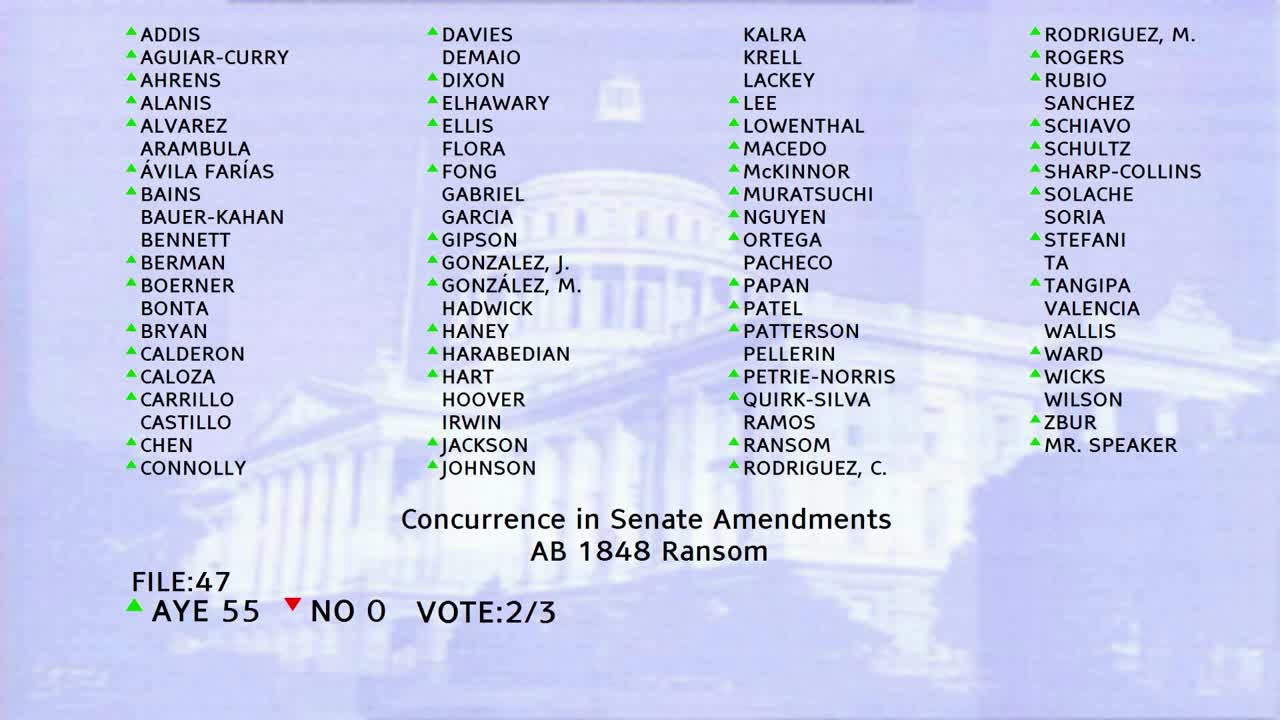
Bill Author
Bill Co-Author(s):