AB 2543: Emergency preparedness: fuel and transportation resources: assessment.
- Session Year: 2025-2026
- House: Assembly
- Latest Version Date: 2026-08-27
Current Status:
Failed
(2026-09-27: Vetoed by Governor.)
Introduced
In Committee
Awaiting First Chamber Vote
Passed First Chamber
In Committee
Awaiting Second Chamber Vote
Passed Second Chamber
Enacted
Existing law, the California Emergency Services Act, generally prescribes duties with regard to various types of emergencies and disasters, including requiring the Governor to coordinate the State Emergency Plan and those programs necessary for the mitigation of the effects of an emergency in this state. Existing law requires the Office of Emergency Services to include in the State Hazard Mitigation Plan an evaluation of risks from specified causes of a long-term electrical outage and, based on that analysis, requires the plan to identify cost-effective and feasible measures to lessen risks from those hazards, including, hardening the critical infrastructure of electrical utilities.
This bill would require, on or before July 1, 2028, the Office of Emergency Services, in consultation with the State Energy Resources Conservation and Development Commission and the Office of Energy Infrastructure Safety, to submit an assessment to the relevant policy committees of the Senate and Assembly that (1) identifies and evaluates emergency types during which Californians access to fuel and transportation resources may be limited in a manner that would impact public health and safety, (2) identifies fuel and transportation resources that are important to maintain during each emergency type based on specified factors, and (3) provides recommendations for actions the state should take in the event of an emergency to ensure that fuel and transportation resources necessary for public health and safety are available during the emergency, as provided.
Existing law, the California Emergency Services Act, generally prescribes duties with regard to various types of emergencies and disasters, including requiring the Governor to coordinate the State Emergency Plan and those programs necessary for the mitigation of the effects of an emergency in this state. Existing law requires the Office of Emergency Services to include in the State Hazard Mitigation Plan an evaluation of risks from specified causes of a long-term electrical outage and, based on that analysis, requires the plan to identify cost-effective and feasible measures to lessen risks from those hazards, including, hardening the critical infrastructure of electrical utilities.
This bill would require, on or before July 1, 2027, 2028, the Office of Emergency Services, in consultation with the State Energy Resources Conservation and Development Commission and the Office of Energy Infrastructure Safety, to submit an assessment to the relevant policy committees of the Senate and Assembly that (1) identify and evaluate identifies and evaluates emergency types during which operators of direct-current fast-charging station sites should be required to maintain operations, Californians access to fuel and transportation resources may be limited in a manner that would impact public health and safety, (2) identify direct-current fast-charging station sites identifies fuel and transportation resources that are important to maintain during each emergency type based on specified factors, and (3) develop recommendations on how long energy should be maintained during each emergency type and on requirements for station operators to ensure operability of identified station sites during each emergency type, as provided. The bill would require, on or before January 1, 2028, and annually thereafter, an operator of a direct-current fast-charging station site identified by the Office of Emergency Services to submit an emergency management plan to the Office of Emergency Services that considers options to be used during an emergency to maintain operations, as provided. The bill would require the Office of Emergency Services to review the emergency management plans and consult with the Office of Energy Infrastructure Safety and the Energy Commission, as necessary. provides recommendations for actions the state should take in the event of an emergency to ensure that fuel and transportation resources necessary for public health and safety are available during the emergency, as provided.
Existing law vests the Public Utilities Commission (PUC) with regulatory authority over public utilities, including electrical corporations. Under existing law, the PUC requires, as part of a general order, an electrical corporation to submit an annual report and emergency and disaster preparedness plan to the PUC.This bill would require an electrical corporation to consider electric vehicle charging stations in its annual report and emergency and disaster preparedness plan.Under existing law, a violation of the Public Utilities Act or any order, decision, rule, direction, demand, or requirement of the PUC is a crime.Because certain provisions of this bill would be part of the act and therefore a violation of the bills requirements, or a violation of a PUC action implementing its requirements, would be a crime, the bill would impose a state-mandated local program.The California Constitution requires the state to reimburse local agencies and school districts for certain costs mandated by the state. Statutory provisions establish procedures for making that reimbursement.This bill would provide that no reimbursement is required by this act for a specified reason.Existing law establishes various duties and responsibilities of the State Energy Resources Conservation and Development Commission (Energy Commission) relating to energy usage in the state, including to carry out research and development into alternative sources of energy, improvements in energy generation, transmission, and siting, fuel substitution, and other topics related to energy supply, demand, public safety, ecology, and conservation that are of particular statewide importance, as provided.
Existing law, the California Emergency Services Act, generally prescribes duties with regard to various types of emergencies and disasters, including requiring the Governor to coordinate the State Emergency Plan and those programs necessary for the mitigation of the effects of an emergency in this state. Existing law requires the Office of Emergency Services to include in the State Hazard Mitigation Plan an evaluation of risks from specified causes of a long-term electrical outage and, based on that analysis, requires the plan to identify cost-effective and feasible measures to lessen risks from those hazards, including, hardening the critical infrastructure of electrical utilities.
This bill would require, on or before July 1, 2027, the State Energy Resources Conservation and Development Commission, in consultation with the Office of Emergency Services Services, in consultation with the Energy Commission and the Office of Energy Infrastructure Safety, to (A) (1) identify and evaluate emergency types during which operators of fast charging direct-current fast-charging station sites should be required to maintain operations, (B) determine direct current fast charging (2) identify direct-current fast-charging station sites that are important to maintain during each emergency type based on specified factors, and (C) (3) develop recommendations on how long power energy should be maintained during each emergency type and on requirements for station operators to ensure operability of identified station sites during each emergency type, as provided. The bill would require, on or before January 1, 2028, and annually thereafter, an operator of a direct current fast charging direct-current fast-charging station site identified by the commission Office of Emergency Services to submit an emergency management plan to the commission Office of Emergency Services that considers options to be used during an emergency to maintain operations, as provided. The bill would require the commission Office of Emergency Services to review the emergency management plans and consult with the Office of Emergency Services and the Office of Energy Infrastructure Safety, Safety and the Energy Commission, as necessary.
Existing law vests the Public Utilities Commission (PUC) with regulatory authority over public utilities, including electrical corporations. Under existing law, the commission PUC requires, as part of a general order, an electrical corporations corporation to submit an annual report and emergency response and disaster preparedness plan to the commission. PUC.
This bill would require an electrical corporation to consider electric vehicle charging stations in its annual report and emergency response and disaster preparedness plan.
Under existing law, a violation of the Public Utilities Act or any order, decision, rule, direction, demand, or requirement of the commission PUC is a crime.
Because the certain provisions of this bill would be a part of the act and therefore a violation of the bills requirements requirements, or a violation of a commission PUC action implementing its requirements requirements, would be a crime, the bill would impose a state-mandated local program.
The California Constitution requires the state to reimburse local agencies and school districts for certain costs mandated by the state. Statutory provisions establish procedures for making that reimbursement.
This bill would provide that no reimbursement is required by this act for a specified reason.
Existing law establishes various duties and responsibilities of the State Energy Resources Conservation and Development Commission relating to energy usage in the state, including to carry out research and development into alternative sources of energy, improvements in energy generation, transmission, and siting, fuel substitution, and other topics related to energy supply, demand, public safety, ecology, and conservation that are of particular statewide importance, as provided.
Existing law, the California Emergency Services Act, generally prescribes duties with regard to various types of emergencies and disasters, including requiring the Governor to coordinate the State Emergency Plan and those programs necessary for the mitigation of the effects of an emergency in this state. Existing law requires the Office of Emergency Services to include in the State Hazard Mitigation Plan an evaluation of risks from specified causes of a long-term electrical outage and, based on that analysis, requires the plan to identify cost-effective and feasible measures to lessen risks from those hazards, including, hardening the critical infrastructure of electrical utilities.
This bill would require, on or before July 1, 2027, the State Energy Resources Conservation and Development Commission, in consultation with the Office of Emergency Services, in consultation with Services and the Office of Energy Infrastructure Safety, to (A) identify and evaluate emergency types during which operators of fast charging station sites should be required to maintain operations, (B) determine direct current fast charging station sites that are important to maintain during an each emergency type based on specified factors factors, and to (C) develop recommendations on how long backup power would be necessary should be maintained during an emergency. each emergency type and on requirements for station operators to ensure operability of station sites during each emergency type, as provided. The bill would require, on or before January 1, 2028, and annually thereafter, an operator of a direct current fast charging station site identified by the Office of Emergency Services as described above commission to submit an emergency management plan to the Office of Emergency Services and the Office of Energy Infrastructure Safety commission that considers backup power options to be used during and after the event of an emergency, an emergency to maintain operations, as provided. The bill would require the commission to review the plans and consult with the Office of Emergency Services and the Office of Energy Infrastructure Safety, as necessary.
Existing law vests the Public Utilities Commission with regulatory authority over public utilities, including electrical corporations. Under existing law, the commission requires, as part of a general order, electrical corporations to submit an annual report and emergency response plan to the commission.
This bill would require an electrical corporation to consider electric vehicle charging stations in its annual report and emergency response plan.
Under existing law, a violation of the Public Utilities Act or any order, decision, rule, direction, demand, or requirement of the commission is a crime.
Because the provisions of this bill would be a part of the act and therefore a violation of the bills requirements or of a commission action implementing its requirements would be a crime, the bill would impose a state-mandated local program.
The California Constitution requires the state to reimburse local agencies and school districts for certain costs mandated by the state. Statutory provisions establish procedures for making that reimbursement.
This bill would provide that no reimbursement is required by this act for a specified reason.
Existing law, the California Emergency Services Act, generally prescribes duties with regard to various types of emergencies and disasters, including requiring the Governor to coordinate the State Emergency Plan and those programs necessary for the mitigation of the effects of an emergency in this state. Existing law requires the Office of Emergency Services to include in the State Hazard Mitigation Plan an evaluation of risks from specified causes of a long-term electrical outage and, based on that analysis, requires the plan to identify cost-effective and feasible measures to lessen risks from those hazards, including, hardening the critical infrastructure of electrical utilities.
This bill would require, on or before June July 1, 2027, the Office of Emergency Services to, in Services, in consultation with the State Energy Resources Conservation and Development Commission establish a working group to evaluate the resilience of publicly available electric vehicle fast charging stations during and following a disaster. The bill would require, on or before January 1, 2028, the working group to issue guidelines to city and county emergency managers on how its recommendations may be incorporated into local emergency plans. The bill would define terms for its purposes. Office of Energy Infrastructure Safety, to determine direct current fast charging station sites that are important to maintain during an emergency based on specified factors and to develop recommendations on how long backup power would be necessary during an emergency. The bill would require, on or before January 1, 2028, an operator of a direct current fast charging station site identified by the Office of Emergency Services as described above to submit an emergency management plan to the Office of Emergency Services and the Office of Energy Infrastructure Safety that considers backup power options to be used during and after the event of an emergency, as provided.
Existing law vests the Public Utilities Commission with regulatory authority over public utilities, including electrical corporations. Under existing law, the commission requires, as part of a general order, electrical corporations to submit an annual report and emergency response plan to the commission.
This bill would require an electrical corporation to consider electric vehicle charging stations in its annual report and emergency response plan.
Under existing law, a violation of the Public Utilities Act or any order, decision, rule, direction, demand, or requirement of the commission is a crime.
Because the provisions of this bill would be a part of the act and therefore a violation of the bills requirements or of a commission action implementing its requirements would be a crime, the bill would impose a state-mandated local program.
The California Constitution requires the state to reimburse local agencies and school districts for certain costs mandated by the state. Statutory provisions establish procedures for making that reimbursement.
This bill would provide that no reimbursement is required by this act for a specified reason.
Existing law, the California Emergency Services Act, generally prescribes duties with regard to various types of emergencies and disasters, including requiring the Governor to coordinate the State Emergency Plan and those programs necessary for the mitigation of the effects of an emergency in this state. Existing law requires the Office of Emergency Services to include in the State Hazard Mitigation Plan an evaluation of risks from specified causes of a long-term electrical outage and, based on that analysis, requires the plan to identify cost-effective and feasible measures to lessen risks from those hazards, including, hardening the critical infrastructure of electrical utilities.
This bill would state that it is the intent of the Legislature to enact legislation that ensures Californias electric vehicle charging infrastructure will remain operational during a disaster. require, on or before June 1, 2027, the Office of Emergency Services to, in consultation with the State Energy Resources Conservation and Development Commission establish a working group to evaluate the resilience of publicly available electric vehicle fast charging stations during and following a disaster. The bill would require, on or before January 1, 2028, the working group to issue guidelines to city and county emergency managers on how its recommendations may be incorporated into local emergency plans. The bill would define terms for its purposes.
Existing law, the California Emergency Services Act, generally prescribes duties with regard to various types of emergencies and disasters, including requiring the Governor to coordinate the State Emergency Plan and those programs necessary for the mitigation of the effects of an emergency in this state. Existing law requires the Office of Emergency Services to include in the State Hazard Mitigation Plan an evaluation of risks from specified causes of a long-term electrical outage and, based on that analysis, requires the plan to identify cost-effective and feasible measures to lessen risks from those hazards, including, hardening the critical infrastructure of electrical utilities.
This bill would state that it is the intent of the Legislature to enact legislation that ensures Californias electric vehicle charging infrastructure will remain operational during a disaster.
(a)On or before July 1, 2028, the Office of Emergency Services, in consultation with the State Energy Resources Conservation and Development Commission and the Office of Energy Infrastructure Safety, shall submit an assessment to the relevant policy committees of the Senate and Assembly that does all of the following:
(1)Identifies and evaluates the types of emergencies during which Californians access to fuel and transportation resources may be limited in a manner that would impact public health and safety during the emergency. The emergency types the Office of Emergency Services shall evaluate include, but are not limited to, a seismic event, a deenergization event, an extreme weather condition, and a wildfire.
(2)Identifies fuel and transportation resources that are important to maintain, and maintain access to, during each emergency type identified pursuant to paragraph (1) based on considerations that shall include, but not be limited to, all of the following factors:
(A)Population that is reliant on the fuel and transportation resources.
(B)Geographical location of the fuel and transportation resources.
(C)Types of fuel and transportation resources used by populations impacted by emergencies, including the rate of electric vehicle adoption in a region prone to emergencies.
(D)Evacuation fuel and transportation resources needed for different types of emergencies.
(E)Safety of accessing the fuel and transportation resources during the emergency.
(F)Whether the population using the fuel and transportation resources can be adequately served by alternative fuel and transportation resources during an emergency.
(3)Provides recommendations for actions the state should take in the event of an emergency to ensure that fuel and transportation resources necessary for public health and safety are available during the emergency, including recommendations for any fuel and transportation resources that should be made available to Californians under evacuation orders.
(b)The Office of Emergency Services shall provide opportunities for public comment and feedback when conducting the activities required pursuant to subdivision (a).
(a)On or before July 1, 2027, 2028, the Office of Emergency Services, in consultation with the State Energy Resources Conservation and Development Commission and the Office of Energy Infrastructure Safety, shall do submit an assessment to the relevant policy committees of the Senate and Assembly that does all of the following:
(1)Identify and evaluate Identifies and evaluates the types of emergencies during which operators of direct-current fast-charging station sites should be required to maintain operations. Californians access to fuel and transportation resources may be limited in a manner that would impact public health and safety during the emergency. The emergency types the Office of Emergency Services shall evaluate include, but are not limited to, a seismic event, a deenergization event, an extreme weather condition, and a wildfire.
(2)Identify direct-current fast-charging station sites Identifies fuel and transportation resources that are important to maintain maintain, and maintain access to, during each emergency type identified pursuant to paragraph (1) based on considerations that shall include, but not be limited to, all of the following factors:
(A)Population density. that is reliant on the fuel and transportation resources.
(B)Geographical area. location of the fuel and transportation resources.
(C)Number of chargers per station site.(D)Distance to the next station site.(C)Types of fuel and transportation resources used by populations impacted by emergencies, including the rate of electric vehicle adoption in a region prone to emergencies.
(D)Evacuation fuel and transportation resources needed for different types of emergencies.
(E)Safety of accessing the station site fuel and transportation resources during the emergency.
(F)Whether the population using the station site fuel and transportation resources can be adequately served by mobile charger deployment. alternative fuel and transportation resources during an emergency.
(3)Develop recommendations on the duration for which energy should be maintained during each emergency type identified pursuant to paragraph (1).(4)Develop recommendations on requirements for operators of station sites identified pursuant to paragraph (2) to ensure operability of those station sites during each emergency type, including the type of backup power to be provided. For purposes of this paragraph, backup power means anything that may be used to provide off-grid energy to direct-current fast-charging stations, including, but not limited to, backup generators.(3)Provides recommendations for actions the state should take in the event of an emergency to ensure that fuel and transportation resources necessary for public health and safety are available during the emergency, including recommendations for any fuel and transportation resources that should be made available to Californians under evacuation orders.
(5)Provide opportunity
(b)The Office of Emergency Services shall provide opportunities for public comment and feedback when conducting the activities required pursuant to paragraphs (1) to (4), inclusive. subdivision (a).
(b)The Office of Emergency Services, in consultation with the State Energy Resources Conservation and Development Commission and the Office of Energy Infrastructure Safety, shall meet annually to review and update the activities required pursuant to subdivision (a).(c)(1)On or before January 1, 2028, an operator of a direct-current fast-charging station site identified pursuant to paragraph (2) of subdivision (a) shall submit an emergency management plan to the Office of Emergency Services that considers options to be used during an emergency, including, but not limited to, a seismic event, deenergization event, extreme weather condition, or wildfire, to maintain operations.(2)The Office of Emergency Services shall review the emergency management plans and consult with the Office of Energy Infrastructure Safety and the State Energy Resources Conservation and Development Commission, as necessary.(3)An operator shall submit an emergency management plan annually and include a report on if, how, and when an identified station site was maintained during an emergency.SEC. 2.Section 590.5 is added to the Public Utilities Code, to read:590.5.An electrical corporation shall consider electric vehicle charging stations in its annual report and emergency and disaster preparedness plan prepared pursuant to commission General Order No. 166.SEC. 3.No reimbursement is required by this act pursuant to Section 6 of Article XIIIB of the California Constitution because the only costs that may be incurred by a local agency or school district will be incurred because this act creates a new crime or infraction, eliminates a crime or infraction, or changes the penalty for a crime or infraction, within the meaning of Section 17556 of the Government Code, or changes the definition of a crime within the meaning of Section 6 of Article XIIIB of the California Constitution.(a)On or before July 1, 2027, the State Energy Resources Conservation and Development Commission, in consultation with the Office of Emergency Services Services, in consultation with the State Energy Resources Conservation and Development Commission and the Office of Energy Infrastructure Safety, shall do all of the following:
(1)Identify and evaluate the types of emergencies during which operators of direct current fast charging direct-current fast-charging station sites should be required to maintain operations. The emergency types the commission Office of Emergency Services shall evaluate include, but are not limited to, a seismic event, a public safety power shutoff deenergization event, an extreme weather condition, and a wildfire.
(2)Determine direct current fast charging Identify direct-current fast-charging station sites that are important to maintain during each emergency type identified pursuant to paragraph (1) based on considerations that shall include, but are not be limited to, all of the following factors:
(A)Population density.
(B)Geographical area.
(C)Number of chargers per station site.
(D)Distance to the next station site.
(E)Safety of accessing the station site during the emergency.
(F)Whether the population using the station site can be adequately served by mobile charger deployment.
(3)Develop recommendations on the duration for which power energy should be maintained during each emergency type identified pursuant to paragraph (1).
(4)Develop recommendations on requirements for station operators of station sites identified pursuant to paragraph (2) to ensure operability of those station sites during each emergency type, including the type of backup power to be provided. For purposes of this paragraph, backup power means anything that may be used to provide off-grid power to direct current fast charging energy to direct-current fast-charging stations, including, but not limited to, backup generators.
(5)Provide opportunity for public comment and feedback when conducting the activities required pursuant to paragraphs (1) to (4), inclusive.
(b)The State Energy Resources Conservation and Development Commission, the Office of Emergency Services, Services, in consultation with the State Energy Resources Conservation and Development Commission and the Office of Energy Infrastructure Safety Safety, shall meet annually to review and update the activities required pursuant to subdivision (a).
(c)(1)On or before January 1, 2028, an operator of a direct current fast charging direct-current fast-charging station site identified pursuant to paragraph (1) (2) of subdivision (a) shall submit an emergency management plan to the State Energy Resources Conservation and Development Commission Office of Emergency Services that considers options to be used during an emergency to maintain operations. emergency, including, but not limited to, a seismic event, deenergization event, extreme weather condition, or wildfire, to maintain operations.
(2)The commission Office of Emergency Services shall review the emergency management plans and consult with the Office of Emergency Services and Office of Energy Infrastructure Safety, Safety and the State Energy Resources Conservation and Development Commission, as necessary.
(3)An operator shall submit a an emergency management plan annually and include a report on if, how, and when a an identified station site was maintained during an emergency.
SEC. 2.Section 590.5 is added to the Public Utilities Code, to read:590.5.An electrical corporation shall consider electric vehicle charging stations in its annual report and emergency response and disaster preparedness plan prepared pursuant to Public Utilities Commission commission General Order No. 166.
SEC. 3.No reimbursement is required by this act pursuant to Section 6 of Article XIIIB of the California Constitution because the only costs that may be incurred by a local agency or school district will be incurred because this act creates a new crime or infraction, eliminates a crime or infraction, or changes the penalty for a crime or infraction, within the meaning of Section 17556 of the Government Code, or changes the definition of a crime within the meaning of Section 6 of Article XIIIB of the California Constitution.
(a)On or before July 1, 2027, the State Energy Resources Conservation and Development Commission, in consultation with the Office of Emergency Services, in consultation with Services and the Office of Energy Infrastructure Safety, shall do both all of the following:
(1)Identify and evaluate the types of emergencies during which operators of direct current fast charging station sites should be required to maintain operations. The emergency types the commission shall evaluate include, but are not limited to, a seismic event, a public safety power shutoff event, an extreme weather condition, and a wildfire.
(1)(2)Determine direct current fast charging station sites that are important to maintain during an each emergency type identified pursuant to paragraph (1) based on, on considerations that shall include, but are not limited to, all of the following factors:
(A)Population density.
(B)Geographical area.
(C)Number of chargers per station. station site.
(D)Distance to the next direct current fast charging station. station site.
(E)Safety of accessing the station site during the emergency.
(F)Whether the population using the station site can be adequately served by mobile charger deployment.
(2)(3)Develop recommendations on how long backup the duration for which power would be necessary should be maintained during an emergency. each emergency type identified pursuant to paragraph (1).
(4)Develop recommendations on requirements for station operators to ensure operability of station sites during each emergency type, including the type of backup power to be provided. For purposes of this paragraph, backup power means anything that may be used to provide off-grid power to direct current fast charging stations, including, but not limited to, backup generators.
(5)Provide opportunity for public comment and feedback when conducting the activities required pursuant to paragraphs (1) to (4), inclusive.
(b)The State Energy Resources Conservation and Development Commission, the Office of Emergency Services, and the Office of Energy Infrastructure Safety shall meet annually to review and update the activities required pursuant to subdivision (a).
(b)(c)(1)On or before January 1, 2028, an operator of a direct current fast charging station site identified pursuant to paragraph (1) of subdivision (a) shall submit an emergency management plan to the Office of Emergency Services and the Office of Energy Infrastructure Safety State Energy Resources Conservation and Development Commission that considers backup power options to be used during and after the event of an emergency, including, but not limited to, a seismic event, public safety power event, extreme weather condition, or wildfire. an emergency to maintain operations.
(2)The commission shall review the plans and consult with the Office of Emergency Services and Office of Energy Infrastructure Safety, as necessary.
(3)An operator shall submit a plan annually and include a report on if, how, and when a identified station site was maintained during an emergency.
(c)For purposes of this section, backup power means anything that may be used to provide off-grid power to direct current fast charging stations, including, but not limited to, backup generators and mobile charger deployment.SEC. 2.Section 590.5 is added to the Public Utilities Code, to read:590.5.An electrical corporation shall consider electric vehicle charging stations in its annual report and emergency response plan prepared pursuant to Public Utilities Commission General Order No. 166.
SEC. 3.No reimbursement is required by this act pursuant to Section 6 of Article XIIIB of the California Constitution because the only costs that may be incurred by a local agency or school district will be incurred because this act creates a new crime or infraction, eliminates a crime or infraction, or changes the penalty for a crime or infraction, within the meaning of Section 17556 of the Government Code, or changes the definition of a crime within the meaning of Section 6 of Article XIIIB of the California Constitution.
(a)On or before July 1, 2027, the Office of Emergency Services, in consultation with the Office of Energy Infrastructure Safety, shall do both of the following:
(1)Determine direct current fast charging station sites that are important to maintain during an emergency based on, but not limited to, all of the following factors:
(A)Population density.
(B)Geographical area.
(C)Number of chargers per station.
(D)Distance to the next direct current fast charging station.
(2)Develop recommendations on how long backup power would be necessary during an emergency.
(b)On or before January 1, 2028, an operator of a direct current fast charging station site identified pursuant to paragraph (1) of subdivision (a) shall submit an emergency management plan to the Office of Emergency Services and the Office of Energy Infrastructure Safety that considers backup power options to be used during and after the event of an emergency, including, but not limited to, a seismic event, public safety power event, extreme weather condition, or wildfire.
(c)For purposes of this section, backup power means anything that may be used to provide off-grid power to direct current fast charging stations, including, but not limited to, backup generators and mobile charger deployment.
SEC. 2.Section 590.5 is added to the Public Utilities Code, to read:590.5.An electrical corporation shall consider electric vehicle charging stations in its annual report and emergency response plan prepared pursuant to Public Utilities Commission General Order No. 166.
SEC. 3.No reimbursement is required by this act pursuant to Section 6 of Article XIIIB of the California Constitution because the only costs that may be incurred by a local agency or school district will be incurred because this act creates a new crime or infraction, eliminates a crime or infraction, or changes the penalty for a crime or infraction, within the meaning of Section 17556 of the Government Code, or changes the definition of a crime within the meaning of Section 6 of Article XIIIB of the California Constitution.
SECTION 1.Section 8570.7 is added to the Government Code, to read:8570.7.(a)For the purpose of this section, all of the following definitions shall apply:(1)Electric vehicle fast charging station means a direct current fast charging station that electrical vehicles use for charging purposes.(2)Resilience means the safe maintenance and operation of electric vehicle fast charging stations.(b)On or before June 1, 2027, the Office of Emergency Services, in consultation with the State Energy Resources Conservation and Development Commission, shall establish a working group to evaluate the resilience of publicly available electric vehicle fast charging stations during and following a disaster.(c)On or before January 1, 2028, the working group established by this section shall issue guidelines to city and county emergency managers on how its recommendations may be incorporated into local emergency plans.(a)For the purpose of this section, all of the following definitions shall apply:
(1)Electric vehicle fast charging station means a direct current fast charging station that electrical vehicles use for charging purposes.
(2)Resilience means the safe maintenance and operation of electric vehicle fast charging stations.
(b)On or before June 1, 2027, the Office of Emergency Services, in consultation with the State Energy Resources Conservation and Development Commission, shall establish a working group to evaluate the resilience of publicly available electric vehicle fast charging stations during and following a disaster.
(c)On or before January 1, 2028, the working group established by this section shall issue guidelines to city and county emergency managers on how its recommendations may be incorporated into local emergency plans.
SECTION 1.It is the intent of the Legislature to enact legislation that ensures Californias electric vehicle charging infrastructure will remain operational during a disaster.It is the intent of the Legislature to enact legislation that ensures Californias electric vehicle charging infrastructure will remain operational during a disaster.
|
Date
|
Status
|
|---|---|
| Sep 27, 2026 | Vetoed by Governor. |
| Aug 31, 2026 | Enrolled and presented to the Governor at 4 p.m. |
| Aug 25, 2026 | Senate amendments concurred in. To Engrossing and Enrolling. (Ayes 74. Noes 0. Page 6488.). |
| Aug 25, 2026 | Senate amendments concurred in. To Engrossing and Enrolling. (Ayes 74. Noes 0.). |
| Aug 24, 2026 | In Assembly. Concurrence in Senate amendments pending. |
| Aug 24, 2026 | Read third time. Passed. Ordered to the Assembly. (Ayes 31. Noes 2. Page 5700.). |
| Aug 24, 2026 | Read third time. Passed. Ordered to the Assembly. (Ayes 31. Noes 2.). |
| Aug 13, 2026 | Read second time. Ordered to third reading. |
| Aug 13, 2026 | From committee: Do pass. (Ayes 5. Noes 1.) (August 13). |
| Aug 3, 2026 | In committee: Referred to APPR. suspense file. |
| Jul 2, 2026 | Read second time and amended. Re-referred to Com. on APPR. |
| Jul 1, 2026 | From committee: Amend, and do pass as amended and re-refer to Com. on APPR. (Ayes 15. Noes 0.) (June 30). |
| Jun 24, 2026 | From committee: Do pass and re-refer to Com. on E., U & C. (Ayes 6. Noes 1.) (June 23). Re-referred to Com. on E., U & C. |
| Jun 10, 2026 | Referred to Coms. on E.M. and E., U & C. |
| May 27, 2026 | In Senate. Read first time. To Com. on RLS. for assignment. |
| May 26, 2026 | Read third time. Passed. Ordered to the Senate. (Ayes 72. Noes 1. Page 5385.) |
| May 26, 2026 | Read third time. Passed. Ordered to the Senate. (Ayes 72. Noes 1.) |
| May 26, 2026 | Read third time. Passed. Ordered to the Senate. |
| May 19, 2026 | Read second time. Ordered to third reading. |
| May 18, 2026 | Read second time and amended. Ordered returned to second reading. |
| May 14, 2026 | From committee: Amend, and do pass as amended. (Ayes 11. Noes 0.) (May 14). |
| May 6, 2026 | In committee: Set, first hearing. Referred to APPR. suspense file. |
| Apr 28, 2026 | Re-referred to Com. on APPR. |
| Apr 27, 2026 | Read second time and amended. |
| Apr 23, 2026 | From committee: Amend, and do pass as amended and re-refer to Com. on APPR. (Ayes 18. Noes 0.) (April 22). |
| Apr 16, 2026 | Re-referred to Com. on U. & E. |
| Apr 15, 2026 | Read second time and amended. |
| Apr 14, 2026 | From committee: Amend, and do pass as amended and re-refer to Com. on U. & E. with recommendation: To Consent Calendar. (Ayes 6. Noes 0.) (April 13). |
| Mar 23, 2026 | Re-referred to Com. on E.M. |
| Mar 19, 2026 | From committee chair, with author's amendments: Amend, and re-refer to Com. on E.M. Read second time and amended. |
| Mar 19, 2026 | Referred to Coms. on E.M and U. & E. |
| Feb 21, 2026 | From printer. May be heard in committee March 23. |
| Feb 20, 2026 | Read first time. To print. |
|
Date
|
Description
|
Location
|
Votes
|
|
|---|---|---|---|---|
| Aug 25, 2026 | AB 2543 Ransom Concurrence in Senate Amendments | Assembly Floor |
Passed |
|
| Aug 24, 2026 | Assembly 3rd Reading AB2543 Ransom et al. By Wahab | Senate Floor |
Passed |
|
| Aug 13, 2026 | Do pass | Senate Standing Committee on Appropriations |
Passed |
|
| Aug 3, 2026 | Placed on suspense file | Senate Standing Committee on Appropriations |
Passed |
|
| Jun 30, 2026 | Do pass as amended, but first amend, and re-refer to the Committee on [Appropriations] | Senate Standing Committee on Energy, Utilities and Communications |
Passed |
|
| Jun 23, 2026 | Do pass, but first be re-referred to the Committee on [Energy, Utilities and Communications] | Senate Standing Committee on Emergency Management |
Passed |
|
| May 26, 2026 | AB 2543 Ransom Assembly Third Reading | Assembly Floor |
Passed |
|
| May 14, 2026 | Do pass as amended. | Assembly Standing Committee on Appropriations |
Passed |
|
| Apr 22, 2026 | Do pass as amended and be re-referred to the Committee on [Appropriations] | Assembly Standing Committee on Utilities and Energy |
Passed |
|
| Apr 13, 2026 | Do pass as amended, and be re-referred to the Committee on [Utilities and Energy] with recommendation: To Consent Calendar | Assembly Standing Committee on Emergency Management |
Passed |
This list shows positions taken on this bill by organizations on the date displayed, which is linked to the original source.
Positions by individuals are not included.
|
Organization
|
Position
|
Date
|
|---|---|---|
| ABB E-mobility | ** Against | |
| California Electric Transportation Coalition | ** Against | |
| California Fuels And Convenience Alliance | ** Against | |
| ChargePoint | ** Against | |
| Electric Vehicle Charging Association | ** Against | |
| Electric Vehicle Charging Association (EVCA) | ** Against | |
| ELECTRIFY AMERICA, LLC | ** Against | |
| Forum Mobility | ** Against | |
| Gateway Fleets | ** Against | |
| Governor Gavin Newsom | ** Against | |
| Powering America’s Commercial Transportation | ** Against | |
| Tesla Motors | ** Against | |
| Workhorse | ** Against | |
| Workhorse Group | ** Against | |
| Zeem | ** Against | |
| Zeem Solutions | ** Against |
GOVERNOR'S VETO
GV Bill Id:AB 2543
Author:(Ransom)
As Enrolled Ver:August 27, 2026
2/3 vote
SUMMARY
This bill directs the California Office of Emergency Services (Cal OES) to consult with the State Energy Resources Conservation and Development Commission (CEC) and the Office of Energy Infrastructure Safety (OEIS) to submit an assessment to the Legislature, by July 1, 2028, that evaluates the impact of emergencies on fuel and transportation access, identifies critical resources, and recommends state actions to ensure public safety and evacuation capabilities, as specified.
Senate Amendments
- Strike requirements that require Cal OES to identify direct-current fast-charging (DCFC) station sites that are important to maintain operations during identified emergency types, recommendations on how long energy should be maintained to operate DCFCs during emergencies, and mandatory emergency management plans submissions by operators.
- Strike the requirement for electrical corporations to consider electric vehicle charging stations in its annual report and emergency and disaster preparedness plan prepared pursuant to Public Utilities Commission General Order No. 166.
- Requires Cal OES, in consultation with the CEC and OEIS, to submit an assessment to the relevant policy committees of the Senate and Assembly that does all of the following:
- Identifies and evaluates the types of emergencies during which Californians’ access to fuel and transportation resources may be limited in a manner that would impact public health and safety during the emergency. The emergency types the Office of Emergency Services shall evaluate include, but are not limited to, a seismic event, a deenergization event, an extreme weather condition, and a wildfire.
- Identifies fuel and transportation resources that are important to maintain, and maintain access to, during each emergency type identified pursuant to paragraph (a) based on considerations that shall include, but not be limited to, all of the following factors:
- Population that is reliant on the fuel and transportation resources.
- Geographical location of the fuel and transportation resources.
- Types of fuel and transportation resources used by populations impacted by emergencies, including the rate of electric vehicle adoption in a region prone to emergencies.
- Evacuation fuel and transportation resources needed for different types of emergencies.
- Safety of accessing the fuel and transportation resources during the emergency.
- Whether the population using the fuel and transportation resources can be adequately served by alternative fuel and transportation resources during an emergency.
- Provides recommendations for actions the state should take in the event of an emergency to ensure that fuel and transportation resources necessary for public health and safety are available during the emergency, including recommendations for any fuel and transportation resources that should be made available to Californians under evacuation orders.
- Requires Cal OES to provide opportunities for public comment and feedback when conducting the activities required pursuant to the bill.
Governor’s Veto Message
I am returning Assembly Bill 2543 without my signature.
This bill would require the Office of Emergency Services (OES), in consultation with the California Energy Commission and the Office of Energy Infrastructure Safety, to produce, by July 1, 2028, a statewide assessment evaluating how emergency events affect Californians' access to fuel and transportation resources, identifying essential resources across emergency types, and recommending actions the state should take to ensure fuel and transportation availability during disasters.
I appreciate the author's intent to strengthen California's emergency preparedness and ensure continuity of critical mobility resources during emergencies. Maintaining access to fuel and transportation is essential to public health, safety, evacuation readiness, moving goods, and operation of critical infrastructure.
However, a study of this scale would require substantial new staffing and technical expertise and far longer timelines than those set in the bill, and would divert the OES from core public safety missions by assigning work more appropriately led by agencies with energy systems expertise such as the California Energy Commission.
My administration remains committed to ensuring that Californians have access to essential transportation and fuel resources during emergencies. We will continue pursuing approaches that strengthen resilience through existing statewide systems and partnerships.
For these reasons, I cannot sign this bill.
COMMENTS
Impacts on Fuel and Transportation Resources during an Emergency: It is well documented that natural disasters disproportionately impact vulnerable communities, such as low-income families, older adults, people with disabilities, and rural residents. Some emergency response systems rely on evacuations via private vehicles owned by individuals, but these systems may result in vulnerable groups stranded during disasters. A recent study on wildfire response, recovery, and resilience for resource-constrained and vulnerable communities noted that households relying on public or government-provided transit frequently face evacuation delays.[1] A report from the Legislative Analyst Office enumerates the many ways climate change impacts transportation, such as infrastructure deterioration due to an increase in natural disasters, which will require modification or relocation to remain usable. [2] During a natural disaster, severe ground movement, flooding, or structural collapse can cause automated seismic valves to trigger, or force utility companies to deliberately cut off fuel networks or initiate Public Safety Power Shutoff (PSPS) events (also known as deenergization events) to prevent catastrophic fires from broken pipelines or downed power lines.[3], [4]Additionally, a 2023 report from the Natural Hazards Center looked at transportation as a social determinant of health during Hurricane Idalia, a destructive tropical cyclone that caused significant damage across Northern Florida and parts of the southeastern United States. The report noted that there were disparities in access to public assistance in vulnerable areas, with interviewed participants who had transportation and food insecurity reporting they had less access to disaster aid provided by the Federal Emergency Management Agency, the Red Cross, and community-based organizations.[5] Strengthening California’s emergency preparedness requires a clear understanding of how fuel and transportation shortages jeopardize public health and safety.
Cal OES' Emergency Preparedness and Response: In California, Cal OES is responsible for addressing natural, technological, or manmade disasters and emergencies, and preparing the State to prevent, respond to, quickly recover from, and mitigate the effects of both intentional and natural disasters. As part of their overall preparedness mission, Cal OES is required to develop a State Emergency Plan (SEP) and State Hazard Mitigation Plan (SHMP); maintain the Standardized Emergency Management System (SEMS) and the Emergency Management Mutual Aid System (EMMA); and assist counties with their local Emergency Operation Plans (EOP). Cal OES, in coordination with FEMA and local partners, has developed four Catastrophic Plans to augment the State Emergency Plan.
State Energy Resources Conservation and Development Commission (California Energy Commission): The California Energy Commission (CEC) is the primary state agency responsible for planning, funding, and advancing California’s public electric vehicle (EV) charging infrastructure. Through programs such as the Clean Transportation Program and federal National Electric Vehicle Infrastructure (NEVI) implementation, the CEC supports the build-out of direct current fast charging (DCFC) networks along highways and in communities statewide. [6],[7]
Office of Energy Infrastructure Safety (Energy Safety): Energy Safety is responsible for advancing the safety and resiliency of California's electrical infrastructure, focusing on reducing utility-caused wildfire risk. Energy Safety reviews, evaluates, and approves wildfire mitigation plans submitted to the agency by investor-owned utilities, while also monitoring compliance with state laws, regulations, and approved safety measures. The agency also conducts compliance audits, enforcement activities, and technical evaluations to ensure wildfire mitigation plans are implemented appropriately and effectively.
According to the Author
California faces increasingly frequent and severe emergencies, including wildfires, floods, earthquakes, extreme weather events, and Public Safety Power Shutoffs (PSPS). These events can disrupt transportation networks and limit access to fuel resources that Californians rely on to safely evacuate, access essential services, and maintain daily activities. The importance and role of fuel and transportation resources, including electrical vehicle (EV) resilience, during natural disasters is recognized at both the federal and state level, through California's clean transportation goals and the Federal highway Administration's National Electrical Vehicle Infrastructure (NEVI) Program, which encourages consideration of reliability and emergency preparedness, with recognition of charging networks. As California's transportation sector continues to evolve, emergency preparedness efforts must account for how emergencies affect all transportation and fuel resources used by the public. AB 2543 would gather information related to relevant resources, identify potential vulnerabilities, and ensure that state emergency planners have a clearer understanding of how transportation and fuel resource disruptions affect Californians during emergencies. By providing a comprehensive assessment of transportation and fuel-related challenges during emergencies, this bill will help inform future emergency planning efforts, strengthen statewide preparedness, and support the development of practical recommendations that enhance public safety and community resilience before the next disaster occurs.
Arguments in Support
None on file.
Arguments in Opposition
None on file.
FISCAL COMMENTS
According to the Senate Appropriations Committee
- OES estimates costs of $1,883,000 in the first year and $1,108,000 ongoing to complete the assessment (General Fund). This estimate includes costs for 4.0 positions and $775,000 in one-time consulting costs.
- CEC estimates total one-time costs of $267,000 (Alternative and Renewable Fuel and Vehicle Technology Program Fund or Energy Resources Programs Account) , which includes:
- $72,000 for a limited-term Electric Generation System Program Specialist I in the Fuels and Transportation Division to assist with the study of direct current fast charging stations.
- $95,000 for a limited-term Research Data Specialist II in the Energy Assessments Division to assist with the study of liquid fuel service stations.
- $100,000 in one-time contracting costs to build a statewide service station dataset.
VOTES
ASM EMERGENCY MANAGEMENT: 6-0-0
YES: Ransom, Hadwick, Arambula, Bains, Bennett, Calderon
ASM UTILITIES AND ENERGY: 18-0-0
YES: Petrie-Norris, Patterson, Boerner, Calderon, Chen, Davies, Mark González, Harabedian, Hart, Irwin, Kalra, Papan, Rogers, Schiavo, Schultz, Ta, Wallis, Zbur
ASM APPROPRIATIONS: 11-0-4
YES: Wicks, Aguiar-Curry, Calderon, Caloza, Fong, Mark González, Krell, Pacheco, Pellerin, Sharp-Collins, Solache
ABS, ABST OR NV: Hoover, Dixon, Ta, Tangipa
ASSEMBLY FLOOR: 72-1-7
YES: Addis, Aguiar-Curry, Ahrens, Alanis, Alvarez, Arambula, Ávila Farías, Bains, Bauer-Kahan, Bennett, Berman, Boerner, Bonta, Bryan, Calderon, Caloza, Carrillo, Castillo, Chen, Connolly, Davies, Elhawary, Ellis, Fong, Gabriel, Gallagher, Garcia, Gipson, Jeff Gonzalez, Mark González, Hadwick, Haney, Harabedian, Hart, Hoover, Irwin, Jackson, Kalra, Krell, Lee, Lowenthal, McKinnor, Nguyen, Ortega, Pacheco, Papan, Patel, Patterson, Pellerin, Petrie-Norris, Quirk-Silva, Ramos, Ransom, Michelle Rodriguez, Rogers, Blanca Rubio, Sanchez, Schiavo, Schultz, Sharp-Collins, Solache, Soria, Stefani, Ta, Tangipa, Valencia, Wallis, Ward, Wicks, Wilson, Zbur, Rivas
NO: DeMaio
ABS, ABST OR NV: Dixon, Flora, Johnson, Lackey, Macedo, Muratsuchi, Celeste Rodriguez
SENATE FLOOR: 31-2-7
YES: Allen, Archuleta, Arreguín, Ashby, Becker, Blakespear, Cabaldon, Caballero, Cervantes, Cortese, Durazo, Gonzalez, Grayson, Hurtado, Laird, Limón, McGuire, McNerney, Menjivar, Ochoa Bogh, Padilla, Pérez, Reyes, Richardson, Rubio, Smallwood-Cuevas, Stern, Umberg, Wahab, Weber Pierson, Wiener
NO: Choi, Seyarto
ABS, ABST OR NV: Alvarado-Gil, Dahle, Grove, Jones, Niello, Strickland, Valladares
ASSEMBLY FLOOR: 74-0-5
YES: Addis, Aguiar-Curry, Ahrens, Alanis, Alvarez, Arambula, Ávila Farías, Bains, Bauer-Kahan, Bennett, Berman, Boerner, Bonta, Bryan, Calderon, Caloza, Carrillo, Castillo, Chen, Connolly, Davies, DeMaio, Elhawary, Flora, Fong, Gabriel, Gipson, Jeff Gonzalez, Mark González, Hadwick, Haney, Harabedian, Hart, Hoover, Irwin, Jackson, Kalra, Krell, Lackey, Lee, Lowenthal, Macedo, Muratsuchi, Nguyen, Ortega, Pacheco, Papan, Patel, Patterson, Pellerin, Petrie-Norris, Quirk-Silva, Ramos, Ransom, Celeste Rodriguez, Michelle Rodriguez, Rogers, Blanca Rubio, Sanchez, Schiavo, Schultz, Sharp-Collins, Solache, Soria, Stefani, Ta, Tangipa, Valencia, Wallis, Ward, Wicks, Wilson, Zbur, Rivas
ABS, ABST OR NV: Dixon, Ellis, Garcia, Johnson, McKinnor
UPDATED
VERSION: August 27, 2026
CONSULTANT: Ugbad Farah / E.M. / (916) 319-3802 FN: 0004634
Wildfire Recovery and Resilience Strategies for Resource-Constrained and Vulnerable Communities, https://its.ucla.edu/publication/wildfire-recovery-and-resilience-strategies-for-resource-constrained-and-vulnerable-communities/ ↑
Climate Change Impacts Across California Transportation, https://lao.ca.gov/Publications/Report/4576#Major_Climate_Change_Impacts_on_Transportation ↑
Automatic Gas Shutoff Valves, https://basc.pnnl.gov/resource-guides/automatic-gas-shutoff-valves ↑
Public Safety Power Shutoffs (PSPS), https://www.cpuc.ca.gov/psps/ ↑
Transportation as a Social Determinant of Health During Hurricane Idalia, https://hazards.colorado.edu/health-and-extreme-weather-research/transportation-as-a-social-determinant-of-health-during-hurricane-idalia ↑
National Electric Vehicle Infrastructure (NEVI) Formula Program, https://afdc.energy.gov/laws/12744 ↑
Clean Transportation Program, https://www.energy.ca.gov/programs-and-topics/programs/clean-transportation-program ↑
CONCURRENCE IN SENATE AMENDMENTS
CSA1 Bill Id:AB 2543
Author:(Ransom)
As Amended Ver:July 2, 2026
Majority vote
SUMMARY
This bill directs the California Office of Emergency Services (Cal OES) to consult with the State Energy Resources Conservation and Development Commission (CEC) and the Office of Energy Infrastructure Safety (OEIS) to submit an assessment to the Legislature, by July 1, 2028, that evaluates the impact of emergencies on fuel and transportation access, identifies critical resources, and recommends state actions to ensure public safety and evacuation capabilities, as specified.
Senate Amendments
- Strike requirements that require Cal OES to identify direct-current fast-charging (DCFC) station sites that are important to maintain operations during identified emergency types, recommendations on how long energy should be maintained to operate DCFCs during emergencies, and mandatory emergency management plans submissions by operators.
- Strikes requirement for electrical corporations to consider electric vehicle charging stations in its annual report and emergency and disaster preparedness plan prepared pursuant to Public Utilities Commission General Order No. 166.
- Requires Cal OES, in consultation with the CEC and OEIS, to submit an assessment to the relevant policy committees of the Senate and Assembly that does all of the following:
- Identifies and evaluates the types of emergencies during which Californians' access to fuel and transportation resources may be limited in a manner that would impact public health and safety during the emergency. The emergency types the Office of Emergency Services shall evaluate include, but are not limited to, a seismic event, a deenergization event, an extreme weather condition, and a wildfire.
- Identifies fuel and transportation resources that are important to maintain, and maintain access to, during each emergency type identified pursuant to paragraph (a) based on considerations that shall include, but not be limited to, all of the following factors:
- Population that is reliant on the fuel and transportation resources.
- Geographical location of the fuel and transportation resources.
- Types of fuel and transportation resources used by populations impacted by emergencies, including the rate of electric vehicle adoption in a region prone to emergencies.
- Evacuation fuel and transportation resources needed for different types of emergencies.
- Safety of accessing the fuel and transportation resources during the emergency.
- Whether the population using the fuel and transportation resources can be adequately served by alternative fuel and transportation resources during an emergency.
- Provides recommendations for actions the state should take in the event of an emergency to ensure that fuel and transportation resources necessary for public health and safety are available during the emergency, including recommendations for any fuel and transportation resources that should be made available to Californians under evacuation orders.
- The Office of Emergency Services shall provide opportunities for public comment and feedback when conducting the activities required pursuant to the bill.
COMMENTS
Impacts on Fuel and Transportation Resources during an Emergency: It is well documented that natural disasters disproportionately impact vulnerable communities, such as low-income families, older adults, people with disabilities, and rural residents. Some emergency response systems rely on evacuations via private vehicles owned by individuals, but these systems may result in vulnerable groups stranded during disasters. A recent study on wildfire response, recovery, and resilience for resource-constrained and vulnerable communities noted that households relying on public or government-provided transit frequently face evacuation delays.[1] A report from the Legislative Analyst Office enumerates the many ways climate change impacts transportation, such as infrastructure deterioration due to an increase in natural disasters, which will require modification or relocation to remain usable. [2] During a natural disaster, severe ground movement, flooding, or structural collapse can cause automated seismic valves to trigger, or force utility companies to deliberately cut off fuel networks or initiate Public Safety Power Shutoff (PSPS) events (also known as deenergization events) to prevent catastrophic fires from broken pipelines or downed power lines.[3], [4]Additionally, a 2023 report from the Natural Hazards Center looked at transportation as a social determinant of health during Hurricane Idalia, a destructive tropical cyclone that caused significant damage across Northern Florida and parts of the southeastern United States. The report noted that there were disparities in access to public assistance in vulnerable areas, with interviewed participants who had transportation and food insecurity reporting they had less access to disaster aid provided by the Federal Emergency Management Agency, the Red Cross, and community-based organizations.[5] Strengthening California's emergency preparedness requires a clear understanding of how fuel and transportation shortages jeopardize public health and safety.
Cal OES' Emergency Preparedness and Response: In California, Cal OES is responsible for addressing natural, technological, or manmade disasters and emergencies, and preparing the State to prevent, respond to, quickly recover from, and mitigate the effects of both intentional and natural disasters. As part of their overall preparedness mission, Cal OES is required to develop a State Emergency Plan (SEP) and State Hazard Mitigation Plan (SHMP); maintain the Standardized Emergency Management System (SEMS) and the Emergency Management Mutual Aid System (EMMA); and assist counties with their local Emergency Operation Plans (EOP). Cal OES, in coordination with FEMA and local partners, has developed four Catastrophic Plans to augment the State Emergency Plan.
State Energy Resources Conservation and Development Commission (California Energy Commission): The California Energy Commission (CEC) is the primary state agency responsible for planning, funding, and advancing California's public electric vehicle (EV) charging infrastructure. Through programs such as the Clean Transportation Program and federal National Electric Vehicle Infrastructure (NEVI) implementation, the CEC supports the build-out of direct current fast charging (DCFC) networks along highways and in communities statewide. [6],[7]
Office of Energy Infrastructure Safety (Energy Safety): Energy Safety is responsible for advancing the safety and resiliency of California's electrical infrastructure, focusing on reducing utility-caused wildfire risk. Energy Safety reviews, evaluates, and approves wildfire mitigation plans submitted to the agency by investor-owned utilities, while also monitoring compliance with state laws, regulations, and approved safety measures. The agency also conducts compliance audits, enforcement activities, and technical evaluations to ensure wildfire mitigation plans are implemented appropriately and effectively.
According to the Author
California faces increasingly frequent and severe emergencies, including wildfires, floods, earthquakes, extreme weather events, and Public Safety Power Shutoffs (PSPS). These events can disrupt transportation networks and limit access to fuel resources that Californians rely on to safely evacuate, access essential services, and maintain daily activities. The importance and role of fuel and transportation resources, including electrical vehicle (EV) resilience, during natural disasters is recognized at both the federal and state level, through California's clean transportation goals and the Federal highway Administration's National Electrical Vehicle Infrastructure (NEVI) Program, which encourages consideration of reliability and emergency preparedness, with recognition of charging networks. As California's transportation sector continues to evolve, emergency preparedness efforts must account for how emergencies affect all transportation and fuel resources used by the public. AB 2543 would gather information related to relevant resources, identify potential vulnerabilities, and ensure that state emergency planners have a clearer understanding of how transportation and fuel resource disruptions affect Californians during emergencies. By providing a comprehensive assessment of transportation and fuel-related challenges during emergencies, this bill will help inform future emergency planning efforts, strengthen statewide preparedness, and support the development of practical recommendations that enhance public safety and community resilience before the next disaster occurs.
Arguments in Support
None on file.
Arguments in Opposition
None on file.
FISCAL COMMENTS
According to the Senate Appropriations Committee
- OES estimates costs of $1,883,000 in the first year and $1,108,000 ongoing to complete the assessment (General Fund). This estimate includes costs for 4.0 positions and $775,000 in one-time consulting costs.
- CEC estimates total one-time costs of $267,000 (Alternative and Renewable Fuel and Vehicle Technology Program Fund or Energy Resources Programs Account) , which includes:
- $72,000 for a limited-term Electric Generation System Program Specialist I in the Fuels and Transportation Division to assist with the study of direct current fast charging stations.
- $95,000 for a limited-term Research Data Specialist II in the Energy Assessments Division to assist with the study of liquid fuel service stations.
- $100,000 in one-time contracting costs to build a statewide service station dataset.
VOTES:
ASM EMERGENCY MANAGEMENT: 6-0-1
YES: Ransom, Hadwick, Arambula, Bains, Bennett, Calderon
ABS, ABST OR NV: DeMaio
ASM UTILITIES AND ENERGY: 18-0-0
YES: Petrie-Norris, Patterson, Boerner, Calderon, Chen, Davies, Mark González, Harabedian, Hart, Irwin, Kalra, Papan, Rogers, Schiavo, Schultz, Ta, Wallis, Zbur
ASM APPROPRIATIONS: 11-0-4
YES: Wicks, Aguiar-Curry, Calderon, Caloza, Fong, Mark González, Krell, Pacheco, Pellerin, Sharp-Collins, Solache
ABS, ABST OR NV: Hoover, Dixon, Ta, Tangipa
ASSEMBLY FLOOR: 72-1-7
YES: Addis, Aguiar-Curry, Ahrens, Alanis, Alvarez, Arambula, Ávila Farías, Bains, Bauer-Kahan, Bennett, Berman, Boerner, Bonta, Bryan, Calderon, Caloza, Carrillo, Castillo, Chen, Connolly, Davies, Elhawary, Ellis, Fong, Gabriel, Gallagher, Garcia, Gipson, Jeff Gonzalez, Mark González, Hadwick, Haney, Harabedian, Hart, Hoover, Irwin, Jackson, Kalra, Krell, Lee, Lowenthal, McKinnor, Nguyen, Ortega, Pacheco, Papan, Patel, Patterson, Pellerin, Petrie-Norris, Quirk-Silva, Ramos, Ransom, Michelle Rodriguez, Rogers, Blanca Rubio, Sanchez, Schiavo, Schultz, Sharp-Collins, Solache, Soria, Stefani, Ta, Tangipa, Valencia, Wallis, Ward, Wicks, Wilson, Zbur, Rivas
NO: DeMaio
ABS, ABST OR NV: Dixon, Flora, Johnson, Lackey, Macedo, Muratsuchi, Celeste Rodriguez
SENATE FLOOR: 31-2-7
YES: Allen, Archuleta, Arreguín, Ashby, Becker, Blakespear, Cabaldon, Caballero, Cervantes, Cortese, Durazo, Gonzalez, Grayson, Hurtado, Laird, Limón, McGuire, McNerney, Menjivar, Ochoa Bogh, Padilla, Pérez, Reyes, Richardson, Rubio, Smallwood-Cuevas, Stern, Umberg, Wahab, Weber Pierson, Wiener
NO: Choi, Seyarto
ABS, ABST OR NV: Alvarado-Gil, Dahle, Grove, Jones, Niello, Strickland, Valladares
UPDATED
VERSION: July 2, 2026
CONSULTANT: Ugbad Farah / E.M. / (916) 319-3802 FN: 0004094
Wildfire Recovery and Resilience Strategies for Resource-Constrained and Vulnerable Communities, https://its.ucla.edu/publication/wildfire-recovery-and-resilience-strategies-for-resource-constrained-and-vulnerable-communities/ ↑
Climate Change Impacts Across California Transportation, https://lao.ca.gov/Publications/Report/4576#Major_Climate_Change_Impacts_on_Transportation ↑
Automatic Gas Shutoff Valves, https://basc.pnnl.gov/resource-guides/automatic-gas-shutoff-valves ↑
Public Safety Power Shutoffs (PSPS), https://www.cpuc.ca.gov/psps/ ↑
Transportation as a Social Determinant of Health During Hurricane Idalia, https://hazards.colorado.edu/health-and-extreme-weather-research/transportation-as-a-social-determinant-of-health-during-hurricane-idalia ↑
National Electric Vehicle Infrastructure (NEVI) Formula Program, https://afdc.energy.gov/laws/12744 ↑
Clean Transportation Program, https://www.energy.ca.gov/programs-and-topics/programs/clean-transportation-program ↑
43 SENATE RULES COMMITTEE Office of Senate Floor Analyses (916) 651-4171 | AB 2543 |
THIRD READING
Bill No: AB 2543
Author: Ransom (D), et al.
Amended: 7/2/26 in Senate
Vote: 21
SENATE EMERGENCY MGT. COMMITTEE: 6-1, 6/23/26
AYES: Allen, Ashby, Blakespear, Grayson, Pérez, Rubio
NOES: Seyarto
NO VOTE RECORDED: Stern, Dahle
SENATE ENERGY, U. & C. COMMITTEE: 15-0, 6/30/26
AYES: Allen, Ochoa Bogh, Arreguín, Ashby, Becker, Caballero, Gonzalez, Grove, Hurtado, McNerney, Reyes, Richardson, Stern, Strickland, Wahab
NO VOTE RECORDED: Archuleta, Dahle
SENATE APPROPRIATIONS COMMITTEE: 5-1, 8/13/26
AYES: Cervantes, Cabaldon, Grayson, Richardson, Wahab
NOES: Seyarto
NO VOTE RECORDED: Dahle
ASSEMBLY FLOOR: 72-1, 5/26/26 - See last page for vote
SUBJECT: Emergency preparedness: fuel and transportation resources: assessment
SOURCE: Author
DIGEST:
This bill directs the California Office of Emergency Services (Cal OES) to consult with the State Energy Resources Conservation and Development Commission (CEC) and the Office of Energy Infrastructure Safety (OEIS) to submit an assessment to the Legislature, by July 1, 2028, that evaluates the impact of emergencies on fuel and transportation access, identifies critical resources, and recommends state actions to ensure public safety and evacuation capabilities, as specified.
ANALYSIS:
Existing law:
- Designates, under the California Emergency Services Act (ESA), Cal OES as the lead state agency responsible for state emergency response to natural, technological, or man-made disasters, including activities necessary to prevent, respond to, recover from, and mitigate the effects of emergencies and disasters to people and property.
- Requires all state agencies to use the Standardized Emergency Management System (SEMS) for emergency and disaster response involving multiple jurisdictions or agencies and directs local agencies to use it to be eligible for state funding of personnel costs related to emergencies and disasters.
- Establishes the CEC as the state's primary energy policy and planning agency.
- Establishes the Clean Transportation Program, administered by the CEC, to fund the development of zero-emission vehicle technologies and fuels.
This bill:
- Requires, on or before July 1, 2028, Cal OES, in consultation with the CEC and the OEIS, to submit an assessment to the Legislature that does all of the following:
- Identifies and evaluates the types of emergencies, including, but not limited to, a seismic event, a deenergization event, an extreme weather condition, and a wildfire, during which Californians’ access to fuel and transportation resources may be limited in a manner that would impact public health and safety during the emergency.
- Identifies fuel and transportation resources that are important to maintain, and maintain access to, during each emergency type identified in a) above based on considerations that shall include, but not be limited to, all of the following factors:
- Population that is reliant on the fuel and transportation resources.
- Geographical location of the fuel and transportation resources.
- Types of fuel and transportation resources used by populations impacted by emergencies, as specified.
- Evacuation fuel and transportation resources needed for different types of emergencies.
- Safety of accessing the fuel and transportation resources during the emergency.
- Whether the population using the fuel and transportation resources can be adequately served by alternative fuel and transportation resources during an emergency.
- Provides recommendations for actions the state should take in the event of an emergency to ensure that fuel and transportation resources necessary for public health and safety are available during the emergency, as specified.
- Directs Cal OES to provide opportunities for public comment and feedback when conducting the activities required pursuant to this bill.
Background
State emergency preparedness and response. State and local agencies in California must integrate with the SEMS during disasters to ensure consistent response, particularly in emergencies involving multiple jurisdictions or multiple agencies and in coordination with other local and state partners, including Cal OES. SEMS is designed to be flexible and adaptable to the needs of all emergency responders in California. The basic components of SEMS are the Incident Command System, multi-agency or inter-agency coordination, the operational area concept, and the mutual aid system.
The State Emergency Plan (SEP), prepared by Cal OES, addresses California’s response and recovery to emergency situations associated with natural or human-caused disasters. The SEP is required by the ESA and describes methods for oversight of emergency operations, mutual aid provision, government agencies emergency capabilities, mobilization of resources, consistent and accessible public messaging, and continuity of government during disasters. The 2024 SEP incorporates the Whole Community Planning Approach to involve community members, businesses, organizations, and all levels of government to increase capacity for emergency preparedness, response, and recovery. The SEP is updated every five years.
According to the author, “this bill seeks to provide a comprehensive assessment of transportation and fuel-related challenges during emergencies to help inform future emergency planning efforts, strengthen statewide preparedness, and support the development of practical recommendations that enhance public safety and community resilience before the next disaster occurs.”
FISCAL EFFECT: Appropriation: No Fiscal Com.: Yes Local: No
According to the Senate Appropriations Committee:
- Cal OES estimates costs of $1,883,000 in the first year and $1,108,000 ongoing to complete the assessment (General Fund). This estimate includes costs for 4.0 positions and $775,000 in one-time consulting costs.
- CEC estimates total one-time costs of $267,000 (Alternative and Renewable Fuel and Vehicle Technology Program Fund or Energy Resources Programs Account), which includes:
- $72,000 for a limited-term Electric Generation System Program Specialist I in the Fuels and Transportation Division to assist with the study of direct current fast charging stations.
- $95,000 for a limited-term Research Data Specialist II in the Energy Assessments Division to assist with the study of liquid fuel service stations.
- $100,000 in one-time contracting costs to build a statewide service station dataset.
SUPPORT: (Verified 8/13/26)
None received
OPPOSITION: (Verified 8/13/26)
None received
ASSEMBLY FLOOR: 72-1, 5/26/26
AYES: Addis, Aguiar-Curry, Ahrens, Alanis, Alvarez, Arambula, Ávila Farías, Bains, Bauer-Kahan, Bennett, Berman, Boerner, Bonta, Bryan, Calderon, Caloza, Carrillo, Castillo, Chen, Connolly, Davies, Elhawary, Ellis, Fong, Gabriel, Gallagher, Garcia, Gipson, Jeff Gonzalez, Mark González, Hadwick, Haney, Harabedian, Hart, Hoover, Irwin, Jackson, Kalra, Krell, Lee, Lowenthal, McKinnor, Nguyen, Ortega, Pacheco, Papan, Patel, Patterson, Pellerin, Petrie-Norris, Quirk-Silva, Ramos, Ransom, Michelle Rodriguez, Rogers, Blanca Rubio, Sanchez, Schiavo, Schultz, Sharp-Collins, Solache, Soria, Stefani, Ta, Tangipa, Valencia, Wallis, Ward, Wicks, Wilson, Zbur, Rivas
NOES: DeMaio
NO VOTE RECORDED: Dixon, Flora, Johnson, Lackey, Macedo, Muratsuchi, Celeste Rodriguez
Prepared by: Cassie Royce / E.M. /
8/14/26 14:08:40
**** END ****
SENATE COMMITTEE ON
Senator Sabrina Cervantes, Chair
2025 - 2026 Regular Session
AB 2543 (Ransom) - Emergency preparedness: fuel and transportation resources: assessment
Version: | Policy Vote: |
Urgency: | Mandate: |
Hearing Date: | Consultant: |
Bill Summary:
AB 2543 requires the Office of Emergency Services (OES), in consultation with the California Energy Commission (CEC) and the Office of Energy Infrastructure Safety (OEIS), to submit an assessment to the Legislature by July 1, 2028, that evaluates the impact of emergencies on fuel and transportation access, identifies critical resources, and recommends state actions to ensure public safety and evacuation capabilities, as specified.
Fiscal Impact:
- OES estimates costs of $1,883,000 in the first year and $1,108,000 ongoing to complete the assessment (General Fund). This estimate includes costs for 4.0 positions and $775,000 in one-time consulting costs.
- CEC estimates total one-time costs of $267,000 (Alternative and Renewable Fuel and Vehicle Technology Program Fund or Energy Resources Programs Account) , which includes:
- $72,000 for a limited-term Electric Generation System Program Specialist I in the Fuels and Transportation Division to assist with the study of direct current fast charging stations.
- $95,000 for a limited-term Research Data Specialist II in the Energy Assessments Division to assist with the study of liquid fuel service stations.
- $100,000 in one-time contracting costs to build a statewide service station dataset.
Background:
The State Emergency Plan (SEP), prepared by OES, addresses California’s response and recovery to emergency situations associated with natural or human-caused disasters. The SEP is required by the Emergency Services Act and describes methods for oversight of emergency operations, mutual aid provision, government agencies emergency capabilities, mobilization of resources, consistent and accessible public messaging, and continuity of government during disasters. The 2024 SEP incorporates the Whole Community Planning Approach to involve community members, businesses, organizations, and all levels of government to increase capacity for emergency preparedness, response, and recovery. The SEP is updated every five years.
Proposed Law:
- Requires OES, by July 1, 2028 and in consultation with CEC and OEIS, to submit an assessment to the relevant legislative policy committees that:
- Identifies and evaluates emergencies where limited access to fuel and transportation threatens public health and safety, including, but not limited to, seismic events, deenergization, extreme weather, and wildfires.
- Identifies critical fuel and transportation resources to maintain and access during emergencies, based on factors including:
- Population that is reliant on the fuel and transportation resources.
- Geographical location of the fuel and transportation resources.
- Types of fuel and transportation resources used by populations impacted by emergencies, including the rate of electric vehicle adoption in a region prone to emergencies.
- Evacuation fuel and transportation resources needed for different types of emergencies.
- Safety of accessing the fuel and transportation resources during the emergency.
- Whether the population using the fuel and transportation resources can be adequately served by alternative fuel and transportation resources during an emergency.
- Provides recommendations for actions the state should take in the event of an emergency to ensure that fuel and transportation resources necessary for public health and safety are available during the emergency, including recommendations for any fuel and transportation resources that should be made available to Californians under evacuation orders.
- Requires OES to provide opportunities for public comment and feedback in conducting the assessment.
-- END --
SENATE COMMITTEE ON ENERGY, UTILITIES AND COMMUNICATIONS
Senator Benjamin Allen, Chair
2025 - 2026 Regular
Bill No: Hearing Date: 6/30/2026
Author: | |||
Version: | Amended | ||
Urgency: | Fiscal: | ||
Consultant: | |||
SUBJECT:
DIGEST: This bill requires the Office of Emergency Services (OES) to identify the types of emergencies during which direct-current fast-charging (DCFC) stations should be required to maintain service using backup power for the station. This bill also requires DCFC station operators to submit an emergency management plan to OES that identifies mechanisms the operator will use to ensure that a charger continues to operate during an emergency.
ANALYSIS:
Existing law:
Requires the California Energy Commission CEC) to conduct a statewide assessment every two years of electric vehicle (EV) charging infrastructure needed to support the levels of EV adoption required for the state to meet its goals of putting at least five million zero-emission vehicles (ZEVs) on California roads by 2030, and of reducing emissions of greenhouse gases (GHG) to 40% below 1990 levels by 2030. (Public Resources Code §25229)
Requires the CEC to define “uptime” for the purposes of calculating the time when an EV charger is functioning and available for use and requires the CEC to develop uptime recordkeeping and reporting standards for EV chargers and charging stations by January 1, 2024. These recordkeeping and reporting requirements may only apply to EV chargers and stations installed on or after January 1, 2024, and they must apply for a minimum of six years unless the CEC specifies a longer time span is necessary. (Public Resources Code §25231.5)
Requires the CEC to assess the uptime of charging station infrastructure every two years, starting on January 1, 2025. (Public Resources Code §25231.5)
Excludes chargers at residential properties with four or fewer units from the recordkeeping and reporting requirements and authorizes the CEC to consider other reliability metrics. (Public Resources Code §25231.5)
Establishes the Clean Transportation Program (CTP), which is administered by the CEC to fund the development of ZEV technologies and fuels, including the deployment of EV chargers. (Health and Safety Code §44272 et. seq.)
Requires the CEC to set standards by January 1, 2025, to establish requirements for how EV charging stations that receive CTP grants or ratepayer funds will notify customers about the availability and accessibility of publicly available charging infrastructure. Existing law specifies that this requirement does not impact the CEC’s existing authority to include reporting or reliability requirements as a condition of obtaining grant funds. (Public Resources Code §25231.5)
This bill:
- Requires OES to identify and evaluate the types of emergencies during which DCFC should be required to maintain service and which DCFC sites should be required to maintain operations during emergencies.
- Requires OES to use all the following factors when determining which DCFC sites should be required to maintain service during an emergency:
- Population density.
- Geographical area.
- Number of chargers per station site.
- Distance to the next station site.
- Safety of accessing the station site during the emergency.
- Whether the population using the station site can be adequately served by mobile charger deployment.
- Requires OES to develop recommendations for the following:
- The duration of time for which energy should be maintained to a DCFC site during an emergency.
- Requirements that should apply to DCFC sites to ensure those charging stations remain in service during an emergency, including the type of backup power that should be used at the site.
- Requires OES annually update its evaluations and recommendations regarding DCFC operations during emergencies and requires OES to develop recommendations and evaluations using a process that provides an opportunity for public comment and feedback.
- Requires owners of DCFCs that OES determines must maintain power during emergencies to submit an emergency management plan to OES by January 1, 2028, and annually thereafter. This bill requires this plan to include options the DCFC owner uses during an emergency to maintain the DCFC’s operation, including options for an earthquake, public safety power shutoff (PSPS) extreme weather condition, or wildfire.
- Requires OES to review emergency management plans and consult with the Office of Energy Infrastructure Safety and CEC.
- Requires electrical corporations to incorporate EV charging needs in its annual reports and emergency plans pursuant to General Order (GO) 166.
Background
Bill aims to address the availability of DCFCs during emergencies. As EV adoption has increased, more households in California are reliant on EVs as their sole mode of transportation. Increased reliance on vehicles using electricity as fuel may necessitate different types of planning to address Californians’ transportation needs during disasters, emergencies, or other events resulting in power outages. In addition to outages caused by damage to electric infrastructure, residents in the investor-owned utility (IOU) service territories also experience outages from PSPS de-energization events. During the 2025 Palisades and Eaton fires, more than four million Californians in Southern California lost power for some duration due to wildfire-related outages, infrastructure damage, and PSPS events. While a fully charged EV generally has more than sufficient range to enable a driver to reach a safe location with electricity to re-charge, the duration of some power outages in the Los Angeles area led some vehicle and charging manufacturers to take unique steps to help EV drivers find reliable charging in the region. Rivian made charging at certain Southern California fast-charging stations free, and General Motors deployed several proprietary mobile fast-charging facilities to various locations in Los Angeles.
EV drivers’ range anxiety during an emergency may be improved by increasing the ubiquity of chargers. Charger reliability concerns are a subset of larger consumer concerns about charger availability. EV drivers’ range anxiety is exacerbated by the lack of ubiquitously available EV charging. While many EV homeowners charge at home, renters and EV owners in multifamily dwellings are more likely to lack opportunities to charge at home. Additionally, EV drivers with longer commutes may experience a scarcity of charging opportunities in certain areas, increasing their reliance on a small number of publicly available chargers. California has over 200,000 EV charging ports; however, less than half of those chargers are publicly accessible. Most publicly available charging ports are Level 2 chargers, which provide faster charging than home ports, but provide much slower charging than DCFCs. DCFCs are overwhelmingly publicly accessible where installed, but much fewer DCFCs exist in the state, and they are disproportionately located in a handful of counties with high rates of EV adoption. Approximately 22% of the state’s DCFCs are located in Los Angeles County and more than 50% of the state’s DCFC are located in six counties. Several counties have no DCFCs. This bill attempts to address EV drivers’ charging needs during emergencies by requiring owners of DCFCs to establish emergency plans to keep those chargers operational during power outages. However, maintaining the operation of existing DCFCs during power outages may not help EV drivers in the event of emergencies if they evacuate to locations where DCFCs do not exist. Increasing access to charging infrastructure across the state may better alleviate drivers’ range anxiety broadly and during emergencies.
The Legislature has passed multiple measures in recent years aimed at addressing EV charger reliability. A 2022 report by researchers at the University of California at Berkeley indicated that charger outages and malfunctions reduce charger availability significantly. The report studied all publicly accessible DCFCs in the greater Bay Area and found that only 72.5% of the chargers had functional electric vehicle service equipment. To address these concerns, the Legislature passed AB 2061 (Ting, Chapter 345, Statutes of 2022), which required the CEC to define uptime for EV chargers, set uptime recordkeeping and reporting, and assess EV charger uptime every two years. In 2023, the Legislature passed AB 126 (Reyes, Chapter 319, Statutes of 2023), which extended the operation of the CTP and required the CEC to set standards for how stations receiving CTP grants and ratepayer funding will notify customers about the availability and accessibility of public chargers. The Legislature has also passed several recent bills aimed at improving data collection about charger outages and improving drivers’ access to chargers.
Bill’s backup power provisions for DCFCs may be infeasible. This bill requires OES to identify DCFCs that should remain operational during emergencies that trigger a loss of commercial power. This bill also requires the owners of these DCFCs to file emergency plans with OES identifying how the owner intends to maintain the DCFC’s operation during various emergencies. Under this bill, the plan must identify what resources the owner will use to maintain the DCFC’s operation during emergencies that include power outages. Various provisions of this bill imply that OES may require plans from DCFC owners that would necessitate the installation of backup power on an existing DCFC. may be infeasible for existing DCFCs that were not installed with integrated backup power systems in the charger to provide fast charging using mobile backup generators or batteries. DCFCs may also be installed in locations where installing backup power is infeasible. DCFCs rely on a much higher voltage than most commercially available backup generators can provide. Additionally, DCFCs generally require much more complex electrical planning than lower voltage chargers. Since EVs may be able to charge on generators themselves, it is not clear that connecting a generator to a DCFC would provide EV drivers with greater access to emergency power than a generator or battery by itself.
Bill may create new obligations for charging site hosts seeking to expand access to DCFCs. This bill requires operators of DCFCs to establish emergency plans, and it requires OES to regularly review those plans. DCFCs are not necessarily owned and operated by charger manufacturers. DCFCs may be jointly managed by automotive manufacturers like General Motors or with retailers hosting the chargers, like Costco. Other DCFCs may be owned and operated by the property owner where the charger is installed. A small number of gas station owners in parts of the state with high EV adoption rates have started to add DCFCs to these stations. As a result, this bill may require a wide variety of businesses and property owners to file emergency plans with OES. It is not clear whether all the owners of DCFCs have the ability to make these plans. Additionally, establishing an obligation to provide backup power and maintain the operation of a DCFC during a power outage may provide a disincentive to DCFC siting and investment. This bill does not establish a similar planning obligation for gas stations and hydrogen stations. As a result, site hosts of DCFCs may face unique obligations under this bill that are not required for any other fuel provider. While the author of this bill committed to amendments in the Senate Emergency Management Committee to modify DCFC owners’ emergency plan filing duties, this bill still retains provisions requiring DCFC owners to submit annual emergency management plans that detail how the owner will ensure the station retains service during a power outage.
Dual referral. This bill passed out of the Senate Emergency Management Committee on June 23, 2026, with a vote of 6-1.
Prior/Related Legislation
AB 2697 (Irwin, Chapter 735, Statutes of 2024) clarified the CEC’s authority to adopt roaming standards for EV charging networks. The bill specified that any roaming standards adopted by the CEC shall only apply to major EV charging network operators, and the standards must enable network managers to choose between different mechanisms to establish roaming agreements.
AB 1349 (Irwin, 2023) would have required EV charger owners and operators that accept state grants to provide certain data about their chargers and charging network to third-party software developers for free, as specified. The bill died in the Senate Committee on Energy, Utilities and Communications.
AB 126 (Reyes, Chapter 319, Statutes of 2023) modified and extended the operation of the CTP until January 1, 2035. The bill also required the CEC to set standards by January 1, 2025, regarding how EV charging stations receiving CTP or ratepayer funds will notify customers about the availability and accessibility of chargers.
AB 2061 (Ting, Chapter 345, Statutes of 2022) required the CEC to define uptime for EV chargers, set uptime recordkeeping and reporting, and assess EV charger uptime every two years.
AB 2127 (Ting, Chapter 365, Statutes of 2018) required the CEC to conduct a statewide assessment every two years of EV charging infrastructure needed to support the levels of EV adoption required for the state to meet its goals of putting at least five million ZEVs on California roads by 2030, and of reducing emissions of GHG to 40% below 1990 levels by 2030.
SB 454 (Corbett, Chapter 418, Statutes of 2013) established the EV Charging Stations Open Access Act, which prohibited EV charger owner-operators from requiring individuals to join clubs or pay subscription fees to use a charger. The bill required chargers to accept credit card payment and authorized California Air Resources Board to establish interoperable billing standards for EV chargers if a national organization has not adopted such standards by 2015.
FISCAL EFFECT: Appropriation: Fiscal Com.: Local:
SUPPORT:
None received
OPPOSITION:
ABB E-mobility
California Electric Transportation Coalition
California Fuels and Convenience Alliance
ChargePoint
Electric Vehicle Charging Association
Electrify America, LLC
Forum Mobility
Gateway Fleets
Powering America’s Commercial Transportation
Tesla Motors
Workhorse Group
Zeem Solutions
ARGUMENTS IN SUPPORT: According to the author:
Emergency preparedness in the EV sector during an active emergency remains rather unexplored, underscoring the urgent need for clear guidelines for direct current fast charging (DCFC) operations in the event of an emergency. With climate-driven hazards such as wildfires and extreme weather intensifying and the grid occasionally subject to planned shutoffs like PSPS events, comprehensive emergency plans that explicitly address EV charging infrastructure can help ensure that both personal EV users and fleet operators retain access to critical charging services when they are most needed.
ARGUMENTS IN OPPOSITION: In opposition, a coalition of EV charging providers, including the Electric Vehicle Charging Association, states:
California relies on a diverse range of fuels for its vehicles. Yet, AB 2543 applies only to electric direct-current fast-charging (DCFC) station sites. Gasoline, diesel, hydrogen, and every other form of retail transportation fuel are not impacted. To properly address emergency preparedness, the state should pursue this policy holistically and address all fuel types. As written, the bill’s requirements apply to existing, already-built sites, many of which are hosted by restaurants, hotels, convenience stores, and other small businesses that have made their property available for charging. Most of those sites were never designed to accommodate backup generation, and retrofitting them (building the battery storage or microgrid capability needed to comply) demands substantial capital and equipment with long procurement and energization timeframes. This would divert resources from new site development, disrupt existing charging access, and could lead to sites being shuttered if found non-workable under this bill. Depending on the leasing and ownership model, these small businesses may need to fund this work.
-- END --
SENATE COMMITTEE ON EMERGENCY MANAGEMENT
Senator Henry Stern
Chair
2025 - 2026 Regular
Bill No: Hearing Date: 6/23/2026
Author: | |||
Version: | Amended | ||
Urgency: | Fiscal: | ||
Consultant: | |||
SUBJECT:
SUMMARY: Directs the California Office of Emergency Services (Cal OES) to consult with the State Energy Resources Conservation and Development Commission (CEC) and the Office of Energy Infrastructure Safety (OEIS) to identify direct current fast charging (DCFC) station sites that should be required to maintain operations during an emergency, as specified, and develop related backup power recommendations by July 1, 2027. Also requires operators of the identified sites to submit emergency management plans to Cal OES by January 1, 2028. Additionally, requires electrical corporations to consider charging stations in their annual report and emergency response plans submitted to the California Public Utilities Commission (CPUC).
ANALYSIS:
Existing law:
- Designates, under the California Emergency Services Act (ESA), Cal OES as the lead state agency responsible for state emergency response to natural, technological, or man-made disasters, including activities necessary to prevent, respond to, recover from, and mitigate the effects of emergencies and disasters to people and property.
- Requires all state agencies to use the Standardized Emergency Management System (SEMS) for emergency and disaster response involving multiple jurisdictions or agencies and directs local agencies to use it to be eligible for state funding of personnel costs related to emergencies and disasters.
- Requires Cal OES to review county emergency operations plans (EOPs).
- Authorizes the CPUC to supervise and regulate every public utility in the state and do all things necessary and convenient in the exercise of such power.
- Establishes the CEC as the state's primary energy policy and planning agency.
- Requires CEC, in consultation with the CPUC, to develop uptime recordkeeping and reporting standards for electric vehicle (EV) chargers and charging stations installed on or after January 1, 2024. Applies these standards, known as EV Charger Data and Reliability Standards, to applicable EV chargers and charging stations for a minimum of six years.
This bill:
- Directs Cal OES, in consultation with CEC and OEIS, on or before July 1, 2027, to identify and evaluate the types of emergencies, as specified, for which DCFCs should be required to maintain operations.
- Requires the identification of the DC Fast Chargers pursuant to 1) above to be based on considerations that shall include, but not be limited to, all of the following factors:
- Population density.
- Geographical area.
- Number of chargers per station site.
- Distance to the next DC Fast Charger station.
- Safety of accessing the station site during the emergency.
- Whether the population using the station site can be adequately served by mobile charger deployment.
- Requires Cal OES, CEC and OEIS to develop recommendations on the duration for which energy should be maintained during each emergency type in 1) above.
- Requires Cal OES, CEC and OEIS to develop recommendations on requirements for DCFC operators identified pursuant to 2) above to ensure operability during each emergency type in 1) above, including the type of backup power provided.
- Defines “backup power” to mean anything that may be used to provide off-grid energy to DCFC charging stations, including, but not limited to, backup generators.
- Specifies that Cal OES, CEC and OEIS must provide opportunity for public comment and feedback when conducting the activities required by this bill.
- Directs Cal OES, in consultation with CEC and OEIS, to meet annually to review and update the activities required by this bill.
- Requires operators of identified DCFC station sites to submit an emergency management plan to Cal OES that considers backup power options to be used during an emergency, as specified, to maintain operations, by January 1, 2028.
- Provides that Cal OES shall review the emergency management plans and consult with CEC and OEIS as necessary.
- Requires an operator to submit an emergency management plan annually and include a report on if, how, and when an identified station site was maintained during an emergency.
- Requires electrical corporations to consider electric vehicle charging stations in their annual report and emergency response plan prepared for the CPUC.
Background
Author’s statement. According to the author, “Emergency preparedness in the EV sector during an active emergency remains rather unexplored, underscoring the urgent need for clear guidelines for direct current fast charging (DCFC) operations in the event of an emergency. With climate-driven hazards such as wildfires and extreme weather intensifying and the grid occasionally subject to planned shutoffs like PSPS events, comprehensive emergency plans that explicitly address EV charging infrastructure can help ensure that both personal EV users and fleet operators retain access to critical charging services when they are most needed.”
DCFCs. According to the CEC, a DCFC is a type of EV charger that uses direct current electricity at 480 volts to recharge an all‑battery electric vehicle to about 80% capacity in roughly 30 minutes. As of September 2025, California has over 200,000 EV chargers, with nearly 18,000 of those being publicly available and DCFC specific, per the CEC’s EV Chargers in California dashboard.
State emergency preparedness and response. State and local agencies in California must integrate with the SEMS during disasters to ensure consistent response, particularly in emergencies involving multiple jurisdictions or multiple agencies and in coordination with other local and state partners, including Cal OES. SEMS is designed to be flexible and adaptable to the needs of all emergency responders in California. The basic components of SEMS are the Incident Command System, multi-agency or inter-agency coordination, the operational area concept, and the mutual aid system.
The State Emergency Plan (SEP), prepared by Cal OES, addresses California’s response and recovery to emergency situations associated with natural or human-caused disasters. The SEP is required by the ESA and describes methods for oversight of emergency operations, mutual aid provision, government agencies emergency capabilities, mobilization of resources, consistent and accessible public messaging, and continuity of government during disasters. The 2024 SEP incorporates the Whole Community Planning Approach to involve community members, businesses, organizations, and all levels of government to increase capacity for emergency preparedness, response, and recovery. The SEP is updated every five years.
County EOPs. County EOPs describe the tactical, real-time actions taken during an emergency response, including the chain of command system, evacuation and shelter processes, communications protocols, and resource deployment. Currently, Cal OES is required to review emergency plans from at least 10 counties every year, prioritizing plans from counties with a high wildfire risk. Cal OES reviews the plans for alignment with the SEMS and consistency with best practices.
The Planning and Preparedness Branch at Cal OES reports that the following elements have been added to the EOP review process: (1) protection and accommodation of vulnerable populations; (2) procedures to alert and warn, evacuate, and shelter individuals during an emergency; (3) procedures to alert and warn, evacuate, and shelter individuals during an emergency; (4) county emergency alert systems; (5) evacuation routes and shelter-in-place plans; (6) community outreach; (7) plans to ensure the health and safety of citizens during power outages; and, (8) plans to accommodate the evacuation, shelter and rescue of animals.
Cal OES undertakes a comprehensive review to ensure each EOP contains all essential elements and provides recommendations for improvement. To date, Cal OES reports completing reviews of 44 counties’ EOPs, with three more currently in process. By the end of 2026, Cal OES anticipates having completed 54, with the final four scheduled in 2027.
Lead agency administration. This bill directs Cal OES to consult with specified state energy sector agencies to, among other things, identify DCFC stations that are important to maintain during different types of emergencies and develop specified backup power recommendations. While Cal OES is the state’s subject matter agency for emergency preparedness and response, it is not clear if Cal OES has the expertise or staffing to conduct the energy‑infrastructure related activities in this bill. The author may wish to continue conversations with the relevant state agencies to develop a joint administration approach that could be modeled after existing law under SB 100, De Leon, Chapter 312, Statutes of 2018, requiring the CEC, CPUC and the California Air Resources Board to work together to prepare a joint agency report related to clean energy.
Plan submission process. To align with Cal OES’ existing EOP review process, the Committee may wish to strike the provisions related to requiring identified DCFC operators to submit emergency plans directly to Cal OES for review, and, instead, require the operators to submit plans to the county for inclusion in the next update to the county EOP based on operator compliance guidance from the CEC.
Backup power definition. Given that mobile chargers provide a power alternative to allow for continued access to charging capabilities, the Committee may wish to modify the definition of “backup power” to include mobile chargers.
Recommended amendments. To clarify the plan submission process, and the definition of “backup power,” the Committee recommends the following amendments described below:
Amend Section 1 as follows:
SECTION 1. 8570.7…. (3) Develop recommendations on the duration for which energy should be maintained during each emergency type identified pursuant to paragraph (1).
(4) Develop recommendations on requirements for operators of station sites identified pursuant to paragraph (2) to ensure operability of those station sites during each emergency type, including the type of backup power to be provided. For purposes of this paragraph, “backup power” means anything that may be used to provide off-grid energy to direct-current fast-charging stations, including, but not limited to, backup generators or mobile chargers.
(5) Provide opportunity for public comment and feedback when conducting the activities required pursuant to paragraphs (1) to (4), inclusive.
(b) The Office of Emergency Services, in consultation with the State Energy Resources Conservation and Development Commission and the Office of Energy Infrastructure Safety, shall meet annually to review and update the activities required pursuant to subdivision (a).
(c) The CEC shall issue guidance to counties on operator compliance with the recommendations developed pursuant to paragraph (4).
(d) (1) On or before January 1, 2028, an operator of a direct-current fast-charging station site identified pursuant to paragraph (2) of subdivision (a) shall submit an emergency management plan to the county to the Office of Emergency Services that considers options to be used during an emergency, including, but not limited to, a seismic event, deenergization event, extreme weather condition, or wildfire, to maintain operations.
(2) Following receipt of the CEC guidance developed pursuant to (c) and receipt of the operators plans pursuant to (d)(1), the county shall incorporate the information into the next update of its emergency operations plan.
(2) The Office of Emergency Services shall review the emergency management plans and consult with the Office of Energy Infrastructure Safety and the State Energy Resources Conservation and Development Commission, as necessary.
(3) An operator shall submit an emergency management plan annually and include a report on if, how, and when an identified station site was maintained during an emergency.
Prior/Related Legislation
AB 2061 (Ting and Reyes), Chapter 345, Statutes of 2022, requires CEC to develop uptime recordkeeping and reporting standards for EV charging stations that received state funding or ratepayer money and are installed on or after January 1, 2024.
AB 580 (Rodriguez), Chapter 744, Statutes of 2021, requires Cal OES to review county EOPs.
FISCAL EFFECT: Appropriation: Fiscal Com.: Local:
SUPPORT:
None on file
OPPOSITION:
ABB E-mobility
California Electric Transportation Coalition
ChargePoint
Electric Vehicle Charging Association
Electrify America
Forum Mobility
Gateway Fleets
Powering America’s Commercial Transportation
Tesla
Workhorse
Zeem
ARGUMENTS IN OPPOSITION: In opposition to this bill, the Electric Vehicle Charging Association, representing charging industry and allied energy and infrastructure interests, writes that, “The bill puts CalOES in charge of implementation, with no feasibility assessment and, beyond a general public comment period, no formal role for the operators or utilities that must comply. An earlier version’s multi-stakeholder working group has been removed. The state thus risks designating sites with no viable path to compliance, leaving operators with open-ended obligations and no defined outcome. The schedule of the requirements compounds the problem: the operability requirements are due only as recommendations by July 1, 2027, yet operators must begin filing annual emergency-management plans and performance reports by January 1, 2028, before any workable compliance standard is likely to be settled, even as utility energization for charging sites frequently runs upwards of 24 months.”
DUAL REFERRAL: Senate Emergency Management Committee & Senate Energy, Utilities, and Communications Committee
ASSEMBLY THIRD READING
ATR Bill Id:AB 2543
Author:(Ransom)
As Amended Ver:May 18, 2026
Majority vote
SUMMARY
This bill would require, on or before July 1, 2027, the Office of Emergency Services (Cal OES) to, in consultation with the State Energy Resources Conservation and Development Commission (CEC) and the Office of Energy Infrastructure (Energy Safety) to identify and evaluate the types of emergencies that operators of direct-current fast charging (DCFCs) stations should be required to maintain operations; identify DCFCs that are important to maintain during each emergency type, as specified; and develop recommendations on how long energy should be maintained for identified DCFC station sites during emergencies. This bill would also require, on or before January 1, 2028, operators of identified DCFC sites to submit emergency management plans to OES. This bill would also require electrical corporations to include electric vehicle (EV) charging stations in its annual report and emergency and disaster preparedness plan prepared for the California Public Utilities Commission (CPUC).
Major Provisions
- Requires, by July 1, 2027, Cal OES, in consultation with the CEC and Energy Safey, to (a) identify and evaluate emergency types during which an operator of a DCFC station site should be required to maintain operations, including a seismic event, deenergization event, extreme weather condition, and wildfire, (b) identify DCFC station sites that are important to maintain during each emergency type based on specified factors, and (c) develop recommendations on how long energy should be maintained during each emergency type and the requirements for an operator of identified DCFCs stations to ensure operability of those DCFCs station sites during each emergency type.
- Requires Cal OES, CEC and Energy Safety to provide opportunity for public comment and feedback.
- Requires Cal OES, CEC and Energy Safety, to meet annually to review and update these identifications and recommendations.
- Requires, by January 1, 2028, and annually thereafter, an operator of a DCFC station site identified by Cal OES to submit an emergency management plan to Cal OES that considers options to be used during an emergency to maintain operations and if, how, and when an identified station was maintained during an emergency.
- Requires the Cal OES to review submitted plans and consult with CEC and Energy Safety as necessary.
- Requires an electrical corporation to consider electric vehicle (EV) charging stations in the corporation's annual report and emergency response plan prepared for the California Public Utilities Commission (CPUC).
COMMENTS
Cal OES' Emergency Preparedness and Response: Cal OES is responsible for addressing natural, technological, or manmade disasters and emergencies, and preparing the State to prevent, respond to, quickly recover from, and mitigate the effects of both intentional and natural disasters. As part of their overall preparedness mission, Cal OES is required to develop a State Emergency Plan (SEP) and State Hazard Mitigation Plan (SHMP); maintain the Standardized Emergency Management System (SEMS) and the Emergency Management Mutual Aid System (EMMA); and assist counties with their local Emergency Operation Plans (EOP). Cal OES, in coordination with FEMA and local partners, has developed four Catastrophic Plans to augment the State Emergency Plan.
State Energy Resources Conservation and Development Commission (California Energy Commission): The California Energy Commission (CEC) is the primary state agency responsible for planning, funding, and advancing California's public electric vehicle (EV) charging infrastructure. Through programs such as the Clean Transportation Program and federal National Electric Vehicle Infrastructure (NEVI) implementation, the CEC supports the build-out of direct current fast charging (DCFC) networks along highways and in communities statewide. [1],[2]
Office of Energy Infrastructure Safety (Energy Safety): Energy Safety is responsible for advancing the safety and resiliency of California's electrical infrastructure, focusing on reducing utility-caused wildfire risk. Energy Safety reviews, evaluates, and approves wildfire mitigation plans submitted to the agency by investor-owned utilities, while also monitoring compliance with state laws, regulations, and approved safety measures. The agency also conducts compliance audits, enforcement activities, and technical evaluations to ensure wildfire mitigation plans are implemented appropriately and effectively.
Emergency Preparedness in EV Space: Emergency preparedness for electric vehicles, including personal EVs and truck fleets that rely on direct-current fast charging (DCFC) stations, requires integration of charging infrastructure into broader disaster planning and utility emergency response frameworks. DCFCs are vulnerable to power interruptions as they depend on real-time electricity delivery from the grid. Outages from deenergiznation events (public safety power shutoffs) or unplanned grid failures render them inoperable when needed. Natural hazards such as wildfires, severe storms, earthquakes, or other disruptive events can damage grid infrastructure or trigger protective shut-offs, preventing DCFC stations from delivering power. Utilities and planners in some states are beginning to integrate EV charging considerations into emergency planning. For example, the Florida Department of Emergency Management deployed temporary mobile DC fast chargers along hurricane evacuation routes ahead of Hurricane Milton to support EV drivers fleeing dangerous weather conditions, demonstrating proactive inclusion of EV charging infrastructure in disaster response efforts. [3] The Alternative Fuels Data Center (AFDC) updated the Alternative Fuel Station Locator to include mobile electric vehicle (EV) charging stations, provided by Garner Environmental Services, along evacuation routes to help EV driving Floridians evacuate. Similarly, Florida utilities such as Florida Power & Light (FPL) have developed mobile EV charging trailers that can be deployed during storms to provide charging capacity when stationary infrastructure is compromised. During Hurricane Milton, these smaller trailers were instrumental, offering power for 20 charging sessions at a time.
According to the Author
Emergency preparedness in the Electric Vehicle (EV) sector during an active emergency remains rather unexplored, underscoring the urgent need for clear guidelines for direct current fast charging (DCFC) operations in the event of an emergency. With climate-driven hazards such as wildfires and extreme weather intensifying and the grid occasionally subject to planned shutoffs like PSPS events, comprehensive emergency plans that explicitly address EV charging infrastructure can help ensure that both personal EV users and fleet operators retain access to critical charging services when they are most needed.
Arguments in Support
None on file.
Arguments in Opposition
None on file. However, Electrify America and the Electric Vehicle Charging Association (EVCA) are opposed unless amended.
FISCAL COMMENTS
- Costs of an unknown, but potentially significant amount, to OES additional staff positions to develop recommendations in consultation with the CEC and OEIS, meet annually with the CEC and OEIS, and review emergency management plans submitted by identified "critical" sites (GF).
- Costs of approximately $193,000 annually to OEIS for an additional staff position to develop recommendations in consultation with the CEC and OES, meet annually with the CEC and OES, and consult with the CEC to review emergency management plans submitted by identified “critical” sites (Public Utilities Commission Regulatory Account).
- Costs of an unknown amount, potentially in excess of $150,000, to the CEC for the same scope of work identified for OEIS (General Fund (GF)).
- Likely absorbable costs to the CPUC to review expanded annual reports and emergency response plans.
VOTES
ASM EMERGENCY MANAGEMENT: 6-0-1
YES: Ransom, Hadwick, Arambula, Bains, Bennett, Calderon
ABS, ABST OR NV: DeMaio
ASM UTILITIES AND ENERGY: 18-0-0
YES: Petrie-Norris, Patterson, Boerner, Calderon, Chen, Davies, Mark González, Harabedian, Hart, Irwin, Kalra, Papan, Rogers, Schiavo, Schultz, Ta, Wallis, Zbur
ASM APPROPRIATIONS: 11-0-4
YES: Wicks, Aguiar-Curry, Calderon, Caloza, Fong, Mark González, Krell, Pacheco, Pellerin, Sharp-Collins, Solache
ABS, ABST OR NV: Hoover, Dixon, Ta, Tangipa
UPDATED
VERSION: May 18, 2026
CONSULTANT: Ugbad Farah / E.M. / (916) 319-3802 FN: 0003031
National Electric Vehicle Infrastructure (NEVI) Formula Program, https://afdc.energy.gov/laws/12744 ↑
Clean Transportation Program, https://www.energy.ca.gov/programs-and-topics/programs/clean-transportation-program ↑
Florida Deploys Emergency Mobile Electric Vehicle Charging Stations Along Hurricane Evacuation Routes, https://driveelectric.gov/news/florida-mobile-charging ↑
Date of Hearing: May 6, 2026
ASSEMBLY COMMITTEE ON APPROPRIATIONS
Buffy Wicks, Chair
ABPCA Bill Id:AB 2543
Author:(Ransom) – As Amended Ver:April 27, 2026
Policy Committee: | Emergency Management | Vote: | 6 - 0 |
Utilities and Energy | 18 - 0 | ||
|
|
Urgency: No State Mandated Local Program: Yes Reimbursable: No
SUMMARY:
This bill requires the California Energy Commission (CEC) to determine which direct current fast charging (DCFC) station sites are important to maintain during an emergency and requires the operator of an identified DCFC to submit an emergency management plan to the CEC.
Specifically, this bill:
- Requires, by July 1, 2027, the CEC, in consultation with the Office of Emergency Services (OES) and Office of Energy Infrastructure Safety (OEIS), to (a) identify and evaluate emergency types during which an operator of a DCFC station site should be required to maintain operations, including a seismic event, public safety power shutoff (PSPS) event, extreme weather condition, and wildfire, (b) determine DCFC station sites that are important to maintain during each emergency type based on certain factors, and (c) develop recommendations on how long power should be maintained during each emergency type and the requirements for a station operator to ensure operability of a station site during each emergency type.
- Requires the CEC, OES, and OEIS to meet annually to review and update these identifications, determinations, and recommendations.
- Requires, by July 1, 2028, and annually thereafter, an operator of a DCFC charging station site identified by the CEC to submit an emergency management plan to the CEC that considers options to be used during an emergency to maintain operations and if, how, and when an identified station was maintained during an emergency.
- Requires the CEC to review submitted plans and consult with OES and OEIS as necessary.
- Requires an electrical corporation to consider electric vehicle (EV) charging stations in the corporation’s annual report and emergency response plan prepared for the California Public Utilities Commission (CPUC).
FISCAL EFFECT:
- Costs of approximately $433,000 annually to the CEC for two additional staff positions to develop recommendations in consultation with OES and OEIS, meet annually with OES and OEIS, and review emergency management plans submitted by identified “critical” sites (special fund). Additionally, costs of approximately $200,000 annually to the CEC for data purchases and survey deployment to better define the need for charging in regard to a disaster and the public’s responses to disaster conditions (Alternative and Renewable Fuel and Vehicle Technology Fund).
- Costs of approximately $193,000 annually to OEIS for an additional staff position to develop recommendations in consultation with the CEC and OES, meet annually with the CEC and OES, and consult with the CEC to review emergency management plans submitted by identified “critical” sites (Public Utilities Commission Regulatory Account)
- Costs of an unknown amount, potentially in excess of $150,000, to OES for the same scope of work identified for OEIS (General Fund (GF)).
- Likely absorbable costs to the CPUC to review expanded annual reports and emergency response plans.
The Legislative Analyst’s Office recently warned of GF structural deficits of around $35 billion per year in the 2027-28 fiscal year and ongoing.
COMMENTS:
- Purpose. According to the author:
Emergency preparedness in the EV sector during an active emergency remains rather unexplored, underscoring the urgent need for clear guidelines for [DCFC] operations in the event of an emergency. With climate-driven hazards such as wildfires and extreme weather intensifying and the grid occasionally subject to planned shutoffs like PSPS events, comprehensive emergency plans that explicitly address EV charging infrastructure can help ensure that both personal EV users and fleet operators retain access to critical charging services when they are most needed.
- DCFC Station Sites. EV adoption is rapidly increasing in California and state agencies, such as the CEC, CPUC, and Department of Transportation, have been focused on ensuring adequate EV charging sites to meet this rise in demand. EV chargers are generally grouped into three categories: Level One, Level Two, and DCFCs, each with different capabilities, ideal use cases, and implications for the electrical grid. DCFCs, as the name suggests, are the fastest EV chargers and can currently provide approximately 540 miles of range per hour of charging, meaning that a 300-mile range battery could be charged to near capacity within 30 minutes. In the face of an emergency, it is possible that EV charging sites will be unavailable or damaged, rendering these facilities unusable. This could impact drivers needing to flee dangerous conditions.
This bill requires the CEC to determine which DCFC station sites are important to maintain during each emergency type and develop recommendations on the backup power requirements for a station operator, and requires the operator of an identified DCFC to submit an emergency management plan to the CEC. As noted in the Assembly Utilities and Energy Committee’s analysis of this bill:
As transportation electrification increases in California, what role public charging sites should play in emergency plans will likely become more relevant. However, it should be noted that emergency plans are not required for gas stations. It is up to the gas station owner to determine whether to stay open during an emergency. This raises the question of who should be responsible – the owners of the charging stations, the electrical utilities, or the state – in maintaining EV charging infrastructure during an emergency. This bill rests responsibility largely on station owners, requiring them to submit emergency plans for their charging sites and consider backup power options to maintain operability.
Analysis Prepared by: Irene Ho / APPR. / (916) 319-2081
Date of Hearing: April 22, 2026
ASSEMBLY COMMITTEE ON UTILITIES AND ENERGY
Cottie Petrie-Norris, Chair
ABPCA Bill Id:AB 2543 (
Author:Ransom) – As Amended Ver:April 15, 2026
SUBJECT: Emergency preparedness: direct current fast charging station sites.
SUMMARY: Requires the Office of Emergency Services (OES), in consultation with the Office of Energy Infrastructure Safety (Energy Safety), to determine direct current fast charging (DCFC) station sites that are important to maintain during an emergency and develop recommendations for how long backup power would be necessary during an emergency to maintain these stations. Operators of these sites must then submit emergency plans to meet these recommendations. Additionally, the bill requires electrical corporations to consider charging stations in their annual report and emergency response plans submitted to the California Public Utilities Commission (CPUC). Specifically, this bill:
- Requires OES and Energy Safety, on or before July 1, 2027, to determine the charging sites important to maintain during an emergency based on the following factors:
- Population density.
- Geographical area.
- Number of chargers per station.
- Distance to the next DCFC station.
- Requires OES and Energy Safety to develop recommendations on how long backup power would be necessary during an emergency for the charging sites identified.
- Requires operators of a DCFC station site identified by OES and Energy Safety to submit an emergency management plan to these entities that considers backup power options to be used during and after an emergency.
- Defines “backup power” as anything that may be used to provide off-grid power to charging stations, including but not limited to backup generators and mobile charger deployment.
- Requires electrical corporations to consider electric vehicle charging stations in their annual report and emergency response plan prepared for the CPUC General Order No. 166.
EXISTING LAW:
- Requires the Standardized Emergency Management System (SEMS) for managing multiagency and multijurisdictional responses to emergencies in California. State agencies are required to use SEMS and local government entities must use SEMS in order to be eligible for any reimbursement of response-related costs under the state’s disaster assistance programs. (Government Code § 8607)
- Prohibits the charging of a subscription fee or the conditional requiring of membership in any club, association, or organization for persons desiring to use an EV charging station. Also requires disclosure to the public of total actual charges for the use of an EV charging station, including any additional network roaming charges for nonmembers, at the point of sale. Requires an EV charging station that requires payment of a fee to allow payment via credit card or mobile technology, or both. (Health and Safety Code § 44268.2)
- Requires the California Energy Commission (CEC), in consultation with the CPUC, to develop uptime recordkeeping and reporting standards for EV chargers and charging stations installed on or after January 1, 2024. Applies these standards to applicable EV chargers and charging stations for a minimum of six years. (Public Resources Code § 25231.5)
- Requires the CEC, working with the California Air Resources Board (CARB) and the CPUC, to prepare a statewide assessment of EV charging infrastructure needed to support the levels of EV adoption required for the state to meet its goals of putting at least 5 million zero-emission vehicles (ZEVs) on California roads by 2030, and of reducing emission of greenhouse gases (GHGs) to 40% below 1990 levels by 2030. (Public Resources Code § 25229)
- Requires CEC, in consultation with CARB, as part of the development of the Clean Transportation Program (CTP) investment plan, to assess whether charging station infrastructure is disproportionately deployed and to use CTP funding to more proportionately deploy new charging station infrastructure, unless CEC makes a finding that the disproportionate deployment is reasonable and furthers state energy or environmental policy. (Public Resources Code § 25231)
FISCAL EFFECT: Unknown. This bill is keyed fiscal and will be referred to the Assembly Committee on Appropriations for its review.
BACKGROUND:
Electric Vehicle Chargers – EV chargers are generally grouped into three categories: Level 1, Level 2, and direct current fast chargers (DCFCs), each with different capabilities, ideal use cases, and implications for the electrical grid.[1] Level 1 chargers take the longest of the three types to fully charge an EV (providing an estimated 3.5-6.5 miles of range per hour of charging), and are used primarily for overnight charging or as a backup option. Level 2 chargers are faster than Level 1 and depending on their power output (typically ranging from 3-19 kilowatts (kW)), can fully charge a 300-mile range battery in 6-8 hours. DCFCs, as the name suggests, are the fastest EV chargers, and can currently provide approximately 540 miles of range per hour of charging, meaning that a 300-mile range battery could be charged to near capacity within 30 minutes.[2] As of September 2025, California has over 200,000 EV chargers, with 17,798 of those being publicly available and DCFC specific.[3] Figure 1 shows the density of publicly available chargers throughout the state.[4]
EV Charger Rollout – As EV adoption has drastically increased in California,[5] and the charging sector has grown, adopters of EVs have experienced hiccups in the charging experience. In a 2023 survey, Plug In America found that, despite EVs scoring well in driver satisfaction, unreliable or non-functional public chargers have increased in severity and become a major concern or a deal-breaker for drivers who own or are considering owning an EV.[6] Corroborating anecdotal stories from EV owners, a 2022 field study led by UC Berkeley found 28% of public DCFC chargers in the Bay Area were not functional or accessible.[7] Though satisfaction with EV public charging does appear to be on the rise,[8] possibly driven, at least in part, through policy efforts to address accessibility and reliability efforts.

Figure 1. Total Public Electric Vehicle Charging Ports (Level 2 and DCFC) as of September, 2025, aggregated by county in California.4
Commonly used as a metric for reliability, uptime is the percentage of time that a charger is functional. Definitions of uptime vary, as do categories of excluded “downtime,” or periods when a charger is not functional but are not counted in uptime statistics. The National Electric Vehicle Infrastructure (NEVI) Formula Program considers a charging port “up” when its hardware and software are both online and available for use, or in use, and the charging port successfully dispenses electricity in accordance with requirements for minimum power level.[9] NEVI also specified that downtime due to electric service interruptions, failure to initiate a charge at the expected power level due to the fault of the vehicle, scheduled maintenance, vandalism, or natural disasters are excluded from the uptime calculation. NEVI mandates a 97% uptime requirement annually for five years.
In 2022, the Legislature passed AB 2061 (Ting, Chapter 345, Statutes of 2022), directing the CEC to define “uptime” for reliability and develop uptime recordkeeping and reporting standards for EV chargers and charging stations installed on or after January 1, 2024, and that received state or ratepayer funding.[10] The CEC has aligned with the definitions for uptime and downtime with NEVI and adopted requirements for chargers installed on or after January 1, 2024, to meet 97% uptime.[11] The CEC has partnered with the University of California, Davis Institute of Transportation Studies to investigate the charging reliability experience in different communities and identify potential solutions for providers to maximize the reliability of chargers.[12]
To help locate charging stations, there are a number of dedicated EV charging smartphone apps that provide information such as station locations, charger types at a given location, and real-time usage status (available or in use). Most charging provider companies have proprietary apps designed to help users locate a charging station within the charging provider’s network and pay for charging. Some charging network providers have entered into mutual roaming agreements to enable drivers to use a single app and payment method to access charging stations from different networks. However, roaming agreements are not universal and therefore have done little to assuage frustrations from EV drivers who report having to download more than a handful of apps, each of which may require their own account and outstanding balance to use.[13],[14] Recent legislation[15] requires the CEC to apply network roaming standards to major EV charging operators for greater transparency of charging sites available to EV users. The CEC’s work on this issue is underway, with biennial reports ranking charging network reliability starting this year.[16]
Emergency Preparedness for EV chargers – EV charging sites are vulnerable to power interruptions, as charging sites depend on real-time electricity delivery from the grid. Outages from Public Safety Power Shutoffs (PSPS) or unplanned grid failures can render sites inoperable. Furthermore, natural hazards such as wildfires, severe storms, earthquakes, or other disruptive events can damage grid infrastructure or trigger protective shut-offs, preventing DCFC stations from delivering power. Utilities and planners in some states are beginning to integrate EV charging considerations into emergency planning. For example, the Florida Department of Emergency Management deployed temporary mobile DC fast chargers along hurricane evacuation routes ahead of Hurricane Milton to support EV drivers fleeing dangerous weather conditions. [17] Additionally, the Alternative Fuels Data Center (AFDC) updated the Alternative Fuel Station Locator[18] to include mobile EV charging stations, along evacuation routes to help Floridians evacuate. Similarly, Florida Power & Light (FPL) have developed mobile EV charging trailers that can be deployed during storms to provide charging capacity when stationary infrastructure is compromised.[19] In California, the California Public Utilities Commission (CPUC) has identified the need for innovation to ensure EV resilience during natural disasters and widespread power outages.[20] To the committee’s knowledge, there is currently no example from California, or elsewhere in the U.S., that requires the EV charging site operators to be responsible for backup power. There are some companies, such as SparkCharge[21] and L Charge[22], that provide and deploy mobile charging as their business model.
COMMENTS:
- Author’s Statement. According to the author, “Emergency preparedness in the EV sector during an active emergency remains rather unexplored, underscoring the urgent need for clear guidelines for direct current fast charging (DCFC) operations in the event of an emergency. With climate-driven hazards such as wildfires and extreme weather intensifying and the grid occasionally subject to planned shutoffs like PSPS events, comprehensive emergency plans that explicitly address EV charging infrastructure can help ensure that both personal EV users and fleet operators retain access to critical charging services when they are most needed.”
- Purpose of Bill. AB 2543 requires the operators of designated DCFC sites to adopt emergency management plans as it relates to the use of backup power during and after an emergency event. Furthermore, the bill requires electrical corporations to factor in EV charging stations in annual reports and emergency response plans submitted to the CPUC. The goal of both measures is to ensure that during unexpected power outages, EV charging sites remain available for use, particularly during and following an emergency.
As mentioned, EV adoption is rapidly increasing in California and state agencies like the CEC, CPUC, and California Department of Transportation (Caltrans) have been focused on ensuring adequate EV charging sites to meet this rise in demand.[23] In the face of an emergency, it is possible that EV charging sites will be unavailable or damaged, rendering these facilities unusable. This could impact drivers needing to flee dangerous conditions, especially when such conditions are forecast in advance and the public is asked to be ready to evacuate. As transportation electrification increases in California, what role public charging sites should play in emergency plans will likely become more relevant. However, it should be noted that emergency plans are not required for gas stations. It is up to the gas station owner to determine whether to stay open during an emergency. This raises the question of who should be responsible - the owners of the charging stations, the electrical utilities, or the State - in maintaining EV charging infrastructure during an emergency. This bill rests responsibility largely on station owners, requiring them to submit emergency plans for their charging sites and consider backup power options to maintain operability.
- CEC involvement. The CEC is the state agency leading EV charging station deployment. This is accomplished through a number of programs and initiatives, such as the Clean Transportation Program[24] and California’s National Electric Vehicle Infrastructure Formula Program.[25] Moreover, as highlighted above, the CEC collects and distributes information about public EV charging station sites throughout the State.[26] Related to information on public EV charging sites is tracking their reliability via the uptime calculation. As noted above, the CEC has aligned the definition for uptime and downtime with NEVI. Excluded from the downtime calculation are natural disasters and electric service interruptions, but other types of emergencies are not specified. The author may want to consider additional direction for calculating or reporting downtimes for EV charging sites during emergencies, as this is also valuable information for availability of charging sites. Given the outsized role and responsibility the CEC already has in overseeing EV charging station deployment and operability, the committee recommends designating the CEC as the lead agency in this bill for both determining which DCFC stations to maintain during emergencies and reviewing subsequent emergency plans submitted by the operators.
- Types of emergencies. Due to the geographical size and location of California, there are a number of emergencies that have the potential to affect our State. This includes flooding, seismic events, and wildfires, just to name a few. The emergency response for each requires unique considerations and approaches. As currently written, the bill language does not differentiate between different types of emergencies and the DCFC stations that may be beneficial or warranted to be operational in those situations. Therefore, the committee recommends that the agencies tasked with designating DCFC stations delineate requirements across emergency types, including but not limited to a seismic event, public safety power shutoffs, extreme weather conditions, and wildfires. Additionally, the committee recommends that the safety of accessing a charging site is considered when the agencies designate DCFC stations as important to maintain in an emergency.
- Emergency Plan frequency and reporting. The availability of public EV charging stations and types of emergencies impacting California are both dynamic and changing landscapes. To ensure that the designated DCFC stations are accurate and adequate for emergency preparedness, the committee recommends that the CEC, with support from OES and Energy Safety, review the designated DCFC stations annually and make adjustments as necessary. To ensure that the plans submitted by operators are also a reflection of the most timely and relevant information, the committee also recommends that operators submit plans to the CEC annually. Additionally, the committee recommends that the CEC establish opportunity for public comment and feedback when developing recommendations for the emergency plans.
- Backup power. As defined in the bill, “backup power” may include backup generators and mobile charger deployment, but is not limited to those possibilities. However, mobile changers are not a source of backup power, as they do not provide backup power to the deenergized grid. Instead, these chargers provide a power alternative to allow for continued access to charging capabilities. As was noted in Florida, mobile charger deployment was used along evacuation routes during Hurricane Milton.[27] The use of mobile chargers seems particularly useful, allowing for deployment where most necessary. Therefore, the committee recommends that the agencies consider whether the population utilizing a designated site can be adequately served by mobile charger deployment.
There may also be utility in more permanent forms of backup power, such as long-term battery storage, which could also be deployed for load flexibility outside of emergency situations. In letters to the committee, some DCFC operators also note cost and feasibility constraints regarding the possibility of sites being required to produce backup power generation, but also echoed the possible benefits of some sites having backup capability that can be used as a distributed energy resource during periods of high demand or emergency. Furthermore, the entities also agree with the author’s goal of ensuring an adequate EV charging network during emergencies. To give operators and the agencies more flexibility, the committee recommends that the agencies develop recommendations on how long power would be necessary to be maintained during different emergencies and include recommendations on appropriate types of backup power to be provided. Additionally, for better understanding of how and when backup power is being used, the committee recommends that operators, with their emergency plans, report on their use of backup power at designated stations and the type of power used during an emergency.
- General Order (GO) No. 166. This GO from the CPUC requires that electric utilities be prepared for emergencies and disasters in order to minimize damage and inconvenience to the public.[28] The GO outlines standards that facilitate the CPUC’s investigations into the reasonableness of the utility’s response to emergencies and major outages, which are conducted following every outage, as is required by statute.[29] The bill currently requires each electrical corporation to consider EV charging stations in their emergency response plans pursuant to this GO. It is not clear to the committee how the author wishes for the EV charging stations to be included in this consideration. The purpose of the emergency response plan is for the utility to protect life and property during an emergency and communicate the scope and expected duration of an outage. The plan is not specific to types of infrastructure but more broadly applies to utilities’ public safety responses during outages. Therefore, the author may wish to refine what the desired role is for electrical corporations in the emergency preparedness of EV charging stations.
- Double referred. This bill was first heard in the Assembly Committee on Emergency Management on April 13th, 2026. It passed on a 6-0 vote with amendments that took the bill from establishing a working group to evaluate the resilience of publicly available DCFC sites during and following a disaster, to the current bill language.
- Prior Legislation.
AB 2697 (Irwin and Ting) authorizes the CEC to apply network roaming standards to major electric vehicle charging network operators, as defined. Network roaming agreements streamline the EV charging experience by allowing a driver to search for a charging station and pay for a charging session regardless of the station's host network, all within a single mobile app. Status: Chapter 735, Statutes of 2024.
AB 126 (Reyes and Gonzalez) reauthorized fees that fund the Air Quality Improvement Program, the Clean Transportation Program, and the Enhanced Fleet Modernization Program. Among other changes, the bill required the CEC to adopt tools to increase uptime and recordkeeping and to set standards for how those stations shall notify customers about their availability and accessibility. Status: Chapter 319, Statutes of 2023.
AB 1349 (Irwin, 2023) required that owners or operators of EV charging stations for which the owner or operator was awarded a state grant on or after January 1, 2024, to make freely available to third-party software developers specified data on the owners’ or operators’ entire California network of EV charging stations. Status: Died in the Senate Committee on Transportation.
AB 1580 (Juan Carrillo, 2023) required the CEC and the Department of Transportation to develop a State Electric Vehicle Infrastructure Deployment Plan on or before June 30, 2024. Status: Held in the Assembly Committee on Appropriations.
AB 2061 (Ting and Reyes) required the CEC to develop uptime recordkeeping and reporting standards for EV charging stations that received state funding or ratepayer money and are installed on or after January 1, 2024. Status: Chapter 345, Statutes of 2022
AB 2075 (Ting) requires the California Building Standards Commission (CBSC) to convene a workshop every triennial rulemaking cycle on EV charging infrastructure standards. Status: Chapter 346, Statutes of 2022.
AB 2700 (McCarty) requires the CEC to gather and report fleet data needed to support utilities' plans for grid reliability and enhanced vehicle electrification. This bill also requires utilities to report how distribution investments made pursuant to this bill support climate goals as part of specified filings with the CEC and California Public Utilities Commission (CPUC). Status: Chapter 354, Statutes of 2022.
AB 2127 (Ting) required the CEC to conduct a statewide assessment every two years of EV charging infrastructure needed to support the levels of EV adoption required for the state to meet its goals of putting at least five million zero-emission vehicles (ZEVs) on the road and reducing greenhouse gas (GHG) emissions 40% below 1990 levels by 2030. Status: Chapter 364, Statutes of 2018.
SB 454 (Corbett) created the Electric Vehicle Charging Stations Open Access Act, prohibiting the charging of a subscription fee on persons desiring to use an electric vehicle charging station and prohibiting a requirement for persons to obtain membership in any club, association, or organization as a condition of using the station, except as specified. Status: Chapter 418, Statutes of 2013.
REGISTERED SUPPORT / OPPOSITION:
Support
None on file.
Opposition
None on file.
Other
Electrify America, LLC
Electric Vehicle Charging Association
Analysis Prepared by: Alexa Cohill-Milanick / U. & E. / (916) 319-2083
SDG&E; “Electric Vehicle Charging”; https://www.sdge.com/residential/electric-vehicles/power-your-drive/public-charging ↑
CALeVIP; “EV Charging Basics”; https://calevip.org/electric-vehicle-charging-101 ↑
CEC, Electric Vehicle Chargers in California, https://www.energy.ca.gov/data-reports/energy-almanac/zero-emission-vehicle-and-infrastructure-statistics-collection/electric ↑
https://www.energy.ca.gov/data-reports/energy-almanac/zero-emission-vehicle-and-infrastructure-statistics-collection/electric ↑
https://www.energy.ca.gov/news/2026-01/california-surpasses-25-million-zev-sales ↑
Plug In America; “2023 EV Driver Insights”; https://pluginamerica.org/survey/2023-ev-driver-survey/. ↑
UC Berkeley, Cool the Earth, SLAC National Accelerator Laboratory; “Reliability of Open Public Electric Vehicle Direct Current Fast Chargers”; March 2022. ↑
Plug In America, The Public Charging Experience, October 2025, https://pluginamerica.org/wp-content/uploads/2025/10/2025.10-Public-Charging-Experience.pdf ↑
US Department of Transportation, Federal Highway Administration. National Electric Vehicle Infrastructure Standards and Requirements; February 2023. ↑
PRC § 25231.5 ↑
CEC; “Second Draft Staff Report Tracking and Improving Reliability of California’s Electric Vehicle Chargers”; April 2024. ↑
UC Davis Institute of Transportation Studies; “Measuring Charging Infrastructure Reliability in California”; https://ev.ucdavis.edu/project/measuring-charging-infrastructure-reliability-california ↑
ABC News; “Electric vehicle drivers get candid about charging: ‘Logistical nightmare’”; February 2023; https://abcnews.go.com/Business/broken-machines-long-waits-reality-charging-electric-vehicle/story?id=97389275. ↑
Axios; “Exclusive: EV charging providers to allow roaming across their networks”; June 2021; https://www.axios.com/2021/06/24/electric-vehicle-charging-roaming-networks. ↑
AB 2657 (Irwin and Ting), Chapter 795, Statutes of 2022. ↑
Slide 24, Navigating the EV Charging Data and Reliability Standards, CEC, March 26, 2026, https://efiling.energy.ca.gov/GetDocument.aspx?tn=269392&DocumentContentId=106483 ↑
Florida Deploys Emergency Mobile Electric Vehicle Charging Stations Along Hurricane Evacuation Routes, https://driveelectric.gov/news/florida-mobile-charging ↑
https://afdc.energy.gov/stations#/find/nearest ↑
https://www.driveelectricflorida.org/post/fpl-evolution-mobile-charging-trailers-keep-florida-charged ↑
R.19-10-005, Section 5.1: Transportation Electrification ↑
https://www.sparkcharge.io/ ↑
https://l-charge.net/ ↑
California's Deployment Plan for the National Electric Vehicle Infrastructure (NEVI) Program, 2025 annual update, https://dot.ca.gov/-/media/dot-media/programs/sustainability/documents/transportation-electrification/nevi/2025-ca-nevi-plan-update-a11y.pdf ↑
https://www.energy.ca.gov/programs-and-topics/programs/clean-transportation-program ↑
https://www.energy.ca.gov/programs-and-topics/programs/federal-ev-infrastructure-programs/californias-national-electric ↑
https://www.energy.ca.gov/data-reports/energy-almanac/zero-emission-vehicle-and-infrastructure-statistics-collection/electric ↑
https://driveelectric.gov/news/florida-mobile-charging ↑
https://www.cpuc.ca.gov/-/media/cpuc-website/divisions/safety-policy-division/reports/general-order-no-166.pdf ↑
PUC § 364 ↑
Date of Hearing: April 13, 2026
ASSEMBLY COMMITTEE ON EMERGENCY MANAGEMENT
Rhodesia Ransom, Chair
ABPCA Bill Id:AB 2543 (
Author:Ransom) – As Amended Ver:March 19, 2026
SUBJECT: Emergency preparedness: electric vehicle fast charging infrastructure
SUMMARY: This bill would require, on or before June 1, 2027, the Office of Emergency Services (Cal OES) to, in consultation with the State Energy Resources Conservation and Development Commission (CEC) to establish a working group to evaluate the resilience of publicly available electric vehicle fast charging stations during and following a disaster. The bill would require, on or before January 1, 2028, the working group to issue guidelines to city and county emergency managers on how its recommendations may be incorporated into local emergency plans. Specifically, this bill:
- Define “electric vehicle fast charging station” to mean means a direct current fast charging station that electrical vehicles use for charging purposes.
- Define “resilience” to mean the safe maintenance and operation of electric vehicle fast charging stations.
- Requires Cal OES in consultation with the CEC to establish a working group to evaluate the resilience of publicly available electric vehicle fast charging stations during and following a disaster, on or before June 1, 2027.
- Requires the working group to issue guidelines to city and county emergency managers on how its recommendations may be incorporated into local emergency plans, on or before January 1, 2028.
EXISTING LAW:
- Establishes the California Office of Emergency Services (Cal OES) within the office of the Governor and makes Cal OES responsible for the state’s emergency and disaster response services for natural, technological, or manmade disasters and emergencies. (Government Code § 8550)
- Defines “state of emergency” and “local emergency” to mean a duly proclaimed existence of conditions of disaster or of extreme peril to the safety of persons and property within the state or territorial limits of a local government caused by, among other things, a sudden and severe energy shortage. (Government Code § 8558)
- Requires the Standardized Emergency Management System (SEMS) for managing multiagency and multijurisdictional responses to emergencies in California. State agencies are required to use SEMS and local government entities must use SEMS in order to be eligible for any reimbursement of response-related costs under the state’s disaster assistance programs. (Government Code § 8607)
- Authorizes the Governor, in accordance with the State Emergency Plan and programs for the mitigation of the effects of an emergency in this state, to take all other preparatory steps, including the partial or full mobilization of emergency organizations in advance of an actual emergency; and order those test exercises needed to insure the furnishing of adequately trained and equipped personnel in time of need. (Government Code §8570)
- Establishes the Electric Vehicle Charging Stations Open Access Act, prohibiting the charging of a subscription fee on persons desiring to use an electric vehicle charging station and would prohibit a requirement for persons to obtain membership in any club, association, or organization as a condition of using the station, except as specified. (Health and Safety Code § 44268.2)
- Establishes the State Energy Resources Conservation and Development Commission (California Energy Commission (CEC)), consisting of five members appointed by the Governor, and specifies the duties of the CEC. (Public Resources Code § 25200 et. seq.)
FISCAL EFFECT: Unknown. A fiscal committee has not analyzed this bill.
COMMENTS:
Author Statement: “Emergency preparedness in the Electric Vehicle (EV) sector during an active emergency remains rather unexplored, underscoring the urgent need for clear guidelines for direct current fast charging (DCFC) operations in the event of an emergency. With climate-driven hazards such as wildfires and extreme weather intensifying and the grid occasionally subject to planned shutoffs like PSPS events, comprehensive emergency plans that explicitly address EV charging infrastructure can help ensure that both personal EV users and fleet operators retain access to critical charging services when they are most needed.”
Equity Impact: “Emergency planning requires ensuring that EV-dependent communities have reliable access to charging resources during disasters, so that mobility and safety are not determined by geography. Prioritizing solutions that strengthen charging resilience across all regions helps ensure that California’s transition to zero-emission transportation benefits every community, especially during emergencies when access matters most.”
Natural, Technological, or Manmade Disasters and Emergencies: California faces an escalating threat from natural, technological, and human-caused disasters, with climate change acting as a major force multiplier that intensifies the frequency, scale, and complexity of emergencies statewide. Rising temperatures, prolonged drought, extreme precipitation, sea-level rise, and record-breaking heat waves are accelerating life-threatening historic wildfires, vanishing Sierra snowpacks, stressing water and energy systems, degrading air quality, and increasing risks to public health and critical infrastructure are all major intensifiers of disasters. These issues demonstrate that California’s climate emergencies are growing with frequency and intensity. California faces heightened risks of mass casualties, large-scale infrastructure failure, economic disruption, community displacement, and irreversible ecological damage
Cal OES’ Emergency Preparedness and Response: Cal OES is responsible for addressing natural, technological, or manmade disasters and emergencies, and preparing the State to prevent, respond to, quickly recover from, and mitigate the effects of both intentional and natural disasters. As part of their overall preparedness mission, Cal OES is required to develop a State Emergency Plan (SEP) and State Hazard Mitigation Plan (SHMP); maintain the Standardized Emergency Management System (SEMS) and the Emergency Management Mutual Aid System (EMMA); and assist counties with their local Emergency Operation Plans (EOP). Cal OES, in coordination with FEMA and local partners, has developed four Catastrophic Plans to augment the State Emergency Plan.
State Emergency Plan: The SEP describes how response to natural or human-caused emergencies occur in California. The plan is a requirement of the California Emergency Services Act (ESA), and describes methods for conducting emergency operations, the process for rendering mutual aid, emergency services of government agencies, how resources are mobilized, how the public is informed, and how continuity of government is maintained during emergencies. The SEP further describes hazard mitigation, as well as emergency preparedness for disasters. The SEP defines Emergency Support Functions (ESF) which are discipline-specific groups that develop functional annexes to set goals, objectives, operational concepts, capabilities, organization structures, and related policies and procedures. Under the SEP, there are 18 ESFs led by a state agency and represent an alliance of state government and other stakeholders with similar functional responsibilities.[1].
State Energy Resources Conservation and Development Commission (California Energy Commission): The California Energy Commission (CEC) is the primary state agency responsible for planning, funding, and advancing California’s public electric vehicle (EV) charging infrastructure. Through programs such as the Clean Transportation Program and federal National Electric Vehicle Infrastructure (NEVI) implementation, the CEC supports the build-out of direct current fast charging (DCFC) networks along highways and in communities statewide. [2],[3] It conducts market assessments, infrastructure gap analyses, and technical studies to guide strategic deployment of chargers and ensure alignment with statewide zero-emission vehicle goals. The CEC also administers competitive grants to expand charging access in underserved and rural communities, helping ensure equitable infrastructure distribution. In coordination with utilities, the Department of Transportation (Caltrans), and local governments, the CEC develops statewide charging plans that integrate grid needs, reliability considerations, and long-term transportation electrification objectives.
Emergency Preparedness in EV Space: Emergency preparedness for electric vehicles, including personal EVs and truck fleets that rely on direct current fast charging (DCFC) stations, requires integration of charging infrastructure into broader disaster planning and utility emergency response frameworks.
DCFCs are vulnerable to power interruptions as they depend on real-time electricity delivery from the grid. Outages from Public Safety Power Shutoffs (PSPS) or unplanned grid failures render them inoperable when needed. Natural hazards such as wildfires, severe storms, earthquakes, or other disruptive events can damage grid infrastructure or trigger protective shut-offs, preventing DCFC stations from delivering power. Utilities and planners in some states are beginning to integrate EV charging considerations into emergency planning. For example, the Florida Department of Emergency Management deployed temporary mobile DC fast chargers along hurricane evacuation routes ahead of Hurricane Milton to support EV drivers fleeing dangerous weather conditions, demonstrating proactive inclusion of EV charging infrastructure in disaster response efforts. [4] The Alternative Fuels Data Center (AFDC) updated the Alternative Fuel Station Locator to include mobile electric vehicle (EV) charging stations, provided by Garner Environmental Services, along evacuation routes to help EV driving Floridians evacuate. Similarly, Florida utilities such as Florida Power & Light (FPL) have developed mobile EV charging trailers that can be deployed during storms to provide charging capacity when stationary infrastructure is compromised. During Hurricane Milton, these smaller trailers were instrumental, offering power for 20 charging sessions at a time.
Working Groups: Working groups are typically established to bring together subject matter experts and stakeholders to collaboratively analyze complex issues, share knowledge, and develop informed recommendations or guidelines. They can enable coordination across federal and state agencies, industry partners, and other relevant entities, ensuring that different perspectives and a wide breadth of technical expertise are incorporated into decision making processes. FEMA’s guidance on national preparedness emphasizes coordinated, inclusive approaches to emergency preparedness and management improve planning outcomes and support more effective policy and program implementation. [5] State agencies like the CEC and California Public Utilities Commission (CPUC) provide strategic planning, technical expertise on grid impacts of transportation electrification, and data on infrastructure capacity and charging deployment. Emergency management authorities such as Cal OES and local emergency managers bring operational experience, incident coordination capabilities, and insights into hazard response and resource allocation across jurisdictions.
In the electric vehicle charging space, industry stakeholders may play a critical role in shaping effective emergency management planning by contributing operational expertise, real-time system visibility, and deployable resources. For example, electric vehicle charging network operators maintain network operations centers (NOCs) that monitor charging station performance, grid conditions, and outages in real time, enabling rapid identification of disruptions and can assist with coordinated response during emergencies. These NOCs can support situational awareness, prioritize restoration of high-traffic or evacuation corridor DC fast charging sites, and communicate directly with field teams to expedite repairs or deploy mobile charging solutions. Incorporating these industry capabilities into planning frameworks strengthens preparedness by aligning emergency response with the realities of how charging networks are operated and maintained.
Participation by utilities may ensure practical understanding of electrical system constraints, critical infrastructure interdependencies, and the feasibility of backup power or grid hardening measures. Inclusion of local governments, first responders, and community representatives supports geographic diversity and ensures plans reflect on-the-ground needs and risks across urban, rural, and disadvantaged areas. Academic, industry, and nonprofit experts can contribute specialized hazard modeling, resilience research, and community engagement perspectives that improve planning outcomes.
Committee Amends: The author’s office, in consultation with Committee staff, has decided to take the following as committee amendments that strike the original text:
An act to add Section 8570.7 to the Government Code, and to add Section 590.5 to the Public Utilities Code, relating to emergency preparedness.
The people of the State of California do enact as follows
SECTION 1. Section 8570.7 is added to the Government Code, to read:
8570.7. (a) On or before July 1, 2027, the Office of Emergency Services, in consultation with the Office of Energy Infrastructure Safety, shall do both of the following:
(1) Determine direct current fast charging station sites that are important to maintain during an emergency based on, but not limited to, all of the following factors:
(A) Population density.
(B) Geographical area.
(C) Number of chargers per station.
(D) Distance to the next direct current fast charging station.
(2) Develop recommendations on how long backup power would be necessary during an emergency.
(b) On or before January 1, 2028, an operator of a direct current fast charging station site identified pursuant to paragraph (1) of subdivision (a) shall submit an emergency management plan to the Office of Emergency Services and the Office of Energy Infrastructure Safety that considers backup power options to be used during and after the event of an emergency, including, but not limited to, a seismic event, public safety power event, extreme weather condition, or wildfire.
(c) For purposes of this section, “backup power” means anything that may be used to provide off-grid power to direct current fast charging stations, including, but not limited to, backup generators and mobile charger deployment.
SEC. 2. Section 590.5 is added to the Public Utilities Code, to read:
590.5. An electrical corporation shall consider electric vehicle charging stations in its annual report and emergency response plan prepared pursuant to Public Utilities Commission General Order No. 166.
SEC. 3. No reimbursement is required by this act pursuant to Section 6 of Article XIIIB of the California Constitution because the only costs that may be incurred by a local agency or school district will be incurred because this act creates a new crime or infraction, eliminates a crime or infraction, or changes the penalty for a crime or infraction, within the meaning of Section 17556 of the Government Code, or changes the definition of a crime within the meaning of Section 6 of Article XIIIB of the California Constitution.
The bill, in summary, would direct Office of Emergency Services (Cal OES), in consultation with the Office of Energy Infrastructure Safety, to identify direct current fast charging (DCFC) stations that are important to maintain during an emergency and develop recommendations on how long backup power is necessary during an emergency, by July 1, 2027. This bill also requires operators of identified DCFC stations to submit emergency management plans considering backup power to Cal OES and the Office of Energy Infrastructure Safety by January 1, 2028. This bill also requires utility companies to consider electrical vehicle charging stations in their annual report and emergency response plan prepared pursuant to the Public Utilities Commission General Order No. 166.
Double Referral: Should this bill be approved, it will be referred to the Assembly Committee on Utilities and Energy.
Related Legislation
SB 454 (Corbett), Chapter 418, Statutes of 2013. This bill created the Electric Vehicle Charging Stations Open Access Act, prohibiting the charging of a subscription fee on persons desiring to use an electric vehicle charging station and would prohibit a requirement for persons to obtain membership in any club, association, or organization as a condition of using the station, except as specified.
REGISTERED SUPPORT / OPPOSITION:
Support
None on file.
Opposition
None on file.
Analysis Prepared by: Ugbad Farah / E.M. / (916) 319-3802
California Emergency Support Functions, https://www.caloes.ca.gov/office-of-the-director/operations/planning-preparedness-prevention/planning-preparedness/california-emergency-plan-emergency-support-functions/ ↑
National Electric Vehicle Infrastructure (NEVI) Formula Program, https://afdc.energy.gov/laws/12744 ↑
Clean Transportation Program, https://www.energy.ca.gov/programs-and-topics/programs/clean-transportation-program ↑
Florida Deploys Emergency Mobile Electric Vehicle Charging Stations Along Hurricane Evacuation Routes, https://driveelectric.gov/news/florida-mobile-charging ↑
National Preparedness, https://www.fema.gov/emergency-managers/national-preparedness ↑
Discussed in Hearing
 53SEC
Assembly Floor
 2MIN
Senate Floor
 11MIN
Senate Standing Committee on Energy, Utilities and Communications
 22MIN
Senate Standing Committee on Emergency Management
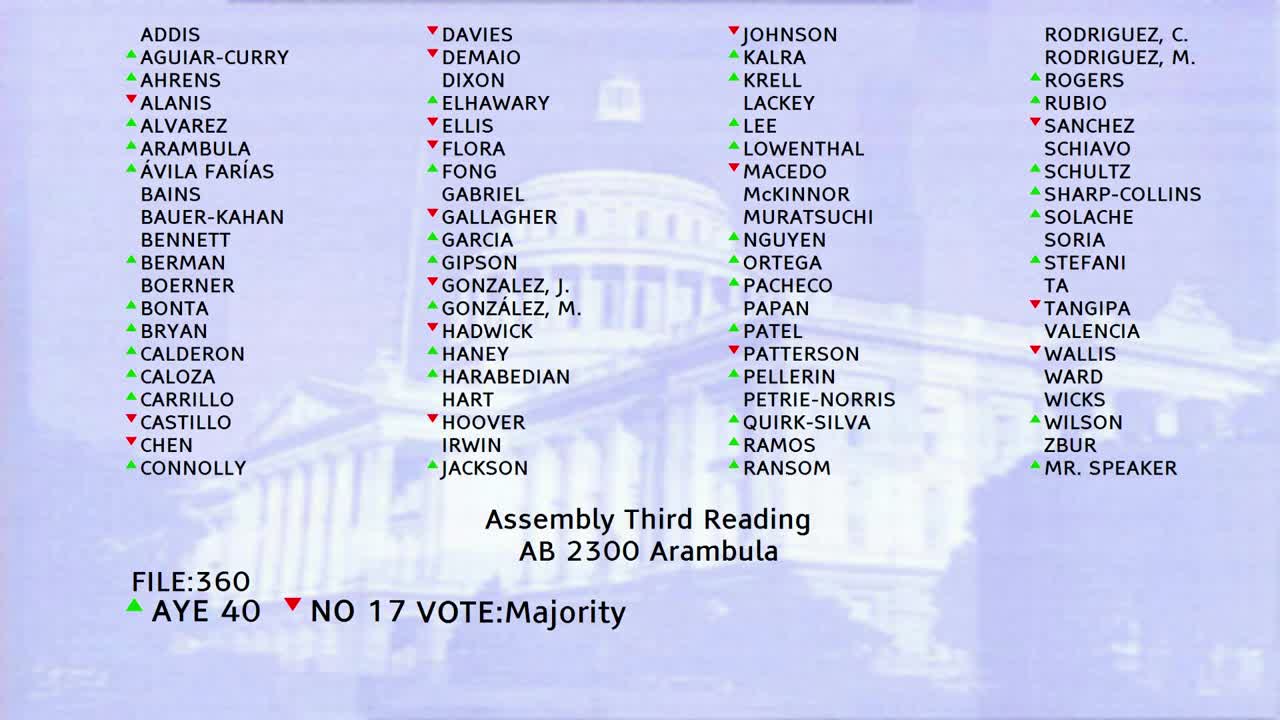 1MIN
Assembly Floor
 5MIN
Assembly Standing Committee on Utilities and Energy
 3MIN
Assembly Standing Committee on Emergency Management
Bill Author

Bill Co-Author(s):
