AB 2562: Alcohol or other drug recovery and treatment programs and facilities: suicide prevention.
- Session Year: 2025-2026
- House: Assembly
- Latest Version Date: 2026-09-27
Current Status:
Passed
(2026-09-27: Chaptered by Secretary of State - Chapter 620, Statutes of 2026.)
Introduced
In Committee
Awaiting First Chamber Vote
Passed First Chamber
In Committee
Awaiting Second Chamber Vote
Passed Second Chamber
Enacted
Existing law requires the State Department of Health Care Services to license and regulate adult alcohol or other drug recovery or treatment facilities that provide residential nonmedical services, as specified, and further requires the department to certify and regulate alcohol or other drug programs, as specified. Existing law requires a licensed facility to take specified actions, including to develop a plan to address when a resident relapses. Existing law requires a certified program to keep all policies and procedures in an operation manual.
This bill would require a licensed facility to develop a suicide prevention plan. The bill would authorize the department to implement the above-described requirement by bulletin or all-county or all-provider letter, after stakeholder input, until regulations are promulgated. The bill would require the department to promulgate regulations to implement the requirement no later than January 1, 2031. The bill would require a certified program to include in its operation manual a suicide prevention plan.
Existing law requires the State Department of Health Care Services to license and regulate adult alcohol or other drug recovery or treatment facilities that provide residential nonmedical services, as specified, and further requires the department to certify and regulate alcohol or other drug programs, as specified. Existing law requires a licensed facility to take specified actions, including to develop a plan to address when a resident relapses. Existing law requires a certified program to keep all policies and procedures in an operation manual.
This bill would require a licensed facility to develop a suicide prevention plan. The bill would authorize the department to implement the above-described requirement by bulletin or all-county or all-provider letter, after stakeholder input, until regulations are promulgated. The bill would require the department to promulgate regulations to implement the requirement no later than January 1, 2031. The bill would require a certified program to include in its operation manual a suicide prevention plan.
Existing law requires the State Department of Health Care Services to license and regulate adult alcohol or other drug recovery or treatment facilities that provide residential nonmedical services, as specified, and further requires the department to certify and regulate alcohol or other drug programs, as specified. Existing law requires a licensed facility to take specified actions, including to develop a plan to address when a resident relapses. Existing law requires a certified program to keep all policies and procedures in an operation manual.
This bill would require a licensed facility to develop a suicide prevention plan. The bill would authorize the department to implement the above-described requirement by bulletin or all-county or all-provider letter, after stakeholder input, until regulations are promulgated. The bill would require the department to promulgate regulations to implement the requirement no later than January 1, 2031. The bill would require a certified program to include in its operation manual a suicide prevention plan.
Existing law requires the State Department of Health Care Services to license and regulate adult alcohol or other drug recovery or treatment facilities that provide residential nonmedical services, as specified, and further requires the department to certify and regulate alcohol or other drug programs, as specified. Existing law requires a licensed facility to take specified actions, including to develop a plan to address when a resident relapses. Existing law requires a certified program to keep all policies and procedures in an operation manual.
This bill would require a licensed facility to develop a suicide prevention plan. The bill would authorize the department to implement the above-described requirement by bulletin or all-county or all-provider letter, after stakeholder input, until regulations are promulgated. The bill would require the department to promulgate regulations to implement the requirement no later than January 1, 2031. The bill would require a certified program to include in its operation manual a suicide prevention plan.
Existing law requires the State Department of Health Care Services to license and regulate alcohol or other drug recovery or treatment facilities. Existing law authorizes the suspension or revocation of a facilitys license upon specified grounds. Under existing law, a suspended license may be reinstated if the licensee petitions for reinstatement after at least one year has elapsed from the suspension or the denial of a similar petition.This bill would make a technical, nonsubstantive change to that provision.Existing law requires the State Department of Health Care Services to license and regulate alcohol or other drug recovery or treatment facilities. Existing law authorizes the suspension or revocation of a facilitys license upon specified grounds. Under existing law, a suspended license may be reinstated if the licensee petitions for reinstatement after at least one year has elapsed from the suspension or the denial of a similar petition.
This bill would make a technical, nonsubstantive change to that provision.
(a)An alcohol or other drug program shall adopt policies and procedures that are consistent with this chapter and any regulations adopted pursuant to this chapter.
(b)All policies and procedures shall be kept in an operation manual and address and include, at a minimum, all of the following:
(1)Admission and discharge.
(2)Client rights.
(3)Services.
(4)Medications.
(5)Staff and client code of conduct.
(6)Suicide prevention plan.
SEC. 2.Section 11834.26 of the Health and Safety Code is amended to read:11834.26.(a)The licensee shall provide one of the following combinations of nonmedical services:
(1)Recovery and treatment services.
(2)Recovery, treatment, and withdrawal management services.
(b)(1)A licensee with an existing license to provide detoxification-only services may provide those services before July 1, 2027.
(2)A license to provide detoxification-only services shall expire on July 1, 2027.
(3)The department shall not issue a new license to provide detoxification-only services, and shall not extend an existing license to provide detoxification-only services on or after July 1, 2027.
(c)The department shall adopt regulations requiring records and procedures that are appropriate for each of the services specified in subdivision (a). The records and procedures may include all of the following:
(1)Admission criteria.
(2)Intake process.
(3)Assessments.
(4)Recovery, treatment, or withdrawal management planning.
(5)Referral.
(6) Documentation of provision of recovery, treatment, or withdrawal management services.
(7)Discharge and continuing care planning.
(8)Indicators of recovery, treatment, or withdrawal management outcomes.
(d)A licensee shall not deny admission to any individual based solely on either of the following:
(1)The individual having a valid prescription from a licensed health care professional for a medication approved by the federal Food and Drug Administration for the purpose of narcotic replacement treatment or medication-assisted treatment of substance use disorders.
(2)The individual having consumed, used, or otherwise been under the influence of alcohol or other drugs, as these circumstances represent symptoms of the condition of substance use disorders.
(e)A licensee shall develop a plan to address when a resident relapses, including when a resident is on the licensed premises after using alcohol or other drugs.
(1)The plan shall include details of how the treatment stay and treatment plan of the resident will be adjusted to address the relapse episode and how the resident will be treated and supervised while under the influence of alcohol or other drugs, as well as discharge and continuing care planning, including when a licensee determines that a resident requires services beyond the scope of the licensee.
(2)This subdivision does not require a licensee to discharge a resident, as relapse, lapses, and momentary reengagement with alcohol or other drugs are symptoms of the condition of substance use disorders.
(3)In developing a plan pursuant to this subdivision, the licensee shall prioritize the individual maintaining some level of connection to treatment and shall consider options to avoid complete disconnection of the resident from treatment.
(f)(1)The department shall have the authority to implement this section by bulletin or all-county or all-provider letter, after stakeholder input, until regulations are promulgated. The department shall promulgate regulations to implement this section no later than January 1, 2030.
(2)On and after July 1, 2027, a licensee that provides withdrawal management services shall provide those services as required in guidance issued by the department.
(g)(1)A licensee shall, at all times, maintain at least two unexpired doses of naloxone hydrochloride, or any other opioid antagonist that is approved by the United States Food and Drug Administration for treatment of an opioid overdose, on the premises and shall, at all times, have at least one staff member on the premises who knows the specific location of the naloxone hydrochloride, or other opioid antagonist that is approved by the United States Food and Drug Administration for treatment of an opioid overdose, and who has been trained on the administration of naloxone hydrochloride, or other opioid antagonist that is approved by the United States Food and Drug Administration for treatment of an opioid overdose, in accordance with the training requirements set forth by the department. Proof of completion of training on the administration of naloxone hydrochloride, or other opioid antagonist that is approved by the United States Food and Drug Administration for treatment of an opioid overdose, shall be documented in the staff members individual personnel file.
(2)A trained staff member shall not be liable for damages in a civil action or subject to criminal prosecution for the administration, in good faith, of naloxone hydrochloride, or any other opioid antagonist that is approved by the United States Food and Drug Administration for treatment of an opioid overdose, to a person appearing to experience an overdose. This paragraph shall not apply in a case where the person who renders emergency care treatment by the use of naloxone hydrochloride, or any other opioid antagonist that is approved by the United States Food and Drug Administration for treatment of an overdose, acts with gross negligence or engages in willful and wanton misconduct.
(h)(1)A licensee shall develop a suicide prevention plan.
(2)The department shall have the authority to implement paragraph (1) by bulletin or all-county or all-provider letter, after stakeholder input, until regulations are promulgated. The department shall promulgate regulations to implement paragraph (1) no later than January 1, 2031.
(i)In the development of regulations implementing this section, the written record requirements shall be modified or adapted for social model programs.
(a)An alcohol or other drug program shall adopt policies and procedures that are consistent with this chapter and any regulations adopted pursuant to this chapter.
(b)All policies and procedures shall be kept in an operation manual and address and include, at a minimum, all of the following:
(1)Admission and discharge.
(2)Client rights.
(3)Services.
(4)Medications.
(5)Staff and client code of conduct.
(6)Suicide prevention plan.
SEC. 2.Section 11834.26 of the Health and Safety Code is amended to read:11834.26.(a)The licensee shall provide one of the following combinations of nonmedical services:
(1)Recovery and treatment services.
(2)Recovery, treatment, and withdrawal management services.
(b)(1)A licensee with an existing license to provide detoxification-only services may provide those services before July 1, 2027.
(2)A license to provide detoxification-only services shall expire on July 1, 2027.
(3)The department shall not issue a new license to provide detoxification-only services, and shall not extend an existing license to provide detoxification-only services on or after July 1, 2027.
(c)The department shall adopt regulations requiring records and procedures that are appropriate for each of the services specified in subdivision (a). The records and procedures may include all of the following:
(1)Admission criteria.
(2)Intake process.
(3)Assessments.
(4)Recovery, treatment, or withdrawal management planning.
(5)Referral.
(6) Documentation of provision of recovery, treatment, or withdrawal management services.
(7)Discharge and continuing care planning.
(8)Indicators of recovery, treatment, or withdrawal management outcomes.
(d)A licensee shall not deny admission to any individual based solely on either of the following:
(1)The individual having a valid prescription from a licensed health care professional for a medication approved by the federal Food and Drug Administration for the purpose of narcotic replacement treatment or medication-assisted treatment of substance use disorders.
(2)The individual having consumed, used, or otherwise been under the influence of alcohol or other drugs, as these circumstances represent symptoms of the condition of substance use disorders.
(e)A licensee shall develop a plan to address when a resident relapses, including when a resident is on the licensed premises after using alcohol or other drugs.
(1)The plan shall include details of how the treatment stay and treatment plan of the resident will be adjusted to address the relapse episode and how the resident will be treated and supervised while under the influence of alcohol or other drugs, as well as discharge and continuing care planning, including when a licensee determines that a resident requires services beyond the scope of the licensee.
(2)This subdivision does not require a licensee to discharge a resident, as relapse, lapses, and momentary reengagement with alcohol or other drugs are symptoms of the condition of substance use disorders.
(3)In developing a plan pursuant to this subdivision, the licensee shall prioritize the individual maintaining some level of connection to treatment and shall consider options to avoid complete disconnection of the resident from treatment.
(f)(1)The department shall have the authority to implement this section by bulletin or all-county or all-provider letter, after stakeholder input, until regulations are promulgated. The department shall promulgate regulations to implement this section no later than January 1, 2030.
(2)On and after July 1, 2027, a licensee that provides withdrawal management services shall provide those services as required in guidance issued by the department.
(g)(1)A licensee shall, at all times, maintain at least two unexpired doses of naloxone hydrochloride, or any other opioid antagonist that is approved by the United States Food and Drug Administration for treatment of an opioid overdose, on the premises and shall, at all times, have at least one staff member on the premises who knows the specific location of the naloxone hydrochloride, or other opioid antagonist that is approved by the United States Food and Drug Administration for treatment of an opioid overdose, and who has been trained on the administration of naloxone hydrochloride, or other opioid antagonist that is approved by the United States Food and Drug Administration for treatment of an opioid overdose, in accordance with the training requirements set forth by the department. Proof of completion of training on the administration of naloxone hydrochloride, or other opioid antagonist that is approved by the United States Food and Drug Administration for treatment of an opioid overdose, shall be documented in the staff members individual personnel file.
(2)A trained staff member shall not be liable for damages in a civil action or subject to criminal prosecution for the administration, in good faith, of naloxone hydrochloride, or any other opioid antagonist that is approved by the United States Food and Drug Administration for treatment of an opioid overdose, to a person appearing to experience an overdose. This paragraph shall not apply in a case where the person who renders emergency care treatment by the use of naloxone hydrochloride, or any other opioid antagonist that is approved by the United States Food and Drug Administration for treatment of an overdose, acts with gross negligence or engages in willful and wanton misconduct.
(h)(1)A licensee shall develop a suicide prevention plan.
(2)The department shall have the authority to implement paragraph (1) by bulletin or all-county or all-provider letter, after stakeholder input, until regulations are promulgated. The department shall promulgate regulations to implement paragraph (1) no later than January 1, 2031.
(i)In the development of regulations implementing this section, the written record requirements shall be modified or adapted for social model programs.
(a)An alcohol or other drug program shall adopt policies and procedures that are consistent with this chapter and any regulations adopted pursuant to this chapter.
(b)All policies and procedures shall be kept in an operation manual and address and include, at a minimum, all of the following:
(1)Admission and discharge.
(2)Client rights.
(3)Services.
(4)Medications.
(5)Staff and client code of conduct.
(6)Suicide prevention plan.
SEC. 2.Section 11834.26 of the Health and Safety Code is amended to read:11834.26.(a)The licensee shall provide at least one of the following nonmedical services:(1)Recovery services.(2)Treatment services.(3)Detoxification services.(b)The department shall adopt regulations requiring records and procedures that are appropriate for each of the services specified in subdivision (a). The records and procedures may include all of the following:(1)Admission criteria.(2)Intake process.(3)Assessments.(4)Recovery, treatment, or detoxification planning.(5)Referral.(6) Documentation of provision of recovery, treatment, or detoxification services.(7)Discharge and continuing care planning.(8)Indicators of recovery, treatment, or detoxification outcomes.(c)A licensee shall not deny admission to any individual based solely on either of the following:(1)The individual having a valid prescription from a licensed health care professional for a medication approved by the federal Food and Drug Administration for the purpose of narcotic replacement treatment or medication-assisted treatment of substance use disorders.(2)The individual having consumed, used, or otherwise been under the influence of alcohol or other drugs, as these circumstances represent symptoms of the condition of substance use disorders.(d)A licensee shall develop a plan to address when a resident relapses, including when a resident is on the licensed premises after using alcohol or other drugs.(1)The plan shall include details of how the treatment stay and treatment plan of the resident will be adjusted to address the relapse episode and how the resident will be treated and supervised while under the influence of alcohol or other drugs, as well as discharge and continuing care planning, including when a licensee determines that a resident requires services beyond the scope of the licensee.(2)This subdivision does not require a licensee to discharge a resident, as relapse, lapses, and momentary reengagement with alcohol or other drugs are symptoms of the condition of substance use disorders.(3)In developing a plan pursuant to this subdivision, the licensee shall prioritize the individual maintaining some level of connection to treatment and shall consider options to avoid complete disconnection of the resident from treatment.(e)The department shall have the authority to implement subdivisions (d) and (f) by bulletin or all-county or all-provider letter, after stakeholder input, until regulations are promulgated. The department shall promulgate regulations to implement subdivisions (d) and (f) no later than July 1, 2027.(f)(1)A licensee shall, at all times, maintain at least two unexpired doses of naloxone hydrochloride, or any other opioid antagonist that is approved by the United States Food and Drug Administration for treatment of an opioid overdose, on the premises and shall, at all times, have at least one staff member on the premises who knows the specific location of the naloxone hydrochloride, or other opioid antagonist that is approved by the United States Food and Drug Administration for treatment of an opioid overdose, and who has been trained on the administration of naloxone hydrochloride, or the other opioid antagonist that is approved by the United States Food and Drug Administration for treatment of an opioid overdose, in accordance with the training requirements set forth by the department. Proof of completion of training on the administration of naloxone hydrochloride, or other opioid antagonist that is approved by the United States Food and Drug Administration for treatment of an opioid overdose, shall be documented in the staff members individual personnel file.(2)A trained staff member shall not be liable for damages in a civil action or subject to criminal prosecution for the administration, in good faith, of naloxone hydrochloride, or any other opioid antagonist that is approved by the United States Food and Drug Administration for treatment of an opioid overdose, to a person appearing to experience an overdose. This paragraph shall not apply in a case where the person who renders emergency care treatment by the use of naloxone hydrochloride, or any other opioid antagonist that is approved by the United States Food and Drug Administration for treatment of an overdose, acts with gross negligence or engages in willful and wanton misconduct.(g)(1)A licensee shall develop a suicide prevention plan.(2)The department shall have the authority to implement paragraph (1) by bulletin or all-county or all-provider letter, after stakeholder input, until regulations are promulgated. The department shall promulgate regulations to implement paragraph (1) no later than January 1, 2031.(h)In the development of regulations implementing this section, the written record requirements shall be modified or adapted for social model programs.SEC. 2.Section 11834.26 of the Health and Safety Code is amended to read:11834.26.(a)The licensee shall provide one of the following combinations of nonmedical services:
(1)Recovery and treatment services.
(2)Recovery, treatment, and withdrawal management services.
(b)(1)A licensee with an existing license to provide detoxification-only services may provide those services before July 1, 2027.
(2)A license to provide detoxification-only services shall expire on July 1, 2027.
(3)The department shall not issue a new license to provide detoxification-only services, and shall not extend an existing license to provide detoxification-only services on or after July 1, 2027.
(c)The department shall adopt regulations requiring records and procedures that are appropriate for each of the services specified in subdivision (a). The records and procedures may include all of the following:
(1)Admission criteria.
(2)Intake process.
(3)Assessments.
(4)Recovery, treatment, or withdrawal management planning.
(5)Referral.
(6) Documentation of provision of recovery, treatment, or withdrawal management services.
(7)Discharge and continuing care planning.
(8)Indicators of recovery, treatment, or withdrawal management outcomes.
(d)A licensee shall not deny admission to any individual based solely on either of the following:
(1)The individual having a valid prescription from a licensed health care professional for a medication approved by the federal Food and Drug Administration for the purpose of narcotic replacement treatment or medication-assisted treatment of substance use disorders.
(2)The individual having consumed, used, or otherwise been under the influence of alcohol or other drugs, as these circumstances represent symptoms of the condition of substance use disorders.
(e)A licensee shall develop a plan to address when a resident relapses, including when a resident is on the licensed premises after using alcohol or other drugs.
(1)The plan shall include details of how the treatment stay and treatment plan of the resident will be adjusted to address the relapse episode and how the resident will be treated and supervised while under the influence of alcohol or other drugs, as well as discharge and continuing care planning, including when a licensee determines that a resident requires services beyond the scope of the licensee.
(2)This subdivision does not require a licensee to discharge a resident, as relapse, lapses, and momentary reengagement with alcohol or other drugs are symptoms of the condition of substance use disorders.
(3)In developing a plan pursuant to this subdivision, the licensee shall prioritize the individual maintaining some level of connection to treatment and shall consider options to avoid complete disconnection of the resident from treatment.
(f)(1)The department shall have the authority to implement this section by bulletin or all-county or all-provider letter, after stakeholder input, until regulations are promulgated. The department shall promulgate regulations to implement this section no later than January 1, 2030.
(2)On and after July 1, 2027, a licensee that provides withdrawal management services shall provide those services as required in guidance issued by the department.
(g)(1)A licensee shall, at all times, maintain at least two unexpired doses of naloxone hydrochloride, or any other opioid antagonist that is approved by the United States Food and Drug Administration for treatment of an opioid overdose, on the premises and shall, at all times, have at least one staff member on the premises who knows the specific location of the naloxone hydrochloride, or other opioid antagonist that is approved by the United States Food and Drug Administration for treatment of an opioid overdose, and who has been trained on the administration of naloxone hydrochloride, or the other opioid antagonist that is approved by the United States Food and Drug Administration for treatment of an opioid overdose, in accordance with the training requirements set forth by the department. Proof of completion of training on the administration of naloxone hydrochloride, or other opioid antagonist that is approved by the United States Food and Drug Administration for treatment of an opioid overdose, shall be documented in the staff members individual personnel file.
(2)A trained staff member shall not be liable for damages in a civil action or subject to criminal prosecution for the administration, in good faith, of naloxone hydrochloride, or any other opioid antagonist that is approved by the United States Food and Drug Administration for treatment of an opioid overdose, to a person appearing to experience an overdose. This paragraph shall not apply in a case where the person who renders emergency care treatment by the use of naloxone hydrochloride, or any other opioid antagonist that is approved by the United States Food and Drug Administration for treatment of an overdose, acts with gross negligence or engages in willful and wanton misconduct.
(h)(1)A licensee shall develop a suicide prevention plan.
(2)The department shall have the authority to implement paragraph (1) by bulletin or all-county or all-provider letter, after stakeholder input, until regulations are promulgated. The department shall promulgate regulations to implement paragraph (1) no later than January 1, 2031.
(h)(i)In the development of regulations implementing this section, the written record requirements shall be modified or adapted for social model programs.
(a)An alcohol or other drug program shall adopt policies and procedures that are consistent with this chapter and any regulations adopted pursuant to this chapter.
(b)All policies and procedures shall be kept in an operation manual and address and include, at a minimum, all of the following:
(1)Admission and discharge.
(2)Client rights.
(3)Services.
(4)Medications.
(5)Staff and client code of conduct.
(6)Suicide prevention plan.
SEC. 2.Section 11834.26 of the Health and Safety Code is amended to read:11834.26.(a)The licensee shall provide at least one of the following nonmedical services:
(1)Recovery services.
(2)Treatment services.
(3)Detoxification services.
(b)The department shall adopt regulations requiring records and procedures that are appropriate for each of the services specified in subdivision (a). The records and procedures may include all of the following:
(1)Admission criteria.
(2)Intake process.
(3)Assessments.
(4)Recovery, treatment, or detoxification planning.
(5)Referral.
(6) Documentation of provision of recovery, treatment, or detoxification services.
(7)Discharge and continuing care planning.
(8)Indicators of recovery, treatment, or detoxification outcomes.
(c)A licensee shall not deny admission to any individual based solely on either of the following:
(1)The individual having a valid prescription from a licensed health care professional for a medication approved by the federal Food and Drug Administration for the purpose of narcotic replacement treatment or medication-assisted treatment of substance use disorders.
(2)The individual having consumed, used, or otherwise been under the influence of alcohol or other drugs, as these circumstances represent symptoms of the condition of substance use disorders.
(d)A licensee shall develop a plan to address when a resident relapses, including when a resident is on the licensed premises after using alcohol or other drugs.
(1)The plan shall include details of how the treatment stay and treatment plan of the resident will be adjusted to address the relapse episode and how the resident will be treated and supervised while under the influence of alcohol or other drugs, as well as discharge and continuing care planning, including when a licensee determines that a resident requires services beyond the scope of the licensee.
(2)This subdivision does not require a licensee to discharge a resident, as relapse, lapses, and momentary reengagement with alcohol or other drugs are symptoms of the condition of substance use disorders.
(3)In developing a plan pursuant to this subdivision, the licensee shall prioritize the individual maintaining some level of connection to treatment and shall consider options to avoid complete disconnection of the resident from treatment.
(e)The department shall have the authority to implement subdivisions (d) and (f) by bulletin or all-county or all-provider letter, after stakeholder input, until regulations are promulgated. The department shall promulgate regulations to implement subdivisions (d) and (f) no later than July 1, 2027.
(f)(1)A licensee shall, at all times, maintain at least two unexpired doses of naloxone hydrochloride, or any other opioid antagonist that is approved by the United States Food and Drug Administration for treatment of an opioid overdose, on the premises and shall, at all times, have at least one staff member on the premises who knows the specific location of the naloxone hydrochloride, or other opioid antagonist that is approved by the United States Food and Drug Administration for treatment of an opioid overdose, and who has been trained on the administration of naloxone hydrochloride, or the other opioid antagonist that is approved by the United States Food and Drug Administration for treatment of an opioid overdose, in accordance with the training requirements set forth by the department. Proof of completion of training on the administration of naloxone hydrochloride, or other opioid antagonist that is approved by the United States Food and Drug Administration for treatment of an opioid overdose, shall be documented in the staff members individual personnel file.
(2)A trained staff member shall not be liable for damages in a civil action or subject to criminal prosecution for the administration, in good faith, of naloxone hydrochloride, or any other opioid antagonist that is approved by the United States Food and Drug Administration for treatment of an opioid overdose, to a person appearing to experience an overdose. This paragraph shall not apply in a case where the person who renders emergency care treatment by the use of naloxone hydrochloride, or any other opioid antagonist that is approved by the United States Food and Drug Administration for treatment of an overdose, acts with gross negligence or engages in willful and wanton misconduct.
(g)(1)A licensee shall develop a suicide prevention plan.
(2)The department shall have the authority to implement paragraph (1) by bulletin or all-county or all-provider letter, after stakeholder input, until regulations are promulgated. The department shall promulgate regulations to implement paragraph (1) no later than January 1, 2031.
(g)(h)In the development of regulations implementing this section, the written record requirements shall be modified or adapted for social model programs.
SECTION 1.Section 11834.38 of the Health and Safety Code is amended to read:11834.38.A license suspended pursuant to this chapter may be reinstated pursuant to Section 11522 of the Government Code.Any A license suspended pursuant to this chapter may be reinstated pursuant to Section 11522 of the Government Code.
|
Date
|
Status
|
|---|---|
| Sep 27, 2026 | Chaptered by Secretary of State - Chapter 620, Statutes of 2026. |
| Sep 27, 2026 | Approved by the Governor. |
| Sep 10, 2026 | Enrolled and presented to the Governor at 3 p.m. |
| Aug 30, 2026 | Senate amendments concurred in. To Engrossing and Enrolling. (Ayes 76. Noes 0. Page 6879.). |
| Aug 30, 2026 | Senate amendments concurred in. To Engrossing and Enrolling. (Ayes 76. Noes 0.). |
| Aug 30, 2026 | Senate amendments concurred in. To Engrossing and Enrolling. |
| Aug 28, 2026 | In Assembly. Concurrence in Senate amendments pending. |
| Aug 27, 2026 | Read third time. Passed. Ordered to the Assembly. (Ayes 40. Noes 0. Page 6008.). |
| Aug 27, 2026 | Read third time. Passed. Ordered to the Assembly. (Ayes 40. Noes 0.). |
| Aug 10, 2026 | Read second time. Ordered to third reading. |
| Aug 6, 2026 | Read third time and amended. Ordered to second reading. |
| Aug 6, 2026 | Ordered to third reading. |
| Aug 6, 2026 | From Consent Calendar. |
| Aug 4, 2026 | Read second time. Ordered to Consent Calendar. |
| Aug 3, 2026 | From committee: Be ordered to second reading file pursuant to Senate Rule 28.8 and ordered to Consent Calendar. |
| Jun 25, 2026 | From committee: Do pass and re-refer to Com. on APPR. with recommendation: To Consent Calendar. (Ayes 11. Noes 0.) (June 24). Re-referred to Com. on APPR. |
| Jun 10, 2026 | Referred to Com. on HEALTH. |
| Jun 1, 2026 | In Senate. Read first time. To Com. on RLS. for assignment. |
| May 28, 2026 | Read third time. Passed. Ordered to the Senate. (Ayes 74. Noes 0. Page 2562.) |
| May 28, 2026 | Read third time. Passed. Ordered to the Senate. (Ayes 74. Noes 0.) |
| May 18, 2026 | Read second time. Ordered to third reading. |
| May 14, 2026 | From committee: Do pass. (Ayes 15. Noes 0.) (May 14). |
| May 14, 2026 | Joint Rule 62(a), file notice suspended. (Page 5030.) |
| May 14, 2026 | Joint Rule 62(a), file notice suspended. |
| May 13, 2026 | In committee: Set, first hearing. Referred to APPR. suspense file. |
| Apr 15, 2026 | From committee: Do pass and re-refer to Com. on APPR. with recommendation: To Consent Calendar. (Ayes 16. Noes 0.) (April 14). Re-referred to Com. on APPR. |
| Mar 17, 2026 | Re-referred to Com. on HEALTH. |
| Mar 16, 2026 | From committee chair, with author's amendments: Amend, and re-refer to Com. on HEALTH. Read second time and amended. |
| Mar 16, 2026 | Referred to Com. on HEALTH. |
| Feb 21, 2026 | From printer. May be heard in committee March 23. |
| Feb 20, 2026 | Read first time. To print. |
|
Date
|
Description
|
Location
|
Votes
|
|
|---|---|---|---|---|
| Aug 30, 2026 | AB 2562 Dixon Concurrence in Senate Amendments | Assembly Floor |
Passed |
|
| Aug 27, 2026 | Assembly 3rd Reading AB2562 Dixon By Blakespear | Senate Floor |
Passed |
|
| Jun 24, 2026 | Do pass, but first be re-referred to the Committee on [Appropriations] with the recommendation: To Consent Calendar | Senate Standing Committee on Health |
Passed |
|
| May 28, 2026 | AB 2562 Dixon Assembly Third Reading | Assembly Floor |
Passed |
|
| May 14, 2026 | Do pass. | Assembly Standing Committee on Appropriations |
Passed |
|
| Apr 14, 2026 | Do pass and be re-referred to the Committee on [Appropriations] with recommendation: To Consent Calendar | Assembly Standing Committee on Health |
Passed |
This list shows positions taken on this bill by organizations on the date displayed, which is linked to the original source.
Positions by individuals are not included.
|
Organization
|
Position
|
Date
|
|---|---|---|
| Capo Cares | ** Support | |
| City of Newport Beach | ** Support | |
| COUNTY BEHAVIORAL HEALTH DIRECTORS ASSOCIATION (CBHDA) | ** Support | |
| County of Orange | ** Support | |
| One individual | ** Support |
CONCURRENCE IN SENATE AMENDMENTS
CSA1 Bill Id:AB 2562
Author:(Dixon)
As Amended Ver:August 6, 2026
Majority vote
SUMMARY
Requires a certified alcohol or other drug (AOD) program to include in its policies and procedures a suicide prevention plan. Requires licensed AOD recovery or treatment facilities (RTF) to develop a suicide prevention plan. Authorizes the State Department of Health Care Services (DHCS) to implement the requirement on RTFs by bulletin or all-county or all-provider letter, after stakeholder input, until regulations are promulgated. Requires DHCS to promulgate regulations to implement the requirement no later than January 1, 2031.
Senate Amendments
Address chaptering conflicts with the health budget trailer bill.
COMMENTS
Prevalence of Substance Use Disorder (SUD) in California. A 2024 publication from Health Management Associates and the California Health Care Foundation titled, "Substance Use Disorder in California — a Focused Landscape Analysis" reported that approximately 9% of Californians ages 12 years and older met the criteria for SUD in 2022. According to the report, the prevalence of SUD among individuals 12 years of age and older increased to 8.8% in 2022 from 8.1% in 2015. While the health care system is moving toward acknowledging SUD as a chronic illness, only 6% of Americans and 10% of Californians ages 12 and older with an SUD received treatment for their condition in 2021. More than 19,335 Californians ages 12 years and older died from the effects of alcohol from 2020 to 2021, and the total annual number of alcohol-related deaths increased by approximately 18% in the state from 2020 to 2021. Overdose deaths from both opioids and psychostimulants (such as amphetamines), are soaring. This issue, compounded by the increased availability of fentanyl, has resulted in a 10-fold increase in fentanyl related deaths between 2015 and 2019. According to the Overdose Prevention Initiative, 7,847 opioid-related overdose deaths occurred in California in 2023, and preliminary data shows 5,030 opioid-related overdose deaths in 2025.
Alcohol and Drug Treatment Facility Licensing. DHCS has sole authority to license RTFs in the state. Licensure is required when at least one of the following services is provided: detoxification; group sessions; individual sessions; educational sessions; or, alcoholism or other drug abuse recovery or treatment planning. Additionally, facilities may be subject to other types of permits, clearances, business taxes, or local fees that may be required by the cities or counties in which the facilities are located.
As part of their licensing function, DHCS conducts reviews of RTF operations every two years, or as necessary. DHCS's Substance Use Disorder Compliance Division checks for compliance with statute and regulations (Title 9, Chapter 5, California Code of Regulations) to ensure the health and safety of RTF residents and investigates all complaints related to RTFs, including deaths, complaints against staff, and allegations of operating without a license. DHCS has the authority to suspend or revoke a license for conduct in the operation of an RTF that is contrary to the health, morals, welfare, or safety of either an individual in, or receiving services from, the facility or to the people of the State of California.
AOD Program Certification. Prior to January 1, 2025, programs were permitted to seek certification from DHCS. Under AB 118 (Committee on Budget), Chapter 42, Statutes of 2023, certification is now a requirement for many AOD programs, with exceptions for various licensed facility types, schools, jails, and prisons. Programs were required to apply for certification no later than January 1, 2024. If DHCS finds evidence that a program is providing treatment, recovery, detoxification, or medication-assisted treatment services without a certification, DHCS must issue a written notice to the program stating that it is operating in violation of the law, and any person or entity found to be operating without certification may be subject to an assessment of civil penalties of two thousand ($2,000) dollars per day and will be barred from applying for initial certification for a period of five years from the date of the violation notice.
According to the Author
Patients or clients in substance use disorder treatment settings can often suffer from suicidal ideation. Like addiction, suicide is unbiased and can impact anyone. The author notes a study done by the Massachusetts Department of Public Health finding that individuals diagnosed with SUDs are at increased risk of suicidal ideation. Up to 40% of those seeking SUD treatment have a suicide attempt history and a previous attempt is a key predictor of future suicide. The author contends that California regulations currently require some rehabilitative and developmental services to have suicide prevention plans. However, DHCS currently has no requirement for AOD programs and facilities to have a suicide policy in place. This gap is an oversight in alignment across departments in the importance of holistic care for individuals in rehabilitative and developmental services. The author concludes this bill would add a new level of care in the promotion of emotional, mental and physical health for individuals in treatment settings.
Arguments in Support
Capo Cares supports this bill stating that it seems obvious that a Suicide Prevention Plan is a basic safety measure that should be in place in licensed alcohol and drug treatment facilities. Too many lives have been lost unnecessarily in state licensed treatment homes. Capo Cares argues this is very basic and obvious step to take precautions against suicide in these facilities. The safety of vulnerable people and their families who are trusting our state licensed treatment centers to provide recovery should be paramount.
The County Behavioral Health Directors Association (CBHDA) supports this bill stating that patients or clients in SUD treatment settings can often suffer from suicidal ideation. Like addiction, suicide is unbiased and can impact anyone. From a study done by the Massachusetts Department of Public Health, "Individuals diagnosed with substance use disorders (SUDs) are at increased risk of suicidal ideation. Up to 40% of those seeking substance use disorder treatment have a suicide attempt history. Importantly, a previous attempt is a key predictor of future suicide. CBHDA argues that this bill would bridge the gap currently existing in the California Code of Regulations amongst rehabilitative departments and in Health & Safety Code statutes.
Arguments in Opposition
None on file.
FISCAL COMMENTS
According to the Senate Appropriations Committee, pursuant to Senate Rule 28.8, negligible state costs.
VOTES:
ASM HEALTH: 16-0-0
YES: Bonta, Chen, Addis, Aguiar-Curry, Ahrens, Caloza, Carrillo, Mark González, Johnson, Patel, Patterson, Rogers, Sanchez, Schiavo, Sharp-Collins, Stefani
ASM APPROPRIATIONS: 15-0-0
YES: Wicks, Hoover, Aguiar-Curry, Calderon, Caloza, Dixon, Fong, Mark González, Krell, Pacheco, Pellerin, Sharp-Collins, Solache, Ta, Tangipa
ASSEMBLY FLOOR: 74-0-6
YES: Addis, Aguiar-Curry, Ahrens, Alanis, Alvarez, Arambula, Ávila Farías, Bains, Bauer-Kahan, Bennett, Berman, Boerner, Bonta, Bryan, Calderon, Caloza, Carrillo, Castillo, Chen, Connolly, Davies, DeMaio, Dixon, Elhawary, Ellis, Flora, Fong, Gabriel, Gallagher, Garcia, Gipson, Jeff Gonzalez, Mark González, Hadwick, Haney, Harabedian, Hart, Hoover, Irwin, Johnson, Kalra, Krell, Lackey, Lowenthal, Macedo, McKinnor, Muratsuchi, Nguyen, Ortega, Pacheco, Papan, Patel, Patterson, Petrie-Norris, Ramos, Ransom, Michelle Rodriguez, Blanca Rubio, Sanchez, Schiavo, Schultz, Sharp-Collins, Solache, Soria, Stefani, Ta, Tangipa, Valencia, Wallis, Ward, Wicks, Wilson, Zbur, Rivas
ABS, ABST OR NV: Jackson, Lee, Pellerin, Quirk-Silva, Celeste Rodriguez, Rogers
UPDATED
VERSION: August 6, 2026
CONSULTANT: Logan Hess / HEALTH / (916) 319-2097 FN: 0004150
SENATE RULES COMMITTEE Office of Senate Floor Analyses (916) 651-4171 | AB 2562 |
THIRD READING
Bill No: AB 2562
Author: Dixon (R)
Amended: 8/6/26 in Senate
Vote: 21
SENATE HEALTH COMMITTEE: 11-0, 6/24/26
AYES: Weber Pierson, Valladares, Caballero, Durazo, Gonzalez, Grove, Menjivar, Padilla, Pérez, Rubio, Smallwood-Cuevas
SENATE APPROPRIATIONS COMMITTEE: Senate Rule 28.8
ASSEMBLY FLOOR: 74-0, 5/28/26 - See last page for vote
SUBJECT: Alcohol or other drug recovery and treatment programs and facilities: suicide prevention
SOURCE: Author
DIGEST:
This bill requires certified alcohol and other drug (AOD) programs and licensed adult residential AOD treatment facilities to have suicide prevention plans.
Senate Floor Amendments of 8/6/26 avoid the chaptering out of some provisions that were included in the recently enacted Health trailer bill.
ANALYSIS:
Existing law:
- Grants sole authority in the state to the Department of Health Care Services (DHCS) to certify AOD programs and to license adult residential AOD treatment facilities (RTFs). [Health and Safety Code (HSC) §11832 and §11834.01]
- Requires DHCS to conduct onsite program compliance visits for AOD programs and RTFs at least once during the certification or licensure period. Permits DHCS to conduct announced or unannounced site visits to review for compliance. [HSC §11832.12 and §11834.01]
- Requires an AOD program to adopt policies and procedures, kept in an operation manual, that address and include, at a minimum, all of the following:
- Admission and discharge;
- Client rights;
- Services;
- Medications; and,
- Staff and client code of conduct. [HSC §11832.8.]
- Enumerates requirements for an RTF, such as the types of nonmedical services each is authorized to provide; prohibitions on reasons for denying an individual admission to the RTF; a plan for when an RTF resident relapses; and, maintaining unexpired doses of naloxone hydrochloride, or any other opioid antagonist that is approved by the United States Food and Drug Administration for treatment of an opioid overdose. [HSC §11834.26]
This bill:
- Requires an AOD program to include in its operation manual and RTFs to develop a suicide prevention plan.
- Grants DHCS the authority to implement the suicide prevention plan requirement for RTFs by bulletin, or all-county or all-provider letter, after stakeholder input, until regulations are promulgated. Requires DHCS to promulgate regulations no later than January 1, 2031.
Background
According to the author of this bill:
Patients or clients in substance use disorder (SUD/AOD) treatment settings can often suffer from suicidal ideation. Like addiction, suicide is unbiased and can impact anyone. From a study done by the Massachusetts Department of Public Health, “Individuals diagnosed with SUDs are at increased risk of suicidal ideation. Up to 40% of those seeking SUD treatment have a suicide attempt history. Importantly, a previous attempt is a key predictor of future suicide.” Currently, in the California Code of Regulations under Title 9 “Rehabilitative and Developmental Services,” two of the four departments already require suicide prevention plans. However, DHCS currently has no requirement for such health facilities to have a suicide policy in place. This gap is an oversight in alignment across departments in the importance of holistic care for individuals in rehabilitative and developmental services. By requiring licensed treatment facilities and certified programs to have a suicide prevention plan in place, we are improving and prioritizing patient safety and ultimately, their success. This bill would add a new level of care in the promotion of emotional, mental and physical health for individuals in treatment settings.
RTFs and AOD programs. RTFs licensed by DHCS, based on what is commonly referred to as the “social model,” provide recovery, treatment, or detoxification services. (The Department of Public Health licenses medical model RTFs, known as chemical dependency recovery hospitals.) The services provided by social model RTFs include group and individual counseling, educational sessions, and alcoholism or drug abuse recovery and treatment planning. Social model RTFs are allowed to provide clients first aid and emergency care, and since the passage of AB 848 (Mark Stone, Chapter 744, Statutes of 2015), RTFs can apply to DHCS for an additional license to provide incidental medical services by a licensed physician or other health care practitioner. SB 823 (Hill, Chapter 781, Statutes of 2018) requires DHCS to adopt American Society of Addiction Medicine treatment criteria as the minimum standard of care for licensed RTFs. DHCS is also responsible for certification of a business entity with a physical location in the state that provides one or more of the following services to clients: treatment, recovery, detoxification services, or medications for addiction treatment. DHCS also provides program certification for facilities that are licensed by the Department of Social Services that serve adolescents. As part of their licensing and certification functions, DHCS conducts reviews of RTFs and AOD programs every two years, or as necessary; checks for compliance with statute, regulations, and certification standards to ensure the health and safety of clients; investigates all complaints; and, has the authority to suspend or revoke a license or certification for a violation of statutes, regulations, and certification standards. DHCS states that they have the sole authority to conduct site visits to their RTFs and AOD programs.
SUD and suicide. According to the Kaiser Family Foundation, from 2014 to 2024, over half a million lives nationally (516,790) were lost to suicide, with 2022 marking the highest annual total on record. Since then, overall suicides have declined somewhat but trends diverged by method: firearm suicides continued to rise, reaching a new high in 2024. As a result, firearms accounted for 57% of all suicides in 2024, up from 50% in 2014, while suicides by other methods fell. Some of the shift may also reflect undercounting, if some suicides are recorded as unintentional drug overdose deaths. These shifts may have implications for prevention strategies including the capacity and design of crisis and treatment systems. In July 2022, the 988 Suicide and Crisis Lifeline launched nationwide, replacing the prior 10-digit number with an easier to remember, three-digit option that connects people in distress to counselors at 200+ local crisis call centers and, when needed, other crisis services. Since launch through October 2025, 988 has received more than 19 million calls, texts, or chats nationally, alongside improved answer rates and shorter wait times. However, access to mental health and SUD treatment gaps persist. In 2025, the Trump Administration discontinued the LGBTQI+ 988 call line and advanced an array of federal policy actions that could limit access to care including projected coverage loss in Medicaid and the Marketplace.
A UCLA Center for Health Policy Research brief from June 2026, “Adolescents’ Substance Use, Psychological Distress, and Suicidal Thoughts and Attempts,” notes that youth substance use remains common in the U.S., and many adolescents experience mental health challenges—such as anxiety, depression, and trauma—before or after trying drugs or alcohol. Early, frequent, or heavy substance use can harm brain development and worsen mental health issues, including depression, anxiety, and mood instability. Adolescents with both SUD and mental health issues are at a much higher risk for suicide. Mental health conditions are strong predictors of suicidal behavior, and substance use increases this risk by reducing inhibition and judgment, and worsening depression and anxiety. Together, these factors make suicide attempts more likely and more dangerous. The brief further notes that adolescents who currently use substances are nearly twice as likely to have had serious psychological distress in the past year as adolescents who do not currently use substances (46% and 27%, respectively), and 1.5 times as likely to have had moderate psychological distress in the past year as adolescents who do not currently use substances (21% and 13%, respectively). More than a quarter (26%) of adolescents have tried at least one substance, with alcohol (21%) being the most common, followed by marijuana/THC (11%), e-cigarettes (11%), and cigarettes (5%). Among all adolescents, 9% currently use one or more substances, most often marijuana/THC (6%), alcohol (binge drinking) (4%), or e-cigarettes (3%). Among adolescents who currently use substances, 44% reported using multiple substances. Overall, 10% of adolescents had seriously thought about or attempted suicide in the past year. Adolescents who had ever used substances (marijuana, alcohol, e-cigarettes, or cigarettes) were more than three times as likely to report suicidal thoughts and attempts as those who had never used substances (20% and 6%, respectively). Adolescents who currently use substances were nearly four times as likely to have seriously thought about or attempted suicide in the past year (28%) as those who do not use substances (8%).
FISCAL EFFECT: Appropriation: No Fiscal Com.: Yes Local: No
SUPPORT: (Verified 8/6/26)
City of Newport Beach
County Behavioral Health Directors Association
County of Orange
One individual
OPPOSITION: (Verified 8/6/26)
None received
ARGUMENTS IN SUPPORT: Orange County (OC) states it supports measures that bring more accountability to licensed RTFs in order to balance the need of those who seek recovery with the residents of the communities where these facilities are or may be located. This bill aims to protect vulnerable populations and aligns with existing practices, as many treatment providers already address suicide risk when clinically appropriate. The bill would formalize and standardize these practices across providers, which will help ensure consistency and provide clearer guidance for staff. OC further argues that establishing a required suicide prevention plan may also build on existing approaches used in treatment settings, similar to relapse prevention and other risk mitigation strategies.
ASSEMBLY FLOOR: 74-0, 5/28/26
AYES: Addis, Aguiar-Curry, Ahrens, Alanis, Alvarez, Arambula, Ávila Farías, Bains, Bauer-Kahan, Bennett, Berman, Boerner, Bonta, Bryan, Calderon, Caloza, Carrillo, Castillo, Chen, Connolly, Davies, DeMaio, Dixon, Elhawary, Ellis, Flora, Fong, Gabriel, Gallagher, Garcia, Gipson, Jeff Gonzalez, Mark González, Hadwick, Haney, Harabedian, Hart, Hoover, Irwin, Johnson, Kalra, Krell, Lackey, Lowenthal, Macedo, McKinnor, Muratsuchi, Nguyen, Ortega, Pacheco, Papan, Patel, Patterson, Petrie-Norris, Ramos, Ransom, Michelle Rodriguez, Blanca Rubio, Sanchez, Schiavo, Schultz, Sharp-Collins, Solache, Soria, Stefani, Ta, Tangipa, Valencia, Wallis, Ward, Wicks, Wilson, Zbur, Rivas
NO VOTE RECORDED: Jackson, Lee, Pellerin, Quirk-Silva, Celeste Rodriguez, Rogers
Prepared by: Reyes Diaz / HEALTH / (916) 651-4111
8/10/26 17:31:24
**** END ****
SENATE RULES COMMITTEE Office of Senate Floor Analyses (916) 651-4171 | AB 2562 |
THIRD READING
Bill No: AB 2562
Author: Dixon (R)
Amended: 3/16/26 in Assembly
Vote: 21
SENATE HEALTH COMMITTEE: 11-0, 6/24/26
AYES: Weber Pierson, Valladares, Caballero, Durazo, Gonzalez, Grove, Menjivar, Padilla, Pérez, Rubio, Smallwood-Cuevas
SENATE APPROPRIATIONS COMMITTEE: Senate Rule 28.8
ASSEMBLY FLOOR: 74-0, 5/28/26 - See last page for vote
SUBJECT: Alcohol or other drug recovery and treatment programs and facilities: suicide prevention
SOURCE: Author
DIGEST:
This bill requires state-certified programs and state-licensed alcohol and other drug recovery and treatment facilities to have suicide prevention plans.
ANALYSIS:
Existing law:
- Grants sole authority in the state to the Department of Health Care Services (DHCS) to certify alcohol or other drug (AOD) programs and to license adult residential AOD recovery or treatment facilities (RTFs). [Health and Safety Code (HSC) §11832 and §11834.01]
- Requires DHCS to conduct onsite program compliance visits for AOD programs and RTFs at least once during the certification or licensure period. Permits DHCS to conduct announced or unannounced site visits to review for compliance. [HSC §11832.12 and §11834.01]
- Requires an AOD program to adopt policies and procedures, kept in an operation manual, that address and include, at a minimum, all of the following:
- Admission and discharge;
- Client rights;
- Services;
- Medications; and,
- Staff and client code of conduct. [HSC §11832.8.]
- Enumerates requirements for an RTF, such as the types of nonmedical services each is authorized to provide; prohibitions on reasons for denying an individual admission to the RTF; a plan for when an RTF resident relapses; and, maintaining unexpired doses of naloxone hydrochloride, or any other opioid antagonist that is approved by the United States Food and Drug Administration for treatment of an opioid overdose. [HSC §11834.26]
This bill:
- Requires an AOD program to include in its operation manual and RTFs to develop a suicide prevention plan.
- Grants DHCS the authority to implement the suicide plan requirement for RTFs by bulletin, or all-county or all-provider letter, after stakeholder input, until regulations are promulgated. Requires DHCS to promulgate regulations no later than January 1, 2031.
Background
According to the author of this bill:
Patients or clients in substance use disorder treatment settings can often suffer from suicidal ideation. Like addiction, suicide is unbiased and can impact anyone. From a study done by the Massachusetts Department of Public Health, “Individuals diagnosed with substance use disorders (SUDs) are at increased risk of suicidal ideation. Up to 40% of those seeking SUD treatment have a suicide attempt history. Importantly, a previous attempt is a key predictor of future suicide.” Currently, in the California Code of Regulations under Title 9 “Rehabilitative and Developmental Services,” two of the four departments already require suicide prevention plans. However, the Department of Alcohol and Drug Programs currently has no requirement for such health facilities to have a suicide policy in place. This gap is an oversight in alignment across departments in the importance of holistic care for individuals in rehabilitative and developmental services. By requiring licensed treatment facilities and certified programs to have a suicide prevention plan in place, we are improving and prioritizing patient safety and ultimately, their success. This bill would add a new level of care in the promotion of emotional, mental and physical health for individuals in treatment settings.
RTFs and AOD programs. RTFs licensed by DHCS, based on what is commonly referred to as the “social model,” provide recovery, treatment, or detoxification services. (The Department of Public Health licenses medical model RTFs, known as chemical dependency recovery hospitals.) The services provided by social model RTFs include group and individual counseling, educational sessions, and alcoholism or drug abuse recovery and treatment planning. Social model RTFs are allowed to provide clients first aid and emergency care, and since the passage of AB 848 (Mark Stone, Chapter 744, Statutes of 2015), RTFs can apply to DHCS for an additional license to provide incidental medical services by a licensed physician or other health care practitioner. SB 823 (Hill, Chapter 781, Statutes of 2018) requires DHCS to adopt American Society of Addiction Medicine treatment criteria as the minimum standard of care for licensed RTFs. DHCS is also responsible for certification of a business entity with a physical location in the state that provides one or more of the following services to clients: treatment, recovery, detoxification services, or medications for addiction treatment. DHCS also provides program certification for facilities that are licensed by the Department of Social Services that serve adolescents. As part of their licensing and certification functions, DHCS conducts reviews of RTFs and AOD programs every two years, or as necessary; checks for compliance with statute, regulations, and certification standards to ensure the health and safety of clients; investigates all complaints; and, has the authority to suspend or revoke a license or certification for a violation of statutes, regulations, and certification standards. DHCS states that they have the sole authority to conduct site visits to their RTFs and AOD programs.
SUD and suicide. According to the Kaiser Family Foundation, from 2014 to 2024, over half a million lives nationally (516,790) were lost to suicide, with 2022 marking the highest annual total on record. Since then, overall suicides have declined somewhat but trends diverged by method: firearm suicides continued to rise, reaching a new high in 2024. As a result, firearms accounted for 57% of all suicides in 2024, up from 50% in 2014, while suicides by other methods fell. Some of the shift may also reflect undercounting, if some suicides are recorded as unintentional drug overdose deaths. These shifts may have implications for prevention strategies including the capacity and design of crisis and treatment systems. In July 2022, the 988 Suicide and Crisis Lifeline launched nationwide, replacing the prior 10-digit number with an easier to remember, three-digit option that connects people in distress to counselors at 200+ local crisis call centers and, when needed, other crisis services. Since launch through October 2025, 988 has received more than 19 million calls, texts, or chats nationally, alongside improved answer rates and shorter wait times. However, access to mental health and SUD treatment gaps persist. In 2025, the Trump Administration discontinued the LGBTQI+ 988 call line and advanced an array of federal policy actions that could limit access to care including projected coverage loss in Medicaid and the Marketplace.
A UCLA Center for Health Policy Research brief from June 2026, “Adolescents’ Substance Use, Psychological Distress, and Suicidal Thoughts and Attempts,” notes that youth substance use remains common in the U.S., and many adolescents experience mental health challenges—such as anxiety, depression, and trauma—before or after trying drugs or alcohol. Early, frequent, or heavy substance use can harm brain development and worsen mental health issues, including depression, anxiety, and mood instability. Adolescents with both SUD and mental health issues are at a much higher risk for suicide. Mental health conditions are strong predictors of suicidal behavior, and substance use increases this risk by reducing inhibition and judgment, and worsening depression and anxiety. Together, these factors make suicide attempts more likely and more dangerous. The brief further notes that adolescents who currently use substances are nearly twice as likely to have had serious psychological distress in the past year as adolescents who do not currently use substances (46% and 27%, respectively), and 1.5 times as likely to have had moderate psychological distress in the past year as adolescents who do not currently use substances (21% and 13%, respectively). More than a quarter (26%) of adolescents have tried at least one substance, with alcohol (21%) being the most common, followed by marijuana/THC (11%), e-cigarettes (11%), and cigarettes (5%). Among all adolescents, 9% currently use one or more substances, most often marijuana/THC (6%), alcohol (binge drinking) (4%), or e-cigarettes (3%). Among adolescents who currently use substances, 44% reported using multiple substances. Overall, 10% of adolescents had seriously thought about or attempted suicide in the past year. Adolescents who had ever used substances (marijuana, alcohol, e-cigarettes, or cigarettes) were more than three times as likely to report suicidal thoughts and attempts as those who had never used substances (20% and 6%, respectively). Adolescents who currently use substances were nearly four times as likely to have seriously thought about or attempted suicide in the past year (28%) as those who do not use substances (8%).
FISCAL EFFECT: Appropriation: No Fiscal Com.: Yes Local: No
SUPPORT: (Verified 8/3/2026)
City of Newport Beach
County Behavioral Health Directors Association
County of Orange
One individual
OPPOSITION: (Verified 8/3/2026)
None received
ARGUMENTS IN SUPPORT: Orange County (OC) states it supports measures that bring more accountability to licensed RTFs in order to balance the need of those who seek recovery with the residents of the communities where these facilities are or may be located. This bill aims to protect vulnerable populations and aligns with existing practices, as many treatment providers already address suicide risk when clinically appropriate. The bill would formalize and standardize these practices across providers, which will help ensure consistency and provide clearer guidance for staff. OC further argues that establishing a required suicide prevention plan may also build on existing approaches used in treatment settings, similar to relapse prevention and other risk mitigation strategies.
ASSEMBLY FLOOR: 74-0, 5/28/26
AYES: Addis, Aguiar-Curry, Ahrens, Alanis, Alvarez, Arambula, Ávila Farías, Bains, Bauer-Kahan, Bennett, Berman, Boerner, Bonta, Bryan, Calderon, Caloza, Carrillo, Castillo, Chen, Connolly, Davies, DeMaio, Dixon, Elhawary, Ellis, Flora, Fong, Gabriel, Gallagher, Garcia, Gipson, Jeff Gonzalez, Mark González, Hadwick, Haney, Harabedian, Hart, Hoover, Irwin, Johnson, Kalra, Krell, Lackey, Lowenthal, Macedo, McKinnor, Muratsuchi, Nguyen, Ortega, Pacheco, Papan, Patel, Patterson, Petrie-Norris, Ramos, Ransom, Michelle Rodriguez, Blanca Rubio, Sanchez, Schiavo, Schultz, Sharp-Collins, Solache, Soria, Stefani, Ta, Tangipa, Valencia, Wallis, Ward, Wicks, Wilson, Zbur, Rivas
NO VOTE RECORDED: Jackson, Lee, Pellerin, Quirk-Silva, Celeste Rodriguez, Rogers
Prepared by: Reyes Diaz / HEALTH / (916) 651-4111
8/6/26 11:32:56
**** END ****
SENATE RULES COMMITTEE Office of Senate Floor Analyses (916) 651-4171 | AB 2562 |
CONSENT
Bill No: AB 2562
Author: Dixon (R)
Amended: 3/16/26 in Assembly
Vote: 21
SENATE HEALTH COMMITTEE: 11-0, 6/24/26
AYES: Weber Pierson, Valladares, Caballero, Durazo, Gonzalez, Grove, Menjivar, Padilla, Pérez, Rubio, Smallwood-Cuevas
SENATE APPROPRIATIONS COMMITTEE: Senate Rule 28.8
ASSEMBLY FLOOR: 74-0, 5/28/26 - See last page for vote
SUBJECT: Alcohol or other drug recovery and treatment programs and facilities: suicide prevention
SOURCE: Author
DIGEST:
This bill requires state-certified programs and state-licensed alcohol and other drug recovery and treatment facilities to have suicide prevention plans.
ANALYSIS:
Existing law:
- Grants sole authority in the state to the Department of Health Care Services (DHCS) to certify alcohol or other drug (AOD) programs and to license adult residential AOD recovery or treatment facilities (RTFs). [Health and Safety Code (HSC) §11832 and §11834.01]
- Requires DHCS to conduct onsite program compliance visits for AOD programs and RTFs at least once during the certification or licensure period. Permits DHCS to conduct announced or unannounced site visits to review for compliance. [HSC §11832.12 and §11834.01]
- Requires an AOD program to adopt policies and procedures, kept in an operation manual, that address and include, at a minimum, all of the following:
- Admission and discharge;
- Client rights;
- Services;
- Medications; and,
- Staff and client code of conduct. [HSC §11832.8.]
- Enumerates requirements for an RTF, such as the types of nonmedical services each is authorized to provide; prohibitions on reasons for denying an individual admission to the RTF; a plan for when an RTF resident relapses; and, maintaining unexpired doses of naloxone hydrochloride, or any other opioid antagonist that is approved by the United States Food and Drug Administration for treatment of an opioid overdose. [HSC §11834.26]
This bill:
- Requires an AOD program to include in its operation manual and RTFs to develop a suicide prevention plan.
- Grants DHCS the authority to implement the suicide plan requirement for RTFs by bulletin, or all-county or all-provider letter, after stakeholder input, until regulations are promulgated. Requires DHCS to promulgate regulations no later than January 1, 2031.
Background
According to the author of this bill:
Patients or clients in substance use disorder treatment settings can often suffer from suicidal ideation. Like addiction, suicide is unbiased and can impact anyone. From a study done by the Massachusetts Department of Public Health, “Individuals diagnosed with substance use disorders (SUDs) are at increased risk of suicidal ideation. Up to 40% of those seeking SUD treatment have a suicide attempt history. Importantly, a previous attempt is a key predictor of future suicide.” Currently, in the California Code of Regulations under Title 9 “Rehabilitative and Developmental Services,” two of the four departments already require suicide prevention plans. However, the Department of Alcohol and Drug Programs currently has no requirement for such health facilities to have a suicide policy in place. This gap is an oversight in alignment across departments in the importance of holistic care for individuals in rehabilitative and developmental services. By requiring licensed treatment facilities and certified programs to have a suicide prevention plan in place, we are improving and prioritizing patient safety and ultimately, their success. This bill would add a new level of care in the promotion of emotional, mental and physical health for individuals in treatment settings.
RTFs and AOD programs. RTFs licensed by DHCS, based on what is commonly referred to as the “social model,” provide recovery, treatment, or detoxification services. (The Department of Public Health licenses medical model RTFs, known as chemical dependency recovery hospitals.) The services provided by social model RTFs include group and individual counseling, educational sessions, and alcoholism or drug abuse recovery and treatment planning. Social model RTFs are allowed to provide clients first aid and emergency care, and since the passage of AB 848 (Mark Stone, Chapter 744, Statutes of 2015), RTFs can apply to DHCS for an additional license to provide incidental medical services by a licensed physician or other health care practitioner. SB 823 (Hill, Chapter 781, Statutes of 2018) requires DHCS to adopt American Society of Addiction Medicine treatment criteria as the minimum standard of care for licensed RTFs. DHCS is also responsible for certification of a business entity with a physical location in the state that provides one or more of the following services to clients: treatment, recovery, detoxification services, or medications for addiction treatment. DHCS also provides program certification for facilities that are licensed by the Department of Social Services that serve adolescents. As part of their licensing and certification functions, DHCS conducts reviews of RTFs and AOD programs every two years, or as necessary; checks for compliance with statute, regulations, and certification standards to ensure the health and safety of clients; investigates all complaints; and, has the authority to suspend or revoke a license or certification for a violation of statutes, regulations, and certification standards. DHCS states that they have the sole authority to conduct site visits to their RTFs and AOD programs.
SUD and suicide. According to the Kaiser Family Foundation, from 2014 to 2024, over half a million lives nationally (516,790) were lost to suicide, with 2022 marking the highest annual total on record. Since then, overall suicides have declined somewhat but trends diverged by method: firearm suicides continued to rise, reaching a new high in 2024. As a result, firearms accounted for 57% of all suicides in 2024, up from 50% in 2014, while suicides by other methods fell. Some of the shift may also reflect undercounting, if some suicides are recorded as unintentional drug overdose deaths. These shifts may have implications for prevention strategies including the capacity and design of crisis and treatment systems. In July 2022, the 988 Suicide and Crisis Lifeline launched nationwide, replacing the prior 10-digit number with an easier to remember, three-digit option that connects people in distress to counselors at 200+ local crisis call centers and, when needed, other crisis services. Since launch through October 2025, 988 has received more than 19 million calls, texts, or chats nationally, alongside improved answer rates and shorter wait times. However, access to mental health and SUD treatment gaps persist. In 2025, the Trump Administration discontinued the LGBTQI+ 988 call line and advanced an array of federal policy actions that could limit access to care including projected coverage loss in Medicaid and the Marketplace.
A UCLA Center for Health Policy Research brief from June 2026, “Adolescents’ Substance Use, Psychological Distress, and Suicidal Thoughts and Attempts,” notes that youth substance use remains common in the U.S., and many adolescents experience mental health challenges—such as anxiety, depression, and trauma—before or after trying drugs or alcohol. Early, frequent, or heavy substance use can harm brain development and worsen mental health issues, including depression, anxiety, and mood instability. Adolescents with both SUD and mental health issues are at a much higher risk for suicide. Mental health conditions are strong predictors of suicidal behavior, and substance use increases this risk by reducing inhibition and judgment, and worsening depression and anxiety. Together, these factors make suicide attempts more likely and more dangerous. The brief further notes that adolescents who currently use substances are nearly twice as likely to have had serious psychological distress in the past year as adolescents who do not currently use substances (46% and 27%, respectively), and 1.5 times as likely to have had moderate psychological distress in the past year as adolescents who do not currently use substances (21% and 13%, respectively). More than a quarter (26%) of adolescents have tried at least one substance, with alcohol (21%) being the most common, followed by marijuana/THC (11%), e-cigarettes (11%), and cigarettes (5%). Among all adolescents, 9% currently use one or more substances, most often marijuana/THC (6%), alcohol (binge drinking) (4%), or e-cigarettes (3%). Among adolescents who currently use substances, 44% reported using multiple substances. Overall, 10% of adolescents had seriously thought about or attempted suicide in the past year. Adolescents who had ever used substances (marijuana, alcohol, e-cigarettes, or cigarettes) were more than three times as likely to report suicidal thoughts and attempts as those who had never used substances (20% and 6%, respectively). Adolescents who currently use substances were nearly four times as likely to have seriously thought about or attempted suicide in the past year (28%) as those who do not use substances (8%).
FISCAL EFFECT: Appropriation: No Fiscal Com.: Yes Local: No
SUPPORT: (Verified 8/3/2026)
City of Newport Beach
County Behavioral Health Directors Association
County of Orange
One individual
OPPOSITION: (Verified 8/3/2026)
None received
ARGUMENTS IN SUPPORT: Orange County (OC) states it supports measures that bring more accountability to licensed RTFs in order to balance the need of those who seek recovery with the residents of the communities where these facilities are or may be located. This bill aims to protect vulnerable populations and aligns with existing practices, as many treatment providers already address suicide risk when clinically appropriate. The bill would formalize and standardize these practices across providers, which will help ensure consistency and provide clearer guidance for staff. OC further argues that establishing a required suicide prevention plan may also build on existing approaches used in treatment settings, similar to relapse prevention and other risk mitigation strategies.
ASSEMBLY FLOOR: 74-0, 5/28/26
AYES: Addis, Aguiar-Curry, Ahrens, Alanis, Alvarez, Arambula, Ávila Farías, Bains, Bauer-Kahan, Bennett, Berman, Boerner, Bonta, Bryan, Calderon, Caloza, Carrillo, Castillo, Chen, Connolly, Davies, DeMaio, Dixon, Elhawary, Ellis, Flora, Fong, Gabriel, Gallagher, Garcia, Gipson, Jeff Gonzalez, Mark González, Hadwick, Haney, Harabedian, Hart, Hoover, Irwin, Johnson, Kalra, Krell, Lackey, Lowenthal, Macedo, McKinnor, Muratsuchi, Nguyen, Ortega, Pacheco, Papan, Patel, Patterson, Petrie-Norris, Ramos, Ransom, Michelle Rodriguez, Blanca Rubio, Sanchez, Schiavo, Schultz, Sharp-Collins, Solache, Soria, Stefani, Ta, Tangipa, Valencia, Wallis, Ward, Wicks, Wilson, Zbur, Rivas
NO VOTE RECORDED: Jackson, Lee, Pellerin, Quirk-Silva, Celeste Rodriguez, Rogers
Prepared by: Reyes Diaz / HEALTH / (916) 651-4111
8/5/26 15:12:51
**** END ****
SENATE COMMITTEE ON HEALTH
Senator Akilah Weber Pierson, Chair
BILL NO: AB 2562
AUTHOR: | Dixon | ||
VERSION: | March 16, 2026 | ||
HEARING DATE: | June 24, 2026 | ||
CONSULTANT: | Reyes Diaz | ||
SUBJECT: Alcohol or other drug recovery and treatment programs and facilities: suicide prevention
SUMMARY:
Requires state-certified programs and state-licensed alcohol and other drug recovery and treatment facilities to have suicide prevention plans.
Existing law:
- Grants sole authority in the state to the Department of Health Care Services (DHCS) to certify alcohol or other drug (AOD) programs and to license adult residential AOD recovery or treatment facilities (RTFs). [HSC §11832 and §11834.01]
- Requires DHCS to conduct onsite program compliance visits for AOD programs and RTFs at least once during the certification or licensure period. Permits DHCS to conduct announced or unannounced site visits to review for compliance. [HSC §11832.12 and §11834.01]
- Requires an AOD program to adopt policies and procedures, kept in an operation manual, that address and include, at a minimum, all of the following:
- Admission and discharge;
- Client rights;
- Services;
- Medications; and,
- Staff and client code of conduct. [HSC §11832.8.]
- Enumerates requirements for an RTF, such as the types of nonmedical services each is authorized to provide; prohibitions on reasons for denying an individual admission to the RTF; a plan for when an RTF resident relapses; and, maintaining unexpired doses of naloxone hydrochloride, or any other opioid antagonist that is approved by the United States Food and Drug Administration for treatment of an opioid overdose. [HSC §11834.26]
This bill:
- Requires an AOD program to include in its operation manual and RTFs to develop a suicide prevention plan.
- Grants DHCS the authority to implement the suicide plan requirement for RTFs by bulletin, or all-county or all-provider letter, after stakeholder input, until regulations are promulgated. Requires DHCS to promulgate regulations no later than January 1, 2031.
FISCAL EFFECT:
According to the Assembly Appropriations Committee, this bill results in minor and absorbable costs to DHCS.
PRIOR VOTES:
Assembly Floor: | 74 - 0 |
Assembly Appropriations Committee: | 15 - 0 |
Assembly Health Committee: | 16 - 0 |
COMMENTS:
- Author’s statement. According to the author, patients or clients in substance use disorder treatment settings can often suffer from suicidal ideation. Like addiction, suicide is unbiased and can impact anyone. From a study done by the Massachusetts Department of Public Health, “Individuals diagnosed with substance use disorders (SUDs) are at increased risk of suicidal ideation. Up to 40% of those seeking SUD treatment have a suicide attempt history. Importantly, a previous attempt is a key predictor of future suicide.” Currently, in the California Code of Regulations under Title 9 “Rehabilitative and Developmental Services,” two of the four departments already require suicide prevention plans. However, the Department of Alcohol and Drug Programs currently has no requirement for such health facilities to have a suicide policy in place. This gap is an oversight in alignment across departments in the importance of holistic care for individuals in rehabilitative and developmental services. By requiring licensed treatment facilities and certified programs to have a suicide prevention plan in place, we are improving and prioritizing patient safety and ultimately, their success. This bill would add a new level of care in the promotion of emotional, mental and physical health for individuals in treatment settings.
- RTFs and AOD programs. RTFs licensed by DHCS, based on what is commonly referred to as the “social model,” provide recovery, treatment, or detoxification services. (The Department of Public Health licenses medical model RTFs, known as chemical dependency recovery hospitals.) The services provided by social model RTFs include group and individual counseling, educational sessions, and alcoholism or drug abuse recovery and treatment planning. Social model RTFs are allowed to provide clients first aid and emergency care, and since the passage of AB 848 (Mark Stone, Chapter 744, Statutes of 2015), RTFs can apply to DHCS for an additional license to provide incidental medical services by a licensed physician or other health care practitioner. SB 823 (Hill, Chapter 781, Statutes of 2018) requires DHCS to adopt American Society of Addiction Medicine treatment criteria as the minimum standard of care for licensed RTFs. DHCS is also responsible for certification of a business entity with a physical location in the state that provides one or more of the following services to clients: treatment, recovery, detoxification services, or medications for addiction treatment. DHCS also provides program certification for facilities that are licensed by the Department of Social Services that serve adolescents. As part of their licensing and certification functions, DHCS conducts reviews of RTFs and AOD programs every two years, or as necessary; checks for compliance with statute, regulations, and certification standards to ensure the health and safety of clients; investigates all complaints; and, has the authority to suspend or revoke a license or certification for a violation of statutes, regulations, and certification standards. DHCS states that they have the sole authority to conduct site visits to their RTFs and AOD programs.
- SUD and suicide. According to the Kaiser Family Foundation, from 2014 to 2024, over half a million lives nationally (516,790) were lost to suicide, with 2022 marking the highest annual total on record. Since then, overall suicides have declined somewhat but trends diverged by method: firearm suicides continued to rise, reaching a new high in 2024. As a result, firearms accounted for 57% of all suicides in 2024, up from 50% in 2014, while suicides by other methods fell. Some of the shift may also reflect undercounting, if some suicides are recorded as unintentional drug overdose deaths. These shifts may have implications for prevention strategies including the capacity and design of crisis and treatment systems. In July 2022, the 988 Suicide and Crisis Lifeline launched nationwide, replacing the prior 10-digit number with an easier to remember, three-digit option that connects people in distress to counselors at 200+ local crisis call centers and, when needed, other crisis services. Since launch through October 2025, 988 has received more than 19 million calls, texts, or chats nationally, alongside improved answer rates and shorter wait times. However, access to mental health and SUD treatment gaps persist. In 2025, the Trump Administration discontinued the LGBTQI+ 988 call line and advanced an array of federal policy actions that could limit access to care including projected coverage loss in Medicaid and the Marketplace.
A UCLA Center for Health Policy Research brief from June 2026, “Adolescents’ Substance Use, Psychological Distress, and Suicidal Thoughts and Attempts,” notes that youth substance use remains common in the U.S., and many adolescents experience mental health challenges—such as anxiety, depression, and trauma—before or after trying drugs or alcohol. Early, frequent, or heavy substance use can harm brain development and worsen mental health issues, including depression, anxiety, and mood instability. Adolescents with both SUD and mental health issues are at a much higher risk for suicide. Mental health conditions are strong predictors of suicidal behavior, and substance use increases this risk by reducing inhibition and judgment, and worsening depression and anxiety. Together, these factors make suicide attempts more likely and more dangerous. The brief further notes that adolescents who currently use substances are nearly twice as likely to have had serious psychological distress in the past year as adolescents who do not currently use substances (46% and 27%, respectively), and 1.5 times as likely to have had moderate psychological distress in the past year as adolescents who do not currently use substances (21% and 13%, respectively). More than a quarter (26%) of adolescents have tried at least one substance, with alcohol (21%) being the most common, followed by marijuana/THC (11%), e-cigarettes (11%), and cigarettes (5%). Among all adolescents, 9% currently use one or more substances, most often marijuana/THC (6%), alcohol (binge drinking) (4%), or e-cigarettes (3%). Among adolescents who currently use substances, 44% reported using multiple substances. Overall, 10% of adolescents had seriously thought about or attempted suicide in the past year. Adolescents who had ever used substances (marijuana, alcohol, e-cigarettes, or cigarettes) were more than three times as likely to report suicidal thoughts and attempts as those who had never used substances (20% and 6%, respectively). Adolescents who currently use substances were nearly four times as likely to have seriously thought about or attempted suicide in the past year (28%) as those who do not use substances (8%).
- Related legislation. AB 2343 (Patel) requires AOD programs and RTFs to participate in a public consumer protection platform designated or designed by DHCS, except for those contracted to provide Medi-Cal treatment services, or contracted with DHCS or a county to provide SUD services. AB 2343 is set for hearing on June 24, 2026, in this Committee.
- Prior legislation. AB 1356 (Dixon, Chapter 189, Statutes of 2025) requires RTFs to submit, within 30 days of an incident involving the death of a resident, any relevant information that was not previously provided to DHCS in the initial report. AB 1356 requires DHCS to issue a deficiency if it identifies any violations of specified licensing provisions during its investigation of a resident’s death.
- Support. Orange County (OC) states it supports measures that bring more accountability to licensed RTFs in order to balance the need of those who seek recovery with the residents of the communities where these facilities are or may be located. This bill aims to protect vulnerable populations and aligns with existing practices, as many treatment providers already address suicide risk when clinically appropriate. The bill would formalize and standardize these practices across providers, which will help ensure consistency and provide clearer guidance for staff. OC further argues that establishing a required suicide prevention plan may also build on existing approaches used in treatment settings, similar to relapse prevention and other risk mitigation strategies.
SUPPORT AND OPPOSITION:
Support: County Behavioral Health Directors Association
County of Orange
One individual
Oppose: None received
-- END --
ASSEMBLY THIRD READING
ATR Bill Id:AB 2562
Author:(Dixon)
As Amended Ver:March 16, 2026
Majority vote
SUMMARY
Requires a certified alcohol or other drug (AOD) program to include in its policies and procedures a suicide prevention plan. Requires licensed AOD recovery or treatment facilities (RTF) to develop a suicide prevention plan. Authorizes the State Department of Health Care Services (DHCS) to implement the requirement on RTFs by bulletin or all-county or all-provider letter, after stakeholder input, until regulations are promulgated. Requires DHCS to promulgate regulations to implement the requirement no later than January 1, 2031.
Major Provisions
COMMENTS
Prevalence of Substance Use Disorder (SUD) in California. A 2024 publication from Health Management Associates and the California Health Care Foundation titled, "Substance Use Disorder in California — a Focused Landscape Analysis" reported that approximately 9% of Californians ages 12 years and older met the criteria for SUD in 2022. According to the report, the prevalence of SUD among individuals 12 years of age and older increased to 8.8% in 2022 from 8.1% in 2015. While the health care system is moving toward acknowledging SUD as a chronic illness, only 6% of Americans and 10% of Californians ages 12 and older with an SUD received treatment for their condition in 2021. More than 19,335 Californians ages 12 years and older died from the effects of alcohol from 2020 to 2021, and the total annual number of alcohol-related deaths increased by approximately 18% in the state from 2020 to 2021. Overdose deaths from both opioids and psychostimulants (such as amphetamines), are soaring. This issue, compounded by the increased availability of fentanyl, has resulted in a 10-fold increase in fentanyl related deaths between 2015 and 2019. According to the Overdose Prevention Initiative, 7,847 opioid-related overdose deaths occurred in California in 2023, and preliminary data shows 5,030 opioid-related overdose deaths in 2025.
Alcohol and Drug Treatment Facility Licensing. DHCS has sole authority to license RTFs in the state. Licensure is required when at least one of the following services is provided: detoxification; group sessions; individual sessions; educational sessions; or, alcoholism or other drug abuse recovery or treatment planning. Additionally, facilities may be subject to other types of permits, clearances, business taxes, or local fees that may be required by the cities or counties in which the facilities are located.
As part of their licensing function, DHCS conducts reviews of RTF operations every two years, or as necessary. DHCS's Substance Use Disorder Compliance Division checks for compliance with statute and regulations (Title 9, Chapter 5, California Code of Regulations) to ensure the health and safety of RTF residents and investigates all complaints related to RTFs, including deaths, complaints against staff, and allegations of operating without a license. DHCS has the authority to suspend or revoke a license for conduct in the operation of an RTF that is contrary to the health, morals, welfare, or safety of either an individual in, or receiving services from, the facility or to the people of the State of California.
AOD Program Certification. Prior to January 1, 2025, programs were permitted to seek certification from DHCS. Under AB 118 (Committee on Budget), Chapter 42, Statutes of 2023, certification is now a requirement for many AOD programs, with exceptions for various licensed facility types, schools, jails, and prisons. Programs were required to apply for certification no later than January 1, 2024. If DHCS finds evidence that a program is providing treatment, recovery, detoxification, or medication-assisted treatment services without a certification, DHCS must issue a written notice to the program stating that it is operating in violation of the law, and any person or entity found to be operating without certification may be subject to an assessment of civil penalties of two thousand ($2,000) dollars per day and will be barred from applying for initial certification for a period of five years from the date of the violation notice.
According to the Author
Patients or clients in substance use disorder treatment settings can often suffer from suicidal ideation. Like addiction, suicide is unbiased and can impact anyone. The author notes a study done by the Massachusetts Department of Public Health finding that individuals diagnosed with SUDs are at increased risk of suicidal ideation. Up to 40% of those seeking SUD treatment have a suicide attempt history and a previous attempt is a key predictor of future suicide. The author contends that California regulations currently require some rehabilitative and developmental services to have suicide prevention plans. However, DHCS currently has no requirement for AOD programs and facilities to have a suicide policy in place. This gap is an oversight in alignment across departments in the importance of holistic care for individuals in rehabilitative and developmental services. The author concludes this bill would add a new level of care in the promotion of emotional, mental and physical health for individuals in treatment settings.
Arguments in Support
Capo Cares supports this bill stating that it seems obvious that a Suicide Prevention Plan is a basic safety measure that should be in place in licensed alcohol and drug treatment facilities. Too many lives have been lost unnecessarily in state licensed treatment homes. Capo Cares argues this is very basic and obvious step to take precautions against suicide in these facilities. The safety of vulnerable people and their families who are trusting our state licensed treatment centers to provide recovery should be paramount.
Arguments in Opposition
None on file.
FISCAL COMMENTS
According to the Assembly Appropriations Committee, minor and absorbable costs to DHCS.
VOTES
ASM HEALTH: 16-0-0
YES: Bonta, Chen, Addis, Aguiar-Curry, Ahrens, Caloza, Carrillo, Mark González, Johnson, Patel, Patterson, Rogers, Sanchez, Schiavo, Sharp-Collins, Stefani
ASM APPROPRIATIONS: 15-0-0
YES: Wicks, Hoover, Aguiar-Curry, Calderon, Caloza, Dixon, Fong, Mark González, Krell, Pacheco, Pellerin, Sharp-Collins, Solache, Ta, Tangipa
UPDATED
VERSION: March 16, 2026
CONSULTANT: Logan Hess / HEALTH / (916) 319-2097 FN: 0002981
Date of Hearing: May 13, 2026
ASSEMBLY COMMITTEE ON APPROPRIATIONS
Buffy Wicks, Chair
ABPCA Bill Id:AB 2562
Author:(Dixon) – As Amended Ver:March 16, 2026
Policy Committee: | Health | Vote: | 16 - 0 |
|
| ||
|
|
Urgency: No State Mandated Local Program: No Reimbursable: No
SUMMARY:
This bill requires a certified alcohol or other drug (AOD) program to include in its policies and procedures a suicide prevention plan and requires a licensed AOD recovery or treatment facility (RTF) to develop a suicide prevention plan. The bill requires the Department of Health Care Services (DHCS) to promulgate regulations to implement the requirement on RTFs no later than January 1, 2031.
FISCAL EFFECT:
Costs to DHCS of an unknown amount, potentially over $150,000, to adopt regulations (Residential and Outpatient Program Licensing Fund).
COMMENTS:
Purpose. According to the author:
[This bill] would require licensed alcohol and drug treatment facilities and certified recovery programs to create a suicide prevention plan.
Currently, in the California Code of Regulations under Title 9 “Rehabilitative and Developmental Services”, two of the four departments already require suicide prevention plans. However, [DHCS] currently has no requirement for such health facilities to have a suicide policy in place. This gap is an oversight in alignment across departments in the importance of holistic care for individuals in rehabilitative and developmental services.
By requiring licensed treatment facilities and certified programs to have a suicide prevention plan in place, we are improving and prioritizing patient safety and ultimately, their success. [This bill] would add a new level of care in the promotion of emotional, mental and physical health for individuals in treatment settings.
Analysis Prepared by: Allegra Kim / APPR. / (916) 319-2081
Date of Hearing: April 14, 2026
ASSEMBLY COMMITTEE ON HEALTH
Mia Bonta, Chair
ABPCA Bill Id:AB 2562
Author:(Dixon) – As Amended Ver:March 16, 2026
SUBJECT: Alcohol or other drug recovery and treatment programs and facilities: suicide prevention.
SUMMARY: Requires a certified alcohol or other drug (AOD) program to include in its policies and procedures a suicide prevention plan. Requires licensed AOD recovery or treatment facilities (RTF) to develop a suicide prevention plan. Authorizes the State Department of Health Care Services (DHCS) to implement the requirement on RTFs by bulletin or all-county or all-provider letter, after stakeholder input, until regulations are promulgated. Requires DHCS to promulgate regulations to implement the requirement no later than January 1, 2031.
EXISTING LAW:
- Grants sole authority in the state to DHCS to certify AOD programs and to license RTFs. [Health and Safety Code (HSC) §§ 11832 and 11834.01]
- Requires a certified AOD program to keep all policies and procedures in an operation manual, and to include, at a minimum: Admission and Discharge, Client Rights, Services, Medications, and Staff and client code of conduct. [HSC § 11832.8]
- Requires DHCS to conduct onsite program compliance visits for AOD programs and RTFs at least once during the certification or licensure period. Permits DHCS to conduct announced or unannounced site visits to review for compliance. [HSC §§ 11832.12 and 11834.01]
- Requires all programs certified or RTFs licensed by DHCS to disclose if any of its agents, partners, directors, officers, or owners, including a sole proprietor and member, has either ownership or control of, or financial interest in, a recovery residence (RR) or any contractual relationship with an entity that regularly provides professional services or substance use disorder (SUD) treatment or recovery services to clients of programs certified or facilities licensed by DHCS, if the entity is not part of the program certified or facility licensed. [HSC § 11833.05(a)]
- Requires DHCS to adopt the American Society of Addiction Medicine (ASAM) treatment criteria, or an equivalent evidence-based standard, as the minimum standard of care for licensed RTFs and requires a licensee to maintain those standards with respect to the level of care to be provided by the licensee. [HSC § 11834.015]
- Defines RTF to mean a premises, place, or building that provides residential nonmedical services to adults who are recovering from problems related to alcohol, drug, or alcohol and drug misuse or addiction, and who need alcohol, drug, or alcohol and drug recovery, treatment, or detoxification services. [HSC § 11834.02]
- Requires that initial licenses for a new RTF to be provisional for one year, permits DHCS to revoke the provisional license for good cause, and prohibits a licensee from reapplying for an initial license for five years following a revocation of a provisional license. Defines “good cause” to mean failure to operate in compliance with the statutes and regulations relating to treatment facilities. [HSC § 11834.09(d)]
- Requires a licensed RTF to take specified actions, including to develop a plan to address when a resident relapses, maintain naloxone hydrochloride on site, and others. [HSC § 11834.26]
FISCAL EFFECT: Unknown. This bill has not been analyzed by a fiscal committee.
COMMENTS:
- PURPOSE OF THIS BILL. According to the author, patients or clients in substance use disorder treatment settings can often suffer from suicidal ideation. Like addiction, suicide is unbiased and can impact anyone. The author notes a study done by the Massachusetts Department of Public Health finding that individuals diagnosed with SUDs are at increased risk of suicidal ideation. Up to 40% of those seeking SUD treatment have a suicide attempt history and a previous attempt is a key predictor of future suicide. The author contends that California regulations currently require some rehabilitative and developmental services to have suicide prevention plans. However, DHCS currently has no requirement for AOD programs and facilities to have a suicide policy in place. This gap is an oversight in alignment across departments in the importance of holistic care for individuals in rehabilitative and developmental services. The author concludes this bill would add a new level of care in the promotion of emotional, mental and physical health for individuals in treatment settings.
- BACKGROUND.
- Prevalence of SUD in California. A 2024 publication from Health Management Associates and the California Health Care Foundation titled, “Substance Use Disorder in California — a Focused Landscape Analysis” reported that approximately 9% of Californians ages 12 years and older met the criteria for SUD in 2022. According to the report, the prevalence of SUD among individuals 12 years of age and older increased to 8.8% in 2022 from 8.1% in 2015. While the health care system is moving toward acknowledging SUD as a chronic illness, only 6% of Americans and 10% of Californians ages 12 and older with an SUD received treatment for their condition in 2021. More than 19,335 Californians ages 12 years and older died from the effects of alcohol from 2020 to 2021, and the total annual number of alcohol-related deaths increased by approximately 18% in the state from 2020 to 2021. Overdose deaths from both opioids and psychostimulants (such as amphetamines), are soaring. This issue, compounded by the increased availability of fentanyl, has resulted in a 10-fold increase in fentanyl related deaths between 2015 and 2019. According to the Overdose Prevention Initiative, 7,847 opioid-related overdose deaths occurred in California in 2023, and preliminary data shows 5,030 opioid-related overdose deaths in 2025.
- Alcohol and Drug Treatment Facility Licensing. DHCS has sole authority to license RTFs in the state. Licensure is required when at least one of the following services is provided: detoxification; group sessions; individual sessions; educational sessions; or, alcoholism or other drug abuse recovery or treatment planning. Additionally, facilities may be subject to other types of permits, clearances, business taxes, or local fees that may be required by the cities or counties in which the facilities are located.
As part of their licensing function, DHCS conducts reviews of RTF operations every two years, or as necessary. DHCS's Substance Use Disorder Compliance Division checks for compliance with statute and regulations (Title 9, Chapter 5, California Code of Regulations) to ensure the health and safety of RTF residents and investigates all complaints related to RTFs, including deaths, complaints against staff, and allegations of operating without a license. DHCS has the authority to suspend or revoke a license for conduct in the operation of an RTF that is contrary to the health, morals, welfare, or safety of either an individual in, or receiving services from, the facility or to the people of the State of California.
- AOD Program Certification. Prior to January 1, 2025, programs were permitted to seek certification from DHCS. Under AB 118 (Committee on Budget), Chapter 42, Statutes of 2023, certification is now a requirement for many AOD programs, with exceptions for various licensed facility types, schools, jails, and prisons. Programs were required to apply for certification no later than January 1, 2024. If DHCS finds evidence that a program is providing treatment, recovery, detoxification, or medication-assisted treatment services without a certification, DHCS must issue a written notice to the program stating that it is operating in violation of the law, and any person or entity found to be operating without certification may be subject to an assessment of civil penalties of two thousand ($2,000) dollars per day and will be barred from applying for initial certification for a period of five years from the date of the violation notice.
- SUPPORT. Capo Cares supports this bill stating that it seems obvious that a Suicide Prevention Plan is a basic safety measure that should be in place in licensed alcohol and drug treatment facilities. Too many lives have been lost unnecessarily in state licensed treatment homes. Capo Cares argues this is very basic and obvious step to take precautions against suicide in these facilities. The safety of vulnerable people and their families who are trusting our state licensed treatment centers to provide recovery should be paramount.
- RELATED LEGISLATION.
- AB 1879 (Dixon) would require licensed AOD RTF, certified AOD programs, and RR to annually submit a report to DHCS specific data on services provided, beginning January 1, 2028, and would require DHCS to publish the data in an annual report on its website.
- AB 2343 (Patel) would require licensed AOD RTFs and certified AOD programs to participate in a public quality rating system designated by DHCS in order to be licensed or certified. Would authorize DHCS to charge a reasonable fee to AOD RTFs and programs required to enroll in the platform, as specified, and would prohibit the administrator of the public quality rating system from accepting payment from the entities participating under this bill.
- PREVIOUS LEGISLATION. AB 1356 (Dixon), Chapter 189, Statutes of 2025 requires a licensed AOD RTF to submit to DHCS, within 30 days of an incident involving the death of a resident, any relevant information that was not previously provided to DHCS in the initial report, and requires DHCS to issue a deficiency if it identifies any violations of specified licensing provisions during its investigation of a resident's death.
REGISTERED SUPPORT / OPPOSITION:
Support
Capo Cares
Opposition
None on file
Analysis Prepared by: Logan Hess / HEALTH / (916) 319-2097
Discussed in Hearing
View Older Hearings

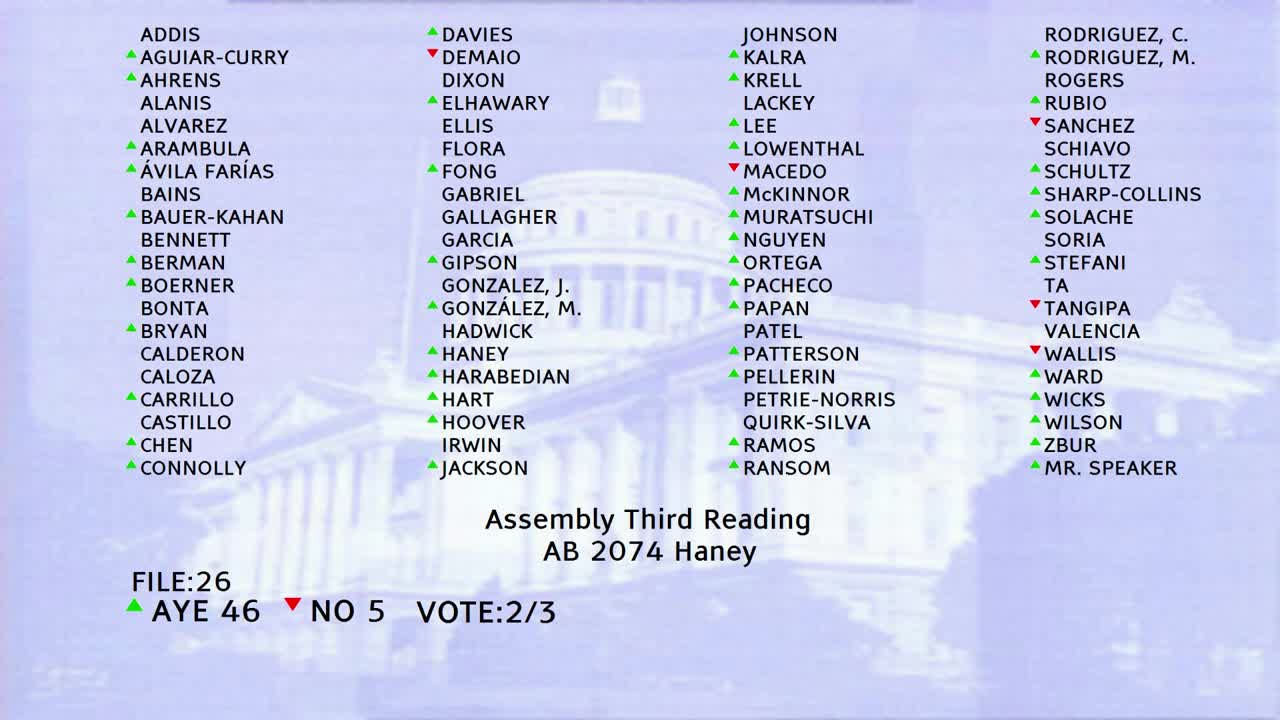
Bill Author

Bill Co-Author(s):