AB 2569: California Environmental Quality Act: natural hazards and adverse environmental conditions.
- Session Year: 2025-2026
- House: Assembly
- Latest Version Date: 2026-02-20
Current Status:
In Progress
(2026-05-14: In committee: Held under submission.)
Introduced
In Committee
Awaiting First Chamber Vote
Passed First Chamber
In Committee
Awaiting Second Chamber Vote
Passed Second Chamber
Enacted
The California Environmental Quality Act (CEQA) requires a lead agency, as defined, to prepare, or cause to be prepared, and certify the completion of an environmental impact report (EIR) on a project that it proposes to carry out or approve that may have a significant effect on the environment or to adopt a negative declaration if it finds that the project will not have that effect. CEQA also requires a lead agency to prepare a mitigated negative declaration for a project that may have a significant effect on the environment if revisions in the project would avoid or mitigate that effect and there is no substantial evidence that the project, as revised, would have a significant effect on the environment.
CEQA defines environment and significant effect on the environment for its purposes. CEQA requires the EIR to include a detailed statement setting forth specified facts.
This bill would expand those definitions to include impacts on people, as specified. The bill would additionally require the lead agency to include in the EIR a detailed statement on any significant effects that may result from locating the proposed project near, or attracting people to, existing or reasonably foreseeable natural hazards or adverse environmental conditions. Because the lead agency would be required to undertake this additional consideration, the bill would impose a state-mandated local program.
The California Constitution requires the state to reimburse local agencies and school districts for certain costs mandated by the state. Statutory provisions establish procedures for making that reimbursement.
This bill would provide that no reimbursement is required by this act for a specified reason.
Environment means the physical conditions which that exist within the area which that will be affected by a proposed project, including land, air, water, minerals, flora, fauna, noise, objects of historic or aesthetic significance. significance, as well as the health and safety of people affected by the physical conditions at the location of a project.
SEC. 2.Section 21068 of the Public Resources Code is amended to read:21068.Significant effect on the environment means a substantial, or potentially substantial, adverse change in the environment. Significant effect on the environment includes exposure of people, either directly or indirectly, to a substantial existing or reasonably foreseeable natural hazard or adverse condition of the environment.
SEC. 3.Section 21100 of the Public Resources Code is amended to read:21100.(a)All lead agencies shall prepare, or cause to be prepared by contract, and certify the completion of, an environmental impact report on any project which they propose to carry out or approve that may have a significant effect on the environment. Whenever feasible, a standard format shall be used for environmental impact reports.
(b)The environmental impact report shall include a detailed statement setting forth all of the following:
(1)All significant effects on the environment of the proposed project.
(2)In a separate section:
(A)Any significant effect on the environment that cannot be avoided if the project is implemented.
(B)Any significant effect on the environment that would be irreversible if the project is implemented.
(3)Mitigation measures proposed to minimize significant effects on the environment, including, but not limited to, measures to reduce the wasteful, inefficient, and unnecessary consumption of energy.
(4)Alternatives to the proposed project.
(5)The growth-inducing impact of the proposed project.
(6)Any significant effects that may result from locating the proposed project near, or attracting people to, existing or reasonably foreseeable natural hazards or adverse environmental conditions.
(c)The report shall also contain a statement briefly indicating the reasons for determining that various effects on the environment of a project are not significant and consequently have not been discussed in detail in the environmental impact report.
(d)For purposes of this section, any significant effect on the environment shall be limited to substantial, or potentially substantial, adverse changes in physical conditions which that exist within the area as defined in Section 21060.5.
(e)Previously approved land use documents, including, but not limited to, general plans, specific plans, and local coastal plans, may be used in cumulative impact analysis.
SEC. 4.No reimbursement is required by this act pursuant to Section 6 of Article XIIIB of the California Constitution because a local agency or school district has the authority to levy service charges, fees, or assessments sufficient to pay for the program or level of service mandated by this act, within the meaning of Section 17556 of the Government Code.
|
Date
|
Status
|
|---|---|
| May 14, 2026 | In committee: Held under submission. |
| Apr 29, 2026 | In committee: Set, first hearing. Referred to APPR. suspense file. |
| Apr 14, 2026 | From committee: Do pass and re-refer to Com. on APPR. (Ayes 9. Noes 4.) (April 13). Re-referred to Com. on APPR. |
| Mar 9, 2026 | Referred to Com. on NAT. RES. |
| Feb 21, 2026 | From printer. May be heard in committee March 23. |
| Feb 20, 2026 | Read first time. To print. |
|
Date
|
Description
|
Location
|
Votes
|
|
|---|---|---|---|---|
| Apr 13, 2026 | Do pass and be re-referred to the Committee on [Appropriations] | Assembly Standing Committee on Natural Resources |
Passed |
This list shows positions taken on this bill by organizations on the date displayed, which is linked to the original source.
Positions by individuals are not included.
|
Organization
|
Position
|
Date
|
|---|---|---|
| 350 Bay Area Action | ** Support | |
| Building Owners and Managers Association of California | ** Against | |
| CALIFORNIA APARTMENT ASSOCATION | ** Against | |
| California Association Of Realtors | ** Against | |
| California Building Industry Association (CBIA) | ** Against | |
| California Business Properties Association | ** Against | |
| California Central Valley Flood Control Association | ** Against | |
| California Chamber Of Commerce | ** Against | |
| California Environmental Justice Alliance (CEJA) Action | ** Support | |
| California Environmental Voters | ** Support | |
| California State Association Of Counties | ** Against | |
| Center For Biological Diversity | ** Support | |
| Center on Race, Poverty & the Environment | ** Support | |
| Citizens Planning Association | ** Support | |
| cleanearth4kids.org | ** Support | |
| Clean Water Action | ** Support | |
| Climate Action California | ** Support | |
| Committees for Land, Air, Water and Species | ** Support | |
| Communities for a Better Environment | ** Support | |
| Defenders Of Wildlife | ** Support | |
| Desert Water Agency | ** Against | |
| Earthjustice | ** Support | |
| El Dorado Irrigation District | ** Against | |
| Endangered Habitats League | ** Support | |
| Environmental Defense Center | ** Support | |
| Facts: Families Advocating for Chemical & Toxics Safety | ** Support | |
| Food and Water Watch | ** Support | |
| Friends of Mission Canyon | ** Support | |
| Friends of the River | ** Support | |
| Leadership Counsel Action | ** Support | |
| League Of California Cities | ** Against | |
| Mothers Out Front Silicon Valley | ** Support | |
| NAIOP of California | ** Against | |
| Natural Resources Defense Council | ** Support | |
| Physicians for Social Responsibility - San Francisco Bay | ** Support | |
| Planning And Conservation League | ** Support | |
| Rural County Representatives of California | ** Against | |
| San Francisco Baykeeper | ** Support | |
| Sierra Club California | ** Support | |
| Smart Action for Growth & Equity - Santa Barbara | ** Support | |
| Valley Ag Water Coalition | ** Against | |
| Water Replenishment District | ** Against |
Date of Hearing: April 29, 2026
ASSEMBLY COMMITTEE ON APPROPRIATIONS
Buffy Wicks, Chair
ABPCA Bill Id:AB 2569
Author:(Hart) – As Introduced Ver:February 20, 2026
Policy Committee: | Natural Resources | Vote: | 9 - 4 |
|
| ||
|
|
Urgency: No State Mandated Local Program: Yes Reimbursable: No
SUMMARY:
This bill expands the scope of the California Environmental Quality Act (CEQA) analysis to explicitly include consideration of significant effects that may result from locating a project near, or attracting people to, existing or reasonably foreseeable natural hazards or adverse environmental conditions, validating prior CEQA practice and invalidating a 2015 California Supreme Court decision.
Specifically, this bill:
- Requires the “detailed statement” as part of an Environmental Impact Report (EIR) to additionally include any significant effects that may result from locating the proposed project near, or attracting people to, existing or reasonably foreseeable natural hazards or adverse environmental conditions.
- Revises the definition of “environment” to include the health and safety of people affected by the physical conditions at the location of a project.
- Revises the definition of “significant effect on the environment” to include exposure of people, either directly or indirectly, to a substantial existing or reasonably foreseeable natural hazard or adverse condition of the environment.
FISCAL EFFECT:
By expanding what triggers a finding of "significant effect on the environment" under CEQA and expanding the scope of what must be disclosed in an EIR, this bill will result in increased ongoing annual costs of an unknown but potentially significant amount, possibly in the low millions of dollars in the aggregate, to state agencies subject to CEQA for publicly funded or agency-led projects (General Fund or special fund).
Department of Parks and Recreation (State Parks). State Parks asserts it cannot comply with the requirements of this bill within existing resources. According to State Parks, an average, somewhat complex project undergoing the department’s internal CEQA review process resulting in a Notice of Exemption (NOE) costs the department about $50,000 to $60,000 and between four and six months of review time. An initial study resulting in a negative or mitigated negative declaration can range from $150,000 to $200,000 and takes over a year to complete. An EIR averages $250,000 or more.
State Parks processes approximately 400 CEQA notices and documents annually, with about 95% resulting in NOEs. It is challenging to estimate how many department-led projects may require a higher level of review under this bill, but State Parks conservatively estimates an increase of $5 million annually (General Fund or bond funds) in addition to the much lengthier processing times.
Department of General Services (DGS). DGS anticipates General Fund cost increases of $170,000 per CEQA document (for additional qualitative and quantitative analysis, including modeling), although exact costs will depend on the specific project, project location, and availability of existing environmental data. DGS additionally anticipates $400,000 in added litigation costs per lawsuit where it is the lead agency, for affordable housing projects, and for projects using the State Project Infrastructure Fund, as well as significantly higher costs for mitigation for certain projects. DGS notes these increased costs will materially impact the types and number of projects and sites state agencies are able to undertake or acquire, respectively.
Department of Corrections and Rehabilitation (CDCR). CDCR estimates increased General Fund costs of an unknown amount resulting from the need to incorporate both the expanded scope of significant effects into its EIRs as well as the cost of associated additional mitigation measures. CDCR notes this bill may invite additional legal challenges regarding the validity of any EIR or the information used in the development of the EIR, which may result in additional project costs and schedule delays.
State Water Resources Control Board (State Water Board). The State Water Board estimates ongoing annual General Fund costs of $250,000 to analyze environmental impacts for projects located near natural hazards or adverse environmental conditions where the State Water Board or a Regional Water Quality Control Board serves as the lead agency.
University of California (UC). The UC system estimates ongoing annual General Fund costs of an unknown amount to comply with CEQA as well as increased costs related to legal challenges. The UC notes this bill may significantly impact its ability to build urgently needed university housing for students, faculty, and staff.
Air Resources Board (ARB). ARB anticipates ongoing annual costs (General Fund or special fund), potentially in the millions of dollars, to conduct more extensive environmental analyses for its regulations, including for minor amendments. ARB argues the bill also introduces a significant amount of litigation risk for the board by adding new areas of analysis that must be evaluated on a statewide level.
Numerous other state agencies, including Department of Transportation, Department of Forestry and Fire Protection, Department of Fish and Wildlife, Department of Water Resources, California State University, and California Community Colleges, are subject to CEQA for publicly funded projects and will likely see commiserate cost increases as a result of this bill.
The Legislative Analyst’s Office recently warned of General Fund structural deficits of around $35 billion per year in the 2027-28 fiscal year and ongoing.
COMMENTS:
1) Purpose. According to the author:
Enacted in 1970, CEQA is the state’s bedrock environmental law, ensuring that environmental impacts are considered before projects are approved. Current law, however, does not clearly require agencies to evaluate how hazards like wildfires, flooding, or extreme heat may impact people brought into a project. With worsening climate change and natural hazards, this lack of clarity has allowed developments to be approved without a full analysis and understanding of the risks to future residents. AB 2569 will clarify that human health and safety is a core part of environmental review and require agencies to assess when projects may expose people to natural hazards, helping prevent unsafe development and better protect communities.
2) Background. CEQA and EIRs. CEQA provides a process for evaluating the environmental effects of applicable projects undertaken or approved by public agencies. If a project is not exempt from CEQA, the lead agency prepares an initial study to determine whether the project may have a significant effect on the environment. If the initial study shows the project would not have a significant effect on the environment, the lead agency must prepare a negative declaration. If the initial study shows that project may have a significant effect, the lead agency must prepare an EIR.
Generally, an EIR must accurately describe the proposed project, identify and analyze each significant environmental impact expected to result from the proposed project, identify mitigation measures to reduce those impacts to the extent feasible, and evaluate a range of reasonable alternatives to the proposed project. Prior to approving any project that has received environmental review, the lead agency must make certain findings. If mitigation measures are required or incorporated into a project, the lead agency must adopt a reporting or monitoring program to ensure compliance with those measures.
Legal History. As detailed in the Assembly Natural Resources Committee’s analysis of this bill, Section 15126.2 of the CEQA Guidelines details how to consider and discuss significant environmental impacts of a proposed project. 15126.2(s) states that an EIR shall also analyze “any significant environmental effects the project might cause or risk exacerbating by bringing development and people into the area affected.” For example, the guidelines state, the EIR should evaluate “any potentially significant direct, indirect, or cumulative environmental impacts of locating development in areas susceptible to hazardous conditions (e.g., floodplains, coastlines, wildfire risk areas).”
A 2011 decision by the Second District Court of Appeal, Ballona Wetlands Land Trust v. City of Los Angeles, held that the requirement in Section 15126.2(a) is invalid. Finding that CEQA literally requires analysis of the project’s significant impacts on the environment – and not the environment’s impacts on the project – the court held that the effects of preexisting environmental hazards on the project and its users are not environmental impacts under CEQA. According to the court, to hold otherwise would be inconsistent with the statute’s legislative purpose and statutory requirements.
Then a 2015 decision by the California Supreme Court, California Building Industry Association (CBIA) v. Bay Area Air Quality Management District, held that CEQA generally did not require agencies to analyze the impacts of existing environmental conditions on future users or residents of a project. Instead, agencies were only required to evaluate how the project might exacerbate existing environmental hazards.
Support and Opposition. Writing in support, a coalition of environmental and environmental justice organizations argues the result of the 2015 decision is that developers can “site projects in fire-prone canyons, flood zones, near freeways, and on contaminated land, and bear no obligation under CEQA to assess, disclose, or mitigate the potential impacts of these hazards on human health and safety.” The coalition cites an example of an East Sacramento project, which proposed 336 housing units between the Capital City Freeway and Union Pacific rail tracks, “potentially exposing future residents to elevated cancer and health risks from these polluting sources.” The coalition notes that “community concerns were dismissed, as the court deemed freeway pollution as an existing condition under CEQA.” Supporters also assert the bill applies only to projects already subject to CEQA and does not impede the application of recent bills that create various ministerial approval pathways for projects or statutory and categorical exemptions from CEQA.
Among others in opposition, the California Building Industry Association (CBIA) argues this bill will drive up the cost of housing and various other projects in California “by massively expanding the scope and uncertainty of [CEQA,]” and exposing projects “to a new layer of analysis regarding pre-existing hazard conditions – conditions the project did not create and cannot control – adding cost, delay, and legal uncertainty to the approval process.” CBIA further argues the bill creates significant new litigation exposure and that “the state’s existing framework of hazard mitigation planning, building codes, safety element requirements, disclosure mandates, and adaptation planning already provide robust protections.”
Prior Legislation. AB 953 (Ammiano), of the 2013-2014 Legislative Session, was substantially similar to this bill and died on the Assembly Inactive File.
Analysis Prepared by: Nikita Koraddi / APPR. / (916) 319-2081
Date of Hearing: April 13, 2026
ASSEMBLY COMMITTEE ON NATURAL RESOURCES
Isaac G. Bryan, Chair
ABPCA Bill Id:AB 2569 (
Author:Hart) – As Introduced Ver:February 20, 2026
SUBJECT: California Environmental Quality Act: natural hazards and adverse environmental conditions
SUMMARY: Expands the scope of the California Environmental Quality Act (CEQA) analysis to explicitly include consideration of significant effects that may result from locating a project near, or attracting people to, existing or reasonably foreseeable natural hazards or adverse environmental conditions, validating prior CEQA practice and invalidating a 2015 California Supreme Court decision.
EXISTING LAW, CEQA:
- Requires lead agencies with the principal responsibility for carrying out or approving a proposed project to prepare a negative declaration, mitigated negative declaration, or environmental impact report (EIR) for this action, unless the project is exempt from CEQA. (Public Resources Code (PRC) 21000 et seq.)
- Requires an EIR to include a detailed statement setting forth all of the following:
- All significant effects on the environment of the proposed project.
- In a separate section:
- Any significant effect on the environment that cannot be avoided if the project is implemented.
- Any significant effect on the environment that would be irreversible if the project is implemented.
- Mitigation measures proposed to minimize significant effects on the environment, including, but not limited to, measures to reduce the wasteful, inefficient, and unnecessary consumption of energy.
- Alternatives to the proposed project.
- The growth-inducing impact of the proposed project.
(PRC 21100)
- Defines "environment" as the physical conditions that exist within the area which will be affected by a proposed project, including land, air, water, minerals, flora, fauna, noise, or objects of historic or aesthetic significance. (PRC 21060.5)
- Defines “significant effect on the environment” as a substantial, or potentially substantial, adverse change in the environment. (PRC 21068)
THIS BILL:
- Requires an EIR also to include a detailed statement setting forth any significant effects that may result from locating the proposed project near, or attracting people to, existing or reasonably foreseeable natural hazards or adverse environmental conditions.
- Revises the definition of “environment” to include the health and safety of people affected by the physical conditions at the location of a project.
- Revises the definition of “significant effect on the environment” to include exposure of people, either directly or indirectly, to a substantial existing or reasonably foreseeable natural hazard or adverse condition of the environment.
FISCAL EFFECT: Unknown
COMMENTS:
- Background. CEQA provides a process for evaluating the environmental effects of applicable projects undertaken or approved by public agencies. If a project is not exempt from CEQA, an initial study is prepared to determine whether the project may have a significant effect on the environment. If the initial study shows that the project would not have a significant effect on the environment, the lead agency must prepare a negative declaration. If the initial study shows that the project may have a significant effect, the lead agency must prepare an EIR.
Generally, an EIR must accurately describe the proposed project, identify and analyze each significant environmental impact expected to result from the proposed project, identify mitigation measures to reduce those impacts to the extent feasible, and evaluate a range of reasonable alternatives to the proposed project. If a lead agency approves a proposed project despite its significant environmental impacts, the EIR must contain a statement of overriding considerations explaining the economic, social, and other factors that support this decision. Prior to approving any project that has received environmental review, an agency must make certain findings. If mitigation measures are required or incorporated into a project, the agency must adopt a reporting or monitoring program to ensure compliance with those measures.
- Author’s statement:
Enacted in 1970, CEQA is the state’s bedrock environmental law, ensuring that environmental impacts are considered before projects are approved. Current law, however, does not clearly require agencies to evaluate how hazards like wildfires, flooding, or extreme heat may impact people brought into a project. With worsening climate change and natural hazards, this lack of clarity has allowed developments to be approved without a full analysis and understanding of the risks to future residents. AB 2569 will clarify that human health and safety is a core part of environmental review and require agencies to assess when projects may expose people to natural hazards, helping prevent unsafe development and better protect communities.
- CEQA Guidelines have long required lead agencies to consider the effects of hazardous or adverse environmental conditions on a proposed project. Section 15126.2 of the CEQA Guidelines details how to consider and discuss significant environmental impacts of a proposed project. 15126.2(s) states “(t)he EIR shall also analyze any significant environmental effects the project might cause or risk exacerbating by bringing development and people into the area affected. For example, the EIR should evaluate any potentially significant direct, indirect, or cumulative environmental impacts of locating development in areas susceptible to hazardous conditions (e.g., floodplains, coastlines, wildfire risk areas), including both short-term and long-term conditions, as identified in authoritative hazard maps, risk assessments or in land use plans addressing such hazards areas.”
This “reverse-CEQA” analysis, considering impacts of the environment on the project, was used to evaluate and address problems caused by bringing people and new development to areas with poor air quality, incompatible land uses, or hazardous conditions such as heightened seismic activity. While not explicitly required by statute, this requirement in the Guidelines promoted common-sense planning and consideration of issues that would naturally come up throughout the environmental review process, such as the risk of flooding from sea-level rise and other impacts associated with climate change.
- But the courts have invalidated these provisions in the CEQA Guidelines. A 2011 decision by the Second District Court of Appeal, Ballona Wetlands Land Trust v. City of Los Angeles, held that the requirement in Section 15126.2(a) is invalid. Finding that CEQA literally requires analysis of the project’s significant impacts on the environment – and not the environment’s impacts on the project – the court held that the effects of preexisting environmental hazards on the project and its users are not environmental impacts under CEQA. According to the court, to hold otherwise would be inconsistent with the statute’s legislative purpose and statutory requirements.
Then a 2015 decision by the California Supreme Court, California Building Industry Association (CBIA) v. Bay Area Air Quality Management District, held that CEQA generally did not require agencies to analyze the impacts of existing environmental conditions on future users or residents of a project. Instead, agencies were only required to evaluate how the project might exacerbate existing environmental hazards.
- Prior legislation. AB 953 (Ammiano, 2013) was essentially the same as this bill, requiring an EIR to analyze significant environmental effects resulting from locating a proposed project near, or attracting people to, areas with substantial existing or reasonably foreseeable natural hazards or adverse environmental conditions. While AB 953 passed this committee on April 15, 2013, it was not taken up for a vote on the floor and eventually died on the inactive file.
REGISTERED SUPPORT / OPPOSITION:
Support
350 Bay Area Action
California Environmental Justice Alliance (CEJA) Action
California Environmental Voters
Center for Biological Diversity
Center on Race, Poverty & the Environment
Citizens Planning Association
Clean Water Action
Cleanearth4kids.org
Climate Action California
Committees for Land, Air, Water and Species
Communities for a Better Environment
Defenders of Wildlife
Earthjustice
Endangered Habitats League
Environmental Defense Center
Facts: Families Advocating for Chemical & Toxics Safety
Food and Water Watch
Friends of Mission Canyon
Friends of the River
Leadership Counsel Action
Mothers Out Front Silicon Valley
Natural Resources Defense Council
Physicians for Social Responsibility - San Francisco Bay
Planning and Conservation League
San Francisco Baykeeper
Sierra Club California
Smart Action for Growth & Equity - Santa Barbara
Opposition
Building Owners and Managers Association of California
California Apartment Assocation
California Association of Realtors
California Building Industry Association
California Business Properties Association
California Central Valley Flood Control Association
California Chamber of Commerce
California State Association of Counties
Desert Water Agency
El Dorado Irrigation District
League of California Cities
NAIOP of California
Rural County Representatives of California
Valley Ag Water Coalition
Water Replenishment District
Analysis Prepared by: Lawrence Lingbloom / NAT. RES. /
Discussed in Hearing
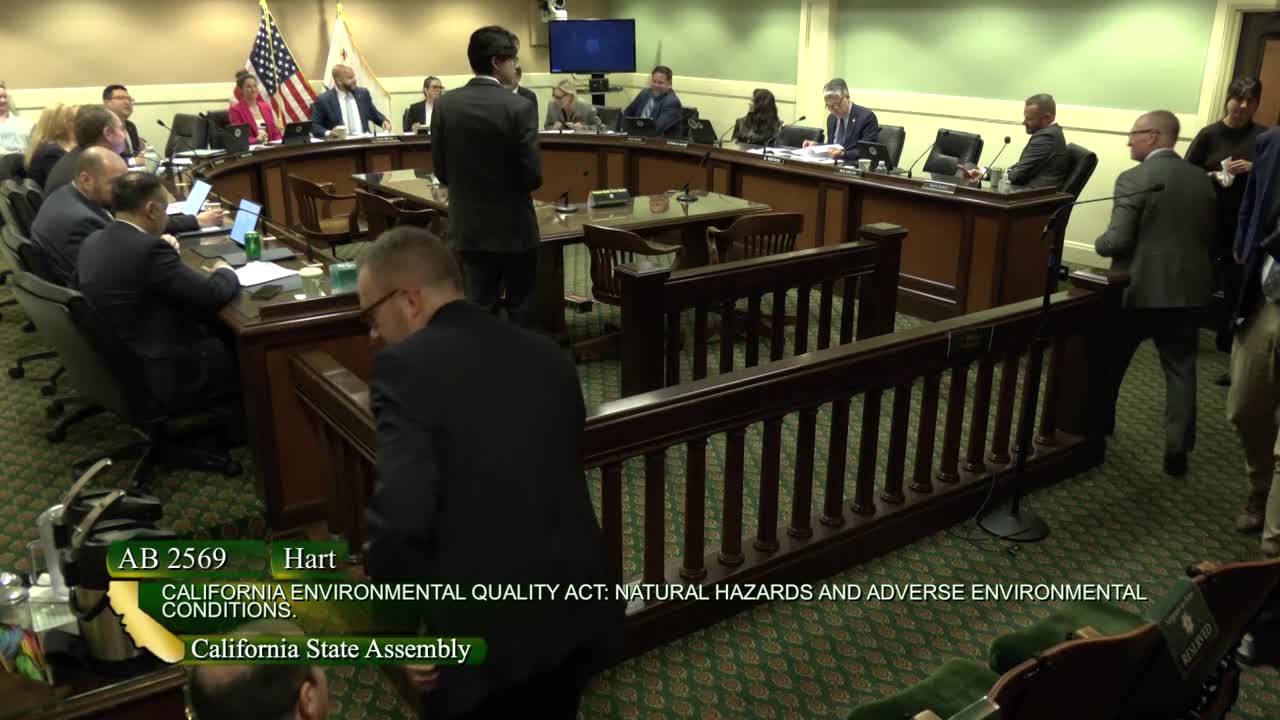 15MIN
Assembly Standing Committee on Natural Resources
Bill Author

Bill Co-Author(s):