AB 2582: Crimes: prostitution.
- Session Year: 2025-2026
- House: Assembly
- Latest Version Date: 2026-02-20
Current Status:
In Progress
(2026-05-14: In committee: Held under submission.)
Introduced
In Committee
Awaiting First Chamber Vote
Passed First Chamber
In Committee
Awaiting Second Chamber Vote
Passed Second Chamber
Enacted
Under existing law, an individual who solicits, or who agrees to engage in, or who engages in, any act of prostitution is guilty of disorderly conduct, a misdemeanor.
This bill would require a person who commits prostitution with intent to receive compensation, money, or anything of value from another person to, for a first or 2nd violation of those provisions, be offered a diversion program pursuant to specified provisions. By imposing new duties on local officials, the bill would create a state-mandated local program.
The California Constitution requires the state to reimburse local agencies and school districts for certain costs mandated by the state. Statutory provisions establish procedures for making that reimbursement.
This bill would provide that, if the Commission on State Mandates determines that the bill contains costs mandated by the state, reimbursement for those costs shall be made pursuant to the statutory provisions noted above.
Except as provided in paragraph (5) of subdivision (b) and in subdivisions (k) and (l), a person who commits any of the following acts is guilty of disorderly conduct, a misdemeanor:
(a)An individual who solicits anyone to engage in or who engages in lewd or dissolute conduct in a public place or in a place open to the public or exposed to public view.
(b)(1)An individual who solicits, or who agrees to engage in, or who engages in, an act of prostitution with the intent to receive compensation, money, or anything of value from another person. An individual agrees to engage in an act of prostitution when, with specific intent to so engage, the individual manifests an acceptance of an offer or solicitation by another person to so engage, regardless of whether the offer or solicitation was made by a person who also possessed the specific intent to engage in an act of prostitution.
(2)An individual who solicits, or who agrees to engage in, or who engages in, an act of prostitution with another person who is 18 years of age or older in exchange for the individual providing compensation, money, or anything of value to the other person. An individual agrees to engage in an act of prostitution when, with specific intent to so engage, the individual manifests an acceptance of an offer or solicitation by another person who is 18 years of age or older to so engage, regardless of whether the offer or solicitation was made by a person who also possessed the specific intent to engage in an act of prostitution.
(3)An individual who solicits, or who agrees to engage in, or who engages in, an act of prostitution with another person who is a minor in exchange for the individual providing compensation, money, or anything of value to the minor. An individual agrees to engage in an act of prostitution when, with specific intent to so engage, the individual manifests an acceptance of an offer or solicitation by someone who is a minor to so engage, regardless of whether the offer or solicitation was made by a minor who also possessed the specific intent to engage in an act of prostitution.
(4)A manifestation of acceptance of an offer or solicitation to engage in an act of prostitution does not constitute a violation of this subdivision unless some act, in addition to the manifestation of acceptance, is done within this state in furtherance of the commission of the act of prostitution by the person manifesting an acceptance of an offer or solicitation to engage in that act. As used in this subdivision, prostitution includes any lewd act between persons for money or other consideration.
(5)Notwithstanding paragraphs (1) to (3), inclusive, this subdivision does not apply to a child under 18 years of age who is alleged to have engaged in conduct to receive money or other consideration that would, if committed by an adult, violate this subdivision. A commercially exploited child under this paragraph may be adjudged a dependent child of the court pursuant to paragraph (2) of subdivision (b) of Section 300 of the Welfare and Institutions Code and may be taken into temporary custody pursuant to subdivision (a) of Section 305 of the Welfare and Institutions Code, if the conditions allowing temporary custody without warrant are met.
(c)Who accosts other persons in a public place or in a place open to the public for the purpose of begging or soliciting alms.
(d)Who loiters in or about a toilet open to the public for the purpose of engaging in or soliciting a lewd or lascivious or an unlawful act.
(e)Who lodges in a building, structure, vehicle, or place, whether public or private, without the permission of the owner or person entitled to the possession or in control of it.
(f)Who is found in a public place under the influence of intoxicating liquor, a drug, controlled substance, toluene, or a combination of an intoxicating liquor, drug, controlled substance, or toluene, in a condition that they are unable to exercise care for their own safety or the safety of others, or by reason of being under the influence of intoxicating liquor, drug, controlled substance, toluene, or a combination of an intoxicating liquor, drug, or toluene, interferes with or obstructs or prevents the free use of a street, sidewalk, or other public way.
(g)If a person has violated subdivision (f), a peace officer, if reasonably able to do so, shall place the person, or cause the person to be placed, in civil protective custody. The person shall be taken to a facility, designated pursuant to Section 5170 of the Welfare and Institutions Code, for the 72-hour treatment and evaluation of inebriates. A peace officer may place a person in civil protective custody with that kind and degree of force authorized to effect an arrest for a misdemeanor without a warrant. A person who has been placed in civil protective custody shall not thereafter be subject to criminal prosecution or juvenile court proceeding based on the facts giving rise to this placement. This subdivision does not apply to the following persons:
(1)A person who is under the influence of a drug or under the combined influence of intoxicating liquor and a drug.
(2)A person who a peace officer has probable cause to believe has committed a felony, or who has committed a misdemeanor in addition to subdivision (f).
(3)A person who a peace officer in good faith believes will attempt escape or will be unreasonably difficult for medical personnel to control.
(h)Who loiters, prowls, or wanders upon the private property of another, at any time, without visible or lawful business with the owner or occupant. As used in this subdivision, loiter means to delay or linger without a lawful purpose for being on the property and for the purpose of committing a crime as opportunity may be discovered.
(i)Who, while loitering, prowling, or wandering upon the private property of another, at any time, peeks in the door or window of an inhabited building or structure, without visible or lawful business with the owner or occupant.
(j)(1)A person who looks through a hole or opening, into, or otherwise views, by means of any instrumentality, including, but not limited to, a periscope, telescope, binoculars, camera, motion picture camera, camcorder, mobile phone, electronic device, or unmanned aircraft system, the interior of a bedroom, bathroom, changing room, fitting room, dressing room, or tanning booth, or the interior of any other area in which the occupant has a reasonable expectation of privacy, with the intent to invade the privacy of a person or persons inside. This subdivision does not apply to those areas of a private business used to count currency or other negotiable instruments.
(2)A person who uses a concealed camcorder, motion picture camera, or photographic camera of any type, to secretly videotape, film, photograph, or record by electronic means, another identifiable person under or through the clothing being worn by that other person, for the purpose of viewing the body of, or the undergarments worn by, that other person, without the consent or knowledge of that other person, with the intent to arouse, appeal to, or gratify the lust, passions, or sexual desires of that person and invade the privacy of that other person, under circumstances in which the other person has a reasonable expectation of privacy. For the purposes of this paragraph, identifiable means capable of identification, or capable of being recognized, meaning that someone, including the victim, could identify or recognize the victim. It does not require the victims identity to actually be established.
(3)(A)A person who uses a concealed camcorder, motion picture camera, or photographic camera of any type, to secretly videotape, film, photograph, or record by electronic means, another identifiable person who may be in a state of full or partial undress, for the purpose of viewing the body of, or the undergarments worn by, that other person, without the consent or knowledge of that other person, in the interior of a bedroom, bathroom, changing room, fitting room, dressing room, or tanning booth, or the interior of any other area in which that other person has a reasonable expectation of privacy, with the intent to invade the privacy of that other person. For the purposes of this paragraph, identifiable means capable of identification, or capable of being recognized, meaning that someone, including the victim, could identify or recognize the victim. It does not require the victims identity to actually be established.
(B)Neither of the following is a defense to the crime specified in this paragraph:
(i)The defendant was a cohabitant, landlord, tenant, cotenant, employer, employee, or business partner or associate of the victim, or an agent of any of these.
(ii)The victim was not in a state of full or partial undress.
(4)(A)(i)A person who intentionally distributes or causes to be distributed the image of the intimate body part or parts of another identifiable person, or an image of the person depicted engaged in an act of sexual intercourse, sodomy, oral copulation, sexual penetration, or an image of masturbation by the person depicted or in which the person depicted participates, when subclauses (I) to (III), inclusive, are all true:
(I)The person distributing the image knows or should know that the distribution of the image will cause serious emotional distress.
(II)The person depicted suffers serious emotional distress.
(III)One of the following has occurred:
(ia)The person depicted in the image and the person distributing the image had agreed or had an understanding that the image shall remain private.
(ib)The image was knowingly recorded, captured, or otherwise obtained by the person distributing the image without the authorization of the person depicted, and the image was recorded or captured under circumstances in which the person depicted had a reasonable expectation of privacy.
(ic)The image is knowingly obtained by the person distributing the image by exceeding authorized access from the property, accounts, messages, files, or resources of the person depicted.
(ii)A person who intentionally creates and distributes or causes to be distributed any photo realistic image, digital image, electronic image, computer image, computer-generated image, or other pictorial representation of an intimate body part or parts of another identifiable person, or an image of the person depicted engaged in an act of sexual intercourse, sodomy, oral copulation, sexual penetration, or an image of masturbation by the person depicted or in which the person depicted participates that was created in a manner that would cause a reasonable person to believe the image is an authentic image of the person depicted, under circumstances in which the person distributing the image knows or should know that distribution of the image will cause serious emotional distress, and the person depicted suffers that distress. This clause shall not apply to a person who was under 18 years of age at the time the person committed the offense.
(B)(i)A person intentionally distributes an image described in subparagraph (A) when that person personally distributes the image.
(ii)A person intentionally causes an image described in subparagraph (A) to be distributed when that person arranges, specifically requests, or intentionally causes another person to distribute the image.
(C)As used in this paragraph, the following terms have the following meanings:
(i)Distribute includes exhibiting in public or giving possession.
(ii)Identifiable has the same meaning as in paragraphs (2) and (3).
(iii)Intimate body part means any portion of the genitals, the anus and, in the case of a female, also includes any portion of the breasts below the top of the areola, that is either uncovered or clearly visible through clothing.
(D)It shall not be a violation of this paragraph to distribute an image described in subparagraph (A) if any of the following applies:
(i)The distribution is made in the course of reporting an unlawful activity.
(ii)The distribution is made in compliance with a subpoena or other court order for use in a legal proceeding.
(iii)The distribution is made in the course of a lawful public proceeding.
(iv)The distribution is related to a matter of public concern or public interest. Distribution is not a matter of public concern or public interest solely because the depicted individual is a public figure.
(5)This subdivision does not preclude punishment under any section of law providing for greater punishment.
(6)A defendant shall not be punished for both a violation of paragraph (4) of subdivision (j) and paragraph (2) of subdivision (j) or Section 502 if that punishment would be barred under Section 654.
(k)(1)Except as provided in paragraph (3), a second or subsequent violation of subdivision (j) is punishable by imprisonment in a county jail not exceeding one year, or by a fine not exceeding two thousand dollars ($2,000), or by both that fine and imprisonment.
(2)Except as provided in paragraph (3), if the victim of a violation of subdivision (j) was a minor at the time of the offense, the violation is punishable by imprisonment in a county jail not exceeding one year, or by a fine not exceeding two thousand dollars ($2,000), or by both that fine and imprisonment.
(3)If the victim of a violation of paragraph (3) of subdivision (j) was a minor at the time of the offense, a second or subsequent violation of paragraph (3) of subdivision (j) is punishable by a fine not exceeding two thousand dollars ($2,000), or by imprisonment in county jail not exceeding one year, or by imprisonment pursuant to subdivision (h) of Section 1170, or by both a fine and imprisonment. This paragraph shall not apply to a person who was under 18 years of age at the time that they committed the offense.
(l)(1)(A)If a crime is committed in violation of subdivision (b) by a defendant who is 18 years of age or older, the person who was solicited was a minor at the time of the offense, and the defendant knew or should have known that the person who was solicited was a minor at the time of the offense, the violation is punishable by imprisonment in a county jail for not less than two days and not more than one year, or by a fine not exceeding ten thousand dollars ($10,000), or by both that fine and imprisonment, except as provided in paragraph (2).
(B)The court may, in unusual cases, when the interests of justice are best served, reduce or eliminate the mandatory two days of imprisonment in a county jail required by this paragraph. If the court reduces or eliminates the mandatory two days of imprisonment, the court shall specify the reason on the record.
(2)Notwithstanding paragraph (1), a defendant 18 years of age or older may be punished by either imprisonment in a county jail for not less than two days and not more than one year, or by a fine not exceeding ten thousand dollars ($10,000), or by both that fine and imprisonment, or imprisonment pursuant to subdivision (h) of Section 1170 for any of the following:
(A)The solicited minor was under 16 years of age at the time of the offense, or the person solicited was under 18 years of age at the time of the offense and the person solicited was caused, induced, or persuaded at the time of the solicitation to engage in a commercial sex act as specified in subdivision (c) of Section 236.1.
(B)The solicited minor was more than 3 years younger than the defendant at the time of the offense.
(3)A second or subsequent violation of paragraph (2) is punishable as a felony by imprisonment pursuant to subdivision (h) of Section 1170.
(4)A defendant who is convicted of a violation of paragraph (2) shall be ordered by the court, if granted probation, to successfully complete an education program on human trafficking and the exploitation of children. A fee shall not be imposed for participation or enrollment in an education program pursuant to this paragraph.
(5)For a first or second violation of paragraph (1) of subdivision (b), the defendant shall be offered diversion pursuant to a program in Title 6 (commencing with Section 976) of Part 2, if a program for which the defendant is eligible is available.
(5)(6)An individual who provides compensation, money, or anything of value in violation of paragraph (2) or (3) of subdivision (b) shall, in addition to any other punishment, be punished by a fine of one thousand dollars ($1,000). Fines collected pursuant to this paragraph shall be deposited in the Survivors Support Fund.
SEC. 2.If the Commission on State Mandates determines that this act contains costs mandated by the state, reimbursement to local agencies and school districts for those costs shall be made pursuant to Part 7 (commencing with Section 17500) of Division 4 of Title 2 of the Government Code.
|
Date
|
Status
|
|---|---|
| May 14, 2026 | In committee: Held under submission. |
| Apr 22, 2026 | In committee: Set, first hearing. Referred to APPR. suspense file. |
| Mar 25, 2026 | From committee: Do pass and re-refer to Com. on APPR. (Ayes 8. Noes 0.) (March 24). Re-referred to Com. on APPR. |
| Mar 9, 2026 | Referred to Com. on PUB. S. |
| Feb 21, 2026 | From printer. May be heard in committee March 23. |
| Feb 20, 2026 | Read first time. To print. |
|
Date
|
Description
|
Location
|
Votes
|
|
|---|---|---|---|---|
| Mar 24, 2026 | Do pass and be re-referred to the Committee on [Appropriations] | Assembly Standing Committee on Public Safety |
Passed |
This list shows positions taken on this bill by organizations on the date displayed, which is linked to the original source.
Positions by individuals are not included.
|
Organization
|
Position
|
Date
|
|---|---|---|
| 1 Private Individual | ** Support | |
| 8 Private Individuals | ** Against | |
| Access Reproductive Justice | ** Against | |
| California Attorneys For Criminal Justice | ** Support | |
| California Catholic Conference | ** Support | |
| California Public Defenders Association | ** Support | |
| California State Sheriffs' Association | ** Against | |
| Community Health Project LA | ** Against | |
| Erotic Service Providers Legal, Education, and Research Project | ** Against | |
| HealthRight 360 | ** Against | |
| Stripper Worker Center | ** Against | |
| The Sidewalk Project | ** Against |
Date of Hearing: April 22, 2026
ASSEMBLY COMMITTEE ON APPROPRIATIONS
Buffy Wicks, Chair
ABPCA Bill Id:AB 2582
Author:(Schultz) – As Introduced Ver:February 20, 2026
Policy Committee: | Public Safety | Vote: | 8 - 0 |
|
| ||
|
|
Urgency: No State Mandated Local Program: Yes Reimbursable: Yes
SUMMARY:
This bill requires that a person who commits prostitution with intent to receive compensation, for a first or second violation, be offered a diversion program, if a program for which the defendant is eligible is available.
FISCAL EFFECT:
- Unknown, potentially moderate costs to trial courts (Trial Court Trust Fund) and counties for mandatory diversion offers to defendants charged with prostitution with intent to receive compensation. Under existing law, judges already have discretion to offer diversion for most misdemeanors, including Section 647(b) offenses, under Penal Code Section 1001.95. According to the Judicial Council, defendants charged under Section 647(b) are regularly offered diversion under existing authority. This bill would shift diversion from discretionary to mandatory for first and second violations, which may increase the number of defendants offered and placed into diversion programs. The Judicial Council does not collect statewide data on Section 647(b) filings or on the share of defendants currently being offered diversion, so the incremental impact of the mandate is unknown.
- County costs for diversion program services — including treatment, counseling, education, and case management for this population — would increase to the extent more defendants enter diversion programs as a result of the mandate. By requiring that diversion be offered, this bill creates a state-mandated local program. If the Commission on State Mandates determines the provisions of this bill create a new program or impose a higher level of service for which the state must reimburse local costs, counties could claim reimbursement from the state (General Fund). The magnitude of these costs is unknown, but potentially in excess of $150,000 across all counties, depending on the number of mandated diversions.
COMMENTS:
- Purpose. According to the author, many individuals charged with prostitution have been victimized by sex traffickers and face extreme barriers to exiting, including violence, isolation, mental health issues, and substance use. The author cites research finding that participants who completed a prostitution diversion program had a 68% lower risk of re-arrest. This bill applies only to defendants charged with intent to receive compensation — not to buyers of sex — and requires diversion to be offered only where a program is already available.
- Background. Under existing law, it is a misdemeanor to solicit, agree to engage in, or engage in any act of prostitution with the intent to receive compensation, money, or anything of value from another person. It is separately a misdemeanor to solicit or engage in prostitution in exchange for providing compensation to another person— the “buyer” offense. This bill applies only to the former — individuals who receive or intend to receive compensation. Existing law under Penal Code Section 1001.95, enacted by AB 3234 (Ting), Chapter 334, Statutes of 2020, authorizes judges to offer misdemeanor diversion over the objection of the prosecution for most misdemeanors, excluding offenses requiring sex offender registration, domestic violence offenses, and stalking. Section 647(b)(1) is eligible for this existing judicial diversion. According to the Judicial Council, defendants charged under Section 647(b) are regularly offered diversion under this authority. This bill does not create a new diversion program — it mandates that defendants charged under Section 647(b)(1) be offered diversion for a first or second violation where a program is available. The shift from discretionary to mandatory is the basis for the bill’s state-mandated local program finding. The policy committee analysis notes it is unclear whether each county has appropriate programs in place to serve this population, and the bill does not specify whether diversion must be pre-plea or post-plea.
Analysis Prepared by: Shiran Zohar / APPR. / (916) 319-2081
Date of Hearing:
Deputy Chief Counsel: Stella Choe
ASSEMBLY COMMITTEE ON PUBLIC SAFETY
Nick Schultz, Chair
ABPCA Bill Id:AB 2582
Author:(Schultz) – As Introduced Ver:February 20, 2026
SUMMARY:
Requires a person who commits prostitution with intent to receive compensation, money, or anything of value from another person to, for a first or second violation of those provisions, be offered a diversion program, if a program for which the defendant is eligible is available.
EXISTING LAW:
- Makes it a misdemeanor to solicit, agree to engage in, or engage in any act of prostitution with the intent to receive compensation, money, or anything of value from another person. (Pen. Code, § 647, subd. (b)(1).)
- Makes it a misdemeanor to solicit, agree to engage in, or engage in, any act of prostitution with another person who is 18 years of age or older in exchange for the individual providing compensation, money, or anything of value to the other person. (Pen. Code, § 647, subd. (b)(2).)
- Makes it a misdemeanor to solicit, or agree to engage in, or engage in, any act of prostitution with another person who is a minor in exchange for the individual providing compensation, money, or anything of value to the minor. (Pen. Code, § 647, subd. (b)(3).)
- Provides that if the crime of solicitation of a minor is committed and the defendant knew or should have known that the person solicited was a minor at the time of the offense, the violation is punishable by imprisonment in a county jail for a minimum of two days and not more than one year, or by a fine not $10,000, or by both that fine and imprisonment. (Pen. Code, § 647, subd. (l)(1)(A).)
- States, notwithstanding the above punishment for solicitation of a minor, a defendant 18 years of age or older may be punished with an alternate felony-misdemeanor, if the solicited minor was under 16 years of age at the time of the offense or if the solicited minor was more than 3 years younger than the defendant at the time of the offense. (Pen. Code, §647, subd. (l)(2)(A)-(B).)
- Specifies that a second or subsequent violation of the above is punishable as a felony. (Pen. Code, § 647, subd. (l)(3).)
- Provides that a person who is convicted of soliciting a minor shall be ordered by the court, if granted probation, to successfully complete an education program on human trafficking and the exploitation of children. A fee shall not be imposed for participation or enrollment in an education program. (Pen. Code, § 647, subd. (l)(4).)
- Requires an individual who provides compensation, money, or anything of value in violation of paragraph (2) or (3) of subdivision (b), above, in addition to any other punishment, be punished by a fine of $1,000. Fines collected pursuant to this paragraph shall be deposited in the Survivors Support Fund. (Pen. Code, § 647, subd. (l)(5).)
- Authorizes a judge of the superior court in which a misdemeanor case is being prosecuted, at the judge’s discretion and over the objection of a prosecuting attorney, to offer diversion to a defendant except if the defendant is charged with any of the following offenses:
- Any offense for which the defendant, if convicted, would be required to register as a sex offender;
- Any offense involving domestic violence; or,
- An offense of stalking. (Pen. Code, § 1001.95., subd. (a) & (e).)
- States that a judge may continue a diverted case for a period not to exceed 24 months and order the defendant to comply with terms, conditions, or programs that the judge deems appropriate based on the defendant’s situation. (Pen. Code, § 1001.95., subd. (b).)
- States that if the defendant has complied with the imposed terms and conditions, at the end of the period of diversion, the judge shall dismiss the action against the defendant. (Pen. Code, § 1001.95., subd. (c).)
- States that if it appears that the defendant is not complying with the terms and conditions of diversion, after notice to the defendant, the court shall hold a hearing to determine whether the criminal proceedings should be reinstituted. If the court finds that the defendant has not complied with the terms and conditions of diversion, the court may end the diversion and order resumption of the criminal proceedings. (Pen. Code, § 1001.95, subd. (d).)
FISCAL EFFECT:
Unknown
COMMENTS:
- Author's Statement: According to the author, “Many individuals who are charged with prostitution in California have been victimized by sex traffickers and buyers. These survivors often face extreme barriers to exiting sex work or escaping trafficking, such as repeated instances of physical and sexual violence, isolation from support networks, high rates of mental health issues such as PTSD, substance use, and employment difficulties. AB 2582 builds on California’s efforts to combat trafficking and commercial sex exploitation by requiring diversion to be offered for an individual’s first or second charge of committing prostitution with the intent to receive compensation. Through emphasizing the redirection of survivors out of criminal proceedings, California can more effectively and compassionately address the unique needs and circumstances of these survivors.
“Diversion programs have been documented as an effective tool for interrupting cycles of violence and recidivism for this population. One study found that participants who completed a prostitution diversion program had a 68% lower risk of being rearrested and that 77.3% were employed, volunteering, or enrolled in an educational program. This bill will only apply to defendants who are charged with the intent to receive compensation, and not the solicitors of prostitution. It additionally will only require diversion to be offered when it is already available in a jurisdiction. By ensuring access to diversion where it already exists, AB 2582 supports a survivor-centered response that prioritizes long term recovery and more effectively addresses recidivism.
- Background on Diversion: Diversion is the suspension of criminal proceedings for a prescribed time period with certain conditions. A defendant may not be required to admit guilt as a prerequisite for placement in a pretrial diversion program. If diversion is successfully completed, the criminal charges are dismissed and the defendant may, with certain exceptions, legally answer that he or she has never been arrested or charged for the diverted offense. If diversion is not successfully completed, the criminal proceedings resume, however, a hearing to terminate diversion is required.
Diversion programs may be pre-plea or post-plea (often called deferred entry of judgement). Pre-plea programs allow a defendant to participate in the program without admitting guilt. In post-plea programs, the defendant must first admit guilt before participating in the program. The main difference between the two types of diversion is that in a pre-plea program, if the defendant does not successfully complete the program, criminal proceedings resume and the defendant has the option to plead guilty or pursue a defense against their case. In a post-plea diversion program, if a defendant does not successfully complete the program, the defendant having already plead guilty, would be sentenced.
In recent years, the Legislature has enacted several pre-plea diversion programs such as military diversion (SB 1227 (Hancock), Ch. 658, Stats. 2013), mental health diversion (SB 215 (Beall), Ch. 1005, Stats. 2017), diversion for primary caretakers (SB 394 (Skinner), Ch. 593, Stats. 2019), and court-initiated misdemeanor diversion (AB 3234 (Ting), Ch. 334, Stats. 2020). Drug diversion was enacted as a preplea program and changed to a postplea program in 1997 (SB 1369 (Kopp), Ch. 1132, Stats. 1996), then in 2017 changed back to a preplea program (AB 208 (Eggman), Ch. 778, Stats. 2017).
Existing law authorizes a city or county prosecuting attorney or county probation department, until January 1, 2031, to create a diversion or deferred entry of judgment program for persons who commit a theft offense or repeat theft offenses and specifies that the prosecuting attorney is to determine who to refer to the program and who is appropriate for placement in the program. For purposes, of the program, “repeat theft offenses” means being cited or convicted for misdemeanor or felony theft from a store or vehicle two or more times in the previous 12 months and failing to appear in court when cited for these crimes or continuing to engage in these crimes after release or after conviction. (Pen. Code, § 1001.81.)
This bill does not create a new diversion program. Rather, it requires a defendant who violates existing law that prohibits soliciting another person to engage in an act of prostitution with the intent to receive compensation, money, or anything of value from the other person, on a first or second violation, to be offered diversion, if a program for which the defendant is eligible is available. As discussed in more detail in note 3, misdemeanor diversion would likely be available, however, it is unclear whether each county would have appropriate programs in place to address this population. The bill does specify whether the diversion program must be preplea or postplea, thus a deferred entry of judgement program may be available in addition to preplea misdemeanor diversion.
- Misdemeanor Diversion: As referenced above, existing law authorizes a judge to suspend criminal proceedings and divert a misdemeanor defendant, over the objection of the prosecution, except in cases of stalking, domestic violence and any offense requiring sex offender registration. The judge has broad authority to order the defendant to comply with terms, conditions, or programs that the judge deems appropriate based on the specific situation, however the case may not be diverted for a period exceeding 24 months. Similar to other existing diversion programs, if a defendant successfully completes diversion, the charges would be dismissed; if not, the judge is to hold a hearing to determine whether the defendant has not complied with the terms and conditions of diversion and whether the criminal proceedings should be reinstituted. Unlike some of the other existing pre-plea diversion programs such as mental health diversion or military diversion, court-initiated diversion contains no statutory requirements for the defendant to satisfy in order to be eligible other than the crimes that are specifically excluded.
Whether or not to divert a misdemeanor defendant is in the trial court's discretion. However, judicial discretion is not without limits. "[A]ll exercises of legal discretion must be grounded in reasoned judgment and guided by legal principles and policies appropriate to the particular matter at issue." (People v. Russel (1968) 69 Cal.2d 187, 195.) A trial court abuses its discretion when it exceeds the bounds of reason, all of the circumstances before it being considered. (Id. at p. 194.)
This bill states that a defendant who violates existing law that prohibits soliciting another person to engage in an act of prostitution with the intent to receive compensation, money, or anything of value from the other person, on a first or second violation, shall be offered diversion, if a program for which the defendant is eligible is available. Currently, court-initiated diversion for misdemeanor offenses is at the court’s discretion. This would require the court to offer diversion on a first or second violation, if the program is available and the defendant would be eligible.
- Argument in Support: According to California Catholic Conference, “California has one of the highest rates of human trafficking in the country, and disproportionately impacts women of color – Black, Indigenous, and Latina women – and the most vulnerable with a history of family breakdown, sexual abuse, homelessness, poverty, substance use disorders, undocumented status, and involvement with the foster care or juvenile justice systems.
“Similarly, nearly 9 in 10 individuals in adult prostitution want to leave the life, with its universal experiences of violence, brain injury, mortality and suffering. No one should have to trade the most personal and intimate of acts that is sex for basic human rights like food, water, shelter, or clothing. The Vatican has called the buying of sexual services “a serious offence against human dignity and human integrity and an affront to human sexuality,” especially because of its impact on women and girls.
“Providing diversion to help women leave prostitution will help break this cycle for the most vulnerable in our society. Exploited children often remain trapped in prostitution as adults and the state has a responsibility to safeguard them.”
- Argument in Opposition: According to Erotic Service Providers Legal, Education and Research Project (ESPLER Project), “Diversion programs do not reduce prostitution. And this bill effectively creates a state “slush fund” for already highly problematic programs.
- Diversion programs are frequently run by faith-based organizations with close ties to law enforcement. This creates an obvious conflict of interest where police are incentivized to arrest people for consensual adult sex work – which then generates revenue for these organizations.
- Diversion programs are already in receipt of significant public funds without any requirement for transparency and accountability as to how those funds are used, or any independent ethics oversight.
- Diversion programs do not have any independent ethics oversight.
- Diversion programs frequently violate the extorted participants' consent to HIV testing.
- Diversion programs require participants’ unpaid labor to attend.
- Diversion programs are arbitrary in length and allow the controlling parties to decide if they sign off on the participants' participation – effectively holding them hostage.
- Diversion programs for prostitution do not address the harms caused by criminalization – in that prostitution arrest is a basis for discrimination in housing, employment, parental rights, education, and access to financial institutions.
- Diversion programs undermine trust between law enforcement and the public. AB 233 provides immunity for anyone reporting serious crimes without the threat of being arrested for prostitution – but does not exclude the reporter being forced into a diversion program.”
- Related Legislation:
- AB 1231 (Elhawary) would authorize a court to exercise its discretion to grant pretrial diversion for felony offenses, except as specified. AB 1231 is pending vote on the Assembly Floor.
- AB 2217 (Zbur) would reauthorize, upon appropriation by the Legislature, law enforcement assisted prebooking diversion for specified offenses. AB 2217 is scheduled to be heard by the Committee today.
- Prior Legislation:
- AB 379 (Schultz), Chapter 82, Statutes of 2025, relevant to this bill, increased the punishment applicable for solicitation of a minor who was more than 3 years younger than the defendant at the time of the offense and required a person who commits prostitution in exchange for providing compensation, money, or anything of value to the other person to pay an additional fine of $1,000, which would be deposited in the Survivor Support Fund, established by the bill.
- SB 1282 (Smallwood-Cuevas), of the 2023-2024 Legislative Session, would have authorized felony pretrial diversion, with specified exceptions. SB 1282 failed passage on the Senate Floor.
- SB 1025 (Eggman), Chapter 924, Statutes of 2024, expanded military diversion to apply to specified felonies.
- SB 1223 (Becker), Chapter 735, Statutes of 2022, made various changes to the mental health diversion program recommended by the Committee on the Revision of the Penal Code including requiring the court, if a defendant has been diagnosed with a mental disorder, to find that the defendant’s mental disorder was a significant factor in the commission of a charged offense unless there is clear and convincing evidence that it was not a motivating factor, causal factor, or contributing factor to the alleged offense.
- AB 3234 (Ting), Chapter 334, Statutes of 2020, authorized a judge in the superior court in which a misdemeanor is being prosecuted to offer misdemeanor diversion to a defendant over the objection of a prosecuting attorney, except as specified.
- SB 394 (Skinner), Chapter 593, Statutes of 2019, authorized the presiding judge of the superior court, in consultation with the presiding juvenile court judge and criminal court judges and together with the prosecuting entity and the public defender, to create a pretrial diversion program for defendants who are primary caregivers of a child under 18 years of age, as specified.
- SB 215 (Beall), Chapter 1005, Statutes of 2018, made specified changes to mental health diversion established by AB 1810 of the same year.
- AB 1810 (Committee on Budget), Chapter 34, Statutes of 2018, established mental health diversion for defendants with mental disorders through which the court would be authorized to grant pretrial diversion, for a period no longer than 2 years, to a defendant suffering from a mental disorder, on an accusatory pleading alleging the commission of a misdemeanor or felony offense, in order to allow the defendant to undergo mental health treatment.
- AB 208 (Eggman), Chapter 778, Statutes of 2017, make the deferred entry of judgment program for drugs a pretrial diversion program.
- AB 725 (Jackson), Chapter 179, Statutes of 2017, authorized driving under the influence offenses to be diverted under the military diversion program.
- SB 1227 (Hancock), Chapter 658, Statutes of 2013, established the military diversion program for a defendant who was, or currently is, a member of the United States military and if they may be suffering from sexual trauma, traumatic brain injury, post-traumatic stress disorder, substance abuse, or mental health problems as a result of his or her military service.
REGISTERED SUPPORT / OPPOSITION:
Support
California Attorneys for Criminal Justice
California Catholic Conference
California Public Defenders Association
1 Private Individual
Opposition
Access Reproductive Justice
California State Sheriffs' Association
Community Health Project LA
Erotic Service Providers Legal, Education, and Research Project
Healthright 360
Stripper Worker Center
The Sidewalk Project
8 Private Individuals
Analysis Prepared by:
Stella Choe / PUB. S. / (916) 319-3744
Discussed in Hearing
 32MIN
Assembly Standing Committee on Appropriations
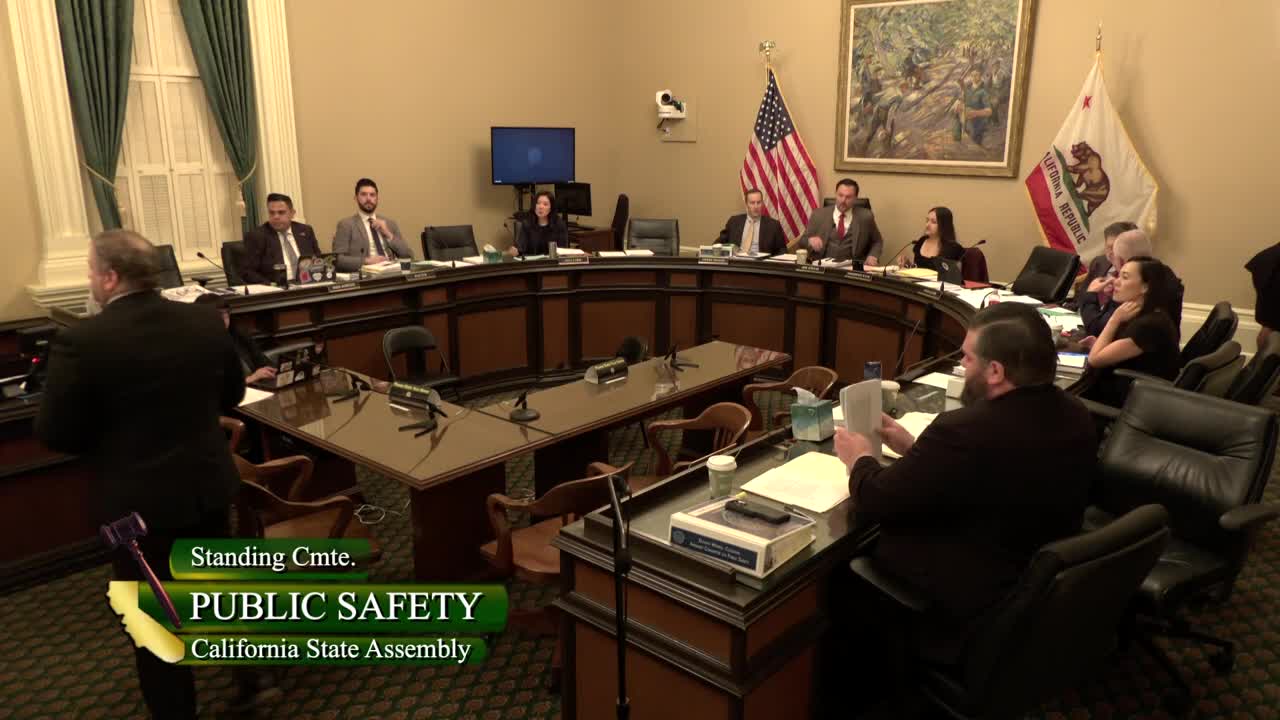 10MIN
Assembly Standing Committee on Public Safety


Bill Co-Author(s):