AB 2589: Public utilities: rates: changes to federal law.
- Session Year: 2025-2026
- House: Assembly
- Latest Version Date: 2026-09-27
Current Status:
Passed
(2026-09-27: Chaptered by Secretary of State - Chapter 625, Statutes of 2026.)
Introduced
In Committee
Awaiting First Chamber Vote
Passed First Chamber
In Committee
Awaiting Second Chamber Vote
Passed Second Chamber
Enacted
Existing law vests the Public Utilities Commission with regulatory authority over public utilities. Existing law authorizes the commission to fix the rates and charges for every public utility and requires that those rates and charges be just and reasonable. Existing law requires the commission to evaluate the full effect of the enactment of federal House Resolution 1 (Public Law 115-97) on the expenses and tax liabilities incurred by certain public utilities for the payment of federal taxes, and, if the commission determines that the projected expenses and tax liabilities for federal taxes that the commission has authorized in the rates for a public utility are materially affected by its enactment, to adjust the rates of the public utility to reflect the changes in projected expenses and tax liabilities in light of the changes in federal law.
This bill would require the commission to evaluate the full effect of all federal legislation that becomes law, including the recent federal House Resolution 1 (Public Law 119-21), on the expenses and tax liabilities incurred by those public utilities for the payment of federal taxes and, if the commission determines that the projected expenses and tax liabilities for federal taxes that the commission has authorized in the rates for a public utility are materially affected by the enactment, to adjust the rates of the public utility to reflect the changes in projected expenses and tax liabilities in light of the changes in federal law, as specified.
Existing law vests the Public Utilities Commission with regulatory authority over public utilities. Existing law authorizes the commission to fix the rates and charges for every public utility and requires that those rates and charges be just and reasonable. Existing law requires the commission to evaluate the full effect of the enactment of federal House Resolution 1 (Public Law 115-97) upon on the expenses and tax liabilities incurred by certain public utilities for the payment of federal taxes, and, if the commission determines that the projected expenses and tax liabilities for federal taxes that the commission has authorized in the rates for a public utility are materially affected by its enactment, to adjust the rates of the public utility to reflect the changes in projected expenses and tax liabilities in light of the changes in federal law.
This bill would require the commission to evaluate the full effect of all federal legislation that becomes law, including the recent federal House Resolution 1 (Public Law 119-21), upon on the expenses and tax liabilities incurred by those public utilities for the payment of federal taxes and, if the commission determines that the projected expenses and tax liabilities for federal taxes that the commission has authorized in the rates for a public utility are materially affected by the enactment, to adjust the rates of the public utility to reflect the changes in projected expenses and tax liabilities in light of the changes in federal law, as specified.
Existing law vests the Public Utilities Commission with regulatory authority over public utilities. Existing law authorizes the commission to fix the rates and charges for every public utility and requires that those rates and charges be just and reasonable. Existing law requires the commission to evaluate the full effect of the enactment of federal House Resolution 1 (Public Law 115-97) upon the expenses and tax liabilities incurred by public utilities for payment of federal taxes, and, if the commission determines that the projected expenses and tax liabilities for federal taxes that the commission has authorized in the rates for a public utility are materially affected by its enactment, to adjust the rates of the public utility to reflect the changes in projected expenses and tax liabilities in light of the changes in federal law.
This bill would require the commission to evaluate the full effect of all federal legislation that becomes law, including the recent federal House Resolution 1 (Public Law 119-21), upon the expenses and tax liabilities incurred by public utilities for payment of federal taxes and, if the commission determines that the projected expenses and tax liabilities for federal taxes that the commission has authorized in the rates for a public utility are materially affected by the enactment, to adjust the rates of the public utility to reflect the changes in projected expenses and tax liabilities in light of the changes in federal law, as specified.
(a)This section only applies to those public utilities over which the commission exercises its authority to fix rates and only to the extent the revenue requirements of the public utility were based upon the tax rates in effect at the time rates were fixed for the public utility by the commission. This section does not limit the discretionary authority of the commission to adjust any incentives provided pursuant to any state supervised or administered program, including the states telecommunications universal service programs administered pursuant to Chapter 1.5 (commencing with Section 270).
(b)The commission shall evaluate the full effect of all federal legislation that becomes law, including the enactment of federal House Resolution 1 (Public Law 115-97) and federal House Resolution 1 (Public Law 119-21), on the expenses and tax liabilities incurred by public utilities for the payment of federal taxes. If the commission determines that the projected expenses and tax liabilities for federal taxes that the commission has authorized in the rates for a public utility are materially affected by the enactment of federal House Resolution 1 (Public Law 115-97), federal House Resolution 1 (Public Law 119-21), or any other federal law, the commission shall adjust the rates of the public utility to reflect the changes in projected expenses and tax liabilities in light of the changes in federal law. This section does not limit the discretionary authority of the commission to determine the full effect of the changes in federal tax law on each public utilitys cost of service, to utilize appropriate mechanisms at its disposal to track changes and adjust rates accordingly, and to allocate the impacts from changes in federal tax law over the period of time that results in the most reasonable allocation based on the particular circumstances of each public utility.
(a)This section only applies only to those public utilities over which the commission exercises its authority to fix rates and only to the extent the revenue requirements of the public utility were based upon the tax rates in effect at the time rates were fixed for the public utility by the commission. This section does not limit the discretionary authority of the commission to adjust any incentives provided pursuant to any state supervised or administered program, including the states telecommunications universal service programs administered pursuant to Chapter 1.5 (commencing with Section 270).
(b)The commission shall evaluate the full effect of all federal legislation that becomes law, including the enactment of federal House Resolution 1 (Public Law 115-97) upon and federal House Resolution 1 (Public Law 119-21), on the expenses and tax liabilities incurred by public utilities for the payment of federal taxes. If the commission determines that the projected expenses and tax liabilities for federal taxes that the commission has authorized in the rates for a public utility are materially affected by the enactment of federal House Resolution 1 (Public Law 115-97), 115-97), federal House Resolution 1 (Public Law 119-21), or any other federal law, the commission shall adjust the rates of the public utility to reflect the changes in projected expenses and tax liabilities in light of the changes in federal law. This section does not limit the discretionary authority of the commission to determine the full effect of the changes in federal tax law on each public utilitys cost of service, to utilize appropriate mechanisms at its disposal to track changes and adjust rates accordingly, and to allocate the impacts from changes in federal tax law over the period of time that results in the most reasonable allocation based on the particular circumstances of each public utility.
SECTION 1.Section 752 is added to the Public Utilities Code, to read:752.(a)This section applies only to a public utility over which the commission exercises its authority to fix rates and only to the extent the revenue requirements of the public utility were based upon the tax rates in effect at the time rates were fixed for the public utility by the commission. This section does not limit the discretionary authority of the commission to adjust an incentive provided pursuant to a state supervised or administered program, including the states telecommunications universal service programs administered pursuant to Chapter 1.5 (commencing with Section 270).(b)The commission shall evaluate the full effect of all federal legislation that becomes law, including federal House Resolution 1 (Public Law 119-21), upon the expenses and tax liabilities incurred by public utilities for payment of federal taxes. If the commission determines that the projected expenses and tax liabilities for federal taxes that the commission has authorized in the rates for a public utility are materially affected by the enactment of federal House Resolution 1 (Public Law 119-21) or another federal law, the commission shall adjust the rates of the public utility to reflect the changes in projected expenses and tax liabilities in light of the changes in federal law. This section does not limit the discretionary authority of the commission to determine the full effect of the changes in federal tax law on each public utilitys cost of service, to use appropriate mechanisms at its disposal to track changes and adjust rates accordingly, and to allocate the impacts from changes in federal tax law over the period of time that results in the most reasonable allocation based on the particular circumstances of each public utility.(a)This section applies only to a public utility over which the commission exercises its authority to fix rates and only to the extent the revenue requirements of the public utility were based upon the tax rates in effect at the time rates were fixed for the public utility by the commission. This section does not limit the discretionary authority of the commission to adjust an incentive provided pursuant to a state supervised or administered program, including the states telecommunications universal service programs administered pursuant to Chapter 1.5 (commencing with Section 270).
(b)The commission shall evaluate the full effect of all federal legislation that becomes law, including federal House Resolution 1 (Public Law 119-21), upon the expenses and tax liabilities incurred by public utilities for payment of federal taxes. If the commission determines that the projected expenses and tax liabilities for federal taxes that the commission has authorized in the rates for a public utility are materially affected by the enactment of federal House Resolution 1 (Public Law 119-21) or another federal law, the commission shall adjust the rates of the public utility to reflect the changes in projected expenses and tax liabilities in light of the changes in federal law. This section does not limit the discretionary authority of the commission to determine the full effect of the changes in federal tax law on each public utilitys cost of service, to use appropriate mechanisms at its disposal to track changes and adjust rates accordingly, and to allocate the impacts from changes in federal tax law over the period of time that results in the most reasonable allocation based on the particular circumstances of each public utility.
REVISIONS: HeadingLine 2.|
Date
|
Status
|
|---|---|
| Sep 27, 2026 | Chaptered by Secretary of State - Chapter 625, Statutes of 2026. |
| Sep 27, 2026 | Approved by the Governor. |
| Sep 3, 2026 | Enrolled and presented to the Governor at 4 p.m. |
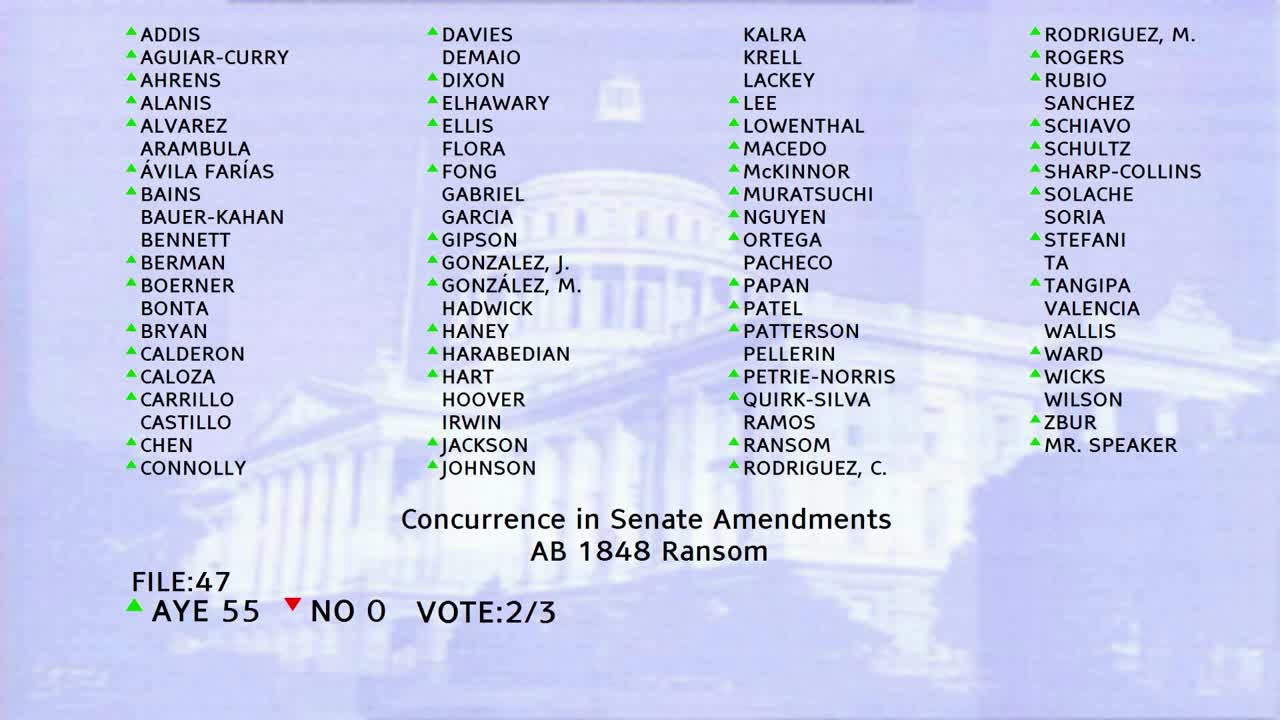
| Aug 26, 2026 | Senate amendments concurred in. To Engrossing and Enrolling. (Ayes 79. Noes 0. Page 6588.). |
| Aug 26, 2026 | Senate amendments concurred in. To Engrossing and Enrolling. (Ayes 79. Noes 0.). |
| Aug 25, 2026 | In Assembly. Concurrence in Senate amendments pending. |
| Aug 25, 2026 | Read third time. Passed. Ordered to the Assembly. (Ayes 39. Noes 0. Page 5760.). |
| Aug 25, 2026 | Read third time. Passed. Ordered to the Assembly. (Ayes 37. Noes 0.). |
| Aug 13, 2026 | Read second time. Ordered to third reading. |
| Aug 13, 2026 | From committee: Do pass. (Ayes 7. Noes 0.) (August 13). |
| Aug 3, 2026 | In committee: Referred to APPR. suspense file. |
| Jun 29, 2026 | Read second time and amended. Re-referred to Com. on APPR. |
| Jun 25, 2026 | From committee: Amend, and do pass as amended and re-refer to Com. on APPR. (Ayes 17. Noes 0.) (June 24). |
| Jun 10, 2026 | Referred to Com. on E., U & C. |
| May 27, 2026 | In Senate. Read first time. To Com. on RLS. for assignment. |
| May 26, 2026 | Read third time. Passed. Ordered to the Senate. (Ayes 76. Noes 0. Page 5334.) |
| May 26, 2026 | Read third time. Passed. Ordered to the Senate. (Ayes 76. Noes 0.) |
| May 26, 2026 | Read third time. Passed. Ordered to the Senate. |
| May 18, 2026 | Read second time. Ordered to third reading. |
| May 14, 2026 | From committee: Do pass. (Ayes 15. Noes 0.) (May 14). |
| May 6, 2026 | In committee: Set, first hearing. Referred to APPR. suspense file. |
| Apr 9, 2026 | From committee: Do pass and re-refer to Com. on APPR. (Ayes 18. Noes 0.) (April 8). Re-referred to Com. on APPR. |
| Apr 9, 2026 | Coauthors revised. |
| Mar 9, 2026 | Referred to Com. on U. & E. |
| Feb 21, 2026 | From printer. May be heard in committee March 23. |
| Feb 20, 2026 | Read first time. To print. |
|
Date
|
Description
|
Location
|
Votes
|
|
|---|---|---|---|---|
| Aug 26, 2026 | AB 2589 Irwin Concurrence in Senate Amendments | Assembly Floor |
Passed |
|
| Aug 25, 2026 | Assembly 3rd Reading AB2589 Irwin et al. By Wiener | Senate Floor |
Passed |
|
| Aug 13, 2026 | Do pass | Senate Standing Committee on Appropriations |
Passed |
|
| Aug 3, 2026 | Placed on suspense file | Senate Standing Committee on Appropriations |
Passed |
|
| Jun 24, 2026 | Do pass as amended, but first amend, and re-refer to the Committee on [Appropriations] | Senate Standing Committee on Energy, Utilities and Communications |
Passed |
|
| May 26, 2026 | AB 2589 Irwin Assembly Third Reading | Assembly Floor |
Passed |
|
| May 14, 2026 | Do pass. | Assembly Standing Committee on Appropriations |
Passed |
|
| Apr 8, 2026 | Do pass and be re-referred to the Committee on [Appropriations] | Assembly Standing Committee on Utilities and Energy |
Passed |
This list shows positions taken on this bill by organizations on the date displayed, which is linked to the original source.
Positions by individuals are not included.
|
Organization
|
Position
|
Date
|
|---|---|---|
| Southern California Edison (SCE) | ** Against |
CONCURRENCE IN SENATE AMENDMENTS
CSA1 Bill Id:AB 2589
Author:(Irwin)
As Amended Ver:June 29, 2026
Majority vote
SUMMARY
This bill requires the California Public Utilities Commission (CPUC) to evaluate the effect of all federal legislation that becomes law, including federal House Resolution 1 (Public Law 119-21) (also known as the One Big Beautiful Bill Act), on the expenses and tax liabilities incurred by public utilities for payment of federal taxes. If the CPUC determines that the projected expenses and tax liabilities for federal taxes are affected, it would require the CPUC to adjust the rates of the utility, as appropriate.
Senate Amendments
This bill had minor amendments in the Senate to move the bill from a new code section, to amending an existing code section established by SB 1028 (Hill) Chapter 411, Statutes of 2018.
COMMENTS
This bill expands on previously passed legislation, SB 1028 (Hill) Chapter 411, Statutes of 2018, to ensure the CPUC not only monitors the federal expense and tax liabilities of utilities but also makes appropriate adjustments to rates to reflect any changes.
SB 1028 ensured the CPUC adjusted rates after the corporate tax cuts provided by Federal House Resolution 1 (Public Law 115-97), also known as the Tax Cuts and Jobs Act. The present bill expands the scope of SB 1028 to apply to all federal legislation, including the recently passed Federal House Resolution 1 (Public Law 119-21), also known as the One Big Beautiful Bill Act. By applying to all federal legislation, this bill directs the CPUC to monitor changes in federal tax liability and ensure rates are adjusted to accurately reflect changes in projected expenses and liabilities, therefore codifying that any savings received by utilities are passed along to ratepayers.
According to the Author
According to the author, "In recent years, federal tax laws have reduced the federal tax liability of an investor-owned utility, causing the IOU's overall costs to be lower than what it was authorized by the CPUC to collect through rates. However, there is no ongoing requirement in California law that any money that an IOU saves from reduced federal tax liability be returned to ratepayers. AB 2589 will ensure that any money an IOU saves as a result of the second term Trump tax bill in 2025, or any other changes to federal law, is refunded to California ratepayers rather than kept as additional profit for the utility. This mirrors SB 1028 (Hill), which the Legislature passed in response to the first Trump Administration tax cuts in 2017 and which returned more than $1 billion to ratepayers from the IOUs’ reduced federal tax liability."
Arguments in Support
None on file
Arguments in Opposition
None on file
FISCAL COMMENTS
According to the Senate Committee on Appropriations, the CPUC estimates ongoing costs of about $1 million annually and one-time costs of about $257,00 over a period of two years to retain a specialized tax consultant to monitor the effect of all federal legislation on utility expenses and tax liabilities, and to re-open prior General Rate Case proceedings to evaluate whether approved revenue requirements should be adjusted in light of Public Law 119-21 or other federal laws.
VOTES:
ASM UTILITIES AND ENERGY: 18-0-0
YES: Petrie-Norris, Patterson, Boerner, Calderon, Chen, Davies, Mark González, Harabedian, Hart, Irwin, Kalra, Papan, Rogers, Schiavo, Schultz, Ta, Wallis, Zbur
ASM APPROPRIATIONS: 15-0-0
YES: Wicks, Hoover, Aguiar-Curry, Calderon, Caloza, Dixon, Fong, Mark González, Krell, Pacheco, Pellerin, Sharp-Collins, Solache, Ta, Tangipa
ASSEMBLY FLOOR: 76-0-4
YES: Addis, Aguiar-Curry, Ahrens, Alanis, Alvarez, Arambula, Ávila Farías, Bains, Bauer-Kahan, Bennett, Berman, Boerner, Bonta, Bryan, Calderon, Caloza, Carrillo, Castillo, Chen, Connolly, Davies, DeMaio, Dixon, Elhawary, Ellis, Flora, Fong, Gabriel, Gallagher, Garcia, Gipson, Jeff Gonzalez, Mark González, Hadwick, Haney, Harabedian, Hart, Hoover, Irwin, Jackson, Johnson, Kalra, Krell, Lackey, Lee, Lowenthal, Macedo, McKinnor, Nguyen, Ortega, Papan, Patel, Patterson, Pellerin, Petrie-Norris, Quirk-Silva, Ramos, Ransom, Michelle Rodriguez, Rogers, Blanca Rubio, Sanchez, Schiavo, Schultz, Sharp-Collins, Solache, Soria, Stefani, Ta, Tangipa, Valencia, Wallis, Ward, Wicks, Wilson, Rivas
ABS, ABST OR NV: Muratsuchi, Pacheco, Celeste Rodriguez, Zbur
UPDATED
VERSION: June 29, 2026
CONSULTANT: Alexa Cohill-Milanick / U. & E. / (916) 319-2083 FN: 0004147
SENATE RULES COMMITTEE Office of Senate Floor Analyses (916) 651-4171 | AB 2589 |
THIRD READING
Bill No: AB 2589
Author: Irwin (D), et al.
Amended: 6/29/26 in Senate
Vote: 21
SENATE ENERGY, U. & C. COMMITTEE: 17-0, 6/24/26
AYES: Allen, Ochoa Bogh, Archuleta, Arreguín, Becker, Caballero, Dahle, Gonzalez, Grove, Hurtado, McNerney, Reyes, Richardson, Rubio, Stern, Strickland, Wahab
SENATE APPROPRIATIONS COMMITTEE: 7-0, 8/13/26
AYES: Cervantes, Seyarto, Cabaldon, Dahle, Grayson, Richardson, Wahab
ASSEMBLY FLOOR: 76-0, 5/26/26 - See last page for vote
SUBJECT: Public utilities: rates: changes to federal law
SOURCE: Author
DIGEST:
This bill requires the California Public Utilities Commission (CPUC) to evaluate the full effect on public utilities’ tax liabilities of the changes to corporate tax federal law and explicitly includes those changes as enacted by the One Big Beautiful Bill Act, federal House Resolution 1 (Public Law 119-21).
ANALYSIS:
Existing law:
- Authorizes the CPUC to fix rates, establish rules, examine records, issue subpoenas, administer oaths, take testimony, punish for contempt, and prescribe a uniform system of accounts for all public utilities, including electrical, gas, sewer, telephone, and water corporations (also known as investor-owned utilities (IOUs)), subject to its jurisdiction. (Article 12, §6 of the California Constitution)
- Requires that all charges demanded or received by any public utility for any product, commodity or service be just and reasonable, and that every unjust or unreasonable charge is unlawful. (Public Utilities Code §451)
- Provides the CPUC with general, broad authority to regulate every public utility in the state. (Public Utilities Code §701)
- Authorizes the CPUC to require a public utility to correct any rates, practices, equipment or behavior that is unjust, unreasonable, unsafe, improper, inadequate, or insufficient. (Public Utilities Code §761)
- Requires the CPUC to evaluate the full effect of the enactment of federal House Resolution 1 (Public Law 115-97) upon the expenses and tax liabilities incurred by public utilities for payment of federal taxes, and, if the CPUC determines that the projected expenses and tax liabilities for federal taxes that the CPUC has authorized in the rates for a public utility are materially affected by its enactment, to adjust the rates of the public utility to reflect the changes in projected expenses and tax liabilities in light of the changes in federal law. (Public Utilities Code §751)
This bill:
- Requires the CPUC to evaluate the full effect of all federal legislation that becomes law and explicitly includes the recent federal House Resolution 1 (Public Law 119-21), otherwise known as the One Big Beautiful Bill Act, upon the expenses and tax liabilities incurred by public utilities for payment of federal taxes and, if the CPUC determines that the projected expenses and tax liabilities for federal taxes that the CPUC has authorized in the rates for a public utility are materially affected by the enactment, to adjust the rates of the public utility to reflect the changes in projected expenses and tax liabilities in light of the changes in federal law.
- Makes additional clarifying changes.
Background
CPUC general rate case (GRC). As part of its authority to regulate the rates of a utility, the CPUC reviews and adopts a GRC which is a forecasted budget for the upcoming three-four years, depending on the utility. The GRC is the CPUC’s primary opportunity to review utility operations, investments, and associated costs. As part of the GRC, the CPUC adopts a revenue requirement which refers to the annual amount of money that IOUs are authorized by the CPUC to collect in rates from their customers. The GRC phase 1 decision establishes the revenue requirement for the “test year” and for the following three (or two) “attrition years.” The test year is the year in the future for which costs are estimated. Typically, IOUs file GRCs every four or three years, depending on the type of utility. Tax expenses are among the expenses reviewed during the GRC.
Tax Act Memorandum Accounts (TAMAs). A utility’s income taxes are among the expenses considered a cost of providing service. As the case with other expenses, income taxes are recoverable by the utility in the revenue requirement. In general, any increase or decrease in tax liabilities is accounted for through the GRC forecasting process for each utility based on the expected federal and state tax rates to the utility’s expected net operating income. Given that each utility’s GRC cycle is conducted on a unique schedule, any changes from recent federal tax law would typically not be accounted for until the utility’s next GRC. In the case of some utilities their GRC may not be until three-four years from now and for other utilities, they may currently be in the midst of their GRC. GRCs rely on forecasted tax expenses, therefore, actual tax liabilities may differ due to changes in federal tax law or realized earnings. These differences are typically tracked in memorandum accounts, TAMAs. TAMAs were implemented following the passage of the federal Tax Relief Act in 2011 which resulted in unexpected decreases in utility tax liabilities. The CPUC reviews the tax expenses tracked in the memorandum account as part of the utility’s GRC.
Comments
Tax Cuts and Jobs Act” federal House Resolution 1 (Public Law 115-97). The “Tax Cuts and Jobs Act” federal House Resolution 1 (Public Law 115-97) was signed into law on December 22, 2017, during President Trump’s first term with portions of the law taking effect January 1, 2018. The Act resulted in a federal corporate income tax rate cut from 35% to 21%. The Act also made additional tax changes including loss of Section 199 deduction (also known as a domestic manufacturing tax deduction), the loss of bonus depreciation for IOUs, and complications to the Accumulated Deferred Federal Income Taxes (AdFit). These provisions affected the federal tax liabilities of corporations, including utilities regulated by the CPUC beginning in tax year 2018. The effect of the changes from the Act vary by utility, depending on how the utility accounts for its taxes, depreciation expenses, and other factors. Further complicating the effect of the tax law on regulated utilities, as noted by a report by the Brattle Group, the changes to the federal tax law could result in an increase in credit costs for utilities, namely due to reduced cash flow of the tax changes and the loss of bonus depreciation. In fact, credit ratings agencies reduced the credit ratings for a number of utilities across the nation due to the tax changes.
CPUC requires public utilities to track tax impacts. In anticipation of the sizeable tax changes made from the Act, the CPUC informed all rate-regulated utilities (energy, water, telecommunications) of the CPUC’s goal to implement expeditious and efficient rate relief to the extent the new tax laws contain flow-through benefits for utility customers. As such, the CPUC instituted a number of tax memorandum accounts in order to account for the tax expenses and adjustments. This process requires a tailored approach for each utility, as much depends on how the utility accounts for depreciation, the point of their GRC cycle and other factors. Additionally, SB 1028 (Hill, Chapter 411, Statutes of 2018) was proposed during the 2018 state legislative session and ultimately signed into law that year. SB 1028 made explicit the requirement on the CPUC to account for changes to federal law that impact IOUs’ tax liabilities, with specific mention of changes from the “Tax Cuts and Jobs Act” federal House Resolution 1 (Public Law 115-97). As reported by the CPUC, the changes from the federal law resulted in nearly $1 billion dollars among the large energy utilities. These savings were accounted for within the utilities’ GRCs, resulting in reducing collections from ratepayers for this purpose.
One Big Beautiful Bill Act (Act). Federal House Resolution 1 (Public Law 119-21), commonly known as the One Big Beautiful Bill Act was signed into law on July 4, 2025. The Act makes several changes to federal tax law for residents and companies. Specific to corporate taxes, the bill cements the corporate statutory tax rate at 21%. The Act also rescinds or sunsets a number of previously approved federal clean energy and water tax credits and other incentives from the Inflation Reduction Act (IRA) and the Infrastructure Investment and Jobs Act (IIJA). The Act also implements stricter foreign-entity manufacturing restrictions to access federal subsidies and accelerates the deadline for solar and wind energy projects to access tax credits. The Act also provides for a permanent reinstatement of 100% bonus depreciation for capital projects placed in service after January 19, 2025.
Ratepayer impacts. This bill amends the language adopted in SB 1028, as adopted in Section 751 of the Public Utilities Code, to require the CPUC to account for all changes in federal tax law with rate adjustments, to the extent they are warranted, due to the adopted changes in the federal corporate tax changes and explicitly mentions the One Big Beautiful Bill Act. With each utility being uniquely affected by the tax changes, not all ratepayers may experience impacts (savings or charges). However, to the extent a utility’s federal tax obligations have reduced overall, the utility’s ratepayers are likely to have a reduction in the rates associated with the tax expenses that would have been collected for federal taxes. Since overall rates may be affected by numerous other factors and expenses, it’s unclear whether the reduction in tax liabilities will guarantee reduced rate recovery by public utilities overall.
Related/Prior Legislation
AB 1715 (Schiavo, 2026) requires specified quarterly and annual reporting by electrical and natural gas corporations regarding federal funding received from federal legislation adopted under the Biden administration and other non-ratepayer sources. The bill also requires the CPUC to develop a searchable database for utility advice letters. The bill is pending before the full Senate.
SB 1028 (Hill, Chapter 411, Statutes of 2018) required the CPUC to evaluate the full effect of the recently adopted federal corporate tax cuts on the expenses and tax liabilities incurred by public utilities for payment of federal taxes and adjust the rates of the utilities to reflect any changes.
FISCAL EFFECT: Appropriation: No Fiscal Com.: Yes Local: No
According to the Senate Appropriations Committee:
- The CPUC estimates ongoing costs of about $1 million annually and one-time costs of about $257,000 over a period of two years (ratepayer funds) to retain a specialized tax consultant to monitor the effect of all federal legislation on utility expenses and tax liabilities, and to re-open prior General Rate Case proceedings to evaluate whether approved revenue requirements should be adjusted in light of Public Law 119-21 or other federal laws — among other things.
- To the extent that this bill impacts electricity rates, it could result in costs or savings to the state as an electric utility ratepayer. The State of California is an electricity customer, purchasing roughly one percent of the state’s electricity. As such, the state incurs costs when rates increase, and realizes cost savings if rates go down (various funds).
SUPPORT: (Verified 8/13/26)
None received
OPPOSITION: (Verified 8/13/26)
None received
ARGUMENTS IN SUPPORT: According to the author:
In recent years, federal tax laws have reduced the federal tax liability of an investor-owned utility, causing the IOU’s overall costs to be lower than what it was authorized by the CPUC to collect through rates. However, there is no ongoing requirement in California law that any money that an IOU saves from reduced federal tax liability be returned to ratepayers. AB 2589 will ensure that any money an IOU saves as a result of the second term Trump tax bill in 2025, or any other changes to federal law, is refunded to California ratepayers rather than kept as additional profit for the utility. This mirrors SB 1028 (Hill), which the Legislature passed in response to the first Trump Administration tax cuts in 2017 and which returned more than $1 billion to ratepayers from the IOUs’ reduced federal tax liability.”
ASSEMBLY FLOOR: 76-0, 5/26/26
AYES: Addis, Aguiar-Curry, Ahrens, Alanis, Alvarez, Arambula, Ávila Farías, Bains, Bauer-Kahan, Bennett, Berman, Boerner, Bonta, Bryan, Calderon, Caloza, Carrillo, Castillo, Chen, Connolly, Davies, DeMaio, Dixon, Elhawary, Ellis, Flora, Fong, Gabriel, Gallagher, Garcia, Gipson, Jeff Gonzalez, Mark González, Hadwick, Haney, Harabedian, Hart, Hoover, Irwin, Jackson, Johnson, Kalra, Krell, Lackey, Lee, Lowenthal, Macedo, McKinnor, Nguyen, Ortega, Papan, Patel, Patterson, Pellerin, Petrie-Norris, Quirk-Silva, Ramos, Ransom, Michelle Rodriguez, Rogers, Blanca Rubio, Sanchez, Schiavo, Schultz, Sharp-Collins, Solache, Soria, Stefani, Ta, Tangipa, Valencia, Wallis, Ward, Wicks, Wilson, Rivas
NO VOTE RECORDED: Muratsuchi, Pacheco, Celeste Rodriguez, Zbur
Prepared by: Nidia Bautista / E., U. & C. / (916) 651-4107
8/14/26 14:11:28
**** END ****
SENATE COMMITTEE ON
Senator Sabrina Cervantes, Chair
2025 - 2026 Regular Session
AB 2589 (Irwin) - Public utilities: rates: changes to federal law
Version: | Policy Vote: |
Urgency: | Mandate: |
Hearing Date: | Consultant: |
Bill Summary:
This bill would require the California Public Utilities Commission (CPUC) to evaluate the full effect on public utilities' expenses and tax liabilities of all federal legislation that becomes law, and would explicitly include the changes enacted by the One Big Beautiful Bill Act, federal House Resolution 1 (Public Law 119-21).
Fiscal Impact:
- The CPUC estimates ongoing costs of about $1 million annually and one-time costs of about $257,000 over a period of two years (ratepayer funds) to retain a specialized tax consultant to monitor the effect of all federal legislation on utility expenses and tax liabilities, and to re-open prior General Rate Case proceedings to evaluate whether approved revenue requirements should be adjusted in light of Public Law 119-21 or other federal laws — among other things.
- To the extent that this bill impacts electricity rates, it could result in costs or savings to the state as an electric utility ratepayer. The State of California is an electricity customer, purchasing roughly one percent of the state’s electricity. As such, the state incurs costs when rates increase, and realizes cost savings if rates go down (various funds).
Background:
CPUC general rate case (GRC). As part of its authority to regulate the rates of a utility, the CPUC reviews and adopts a GRC which is a forecasted budget for the upcoming three-four years, depending on the utility. The GRC is the CPUC’s primary opportunity to review utility operations, investments, and associated costs. As part of the GRC, the CPUC adopts a revenue requirement which refers to the annual amount of money that IOUs are authorized by the CPUC to collect in rates from their customers. The GRC phase 1 decision establishes the revenue requirement for the “test year” and for the following three (or two) “attrition years.” The test year is the year in the future for which costs are estimated. Typically, IOUs file GRCs every four or three years, depending on the type of utility. Tax expenses are among the expenses reviewed during the GRC.
Tax Act Memorandum Accounts (TAMAs). A utility’s income taxes are among the expenses considered a cost of providing service. As the case with other expenses, income taxes are recoverable by the utility in the revenue requirement. In general, any increase or decrease in tax liabilities is accounted for through the GRC forecasting process for each utility based on the expected federal and state tax rates to the utility’s expected net operating income. Given that each utility’s GRC cycle is conducted on a unique schedule, any changes from recent federal tax law would typically not be accounted for until the utility’s next GRC. In the case of some utilities their GRC may not be until three-four years from now and for other utilities, they may currently be in the midst of their GRC. GRCs rely on forecasted tax expenses, therefore, actual tax liabilities may differ due to changes in federal tax law or realized earnings. These differences are typically tracked in memorandum accounts, TAMAs. TAMAs were implemented following the passage of the federal Tax Relief Act in 2011 which resulted in unexpected decreases in utility tax liabilities. The CPUC reviews the tax expenses tracked in the memorandum account as part of the utility’s GRC.
Proposed Law:
This bill would:
- Require the CPUC to evaluate the full effect of all federal legislation that becomes law, including the enactment of federal House Resolution 1 (Public Law 115-97) and federal House Resolution 1 (Public Law 119-21), otherwise known as the One Big Beautiful Bill Act, on the expenses and tax liabilities incurred by public utilities for the payment of federal taxes, and, if the CPUC determines that the projected expenses and tax liabilities for federal taxes that the CPUC has authorized in the rates for a public utility are materially affected by the enactment of Public Law 115-97, Public Law 119-21, or any other federal law, to adjust the rates of the public utility to reflect the changes in projected expenses and tax liabilities in light of the changes in federal law.
- Restate that the section does not limit the discretionary authority of the CPUC to determine the full effect of the changes in federal tax law on each public utility's cost of service, to utilize appropriate mechanisms at its disposal to track changes and adjust rates accordingly, and to allocate the impacts from changes in federal tax law over the period of time that results in the most reasonable allocation based on the particular circumstances of each public utility.
- Retain the application of the section to only those public utilities over which the CPUC exercises its authority to fix rates and only to the extent the revenue requirements of the public utility were based upon the tax rates in effect at the time rates were fixed for the public utility by the CPUC.
- Restate that the section does not limit the discretionary authority of the CPUC to adjust any incentives provided pursuant to any state supervised or administered program, including the state's telecommunications universal service programs administered pursuant to Chapter 1.5 (commencing with Section 270).
Related Legislation:
AB 1715 (Schiavo, 2026) would require specified quarterly and annual reporting by electrical and natural gas corporations regarding federal funding received from federal legislation adopted under the Biden administration and other non-ratepayer sources. The bill would also require the CPUC to develop a searchable database for utility advice letters.
SB 1028 (Hill, 2018) required the CPUC to evaluate the full effect of the recently adopted federal corporate tax cuts on the expenses and tax liabilities incurred by public utilities for payment of federal taxes and adjust the rates of the utilities to reflect any changes.
Staff Comments:
Ratepayer impacts. This bill would amend Section 751 of the Public Utilities Code to require the CPUC to account for all changes in federal tax law with rate adjustments, to the extent they are warranted, and would explicitly mention the One Big Beautiful Bill Act. With each utility being uniquely affected by the tax changes, not all ratepayers may experience rate changes. However, to the extent a utility’s federal tax obligations have reduced overall, the utility’s ratepayers are likely to have a reduction in the rates associated with the tax expenses that would have been collected for federal taxes. Since overall rates may be affected by numerous other factors and expenses, it’s unclear whether the reduction in tax liabilities will guarantee reduced rate recovery overall.
-- END --
SENATE COMMITTEE ON ENERGY, UTILITIES AND COMMUNICATIONS
Senator Benjamin Allen, Chair
2025 - 2026 Regular
Bill No: Hearing Date: 6/24/2026
Author: | |||
Version: | Introduced | ||
Urgency: | Fiscal: | ||
Consultant: | |||
SUBJECT: Public utilities: rates: changes to federal law
DIGEST: This bill requires the California Public Utilities Commission (CPUC) to evaluate the full effect on public utilities’ tax liabilities of the changes to corporate tax federal law and explicitly includes those changes as enacted by the One Big Beautiful Bill Act, federal House Resolution 1 (Public Law 119-21).
ANALYSIS:
Existing law:
- Authorizes the CPUC to fix rates, establish rules, examine records, issue subpoenas, administer oaths, take testimony, punish for contempt, and prescribe a uniform system of accounts for all public utilities, including electrical, gas, sewer, telephone, and water corporations (also known as investor-owned utilities (IOUs)), subject to its jurisdiction. (Article 12, §6 of the California Constitution)
- Requires that all charges demanded or received by any public utility for any product, commodity or service be just and reasonable, and that every unjust or unreasonable charge is unlawful. (Public Utilities Code §451)
- Provides the CPUC with general, broad authority to regulate every public utility in the state. (Public Utilities Code §701)
- Authorizes the CPUC to require a public utility to correct any rates, practices, equipment or behavior that is unjust, unreasonable, unsafe, improper, inadequate, or insufficient. (Public Utilities Code §761)
- Requires the CPUC to evaluate the full effect of the enactment of federal House Resolution 1 (Public Law 115-97) upon the expenses and tax liabilities incurred by public utilities for payment of federal taxes, and, if the CPUC determines that the projected expenses and tax liabilities for federal taxes that the CPUC has authorized in the rates for a public utility are materially affected by its enactment, to adjust the rates of the public utility to reflect the changes in projected expenses and tax liabilities in light of the changes in federal law. (Public Utilities Code §751)
This bill:
- Requires the CPUC to evaluate the full effect of all federal legislation that becomes law and explicitly includes the recent federal House Resolution 1 (Public Law 119-21), otherwise known as the One Big Beautiful Bill Act, upon the expenses and tax liabilities incurred by public utilities for payment of federal taxes and, if the CPUC determines that the projected expenses and tax liabilities for federal taxes that the CPUC has authorized in the rates for a public utility are materially affected by the enactment, to adjust the rates of the public utility to reflect the changes in projected expenses and tax liabilities in light of the changes in federal law.
- Restates that the section does not limit the discretionary authority of the CPUC to determine the full effect of the changes in federal tax law on each utility’s cost of service, to utilize appropriate mechanisms at its disposal to track changes and adjust rates accordingly, and to allocate the benefits from the changes in federal tax law over the period of time that results in the most reasonable allocation based on the particular circumstances of each utility.
- Reapplies the provisions of the section to only those public utilities over which the CPUC exercises its authority to fix rates and only to the extent the revenue requirements of the utility are based upon the tax rates in effect at the time rates were fixed for the utility by the CPUC.
- Restates this section does not limit the discretionary authority of the CPUC to adjust any incentives provided pursuant to any state supervised or administered program, including the state’s telecommunications universal service programs administered pursuant to Chapter 1.5 (commencing with Section 270).
Background
CPUC general rate case (GRC). As part of its authority to regulate the rates of a utility, the CPUC reviews and adopts a GRC which is a forecasted budget for the upcoming three-four years, depending on the utility. The GRC is the CPUC’s primary opportunity to review utility operations, investments, and associated costs. As part of the GRC, the CPUC adopts a revenue requirement which refers to the annual amount of money that IOUs are authorized by the CPUC to collect in rates from their customers. The GRC phase 1 decision establishes the revenue requirement for the “test year” and for the following three (or two) “attrition years.” The test year is the year in the future for which costs are estimated. Typically, IOUs file GRCs every four or three years, depending on the type of utility. Tax expenses are among the expenses reviewed during the GRC.
Tax Act Memorandum Accounts (TAMAs). A utility’s income taxes are among the expenses considered a cost of providing service. As the case with other expenses, income taxes are recoverable by the utility in the revenue requirement. In general, any increase or decrease in tax liabilities is accounted for through the GRC forecasting process for each utility based on the expected federal and state tax rates to the utility’s expected net operating income. Given that each utility’s GRC cycle is conducted on a unique schedule, any changes from recent federal tax law would typically not be accounted for until the utility’s next GRC. In the case of some utilities their GRC may not be until three-four years from now and for other utilities, they may currently be in the midst of their GRC. GRCs rely on forecasted tax expenses, therefore, actual tax liabilities may differ due to changes in federal tax law or realized earnings. These differences are typically tracked in memorandum accounts, TAMAs. TAMAs were implemented following the passage of the federal Tax Relief Act in 2011 which resulted in unexpected decreases in utility tax liabilities. The CPUC reviews the tax expenses tracked in the memorandum account as part of the utility’s GRC.
Comments
Tax Cuts and Jobs Act” federal House Resolution 1 (Public Law 115-97). The “Tax Cuts and Jobs Act” federal House Resolution 1 (Public Law 115-97) was signed into law on December 22, 2017, during President Trump’s first term with portions of the law taking effect January 1, 2018. The Act resulted in a federal corporate income tax rate cut from 35% to 21%. The Act also made additional tax changes including loss of Section 199 deduction (also known as a domestic manufacturing tax deduction), the loss of bonus depreciation for IOUs, and complications to the Accumulated Deferred Federal Income Taxes (AdFit). These provisions affected the federal tax liabilities of corporations, including utilities regulated by the CPUC beginning in tax year 2018. The effect of the changes from the Act vary by utility, depending on how the utility accounts for its taxes, depreciation expenses, and other factors. Further complicating the effect of the tax law on regulated utilities, as noted by a report by the Brattle Group, the changes to the federal tax law could result in an increase in credit costs for utilities, namely due to reduced cash flow of the tax changes and the loss of bonus depreciation. In fact, credit ratings agencies reduced the credit ratings for a number of utilities across the nation due to the tax changes.
In anticipation of the sizeable tax changes made from the Act, the CPUC informed all rate-regulated utilities (energy, water, telecommunications) of the CPUC’s goal to implement expeditious and efficient rate relief to the extent the new tax laws contain flow-through benefits for utility customers. As such, the CPUC instituted a number of tax memorandum accounts in order to account for the tax expenses and adjustments. This process requires a tailored approach for each utility, as much depends on how the utility accounts for depreciation, the point of their GRC cycle and other factors. Additionally, SB 1028 (Hill, Chapter 411, Statutes of 2018) was proposed during the 2018 state legislative session and ultimately signed into law that year. SB 1028 established identical provisions as this bill to make explicit the requirement on the CPUC to account for changes to federal law that impact IOUs’ tax liabilities, with specific mention of changes from the “Tax Cuts and Jobs Act” federal House Resolution 1 (Public Law 115-97). As reported by the CPUC, the changes from the federal law resulted in nearly $1 billion dollars among the large energy utilities. These savings were accounted for within the GRCs, resulting in reducing collections from ratepayers for this purpose.
One Big Beautiful Bill Act. Federal House Resolution 1 (Public Law 119-21), commonly known as the One Big Beautiful Bill Act was signed into law on July 4, 2025. The Act makes several changes to federal tax law for residents and companies. Specific to corporate taxes, the bill cements the corporate statutory tax rate at 21%. The Act also rescinds or sunsets a number of previously approved federal clean energy and water tax credits and other incentives from the Inflation Reduction Act (IRA) and the Infrastructure Investment and Jobs Act (IIJA). The Act also implements stricter foreign-entity manufacturing restrictions to access federal subsidies and accelerates the deadline for solar and wind energy projects to access tax credits. The Act also provides for a permanent reinstatement of 100% bonus depreciation for capital projects placed in service after January 19, 2025.
Ratepayer impacts. This bill would state the requirements in Section 751 of the Public Utilities Code to require the CPUC to account for all changes in federal tax law with rate adjustments, to the extent they are warranted, due to the adopted changes in the federal corporate tax changes and explicitly mentions the One Big Beautiful Bill Act. With each utility being uniquely affected by the tax changes, not all ratepayers may experience rate changes. However, to the extent a utility’s federal tax obligations have reduced overall, the utility’s ratepayers are likely to have a reduction in the rates associated with the tax expenses that would have been collected for federal taxes. Since overall rates may be affected by numerous other factors and expenses, it’s unclear whether the reduction in tax liabilities will guarantee reduced rate recovery overall.
Amendments. As noted above, the CPUC does review IOUs’ tax liability changes from federal tax law. However, this bill would make it explicit that CPUC must evaluate the changes from the One Big Beautiful Bill Act and all federal legislation. To clarify the language in the code, the author and committee may wish to amend this bill to delete the new section proposed to be added by the bill and instead amend Section 751 of the Public Utilities Code by adding a reference to the One Big Beautiful Bill Act and all federal legislation changes taxes for electric utilities among the federal legislation the CPUC must evaluate upon the expenses and tax liabilities incurred by public utilities for payment of federal taxes.
Prior/Related Legislation
AB 1715 (Schiavo, 2026) requires specified quarterly and annual reporting by electrical and natural gas corporations regarding federal funding received from federal legislation adopted under the Biden administration and other non-ratepayer sources. The bill also requires the CPUC to develop a searchable database for utility advice letters. The bill is pending in the Senate Appropriations Committee.
SB 1028 (Hill, Chapter 411, Statutes of 2018) required the CPUC to evaluate the full effect of the recently adopted federal corporate tax cuts on the expenses and tax liabilities incurred by public utilities for payment of federal taxes and adjust the rates of the utilities to reflect any changes.
FISCAL EFFECT: Appropriation: Fiscal Com.: Local:
SUPPORT:
None received
OPPOSITION:
None received
ARGUMENTS IN SUPPORT: According to the author:
In recent years, federal tax laws have reduced the federal tax liability of an investor-owned utility, causing the IOU’s overall costs to be lower than what it was authorized by the CPUC to collect through rates. However, there is no ongoing requirement in California law that any money that an IOU saves from reduced federal tax liability be returned to ratepayers. AB 2589 will ensure that any money an IOU saves as a result of the second term Trump tax bill in 2025, or any other changes to federal law, is refunded to California ratepayers rather than kept as additional profit for the utility. This mirrors SB 1028 (Hill), which the Legislature passed in response to the first Trump Administration tax cuts in 2017 and which returned more than $1 billion to ratepayers from the IOUs’ reduced federal tax liability.”
-- END --
ASSEMBLY THIRD READING
ATR Bill Id:AB 2589
Author:(Irwin)
As Introduced Ver:February 20, 2026
Majority vote
SUMMARY
This bill requires the California Public Utilities Commission (CPUC) to evaluate the effect of all federal legislation that becomes law, including federal House Resolution 1 (Public Law 119-21) on the expenses and tax liabilities incurred by public utilities for payment of federal taxes. If the CPUC determines that the projected expenses and tax liabilities for federal taxes are affected, it would require the CPUC to adjust the rates of the utility, as appropriate.
Major Provisions
COMMENTS
This bill expands on previously passed legislation, SB 1028 (Hill, Chapter 411, Statutes of 2018), to ensure the CPUC not only monitors the federal expense and tax liabilities of utilities but also makes appropriate adjustments to rates to reflect any changes. SB 1028 ensured the CPUC adjusted rates after the corporate tax cuts provided by Federal House Resolution 1 (Public Law 115-97), also known as the Tax Cuts and Jobs Act. The present bill expands the scope of SB 1028 to apply to all federal legislation, including the recently passed Federal House Resolution 1 (Public Law 119-21), also known as the One Big Beautiful Bill Act. By applying to all federal legislation, this bill directs the CPUC to monitor changes in federal tax liability and ensure rates are adjusted to accurately reflect changes in projected expenses and liabilities, therefore codifying that any savings received by utilities are passed along to ratepayers.
According to the Author
According to the author, ″In recent years, federal tax laws have reduced the federal tax liability of an investor-owned utility, causing the IOU′s overall costs to be lower than what it was authorized by the CPUC to collect through rates. However, there is no ongoing requirement in California law that any money that an IOU saves from reduced federal tax liability be returned to ratepayers. AB 2589 will ensure that any money an IOU saves as a result of the second term Trump tax bill in 2025, or any other changes to federal law, is refunded to California ratepayers rather than kept as additional profit for the utility. This mirrors SB 1028 (Hill), which the Legislature passed in response to the first Trump Administration tax cuts in 2017 and which returned more than $1 billion to ratepayers from the IOUs′ reduced federal tax liability.″
Arguments in Support
None on file
Arguments in Opposition
This bill is opposed by Southern California Edison (SCE), which describes the bill as creating ″duplicative processes for evaluating federal tax law, adding new administrative burdens without clear benefits.″ SCE further asserts ″adding bureaucracy to target a specific federal legislative item that will already be accounted for by existing regulatory structures does not improve transparency, affordability, or accountability, but instead has the potential to raise costs for taxpayers and ratepayers with administrative expenses.″
FISCAL COMMENTS
According to the Assembly Committee on Appropriations, the CPUC estimates costs of approximately $1.3 million for two years and $1 million ongoing thereafter. However, the CPUC reports that, acting under existing legal authority, the CPUC already considers the effects of federal tax and legislative changes as part of the CPUC′s review of each IOU′s general rate case (GRC). Therefore, it would be reasonable to assume, at first look, that this bill creates no new costs at the CPUC. The CPUC counters this assumption, sharing that the bill goes well beyond the work it currently undertakes by (1) broadening the scope of the CPUC′s work to encompass all federal legislation that becomes law and (2) by requiring the CPUC to reopen prior GRC proceedings to reconsider already-approved revenue requirements.
VOTES
ASM UTILITIES AND ENERGY: 18-0-0
YES: Petrie-Norris, Patterson, Boerner, Calderon, Chen, Davies, Mark González, Harabedian, Hart, Irwin, Kalra, Papan, Rogers, Schiavo, Schultz, Ta, Wallis, Zbur
ASM APPROPRIATIONS: 15-0-0
YES: Wicks, Hoover, Aguiar-Curry, Calderon, Caloza, Dixon, Fong, Mark González, Krell, Pacheco, Pellerin, Sharp-Collins, Solache, Ta, Tangipa
UPDATED
VERSION: February 20, 2026
CONSULTANT: Alexa Cohill-Milanick / U. & E. / (916) 319-2083 FN: 0002705
Date of Hearing: May 6, 2026
ASSEMBLY COMMITTEE ON APPROPRIATIONS
Buffy Wicks, Chair
ABPCA Bill Id:AB 2589
Author:(Irwin) – As Introduced Ver:February 20, 2026
Policy Committee: | Utilities and Energy | Vote: | 18 - 0 |
|
| ||
|
|
Urgency: No State Mandated Local Program: No Reimbursable: No
SUMMARY:
This bill requires the California Public Utilities Commission (CPUC) (1) to evaluate the effect of all federal legislation that becomes law, including federal House Resolution 1 (Public Law 119-21)—commonly known as the One Big Beautiful Bill—on the expenses and tax liabilities incurred by public utilities (also known as investor-owned utilities (IOUs)) for payment of federal taxes, and (2) if the CPUC determines the IOU’s projected expenses and tax liabilities for federal taxes are affected, requires the CPUC to adjust the rates of the IOU to reflect the changes in projected expenses and tax liabilities in light of the changes in federal law.
FISCAL EFFECT:
The CPUC estimates costs of approximately $1.3 million (Public Utilities Commission Utilities Reimbursement Account) for two years and $1 million ongoing thereafter, as follows: (1) $1 million, annually, for an ongoing contract with an outside legal and tax consultant, and (2) $275,000 for each of two years for an administrative law judge to reopen prior GRC proceedings to evaluate whether approved revenue requirements should be adjusted in light of H.R. 1 and other federal laws.
The CPUC reports that, acting under existing legal authority, the CPUC already considers the effects of federal tax and legislative changes as part of the CPUC’s review of each IOU’s general rate case (GRC). Therefore, it would be reasonable to assume, at first look, that this bill creates no new costs at the CPUC as the bill simply requires the CPUC to undertake that which is existing practice. That, however, is not the CPUC’s view.
The CPUC justifies this cost estimate by asserting that the bill goes well beyond the work it currently undertakes by (1) broadening the scope of the CPUC’s work to encompass all federal legislation that becomes law and (2) by requiring the CPUC to reopen prior GRC proceedings to reconsider already-approved revenue requirements.
COMMENTS:
- Background. The California Constitution establishes the CPUC to, among other things, fix rates, establish rules, examine records, issue subpoenas, administer oaths, take testimony, punish for contempt and prescribe a uniform system of accounts for all public utilities subject to its jurisdiction. Such public utilities are commonly referred to as IOUs.
Existing state law—section 451 of the Public Resources Code—specifies the requirements of charges, such as rates, imposed by an IOU:
- All charges demanded or received by any public utility, or by any two or more public utilities, for any product or commodity furnished or to be furnished or any service rendered or to be rendered shall be just and reasonable. Every unjust or unreasonable charge demanded or received for such product or commodity or service is unlawful.
- Every public utility shall furnish and maintain such adequate, efficient, just, and reasonable service, instrumentalities, equipment and facilities, including telephone facilities as are necessary to promote the safety, health, comfort and convenience of its patrons, employees and the public.
- All rules made by a public utility affecting or pertaining to its charges or service to the public shall be just and reasonable.
It is the CPUC’s job to authorize an IOU to collect only those rates for service that are just and reasonable.
One of the main ways the CPUC reviews rates proposed by an IOU is through the general rate case (GRC), which is a proceeding to address the costs of operating and maintaining the utility system and the allocation of those costs among customer classes. A GRC involves thousands of pages of documents, invites adversarial multi-party input and concerns billions of dollars of revenue. Each of the state’s largest electrical IOUs—Pacific Gas and Electric (PG&E), Southern California Edison (SCE) and San Diego Gas and Electric (SDG&E)—must file a GRC application with the CPUC once every four years.
The author contends that “Under current California law, if the federal tax liability of an IOU is reduced in the middle of a GRC, the IOU can keep the savings rather than returning it to ratepayers” For this reason, the author describes AB 2589 as ensuring that “any money an investor-owned utility saves as a result of the corporate tax cuts in HR1 (2025) or any other changes to federal law is refunded to California ratepayers, rather than kept as additional profit for the utility.”
The CPUC concedes that current law does not explicitly require to claw back such “savings” from an IOU. The CPUC insists, however, current law provides it ample authority to review the effect of federal tax changes on IOU revenues to ensure those revenues remain just and reasonable and, indeed, that that is the CPUC practice.
- Support and Opposition. This bill is opposed by Southern California Edison alone, which describes the bill as creating “duplicative processes for evaluating federal tax law, adding new administrative burdens without clear benefits.” The utility further asserts “adding bureaucracy to target a specific federal legislative item that will already be accounted for by existing regulatory structures does not improve transparency, affordability, or accountability, but instead has the potential to raise costs for taxpayers and ratepayers with administrative expenses.
There is no support registered for this bill.
Analysis Prepared by: Jay Dickenson / APPR. / (916) 319-2081
Date of Hearing: April 8, 2026
ASSEMBLY COMMITTEE ON UTILITIES AND ENERGY
Cottie Petrie-Norris, Chair
ABPCA Bill Id:AB 2589 (
Author:Irwin) – As Introduced Ver:February 20, 2026
SUBJECT: Public utilities: rates: changes to federal law.
SUMMARY: Requires the California Public Utilities Commission (CPUC) to evaluate the effect of all federal legislation that becomes law, including federal House Resolution 1 (Public Law 119-21) on the expenses and tax liabilities incurred by public utilities for payment of federal taxes. If the CPUC determines that the projected expenses and tax liabilities for federal taxes are affected, it would require the CPUC to adjust the rates of the utility. Specifically, this bill:
- Applies only to revenue requirements of public utilities that were based upon the tax rates at the time rates were fixed for the utility by the CPUC.
- Does not limit the authority of the CPUC to determine the full effects of changes in federal tax law on each utility’s cost of service, to use appropriate mechanisms to track changes and adjust rates accordingly, or to allocate the impacts from changes in federal tax law over a period of time that is most reasonable on the particular circumstances of each public utility.
EXISTING LAW:
- Establishes and vests the CPUC with regulatory jurisdiction over public utilities, including electrical and gas corporations. (Article XII of the California Constitution)
- Defines a “public utility” to include every common carrier, toll bridge corporation, pipeline corporation, gas corporation, electrical corporation, telephone corporation, telegraph corporation, water corporation, sewer system corporation, and heat corporation, where the service is performed for, or the commodity is delivered to, the public or any portion thereof. (Public Utilities Code § 216)
- Authorizes the CPUC to fix the rates and charges for public utilities and requires those rates and charges to be just and reasonable. (Public Utilities Code § 451)
- Authorizes the CPUC to inspect the accounts, books, papers, and documents of any public utility, or any affiliate, subsidiary, or holding corporation of that utility; and to examine under oath any officer, agent, or employee of such a utility in relation to its business and affairs. (Public Utilities Code § 314)
- Requires every public utility to furnish to the CPUC all information the CPUC requests, including tabulations, computations, maps, reports, books, and records. (Public Utilities Code §§ 581-582, 585)
- Authorizes the CPUC to require a public utility to correct any rates, practices, equipment, or behavior that is unjust, unreasonable, unsafe, improper, inadequate, or insufficient. (Public Utilities Code § 761)
- Federal House Resolution 1 (Public Law 119-21), as it pertains to this bill, continues the federal corporate income tax rate at 21% and has a number of other provisions related to income tax deductions.
FISCAL EFFECT: Unknown. This bill is keyed fiscal and will be referred to the Assembly Committee on Appropriations for its review. A prior version of this proposal – SB 1028 (Hill, 2018) – was estimated to incur minor costs for the CPUC when heard in the Assembly Committee on Appropriations. However, the CPUC estimated costs around $800,000 in ongoing personnel and contracting costs. It was noted by the Appropriations Committee that these costs seemed unreasonable given that the CPUC already implemented many of the requirements of the bill. SB 1028 was specific to the Federal House Resolution 1 (Public Law 115-97), unlike this bill, which applies to all federal law.
BACKGROUND:
Tax Act Memorandum Accounts – The CPUC determines, through a general rate case (GRC), the amount a utility can charge customers, invest in infrastructure, and earn a reasonable return. The GRCs are typically conducted every 3-5 years, depending on the utility. As the GRC stretches over multiple years, the CPUC reviews detailed cost data for utility operations and approves a budget for the first year, which is called the “test year”, followed by the remaining GRC years, which are called “post-test years.” GRCs are the primary mechanism for establishing a utility’s revenue requirement, including operating costs, capital investments, and an authorized return, as well as allocating costs to customers.[1]
The utility’s income tax burden, including federal income taxes, is incorporated into the revenue requirement. In a GRC, the CPUC calculates an income tax allowance on a pro forma (forecasted) basis by applying applicable federal and state tax rates to the utility’s expected net operating income for the test year. Because GRCs rely on forecasted tax expenses, actual tax liabilities may differ due to changes in federal tax law or realized earnings. These differences are typically tracked in memorandum accounts,[2] specifically, Tax Act Memorandum Accounts (TAMAs). TAMAs were implemented following the passage of the Tax Relief Act in 2011.[3] This federal legislation resulted in large, unexpected decreases in utility tax liabilities.[4] With GRCs already underway, the CPUC directed some utilities to establish TAMAs for the CPUC to review at the subsequent GRCs. TAMAs are still in use today. Indeed, Southern California Edison (SCE) recently received approval to continue using a TAMA that was approved in 2018.[5] These accounts remain open, and the balance of the account is reviewed at the subsequent GRC. This may result in utilities seeking cost recovery or returning any excess to ratepayers. However, factoring these savings into future costs for ratepayers money is not mandated in statute and remains subject to CPUC approval.
Tax Cuts and Jobs Act – Federal House Resolution 1 (Public Law 115-97), also known as the Tax Cuts and Jobs Act (TCJA), was signed into law on December 22, 2017. TCJA had many provisions, but critically, resulted in a federal corporate income tax rate cut from 35% to 21%.[6] The Act also made additional tax changes, including the loss of Section 199 deductions (also known as a domestic manufacturing tax deduction), the loss of bonus depreciation for investor-owned utilities (IOUs), and complications to the Accumulated Deferred Federal Income Taxes.[7] All of these provisions affected the federal tax liabilities of corporations, including utilities regulated by the CPUC, beginning in tax year 2018.
SB 1028 implementation – In 2018, SB 1028 (Hill) was signed into law and requires the CPUC to evaluate the full effect of the federal corporate tax cuts passed in TCJA on the expenses and tax liabilities incurred by utilities.[8] Critically, the bill required that the CPUC adjust rates of the utilities to reflect any changes. This essentially meant that any of the savings tracked in TAMAs were required to be returned to ratepayers. As a result of SB 1028 implementation, more than one billion dollars were returned to ratepayers. Detailed below are values reflecting the net decreases in revenue requirement, equivalent to funds ratepayers no longer had to pay. These values were reported to the committee by the CPUC.
- PG&E: $505.603 million (2018–2022)
- SDG&E: $112.519 million (2018–2023)
- SoCalGas: $86.187 million (2018–2023)
- SCE: $419.993 million (2018-2021)[9]
As is highlighted above, not all ratepayers experienced the same rate change. This is because each utility was uniquely affected by the taxes. The mechanism by which these savings were passed onto the ratepayers was determined by the CPUC but could have taken the form of savings to pay for future expenses or deductions in rates or requested expenses moving forward, so long as the prohibition on retroactive ratemaking was maintained. It is not clear to the committee the exact mechanism for how these savings were incorporated back to ratepayers.
COMMENTS:
- Author’s Statement. According to the author, “In recent years, federal tax laws have reduced the federal tax liability of an investor-owned utility, causing the IOU’s overall costs to be lower than what it was authorized by the CPUC to collect through rates. However, there is no ongoing requirement in California law that any money that an IOU saves from reduced federal tax liability be returned to ratepayers. AB 2589 will ensure that any money an IOU saves as a result of the second term Trump tax bill in 2025, or any other changes to federal law, is refunded to California ratepayers rather than kept as additional profit for the utility. This mirrors SB 1028 (Hill), which the Legislature passed in response to the first Trump Administration tax cuts in 2017 and which returned more than $1 billion to ratepayers from the IOUs’ reduced federal tax liability.”
- Purpose of Bill. AB 2589 expands on previously passed legislation – SB 1028 – to ensure the CPUC not only monitors the federal expense and tax liabilities of utilities but also makes appropriate adjustments to rates to reflect any changes.
SB 1028, as detailed above, ensured the CPUC adjusted rates after the corporate tax cuts provided by TCJA. The present bill expands the scope of SB 1028 to apply to all federal legislation, including the recently passed Federal House Resolution 1 (Public Law 119-21), also known as the One Big Beautiful Bill Act (OBBBA). By applying to all federal legislation, this bill directs the CPUC to monitor changes in federal tax liability and ensure rates are adjusted to accurately reflect changes in projected expenses and liabilities, therefore codifying that any savings received by utilities are passed along to ratepayers.
- Unknown impacts. Federal House Resolution 1 (Public Law 119-21), or OBBBA, was signed into law on July 4, 2025, and included a number of provisions related to corporate tax rates. For the context of this bill, OBBBA extended the corporate income tax rate set in TCJA, maintaining the rate at 21%. It is possible that the other provisions related to corporate tax rates will also impact tax liabilities for utilities, such as changes to the Corporate Alternative Minimum Tax, but this will need to be examined by the CPUC. While the federal corporate income tax rate remains at 21% following the passage of OBBBA, this does not mean that adjustments to rates are not possibly warranted. For example, if a utility submitted a GRC with the assumption that the tax cuts provided under TCJA would sunset (as they were going to before the extension in OBBBA), this may have been reflected in their rates set during that GRC. Additional adjustments to corporate tax rates in the OBBBA may also impact IOU tax liabilities. AB 2589 would give the CPUC authority to examine this possibility and any future changes to federal tax liability for utilities. While the exact impact of OBBBA’s passage on the utilities’ federal tax liability remains unknown, this bill codifies the mandate for the CPUC to examine these impacts and incorporate realized savings back to the ratepayers.
- TAMA can stay. In opposition to the bill, SCE states that AB 2589 “duplicates mechanism already in place” as the CPUC has “approved the TAMA for SCE to track all differences between forecast and recorded income tax expenses.” While true that the CPUC has approved SCE’s ongoing TAMA,[10] there is currently no requirement that savings from income tax expenses must result in adjustments for ratepayers. SB 1028 made that explicit mandate for the TCJA, and AB 2589 aims to continue that mandate by codifying the language for all current and future federal legislation. It is likely that the mechanism for tracking these changes will continue in the form of TAMAs. This legislation just makes the critical (not duplicative) directive that savings tracked in the TAMA must manifest as adjustments for ratepayers.
- Related Legislation.
AB 1715 (Schiavo) requires investor-owned utilities to report quarterly on their use of taxpayer funding, including grants, loans, and bonds from federal and state entities. The bill also requires the CPUC to establish a standardized database for advice letters submitted by public utilities, including any associated protests or public comment. Status: Passed out of this committee on March 18th, 2026, on a 16-0-2 vote, and was referred to the Assembly Committee on Appropriations.
- Prior Legislation.
SB 1028 (Hill) requires the CPUC to evaluate the full effect of the federal corporate tax cuts adopted under TCJA on the expenses and tax liabilities incurred by public utilities for payment of federal taxes and adjust the rates of the utilities to reflect any changes. Status: Chapter 411, Statutes of 2018.
Federal House Resolution 1 (Public Law 115-97) resulted in many changes to tax liabilities, but most notably for this bill, cut the federal corporate income tax rate from 35 to 21% which was set to expire on December 31, 2025. Status: Enrolled as law on December 22, 2017.
AB 2666 (Boerner) requires the CPUC to review forecasted costs by electric and gas utilities on a more frequent basis after the approval of each GRC, and to adjust the authorized revenue requirement in the subsequent GRC, as appropriate, based on actual past costs. Status: Chapter 413, Statutes of 2024.
REGISTERED SUPPORT / OPPOSITION:
Support
None on file.
Opposition
Edison International and Affiliates, including Southern California Edison
Analysis Prepared by: Alexa Cohill-Milanick / U. & E. / (916) 319-2083
https://www.cpuc.ca.gov/industries-and-topics/electrical-energy/electric-rates/general-rate-case ↑
The Nature of Balancing Account and Memorandum Accounts, https://docs.cpuc.ca.gov/published/Final_decision/26958-03.htm ↑
A.16-09-001, 24.1 Tax Memorandum Accounts, https://docs.cpuc.ca.gov/PublishedDocs/Published/G000/M293/K008/293008003.PDF ↑
Resolution L-411, https://docs.cpuc.ca.gov/word_pdf/COMMENT_RESOLUTION/131448.pdf ↑
A.23-05-010, 40.3. Taxes, https://docs.cpuc.ca.gov/PublishedDocs/Published/G000/M579/K825/579825897.pdf ↑
Subtitle C-Business-relate provisions, Part I-Corporate provisions, https://uscode.house.gov/statutes/pl/115/97.pdf ↑
p. 22-23 Understanding the Tax Cuts and Jobs Act, Tax Policy Center, https://taxpolicycenter.org/sites/default/files/2024-10/Understanding%20TCJA_Overview%20and%20Issues%20Ahead.pdf ↑
PUC § 751 ↑
SCE numbers are approximate, based on amounts requested in their 2018 General Rate Case testimony. ↑
A.23-05-010, Idid ↑
Discussed in Hearing
 1MIN
Assembly Floor
 2MIN
Senate Floor
 52SEC
Assembly Floor
 2MIN
Assembly Standing Committee on Utilities and Energy
Bill Author

Bill Co-Author(s):