AB 2594: Voluntary employees’ beneficiary association pilot program.
- Session Year: 2025-2026
- House: Assembly
- Latest Version Date: 2026-09-20
Current Status:
Passed
(2026-09-20: Chaptered by Secretary of State - Chapter 404, Statutes of 2026.)
Introduced
In Committee
Awaiting First Chamber Vote
Passed First Chamber
In Committee
Awaiting Second Chamber Vote
Passed Second Chamber
Enacted
Existing law, the Knox-Keene Health Care Service Plan Act of 1975, provides for the licensure and regulation of health care service plans by the Department of Managed Health Care. Existing law authorizes the Director of the Department of Managed Health Care to authorize a pilot program in southern California under which approved providers may undertake risk-bearing arrangements with a voluntary employees beneficiary association with enrollment of more than 100,000 lives, as specified, beginning no earlier than January 1, 2022, to December 31, 2027, inclusive, if certain criteria are met. Existing law requires the association and each participating health care provider to report to the department information regarding cost savings and clinical patient outcomes compared to a fee-for-service payment model. Existing law requires the department to report those findings to the Legislature after the termination of the pilot program and before January 1, 2027. Existing law repeals these provisions on January 1, 2030.
This bill would extend that repeal date to January 1, 2031. The bill would extend the end date of the pilot program to December 31, 2030, but would authorize the department to terminate the pilot program for specified reasons and would require the department to terminate the pilot program prior to the pilot programs end date based on any significant negative findings in any report, including if the department identifies any serious deficiencies that could cause enrollee harm. The bill would, instead of requiring the department to report findings to the Legislature after the termination of the pilot program, require the department to submit an interim report of the findings described above and policy recommendations regarding the continuation of the pilot program to the Legislature before January 1, 2029.
Existing law, the Knox-Keene Health Care Service Plan Act of 1975, provides for the licensure and regulation of health care service plans by the Department of Managed Health Care. Existing law authorizes the Director of the Department of Managed Health Care to authorize a pilot program in southern California under which approved providers may undertake risk-bearing arrangements with a voluntary employees beneficiary association with enrollment of more than 100,000 lives, as specified, beginning no earlier than January 1, 2022, to December 31, 2027, inclusive, if certain criteria are met. Existing law requires the association and each participating health care provider to report to the department information regarding cost savings and clinical patient outcomes compared to a fee-for-service payment model. Existing law requires the department to report those findings to the Legislature after the termination of the pilot program and before January 1, 2027. Existing law repeals these provisions on January 1, 2030.
This bill would extend that repeal date to January 1, 2031. The bill would extend the end date of the pilot program to December 31, 2030, but would authorize the department to terminate the pilot program for specified reasons and would require the department to terminate the pilot program prior to the pilot programs end date based on any significant negative findings in any report, including if the department identifies any serious deficiencies that could cause enrollee harm. The bill would, instead of requiring the department to report findings to the Legislature after the termination of the pilot program, require the department to submit an interim report of the findings described above and policy recommendations regarding the continuation of the pilot program to the Legislature before January 1, 2029.
Existing law, the Knox-Keene Health Care Service Plan Act of 1975, provides for the licensure and regulation of health care service plans by the Department of Managed Health Care. Existing law authorizes the Director of the Department of Managed Health Care to authorize a pilot program in southern California under which approved providers may undertake risk-bearing arrangements with a voluntary employees beneficiary association with enrollment of more than 100,000 lives, as specified, beginning no earlier than January 1, 2022, to December 31, 2027, inclusive, if certain criteria are met. Existing law requires the association and each participating health care provider to report to the department information regarding cost savings and clinical patient outcomes compared to a fee-for-service payment model. Existing law requires the department to report those findings to the Legislature after the termination of the pilot program and before January 1, 2027. Existing law repeals these provisions on January 1, 2030.
This bill would extend that repeal date to January 1, 2031. The bill would extend the end date of the pilot program to December 31, 2030. The bill would instead 2030, but would authorize the department to terminate the pilot program for specified reasons and would require the department to terminate the pilot program prior to the pilot programs end date based on any significant negative findings in any report, including if the department identifies any serious deficiencies that could cause enrollee harm. The bill would, instead of requiring the department to report findings to the Legislature after the termination of the pilot program, require the department to submit an interim report of the findings described above and policy recommendations regarding the continuation of the pilot program to the Legislature before January 1, 2029.
Existing law, the Knox-Keene Health Care Service Plan Act of 1975, provides for the licensure and regulation of health care service plans by the Department of Managed Health Care. Existing law authorizes the Director of the Department of Managed Health Care to authorize a pilot program in southern California under which approved providers may undertake risk-bearing arrangements with a voluntary employees beneficiary association with enrollment of more than 100,000 lives, as specified, beginning no earlier than January 1, 2022, to December 31, 2027, inclusive, if certain criteria are met. Existing law requires the association and each participating health care provider to report to the department information regarding cost savings and clinical patient outcomes compared to a fee-for-service payment model. Existing law requires the department to report those findings to the Legislature after the termination of the pilot program and before January 1, 2027. Existing law repeals these provisions on January 1, 2030.
This bill would extend that repeal date to January 1, 2033. 2031. The bill would authorize the pilot program to be throughout California and would extend the end date of the pilot program to December 31, 2032. 2030. The bill would instead require the department to submit an interim report of the findings to the Legislature before December 31, January 1, 2029.
Existing law, the Knox-Keene Health Care Service Plan Act of 1975, provides for the licensure and regulation of health care service plans by the Department of Managed Health Care. Existing law authorizes the Director of the Department of Managed Health Care to authorize a pilot program in southern California under which approved providers may undertake risk-bearing arrangements with a voluntary employees beneficiary association with enrollment of more than 100,000 lives, as specified, beginning no earlier than January 1, 2022, to December 31, 2027, inclusive, if certain criteria are met. Existing law requires the association and each participating health care provider to report to the department information regarding cost savings and clinical patient outcomes compared to a fee-for-service payment model. Existing law requires the department to report those findings to the Legislature after the termination of the pilot program and before January 1, 2027. Existing law repeals these provisions on January 1, 2030.
This bill would extend that repeal date to January 1, 2033. The bill would authorize the pilot program to be throughout California and would extend the end date of the pilot program to December 31, 2032. The bill would instead require the department to submit an interim report of the findings to the Legislature before December 31, 2029.
(a)The director, no later than May 1, 2021, may authorize one pilot program in southern California whereby providers approved by the department may undertake risk-bearing arrangements with a voluntary employees beneficiary association, as defined in Section 501(c)(9) of Title 26 of the United States Code or in Section 1349.2, notwithstanding paragraph (3) of subdivision (a) of Section 1349.2, with enrollment of greater than 100,000 lives, beginning no earlier than January 1, 2022, to December 31, 2030, inclusive, if all of the following criteria are met:
(1)The purpose of the pilot program is to demonstrate the control of costs for health care services and the improvement of health outcomes and quality of service when compared against a sole fee-for-service provider reimbursement model.
(2)The voluntary employees beneficiary association has entered into a contract with one or more health care providers under which each provider agrees to accept risk-based or global risk payment from the voluntary employees beneficiary association.
(3)Each risk-bearing provider is registered as a risk-bearing organization pursuant to Section 1375.4 and applicable department regulations if the provider accepts professional capitation and is delegated the responsibility for the processing and payment of claims.
(4)Each global risk-bearing provider holds or will obtain in conjunction with the pilot program application a limited or restricted license pursuant to Section 1349 or 1351, or Section 1300.49 of Title 28 of the California Code of Regulations.
(5)Each risk-bearing provider continues to comply with applicable financial solvency standards and audit requirements under this chapter, including, but not limited to, financial reporting on a quarterly basis, during the term of the pilot program.
(6)The voluntary employees beneficiary association shall be responsible for providing all of the following:
(A)Basic health care services.
(B)Prescription drug benefits.
(C)Continuity of care.
(D)Standards for network adequacy and timely access to care, including, but not limited to, access to specialty care.
(E)Language assistance programs.
(F)A process for filing and resolving consumer grievances and appeals, including, but not limited to, independent medical review.
(G)Prohibitions against deceptive marketing.
(H)Member documents that include a description of the benefit coverage, any applicable copays, how to access services, and how to submit a grievance.
(I)Mechanisms for resolving provider disputes, including an appeals process.
(7)The contract between the voluntary employees beneficiary association and each health care provider shall include all of the following:
(A)Provisions dividing financial responsibility between the parties and defining which party is financially responsible for services rendered, including arrangements for member care should a global or risk-bearing provider become insolvent.
(B)A delegation agreement.
(C)Requirements regarding utilization review or utilization management.
(D)Provisions stating the risk-based organization, limited licensee, or restricted licensee, as applicable, has the organizational and administrative capacity to provide services to covered employees, and that medical decisions are rendered by qualified medical providers, unhindered by fiscal and administrative management, including the disclosure of the percentage of risk assumed in relation to its total risk-based business.
(E)Requirements regarding the submission of claims by providers and the timely processing of provider claims, including a guarantee that the voluntary employees beneficiary association will indemnify any outstanding unpaid provider claim in the event of the insolvency of a participating provider to the pilot program.
(F)Require the health care provider to comply with the voluntary employees beneficiary associations requirements for all of the following:
(i)Continuity of care.
(ii)Language assistance.
(iii)Consumer grievances and appeals, including, but not limited to, independent medical review.
(8)The term of each contract between the voluntary employees beneficiary association and a health care provider does not exceed the period of the pilot program.
(9)To participate in the pilot program, each voluntary employees beneficiary association shall submit to the department an application consistent with paragraph (2) of subdivision (h).
(10)Each health care provider that has entered into a contract with the voluntary employees beneficiary association is a party to the pilot program application submitted to the department. The application shall include a copy of each contract between the voluntary employees beneficiary association and a participating health care provider.
(11)(A)The voluntary employees beneficiary association and each health care provider participating in the pilot program agree to collect and report to the department, in each year of the pilot program, in a manner and frequency determined by the department, information regarding the comparative cost savings when compared to fee-for-service payment, performance measurements for clinical patient outcomes, and enrollee satisfaction. The department may require additional information be reported. Any additional reporting requirements shall not be subject to the Administrative Procedure Act (Chapter 3.5 (commencing with Section 11340) of Part 1 of Division 3 of Title 2 of the Government Code).
(B)The department may authorize a public or private agency to receive the information specified in this paragraph and monitor the pilot program under the data standard currently used by the Integrated Healthcare Associations Align. Measure. Perform. (AMP) program and the California Regional Health Care Cost & Quality Atlas.
(b)This section does not exempt a health care provider that contracts with a voluntary employees beneficiary association as part of a pilot program authorized by subdivision (a) from the financial solvency requirements of Section 1375.4 and related department regulations, Section 1349 or 1351, or Section 1300.49 of Title 28 of the California Code of Regulations, as applicable, or any other provision of this chapter required by the department as part of the pilot program.
(c)Notwithstanding paragraph (3) of subdivision (a), this section does not exempt a voluntary employees beneficiary association participating in a program authorized by subdivision (a) of Section 1349.2 from the requirement to reimburse providers on a fee-for-service basis.
(d)The participating voluntary employees beneficiary association shall appoint an ombudsperson to monitor and respond to any complaint lodged by a participating enrollee in the pilot program. If the enrollee is not satisfied with the result, the ombudsperson shall refer the enrollee to the departments grievance and appeal process as established pursuant to Section 1368. Determinations made by the department pursuant to the grievance and appeal process shall be binding upon the voluntary employees beneficiary association.
(e)The participating voluntary employees beneficiary association shall report on a quarterly basis to the department any complaint lodged by a participating enrollee in the pilot program, along with a description of the response and resolution.
(f)The global and risk-bearing providers participating in a pilot program authorized by subdivision (a) shall be approved by the department. The department shall retain the right to disapprove any pilot program application for any reason consistent with this chapter, including, but not limited to, failure to demonstrate to the departments satisfaction adequate enrollee protection and compliance with all criteria and requirements in this section.
(g)(1)The department, before January 1, 2029, shall submit an interim report to the Legislature regarding the costs and clinical patient outcomes of the pilot program through December 31, 2027, compared to fee-for-service payment models, including data on enrollee satisfaction, consumer and provider grievances, appeals, and independent medical reviews. The department shall include policy recommendations for the Legislature to consider regarding the future authority of the department to continue the pilot program. The department may authorize a public or private agency in subparagraph (B) of paragraph (11) of subdivision (a) to prepare the report on behalf of the department. This report shall be submitted in compliance with Section 9795 of the Government Code.
(2)The department may terminate the pilot program for any reason consistent with this chapter, including, but not limited to, failure to demonstrate to the departments satisfaction adequate enrollee protection and compliance with all criteria and requirements in this section. The department shall terminate the pilot program prior to the pilot programs end date based on any significant negative findings in any report, including if the department identifies any serious deficiencies that could cause enrollee harm.
(h)The pilot program participants shall reimburse the department for reasonable regulatory costs of up to five hundred thousand dollars ($500,000) for all of the following:
(1)Commissioning the report described in subdivision (g).
(2)Developing an application process for the pilot program described in this section.
(3)Monitoring compliance with this section.
(i)This section shall remain in effect only until January 1, 2031, and as of that date is repealed.
(a)The director, no later than May 1, 2021, may authorize one pilot program in southern California whereby providers approved by the department may undertake risk-bearing arrangements with a voluntary employees beneficiary association, as defined in Section 501(c)(9) of Title 26 of the United States Code or in Section 1349.2, notwithstanding paragraph (3) of subdivision (a) of Section 1349.2, with enrollment of greater than 100,000 lives, beginning no earlier than January 1, 2022, to December 31, 2030, inclusive, if all of the following criteria are met:
(1)The purpose of the pilot program is to demonstrate the control of costs for health care services and the improvement of health outcomes and quality of service when compared against a sole fee-for-service provider reimbursement model.
(2)The voluntary employees beneficiary association has entered into a contract with one or more health care providers under which each provider agrees to accept risk-based or global risk payment from the voluntary employees beneficiary association.
(3)Each risk-bearing provider is registered as a risk-bearing organization pursuant to Section 1375.4 and applicable department regulations if the provider accepts professional capitation and is delegated the responsibility for the processing and payment of claims.
(4)Each global risk-bearing provider holds or will obtain in conjunction with the pilot program application a limited or restricted license pursuant to Section 1349 or 1351, or Section 1300.49 of Title 28 of the California Code of Regulations.
(5)Each risk-bearing provider continues to comply with applicable financial solvency standards and audit requirements under this chapter, including, but not limited to, financial reporting on a quarterly basis, during the term of the pilot program.
(6)The voluntary employees beneficiary association shall be responsible for providing all of the following:
(A)Basic health care services.
(B)Prescription drug benefits.
(C)Continuity of care.
(D)Standards for network adequacy and timely access to care, including, but not limited to, access to specialty care.
(E)Language assistance programs.
(F)A process for filing and resolving consumer grievances and appeals, including, but not limited to, independent medical review.
(G)Prohibitions against deceptive marketing.
(H)Member documents that include a description of the benefit coverage, any applicable copays, how to access services, and how to submit a grievance.
(I)Mechanisms for resolving provider disputes, including an appeals process.
(7)The contract between the voluntary employees beneficiary association and each health care provider shall include all of the following:
(A)Provisions dividing financial responsibility between the parties and defining which party is financially responsible for services rendered, including arrangements for member care should a global or risk-bearing provider become insolvent.
(B)A delegation agreement.
(C)Requirements regarding utilization review or utilization management.
(D)Provisions stating the risk-based organization, limited licensee, or restricted licensee, as applicable, has the organizational and administrative capacity to provide services to covered employees, and that medical decisions are rendered by qualified medical providers, unhindered by fiscal and administrative management, including the disclosure of the percentage of risk assumed in relation to its total risk-based business.
(E)Requirements regarding the submission of claims by providers and the timely processing of provider claims, including a guarantee that the voluntary employees beneficiary association will indemnify any outstanding unpaid provider claim in the event of the insolvency of a participating provider to the pilot program.
(F)Require the health care provider to comply with the voluntary employees beneficiary associations requirements for all of the following:
(i)Continuity of care.
(ii)Language assistance.
(iii)Consumer grievances and appeals, including, but not limited to, independent medical review.
(8)The term of each contract between the voluntary employees beneficiary association and a health care provider does not exceed the period of the pilot program.
(9)To participate in the pilot program, each voluntary employees beneficiary association shall submit to the department an application consistent with paragraph (2) of subdivision (h).
(10)Each health care provider that has entered into a contract with the voluntary employees beneficiary association is a party to the pilot program application submitted to the department. The application shall include a copy of each contract between the voluntary employees beneficiary association and a participating health care provider.
(11)(A)The voluntary employees beneficiary association and each health care provider participating in the pilot program agree to collect and report to the department, in each year of the pilot program, in a manner and frequency determined by the department, information regarding the comparative cost savings when compared to fee-for-service payment, performance measurements for clinical patient outcomes, and enrollee satisfaction. The department may require additional information be reported. Any additional reporting requirements shall not be subject to the Administrative Procedure Act (Chapter 3.5 (commencing with Section 11340) of Part 1 of Division 3 of Title 2 of the Government Code).
(B)The department may authorize a public or private agency to receive the information specified in this paragraph and monitor the pilot program under the data standard currently used by the Integrated Healthcare Associations Align. Measure. Perform. (AMP) program and the California Regional Health Care Cost & Quality Atlas.
(b)This section does not exempt a health care provider that contracts with a voluntary employees beneficiary association as part of a pilot program authorized by subdivision (a) from the financial solvency requirements of Section 1375.4 and related department regulations, Section 1349 or 1351, or Section 1300.49 of Title 28 of the California Code of Regulations, as applicable, or any other provision of this chapter required by the department as part of the pilot program.
(c)Notwithstanding paragraph (3) of subdivision (a), this section does not exempt a voluntary employees beneficiary association participating in a program authorized by subdivision (a) of Section 1349.2 from the requirement to reimburse providers on a fee-for-service basis.
(d)The participating voluntary employees beneficiary association shall appoint an ombudsperson to monitor and respond to any complaint lodged by a participating enrollee in the pilot program. If the enrollee is not satisfied with the result, the ombudsperson shall refer the enrollee to the departments grievance and appeal process as established pursuant to Section 1368. Determinations made by the department pursuant to the grievance and appeal process shall be binding upon the voluntary employees beneficiary association.
(e)The participating voluntary employees beneficiary association shall report on a quarterly basis to the department any complaint lodged by a participating enrollee in the pilot program, along with a description of the response and resolution.
(f)The global and risk-bearing providers participating in a pilot program authorized by subdivision (a) shall be approved by the department. The department shall retain the right to disapprove any pilot program application for any reason consistent with this chapter, including, but not limited to, failure to demonstrate to the departments satisfaction adequate enrollee protection and compliance with all criteria and requirements in this section.
(g)(1)The department, before January 1, 2029, shall submit an interim report to the Legislature regarding the costs and clinical patient outcomes of the pilot program through December 31, 2027, compared to fee-for-service payment models, including data on enrollee satisfaction, consumer and provider grievances, appeals, and independent medical reviews. The department shall include policy recommendations for the Legislature to consider regarding the future authority of the department to continue the pilot program. The department may authorize a public or private agency in subparagraph (B) of paragraph (11) of subdivision (a) to prepare the report on behalf of the department. This report shall be submitted in compliance with Section 9795 of the Government Code.
(2)The department may terminate the pilot program for any reason consistent with this chapter, including, but not limited to, failure to demonstrate to the departments satisfaction adequate enrollee protection and compliance with all criteria and requirements in this section. The department shall terminate the pilot program prior to the pilot programs end date based on any significant negative findings in any report, including if the department identifies any serious deficiencies that could cause enrollee harm.
(h)The pilot program participants shall reimburse the department for reasonable regulatory costs of up to five hundred thousand dollars ($500,000) for all of the following:
(1)Commissioning the report described in subdivision (g).
(2)Developing an application process for the pilot program described in this section.
(3)Monitoring compliance with this section.
(i)This section shall remain in effect only until January 1, 2031, and as of that date is repealed.
(a)The director, no later than May 1, 2021, may authorize one pilot program in southern California whereby providers approved by the department may undertake risk-bearing arrangements with a voluntary employees beneficiary association, as defined in Section 501(c)(9) of Title 26 of the United States Code or in Section 1349.2, notwithstanding paragraph (3) of subdivision (a) of Section 1349.2, with enrollment of greater than 100,000 lives, beginning no earlier than January 1, 2022, to December 31, 2030, inclusive, if all of the following criteria are met:
(1)The purpose of the pilot program is to demonstrate the control of costs for health care services and the improvement of health outcomes and quality of service when compared against a sole fee-for-service provider reimbursement model.
(2)The voluntary employees beneficiary association has entered into a contract with one or more health care providers under which each provider agrees to accept risk-based or global risk payment from the voluntary employees beneficiary association.
(3)Each risk-bearing provider is registered as a risk-bearing organization pursuant to Section 1375.4 and applicable department regulations if the provider accepts professional capitation and is delegated the responsibility for the processing and payment of claims.
(4)Each global risk-bearing provider holds or will obtain in conjunction with the pilot program application a limited or restricted license pursuant to Section 1349 or 1351, or Section 1300.49 of Title 28 of the California Code of Regulations.
(5)Each risk-bearing provider continues to comply with applicable financial solvency standards and audit requirements under this chapter, including, but not limited to, financial reporting on a quarterly basis, during the term of the pilot program.
(6)The voluntary employees beneficiary association shall be responsible for providing all of the following:
(A)Basic health care services.
(B)Prescription drug benefits.
(C)Continuity of care.
(D)Standards for network adequacy and timely access to care, including, but not limited to, access to specialty care.
(E)Language assistance programs.
(F)A process for filing and resolving consumer grievances and appeals, including, but not limited to, independent medical review.
(G)Prohibitions against deceptive marketing.
(H)Member documents that include a description of the benefit coverage, any applicable copays, how to access services, and how to submit a grievance.
(I)Mechanisms for resolving provider disputes, including an appeals process.
(7)The contract between the voluntary employees beneficiary association and each health care provider shall include all of the following:
(A)Provisions dividing financial responsibility between the parties and defining which party is financially responsible for services rendered, including arrangements for member care should a global or risk-bearing provider become insolvent.
(B)A delegation agreement.
(C)Requirements regarding utilization review or utilization management.
(D)Provisions stating the risk-based organization, limited licensee, or restricted licensee, as applicable, has the organizational and administrative capacity to provide services to covered employees, and that medical decisions are rendered by qualified medical providers, unhindered by fiscal and administrative management, including the disclosure of the percentage of risk assumed in relation to its total risk-based business.
(E)Requirements regarding the submission of claims by providers and the timely processing of provider claims, including a guarantee that the voluntary employees beneficiary association will indemnify any outstanding unpaid provider claim in the event of the insolvency of a participating provider to the pilot program.
(F)Require the health care provider to comply with the voluntary employees beneficiary associations requirements for all of the following:
(i)Continuity of care.
(ii)Language assistance.
(iii)Consumer grievances and appeals, including, but not limited to, independent medical review.
(8)The term of each contract between the voluntary employees beneficiary association and a health care provider does not exceed the period of the pilot program.
(9)To participate in the pilot program, each voluntary employees beneficiary association shall submit to the department an application consistent with paragraph (2) of subdivision (h).
(10)Each health care provider that has entered into a contract with the voluntary employees beneficiary association is a party to the pilot program application submitted to the department. The application shall include a copy of each contract between the voluntary employees beneficiary association and a participating health care provider.
(11)(A)The voluntary employees beneficiary association and each health care provider participating in the pilot program agree to collect and report to the department, in each year of the pilot program, in a manner and frequency determined by the department, information regarding the comparative cost savings when compared to fee-for-service payment, performance measurements for clinical patient outcomes, and enrollee satisfaction. The department may require additional information be reported. Any additional reporting requirements shall not be subject to the Administrative Procedure Act (Chapter 3.5 (commencing with Section 11340) of Part 1 of Division 3 of Title 2 of the Government Code).
(B)The department may authorize a public or private agency to receive the information specified in this paragraph and monitor the pilot program under the data standard currently used by the Integrated Healthcare Associations Align. Measure. Perform. (AMP) program and the California Regional Health Care Cost & Quality Atlas.
(b)This section does not exempt a health care provider that contracts with a voluntary employees beneficiary association as part of a pilot program authorized by subdivision (a) from the financial solvency requirements of Section 1375.4 and related department regulations, Section 1349 or 1351, or Section 1300.49 of Title 28 of the California Code of Regulations, as applicable, or any other provision of this chapter required by the department as part of the pilot program.
(c)Notwithstanding paragraph (3) of subdivision (a), this section does not exempt a voluntary employees beneficiary association participating in a program authorized by subdivision (a) of Section 1349.2 from the requirement to reimburse providers on a fee-for-service basis.
(d)The participating voluntary employees beneficiary association shall appoint an ombudsperson to monitor and respond to any complaint lodged by a participating enrollee in the pilot program. If the enrollee is not satisfied with the result, the ombudsperson shall refer the enrollee to the departments grievance and appeal process as established pursuant to Section 1368. Determinations made by the department pursuant to the grievance and appeal process shall be binding upon the voluntary employees beneficiary association.
(e)The participating voluntary employees beneficiary association shall report on a quarterly basis to the department any complaint lodged by a participating enrollee in the pilot program, along with a description of the response and resolution.
(f)The global and risk-bearing providers participating in a pilot program authorized by subdivision (a) shall be approved by the department. The department shall retain the right to disapprove any pilot program application for any reason consistent with this chapter, including, but not limited to, failure to demonstrate to the departments satisfaction adequate enrollee protection and compliance with all criteria and requirements in this section.
(g)(1)The department, before January 1, 2029, shall submit an interim report to the Legislature regarding the costs and clinical patient outcomes of the pilot program through December 31, 2027, compared to fee-for-service payment models, including data on enrollee satisfaction, consumer and provider grievances, appeals, and independent medical reviews. The department shall include policy recommendations for the Legislature to consider regarding the future authority of the department to continue the pilot program. The department may authorize a public or private agency in subparagraph (B) of paragraph (11) of subdivision (a) to prepare the report on behalf of the department. This report shall be submitted in compliance with Section 9795 of the Government Code.
(2)The department may terminate the pilot program for any reason consistent with this chapter, including, but not limited to, failure to demonstrate to the departments satisfaction adequate enrollee protection and compliance with all criteria and requirements in this section. The department shall terminate the pilot program prior to the pilot programs end date based on any significant negative findings in any report, including if the department identifies any serious deficiencies that could cause enrollee harm.
(h)The pilot program participants shall reimburse the department for reasonable regulatory costs of up to five hundred thousand dollars ($500,000) for all of the following:
(1)Commissioning the report described in subdivision (g).
(2)Developing an application process for the pilot program described in this section.
(3)Monitoring compliance with this section.
(i)This section shall remain in effect only until January 1, 2031, and as of that date is repealed.
(a)The director, no later than May 1, 2021, may authorize one pilot program in southern California whereby providers approved by the department may undertake risk-bearing arrangements with a voluntary employees beneficiary association, as defined in Section 501(c)(9) of Title 26 of the United States Code or in Section 1349.2, notwithstanding paragraph (3) of subdivision (a) of Section 1349.2, with enrollment of greater than 100,000 lives, beginning no earlier than January 1, 2022, to December 31, 2032, 2030, inclusive, if all of the following criteria are met:
(1)The purpose of the pilot program is to demonstrate the control of costs for health care services and the improvement of health outcomes and quality of service when compared against a sole fee-for-service provider reimbursement model.
(2)The voluntary employees beneficiary association has entered into a contract with one or more health care providers under which each provider agrees to accept risk-based or global risk payment from the voluntary employees beneficiary association.
(3)Each risk-bearing provider is registered as a risk-bearing organization pursuant to Section 1375.4 and applicable department regulations if the provider accepts professional capitation and is delegated the responsibility for the processing and payment of claims.
(4)Each global risk-bearing provider holds or will obtain in conjunction with the pilot program application a limited or restricted license pursuant to Section 1349 or 1351, or Section 1300.49 of Title 28 of the California Code of Regulations.
(5)Each risk-bearing provider continues to comply with applicable financial solvency standards and audit requirements under this chapter, including, but not limited to, financial reporting on a quarterly basis, during the term of the pilot program.
(6)The voluntary employees beneficiary association shall be responsible for providing all of the following:
(A)Basic health care services.
(B)Prescription drug benefits.
(C)Continuity of care.
(D)Standards for network adequacy and timely access to care, including, but not limited to, access to specialty care.
(E)Language assistance programs.
(F)A process for filing and resolving consumer grievances and appeals, including, but not limited to, independent medical review.
(G)Prohibitions against deceptive marketing.
(H)Member documents that include a description of the benefit coverage, any applicable copays, how to access services, and how to submit a grievance.
(I)Mechanisms for resolving provider disputes, including an appeals process.
(7)The contract between the voluntary employees beneficiary association and each health care provider shall include all of the following:
(A)Provisions dividing financial responsibility between the parties and defining which party is financially responsible for services rendered, including arrangements for member care should a global or risk-bearing provider become insolvent.
(B)A delegation agreement.
(C)Requirements regarding utilization review or utilization management.
(D)Provisions stating the risk-based organization, limited licensee, or restricted licensee, as applicable, has the organizational and administrative capacity to provide services to covered employees, and that medical decisions are rendered by qualified medical providers, unhindered by fiscal and administrative management, including the disclosure of the percentage of risk assumed in relation to its total risk-based business.
(E)Requirements regarding the submission of claims by providers and the timely processing of provider claims, including a guarantee that the voluntary employees beneficiary association will indemnify any outstanding unpaid provider claim in the event of the insolvency of a participating provider to the pilot program.
(F)Require the health care provider to comply with the voluntary employees beneficiary associations requirements for all of the following:
(i)Continuity of care.
(ii)Language assistance.
(iii)Consumer grievances and appeals, including, but not limited to, independent medical review.
(8)The term of each contract between the voluntary employees beneficiary association and a health care provider does not exceed the period of the pilot program.
(9)To participate in the pilot program, each voluntary employees beneficiary association shall submit to the department an application consistent with paragraph (2) of subdivision (h).
(10)Each health care provider that has entered into a contract with the voluntary employees beneficiary association is a party to the pilot program application submitted to the department. The application shall include a copy of each contract between the voluntary employees beneficiary association and a participating health care provider.
(11)(A)The voluntary employees beneficiary association and each health care provider participating in the pilot program agree to collect and report to the department, in each year of the pilot program, in a manner and frequency determined by the department, information regarding the comparative cost savings when compared to fee-for-service payment, performance measurements for clinical patient outcomes, and enrollee satisfaction. The department may require additional information be reported. Any additional reporting requirements shall not be subject to the Administrative Procedure Act (Chapter 3.5 (commencing with Section 11340) of Part 1 of Division 3 of Title 2 of the Government Code).
(B)The department may authorize a public or private agency to receive the information specified in this paragraph and monitor the pilot program under the data standard currently used by the Integrated Healthcare Associations Align. Measure. Perform. (AMP) program and the California Regional Health Care Cost & Quality Atlas.
(b)This section does not exempt a health care provider that contracts with a voluntary employees beneficiary association as part of a pilot program authorized by subdivision (a) from the financial solvency requirements of Section 1375.4 and related department regulations, Section 1349 or 1351, or Section 1300.49 of Title 28 of the California Code of Regulations, as applicable, or any other provision of this chapter required by the department as part of the pilot program.
(c)Notwithstanding paragraph (3) of subdivision (a), this section does not exempt a voluntary employees beneficiary association participating in a program authorized by subdivision (a) of Section 1349.2 from the requirement to reimburse providers on a fee-for-service basis.
(d)The participating voluntary employees beneficiary association shall appoint an ombudsperson to monitor and respond to any complaint lodged by a participating enrollee in the pilot program. If the enrollee is not satisfied with the result, the ombudsperson shall refer the enrollee to the departments grievance and appeal process as established pursuant to Section 1368. Determinations made by the department pursuant to the grievance and appeal process shall be binding upon the voluntary employees beneficiary association.
(e)The participating voluntary employees beneficiary association shall report on a quarterly basis to the department any complaint lodged by a participating enrollee in the pilot program, along with a description of the response and resolution.
(f)The global and risk-bearing providers participating in a pilot program authorized by subdivision (a) shall be approved by the department. The department shall retain the right to disapprove any pilot program application for any reason consistent with this chapter, including, but not limited to, failure to demonstrate to the departments satisfaction adequate enrollee protection and compliance with all criteria and requirements in this section.
(g)The department, before December 31, January 1, 2029, shall submit an interim report to the Legislature regarding the costs and clinical patient outcomes of the pilot program through December 31, 2027, compared to fee-for-service payment models, including data on enrollee satisfaction, consumer and provider grievances, appeals, and independent medical reviews. The department may authorize a public or private agency in subparagraph (B) of paragraph (11) of subdivision (a) to prepare the report on behalf of the department. This report shall be submitted in compliance with Section 9795 of the Government Code.
(h)The pilot program participants shall reimburse the department for reasonable regulatory costs of up to five hundred thousand dollars ($500,000) for all of the following:
(1)Commissioning the report described in subdivision (g).
(2)Developing an application process for the pilot program described in this section.
(3)Monitoring compliance with this section.
(i)This section shall remain in effect only until January 1, 2033, 2031, and as of that date is repealed.
(a)The director, no later than May 1, 2021, may authorize one pilot program in southern California whereby providers approved by the department may undertake risk-bearing arrangements with a voluntary employees beneficiary association, as defined in Section 501(c)(9) of Title 26 of the United States Code or in Section 1349.2, notwithstanding paragraph (3) of subdivision (a) of Section 1349.2, with enrollment of greater than 100,000 lives, beginning no earlier than January 1, 2022, to December 31, 2027, 2032, inclusive, if all of the following criteria are met:
(1)The purpose of the pilot program is to demonstrate the control of costs for health care services and the improvement of health outcomes and quality of service when compared against a sole fee-for-service provider reimbursement model.
(2)The voluntary employees beneficiary association has entered into a contract with one or more health care providers under which each provider agrees to accept risk-based or global risk payment from the voluntary employees beneficiary association.
(3)Each risk-bearing provider is registered as a risk-bearing organization pursuant to Section 1375.4 and applicable department regulations if the provider accepts professional capitation and is delegated the responsibility for the processing and payment of claims.
(4)Each global risk-bearing provider holds or will obtain in conjunction with the pilot program application a limited or restricted license pursuant to Section 1349 or 1351, or Section 1300.49 of Title 28 of the California Code of Regulations.
(5)Each risk-bearing provider continues to comply with applicable financial solvency standards and audit requirements under this chapter, including, but not limited to, financial reporting on a quarterly basis, during the term of the pilot program.
(6)The voluntary employees beneficiary association shall be responsible for providing all of the following:
(A)Basic health care services.
(B)Prescription drug benefits.
(C)Continuity of care.
(D)Standards for network adequacy and timely access to care, including, but not limited to, access to specialty care.
(E)Language assistance programs.
(F)A process for filing and resolving consumer grievances and appeals, including, but not limited to, independent medical review.
(G)Prohibitions against deceptive marketing.
(H)Member documents that include a description of the benefit coverage, any applicable copays, how to access services, and how to submit a grievance.
(I)Mechanisms for resolving provider disputes, including an appeals process.
(7)The contract between the voluntary employees beneficiary association and each health care provider shall include all of the following:
(A)Provisions dividing financial responsibility between the parties and defining which party is financially responsible for services rendered, including arrangements for member care should a global or risk-bearing provider become insolvent.
(B)A delegation agreement.
(C)Requirements regarding utilization review or utilization management.
(D)Provisions stating the risk-based organization, limited licensee, or restricted licensee, as applicable, has the organizational and administrative capacity to provide services to covered employees, and that medical decisions are rendered by qualified medical providers, unhindered by fiscal and administrative management, including the disclosure of the percentage of risk assumed in relation to its total risk-based business.
(E)Requirements regarding the submission of claims by providers and the timely processing of provider claims, including a guarantee that the voluntary employees beneficiary association will indemnify any outstanding unpaid provider claim in the event of the insolvency of a participating provider to the pilot program.
(F)Require the health care provider to comply with the voluntary employees beneficiary associations requirements for all of the following:
(i)Continuity of care.
(ii)Language assistance.
(iii)Consumer grievances and appeals, including, but not limited to, independent medical review.
(8)The term of each contract between the voluntary employees beneficiary association and a health care provider does not exceed the period of the pilot program.
(9)To participate in the pilot program, each voluntary employees beneficiary association shall submit to the department an application consistent with paragraph (2) of subdivision (h).
(10)Each health care provider that has entered into a contract with the voluntary employees beneficiary association is a party to the pilot program application submitted to the department. The application shall include a copy of each contract between the voluntary employees beneficiary association and a participating health care provider.
(11)(A)The voluntary employees beneficiary association and each health care provider participating in the pilot program agree to collect and report to the department, in each year of the pilot program, in a manner and frequency determined by the department, information regarding the comparative cost savings when compared to fee-for-service payment, performance measurements for clinical patient outcomes, and enrollee satisfaction. The department may require additional information be reported. Any additional reporting requirements shall not be subject to the Administrative Procedure Act (Chapter 3.5 (commencing with Section 11340) of Part 1 of Division 3 of Title 2 of the Government Code).
(B)The department may authorize a public or private agency to receive the information specified in this paragraph and monitor the pilot program under the data standard currently used by the Integrated Healthcare Associations Align. Measure. Perform. (AMP) program and the California Regional Health Care Cost & Quality Atlas.
(b)This section does not exempt a health care provider that contracts with a voluntary employees beneficiary association as part of a pilot program authorized by subdivision (a) from the financial solvency requirements of Section 1375.4 and related department regulations, Section 1349 or 1351, or Section 1300.49 of Title 28 of the California Code of Regulations, as applicable, or any other provision of this chapter required by the department as part of the pilot program.
(c)Notwithstanding paragraph (3) of subdivision (a), this section does not exempt a voluntary employees beneficiary association participating in a program authorized by subdivision (a) of Section 1349.2 from the requirement to reimburse providers on a fee-for-service basis.
(d)The participating voluntary employees beneficiary association shall appoint an ombudsperson to monitor and respond to any complaint lodged by a participating enrollee in the pilot program. If the enrollee is not satisfied with the result, the ombudsperson shall refer the enrollee to the departments grievance and appeal process as established pursuant to Section 1368. Determinations made by the department pursuant to the grievance and appeal process shall be binding upon the voluntary employees beneficiary association.
(e)The participating voluntary employees beneficiary association shall report on a quarterly basis to the department any complaint lodged by a participating enrollee in the pilot program, along with a description of the response and resolution.
(f)The global and risk-bearing providers participating in a pilot program authorized by subdivision (a) shall be approved by the department. The department shall retain the right to disapprove any pilot program application for any reason consistent with this chapter, including, but not limited to, failure to demonstrate to the departments satisfaction adequate enrollee protection and compliance with all criteria and requirements in this section.
(g)The department, after the termination of the pilot program, and before January 1, before December 31, 2029, shall submit a an interim report to the Legislature regarding the costs and clinical patient outcomes of the pilot program through December 31, 2027, compared to fee-for-service payment models, including data on enrollee satisfaction, consumer and provider grievances, appeals, and independent medical reviews. The department may authorize a public or private agency in subparagraph (B) of paragraph (11) of subdivision (a) to prepare the report on behalf of the department. This report shall be submitted in compliance with Section 9795 of the Government Code.
(h)The pilot program participants shall reimburse the department for reasonable regulatory costs of up to five hundred thousand dollars ($500,000) for all of the following:
(1)Commissioning the report described in subdivision (g).
(2)Developing an application process for the pilot program described in this section.
(3)Monitoring compliance with this section.
(i)This section shall remain in effect only until January 1, 2030, 2033, and as of that date is repealed.
|
Date
|
Status
|
|---|---|
| Sep 20, 2026 | Chaptered by Secretary of State - Chapter 404, Statutes of 2026. |
| Sep 20, 2026 | Approved by the Governor. |
| Aug 31, 2026 | Enrolled and presented to the Governor at 4 p.m. |
| Aug 25, 2026 | Senate amendments concurred in. To Engrossing and Enrolling. (Ayes 78. Noes 0. Page 6489.). |
| Aug 25, 2026 | Senate amendments concurred in. To Engrossing and Enrolling. (Ayes 78. Noes 0.). |
| Aug 24, 2026 | In Assembly. Concurrence in Senate amendments pending. |
| Aug 24, 2026 | Read third time. Passed. Ordered to the Assembly. (Ayes 40. Noes 0. Page 5696.). |
| Aug 24, 2026 | Read third time. Passed. Ordered to the Assembly. (Ayes 40. Noes 0.). |
| Aug 4, 2026 | Read second time. Ordered to third reading. |
| Aug 3, 2026 | From committee: Be ordered to second reading pursuant to Senate Rule 28.8. |
| Jun 29, 2026 | Read second time and amended. Re-referred to Com. on APPR. |
| Jun 25, 2026 | From committee: Amend, and do pass as amended and re-refer to Com. on APPR. (Ayes 11. Noes 0.) (June 24). |
| Jun 8, 2026 | In committee: Hearing postponed by committee. |
| May 27, 2026 | Referred to Com. on HEALTH. |
| May 14, 2026 | In Senate. Read first time. To Com. on RLS. for assignment. |
| May 14, 2026 | Read third time. Passed. Ordered to the Senate. (Ayes 77. Noes 0. Page 5056.) |
| May 14, 2026 | Read third time. Passed. Ordered to the Senate. (Ayes 77. Noes 0.) |
| May 7, 2026 | Read second time. Ordered to Consent Calendar. |
| May 6, 2026 | From committee: Do pass. To Consent Calendar. (Ayes 14. Noes 0.) (May 6). |
| Apr 27, 2026 | Re-referred to Com. on APPR. |
| Apr 23, 2026 | Read second time and amended. |
| Apr 22, 2026 | From committee: Amend, and do pass as amended and re-refer to Com. on APPR. with recommendation: To Consent Calendar. (Ayes 16. Noes 0.) (April 21). |
| Mar 9, 2026 | Referred to Com. on HEALTH. |
| Feb 21, 2026 | From printer. May be heard in committee March 23. |
| Feb 20, 2026 | Read first time. To print. |
|
Date
|
Description
|
Location
|
Votes
|
|
|---|---|---|---|---|
| Aug 25, 2026 | AB 2594 Lowenthal Concurrence in Senate Amendments | Assembly Floor |
Passed |
|
| Aug 24, 2026 | Assembly 3rd Reading AB2594 Lowenthal By Padilla | Senate Floor |
Passed |
|
| Jun 24, 2026 | Do pass as amended, but first amend, and re-refer to the Committee on [Appropriations] | Senate Standing Committee on Health |
Passed |
|
| May 14, 2026 | AB 2594 Lowenthal Consent Calendar Second Day Regular Session | Assembly Floor |
Passed |
|
| May 6, 2026 | Do pass. To Consent Calendar. | Assembly Standing Committee on Appropriations |
Passed |
|
| Apr 21, 2026 | Do pass as amended, and be re-referred to the Committee on [Appropriations] with recommendation: To Consent Calendar | Assembly Standing Committee on Health |
Passed |
This list shows positions taken on this bill by organizations on the date displayed, which is linked to the original source.
Positions by individuals are not included.
|
Organization
|
Position
|
Date
|
|---|---|---|
| America’s Physician Groups | ** Support | |
| America'S Physician Groups | ** Support | |
| California Federation of Labor Unions | ** Support | |
| California School Employees Association | ** Support | |
| California Schools Veba | ** Support | |
| California Schools VEBA (CalVEBA) | ** Support | |
| California Teachers Association | ** Support | |
| Sharp Community Medical Group | ** Support | |
| SHARP REES-STEALY MEDICAL GROUP | ** Support |
CONCURRENCE IN SENATE AMENDMENTS
CSA1 Bill Id:AB 2594
Author:(Lowenthal)
As Amended Ver:June 29, 2026
Majority vote
SUMMARY
Extends, from December 31, 2027 to December 31, 2032, the authority for a pilot program under the Department of Managed Health Care (DMHC) for a voluntary employees' beneficiary association (VEBA) to contract with health care providers using risk-based or global payment arrangements. Requires DMHC, before December 31, 2029, to submit an interim report to the Legislature regarding the costs and clinical patient outcomes of the pilot program through December 31, 2027, compared to fee-for-service payment models.
Senate Amendments
- Require DMHC to include policy recommendations for the Legislature's consideration regarding the future of the pilot program in the interim report; and,
- Authorize DMHC to terminate the pilot program for any reason, including but not limited to, failure to demonstrate adequate enrollee protection and compliance with all criteria and requirements under current law. Require DMHC to terminate the pilot program prior to the sunset date based on any significant negative findings in any report, including if DMHC identifies any serious deficiencies that could cause enrollee harm.
COMMENTS
Regulation of Health Insurance. The regulatory landscape for health insurance is a patchwork, depending on the program, its funding, and historical departmental jurisdictions. Different rules apply depending on whether insurance coverage is purchased directly by individuals or on behalf of a group, as in job-based health insurance. There are essentially three relevant regulatory frameworks for health insurance and they are DMHC, the California Department of Insurance, and the federal Department of Labor for regulation of Medicare, TriCare (for military personnel, veterans, and dependents), and self-funded employer plans.
The Employee Retirement Income Security Act of 1974 (ERISA) prohibits states from enforcing state laws relating to private sector employee benefit plans established by employers or other sponsors in order to provide health coverage. In general, ERISA requirements for employee health benefit plans are less far-reaching than the state regulations that apply to insurance carriers. Since self-insured employee benefit plans are subject only to ERISA, consumers covered by self-insured plans can have fewer consumer protections than those covered through fully insured plans that are required to comply with California's consumer protection laws.
An arrangement established pursuant to a collective bargaining agreement may be a single employer or multiemployer plan. A Taft-Hartley trust is a multiemployer plan that, in addition to being established or maintained under or pursuant to one or more collective bargaining agreements, also meets criteria outlined in the Labor-Management Relations Act of 1947 (referred to as the Taft-Hartley Act). Plans established or maintained under or pursuant to collective bargaining agreements may be governed by both the Taft-Hartley Act and ERISA.
A VEBA is a trust established to pay certain benefits—including health benefits—to VEBA "members" (generally, current or former employees) or their dependents or beneficiaries. A VEBA can be used as a funding mechanism for a self-insured health plan. California Schools VEBA (CalVEBA) is the authorized participant in the pilot program subject to this bill. CalVEBA is a joint labor-management trust in San Diego established by the County Office of Education, employee associations, and district management that innovates health care purchasing, manages rising costs, and improves care access for members and their families. CalVEBA provides benefits to nearly 160,000 members and partners with over 70 public sector employers.
DMHC Licensure Requirements. According to DMHC's Annual Report, in 2024, 98 full service health plans licensed by the DMHC provided health care services to more than 30.2 million Californians. DMHC assesses and monitors health plan networks and delivery systems for compliance with Knox-Keene, and evaluates compliance through onsite surveys of health plan operations performed every three years. Surveys examine health plan processes related to access, utilization management, quality improvement, continuity and coordination of care, language access and enrollee grievances and appeals.
- Risk Arrangements. According to a 2018 State Health and Value Strategies report, Knox-Keene is the legal framework through which health care entities in the state are governed. The long-standing practice of providers accepting financial risk in California, and the bankruptcies of large provider groups in the 1990s, led DMHC to adopt prescriptive regulations governing health plans and provider risk-bearing organization (RBOs). Knox-Keene requires licensure by DMHC of health plans that accept global risk, defined as risk for both institutional and professional services, for the provision of health care services. The primary forms of risk arrangements include capitation, risk pools, withholds and stop-loss arrangements. Capitation is a set amount of money received by or paid to a provider on a per member per month basis rather than on the level of health care services provided. DMHC is also authorized to exempt entities from Knox-Keene requirements under certain circumstances.
- Risk Regulations. DMHC regulations clarify the level of financial risk that would trigger health plan licensure. The regulations proposed different categories of licensure, including "full" and "restricted." Traditional health insurance plans would be required to obtain a full license to operate. Entities that accept global risk as a subcontractor to a fully licensed health plan could obtain a restricted license. A restricted licensee would not be subject to rules concerning marketing and enrollment. Entities that have a small market share and/or operate in well-served areas could be granted an exemption from California's licensure requirements as those dynamics reduce the risk of disrupting the delivery of care in the event of insolvency.
- RBOs. An entity in California that only takes financial risk within the scope of its professional license (e.g., primary care capitation) is required to register as an RBO. DMHC retains limited oversight of RBOs; most of the direct oversight is delegated to the health plans with which RBOs contract. RBOs are required to submit quarterly and annual reports to DMHC so the DMHC can evaluate their financial condition. The pilot program under this bill authorizes RBOs to contract with VEBAs or a trust fund.
According to the Author
Health care costs keep going up, and for many California families who get their coverage through their employer, that means higher premiums and fewer options. The author states that this bill extends a pilot program that tests an alternative way to pay doctors and health care providers, one that rewards better health outcomes instead of simply paying for every test and procedure. The author continues that early results show this approach is working, and thousands of Californians are already benefiting from it. The author argues that this bill ensures the program can keep running through 2032 so we can fully measure what's working and use that information to improve health care for everyone. The author concludes that we owe it to California families to follow through on solutions that are making a difference.
Arguments in Support
America's Physician Groups (APG) is sponsoring this bill, arguing that the changes in this bill are both timely and necessary. APG notes that early results from the VEBA Direct pilot program demonstrate that this model is achieving precisely what California's health care system seeks: lower costs, improved affordability, and strong patient outcomes. APG continues that in its first year alone, the pilot generated more than $2.2 million in savings for reinvestment into member benefits, while reducing premiums and overall health care expenditures compared to traditional fee-for-service models. APG states that a key reason for extending the pilot timeline and providing for an interim report is to ensure that policymakers receive a complete and accurate evaluation of its performance. APG continues that under the current statute governing the pilot, the Integrated Healthcare Association (IHA) will collect and analyze both cost and quality data using the nationally recognized Total Cost of Care (TCOC) framework and produce a final report to the Department. However, IHA will not be able to do so until the earliest of the first quarter of 2027. APG states that absent this extension, the Legislature would be forced to evaluate the pilot based on incomplete and non-comparable data, undermining the core purpose of the demonstration.
Arguments in Opposition
None on file.
FISCAL COMMENTS
According to the Senate Appropriations Committee, pursuant to Senate Rule 28.8, negligible state costs.
VOTES:
ASM HEALTH: 16-0-0
YES: Bonta, Chen, Addis, Aguiar-Curry, Ahrens, Caloza, Carrillo, Mark González, Johnson, Patel, Patterson, Rogers, Sanchez, Schiavo, Sharp-Collins, Stefani
ASM APPROPRIATIONS: 14-0-1
YES: Wicks, Hoover, Aguiar-Curry, Caloza, Dixon, Fong, Mark González, Krell, Pacheco, Pellerin, Sharp-Collins, Solache, Ta, Tangipa
ABS, ABST OR NV: Arambula
ASSEMBLY FLOOR: 77-0-3
YES: Addis, Aguiar-Curry, Ahrens, Alanis, Alvarez, Ávila Farías, Bains, Bauer-Kahan, Bennett, Berman, Boerner, Bonta, Bryan, Calderon, Caloza, Carrillo, Castillo, Chen, Connolly, Davies, DeMaio, Dixon, Elhawary, Ellis, Fong, Gabriel, Gallagher, Garcia, Gipson, Jeff Gonzalez, Mark González, Hadwick, Haney, Harabedian, Hart, Hoover, Irwin, Jackson, Johnson, Kalra, Krell, Lackey, Lee, Lowenthal, Macedo, McKinnor, Muratsuchi, Nguyen, Ortega, Pacheco, Papan, Patel, Patterson, Pellerin, Petrie-Norris, Quirk-Silva, Ramos, Ransom, Michelle Rodriguez, Rogers, Blanca Rubio, Sanchez, Schiavo, Schultz, Sharp-Collins, Solache, Soria, Stefani, Ta, Tangipa, Valencia, Wallis, Ward, Wicks, Wilson, Zbur, Rivas
ABS, ABST OR NV: Arambula, Flora, Celeste Rodriguez
SENATE FLOOR: 40-0-0
YES: Allen, Alvarado-Gil, Archuleta, Arreguín, Ashby, Becker, Blakespear, Cabaldon, Caballero, Cervantes, Choi, Cortese, Dahle, Durazo, Gonzalez, Grayson, Grove, Hurtado, Jones, Laird, Limón, McGuire, McNerney, Menjivar, Niello, Ochoa Bogh, Padilla, Pérez, Reyes, Richardson, Rubio, Seyarto, Smallwood-Cuevas, Stern, Strickland, Umberg, Valladares, Wahab, Weber Pierson, Wiener
UPDATED
VERSION: June 29, 2026
CONSULTANT: Riana King / HEALTH / (916) 319-2097 FN: 0004043
CONCURRENCE IN SENATE AMENDMENTS
CSA1 Bill Id:AB 2594
Author:(Lowenthal)
As Amended Ver:June 29, 2026
Majority vote
SUMMARY
Extends, from December 31, 2027 to December 31, 2032, the authority for a pilot program under the Department of Managed Health Care (DMHC) for a voluntary employees' beneficiary association (VEBA) to contract with health care providers using risk-based or global payment arrangements. Requires DMHC, before December 31, 2029, to submit an interim report to the Legislature regarding the costs and clinical patient outcomes of the pilot program through December 31, 2027, compared to fee-for-service payment models.
Senate Amendments
- Require DMHC to include policy recommendations for the Legislature's consideration regarding the future of the pilot program in the interim report; and,
- Authorize DMHC to terminate the pilot program for any reason, including but not limited to, failure to demonstrate adequate enrollee protection and compliance with all criteria and requirements under current law. Require DMHC to terminate the pilot program prior to the sunset date based on any significant negative findings in any report, including if DMHC identifies any serious deficiencies that could cause enrollee harm.
COMMENTS
Regulation of Health Insurance. The regulatory landscape for health insurance is a patchwork, depending on the program, its funding, and historical departmental jurisdictions. Different rules apply depending on whether insurance coverage is purchased directly by individuals or on behalf of a group, as in job-based health insurance. There are essentially three relevant regulatory frameworks for health insurance and they are DMHC, the California Department of Insurance, and the federal Department of Labor for regulation of Medicare, TriCare (for military personnel, veterans, and dependents), and self-funded employer plans.
The Employee Retirement Income Security Act of 1974 (ERISA) prohibits states from enforcing state laws relating to private sector employee benefit plans established by employers or other sponsors in order to provide health coverage. In general, ERISA requirements for employee health benefit plans are less far-reaching than the state regulations that apply to insurance carriers. Since self-insured employee benefit plans are subject only to ERISA, consumers covered by self-insured plans can have fewer consumer protections than those covered through fully insured plans that are required to comply with California's consumer protection laws.
An arrangement established pursuant to a collective bargaining agreement may be a single employer or multiemployer plan. A Taft-Hartley trust is a multiemployer plan that, in addition to being established or maintained under or pursuant to one or more collective bargaining agreements, also meets criteria outlined in the Labor-Management Relations Act of 1947 (referred to as the Taft-Hartley Act). Plans established or maintained under or pursuant to collective bargaining agreements may be governed by both the Taft-Hartley Act and ERISA.
A VEBA is a trust established to pay certain benefits—including health benefits—to VEBA "members" (generally, current or former employees) or their dependents or beneficiaries. A VEBA can be used as a funding mechanism for a self-insured health plan. California Schools VEBA (CalVEBA) is the authorized participant in the pilot program subject to this bill. CalVEBA is a joint labor-management trust in San Diego established by the County Office of Education, employee associations, and district management that innovates health care purchasing, manages rising costs, and improves care access for members and their families. CalVEBA provides benefits to nearly 160,000 members and partners with over 70 public sector employers.
DMHC Licensure Requirements. According to DMHC's Annual Report, in 2024, 98 full service health plans licensed by the DMHC provided health care services to more than 30.2 million Californians. DMHC assesses and monitors health plan networks and delivery systems for compliance with Knox-Keene, and evaluates compliance through onsite surveys of health plan operations performed every three years. Surveys examine health plan processes related to access, utilization management, quality improvement, continuity and coordination of care, language access and enrollee grievances and appeals.
- Risk Arrangements. According to a 2018 State Health and Value Strategies report, Knox-Keene is the legal framework through which health care entities in the state are governed. The long-standing practice of providers accepting financial risk in California, and the bankruptcies of large provider groups in the 1990s, led DMHC to adopt prescriptive regulations governing health plans and provider risk-bearing organization (RBOs). Knox-Keene requires licensure by DMHC of health plans that accept global risk, defined as risk for both institutional and professional services, for the provision of health care services. The primary forms of risk arrangements include capitation, risk pools, withholds and stop-loss arrangements. Capitation is a set amount of money received by or paid to a provider on a per member per month basis rather than on the level of health care services provided. DMHC is also authorized to exempt entities from Knox-Keene requirements under certain circumstances.
- Risk Regulations. DMHC regulations clarify the level of financial risk that would trigger health plan licensure. The regulations proposed different categories of licensure, including "full" and "restricted." Traditional health insurance plans would be required to obtain a full license to operate. Entities that accept global risk as a subcontractor to a fully licensed health plan could obtain a restricted license. A restricted licensee would not be subject to rules concerning marketing and enrollment. Entities that have a small market share and/or operate in well-served areas could be granted an exemption from California's licensure requirements as those dynamics reduce the risk of disrupting the delivery of care in the event of insolvency.
- RBOs. An entity in California that only takes financial risk within the scope of its professional license (e.g., primary care capitation) is required to register as an RBO. DMHC retains limited oversight of RBOs; most of the direct oversight is delegated to the health plans with which RBOs contract. RBOs are required to submit quarterly and annual reports to DMHC so the DMHC can evaluate their financial condition. The pilot program under this bill authorizes RBOs to contract with VEBAs or a trust fund.
According to the Author
Health care costs keep going up, and for many California families who get their coverage through their employer, that means higher premiums and fewer options. The author states that this bill extends a pilot program that tests an alternative way to pay doctors and health care providers, one that rewards better health outcomes instead of simply paying for every test and procedure. The author continues that early results show this approach is working, and thousands of Californians are already benefiting from it. The author argues that this bill ensures the program can keep running through 2032 so we can fully measure what's working and use that information to improve health care for everyone. The author concludes that we owe it to California families to follow through on solutions that are making a difference.
Arguments in Support
America's Physician Groups (APG) is sponsoring this bill, arguing that the changes in this bill are both timely and necessary. APG notes that early results from the VEBA Direct pilot program demonstrate that this model is achieving precisely what California's health care system seeks: lower costs, improved affordability, and strong patient outcomes. APG continues that in its first year alone, the pilot generated more than $2.2 million in savings for reinvestment into member benefits, while reducing premiums and overall health care expenditures compared to traditional fee-for-service models. APG states that a key reason for extending the pilot timeline and providing for an interim report is to ensure that policymakers receive a complete and accurate evaluation of its performance. APG continues that under the current statute governing the pilot, the Integrated Healthcare Association (IHA) will collect and analyze both cost and quality data using the nationally recognized Total Cost of Care (TCOC) framework and produce a final report to the Department. However, IHA will not be able to do so until the earliest of the first quarter of 2027. APG states that absent this extension, the Legislature would be forced to evaluate the pilot based on incomplete and non-comparable data, undermining the core purpose of the demonstration.
Arguments in Opposition
None on file.
FISCAL COMMENTS
According to the Senate Appropriations Committee, pursuant to Senate Rule 28.8, negligible state costs.
VOTES:
ASM HEALTH: 16-0-0
YES: Bonta, Chen, Addis, Aguiar-Curry, Ahrens, Caloza, Carrillo, Mark González, Johnson, Patel, Patterson, Rogers, Sanchez, Schiavo, Sharp-Collins, Stefani
ASM APPROPRIATIONS: 14-0-1
YES: Wicks, Hoover, Aguiar-Curry, Caloza, Dixon, Fong, Mark González, Krell, Pacheco, Pellerin, Sharp-Collins, Solache, Ta, Tangipa
ABS, ABST OR NV: Arambula
ASSEMBLY FLOOR: 77-0-3
YES: Addis, Aguiar-Curry, Ahrens, Alanis, Alvarez, Ávila Farías, Bains, Bauer-Kahan, Bennett, Berman, Boerner, Bonta, Bryan, Calderon, Caloza, Carrillo, Castillo, Chen, Connolly, Davies, DeMaio, Dixon, Elhawary, Ellis, Fong, Gabriel, Gallagher, Garcia, Gipson, Jeff Gonzalez, Mark González, Hadwick, Haney, Harabedian, Hart, Hoover, Irwin, Jackson, Johnson, Kalra, Krell, Lackey, Lee, Lowenthal, Macedo, McKinnor, Muratsuchi, Nguyen, Ortega, Pacheco, Papan, Patel, Patterson, Pellerin, Petrie-Norris, Quirk-Silva, Ramos, Ransom, Michelle Rodriguez, Rogers, Blanca Rubio, Sanchez, Schiavo, Schultz, Sharp-Collins, Solache, Soria, Stefani, Ta, Tangipa, Valencia, Wallis, Ward, Wicks, Wilson, Zbur, Rivas
ABS, ABST OR NV: Arambula, Flora, Celeste Rodriguez
UPDATED
VERSION: June 29, 2026
CONSULTANT: Riana King / HEALTH / (916) 319-2097 FN: 0004043
SENATE RULES COMMITTEE Office of Senate Floor Analyses (916) 651-4171 | AB 2594 |
THIRD READING
Bill No: AB 2594
Author: Lowenthal (D)
Amended: 6/29/26 in Senate
Vote: 21
SENATE HEALTH COMMITTEE: 11-0, 6/24/26
AYES: Weber Pierson, Valladares, Caballero, Durazo, Gonzalez, Grove, Menjivar, Padilla, Pérez, Rubio, Smallwood-Cuevas
ASSEMBLY FLOOR: 77-0, 5/14/26 (Consent) - See last page for vote
SUBJECT: Voluntary employees’ beneficiary association pilot program
SOURCE: America's Physician Groups
California Schools VEBA
DIGEST:
This bill extends three years (to December 31, 2030) an authorization of a southern California pilot program that allows health care providers to undertake risk-bearing arrangements with a voluntary employees’ beneficiary association.
ANALYSIS:
Existing law:
- Establishes the Department of Managed Health Care (DMHC) to regulate health plans under the Knox-Keene Health Care Service Plan Act (Knox-Keene Act). [Health and Safety Code (HSC) §1340, et seq.]
- Permits the DMHC director to exempt from the Knox-Keene Act any class of persons or plan contracts if they find the action to be in the public interest and not detrimental to the protection of subscribers, enrollees, or persons regulated under the Knox-Keene Act, and that the regulation of the persons or plan contracts is not essential to the purposes of the Knox-Keene Act. [HSC §1343]
- Makes it unlawful for any person to engage as a health plan in California or receive advance or periodic consideration in connection with a plan from or on behalf of persons in California unless such person has first secured from the director a license as plan or is exempted, as specified. Establishes requirements for licensure. [HSC §1349 and §1351]
- Exempts, from the Knox-Keene Act, a health plan, including a self-insured reimbursement plan that pays for or reimburses any part of the cost of health care services, operated by any city, county, city and county, public entity, political subdivision, or public joint labor management trust that satisfies specified criteria including that providers are reimbursed solely on a fee-for-service basis, so that providers are not at risk in contracting arrangements. [HSC §1349.2]
- Requires every contract between a health plan and a risk-bearing organization (RBO) to include specified provisions related to the RBO’s administrative and financial capacity including reporting requirements, auditing, and corrective actions. [HSC §1375.4]
- Authorizes, until January 1, 2030, the DMHC director to authorize one pilot program in southern California whereby approved providers may undertake risk-bearing arrangements with a voluntary employees’ beneficiary association (VEBA) with enrollment of greater than 100,000 lives if specified criteria are met, including, in part:
- The VEBA has entered into a contract with one or more health care providers under which each provider agrees to accept risk-based or global risk payment from the VEBA or trust fund;
- Each risk-bearing provider is registered pursuant to existing law and applicable DMHC regulations, if the provider accepts professional capitation and is delegated the responsibility for processing and payment of claims;
- Each global risk-bearing provider holds, or will obtain in conjunction with the pilot program application, a limited or restricted license;
- Each risk-bearing provider continues to comply with applicable financial solvency standards and audit requirements, including financial reporting on a quarterly basis, during the pilot;
- The VEBA is responsible for providing basic health care services, prescription drug benefits, continuity of care, network adequacy and timely access to care, as well as other requirements;
- The VEBA submits an application for DMHC for the pilot program, including the contract of each health care provider that has entered into a contract under the pilot; and,
- The VEBA and each participating health care provider agree to collect and report to DMHC, in each year of the pilot, in a manner and frequency determined by DMHC, information regarding the comparative cost savings when compared to fee-for-service payment, performance measurements for clinical patient outcomes, and enrollee satisfaction. Authorizes DMHC to require additional information. [HSC §1343.3]
- Requires the participating VEBA to appoint an ombudsperson, and if an enrollee is not satisfied with a result refer the enrollee to the DMHC grievance and appeal process, which is binding on the VEBA. [HSC §1343.3]
- Requires the global and risk-bearing providers participating in the pilot to be approved by DMHC. Requires DMHC to retain the right to disapprove any pilot program at any time, as specified. [HSC §1343.3]
- Requires DMHC, after the termination of the pilot program and before January 1, 2029, to submit a report to the Legislature regarding the costs and clinical patient outcomes of the pilot programs compared to fee-for-service payment models, including data on enrollee satisfaction, consumer and provider grievances, appeals, and independent medical reviews. [HSC §1343.3]
This bill:
- Extends the pilot date from December 31, 2027, to December 31, 2030.
- Replaces the final DMHC report with an interim report on costs and clinical outcomes through December 31, 2027, that includes policy recommendations regarding the future authority to continue the pilot, and maintains the report deadline date of January 1, 2029.
- Authorizes DMHC to terminate the pilot for any reasons consistent with the Knox-Keene Act, including, but not limited to, failure to demonstrate to DMHC’s satisfaction adequate enrollee protection and compliance with all criteria and requirements of the pilot. Requires DMHC to terminate the pilot prior to the end date based on any significant negative findings in any report, including if DMHC identifies any serious deficiencies that could cause enrollee harm.
- Sunsets the authority for the pilot on January 1, 2031.
Comments
According to the author:
Health care costs keep going up, and for many California families who get their coverage through their employer, that means higher premiums and fewer options. This bill extends a pilot program that tests an alternative way to pay doctors and health care providers, one that rewards better health outcomes instead of simply paying for every test and procedure. Early results show this approach is working, and thousands of Californians are already benefiting from it. This bill makes sure the program can keep running through 2030 so we can fully measure what's working and use that information to improve health care for everyone. We owe it to California families to follow through on solutions that are making a difference.
VEBAs. DMHC describes VEBA as a tax-advantaged vehicle for funding certain employee benefits, including health care coverage. Employees can participate in the VEBA based on their common employment-related bond, such as a common employer, coverage under one or more collective bargaining agreements, or membership in a labor union. A VEBA may be, but is not always, associated with an employee welfare benefit plan under the federal Employee Retirement Income Security Act (ERISA). California Schools VEBA (CalVEBA), as described on their website, is a joint labor-management trust established by the San Diego County Office of Education, employee associations, and district management that innovates health care purchasing, manages rising costs, and improves care access for members and their families. Their website says it is the fourth largest health care purchaser in California and provides benefits for nearly 160,000 members and partners with more than 70 public sector employers. As a government plan, CalVEBA is not subject to ERISA.
Existing AB 1124 pilot. AB 1124 (Maienschein, Chapter 266, Statutes of 2020) created the pilot authority that is proposed to be extended again under this bill. The pilot authorized by AB 1124 allows a provider to accept risk or global risk payments from a specified health care purchaser that is not a licensed health plan. Initially, there were two authorized pilots to allow entities that are exempt from the Knox-Keene Act because they reimburse providers on a fee-for-service basis, to pay providers on a capitated basis. Health plans are regulated by DMHC and must comply with the Knox-Keene Act, which includes requirements to ensure delegated contractors (including risk-bearing providers who are registered as Risk Bearing Organizations [RBOs]) also follow Knox-Keene Act requirements for timely payments and consumer protections. RBOs are not regulated by DMHC but are monitored for financial solvency based on their role in accepting global risk from health plans. DMHC indicates that on December 10, 2021, Cal-VEBA in San Diego (a cosponsor of this bill) was authorized to participate in the AB 1124 pilot program effective January 1, 2022, subject to two conditions: a) submission of executed provider contracts to demonstrate compliance with the requirements that risk-bearing providers have met specified requirements; and, b) collecting and reporting of information required in the law. According to DMHC, executed contracts were submitted on April 1, 2022. In August 2022, Cal-VEBA informed the DMHC of its plan to “go-live” January 1, 2024. AB 2063 (Maienschein, Chapter 818, Statutes of 2024) extended the pilot sunset date to January 1, 2030 and the report deadline from before January 1, 2027, to January 1, 2029. There are approximately 5,500 members in the pilot. CalVEBA indicates that they are the state’s first direct contracting pilot program, which they call VEBA Direct. VEBA Direct is a self-funded program based on direct contracts between CalVEBA and members of America’s Physician Groups (APG), including Sharp Rees-Stealy, Sharp Community Medical Group, Rady Children’s Hospital, and UC San Diego Health. CalVEBA says 23 school districts are currently participating. CalVEBA is acting as a health plan but is not subject to the same requirements as health plans licensed by DMHC. The pilot allows CalVEBA to contract with RBOs as would a health plan.
Initial data from CalVEBA. According to CalVEBA, so far some clinical quality metrics are higher under the pilot in comparison to the 2024 PPO statewide average for example, colorectal screening 62.2% vs. 48.3%, and 60.3% for the 2024 HMO statewide average. For cervical cancer screening the 2024 pilot results were 86.2% compared to 67.1% (statewide PPO average) and 76.2% (statewide HMO average). There have been 204 provider dispute resolutions (described as standard provider payment and claims-related disputes, resolved in accordance with regulatory timelines), 111 first level appeals (mostly administrative) with over half resolved in the member’s favor following review of additional information, and seven second level appeals to VEBA Ombudsperson of which six where overturned in the member’s favor and one initially denied and subsequently approved through DMHC’s Independent Medical Review. CalVEBA indicates appeals reflect isolated administrative issues (billing, authorization, and network alignment) and not systemic access concerns.
RBOs. An RBO is a physician-owned provider group that, in its contracts with health plans, pays claims and assumes financial risk for the cost of all health care services (inpatient and outpatient) for each enrolled person by accepting a fixed monthly payment (also referred to as “capitation”). RBOs are responsible for the processing and payment of claims made by providers for services rendered by those providers on behalf of health plans when those services are covered under the capitation or fixed periodic payment made by the plan to the RBO. RBOs are subject to financial solvency requirements and regular financial reporting but are not licensed by DMHC. RBOs are not subject to many requirements of the Knox-Keene Act, including network adequacy or mandated benefits, except to the extent they are delegated those requirements by a health plan that is subject to those requirements. As part of DMHC’s financial oversight responsibilities, DMHC actively monitors RBOs to make sure they can meet their financial obligations to consumers and purchasers. According to DMHC’s latest Annual Report, at the end of 2024 there were 206 registered RBOs. DMHC conducted 25 claims and provider dispute examinations of RBOs. As a result of the examinations, 19 RBOs were required to file corrective action plans to address claims processing deficiencies. Collectively, the RBOs remediated claims in the amount of $1,406,955, including additional payments, interest and penalties.
Related/Prior Legislation
AB 2063 (Maienschein, Chapter 818, Statutes of 2024) extends the sunset for one southern California pilot program authorized by DMHC to operate from December 31, 2025 to December 31, 2027, and deletes authority for a second pilot. AB 2063 extends the deadline for DMHC to report the pilot program findings to the Legislature from January 1, 2027 to January 1, 2029, and sunsets the pilot authority on January 1, 2030.
AB 1124 (Maienschein, Chapter 266, Statutes of 2020) authorizes two pilot programs that allow health care providers to undertake risk-bearing arrangements with a VEBA with enrollment of greater than 100,000 lives, or a trust fund that is a welfare plan and a multiemployer plan with enrollment greater than 25,000 lives.
AB 1249 Maienschein of 2019 would have allowed DMHC to authorize similar pilots as authorized under AB 1124. AB 1249 was vetoed by Governor Newsom, who stated:
This bill would authorize a pilot program that would exempt risk-bearing provider groups taking on global risk from full licensure under the Knox-Keene Act. This proposed pilot project would undermine the fundamental purpose of the Knox-Keene Act by permitting such entities to operate in the State without providing the strong consumer protections guaranteed under the Act.
FISCAL EFFECT: Appropriation: No Fiscal Com.: Yes Local: No
America's Physician Groups (co-source)
California Schools VEBA (co-source)
California Federation of Labor Unions
California School Employees Association
California Teachers Association
Sharp Community Medical Group
Sharp Rees-Stealy Medical Group
OPPOSITION: (Verified 8/3/26)
None received
ARGUMENTS IN SUPPORT:
America’s Physician Groups (APG), a cosponsor, writes in the first year the pilot generated more than $2.2 million in savings for reinvestment into member benefits, while reducing premiums and overall health care expenditures compared to fee-for-service models. APG indicates these results are measured against VEBA’s prior PPO self-funded fee-for-service coverage plan. APG says the pilot enabled VEBA to offer a health maintenance organization (HMO) coverage plan at 40% lower premiums, 30% lower healthcare costs, and a reduction in out-of-pocket maximums from $5,000 to $1,500. APG indicates a key reason for extending the pilot is to ensure policymakers receive a complete and accurate evaluation of its performance. According to CalVEBA, prior to the enactment of this pilot, self-funded employers interested in direct contracting had limited options beyond traditional models that incentivize higher utilization and contribute to increased overall health care spending without improvements in patient outcomes, and to date, the pilot has shown positive outcomes and promising financial stability, achieving $3.8 million in better-than-expected performance.
ASSEMBLY FLOOR: 77-0, 5/14/26
AYES: Addis, Aguiar-Curry, Ahrens, Alanis, Alvarez, Ávila Farías, Bains, Bauer-Kahan, Bennett, Berman, Boerner, Bonta, Bryan, Calderon, Caloza, Carrillo, Castillo, Chen, Connolly, Davies, DeMaio, Dixon, Elhawary, Ellis, Fong, Gabriel, Gallagher, Garcia, Gipson, Jeff Gonzalez, Mark González, Hadwick, Haney, Harabedian, Hart, Hoover, Irwin, Jackson, Johnson, Kalra, Krell, Lackey, Lee, Lowenthal, Macedo, McKinnor, Muratsuchi, Nguyen, Ortega, Pacheco, Papan, Patel, Patterson, Pellerin, Petrie-Norris, Quirk-Silva, Ramos, Ransom, Michelle Rodriguez, Rogers, Blanca Rubio, Sanchez, Schiavo, Schultz, Sharp-Collins, Solache, Soria, Stefani, Ta, Tangipa, Valencia, Wallis, Ward, Wicks, Wilson, Zbur, Rivas
NO VOTE RECORDED: Arambula, Flora, Celeste Rodriguez
Prepared by: Teri Boughton / HEALTH / (916) 651-4111
8/5/26 15:12:52
**** END ****
SENATE COMMITTEE ON HEALTH
Senator Akilah Weber Pierson, Chair
BILL NO: AB 2594
AUTHOR: | Lowenthal | ||
VERSION: | April 23, 2026 | ||
HEARING DATE: | June 24, 2026 | ||
CONSULTANT: | Teri Boughton | ||
SUBJECT: Voluntary employees’ beneficiary association pilot program
SUMMARY:
Extends three years (to December 31, 2030) an authorization of a southern California pilot program that allows health care providers to undertake risk-bearing arrangements with a voluntary employees’ beneficiary association.
Existing law:
- Establishes the Department of Managed Health Care (DMHC) to regulate health plans under the Knox-Keene Health Care Service Plan Act (Knox-Keene Act). [HSC §1340, et seq.]
- Permits the DMHC director to exempt from the Knox-Keene Act any class of persons or plan contracts if they find the action to be in the public interest and not detrimental to the protection of subscribers, enrollees, or persons regulated under the Knox-Keene Act, and that the regulation of the persons or plan contracts is not essential to the purposes of the Knox-Keene Act. [HSC §1343]
- Makes it unlawful for any person to engage as a health plan in California or receive advance or periodic consideration in connection with a plan from or on behalf of persons in California unless such person has first secured from the director a license as plan or is exempted, as specified. Establishes requirements for licensure. [HSC §1349 and §1351]
- Exempts, from the Knox-Keene Act, a health plan, including a self-insured reimbursement plan that pays for or reimburses any part of the cost of health care services, operated by any city, county, city and county, public entity, political subdivision, or public joint labor management trust that satisfies specified criteria including that providers are reimbursed solely on a fee-for-service basis, so that providers are not at risk in contracting arrangements. [HSC §1349.2]
- Requires every contract between a health plan and a risk-bearing organization (RBO) to include specified provisions related to the RBO’s administrative and financial capacity including reporting requirements, auditing, and corrective actions. [HSC §1375.4]
- Authorizes, until January 1, 2030, the DMHC director to authorize one pilot program in southern California whereby approved providers may undertake risk-bearing arrangements with a voluntary employees’ beneficiary association (VEBA) with enrollment of greater than 100,000 lives if specified criteria are met, including, in part:
- The VEBA has entered into a contract with one or more health care providers under which each provider agrees to accept risk-based or global risk payment from the VEBA or trust fund;
- Each risk-bearing provider is registered pursuant to existing law and applicable DMHC regulations, if the provider accepts professional capitation and is delegated the responsibility for processing and payment of claims;
- Each global risk-bearing provider holds, or will obtain in conjunction with the pilot program application, a limited or restricted license;
- Each risk-bearing provider continues to comply with applicable financial solvency standards and audit requirements, including financial reporting on a quarterly basis, during the pilot;
- The VEBA is responsible for providing basic health care services, prescription drug benefits, continuity of care, network adequacy and timely access to care, as well as other requirements;
- The VEBA submits an application for DMHC for the pilot program, including the contract of each health care provider that has entered into a contract under the pilot; and,
- The VEBA and each participating health care provider agree to collect and report to DMHC, in each year of the pilot, in a manner and frequency determined by DMHC, information regarding the comparative cost savings when compared to fee-for-service payment, performance measurements for clinical patient outcomes, and enrollee satisfaction. Authorizes DMHC to require additional information. [HSC §1343.3]
- Requires the participating VEBA to appoint an ombudsperson, and if an enrollee is not satisfied with a result refer the enrollee to the DMHC grievance and appeal process, which is binding on the VEBA. [HSC §1343.3]
- Requires the global and risk-bearing providers participating in the pilot to be approved by DMHC. Requires DMHC to retain the right to disapprove any pilot program at any time, as specified. [HSC §1343.3]
- Requires DMHC, after the termination of the pilot program and before January 1, 2029, to submit a report to the Legislature regarding the costs and clinical patient outcomes of the pilot programs compared to fee-for-service payment models, including data on enrollee satisfaction, consumer and provider grievances, appeals, and independent medical reviews. [HSC §1343.3]
This bill:
- Extends the pilot date from December 31, 2027, to December 31, 2030.
- Replaces the final DMHC report with an interim report on costs and clinical outcomes through December 31, 2027, and maintains the report deadline date of January 1, 2029.
- Sunsets the authority for the pilot on January 1, 2031.
FISCAL EFFECT:
According to the Assembly Appropriations Committee, DMHC reports minor and absorbable costs.
PRIOR VOTES:
Assembly Floor: | 77 - 0 |
Assembly Appropriations Committee: | 14 - 0 |
Assembly Health Committee: | 16 - 0 |
COMMENTS:
- Author’s statement. According to the author, health care costs keep going up, and for many California families who get their coverage through their employer, that means higher premiums and fewer options. This bill extends a pilot program that tests an alternative way to pay doctors and health care providers, one that rewards better health outcomes instead of simply paying for every test and procedure. Early results show this approach is working, and thousands of Californians are already benefiting from it. This bill makes sure the program can keep running through 2030 so we can fully measure what's working and use that information to improve health care for everyone. We owe it to California families to follow through on solutions that are making a difference.
- VEBAs. DMHC describes VEBA as a tax-advantaged vehicle for funding certain employee benefits, including health care coverage. Employees can participate in the VEBA based on their common employment-related bond, such as a common employer, coverage under one or more collective bargaining agreements, or membership in a labor union. A VEBA may be, but is not always, associated with an employee welfare benefit plan under the federal Employee Retirement Income Security Act (ERISA). California Schools VEBA (CalVEBA), as described on their website, is a joint labor-management trust established by the San Diego County Office of Education, employee associations, and district management that innovates health care purchasing, manages rising costs, and improves care access for members and their families. Their website says it is the fourth largest health care purchaser in California and provides benefits for nearly 160,000 members and partners with more than 70 public sector employers. As a government plan, CalVEBA is not subject to ERISA.
- Existing AB 1124 pilot. AB 1124 (Maienschein, Chapter 266, Statutes of 2020) created the pilot authority that is proposed to be extended again under this bill. The pilot authorized by AB 1124 allows a provider to accept risk or global risk payments from a specified health care purchaser that is not a licensed health plan. Initially, there were two authorized pilots to allow entities that are exempt from the Knox-Keene Act because they reimburse providers on a fee-for-service basis, to pay providers on a capitated basis. Health plans are regulated by DMHC and must comply with the Knox-Keene Act, which includes requirements to ensure delegated contractors (including risk-bearing providers who are registered as Risk Bearing Organizations [RBOs]) also follow Knox-Keene Act requirements for timely payments and consumer protections. RBOs are not regulated by DMHC but are monitored for financial solvency based on their role in accepting global risk from health plans. DMHC indicates that on December 10, 2021, Cal-VEBA in San Diego (a cosponsor of this bill) was authorized to participate in the AB 1124 pilot program effective January 1, 2022, subject to two conditions: a) submission of executed provider contracts to demonstrate compliance with the requirements that risk-bearing providers have met specified requirements; and, b) collecting and reporting of information required in the law. According to DMHC, executed contracts were submitted on April 1, 2022. In August 2022, Cal-VEBA informed the DMHC of its plan to “go-live” January 1, 2024. AB 2063 (Maienschein, Chapter 818, Statutes of 2024) extended the pilot sunset date to January 1, 2030 and the report deadline from before January 1, 2027, to January 1, 2029. There are approximately 5,500 members in the pilot. CalVEBA indicates that they are the state’s first direct contracting pilot program, which they call VEBA Direct. VEBA Direct is a self-funded program based on direct contracts between CalVEBA and members of America’s Physician Groups (APG), including Sharp Rees-Stealy, Sharp Community Medical Group, Rady Children’s Hospital, and UC San Diego Health. CalVEBA says 23 school districts are currently participating. CalVEBA is acting as a health plan but is not subject to the same requirements as health plans licensed by DMHC. The pilot allows CalVEBA to contract with RBOs as would a health plan.
- Initial data. According to CalVEBA, so far some clinical quality metrics are higher under the pilot in comparison to the 2024 PPO statewide average for example, colorectal screening 62.2% vs. 48.3%, and 60.3% for the 2024 HMO statewide average. For cervical cancer screening the 2024 pilot results were 86.2% compared to 67.1% (statewide PPO average) and 76.2% (statewide HMO average). There have been 204 provider dispute resolutions (described as standard provider payment and claims-related disputes, resolved in accordance with regulatory timelines), 111 first level appeals (mostly administrative) with over half resolved in the member’s favor following review of additional information, and seven second level appeals to VEBA Ombudsperson of which six where overturned in the member’s favor and one initially denied and subsequently approved through DMHC’s Independent Medical Review. CalVEBA indicates appeals reflect isolated administrative issues (billing, authorization, and network alignment) and not systemic access concerns.
- RBOs. An RBO is a physician-owned provider group that, in its contracts with health plans, pays claims and assumes financial risk for the cost of all health care services (inpatient and outpatient) for each enrolled person by accepting a fixed monthly payment (also referred to as “capitation”). RBOs are responsible for the processing and payment of claims made by providers for services rendered by those providers on behalf of health plans when those services are covered under the capitation or fixed periodic payment made by the plan to the RBO. RBOs are subject to financial solvency requirements and regular financial reporting but are not licensed by DMHC. RBOs are not subject to many requirements of the Knox-Keene Act, including network adequacy or mandated benefits, except to the extent they are delegated those requirements by a health plan that is subject to those requirements. As part of DMHC’s financial oversight responsibilities, DMHC actively monitors RBOs to make sure they can meet their financial obligations to consumers and purchasers. According to DMHC’s latest Annual Report, at the end of 2024 there were 206 registered RBOs. DMHC conducted 25 claims and provider dispute examinations of RBOs. As a result of the examinations, 19 RBOs were required to file corrective action plans to address claims processing deficiencies. Collectively, the RBOs remediated claims in the amount of $1,406,955, including additional payments, interest and penalties.
- Prior legislation. AB 2063 (Maienschein, Chapter 818, Statutes of 2024) extends the sunset for one southern California pilot program authorized by DMHC to operate from December 31, 2025 to December 31, 2027, and deletes authority for a second pilot. AB 2063 extends the deadline for DMHC to report the pilot program findings to the Legislature from January 1, 2027 to January 1, 2029, and sunsets the pilot authority on January 1, 2030.
AB 1124 (Maienschein, Chapter 266, Statutes of 2020) authorizes two pilot programs that allow health care providers to undertake risk-bearing arrangements with a VEBA with enrollment of greater than 100,000 lives, or a trust fund that is a welfare plan and a multiemployer plan with enrollment greater than 25,000 lives.
AB 1249 Maienschein of 2019 would have allowed DMHC to authorize similar pilots as authorized under AB 1124. AB 1249 was vetoed by Governor Newsom, who stated:
This bill would authorize a pilot program that would exempt risk-bearing provider groups taking on global risk from full licensure under the Knox-Keene Act. This proposed pilot project would undermine the fundamental purpose of the Knox-Keene Act by permitting such entities to operate in the State without providing the strong consumer protections guaranteed under the Act.
- Support. APG, a cosponsor, writes in the first year the pilot generated more than $2.2 million in savings for reinvestment into member benefits, while reducing premiums and overall health care expenditures compared to fee-for-service models. APG indicates these results are measured against VEBA’s prior PPO self-funded fee-for-service coverage plan. APG says the pilot enabled VEBA to offer a health maintenance organization (HMO) coverage plan at 40% lower premiums, 30% lower healthcare costs, and a reduction in out-of-pocket maximums from $5,000 to $1,500. APG indicates a key reason for extending the pilot is to ensure policymakers receive a complete and accurate evaluation of its performance. According to CalVEBA, prior to the enactment of this pilot, self-funded employers interested in direct contracting had limited options beyond traditional models that incentivize higher utilization and contribute to increased overall health care spending without improvements in patient outcomes, and to date, the pilot has shown positive outcomes and promising financial stability, achieving $3.8 million in better-than-expected performance.
- Policy comment. This pilot is allowing CalVEBA to act as an HMO health plan without a Knox-Keene Act license, avoiding many legislatively mandated requirements to cover specified benefits or pay fees and taxes to support health plan oversight and other state priorities. The pilot has imposed some consumer protections of the Knox-Keene Act but the DMHC’s enforcement and oversight capabilities are not to the same extent as DMHC has with its regulated health plans. Annual reports to DMHC are required. The report for the first year was due in November of 2025 but is not expected until June of 2026 because of some issues with CalVEBA’s data analysis partner. Much of the cost data is comparing essentially a small, network HMO in San Diego to a statewide PPO. A thorough evaluation is necessary to inform policy makers prior to any decisions to extend or expand the pilot further, and to determine what requirements should be considered if this pilot is continued or expanded.
- Amendments. The Chair has requested amendments to require DMHC to terminate the pilot upon any significant negative finding of serious deficiencies which could cause enrollee harm, and require DMHC to include policy recommendations in any reports for the Legislature to consider with respect to future authority of the pilot.
SUPPORT AND OPPOSITION:
Support: America's Physician Groups (co-sponsor)
California Schools VEBA (co-sponsor)
California Federation of Labor Unions
California School Employees Association
California Teachers Association
Sharp Community Medical Group
Sharp Rees-Stealy Medical Group
Oppose: None received
-- END --
Date of Hearing: May 6, 2026
ASSEMBLY COMMITTEE ON APPROPRIATIONS
Buffy Wicks, Chair
ABPCA Bill Id:AB 2594
Author:(Lowenthal) – As Amended Ver:April 23, 2026
Policy Committee: | Health | Vote: | 16 - 0 |
|
| ||
|
|
Urgency: No State Mandated Local Program: No Reimbursable: No
SUMMARY:
This bill extends, from December 31, 2027, to December 31, 2030, the sunset date on a pilot program for a voluntary employees’ beneficiary association (VEBA) to contract with health care providers using risk-based or global payment arrangements. The bill also extends, from January 1, 2027, to January 1, 2029, the date by which the Department of Managed Health Care (DMHC) must submit a report to the Legislature.
FISCAL EFFECT:
DMHC reports minor and absorbable costs.
COMMENTS:
- Purpose. The sponsors of this bill are California Schools VEBA (CalVEBA) and America’s Physician Groups. According to the author:
Health care costs keep going up, and for many California families who get their coverage through their employer, that means higher premiums and fewer options. AB 2594 extends a pilot program that tests an alternative way to pay doctors and health care providers, one that rewards better health outcomes instead of simply paying for every test and procedure. Early results show this approach is working, and thousands of Californians are already benefiting from it. This bill makes sure the program can keep running through 2032 so we can fully measure what's working and use that information to improve health care for everyone. We owe it to California families to follow through on solutions that are making a difference.
- Background. A VEBA is a trust established to pay certain benefits, such as health benefits, to VEBA “members” (generally, current or former employees) or their dependents or beneficiaries. A VEBA can be used as a funding mechanism for a self-insured health plan. CalVEBA is the authorized participant in the pilot program subject to this bill. CalVEBA is a joint labor-management trust in San Diego established by the County Office of Education, employee associations, and district management that innovates health care purchasing, manages rising costs, and improves care access for members and their families. CalVEBA provides benefits to nearly 160,000 members and partners with over 70 public sector employers.
- Prior Legislation. This bill extends the sunset dates on a program introduced and extended by the following bills:
AB 2063 (Maienschein), Chapter 818, Statutes of 2024, extended the sunset for the VEBA pilot program to operate from December 31, 2025 to December 31, 2027 and limited authorized pilot programs to one in southern California.
AB 1124 (Maienschein), Chapter 266, Statutes of 2020, authorized the DMHC Director to authorize two pilot programs, one in northern California and one in southern California, under which providers approved by DMHC may undertake risk-bearing arrangements with a VEBA, or a trust fund. AB 1124 repealed its provisions on January 1, 2028.
Analysis Prepared by: Allegra Kim / APPR. / (916) 319-2081
Date of Hearing: April 21, 2026
ASSEMBLY COMMITTEE ON HEALTH
Mia Bonta, Chair
ABPCA Bill Id:AB 2594
Author:(Lowenthal) – As Introduced Ver:February 20, 2026
SUBJECT: Voluntary employees’ beneficiary association pilot program.
SUMMARY: Extends, from December 31, 2027 to December 31, 2032, the authority for a pilot program under the Department of Managed Health Care (DMHC) for a voluntary employees’ beneficiary association (VEBA) to contract with health care providers using risk-based or global payment arrangements. Requires DMHC, before December 31, 2029, to submit an interim report to the Legislature regarding the costs and clinical patient outcomes of the pilot program through December 31, 2027, compared to fee-for-service payment models.
EXISTING LAW:
- Establishes DMHC to regulate health plans under the Knox-Keene Health Care Service Plan Act (Knox-Keene Act). [Health and Safety Code (HSC) § 1340, et seq.]
- Permits the DMHC director to exempt from the Knox-Keene Act any class of persons or plan contracts if they find the action to be in the public interest and not detrimental to the protection of subscribers, enrollees, or persons regulated under the Knox-Keene Act, and that the regulation of the persons or plan contracts is not essential to the purposes of the Knox-Keene Act. [HSC § 1343]
- Makes it unlawful for any person to engage in the business as a health plan in California or receive advance or periodic consideration in connection with a plan from or on behalf of persons in California unless such person has first secured from the director a license as plan or is exempted, as specified. Establishes requirements for licensure. [HSC § 1349 and § 1351]
- Exempts from the Knox-Keene Act a health plan, including a self-insured reimbursement plan that pays for or reimburses any part of the cost of health care services, operated by any city, county, city and county, public entity, political subdivision, or public joint labor management trust that satisfies specified criteria including that providers are reimbursed solely on a fee-for-service basis, so that providers are not at risk in contracting arrangements. [HSC § 1349.2]
- Requires every contract between a health plan and a risk-bearing organization (RBO) to include specified provisions related to the RBOs administrative and financial capacity including reporting requirements, auditing, and corrective actions. [HSC § 1375.4]
- Authorizes, until December 31, 2027, the DMHC director to authorize one pilot program in southern California whereby approved providers may undertake risk-bearing arrangements with a VEBA with enrollment of greater than 100,000 lives if specified criteria are met, including, in part:
- The VEBA has entered into a contract with one or more health care providers under which each provider agrees to accept risk-based or global risk payment from the VEBA;
- Each risk-bearing provider is registered pursuant to existing law and applicable DMHC regulations, if the provider accepts professional capitation and is delegated the responsibility for processing and payment of claims;
- Each global risk-bearing provider holds, or will obtain in conjunction with the pilot program application, a limited or restricted license;
- Each risk-bearing provider continues to comply with applicable financial solvency standards and audit requirements, including financial reporting on a quarterly basis, during the pilot;
- The VEBA is responsible for providing basic health care services, prescription drug benefits, continuity of care, network adequacy and timely access to care, as well as other requirements;
- The contract between the VEBA and each health care provider contains provisions dividing financial responsibility between the parties, a delegation agreement, requirements regarding utilization review or management, as well as other requirements; and,
- The VEBA and each participating health care provider agree to collect and report to DMHC, in each year of the pilot, in a manner and frequency determined by DMHC, information regarding the comparative cost savings when compared to fee-for-service payment, performance measurements for clinical patient outcomes, and enrollee satisfaction. Authorizes DMHC to require additional information. [HSC § 1343.3]
- Requires the participating VEBA to appoint an ombudsperson, and if an enrollee is not satisfied with a result refer the enrollee to the DMHC grievance and appeal process, which is binding on the VEBA or trust fund. [HSC § 1343.3]
- Requires the global and risk-bearing providers participating in the pilot to be approved by DMHC. Requires DMHC to retain the right to disapprove any pilot program at any time, as specified. [HSC § 1343.3]
- Requires DMHC, after the termination of both pilot programs and before January 1, 2029, to submit a report to the Legislature regarding the costs and clinical patient outcomes of the pilot programs compared to fee-for-service payment models, including data on enrollee satisfaction, consumer and provider grievances, appeals, and independent medical reviews. [HSC § 1343.3]
FISCAL EFFECT: Unknown. This bill has not been analyzed by a fiscal committee.
COMMENTS:
- PURPOSE OF THIS BILL. According to the author, health care costs keep going up, and for many California families who get their coverage through their employer, that means higher premiums and fewer options. The author states that this bill extends a pilot program that tests an alternative way to pay doctors and health care providers, one that rewards better health outcomes instead of simply paying for every test and procedure. The author continues that early results show this approach is working, and thousands of Californians are already benefiting from it. The author argues that this bill ensures the program can keep running through 2032 so we can fully measure what's working and use that information to improve health care for everyone. The author concludes that we owe it to California families to follow through on solutions that are making a difference.
- BACKGROUND.
- Regulation of Health Insurance. The regulatory landscape for health insurance is a patchwork, depending on the program, its funding, and historical departmental jurisdictions. Different rules apply depending on whether insurance coverage is purchased directly by individuals or on behalf of a group, as in job-based health insurance. There are essentially three relevant regulatory frameworks for health insurance and they are DMHC, the California Department of Insurance, and the federal Department of Labor for regulation of Medicare, TriCare (for military personnel, veterans, and dependents), and self-funded employer plans.
The Employee Retirement Income Security Act of 1974 (ERISA) prohibits states from enforcing state laws relating to private sector employee benefit plans established by employers or other sponsors in order to provide health coverage. In general, ERISA requirements for employee health benefit plans are less far-reaching than the state regulations that apply to insurance carriers. Since self-insured employee benefit plans are subject only to ERISA, consumers covered by self-insured plans can have fewer consumer protections than those covered through fully insured plans that are required to comply with California’s consumer protection laws.
An arrangement established pursuant to a collective bargaining agreement may be a single employer or multiemployer plan. A Taft-Hartley trust is a multiemployer plan that, in addition to being established or maintained under or pursuant to one or more collective bargaining agreements, also meets criteria outlined in the Labor-Management Relations Act of 1947 (referred to as the Taft-Hartley Act). Plans established or maintained under or pursuant to collective bargaining agreements may be governed by both the Taft-Hartley Act and ERISA.
A VEBA is a trust established to pay certain benefits—including health benefits—to VEBA “members” (generally, current or former employees) or their dependents or beneficiaries. A VEBA can be used as a funding mechanism for a self-insured health plan. California Schools VEBA (CalVEBA) is the authorized participant in the pilot program subject to this bill. CalVEBA is a joint labor-management trust in San Diego established by the County Office of Education, employee associations, and district management that innovates health care purchasing, manages rising costs, and improves care access for members and their families. CalVEBA provides benefits to nearly 160,000 members and partners with over 70 public sector employers.
- DMHC Licensure Requirements. According to DMHC's Annual Report, in 2024, 98 full service health plans licensed by the DMHC provided health care services to more than 30.2 million Californians. DMHC assesses and monitors health plan networks and delivery systems for compliance with Knox-Keene, and evaluates compliance through onsite surveys of health plan operations performed every three years. Surveys examine health plan processes related to access, utilization management, quality improvement, continuity and coordination of care, language access and enrollee grievances and appeals.
- Risk Arrangements. According to a 2018 State Health and Value Strategies report, Knox-Keene is the legal framework through which health care entities in the state are governed. The long-standing practice of providers accepting financial risk in California, and the bankruptcies of large provider groups in the 1990s, led DMHC to adopt prescriptive regulations governing health plans and provider RBOs. Knox-Keene requires licensure by DMHC of health plans that accept global risk, defined as risk for both institutional and professional services, for the provision of health care services. The primary forms of risk arrangements include capitation, risk pools, withholds and stop-loss arrangements. Capitation is a set amount of money received by or paid to a provider on a per member per month basis rather than on the level of health care services provided. DMHC is also authorized to exempt entities from Knox-Keene requirements under certain circumstances.
- Risk Regulations. DMHC regulations clarify the level of financial risk that would trigger health plan licensure. The regulations proposed different categories of licensure, including “full” and “restricted.” Traditional health insurance plans would be required to obtain a full license to operate. Entities that accept global risk as a subcontractor to a fully licensed health plan could obtain a restricted license. A restricted licensee would not be subject to rules concerning marketing and enrollment. Entities that have a small market share and/or operate in well-served areas could be granted an exemption from California's licensure requirements as those dynamics reduce the risk of disrupting the delivery of care in the event of insolvency.
- RBOs. An entity in California that only takes financial risk within the scope of its professional license (e.g., primary care capitation) is required to register as an RBO. DMHC retains limited oversight of RBOs; most of the direct oversight is delegated to the health plans with which RBOs contract. RBOs are required to submit quarterly and annual reports to DMHC so the DMHC can evaluate their financial condition. The pilot program under this bill authorizes RBOs to contract with VEBAs or a trust fund.
- DMHC Licensure Requirements. According to DMHC's Annual Report, in 2024, 98 full service health plans licensed by the DMHC provided health care services to more than 30.2 million Californians. DMHC assesses and monitors health plan networks and delivery systems for compliance with Knox-Keene, and evaluates compliance through onsite surveys of health plan operations performed every three years. Surveys examine health plan processes related to access, utilization management, quality improvement, continuity and coordination of care, language access and enrollee grievances and appeals.
- SUPPORT. America’s Physician Groups (APG) is sponsoring this bill, arguing that the changes in this bill are both timely and necessary. APG notes that early results from the VEBA Direct pilot program demonstrate that this model is achieving precisely what California’s health care system seeks: lower costs, improved affordability, and strong patient outcomes. APG continues that in its first year alone, the pilot generated more than $2.2 million in savings for reinvestment into member benefits, while reducing premiums and overall health care expenditures compared to traditional fee-for-service models. APG states that a key reason for extending the pilot timeline and providing for an interim report is to ensure that policymakers receive a complete and accurate evaluation of its performance. APG continues that under the current statute governing the pilot, the Integrated Healthcare Association (IHA) will collect and analyze both cost and quality data using the nationally recognized Total Cost of Care (TCOC) framework and produce a final report to the Department. However, IHA will not be able to do so until the earliest of Q1 2027. APG states that absent this extension, the Legislature would be forced to evaluate the pilot based on incomplete and non-comparable data, undermining the core purpose of the demonstration.
- PREVIOUS LEGISLATION.
- AB 2063 (Maienschein), Chapter 818, Statutes of 2024, extends the sunset for the pilot program authorized by DMHC to operate from December 31, 2025 to December 31, 2027. Narrows authorized pilot programs to one in southern California, under which providers approved by the DMHC may undertake risk-bearing arrangements with a VEBA with enrollment of more than 100,000 lives, if certain criteria are met. Extends the deadline for DMHC to report the pilot program findings to the Legislature from January 1, 2027 to January 1, 2029.
- AB 1124 (Maienschein), Chapter 266, Statutes of 2020, authorizes the DMHC Director, no later than May 1, 2021, to authorize two pilot programs, one in northern California and one in southern California, under which providers approved by DMHC may undertake risk-bearing arrangements with a VEBA, or a trust fund. Repeals these provisions on January 1, 2028.
- AB 1249 (Maienschein) was substantially similar to AB 1124 and was vetoed by Governor Newsom who stated in part:
“This bill would authorize a pilot program that would exempt risk-bearing provider groups taking on global risk from full licensure under the Knox-Keene Act. This proposed pilot project would undermine the fundamental purpose of the Knox-Keene Act by permitting such entities to operate in the State without providing the strong consumer protections guaranteed under the Knox-Keene Act.”
- COMMITTEE AMENDMENTS. Under current law, the VEBA pilot program would expire before the outcomes report is published under DMHC. While there is a clear argument to ensure that the report is finalized before the pilot expires so further extensions, this bill proposes expanding the reach of the pilot and pushing the sunset date an additional 6 years, meaning it would be extended for 3 years after the report is due. The committee may wish to amend the bill to:
- Reinstate the limitation of the current pilot to southern California.
- Reinstate the initial DMHC reporting due date of January 1, 2029 to ensure pilot outcomes are reported on as soon as possible.
- Sunset the pilot program on December 31, 2030, giving the Legislature two full legislative years after the report is complete to consider further extension or sunset elimination.
REGISTERED SUPPORT / OPPOSITION:
Support
America’s Physician Groups (sponsor)
California Labor Federation
California Schools VEBA
Opposition
None on file
Analysis Prepared by: Riana King / HEALTH / (916) 319-2097
Discussed in Hearing
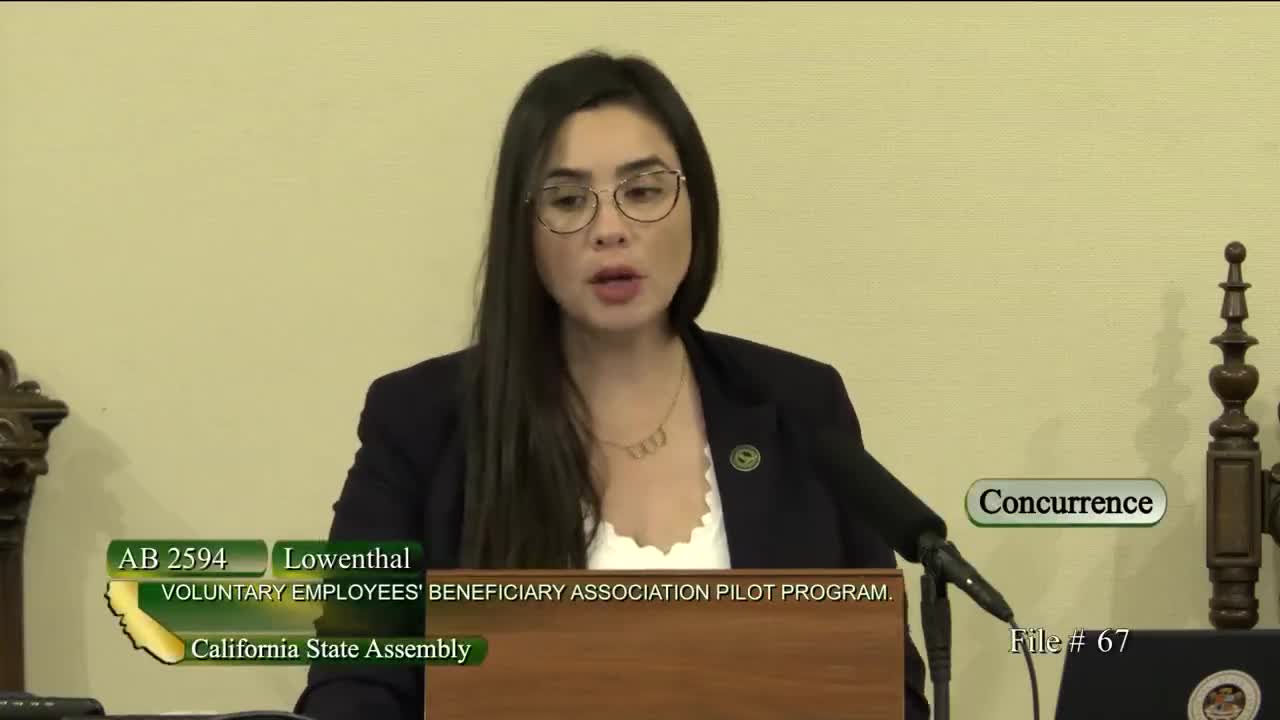 1MIN
Assembly Floor
 1MIN
Senate Floor
 7MIN
Senate Standing Committee on Health
Bill Author

Bill Co-Author(s):