AB 2599: Slavery: corporate disclosures.
- Session Year: 2025-2026
- House: Assembly
- Latest Version Date: 2026-09-30
Current Status:
Passed
(2026-09-30: Chaptered by Secretary of State - Chapter 954, Statutes of 2026.)
Introduced
In Committee
Awaiting First Chamber Vote
Passed First Chamber
In Committee
Awaiting Second Chamber Vote
Passed Second Chamber
Enacted
Existing law requires every retail seller and manufacturer doing business in this state and having annual worldwide gross receipts that exceed $100,000,000 to disclose, as specified, its efforts to eradicate slavery and human trafficking from its direct supply chain for tangible goods offered for sale.
Existing law also requires a person that submits a bid or proposal to, or otherwise proposes to enter into or renew a contract with, a state agency with respect to any contract in the amount of $100,000 or more to certify, under penalty of perjury, at the time the bid or proposal is submitted or the contract is renewed that they have complied with the Unruh Civil Rights Act and the California Fair Employment and Housing Act, and that any policy that they have adopted against any sovereign nation or peoples recognized by the government of the United States is not used as a pretext for discrimination in violation of the Unruh Civil Rights Act or the California Fair Employment and Housing Act.
This bill, upon appropriation by the Legislature, would require any business or enterprise that is doing business in the state that was in existence or whose predecessor company was in existence on or before December 31, 1964 and has annual worldwide gross receipts that exceed $100,000,000 to complete an affidavit, under penalty of perjury, verifying that it has searched through any and all records in its and its related entities, as defined, possession, control, and knowledge for records that the covered entity or its related entities bought or sold persons subjected to slavery, used persons subjected to slavery as collateral, provided loans to purchase persons subjected to slavery, insured such transactions or the persons subjected to slavery, or provided related or other services to aid or otherwise facilitate those transactions. The bill would set forth the contents of the affidavit, the timeline and manner of submission, and reporting requirements.
This bill would require the Civil Rights Department to create a public, digital platform within one year after an appropriation is made, that would make available affidavits and records made pursuant to the bill and disaggregated data, as described. The bill would additionally require the above-described business or entity, that submits a bid or proposal to, or otherwise proposes to enter into or renew a contract with, a state agency, as described above, to additionally certify, under penalty of perjury, that they have submitted the affidavit in compliance with the above-described provisions. By requiring an affidavit and to certify under penalty of perjury regarding compliance with the above-described affidavit requirements, and thus expanding the crime of perjury, the bill would impose a state-mandated local program.
The California Constitution requires the state to reimburse local agencies and school districts for certain costs mandated by the state. Statutory provisions establish procedures for making that reimbursement.
This bill would provide that no reimbursement is required by this act for a specified reason.
Existing law requires every retail seller and manufacturer doing business in this state and having annual worldwide gross receipts that exceed $100,000,000 to disclose, as specified, its efforts to eradicate slavery and human trafficking from its direct supply chain for tangible goods offered for sale.
Existing law also requires a person that submits a bid or proposal to, or otherwise proposes to enter into or renew a contract with, a state agency with respect to any contract in the amount of $100,000 or more to certify, under penalty of perjury, at the time the bid or proposal is submitted or the contract is renewed that they have complied with the Unruh Civil Rights Act and the California Fair Employment and Housing Act, and that any policy that they have adopted against any sovereign nation or peoples recognized by the government of the United States is not used as a pretext for discrimination in violation of the Unruh Civil Rights Act or the California Fair Employment and Housing Act.
This bill bill, upon appropriation by the Legislature, would require any business or enterprise that is doing business in the state that was in existence or whose predecessor company was in existence on or before December 31, 1964 and has annual worldwide gross receipts that exceed $100,000,000 to complete an affidavit, under penalty of perjury, verifying that it has searched through any and all records in its and its related entities, as defined, possession, control, and knowledge for records that the in-state covered entity or its related entities bought or sold persons subjected to slavery, used persons subjected to slavery as collateral, provided loans to purchase persons subjected to slavery, insured such transactions or the persons subjected to slavery, or provided related or other services to aid or otherwise facilitate those transactions. The bill would set forth the contents of the affidavit, the timeline and manner of submission, and reporting requirements. The
This bill would require the Civil Rights Department to create a public, digital platform by January 3, 2028, within one year after an appropriation is made, that would make available affidavits and reports records made pursuant to the bill and disaggregated data, as described. The bill would additionally require the above-described business or entity, that submits a bid or proposal to, or otherwise proposes to enter into or renew a contract with, a state agency, as described above, to additionally certify, under penalty of perjury, that they have submitted the affidavit in compliance with the above-described provisions. By requiring an affidavit and to certify under penalty of perjury regarding compliance with the above-described affidavit requirements, and thus expanding the crime of perjury, the bill would impose a state-mandated local program.
The California Constitution requires the state to reimburse local agencies and school districts for certain costs mandated by the state. Statutory provisions establish procedures for making that reimbursement.
This bill would provide that no reimbursement is required by this act for a specified reason.
Existing law requires every retail seller and manufacturer doing business in this state and having annual worldwide gross receipts that exceed $100,000,000 to disclose, as specified, its efforts to eradicate slavery and human trafficking from its direct supply chain for tangible goods offered for sale.
Existing law also requires a person that submits a bid or proposal to, or otherwise proposes to enter into or renew a contract with, a state agency with respect to any contract in the amount of $100,000 or more to certify, under penalty of perjury, at the time the bid or proposal is submitted or the contract is renewed that they have complied with the Unruh Civil Rights Act and the California Fair Employment and Housing Act, and that any policy that they have adopted against any sovereign nation or peoples recognized by the government of the United States is not used as a pretext for discrimination in violation of the Unruh Civil Rights Act or the California Fair Employment and Housing Act.
This bill would require any business or enterprise that is doing business in the state and has annual worldwide gross receipts that exceed $100,000,000 to complete an affidavit, under penalty of perjury, verifying that it has searched through any and all records in its and its related entities, as defined, possession, control, and knowledge for records that the in-state entity or its related entities bought or sold persons subjected to slavery, used persons subjected to slavery as collateral, provided loans to purchase persons subjected to slavery, insured such transactions or the persons subjected to slavery, or provided related or other services to aid or otherwise facilitate those transactions. The bill would set forth the contents of the affidavit, the timeline and manner of submission, and reporting requirements. The bill would require an unspecified department the Civil Rights Department to create a public, digital platform by January 3, 2028, that would make available affidavits and reports made pursuant to the bill and disaggregated data, as described. The bill would authorize the Attorney General to bring an action for injunctive relief for a violation of these provisions. The bill would additionally require the above-described business or entity, that submits a bid or proposal to, or otherwise proposes to enter into or renew a contract with, a state agency, as described above, to additionally certify, under penalty of perjury, that they have submitted the affidavit in compliance with the above-described provisions. By requiring an affidavit and to certify under penalty of perjury regarding compliance with the above-described affidavit requirements, and thus expanding the crime of perjury, the bill would impose a state-mandated local program.
The California Constitution requires the state to reimburse local agencies and school districts for certain costs mandated by the state. Statutory provisions establish procedures for making that reimbursement.
This bill would provide that no reimbursement is required by this act for a specified reason.
Existing law requires every retail seller and manufacturer doing business in this state and having annual worldwide gross receipts that exceed $100,000,000 to disclose, as specified, its efforts to eradicate slavery and human trafficking from its direct supply chain for tangible goods offered for sale.
Existing law also requires a person that submits a bid or proposal to, or otherwise proposes to enter into or renew a contract with, a state agency with respect to any contract in the amount of $100,000 or more to certify, under penalty of perjury, at the time the bid or proposal is submitted or the contract is renewed that they have complied with the Unruh Civil Rights Act and the California Fair Employment and Housing Act, and that any policy that they have adopted against any sovereign nation or peoples recognized by the government of the United States is not used as a pretext for discrimination in violation of the Unruh Civil Rights Act or the California Fair Employment and Housing Act.
This bill would require textile, tobacco, railroad, shipping, rice, sugar, financial, and insurance companies any business or enterprise that is doing business in the state and has annual worldwide gross receipts that exceed $100,000,000 to complete an affidavit, under penalty of perjury, verifying that it has searched through any and all records in its and its related entities, as defined, possession, control, and knowledge for records that the in-state entity or its related entities bought or sold persons subjected to slavery, used persons subjected to slavery as collateral, provided loans to purchase persons subjected to slavery, insured such transactions or the persons subjected to slavery, or provided related or other services to aid or otherwise facilitate those transactions. The bill would set forth the contents of the affidavit, the timeline and manner of submission, and reporting requirements. The bill would require an unspecified department to create a public, digital platform by January 3, 2028, that would make available affidavits and reports made pursuant to the bill and disaggregated data, as described. The bill would authorize the Attorney General to bring an action for injunctive relief for a violation of these provisions. The bill would additionally require the above-described business or entity, that submits a bid or proposal to, or otherwise proposes to enter into or renew a contract with, a state agency, as described above, to additionally certify, under penalty of perjury, that they have submitted the affidavit in compliance with the above-described provisions. By requiring an affidavit, affidavit and to certify under penalty of perjury regarding compliance with the above-described affidavit requirements, and thus expanding the crime of perjury, the bill would impose a state-mandated local program.
The California Constitution requires the state to reimburse local agencies and school districts for certain costs mandated by the state. Statutory provisions establish procedures for making that reimbursement.
This bill would provide that no reimbursement is required by this act for a specified reason.
Existing law requires every retail seller and manufacturer doing business in this state and having annual worldwide gross receipts that exceed $100,000,000 to disclose, as specified, its efforts to eradicate slavery and human trafficking from its direct supply chain for tangible goods offered for sale.
This bill would require textile, tobacco, railroad, shipping, rice, sugar, financial, and insurance companies to complete an affidavit, under penalty of perjury, verifying that it has searched through any and all records in its and its related entities, as defined, possession, control, and knowledge for records that the in-state entity or its related entities bought or sold persons subjected to slavery, used persons subjected to slavery as collateral, provided loans to purchase persons subjected to slavery, insured such transactions or the persons subjected to slavery, or provided related or other services to aid or otherwise facilitate those transactions. The bill would set forth the contents of the affidavit, the timeline and manner of submission, and reporting requirements. The bill would require an unspecified department to create a public, digital platform by January 3, 2028, that would make available affidavits and reports made pursuant to the bill and disaggregated data, as described. By requiring an affidavit, and thus expanding the crime of perjury, the bill would impose a state-mandated local program.
The California Constitution requires the state to reimburse local agencies and school districts for certain costs mandated by the state. Statutory provisions establish procedures for making that reimbursement.
This bill would provide that no reimbursement is required by this act for a specified reason.
(a)The Legislature finds and declares all of the following:
(1)Numerous American businesses across various industries, including, but not limited to, insurance, banking, tobacco, cotton, sugar, railroads, and shipping, reaped substantial profits by exploiting the uncompensated labor of enslaved persons. Consequently, these businesses and the individuals managing them directly profited from the labor of enslaved persons or directly benefited from insurance policies that insured enslaved persons. This intertwining of economic interests highlights the extent to which the exploitation of enslaved persons permeated the foundation of various American industries. However, very few American industries and the underlying businesses and individuals have adequately acknowledged their connection to the enslavement era.
(2)Many California residents are descendants of enslaved persons and their ancestors were defined as property, dehumanized, separated from their families, coerced into performing labor without appropriate compensation or benefits, and were assaulted and abused. Enslaved persons were treated as chattels in every sense of the word, including being used as collateral for insurance policies, loans, and other transactions, and in some instances, their ancestors owners were compensated for damages by insurers.
(3)Insurance policies from the enslavement era, which have been discovered in the archives of several insurance companies, document insurance coverage to slaveholders for damage to or the death of enslaved persons. In some cases, existing insurance firms or their predecessor firms issued these policies. These insurance policies, loan documents, and other documents and records provide evidence of ill-gotten profits from slavery. Slaveholders and those involved in the slave trade, in turn, profited from the uncompensated labor of enslaved persons, even if such profits have long since been redistributed to shareholders. Industries that profited in this manner may include, but not be limited to, capitalized insurers, financial service providers, textile companies, tobacco companies, railroad companies, shipping companies, the sugar industry, and entities in other industries whose successors in interest remain in existence today.
(4)The citizens of California, which include descendants of enslaved persons, are entitled to complete transparency regarding any involvement or profits acquired through slavery by companies seeking to conduct business within California. This disclosure is essential to ensure that the community is informed about the historical connections and practices of the companies operating within its jurisdiction, fostering a culture of accountability and responsible business practices. This provision is a call to the companies who participated in slaveholding and the slave trade to acknowledge and address the enduring impacts of the enslavement era on our society, and to promote responsible corporate citizenship.
(5)It is essential for corporations to recognize their historical connections to the enslavement era and take responsibility for any past actions that have contributed to the perpetuation of unfairness and harm. By actively engaging in redress efforts, corporations demonstrate their commitment to fostering a more just and fair society. Remedying the harms resulting from the enslavement era is not only a moral imperative but also a crucial step towards ensuring a cohesive and inclusive community. This provision serves to facilitate corporate transparency and accountability, and to encourage the implementation of concrete measures aimed at alleviating the long-lasting adverse effects of the slave trade on descendants of enslaved persons.
(6)The full disclosure of the facts and acknowledgment of the depth and scope of the participation in slaveholding and the slave trade and public hearings with respect thereto furthers the public interest by recognizing the dignity of enslaved persons and descendants and promotes healing in the California community for enslaved persons, descendants, and those who participated in slaveholding or the slave trade.
(7)The purpose of this section is to do all of the following:
(A)Promote the investigation of any participation in slaveholding or the slave trade by companies or contractors engaging in business with California.
(B)Establish a system whereby full and accurate disclosure of company or contractor records related to participation in slaveholding or the slave trade are made publicly available, and which provides an opportunity for public notice.
(C)Establish a governance structure to collect affidavits and enforce the provisions of this section.
(b)For purposes of this section, the following definitions apply:
(1)Company type means the industry or primary focus of the company.
(2)Company value means estimated value and profit to the company for each year information has been submitted.
(3)Covered entity means any business or enterprise that is doing business in the state that was in existence or whose predecessor company was in existence on or before December 31, 1964.
(4)Department means the Civil Rights Department.
(5)Doing business in the state shall have the same meaning as set forth in Section 23101 of the Revenue and Taxation Code.
(6)Financial company includes, but is not limited to, any bank in which the state deposits public funds and investment managers.
(7)Multiyear review of data means disaggregated data by year.
(8)Related entities means both of the following:
(A)The covered entitys parent entities or subsidiaries that do business in the state.
(B)A predecessor in interest, regardless of whether that predecessor did business in the state.
(c)(1)Every covered entity having annual worldwide gross receipts that exceed one hundred million dollars ($100,000,000) shall complete an affidavit, under penalty of perjury, verifying that it has searched through any and all records in its and its related entities possession, control, and knowledge for records that the covered entity or its related entities bought or sold persons subjected to slavery, used persons subjected to slavery as collateral, provided loans to purchase persons subjected to slavery, insured such transactions or the persons subjected to slavery, or provided related or other services to aid or otherwise facilitate those transactions.
(2)The affidavit shall include all of the following:
(A)The names of each slave and slaveholder described in the records.
(B)Evidence of transactions that benefited or otherwise profited from slavery in the United States financially or through the exchange of goods or services.
(C)To the extent applicable, records from 1849 forward indicating all of the following:
(i)Insurance policies related to slaveholding.
(ii)Evidence of purchase, sale, or lease of enslaved persons.
(iii)The use of enslaved persons as collateral for insurance policies, loans, or other transactions.
(iv)Evidence of the provision, or receipt, of loans to purchase enslaved persons.
(v)Insuring transactions for enslaved persons.
(vi)Any other company or contractor records evidencing participation in slaveholding or participation in the slave trade.
(D)An index summarizing and describing the records provided, including the years referenced in the records, the industry and names of the companies referenced in those records, if the predecessor or subsidiary company had a different name, and the types of documentation or records submitted.
(E)A statement from the covered entity verifying that it has exercised due diligence to search through any and all records in its and its related entities possession.
(3) The affidavit shall be submitted to the department pursuant to one of the following dates:
(A)For covered entities doing business in the state as of January 1, 2028, the affidavit is due by January 15, 2029 or by January 15 of the year following the development of the digital platform in accordance with subdivision (d), whichever is later.
(B)For covered entities commencing business in the state following January 1, 2028, the affidavit is due by January 15 of the second year following the establishment of the business or one year after an appropriation has been made in accordance with subdivision (g), whichever is later.
(4)An insurance company that submitted documentation to the Department of Insurance pursuant to Chapter 5 (commencing with Section 13810) of Division 3 of the Insurance Code may include that documentation as part of the submission required by paragraph (2).
(5) A covered entity shall submit an updated affidavit to the department upon the discovery of new reportable information.
(d)The department shall do all of the following:
(1)Provide within two years after an appropriation has been made in accordance with subdivision (g), and by March 1 annually thereafter, a report to the Legislature, in compliance with Section 9795 of the Government Code, regarding affidavits received during the prior calendar year.
(2)Create, within one year after an appropriation has been made, a public digital platform with all of the following information in an understandable and accessible manner:
(A)A database of all affidavits and records received, with the ability to view individual affidavits and records.
(B)All reported information disaggregated based on a variety of data points, including, but not limited to, all of the following:
(i)Company type.
(ii)Multiyear review of data.
(iii)Company value.
(iv)Estimated value or revenue gained in the time period of the slavery-related transactions or business including, but not limited to, the value of the sale of enslaved people, value of insurance claims paid on behalf of lost or injured slaves, or estimated revenue gained through sale of goods produced through recorded slave labor.
(C)All reported information and data points in an electronic format for access and use by the public.
(D)All annual legislative reports drafted by the department.
(3) Make affidavits and records received by January 15 of the first reporting year available on the platform within one year, and subsequent affidavits and records received, within six months of receipt.
(4)Notwithstanding any law, ensure that all affidavits, reports, information, and data remain indefinitely on the digital platform.
(e)Pursuant to subdivision (e) of Section 12930 of the Government Code, the department may adopt, promulgate, and amend regulations implementing and interpreting this section.
(f)Nothing in this section shall be construed to limit any of the Attorney Generals enforcement powers under the Business and Professions Code or otherwise.
(g)Implementation of this section shall be contingent upon appropriation by the Legislature. The requirements in this section shall become operative upon appropriation by the Legislature.
SEC. 2.Section 2010 of the Public Contract Code is amended to read:2010.A person that submits a bid or proposal to, or otherwise proposes to enter into or renew a contract with, a state agency with respect to any contract in the amount of one hundred thousand dollars ($100,000) or more shall certify, under penalty of perjury, at the time the bid or proposal is submitted or the contract is renewed, all of the following:
(a)That they are in compliance with the Unruh Civil Rights Act (Section 51 of the Civil Code).
(b)That they are in compliance with the California Fair Employment and Housing Act (Chapter 7 (commencing with Section 12960) of Part 2.8 of Division 3 of Title 2 of the Government Code).
(c)(1)That any policy that they have against any sovereign nation or peoples recognized by the government of the United States, including, but not limited to, the nation and people of Israel, is not used to discriminate in violation of the Unruh Civil Rights Act (Section 51 of the Civil Code) or the California Fair Employment and Housing Act (Chapter 7 (commencing with Section 12960) of Part 2.8 of Division 3 of Title 2 of the Government Code).
(2)Any policy adopted by a person or actions taken thereunder that are reasonably necessary to comply with federal or state sanctions or laws affecting sovereign nations or their nationals shall not be construed as unlawful discrimination in violation of the Unruh Civil Rights Act (Section 51 of the Civil Code) or the California Fair Employment and Housing Act (Chapter 7 (commencing with Section 12960) of Part 2.8 of Division 3 of Title 2 of the Government Code).
(d)(1)That if they are a covered entity having annual worldwide gross receipts that exceed one hundred million dollars ($100,000,000), they have submitted an affidavit in compliance with Section 1714.44 of the Civil Code.
(2)For purposes of this subdivision, covered entity has the same meaning as defined in Section 1714.44 of the Civil Code.
SEC. 3.No reimbursement is required by this act pursuant to Section 6 of Article XIIIB of the California Constitution because the only costs that may be incurred by a local agency or school district will be incurred because this act creates a new crime or infraction, eliminates a crime or infraction, or changes the penalty for a crime or infraction, within the meaning of Section 17556 of the Government Code, or changes the definition of a crime within the meaning of Section 6 of Article XIIIB of the California Constitution.
(a)The Legislature finds and declares all of the following:
(1)Numerous American businesses across various industries, including, but not limited to, insurance, banking, tobacco, cotton, sugar, railroads, and shipping, reaped substantial profits by exploiting the uncompensated labor of enslaved persons. Consequently, these businesses and the individuals managing them directly profited from the labor of enslaved persons or directly benefited from insurance policies that insured enslaved persons. This intertwining of economic interests highlights the extent to which the exploitation of enslaved persons permeated the foundation of various American industries. However, very few American industries and the underlying businesses and individuals have adequately acknowledged their connection to the enslavement era.
(2)Many California residents are descendants of enslaved persons and their ancestors were defined as property, dehumanized, separated from their families, coerced into performing labor without appropriate compensation or benefits, and were assaulted and abused. Enslaved persons were treated as chattels in every sense of the word, including being used as collateral for insurance policies, loans, and other transactions, and in some instances, their ancestors owners were compensated for damages by insurers.
(3)Insurance policies from the enslavement era, which have been discovered in the archives of several insurance companies, document insurance coverage to slaveholders for damage to or the death of enslaved persons. In some cases, existing insurance firms or their predecessor firms issued these policies. These insurance policies, loan documents, and other documents and records provide evidence of ill-gotten profits from slavery. Slaveholders and those involved in the slave trade, in turn, profited from the uncompensated labor of enslaved persons, even if such profits have long since been redistributed to shareholders. Industries that profited in this manner may include, but not be limited to, capitalized insurers, financial service providers, textile companies, tobacco companies, railroad companies, shipping companies, the sugar industry, and entities in other industries whose successors in interest remain in existence today.
(4)The citizens of California, which include descendants of enslaved persons, are entitled to complete transparency regarding any involvement or profits acquired through slavery by companies seeking to conduct business within California. This disclosure is essential to ensure that the community is informed about the historical connections and practices of the companies operating within its jurisdiction, fostering a culture of accountability and responsible business practices. This provision is a call to the companies who participated in slaveholding and the slave trade to acknowledge and address the enduring impacts of the enslavement era on our society, and to promote responsible corporate citizenship.
(5)It is essential for corporations to recognize their historical connections to the enslavement era and take responsibility for any past actions that have contributed to the perpetuation of unfairness and harm. By actively engaging in redress efforts, corporations demonstrate their commitment to fostering a more just and fair society. Remedying the harms resulting from the enslavement era is not only a moral imperative but also a crucial step towards ensuring a cohesive and inclusive community. This provision serves to facilitate corporate transparency and accountability, and to encourage the implementation of concrete measures aimed at alleviating the long-lasting adverse effects of the slave trade on descendants of enslaved persons.
(6)The full disclosure of the facts and acknowledgment of the depth and scope of the participation in slaveholding and the slave trade and public hearings with respect thereto furthers the public interest by recognizing the dignity of enslaved persons and descendants and promotes healing in the California community for enslaved persons, descendants, and those who participated in slaveholding or the slave trade.
(7)The purpose of this section is to do all of the following:
(A)Promote the investigation of any participation in slaveholding or the slave trade by companies or contractors engaging in business with California.
(B)Establish a system whereby full and accurate disclosure of company or contractor records related to participation in slaveholding or the slave trade are made publicly available, and which provides an opportunity for public notice.
(C)Establish a governance structure to collect affidavits and enforce the provisions of this section.
(b)For purposes of this section, the following definitions apply:
(1)Company type means the industry or primary focus of the company.
(2)Company value means estimated value and profit to the company for each year information has been submitted.
(3)Covered entity means any business or enterprise that is doing business in the state that was in existence or whose predecessor company was in existence on or before December 31, 1964.
(1)(4)Department means the Civil Rights Department.
(2)(5)Doing business in the state shall have the same meaning as set forth in Section 23101 of the Revenue and Taxation Code.
(3)(6)Financial company includes, but is not limited to, any bank in which the state deposits public funds and investment managers.
(4)In-state entities means any business or enterprise that is doing business in the state.(7)Multiyear review of data means disaggregated data by year.
(5)(8)Related entities means both of the following:
(A)The in-state covered entitys parent entities or subsidiaries that do business in the state.
(B)A predecessor in interest, regardless of whether that predecessor did business in the state.
(c)(1)Every in-state covered entity having annual worldwide gross receipts that exceed one hundred million dollars ($100,000,000) shall complete an affidavit, under penalty of perjury, verifying that it has searched through any and all records in its and its related entities possession, control, and knowledge for records that the in-state covered entity or its related entities bought or sold persons subjected to slavery, used persons subjected to slavery as collateral, provided loans to purchase persons subjected to slavery, insured such transactions or the persons subjected to slavery, or provided related or other services to aid or otherwise facilitate those transactions.
(2)The affidavit shall include all of the following:
(A)The names of each slave and slaveholder described in the records.
(B)Evidence of transactions that benefited or otherwise profited from slavery in the United States. States financially or through the exchange of goods or services.
(C)To the extent applicable, records from 1849 forward indicating all of the following:
(i)Insurance policies related to slaveholding.
(ii)Evidence of purchase, sale, or lease of enslaved persons.
(iii)The use of enslaved persons as collateral for insurance policies, loans, or other transactions.
(iv)Evidence of the provision, or receipt, of loans to purchase enslaved persons.
(v)Insuring transactions for enslaved persons.
(vi)Any other company or contractor records evidencing participation in slaveholding or participation in the slave trade.
(D)An index summarizing and describing the records provided, including the years referenced in the records, the industry and names of the companies referenced in those records, if the predecessor or subsidiary company had a different name, and the types of documentation or records submitted.
(D)(E)A statement from the in-state covered entity verifying that it has exercised due diligence to search through any and all records in its and its related entities possession.
(3) The affidavit shall be submitted to the department pursuant to one of the following dates:
(A)For in-state covered entities doing business in the state as of January 1, 2027, by July 1, 2027. 2028, the affidavit is due by January 15, 2029 or by January 15 of the year following the development of the digital platform in accordance with subdivision (d), whichever is later.
(B)For in-state covered entities commencing business in the state following January 1, 2027, within 60 days of commencement of business within the state. 2028, the affidavit is due by January 15 of the second year following the establishment of the business or one year after an appropriation has been made in accordance with subdivision (g), whichever is later.
(4)An insurance company that submitted documentation to the Department of Insurance pursuant to Chapter 5 (commencing with Section 13810) of Division 3 of the Insurance Code may include that documentation as part of the submission required by paragraph (2).
(5)An in-state A covered entity shall submit an updated affidavit to the department upon the discovery of new reportable information.
(d)The department shall do all of the following:
(1)Provide by January 3, 2028, within two years after an appropriation has been made in accordance with subdivision (g), and by March 1 annually thereafter, a report to the Legislature, in compliance with Section 9795 of the Government Code, regarding affidavits received during the prior calendar year.
(2)Make all reports available to the public upon request.(3)(2)Create, by January 3, 2028, within one year after an appropriation has been made, a public digital platform with all of the following information in an understandable and accessible manner:
(A)A database of all affidavits and reports records received, with the ability to view individual affidavits and reports. records.
(B)All reported information disaggregated based on a variety of data points, including, but not limited to, all of the following:
(i)Company type.
(ii)Multiyear review of data.
(iii)Company value.
(iv)Estimated value or revenue gained in the time period of the slavery-related transactions or business. business including, but not limited to, the value of the sale of enslaved people, value of insurance claims paid on behalf of lost or injured slaves, or estimated revenue gained through sale of goods produced through recorded slave labor.
(C)All reported information and data points in an electronic format for access and use by the public.
(D)All annual legislative reports drafted by the department.
(4)(3)Following creation of the database, make Make affidavits and reports records received available on the platform within 30 days by January 15 of the first reporting year available on the platform within one year, and subsequent affidavits and records received, within six months of receipt.
(5)Update the platform with information required under subparagraphs (B) and (C) of paragraph (3) within 30 days that new information and data is available. (6)(4)Notwithstanding any law, ensure that all affidavits, reports, information, and data remain indefinitely on the digital platform.
(e)Pursuant to subdivision (e) of Section 12930 of the Government Code, the department may adopt, promulgate, and amend regulations implementing and interpreting this section.
(e)(f)Nothing in this section shall be construed to limit any of the Attorney Generals enforcement powers under the Business and Professions Code or otherwise.
(g)Implementation of this section shall be contingent upon appropriation by the Legislature. The requirements in this section shall become operative upon appropriation by the Legislature.
SEC. 2.Section 2010 of the Public Contract Code is amended to read:2010.A person that submits a bid or proposal to, or otherwise proposes to enter into or renew a contract with, a state agency with respect to any contract in the amount of one hundred thousand dollars ($100,000) or more shall certify, under penalty of perjury, at the time the bid or proposal is submitted or the contract is renewed, all of the following:
(a)That they are in compliance with the Unruh Civil Rights Act (Section 51 of the Civil Code).
(b)That they are in compliance with the California Fair Employment and Housing Act (Chapter 7 (commencing with Section 12960) of Part 2.8 of Division 3 of Title 2 of the Government Code).
(c)(1)That any policy that they have against any sovereign nation or peoples recognized by the government of the United States, including, but not limited to, the nation and people of Israel, is not used to discriminate in violation of the Unruh Civil Rights Act (Section 51 of the Civil Code) or the California Fair Employment and Housing Act (Chapter 7 (commencing with Section 12960) of Part 2.8 of Division 3 of Title 2 of the Government Code).
(2)Any policy adopted by a person or actions taken thereunder that are reasonably necessary to comply with federal or state sanctions or laws affecting sovereign nations or their nationals shall not be construed as unlawful discrimination in violation of the Unruh Civil Rights Act (Section 51 of the Civil Code) or the California Fair Employment and Housing Act (Chapter 7 (commencing with Section 12960) of Part 2.8 of Division 3 of Title 2 of the Government Code).
(d)(1)That if they are an in-state a covered entity having annual worldwide gross receipts that exceed one hundred million dollars ($100,000,000), they have submitted an affidavit in compliance with Section 1714.44 of the Civil Code.
(2)For purposes of this subdivision, in-state covered entity has the same meaning as defined in Section 1714.44 of the Civil Code.
SEC. 3.No reimbursement is required by this act pursuant to Section 6 of Article XIIIB of the California Constitution because the only costs that may be incurred by a local agency or school district will be incurred because this act creates a new crime or infraction, eliminates a crime or infraction, or changes the penalty for a crime or infraction, within the meaning of Section 17556 of the Government Code, or changes the definition of a crime within the meaning of Section 6 of Article XIIIB of the California Constitution.
(a)The Legislature finds and declares all of the following:
(1)Numerous American businesses across various industries, including, but not limited to, insurance, banking, tobacco, cotton, sugar, railroads, and shipping, reaped substantial profits by exploiting the uncompensated labor of enslaved persons. Consequently, these businesses and the individuals managing them directly profited from the labor of enslaved persons or directly benefited from insurance policies that insured enslaved persons. This intertwining of economic interests highlights the extent to which the exploitation of enslaved persons permeated the foundation of various American industries. However, very few American industries and the underlying businesses and individuals have adequately acknowledged their connection to the enslavement era.
(2)Many California residents are descendants of enslaved persons and their ancestors were defined as property, dehumanized, separated from their families, coerced into performing labor without appropriate compensation or benefits, and were assaulted and abused. Enslaved persons were treated as chattels in every sense of the word, including being used as collateral for insurance policies, loans, and other transactions, and in some instances, their ancestors owners were compensated for damages by insurers.
(3)Insurance policies from the enslavement era, which have been discovered in the archives of several insurance companies, document insurance coverage to slaveholders for damage to or the death of enslaved persons. In some cases, existing insurance firms or their predecessor firms issued these policies. These insurance policies, loan documents, and other documents and records provide evidence of ill-gotten profits from slavery. Slaveholders and those involved in the slave trade, in turn, profited from the uncompensated labor of enslaved persons, even if such profits have long since been redistributed to shareholders. Industries that profited in this manner may include, but not be limited to, capitalized insurers, financial service providers, textile companies, tobacco companies, railroad companies, shipping companies, the sugar industry, and entities in other industries whose successors in interest remain in existence today.
(4)The citizens of California, which include descendants of enslaved persons, are entitled to complete transparency regarding any involvement or profits acquired through slavery by companies seeking to conduct business within California. This disclosure is essential to ensure that the community is informed about the historical connections and practices of the companies operating within its jurisdiction, fostering a culture of accountability and responsible business practices. This provision is a call to the companies who participated in slaveholding and the slave trade to acknowledge and address the enduring impacts of the enslavement era on our society, and to promote responsible corporate citizenship.
(5)It is essential for corporations to recognize their historical connections to the enslavement era and take responsibility for any past actions that have contributed to the perpetuation of unfairness and harm. By actively engaging in redress efforts, corporations demonstrate their commitment to fostering a more just and fair society. Remedying the harms resulting from the enslavement era is not only a moral imperative but also a crucial step towards ensuring a cohesive and inclusive community. This provision serves to facilitate corporate transparency and accountability, and to encourage the implementation of concrete measures aimed at alleviating the long-lasting adverse effects of the slave trade on descendants of enslaved persons.
(6)The full disclosure of the facts and acknowledgment of the depth and scope of the participation in slaveholding and the slave trade and public hearings with respect thereto furthers the public interest by recognizing the dignity of enslaved persons and descendants and promotes healing in the California community for enslaved persons, descendants, and those who participated in slaveholding or the slave trade.
(7)The purpose of this section is to do all of the following:
(A)Promote the investigation of any participation in slaveholding or the slave trade by companies or contractors engaging in business with California.
(B)Establish a system whereby full and accurate disclosure of company or contractor records related to participation in slaveholding or the slave trade are made publicly available, and which provides an opportunity for public notice.
(C)Establish a governance structure to collect affidavits and enforce the provisions of this section.
(b)For purposes of this section, the following definitions apply:
(1)Department means ____. the Civil Rights Department.
(2)Doing business in the state shall have the same meaning as set forth in Section 23101 of the Revenue and Taxation Code.
(3)Financial company includes, but is not limited to, any bank in which the state deposits public funds and investment managers.
(4)In-state entities means any business or enterprise that is doing business in the state.
(5)Related entities means both of the following:
(A)The in-state entitys parent entities or subsidiaries that do business in the state.
(B)A predecessor in interest, regardless of whether that predecessor did business in the state.
(c)(1)Every in-state entity having annual worldwide gross receipts that exceed one hundred million dollars ($100,000,000) shall complete an affidavit, under penalty of perjury, verifying that it has searched through any and all records in its and its related entities possession, control, and knowledge for records that the in-state entity or its related entities bought or sold persons subjected to slavery, used persons subjected to slavery as collateral, provided loans to purchase persons subjected to slavery, insured such transactions or the persons subjected to slavery, or provided related or other services to aid or otherwise facilitate those transactions.
(2)The affidavit shall include all of the following:
(A)The names of each slave and slaveholder described in the records.
(B)Evidence of transactions that benefited or otherwise profited from slavery in the United States.
(C)To the extent applicable, records from 1849 forward indicating all of the following:
(i)Insurance policies related to slaveholding.
(ii)Evidence of purchase, sale, or lease of enslaved persons.
(iii)The use of enslaved persons as collateral for insurance policies, loans, or other transactions.
(iv)Evidence of the provision, or receipt, of loans to purchase enslaved persons.
(v)Insuring transactions for enslaved persons.
(vi)Any other company or contractor records evidencing participation in slaveholding or participation in the slave trade.
(D)A statement from the in-state entity verifying that it has exercised due diligence to search through any and all records in its and its related entities possession.
(3) The affidavit shall be submitted to the department pursuant to one of the following dates:
(A)For in-state entities doing business in the state as of January 1, 2027, by July 1, 2027.
(B)For in-state entities commencing business in the state following January 1, 2027, within 60 days of commencement of business within the state.
(4)An insurance company that submitted documentation to the Department of Insurance pursuant to Chapter 5 (commencing with Section 13810) of Division 3 of the Insurance Code may include that documentation as part of the submission required by paragraph (2).
(4)(5)An in-state entity shall submit an updated affidavit to the department upon the discovery of new reportable information.
(d)The department shall do all of the following:
(1)Provide by January 3, 2028, and annually thereafter, a report to the Legislature, in compliance with Section 9795 of the Government Code, regarding affidavits received during the prior calendar year.
(2)Make all reports available to the public upon request.
(3)Create, by January 3, 2028, a public digital platform with all of the following information in an understandable and accessible manner:
(A)A database of all affidavits and reports received, with the ability to view individual affidavits and reports.
(B)All reported information disaggregated based on a variety of data points, including, but not limited to, all of the following:
(i)Company type.
(ii)Multiyear review of data.
(iii)Company value.
(iv)Estimated value or revenue gained in the time period of the slavery-related transactions or business.
(C)All reported information and data points in an electronic format for access and use by the public.
(4)Following creation of the database, make affidavits and reports received available on the platform within 30 days of receipt.
(5)Update the platform with information required under subparagraphs (B) and (C) of paragraph (3) within 30 days that new information and data is available.
(6)Notwithstanding any law, ensure that all affidavits, reports, information, and data remain indefinitely on the digital platform.
(e)(1)The Attorney General may bring an action for injunctive relief for a violation of this section.(2)Nothing in this section shall limit remedies available for a violation of any other state or federal law.(e)Nothing in this section shall be construed to limit any of the Attorney Generals enforcement powers under the Business and Professions Code or otherwise.
SEC. 2.Section 2010 of the Public Contract Code is amended to read:2010.A person that submits a bid or proposal to, or otherwise proposes to enter into or renew a contract with, a state agency with respect to any contract in the amount of one hundred thousand dollars ($100,000) or more shall certify, under penalty of perjury, at the time the bid or proposal is submitted or the contract is renewed, all of the following:
(a)That they are in compliance with the Unruh Civil Rights Act (Section 51 of the Civil Code).
(b)That they are in compliance with the California Fair Employment and Housing Act (Chapter 7 (commencing with Section 12960) of Part 2.8 of Division 3 of Title 2 of the Government Code).
(c)(1)That any policy that they have against any sovereign nation or peoples recognized by the government of the United States, including, but not limited to, the nation and people of Israel, is not used to discriminate in violation of the Unruh Civil Rights Act (Section 51 of the Civil Code) or the California Fair Employment and Housing Act (Chapter 7 (commencing with Section 12960) of Part 2.8 of Division 3 of Title 2 of the Government Code).
(2)Any policy adopted by a person or actions taken thereunder that are reasonably necessary to comply with federal or state sanctions or laws affecting sovereign nations or their nationals shall not be construed as unlawful discrimination in violation of the Unruh Civil Rights Act (Section 51 of the Civil Code) or the California Fair Employment and Housing Act (Chapter 7 (commencing with Section 12960) of Part 2.8 of Division 3 of Title 2 of the Government Code).
(d)(1)That if they are an in-state entity having annual worldwide gross receipts that exceed one hundred million dollars ($100,000,000), they have submitted an affidavit in compliance with Section 1714.44 of the Civil Code.
(2)For purposes of this subdivision, in-state entity has the same meaning as defined in Section 1714.44 of the Civil Code.
SEC. 3.No reimbursement is required by this act pursuant to Section 6 of Article XIIIB of the California Constitution because the only costs that may be incurred by a local agency or school district will be incurred because this act creates a new crime or infraction, eliminates a crime or infraction, or changes the penalty for a crime or infraction, within the meaning of Section 17556 of the Government Code, or changes the definition of a crime within the meaning of Section 6 of Article XIIIB of the California Constitution.
(1)Numerous American businesses across various industries, including, but not limited to, insurance, banking, tobacco, cotton, sugar, railroads, and shipping, reaped substantial profits by exploiting the uncompensated labor of enslaved persons. Consequently, these businesses and the individuals managing them directly profited from the labor of enslaved persons or directly benefited from insurance policies that insured enslaved persons. This intertwining of economic interests highlights the extent to which the exploitation of enslaved persons permeated the foundation of various American industries. However, very few American industries and the underlying businesses and individuals have adequately acknowledged their connection to the enslavement era.
(2)Many California residents are descendants of enslaved persons and their ancestors were defined as property, dehumanized, separated from their families, coerced into performing labor without appropriate compensation or benefits, and were assaulted and abused. Enslaved persons were treated as chattels in every sense of the word, including being used as collateral for insurance policies, loans, and other transactions, and in some instances, their ancestors owners were compensated for damages by insurers.
(3)Insurance policies from the enslavement era, which have been discovered in the archives of several insurance companies, document insurance coverage to slaveholders for damage to or the death of enslaved persons. In some cases, existing insurance firms or their predecessor firms issued these policies. These insurance policies, loan documents, and other documents and records provide evidence of ill-gotten profits from slavery. Slaveholders and those involved in the slave trade, in turn, profited from the uncompensated labor of enslaved persons, even if such profits have long since been redistributed to shareholders. Industries that profited in this manner may include, but not be limited to, capitalized insurers, financial service providers, textile companies, tobacco companies, railroad companies, shipping companies, the sugar industry, and entities in other industries whose successors in interest remain in existence today.
(4)The citizens of California, which include descendants of enslaved persons, are entitled to complete transparency regarding any involvement or profits acquired through slavery by companies seeking to conduct business within California. This disclosure is essential to ensure that the community is informed about the historical connections and practices of the companies operating within its jurisdiction, fostering a culture of accountability and responsible business practices. This provision is a call to the companies who participated in slaveholding and the slave trade to acknowledge and address the enduring impacts of the enslavement era on our society, and to promote responsible corporate citizenship.
(5)It is essential for corporations to recognize their historical connections to the enslavement era and take responsibility for any past actions that have contributed to the perpetuation of unfairness and harm. By actively engaging in redress efforts, corporations demonstrate their commitment to fostering a more just and fair society. Remedying the harms resulting from the enslavement era is not only a moral imperative but also a crucial step towards ensuring a cohesive and inclusive community. This provision serves to facilitate corporate transparency and accountability, and to encourage the implementation of concrete measures aimed at alleviating the long-lasting adverse effects of the slave trade on descendants of enslaved persons.
(6)The full disclosure of the facts and acknowledgment of the depth and scope of the participation in slaveholding and the slave trade and public hearings with respect thereto furthers the public interest by recognizing the dignity of enslaved persons and descendants and promotes healing in the California community for enslaved persons, descendants, and those who participated in slaveholding or the slave trade.
(7)The purpose of this section is to do all of the following:
(A)Promote the investigation of any participation in slaveholding or the slave trade by companies or contractors engaging in business with California.
(B)Establish a system whereby full and accurate disclosure of company or contractor records related to participation in slaveholding or the slave trade are made publicly available, and which provides an opportunity for public notice.
(C)Establish a governance structure to collect affidavits and enforce the provisions of this section.
(b)For purposes of this section, the following definitions apply:
(1)Department means ____ ____.
(2)Doing business in the state shall have the same meaning as set forth in Section 23101 of the Revenue and Taxation Code.
(2)(3)Financial company includes, but is not limited to, any bank in which the state deposits public funds and investment managers.
(3)(4)In-state entities means a textile, tobacco, railroad, shipping, rice, sugar, financial, or insurance company. any business or enterprise that is doing business in the state.
(4)(5)Related entities means both of the following:
(A)The in-state entitys parent entities or subsidiaries that do business within in the state.
(B)A predecessor in interest, regardless of whether that predecessor did business in the state.
(c)(1)Every in-state entity having annual worldwide gross receipts that exceed one hundred million dollars ($100,000,000) shall complete an affidavit, under penalty of perjury, verifying that it has searched through any and all records in its and its related entities possession, control, and knowledge for records that the in-state entity or its related entities bought or sold persons subjected to slavery, used persons subjected to slavery as collateral, provided loans to purchase persons subjected to slavery, insured such transactions or the persons subjected to slavery, or provided related or other services to aid or otherwise facilitate those transactions.
(2)The affidavit shall include all of the following:
(A)The names of each slave and slaveholder described in the records.
(B)Evidence of transactions that benefited or otherwise profited from slavery in the United States.
(C)To the extent applicable, records from 1849 forward indicating all of the following:
(i)Insurance policies related to slaveholding.
(ii)Evidence of purchase, sale, or lease of enslaved persons.
(iii)The use of enslaved persons as collateral for insurance policies, loans, or other transactions.
(iv)Evidence of the provision, or receipt, of loans to purchase enslaved persons.
(v)Insuring transactions for enslaved persons.
(vi)Any other company or contractor records evidencing participation in slaveholding or participation in the slave trade.
(D)A statement from the in-state entity verifying that it has exercised due diligence to search through any and all records in its and its related entities possession.
(3)The affidavit shall be submitted to the department pursuant to one of the following dates:
(A)For in-state entities doing business in the state as of January 1, 2027, by July 1, 2027.
(B)For in-state entities commencing business in the state following January 1, 2027, within 60 days of commencement of business within the state.
(4)An in-state entity shall submit an updated affidavit to the department upon the discovery of new reportable information.
(d)The department shall do all of the following:
(1)Provide by January 3, 2028, and annually thereafter, a report to the Legislature, in compliance with Section 9795 of the Government Code, regarding affidavits received during the prior calendar year.
(2)Make all reports available to the public upon request.
(3)Create, by January 3, 2028, a public digital platform with all of the following information in an understandable and accessible manner:
(A)A database of all affidavits and reports received, with the ability to view individual affidavits and reports.
(B)All reported information disaggregated based on a variety of data points, including, but not limited to, all of the following:
(i)Company type.
(ii)Multiyear review of data.
(iii)Company value.
(iv)Estimated value or revenue gained in the time period of the slavery-related transactions or business.
(C)All reported information and data points in an electronic format for access and use by the public.
(4)Following creation of the database, make affidavits and reports received available on the platform within 30 days of receipt.
(5)Update the platform with information required under subparagraphs (B) and (C) of paragraph (3) within 30 days that new information and data is available.
(6)Notwithstanding any law, ensure that all affidavits, reports, information, and data remain indefinitely on the digital platform.
(e)(1)The Attorney General may bring an action for injunctive relief for a violation of this section.
(2)Nothing in this section shall limit remedies available for a violation of any other state or federal law.
SEC. 2.Section 2010 of the Public Contract Code is amended to read:2010.A person that submits a bid or proposal to, or otherwise proposes to enter into or renew a contract with, a state agency with respect to any contract in the amount of one hundred thousand dollars ($100,000) or more shall certify, under penalty of perjury, at the time the bid or proposal is submitted or the contract is renewed, all of the following:
(a)That they are in compliance with the Unruh Civil Rights Act (Section 51 of the Civil Code).
(b)That they are in compliance with the California Fair Employment and Housing Act (Chapter 7 (commencing with Section 12960) of Part 2.8 of Division 3 of Title 2 of the Government Code).
(c)(1)That any policy that they have against any sovereign nation or peoples recognized by the government of the United States, including, but not limited to, the nation and people of Israel, is not used to discriminate in violation of the Unruh Civil Rights Act (Section 51 of the Civil Code) or the California Fair Employment and Housing Act (Chapter 7 (commencing with Section 12960) of Part 2.8 of Division 3 of Title 2 of the Government Code).
(2)Any policy adopted by a person or actions taken thereunder that are reasonably necessary to comply with federal or state sanctions or laws affecting sovereign nations or their nationals shall not be construed as unlawful discrimination in violation of the Unruh Civil Rights Act (Section 51 of the Civil Code) or the California Fair Employment and Housing Act (Chapter 7 (commencing with Section 12960) of Part 2.8 of Division 3 of Title 2 of the Government Code. Code).
(d)(1)That if they are an in-state entity having annual worldwide gross receipts that exceed one hundred million dollars ($100,000,000), they have submitted an affidavit in compliance with Section 1714.44 of the Civil Code.
(2)For purposes of this subdivision, in-state entity has the same meaning as defined in Section 1714.44 of the Civil Code.
SEC. 2.SEC. 3.No reimbursement is required by this act pursuant to Section 6 of Article XIIIB of the California Constitution because the only costs that may be incurred by a local agency or school district will be incurred because this act creates a new crime or infraction, eliminates a crime or infraction, or changes the penalty for a crime or infraction, within the meaning of Section 17556 of the Government Code, or changes the definition of a crime within the meaning of Section 6 of Article XIIIB of the California Constitution.
(a)The Legislature finds and declares that the purpose of this section is to promote healing and assist in remedying depressed economic conditions, poverty, unequal educational opportunity, and other legacies of slavery, which will serve to promote the public health, welfare, and safety.
(b)For purposes of this section, the following definitions apply:
(1)Department means ____
(2)Financial company includes, but is not limited to, any bank in which the state deposits public funds and investment managers.
(3)In-state entities means a textile, tobacco, railroad, shipping, rice, sugar, financial, or insurance company.
(4)Related entities means both of the following:
(A)The in-state entitys parent entities or subsidiaries that do business within the state.
(B)A predecessor in interest, regardless of whether that predecessor did business in the state.
(c)(1)Every in-state entity shall complete an affidavit, under penalty of perjury, verifying that it has searched through any and all records in its and its related entities possession, control, and knowledge for records that the in-state entity or its related entities bought or sold persons subjected to slavery, used persons subjected to slavery as collateral, provided loans to purchase persons subjected to slavery, insured such transactions or the persons subjected to slavery, or provided related or other services to aid or otherwise facilitate those transactions.
(2)The affidavit shall include all of the following:
(A)The names of each slave and slaveholder described in the records.
(B)Evidence of transactions that benefited or otherwise profited from slavery in the United States.
(3)The affidavit shall be submitted to the department pursuant to one of the following dates:
(A)For in-state entities doing business in the state as of January 1, 2027, by July 1, 2027.
(B)For in-state entities commencing business in the state following January 1, 2027, within 60 days of commencement of business within the state.
(4)An in-state entity shall submit an updated affidavit to the department upon the discovery of new reportable information.
(d)The department shall do all of the following:
(1)Provide by January 3, 2028, and annually thereafter, a report to the Legislature, in compliance with Section 9795 of the Government Code, regarding affidavits received during the prior calendar year.
(2)Make all reports available to the public upon request.
(3)Create, by January 3, 2028, a public digital platform with all of the following information in an understandable and accessible manner:
(A)A database of all affidavits and reports received, with the ability to view individual affidavits and reports.
(B)All reported information disaggregated based on a variety of data points, including, but not limited to, all of the following:
(i)Company type.
(ii)Multiyear review of data.
(iii)Company value.
(iv)Estimated value or revenue gained in the time period of the slavery-related transactions or business.
(C)All reported information and data points in an electronic format for access and use by the public.
(4)Following creation of the database, make affidavits and reports received available on the platform within 30 days of receipt.
(5)Update the platform with information required under subparagraphs (B) and (C) of paragraph (3) within 30 days that new information and data is available.
(6)Notwithstanding any law, ensure that all affidavits, reports, information, and data remain indefinitely on the digital platform.
SEC. 2.No reimbursement is required by this act pursuant to Section 6 of Article XIIIB of the California Constitution because the only costs that may be incurred by a local agency or school district will be incurred because this act creates a new crime or infraction, eliminates a crime or infraction, or changes the penalty for a crime or infraction, within the meaning of Section 17556 of the Government Code, or changes the definition of a crime within the meaning of Section 6 of Article XIIIB of the California Constitution.
|
Date
|
Status
|
|---|---|
| Sep 30, 2026 | Chaptered by Secretary of State - Chapter 954, Statutes of 2026. |
| Sep 30, 2026 | Approved by the Governor. |
| Sep 3, 2026 | Enrolled and presented to the Governor at 4 p.m. |
| Aug 26, 2026 | Senate amendments concurred in. To Engrossing and Enrolling. (Ayes 60. Noes 13. Page 6589.). |
| Aug 26, 2026 | Senate amendments concurred in. To Engrossing and Enrolling. (Ayes 60. Noes 13.). |
| Aug 25, 2026 | In Assembly. Concurrence in Senate amendments pending. |
| Aug 25, 2026 | Read third time. Passed. Ordered to the Assembly. (Ayes 30. Noes 9. Page 5790.). |
| Aug 25, 2026 | Read third time. Passed. Ordered to the Assembly. (Ayes 30. Noes 8.). |
| Aug 24, 2026 | Read second time. Ordered to third reading. |
| Aug 21, 2026 | Read third time and amended. Ordered to second reading. |
| Aug 17, 2026 | Read second time. Ordered to third reading. |
| Aug 13, 2026 | From committee: Amend, and do pass as amended. (Ayes 5. Noes 2.) (August 13). |
| Aug 13, 2026 | Read second time and amended. Ordered returned to second reading. |
| Aug 3, 2026 | In committee: Referred to APPR. suspense file. |
| Jul 1, 2026 | From committee: Do pass and re-refer to Com. on APPR. (Ayes 5. Noes 1.) (June 30). Re-referred to Com. on APPR. |
| Jun 24, 2026 | From committee: Do pass and re-refer to Com. on PUB. S. (Ayes 11. Noes 1.) (June 23). Re-referred to Com. on PUB. S. |
| Jun 10, 2026 | Referred to Coms. on JUD. and PUB. S. |
| May 27, 2026 | In Senate. Read first time. To Com. on RLS. for assignment. |
| May 26, 2026 | Read third time. Passed. Ordered to the Senate. (Ayes 58. Noes 17. Page 5336.) |
| May 26, 2026 | Read third time. Passed. Ordered to the Senate. (Ayes 58. Noes 17.) |
| May 26, 2026 | Read third time. Passed. Ordered to the Senate. |
| May 18, 2026 | Read second time. Ordered to third reading. |
| May 14, 2026 | From committee: Do pass. (Ayes 11. Noes 2.) (May 14). |
| Apr 29, 2026 | In committee: Set, first hearing. Referred to APPR. suspense file. |
| Apr 20, 2026 | Re-referred to Com. on APPR. |
| Apr 16, 2026 | Read second time and amended. |
| Apr 15, 2026 | From committee: Amend, and do pass as amended and re-refer to Com. on APPR. (Ayes 9. Noes 3.) (April 14). |
| Mar 24, 2026 | In committee: Set, first hearing. Hearing canceled at the request of author. |
| Mar 9, 2026 | Referred to Com. on JUD. |
| Feb 21, 2026 | From printer. May be heard in committee March 23. |
| Feb 20, 2026 | Read first time. To print. |
|
Date
|
Description
|
Location
|
Votes
|
|
|---|---|---|---|---|
| Aug 26, 2026 | AB 2599 Bryan Concurrence in Senate Amendments | Assembly Floor |
Passed |
|
| Aug 25, 2026 | Assembly 3rd Reading AB2599 Bryan et al. By Weber Pierson | Senate Floor |
Passed |
|
| Aug 13, 2026 | Do pass as amended | Senate Standing Committee on Appropriations |
Passed |
|
| Aug 3, 2026 | Placed on suspense file | Senate Standing Committee on Appropriations |
Passed |
|
| Jun 30, 2026 | Do pass, but first be re-referred to the Committee on [Appropriations] | Senate Standing Committee on Public Safety |
Passed |
|
| Jun 23, 2026 | Do pass, but first be re-referred to the Committee on [Public Safety] | Senate Standing Committee on Judiciary |
Passed |
|
| May 26, 2026 | AB 2599 Bryan Assembly Third Reading | Assembly Floor |
Passed |
|
| May 14, 2026 | Do pass. | Assembly Standing Committee on Appropriations |
Passed |
|
| Apr 14, 2026 | Do pass as amended and be re-referred to the Committee on [Appropriations] | Assembly Standing Committee on Judiciary |
Passed |
This list shows positions taken on this bill by organizations on the date displayed, which is linked to the original source.
Positions by individuals are not included.
|
Organization
|
Position
|
Date
|
|---|---|---|
| African Communities Public Health Coalition | ** Support | |
| Alliance for Reparations, Reconciliation and Truth | ** Support | |
| All Of Us Or None Orange County | ** Support | |
| American Council Of Life Insurers | ** Against | |
| American Property and Casualty Insurance Association | ** Against | |
| Association Of California Life And Health Insurance Companies | ** Against | |
| Bay Area Regional Health Inequity Initiative | ** Support | |
| Black Jewish Justice Alliance | ** Support | |
| Black Women Organized for Political Action | ** Support | |
| California Calls | ** Support | |
| CFT – A Union of Educators & Classified Professionals | ** Support | |
| Community Coalition | ** Support | |
| Community Interventions | ** Support | |
| Concrete Development INC | ** Support | |
| Congregations Organized for Prophetic Engagement | ** Support | |
| Council on American-Islamic Relations, California | ** Support | |
| Ella Baker Center For Human Rights | ** Support | |
| Emerging Leaders Program of the Leadership Institute At Allen Temple Baptist Church | ** Support | |
| Equal Justice Society | ** Support | |
| Families Inspiring Reentry & Reunification 4 Everyone | ** Support | |
| Fund for Reparations Now! | ** Support | |
| Healing Justice Santa Barbara | ** Support | |
| Healthy Black Families | ** Support | |
| Healthy Black Families, Inc. | ** Support | |
| Inland Empire Black Worker Center | ** Support | |
| Japanese American Citizens League, Berkeley Chapter | ** Support | |
| Japanese American Citizens’ League, Berkeley Chapter | ** Support | |
| LA Voice | ** Support | |
| League Of Women Voters Of California | ** Support | |
| Livefree California | ** Support | |
| Los Angeles Black Worker Center | ** Support | |
| National Association of Mutual Insurance Companies | ** Against | |
| National Association of Mutual Life Companies | ** Against | |
| Nikkei Progressives | ** Support | |
| Personal Insurance Federation | ** Against | |
| Power California Action | ** Support | |
| San Jose Nikkei Resisters | ** Support | |
| Starting Over Inc. | ** Support | |
| Starting Over Strong | ** Support | |
| The Amelia Ann Adams Whole Life Center | ** Support | |
| The Southern California Black Worker Hub for Regional Organizing | ** Support |
CONCURRENCE IN SENATE AMENDMENTS
CSA1 Bill Id:AB 2599
Author:(Bryan, et al.)
As Amended Ver:August 21, 2026
Majority vote
SUMMARY
Requires certain companies under the penalty of perjury, to verify that they have searched their records to determine if the company, or any related entity, bought or sold persons subjected to slavery, used persons subjected to slavery as collateral, provided loans to purchase persons subjected to slavery, insured such transactions, or provided related or other services to facilitate those transactions.
Major Provisions
- Finds and declares, among other things, the following:
- Numerous American businesses across many industries reaped substantial profits by exploiting the uncompensated labor of enslaved persons, and that the intertwining economic interest across diverse industries highlight the extent to which slavery permeated American industry.
- Many Californians are descendants of enslaved persons, and their ancestors were defined as property, grossly mistreated, and used as collateral for insurance policies, loans, and other transactions.
- Documents show that during the slavery era insurance companies profited by providing coverage to slaveholders for damage to enslaved people, and some of these companies were the predecessors of existing insurance companies. Other companies that profited from slavery include not only insurance companies but financial service providers, textile companies, tobacco companies, shipping companies, railroad companies, the rice industry, the sugar industry, and other industries whose successors in interest remain in existence today.
- The citizens of California are entitled to complete transparency regarding any involvement or profits acquired through slavery by companies seeking to conduct business in California. This disclosure is essential to ensure that the community is informed about historical connections and practices of companies operating in the state.
- It is essential for corporations to recognize their historical connections to slavery and take responsibility for past actions that perpetuated harm, and actively engaging in efforts to redress harms demonstrate corporate commitment to fostering a more just and fair society.
- The purpose of this legislation is to promote investigation and disclosure of company or contractor records relating to slavery and to make records public available.
- Requires, upon appropriation by the Legislature, an enterprise doing business in the state that was in existence on or before December 31, 1964, and having annual worldwide gross receipts of $100 million, to complete an affidavit, under penalty of perjury. The affidavit shall verify that it has searched through any and all records in its and its related entities' possession, control, and knowledge for records that the company or its related entities bought or sold persons subject to slavery, used persons subjected to slavery as collateral, provided loans to purchase persons subjected to slavery, insured such transactions or the persons subjected to slavery, or provided related or other services to aid or otherwise facilitate those transactions.
- Requires the affidavit to include specified information, including the names of each slave and slaveholder in the records; evidence of transactions that benefitted or otherwise profited from slavery in the United States; and, to the extent possible, records relating to insurance policies, purchase, sale, or lease of enslaved persons, the use of enslaved persons as collateral, any other records evidencing participation in slaveholding or the slave trade, and an index summarizing and describing the records provided. The affidavit shall include a statement verifying that the company has exercised due diligence to search through any and all records in its possession and in the possession of any related entities, as defined.
- Requires the company to submit the affidavit to the Civil Rights Department as specified.
- Requires the Civil Rights Department to do all of the following:
- Provide, within two years after an appropriation, as specified, and annually thereafter, a report to the Legislature regarding the affidavits received during the prior calendar year.
- Make all reports available to the public upon request.
- Create, within one year after an appropriation has been made, a public digital platform that contains and makes accessible all affidavits and reports received; all reported information disaggregated by a variety of data points, including company type, multiyear review of data, company value, estimated value or revenue gained in the time period of the slavery-related transactions of data, as specified.
- Update the information on the platform, as specified.
- Ensure that all affidavits, reports, information, and data remain indefinitely on the digital platform.
- Authorizes the California Attorney General to bring an action for injunctive relief for a violation of the bill's provisions and specifies that nothing in this bill limits remedies available for a violation of any other state or federal law.
- Requires an in-state entity subject to this bill that bids on a contract with the state in the amount of $100,000 or more to verify that they have complied with the provisions of this bill.
Senate Amendments
- Designate the Civil Rights Department as the state entity that will provide specified reports and establish a digital platform that contains specified affidavits and reports.
- Defines the definition of a covered entity to include those in existence as December 31, 1964.
- Specify that the implementation of the bill's provisions is subject to an appropriation by the Legislature for the development of a digital platform, which will contain affidavit, and provide that the Civil Rights Department shall create the digital platform within one year of this appropriation.
COMMENTS
This bill requires companies operating in California and having annual worldwide gross receipts that exceed $100M to complete an affidavit, under penalty of perjury, verifying that it has searched its records, and those of any related entity, to determine whether they participated in or facilitated the business of slavery in the era of slavery. Existing law requires every retail seller and manufacturer doing business in this state and having annual worldwide gross receipts that exceed $100,000,000 to disclose, as specified, its efforts to eradicate slavery and human trafficking from its direct supply chain. That existing requirement, however, only requires companies to disclose present efforts to eradicate present-day slavery, while this bill would require the company to conduct research into the company's historical records – including the records of any predecessor in interest – to identify ways that it might have profited from chattel slavery of the pre-Civil War period. The bill also requires a state agency to create a public digital platform containing the company affidavits, reported disclosures, and associated information. Finally, the bill amends an existing section of the Public Contracts Code to require a company seeking certain contracts with the state to verify that it has complied with the provisions of this bill. Currently, this section requires contract bidders to attest that they have complied with the Unruh Civil Rights Act and FEHA. They would now need to also attest that they had complied with this bill.
What is "due diligence?" The depth of any historical research can vary greatly. Historians spend years, and sometimes entire careers, conducting research. The companies subject to this bill will have less than two years to complete their work, so the amount of research required by this bill will necessarily reflect that reality. The bill requires the companies to search the records with "due diligence." The bill does not define this term, but Black's Law Dictionary defines "due diligence" as a "measure of prudence, activity, or assiduity, as is properly to be expected from, and ordinarily exercised by, a reasonable and prudent [person] under the particular circumstances." It is "not measured by any absolute standard but depends on the relative facts of the case." Here, "the particular circumstances" are the two year limit, the fact that businesses are not historians, and the fact that businesses cannot be expected to set aside the normal conduct of business to engage in research. Black's Law Dictionary distinguishes "due diligence" from "extraordinary diligence" and "great diligence," again suggesting that under the due diligence standard one is only required to do what a reasonably prudent person would do under the circumstances.
Presumably, where neither the company nor any of its related entities existed before 1865, and where there was no predecessor in interest operating before 1865, the company's affidavit could simply declare this fact. However, where companies either existed during the era of chattel slavery or could trace their companies to a predecessor in interest, the task could become more complex. Other obstacles to conducting this research may also emerge. For example, the bill requires companies to search not only their own records but also to search the records of any "related entities." This term is defined to include 1) parent companies and subsidiaries operating in the state; and 2) "predecessors in interest," regardless of whether they operate in this state. Many companies that existed before 1865 might not have records dating from that era, and companies that have a predecessor in interest may have difficulty accessing the records of a defunct company that operated in another state.
According to the Author
California does not currently require standardized disclosure of verified historical ties to slavery or related economic activity. As a result, information remains fragmented, inconsistent, or inaccessible to the public. Transparency regarding historical practices is essential to responsible governance and ethical business standards. . . AB 2599 focuses on transparency and accountability. If corporations benefited from slavery, the public deserves to know. This bill ensures we uncover those truths and make that information accessible to all Californians.
Arguments in Support
The Ella Baker Center for Human Rights (EBC) believes that AB 2599 is a "critical piece of legislation that builds on the work of the California Reparations Task Force." EBC explains further:
Corporations have a moral and ethical responsibility to conduct business practices in alignment with human rights. It is important that we acknowledge the financial benefit gained from businesses with historical ties to human trafficking and slavery. This legislation is building on current disclosure laws and transparency efforts like the California Transparency in Supply Chains Act (CTSCA), which already requires certain companies to disclose their efforts to eradicate slavery and human trafficking from their supply chains. Current disclosure laws primarily focus on modern-day slavery, but transparency about historical practices is also essential for informed public dialogue, responsible governance, and ethical business standards.
We believe that reparations for descendants of U.S. chattel slavery and the larger African American community as a group begin with naming and admitting the harm done. This is in accordance with the principle of Satisfaction as defined by the United Nations (UN), which requires acknowledgment, public disclosure, and apology for the harm. Harm cannot be repaired unless and until one acknowledges that it occurred. AB 2599 supports the ongoing historical effort in California to tell true history and acknowledge the historical and ongoing impacts of slavery.
Arguments in Opposition
A coalition of groups representing the insurance industry support the aims of this bill but seek an amendment exempting them from the new requirement if they have already complied with SB 2199. They point out that "SB 2199 resulted in a comprehensive report to the Legislature and the public. The findings were compiled and published by the California Department of Insurance, and the report remains publicly available on the Department's website today. As a result of that statutory process, insurers have already complied with California law requiring disclosure of historical slave-era insurance policies." To avoid duplication, they propose adding a subdivision (e) in section 1744.44 to read as follows:
(e) Compliance by an insurance company with California Insurance Code Division 3, Chapter 5, Slavery Era Insurance Policies, Section 13810 et seq. shall be deemed full compliance with this section.
FISCAL COMMENTS
According to the Senate Appropriations Committee, estimated $2.65 million in FY 2027-28 for personnel and $2.2 million in FY 2028-29 and annually thereafter to the Civil Rights Department for legal, administrative, research, and information technology personnel, including contract personnel and hardware associated with the requirements of the bill. (General Fund)
Cost pressures of an unknown but potentially significant amount to the courts. Actual costs will depend on the number of cases filed and the amount of court time needed to resolve each case (Trial Court Trust Fund, General Fund).
VOTES:
ASM JUDICIARY: 9-3-0
YES: Kalra, Bauer-Kahan, Bryan, Connolly, Harabedian, Pacheco, Papan, Stefani, Zbur
NO: Macedo, Dixon, Sanchez
ASM APPROPRIATIONS: 11-2-2
YES: Wicks, Aguiar-Curry, Calderon, Caloza, Fong, Mark González, Krell, Pacheco, Pellerin, Sharp-Collins, Solache
NO: Dixon, Tangipa
ABS, ABST OR NV: Hoover, Ta
ASSEMBLY FLOOR: 58-17-5
YES: Addis, Aguiar-Curry, Ahrens, Alvarez, Arambula, Ávila Farías, Bains, Bauer-Kahan, Bennett, Berman, Boerner, Bonta, Bryan, Calderon, Caloza, Carrillo, Connolly, Elhawary, Fong, Gabriel, Garcia, Gipson, Mark González, Haney, Harabedian, Hart, Irwin, Jackson, Kalra, Krell, Lee, Lowenthal, McKinnor, Nguyen, Ortega, Pacheco, Papan, Patel, Pellerin, Petrie-Norris, Quirk-Silva, Ramos, Ransom, Michelle Rodriguez, Rogers, Blanca Rubio, Schiavo, Schultz, Sharp-Collins, Solache, Soria, Stefani, Valencia, Ward, Wicks, Wilson, Zbur, Rivas
NO: Castillo, Chen, Davies, DeMaio, Dixon, Ellis, Gallagher, Jeff Gonzalez, Hadwick, Hoover, Johnson, Lackey, Macedo, Patterson, Sanchez, Tangipa, Wallis
ABS, ABST OR NV: Alanis, Flora, Muratsuchi, Celeste Rodriguez, Ta
UPDATED
VERSION: August 21, 2026
CONSULTANT: Tom Clark / JUD. / (916) 319-2334 FN: 0004042
SENATE RULES COMMITTEE Office of Senate Floor Analyses (916) 651-4171 | AB 2599 |
THIRD READING
Bill No: AB 2599
Author: Bryan (D), Bonta (D), Elhawary (D), Gipson (D), Jackson (D), McKinnor (D) and Sharp-Collins (D), et al.
Amended: 8/21/26 in Senate
Vote: 21
SENATE JUDICIARY COMMITTEE: 11-1, 6/23/26
AYES: Umberg, Allen, Ashby, Caballero, Durazo, Laird, Reyes, Stern, Wahab, Weber Pierson, Wiener
NOES: Niello
NO VOTE RECORDED: Valladares
SENATE PUBLIC SAFETY COMMITTEE: 5-1, 6/30/26
AYES: Arreguín, Caballero, Cortese, Pérez, Wiener
NOES: Seyarto
SENATE APPROPRIATIONS COMMITTEE: 5-2, 8/13/26
AYES: Cervantes, Cabaldon, Grayson, Richardson, Wahab
NOES: Seyarto, Dahle
ASSEMBLY FLOOR: 58-17, 5/26/26 - See last page for vote
SUBJECT: Slavery: corporate disclosures
SOURCE: Alliance for Reparations, Reconciliation and Truth
DIGEST:
This bill, upon appropriation by the Legislature, requires covered entities, as defined, with gross annual receipts of over $100 million to provide information and records relating to their past commercial activities related to slavery, as specified, to the Civil Rights Department (CRD), and for the CRD to make that information publicly available.
Senate Floor amendments of 8/21/26 made the bill’s reporting provisions and the CRD’s obligations contingent upon an appropriation by the Legislature; narrowed the scope of companies required to provide information under this bill; and delayed the due date for covered entities to submit the required information to the CRD.
ANALYSIS:
Existing law:
- Requires every retail seller and manufacturer doing business in the state and having annual worldwide gross receipts that exceed $100 million to disclose, as set forth in 2), its efforts to eradicate slavery and human trafficking from its direct supply chain for tangible goods offered for sale; the disclosure must be posted on the retailer or manufacturer’s website, as specified. (Civil [Civ.] Code, § 1714.43.)
- Requires a person that submits a bid or proposal to, or otherwise proposes to enter into or renew a contract with, a state agency with respect to any contract in the amount of $100,000 or more to certify, under penalty of perjury, at the time the bid or proposal is submitted or the contract is renewed, all of the following:
- That they are in compliance with the Unruh Civil Rights Act.
- That they are in compliance with the California Fair Employment and Housing Act (FEHA).
- That any policy they have against any sovereign peoples recognized by the government of the United States, including, but not limited to, the nation and people of Israel, is not used to discriminate in violation of the Unruh Civil Rights Act of the FEHA; any policy adopted by a person or actions taken thereunder that are reasonably necessary to comply with federal or state sanction laws or laws affecting sovereign nations or their nationals shall not be construed as unlawful discrimination in violation of the Unruh Civil Rights Act or the FEHA. (California Public [Cal. Pub.] Contract Code, § 2010.)
- Requires the Insurance Commissioner to request and obtain information from insurers licensed and doing business in California regarding any records of slaveholder insurance policies issued by any predecessor corporation during the slavery era. (Insurance [Ins.] Code, § 13810.)
- Requires the Insurance Commissioner to obtain the names of any slaveholders or slaves described in the insurance records in 4) and make the information available to the public and the Legislature. (Ins. Code, § 13811.)
- Requires each insurer licensed and doing business in California to research and report to the Insurance Commissioner with respect to any records within the insurer’s possession or knowledge relating to insurance policies issued to slaveholders that provided coverage for damage to, or death of, their slaves. (Ins. Code, § 13812.)
- Provides that descendants of slaves, whose ancestors were defined as private property, dehumanized, divided from their families, forced to perform labor without appropriate compensation or benefits, and whose ancestors’ owners were compensated for damages by insurers, are entitled to full disclosure. (Ins. Code, § 13813.)
This bill:
- Makes findings and declarations relating to the prevalence of California businesses that profited from the exploitation of the uncompensated labor of enslaved persons and the need for transparency regarding profits attained through slavery.
- Defines the following terms:
- “Company type” means the industry or primary focus of the company.
- “Company value” means estimated value and profit to the company for each year information has been submitted.
- “Covered entity” means any business or enterprise that is doing business in the state that was in existence or whose predecessor company was in existence on or before December 31, 1964.
- “Department” means the CRD.
- “Doing business in the state” has the same meaning as in Section 23101 of the Revenue and Taxation Code.
- “Financial company” includes, but is not limited to, any bank in which the state deposits public funds and investment managers.
- “In-state entities” means any business or enterprise that is doing business in the state, as defined in the Revenue and Taxation Code.
- “Multiyear review of data” means disaggregated data by year.
- “Related entities “ means both of the following:
- The covered entity’s parent entities or subsidiaries that do business in the state.
- A predecessor in interest, regardless of whether that predecessor did business in the state.
- Requires each covered entity with annual worldwide gross receipts that exceed $100 million to complete an affidavit, under penalty of perjury, verifying that it has searched through any and all records in its and its related entities possession, control, and knowledge for records that the covered entity or its related entities bought or sold persons subjected to slavery, used persons subjected to slavery as collateral, provided loans to purchase persons subjected to slavery, insured transactions or the persons subjected to slavery, or provided related or other services to aid or otherwise facilitate those transactions.
- Requires an affidavit in 4) to include all of the following:
- The names of each slave and slaveholder described in the records.
- Evidence of transactions that benefited or otherwise profited from slavery in the United States financially or through the exchange of goods or services.
- To the extent applicable, records from 1849 onward indicating all of the following:
- Insurance policies related to slaveholding.
- Evidence of purchase, sale, or lease of enslaved persons.
- The use of enslaved persons as collateral for insurance policies, loans, or other transactions.
- Evidence of the provision, or receipt, of loans to purchase enslaved persons.
- Insuring transactions for enslaved persons.
- Any other company or contractor records evidencing participation in slaveholding or participation in the slave trade.
- An index summarizing and describing the records provided, including the years referenced in the records, the industry and names of the companies referenced in those records, if the predecessor or subsidiary company had a different name, and the types of documentation or records submitted.
- A statement from the covered entity verifying that it has exercised due diligence to search through any and all records in its entities’ possession.
- Requires an affidavit in 4) to be submitted to the CRD by one of the following dates:
- For covered entities doing business in the state as of January 1, 2028, by January 15, 2029, or by January 15 of the year following the development of the digital platform in accordance with 8), whichever is later.
- For covered entities commencing business in the state following January 1, 2028, by January 15 of the second year following the establishment of the business or one year after an appropriation has been made for the bill, whichever is later.
- Provides that an insurance company that submitted documentation to the Department of Insurance pursuant to existing slavery disclosure laws may include that documentation as part of its required submission pursuant to this measure.
- Requires a covered entity to submit an updated affidavit to the CRD upon the discovery of new reportable information.
- Requires the CRD to do all of the following:
- Provide, within two years after an appropriation has been made and by March 1 annually thereafter, a report to the Legislature regarding affidavits received during the prior calendar year.
- Create, within one year after an appropriation has been made, a public digital platform with a database of all affidavits and records received, reported information disaggregated based on a variety of data points, as specified, and all of the CRD’s annual reports to the Legislature.
- Make affidavits and records received by January 15 of the first reporting year available on the platform within one year, and subsequent affidavits and records received available on the platform within six months of receipt.
- Notwithstanding any other law, ensure that all affidavits, reports, information, and data remain indefinitely on the platform.
- Permits the CRD to adopt, promulgate, and amend regulations to implement and interpret this bill’s provisions.
- Provides that nothing in this measure shall be construed to limit any of the Attorney General’s enforcement powers under the Business and Professions Code or otherwise.
- Provides that implementation of 1)-10) is contingent upon an appropriation by the Legislature, and that those requirements shall become operative upon appropriation
- Adds, to the list of certifications that must be made, under penalty of perjury, by a person that submits a bid or proposal, or otherwise proposes to enter or renew a contact with, a state agency with respect to any contract in the amount of $100,000 or more, that, if they are an in-state entity with annual worldwide gross receipts of over $100 million, they have submitted an affidavit in compliance with 2).
Comments
The Nineteenth Century American economy is inextricably intertwined with the practice of chattel enslavement. Even here in California, an ostensibly “free” state, enslavement affected the state’s growth through enslaved persons brought into the state from states where slavery was legal, and through the economic activities of corporations relating to enslavement. Banks financed the acquisition of slave property; shipping companies and railroad companies transported enslaved persons; and insurance companies insured slaveholders against loss of human “property.” While historians have done admirable work to uncover the details of this era, there is still much that remains unknown about which companies benefitted from slavery-related commerce, and to what extent. The absence of records also hurts the descendants of enslaved persons, who are left without information about their family histories.
This bill, contingent upon an appropriation by the Legislature, requires covered entities with annual worldwide gross receipts of over $100 million to complete an affidavit, under penalty of perjury, verifying that it has searched through all of its records, and its subsidiaries’ and related entities’ records, for records indicating that the entity engaged in the commerce of enslavement. A “covered entity” is a business doing business in the state that was in existence, or whose predecessor company, was in existence on or before December 31, 1964. Each covered entity’s affidavit must provide specified information relating their relevant commercial activities, and be accompanied by copies of records from 1849 and forward reflecting specified transactions and information; insurance companies that have already provided similar information to the Insurance Commissioner may include that documentation as part of their submission under this bill. Each covered entity doing business in the state on or before January 1, 2028, must submit its affidavit on or before January 15, 2029, or by January 15 of the year following the CRD’s development of a public digital platform to display the reported information. The CRD must develop the platform within two years after an appropriation is made, and must take specified steps to maintain and update the platform.
FISCAL EFFECT: Appropriation: No Fiscal Com.: Yes Local: Yes
According to the Senate Appropriations Committee, the fiscal effect is as follows:
Estimated $2.65 million in FY 2027-28 for personnel and $2.2 million in FY 2028-29 and annually thereafter to the Civil Rights Department for legal, administrative, research, and information technology personnel, including contract personnel and hardware associated with the requirements of the bill. (General Fund)
Cost pressures of an unknown but potentially significant amount to the courts. Actual costs will depend on the number of cases filed and the amount of court time needed to resolve each case (Trial Court Trust Fund, General Fund).
SUPPORT: (Verified 8/21/26)
Alliance for Reparations, Reconciliation and Truth (source)
All of Us or None Orange County
Black Women Organized for Political Action
Congregations Organized for Prophetic Engagement
Ella Baker Center for Human Rights
Families Inspiring Reentry & Reunification 4 Everyone
Healing Justice Santa Barbara
Healthy Black Families, Inc.
Inland Empire Black Worker Center
Japanese American Citizens’ League, Berkeley Chapter
LA Voice
League of Women Voters of California
LiveFree California
Nikkei Progressives
San Jose Nikkei Resisters
Starting Over Inc.
Starting Over Strong
OPPOSITION: (Verified 8/21/26)
American Council of Life Insurers
Association of California Life and Health Insurance Companies
American Property and Casualty Insurance Association
National Association of Mutual Life Companies
Personal Insurance Federation
ARGUMENTS IN SUPPORT: According to Black Women Organizing for Political Action:
AB 2599 is a critical piece of legislation that builds on the work of the California Reparations Task Force which began the historical process of identifying harm at the state level. Since then, this research has expanded through local commissions who are also identifying the role local governments played in slavery, as well as subsequent racial violence and discrimination. This research at the government level, has been a significant first step in acknowledging the harm and exploitation of African Americans which has generated substantial wealth, and inflicted lasting economic and social harm. It is, however, missing acknowledgement and disclosure of the role and benefit to companies who owned and profited from the labor of slaves.
Corporations have a moral and ethical responsibility to conduct business practices in alignment with human rights. It is important that we acknowledge the financial benefit gained from businesses with historical ties to human trafficking and slavery. This legislation is building on current disclosure laws and transparency efforts like the California Transparency in Supply Chains Act (CTSCA) which already requires certain companies to disclose their efforts to eradicate slavery and human trafficking from their supply chains. Current disclosure laws are primarily focused on modern-day slavery, but transparency regarding historical practices is also essential to informed public dialogue, responsible governance, and ethical business standards.
We believe that repair for descendants of U.S. chattel slavery and the larger African American community as a group, begins with naming and admitting the harm done. This is in accordance with the principle of Satisfaction as defined by the United Nations (UN) which requires acknowledgement, public disclosure and apology for the harm.
ARGUMENTS IN OPPOSITION: According to a coalition of the bill’s opponents:
We recognize and appreciate the Legislature’s longstanding interest in ensuring transparency regarding any historical connections between insurance companies and the slave trade. In 2000, the Legislature addressed this issue through SB 2199 (Hayden), which was supported by organizations including the Southern Christian Leadership Conference (SCLC), the NAACP, and the Rainbow PUSH Coalition. That legislation required insurers doing business in California to investigate and report any records of slave-era insurance policies.
SB 2199 resulted in a comprehensive report to the Legislature and the public. The findings were compiled and published by the California Department of Insurance, and the report remains publicly available on the Department’s website today. As a result of that statutory process, insurers have already complied with California law requiring disclosure of historical slave-era insurance policies.
As currently drafted, AB 2599 appears to require reporting that substantially overlaps with the work already completed pursuant to SB 2199 and codified in CA INS 13810.
ASSEMBLY FLOOR: 58-17, 5/26/26
AYES: Addis, Aguiar-Curry, Ahrens, Alvarez, Arambula, Ávila Farías, Bains, Bauer-Kahan, Bennett, Berman, Boerner, Bonta, Bryan, Calderon, Caloza, Carrillo, Connolly, Elhawary, Fong, Gabriel, Garcia, Gipson, Mark González, Haney, Harabedian, Hart, Irwin, Jackson, Kalra, Krell, Lee, Lowenthal, McKinnor, Nguyen, Ortega, Pacheco, Papan, Patel, Pellerin, Petrie-Norris, Quirk-Silva, Ramos, Ransom, Michelle Rodriguez, Rogers, Blanca Rubio, Schiavo, Schultz, Sharp-Collins, Solache, Soria, Stefani, Valencia, Ward, Wicks, Wilson, Zbur, Rivas
NOES: Castillo, Chen, Davies, DeMaio, Dixon, Ellis, Gallagher, Jeff Gonzalez, Hadwick, Hoover, Johnson, Lackey, Macedo, Patterson, Sanchez, Tangipa, Wallis
NO VOTE RECORDED: Alanis, Flora, Muratsuchi, Celeste Rodriguez, Ta
Prepared by: Allison Whitt Meredith / JUD. / (916) 651-4113
8/24/26 11:46:16
**** END ****
SENATE RULES COMMITTEE Office of Senate Floor Analyses (916) 651-4171 | AB 2599 |
THIRD READING
Bill No: AB 2599
Author: Bryan (D), Bonta (D), Elhawary (D), Gipson (D), Jackson (D), McKinnor (D) and Sharp-Collins (D), et al.
Amended: 8/13/26 in Senate
Vote: 21
SENATE JUDICIARY COMMITTEE: 11-1, 6/23/26
AYES: Umberg, Allen, Ashby, Caballero, Durazo, Laird, Reyes, Stern, Wahab, Weber Pierson, Wiener
NOES: Niello
NO VOTE RECORDED: Valladares
SENATE PUBLIC SAFETY COMMITTEE: 5-1, 6/30/26
AYES: Arreguín, Caballero, Cortese, Pérez, Wiener
NOES: Seyarto
SENATE APPROPRIATIONS COMMITTEE: 5-2, 8/13/26
AYES: Cervantes, Cabaldon, Grayson, Richardson, Wahab
NOES: Seyarto, Dahle
ASSEMBLY FLOOR: 58-17, 5/26/26 - See last page for vote
SUBJECT: Slavery: corporate disclosures
SOURCE: Alliance for Reparations, Reconciliation and Truth
DIGEST:
This bill requires businesses operating in California and with gross annual receipts of over $100 million to provide information and records relating to their past commercial activities related to slavery, as specified, to the Civil Rights Department (CRD), and for the CRD to make that information publicly available.
ANALYSIS:
Existing law:
- Requires every retail seller and manufacturer doing business in the state and having annual worldwide gross receipts that exceed $100 million to disclose, as set forth in 2), its efforts to eradicate slavery and human trafficking from its direct supply chain for tangible goods offered for sale; the disclosure must be posted on the retailer or manufacturer’s website, as specified. (Civil [Civ.] Code, § 1714.43.)
- Requires a person that submits a bid or proposal to, or otherwise proposes to enter into or renew a contract with, a state agency with respect to any contract in the amount of $100,000 or more to certify, under penalty of perjury, at the time the bid or proposal is submitted or the contract is renewed, all of the following:
- That they are in compliance with the Unruh Civil Rights Act.
- That they are in compliance with the California Fair Employment and Housing Act (FEHA).
- That any policy they have against any sovereign peoples recognized by the government of the United States, including, but not limited to, the nation and people of Israel, is not used to discriminate in violation of the Unruh Civil Rights Act of the FEHA; any policy adopted by a person or actions taken thereunder that are reasonably necessary to comply with federal or state sanction laws or laws affecting sovereign nations or their nationals shall not be construed as unlawful discrimination in violation of the Unruh Civil Rights Act or the FEHA. (California Public [Cal. Pub.] Contract Code, § 2010.)
- Requires the Insurance Commissioner to request and obtain information from insurers licensed and doing business in California regarding any records of slaveholder insurance policies issued by any predecessor corporation during the slavery era. (Insurance [Ins.] Code, § 13810.)
- Requires the Insurance Commissioner to obtain the names of any slaveholders or slaves described in the insurance records in 4) and make the information available to the public and the Legislature. (Ins. Code, § 13811.)
- Requires each insurer licensed and doing business in California to research and report to the Insurance Commissioner with respect to any records within the insurer’s possession or knowledge relating to insurance policies issued to slaveholders that provided coverage for damage to, or death of, their slaves. (Ins. Code, § 13812.)
- Provides that descendants of slaves, whose ancestors were defined as private property, dehumanized, divided from their families, forced to perform labor without appropriate compensation or benefits, and whose ancestors’ owners were compensated for damages by insurers, are entitled to full disclosure. (Ins. Code, § 13813.)
This bill:
- Makes findings and declarations relating to the prevalence of California businesses that profited from the exploitation of the uncompensated labor of enslaved persons and the need for transparency regarding profits attained through slavery.
- Defines the following terms:
- “Department” means the CRD.
- “Doing business in the state” has the same meaning as in Section 23101 of the Revenue and Taxation Code.
- “Financial company” includes, but is not limited to, any bank in which the state deposits public funds and investment managers.
- “In-state entities” means any business or enterprise that is doing business in the state, as defined in the Revenue and Taxation Code.
- “Related entities “ means both of the following:
- The in-state entity’s parent entities or subsidiaries that do business in the state.
- A predecessor in interest, regardless of whether that predecessor did business in the state.
- Requires each in-state entity with annual worldwide gross receipts that exceed $100 million to complete an affidavit, under penalty of perjury, verifying that it has searched through any and all records in its and its related entities possession, control, and knowledge for records that the in-state entity or its related entities bought or sold persons subjected to slavery, used persons subjected to slavery as collateral, provided loans to purchase persons subjected to slavery, insured transactions or the persons subjected to slavery, or provided related or other services to aid or otherwise facilitate those transactions.
- Requires an affidavit in 4) to include all of the following:
- The names of each slave and slaveholder described in the records.
- Evidence of transactions that benefited or otherwise profited from slavery in the United States.
- To the extent applicable, records from 1849 onward indicating all of the following:
- Insurance policies related to slaveholding.
- Evidence of purchase, sale, or lease of enslaved persons.
- The use of enslaved persons as collateral for insurance policies, loans, or other transactions.
- Evidence of the provision, or receipt, of loans to purchase enslaved persons.
- Insuring transactions for enslaved persons.
- Any other company or contractor records evidencing participation in slaveholding or participation in the slave trade.
- A statement from the in-state entity verifying that it has exercised due diligence to search through any and all records in its entities’ possession.
- Requires an affidavit in 4) to be submitted to the CRD by one of the following dates:
- For in-state businesses doing business in the state as of January 1, 2027, by July 1, 2027.
- For in-state entities commencing business in the state following January 1, 2027, within 60 days of commencement of business within the state.
- Provides that an insurance company that submitted documentation to the Department of Insurance pursuant to existing slavery disclosure laws may include that documentation as part of its required submission pursuant to this measure.
- Requires an in-state entity to submit an updated affidavit to the CRD upon the discovery of new reportable information.
- Requires the CRD to do all of the following:
- Provide by January 3, 2028, a public digital platform.
- Following creation of the database, make affidavits and reports received available on the platform within 30 days of receipt.
- Update the platform with information required under 9) within 30 days that the new information and data are available.
- Notwithstanding any other law, ensure that all affidavits, reports, information, and data remain indefinitely on the platform.
- Requires the public digital platform in 8) to make all of the following available in an understandable and accessible manner:
- A database of all affidavits and reports received, with the ability to view individual affidavits and reports.
- All reported information disaggregated based on a variety of data points, including, but not limited to, all of the following:
- Company type.
- Multiyear review of data.
- Company value.
- Estimated value or revenue gained in the time period of the slavery-related transactions or business.
- Provides that nothing in this measure shall be construed to limit any of the Attorney General’s enforcement powers under the Business and Professions Code or otherwise
- Adds, to the list of certifications that must be made, under penalty of perjury, by a person that submits a bid or proposal, or otherwise proposes to enter or renew a contact with, a state agency with respect to any contract in the amount of $100,000 or more, that, if they are an in-state entity with annual worldwide gross receipts of over $100 million, they have submitted an affidavit in compliance with 2).
Comments
The Nineteenth Century American economy is inextricably intertwined with the practice of chattel enslavement. Even here in California, an ostensibly “free” state, enslavement affected the state’s growth through enslaved persons brought into the state from states where slavery was legal, and through the economic activities of corporations relating to enslavement. Banks financed the acquisition of slave property; shipping companies and railroad companies transported enslaved persons; and insurance companies insured slaveholders against loss of human “property.” While historians have done admirable work to uncover the details of this era, there is still much that remains unknown about which companies benefitted from slavery-related commerce, and to what extent. The absence of records also hurts the descendants of enslaved persons, who are left without information about their family histories.
This bill requires every entity doing business in this state and with annual worldwide gross receipts of over $100 million to complete an affidavit, under penalty of perjury, verifying that it has searched through all of its records, and its subsidiaries’ and related entities’ records, for records indicating that the entity engaged in the commerce of enslavement. The affidavit must provide specified information relating to those commercial activities and be accompanied by copies of records from 1849 and forward reflecting specified transactions and information; insurance companies that have already provided similar information to the Insurance Commissioner may include that documentation as part of their submission under this bill. Each entity must submit its affidavit on or before January 1, 2027. The CRD will then compile the information and, by January 3, 2028, create a digital public platform with specified information available to the public in an understandable and accessible manner.
FISCAL EFFECT: Appropriation: No Fiscal Com.: Yes Local: Yes
According to the Senate Appropriations Committee, the fiscal effect is as follows:
Estimated $2.65 million in FY 2027-28 for personnel and $2.2 million in FY 2028-29 and annually thereafter to the Civil Rights Department for legal, administrative, research, and information technology personnel, including contract personnel and hardware associated with the requirements of the bill. (General Fund)
Cost pressures of an unknown but potentially significant amount to the courts. Actual costs will depend on the number of cases filed and the amount of court time needed to resolve each case (Trial Court Trust Fund, General Fund).
SUPPORT: (Verified 8/14/26)
Alliance for Reparations, Reconciliation and Truth (source)
All of Us or None Orange County
Black Women Organized for Political Action
Congregations Organized for Prophetic Engagement
Ella Baker Center for Human Rights
Families Inspiring Reentry & Reunification 4 Everyone
Healing Justice Santa Barbara
Healthy Black Families, Inc.
Inland Empire Black Worker Center
Japanese American Citizens’ League, Berkeley Chapter
LA Voice
League of Women Voters of California
LiveFree California
Nikkei Progressives
San Jose Nikkei Resisters
Starting Over Inc.
Starting Over Strong
OPPOSITION: (Verified 8/14/26)
American Council of Life Insurers
Association of California Life and Health Insurance Companies
American Property and Casualty Insurance Association
National Association of Mutual Life Companies
Personal Insurance Federation
ARGUMENTS IN SUPPORT: According to Black Women Organizing for Political Action:
AB 2599 is a critical piece of legislation that builds on the work of the California Reparations Task Force which began the historical process of identifying harm at the state level. Since then, this research has expanded through local commissions who are also identifying the role local governments played in slavery, as well as subsequent racial violence and discrimination. This research at the government level, has been a significant first step in acknowledging the harm and exploitation of African Americans which has generated substantial wealth, and inflicted lasting economic and social harm. It is, however, missing acknowledgement and disclosure of the role and benefit to companies who owned and profited from the labor of slaves.
Corporations have a moral and ethical responsibility to conduct business practices in alignment with human rights. It is important that we acknowledge the financial benefit gained from businesses with historical ties to human trafficking and slavery. This legislation is building on current disclosure laws and transparency efforts like the California Transparency in Supply Chains Act (CTSCA) which already requires certain companies to disclose their efforts to eradicate slavery and human trafficking from their supply chains. Current disclosure laws are primarily focused on modern-day slavery, but transparency regarding historical practices is also essential to informed public dialogue, responsible governance, and ethical business standards.
We believe that repair for descendants of U.S. chattel slavery and the larger African American community as a group, begins with naming and admitting the harm done. This is in accordance with the principle of Satisfaction as defined by the United Nations (UN) which requires acknowledgement, public disclosure and apology for the harm.
ARGUMENTS IN OPPOSITION: According to a coalition of the bill’s opponents:
We recognize and appreciate the Legislature’s longstanding interest in ensuring transparency regarding any historical connections between insurance companies and the slave trade. In 2000, the Legislature addressed this issue through SB 2199 (Hayden), which was supported by organizations including the Southern Christian Leadership Conference (SCLC), the NAACP, and the Rainbow PUSH Coalition. That legislation required insurers doing business in California to investigate and report any records of slave-era insurance policies.
SB 2199 resulted in a comprehensive report to the Legislature and the public. The findings were compiled and published by the California Department of Insurance, and the report remains publicly available on the Department’s website today. As a result of that statutory process, insurers have already complied with California law requiring disclosure of historical slave-era insurance policies.
As currently drafted, AB 2599 appears to require reporting that substantially overlaps with the work already completed pursuant to SB 2199 and codified in CA INS 13810.
ASSEMBLY FLOOR: 58-17, 5/26/26
AYES: Addis, Aguiar-Curry, Ahrens, Alvarez, Arambula, Ávila Farías, Bains, Bauer-Kahan, Bennett, Berman, Boerner, Bonta, Bryan, Calderon, Caloza, Carrillo, Connolly, Elhawary, Fong, Gabriel, Garcia, Gipson, Mark González, Haney, Harabedian, Hart, Irwin, Jackson, Kalra, Krell, Lee, Lowenthal, McKinnor, Nguyen, Ortega, Pacheco, Papan, Patel, Pellerin, Petrie-Norris, Quirk-Silva, Ramos, Ransom, Michelle Rodriguez, Rogers, Blanca Rubio, Schiavo, Schultz, Sharp-Collins, Solache, Soria, Stefani, Valencia, Ward, Wicks, Wilson, Zbur, Rivas
NOES: Castillo, Chen, Davies, DeMaio, Dixon, Ellis, Gallagher, Jeff Gonzalez, Hadwick, Hoover, Johnson, Lackey, Macedo, Patterson, Sanchez, Tangipa, Wallis
NO VOTE RECORDED: Alanis, Flora, Muratsuchi, Celeste Rodriguez, Ta
Prepared by: Allison Whitt Meredith / JUD. / (916) 651-4113
8/17/26 9:53:51
**** END ****
SENATE COMMITTEE ON
Senator Sabrina Cervantes, Chair
2025 - 2026 Regular Session
AB 2599 (Bryan) - Slavery: corporate disclosures
Version: | Policy Vote: |
Urgency: | Mandate: |
Hearing Date: | Consultant: |
Bill Summary:
AB 2599 would require every in-state business entity with annual worldwide gross receipts exceeding $100 million to complete an affidavit, under penalty of perjury, verifying that it has searched its records and those of any related entity for evidence of historical participation in chattel slavery. The bill requires the Civil Rights Department to receive affidavits, report annually to the Legislature, and build and maintain a public digital platform containing the affidavits and related data indefinitely.
*********** ANALYSIS ADDENDUM – SUSPENSE FILE ***********
The following information is revised to reflect amendments
adopted by the committee on August 13, 2026
Fiscal Impact:
Estimated $2.65 million in FY 2027-28 for personnel and $2.2 million in FY 2028-29 and annually thereafter to the Civil Rights Department for legal, administrative, research, and information technology personnel, including contract personnel and hardware associated with the requirements of the bill. (General Fund)
Cost pressures of an unknown but potentially significant amount to the courts. Actual costs will depend on the number of cases filed and the amount of court time needed to resolve each case (Trial Court Trust Fund, General Fund).
Author Amendments:
- Specify the Civil Rights Department shall create the public digital platform, as specified.
- Strike the provision authorizing the Attorney General to bring an action for injunctive relief.
- Make other technical and clarifying changes.
-- END --
SENATE COMMITTEE ON
Senator Sabrina Cervantes, Chair
2025 - 2026 Regular Session
AB 2599 (Bryan) - Slavery: corporate disclosures
Version: | Policy Vote: |
Urgency: | Mandate: |
Hearing Date: | Consultant: |
Bill Summary:
AB 2599 would require every in-state business entity with annual worldwide gross receipts exceeding $100 million to complete an affidavit, under penalty of perjury, verifying that it has searched its records and those of any related entity for evidence of historical participation in chattel slavery. The bill requires a state department (see Staff Comments), to be identified, to receive affidavits, report annually to the Legislature, and build and maintain a public digital platform containing the affidavits and related data indefinitely.
Fiscal Impact:
Estimated $2.65 million in FY 2027-28 for personnel and $2.2 million in FY 2028-29 and annually thereafter to a state department for legal, administrative, research, and information technology personnel, including contract personnel and hardware associated with the requirements of the bill. (General Fund)
Possible costs to the Department of Justice (DOJ) of an unknown amount. Actual costs will depend on whether the Attorney General brings an action for injunctive relief. If DOJ does not pursue enforcement as authorized by this bill, the department would likely not incur costs (General Fund).
Cost pressures of an unknown but potentially significant amount to the courts. Actual costs will depend on the number of cases filed and the amount of court time needed to resolve each case (Trial Court Trust Fund, General Fund).
Proposed Law:
Every in-state entity having annual worldwide gross receipts that exceed one hundred million dollars ($100,000,000) shall complete an affidavit, under penalty of perjury, verifying that it has searched through any and all records in its and its related entities’ possession, control, and knowledge for records that the in-state entity or its related entities bought or sold persons subjected to slavery, used persons subjected to slavery as collateral, provided loans to purchase persons subjected to slavery, insured such transactions or the persons subjected to slavery, or provided related or other services to aid or otherwise facilitate those transactions.
The bill provides that the Attorney General may bring an action for injunctive relief.
The bill would require an unspecified department to do all of the following:
Provide by January 3, 2028, a public digital platform.
Following creation of the database, make affidavits and reports received available on the platform within 30 days of receipt.
Update the platform with information required under 9) within 30 days that the new information and data are available.
Ensure that all affidavits, reports, information, and data remain indefinitely on the platform.
The public digital platform would be required to make all of the following available in an understandable and accessible manner:
A database of all affidavits and reports received, with the ability to view individual affidavits and reports.
All reported information disaggregated based on a variety of data points, including, but not limited to, all of the following:
Company type.
Multiyear review of data.
Company value.
Estimated value or revenue gained in the time period of the slavery-related transactions or business.
The bill adds to the list of certifications that must be made, under penalty of perjury, by a person that submits a bid or proposal, or otherwise proposes to enter or renew a contact with, a state agency with respect to any contract in the amount of $100,000 or more, that, if they are an in-state entity with annual worldwide gross receipts of over $100 million, they have submitted an affidavit in compliance, as specified.
Staff Comments:
This bill adds Civil Code 1714.44 (b) (1) to read: (1) “Department” means_______.
There is no publicly available count of all entities doing business in the state across all industries. However, a useful benchmark exists from the California Transparency in Supply Chains Act (CTSCA).
Under the CTSCA, the Franchise Tax Board (FTB) identifies entities that are:
- Doing business in California;
- Have annual worldwide gross receipts exceeding $100 million; and
- Are classified as retail sellers or manufacturers based on their California tax return.
The Attorney General has reported that the FTB’s list identified approximately 1,700 companies likely subject to the CTSCA. This figure, however, does not represent all California businesses with more than $100 million in worldwide gross receipts, because it excludes high-revenue businesses outside the retail and manufacturing sectors (such as many technology, financial services, professional services, healthcare, and other companies).
For a broader estimate:
- California has more than 1.8 million private-sector businesses, but only a small fraction generate more than $100 million annually.
- A reasonable rough estimate is that several thousand California business entities have worldwide gross receipts above $100 million, likely in the range of 5,000–10,000 entities, although no state agency appears to publish an exact figure.
- The number of entities meeting the threshold for a specific regulatory purpose (for example, CTSCA or climate disclosure laws) may be substantially smaller because those laws apply only to defined categories of businesses.
Proposed Author Amendments:
The author has suspense file amendments which would specify that “Department” means the Civil Rights Department.
A second amendment would, on page 6, between lines 18 and 19, insert:
(4) An insurance company that submitted documentation to the Department of Insurance pursuant to Chapter 5 (commencing with Section 13810) of Division 3 of the Insurance Code may include that documentation as part of the submission required by paragraph (2).
SENATE COMMITTEE ON PUBLIC SAFETY
Senator Jesse Arreguín, Chair
2025 - 2026 Regular
Bill No: AB 2599 Hearing Date: June 30, 2026
Author: | Bryan | ||
Version: | April 16, 2026 | ||
Urgency: | No | Fiscal: | Yes |
Consultant: | NDT | ||
Subject: Slavery: corporate disclosures
HISTORY
Source: Alliance for Reparations, Reconciliation, and Truth
Prior Legislation: AB 3121 (Weber), Ch. 319, Stats. of 2020
SB 657 (Steinberg), Ch. 556, Stats. of 2010
SB 1737 (Hayden), Ch. 1038, Stats. of 2000
SB 2199 (Hayden), Ch. 934, Stats. of 2000
Support: All of US or None Orange County; Black Women Organized for Political Action; Council on American-Islamic Relations, California; Congregations Organized for Prophetic Engagement; Ella Baker Center for Human Rights; Families Inspiring Reentry & Reunification 4 Everyone; Healing Justice Santa Barbara; Healthy Black Families; Inland Empire Black Worker Center; Japanese American Citizens League, Berkeley Chapter; LA Voice; League of Women Voters of California; Live Free California; Nikkei Progressives; San Jose Nikkei Resisters; Starting Over INC.; Starting Over Strong
Opposition: American Council of Life Insurers; American Property Casualty Insurance; Association; Association of California Life & Health Insurance Companies; National Association of Mutual Insurance Companies; Personal Insurance Federation of California
Assembly Floor Vote: 58 - 17
PURPOSE
The purpose of this bill is to require businesses operating in California with gross annual receipts of over $100 million to provide information and records relating to their past commercial activities related to slavery, as specified, and for that information to be made publicly available.
Existing law provides that “the right of the people to be secure in their persons, houses, papers, and effects, against unreasonable searches and seizures, shall not be violated, and no Warrants shall issue, but upon probable cause, supported by Oath or affirmation, and particularly describing the place to be searched, and the persons or things to be seized.” (U.S. Const., 4th Amend.)
Existing law provides that “the right of the people to be secure in their persons, houses, papers and effects against unreasonable seizures and searches may not be violated; and a warrant may not issue except on probable cause, supported by oath or affirmation, particularly describing the place to be searched and the persons and things to be seized.” (Cal. Const., art. I, § 13.)
Existing law requires every retail seller and manufacturer doing business in the state and having annual worldwide gross receipts that exceed $100 million to disclose, as set forth below, its efforts to eradicate slavery and human trafficking from its direct supply chain for tangible goods offered for sale; the disclosure must be posted on the retailer or manufacturer’s website, as specified. (Civ. Code, § 1714.43.)
Existing law requires the disclosure, at a minimum, to disclose to what extent, if any, that the retail seller or manufacturer does each of the following:
- Engages in verification of product supply chains to evaluate and address risks of human trafficking and slavery. The disclosure shall specify if the verification was not conducted by a third party.
- Conducts audits of suppliers to evaluate supplier compliance with company standards for trafficking and supply chains. The disclosure shall specify if the verification was not an independent, unannounced audit.
- Requires direct suppliers to certify that materials incorporated into the product comply with the laws regarding slavery and human trafficking of the country or countries in which they are doing business.
- Maintains internal accountability standards and procedures for employees or contractors failing to meet company standards regarding slavery and trafficking.
- Provides company employees and management, who have direct responsibility for supply chain management, training on human trafficking and slavery, particularly with respect to mitigating risks within the supply chains of products. (Civ. Code, § 1714.43.)
Existing law requires a person that submits a bid or proposal to, or otherwise proposes to enter into or renew a contract with, a state agency with respect to any contract in the amount of $100,000 or more to certify, under penalty of perjury, at the time the bid or proposal is submitted or the contract is renewed, all of the following:
- That they are in compliance with the Unruh Civil Rights Act.
- That they are in compliance with the California Fair Employment and Housing Act (FEHA).
- That any policy they have against any sovereign peoples recognized by the government of the United States, including, but not limited to, the nation and people of Israel, is not used to discriminate in violation of the Unruh Civil Rights Act of the FEHA; any policy adopted by a person or actions taken thereunder that are reasonably necessary to comply with federal or state sanction laws or laws affecting sovereign nations or their nationals shall not be construed as unlawful discrimination in violation of the Unruh Civil Rights Act or the FEHA. (Cal. Pub. Contract Code, § 2010.)
Existing law requires the Insurance Commissioner to request and obtain information from insurers licensed and doing business in California regarding any records of slaveholder insurance policies issued by any predecessor corporation during the slavery era. (Ins. Code, § 13810.)
Existing law requires the Insurance Commissioner to obtain the names of any slaveholders or slaves described in certain insurance records and make the information available to the public and the Legislature. (Ins. Code, § 13811.)
Existing law requires each insurer licensed and doing business in California to research and report to the Insurance Commissioner with respect to any records within the insurer’s possession or knowledge relating to insurance policies issued to slaveholders that provided coverage for damage to, or death of, their slaves. (Ins. Code, § 13812.)
Existing law provides that descendants of slaves, whose ancestors were defined as private property, dehumanized, divided from their families, forced to perform labor without appropriate compensation or benefits, and whose ancestors’ owners were compensated for damages by insurers, are entitled to full disclosure. (Ins. Code, § 13813.)
Existing law provides that every person who, having taken an oath that he or she will testify, declare, depose, or certify truly before any competent tribunal, officer, or person, in any of the cases in which the oath may by law of the State of California be administered, willfully and contrary to the oath, states as true any material matter which he or she knows to be false, and every person who testifies, declares, deposes, or certifies under penalty of perjury in any of the cases in which the testimony, declarations, depositions, or certification is permitted by law of the State of California under penalty of perjury and willfully states as true any material matter which he or she knows to be false, is guilty of perjury. (Pen. Code, § 118, subd. (a).)
Existing law provides that any person who, in any affidavit taken before any person authorized to administer oaths, swears, affirms, declares, deposes, or certifies that they will testify, declare, depose, or certify before any competent tribunal, officer, or person, in any case then pending or thereafter to be instituted, in any particular manner, or to any particular fact, and in such affidavit willfully and contrary to such oath states as true any material matter which they know to be false, is guilty of perjury. In any prosecution, the subsequent testimony of such person, in any action involving the matters in such affidavit contained, which is contrary to any of the matters in such affidavit contained, shall be prima facie evidence that the matters in such affidavit were false. (Pen. Code, § 118a.)
Existing law makes perjury a felony, punishable by imprisonment for two, three, or four years in the county jail. (Pen. Code, § 126.)
This bill finds and declares all of the following:
- Numerous American businesses across various industries, including, but not limited to, insurance, banking, tobacco, cotton, sugar, railroads, and shipping, reaped substantial profits by exploiting the uncompensated labor of enslaved persons. Consequently, these businesses and the individuals managing them directly profited from the labor of enslaved persons or directly benefited from insurance policies that insured enslaved persons. This intertwining of economic interests highlights the extent to which the exploitation of enslaved persons permeated the foundation of various American industries. However, very few American industries and the underlying businesses and individuals have adequately acknowledged their connection to the enslavement era.
- Many California residents and descendants of enslaved persons and their ancestors were defined as property, dehumanized, separated from their families, coerced into performing labor without appropriate compensation or benefits, assaulted and abused. Enslaved persons were treated as chattels in every sense of the word, including being used as collateral for insurance policies, loans, and other transactions, and in some instances, their ancestors’ owners were compensated for damages by insurers.
- Insurance policies from the enslavement era, which have been discovered in the archives of several insurance companies, document insurance coverage to slaveholders for damage to or the death of enslaved persons. In some cases, existing insurance firms or their predecessor firms issued these policies. These insurance policies, loan documents, and other documents and records provide evidence of ill-gotten profits from slavery. Slaveholders and those involved in the slave trade, in turn, profited from the uncompensated labor of enslaved persons, even if such profits have long been redistributed to shareholders. Industries that profited in this manner may include, but not be limited to, capitalized insurers, financial services providers, textile companies, tobacco companies, railroad companies, shipping containers, the sugar industry, and entities in other industries whose successors in interest remain in existence today.
- The citizens of California, which include descendants of enslaved persons, are entitled to complete transparency regarding any involvement or profits acquired through slavery by companies seeking to conduct business in California. This disclosure is essential to ensure that the community is informed about the historical connections and practices of the companies operating within its jurisdiction fostering a culture of accountability and responsible business practices. This provision is a call to the companies who participated in slaveholding and the slave trade to acknowledge and address the enduring impacts of the enslavement era on our society, and to promote responsible corporate leadership.
- It is essential for corporations to recognize their historical connections to the enslavement era and take responsibility for any past actions that have contributed to the perpetuation of unfairness and harm. By actively engaging in redress efforts, corporations demonstrate their commitment to fostering a more just and fair society. Remedying the harms resulting from the enslavement era is not only a moral imperative but also a crucial step towards ensuring a cohesive and inclusive community. This provision serves to facilitate corporate transparency and accountability, and to encourage the implementation of concrete measures aimed at alleviating the long-lasting adverse effects of the slave trade on descendants of enslaved persons.
- The full disclosure of the facts and acknowledgement of the depth and scope of the participation in slaveholding and the slave trade and public hearings with respect thereto furthers the public interest by recognizing the dignity of enslaved persons and descendants and promotes healing in the California community for enslaved persons, descendants, and those who participated in slaveholding or the slave trade.
This bill provides that the purpose of the section added to the Civil Code by this bill is to do all of the following:
- Promote the investigation of any participation in slaveholding or the slave trade by companies or contractors engaging in business in California.
- Establish a system whereby full and accurate disclosure of company or contractor records related to participation in slaveholding or the slave trade are made publicly available, and which provides an opportunity for public notice.
- Establish a governance structure to collect affidavits and enforce the provisions of the section.
This bill defines the following terms:
- “Department” means a department to be determined.
- “Doing business in the state” has the same meaning as in Section 23101 of the Revenue and Taxation Code.
- “Financial company” includes, but is not limited to, any bank in which the state deposits public funds and investment managers.
- “In-state entities” means any business or enterprise that is doing business in the state, as defined in the Revenue and Taxation Code.
- “Related entities “ means both of the following:
- The in-state entity’s parent entities or subsidiaries that do business in the state.
- A predecessor in interest, regardless of whether that predecessor did business in the state.
This bill requires each in-state entity with annual worldwide gross receipts that exceed $100 million to complete an affidavit, under penalty of perjury, verifying that it has searched through any and all records in its and its related entities possession, control, and knowledge for records that the in-state entity or its related entities bought or sold persons subjected to slavery, used persons subjected to slavery as collateral, provided loans to purchase persons subjected to slavery, insured transactions or the persons subjected to slavery, or provided related or other services to aid or otherwise facilitate those transactions.
This bill requires the affidavit to include all of the following:
- The names of each slave and slaveholder described in the records.
- Evidence of transactions that benefited or otherwise profited from slavery in the United States.
- To the extent applicable, records from 1849 onward indicating all of the following:
- Insurance policies related to slaveholding.
- Evidence of purchase, sale, or lease of enslaved persons.
- The use of enslaved persons as collateral for insurance policies, loans, or other transactions.
- Evidence of the provision, or receipt, of loans to purchase enslaved persons.
- Insuring transactions for enslaved persons.
- Any other company or contractor records evidencing participation in slaveholding or participation in the slave trade.
- A statement from the in-state entity verifying that it has exercised due diligence to search through any and all records in its entities’ possession.
This bill requires the affidavit to be submitted by one of the following dates:
- For in-state businesses doing business in the state as of January 1, 2027, by July 1, 2027.
- For in-state entities commencing business in the state following January 1, 2027, within 60 days of commencement of business within the state.
This bill requires an in-state entity to submit an updated affidavit to the department upon the discovery of new reportable information.
This bill requires the department to do all of the following:
- Provide by January 3, 2028, a public digital platform.
- Following creation of the database, make affidavits and reports received available on the platform within 30 days of receipt.
- Update the platform with information required under 9) within 30 days that the new information and data are available.
- Notwithstanding any other law, ensure that all affidavits, reports, information, and data remain indefinitely on the platform.
This bill requires the public digital platform to make all of the following available in an understandable and accessible manner:
- A database of all affidavits and reports received, with the ability to view individual affidavits and reports.
- All reported information disaggregated based on a variety of data points, including, but not limited to, all of the following:
- Company type.
- Multiyear review of data.
- Company value.
- Estimated value or revenue gained in the time period of the slavery-related transactions or business.
This bill provides that the Attorney General may bring an action for injunctive relief for a violation of the above provisions.
This bill provides that nothing shall limit remedies available for a violation of any other state or federal law.
This bill adds, to the list of certifications that must be made, under penalty of perjury, by a person that submits a bid or proposal, or otherwise proposes to enter or renew a contact with, a state agency with respect to any contract in the amount of $100,000 or more, that, if they are an in-state entity with annual worldwide gross receipts of over $100 million, they have submitted an affidavit in compliance with the above provisions.
COMMENTS
- Need for This Bill
According to the author:
AB 2599 focuses on transparency and accountability. If corporations benefited from slavery, the public deserves to know. This bill ensures we uncover those truths and make that information accessible to all Californians.
- California Transparency in Supply Chains Act
For more than a decade, the California Transparency in Supply Chains Act (CTSCA) has required large retailers and manufacturers to disclose their efforts to eradicate slavery and human trafficking from their supply chains. The CTSCA applies to retail sellers or manufacturers doing business in the state of California with annual worldwide gross receipts in excess of $100,000,000.[1] Companies subject to the CTSCA must disclose to what extent they:
- Engage in verification of product supply chains to evaluate and address risks of human trafficking and slavery. The disclosure shall specify if the verification was not conducted by a third party.
- Conduct audits of suppliers to evaluate supplier compliance with company standards for trafficking and slavery in supply chains. The disclosure shall specify if the verification was not an independent, unannounced audit.
- Require direct suppliers to certify that materials incorporated into the product comply with the laws regarding slavery and human trafficking of the country or countries in which they are doing business.
- Maintain internal accountability standards and procedures for employees or contractors failing to meet company standards regarding slavery and trafficking.
- Provide company employees and management, who have direct responsibility for supply chain management, training on human trafficking and slavery, particularly with respect to mitigating risks within the supply chains of products.
The CTSCA focuses on modern-day slavery, with less emphasis on historical ties and profiting from U.S. slavery-era transactions.
- California Reparations Task Force
While many of California’s businesses were founded long after the ratification of the Thirteenth Amendment to the United States Constitution, California also has many businesses which directly, or through the acquisition of older companies, profited from slavery or from business activities arising from slavery, such as writing insurance policies for slaveholders.
In 2000, the Legislature enacted SB 2199 (Hayden, Ch. 934, Stats. 2000), which required the Insurance Commissioner to request and obtain from insurers licensed in California records in their possession indicating that the company, or any predecessor entity, provided coverage to slaveholders for damage to enslaved persons.[2] SB 2199 also required the Insurance Commissioner to make the names of all enslaved persons and slaveholders, and a report on the records received from insurers, publicly available.[3] The list and report are currently available on the California Department of Insurance’s website.[4] In its first three years of implementation, “…the California Department of Insurance received reports from at least eight companies, three of which supplied 690 records of insurance policies. New York Life Insurance Company supplied 488 policy records (71 percent of the total); American International Group, Inc. (AIG) supplied 173 (25 percent), and Aetna supplied 29 (4 percent)…Most policies were sold in the upper south states of Kentucky, North Carolina, and Virginia.”[5] The data collected from SB 2199, as well as from myriad other sources continues to be used in public facing record repositories.[6]
Thereafter, the California Reparations Task Force process began to document the role that public and private institutions, including corporations, played in systems of enslavement and racial exploitation.[7] This was an important first step in acknowledging the harm and exploitation that generated substantial wealth while also inflicting generational economic and social harm. However, that work primarily focused on cataloguing the harm suffered, with less attention given to the institutions that benefited from those systems and the profits earned from the chattel slavery system.[8]
- Perjury
Perjury occurs when a person, having taken an oath that they will speak honestly before a tribunal, officer, or person, states as true any material matter which they know to be false. (Pen. Code, § 118, subd. (a).) Perjury applies not only to the described testimony but also to written sworn affidavits. (Pen. Code, § 118a.) It is a felony punishable by two, three, or four years of imprisonment in a county jail. (Pen. Code, § 126.)
It is not a defense to perjury that the person accused was not competent to give the testimony of which the falsehood is alleged. (Pen. Code, § 122.) It is also not a defense to perjury that the person accused did not know the materiality of the false statement or did not know the effect that the false statement could have. (Pen. Code, § 123.) A person cannot be convicted of perjury if the proof of their perjury rests solely upon the testimony of one other person. (Pen. Code, § 118, subd. (b).)
- Enhanced Sentencing and Deterrence
Research shows that increasing the severity of punishment does little to deter crime. According to the National Institute of Justice, an agency of the U.S. Department of Justice, “[l]aws and policies designed to deter crime by focusing mainly on increasing the severity of punishment are ineffective partly because criminals know little about the sanctions for specific crimes. More severe punishments do not ‘chasten’ individuals convicted of crimes, and prisons may exacerbate recidivism… Studies show that for most individuals convicted of a crime, short to moderate prison sentences may be a deterrent but longer prison terms produce only a limited deterrent effect. In addition, the crime prevention benefit falls far short of the social and economic costs.”[9]
- Constitutional Protections
The Fourth Amendment of the United States Constitution protects the right of people to be secure in their persons, property, and documentation from unreasonable searches and seizures unless permitted by warrants upon probable cause. Analogously, Article 1, Section 13 of the California Constitution declares that:
The right of the people to be secure in their persons, houses, papers, and effects against unreasonable seizures and searches may not be violated; and a warrant may not issue except on probable cause, supported by oath or affirmation, particularly describing the place to be searched and the persons and things to be seized.
A search occurs when the government physically intrudes upon an enumerated area or invades a protected privacy interest, for the purpose of obtaining information. (Patel v. City of Los Angeles (9th Cir. 2013) 738 F.3d 1058.) The U.S. Supreme Court affirmed in Agnello v. United States that searches conducted without warrants have been held unlawful “notwithstanding facts unquestionably showing probable cause” (Agnello v. U.S. (1925) 269 U. S. 20.) Katz v. U.S. further emphasized that searches and seizers without a warrant issued by a judge or magistrate are considered to be unreasonable when a right to privacy is involved. (Katz v. U.S. (1967) 389 U.S. 347, 357.) An individual’s subjective expectation of privacy is one that society is prepared to recognize as reasonable. (Smith v. Maryland (1979) 442 U.S. 735, 740.)
If a disclosure requirement is a search, the next question is if a search is reasonable. (Small Bus. Ass'n of Mich. v. Yellen (W.D.Mich. 2025) 769 F. Supp. 3d 722.) The Fourth Amendment is not violated if it is objectively reasonable for the search or seizure to be conducted. (Florida v. Jimeno (1991) 500 U.S. 248, 250.)
Government regulators have broad discretion when investigating compliance; commercial entities do not have a right to conduct their affairs in secret and have weaker 4th Amendment rights than individuals. (United States v. Morton Salt Co. (1950) 338 U.S. 632, 652-53.) In general, with corporate disclosure, courts are often concerned about the release of data that could be adversely used by law enforcement, triggering concerns about self-incrimination, a 5th Amendment right. (Romero v. Commissioner of the IRS (E.D.Cal. Dec. 15, 1998, CV-F-98-6284 OWW SMS) 1998 U.S.Dist.LEXIS 20494; David H. Tedder & Assocs. v. United States (9th Cir. 1996) 77 F.3d 1166; United States v. Bisceglia (1975) 420 U.S. 141.) However, mandated corporate disclosures are subject to 4th Amendment privacy protections if noncompliance with the disclosure incurs civil or criminal penalties. (California Bankers Association v. Shultz (1974) 416, U.S. 21, 65-66.) The U.S. Supreme Court set forth a reasonableness standard for reporting requirements like those imposed here; it requires the information sought to be (i) "sufficiently described," (ii) "limited in nature," and (iii) "sufficiently related to a tenable congressional determination," analogous at the state level to legislative finding that is supported in fact and law. (Id. at 67.)
Here, a court may find that the records are sufficiently described by the text of AB 2599, limited in nature as they are finite historical records, and that California has a legislative history of disclosing ill-gotten gains from slavery. This bill does not require the government to review all of a commercial entity’s internal records; this bill does require a commercial entity to attest under penalty of perjury that, after an internal review, they have released all required records to the public. While this bill does make private identifying information public, the information is likely about deceased individuals. Certain companies have voluntarily made disclosures that they have profited from slavery, highlighting a lessened socially recognized privacy expectation.[10]
Unfortunately, jurisprudence regarding the public release of privately owned records is less developed than jurisprudence regarding the collection of private records by government regulators or the release of public records. Further, releasing the names of enslaved people and enslavers, and any privacy interests that their living relatives may have, is something partially mandated by SB 2199 (Hayden) Ch. 934, Stats. of 2000, that has not been litigated.
- Effect of This Bill
California does not currently require standardized disclosure of verified historical ties to slavery or related economic activity. As a result, information remains fragmented, inconsistent, or inaccessible to the public. Transparency regarding historical practices is essential to responsible governance and ethical business standards.
This bill imposes corporate disclosure requirements for commercial conduct relating to enslavement that is similar to, but more expansive than, SB 2199 (Hayden) Ch. 934, Stats. of 2000. Specifically, this bill requires all entities doing business in California, across all industries, with over $100 million in annual worldwide gross receipts to complete an affidavit, by January 1, 2027, that does all of the following:
- Verifies that the entity has searched through any and all records in its, or its related entities’, possession, control, and knowledge for records that the entity or related entities bought or sold persons subjected to slavery, used persons subjected to slavery as collateral, provided loans to purchase persons subjected to slavery, insured such transactions or the persons subjected to slavery, or provided related or other services or otherwise facilitated those transactions.
- Includes the names of each slave and slaveholder described in the records.
- Includes evidence of transactions that benefitted or otherwise profited from slavery in the United States and, to the extent possible, records from 1849 forward indicating insurance policies related to slaveholding; evidence of purchase, sale, or lease of enslaved persons; the use of enslaved persons as collateral for insurance policies, loans, or other transactions; evidence of the provision, or receipt, of loans to purchase enslaved persons; insuring transactions for enslaved persons; and any other company or contractor records evidencing participation in slaveholding or participation in the slave trade.
- A statement from the in-state entity verifying that it has exercised due diligence to search through any and all records in its and its related entities’ possession.
If a new entity begins doing business in the state after January 1, 2027, it must provide the affidavit, information, and documents described above within 60 days of the commencement of in-state business. If an in-state entity learns of new reportable information, it must provide an updated affidavit.
The bill requires the affidavits set forth above to be submitted to a state department that has yet to be determined. The department is tasked with compiling the information provided and, by January 3, 2028, reporting on the information to the Legislature and making the information publicly available on a digital platform that can be disaggregated based on a variety of data points. The digital platform must be updated to reflect new information received. The bill also requires companies to certify that they are in compliance with the disclosure requirements as a condition of bidding for a public contract over $100,000.
Because the affidavits are signed under penalty of perjury, this bill creates a felony, punishable by up to four years of imprisonment. California has, in general, moved away from increased incarceration as studies show that punitive measures are often ineffective.
- Similar Legislation
The City of Los Angeles requires that any company that enters a contract with it attests that the company has searched all its records for profits derived from slavery and disclosed those records, as specified.[11] In 2005, the City of Oakland enacted the Slavery Era Disclosure Ordinance that required disclosure from insurance companies and financial services providers.[12]
Illinois is currently hearing that Enslavement Redress Act, which requires each contractor that participates in a competitive bid with the State to review its records for evidence of the contractor's or a related party's participation in slaveholding or the slave trade and to make certain disclosures with respect to that participation, contains provisions concerning notice of public hearings following the disclosures, provides that the Illinois Office of Equity shall appoint an administrator to oversee the program, provides that each contractor that has disclosed participation in slaveholding or the slave trade shall provide the State with a statement of financial redress at the time of submitting its bid, and contains provisions creating a Redress Fund.[13]
- Argument in Support
According to the Ella Baker Center for Human Rights:
AB 2599 is a critical piece of legislation that builds on the work of the California Reparations Task Force which began the historical process of identifying harm at the state level. Since then, this research has expanded through local commissions who are also identifying the role local governments played in slavery, as well as subsequent racial violence and discrimination. This research at the government level, has been a significant first step in acknowledging the harm and exploitation of African Americans which has generated substantial wealth, and inflicted
lasting economic and social harm. It is, however, missing acknowledgement and disclosure of the role and benefit to companies who owned and profited from the labor of slaves. .
Corporations have a moral and ethical responsibility to conduct business practices in alignment with human rights. It is important that we acknowledge the financial benefit gained from businesses with historical ties to human trafficking and slavery. This legislation is building on current disclosure laws and transparency efforts like the California Transparency in Supply Chains Act (CTSCA) which already requires certain companies to disclose their efforts to eradicate slavery and human trafficking from their supply chains. Current disclosure laws are
primarily focused on modern-day slavery, but transparency regarding historical practices is also essential to informed public dialogue, responsible governance, and ethical business standards.
We believe that repair for descendants of U.S. chattel slavery and the larger African American community as a group, begins with naming and admitting the harm done. This is in accordance with the principle of Satisfaction as defined by the United Nations (UN), which requires acknowledgment, public disclosure, and apology for the harm.
Harm cannot be repaired unless and until one acknowledges that it occurred. AB 2599 supports the ongoing historical effort in California to tell true history and acknowledge the historical and ongoing impacts of slavery.
- Argument in Opposition
According to the American Council of Life Insurers:
On behalf of the organizations listed below, we respectfully submit our continued opposition to AB 2599 unless it is amended to address the concerns outlined in this letter.
We recognize and appreciate the Legislature’s longstanding interest in ensuring transparency regarding any historical connections between insurance companies and the slave trade. In 2000, the Legislature addressed this issue through SB 2199 (Hayden), which was supported by organizations including the Southern Christian Leadership Conference (SCLC), the NAACP, and the Rainbow PUSH Coalition. That legislation required insurers doing business in California to investigate and report any records of slave-era insurance policies.
SB 2199 resulted in a comprehensive report to the Legislature and the public. The findings were compiled and published by the California Department of Insurance, and the report remains publicly available on the Department’s website today. As a result of that statutory process, insurers have already complied with California law requiring disclosure of historical slave-era insurance policies.
As currently drafted, AB 2599 appears to require reporting that substantially overlaps with the work already completed pursuant to SB 2199 and codified in CA INS 13810. To avoid duplicative reporting requirements while preserving the transparency goals previously established by the Legislature, we respectfully request that the bill be amended to recognize compliance with the existing statute. Specifically, we ask that AB 2599 be amended to add a new subparagraph (e) in 1714.44:
(e) Compliance by an insurance company with California Insurance Code Division 3, Chapter 5, Slavery Era Insurance Policies, Section 13810 et seq. shall be deemed full compliance with this section.
This amendment would ensure that companies that have already complied with California’s existing statutory reporting framework are deemed to have satisfied the requirements contemplated by AB 2599. We also note that the Assembly Judiciary Committee analysis dated April 14 characterized this as a “reasonable request.” It is plainly in the state’s interest for insurers to devote their resources to the business of insurance and, where they have already complied with analogous legal requirements, to have a clear safe harbor from duplicative mandates. At the same time, if an insurance carrier has not complied with Insurance Code Section 13810, nothing in this amendment would limit the application of AB 2599 to that insurer.
-- END --
State of California, Department of Justice, Office of the Attorney General (2026). The California Transparency in Supply Chains Act https://oag.ca.gov/SB657 ↑
Ins. Code, § 13810. ↑
Ins. Code, §§ 13810, 13811, 13812. ↑
California Department of Insurance (2026). Slavery Era Insurance Registry https://www.insurance.ca.gov/01-consumers/150-other-prog/10-seir/ ↑
Scholarly Publishing Collective, Journal of Slavery and Data Preservation (April 2025) Review: California Slavery Era Insurance Registry https://scholarlypublishingcollective.org/msup/jsdp/article/6/1/68/399990/Review-California-Slavery-Era-Insurance-Registry ↑
Journal of Slavery and Data Preservation, Enslaved, Peoples of the Historical Slave Trade (2026). Visualize Data https://enslaved.org/explore/visualizations/ ↑
AB 3121 (Weber) Ch. 319, Stats. of 2020. ↑
California Task Force to Study and Develop Reparation Proposals for African Americans (2022). Final Report https://oag.ca.gov/system/files/media/full-ca-reparations.pdf ↑
National Institute of Justice (May 2016). Five Things about Deterrence https://www.ojp.gov/pdffiles1/nij/247350.pdf ↑
The Guardian (Jan. 2005) Bank admits it owned slaves https://www.theguardian.com/world/2005/jan/22/usa.davidteather; AP News (July 2023) Citigroup says some predecessor companies likely saw indirect financial benefits from slavery https://apnews.com/article/citigroup-slavery-indirect-benefit-taylor-bf884f8d48492305cd38fcbad693aa62 ↑
City of Los Angeles (2003) Los Angeles Charter § 10.41.2, added by ord. No. 175,346, eff. 8-16-03 https://codelibrary.amlegal.com/codes/los_angeles/latest/laac/0-0-0-60142 ↑
City of Oakland (2005) Code of Ordinances, Chapter 9.60 – Slavery Era Disclosure, § 9.60.010, Ord. 12686 https://library.municode.com/ca/oakland/codes/code_of_ordinances?nodeId=TIT9PUPEMOWE_CH9.60SLERDI ↑
Illinois General Assembly (2026) Bill Status of HB 1227 https://www.ilga.gov/Legislation/BillStatus?DocNum=1227&GAID=18&DocTypeID=HB&SessionID=114&GA=104; National African-American Reparations Commission (Jan. 2025) Illinois Introduces Landmark Slavery Disclosure & Redress Bill, Press Conference Set for January 28 https://reparationscomm.org/reparations-news/landmark-slavery-disclosure-and-redress-act-introduced-in-illinois/ ↑
Senator Thomas Umberg, Chair
2025-2026 Regular Session
Bill No: AB 2599 (Author:Bryan)
Version: April 16, 2026
Hearing Date: June 23, 2026
Fiscal: Yes
Urgency: No
Consultant: AWM
SUBJECT
Slavery: corporate disclosures
DIGEST
This bill requires businesses operating in California and with gross annual receipts of over $100 million to provide information and records relating to their past commercial activities related to slavery, as specified, and for that information to be made publicly available.
EXECUTIVE SUMMARY
The Nineteenth Century American economy is inextricably intertwined with the practice of chattel enslavement. Even here in California, an ostensibly “free” state, enslavement affected the state’s growth through enslaved persons brought into the state from states where slavery was legal, and through the economic activities of corporations relating to enslavement. Banks financed the acquisition of slave property; shipping companies and railroad companies transported enslaved persons; and insurance companies insured slaveholders against loss of human “property.” While historians have done admirable work to uncover the details of this era, there is still much that remains unknown about which companies benefitted from slavery-related commerce, and to what extent. The absence of records also hurts the descendants of enslaved persons, who are left without information about their family histories.
This bill requires every entity doing business in this state and with annual worldwide gross receipts of over $100 million to complete an affidavit, under penalty of perjury, verifying that it has searched through all of its records, and its subsidiaries’ and related entities’ records, for records indicating that the entity engaged in the commerce of enslavement. The affidavit must provide specified information relating to those commercial activities and be accompanied by copies of records from 1849 and forward reflecting specified transactions and information. Each entity must submit its affidavit on or before January 1, 2027. A department to be named within the state government will then compile the information and, by January 3, 2028, create a digital public platform with specified information available to the public in an understandable and accessible manner.
This bill is sponsored by the Alliance for Reparations, Reconciliation and Truth and is supported by Black Women Organized for Political Action, Congregations Organized for Prophetic Engagement, the Ella Baker Center for Human Rights, Healing Justice Santa Barbara, the Inland Empire Black Worker Center, LA Voice, the League of Women Voters of California, and Starting Over Inc. This bill is opposed by the American Council of Life Insurers, the Association of California Life and Health Insurance Companies, the American Property and Casualty Insurance Association, the National Association of Mutual Life Companies, and the Personal Insurance Federation. If this Committee passes this bill, it will be referred to the Senate Public Safety Committee.
PROPOSED CHANGES TO THE LAW
Existing law:
- Requires every retail seller and manufacturer doing business in the state and having annual worldwide gross receipts that exceed $100 million to disclose, as set forth in 2), its efforts to eradicate slavery and human trafficking from its direct supply chain for tangible goods offered for sale; the disclosure must be posted on the retailer or manufacturer’s website, as specified. (Civ. Code, § 1714.43.)
- Requires the disclosure in 1), at a minimum, to disclose to what extent, if any, that the retail seller or manufacturer does each of the following:
- Engages in verification of product supply chains to evaluate and address risks of human trafficking and slavery. The disclosure shall specify if the verification was not conducted by a third party.
- Conducts audits of suppliers to evaluate supplier compliance with company standards for trafficking and supply chains. The disclosure shall specify if the verification was not an independent, unannounced audit.
- Requires direct suppliers to certify that materials incorporated into the product comply with the laws regarding slavery and human trafficking of the country or countries in which they are doing business.
- Maintains internal accountability standards and procedures for employees or contractors failing to meet company standards regarding slavery and trafficking.
- Provides company employees and management, who have direct responsibility for supply chain management, training on human trafficking and slavery, particularly with respect to mitigating risks within the supply chains of products. (Civ. Code, § 1714.43.)
- Requires a person that submits a bid or proposal to, or otherwise proposes to enter into or renew a contract with, a state agency with respect to any contract in the amount of $100,000 or more to certify, under penalty of perjury, at the time the bid or proposal is submitted or the contract is renewed, all of the following:
- That they are in compliance with the Unruh Civil Rights Act.
- That they are in compliance with the California Fair Employment and Housing Act (FEHA).
- That any policy they have against any sovereign peoples recognized by the government of the United States, including, but not limited to, the nation and people of Israel, is not used to discriminate in violation of the Unruh Civil Rights Act of the FEHA; any policy adopted by a person or actions taken thereunder that are reasonably necessary to comply with federal or state sanction laws or laws affecting sovereign nations or their nationals shall not be construed as unlawful discrimination in violation of the Unruh Civil Rights Act or the FEHA. (Cal. Pub. Contract Code, § 2010.)
- Requires the Insurance Commissioner to request and obtain information from insurers licensed and doing business in California regarding any records of slaveholder insurance policies issued by any predecessor corporation during the slavery era. (Ins. Code, § 13810.)
- Requires the Insurance Commissioner to obtain the names of any slaveholders or slaves described in the insurance records in 4) and make the information available to the public and the Legislature. (Ins. Code, § 13811.)
- Requires each insurer licensed and doing business in California to research and report to the Insurance Commissioner with respect to any records within the insurer’s possession or knowledge relating to insurance policies issued to slaveholders that provided coverage for damage to, or death of, their slaves. (Ins. Code, § 13812.)
- Provides that descendants of slaves, whose ancestors were defined as private property, dehumanized, divided from their families, forced to perform labor without appropriate compensation or benefits, and whose ancestors’ owners were compensated for damages by insurers, are entitled to full disclosure. (Ins. Code, § 13813.)
This bill:
- Finds and declares all of the following:
- Numerous American businesses across various industries, including, but not limited to, insurance, banking, tobacco, cotton, sugar, railroads, and shipping, reaped substantial profits by exploiting the uncompensated labor of enslaved persons. Consequently, these businesses and the individuals managing them directly profited from the labor of enslaved persons or directly benefited from insurance policies that insured enslaved persons. This intertwining of economic interests highlights the extent to which the exploitation of enslaved persons permeated the foundation of various American industries. However, very few American industries and the underlying businesses and individuals have adequately acknowledged their connection to the enslavement era.
- Many California residents and descendants of enslaved persons and their ancestors were defined as property, dehumanized, separated from their families, coerced into performing labor without appropriate compensation or benefits, assaulted and abused. Enslaved persons were treated as chattels in every sense of the word, including being used as collateral for insurance policies, loans, and other transactions, and in some instances, their ancestors’ owners were compensated for damages by insurers.
- Insurance policies from the enslavement era, which have been discovered in the archives of several insurance companies, document insurance coverage to slaveholders for damage to or the death of enslaved persons. In some cases, existing insurance firms or their predecessor firms issued these policies. These insurance policies, loan documents, and other documents and records provide evidence of ill-gotten profits from slavery. Slaveholders and those involved in the slave trade, in turn, profited from the uncompensated labor of enslaved persons, even if such profits have long been redistributed to shareholders. Industries that profited in this manner may include, but not be limited to, capitalized insurers, financial services providers, textile companies, tobacco companies, railroad companies, shipping containers, the sugar industry, and entities in other industries whose successors in interest remain in existence today.
- The citizens of California, which include descendants of enslaved persons, are entitled to complete transparency regarding any involvement or profits acquired through slavery by companies seeking to conduct business in California. This disclosure is essential to ensure that the community is informed about the historical connections and practices of the companies operating within its jurisdiction fostering a culture of accountability and responsible business practices. This provision is a call to the companies who participated in slaveholding and the slave trade to acknowledge and address the enduring impacts of the enslavement era on our society, and to promote responsible corporate leadership.
- It is essential for corporations to recognize their historical connections to the enslavement era and take responsibility for any past actions that have contributed to the perpetuation of unfairness and harm. By actively engaging in redress efforts, corporations demonstrate their commitment to fostering a more just and fair society. Remedying the harms resulting from the enslavement era is not only a moral imperative but also a crucial step towards ensuring a cohesive and inclusive community. This provision serves to facilitate corporate transparency and accountability, and to encourage the implementation of concrete measures aimed at alleviating the long-lasting adverse effects of the slave trade on descendants of enslaved persons.
- The full disclosure of the facts and acknowledgement of the depth and scope of the participation in slaveholding and the slave trade and public hearings with respect thereto furthers the public interest by recognizing the dignity of enslaved persons and descendants and promotes healing in the California community for enslaved persons, descendants, and those who participated in slaveholding or the slave trade.
- Provides that the purpose of the section added to the Civil Code by this bill is to do all of the following:
- Promote the investigation of any participation in slaveholding or the slave trade by companies or contractors engaging in business in California.
- Establish a system whereby full and accurate disclosure of company or contractor records related to participation in slaveholding or the slave trade are made publicly available, and which provides an opportunity for public notice.
- Establish a governance structure to collect affidavits and enforce the provisions of the section.
- Defines the following terms:
- “Department” means a department to be determined.
- “Doing business in the state” has the same meaning as in Section 23101 of the Revenue and Taxation Code.
- “Financial company” includes, but is not limited to, any bank in which the state deposits public funds and investment managers.
- “In-state entities” means any business or enterprise that is doing business in the state, as defined in the Revenue and Taxation Code.
- “Related entities “ means both of the following:
- The in-state entity’s parent entities or subsidiaries that do business in the state.
- A predecessor in interest, regardless of whether that predecessor did business in the state.
- Requires each in-state entity with annual worldwide gross receipts that exceed $100 million to complete an affidavit, under penalty of perjury, verifying that it has searched through any and all records in its and its related entities possession, control, and knowledge for records that the in-state entity or its related entities bought or sold persons subjected to slavery, used persons subjected to slavery as collateral, provided loans to purchase persons subjected to slavery, insured transactions or the persons subjected to slavery, or provided related or other services to aid or otherwise facilitate those transactions.
- Requires an affidavit in 4) to include all of the following:
- The names of each slave and slaveholder described in the records.
- Evidence of transactions that benefited or otherwise profited from slavery in the United States.
- To the extent applicable, records from 1849 onward indicating all of the following:
- Insurance policies related to slaveholding.
- Evidence of purchase, sale, or lease of enslaved persons.
- The use of enslaved persons as collateral for insurance policies, loans, or other transactions.
- Evidence of the provision, or receipt, of loans to purchase enslaved persons.
- Insuring transactions for enslaved persons.
- Any other company or contractor records evidencing participation in slaveholding or participation in the slave trade.
- A statement from the in-state entity verifying that it has exercised due diligence to search through any and all records in its entities’ possession.
- Requires an affidavit in 4) to be submitted by one of the following dates:
- For in-state businesses doing business in the state as of January 1, 2027, by July 1, 2027.
- For in-state entities commencing business in the state following January 1, 2027, within 60 days of commencement of business within the state.
- Requires an in-state entity to submit an updated affidavit to the department upon the discovery of new reportable information.
- Requires the department to do all of the following:
- Provide by January 3, 2028, a public digital platform.
- Following creation of the database, make affidavits and reports received available on the platform within 30 days of receipt.
- Update the platform with information required under 9) within 30 days that the new information and data are available.
- Notwithstanding any other law, ensure that all affidavits, reports, information, and data remain indefinitely on the platform.
- Requires the public digital platform in 8) to make all of the following available in an understandable and accessible manner:
- A database of all affidavits and reports received, with the ability to view individual affidavits and reports.
- All reported information disaggregated based on a variety of data points, including, but not limited to, all of the following:
- Company type.
- Multiyear review of data.
- Company value.
- Estimated value or revenue gained in the time period of the slavery-related transactions or business.
- Provides that the Attorney General may bring an action for injunctive relief for a violation of 1)-9).
- Provides that nothing in 1)-10) shall limit remedies available for a violation of any other state or federal law.
- Adds, to the list of certifications that must be made, under penalty of perjury, by a person that submits a bid or proposal, or otherwise proposes to enter or renew a contact with, a state agency with respect to any contract in the amount of $100,000 or more, that, if they are an in-state entity with annual worldwide gross receipts of over $100 million, they have submitted an affidavit in compliance with 2).
COMMENTS
- Author’s comment
According to the author:
AB 2599 focuses on transparency and accountability. If corporations benefited from slavery, the public deserves to know. This bill ensures we uncover those truths and make that information accessible to all Californians.
2. The enduring economic legacy of slavery in California
While California did not permit slavery in its original constitution and was admitted to the United States as a “free state,” slavery was, in fact, common.[1] California’s Legislature also protected slaveholders in other states by enacting the Fugitive Slave Act of 1852; the California Supreme Court upheld the Act, affirming that enslavers who brought enslaved persons from other states were not affected by the anti-slavery clause in the California Constitution.[2]
The United States Civil War ended 161 years ago. That feels eons away, but in economic terms, it’s not all that far back. In the past few years, the Legislature has considered a number of measures relating to the enduring economic legacy of slavery on the descendants of formerly enslaved persons; but much less attention has been paid to the persons and corporations who benefitted from chattel slavery. While many of California’s businesses were founded long after the ratification of the Thirteenth Amendment to the United States Constitution, California also has many businesses which directly, or through the acquisition of older companies, profited from slavery or from business activities arising from slavery, such as writing insurance policies for slaveholders.
In 2000, the Legislature enacted SB 2199 (Hayden, Ch. 934, Stats. 2000), which required the Insurance Commissioner to request and obtain from insurers licensed in California records in their possession indicating that the company, or any predecessor entity, provided coverage to slaveholders for damage to enslaved persons.[3] SB 1299 also required the Insurance Commissioner to make the names of all enslaved persons and slaveholders, and a report on the records received from insurers, publicly available.[4] The list and report are currently available on the California Department of Insurance’s website.[5]
3. This bill requires large businesses doing business in California to provide records and information relating to their slavery era transactions and economic activities
This bill imposes corporate disclosure requirements for commercial conduct relating to enslavement that is similar to, but more expansive than, SB 2199 (Hayden, Ch. 934, Stats. 2000). Specifically, this bill requires all entities doing business in California, across all industries, with over $100 million in annual worldwide gross receipts to complete an affidavit, by January 1, 2027, that does all of the following:
- Verifies that the entity has searched through any and all records in its, or its related entities’, possession, control, and knowledge for records that the entity or related entities bought or sold persons subjected to slavery, used persons subjected to slavery as collateral, provided loans to purchase persons subjected to slavery, insured such transactions or the persons subjected to slavery, or provided related or other services or otherwise facilitated those transactions.
- Includes the names of each slave and slaveholder described in the records.
- Includes evidence of transactions that benefitted or otherwise profited from slavery in the United States and, to the extent possible, records from 1849 forward indicating insurance policies related to slaveholding; evidence of purchase, sale, or lease of enslaved persons; the use of enslaved persons as collateral for insurance policies, loans, or other transactions; evidence of the provision, or receipt, of loans to purchase enslaved persons; insuring transactions for enslaved persons; and any other company or contractor records evidencing participation in slaveholding or participation in the slave trade.
- A statement from the in-state entity verifying that it has exercised due diligence to search through any and all records in its and its related entities’ possession.
If a new entity begins doing business in the state after January 1, 2027, it must provide the affidavit, information, and documents described above within 60 days of the commencement of in-state business. If an in-state entity learns of new reportable information, it must provide an updated affidavit.
The bill requires the affidavits set forth above to be submitted to a state department that has yet to be determined. The department is tasked with compiling the information provided and, by January 3, 2028, reporting on the information to the Legislature and making the information publicly available on a digital platform that can be disaggregated based on a variety of data points. The digital platform must be updated to reflect new information received. The bill also requires companies to certify that they are in compliance with the disclosure requirements as a condition of bidding for a public contract over $100,000.
As noted above, this bill imposes obligations similar to those obligations already imposed on California-licensed insurers through SB 2199. The author is continuing to work with insurance industry stakeholders to ensure that they are not subjected to duplicative obligations under this bill.
5. Arguments in support
According to Black Women Organizing for Political Action:
AB 2599 is a critical piece of legislation that builds on the work of the California Reparations Task Force which began the historical process of identifying harm at the state level. Since then, this research has expanded through local commissions who are also identifying the role local governments played in slavery, as well as subsequent racial violence and discrimination. This research at the government level, has been a significant first step in acknowledging the harm and exploitation of African Americans which has generated substantial wealth, and inflicted lasting economic and social harm. It is, however, missing acknowledgement and disclosure of the role and benefit to companies who owned and profited from the labor of slaves.
Corporations have a moral and ethical responsibility to conduct business practices in alignment with human rights. It is important that we acknowledge the financial benefit gained from businesses with historical ties to human trafficking and slavery. This legislation is building on current disclosure laws and transparency efforts like the California Transparency in Supply Chains Act (CTSCA) which already requires certain companies to disclose their efforts to eradicate slavery and human trafficking from their supply chains. Current disclosure laws are primarily focused on modern-day slavery, but transparency regarding historical practices is also essential to informed public dialogue, responsible governance, and ethical business standards.
We believe that repair for descendants of U.S. chattel slavery and the larger African American community as a group, begins with naming and admitting the harm done. This is in accordance with the principle of Satisfaction as defined by the United Nations (UN) which requires acknowledgement, public disclosure and apology for the harm.
Harm cannot be repaired unless and until one acknowledges that it occurred. AB 2599 supports the ongoing historical effort in California to tell true history and acknowledge the historical and ongoing impacts of slavery.
6. Arguments in opposition
According to the bill’s opponents:
We recognize and appreciate the Legislature’s longstanding interest in ensuring transparency regarding any historical connections between insurance companies and the slave trade. In 2000, the Legislature addressed this issue through SB 2199 (Hayden), which was supported by organizations including the Southern Christian Leadership Conference (SCLC), the NAACP, and the Rainbow PUSH Coalition. That legislation required insurers doing business in California to investigate and report any records of slave-era insurance policies.
SB 2199 resulted in a comprehensive report to the Legislature and the public. The findings were compiled and published by the California Department of Insurance, and the report remains publicly available on the Department’s website today. As a result of that statutory process, insurers have already complied with California law requiring disclosure of historical slave-era insurance policies.
As currently drafted, AB 2599 appears to require reporting that substantially overlaps with the work already completed pursuant to SB 2199 and codified in CA INS 13810.
SUPPORT
Alliance for Reparations, Reconciliation and Truth (co-sponsor)
Black Women Organized for Political Action
Congregations Organized for Prophetic Engagement
Ella Baker Center for Human Rights
Healing Justice Santa Barbara
Inland Empire Black Worker Center
LA Voice
League of Women Voters of California
Starting Over Inc.
OPPOSITION
American Council of Life Insurers
Association of California Life and Health Insurance Companies
American Property and Casualty Insurance Association
National Association of Mutual Life Companies
Personal Insurance Federation
RELATED LEGISLATION
Pending legislation: None known.
Prior legislation: None known.
PRIOR VOTES
Assembly Floor (Ayes 58, Noes 17)
Assembly Appropriations Committee (Ayes 11, Noes 2)
Assembly Judiciary Committee (Ayes 9, Noes 3)
**************
Smith, Remaking Slavery in a Free State: Masters and Slaves in Gold Rush California, 80 Pacific Historical Review 28, 29-30 (2011). The exact number of enslaved persons in California in the 1850s is unknown, but estimates range from several hundred to a few thousand. (Id., p. 29, fn. 2.; see also Beckner, Slavery: California’s hidden sin, Sacramento News & Review (Oct. 23, 2003), available at https://www.newsreview.com/sacramento/slavery-californias-hidden-sin/content?oid=16199 (California newspapers in the 1850s advertising slave sales).) All links in this analysis are current as of June 18, 2026. ↑
In re Perkins (1852) 2 Cal. 424, 437-441, 454-457. ↑
Ins. Code, § 13810. ↑
Id., §§ 13811, 13812. ↑
California Department of Insurance, Slavery Era Insurance Registry, https://www.insurance.ca.gov/01-consumers/150-other-prog/10-seir/. ↑
ASSEMBLY THIRD READING
ATR Bill Id:AB 2599
Author:(Bryan, et al.)
As Amended Ver:April 16, 2026
Majority vote
SUMMARY
Requires certain companies to verify, under the penalty of perjury, that they have searched their records to determine if the company, or any related entity, bought or sold persons subjected to slavery, used persons subjected to slavery as collateral, provided loans to purchase persons subjected to slavery, insured such transactions, or provided related or other services to facilitate those transactions.
Major Provisions
- Finds and declares, among other things, the following:
- Numerous American businesses across many industries reaped substantial profits by exploiting the uncompensated labor of enslaved persons, and that the intertwining economic interest across diverse industries highlight the extent to which slavery permeated American industry.
- Many Californians are descendants of enslaved persons, and their ancestors were defined as property, grossly mistreated, and used as collateral for insurance policies, loans, and other transactions.
- Documents show that during the slavery era insurance companies profited by providing coverage to slaveholders for damage to enslaved people, and some of these companies were the predecessors of existing insurance companies. Other companies that profited from slavery include not only insurance companies but financial service providers, textile companies, tobacco companies, shipping companies, railroad companies, the rice industry, the sugar industry, and other industries whose successors in interest remain in existence today.
- The citizens of California are entitled to complete transparency regarding any involvement or profits acquired through slavery by companies seeking to conduct business in California. This disclosure is essential to ensure that the community is informed about historical connections and practices of companies operating in the state.
- It is essential for corporations to recognize their historical connections to slavery and take responsibility for past actions that perpetuated harm, and actively engaging in efforts to redress harms demonstrate corporate commitment to fostering a more just and fair society.
- The full disclosure of the facts and acknowledgment of the depth and scope of the participation in slaveholding and the slave trade and recognizing the dignity of enslaved persons promotes healing.
- The purpose of this legislation is to promote investigation and disclosure of company or contractor records relating to slavery and to make records public available.
- Requires every in-state entity, as defined, having annual worldwide gross receipts of $100 million, to complete an affidavit, under penalty of perjury, verifying that it has searched through any and all records in its and its related entities' possession, control, and knowledge for records that the in-state entity or its related entities bought or sold persons subject to slavery, used persons subjected to slavery as collateral, provided loans to purchase persons subjected to slavery, insured such transactions or the persons subjected to slavery, or provided related or other services to aid or otherwise facilitate those transactions.
- Defines "in-state entity" for purposes of 2) above to mean any business or enterprise within the state and defines "related entities" for these purposes to mean both of the following: parent entities or subsidiaries doing business in the state; and any predecessor in interest, regardless of whether that predecessor did business in the state.
- Requires the affidavit to include specified information, including the names of each slave and slaveholder in the records; evidence of transactions that benefitted or otherwise profited from slavery in the United States; and, to the extent possible, records relating to insurance policies, purchase, sale, or lease of enslaved persons, the use of enslaved persons as collateral, and any other records evidencing participation in slaveholding or the slave trade. The affidavit shall include a statement verifying that the company has exercised due diligence to search through any and all records in its possession and in the possession of any related entities, as defined.
- Requires the company to submit the affidavit by either January 1, 2027, or by July 1, 2027, as specified, to a department to be determined.
- Requires the department identified in 5) above to do all of the following:
- Provide by January 3, 2028, and annually thereafter, a report to the Legislature regarding the affidavits received during the prior calendar year.
- Make all reports available to the public upon request.
- Create, by January 3, 2028, a public digital platform that contains and makes accessible all affidavits and reports received; all reported information disaggregated by a variety of data points, including company type, multiyear review of data, company value, estimated value or revenue gained in the time period of the slavery-related transactions of data.
- Update the information on the platform, as specified.
- Ensure that all affidavits, reports, information, and data remain indefinitely on the digital platform.
- Authorizes the California Attorney General to bring an action for injunctive relief for a violation of the bill's provisions and specifies that nothing in this bill limits remedies available for a violation of any other state or federal law.
- Requires an in-state entity subject to this bill that bids on a contract with the state in the amount of $100,000 or more to verify that they have complied with the provisions of this bill.
COMMENTS
This bill requires companies operating in California and having annual worldwide gross receipts that exceed $100M to complete an affidavit, under penalty of perjury, verifying that it has searched its records, and those of any related entity, to determine whether they participated in or facilitated the business of slavery in the era of slavery. Existing law requires every retail seller and manufacturer doing business in this state and having annual worldwide gross receipts that exceed $100,000,000 to disclose, as specified, its efforts to eradicate slavery and human trafficking from its direct supply chain. That existing requirement, however, only requires companies to disclose present efforts to eradicate present-day slavery, while this bill would require the company to conduct research into the company's historical records – including the records of any predecessor in interest – to identify ways that it might have profited from chattel slavery of the pre-Civil War period. The bill also requires a state agency to create a public digital platform containing the company affidavits, reported disclosures, and associated information. Finally, the bill amends an existing section of the Public Contracts Code to require a company seeking certain contracts with the state to verify that it has complied with the provisions of this bill. Currently, this section requires contract bidders to attest that they have complied with the Unruh Civil Rights Act and FEHA. They would now need to also attest that they had complied with this bill.
What is "due diligence?" The depth of any historical research can vary greatly. Historians spend years, and sometimes entire careers, conducting research. The companies subject to this bill will have less than two years to complete their work, so the amount of research required by this bill will necessarily reflect that reality. The bill requires the companies to search the records with "due diligence." The bill does not define this term, but Black's Law Dictionary defines "due diligence" as a "measure of prudence, activity, or assiduity, as is properly to be expected from, and ordinarily exercised by, a reasonable and prudent [person] under the particular circumstances." It is "not measured by any absolute standard but depends on the relative facts of the case." Here, "the particular circumstances" are the two year limit, the fact that businesses are not historians, and the fact that businesses cannot be expected to set aside the normal conduct of business to engage in research. Black's Law Dictionary distinguishes "due diligence" from "extraordinary diligence" and "great diligence," again suggesting that under the due diligence standard one is only required to do what a reasonably prudent person would do under the circumstances.
Presumably, where neither the company nor any of its related entities existed before 1865, and where there was no predecessor in interest operating before 1865, the company's affidavit could simply declare this fact. However, where companies either existed during the era of chattel slavery or could trace their companies to a predecessor in interest, the task could become more complex. Other obstacles to conducting this research may also emerge. For example, the bill requires companies to search not only their own records but also to search the records of any "related entities." This term is defined to include (1) parent companies and subsidiaries operating in the state; and (2) "predecessors in interest," regardless of whether they operate in this state. Many companies that existed before 1865 might not have records dating from that era, and companies that have a predecessor in interest may have difficulty accessing the records of a defunct company that operated in another state.
According to the Author
California does not currently require standardized disclosure of verified historical ties to slavery or related economic activity. As a result, information remains fragmented, inconsistent, or inaccessible to the public. Transparency regarding historical practices is essential to responsible governance and ethical business standards. . . AB 2599 focuses on transparency and accountability. If corporations benefited from slavery, the public deserves to know. This bill ensures we uncover those truths and make that information accessible to all Californians.
Arguments in Support
The Ella Baker Center for Human Rights (EBC) believes that AB 2599 is a "critical piece of legislation that builds on the work of the California Reparations Task Force." EBC explains further:
Corporations have a moral and ethical responsibility to conduct business practices in alignment with human rights. It is important that we acknowledge the financial benefit gained from businesses with historical ties to human trafficking and slavery. This legislation is building on current disclosure laws and transparency efforts like the California Transparency in Supply Chains Act (CTSCA), which already requires certain companies to disclose their efforts to eradicate slavery and human trafficking from their supply chains. Current disclosure laws primarily focus on modern-day slavery, but transparency about historical practices is also essential for informed public dialogue, responsible governance, and ethical business standards.
We believe that reparations for descendants of U.S. chattel slavery and the larger African American community as a group begin with naming and admitting the harm done. This is in accordance with the principle of Satisfaction as defined by the United Nations (UN), which requires acknowledgment, public disclosure, and apology for the harm. Harm cannot be repaired unless and until one acknowledges that it occurred. AB 2599 supports the ongoing historical effort in California to tell true history and acknowledge the historical and ongoing impacts of slavery.
Arguments in Opposition
A coalition of groups representing the insurance industry support the aims of this bill but seek an amendment exempting them from the new requirement if they have already complied with SB 2199. They point out that "SB 2199 resulted in a comprehensive report to the Legislature and the public. The findings were compiled and published by the California Department of Insurance, and the report remains publicly available on the Department's website today. As a result of that statutory process, insurers have already complied with California law requiring disclosure of historical slave-era insurance policies." To avoid duplication, they propose adding a subdivision (e) in section 1744.44 to read as follows:
(e) Compliance by an insurance company with California Insurance Code Division 3, Chapter 5, Slavery Era Insurance Policies, Section 13810 et seq. shall be deemed full compliance with this section.
FISCAL COMMENTS
According to the Assembly Appropriations Committee:
- Possible costs (General Fund, special funds) to the Department of Justice (DOJ) of an unknown amount. Actual costs will depend on whether the Attorney General pursues enforcement actions, and, if so, the level of additional staffing DOJ needs to handle the related workload. If DOJ hires staff to handle enforcement actions authorized by this bill, the department would incur significant costs, likely in the low hundreds of thousands of dollars annually at a minimum. If DOJ does not pursue enforcement as authorized by this bill, the department would likely not incur any costs.
- Cost pressures (Trial Court Trust Fund, General Fund) of an unknown but potentially significant amount to the courts to adjudicate civil enforcement actions authorized by this bill. Actual costs will depend on the number of cases filed and the amount of court time needed to resolve each case. It generally costs approximately $1,000 to operate a courtroom for one hour. Although courts are not funded on the basis of workload, increased pressure on the Trial Court Trust Fund may create a demand for increased funding for courts from the General Fund. The state budget provides annual General Fund backfills to the Trial Court Trust Fund to offset revenue reductions, totaling approximately $117.3 million in 2025-26.
- Costs (General Fund) of an unknown but potentially significant amount to the state agency designated to administer the program to receive, review, and process affidavits from thousands of covered entities; maintain compliance tracking; produce annual legislative reports; and respond to public information requests. The bill as currently drafted does not identify the administering agency.
The Legislative Analyst's Office recently warned of General Fund structural deficits of around $35 billion per year beginning in the 2027-28 fiscal year.
VOTES
ASM JUDICIARY: 9-3-0
YES: Kalra, Bauer-Kahan, Bryan, Connolly, Harabedian, Pacheco, Papan, Stefani, Zbur
NO: Macedo, Dixon, Sanchez
ASM APPROPRIATIONS: 11-2-2
YES: Wicks, Aguiar-Curry, Calderon, Caloza, Fong, Mark González, Krell, Pacheco, Pellerin, Sharp-Collins, Solache
NO: Dixon, Tangipa
ABS, ABST OR NV: Hoover, Ta
UPDATED
VERSION: April 16, 2026
CONSULTANT: Tom Clark / JUD. / (916) 319-2334 FN: 0002597
Date of Hearing: April 29, 2026
ASSEMBLY COMMITTEE ON APPROPRIATIONS
Buffy Wicks, Chair
ABPCA Bill Id:AB 2599
Author:(Bryan) – As Amended Ver:April 16, 2026
Policy Committee: | Judiciary | Vote: | 9 - 3 |
|
| ||
|
|
Urgency: No State Mandated Local Program: Yes Reimbursable: No
SUMMARY:
This bill requires every in-state business entity with annual worldwide gross receipts exceeding $100 million to complete an affidavit, under penalty of perjury, verifying that it has searched its records and those of any related entity for evidence of historical participation in chattel slavery. The bill requires a state department, to be identified, to receive affidavits, report annually to the Legislature, and build and maintain a public digital platform containing the affidavits and related data indefinitely.
Specifically, this bill:
- Requires covered entities to submit affidavits by July 1, 2027, or within 60 days of commencing business in the state, and to submit updated affidavits upon discovery of new reportable information.
- Requires the affidavit to include names of enslaved persons and slaveholders identified in records, evidence of transactions benefiting from slavery, and records from 1849 onward relating to insurance policies, purchase or lease of enslaved persons, use of enslaved persons as collateral, related loan transactions, and other records evidencing participation in slaveholding or the slave trade.
- Requires the designated department to create, by January 3, 2028, a public digital platform containing all affidavits and reports, disaggregated by company type, multi-year review of data, company value, and estimated value or revenue from slavery-related transactions, with affidavits posted within 30 days of receipt and retained indefinitely.
- Authorizes the Attorney General to bring an action for injunctive relief for a violation.
- Requires bidders for state contracts of $100,000 or more, if they meet the bill’s revenue threshold, to certify compliance with the bill’s affidavit requirement.
FISCAL EFFECT:
- Possible costs (General Fund, special funds) to the Department of Justice (DOJ) of an unknown amount. Actual costs will depend on whether the Attorney General pursues enforcement actions, and, if so, the level of additional staffing DOJ needs to handle the related workload. If DOJ hires staff to handle enforcement actions authorized by this bill, the department would incur significant costs, likely in the low hundreds of thousands of dollars annually at a minimum. If DOJ does not pursue enforcement as authorized by this bill, the department would likely not incur any costs.
- Cost pressures (Trial Court Trust Fund, General Fund) of an unknown but potentially significant amount to the courts to adjudicate civil enforcement actions authorized by this bill. Actual costs will depend on the number of cases filed and the amount of court time needed to resolve each case. It generally costs approximately $1,000 to operate a courtroom for one hour. Although courts are not funded on the basis of workload, increased pressure on the Trial Court Trust Fund may create a demand for increased funding for courts from the General Fund. The state budget provides annual General Fund backfills to the Trial Court Trust Fund to offset revenue reductions, totaling approximately $117.3 million in 2025-26.
- Costs (General Fund) of an unknown but potentially significant amount to the state agency designated to administer the program to receive, review, and process affidavits from thousands of covered entities; maintain compliance tracking; produce annual legislative reports; and respond to public information requests. The bill as currently drafted does not identify the administering agency.
The Legislative Analyst’s Office recently warned of General Fund structural deficits of around $35 billion per year beginning in the 2027-28 fiscal year.
COMMENTS:
- Purpose. According to the author:
California does not currently require standardized disclosure of verified historical ties to slavery or related economic activity. As a result, information remains fragmented, inconsistent, or inaccessible to the public. Transparency regarding historical practices is essential to responsible governance and ethical business standards. . . AB 2599 focuses on transparency and accountability. If corporations benefited from slavery, the public deserves to know. This bill ensures we uncover those truths and make that information accessible to all Californians.
- Background. This is not the first time the Legislature has required corporate disclosure of connections to slavery. SB 2199 (Hayden, Chapter 934, Statutes 2000) required the Insurance Commissioner to request and obtain records from insurers operating in the state indicating that the company, or any predecessor entity, provided coverage to slaveholders for damage to enslaved persons. That bill produced the Slavery Era Insurance Registry, which remains accessible on the Department of Insurance website, which received 690 records of policies sold to slaveholders to insure enslaved persons. Existing law requires retail sellers and manufacturers with worldwide gross receipts over $100 million to disclose their efforts to eradicate present-day slavery and human trafficking from their direct supply chains. This bill extends the concept in two ways: it applies across industries (not just retail and manufacturing), and it requires research into historical records documenting pre-Civil War participation in slaveholding or the slave trade, rather than present-day practices. The “due diligence” standard in the bill is not a fixed research requirement but a context-dependent measure of reasonable effort. As the policy committee has noted, the standard reflects the two-year compliance timeline, the fact that businesses are not historians, and the practical limits of conducting archival research alongside ordinary business operations. The bill as drafted does not identify which state agency will administer the program.
Analysis Prepared by: Shiran Zohar / APPR. / (916) 319-2081
Date of Hearing: April 14, 2026
ASSEMBLY COMMITTEE ON JUDICIARY
Ash Kalra, Chair
ABPCA Bill Id:AB 2599
Author:(Bryan) – As Introduced Ver:February 20, 2026
As Proposed to be Amended
SUBJECT: Slavery: corporate disclosures
KEY ISSUE: Should any business operating in California and having gross annual receipts that exceed $100 million verify, under penalty of perjury, that they have searched their records for information on their historical ties to U.S. chattel slavery?
SYNOPSIS
This bill requires companies operating in California and having annual worldwide gross receipts that exceed $100M to complete an affidavit, under penalty of perjury, verifying that it has searched its records, and those of any related entity, to determine whether they participated in or facilitated the business of slavery during the era of slavery in the nation. Existing law requires every retail seller and manufacturer doing business in this state and having annual worldwide gross receipts that exceed $100,000,000 to disclose its efforts to eradicate slavery and human trafficking from its direct supply chain. That existing requirement, however, requires companies to disclose present efforts to eradicate present-day slavery, while this bill would require the company to conduct research into the company’s historical records – including the records of any predecessor in interest – to identify ways that it might have profited from chattel slavery of the pre-Civil War period. The bill would also require a state agency to create a public digital platform containing the company affidavits, reported disclosures, and associated information. Finally, the bill requires a company seeking a contract with the state to verify that it has complied with the provisions of this bill, if it is subject to the provisions of this bill.
This is not the first time the Legislature has required companies to search records and disclose connections to slavery. In 2000, Senator Tom Hayden’s SB 2199 (Chap. 934, Stats. 2000) required the Insurance Commissioner to request and obtain from insurers operating in the state any records in their possession indicating that the company, or any predecessor entity, provided insurance to slaveholders to cover damage to enslaved persons. That bill led to the creation of the Slavery Era Insurance Registry which can still be accessed on the Department of Insurance website.
The bill is supported by several civil rights, religious, labor, and social justice groups, among others. It is opposed unless amended by associations representing the insurance industry. Because SB 2199, noted above, required insurance companies to disclose their connections to slavery, they seek an amendment stating that if they complied with SB 2199 they will be deemed to have complied with this bill. The author will take amendments in this Committee. Those amendments are reflected in the summary and discussed in the analysis.
SUMMARY: Requires certain companies to verify, under the penalty of perjury, that they have searched their records to determine if the company, or any related entity, bought or sold persons subjected to slavery, used persons subjected to slavery as collateral, provided loans to purchase persons subjected to slavery, insured such transactions, or provided related or other services to facilitate those transactions. Specifically, this bill:
- Finds and declares, among other things, the following:
- Numerous American businesses across many industries reaped substantial profits by exploiting the uncompensated labor of enslaved persons, and that the intertwining economic interest across diverse industries highlight the extent to which slavery permeated American industry.
- Many Californians are descendants of enslaved persons, and their ancestors were defined as property, grossly mistreated, and used as collateral for insurance policies, loans, and other transactions.
- Documents show that during the slavery era insurance companies profited by providing coverage to slaveholders for damage to enslaved people, and some of these companies were the predecessors of existing insurance companies. Other companies that profited from slavery include not only insurance companies but financial service providers, textile companies, tobacco companies, shipping companies, railroad companies, the rice industry, the sugar industry, and other industries whose successors in interest remain in existence today.
- The citizens of California are entitled to complete transparency regarding any involvement or profits acquired through slavery by companies seeking to conduct business in California. This disclosure is essential to ensure that the community is informed about historical connections and practices of companies operating in the state.
- It is essential for corporations to recognize their historical connections to slavery and take responsibility for past actions that perpetuated harm, and actively engaging in efforts to redress harms demonstrate corporate commitment to fostering a more just and fair society.
- The full disclosure of the facts and acknowledgment of the depth and scope of the participation in slaveholding and the slave trade and recognizing the dignity of enslaved persons promotes healing.
- The purpose of this legislation is to promote investigation and disclosure of company or contractor records relating to slavery and to make records public available.
- Requires every in-state entity, as defined, having annual worldwide gross receipts of $100 million, to complete an affidavit, under penalty of perjury, verifying that it has searched through any and all records in its and its related entities’ possession, control, and knowledge for records that the in-state entity or its related entities bought or sold persons subject to slavery, used persons subjected to slavery as collateral, provided loans to purchase persons subjected to slavery, insured such transactions or the persons subjected to slavery, or provided related or other services to aid or otherwise facilitate those transactions.
- Defines “in-state entity” for purposes of 2) above to mean any business or enterprise within the state and defines “related entities” for these purposes to mean both of the following: parent entities or subsidiaries doing business in the state; and any predecessor in interest, regardless of whether that predecessor did business in the state.
- Requires the affidavit to include specified information, including the names of each slave and slaveholder in the records; evidence of transactions that benefitted or otherwise profited from slavery in the United States; and, to the extent possible, records relating to insurance policies, purchase, sale, or lease of enslaved persons, the use of enslaved persons as collateral, and any other records evidencing participation in slaveholding or the slave trade. The affidavit shall include a statement verifying that the company has exercised due diligence to search through any and all records in its possession and in the possession of any related entities, as defined.
- Requires the company to submit the affidavit by either January 1, 2027, or by July 1, 2027, as specified, to a department to be determined.
- Requires the department identified in 5) above to do all of the following:
- Provide by January 3, 2028, and annually thereafter, a report to the Legislature regarding the affidavits received during the prior calendar year.
- Make all reports available to the public upon request.
- Create, by January 3, 2028, a public digital platform that contains and makes accessible all affidavits and reports received; all reported information disaggregated by a variety of data points, including company type, multiyear review of data, company value, estimated value or revenue gained in the time period of the slavery-related transactions of data.
- Update the information on the platform, as specified.
- Ensure that all affidavits, reports, information, and data remain indefinitely on the digital platform.
- Authorizes the California Attorney General to bring an action for injunctive relief for a violation of the bill’s provisions and specifies that nothing in this bill limits remedies available for a violation of any other state or federal law.
- Requires an in-state entity subject to this bill that bids on a contract with the state in the amount of $100,000 or more to verify that they have complied with the provisions of this bill.
EXISTING LAW:
- Requires every retail seller and manufacturer doing business in California and having annual worldwide gross receipts that exceed $100 million to disclose, as specified, their efforts to eradicate slavery and human trafficking from its direct supply chain. (Civil Code Section 1714.43.)
- Requires a person submitting a bit to enter or renew a contract with the state in the amount of $100,000 or more to certify, under penalty of perjury, that they have complied with the Unruh Civil Rights Act and the California Fair Employment and Housing Act, and that any policy they have adopted against any sovereign nation or peoples recognized by the government of the United States is not used as a pretext for discrimination in violation of the Unruh Civil Rights Act or the California Fair Employment and Housing Act. (Public Contract Code Section 2010.)
FISCAL EFFECT: As currently in print this bill is keyed fiscal.
COMMENTS: According to the author, “California does not currently require standardized disclosure of verified historical ties to slavery or related economic activity. As a result, information remains fragmented, inconsistent, or inaccessible to the public. Transparency regarding historical practices is essential to responsible governance and ethical business standards. . . AB 2599 focuses on transparency and accountability. If corporations benefited from slavery, the public deserves to know. This bill ensures we uncover those truths and make that information accessible to all Californians.”
The New History of Slavery and Capitalism. For more than two decades historians have fundamentally reoriented the history of slavery in the Atlantic World by focusing on the extent to which the profits of chattel slavery helped to fuel the rise of global capitalism. Indeed, many historians now agree that the rise of the Atlantic slave trade and rise of capitalism are all but inseparable. Southern slaveowners were not the only ones who participated in and profited from slavery. Banks financed the acquisition of slave property; shipping companies and railroad companies transported enslaved persons; insurance companies insured slaveholders against loss of human “property;” and mills from New England to Manchester, England transformed cotton into a profitable textile industry which generated the capital that fueled later industrial expansion. [See e.g. Sven Beckert, Empire of Cotton (2014), Walter Johnson, River of Dark Dreams (2013), Edward Baptist, The Half Has Never Been Told (2014), and especially Seth Rockman, ed., Slavery’s Capitalism: A New History of American Development (2016). For briefer version of this interpretation see Matthew Desmond, “Capitalism,” chapter 6 in Nikole Hannah-Jones, The 1619 Project: A New Origin Story (2021).]
This is not the first time that the Legislature has taken cognizance of this history. In 2000, Senator Tom Hayden’s SB 2199 (Chap. 934, Stats. 2000) required the Insurance Commissioner to request and obtain from insurers operating in the state any records in their possession indicating that the company, or any predecessor entity, provided coverage to slaveholders for damage to enslaved persons. That bill led to the creation of the Slavery Era Insurance Registry which can still be accessed on the Department of Insurance website. Between 2002 and 2006, the California Department of Insurance received reports from at least eight companies, including major companies like New York Life, AIG, and ACE USA. The disclosures resulted in the Commissioner obtaining 690 records of policies sold to slaveholders to insure enslaved persons. [See Calvin Schermerhorn, “California Slavery Era Insurance Registry,” Journal of Slavery and Data Preservation (2025), at http://doi.org/10,14321/jsdp.6.1.0068.]
This bill requires companies operating in California and having annual worldwide gross receipts that exceed $100M to complete an affidavit, under penalty of perjury, verifying that it has searched its records, and those of any related entity, to determine whether they participated in or facilitated the business of slavery in the era of slavery. Existing law requires every retail seller and manufacturer doing business in this state and having annual worldwide gross receipts that exceed $100,000,000 to disclose, as specified, its efforts to eradicate slavery and human trafficking from its direct supply chain. That existing requirement, however, only requires companies to disclose present efforts to eradicate present-day slavery, while this bill would require the company to conduct research into the company’s historical records – including the records of any predecessor in interest – to identify ways that it might have profited from chattel slavery of the pre-Civil War period. The bill would also require a state agency to create a public digital platform containing the company affidavits, reported disclosures, and associated information. Finally, the bill amends an existing section of the Public Contracts Code to require a company seeking certain contracts with the state to verify that it has complied with the provisions of this bill. Currently, this section requires contract bidders to attest that they have complied Unruh Civil Rights Act and FEHA. They would now need to also attest that they had complied with this bill.
What is “due diligence?” The depth of any historical research can vary greatly. The historians cited above spent years, and sometimes entire careers, conducting their research. The companies subject to this bill will have less than two years to complete their work, so the amount of research required by this bill will necessarily reflect that reality. The bill requires the companies to search the records with “due diligence.” The bill does not define this term, but Black’s Law Dictionary defines “due diligence” as a “measure of prudence, activity, or assiduity, as is properly to be expected from, and ordinarily exercised by, a reasonable and prudent [person] under the particular circumstances.” It is “not measured by any absolute standard but depends on the relative facts of the case.” Here, “the particular circumstances” are the two year limit, the fact that businesses are not historians, and the fact that businesses cannot be expected to set aside the normal conduct of business to engage in research. Black’s Law Dictionary distinguishes “due diligence” from “extraordinary diligence” and “great diligence,” again suggesting that under the due diligence standard one is only required to do what a reasonably prudent person would do under the circumstances. Presumably, the businesses covered by this bill will be expected to exercise the same degree of diligence as did the insurance companies that complied with SB 2199.
Presumably, where neither the company nor any of its related entities existed before 1865, and where there was no predecessor in interest operating before 1865, the company’s affidavit could simply declare this fact. However, where companies either existed during the era of chattel slavery or can trace their companies to a predecessor in interest, the task could become more complex. Other obstacles to conducting this research may also emerge. For example, the bill requires companies to search not only their own records but also to search the records of any “related entities.” This term is defined to include (1) parent companies and subsidiaries operating in the state; and (2) “predecessors in interest,” regardless of whether they operate in this state. Many companies that existed before 1865 might not have records dating from that era, and companies that have a predecessor in interest may have difficulty accessing the records of a defunct company that operated in another state.
Insurance company proposed amendment. Several organizations representing insurance companies submitted a joint letter opposing this bill unless it is amended. Specifically, they argue that because many of their companies have already conducted this research and submitted it to the Department of Insurance, they seek an amendment providing that compliance with the requirements of SB 2199 shall constitute compliance with the requirements of this bill. The author may wish to consider this reasonable request if the bill moves out of this Committee.
Proposed author amendments. The author wishes to take the following amendments in this Committee. In addition to technical amendments, the major changes (1) add new findings and declarations; (2) apply the bill’s requirements to a business with annual worldwide gross receipts of $100 million, instead of identifying specific industries; (3) require additional information on the affidavit; (4) authorize the Attorney General to bring an action for injunctive relief; and (5) amend the Public Contract Code to require any person seeking a contract with the state to verify that they have complied with the provisions of this bill. Specifically, the amendments do the following:
- On page 2, line 3, strike out “that the purpose,” and strike out lines 4-7 and insert new findings and declarations.
- On page 2, line 3, strike out “that the purpose,” and strike out lines 4-7 and insert new findings and declarations.
- On page 2, in line 9, insert: (2) Doing business in the state” has the same meaning as that set forth in Section 23101 of the Revenue and Taxation Code.
- On page 2, in line 13, strike out “a textile, tobacco, railroad, shipping” and strike out line 14 and insert: any business or enterprise that is doing business in the state.
- On page 2, in line 20, after “entity” insert: having annual worldwide gross receipts that exceed one hundred million dollars ($100,000,000)
- On page 3, between lines 5 and 6, insert: (C) To the extent applicable, records from 1849 onward indicating the following:
(i) Insurance policies relating to slaveholding,
(ii) Evidence of purchase, sale, or lease or enslaved persons.
(iii) The use of enslaved persons as collateral for insurances policies, loans, or other transactions.
(iv) Evidence of the provision, or receipt, of loans to purchase enslaved persons.
(v) Insuring transactions for enslaved persons.
(vi) Any other company or contractor records evidencing participation in slaveholding or participation in the slave trade.
(D) A statement from the in-state entity verifying that it has exercised due diligence to search through any and all records in its or its related entities’ possession.
- On page 4, between lines 2 and 3, insert:
(c)(1) The Attorney General may bring an action for injunctive relief for a violation of this section.
(2) Nothing in this section shall limit remedies available for a violation of any other state or federal law.
- At the end of the bill, add a new subdivision to Section 2010 of the Public Contracts Code to read as follows:
(d)(1) That is they are an in-state entity having annual worldwide gross receipts that exceed $100,000,000, they have submitted an affidavit in compliance with Section 1714.44 of the Civil Code.
(2) For purposes of this subdivision, the “in-state entity” has the same meaning as defined in Section 1714.44 of the Civil Code.
ARGUMENTS IN SUPPORT: The Ella Baker Center for Human Rights (EBC) believes that AB 2599 is a “critical piece of legislation that builds on the work of the California Reparations Task Force.” EBC explains further:
Corporations have a moral and ethical responsibility to conduct business practices in alignment with human rights. It is important that we acknowledge the financial benefit gained from businesses with historical ties to human trafficking and slavery. This legislation is building on current disclosure laws and transparency efforts like the California Transparency in Supply Chains Act (CTSCA), which already requires certain companies to disclose their efforts to eradicate slavery and human trafficking from their supply chains. Current disclosure laws primarily focus on modern-day slavery, but transparency about historical practices is also essential for informed public dialogue, responsible governance, and ethical business standards.
We believe that reparations for descendants of U.S. chattel slavery and the larger African American community as a group begin with naming and admitting the harm done. This is in accordance with the principle of Satisfaction as defined by the United Nations (UN), which requires acknowledgment, public disclosure, and apology for the harm. Harm cannot be repaired unless and until one acknowledges that it occurred. AB 2599 supports the ongoing historical effort in California to tell true history and acknowledge the historical and ongoing impacts of slavery.
Arguments in opposition, unless amended: A coalition of groups representing the insurance industry support the aims of this bill but seek an amendment exempting them from the new requirement if they have already complied with SB 2199. They point out that “SB 2199 resulted in a comprehensive report to the Legislature and the public. The findings were
compiled and published by the California Department of Insurance, and the report remains publicly available on the Department’s website today. As a result of that statutory process, insurers have already complied with California law requiring disclosure of historical slave-era insurance policies.”
To avoid duplication, they propose adding a subdivision (e) in section 1744.44 to read as follows:
(e) Compliance by an insurance company with California Insurance Code Division 3, Chapter 5, Slavery Era Insurance Policies, Section 13810 et seq. shall be deemed full compliance with this section.
REGISTERED SUPPORT / OPPOSITION:
Support
African Communities Public Health Coalition
Bay Area Regional Health Inequity Initiative
Black Jewish Justice Alliance
California Calls
CFT – a Union of Educators & Classified Professionals
Community Coalition
Community Interventions
Concrete Development INC
Congregations Organized for Prophetic Engagement
Ella Baker Center for Human Rights
Emerging Leaders Program of the Leadership Institute At Allen Temple Baptist Church
Equal Justice Society
Fund for Reparations Now!
Inland Empire Black Worker Center
Live Free California
Los Angeles Black Worker Center
Nikkei Progressives
Power California Action
Starting Over
The Amelia Ann Adams Whole Life Center
The Southern California Black Worker Hub for Regional Organizing
Opposition (unless amended)
American Council of Life Insurers
American Property Casualty Insurance Association
Association of California Life & Health Insurance Companies
National Association of Mutual Insurance Companies
Personal Insurance Federation of California
Analysis Prepared by: Tom Clark / JUD. / (916) 319-2334
Discussed in Hearing
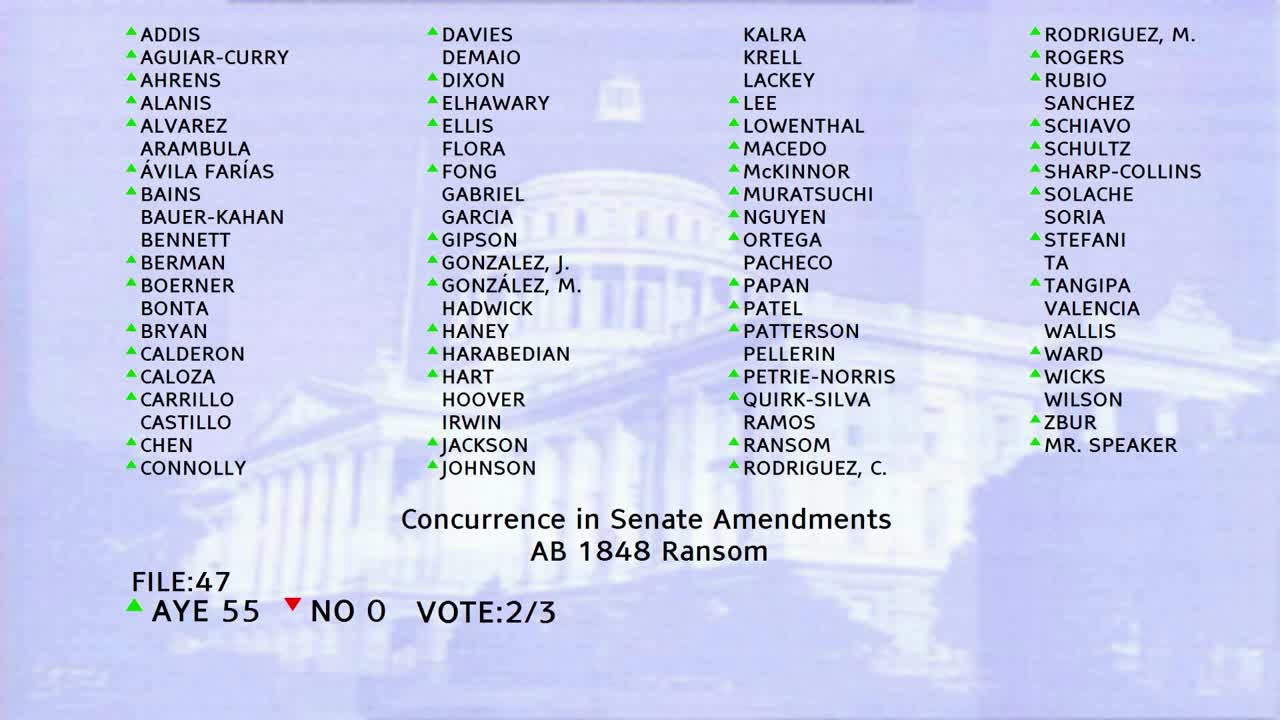 1MIN
Assembly Floor
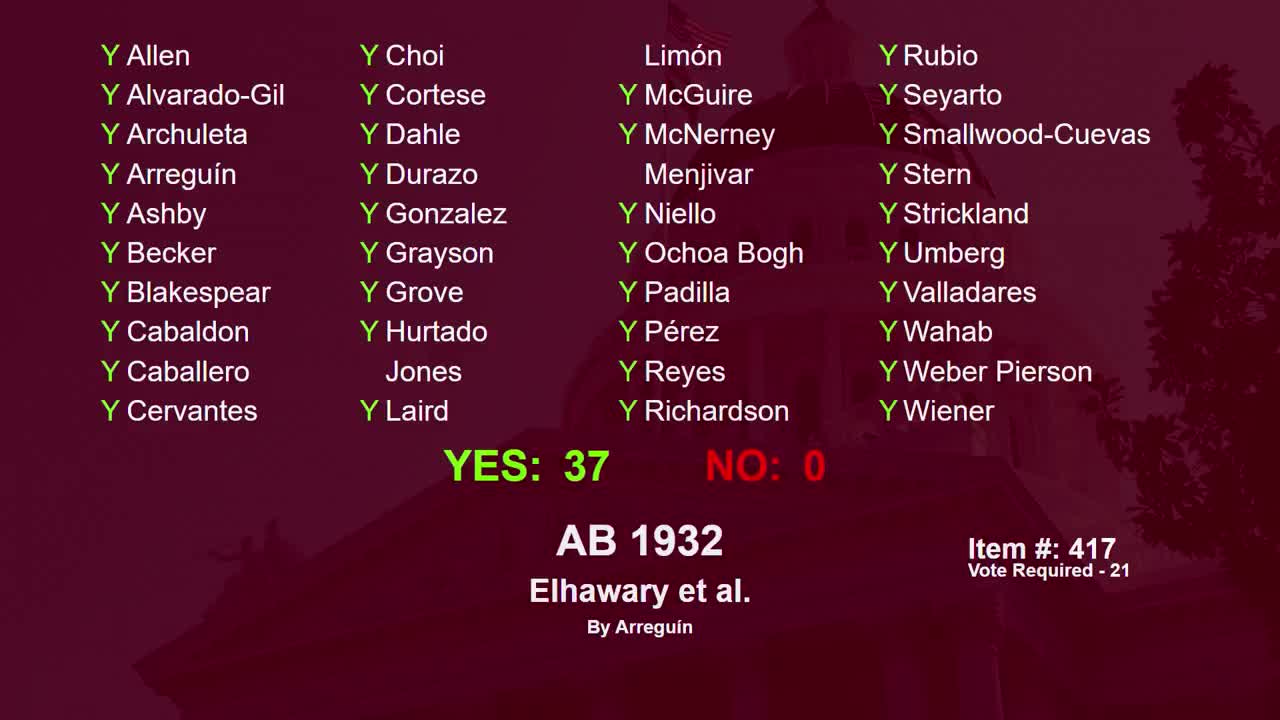 3MIN
Senate Floor
 57SEC
Senate Standing Committee on Appropriations
 11MIN
Senate Standing Committee on Public Safety
 13MIN
Senate Standing Committee on Judiciary
 1MIN
Assembly Floor
 22MIN