AB 2604: Elections: ballot curing.
- Session Year: 2025-2026
- House: Assembly
- Latest Version Date: 2026-09-27
Current Status:
Passed
(2026-09-27: Chaptered by Secretary of State - Chapter 628, Statutes of 2026.)
Introduced
In Committee
Awaiting First Chamber Vote
Passed First Chamber
In Committee
Awaiting Second Chamber Vote
Passed Second Chamber
Enacted
Existing law requires an elections official, upon receiving a vote by mail ballot, to compare the signature on the identification envelope with either the signature appearing on the voters affidavit or signature appearing on a form that is part of the voters registration record. Existing law requires an elections official, if it is determined that the signatures do not compare, to notify the voter of the opportunity to verify the voters signature. Under existing law, if an elections official has a telephone number or email address on file for a voter whose signature does not compare, the elections official is required to notify the voter by telephone, text message, or email, as specified. Existing law requires a county elections official to establish a free access system that allows a vote by mail voter to learn if the voters vote by mail ballot was counted, as specified. Existing law requires the Secretary of State to maintain a system to allow a vote by mail voter to track the voters vote by mail ballot through the mail system, as specified.
This bill would require the Secretary of State to implement and make available to county elections officials a system that allows voters to access electronic signature curing, as defined. The bill would require the Secretary of State to make available on its internet website specified data regarding voters use of the system.
Existing law requires an elections official, upon receiving a vote by mail ballot, to compare the signature on the identification envelope with either the signature appearing on the voters affidavit or signature appearing on a form that is part of the voters registration record. Existing law requires an elections official, if it is determined that the signatures do not compare, to notify the voter of the opportunity to verify the voters signature. Under existing law, if an elections official has a telephone number or email address on file for a voter whose signature does not compare, the elections official is required to notify the voter by telephone, text message, or email, as specified. Existing law requires a county elections official to establish a free access system that allows a vote by mail voter to learn if the voters vote by mail ballot was counted, as specified. Existing law requires the Secretary of State to maintain a system to allow a vote by mail voter to track the voters vote by mail ballot through the mail system, as specified.
This bill would require the Secretary of State to implement and make available to county registrars elections officials a system that allows voters to access text-message-based electronic signature curing, as defined. The bill would require the Secretary of State to make available on its internet website specified data regarding voters use of the system.
Existing law requires an elections official, upon receiving a vote by mail ballot, to compare the signature on the identification envelope with either the signature appearing on the voters affidavit or signature appearing on a form that is part of the voters registration record. Existing law requires an elections official, if it is determined that the signatures do not compare, to notify the voter of the opportunity to verify the voters signature. Under existing law, if an elections official has a telephone number or email address on file for a voter whose signature does not compare, the elections official is required to notify the voter by telephone, text message, or email, as specified. Existing law requires a county elections official to establish a free access system that allows a vote by mail voter to learn if the voters vote by mail ballot was counted, as specified. Existing law requires the Secretary of State to maintain a system to allow a vote by mail voter to track the voters vote by mail ballot through the mail system, as specified.
This bill would require the Secretary of State to either implement and make available to county registrars a system that allows voters to access text-message-based ballot signature curing, as defined, or make available to county registrars the resources necessary to implement such a system, as specified. defined. The bill would require the Secretary of State to make available on its internet website specified data regarding voters use of the system.
Existing law requires an elections official, upon receiving a vote by mail ballot, to compare the signature on the identification envelope with either the signature appearing on the voters affidavit or signature appearing on a form that is part of the voters registration record. Existing law requires an elections official, if it is determined that the signatures do not compare, to notify the voter of the opportunity to verify the voters signature. Under existing law, if an elections official has a telephone number or email address on file for a voter whose signature does not compare, the elections official is required to notify the voter by telephone, text message, or email, as specified. Existing law requires a county elections official to establish a free access system that allows a vote by mail voter to learn if the voters vote by mail ballot was counted, as specified. Existing law requires the Secretary of State to maintain a system to allow a vote by mail voter to track the voters vote by mail ballot through the mail system, as specified.
This bill would require the Secretary of State to either implement a system that allows voters to access text-message-based ballot curing, as defined, or make available to county registrars the resources necessary to implement such a system, as specified.
(a)The Secretary of State shall implement and make available to county elections officials a system that allows voters to access electronic signature curing.
(b)For the purposes of this section, signature curing means following the procedures described in subdivision (d) or (e) of Section 3019.
(c)Any service provided pursuant to subdivision (a) shall ensure data privacy and security for voters.
(d)The Secretary of State shall make available on its internet website data relating to this program, including, by county: the number of voters who cured missing signatures or signatures that do not compare, as described in subdivision (a) of Section 3019, using electronic signature curing and the number of voters to whom electronic signature curing was offered.
(e)The Secretary of State may combine the system described in this section with the systems described in Sections 3019.5 and 3019.7.
(a)The Secretary of State shall implement and make available to county registrars elections officials a system that allows voters to access text-message-based electronic signature curing.
(b)For purposes of this section, signature curing means following the procedures described in subdivision (d) or (e) of Section 3019.
(c)Any service provided pursuant to subdivision (a) shall ensure data privacy and ballot security for voters.
(d)The Secretary of State shall make available on its internet website data relating to this program, including, by county: the number of voters who cured missing or mismatched signatures or signatures that do not compare, as described in subdivision (a) of Section 3019, using text-message-based electronic signature curing and the number of voters to whom text-message-based electronic signature curing was offered.
(e)The Secretary of State may combine the system described in this section with the systems described in Sections 3019.5 and 3019.7.
(a)The Secretary of State shall do either of the following:
(1)Implement implement and make available to county registrars a system that allows voters to access text-message-based ballot signature curing.
(2)Make available to county registrars the resources necessary to implement a system that allows voters to access text-message-based ballot curing.(b)For purposes of this section, ballot signature curing means following the procedures described in subdivision (d) or (e) of Section 3019.
(c)Any service provided pursuant to subdivision (a), whether provided by the Secretary or by counties, (a) shall ensure data privacy and ballot security for voters.
(d)The Secretary of State shall make available on its internet website data relating to this program, including: including, by county: the number of voters who cured ballots missing or mismatched signatures using text-message-based ballot curing, signature curing and the number of voters to whom text-message-based ballot signature curing was offered, the number of voters who cured their ballot by other means, the number of voters who did not cure their ballots, and the median time between notification and curing for both text-message-based and traditional ballot curing. offered.
(e)The Secretary of State may combine the system described in this section with the systems described in Sections 3019.5 and 3019.7.
(a)The Secretary of State shall do either of the following:
(1)Implement a system that allows voters to access text-message-based ballot curing.
(2)Make available to county registrars the resources necessary to implement a system that allows voters to access text-message-based ballot curing.
(b)For purposes of this section, ballot curing means following the procedures described in subdivision (d) of Section 3019.
(c)Any service provided pursuant to subdivision (a), whether provided by the Secretary or by counties, shall ensure data privacy and ballot security for voters.
(d)The Secretary of State shall make available on its internet website data relating to this program, including: the number of voters who cured ballots using text-message-based ballot curing, the number of voters to whom text-message-based ballot curing was offered, the number of voters who cured their ballot by other means, the number of voters who did not cure their ballots, and the median time between notification and curing for both text-message-based and traditional ballot curing.
(e)The Secretary of State may combine the system described in this section with the systems described in Sections 3019.5 and 3019.7.
REVISIONS: HeadingLine 2.|
Date
|
Status
|
|---|---|
| Sep 27, 2026 | Chaptered by Secretary of State - Chapter 628, Statutes of 2026. |
| Sep 27, 2026 | Approved by the Governor. |
| Sep 10, 2026 | Enrolled and presented to the Governor at 3 p.m. |
| Aug 30, 2026 | Senate amendments concurred in. To Engrossing and Enrolling. (Ayes 59. Noes 19. Page 6925.). |
| Aug 30, 2026 | Senate amendments concurred in. To Engrossing and Enrolling. (Ayes 59. Noes 19.). |
| Aug 30, 2026 | Senate amendments concurred in. To Engrossing and Enrolling. |
| Aug 30, 2026 | In Assembly. Concurrence in Senate amendments pending. |
| Aug 30, 2026 | Read third time. Passed. Ordered to the Assembly. (Ayes 29. Noes 10.). |
| Aug 17, 2026 | Read second time. Ordered to third reading. |
| Aug 13, 2026 | Read second time and amended. Ordered returned to second reading. |
| Aug 13, 2026 | From committee: Amend, and do pass as amended. (Ayes 5. Noes 2.) (August 13). |
| Aug 3, 2026 | In committee: Referred to APPR. suspense file. |
| Jun 30, 2026 | From committee: Do pass and re-refer to Com. on APPR. (Ayes 4. Noes 1.) (June 30). Re-referred to Com. on APPR. |
| Jun 22, 2026 | From committee chair, with author's amendments: Amend, and re-refer to committee. Read second time, amended, and re-referred to Com. on E. & C.A. |
| Jun 10, 2026 | Referred to Com. on E. & C.A. |
| May 27, 2026 | In Senate. Read first time. To Com. on RLS. for assignment. |
| May 26, 2026 | Read third time. Passed. Ordered to the Senate. (Ayes 58. Noes 20. Page 5387.) |
| May 26, 2026 | Read third time. Passed. Ordered to the Senate. (Ayes 58. Noes 20.) |
| May 26, 2026 | Read third time. Passed. Ordered to the Senate. |
| May 19, 2026 | Read second time. Ordered to third reading. |
| May 18, 2026 | Read second time and amended. Ordered returned to second reading. |
| May 14, 2026 | From committee: Amend, and do pass as amended. (Ayes 11. Noes 4.) (May 14). |
| May 6, 2026 | In committee: Set, first hearing. Referred to APPR. suspense file. |
| Apr 15, 2026 | From committee: Do pass and re-refer to Com. on APPR. (Ayes 6. Noes 2.) (April 15). Re-referred to Com. on APPR. |
| Apr 15, 2026 | Coauthors revised. |
| Mar 9, 2026 | Referred to Com. on ELECTIONS. |
| Feb 21, 2026 | From printer. May be heard in committee March 23. |
| Feb 20, 2026 | Read first time. To print. |
|
Date
|
Description
|
Location
|
Votes
|
|
|---|---|---|---|---|
| Aug 30, 2026 | AB 2604 Berman Concurrence in Senate Amendments | Assembly Floor |
Passed |
|
| Aug 30, 2026 | Assembly 3rd Reading AB2604 Berman et al. By Cervantes | Senate Floor |
Passed |
|
| Aug 13, 2026 | Do pass as amended | Senate Standing Committee on Appropriations |
Passed |
|
| Aug 3, 2026 | Placed on suspense file | Senate Standing Committee on Appropriations |
Passed |
|
| Jun 30, 2026 | Do pass, but first be re-referred to the Committee on [Appropriations] | Senate Standing Committee on Elections and Constitutional Amendments |
Passed |
|
| May 26, 2026 | AB 2604 Berman Assembly Third Reading | Assembly Floor |
Passed |
|
| May 14, 2026 | Do pass as amended. | Assembly Standing Committee on Appropriations |
Passed |
|
| Apr 15, 2026 | Do pass and be re-referred to the Committee on [Appropriations] | Assembly Standing Committee on Elections |
Passed |
This list shows positions taken on this bill by organizations on the date displayed, which is linked to the original source.
Positions by individuals are not included.
|
Organization
|
Position
|
Date
|
|---|---|---|
| American Federation Of State, County And Municipal Employees, Afl-Cio | ** Support | |
| California Association of Black Lawyers | ** Support | |
| California Common Cause | ** Support | |
| California Initiative for Technology & Democracy | ** Support | |
| California Voter Foundation | ** Support | |
| California Voter Foundation (co-source) | ** Support | |
| Campaign Legal Center | ** Support | |
| CFT | ** Support | |
| CFT – A Union of Educators and Classified Professionals, AFT, AFL-CIO | ** Support | |
| Democracy Live | ** Against | |
| Disability Rights California | ** Support | |
| Human Rights First | ** Support | |
| League Of Women Voters Of California | ** Support | |
| NextGen California | ** Support | |
| Protect Democracy United | ** Support | |
| Protect Democracy United (co-source) | ** Support | |
| Responsive Gov Action | ** Support | |
| Secretary of State Shirely N. Weber, Ph.D. | ** Against | |
| Secretary of State Shirley N. Weber, Ph.D. | ** Against | |
| SEIU California | ** Support | |
| Verified Voting | ** Support |
CONCURRENCE IN SENATE AMENDMENTS
CSA1 Bill Id:AB 2604
Author:(Berman)
As Amended Ver:August 13, 2026
Majority vote
SUMMARY
Requires the Secretary of State (SOS) to implement and make available to county election officials a system that allows voters to access electronic signature curing.
Senate Amendments
Make technical and clarifying changes.
COMMENTS
It is not uncommon for a vote by mail (VBM) ballot to be returned in an envelope that is missing the voter's signature or with a signature that doesn't compare to signatures in the voter's record. In the last several years, the Legislature has taken a number of steps to reduce the number of VBM ballots that are rejected for these reasons. Notably, AB 477 (Mullin), Chapter 726, Statutes of 2015, and SB 759 (McGuire), Chapter 446, Statutes of 2018, created processes for a voter to verify their VBM ballot if the voter failed to sign the VBM ballot return envelope, or if the signature on that envelope did not compare to the signatures in the voter's registration record. These processes are commonly referred to as "cure processes," and the forms used by voters to verify their ballots as a part of these processes are commonly referred to as “signature cure forms."
Under existing law, a voter may submit their signature cure form by mail, in person, via a ballot dropbox, a voting location, email, or fax. Additionally, in an effort to modernize the process, AB 1037 (Berman), Chapter 673, Statutes of 2023, permits a voter to return a completed signature cure form by electronic means, if such means are made available by the elections official, as specified.
Some counties have implemented an electronic signature cure process that allows a voter to cure their ballot using a text platform, also known as a text-message-based system or a text to cure system. Voters sign on the screen of their phone or tablet and submit it using a secure platform. For example, Contra Costa County Registrar of Voters implemented a text message signature cure process during the 2024 primary election. For the 2025 statewide special election, Contra Costa sent 3,643 cure letters for nonmatching signatures and voters cured 971 signatures, including 284 using Text to Cure and 58 using email (with the remainder by mail). They received feedback that this option was particularly appealing for younger voters, and an important benefit since 18-24 year-old voters make up the largest demographic in the county whose signatures are challenged and can be cured.
The Senate Amendments make technical and clarifying changes. This bill, as amended in the Senate, is consistent with prior Assembly actions.
According to the Author
"In our last general election in November 2024, over 69% of rejected vote-by-mail ballots were for either a missing or non-matching signature. That amounted to nearly 85,000 ballots. Current law provides that if there is a missing or non-matching signature on the vote-by-mail ballot envelope, our elections officials notify the voter of the problem and how to correct the issue. In response to my AB 1037 from 2023, several counties have chosen to offer voters mobile curing as a secure, effective, and voter-friendly option to correct a missing or non-matching signature. Unfortunately, far too many curable ballots are still not corrected. Accordingly, AB 2604 would simply provide for statewide adoption of mobile ballot curing, thereby making it more likely that eligible ballots are counted and less likely that voters are disenfranchised."
Arguments in Support
In support of a prior version of this bill, the sponsors, California Voter Foundation and Protect Democracy United, wrote, "As documented by the Secretary of State, a significant share of rejected vote-by-mail ballots results from missing or non-matching signatures—comprising nearly half of all rejections in the November 2022 election and more than two-thirds in the November 2024 election. These preventable errors disproportionately affect voters who otherwise fully comply with all voting requirements. AB 2604 addresses this challenge by facilitating statewide adoption of mobile signature curing, allowing voters to quickly and securely resolve signature issues through an electronic system.
Several counties have already demonstrated that mobile curing is an effective, secure, and voter-friendly tool. AB 2604 would build on that success by enabling the Secretary of State to implement or support a uniform statewide system, improving cure rates and reducing the number of ballots that go uncounted…In addition to the enfranchisement benefits of this process, it is significantly more cost-effective to implement a solution statewide than the current county-by-county approach, based on information from leading companies that offer these services."
Arguments in Opposition
With an oppose unless amended position of this bill, the Secretary of State Shirely N. Weber, Ph.D., writes, "The Secretary of State's office does not oppose any technology solution that may help speed up the count in California's elections, so long as that technology is appropriately regulated and does not pose any insurmountable cybersecurity hazards. Unfortunately AB 2604 at this moment does not pass either test, in part due to the reluctance of the bill’s sponsor to accept our amendment to designate the Secretary of State's office as the entity to test and certify whatever technology would be sanctioned by this bill. I appreciate the bill’s goal of modernizing and improving signature curing processes for California voters. With the recommended changes, I believe this legislation can be both practical and secure while expanding access to signature curing options."
FISCAL COMMENTS
According to the Senate Appropriations Committee, the SOS indicates that it would incur annual costs in the millions of dollars to implement a statewide text-message-based ballot curing system (General Fund).
VOTES:
ASM ELECTIONS: 6-2-0
YES: Pellerin, Bennett, Berman, Elhawary, Solache, Stefani
NO: Gallagher, Johnson
ASM APPROPRIATIONS: 11-4-0
YES: Wicks, Aguiar-Curry, Calderon, Caloza, Fong, Mark González, Krell, Pacheco, Pellerin, Sharp-Collins, Solache
NO: Hoover, Dixon, Ta, Tangipa
ASSEMBLY FLOOR: 58-20-2
YES: Addis, Aguiar-Curry, Ahrens, Alvarez, Arambula, Ávila Farías, Bains, Bauer-Kahan, Bennett, Berman, Boerner, Bonta, Bryan, Calderon, Caloza, Carrillo, Connolly, Elhawary, Fong, Gabriel, Garcia, Gipson, Mark González, Haney, Harabedian, Hart, Irwin, Jackson, Kalra, Krell, Lee, Lowenthal, McKinnor, Nguyen, Ortega, Pacheco, Papan, Patel, Pellerin, Petrie-Norris, Quirk-Silva, Ramos, Ransom, Michelle Rodriguez, Rogers, Blanca Rubio, Schiavo, Schultz, Sharp-Collins, Solache, Soria, Stefani, Valencia, Ward, Wicks, Wilson, Zbur, Rivas
NO: Alanis, Castillo, Chen, Davies, DeMaio, Dixon, Ellis, Flora, Gallagher, Jeff Gonzalez, Hadwick, Hoover, Johnson, Lackey, Macedo, Patterson, Sanchez, Ta, Tangipa, Wallis
ABS, ABST OR NV: Muratsuchi, Celeste Rodriguez
UPDATED
VERSION: August 13, 2026
CONSULTANT: Nichole Becker / ELECTIONS / (916) 319-2094 FN: 0003827
SENATE RULES COMMITTEE Office of Senate Floor Analyses (916) 651-4171 | AB 2604 |
THIRD READING
Bill No: AB 2604
Author: Berman (D), et al.
Amended: 8/13/26 in Senate
Vote: 21
SENATE ELECTIONS & C.A. COMMITTEE: 4-1, 6/30/26
AYES: Wiener, Allen, Cervantes, Umberg
NOES: Choi
SENATE APPROPRIATIONS COMMITTEE: 5-2, 8/13/26
AYES: Cervantes, Cabaldon, Grayson, Richardson, Wahab
NOES: Seyarto, Dahle
ASSEMBLY FLOOR: 58-20, 5/26/26 - See last page for vote
SUBJECT: Elections: ballot curing
SOURCE: California Voter Foundation
Protect Democracy United
DIGEST:
This bill requires the Secretary of State (SOS) to implement and make available to county election officials a system that allows voters to access electronic signature curing.
ANALYSIS:
Existing law:
- Requires every active registered voter to receive a vote by mail (VBM) ballot for any election. A VBM ballot is timely cast if it is received by the voter’s elections official by mail no later than seven days after Election Day and is postmarked or time/date stamped on or before Election Day.
- Requires election officials to compare the voter’s signature on the identification envelope with the voter’s signatures on file upon receiving a VBM ballot. If the elections official determines the signature on a VBM ballot return envelope does not compare to the signatures in the voter’s registration record or is missing, a voter is mailed a notice and a form detailing how to remedy the issue. This process is also known as “curing” a signature.
- Provides a voter’s VBM ballot is not rejected if the voter submits a signature cure form by 5 p.m. on the day of the applicable receipt deadline and the signature on that form compares to a signature in the voter’s registration record.
- Permits a voter to submit their completed statement by email, facsimile transmission, or by other electronic means made available by the local elections official.
- Requires a local elections official offering other electronic means for submission of a signature verification or unsigned VBM envelope statement to establish appropriate privacy and security protocols that ensure the information transmitted is received directly and securely by the elections official and is only used for the stated purposes of verifying the signature on the voter’s ballot.
This bill:
- Requires the SOS to implement and make available to county election officials a system allowing voters to access electronic signature curing to mitigate issues related to a voter’s missing or noncomparing signature on the voter’s VBM ballot envelope.
- Provides that any electronic signature curing service ensures data privacy and security for voters.
- Requires the SOS to publish electronic signature curing data on its website. This data includes, by county, the number of voters who cured missing or noncomparing signatures using electronic signature curing and the number of voters to whom electronic signature curing was offered.
- Permits the SOS to combine an electronic signature curing system with existing ballot tracking notifications.
Background
Curing Signatures Electronically. Under existing law, a voter may submit their signature cure form by mail, in person, via a ballot dropbox, a voting location, email, or fax. In addition to these methods, AB 1037 (Berman, Chapter 673, Statutes of 2023) allowed voters to return a completed signature cure form by electronic means if service was made available by the elections official.
Some counties have implemented an electronic signature cure process that allows a voter to cure using a text platform, also known as a text-to-cure system. Voters sign the screen of their phone or tablet and submit it using a secure platform.
The Contra Costa County Registrar of Voters (ROV) implemented a text message signature cure process during the 2024 primary election. In the 2025 statewide special election, the Contra Costa ROV sent 3,643 cure letters for noncomparing signatures and voters cured 971 signatures, including 284 using text-to-cure and 58 using email.
Comments
Author’s Statement. In the last general election in November 2024, over 69% of rejected VBM ballots were for either a missing signature or for a signature that did not compare to the signature associated with the voter’s registration record. This amounted to nearly 85,000 ballots. Current law provides that if there is a missing or noncomparing signature on the VBM ballot envelope, our election officials notify the voter of the problem and how to correct the issue. In response to AB 1037, several counties have chosen to offer voters electronic curing as a secure, effective, and voter-friendly option to correct a missing or a signature that does not compare to the one on the voter’s registration record. Unfortunately, far too many curable ballots are still not corrected. Accordingly, this bill simply provides for statewide adoption of electronic ballot curing, thereby making it more likely that eligible ballots are counted and less likely that voters are disenfranchised.
Electronic Signature Curing. Changing the wording from “text-message-based signature curing” to “electronic signature curing,” allows for other methods, beyond text messaging, to be used for signature curing. For example, in Los Angeles County, a voter currently has the ability to return their signature cure form by mail, email, fax, text message, delivering the form in-person, or dropping off the form at a ballot dropbox or vote center. The change in wording does not limit a county to only text messages and allows for other electronic means.
The expanded wording is also aligned with the author’s intent. The author sees this bill as a way to streamline the curing process and help get more ballots cured faster by facilitating statewide adoption of electronic ballot curing, in particular by having access to electronic ballot curing for all California voters.
Alternatively, “electronic” could also be interpreted with a narrow meaning. For example, the SOS could implement these provisions to only apply to facsimile submissions.
Related/Prior Legislation
AB 1037 (Berman, Chapter 673, Statutes of 2023) permits a voter to return a completed signature cure form by electronic means, if such means are made available by the elections official.
FISCAL EFFECT: Appropriation: No Fiscal Com.: Yes Local: No
According to the Senate Committee on Appropriations:
SOS indicates that it would incur annual costs in the millions of dollars to implement a statewide text-message-based ballot curing system (General Fund, see Staff Comments).
SUPPORT: (Verified 8/19/26)
California Voter Foundation (co-source)
Protect Democracy United (co-source)
American Federation of State, County and Municipal Employees, AFL-CIO
California Association of Black Lawyers
California Initiative for Technology & Democracy
California Common Cause
Campaign Legal Center
CFT – A Union of Educators and Classified Professionals, AFT, AFL-CIO
Disability Rights California
Human Rights First
League of Women Voters of California
NextGen California
Responsive Gov Action
SEIU California
Verified Voting
OPPOSITION: (Verified 8/19/26)
Secretary of State Shirley N. Weber, Ph.D.
ARGUMENTS IN SUPPORT: In a letter supporting this bill, Verified Voting stated, in part, the following:
Several counties have already demonstrated that mobile curing is an effective, secure, and voter-friendly tool. [This bill] would build on that success by enabling the SOS to implement or support a uniform statewide system, improving cure rates and reducing the number of ballots that go uncounted.
[...]
Providing a mobile ballot curing solution allows California voters to use technology that they are already familiar with to cure their ballot. Benefits of adopting a solution statewide, rather than the current county-by-county approach, also include significant cost savings.
ARGUMENTS IN OPPOSITION: In a letter opposing this bill, SOS Shirley N. Weber, Ph.D., suggested amendments for this bill. Below is a summary of their proposed amendments:
- Replace specific provisions in the bill and insert language that adopts and publishes signature curing technology standards and regulations governing the certification and use of signature verification and signature curing technology. This includes technology capable of capturing digital signatures.
- Provide language that signature verification and/or signature curing technology must not be used unless it has been certified by the SOS. This includes a prohibition of certifying signature verification and signature curing technology by the SOS unless it meets the SOS’ standards and regulations.
- Require counties, instead of the SOS, to collect and publish data required by this bill.
ASSEMBLY FLOOR: 58-20, 5/26/26
AYES: Addis, Aguiar-Curry, Ahrens, Alvarez, Arambula, Ávila Farías, Bains, Bauer-Kahan, Bennett, Berman, Boerner, Bonta, Bryan, Calderon, Caloza, Carrillo, Connolly, Elhawary, Fong, Gabriel, Garcia, Gipson, Mark González, Haney, Harabedian, Hart, Irwin, Jackson, Kalra, Krell, Lee, Lowenthal, McKinnor, Nguyen, Ortega, Pacheco, Papan, Patel, Pellerin, Petrie-Norris, Quirk-Silva, Ramos, Ransom, Michelle Rodriguez, Rogers, Blanca Rubio, Schiavo, Schultz, Sharp-Collins, Solache, Soria, Stefani, Valencia, Ward, Wicks, Wilson, Zbur, Rivas
NOES: Alanis, Castillo, Chen, Davies, DeMaio, Dixon, Ellis, Flora, Gallagher, Jeff Gonzalez, Hadwick, Hoover, Johnson, Lackey, Macedo, Patterson, Sanchez, Ta, Tangipa, Wallis
NO VOTE RECORDED: Muratsuchi, Celeste Rodriguez
Prepared by: Scott Matsumoto / E. & C.A. / (916) 651-4106
8/19/26 15:44:14
**** END ****
SENATE RULES COMMITTEE Office of Senate Floor Analyses (916) 651-4171 | AB 2604 |
THIRD READING
Bill No: AB 2604
Author: Berman (D), et al.
Amended: 8/13/26 in Senate
Vote: 21
SENATE ELECTIONS & C.A. COMMITTEE: 4-1, 6/30/26
AYES: Wiener, Allen, Cervantes, Umberg
NOES: Choi
SENATE APPROPRIATIONS COMMITTEE: 5-2, 8/13/26
AYES: Cervantes, Cabaldon, Grayson, Richardson, Wahab
NOES: Seyarto, Dahle
ASSEMBLY FLOOR: 58-20, 5/26/26 - See last page for vote
SUBJECT: Elections: ballot curing
SOURCE: California Voter Foundation
Protect Democracy United
DIGEST:
This bill requires the Secretary of State (SOS) to implement and make available to county election officials a system that allows voters to access electronic signature curing.
ANALYSIS:
Existing law:
- Requires every active registered voter to receive a vote by mail (VBM) ballot for any election. A VBM ballot is timely cast if it is received by the voter’s elections official by mail no later than seven days after Election Day and is postmarked or time/date stamped on or before Election Day.
- Requires election officials to compare the voter’s signature on the identification envelope with the voter’s signatures on file upon receiving a VBM ballot. If the elections official determines the signature on a VBM ballot return envelope does not compare to the signatures in the voter’s registration record or is missing, a voter is mailed a notice and a form detailing how to remedy the issue. This process is also known as “curing” a signature.
- Provides a voter’s VBM ballot is not rejected if the voter submits a signature cure form by 5 p.m. on the day of the applicable receipt deadline and the signature on that form compares to a signature in the voter’s registration record.
- Permits a voter to submit their completed statement by email, facsimile transmission, or by other electronic means made available by the local elections official.
- Requires a local elections official offering other electronic means for submission of a signature verification or unsigned VBM envelope statement to establish appropriate privacy and security protocols that ensure the information transmitted is received directly and securely by the elections official and is only used for the stated purposes of verifying the signature on the voter’s ballot.
This bill:
- Requires the SOS to implement and make available to county election officials a system allowing voters to access electronic signature curing to mitigate issues related to a voter’s missing or noncomparing signature on the voter’s VBM ballot envelope.
- Provides that any electronic signature curing service ensures data privacy and security for voters.
- Requires the SOS to publish electronic signature curing data on its website. This data includes, by county, the number of voters who cured missing or noncomparing signatures using electronic signature curing and the number of voters to whom electronic signature curing was offered.
- Permits the SOS to combine an electronic signature curing system with existing ballot tracking notifications.
Background
Curing Signatures Electronically. Under existing law, a voter may submit their signature cure form by mail, in person, via a ballot dropbox, a voting location, email, or fax. In addition to these methods, AB 1037 (Berman, Chapter 673, Statutes of 2023) allowed voters to return a completed signature cure form by electronic means if service was made available by the elections official.
Some counties have implemented an electronic signature cure process that allows a voter to cure using a text platform, also known as a text-to-cure system. Voters sign the screen of their phone or tablet and submit it using a secure platform.
The Contra Costa County Registrar of Voters (ROV) implemented a text message signature cure process during the 2024 primary election. In the 2025 statewide special election, the Contra Costa ROV sent 3,643 cure letters for noncomparing signatures and voters cured 971 signatures, including 284 using text-to-cure and 58 using email.
Comments
- Author’s Statement. In the last general election in November 2024, over 69% of rejected VBM ballots were for either a missing signature or for a signature that did not compare to the signature associated with the voter’s registration record. This amounted to nearly 85,000 ballots. Current law provides that if there is a missing or noncomparing signature on the VBM ballot envelope, our election officials notify the voter of the problem and how to correct the issue. In response to AB 1037, several counties have chosen to offer voters electronic curing as a secure, effective, and voter-friendly option to correct a missing or a signature that does not compare to the one on the voter’s registration record. Unfortunately, far too many curable ballots are still not corrected. Accordingly, this bill simply provides for statewide adoption of electronic ballot curing, thereby making it more likely that eligible ballots are counted and less likely that voters are disenfranchised.
- Electronic Signature Curing. Changing the wording from “text-message-based signature curing” to “electronic signature curing,” allows for other methods, beyond text messaging, to be used for signature curing. For example, in Los Angeles County, a voter currently has the ability to return their signature cure form by mail, email, fax, text message, delivering the form in-person, or dropping off the form at a ballot dropbox or vote center. The change in wording does not limit a county to only text messages and allows for other electronic means.
The expanded wording is also aligned with the author’s intent. The author sees this bill as a way to streamline the curing process and help get more ballots cured faster by facilitating statewide adoption of electronic ballot curing, in particular by having access to electronic ballot curing for all California voters.
Alternatively, “electronic” could also be interpreted with a narrow meaning. For example, the SOS could implement these provisions to only apply to facsimile submissions.
Related/Prior Legislation
AB 1037 (Berman, Chapter 673, Statutes of 2023) permits a voter to return a completed signature cure form by electronic means, if such means are made available by the elections official.
FISCAL EFFECT: Appropriation: No Fiscal Com.: Yes Local: No
According to the Senate Committee on Appropriations:
SOS indicates that it would incur annual costs in the millions of dollars to implement a statewide text-message-based ballot curing system (General Fund, see Staff Comments).
SUPPORT: (Verified 8/13/26)
California Voter Foundation (co-source)
Protect Democracy United (co-source)
American Federation of State, County and Municipal Employees, AFL-CIO
California Association of Black Lawyers
California Initiative for Technology & Democracy
California Common Cause
Campaign Legal Center
CFT – A Union of Educators and Classified Professionals, AFT, AFL-CIO
Disability Rights California
Human Rights First
League of Women Voters of California
NextGen California
Responsive Gov Action
SEIU California
Verified Voting
OPPOSITION: (Verified 8/13/26)
Secretary of State Shirley N. Weber, Ph.D.
Democracy Live
ARGUMENTS IN SUPPORT: In a letter supporting this bill, Verified Voting stated, in part, the following:
Several counties have already demonstrated that mobile curing is an effective, secure, and voter-friendly tool. [This bill] would build on that success by enabling the SOS to implement or support a uniform statewide system, improving cure rates and reducing the number of ballots that go uncounted.
[...]
Providing a mobile ballot curing solution allows California voters to use technology that they are already familiar with to cure their ballot. Benefits of adopting a solution statewide, rather than the current county-by-county approach, also include significant cost savings.
ARGUMENTS IN OPPOSITION: In a letter opposing this bill, SOS Shirley N. Weber, Ph.D., suggested amendments for this bill. Below is a summary of their proposed amendments:
- Replace specific provisions in the bill and insert language that adopts and publishes signature curing technology standards and regulations governing the certification and use of signature verification and signature curing technology. This includes technology capable of capturing digital signatures.
- Provide language that signature verification and/or signature curing technology must not be used unless it has been certified by the SOS. This includes a prohibition of certifying signature verification and signature curing technology by the SOS unless it meets the SOS’ standards and regulations.
- Require counties, instead of the SOS, to collect and publish data required by this bill.
ASSEMBLY FLOOR: 58-20, 5/26/26
AYES: Addis, Aguiar-Curry, Ahrens, Alvarez, Arambula, Ávila Farías, Bains, Bauer-Kahan, Bennett, Berman, Boerner, Bonta, Bryan, Calderon, Caloza, Carrillo, Connolly, Elhawary, Fong, Gabriel, Garcia, Gipson, Mark González, Haney, Harabedian, Hart, Irwin, Jackson, Kalra, Krell, Lee, Lowenthal, McKinnor, Nguyen, Ortega, Pacheco, Papan, Patel, Pellerin, Petrie-Norris, Quirk-Silva, Ramos, Ransom, Michelle Rodriguez, Rogers, Blanca Rubio, Schiavo, Schultz, Sharp-Collins, Solache, Soria, Stefani, Valencia, Ward, Wicks, Wilson, Zbur, Rivas
NOES: Alanis, Castillo, Chen, Davies, DeMaio, Dixon, Ellis, Flora, Gallagher, Jeff Gonzalez, Hadwick, Hoover, Johnson, Lackey, Macedo, Patterson, Sanchez, Ta, Tangipa, Wallis
NO VOTE RECORDED: Muratsuchi, Celeste Rodriguez
Prepared by: Scott Matsumoto / E. & C.A. / (916) 651-4106
8/17/26 11:13:26
**** END ****
SENATE COMMITTEE ON
Senator Sabrina Cervantes, Chair
2025 - 2026 Regular Session
AB 2604 (Berman) - Elections: ballot curing
Version: | Policy Vote: |
Urgency: | Mandate: |
Hearing Date: | Consultant: |
Bill Summary:
AB 2604 would require the Secretary of State (SOS) to implement and make available to county registrars a system that allows voters to access electronic signature curing.
*********** ANALYSIS ADDENDUM – SUSPENSE FILE ***********
The following information is revised to reflect amendments
adopted by the committee on August 13, 2026
Fiscal Impact:
SOS indicates that it would incur annual costs in the millions of dollars to implement a statewide text-message-based ballot curing system (General Fund, see Staff Comments).
Committee Amendments:
Add Senator Cervantes as a coauthor.
-- END --
SENATE COMMITTEE ON
Senator Sabrina Cervantes, Chair
2025 - 2026 Regular Session
AB 2604 (Berman) - Elections: ballot curing
Version: | Policy Vote: |
Urgency: | Mandate: |
Hearing Date: | Consultant: |
Bill Summary:
AB 2604 would require the Secretary of State (SOS) to implement and make available to county registrars a system that allows voters to access electronic signature curing.
Fiscal Impact:
SOS indicates that it would incur annual costs in the millions of dollars to implement a statewide text-message-based ballot curing system (General Fund, see Staff Comments).
Background:
As vote-by-mail (VBM) has become the predominant method of voting in California, the Legislature has enacted a series of measures to reduce the rejection of ballots due to missing or mismatched signatures on ballot identification envelopes. SB 759 (McGuire, 2018) established a signature cure process for voters whose ballot envelope signature does not match the signature on file. SB 523 (McGuire, 2019) expanded these protections by requiring counties to notify voters whose ballot envelopes are missing a signature and aligning the cure process for missing signatures with that for mismatched signatures.
Current law allows voters to submit a corrective signature statement in person or by mail, fax, email, or, where available, through electronic means. AB 1037 (Berman, 2023) expressly authorized elections officials to accept electronically submitted signature cure forms. In response, several counties have adopted text-message-based ballot curing systems that allow voters to securely complete and submit a signature cure form from a mobile device. For example, Contra Costa County implemented such a system beginning with the 2024 primary election. During the 2025 statewide special election, approximately 29 percent of cured signatures in the county were completed through the text-based platform, with election officials reporting that the option was particularly effective in reaching younger voters, who accounted for a disproportionate share of ballots requiring signature correction.
Proposed Law:
This bill would do the following:
- Require SOS to implement and make available to county election officials a system allowing voters to access electronic signature curing to mitigate issues related to a voter’s missing or noncomparing signature on the voter’s VBM ballot envelope.
- Provide that any electronic signature curing service ensures data privacy and ballot security for voters.
- Require SOS to publish electronic signature curing data on its website. This data includes, by county, the number of voters who cured missing or noncomparing signatures using electronic signature curing and the number of voters to whom text-message-based signature curing was offered.
- Permit SOS to combine an electronic signature curing system with existing ballot tracking notifications.
Related Legislation:
AB 1037 (Berman, Chapter 673, Statutes of 2023) permits a voter to return a completed signature cure form by electronic means, if such means are made available by the elections official.
Staff Comments:
SOS indicates that implementing this bill would require substantial modifications to both the statewide voter registration database (VoteCal) and county Election Management Systems (EMS). Under the current ballot tracking infrastructure, VoteCal can transmit voter information to the state's ballot tracking vendor, but it is not designed to receive voter data or signature information in return. Enabling the two-way exchange of voter information and signature images required by this bill would exceed the scope of the existing contract and require a new or expanded procurement. In addition, county EMS vendors have indicated that significant system integration and development would be necessary at the local level. SOS further notes that these technology changes could not reasonably be completed by the bill's January 1, 2027, implementation date given ongoing workload and resource commitments associated with the 2026 statewide election.
SOS has identified two potential approaches for implementing a statewide text-message-based ballot curing system. Under the first option, SOS would develop, operate, and maintain the system in-house using state staff. This approach is estimated to cost approximately $5.2 million in the first year, $3.4 million annually in the second and third years, and $2.2 million annually thereafter. These costs include 13 new positions and initial staffing resources to promulgate regulations. Under the second option, the SOS would procure and configure a commercial off-the-shelf platform through a vendor contract. This approach is estimated to cost approximately $6.2 million in the first year, $3.8 million in the second year, and $3.4 million annually thereafter. These costs include the vendor contract, seven new positions, and initial staffing resources to promulgate regulations.
Alternatively, the bill authorizes the SOS to provide counties with the resources necessary to implement their own local text-message-based ballot curing systems rather than developing a statewide platform. The fiscal impact of this approach is uncertain but could exceed the cost of a statewide system because county implementation needs would vary significantly. It is also unclear whether the bill contemplates direct state funding to counties for local system development or whether the SOS would instead incur additional staffing and contract costs to assist counties in establishing their own systems.
-- END --
SENATE COMMITTEE ON
ELECTIONS AND CONSTITUTIONAL AMENDMENTS
Senator Scott Wiener, Chair
2025 - 2026 Regular
Bill No: Hearing Date: 6/30/26
Author: | |||
Version: |
| ||
Urgency: | Fiscal: | ||
Consultant: | |||
Subject:
DIGEST
This bill requires the Secretary of State (SOS) to implement and make available to county registrars a system that allows voters to access electronic signature curing.
ANALYSIS
Existing law:
- Requires every active registered voter to receive a vote by mail (VBM) ballot for any election. A VBM ballot is timely cast if it is received by the voter’s elections official by mail no later than seven days after Election Day and is postmarked or time/date stamped on or before Election Day.
- Requires election officials to compare the voter’s signature on the identification envelope with the voter’s signatures on file upon receiving a VBM ballot. If the elections official determines the signature on a VBM ballot return envelope does not compare to the signatures in the voter’s registration record or is missing, a voter is mailed a notice and a form detailing how to remedy the issue. This process is also known as “curing” a signature.
- Provides a voter’s VBM ballot is not rejected if the voter submits a signature cure form by 5 p.m. on the day of the applicable receipt deadline and the signature on that form compares to a signature in the voter’s registration record.
- Permits a voter to submit their completed statement by email, facsimile transmission, or by other electronic means made available by the local elections official.
- Requires a local elections official offering other electronic means for submission of a signature verification or unsigned VBM envelope statement to establish appropriate privacy and security protocols that ensure the information transmitted is received directly and securely by the elections official and is only used for the stated purposes of verifying the signature on the voter’s ballot.
This bill:
- Requires the SOS to implement and make available to county election officials a system allowing voters to access electronic signature curing to mitigate issues related to a voter’s missing or noncomparing signature on the voter’s VBM ballot envelope.
- Provides that any electronic signature curing service ensures data privacy and ballot security for voters.
- Requires the SOS to publish electronic signature curing data on its website. This data includes, by county, the number of voters who cured missing or noncomparing signatures using electronic signature curing and the number of voters to whom text-message-based signature curing was offered.
- Permits the SOS to combine an electronic signature curing system with existing ballot tracking notifications.
BACKGROUND
Curing Signatures Electronically. Under existing law, a voter may submit their signature cure form by mail, in person, via a ballot dropbox, a voting location, email, or fax. In addition to these methods, AB 1037 (Berman), Chapter 673, Statutes of 2023, allowed voters to return a completed signature cure form by electronic means if service was made available by the elections official.
Some counties have implemented an electronic signature cure process that allows a voter to cure using a text platform, also known as a text-to-cure system. Voters sign the screen of their phone or tablet and submit it using a secure platform.
The Contra Costa County Registrar of Voters (ROV) implemented a text message signature cure process during the 2024 primary election. In the 2025 statewide special election, the Contra Costa ROV sent 3,643 cure letters for noncomparing signatures and voters cured 971 signatures, including 284 using text-to-cure and 58 using email.
COMMENTS
- Author’s Statement. In the last general election in November 2024, over 69% of rejected VBM ballots were for either a missing signature or for a signature that did not compare to the signature associated with the voter’s registration record. This amounted to nearly 85,000 ballots. Current law provides that if there is a missing or noncomparing signature on the VBM ballot envelope, our election officials notify the voter of the problem and how to correct the issue. In response to AB 1037, several counties have chosen to offer voters electronic curing as a secure, effective, and voter-friendly option to correct a missing or a signature that does not compare to the one on the voter’s registration record. Unfortunately, far too many curable ballots are still not corrected. Accordingly, this bill simply provides for statewide adoption of electronic ballot curing, thereby making it more likely that eligible ballots are counted and less likely that voters are disenfranchised.
- Electronic Signature Curing. Recent amendments modified the wording describing the methods of signature curing prescribed by this bill. Changing the wording from “text-message-based signature curing” to “electronic signature curing,” allows for other methods, beyond text messaging, to be used for signature curing. For example, in Los Angeles County, a voter currently has the ability to return their signature cure form by mail, email, fax, text message, delivering the form in-person, or dropping off the form at a ballot dropbox or vote center. The change in wording does not limit a county to only text messages and allows for other electronic means.
The expanded wording is also aligned with the author’s intent. In the materials provided to this committee, the author sees this bill as a way to streamline the curing process and help get more ballots cured faster by facilitating statewide adoption of electronic ballot curing, in particular by having access to electronic ballot curing for all California voters.
Alternatively, “electronic” could also be interpreted with a narrow meaning. For example, the SOS could implement these provisions to only apply to facsimile submissions. The author should continue to work with the SOS to avoid potential conflicts of interpretation should this bill become law.
- Argument in Support. In a letter supporting this bill, Verified Voting stated, in part, the following:
Several counties have already demonstrated that mobile curing is an effective, secure, and voter-friendly tool. [This bill] would build on that success by enabling the SOS to implement or support a uniform statewide system, improving cure rates and reducing the number of ballots that go uncounted.
[...]
Providing a mobile ballot curing solution allows California voters to use technology that they are already familiar with to cure their ballot. Benefits of adopting a solution statewide, rather than the current county-by-county approach, also include significant cost savings.
- Argument in Opposition. In a letter opposing this bill, SOS Shirley N. Weber, Ph.D., suggested amendments for the bill. Below is a summary of their proposed amendments:
- Replace specific provisions in the bill and insert language that adopts and publishes signature curing technology standards and regulations governing the certification and use of signature verification and signature curing technology. This includes technology capable of capturing digital signatures.
- Provide language that signature verification and/or signature curing technology must not be used unless it has been certified by the SOS. This includes a prohibition of certifying signature verification and signature curing technology by the SOS unless it meets the SOS’ standards and regulations.
- Require counties, instead of the SOS, to collect and publish data required by this bill.
- Removing the references to text message notifications because there is no direct relation to signature curing.
RELATED/PRIOR LEGISLATION
AB 1037 (Berman), Chapter 673, Statutes of 2023, permits a voter to return a completed signature cure form by electronic means, if such means are made available by the elections official.
PRIOR ACTION
Assembly Floor: | |
Assembly Appropriations Committee: | |
Assembly Committee: |
|
POSITIONS
Sponsor: California Voter Foundation
Protect Democracy United
Support: American Federation of State, County and Municipal Employees, AFL-CIO
California Initiative for Technology & Democracy
California Common Cause
Campaign Legal Center
CFT – A Union of Educators and Classified Professionals, AFT, AFL-CIO
Disability Rights California
Human Rights First
League of Women Voters of California
NextGen California
Responsive Gov Action
SEIU California
Verified Voting
Oppose: Secretary of State Shirley N. Weber, Ph.D.
D emocracy Live
-- END --
ASSEMBLY THIRD READING
ATR Bill Id:AB 2604
Author:(Berman)
As Amended Ver:May 18, 2026
Majority vote
SUMMARY
Requires the Secretary of State (SOS) to implement and make available to county registrars a system that allows voters to access text-message-based signature curing.
Major Provisions
- Provides, for purposes of this bill, that "signature curing" means procedures in which an elections official sends a signature cure form to a voter whose vote by mail (VBM) ballot envelope was missing their signature or where the voter's signature did not compare to signature(s) in the voter's registration record, to verify under penalty of perjury that the voter completed and returned the VBM ballot in question.
- Requires any text-message-based signature curing service to ensure data privacy and ballot security for voters.
- Requires the SOS to make available on its internet website data relating to the text-message-based signature curing program, including, by county:
- The number of voters who cured missing or mismatched signatures using text-message-based signature curing system; and,
- The number of voters to whom text-message-based signature curing was offered.
- Permits the SOS to combine the text-message-based signature curing system with the ballot tracking system that a county or the SOS maintains that allows a voter to track their VBM ballot through the mail system and as the VBM ballot is processed by the county elections official.
COMMENTS
It is not uncommon for a VBM ballot to be returned in an envelope that is missing the voter's signature or with a signature that doesn't compare to signatures in the voter's record. In the last several years, the Legislature has taken a number of steps to reduce the number of VBM ballots that are rejected for these reasons. Notably, AB 477 (Mullin), Chapter 726, Statutes of 2015, and SB 759 (McGuire), Chapter 446, Statutes of 2018, created processes for a voter to verify their VBM ballot if the voter failed to sign the VBM ballot return envelope, or if the signature on that envelope did not compare to the signatures in the voter's registration record. These processes are commonly referred to as "cure processes," and the forms used by voters to verify their ballots as a part of these processes are commonly referred to as “signature cure forms."
Under existing law, a voter may submit their signature cure form by mail, in person, via a ballot dropbox, a voting location, email, or fax. Additionally, in an effort to modernize the process, AB 1037 (Berman), Chapter 673, Statutes of 2023, permits a voter to return a completed signature cure form by electronic means, if such means are made available by the elections official, as specified.
Some counties have implemented an electronic signature cure process that allows a voter to cure their ballot using a text platform, also known as a text-message-based system or a text to cure system. Voters sign on the screen of their phone or tablet and submit it using a secure platform. For example, Contra Costa County Registrar of Voters implemented a text message signature cure process during 2024 primary election. For the 2025 statewide special election, Contra Costa sent 3,643 cure letters for nonmatching signatures and voters cured 971 signatures, including 284 using Text to Cure and 58 using email (with the remainder by mail). They received feedback that this option was particularly appealing for younger voters, and an important benefit since 18-24 year-old voters make up the largest demographic in the county whose signatures are challenged and can be cured.
Please see the policy committee analysis for a full discussion of this bill.
According to the Author
"In our last general election in November 2024, over 69% of rejected vote-by-mail ballots were for either a missing or non-matching signature. That amounted to nearly 85,000 ballots. Current law provides that if there is a missing or non-matching signature on the vote-by-mail ballot envelope, our elections officials notify the voter of the problem and how to correct the issue. In response to my AB 1037 from 2023, several counties have chosen to offer voters mobile curing as a secure, effective, and voter-friendly option to correct a missing or non-matching signature. Unfortunately, far too many curable ballots are still not corrected. Accordingly, AB 2604 would simply provide for statewide adoption of mobile ballot curing, thereby making it more likely that eligible ballots are counted and less likely that voters are disenfranchised."
Arguments in Support
In support of a prior version of this bill, the sponsors, California Voter Foundation and Protect Democracy United, wrote: "As documented by the Secretary of State, a significant share of rejected vote-by-mail ballots results from missing or non-matching signatures—comprising nearly half of all rejections in the November 2022 election and more than two-thirds in the November 2024 election. These preventable errors disproportionately affect voters who otherwise fully comply with all voting requirements. AB 2604 addresses this challenge by facilitating statewide adoption of mobile ballot curing, allowing voters to quickly and securely resolve signature issues through a text-message-based system…
"In recent elections, tens of thousands of ballots have gone uncounted due to missing or mismatched signatures…These ballot rejections disproportionally impact young voters and first-time voters. Research conducted by the Center for Inclusive Democracy found that voters aged 18-24 were three times more likely to have their mail ballots rejected than voters overall, with nonmatching signatures the top reason for rejection among this age group.
"Providing a mobile ballot curing solution allows young California voters to use technology that they are already familiar with to cure their ballot. In addition to the enfranchisement benefits of this process, it is significantly more cost-effective to implement a solution statewide than the current county-by-county approach, based on information from leading companies that offer these services."
Arguments in Opposition
None received.
FISCAL COMMENTS
According to the Assembly Appropriations Committee, costs of an unknown, but potentially significant, amount to the SOS to implement a statewide text-message-based signature curing system and report information online. (General Fund).
VOTES
ASM ELECTIONS: 6-2-0
YES: Pellerin, Bennett, Berman, Elhawary, Solache, Stefani
NO: Gallagher, Johnson
ASM APPROPRIATIONS: 11-4-0
YES: Wicks, Aguiar-Curry, Calderon, Caloza, Fong, Mark González, Krell, Pacheco, Pellerin, Sharp-Collins, Solache
NO: Hoover, Dixon, Ta, Tangipa
UPDATED
VERSION: May 18, 2026
CONSULTANT: Nichole Becker / ELECTIONS / (916) 319-2094 FN: 0002988
Date of Hearing: May 6, 2026
ASSEMBLY COMMITTEE ON APPROPRIATIONS
Buffy Wicks, Chair
ABPCA Bill Id:AB 2604
Author:(Berman) – As Introduced Ver:February 20, 2026
Policy Committee: | Elections | Vote: | 6 - 2 |
|
| ||
|
|
Urgency: No State Mandated Local Program: No Reimbursable: No
SUMMARY:
This bill requires the Secretary of State (SOS) implement one of two options to allow voters to access text-message-based ballot curing.
Specifically, this bill:
- Requires the SOS to either: (a) implement a system that allows voters to access text-message-based ballot curing or (b) make available to county registrars the resources necessary to implement systems that allow voters to access text-message-based ballot curing.
- Requires the SOS make certain data related to the system available on the SOS’s website, such as the median time between notification and curing for both text-message-based and traditional ballot curing.
- Allows the SOS to combine the system with existing county and SOS ballot tracking systems for vote-by-mail (VBM) ballots.
FISCAL EFFECT:
Costs in the millions of dollars to the SOS to implement a statewide text-message-based ballot curing system (General Fund (GF)). The SOS notes that this bill would require significant modifications to the statewide voter registration database system (VoteCal) and county Election Management Systems (EMS). Current ballot tracking infrastructure allows VoteCal to send data to the ballot tracking vendor, but does not allow the receipt of data in return. According to the SOS, requiring two-way transmission of voter information and signature images is outside the scope of the current contract and would necessitate a new or expanded procurement, and multiple county EMS vendors have also confirmed integration workload would be required on behalf of the county. The SOS notes that such changes cannot realistically be implemented by January 1, 2027, due to current workload associated with the 2026 statewide election.
The SOS has identified two potential options to build or procure technology capable of sending official text message notifications to affected voters and guiding those voters through a secure, identity-verified ballot cure process:
- Under the first path, an in-house build, the SOS would design, develop, and maintain the system entirely with state staff, with costs of approximately $5.2 million in the first year, $3.4 million in the second and third year, and $2.2 million in the fourth year and annually thereafter for 13 additional positions and initial staff resources to promulgate regulations.
- Under the second path, a procured solution, the SOS would contract with an outside vendor to provide an existing commercial platform that can be configured for ballot curing, with costs of approximately $6.2 million in the first year, $3.8 million in the second year, and $3.4 million in the third year and annually thereafter for the contract, seven additional positions, and initial staff resources to promulgate regulations.
Alternatively, if the SOS chooses to provide counties with the resources necessary to implement local systems, resultant costs to the SOS may be higher than if the SOS implements its own text-message-based ballot curing system, as each county will have different needs. It is unclear whether the SOS must provide direct financial payments to counties to develop their own systems or incur staff workload and contract costs to fulfill counties’ requests (GF).
The Legislative Analyst’s Office recently warned of GF structural deficits of around $35 billion per year in the 2027-28 fiscal year and ongoing.
COMMENTS:
- Purpose. According to the author:
In response to my AB 1037 from 2023, several counties have chosen to offer voters mobile curing as a secure, effective, and voter-friendly option to correct a missing or non-matching signature. Unfortunately, far too many curable ballots are still not corrected. Accordingly, AB 2604 would simply provide for statewide adoption of mobile ballot curing, thereby making it more likely that eligible ballots are counted and less likely that voters are disenfranchised.
This bill is sponsored by Protect Democracy United and the California Voter Foundation.
- Ballot Curing. As an increasing number of voters prefer to vote via VBM ballots, the Legislature has undertaken many efforts to modify the signature verification process to reduce the number of rejected VBM ballots due to incomplete or invalid ballot identification envelopes. SB 759 (McGuire), Chapter 446, Statutes of 2018, created a cure process for a voter whose signature on their VBM ballot identification envelope does not match the signature on file in the voter’s registration record. And, SB 523 (McGuire), Chapter 568, Statutes of 2019, required a county to notify a voter whose signature is missing on a VBM ballot and aligns the cure process with that for mismatched signatures.
Under these processes, a voter may return the relevant corrective signature statement in person or by mail, fax, or email. AB 1037 (Berman), Chapter 673, Statutes of 2023, allows a voter to return a completed signature cure form by electronic means if such means are made available by the elections official. Some counties have implemented an electronic cure process that utilizes a text platform, also known as a text-message-based system or a text to cure system, whereby a voter signs a form through the screen of their phone or tablet and submits the form using a secure platform. For example, the Contra Costa County Registrar of Voters implemented a text-message-based cure process beginning in the 2024 primary election. For the 2025 statewide special election, approximately 29% of cured signatures were done through text and the registrar received feedback that the option was particularly appealing for younger voters who comprise the largest demographic in the county whose signatures require curing.
This bill requires the SOS to either: (a) implement a text-message-based ballot curing system for all voters or (b) provide county registrars with the resources necessary to implement their own text-message-based ballot curing system. However, as noted in the Assembly Elections Committee’s analysis of this bill, this bill does not require a county elections official to use either the statewide system or resources provided by the SOS to implement a local system, potentially resulting in inconsistent efforts across the state.
Analysis Prepared by: Irene Ho / APPR. / (916) 319-2081
Date of Hearing: April 15, 2026
ASSEMBLY COMMITTEE ON ELECTIONS
Gail Pellerin, Chair
ABPCA Bill Id:AB 2604 (
Author:Berman) – As Introduced Ver:February 20, 2026
SUBJECT: Elections: ballot curing.
SUMMARY: Requires the Secretary of State (SOS) to implement a system that allows voters to access text-message-based ballot curing, as defined, or make available to county registrars the resources necessary to implement such a system, as specified. Specifically, this bill:
- Requires the SOS to do either of the following:
- Implement a system that allows voters to access text-message-based ballot curing; or,
- Make available to county registrars the resources necessary to implement a system that allows voters to access text-message-based ballot curing.
- Implement a system that allows voters to access text-message-based ballot curing; or,
- Provides, for purposes of this bill, that “ballot curing” means procedures in which an elections official sends a signature cure form to a voter whose vote by mail (VBM) ballot envelope was missing their signature or where the voter’s signature did not compare to signature(s) in the voter’s registration record, to verify under penalty of perjury that the voter completed and returned the VBM ballot in question.
- Requires any text-message-based ballot curing service provided by the SOS or by counties, to ensure data privacy and ballot security for voters.
- Requires the SOS to make available on its internet website data relating to the text-message-based ballot curing program, including:
- The number of voters who cured ballots using text-message-based ballot curing;
- The number of voters to whom text-message-based ballot curing was offered;
- The number of voters who cured their ballot by other means;
- The number of voters who did not cure their ballots; and,
- The median time between notification and curing for both text-message-based and traditional ballot curing.
- Permits the SOS to combine the text-message-based ballot curing system with the ballot tracking system that a county or the SOS maintains that allows a voter to track their VBM ballot through the mail system and as the VBM ballot is processed by the county elections official.
EXISTING LAW:
- Requires a county elections official, upon receiving a VBM ballot, to compare the signature on the VBM ballot return envelope with a signature that is part of the voter's registration record, as specified. (Elections Code §3019(a)(1))
- Provides that if the elections official determines that the signature on a VBM ballot return envelope possesses multiple, significant, and obvious differing characteristics when compared to all signatures in the voter's registration record, the signature is subject to additional procedures that provide that a signature shall be rejected only if two additional elections officials each find beyond a reasonable doubt that the signature differs in multiple, significant, and obvious respects from all signatures in the voter's registration record. (Elections Code §3019(c))
- Requires, in the case of a VBM ballot identification envelope that was not signed by the voter, or in the case of an identification envelope that was signed but where the signature on the envelope did not compare to the signatures on file for the voter as detailed above in 1), that the voter be sent a signature cure form to verify under penalty of perjury that the voter completed and returned the VBM ballot in question. Provides that a voter’s VBM ballot shall not be rejected if the voter submits a signature cure form by 5 p.m. on the day of the applicable receipt deadline and the signature on that form compares to a signature in the voter’s registration record, as specified. (Elections Code §§3019(d), (e), (f))
- Permits a voter to submit their completed statement by email or facsimile transmission to their local elections official, or by other electronic means made available by the local elections official. (Elections Code §3019(d))
- Requires a local elections official offering other electronic means for submission of a signature verification or unsigned VBM envelope statement to establish appropriate privacy and security protocols that ensure that the information transmitted is received directly and securely by the elections official and is only used for the stated purposes of verifying the signature on the voter’s ballot. (Elections Code §3019(g))
- Requires a county elections official to establish a free access system that allows a voter to learn if the their VBM ballot was counted and, if not, the reason why the ballot was not counted. (Elections Code §3019.5)
- Requires the SOS to maintain a system that allows a voter to track their VBM ballot through the mail system and as the VBM ballot is processed by the county elections official (this system is known as BallotTrax). Requires a county elections official to use this system unless the county makes available to voters a different VBM ballot tracking system that meets or exceeds the level of service provided by the SOS’s system. (Elections Code §3019.7)
- Requires an elections official to identify and provide to the SOS within 31 days of the election the number of VBM ballots rejected, categorized according to the reason for the rejection. Requires the SOS to provide uniform VBM ballot rejection reason codes for each category of rejection to be used by elections officials for reporting. Requires the SOS to publish a report containing the information for every statewide election on the SOS’s website, as specified. (Elections Code §15377)
FISCAL EFFECT: Unknown
COMMENTS:
- Purpose of the Bill: According to the author:
In our last general election in November 2024, over 69% of rejected vote-by-mail ballots were for either a missing or non-matching signature. That amounted to nearly 85,000 ballots. Current law provides that if there is a missing or non-matching signature on the vote-by-mail ballot envelope, our elections officials notify the voter of the problem and how to correct the issue. In response to my AB 1037 from 2023, several counties have chosen to offer voters mobile curing as a secure, effective, and voter-friendly option to correct a missing or non-matching signature. Unfortunately, far too many curable ballots are still not corrected. Accordingly, AB 2604 would simply provide for statewide adoption of mobile ballot curing, thereby making it more likely that eligible ballots are counted and less likely that voters are disenfranchised.
- VBM Signature Curing and Previous Legislation: Under California law, a VBM ballot must be verified by the elections official before it can be counted. That verification includes a comparison of the signature on the VBM ballot return envelope with the signatures that are part of the voter’s registration record to confirm that the voter who was issued the VBM ballot is the voter who completed and returned the ballot.
It is not uncommon for a VBM ballot to be returned in an envelope that is missing the voter’s signature or with a signature that doesn’t compare to signatures in the voter’s record. At the November 2024 statewide general election, for instance, more than 71,000 VBM ballots that were returned by voters to elections officials were unable to be counted because the signature on the return envelope did not compare to the signatures on file, and more than 13,000 VBM ballots were rejected because the return envelope was not signed by the voter. In the last several years, the Legislature has taken a number of steps to reduce the number of VBM ballots that are rejected for these reasons.
Notably, AB 477 (Mullin), Chapter 726, Statutes of 2015, and SB 759 (McGuire), Chapter 446, Statutes of 2018, created processes for a voter to verify their VBM ballot if the voter failed to sign the VBM ballot return envelope, or if the signature on that envelope did not compare to the signatures in the voter’s registration record. These processes are commonly referred to as “cure processes,” and the forms used by voters to verify their ballots as a part of these processes are commonly referred to as “signature cure forms.”
Last session, AB 3184 (Berman), Chapter 437, Statutes of 2024, made various changes to the signature cure process in an effort to minimize the number of VBM ballots that are unable to be counted. Some of the changes made by AB 3184 were permanent, while others were in effect only for the November 2024 statewide general election.
Last year, SB 3 (Cervantes), Chapter 307, Statutes of 2025, made various changes to state law governing the process for verifying signatures on VBM ballot return envelopes. SB 3, among other provisions, requires the SOS to post a uniform signature cure form and instructions on its website, prohibits a county elections official from accepting signature cure forms that were not developed by the SOS or an elections official, and requires an elections official to use the signature from a completed signature cure form to update the voter's registration record for use in future elections, including updating the signature database.
AB 827 (Berman), Chapter 279, Statutes of 2025, made changes to the procedures for processing VBM ballots with a signature issue and modified deadlines allowing voters to submit a their signature cure forms, among other provisions. Specifically, AB 827 requires a voter be given until the 22nd day after each regularly scheduled statewide election to submit a VBM ballot signature cure form in order to resolve specified issues with their VBM ballots. - Signature Cure Form Return Method and Previous Legislation: Under existing law, a voter may submit their signature cure form by mail, in person, via a ballot dropbox, a voting location, email, or fax. Additionally, in an effort to modernize the process, AB 1037 (Berman), Chapter 673, Statutes of 2023, permits a voter to return a completed signature cure form by electronic means, if such means are made available by the elections official, as specified.
Some counties have implemented an electronic signature cure process that allows a voter to cure their ballot using a text platform, also known as a text-message-based system or a text to cure system. Voters sign on the screen of their phone or tablet and submit it using a secure platform. The Contra Costa County Registrar of Voters implemented a text message signature cure process during 2024 primary election. According to the Contra Costa Registrar, they found significant benefits, particularly in the second year of implementation. In the 2025 statewide special election, the Contra Costa sent 3,643 cure letters for nonmatching signatures and voters cured 971 signatures, including 284 using Text to Cure and 58 using email (with the remainder by mail). They received feedback that this option was particularly appealing for younger voters, and an important benefit since 18-24 year-old voters make up the largest demographic in the county whose signatures are challenged and can be cured.
According to the county elections officials, nine counties provide some text-based-message service for a voter to cure their ballot. - Other States and Signature Cure Processes: According to the National Conference of State Legislatures, approximately 33 states require election officials to notify voters when there is a missing signature or a signature discrepancy on a voter’s VBM ballot return envelope, and allow voters to correct the error through a process called curing. Some states are employing available technologies to help voters cure their ballots.
Notably, Nevada and Colorado adopted an electronic signature cure process, also known as “text to cure” or “TXT2Cure,” that allows a voter the option to cure their ballot expeditiously through electronic means. Any voter who has a signature discrepancy is sent a cure notification from their county clerk that includes an affidavit with instructions on how they can return the signed paper affidavit with a photocopy of an acceptable form of identification to their county election office or instructions for voters to use the TXT2Cure system.
Generally, to use a TXT2Cure system, a voter will be provided a link and identification information on the cure letter to login and submit their signature via their smartphone. For example, in order for a Colorado voter to electronically cure their signature they must: 1) Text "Colorado" to 2VOTE (28683) and click on the link provided; 2) Enter their voter ID number and affirm they returned a ballot; 3) Sign an affidavit on their phone and take a photo of an acceptable form of ID, and 4) Submit the information electronically to their county clerk.
Both Colorado and Nevada have been offering the TXT2Cure systems since 2020. According to the Colorado SOS’s office, the TXT2Cure system is designed to reduce the number of ballots rejected due to missing or discrepant signatures, and is especially geared for younger voters who statistically have more ballots with signature discrepancies. Typically, younger voters have fewer signatures on file, and have signatures that are evolving. Through leveraging technology familiar to young people, TXT2Cure helps make sure these younger voters have their ballots counted. Additionally, voters may be more inclined to quickly go online and submit their signature, as opposed to mailing, faxing, or emailing the signed cure letter.
- Statewide System: Although this bill requires the SOS to establish a statewide text-message-based ballot curing system or provide resources for counties to develop their own system, it does not require a county elections officials to use either the statewide system or those resources. As a result, implementation may be inconsistent across the state.
Conversely, while a statewide text-message-based ballot curing system could theoretically help prevent eligible ballots from going uncounted—particularly in counties that choose to use it—making participation optional allows county elections officials to determine what best fits the needs and capacities of their local communities. - Data: In every election, a small share of VBM ballots are rejected and not counted due to a variety of reasons, including being received late and signature issues. Research conducted by the University of Southern California’s Center for Inclusive Democracy, found that in the 2024 general election, 0.9% (117,586 ballots) of the VBM ballots cast (13,065,070) were rejected, lower than the rejection rate seen in 2022 (1.2%). Notably, the report states that VBM ballot rejection rates were highest among young voters aged 18 to 24, Latino voters, and registered no party preference voters. The most common reason for VBM ballot rejection was being received late, although Latino voters, young voters, and Republican voters had higher rates of signature issues.
According to the report, VBM ballot rejection rates decreased as age increased, with youth voters having by far the largest VBM ballot rejection rate. Around 3.3% of VBM ballots cast by voters aged 18 to 24 were rejected, 1.6 percentage points higher than those aged 25 to 34 (1.7%). The latter age group had the second highest rejection rate. VBM ballot rejection rates decreased as age increased, with voters aged 65 and over having a rejection rate (0.3%), around one-tenth of the youth rejection rate. Moreover, non-matching signature issues were more common among young voters than their older counterparts. Nearly 73% of rejected VBM ballots cast by those aged 18 to 24 had non-matching signatures, notably more than any other age group. - Ballot Tracking: AB 2218 (Berman), Chapter 432, Statutes of 2018, required the SOS to establish a system that allows voters to track and receive information about their VBM ballots as they move through the mail system and are processed by county elections officials. Voters can sign-up to use California’s system, commonly known as BallotTrax, at WheresMyBallot.sos.ca.gov. The BallotTrax system can provide information via text message or email to a voter who has signed up for the tracking service.
This bill allows the text-message-based ballot curing system to be incorporated into the statewide BallotTrax system or a county’s local ballot tracking system. Allowing a county to incorporate a text-message ballot curing process into an existing ballot tracking system may allow a county to more efficiently implement a text-message-based system. - Arguments in Support: In support, the sponsors of this bill, California Voter Foundation and Protect Democracy United, write:
As documented by the Secretary of State, a significant share of rejected vote-by-mail ballots results from missing or non-matching signatures—comprising nearly half of all rejections in the November 2022 election and more than two-thirds in the November 2024 election. These preventable errors disproportionately affect voters who otherwise fully comply with all voting requirements. AB 2604 addresses this challenge by facilitating statewide adoption of mobile ballot curing, allowing voters to quickly and securely resolve signature issues through a text-message-based system.
Several counties have already demonstrated that mobile curing is an effective, secure, and voter-friendly tool. AB 2604 would build on that success by enabling the Secretary of State to implement or support a uniform statewide system, improving cure rates and reducing the number of ballots that go uncounted.
In recent elections, tens of thousands of ballots have gone uncounted due to missing or mismatched signatures…These ballot rejections disproportionally impact young voters and first-time voters. Research conducted by the Center for Inclusive Democracy found that voters aged 18-24 were three times more likely to have their mail ballots rejected than voters overall, with nonmatching signatures the top reason for rejection among this age group.
Providing a mobile ballot curing solution allows young California voters to use technology that they are already familiar with to cure their ballot. In addition to the enfranchisement benefits of this process, it is significantly more cost-effective to implement a solution statewide than the current county-by-county approach, based on information from leading companies that offer these services.
REGISTERED SUPPORT / OPPOSITION:
Support
California Voter Foundation (Co-sponsor)
Protect Democracy United (Co-sponsor)
American Federation of State, County and Municipal Employees, AFL-CIO
Campaign Legal Center
CFT
Disability Rights California
Human Rights First
NextGen California
SEIU California
Verified Voting
Opposition
None on file.
Analysis Prepared by: Nichole Becker / ELECTIONS / (916) 319-2094
Discussed in Hearing
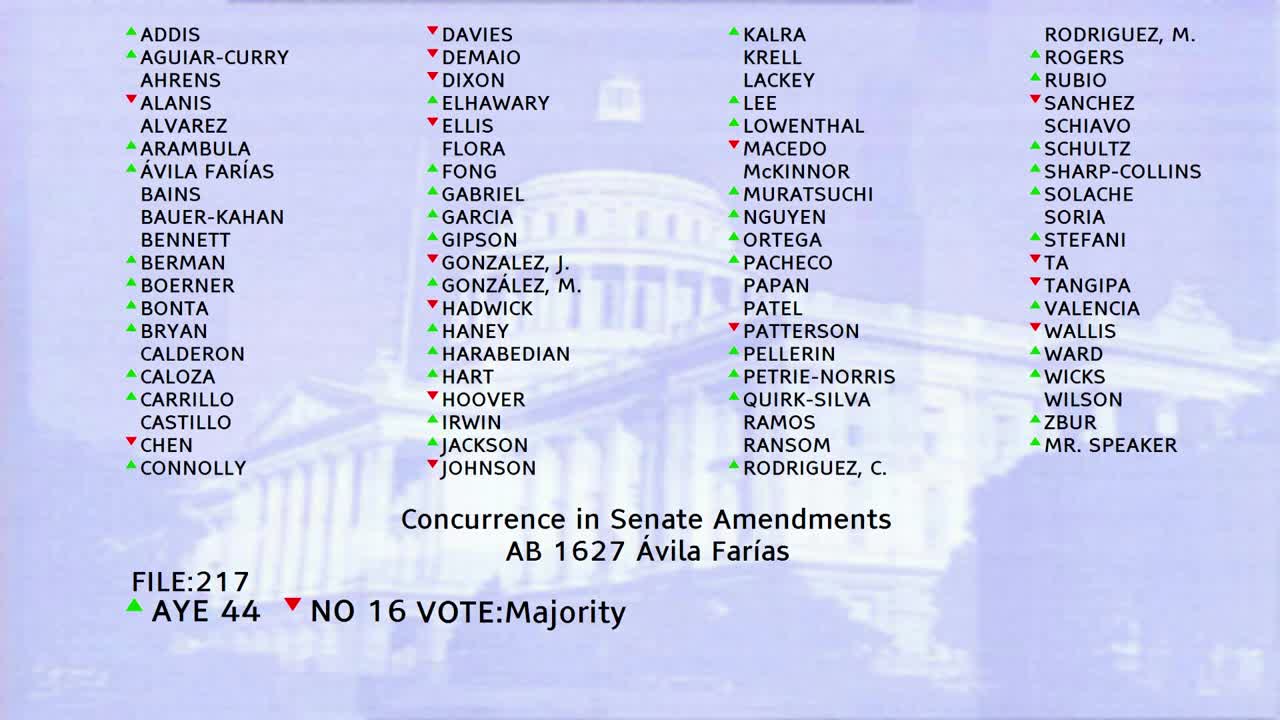 1MIN
Assembly Floor
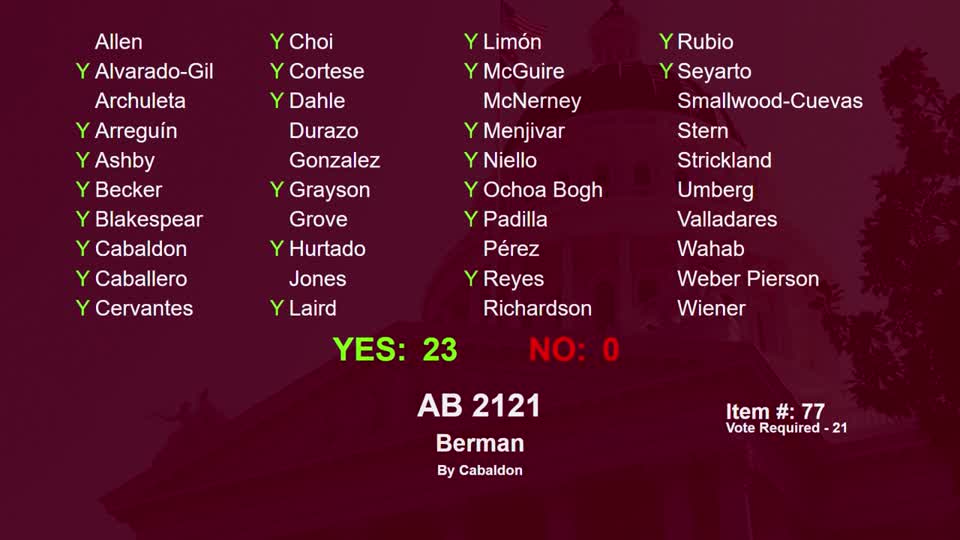 4MIN
Senate Floor
 1MIN
Senate Standing Committee on Appropriations
 15MIN
Senate Standing Committee on Elections and Constitutional Amendments
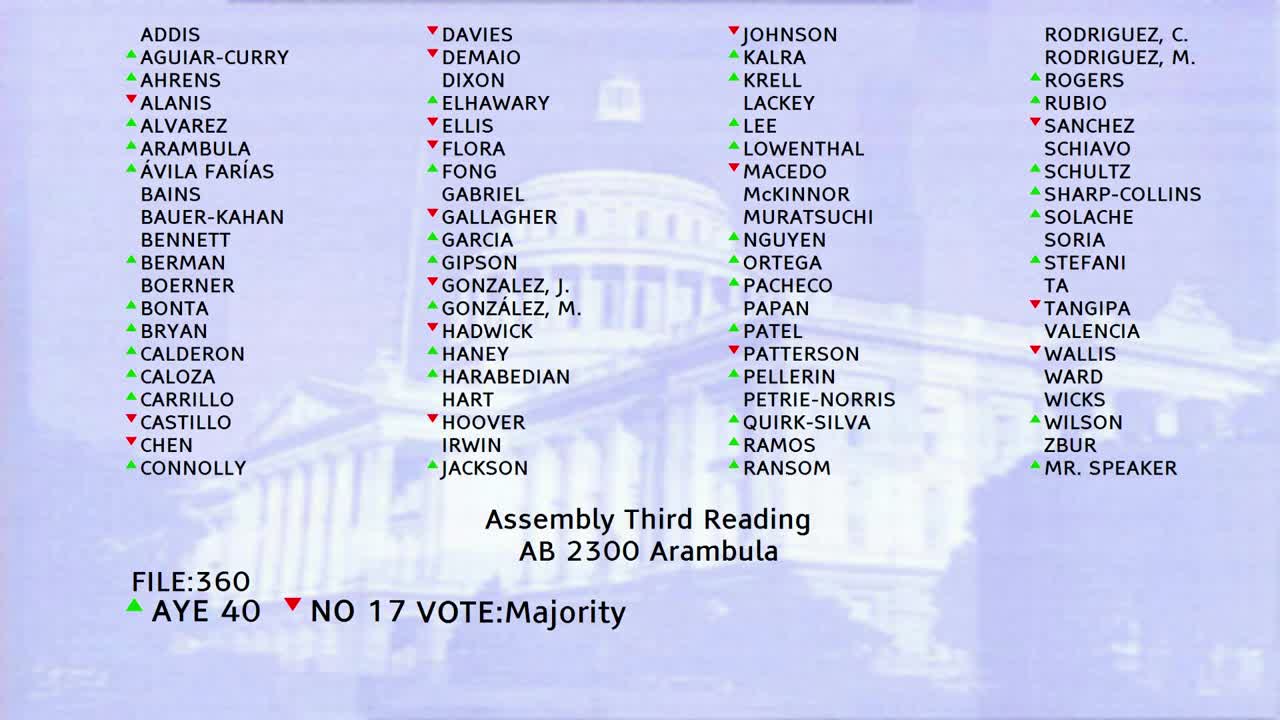 7MIN
Assembly Floor
 10MIN
Assembly Standing Committee on Elections
Bill Author


