AB 263: Scott River: Shasta River: watersheds.
- Session Year: 2025-2026
- House: Assembly
- Latest Version Date: 2025-09-26
Current Status:
Passed
(2025-09-26: Chaptered by Secretary of State - Chapter 130, Statutes of 2025.)
Introduced
In Committee
Awaiting First Chamber Vote
Passed First Chamber
In Committee
Awaiting Second Chamber Vote
Passed Second Chamber
Enacted
Existing law provides that an emergency regulation adopted by the State Water Resources Control Board following a Governors proclamation of a state of emergency based on drought conditions, for which the board makes specified findings, may remain in effect for up to one year, as provided, and may be renewed if the board determines that specified conditions relating to precipitation are still in effect.
This bill would provide that specified emergency regulations adopted by the board for the Scott River and Shasta River watersheds shall remain in effect until January 1, 2031, or until permanent rules establishing and implementing long-term instream flow requirements are adopted for those watersheds, whichever occurs first. The bill would require the board to provide annual public updates, including opportunities for public comment, on its progress toward developing permanent flow rules for the rivers, as provided.
This bill would make legislative findings and declarations as to the necessity of a special statute for the Scott River and Shasta River watersheds.
Existing law provides that an emergency regulation adopted by the State Water Resources Control Board following a Governors proclamation of a state of emergency based on drought conditions, for which the board makes specified findings, may remain in effect for up to one year, as provided, and may be renewed if the board determines that specified conditions relating to precipitation are still in effect.
This bill would provide that specified emergency regulations adopted by the board for the Scott River and Shasta River watersheds shall remain in effect until January 1, 2031, or until permanent rules establishing and implementing long-term instream flow requirements are adopted for those watersheds, whichever occurs first.
This bill would make legislative findings and declarations as to the necessity of a special statute for the Scott River and Shasta River watersheds.
Existing law provides that an emergency regulation adopted by the State Water Resources Control Board following a Governors proclamation of a state of emergency based on drought conditions, for which the board makes specified findings, may remain in effect for up to one year, as provided, and may be renewed if the board determines that specified conditions relating to precipitation are still in effect.
This bill would provide that specified emergency regulations adopted by the board for the Scott River and Shasta River watersheds shall remain in effect until January 1, 2031, or until permanent rules establishing and implementing long-term instream flow requirements are adopted for those watersheds. watersheds, whichever occurs first.
This bill would make legislative findings and declarations as to the necessity of a special statute for the Scott River and Shasta River watersheds.
Existing law provides that an emergency regulation adopted by the State Water Resources Control Board following a Governors proclamation of a state of emergency based on drought conditions, for which the board makes specified findings, may remain in effect for up to one year, as provided, and may be renewed if the board determines that specified conditions relating to precipitation are still in effect.
This bill would provide that specified emergency regulations adopted by the board for the Scott River and Shasta River watersheds shall remain in effect until permanent rules establishing and implementing long-term instream flow requirements are adopted for those watersheds.
This bill would make legislative findings and declarations as to the necessity of a special statute for the Scott River and Shasta River watersheds.
The Legislature finds and declares all of the following:
(a)Droughts and extreme weather events in California are becoming more frequent and severe.
(b)The rapidly changing climate threatens the health of Californias rivers and streams that provide water for the states farms and communities, as well as for fish and wildlife.
(c)Salmon populations are not only an important part of our states biodiversity, but a rich component of our history, heritage, and economy.
(d)California has a responsibility to prepare for the future and protect the ecosystems and people whose well-being are connected to the continued success of salmon.
(e)The California commercial salmon season, which is valued at $1.4 billion in economic activity and supports 23,000 jobs annually, has been closed for three years in a row as a result of low salmon population numbers.
(f)The California Salmon Strategy for a Hotter Drier Future: Restoring Aquatic Ecosystems in the Age of Climate Change (2024) identifies the Scott and Shasta Rivers as salmon strongholds and calls for the establishment of minimum instream flows on the rivers.
(g)California has invested significant funds in supporting the development of flow regulations on the Scott River and Shasta River watersheds.
(h)The Department of Fish and Wildlife used well-established science to determine survival-level flows for the Scott River and Shasta River watersheds.
(i)The cultural identities of California Indians are intrinsically connected to the rivers and streams that support salmon and other native fish that sustained them since time immemorial and throughout periods of genocide and discrimination dating back to European colonization.
(j)The Scott River is the largest producer of wild Southern Oregon/Northern California Coast coho salmon, the evolutionarily distinct unit that is listed as threatened on the federal endangered species list and the California endangered species list.
(k)The Shasta River is the biggest producer of wild Upper Klamath-Trinity Fall Chinook salmon. Historical reports from the Department of Fish and Wildlife describe 80,000 adult salmon returning to the Shasta River in 1931. By contrast, the Pacific Fishery Management Council estimated that 36,568 adult fall Chinook salmon returned to the entire Klamath River Basin in 2024.
(l)Water rights on the Shasta River were adjudicated in 1932, and water rights on the Scott River were adjudicated in 1980. Tribes were unfairly excluded from participating in these adjudications, underscoring the need to ensure adequate flows to maintain flows and restore fisheries today.
SEC. 2.Section 1058.5 of the Water Code is amended to read:1058.5.(a)This section applies to any emergency regulation adopted by the board for which the board makes both of the following findings:
(1)The emergency regulation is adopted to prevent the waste, unreasonable use, unreasonable method of use, or unreasonable method of diversion, of water, to promote water recycling or water conservation, to require curtailment of diversions when water is not available under the diverters priority of right, or in furtherance of any of the foregoing, to require reporting of diversion or use or the preparation of monitoring reports.
(2)The emergency regulation is adopted in response to conditions which exist, or are threatened, in a critically dry year immediately preceded by two or more consecutive below normal, dry, or critically dry years or during a period for which the Governor has issued a proclamation of a state of emergency under the California Emergency Services Act (Chapter 7 (commencing with Section 8550) of Division 1 of Title 2 of the Government Code) based on drought conditions.
(b)Notwithstanding Sections 11346.1 and 11349.6 of the Government Code, any findings of emergency adopted by the board, in connection with the adoption of an emergency regulation under this section, are not subject to review by the Office of Administrative Law.
(c)(1)An emergency regulation adopted by the board pursuant to this section may remain in effect for up to one year, as determined by the board, and is deemed repealed immediately upon a finding by the board that due to changed conditions it is no longer necessary for the regulation to remain in effect. An emergency regulation adopted by the board pursuant to this section may be renewed if the board determines that the conditions specified in paragraph (2) of subdivision (a) are still in effect.
(2)Notwithstanding paragraph (1), the requirements of Article 23.5 (commencing with Section 875) of Chapter 2 of Division 3 of Title 23 of the California Code of Regulations, as operative January 27, 2025, shall remain in effect until January 1, 2031, or until permanent rules establishing and implementing long-term instream flow requirements in the Scott River and Shasta River watersheds are adopted, whichever occurs first. The board shall provide annual public updates, including opportunities for public comment, on its progress toward developing permanent flow rules for the rivers while this provision is in effect.
(d)In addition to any other applicable civil or criminal penalties, any person or entity that violates a regulation adopted by the board pursuant to this section is guilty of an infraction punishable by a fine of up to five hundred dollars ($500) for each day in which the violation occurs.
(e)(1)Notwithstanding subdivision (b) of Section 1551 or subdivision (e) of Section 1848, a civil liability imposed under Chapter 12 (commencing with Section 1825) of Part 2 of Division 2 by the board or a court for a violation of an emergency conservation regulation adopted pursuant to this section shall be deposited, and separately accounted for, in the Water Rights Fund. Funds deposited in accordance with this subdivision shall be available, upon appropriation, for water conservation activities and programs.
(2)For purposes of this subdivision, an emergency conservation regulation means an emergency regulation that requires an end user of water, a water retailer, or a water wholesaler to conserve water or report to the board on water conservation. Water conservation includes restrictions or limitations on particular uses of water or a reduction in the amount of water used or served, but does not include curtailment of diversions when water is not available under the diverters priority of right or reporting requirements related to curtailments.
SEC. 3.The Legislature finds and declares that a special statute is necessary and that a general statute cannot be made applicable within the meaning of Section 16 of Article IV of the California Constitution because of the unique circumstances and needs of the Scott River and Shasta River watersheds.
The Legislature finds and declares all of the following:
(a)Droughts and extreme weather events in California are becoming more frequent and severe.
(b)The rapidly changing climate threatens the health of Californias rivers and streams that provide water for the states farms and communities, as well as for fish and wildlife.
(c)Salmon populations are not only an important part of our states biodiversity, but a rich component of our history, heritage, and economy.
(d)California has a responsibility to prepare for the future and protect the ecosystems and people whose well-being are connected to the continued success of salmon.
(e)The California commercial salmon season, which is valued at $1.4 billion in economic activity and supports 23,000 jobs annually, has been closed for three years in a row as a result of low salmon population numbers.
(f)The California Salmon Strategy for a Hotter Drier Future: Restoring Aquatic Ecosystems in the Age of Climate Change (2024) identifies the Scott and Shasta Rivers as salmon strongholds and calls for the establishment of minimum instream flows on the rivers.
(g)California has invested significant funds in supporting the development of flow regulations on the Scott River and Shasta River watersheds.
(h)The Department of Fish and Wildlife used well-established science to determine survival-level flows for the Scott River and Shasta River watersheds.
(h)(i)The cultural identities of California Indians are intrinsically connected to the rivers and streams that support salmon and other native fish that sustained them since time immemorial and throughout periods of genocide and discrimination dating back to European colonization.
(i)(j)The Scott River is the largest producer of wild Southern Oregon/Northern California Coast coho salmon, the evolutionarily distinct unit that is listed as threatened on the federal endangered species list and the California endangered species list.
(j)(k)The Shasta River is the biggest producer of wild Upper Klamath-Trinity Spring Fall Chinook salmon. Historical reports from the Department of Fish and Wildlife describe 80,000 adult salmon returning to the Shasta River in 1931. By contrast, the Pacific Fishery Management Council estimated that 36,568 adult fall Chinook salmon returned to the entire Klamath River Basin in 2024.
(k)(l)Water rights on the Shasta River were adjudicated in 1932, and water rights on the Scott River were adjudicated in 1980. Tribes were unfairly excluded from participating in these adjudications, underscoring the need to ensure adequate flows to maintain flows and restore fisheries today.
SEC. 2.Section 1058.5 of the Water Code is amended to read:1058.5.(a)This section applies to any emergency regulation adopted by the board for which the board makes both of the following findings:
(1)The emergency regulation is adopted to prevent the waste, unreasonable use, unreasonable method of use, or unreasonable method of diversion, of water, to promote water recycling or water conservation, to require curtailment of diversions when water is not available under the diverters priority of right, or in furtherance of any of the foregoing, to require reporting of diversion or use or the preparation of monitoring reports.
(2)The emergency regulation is adopted in response to conditions which exist, or are threatened, in a critically dry year immediately preceded by two or more consecutive below normal, dry, or critically dry years or during a period for which the Governor has issued a proclamation of a state of emergency under the California Emergency Services Act (Chapter 7 (commencing with Section 8550) of Division 1 of Title 2 of the Government Code) based on drought conditions.
(b)Notwithstanding Sections 11346.1 and 11349.6 of the Government Code, any findings of emergency adopted by the board, in connection with the adoption of an emergency regulation under this section, are not subject to review by the Office of Administrative Law.
(c)(1)An emergency regulation adopted by the board pursuant to this section may remain in effect for up to one year, as determined by the board, and is deemed repealed immediately upon a finding by the board that due to changed conditions it is no longer necessary for the regulation to remain in effect. An emergency regulation adopted by the board pursuant to this section may be renewed if the board determines that the conditions specified in paragraph (2) of subdivision (a) are still in effect.
(2)Notwithstanding paragraph (1), the requirements of Article 23.5 (commencing with Section 875) of Chapter 2 of Division 3 of Title 23 of the California Code of Regulations, as operative January 27, 2025, shall remain in effect until January 1, 2031, or until permanent rules establishing and implementing long-term instream flow requirements in the Scott River and Shasta River watersheds are adopted, whichever occurs first. The board shall provide annual public updates, including opportunities for public comment, on its progress toward developing permanent flow rules for the rivers while this provision is in effect.
(d)In addition to any other applicable civil or criminal penalties, any person or entity that violates a regulation adopted by the board pursuant to this section is guilty of an infraction punishable by a fine of up to five hundred dollars ($500) for each day in which the violation occurs.
(e)(1)Notwithstanding subdivision (b) of Section 1551 or subdivision (e) of Section 1848, a civil liability imposed under Chapter 12 (commencing with Section 1825) of Part 2 of Division 2 by the board or a court for a violation of an emergency conservation regulation adopted pursuant to this section shall be deposited, and separately accounted for, in the Water Rights Fund. Funds deposited in accordance with this subdivision shall be available, upon appropriation, for water conservation activities and programs.
(2)For purposes of this subdivision, an emergency conservation regulation means an emergency regulation that requires an end user of water, a water retailer, or a water wholesaler to conserve water or report to the board on water conservation. Water conservation includes restrictions or limitations on particular uses of water or a reduction in the amount of water used or served, but does not include curtailment of diversions when water is not available under the diverters priority of right or reporting requirements related to curtailments.
SEC. 3.The Legislature finds and declares that a special statute is necessary and that a general statute cannot be made applicable within the meaning of Section 16 of Article IV of the California Constitution because of the unique circumstances and needs of the Scott River and Shasta River watersheds.
The Legislature finds and declares all of the following:
(a)Droughts and extreme weather events in California are becoming more frequent and severe.
(b)The rapidly changing climate threatens the health of Californias rivers and streams that provide water for the states farms and communities, as well as for fish and wildlife.
(c)Salmon populations are not only an important part of our states biodiversity, but a rich component of our history, heritage, and economy.
(d)California has a responsibility to prepare for the future and protect the ecosystems and people whose well-being are connected to the continued success of salmon.
(e)The California commercial salmon season, which is valued at $1.4 billion in economic activity and supports 23,000 jobs annually, has been closed for three years in a row as a result of low salmon population numbers.
(f)The California Salmon Strategy for a Hotter Drier Future: Restoring Aquatic Ecosystems in the Age of Climate Change (2024) identifies the Scott and Shasta Rivers as salmon strongholds and calls for the establishment of minimum instream flows on the rivers.
(g)California has invested significant funds in supporting the development of flow regulations on the Scott River and Shasta River watersheds.
(h)The cultural identities of California Indians are intrinsically connected to the rivers and streams that support salmon and other native fish that sustained them since time immemorial and throughout periods of genocide and discrimination dating back to European colonization.
(i)The Scott River is the largest producer of wild Southern Oregon/Northern California Coast coho salmon, the evolutionarily distinct unit that is listed as threatened on the federal endangered species list and the California endangered species list.
(j)The Shasta River is the biggest producer of wild Upper Klamath-Trinity Spring Chinook salmon. Historical reports from the Department of Fish and Wildlife describe 80,000 adult salmon returning to the Shasta River in 1931. By contrast, the Pacific Fishery Management Council estimated that 36,568 adult fall Chinook salmon returned to the entire Klamath River Basin in 2024.
(k)Water rights on the Shasta River were adjudicated in 1932, and water rights on the Scott River were adjudicated in 1980. Tribes were unfairly excluded from participating in these adjudications adjudications, underscoring the need to ensure adequate flows to maintain flows and restore fisheries today.
SEC. 2.Section 1058.5 of the Water Code is amended to read:1058.5.(a)This section applies to any emergency regulation adopted by the board for which the board makes both of the following findings:
(1)The emergency regulation is adopted to prevent the waste, unreasonable use, unreasonable method of use, or unreasonable method of diversion, of water, to promote water recycling or water conservation, to require curtailment of diversions when water is not available under the diverters priority of right, or in furtherance of any of the foregoing, to require reporting of diversion or use or the preparation of monitoring reports.
(2)The emergency regulation is adopted in response to conditions which exist, or are threatened, in a critically dry year immediately preceded by two or more consecutive below normal, dry, or critically dry years or during a period for which the Governor has issued a proclamation of a state of emergency under the California Emergency Services Act (Chapter 7 (commencing with Section 8550) of Division 1 of Title 2 of the Government Code) based on drought conditions.
(b)Notwithstanding Sections 11346.1 and 11349.6 of the Government Code, any findings of emergency adopted by the board, in connection with the adoption of an emergency regulation under this section, are not subject to review by the Office of Administrative Law.
(c)(1)An emergency regulation adopted by the board pursuant to this section may remain in effect for up to one year, as determined by the board, and is deemed repealed immediately upon a finding by the board that due to changed conditions it is no longer necessary for the regulation to remain in effect. An emergency regulation adopted by the board pursuant to this section may be renewed if the board determines that the conditions specified in paragraph (2) of subdivision (a) are still in effect.
(2)Notwithstanding paragraph (1), the requirements of Article 23.5 (commencing with Section 875) of Chapter 2 of Division 3 of Title 23 of the California Code of Regulations, as operative December 19, 2023, January 27, 2025, shall remain in effect until January 1, 2031, or until permanent rules establishing and implementing long-term instream flow requirements in the Scott River and Shasta River watersheds are adopted, whichever occurs first.
(d)In addition to any other applicable civil or criminal penalties, any person or entity that violates a regulation adopted by the board pursuant to this section is guilty of an infraction punishable by a fine of up to five hundred dollars ($500) for each day in which the violation occurs.
(e)(1)Notwithstanding subdivision (b) of Section 1551 or subdivision (e) of Section 1848, a civil liability imposed under Chapter 12 (commencing with Section 1825) of Part 2 of Division 2 by the board or a court for a violation of an emergency conservation regulation adopted pursuant to this section shall be deposited, and separately accounted for, in the Water Rights Fund. Funds deposited in accordance with this subdivision shall be available, upon appropriation, for water conservation activities and programs.
(2)For purposes of this subdivision, an emergency conservation regulation means an emergency regulation that requires an end user of water, a water retailer, or a water wholesaler to conserve water or report to the board on water conservation. Water conservation includes restrictions or limitations on particular uses of water or a reduction in the amount of water used or served, but does not include curtailment of diversions when water is not available under the diverters priority of right or reporting requirements related to curtailments.
SEC. 3.The Legislature finds and declares that a special statute is necessary and that a general statute cannot be made applicable within the meaning of Section 16 of Article IV of the California Constitution because of the unique circumstances and needs of the Scott River and Shasta River watersheds.
The Legislature finds and declares all of the following:
(a)Droughts and extreme weather events in California are becoming more frequent and severe.
(b)The rapidly changing climate threatens the health of Californias rivers and streams that provide water for the states farms and communities, as well as for fish and wildlife.
(c)Salmon populations are not only an important part of our states biodiversity, but a rich component of our history, heritage, and economy.
(d)California has a responsibility to prepare for the future and protect the ecosystems and people whose well-being are connected to the continued success of salmon.
(e)The California commercial salmon season, which is valued at $1.4 billion in economic activity and supports 23,000 jobs annually, has been closed for three years in a row as a result of low salmon population numbers.
(f)The California Salmon Strategy for a Hotter Drier Future: Restoring Aquatic Ecosystems in the Age of Climate Change (2024) identifies the Scott and Shasta Rivers as salmon strongholds and calls for the establishment of minimum instream flows on the rivers.
(g)California has invested significant funds in supporting the development of flow regulations on the Scott River and Shasta River watersheds.
(h)The cultural identities of California Indians are intrinsically connected to the rivers and streams that support salmon and other native fish that sustained them since time immemorial and throughout periods of genocide and discrimination dating back to European colonization.
(i)The Scott River is the largest producer of wild Southern Oregon/Northern California Coast coho salmon, the evolutionarily distinct unit that is listed as threatened on the federal endangered species list and the California endangered species list.
(j)The Shasta River is the biggest producer of wild Upper Klamath-Trinity Spring Chinook salmon. Historical reports from the Department of Fish and Wildlife describe 80,000 adult salmon returning to the Shasta River in 1931. By contrast, the Pacific Fishery Management Council estimated that 36,568 adult fall Chinook salmon returned to the entire Klamath River Basin in 2024.
(k)Water rights on the Shasta River were adjudicated in 1932, and water rights on the Scott River were adjudicated in 1980. Tribes were unfairly excluded from participating in these adjudications underscoring the need to ensure adequate flows to maintain flows and restore fisheries today.
SECTION 1.SEC. 2.Section 1058.5 of the Water Code is amended to read:1058.5.(a)This section applies to any emergency regulation adopted by the board for which the board makes both of the following findings:
(1)The emergency regulation is adopted to prevent the waste, unreasonable use, unreasonable method of use, or unreasonable method of diversion, of water, to promote water recycling or water conservation, to require curtailment of diversions when water is not available under the diverters priority of right, or in furtherance of any of the foregoing, to require reporting of diversion or use or the preparation of monitoring reports.
(2)The emergency regulation is adopted in response to conditions which exist, or are threatened, in a critically dry year immediately preceded by two or more consecutive below normal, dry, or critically dry years or during a period for which the Governor has issued a proclamation of a state of emergency under the California Emergency Services Act (Chapter 7 (commencing with Section 8550) of Division 1 of Title 2 of the Government Code) based on drought conditions.
(b)Notwithstanding Sections 11346.1 and 11349.6 of the Government Code, any findings of emergency adopted by the board, in connection with the adoption of an emergency regulation under this section, are not subject to review by the Office of Administrative Law.
(c)(1)An emergency regulation adopted by the board pursuant to this section may remain in effect for up to one year, as determined by the board, and is deemed repealed immediately upon a finding by the board that due to changed conditions it is no longer necessary for the regulation to remain in effect. An emergency regulation adopted by the board pursuant to this section may be renewed if the board determines that the conditions specified in paragraph (2) of subdivision (a) are still in effect.
(2)Notwithstanding paragraph (1), the requirements of Article 23.5 (commencing with Section 875) of Chapter 2 of Division 3 of Title 23 of the California Code of Regulations, as operative December 19, 2023, shall remain in effect until January 1, 2031, or until permanent rules establishing and implementing long-term instream flow requirements in the Scott River and Shasta River watersheds are adopted, whichever occurs first.
(d)In addition to any other applicable civil or criminal penalties, any person or entity that violates a regulation adopted by the board pursuant to this section is guilty of an infraction punishable by a fine of up to five hundred dollars ($500) for each day in which the violation occurs.
(e)(1)Notwithstanding subdivision (b) of Section 1551 or subdivision (e) of Section 1848, a civil liability imposed under Chapter 12 (commencing with Section 1825) of Part 2 of Division 2 by the board or a court for a violation of an emergency conservation regulation adopted pursuant to this section shall be deposited, and separately accounted for, in the Water Rights Fund. Funds deposited in accordance with this subdivision shall be available, upon appropriation, for water conservation activities and programs.
(2)For purposes of this subdivision, an emergency conservation regulation means an emergency regulation that requires an end user of water, a water retailer, or a water wholesaler to conserve water or report to the board on water conservation. Water conservation includes restrictions or limitations on particular uses of water or a reduction in the amount of water used or served, but does not include curtailment of diversions when water is not available under the diverters priority of right or reporting requirements related to curtailments.
SEC. 2.SEC. 3.The Legislature finds and declares that a special statute is necessary and that a general statute cannot be made applicable within the meaning of Section 16 of Article IV of the California Constitution because of the unique circumstances and needs of the Scott River and Shasta River watersheds.
(a)This section applies to any emergency regulation adopted by the board for which the board makes both of the following findings:
(1)The emergency regulation is adopted to prevent the waste, unreasonable use, unreasonable method of use, or unreasonable method of diversion, of water, to promote water recycling or water conservation, to require curtailment of diversions when water is not available under the diverters priority of right, or in furtherance of any of the foregoing, to require reporting of diversion or use or the preparation of monitoring reports.
(2)The emergency regulation is adopted in response to conditions which exist, or are threatened, in a critically dry year immediately preceded by two or more consecutive below normal, dry, or critically dry years or during a period for which the Governor has issued a proclamation of a state of emergency under the California Emergency Services Act (Chapter 7 (commencing with Section 8550) of Division 1 of Title 2 of the Government Code) based on drought conditions.
(b)Notwithstanding Sections 11346.1 and 11349.6 of the Government Code, any findings of emergency adopted by the board, in connection with the adoption of an emergency regulation under this section, are not subject to review by the Office of Administrative Law.
(c)(1)An emergency regulation adopted by the board pursuant to this section may remain in effect for up to one year, as determined by the board, and is deemed repealed immediately upon a finding by the board that due to changed conditions it is no longer necessary for the regulation to remain in effect. An emergency regulation adopted by the board pursuant to this section may be renewed if the board determines that the conditions specified in paragraph (2) of subdivision (a) are still in effect.
(2)Notwithstanding paragraph (1), the requirements of Article 23.5 (commencing with Section 875) of Chapter 2 of Division 3 of Title 23 of the California Code of Regulations, as operative December 19, 2023, shall remain in effect until January 1, 2031, or until permanent rules establishing and implementing long-term instream flow requirements in the Scott River and Shasta River watersheds are adopted. adopted, whichever occurs first.
(d)In addition to any other applicable civil or criminal penalties, any person or entity that violates a regulation adopted by the board pursuant to this section is guilty of an infraction punishable by a fine of up to five hundred dollars ($500) for each day in which the violation occurs.
(e)(1)Notwithstanding subdivision (b) of Section 1551 or subdivision (e) of Section 1848, a civil liability imposed under Chapter 12 (commencing with Section 1825) of Part 2 of Division 2 by the board or a court for a violation of an emergency conservation regulation adopted pursuant to this section shall be deposited, and separately accounted for, in the Water Rights Fund. Funds deposited in accordance with this subdivision shall be available, upon appropriation, for water conservation activities and programs.
(2)For purposes of this subdivision, an emergency conservation regulation means an emergency regulation that requires an end user of water, a water retailer, or a water wholesaler to conserve water or report to the board on water conservation. Water conservation includes restrictions or limitations on particular uses of water or a reduction in the amount of water used or served, but does not include curtailment of diversions when water is not available under the diverters priority of right or reporting requirements related to curtailments.
SEC. 2.The Legislature finds and declares that a special statute is necessary and that a general statute cannot be made applicable within the meaning of Section 16 of Article IV of the California Constitution because of the unique circumstances and needs of the Scott River and Shasta River watersheds.
(a)This section applies to any emergency regulation adopted by the board for which the board makes both of the following findings:
(1)The emergency regulation is adopted to prevent the waste, unreasonable use, unreasonable method of use, or unreasonable method of diversion, of water, to promote water recycling or water conservation, to require curtailment of diversions when water is not available under the diverters priority of right, or in furtherance of any of the foregoing, to require reporting of diversion or use or the preparation of monitoring reports.
(2)The emergency regulation is adopted in response to conditions which exist, or are threatened, in a critically dry year immediately preceded by two or more consecutive below normal, dry, or critically dry years or during a period for which the Governor has issued a proclamation of a state of emergency under the California Emergency Services Act (Chapter 7 (commencing with Section 8550) of Division 1 of Title 2 of the Government Code) based on drought conditions.
(b)Notwithstanding Sections 11346.1 and 11349.6 of the Government Code, any findings of emergency adopted by the board, in connection with the adoption of an emergency regulation under this section, are not subject to review by the Office of Administrative Law.
(c)(1)An emergency regulation adopted by the board under pursuant to this section may remain in effect for up to one year, as determined by the board, and is deemed repealed immediately upon a finding by the board that due to changed conditions it is no longer necessary for the regulation to remain in effect. An emergency regulation adopted by the board under pursuant to this section may be renewed if the board determines that the conditions specified in paragraph (2) of subdivision (a) are still in effect.
(2)Notwithstanding paragraph (1), the requirements of Article 23.5 (commencing with Section 875) of Chapter 2 of Division 3 of Title 23 of the California Code of Regulations, as operative December 19, 2023, shall remain in effect until permanent rules establishing and implementing long-term instream flow requirements in the Scott River and Shasta River watersheds are adopted.
(d)In addition to any other applicable civil or criminal penalties, any person or entity that violates a regulation adopted by the board pursuant to this section is guilty of an infraction punishable by a fine of up to five hundred dollars ($500) for each day in which the violation occurs.
(e)(1)Notwithstanding subdivision (b) of Section 1551 or subdivision (e) of Section 1848, a civil liability imposed under Chapter 12 (commencing with Section 1825) of Part 2 of Division 2 by the board or a court for a violation of an emergency conservation regulation adopted pursuant to this section shall be deposited, and separately accounted for, in the Water Rights Fund. Funds deposited in accordance with this subdivision shall be available, upon appropriation, for water conservation activities and programs.
(2)For purposes of this subdivision, an emergency conservation regulation means an emergency regulation that requires an end user of water, a water retailer, or a water wholesaler to conserve water or report to the board on water conservation. Water conservation includes restrictions or limitations on particular uses of water or a reduction in the amount of water used or served, but does not include curtailment of diversions when water is not available under the diverters priority of right or reporting requirements related to curtailments.
SEC. 2.The Legislature finds and declares that a special statute is necessary and that a general statute cannot be made applicable within the meaning of Section 16 of Article IV of the California Constitution because of the unique circumstances and needs of the Scott River and Shasta River watersheds.
|
Date
|
Status
|
|---|---|
| Sep 26, 2025 | Chaptered by Secretary of State - Chapter 130, Statutes of 2025. |
| Sep 26, 2025 | Approved by the Governor. |
| Sep 22, 2025 | Enrolled and presented to the Governor at 3 p.m. |
| Sep 10, 2025 | Senate amendments concurred in. To Engrossing and Enrolling. (Ayes 58. Noes 20. Page 3213.). |
| Sep 9, 2025 | In Assembly. Concurrence in Senate amendments pending. |
| Sep 9, 2025 | Read third time. Passed. Ordered to the Assembly. (Ayes 30. Noes 6. Page 2657.). |
| Sep 4, 2025 | Read second time. Ordered to third reading. |
| Sep 3, 2025 | Read third time and amended. Ordered to second reading. |
| Jun 24, 2025 | Read second time. Ordered to third reading. |
| Jun 23, 2025 | From committee: Be ordered to second reading pursuant to Senate Rule 28.8. |
| Jun 11, 2025 | Read second time and amended. Re-referred to Com. on APPR. |
| Jun 10, 2025 | From committee: Amend, and do pass as amended and re-refer to Com. on APPR. (Ayes 6. Noes 0.) (June 10). |
| Jun 2, 2025 | From committee chair, with author's amendments: Amend, and re-refer to committee. Read second time, amended, and re-referred to Com. on N.R. & W. |
| May 14, 2025 | Referred to Com. on N.R. & W. |
| May 6, 2025 | In Senate. Read first time. To Com. on RLS. for assignment. |
| May 5, 2025 | Read third time. Passed. Ordered to the Senate. (Ayes 56. Noes 17. Page 1423.) |
| Apr 24, 2025 | Read second time. Ordered to third reading. |
| Apr 23, 2025 | From committee: Do pass. (Ayes 11. Noes 4.) (April 23). |
| Apr 21, 2025 | Re-referred to Com. on APPR. |
| Apr 10, 2025 | Read second time and amended. |
| Apr 9, 2025 | From committee: Amend, and do pass as amended and re-refer to Com. on APPR. (Ayes 9. Noes 3.) (April 8). |
| Feb 10, 2025 | Referred to Com. on W. P., & W. |
| Jan 17, 2025 | From printer. May be heard in committee February 16. |
| Jan 16, 2025 | Read first time. To print. |
|
Date
|
Description
|
Location
|
Votes
|
|
|---|---|---|---|---|
| Sep 10, 2025 | AB 263 Rogers Concurrence in Senate Amendments | Assembly Floor |
Passed |
|
| Sep 9, 2025 | Assembly 3rd Reading AB263 Rogers et al. By McGuire | Senate Floor |
Passed |
|
| Jun 10, 2025 | Do pass as amended, but first amend, and re-refer to the Committee on [Appropriations] | Senate Standing Committee on Natural Resources and Water |
Passed |
|
| May 5, 2025 | AB 263 Rogers Assembly Third Reading | Assembly Floor |
Passed |
|
| Apr 23, 2025 | Do pass. | Assembly Standing Committee on Appropriations |
Passed |
|
| Apr 8, 2025 | Do pass as amended and be re-referred to the Committee on [Appropriations] | Assembly Standing Committee on Water, Parks, and Wildlife |
Passed |
This list shows positions taken on this bill by organizations on the date displayed, which is linked to the original source.
Positions by individuals are not included.
|
Organization
|
Position
|
Date
|
|---|---|---|
| amah mutsun tribal band | ** Support | |
| Anchored in Trinidad | ** Support | |
| Association Of California Water Agencies | ** Against | |
| Audobon California | ** Support | |
| California Chamber Of Commerce | ** Against | |
| California Coastkeeper Alliance (co-source) | ** Support | |
| California Environmental Voters | ** Support | |
| California Farm Bureau Federation | ** Against | |
| California Municipal Utilities Association | ** Against | |
| California Native Plant Society, Alta Peak Chapter | ** Support | |
| California Sportfishing Protection Alliance | ** Support | |
| California Sportsfishing Protection Alliance | ** Support | |
| California Tribal Chairpersons' Association | ** Support | |
| Calwild | ** Support | |
| Center For Biological Diversity | ** Support | |
| cleanearth4kids.org | ** Support | |
| Clean Water Action | ** Support | |
| Community Water Center | ** Support | |
| County of Humboldt | ** Support | |
| Defenders Of Wildlife | ** Support | |
| Endangered Habitats League | ** Support | |
| Environmental Defense Fund | ** Support | |
| Environmental Defense Fund, Incorporated | ** Support | |
| Environmental Law Foundation | ** Support | |
| Environmental Protection Information Center | ** Support | |
| Friends Committee On Legislation Of California | ** Support | |
| Friends of the Eel River | ** Support | |
| Friends of the Inyo | ** Support | |
| Friends of the River | ** Support | |
| Friends of the Shasta River | ** Support | |
| Golden Gate Salmon Association | ** Support | |
| Golden State Salmon Association | ** Support | |
| Green Policy Initiative | ** Support | |
| Humboldt; County Of | ** Support | |
| Humboldt Waterkeeper | ** Support | |
| Inland Empire Waterkeeper | ** Support | |
| Karmic Action Redistribution Management Agency | ** Support | |
| Karuk Tribe | ** Support | |
| Karuk Tribe (co-source) | ** Support | |
| Los Angeles Waterkeeper | ** Support | |
| Mendocino Producers Guild | ** Support | |
| Mid Klamath Watershed Council | ** Support | |
| Milk Producers Council | ** Against | |
| Monterey Coastkeeper | ** Support | |
| Monterey Waterkeeper | ** Support | |
| Mount Shasta Bioregional Ecology Center | ** Support | |
| National Parks Conservation Association | ** Support | |
| Native Fish Society | ** Support | |
| Northern California Tribal Chairpersons Association | ** Support | |
| Orange County Coastkeeper | ** Support | |
| Orange County Waterkeeper | ** Support | |
| Pacific Coast Federation Of Fishermen'S Associations | ** Support | |
| Planning And Conservation League | ** Support | |
| Regional Water Authority | ** Against | |
| Resource Renewal Institute | ** Support | |
| San Diego Coastkeeper | ** Support | |
| San Francisco Public Utilities Commission | ** Against | |
| Santa Barbara Channelkeeper | ** Support | |
| Save California Salmon | ** Support | |
| Scott Valley Agriculture Water Alliance | ** Against | |
| Shasta Waterkeeper | ** Support | |
| Sierra Club California | ** Support | |
| Sierra Nevada Alliance | ** Support | |
| Siskiyou County Board of Supervisors | ** Against | |
| Siskiyou County Farm Bureau | ** Against | |
| Siskiyou Economic Development | ** Against | |
| South Yuba River Citizens League | ** Support | |
| The Fire Restoration Group | ** Support | |
| The Nature Conservancy | ** Support | |
| The Otter Project | ** Support | |
| Trout Unlimited | ** Support | |
| Union Of Concerned Scientists | ** Support | |
| Valley Ag Water Coalition | ** Against | |
| Water Climate Trust | ** Support | |
| Watershed Research & Training Center | ** Support | |
| Western Growers Association | ** Against | |
| Wholly H2O | ** Support | |
| Yuba River Waterkeeper | ** Support | |
| Yurok Tribe | ** Support | |
| Yurok Tribe (co-source) | ** Support |
CONCURRENCE IN SENATE AMENDMENTS
CSA1 Bill Id:AB 263
Author:(Rogers)
As Amended Ver:September 3, 2025
Majority vote
SUMMARY
Provides that emergency regulations adopted by the State Water Resources Control Board (State Water Board) for the Scott River and Shasta River watersheds on January 27, 2025 shall remain in effect until January 1, 2031 or until the State Water Board adopts permanent rules establishing and implementing long-term instream flow requirements in those watersheds.
Senate Amendments
- Require the State Water Board to provide annual updates, including opportunity for public comment, on its progress toward developing permanent regulations on the Scott and Shasta Rivers.
- Make a technical correction so that the most current version of the emergency regulations (those adopted on January 27, 2025) will remain in place until January 1, 2031 or until permanent regulations are adopted by the State Water Board.
- Add legislative findings and declarations.
COMMENTS
On May 10, 2021, Governor Newsom declared a drought emergency for 41 counties, including Siskiyou County, where accelerated action was needed to protect public health and safety, as well as the environment. Due to the drought emergency, the State Water Board adopted emergency regulations setting minimum flows on the Scott and Shasta Rivers in August 2021 to protect fish and maintain water quality. These emergency regulations have been re-adopted four times since 2021 (emergency regulations can remain in effect for up to one year). While Governor Newsom signed an executive order removing emergency drought provisions in many counties on September 5, 2024, the drought emergency in Siskiyou County remained in place due to continuing dry conditions in the region. On January 7, 2025, the State Water Board re-adopted an emergency regulation for the Scott and Shasta River Watersheds. The Office of Administrative Law approved the emergency regulation on January 27, 2025 and the emergency regulation will remain in effect through January 27, 2026, unless re-adopted or rescinded. This bill keeps these emergency regulations in effect for five years or until the State Water Board is able to adopt permanent regulations, whichever occurs sooner.
The Scott and Shasta rivers are important tributaries to the Klamath River, the second largest river in California. These rivers are crucial sources of water for Siskiyou County and have immense economic, ecological, and cultural importance. Siskiyou County is home to 43,500 people. The Scott and Shasta watersheds provide water for agriculture, domestic users, the environment, fire protection, municipalities, Tribal Nations, and recreation. Both rivers provide habitat for commercially significant and culturally important fall-run Chinook salmon, steelhead, and Coho salmon [listed as threatened under the federal Endangered Species Act (ESA) and California ESA].
These fisheries have declined substantially compared to historical levels. According to the State Water Board, populations of Coho salmon in the Klamath River have declined between 52% and 95%; fall-run Chinook salmon populations have declined between 92% and 96%, spring-run Chinook salmon populations have declined 98%, and steelhead populations have declined 61%. In May 2021, the Department of Fish and Wildlife (DFW) recommended that the State Water Board develop permanent flow standards to protect public trust resources on the Scott River; likewise, in July 2023, DFW expressed support for the establishment of minimum flows for both the Scott and Shasta Rivers to protect fish populations against further decline.
Due to the impact of the 2020-23 drought on fish populations, the National Marine Fisheries Service closed the commercial and recreational ocean salmon fisheries from southern Oregon to the U.S.-Mexico border in 2023 and 2024. Similarly, the Fish and Game Commission closed the recreational salmon fishing season in the Klamath River Basin and Central Valley rivers in 2023 and 2024.
According to the Author
″We have made tremendous strides to restore the salmon runs in the Klamath River, but more must be done further upstream to ensure salmon populations can grow and flourish. This bill simply maintains the current status quo until long-term regulations are finalized. This legislation will protect some of the most critical salmon habitat in California and will complement the restoration efforts associated with Klamath dam removal. This is a matter of survival for salmon, tribal residents, and the historic fishing industry that is a centerpiece of the North Coast′s unique culture.″
Arguments in Support
The Karuk Tribe is one of the co-sponsors of this bill and writes ″Since time immemorial, Karuk People have subsisted on the bounty of the Klamath River and surrounding forests. Salmon are a cornerstone of Karuk culture. Our ceremonies celebrate the annual migration of salmon and the harvest and preservation of salmon are central to many community activities.″ The Karuk Tribe has worked for years to restore salmon on the Klamath River and its tributaries, including the Scott and Shasta Rivers because ″the Shasta is the largest producer of wild Chinook salmon in the Klamath Basin; the Scott the largest producer of wild Coho salmon.″ The Karuk Tribe asserts this bill is necessary because the drought proclamation is likely to be lifted in the near future and the process to adopt permanent standards will take years, hence, leaving these important salmon runs unprotected. Finally, the Karuk Tribe states ″while flows naturally are at their lowest during a drought, we note that flows in both Scott and Shasta consistently dip below levels deemed to be the minimum necessary for fish survival even in average water years due to excessive diversions and groundwater pumping. Given the real risk of extinction, we cannot afford to not have flow regulations in place.″
Arguments in Opposition
The Siskiyou County Farm Bureau and others oppose this bill arguing that establishing ″in statute the continuation of the January 7, 2025 emergency order for the Scott and Shasta Rivers regardless of regional hydrologic conditions, would undermine efforts at the State Water Board to establish permanent regulations for these watersheds, would circumvent public process protections in the Administrative Procedures Act […], would set a troubling precedent, and would undermine the current local collaborative process.″ Further, the Siskiyou County Farm Bureau maintains this bill will undermine existing collaborative efforts to develop a holistic plan for supporting salmon on these rivers and short-circuits public process and participation. Finally, the Association of California Water Agencies asserts this bill establishes a ″precedent for interests in other watersheds to extend emergency regulations through legislation rather than the current process to establish and renew emergency regulations at the State Water Board. This precedent could have negative impacts that extend emergency orders beyond their original intent and need.″
FISCAL COMMENTS
According to the Assembly Appropriations Committee:
- By eliminating the need to annually dedicate staff time and expend resources to re-adopt emergency regulations, the State Water Board estimates cost savings of approximately $2 million over five years (Water Rights Fund and General Fund).
- The fiscal year 2024-25 budget allocated $711,000 in ongoing funding (Water Rights Fund) for two permanent positions at the State Water Board to support establishing and implementing long-term instream flow objectives in the Scott River and Shasta River Watersheds.
VOTES:
ASM WATER, PARKS, AND WILDLIFE: 9-3-1
YES: Papan, Alvarez, Ávila Farías, Bennett, Boerner, Caloza, Hart, Celeste Rodriguez, Rogers
NO: Bains, Macedo, Tangipa
ABS, ABST OR NV: Jeff Gonzalez
ASM APPROPRIATIONS: 11-4-0
YES: Wicks, Arambula, Calderon, Caloza, Elhawary, Fong, Mark González, Hart, Pacheco, Pellerin, Solache
NO: Sanchez, Dixon, Ta, Tangipa
ASSEMBLY FLOOR: 56-17-6
YES: Addis, Ahrens, Alvarez, Arambula, Ávila Farías, Bauer-Kahan, Bennett, Berman, Boerner, Bonta, Bryan, Calderon, Caloza, Carrillo, Connolly, Elhawary, Fong, Gabriel, Garcia, Gipson, Mark González, Haney, Harabedian, Hart, Irwin, Jackson, Kalra, Krell, Lee, Lowenthal, McKinnor, Muratsuchi, Nguyen, Ortega, Pacheco, Papan, Patel, Pellerin, Petrie-Norris, Quirk-Silva, Ramos, Ransom, Celeste Rodriguez, Michelle Rodriguez, Rogers, Schiavo, Schultz, Sharp-Collins, Soria, Stefani, Valencia, Ward, Wicks, Wilson, Zbur, Rivas
NO: Alanis, Castillo, Chen, Davies, DeMaio, Dixon, Gallagher, Jeff Gonzalez, Hadwick, Hoover, Lackey, Macedo, Patterson, Sanchez, Ta, Tangipa, Wallis
ABS, ABST OR NV: Aguiar-Curry, Bains, Ellis, Flora, Blanca Rubio, Solache
UPDATED
VERSION: September 3, 2025
CONSULTANT: Pablo Garza / W., P., & W. / (916) 319-2096 FN: 0001969
SENATE RULES COMMITTEE Office of Senate Floor Analyses (916) 651-1520 Fax: (916) 327-4478 | AB 263 |
THIRD READING
Bill No: AB 263
Author: Rogers (D), et al.
Amended: 9/3/25 in Senate
Vote: 21
SENATE NATURAL RES. & WATER COMMITTEE: 6-0, 6/10/25
AYES: Limón, Seyarto, Allen, Hurtado, Laird, Stern
NO VOTE RECORDED: Grove
SENATE APPROPRIATIONS COMMITTEE: Senate Rule 28.8
ASSEMBLY FLOOR: 56-17, 5/5/25 - See last page for vote
SUBJECT: Scott River: Shasta River: watersheds
SOURCE: California Coastkeeper Alliance, Karuk Tribe, and Yurok Tribe
DIGEST:
This bill extends the operation of specified emergency regulations adopted by the State Water Resources Control Board (State Water Board) for the Scott River and Shasta River watersheds to January 1, 2031, or until the State Water Board adopts permanent rules establishing and implementing long-term instream flow requirements in the watersheds, whichever occurs first.
Senate Floor Amendments of 9/3/25 require the State Water Resources Control Board to provide updates on its progress towards developing permanent flow regulations for the Scott and Shasta Rivers.
ANALYSIS:
Existing law:
- Authorizes the State Water Board to adopt emergency regulations during times of drought to enforce the reasonable use doctrine, promote water recycling or conservation, curtail diversions due to lack of water availability, or to require reporting on water use. Provides such emergency regulations are not subject to review by the Office of Administrative Law (OAL) and may only remain in effect for one year. (Water Code (Wat. C.) §1058.5)
- Provides the adoption, amendment, or repeal of an emergency regulation is not subject to review by OAL. An emergency regulation must still be filed with OAL and takes effect once such filing occurs. Requires the adopting agency to notify interested parties of the pending adoption of an emergency regulation at least five days before submitting the emergency regulation to OAL. (Government Code (Gov. C.) §11346.1)
This bill:
- Extends the operation of specified emergency regulations adopted by the State Water Board for the Scott River and Shasta River watersheds to January 1, 2031, or until the State Water Board adopts permanent rules establishing and implementing long-term instream flow requirements in the watersheds, whichever occurs first.
- Requires the State Water Board to provide annual public updates, including opportunities for public comment, on its progress towards developing permanent flow rules for the rivers.
Background
Scott and Shasta tributaries. The Scott and Shasta are important tributaries to the Klamath River, the second largest river in California. These rivers are crucial sources of water for Siskiyou County and have immense economic, ecological, and cultural importance. Siskiyou County is home to 43,500 people. The Scott and Shasta watersheds provide water for agriculture, domestic users, the environment, fire protection, municipalities, Tribal Nations, and recreation. Both rivers provide habitat for commercially significant and culturally important fall-run Chinook salmon, steelhead, and Coho salmon (listed as threatened under the federal Endangered Species Act (ESA) and California ESA).
These fisheries have declined substantially compared to historical levels. According to the State Water Board’s Finding of Emergency and Informative Digest: Proposed Scott River and Shasta River Watersheds Emergency Regulation (Informative Digest), published January 2025, populations of Coho salmon in the Klamath River have declined between 52% and 95%; fall-run Chinook salmon populations have declined between 92% and 96%, spring-run Chinook salmon have declined 98%, and steelhead populations have declined 61%. In May 2021, the California Department of Fish and Wildlife (CDFW) recommended that the State Water Board develop permanent flow standards to protect public trust resources on the Scott River; likewise, in July 2023, CDFW expressed support for the establishment of minimum flows for both the Scott and Shasta Rivers to protect fish populations against further decline.
Importance of fisheries to tribes. Salmon are an essential resource and of cultural significance to Tribes in the Klamath River watershed, including the Yurok Tribe, Karuk Tribe, Quartz Valley Indian Reservation, and Hoopa Valley Tribe. Salmon populations support tribal subsistence, as well as traditional and ceremonial practices. In recent years, Tribes have severely restricted or closed subsistence, commercial, and ceremonial fisheries. For example, since 2015 the Yurok Tribe has closed its commercial fishery all but one year to preserve fish runs. Additionally, Yurok Tribal leaders decided not to serve salmon at the Tribe’s 2023 Klamath Salmon Festival, for the third time since 2016, because the Klamath River’s forecasted fish run was one of the lowest on record. According to the Informative Digest, the elimination of traditional foods has had adverse impacts on the Karuk Tribe, including adverse health, social, economic, and spiritual effects.
Emergency drought regulations. On May 10, 2021, Governor Newsom declared a drought emergency for 41 counties, including Siskiyou County, where accelerated action was needed to protect public health, safety, as well as the environment. Due to the drought emergency, the State Water Board adopted emergency regulations setting minimum flows on the Scott and Shasta Rivers in August 2021 to protect fish and maintain water quality. These emergency regulations were readopted in 2022, 2024, and earlier this year (emergency regulations can remain in effect for up to one year). While Governor Newsom signed an executive order removing emergency drought provisions in many counties on September 5, 2024, the drought emergency in Siskiyou County remained in place due to continuing dry conditions in the region. On January 7, 2025, the State Water Board readopted an emergency regulation for the Scott and Shasta River Watersheds. The OAL approved the emergency regulation on January 27, 2025, and the emergency regulation will remain in effect through January 27, 2026, unless re-adopted or rescinded.
Economic impact of emergency regulations. According to the State Water Board’s fiscal impact analysis of the Informative Digest, the estimated loss in revenue (income before expenses are subtracted) to municipal water suppliers from the proposed Emergency Regulation is estimated to be $765,752 ($1,629.26 per acre-feet of water multiplied by 470 acre-feet) for the expected-range scenario, $972,668 ($1,629.26 per acre-feet of water multiplied by 597 acre-feet) for the extreme-drought scenario, and $286,750 ($1,629.26 per acre-feet of water multiplied by 176 acre-feet) for the above-average scenario. Out of an estimated total crop revenue of $316,125,604, the loss in crop sales revenue in 2024 in the Scott and Shasta River watersheds is estimated to be $5,994,000 for the expected-range scenario, $10,014,122 for the extreme-drought scenario, and $152,393 for the above-average scenario.
FISCAL EFFECT: Appropriation: No Fiscal Com.: Yes Local: No
SUPPORT: (Verified 9/3/25)
California Coastkeeper Alliance (co-source)
Karuk Tribe (co-source)
Yurok Tribe (co-source)
Amah Mutsun Tribal Band
Anchored in Trinidad
Audobon California
California Environmental Voters
California Native Plant Society, Alta Peak Chapter
California Sportfishing Protection Alliance
California Tribal Chairpersons' Association
CalWild
Center for Biological Diversity
Clean Water Action
Cleanearth4kids.org
Communitiy Water Center
Defenders of Wildlife
Endangered Habitats League
Environmental Defense Fund, Incorporated
Environmental Law Foundation
Environmental Protection Information Center
Friends Committee on Legislation of California
Friends of the Eel River
Friends of the Inyo
Friends of the River
Friends of the Shasta River
Golden Gate Salmon Association
Green Policy Initiative
Humboldt Waterkeeper
Humboldt; County of
Inland Empire Waterkeeper
Karmic Action Retribution Management Agency
Los Angeles Waterkeeper
Mendocino Producers Guild
Mid Klamath Watershed Council
Monterey Coastkeeper
Mount Shasta Bioregional Ecology Center
National Parks Conservation Association
Native Fish Society
Northern California Tribal Chairperson's Association
Orange County Coastkeeper
Pacific Coast Federation of Fishermen's Associations
Planning and Conservation League
Resource Renewal Institute
San Diego Coastkeeper
Santa Barbara Channelkeeper
Save California Salmon
Shasta Waterkeeper
Sierra Club California
Sierra Nevada Alliance
South Yuba River Citizens League
The Fire Restoration Group
The Nature Conservancy
Trout Unlimited
Union of Concerned Scientists
Water Climate Trust
Watershed Research & Training Center
Wholly H2O
Yuba River Waterkeeper
OPPOSITION: (Verified 9/3/25)
Association of California Water Agencies
California Chamber of Commerce
California Farm Bureau Federation
California Municipal Utilities Association
Milk Producers Council
Regional Water Authority
San Francisco Public Utilities Commission
Scott Valley Agriculture Water Alliance
Siskiyou County Board of Supervisors
Siskiyou County Farm Bureau
Siskiyou Economic Development
Valley Ag Water Coalition
Western Growers Association
ARGUMENTS IN SUPPORT:
According to the author, “I’m proud to stand with the fisherfolk and Tribes of the North Coast to protect California’s fisheries. We have made tremendous strides to restore the salmon runs in the Klamath River but more must be done further upstream to ensure salmon populations can grow and flourish. This bill simply maintains the current status quo for the next 5 years, or until long term regulations are finalized, whichever occurs sooner. This legislation will protect some of the most critical salmon habitat in California and will complement the restoration efforts associated with Klamath dam removal. This a matter of survival for salmon, tribal residents, and the historic fishing industry that is a centerpiece of the North Coast’s unique culture.”
According to the Karuk Tribe, one of the cosponsors of the bill, if the emergency drought declaration is lifted and the emergency drought regulations expire, there will be “no flow protections while the [State] Water Board promulgates permanent regulations which could take years. While flows naturally are at their lowest during a drought, we note that flows in both the Scott and Shasta consistently dip below levels deemed to be the minimum necessary for fish survival even in average water years due to excessive diversions and groundwater pumping. Given the real risk of extinction, we cannot afford to not have flow regulations in place. AB 263 addresses this by ensuring the emergency regulations will stay in place until long-term regulations can be established.”
ARGUMENTS IN OPPOSITION:
Writing in opposition, California Farm Bureau, California Municipal Utilities Association, and Western Growers Association, among others, express concern that AB 263 “would establish in statute the continuation of the January 7, 2025, emergency order for the Scott and Shasta rivers regardless of regional hydrologic conditions, would undermine efforts at the State Water Board to establish permanent regulations for these watersheds, would circumvent public process protections in the Administrative Procedures Act (APA), would set a troubling precedent, and would undermine the current local collaborative process.” The coalition expresses concern that the bill “may unnecessarily prolong [the effort to move away from the emergency regulation process and toward adoption of permanent regulations for the Scott and Shasta watersheds] by removing the incentive for the State Water Board to act quickly.
The County of Siskiyou expressed similar concerns, arguing that AB 263 would “circumvent public participation, which would undermine current local collaborative processes that are intended to incorporate all stakeholders.” The County points out that “Governor Newsom’s proclamation currently remains in place for Siskiyou County and the Klamath Basin” even though “the entirety of Siskiyou County is categorized as ‘None’ on the drought intensity scale” according to the U.S. Drought Monitor. Also according to the letter, “the California Nevada River Forecast Center indicated that the Scott and Shasta watersheds have received well over 100% of average annual precipitation during the 2025 water year so far.”
ASSEMBLY FLOOR: 56-17, 5/5/25
AYES: Addis, Ahrens, Alvarez, Arambula, Ávila Farías, Bauer-Kahan, Bennett, Berman, Boerner, Bonta, Bryan, Calderon, Caloza, Carrillo, Connolly, Elhawary, Fong, Gabriel, Garcia, Gipson, Mark González, Haney, Harabedian, Hart, Irwin, Jackson, Kalra, Krell, Lee, Lowenthal, McKinnor, Muratsuchi, Nguyen, Ortega, Pacheco, Papan, Patel, Pellerin, Petrie-Norris, Quirk-Silva, Ramos, Ransom, Celeste Rodriguez, Michelle Rodriguez, Rogers, Schiavo, Schultz, Sharp-Collins, Soria, Stefani, Valencia, Ward, Wicks, Wilson, Zbur, Rivas
NOES: Alanis, Castillo, Chen, Davies, DeMaio, Dixon, Gallagher, Jeff Gonzalez, Hadwick, Hoover, Lackey, Macedo, Patterson, Sanchez, Ta, Tangipa, Wallis
NO VOTE RECORDED: Aguiar-Curry, Bains, Ellis, Flora, Blanca Rubio, Solache
Prepared by: Genevieve Wong / N.R. & W. / (916) 651-4116
9/6/25 10:24:25
**** END ****
SENATE RULES COMMITTEE Office of Senate Floor Analyses (916) 651-1520 Fax: (916) 327-4478 | AB 263 |
THIRD READING
Bill No: AB 263
Author: Rogers (D), et al.
Amended: 6/11/25 in Senate
Vote: 21
SENATE NATURAL RES. & WATER COMMITTEE: 6-0, 6/10/25
AYES: Limón, Seyarto, Allen, Hurtado, Laird, Stern
NO VOTE RECORDED: Grove
SENATE APPROPRIATIONS COMMITTEE: Senate Rule 28.8
ASSEMBLY FLOOR: 56-17, 5/5/25 - See last page for vote
SUBJECT: Scott River: Shasta River: watersheds
SOURCE: California Coastkeeper Alliance, Karuk Tribe, and Yurok Tribe
DIGEST:
This bill extends the operation of specified emergency regulations adopted by the State Water Resources Control Board (State Water Board) for the Scott River and Shasta River watersheds to January 1, 2031, or until the State Water Board adopts permanent rules establishing and implementing long-term instream flow requirements in the watersheds, whichever occurs first.
ANALYSIS:
Existing law:
- Authorizes the State Water Board to adopt emergency regulations during times of drought to enforce the reasonable use doctrine, promote water recycling or conservation, curtail diversions due to lack of water availability, or to require reporting on water use. Provides such emergency regulations are not subject to review by the Office of Administrative Law (OAL) and may only remain in effect for one year. (Water Code (Wat. C.) §1058.5)
- Provides the adoption, amendment, or repeal of an emergency regulation is not subject to review by OAL. An emergency regulation must still be filed with OAL and takes effect once such filing occurs. Requires the adopting agency to notify interested parties of the pending adoption of an emergency regulation at least five days before submitting the emergency regulation to OAL. (Government Code (Gov. C.) §11346.1)
This bill extends the operation of specified emergency regulations adopted by the State Water Board for the Scott River and Shasta River watersheds to January 1, 2031, or until the State Water Board adopts permanent rules establishing and implementing long-term instream flow requirements in the watersheds, whichever occurs first.
Background
Scott and Shasta tributaries. The Scott and Shasta are important tributaries to the Klamath River, the second largest river in California. These rivers are crucial sources of water for Siskiyou County and have immense economic, ecological, and cultural importance. Siskiyou County is home to 43,500 people. The Scott and Shasta watersheds provide water for agriculture, domestic users, the environment, fire protection, municipalities, Tribal Nations, and recreation. Both rivers provide habitat for commercially significant and culturally important fall-run Chinook salmon, steelhead, and Coho salmon (listed as threatened under the federal Endangered Species Act (ESA) and California ESA).
These fisheries have declined substantially compared to historical levels. According to the State Water Board’s Finding of Emergency and Informative Digest: Proposed Scott River and Shasta River Watersheds Emergency Regulation (Informative Digest), published January 2025, populations of Coho salmon in the Klamath River have declined between 52% and 95%; fall-run Chinook salmon populations have declined between 92% and 96%, spring-run Chinook salmon have declined 98%, and steelhead populations have declined 61%. In May 2021, the California Department of Fish and Wildlife (CDFW) recommended that the State Water Board develop permanent flow standards to protect public trust resources on the Scott River; likewise, in July 2023, CDFW expressed support for the establishment of minimum flows for both the Scott and Shasta Rivers to protect fish populations against further decline.
Importance of fisheries to tribes. Salmon are an essential resource and of cultural significance to Tribes in the Klamath River watershed, including the Yurok Tribe, Karuk Tribe, Quartz Valley Indian Reservation, and Hoopa Valley Tribe. Salmon populations support tribal subsistence, as well as traditional and ceremonial practices. In recent years, Tribes have severely restricted or closed subsistence, commercial, and ceremonial fisheries. For example, since 2015 the Yurok Tribe has closed its commercial fishery all but one year to preserve fish runs. Additionally, Yurok Tribal leaders decided not to serve salmon at the Tribe’s 2023 Klamath Salmon Festival, for the third time since 2016, because the Klamath River’s forecasted fish run was one of the lowest on record. According to the Informative Digest, the elimination of traditional foods has had adverse impacts on the Karuk Tribe, including adverse health, social, economic, and spiritual effects.
Emergency drought regulations. On May 10, 2021, Governor Newsom declared a drought emergency for 41 counties, including Siskiyou County, where accelerated action was needed to protect public health, safety, as well as the environment. Due to the drought emergency, the State Water Board adopted emergency regulations setting minimum flows on the Scott and Shasta Rivers in August 2021 to protect fish and maintain water quality. These emergency regulations were readopted in 2022, 2024, and earlier this year (emergency regulations can remain in effect for up to one year). While Governor Newsom signed an executive order removing emergency drought provisions in many counties on September 5, 2024, the drought emergency in Siskiyou County remained in place due to continuing dry conditions in the region. On January 7, 2025, the State Water Board readopted an emergency regulation for the Scott and Shasta River Watersheds. The OAL approved the emergency regulation on January 27, 2025, and the emergency regulation will remain in effect through January 27, 2026, unless re-adopted or rescinded.
Economic impact of emergency regulations. According to the State Water Board’s fiscal impact analysis of the Informative Digest, the estimated loss in revenue (income before expenses are subtracted) to municipal water suppliers from the proposed Emergency Regulation is estimated to be $765,752 ($1,629.26 per acre-feet of water multiplied by 470 acre-feet) for the expected-range scenario, $972,668 ($1,629.26 per acre-feet of water multiplied by 597 acre-feet) for the extreme-drought scenario, and $286,750 ($1,629.26 per acre-feet of water multiplied by 176 acre-feet) for the above-average scenario. Out of an estimated total crop revenue of $316,125,604, the loss in crop sales revenue in 2024 in the Scott and Shasta River watersheds is estimated to be $5,994,000 for the expected-range scenario, $10,014,122 for the extreme-drought scenario, and $152,393 for the above-average scenario.
FISCAL EFFECT: Appropriation: No Fiscal Com.: Yes Local: No
SUPPORT: (Verified 6/23/25)
California Coastkeeper Alliance (co-source)
Karuk Tribe (co-source)
Yurok Tribe (co-source)
Amah Mutsun Tribal Band
Anchored in Trinidad
Audobon California
California Environmental Voters
California Native Plant Society, Alta Peak Chapter
California Sportfishing Protection Alliance
California Tribal Chairpersons' Association
CalWild
Center for Biological Diversity
Clean Water Action
Cleanearth4kids.org
Communitiy Water Center
Defenders of Wildlife
Endangered Habitats League
Environmental Defense Fund, Incorporated
Environmental Law Foundation
Environmental Protection Information Center
Friends Committee on Legislation of California
Friends of the Eel River
Friends of the Inyo
Friends of the River
Friends of the Shasta River
Golden Gate Salmon Association
Green Policy Initiative
Humboldt Waterkeeper
Humboldt; County of
Inland Empire Waterkeeper
Karmic Action Retribution Management Agency
Los Angeles Waterkeeper
Mendocino Producers Guild
Mid Klamath Watershed Council
Monterey Coastkeeper
Mount Shasta Bioregional Ecology Center
National Parks Conservation Association
Native Fish Society
Northern California Tribal Chairperson's Association
Orange County Coastkeeper
Pacific Coast Federation of Fishermen's Associations
Planning and Conservation League
Resource Renewal Institute
San Diego Coastkeeper
Santa Barbara Channelkeeper
Save California Salmon
Shasta Waterkeeper
Sierra Club California
Sierra Nevada Alliance
South Yuba River Citizens League
The Fire Restoration Group
The Nature Conservancy
Trout Unlimited
Union of Concerned Scientists
Water Climate Trust
Watershed Research & Training Center
Wholly H2O
Yuba River Waterkeeper
OPPOSITION: (Verified 6/23/25)
Association of California Water Agencies
California Chamber of Commerce
California Farm Bureau Federation
California Municipal Utilities Association
Milk Producers Council
Regional Water Authority
San Francisco Public Utilities Commission
Scott Valley Agriculture Water Alliance
Siskiyou County Board of Supervisors
Siskiyou County Farm Bureau
Siskiyou Economic Development
Valley Ag Water Coalition
Western Growers Association
ARGUMENTS IN SUPPORT:
According to the author, “I’m proud to stand with the fisherfolk and Tribes of the North Coast to protect California’s fisheries. We have made tremendous strides to restore the salmon runs in the Klamath River but more must be done further upstream to ensure salmon populations can grow and flourish. This bill simply maintains the current status quo for the next 5 years, or until long term regulations are finalized, whichever occurs sooner. This legislation will protect some of the most critical salmon habitat in California and will complement the restoration efforts associated with Klamath dam removal. This a matter of survival for salmon, tribal residents, and the historic fishing industry that is a centerpiece of the North Coast’s unique culture.”
According to the Karuk Tribe, one of the cosponsors of the bill, if the emergency drought declaration is lifted and the emergency drought regulations expire, there will be “no flow protections while the [State] Water Board promulgates permanent regulations which could take years. While flows naturally are at their lowest during a drought, we note that flows in both the Scott and Shasta consistently dip below levels deemed to be the minimum necessary for fish survival even in average water years due to excessive diversions and groundwater pumping. Given the real risk of extinction, we cannot afford to not have flow regulations in place. AB 263 addresses this by ensuring the emergency regulations will stay in place until long-term regulations can be established.”
ARGUMENTS IN OPPOSITION:
Writing in opposition, California Farm Bureau, California Municipal Utilities Association, and Western Growers Association, among others, express concern that AB 263 “would establish in statute the continuation of the January 7, 2025, emergency order for the Scott and Shasta rivers regardless of regional hydrologic conditions, would undermine efforts at the State Water Board to establish permanent regulations for these watersheds, would circumvent public process protections in the Administrative Procedures Act (APA), would set a troubling precedent, and would undermine the current local collaborative process.” The coalition expresses concern that the bill “may unnecessarily prolong [the effort to move away from the emergency regulation process and toward adoption of permanent regulations for the Scott and Shasta watersheds] by removing the incentive for the State Water Board to act quickly.
The County of Siskiyou expressed similar concerns, arguing that AB 263 would “circumvent public participation, which would undermine current local collaborative processes that are intended to incorporate all stakeholders.” The County points out that “Governor Newsom’s proclamation currently remains in place for Siskiyou County and the Klamath Basin” even though “the entirety of Siskiyou County is categorized as ‘None’ on the drought intensity scale” according to the U.S. Drought Monitor. Also according to the letter, “the California Nevada River Forecast Center indicated that the Scott and Shasta watersheds have received well over 100% of average annual precipitation during the 2025 water year so far.”
ASSEMBLY FLOOR: 56-17, 5/5/25
AYES: Addis, Ahrens, Alvarez, Arambula, Ávila Farías, Bauer-Kahan, Bennett, Berman, Boerner, Bonta, Bryan, Calderon, Caloza, Carrillo, Connolly, Elhawary, Fong, Gabriel, Garcia, Gipson, Mark González, Haney, Harabedian, Hart, Irwin, Jackson, Kalra, Krell, Lee, Lowenthal, McKinnor, Muratsuchi, Nguyen, Ortega, Pacheco, Papan, Patel, Pellerin, Petrie-Norris, Quirk-Silva, Ramos, Ransom, Celeste Rodriguez, Michelle Rodriguez, Rogers, Schiavo, Schultz, Sharp-Collins, Soria, Stefani, Valencia, Ward, Wicks, Wilson, Zbur, Rivas
NOES: Alanis, Castillo, Chen, Davies, DeMaio, Dixon, Gallagher, Jeff Gonzalez, Hadwick, Hoover, Lackey, Macedo, Patterson, Sanchez, Ta, Tangipa, Wallis
NO VOTE RECORDED: Aguiar-Curry, Bains, Ellis, Flora, Blanca Rubio, Solache
Prepared by: Genevieve Wong / N.R. & W. / (916) 651-4116
6/24/25 16:32:48
**** END ****
SENATE COMMITTEE ON NATURAL RESOURCES AND WATER
Senator Monique Limón, Chair
2025 - 2026 Regular
Bill No: AB Hearing Date: June 10, 2025
Author: | Rogers | ||
Version: | June 2, 2025 Amended | ||
Urgency: | No | Fiscal: | Yes |
Consultant: | Genevieve Wong | ||
Subject: Scott River: Shasta River: watersheds
SUMMARY
This bill would extend the operation of specified emergency regulations adopted by the State Water Resources Control Board (State Water Board) for the Scott River and Shasta River watersheds to January 1, 2031, or until the State Water Board adopts permanent rules establishing and implementing long-term instream flow requirements in the watersheds, whichever occurs first.
BACKGROUND AND EXISTING LAW
Scott and Shasta tributaries. The Scott and Shasta are important tributaries to the Klamath River, the second largest river in California. These rivers are crucial sources of water for Siskiyou County and have immense economic, ecological, and cultural importance. Siskiyou County is home to 43,500 people. The Scott and Shasta watersheds provide water for agriculture, domestic users, the environment, fire protection, municipalities, Tribal Nations, and recreation. Both rivers provide habitat for commercially significant and culturally important fall-run Chinook salmon, steelhead, and Coho salmon (listed as threatened under the federal Endangered Species Act (ESA) and California ESA).
These fisheries have declined substantially compared to historical levels. According to the State Water Board’s Finding of Emergency and Informative Digest: Proposed Scott River and Shasta River Watersheds Emergency Regulation (Informative Digest), published January 2025, populations of Coho salmon in the Klamath River have declined between 52% and 95%; fall-run Chinook salmon populations have declined between 92% and 96%, spring-run Chinook salmon have declined 98%, and steelhead populations have declined 61%. In May 2021, the California Department of Fish and Wildlife (CDFW) recommended that the State Water Board develop permanent flow standards to protect public trust resources on the Scott River; likewise, in July 2023, CDFW expressed support for the establishment of minimum flows for both the Scott and Shasta Rivers to protect fish populations against further decline.
Due to the impact of the 2020-23 drought on fish populations, the National Marine Fisheries Service closed the commercial and recreational ocean salmon fisheries from southern Oregon to the U.S.-Mexico border in 2023 and 2024. On May 16, 2025, the National Marine Fisheries Service announced that the ocean salmon season for that area will be open for two days on June 7 – 8, 2025. The Fish and Game Commission (Commission) closed the recreational salmon fishing season in the Klamath River Basin and Central Valley rivers in 2023, 2024, and 2025.
Importance of fisheries to tribes. Salmon are an essential resource and of cultural significance to Tribes in the Klamath River watershed, including the Yurok Tribe, Karuk Tribe, Quartz Valley Indian Reservation, and Hoopa Valley Tribe. Salmon populations support tribal subsistence, as well as traditional and ceremonial practices. In recent years, Tribes have severely restricted or closed subsistence, commercial, and ceremonial fisheries. For example, since 2015 the Yurok Tribe has closed its commercial fishery all but one year to preserve fish runs. Additionally, Yurok Tribal leaders decided not to serve salmon at the Tribe’s 2023 Klamath Salmon Festival, for the third time since 2016, because the Klamath River’s forecasted fish run was one of the lowest on record. According to the Informative Digest, the elimination of traditional foods has had adverse impacts on the Karuk Tribe, including adverse health, social, economic, and spiritual effects.
Emergency drought regulations. On May 10, 2021, Governor Newsom declared a drought emergency for 41 counties, including Siskiyou County, where accelerated action was needed to protect public health, safety, as well as the environment. Due to the drought emergency, the State Water Board adopted emergency regulations setting minimum flows on the Scott and Shasta Rivers in August 2021 to protect fish and maintain water quality. These emergency regulations were readopted in 2022, 2024, and earlier this year (emergency regulations can remain in effect for up to one year). While Governor Newsom signed an executive order removing emergency drought provisions in many counties on September 5, 2024, the drought emergency in Siskiyou County remained in place due to continuing dry conditions in the region. On January 7, 2025, the State Water Board readopted an emergency regulation for the Scott and Shasta River Watersheds. The Office of Administrative Law (OAL) approved the emergency regulation on January 27, 2025, and the emergency regulation will remain in effect through January 27, 2026, unless re-adopted or rescinded.
Economic impact of emergency regulations. According to the State Water Board’s fiscal impact analysis of the Informative Digest, the estimated loss in revenue (income before expenses are subtracted) to municipal water suppliers from the proposed Emergency Regulation is estimated to be $765,752 ($1,629.26 per acre-feet of water multiplied by 470 acre-feet) for the expected-range scenario, $972,668 ($1,629.26 per acre-feet of water multiplied by 597 acre-feet) for the extreme-drought scenario, and $286,750 ($1,629.26 per acre-feet of water multiplied by 176 acre-feet) for the above-average scenario. Out of an estimated total crop revenue of $316,125,604, the loss in crop sales revenue in 2024 in the Scott and Shasta River watersheds is estimated to be $5,994,000 for the expected-range scenario, $10,014,122 for the extreme-drought scenario, and $152,393 for the above-average scenario.
Shasta River Water Association (SRWA) August 2022 incident. Under the emergency drought regulations at issue in this bill, the State Water Board issued curtailment notices to senior water right holders on the Shasta River on August 2, 2022. Though subject to this curtailment order, SRWA began diverting water from the Shasta River on August 17, 2022. State Water Board staff observed a precipitous decline in flows on the Shasta River once SRWA began illegally diverting water. The State Water Board immediately provided notice and a draft cease and desist order to SRWA, which had 20 days to request a hearing. After eight days, SRWA ceased its illegal diversion and a hearing never occurred. The State Water Board eventually imposed the maximum penalty allowable on SRWA at the time: $4,000 ($500 per day for eight days). AB 460 (Bauer-Kahan, Chapter 342, Statutes of 2024) enacted last year substantially increased penalties for violations of curtailment orders in response to this incident.
Existing law:
- Authorizes the State Water Board to adopt emergency regulations during times of drought to enforce the reasonable use doctrine, promote water recycling or conservation, curtail diversions due to lack of water availability, or to require reporting on water use. Provides such emergency regulations are not subject to review by OAL and may only remain in effect for one year. Sets penalties for violations of emergency regulations at $500 per day (Water Code (Wat. C.) §1058.5).
- Provides that violations of a curtailment order issued by the State Water Board are subject to a penalty of $10,000 per day and $2,500 per acre-foot of water diverted in violation of a curtailment order (Wat. C. §1846).
- Provides the adoption, amendment, or repeal of an emergency regulation is not subject to review by OAL. An emergency regulation must still be filed with OAL and takes effect once such filing occurs. Requires the adopting agency to notify interested parties of the pending adoption of an emergency regulation at least five days before submitting the emergency regulation to OAL (Government Code (Gov. C.) §11346.1).
- Requires a notice of the adoption, amendment, or repeal of an emergency regulation to include specified information including: the time, place, and nature of proceeding relative to the adoption, amendment, or repeal; reference to the authority for the emergency regulation; a digest summarizing the emergency regulation and explaining the objectives and benefits of the emergency regulation, among other information; and an estimate of the costs or savings to any state or local agency resulting from the emergency regulation (Gov. C.§11346.5).
PROPOSED LAW
This bill would extend the operation of specified emergency regulations adopted by the State Water Board for the Scott River and Shasta River watersheds to January 1, 2031, or until the State Water Board adopts permanent rules establishing and implementing long-term instream flow requirements in the watersheds, whichever occurs first.
ARGUMENTS IN SUPPORT
According to the author, “I’m proud to stand with the fisherfolk and Tribes of the North Coast to protect California’s fisheries. We have made tremendous strides to restore the salmon runs in the Klamath River but more must be done further upstream to ensure salmon populations can grow and flourish. This bill simply maintains the current status quo for the next 5 years, or until long term regulations are finalized, whichever occurs sooner. This legislation will protect some of the most critical salmon habitat in California and will complement the restoration efforts associated with Klamath dam removal. This a matter of survival for salmon, tribal residents, and the historic fishing industry that is a centerpiece of the North Coast’s unique culture.”
According to the Karuk Tribe, one of the cosponsors of the bill, if the emergency drought declaration is lifted and the emergency drought regulations expire, there will be “no flow protections while the [State] Water Board promulgates permanent regulations which could take years. While flows naturally are at their lowest during a drought, we note that flows in both the Scott and Shasta consistently dip below levels deemed to be the minimum necessary for fish survival even in average water years due to excessive diversions and groundwater pumping. Given the real risk of extinction, we cannot afford to not have flow regulations in place. AB 263 addresses this by ensuring the emergency regulations will stay in place until long-term regulations can be established.”
ARGUMENTS IN OPPOSITION
Writing in opposition, California Farm Bureau, California Municipal Utilities Association, and Western Growers Association, among others, express concern that AB 263 “would establish in statute the continuation of the January 7, 2025, emergency order for the Scott and Shasta rivers regardless of regional hydrologic conditions, would undermine efforts at the State Water Board to establish permanent regulations for these watersheds, would circumvent public process protections in the Administrative Procedures Act (APA), would set a troubling precedent, and would undermine the current local collaborative process.” The coalition expresses concern that the bill “may unnecessarily prolong [the effort to move away from the emergency regulation process and toward adoption of permanent regulations for the Scott and Shasta watersheds] by removing the incentive for the State Water Board to act quickly.
The County of Siskiyou expressed similar concerns, arguing that AB 263 would “circumvent public participation, which would undermine current local collaborative processes that are intended to incorporate all stakeholders.” The County points out that “Governor Newsom’s proclamation currently remains in place for Siskiyou County and the Klamath Basin” even though “the entirety of Siskiyou County is categorized as ‘None’ on the drought intensity scale” according to the U.S. Drought Monitor. Also according to the letter, “the California Nevada River Forecast Center indicated that the Scott and Shasta watersheds have received well over 100% of average annual precipitation during the 2025 water year so far.”
COMMENTS
The road to permanent flows. The author and cosponsors intend for this bill to be a stop gap until the State Water Board establishes permanent regulations for the instream flows in the Scott River and Shasta River watersheds or January 1, 2031, whichever occurs first. The emergency regulations that would remain in effect until this bill, however, have been readopted three times since their original adoption in 2021 (in 2022, 2024, and 2025) and opponents are concerned that the emergency regulations are starting to feel more like permanent regulations.
While it may seem like the permanent regulations have been slow to materialize, actions of the State Water Board seem to indicate its commitment to establishing permanent instream flows for the Scott River and Shasta River Watersheds.
In its 2024 Strategic Work Plan, the State Water Board identified “Fishery-protective permanent minimum instream flows” as one of the “highest-priority actions to work on or complete in 2024.” In this action, the State Water Board described its intention to “[c]ontinue existing efforts to develop appropriate science and environmental documentation to establish permanent minimum instream flows in streams where the California Department of Fish and Wildlife or another fisheries or wildlife government agency has submitted emergency recommendations to protect fisheries, wildlife, habitat, or other public trust resources, particularly those streams subject to 2021-2022 drought emergency fisheries flows” (emphasis added).
Further, last year the Legislature approved a $711,000 Budget Change Proposal for the State Water Board for the funding of 2 permanent positions to support establishing and implementing long-term instream flow objectives in the Scott River and Shasta River Watersheds.
In October 2024, the State Water Board also passed Resolution No. 2024-0036, which found, among other things, that “reliance on emergency regulations to establish baseline flows while establishing long-term flows is not indefinitely sustainable”, the “year-to-year term of emergency regulations impacts the planning horizon of agriculture, restoration, data collection, and other practices dependent on water availability”, and “significant staff time to refine and implement emergency regulations on an annual basis is in tension with advancing long-term flows, particularly in light of current budget constraints.” The resolution directed staff to take a number of actions, including to develop a report setting the scientific basis for baseline minimum flow requirements, initial analysis of the economic impacts of implementing long-term baseline minimum flows, continue modeling and data collection efforts, and solicit proposals for alternatives to re-adoption of the emergency regulation for either or both watersheds.
According to opponents, groups have been working with the State Water Board to establish flow requirements for the long term management of the area and there is concern that this bill would slow down that collaborative process. However actions by the State Water Board would appear to imply otherwise.
The process to adopt permanent regulations for the Scott River and Shasta River Watershed is likely a long, complicated process that includes extensive scientific studies, environmental review, development of regulations, and public participation and review of those regulations. Additionally, the State Water Board will have to ensure that the permanent instream flow requirements account for tribal beneficial uses of water that have not otherwise been reflected in California’s water right system.
Changing conditions. Although the emergency regulations have been readopted since their original enactment, the re-adoptions in 2022 and 2025 also contained minor modifications to the regulations (it is unclear if the 2024 re-adoption contained modifications). Opponents argue that the State Water Board should have to adjust the emergency regulations to reflect hydraulic conditions, and this bill would “lock in” the regulations. However, the emergency regulations have been kept reasonably the same since their original enactment. While there may be more water temporarily available in the rivers now, these emergency regulations set the minimum flows that are needed to maintain and protect fish populations. Without these minimum protections in place, water could be diverted to below the minimum levels, causing further damage to the fisheries.
If required to readopt the emergency regulations each year in order to make minor modifications, then some of the State Water Board’s staff time and resources will be diverted to the re-adoption, rather than being able to focus on developing the permanent instream flows. This could further draw out the process of adopting permanent regulations. Given the limitation on financial resources of the State and the desire to adopt permanent regulations efficiently and thoughtfully, this bill may be a more prudent approach.
Author’s amendment. In order to refer to the most recently-adopted emergency regulations, the author had intended to amend the bill to refer to those regulations, as operative January 27, 2025, instead of December 19, 2023, but unintentionally left out a change when submitting their author’s amendments to the committee. The committee may wish to amend the bill on the author’s behalf. See Amendment 1.
Related legislation
AB 430 (Alanis) of the current legislative session would have required the State Water Board to conduct a comprehensive economic analysis of the impacts of an emergency regulation before the second renewal of an emergency regulation or upon its repeal. AB 430 was held in the Assembly Appropriations Committee on the suspense file.
AB 460 (Bauer-Kahan), Chapter 342, Statutes of 2024, increases penalties for violations of CDOs and curtailment orders issued by the State Water Board and requires the State Water Board to annually adjust all civil and administrative penalties based on inflation beginning January 1, 2026.
SUGGESTED AMENDMENTS
AMENDMENT 1
Amend Water Code §1058.5(c)(2) as follows:
(c)(2) Notwithstanding paragraph (1), the requirements of Article 23.5 (commencing with Section 875) of Chapter 2 of Division 3 of Title 23 of the California Code of Regulations, as operative December 19, 2023 January 27, 2025, shall remain in effect until January 1, 2031, or until permanent rules establishing and implementing long-term instream flow requirements in the Scott River and Shasta River watersheds are adopted, whichever occurs first.
SUPPORT
California Coastkeeper Alliance (cosponsor)
Karuk Tribe (cosponsor)
Yurok Tribe (cosponsor)
Amah Mutsun Tribal Band
Anchored in Trinidad
Audobon California
California Environmental Voters
California Native Plant Society, Alta Peak Chapter
California Sportfishing Protection Alliance
California Tribal Chairpersons' Association
CalWild
Center for Biological Diversity
Clean Water Action
Cleanearth4kids.org
Community Water Center
Defenders of Wildlife
Endangered Habitats League
Environmental Defense Fund, Incorporated
Environmental Law Foundation
Environmental Protection Information Center
Friends Committee on Legislation of California
Friends of the Eel River
Friends of the Inyo
Friends of the River
Friends of the Shasta River
Golden Gate Salmon Association
Green Policy Initiative
Humboldt Waterkeeper
Humboldt; County of
Inland Empire Waterkeeper
Karmic Action Retribution Management Agency
Los Angeles Waterkeeper
Mendocino Producers Guild
Mid Klamath Watershed Council
Monterey Coastkeeper
Mount Shasta Bioregional Ecology Center
National Parks Conservation Association
Native Fish Society
Northern California Tribal Chairperson's Association
Orange County Coastkeeper
Pacific Coast Federation of Fishermen's Associations (PCFFA)
Planning and Conservation League
Resource Renewal Institute
San Diego Coastkeeper
Santa Barbara Channelkeeper
Save California Salmon
Shasta Waterkeeper
Sierra Club California
Sierra Nevada Alliance
South Yuba River Citizens League
The Fire Restoration Group
The Nature Conservancy
Trout Unlimited
Union of Concerned Scientists
Water Climate Trust
Watershed Research & Training Center
Wholly H2O
Yuba River Waterkeeper
OPPOSITION
Association of California Water Agencies
California Chamber of Commerce
California Farm Bureau Federation
California Municipal Utilities Association
County of Siskiyou
Milk Producers Council
Regional Water Authority
San Francisco Public Utilities Commission
Scott Valley Agriculture Water Alliance
Siskiyou County Farm Bureau
Siskiyou Economic Development
Valley Ag Water Coalition
Western Growers Association
-- END --
ASSEMBLY THIRD READING
ATR Bill Id:AB 263
Author:(Rogers)
As Amended Ver:April 10, 2025
Majority vote
SUMMARY
Provides that specified emergency regulations adopted by the State Water Resources Control Board (State Water Board) for the Scott River and Shasta River watersheds shall remain in effect until January 1, 2031, or until the State Water Board adopts permanent rules establishing and implementing long-term instream flow requirements in the watersheds, whichever occurs first.
Major Provisions
COMMENTS
On May 10, 2021, Governor Newsom declared a drought emergency for 41 counties, including Siskiyou County, where accelerated action was needed to protect public health, safety, as well as the environment. Due to the drought emergency, the State Water Board adopted emergency regulations setting minimum flows on the Scott and Shasta Rivers in August 2021 to protect fish and maintain water quality. These emergency regulations have been re-adopted four times since 2021 (emergency regulations can remain in effect for up to one year). While Governor Newsom signed an executive order removing emergency drought provisions in many counties on September 5, 2024, the drought emergency in Siskiyou County remained in place due to continuing dry conditions in the region. On January 7, 2025, the State Water Board readopted an emergency regulation for the Scott and Shasta River Watersheds. The Office of Administrative Law approved the emergency regulation on January 27, 2025 and the emergency regulation will remain in effect through January 27, 2026, unless re-adopted or rescinded. This bill keeps these emergency regulations in effect for five years or until the State Water Board is able to adopt permanent regulations, whichever occurs sooner.
The Scott and Shasta rivers are important tributaries to the Klamath River, the second largest river in California. These rivers are crucial sources of water for Siskiyou County and have immense economic, ecological, and cultural importance. Siskiyou County is home to 43,500 people. The Scott and Shasta watersheds provide water for agriculture, domestic users, the environment, fire protection, municipalities, Tribal Nations, and recreation. Both rivers provide habitat for commercially significant and culturally important fall-run Chinook salmon, steelhead, and Coho salmon [listed as threatened under the federal Endangered Species Act (ESA) and California ESA].
These fisheries have declined substantially compared to historical levels. According to the State Water Board, populations of Coho salmon in the Klamath River have declined between 52% and 95%; fall-run Chinook salmon populations have declined between 92% and 96%, spring-run Chinook salmon have declined 98%, and steelhead populations have declined 61%. In May 2021, the Department of Fish and Wildlife (DFW) recommended that the State Water Board develop permanent flow standards to protect public trust resources on the Scott River; likewise, in July 2023, DFW expressed support for the establishment of minimum flows for both the Scott and Shasta Rivers to protect fish populations against further decline.
Due to the impact of the 2020-23 drought on fish populations, the National Marine Fisheries Service closed the commercial and recreational ocean salmon fisheries from southern Oregon to the U.S.-Mexico border in 2023 and 2024. Similarly, the Fish and Game Commission closed the recreational salmon fishing season in the Klamath River Basin and Central Valley rivers in 2023 and 2024.
According to the Author
"We have made tremendous strides to restore the salmon runs in the Klamath River, but more must be done further upstream to ensure salmon populations can grow and flourish. This bill simply maintains the current status quo until long-term regulations are finalized. This legislation will protect some of the most critical salmon habitat in California and will complement the restoration efforts associated with Klamath dam removal. This is a matter of survival for salmon, tribal residents, and the historic fishing industry that is a centerpiece of the North Coast's unique culture."
Arguments in Support
The Karuk Tribe is one of the co-sponsors of this bill and writes "Since time immemorial, Karuk People have subsisted on the bounty of the Klamath River and surrounding forests. Salmon are a cornerstone of Karuk culture. Our ceremonies celebrate the annual migration of salmon and the harvest and preservation of salmon are central to many community activities." The Karuk Tribe has worked for years to restore salmon on the Klamath River and its tributaries, including the Scott and Shasta Rivers because "the Shasta is the largest producer of wild Chinook salmon in the Klamath Basin; the Scott the largest producer of wild Coho salmon." The Karuk Tribe asserts this bill is necessary because the drought proclamation is likely to be lifted in the near future and the process to adopt permanent standards will take years, hence, leaving these important salmon runs unprotected. Finally, the Karuk Tribe states "while flows naturally are at their lowest during a drought, we note that flows in both Scott and Shasta consistently dip below levels deemed to the minimum necessary for fish survival even in average water years due to excessive diversions and groundwater pumping. Given the real risk of extinction, we cannot afford to not have flow regulations in place."
Arguments in Opposition
The Siskiyou County Farm Bureau and others oppose this bill arguing that establishing "in statute the continuation of the emergency order for the Scott and Shasta watersheds regardless of regional hydrologic conditions, would undermine efforts at the State Water Board to establish permanent regulations for these watersheds, would circumvent public process protections in the Administrative Procedures Act, would set a troubling precedent, and would undermine the current local collaborative process." Further, Siskiyou County Farm Bureau maintains this bill will undermine existing collaborative efforts to develop a holistic plan for supporting salmon on these rivers and short-circuits public process and participation. Finally, the Association of California Water Agencies asserts this bill establishes a "precedent for interests in other watersheds to extend emergency regulations through legislation rather than the current process to establish and renew emergency regulations at the State Water Board. This precedent could have negative impacts that extend emergency orders beyond their original intent and need."
FISCAL COMMENTS
According to the Assembly Appropriations Committee:
- By eliminating the need to annually dedicate staff time and expend resources to readopt emergency regulations, the State Water Board estimates cost savings of approximately $2 million over five years (Water Rights Fund and General Fund).
- The fiscal year (FY) 2024-25 budget allocated $711,000 in ongoing funding (Water Rights Fund) for two permanent positions at the State Water Board to support establishing and implementing long-term instream flow objectives in the Scott River and Shasta River Watersheds.
VOTES
ASM WATER, PARKS, AND WILDLIFE: 9-3-1
YES: Papan, Alvarez, Ávila Farías, Bennett, Boerner, Caloza, Hart, Celeste Rodriguez, Rogers
NO: Bains, Macedo, Tangipa
ABS, ABST OR NV: Jeff Gonzalez
ASM APPROPRIATIONS: 11-4-0
YES: Wicks, Arambula, Calderon, Caloza, Elhawary, Fong, Mark González, Hart, Pacheco, Pellerin, Solache
NO: Sanchez, Dixon, Ta, Tangipa
UPDATED
VERSION: April 10, 2025
CONSULTANT: Pablo Garza / W., P., & W. / (916) 319-2096 FN: 0000273
Date of Hearing: April 23, 2025
ASSEMBLY COMMITTEE ON APPROPRIATIONS
Buffy Wicks, Chair
ABPCA Bill Id:AB 263
Author:(Rogers) – As Amended Ver:April 10, 2025
Policy Committee: | Water, Parks and Wildlife | Vote: | 9 - 3 |
|
| ||
|
|
Urgency: No State Mandated Local Program: No Reimbursable: No
SUMMARY:
This bill provides that specified emergency regulations adopted by the State Water Resources Control Board (State Water Board) for the Scott River and Shasta River watersheds shall remain in effect until January 1, 2031, or until the State Water Board adopts permanent rules establishing and implementing long-term instream flow requirements in the watersheds, whichever occurs first.
FISCAL EFFECT:
By eliminating the need to annually dedicate staff time and expend resources to readopt emergency regulations, the State Water Board estimates cost savings of approximately $2 million over five years (Water Rights Fund and General Fund).
The fiscal year (FY) 2024-25 budget allocated $711,000 in ongoing funding (Water Rights Fund) for two permanent positions at the State Water Board to support establishing and implementing long-term instream flow objectives in the Scott River and Shasta River Watersheds.
COMMENTS:
1) Purpose. According to the author:
This legislation will protect some of the most critical salmon habitat in California and will complement the restoration efforts associated with Klamath dam removal. This is a matter of survival for salmon, tribal residents, and the historic fishing industry that is a centerpiece of the North Coast’s unique culture.
2) Background. The Scott and Shasta rivers are important tributaries to the Klamath River, the second largest river in California. These rivers are crucial sources of water for Siskiyou County and have immense economic, ecological, and cultural importance. The Scott and Shasta watersheds provide water for agriculture, domestic users, the environment, fire protection, municipalities, tribes, and recreation. Both rivers provide habitat for commercially significant and culturally important fall-run Chinook salmon, steelhead, and Coho salmon – which are listed as threatened under the federal Endangered Species Act (ESA) and the California ESA.
Unfortunately, the state’s salmon population has declined so precipitously over the last few years that regulators canceled the salmon fishing season in 2023 and 2024. Salmon are an essential resource for and of cultural significance to tribes in the Klamath River watershed. In recent years, tribes have severely restricted or closed subsistence, commercial, and ceremonial fisheries.
In May 2021, the Department of Fish and Wildlife (DFW) recommended that the State Water Board develop permanent flow standards to protect public trust resources on the Scott River; similarly, in July 2023, DFW expressed support for the establishment of minimum flows for both the Scott and Shasta rivers to protect fish populations against further decline.
On May 10, 2021, Governor Newsom declared a drought emergency for 41 counties, including Siskiyou County. In response, the State Water Board adopted emergency regulations setting minimum flows on the Scott and Shasta rivers in August 2021 to protect fish and maintain water quality. The Kaurk Tribe, one of the co-sponsors of this bill, notes that when river flows are below established minimums, the State Water Board may curtail water right holders to protect flows and fish (and people) that depend on these flows. In 2022, the State Water Board issued such curtailment orders to water right holders in both basins.
These emergency regulations have been readopted four times since 2021 (emergency regulations can remain in effect for up to one year). While Governor Newsom signed an executive order removing emergency drought provisions in many counties on September 5, 2024, the drought emergency in Siskiyou County remained in place due to continuing dry conditions in the region. On January 7, 2025, the State Water Board readopted the emergency regulation for the Scott and Shasta river watersheds. The Office of Administrative Law approved the emergency regulation on January 27, 2025, and the emergency regulation will remain in effect through January 27, 2026, unless readopted or rescinded. This bill keeps these emergency regulations in effect until January 1, 2031, or until the State Water Board adopts permanent rules establishing and implementing long-term instream flow requirements in the watersheds, whichever occurs first.
The Karuk Tribe is one of the co-sponsors of this bill and writes:
The problem now is that the emergency drought declaration is likely to be lifted thus when the emergency drought regulations expire at the end of the year, we will have no flow protections while the Water Board promulgates permanent regulations which could take years. While flows naturally are at their lowest during a drought, we note that flows in both Scott and the Shasta consistently dip below levels deemed to the minimum necessary for fish survival even in average water years due to excessive diversions and groundwater pumping. Given the real risk of extinction, we cannot afford to not have flow regulations in place. AB 263 addresses this issue by ensuring the emergency regulations will stay in place until the long-term regulations can be established.
The Siskiyou County Farm Bureau and others oppose this bill arguing that establishing “in statute the continuation of the emergency order for the Scott and Shasta watersheds regardless of regional hydrologic conditions, would undermine efforts at the State Water Board to establish permanent regulations for these watersheds, would circumvent public process protections in the Administrative Procedures Act, would set a troubling precedent, and would undermine the current local collaborative process.” Further, Siskiyou County Farm Bureau maintains this bill will undermine existing collaborative efforts to develop a holistic plan for supporting salmon on these rivers and short-circuits public process and participation. Finally, the Association of California Water Agencies asserts this bill establishes a precedent for interests in other watersheds to extend emergency regulations through legislation “rather than the current process to establish and renew emergency regulations at the State Water Board. This precedent could have negative impacts that extend emergency orders beyond their original intent and need.”
Analysis Prepared by: Nikita Koraddi / APPR. / (916) 319-2081
Date of Hearing: April 8, 2025
ASSEMBLY COMMITTEE ON WATER, PARKS, AND WILDLIFE
Diane Papan, Chair
ABPCA Bill Id:AB 263 (
Author:Rogers) – As Introduced Ver:January 16, 2025
SUBJECT: Scott River: Shasta River: watersheds
SUMMARY: Provides that emergency drought regulations for the Scott and Shasta Rivers shall remain in effect until the State Water Resources Control Board (State Water Board) adopts permanent regulations to implement long-term instream flow requirements for these rivers.
EXISTING LAW:
- Authorizes the State Water Board to adopt emergency regulations during times of drought to enforce the reasonable use doctrine, promote water recycling or conservation, curtail diversions due to lack of water availability, or to require reporting on water use. Provides such emergency regulations are not subject to review by the Office of Administrative Law (OAL) and may only remain in effect for one year. Sets penalties for violations of emergency regulations at $500 per day (Water Code § 1058.5).
- Provides that violations of a curtailment order issued by the State Water Board are subject to a penalty of $10,000 per day and $2,500 per acre-foot of water diverted in violation of a curtailment order (Water Code § 1846).
- Provides the adoption, amendment, or repeal of an emergency regulation is not subject to review by OAL. An emergency regulation must still be filed with OAL and takes effect once such filing occurs. Requires the adopting agency to notify interested parties of the pending adoption of an emergency regulation at least five days before submitting the emergency regulation to OAL (Government Code § 11346.1).
- Requires a notice of the adoption, amendment, or repeal of an emergency regulation to include specified information including: the time, place, and nature of proceeding relative to the adoption, amendment, or repeal; reference to the authority for the emergency regulation; a digest summarizing the emergency regulation and explaining the objectives and benefits of the emergency regulation, among other information; and an estimate of the costs or savings to any state or local agency resulting from the emergency regulation (Government Code § 11346.5).
FISCAL EFFECT: Unknown. This bill is keyed fiscal.
COMMENTS:
- Purpose of this bill. According to the author, “We have made tremendous strides to restore the salmon runs in the Klamath River, but more must be done further upstream to ensure salmon populations can grow and flourish. This bill simply maintains the current status quo until long-term regulations are finalized. This legislation will protect some of the most critical salmon habitat in California and will complement the restoration efforts associated with Klamath dam removal. This is a matter of survival for salmon, tribal residents, and the historic fishing industry that is a centerpiece of the North Coast’s unique culture.”
- Background. The Scott and Shasta are important tributaries to the Klamath River, the second largest river in California. These rivers are crucial sources of water for Siskiyou County and have immense economic, ecological, and cultural importance. Siskiyou County is home to 43,500 people. The Scott and Shasta watersheds provide water for agriculture, domestic users, the environment, fire protection, municipalities, Tribal Nations, and recreation. Both rivers provide habitat for commercially significant and culturally important fall-run Chinook salmon, steelhead, and Coho salmon [listed as threatened under the federal Endangered Species Act (ESA) and California ESA].
These fisheries have declined substantially compared to historical levels. According to the State Water Board, populations of Coho salmon in the Klamath River have declined between 52% and 95%; fall-run Chinook salmon populations have declined between 92% and 96%, spring-run Chinook salmon have declined 98%, and steelhead populations have declined 61%. In May 2021, the Department of Fish and Wildlife (DFW) recommended that the State Water Board develop permanent flow standards to protect public trust resources on the Scott River; likewise, in July 2023, DFW expressed support for the establishment of minimum flows for both the Scott and Shasta Rivers to protect fish populations against further decline.
Due to the impact of the 2020-23 drought on fish populations, the National Marine Fisheries Service closed the commercial and recreational ocean salmon fisheries from southern Oregon to the U.S.-Mexico border in 2023 and 2024. Similarly, the Fish and Game Commission closed the recreational salmon fishing season in the Klamath River Basin and Central Valley rivers in 2023 and 2024.
Importance of fisheries to tribes. Salmon are an essential resource and of cultural significance to Tribes in the Klamath River watershed, including the Yurok Tribe, Karuk Tribe, Quartz Valley Indian Reservation, and Hoopa Valley Tribe. Salmon populations support tribal subsistence, as well as traditional and ceremonial practices. In recent years, Tribes have severely restricted or closed subsistence, commercial, and ceremonial fisheries. For example, since 2015 the Yurok Tribe has closed its commercial fishery all but one year to preserve fish runs. Additionally, Yurok Tribal leaders decided not to serve salmon at the Tribe’s 2023 Klamath Salmon Festival, for the third time since 2016, because the Klamath River’s forecasted fish run was one of the lowest on record. These restrictions and closures disrupt traditional diets and impact cultural needs.
Emergency drought regulations. On May 10, 2021, Governor Newsom declared a drought emergency for 41 counties, including Siskiyou County, where accelerated action was needed to protect public health, safety, as well as the environment. Due to the drought emergency, the State Water Board adopted emergency regulations setting minimum flows on the Scott and Shasta Rivers in August 2021 to protect fish and maintain water quality. These emergency regulations have been re-adopted four times since 2021 (emergency regulations can remain in effect for up to one year). While Governor Newsom signed an executive order removing emergency drought provisions in many counties on September 5, 2024, the drought emergency in Siskiyou County remained in place due to continuing dry conditions in the region. On January 7, 2025, the State Water Board readopted an emergency regulation for the Scott and Shasta River Watersheds. OAL approved the emergency regulation on January 27, 2025 and the emergency regulation will remain in effect through January 27, 2026, unless re-adopted or rescinded. This bill keeps these emergency regulations in effect until the State Water Board is able to adopt permanent regulations.
Economic impact of emergency regulations. According to the State Water Board’s fiscal impact analysis of the emergency regulations, “the estimated loss in revenue (income before expenses are subtracted) to municipal water suppliers from the proposed Emergency Regulation is estimated to be $765,752 ($1629.26 per acre-feet of water multiplied by 470 acre-feet) for the expected-range scenario, $972,668 ($1629.26 per acre-feet of water multiplied by 597 acre-feet) for the extreme-drought scenario, and $286,750 ($1629.26 per acre-feet of water multiplied by 176 acre-feet) for the above-average scenario. “The loss in crop sales revenue in 2024 in the Scott and Shasta River watersheds is estimated to be $5,994,000 for the expected-range scenario, $10,014,122 for the extreme-drought scenario, and $152,393 for the above-average scenario.” (Out of an estimated total crop revenue of $316,125,604.)
Shasta River Water Association (SRWA) August 2022 incident. Under the emergency drought regulations at issue in this bill, the State Water Board issued curtailment notices to senior water right holders on the Shasta River on August 2, 2022. Though subject to this curtailment order, SRWA began diverting water from the Shasta River on August 17, 2022. State Water Board staff observed a precipitous decline in flows on the Shasta River once SRWA began illegally diverting water. The State Water Board immediately provided notice and a draft cease and desist order (CDO) to SRWA, which had 20 days to request a hearing. After eight days, SRWA ceased its illegal diversion and a hearing never occurred. The State Water Board eventually imposed the maximum penalty allowable on SRWA: $4,000 ($500 per day for eight days). It appears that SRWA viewed that paying the minimal allowable fine was simply a cost of doing business. AB 460 (Bauer-Kahan) enacted last year substantially increased penalties for violations of curtailment orders in response to this incident (see #2 under Existing Law, above, and below under Related Legislation). - Arguments in support. The Karuk Tribe is one of the co-sponsors of this bill and writes “Since time immemorial, Karuk People have subsisted on the bounty of the Klamath River and surrounding forests. Salmon are a cornerstone of Karuk culture. Our ceremonies celebrate the annual migration of salmon and the harvest and preservation of salmon are central to many community activities.” The Karuk Tribe has worked for years to restore salmon on the Klamath River and its tributaries, including the Scott and Shasta Rivers because “the Shasta is the largest producer of wild Chinook salmon in the Klamath Basin; the Scott the largest producer of wild Coho salmon.” The Karuk Tribe asserts this bill is necessary because the drought proclamation is likely to be lifted in the near future and the process to adopt permanent standards will take years, hence, leaving these important salmon runs unprotected. Finally, the Karuk Tribe states “while flows naturally are at their lowest during a drought, we note that flows in both Scott and Shasta consistently dip below levels deemed to the minimum necessary for fish survival even in average water years due to excessive diversions and groundwater pumping. Given the real risk of extinction, we cannot afford to not have flow regulations in place.”
- Arguments in opposition. The Siskiyou County Farm Bureau and others oppose this bill arguing that establishing “in statute the continuation of the emergency order for the Scott and Shasta watersheds regardless of regional hydrologic conditions, would undermine efforts at the State Water Board to establish permanent regulations for these watersheds, would circumvent public process protections in the Administrative Procedures Act, would set a troubling precedent, and would undermine the current local collaborative process.” Further, Siskiyou County Farm Bureau maintains this bill will undermine existing collaborative efforts to develop a holistic plan for supporting salmon on these rivers and short-circuits public process and participation. Finally, the Association of California Water Agencies asserts this bill establishes a “precedent for interests in other watersheds to extend emergency regulations through legislation rather than the current process to establish and renew emergency regulations at the State Water Board. This precedent could have negative impacts that extend emergency orders beyond their original intent and need.”
- Proposed committee amendments. The Committee may wish to request that the author add a deadline for the adoption of permanent regulations on the Scott and Shasta Rivers. The State Water Board received $711,000 in the current fiscal year for two permanent positions to establish and implement permanent flow standards for the Scott and Shasta Rivers and estimates that draft standards will be ready in FY 2028-29. A sunset date will help to ensure that permanent regulations are adopted under the planned time horizon and to help address concerns about the precedent of codifying emergency regulations.
Amendment 1
Add a deadline – Provide that this bill will sunset after five years or upon the adoption of permanent regulations for the Scott and Shasta Rivers, whichever occurs sooner.
- Related legislation. AB 430 (Alanis) of the current legislative session requires the State Water Board to conduct a comprehensive economic analysis of the impacts of an emergency regulation before the second renewal of an emergency regulation or upon its repeal. AB 430 is currently pending in this Committee.
AB 460 (Bauer-Kahan), Chapter 342, Statutes of 2024, increases penalties for violations of CDOs and curtailment orders issued by the State Water Board and requires the State Water Board to annually adjust all civil and administrative penalties based on inflation beginning January 1, 2026.
REGISTERED SUPPORT / OPPOSITION:
Support
Karuk Tribe (co-sponsor)
Yurok Tribe (co-sponsor)
Amah Mutsun Tribal Band
Anchored in Trinidad
Audubon California
California Environmental Voters
California Native Plant Society, Alta Peak Chapter
California Sportsfishing Protection Alliance
CalWild
Center for Biological Diversity
Clean Water Action
Cleanearth4kids.org
County of Humboldt
Defenders of Wildlife
Endangered Habitats League
Environmental Defense Fund
Environmental Law Foundation
Environmental Protection Information Center
Friends Committee on Legislation of California
Friends of the Eel River
Friends of the Inyo
Friends of the Shasta River
Golden State Salmon Association
Humboldt Waterkeeper
Inland Empire Waterkeeper
Karmic Action Retribution Management Agency
Los Angeles Waterkeeper
Mendocino Producers Guild
Mid Klamath Watershed Council
Monterey Waterkeeper
Mount Shasta Bioregional Ecology Center
National Parks Conservation Association
Native Fish Society
Northern California Tribal Chairperson's Association
Orange County Waterkeeper
Pacific Coast Federation of Fishermen's Associations
Planning and Conservation League
Resource Renewal Institute
San Diego Coastkeeper
Santa Barbara Channelkeeper
Save California Salmon
Shasta Waterkeeper
Sierra Club California
Sierra Nevada Alliance
South Yuba River Citizens League
The Fire Restoration Group
The Nature Conservancy
The Otter Project
Trout Unlimited
Union of Concerned Scientists
Water Climate Trust
Watershed Research & Training Center
Wholly H2o
Yuba River Waterkeeper
Opposition
Association of California Water Agencies
California Chamber of Commerce
California Farm Bureau Federation
California Municipal Utilities Association
Regional Water Authority
San Francisco Public Utilities Commission
Siskiyou County Farm Bureau
Valley Ag Water Coalition
Western Growers Association
Analysis Prepared by: Pablo Garza / W., P., & W. / (916) 319-2096
Discussed in Hearing
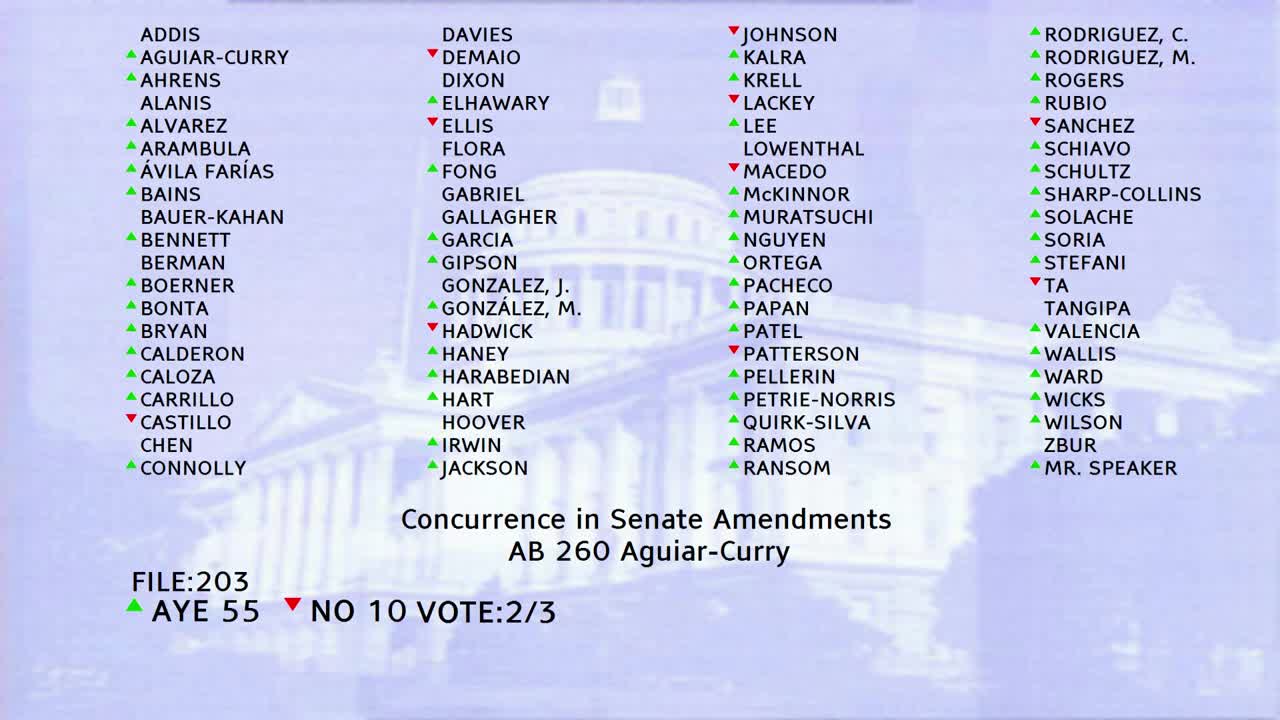 1MIN
Assembly Floor
 2MIN
Senate Floor
 58MIN
Senate Standing Committee on Natural Resources and Water
 14MIN
Assembly Floor
 2MIN
Assembly Standing Committee on Appropriations
 36MIN
Assembly Standing Committee on Water, Parks, and Wildlife
Bill Author