AB 2635: Air pollution: small off-road engines: voucher programs: local regulation.
- Session Year: 2025-2026
- House: Assembly
- Latest Version Date: 2026-09-01
Current Status:
Failed
(2026-09-20: Vetoed by Governor.)
Introduced
In Committee
Awaiting First Chamber Vote
Passed First Chamber
In Committee
Awaiting Second Chamber Vote
Passed Second Chamber
Enacted
Existing law requires the State Air Resources Board, by July 1, 2022, consistent with federal law, to adopt cost-effective and technologically feasible regulations to prohibit engine exhaust and evaporative emissions from new small off-road engines, as defined by the state board. Existing law requires those regulations to apply to engines produced on or after January 1, 2024, or as soon as the state board determines is feasible, whichever is later, and requires the state board to identify, and, to the extent feasible, make available, funding for commercial rebates or similar incentive funding, as specified.
This bill would require, to the extent that funding is appropriated by the Legislature, each large and medium air pollution control and air quality management district, no later than January 1, 2028, to implement and maintain a commercial voucher program to support the transition to zero-emission small off-road equipment consistent with specified requirements. By requiring districts to establish a new program, the bill would impose a state-mandated local program. The bill would also require a small rural district or local government that chooses to adopt such a program to comply with specified requirements in administering the program.
This bill would prohibit the punishment of a violation of an ordinance adopted by a local government governing the use of any small off-road engine landscaping equipment as an infraction or misdemeanor, and would provide that the ordinance is only punishable by an administrative fine imposed in accordance with specified requirements.
Existing constitutional provisions require that a statute that limits the right of access to the meetings of public bodies or the writings of public officials and agencies be adopted with findings demonstrating the interest protected by the limitation and the need for protecting that interest.
This bill would make legislative findings to that effect.
The bill would include findings that changes proposed by this bill address a matter of statewide concern rather than a municipal affair and, therefore, apply to all cities, including charter cities.
The California Constitution requires the state to reimburse local agencies and school districts for certain costs mandated by the state. Statutory provisions establish procedures for making that reimbursement.
This bill would provide that, if the Commission on State Mandates determines that the bill contains costs mandated by the state, reimbursement for those costs shall be made pursuant to the statutory provisions noted above.
Existing law requires the State Air Resources Board, by July 1, 2022, consistent with federal law, to adopt cost-effective and technologically feasible regulations to prohibit engine exhaust and evaporative emissions from new small off-road engines, as defined by the state board. Existing law requires those regulations to apply to engines produced on or after January 1, 2024, or as soon as the state board determines is feasible, whichever is later, and requires the state board to identify, and, to the extent feasible, make available, funding for commercial rebates or similar incentive funding, as specified.
This bill would require, to the extent that funding is available, appropriated by the Legislature, each large and medium air pollution control and air quality management district, no later than January 1, 2028, to implement and maintain a commercial voucher program to support the transition to zero-emission small off-road equipment consistent with specified requirements. By requiring districts to establish a new program, the bill would impose a state-mandated local program. The bill would also require a small rural district or local government that chooses to adopt such a program to comply with specified requirements in administering the program.
This bill would prohibit a local government, until January 31, 2032, from adopting or enforcing an ordinance that prohibits the use of small off-road engine landscaping equipment unless the district in which the local government is located offers commercial vouchers pursuant to the above-described program or the local government implements an incentive voucher program that complies with specified requirements. The bill would prohibit the punishment of a violation of an ordinance adopted by a local government governing the use of any small off-road engine landscaping equipment as an infraction or misdemeanor, and would provide that the ordinance is only punishable by an administrative fine imposed in accordance with specified requirements.
Existing constitutional provisions require that a statute that limits the right of access to the meetings of public bodies or the writings of public officials and agencies be adopted with findings demonstrating the interest protected by the limitation and the need for protecting that interest.
This bill would make legislative findings to that effect.
The bill would include findings that changes proposed by this bill address a matter of statewide concern rather than a municipal affair and, therefore, apply to all cities, including charter cities.
The California Constitution requires the state to reimburse local agencies and school districts for certain costs mandated by the state. Statutory provisions establish procedures for making that reimbursement.
This bill would provide that, if the Commission on State Mandates determines that the bill contains costs mandated by the state, reimbursement for those costs shall be made pursuant to the statutory provisions noted above.
Existing law requires the State Air Resources Board, by July 1, 2022, consistent with federal law, to adopt cost-effective and technologically feasible regulations to prohibit engine exhaust and evaporative emissions from new small off-road engines, as defined by the state board. Existing law requires those regulations to apply to engines produced on or after January 1, 2024, or as soon as the state board determines is feasible, whichever is later, and requires the state board to identify, and, to the extent feasible, make available, funding for commercial rebates or similar incentive funding, as specified.
This bill would require require, to the extent that funding is available, each large and medium air pollution control and air quality management district, no later than January 1, 2028, to implement and maintain a commercial voucher program to support the transition to zero-emission small off-road equipment consistent with specified requirements. By requiring districts to establish a new program, the bill would impose a state-mandated local program. The bill would also require a small rural district or local government that chooses to adopt such a program to comply with specified requirements in administering the program.
This bill would prohibit a local government government, until January 31, 2032, from adopting or enforcing an ordinance that prohibits the use of small off-road engine landscaping equipment unless the district in which the local government is located offers commercial vouchers pursuant to the above-described program or the local government implements an incentive voucher program that complies with specified requirements. The bill would prohibit the punishment of a violation of an ordinance adopted by a local government governing the use of any small off-road engine landscaping equipment as an infraction or misdemeanor, and would provide that the ordinance is only punishable by an administrative fine imposed in accordance with specified requirements.
Existing constitutional provisions require that a statute that limits the right of access to the meetings of public bodies or the writings of public officials and agencies be adopted with findings demonstrating the interest protected by the limitation and the need for protecting that interest.
This bill would make legislative findings to that effect.
The bill would include findings that changes proposed by this bill address a matter of statewide concern rather than a municipal affair and, therefore, apply to all cities, including charter cities.
The California Constitution requires the state to reimburse local agencies and school districts for certain costs mandated by the state. Statutory provisions establish procedures for making that reimbursement.
This bill would provide that, if the Commission on State Mandates determines that the bill contains costs mandated by the state, reimbursement for those costs shall be made pursuant to the statutory provisions noted above.
Existing law requires the State Air Resources Board, by July 1, 2022, consistent with federal law, to adopt cost-effective and technologically feasible regulations to prohibit engine exhaust and evaporative emissions from new small off-road engines, as defined by the state board. Existing law requires those regulations to apply to engines produced on or after January 1, 2024, or as soon as the state board determines is feasible, whichever is later, and requires the state board to identify, and, to the extent feasible, make available, funding for commercial rebates or similar incentive funding, as specified.
This bill would require each large and medium air pollution control and air quality management district, no later than January 1, 2028, to implement and maintain a commercial voucher program to support the transition to zero-emission small off-road equipment consistent with specified requirements. By requiring districts to establish a new program, the bill would impose a state-mandated local program. The bill would also require a small rural district or local government that chooses to adopt such a program to comply with specified requirements in administering the program.
This bill would prohibit a local government from adopting or enforcing an ordinance that prohibits the use of small off-road engine landscaping equipment unless the district in which the local government is located offers commercial vouchers pursuant to the above-described program or the local government implements an incentive voucher program that complies with specified requirements. The bill would prohibit the punishment of a violation of an ordinance adopted by a local government governing the use of any small off-road engine landscaping equipment as an infraction or misdemeanor, and would provide that the ordinance is only punishable by an administrative fine imposed in accordance with specified requirements.
Existing constitutional provisions require that a statute that limits the right of access to the meetings of public bodies or the writings of public officials and agencies be adopted with findings demonstrating the interest protected by the limitation and the need for protecting that interest.
This bill would make legislative findings to that effect.
The bill would include findings that changes proposed by this bill address a matter of statewide concern rather than a municipal affair and, therefore, apply to all cities, including charter cities.
The California Constitution requires the state to reimburse local agencies and school districts for certain costs mandated by the state. Statutory provisions establish procedures for making that reimbursement.
This bill would provide that, if the Commission on State Mandates determines that the bill contains costs mandated by the state, reimbursement for those costs shall be made pursuant to the statutory provisions noted above.
Existing law requires the State Air Resources Board, by July 1, 2022, consistent with federal law, to adopt cost-effective and technologically feasible regulations to prohibit engine exhaust and evaporative emissions from new small off-road engines, as defined by the state board. Existing law requires those regulations to apply to engines produced on or after January 1, 2024, or as soon as the state board determines is feasible, whichever is later, and requires the state board to identify, and, to the extent feasible, make available, funding for commercial rebates or similar incentive funding, as specified.
This bill would require each large and medium air pollution control and air quality management district, no later than January 1, 2028, to implement and maintain a commercial rebate voucher program to support the transition to zero-emission small off-road equipment consistent with specified requirements. By requiring districts to establish a new program, the bill would impose a state-mandated local program. The bill would also require a small rural district or local government that chooses to adopt such a program to comply with specified requirements in administering the program.
This bill would prohibit, until January 1, 2032, prohibit a local government from adopting or enforcing an ordinance that prohibits the use of small off-road engine landscaping equipment, except as specified, and equipment unless the local government implements an incentive voucher program that complies with specified requirements. The bill would prohibit the punishment of a violation of an ordinance adopted by a local government governing the use of any small off-road engine landscaping equipment as an infraction or misdemeanor, as specified. and would provide that the ordinance is only punishable by an administrative fine imposed in accordance with specified requirements.
Existing constitutional provisions require that a statute that limits the right of access to the meetings of public bodies or the writings of public officials and agencies be adopted with findings demonstrating the interest protected by the limitation and the need for protecting that interest.
This bill would make legislative findings to that effect.
The bill would include findings that changes proposed by this bill address a matter of statewide concern rather than a municipal affair and, therefore, apply to all cities, including charter cities.
The California Constitution requires the state to reimburse local agencies and school districts for certain costs mandated by the state. Statutory provisions establish procedures for making that reimbursement.
This bill would provide that, if the Commission on State Mandates determines that the bill contains costs mandated by the state, reimbursement for those costs shall be made pursuant to the statutory provisions noted above.
Existing law requires the State Air Resources Board, by July 1, 2022, consistent with federal law, to adopt cost-effective and technologically feasible regulations to prohibit engine exhaust and evaporative emissions from new small off-road engines, as defined by the state board. Existing law requires those regulations to apply to engines produced on or after January 1, 2024, or as soon as the state board determines is feasible, whichever is later, and requires the state board to identify, and, to the extent feasible, make available, funding for commercial rebates or similar incentive funding, as specified.
This bill would require each air pollution control and air quality management district, no later than January 1, 2028, to implement and maintain a commercial rebate program to support the transition to zero-emission small off-road equipment consistent with specified requirements. By requiring districts to establish a new program, the bill would impose a state-mandated local program.
This bill would prohibit, until January 1, 2032, a local government from adopting or enforcing an ordinance that prohibits the use of small off-road engine landscaping equipment, except as specified, and would prohibit the punishment of a violation of an ordinance adopted by a local government governing the use of any small off-road engine landscaping equipment as an infraction or misdemeanor, as specified.
Existing constitutional provisions require that a statute that limits the right of access to the meetings of public bodies or the writings of public officials and agencies be adopted with findings demonstrating the interest protected by the limitation and the need for protecting that interest.
This bill would make legislative findings to that effect.
The bill would include findings that changes proposed by this bill address a matter of statewide concern rather than a municipal affair and, therefore, apply to all cities, including charter cities.
The California Constitution requires the state to reimburse local agencies and school districts for certain costs mandated by the state. Statutory provisions establish procedures for making that reimbursement.
This bill would provide that, if the Commission on State Mandates determines that the bill contains costs mandated by the state, reimbursement for those costs shall be made pursuant to the statutory provisions noted above.
This act shall be known, and may be cited, as the Just Transition for Landscapers Act.
SEC. 2.(a)The Legislature finds and declares all of the following:
(1)Hundreds of thousands of Californians earn their livelihoods as landscapers, providing essential services that maintain and beautify residential, commercial, and public spaces throughout the state. The landscaping industry encompasses a wide variety of jobs, including, but not limited to, mowing, blowing, fertilization, weed control, aeration, and tree trimming. This includes everything from residential gardens to larger commercial grounds.
(2)A majority of landscapers are immigrants or informal workers who often decide to enter the landscaping industry after being excluded from other sectors of the economy. These workers contribute significantly to the states economy and environmental stewardship while supporting their families and communities. Landscapers experience persistent and overlapping challenges, including unsafe working conditions, wage theft, exploitative employment arrangements, language barriers, and criminalization associated with informal work status. These challenges are compounded by fear of interaction with government agencies and heightened risks of immigration enforcement, resulting in increased economic and employment instability.
(3)Gas-powered small off-road engines (SOREs) are often used in landscaping equipment and are a significant source of localized air pollution. They emit nitrogen oxides, particulate matter, and greenhouse gases, which contribute to climate change and disproportionately impact low-income communities and communities of color that are already overburdened by environmental pollution.
(4)In 2021, the Legislature enacted Assembly Bill 1346 (Chapter 753 of the Statutes of 2021), which phases out the sale of new gas-powered SOREs beginning in 2024 and directs the State Air Resources Board to develop incentive programs that, to the extent feasible, make available funding for commercial rebates to support the transition to zero-emission small off-road equipment.
(5)Existing rebate programs are insufficient, unevenly implemented, and inaccessible to many immigrant landscapers due to requirements such as business licensing, language barriers, fear of interacting with government agencies, and significant upfront costs. As a result, this leaves many workers without a viable pathway to a full and just transition that allows them to support their families and communities.
(6)Some local jurisdictions have implemented ordinances restricting or prohibiting the use of gas-powered equipment to cut pollution and noise. Without adequate access to transition assistance, these enforcement mechanisms impose fines and fees that disproportionately impact immigrant and informal landscapers, creating cycles of debt, worsening economic instability, and slowing the transition to zero-emission equipment.
(7)Premature enforcement through fines and penalties, in the absence of accessible transition assistance, risks discouraging compliance, increasing informal economic activity, prolonging pollution, and delaying the replacement of gas equipment.
(8)This act applies to any city, county, or city and county, including a charter city. The fines and penalties imposed on landscapers and the challenges these workers face as a result of their informal work status, including challenges resulting from licensing requirements, are matters of statewide concern. Furthermore, unnecessary barriers that prevent landscapers from accessing vouchers and incentives to transition to zero-emission equipment interfere with the achievement of Californias climate goals and disrupt the regulation of business, which are matters of statewide concern. Moreover, California has an interest in the regulation of emissions, air quality, and public health, all matters of statewide concern, because they affect landscapers and residents across all communities.
(9)Californias climate and air quality goals are best achieved through policies that promote widespread, sustained adoption of zero-emission technologies. Ensuring that landscapers who rely on small off-road equipment have sufficient time, resources, and support to transition to zero-emission alternatives is essential to achieving meaningful and lasting emissions reductions.
(b)It is the intent of the Legislature to promote environmental protection, public health, economic stability and mobility, and support immigrant and informal landscapers in accessing the resources necessary to transition to zero-emission landscaping equipment.
SEC. 3.Section 43018.12 is added to the Health and Safety Code, to read:43018.12.(a)For purposes of this section, the following definitions apply:
(1)Large district means a district with a population of 1,000,000 or more.
(2)Local government means a chartered or general law city, county, or city and county.
(3)Medium district means a district with a population of less than 1,000,000 that is not a small rural district.
(4)Personally identifiable information means an individuals name, business name, home address, business address, birth date, telephone number, business location, California drivers license or identification number, individual taxpayer identification number, municipal identification number, government-issued identification number, consular identification, social media identifiers, employer identification number, business license number, social security number, known place of work, income and tax information, and any other information that would identify the individual.
(5)Small off-road engine equipment means off-road spark-ignition engines that produce 19 kilowatts gross power or less (25 horsepower or less).
(6)Small off-road engine landscaping equipment means small off-road engine equipment commonly used in landscaping operations, including lawn and garden equipment such as lawn mowers, leaf blowers, trimmers, weed whackers, aerators, chainsaws, edgers, and other turf care tools. Small off-road engine landscaping equipment does not include golf carts, specialty vehicles, generators, pumps, and logging, airport ground support, and other small utility equipment.
(7)Small rural district means a district with a population of less than 1,000,000 and that is designated as rural by the California Air Pollution Control Officers Association consistent with the following criteria:
(A)A small rural district is typically characterized by a smaller population base relative to medium and large districts.
(B)A small rural district has limited staffing and administrative capacity relative to medium and large districts.
(8)Worker center means a nonprofit or community-based organization that serves workers through outreach, education, training, and workforce development, and has demonstrated a history of working with individuals employed or self-employed in landscaping.
(b)(1)No later than January 1, 2028, to the extent that funding is appropriated by the Legislature in the annual Budget Act or other statute for purposes of this paragraph, each large and medium district shall implement and maintain a commercial voucher program to support the transition to zero-emission small off-road equipment consistent with all of the following:
(A)The district shall recognize and accept alternative forms of documentation in place of a business license for eligibility verification. Acceptable documentation may include, but is not limited to, a letter from a worker center confirming the applicants employment or self-employment in landscaping, or self-attestation stating the applicants work in commercial and residential landscaping.
(B)The district shall not require that a business hold a business license for a minimum period before submitting an application.
(C)The district shall establish low-burden procedures to review and verify any required documentation in a manner that is equitable for landscapers and shall provide language assistance in the top five non-English languages spoken within the districts service area.
(D)The district shall not inquire into or collect information about an individuals immigration or citizenship status or place of birth.
(E)The district shall not inquire into or collect information or documentation regarding an individuals criminal history, and shall not require an applicant to submit fingerprints, complete a LiveScan fingerprinting, or submit to a background check as part of an application for a voucher.
(F)Unless the district is using funds appropriated specifically for purposes of implementing this section, the district shall ensure that any existing district incentive funds used to implement this subdivision achieve emissions reductions that are cost effective relative to other allowable uses of those funds.
(2)Paragraph (1) does not prohibit a district from implementing or maintaining a commercial voucher program using any other available funds notwithstanding the absence of an appropriation made for purposes of paragraph (1).
(3)Except as otherwise required by state or federal law, a district shall not provide voluntary consent to any individual to access, review, or obtain any of the records obtained in connection with a program described in paragraph (1) that include personally identifiable information of any voucher participants without a subpoena or judicial warrant. This paragraph does not prohibit a district from challenging the validity of a subpoena or judicial warrant in a federal district court.
(4)A district shall not disclose or provide in writing, verbally, or in any other manner, personally identifiable information of any voucher participant obtained in connection with a program described in paragraph (1), except pursuant to a subpoena or a valid judicial warrant.
(5)If a small rural district or local government adopts a program described in paragraph (1), it shall comply with subparagraph (A) of paragraph (1) in administering the program.
(6)On and after January 1, 2028, a contract between a nonpublic entity and a large or medium district for the purpose of administering a program pursuant to paragraph (1) shall require the nonpublic entity to explicitly agree to adhere to the requirements of this subdivision, and shall be immediately terminated if it is found that the nonpublic entity has violated this subdivision.
(c)(1)A violation of an ordinance adopted by a local government governing the use of any small off-road engine landscaping equipment shall not be punishable as an infraction or misdemeanor, and a person shall not be subject to arrest for an alleged violation of the ordinance.
(2)For purposes of this subdivision, a violation shall be deemed to occur no more than once per property or job site per calendar day. The use of multiple pieces of small off-road engine landscaping equipment, the involvement of multiple persons, or multiple observations of the same conduct shall not constitute separate violations arising from the same landscaping activity.
(3)A violation of an ordinance described in paragraph (1) is punishable only by the following:
(A)A written warning for a first violation.
(B)An administrative fine not exceeding one hundred dollars ($100) for a second violation within one year of the first violation.
(C)An administrative fine not exceeding two hundred dollars ($200) for each additional violation within one year of the first violation.
(4)When assessing an administrative fine pursuant to paragraph (3), the adjudicator shall take into consideration the persons ability to pay the fine. The local government shall provide the person with notice of their right to request an ability-to-pay determination and shall make available instructions or other materials for requesting an ability-to-pay determination. The person may request an ability-to-pay determination at adjudication or while the judgment remains unpaid, including when a case is delinquent or has been referred to a comprehensive collection program.
(5)If the person meets the criteria described in subdivision (a) or (b) of Section 68632 of the Government Code, the local government shall accept, in full satisfaction, 20 percent of the administrative fine imposed pursuant to paragraph (3).
(6)The local government may allow the person to complete community service in lieu of paying the total administrative fine, may waive the administrative fine, or may offer an alternative disposition.
SEC. 4.The Legislature finds and declares that Section 3 of this act, which adds Section 43018.12 to the Health and Safety Code, imposes a limitation on the publics right of access to the meetings of public bodies or the writings of public officials and agencies within the meaning of Section 3 of Article I of the California Constitution. Pursuant to that constitutional provision, the Legislature makes the following findings to demonstrate the interest protected by this limitation and the need for protecting that interest:
In order to protect the privacy of participants in the voucher programs described in Section 3 of this act, the limitations on the publics right of access imposed by Section 3 of this act are necessary.
SEC. 5.The Legislature finds and declares that, for the reasons described in paragraph (8) of subdivision (a) of Section 2 of this act, the regulation of the use of gas-powered landscaping equipment is a matter of statewide concern and is not a municipal affair as that term is used in Section 5 of Article XI of the California Constitution. Therefore, Section 3 of this act adding Section 43018.12 to the Health and Safety Code applies to all cities, including charter cities.
SEC. 6.If the Commission on State Mandates determines that this act contains costs mandated by the state, reimbursement to local agencies and school districts for those costs shall be made pursuant to Part 7 (commencing with Section 17500) of Division 4 of Title 2 of the Government Code.
This act shall be known, and may be cited, as the Just Transition for Landscapers Act.
SEC. 2.(a)The Legislature finds and declares all of the following:
(1)Hundreds of thousands of Californians earn their livelihoods as landscapers, providing essential services that maintain and beautify residential, commercial, and public spaces throughout the state. The landscaping industry encompasses a wide variety of jobs, including, but not limited to, mowing, blowing, fertilization, weed control, aeration, and tree trimming. This includes everything from residential gardens to larger commercial grounds.
(2)A majority of landscapers are immigrants or informal workers who often decide to enter the landscaping industry after being excluded from other sectors of the economy. These workers contribute significantly to the states economy and environmental stewardship while supporting their families and communities. Landscapers experience persistent and overlapping challenges, including unsafe working conditions, wage theft, exploitative employment arrangements, language barriers, and criminalization associated with informal work status. These challenges are compounded by fear of interaction with government agencies and heightened risks of immigration enforcement, resulting in increased economic and employment instability.
(3)Gas-powered small off-road engines (SOREs) are often used in landscaping equipment and are a significant source of localized air pollution. They emit nitrogen oxides, particulate matter, and greenhouse gases, which contribute to climate change and disproportionately impact low-income communities and communities of color that are already overburdened by environmental pollution.
(4)In 2021, the Legislature enacted Assembly Bill 1346 (Chapter 753 of the Statutes of 2021), which phases out the sale of new gas-powered SOREs beginning in 2024 and directs the State Air Resources Board to develop incentive programs that, to the extent feasible, make available funding for commercial rebates to support the transition to zero-emission small off-road equipment.
(5)Existing rebate programs are insufficient, unevenly implemented, and inaccessible to many immigrant landscapers due to requirements such as business licensing, language barriers, fear of interacting with government agencies, and significant upfront costs. As a result, this leaves many workers without a viable pathway to a full and just transition that allows them to support their families and communities.
(6)Some local jurisdictions have implemented ordinances restricting or prohibiting the use of gas-powered equipment to cut pollution and noise. Without adequate access to transition assistance, these enforcement mechanisms impose fines and fees that disproportionately impact immigrant and informal landscapers, creating cycles of debt, worsening economic instability, and slowing the transition to zero-emission equipment.
(7)Premature enforcement through fines and penalties, in the absence of accessible transition assistance, risks discouraging compliance, increasing informal economic activity, prolonging pollution, and delaying the replacement of gas equipment.
(8)This act applies to any city, county, or city and county, including a charter city. The fines and penalties imposed on landscapers and the challenges these workers face as a result of their informal work status, including challenges resulting from licensing requirements, are matters of statewide concern. Furthermore, unnecessary barriers that prevent landscapers from accessing vouchers and incentives to transition to zero-emission equipment interfere with the achievement of Californias climate goals and disrupt the regulation of business, which are matters of statewide concern. Moreover, California has an interest in the regulation of emissions, air quality, and public health, all matters of statewide concern, because they affect landscapers and residents across all communities.
(9)Californias climate and air quality goals are best achieved through policies that promote widespread, sustained adoption of zero-emission technologies. Ensuring that landscapers who rely on small off-road equipment have sufficient time, resources, and support to transition to zero-emission alternatives is essential to achieving meaningful and lasting emissions reductions.
(b)It is the intent of the Legislature to promote environmental protection, public health, economic stability and mobility, and support immigrant and informal landscapers in accessing the resources necessary to transition to zero-emission landscaping equipment.
SEC. 3.Section 43018.12 is added to the Health and Safety Code, to read:43018.12.(a)For purposes of this section, the following definitions apply:
(1)Large district means a district with a population of 1,000,000 or more.
(2)Local government means a chartered or general law city, county, or city and county.
(3)Medium district means a district with a population of less than 1,000,000 that is not a small rural district.
(4)Personally identifiable information means an individuals name, business name, home address, business address, birth date, telephone number, business location, California drivers license or identification number, individual taxpayer identification number, municipal identification number, government-issued identification number, consular identification, social media identifiers, employer identification number, business license number, social security number, known place of work, income and tax information, and any other information that would identify the individual.
(5)Small off-road engine equipment means off-road spark-ignition engines that produce 19 kilowatts gross power or less (25 horsepower or less).
(6)Small off-road engine landscaping equipment means small off-road engine equipment commonly used in landscaping operations, including lawn and garden equipment such as lawn mowers, leaf blowers, trimmers, weed whackers, aerators, chainsaws, edgers, and other turf care tools. Small off-road engine landscaping equipment does not include golf carts, specialty vehicles, generators, pumps, and logging, airport ground support, and other small utility equipment.
(7)Small rural district means a district with a population of less than 1,000,000 and that is designated as rural by the California Air Pollution Control Officers Association consistent with the following criteria:
(A)A small rural district is typically characterized by a smaller population base relative to medium and large districts.
(B)A small rural district has limited staffing and administrative capacity relative to medium and large districts.
(8)Worker center means a nonprofit or community-based organization that serves workers through outreach, education, training, and workforce development, and has demonstrated a history of working with individuals employed or self-employed in landscaping.
(b)(1)No later than January 1, 2028, to the extent that funding is appropriated by the Legislature in the annual Budget Act or other statute for purposes of this paragraph, each large and medium district shall implement and maintain a commercial voucher program to support the transition to zero-emission small off-road equipment consistent with all of the following:
(A)The district shall recognize and accept alternative forms of documentation in place of a business license for eligibility verification. Acceptable documentation may include, but is not limited to, a letter from a worker center confirming the applicants employment or self-employment in landscaping, or self-attestation stating the applicants work in commercial and residential landscaping.
(B)The district shall not require that a business hold a business license for a minimum period before submitting an application.
(C)The district shall establish low-burden procedures to review and verify any required documentation in a manner that is equitable for landscapers, landscapers and shall provide language assistance when requested. in the top five non-English languages spoken within the districts service area.
(D)The district shall not inquire into or collect information about an individuals immigration or citizenship status or place of birth.
(E)The district shall not inquire into or collect information or documentation regarding an individuals criminal history, and shall not require an applicant to submit fingerprints, complete a LiveScan fingerprinting, or submit to a background check as part of an application for a voucher.
(F)Unless the district is using funds appropriated specifically for purposes of implementing this section, the district shall ensure that any existing district incentive funds used to implement this subdivision achieve emissions reductions that are cost effective relative to other allowable uses of those funds.
(2)Paragraph (1) does not prohibit a district from implementing or maintaining a commercial voucher program using any other available funds notwithstanding the absence of an appropriation made for purposes of paragraph (1).
(3)Except as otherwise required by state or federal law, a district shall not provide voluntary consent to any individual to access, review, or obtain any of the records obtained in connection with a program described in paragraph (1) that include personally identifiable information of any voucher participants without a subpoena or judicial warrant. This paragraph does not prohibit a district from challenging the validity of a subpoena or judicial warrant in a federal district court.
(4)A district shall not disclose or provide in writing, verbally, or in any other manner, personally identifiable information of any voucher participant obtained in connection with a program described in paragraph (1), except pursuant to a subpoena or a valid judicial warrant.
(5)If a small rural district or local government adopts a program described in paragraph (1), it shall comply with subparagraph (A) of paragraph (1) in administering the program.
(6)On and after January 1, 2028, a contract between a nonpublic entity and a large or medium district for the purpose of administering a program pursuant to paragraph (1) shall require the nonpublic entity to explicitly agree to adhere to the requirements of this subdivision, and shall be immediately terminated if it is found that the nonpublic entity has violated this subdivision.
(c)(1)A violation of an ordinance adopted by a local government governing the use of any small off-road engine landscaping equipment shall not be punishable as an infraction or misdemeanor, and a person shall not be subject to arrest for an alleged violation of the ordinance.
(2)For purposes of this subdivision, a violation shall be deemed to occur no more than once per property or job site per calendar day. The use of multiple pieces of small off-road engine landscaping equipment, the involvement of multiple persons, or multiple observations of the same conduct shall not constitute separate violations arising from the same landscaping activity.
(3)A violation of an ordinance described in paragraph (1) is punishable only by the following:
(A)A written warning for a first violation.
(B)An administrative fine not exceeding one hundred dollars ($100) for a second violation within one year of the first violation.
(C)An administrative fine not exceeding two hundred dollars ($200) for each additional violation within one year of the first violation.
(4)When assessing an administrative fine pursuant to paragraph (3), the adjudicator shall take into consideration the persons ability to pay the fine. The local government shall provide the person with notice of their right to request an ability-to-pay determination and shall make available instructions or other materials for requesting an ability-to-pay determination. The person may request an ability-to-pay determination at adjudication or while the judgment remains unpaid, including when a case is delinquent or has been referred to a comprehensive collection program.
(5)If the person meets the criteria described in subdivision (a) or (b) of Section 68632 of the Government Code, the local government shall accept, in full satisfaction, 20 percent of the administrative fine imposed pursuant to paragraph (3).
(6)The local government may allow the person to complete community service in lieu of paying the total administrative fine, may waive the administrative fine, or may offer an alternative disposition.
SEC. 4.The Legislature finds and declares that Section 3 of this act, which adds Section 43018.12 to the Health and Safety Code, imposes a limitation on the publics right of access to the meetings of public bodies or the writings of public officials and agencies within the meaning of Section 3 of Article I of the California Constitution. Pursuant to that constitutional provision, the Legislature makes the following findings to demonstrate the interest protected by this limitation and the need for protecting that interest:
In order to protect the privacy of participants in the voucher programs described in Section 3 of this act, the limitations on the publics right of access imposed by Section 3 of this act are necessary.
SEC. 5.The Legislature finds and declares that, for the reasons described in paragraph (8) of subdivision (a) of Section 2 of this act, the regulation of the use of gas-powered landscaping equipment is a matter of statewide concern and is not a municipal affair as that term is used in Section 5 of Article XI of the California Constitution. Therefore, Section 3 of this act adding Section 43018.12 to the Health and Safety Code applies to all cities, including charter cities.
SEC. 6.If the Commission on State Mandates determines that this act contains costs mandated by the state, reimbursement to local agencies and school districts for those costs shall be made pursuant to Part 7 (commencing with Section 17500) of Division 4 of Title 2 of the Government Code.
This act shall be known, and may be cited, as the Just Transition for Landscapers Act.
SEC. 2.(a)The Legislature finds and declares all of the following:
(1)Hundreds of thousands of Californians earn their livelihoods as landscapers, providing essential services that maintain and beautify residential, commercial, and public spaces throughout the state. The landscaping industry encompasses a wide variety of jobs, including, but not limited to, mowing, blowing, fertilization, weed control, aeration, and tree trimming. This includes everything from residential gardens to larger commercial grounds.
(2)A majority of landscapers are immigrants or informal workers who often decide to enter the landscaping industry after being excluded from other sectors of the economy. These workers contribute significantly to the states economy and environmental stewardship while supporting their families and communities. Landscapers experience persistent and overlapping challenges, including unsafe working conditions, wage theft, exploitative employment arrangements, language barriers, and criminalization associated with informal work status. These challenges are compounded by fear of interaction with government agencies and heightened risks of immigration enforcement, resulting in increased economic and employment instability.
(3)Gas-powered small off-road engines (SOREs) are often used in landscaping equipment and are a significant source of localized air pollution. They emit nitrogen oxides, particulate matter, and greenhouse gases, which contribute to climate change and disproportionately impact low-income communities and communities of color that are already overburdened by environmental pollution.
(4)In 2021, the Legislature enacted Assembly Bill 1346 (Chapter 753 of the Statutes of 2021), which phases out the sale of new gas-powered SOREs beginning in 2024 and directs the State Air Resources Board to develop incentive programs that, to the extent feasible, make available funding for commercial rebates to support the transition to zero-emission small off-road equipment.
(5)Existing rebate programs are insufficient, unevenly implemented, and inaccessible to many immigrant landscapers due to requirements such as business licensing, language barriers, fear of interacting with government agencies, and significant upfront costs. As a result, this leaves many workers without a viable pathway to a full and just transition that allows them to support their families and communities.
(6)Some local jurisdictions have implemented ordinances restricting or prohibiting the use of gas-powered equipment to cut pollution and noise. Without adequate access to transition assistance, these enforcement mechanisms impose fines and fees that disproportionately impact immigrant and informal landscapers, creating cycles of debt, worsening economic instability, and slowing the transition to zero-emission equipment.
(7)Premature enforcement through fines and penalties, in the absence of accessible transition assistance, risks discouraging compliance, increasing informal economic activity, prolonging pollution, and delaying the replacement of gas equipment.
(8)This act applies to any city, county, or city and county, including a charter city. The fines and penalties imposed on landscapers and the challenges these workers face as a result of their informal work status, including challenges resulting from licensing requirements, are matters of statewide concern. Furthermore, unnecessary barriers that prevent landscapers from accessing vouchers and incentives to transition to zero-emission equipment interfere with the achievement of Californias climate goals and disrupt the regulation of business, which are matters of statewide concern. Moreover, California has an interest in the regulation of emissions, air quality, and public health, all matters of statewide concern, because they affect landscapers and residents across all communities.
(9)Californias climate and air quality goals are best achieved through policies that promote widespread, sustained adoption of zero-emission technologies. Ensuring that landscapers who rely on small off-road equipment have sufficient time, resources, and support to transition to zero-emission alternatives is essential to achieving meaningful and lasting emissions reductions.
(b)It is the intent of the Legislature to promote environmental protection, public health, economic stability and mobility, and support immigrant and informal landscapers in accessing the resources necessary to transition to zero-emission landscaping equipment.
SEC. 3.Section 43018.12 is added to the Health and Safety Code, to read:43018.12.(a)For purposes of this section, the following definitions apply:
(1)Large district means a district with a population of 1,000,000 or more.
(2)Local government means a chartered or general law city, county, or city and county.
(3)Medium district means a district with a population of less than 1,000,000 that is not a small rural district.
(4)Personally identifiable information means an individuals name, business name, home address, business address, birth date, telephone number, business location, California drivers license or identification number, individual taxpayer identification number, municipal identification number, government-issued identification number, consular identification, social media identifiers, employer identification number, business license number, social security number, known place of work, income and tax information, and any other information that would identify the individual.
(5)Small off-road engine equipment means off-road spark-ignition engines that produce 19 kilowatts gross power or less (25 horsepower or less).
(6)Small off-road engine landscaping equipment means small off-road engine equipment commonly used in landscaping operations, including lawn and garden equipment such as lawn mowers, leaf blowers, trimmers, weed whackers, aerators, chainsaws, edgers, and other turf care tools. Small off-road engine landscaping equipment does not include golf carts, specialty vehicles, generators, pumps, and logging, airport ground support, and other small utility equipment.
(7)Small rural district means a district with a population of less than 1,000,000 and that is designated as rural by the California Air Pollution Control Officers Association consistent with the following criteria:
(A)A small rural district is typically characterized by a smaller population base relative to medium and large districts.
(B)A small rural district has limited staffing and administrative capacity relative to medium and large districts.
(8)Worker center means a nonprofit or community-based organization that serves workers through outreach, education, training, and workforce development, and has demonstrated a history of working with individuals employed or self-employed in landscaping.
(b)(1)No later than January 1, 2028, to the extent that funding is available, appropriated by the Legislature in the annual Budget Act or other statute for purposes of this paragraph, each large and medium district shall implement and maintain a commercial voucher program to support the transition to zero-emission small off-road equipment consistent with all of the following:
(A)The district shall recognize and accept alternative forms of documentation in place of a business license for eligibility verification. Acceptable documentation may include, but is not limited to, a letter from a worker center confirming the applicants employment or self-employment in landscaping, or self-attestation stating the applicants work in commercial and residential landscaping.
(B)The district shall not require that a business hold a business license for a minimum period before submitting an application.
(C)The district shall establish low-burden procedures to review and verify any required documentation in a manner that is equitable for landscapers, and shall provide language assistance when requested.
(D)The district shall not inquire into or collect information about an individuals immigration or citizenship status or place of birth.
(E)The district shall not inquire into or collect information or documentation regarding an individuals criminal history, and shall not require an applicant to submit fingerprints, complete a LiveScan fingerprinting, or submit to a background check as part of an application for a voucher.
(F)Unless the district is using funds appropriated specifically for purposes of implementing this section, the district shall ensure that any existing district incentive funds used to implement this subdivision achieve emissions reductions that are cost effective relative to other allowable uses of those funds.
(2)Paragraph (1) does not prohibit a district from implementing or maintaining a commercial voucher program using any other available funds notwithstanding the absence of an appropriation made for purposes of paragraph (1).
(2)(3)Except as otherwise required by state or federal law, a district shall not provide voluntary consent to any individual to access, review, or obtain any of the records obtained in connection with a program described in paragraph (1) that include personally identifiable information of any voucher participants without a subpoena or judicial warrant. This paragraph does not prohibit a district from challenging the validity of a subpoena or judicial warrant in a federal district court.
(3)(4)A district shall not disclose or provide in writing, verbally, or in any other manner, personally identifiable information of any voucher participant obtained in connection with a program described in paragraph (1), except pursuant to a subpoena or a valid judicial warrant.
(4)(5)If a small rural district or local government adopts a program described in paragraph (1), it shall comply with subparagraph (A) of paragraph (1) in administering the program.
(5)(6)On and after January 1, 2028, a contract between a nonpublic entity and a large or medium district for the purpose of administering a program pursuant to paragraph (1) shall require the nonpublic entity to explicitly agree to adhere to the requirements of this subdivision, and shall be immediately terminated if it is found that the nonpublic entity has violated this subdivision.
(c)(1)(A)On and after January 1, 2027, a local government shall not adopt or enforce an ordinance that prohibits the use of small off-road engine landscaping equipment unless the district in which the local government is located offers commercial vouchers pursuant to subdivision (b) or the local government implements an incentive voucher program for landscapers to transition to zero-emission small off-road equipment.(B)This paragraph shall become inoperative on January 31, 2032.(2)(A)(c)(1)A violation of an ordinance adopted by a local government governing the use of any small off-road engine landscaping equipment shall not be punishable as an infraction or misdemeanor, and a person shall not be subject to arrest for an alleged violation of the ordinance.
(2)For purposes of this subdivision, a violation shall be deemed to occur no more than once per property or job site per calendar day. The use of multiple pieces of small off-road engine landscaping equipment, the involvement of multiple persons, or multiple observations of the same conduct shall not constitute separate violations arising from the same landscaping activity.
(B)(3)A violation of an ordinance described in subparagraph (A) paragraph (1) is punishable only by the following:
(i)(A)A written warning for a first violation.
(ii)(B)An administrative fine not exceeding one hundred dollars ($100) for a second violation within one year of the first violation.
(iii)(C)An administrative fine not exceeding two hundred dollars ($200) for each additional violation within one year of the first violation.
(C)(4)When assessing an administrative fine pursuant to subparagraph (B), paragraph (3), the adjudicator shall take into consideration the persons ability to pay the fine. The local government shall provide the person with notice of their right to request an ability-to-pay determination and shall make available instructions or other materials for requesting an ability-to-pay determination. The person may request an ability-to-pay determination at adjudication or while the judgment remains unpaid, including when a case is delinquent or has been referred to a comprehensive collection program.
(D)(5)If the person meets the criteria described in subdivision (a) or (b) of Section 68632 of the Government Code, the local government shall accept, in full satisfaction, 20 percent of the administrative fine imposed pursuant to subparagraph (B). paragraph (3).
(E)(6)The local government may allow the person to complete community service in lieu of paying the total administrative fine, may waive the administrative fine, or may offer an alternative disposition.
SEC. 4.The Legislature finds and declares that Section 3 of this act, which adds Section 43018.12 to the Health and Safety Code, imposes a limitation on the publics right of access to the meetings of public bodies or the writings of public officials and agencies within the meaning of Section 3 of Article I of the California Constitution. Pursuant to that constitutional provision, the Legislature makes the following findings to demonstrate the interest protected by this limitation and the need for protecting that interest:
In order to protect the privacy of participants in the voucher programs described in Section 3 of this act, the limitations on the publics right of access imposed by Section 3 of this act are necessary.
SEC. 5.The Legislature finds and declares that, for the reasons described in paragraph (8) of subdivision (a) of Section 2 of this act, the regulation of the use of gas-powered landscaping equipment is a matter of statewide concern and is not a municipal affair as that term is used in Section 5 of Article XI of the California Constitution. Therefore, Section 3 of this act adding Section 43018.12 to the Health and Safety Code applies to all cities, including charter cities.
SEC. 6.If the Commission on State Mandates determines that this act contains costs mandated by the state, reimbursement to local agencies and school districts for those costs shall be made pursuant to Part 7 (commencing with Section 17500) of Division 4 of Title 2 of the Government Code.
This act shall be known, and may be cited, as the Just Transition for Landscapers Act.
SEC. 2.(a)The Legislature finds and declares all of the following:
(1)Hundreds of thousands of Californians earn their livelihoods as landscapers, providing essential services that maintain and beautify residential, commercial, and public spaces throughout the state. The landscaping industry encompasses a wide variety of jobs, including, but not limited to, mowing, blowing, fertilization, weed control, aeration, and tree trimming. This includes everything from residential gardens to larger commercial grounds.
(2)A majority of landscapers are immigrants or informal workers who often decide to enter the landscaping industry after being excluded from other sectors of the economy. These workers contribute significantly to the states economy and environmental stewardship while supporting their families and communities. Landscapers experience persistent and overlapping challenges, including unsafe working conditions, wage theft, exploitative employment arrangements, language barriers, and criminalization associated with informal work status. These challenges are compounded by fear of interaction with government agencies and heightened risks of immigration enforcement, resulting in increased economic and employment instability.
(3)Gas-powered small off-road engines (SOREs) are often used in landscaping equipment and are a significant source of localized air pollution. They emit nitrogen oxides, particulate matter, and greenhouse gases, which contribute to climate change and disproportionately impact low-income communities and communities of color that are already overburdened by environmental pollution.
(4)In 2021, the Legislature enacted Assembly Bill 1346 (Chapter 753 of the Statutes of 2021), which phases out the sale of new gas-powered SOREs beginning in 2024 and directs the State Air Resources Board to develop incentive programs that, to the extent feasible, make available funding for commercial rebates to support the transition to zero-emission small off-road equipment.
(5)Existing rebate programs are insufficient, unevenly implemented, and inaccessible to many immigrant landscapers due to requirements such as business licensing, language barriers, fear of interacting with government agencies, and significant upfront costs. As a result, this leaves many workers without a viable pathway to a full and just transition that allows them to support their families and communities.
(6)Some local jurisdictions have implemented ordinances restricting or prohibiting the use of gas-powered equipment to cut pollution and noise. Without adequate access to transition assistance, these enforcement mechanisms impose fines and fees that disproportionately impact immigrant and informal landscapers, creating cycles of debt, worsening economic instability, and slowing the transition to zero-emission equipment.
(7)Premature enforcement through fines and penalties, in the absence of accessible transition assistance, risks discouraging compliance, increasing informal economic activity, prolonging pollution, and delaying the replacement of gas equipment.
(8)This act applies to any city, county, or city and county, including a charter city. The fines and penalties imposed on landscapers and the challenges these workers face as a result of their informal work status, including challenges resulting from licensing requirements, are matters of statewide concern. Furthermore, unnecessary barriers that prevent landscapers from accessing vouchers and incentives to transition to zero-emission equipment interfere with the achievement of Californias climate goals and disrupt the regulation of business, which are matters of statewide concern. Moreover, California has an interest in the regulation of emissions, air quality, and public health, all matters of statewide concern, because they affect landscapers and residents across all communities.
(9)Californias climate and air quality goals are best achieved through policies that promote widespread, sustained adoption of zero-emission technologies. Ensuring that landscapers who rely on small off-road equipment have sufficient time, resources, and support to transition to zero-emission alternatives is essential to achieving meaningful and lasting emissions reductions.
(b)It is the intent of the Legislature to promote environmental protection, public health, economic stability and mobility, and support immigrant and informal landscapers in accessing the resources necessary to transition to zero-emission landscaping equipment.
SEC. 3.Section 43018.12 is added to the Health and Safety Code, to read:43018.12.(a)For purposes of this section, the following definitions apply:
(1)Large district means a district with a population of 1,000,000 or more.
(2)Local government means a chartered or general law city, county, or city and county.
(3)Medium district means a district with a population of less than 1,000,000 that is not a small rural district.
(4)Personally identifiable information means an individuals name, business name, home address, business address, birth date, telephone number, business location, California drivers license or identification number, individual taxpayer identification number, municipal identification number, government-issued identification number, consular identification, social media identifiers, employer identification number, business license number, social security number, known place of work, income and tax information, and any other information that would identify the individual.
(5)Small off-road engine equipment means off-road spark-ignition engines that produce 19 kilowatts gross power or less (25 horsepower or less).
(6)Small off-road engine landscaping equipment means small off-road engine equipment commonly used in landscaping operations, including lawn and garden equipment such as lawn mowers, leaf blowers, trimmers, weed whackers, aerators, chainsaws, edgers, and other turf care tools. Small off-road engine landscaping equipment does not include golf carts, specialty vehicles, generators, pumps, and logging, airport ground support, and other small utility equipment.
(7)Small rural district means a district with a population of less than 1,000,000 and that is designated as rural by the California Air Pollution Control Officers Association consistent with the following criteria:
(A)A small rural district is typically characterized by a smaller population base relative to medium and large districts.
(B)A small rural district has limited staffing and administrative capacity relative to medium and large districts.
(8)Worker center means a nonprofit or community-based organization that serves workers through outreach, education, training, and workforce development, and has demonstrated a history of working with individuals employed or self-employed in landscaping.
(b)(1)No later than January 1, 2028, to the extent that funding is available, each large and medium district shall implement and maintain a commercial voucher program to support the transition to zero-emission small off-road equipment consistent with all of the following:
(A)The district shall recognize and accept alternative forms of documentation in place of a business license for eligibility verification. Acceptable documentation may include, but is not limited to, a letter from a worker center confirming the applicants employment or self-employment in landscaping, or self-attestation stating the applicants work in commercial and residential landscaping.
(B)The district shall not require that a business hold a business license for a minimum period before submitting an application.
(C)The district shall establish low-burden procedures to review and verify any required documentation in a manner that is equitable for landscapers, and shall provide language assistance when requested.
(D)The district shall offer vouchers covering not less than 85 percent, and up to 100 percent, of eligible costs for landscapers to transition to zero-emission equipment.(E)(D)The district shall not inquire into or collect information about an individuals immigration or citizenship status or place of birth.
(F)(E)The district shall not inquire into or collect information or documentation regarding an individuals criminal history, and shall not require an applicant to submit fingerprints, complete a LiveScan fingerprinting, or submit to a background check as part of an application for a voucher.
(G)(F)Unless the district is using funds appropriated specifically for purposes of implementing this section, the district shall ensure that any existing district incentive funds used to implement this subdivision achieve emissions reductions that are cost effective relative to other allowable uses of those funds.
(2)Except as otherwise required by state or federal law, a district shall not provide voluntary consent to any individual to access, review, or obtain any of the records obtained in connection with a program described in paragraph (1) that include personally identifiable information of any voucher participants without a subpoena or judicial warrant. This paragraph does not prohibit a district from challenging the validity of a subpoena or judicial warrant in a federal district court.
(3)A district shall not disclose or provide in writing, verbally, or in any other manner, personally identifiable information of any voucher participant obtained in connection with a program described in paragraph (1), except pursuant to a subpoena or a valid judicial warrant.
(4)If a small rural district or local government adopts a program described in paragraph (1), it shall comply with subparagraph (A) of paragraph (1) in administering the program.
(5)On and after January 1, 2028, a contract between a nonpublic entity and a large or medium district for the purpose of administering a program pursuant to paragraph (1) shall require the nonpublic entity to explicitly agree to adhere to the requirements of this subdivision, and shall be immediately terminated if it is found that the nonpublic entity has violated this subdivision.
(c)(1)(A)On and after January 1, 2027, a local government shall not adopt or enforce an ordinance that prohibits the use of small off-road engine landscaping equipment unless the district in which the local government is located offers commercial vouchers pursuant to subdivision (b) or the local government implements an incentive voucher program that provides vouchers covering not less than 85 percent, and up to 100 percent, of eligible costs for landscapers to transition to zero-emission small off-road equipment.
(B)This paragraph shall become inoperative on January 31, 2032.
(2)(A)A violation of an ordinance adopted by a local government governing the use of any small off-road engine landscaping equipment shall not be punishable as an infraction or misdemeanor, and a person shall not be subject to arrest for an alleged violation of the ordinance.
(B)A violation of an ordinance described in subparagraph (A) is punishable only by the following:
(i)A written warning for a first violation.
(ii)An administrative fine not exceeding one hundred dollars ($100) for a second violation within one year of the first violation.
(iii)An administrative fine not exceeding two hundred dollars ($200) for each additional violation within one year of the first violation.
(C)When assessing an administrative fine pursuant to subparagraph (B), the adjudicator shall take into consideration the persons ability to pay the fine. The local government shall provide the person with notice of their right to request an ability-to-pay determination and shall make available instructions or other materials for requesting an ability-to-pay determination. The person may request an ability-to-pay determination at adjudication or while the judgment remains unpaid, including when a case is delinquent or has been referred to a comprehensive collection program.
(D)If the person meets the criteria described in subdivision (a) or (b) of Section 68632 of the Government Code, the local government shall accept, in full satisfaction, 20 percent of the administrative fine imposed pursuant to subparagraph (B).
(E)The local government may allow the person to complete community service in lieu of paying the total administrative fine, may waive the administrative fine, or may offer an alternative disposition.
SEC. 4.The Legislature finds and declares that Section 3 of this act, which adds Section 43018.12 to the Health and Safety Code, imposes a limitation on the publics right of access to the meetings of public bodies or the writings of public officials and agencies within the meaning of Section 3 of Article I of the California Constitution. Pursuant to that constitutional provision, the Legislature makes the following findings to demonstrate the interest protected by this limitation and the need for protecting that interest:
In order to protect the privacy of participants in the voucher programs described in Section 3 of this act, the limitations on the publics right of access imposed by Section 3 of this act are necessary.
SEC. 5.The Legislature finds and declares that, for the reasons described in paragraph (8) of subdivision (a) of Section 2 of this act, the regulation of the use of gas-powered landscaping equipment is a matter of statewide concern and is not a municipal affair as that term is used in Section 5 of Article XI of the California Constitution. Therefore, Section 3 of this act adding Section 43018.12 to the Health and Safety Code applies to all cities, including charter cities.
SEC. 6.If the Commission on State Mandates determines that this act contains costs mandated by the state, reimbursement to local agencies and school districts for those costs shall be made pursuant to Part 7 (commencing with Section 17500) of Division 4 of Title 2 of the Government Code.
This act shall be known, and may be cited, as the Just Transition for Landscapers Act.
SEC. 2.(a)The Legislature finds and declares all of the following:
(1)Hundreds of thousands of Californians earn their livelihoods as landscapers, providing essential services that maintain and beautify residential, commercial, and public spaces throughout the state. The landscaping industry encompasses a wide variety of jobs, including, but not limited to, mowing, blowing, fertilization, weed control, aeration, and tree trimming. This includes everything from residential gardens to larger commercial grounds.
(2)A majority of landscapers are immigrants or informal workers who often decide to enter the landscaping industry after being excluded from other sectors of the economy. These workers contribute significantly to the states economy and environmental stewardship while supporting their families and communities. Landscapers experience persistent and overlapping challenges, including unsafe working conditions, wage theft, exploitative employment arrangements, language barriers, and criminalization associated with informal work status. These challenges are compounded by fear of interaction with government agencies and heightened risks of immigration enforcement, resulting in increased economic and employment instability.
(3)Gas-powered small off-road engines (SOREs) are often used in landscaping equipment and are a significant source of localized air pollution. They emit nitrogen oxides, particulate matter, and greenhouse gases, which contribute to climate change and disproportionately impact low-income communities and communities of color that are already overburdened by environmental pollution.
(4)In 2021, the Legislature enacted Assembly Bill 1346 (Chapter 753 of the Statutes of 2021), which phases out the sale of new gas-powered SOREs beginning in 2024 and directs the State Air Resources Board to develop incentive programs that, to the extent feasible, make available funding for commercial rebates to support the transition to zero-emission small off-road equipment.
(5)Existing rebate programs are insufficient, unevenly implemented, and inaccessible to many immigrant landscapers due to requirements such as business licensing, language barriers, fear of interacting with government agencies, and significant upfront costs. As a result, this leaves many workers without a viable pathway to a full and just transition that allows them to support their families and communities.
(6)Some local jurisdictions have implemented ordinances restricting or prohibiting the use of gas-powered equipment to cut pollution and noise. Without adequate access to transition assistance, these enforcement mechanisms impose fines and fees that disproportionately impact immigrant and informal landscapers, creating cycles of debt, worsening economic instability, and slowing the transition to zero-emission equipment.
(7)Premature enforcement through fines and penalties, in the absence of accessible transition assistance, risks discouraging compliance, increasing informal economic activity, prolonging pollution, and delaying the replacement of gas equipment.
(8)This act applies to any city, county, or city and county, including a charter city. The fines and penalties imposed on landscapers and the challenges these workers face as a result of their informal work status, including challenges resulting from licensing requirements, are matters of statewide concern. Furthermore, unnecessary barriers that prevent landscapers from accessing vouchers and incentives to transition to zero-emission equipment interfere with the achievement of Californias climate goals and disrupt the regulation of business, which are matters of statewide concern. Moreover, California has an interest in the regulation of emissions, air quality, and public health, all matters of statewide concern, because they affect landscapers and residents across all communities.
(9)Californias climate and air quality goals are best achieved through policies that promote widespread, sustained adoption of zero-emission technologies. Ensuring that landscapers who rely on small off-road equipment have sufficient time, resources, and support to transition to zero-emission alternatives is essential to achieving meaningful and lasting emissions reductions.
(b)It is the intent of the Legislature to promote environmental protection, public health, economic stability and mobility, and support immigrant and informal landscapers in accessing the resources necessary to transition to zero-emission landscaping equipment.
SEC. 3.Section 43018.12 is added to the Health and Safety Code, to read:43018.12.(a)For purposes of this section, the following definitions apply:
(1)Large district means a district with a population of 1,000,000 or more.
(2)Local government means a chartered or general law city, county, or city and county.
(3)Medium district means a district with a population of less than 1,000,000 that is not a small rural district.
(4)Personally identifiable information means an individuals name, business name, home address, business address, birth date, telephone number, business location, California drivers license or identification number, individual taxpayer identification number, municipal identification number, government-issued identification number, consular identification, social media identifiers, employer identification number, business license number, social security number, known place of work, income and tax information, and any other information that would identify the individual.
(5)Small off-road engine equipment means off-road spark-ignition engines that produce 19 kilowatts gross power or less (25 horsepower or less).
(6)Small off-road engine landscaping equipment means small off-road engine equipment commonly used in landscaping operations, including lawn and garden equipment such as lawn mowers, leaf blowers, trimmers, weed whackers, aerators, chainsaws, edgers, and other turf care tools. Small off-road engine landscaping equipment does not include golf carts, specialty vehicles, generators, pumps, and logging, airport ground support, and other small utility equipment.
(7)Small rural district means a district with a population of less than 1,000,000 and that is designated as rural by the California Air Pollution Control Officers Association consistent with the following criteria:
(A)A small rural district is typically characterized by a smaller population base relative to medium and large districts.
(B)A small rural district has limited staffing and administrative capacity relative to medium and large districts.
(8)Worker center means a nonprofit or community-based organization that serves workers through outreach, education, and training training, and workforce development, and has demonstrated a history of working with individuals employed or self-employed in landscaping.
(b)(1)No later than January 1, 2028, each large and medium district shall implement and maintain a commercial voucher program to support the transition to zero-emission small off-road equipment consistent with all of the following:
(A)The district shall recognize and accept alternative forms of documentation in place of a business license for eligibility verification. Acceptable documentation may include, but is not limited to, a letter from a worker center confirming the applicants employment or self-employment in landscaping, or self-attestation stating the applicants work in commercial and residential landscaping.
(B)The district shall not require that a business hold a business license for a minimum period before submitting an application.
(C)The district shall establish low-burden procedures to review and verify any required documentation in a manner that is equitable for landscapers, and shall provide language assistance when requested.
(D)The district shall offer vouchers covering not less than 85 percent, and up to 100 percent, of eligible costs for landscapers to transition to zero-emission equipment.
(E)The district shall not inquire into or collect information about an individuals immigration or citizenship status or place of birth.
(F)The district shall not inquire into or collect information or documentation regarding an individuals criminal history, and shall not require an applicant to submit fingerprints, complete a LiveScan fingerprinting, or submit to a background check as part of an application for a voucher.
(G)Unless the district is using funds appropriated specifically for purposes of implementing this section, the district shall ensure that any existing district incentive funds used to implement this subdivision achieve emissions reductions that are cost effective relative to other allowable uses of those funds.
(2)Except as otherwise required by state or federal law, a district shall not provide voluntary consent to any individual to access, review, or obtain any of the records obtained in connection with a program described in paragraph (1) that include personally identifiable information of any voucher participants without a subpoena or judicial warrant. This paragraph does not prohibit a district from challenging the validity of a subpoena or judicial warrant in a federal district court.
(3)A district shall not disclose or provide in writing, verbally, or in any other manner, personally identifiable information of any voucher participant obtained in connection with a program described in paragraph (1), except pursuant to a subpoena or a valid judicial warrant.
(4)If a small rural district or local government adopts a program described in paragraph (1), it shall comply with subparagraph (A) of paragraph (1) in administering the program.
(5)On and after January 1, 2028, a contract between a nonpublic entity and a large or medium district for the purpose of administering a program described in pursuant to paragraph (1) shall require the nonpublic entity to explicitly agree to adhere to the requirements of this subdivision, and shall be immediately terminated if it is found that the nonpublic entity has violated this subdivision.
(c)(1)On and after January 1, 2027, a local government shall not adopt or enforce an ordinance that prohibits the use of small off-road engine landscaping equipment unless the district in which the local government is located offers commercial vouchers pursuant to subdivision (b) or the local government implements an incentive voucher program that provides vouchers covering not less than 85 percent, and up to 100 percent, of eligible costs for landscapers to transition to zero-emission small off-road equipment.
(2)(A)A violation of an ordinance adopted by a local government governing the use of any small off-road engine landscaping equipment shall not be punishable as an infraction or misdemeanor, and a person shall not be subject to arrest for an alleged violation of the ordinance.
(B)A violation of an ordinance described in subparagraph (A) is punishable only by the following:
(i)A written warning for a first violation.
(ii)An administrative fine not exceeding one hundred dollars ($100) for a second violation within one year of the first violation.
(iii)An administrative fine not exceeding two hundred dollars ($200) for each additional violation within one year of the first violation.
(C)When assessing an administrative fine pursuant to subparagraph (B), the adjudicator shall take into consideration the persons ability to pay the fine. The local government shall provide the person with notice of their right to request an ability-to-pay determination and shall make available instructions or other materials for requesting an ability-to-pay determination. The person may request an ability-to-pay determination at adjudication or while the judgment remains unpaid, including when a case is delinquent or has been referred to a comprehensive collection program.
(D)If the person meets the criteria described in subdivision (a) or (b) of Section 68632 of the Government Code, the local government shall accept, in full satisfaction, 20 percent of the administrative fine imposed pursuant to subparagraph (B).
(E)The local government may allow the person to complete community service in lieu of paying the total administrative fine, may waive the administrative fine, or may offer an alternative disposition.
SEC. 4.The Legislature finds and declares that Section 3 of this act, which adds Section 43018.12 to the Health and Safety Code, imposes a limitation on the publics right of access to the meetings of public bodies or the writings of public officials and agencies within the meaning of Section 3 of Article I of the California Constitution. Pursuant to that constitutional provision, the Legislature makes the following findings to demonstrate the interest protected by this limitation and the need for protecting that interest:
In order to protect the privacy of participants in the voucher programs described in Section 3 of this act, the limitations on the publics right of access imposed by Section 3 of this act are necessary.
SEC. 5.The Legislature finds and declares that, for the reasons described in paragraph (8) of subdivision (a) of Section 2 of this act, the regulation of the use of gas-powered landscaping equipment is a matter of statewide concern and is not a municipal affair as that term is used in Section 5 of Article XI of the California Constitution. Therefore, Section 3 of this act adding Section 43018.12 to the Health and Safety Code applies to all cities, including charter cities.
SEC. 6.If the Commission on State Mandates determines that this act contains costs mandated by the state, reimbursement to local agencies and school districts for those costs shall be made pursuant to Part 7 (commencing with Section 17500) of Division 4 of Title 2 of the Government Code.
This act shall be known, and may be cited, as the Just Transition for Landscapers Act.
SEC. 2.(a)The Legislature finds and declares all of the following:
(1)Hundreds of thousands of Californians earn their livelihoods as landscapers, providing essential services that maintain and beautify residential, commercial, and public spaces throughout the state. The landscaping industry encompasses a wide variety of jobs, including, but not limited to, mowing, blowing, fertilization, weed control, aeration, and tree trimming. This includes everything from residential gardens to larger commercial grounds.
(2)A majority of landscapers are immigrants or informal workers who often decide to enter the landscaping industry after being excluded from other sectors of the economy. These workers contribute significantly to the states economy and environmental stewardship while supporting their families and communities. Landscapers experience persistent and overlapping challenges, including unsafe working conditions, wage theft, exploitative employment arrangements, language barriers, and criminalization associated with informal work status. These challenges are compounded by fear of interaction with government agencies and heightened risks of immigration enforcement, resulting in increased economic and employment instability.
(3)Gas-powered small off-road engines (SOREs) are often used in landscaping equipment and are a significant source of localized air pollution. They emit nitrogen oxides, particulate matter, and greenhouse gases, which contribute to climate change and disproportionately impact low-income communities and communities of color that are already overburdened by environmental pollution.
(4)In 2021, the Legislature enacted Assembly Bill 1346 (Chapter 753 of the Statutes of 2021), which phases out the sale of new gas-powered SOREs beginning in 2024 and directs the State Air Resources Board to develop incentive programs that, to the extent feasible, make available funding for commercial rebates to support the transition to zero-emission small off-road equipment.
(5)Existing rebate programs are insufficient, unevenly implemented, and inaccessible to many immigrant landscapers due to requirements such as business licensing, language barriers, fear of interacting with government agencies, and significant upfront costs. As a result, this leaves many workers without a viable pathway to a full and just transition that allows them to support their families and communities.
(6)Some local jurisdictions have implemented ordinances restricting or prohibiting the use of gas-powered equipment to cut pollution and noise. Without adequate access to transition assistance, these enforcement mechanisms impose fines and fees that disproportionately impact immigrant and informal landscapers, creating cycles of debt, worsening economic instability, and slowing the transition to zero-emission equipment.
(7)Premature enforcement through fines and penalties, in the absence of accessible transition assistance, risks discouraging compliance, increasing informal economic activity, prolonging pollution, and delaying the replacement of gas equipment.
(8)This act applies to any city, county, or city and county, including a charter city. The fines and penalties imposed on landscapers and the challenges these workers face as a result of their informal work status, including challenges resulting from licensing requirements, are matters of statewide concern. Furthermore, unnecessary barriers that prevent landscapers from accessing rebates vouchers and incentives to transition to zero-emission equipment interfere with the achievement of Californias climate goals and disrupt the regulation of business, which are matters of statewide concern. Moreover, California has an interest in the regulation of emissions, air quality, and public health, all matters of statewide concern, because they affect landscapers and residents across all communities.
(9)Californias climate and air quality goals are best achieved through policies that promote widespread, sustained adoption of zero-emission technologies. Ensuring that landscapers who rely on small off-road equipment have sufficient time, resources, and support to transition to zero-emission alternatives is essential to achieving meaningful and lasting emissions reductions.
(10)Phasing in enforcement of local bans on the use of gas-powered landscaping equipment is necessary to provide landscapers additional time and sufficient support to transition to zero-emission equipment and to prevent debt that will impede transition. These purposes are aligned with the State Air Resource Boards benchmark for emissions reduction by 2031 and beyond.(b)It is the intent of the Legislature to promote environmental protection, public health, economic stability and mobility, and support immigrant and informal landscapers in accessing the resources necessary to transition to zero-emission landscaping equipment.
SEC. 3.Section 43018.12 is added to the Health and Safety Code, to read:43018.12.(a)For purposes of this section, the following definitions apply:
(1)Large district means a district with a population of 1,000,000 or more.
(1)(2)Local government means a chartered or general law city, county, or city and county.
(3)Medium district means a district with a population of less than 1,000,000 that is not a small rural district.
(2)(4)Personally identifiable information means an individuals name, business name, home address, business address, birth date, telephone number, business location, California drivers license or identification number, individual taxpayer identification number, municipal identification number, government-issued identification number, consular identification, social media identifiers, employer identification number, business license number, social security number, known place of work, income and tax information, and any other information that would identify the individual.
(3)(5)Small off-road engine equipment means off-road spark-ignition engines that produce 19 kilowatts gross power or less (25 horsepower or less).
(4)(6)Small off-road engine landscaping equipment means small off-road engine equipment commonly used in landscaping operations, including lawn and garden equipment such as lawn mowers, leaf blowers, trimmers, weed whackers, aerators, chainsaws, edgers, and other turf care tools. Small off-road engine landscaping equipment does not include golf carts, specialty vehicles, generators, pumps, and logging, airport ground support, and other small utility equipment.
(7)Small rural district means a district with a population of less than 1,000,000 and that is designated as rural by the California Air Pollution Control Officers Association consistent with the following criteria:
(A)A small rural district is typically characterized by a smaller population base relative to medium and large districts.
(B)A small rural district has limited staffing and administrative capacity relative to medium and large districts.
(5)(8)Worker center means a nonprofit or community-based organization that serves workers through outreach, education, and training and workforce development, and has demonstrated a history of working with individuals employed or self-employed in landscaping.
(b)(1)No later than January 1, 2028, each large and medium district shall implement and maintain a commercial rebate voucher program to support the transition to zero-emission small off-road equipment consistent with all of the following:
(A)A The district shall recognize and accept alternative forms of documentation in place of a business license for eligibility verification. Acceptable documentation may include, but is not limited to, a letter from a worker center confirming the applicants employment or self-employment in landscaping, or self-attestation stating the applicants work in commercial and residential landscaping.
(B)A The district shall not require that a business hold a business license for a minimum period before submitting an application.
(C)A The district shall establish low-burden procedures to review and verify any required documentation in a manner that is equitable for landscapers. landscapers, and shall provide language assistance when requested.
(D)A The district shall offer rebates vouchers covering not less than 85 percent, and up to 100 percent, of eligible costs for landscapers to transition to zero-emission equipment.
(E)A The district shall not inquire into or collect information about an individuals immigration or citizenship status or place of birth.
(F)A The district shall not inquire into or collect information or documentation regarding an individuals criminal history, and shall not require an applicant to submit fingerprints, complete a LiveScan fingerprinting, or submit to a background check as part of an application for a rebate. voucher.
(2)Except as otherwise required by state or federal law, a district shall not provide voluntary consent to any individual to access, review, or obtain any of the records obtained pursuant to in connection with a program described in paragraph (1) that include personally identifiable information of any rebate voucher participants without a subpoena or judicial warrant. This paragraph does not prohibit a district from challenging the validity of a subpoena or judicial warrant in a federal district court.
(3)A district shall not disclose or provide in writing, verbally, or in any other manner, personally identifiable information of any rebate voucher participant obtained pursuant to in connection with a program described in paragraph (1), except pursuant to a subpoena or a valid judicial warrant.
(4)If a small rural district or local government adopts a program described in paragraph (1), it shall comply with subparagraph (A) of paragraph (1) in administering the program.
(5)On and after January 1, 2028, a contract between a nonpublic entity and a large or medium district for the purpose of administering a program described in paragraph (1) shall require the nonpublic entity to explicitly agree to adhere to the requirements of this subdivision, and shall be immediately terminated if it is found that the nonpublic entity has violated this subdivision.
(c)(1)(A)Except as provided in subparagraph (B), a On and after January 1, 2027, a local government shall not adopt or enforce an ordinance that prohibits the use of small off-road engine landscaping equipment. equipment unless the local government implements an incentive voucher program that provides vouchers covering not less than 85 percent, and up to 100 percent, of eligible costs for landscapers to transition to zero-emission small off-road equipment.
(B)This paragraph does not prohibit a local authority from adopting and enforcing an ordinance that places reasonable restrictions on the time, place, and manner that small off-road engine landscaping equipment may be used, provided that those restrictions allow the use of small off-road engine landscaping equipment between the hours of 7 a.m. and 10 p.m.(C)This paragraph does not apply to an ordinance adopted before January 1, 2022, that prohibits the use of small off-road engine landscaping equipment.(D)This paragraph shall become inoperative on January 1, 2032.(2)(A)A violation of an ordinance adopted by a local government governing the use of any small off-road engine landscaping equipment shall not be punishable as an infraction or misdemeanor, and a person shall not be subject to arrest for an alleged violation of such an the ordinance.
(3)(A)This subdivision does not limit a local government from providing incentives and rebates or educational programs to encourage the transition to zero-emission small off-road engines.(B)If a local government provides any incentives or rebates described in subparagraph (A), it shall do so in accordance with the requirements applicable to programs established by districts pursuant to subdivision (b).(B)A violation of an ordinance described in subparagraph (A) is punishable only by the following:
(i)A written warning for a first violation.
(ii)An administrative fine not exceeding one hundred dollars ($100) for a second violation within one year of the first violation.
(iii)An administrative fine not exceeding two hundred dollars ($200) for each additional violation within one year of the first violation.
(C)When assessing an administrative fine pursuant to subparagraph (B), the adjudicator shall take into consideration the persons ability to pay the fine. The local government shall provide the person with notice of their right to request an ability-to-pay determination and shall make available instructions or other materials for requesting an ability-to-pay determination. The person may request an ability-to-pay determination at adjudication or while the judgment remains unpaid, including when a case is delinquent or has been referred to a comprehensive collection program.
(D)If the person meets the criteria described in subdivision (a) or (b) of Section 68632 of the Government Code, the local government shall accept, in full satisfaction, 20 percent of the administrative fine imposed pursuant to subparagraph (B).
(E)The local government may allow the person to complete community service in lieu of paying the total administrative fine, may waive the administrative fine, or may offer an alternative disposition.
SEC. 4.The Legislature finds and declares that Section 3 of this act, which adds Section 43018.12 to the Health and Safety Code, imposes a limitation on the publics right of access to the meetings of public bodies or the writings of public officials and agencies within the meaning of Section 3 of Article I of the California Constitution. Pursuant to that constitutional provision, the Legislature makes the following findings to demonstrate the interest protected by this limitation and the need for protecting that interest:
In order to protect the privacy of participants in the rebate voucher programs described in Section 3 of this act, the limitations on the publics right of access imposed by Section 3 of this act are necessary.
SEC. 5.The Legislature finds and declares that, for the reasons described in paragraph (8) of subdivision (a) of Section 2 of this act, the regulation of the use of gas-powered landscaping equipment is a matter of statewide concern and is not a municipal affair as that term is used in Section 5 of Article XI of the California Constitution. Therefore, Section 3 of this act adding Section of 43018.12 to the Health and Safety Code applies to all cities, including charter cities.
SEC. 6.If the Commission on State Mandates determines that this act contains costs mandated by the state, reimbursement to local agencies and school districts for those costs shall be made pursuant to Part 7 (commencing with Section 17500) of Division 4 of Title 2 of the Government Code.
This act shall be known, and may be cited, as the Just Transition for Landscapers Act.
SEC. 2.(a)The Legislature finds and declares all of the following:
(1)Hundreds of thousands of Californians earn their livelihoods as landscapers, providing essential services that maintain and beautify residential, commercial, and public spaces throughout the state. The landscaping industry encompasses a wide variety of jobs, including, but not limited to, mowing, blowing, fertilization, weed control, aeration, and tree trimming. This includes everything from residential gardens to larger commercial grounds.
(2)A majority of landscapers are immigrants or informal workers who often decide to enter the landscaping industry after being excluded from other sectors of the economy. These workers contribute significantly to the states economy and environmental stewardship while supporting their families and communities. Landscapers experience persistent and overlapping challenges, including unsafe working conditions, wage theft, exploitative employment arrangements, language barriers, and criminalization associated with informal work status. These challenges are compounded by fear of interaction with government agencies and heightened risks of immigration enforcement, resulting in increased economic and employment instability.
(3)Gas-powered small off-road engines (SOREs) are often used in landscaping equipment and are a significant source of localized air pollution. They emit nitrogen oxides, particulate matter, and greenhouse gases, which contribute to climate change and disproportionately impact low-income communities and communities of color that are already overburdened by environmental pollution.
(4)In 2021, the Legislature enacted Assembly Bill 1346 (Chapter 753 of the Statutes of 2021), which phases out the sale of new gas-powered SOREs beginning in 2024 and directs the State Air Resources Board to develop incentive programs that, to the extent feasible, make available funding for commercial rebates to support the transition to zero-emission small off-road equipment.
(5)Existing rebate programs are insufficient, unevenly implemented, and inaccessible to many immigrant landscapers due to requirements such as business licensing, language barriers, fear of interacting with government agencies, and significant upfront costs. As a result, this leaves many workers without a viable pathway to a full and just transition that allows them to support their families and communities.
(6)Some local jurisdictions have implemented ordinances restricting or prohibiting the use of gas-powered equipment to cut pollution and noise. Without adequate access to transition assistance, these enforcement mechanisms impose fines and fees that disproportionately impact immigrant and informal landscapers, creating cycles of debt, worsening economic instability, and slowing the transition to zero-emission equipment.
(7)Premature enforcement through fines and penalties, in the absence of accessible transition assistance, risks discouraging compliance, increasing informal economic activity, prolonging pollution, and delaying the replacement of gas equipment.
(8)This act applies to any city, county, or city and county, including a charter city. The fines and penalties imposed on landscapers and the challenges these workers face as a result of their informal work status, including challenges resulting from licensing requirements, are matters of statewide concern. Furthermore, unnecessary barriers that prevent landscapers from accessing rebates and incentives to transition to zero-emission equipment interfere with the achievement of Californias climate goals and disrupt the regulation of business, which are matters of statewide concern. Moreover, California has an interest in the regulation of emissions, air quality, and public health, all matters of statewide concern, because they affect landscapers and residents across all communities.
(9)Californias climate and air quality goals are best achieved through policies that promote widespread, sustained adoption of zero-emission technologies. Ensuring that landscapers who rely on small off-road equipment have sufficient time, resources, and support to transition to zero-emission alternatives is essential to achieving meaningful and lasting emissions reductions.
(10)Phasing in enforcement of local bans on the use of gas-powered landscaping equipment is necessary to provide landscapers additional time and sufficient support to transition to zero-emission equipment and to prevent debt that will impede transition. These purposes are aligned with the State Air Resource Boards benchmark for emissions reduction by 2031 and beyond.
(b)It is the intent of the Legislature to promote environmental protection, public health, economic stability and mobility, and support immigrant and informal landscapers in accessing the resources necessary to transition to zero-emission landscaping equipment.
SEC. 3.Section 43018.12 is added to the Health and Safety Code, to read:43018.12.(a)For purposes of this section, the following definitions apply:
(1)Local government means a chartered or general law city, county, or city and county.
(2)Personally identifiable information means an individuals name, business name, home address, business address, birth date, telephone number, business location, California drivers license or identification number, individual taxpayer identification number, municipal identification number, government-issued identification number, consular identification, social media identifiers, employer identification number, business license number, social security number, known place of work, income and tax information, and any other information that would identify the individual.
(3)Small off-road engine equipment means off-road spark-ignition engines that produce 19 kilowatts gross power or less (25 horsepower or less).
(4)Small off-road engine landscaping equipment means small off-road engine equipment commonly used in landscaping operations, including lawn and garden equipment such as lawn mowers, leaf blowers, trimmers, weed whackers, aerators, chainsaws, edgers, and other turf care tools. Small off-road engine landscaping equipment does not include golf carts, specialty vehicles, generators, pumps, and logging, airport ground support, and other small utility equipment.
(5)Worker center means a nonprofit or community-based organization that serves workers through outreach, education, training and workforce development, and has demonstrated a history of working with individuals employed or self-employed in landscaping.
(b)(1)No later than January 1, 2028, each district shall implement and maintain a commercial rebate program to support the transition to zero-emission small off-road equipment consistent with all of the following:
(A)A district shall recognize and accept alternative forms of documentation in place of a business license for eligibility verification. Acceptable documentation may include, but is not limited to, a letter from a worker center confirming the applicants employment or self-employment in landscaping, or self-attestation stating the applicants work in commercial and residential landscaping.
(B)A district shall not require that a business hold a business license for a minimum period before submitting an application.
(C)A district shall establish low-burden procedures to review and verify any required documentation in a manner that is equitable for landscapers.
(D)A district shall offer rebates covering not less than 85 percent, and up to 100 percent, of eligible costs for landscapers to transition to zero-emission equipment.
(E)A district shall not inquire into or collect information about an individuals immigration or citizenship status or place of birth.
(F)A district shall not inquire into or collect information or documentation regarding an individuals criminal history, and shall not require an applicant to submit fingerprints, complete a LiveScan fingerprinting, or submit to a background check as part of an application for a rebate.
(2)Except as otherwise required by state or federal law, a district shall not provide voluntary consent to any individual to access, review, or obtain any of the records obtained pursuant to paragraph (1) that include personally identifiable information of any rebate participants without a subpoena or judicial warrant. This paragraph does not prohibit a district from challenging the validity of a subpoena or judicial warrant in a federal district court.
(3)A district shall not disclose or provide in writing, verbally, or in any other manner, personally identifiable information of any rebate participant obtained pursuant to paragraph (1), except pursuant to a subpoena or a valid judicial warrant.
(c)(1)(A)Except as provided in subparagraph (B), a local government shall not adopt or enforce an ordinance that prohibits the use of small off-road engine landscaping equipment.
(B)This paragraph does not prohibit a local authority from adopting and enforcing an ordinance that places reasonable restrictions on the time, place, and manner that small off-road engine landscaping equipment may be used, provided that those restrictions allow the use of small off-road engine landscaping equipment between the hours of 7 a.m. and 10 p.m.
(C)This paragraph does not apply to an ordinance adopted before January 1, 2022, that prohibits the use of small off-road engine landscaping equipment.
(D)This paragraph shall become inoperative on January 1, 2032.
(2)A violation of an ordinance adopted by a local government governing the use of any small off-road engine landscaping equipment shall not be punishable as an infraction or misdemeanor, and a person shall not be subject to arrest for an alleged violation of such an ordinance.
(3)(A)This subdivision does not limit a local government from providing incentives and rebates or educational programs to encourage the transition to zero-emission small off-road engines.
(B)If a local government provides any incentives or rebates described in subparagraph (A), it shall do so in accordance with the requirements applicable to programs established by districts pursuant to subdivision (b).
SEC. 4.The Legislature finds and declares that Section 3 of this act, which adds Section 43018.12 to the Health and Safety Code, imposes a limitation on the publics right of access to the meetings of public bodies or the writings of public officials and agencies within the meaning of Section 3 of Article I of the California Constitution. Pursuant to that constitutional provision, the Legislature makes the following findings to demonstrate the interest protected by this limitation and the need for protecting that interest:
In order to protect the privacy of participants in the rebate programs described in Section 3 of this act, the limitations on the publics right of access imposed by Section 3 of this act are necessary.
SEC. 5.The Legislature finds and declares that, for the reasons described in paragraph (8) subdivision (a) of Section 2 of this act, the regulation of the use of gas-powered landscaping equipment is a matter of statewide concern and is not a municipal affair as that term is used in Section 5 of Article XI of the California Constitution. Therefore, Section 3 of this act adding Section of 43018.12 to the Health and Safety Code applies to all cities, including charter cities.
SEC. 6.If the Commission on State Mandates determines that this act contains costs mandated by the state, reimbursement to local agencies and school districts for those costs shall be made pursuant to Part 7 (commencing with Section 17500) of Division 4 of Title 2 of the Government Code.
|
Date
|
Status
|
|---|---|
| Sep 20, 2026 | Vetoed by Governor. |
| Sep 4, 2026 | Enrolled and presented to the Governor at 4 p.m. |
| Aug 27, 2026 | Senate amendments concurred in. To Engrossing and Enrolling. (Ayes 62. Noes 11. Page 6724.). |
| Aug 27, 2026 | Senate amendments concurred in. To Engrossing and Enrolling. (Ayes 62. Noes 11.). |
| Aug 27, 2026 | In Assembly. Concurrence in Senate amendments pending. |
| Aug 26, 2026 | Read third time. Passed. Ordered to the Assembly. (Ayes 33. Noes 4. Page 5893.). |
| Aug 26, 2026 | Read third time. Passed. Ordered to the Assembly. (Ayes 32. Noes 4.). |
| Aug 17, 2026 | Read second time. Ordered to third reading. |
| Aug 13, 2026 | Read second time and amended. Ordered returned to second reading. |
| Aug 13, 2026 | From committee: Amend, and do pass as amended. (Ayes 6. Noes 0.) (August 13). |
| Aug 3, 2026 | In committee: Referred to APPR. suspense file. |
| Jul 2, 2026 | From committee: Amend, and do pass as amended and re-refer to Com. on APPR. (Ayes 5. Noes 0.) (July 1). |
| Jul 2, 2026 | Read second time and amended. Re-referred to Com. on APPR. |
| Jun 24, 2026 | From committee: Do pass and re-refer to Com. on L. GOV. (Ayes 7. Noes 0.) (June 24). Re-referred to Com. on L. GOV. |
| Jun 10, 2026 | Referred to Coms. on E.Q. and L. GOV. |
| May 28, 2026 | In Senate. Read first time. To Com. on RLS. for assignment. |
| May 27, 2026 | Read third time. Passed. Ordered to the Senate. (Ayes 62. Noes 12. Page 5485.) |
| May 27, 2026 | Read third time. Passed. Ordered to the Senate. (Ayes 62. Noes 12.) |
| May 27, 2026 | Read third time. Passed. Ordered to the Senate. |
| May 19, 2026 | Read second time. Ordered to third reading. |
| May 18, 2026 | Read second time and amended. Ordered returned to second reading. |
| May 14, 2026 | From committee: Amend, and do pass as amended. (Ayes 12. Noes 2.) (May 14). |
| May 6, 2026 | In committee: Set, first hearing. Referred to APPR. suspense file. |
| Apr 23, 2026 | Re-referred to Com. on APPR. |
| Apr 22, 2026 | Read second time and amended. |
| Apr 21, 2026 | From committee: Amend, and do pass as amended and re-refer to Com. on APPR. (Ayes 11. Noes 2.) (April 20). |
| Apr 14, 2026 | Re-referred to Com. on NAT. RES. |
| Apr 13, 2026 | From committee chair, with author's amendments: Amend, and re-refer to Com. on NAT. RES. Read second time and amended. |
| Apr 2, 2026 | In committee: Set, first hearing. Hearing canceled at the request of author. |
| Mar 9, 2026 | Referred to Com. on NAT. RES. |
| Feb 21, 2026 | From printer. May be heard in committee March 23. |
| Feb 20, 2026 | Read first time. To print. |
|
Date
|
Description
|
Location
|
Votes
|
|
|---|---|---|---|---|
| Aug 27, 2026 | AB 2635 Celeste Rodriguez Concurrence in Senate Amendments | Assembly Floor |
Passed |
|
| Aug 26, 2026 | Assembly 3rd Reading AB2635 Celeste Rodriguez By Durazo | Senate Floor |
Passed |
|
| Aug 13, 2026 | Do pass as amended | Senate Standing Committee on Appropriations |
Passed |
|
| Aug 3, 2026 | Placed on suspense file | Senate Standing Committee on Appropriations |
Passed |
|
| Jul 1, 2026 | Do pass as amended, but first amend, and re-refer to the Committee on [Appropriations] | Senate Standing Committee on Local Government |
Passed |
|
| Jun 24, 2026 | Do pass, but first be re-referred to the Committee on [Local Government] | Senate Standing Committee on Environmental Quality |
Passed |
|
| May 27, 2026 | AB 2635 Celeste Rodriguez Assembly Third Reading By SCHULTZ | Assembly Floor |
Passed |
|
| May 14, 2026 | Do pass as amended. | Assembly Standing Committee on Appropriations |
Passed |
|
| Apr 20, 2026 | Do pass as amended and be re-referred to the Committee on [Appropriations] | Assembly Standing Committee on Natural Resources |
Passed |
This list shows positions taken on this bill by organizations on the date displayed, which is linked to the original source.
Positions by individuals are not included.
|
Organization
|
Position
|
Date
|
|---|---|---|
| 1 individual | ** Against | |
| 350 Humboldt | ** Against | |
| 7th Generation Advisors | ** Against | |
| Active San Gabriel Valley | ** Against | |
| Alliance for A Better Community | ** Support | |
| Alliance San Diego | ** Support | |
| AltCap California | ** Support | |
| Asociacion De Emprendedor@s | ** Support | |
| Ban Gas Leaf Blowers San Jose | ** Against | |
| Bay Area Air Quality Management District | ** Against | |
| Border Angels | ** Support | |
| Buen Vecino | ** Support | |
| California Air Pollution Control Officers Association | ** Against | |
| California Coalition for Community Investment | ** Support | |
| California Coalition for Community Investment (CCCI) | ** Support | |
| California Electric Transportation Coalition | ** Support | |
| California Environmental Justice Alliance Action | ** Support | |
| California Immigrant Policy Center | ** Support | |
| California Latino Legislative Caucus | ** Support | |
| CAMEO Network | ** Support | |
| Central American Resource Center of California | ** Support | |
| Central Valley Immigrant Integration Collaborative | ** Support | |
| Centro Community Hispanic Association | ** Support | |
| Centro Community Hispanic Association (centro Cha Inc.) | ** Support | |
| Centro Laboral de Graton | ** Support | |
| Cielo | ** Support | |
| cleanearth4kids.org | ** Against | |
| Coalition For Clean Air | ** Against | |
| Coalition for Humane Immigrant Rights | ** Support | |
| First Community Capital, INC. | ** Support | |
| Five Rivers Loan Fund, INC. | ** Support | |
| Healing and Justice Center | ** Against | |
| Immigrants Rising | ** Support | |
| Inclusive Action for the City | ** Support | |
| Inland Coalition for Immigrant Justice | ** Support | |
| InnerCity Struggle | ** Support | |
| kiwa | ** Support | |
| LA Forward Institute | ** Support | |
| Latino Coalition for a Healthy California | ** Support | |
| League of Women Voters of Sacramento County | ** Against | |
| Lift | ** Support | |
| Los Angeles Alliance for a New Economy | ** Support | |
| Los Angeles Alliance for a New Economy (LAANE) | ** Support | |
| Los Angeles Economic Equity Accelerator and Fellowship (LEEAF) | ** Support | |
| Los Angeles Economic Equity & Access Forward | ** Support | |
| Lucita INC | ** Against | |
| Moreno Seeds Foundation | ** Support | |
| Multicultural Institute | ** Support | |
| National Day Laborer Organizing Network | ** Support | |
| Nature For All | ** Against | |
| Nuevo Sol Day Labor & Domestic Worker Center | ** Support | |
| One individual | ** Against | |
| Orale: Organizing Rooted in Abolition, Liberation, and Empowerment | ** Support | |
| Our Future Los Angeles | ** Support | |
| Pacific Community Ventures | ** Support | |
| Pasadena Community Job Center | ** Support | |
| Pilipino Workers Center of Southern California | ** Support | |
| Pomona Economic Opportunity Center | ** Support | |
| Public Counsel | ** Support | |
| Quiet Clean Alliance | ** Against | |
| Quiet Clean San Mateo | ** Against | |
| Sacramento Splash | ** Against | |
| Salva | ** Support | |
| San Diego Immigrant Rights Consortium | ** Support | |
| San Francisco Bay Physicians for Social Responsibility | ** Against | |
| Santa Cruz Coalition for a Healthy & Safe Environment | ** Against | |
| Santa Monica Safe Streets Alliance | ** Against | |
| Santa Monica Spoke | ** Against | |
| SMUD | ** Against | |
| Somos Familia Valle | ** Support | |
| South Asian Network | ** Support | |
| South Pas Active Streets | ** Against | |
| St. John's Community Health | ** Support | |
| Street Level Health Project | ** Support | |
| Sustainable Claremont | ** Against | |
| Thai Community Development Center | ** Support | |
| The Los Angeles Tool Library | ** Support | |
| The Translatin@ Coalition | ** Support | |
| The Wildwoods Foundation | ** Against | |
| Tri-Valley Air Quality Climate Alliance | ** Against | |
| T.R.U.S.T. South LA | ** Support | |
| Union Of Concerned Scientists | ** Against | |
| Urban Visionaries | ** Support | |
| Vera California | ** Support | |
| Worksafe | ** Support |
GOVERNOR′S VETO
GV Bill Id:AB 2635
Author:(Celeste Rodriguez)
As Enrolled Ver:September 1, 2026
2/3 vote
SUMMARY
Requires, to the extent funding is appropriated, each large and medium air district, as defined, to offer commercial vouchers for zero-emission small off-road equipment (SORE). Prohibits districts from collecting or disclosing specified information from applicants. Limits penalties for violations of local ordinances, as specified.
Senate Amendments
- Condition the requirement for air districts to implement a SORE voucher program on the appropriation of funds by the Legislature.
- Require air districts to provide language assistance in the top five non-English languages spoken within the district′s service area, rather than upon request.
- Clarify that the bill′s voucher requirement does not prohibit a district from implementing or maintaining a commercial voucher program using any other available funds.
- Strike the five-year prohibition on a local government adopting or enforcing an ordinance prohibiting the use of SORE unless the local government offers SORE vouchers to landscapers.
- Provide that a violation shall be deemed to occur no more than once per property or job site per calendar day.
Governor′s Veto Message
This bill requires local air districts to implement a commercial voucher program to support the transition to zero-emission small off-road equipment.
Small off-road engines are a significant source of harmful air pollution, particularly in communities already burdened by poor air quality. While I share the author′s goal of helping marginalized communities transition to zero-emission equipment, this bill duplicates existing state and local air district programs. Under my administration, in partnership with the Legislature, we provided $30 million to incentivize the purchase of nearly 30,000 pieces of zero-emission landscape equipment. Additionally, zero-emission landscape equipment is now widely available from many manufacturers, which will further increase market competition.
COMMENTS
SORE emissions have been regulated since 1990, when exhaust and evaporative emission standards for SORE were first adopted by the Air Resources Board (ARB). Following passage of AB 1346 (Berman), Chapter 753, Statutes of 2021, ARB adopted zero emission standards for SORE. It is important to note that ARB′s emission standards apply only to manufacture of new equipment for sale or import into California. These regulations do not regulate the use of existing SORE equipment.
On a separate track, local governments in California have adopted ordinances to ban or restrict the use of lawn and garden equipment, primarily leaf blowers, dating back to the 1970s, based on local concerns about noise, but also air pollution, including exhaust and evaporative emissions associated with gas equipment, as well as fugitive dust created by all mechanical leaf blowers, gas and electric.
AB 1346 required ARB to identify funding for commercial rebates. In 2021, the Legislature appropriated $30 million in the Budget Act to provide incentives to small-business professional landscapers. Incentive funding was administered through the Clean Off-Road Equipment Voucher Incentive Project (CORE), with 1,906 products from 23 manufacturers in a dozen equipment categories available for point-of-sale vouchers. CORE-eligible landscaping equipment ranged from backpack leaf blowers to riding lawnmowers, as well as additional batteries and chargers. Requests for voucher applications began in September 2022 and available funding was exhausted by October 2023. In 2025, about $6.7 million in vouchers remained unredeemed. An additional round for voucher requests opened on March 26, 2025. Within 24 hours, all remaining funds had been requested. As of March 1, 2026, over 99.5 percent of all voucher funding has been distributed. This has reduced the up-font costs for professional landscapers in California for nearly 30,000 pieces of commercially available zero-emission landscape equipment, and almost 70,000 pieces when including additional batteries and chargers. Overall, 18 percent of voucher funding went to purchases by sole proprietorships. The strong interest from California′s professional landscapers to use zero-emission equipment is reflected in voucher demand and the range of eligible SORE equipment.
According to the Author
California has set ambitious clean air goals, but we must also be clear about what compliance means for the workers whose livelihoods are at stake. Landscapers are essential to our communities, yet many are low-wage workers being asked to transition to costly new equipment without consistent or accessible support. In some areas, incentive programs are not available, and in others, requirements such as business licenses can exclude informal workers. At the same time, local bans are imposing fines that can escalate quickly, even when workers lack the resources to comply. AB 2635 is intended to make this transition more equitable.
Arguments in Support
California has set ambitious clean air goals, but we must also be clear about what compliance means for the workers whose livelihoods are at stake. Landscapers are essential to our communities, yet many are low-wage workers being asked to transition to costly new equipment without consistent or accessible support. In some areas, incentive programs are not available, and in others, requirements such as business licenses can exclude informal workers. At the same time, local bans are imposing fines that can escalate quickly, even when workers lack the resources to comply. AB 2635 is intended to make this transition more equitable.
Arguments in Opposition
According to the California Air Pollution Control Officers Association, not all air districts have the resources to implement and maintain a commercial rebate program. This unfunded state mandate will require air districts already struggling with limited resources to divert them from other areas that are resulting in greater public health benefits than those that may be realized with this bill.
FISCAL COMMENTS
According to the Senate Appropriations Committee, this bill would create significant ongoing cost pressures (General Fund or special fund) on ARB, perhaps in the hundreds of thousands or millions of dollars annually…ARB could incur resource impacts from the bill due to potential grant agreements, grant oversight, fiscal tracking, and reporting.
To the extent the Commission on State Mandates determines that the provisions of this bill create a new program or impose a higher level of service on local agencies, local agencies could claim reimbursement of those costs, which could have a General Fund impact. Local air districts could incur unknown but potentially significant costs developing and implementing the program due to the bill′s program requirements such as language assistance to applicants as well as implementing the business verification provisions while still meeting requirements for transparency of public funds and accountability. These local costs are potentially reimbursable by the state, subject to a determination by the Commission on State Mandates. The magnitude of these costs is unknown but could be in the hundreds of thousands to millions of dollars annually (General Fund).
VOTES
ASM NATURAL RESOURCES: 11-2-1
YES: Bryan, Alanis, Connolly, Garcia, Haney, Hoover, Kalra, Pellerin, Schultz, Wicks, Zbur
NO: Ellis, Macedo
ABS, ABST OR NV: Muratsuchi
ASM APPROPRIATIONS: 12-2-1
YES: Wicks, Hoover, Aguiar-Curry, Calderon, Caloza, Fong, Mark González, Krell, Pacheco, Pellerin, Sharp-Collins, Solache
NO: Dixon, Tangipa
ABS, ABST OR NV: Ta
ASSEMBLY FLOOR: 62-12-6
YES: Addis, Aguiar-Curry, Ahrens, Alanis, Alvarez, Arambula, Ávila Farías, Bains, Bauer-Kahan, Bennett, Berman, Boerner, Bonta, Bryan, Calderon, Caloza, Carrillo, Connolly, Davies, Elhawary, Fong, Gabriel, Garcia, Gipson, Mark González, Haney, Harabedian, Hart, Hoover, Irwin, Jackson, Kalra, Lee, Lowenthal, McKinnor, Muratsuchi, Nguyen, Ortega, Pacheco, Papan, Patel, Pellerin, Petrie-Norris, Quirk-Silva, Ramos, Ransom, Michelle Rodriguez, Rogers, Blanca Rubio, Schiavo, Schultz, Sharp-Collins, Solache, Soria, Stefani, Valencia, Wallis, Ward, Wicks, Wilson, Zbur, Rivas
NO: Castillo, DeMaio, Dixon, Ellis, Flora, Gallagher, Jeff Gonzalez, Hadwick, Johnson, Macedo, Sanchez, Tangipa
ABS, ABST OR NV: Chen, Krell, Lackey, Patterson, Celeste Rodriguez, Ta
SENATE FLOOR: 33-4-3
YES: Allen, Archuleta, Arreguín, Ashby, Becker, Blakespear, Cabaldon, Caballero, Cervantes, Cortese, Dahle, Durazo, Gonzalez, Grayson, Grove, Hurtado, Laird, Limón, McGuire, McNerney, Menjivar, Padilla, Pérez, Reyes, Richardson, Rubio, Smallwood-Cuevas, Stern, Umberg, Valladares, Wahab, Weber Pierson, Wiener
NO: Alvarado-Gil, Niello, Ochoa Bogh, Strickland
ABS, ABST OR NV: Choi, Jones, Seyarto
ASSEMBLY FLOOR: 62-11-6
YES: Addis, Aguiar-Curry, Ahrens, Alanis, Alvarez, Arambula, Ávila Farías, Bains, Bauer-Kahan, Bennett, Berman, Boerner, Bonta, Bryan, Calderon, Caloza, Carrillo, Connolly, Davies, Elhawary, Fong, Gabriel, Garcia, Gipson, Mark González, Haney, Harabedian, Hart, Hoover, Irwin, Jackson, Kalra, Krell, Lee, Lowenthal, Nguyen, Ortega, Pacheco, Papan, Patel, Pellerin, Petrie-Norris, Quirk-Silva, Ramos, Ransom, Celeste Rodriguez, Michelle Rodriguez, Rogers, Blanca Rubio, Schiavo, Schultz, Sharp-Collins, Solache, Soria, Stefani, Valencia, Wallis, Ward, Wicks, Wilson, Zbur, Rivas
NO: Castillo, DeMaio, Dixon, Ellis, Flora, Jeff Gonzalez, Hadwick, Johnson, Macedo, Sanchez, Tangipa
ABS, ABST OR NV: Chen, Lackey, McKinnor, Muratsuchi, Patterson, Ta
UPDATED
VERSION: September 1, 2026
CONSULTANT: Lawrence Lingbloom / NAT. RES. / (916) 319-2092 FN: 0004612
CONCURRENCE IN SENATE AMENDMENTS
CSA1 Bill Id:AB 2635
Author:(Celeste Rodriguez)
As Amended Ver:August 13, 2026
Majority vote
SUMMARY
Requires, to the extent funding is appropriated, each large and medium air district, as defined, to offer commercial vouchers for zero-emission small off-road equipment (SORE). Prohibits districts from collecting or disclosing specified information from applicants. Limits penalties for violations of local ordinances, as specified.
Senate Amendments
- Condition the requirement for air districts to implement a SORE voucher program on the appropriation of funds by the Legislature.
- Require air districts to provide language assistance in the top five non-English languages spoken within the district's service area, rather than upon request.
- Clarify that the bill's voucher requirement does not prohibit a district from implementing or maintaining a commercial voucher program using any other available funds.
- Strike the five-year prohibition on a local government adopting or enforcing an ordinance prohibiting the use of SORE unless the local government offers SORE vouchers to landscapers.
- Provide that a violation shall be deemed to occur no more than once per property or job site per calendar day.
COMMENTS
SORE emissions have been regulated since 1990, when exhaust and evaporative emission standards for SORE were first adopted by the Air Resources Board (ARB). Following passage of AB 1346 (Berman), Chapter 753, Statutes of 2021, ARB adopted zero emission standards for SORE. It is important to note that ARB’s emission standards apply only to manufacture of new equipment for sale or import into California. These regulations do not regulate the use of existing SORE equipment.
On a separate track, local governments in California have adopted ordinances to ban or restrict the use of lawn and garden equipment, primarily leaf blowers, dating back to the 1970s, based on local concerns about noise, but also air pollution, including exhaust and evaporative emissions associated with gas equipment, as well as fugitive dust created by all mechanical leaf blowers, gas and electric.
AB 1346 required ARB to identify funding for commercial rebates. In 2021, the Legislature appropriated $30 million in the Budget Act to provide incentives to small-business professional landscapers. Incentive funding was administered through the Clean Off-Road Equipment Voucher Incentive Project (CORE), with 1,906 products from 23 manufacturers in a dozen equipment categories available for point-of-sale vouchers. CORE-eligible landscaping equipment ranged from backpack leaf blowers to riding lawnmowers, as well as additional batteries and chargers. Requests for voucher applications began in September 2022 and available funding was exhausted by October 2023. In 2025, about $6.7 million in vouchers remained unredeemed. An additional round for voucher requests opened on March 26, 2025. Within 24 hours, all remaining funds had been requested. As of March 1, 2026, over 99.5 percent of all voucher funding has been distributed. This has reduced the up-font costs for professional landscapers in California for nearly 30,000 pieces of commercially available zero-emission landscape equipment, and almost 70,000 pieces when including additional batteries and chargers. Overall, 18 percent of voucher funding went to purchases by sole proprietorships. The strong interest from California’s professional landscapers to use zero-emission equipment is reflected in voucher demand and the range of eligible SORE equipment.
According to the Author
California has set ambitious clean air goals, but we must also be clear about what compliance means for the workers whose livelihoods are at stake. Landscapers are essential to our communities, yet many are low-wage workers being asked to transition to costly new equipment without consistent or accessible support. In some areas, incentive programs are not available, and in others, requirements such as business licenses can exclude informal workers. At the same time, local bans are imposing fines that can escalate quickly, even when workers lack the resources to comply. AB 2635 is intended to make this transition more equitable.
Arguments in Support
According to sponsors Inclusive Action for the City, California Immigrant Policy Center, and National Day Laborer Organizing Network, many of the state's landscapers face significant challenges in obtaining electric equipment. Without an equitable transition, these policies risk placing disproportionate burdens on the very workers who are essential to our communities and to achieving the state’s climate goals…AB 2635 ensures that California's transition to zero-emission landscaping equipment is equitable, economically inclusive, and continues to align with the state's environmental goals while maintaining realities that have been identified by workers in the industry.
Arguments in Opposition
According to the California Air Pollution Control Officers Association, not all air districts have the resources to implement and maintain a commercial rebate program. This unfunded state mandate will require air districts already struggling with limited resources to divert them from other areas that are resulting in greater public health benefits than those that may be realized with this bill.
FISCAL COMMENTS
According to the Senate Appropriations Committee, this bill would create significant ongoing cost pressures (General Fund or special fund) on ARB, perhaps in the hundreds of thousands or millions of dollars annually…ARB could incur resource impacts from the bill due to potential grant agreements, grant oversight, fiscal tracking, and reporting.
To the extent the Commission on State Mandates determines that the provisions of this bill create a new program or impose a higher level of service on local agencies, local agencies could claim reimbursement of those costs, which could have a General Fund impact. Local air districts could incur unknown but potentially significant costs developing and implementing the program due to the bill’s program requirements such as language assistance to applicants as well as implementing the business verification provisions while still meeting requirements for transparency of public funds and accountability. These local costs are potentially reimbursable by the state, subject to a determination by the Commission on State Mandates. The magnitude of these costs is unknown but could be in the hundreds of thousands to millions of dollars annually (General Fund).
VOTES:
ASM NATURAL RESOURCES: 11-2-1
YES: Bryan, Alanis, Connolly, Garcia, Haney, Hoover, Kalra, Pellerin, Schultz, Wicks, Zbur
NO: Ellis, Macedo
ABS, ABST OR NV: Muratsuchi
ASM APPROPRIATIONS: 12-2-1
YES: Wicks, Hoover, Aguiar-Curry, Calderon, Caloza, Fong, Mark González, Krell, Pacheco, Pellerin, Sharp-Collins, Solache
NO: Dixon, Tangipa
ABS, ABST OR NV: Ta
ASSEMBLY FLOOR: 62-12-6
YES: Addis, Aguiar-Curry, Ahrens, Alanis, Alvarez, Arambula, Ávila Farías, Bains, Bauer-Kahan, Bennett, Berman, Boerner, Bonta, Bryan, Calderon, Caloza, Carrillo, Connolly, Davies, Elhawary, Fong, Gabriel, Garcia, Gipson, Mark González, Haney, Harabedian, Hart, Hoover, Irwin, Jackson, Kalra, Lee, Lowenthal, McKinnor, Muratsuchi, Nguyen, Ortega, Pacheco, Papan, Patel, Pellerin, Petrie-Norris, Quirk-Silva, Ramos, Ransom, Michelle Rodriguez, Rogers, Blanca Rubio, Schiavo, Schultz, Sharp-Collins, Solache, Soria, Stefani, Valencia, Wallis, Ward, Wicks, Wilson, Zbur, Rivas
NO: Castillo, DeMaio, Dixon, Ellis, Flora, Gallagher, Jeff Gonzalez, Hadwick, Johnson, Macedo, Sanchez, Tangipa
ABS, ABST OR NV: Chen, Krell, Lackey, Patterson, Celeste Rodriguez, Ta
UPDATED
VERSION: August 13, 2026
CONSULTANT: Lawrence Lingbloom / NAT. RES. / (916) 319-2092 FN: 0004333
SENATE RULES COMMITTEE Office of Senate Floor Analyses (916) 651-4171 | AB 2635 |
THIRD READING
Bill No: AB 2635
Author: Celeste Rodriguez (D)
Amended: 8/13/26 in Senate
Vote: 21
SENATE ENVIRONMENTAL QUALITY COMMITTEE: 7-0, 6/24/26
AYES: Blakespear, Valladares, Allen, Dahle, Gonzalez, Hurtado, Menjivar
SENATE LOCAL GOVERNMENT COMMITTEE: 5-0, 7/1/26
AYES: Durazo, Arreguín, Ashby, Cervantes, Laird
NO VOTE RECORDED: Choi, Seyarto
ASSEMBLY FLOOR: 62-12, 5/27/26 - See last page for vote
SENATE APPROPRIATIONS COMMITTEE: 6-0, 8/13/26
AYES: Cervantes, Cabaldon, Dahle, Grayson, Richardson, Wahab
NO VOTE RECORDED: Seyarto
SUBJECT: Air pollution: small off-road engines: voucher programs: local regulation
SOURCE: California Immigrant Policy Center
Inclusive Action
DIGEST:
This bill requires large and medium air districts, as defined, to offer commercial vouchers for zero-emission small off-road equipment (SORE), as specified. Prohibits air districts from collecting or disclosing specified information from applicants. Limits penalties for violations of local ordinances, as specified.
ANALYSIS:
Existing federal law:
- Sets, through the Federal Clean Air Act (FCAA) and its implementing regulations, National Ambient Air Quality Standards (NAAQS) for six criteria pollutants, designates air basins that do not achieve NAAQS as nonattainment, allows only California to set emissions standards stricter than the federal government, and allows other states to adopt either the federal or California emissions standards. (42 U.S.C. §7401 et seq.)
- Prohibits states from adopting emission standards that would affect new nonroad engines which are used in farm or construction equipment or vehicles and which are smaller than 175 horsepower. (42 U.S.C. §7543)
- Dictates the conditions and requirements for the payment, receipt, and reporting (on tax form 1099) of incomes greater than $2,000 in a year, including the name and address of the recipient (26 U.S.C. §6041 et seq.)
Existing state law:
- Establishes the Air Resources Board (CARB) as the air pollution control agency in California and requires the CARB, among other things, to control emissions from a wide array of mobile sources and implement the FCAA. (Health and Safety Code (HSC) §39500 et seq.)
- Describes what is meant by “Small off-road engine” (SORE) by:
- Defining SORE to mean any engine that produces a gross horsepower less than 25 horsepower (at or below 19 kilowatts for 2005 and later model year), or is designed (e.g., through fuel feed, valve timing, etc.) to produce less than 25 horsepower (at or below 19 kilowatts for 2005 and later model year), that is not used to propel a licensed on-road motor vehicle, an off‑road motorcycle, an all-terrain vehicle, a marine vessel, a snowmobile, a model airplane, a model car, or a model boat;
- Stating that SORE uses include, but are not limited to, applications such as lawn mowers, weed trimmers, chain saws, golf carts, specialty vehicles, generators, and pumps; and
- Stating that all engines and equipment that fall within the scope of the preemption of Section 209(e)(1)(A) of the FCAA, as amended, and as defined by regulation of the Environmental Protection Agency, are specifically not included within this category. (13 CCR §2401)
- Requires, pursuant to AB 1346 (Berman, Chapter 753, Statutes of 2021), CARB to:
- Develop cost-effective and technologically feasible regulations to prohibit engine exhaust and evaporative emissions from new SORE, effective on or after January 1, 2024.
- Identify and, to the extent feasible make available, funding for commercial rebates or similar incentive funding as part of any updates to existing applicable funding program guidelines for air districts to implement to support the transition to zero-emission (ZE) SORE operations.
This bill:
- Requires medium and large air districts to, no later than January 1, 2028 and to the extent that funding is appropriated by the Legislature in the budget, implement and maintain a commercial voucher program to support transitioning to ZE SORE. Further requires air districts:
- Recognize and accept alternative forms of documentation instead of a business license to verify eligibility; Not require a minimum length of time for a business to hold a license; Establish low-burden procedures to review and verify any required documentation in a manner that is equitable for landscapers; Provide language assistance for the five most common languages spoken in the district’s service area when requested; Not inquire into or collect information about an individual’s immigration or citizenship status or place of birth; Not inquire into or collect information about an individual’s criminal history or other forms of background check; Ensure that any existing district incentive funds for SORE vouchers be cost effective compared to other allowable uses of those funds; Not provide—except where otherwise required by state or federal law—voluntary consent to access the records of program participants that include personally identifiable information; and not disclose nor provide in writing, verbally, or in any other manner, any personally identifiable information of any voucher participant;
- Applies some or all of the above requirements to any small rural air district, local government, or nonpublic program administers.
- Dictates that local governments:
- Cannot punish any violation of a local government ordinance as an infraction or misdemeanor, nor by arrest. States that a violation shall be deemed to occur no more than once per job per day, and multiple persons or observations of the same conduct shall not constitute separate violations. Instead provides a system of a warning, $100 or less administrative fine, and $200 or less administrative as acceptable punishments for violations;
- Must take into consideration a person’s ability to pay and provide certain notices regarding services;
- Cannot impose more than 20% of penalty amounts to anyone receiving public benefits or whose monthly income is 200% or less of the current poverty guidelines;
- Must offer community service in lieu of paying the administrative fine, or provide other alternatives as specified.
Background
Carl Moyer Program. The Moyer Program provides grants to private companies and public agencies to clean up polluting engines beyond what is required by law through retrofitting, repowering or replacing their engines with newer and cleaner ones. These grants are issued locally by air districts. Moyer’s primary objective is to obtain cost-effective and surplus emission reductions to be credited toward California’s obligations in the State Implementation Plan (SIP) – California’s road map for attaining health-based national ambient air quality standards. Covered pollutants include oxides of nitrogen (NOx), reactive organic gases (ROG), and particulate matter (PM). Moyer is implemented as a partnership between CARB and California’s 35 air districts working collaboratively with stakeholders to set guidelines and ensure the program reduces pollution and provides cleaner air for Californians.
The Moyer Program is funded through a variety of fees that go into the Air Pollution Control Fund (APCF). Specifically, vehicle registration surcharges adopted by local air districts in non-attainment areas, a $0.75 fee on new tires, and a $2 surcharge for local air districts on vehicle registrations are the primary sources of funding for the program.
SORE emissions in California. SORE emissions have been regulated since 1990, when exhaust and evaporative emission standards for SORE were first adopted by CARB. Following passage of AB 1346 (Berman, Chapter 753, Statutes of 2021), CARB adopted zero emission standards for SORE. It is important to note that CARB’s emission standards apply only to manufacture of new equipment for sale or import into California. These regulations do not regulate the use of existing SORE equipment.
On a separate track, local governments in California have adopted ordinances to ban or restrict the use of lawn and garden equipment, primarily leaf blowers, dating back to the 1970s, based on local concerns about noise, but also air pollution, including exhaust and evaporative emissions associated with gas equipment, as well as fugitive dust created by all mechanical leaf blowers, gas and electric.
At least 16 of the 35 air districts in California offer SORE rebates for commercial equipment. These 16 districts include the largest districts, which together comprise at least 85% of the state’s population. These existing rebate programs likely would require updates to meet the requirements of this bill. By adding administrative complexity and costs, this bill may reduce the number of SORE equipment deployed via rebates or vouchers. The bill provides no funding to match its mandate. If districts are forced to turn to existing funding sources, they could use Moyer Program funds.
Comments
Purpose of Bill. According to the author, “California has set ambitious clean air goals, but we must also be clear about what compliance means for the workers whose livelihoods are at stake. Landscapers are essential to our communities, yet many are low-wage workers being asked to transition to costly new equipment without consistent or accessible support. In some areas, incentive programs are not available, and in others, requirements such as business licenses can exclude informal workers. At the same time, local bans are imposing fines that can escalate quickly, even when workers lack the resources to comply. AB 2635 is intended to make this transition more equitable. It requires air districts to provide voucher programs for zero-emission equipment, removes barriers that limit access to those programs, and ensures enforcement does not outpace available support. It also establishes a clear, time-limited transition framework that provides workers with a realistic path to compliance. This approach aligns the state’s clean air goals with the realities workers face as they are asked to transition to costly alternatives within a short timeframe.”
Patchwork of policies. The issues raised by this bill highlight an unfortunate consequence of how several different policies at different levels of California government have interacted in unanticipated and undesirable ways.
State-level policies. When the Legislature passed AB 1346 in 2021 and CARB subsequently adopted their SORE regulations, neither policy directly targeted landscapers. Californians through 2024 and beyond can continue to operate their current CARB-compliant gasoline-powered SORE equipment; there is no state-level “ban” on using older models or used equipment purchased in the future. Older models on store shelves can also be purchased even if they are gasoline-powered. Rather, by imposing technology-forcing regulations to move the industry towards necessarily buying ZE lawncare equipment from 2024 onward, AB 1346 and CARB’s regulations attempted to change behavior by shifting the market.
Furthermore, in 2021 the Legislature appropriated $30 million in the Budget Act to provide incentives to small-business professional landscapers. Incentive funding was administered through the Clean Off-Road Equipment Voucher Incentive Project (CORE), with 1,906 products from 23 manufacturers in a dozen equipment categories available for point-of-sale vouchers. On July 29, 2025, funding for the CORE project was closed, and none has been available since.
All of these state-level approaches attempted to either shift the market of equipment available in California or provide incentives to help Californians make the switch. They did not penalize the use of gas-powered equipment.
Air district-level policies. California is split into 35 distinct air districts, which range significantly in terms of geographic area, population, and air district resources. As a result, there is tremendous heterogeneity in terms of what regulations and incentives might apply. According to CARB’s website, of the 35 air districts, some offer only commercial rebates, some offer only residential rebates, some offer both, and some offer neither.[1] As air districts’ regulatory authority is largely constrained to stationary sources of air pollution, administering incentive programs is the primary way air districts support the accelerated adoption of clean offroad equipment. In other words, they generally do not penalize the use of gas-powered equipment.[2]
Local-level policies. Many California cities have taken myriad approaches to addressing the use of gas-powered leaf blowers and other lawncare equipment, both for noise-related and pollution-motivated reasons. As a few examples, as of 2024, Los Angeles bans their use within 500 feet of residences. Davis limits use to a maximum of 10 minutes at a time. Newport and San Diego regulate the noise level, banning the use of blowers that are louder than vacuum cleaners at a distance of 20 paces. Burlingame limits their use in different areas of the city to specific days.[3]
This wide range of policies reflects the wide range of political and practical considerations that are at play in the wide range of California cities and counties.
Putting it all together. In summary, California has, through legislation and regulation, created a market where all new lawncare equipment must be ZE (which is still more expensive than traditional combustion-powered options). The state budget provided $30 million in grants five years ago to ease this transition (which has long since been exhausted). Some air districts provide incentives funded by other sources for commercial and/or residential ZE lawncare equipment (although they are resource limited and cannot generally regulate the use of lawncare equipment). Many local governments have enacted a variety of different policies all aimed at achieving a similar outcome: reduced use of gas-powered lawncare equipment in cities.
The result of this for lawncare businesses (particularly sole proprietor or small businesses) is a complex thicket of differing requirements, an inability to buy new gas-powered equipment, and an unclear suite of incentives available from varying sources in varying amounts. It is little wonder affected lawncare professionals have sought a legislative remedy, given how no single part of the patchwork of policies is individually responsible for the present situation.
Dictates or directions? As written, this bill would enshrine in state law a number of specific requirements that apply to a variety of programs administered by air districts and local governments. At least for the air districts, much of the funding currently eligible to go to ZE SORE incentives comes from the Moyer Program. The Moyer Program is ultimately shaped by CARB through Guidelines. The Moyer Program Guidelines—including as they pertain to funds used for ZE lawn and garden equipment—were updated recently.[4] Recent Moyer Program Guideline updates directly address one of the core issues raised by this bill. CARB described the updates to the Lawn and Garden Equipment Guidelines as, “Broadens eligibility by allowing districts to determine acceptable verification documents for commercial lawn and garden businesses, addressing concerns that strict business license requirements may exclude informal landscaping companies.” It may be worth considering if, rather than statutorily dictate how air districts may or may not administer their ZE SORE incentive programs, requiring CARB to update the Moyer Program Guidelines to direct air districts to implement said requirements as permissible under state and federal law could be an effective way to carry out the goals of this bill.
FISCAL EFFECT: Appropriation: No Fiscal Com.: Yes Local: Yes
According to the Senate Appropriations Committee:
- This bill would create significant ongoing cost pressures (General Fund or special fund) on CARB, perhaps in the hundreds of thousands or millions of dollars annually.
- If the Legislature makes an appropriation pursuant to AB 2635, CARB assumes that it would be provided the funding for dissemination to the districts. For example, CARB has been designated as the State agency for funding distribution to the local air districts to support their air pollution control programs pursuant to HSC 39800 et al, which is the subvention program. Additionally, CARB distributes Carl Moyer funding to the air districts, as well as other incentive funding. CARB could incur resource impacts from the bill due to potential grant agreements, grant oversight, fiscal tracking, and reporting.
- To the extent the Commission on State Mandates determines that the provisions of this bill create a new program or impose a higher level of service on local agencies, local agencies could claim reimbursement of those costs, which could have a General Fund impact. Local air districts could incur unknown but potentially significant costs developing and implementing the program due to the bill’s program requirements such as language assistance to applicants as well as implementing the business verification provisions while still meeting requirements for transparency of public funds and accountability. These local costs are potentially reimbursable by the state, subject to a determination by the Commission on State Mandates. The magnitude of these costs is unknown but could be in the hundreds of thousands to millions of dollars annually (General Fund)
SUPPORT: (Verified 8/13/2026)
California Immigrant Policy Center (co-source)
Inclusive Action (co-source)
Alliance for a Better Community
Alliance San Diego
Altcap California
Asociacion De Emprendedor@s
Border Angels
Buen Vecino
California Electric Transportation Coalition
California Environmental Justice Alliance Action
Cameo Network
Central American Resource Center of California
Central Valley Immigrant Integration Collaborative
Centro Community Hispanic Association (centro Cha Inc.)
Centro Laboral De Graton
Cielo
Coalition for Humane Immigrant Rights
First Community Capital, INC.
Five Rivers Loan Fund, INC.
Immigrants Rising
Inclusive Action
Inclusive Action for the City
Inland Coalition for Immigrant Justice
Innercity Struggle
Kiwa
LA Forward Institute
Latino Coalition for a Healthy California
Lift
Los Angeles Alliance for a New Economy
Los Angeles Economic Equity & Access Forward
Moreno Seeds Foundation
Multicultural Institute
National Day Laborer Organizing Network
Nuevo Sol Day Labor & Domestic Worker Center
Orale: Organizing Rooted in Abolition, Liberation, and Empowerment
Our Future Los Angeles
Pacific Community Ventures
Pasadena Community Job Center
Pilipino Workers Center of Southern California
Pomona Economic Opportunity Center
Public Counsel
Salva
San Diego Immigrant Rights Consortium
Somos Familia Valle
South Asian Network
St. John's Community Health
Street Level Health Project
T.r.u.s.t. South LA
Thai Community Development Center
The Los Angeles Tool Library
The Translatin@ Coalition
Urban Visionaries
Vera California
Worksafe
OPPOSITION: (Verified 8/13/2026)
350 Humboldt
7th Generation Advisors
Ban Gas Leaf Blowers San Jose
Bay Area Air Quality Management District
California Air Pollution Control Officers Association
Coalition for Clean Air
Quiet Clean Alliance
Tri-valley Air Quality Climate Alliance
Union of Concerned Scientists
1 Individual
ASSEMBLY FLOOR: 62-12, 5/27/26
AYES: Addis, Aguiar-Curry, Ahrens, Alanis, Alvarez, Arambula, Ávila Farías, Bains, Bauer-Kahan, Bennett, Berman, Boerner, Bonta, Bryan, Calderon, Caloza, Carrillo, Connolly, Davies, Elhawary, Fong, Gabriel, Garcia, Gipson, Mark González, Haney, Harabedian, Hart, Hoover, Irwin, Jackson, Kalra, Lee, Lowenthal, McKinnor, Muratsuchi, Nguyen, Ortega, Pacheco, Papan, Patel, Pellerin, Petrie-Norris, Quirk-Silva, Ramos, Ransom, Michelle Rodriguez, Rogers, Blanca Rubio, Schiavo, Schultz, Sharp-Collins, Solache, Soria, Stefani, Valencia, Wallis, Ward, Wicks, Wilson, Zbur, Rivas
NOES: Castillo, DeMaio, Dixon, Ellis, Flora, Gallagher, Jeff Gonzalez, Hadwick, Johnson, Macedo, Sanchez, Tangipa
NO VOTE RECORDED: Chen, Krell, Lackey, Patterson, Celeste Rodriguez, Ta
Prepared by: Heather Walters / E.Q. / (916) 651-4108
8/17/26 9:53:48
**** END ****
Zero-Emission Landscaping Equipment Incentive Programs. https://ww2.arb.ca.gov/our-work/programs/zero-emission-landscaping-equipment/zero-emission-landscaping-equipment-incentive ↑
Regulatory Authority of the Sacramento Metropolitan AQMD Over Leaf Blowers. May 2017. https://www.airquality.org/StationarySources/Documents/Regulatory%20authority%20over%20leaf%20blowers%20final.pdf ↑
Leaf Blower Regulation. Sustainable San Mateo County – Sustainability Ideas Bank. https://sustainablesanmateo.org/wp-content/uploads/2024/01/Leaf-Blower-Regulation_202401.pdf ↑
Carl Moyer Program Guidelines. Chapter 9: Lawn and Garden Equipment Replacement. CARB June 12, 2026 https://ww2.arb.ca.gov/sites/default/files/2026-06/Chapter_9_Lawn%26Garden_Equipment_Replacement_.pdf ↑
SENATE COMMITTEE ON
Senator Sabrina Cervantes, Chair
2025 - 2026 Regular Session
AB 2635 (Celeste Rodriguez) - Air pollution: small off-road engines: voucher programs: local regulation
Version: | Policy Vote: |
Urgency: | Mandate: |
Hearing Date: | Consultant: |
Bill Summary:
This bill would require large and medium air districts, as defined, to offer commercial vouchers for zero-emission small off-road equipment (SORE), as specified; prohibit air districts from collecting or disclosing specified information from applicants; limit penalties for violations of local ordinances, as specified.
*********** ANALYSIS ADDENDUM – SUSPENSE FILE ***********
The following information is revised to reflect amendments
adopted by the committee on August 13, 2026
Fiscal Impact:
- This bill would create significant ongoing cost pressures (General Fund or special fund) on CARB, perhaps in the hundreds of thousands or millions of dollars annually.
- If the Legislature makes an appropriation pursuant to AB 2635, CARB assumes that it would be provided the funding for dissemination to the districts. For example, CARB has been designated as the State agency for funding distribution to the local air districts to support their air pollution control programs pursuant to HSC 39800 et al, which is the subvention program. Additionally, CARB distributes Carl Moyer funding to the air districts, as well as other incentive funding. CARB could incur resource impacts from the bill due to potential grant agreements, grant oversight, fiscal tracking, and reporting.
- To the extent the Commission on State Mandates determines that the provisions of this bill create a new program or impose a higher level of service on local agencies, local agencies could claim reimbursement of those costs, which could have a General Fund impact. Local air districts could incur unknown but potentially significant costs developing and implementing the program due to the bill’s program requirements such as language assistance to applicants as well as implementing the business verification provisions while still meeting requirements for transparency of public funds and accountability. These local costs are potentially reimbursable by the state, subject to a determination by the Commission on State Mandates. The magnitude of these costs is unknown but could be in the hundreds of thousands to millions of dollars annually (General Fund).
Author Amendments:
Author amendments would limit the number of languages for which an air district must provide language assistance to the top five non-English languages spoken within the district’s service area.
-- END --
SENATE COMMITTEE ON
Senator Sabrina Cervantes, Chair
2025 - 2026 Regular Session
AB 2635 (Celeste Rodriguez) - Air pollution: small off-road engines: voucher programs: local regulation
Version: | Policy Vote: |
Urgency: | Mandate: |
Hearing Date: | Consultant: |
Bill Summary:
This bill would require large and medium air districts, as defined, to offer commercial vouchers for zero-emission small off-road equipment (SORE), as specified; prohibit air districts from collecting or disclosing specified information from applicants; limit penalties for violations of local ordinances, as specified.
Fiscal Impact:
- This bill would create significant ongoing cost pressures (General Fund or special fund) on CARB, perhaps in the hundreds of thousands or millions of dollars annually.
- If the Legislature makes an appropriation pursuant to AB 2635, CARB assumes that it would be provided the funding for dissemination to the districts. For example, CARB has been designated as the State agency for funding distribution to the local air districts to support their air pollution control programs pursuant to HSC 39800 et al, which is the subvention program. Additionally, CARB distributes Carl Moyer funding to the air districts, as well as other incentive funding. CARB could incur resource impacts from the bill due to potential grant agreements, grant oversight, fiscal tracking, and reporting.
- To the extent the Commission on State Mandates determines that the provisions of this bill create a new program or impose a higher level of service on local agencies, local agencies could claim reimbursement of those costs, which could have a General Fund impact. Local air districts could incur unknown but potentially significant costs developing and implementing the program due to the bill’s program requirements such as language assistance to applicants as California has numerous languages spoken in the State, as well as implementing the business verification provisions while still meeting requirements for transparency of public funds and accountability. These local costs are potentially reimbursable by the state, subject to a determination by the Commission on State Mandates. The magnitude of these costs is unknown but could be in the hundreds of thousands to millions of dollars annually (General Fund).
Background:
Carl Moyer Program. The Moyer Program provides grants to private companies and public agencies to clean up polluting engines beyond what is required by law through retrofitting, repowering or replacing their engines with newer and cleaner ones. These grants are issued locally by air districts. Moyer’s primary objective is to obtain cost-effective and surplus emission reductions to be credited toward California’s obligations in the State Implementation Plan (SIP) – California’s road map for attaining health-based national ambient air quality standards. Covered pollutants include oxides of nitrogen (NOx), reactive organic gases (ROG), and particulate matter (PM). Moyer is implemented as a partnership between CARB and California’s 35 air districts working collaboratively with stakeholders to set guidelines and ensure the program reduces pollution and provides cleaner air for Californians.
The Moyer Program is funded through a variety of fees that go into the Air Pollution Control Fund (APCF). Specifically, vehicle registration surcharges adopted by local air districts in non-attainment areas, a $0.75 fee on new tires, and a $2 surcharge for local air districts on vehicle registrations are the primary sources of funding for the program.
SORE emissions in California. SORE emissions have been regulated since 1990, when exhaust and evaporative emission standards for SORE were first adopted by CARB. Following passage of AB 1346 (Berman), Chapter 753, Statutes of 2021, CARB adopted zero emission standards for SORE. It is important to note that CARB’s emission standards apply only to manufacture of new equipment for sale or import into California. These regulations do not regulate the use of existing SORE equipment.
On a separate track, local governments in California have adopted ordinances to ban or restrict the use of lawn and garden equipment, primarily leaf blowers, dating back to the 1970s, based on local concerns about noise, but also air pollution, including exhaust and evaporative emissions associated with gas equipment, as well as fugitive dust created by all mechanical leaf blowers, gas and electric.
AB 1346 required CARB to identify funding for commercial rebates, which led to $30 million in grants (funded by revenues in the Greenhouse Gas Reduction fund) being offered. Eligible landscaping equipment ranged from backpack leaf blowers to riding lawnmowers, as well as additional batteries and chargers. Requests for voucher applications began in September 2022 and available funding was exhausted by October 2023. In 2025, about $6.7 million in vouchers remained unredeemed. An additional round for voucher requests opened on March 26, 2025. Within 24 hours, all remaining funds had been requested. As of March 1, 2026, over 99.5 percent of all voucher funding has been distributed. This has reduced the up-front costs for professional landscapers in California for nearly 30,000 pieces of commercially available zero-emission landscape equipment, and almost 70,000 pieces when including additional batteries and chargers. Overall, 18 percent of voucher funding went to purchases by sole proprietorships. The strong interest from California’s professional landscapers to use zero-emission equipment is reflected in voucher demand and the range of eligible SORE equipment.
At least 16 of the 35 air districts in California offer SORE rebates for commercial equipment. These 16 districts include the largest districts, which together comprise at least 85% of the state’s population. These existing rebate programs likely would require updates to meet the requirements of this bill. By adding administrative complexity and costs, this bill may reduce the number of SORE equipment deployed via rebates or vouchers. The bill provides no funding to match its mandate.
Proposed Law:
This bill would:
- Require medium and large air districts to, no later than January 1, 2028 and to the extent that funding is appropriated by the Legislature in the annual Budget Act or other statute for purposes of this paragraph, implement and maintain a commercial voucher program to support transitioning to ZE SORE. Would further require air districts:
- Recognize and accept alternative forms of documentation instead of a business license to verify eligibility;
- Not require a minimum length of time for a business to hold a license;
- Establish low-burden procedures to review and verify any required documentation in a manner that is equitable for landscapers;
- Provide language assistance when requested;
- Not inquire into or collect information about an individual's immigration or citizenship status or place of birth;
- Not inquire into or collect information about an individual's criminal history or other forms of background check;
- Ensure that any existing district incentive funds for SORE vouchers be cost effective compared to other allowable uses of those funds;
- Not provide—except where otherwise required by state or federal law—voluntary consent to access the records of program participants that include personally identifiable information;
- Not disclose nor provide in writing, verbally, or in any other manner, any personally identifiable information of any voucher participant.
- Provide that a district would not be prohibited from implementing or maintaining a commercial voucher program using any other available funds notwithstanding the absence of an appropriation.
- Apply some or all of the above requirements to any small rural air district, local government, or nonpublic program administrators.
- Dictate that local governments:
a. Cannot punish any violation of a local government ordinance as an infraction or misdemeanor, nor by arrest. Would instead provide a system of a warning, $100 or less administrative fine, and $200 or less administrative fine as acceptable punishments for violations;
b. Must deem a violation to occur no more than once per property or job site per calendar day, and cannot treat multiple pieces of SORE landscaping equipment, multiple persons, or multiple observations of the same conduct as separate violations arising from the same landscaping activity;
c. Must take into consideration a person's ability to pay and provide certain notices regarding services;
d. Cannot impose more than 20% of penalty amounts to anyone receiving public benefits or whose monthly income is 200% or less of the current poverty guidelines;
e. May allow community service in lieu of paying the administrative fine, may waive the administrative fine, or may offer an alternative disposition.
Related Legislation:
AB 1346 (Berman, Chapter 753, Statutes of 2021), required CARB to develop cost-effective and technologically feasible regulations to prohibit engine exhaust and evaporative emissions from new SORE, effective on or after January 1, 2024; and identify and, to the extent feasible, make available funding for commercial rebates or similar incentive funding as part of any updates to existing applicable funding program guidelines for air districts to implement to support the transition to ZE SORE operations.
Staff Comments:
Recent amendments added language making provisions contingent upon appropriation. Due to this change, the regional air districts now view this bill as requiring them to develop a new program that is separate from the Carl Moyer program. According to the districts, this raises a new set of concerns. If any money is provided in future years, then all the requirements of the bill could go into effect. The districts ask, “What happens if funding is provided one year and then goes away? Do we lay off staff hired to develop and run the programs? And if funding is inadequate will districts have to pull resources away from other important programs that are resulting in greater public health benefits?” These challenges and concerns could come to fruition as an unfunded state reimbursable mandate.
The local air districts also note that in some districts the staff costs to develop and administer the new program could be greater than the incentives that could be offered. For example, one costly provision is that the bill would require districts to provide assistance in any language. There are over two hundred languages spoken in California. Lastly, air districts are concerned the bill contains provisions that could limit their ability to ensure accountability measures are in place that help ensure appropriate and transparent expenditure of public funds.
-- END --
SENATE COMMITTEE ON LOCAL GOVERNMENT
Senator María Elena Durazo, Chair
2025 - 2026 Regular
Bill No: | AB 2635 | Hearing Date: | 7/1/26 |
Author: | Celeste Rodriguez | Fiscal: | Yes |
Version: | 5/18/26 | Consultant: | Peterson |
Air pollution: small off-road engines: voucher programs: local regulation
Enacts the Just Transition for Landscapers Act, which prohibits local agencies from adopting ordinances that prohibit the use of small off-road engine landscaping equipment unless its air district, or the local agency itself, offers a voucher program.
Background
Police power. The California Constitution allows a city to “make and enforce within its limits, all local, police, sanitary and other ordinances and regulations not in conflict with general laws.” It is from this fundamental power (commonly called the police power) that local governments derive their authority to regulate behavior to preserve the health, safety, and welfare of the public.
Local ordinances. Existing law provides that a city or county legislative body, such as a city council or county board of supervisors, can impose fines, penalties, and forfeitures for violations of local ordinances. In general, every ordinance violation that is determined to be an infraction is punishable by:
- A fine not more than $100 for a first violation;
- A fine not more than $200 for a second violation of the same ordinance within one year; and
- A fine not more than $500 for each additional violation of the same ordinance within one year.
As an exception to the general limits on fines for infractions, a violation of local building and safety codes determined to be an infraction is punishable by:
- A fine not more than $130 for a first violation;
- A fine not more than $700 for a second violation of the same ordinance within one year;
- A fine not more than $1,300 for each additional violation of the same ordinance within one year; and
- A fine not exceeding $2,500 for each additional violation of the same ordinance within two years of the first violation if the property is a commercial property that has an existing building at the time of the violation, and the violation is due to failure by the owner to remove visible refuse or failure to prohibit unauthorized use of the property.
A local agency can make any violation of any of its ordinances subject to an administrative fine or penalty (SB 814, Alquist, 1995). Administrative fines and penalties are subject to the same maximum fine limits that state law generally applies for ordinance violations determined to be an infraction. The local agency must adopt an ordinance specifying the administrative procedures that govern the imposition, enforcement, collection, and administrative review of the fines or penalties. The administrative procedures must grant a reasonable time to remedy a continuing violation before the imposition of administrative fines or penalties when the violation pertains to building, plumbing, electrical, or other similar structural and zoning issues that do not create an immediate danger to health or safety. Within 20 days after service of a final administrative order or decision regarding administrative fines or penalties, a person contesting that final administrative order or decision may appeal in Superior Court. Local agencies must go through a civil court proceeding to collect unpaid fines and penalties. They may also impose fines and penalties through civil or criminal proceedings, which are limited to $1,000 per violation and six months of imprisonment.
California Air Resources Board. California’s efforts to protect the public from the harmful effects of air pollution and help prepare the state for the effects of climate change involves federal, state, and local governments. The California Air Resources Board (CARB) works with the federal Environmental Protection Agency (EPA) and spearheads the state’s non-vehicular air pollution efforts through 35 air pollution control districts and air quality management districts (air districts). CARB is comprised of 16 members, including 12 members the Governor appoints and the Senate confirms. Five of these members serve on local air districts, four are experts in fields that shape air quality rules, two are members of the public, and one serves as the CARB chair. The remaining four members include two members who represent environmental justice communities (one each appointed by the Senate and the Assembly) and two non-voting members for Legislative oversight (also one each appointed by the Senate and the Assembly). AB 197 (Eduardo Garcia, 2016) established staggered six-year terms for CARB’s voting members.
Local air districts. CARB oversees the state’s 35 air districts, who adopt and enforce rules and regulations to achieve and maintain state and federal air quality standards affected by businesses and facilities, ranging from oil refineries to auto body shops to dry cleaners. State law spells out the membership of these local air districts’ governing boards, but there are many variations. Some are county-specific, while others are regional entities with representation from more than one county, and some have their own specific governing statutes. While governance structures vary, each district appoints an air pollution control officer, whose responsibilities include enforcing all orders, regulations, and rules the district board prescribes.
Air districts generally receive funding from grants, subventions, permit fees, penalties, and/or a surcharge or fee on motor vehicles registered in the district. If these funding sources do not provide the district with sufficient revenues to meet its expenses, an air district can levy an annual per capita assessment on the cities that have agreed to have a member on the district board and on the county or counties included within the district. Any annual per capita assessment imposed on the cities and/or counties included in a district must be imposed on an equitable per capita basis.
There are five different types of air district boards, specifically:
- Eleven single-county districts where the air district board consists only of the five members of the county board of supervisors;
- Eleven single-county districts where the air district board consists of elected officials from cities and members of the county board of supervisors;
- Eight unified air districts where the air district board consists of city councilmembers or city mayors, members of a county board of supervisors, and may include public members;
- Four air districts that consist of multi-county or single county air districts, each with an individual statute specifying their exact membership; and
- The Antelope Valley AQMD where the air district board consists of four city councilmembers, two members of the Los Angeles County board of supervisors, and one public member.
Small off-road engines (SORE). SORE emissions have been regulated since 1990, when CARB first adopted exhaust and evaporative emission standards for SORE. Following passage of AB 1346 (Berman, 2021), CARB adopted zero emission standards for SORE. These standards apply only to manufacturing of new equipment for sale or import into California, not the use of existing SORE equipment. In 2021, the Legislature appropriated $30 million to CARB to provide incentives to small business, professional landscapers. CARB distributed funds through its Clean Off-Road Equipment Voucher Incentive Project (CORE). As of March 1, 2026, CARB has distributed essentially all voucher funds. At least 16 of the 35 air districts offer SORE rebates for commercial equipment. Local governments in California have adopted ordinances to ban or restrict the use of lawn and garden equipment, primarily leaf blowers, dating back to the 1970s, based on local concerns about noise, but also air pollution, including exhaust and evaporative emissions associated with gas equipment, as well as fugitive dust created by all mechanical leaf blowers, gas and electric.
In an effort to ensure that landscapers have resources necessary to transition to electric SORE equipment, the author wants to require air districts to offer voucher programs.
Proposed Law
Assembly Bill 2635 enacts the Just Transition for Landscapers Act (the Act), which, starting on January 1, 2027, and until January 31, 2032, prohibits local agencies from adopting or enforcing ordinances that prohibit the use of SORE landscaping equipment unless the air district where the local agency is located, or the local agency itself, offers a voucher program.
Local ordinances. Local agencies cannot punish violations of a SORE landscaping equipment ordinance with an infraction or misdemeanor, and cannot subject a violator to arrest. Ordinances can only punish an individual as follows:
- A written warning for a first violation;
- An administrative fine not exceeding $100 for a second violation within one year of the first violation; and
- An administrative fine not exceeding $200 for each additional violation within one year of the first violation.
When assessing fines, the adjudicator must take into consideration the individual’s ability to pay. The local agency must notify the individual of their right to request an ability-to-pay determination, and must make instructions and other information regarding that request available. The individual may request an ability-to-pay determination at adjudication or while the judgment remains unpaid, including when referred to a comprehensive collection program. The Act requires that individuals receiving specified government assistance programs or meeting specified income thresholds only have to pay 20% of a fine. The Act allows a local government to accept community service in lieu of the fine, can waive fines, or offer alternative disposition.
Voucher programs. The Act requires that, no later than January 1, 2028, and to extent that funding is available, large and medium districts to implement and maintain a commercial voucher program to support the transition to zero-emission SORE consistent with the following:
- The district must recognize and accept alternative forms of documentation in place of a business license to verify eligibility for the voucher program, as specified;
- The district cannot require that a business hold a business license for a minimum period of time before submitting an application to the voucher program;
- The district must establish low-burden procedures to review and verify required documentation that is equitable for landscapers, and must provide language assistance when requested;
- The district must not inquire into or collect information about an individual’s immigration status, citizenship status, or place of birth;
- The district must not inquire into or collect information regarding an individual’s criminal history, and cannot require an applicant to submit fingerprints or a background check as part of their application;
- Unless the district uses funds appropriated specifically for purposes of implementing the Act, it must ensure that existing district incentive funds achieve emissions reductions that are cost effective relative to other allowable uses of those funds;
- Unless required by state or federal law, a district must not provide voluntary consent to any individual to access, review, or obtain records in connection to a voucher program without a subpoena or judicial warrant, which the Act allows to be challenged; and
- The district must not disclose personally identifiable information of any voucher participant except as required by a subpoena.
If a small rural district or local government decides to adopt a voucher program, it must comply with these requirements. On and after January 1, 2028, a contract between a private entity and a large or medium district must require the private entity to explicitly agree to adhere to these requirements, and the contract must be immediately terminated if the private entity violates this requirement.
AB 2635 defines small rural, medium, and large air districts to mean the following:
- Small rural districts are air districts with a population of less than 1 million that is designated as rural by the California Air Pollution Control Officers Association and has limited staffing and administrative capacity relative to medium and large districts;
- Medium districts are air districts with a population of less than 1 million that is not a small rural district; and
- Large districts are air districts with a population of 1 million or more.
The measure defines its terms, and makes findings and declarations to further its intent.
Comments
1. Purpose of the bill. According to the author, “California has set ambitious clean air goals, but we must also be clear about what compliance means for the workers whose livelihoods are at stake. Landscapers are essential to our communities, yet many are low-wage workers being asked to transition to costly new equipment without consistent or accessible support. In some areas, incentive programs are not available, and in others, requirements such as business licenses can exclude informal workers. At the same time, local bans are imposing fines that can escalate quickly, even when workers lack the resources to comply.
“AB 2635 is intended to make this transition more equitable. It requires air districts to provide voucher programs covering 85–100% of the cost of zero-emission equipment, removes barriers that limit access to those programs, and ensures enforcement does not outpace available support. It also establishes a clear, time-limited transition framework that provides workers with a realistic path to compliance. This approach aligns the state’s clean air goals with the realities facing workers being asked to transition to costly alternatives within a short timeframe.”
2. Home rule. The police power allows cities and counties to “make and enforce within its limits, all local, police, sanitary and other ordinances and regulations not in conflict with general laws.” AB 2635 removes the ability for a city or county to adopt or enforce an ordinance that prohibits the use SORE landscaping equipment unless it is located in an air district that offers commercial vouchers or the local government implements an incentive voucher program for landscapers to transition to zero-emission small off-road equipment. AB 2635 requires air districts that are not small and rural to implement a voucher program, but only if funding is available. This means that local agencies have no guarantee air districts will implement a voucher program, leaving them to develop their own voucher program without state resources if they want to continue to enforce their ordinances. Local agencies adopt and enforce these ordinances for a variety of purposes, including local concerns about noise, but also air pollution. AB 2635 disregards these local determinations. The Committee may wish to consider whether decisions regarding local regulation of SORE landscaping equipment are better left in the hands of local governments.
3. Fine by me. AB 2635 places limits on the fines local agencies can apply. Specifically, the first violation must be a warning, then the second violation is $100, and each subsequent violation is $200. Without clearer rules, some local agencies may adopt different fine policies. For example, one local agency could impose fines on a per person basis, a per equipment basis, or charge the same individual multiple times for the same violation in a single day. Without further specification, fines could pile up. The Committee may wish to consider amending the bill to specify what constitutes a violation subject to fines.
4. The times they are a changin’. The Senate Committee on Rules has ordered a double referral of AB 2635: first to the Committee on Environmental Quality, which approved AB 2635 at its June 24th hearing on a vote of 7-0, and second to the Committee on Local Government. At its hearing, the Committee on Environmental Quality approved the measure with committee amendments to:
- Make air district requirements contingent on additional funding; and
- Eliminate prohibition on local governments from adopting or enforcing an ordinance that prohibits the use SORE landscaping equipment unless it is located in an air district that offers commercial vouchers or the local government implements an incentive voucher program for landscapers to transition to zero-emission small off-road equipment.
Due to timing, the Committee on Environmental Quality requested that these amendments be taken as committee amendments in the Committee on Local Government.
5. Mandate. Because AB 2635 imposes new duties on local agencies in terms of these voucher program requirements, Legislative Counsel says it imposes a new state mandate. The measure states that if the Commission on State Mandates determines that the bill imposes a reimbursable mandate, then reimbursement must be made pursuant to existing statutory provisions.
6. Charter city. The California Constitution allows cities that adopt charters to control their own “municipal affairs.” In all other matters, charter cities must follow the general, statewide laws. Because the Constitution doesn’t define “municipal affairs,” the courts determine whether a topic is a municipal affair or whether it’s an issue of statewide concern. AB 2635 says that it applies to all cities, including charter cities. To support this assertion, the bill includes a legislative finding and declaration that the regulation of the use of gas-powered landscaping equipment is a matter of statewide concern and is not a municipal affair.
Assembly Actions
Assembly Natural Resources Committee: 11-2
Assembly Appropriations Committee: 12-2
Assembly Floor: 62-12
Support and Opposition
(6/26/26)
Support: California Immigrant Policy Center (Co-Sponsor)
Inclusive Action (Co-Sponsor)
National Day Laborer Organizing Network (NDLON) (Co-Sponsor)
Alliance for a Better Community
Alliance San Diego
Altcap California
Asociacion De Emprendedor@s
Border Angels
Buen Vecino
California Coalition for Community Investment
California Electric Transportation Coalition
California Environmental Justice Alliance (CEJA)
California Latino Legislative Caucus
Cameo Network
Central American Resource Center of California (CARECEN-LA)
Central Valley Immigrant Integration Collaborative
Centro Community Hispanic Association (centro Cha Inc.)
Centro Laboral De Graton
Cielo
Coalition for Humane Immigrant Rights
Coalition for Humane Immigrant Rights (CHIRLA)
First Community Capital, INC.
Five Rivers Loan Fund, INC.
Immigrants Rising
Inclusive Action for the City
Inland Coalition for Immigrant Justice
Inner City Struggle
Innercity Struggle
Kiwa
LA Forward Institute
Latino Coalition for a Healthy California
Lift
Los Angeles Alliance for a New Economy (LAANE)
Los Angeles Economic Equity & Access Forward
Moreno Seeds Foundation
Multicultural Institute
Nuevo Sol Day Labor & Domestic Worker Center
Orale: Organizing Rooted in Abolition, Liberation, and Empowerment
Our Future Los Angeles
Pacific Community Ventures
Pasadena Community Job Center
Pilipino Workers Center of Southern California
Pomona Economic Opportunity Center
Public Counsel
Salva
San Diego Immigrant Rights Consortium
Somos Familia Valle
South Asian Network
St. John's Community Health
Street Level Health Project
T.r.u.s.t. South LA
Thai Community Development Center
The Los Angeles Tool Library
The Translatin@ Coalition
Urban Visionaries
Vera California
Worksafe
Opposition: 350 Humboldt
7th Generation Advisors
Ban Gas Leaf Blowers San Jose
California Air Pollution Control Officers Association
Coalition for Clean Air
Quiet Clean Alliance
Tri-valley Air Quality Climate Alliance
Union of Concerned Scientists
One individual
-- END --
SENATE COMMITTEE ON ENVIRONMENTAL QUALITY
Senator Blakespear, Chair
2025 - 2026 Regular
Bill No: AB 2635
Author: | Celeste Rodriguez | ||
Version: | 5/18/2026 | Hearing Date: | 6/24/2026 |
Urgency: | No | Fiscal: | Yes |
Consultant: | Heather Walters | ||
SUBJECT: Air pollution: small off-road engines: voucher programs: local regulation
DIGEST: This bill requires large and medium air districts, as defined, to offer commercial vouchers for zero-emission small off-road equipment (SORE), as specified. Prohibits air districts from collecting or disclosing specified information from applicants. Prohibits a local government from adopting or enforcing an ordinance prohibiting the use of SORE unless the local government offers SORE vouchers to landscapers, as specified. Limits penalties for violations of local ordinances, as specified.
ANALYSIS:
Existing federal law:
- Sets, through the Federal Clean Air Act (FCAA) and its implementing regulations, National Ambient Air Quality Standards (NAAQS) for six criteria pollutants, designates air basins that do not achieve NAAQS as nonattainment, allows only California to set emissions standards stricter than the federal government, and allows other states to adopt either the federal or California emissions standards. (42 U.S.C. §7401 et seq.)
- Prohibits states from adopting emission standards that would affect new nonroad engines which are used in farm or construction equipment or vehicles and which are smaller than 175 horsepower. (42 U.S.C. §7543)
- Dictates the conditions and requirements for the payment, receipt, and reporting (on tax form 1099) of incomes greater than $2,000 in a year, including the name and address of the recipient (26 U.S.C. §6041 et seq.)
Existing state law:
- Establishes the Air Resources Board (CARB) as the air pollution control agency in California and requires the CARB, among other things, to control emissions from a wide array of mobile sources and implement the FCAA. (Health and Safety Code (HSC) §39500 et seq.)
- Describes what is meant by “Small off-road engine” (SORE) by:
- Defining SORE to mean any engine that produces a gross horsepower less than 25 horsepower (at or below 19 kilowatts for 2005 and later model year), or is designed (e.g., through fuel feed, valve timing, etc.) to produce less than 25 horsepower (at or below 19 kilowatts for 2005 and later model year), that is not used to propel a licensed on-road motor vehicle, an off‑road motorcycle, an all-terrain vehicle, a marine vessel, a snowmobile, a model airplane, a model car, or a model boat;
- Stating that SORE uses include, but are not limited to, applications such as lawn mowers, weed trimmers, chain saws, golf carts, specialty vehicles, generators, and pumps; and
- Defining SORE to mean any engine that produces a gross horsepower less than 25 horsepower (at or below 19 kilowatts for 2005 and later model year), or is designed (e.g., through fuel feed, valve timing, etc.) to produce less than 25 horsepower (at or below 19 kilowatts for 2005 and later model year), that is not used to propel a licensed on-road motor vehicle, an off‑road motorcycle, an all-terrain vehicle, a marine vessel, a snowmobile, a model airplane, a model car, or a model boat;
- Stating that all engines and equipment that fall within the scope of the preemption of Section 209(e)(1)(A) of the FCAA, as amended, and as defined by regulation of the Environmental Protection Agency, are specifically not included within this category. (13 CCR §2401)
- Requires, pursuant to AB 1346 (Berman, Chapter 753, Statutes of 2021), CARB to:
- Develop cost-effective and technologically feasible regulations to prohibit engine exhaust and evaporative emissions from new SORE, effective on or after January 1, 2024.
- Identify and, to the extent feasible make available, funding for commercial rebates or similar incentive funding as part of any updates to existing applicable funding program guidelines for air districts to implement to support the transition to zero-emission (ZE) SORE operations.
This bill:
- Requires medium and large air districts to, no later than January 1, 2028 and to the extent that funding is available, implement and maintain a commercial voucher program to support transitioning to ZE SORE. Further requires air districts:
- Recognize and accept alternative forms of documentation instead of a business license to verify eligibility;
- Not require a minimum length of time for a business to hold a license;
- Establish low-burden procedures to review and verify any required documentation in a manner that is equitable for landscapers;
- Provide language assistance when requested;
- Not inquire into or collect information about an individual’s immigration or citizenship status or place of birth;
- Not inquire into or collect information about an individual’s criminal history or other forms of background check;
- Ensure that any existing district incentive funds for SORE vouchers be cost effective compared to other allowable uses of those funds;
- Not provide—except where otherwise required by state or federal law—voluntary consent to access the records of program participants that include personally identifiable information;
- Not disclose nor provide in writing, verbally, or in any other manner, any personally identifiable information of any voucher participant;
- Applies some or all of the above requirements to any small rural air district, local government, or nonpublic program administers.
- Dictates that local governments:
- Cannot, between January 1, 2027 and January 31, 2032, adopt or enforce an ordinance that prohibits the use of SORE landscaping equipment unless either the air district containing the local government or the local government itself offers a voucher incentive program;
- Cannot punish any violation of a local government ordinance as an infraction or misdemeanor, nor by arrest. Instead provides a system of a warning, $100 or less administrative fine, and $200 or less administrative as acceptable punishments for violations;
- Must take into consideration a person’s ability to pay and provide certain notices regarding services;
- Cannot impose more than 20% of penalty amounts to anyone receiving public benefits or whose monthly income is 200% or less of the current poverty guidelines;
- Must offer community service in lieu of paying the administrative fine, or provide other alternatives as specified.
Background
- Carl Moyer Program. The Moyer Program provides grants to private companies and public agencies to clean up polluting engines beyond what is required by law through retrofitting, repowering or replacing their engines with newer and cleaner ones. These grants are issued locally by air districts. Moyer’s primary objective is to obtain cost-effective and surplus emission reductions to be credited toward California’s obligations in the State Implementation Plan (SIP) – California’s road map for attaining health-based national ambient air quality standards. Covered pollutants include oxides of nitrogen (NOx), reactive organic gases (ROG), and particulate matter (PM). Moyer is implemented as a partnership between CARB and California’s 35 air districts working collaboratively with stakeholders to set guidelines and ensure the program reduces pollution and provides cleaner air for Californians.
The Moyer Program is funded through a variety of fees that go into the Air Pollution Control Fund (APCF). Specifically, vehicle registration surcharges adopted by local air districts in non-attainment areas, a $0.75 fee on new tires, and a $2 surcharge for local air districts on vehicle registrations are the primary sources of funding for the program. - SORE emissions in California. SORE emissions have been regulated since 1990, when exhaust and evaporative emission standards for SORE were first adopted by CARB. Following passage of AB 1346 (Berman), Chapter 753, Statutes of 2021, CARB adopted zero emission standards for SORE. It is important to note that CARB’s emission standards apply only to manufacture of new equipment for sale or import into California. These regulations do not regulate the use of existing SORE equipment.
On a separate track, local governments in California have adopted ordinances to ban or restrict the use of lawn and garden equipment, primarily leaf blowers, dating back to the 1970s, based on local concerns about noise, but also air pollution, including exhaust and evaporative emissions associated with gas equipment, as well as fugitive dust created by all mechanical leaf blowers, gas and electric.
AB 1346 required CARB to identify funding for commercial rebates, which led to $30 million in grants (funded by revenues in the Greenhouse Gas Reduction fund) being offered. Eligible landscaping equipment ranged from backpack leaf blowers to riding lawnmowers, as well as additional batteries and chargers. Requests for voucher applications began in September 2022 and available funding was exhausted by October 2023. In 2025, about $6.7 million in vouchers remained unredeemed. An additional round for voucher requests opened on March 26, 2025. Within 24 hours, all remaining funds had been requested. As of March 1, 2026, over 99.5 percent of all voucher funding has been distributed. This has reduced the up-front costs for professional landscapers in California for nearly 30,000 pieces of commercially available zero-emission landscape equipment, and almost 70,000 pieces when including additional batteries and chargers. Overall, 18 percent of voucher funding went to purchases by sole proprietorships. The strong interest from California’s professional landscapers to use zero-emission equipment is reflected in voucher demand and the range of eligible SORE equipment.
At least 16 of the 35 air districts in California offer SORE rebates for commercial equipment. These 16 districts include the largest districts, which together comprise at least 85% of the state’s population. These existing rebate programs likely would require updates to meet the requirements of this bill. By adding administrative complexity and costs, this bill may reduce the number of SORE equipment deployed via rebates or vouchers. The bill provides no funding to match its mandate. If districts are forced to turn to existing funding sources, they could use Moyer Program funds.
Comments
- Purpose of Bill. According to the author, “California has set ambitious clean air goals, but we must also be clear about what compliance means for the workers whose livelihoods are at stake. Landscapers are essential to our communities, yet many are low-wage workers being asked to transition to costly new equipment without consistent or accessible support. In some areas, incentive programs are not available, and in others, requirements such as business licenses can exclude informal workers. At the same time, local bans are imposing fines that can escalate quickly, even when workers lack the resources to comply. AB 2635 is intended to make this transition more equitable. It requires air districts to provide voucher programs for zero-emission equipment, removes barriers that limit access to those programs, and ensures enforcement does not outpace available support. It also establishes a clear, time-limited transition framework that provides workers with a realistic path to compliance. This approach aligns the state’s clean air goals with the realities workers face as they are asked to transition to costly alternatives within a short timeframe.”
- Patchwork of policies. The issues raised by AB 2635 highlight an unfortunate consequence of how several different policies at different levels of California government have interacted in unanticipated and undesirable ways.
- State-level policies. When the Legislature passed AB 1346 in 2021 and CARB subsequently adopted their SORE regulations, neither policy directly targeted landscapers. Californians through 2024 and beyond can continue to operate their current CARB-compliant gasoline-powered SORE equipment; there is no state-level “ban” on using older models or used equipment purchased in the future. Older models on store shelves can also be purchased even if they are gasoline-powered. Rather, by imposing technology-forcing regulations to move the industry towards necessarily buying ZE lawncare equipment from 2024 onward, AB 1346 and CARB’s regulations attempted to change behavior by shifting the market.
Furthermore, in 2021 the Legislature appropriated $30 million in the Budget Act to provide incentives to small-business professional landscapers. Incentive funding was administered through the Clean Off-Road Equipment Voucher Incentive Project (CORE), with 1,906 products from 23 manufacturers in a dozen equipment categories available for point-of-sale vouchers. On July 29, 2025, funding for the CORE project was closed, and none has been available since.
All of these state-level approaches attempted to either shift the market of equipment available in California or provide incentives to help Californians make the switch. They did not penalize the use of gas-powered equipment. - Air district-level policies. California is split into 35 distinct air districts, which range significantly in terms of geographic area, population, and air district resources. As a result, there is tremendous heterogeneity in terms of what regulations and incentives might apply. According to CARB’s website, of the 35 air districts, some offer only commercial rebates, some offer only residential rebates, some offer both, and some offer neither.[1] As air districts’ regulatory authority is largely constrained to stationary sources of air pollution, administering incentive programs is the primary way air districts support the accelerated adoption of clean offroad equipment. In other words, they generally do not penalize the use of gas-powered equipment.[2]
- Local-level policies. Many California cities have taken myriad approaches to addressing the use of gas-powered leaf blowers and other lawncare equipment, both for noise-related and pollution-motivated reasons. As a few examples, as of 2024, Los Angeles bans their use within 500 feet of residences. Davis limits use to a maximum of 10 minutes at a time. Newport and San Diego regulate the noise level, banning the use of blowers that are louder than vacuum cleaners at a distance of 20 paces. Burlingame limits their use in different areas of the city to specific days.[3]
This wide range of policies reflects the wide range of political and practical considerations that are at play in the wide range of California cities and counties. By applying very specific constraints on local governments’ abilities to enforce their own ordinances, AB 2635 uses state-level policy to limit local-level authorities. These interactions are the purview of the Senate Local Government Committee, where this bill will next be heard if passed by this committee today. - Putting it all together. In summary, California has, through legislation and regulation, created a market where all new lawncare equipment must be ZE (which is still more expensive than traditional combustion-powered options). The state budget provided $30 million in grants five years ago to ease this transition (which has long since been exhausted). Some air districts provide incentives funded by other sources for commercial and/or residential ZE lawncare equipment (although they are resource limited and cannot generally regulate the use of lawncare equipment). Many local governments have enacted a variety of different policies all aimed at achieving similar a similar outcome: reduced use of of gas-powered lawncare equipment in cities (which is typically effectuated through enforcing local ordinances).
The result of this for lawncare businesses (particularly sole proprietor or small businesses) is a complex thicket of differing requirements, an inability to buy new gas-powered equipment, and an unclear suite of incentives available from varying sources in varying amounts. It is little wonder affected lawncare professionals have sought a legislative remedy, given how no single part of the patchwork of policies is individually responsible for the present situation.
- State-level policies. When the Legislature passed AB 1346 in 2021 and CARB subsequently adopted their SORE regulations, neither policy directly targeted landscapers. Californians through 2024 and beyond can continue to operate their current CARB-compliant gasoline-powered SORE equipment; there is no state-level “ban” on using older models or used equipment purchased in the future. Older models on store shelves can also be purchased even if they are gasoline-powered. Rather, by imposing technology-forcing regulations to move the industry towards necessarily buying ZE lawncare equipment from 2024 onward, AB 1346 and CARB’s regulations attempted to change behavior by shifting the market.
- Dictates or directions? As written, AB 2635 would enshrine in state law a number of specific requirements that apply to a variety of programs administered by air districts and local governments. At least for the air districts, much of the funding currently eligible to go to ZE SORE incentives comes from the Moyer Program. The Moyer Program is ultimately shaped by CARB through Guidelines. The Moyer Program Guidelines—including as they pertain to funds used for ZE lawn and garden equipment—were updated as recently as last week.[4] In fact, the recent Moyer Program Guideline updates directly address one of the core issues raised by this bill. CARB described the updates to the Lawn and Garden Equipment Guidelines as, “Broadens eligibility by allowing districts to determine acceptable verification documents for commercial lawn and garden businesses, addressing concerns that strict business license requirements may exclude informal landscaping companies.” This specific section may obviate the need for part of this bill, and it may also provide a model for how other policies in the bill (specifically those that would affect programs that are funded by Moyer Program) could be implemented.
It is worth considering whether, rather than statutorily dictate how air districts may or may not administer their ZE SORE incentive programs, requiring CARB to update the Moyer Program Guidelines to direct air districts to implement said requirements as permissible under state and federal law could be an effective way to carry out the goals of this bill. - Taking policy tools off the table for landscaping tools. In addition to placing requirements on air districts, AB 2635 also imposes specific constraints on local governments: a prohibition on adopting or enforcing any ordinance that prohibits the use of SORE landscaping equipment unless a commercial voucher program is in place, and specific limitations on how local governments can punish violations of any ordinance governing the use of SORE landscaping equipment. While the latter is more the purview of the Senate Local Government Committee (where this bill will go next if passed today), the former risks imposing limitations on local governments’ ability to control significant sources of air pollution and GHGs in their communities.
Under the bill as written, if for any reason a district didn’t offer a commercial voucher program (either due to capacity limitations, funding constraints, or policy prioritization), all local governments in the region would be strictly prohibited from governing SORE landscaping equipment use in any way. Given the significant contribution such SOREs make to local air pollution, the risk of limiting local governments’ powers to regulate sources within their purview due to circumstances outside of their control may be problematic.
The committee may wish to consider striking the conditional prohibition on local governments’ ability to adopt and enforce ordinances governing the use of SORE landscaping equipment. - Zero emissions, zero additional resources, zero sum incentives. The incentive programs administered by air districts are perennially oversubscribed. Without additional resources—such as those provided in the 2021-2022 Budget—funding ZE SORE incentives necessarily comes at the expense of defunding something else. Although AB 2635 directs air districts to ensure that any use of existing air district funds for ZE SORE incentives is cost effective relative to other allowable uses, this may be easier said than done and could be subject to disagreement and ambiguity. Although the author of this measure is also seeking money in this year’s Budget to fund ZE SORE vouchers once more, this money has yet to materialize, and so landscapers and air districts alike are put in a challenging predicament.
Rather than infringing on air district and local government authorities by adding further specific constraints onto funds that are already inadequate, the committee may wish to make the requirements on air districts to operate SORE voucher programs contingent on the receipt of additional funds for that purpose. - Committee amendments. Staff recommends the committee adopt the bolded amendments contained in comments 4 and 5 above.
DOUBLE REFERRAL:
If this measure is approved by the Senate Environmental Quality Committee, the do pass motion must include the action to re-refer the bill to the Senate Local Government Committee.
Related/Prior Legislation
AB 1346 (Berman, Chapter 753, Statutes of 2021), required CARB to develop cost-effective and technologically feasible regulations to prohibit engine exhaust and evaporative emissions from new SORE, effective on or after January 1, 2024; and identify and, to the extent feasible, make available funding for commercial rebates or similar incentive funding as part of any updates to existing applicable funding program guidelines for air districts to implement to support the transition to ZE SORE operations.
SOURCE:
California Immigrant Policy Center
Inclusive Action
SUPPORT:
Alliance for a Better Community
Alliance San Diego
Altcap California
Asociacion De Emprendedor@s
Border Angels
Buen Vecino
California Environmental Justice Alliance (CEJA) Action
California Immigrant Policy Center
Cameo Network
Central American Resource Center of California (CARECEN-LA)
Central Valley Immigrant Integration Collaborative
Centro Community Hispanic Association (centro Cha Inc.)
Centro Laboral De Graton
Cielo
Coalition for Humane Immigrant Rights
First Community Capital, INC.
Five Rivers Loan Fund, INC.
Immigrants Rising
Inclusive Action
Inclusive Action for the City
Inland Coalition for Immigrant Justice
Innercity Struggle
Kiwa
LA Forward Institute
Latino Coalition for a Healthy California
Lift
Los Angeles Alliance for a New Economy (LAANE)
Los Angeles Economic Equity & Access Forward
Moreno Seeds Foundation
Multicultural Institute
National Day Laborer Organizing Network (NDLON)
Nuevo Sol Day Labor & Domestic Worker Center
Orale: Organizing Rooted in Abolition, Liberation, and Empowerment
Our Future Los Angeles
Pacific Community Ventures
Pasadena Community Job Center
Pilipino Workers Center of Southern California
Pomona Economic Opportunity Center
Public Counsel
Salva
San Diego Immigrant Rights Consortium
Somos Familia Valle
South Asian Network
St. John's Community Health
Street Level Health Project
T.r.u.s.t. South LA
Thai Community Development Center
The Los Angeles Tool Library
The Translatin@ Coalition
Urban Visionaries
Vera California
Worksafe
OPPOSITION:
California Air Pollution Control Officers Association
Quiet Clean Alliance
350 Humboldt
7th Generation Advisors
Ban Gas Leaf Blowers San Jose
Bay Area Air Quality Management District
Coalition for Clean Air
Tri-valley Air Quality Climate Alliance
Union of Concerned Scientists
1 Individual
-- END --
Zero-Emission Landscaping Equipment Incentive Programs. https://ww2.arb.ca.gov/our-work/programs/zero-emission-landscaping-equipment/zero-emission-landscaping-equipment-incentive ↑
Regulatory Authority of the Sacramento Metropolitan AQMD Over Leaf Blowers. May 2017. https://www.airquality.org/StationarySources/Documents/Regulatory%20authority%20over%20leaf%20blowers%20final.pdf ↑
Leaf Blower Regulation. Sustainable San Mateo County – Sustainability Ideas Bank. https://sustainablesanmateo.org/wp-content/uploads/2024/01/Leaf-Blower-Regulation_202401.pdf ↑
Carl Moyer Program Guidelines. Chapter 9: Lawn and Garden Equipment Replacement. CARB June 12, 2026 https://ww2.arb.ca.gov/sites/default/files/2026-06/Chapter_9_Lawn%26Garden_Equipment_Replacement_.pdf ↑
ASSEMBLY THIRD READING
ATR Bill Id:AB 2635
Author:(Celeste Rodriguez)
As Amended Ver:May 18, 2026
Majority vote
SUMMARY
Requires, to the extent funding is available, each large and medium air district, as defined, to offer commercial vouchers for zero-emission small off-road equipment (SORE). Prohibits districts from collecting or disclosing specified information from applicants. Prohibits, until January 31, 2032, a local government from adopting or enforcing an ordinance prohibiting the use of SORE unless the local government offers SORE vouchers to landscapers. Limits penalties for violations of local ordinances, as specified.
Major Provisions
- Requires, to the extent funding is available, each "large" and "medium" air district, no later than January 1, 2028, to implement and maintain a commercial voucher program to support the transition to zero-emission small off-road equipment, and imposes the following conditions on districts:
- Recognize and accept alternative forms of documentation in place of a business license for eligibility verification.
- Not require that a business hold a business license for a minimum period before submitting an application.
- Establish low-burden procedures to review and verify any required documentation in a manner that is equitable for landscapers, and provide language assistance when requested.
- Not inquire into or collect information about an individual’s immigration or citizenship status or place of birth.
- Not inquire into or collect information or documentation regarding an individual's criminal history, and not require an applicant to submit fingerprints, complete a LiveScan fingerprinting, or submit to a background check as part of an application for a voucher.
- Unless the district is using funds appropriated specifically for purposes of implementing this bill, requires the district to ensure that any existing district incentive funds used to implement this bill achieve emissions reductions that are cost effective relative to other allowable uses of those funds.
- Not provide voluntary consent, except as otherwise required by state or federal law, to any individual to access, review, or obtain any of the records obtained in connection with a SORE voucher program that include personally identifiable information of any voucher participants without a subpoena or judicial warrant.
- Not disclose or provide in writing, verbally, or in any other manner, personally identifiable information of any voucher participant, except pursuant to a subpoena or a valid judicial warrant.
- Requires any "small rural" district or local government that adopts a SORE voucher program to comply with the above requirements.
- Requires a nonpublic entity administering a SORE voucher program under contract with large or medium district to explicitly agree to adhere to the above requirements.
- Prohibits, until January 31, 2032, a local government from adopting or enforcing an ordinance that prohibits the use of SORE landscaping equipment unless the district in which the local government is located offers commercial vouchers or the local government implements an incentive voucher program.
- Prohibits punishing a violation of a local SORE ordinance as an infraction or misdemeanor, and prohibits a person from being subject to arrest for an alleged violation of the ordinance. Limits enforcement for violations of a local ordinance to the following:
- A written warning for a first violation.
- An administrative fine not exceeding $100 for a second violation within one year of the first violation.
- An administrative fine not exceeding $200 for each additional violation within one year of the first violation.
- Requires consideration of the person's ability to pay the fine. Requires the local government to provide the person with notice of their right to request an ability-to-pay determination and make available instructions or other materials for requesting an ability-to-pay determination. Authorizes the person to request an ability-to-pay determination at adjudication or while the judgment remains unpaid, including when a case is delinquent or has been referred to a comprehensive collection program.
- Authorizes the local government to allow the person to complete community service in lieu of paying the total administrative fine, waive the administrative fine, or offer an alternative disposition.
- Establishes definitions for purposes of the bill, including:
- "Large district" means a district with a population of 1,000,000 or more.
- "Medium district" means a district with a population of less than 1,000,000 that is not a small rural district.
- "Small off-road engine landscaping equipment" means small off-road engine equipment commonly used in landscaping operations, including lawn and garden equipment such as lawn mowers, leaf blowers, trimmers, weed whackers, aerators, chainsaws, edgers, and other turf care tools. Small off-road engine landscaping equipment does not include golf carts, specialty vehicles, generators, pumps, and logging, airport ground support, and other small utility equipment.
- "Small rural district" means a district with a population of less than 1,000,000 and that is designated as rural by the California Air Pollution Control Officers Association consistent with the following criteria:
- A small rural district is typically characterized by a smaller population base relative to medium and large districts.
- A small rural district has limited staffing and administrative capacity relative to medium and large districts.
- Makes related findings.
COMMENTS
SORE emissions have been regulated since 1990, when exhaust and evaporative emission standards for SORE were first adopted by the Air Resources Board (ARB). Following passage of AB 1346 (Berman), Chapter 753, Statutes of 2021, ARB adopted zero emission standards for SORE. It is important to note that ARB’s emission standards apply only to manufacture of new equipment for sale or import into California. These regulations do not regulate the use of existing SORE equipment.
On a separate track, local governments in California have adopted ordinances to ban or restrict the use of lawn and garden equipment, primarily leaf blowers, dating back to the 1970s, based on local concerns about noise, but also air pollution, including exhaust and evaporative emissions associated with gas equipment, as well as fugitive dust created by all mechanical leaf blowers, gas and electric.
AB 1346 required ARB to identify funding for commercial rebates. In 2021, the Legislature appropriated $30 million in the Budget Act to provide incentives to small-business professional landscapers. Incentive funding was administered through the Clean Off-Road Equipment Voucher Incentive Project (CORE), with 1,906 products from 23 manufacturers in a dozen equipment categories available for point-of-sale vouchers. CORE-eligible landscaping equipment ranged from backpack leaf blowers to riding lawnmowers, as well as additional batteries and chargers. Requests for voucher applications began in September 2022 and available funding was exhausted by October 2023. In 2025, about $6.7 million in vouchers remained unredeemed. An additional round for voucher requests opened on March 26, 2025. Within 24 hours, all remaining funds had been requested. As of March 1, 2026, over 99.5 percent of all voucher funding has been distributed. This has reduced the up-font costs for professional landscapers in California for nearly 30,000 pieces of commercially available zero-emission landscape equipment, and almost 70,000 pieces when including additional batteries and chargers. Overall, 18 percent of voucher funding went to purchases by sole proprietorships. The strong interest from California’s professional landscapers to use zero-emission equipment is reflected in voucher demand and the range of eligible SORE equipment.
According to the Author
California has set ambitious clean air goals, but we must also be clear about what compliance means for the workers whose livelihoods are at stake. Landscapers are essential to our communities, yet many are low-wage workers being asked to transition to costly new equipment without consistent or accessible support. In some areas, incentive programs are not available, and in others, requirements such as business licenses can exclude informal workers. At the same time, local bans are imposing fines that can escalate quickly, even when workers lack the resources to comply. AB 2635 is intended to make this transition more equitable.
Arguments in Support
According to sponsors Inclusive Action for the City, California Immigrant Policy Center, and National Day Laborer Organizing Network, many of the state's landscapers face significant challenges in obtaining electric equipment. Without an equitable transition, these policies risk placing disproportionate burdens on the very workers who are essential to our communities and to achieving the state's climate goals. In our conversations engaging directly with landscapers, we have learned that the overwhelming majority of those in the industry support the transition to electric equipment—but current policies make that transition inaccessible and nearly impossible. AB 2635 ensures that California’s transition to zero-emission landscaping equipment is equitable, economically inclusive, and continues to align with the state's environmental goals while maintaining realities that have been identified by workers in the industry. Unfortunately California's transition to climate friendly equipment—while necessary—has created new economic and regulatory burdens that risk slowing, rather than accelerating, the transition.
Arguments in Opposition
According to the California Air Pollution Control Officers Association, not all air districts have the resources to implement and maintain a commercial rebate program. This unfunded state mandate will require air districts already struggling with limited resources to divert them from other areas that are resulting in greater public health benefits than those that may be realized with this bill.
According to a coalition of clean air advocates, AB 2635…would pre-empt local governments from taking sensible steps to protect their residents from excessive pollution from lawnmowers and leaf blowers…Cities and counties traditionally have the authority to protect the health and safety of their residents. The State should not take away the ability of local governments to accelerate the transition to zero-emission landscaping within their jurisdictions.
FISCAL COMMENTS
According to the Assembly Appropriations Committee:
- By requiring local air districts to implement and maintain commercial voucher programs, to the extent funding is available, to support the transition to zero-emission SORE and requiring districts and local governments that adopt such programs to comply with specified requirements (such as providing language assistance when requested) in administering those programs, this bill imposes a state-mandated local program. These local costs are potentially reimbursable by the state, subject to a determination by the Commission on State Mandates. The magnitude of these costs is unknown but could be in the hundreds of thousands to millions of dollars annually (General Fund).
At least 16 of the 35 air districts in California offer SORE rebates for commercial equipment, which together comprise at least 70% of the state's population. While most districts require a minimum 15% cost-share for commercial applicants, districts may waive this requirement for public agencies and small businesses. Most districts follow guidelines for the Carl Moyer Program to administer SORE rebate programs, including the imposition of hard caps on incentive amounts depending on the type of equipment being purchased. For example, Sacramento Metropolitan Air Quality Management District imposes a $50,000 cap per applicant per funding cycle, whereas Butte County Air Quality Management District imposes a $25,000 cap.
Existing programs would likely require updates to meet the requirements of this bill. By adding administrative complexity and costs, this bill may reduce the number of SORE equipment deployed via rebates or vouchers. Current district programs are very popular and oversubscribed. If districts are forced to turn to existing funding sources (such as the Carl Moyer Program or the AB 617 Community Air Protection Program), this bill requires the districts to ensure those existing incentive funds used to implement this bill achieve emissions reductions that are cost-effective relative to other allowable uses of those funds (such as incentives for heavy-duty trucks and buses, school and transit buses, drayage trucks, emergency vehicles, charging stations, and other project categories).
- ARB may incur some near-term costs as a result of this bill. For its part, ARB argues that because most air district lawn and garden equipment incentives are funded with monies from the Carl Moyer Program (which is implemented as a partnership between ARB and air districts), ARB must update the program guidelines to reflect the criteria and conditions outlined in the bill, thereby incurring costs of an unknown amount (Air Pollution Control Fund).
In 2021, the Legislature allocated $30 million to provide incentives to sole proprietors and other small landscaping businesses to help them purchase SORE. ARB established an incentive program for small businesses and sole proprietor professional landscapers through the Clean Off-Road Equipment Voucher Incentive Project – with 1,906 items from 23 manufacturers in a dozen equipment categories available for point-of-sale vouchers. This funding is almost fully exhausted.
The author has submitted a budget request for fiscal year 2026-7 for $30 million in one-time funding for ARB to provide incentives to help small landscaping companies and sole proprietorships transition to zero-emission land and gardening equipment, including leaf blowers and lawn mowers.
VOTES
ASM NATURAL RESOURCES: 11-2-1
YES: Bryan, Alanis, Connolly, Garcia, Haney, Hoover, Kalra, Pellerin, Schultz, Wicks, Zbur
NO: Ellis, Macedo
ABS, ABST OR NV: Muratsuchi
ASM APPROPRIATIONS: 12-2-1
YES: Wicks, Hoover, Aguiar-Curry, Calderon, Caloza, Fong, Mark González, Krell, Pacheco, Pellerin, Sharp-Collins, Solache
NO: Dixon, Tangipa
ABS, ABST OR NV: Ta
UPDATED
VERSION: May 18, 2026
CONSULTANT: Lawrence Lingbloom / NAT. RES. / (916) 319-2092 FN: 0002857
Date of Hearing: May 6, 2026
ASSEMBLY COMMITTEE ON APPROPRIATIONS
Buffy Wicks, Chair
ABPCA Bill Id:AB 2635
Author:(Celeste Rodriguez) – As Amended Ver:April 22, 2026
Policy Committee: | Natural Resources | Vote: | 11 - 2 |
|
| ||
|
|
Urgency: No State Mandated Local Program: Yes Reimbursable: Yes
SUMMARY:
This bill requires every large and medium air district, as defined, to offer commercial vouchers for zero-emission (ZE) small off-road equipment (SORE), prohibits a local government from adopting or enforcing an ordinance prohibiting the use of SORE unless the air district in which the local government is located offers SORE vouchers, and limits penalties for violations of local ordinances.
Specifically, this bill, among other things:
1) Requires each large and medium district, no later than January 1, 2028, to implement and maintain a commercial voucher program to support the transition to ZE SORE consistent with seven specified conditions; for example, the program must offer vouchers covering at least 85% of eligible costs for landscapers to transition to ZE equipment and unless the district is using funds appropriated specifically for purposes of implementing this bill, the district must ensure any existing district incentive funds used to implement this requirement achieve emission reductions that are cost-effective relative to other allowable uses of those funds.
2) Requires a non-public entity administering a SORE voucher program under contract with a large or medium district to explicitly agree to adhere to the above requirements, prohibits districts from collecting or disclosing specified information from applicants, and requires a small rural district or local government that adopts a SORE voucher program to comply with specified requirements.
3) Prohibits, on and after January 1, 2027, a local government from adopting or enforcing an ordinance that prohibits the use of SORE landscaping equipment unless the district in which the local government is located offers a commercial voucher pursuant to this bill or the local government implements an incentive voucher program that provides vouchers covering at least 85% of eligible costs for landscapers to transition to ZE SORE.
4) Provides that (a) a violation of an ordinance adopted by a local government governing the use of any SORE landscaping equipment shall not be punishable as an infraction or misdemeanor, (b) a person shall not be subject to arrest for an alleged violation of the ordinance, and (c) a violation of an ordinance is punishable only by a written warning for a first violation, an administrative fine not exceeding $100 for a second violation within one year of the first violation, and an administrative fine not exceeding $200 for each additional violation within one year of the first violation.
5) Requires an adjudicator, when assessing an administrative fine, to consider the person’s ability to pay the fine; requires the local government to provide the person with notice of their right to request an ability-to-pay determination and make available instructions or other materials for requesting an ability-to-pay determination; authorizes the person to request an ability-to-pay determination at adjudication or while the judgment remains unpaid, including when a case is delinquent or has been referred to a comprehensive collection program; provides that if a person meets specified criteria in the Government Code, the local government must accept, in full satisfaction, 20% of the administrative fine imposed; and authorizes the local government to allow the person to complete community service in lieu of paying the total administrative fine, waive the administrative fine, or offer an alternative disposition.
FISCAL EFFECT:
1) By requiring local air districts to implement and maintain commercial voucher programs to support the transition to ZE SORE (without providing additional state funding) and requiring districts and local governments that adopt such programs to comply with specified requirements (such as providing language assistance when requested) in administering those programs, this bill imposes a state-mandated local program. These local costs are potentially reimbursable by the state, subject to a determination by the Commission on State Mandates. The magnitude of these costs is unknown but could be in the hundreds of thousands to millions of dollars annually (General Fund).
At least 16 of the 35 air districts in California offer SORE rebates for commercial equipment, which together comprise at least 70% of the state’s population. While most districts require a minimum 15% cost-share for commercial applicants, districts may waive this requirement for public agencies and small businesses. Most districts follow guidelines for the Carl Moyer Program to administer SORE rebate programs, including the imposition of hard caps on incentive amounts depending on the type of equipment being purchased. For example, Sacramento Metropolitan Air Quality Management District imposes a $50,000 cap per applicant per funding cycle, whereas Butte County Air Quality Management District imposes a $25,000 cap.
Existing programs would likely require updates to meet the requirements of this bill. By adding administrative complexity and costs, plus minimum percentages for incentive amounts, this bill may reduce the number of SORE equipment deployed via rebates or vouchers. Current district programs are very popular and oversubscribed. If districts are forced to turn to existing funding sources (such as the Carl Moyer Program or the AB 617 Community Air Protection Program), this bill requires the districts to ensure those existing incentive funds used to implement this bill achieve emissions reductions that are cost-effective relative to other allowable uses of those funds (such as incentives for heavy-duty trucks and buses, school and transit buses, drayage trucks, emergency vehicles, ZE charging stations, and other project categories).
2) ARB may incur some near-term costs as a result of this bill. For its part, ARB argues that because most air district lawn and garden equipment incentives are funded with monies from the Carl Moyer Program (which is implemented as a partnership between ARB and air districts), ARB must update the program guidelines to reflect the criteria and conditions outlined in the bill, thereby incurring costs of an unknown amount (Air Pollution Control Fund).
In 2021, the Legislature allocated $30 million to provide incentives to sole proprietors and other small landscaping businesses to help them purchase ZE SORE. ARB established an incentive program for small businesses and sole proprietor professional landscapers through the Clean Off-Road Equipment Voucher Incentive Project – with 1,906 items from 23 manufacturers in a dozen equipment categories available for point-of-sale vouchers. This funding is almost fully exhausted.
The author has submitted a budget request for fiscal year 2026-7 for $30 million in one-time funding for ARB to provide incentives to help small landscaping companies and sole proprietorships transition to ZE land and gardening equipment, including leaf blowers and lawn mowers.
COMMENTS:
1) Purpose. According to the author:
California has set ambitious clean air goals, but we must also be clear about what compliance means for the workers whose livelihoods are at stake. Landscapers are essential to our communities, yet many are low-wage workers being asked to transition to costly new equipment without consistent or accessible support. In some areas, incentive programs are not available, and in others, requirements such as business licenses can exclude informal workers. At the same time, local bans are imposing fines that can escalate quickly, even when workers lack the resources to comply. AB 2635 is intended to make this transition more equitable.
2) Background. ARB has regulated SORE emissions since the 1990s. Following the passage of AB 1346 (Berman), Chapter 753, Statutes of 2021, ARB adopted ZE standards for SORE; these standards apply only to manufacturers of new equipment for sale or import into California, not to the use of existing SORE equipment. These regulations require most newly manufactured small off-road engines such as those found in leaf blowers, lawn mowers, and other equipment be ZE starting in 2024. According to ARB, despite their small size, these engines are highly polluting. The volume of smog-forming emissions from this type of equipment has surpassed emissions from light-duty passenger cars and is projected to be nearly twice that of passenger cars by 2031. ARB asserts ZE equipment in the SORE sector is widely available.
On a separate track, local governments have adopted ordinances to ban or restrict the use of lawn and garden equipment, primarily leaf blowers, dating back to the 1970s, based on local concerns about noise and air pollution, including exhaust and evaporative emissions associated with gas equipment, as well as fugitive dust created by mechanical leaf blowers.
Writing in support, a coalition of organizations states that California has over 100,000 landscapers who are mostly immigrants or informal workers and who experience persistent and overlapping challenges. The coalition argues that existing SORE rebate programs are “insufficient, unevenly implemented, and inaccessible to many immigrant landscapers due to requirements such as business licensing, language barriers, and high upfront costs,” leaving many workers without a viable pathway to a full and just transition that allows them to support their families and communities. In addition, the coalition argues, local jurisdictions have implemented ordinances restricting or prohibiting the use of gas-powered equipment to cut pollution and noise, and that without adequate access to transition assistance, these “enforcement mechanisms impose fines and fees that disproportionately impact immigrant and informal landscapers, creating cycles of debt, worsening economic instability, and slowing the transition to zero-emission equipment.”
Writing in opposition, a coalition of organizations argues this bill preempts local governments “from taking sensible steps to protect their residents from excessive pollution from lawn mowers and leaf blowers,” and that ZE lawn mowers and leaf blowers are widely available. The coalition writes, “We view the transition to zero-emission equipment for landscaping as necessary to eliminate harmful pollution to protect the health of workers and residents and support attainment of clean air standards.”
Analysis Prepared by: Nikita Koraddi / APPR. / (916) 319-2081
Date of Hearing: April 20, 2026
ASSEMBLY COMMITTEE ON NATURAL RESOURCES
Isaac G. Bryan, Chair
ABPCA Bill Id:AB 2635 (
Author:Celeste Rodriguez) – As Amended Ver:April 13, 2026
SUBJECT: Air pollution: small off-road engines: voucher programs: local regulation
SUMMARY: Requires large and medium air districts, as defined, to offer commercial vouchers for zero-emission small off-road equipment (SORE), as specified. Prohibits districts from collecting or disclosing specified information from applicants. Prohibits a local government from adopting or enforcing an ordinance prohibiting the use of SORE unless the local government offers SORE vouchers to landscapers, as specified. Limits penalties for violations of local ordinances, as specified.
EXISTING LAW:
- Establishes the Air Resources Board (ARB) as the air pollution control agency in California and requires ARB, among other things, to control emissions from a wide array of mobile sources and coordinate with local air districts to control emissions from stationary sources in order to implement the federal Clean Air Act (CAA). (Health and Safety Code (HSC) 39000 et seq.)
- Requires, subject to the powers and duties of ARB, air districts to adopt and enforce rules and regulations to achieve and maintain the state and federal air quality standards in all areas affected by emission sources under their jurisdiction, and to enforce all applicable provisions of state and federal law. (HSC 40001)
- Requires ARB to adopt cost-effective and technologically feasible regulations to prohibit engine exhaust and evaporative emissions from new SORE, to apply to engines produced on or after January 1, 2024, or as soon as ARB determines is feasible, whichever is later. (HSC 43018.11(a))
- ARB regulations define SORE as follows:
“Small off-road engine” means any engine that produces a gross horsepower less than 25 horsepower (at or below 19 kilowatts for 2005 and later model year), or is designed (e.g., through fuel feed, valve timing, etc.) to produce less than 25 horsepower (at or below 19 kilowatts for 2005 and later model year), that is not used to propel a licensed on-road motor vehicle, an off-road motorcycle, an all-terrain vehicle, a marine vessel, a snowmobile, a model airplane, a model car, or a model boat. If an engine family has models below 25 horsepower (at or below 19 kilowatts) and models at or above 25 horsepower (above 19 kilowatts), only the models under 25 horsepower (at or below 19 kilowatts) would be considered small off-road engines. Uses for small off-road engines include, but are not limited to, applications such as lawn mowers, weed trimmers, chain saws, golf carts, specialty vehicles, generators and pumps. All engines and equipment that fall within the scope of the preemption of Section 209(e)(1)(A) of the Federal Clean Air Act, as amended, and as defined by regulation of the Environmental Protection Agency, are specifically not included within this category. Any compression-ignition engine, as defined in Section 2421, produced during the 2000 and later model years shall not be defined as a small off-road engine.
(The CAA prohibits states from enforcing emission control standards on engines smaller than 175 horsepower used in farm or construction equipment or vehicles.)
- Requires ARB to identify, and, to the extent feasible, make available, funding for commercial rebates or similar incentive funding as part of any updates to existing, applicable funding program guidelines for air districts to implement to support the transition to zero-emission SORE operation. (HSC 43018.11(b))
- Establishes the Carl Moyer Memorial Air Quality Standards Attainment Program (Moyer Program), administered by ARB and air districts, to fund the incremental cost of cleaner-than-required vehicles, engines, and equipment. The primary objective of the program is to achieve air quality emission reductions that would not otherwise occur through regulations or other legal mandates. The Moyer Program is funded by vehicle registration surcharges and tire fees. (HSC 44275 et seq.)
THIS BILL:
- Requires each “large” and “medium” air district, no later than January 1, 2028, to implement and maintain a commercial voucher program to support the transition to zero-emission small off-road equipment, and imposes the following conditions on districts:
- Recognize and accept alternative forms of documentation in place of a business license for eligibility verification.
- Not require that a business hold a business license for a minimum period before submitting an application.
- Establish low-burden procedures to review and verify any required documentation in a manner that is equitable for landscapers, and provide language assistance when requested.
- Offer vouchers covering at least 85% of eligible costs of zero-emission equipment.
- Not inquire into or collect information about an individual’s immigration or citizenship status or place of birth.
- Not inquire into or collect information or documentation regarding an individual’s criminal history, and not require an applicant to submit fingerprints, complete a LiveScan fingerprinting, or submit to a background check as part of an application for a voucher.
- Not provide voluntary consent, except as otherwise required by state or federal law, to any individual to access, review, or obtain any of the records obtained in connection with a SORE voucher program that include personally identifiable information of any voucher participants without a subpoena or judicial warrant.
- Not disclose or provide in writing, verbally, or in any other manner, personally identifiable information of any voucher participant, except pursuant to a subpoena or a valid judicial warrant.
- Requires any “small rural” district or local government that adopts a SORE voucher program to comply with the above requirements.
- Requires a nonpublic entity administering a SORE voucher program under contract with large or medium district to explicitly agree to adhere to the above requirements.
- Prohibits a local government from adopting or enforcing an ordinance that prohibits the use of SORE landscaping equipment unless the local government implements an incentive voucher program that provides vouchers covering at least 85% of eligible costs.
- Prohibits punishing a violation of a local SORE ordinance as an infraction or misdemeanor, and prohibits a person from being subject to arrest for an alleged violation of the ordinance. Limits enforcement for violations of a local ordinance to the following:
- A written warning for a first violation.
- An administrative fine not exceeding $100 for a second violation within one year of the first violation.
- An administrative fine not exceeding $200 for each additional violation within one year of the first violation.
- Requires consideration of the person’s ability to pay the fine. Requires the local government to provide the person with notice of their right to request an ability-to-pay determination and make available instructions or other materials for requesting an ability-to-pay determination. Authorizes the person to request an ability-to-pay determination at adjudication or while the judgment remains unpaid, including when a case is delinquent or has been referred to a comprehensive collection program.
- Authorizes the local government to allow the person to complete community service in lieu of paying the total administrative fine, waive the administrative fine, or offer an alternative disposition.
- Establishes definitions for purposes of the bill, including:
- “Large district” means a district with a population of 1,000,000 or more.
- “Medium district” means a district with a population of less than 1,000,000 that is not a small rural district.
- “Small off-road engine landscaping equipment” means small off-road engine equipment commonly used in landscaping operations, including lawn and garden equipment such as lawn mowers, leaf blowers, trimmers, weed whackers, aerators, chainsaws, edgers, and other turf care tools. Small off-road engine landscaping equipment does not include golf carts, specialty vehicles, generators, pumps, and logging, airport ground support, and other small utility equipment.
- “Small rural district” means a district with a population of less than 1,000,000 and that is designated as rural by the California Air Pollution Control Officers Association consistent with the following criteria:
- A small rural district is typically characterized by a smaller population base relative to medium and large districts.
- A small rural district has limited staffing and administrative capacity relative to medium and large districts.
- Makes related findings.
FISCAL EFFECT: Unknown
COMMENTS:
- Background. SORE emissions have been regulated since 1990, when exhaust and evaporative emission standards for SORE were first adopted by ARB. Following passage of AB 1346 (Berman), Chapter 753, Statutes of 2021, ARB adopted zero emission standards for SORE. It is important to note that ARB’s emission standards apply only to manufacture of new equipment for sale or import into California. These regulations do not regulate the use of existing SORE equipment.
On a separate track, local governments in California have adopted ordinances to ban or restrict the use of lawn and garden equipment, primarily leaf blowers, dating back to the 1970s, based on local concerns about noise, but also air pollution, including exhaust and evaporative emissions associated with gas equipment, as well as fugitive dust created by all mechanical leaf blowers, gas and electric.
AB 1346 required ARB to identify funding for commercial rebates. In 2021, the Legislature appropriated $30 million in the Budget Act to provide incentives to small-business professional landscapers. Incentive funding was administered through the Clean Off-Road Equipment Voucher Incentive Project (CORE), with 1,906 products from 23 manufacturers in a dozen equipment categories available for point-of-sale vouchers. CORE-eligible landscaping equipment ranged from backpack leaf blowers to riding lawnmowers, as well as additional batteries and chargers. Requests for voucher applications began in September 2022 and available funding was exhausted by October 2023. In 2025, about $6.7 million in vouchers remained unredeemed. An additional round for voucher requests opened on March 26, 2025. Within 24 hours, all remaining funds had been requested. As of March 1, 2026, over 99.5 percent of all voucher funding has been distributed. This has reduced the up-font costs for professional landscapers in California for nearly 30,000 pieces of commercially available zero-emission landscape equipment, and almost 70,000 pieces when including additional batteries and chargers. Overall, 18 percent of voucher funding went to purchases by sole proprietorships. The strong interest from California’s professional landscapers to use zero-emission equipment is reflected in voucher demand and the range of eligible SORE equipment.
At least 16 of the 35 air districts in California offer SORE rebates for commercial equipment. These 16 districts include the largest districts, which together comprise at least 85% of the state’s population. These existing rebate programs likely would require updates to meet the requirements of this bill. By adding administrative complexity and costs, plus high minimum voucher amounts, this bill may reduce the number of SORE equipment deployed via rebates or vouchers. The bill provides no funding to match its mandate. If districts are forced to turn to existing funding sources, they could use Moyer Program funds. However, there is intense competition for those funds, and using Moyer funds for SORE vouchers may diminish more cost-effective uses, such as replacing heavy-duty on and off-road diesel equipment.
- Author’s statement:
California has set ambitious clean air goals, but we must also be clear about what compliance means for the workers whose livelihoods are at stake. Landscapers are essential to our communities, yet many are low-wage workers being asked to transition to costly new equipment without consistent or accessible support. In some areas, incentive programs are not available, and in others, requirements such as business licenses can exclude informal workers. At the same time, local bans are imposing fines that can escalate quickly, even when workers lack the resources to comply.
AB 2635 is intended to make this transition more equitable. It requires air districts to provide voucher programs covering 85–100% of the cost of zero-emission equipment, removes barriers that limit access to those programs, and ensures enforcement does not outpace available support. It also establishes a clear, time-limited transition framework that provides workers with a realistic path to compliance. This approach aligns the state’s clean air goals with the realities facing workers being asked to transition to costly alternatives within a short timeframe.
- The bill places prohibitive voucher requirements on new local ordinances, and appears to prohibit enforcement of both new and existing local ordinances. This bill prohibits a local government from adopting or enforcing an ordinance that prohibits the use of SORE landscaping equipment unless the local government implements an incentive voucher program that provides vouchers covering at least 85% of eligible costs. By imposing this condition, without providing funding, the bill will significantly raise the bar for cities implementing local ordinances. This provision also creates the circumstance where a city and air district must both offer 85% vouchers in the same jurisdiction, without reconciling the two mandates.
- Suggested amendments. The author and the committee may wish to consider the following amendments:
- To assure that, if air districts do not receive new funding for this bill, use of existing funds for SORE vouchers does not compromise more cost-effective uses of these funds, add the following:
Unless the district is using funds appropriated specifically for purposes of implementing this section, the district shall assure that any existing district incentive funds used to implement this section achieve emissions reductions that are cost-effective relative to existing allowable uses of the funds.
- To assure that local governments are not required to implement duplicative SORE vouchers in jurisdictions where they are already available from air districts, add language to permit local governments to adopt SORE restrictions by ordinance if the local air district offers commercial vouchers pursuant to this bill.
REGISTERED SUPPORT / OPPOSITION:
Support
Alliance for a Better Community
Altcap California
Border Angels
Buen Vecino
California Coalition for Community Investment (CCCI)
California Electric Transportation Coalition
California Environmental Justice Alliance (CEJA) Action
California Immigrant Policy Center
Cameo Network
Central American Resource Center - CareCen - of California
Central Valley Immigrant Integration Collaborative
Centro Community Hispanic Association
Centro Laboral De Graton
Coalition for Humane Immigrant Rights (CHIRLA)
First Community Capital, INC.
Five Rivers Loan Fund, INC.
Immigrants Rising
Inclusive Action for the City
Inland Coalition for Immigrant Justice
Inner City Struggle
Kiwa
LA Forward Institute
Latino Coalition for a Healthy California
Los Angeles Economic Equity Accelerator and Fellowship (LEEAF)
Moreno Seeds Foundation
Multicultural Institute
National Day Laborer Organizing Network (NDLON)
Nuevo Sol Day Labor & Domestic Worker Center
Orale: Organizing Rooted in Abolition, Liberation, and Empowerment
Pacific Community Ventures
Pasadena Community Job Center
Pilipino Workers Center of Southern California
Pomona Economic Opportunity Center
Public Counsel
Salva
San Diego Immigrant Rights Consortium
Somos Familia Valle
South Asian Network
St John's Community Health
Street Level Health Project
Thai Community Development Center
The Los Angeles Tool Library
The Translatin@ Coalition
Urban Visionaries
Vera California
Worksafe
Opposition
1 Individual
350 Humboldt
7th Generation Advisors
Active San Gabriel Valley
Ban Gas Leaf Blowers San Jose
California Air Pollution Control Officers Association
Cleanearth4kids.org
Coalition for Clean Air
Healing and Justice Center
League of Women Voters of Sacramento County
Lucita INC
Nature for All
Quiet Clean San Mateo
Sacramento Splash
San Francisco Bay Physicians for Social Responsibility
Santa Cruz Coalition for a Healthy & Safe Environment
Santa Monica Safe Streets Alliance
Santa Monica Spoke
SMUD
South Pas Active Streets
Sustainable Claremont
The Wildwoods Foundation
Tri-Valley Air Quality Climate Alliance
Union of Concerned Scientists
Analysis Prepared by: Lawrence Lingbloom / NAT. RES. /
Discussed in Hearing
 57SEC
Assembly Floor
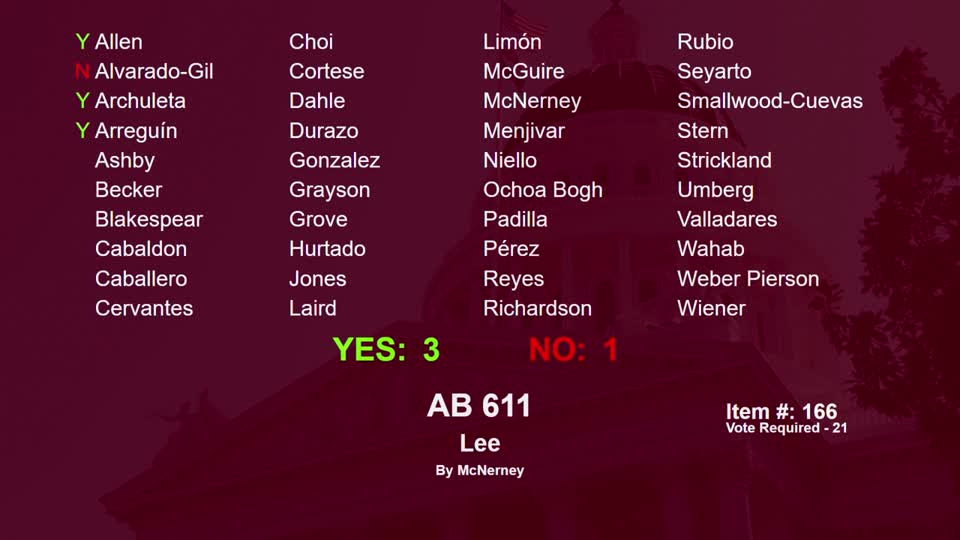 7MIN
Senate Floor
 31MIN
Senate Standing Committee on Local Government
 8MIN
Senate Standing Committee on Environmental Quality
 1MIN
Assembly Floor
 20MIN
Assembly Standing Committee on Natural Resources
Bill Author

Bill Co-Author(s):