AB 2636: Juveniles.
- Session Year: 2025-2026
- House: Assembly
- Latest Version Date: 2026-09-26
Current Status:
Passed
(2026-09-26: Chaptered by Secretary of State - Chapter 464, Statutes of 2026.)
Introduced
In Committee
Awaiting First Chamber Vote
Passed First Chamber
In Committee
Awaiting Second Chamber Vote
Passed Second Chamber
Enacted
Existing law subjects a person between 12 and 17 years of age, inclusive, who commits a crime, and a person under 12 years of age who commits specified crimes, to the jurisdiction of the juvenile court, which may adjudge that person to be a ward of the court. Under existing law, as added by the Gang Violence and Juvenile Crime Prevention Act of 1998, approved as Proposition 21 at the March 7, 2000, statewide primary election, a minor may be eligible for deferred entry of judgment if certain circumstances apply, including, among others, that the minor has not previously been declared to be a ward of the court for the commission of a felony offense. Existing law requires, once eligibility is established, the court to determine whether the minor is suitable for deferred entry of judgment and would benefit from education, treatment, and rehabilitation efforts.
This bill would require the court to consider whether the minor is charged with an offense of carrying a loaded firearm, as specified, when evaluating suitability of the minor for deferred entry of judgment.
Existing law subjects a person between 12 and 17 years of age, inclusive, who commits a crime, and a person under 12 years of age who commits specified crimes, to the jurisdiction of the juvenile court, which may adjudge that person to be a ward of the court. Under existing law, as added by the Gang Violence and Juvenile Crime Prevention Act of 1998, approved as Proposition 21 at the March 7, 2000, statewide primary election, a minor may be eligible for deferred entry of judgment if certain circumstances apply, including, among others, that the minor has not previously been declared to be a ward of the court for the commission of a felony offense. Existing law requires, once eligibility is established, the court to determine whether the minor is suitable for deferred entry of judgment and would benefit from education, treatment, and rehabilitation efforts.
This bill would make technical, nonsubstantive changes to those provisions.This bill would require the court to consider whether the minor is charged with an offense of carrying a loaded firearm, as specified, when evaluating suitability of the minor for deferred entry of judgment.
Existing law subjects a person between 12 and 17 years of age, inclusive, who commits a crime, and a person under 12 years of age who commits specified crimes, to the jurisdiction of the juvenile court, which may adjudge that person to be a ward of the court. Under existing law, as added by the Gang Violence and Juvenile Crime Prevention Act of 1998, approved as Proposition 21 at the March 7, 2000, statewide primary election, a minor may be eligible for deferred entry of judgment if certain circumstances apply, including, among others, that the minor has not previously been declared to be a ward of the court for the commission of a felony offense.
This bill would make technical, nonsubstantive changes to those provisions.
(a)Notwithstanding Section 654 or 654.2, or any other law, this article applies when a case is before the juvenile court for a determination of whether a minor is a person described in Section 602 because of the commission of a felony offense, if all of the following circumstances apply:
(1)The minor has not previously been declared to be a ward of the court for the commission of a felony offense.
(2)The offense charged is not one of the offenses enumerated in subdivision (b) of Section 707.
(3)The minor has not previously been committed to the custody of the Department of Corrections and Rehabilitation, Division of Juvenile Facilities.
(4)The minors record does not indicate that probation has ever been revoked without being completed.
(5)The minor is at least 14 years of age at the time of the hearing.
(6)The minor is eligible for probation pursuant to Section 1203.06 of the Penal Code.
(7)The offense charged is not rape, sodomy, oral copulation, or an act of sexual penetration specified in Section 289 of the Penal Code when the victim was prevented from resisting due to being rendered unconscious by any intoxicating, anesthetizing, or controlled substance, or when the victim was at the time incapable, because of mental disorder or developmental or physical disability, of giving consent, and that was known or reasonably should have been known to the minor at the time of the offense.
(b)The prosecuting attorney shall review their file to determine whether or not paragraphs (1) to (7), inclusive, of subdivision (a) apply. If the minor is found eligible for deferred entry of judgment, the prosecuting attorney shall file a declaration in writing with the court or state for the record the grounds upon which the determination is based, and shall make this information available to the minor and their attorney. Upon a finding that the minor is also suitable for deferred entry of judgment and would benefit from education, treatment, and rehabilitation efforts, the court may grant deferred entry of judgment. The court shall consider whether the offense charged is a violation of Section 25850 of the Penal Code when evaluating suitability of the minor for deferred entry of judgment. Under this procedure, the court may set the hearing for deferred entry of judgment at the initial appearance under Section 657. The court shall make findings on the record that a minor is appropriate for deferred entry of judgment pursuant to this article in any case where deferred entry of judgment is granted.
(c)(1)If a minor is eligible for deferred entry of judgment, but the minor resides in a different county and the case will be transferred, as described in Section 750, the court may adjudicate the case without determining the minors suitability for deferred entry of judgment to enable the court in the minors county of residence to make that determination.
(2)If a minor is eligible for deferred entry of judgment, but the court did not determine the minors suitability for deferred entry of judgment pursuant to paragraph (1), upon transfer of the case to the minors county of residence, the receiving court may, prior to determining the disposition of the case, determine the minors suitability for deferred entry of judgment and modify the transferring courts finding accordingly.
(a)Notwithstanding Section 654 or 654.2, or any other provision of law, this article shall apply whenever applies when a case is before the juvenile court for a determination of whether a minor is a person described in Section 602 because of the commission of a felony offense, if all of the following circumstances apply:
(1)The minor has not previously been declared to be a ward of the court for the commission of a felony offense.
(2)The offense charged is not one of the offenses enumerated in subdivision (b) of Section 707.
(3)The minor has not previously been committed to the custody of the Department of Corrections and Rehabilitation, Division of Juvenile Facilities.
(4)The minors record does not indicate that probation has ever been revoked without being completed.
(5)The minor is at least 14 years of age at the time of the hearing.
(6)The minor is eligible for probation pursuant to Section 1203.06 of the Penal Code.
(7)The offense charged is not rape, sodomy, oral copulation, or an act of sexual penetration specified in Section 289 of the Penal Code when the victim was prevented from resisting due to being rendered unconscious by any intoxicating, anesthetizing, or controlled substance, or when the victim was at the time incapable, because of mental disorder or developmental or physical disability, of giving consent, and that was known or reasonably should have been known to the minor at the time of the offense.
(b)The prosecuting attorney shall review their file to determine whether or not paragraphs (1) to (7), inclusive, of subdivision (a) apply. If the minor is found eligible for deferred entry of judgment, the prosecuting attorney shall file a declaration in writing with the court or state for the record the grounds upon which the determination is based, and shall make this information available to the minor and their attorney. Upon a finding that the minor is also suitable for deferred entry of judgment and would benefit from education, treatment, and rehabilitation efforts, the court may grant deferred entry of judgment. Under this procedure, the court may set the hearing for deferred entry of judgment at the initial appearance under Section 657. The court shall make findings on the record that a minor is appropriate for deferred entry of judgment pursuant to this article in any case where deferred entry of judgment is granted.
(c)(1)If a minor is eligible for deferred entry of judgment, but the minor resides in a different county and the case will be transferred, as described in Section 750, the court may adjudicate the case without determining the minors suitability for deferred entry of judgment to enable the court in the minors county of residence to make that determination.
(2)If a minor is eligible for deferred entry of judgment, but the court did not determine the minors suitability for deferred entry of judgment pursuant to paragraph (1), upon transfer of the case to the minors county of residence, the receiving court may, prior to determining the disposition of the case, determine the minors suitability for deferred entry of judgment and modify the transferring courts finding accordingly.
|
Date
|
Status
|
|---|---|
| Sep 26, 2026 | Chaptered by Secretary of State - Chapter 464, Statutes of 2026. |
| Sep 26, 2026 | Approved by the Governor. |
| Aug 25, 2026 | Enrolled and presented to the Governor at 4 p.m. |
| Aug 19, 2026 | In Assembly. Ordered to Engrossing and Enrolling. |
| Aug 19, 2026 | Read third time. Passed. Ordered to the Assembly. (Ayes 33. Noes 4. Page 5543.). |
| Aug 19, 2026 | Read third time. Passed. Ordered to the Assembly. (Ayes 33. Noes 4.). |
| Jun 10, 2026 | Read second time. Ordered to third reading. |
| Jun 9, 2026 | From committee: Do pass. (Ayes 5. Noes 0.) (June 9). |
| May 20, 2026 | Referred to Com. on PUB. S. |
| May 7, 2026 | In Senate. Read first time. To Com. on RLS. for assignment. |
| May 7, 2026 | Read third time. Passed. Ordered to the Senate. (Ayes 59. Noes 0. Page 4961.) |
| May 7, 2026 | Read third time. Passed. Ordered to the Senate. (Ayes 59. Noes 0.) |
| Apr 23, 2026 | Read second time. Ordered to third reading. |
| Apr 22, 2026 | From committee: Do pass. (Ayes 9. Noes 0.) (April 21). |
| Mar 17, 2026 | Re-referred to Com. on PUB. S. |
| Mar 16, 2026 | From committee chair, with author's amendments: Amend, and re-refer to Com. on PUB. S. Read second time and amended. |
| Mar 16, 2026 | Referred to Com. on PUB. S. |
| Feb 21, 2026 | From printer. May be heard in committee March 23. |
| Feb 20, 2026 | Read first time. To print. |
|
Date
|
Description
|
Location
|
Votes
|
|
|---|---|---|---|---|
| Aug 19, 2026 | Assembly 3rd Reading AB2636 Pacheco By Caballero | Senate Floor |
Passed |
|
| Jun 9, 2026 | Do pass | Senate Standing Committee on Public Safety |
Passed |
|
| May 7, 2026 | AB 2636 Pacheco Assembly Third Reading | Assembly Floor |
Passed |
|
| Apr 21, 2026 | Do pass. | Assembly Standing Committee on Public Safety |
Passed |
This list shows positions taken on this bill by organizations on the date displayed, which is linked to the original source.
Positions by individuals are not included.
|
Organization
|
Position
|
Date
|
|---|---|---|
| Aclu California Action | ** Against | |
| Arcadia Police Officers’ Association | ** Support | |
| Brea Police Association | ** Support | |
| Burbank Police Officers’ Association | ** Support | |
| California Association of School Police Chiefs | ** Support | |
| California Attorneys For Criminal Justice | ** Against | |
| California Coalition of School Safety Professionals | ** Support | |
| California Narcotic Officers’ Association | ** Support | |
| Californians United for a Responsible Budget | ** Against | |
| California Police Chiefs Association | ** Support | |
| California Public Defenders Association | ** Against | |
| California Reserve Peace Officers Association | ** Support | |
| California Youth Defender Center | ** Against | |
| Center on Juvenile and Criminal Justice | ** Against | |
| Chief Probation Officers’ of California | ** Support | |
| CLAREMONT POLICE OFFICERS ASSOCIATION | ** Support | |
| Corona Police Officers’ Association | ** Support | |
| Culver City Police Officers’ Association | ** Support | |
| Ella Baker Center For Human Rights | ** Against | |
| Fullerton Police Officers’ Association | ** Support | |
| Justice2jobs Coalition | ** Against | |
| LA Defensa | ** Against | |
| Los Angeles County Public Defender’s Union, Local 148 | ** Against | |
| Los Angeles School Police Management Association | ** Support | |
| los angeles school police officers association | ** Support | |
| Murrieta Police Officers’ Association | ** Support | |
| Newport Beach Police Association | ** Support | |
| Office of Youth and Community Restoration | ** Against | |
| Palos Verdes Police Officers’ Association | ** Support | |
| Placer County Deputy Sheriffs’ Association | ** Support | |
| Pomona Police Officers’ Association | ** Support | |
| Riverside Police Officers’ Association | ** Support | |
| Riverside Sheriffs’ Association | ** Support | |
| San Francisco Public Defender | ** Against |
SENATE RULES COMMITTEE Office of Senate Floor Analyses (916) 651-4171 | AB 2636 |
THIRD READING
Bill No: AB 2636
Author: Pacheco (D)
Amended: 3/16/26 in Assembly
Vote: 21
SENATE PUBLIC SAFETY COMMITTEE: 5-0, 6/9/26
AYES: Arreguín, Seyarto, Caballero, Cortese, Wiener
NO VOTE RECORDED: Pérez
ASSEMBLY FLOOR: 59-0, 5/7/26 - See last page for vote
SUBJECT: Juveniles
SOURCE: California Police Chiefs Association
Chief Probation Officers’ of California
DIGEST:
This bill requires the court to consider, for purposes of determining suitability of a minor for deferred entry of judgement (DEJ), whether the minor is charged with carrying a loaded firearm in public.
ANALYSIS:
Existing law:
- Provides, generally, that a minor who is between 12 years of age and 17 years of age, inclusive, when the minor violates any law defining a crime, is subject to the jurisdiction of the juvenile court and to adjudication as a ward. (Welfare (Welf.) & Institutions (Inst.) Code, § 602, subd. (a).)
- Requires, whenever a case is before the juvenile court for a determination of whether a minor may be adjudicated as a ward because of the commission of a felony offense, the minor to be considered for DEJ if all of the following circumstances apply:
- The minor has not previously been declared to be a ward of the court for the commission of a felony offense;
- The offense charged is not a Section 707(b) offense;
- The minor has not previously been committed to the custody of the Department of Corrections and Rehabilitation (CDCR), Division of Juvenile Facilities;
- The minor’s record does not indicate that probation has ever been revoked without being completed;
- The minor is at least 14 years of age at the time of the hearing;
- The minor is eligible for probation; and,
- The offense charged is not rape, sodomy, oral copulation, or an act of sexual penetration when the victim was prevented from resisting due to being rendered unconscious by any intoxicating, anesthetizing, or controlled substance, or when the victim was at the time incapable, because of mental disorder or developmental or physical disability, of giving consent, and that was known or reasonably should have been known to the minor at the time of the offense. (Welf. & Inst. Code, § 790, subd. (a).)
- Requires the prosecuting attorney to review their file to determine whether the minor is eligible for DEJ based on the factors listed above, and if so determined, requires the prosecuting attorney to file a declaration with the court or state for the record the grounds upon which the determination is based. Requires this information to be available to the minor and their attorney. (Welf. & Inst. Code, § 790, subd. (b).)
- Authorizes the court, upon a finding that the minor is also suitable for DEJ and would benefit from education, treatment, and rehabilitation efforts, to grant DEJ. Requires the court to make these findings on the record where DEJ is granted. (Welf. & Inst. Code, § 790, subd. (b).)
- Provides that a person is guilty of carrying a loaded firearm when the person carries a loaded firearm on the person or in a vehicle while in any public place or on any public street in an incorporated city, city and county, or in any public place or on any public street in a prohibited area of an unincorporated area of a county or city and county. (Pen. Code, § 25850, subd. (a).)
- Provides that carrying a loaded firearm in public is punishable as follows:
- Where the person previously has been convicted of any felony, or of any specified firearm-related offenses, as a felony.
- Where the firearm is stolen and the person knew or had reasonable cause to believe that it was stolen, as a felony.
- Where the person is an active participant in a criminal street gang, as a felony.
- Where the person is not in lawful possession of the firearm, or is within a class of persons prohibited from possessing or acquiring a firearm, as a felony.
- Where the person has been convicted of a crime against a person or property, or of a narcotics or dangerous drug violation, as an alternate felony-misdemeanor (hereinafter “wobbler”).
- Where the person is not listed with the Department of Justice (DOJ) as the recorded owner of the handgun, as a wobbler.
- In all others cases, as a misdemeanor, punishable by imprisonment in a county jail not to exceed one year, by a fine not to exceed one $1,000, or by both. (Pen. Code, § 25850, subd. (c).)
This bill requires the court to consider, for purposes of determining suitability of a minor for DEJ, whether the minor is charged with carrying a loaded firearm in public.
Background
DEJ is a post-adjudication, pre-disposition diversion program. Under existing law, certain juvenile offenders are eligible for DEJ. (Welf. & Inst. Code, § 790.) For DEJ, a minor must admit each allegation in the petition, and the judgment is deferred while the minor is placed on probation for one to three years. (Welf. & Inst. Code, § 791.) While on probation, certain terms and conditions related to the minor’s treatment and rehabilitation are imposed. Upon the successful completion of the terms of probation, the charge or charges against the minor are dismissed, the arrest upon which the judgment was deferred is deemed never to have occurred, and any records in the possession of the juvenile court are required to be sealed, except as specified. (Welf. & Inst. Code, § 793, subd. (c).) If it appears to the prosecuting attorney, the court, or the probation department that the minor is not performing satisfactorily in the assigned program or is not complying with the terms of the probation, or that the minor is not benefiting from education, treatment, or rehabilitation, the deferred entry of judgment is lifted and the court will schedule a dispositional hearing. (Welf. & Inst. Code, § 793, subd. (a).)
In order to be eligible for DEJ, a minor must meet the following requirements: (1) the minor has not previously been declared to be a ward of the court for the commission of a felony offense; (2) the offense charged is not a serious or violent felony listed in Welfare and Institutions Code section 707 (b); (3) the minor has not previously been committed to the custody of the Division of Juvenile Justice; (4) the minor’s record does not indicate that probation has ever been revoked without being completed; (5) the minor is at least 14 years of age at the time of the hearing; (6) the minor is eligible for probation under Penal Code section 1203.06; and (7) the offense charged is not one of several specified sex offenses. (Welf. & Inst. Code, § 790, subd. (a).) The prosecuting attorney is required to make a determination regarding a minor’s eligibility for DEJ, and if the minor is eligible, the prosecuting attorney must notify the court, the minor, and the minor’s attorney. (Welf. & Inst. Code, § 790, subd. (b).) The juvenile court must then decide if the minor is suitable for DEJ. A minor is suitable for DEJ if the judge finds that the minor would benefit from court-ordered education, rehabilitation, and treatment efforts. (Ibid).
Under existing law, a person who personally used a firearm during the commission or attempted commission of specified offenses is ineligible for DEJ. (Welf. & Inst. Code, § 790, subd. (b); Pen. Code, § 1203.06.) This bill requires the court to consider whether the offense charged is an offense of carrying a loaded firearm in public in making its DEJ suitability determination. Existing law does not enumerate specific factors for the court to consider in its suitability determination. It appears the court has broad discretion to grant when the court makes a finding that the minor would benefit from education, treatment, and rehabilitation efforts. It is unclear whether this new consideration is to be made in conjunction with the court’s determination that the minor would benefit from education, treatment, and rehabilitation efforts, or if it is to be considered separately and how the court is to weigh that fact in its determination.
FISCAL EFFECT: Appropriation: No Fiscal Com.: No Local: No
SUPPORT: (Verified 6/9/26)
California Police Chiefs Association (co-source)
Chief Probation Officers’ of California (co-source)
Arcadia Police Officers’ Association
Brea Police Association
Burbank Police Officers’ Association
California Association of School Police Chiefs
California Coalition of School Safety Professionals
California Narcotic Officers’ Association
California Police Chiefs Association
California Reserve Peace Officers Association
Claremont Police Officers Association
Corona Police Officers Association
Culver City Police Officers’ Association
Fullerton Police Officers’ Association
Los Angeles School Police Management Association
Los Angeles School Police Officers Association
Murrieta Police Officers’ Association
Newport Beach Police Association
Palos Verdes Police Officers Association
Placer County Deputy Sheriffs’ Association
Pomona Police Officers’ Association
Riverside Police Officers Association
Riverside Sheriffs’ Association
OPPOSITION: (Verified 6/9/26)
ACLU California Action
California Attorneys for Criminal Justice
California Public Defenders Association
Center on Juvenile and Criminal Justice
Ella Baker Center for Human Rights
Justice2Jobs Coalition
La Defensa
Los Angeles County Public Defender’s Union, Local 148
San Francisco Public Defender
ARGUMENT IN SUPPORT: According to the Chief Probation Officers of California, one of the bill’s co-sponsors:
In California, under Welfare & Institutions Code 790, Deferred Entry of Judgment (DEJ) for juveniles is a path for first-time, nonviolent felonies where the minor admits guilt, completes programming, and has their charged dismissed and their case sealed if successfully completed, thereby enabling the youth to avoid a formal conviction. While DEJ plays a role within the continuum of juvenile justice responses, it is not structured or designed to address more serious offenses. As DEJ is intended for first time nonviolent offenses, there are current offenses excluded from eligibility in recognition of the seriousness of the offense and the types of interventions that are necessary, including existing firearms offenses.
With an uptick in serious and violent juvenile crime, and impacts in communities from juvenile gun offenses, it is imperative to address these types of crimes through structured rehabilitative programming and accountability to address and mitigate future risk of adult re-offense. In 2016, 1 in 10 juvenile arrests were for a violent felony. In 2024, 1 in 5 arrests were for a violent felony. Additionally, in regards to recent juvenile violent felony data from 2021 to 2024 (the period following the closure of DJJ), violent felony arrests went up 69.28%.
Despite existing law already prohibiting minors from possessing firearms and making it a wobbler, current DEJ eligibility does not expressly exclude possession of a loaded firearm, thereby allowing this offense to be eligible for a program designed for low-level first-time offenses. Carrying a loaded firearm carries great consequence to the community and it is imperative that more structured court interventions are utilized in these cases to address the rehabilitation and safety needs of youth committing these offenses.
This bill represents a balanced and necessary change to ensure that courts are giving consideration to this specific offense of carrying a loaded firearm when looking at the appropriate disposition for these cases. It prioritizes public safety while preserving rehabilitative opportunities for youth through more structured juvenile court interventions. This change ensures that California’s response to
juvenile firearm possession is aligned with best practices in youth risk management and other efforts to reduce juvenile and community gun violence.
ARGUMENT IN OPPOSITION: La Defense writes:
Juvenile DEJ offers an opportunity for youth to have their case dismissed and records sealed upon successful completion of treatment and supervision in a community setting. Eligible youth must admit all allegations charged and waive the right to a speedy jurisdictional hearing. If a youth subsequently commits a felony offense or two or more misdemeanors, the deferred judgment will be imposed. Under existing law, a juvenile court may consider whether a youth charged with a first-time, non-violent offense would benefit from education, treatment, and rehabilitation when determining whether to grant DEJ. AB 2636 impedes this process, requiring the court to consider whether the offense charged includes possession of a loaded firearm, making it less likely that youth charged with a first offense will be able to benefit from these programs.
While reducing gun possession among youth should be a priority, this bill increases punishment for youth without improving public safety. Despite an uptick in gun sales during the pandemic, the share of U.S. youth who carry guns has decreased. At the same time, responses to youth charged with weapon possession have grown increasingly punitive over the last decade, with juvenile courts increasingly less likely to provide diversion and more likely to choose detention, especially for youth of color. Rather than keeping us safer, removing opportunities for education, treatment, and rehabilitation is likely to worsen gun violence and other crime. Reducing gun possession among youth requires comprehensive initiatives involving community partners, not punitive responses that make the problem worse.
Targeted diversion is a proven solution, especially for youth charged with a first offense. It is well-established that longer periods of confinement produce higher rates of recidivism for youth. Recently, the Office of Youth and Community Restoration recognized that community-based alternatives to incarceration reduce further system involvement, decrease life disruption, and promote positive health and social outcomes. Moreover, diversion is especially effective for youth with little prior involvement in the justice system. Given the developmental status of minors, programs that help improve critical thinking and judgement skills have been shown to substantially lower violence among at-risk youth. Further, programming designed specifically for youth facing gun possession charges is highly effective in preventing recidivism.
AB 2636 will reduce opportunities for youth charged with a first-time, non-violent offense to participate in these programs and receive the services they need, increasing the number of youth incarcerated at juvenile detention facilities and driving up costs without providing a benefit to public safety. This is especially troublesome when the state’s own agency responsible for guiding the transition away from youth incarceration has recognized the extensive benefits of diversion, education, treatment, and rehabilitation for youth offenders.
ASSEMBLY FLOOR: 59-0, 5/7/26
AYES: Addis, Aguiar-Curry, Ahrens, Alanis, Alvarez, Ávila Farías, Bains, Bauer-Kahan, Bennett, Berman, Boerner, Calderon, Carrillo, Castillo, Connolly, Davies, DeMaio, Dixon, Ellis, Fong, Gabriel, Gallagher, Garcia, Gipson, Jeff Gonzalez, Mark González, Hadwick, Haney, Harabedian, Irwin, Jackson, Johnson, Krell, Lackey, Lowenthal, Macedo, Muratsuchi, Nguyen, Ortega, Pacheco, Papan, Patel, Patterson, Pellerin, Ramos, Ransom, Michelle Rodriguez, Blanca Rubio, Sanchez, Schiavo, Schultz, Sharp-Collins, Solache, Soria, Stefani, Ta, Tangipa, Zbur, Rivas
NO VOTE RECORDED: Arambula, Bonta, Bryan, Caloza, Chen, Elhawary, Flora, Hart, Hoover, Kalra, Lee, McKinnor, Petrie-Norris, Quirk-Silva, Celeste Rodriguez, Rogers, Valencia, Wallis, Ward, Wicks, Wilson
Prepared by: Stephanie Jordan / PUB. S. /
6/10/26 17:00:44
**** END ****
SENATE COMMITTEE ON PUBLIC SAFETY
Senator Jesse Arreguín, Chair
2025 - 2026 Regular
Bill No: AB 2636 Hearing Date: June 9, 2026
Author: | Pacheco | ||
Version: | March 16, 2026 | ||
Urgency: | No | Fiscal: | No |
Consultant: | SJ | ||
Subject: Juveniles
HISTORY
Source: California Police Chiefs Association
Chief Probation Officers’ of California
Prior Legislation: SB 383 (Cortese), Ch. 603, Stats. of 2021
SB 838 (Beall), Ch. 919, Stats. of 2014
SB 1626 (Ashburn), Ch. 675, Stats. of 2006
Proposition 21, as approved by the voters on March 7, 2000
Support: Arcadia Police Officers’ Association; Brea Police Association; Burbank Police Officers’ Association; California Association of School Police Chiefs; California Coalition of School Safety Professionals; California Narcotic Officers’ Association; California Police Chiefs Association; California Reserve Peace Officers Association; Claremont Police Officers Association; Corona Police Officers Association; Culver City Police Officers’ Association; Fullerton Police Officers’ Association; Los Angeles School Police Management Association; Los Angeles School Police Officers Association; Murrieta Police Officers’ Association; Newport Beach Police Association; Palos Verdes Police Officers Association; Placer County Deputy Sheriffs’ Association; Pomona Police Officers’ Association; Riverside Police Officers Association; Riverside Sheriffs’ Association
Opposition: ACLU California Action; California Attorneys for Criminal Justice; California Public Defenders Association; Ella Baker Center for Human Rights; Justice2Jobs Coalition; La Defensa; Los Angeles County Public Defender’s Union, Local 148; San Francisco Public Defender
Assembly Floor Vote: 59 - 0
PURPOSE
The purpose of this bill is to require the court to consider, for purposes of determining suitability of a minor for deferred entry of judgement (DEJ), whether the minor is charged with carrying a loaded firearm in public.
Existing law provides, generally, that a minor who is between 12 years of age and 17 years of age, inclusive, when the minor violates any law defining a crime, is subject to the jurisdiction of the juvenile court and to adjudication as a ward. (Welf. & Inst. Code, § 602, subd. (a).)
Existing law requires, whenever a case is before the juvenile court for a determination of whether a minor may be adjudicated as a ward because of the commission of a felony offense, the minor to be considered for DEJ if all of the following circumstances apply:
- The minor has not previously been declared to be a ward of the court for the commission of a felony offense;
- The offense charged is not a Section 707(b) offense;
- The minor has not previously been committed to the custody of the Department of Corrections and Rehabilitation (CDCR), Division of Juvenile Facilities;
- The minor’s record does not indicate that probation has ever been revoked without being completed;
- The minor is at least 14 years of age at the time of the hearing;
- The minor is eligible for probation; and,
- The offense charged is not rape, sodomy, oral copulation, or an act of sexual penetration when the victim was prevented from resisting due to being rendered unconscious by any intoxicating, anesthetizing, or controlled substance, or when the victim was at the time incapable, because of mental disorder or developmental or physical disability, of giving consent, and that was known or reasonably should have been known to the minor at the time of the offense. (Welf. & Inst. Code, § 790, subd. (a).)
Existing law requires the prosecuting attorney to review their file to determine whether the minor is eligible for DEJ based on the factors listed above, and if so determined, requires the prosecuting attorney to file a declaration with the court or state for the record the grounds upon which the determination is based. Requires this information to be available to the minor and their attorney. (Welf. & Inst. Code, § 790, subd. (b).)
Existing law authorizes the court, upon a finding that the minor is also suitable for DEJ and would benefit from education, treatment, and rehabilitation efforts, to grant DEJ. Requires the court to make these findings on the record where DEJ is granted. (Welf. & Inst. Code, § 790, subd. (b).)
Existing law provides that a person is guilty of carrying a loaded firearm when the person carries a loaded firearm on the person or in a vehicle while in any public place or on any public street in an incorporated city, city and county, or in any public place or on any public street in a prohibited area of an unincorporated area of a county or city and county. (Pen. Code, § 25850, subd. (a).)
Existing law provides that carrying a loaded firearm in public is punishable as follows:
- Where the person previously has been convicted of any felony, or of any specified firearm-related offenses, as a felony.
- Where the firearm is stolen and the person knew or had reasonable cause to believe that it was stolen, as a felony.
- Where the person is an active participant in a criminal street gang, as a felony.
- Where the person is not in lawful possession of the firearm, or is within a class of persons prohibited from possessing or acquiring a firearm, as a felony.
- Where the person has been convicted of a crime against a person or property, or of a narcotics or dangerous drug violation, as an alternate felony-misdemeanor (hereinafter “wobbler”).
- Where the person is not listed with the Department of Justice (DOJ) as the recorded owner of the handgun, as a wobbler.
- In all others cases, as a misdemeanor, punishable by imprisonment in a county jail not to exceed one year, by a fine not to exceed one $1,000, or by both. (Pen. Code, § 25850, subd. (c).)
This bill requires the court to consider, for purposes of determining suitability of a minor for DEJ, whether the minor is charged with carrying a loaded firearm in public.
COMMENTS
- Need For This Bill
According to the author:
California continues to face a serious challenge with youth access to firearms. In recent years, juvenile violent crime arrests have increased, and firearms remain a leading cause of death among children and adolescents, underscoring the urgency of this issue. Existing law prohibits minors from possessing firearms. However, these cases still are eligible for Deferred Entry of Judgment (DEJ), a program intended for first-time, low-level offenses. DEJ programs are intended to provide an offramp from further justice involvement by allowing a court to order programming or treatment to address the underlying criminal factors. However, there is not an evidence-based program for the use of firearms and carrying a loaded firearm is a serious public safety risk that falls outside the intent of this program.
AB 2636 makes minors who carry a loaded firearm ineligible for DEJ, which aligns with existing exclusions for more serious offenses and ensures that conduct posing a significant risk to public safety is treated accordingly. The bill does not change how the offense is charged or penalized. Instead, AB 2636 ensures that these cases remain under the supervision of the juvenile court, where appropriate interventions and accountability measures may be applied. AB 2636 prioritizes public safety while preserving rehabilitative opportunities for youth that promote community safety.
- Juvenile Court Jurisdiction
As a general rule, any person between the age of 12 and 17 who commits a crime falls within the jurisdiction of the juvenile court. (Welf. & Inst. Code, § 602.) This extends to a youth alleged to have committed a crime before their 18th birthday, even if they were an adult at the time of arrest or commencement of proceedings. (Welf. & Inst. Code, § 603.) For example, if someone commits a crime at age 17, but it is not discovered or tried until the person is 20, the person can
still be tried in juvenile court. The jurisdiction of the juvenile court continues until the youth is 23 years old, unless the youth would have, in criminal court, faced a sentence of 7 years or more, in which case the juvenile court’s jurisdiction continues until the youth turns 25. (Welf. & Inst. Code, § 607.)
The creation of the juvenile court was rooted in the idea that adolescents, who are not fully developed or mature, are less culpable than adults. Accordingly, the focus of the juvenile court was rehabilitation, not punishment. (See e.g., In re Gault (1967) 387 U.S. 1, 15-16.) The purpose of the juvenile law is to provide for the protection and safety of the public and each minor under the jurisdiction of the court and to preserve and strengthen family ties when possible. (Welf. & Inst. Code, § 202, subd. (a).) Minors under the jurisdiction of the juvenile court as a consequence of delinquent conduct receive care, treatment, and guidance that is consistent with their best interest, that holds them accountable for their behavior, and that is appropriate for their circumstances. This may include punishment that is consistent with rehabilitative objectives. (Welf. & Inst. Code, § 202, subd. (b).) The juvenile court has a wide range of options available
for placing its wards, including probation, placement in a relative's home, foster home, licensed community care facility, or group home, and commitment to “a juvenile home, ranch, camp, or forestry camp” or “the county juvenile hall.” (Welf. & Inst. Code, §§ 727, subd. (a); 730, subd. (a)(1).)
- Deferred Entry of Judgment (DEJ)
DEJ is a post-adjudication, pre-disposition diversion program. Under existing law, certain juvenile offenders are eligible for DEJ. (Welf. & Inst. Code, § 790.) For DEJ, a minor must admit each allegation in the petition, and the judgment is deferred while the minor is placed on probation for one to three years. (Welf. & Inst. Code, § 791.) While on probation, certain terms and conditions related to the minor’s treatment and rehabilitation are imposed. Upon the successful completion of the terms of probation, the charge or charges against the minor are dismissed, the arrest upon which the judgment was deferred is deemed never to have occurred, and any records in the possession of the juvenile court are required to be sealed, except as specified. (Welf. & Inst. Code, § 793, subd. (c).) If it appears to the prosecuting attorney, the court, or the probation department that the minor is not performing satisfactorily in the assigned program or is not complying with the terms of the probation, or that the minor is not benefiting from education, treatment, or rehabilitation, the deferred entry of judgment is lifted and the court will schedule a dispositional hearing. (Welf. & Inst. Code, § 793, subd. (a).)
In order to be eligible for DEJ, a minor must meet the following requirements: (1) the minor has not previously been declared to be a ward of the court for the commission of a felony offense; (2) the offense charged is not a serious or violent felony listed in Welfare and Institutions Code section 707 (b); (3) the minor has not previously been committed to the custody of the Division of Juvenile Justice; (4) the minor’s record does not indicate that probation has ever been revoked without being completed; (5) the minor is at least 14 years of age at the time of the hearing; (6) the minor is eligible for probation under Penal Code section 1203.06; and (7) the offense charged is not one of several specified sex offenses. (Welf. & Inst. Code, § 790, subd. (a).) The prosecuting attorney is required to make a determination regarding a minor’s eligibility for DEJ, and if the minor is eligible, the prosecuting attorney must notify the court, the minor, and the minor’s attorney. (Welf. & Inst. Code, § 790, subd. (b).) The juvenile court must then decide if the minor is suitable for DEJ. A minor is suitable for DEJ if the judge finds that the minor would benefit from court-ordered education, rehabilitation, and treatment efforts. (Ibid).
- Effect of This Bill
Under existing law, a person who personally used a firearm during the commission or attempted commission of specified offenses is ineligible for DEJ. (Welf. & Inst. Code, § 790, subd. (b); Pen. Code, § 1203.06.) This bill requires the court to consider whether the offense charged is an offense of carrying a loaded firearm in public in making its DEJ suitability determination. Existing law does not enumerate specific factors for the court to consider in its suitability determination. It appears the court has broad discretion to grant when the court makes a finding that the minor would benefit from education, treatment, and rehabilitation efforts. It is unclear whether this new consideration is to be made in conjunction with the court’s determination that the minor would benefit from education, treatment, and rehabilitation efforts, or if it is to be considered separately and how the court is to weigh that fact in its determination.
- Argument in Support
According to the Chief Probation Officers of California, one of the bill’s co-sponsors:
In California, under Welfare & Institutions Code 790, Deferred Entry of Judgment (DEJ) for juveniles is a path for first-time, nonviolent felonies where the minor admits guilt, completes programming, and has their charged dismissed and their case sealed if successfully completed, thereby enabling the youth to avoid a formal conviction. While DEJ plays a role within the continuum of juvenile justice responses, it is not structured or designed to address more serious offenses. As DEJ is intended for first time nonviolent offenses, there are current offenses excluded from eligibility in recognition of the seriousness of the offense and the types of interventions that are necessary, including existing firearms offenses.
With an uptick in serious and violent juvenile crime, and impacts in communities from juvenile gun offenses, it is imperative to address these types of crimes through structured rehabilitative programming and accountability to address and mitigate future risk of adult re-offense. In 2016, 1 in 10 juvenile arrests were for a violent felony. In 2024, 1 in 5 arrests were for a violent felony. Additionally, in regards to recent juvenile violent felony data from 2021 to 2024 (the period following the closure of DJJ), violent felony arrests went up 69.28%.
Despite existing law already prohibiting minors from possessing firearms and making it a wobbler, current DEJ eligibility does not expressly exclude possession of a loaded firearm, thereby allowing this offense to be eligible for a program designed for low-level first-time offenses. Carrying a loaded firearm carries great consequence to the community and it is imperative that more structured court interventions are utilized in these cases to address the rehabilitation and safety needs of youth committing these offenses.
This bill represents a balanced and necessary change to ensure that courts are giving consideration to this specific offense of carrying a loaded firearm when looking at the appropriate disposition for these cases. It prioritizes public safety while preserving rehabilitative opportunities for youth through more structured juvenile court interventions. This change ensures that California’s response to
juvenile firearm possession is aligned with best practices in youth risk management and other efforts to reduce juvenile and community gun violence.
- Argument in Opposition
La Defense writes:
Juvenile DEJ offers an opportunity for youth to have their case dismissed and records sealed upon successful completion of treatment and supervision in a community setting. Eligible youth must admit all allegations charged and waive the right to a speedy jurisdictional hearing. If a youth subsequently commits a felony offense or two or more misdemeanors, the deferred judgment will be imposed. Under existing law, a juvenile court may consider whether a youth charged with a first-time, non-violent offense would benefit from education, treatment, and rehabilitation when determining whether to grant DEJ. AB 2636 impedes this process, requiring the court to consider whether the offense charged includes possession of a loaded firearm, making it less likely that youth charged with a first offense will be able to benefit from these programs.
While reducing gun possession among youth should be a priority, this bill increases punishment for youth without improving public safety. Despite an uptick in gun sales during the pandemic, the share of U.S. youth who carry guns has decreased. At the same time, responses to youth charged with weapon possession have grown increasingly punitive over the last decade, with juvenile courts increasingly less likely to provide diversion and more likely to choose detention, especially for youth of color. Rather than keeping us safer, removing opportunities for education, treatment, and rehabilitation is likely to worsen gun violence and other crime. Reducing gun possession among youth requires comprehensive initiatives involving community partners, not punitive responses that make the problem worse.
Targeted diversion is a proven solution, especially for youth charged with a first offense. It is well-established that longer periods of confinement produce higher rates of recidivism for youth. Recently, the Office of Youth and Community Restoration recognized that community-based alternatives to incarceration reduce further system involvement, decrease life disruption, and promote positive health and social outcomes. Moreover, diversion is especially effective for youth with little prior involvement in the justice system. Given the developmental status of minors, programs that help improve critical thinking and judgement skills have been shown to substantially lower violence among at-risk youth. Further, programming designed specifically for youth facing gun possession charges is highly effective in preventing recidivism.
AB 2636 will reduce opportunities for youth charged with a first-time, non-violent offense to participate in these programs and receive the services they need, increasing the number of youth incarcerated at juvenile detention facilities and driving up costs without providing a benefit to public safety. This is especially troublesome when the state’s own agency responsible for guiding the transition away from youth incarceration has recognized the extensive benefits of diversion, education, treatment, and rehabilitation for youth offenders.
-- END --
ASSEMBLY THIRD READING
ATR Bill Id:AB 2636
Author:(Pacheco)
As Amended Ver:March 16, 2026
Majority vote
SUMMARY
Requires the court to consider, for purposes of determining suitability of a minor for deferred entry of judgement (DEJ), whether the minor is charged with an offense of carrying a loaded firearm in public.
Major Provisions
COMMENTS
According to the Author
"California continues to face a serious challenge with youth access to firearms. In recent years, juvenile violent crime arrests have increased, and firearms remain a leading cause of death among children and adolescents, underscoring the urgency of this issue. Existing law prohibits minors from possessing firearms. However, these cases still are eligible for Deferred Entry of Judgment (DEJ), a program intended for first-time, low-level offenses to provide an offramp from further justice involvement by allowing a court to order programming or treatment to address the underlying criminal factors. This bill requires courts, when determining suitability for Deferred Entry of Judgement (DEJ), to consider whether the offense charged is possession of a loaded firearm, a violation of Penal Code 25850. AB 2636 represents a balanced and necessary change to ensure that courts are giving consideration to this specific offense of carrying a loaded firearm, which has significant impact and consequence to our communities, when looking at the appropriate disposition for these cases. This ensures that conduct posing a significant risk to public safety is addressed with appropriate rehabilitative and accountability interventions. AB 2636 prioritizes public safety while preserving rehabilitative opportunities for youth that promote community safety."
Arguments in Support
According to the California Police Chiefs Association, the sponsor of this bill, "AB 2636 requires courts, when determining suitability for Deferred Entry of Judgment (DEJ), to explicitly consider whether the offense charged involves possession of a loaded firearm. This is a targeted and thoughtful reform that ensures courts are appropriately weighing the seriousness of firearm-related offenses when determining the most suitable rehabilitative pathway for youth.
"Deferred Entry of Judgment plays an important role in California's juvenile justice system by providing first-time, nonviolent offenders with an opportunity to avoid formal adjudication through successful completion of programming. However, as currently structured, DEJ does not adequately account for the seriousness of certain offenses—particularly those involving firearms. As noted by the Chief Probation Officers of California, DEJ was never intended to address higher-risk offenses that present significant safety concerns to the public.
"Recent data underscores the urgency of this issue. Juvenile involvement in violent crime is increasing, with violent felony arrests rising significantly in recent years. The presence of a loaded firearm in the hands of a minor dramatically elevates the risk of harm—not only to the community, but to the youth themselves. These cases require structured intervention, supervision, and accountability that go beyond what DEJ is designed to provide.
"Importantly, AB 2636 does not eliminate DEJ eligibility, nor does it mandate a particular outcome. Instead, it ensures that courts give appropriate weight to firearm possession when making individualized determinations. This approach preserves judicial discretion while reinforcing the importance of public safety considerations in these cases. It aligns with best practices in juvenile justice by directing higher-risk cases toward more structured supervision and services designed to reduce recidivism and promote long-term rehabilitation."
Arguments in Opposition
According to California Youth Defender Center, "Juvenile DEJ offers an opportunity for youth to have their cases dismissed and records sealed upon the successful completion of treatment and supervision in a community setting. Eligible youth must admit all allegations charged and waive the right to a speedy jurisdictional hearing. If a youth subsequently commits a felony offense or two or more misdemeanors, the deferred judgment is imposed.
"Under existing law, a juvenile court may consider whether a youth charged with a first-time, non-violent offense would benefit from education, treatment, and rehabilitation when determining whether to grant DEJ. AB 2636 impedes this process by requiring the court to specifically consider whether the offense charged includes possession of a loaded firearm, making it less likely that youth charged with a first offense will be able to benefit from these programs.
"While reducing gun possession among youth should be a priority, this bill increases punishment for youth without improving public safety. Despite an uptick in gun sales during the pandemic, the share of U.S. youth who carry guns has decreased. At the same time, responses to youth charged with weapon possession have grown increasingly punitive over the last decade.
"Current law provides that youth charged with a felony shall be screened by the prosecution for statutory eligibility for DEJ. Statutory eligibility specifically excludes certain offenses from consideration (Welf. & Inst. Code Section 790(a)). If the youth meets eligibility criteria, they are then screened for suitability by both the probation department—which prepares a thorough written report—and the court.
"The court, by statute (Welf. & Inst. Code Section 790) and by California Rule of Court 5.800, must find that the youth is suitable and would derive benefit from education, treatment, and rehabilitation efforts offered by DEJ. The court considers the nature of the offense, the youth's prior record (if any), and the current status of the youth—including school status, home conditions, and the youth's willingness to cooperate. If the youth is both eligible and suitable, they admit the charge and are placed on up to three years of probation. If successful, the youth's record is sealed.
"It is well-established that longer periods of confinement produce higher rates of recidivism for youth.3 Recently, the Office of Youth and Community Restoration recognized that community-based alternatives to incarceration reduce further system involvement, decrease life disruption, and promote positive health and social outcomes.
"AB 2636 proposes a solution to a problem that does not exist. Because the court must already consider the nature of the offense, this additional requirement adds nothing to the legal analysis. Instead, AB 2636 will reduce opportunities for youth charged with a first-time, non-violent offense to participate in DEJ, thereby increasing the number of youth incarcerated at juvenile detention facilities and driving up costs without providing a benefit to public safety."
FISCAL COMMENTS
Unknown. This bill is keyed non-fiscal by the Legislative Counsel.
VOTES
ASM PUBLIC SAFETY: 9-0-0
YES: Schultz, Alanis, Mark González, Haney, Harabedian, Lackey, Nguyen, Ramos, Sharp-Collins
UPDATED
VERSION: March 16, 2026
CONSULTANT: Stella Choe / PUB. S. / (916) 319-3744 FN: 0002393
Date of Hearing:
Deputy Chief Counsel: Stella Choe
ASSEMBLY COMMITTEE ON PUBLIC SAFETY
Nick Schultz, Chair
ABPCA Bill Id:AB 2636
Author:(Pacheco) – As Amended Ver:March 16, 2026
SUMMARY:
Requires the court to consider, for purposes of determining suitability of a minor for deferred entry of judgement (DEJ), whether the minor is charged with an offense of carrying a loaded firearm in public.
EXISTING LAW:
- Provides, generally, that a minor who is between 12 years of age and 17 years of age, inclusive, when the minor violates any law defining a crime, is subject to the jurisdiction of the juvenile court and to adjudication as a ward. (Welf. & Inst. Code, § 602, subd. (a).)
- Requires, whenever a case is before the juvenile court for a determination of whether a minor may be adjudicated as a ward because of the commission of a felony offense, the minor to be considered DEJ if all of the following circumstances apply:
- The minor has not previously been declared to be a ward of the court for the commission of a felony offense;
- The offense charged is not one of the offenses enumerated in subdivision (b) of Section 707;
- The minor has not previously been committed to the custody of the Department of Corrections and Rehabilitation (CDCR), Division of Juvenile Facilities;
- The minor’s record does not indicate that probation has ever been revoked without being completed;
- The minor is at least 14 years of age at the time of the hearing;
- The minor is eligible for probation; and,
- The offense charged is not rape, sodomy, oral copulation, or an act of sexual penetration when the victim was prevented from resisting due to being rendered unconscious by any intoxicating, anesthetizing, or controlled substance, or when the victim was at the time incapable, because of mental disorder or developmental or physical disability, of giving consent, and that was known or reasonably should have been known to the minor at the time of the offense. (Welf. & Inst. Code, § 790, subd. (a).)
- Requires the prosecuting attorney to review their file to determine whether the minor is eligible for DEJ based on the factors listed above, and if so determined, requires the prosecuting attorney to file a declaration with the court or state for the record the grounds upon which the determination is based, and shall make this information available to the minor and their attorney. (Welf. & Inst. Code, § 790, subd. (b).)
- States that upon a finding that the minor is also suitable for DEJ and would benefit from education, treatment, and rehabilitation efforts, the court may grant DEJ. The court shall make these findings on the record. (Welf. & Inst. Code, § 790, subd. (b).)
- States that a person is guilty of carrying a loaded firearm when the person carries a loaded firearm on the person or in a vehicle while in any public place or on any public street in an incorporated city, city and county, or in any public place or on any public street in a prohibited area of an unincorporated area of a county or city and county. (Pen. Code, § 25850, subd. (a).)
- Punishes the crime of carrying a loaded firearm in public as follows:
- Where the person previously has been convicted of any felony, or of any specified firearm-related offenses, as a felony.
- Where the firearm is stolen and the person knew or had reasonable cause to believe that it was stolen, as a felony.
- Where the person is an active participant in a criminal street gang, as defined.
- Where the person is not in lawful possession of the firearm, or is within a class of persons prohibited from possessing or acquiring a firearm, as a felony.
- Where the person has been convicted of a crime against a person or property, or of a narcotics or dangerous drug violation, as an alternate felony-misdemeanor (hereinafter “wobbler”).
- Where the person is not listed with the Department of Justice (DOJ) as the recorded owner of the handgun, as a wobbler.
- In all cases other than those specified above, as a misdemeanor, punishable by imprisonment in a county jail not to exceed one year, by a fine not to exceed one $1,000, or by both that imprisonment and fine. (Pen. Code, § 25850, subd. (c).)
FISCAL EFFECT:
Unknown
COMMENTS:
- Author's Statement: According to the author, “California continues to face a serious challenge with youth access to firearms. In recent years, juvenile violent crime arrests have increased, and firearms remain a leading cause of death among children and adolescents, underscoring the urgency of this issue. Existing law prohibits minors from possessing firearms. However, these cases still are eligible for Deferred Entry of Judgment (DEJ), a program intended for first-time, low-level offenses to provide an offramp from further justice involvement by allowing a court to order programming or treatment to address the underlying criminal factors. This bill requires courts, when determining suitability for Deferred Entry of Judgement (DEJ), to consider whether the offense charged is possession of a loaded firearm, a violation of Penal Code 25850. AB 2636 represents a balanced and necessary change to ensure that courts are giving consideration to this specific offense of carrying a loaded firearm, which has significant impact and consequence to our communities, when looking at the appropriate disposition for these cases. This ensures that conduct posing a significant risk to public safety is addressed with appropriate rehabilitative and accountability interventions. AB 2636 prioritizes public safety while preserving rehabilitative opportunities for youth that promote community safety.”
- Juvenile Court Jurisdiction: As a general rule, any person between the age of 12 and 17 who commits a crime falls within the jurisdiction of the juvenile court. (Welf. & Inst. Code, § 602.) This extends to a youth alleged to have committed a crime before their 18th birthday, even if they were an adult at the time of arrest or commencement of proceedings. (Welf. & Inst. Code, § 603.) For example, if someone commits a crime at age 17, but it is not discovered or tried until the person is 20, the person can still be tried in juvenile court. The jurisdiction of the juvenile court continues until the youth is 23 years old, unless the youth would have, in criminal court, faced a sentence of 7 years or more, in which case the juvenile court’s jurisdiction continues until the youth turns 25. (Welf. & Inst. Code, § 607.)
The creation of the juvenile court, now over 100 years old, was rooted in the idea that adolescents, who are not fully developed or mature, are less culpable than adults. Accordingly, the focus of the juvenile court was rehabilitation, not punishment. (See e.g., In re Gault (1967) 387 U.S. 1, 15-16.) The purpose of the juvenile law is to provide for the protection and safety of the public and each minor under the jurisdiction of the court and to preserve and strengthen family ties when possible. (Welf. & Inst. Code, § 202, subd. (a).) Minors under the jurisdiction of the juvenile court as a consequence of delinquent conduct receive care, treatment, and guidance that is consistent with their best interest, that holds them accountable for their behavior, and that is appropriate for their circumstances. This may include punishment that is consistent with rehabilitative objectives. (Welf. & Inst. Code, § 202, subd. (b).) The juvenile court has a wide range of options available for placing its wards, including probation, placement in a relative's home, foster home, licensed community care facility, or group home, and commitment to “a juvenile home, ranch, camp, or forestry camp” or “the county juvenile hall.” (Welf. & Inst. Code, §§ 727, subd. (a); 730, subd. (a)(1).) - Deferred Entry of Judgment (DEJ): DEJ is a post-adjudication, pre-disposition diversion program. Under existing law, certain juvenile offenders are eligible for DEJ. (Welf. & Inst. Code, § 790.) With DEJ, a minor must admit each allegation in the petition, and the judgment is deferred while the minor is placed on probation for one to three years. (Welf. & Inst. Code, § 791.) While on probation, certain terms and conditions related to the minor’s treatment and rehabilitation are imposed. Upon the successful completion of the terms of probation, the charge or charges against the minor are dismissed, the arrest upon which the judgment was deferred is deemed never to have occurred, and any records in the possession of the juvenile court are required to be sealed, except as specified. (Welf. & Inst. Code, § 793, subd. (c).) If it appears to the prosecuting attorney, the court, or the probation department that the minor is not performing satisfactorily in the assigned program or is not complying with the terms of the probation, or that the minor is not benefiting from education, treatment, or rehabilitation, the deferred entry of judgment is lifted and the court will schedule a dispositional hearing. (Welf. & Inst. Code, § 793, subd. (a).)
In order to be eligible for DEJ, a minor must meet the following requirements: (1) the minor has not previously been declared to be a ward of the court for the commission of a felony offense; (2) the offense charged is not a serious or violent felony listed in Welfare and Institutions Code section 707 (b); (3) the minor has not previously been committed to the custody of the Division of Juvenile Justice; (4) the minor’s record does not indicate that probation has ever been revoked without being completed; (5) the minor is at least 14 years of age at the time of the hearing; (6) the minor is eligible for probation under Penal Code section 1203.06; and (7) the offense charged is not one of several specified sex offenses. (Welf. & Inst. Code, § 790, subd. (a).)
The prosecuting attorney is required to make a determination regarding a minor’s eligibility for DEJ, and if the minor is eligible, the prosecuting attorney must notify the court, the minor, and the minor’s attorney. (Welf. & Inst. Code, § 790, subd. (b).)
The juvenile court must then decide if the minor is suitable for DEJ. A minor is suitable for DEJ if the judge finds that the minor would benefit from court-ordered education, rehabilitation, and treatment efforts. (Id).
Under existing law, a person who personally used a firearm during the commission or attempted commission of specified offenses is ineligible for DEJ. (Welf. & Inst. Code, § 790, subd. (b); Pen. Code, § 1203.06.) This bill does not add to the offenses that would make the minor ineligible for DEJ. Instead, it would require the court in making its suitability determination whether the offense charged is an offense of carrying a loaded firearm in public. Existing law does not enumerate specified factors for the court to consider in its suitability determination. Thus, it appears the court has wide discretion to grant when the court makes a finding that the minor would benefit from education, treatment, and rehabilitation efforts. It is unclear whether this new consideration is to be made in conjunction with the court’s determination that the minor would benefit from education, treatment, and rehabilitation efforts, or if it is to be considered wholly separately and how the court is to weigh that fact in its determination.
By adding this additional consideration, courts may read the language to signal legislative intent that those charged with carrying a loaded firearm in public are less suitable for diversion. This may in turn raise the question of what other offenses that are perhaps more serious should be added to the list for consideration.
- Proposition 21: Proposition 21, the Gang Violence and Juvenile Crime Prevention Act, was approved by voters on March 7, 2000 at the statewide primary election. The initiative made various changes affecting juveniles including increasing punishment for specified offenses, adding offenses to the serious and violent felony lists, and requiring juveniles 14 years or older charged with murder or specified sex offenses to be tried in adult court. Relevant to this bill, the initiative also prohibited informal probation for a juvenile charged with a felony and created a new sanction of DEJ for first-time juvenile offenders charged with felonies. According to the Legislative Analyst’s Office: “This measure generally prohibits the use of informal probation for any juvenile offender who commits a felony. Instead, it requires that these offenders appear in court, but allows the court to impose a newly created sanction called ‘deferred entry of judgment.’ Like informal probation, this sanction would result in the dismissal of charges if an offender successfully completes the term of probation.”[1]
Because Proposition 21 was a voter initiative, the Legislature may not amend the statute without subsequent voter approval unless the initiative permits such amendment, and then only upon whatever conditions the voters attached to the Legislature’s amendatory powers. (People v. Superior Court (Pearson) (2010) 48 Cal.4th 564, 568; see also Cal. Const., art. II, § 10, subd. (c).) The California Constitution states, “The Legislature may amend or repeal referendum statutes. It may amend or repeal an initiative statute by another statute that becomes effective only when approved by the electors unless the initiative statute permits amendment or repeal without their approval.” (Cal. Const., art. II, § 10, subd. (c).) Therefore, unless the initiative expressly authorizes the Legislature to amend, only the voters may alter statutes created by initiative.
The purpose of California’s constitutional limitation on the Legislature’s power to amend initiative statutes is to protect the people’s initiative powers by precluding the Legislature from undoing what the people have done, without the electorate’s consent. Courts have a duty to jealously guard the people’s initiative power and, hence, to apply a liberal construction to this power wherever it is challenged in order that the right to resort to the initiative process is not improperly annulled by a legislative body. (Proposition 103 Enforcement Project v. Quackenbush (1998) 64 Cal.App.4th 1473.)
As to the Legislature’s authority to amend the initiative, Proposition 21 states: “The provisions of this measure shall not be amended by the Legislature except by a statute passed in each house by rollcall vote entered in the journal, two-thirds of the membership of each house concurring, or by a statute that becomes effective only when approved by the voters.” (See Voter Information Guide, supra, p. 131.)
This bill adds a specified factor for the court to consider when determining a minor’s suitability for DEJ. It has been keyed majority vote. Arguably, since it amends a statute which was added by Proposition 21, it should be keyed 2/3. Comparing prior legislation that made changes to this same section, SB 383 (Cortese), Chapter 603, Statutes of 2021, deleted the requirement that a prosecutor provide written notification to the minor about their DEJ suitability and added the ability for a court to transfer a minor who is eligible for DEJ to another county where the minor resides. SB 383 was keyed 2/3 vote. Similarly, SB 1626 (Ashburn), Chapter 675, Statutes of 2006, removed the provision requiring the agreement of the attorneys and the judge and instead provided that upon a finding that a minor is eligible for DEJ and would benefit from education, treatment, and rehabilitation efforts, the court may grant DEJ. SB 1626 was also keyed 2/3. Several other bills that made changes to this section were keyed 2/3 vote as well. (See Prior Legislation section below.)
- Argument in Support: According to the California Police Chiefs Association, the sponsor of this bill, “AB 2636 requires courts, when determining suitability for Deferred Entry of Judgment (DEJ), to explicitly consider whether the offense charged involves possession of a loaded firearm. This is a targeted and thoughtful reform that ensures courts are appropriately weighing the seriousness of firearm-related offenses when determining the most suitable rehabilitative pathway for youth.
“Deferred Entry of Judgment plays an important role in California’s juvenile justice system by providing first-time, nonviolent offenders with an opportunity to avoid formal adjudication through successful completion of programming. However, as currently structured, DEJ does not adequately account for the seriousness of certain offenses—particularly those involving firearms. As noted by the Chief Probation Officers of California, DEJ was never intended to address higher-risk offenses that present significant safety concerns to the public.
“Recent data underscores the urgency of this issue. Juvenile involvement in violent crime is increasing, with violent felony arrests rising significantly in recent years. The presence of a loaded firearm in the hands of a minor dramatically elevates the risk of harm—not only to the community, but to the youth themselves. These cases require structured intervention, supervision, and accountability that go beyond what DEJ is designed to provide.
“Importantly, AB 2636 does not eliminate DEJ eligibility, nor does it mandate a particular outcome. Instead, it ensures that courts give appropriate weight to firearm possession when making individualized determinations. This approach preserves judicial discretion while reinforcing the importance of public safety considerations in these cases. It aligns with best practices in juvenile justice by directing higher-risk cases toward more structured supervision and services designed to reduce recidivism and promote long-term rehabilitation.”
- Argument in Opposition: According to California Youth Defender Center, “Juvenile DEJ offers an opportunity for youth to have their cases dismissed and records sealed upon the successful completion of treatment and supervision in a community setting. Eligible youth must admit all allegations charged and waive the right to a speedy jurisdictional hearing. If a youth subsequently commits a felony offense or two or more misdemeanors, the deferred judgment is imposed.
“Under existing law, a juvenile court may consider whether a youth charged with a first-time, non-violent offense would benefit from education, treatment, and rehabilitation when determining whether to grant DEJ. AB 2636 impedes this process by requiring the court to specifically consider whether the offense charged includes possession of a loaded firearm, making it less likely that youth charged with a first offense will be able to benefit from these programs.
“While reducing gun possession among youth should be a priority, this bill increases punishment for youth without improving public safety. Despite an uptick in gun sales during the pandemic, the share of U.S. youth who carry guns has decreased. At the same time, responses to youth charged with weapon possession have grown increasingly punitive over the last decade.
“Current law provides that youth charged with a felony shall be screened by the prosecution for statutory eligibility for DEJ. Statutory eligibility specifically excludes certain offenses from consideration (Welf. & Inst. Code § 790(a)). If the youth meets eligibility criteria, they are then screened for suitability by both the probation department—which prepares a thorough written report—and the court.
“The court, by statute (Welf. & Inst. Code § 790) and by California Rule of Court 5.800, must find that the youth is suitable and would derive benefit from education, treatment, and rehabilitation efforts offered by DEJ. The court considers the nature of the offense, the youth’s prior record (if any), and the current status of the youth—including school status, home conditions, and the youth’s willingness to cooperate. If the youth is both eligible and suitable, they admit the charge and are placed on up to three years of probation. If successful, the youth’s record is sealed.
“It is well-established that longer periods of confinement produce higher rates of recidivism for youth.3 Recently, the Office of Youth and Community Restoration recognized that community-based alternatives to incarceration reduce further system involvement, decrease life disruption, and promote positive health and social outcomes.
“AB 2636 proposes a solution to a problem that does not exist. Because the court must already consider the nature of the offense, this additional requirement adds nothing to the legal analysis. Instead, AB 2636 will reduce opportunities for youth charged with a first-time, non-violent offense to participate in DEJ, thereby increasing the number of youth incarcerated at juvenile detention facilities and driving up costs without providing a benefit to public safety.”
- Prior Legislation:
- SB 383 (Cortese), Chapter 603, Statutes of 2021, authorized a court, if a minor is eligible for DEJ, but the minor resides in a different county and the case will be transferred to the minor’s county of residence, to adjudicate the case without determining the minor’s suitability for DEJ; (2) authorizes the receiving court to make a determination regarding the minor’s suitability for DEJ if the transferring court did not do so, and to modify the transferring court’s finding accordingly; and (3) makes changes to the eligibility criteria for informal supervision.
- SB 838 (Beall), Chapter 919, Statutes of 2014, added to the juvenile DEJ criteria that the offense charged is not rape, sodomy, oral copulation, or an act of sexual penetration, as specified, when the victim was prevented from resisting due to being rendered unconscious by any intoxicating, anesthetizing, or controlled substance, or when the victim was at the time incapable, because of mental disorder or developmental or physical disability, of giving consent, and that was known or reasonably should have been known to the minor at the time of the offense.
- AB 2408 (Nava), of the 2007-2008 Legislative Session, would have excluded a minor adjudicated for specified sex crimes, including oral copulation, sodomy, sexual penetration where the victim was unconscious, intoxicated or disabled, from eligibility for DEJ. AB 2408 failed passage in the Senate Committee on Public Safety.
- AB 61 (Nava), of the 2009-2010 Legislative Session, was substantively similar to AB 2408 (Nava), of the 2007-2008 Legislative Session. AB 61 failed passage in the Senate Committee on Public Safety.
- SB 1626 (Ashburn), Chapter 675, Statutes of 2006, deleted a requiring the agreement of the attorneys and judge in granted DEJ and instead provided that upon a finding that a minor is suitable for deferred entry of judgment and would benefit from education, treatment, and rehabilitation efforts, the court may grant DEJ. A court is also required to make findings on the record that a minor is appropriate for deferred entry of judgment in any case in which it is granted.
- SB 520 (Ashburn), of the 2005-2006 Legislative Session, would have excluded a minor adjudicated for specified sex crimes, including oral copulation, sodomy, sexual penetration where the victim was unconscious, intoxicated or disabled, from eligibility for DEJ. SB 520 failed passaged in the Senate Committee on Public Safety.
REGISTERED SUPPORT / OPPOSITION:
Support
California Police Chiefs Association (Co-Sponsor)
Chief Probation Officers' of California (CPOC) (Co-Sponsor)
Opposition
ACLU California Action
California Public Defenders Association
California Youth Defender Center
Californians United for a Responsible Budget
Justice2jobs Coalition
LA Defensa
Local 148 Los Angeles County Public Defender's Union
San Francisco Public Defender
Analysis Prepared by:
Stella Choe / PUB. S. / (916) 319-3744
https://lao.ca.gov/ballot/2000/21_03_2000.html ↑
Discussed in Hearing
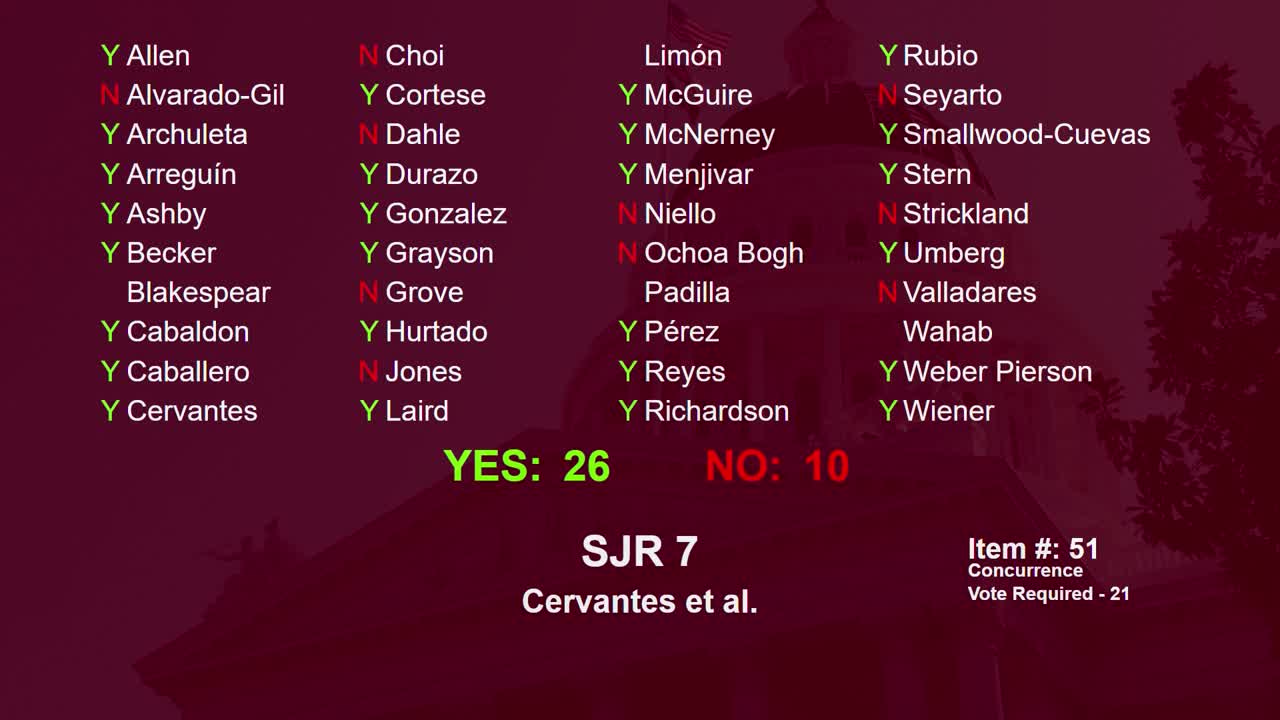 4MIN
Senate Floor
 19MIN
Senate Standing Committee on Public Safety
 1MIN
Assembly Floor
 12MIN
Assembly Standing Committee on Public Safety
Bill Author

Bill Co-Author(s):