AB 2646: Employment: minimum wages: agricultural workers.
- Session Year: 2025-2026
- House: Assembly
- Latest Version Date: 2026-09-30
Current Status:
Passed
(2026-09-30: Chaptered by Secretary of State - Chapter 956, Statutes of 2026.)
Introduced
In Committee
Awaiting First Chamber Vote
Passed First Chamber
In Committee
Awaiting Second Chamber Vote
Passed Second Chamber
Enacted
Existing law establishes a minimum wage for all industries and imposes criminal penalties for violation of these wage provisions. Existing law authorizes the Labor Commissioner to collect due and unpaid wages or benefits on behalf of workers. Under existing law, the commissioner acts as trustee and deposits collected wages and benefits into the Industrial Relations Unpaid Wage Fund, which is continuously appropriated for the purpose of remitting the collected wages or benefits.
This bill would require the minimum hourly wage for an approved agricultural employee and corresponding employee, as defined, to be $19.75 per hour. Commencing January 1, 2027, and each January thereafter, the bill would require the above-described minimum hourly wage to be adjusted by an amount equal to the cost-of-living adjustment for social security benefits, as specified. By expanding the scope of a crime, the bill would impose a state-mandated local program. By increasing the revenue to the Industrial Relations Unpaid Wage Fund, a continuously appropriated fund, and expanding the purposes for which moneys in that fund may be used, the bill would make an appropriation.
The California Constitution requires the state to reimburse local agencies and school districts for certain costs mandated by the state. Statutory provisions establish procedures for making that reimbursement.
This bill would provide that no reimbursement is required by this act for a specified reason.
(a)The minimum hourly wage for an approved agricultural employee and corresponding employee shall be nineteen dollars and seventy-five cents ($19.75) per hour.
(b)Commencing on January 1, 2027, and each January 1 thereafter, the wage specified in subdivision (a) shall be adjusted by an amount equal to the cost-of-living adjustment for social security benefits for that year as published by the Social Security Administration based on changes in the United States Consumer Price Index, and be applied to the previous years amount in the same manner as social security adjustments are applied.
(c)For purposes of this section:
(1)Agricultural employer has the same meaning as defined in subdivision (c) of Section 1140.4.
(2)Agriculture has the same meaning as defined in subdivision (a) of Section 1140.4.
(3)Approved agricultural employee means an employee engaged in agriculture who is a resident outside of the state and is permitted to work in the state on a temporary or seasonal basis through an application process where the Labor and Workforce Development Agency or the Employment Development Department has approved, in part or in whole, an application or job order to hire agricultural workers from outside of the state on a temporary or seasonal basis.
(4)Corresponding employee means an employee engaged in agriculture who is a resident of the state and who performs the same, or substantially similar, work during the same time period as an approved agricultural employee employed by the same employer in the same county.
(5)Temporary or seasonal basis means employment of a temporary nature where the employers need to fill the position with a temporary worker shall, except in extraordinary circumstances, last no longer than one year.
SEC. 2.No reimbursement is required by this act pursuant to Section 6 of Article XIIIB of the California Constitution because the only costs that may be incurred by a local agency or school district will be incurred because this act creates a new crime or infraction, eliminates a crime or infraction, or changes the penalty for a crime or infraction, within the meaning of Section 17556 of the Government Code, or changes the definition of a crime within the meaning of Section 6 of Article XIIIB of the California Constitution.
(a)The minimum hourly wage for an approved agricultural employee and corresponding employee shall be nineteen dollars and seventy-five cents ($19.75) per hour.
(b)Commencing on January 1, 2027, and each January 1 thereafter, the wage specified in subdivision (a) shall be adjusted by an amount equal to the cost-of-living adjustment for social security benefits for that year as published by the Social Security Administration based on changes in the United States Consumer Price Index, and be applied to the previous years amount in the same manner as social security adjustments are applied.
(c)For purposes of this section, the following definitions apply: section:
(1)Agricultural employer has the same meaning as defined in subdivision (c) of Section 1140.4.
(2)Agriculture has the same meaning as defined in subdivision (a) of Section 1140.4.
(3)Approved agricultural employee means an employee engaged in agriculture who is a resident outside of the state and is permitted to work in the state on a temporary or seasonal basis through an application process where the Labor and Workforce Development Agency or the Employment Development Department has approved, in part or in whole, an application or job order to hire agricultural workers from outside of the state on a temporary or seasonal basis.
(4)Corresponding employee means an employee engaged in agriculture who is a resident of the state or who is not an approved agricultural employee, and who performs the same, or substantially similar work, similar, work during the same time period as an approved agricultural employee employed by the same employer in the same county.
(5)Temporary or seasonal basis means employment of a temporary nature where the employers need to fill the position with a temporary worker shall, except in extraordinary circumstances, last no longer than one year.
SEC. 2.No reimbursement is required by this act pursuant to Section 6 of Article XIIIB of the California Constitution because the only costs that may be incurred by a local agency or school district will be incurred because this act creates a new crime or infraction, eliminates a crime or infraction, or changes the penalty for a crime or infraction, within the meaning of Section 17556 of the Government Code, or changes the definition of a crime within the meaning of Section 6 of Article XIIIB of the California Constitution.
(a)The minimum hourly wage for an approved agricultural employee and corresponding employee shall be nineteen dollars and seventy-five cents ($19.75) per hour.
(b)Commencing on January 1, 2027, and each January 1 thereafter, the wage specified in subdivision (a) shall be adjusted by an amount equal to the cost-of-living adjustment for social security benefits for that year as published by the Social Security Administration based on changes in the United States Consumer Price Index, and be applied to the previous years amount in the same manner as social security adjustments are applied.
(c)For purposes of this section, the following definitions apply:
(1)Agricultural employer has the same meaning as defined in subdivision (c) of Section 1140.4.
(2)Agriculture has the same meaning as defined in subdivision (a) of Section 1140.4.
(3)Approved agricultural employee means an employee engaged in agriculture who is a resident outside of the state and is permitted to work in the state on a temporary or seasonal basis through an application process where the Labor and Workforce Development Agency or the Employment Development Department has approved, in part or in whole, an application or job order to hire agricultural workers from outside of the state on a temporary or seasonal basis.
(4)Corresponding employee means an employee engaged in agriculture who is a resident of the state or who is not an approved agricultural employee, and who performs the same, or substantially similar work, as an approved agricultural employee. employee employed by the same employer in the same county.
(5)Temporary or seasonal basis means employment of a temporary nature where the employers need to fill the position with a temporary worker shall, except in extraordinary circumstances, last no longer than one year.
SEC. 2.No reimbursement is required by this act pursuant to Section 6 of Article XIIIB of the California Constitution because the only costs that may be incurred by a local agency or school district will be incurred because this act creates a new crime or infraction, eliminates a crime or infraction, or changes the penalty for a crime or infraction, within the meaning of Section 17556 of the Government Code, or changes the definition of a crime within the meaning of Section 6 of Article XIIIB of the California Constitution.
(a)The minimum hourly wage for an approved agricultural employee and corresponding employee shall be nineteen dollars and seventy-five cents ($19.75) per hour.
(b)Commencing on January 1, 2027, and each January 1 thereafter, the wage specified in subdivision (a) shall be adjusted by an amount equal to the cost-of-living adjustment for social security benefits for that year as published by the Social Security Administration based on changes in the United States Consumer Price Index, and be applied to the previous years amount in the same manner as social security adjustments are applied.
(c)For purposes of this section, the following definitions apply:
(1)Agricultural employer has the same meaning as defined in subdivision (c) of Section 1140.4.
(2)Agriculture has the same meaning as defined in subdivision (a) of Section 1140.4.
(3)Approved agricultural employee means an employee engaged in agriculture who is a resident outside of the state and is permitted to work in the state on a temporary or seasonal basis through an application process where the Labor and Workforce Development Agency or the Employment Development Department has approved, in part or in whole, an application or job order to hire agricultural workers from outside of the state on a temporary or seasonal basis.
(4)Corresponding employee means an employee engaged in agriculture who is a resident of the state or who is not an approved agricultural employee, and who performs the same, or substantially similar work, as an approved agricultural employee.
(5)Temporary or seasonal basis means employment of a temporary nature where the employers need to fill the position with a temporary worker shall, except in extraordinary circumstances, last no longer than one year.
SEC. 2.No reimbursement is required by this act pursuant to Section 6 of Article XIIIB of the California Constitution because the only costs that may be incurred by a local agency or school district will be incurred because this act creates a new crime or infraction, eliminates a crime or infraction, or changes the penalty for a crime or infraction, within the meaning of Section 17556 of the Government Code, or changes the definition of a crime within the meaning of Section 6 of Article XIIIB of the California Constitution.
|
Date
|
Status
|
|---|---|
| Sep 30, 2026 | Chaptered by Secretary of State - Chapter 956, Statutes of 2026. |
| Sep 30, 2026 | Approved by the Governor. |
| Aug 31, 2026 | Enrolled and presented to the Governor at 4 p.m. |
| Aug 25, 2026 | In Assembly. Ordered to Engrossing and Enrolling. |
| Aug 25, 2026 | Read third time. Passed. Ordered to the Assembly. (Ayes 30. Noes 9. Page 5761.). |
| Aug 25, 2026 | Read third time. Passed. Ordered to the Assembly. (Ayes 30. Noes 8.). |
| Aug 13, 2026 | Read second time. Ordered to third reading. |
| Aug 13, 2026 | From committee: Do pass. (Ayes 4. Noes 2.) (August 13). |
| Aug 3, 2026 | In committee: Referred to APPR. suspense file. |
| Jun 24, 2026 | From committee: Do pass and re-refer to Com. on APPR. (Ayes 4. Noes 1.) (June 24). Re-referred to Com. on APPR. |
| Jun 10, 2026 | Referred to Com. on L., P.E. & R. |
| May 27, 2026 | In Senate. Read first time. To Com. on RLS. for assignment. |
| May 26, 2026 | Read third time. Passed. Ordered to the Senate. (Ayes 58. Noes 16. Page 5338.) |
| May 26, 2026 | Read third time. Passed. Ordered to the Senate. (Ayes 58. Noes 16.) |
| May 26, 2026 | Read third time. Passed. Ordered to the Senate. |
| May 18, 2026 | Read third time and amended. Ordered to third reading. (Page 5143.) |
| May 18, 2026 | Read third time and amended. Ordered to third reading. |
| May 18, 2026 | Read second time. Ordered to third reading. |
| May 14, 2026 | From committee: Do pass. (Ayes 11. Noes 4.) (May 14). |
| May 6, 2026 | In committee: Set, first hearing. Referred to APPR. suspense file. |
| Apr 23, 2026 | From committee: Do pass and re-refer to Com. on APPR. (Ayes 5. Noes 0.) (April 22). Re-referred to Com. on APPR. |
| Mar 26, 2026 | Re-referred to Com. on L. & E. |
| Mar 25, 2026 | From committee chair, with author's amendments: Amend, and re-refer to Com. on L. & E. Read second time and amended. |
| Mar 16, 2026 | Referred to Com. on L. & E. |
| Feb 21, 2026 | From printer. May be heard in committee March 23. |
| Feb 20, 2026 | Read first time. To print. |
|
Date
|
Description
|
Location
|
Votes
|
|
|---|---|---|---|---|
| Aug 25, 2026 | Assembly 3rd Reading AB2646 Krell By Umberg | Senate Floor |
Passed |
|
| Aug 13, 2026 | Do pass | Senate Standing Committee on Appropriations |
Passed |
|
| Aug 3, 2026 | Placed on suspense file | Senate Standing Committee on Appropriations |
Passed |
|
| Jun 24, 2026 | Do pass, but first be re-referred to the Committee on [Appropriations] | Senate Standing Committee on Labor, Public Employment and Retirement |
Passed |
|
| May 26, 2026 | AB 2646 Krell Assembly Third Reading | Assembly Floor |
Passed |
|
| May 14, 2026 | Do pass. | Assembly Standing Committee on Appropriations |
Passed |
|
| Apr 22, 2026 | Do pass and be re-referred to the Committee on [Appropriations] | Assembly Standing Committee on Labor and Employment |
Passed |
This list shows positions taken on this bill by organizations on the date displayed, which is linked to the original source.
Positions by individuals are not included.
|
Organization
|
Position
|
Date
|
|---|---|---|
| Agricultural Council Of California | ** Against | |
| American Pistachio Growers | ** Against | |
| Association Of California Egg Farmers | ** Against | |
| California Apple Commission | ** Against | |
| California Association of Nurseries | ** Against | |
| California Association Of Nurseries And Garden Centers | ** Against | |
| California Association Of Winegrape Growers | ** Against | |
| California Blueberry Association | ** Against | |
| California Blueberry Commission | ** Against | |
| California Cattlemen'S Association | ** Against | |
| California Chamber Of Commerce | ** Against | |
| California Citrus Mutual | ** Against | |
| California Cotton Ginners and Growers Association | ** Against | |
| California Date Commission | ** Against | |
| California Department of Justice | ** Support | |
| California Farm Bureau | ** Against | |
| california farm labor contractor association | ** Against | |
| California Federation of Labor Unions | ** Support | |
| California Food Producers | ** Against | |
| California Fresh Fruit Association | ** Against | |
| California Grain and Feed Association | ** Against | |
| California Pear Growers Association | ** Against | |
| California Professional Firefighters | ** Support | |
| California Rural Legal Assistance Foundation | ** Support | |
| California Seed Association | ** Against | |
| California State Beekeepers Association | ** Against | |
| California Strawberry Commission | ** Against | |
| California Thoroughbred Breeders Association | ** Against | |
| California Walnut Commission | ** Against | |
| Grower-Shipper Association | ** Against | |
| Grower-Shipper Association of Central California | ** Against | |
| Olive Growers Council of California | ** Against | |
| Olive Oil Commission of California | ** Against | |
| Pacific Egg & Poultry Association | ** Against | |
| Teamsters California | ** Support | |
| united ag | ** Against | |
| United Farm Workers | ** Support | |
| Ventura County Agricultural Association | ** Against | |
| Western Growers Association | ** Against | |
| Western Tree Nut Association | ** Against |
SENATE RULES COMMITTEE Office of Senate Floor Analyses (916) 651-4171 | AB 2646 |
THIRD READING
Bill No: AB 2646
Author: Krell (D)
Amended: 5/18/26 in Assembly
Vote: 21
SENATE LABOR, PUB. EMP. & RET. COMMITTEE: 4-1, 6/24/26
AYES: Smallwood-Cuevas, Cortese, Durazo, Laird
NOES: Strickland
SENATE APPROPRIATIONS COMMITTEE: 4-2, 8/13/26
AYES: Cervantes, Cabaldon, Grayson, Richardson
NOES: Seyarto, Dahle
NO VOTE RECORDED: Wahab
ASSEMBLY FLOOR: 58-16, 5/26/26 - See last page for vote
SUBJECT: Employment: minimum wages: agricultural workers
SOURCE: United Farm Workers
DIGEST:
This bill establishes the minimum hourly wage for an approved agricultural employee and corresponding employee, as defined, to be $19.75 per hour. This bill also requires, beginning on January 1, 2027, and each January 1 thereafter, the minimum wage to be adjusted by an amount equal to the cost-of-living adjustment (COLA) for social security benefits for that year as published by the Social Security Administration based on changes in the United States Consumer Price Index (CPI), as specified.
ANALYSIS:
Existing federal law:
- Sets the federal minimum wage at $7.25 an hour. (Fair Labor Standards Act of 1938, 29 U.S.C. Chapter 8)
Existing state law:
- Establishes the Department of Industrial Relations (DIR) in the Labor and Workforce Development Agency (LWDA), and vests it with various powers and duties to foster, promote, and develop the welfare of the wage earners of California, to improve their working conditions, and to advance their opportunities for profitable employment. (Labor Code §50.5)
- Empowers the Labor Commissioner’s office, within DIR, with ensuring a just day’s pay in every workplace in the State and promotes economic justice through robust enforcement of labor laws. (Labor Code §79-107)
- Sets California’s minimum wage at $16.90 an hour[1] for all employers and specifies that after January 1, 2023, the minimum wage rate will be adjusted annually for inflation based on the national consumer price index for urban wage earners and clerical workers (CPI-W). However, the minimum wage cannot be lowered, even if there is a negative CPI, and the highest raise allowed in any one year is 3.5 percent. Each minimum wage increase must be rounded to the nearest ten cents ($0.10) and calculated (by the Director of Finance) on August 1st to take effect on January 1st of the following year. (Labor Code §1182.12)
- Defines, under the Agricultural Labor Relations Act (ALRA), “agriculture” to mean farming in all its branches, and, among other things, includes the cultivation and tillage of the soil, dairying, the production, cultivation, growing, and harvesting of any agricultural or horticultural commodities, as defined, the raising of livestock, bees, furbearing animals, or poultry, and any practices (including any forestry or lumbering operations) performed by a farmer or on a farm as an incident to or in conjunction with such farming operations, including preparation for market and delivery to storage or to market or to carriers for transportation to market. (Labor Code §1140.4(a))
- Defines, under the ALRA, the term “agricultural employer” to be liberally construed to include any person acting directly or indirectly in the interest of an employer in relation to an agricultural employee, any individual grower, corporate grower, cooperative grower, harvesting association, hiring association, land management group, any association of persons or cooperatives engaged in agriculture, and includes any person who owns or leases or manages land used for agricultural purposes, but excludes any person supplying agricultural workers to an employer, any farm labor contractor, as defined, and any person functioning in the capacity of a labor contractor. (Labor Code §1140.4(c))
This bill:
- Establishes the minimum hourly wage for an approved agricultural employee and corresponding employee to be $19.75 per hour.
- Requires, beginning on January 1, 2027, and each January 1 thereafter, the minimum wage specified under 1) to be adjusted by an amount equal to the cost-of-living adjustment for social security benefits for that year as published by the Social Security Administration based on changed in the United States Consumer Price Index, and be applied to the previous year’s amount in the same manner as social security adjustments are applied.
- Defines the following:
- “Agricultural employer” has the same meaning as defined in subdivision (c) of Section 1140.4.
- “Agriculture” has the same meaning as defined in subdivision (a) of Section 1140.4.
- “Approved agricultural employee” means an employee engaged in agriculture who is a resident outside of the state and is permitted to work in the state on a temporary or seasonal basis through an application process where the Labor and Workforce Development Agency or the Employment Development Department has approved, in part or in whole, an application or job order to hire agricultural workers from outside of the state on a temporary or seasonal basis.
- “Corresponding employee” means an employee engaged in agriculture who is a resident of the state and who performs the same, or substantially similar, work during the same time period as an approved agricultural employee employed by the same employer in the same county.
- “Temporary or seasonal basis” means employment of a temporary nature where the employer’s need to fill the position with a temporary worker shall, except in extraordinary circumstances, last no longer than one year.
Background
Farm workers. California produces over 400 commodities including nearly half of the nation's vegetables and over three-quarters of the nation's fruits and nuts.[2] California is home to an estimated 400,000 farm workers that are the backbone to this country’s agricultural system. Although California (and the rest of the nation) relies on the important work of farm workers, they tend to earn some of the lowest wages in the labor market. According to the author, “farm workers in California have historically earned wages that place many near or below the poverty line. This is due to the fact that farm work is often seasonal which makes actual earnings frequently lower. Lower earnings and reduced income make farm workers more vulnerable to the adverse effects of even minor economic fluctuations.” According to the National Agricultural Workers Survey (NAWS) published by the Department of Labor, which looked at the demographics and employment profile of California’s farmworkers from 2015 to 2019, California farmworkers’ mean and median personal income in the previous year was in the range of $20,000 to $24,999. 9% of workers said their total personal income was less than $10,000, 24% said they had personal incomes of $10,000 to $19,999, 37% had personal incomes of $20,000 to $29,999, and 21% reported that their total personal income was $30,000 or more. 5% of workers reported that they did not work at all during the prior calendar year.[3]
Federal minimum wage. In 1938, the Fair Labor Standards Act (FLSA) was enacted and created the framework governing workplaces today including restriction on child labor, establishing a standardized workday, and providing for overtime pay. The FLSA also established a national minimum wage for workers in the U.S., creating a guaranteed wage floor but not precluding states from enacting their own stronger minimum wage laws.
The minimum wage in the U.S. is currently $7.25. According to the National Conference of State Legislature (NCSL), as of January 5, 2026, 34 states and D.C. have minimum wages above the federal minimum wage of $7.25 per hour.[4]
Minimum wage laws in California. California first established a statewide minimum wage in 1916 and has increased the minimum wage several times over the years. As of January 1, 2026, the minimum wage in California for all employers is $16.90 per hour. SB 3 (Leno, Chapter 4, Statutes of 2016) increased the minimum wage in California from $10 an hour to the current $16.90 in a phased in approach (increasing the wage by $0.50 when first enacted and then by $1 each year until reaching $15). SB 3 also included a slower timeline for the incremental increases for employers of 25 or fewer employees. Additionally, after January 1, 2023, the minimum wage now increases annually from the seasonally adjusted U.S. CPI, but no more than 3.5% in a year, with the resulting amount rounded to the nearest $0.10. The increase is calculated on August 1st and takes effect on January 1st of the following year.
Some cities in California have established minimum wages that are higher than the current statewide minimum wage. For example, the following cities all have minimum wages higher than $17 per hour: Alameda, Belmont, Berkeley, Burlingame, Cupertino, Daly City, East Palo Alto, El Cerrito, Emeryville, Foster City, Fremont, Half Moon Bay, Hayward, Los Altos, Los Angeles, Malibu, Menlo Park, Milpitas, Mountain View, Novato, Oakland, Palo Alto, Pasadena, Petaluma, Redwood City, Richmond, San Carlos, San Diego, San Francisco, San Jose, San Mateo, Santa Clara, Santa Monica, Sonoma, South San Francisco, Sunnyvale, and West Hollywood. San Francisco is at $19.61 and Los Angeles $18.42. The city of Emeryville has the highest minimum wage at $20.34 per hour.
In 2023, the Governor signed AB 1228 (Holden) which established a $20 dollar per hour minimum wage for half a million fast food restaurant employees, effective April 1, 2024. That same year, SB 525 (Durazo) also became law, establishing a phased-in minimum wage for about 400,000 health care workers to reach $25 per hour beginning in October 16, 2024 depending on the type of health care facility.
Social security benefits cost-of-living adjustments. As a response to the challenges of the Great Depression, social security insurance was created in order to address the permanent problem of economic security for the elderly by creating a work-related, contributory system in which workers would provide for their own future economic security through taxes paid while employed.
To offset the effects of inflation on fixed income, Social Security benefits have annual increases. These increases are now known as Cost of Living Allowances or Cost-of-Living Adjustments (COLAs). It was not until 1950 that Congress passed amendments to the SSA and first legislated an increase in benefits. Later, in 1972, the law was changed again to provide, beginning in 1975, automatic annual COLAs based on the annual increase in consumer prices. With this change, beneficiaries do not have to wait for congressional action to increase their benefits and inflation does not drain value from Social Security benefits. The Act specifies a formula for determining each COLA. According to the formula, COLAs are based on increases in the Consumer Price Index for Urban Wage Earners and Clerical Workers (CPI-W). CPI-Ws are calculated on a monthly basis by the Bureau of Labor Statistics.
The Social Security Administration (SSA) announced a 2.8% increase in Social Security and Supplemental Security Income (SSI) benefits for more than 75 million Americans for 2026.[5] There has been a COLA for social security benefits during the last ten years:[6]
This bill, AB 2646, proposes to establish the minimum wage for specified agricultural employees to be $19.75 and requires the minimum wage to be adjusted by an amount equal to the COLA for social security benefits for that year, as published by the SSA, based on changes in the United States CPI beginning on January 1, 2027. This bill requires the increase to be applied to the previous year’s amount in the same manner as social security adjustments are applied. For context, if this bill becomes law, the proposed minimum wage would increase the following year (January 1, 2027) by the same amounts equal to the COLA for social security benefits (i.e. 2.8% in 2026).
Related/Prior Legislation
SB 525 (Durazo, Chapter 890, Statutes of 2023) enacted a phased in multi-tiered statewide minimum wage schedule for health care workers employed by covered healthcare facilities, as defined; (2) required, following the phased-in wage increases, the minimum wage for health care workers employed by covered healthcare facilities to be adjusted, as specified; (3) provided a temporary waiver of wage increases under specified circumstances; (4) and established a 10-year moratorium on wage ordinances, regulations, or administrative actions for covered health care facility employees, as specified.
AB 1228 (Holden, Chapter 262, Statutes of 2023) among other things, required the hourly minimum wage for fast food restaurant employees to be $20 per hour, effective April 1, 2024.
SB 639 (Durazo, Chapter 339, Statutes of 2021) required the development of a plan to phase out the use of the subminimum wage certificate program, which authorizes employers to pay less than minimum wage for employees with physical or mental disabilities, as defined, by January 1, 2025.
SB 3 (Leno, Chapter 4, Statutes of 2016), among other things, increased the state minimum wage to $15 per hour, in an incremental timeline from $10 to $15, and indexed the minimum wage to inflation thereafter, as specified.
AB 1066 (Gonzalez, Chapter 313, Statutes of 2016), enacted the Phase-In Overtime for Agricultural Workers Act of 2016, which removed the exemption for agricultural employees regarding hours, meal breaks, and other working conditions, including specified wage requirements, and created a schedule that would phase in overtime requirements for agricultural workers, as defined, over the course of 4 years, from 2019 to 2022, inclusive. Beginning January 1, 2022, the bill required any work performed by a person employed in an agricultural occupation in excess of 12 hours in one day to be compensated at the rate of no less than twice the employee’s regular rate of pay. The bill provided employers who employ 25 or fewer employees an additional 3 years to comply with the phasing in of these overtime requirements. The bill required DIR to update a specified wage order for consistency with these provisions, as specified.
FISCAL EFFECT: Appropriation: Yes Fiscal Com.: Yes Local: Yes
According to the Senate Appropriations Committee:
- The Labor Commissioner’s Office (LCO), within the Department of Industrial Relations (DIR), indicates that it would incur first-year costs of $1.6 million $2.8 million, and $1.5 million to $2.6 million annually thereafter, to issue new minimum wage orders to impacted employers and enforce the farmworker minimum wage (Labor Enforcement and Compliance Fund). DIR previously noted a 50 percent increase in reports of labor law violations in the agricultural industry as a result of this bill, approximately 15 percent of which would trigger new investigations and wage claim cases, entailing an intake process, conference, and hearing.
SUPPORT: (Verified 8/13/26)
United Farm Workers (Source)
California Department of Justice
California Federation of Labor Unions
California Professional Firefighters
California Rural Legal Assistance Foundation
Teamsters California
OPPOSITION: (Verified 8/13/26)
Agricultural Council of California
American Pistachio Growers
Association of California Egg Farmers
California Apple Commission
California Association of Nurseries
California Association of Nurseries and Garden Centers
California Association of Winegrape Growers
California Blueberry Association
California Blueberry Commission
California Cattlemen's Association
California Chamber of Commerce
California Citrus Mutual
California Cotton Ginners and Growers Association
California Date Commission
California Farm Bureau
California Farm Labor Contractor Association
California Food Producers
California Fresh Fruit Association
California Grain and Feed Association
California Pear Growers Association
California Seed Association
California State Beekeepers Association
California Strawberry Commission
California Thoroughbred Breeders Association
California Walnut Commission
Grower-shipper Association
Grower-shipper Association of Central California
Olive Growers Council of California
Olive Oil Commission of California
Pacific Egg & Poultry Association
United Ag
Ventura County Agricultural Association
Western Growers Association
Western Tree Nut Association
ARGUMENTS IN SUPPORT: According to the sponsors, United Farm Workers: “By establishing a state $19.75 wage floor with annual cost-of-living adjustments tied to the Social Security Administration’s Consumer Price Index, the bill safeguards vulnerable California farm workers against deepening wage depression in the middle of escalating prices for food and basic necessities. Under Governor Newsom’s administration, California has established a precedent of industry-specific wage standards that address the unique vulnerabilities of specific and marginalized workforces, including in fast-food and healthcare. California’s agricultural sector is a cornerstone of the state’s economy, yet the workers who labor in our fields often face significant economic hardship. […] By setting a minimum hourly rate of $19.75 for state “approved agricultural employees” and “corresponding employees” beginning January 1, 2027, with annual cost-of-living adjustments, AB 2646 takes a step toward fair compensation for workers that feed us all. The inclusion of “corresponding employees” performing the same or substantially similar work and employed for the same employer in the same county, protects farm workers from unequal treatment for the same work.”
ARGUMENTS IN OPPOSITION: A coalition of agricultural associations and employers, including the Western Growers Association, argues: “The proposed wage floor of $19.75 beginning January 1, 2027, followed by automatic annual cost of living adjustments, would impose significant new costs on California farms that already operate on extremely thin margins. Nearly 98 percent of California farms are family-owned operations, many of which have been struggling to absorb rising labor, regulatory, water, and energy costs. Imposing an additional sector-specific wage mandate will make it even harder for these businesses to remain competitive with producers in other states and countries, maintain production, and preserve jobs in rural communities.
The domestic agricultural workforce has steadily declined, and growers increasingly rely on the H-2A program to maintain stable food production. The H-2A program is not designed or intended to replace the domestic workforce, it offers temporary assistance in filling labor gaps that exist at varying levels each year. Today, more than 350,000 H-2A workers are employed nationwide each year, reflecting the growing gap between available domestic labor and the workforce needed to harvest crops. Policies that make it more difficult or costly to use that program risk accelerating the loss of agricultural production in California.”
ASSEMBLY FLOOR: 58-16, 5/26/26
AYES: Addis, Aguiar-Curry, Ahrens, Alvarez, Arambula, Ávila Farías, Bains, Bauer-Kahan, Bennett, Berman, Boerner, Bonta, Bryan, Calderon, Caloza, Carrillo, Connolly, Elhawary, Fong, Gabriel, Garcia, Gipson, Mark González, Haney, Harabedian, Hart, Irwin, Jackson, Kalra, Krell, Lee, Lowenthal, McKinnor, Nguyen, Ortega, Pacheco, Papan, Patel, Pellerin, Petrie-Norris, Quirk-Silva, Ramos, Ransom, Michelle Rodriguez, Rogers, Blanca Rubio, Schiavo, Schultz, Sharp-Collins, Solache, Soria, Stefani, Valencia, Ward, Wicks, Wilson, Zbur, Rivas
NOES: Alanis, Chen, Davies, DeMaio, Dixon, Ellis, Flora, Gallagher, Jeff Gonzalez, Hadwick, Hoover, Patterson, Sanchez, Ta, Tangipa, Wallis
NO VOTE RECORDED: Castillo, Johnson, Lackey, Macedo, Muratsuchi, Celeste Rodriguez
Prepared by: Jazmin Marroquin / L., P.E. & R. / (916) 651-1556
8/14/26 14:12:12
**** END ****
The minimum wage in California, effective January 1, 2026, is $16.90/hour for all employers. Starting April 1, 2024, all “fast food restaurant employees” who are covered by the law must be paid at least $20.00 per hour. Starting October 16, 2024, certain health care workers must be paid a higher minimum wage. https://www.dir.ca.gov/dlse/minimum_wage.htm ↑
California Agricultural Production Statistics, https://www.cdfa.ca.gov/statistics/ ↑
“California Findings from the National Agricultural Workers Survey (NAWS) 2015-2019: A Demographic and Employment Profile of California Farmworkers.” January 2022. https://www.dol.gov/sites/dolgov/files/ETA/naws/pdfs/NAWS%20Research%20Report%2015.pdf ↑
According to the NCSL, five states have not adopted a state minimum wage: Alabama, Louisiana, Mississippi, South Carolina and Tennessee. Three states, Georgia, Oklahoma and Wyoming, have a minimum wage below $7.25 per hour. In all eight of these states, the federal minimum wage of $7.25 per hour generally applies. https://www.ncsl.org/labor-and-employment/state-minimum-wages ↑
Social Security Administration, “Cost-of-Living Adjustment (COLA) Information for 2026,” https://www.ssa.gov/cola/ ↑
Social Security Administration, “Cost-of-Living Adjustment,” https://www.ssa.gov/OACT/COLA/colaseries.html ↑
SENATE COMMITTEE ON
Senator Sabrina Cervantes, Chair
2025 - 2026 Regular Session
AB 2646 (Krell) - Employment: minimum wages: agricultural workers
Version: | Policy Vote: |
Urgency: | Mandate: |
Hearing Date: | Consultant: |
Bill Summary:
AB 2646 would (1) establish the minimum hourly wage for an approved agricultural employee and corresponding employee, as defined, to be $19.75 per hour, and (2) provide for annual cost-of-living increases, as specified.
Fiscal Impact:
The Labor Commissioner’s Office (LCO), within the Department of Industrial Relations (DIR), indicates that it would incur first-year costs of $1.6 million $2.8 million, and $1.5 million to $2.6 million annually thereafter, to issue new minimum wage orders to impacted employers and enforce the farmworker minimum wage (Labor Enforcement and Compliance Fund). DIR previously noted a 50 percent increase in reports of labor law violations in the agricultural industry as a result of this bill, approximately 15 percent of which would trigger new investigations and wage claim cases, entailing an intake process, conference, and hearing.
Background:
California is the nation's leading agricultural state, producing more than 400 commodities, including nearly half of the nation's vegetables and more than three-quarters of its fruits and nuts. The state's agricultural industry depends on an estimated 400,000 farm workers who perform essential work throughout the food production system.
Despite their critical role, farm workers have historically earned among the lowest wages in California. According to the author, agricultural employment is often seasonal, resulting in lower annual earnings and greater economic insecurity. Data from the U.S. Department of Labor's National Agricultural Workers Survey (NAWS), which examined California farm workers between 2015 and 2019, found that the mean and median annual personal income of California farm workers was between $20,000 and $24,999. Nine percent of workers reported earning less than $10,000 annually, 24 percent earned between $10,000 and $19,999, 37 percent earned between $20,000 and $29,999, and 21 percent earned $30,000 or more. An additional five percent reported that they did not work at all during the previous calendar year.
The federal Fair Labor Standards Act (FLSA), enacted in 1938, established many of the nation's foundational workplace protections, including a federal minimum wage, overtime requirements, and restrictions on child labor. While the FLSA establishes a national wage floor, states and local governments may adopt higher minimum wage standards. The federal minimum wage is currently $7.25 per hour. According to the National Conference of State Legislatures, as of January 2026, 34 states and the District of Columbia have minimum wages above the federal level.
California established its first statewide minimum wage in 1916 and has increased it numerous times since then. Most recently, SB 3 (Leno), Chapter 4, Statutes of 2016, increased the minimum wage from $10 per hour through a phased-in schedule that ultimately reached $15 per hour, with a slower implementation schedule for employers with 25 or fewer employees. Beginning January 1, 2023, the statewide minimum wage became subject to an annual inflation adjustment based on changes in the U.S. Consumer Price Index (CPI), capped at 3.5 percent and rounded to the nearest $0.10. As of January 1, 2026, the statewide minimum wage is $16.90 per hour. The Department of Finance calculates the annual adjustment each year by August 1, with any increase taking effect the following January 1.
Several California cities have adopted local minimum wages that exceed the statewide rate. For example, San Francisco, Los Angeles, and Emeryville all require higher minimum wages, with Emeryville currently having the highest local minimum wage in the state at $20.34 per hour.
In addition to statewide and local minimum wages, California has recently established industry-specific minimum wage standards for certain sectors. AB 1228 (Holden), Chapter 262, Statutes of 2023, established a $20 per hour minimum wage for approximately 500,000 fast food restaurant employees, effective April 1, 2024. Similarly, SB 525 (Durazo), Chapter 890, Statutes of 2023, established a phased-in minimum wage for approximately 400,000 health care workers that will increase to $25 per hour by 2026 or 2028, depending on the type of health care facility.
Separately, Social Security benefits are adjusted annually through cost-of-living adjustments (COLAs) to help preserve beneficiaries' purchasing power during inflation. Since 1975, federal law has required automatic annual COLAs based on changes in the Consumer Price Index for Urban Wage Earners and Clerical Workers (CPI-W), as calculated by the U.S. Bureau of Labor Statistics. The Social Security Administration announced a 2.8 percent COLA for Social Security and Supplemental Security Income benefits in 2026. Recent annual COLAs have ranged from 0.3 percent in 2016 to 8.7 percent in 2023, reflecting changes in inflation over time.
Proposed Law:
This bill, among other things, would do the following:
- Establish the minimum hourly wage for an approved agricultural employee (as defined) and corresponding employee (as defined) to be $19.75 per hour.
- Require, beginning on January 1, 2027, and each January 1 thereafter, the minimum wage to be adjusted by an amount equal to the cost-of-living adjustment for social security benefits for that year as published by the Social Security Administration based on changes in the United States Consumer Price Index, and be applied to the previous year’s amount in the same manner as social security adjustments are applied.
Related Legislation:
- SB 525 (Durazo, Chapter 890, Statutes of 2023) enacted a phased in multi-tiered statewide minimum wage schedule for health care workers employed by covered healthcare facilities, as defined; required, following the phased-in wage increases, the minimum wage for health care workers employed by covered healthcare facilities to be adjusted, as specified; provided a temporary waiver of wage increases under specified circumstances; and established a 10-year moratorium on wage ordinances, regulations, or administrative actions for covered health care facility employees, as specified.
- AB 1228 (Holden, Chapter 262, Statutes of 2023) among other things, required the hourly minimum wage for fast food restaurant employees to be $20 per hour, effective April 1, 2024.
- SB 639 (Durazo, Chapter 339, Statutes of 2021) required the development of a plan to phase out the use of the subminimum wage certificate program, which authorizes employers to pay less than minimum wage for employees with physical or mental disabilities, as defined, by January 1, 2025.
- SB 3 (Leno, Chapter 4, Statutes of 2016), among other things, increased the state minimum wage to $15 per hour, in an incremental timeline from $10 to $15, and indexed the minimum wage to inflation thereafter, as specified.
- AB 1066 (Gonzalez, Chapter 313, Statutes of 2016), enacted the Phase-In Overtime for Agricultural Workers Act of 2016, which removed the exemption for agricultural employees regarding hours, meal breaks, and other working conditions, including specified wage requirements, and created a schedule that would phase in overtime requirements for agricultural workers, as defined, over the course of 4 years, from 2019 to 2022, inclusive. Beginning January 1, 2022, the bill required any work performed by a person employed in an agricultural occupation in excess of 12 hours in one day to be compensated at the rate of no less than twice the employee’s regular rate of pay. The bill provided employers who employ 25 or fewer employees an additional 3 years to comply with the phasing in of these overtime requirements. The bill required DIR to update a specified wage order for consistency with these provisions, as specified.
Staff Comments:
This bill would establish a separate minimum wage for specified agricultural employees of $19.75 per hour beginning January 1, 2027. Beginning January 1, 2028, the minimum wage would be adjusted annually by the same percentage as the Social Security COLA published by the SSA, based on changes in the CPI-W. The adjustment would be applied to the prior year’s wage rate in the same manner as Social Security benefit adjustments.
Any local government costs resulting from the mandate in this measure are not state-reimbursable because the mandate only involves the definition of a crime or the penalty for conviction of a crime.
-- END --
SENATE COMMITTEE ON LABOR, PUBLIC EMPLOYMENT AND RETIREMENT
Senator Lola Smallwood-Cuevas, Chair
2025 - 2026 Regular
Bill No: AB 2646 Hearing Date: June 24, 2026
Author: | Krell | ||
Version: | May 18, 2026 | ||
Urgency: | No | Fiscal: | Yes |
Consultant: | Jazmin Marroquin | ||
SUBJECT: Employment: minimum wages: agricultural workers
KEY ISSUE
This bill establishes the minimum hourly wage for an approved agricultural employee and corresponding employee, as defined, to be $19.75 per hour. This bill also requires, beginning on January 1, 2027, and each January 1 thereafter, the minimum wage to be adjusted by an amount equal to the cost-of-living adjustment (COLA) for social security benefits for that year as published by the Social Security Administration based on changed in the United States Consumer Price Index (CPI), as specified.
ANALYSIS
Existing federal law:
- Sets the federal minimum wage at $7.25 an hour. (Fair Labor Standards Act of 1938, 29 U.S.C. Chapter 8)
Existing law:
- Establishes the Department of Industrial Relations (DIR) in the Labor and Workforce Development Agency (LWDA), and vests it with various powers and duties to foster, promote, and develop the welfare of the wage earners of California, to improve their working conditions, and to advance their opportunities for profitable employment. (Labor Code §50.5)
- Empowers the Labor Commissioner’s office, within DIR, with ensuring a just day’s pay in every workplace in the State and promotes economic justice through robust enforcement of labor laws. (Labor Code §79-107)
- Sets California’s minimum wage at $16.90 an hour[1] for all employers and specifies that after January 1, 2023, the minimum wage rate will be adjusted annually for inflation based on the national consumer price index for urban wage earners and clerical workers (CPI-W). However, the minimum wage cannot be lowered, even if there is a negative CPI, and the highest raise allowed in any one year is 3.5 percent. Each minimum wage increase must be rounded to the nearest ten cents ($0.10) and calculated (by the Director of Finance) on August 1st to take effect on January 1st of the following year. (Labor Code §1182.12)
- Defines, under the Agricultural Labor Relations Act (ALRA), “agriculture” to mean farming in all its branches, and, among other things, includes the cultivation and tillage of the soil, dairying, the production, cultivation, growing, and harvesting of any agricultural or horticultural commodities, as defined, the raising of livestock, bees, furbearing animals, or poultry, and any practices (including any forestry or lumbering operations) performed by a farmer or on a farm as an incident to or in conjunction with such farming operations, including preparation for market and delivery to storage or to market or to carriers for transportation to market. (Labor Code §1140.4(a))
- Defines, under the ALRA, the term “agricultural employer” to be liberally construed to include any person acting directly or indirectly in the interest of an employer in relation to an agricultural employee, any individual grower, corporate grower, cooperative grower, harvesting association, hiring association, land management group, any association of persons or cooperatives engaged in agriculture, and includes any person who owns or leases or manages land used for agricultural purposes, but excludes any person supplying agricultural workers to an employer, any farm labor contractor, as defined, and any person functioning in the capacity of a labor contractor. (Labor Code §1140.4(c))
This bill:
- Establishes the minimum hourly wage for an approved agricultural employee and corresponding employee to be $19.75 per hour.
- Requires, beginning on January 1, 2027, and each January 1 thereafter, the minimum wage specified under 1) to be adjusted by an amount equal to the cost-of-living adjustment for social security benefits for that year as published by the Social Security Administration based on changed in the United States Consumer Price Index, and be applied to the previous year’s amount in the same manner as social security adjustments are applied.
- Defines the following:
- “Agricultural employer” has the same meaning as defined in subdivision (c) of Section 1140.4.
- “Agriculture” has the same meaning as defined in subdivision (a) of Section 1140.4.
- “Approved agricultural employee” means an employee engaged in agriculture who is a resident outside of the state and is permitted to work in the state on a temporary or seasonal basis through an application process where the Labor and Workforce Development Agency or the Employment Development Department has approved, in part or in whole, an application or job order to hire agricultural workers from outside of the state on a temporary or seasonal basis.
- “Corresponding employee” means an employee engaged in agriculture who is a resident of the state and who performs the same, or substantially similar, work during the same time period as an approved agricultural employee employed by the same employer in the same county.
- “Temporary or seasonal basis” means employment of a temporary nature where the employer’s need to fill the position with a temporary worker shall, except in extraordinary circumstances, last no longer than one year.
COMMENTS
1. Background:
Farm workers
California produces over 400 commodities including nearly half of the nation's vegetables and over three-quarters of the nation's fruits and nuts.[2] California is home to an estimated 400,000 farm workers that are the backbone to this country’s agricultural system.
Although California (and the rest of the nation) relies on the important work of farm workers, they tend to earn some of the lowest wages in the labor market. According to the author, “farm workers in California have historically earned wages that place many near or below the poverty line. This is due to the fact that farm work is often seasonal which makes actual earnings frequently lower. Lower earnings and reduced income make farm workers more vulnerable to the adverse effects of even minor economic fluctuations.” According to the National Agricultural Workers Survey (NAWS) published by the Department of Labor, which looked at the demographics and employment profile of California’s farmworkers from 2015 to 2019, California farmworkers’ mean and median personal income in the previous year was in the range of $20,000 to $24,999. Nine percent of workers said their total personal income was less than $10,000, 24 percent said they had personal incomes of $10,000 to $19,999, 37 percent had personal incomes of $20,000 to $29,999, and 21 percent reported that their total personal income was $30,000 or more. Five percent of workers reported that they did not work at all during the prior calendar year.[3]
Federal minimum wage
In 1938, the Fair Labor Standards Act (FLSA) was enacted and created the framework governing workplaces today including restriction on child labor, establishing a standardized workday, and providing for overtime pay. The FLSA also established a national minimum wage for workers in the U.S., creating a guaranteed wage floor but not precluding states from enacting their own stronger minimum wage laws.
The minimum wage in the U.S. is currently $7.25. According to the National Conference of State Legislature (NCSL), as of January 5, 2026, 34 states and the D.C. have minimum wages above the federal minimum wage of $7.25 per hour.[4]
Minimum wage laws in California
California first established a statewide minimum wage in 1916 and has increased the minimum wage several times over the years.
As of January 1, 2026, the minimum wage in California for all employers is $16.90 per hour. SB 3 (Leno, Chapter 4, Statutes of 2016) increased the minimum wage in California from $10 an hour to the current $16.90 in a phased in approach (increasing the wage by $0.50 when first enacted and then by $1 each year until reaching $15). SB 3 also included a slower timeline for the incremental increases for employers of 25 or fewer employees. Additionally, after January 1, 2023, the minimum wage now increases annually from the seasonally adjusted U.S. CPI, but no more than 3.5% in a year, with the resulting amount rounded to the nearest $0.10. The increase is calculated on August 1st and takes effect on January 1st of the following year.
Some cities in California have established minimum wages that are higher than the current statewide minimum wage. For example, the following cities all have minimum wages higher than $17 per hour: Alameda, Belmont, Berkeley, Burlingame, Cupertino, Daly City, East Palo Alto, El Cerrito, Emeryville, Foster City, Fremont, Half Moon Bay, Hayward, Los Altos, Los Angeles, Malibu, Menlo Park, Milpitas, Mountain View, Novato, Oakland, Palo Alto, Pasadena, Petaluma, Redwood City, Richmond, San Carlos, San Diego, San Francisco, San Jose, San Mateo, Santa Clara, Santa Monica, Sonoma, South San Francisco, Sunnyvale, and West Hollywood. San Francisco is at $19.61 and Los Angeles $18.42. The city of Emeryville has the highest minimum wage at $20.34 per hour.
In 2023, the Governor signed AB 1228 (Holden) which established a $20 dollar per hour minimum wage for half a million fast food restaurant employees, effective April 1, 2024. That same year, SB 525 (Durazo) also became law, establishing a phased-in minimum wage for about 400,000 health care workers to reach $25 per hour beginning in October 16, 2024 depending on the type of health care facility.
Social security benefits cost-of-living adjustments (COLA)
As a response to the challenges of the Great Depression, social security insurance was created in order to address the permanent problem of economic security for the elderly by creating a work-related, contributory system in which workers would provide for their own future economic security through taxes paid while employed.
To offset the effects of inflation on fixed income, Social Security benefits have annual increases. These increases are now known as Cost of Living Allowances or Cost-of-Living Adjustments (COLAs). It was not until 1950 that Congress passed amendments to the SSA and first legislated an increase in benefits. Later, in 1972, the law was changed again to provide, beginning in 1975, automatic annual COLAs based on the annual increase in consumer prices. With this change, beneficiaries do not have to wait for congressional action to increase their benefits and inflation does not drain value from Social Security benefits. The Act specifies a formula for determining each COLA. According to the formula, COLAs are based on increases in the Consumer Price Index for Urban Wage Earners and Clerical Workers (CPI-W). CPI-Ws are calculated on a monthly basis by the Bureau of Labor Statistics.
The Social Security Administration (SSA) announced a 2.8 percent increase in Social Security and Supplemental Security Income (SSI) benefits for more than 75 million Americans for 2026.[5] There has been a COLA for social security benefits during the last ten years:[6]
Year COLA
2016 0.3%
2017 2.0%
2018 2.8%
2019 1.6%
2020 1.3%
2021 5.9%
2022 8.7%
2023 3.2%
2024 2.5%
2025 2.8%
This bill, AB 2646, proposes to establish the minimum wage for specified agricultural employees to be $19.75 and requires the minimum wage to be adjusted by an amount equal to the COLA for social security benefits for that year, as published by the SSA, based on changes in the United States CPI beginning on January 1, 2027. This bill would require the increase to be applied to the previous year’s amount in the same manner as social security adjustments are applied. For context, if this bill becomes law, the proposed minimum wage would increase the following year (January 1, 2027) by the same amounts equal to the COLA for social security benefits (i.e. 2.8% in 2026).
2. Need for this bill?
According to the author, “California’s farm workers deserve a livable wage. Every day these workers face immigration threats, experience wage theft, unsafe working conditions including exposures to excessive heat or dangerous pesticides, workplace sexual harassment, and lack of access to basic health care. California’s farm workers have historically earned wages that place many near or below the poverty line. Often, farm work can be seasonal, which makes earnings even lower. AB 2646 safeguards farmworker wages by establishing a wage floor of $19.75.”
3. Proponent Arguments:
According to the sponsors, United Farm Workers:
“By establishing a state $19.75 wage floor with annual cost-of-living adjustments tied to the Social Security Administration’s Consumer Price Index, the bill safeguards vulnerable California farm workers against deepening wage depression in the middle of escalating prices for food and basic necessities. Under Governor Newsom’s administration, California has established a precedent of industry-specific wage standards that address the unique vulnerabilities of specific and marginalized workforces, including in fast-food and healthcare. California’s agricultural sector is a cornerstone of the state’s economy, yet the workers who labor in our fields often face significant economic hardship. […]
By setting a minimum hourly rate of $19.75 for state “approved agricultural employees” and “corresponding employees” beginning January 1, 2027, with annual cost-of-living adjustments, AB 2646 takes a step toward fair compensation for workers that feed us all. The inclusion of “corresponding employees” performing the same or substantially similar work and employed for the same employer in the same county, protects farm workers from unequal treatment for the same work.”
4. Opponent Arguments:
a coalition of agricultural associations and employers, including the Western Growers Association, is opposed and argues:
“The proposed wage floor of $19.75 beginning January 1, 2027, followed by automatic annual cost of living adjustments, would impose significant new costs on California farms that already operate on extremely thin margins. Nearly 98 percent of California farms are family-owned operations, many of which have been struggling to absorb rising labor, regulatory, water, and energy costs. Imposing an additional sector-specific wage mandate will make it even harder for these businesses to remain competitive with producers in other states and countries, maintain production, and preserve jobs in rural communities.
The domestic agricultural workforce has steadily declined, and growers increasingly rely on the H-2A program to maintain stable food production. The H-2A program is not designed or intended to replace the domestic workforce, it offers temporary assistance in filling labor gaps that exist at varying levels each year. Today, more than 350,000 H-2A workers are employed nationwide each year, reflecting the growing gap between available domestic labor and the workforce needed to harvest crops. Policies that make it more difficult or costly to use that program risk accelerating the loss of agricultural production in California.”
5. Prior Legislation:
SB 525 (Durazo, Chapter 890, Statutes of 2023) enacted a phased in multi-tiered statewide minimum wage schedule for health care workers employed by covered healthcare facilities, as defined; (2) required, following the phased-in wage increases, the minimum wage for health care workers employed by covered healthcare facilities to be adjusted, as specified; (3) provided a temporary waiver of wage increases under specified circumstances; (4) and established a 10-year moratorium on wage ordinances, regulations, or administrative actions for covered health care facility employees, as specified.
AB 1228 (Holden, Chapter 262, Statutes of 2023) among other things, required the hourly minimum wage for fast food restaurant employees to be $20 per hour, effective April 1, 2024.
SB 639 (Durazo, Chapter 339, Statutes of 2021) required the development of a plan to phase out the use of the subminimum wage certificate program, which authorizes employers to pay less than minimum wage for employees with physical or mental disabilities, as defined, by January 1, 2025.
SB 3 (Leno, Chapter 4, Statutes of 2016), among other things, increased the state minimum wage to $15 per hour, in an incremental timeline from $10 to $15, and indexed the minimum wage to inflation thereafter, as specified.
AB 1066 (Gonzalez, Chapter 313, Statutes of 2016), enacted the Phase-In Overtime for Agricultural Workers Act of 2016, which removed the exemption for agricultural employees regarding hours, meal breaks, and other working conditions, including specified wage requirements, and created a schedule that would phase in overtime requirements for agricultural workers, as defined, over the course of 4 years, from 2019 to 2022, inclusive. Beginning January 1, 2022, the bill required any work performed by a person employed in an agricultural occupation in excess of 12 hours in one day to be compensated at the rate of no less than twice the employee’s regular rate of pay. The bill provided employers who employ 25 or fewer employees an additional 3 years to comply with the phasing in of these overtime requirements. The bill required DIR to update a specified wage order for consistency with these provisions, as specified.
SUPPORT
United Farm Workers (Sponsor)
California Department of Justice
California Federation of Labor Unions
California Professional Firefighters
California Rural Legal Assistance Foundation
Teamsters California
OPPOSITION
Agricultural Council of California
American Pistachio Growers
Association of California Egg Farmers
California Apple Commission
California Association of Nurseries
California Association of Nurseries and Garden Centers
California Association of Winegrape Growers
California Blueberry Association
California Blueberry Commission
California Cattlemen's Association
California Chamber of Commerce
California Citrus Mutual
California Cotton Ginners and Growers Association
California Date Commission
California Farm Bureau
California Farm Labor Contractor Association
California Food Producers
California Fresh Fruit Association
California Grain and Feed Association
California Pear Growers Association
California Seed Association
California State Beekeepers Association
California Strawberry Commission
California Thoroughbred Breeders Association
California Walnut Commission
Grower-shipper Association of Central California
Olive Growers Council of California
Olive Oil Commission of California
Pacific Egg and Poultry Association
United Ag
Ventura County Agricultural Association
Western Growers Association
Western Tree Nut Association
-- END --
The minimum wage in California, effective January 1, 2026, is $16.90/hour for all employers. Starting April 1, 2024, all “fast food restaurant employees” who are covered by the law must be paid at least $20.00 per hour. Starting October 16, 2024, certain health care workers must be paid a higher minimum wage. https://www.dir.ca.gov/dlse/minimum_wage.htm ↑
California Agricultural Production Statistics, https://www.cdfa.ca.gov/statistics/ ↑
“California Findings from the National Agricultural Workers Survey (NAWS) 2015-2019: A Demographic and Employment Profile of California Farmworkers.” January 2022. https://www.dol.gov/sites/dolgov/files/ETA/naws/pdfs/NAWS%20Research%20Report%2015.pdf ↑
According to the NCSL, five states have not adopted a state minimum wage: Alabama, Louisiana, Mississippi, South Carolina and Tennessee. Three states, Georgia, Oklahoma and Wyoming, have a minimum wage below $7.25 per hour. In all eight of these states, the federal minimum wage of $7.25 per hour generally applies. https://www.ncsl.org/labor-and-employment/state-minimum-wages ↑
Social Security Administration, “Cost-of-Living Adjustment (COLA) Information for 2026,” https://www.ssa.gov/cola/ ↑
Social Security Administration, “Cost-of-Living Adjustment,” https://www.ssa.gov/OACT/COLA/colaseries.html ↑
ASSEMBLY THIRD READING
ATR Bill Id:AB 2646
Author:(Krell)
As Amended Ver:March 25, 2026
Majority vote
SUMMARY
Requires the minimum hourly wage for agricultural employees, as specified, to be nineteen dollars and seventy-five cents ($19.75) per hour. Requires, commencing on January 1, 2027, and each January 1 thereafter, the $19.75 hourly wage to be adjusted by an amount equal to the cost-of-living adjustment (COLA) for social security benefits for that year as published by the Social Security Administration (SSA).
Major Provisions
- Requires the minimum hourly wage for an approved agricultural employee, as defined, and a corresponding employee, as defined, to be nineteen dollars and seventy-five cents ($19.75) per hour.
- Requires, commencing on January 1, 2027, and each January 1 thereafter, the wage specified in 1) above to be adjusted by an amount equal to the COLA for social security benefits for that year as published by the SSA based on changes in the United States Consumer Price Index, and be applied to the previous year's amount in the same manner as with social security adjustments.
- Provides that "agricultural employer" has the same meaning as defined in subdivision (c) of Labor Code Section 1140.4. (See existing law #5 in the committee policy analysis)
- Provides that "agriculture" has the same meaning as defined in subdivision (a) of Labor Code Section 1140.4. (See existing law #4 in the committee policy analysis)
- Defines "approved agricultural employee" to mean an employee engaged in agriculture who is a resident outside of the state and is permitted to work in the state on a temporary or seasonal basis through an application process where the Labor and Workforce Development Agency or the Employment Development Department has approved, in part or in whole, an application or job order to hire agricultural workers from outside of the state on a temporary or seasonal basis.
- Defines "corresponding employee" to mean an employee engaged in agriculture who is a resident of the state or who is not an approved agricultural employee, and who performs the same, or substantially similar work, as an approved agricultural employee employed by the same employer in the same county.
- Defines "temporary or seasonal basis" to mean employment of a temporary nature where the employer's need to fill the position with a temporary worker shall, except in extraordinary circumstances, last no longer than one year.
COMMENTS
As a workforce, farmworkers experience wage theft and other workplace abuses all too often. The majority of California's farmworkers are immigrants and undocumented, making them particularly vulnerable to labor violations. In February of this year, the state Labor Commissioner secured a $6 million dollar settlement for more than 10,000 farmworkers against a harvesting company for a series of wage and hour violations.[1] Labor law violations included failure to pay overtime, minimum wage and compensate for travel time. The settlement took five years from the time of filing the lawsuit.
According to the Author
According to the author, "California's farm workers deserve a livable wage. Every day these workers face immigration threats, experience wage theft, unsafe working conditions including exposures to excessive heat or dangerous pesticides, workplace sexual harassment and lack of access to basic health care. California's farm workers have historically earned wages that place many near or below the poverty line. Often, farm work can be seasonal, which makes earnings even lower. AB 2646 safeguards farmworker wages by establishing a wage floor of $19.75."
Arguments in Support
The United Farm Workers, sponsor of the bill, states, "By establishing a state $19.75 wage floor with annual cost-of-living adjustments tied to the Social Security Administration's Consumer Price Index, the bill safeguards vulnerable California farm workers against deepening wage depression in the middle of escalating prices for food and basic necessities.
Under Governor Newsom's administration, California has established a precedent of industry-specific wage standards that address the unique vulnerabilities of specific and marginalized workforces, including in fast-food and healthcare.
California's agricultural sector is a cornerstone of the state's economy, yet the workers who labor in our fields often face significant economic hardship. Farm workers have historically earned wages that place many below the poverty line. Farm work is often seasonal which makes annual earnings frequently lower.
Lower earnings make farm workers more vulnerable to the adverse effects of even minor economic fluctuations.
By setting a minimum hourly rate of $19.75 for state "approved agricultural employees" and "corresponding employees" beginning January 1, 2027, with annual cost-of-living adjustments, AB 2646 takes a step toward fair compensation for workers that feed us all."
Arguments in Opposition
A coalition of agricultural associations, including the Western Growers, is opposed and states, "The proposed wage floor of $19.75 beginning January 1, 2027, followed by automatic annual cost of living adjustments, would impose significant new costs on California farms that already operate on extremely thin margins. Nearly 98 percent of California farms are family-owned operations, many of which have been struggling to absorb rising labor, regulatory, water, and energy costs. Imposing an additional sector-specific wage mandate will make it even harder for these businesses to remain competitive with producers in other states and countries, maintain production, and preserve jobs in rural communities.
The domestic agricultural workforce has steadily declined, and growers increasingly rely on the H-2A program to maintain stable food production. The H-2A program is not designed or intended to replace the domestic workforce, it offers temporary assistance in filling labor gaps that exist at varying levels each year. Today, more than 350,000 H-2A workers are employed nationwide each year, reflecting the growing gap between available domestic labor and the workforce needed to harvest crops. Policies that make it more difficult or costly to use that program risk accelerating the loss of agricultural production in California."
FISCAL COMMENTS
According to the Assembly Appropriations Committee,
Ongoing costs in the low millions of dollars to the Labor Commissioner (LC), under the Department of Industrial Relations (DIR), to issue new minimum wage orders to impacted employers and enforce the farmworker minimum wage (Labor Enforcement and Compliance Fund). DIR anticipates a 50% increase in reports of labor law violations in the agricultural industry as a result of this bill, approximately 15% of which would trigger new investigations and wage claim cases, entailing an intake process, conference, and hearing.
VOTES
ASM LABOR AND EMPLOYMENT: 5-0-2
YES: Ortega, Elhawary, Kalra, Lee, Ward
ABS, ABST OR NV: Alanis, Chen
ASM APPROPRIATIONS: 11-4-0
YES: Wicks, Aguiar-Curry, Calderon, Caloza, Fong, Mark González, Krell, Pacheco, Pellerin, Sharp-Collins, Solache
NO: Hoover, Dixon, Ta, Tangipa
UPDATED
VERSION: March 25, 2026
CONSULTANT: Megan Lane / L. & E. / (916) 319-2091 FN: 0002855
DIR News Release, "California Labor Commissioner secures over $6 million for farmworkers denied paid sick leave and other wage protections." February 4, 2026. Release No.: 2026:17. ↑
ASSEMBLY THIRD READING
ATR Bill Id:AB 2646
Author:(Krell)
As Amended Ver:May 18, 2026
Majority vote
SUMMARY
Requires the minimum hourly wage for agricultural employees, as specified, to be nineteen dollars and seventy-five cents ($19.75) per hour. Requires, commencing on January 1, 2027, and each January 1 thereafter, the $19.75 hourly wage to be adjusted by an amount equal to the cost-of-living adjustment (COLA) for social security benefits for that year as published by the Social Security Administration (SSA).
Major Provisions
- Requires the minimum hourly wage for an approved agricultural employee, as defined, and a corresponding employee, as defined, to be nineteen dollars and seventy-five cents ($19.75) per hour.
- Requires, commencing on January 1, 2027, and each January 1 thereafter, the wage specified in 1), above, to be adjusted by an amount equal to the COLA for social security benefits for that year as published by the SSA based on changes in the United States Consumer Price Index, and be applied to the previous year’s amount in the same manner as with social security adjustments.
- Provides that "agricultural employer" has the same meaning as defined in subdivision (c) of Labor Code Section 1140.4. (See existing law #5 in the committee policy analysis)
- Provides that "agriculture" has the same meaning as defined in subdivision (a) of Labor Code Section 1140.4. (See existing law #4 in the committee policy analysis)
- Defines "approved agricultural employee" to mean an employee engaged in agriculture who is a resident outside of the state and is permitted to work in the state on a temporary or seasonal basis through an application process where the Labor and Workforce Development Agency or the Employment Development Department has approved, in part or in whole, an application or job order to hire agricultural workers from outside of the state on a temporary or seasonal basis.
- Defines "corresponding employee" to mean an employee engaged in agriculture who is a resident of the state and who performs the same, or substantially similar work, during the same time period as an approved agricultural employee employed by the same employer in the same county.
- Defines "temporary or seasonal basis" to mean employment of a temporary nature where the employer's need to fill the position with a temporary worker shall, except in extraordinary circumstances, last no longer than one year.
COMMENTS
As a workforce, farmworkers experience wage theft and other workplace abuses all too often. The majority of California's farmworkers are immigrants and undocumented, making them particularly vulnerable to labor violations. In February of this year, the state Labor Commissioner secured a $6 million dollar settlement for more than 10,000 farmworkers against a harvesting company for a series of wage and hour violations.[1] Labor law violations included failure to pay overtime, minimum wage and compensate for travel time. The settlement took five years from the time of filing the lawsuit.
According to the Author
According to the author, "California's farm workers deserve a livable wage. Every day these workers face immigration threats, experience wage theft, unsafe working conditions including exposures to excessive heat or dangerous pesticides, workplace sexual harassment and lack of access to basic health care. California's farm workers have historically earned wages that place many near or below the poverty line. Often, farm work can be seasonal, which makes earnings even lower. AB 2646 safeguards farmworker wages by establishing a wage floor of $19.75."
Arguments in Support
The United Farm Workers, sponsor of the bill, states, "By establishing a state $19.75 wage floor with annual cost-of-living adjustments tied to the Social Security Administration's Consumer Price Index, the bill safeguards vulnerable California farm workers against deepening wage depression in the middle of escalating prices for food and basic necessities.
Under Governor Newsom's administration, California has established a precedent of industry-specific wage standards that address the unique vulnerabilities of specific and marginalized workforces, including in fast-food and healthcare.
California's agricultural sector is a cornerstone of the state's economy, yet the workers who labor in our fields often face significant economic hardship. Farm workers have historically earned wages that place many below the poverty line. Farm work is often seasonal which makes annual earnings frequently lower.
Lower earnings make farm workers more vulnerable to the adverse effects of even minor economic fluctuations.
By setting a minimum hourly rate of $19.75 for state "approved agricultural employees" and "corresponding employees" beginning January 1, 2027, with annual cost-of-living adjustments, AB 2646 takes a step toward fair compensation for workers that feed us all."
Arguments in Opposition
A coalition of agricultural associations, including the Western Growers, is opposed and states, "The proposed wage floor of $19.75 beginning January 1, 2027, followed by automatic annual cost of living adjustments, would impose significant new costs on California farms that already operate on extremely thin margins. Nearly 98% of California farms are family-owned operations, many of which have been struggling to absorb rising labor, regulatory, water, and energy costs. Imposing an additional sector-specific wage mandate will make it even harder for these businesses to remain competitive with producers in other states and countries, maintain production, and preserve jobs in rural communities.
The domestic agricultural workforce has steadily declined, and growers increasingly rely on the H-2A program to maintain stable food production. The H-2A program is not designed or intended to replace the domestic workforce, it offers temporary assistance in filling labor gaps that exist at varying levels each year. Today, more than 350,000 H-2A workers are employed nationwide each year, reflecting the growing gap between available domestic labor and the workforce needed to harvest crops. Policies that make it more difficult or costly to use that program risk accelerating the loss of agricultural production in California."
FISCAL COMMENTS
According to the Assembly Appropriations Committee,
Ongoing costs in the low millions of dollars to the Labor Commissioner (LC), under the Department of Industrial Relations (DIR), to issue new minimum wage orders to impacted employers and enforce the farmworker minimum wage (Labor Enforcement and Compliance Fund). DIR anticipates a 50% increase in reports of labor law violations in the agricultural industry as a result of this bill, approximately 15% of which would trigger new investigations and wage claim cases, entailing an intake process, conference, and hearing.
VOTES
ASM LABOR AND EMPLOYMENT: 5-0-2
YES: Ortega, Elhawary, Kalra, Lee, Ward
ABS, ABST OR NV: Alanis, Chen
ASM APPROPRIATIONS: 11-4-0
YES: Wicks, Aguiar-Curry, Calderon, Caloza, Fong, Mark González, Krell, Pacheco, Pellerin, Sharp-Collins, Solache
NO: Hoover, Dixon, Ta, Tangipa
UPDATED
VERSION: May 18, 2026
CONSULTANT: Megan Lane / L. & E. / (916) 319-2091 FN: 0003052
DIR News Release, “California Labor Commissioner secures over $6 million for farmworkers denied paid sick leave and other wage protections.” February 4, 2026. Release No.: 2026:17. ↑
Date of Hearing: May 6, 2026
ASSEMBLY COMMITTEE ON APPROPRIATIONS
Buffy Wicks, Chair
ABPCA Bill Id:AB 2646
Author:(Krell) – As Amended Ver:March 25, 2026
Policy Committee: | Labor and Employment | Vote: | 5 - 0 |
|
| ||
|
|
Urgency: No State Mandated Local Program: Yes Reimbursable: No
SUMMARY:
This bill sets a minimum wage of $19.75 per hour for certain agricultural employees.
Specifically, this bill:
- Requires a minimum hourly wage for an approved agricultural employee and corresponding employee of $19.75 per hour.
- Defines an “approved agricultural employee” as an employee engaged in agriculture who is a resident outside of the state and is permitted to work in the state on a temporary or seasonal basis through a certain application process.
- Defines a “corresponding employee” as an employee engaged in agriculture who is a resident of the state or who is not an approved agricultural employee, and who performs the same or substantially similar work as an approved agricultural employee employed by the same employer in the same county.
- Requires, beginning January 1, 2027, and annually thereafter, the $19.75 wage to be adjusted by an amount equal to the cost-of-living-adjustment (COLA) for social security benefits for that year as published by the Social Security Administration (SSA) based on changes in the U.S. Consumer Price Index.
FISCAL EFFECT:
Ongoing costs in the low millions of dollars to the Labor Commissioner (LC), under the Department of Industrial Relations (DIR), to issue new minimum wage orders to impacted employers and enforce the farmworker minimum wage (Labor Enforcement and Compliance Fund). DIR anticipates a 50% increase in reports of labor law violations in the agricultural industry as a result of this bill, approximately 15% of which would trigger new investigations and wage claim cases, entailing an intake process, conference, and hearing.
COMMENTS:
- Purpose. According to the author:
California’s farm workers deserve a livable wage. Every day these works face immigration threats, experience wage theft, unsafe working conditions including exposures to excessive heat or dangerous pesticides, workplace sexual harassment and lack of access to basic health care. California’s farm workers have historically earned wages that place many near or below the poverty line. Often, farm work can be seasonal, which makes earnings even lower. AB 2646 safeguards farmworker wages by establishing a wage floor of $19.75.
- Sectoral Minimum Wage. Pursuant to SB 3 (Leno), Chapter 4, Statues of 2016, the state minimum wage is currently $16.90 per hour. SB 3 increased the minimum wage from $10 per hour to the current amount in a phased approach, increasing the wage by 50 cents when first enacted, and then by $1 each year until reaching $15. Additionally, after January 1, 2023, the minimum wage will be increased annually using the change in CPI, but no more than 3.5% per year, with the resulting amount rounded to the nearest 10 cents. The Department of Finance must calculate the adjustment each August 1, to take effect on January 1 of the following year.
A sectoral minimum wage sets a separate pay floor for a particular industry or occupation that differs from the minimum wage applicable to a jurisdiction. AB 1228 (Holden), Chapter 262, Statutes of 2023, established a $20 per hour minimum wage for approximately half a million fast food restaurant employees, effective April 1, 2024. SB 525 (Durazo), Chapter 890, Statutes of 2023, established a phased-in minimum wage to reach $25 per hour by 2026 or 2028, depending on the employer’s health care facility setting, for approximately 400,000 health care workers. This bill sets a $19.75 per hour minimum wage for certain agricultural employees and requires an annual increase in the minimum wage adjusted to the COLA for social security benefits. According to the SSA, the COLA for the last five years was: 2.8% in 2026, 2.5% in 2025, 3.2% in 2024, 8.7% in 2023, and 5.9% in 2022.
- Support and Opposition. This bill is sponsored by the United Farm Workers, which argues this bill “safeguards vulnerable California farm workers against deepening wage depression in the middle of escalating prices for food and basic necessities.” This bill is also supported by other labor organizations and the California Rural Legal Assistance Foundation.
This bill is opposed by a large coalition of agriculture associations, led by the Western Growers, which argues, “At a time when California is already facing rising food costs, shrinking agricultural acreage, and mounting regulatory burdens, AB 2646 would make it significantly more difficult for farms to remain viable in this state.”
- Related Legislation. AB 1363 (Kalra), Chapter 190, Statutes of 2025, expanded the LC’s foreign labor contractor registration program to include foreign agricultural labor contractors, thus providing certain workplace protections to H-2A visa agricultural workers.
AB 2227 (Connolly) increases the surety bond amount a farm labor contractor (FLC) must deposit with the LC and makes other changes to increase LC oversight over FLCs. AB 2227 is pending hearing by this committee.
- Prior Legislation. AB 1066 (Gonzalez), Chapter 313, Statutes of 2016, removed the exemption for agricultural employees regarding hours, meal breaks, and other working conditions and phased in overtime requirements for agricultural workers over the course of four years from 2019 to 2022.
Analysis Prepared by: Irene Ho / APPR. / (916) 319-2081
Date of Hearing: April 22, 2026
ASSEMBLY COMMITTEE ON LABOR AND EMPLOYMENT
Liz Ortega, Chair
ABPCA Bill Id:AB 2646 (
Author:Krell) – As Amended Ver:March 25, 2026
SUBJECT: Employment: minimum wages: agricultural workers
SUMMARY: Requires the minimum hourly wage for agricultural employees, as specified, to be nineteen dollars and seventy-five cents ($19.75) per hour. Requires, commencing on January 1, 2027, and each January 1 thereafter, the $19.75 hourly wage to be adjusted by an amount equal to the cost-of-living adjustment (COLA) for social security benefits for that year as published by the Social Security Administration (SSA). Specifically, this bill:
- Requires the minimum hourly wage for an approved agricultural employee, as defined, and a corresponding employee, as defined, to be nineteen dollars and seventy-five cents ($19.75) per hour.
- Requires, commencing on January 1, 2027, and each January 1 thereafter, the wage specified in 1) above to be adjusted by an amount equal to the COLA for social security benefits for that year as published by the SSA based on changes in the United States Consumer Price Index, and be applied to the previous year’s amount in the same manner as with social security adjustments.
- Provides that “agricultural employer” has the same meaning as defined in subdivision (c) of Labor Code Section 1140.4. (See existing law #5)
- Provides that “agriculture” has the same meaning as defined in subdivision (a) of Labor Code Section 1140.4. (See existing law #4)
- Defines “approved agricultural employee” to mean an employee engaged in agriculture who is a resident outside of the state and is permitted to work in the state on a temporary or seasonal basis through an application process where the Labor and Workforce Development Agency or the Employment Development Department has approved, in part or in whole, an application or job order to hire agricultural workers from outside of the state on a temporary or seasonal basis.
- Defines “corresponding employee” to mean an employee engaged in agriculture who is a resident of the state or who is not an approved agricultural employee, and who performs the same, or substantially similar work, as an approved agricultural employee employed by the same employer in the same county.
- Defines “temporary or seasonal basis” to mean employment of a temporary nature where the employer’s need to fill the position with a temporary worker shall, except in extraordinary circumstances, last no longer than one year.
EXISTING LAW:
- Establishes the Division of Labor Standards Enforcement under the direction of the Labor Commissioner (LC) and authorizes the LC to investigate employee complaints and enforce labor laws, as specified. Labor Code, § 79 et seq.
- Requires the LC and authorized deputies and representatives, upon the filing of a claim by an employee, as specified, to, among other things, take assignments of:
- Wage claims and incidental expense accounts and advances.
- Mechanics’ and other liens of employees.
- Claims based on “stop orders” for wages and on bonds for labor.
- Claims for damages for misrepresentations of conditions of employment.
- Claims for penalties for nonpayment of wages.
- Claims for vacation, severance, or other supplemental compensation, as specified.
- Claims for loss of wages as the result of discharge from employment for the garnishment of wages.
- Claims for loss of wages as the result of demotion, suspension, or discharge from employment for lawful conduct occurring during nonworking hours away from the employer’s premises. Labor Code, § 96.
- Sets California’s minimum wage at $16.90 an hour for all employees and specifies that after January 1, 2023, the minimum wage rate will be adjusted annually for inflation based on the national consumer price index for urban wage earners and clerical workers (CPI-W). However, the minimum wage cannot be lowered, even if there is a negative CPI, and the highest increase allowed in any one year is 3.5 percent. Each minimum wage increase must be rounded to the nearest ten cents ($0.10) and calculated (by the Director of Finance) on August 1st to take effect on January 1st of the following year. Labor Code §1182.12.
- Defines, under the Agricultural Labor Relations Act (ALRA), “agriculture” to mean farming in all its branches, and, among other things, includes the cultivation and tillage of the soil, dairying, the production, cultivation, growing, and harvesting of any agricultural or horticultural commodities, as defined, the raising of livestock, bees, furbearing animals, or poultry, and any practices (including any forestry or lumbering operations) performed by a farmer or on a farm as an incident to or in conjunction with such farming operations, including preparation for market and delivery to storage or to market or to carriers for transportation to market. Labor Code §1140.4(a).
- Requires, under the ALRA, the term “agricultural employer” to be liberally construed to include any person acting directly or indirectly in the interest of an employer in relation to an agricultural employee, any individual grower, corporate grower, cooperative grower, harvesting association, hiring association, land management group, any association of persons or cooperatives engaged in agriculture, and shall include any person who owns or leases or manages land used for agricultural purposes, but shall exclude any person supplying agricultural workers to an employer, any farm labor contractor, as defined, and any person functioning in the capacity of a labor contractor. Labor Code §1140.4(c).
FISCAL EFFECT: Unknown
COMMENTS:
Farmworkers experience high rates of wage theft
As a workforce, farmworkers experience wage theft and other workplace abuses all too often. The majority of California’s farmworkers are immigrants and undocumented, making them particularly vulnerable to labor violations. In February of this year, the state Labor Commissioner secured a $6 million dollar settlement for more than 10,000 farmworkers against a harvesting company for a series of wage and hour violations.[1] Labor law violations included failure to pay overtime, minimum wage and compensate for travel time. The settlement took five years from the time of filing the lawsuit.
The Farmworker Health Study by the Community and Labor Center at UC Merced[2] surveyed over 1,200 farmworkers across the state from July 2021 to April 2022 and found:
- Almost one in five (19%) experienced, at one point or another, not being paid wages they earned by an employer.
- More than one-third (36%) of farmworkers said they would not be willing to file a report against their employer for workplace non-compliance.
A note about COLAs for Social Security benefits
AB 2646 requires that the annual increase to the hourly minimum wage for approved and corresponding agricultural employees be tied to the COLA for Social Security benefits. According to the SSA, the COLA for the last five years was as follows:
- 2.8% in 2026
- 2.5% in 2025
- 3.2% in 2024
- 8.7% in 2023*
- 5.9% in 2022
*This COLA was somewhat of an anomaly as it was the largest in 40 years and was driven by high inflation.
There is precedent for establishing industry minimum wages
In 2023, the Legislature passed and the Governor signed AB 1228 (Holden) which established a $20 dollar an hour minimum wage for half a million fast food restaurant employees, effective April 1, 2024. That same year, SB 525 (Durazo) also became law, establishing a phased-in minimum wage for some 400,000 health care workers to reach $25 an hour by 2026-2028 depending on the type of health care facility. While there’s been much debate about the economic impact of setting industry minimum wages, in the case of the fast food worker minimum wage, the number of fast food jobs in California grew consistently from the month the minimum wage became effective (April 2024) to July 2024.[3]
According to the author, “California’s farm workers deserve a livable wage. Every day these workers face immigration threats, experience wage theft, unsafe working conditions including exposures to excessive heat or dangerous pesticides, workplace sexual harassment and lack of access to basic health care. California’s farm workers have historically earned wages that place many near or below the poverty line. Often, farm work can be seasonal, which makes earnings even lower. AB 2646 safeguards farmworker wages by establishing a wage floor of $19.75.”
Committee Comments
This measure effectively defines an agricultural employee as “one engaged in agriculture...” (proposed Labor Code §1208(c)(3)) and utilizes the definition of “agriculture” from the Agricultural Labor Relations Act (Labor Code §1140.4(a)). Committee staff recommend the author consider adopting in the future the much broader definition used by the Industrial Wage Commission in Wage Order 14 for those “employed in an agricultural occupation.” This broader definition was used in AB 1066 (Gonzalez) from 2016 which established phased-in overtime for agricultural workers.
Arguments in Support
The United Farm Workers, sponsor of the bill, states, “By establishing a state $19.75 wage floor with annual cost-of-living adjustments tied to the Social Security Administration's Consumer Price Index, the bill safeguards vulnerable California farm workers against deepening wage depression in the middle of escalating prices for food and basic necessities.
Under Governor Newsom’s administration, California has established a precedent of industry-specific wage standards that address the unique vulnerabilities of specific and marginalized workforces, including in fast-food and healthcare.
California's agricultural sector is a cornerstone of the state’s economy, yet the workers who labor in our fields often face significant economic hardship. Farm workers have historically earned wages that place many below the poverty line. Farm work is often seasonal which makes annual earnings frequently lower.
Lower earnings make farm workers more vulnerable to the adverse effects of even minor economic fluctuations.
By setting a minimum hourly rate of $19.75 for state “approved agricultural employees" and "corresponding employees" beginning January 1, 2027, with annual cost-of-living adjustments, AB 2646 takes a step toward fair compensation for workers that feed us all.”
Arguments in Opposition
A coalition of agricultural associations, including the Western Growers, is opposed and states, “The proposed wage floor of $19.75 beginning January 1, 2027, followed by automatic annual cost of living adjustments, would impose significant new costs on California farms that already operate on extremely thin margins. Nearly 98 percent of California farms are family-owned operations, many of which have been struggling to absorb rising labor, regulatory, water, and energy costs. Imposing an additional sector-specific wage mandate will make it even harder for these businesses to remain competitive with producers in other states and countries, maintain production, and preserve jobs in rural communities.
The domestic agricultural workforce has steadily declined, and growers increasingly rely on the H-2A program to maintain stable food production. The H-2A program is not designed or intended to replace the domestic workforce, it offers temporary assistance in filling labor gaps that exist at varying levels each year. Today, more than 350,000 H-2A workers are employed nationwide each year, reflecting the growing gap between available domestic labor and the workforce needed to harvest crops. Policies that make it more difficult or costly to use that program risk accelerating the loss of agricultural production in California.”
Related and Prior Legislation
AB 2227 (Connolly) of 2026 would add to the conditions that must be satisfied for a person to obtain from the LC a license to act as a farm labor contractor. The bill would also double the surety bond amounts required to be licensed as a farm labor contractor and tie the amounts to annual gross receipts. It would require, if a grower, a farm labor contractor, or person acting in the capacity of a farm labor contractor fails to appear or answer within the time allowed after a wage complaint is filed, the LC to issue an order, decision, or award in the amount stated in the notice. This bill is pending a hearing in this committee.
AB 1228 (Holden) Chapter 262, Statutes of 2023, required the hourly minimum wage for fast food restaurant employees to be $20 per hour, effective April 1, 2024.
AB 1066 (Gonzales) Chapter 313, Statutes of 2016, removed the exemption for agricultural employees regarding hours, meal breaks, and other working conditions, including specified wage requirements, and would create a schedule that would phase in overtime requirements for agricultural workers, as defined, over the course of 4 years, from 2019 to 2022.
REGISTERED SUPPORT / OPPOSITION:
Support
United Farm Workers (Sponsor)
Opposition
Agricultural Council of California
American Pistachio Growers
Association of California Egg Farmers
CalChamber
California Apple Commission
California Association of Nurseries and Garden Centers
California Association of Winegrape Growers
California Blueberry Association
California Blueberry Commission
California Citrus Mutual
California Cotton Ginners and Growers Association
California Date Commission
California Farm Bureau
California Farm Labor Contractor Association
California Food Producers
California Fresh Fruit Association
California Grain and Feed Association
California Pear Growers Association
California Seed Association
California Strawberry Commission
California Walnut Commission
Grower-shipper Association of Central California
Olive Growers Council of California
Olive Oil Commission of California
Pacific Egg and Poultry Association
United Ag
Ventura County Agricultural Association
Western Growers Association
Western Tree Nut Association
Analysis Prepared by: Megan Lane / L. & E. /
DIR News Release, “California Labor Commissioner secures over $6 million for farmworkers denied paid sick leave and other wage protections.” February 4, 2026. Release No.: 2026:17. ↑
“Farmworker Health in California: Health in a time of contagion, drought, and climate change.” UC Merced, Community and Labor Center. 2022. ↑
“After raising minimum wage, California has more fast food jobs than ever before,” Office of Governor Newson, August 20, 2024. ↑
Discussed in Hearing
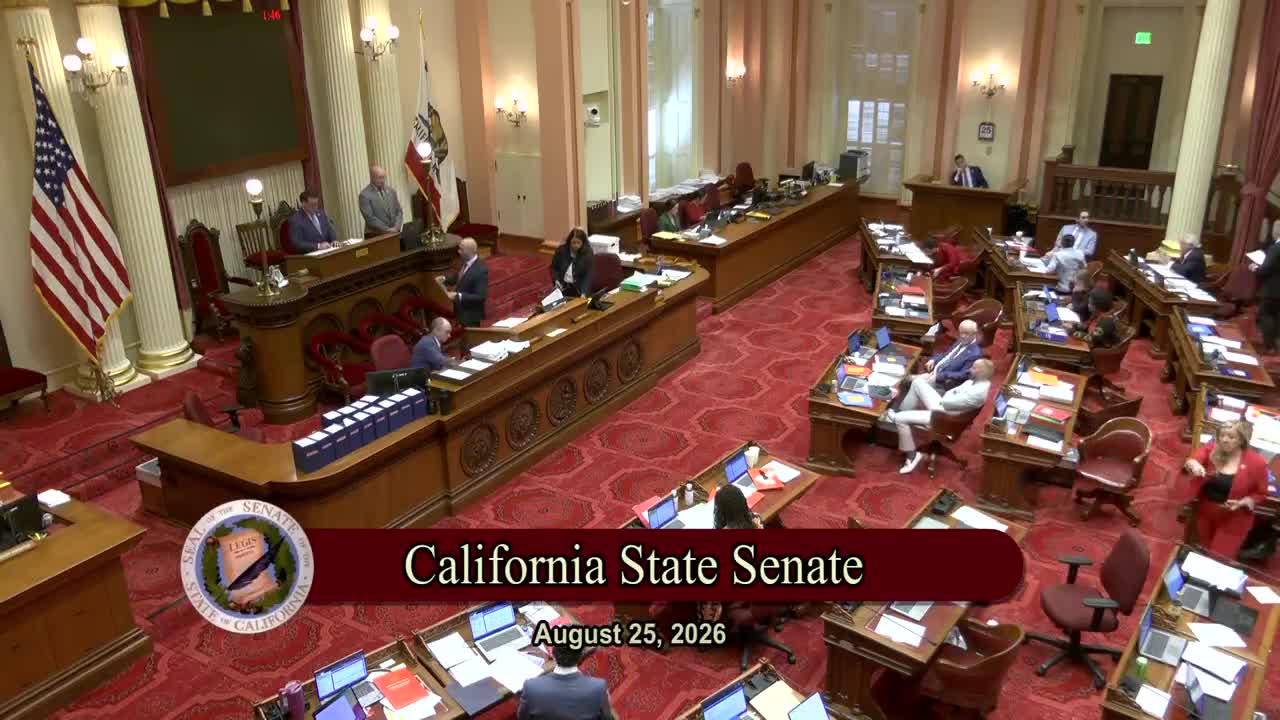 5MIN
Senate Floor
 11MIN
Senate Standing Committee on Labor, Public Employment and Retirement
 26MIN
Assembly Floor
 19MIN
Assembly Standing Committee on Labor and Employment
Bill Author

Bill Co-Author(s):