AB 2647: Energy: nuclear powerplants: assessment.
- Session Year: 2025-2026
- House: Assembly
- Latest Version Date: 2026-09-30
Current Status:
Passed
(2026-09-30: Chaptered by Secretary of State - Chapter 830, Statutes of 2026.)
Introduced
In Committee
Awaiting First Chamber Vote
Passed First Chamber
In Committee
Awaiting Second Chamber Vote
Passed Second Chamber
Enacted
Existing law vests the State Energy Resources Conservation and Development Commission (Energy Commission) with the exclusive jurisdiction to certify thermal powerplants with a generating capacity of 50 megawatts or more. Existing law prohibits the Energy Commission from certifying a nuclear fission thermal powerplant, except for specified powerplants, and provides that a nuclear fission thermal powerplant, except those specified powerplants, is not a permitted land use in California unless certain conditions are met regarding the existence of technology for the construction and operation of nuclear fuel rod processing plants and of demonstrated technology or means for the disposal of high-level nuclear waste, as specified. Existing law, the 100 Percent Clean Energy Act of 2018, declares that it is the policy of the state to achieve 100% zero-carbon electricity by 2045.
This bill would require the Energy Commission, on or before January 1, 2028, to prepare, as provided, a comprehensive assessment of the potential role for advanced nuclear technologies in supporting critical infrastructure in California, and of the potential for new, in-state nuclear powerplants to cost-effectively meet statewide needs for new electricity resources, and to meet the expressed policy of the state described above. The bill would authorize the Energy Commission to update the assessment as appropriate. The bill would authorize the Energy Commission, the Public Utilities Commission, the Independent System Operator, and other public agencies to evaluate the potential of nuclear energy to meet long-term resource needs.
Existing law vests the State Energy Resources Conservation and Development Commission (Energy Commission) with the exclusive jurisdiction to certify thermal powerplants with a generating capacity of 50 megawatts or more. Existing law prohibits the Energy Commission from certifying a nuclear fission thermal powerplant, except for specified powerplants, and provides that a nuclear fission thermal powerplant, except those specified powerplants, is not a permitted land use in California unless certain conditions are met regarding the existence of technology for the construction and operation of nuclear fuel rod processing plants and of demonstrated technology or means for the disposal of high-level nuclear waste, as specified. Existing law, the 100 Percent Clean Energy Act of 2018, declares that it is the policy of the state to achieve 100 percent 100% zero-carbon electricity by 2045.
This bill would require the Energy Commission, on or before July 1, 2027, January 1, 2028, to prepare, as provided, a comprehensive assessment of the potential role for advanced nuclear technologies in supporting critical infrastructure in California, and of the potential for new, in-state nuclear powerplants to cost-effectively meet statewide needs for new electricity resources, and to meet the expressed policy of the state described above. The bill would authorize the Energy Commission to update the assessment as appropriate. The bill would authorize the Energy Commission, the Public Utilities Commission, the Independent System Operator, and other public agencies to evaluate the potential of nuclear energy to meet long-term resource needs.
Existing law vests the State Energy Resources Conservation and Development Commission (Energy Commission) with the exclusive jurisdiction to certify thermal powerplants with a generating capacity of 50 megawatts or more. Existing law prohibits the Energy Commission from certifying a nuclear fission thermal powerplant, except for specified powerplants, and provides that a nuclear fission thermal powerplant, except those specified powerplants, is not a permitted land use in California unless certain conditions are met regarding the existence of technology for the construction and operation of nuclear fuel rod processing plants and of demonstrated technology or means for the disposal of high-level nuclear waste, as specified. Existing law, the 100 Percent Clean Energy Act of 2018, declares that it is the policy of the state to achieve 100 percent zero-carbon electricity by 2045.
This bill would exempt advanced nuclear reactors, as defined, from that prohibition. The bill would require the commission, before making a determination that an advanced nuclear reactor is not subject to the prohibition, to verify that the owner, operator, or developer of the advanced nuclear reactor has made legally enforceable commitment to comply with certain labor requirements. The bill would, except as provided, require the owner, operator, or developer of an advanced nuclear reactor that is certified by the commission to comply with those labor requirements.This bill would require the Energy Commission, on or before July 1, 2027, to prepare, as provided, a comprehensive assessment of the potential role for advanced nuclear technologies in supporting critical infrastructure in California, and of the potential for new, in-state nuclear powerplants to cost-effectively meet statewide needs for new electricity resources, and to meet the expressed policy of the state described above. The bill would authorize the Energy Commission to update the assessment as appropriate. The bill would authorize the Energy Commission, the Public Utilities Commission, the Independent System Operator, and other public agencies to evaluate the potential of nuclear energy to meet long-term resource needs.
Existing law prohibits vests the State Energy Resources Conservation and Development Commission (Energy Commission) with the exclusive jurisdiction to certify thermal powerplants with a generating capacity of 50 megawatts or more. Existing law prohibits the Energy Commission from certifying a nuclear fission thermal powerplant, except for specified powerplants, and provides that a nuclear fission thermal powerplant, except those specified powerplants, is not a permitted land use in California unless certain conditions are met regarding the existence of technology for the construction and operation of nuclear fuel rod processing plants and of demonstrated technology or means for the disposal of high-level nuclear waste, as specified.
This bill would exempt advanced nuclear reactors, as defined, from that prohibition. The bill would require the commission, before making a determination that an advanced nuclear reactor is not subject to the prohibition, to verify that the owner, operator, or developer of the advanced nuclear reactor has made legally enforceable commitment to comply with certain labor requirements. The bill would, except as provided, require the owner, operator, or developer of an advanced nuclear reactor that is certified by the commission to comply with those labor requirements.
Existing law prohibits the State Energy Resources Conservation and Development Commission (Energy Commission) from certifying a nuclear fission thermal powerplant, except for specified powerplants, and provides that a nuclear fission thermal powerplant, except those specified powerplants, is not a permitted land use in California unless certain conditions are met regarding the existence of technology for the construction and operation of nuclear fuel rod processing plants and of demonstrated technology or means for the disposal of high-level nuclear waste, as specified.
This bill would exempt advanced nuclear reactors, as defined, from that prohibition.
In enacting this act, it is the intent of the Legislature to ensure the use of a skilled and trained workforce, as defined for purposes of Sections 25536.7 and 25536.8 of the Health and Safety Code, which is required to perform work on other dangerous industrial facilities, including petroleum refineries and chemical manufacturing facilities, also applies to the initial construction and maintenance of any new advanced nuclear reactors that may be permitted and constructed in the future, following the enactment of this act and amendments to Sections 25524.1 and 25524.2 of the Public Resources Code, to ensure public health and safety.
SEC. 2.Section 25302.2 is added to the Public Resources Code, to read:25302.2.(a)On or before January 1, 2028, as part of the integrated energy policy report or as a separate report, as determined by the commission, the commission shall prepare a comprehensive assessment of the potential role for advanced nuclear technologies in supporting critical infrastructure in California and of the potential for new, in-state nuclear powerplants to cost-effectively meet statewide needs for new electricity resources, and to meet the expressed policy of the state, pursuant to the 100 Percent Clean Energy Act of 2018 (Chapter 312 of the Statutes of 2018), to achieve 100 percent zero-carbon electricity by 2045.
(b)In preparing the comprehensive assessment, the commission shall consider all of the following:
(1)An analysis of system costs, reliability benefits, emission impacts, deployment timelines, waste management and disposal pathways to include advanced fuel cycle technologies, environmental and public health impacts, and potential siting considerations.
(2)An evaluation assessing the potential of nuclear energy using high-renewable grid scenarios that require firm, dispatchable, zero-carbon resources to complement renewable resources, enhance grid reliability, and reduce overall system costs.
(3)An assessment of the ratepayer, taxpayer, and private costs associated with spent nuclear fuel management, including onsite, interim, and long-term storage pathways, in comparison with systemwide costs of waste, storage, and byproduct management across other electricity generation technologies.
(4)The potential for employment of a skilled and trained workforce, as defined for purposes of Sections 25536.7 and 25536.8 of the Health and Safety Code, in construction, operation, and maintenance of nuclear powerplants.
(5)The potential need for procurement of electricity from nuclear powerplants after 2045.
(6)The comparative outcomes relative to existing and projected energy pathways in California.
(7)A comparative analysis of environmental, public health, and waste impacts across all electricity generation technologies.
(8)Recommended revisions to state law and regulations, including to Sections 25524.1 and 25524.2.
(9)An assessment of the security-related costs and considerations to store, handle, and transport nuclear fuel for each nuclear energy technology.
(10)Additional factors, as appropriate.
(c)The commission shall consult with the Public Utilities Commission, the Independent System Operator, and other state agencies, as appropriate.
(d)The commission shall hold workshops and solicit participation and comments from a broad range of stakeholders, including academic experts in nuclear science and technology and in public health, potential developers, investors, electric corporations, labor, ratepayer advocates, and environmentalists.
(e)The commission may update the initial comprehensive assessment as appropriate.
(f)The commission, the Public Utilities Commission, the Independent System Operator, and other public agencies may evaluate the potential of nuclear energy to meet long-term resource needs, notwithstanding the conditional prohibitions on siting new nuclear powerplants pursuant to Sections 25524.1 and 25524.2.
In enacting this act, it is the intent of the Legislature to ensure the use of a skilled and trained workforce, as defined for purposes of Sections 25536.7 and 25536.8 of the Health and Safety Code, which is required to perform work on other dangerous industrial facilities, including petroleum refineries and chemical manufacturing facilities, also applies to the initial construction and maintenance of any new advanced nuclear reactors that may be permitted and constructed in the future, following the enactment of this act and amendments to Sections 25524.1 and 25524.2 of the Public Resources Code, to ensure public health and safety.
SEC. 2.Section 25302.2 is added to the Public Resources Code, to read:25302.2.(a)On or before July 1, 2027, January 1, 2028, as part of the integrated energy policy report or as a separate report, as determined by the commission, the commission shall prepare a comprehensive assessment of the potential role for advanced nuclear technologies in supporting critical infrastructure in California and of the potential for new, in-state nuclear powerplants to cost-effectively meet statewide needs for new electricity resources, and to meet the expressed policy of the state, pursuant to the 100 Percent Clean Energy Act of 2018 (Chapter 312 of the Statutes of 2018), to achieve 100 percent zero-carbon electricity by 2045.
(b)In preparing the comprehensive assessment, the commission shall consider all of the following:
(1)An analysis of system costs, reliability benefits, emission impacts, deployment timelines, waste management and disposal pathways to include advanced fuel cycle technologies, environmental and public health impacts, and potential siting considerations.
(2)An evaluation assessing the potential of nuclear energy using high-renewable grid scenarios that require firm, dispatchable, zero-carbon resources to complement renewable resources, enhance grid reliability, and reduce overall system costs.
(3)An assessment of the ratepayer, taxpayer, and private costs associated with spent nuclear fuel management, including onsite, interim, and long-term storage pathways, in comparison with systemwide costs of waste, storage, and byproduct management across other electricity generation technologies.
(4)The potential for employment of a skilled and trained workforce, as defined for purposes of Sections 25536.7 and 25536.8 of the Health and Safety Code, in construction, operation, and maintenance of nuclear powerplants.
(5)The potential need for procurement of electricity from nuclear powerplants after 2045.
(6)The comparative outcomes relative to existing and projected energy pathways in California.
(7)A comparative analysis of environmental, public health, and waste impacts across all electricity generation technologies.
(8)Recommended revisions to state law and regulations, including to Sections 25524.1 and 25524.2.
(9)An assessment of the security-related costs and considerations to store, handle, and transport nuclear fuel for each nuclear energy technology.
(9)(10)Additional factors, as appropriate.
(c)The commission shall consult with the Public Utilities Commission, the Independent System Operator, and other state agencies, as appropriate.
(d)The commission shall hold workshops and solicit participation and comments from a broad range of stakeholders, including academic experts in nuclear science and technology and in public health, potential developers, investors, electric corporations, labor, ratepayer advocates, and environmentalists.
(e)The commission may update the initial comprehensive assessment as appropriate.
(f)The commission, the Public Utilities Commission, the Independent System Operator, and other public agencies may evaluate the potential of nuclear energy to meet long-term resource needs, notwithstanding the conditional prohibitions on siting new nuclear powerplants pursuant to Sections 25524.1 and 25524.2.
In enacting this act, it is the intent of the Legislature to ensure the use of a skilled and trained workforce workforce, as defined for purposes of Sections 25536.7 and 25536.8 of the Health and Safety Code, which is required to perform work on other dangerous industrial facilities, including petroleum refineries and chemical manufacturing facilities, also applies to the initial construction and maintenance of any new advanced nuclear reactors that may be permitted and constructed in the future, following the enactment of this act and amendments to Sections 25524.1 and 25524.2 of the Public Resources Code, to ensure public health and safety.
SEC. 2.Section 25524.1 of the Public Resources Code is amended to read:25524.1.(a)Except for the existing Diablo Canyon Units 1 and 2 owned by Pacific Gas and Electric Company and San Onofre Units 2 and 3 owned by Southern California Edison Company and San Diego Gas and Electric Company and, except as provided in Section 25524.3, a nuclear fission thermal powerplant requiring the reprocessing of fuel rods, including any to which this chapter does not otherwise apply, except those having a vested right as defined in this section, shall not be a permitted land use in the state or, where applicable, certified by the commission until both of the following conditions are met:(1)The commission finds that the United States through its authorized agency has identified and approved, and there exists a technology for the construction and operation of, nuclear fuel rod reprocessing plants.(2)(A)The commission has reported its findings and the reasons therefor pursuant to paragraph (1) to the Legislature. That report shall be assigned to the appropriate policy committees for review. The commission may proceed to certify nuclear fission thermal powerplants 100 legislative days after reporting its findings unless within those 100 legislative days either house of the Legislature adopts by a majority vote of its members a resolution disaffirming the findings of the commission made pursuant to paragraph (1).(B)A resolution of disaffirmance shall set forth the reasons for the action and shall provide, to the extent possible, guidance to the commission as to an appropriate method of bringing the commissions findings into conformance with paragraph (1).(C)If a disaffirming resolution is adopted, the commission shall reexamine its original findings consistent with matters raised in the resolution. On conclusion of its reexamination, the commission shall transmit its findings in writing, with the reasons therefor, to the Legislature.(D)If the findings are that the conditions of paragraph (1) have been met, the commission may proceed to certify nuclear fission thermal powerplants 100 legislative days after reporting its findings to the Legislature unless within those 100 legislative days both houses of the Legislature act by statute to declare the findings null and void and take appropriate action.(E)To allow sufficient time for the Legislature to act, the reports of findings of the commission shall be submitted to the Legislature at least six calendar months before the adjournment of the Legislature sine die.(b)The commission shall further find on a case-by-case basis that facilities with adequate capacity to reprocess nuclear fuel rods from a certified nuclear facility or to store that fuel if that storage is approved by an authorized agency of the United States are in actual operation or will be in operation at the time that the nuclear facility requires reprocessing or storage if the storage of fuel is in an offsite location to the extent necessary to provide continuous onsite full core reserve storage capacity.(c)The commission shall continue to receive and process notices of intention and applications for certification pursuant to this division, but shall not issue a decision pursuant to Section 25523 granting a certificate until the requirements of this section have been met. All other permits, licenses, approvals, or authorizations for the entry or use of the land, including orders of court, that may be required may be processed and granted by the governmental entity concerned, but construction work to install permanent equipment or structures shall not commence until the requirements of this section have been met.SEC. 3.Section 25524.2 of the Public Resources Code is amended to read:25524.2.(a)Except for the existing Diablo Canyon Units 1 and 2 owned by Pacific Gas and Electric Company and San Onofre Units 2 and 3 owned by Southern California Edison Company and San Diego Gas and Electric Company and, except as provided in Section 25524.3, a nuclear fission thermal powerplant, including any to which this chapter does not otherwise apply, except those exempted by this section, shall not be a permitted land use in the state or, where applicable, be certified by the commission until both of the following conditions have been met:(1)The commission finds that there has been developed and that the United States through its authorized agency has approved and there exists a demonstrated technology or means for the disposal of high-level nuclear waste.(2)(A)The commission has reported its findings and the reasons therefor pursuant to paragraph (1) to the Legislature. That report shall be assigned to the appropriate policy committees for review. The commission may proceed to certify nuclear fission thermal powerplants 100 legislative days after reporting its findings unless within those 100 legislative days either house of the Legislature adopts by a majority vote of its members a resolution disaffirming the findings of the commission made pursuant to paragraph (1).(B)A resolution of disaffirmance shall set forth the reasons for the action and shall provide, to the extent possible, guidance to the commission as to an appropriate method of bringing the commissions findings into conformance with paragraph (1).(C)If a disaffirming resolution is adopted, the commission shall reexamine its original findings consistent with matters raised in the resolution. On conclusion of its reexamination, the commission shall transmit its findings in writing, with the reasons therefor, to the Legislature.(D)If the findings are that the conditions of paragraph (1) have been met, the commission may proceed to certify nuclear fission thermal powerplants 100 legislative days after reporting its findings to the Legislature unless within those 100 legislative days both houses of the Legislature act by statute to declare the findings null and void and take appropriate action.(E)To allow sufficient time for the Legislature to act, the reports of findings of the commission shall be submitted to the Legislature at least six calendar months before the adjournment of the Legislature sine die. (b)For purposes of this section, technology or means for the disposal of high-level nuclear waste means a method for the permanent and terminal disposition of high-level nuclear waste. This section does not require that facilities for the application of that technology or means be available at the time that the commission makes its findings. That disposition of high-level nuclear waste does not preclude the possibility of an approved process for retrieval of the waste.(c)The commission shall continue to receive and process notices of intention and applications for certification pursuant to this division, but shall not issue a decision pursuant to Section 25523 granting a certificate until the requirements of this section have been met. All other permits, licenses, approvals, or authorizations for the entry or use of the land, including orders of court, that may be required may be processed and granted by the governmental entity concerned, but construction work to install permanent equipment or structures shall not commence until the requirements of this section have been met.SEC. 4.Section 25524.3 is added to the Public Resources Code, to read:25524.3.(a)For purposes of this section, all of the following definitions apply:(1)Advanced nuclear reactor means a nuclear fission or fusion energy system with design characteristics that provide enhanced safety features, reduced waste generation, improved fuel use, and other technological advancements compared to a generation II nuclear reactor, and that has a design license approved by the federal Nuclear Regulatory Commission on or after January 1, 2005.(2)Apprenticeable occupation means an occupation for which the chief has approved an apprenticeship program pursuant to Section 3075 of the Labor Code.(3)Building and construction trades means trades with apprenticeship programs that are subject to the Section 3075.5 of the Labor Code.(4)Chief means the Chief of the Division of Apprenticeship Standards of the Department of Industrial Relations.(5)Construction, alteration, demolition, installation, and repair have the same meanings as those terms are used in Section 1720 of the Labor Code.(6)Graduate of an apprenticeship program means either of the following:(A)An individual that has been issued a certificate of completion under the authority of the California Apprenticeship Council or the chief for completing an apprenticeship program approved by the chief pursuant to Section 3075 of the Labor Code.(B)An individual that has completed an apprenticeship program located outside California and approved for federal purposes pursuant to the apprenticeship regulations adopted by the United States Secretary of Labor.(7)Onsite work does not include catalyst handling and loading, chemical cleaning, or inspection and testing that was not within the scope of a prevailing wage determination issued by the Director of Industrial Relations as of January 1, 2025.(8)Prevailing hourly wage rate means the general prevailing rate of per diem wages, as determined by the Director of Industrial Relations pursuant to Sections 1773 and 1773.9 of the Labor Code, but does not include shift differentials, travel and subsistence, or holiday pay. Notwithstanding subdivision (c) of Section 1773.1 of the Labor Code, the requirement that employer payments not reduce the obligation to pay the hourly straight time or overtime wages found to be prevailing does not apply if otherwise provided in a bona fide collective bargaining agreement covering the worker.(9)Registered apprentice means an apprentice registered in an apprenticeship program approved by the chief pursuant to Section 3075 of the Labor Code who is performing work covered by the standards of that apprenticeship program and receiving the supervision required by the standards of that apprenticeship program.(10)Skilled and trained workforce means a workforce that meets both of the following criteria:(A)All the workers are either registered apprentices or skilled journeypersons.(B)At least 60 percent of the skilled journeypersons are graduates of an apprenticeship program for the applicable occupation.(11)Skilled journeyperson means a worker who meets both of the following criteria:(A)The worker either graduated from an apprenticeship program for the applicable occupation that was approved by the chief, or has at least as many hours of on-the-job experience in the applicable occupation that would be required to graduate from an apprenticeship program for the applicable occupation that is approved by the chief.(B)The worker is being paid at least a rate equivalent to the prevailing hourly wage rate for a journeyperson in the applicable occupation and geographic area.(b)Subject to subdivision (c), Sections 25524.1 and 25524.2 do not apply to an advanced nuclear reactor.(c)Before making a determination that an advanced nuclear reactor is not subject to Section 25524.1 or 25524.2, the commission shall verify that the owner, operator, or developer of the advanced nuclear reactor has made a legally enforceable commitment that in contracting for the performance of initial and subsequent construction, alteration, demolition, installation, repair, or maintenance work on the advanced nuclear reactor, it will require contractors and any subcontractors on those activities to use a skilled and trained workforce to perform all onsite work within an apprenticeable occupation in the building and construction trades.(d)(1)The owner, operator, or developer of an advanced nuclear reactor that is authorized pursuant to this chapter shall provide to the Labor Commissioner, on a monthly basis, a report demonstrating compliance with subdivision (c) that includes the full name of, and identify the apprenticeship program, location, and graduation date of, each worker relied upon to satisfy the apprenticeship graduation percentage requirements of this section. The report is a public record under the California Public Records Act (Division 10 (commencing with Section 7920.000) of Title 1 of the Government Code) and shall be open to public inspection.(2)(A)If the Labor Commissioner, or the Labor Commissioners designee, determines after an investigation that a contractor or subcontractor failed to use a skilled and trained workforce in accordance with subdivision (c), the contractor or subcontractor responsible for the violation shall forfeit, as a civil penalty to the state, not more than five thousand dollars ($5,000) per month of work performed in violation of subdivision (c). A contractor or subcontractor that commits a second or subsequent violation within a three-year period shall forfeit as a civil penalty to the state the sum of not more than ten thousand dollars ($10,000) per month of work performed in violation of subdivision (c).(B)The amount of a civil penalty may be reduced or waived by the Labor Commissioner if the amount of the civil penalty would be disproportionate to the severity of the violation. The Labor Commissioner shall consider, in setting the amount of a civil penalty, all of the following circumstances:(i)Whether the violation was intentional.(ii)Whether the contractor or subcontractor has committed other violations of this section or of the Labor Code.(iii)Whether, upon notice of the violation, the contractor or subcontractor took steps to voluntarily remedy the violation.(iv)The extent or severity of the violation.(v)The Labor Commissioner, or Labor Commissioners designee, shall issue a civil wage and penalty assessment, in accordance with Section 1741 of the Labor Code, upon determination of a civil penalty assessed under subparagraph (A). Review of a civil wage and penalty assessment issued under this subdivision may be requested in accordance with Section 1742 of the Labor Code. The regulations of the Director of Industrial Relations, which govern proceedings for review of civil wage and penalty assessments and the withholding of contract payments under Article 1 (commencing with Section 1720) and Article 2 (commencing with Section 1770) of Chapter 1 of Part 7 of Division 2 of the Labor Code, shall apply.(C)The determination of the Labor Commissioner as to the amount of the civil penalty imposed under this subdivision shall be reviewable by the Director of Industrial Relations only for an abuse of discretion.(3)This subdivision does not apply if all work on the advanced nuclear reactor is covered by a project labor agreement that requires the use of a skilled and trained workforce and provides for the enforcement of that obligation through an arbitration procedure. For purposes of this subdivision, a project labor agreement means a prehire collective bargaining agreement that establishes terms and conditions of employment for a specific construction project or projects and is an agreement described in Section 158(f) of Title 29 of the United States Code.SEC. 2.Section 25302.2 is added to the Public Resources Code, to read:25302.2.(a)On or before July 1, 2027, as part of the integrated energy policy report or as a separate report, as determined by the commission, the commission shall prepare a comprehensive assessment of the potential role for advanced nuclear technologies in supporting critical infrastructure in California and of the potential for new, in-state nuclear powerplants to cost-effectively meet statewide needs for new electricity resources, and to meet the expressed policy of the state, pursuant to the 100 Percent Clean Energy Act of 2018 (Chapter 312 of the Statutes of 2018), to achieve 100 percent zero-carbon electricity by 2045.
(b)In preparing the comprehensive assessment, the commission shall consider all of the following:
(1)An analysis of system costs, reliability benefits, emission impacts, deployment timelines, waste management and disposal pathways to include advanced fuel cycle technologies, environmental and public health impacts, and potential siting considerations.
(2)An evaluation assessing the potential of nuclear energy using high-renewable grid scenarios that require firm, dispatchable, zero-carbon resources to complement renewable resources, enhance grid reliability, and reduce overall system costs.
(3)An assessment of the ratepayer, taxpayer, and private costs associated with spent nuclear fuel management, including onsite, interim, and long-term storage pathways, in comparison with systemwide costs of waste, storage, and byproduct management across other electricity generation technologies.
(4)The potential for employment of a skilled and trained workforce, as defined for purposes of Sections 25536.7 and 25536.8 of the Health and Safety Code, in construction, operation, and maintenance of nuclear powerplants.
(5)The potential need for procurement of electricity from nuclear powerplants after 2045.
(6)The comparative outcomes relative to existing and projected energy pathways in California.
(7)A comparative analysis of environmental, public health, and waste impacts across all electricity generation technologies.
(8)Recommended revisions to state law and regulations, including to Sections 25524.1 and 25524.2.
(9)Additional factors, as appropriate.
(c)The commission shall consult with the Public Utilities Commission, the Independent System Operator, and other state agencies, as appropriate.
(d)The commission shall hold workshops and solicit participation and comments from a broad range of stakeholders, including academic experts in nuclear science and technology and in public health, potential developers, investors, electric corporations, labor, ratepayer advocates, and environmentalists.
(e)The commission may update the initial comprehensive assessment as appropriate.
(f)The commission, the Public Utilities Commission, the Independent System Operator, and other public agencies may evaluate the potential of nuclear energy to meet long-term resource needs, notwithstanding the conditional prohibitions on siting new nuclear powerplants pursuant to Sections 25524.1 and 25524.2.
REVISIONS: HeadingLines 2, 3, and 4.In enacting this act, it is the intent of the Legislature to ensure the use of a skilled and trained workforce required to perform work on other dangerous industrial facilities, including petroleum refineries and chemical manufacturing facilities, also applies to the initial construction and maintenance of new advanced nuclear reactors to ensure public health and safety.
SECTION 1.SEC. 2.Section 25524.1 of the Public Resources Code is amended to read:25524.1.(a)Except for the existing Diablo Canyon Units 1 and 2 owned by Pacific Gas and Electric Company and San Onofre Units 2 and 3 owned by Southern California Edison Company and San Diego Gas and Electric Company, Company and, except as provided in Section 25524.3, a nuclear fission thermal powerplant requiring the reprocessing of fuel rods, including any to which this chapter does not otherwise apply, except those having a vested right as defined in this section, shall not be a permitted land use in the state or, where applicable, certified by the commission until both of the following conditions are met:
(1)The commission finds that the United States through its authorized agency has identified and approved, and there exists a technology for the construction and operation of, nuclear fuel rod reprocessing plants.
(2)(A)The commission has reported its findings and the reasons therefor pursuant to paragraph (1) to the Legislature. That report shall be assigned to the appropriate policy committees for review. The commission may proceed to certify nuclear fission thermal powerplants 100 legislative days after reporting its findings unless within those 100 legislative days either house of the Legislature adopts by a majority vote of its members a resolution disaffirming the findings of the commission made pursuant to paragraph (1).
(B)A resolution of disaffirmance shall set forth the reasons for the action and shall provide, to the extent possible, guidance to the commission as to an appropriate method of bringing the commissions findings into conformance with paragraph (1).
(C)If a disaffirming resolution is adopted, the commission shall reexamine its original findings consistent with matters raised in the resolution. On conclusion of its reexamination, the commission shall transmit its findings in writing, with the reasons therefor, to the Legislature.
(D)If the findings are that the conditions of paragraph (1) have been met, the commission may proceed to certify nuclear fission thermal powerplants 100 legislative days after reporting its findings to the Legislature unless within those 100 legislative days both houses of the Legislature act by statute to declare the findings null and void and take appropriate action.
(E)To allow sufficient time for the Legislature to act, the reports of findings of the commission shall be submitted to the Legislature at least six calendar months before the adjournment of the Legislature sine die.
(b)The commission shall further find on a case-by-case basis that facilities with adequate capacity to reprocess nuclear fuel rods from a certified nuclear facility or to store that fuel if that storage is approved by an authorized agency of the United States are in actual operation or will be in operation at the time that the nuclear facility requires reprocessing or storage if the storage of fuel is in an offsite location to the extent necessary to provide continuous onsite full core reserve storage capacity.
(c)The commission shall continue to receive and process notices of intention and applications for certification pursuant to this division, but shall not issue a decision pursuant to Section 25523 granting a certificate until the requirements of this section have been met. All other permits, licenses, approvals, or authorizations for the entry or use of the land, including orders of court, that may be required may be processed and granted by the governmental entity concerned, but construction work to install permanent equipment or structures shall not commence until the requirements of this section have been met.
(d)(1)This section does not apply to an advanced nuclear reactor.(2)For purposes of this subdivision, advanced nuclear reactor means a nuclear fission or fusion energy system with design characteristics that provide enhanced safety features, reduced waste generation, improved fuel use, and other technological advancements compared to a generation II nuclear reactor and that has a design license approved by the Nuclear Regulatory Commission on or after January 1, 2005.SEC. 2.SEC. 3.Section 25524.2 of the Public Resources Code is amended to read:25524.2.(a)Except for the existing Diablo Canyon Units 1 and 2 owned by Pacific Gas and Electric Company and San Onofre Units 2 and 3 owned by Southern California Edison Company and San Diego Gas and Electric Company, Company and, except as provided in Section 25524.3, a nuclear fission thermal powerplant, including any to which this chapter does not otherwise apply, except those exempted by this section, shall not be a permitted land use in the state or, where applicable, be certified by the commission until both of the following conditions have been met:
(1)The commission finds that there has been developed and that the United States through its authorized agency has approved and there exists a demonstrated technology or means for the disposal of high-level nuclear waste.
(2)(A)The commission has reported its findings and the reasons therefor pursuant to paragraph (1) to the Legislature. That report shall be assigned to the appropriate policy committees for review. The commission may proceed to certify nuclear fission thermal powerplants 100 legislative days after reporting its findings unless within those 100 legislative days either house of the Legislature adopts by a majority vote of its members a resolution disaffirming the findings of the commission made pursuant to paragraph (1).
(B)A resolution of disaffirmance shall set forth the reasons for the action and shall provide, to the extent possible, guidance to the commission as to an appropriate method of bringing the commissions findings into conformance with paragraph (1).
(C)If a disaffirming resolution is adopted, the commission shall reexamine its original findings consistent with matters raised in the resolution. On conclusion of its reexamination, the commission shall transmit its findings in writing, with the reasons therefor, to the Legislature.
(D)If the findings are that the conditions of paragraph (1) have been met, the commission may proceed to certify nuclear fission thermal powerplants 100 legislative days after reporting its findings to the Legislature unless within those 100 legislative days both houses of the Legislature act by statute to declare the findings null and void and take appropriate action.
(E)To allow sufficient time for the Legislature to act, the reports of findings of the commission shall be submitted to the Legislature at least six calendar months before the adjournment of the Legislature sine die.
(b)For purposes of this section, technology or means for the disposal of high-level nuclear waste means a method for the permanent and terminal disposition of high-level nuclear waste. This section does not require that facilities for the application of that technology or means be available at the time that the commission makes its findings. That disposition of high-level nuclear waste does not preclude the possibility of an approved process for retrieval of the waste.
(c)The commission shall continue to receive and process notices of intention and applications for certification pursuant to this division, but shall not issue a decision pursuant to Section 25523 granting a certificate until the requirements of this section have been met. All other permits, licenses, approvals, or authorizations for the entry or use of the land, including orders of court, that may be required may be processed and granted by the governmental entity concerned, but construction work to install permanent equipment or structures shall not commence until the requirements of this section have been met.
(d)(1)This section does not apply to an advanced nuclear reactor.(2)For purposes of this subdivision, advanced nuclear reactor means a nuclear fission or fusion energy system with design characteristics that provide enhanced safety features, reduced waste generation, improved fuel use, and other technological advancements compared to a generation II nuclear reactor and that has a design license approved by the Nuclear Regulatory Commission on or after January 1, 2005.SEC. 4.Section 25524.3 is added to the Public Resources Code, to read:25524.3.(a)For purposes of this section, all of the following definitions apply:
(1)Advanced nuclear reactor means a nuclear fission or fusion energy system with design characteristics that provide enhanced safety features, reduced waste generation, improved fuel use, and other technological advancements compared to a generation II nuclear reactor, and that has a design license approved by the federal Nuclear Regulatory Commission on or after January 1, 2005.
(2)Apprenticeable occupation means an occupation for which the chief has approved an apprenticeship program pursuant to Section 3075 of the Labor Code.
(3)Building and construction trades means trades with apprenticeship programs that are subject to the Section 3075.5 of the Labor Code.
(4)Chief means the Chief of the Division of Apprenticeship Standards of the Department of Industrial Relations.
(5)Construction, alteration, demolition, installation, and repair have the same meanings as those terms are used in Section 1720 of the Labor Code.
(6)Graduate of an apprenticeship program means either of the following:
(A)An individual that has been issued a certificate of completion under the authority of the California Apprenticeship Council or the chief for completing an apprenticeship program approved by the chief pursuant to Section 3075 of the Labor Code.
(B)An individual that has completed an apprenticeship program located outside California and approved for federal purposes pursuant to the apprenticeship regulations adopted by the United States Secretary of Labor.
(7)Onsite work does not include catalyst handling and loading, chemical cleaning, or inspection and testing that was not within the scope of a prevailing wage determination issued by the Director of Industrial Relations as of January 1, 2025.
(8)Prevailing hourly wage rate means the general prevailing rate of per diem wages, as determined by the Director of Industrial Relations pursuant to Sections 1773 and 1773.9 of the Labor Code, but does not include shift differentials, travel and subsistence, or holiday pay. Notwithstanding subdivision (c) of Section 1773.1 of the Labor Code, the requirement that employer payments not reduce the obligation to pay the hourly straight time or overtime wages found to be prevailing does not apply if otherwise provided in a bona fide collective bargaining agreement covering the worker.
(9)Registered apprentice means an apprentice registered in an apprenticeship program approved by the chief pursuant to Section 3075 of the Labor Code who is performing work covered by the standards of that apprenticeship program and receiving the supervision required by the standards of that apprenticeship program.
(10)Skilled and trained workforce means a workforce that meets both of the following criteria:
(A)All the workers are either registered apprentices or skilled journeypersons.
(B)At least 60 percent of the skilled journeypersons are graduates of an apprenticeship program for the applicable occupation.
(11)Skilled journeyperson means a worker who meets both of the following criteria:
(A)The worker either graduated from an apprenticeship program for the applicable occupation that was approved by the chief, or has at least as many hours of on-the-job experience in the applicable occupation that would be required to graduate from an apprenticeship program for the applicable occupation that is approved by the chief.
(B)The worker is being paid at least a rate equivalent to the prevailing hourly wage rate for a journeyperson in the applicable occupation and geographic area.
(b)Subject to subdivision (c), Sections 25524.1 and 25524.2 do not apply to an advanced nuclear reactor.
(c)Before making a determination that an advanced nuclear reactor is not subject to Section 25524.1 or 25524.2, the commission shall verify that the owner, operator, or developer of the advanced nuclear reactor has made a legally enforceable commitment that in contracting for the performance of initial and subsequent construction, alteration, demolition, installation, repair, or maintenance work on the advanced nuclear reactor, it will require contractors and any subcontractors on those activities to use a skilled and trained workforce to perform all onsite work within an apprenticeable occupation in the building and construction trades.
(d)(1)The owner, operator, or developer of an advanced nuclear reactor that is authorized pursuant to this chapter shall provide to the Labor Commissioner, on a monthly basis, a report demonstrating compliance with subdivision (c) that includes the full name of, and identify the apprenticeship program, location, and graduation date of, each worker relied upon to satisfy the apprenticeship graduation percentage requirements of this section. The report is a public record under the California Public Records Act (Division 10 (commencing with Section 7920.000) of Title 1 of the Government Code) and shall be open to public inspection.
(2)(A)If the Labor Commissioner, or the Labor Commissioners designee, determines after an investigation that a contractor or subcontractor failed to use a skilled and trained workforce in accordance with subdivision (c), the contractor or subcontractor responsible for the violation shall forfeit, as a civil penalty to the state, not more than five thousand dollars ($5,000) per month of work performed in violation of subdivision (c). A contractor or subcontractor that commits a second or subsequent violation within a three-year period shall forfeit as a civil penalty to the state the sum of not more than ten thousand dollars ($10,000) per month of work performed in violation of subdivision (c).
(B)The amount of a civil penalty may be reduced or waived by the Labor Commissioner if the amount of the civil penalty would be disproportionate to the severity of the violation. The Labor Commissioner shall consider, in setting the amount of a civil penalty, all of the following circumstances:
(i)Whether the violation was intentional.
(ii)Whether the contractor or subcontractor has committed other violations of this section or of the Labor Code.
(iii)Whether, upon notice of the violation, the contractor or subcontractor took steps to voluntarily remedy the violation.
(iv)The extent or severity of the violation.
(v)The Labor Commissioner, or Labor Commissioners designee, shall issue a civil wage and penalty assessment, in accordance with Section 1741 of the Labor Code, upon determination of a civil penalty assessed under subparagraph (A). Review of a civil wage and penalty assessment issued under this subdivision may be requested in accordance with Section 1742 of the Labor Code. The regulations of the Director of Industrial Relations, which govern proceedings for review of civil wage and penalty assessments and the withholding of contract payments under Article 1 (commencing with Section 1720) and Article 2 (commencing with Section 1770) of Chapter 1 of Part 7 of Division 2 of the Labor Code, shall apply.
(C)The determination of the Labor Commissioner as to the amount of the civil penalty imposed under this subdivision shall be reviewable by the Director of Industrial Relations only for an abuse of discretion.
(3)This subdivision does not apply if all work on the advanced nuclear reactor is covered by a project labor agreement that requires the use of a skilled and trained workforce and provides for the enforcement of that obligation through an arbitration procedure. For purposes of this subdivision, a project labor agreement means a prehire collective bargaining agreement that establishes terms and conditions of employment for a specific construction project or projects and is an agreement described in Section 158(f) of Title 29 of the United States Code.
(a)Except for the existing Diablo Canyon Units 1 and 2 owned by Pacific Gas and Electric Company and San Onofre Units 2 and 3 owned by Southern California Edison Company and San Diego Gas and Electric Company, no a nuclear fission thermal powerplant requiring the reprocessing of fuel rods, including any to which this chapter does not otherwise apply, excepting any except those having a vested right as defined in this section, shall not be a permitted land use in the state or, where applicable, certified by the commission until both of the following conditions are met:
(1)The commission finds that the United States through its authorized agency has identified and approved, and there exists a technology for the construction and operation of, nuclear fuel rod reprocessing plants.
(2)(A)The commission has reported its findings and the reasons therefor pursuant to paragraph (1) to the Legislature. That report shall be assigned to the appropriate policy committees for review. The commission may proceed to certify nuclear fission thermal powerplants 100 legislative days after reporting its findings unless within those 100 legislative days either house of the Legislature adopts by a majority vote of its members a resolution disaffirming the findings of the commission made pursuant to paragraph (1).
(3)(B)A resolution of disaffirmance shall set forth the reasons for the action and shall provide, to the extent possible, guidance to the commission as to an appropriate method of bringing the commissions findings into conformance with paragraph (1).
(4)(C)If a disaffirming resolution is adopted, the commission shall reexamine its original findings consistent with matters raised in the resolution. On conclusion of its reexamination, the commission shall transmit its findings in writing, with the reasons therefor, to the Legislature.
(5)(D)If the findings are that the conditions of paragraph (1) have been met, the commission may proceed to certify nuclear fission thermal powerplants 100 legislative days after reporting its findings to the Legislature unless within those 100 legislative days both houses of the Legislature act by statute to declare the findings null and void and takes take appropriate action.
(6)(E)To allow sufficient time for the Legislature to act, the reports of findings of the commission shall be submitted to the Legislature at least six calendar months prior to before the adjournment of the Legislature sine die.
(b)The commission shall further find on a case-by-case basis that facilities with adequate capacity to reprocess nuclear fuel rods from a certified nuclear facility or to store that fuel if that storage is approved by an authorized agency of the United States are in actual operation or will be in operation at the time that the nuclear facility requires reprocessing or storage; provided, however, that storage if the storage of fuel is in an offsite location to the extent necessary to provide continuous onsite full core reserve storage capacity.
(c)The commission shall continue to receive and process notices of intention and applications for certification pursuant to this division, but shall not issue a decision pursuant to Section 25523 granting a certificate until the requirements of this section have been met. All other permits, licenses, approvals, or authorizations for the entry or use of the land, including orders of court, which that may be required may be processed and granted by the governmental entity concerned, but construction work to install permanent equipment or structures shall not commence until the requirements of this section have been met.
(d)(1)This section does not apply to an advanced nuclear reactor.
(2)For purposes of this subdivision, advanced nuclear reactor means a nuclear fission or fusion energy system with design characteristics that provide enhanced safety features, reduced waste generation, improved fuel use, and other technological advancements compared to a generation II nuclear reactor and that has a design license approved by the Nuclear Regulatory Commission on or after January 1, 2005.
SEC. 2.Section 25524.2 of the Public Resources Code is amended to read:25524.2.(a)Except for the existing Diablo Canyon Units 1 and 2 owned by Pacific Gas and Electric Company and San Onofre Units 2 and 3 owned by Southern California Edison Company and San Diego Gas and Electric Company, no a nuclear fission thermal powerplant, including any to which this chapter does not otherwise apply, but excepting except those exempted herein, by this section, shall not be a permitted land use in the state, or state or, where applicable, be certified by the commission until both of the following conditions have been met:
(a)(1)The commission finds that there has been developed and that the United States through its authorized agency has approved and there exists a demonstrated technology or means for the disposal of high-level nuclear waste.
(b)(1)(2)(A)The commission has reported its findings and the reasons therefor pursuant to paragraph (a) (1) to the Legislature. That report shall be assigned to the appropriate policy committees for review. The commission may proceed to certify nuclear fission thermal powerplants 100 legislative days after reporting its findings unless within those 100 legislative days either house of the Legislature adopts by a majority vote of its members a resolution disaffirming the findings of the commission made pursuant to subdivision (a). paragraph (1).
(2)(B)A resolution of disaffirmance shall set forth the reasons for the action and shall provide, to the extent possible, guidance to the commission as to an appropriate method of bringing the commissions findings into conformance with subdivision (a). paragraph (1).
(3)(C)If a disaffirming resolution is adopted, the commission shall reexamine its original findings consistent with matters raised in the resolution. On conclusion of its reexamination, the commission shall transmit its findings in writing, with the reasons therefor, to the Legislature.
(4)(D)If the findings are that the conditions of subdivision (a) paragraph (1) have been met, the commission may proceed to certify nuclear fission thermal powerplants 100 legislative days after reporting its findings to the Legislature unless within those 100 legislative days both houses of the Legislature act by statute to declare the findings null and void and take appropriate action.
(5)(E)To allow sufficient time for the Legislature to act, the reports of findings of the commission shall be submitted to the Legislature at least six calendar months prior to before the adjournment of the Legislature sine die.
(c)As used in subdivision (a),(b)For purposes of this section, technology or means for the disposal of high-level nuclear waste means a method for the permanent and terminal disposition of high-level nuclear waste. Nothing in this This section requires does not require that facilities for the application of that technology or means be available at the time that the commission makes its findings. That disposition of high-level nuclear waste does not preclude the possibility of an approved process for retrieval of the waste.
(d)(c)The commission shall continue to receive and process notices of intention and applications for certification pursuant to this division division, but shall not issue a decision pursuant to Section 25523 granting a certificate until the requirements of this section have been met. All other permits, licenses, approvals, or authorizations for the entry or use of the land, including orders of court, which that may be required may be processed and granted by the governmental entity concerned, but construction work to install permanent equipment or structures shall not commence until the requirements of this section have been met.
(d)(1)This section does not apply to an advanced nuclear reactor.
(2)For purposes of this subdivision, advanced nuclear reactor means a nuclear fission or fusion energy system with design characteristics that provide enhanced safety features, reduced waste generation, improved fuel use, and other technological advancements compared to a generation II nuclear reactor and that has a design license approved by the Nuclear Regulatory Commission on or after January 1, 2005.
|
Date
|
Status
|
|---|---|
| Sep 30, 2026 | Chaptered by Secretary of State - Chapter 830, Statutes of 2026. |
| Sep 30, 2026 | Approved by the Governor. |
| Aug 31, 2026 | Enrolled and presented to the Governor at 4 p.m. |
| Aug 25, 2026 | Senate amendments concurred in. To Engrossing and Enrolling. (Ayes 71. Noes 1. Page 6489.). |
| Aug 25, 2026 | Senate amendments concurred in. To Engrossing and Enrolling. (Ayes 71. Noes 1.). |
| Aug 24, 2026 | In Assembly. Concurrence in Senate amendments pending. |
| Aug 24, 2026 | Read third time. Passed. Ordered to the Assembly. (Ayes 38. Noes 0. Page 5701.). |
| Aug 24, 2026 | Read third time. Passed. Ordered to the Assembly. (Ayes 38. Noes 0.). |
| Aug 13, 2026 | Read second time. Ordered to third reading. |
| Aug 13, 2026 | From committee: Do pass. (Ayes 7. Noes 0.) (August 13). |
| Aug 3, 2026 | In committee: Referred to APPR. suspense file. |
| Jun 30, 2026 | Read second time and amended. Re-referred to Com. on APPR. |
| Jun 29, 2026 | From committee: Amend, and do pass as amended and re-refer to Com. on APPR. (Ayes 15. Noes 0.) (June 24). |
| Jun 10, 2026 | Referred to Com. on E., U & C. |
| May 27, 2026 | In Senate. Read first time. To Com. on RLS. for assignment. |
| May 26, 2026 | Read third time. Passed. Ordered to the Senate. (Ayes 73. Noes 0. Page 5396.) |
| May 26, 2026 | Read third time. Passed. Ordered to the Senate. (Ayes 73. Noes 0.) |
| May 26, 2026 | Read third time. Passed. Ordered to the Senate. |
| May 18, 2026 | Read second time. Ordered to third reading. |
| May 14, 2026 | Coauthors revised. |
| May 14, 2026 | From committee: Do pass. (Ayes 15. Noes 0.) (May 14). |
| May 6, 2026 | In committee: Set, first hearing. Referred to APPR. suspense file. |
| Apr 23, 2026 | From committee: Do pass and re-refer to Com. on APPR. (Ayes 16. Noes 0.) (April 22). Re-referred to Com. on APPR. |
| Apr 21, 2026 | From committee: Do pass and re-refer to Com. on U. & E. (Ayes 11. Noes 1.) (April 20). Re-referred to Com. on U. & E. |
| Apr 20, 2026 | Re-referred to Com. on NAT. RES. |
| Apr 16, 2026 | Assembly Rule 56 suspended. (Page 4663.) |
| Apr 16, 2026 | From committee chair, with author's amendments: Amend, and re-refer to Com. on NAT. RES. Read second time and amended. |
| Apr 16, 2026 | (Pending re-refer to Com. on U. & E.) |
| Apr 16, 2026 | Assembly Rule 56 suspended. |
| Apr 13, 2026 | In committee: Set, first hearing. Hearing canceled at the request of author. |
| Apr 7, 2026 | Re-referred to Com. on NAT. RES. |
| Apr 6, 2026 | From committee chair, with author's amendments: Amend, and re-refer to Com. on NAT. RES. Read second time and amended. |
| Mar 16, 2026 | Referred to Coms. on NAT. RES. and U. & E. |
| Feb 21, 2026 | From printer. May be heard in committee March 23. |
| Feb 20, 2026 | Read first time. To print. |
|
Date
|
Description
|
Location
|
Votes
|
|
|---|---|---|---|---|
| Aug 25, 2026 | AB 2647 Calderon Concurrence in Senate Amendments | Assembly Floor |
Passed |
|
| Aug 24, 2026 | Assembly 3rd Reading AB2647 Calderon et al. By Jones | Senate Floor |
Passed |
|
| Aug 13, 2026 | Do pass | Senate Standing Committee on Appropriations |
Passed |
|
| Aug 3, 2026 | Placed on suspense file | Senate Standing Committee on Appropriations |
Passed |
|
| Jun 24, 2026 | Do pass as amended, but first amend, and re-refer to the Committee on [Appropriations] | Senate Standing Committee on Energy, Utilities and Communications |
Passed |
|
| May 26, 2026 | AB 2647 Calderon Assembly Third Reading | Assembly Floor |
Passed |
|
| May 14, 2026 | Do pass. | Assembly Standing Committee on Appropriations |
Passed |
|
| Apr 22, 2026 | Do pass and be re-referred to the Committee on [Appropriations] | Assembly Standing Committee on Utilities and Energy |
Passed |
|
| Apr 20, 2026 | Do pass and be re-referred to the Committee on [Utilities and Energy] | Assembly Standing Committee on Natural Resources |
Passed |
This list shows positions taken on this bill by organizations on the date displayed, which is linked to the original source.
Positions by individuals are not included.
|
Organization
|
Position
|
Date
|
|---|---|---|
| Alliance for Nuclear Responsibility | ** Against | |
| Bay Area Council | ** Support | |
| Bay Area New Liberals (Center for New Liberalism) | ** Support | |
| California Council For Environmental & Economic Balance (Cceeb) | ** Support | |
| California Fresh Fruit Association | ** Support | |
| California Land Watch | ** Against | |
| California Large Energy Consumers Association | ** Support | |
| Californians for Green Nuclear Power | ** Support | |
| California State Association Of Electrical Workers | ** Support | |
| California State Pipe Trades Council | ** Support | |
| cleanearth4kids.org | ** Against | |
| Climate Action California | ** Against | |
| Climate Resolve | ** Against | |
| Coalition for Nuclear Safety | ** Against | |
| Committee to Bridge the Gap | ** Against | |
| County of San Luis Obispo | ** Support | |
| Ecological Options Network | ** Against | |
| Environmental Working Group | ** Against | |
| Environment California | ** Against | |
| Fission Transition INC. | ** Against | |
| Fresnans Against Fracking | ** Against | |
| Generation Atomic | ** Support | |
| Green Party of Marin County | ** Against | |
| GREEN PARTY OF ORANGE COUNTY | ** Against | |
| Green Party of Santa Clara County | ** Against | |
| Indivisible 49 | ** Against | |
| Just Transition Alliance | ** Against | |
| Long Beach Alliance for Clean Energy | ** Against | |
| Mothers for Nuclear | ** Support | |
| Native Nuclear | ** Support | |
| New California Coalition | ** Support | |
| North American Young Generation in Nuclear | ** Support | |
| Northern California Power Agency | ** Support | |
| Nuclear Energy Information Service | ** Against | |
| Nuclear Is Clean Energy Club | ** Support | |
| Nucleation Capital | ** Support | |
| One individual | ** Against | |
| Parents Against Santa Susana Field Lab | ** Against | |
| Physicians for Social Responsibility - Los Angeles | ** Against | |
| Physicians for Social Responsibility - San Francisco Bay | ** Against | |
| Protect Rural Escondido | ** Against | |
| Public Watchdogs | ** Against | |
| Radiant Industries, INC. | ** Support | |
| Resource Renewal Institute | ** Against | |
| Samuel Lawrence Foundation | ** Against | |
| San Clemente Green | ** Against | |
| San Francisco Bay Area Physicians for Social Responsibility | ** Against | |
| San Luis Obispo Mothers for Peace | ** Against | |
| Santa Cruz Climate Action Network | ** Against | |
| Sierra Club California | ** Against | |
| So Cal 350 Climate Action | ** Against | |
| Southern California Association of Scaffold Contractors | ** Support | |
| Southern California Contractors Association | ** Support | |
| Southern California Edison | ** Support | |
| Southern California Public Power Authority | ** Support | |
| Stand Up for Nuclear | ** Support | |
| State Building & Construction Trades Council Of California | ** Support | |
| Sunflower Alliance | ** Against | |
| The Breakthrough Institute | ** Support | |
| The Utility Reform Network (TURN) | ** Against | |
| Third Way | ** Support | |
| Three individuals | ** Support | |
| Turlock Irrigation District | ** Support | |
| Union Of Concerned Scientists | ** Against | |
| Upland Chamber Of Commerce | ** Support | |
| Water Replenishment District Of Southern California | ** Support | |
| West Berkeley Alliance for Clean Air and Safe Jobs | ** Against | |
| Western Electrical Contractors Association | ** Against |
CONCURRENCE IN SENATE AMENDMENTS
CSA1 Bill Id:AB 2647
Author:(Calderon)
As Amended Ver:June 30, 2026
Majority vote
SUMMARY
Requires the California Energy Commission (CEC) to prepare a comprehensive assessment of the potential role for advanced nuclear technologies in supporting critical infrastructure in California and of the potential for new, in-state nuclear powerplants to cost-effectively meet statewide needs for new electricity resources, and to meet the expressed policy of the state to achieve 100% zero-carbon electricity by 2045.
Senate Amendments
- Extend the CEC's deadline for the assessment from July 1, 2027 to January 1, 2028.
- Require the CEC to consider an assessment of the security-related costs and considerations to store, handle, and transport nuclear fuel for each nuclear energy technology.
COMMENTS
Since 2012, only one of the four nuclear power plants developed in California by electric utilities has continued to operate: PG&E's Diablo Canyon powerplant. Two other nuclear powerplants, PG&E's Humboldt Bay plant and SMUD's Rancho Seco plant, have been decommissioned. Developed in the early 1960's, Humboldt Bay was shut down in 1976 for refueling and never restarted due to seismic and cost issues. Developed in the early 1970's, Rancho Seco was shut down in 1989 in response to voter referendum. The fourth, the San Onofre Nuclear Generating Station (SONGS) jointly owned by Southern California Edison and San Diego Gas and Electric, was closed in 2012 for repairs, permanently retired in 2013, and is in the process of decommissioning, at a forecasted cost of more than $4.5 billion. High-level radioactive waste from these plants' operation remains stored on site. Diablo Canyon operates at nine-figure annual deficits, borne by PG&E customers, despite massive public subsidies.
In 1976, the Legislature passed AB 2820 (Goggin) Chapter 194, Statutes of 1976 and AB 2822 (Nestande) Chapter 196, Statutes of 1976 to establish a moratorium on permitting new nuclear powerplants. Since that time, the CEC has not found that a high-level waste disposal technology has been demonstrated or approved. Likewise, the Nuclear Regulatory Commission (NRC), which regulates commercial nuclear power plants and other uses of nuclear materials, has never made a finding that a demonstrated technology exists for either nuclear fuel rod reprocessing plants or the disposal of high-level nuclear waste.
The California moratorium was challenged by PG&E and ultimately reviewed by the U.S. Supreme Court. In PG&E v. Energy Commission, 461 U.S. 190 (1983), the Supreme Court upheld California's moratorium law. A key basis of the Court's decision was a division of authority to make safety determinations (federal) and economic determinations (state). The Court found that the absence of a permanent waste disposal site could lead to unknown negative economic consequences. So the moratorium has remained in effect and no new nuclear plant has been proposed in California since the Diablo Canyon and SONGS units that were in the permitting pipeline at the time the moratorium was enacted.
The federal government is responsible for providing for the permanent disposal of high-level radioactive waste and spent nuclear fuel and was required to begin accepting spent nuclear fuel from nuclear power plants by 1998. However, although Congress selected the Yucca Mountain site in Nevada for a permanent deep geologic repository for the disposal of spent nuclear fuel, the federal waste disposal program has been plagued with technical and legal challenges, managerial problems, licensing delays, persistent weaknesses in quality assurance for the program, and increasing costs.
No repository or reprocessing facility for spent nuclear fuel has been licensed in the U.S. The federal waste disposal program is paid for by the nuclear electricity generators and waste owners. Under the provisions of the federal Nuclear Waste Policy Act, utilities pay regular fees to the Nuclear Waste Fund to pay for siting, construction and operating a federal waste repository. California ratepayers have paid billions to fund a repository that has never been built. Reprocessing (the separation of spent fuel into high-level wastes and reusable fuel) remains substantially more expensive than waste storage and disposal and has adverse implications for the U.S. effort to halt the proliferation of nuclear weapons.
While CEC does not have a recent independent evaluation, NRC, Department of Energy (DOE), and Congressional reports confirm that the U.S. does not have a permanent repository or reprocessing facility for commercial spent nuclear fuel. While the U.S. has a disposal facility for defense-generated nuclear waste from DOE sites, it does not accept commercial spent nuclear fuel. Commercial spent nuclear fuel is stored at reactor sites.
According to the Author
California's own energy agencies confirmed in their 2021 Joint Agency Report that nuclear meets SB 100's definition of clean energy — yet because of the 1976 moratorium, they refrained from including it in their modeling scenarios, depriving the state of a clear understanding of its role in achieving SB 100. AB 2647 marks an important and historic step. In addition to mandating the CEC study, it authorizes the CEC, the Public Utilities Commission, the Independent System Operator, and other public agencies to evaluate advanced nuclear energy's potential to meet statewide needs for new electricity resources…AB 2647 gives us the information to make a new choice, based on the technologies and needs of our century.
Arguments in Support
According to the County of San Luis Obispo, the County recognizes the importance of ensuring long-term clean energy reliability and supporting thoughtful, data-driven evaluation of emerging technologies that will enhance safety and efficiency. The County appreciates the bill's comprehensive and analytical approach to informing future state energy policy decisions. The assessment includes analysis of system costs, reliability benefits, environmental and public health impacts, waste management considerations, and potential siting, as well as evaluation of how nuclear technologies may complement a high-renewable energy grid scenario. The bill notably provides for coordination with other state energy agencies and requires engagement with a broad range of stakeholders.
Arguments in Opposition
According to San Luis Obispo Mothers for Peace, such a study is unnecessary and would come at significant cost. The fundamental issues with nuclear power remain unresolved: there is still no permanent solution for highly radioactive waste that remains hazardous for hundreds of thousands of years; nuclear energy remains among the most expensive forms of electricity generation; and serious safety and environmental risks persist. Just two years ago, the Legislature declined to advance AB 2092, which proposed a $4.7 million study of small modular reactors. The broader study envisioned under AB 2647 would likely cost even more. At a time when California faces a multi-billion-dollar structural deficit, allocating scarce public funds for this purpose is not a prudent use of resources. We are also concerned that this study could be used to justify future efforts to expand nuclear power in California, despite the significant unresolved challenges associated with cost, safety, and radioactive waste. California can meet its energy and reliability needs more quickly, safely, and cost-effectively through clean renewable energy, energy storage, demand response, and targeted grid improvements.
FISCAL COMMENTS
According to the Senate Appropriations Committee, CEC estimates limited-term costs of $990,000 annually through 2028 (Energy Resources Program Account [ERPA] or General Fund) to implement the provisions of this bill.
VOTES:
ASM NATURAL RESOURCES: 11-1-2
YES: Bryan, Ellis, Alanis, Haney, Hoover, Kalra, Macedo, Pellerin, Schultz, Wicks, Zbur
NO: Garcia
ABS, ABST OR NV: Connolly, Muratsuchi
ASM UTILITIES AND ENERGY: 16-0-2
YES: Petrie-Norris, Patterson, Calderon, Chen, Davies, Mark González, Harabedian, Irwin, Kalra, Papan, Rogers, Schiavo, Schultz, Ta, Wallis, Zbur
ABS, ABST OR NV: Boerner, Hart
ASM APPROPRIATIONS: 15-0-0
YES: Wicks, Hoover, Aguiar-Curry, Calderon, Caloza, Dixon, Fong, Mark González, Krell, Pacheco, Pellerin, Sharp-Collins, Solache, Ta, Tangipa
ASSEMBLY FLOOR: 73-0-7
YES: Aguiar-Curry, Ahrens, Alanis, Alvarez, Arambula, Ávila Farías, Bains, Bauer-Kahan, Bennett, Berman, Bonta, Bryan, Calderon, Caloza, Carrillo, Castillo, Chen, Davies, DeMaio, Dixon, Elhawary, Ellis, Flora, Fong, Gabriel, Gallagher, Gipson, Jeff Gonzalez, Mark González, Hadwick, Haney, Harabedian, Hart, Hoover, Irwin, Jackson, Johnson, Kalra, Krell, Lackey, Lee, Lowenthal, Macedo, McKinnor, Nguyen, Ortega, Pacheco, Papan, Patel, Patterson, Pellerin, Petrie-Norris, Quirk-Silva, Ramos, Ransom, Michelle Rodriguez, Rogers, Blanca Rubio, Sanchez, Schiavo, Schultz, Solache, Soria, Stefani, Ta, Tangipa, Valencia, Wallis, Ward, Wicks, Wilson, Zbur, Rivas
ABS, ABST OR NV: Addis, Boerner, Connolly, Garcia, Muratsuchi, Celeste Rodriguez, Sharp-Collins
SENATE FLOOR: 38-0-2
YES: Allen, Alvarado-Gil, Archuleta, Ashby, Becker, Blakespear, Cabaldon, Caballero, Cervantes, Choi, Cortese, Dahle, Durazo, Gonzalez, Grayson, Grove, Hurtado, Jones, Laird, Limón, McGuire, McNerney, Menjivar, Niello, Ochoa Bogh, Padilla, Pérez, Reyes, Richardson, Rubio, Seyarto, Smallwood-Cuevas, Stern, Strickland, Umberg, Valladares, Weber Pierson, Wiener
ABS, ABST OR NV: Arreguín, Wahab
UPDATED
VERSION: June 30, 2026
CONSULTANT: Lawrence Lingbloom / NAT. RES. / (916) 319-2092 FN: 0004063
CONCURRENCE IN SENATE AMENDMENTS
CSA1 Bill Id:AB 2647
Author:(Calderon)
As Amended Ver:June 30, 2026
Majority vote
SUMMARY
Requires the California Energy Commission (CEC) to prepare a comprehensive assessment of the potential role for advanced nuclear technologies in supporting critical infrastructure in California and of the potential for new, in-state nuclear powerplants to cost-effectively meet statewide needs for new electricity resources, and to meet the expressed policy of the state to achieve 100% zero-carbon electricity by 2045.
Senate Amendments
- Extend the CEC's deadline for the assessment from July 1, 2027 to January 1, 2028.
- Require the CEC to consider an assessment of the security-related costs and considerations to store, handle, and transport nuclear fuel for each nuclear energy technology.
COMMENTS
Since 2012, only one of the four nuclear power plants developed in California by electric utilities has continued to operate: PG&E's Diablo Canyon powerplant. Two other nuclear powerplants, PG&E's Humboldt Bay plant and SMUD's Rancho Seco plant, have been decommissioned. Developed in the early 1960's, Humboldt Bay was shut down in 1976 for refueling and never restarted due to seismic and cost issues. Developed in the early 1970's, Rancho Seco was shut down in 1989 in response to voter referendum. The fourth, the San Onofre Nuclear Generating Station (SONGS) jointly owned by Southern California Edison and San Diego Gas and Electric, was closed in 2012 for repairs, permanently retired in 2013, and is in the process of decommissioning, at a forecasted cost of more than $4.5 billion. High-level radioactive waste from these plants' operation remains stored on site. Diablo Canyon operates at nine-figure annual deficits, borne by PG&E customers, despite massive public subsidies.
In 1976, the Legislature passed AB 2820 (Goggin) Chapter 194, Statutes of 1976 and AB 2822 (Nestande) Chapter 196, Statutes of 1976 to establish a moratorium on permitting new nuclear powerplants. Since that time, the CEC has not found that a high-level waste disposal technology has been demonstrated or approved. Likewise, the Nuclear Regulatory Commission (NRC), which regulates commercial nuclear power plants and other uses of nuclear materials, has never made a finding that a demonstrated technology exists for either nuclear fuel rod reprocessing plants or the disposal of high-level nuclear waste.
The California moratorium was challenged by PG&E and ultimately reviewed by the U.S. Supreme Court. In PG&E v. Energy Commission, 461 U.S. 190 (1983), the Supreme Court upheld California's moratorium law. A key basis of the Court's decision was a division of authority to make safety determinations (federal) and economic determinations (state). The Court found that the absence of a permanent waste disposal site could lead to unknown negative economic consequences. So the moratorium has remained in effect and no new nuclear plant has been proposed in California since the Diablo Canyon and SONGS units that were in the permitting pipeline at the time the moratorium was enacted.
The federal government is responsible for providing for the permanent disposal of high-level radioactive waste and spent nuclear fuel and was required to begin accepting spent nuclear fuel from nuclear power plants by 1998. However, although Congress selected the Yucca Mountain site in Nevada for a permanent deep geologic repository for the disposal of spent nuclear fuel, the federal waste disposal program has been plagued with technical and legal challenges, managerial problems, licensing delays, persistent weaknesses in quality assurance for the program, and increasing costs.
No repository or reprocessing facility for spent nuclear fuel has been licensed in the U.S. The federal waste disposal program is paid for by the nuclear electricity generators and waste owners. Under the provisions of the federal Nuclear Waste Policy Act, utilities pay regular fees to the Nuclear Waste Fund to pay for siting, construction and operating a federal waste repository. California ratepayers have paid billions to fund a repository that has never been built. Reprocessing (the separation of spent fuel into high-level wastes and reusable fuel) remains substantially more expensive than waste storage and disposal and has adverse implications for the U.S. effort to halt the proliferation of nuclear weapons.
While CEC does not have a recent independent evaluation, NRC, Department of Energy (DOE), and Congressional reports confirm that the U.S. does not have a permanent repository or reprocessing facility for commercial spent nuclear fuel. While the U.S. has a disposal facility for defense-generated nuclear waste from DOE sites, it does not accept commercial spent nuclear fuel. Commercial spent nuclear fuel is stored at reactor sites.
According to the Author
California's own energy agencies confirmed in their 2021 Joint Agency Report that nuclear meets SB 100's definition of clean energy — yet because of the 1976 moratorium, they refrained from including it in their modeling scenarios, depriving the state of a clear understanding of its role in achieving SB 100. AB 2647 marks an important and historic step. In addition to mandating the CEC study, it authorizes the CEC, the Public Utilities Commission, the Independent System Operator, and other public agencies to evaluate advanced nuclear energy's potential to meet statewide needs for new electricity resources…AB 2647 gives us the information to make a new choice, based on the technologies and needs of our century.
Arguments in Support
According to the County of San Luis Obispo, the County recognizes the importance of ensuring long-term clean energy reliability and supporting thoughtful, data-driven evaluation of emerging technologies that will enhance safety and efficiency. The County appreciates the bill's comprehensive and analytical approach to informing future state energy policy decisions. The assessment includes analysis of system costs, reliability benefits, environmental and public health impacts, waste management considerations, and potential siting, as well as evaluation of how nuclear technologies may complement a high-renewable energy grid scenario. The bill notably provides for coordination with other state energy agencies and requires engagement with a broad range of stakeholders.
Arguments in Opposition
According to San Luis Obispo Mothers for Peace, such a study is unnecessary and would come at significant cost. The fundamental issues with nuclear power remain unresolved: there is still no permanent solution for highly radioactive waste that remains hazardous for hundreds of thousands of years; nuclear energy remains among the most expensive forms of electricity generation; and serious safety and environmental risks persist. Just two years ago, the Legislature declined to advance AB 2092, which proposed a $4.7 million study of small modular reactors. The broader study envisioned under AB 2647 would likely cost even more. At a time when California faces a multi-billion-dollar structural deficit, allocating scarce public funds for this purpose is not a prudent use of resources. We are also concerned that this study could be used to justify future efforts to expand nuclear power in California, despite the significant unresolved challenges associated with cost, safety, and radioactive waste. California can meet its energy and reliability needs more quickly, safely, and cost-effectively through clean renewable energy, energy storage, demand response, and targeted grid improvements.
FISCAL COMMENTS
According to the Senate Appropriations Committee, CEC estimates limited-term costs of $990,000 annually through 2028 (Energy Resources Program Account [ERPA] or General Fund) to implement the provisions of this bill.
VOTES:
ASM NATURAL RESOURCES: 11-1-2
YES: Bryan, Ellis, Alanis, Haney, Hoover, Kalra, Macedo, Pellerin, Schultz, Wicks, Zbur
NO: Garcia
ABS, ABST OR NV: Connolly, Muratsuchi
ASM UTILITIES AND ENERGY: 16-0-2
YES: Petrie-Norris, Patterson, Calderon, Chen, Davies, Mark González, Harabedian, Irwin, Kalra, Papan, Rogers, Schiavo, Schultz, Ta, Wallis, Zbur
ABS, ABST OR NV: Boerner, Hart
ASM APPROPRIATIONS: 15-0-0
YES: Wicks, Hoover, Aguiar-Curry, Calderon, Caloza, Dixon, Fong, Mark González, Krell, Pacheco, Pellerin, Sharp-Collins, Solache, Ta, Tangipa
ASSEMBLY FLOOR: 73-0-7
YES: Aguiar-Curry, Ahrens, Alanis, Alvarez, Arambula, Ávila Farías, Bains, Bauer-Kahan, Bennett, Berman, Bonta, Bryan, Calderon, Caloza, Carrillo, Castillo, Chen, Davies, DeMaio, Dixon, Elhawary, Ellis, Flora, Fong, Gabriel, Gallagher, Gipson, Jeff Gonzalez, Mark González, Hadwick, Haney, Harabedian, Hart, Hoover, Irwin, Jackson, Johnson, Kalra, Krell, Lackey, Lee, Lowenthal, Macedo, McKinnor, Nguyen, Ortega, Pacheco, Papan, Patel, Patterson, Pellerin, Petrie-Norris, Quirk-Silva, Ramos, Ransom, Michelle Rodriguez, Rogers, Blanca Rubio, Sanchez, Schiavo, Schultz, Solache, Soria, Stefani, Ta, Tangipa, Valencia, Wallis, Ward, Wicks, Wilson, Zbur, Rivas
ABS, ABST OR NV: Addis, Boerner, Connolly, Garcia, Muratsuchi, Celeste Rodriguez, Sharp-Collins
UPDATED
VERSION: June 30, 2026
CONSULTANT: Lawrence Lingbloom / NAT. RES. / (916) 319-2092 FN: 0004063
SENATE RULES COMMITTEE Office of Senate Floor Analyses (916) 651-4171 | AB 2647 |
THIRD READING
Bill No: AB 2647
Author: Calderon (D), et al.
Amended: 6/30/26 in Senate
Vote: 21
SENATE ENERGY, U. & C. COMMITTEE: 15-0, 6/24/26
AYES: Allen, Ochoa Bogh, Archuleta, Becker, Caballero, Dahle, Gonzalez, Grove, Hurtado, McNerney, Reyes, Richardson, Rubio, Stern, Strickland
NO VOTE RECORDED: Arreguín, Wahab
SENATE APPROPRIATIONS COMMITTEE: 7-0, 8/13/26
AYES: Cervantes, Seyarto, Cabaldon, Dahle, Grayson, Richardson, Wahab
ASSEMBLY FLOOR: 73-0, 5/26/26 - See last page for vote
SUBJECT: Energy: nuclear powerplants: assessment
SOURCE: Author
DIGEST:
This bill requires the California Energy Commission (CEC), on or before July 1, 2028, to prepare a comprehensive assessment of the potential role for advanced nuclear technologies in supporting critical infrastructure in California, and of the potential for new, in-state nuclear powerplants to cost-effectively meet the expressed policy of 100% zero-carbon and renewable energy resources by 2045.
ANALYSIS:
Existing law:
- Establishes and vests the State Energy Resources Conservation and Development Commission (also known as the CEC) with the exclusive jurisdiction to certify thermal powerplants with a generating capacity of 50 megawatts (MW) or more. (Public Resources Code §25000 et seq.)
- Establishes the 100 Percent Clean Energy Act of 2018, declares that it is the policy of the state to achieve 100% zero-carbon electricity by 2045. (Public Utilities Code §454.52)
- Declares the policy of the state to encourage the use of nuclear energy, wherever feasible, recognizing that such use has the potential of providing direct economic benefit to the public, while helping to conserve limited fossil fuel resources and promoting clean air. (Public Resources Code §800)
- Prohibits any nuclear fission thermal powerplant from being permitted in the state until the federal government approves technologies to reprocess the spent nuclear fuel rods, and the CEC reports to the Legislature affirmative findings of that federal action. (Public Resources Code §25524.1)
- Prohibits the CEC from certifying a nuclear fission thermal powerplant, except for specified powerplants, and provides that a nuclear fission thermal powerplant, except those specified powerplants, is not a permitted land use in California unless certain conditions are met regarding the existence of technology for the construction and operation of nuclear fuel rod processing plants and of demonstrated technology or means for the disposal of high-level nuclear waste. (Public Resources Code §25524.2)
This bill:
- States it is the intent of the Legislature to ensure the use of a skilled and trained workforce which is required to perform work on other dangerous industrial facilities and also applies to the initial construction and maintenance of any new advanced nuclear reactors that may be permitted and constructed in the future.
- Requires the CEC, on or before July 1, 2028, to prepare as part of the Integrated Energy Policy Report (IEPR) or a separate report, a comprehensive assessment of the potential role for advanced nuclear technologies in supporting critical infrastructure in California, and of the potential for new, in-state nuclear powerplants to cost-effectively meet statewide needs for new electricity resources, and to meet the expressed policy of 100% zero-carbon and renewable energy resources by 2045.
- Requires the CEC to consider specified analysis and evaluations, including:
- System costs, reliability benefits, emission impacts, deployment timelines, waste management and disposal pathways, environmental and public health impacts, and potential siting considerations.
- Potential of nuclear energy using high-renewable grid scenarios that require firm, dispatchable, zero-carbon resources to complement renewable resources, grid reliability, and reduce overall system costs.
- Ratepayer, taxpayer, and private costs associated with spent nuclear fuel management, including onsite, interim, and long-term storage pathways in comparison with other electricity generation technologies.
- Potential for employment of a skilled and trained workforce.
- Comparative outcomes relative to existing and projected energy pathways in California.
- An assessment of the security-related costs and considerations to store, handle, and transport nuclear fuel for each nuclear energy technology.
- Authorizes the CEC, the California Public Utilities Commission (CPUC), the California Independent System Operator (CAISO), and other public agencies to evaluate the potential of nuclear energy to meet long-term resource needs, notwithstanding the prohibitions on siting new nuclear powerplants.
Background
Nuclear energy. Nuclear energy has been deployed in the country since the 1950s. As of mid-2012, California has one operating nuclear energy powerplant, the Diablo Canyon Nuclear Powerplant outside San Luis Obispo owned by Pacific Gas & Electric (PG&E), which consists of two units – Unit 1 is a 1,073 MW Pressurized Water Reactor (PWR) which began commercial operation in May 1985, while Unit 2 is a 1,087 MW PWR, which began commercial operation in March 1986. Pursuant to statute, both units are scheduled to end operations by 2029 and 2030. The state also has two decommissioned nuclear powerplants – PG&E’s Humboldt Bay plant and Sacramento Municipal Utility District’s Rancho Seco plant. The fourth, the San Onofre Nuclear Generating Station (SONGS), jointly owned by Southern California Edison and San Diego Gas and Electric and Southern California Public Utilities, went offline in January 2012 for repairs and permanently retired abruptly in 2013. Diablo Canyon represents roughly 9% of California’s total in-state generation depending on the state’s annual generation.
Nuclear history in California. In 1976, the Legislature passed AB 2820 (Goggin, Chapter 194, Statutes of 1976) and AB 2822 (Nestande, Chapter 196, Statutes of 1976) as amendments to the previously enacted 1974 Warren-Alquist Act which authorized the CEC to site nuclear powerplants in the state. The amendments to the Act by the two bills established a moratorium on permitting new nuclear powerplants, specifically they require moratorium until the CEC finds there has been developed a means for permanent disposal of high-level nuclear wastes and provides that before a nuclear powerplant is built, the CEC, must determine that there will be adequate capacity for interim storage of the plant’s spent fuel.[1] The California moratorium was challenged by PG&E and ultimately reviewed by the U.S. Supreme Court. In PG&E v. State Energy Resources Conservation and Development Commission, 461 U.S. 190 (1983), the Supreme Court upheld California’s moratorium law. A key basis of the Court’s decision was a division of authority to make safety determinations (federal) and economic determinations (state). The Court found that the absence of a permanent waste disposal site could lead to unknown negative economic consequences. Since that time, the CEC has not found that a high-level waste disposal technology has been demonstrated or approved. Likewise, the Nuclear Regulatory Commission, which regulates commercial nuclear powerplants and other uses of nuclear materials, has never made a finding that a demonstrated technology exists for either nuclear fuel rod preprocessing plants or the disposal of high-level nuclear waste.
Comments
Need for this bill. The author states:
…California’s own energy agencies confirmed in their 2021 Joint Agency Report that nuclear meets SB 100’s definition of clean energy — yet because of the 1976 moratorium, they refrained from including it in their modeling scenarios, depriving the state of a clear understanding of its role in achieving SB 100. AB 2647 marks an important and historic step. In addition to mandating the CEC study, it authorizes the Energy Commission, the Public Utilities Commission, the Independent System Operator, and other public agencies to evaluate advanced nuclear energy’s potential to meet statewide needs for new electricity resources. …AB 2647 gives us the information to make a new choice, based on the technologies and needs of our century.”
SB 100 (De León, Chapter 312, Statutes of 2018) goals. Under SB 100 the state adopted a policy goal to achieve 100% zero-carbon and renewable energy resources by 2045. The state continues to plan towards the SB 100 goal as well as the SB 1020 (Laird, Chapter 361, Statutes of 2022) interim goals, including through the Integrated Resource Planning efforts at the CPUC, transmission planning efforts at the CAISO, and demand forecasting at the CEC, and Renewables Portfolio Standard (RPS) compliance and planning by the CPUC and CEC working with retail-sellers and load-serving entities. The CEC, CPUC, and California Air Resources Board (CARB) published the SB 100 Joint Agency Report in 2021 (required to be updated every four years). The analysis in the Joint Agency Report is intended as a first step in an iterative and ongoing effort to assess barriers and opportunities to implementing the 100% clean electricity policy. The SB 100 Core scenario shows an approximate tripling of generation resources relative to today’s installed capacity, which is driven by the conversion to clean electricity resources and growing electricity demand. Though the report cautions additional analysis is needed. The agencies are currently working towards finalizing the 2025 Joint Agency Report.
Need for firm, dispatchable clean power. SB 423 (Stern, Chapter 243, Statutes of 2021) required the CEC, in consultation with the CPUC, CAISO, and CARB, to submit to the Legislature an assessment of emerging firm zero-carbon resources that support a clean, reliable, and resilient electrical grid. The report was published in December 2024 and identified the specific resources as those “that reliably produce zero-carbon or renewable energy on demand”: long duration energy storage, hydropower, geothermal, renewable natural gas, hydrogen, small modular reactors (SMRs), fusion, and carbon capture. In the SB 423 report, the resources listed above were identified, in part, for their commercial feasibility (or near-commercial feasibility) in addition to being able to potentially address system reliability needs.
Two of these resources – SMRs and fusion – are nuclear technologies which may be of focus for the assessment required by this bill. The SB 423 report notes that SMRs are largely at the demonstration phase, vary significantly in physical design, coolant type, and nuclear process. The study focused on light water cooled thermal-spectrum fission SMRs, noting they are one of the more technologically mature types of SMRs under development and are the most widely deployed conventional reactors. The two classes of light water reactors are PWRs and boiling water reactors (BWRs) which use light (ordinary) water as the fluid to transfer heat from the reactor core to the turbine for power generation. Both designs use low enriched (3-5%) uranium fuel and have expected lifetimes of 60 to 80 years. The classes differ in the number of loops used in the designs and, in turn, the operating pressure and temperature. They generally offer lower initial capital investments, increased siting flexibility, and greater scalability than traditional fission reactors. However, there are existing challenges with public perception of safety, and new deployment is barred in California due to California’s moratorium on new fission reactors. Fusion technologies offer transformative potential without the production of nuclear waste, but systems are not close to commercial readiness and research has remained within a laboratory environment so far. To achieve controlled fusion, confinement is necessary to capture the energy produced from the reaction. In 2022, the National Ignition Facility at the Lawrence Livermore National Laboratory was the first fusion device to demonstrate net energy with their single-shot facility. Further development is needed to overcome technical challenges associated with creating a sustained energy source.
Concerns about safety and security persist. There is considerable and growing interest in developing nuclear energy in the world, particularly as a low-carbon energy source that may provide firm, dispatchable power to complement the integration of variable renewable energy resources, such as solar and wind. This includes efforts at the federal level to fund demonstration projects and provide tax credits. However, continued concerns about safety, security, and costs also affect the viability of these technologies. Recent history, particularly the March 2011 Fukushima, Japan nuclear disaster which resulted in the release of radioactive contaminants. These concerns are heightened by the lack of permanent repository to store nuclear waste. The federal government is responsible for providing for the permanent disposal of high-level radioactive waste and spent nuclear fuel and was required to begin accepting spent nuclear fuel from nuclear powerplants by 1998. However, although Congress selected the Yucca Mountain site in Nevada for a permanent deep geologic repository for the disposal of spent nuclear fuel, the federal waste disposal program has been plagued with technical and legal challenges, managerial problems, licensing delays, persistent weaknesses in quality assurance for the program, and increasing costs. Opponents to this bill raise concerns that the lack of a spent fuel disposal system means the costs of operating nuclear plants cannot be fully accounted for given the ongoing costs to store, transport, and ensure the security of nuclear fuel for its full lifecycle. They quote the 1983 Supreme Court decision that states cost estimates “cannot be made until the Federal Government has settled upon the method of long-term waste disposal.”
Prior/Related Legislation
(See Policy Committee Analysis.)
FISCAL EFFECT: Appropriation: No Fiscal Com.: Yes Local: No
According to the Senate Appropriations Committee, CEC estimates limited-term costs of $990,000 annually through 2028 (Energy Resources Program Account [ERPA] or General Fund) to implement the provisions of this bill.
SUPPORT: (Verified 8/13/26)
Bay Area Council
California Large Energy Consumers Association
California State Association of Electrical Workers
California State Pipe Trades Council
Generation Atomic
Mothers for Nuclear
North American Young Generation in Nuclear
Nuclear is Clean Energy Club
Southern California Edison
Southern California Public Power Authority
State Building & Construction Trades Council of California
The Breakthrough Institute
Water Replenishment District of Southern California
Three Individuals
OPPOSITION: (Verified 8/13/26)
Alliance for Nuclear Responsibility
California Land Watch
Coalition for Nuclear Safety
Committee to Bridge the Gap
Green Party of Orange County
Green Party of Santa Clara County
Indivisible 49
Just Transition Alliance
Long Beach Alliance for Clean Energy
Nuclear Energy Information Service
Parents Against Santa Susana Field Lab
Physicians for Social Responsibility - Los Angeles
Physicians for Social Responsibility - San Francisco Bay
Public Watchdogs
Samuel Lawrence Foundation
San Luis Obispo Mothers for Peace
Sierra Club California
One Individual
ARGUMENTS IN SUPPORT: The Southern California Public Power Authority (SCPPA), which represents publicly owned utilities in Southern California, states:
It is widely recognized that achieving our clean energy goals will require the development and integration of next-generation carbon-free energy resources that can meet the grid reliability needs currently provided by natural gas plants. Advanced nuclear reactors is an emerging technology that has the potential to play a critical role in meeting California’s climate goals by providing firm, dispatchable power when the grids experience fluctuations in renewable generation and energy demand. …SCPPA supports an “all-of-the-above” approach to achieving California’s decarbonization goals…existing state statutory restrictions limit the ability to develop and demonstrate these [advanced nuclear reactor] technologies in California. …[AB 2647] takes the important first step by requiring a comprehensive state assessment of the potential role for advanced nuclear technologies in California.
ARGUMENTS IN OPPOSITION: Several of the organizations opposed to this bill, including the Committee to Bridge the Gap and the Sierra Club California state:
Nuclear energy comes with significant costs and risks. If California is to assess the potential consequences of inviting new nuclear reactors into the state, it is imperative that such an assessment be conducted carefully, with rigor and neutrality. AB 2647, as written, would direct the California Energy Commission (CEC) to conduct a study structured such that it could be expected to produce a biased, incomplete assessment.
They contend additional measures would strengthen the proposed assessment, including: a more realistic timeline, the impact on the state’s ratepayers, the environmental justice implications of nuclear energy projects, the state’s potential financial liability exposure from increased spent fuel storage and reactor accidents, cost projections for nuclear waste management extended across hundreds of thousands of years that spent fuel remains hazardous, and a comparative analysis of the specific implications presented by each of the technically distinct nuclear energy technologies foreseeably in development in the United States.
ASSEMBLY FLOOR: 73-0, 5/26/26
AYES: Aguiar-Curry, Ahrens, Alanis, Alvarez, Arambula, Ávila Farías, Bains, Bauer-Kahan, Bennett, Berman, Bonta, Bryan, Calderon, Caloza, Carrillo, Castillo, Chen, Davies, DeMaio, Dixon, Elhawary, Ellis, Flora, Fong, Gabriel, Gallagher, Gipson, Jeff Gonzalez, Mark González, Hadwick, Haney, Harabedian, Hart, Hoover, Irwin, Jackson, Johnson, Kalra, Krell, Lackey, Lee, Lowenthal, Macedo, McKinnor, Nguyen, Ortega, Pacheco, Papan, Patel, Patterson, Pellerin, Petrie-Norris, Quirk-Silva, Ramos, Ransom, Michelle Rodriguez, Rogers, Blanca Rubio, Sanchez, Schiavo, Schultz, Solache, Soria, Stefani, Ta, Tangipa, Valencia, Wallis, Ward, Wicks, Wilson, Zbur, Rivas
NO VOTE RECORDED: Addis, Boerner, Connolly, Garcia, Muratsuchi, Celeste Rodriguez, Sharp-Collins
Prepared by: Nidia Bautista / E., U. & C. / (916) 651-4107
8/14/26 14:16:47
**** END ****
Public Resources Code § 25524.1, 25524.2 ↑
SENATE COMMITTEE ON
Senator Sabrina Cervantes, Chair
2025 - 2026 Regular Session
AB 2647 (Calderon) - Energy: nuclear powerplants: assessment
Version: | Policy Vote: |
Urgency: | Mandate: |
Hearing Date: | Consultant: |
Bill Summary:
This bill would require the California Energy Commission (CEC), on or before January 1, 2028, to prepare a comprehensive assessment of the potential role for advanced nuclear technologies in supporting critical infrastructure in California, and of the potential for new, in-state nuclear power plants to cost-effectively meet the expressed policy of 100% zero-carbon and renewable energy resources by 2045.
Fiscal Impact:
- CEC estimates limited-term costs of $990,000 annually through 2028 (Energy Resources Program Account [ERPA] or General Fund) to implement the provisions of this bill.
Background:
In 1976, the Legislature passed AB 2820 (Goggin, Chapter 194, Statutes of 1976) and AB 2822 (Nestande, Chapter 196, Statutes of 1976) as amendments to the previously enacted 1974 Warren-Alquist Act which authorized the CEC to site nuclear powerplants in the state. The amendments to the Act by the two bills established a moratorium on permitting new nuclear powerplants, specifically they require moratorium until the CEC finds there has been developed a means for permanent disposal of high-level nuclear wastes and provides that before a nuclear powerplant is built, the CEC, must determine that there will be adequate capacity for interim storage of the plant’s spent fuel. The California moratorium was challenged by PG&E and ultimately reviewed by the U.S. Supreme Court. In PG&E v. State Energy Resources Conservation and Development Commission, 461 U.S. 190 (1983), the Supreme Court upheld California’s moratorium law. A key basis of the Court's decision was a division of authority to make safety determinations (federal) and economic determinations (state). The Court found that the absence of a permanent waste disposal site could lead to unknown negative economic consequences. Since that time, the CEC has not found that a high-level waste disposal technology has been demonstrated or approved. Likewise, the Nuclear Regulatory Commission, which regulates commercial nuclear power plants and other uses of nuclear materials, has never made a finding that a demonstrated technology exists for either nuclear fuel rod preprocessing plants or the disposal of high-level nuclear waste.
Proposed Law:
This bill would:
- State it is the intent of the Legislature to ensure the use of a skilled and trained workforce which is required to perform work on other dangerous industrial facilities and also applies to the initial construction and maintenance of any new advanced nuclear reactors that may be permitted and constructed in the future.
- Require the CEC, on or before January 1, 2028, to prepare as part of the IEPR or a separate report, a comprehensive assessment of the potential role for advanced nuclear technologies in supporting critical infrastructure in California, and of the potential for new, in-state nuclear powerplants to cost-effectively meet statewide needs for new electricity resources, and to meet the expressed policy of 100% zero-carbon and renewable energy resources by 2045.
- Require the CEC to consider specified analysis and evaluations, including:
- System costs, reliability benefits, emission impacts, deployment timelines, waste management and disposal pathways, environmental and public health impacts, and potential siting considerations.
- Potential of nuclear energy using high-renewable grid scenarios that require firm, dispatchable, zero-carbon resources to complement renewable resources, grid reliability, and reduce overall system costs.
- Ratepayer, taxpayer, and private costs associated with spent nuclear fuel management, including onsite, interim, and long-term storage pathways in comparison with other electricity generation technologies.
- Potential for employment of a skilled and trained workforce.
- Security-related costs and considerations to store, handle, and transport nuclear fuel for each nuclear energy technology.
- Comparative outcomes relative to existing and projected energy pathways in California.
- Authorize the CEC to update the assessment as appropriate.
- Authorize the CEC, the California Public Utilities Commission (CPUC), the California Independent System Operator (CAISO), and other public agencies to evaluate the potential of nuclear energy to meet long-term resource needs, notwithstanding the prohibitions on siting new nuclear powerplants.
Related Legislation:
SB 925 (McNerney, 2026) would require the CEC to develop a strategic plan for the development of fusion energy in California.
SB 80 (Caballero, Chapter 334, Statutes of 2025) created the Fusion Research and Development Innovation Hub Program within the CEC to accelerate the development and growth of fusion energy with the goal of delivering the world's first fusion energy pilot plant in the state in the 2030s.
SB 86 (McNerney, Chapter 211, Statutes of 2025) authorized the California Alternative Energy and Advanced Transportation Financing Authority to provide financial assistance, in the form of exclusions from sales and use tax, to electrical generation facilities using nuclear fusion technology.
SCR 25 (Blakespear, Chapter 161, Statutes of 2025) celebrates the numerous contributions of public and private sector organizations within California for advancing nuclear fusion energy research and supports developing the fusion energy ecosystem with the goal of siting a first-of-its-kind fusion pilot plant in California by the 2040s.
AB 1172 (Calderon, Chapter 360, Statutes of 2023) required the CEC as part of its 2025 IEPR to include an assessment of the potential for fusion energy to contribute to California's power supply.
SB 846 (Dodd, Chapter 239, Statutes of 2022) among its provisions, authorizes the extension of operating the Diablo Canyon Nuclear power plant beyond the current expiration dates (of 2024 for Unit 1 and 2025 for Unit 2), to up to five additional years (no later than 2029 and 2030, respectively), under specified conditions.
SB 423 (Stern, Chapter 243, Statutes of 2021) required the CEC to submit to the Legislature an assessment, by December 31, 2023, of "firm zero-carbon resources" that support a clean, reliable, and resilient electrical grid and that will achieve the existing statutory goal of ensuring eligible renewable energy resources and zero-carbon resources supply 100% of all retail sales of electricity to California end-use customers.
SB 100 (De León, Chapter 312, Statutes of 2018) established the 100 Percent Clean Energy Act which increases the RPS requirement from 50% by 2030 to 60% and creates the policy of planning to meet all of the state's retail electricity supply with a mix of RPS-eligible and zero-carbon resources by December 31, 2045, for a total of 100% clean energy.
Staff Comments:
According to the CEC, even with the additional funding, the proposed completion date of January 2028 is not achievable given the need to hire and onboard staff. With current staffing levels and existing commitments, the CEC is unable to absorb this workload, even temporarily. The CEC also notes that, because of its ongoing structural deficit, ERPA may not be an appropriate funding source to support the implementation of this bill.
ERPA is the CEC’s principal ongoing support fund — the account that pays for most of its core operations, and the fund source bills routinely name when they assign the CEC new duties. ERPA is funded by the energy resources surcharge, a per-kilowatt-hour charge imposed under the Energy Resources Surcharge Law (Revenue and Taxation Code §40001 et seq.) on electricity consumed in California that is purchased from an electric utility. Utilities collect it from customers and remit it to CDTFA, which administers the surcharge. The CEC sets the surcharge rate each November for the following calendar year. The rate is capped by statute at three-tenths of a mill ($0.0003) per kWh, a cap last raised from $0.0002 in 2002, and the CEC exercised its remaining authority in late 2018 to raise the rate from $0.00029 to $0.0003 effective January 1, 2019. It has stayed at that ceiling ever since, including for calendar year 2026.
Because the fund is now pinned at its statutory maximum while its revenue base shrinks, ERPA has a long-running structural imbalance. According to the CEC, as building and appliance efficiency standards and behind-the-meter solar flatten statewide consumption, ERPA revenues decline while costs fall on fewer customers; behind-the-meter rooftop solar, wind, and non-utility generation are exempt from the surcharge, so revenues fall further as that capacity grows.
Total ERPA expenditures were roughly $95.7 million in 2024-25, with the fund balance projected to decline steadily. Recent budgets have continued to load new statutory workload onto the account — for example, the Governor's 2026-27 budget requested $660,000 from ERPA to implement SB 237 (Grayson, 2025) and $342,000 for AB 368 (Ward, 2025) on passive house standards. Legislation directing new CEC reporting, rulemaking, or oversight work generally draws on a fund with no headroom in its rate and a declining revenue base.
-- END --
SENATE COMMITTEE ON ENERGY, UTILITIES AND COMMUNICATIONS
Senator Benjamin Allen, Chair
2025 - 2026 Regular
Bill No: Hearing Date: 6/24/2026
Author: | |||
Version: | Amended | ||
Urgency: | Fiscal: | ||
Consultant: | |||
SUBJECT:
DIGEST: This bill requires the California Energy Commission (CEC), on or before July 1, 2027, to prepare a comprehensive assessment of the potential role for advanced nuclear technologies in supporting critical infrastructure in California, and of the potential for new, in-state nuclear power plants to cost-effectively meet the expressed policy of 100% zero-carbon and renewable energy resources by 2045.
ANALYSIS:
Existing law:
- Establishes and vests the State Energy Resources Conservation and Development Commission (also known as the CEC) with the exclusive jurisdiction to certify thermal powerplants with a generating capacity of 50 megawatts (MW) or more. (Public Resources Code §25000 et seq.)
- Establishes the 100 Percent Clean Energy Act of 2018, declares that it is the policy of the state to achieve 100% zero-carbon electricity by 2045. (Public Utilities Code §454.52)
- Declares the policy of the state to encourage the use of nuclear energy, wherever feasible, recognizing that such use has the potential of providing direct economic benefit to the public, while helping to conserve limited fossil fuel resources and promoting clean air. (Public Resources Code §800)
- Prohibits any nuclear fission thermal powerplant from being permitted in the state until the federal government approves technologies to reprocess the spent nuclear fuel rods, and the CEC reports to the Legislature affirmative findings of that federal action. (Public Resources Code §25524.1)
- Prohibits the CEC from certifying a nuclear fission thermal powerplant, except for specified powerplants, and provides that a nuclear fission thermal powerplant, except those specified powerplants, is not a permitted land use in California unless certain conditions are met regarding the existence of technology for the construction and operation of nuclear fuel rod processing plants and of demonstrated technology or means for the disposal of high-level nuclear waste. (Public Resources Code §25524.2)
- Requires the CEC to conduct assessments and forecasts of all aspects of energy industry supply, production, transportation, delivery and distribution, demand, and prices and use these assessments and forecasts to develop and evaluate energy policies and programs that conserve resources, protect the environment, ensure energy reliability, enhance the state’s economy, and protect public health and safety. (Public Resources Code §§25000, et seq.)
- Requires the CEC, as part of its 2027 Integrated Energy Policy Report (IEPR), to include an assessment of the potential of fusion energy to contribute to the state’s power supply. Defines “fusion” to mean a reaction in which at least one heavier, more stable nucleus is produced from at least one lighter, less stable nucleus, typically through high temperatures and pressures, and emitting energy as a result. Defines “fusion energy” to mean the product of fusion reactions inside a fusion device and used to generate electricity or other commercially usable forms of energy. (Public Resources Code §25302.4)
This bill:
- States it is the intent of the Legislature to ensure the use of a skilled and trained workforce which is required to perform work on other dangerous industrial facilities and also applies to the initial construction and maintenance of any new advanced nuclear reactors that may be permitted and constructed in the future.
- Requires the CEC, on or before July 1, 2027, to prepare as part of the IEPR or a separate report, a comprehensive assessment of the potential role for advanced nuclear technologies in supporting critical infrastructure in California, and of the potential for new, in-state nuclear powerplants to cost-effectively meet statewide needs for new electricity resources, and to meet the expressed policy of 100% zero-carbon and renewable energy resources by 2045.
- Requires the CEC to consider specified analysis and evaluations, including:
- System costs, reliability benefits, emission impacts, deployment timelines, waste management and disposal pathways, environmental and public health impacts, and potential siting considerations.
- Potential of nuclear energy using high-renewable grid scenarios that require firm, dispatchable, zero-carbon resources to complement renewable resources, grid reliability, and reduce overall system costs.
- Ratepayer, taxpayer, and private costs associated with spent nuclear fuel management, including onsite, interim, and long-term storage pathways in comparison with other electricity generation technologies.
- Potential for employment of a skilled and trained workforce.
- Comparative outcomes relative to existing and projected energy pathways in California.
- Authorizes the CEC to update the assessment as appropriate.
- Authorizes the CEC, the California Public Utilities Commission (CPUC), the California Independent System Operator (CAISO), and other public agencies to evaluate the potential of nuclear energy to meet long-term resource needs, notwithstanding the prohibitions on siting new nuclear powerplants.
Background
Nuclear energy. Nuclear energy has been deployed in the country since the 1950s. As of mid-2012, California has one operating nuclear energy powerplant, the Diablo Canyon Nuclear Powerplant outside San Luis Obispo owned by Pacific Gas & Electric (PG&E), which consists of two units – Unit 1 is a 1,073 MW Pressurized Water Reactor (PWR) which began commercial operation in May 1985, while Unit 2 is a 1,087 MW PWR, which began commercial operation in March 1986. Pursuant to statute, both units are scheduled to end operations by 2029 and 2030. The state also has two decommissioned nuclear powerplants – PG&E’s Humboldt Bay plant and Sacramento Municipal Utility District’s Rancho Seco plant. Developed in the early 1960s, Humboldt Bay was shut down in 1976 for refueling and never restarted due to seismic and cost issues. Developed in the early 1970s, Rancho Seco was shut down in 1989 in response to a voter referendum, after a troubled operational history that made it unreliable and expensive. The fourth, the San Onofre Nuclear Generating Station (SONGS), jointly owned by Southern California Edison and San Diego Gas and Electric and Southern California Public Utilities, went offline in January 2012 for repairs and permanently retired abruptly in 2013. Diablo Canyon represents just under 9% of California’s total in-state generation depending on the state’s annual generation.
Nuclear history in California. In 1976, the Legislature passed AB 2820 (Goggin, Chapter 194, Statutes of 1976) and AB 2822 (Nestande, Chapter 196, Statutes of 1976) as amendments to the previously enacted 1974 Warren-Alquist Act which authorized the CEC to site nuclear powerplants in the state. The amendments to the Act by the two bills established a moratorium on permitting new nuclear powerplants, specifically they require moratorium until the CEC finds there has been developed a means for permanent disposal of high-level nuclear wastes and provides that before a nuclear powerplant is built, the CEC, must determine that there will be adequate capacity for interim storage of the plant’s spent fuel.[1] The California moratorium was challenged by PG&E and ultimately reviewed by the U.S. Supreme Court. In PG&E v. State Energy Resources Conservation and Development Commission, 461 U.S. 190 (1983), the Supreme Court upheld California’s moratorium law. A key basis of the Court's decision was a division of authority to make safety determinations (federal) and economic determinations (state). The Court found that the absence of a permanent waste disposal site could lead to unknown negative economic consequences. Since that time, the CEC has not found that a high-level waste disposal technology has been demonstrated or approved. Likewise, the Nuclear Regulatory Commission, which regulates commercial nuclear power plants and other uses of nuclear materials, has never made a finding that a demonstrated technology exists for either nuclear fuel rod preprocessing plants or the disposal of high-level nuclear waste.
Comments
Need for this bill. The author states:
…California’s own energy agencies confirmed in their 2021 Joint Agency Report that nuclear meets SB 100’s definition of clean energy — yet because of the 1976 moratorium, they refrained from including it in their modeling scenarios, depriving the state of a clear understanding of its role in achieving SB 100. AB 2647 marks an important and historic step. In addition to mandating the CEC study, it authorizes the Energy Commission, the Public Utilities Commission, the Independent System Operator, and other public agencies to evaluate advanced nuclear energy’s potential to meet statewide needs for new electricity resources.
Advanced nuclear also creates thousands of well-paid, permanent jobs in construction, engineering, and operations — these are careers that sustain families and stay in communities for decades. To conclude: 50 years ago, California made a choice based on the technologies and needs of that era. Today, we face an entirely different reality. Our grid needs firm clean power. Our families and businesses need affordable electricity. Our climate goals need every tool available. AB 2647 gives us the information to make a new choice, based on the technologies and needs of our century.”
SB 100 (De León, Chapter 312, Statutes of 2018) goals. Under SB 100 the state adopted a policy goal to achieve 100% zero-carbon and renewable energy resources by 2045. The state continues to plan towards the SB 100 goal as well as the SB 1020 (Laird, Chapter 361, Statutes of 2022) interim goals, including through the Integrated Resource Planning efforts at the CPUC, transmission planning efforts at the CAISO, and demand forecasting at the CEC, and Renewables Portfolio Standard (RPS) compliance and planning by the CPUC and CEC working with retail-sellers and load-serving entities. The CEC, CPUC, and California Air Resources Board (CARB) published the SB 100 Joint Agency Report in 2021 (required to be updated every four years). The analysis in the Joint Agency Report is intended as a first step in an iterative and ongoing effort to assess barriers and opportunities to implementing the 100% clean electricity policy. The report includes system modeling to provide directional insights into what a 2045 portfolio of renewable and zero-carbon resources may look like, as well as the associated costs and resource build rates (the average amount of new generation required each year) required to achieve such a portfolio. The analysis builds on the modeling and assumptions used in the integrated resource plan. Initial findings suggest that the goals of SB 100 are achievable, though opportunities remain to reduce overall system costs. The report presents various scenarios to meet the 100% clean electricity target with existing technologies (commercially available), as well as alternative scenarios that explore additional factors. The SB 100 Core scenario shows an approximate tripling of generation resources relative to today’s installed capacity, which is driven by the conversion to clean electricity resources and growing electricity demand. Though the report cautions additional analysis is needed. The agencies are currently working towards finalizing the 2025 Joint Agency Report.
Need for firm, dispatchable clean power. SB 423 (Stern, Chapter 243, Statutes of 2021) required the CEC, in consultation with the CPUC, CAISO, and CARB, to submit to the Legislature an assessment of emerging firm zero-carbon resources that support a clean, reliable, and resilient electrical grid. The report was published in December 2024 and identified the specific resources as those “that reliably produce zero-carbon or renewable energy on demand”: long duration energy storage, hydropower, geothermal, renewable natural gas, hydrogen, small modular reactors (SMRs), fusion, and carbon capture. In the SB 423 report, the resources listed above were identified, in part, for their commercial feasibility (or near-commercial feasibility) in addition to being able to potentially address system reliability needs.
Two of these resources – SMRs and fusion – are nuclear technologies which may be of focus for the assessment required by this bill. The SB 423 report notes that SMRs are largely at the demonstration phase, vary significantly in physical design, coolant type, and nuclear process. The study focused on light water cooled thermal-spectrum fission SMRs, noting they are one of the more technologically mature types of SMRs under development and are the most widely deployed conventional reactors. The two classes of light water reactors are PWRs and boiling water reactors (BWRs) which use light (ordinary) water as the fluid to transfer heat from the reactor core to the turbine for power generation. Both designs use low enriched (three-five percent) uranium fuel and have expected lifetimes of 60 to 80 years. The classes differ in the number of loops used in the designs and, in turn, the operating pressure and temperature. They generally offer lower initial capital investments, increased siting flexibility, and greater scalability than traditional fission reactors. However, there are existing challenges with public perception of safety, and new deployment is barred in California due to California’s moratorium on new fission reactors. Fusion technologies offer transformative potential without the production of nuclear waste, but systems are not close to commercial readiness and research has remained within a laboratory environment so far. To achieve controlled fusion, confinement is necessary to capture the energy produced from the reaction. In 2022, the National Ignition Facility at the Lawrence Livermore National Laboratory was the first fusion device to demonstrate net energy with their single-shot facility. Further development is needed to overcome technical challenges associated with creating a sustained energy source.
Concerns about safety and security persist. There is considerable and growing interest in developing nuclear energy in the world, particularly as a low-carbon energy source that may provide firm, dispatchable power to complement the integration of variable renewable energy resources, such as solar and wind. This includes efforts at the federal level to fund demonstration projects and provide tax credits. However, continued concerns about safety, security, and costs also affect the viability of these technologies. Recent history, particularly the Fukushima, Japan nuclear disaster in March 2011 which resulted in the release of radioactive contaminants. These concerns are heightened by the lack of permanent repository to store nuclear waste. The federal government is responsible for providing for the permanent disposal of high-level radioactive waste and spent nuclear fuel and was required to begin accepting spent nuclear fuel from nuclear power plants by 1998. However, although Congress selected the Yucca Mountain site in Nevada for a permanent deep geologic repository for the disposal of spent nuclear fuel, the federal waste disposal program has been plagued with technical and legal challenges, managerial problems, licensing delays, persistent weaknesses in quality assurance for the program, and increasing costs. Opponents to this bill raise concerns that the lack of a spent fuel disposal system means the costs of operating these plants cannot be fully accounted for given the ongoing costs to store, transport, and ensure the security of nuclear fuel for its full lifecycle. They quote the 1983 Supreme Court decision that cost estimates “cannot be made until the Federal Government has settled upon the method of long-term waste disposal.”
Amendments needed. As noted by the opposition and in the Assembly Appropriations Committee analysis, the six months deadline proposed by this bill for the CEC to conduct the required assessment, including all public workshops and information, is likely not sufficient for a rigorous, comprehensive assessment of nuclear energy as envisioned by this bill. In this regard, the author and committee may wish to amend this bill to extend the timeline by when the CEC must conduct the required assessment. Additionally, while the proposed bill includes numerous requirements on the CEC as part of the assessment, the opposition is correct to note the need to incorporate additional requirements concerning security and its related financial impacts to ratepayers and taxpayers of handling and storing nuclear fuel. In this regard, the author and committee may wish to amend this bill to explicitly require the CEC to consider the security-related financial costs of handling and storing nuclear fuel in the state.
Prior/Related Legislation
SB 925 (McNerney, 2026) requires the CEC to develop a strategic plan for the development of fusion energy in California. The bill is pending in the Assembly Appropriations Committee.
SB 80 (Caballero, Chapter 334, Statutes of 2025) created the Fusion Research and Development Innovation Hub Program within the CEC to accelerate the development and growth of fusion energy with the goal of delivering the world’s first fusion energy pilot plant in the state in the 2030s.
SB 86 (McNerney, Chapter 211, Statutes of 2025) authorized the California Alternative Energy and Advanced Transportation Financing Authority to provide financial assistance, in the form of exclusions from sales and use tax, to electrical generation facilities using nuclear fusion technology.
AB 1172 (Calderon, Chapter 360, Statutes 2023) required the CEC as part of its 2025 IEPR to include an assessment of the potential for fusion energy to contribute to California’s power supply.
SCR 25 (Blakespear, Chapter 161, Statutes of 2025) celebrates the numerous contributions of public and private sector organizations within California for advancing nuclear fusion energy research and supports developing the fusion energy ecosystem with the goal of siting a first-of-its-kind fusion pilot plant in California by the 2040s.
SB 846 (Dodd, Chapter 239, Statutes of 2022) among its provisions, authorizes the extension of operating the Diablo Canyon Nuclear power plant beyond the current expiration dates (of 2024 for Unit 1 and 2025 for Unit 2), to up to five additional years (no later than 2029 and 2030, respectively), under specified conditions.
SB 423 (Stern, Chapter 243, Statutes of 2021) required the CEC to submit to the Legislature an assessment, by December 31, 2023, of "firm zero-carbon resources" that support a clean, reliable, and resilient electrical grid and that will achieve the existing statutory goal of ensuring eligible renewable energy resources and zero-carbon resources supply 100% of all retail sales of electricity to California end-use customers.
SB 100 (De León, Chapter 312, Statutes of 2018) established the 100 Percent Clean Energy Act of 2017 which increases the RPS requirement from 50% by 2030 to 60% and creates the policy of planning to meet all of the state's retail electricity supply with a mix of RPS-eligible and zero-carbon resources by December 31, 2045, for a total of 100% clean energy.
FISCAL EFFECT: Appropriation: Fiscal Com.: Local:
SUPPORT:
Bay Area Council
California Large Energy Consumers Association
California State Association of Electrical Workers
California State Pipe Trades Council
Generation Atomic
Mothers for Nuclear
North American Young Generation in Nuclear
Nuclear Is Clean Energy Club
Southern California Edison
Southern California Public Power Authority
State Building & Construction Trades Council of California
The Breakthrough Institute
Water Replenishment District of Southern California
Three Individuals
OPPOSITION:
Alliance for Nuclear Responsibility
California Land Watch
Coalition for Nuclear Safety
Committee to Bridge the Gap
Green Party of Orange County
Green Party of Santa Clara County
Indivisible 49
Just Transition Alliance
Long Beach Alliance for Clean Energy
Nuclear Energy Information Service
Parents Against Santa Susana Field Lab
Physicians for Social Responsibility - Los Angeles
Physicians for Social Responsibility - San Francisco Bay
Public Watchdogs
Samuel Lawrence Foundation
San Luis Obispo Mothers for Peace
Sierra Club California
One Individual
ARGUMENTS IN SUPPORT: The Southern California Public Power Authority (SCPPA), which represents publicly owned utilities in Southern California, states:
It is widely recognized that achieving our clean energy goals will require the development and integration of next-generation carbon-free energy resources that can meet the grid reliability needs currently provided by natural gas plants. Advanced nuclear reactors is an emerging technology that has the potential to play a critical role in meeting California’s climate goals by providing firm, dispatchable power when the grids experience fluctuations in renewable generation and energy demand. …SCPPA supports an “all-of-the-above” approach to achieving California’s decarbonization goals…existing state statutory restrictions limit the ability to develop and demonstrate these [advanced nuclear reactor] technologies in California. …[AB 2647] takes the important first step by requiring a comprehensive state assessment of the potential role for advanced nuclear technologies in California.
ARGUMENTS IN OPPOSITION: The organizations in opposition to this bill state:
Nuclear energy comes with significant costs and risks. If California is to assess the potential consequences of inviting new nuclear reactors into the state, it is imperative that such an assessment be conducted carefully, with rigor and neutrality. AB 2647, as written, would direct the California Energy Commission (CEC) to conduct a study structured such that it could be expected to produce a biased, incomplete assessment.
They contend additional measures would strengthen the proposed assessment, including: a more realistic timeline, the impact on the state’s ratepayers, the environmental justice implications of nuclear energy projects, the state’s potential financial liability exposure from increased spent fuel storage and reactor accidents, cost projections for nuclear waste management extended across hundreds of thousands of years that spent fuel remains hazardous, and a comparative analysis of the specific implications presented by each of the technically distinct nuclear energy technologies foreseeably in development in the United States.
-- END --
Public Resources Code § 25524.1, 25524.2 ↑
ASSEMBLY THIRD READING
ATR Bill Id:AB 2647
Author:(Calderon)
As Amended Ver:April 16, 2026
Majority vote
SUMMARY
Requires the California Energy Commission (CEC) to prepare a comprehensive assessment of the potential role for advanced nuclear technologies in supporting critical infrastructure in California and of the potential for new, in-state nuclear powerplants to cost-effectively meet statewide needs for new electricity resources, and to meet the expressed policy of the state to achieve 100 percent zero-carbon electricity by 2045.
Major Provisions
- Requires the CEC, on or before July 1, 2027, as part of the integrated energy policy report or as a separate report, to prepare a comprehensive assessment of the potential role for advanced nuclear technologies in supporting critical infrastructure in California and of the potential for new, in-state nuclear powerplants to cost-effectively meet statewide needs for new electricity resources, and to meet the expressed policy of the state to achieve 100 percent zero-carbon electricity by 2045.
- Requires the CEC to consider all of the following:
- An analysis of system costs, reliability benefits, emission impacts, deployment timelines, waste management and disposal pathways to include advanced fuel cycle technologies, environmental and public health impacts, and potential siting considerations.
- An evaluation assessing the potential of nuclear energy using high-renewable grid scenarios that require firm, dispatchable, zero-carbon resources to complement renewable resources, enhance grid reliability, and reduce overall system costs.
- An assessment of the ratepayer, taxpayer, and private costs associated with spent nuclear fuel management, including onsite, interim, and long-term storage pathways, in comparison with systemwide costs of waste, storage, and byproduct management across other electricity generation technologies.
- The potential for employment of a skilled and trained workforce, as defined, in construction, operation, and maintenance of nuclear powerplants.
- The potential need for procurement of electricity from nuclear powerplants after 2045.
- The comparative outcomes relative to existing and projected energy pathways in California.
- A comparative analysis of environmental, public health, and waste impacts across all electricity generation technologies.
- Recommended revisions to state law and regulations, including the conditional prohibitions on siting new nuclear powerplants in Sections 25524.1 and 25524.2.
- Additional factors, as appropriate.
- Requires the CEC consult with the Public Utilities Commission (PUC), the Independent System Operator (ISO), and other state agencies, as appropriate.
- Requires the CEC to hold workshops and solicit participation and comments from a broad range of stakeholders, including academic experts in nuclear science and technology and in public health, potential developers, investors, electric corporations, labor, ratepayer advocates, and environmentalists.
- Authorizes the CEC to update the initial comprehensive assessment as appropriate.
- Authorizes the CEC, PUC, ISO, and other public agencies to evaluate the potential of nuclear energy to meet long-term resource needs, notwithstanding the conditional prohibitions on siting new nuclear powerplants.
COMMENTS
Since 2012, only one of the four nuclear power plants developed in California by electric utilities has continued to operate: PG&E′s Diablo Canyon powerplant. Two other nuclear powerplants, PG&E′s Humboldt Bay plant and SMUD′s Rancho Seco plant, have been decommissioned. Developed in the early 1960′s, Humboldt Bay was shut down in 1976 for refueling and never restarted due to seismic and cost issues. Developed in the early 1970′s, Rancho Seco was shut down in 1989 in response to voter referendum. The fourth, the San Onofre Nuclear Generating Station (SONGS) jointly owned by Southern California Edison and San Diego Gas and Electric, was closed in 2012 for repairs, permanently retired in 2013, and is in the process of decommissioning, at a forecasted cost of more than $4.5 billion. High-level radioactive waste from these plants′ operation remains stored on site. Diablo Canyon operates at nine-figure annual deficits, borne by PG&E customers, despite massive public subsidies.
In 1976, the Legislature passed AB 2820 (Goggin) and AB 2822 (Nestande) to establish a moratorium on permitting new nuclear powerplants. Since that time, the CEC has not found that a high-level waste disposal technology has been demonstrated or approved. Likewise, the Nuclear Regulatory Commission (NRC), which regulates commercial nuclear power plants and other uses of nuclear materials, has never made a finding that a demonstrated technology exists for either nuclear fuel rod reprocessing plants or the disposal of high-level nuclear waste.
The California moratorium was challenged by PG&E and ultimately reviewed by the U.S. Supreme Court. In PG&E v. Energy Commission, 461 U.S. 190 (1983), the Supreme Court upheld California′s moratorium law. A key basis of the Court′s decision was a division of authority to make safety determinations (federal) and economic determinations (state). The Court found that the absence of a permanent waste disposal site could lead to unknown negative economic consequences. So the moratorium has remained in effect and no new nuclear plant has been proposed in California since the Diablo Canyon and SONGS units that were in the permitting pipeline at the time the moratorium was enacted.
The federal government is responsible for providing for the permanent disposal of high-level radioactive waste and spent nuclear fuel and was required to begin accepting spent nuclear fuel from nuclear power plants by 1998. However, although Congress selected the Yucca Mountain site in Nevada for a permanent deep geologic repository for the disposal of spent nuclear fuel, the federal waste disposal program has been plagued with technical and legal challenges, managerial problems, licensing delays, persistent weaknesses in quality assurance for the program, and increasing costs.
No repository or reprocessing facility for spent nuclear fuel has been licensed in the U.S. The federal waste disposal program is paid for by the nuclear electricity generators and waste owners. Under the provisions of the federal Nuclear Waste Policy Act, utilities pay regular fees to the Nuclear Waste Fund to pay for siting, construction and operating a federal waste repository. California ratepayers have paid billions to fund a repository that has never been built. Reprocessing (the separation of spent fuel into high-level wastes and reusable fuel) remains substantially more expensive than waste storage and disposal and has adverse implications for the U.S. effort to halt the proliferation of nuclear weapons.
While CEC does not have a recent independent evaluation, NRC, Department of Energy (DOE), and Congressional reports confirm that the U.S. does not have a permanent repository or reprocessing facility for commercial spent nuclear fuel. While the U.S. has a disposal facility for defense-generated nuclear waste from DOE sites, it does not accept commercial spent nuclear fuel. Commercial spent nuclear fuel is stored at reactor sites.
According to the Author
I′m pleased to author AB 2647, a companion measure to SB 100, which was signed in 2018 to mandate 100% clean electricity by 2045 using sources defined as those with zero net greenhouse gas emissions. Since then, California has adopted the most progressive clean energy policies to reduce greenhouse gas emissions and combat climate change. AB 2647 requires the California Energy Commission, on or before July 1, 2027, to prepare a comprehensive assessment of the potential role for advanced nuclear technologies in supporting critical infrastructure in California.
Arguments in Support
According to the County of San Luis Obispo, the County recognizes the importance of ensuring long-term clean energy reliability and supporting thoughtful, data-driven evaluation of emerging technologies that will enhance safety and efficiency. The County appreciates the bill′s comprehensive and analytical approach to informing future state energy policy decisions. The assessment includes analysis of system costs, reliability benefits, environmental and public health impacts, waste management considerations, and potential siting, as well as evaluation of how nuclear technologies may complement a high-renewable energy grid scenario. The bill notably provides for coordination with other state energy agencies and requires engagement with a broad range of stakeholders.
Arguments in Opposition
According to San Luis Obispo Mothers for Peace, such a study is unnecessary and would come at significant cost. The fundamental issues with nuclear power remain unresolved: there is still no permanent solution for highly radioactive waste that remains hazardous for hundreds of thousands of years; nuclear energy remains among the most expensive forms of electricity generation; and serious safety and environmental risks persist. Just two years ago, the Legislature declined to advance AB 2092, which proposed a $4.7 million study of small modular reactors. The broader study envisioned under AB 2647 would likely cost even more. At a time when California faces a multi-billion-dollar structural deficit, allocating scarce public funds for this purpose is not a prudent use of resources. We are also concerned that this study could be used to justify future efforts to expand nuclear power in California, despite the significant unresolved challenges associated with cost, safety, and radioactive waste. California can meet its energy and reliability needs more quickly, safely, and cost-effectively through clean renewable energy, energy storage, demand response, and targeted grid improvements.
FISCAL COMMENTS
According to the Assembly Appropriations Committee:
- CEC estimates annual costs of approximately $990,000 (Energy Resources Programs Account (ERPA)) for two years for four limited-term staff. CEC notes this bill necessitates significant coordination across its technical, analytical, legal, and environmental disciplines and that the July 2027 deadline is infeasible given CEC′s current staffing levels and existing commitments. Workload created by this bill includes, among other things, nuclear technology, waste, and safety analyses; grid modeling and reliability impact analyses; economic and cost assessments; environmental and public health impact evaluations; and regulatory reviews (including laws governing nuclear power plant siting). According to CEC, ERPA is in a structural deficit.
- Costs of an unknown, likely minor, amount to PUC, ISO, and other state agencies to consult with CEC on the assessment (various funds).
VOTES
ASM NATURAL RESOURCES: 11-1-2
YES: Bryan, Ellis, Alanis, Haney, Hoover, Kalra, Macedo, Pellerin, Schultz, Wicks, Zbur
NO: Garcia
ABS, ABST OR NV: Connolly, Muratsuchi
ASM UTILITIES AND ENERGY: 16-0-2
YES: Petrie-Norris, Patterson, Calderon, Chen, Davies, Mark González, Harabedian, Irwin, Kalra, Papan, Rogers, Schiavo, Schultz, Ta, Wallis, Zbur
ABS, ABST OR NV: Boerner, Hart
ASM APPROPRIATIONS: 15-0-0
YES: Wicks, Hoover, Aguiar-Curry, Calderon, Caloza, Dixon, Fong, Mark González, Krell, Pacheco, Pellerin, Sharp-Collins, Solache, Ta, Tangipa
UPDATED
VERSION: April 16, 2026
CONSULTANT: Lawrence Lingbloom / NAT. RES. / (916) 319-2092 FN: 0002625
Date of Hearing: May 6, 2026
ASSEMBLY COMMITTEE ON APPROPRIATIONS
Buffy Wicks, Chair
ABPCA Bill Id:AB 2647
Author:(Calderon) – As Amended Ver:April 16, 2026
Policy Committee: | Natural Resources | Vote: | 11 - 1 |
Utilities and Energy | 16 - 0 | ||
|
|
Urgency: No State Mandated Local Program: No Reimbursable: No
SUMMARY:
This bill requires the California Energy Commission (CEC) to assess the potential role for advanced nuclear technologies in supporting critical infrastructure in California and the potential for new in-state nuclear powerplants to cost-effectively meet statewide needs for new electricity resources and meet the state’s clean energy goals.
Specifically, this bill:
1) Requires CEC, by July 1, 2027, as part of the integrated energy policy report or as a separate report, prepare a comprehensive assessment of the potential role for advanced nuclear technologies in supporting critical infrastructure in California and of the potential for new in-state nuclear powerplants to cost-effectively meet statewide needs for new electricity resources, and to meet the expressed policy of the state to achieve 100% zero-carbon electricity by 2045, pursuant to SB 100 (De León), Chapter 312, Statutes of 2018.
2) Requires CEC to consider nine specified topics in its assessment, including an assessment of the ratepayer, taxpayer, and private costs associated with spent nuclear fuel management in comparison with systemwide costs of waste, storage, and byproduct management across other electricity generation technologies; the potential for employment of a skilled and trained workforce in the construction, operation, and maintenance of nuclear powerplants; and recommended revisions to state law and regulations.
3) Requires CEC to consult with the California Public Utilities Commission (CPUC), the California Independent Systems Operator (CAISO), and other state agencies, as applicable.
4) Requires the CEC to hold workshops and solicit participation and comments from a broad range of stakeholders, including academic experts, potential developers, investors, electric corporations, labor, ratepayer advocates, and environmentalists.
5) Authorizes the CEC to update the assessment as appropriate.
6) Allows the CEC, CPUC, CAISO, and other public agencies to evaluate the potential of nuclear energy to meet long-term resource needs, notwithstanding the conditional statutory prohibitions on siting new nuclear plants, as specified.
FISCAL EFFECT:
1) CEC estimates annual costs of approximately $990,000 (Energy Resources Programs Account (ERPA)) for two years for four limited-term staff. CEC notes this bill necessitates significant coordination across its technical, analytical, legal, and environmental disciplines and that the July 2027 deadline is infeasible given CEC’s current staffing levels and existing commitments. Workload created by this bill includes, among other things, nuclear technology, waste, and safety analyses; grid modeling and reliability impact analyses; economic and cost assessments; environmental and public health impact evaluations; and regulatory reviews (including laws governing nuclear power plant siting). According to CEC, ERPA is in a structural deficit.
2) Costs of an unknown, likely minor, amount to CPUC, CAISO, and other state agencies to consult with CEC on the assessment (various funds).
COMMENTS:
1) Purpose. According to the author:
I’m pleased to author AB 2647, a companion measure to SB 100, which was signed in 2018 to mandate 100% clean electricity by 2045 using sources defined as those with zero net greenhouse gas emissions. Since then, California has adopted the most progressive clean energy policies to reduce greenhouse gas emissions and combat climate change. AB 2647 requires the California Energy Commission, on or before July 1, 2027, to prepare a comprehensive assessment of the potential role for advanced nuclear technologies in supporting critical infrastructure in California.
2) Background. Since 2012, only one of the four nuclear power plants developed in California by electric utilities has continued to operate – Pacific Gas and Electric’s Diablo Canyon powerplant. Legislation in the 1970s established a moratorium on permitting new nuclear power plants. Since then, CEC has not found that a high-level waste disposal technology has been demonstrated or approved. Likewise, the Nuclear Regulatory Commission (NRC), which regulates commercial nuclear power plants and other uses of nuclear materials, has never made a finding that a demonstrated technology exists for either nuclear fuel rod reprocessing plants or the disposal of high-level nuclear waste. The U.S. does not have a permanent repository or reprocessing facility for commercial spent nuclear fuel.
According to the Assembly Utilities and Energy Committee, nuclear energy may be helpful in achieving California’s ambitious clean energy goals. Nuclear energy is a type of firm energy resource, meaning it is available when other sources of energy, such as wind and solar, are unavailable or offline. This weather- and season-dependent nature of some renewable resources creates reliability challenges that need to be addressed for California to meet its clean energy goals. Therefore, firm resources, such as nuclear (among others), may provide a critical path forward. Nuclear energy already plays a significant role in the state’s energy profile, with Diablo Canyon contributing about 9% of the state’s total electricity supply.
Among others in support, the California Large Energy Consumers Association (CLECA) argues that “advanced nuclear reactors – by design characterized by enhanced safety features, reduced waste generation, and improved fuel efficiency relative to prior generations – can provide baseload generation that intermittent resources simply cannot replicate.” CLECA notes its members have watched electricity costs climb steadily as the system relies more heavily on natural gas backup, storage procurement, and transmission upgrades to compensate for intermittency, and that “expanding the portfolio to include advanced nuclear has the potential to reduce the overall system cost of achieving California’s clean energy goals, and that cost reduction flows directly to ratepayers, including our members.”
Writing in opposition to the bill, a coalition of environmental organizations argues that facing “a major budget deficit and deep cuts to critical programs, it does not make sense to expend scarce state resources to conduct a study of nuclear technologies that are currently banned by longstanding California law.” The coalition asserts that an expensive state study is not needed “to know the key facts about nuclear power: the nuclear waste problem remains unsolved, nuclear safety oversight has been severely weakened by the Trump administration, and nuclear energy remains among the most expensive energy sources on the planet.”
Analysis Prepared by: Nikita Koraddi / APPR. / (916) 319-2081
Date of Hearing: April 22, 2026
ASSEMBLY COMMITTEE ON UTILITIES AND ENERGY
Cottie Petrie-Norris, Chair
ABPCA Bill Id:AB 2647 (
Author:Calderon) – As Amended Ver:April 16, 2026
SUBJECT: Energy: nuclear powerplants: assessment
SUMMARY: Requires the California Energy Commission (CEC) to complete, on or before July 1, 2027, as part of the Integrated Energy Policy Report (IEPR) or separate report, a comprehensive assessment of the potential role for advanced nuclear technologies in supporting critical infrastructure in California and the potential for new, in-state nuclear powerplants to cost-effectively meet statewide needs for new electricity resources and meet the state’s clean energy goals. Specifically, this bill:
- Specifies legislative intent to ensure the use of a skilled and trained workforce for the construction and maintenance of any new advanced nuclear reactors that may be permitted and constructed in the future.
- Requires the commission to consider all of the following in preparing the comprehensive nuclear assessment:
- An analysis of system costs, reliability benefits, emission impacts, deployment timelines, waste management and disposal pathways to include advanced fuel cycle technologies, environmental and public health impacts, and potential siting considerations.
- An evaluation assessing the potential of nuclear energy using high-renewable grid scenarios that require firm, dispatchable, zero-carbon resources to complement renewable resources, enhance grid reliability, and reduce overall system costs.
- An assessment of the ratepayer, taxpayer, and private costs associated with spent nuclear fuel management, including onsite, interim, and long-term storage pathways, in comparison with systemwide costs of waste, storage, and byproduct management across other electricity generation technologies.
- The potential for employment of a skilled and trained workforce, as defined, in construction, operation, and maintenance of nuclear powerplants.
- The potential need for procurement of electricity from nuclear powerplants after 2045.
- The comparative outcomes relative to existing and projected energy pathways in California.
- A comparative analysis of environmental, public health, and waste impacts across all electricity generation technologies.
- Recommended revisions to state law and regulations, including relevant sections on California’s nuclear moratorium.
- Additional factors, as appropriate.
- Requires the commission to consult with the California Public Utilities Commission (CPUC), the California Independent Systems Operator (CAISO), and other state agencies, as applicable.
- Requires the CEC to hold workshops and solicit participation and comments from a broad range of stakeholders, including academic experts, potential developers, investors, electric corporations, labor, ratepayer advocates, and environmentalists.
- Allows the CEC to update the assessment as appropriate.
- Allows the CEC, CPUC, CAISO, and other public agencies to evaluate the potential of nuclear energy to meet long-term resource needs, notwithstanding the conditional statutory prohibitions on siting new nuclear plants.
EXISTING LAW:
- Prohibits any nuclear fission thermal powerplant from being permitted in the state until the federal government approves technologies to reprocess the spent nuclear fuel rods, and the CEC reports to the Legislature affirmative findings of that federal action. (Public Resources Code § 25524.1)
- Declares the policy of the state to encourage the use of nuclear energy, wherever feasible, recognizing that such use has the potential of providing direct economic benefit to the public, while helping to conserve limited fossil fuel resources and promoting clean air. (Public Resources Code § 800)
- Requires the CEC to conduct assessments and forecasts of all aspects of energy industry supply, production, transportation, delivery and distribution, demand, and prices and use these assessments and forecasts to develop and evaluate energy policies and programs that conserve resources, protect the environment, ensure energy reliability, enhance the state’s economy, and protect public health and safety. (Public Resources Code §§ 25000, et seq)
- Requires the CEC, as part of its 2027 Integrated Energy Policy Report (IEPR), to include an assessment of the potential of fusion energy to contribute to the state’s power supply. Defines “fusion” to mean a reaction in which at least one heavier, more stable nucleus is produced from at least one lighter, less stable nucleus, typically through high temperatures and pressures, and emitting energy as a result. Defines “fusion energy” to mean the product of fusion reactions inside a fusion device and used to generate electricity or other commercially usable forms of energy. (Public Resources Code § 25302.4)
- Requires the CPUC to adopt a process for each load-serving entity (LSE) serving end-use customers in the state, to file an integrated resource plan (IRP) to identify the LSE’s resource procurement over the coming decade, and schedule periodic updates to the plan to ensure that LSEs accomplish specified objectives. Requires each LSE to prepare and file an IRP consistent with those objectives on a time schedule directed by the CPUC and subject to CPUC review. (Public Utilities Code § 454.52)
- Establishes a state policy that eligible renewable energy resources and zero-carbon resources supply 90% of all retail sales of electricity to California end-use customers by December 31, 2035, 95% of all retail sales of electricity to California end-use customers by December 31, 2040, 100% of all retail sales of electricity to California end-use customers by December 31, 2045, and 100% of electricity procured to serve all state agencies by December 31, 2035, as provided. (Public Utilities Code § 454.53)
- Charges CAISO with management of the transmission grid and related energy markets in order to ensure the reliability of electric service and the health and safety of the public. (Public Utilities Code § 345.5)
FISCAL EFFECT: Unknown. This bill is keyed fiscal and will be referred to the Assembly Committee on Appropriations for its review.
BACKGROUND:
Planning for the Future – California has a complicated but robust electric planning and procurement regime spread across the CPUC, CEC, and CAISO. This regime guides the current procurement the LSEs conduct and informs mid- and long-term procurement strategies. The regime is complementary, where one resource may count toward meeting many facets of an LSE’s procurement requirements and planning goals. Critical aspects of this planning process include the IRP, the SB 100 Report, and the IEPR.
The IRP: anticipated supply in 10-15 years – Since 2015, with the passage of SB 350 (De León, Chapter 547, Statutes of 2015), California regulators have worked to identify a diverse mix of resources to achieve our clean energy goals. SB 350 requires the CPUC to adopt a process for each LSE to file an IRP starting in 2017 and for each publicly-owned utility (POU) to file an IRP by January 1, 2019. The goal of the IRP is to reduce the cost of achieving GHG emission reductions by looking broadly at system needs, rather than at individual LSEs or resource types, in order to identify generation that reduces GHGs, improves reliability, and reduces overall cost. The IRP operates on a 2-year planning cycle, and forecasts system needs 10-15 years into the future. The most recent IRP analysis identified almost 60 gigawatts (GW) of new resources needed by 2035, arising from solar, wind, biomass, geothermal battery storage, and long-duration storage resources.[1]
SB 100 Report: anticipated supply in 20 years – While the IRP focuses on what energy mix is best suited to meet our GHG and reliability goals 10-15 years into the future, the Joint Agency SB 100 Report looks further out at a planning horizon to determine how best to implement the 100%-clean-electricity-by-2045 policy enacted under SB 100 (De León, Chapter 312, Statutes of 2018).[2] The first SB 100 report was finalized in March 2021, with a 24-year horizon, and included analyses of many pathways to achieve the state’s 2045 clean energy goal, including a core scenario which selected offshore wind resources and long-duration storage, as well as study scenarios examining “zero-carbon firm resources.”[3] The next SB 100 Report was due in 2025, as the report should be updated every four years. A joint agency workshop on the draft staff results for the 2025 report was held on February 19, 2026.[4] An update is warranted, given the many changes since 2021, including the changes in forecasts for offshore wind generation[5] and the rapidly approaching clean energy targets.
The IEPR: anticipated demand in 10-15 years – Alongside the IRP and SB 100 Report, which focus on potential mid- and long-term procurement needs for the electricity system, the CEC conducts an IEPR to forecast all aspects of energy industry supply, production, transportation, delivery, distribution, demand, and pricing. The CEC is then required to use these assessments and forecasts to develop energy policies that conserve resources, protect the environment, ensure energy reliability, enhance the state's economy, and protect public health and safety. The CEC adopts an IEPR every two years, with updates every other year. The information generated from the IEPR’s demand forecast is a key input into the IRP process at the CPUC.
Nuclear history in California – In 1976, the Legislature passed AB 2820 (Goggin) and AB 2822 (Nestande) to establish a moratorium on permitting new nuclear powerplants.[6] The California moratorium was challenged by PG&E and ultimately reviewed by the U.S. Supreme Court. In PG&E v. Energy Commission, 461 U.S. 190 (1983), the Supreme Court upheld California’s moratorium law. A key basis of the Court's decision was a division of authority to make safety determinations (federal) and economic determinations (state). The Court found that the absence of a permanent waste disposal site could lead to unknown negative economic consequences. Since that time, the CEC has not found that a high-level waste disposal technology has been demonstrated or approved. Likewise, the Nuclear Regulatory Commission (NRC), which regulates commercial nuclear power plants and other uses of nuclear materials, has never made a finding that a demonstrated technology exists for either nuclear fuel rod preprocessing plants or the disposal of high-level nuclear waste.
Since 2012, only one of the four nuclear power plants developed in California by electric utilities has continued to operate: PG&E’s Diablo Canyon powerplant. Two of the four nuclear powerplants, PG&E’s Humboldt Bay plant and SMUD’s Rancho Seco plant, have been decommissioned. Developed in the early 1960s, Humboldt Bay was shut down in 1976 for refueling and never restarted due to seismic and cost issues. Developed in the early 1970s, Rancho Seco was shut down in 1989 in response to a voter referendum, after a troubled operational history that made it unreliable and expensive. The fourth, the San Onofre Nuclear Generating Station (SONGS), jointly owned by Southern California Edison and San Diego Gas and Electric, was closed in 2012 for repairs and permanently retired in 2013. Diablo Canyon represents just under 9% of California’s total in-state generation.
COMMENTS:
- Author’s Statement. According to the author, “I’m pleased to author AB 2647, a companion measure to SB 100, which was signed in 2018 to mandate 100% clean electricity by 2045 using sources defined as those with zero net greenhouse gas emissions. Since then, California has adopted the most progressive clean energy policies to reduce greenhouse gas emissions and combat climate change. AB 2647 requires the California Energy Commission, on or before July 1, 2027, to prepare a comprehensive assessment of the potential role for advanced nuclear technologies in supporting critical infrastructure in California. The assessment will consider the potential for new, in-state nuclear powerplants to cost-effectively meet statewide needs for new electricity resources. Additionally, AB 2647 authorizes the Energy Commission, the Public Utilities Commission, the Independent System Operator, and other public agencies to evaluate the potential of nuclear energy to meet long-term resource needs.”
- Purpose of Bill. AB 2647 directs the CEC to conduct an assessment on the potential of advanced nuclear technologies to support critical infrastructure in California. The bill also directs considerations to be made towards the potential of new, in-state nuclear powerplants to cost-effectively meet statewide electricity and clean energy needs.
The goal of this bill is to help inform how the State will meet clean energy and reliability goals, including the SB 100 (De León, Chapter 312, Statutes of 2018) requirement to achieve 100% zero-carbon electricity by 2045. Nuclear energy may be helpful in achieving California’s ambitious clean energy goals. Indeed, nuclear energy is a type of firm energy resource, meaning that it is available when other sources of energy, such as wind and solar, are unavailable or offline. This weather- and season-dependent nature of some renewable resources creates reliability challenges that need to be addressed for California to meet its clean energy goals. Therefore, firm resources, such as nuclear (among others), may provide a critical path forward. Nuclear energy already plays a significant role in the State’s energy profile, with Diablo Canyon contributing to about 9% of the state’s total electricity supply.[7]
- Assessing the future of nuclear. In 2021, SB 423 (Stern, Chapter 243, Statutes of 2021) was signed into law, and required the CEC, in consultation with the CPUC, CAISO, and CARB, to submit to the Legislature an assessment of emerging firm zero-carbon resources that support a clean, reliable, and resilient electrical grid. The report was published in December 2024 and identified the following resources as those “that reliably produce zero-carbon or renewable energy on demand”: long duration energy storage, hydropower, geothermal, renewable natural gas, hydrogen, small modular reactors, fusion, and carbon capture.[8] Two of these resources – small modular reactors and fusion – are nuclear technologies and therefore may be of focus for the assessment conducted in the present bill. To that point, the author may want to consider providing further clarity on technologies envisioned with the direction to assess “advanced nuclear technologies.”
In the SB 423 report, the resources listed above were identified, in part, for their commercial feasibility (or near-commercial feasibility) in addition to being able to potentially address system reliability needs, local reliability needs, and de-energization events. However, the report also identified the following challenges to adopting these resources, all of which are particularly relevant for nuclear technology: [9]
- Elevated costs
- Supply chain limitations
- Public perception concerns
- Infrastructure dependencies
- Specific siting requirements
- Performance challenges
These resources are also considered in the IEPR and IRP from the CEC and CPUC, respectively. These two reports are not specific to only examining firm zero-carbon resources, such as nuclear, but do consider their role in the State’s energy mix. While there is overlap across these reports, a closer examination of nuclear energy may provide critical insight into whether, and how, this resource can be better incorporated into California’s energy portfolio. In particular, an update regarding the previously identified barriers may be informative for decision-making needed to meet California’s quickly approaching clean energy goals.
- Double referred. This bill is double referred. It was first heard in the Assembly Committee on Natural Resources on April 20th, 2026 (11-1-2).
- Related Legislation.
AB 1757 (Gallagher) exempts nuclear “microreactors” (nuclear fission powerplants comprised of units 20 megawatts or less) from the conditional moratorium on permitting new nuclear fission powerplants. Status: pending a reconsideration hearing in the Assembly Committee on Natural Resources.
SB 925 (McNerney) requires the CEC to produce a strategic plan for the development of nuclear fusion facilities in California. Status: pending hearing in the Senate Committee on Environmental Quality.
SB 931 (Laird) requires the CPUC to ensure the continued, full funding of the Community Impacts Mitigation Program for the extended operation of the Diablo Canyon nuclear powerplant. Status: pending hearing by the Senate Committee on Energy, Utilities, and Communications.
- Prior Legislation.
SB 80 (Caballero) requires the CEC to establish a program to provide financial incentives for fusion energy research. This bill specifies that it will only become operative if a separate measure or budget bill provides funding for its implementation. Status: Chapter 334, Statutes of 2025.
AB 2092 (Mathis, 2024) directed the CPUC to conduct a feasibility study on the use of SMRs for energy generation in the state and submit a report to the legislature on or before January 1, 2027. Status: Held in the Assembly Committee on Appropriations.
AB 1172 (Calderon) requires the CEC to evaluate various fusion technologies and to analyze the feasibility of using nuclear fusion in the state as part of its 2027 integrated energy policy report (IEPR). Status: Chapter 360, Statutes of 2023.
SB 846 (Dodd) authorizes the extension of operating the Diablo Canyon Nuclear powerplant (DCPP) beyond the current expiration dates (of 2024 for Unit 1 and 2025 for Unit 2), to up to five additional years (no later than 2029 and 2030, respectively), under specified conditions. Status: Chapter 239, Statutes of 2022.
SB 423 (Stern) requires the California Energy Commission (CEC) to submit to the Legislature an assessment, by December 31, 2023, of "firm zero-carbon resources" that support a clean, reliable, and resilient electrical grid and that will achieve the existing statutory goal of ensuring eligible renewable energy resources and zero-carbon resources supply 100 % of all retail sales of electricity to California end-use customers and 100 % of electricity procured to serve all state agencies by December 31, 2045. Status: Chapter 243, Statutes of 2021.
SB 100 (De León) establishes the 100 Percent Clean Energy Act of 2018, which increases the RPS requirement from 50 % by 2030 to 60 % and creates the policy of planning to meet all of the state's retail electricity supply with a mix of RPS-eligible and zero-carbon resources by December 31, 2045, for a total of 100 % clean energy. Status: Chapter 312, Statutes of 2018.
REGISTERED SUPPORT / OPPOSITION:
Note: This bill was significantly amended on April 16th. Organizations listed below reflect positions on the previous version of the bill. The committee is unaware how these organizations’ positions have changed, if at all, in light of the new version of the bill.
Support
Bay Area Council
Bay Area New Liberals (Center for New Liberalism)
California Council for Environmental & Economic Balance (CCEEB)
California Fresh Fruit Association
California State Association of Electrical Workers
California State Pipe Trades Council
County of San Luis Obispo
Edison International and Affiliates, Including Southern California Edison
Generation Atomic
Mothers for Nuclear
Native Nuclear
New California Coalition
Northern California Power Agency
Nuclear Is Clean Energy Club
Nucleation Capital
Radiant Industries, INC.
Southern California Association of Scaffold Contractors
Southern California Contractors Association
Southern California Public Power Authority (SCPPA)
Stand Up for Nuclear
State Building & Construction Trades Council of California
The Breakthrough Institute
Third Way
Turlock Irrigation District
Upland Chamber of Commerce
Oppose
Alliance for Nuclear Responsibility
California Land Watch
Cleanearth4kids.org
Climate Action California
Climate Resolve
Coalition for Nuclear Safety
Committee to Bridge the Gap
Ecological Options Network
Environment California
Environmental Working Group
Fission Transition INC.
Fresnans Against Fracking
Green Party of Marin County
Green Party of Orange County
Long Beach Alliance for Clean Energy
Parents Against Santa Susana Field Lab
Physicians for Social Responsibility - Los Angeles
Protect Rural Escondido
Resource Renewal Institute
Samuel Lawrence Foundation
San Clemente Green
San Francisco Bay Area Physicians for Social Responsibility
San Luis Obispo Mothers for Peace
Santa Cruz Climate Action Network
Sierra Club California
So Cal 350 Climate Action
Sunflower Alliance
The Utility Reform Network (TURN)
Union of Concerned Scientists
West Berkeley Alliance for Clean Air and Safe Jobs
Oppose Unless Amended
Western Electrical Contractors Association
Analysis Prepared by: Alexa Cohill-Milanick / U. & E. / (916) 319-2083
Factsheet on the Decision Transmitting Electric Resource Portfolios to the California Independent System Operator for the 2025-2026 Transmission Planning Process: https://www.cpuc.ca.gov/-/media/cpuc-website/divisions/energy-division/documents/integrated-resource-plan-and-long-term-procurement-plan-irp-ltpp/2024-2026-irp-cycle-events-and-materials/assumptions-for-the-2025-2026-tpp/2025-02-20-25_26tpp_d_factsheet.pdf ↑
CEC, CPUC, & CARB; 2021 SB 100 Joint Agency Report: Achieving 100 Percent Clean Electricity in California: An Initial Assessment;” March 2021. ↑
p. 12, 2021 SB 100 Report. https://efiling.energy.ca.gov/EFiling/GetFile.aspx?tn=237167&DocumentContentId=70349 ↑
https://efiling.energy.ca.gov/GetDocument.aspx?tn=268470&DocumentContentId=105616 ↑
p. 5, Representative Statewide Electricity Portfolio Modeling as Guidance for Individual Plans, CPUC, https://docs.cpuc.ca.gov/PublishedDocs/Efile/G000/M595/K085/595085015.PDF ↑
Public Resources Code § 25524.1, 25524.2 ↑
https://www.energy.ca.gov/data-reports/energy-almanac/california-electricity-data/2024-total-system-electric-generation ↑
p. 1-2, SB 423 Emerging Renewable and Firm Zero-Carbon Resources Report ↑
p. 51, SB 423 Emerging Renewable and Firm Zero-Carbon Resources Report ↑
Date of Hearing: April 20, 2026
ASSEMBLY COMMITTEE ON NATURAL RESOURCES
Isaac G. Bryan, Chair
ABPCA Bill Id:AB 2647 (
Author:Calderon) – As Amended Ver:April 16, 2026
SUBJECT: Energy: nuclear powerplants: assessment
SUMMARY: Requires the California Energy Commission (CEC) to prepare a comprehensive assessment of the potential role for advanced nuclear technologies in supporting critical infrastructure in California and of the potential for new, in-state nuclear powerplants to cost-effectively meet statewide needs for new electricity resources, and to meet the expressed policy of the state to achieve 100 percent zero-carbon electricity by 2045.
EXISTING LAW prohibits any new nuclear fission power plant until the CEC has determined that technologies exist for the reprocessing of nuclear fuel rods and the disposal of high-level nuclear waste. (Public Resources Code 25524.1 and 25524.2)
THIS BILL:
- Requires the CEC, on or before July 1, 2027, as part of the integrated energy policy report or as a separate report, to prepare a comprehensive assessment of the potential role for advanced nuclear technologies in supporting critical infrastructure in California and of the potential for new, in-state nuclear powerplants to cost-effectively meet statewide needs for new electricity resources, and to meet the expressed policy of the state to achieve 100 percent zero-carbon electricity by 2045.
- Requires the CEC to consider all of the following:
- An analysis of system costs, reliability benefits, emission impacts, deployment timelines, waste management and disposal pathways to include advanced fuel cycle technologies, environmental and public health impacts, and potential siting considerations.
- An evaluation assessing the potential of nuclear energy using high-renewable grid scenarios that require firm, dispatchable, zero-carbon resources to complement renewable resources, enhance grid reliability, and reduce overall system costs.
- An assessment of the ratepayer, taxpayer, and private costs associated with spent nuclear fuel management, including onsite, interim, and long-term storage pathways, in comparison with systemwide costs of waste, storage, and byproduct management across other electricity generation technologies.
- The potential for employment of a skilled and trained workforce, as defined, in construction, operation, and maintenance of nuclear powerplants.
- The potential need for procurement of electricity from nuclear powerplants after 2045.
- The comparative outcomes relative to existing and projected energy pathways in California.
- A comparative analysis of environmental, public health, and waste impacts across all electricity generation technologies.
- Recommended revisions to state law and regulations, including the conditional prohibitions on siting new nuclear powerplants in Sections 25524.1 and 25524.2.
- Additional factors, as appropriate.
- Requires the CEC consult with the Public Utilities Commission (PUC), the Independent System Operator (ISO), and other state agencies, as appropriate.
- Requires the CEC to hold workshops and solicit participation and comments from a broad range of stakeholders, including academic experts in nuclear science and technology and in public health, potential developers, investors, electric corporations, labor, ratepayer advocates, and environmentalists.
- Authorizes the CEC to update the initial comprehensive assessment as appropriate.
- Authorizes the CEC, PUC, ISO, and other public agencies to evaluate the potential of nuclear energy to meet long-term resource needs, notwithstanding the conditional prohibitions on siting new nuclear powerplants.
FISCAL EFFECT: Unknown
COMMENTS:
- Background. Since 2012, only one of the four nuclear power plants developed in California by electric utilities has continued to operate: PG&E’s Diablo Canyon powerplant. Two other nuclear powerplants, PG&E’s Humboldt Bay plant and SMUD’s Rancho Seco plant, have been decommissioned. Developed in the early 1960’s, Humboldt Bay was shut down in 1976 for refueling and never restarted due to seismic and cost issues. Developed in the early 1970’s, Rancho Seco was shut down in 1989 in response to voter referendum. The fourth, the San Onofre Nuclear Generating Station (SONGS) jointly owned by Southern California Edison and San Diego Gas and Electric, was closed in 2012 for repairs, permanently retired in 2013, and is in the process of decommissioning, at a forecasted cost of more than $4.5 billion. High-level radioactive waste from these plants’ operation remains stored on site. Diablo Canyon operates at nine-figure annual deficits, borne by PG&E customers, despite massive public subsidies.
In 1976, the Legislature passed AB 2820 (Goggin) and AB 2822 (Nestande) to establish a moratorium on permitting new nuclear powerplants. Since that time, the CEC has not found that a high-level waste disposal technology has been demonstrated or approved. Likewise, the Nuclear Regulatory Commission (NRC), which regulates commercial nuclear power plants and other uses of nuclear materials, has never made a finding that a demonstrated technology exists for either nuclear fuel rod reprocessing plants or the disposal of high-level nuclear waste.
The California moratorium was challenged by PG&E and ultimately reviewed by the U.S. Supreme Court. In PG&E v. Energy Commission, 461 U.S. 190 (1983), the Supreme Court upheld California’s moratorium law. A key basis of the Court's decision was a division of authority to make safety determinations (federal) and economic determinations (state). The Court found that the absence of a permanent waste disposal site could lead to unknown negative economic consequences. So the moratorium has remained in effect and no new nuclear plant has been proposed in California since the Diablo Canyon and SONGS units that were in the permitting pipeline at the time the moratorium was enacted.
The federal government is responsible for providing for the permanent disposal of high-level radioactive waste and spent nuclear fuel and was required to begin accepting spent nuclear fuel from nuclear power plants by 1998. However, although Congress selected the Yucca Mountain site in Nevada for a permanent deep geologic repository for the disposal of spent nuclear fuel, the federal waste disposal program has been plagued with technical and legal challenges, managerial problems, licensing delays, persistent weaknesses in quality assurance for the program, and increasing costs.
No repository or reprocessing facility for spent nuclear fuel has been licensed in the U.S. The federal waste disposal program is paid for by the nuclear electricity generators and waste owners. Under the provisions of the federal Nuclear Waste Policy Act, utilities pay regular fees to the Nuclear Waste Fund to pay for siting, construction and operating a federal waste repository. California ratepayers have paid billions to fund a repository that has never been built. Reprocessing (the separation of spent fuel into high-level wastes and reusable fuel) remains substantially more expensive than waste storage and disposal and has adverse implications for the U.S. effort to halt the proliferation of nuclear weapons.
While CEC does not have a recent independent evaluation, NRC, Department of Energy (DOE), and Congressional reports confirm that the U.S. does not have a permanent repository or reprocessing facility for commercial spent nuclear fuel. While the U.S. has a disposal facility for defense-generated nuclear waste from DOE sites, it does not accept commercial spent nuclear fuel. Commercial spent nuclear fuel is stored at reactor sites.
- Author’s statement:
I’m pleased to author AB 2647, a companion measure to SB 100, which was signed in 2018 to mandate 100% clean electricity by 2045 using sources defined as those with zero net greenhouse gas emissions. Since then, California has adopted the most progressive clean energy policies to reduce greenhouse gas emissions and combat climate change.
AB 2647 requires the California Energy Commission, on or before July 1, 2027, to prepare a comprehensive assessment of the potential role for advanced nuclear technologies in supporting critical infrastructure in California. The assessment will consider the potential for new, in-state nuclear powerplants to cost-effectively meet statewide needs for new electricity resources. Additionally, AB 2647 authorizes the Energy Commission, the Public Utilities Commission, the Independent System Operator, and other public agencies to evaluate the potential of nuclear energy to meet long-term resource needs.
- Related legislation:
AB 1757 (Gallagher) exempts nuclear “microreactors” from both moratoria. AB 1757 failed in this committee on April 6.
AB 305 (Arambula) exempted “small modular reactors” (SMR, a nuclear reactor up to 300 megawatts per unit) from the conditional moratorium and required the Public Utilities Commission (PUC) to adopt a plan to increase the procurement of electricity generated from nuclear facilities and to phase out the procurement of electricity generated from natural gas facilities. In 2025, AB 305 died in this committee without a hearing.
AB 65 (Mathis) was identical to AB 305. AB 65 failed in this committee on April 10, 2023.
AB 1035 (DeVore) exempted from the CEC power plant certification laws the first nuclear power plant to obtain an early site permit from the NRC. AB 1035 failed in this committee on April 20, 2009.
AB 1776 (DeVore) repealed the moratorium and established new conditions on siting new nuclear plants related to seismic hazard, cooling water outflow and waste storage. AB 1776 failed in this committee on April 7, 2008.
AB 2788 (DeVore) was identical to AB 1035. AB 2788 failed in this committee on April 7, 2008.
AB 719 (DeVore) repealed the moratorium. AB 719 failed in this committee on April 16, 2007.
- Double referral. This bill is double-referred to the Utilities and Energy Committee.
REGISTERED SUPPORT / OPPOSITION:
Support
Californians for Green Nuclear Power
County of San Luis Obispo
Prior version:
Bay Area Council
Bay Area New Liberals (center for New Liberalism)
California Council for Environmental & Economic Balance
California Fresh Fruit Association
California State Association of Electrical Workers
California State Pipe Trades Council
Edison International and Affiliates, Including Southern California Edison
Generation Atomic
Mothers for Nuclear
Native Nuclear
New California Coalition
Northern California Power Agency
Nuclear Is Clean Energy Club
Nucleation Capital
Radiant Industries
Southern California Association of Scaffold Contractors
Southern California Contractors Association
Southern California Public Power Authority (SCPPA)
Stand Up for Nuclear
State Building & Construction Trades Council of California
The Breakthrough Institute
Third Way
Upland Chamber of Commerce
Opposition
Prior version:
Alliance for Nuclear Responsibility
California Land Watch
Cleanearth4kids.org
Climate Action California
Climate Resolve
Coalition for Nuclear Safety
Committee to Bridge the Gap
Ecological Options Network
Environment California
Environmental Working Group
Fresnans Against Fracking
Green Party of Marin County
Green Party of Orange County
Long Beach Alliance for Clean Energy
Parents Against Santa Susana Field Lab
Physicians for Social Responsibility - Los Angeles
Protect Rural Escondido
Resource Renewal Institute
Samuel Lawrence Foundation
San Clemente Green
San Francisco Bay Area Physicians for Social Responsibility
San Luis Obispo Mothers for Peace
Santa Cruz Climate Action Network
Sierra Club California
So Cal 350 Climate Action
Sunflower Alliance
The Utility Reform Network (TURN)
Union of Concerned Scientists
West Berkeley Alliance for Clean Air and Safe Jobs
Western Electrical Contractors Association
Analysis Prepared by: Lawrence Lingbloom / NAT. RES. /
Discussed in Hearing
 1MIN
Assembly Floor
 2MIN
Senate Floor
 2MIN
Senate Standing Committee on Appropriations
 21MIN
Senate Standing Committee on Energy, Utilities and Communications
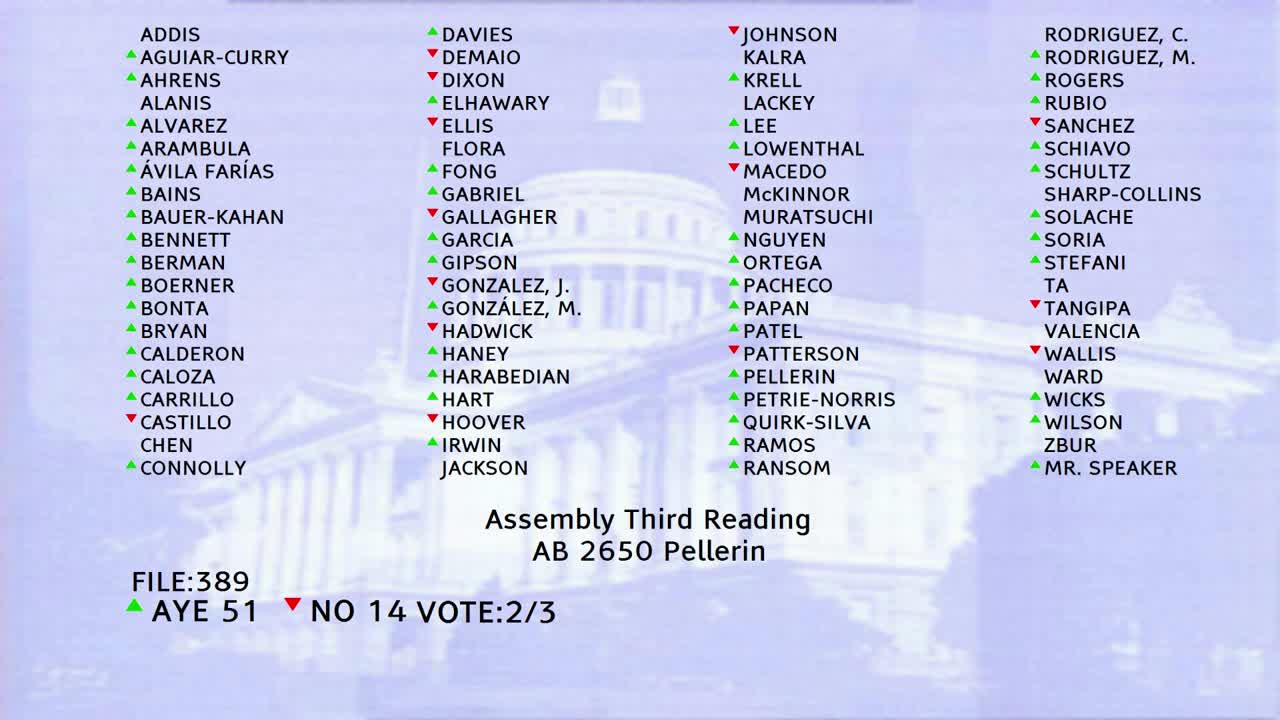 1MIN
Assembly Floor
 18MIN
Assembly Standing Committee on Utilities and Energy
 24MIN
Assembly Standing Committee on Natural Resources
Bill Author