AB 2656: Public employees: notice: artificial intelligence performing service within scope of work.
- Session Year: 2025-2026
- House: Assembly
- Latest Version Date: 2026-08-27
Current Status:
Failed
(2026-09-30: Vetoed by Governor.)
Introduced
In Committee
Awaiting First Chamber Vote
Passed First Chamber
In Committee
Awaiting Second Chamber Vote
Passed Second Chamber
Enacted
Executive Order No. N-12-23 requires specified state agencies, in collaboration with other state agencies and their workforce, to draft a report to the Governor examining the most significant, potentially beneficial use cases for deployment of generative artificial intelligence (GenAI) tools by the state. The executive order requires the report to explain the potential risks to individuals, communities, and government and state government workers, and requires the report to be regularly assessed and updated in consultation with, among others, the state government workforce or organizations that represent state government employees, as specified. Chapter 928 of the Statutes of 2024, the Generative Artificial Intelligence Accountability Act, requires specified state agencies to update the report, as needed, to respond to significant developments and to consult with specified parties, including organizations that represent state exclusive employee representatives. The act also requires state agencies to consider procurement and enterprise use opportunities for GenAI to improve efficiency, effectiveness, accessibility, and equity of government operations, as specified.
This bill would require certain state and local public employers to provide written notice to a recognized employee organization at least 45 days before taking an action to develop, purchase, or require the use of GenAI to perform a service that is within the scope of work of the job classification represented by the recognized employee organization.
Executive Order No. N-12-23 requires specified state agencies, in collaboration with other state agencies and their workforce, to draft a report to the Governor examining the most significant, potentially beneficial use cases for deployment of generative artificial intelligence (GenAI) tools by the state. The executive order requires the report to explain the potential risks to individuals, communities, and government and state government workers, and requires the report to be regularly assessed and updated in consultation with, among others, the state government workforce or organizations that represent state government employees, as specified. Chapter 928 of the Statutes of 2024, the Generative Artificial Intelligence Accountability Act, requires specified state agencies to update the report, as needed, to respond to significant developments and to consult with specified parties, including organizations that represent state exclusive employee representatives. The act also requires state agencies to consider procurement and enterprise use opportunities for GenAI to improve efficiency, effectiveness, accessibility, and equity of government operations, as specified.
This bill would require certain state and local public employers to provide written notice to a recognized employee organization at least 45 days before taking an action to develop, purchase, implement, or utilize or require the use of GenAI to perform a service that is within the scope of work of the job classification represented by the recognized employee organization.
Executive Order No. N-12-23 requires specified state agencies, in collaboration with other state agencies and their workforce, to draft a report to the Governor examining the most significant, potentially beneficial use cases for deployment of generative artificial intelligence (GenAI) tools by the state. The executive order requires the report to explain the potential risks to individuals, communities, and government and state government workers, and requires the report to be regularly assessed and updated in consultation with, among others, the state government workforce or organizations that represent state government employees, as specified. Chapter 928 of the Statutes of 2024, the Generative Artificial Intelligence Accountability Act, requires specified state agencies to update the report, as needed, to respond to significant developments and to consult with specified parties, including organizations that represent state exclusive employee representatives. The act also requires state agencies to consider procurement and enterprise use opportunities for GenAI to improve efficiency, effectiveness, accessibility, and equity of government operations, as specified.
This bill would require certain state and local public employers to provide written notice to a recognized employee organization at least 45 days before taking an action to develop, purchase, implement, or utilize GenAI to perform a service that is within the scope of work of the job classification represented by the recognized employee organization.
The Planning and Zoning Law enacts various laws relating to land use, including statewide land use planning, transportation planning, local planning, zoning regulations, and housing development, among other things. Existing law makes formal rules of evidence or procedure applicable in judicial actions and proceedings inapplicable to any proceeding subject to that law, except to the extent that a public agency otherwise provides by charter, ordinance, resolution, or rule of procedure.This bill would make a nonsubstantive change to the latter provision.The Planning and Zoning Law enacts various laws relating to land use, including statewide land use planning, transportation planning, local planning, zoning regulations, and housing development, among other things. Existing law makes formal rules of evidence or procedure applicable in judicial actions and proceedings inapplicable to any proceeding subject to that law, except to the extent that a public agency otherwise provides by charter, ordinance, resolution, or rule of procedure.
This bill would make a nonsubstantive change to the latter provision.
(a)For purposes of this section, generative artificial intelligence and artificial intelligence have the same meanings as those terms are defined in Section 11549.64.
(b)A public employer identified in subdivision (a) of Section 3555.5 shall provide a recognized employee organization no less than 45 days written notice before taking an action to develop, purchase, or require the use of any generative artificial intelligence to perform a service that is within the scope of work of the job classification represented by the recognized employee organization.
(a)For purposes of this section, generative artificial intelligence and artificial intelligence have the same meanings as those terms are defined in Section 11549.64.
(b)A public employer identified in subdivision (a) of Section 3555.5 shall provide a recognized employee organization no less than 45 days written notice before taking an action to develop, purchase, implement, or utilize or require the use of any generative artificial intelligence to perform a service that is within the scope of work of the job classification represented by the recognized employee organization.
A (a)For purposes of this section, generative artificial intelligence and artificial intelligence have the same meanings as those terms are defined in Section 11549.64.
(b)A public employer identified in subdivision (a) of Section 3555.5 shall provide a recognized employee organization no less than 45 days written notice before taking an action to develop, purchase, implement, or utilize any generative artificial intelligence to perform a service that is within the scope of work of the job classification represented by the recognized employee organization.
A public employer identified in subdivision (a) of Section 3555.5 shall provide a recognized employee organization no less than 45 days written notice before taking an action to develop, purchase, implement, or utilize any generative artificial intelligence to perform a service that is within the scope of work of the job classification represented by the recognized employee organization.
SECTION 1.Section 65010 of the Government Code is amended to read:65010.(a)The formal rules of evidence or procedure applicable in judicial actions and proceedings shall not apply in any proceeding subject to this title except to the extent that a public agency otherwise provides by charter, ordinance, resolution, or rule of procedure.(b)No action, inaction, or recommendation by any public agency or its legislative body or any of its administrative agencies or officials on any matter subject to this title shall be held invalid or set aside by any court on the ground of the improper admission or rejection of evidence or by reason of any error, irregularity, informality, neglect, or omission (hereafter, error) as to any matter pertaining to petitions, applications, notices, findings, records, hearings, reports, recommendations, appeals, or any matters of procedure subject to this title, unless the court finds that the error was prejudicial and that the party complaining or appealing suffered substantial injury from that error and that a different result would have been probable if the error had not occurred. There shall be no presumption that error is prejudicial or that injury was done if the error is shown.(a)Formal The formal rules of evidence or procedure applicable in judicial actions and proceedings shall not apply in any proceeding subject to this title except to the extent that a public agency otherwise provides by charter, ordinance, resolution, or rule of procedure.
(b)No action, inaction, or recommendation by any public agency or its legislative body or any of its administrative agencies or officials on any matter subject to this title shall be held invalid or set aside by any court on the ground of the improper admission or rejection of evidence or by reason of any error, irregularity, informality, neglect, or omission (hereafter, error) as to any matter pertaining to petitions, applications, notices, findings, records, hearings, reports, recommendations, appeals, or any matters of procedure subject to this title, unless the court finds that the error was prejudicial and that the party complaining or appealing suffered substantial injury from that error and that a different result would have been probable if the error had not occurred. There shall be no presumption that error is prejudicial or that injury was done if the error is shown.
|
Date
|
Status
|
|---|---|
| Sep 30, 2026 | Vetoed by Governor. |
| Aug 31, 2026 | Enrolled and presented to the Governor at 4 p.m. |
| Aug 25, 2026 | Senate amendments concurred in. To Engrossing and Enrolling. (Ayes 74. Noes 2. Page 6490.). |
| Aug 25, 2026 | Senate amendments concurred in. To Engrossing and Enrolling. (Ayes 74. Noes 2.). |
| Aug 24, 2026 | In Assembly. Concurrence in Senate amendments pending. |
| Aug 24, 2026 | Read third time. Passed. Ordered to the Assembly. (Ayes 39. Noes 0. Page 5704.). |
| Aug 24, 2026 | Read third time. Passed. Ordered to the Assembly. (Ayes 39. Noes 0.). |
| Aug 13, 2026 | Read second time. Ordered to third reading. |
| Aug 13, 2026 | From committee: Do pass. (Ayes 7. Noes 0.) (August 13). |
| Aug 3, 2026 | In committee: Referred to APPR. suspense file. |
| Jul 1, 2026 | Read second time and amended. Re-referred to Com. on APPR. |
| Jun 30, 2026 | From committee: Amend, and do pass as amended and re-refer to Com. on APPR. (Ayes 9. Noes 0.) (June 29). |
| Jun 19, 2026 | In committee: Set, first hearing. Hearing canceled at the request of author. |
| Jun 17, 2026 | From committee: Do pass and re-refer to Com. on P., D.T., & C.P. (Ayes 5. Noes 0.) (June 17). Re-referred to Com. on P., D.T., & C.P. |
| Jun 10, 2026 | Referred to Coms. on L., P.E. & R. and P., D.T., & C.P. |
| May 27, 2026 | In Senate. Read first time. To Com. on RLS. for assignment. |
| May 26, 2026 | Read third time. Passed. Ordered to the Senate. (Ayes 72. Noes 2. Page 5396.) |
| May 26, 2026 | Read third time. Passed. Ordered to the Senate. (Ayes 72. Noes 2.) |
| May 26, 2026 | Read third time. Passed. Ordered to the Senate. |
| May 18, 2026 | Read second time. Ordered to third reading. |
| May 14, 2026 | From committee: Do pass. (Ayes 14. Noes 0.) (May 14). |
| May 6, 2026 | In committee: Set, first hearing. Referred to APPR. suspense file. |
| Apr 22, 2026 | From committee: Do pass and re-refer to Com. on APPR. (Ayes 7. Noes 0.) (April 22). Re-referred to Com. on APPR. |
| Apr 16, 2026 | From committee: Do pass and re-refer to Com. on P. E. & R. (Ayes 14. Noes 1.) (April 16). Re-referred to Com. on P. E. & R. |
| Apr 15, 2026 | Re-referred to Com. on P. & C.P. |
| Apr 14, 2026 | From committee chair, with author's amendments: Amend, and re-refer to Com. on P. & C.P. Read second time and amended. |
| Apr 6, 2026 | Re-referred to Coms. on P. & C.P. and P. E. & R. pursuant to Assembly Rule 96. |
| Apr 3, 2026 | In committee: Hearing postponed by committee. |
| Mar 23, 2026 | Re-referred to Com. on P. E. & R. |
| Mar 19, 2026 | From committee chair, with author's amendments: Amend, and re-refer to Com. on P. E. & R. Read second time and amended. |
| Mar 19, 2026 | Referred to Coms. on P. E. & R. and P. & C.P. |
| Feb 21, 2026 | From printer. May be heard in committee March 23. |
| Feb 20, 2026 | Read first time. To print. |
|
Date
|
Description
|
Location
|
Votes
|
|
|---|---|---|---|---|
| Aug 25, 2026 | AB 2656 Petrie-Norris Concurrence in Senate Amendments | Assembly Floor |
Passed |
|
| Aug 24, 2026 | Assembly 3rd Reading AB2656 Petrie-Norris By Smallwood-Cuevas | Senate Floor |
Passed |
|
| Aug 13, 2026 | Do pass | Senate Standing Committee on Appropriations |
Passed |
|
| Aug 3, 2026 | Placed on suspense file | Senate Standing Committee on Appropriations |
Passed |
|
| Jun 29, 2026 | Do pass as amended, but first amend, and re-refer to the Committee on [Appropriations] | Senate Standing Committee on Privacy, Digital Technologies, and Consumer Protection |
Passed |
|
| Jun 17, 2026 | Do pass, but first be re-referred to the Committee on [Privacy, Digital Technologies, and Consumer Protection] | Senate Standing Committee on Labor, Public Employment and Retirement |
Passed |
|
| May 26, 2026 | AB 2656 Petrie-Norris Assembly Third Reading | Assembly Floor |
Passed |
|
| May 14, 2026 | Do pass. | Assembly Standing Committee on Appropriations |
Passed |
|
| Apr 22, 2026 | Do pass and be re-referred to the Committee on [Appropriations] | Assembly Standing Committee on Public Employment and Retirement |
Passed |
|
| Apr 16, 2026 | Do pass and be re-referred to the Committee on [Public Employment and Retirement] | Assembly Standing Committee on Privacy and Consumer Protection |
Passed |
This list shows positions taken on this bill by organizations on the date displayed, which is linked to the original source.
Positions by individuals are not included.
|
Organization
|
Position
|
Date
|
|---|---|---|
| Association Of California School Administrators | ** Against | |
| California Association Of Recreation & Park Districts | ** Against | |
| California Professional Firefighters | ** Support | |
| California Special Districts Association | ** Against | |
| California State Association Of Counties | ** Against | |
| CFT – A Union of Educators & Classified Professionals | ** Support | |
| City of Norwalk | ** Against | |
| City of Orinda | ** Against | |
| County Of Kern | ** Against | |
| El Dorado Irrigation District | ** Against | |
| League Of California Cities | ** Against | |
| Peace Officers Research Association Of California | ** Support | |
| PUBLIC RISK INNOVATION, SOLUTIONS, AND MANAGEMENT (PRISM) | ** Against | |
| Rural County Representatives of California | ** Against | |
| SEIU California | ** Support | |
| Shasta County Board of Supervisors | ** Against | |
| The Peace Officers Research Association of California | ** Support | |
| Urban Counties of California | ** Against |
GOVERNOR'S VETO
GV Bill Id:AB 2656
Author:(Petrie-Norris)
As Enrolled Ver:August 27, 2026
2/3 vote
SUMMARY
Requires certain state and local public employers to provide a recognized employee organization no less than 45 days' written notice before taking an action to develop, purchase, or require the use of any generative AI (GenAI) to perform a service that is within the scope of work of the job classification represented by the recognized employee organization.
Senate Amendments
Make a clarifying change, i.e., removed the words "implement, or utilize", and replaced them with "or require the use of" relating to GenAI performing service within the scope of work, as prescribed.
Governor's Veto Message
This bill would require public employers to provide a recognized employee organization with at least 45 days' written notice before developing, purchasing, or requiring the use of any [GenAI] to perform a service that is within the scope of work of the job classification represented by the recognized employee organization.
I believe that employees should be made aware when employers introduce new technologies that significantly impact them. However, this measure would impose redundant administrative layers on public agencies and slow the deployment of even the most innocuous tools. Moreover, this issue is best resolved through the collective bargaining process, which allows employees and employers to tailor rules appropriate for their workplace.
COMMENTS
Artificial Intelligence and GenAI. Until recently, advancements in technology often automated physical tasks, such as those performed on factory floors or self-checkouts, but AI functions more like human brainpower. AI can use algorithms to accomplish tasks faster and sometimes at a lower cost than human workers can. GenAI is a subfield of AI that creates content like text, images, audio or software code in response to human prompts. GenAI can learn from underlying patterns and structures of data to generate new data in response to input or prompts. As this technology develops, so do fears of worker displacement in more areas and industries.
According to a recent CNBC article, "recent estimates from Goldman Sachs suggest that six percent to seven percent of United States workers could lose their jobs because of AI adoption. The Stanford Digital Economy Lab, using Automatic Data Processing, Inc. (ADP) employment data, found that entry-level hiring in "AI exposed jobs" has dropped 13 percent since large language models started proliferating. The report also stated that software development, customer service, and clerical work are the types of jobs most vulnerable to AI today."[1]
Beyond replacing workers, GenAI tools like ChatGPT, Gemini or Claude are being used to complement the duties of employees in astonishing numbers. A 2025 report assessed the scale of global daily active usage for GenAI tools and found that daily active user base for these tools likely falls within the range of 115 million to 180 million individuals.[2] In terms of state employment and GenAI use, a 2024 survey by the National Association of State Chief Information Officers found that 53 percent of chief information officers reported using GenAI tools in their daily work.[3]
Governor Newsom's Executive Orders (EO). Among other things, EO N-12-23 "requires the Government Operations Agency, the California Department of Technology, the Office of Data and Innovation, and the Governor's Office of Business and Economic Development, in collaboration with other State agencies and departments and their workforce, to draft a report to the Governor examining the most significant, potentially beneficial use cases for deployment of GenAI tools by the State."
The report must also "explain the potential risks to individuals, communities, and government and state government workers, with a focus on high-risk use cases, such as where [it] is used to make a consequential decision affecting access to essential goods and services," and to "include but not be limited to: risks stemming from bad actors and insufficiently guarded governmental systems, unintended or emergent effects, and potential risks toward democratic and legal processes, public health and safety, and the economy." Further, the report must be "regularly assessed for any significant developments or necessary updates and as appropriate, be done in consultation with civil society, academia, industry experts, and the state government workforce or organizations that represent state government employees."[4]
On May 21, 2026, the Governor issued EO N-6-26 directing state agencies to build a framework for responding to potential workforce disruption and ensuring workers are not left behind as AI adoption accelerates.[5] Among other things, this EO directs various state agencies to:
- Track and understand the impact of AI on the workforce, filling the gaps of knowledge and providing clear and concrete data with: a) a new report on recommendations, best practices, and early economic warning signals of potential labor disruptions, drafted in consultation with labor, industry, and academic experts; b) a new dashboard showing the impact of AI across sectors; c) recommendations on revisions and updates to the California Worker Adjustment and Retraining Notification (WARN) Act, to ensure it can be used to provide early warning data and is responsive to emerging industry trends; and, d) business feedback on the role of technology in workforce decisions incorporated into the state's monthly jobs report.
- Respond to possible employment and workforce disruption: by (i) reviewing policies that provide workers with a safety net, including severance and other forms of compensation; (ii) increasing awareness and enrollment of employment insurance programs; (iii) creating an AI playbook to modernize job training programs; (iv) creating a single online platform to enable Californians to more easily navigate government services and, ultimately, help Californians identify all social services for which they may be eligible; and, (v) leveraging California Volunteers for those experiencing long-term unemployment and to provide essential training for entry-level workers.
- Develop stronger public policy and support programs for using AI to advance the public good: by working with academic experts and the private sector to develop recommendations for altering incentive structures and increasing the likelihood of AI development and deployments that advance the public good and address critical problems facing society.
Relationship to Collective Bargaining. Within the MMBA (specifically, Section 3505 of the Gov. Code), for example, local public agencies are required to meet and confer in good faith regarding wages, hours, and other terms and conditions of employment with employee organizations representatives; defines "meet and confer" for this purpose, and provides for the resolution of impasse. This requirement and associated provisions are substantially similar to those in a number of the other public employment relations statutes enumerated under "Existing Law" above, that are incorporated by reference in this bill.
This Bill Neither Limits Nor Prohibits Public Employer Action Regarding GenAI. This bill neither explicitly nor tacitly limits or prohibits a public employer regarding GenAI to perform a service that is within the scope of work of the job classification represented by the recognized employee organization. If it is alleged that the public employer's development, purchase, implementation, or required use of GenAI may involve matters relating to the scope of representation, i.e., the mandatory subjects of bargaining being wages, hours (of employment), and other terms and conditions of employment, such matters may be resolved through collective bargaining or the Public Employment Relations Board's grievance resolutions processes.
Please refer to the various policy committee analyses for a full discussion of this bill.
According to the Author
"This measure ensures that public employees are not left in the dark as artificial intelligence becomes more integrated into government operations. As cities, counties, and state agencies increasingly deploy AI tools in the workplace, employees deserve clear, advance notice when these technologies are being used and how they may impact their duties, evaluations, and decision-making processes. While emerging technologies can be valuable tools, they must be implemented thoughtfully, transparently, and with appropriate safeguards. Requiring advance notice is a straightforward, commonsense step that promotes accountability without slowing innovation. It ensures that employees can adapt to new systems, raise concerns where appropriate, and maintain the professional judgment that is critical in high-stakes public safety environments."
Arguments in Support
The Peace Officers Research Association of California expresses, "[this bill] ensures that public employee organizations receive advance notice of the proposed use of GenAI and are provided a meaningful opportunity to engage with public agencies prior to its implementation. This bill establishes a reasonable and necessary framework to ensure that the introduction of new technologies enhances, rather than undermines, the work of public employees. GenAI is rapidly transforming workplaces across the public sector, including law enforcement. While this technology has the potential to improve efficiency and support public safety operations, it also raises important concerns related to job displacement, working conditions, and the use of automated systems that may lack transparency or accountability. Decisions about the development and implementation of GenAI are often made without sufficient input from the employees most directly impacted. Public safety professionals bring valuable, real-world experience and insight that can help ensure these tools are implemented effectively and responsibly. Providing advance notice and an opportunity to engage allows employee organizations to identify potential risks, improve outcomes, and help integrate new technologies in a way that supports both public safety and workforce stability."
Others in support offers similar statements regarding this bill.
Arguments in Opposition
Among other things, a coalition of local public agency organizations (e.g., cities, counties, school administrators) state, "[w]hen tools become available that assist with specific aspects of public service (like charting in health clinic or monitoring drinking water safety), they are often vetted in partnership with employees with the mutual goals of ensuring staff is empowered to focus on certain aspects of their work and providing more efficient and effective outcomes that benefit the public. Importantly, local agencies remain subject to the statutory provisions [of the] Meyers-Milias-Brown Act (MMBA), which require local agencies to meet and confer with recognized employee organizations regarding changes to employees' wages, hours, or terms and conditions of employment. Existing law provides a robust framework for determining when particular uses of generative artificial intelligence may actually have a significant and adverse effect on the employment relationship, in which case notification (and more) is already required. This bill is therefore both overbroad and unnecessary. Finally, local agencies are subject to last year's Chapter 687, Statutes of 2025 (Assembly Bill 339, Ortega), which requires additional notice to recognized employee organizations regarding a range of local agency contracting activities, even when those activities do not rise to the level of triggering meet-and-confer obligations under the MMBA's usual standards. This additional notification requirement has been incredibly burdensome for local agencies and has required a significant amount of time, legal resources, and training to implement. The further unworkable notification provisions in this bill would exacerbate these concerns and represent another state mandate for which the state may be obligated to provide reimbursement under Article XIII B of the California Constitution.
FISCAL COMMENTS
According to the Senate Committee on Appropriations, this bill would result in the following:
- Costs to the State as a direct employer, likely exceeding $50,000 annually (General Fund and special funds), to implement the bill's employee notice requirements. The magnitude of these costs would depend on the extent to which state departments use workplace AI tools.
- The bill's notification requirements would apply to approximately 1,000 school districts and 58 county offices of education. The resulting annual costs are unknown but would be borne through Proposition 98 General Fund support.
- The Public Employment Relations Board (PERB) would incur annual General Fund costs of $235,000 to implement the provisions of the bill.
- Impose costs on local agencies, including cities, counties, and special districts, to implement its notice requirements. If the Commission on State Mandates determines that these requirements constitute a reimbursable state mandate, the state would incur corresponding General Fund costs to reimburse local agencies. The magnitude of these costs is unknown but could exceed $50,000 annually.
VOTES
ASM PRIVACY AND CONSUMER PROTECTION: 14-1-0
YES: Bauer-Kahan, Macedo, Aguiar-Curry, Bryan, Hoover, Irwin, Lowenthal, McKinnor, Ortega, Patterson, Petrie-Norris, Ward, Wicks, Wilson
NO: DeMaio
ASM PUBLIC EMPLOYMENT AND RETIREMENT: 7-0-0
YES: McKinnor, Lackey, Alanis, Boerner, Garcia, Nguyen, Michelle Rodriguez
ASM APPROPRIATIONS: 14-0-1
YES: Wicks, Hoover, Aguiar-Curry, Calderon, Caloza, Fong, Mark González, Krell, Pacheco, Pellerin, Sharp-Collins, Solache, Ta, Tangipa
ABS, ABST OR NV: Dixon
ASSEMBLY FLOOR: 72-2-6
YES: Addis, Aguiar-Curry, Ahrens, Alanis, Alvarez, Arambula, Ávila Farías, Bains, Bauer-Kahan, Bennett, Berman, Boerner, Bonta, Bryan, Calderon, Caloza, Carrillo, Chen, Connolly, Davies, Elhawary, Flora, Fong, Gabriel, Gallagher, Garcia, Gipson, Jeff Gonzalez, Mark González, Haney, Harabedian, Hart, Hoover, Irwin, Jackson, Kalra, Krell, Lackey, Lee, Lowenthal, Macedo, McKinnor, Nguyen, Ortega, Pacheco, Papan, Patel, Patterson, Pellerin, Petrie-Norris, Quirk-Silva, Ramos, Ransom, Michelle Rodriguez, Rogers, Blanca Rubio, Sanchez, Schiavo, Schultz, Sharp-Collins, Solache, Soria, Stefani, Ta, Tangipa, Valencia, Wallis, Ward, Wicks, Wilson, Zbur, Rivas
NO: DeMaio, Ellis
ABS, ABST OR NV: Castillo, Dixon, Hadwick, Johnson, Muratsuchi, Celeste Rodriguez
SENATE FLOOR: 39-0-1
YES: Allen, Alvarado-Gil, Archuleta, Arreguín, Ashby, Becker, Blakespear, Cabaldon, Caballero, Cervantes, Choi, Cortese, Dahle, Durazo, Gonzalez, Grayson, Grove, Hurtado, Jones, Laird, Limón, McGuire, McNerney, Menjivar, Ochoa Bogh, Padilla, Pérez, Reyes, Richardson, Rubio, Seyarto, Smallwood-Cuevas, Stern, Strickland, Umberg, Valladares, Wahab, Weber Pierson, Wiener
ABS, ABST OR NV: Niello
ASSEMBLY FLOOR: 74-2-3
YES: Addis, Aguiar-Curry, Ahrens, Alanis, Alvarez, Arambula, Ávila Farías, Bains, Bauer-Kahan, Bennett, Berman, Boerner, Bonta, Bryan, Calderon, Caloza, Carrillo, Castillo, Chen, Connolly, Davies, Dixon, Elhawary, Flora, Fong, Gabriel, Garcia, Gipson, Jeff Gonzalez, Mark González, Haney, Harabedian, Hart, Hoover, Irwin, Jackson, Kalra, Krell, Lackey, Lee, Lowenthal, Macedo, Muratsuchi, Nguyen, Ortega, Pacheco, Papan, Patel, Patterson, Pellerin, Petrie-Norris, Quirk-Silva, Ramos, Ransom, Celeste Rodriguez, Michelle Rodriguez, Rogers, Blanca Rubio, Sanchez, Schiavo, Schultz, Sharp-Collins, Solache, Soria, Stefani, Ta, Tangipa, Valencia, Wallis, Ward, Wicks, Wilson, Zbur, Rivas
NO: DeMaio, Ellis
ABS, ABST OR NV: Hadwick, Johnson, McKinnor
UPDATED
VERSION: August 27, 2026
CONSULTANT: Michael Bolden / P. E. & R. / (916) 319-3957 FN: 0004617
"AI is already taking white-collar jobs. Economists warn there's 'much more in the tank.' CNBC, October 23, 2025. https://www.cnbc.com/2025/10/22/ai-taking-white-collar-jobs-economists-warn-much-more-in-the-tank.html ↑
"How many people are using generative AI on a daily basis?" A Gemini report. April 14, 2025. https://www.technollama.co.uk/a-gemini-report-how-many-people-are-using-generative-ai-on-a-daily-basis-a-gemini-report. ↑
"Generating opportunity: The risks and rewards of generative AI in state government." National Association of State Chief Information Officers, November 2024. https://www.nascio.org/wp-content/uploads/2024/11/NASCIO_Risks-and-Rewards-of-GenAI_2024_a.pdf ↑
Executive Order N-12-23. https://www.gov.ca.gov/wp-content/uploads/2023/09/AI-EO-No.12-_-GGN-Signed.pdf ↑
Executive Order N-6-26. https://www.gov.ca.gov/wp-content/uploads/2026/05/5.21.26-AI-Workforce-EO-FINAL-SIGNED.pdf. ↑
CONCURRENCE IN SENATE AMENDMENTS
CSA1 Bill Id:AB 2656
Author:(Petrie-Norris)
As Amended Ver:July 1, 2026
Majority vote
SUMMARY
Requires certain state and local public employers to provide a recognized employee organization no less than 45 days' written notice before taking an action to develop, purchase, or require the use of any generative AI (GenAI) to perform a service that is within the scope of work of the job classification represented by the recognized employee organization.
Senate Amendments
Make a clarifying change, i.e., removed the words "implement, or utilize", and replaced them with "or require the use of" relating to GenAI performing service within the scope of work, as prescribed.
COMMENTS
Artificial Intelligence and GenAI. Until recently, advancements in technology often automated physical tasks, such as those performed on factory floors or self-checkouts, but AI functions more like human brainpower. AI can use algorithms to accomplish tasks faster and sometimes at a lower cost than human workers can. GenAI is a subfield of AI that creates content like text, images, audio or software code in response to human prompts. GenAI can learn from underlying patterns and structures of data to generate new data in response to input or prompts. As this technology develops, so do fears of worker displacement in more areas and industries.
According to a recent CNBC article, "recent estimates from Goldman Sachs suggest that six percent to seven percent of United States workers could lose their jobs because of AI adoption. The Stanford Digital Economy Lab, using Automatic Data Processing, Inc. (ADP) employment data, found that entry-level hiring in "AI exposed jobs" has dropped 13 percent since large language models started proliferating. The report also stated that software development, customer service, and clerical work are the types of jobs most vulnerable to AI today."[1]
Beyond replacing workers, GenAI tools like ChatGPT, Gemini or Claude are being used to complement the duties of employees in astonishing numbers. A 2025 report assessed the scale of global daily active usage for GenAI tools and found that daily active user base for these tools likely falls within the range of 115 million to 180 million individuals.[2] In terms of state employment and GenAI use, a 2024 survey by the National Association of State Chief Information Officers found that 53 percent of chief information officers reported using GenAI tools in their daily work.[3]
Governor Newsom's Executive Orders (EO). Among other things, EO N-12-23 "requires the Government Operations Agency, the California Department of Technology, the Office of Data and Innovation, and the Governor's Office of Business and Economic Development, in collaboration with other State agencies and departments and their workforce, to draft a report to the Governor examining the most significant, potentially beneficial use cases for deployment of GenAI tools by the State."
The report must also "explain the potential risks to individuals, communities, and government and state government workers, with a focus on high-risk use cases, such as where [it] is used to make a consequential decision affecting access to essential goods and services," and to "include but not be limited to: risks stemming from bad actors and insufficiently guarded governmental systems, unintended or emergent effects, and potential risks toward democratic and legal processes, public health and safety, and the economy." Further, the report must be "regularly assessed for any significant developments or necessary updates and as appropriate, be done in consultation with civil society, academia, industry experts, and the state government workforce or organizations that represent state government employees."[4]
On May 21, 2026, the Governor issued EO N-6-26 directing state agencies to build a framework for responding to potential workforce disruption and ensuring workers are not left behind as AI adoption accelerates.[5] Among other things, this EO directs various state agencies to:
- Track and understand the impact of AI on the workforce, filling the gaps of knowledge and providing clear and concrete data with: a) a new report on recommendations, best practices, and early economic warning signals of potential labor disruptions, drafted in consultation with labor, industry, and academic experts; b) a new dashboard showing the impact of AI across sectors; c) recommendations on revisions and updates to the California Worker Adjustment and Retraining Notification (WARN) Act, to ensure it can be used to provide early warning data and is responsive to emerging industry trends; and, d) business feedback on the role of technology in workforce decisions incorporated into the state's monthly jobs report.
- Respond to possible employment and workforce disruption: by (i) reviewing policies that provide workers with a safety net, including severance and other forms of compensation; (ii) increasing awareness and enrollment of employment insurance programs; (iii) creating an AI playbook to modernize job training programs; (iv) creating a single online platform to enable Californians to more easily navigate government services and, ultimately, help Californians identify all social services for which they may be eligible; and, (v) leveraging California Volunteers for those experiencing long-term unemployment and to provide essential training for entry-level workers.
- Develop stronger public policy and support programs for using AI to advance the public good: by working with academic experts and the private sector to develop recommendations for altering incentive structures and increasing the likelihood of AI development and deployments that advance the public good and address critical problems facing society.
Relationship to Collective Bargaining. Within the MMBA (specifically, Section 3505 of the Gov. Code), for example, local public agencies are required to meet and confer in good faith regarding wages, hours, and other terms and conditions of employment with employee organizations representatives; defines "meet and confer" for this purpose, and provides for the resolution of impasse. This requirement and associated provisions are substantially similar to those in a number of the other public employment relations statutes enumerated under "Existing Law" above, that are incorporated by reference in this bill.
This Bill Neither Limits Nor Prohibits Public Employer Action Regarding GenAI. This bill neither explicitly nor tacitly limits or prohibits a public employer regarding GenAI to perform a service that is within the scope of work of the job classification represented by the recognized employee organization. If it is alleged that the public employer's development, purchase, implementation, or required use of GenAI may involve matters relating to the scope of representation, i.e., the mandatory subjects of bargaining being wages, hours (of employment), and other terms and conditions of employment, such matters may be resolved through collective bargaining or the Public Employment Relations Board's grievance resolutions processes.
Please refer to the various policy committee analyses for a full discussion of this bill.
According to the Author
"This measure ensures that public employees are not left in the dark as artificial intelligence becomes more integrated into government operations. As cities, counties, and state agencies increasingly deploy AI tools in the workplace, employees deserve clear, advance notice when these technologies are being used and how they may impact their duties, evaluations, and decision-making processes. While emerging technologies can be valuable tools, they must be implemented thoughtfully, transparently, and with appropriate safeguards. Requiring advance notice is a straightforward, commonsense step that promotes accountability without slowing innovation. It ensures that employees can adapt to new systems, raise concerns where appropriate, and maintain the professional judgment that is critical in high-stakes public safety environments."
Arguments in Support
The Peace Officers Research Association of California expresses, "[this bill] ensures that public employee organizations receive advance notice of the proposed use of GenAI and are provided a meaningful opportunity to engage with public agencies prior to its implementation. This bill establishes a reasonable and necessary framework to ensure that the introduction of new technologies enhances, rather than undermines, the work of public employees. GenAI is rapidly transforming workplaces across the public sector, including law enforcement. While this technology has the potential to improve efficiency and support public safety operations, it also raises important concerns related to job displacement, working conditions, and the use of automated systems that may lack transparency or accountability. Decisions about the development and implementation of GenAI are often made without sufficient input from the employees most directly impacted. Public safety professionals bring valuable, real-world experience and insight that can help ensure these tools are implemented effectively and responsibly. Providing advance notice and an opportunity to engage allows employee organizations to identify potential risks, improve outcomes, and help integrate new technologies in a way that supports both public safety and workforce stability."
Others in support offers similar statements regarding this bill.
Arguments in Opposition
Among other things, a coalition of local public employer organizations (e.g., cities counties, school administrators) state, "[w]hen tools become available that assist with specific aspects of public service (like charting in health clinic or monitoring drinking water safety), they are often vetted in partnership with employees with the mutual goals of ensuring staff is empowered to focus on certain aspects of their work and providing more efficient and effective outcomes that benefit the public. Importantly, local agencies remain subject to the statutory provisions [of the] Meyers-Milias-Brown Act (MMBA), which require local agencies to meet and confer with recognized employee organizations regarding changes to employees' wages, hours, or terms and conditions of employment. Existing law provides a robust framework for determining when particular uses of generative artificial intelligence may actually have a significant and adverse effect on the employment relationship, in which case notification (and more) is already required. This bill is therefore both overbroad and unnecessary. Finally, local agencies are subject to last year's Chapter 687, Statutes of 2025 (Assembly Bill 339, Ortega), which requires additional notice to recognized employee organizations regarding a range of local agency contracting activities, even when those activities do not rise to the level of triggering meet-and-confer obligations under the MMBA's usual standards. This additional notification requirement has been incredibly burdensome for local agencies and has required a significant amount of time, legal resources, and training to implement. The further unworkable notification provisions in this bill would exacerbate these concerns and represent another state mandate for which the state may be obligated to provide reimbursement under Article XIII B of the California Constitution.
FISCAL COMMENTS
According to the Senate Committee on Appropriations, this bill would result in the following:
- Costs to the State as a direct employer, likely exceeding $50,000 annually (General Fund and special funds), to implement the bill's employee notice requirements. The magnitude of these costs would depend on the extent to which state departments use workplace AI tools.
- The bill's notification requirements would apply to approximately 1,000 school districts and 58 county offices of education. The resulting annual costs are unknown but would be borne through Proposition 98 General Fund support.
- The Public Employment Relations Board (PERB) would incur annual General Fund costs of $235,000 to implement the provisions of the bill.
- Impose costs on local agencies, including cities, counties, and special districts, to implement its notice requirements. If the Commission on State Mandates determines that these requirements constitute a reimbursable state mandate, the state would incur corresponding General Fund costs to reimburse local agencies. The magnitude of these costs is unknown but could exceed $50,000 annually.
VOTES:
ASM PRIVACY AND CONSUMER PROTECTION: 14-1-0
YES: Bauer-Kahan, Macedo, Aguiar-Curry, Bryan, Hoover, Irwin, Lowenthal, McKinnor, Ortega, Patterson, Petrie-Norris, Ward, Wicks, Wilson
NO: DeMaio
ASM PUBLIC EMPLOYMENT AND RETIREMENT: 7-0-0
YES: McKinnor, Lackey, Alanis, Boerner, Garcia, Nguyen, Michelle Rodriguez
ASM APPROPRIATIONS: 14-0-1
YES: Wicks, Hoover, Aguiar-Curry, Calderon, Caloza, Fong, Mark González, Krell, Pacheco, Pellerin, Sharp-Collins, Solache, Ta, Tangipa
ABS, ABST OR NV: Dixon
ASSEMBLY FLOOR: 72-2-6
YES: Addis, Aguiar-Curry, Ahrens, Alanis, Alvarez, Arambula, Ávila Farías, Bains, Bauer-Kahan, Bennett, Berman, Boerner, Bonta, Bryan, Calderon, Caloza, Carrillo, Chen, Connolly, Davies, Elhawary, Flora, Fong, Gabriel, Gallagher, Garcia, Gipson, Jeff Gonzalez, Mark González, Haney, Harabedian, Hart, Hoover, Irwin, Jackson, Kalra, Krell, Lackey, Lee, Lowenthal, Macedo, McKinnor, Nguyen, Ortega, Pacheco, Papan, Patel, Patterson, Pellerin, Petrie-Norris, Quirk-Silva, Ramos, Ransom, Michelle Rodriguez, Rogers, Blanca Rubio, Sanchez, Schiavo, Schultz, Sharp-Collins, Solache, Soria, Stefani, Ta, Tangipa, Valencia, Wallis, Ward, Wicks, Wilson, Zbur, Rivas
NO: DeMaio, Ellis
ABS, ABST OR NV: Castillo, Dixon, Hadwick, Johnson, Muratsuchi, Celeste Rodriguez
SENATE FLOOR: 39-0-1
YES: Allen, Alvarado-Gil, Archuleta, Arreguín, Ashby, Becker, Blakespear, Cabaldon, Caballero, Cervantes, Choi, Cortese, Dahle, Durazo, Gonzalez, Grayson, Grove, Hurtado, Jones, Laird, Limón, McGuire, McNerney, Menjivar, Ochoa Bogh, Padilla, Pérez, Reyes, Richardson, Rubio, Seyarto, Smallwood-Cuevas, Stern, Strickland, Umberg, Valladares, Wahab, Weber Pierson, Wiener
ABS, ABST OR NV: Niello
UPDATED
VERSION: July 1, 2026
CONSULTANT: Michael Bolden / P. E. & R. / (916) 319-3957 FN: 0004050
"AI is already taking white-collar jobs. Economists warn there's 'much more in the tank.' CNBC, October 23, 2025. https://www.cnbc.com/2025/10/22/ai-taking-white-collar-jobs-economists-warn-much-more-in-the-tank.html ↑
"How many people are using generative AI on a daily basis?" A Gemini report. April 14, 2025. https://www.technollama.co.uk/a-gemini-report-how-many-people-are-using-generative-ai-on-a-daily-basis-a-gemini-report. ↑
"Generating opportunity: The risks and rewards of generative AI in state government." National Association of State Chief Information Officers, November 2024. https://www.nascio.org/wp-content/uploads/2024/11/NASCIO_Risks-and-Rewards-of-GenAI_2024_a.pdf ↑
Executive Order N-12-23. https://www.gov.ca.gov/wp-content/uploads/2023/09/AI-EO-No.12-_-GGN-Signed.pdf ↑
Executive Order N-6-26. https://www.gov.ca.gov/wp-content/uploads/2026/05/5.21.26-AI-Workforce-EO-FINAL-SIGNED.pdf. ↑
CONCURRENCE IN SENATE AMENDMENTS
CSA1 Bill Id:AB 2656
Author:(Petrie-Norris)
As Amended Ver:July 1, 2026
Majority vote
SUMMARY
Requires certain state and local public employers to provide a recognized employee organization no less than 45 days' written notice before taking an action to develop, purchase, or require the use of any generative AI (GenAI) to perform a service that is within the scope of work of the job classification represented by the recognized employee organization.
Senate Amendments
Make a clarifying change, i.e., removed the words "implement, or utilize", and replaced them with "or require the use of" relating to GenAI performing service within the scope of work, as prescribed.
COMMENTS
Artificial Intelligence and GenAI. Until recently, advancements in technology often automated physical tasks, such as those performed on factory floors or self-checkouts, but AI functions more like human brainpower. AI can use algorithms to accomplish tasks faster and sometimes at a lower cost than human workers can. GenAI is a subfield of AI that creates content like text, images, audio or software code in response to human prompts. GenAI can learn from underlying patterns and structures of data to generate new data in response to input or prompts. As this technology develops, so do fears of worker displacement in more areas and industries.
According to a recent CNBC article, "recent estimates from Goldman Sachs suggest that six percent to seven percent of United States workers could lose their jobs because of AI adoption. The Stanford Digital Economy Lab, using Automatic Data Processing, Inc. (ADP) employment data, found that entry-level hiring in "AI exposed jobs" has dropped 13 percent since large language models started proliferating. The report also stated that software development, customer service, and clerical work are the types of jobs most vulnerable to AI today."[1]
Beyond replacing workers, GenAI tools like ChatGPT, Gemini or Claude are being used to complement the duties of employees in astonishing numbers. A 2025 report assessed the scale of global daily active usage for GenAI tools and found that daily active user base for these tools likely falls within the range of 115 million to 180 million individuals.[2] In terms of state employment and GenAI use, a 2024 survey by the National Association of State Chief Information Officers found that 53 percent of chief information officers reported using GenAI tools in their daily work.[3]
Governor Newsom's Executive Orders (EO). Among other things, EO N-12-23 "requires the Government Operations Agency, the California Department of Technology, the Office of Data and Innovation, and the Governor's Office of Business and Economic Development, in collaboration with other State agencies and departments and their workforce, to draft a report to the Governor examining the most significant, potentially beneficial use cases for deployment of GenAI tools by the State."
The report must also "explain the potential risks to individuals, communities, and government and state government workers, with a focus on high-risk use cases, such as where [it] is used to make a consequential decision affecting access to essential goods and services," and to "include but not be limited to: risks stemming from bad actors and insufficiently guarded governmental systems, unintended or emergent effects, and potential risks toward democratic and legal processes, public health and safety, and the economy." Further, the report must be "regularly assessed for any significant developments or necessary updates and as appropriate, be done in consultation with civil society, academia, industry experts, and the state government workforce or organizations that represent state government employees."[4]
On May 21, 2026, the Governor issued EO N-6-26 directing state agencies to build a framework for responding to potential workforce disruption and ensuring workers are not left behind as AI adoption accelerates.[5] Among other things, this EO directs various state agencies to:
- Track and understand the impact of AI on the workforce, filling the gaps of knowledge and providing clear and concrete data with: a) a new report on recommendations, best practices, and early economic warning signals of potential labor disruptions, drafted in consultation with labor, industry, and academic experts; b) a new dashboard showing the impact of AI across sectors; c) recommendations on revisions and updates to the California Worker Adjustment and Retraining Notification (WARN) Act, to ensure it can be used to provide early warning data and is responsive to emerging industry trends; and, d) business feedback on the role of technology in workforce decisions incorporated into the state's monthly jobs report.
- Respond to possible employment and workforce disruption: by (i) reviewing policies that provide workers with a safety net, including severance and other forms of compensation; (ii) increasing awareness and enrollment of employment insurance programs; (iii) creating an AI playbook to modernize job training programs; (iv) creating a single online platform to enable Californians to more easily navigate government services and, ultimately, help Californians identify all social services for which they may be eligible; and, (v) leveraging California Volunteers for those experiencing long-term unemployment and to provide essential training for entry-level workers.
- Develop stronger public policy and support programs for using AI to advance the public good: by working with academic experts and the private sector to develop recommendations for altering incentive structures and increasing the likelihood of AI development and deployments that advance the public good and address critical problems facing society.
Relationship to Collective Bargaining. Within the MMBA (specifically, Section 3505 of the Gov. Code), for example, local public agencies are required to meet and confer in good faith regarding wages, hours, and other terms and conditions of employment with employee organizations representatives; defines "meet and confer" for this purpose, and provides for the resolution of impasse. This requirement and associated provisions are substantially similar to those in a number of the other public employment relations statutes enumerated under "Existing Law" above, that are incorporated by reference in this bill.
This Bill Neither Limits Nor Prohibits Public Employer Action Regarding GenAI. This bill neither explicitly nor tacitly limits or prohibits a public employer regarding GenAI to perform a service that is within the scope of work of the job classification represented by the recognized employee organization. If it is alleged that the public employer's development, purchase, implementation, or required use of GenAI may involve matters relating to the scope of representation, i.e., the mandatory subjects of bargaining being wages, hours (of employment), and other terms and conditions of employment, such matters may be resolved through collective bargaining or the Public Employment Relations Board's grievance resolutions processes.
Please refer to the various policy committee analyses for a full discussion of this bill.
According to the Author
"This measure ensures that public employees are not left in the dark as artificial intelligence becomes more integrated into government operations. As cities, counties, and state agencies increasingly deploy AI tools in the workplace, employees deserve clear, advance notice when these technologies are being used and how they may impact their duties, evaluations, and decision-making processes. While emerging technologies can be valuable tools, they must be implemented thoughtfully, transparently, and with appropriate safeguards. Requiring advance notice is a straightforward, commonsense step that promotes accountability without slowing innovation. It ensures that employees can adapt to new systems, raise concerns where appropriate, and maintain the professional judgment that is critical in high-stakes public safety environments."
Arguments in Support
The Peace Officers Research Association of California expresses, "[this bill] ensures that public employee organizations receive advance notice of the proposed use of GenAI and are provided a meaningful opportunity to engage with public agencies prior to its implementation. This bill establishes a reasonable and necessary framework to ensure that the introduction of new technologies enhances, rather than undermines, the work of public employees. GenAI is rapidly transforming workplaces across the public sector, including law enforcement. While this technology has the potential to improve efficiency and support public safety operations, it also raises important concerns related to job displacement, working conditions, and the use of automated systems that may lack transparency or accountability. Decisions about the development and implementation of GenAI are often made without sufficient input from the employees most directly impacted. Public safety professionals bring valuable, real-world experience and insight that can help ensure these tools are implemented effectively and responsibly. Providing advance notice and an opportunity to engage allows employee organizations to identify potential risks, improve outcomes, and help integrate new technologies in a way that supports both public safety and workforce stability."
Others in support offers similar statements regarding this bill.
Arguments in Opposition
Among other things, a coalition of local public employer organizations (e.g., cities counties, school administrators) state, "[w]hen tools become available that assist with specific aspects of public service (like charting in health clinic or monitoring drinking water safety), they are often vetted in partnership with employees with the mutual goals of ensuring staff is empowered to focus on certain aspects of their work and providing more efficient and effective outcomes that benefit the public. Importantly, local agencies remain subject to the statutory provisions [of the] Meyers-Milias-Brown Act (MMBA), which require local agencies to meet and confer with recognized employee organizations regarding changes to employees' wages, hours, or terms and conditions of employment. Existing law provides a robust framework for determining when particular uses of generative artificial intelligence may actually have a significant and adverse effect on the employment relationship, in which case notification (and more) is already required. This bill is therefore both overbroad and unnecessary. Finally, local agencies are subject to last year's Chapter 687, Statutes of 2025 (Assembly Bill 339, Ortega), which requires additional notice to recognized employee organizations regarding a range of local agency contracting activities, even when those activities do not rise to the level of triggering meet-and-confer obligations under the MMBA's usual standards. This additional notification requirement has been incredibly burdensome for local agencies and has required a significant amount of time, legal resources, and training to implement. The further unworkable notification provisions in this bill would exacerbate these concerns and represent another state mandate for which the state may be obligated to provide reimbursement under Article XIII B of the California Constitution.
FISCAL COMMENTS
According to the Senate Committee on Appropriations, this bill would result in the following:
- Costs to the State as a direct employer, likely exceeding $50,000 annually (General Fund and special funds), to implement the bill's employee notice requirements. The magnitude of these costs would depend on the extent to which state departments use workplace AI tools.
- The bill's notification requirements would apply to approximately 1,000 school districts and 58 county offices of education. The resulting annual costs are unknown but would be borne through Proposition 98 General Fund support.
- The Public Employment Relations Board (PERB) would incur annual General Fund costs of $235,000 to implement the provisions of the bill.
- Impose costs on local agencies, including cities, counties, and special districts, to implement its notice requirements. If the Commission on State Mandates determines that these requirements constitute a reimbursable state mandate, the state would incur corresponding General Fund costs to reimburse local agencies. The magnitude of these costs is unknown but could exceed $50,000 annually.
VOTES:
ASM PRIVACY AND CONSUMER PROTECTION: 14-1-0
YES: Bauer-Kahan, Macedo, Aguiar-Curry, Bryan, Hoover, Irwin, Lowenthal, McKinnor, Ortega, Patterson, Petrie-Norris, Ward, Wicks, Wilson
NO: DeMaio
ASM PUBLIC EMPLOYMENT AND RETIREMENT: 7-0-0
YES: McKinnor, Lackey, Alanis, Boerner, Garcia, Nguyen, Michelle Rodriguez
ASM APPROPRIATIONS: 14-0-1
YES: Wicks, Hoover, Aguiar-Curry, Calderon, Caloza, Fong, Mark González, Krell, Pacheco, Pellerin, Sharp-Collins, Solache, Ta, Tangipa
ABS, ABST OR NV: Dixon
ASSEMBLY FLOOR: 72-2-6
YES: Addis, Aguiar-Curry, Ahrens, Alanis, Alvarez, Arambula, Ávila Farías, Bains, Bauer-Kahan, Bennett, Berman, Boerner, Bonta, Bryan, Calderon, Caloza, Carrillo, Chen, Connolly, Davies, Elhawary, Flora, Fong, Gabriel, Gallagher, Garcia, Gipson, Jeff Gonzalez, Mark González, Haney, Harabedian, Hart, Hoover, Irwin, Jackson, Kalra, Krell, Lackey, Lee, Lowenthal, Macedo, McKinnor, Nguyen, Ortega, Pacheco, Papan, Patel, Patterson, Pellerin, Petrie-Norris, Quirk-Silva, Ramos, Ransom, Michelle Rodriguez, Rogers, Blanca Rubio, Sanchez, Schiavo, Schultz, Sharp-Collins, Solache, Soria, Stefani, Ta, Tangipa, Valencia, Wallis, Ward, Wicks, Wilson, Zbur, Rivas
NO: DeMaio, Ellis
ABS, ABST OR NV: Castillo, Dixon, Hadwick, Johnson, Muratsuchi, Celeste Rodriguez
UPDATED
VERSION: July 1, 2026
CONSULTANT: Michael Bolden / P. E. & R. / (916) 319-3957 FN: 0004050
"AI is already taking white-collar jobs. Economists warn there's 'much more in the tank.' CNBC, October 23, 2025. https://www.cnbc.com/2025/10/22/ai-taking-white-collar-jobs-economists-warn-much-more-in-the-tank.html ↑
"How many people are using generative AI on a daily basis?" A Gemini report. April 14, 2025. https://www.technollama.co.uk/a-gemini-report-how-many-people-are-using-generative-ai-on-a-daily-basis-a-gemini-report. ↑
"Generating opportunity: The risks and rewards of generative AI in state government." National Association of State Chief Information Officers, November 2024. https://www.nascio.org/wp-content/uploads/2024/11/NASCIO_Risks-and-Rewards-of-GenAI_2024_a.pdf ↑
Executive Order N-12-23. https://www.gov.ca.gov/wp-content/uploads/2023/09/AI-EO-No.12-_-GGN-Signed.pdf ↑
Executive Order N-6-26. https://www.gov.ca.gov/wp-content/uploads/2026/05/5.21.26-AI-Workforce-EO-FINAL-SIGNED.pdf. ↑
SENATE RULES COMMITTEE Office of Senate Floor Analyses (916) 651-4171 | AB 2656 |
THIRD READING
Bill No: AB 2656
Author: Petrie-Norris (D)
Amended: 7/1/26 in Senate
Vote: 21
SENATE LABOR, PUB. EMP. & RET. COMMITTEE: 5-0, 6/17/26
AYES: Smallwood-Cuevas, Strickland, Cortese, Durazo, Laird
SENATE PRIV., DIGITAL TECH. & CONS. PROT. COMMITTEE: 9-0, 6/29/26
AYES: Cabaldon, Seyarto, Gonzalez, McNerney, Ochoa Bogh, Padilla, Reyes, Umberg, Wiener
SENATE APPROPRIATIONS COMMITTEE: 7-0, 8/13/26
AYES: Cervantes, Seyarto, Cabaldon, Dahle, Grayson, Richardson, Wahab
ASSEMBLY FLOOR: 72-2, 5/26/26 - See last page for vote
SUBJECT: Public employees: notice: artificial intelligence performing service within scope of work
SOURCE: Author
DIGEST:
This bill requires certain public employers to provide a recognized employee organization with no less than 45 days’ written notice before developing, purchasing, or requiring the use of any generative artificial intelligence to perform a service that is within the scope of work of the job classification represented by the recognized employee organization.
ANALYSIS:
Existing law:
- Defines the following terms:
- “Artificial intelligence” or “AI” means an engineered or machine-based system that varies in its level of autonomy and that can, for explicit or implicit objectives, infer from the input it receives how to generate outputs that can influence physical or virtual environments.
- “Automated decision system” means a computational process derived from machine learning, statistical modeling, data analytics, or artificial intelligence that issues simplified output, including a score, classification, or recommendation, that is used to assist or replace human discretionary decisionmaking and materially impacts natural persons. “Automated decision system” does not include a spam email filter, firewall, antivirus software, identity and access management tools, calculator, database, dataset, or other compilation of data.
- “Generative artificial intelligence” or “GenAI” to mean an artificial intelligence system that can generate derived synthetic content, including text, images, video, and audio that emulates the structure and characteristics of the system’s training data.
(Government Code §11546.45.5 & §11549.64)
- Requires the Office of Emergency Services to, as appropriate, perform a risk analysis of potential threats posed by GenAI to California’s critical infrastructure, including risks that could lead to mass casualty events. Among other things, requires the analysis to include recommendations reflecting changes to AI technology, its applications, and risk management such as further private actions, administrative actions, and collaboration with the Legislature to protect against potential threats and vulnerabilities. (Government Code §11549.65)
- Requires any state agency or department to consider procurement and enterprise use opportunities in which GenAI can improve the efficiency, effectiveness, accessibility, and equity of government operations consistent with relevant policies for public sector GenAI procurement. Additionally, it requires legal counsel for any state agency or department to consider any potential impact of GenAI on regulatory issues and recommend necessary updates, if appropriate, to this evolving technology. (Government Code §11549.65)
- Governs collective bargaining in the private sector under the federal National Labor Relations Act (NLRA) but leaves it to the states to regulate collective bargaining in their respective public sectors. (United States Code, Title 29, §151 et seq.)
- Provides several statutory frameworks in state law granting public employees collective bargaining rights, governing public employer-employee relations, and limiting labor strife and economic disruption in the public sector through a reasonable method of resolving disputes regarding wages, hours and other terms and conditions of employment between public employers and recognized public employee organizations or their exclusive representatives. (Government Code §3560 et seq.)
- Requires the Governor, or their representative, to meet and confer in good faith regarding wages, hours, and other terms and conditions of employment with representatives of recognized employee organizations. For these purposes, “meet and confer in good faith” requires both parties to meet for a reasonable period of time in order to exchange freely information, opinions, and proposals, and to endeavor to reach agreement on matters within the scope of representation prior to the adoption by the state of its final budget for the ensuing year. The process should include adequate time for the resolution of impasses. (Government Code §3517)
- Limits the “scope of representation” to wages, hours, and other terms and conditions of employment, except, however, that the scope of representation shall not include consideration of the merits, necessity, or organization of any service or activity provided by law or executive order. (Government Code §3516)
- Except in cases of emergency, as specified, requires public employers to give reasonable written notice to each recognized employee organization affected by any law, rule, resolution, or regulation directly relating to matters within the scope of representation proposed to be adopted by the employer, and shall give such recognized employee organizations the opportunity to meet and confer with the administrative officials or their delegated representatives as may be properly designated by law. (Government Code §3516.5)
- Establishes the Public Employee Communication chapter (PECC) as a means to provide exclusive representatives meaningful access to, and communication with, their represented members. (Government Code §3555 et seq.)
- Applies the PECC to the following employment relations statutes:
- The Meyers-Milias-Brown Act (MMBA) governing local public employment relations.
- The Ralph C. Dills Act (Dills Act) governing employment relations for certain executive branch, i.e., state, employees.
- The Judicial Council Employment Relations Act (JCEERA) governing employment relations for employees of the Judicial Council.
- The Educational Employment Relations Act (EERA) governing employment relations for public K-12 school districts and community college districts.
- The Higher Education Employer-Employee Relations Act (HEERA) governing employment Relations for the California State University, University of California (UC), and UC San Francisco School of Law (formerly, Hastings College of Law).
- The Trial Court Employment Protection and Governance Act, commonly referred to as the Trial Court Act, governing employment relations for trial court employees.
- The Trial Court Interpreter and Labor Relations Act, commonly referred to as the Court Interpreter Act, governing employment relations for trial court interpreters.
- The Los Angeles County Metropolitan Transportation Authority (LAMTA) Transit Employer-Employee Relations Act governing employment relations for the LAMTA’s supervisory employees (TEERA).
- Other public transit districts, as specified.
(Government Code §3555.5 et seq.)
- Establishes the Public Employment Relations Board (PERB), a quasi-judicial administrative agency charged with administering certain statutory frameworks governing California state and local public employer-employee relations, resolving disputes, and enforcing the statutory duties and rights of public agency employers, employees, and employee organizations. (Government Code §3541 et seq.)
This bill:
- Requires specified public employers to provide a recognized employee organization no less than 45 days’ written notice before taking an action to develop, purchase, or require the use of any GenAI to perform a service that is within the scope of work of the job classification represented by the recognized employee organization.
- Imposes this requirement on the public employers identified in Government Code Section 3555.5 (a) (listed above under item 7 of existing law).
- Defines “AI” and “GenAI” as currently defined in statute, as provided.
Background
Artificial Intelligence and Generative Artificial Intelligence: Until recently, advancements in technology often automated physical tasks, such as those performed on factory floors or self-checkouts, but AI functions more like human brainpower. AI can use algorithms to accomplish tasks faster and sometimes at a lower cost than human workers can. GenAI is a subfield of AI that creates content like text, images, audio or software code in response to human prompts. GenAI can learn from underlying patterns and structures of data to generate new data in response to input or prompts.
As this technology develops, so do fears of worker displacement in more areas and industries. Beyond replacing workers, GenAI tools like ChatGPT, Gemini or Claude are being used to complement the duties of employees in astonishing numbers. A 2025 report assessed the scale of global daily active usage for GenAI tools and found that daily active user base for these tools likely falls within the range of 115 million to 180 million individuals.[1] In terms of state employment and GenAI use, a 2024 survey by the National Association of State Chief Information Officers (NASCIO) found that 53% of chief information officers reported using GenAI tools in their daily work.[2]
“Scope of Representation” in Collective Bargaining: As noted under existing law, public employers are required to meet and confer in good faith with representatives of recognized employee organizations and endeavor to reach agreement on matters within the scope of representation. The mandatory subjects of collective bargaining, commonly referred to as the “scope of representation” or “scope of work” under the various public employment relations statutes cover wages, hours, and other terms and conditions of employment, and explicitly exclude certain matters.
Existing law requires public employers to give reasonable written notice to each recognized employee organization affected by any law, rule, resolution, or regulation directly relating to matters within the scope of representation proposed to be adopted by the employer, and shall give such recognized employee organizations the opportunity to meet and confer with the administrative officials or their delegated representatives as may be properly designated by law.
Need for this bill? According to the author: “Existing law requires public agencies to meet and confer with recognized employee organizations regarding changes to wages, hours, and other terms and conditions of employment. However, these statutes were enacted long before the emergence of generative artificial intelligence (GenAI) and do not specifically address the development, purchase, implementation, or use of GenAI technologies in the public-sector workplace. As a result, public employers may move forward with adopting GenAI tools without providing advance notice to employee organizations, even when those tools may substantially affect employees’ job duties, workplace conditions, evaluations, and/or long-term job security. AB 2656 seeks to address this gap by ensuring that employee organizations receive timely notice before public employers introduce GenAI systems that perform work within represented job classifications”
Related/Prior Legislation:
AB 1883 (Bryan, 2026) would regulate the use of workplace surveillance tools by both public and private employers. AB 1883 is pending on the Senate Floor.
SB 947 (McNerney, 2026) would, among other things, prohibit an employer from using an ADS to perform certain actions and regulates allowable ADS uses. SB 947 is pending on the Assembly Floor.
SB 951 (Reyes, 2026) would, among other things, establish the California Worker Technological Displacement Act requiring a covered employer to provide advance notice when artificial intelligence or other automated technology causes significant workforce disruption. SB 947 is pending on the Assembly Floor.
AB 339 (Ortega, Chapter 687, Statutes of 2025) requires public agencies regulated by the Meyers-Milias-Brown Act (MMBA) to give a recognized employee organization no less than 45 days’ written notice regarding contracts to perform services that are within the scope of work of job classifications represented by the REO, among other provisions.
[NOTE: Please see the Senate Labor, Public Employment and Retirement Committee analysis on this bill for more background information and information on more prior and related legislation.]
FISCAL EFFECT: Appropriation: No Fiscal Com.: Yes Local: No
According to the Senate Appropriations Committee:
- This bill would result in costs to the State as a direct employer, likely exceeding $50,000 annually (General Fund and special funds), to implement the bill's employee notice requirements. The magnitude of these costs would depend on the extent to which state departments use workplace AI tools.
- In addition, the bill's notification requirements would apply to approximately 1,000 school districts and 58 county offices of education. The resulting annual costs are unknown but would be borne through Proposition 98 General Fund support.
- The Public Employment Relations Board (PERB) would incur annual General Fund costs of $235,000 to implement the provisions of the bill.
- The bill would also impose costs on local agencies, including cities, counties, and special districts, to implement its notice requirements. If the Commission on State Mandates determines that these requirements constitute a reimbursable state mandate, the state would incur corresponding General Fund costs to reimburse local agencies. The magnitude of these costs is unknown but could exceed $50,000 annually.
SUPPORT: (Verified 8/13/26)
California Professional Firefighters
CFT – A Union of Educators & Classified Professionals
Peace Officers Research Association of California
SEIU California
OPPOSITION: (Verified 8/13/26)
Association of California School Administrators
California Association of Recreation & Park Districts
California Special Districts Association
California State Association of Counties
City of Norwalk
City of Orinda
County of Kern
El Dorado Irrigation District
League of California Cities
Public Risk Innovation, Solutions, and Management (PRISM)
Rural County Representatives of California
Shasta County Board of Supervisors
Urban Counties of California
ARGUMENTS IN SUPPORT: According to the sponsors, the Peace Officers’ Research Association of California (PORAC):
“Public safety professionals bring valuable, real-world experience and insight that can help ensure these tools are implemented effectively and responsibly. Providing advance notice and an opportunity to engage allows employee organizations to identify potential risks, improve outcomes, and help integrate new technologies in a way that supports both public safety and workforce stability.
AB 2656 strikes an appropriate balance by fostering collaboration between public employers and employee organizations, while ensuring that decisions impacting wages, hours, and working conditions are not made unilaterally. By requiring advance notice, the bill promotes transparency, accountability, and thoughtful implementation of emerging technologies. Additionally, AB 2656 does not create a fiscal impact, as compliance is limited to providing advance notice, which can be accomplished through a simple written communication, such as an email to the recognized employee organization.”
ARGUMENTS IN OPPOSITION: A coalition of local public employer organizations, including the California State Association of Counties, the League of California Cities, and the Association of California School Administrators, among others, write:
“When tools become available that assist with specific aspects of public service (like charting in health clinic or monitoring drinking water safety), they are often vetted in partnership with employees with the mutual goals of ensuring staff is empowered to focus on certain aspects of their work and providing more efficient and effective outcomes that benefit the public.
Importantly, local agencies remain subject to the statutory provisions Meyers-Milias-Brown Act (MMBA), which require local agencies to meet and confer with recognized employee organizations regarding changes to employees’ wages, hours, or terms and conditions of employment. Existing law provides a robust framework for determining when particular uses of generative artificial intelligence may actually have a significant and adverse effect on the employment relationship, in which case notification (and more) is already required. This bill is therefore both overbroad and unnecessary…
It is also important to note the myriad other legislative measures that seek to limit the use of artificial intelligence in the public sector in multiple forms. Regardless of the benefit of any new technologies and regardless of any obligation to take such action in a public meeting, local agencies would be seriously hindered in adopting such tools under these proposals. To be sure, if some of those measures are approved by the Legislature, there will be no notification necessary as many of them would effectively impose bans on the use of most AI tools. AB 2656 appears to be a solution without a clearly identified problem.”
ASSEMBLY FLOOR: 72-2, 5/26/26
AYES: Addis, Aguiar-Curry, Ahrens, Alanis, Alvarez, Arambula, Ávila Farías, Bains, Bauer-Kahan, Bennett, Berman, Boerner, Bonta, Bryan, Calderon, Caloza, Carrillo, Chen, Connolly, Davies, Elhawary, Flora, Fong, Gabriel, Gallagher, Garcia, Gipson, Jeff Gonzalez, Mark González, Haney, Harabedian, Hart, Hoover, Irwin, Jackson, Kalra, Krell, Lackey, Lee, Lowenthal, Macedo, McKinnor, Nguyen, Ortega, Pacheco, Papan, Patel, Patterson, Pellerin, Petrie-Norris, Quirk-Silva, Ramos, Ransom, Michelle Rodriguez, Rogers, Blanca Rubio, Sanchez, Schiavo, Schultz, Sharp-Collins, Solache, Soria, Stefani, Ta, Tangipa, Valencia, Wallis, Ward, Wicks, Wilson, Zbur, Rivas
NOES: DeMaio, Ellis
NO VOTE RECORDED: Castillo, Dixon, Hadwick, Johnson, Muratsuchi, Celeste Rodriguez
Prepared by: Alma Perez-Schwab / L., P.E. & R. / (916) 651-1556
8/14/26 14:17:28
**** END ****
Andres, Guadamuz, “How many people are using generative AI on a daily basis? A Gemini report,” (Apr 14, 2025), https://www.technollama.co.uk/a-gemini-report-how-many-people-are-using-generative-ai-on-a-daily-basis-a-gemini-report. ↑
Amy Glasscock, “Generating opportunity: The risks and rewards of generative AI in state government,” National Association of State Chief Information Officers, (Nov 2024), https://www.nascio.org/wp-content/uploads/2024/11/NASCIO_Risks-and-Rewards-of-GenAI_2024_a.pdf ↑
SENATE COMMITTEE ON
Senator Sabrina Cervantes, Chair
2025 - 2026 Regular Session
AB 2656 (Petrie-Norris) - Public employees: notice: artificial intelligence performing service within scope of work
Version: | Policy Vote: |
Urgency: | Mandate: |
Hearing Date: | Consultant: |
Bill Summary:
AB 2656 would require certain public employers to provide a recognized employee organization with no less than 45 days’ written notice before developing, purchasing, or requiring the use of any generative artificial intelligence to perform a service that is within the scope of work of the job classification represented by the recognized employee organization.
Fiscal Impact:
- This bill would result in costs to the State as a direct employer, likely exceeding $50,000 annually (General Fund and special funds), to implement the bill's employee notice requirements. The magnitude of these costs would depend on the extent to which state departments use workplace AI tools.
- In addition, the bill's notification requirements would apply to approximately 1,000 school districts and 58 county offices of education. The resulting annual costs are unknown but would be borne through Proposition 98 General Fund support.
- The Public Employment Relations Board (PERB) would incur annual General Fund costs of $235,000 to implement the provisions of the bill.
- The bill would also impose costs on local agencies, including cities, counties, and special districts, to implement its notice requirements. If the Commission on State Mandates determines that these requirements constitute a reimbursable state mandate, the state would incur corresponding General Fund costs to reimburse local agencies. The magnitude of these costs is unknown but could exceed $50,000 annually.
Background:
Until recently, technological advances primarily automated physical tasks, such as manufacturing processes or retail self-checkout systems. Artificial intelligence (AI), by contrast, increasingly performs functions that resemble human cognitive work by using algorithms to analyze information, make decisions, and complete tasks more quickly and, in some cases, at lower cost than human workers. Generative artificial intelligence (GenAI), a subset of AI, can create new content—including text, images, audio, and software code—in response to user prompts by identifying patterns in large datasets and generating new outputs.
As AI capabilities continue to expand, concerns have grown regarding its impact on employment. Recent estimates from Goldman Sachs suggest that AI adoption could displace approximately 6 percent to 7 percent of U.S. workers. Similarly, the Stanford Digital Economy Lab, using ADP employment data, found that entry-level hiring in occupations most exposed to AI has declined by 13 percent since the widespread adoption of large language models, with software development, customer service, and clerical occupations among the most vulnerable. At the same time, AI is increasingly being used to augment, rather than replace, employee work. A 2025 report estimated that between 115 million and 180 million people worldwide use GenAI tools daily. Within state government, a 2024 survey by the National Association of State Chief Information Officers found that 53 percent of state chief information officers reported using GenAI tools in their daily work.
Recognizing both the opportunities and risks presented by AI, Governor Newsom has issued a series of executive orders establishing California's policy framework for AI adoption in state government. Executive Order N-12-23 (September 2023) directed state agencies to deploy GenAI ethically and responsibly by developing procurement guidelines, identifying beneficial government applications, providing employee training, and conducting pilot projects to evaluate how GenAI could improve public services while supporting state employees. The order also required agencies to assess potential risks to workers, communities, and government operations.
Subsequent executive orders expanded this framework. Executive Order N-5-26 (March 2026) directed the Department of General Services and the Department of Technology to develop AI vendor certification standards requiring companies seeking to do business with the state to certify that their AI systems contain safeguards against illegal content, harmful bias, and violations of civil rights. Executive Order N-6-26 (May 2026) focused on workforce impacts by directing state agencies to develop recommendations for identifying and responding to labor market disruption caused by AI. Among other actions, the order requires agencies to monitor AI's effect on employment through reports and dashboards, evaluate updates to the California Worker Adjustment and Retraining Notification (WARN) Act, strengthen worker support programs and job training, and develop policies that encourage AI innovation while protecting workers and advancing the public interest.
The Legislature has likewise considered numerous measures addressing AI. In response to Executive Order N-12-23, SB 896 (Dodd, Chapter 928, Statutes of 2024) codified several provisions of the order by requiring the Office of Emergency Services to assess risks that GenAI poses to California's critical infrastructure and by establishing disclosure requirements when state agencies use GenAI to communicate directly with the public regarding government services and benefits. More recently, SB 7 (McNerney, 2025), which was vetoed by the Governor, would have established workplace protections governing the use of automated decision systems (ADS), including employee notification requirements, restrictions on certain uses of ADS, anti-retaliation protections, and enforcement mechanisms applicable to both public and private employers. Several additional AI-related employment measures continue to be considered by the Legislature.
Under California's public employment relations statutes, public employers are generally required to meet and confer in good faith with recognized employee organizations over matters within the "scope of representation," which includes wages, hours, and other terms and conditions of employment. Existing law also requires public employers to provide reasonable written notice to recognized employee organizations before adopting laws, rules, resolutions, or regulations that directly affect matters within the scope of representation.
Although the use of AI or GenAI is not itself a matter of wages or hours, it may affect employees' terms and conditions of employment and therefore may constitute a mandatory subject of bargaining depending on the circumstances. PERB decisions have generally held that issues are within the scope of bargaining when they involve the employment relationship, are likely to generate conflict between management and employees, and collective bargaining is an appropriate means of resolving that conflict. At the same time, PERB has recognized that decisions involving essential managerial prerogatives remain outside the scope of mandatory bargaining. As a result, disputes regarding whether the development, purchase, implementation, or use of GenAI is subject to bargaining may ultimately be resolved through the collective bargaining process or PERB proceedings.
In addition, public employers are subject to a layered set of statutory notice and bargaining obligations. The Meyers-Milias-Brown Act and the other public employment relations statutes incorporated by this bill require employers to meet and confer over negotiable matters. Separately, AB 339 (Ortega, 2025) established additional advance-notice requirements that operate independently of those bargaining obligations.
Proposed Law:
This bill would do the following:
- Require specified public employers to provide a recognized employee organization no less than 45 days’ written notice before taking an action to develop, purchase, or require the use of any generative artificial intelligence to perform a service that is within the scope of work of the job classification represented by the recognized employee organization.
- Impose this requirement on public employers identified in subdivision (a) of Section 3555.5 of the Government Code.
- Define “AI” and “GenAI” as currently defined in statute, as provided.
Related Legislation:
- AB 1883 (Bryan) would prohibit an employer from using certain types of workplace surveillance tools or using workplace surveillance tools to violate or prevent compliance with laws, or infer information about a worker’s legally-protected status or activities. Provides for a civil penalty, enforcement by the LC or a public prosecutor, and a private right of action. The bill is currently pending in this Committee.
- AB 1898 (Schultz) would, among other things, require an employer to provide a written notice to an employee that a workplace AI tool, as defined, was used to assist the employer in making employment-related decisions or to surveil workers in the workplace. The bill was held under submission on the Suspense File of the Assembly Appropriations Committee.
- AB 1979 (Bonta) would subject businesses offering “healthcare chatbots” to the California Medical Information Act (CMIA) and imposes guardrails around the use of automated decision systems (ADS) and other generative AI (GenAI) models in clinical decisionmaking. The bill is currently pending in this Committee.
- AB 2027 (Ward) would, among other things, prohibit an employer from using a worker’s personal information, as defined, to train an AI system to replicate, automate, ore place a worker’s job, as specified. The bill was held under submission on the Suspense File of the Assembly Appropriations Committee.
- AB 2545 (Schiavo) would create the California Artificial Intelligence Worker Impact Data Assessment Project within the Employment Development Department to, among other things, establish an advisory panel consisting of labor, technology experts and employers, as specified, to study and report to the Legislature on the existing data collection systems and gaps in data collection related to the use and impact of advanced artificial intelligence systems on the labor force, as specified. The bill is currently pending in this Committee.
- SB 947 (McNerney) would, among other things, (1) prohibit an employer from using an ADS that does certain functions and would limit the purposes and manner in which an ADS may be used to make disciplinary, termination, or deactivation decisions, (2) require an employer to provide a written postuse notice when an employer has used an ADS, as specified, (3) include worker anti-retaliation provisions for exercising these rights, and (4) specify enforcement provisions including specified penalties and relief for violations. The bill is currently pending in the Assembly Appropriations Committee.
- SB 951 (Reyes) would, among other things, establish the California Worker Technological Displacement Act requiring a covered employer to provide at least a 60-day advanced written notice before any technological displacement or termination of contract affecting 25 or more workers during any 30-day period. less. The bill is currently pending in the Assembly Appropriations Committee.
- SB 1248 (Cabaldon, 2026) would, among other things, impose certain restrictions on the use of an ADS by a state agency to confer services including the issuance of professional licenses and provision of public benefits. SB 1248 was held under submission on the Suspense File of this Committee.
- AB 339 (Ortega, Chapter 687, Statutes of 2025) requires public agencies regulated by the Meyers-Milias-Brown Act (MMBA) to give a recognized employee organization no less than 45 days’ written notice regarding contracts to perform services that are within the scope of work of job classifications represented by the REO, among other provisions.
- SB 896 (Dodd, Chapter 928, Statutes of 2024) codified several provisions of EO N-12-23.
Staff Comments:
As noted above, the bill would apply to the public employers identified in subdivision (a) of Government Code Section 3555.5. These employers include the State of California; cities and counties; special districts; K–12 school districts; county offices of education; community college districts; the University of California and California State University; the Judicial Council; the state's trial courts; and certain public transit agencies and transit districts. Consequently, implementation of the bill's notice requirements would affect nearly all public agencies in California, with the majority of resulting costs likely borne by local governments.
-- END --
SENATE PRIVACY, DIGITAL TECHNOLOGIES, AND CONSUMER PROTECTION COMMITTEE
Senator Christopher Cabaldon, Chair
2025-2026 Regular Session
Bill No: AB 2656 (Author:Petrie-Norris)
Version: April 14, 2026
Hearing Date: June 29, 2026
Fiscal: Yes
Urgency: No
Consultant: CK
SUBJECT
Public employees: notice: artificial intelligence performing service within scope of work
DIGEST
This bill requires certain public employers to provide a recognized employee organization no less than 45 days’ written notice before taking an action to develop, purchase, implement, or utilize any generative AI (GenAI) to perform a service that is within the scope of work of the job classification represented by the recognized employee organization.
EXECUTIVE SUMMARY
GenAI is rapidly transforming the modern workplace, with employers across industries deploying these tools to streamline operations, automate repetitive tasks, boost productivity, and reduce costs. From drafting communications and summarizing reports to analyzing data and handling client inquiries, GenAI is taking on work that was once exclusively human. However, this technological shift has sparked significant concern among workers who fear that these systems are quietly encroaching on their core responsibilities, blurring the line between augmentation and replacement. Employees often feel blindsided when AI tools are introduced without warning, leading to anxiety, distrust, and a sense that their expertise is being devalued. This has prompted a call for increased transparency and open communication, clearly explaining to employees what the technology will do, how it will affect their roles, and what safeguards are in place to protect their positions.
This bill requires public employers to provide such notice before developing or deploying GenAI in the workplace. The bill is sponsored by the Peace Officers Research Association of California. It is opposed by certain public employers, including the City of Orinda. This bill passed out of the Senate Labor, Public Employment, and Retirement Committee on a vote of 5-0.
PROPOSED CHANGES TO THE LAW
Existing law:
- Defines “artificial intelligence” to mean an engineered or machine-based system that varies in its level of autonomy and that can, for explicit or implicit objectives, infer from the input it receives how to generate outputs that can influence physical or virtual environments. (Gov. Code. § 11549.64(a).)
- Defines “GenAI” or “generative artificial intelligence” to mean an artificial intelligence system that can generate derived synthetic content, including text, images, video, and audio that emulates the structure and characteristics of the system’s training data. (Gov. Code. § 11549.64(b).)
- Requires the California Department of Technology (CDT) to update the report ordered by Executive Order No. N-12-23, as needed, to respond to significant developments in GenAI deployment and shall, as appropriate, consult with academia, industry experts, and organizations that represent state exclusive employee representatives. (Gov. Code. § 11549.65(a).)
- Requires the Office of Emergency Services to, as appropriate, perform a risk analysis of potential threats posed by GenAI to California’s critical infrastructure, including risks that could lead to mass casualty.
- Requires the analysis to be provided to the Governor, and to include recommendations reflecting changes to AI technology, its applications, and risk management, such as further private actions, administrative actions, and collaboration with the Legislature to protect against potential threats and vulnerabilities.
- Requires a high-level summary of the analysis be submitted to the Legislature annually. (Gov. Code. § 11549.65(b).)
- Requires any state agency or department to consider procurement and enterprise use opportunities in which GenAI can improve the efficiency, effectiveness, accessibility, and equity of government operations consistent with relevant policies for public sector GenAI procurement. (Gov. Code. § 11549.65(c).)
- Requires legal counsel for any state agency or department to consider any potential impact of GenAI on regulatory issues under the respective agency’s or department’s authority and requires the legal counsel recommend necessary updates, if appropriate, as a result of this evolving technology. (Gov. Code. § 11549.65(d).)
This bill requires certain public employers to provide a recognized employee organization no less than 45 days’ written notice before taking an action to develop, purchase, implement, or utilize any generative artificial intelligence to perform a service that is within the scope of work of the job classification represented by the recognized employee organization.
COMMENTS
- A framework for California: GenAI uses, risks, and benefits
Seeking to establish a framework for California, Governor Gavin Newsom issued Executive Order N-12-23 in September 2023 “to study the development, use, and risks of artificial intelligence (AI) technology throughout the state and to develop a deliberate and responsible process for evaluation and deployment of AI within state government.”[1]
The executive order includes the following provisions:
- Risk-Analysis Report: Directs state agencies and departments to perform a joint risk-analysis of potential threats to and vulnerabilities of California’s critical energy infrastructure by the use of GenAI.
- Procurement Blueprint: To support a safe, ethical, and responsible innovation ecosystem inside state government, agencies will issue general guidelines for public sector procurement, uses, and required training for application of GenAI – building on the White House’s Blueprint for an AI Bill of Rights and the National Institute for Science and Technology’s AI Risk Management Framework. State agencies and departments will consider procurement and enterprise use opportunities where GenAI can improve the efficiency, effectiveness, accessibility, and equity of government operations.
- Beneficial Uses of GenAI Report: Direct state agencies and departments to develop a report examining the most significant and beneficial uses of GenAI in the state. The report will also explain the potential harms and risks for communities, government, and state government workers.
- Deployment and Analysis Framework: Develop guidelines for agencies and departments to analyze the impact that adopting GenAI tools may have on vulnerable communities. The state will establish the infrastructure needed to conduct pilots of GenAI projects, including CDT approved environments or “sandboxes” to test such projects.
- State Employee Training: To support California’s state government workforce and prepare for the next generation of skills needed to thrive in the GenAI economy, agencies will provide trainings for state government workers to use state-approved GenAI to achieve equitable outcomes, and will establish criteria to evaluate the impact of GenAI to the state government workforce.
- Legislative Engagement: Engage with legislative partners and key stakeholders, including academic institutions, in a formal process to develop policy recommendations for responsible use of AI, including any guidelines, criteria, reports, and/or training.
- Evaluate Impacts of AI on an Ongoing Basis: Periodically evaluate for potential impact of GenAI on regulatory issues under the respective agency, department, or board’s authority and recommend necessary updates as a result of this evolving technology.
In the wake of the EO, SB 896 (Dodd, Ch. 928, Stats. 2024) established the Generative Artificial Intelligence Accountability Act, which codified most of the key provisions of the EO. SB 896 required that the Office of Emergency Services perform a risk analysis of potential threats to California’s critical infrastructure posed by GenAI, to be updated as needed to address significant developments. The bill required state agencies and departments to consider procurement and enterprise use opportunities in which GenAI can improve the efficiency, effectiveness, accessibility, and equity of government operations consistent with relevant policies for public sector GenAI procurement.
The EO called for a report to the Governor examining the most significant, potentially beneficial use cases for deployment of GenAI tools by the State. It went on:
The report shall also explain the potential risks to individuals, communities, and government and state government workers, with a focus on high-risk use cases, such as where GenAI is used to make a consequential decision affecting access to essential goods and services. Additionally, the report shall include but not be limited to: risks stemming from bad actors and insufficiently guarded governmental systems, unintended or emergent effects, and potential risks toward democratic and legal processes, public health and safety, and the economy. The report shall be regularly assessed for any significant developments or necessary updates and as appropriate, be done in consultation with civil society, academia, industry experts, and the state government workforce or organizations that represent state government employees.
SB 896 requires CDT to update the report as called for in the EO. SB 896 also established disclosure requirements for state agencies and departments that use GenAI to communicate directly with a person regarding government services and benefits.
- Ensuring transparency when GenAI is introduced in the workplace
The United States Department of Labor, under President Biden and the leadership of Secretary Julie Su, issued principles and best practices for developers and employers with respect to AI and worker well-being. Relevant here is the focus on transparency:
Ensuring Transparency In AI Use: Employers should be transparent
with workers and job seekers about the AI systems that are being used
in the workplace.
Today, many workers are recognizing and responding to the need for greater transparency over the implementation of AI and automated systems in the workplace. Some unions are securing collective bargaining provisions that give workers a right to advanced notice of the use of new technology in the workplace. This notice may include receiving information about an AI system, how it will be used, and how it will impact workers; it may also include obtaining informed consent from workers before deploying AI systems. Employers that provide greater disclosure and transparency about how workers will interact with AI and automated systems will foster greater trust and job security, prepare workers to effectively use AI, and open channels for workers to provide input to improve the technology or correct errors. [2]
The best practice laid out by the report that is most relevant here asserts:
Employers should provide workers and their representatives advance notice and appropriate disclosure if they intend to use worker-impacting AI. This disclosure should include an explanation of the purpose of the AI system; how job seekers or workers will engage with the worker-impacting AI system; and how the AI systems will be used to monitor workers, direct work, or inform significant employment decisions.
In line with these best practices, this bill requires specified public employers to provide a recognized employee organization no less than 45 days’ written notice before taking an action to develop, purchase, implement, or utilize any GenAI to perform a service that is within the scope of work of the job classification represented by the recognized employee organization.
According to the author:
This measure ensures that public employees are not left in the dark as artificial intelligence becomes more integrated into government operations. As cities, counties, and state agencies increasingly deploy AI tools in the workplace, employees deserve clear, advance notice when these technologies are being used and how they may impact their duties, evaluations, and decision-making processes. While emerging technologies can be valuable tools, they must be implemented thoughtfully, transparently, and with appropriate safeguards.
Requiring advance notice is a straightforward, commonsense step that promotes accountability without slowing innovation. It ensures that employees can adapt to new systems, raise concerns where appropriate, and maintain the professional judgment that is critical in high-stakes public safety environments.
- Stakeholder positions
The Peace Officers Research Association of California, the sponsor of the bill, writes:
AB 2656 ensures that public employee organizations receive advance notice of the proposed use of Generative Artificial Intelligence (GenAI) and are provided a meaningful opportunity to engage with public agencies prior to its implementation. This bill establishes a reasonable and necessary framework to ensure that the introduction of new technologies enhances, rather than undermines, the work of public employees.
GenAI is rapidly transforming workplaces across the public sector, including law enforcement. While this technology has the potential to improve efficiency and support public safety operations, it also raises important concerns related to job displacement, working conditions, and the use of automated systems that may lack transparency or accountability. Decisions about the development and implementation of GenAI are often made without sufficient input from the employees most directly impacted.
Public safety professionals bring valuable, real-world experience and insight that can help ensure these tools are implemented effectively and responsibly. Providing advance notice and an opportunity to engage allows employee organizations to identify potential risks, improve outcomes, and help integrate new technologies in a way that supports both public safety and workforce stability.
AB 2656 strikes an appropriate balance by fostering collaboration between public employers and employee organizations, while ensuring that decisions impacting wages, hours, and working conditions are not made unilaterally. By requiring advance notice, the bill promotes transparency, accountability, and thoughtful implementation of emerging technologies.
The El Dorado Irrigation District writes in opposition:
AB 2656 would add Section 3558.10 to the Government Code to require a public employer to provide a recognized employee organization at least 45 days’ written notice before taking an action to develop, purchase, implement, or utilize generative artificial intelligence to perform a service that is within the scope of work of the job classification represented by that recognized employee organization.
Although the legislation would only require notification, the purpose for the notice is unclear. The legislation is also unclear as it relates to the term “service” regarding whether a service would come within the scope of a job classification. The bill would erode an employer’s ability to make unencumbered business decisions that fall within traditional management authority. Decisions related to methods, technology, organizational structure, and workforce composition are fundamental to effective operations, and additional constraints like the notification requirement proposed by this legislation could hinder that flexibility.
To address concerns about the breadth of the requirement, the author has agreed to amendments that narrow the trigger for the relevant notice:
Amendment
3558.10. (a) For purposes of this section, “generative artificial intelligence” and “artificial intelligence” have the same meanings as those terms are defined in Section 11549.64.
(b) A public employer identified in subdivision (a) of Section 3555.5 shall provide a recognized employee organization no less than 45 days’ written notice before taking an action to develop, purchase, or require the use of implement, or utilize any generative artificial intelligence to perform a service that is within the scope of work of the job classification represented by the recognized employee organization.
SUPPORT
Peace Officers Research Association of California (sponsor)
SEIU California
OPPOSITION
Association of California School Administrators
California Association of Recreation & Park Districts
California Special Districts Association
California State Association of Counties (CSAC)
City of Orinda
El Dorado Irrigation District
League of California Cities
Public Risk Innovation, Solutions, and Management (PRISM)
Rural County Representatives of California (RCRC)
Shasta County Board of Supervisors
Urban Counties of California (UCC)
RELATED LEGISLATION
SB 947 (McNerney, 2026) regulates the use of automated decision systems (ADS) in the employment context, prohibiting certain uses and limiting the purposes for which ADS can be used. Certain disclosures are required when ADS are primarily relied upon to make a disciplinary, termination, or deactivation decision. SB 947 is currently in the Assembly Privacy and Consumer Protection Committee.
SB 951 (Reyes, 2026) establishes the California Worker Technological Displacement Act to, among other things, require employers to provide a 60-day advanced written notice before any technological displacement affecting a specified number of its workforce; prohibit employers from discharging an affected worker without reasonable and substantiated cause during this 60-day period; grant impacted workers the right of first bid on other positions with the employer; and prescribe penalties and specified remedies for violations. SB 951 is currently in the Assembly Privacy and Consumer Protection Committee.
AB 1898 (Shultz, 2026) requires employers to give workers at least 90 days’ advance written notice before deploying any “workplace AI tool,” defined to include both ADS and AI-based surveillance technologies. Employers must provide workers a notice that, among other disclosures, lists the tools used by the employers, each tool’s purpose, the data it collects, the employment decisions it may affect, and any quotas the tool sets or enforces. Enforcement falls to the Labor Commissioner, public prosecutors, and workers themselves, with civil penalties of up to $500 per violation. AB 1898 was held in the Assembly Appropriations Committee.
PRIOR VOTES:
Assembly Floor (Ayes 72, Noes 2)
Assembly Appropriations Committee (Ayes 14, Noes 0)
Assembly Public Employment and Retirement Committee (Ayes 7, Noes 0)
Assembly Privacy and Consumer Protection Committee (Ayes 14, Noes 1)
**************
Press Release, Governor Newsom Signs Executive Order to Prepare California for the Progress of Artificial Intelligence (September 6, 2023) Office of Governor Gavin Newsom, https://www.gov.ca.gov/2023/09/06/governor-newsom-signs-executive-order-to-prepare-california-for-the-progress-of-artificial-intelligence/. All internet citations are current as of June 14, 2026. ↑
Artificial Intelligence And Worker Well-being: Principles And Best Practices For Developers And Employers (October 16, 2024) U.S. Department of Labor, https://data.aclum.org/wp-content/uploads/2025/01/DOL_www_dol_gov_general_AI-Principles.pdf. ↑
SENATE COMMITTEE ON LABOR, PUBLIC EMPLOYMENT AND RETIREMENT
Senator Lola Smallwood-Cuevas, Chair
2025 - 2026 Regular
Bill No: AB 2656 Hearing Date: June 17, 2026
Author: | Petrie-Norris | ||
Version: | April 14, 2026 | ||
Urgency: | No | Fiscal: | Yes |
Consultant: | Alma Perez-Schwab | ||
SUBJECT: Public employees: notice: artificial intelligence performing service within scope of work
KEY ISSUE
This bill requires certain public employers to provide a recognized employee organization with no less than 45 days’ written notice before developing, purchasing, implementing, or utilizing any generative artificial intelligence to perform a service that is within the scope of work of the job classification represented by the recognized employee organization.
ANALYSIS
Existing law:
- Defines the following terms:
- “Artificial intelligence” or “AI” means an engineered or machine-based system that varies in its level of autonomy and that can, for explicit or implicit objectives, infer from the input it receives how to generate outputs that can influence physical or virtual environments.
- “Automated decision system” means a computational process derived from machine learning, statistical modeling, data analytics, or artificial intelligence that issues simplified output, including a score, classification, or recommendation, that is used to assist or replace human discretionary decisionmaking and materially impacts natural persons. “Automated decision system” does not include a spam email filter, firewall, antivirus software, identity and access management tools, calculator, database, dataset, or other compilation of data.
- “Generative artificial intelligence” or “GenAI” to mean an artificial intelligence system that can generate derived synthetic content, including text, images, video, and audio that emulates the structure and characteristics of the system’s training data.
(Government Code §11546.45.5 & §11549.64)
- Requires the Office of Emergency Services to, as appropriate, perform a risk analysis of potential threats posed by GenAI to California’s critical infrastructure, including risks that could lead to mass casualty events. Among other things, requires the analysis to include recommendations reflecting changes to AI technology, its applications, and risk management such as further private actions, administrative actions, and collaboration with the Legislature to protect against potential threats and vulnerabilities. (Government Code §11549.65)
- Requires any state agency or department to consider procurement and enterprise use opportunities in which GenAI can improve the efficiency, effectiveness, accessibility, and equity of government operations consistent with relevant policies for public sector GenAI procurement. Additionally, it requires legal counsel for any state agency or department to consider any potential impact of GenAI on regulatory issues and recommend necessary updates, if appropriate, to this evolving technology. (Government Code §11549.65)
- Governs collective bargaining in the private sector under the federal National Labor Relations Act (NLRA) but leaves it to the states to regulate collective bargaining in their respective public sectors. (United States Code, Title 29, §151 et seq.)
- Provides several statutory frameworks in state law granting public employees collective bargaining rights, governing public employer-employee relations, and limiting labor strife and economic disruption in the public sector through a reasonable method of resolving disputes regarding wages, hours and other terms and conditions of employment between public employers and recognized public employee organizations or their exclusive representatives. (Government Code §3560 et seq.)
- Requires the Governor, or their representative, to meet and confer in good faith regarding wages, hours, and other terms and conditions of employment with representatives of recognized employee organizations. For these purposes, “meet and confer in good faith” requires both parties to meet for a reasonable period of time in order to exchange freely information, opinions, and proposals, and to endeavor to reach agreement on matters within the scope of representation prior to the adoption by the state of its final budget for the ensuing year. The process should include adequate time for the resolution of impasses. (Government Code §3517)
- Limits the “scope of representation” to wages, hours, and other terms and conditions of employment, except, however, that the scope of representation shall not include consideration of the merits, necessity, or organization of any service or activity provided by law or executive order. (Government Code §3516)
- Except in cases of emergency, as specified, requires public employers to give reasonable written notice to each recognized employee organization affected by any law, rule, resolution, or regulation directly relating to matters within the scope of representation proposed to be adopted by the employer, and shall give such recognized employee organizations the opportunity to meet and confer with the administrative officials or their delegated representatives as may be properly designated by law. (Government Code §3516.5)
- Establishes the Public Employee Communication chapter (PECC) as a means to provide exclusive representatives meaningful access to, and communication with, their represented members. (Government Code §3555 et seq.)
- Applies the PECC to the following employment relations statutes:
- The Meyers-Milias-Brown Act (MMBA) governing local public employment relations.
- The Ralph C. Dills Act (Dills Act) governing employment relations for certain executive branch, i.e., state, employees.
- The Judicial Council Employment Relations Act (JCEERA) governing employment relations for employees of the Judicial Council.
- The Educational Employment Relations Act (EERA) governing employment relations for public K-12 school districts and community college districts.
- The Higher Education Employer-Employee Relations Act (HEERA) governing employment Relations for the California State University, University of California (UC), and UC San Francisco School of Law (formerly, Hastings College of Law).
- The Trial Court Employment Protection and Governance Act, commonly referred to as the Trial Court Act, governing employment relations for trial court employees.
- The Trial Court Interpreter and Labor Relations Act, commonly referred to as the Court Interpreter Act, governing employment relations for trial court interpreters.
- The Los Angeles County Metropolitan Transportation Authority (LAMTA) Transit Employer-Employee Relations Act governing employment relations for the LAMTA’s supervisory employees (TEERA).
- Other public transit districts, as specified.
(Government Code §3555.5 et seq.)
- Establishes the Public Employment Relations Board (PERB), a quasi-judicial administrative agency charged with administering certain statutory frameworks governing California state and local public employer-employee relations, resolving disputes, and enforcing the statutory duties and rights of public agency employers, employees, and employee organizations. (Government Code §3541 et seq.)
This bill:
- Requires specified public employers to provide a recognized employee organization no less than 45 days’ written notice before taking an action to develop, purchase, implement, or utilize any generative artificial intelligence to perform a service that is within the scope of work of the job classification represented by the recognized employee organization.
- Imposes this requirement on the public employers identified in subdivision (a) of Government Code Section 3555.5 (listed under item 7 of existing law above).
- Defines “AI” and “GenAI” as currently defined in statute, as provided.
COMMENTS
1. Background:
Artificial Intelligence and Generative Artificial Intelligence
Until recently, advancements in technology often automated physical tasks, such as those performed on factory floors or self-checkouts, but AI functions more like human brainpower. AI can use algorithms to accomplish tasks faster and sometimes at a lower cost than human workers can. GenAI is a subfield of AI that creates content like text, images, audio or software code in response to human prompts. GenAI can learn from underlying patterns and structures of data to generate new data in response to input or prompts.
As this technology develops, so do fears of worker displacement in more areas and industries. According to a recent CNBC article, “recent estimates from Goldman Sachs suggest that 6% to 7% of U.S. workers could lose their jobs because of AI adoption. The Stanford Digital Economy Lab, using ADP employment data, found that entry-level hiring in “AI exposed jobs” has dropped 13% since large language models started proliferating. The report said software development, customer service and clerical work are the types of jobs most vulnerable to AI today.”[1]
Beyond replacing workers, GenAI tools like ChatGPT, Gemini or Claude are being used to complement the duties of employees in astonishing numbers. A 2025 report assessed the scale of global daily active usage for GenAI tools and found that daily active user base for these tools likely falls within the range of 115 million to 180 million individuals.[2] In terms of state employment and GenAI use, a 2024 survey by the National Association of State Chief Information Officers (NASCIO) found that 53 precent of chief information officers reported using GenAI tools in their daily work.[3]
Governor Newsom Executive Orders (EOs) on AI and GenAI
In September 2023, Governor Newsom issued Executive Order N-12-23 to deploy GenAI ethically and responsibly throughout state government, protect and prepare for potential harms, and remain the world’s AI leader.[4] Among other things, the EO:
- Procurement Blueprint: To support a safe, ethical, and responsible innovation ecosystem inside state government, required agencies to issue general guidelines for public sector procurement, uses, and required training for application of GenAI, as specified, and directed them to consider opportunities where GenAI can improve the efficiency, effectiveness, accessibility, and equity of government operations.
- Beneficial Uses of GenAI Report: Directed state agencies and departments to develop a report examining the most significant and beneficial uses of GenAI in the state, including the potential harms and risks for communities, government, and workers.
- State Employee Training: To support California’s government workforce and prepare for the next generation of skills needed to thrive in the GenAI economy, required agencies to provide training for state workers to use state-approved GenAI to achieve equitable outcomes, and establish criteria to evaluate their impact.
Additionally, the EO directed all state agencies to consider pilot projects of GenAI applications, in consultation with the state workforce or organizations that represent state government employees, and experts as appropriate from civil society, academia, and industry. Under a controlled setting, pilots were required to measure 1) how GenAI can improve Californians’ experience with and access to government services, and 2) how GenAI can support state employees in the performance of their duties in addition to any domain-specific impacts to be measured by the agency.
On March 30, 2026, Governor Newsom issued Executive Order N-5-26 directing, among other things, the Department of General Services and the Department of Technology to submit recommendations to the Governor for new AI vendor certification standards requiring companies interested in doing business with California to certify that their AI systems include necessary safeguards against illegal content, harmful bias, and violations of civil rights and liberties.[5]
Most recently, on May 21, 2026, Governor Newsom issued Executive Order N-6-26 directing state agencies to build a framework for responding to potential workforce disruption and ensuring workers are not left behind as AI adoption accelerates.[6] Among other things, this EO directs various state agencies to:
- Track and understand the impact of AI on the workforce, filling the gaps of knowledge and providing clear and concrete data with: 1) a new report on recommendations, best practices, and early economic warning signals of potential labor disruptions, drafted in consultation with labor, industry, and academic experts; 2) a new dashboard showing the impact of AI across sectors; 3) recommendations on revisions and updates to the California Worker Adjustment and Retraining Notification (WARN) Act, to ensure it can be used to provide early warning data and is responsive to emerging industry trends; and 4) business feedback on the role of technology in workforce decisions incorporated into the state’s monthly jobs report.
- Respond to possible employment and workforce disruption: by 1) reviewing policies that provide workers with a safety net, including severance and other forms of compensation; 2) increasing awareness and enrollment of employment insurance programs; 3) creating an AI playbook to modernize job training programs; 4) creating a single online platform to enable Californians to more easily navigate government services and, ultimately, help Californians identify all social services for which they may be eligible; and 5) leveraging California Volunteers for those experiencing long-term unemployment and to provide essential training for entry-level workers.
- Develop stronger public policy and support programs for using AI to advance the public good: by working with academic experts and the private sector to develop recommendations for altering incentive structures and increasing the likelihood of AI development and deployments that advance the public good and address critical problems facing society.
Recent Legislative Efforts to Regulate AI
Over the last several years, the Legislature has considered a multitude of bills aimed at regulating AI and its use to ensure that the privacy rights of Californians continue to be protected. In response to Governor Newsom’s 2023 executive order, the California legislature passed SB 896 (Dodd, Chapter 928, Statutes of 2024), which codified several provisions of EO N-12-23. Specifically, SB 896 required that the Office of Emergency Services perform a risk analysis of potential threats to California’s critical infrastructure posed by GenAI, to be updated as needed to address significant developments. SB 896 also established disclosure requirements for state agencies and departments that use GenAI to communicate directly with a person regarding government services and benefits.
SB 7 (McNerney, 2025) attempted to regulate the use of ADS’ in the employment setting by, among other things, 1) requiring employers to provide a written notice that an ADS is in use at the workplace to all workers directly affected by the ADS; 2) prohibiting in some instances and in others limiting the use of an ADS, as specified; 3) providing worker anti-retaliation protections for exercising these rights; and 4) specifying enforcement mechanisms that included penalties and relief for violations. SB 7 would have applied to private and public employers but was vetoed by Governor Newsom.
Several other bills last year and some this year are going through the legislative process attempting to impose guardrails on the use of AI in employment. Please see related legislation listed below for more information.
“Scope of Representation” in Collective Bargaining
As noted under existing law, public employers are required to meet and confer in good faith with representatives of recognized employee organizations and endeavor to reach agreement on matters within the scope of representation. The mandatory subjects of collective bargaining, commonly referred to as the “scope of representation” or “scope of work” under the various public employment relations statutes cover wages, hours, and other terms and conditions of employment, and explicitly exclude certain matters.
Existing law requires public employers to give reasonable written notice to each recognized employee organization affected by any law, rule, resolution, or regulation directly relating to matters within the scope of representation proposed to be adopted by the employer, and shall give such recognized employee organizations the opportunity to meet and confer with the administrative officials or their delegated representatives as may be properly designated by law.
This bill
This bill would require public employers to provide a recognized employee organization no less than 45 days’ written notice before taking an action to develop, purchase, implement, or utilize any GenAI to perform a service that is within the scope of work of the job classification represented by the recognized employee organization.
Although the use of AI and GenAI tools in employment is not wages or hours, for purposes of the scope of representation provisions of existing law, they may fall under the category of other terms and conditions which may be negotiated as part of the collective bargaining process. While “other terms and conditions” is not explicitly defined in all the public employment relations statutes, it is explicitly defined in some. In addition, a 1983 PERB decision has interpreted the Dills Act’s scope of representation which has resulted in what is largely a well-settled rule, providing that subjects are within the scope of bargaining “if they involve the employment relationship and are of such concern to both management and employees that conflict is likely to occur, and if the mediatory influence of collective negotiations is an appropriate means of resolving the conflict.”[7]
However, this framework of bargaining is bound by a major exception that PERB also decided. Decisions concerning 'essential managerial prerogatives' are not within the scope of representation.[8] Any disagreements on whether the development, purchase, implementation, or use of GenAI involve matters outside the scope of representation could be resolved through either the collective bargaining process or through PERB’s grievance resolution processes.
By requiring the prescribed written notice before the use of GenAI tools, the bill would promote transparency and give employees the opportunity to evaluate the effect, if any, that the tools may have on their employment. Lastly, the goals of this bill also appear to complement the directives of Governor Newsom’s executive orders.
2. Need for this bill?
According to the author:
“Existing law requires public agencies to meet and confer with recognized employee organizations regarding changes to wages, hours, and other terms and conditions of employment. However, these statutes were enacted long before the emergence of generative artificial intelligence (GenAI) and do not specifically address the development, purchase, implementation, or use of GenAI technologies in the public-sector workplace. As a result, public employers may move forward with adopting GenAI tools without providing advance notice to employee organizations, even when those tools may substantially affect employees’ job duties, workplace conditions, evaluations, and/or long-term job security.
AB 2656 seeks to address this gap by ensuring that employee organizations receive timely notice before public employers introduce GenAI systems that perform work within represented job classifications. By requiring covered public employers to provide at least 45 days’ written notice before developing, purchasing, implementing, or utilizing GenAI for work performed by represented employees, AB 2656 promotes transparency, allows employee organizations to raise concerns and provide expertise, and ensures that the impacts of AI technologies have a chance to be meaningfully addressed before implementation.”
3. Proponent Arguments:
According to the sponsors, the Peace Officers’ Research Association of California (PORAC):
“GenAI is rapidly transforming workplaces across the public sector, including law enforcement. While this technology has the potential to improve efficiency and support public safety operations, it also raises important concerns related to job displacement, working conditions, and the use of automated systems that may lack transparency or accountability. Decisions about the development and implementation of GenAI are often made without sufficient input from the employees most directly impacted.
Public safety professionals bring valuable, real-world experience and insight that can help ensure these tools are implemented effectively and responsibly. Providing advance notice and an opportunity to engage allows employee organizations to identify potential risks, improve outcomes, and help integrate new technologies in a way that supports both public safety and workforce stability.
AB 2656 strikes an appropriate balance by fostering collaboration between public employers and employee organizations, while ensuring that decisions impacting wages, hours, and working conditions are not made unilaterally. By requiring advance notice, the bill promotes transparency, accountability, and thoughtful implementation of emerging technologies. Additionally, AB 2656 does not create a fiscal impact, as compliance is limited to providing advance notice, which can be accomplished through a simple written communication, such as an email to the recognized employee organization.”
4. Opponent Arguments:
A coalition of local public employer organizations, including the California State Association of Counties, the League of California Cities, and the Association of California School Administrators, among others, write:
“When tools become available that assist with specific aspects of public service (like charting in health clinic or monitoring drinking water safety), they are often vetted in partnership with employees with the mutual goals of ensuring staff is empowered to focus on certain aspects of their work and providing more efficient and effective outcomes that benefit the public.
Importantly, local agencies remain subject to the statutory provisions Meyers-Milias-Brown Act (MMBA), which require local agencies to meet and confer with recognized employee organizations regarding changes to employees’ wages, hours, or terms and conditions of employment. Existing law provides a robust framework for determining when particular uses of generative artificial intelligence may actually have a significant and adverse effect on the employment relationship, in which case notification (and more) is already required. This bill is therefore both overbroad and unnecessary.
Finally, local agencies are subject to last year’s AB 339 (Chapter 687, Statutes of 2025), which requires additional notice to recognized employee organizations regarding a range of local agency contracting activities, even when those activities do not rise to the level of triggering meet-and-confer obligations under the MMBA’s usual standards. This additional notification requirement has been incredibly burdensome for local agencies and has required a significant amount of time, legal resources, and training to implement. The further unworkable notification provisions in this bill would exacerbate these concerns and represent another state mandate for which the state may be obligated to provide reimbursement under Article XIII B of the California Constitution.
It is also important to note the myriad other legislative measures that seek to limit the use of artificial intelligence in the public sector in multiple forms. Regardless of the benefit of any new technologies and regardless of any obligation to take such action in a public meeting, local agencies would be seriously hindered in adopting such tools under these proposals. To be sure, if some of those measures are approved by the Legislature, there will be no notification necessary as many of them would effectively impose bans on the use of most AI tools. AB 2656 appears to be a solution without a clearly identified problem. As a result, we must oppose the bill unless it is amended to provide clarity and specificity as to when notification is to be provided.”
This bill has been double referred and if approved by this Committee today, will be sent to Senate Privacy, Digital Technologies, and Consumer Protection Committee for a hearing.
6. Prior/Related Legislation:
AB 1883 (Bryan, 2026) would prohibit an employer from using certain types of workplace surveillance tools or using workplace surveillance tools to violate or prevent compliance with laws, or infer information about a worker’s legally-protected status or activities. Provides for a civil penalty, enforcement by the LC or a public prosecutor, and a private right of action.
AB 1883 is pending referral in the Senate.
AB 1898 (Schultz, 2026) would, among other things, require an employer to provide a written notice to an employee that a workplace AI tool, as defined, was used to assist the employer in making employment-related decisions or to surveil workers in the workplace. AB 1898 was held under submission in the Assembly Appropriations Committee.
AB 1979 (Bonta, 2026) subjects businesses offering “healthcare chatbots” to the California Medical Information Act (CMIA) and imposes guardrails around the use of automated decision systems (ADS) and other generative AI (GenAI) models in clinical decisionmaking.
AB 1979 is pending before the Senate Privacy, Digital Technologies & Consumer Protection Committee.
AB 2027 (Ward, 2026) would, among other things, prohibit an employer from using a worker’s personal information, as defined, to train an AI system to replicate, automate, ore place a worker’s job, as specified. AB 2027 was held under submission in the Assembly Appropriations Committee.
AB 2148 (Muratsuchi, 2026), in previous versions, attempted to prohibit a certificated or classified employee of a local educational agency or an academic or classified employee of a segment of public postsecondary education from being dismissed, suspended, disciplined, reassigned, transferred, or otherwise retaliated against (A) for refusing to use, refusing to deploy, or refusing to direct students to, any form of educational technology, or (B) based on any information on that employee that is transmitted, acquired, collected, or produced via AI or ADS output. These provisions have since been removed and what remains is a bill that clarifies that, for purposes of the Education Code, public school employees and contractors performing services in public schools must be natural persons, thereby affirming that interactions between students and school personnel are to be conducted by human beings rather than artificial intelligence (AI) systems. AB 2148 is pending on the Senate Floor.
AB 2545 (Schiavo, 2026) would create the California Artificial Intelligence Worker Impact Data Assessment Project within the Employment Development Department to, among other things, establish an advisory panel consisting of labor, technology experts and employers, as specified, to study and report to the Legislature on the existing data collection systems and gaps in data collection related to the use and impact of advanced artificial intelligence systems on the labor force, as specified. AB 2545 is pending before this Committee.
SB 947 (McNerney, 2026) would, among other things, 1) prohibit an employer from using an ADS that does certain functions and would limit the purposes and manner in which an ADS may be used to make disciplinary, termination, or deactivation decisions; 2) require an employer to provide a written postuse notice when an employer has used an ADS, as specified; 3) include worker anti-retaliation provisions for exercising these rights; and 4) specify enforcement provisions including specified penalties and relief for violations. SB 947 is pending in the Assembly Privacy & Consumer Protection Committee.
SB 951 (Reyes, 2026) would, among other things, establish the California Worker Technological Displacement Act requiring a covered employer to provide at least a 60-day advanced written notice before any technological displacement or termination of contract affecting 25 or more workers during any 30-day period. less. SB 947 is pending in the Assembly Privacy & Consumer Protection Committee.
SB 1248 (Cabaldon, 2026) would, among other things, impose certain restrictions on the use of an ADS by a state agency to confer services including the issuance of professional licenses and provision of public benefits. SB 1248 was held under submission in the Senate Appropriations Committee.
AB 339 (Ortega, Chapter 687, Statutes of 2025) requires public agencies regulated by the Meyers-Milias-Brown Act (MMBA) to give a recognized employee organization no less than 45 days’ written notice regarding contracts to perform services that are within the scope of work of job classifications represented by the REO, among other provisions.
Several other bills in 2025 addressed related AI issues including: SB 7 (McNerney, Vetoed), 238 (Smallwood-Cuevas), SB 503 (Weber Pierson), AB 1018 (Bauer-Kahan), AB 1221 (Bryan), AB 1331 (Elhawary)
SB 896 (Dodd, Chapter 928, Statutes of 2024) codified several provisions of EO N-12-23.
SUPPORT
Peace Officers Research Association of California
OPPOSITION
Association of California School Administrators
California Association of Recreation & Park Districts
California Special Districts Association
California State Association of Counties
City of Orinda
El Dorado Irrigation District
League of California Cities
Public Risk Innovation, Solutions, and Management (PRISM)
Rural County Representatives of California
Urban Counties of California
-- END --
Samantha Subin, “AI is already taking white-collar jobs. Economists warn there’s ‘much more in the tank,’” October 23, 2025, CNBC. https://www.cnbc.com/2025/10/22/ai-taking-white-collar-jobs-economists-warn-much-more-in-the-tank.html ↑
Andres, Guadamuz, “How many people are using generative AI on a daily basis? A Gemini report,” (Apr 14, 2025), https://www.technollama.co.uk/a-gemini-report-how-many-people-are-using-generative-ai-on-a-daily-basis-a-gemini-report. ↑
Amy Glasscock, “Generating opportunity: The risks and rewards of generative AI in state government,” National Association of State Chief Information Officers, (Nov 2024), https://www.nascio.org/wp-content/uploads/2024/11/NASCIO_Risks-and-Rewards-of-GenAI_2024_a.pdf ↑
Governor Gavin Newson, Executive Order N-12-23, https://www.gov.ca.gov/2023/09/06/governor-newsom-signs-executive-order-to-prepare-california-for-the-progress-of-artificial-intelligence/. ↑
Governor Gavin Newson, Executive Order N-5-26, https://www.gov.ca.gov/wp-content/uploads/2026/03/3.30-FINAL-Trusted-AI-Procurement-EO-N-5-26.pdf. ↑
Governor Gavin Newson, Executive Order N-6-26, https://www.gov.ca.gov/wp-content/uploads/2026/05/5.21.26-AI-Workforce-EO-FINAL-SIGNED.pdf. ↑
California State Employees’ Assn. v. State of California (Dept. of Transportation), (November 28, 1983), PERB Decision No. 361-S ↑
Ibid. ↑
ASSEMBLY THIRD READING
ATR Bill Id:AB 2656
Author:(Petrie-Norris)
As Amended Ver:April 14, 2026
Majority vote
SUMMARY
Requires a public employer, as provided, to provide a recognized employee organization no less than 45 days′ written notice before taking an action to develop, purchase, implement, or utilize any generative artificial intelligence (GenAI) to perform a service that is within the scope of work of the job classification represented by the recognized employee organization, and incorporates the statutory definitions of ″GenAI″ and ″AI″ by reference.
Major Provisions
Please refer to the summary.
COMMENTS
AI and GenAI
The development of GenAI has created exciting opportunities for California′s economy and the lives of its residents. GenAI can generate compelling text, images and audio in an instant – but with novel technologies come novel safety concerns.
In brief, AI is the mimicking of human intelligence by artificial systems such as computers. AI uses algorithms – sets of rules – to transform inputs into outputs. Inputs and outputs can be anything a computer can process: numbers, text, audio, video, or movement. AI is not fundamentally different from other computer functions; its novelty lies in its application. Unlike normal computer functions, AI is able to accomplish tasks that are normally performed by humans.
AI that are trained on small, specific datasets in order to make recommendations and predictions are sometimes referred to as ″predictive AI.″ This differentiates them from GenAI, which are trained on massive datasets in order to produce detailed text and images. When Netflix suggests a TV show to a viewer, the recommendation is produced by predictive AI that has been trained on the viewing habits of Netflix users. When ChatGPT generates text in clear, concise paragraphs, it uses GenAI that has been trained on the written contents of the internet.
GenAI′s use has skyrocketed in recent years, with one report suggesting that roughly 115 million to 180 million people use GenAI daily.[1] With so many people relying on GenAI tools like ChatGPT and Claude, it′s unsurprising that states and businesses have also turned to the technology as a potential tool to streamline tasks and promote efficiency. Indeed, a 2024 survey found that just over half (53 %) of state employees surveyed said that they use GenAI in their work.[2] This number is only expected to grow as GenAI continues to develop and improve.
The Governor′s GenAI Executive Order
In September 2023, the Governor signed Executive Order N-12-23 with the stated goals of ″deploy[ing] GenAI ethically and responsibly throughout state government, protect[ing] and prepar[ing] for potential harms, and remain[ing] the world′s AI leader.″[3] The executive order lists a number of provisions.
In response to the Executive Order, the Legislature enacted Chapter 928, Statutes of 2024 (Senate Bill 896, Dodd), which codified several provisions of N-12-23.[4] That bill required that the Office of Emergency Services perform a risk analysis of potential threats to California′s critical infrastructure posed by GenAI, to be updated as needed to address significant developments, and established disclosure requirements for state agencies and departments that use GenAI to communicate directly with a person regarding government services and benefits.
The Importance of Notice
The U.S. Department of Labor released a report entitled, ″Artificial Intelligence and Worker Well-Being: Principles and Best Practices for Developers and Employers″ in October 2024 to provide guidance on responsible use of AI and other technologies in the workplace.[5] Most relevant to this bill is the section outlining recommended employer transparency measures about the AI systems that are used in the workplace. According to the U.S. Department of Labor:
″Employers should provide workers and their representatives advance notice and appropriate disclosure if they intend to use worker-impacting AI. This disclosure should include an explanation of the purpose of the AI system; how job seekers or workers will engage with the worker-impacting AI system; and how the AI systems will be used to monitor workers, direct work, or inform significant employment decisions.″[6]
In 2025, the American Federation of Labor – Congress of Industrial Organizations (AFL-CIO), released ″A First Look at Labor′s AI Values,″ which outlined principles for responsible AI development and deployment in the workforce.[7] The report outlined four critical themes for AI deployment in the workplace, including establishing rules for responsible tech use, centering workers, improving jobs and livelihoods, and advancing the public good.[8] Under the first theme of establishing rules for responsible tech use, AFL-CIO outlines the importance of transparency and disclosure, stating that ″[t]ransparency around the use of digital technologies in the workplace is articulated as both the right to advance notice . . . and the right of post-use explanation.″[9] Thus, both the Department of Labor and labor unions see advanced notice for workers as critical to the responsible deployment of AI in the workplace.
Neither Limits or Prohibits Public Employer Action to Develop, Purchase, Implement, or Use GenAI or AI
This bill neither explicitly nor tacitly limits or prohibits a public employer from taking action to develop, purchase, implement, or utilize GenAI to perform a service that is within the scope of work of the job classification represented by the recognized employee organization. If it is alleged that the public employer′s development, purchase, implementation, or use of GenAI may involve matters relating to the scope of representation, i.e., the mandatory subjects of bargaining being wages, hours (of employment), and other terms and conditions of employment, such matters may be resolved through collective bargaining or the PERB′s grievance resolutions processes.
Relationship to Collective Bargaining
Generally, the mandatory subjects of collective bargaining in the public sector, commonly referred to as the ″scope of representation″ under the various public employment relations statutes cover wages, hours, and other terms and conditions of employment, and explicitly exclude certain matters. Although the subjects of wages and hours need not be discussed here due to lack of relevance, the subject of ″terms of conditions of employment″ may be relevant to the potential collective bargaining of the subject of this bill. ″Terms and conditions of employment″ acts similarly as a category of ″other″ when compared to the specific categories of ″hours″ and ″wages.″ While it is not explicitly defined in some of the public employment relations statutes,[10] it is explicitly defined in others.[11] In addition, the Public Employment Relations Board (PRB) has interpreted the Dills Act′s scope of representation, which has resulted in what is largely a well-settled rule. That is, subjects are within the scope of bargaining ″if they involve the employment relationship and are of such concern to both management and employees that conflict is likely to occur, and if the mediatory influence of collective negotiation is an appropriate means of resolving the conflict.″ However, decisions that concern ″essential managerial prerogatives″ are not within the scope of representation under the (Dills) Act.″ (California State Employees Assn. v. State of California (Dept. of Transportation) (1983) PERB Decision No. 361.) Depending on the specific facts and circumstances of an unfair practice charge filed with the PERB and the public employment relations statute under which a claim is filed, the PERB may apply its decision in California State Employees Assn., id., to the other statutes relating to the collective bargaining of the subject of this bill.
Please see the policy committee analyses for a full discussion of this bill.
According to the Author
″This measure ensures that public employees are not left in the dark as artificial intelligence becomes more integrated into government operations. As cities, counties, and state agencies increasingly deploy AI tools in the workplace, employees deserve clear, advance notice when these technologies are being used and how they may impact their duties, evaluations, and decision-making processes. While emerging technologies can be valuable tools, they must be implemented thoughtfully, transparently, and with appropriate safeguards. Requiring advance notice is a straightforward, commonsense step that promotes accountability without slowing innovation. It ensures that employees can adapt to new systems, raise concerns where appropriate, and maintain the professional judgment that is critical in high-stakes public safety environments.″
Arguments in Support
The Peace Officers Research Association of California states, ″[this bill] ensures that public employee organizations receive advance notice of the proposed use of [GenAI] and are provided a meaningful opportunity to engage with public agencies prior to its implementation. This bill establishes a reasonable and necessary framework to ensure that the introduction of new technologies enhances, rather than undermines, the work of public employees. GenAI is rapidly transforming workplaces across the public sector, including law enforcement. While this technology has the potential to improve efficiency and support public safety operations, it also raises important concerns related to job displacement, working conditions, and the use of automated systems that may lack transparency or accountability. Decisions about the development and implementation of GenAI are often made without sufficient input from the employees most directly impacted. Public safety professionals bring valuable, real-world experience and insight that can help ensure these tools are implemented effectively and responsibly. Providing advance notice and an opportunity to engage allows employee organizations to identify potential risks, improve outcomes, and help integrate new technologies in a way that supports both public safety and workforce stability. [This bill] strikes an appropriate balance by fostering collaboration between public employers and employee organizations, while ensuring that decisions impacting wages, hours, and working conditions are not made unilaterally. By requiring advance notice, the bill promotes transparency, accountability, and thoughtful implementation of emerging technologies.″
Arguments in Opposition
Among other things, a coalition of local public agency representatives state ″[l]ike much of the public sector, local agencies are cautiously testing the use of artificial intelligence tools in day-to-day operations. Tools that promise to streamline routine activities (like the notetaking tools included in virtual meeting software such as Zoom and Teams) allow our employees to focus their time and attention on the most important components of serving the public. Often, these tools are relatively benign, like ChatGPT and Microsoft Copilot, and such tools are frequently included in off-the-shelf software ubiquitous in the modern office environment. When tools become available that assist with specific aspects of public service (like charting in a health clinic or monitoring drinking water safety), they are often vetted in partnership with employees with the mutual goals of ensuring staff is empowered to focus on certain aspects of their work and providing more efficient and effective outcomes that benefit the public. Importantly, local agencies remain subject to the statutory provisions [of the MMBA], which require local agencies to meet and confer with recognized employee organizations regarding changes to employees′ wages, hours, or terms and conditions of employment. Existing law provides a robust framework for determining when particular uses of generative artificial intelligence may actually have a significant and adverse effect on the employment relationship, in which case notification (and more) is already required. This bill is therefore both overbroad and unnecessary. Finally, local agencies are subject to last year′s AB 339 (Chapter 687, Statutes of 2025), which requires additional notice to recognized employee organizations regarding a range of local agency contracting activities, even when those activities do not rise to the level of triggering meet-and confer obligations under the MMBA′s usual standards. This additional notification requirement has been incredibly burdensome for local agencies and has required a significant amount of time, legal resources, and training to implement. The further unworkable notification provisions in this bill would exacerbate these concerns and represent another state mandate for which the state may be obligated to provide reimbursement under Article XIII B of the California Constitution. It is also important to note the myriad other legislative measures that seek to limit the use of artificial intelligence in the public sector in multiple forms. Regardless of the benefit of any new technologies and regardless of any obligation to take such action in a public meeting, local agencies would be seriously hindered in adopting such tools under these proposals. To be sure, if some of those measures are approved by the Legislature, there will be no notification necessary as many of them would effectively impose bans on the use of most AI tools.″
FISCAL COMMENTS
According to the Assembly Committee on Appropriations, this bill would result in the following:
- Costs of an unknown, but potentially significant amount, in excess of $150,000, across local agencies (nearly 4,000 cities, counties, and special districts) to plan and provide the required notice. If the Commission on State Mandates determines this bill′s requirements to be a reimbursable state mandate, the state would need to reimburse these costs to local agencies (General Fund).
- Costs of an unknown, but potentially significant amount, in excess of $150,000, to the state as an employer to implement this bill′s notice requirements (General Fund, special fund). The magnitude of costs depends on the prevalence of workplace AI tools across the state.
The Legislative Analyst′s Office recently warned of General Fund structural deficits of around $35 billion per year in the 2027-28 fiscal year and ongoing.
VOTES
ASM PRIVACY AND CONSUMER PROTECTION: 14-1-0
YES: Bauer-Kahan, Macedo, Aguiar-Curry, Bryan, Hoover, Irwin, Lowenthal, McKinnor, Ortega, Patterson, Petrie-Norris, Ward, Wicks, Wilson
NO: DeMaio
ASM PUBLIC EMPLOYMENT AND RETIREMENT: 7-0-0
YES: McKinnor, Lackey, Alanis, Boerner, Garcia, Nguyen, Michelle Rodriguez
ASM APPROPRIATIONS: 14-0-1
YES: Wicks, Hoover, Aguiar-Curry, Calderon, Caloza, Fong, Mark González, Krell, Pacheco, Pellerin, Sharp-Collins, Solache, Ta, Tangipa
ABS, ABST OR NV: Dixon
UPDATED
VERSION: April 14, 2026
CONSULTANT: Michael Bolden / P. E. & R. / (916) 319-3957 FN: 0002843
“How many people are using generative AI on a daily basis? A Gemini report.” Andres, Guadamuz (Apr 14, 2025). Visit: https://www.technollama.co.uk/a-gemini-report-how-many-people-are-using-generative-ai-on-a-daily-basis-a-gemini-report. ↑
“Generating opportunity: The risks and rewards of generative AI in state government,” National Association of State Chief Information Officers (Nov 2024). Visit: https://www.nascio.org/wp-content/uploads/2024/11/NASCIO_Risks-and-Rewards-of-GenAI_2024_a.pdf. ↑
Executive Order N-12-23. Visit: https://www.gov.ca.gov/2023/09/06/governor-newsom-signs-executive-order-to-prepare-california-for-the-progress-of-artificial-intelligence/. ↑
The Governor released an updated Executive Order (N-5-26) on March 30, 2026, which requires companies interested in doing business with the State to certify that their AI systems include necessary safeguards against illegal content, harmful bias, and violations of civil rights and liberties. Visit: https://www.gov.ca.gov/wp-content/uploads/2026/03/3.30-FINAL-Trusted-AI-Procurement-EO-N-5-26.pdf.) ↑
Visit: https://data.aclum.org/wp-content/uploads/2025/01/DOL_www_dol_gov_general_AI-Principles.pdf. ↑
Id. p. 5. ↑
Visit: https://laborcenter.berkeley.edu/wp-content/uploads/2025/09/Labors-AI-Values-v2.pdf. ↑
Id. p. 2. ↑
Ibid, pg. 3. ↑
For example, see Sections 3504, Gov. Code (Meyers-Milias-Brown Act), 3516, Gov. Code (Dills Act); Section 3570, Gov. Code (Higher Education Employment Relations Act; Section 99563.5, Pub. Util. Code (Los Angeles County Metropolitan Transportation Authority Transit Employer-Employee Relations Act); 71816, Gov. Code (Court Interpreter Act); 71634, Gov. Code (Trial Court Act), and 3524.61, Gov. Code (Judicial Council Employer-Employee Relations Act). ↑
For example, see Section 3543.2(a), Gov. Code (Educational Employment Relations Act). ↑
Date of Hearing: May 6, 2026
ASSEMBLY COMMITTEE ON APPROPRIATIONS
Buffy Wicks, Chair
ABPCA Bill Id:AB 2656
Author:(Petrie-Norris) – As Amended Ver:April 14, 2026
Policy Committee: | Privacy and Consumer Protection | Vote: | 14 - 1 |
Public Employment and Retirement | 7 - 0 | ||
|
|
Urgency: No State Mandated Local Program: No Reimbursable: Yes
SUMMARY:
This bill requires a public employer covered under the Public Employee Communications Chapter (Government Code Section 3555.5(a)) to provide a recognized employee organization with no less than 45 days’ written notice before taking an action to develop, purchase, implement, or utilize any generative artificial intelligence to perform a service that is within the scope of work of the job classification represented by the recognized employee organization.
FISCAL EFFECT:
- Costs of an unknown, but potentially significant amount, in excess of $150,000, across local agencies (nearly 4,000 cities, counties, and special districts) to plan and provide the required notice. If the Commission on State Mandates determines this bill’s requirements to be a reimbursable state mandate, the state would need to reimburse these costs to local agencies (General Fund).
- Costs of an unknown, but potentially significant amount, in excess of $150,000, to the state as an employer to implement this bill’s notice requirements (General Fund, special fund). The magnitude of costs depends on the prevalence of workplace AI tools across the state.
The Legislative Analyst’s Office recently warned of General Fund structural deficits of around $35 billion per year in the 2027-28 fiscal year and ongoing.
COMMENTS:
- Purpose. According to the author:
This measure ensures that public employees are not left in the dark as artificial intelligence becomes more integrated into government operations. […] Requiring advance notice is a straightforward, commonsense step that promotes accountability without slowing innovation.
- Background. Public employers in California are subject to a layered set of advance-notice and meet-and-confer obligations to recognized employee organizations regarding changes affecting represented employees. The Meyers-Milias-Brown Act and the other public employment relations statutes incorporated by reference in this bill require meet-and-confer in good faith on wages, hours, and other terms and conditions of employment. Recent legislation, AB 339 (Ortega), Chapter 687, Statutes of 2025, added specific advance-notice requirements that operate independently of meet-and-confer obligations.
This bill requires public employers covered by the major California public employment relations statutes to provide 45 days’ written notice to recognized employee organizations before developing, purchasing, implementing, or utilizing generative AI to perform a service within the scope of work of represented job classifications. The bill operates independently of existing meet-and-confer obligations and does not limit or prohibit a public employer from taking action on generative AI. The Privacy and Consumer Protection Committee analysis notes that “scope of work” remains undefined in the bill.
- Support and Opposition. The sponsor of this bill, the Peace Officers Research Association of California, writes that decisions about generative AI development and implementation are often made without sufficient input from the employees most directly impacted. A coalition including the California State Association of Counties, Urban Counties of California, Rural County Representatives of California, and the California Special Districts Association writes that local agencies are already subject to the Meyers-Milias-Brown Act’s (MMBA) meet-and-confer requirements and to AB 339’s contracting notice requirements, that AB 339 has been “incredibly burdensome” to implement and required significant time, legal resources, and training, and that the bill would represent another state mandate for which the state may be obligated to provide reimbursement. The coalition further writes that off-the-shelf software with embedded generative AI features (such as Zoom and Teams notetaking tools, ChatGPT, and Microsoft Copilot) is now ubiquitous in the modern office environment and that the bill is overbroad and unnecessary.
- Related Legislation. AB 339 (Ortega), Chapter 687, Statutes of 2025, established the 45-day contracting notice requirement under the MMBA.
AB 1898 (Schultz), of this legislative session, would require employers — including public employers — to provide 90 days’ written notice to workers and exclusive bargaining representatives before deploying workplace AI tools used to assist in employment-related decisions or workplace surveillance, and is pending in this committee.
Analysis Prepared by: Shiran Zohar / APPR. / (916) 319-2081
Date of Hearing: April 22, 2026
ASSEMBLY COMMITTEE ON PUBLIC EMPLOYMENT AND RETIREMENT
Tina S. McKinnor, Chair
ABPCA Bill Id:AB 2656 (
Author:Petrie-Norris) – As Amended Ver:April 14, 2026
SUBJECT: Public employees: notice: artificial intelligence performing service within scope of work
The committee is informed that this bill was heard by the Assembly Committee on Privacy and Consumer Protection on April 16, 2026. As such, this writing only discusses matters that are germane to the jurisdiction of this committee. Please refer to the analysis by the Assembly Committee on Privacy and Consumer Protection for a discussion of matters relating to its jurisdiction.
SUMMARY: Requires a public employer, as provided, to provide a recognized employee organization no less than 45 days’ written notice before taking an action to develop, purchase, implement, or utilize any generative artificial intelligence (GenAI) to perform a service that is within the scope of work of the job classification represented by the recognized employee organization, and incorporates the statutory definitions of “GenAI” and “AI” by reference, as provided.
EXISTING LAW:
- Establishes the PECC as means to provide exclusive representatives meaningful access to, and communication with, their represented members. (Sections 3555 et seq., Gov. Code.)
- Provides that the PECC applies to the following employment relations statutes (Section 3555.5, Gov. Code.):
- The Meyers-Milias-Brown Act (MMBA) governing local public employment relations.
- The Ralph C. Dills Act (Dills Act) governing employment relations for certain executive branch, i.e., state, employees.
- The Judicial Council Employment Relations Act (JCEERA) governing employment relations for employees of the Judicial Council.
- The Educational Employment Relations Act (EERA) governing employment relations for public K-12 school districts and community college districts.
- The Higher Education Employer-Employee Relations Act (HEERA) governing employment Relations for the California State University, University of California (UC), and UC San Francisco School of Law (formerly, Hastings College of Law).
- The Trial Court Employment Protection and Governance Act, commonly referred to as the Trial Court Act, governing employment relations for trial court employees.
- The Trial Court Interpreter and Labor Relations Act, commonly referred to as the Court Interpreter Act, governing employment relations for trial court interpreters.
- The Los Angeles County Metropolitan Transportation Authority (LAMTA) Transit Employer-Employee Relations Act governing employment relations for the LAMTA’s supervisory employees (TEERA).
- Other public transit districts with respect to their employees who are in bargaining units not subject to the aforementioned employment relations acts.[1]
- Governs collective bargaining in the private sector under the federal National Labor Relations Act (NLRA) but leaves to the states the regulation of collective bargaining in their respective public sectors. (Sections 151 et seq., Title 29, United States Code.) While the NLRA and the decisions of its National Labor Relations Board often provide persuasive precedent in interpreting state collective bargaining law, public employees generally have no collective bargaining rights absent specific statutory authority establishing those rights.
- Provides several statutory frameworks under California law to provide public employees collective bargaining rights, govern public employer-employee relations, and limit labor strife and economic disruption in the public sector through a reasonable method of resolving disputes regarding wages, hours and other terms and conditions of employment between public employers and recognized public employee organizations or their exclusive representatives. These include those enumerated in “2),” above.
- Does not cover California’s public transit districts by a common employer-employee relations statute. Instead, while some transit districts are subject to specific employer-employee relations statutes, the majority of transit districts are subject to labor relations provisions found in each district’s specific Public Utilities Code (P.U.C.) enabling statute, joint powers agreements, or in articles of incorporation, and bylaws.
Generally, these provisions provide employees with basic rights to organization and representation, but do not define or prohibit unfair labor practices. Unlike other California public agencies and employees, public transit districts and their employees not within the jurisdiction of the PERB have no recourse to the PERB. Instead, they must rely upon the courts to remedy alleged violations. Additionally, they may be subject to provisions of the federal Labor Management Relations Act of 1947 and the 1964 Urban Mass Transit Act (modernly referred to as the Federal Transit Act).
- Establishes the PERB, a quasi-judicial administrative agency charged with administering the several statutory frameworks governing public employer-employee relations, including the PECC, resolving disputes, and enforcing the statutory rights and obligations of public agency employers and employee organizations, but provides the City and County of Los Angeles a local alternative to PERB oversight. (Sections 3541 et seq., and 3555.5(c), Gov. Code.)
FISCAL EFFECT: Unknown. This bill is flagged as fiscal by Legislative Counsel.
COMMENTS:
Among other things, information provided by the author states, “[d]ecisions about the development and implementation of [GenAI] tools are often made without advance notice and input from public sector employees whose jobs are directed impacted by the introduction of this new technology. GenAI can both help and hurt public sector employees in the performance of their jobs. The public sector employees who perform the work targeted for the introduction and use of GenAI possess the knowledge and experience to assist management with the development of the most useful technology while also identifying adverse consequences to employees that should be minimized and avoided to the extent possible. State and local government employee organizations are justifiably concerned that GenAI will replace jobs or diminish the roles of public sector employees – circumstances that will ultimately require retraining and greater protections against layoffs. The use of algorithmic decision-making systems which lack transparency and fairness can also lead to biased outcomes regarding employee performance, promotions, or discipline without human oversight. The development and implementation of GenAI in the public sector workplace directly impacts the wages, hours and working conditions of state and local government employees. Public sector employees cannot be overlooked or be regarded as a mere afterthought with respect to the development and implementation of GenAI in the workplace. Public safety professionals bring valuable, real-world experience and insight that can help ensure these tools are implemented effectively and responsibly. Providing advance notice and an opportunity to engage allows employee organizations to identify potential risks, improve outcomes, and help integrate new technologies in a way that supports both public safety and workforce stability. [This bill] strikes an appropriate balance by fostering collaboration between public employers and employee organizations, while ensuring that decisions impacting wages, hours, and working conditions are not made unilaterally. By requiring advance notice, the bill promotes transparency, accountability, and thoughtful implementation of emerging technologies.”
Governor’s Executive Order N-12-23
Among other things, Executive Order N-12-23 “requires the Government Operations Agency, the California Department of Technology, the Office of Data and Innovation, and the Governor's Office of Business and Economic Development, in collaboration with other State agencies and departments and their workforce, to draft a report to the Governor examining the most significant, potentially beneficial use cases for deployment of GenAI tools by the State.”
The report must also “explain the potential risks to individuals, communities, and government and state government workers, with a focus on high-risk use cases, such as where [it] is used to make a consequential decision affecting access to essential goods and services,” and to “include but not be limited to: risks stemming from bad actors and insufficiently guarded governmental systems, unintended or emergent effects, and potential risks toward democratic and legal processes, public health and safety, and the economy.” Further, the report must be “regularly assessed for any significant developments or necessary updates and as appropriate, be done in consultation with civil society, academia, industry experts, and the state government workforce or organizations that represent state government employees.”[2]
This Bill
Statutory Construction
The PECC expressly applies to communications by exclusive representatives with represented employees and incorporates by reference each of the public employment relations statutes enumerated under “Existing Law.” This bill proposes to add a provision immediately following the severability clause within the PECC statute.[3] Although the PECC is established for specific reasons and purposes, as previously discussed, the section of the Gov. Code that this bill proposes to add immediately following the PECC’s severability clause serves as a means of statutory efficiency. Meaning, because this bill proposes to apply its provisions to each of the employment relations statutes incorporated by reference in the PECC, rather than separately amending each of them to include the provisions proposed by this bill, as a matter of efficient statutory construction, this bill references by incorporation, each of the PECC’s public employment relations statues to which this bill would uniformly apply.
Neither Limits or Prohibits Public Employer Action to Develop, Purchase, Implement, or Use GenAI or AI
This bill neither explicitly nor tacitly limits or prohibits a public employer from taking action to develop, purchase, implement, or utilize GenAI to perform a service that is within the scope of work of the job classification represented by the recognized employee organization. If it is alleged that the public employer’s development, purchase, implementation, or use of GenAI may involve matters relating to the scope of representation, i.e., the mandatory subjects of bargaining being wages, hours (of employment), and other terms and conditions of employment, such matters may be resolved through collective bargaining or the PERB’s grievance resolutions processes.
Relationship to Collective Bargaining
Within the MMBA (specifically, Section 3505 of the Gov. Code), for example, local public agencies are required to meet and confer in good faith regarding wages, hours, and other terms and conditions of employment with employee organizations representatives; defines “meet and confer” for this purpose, and provides for the resolution of impasse. This requirement and associated provisions are substantially similar to those in a number of the other public employment relations statutes enumerated under “Existing Law” above, that are incorporated by reference in this bill.
What is “good faith”? “The phrase “good faith” is used in a variety of contexts, and its meaning varies somewhat with the context. Good faith performance or enforcement of a contract emphasizes faithfulness to an agreed common purpose and consistency with the justified expectations of the other party; it excludes a variety of types of conduct characterized as involving “bad faith” because they violate community standards of decency, fairness, and reasonableness. The appropriate remedy for a breach of the duty of good faith also varies with the circumstances.”[4] “[G]ood faith is an elusive idea, taking on different meanings and emphases as we move from one context to another – whether the particular context is supplied by the type of legal system (e.g., common law, civilian, or hybrid), the type of contract (e.g., commercial or consumer), or the nature of the subject matter of the contract (e.g., insurance, employment, sale of goods, financial services, and so on).” [5] Generally, “good faith” means a state of mind consisting in: i) honesty in belief or purpose, ii) faithfulness to one’s duty or obligation, iii) observance of reasonable commercial standards of fair dealing in a given trade or business, or iv) absence of intent to defraud or to seek unconscionable advantage.
What is “bad faith”? A complete catalogue of types of bad faith is impossible, but the following are among those which have been recognized in judicial decisions: evasion of the spirit of the bargain, lack of diligence and slacking off, willful rendering of imperfect performance, abuse of a power to specify terms, and interference with or failure to cooperate in the other party’s performance.”[6] Generally, “bad faith” means the opposite of good faith. That is, dishonesty of belief, purpose, or motive.
Generally, the mandatory subjects of collective bargaining, commonly referred to as the “scope of representation” under the various public employment relations statutes cover wages, hours, and other terms and conditions of employment, and explicitly exclude certain matters. Although the subjects of wages and hours need not be discussed here due to lack of relevance, the subject of “terms of conditions of employment” may be relevant to the potential collective bargaining of the subject of this bill. “Terms and conditions of employment” acts similarly as a category of “other” when compared to the specific categories of “hours” and “wages.” While it is not explicitly defined in some of the public employment relations statutes,[7] it is explicitly defined in others.[8] In addition, the PERB has interpreted the Dills Act’s scope of representation which has resulted in what is largely a well-settled rule. That is, subjects are within the scope of bargaining “if they involve the employment relationship and are of such concern to both management and employees that conflict is likely to occur, and if the mediatory influence of collective negotiation is an appropriate means of resolving the conflict.” However, decisions that concern “essential managerial prerogatives” are not within the scope of representation under the (Dills) Act.” (California State Employees Assn. v. State of California (Dept. of Transportation) (1983) PERB Decision No. 361.) Depending on the specific facts and circumstances of an unfair practice charge filed with the PERB and the public employment relations statute under which a claim is filed, the PERB may apply its decision in California State Employees Assn., id., to the other statutes relating to the collective bargaining of the subject of this bill.
Advance Notice
While this bill would independently stand and operate from the PECC, the PECC requires a public employer to provide the exclusive representative with specified information of employees within a certain timeframe.[9] Notwithstanding the discussion under the prior subheading, similarly, this bill requires the public employer to provide the exclusive representative with written notice, as prescribed. By requiring the prescribed written notice, this bill would also afford the recognized employee organization to ascertain the effects, if any, that GenAI may have on matters relating to employment in a somewhat consistent manner, as expressed in Executive Order N-12-23.[10]
Concern: Conflict with Assembly Bill 1898 (Schultz, 2026)
The author and committee are informed that Assembly Bill 1898 (Schultz, 2026) proposes to require an employer to provide written notice to a worker who will likely be directly or indirectly affected as well as their exclusive bargaining representative of a workplace AI tool used to assist the employer in making employment-related decisions or to surveil the workplace at least 90 days before its deployment. Among its provisions, “employer” is defined to mean any person who directly or indirectly, or through an agent or any other person, employs or exercises control over the wages, benefits, other compensation, hours, working conditions, access to work or job opportunities, or other terms or conditions of employment, of any worker. This must include all branches of state government, all cities, counties, and cities and counties, including charter cities and charter counties, special districts, transit districts, the University of California, the California State University, community college districts, school districts, and any other governmental entities. (Emphasis added.) Further, “employer” includes a labor contractor of a person defined as an employer.
Assembly Bill 1898 was passed by the Assembly Committee on Labor (7-0) on March 18, 2026; the Assembly Committee on Privacy and Consumer Protection (10-3) on March 25, 2026, and is currently pending in the Assembly Committee on Appropriations. While the current bill and that bill both propose to address a matter regarding employer implementation and use of AI, they differ in various respects, including the timeframe for the notice requirement and employer applicability (public and private vs. solely public), among other provisions. With respect to the jurisdiction of this committee, to the extent that the current bill and Assembly Bill 1898 are both intended to apply to “public employers,” as respectively prescribed, this may raise statutory interpretation conflicts and concerns resulting in confusion as to which bill applies, if both are enacted by the Legislature. Given these, the author may wish to confer with the author of that bill and collectively decide on how best to proceed with their respective bills.
Although the current bill and AB 1898 are specifically discussed here, other proposed statutes that address AI and its deployment and use by employers, along with a requirement for advance notice, are currently pending in the Legislature.[11]
Author’s Statement
“This measure ensures that public employees are not left in the dark as artificial intelligence becomes more integrated into government operations. As cities, counties, and state agencies increasingly deploy AI tools in the workplace, employees deserve clear, advance notice when these technologies are being used and how they may impact their duties, evaluations, and decision-making processes. While emerging technologies can be valuable tools, they must be implemented thoughtfully, transparently, and with appropriate safeguards. Requiring advance notice is a straightforward, commonsense step that promotes accountability without slowing innovation. It ensures that employees can adapt to new systems, raise concerns where appropriate, and maintain the professional judgment that is critical in high-stakes public safety environments.”
Comments by Supporters
The Peace Officers Research Association of California states, “[this bill] ensures that public employee organizations receive advance notice of the proposed use of [GenAI] and are provided a meaningful opportunity to engage with public agencies prior to its implementation. This bill establishes a reasonable and necessary framework to ensure that the introduction of new technologies enhances, rather than undermines, the work of public employees. GenAI is rapidly transforming workplaces across the public sector, including law enforcement. While this technology has the potential to improve efficiency and support public safety operations, it also raises important concerns related to job displacement, working conditions, and the use of automated systems that may lack transparency or accountability. Decisions about the development and implementation of GenAI are often made without sufficient input from the employees most directly impacted. Public safety professionals bring valuable, real-world experience and insight that can help ensure these tools are implemented effectively and responsibly. Providing advance notice and an opportunity to engage allows employee organizations to identify potential risks, improve outcomes, and help integrate new technologies in a way that supports both public safety and workforce stability. [This bill] strikes an appropriate balance by fostering collaboration between public employers and employee organizations, while ensuring that decisions impacting wages, hours, and working conditions are not made unilaterally. By requiring advance notice, the bill promotes transparency, accountability, and thoughtful implementation of emerging technologies.”
Comments by Opponents
Among other things, a coalition of local public agency representatives state “[l]ike much of the public sector, local agencies are cautiously testing the use of artificial intelligence tools in day-to-day operations. Tools that promise to streamline routine activities (like the notetaking tools included in virtual meeting software such as Zoom and Teams) allow our employees to focus their time and attention on the most important components of serving the public. Often, these tools are relatively benign, like ChatGPT and Microsoft Copilot, and such tools are frequently included in off-the-shelf software ubiquitous in the modern office environment. When tools become available that assist with specific aspects of public service (like charting in a health clinic or monitoring drinking water safety), they are often vetted in partnership with employees with the mutual goals of ensuring staff is empowered to focus on certain aspects of their work and providing more efficient and effective outcomes that benefit the public. Importantly, local agencies remain subject to the statutory provisions [of the MMBA], which require local agencies to meet and confer with recognized employee organizations regarding changes to employees’ wages, hours, or terms and conditions of employment. Existing law provides a robust framework for determining when particular uses of generative artificial intelligence may actually have a significant and adverse effect on the employment relationship, in which case notification (and more) is already required. This bill is therefore both overbroad and unnecessary. Finally, local agencies are subject to last year’s AB 339 (Chapter 687, Statutes of 2025), which requires additional notice to recognized employee organizations regarding a range of local agency contracting activities, even when those activities do not rise to the level of triggering meet-and confer obligations under the MMBA’s usual standards. This additional notification requirement has been incredibly burdensome for local agencies and has required a significant amount of time, legal resources, and training to implement. The further unworkable notification provisions in this bill would exacerbate these concerns and represent another state mandate for which the state may be obligated to provide reimbursement under Article XIII B of the California Constitution. It is also important to note the myriad other legislative measures that seek to limit the use of artificial intelligence in the public sector in multiple forms. Regardless of the benefit of any new technologies and regardless of any obligation to take such action in a public meeting, local agencies would be seriously hindered in adopting such tools under these proposals. To be sure, if some of those measures are approved by the Legislature, there will be no notification necessary as many of them would effectively impose bans on the use of most AI tools.”
Prior or Related Legislation
Assembly Bill 1898 (Schultz, 2026) previously discussed above. This bill is currently pending in the Assembly Committee on Appropriations.
Senate Bill 951 (Reyes, 2026) proposes to establish the California Worker Technological Displacement Act and, among other provisions, requires an employer to provide at least 90-days’ advance written notice regarding any technological displacement affecting a specified number of employees. This bill is currently pending in the Senate Committee on Privacy, Digital Technologies, and Consumer Protection.
Senate Bill 947 (McNerney, 2026) proposes to prohibit an employer from using automated decision systems (ADS) to perform certain functions; authorizes an employee to request their own data and requires the employer to provide that data, among other provisions. This bill is currently pending in the Senate Committee on Privacy, Digital Technologies, and Consumer Protection.
Chapter 687, Statutes of 2025 (Assembly Bill 339, Ortega) requires public agencies regulated by the Meyers-Milias-Brown Act (MMBA) to give a recognized employee organization (REO) no less than 45 days’ written notice regarding contracts to perform services that are within the scope of work of job classifications represented by the REO, among other provisions.
Senate Bill 7 (McNerney, 2025) regulates the use of ADS in the employment setting. Among other things, this bill (i) requires an employer to provide a written notice that an ADS is in use at the workplace to all workers that will foreseeably be directly affected by the ADS; (ii) prohibits in some instances and in others limits the use of an ADS by an employer, as specified; (iii) provides worker anti-retaliation protections for exercising their rights under these provisions; and, (iv) specifies enforcement provisions that include penalties and relief for violations. This bill was vetoed by the Governor stating:
“I share the author's concern that in certain cases unregulated use of ADS by employers can be harmful to workers. However, rather than addressing the specific ways employers misuse this technology, the bill imposes unfocused notification requirements on any business using even the most innocuous tools. This proposed solution fails to directly address incidents of misuse. Moreover, this measure proposes overly broad restrictions on how employers may use ADS tools. For example, prohibiting an employer from using customer ratings as the primary input data for an ADS takes away a potentially valuable tool for rewarding high-performing employees. To the extent that customer reviews are unfairly or inappropriately used to make decisions about a worker, legislation should address those specific scenarios rather than ban this practice altogether. Finally, I share the author's concern about situations where an employer uses an ADS to make disciplinary, termination, or deactivation decisions. Such situations are partially covered by forthcoming California Privacy Protection Agency regulations, which would allow employees and independent contractors to better understand how their personal data is used by automated decision technology. Before enacting new legislation in this space, we should assess the efficacy of these regulations to address these concerns.”
Assembly Bill 2489 (Ward, 2024) proposed to makes changes to existing law relating to contracts by local governments, i.e., counties, cities, local public agencies, and municipal corporations, for certain services by requiring the local governing body, as prescribed, to provide written notice to the exclusive representative of the workforce affected by the contract, among other provisions. This bill was held in the Assembly Appropriations Committee.
REGISTERED SUPPORT / OPPOSITION:
Support
Peace Officers Research Association of California (Sponsor)
Opposition
California Special Districts Association
California State Association of Counties
Rural County Representatives of California
Urban Counties of California
Analysis Prepared by: Michael Bolden / P. E. & R. / (916) 319-3957
Ref. “Existing Law,” No. “5).” ↑
Executive Order N-12-23. Visit: https:// ://www.gov.ca.gov/wp-content/uploads/2023/09/AI-EO-No.12-_-GGN-Signed.pdf ↑
Section 3559, Gov. Code. ↑
Section 205, Restatement (Second) of Contracts, cmt. a (1979). ↑
“Good Faith in Contract,” in Good Faith in Contract: Concept and Context 1, 3. Roger Brownsword, et al. (Roger Brownsword, ed., 1999). ↑
Section 205, Restatement (Second) of Contracts, cmt. d (1979). ↑
For example, see Sections 3504, Gov. Code (MMBA), 3516, Gov. Code (Dills Act); Section 3570, Gov. Code (HEERA); Section 99563.5, Pub. Util. Code (TEERA); 71816, Gov. Code (Court Interpreter Act); 71634, Gov. Code (Trial Court Act), and 3524.61, Gov. Code (JCEERA); ↑
For example, see Section 3543.2(a), Gov. Code (EERA). ↑
Section 3558(a), Gov. Code. ↑
See Order No. 1 in the Executive Order that requires, among other things, “the report to be regularly assessed… in consultation with… ‘state employees and organizations that represent state employees.’” ↑
See “Prior or Related Legislation” below. ↑
Date of Hearing: April 16, 2026
Fiscal:
ASSEMBLY COMMITTEE ON PRIVACY AND CONSUMER PROTECTION
Rebecca Bauer-Kahan, Chair
ABPCA Bill Id:AB 2656 (
Author:Petrie-Norris) – As Amended Ver:April 14, 2026
SUBJECT: Public employees: notice: artificial intelligence performing service within scope of work
SYNOPSIS
As artificial intelligence (AI) use has soared in recent years, guardrails and policies surrounding appropriate use and transparency measures for AI deployment in the workplace must adapt to encompass these emerging technologies. This bill requires public employers to provide written notice to recognized employee organizations at least 45 days prior to the development, purchase, implementation, or utilization of any generative AI (GenAI) system to perform a task that is within the scope of work of the recognized employee organization.
This bill is sponsored by the Peace Officers Research Association of California (PORAC). A coalition of local government representatives, including Urban Counties of California and the California State Association of Counties, is opposed to the bill due to concerns that the bill creates unnecessary burdens on local agencies.
Recent amendments add a cross-reference for the definitions of artificial intelligence and GenAI in existing Government Code.
If passed by this Committee, this bill will next be referred to the Assembly Public Employment and Retirement Committee.
EXISTING LAW:
- Defines “artificial intelligence” to mean an engineered or machine-based system that varies in its level of autonomy and that can, for explicit or implicit objectives, infer from the input it receives how to generate outputs that can influence physical or virtual environments. (Gov. Code § 11546.45.5.)
- Defines “GenAI” or “generative artificial intelligence” to mean an artificial intelligence system that can generate derived synthetic content, including text, images, video, and audio that emulates the structure and characteristics of the system’s training data. (Gov. Code. § 11549.64(b).)
- Requires the Office of Emergency Services to, as appropriate, perform a risk analysis of potential threats posed by GenAI to California’s critical infrastructure, including risks that could lead to mass casualty. (Gov. Code. § 11549.65(b).)
- Requires the analysis to be provided to the Governor, and to include recommendations reflecting changes to artificial intelligence technology, its applications, and risk management such as further private actions, administrative actions, and collaboration with the Legislature to protect against potential threats and vulnerabilities.
- Requires a high-level summary of the analysis be submitted to the Legislature annually.
- Requires any state agency or department to consider procurement and enterprise use opportunities in which GenAI can improve the efficiency, effectiveness, accessibility, and equity of government operations consistent with relevant policies for public sector GenAI procurement (Gov. Code. § 11549.65(c).)
- Requires legal counsel for any state agency or department to consider any potential impact of GenAI on regulatory issues under the respective agency’s or department’s authority and requires the legal counsel recommend necessary updates, if appropriate, to this evolving technology (Gov. Code. § 11549.65(d).)
- Requires that a state agency or department that uses GenAI to directly communicate with a person regarding government services and benefits includes within those communications:
- A disclaimer that the communication was generated using GenAI. (Gov. Code. § 11549.66(a).)
- For written communications involving physical and digital media, including letters, email, and other occasional messages, the disclaimer shall appear prominently at the start of each communication.
- For written communications involving continuous online interactions, including interactions with chatbots, the disclaimer shall be prominently displayed throughout the interaction.
- For audio communications, the disclaimer shall be provided verbally at the start and end of the interaction.
- For video communications, the disclaimer shall be prominently displayed throughout the interaction.
- Information, or a link to an internet website containing information, on how a person can contact a human employee of the state agency or department. (Gov. Code. § 11549.66(b).)
- A disclaimer that the communication was generated using GenAI. (Gov. Code. § 11549.66(a).)
- Establishes the Division of Labor Standards Enforcement, under the direction of the LC, within the Department of Industrial Relations and sets forth its powers and duties regarding the enforcement of labor laws. (Lab. Code § 79 et seq.)
- Authorizes a public prosecutor to prosecute an action, either civil or criminal, for primarily wage and hour labor code violations or to enforce those provisions of the labor code independently, or to enforce any other provisions of the code as specifically authorized. (Lab. Code § 181(a).)
THIS BILL: Requires that a public employer provide a recognized employee organization no less than 45 days’ written notice before developing, purchasing, implementing, or utilizing any generative artificial intelligence to perform a service that is within the scope of the work of the job classification represented by the recognized employee organization.
COMMENTS:
1) Author’s statement. According to the author:
This measure ensures that public employees are not left in the dark as artificial intelligence becomes more integrated into government operations. As cities, counties, and state agencies increasingly deploy AI tools in the workplace, employees deserve clear, advance notice when these technologies are being used and how they may impact their duties, evaluations, and decision-making processes. While emerging technologies can be valuable tools, they must be implemented thoughtfully, transparently, and with appropriate safeguards.
Requiring advance notice is a straightforward, commonsense step that promotes accountability without slowing innovation. It ensures that employees can adapt to new systems, raise concerns where appropriate, and maintain the professional judgment that is critical in high-stakes public safety environments.
2) AI and GenAI. The development of GenAI has created exciting opportunities for California’s economy and the lives of its residents. GenAI can generate compelling text, images and audio in an instant – but with novel technologies come novel safety concerns.
In brief, AI is the mimicking of human intelligence by artificial systems such as computers. AI uses algorithms – sets of rules – to transform inputs into outputs. Inputs and outputs can be anything a computer can process: numbers, text, audio, video, or movement. AI is not fundamentally different from other computer functions; its novelty lies in its application. Unlike normal computer functions, AI is able to accomplish tasks that are normally performed by humans.
AI that are trained on small, specific datasets in order to make recommendations and predictions are sometimes referred to as “predictive AI.” This differentiates them from GenAI, which are trained on massive datasets in order to produce detailed text and images. When Netflix suggests a TV show to a viewer, the recommendation is produced by predictive AI that has been trained on the viewing habits of Netflix users. When ChatGPT generates text in clear, concise paragraphs, it uses GenAI that has been trained on the written contents of the internet.
GenAI’s use has skyrocketed in recent years, with one report suggesting that roughly 115 million to 180 million people use GenAI daily.[1] With so many people relying on GenAI tools like ChatGPT and Claude, it’s unsurprising that states and businesses have also turned to the technology as a potential tool to streamline tasks and promote efficiency. Indeed, a 2024 survey found that just over half (53 percent) of state employees surveyed said that they use GenAI in their work.[2] This number is only expected to grow as GenAI continues to develop and improve.
3) Governor Gavin Newsom’s GenAI Executive Order. In September 2023, Governor Gavin Newsom signed Executive Order N-12-23 with the stated goals of “deploy[ing] GenAI ethically and responsibly throughout state government, protect[ing] and prepar[ing] for potential harms, and remain[ing] the world’s AI leader.”[3] The executive order lists a number of provisions:
- Risk-Analysis Report: Direct state agencies and departments to perform a joint risk-analysis of potential threats to and vulnerabilities of California’s critical energy infrastructure by the use of GenAI.
- Procurement Blueprint: To support a safe, ethical, and responsible innovation ecosystem inside state government, agencies will issue general guidelines for public sector procurement, uses, and required training for application of GenAI – building on the White House’s Blueprint for an AI Bill of Rights and the National Institute for Science and Technology’s AI Risk Management Framework. State agencies and departments will consider procurement and enterprise use opportunities where GenAI can improve the efficiency, effectiveness, accessibility, and equity of government operations.
- Beneficial Uses of GenAI Report: Direct state agencies and departments to develop a report examining the most significant and beneficial uses of GenAI in the state. The report will also explain the potential harms and risks for communities, government, and state government workers.
- Deployment and Analysis Framework: Develop guidelines for agencies and departments to analyze the impact that adopting GenAI tools may have on vulnerable communities. The state will establish the infrastructure needed to conduct pilots of GenAI projects, including California Department of Technology approved environments or “sandboxes” to test such projects.
- State Employee Training: To support California’s state government workforce and prepare for the next generation of skills needed to thrive in the GenAI economy, agencies will provide trainings for state government workers to use state-approved GenAI to achieve equitable outcomes, and will establish criteria to evaluate the impact of GenAI to the state government workforce.
- GenAI Partnership and Symposium: Establish a formal partnership with the University of California, Berkeley and Stanford University to consider and evaluate the impacts of GenAI on California and what efforts the state should undertake to advance its leadership in this industry. The state and the institutions will develop and host a joint summit in 2024 to engage in meaningful discussions about the impacts of GenAI on California and its workforce.
- Legislative Engagement: Engage with Legislative partners and key stakeholders in a formal process to develop policy recommendations for responsible use of AI, including any guidelines, criteria, reports, and/or training.
- Evaluate Impacts of AI on an Ongoing Basis: Periodically evaluate for potential impact of GenAI on regulatory issues under the respective agency, department, or board’s authority and recommend necessary updates as a result of this evolving technology.
In response to Governor Newsom’s executive order, the California legislature drafted SB 896 (Dodd, Ch. 928, Stat. 2024), which codified several provisions of N-12-23.[4] Specifically, SB 896 required that the Office of Emergency Services perform a risk analysis of potential threats to California’s critical infrastructure posed by GenAI, to be updated as needed to address significant developments. SB 896 also established disclosure requirements for state agencies and departments that use GenAI to communicate directly with a person regarding government services and benefits. AB 2412 (Ta) extends these disclosure requirements to include any public communication, such as social media posts, not just direct communication regarding governmental services and benefits. The bill is currently in Appropriations Committee.
4) The importance of notice. The U.S. Department of Labor released a report entitled Artificial Intelligence and Worker Well-Being: Principles and Best Practices for Developers and Employers in October 2024 to provide guidance on responsible use of AI and other technologies in the workplace.[5] Most relevant to this bill is the section outlining recommended employer transparency measures about the AI systems that are used in the workplace. According to the U.S. Department of Labor:
Employers should provide workers and their representatives advance notice and appropriate disclosure if they intend to use worker-impacting AI. This disclosure should include an explanation of the purpose of the AI system; how job seekers or workers will engage with the worker-impacting AI system; and how the AI systems will be used to monitor workers, direct work, or inform significant employment decisions.[6]
In 2025, the American Federation of Labor – Congress of Industrial Organizations (AFL-CIO), the largest federation of labor unions in the United States, released “A First Look at Labor’s AI Values,” which outlined principles for responsible AI development and deployment in the workforce.[7] The report outlined four critical themes for AI deployment in the workplace, including establishing rules for responsible tech use, centering workers, improving jobs and livelihoods, and advancing the public good.[8] Under the first theme of establishing rules for responsible tech use, AFL-CIO outlines the importance of transparency and disclosure, stating that “[t]ransparency around the use of digital technologies in the workplace is articulated as both the right to advance notice . . . and the right of post-use explanation.”[9] Thus, both the Department of Labor and labor unions see advanced notice for workers as critical to the responsible deployment of AI in the workplace.
3) This bill requires public employers to notify employee organizations 45 days prior to procuring and implementing GenAI tools that fall within the scope of work of the employee organization. Under AB 2656, employers must notify a recognized employee organization at least 45 days prior to developing, procuring, or implementing GenAI that may perform a service that is within the scope of work of the job application. This bill aims to promote transparency in the workplace to ensure that employees are made aware of any GenAI tools that may impact their workflow or that threaten to displace them. Recent technical amendments add cross-references to established definitions of AI and GenAI to ensure clarity and consistency across California law.
“Scope of work” remains undefined – an issue that is in the jurisdiction of the next committee of referral, the Assembly Public Employment and Retirement Committee.
ARGUMENTS IN SUPPORT: PORAC, sponsors of the bill, write in support:
AB 2656 ensures that public employee organizations receive advance notice of the proposed use of Generative Artificial Intelligence (GenAI) and are provided a meaningful opportunity to engage with public agencies prior to its implementation. This bill establishes a reasonable and necessary framework to ensure that the introduction of new technologies enhances, rather than undermines, the work of public employees.
GenAI is rapidly transforming workplaces across the public sector, including law enforcement. While this technology has the potential to improve efficiency and support public safety operations, it also raises important concerns related to job displacement, working conditions, and the use of automated systems that may lack transparency or accountability. Decisions about the development and implementation of GenAI are often made without sufficient input from the employees most directly impacted.
Public safety professionals bring valuable, real-world experience and insight that can help ensure these tools are implemented effectively and responsibly. Providing advance notice and an opportunity to engage allows employee organizations to identify potential risks, improve outcomes, and help integrate new technologies in a way that supports both public safety and workforce stability.
AB 2656 strikes an appropriate balance by fostering collaboration between public employers and employee organizations, while ensuring that decisions impacting wages, hours, and working conditions are not made unilaterally. By requiring advance notice, the bill promotes transparency, accountability, and thoughtful implementation of emerging technologies.
ARGUMENTS IN OPPOSITION: In opposition to the bill, a coalition of local government representatives argues:
Like much of the public sector, local agencies are cautiously testing the use of artificial intelligence tools in day-to-day operations. Tools that promise to streamline routine activities (like the notetaking tools included in virtual meeting software such as Zoom and Teams) allow our employees to focus their time and attention on the most important components of serving the public. Often, these tools are relatively benign, like ChatGPT and Microsoft Copilot, and such tools are frequently included in off-the-shelf software ubiquitous in the modern office environment. When tools become available that assist with specific aspects of public service (like charting in a health clinic or monitoring drinking water safety), they are often vetted in partnership with employees with the mutual goals of ensuring staff is empowered to focus on certain aspects of their work and providing more efficient and effective outcomes that benefit the public.
Importantly, local agencies remain subject to the statutory provisions Meyers-Milias-Brown Act (MMBA), which require local agencies to meet and confer with recognized employee organizations regarding changes to employees’ wages, hours, or terms and conditions of employment. Existing law provides a robust framework for determining when particular uses of generative artificial intelligence may actually have a significant and adverse effect on the employment relationship, in which case notification (and more) is already required. This bill is therefore both overbroad and unnecessary.
Finally, local agencies are subject to last year’s AB 339 (Chapter 687, Statutes of 2025), which requires additional notice to recognized employee organizations regarding a range of local agency contracting activities, even when those activities do not rise to the level of triggering meet-and-confer obligations under the MMBA’s usual standards. This additional notification requirement has been incredibly burdensome for local agencies and has required a significant amount of time, legal resources, and training to implement. The further unworkable notification provisions in this bill would exacerbate these concerns and represent another state mandate for which the state may be obligated to provide reimbursement under Article XIII B of the California Constitution.
It is also important to note the myriad other legislative measures that seek to limit the use of artificial intelligence in the public sector in multiple forms. Regardless of the benefit of any new technologies and regardless of any obligation to take such action in a public meeting, local agencies would be seriously hindered in adopting such tools under these proposals. To be sure, if some of those measures are approved by the Legislature, there will be no notification necessary as many of them would effectively impose bans on the use of most AI tools.
REGISTERED SUPPORT / OPPOSITION:
Support
Peace Officers Research Association of California (PORAC)
Opposition
California Special Districts Association
California State Association of Counties
Rural County Representatives of California
Urban Counties of California
Analysis Prepared by: Kate Davis / P. & C.P. / (916) 319-2200
Andres, Guadamuz, “How many people are using generative AI on a daily basis? A Gemini report,” (Apr 14, 2025), https://www.technollama.co.uk/a-gemini-report-how-many-people-are-using-generative-ai-on-a-daily-basis-a-gemini-report. ↑
Amy Glasscock, “Generating opportunity: The risks and rewards of generative AI in state government,” National Association of State Chief Information Officers, (Nov 2024), https://www.nascio.org/wp-content/uploads/2024/11/NASCIO_Risks-and-Rewards-of-GenAI_2024_a.pdf. ↑
Governor Gavin Newson, Executive Order N-12-23, https://www.gov.ca.gov/2023/09/06/governor-newsom-signs-executive-order-to-prepare-california-for-the-progress-of-artificial-intelligence/. ↑
Governor Newsom released an updated Executive Order, N-5-26, on March 30, 2026, which requires companies interested in doing business with the state of California to certify that their AI systems include necessary safeguards against illegal content, harmful bias, and violations of civil rights and liberties. (Governor Gavin Newsom, Executive Order N-5-26, https://www.gov.ca.gov/wp-content/uploads/2026/03/3.30-FINAL-Trusted-AI-Procurement-EO-N-5-26.pdf.) ↑
U.S. Department of Labor, Artificial Intelligence and Worker Well-Being: Principles and Best Practices for Developers and Employers, (Oct. 16, 2024), https://data.aclum.org/wp-content/uploads/2025/01/DOL_www_dol_gov_general_AI-Principles.pdf. ↑
Id. p. 5. ↑
Mishal Khan and Kung Feng, “A First Look at Labor’s AI Values,” American Federation of Labor – Congress of Industrial Organizations (AFL-CIO), (Oct. 15, 2025), https://laborcenter.berkeley.edu/wp-content/uploads/2025/09/Labors-AI-Values-v2.pdf. ↑
Id. p. 2. ↑
Ibid, pg. 3. ↑
Date of Hearing: April 16, 2026
Fiscal:
ASSEMBLY COMMITTEE ON PRIVACY AND CONSUMER PROTECTION
Rebecca Bauer-Kahan, Chair
ABPCA Bill Id:AB 2656 (
Author:Petrie-Norris) – As Amended Ver:March 19, 2026
SUBJECT: Public employees: notice: artificial intelligence performing service within scope of work
SYNOPSIS
As artificial intelligence (AI) use has soared in recent years, guardrails and policies surrounding appropriate use and transparency measures for AI deployment in the workplace must adapt to encompass these emerging technologies. This bill requires public employers to provide written notice to recognized employee organizations at least 45 days prior to the development, purchase, implementation, or utilization of any generative AI (GenAI) system to perform a task that is within the scope of work of the recognized employee organization.
This bill is sponsored by the Peace Officers Research Association of California (PORAC). A coalition of local government representatives, including Urban Counties of California and the California State Association of Counties, is opposed to the bill due to concerns that the bill creates unnecessary burdens on local agencies.
Recent amendments add a cross-reference for the definitions of artificial intelligence and GenAI in existing Government Code.
If passed by this Committee, this bill will next be referred to the Assembly Public Employment and Retirement Committee.
EXISTING LAW:
- Defines “artificial intelligence” to mean an engineered or machine-based system that varies in its level of autonomy and that can, for explicit or implicit objectives, infer from the input it receives how to generate outputs that can influence physical or virtual environments. (Gov. Code § 11546.45.5.)
- Defines “GenAI” or “generative artificial intelligence” to mean an artificial intelligence system that can generate derived synthetic content, including text, images, video, and audio that emulates the structure and characteristics of the system’s training data. (Gov. Code. § 11549.64(b).)
- Requires the Office of Emergency Services to, as appropriate, perform a risk analysis of potential threats posed by GenAI to California’s critical infrastructure, including risks that could lead to mass casualty. (Gov. Code. § 11549.65(b).)
- Requires the analysis to be provided to the Governor, and to include recommendations reflecting changes to artificial intelligence technology, its applications, and risk management such as further private actions, administrative actions, and collaboration with the Legislature to protect against potential threats and vulnerabilities.
- Requires a high-level summary of the analysis be submitted to the Legislature annually.
- Requires any state agency or department to consider procurement and enterprise use opportunities in which GenAI can improve the efficiency, effectiveness, accessibility, and equity of government operations consistent with relevant policies for public sector GenAI procurement (Gov. Code. § 11549.65(c).)
- Requires legal counsel for any state agency or department to consider any potential impact of GenAI on regulatory issues under the respective agency’s or department’s authority and requires the legal counsel recommend necessary updates, if appropriate, to this evolving technology (Gov. Code. § 11549.65(d).)
- Requires that a state agency or department that uses GenAI to directly communicate with a person regarding government services and benefits includes within those communications:
- A disclaimer that the communication was generated using GenAI. (Gov. Code. § 11549.66(a).)
- For written communications involving physical and digital media, including letters, email, and other occasional messages, the disclaimer shall appear prominently at the start of each communication.
- For written communications involving continuous online interactions, including interactions with chatbots, the disclaimer shall be prominently displayed throughout the interaction.
- For audio communications, the disclaimer shall be provided verbally at the start and end of the interaction.
- For video communications, the disclaimer shall be prominently displayed throughout the interaction.
- Information, or a link to an internet website containing information, on how a person can contact a human employee of the state agency or department. (Gov. Code. § 11549.66(b).)
- A disclaimer that the communication was generated using GenAI. (Gov. Code. § 11549.66(a).)
- Establishes the Division of Labor Standards Enforcement, under the direction of the LC, within the Department of Industrial Relations and sets forth its powers and duties regarding the enforcement of labor laws. (Lab. Code § 79 et seq.)
- Authorizes a public prosecutor to prosecute an action, either civil or criminal, for primarily wage and hour labor code violations or to enforce those provisions of the labor code independently, or to enforce any other provisions of the code as specifically authorized. (Lab. Code § 181(a).)
THIS BILL: Requires that a public employer provide a recognized employee organization no less than 45 days’ written notice before developing, purchasing, implementing, or utilizing any generative artificial intelligence to perform a service that is within the scope of the work of the job classification represented by the recognized employee organization.
COMMENTS:
1) Author’s statement. According to the author:
This measure ensures that public employees are not left in the dark as artificial intelligence becomes more integrated into government operations. As cities, counties, and state agencies increasingly deploy AI tools in the workplace, employees deserve clear, advance notice when these technologies are being used and how they may impact their duties, evaluations, and decision-making processes. While emerging technologies can be valuable tools, they must be implemented thoughtfully, transparently, and with appropriate safeguards.
Requiring advance notice is a straightforward, commonsense step that promotes accountability without slowing innovation. It ensures that employees can adapt to new systems, raise concerns where appropriate, and maintain the professional judgment that is critical in high-stakes public safety environments.
2) AI and GenAI. The development of GenAI has created exciting opportunities for California’s economy and the lives of its residents. GenAI can generate compelling text, images and audio in an instant – but with novel technologies come novel safety concerns.
In brief, AI is the mimicking of human intelligence by artificial systems such as computers. AI uses algorithms – sets of rules – to transform inputs into outputs. Inputs and outputs can be anything a computer can process: numbers, text, audio, video, or movement. AI is not fundamentally different from other computer functions; its novelty lies in its application. Unlike normal computer functions, AI is able to accomplish tasks that are normally performed by humans.
AI that are trained on small, specific datasets in order to make recommendations and predictions are sometimes referred to as “predictive AI.” This differentiates them from GenAI, which are trained on massive datasets in order to produce detailed text and images. When Netflix suggests a TV show to a viewer, the recommendation is produced by predictive AI that has been trained on the viewing habits of Netflix users. When ChatGPT generates text in clear, concise paragraphs, it uses GenAI that has been trained on the written contents of the internet.
GenAI’s use has skyrocketed in recent years, with one report suggesting that roughly 115 million to 180 million people use GenAI daily.[1] With so many people relying on GenAI tools like ChatGPT and Claude, it’s unsurprising that states and businesses have also turned to the technology as a potential tool to streamline tasks and promote efficiency. Indeed, a 2024 survey found that just over half (53 percent) of state employees surveyed said that they use GenAI in their work.[2] This number is only expected to grow as GenAI continues to develop and improve.
3) Governor Gavin Newsom’s GenAI Executive Order. In September 2023, Governor Gavin Newsom signed Executive Order N-12-23 with the stated goals of “deploy[ing] GenAI ethically and responsibly throughout state government, protect[ing] and prepar[ing] for potential harms, and remain[ing] the world’s AI leader.”[3] The executive order lists a number of provisions:
- Risk-Analysis Report: Direct state agencies and departments to perform a joint risk-analysis of potential threats to and vulnerabilities of California’s critical energy infrastructure by the use of GenAI.
- Procurement Blueprint: To support a safe, ethical, and responsible innovation ecosystem inside state government, agencies will issue general guidelines for public sector procurement, uses, and required training for application of GenAI – building on the White House’s Blueprint for an AI Bill of Rights and the National Institute for Science and Technology’s AI Risk Management Framework. State agencies and departments will consider procurement and enterprise use opportunities where GenAI can improve the efficiency, effectiveness, accessibility, and equity of government operations.
- Beneficial Uses of GenAI Report: Direct state agencies and departments to develop a report examining the most significant and beneficial uses of GenAI in the state. The report will also explain the potential harms and risks for communities, government, and state government workers.
- Deployment and Analysis Framework: Develop guidelines for agencies and departments to analyze the impact that adopting GenAI tools may have on vulnerable communities. The state will establish the infrastructure needed to conduct pilots of GenAI projects, including California Department of Technology approved environments or “sandboxes” to test such projects.
- State Employee Training: To support California’s state government workforce and prepare for the next generation of skills needed to thrive in the GenAI economy, agencies will provide trainings for state government workers to use state-approved GenAI to achieve equitable outcomes, and will establish criteria to evaluate the impact of GenAI to the state government workforce.
- GenAI Partnership and Symposium: Establish a formal partnership with the University of California, Berkeley and Stanford University to consider and evaluate the impacts of GenAI on California and what efforts the state should undertake to advance its leadership in this industry. The state and the institutions will develop and host a joint summit in 2024 to engage in meaningful discussions about the impacts of GenAI on California and its workforce.
- Legislative Engagement: Engage with Legislative partners and key stakeholders in a formal process to develop policy recommendations for responsible use of AI, including any guidelines, criteria, reports, and/or training.
- Evaluate Impacts of AI on an Ongoing Basis: Periodically evaluate for potential impact of GenAI on regulatory issues under the respective agency, department, or board’s authority and recommend necessary updates as a result of this evolving technology.
In response to Governor Newsom’s executive order, the California legislature drafted SB 896 (Dodd, Ch. 928, Stat. 2024), which codified several provisions of N-12-23.[4] Specifically, SB 896 required that the Office of Emergency Services perform a risk analysis of potential threats to California’s critical infrastructure posed by GenAI, to be updated as needed to address significant developments. SB 896 also established disclosure requirements for state agencies and departments that use GenAI to communicate directly with a person regarding government services and benefits. AB 2412 (Ta) extends these disclosure requirements to include any public communication, such as social media posts, not just direct communication regarding governmental services and benefits. The bill is currently in Appropriations Committee.
4) The importance of notice. The U.S. Department of Labor released a report entitled Artificial Intelligence and Worker Well-Being: Principles and Best Practices for Developers and Employers in October 2024 to provide guidance on responsible use of AI and other technologies in the workplace.[5] Most relevant to this bill is the section outlining recommended employer transparency measures about the AI systems that are used in the workplace. According to the U.S. Department of Labor:
Employers should provide workers and their representatives advance notice and appropriate disclosure if they intend to use worker-impacting AI. This disclosure should include an explanation of the purpose of the AI system; how job seekers or workers will engage with the worker-impacting AI system; and how the AI systems will be used to monitor workers, direct work, or inform significant employment decisions.[6]
In 2025, the American Federation of Labor – Congress of Industrial Organizations (AFL-CIO), the largest federation of labor unions in the United States, released “A First Look at Labor’s AI Values,” which outlined principles for responsible AI development and deployment in the workforce.[7] The report outlined four critical themes for AI deployment in the workplace, including establishing rules for responsible tech use, centering workers, improving jobs and livelihoods, and advancing the public good.[8] Under the first theme of establishing rules for responsible tech use, AFL-CIO outlines the importance of transparency and disclosure, stating that “[t]ransparency around the use of digital technologies in the workplace is articulated as both the right to advance notice . . . and the right of post-use explanation.”[9] Thus, both the Department of Labor and labor unions see advanced notice for workers as critical to the responsible deployment of AI in the workplace.
3) This bill requires public employers to notify employee organizations 45 days prior to procuring and implementing GenAI tools that fall within the scope of work of the employee organization. Under AB 2656, employers must notify a recognized employee organization at least 45 days prior to developing, procuring, or implementing GenAI that may perform a service that is within the scope of work of the job application. This bill aims to promote transparency in the workplace to ensure that employees are made aware of any GenAI tools that may impact their workflow or that threaten to displace them. Recent technical amendments add cross-references to established definitions of AI and GenAI to ensure clarity and consistency across California law.
“Scope of work” remains undefined – an issue that is in the jurisdiction of the next committee of referral, the Assembly Public Employment and Retirement Committee.
ARGUMENTS IN SUPPORT: PORAC, sponsors of the bill, write in support:
AB 2656 ensures that public employee organizations receive advance notice of the proposed use of Generative Artificial Intelligence (GenAI) and are provided a meaningful opportunity to engage with public agencies prior to its implementation. This bill establishes a reasonable and necessary framework to ensure that the introduction of new technologies enhances, rather than undermines, the work of public employees.
GenAI is rapidly transforming workplaces across the public sector, including law enforcement. While this technology has the potential to improve efficiency and support public safety operations, it also raises important concerns related to job displacement, working conditions, and the use of automated systems that may lack transparency or accountability. Decisions about the development and implementation of GenAI are often made without sufficient input from the employees most directly impacted.
Public safety professionals bring valuable, real-world experience and insight that can help ensure these tools are implemented effectively and responsibly. Providing advance notice and an opportunity to engage allows employee organizations to identify potential risks, improve outcomes, and help integrate new technologies in a way that supports both public safety and workforce stability.
AB 2656 strikes an appropriate balance by fostering collaboration between public employers and employee organizations, while ensuring that decisions impacting wages, hours, and working conditions are not made unilaterally. By requiring advance notice, the bill promotes transparency, accountability, and thoughtful implementation of emerging technologies.
ARGUMENTS IN OPPOSITION: In opposition to the bill, a coalition of local government representatives argues:
Like much of the public sector, local agencies are cautiously testing the use of artificial intelligence tools in day-to-day operations. Tools that promise to streamline routine activities (like the notetaking tools included in virtual meeting software such as Zoom and Teams) allow our employees to focus their time and attention on the most important components of serving the public. Often, these tools are relatively benign, like ChatGPT and Microsoft Copilot, and such tools are frequently included in off-the-shelf software ubiquitous in the modern office environment. When tools become available that assist with specific aspects of public service (like charting in a health clinic or monitoring drinking water safety), they are often vetted in partnership with employees with the mutual goals of ensuring staff is empowered to focus on certain aspects of their work and providing more efficient and effective outcomes that benefit the public.
Importantly, local agencies remain subject to the statutory provisions Meyers-Milias-Brown Act (MMBA), which require local agencies to meet and confer with recognized employee organizations regarding changes to employees’ wages, hours, or terms and conditions of employment. Existing law provides a robust framework for determining when particular uses of generative artificial intelligence may actually have a significant and adverse effect on the employment relationship, in which case notification (and more) is already required. This bill is therefore both overbroad and unnecessary.
Finally, local agencies are subject to last year’s AB 339 (Chapter 687, Statutes of 2025), which requires additional notice to recognized employee organizations regarding a range of local agency contracting activities, even when those activities do not rise to the level of triggering meet-and-confer obligations under the MMBA’s usual standards. This additional notification requirement has been incredibly burdensome for local agencies and has required a significant amount of time, legal resources, and training to implement. The further unworkable notification provisions in this bill would exacerbate these concerns and represent another state mandate for which the state may be obligated to provide reimbursement under Article XIII B of the California Constitution.
It is also important to note the myriad other legislative measures that seek to limit the use of artificial intelligence in the public sector in multiple forms. Regardless of the benefit of any new technologies and regardless of any obligation to take such action in a public meeting, local agencies would be seriously hindered in adopting such tools under these proposals. To be sure, if some of those measures are approved by the Legislature, there will be no notification necessary as many of them would effectively impose bans on the use of most AI tools.
REGISTERED SUPPORT / OPPOSITION:
Support
Peace Officers Research Association of California (PORAC)
Opposition
California Special Districts Association
California State Association of Counties
Rural County Representatives of California
Urban Counties of California
Analysis Prepared by: Kate Davis / P. & C.P. / (916) 319-2200
Andres, Guadamuz, “How many people are using generative AI on a daily basis? A Gemini report,” (Apr 14, 2025), https://www.technollama.co.uk/a-gemini-report-how-many-people-are-using-generative-ai-on-a-daily-basis-a-gemini-report. ↑
Amy Glasscock, “Generating opportunity: The risks and rewards of generative AI in state government,” National Association of State Chief Information Officers, (Nov 2024), https://www.nascio.org/wp-content/uploads/2024/11/NASCIO_Risks-and-Rewards-of-GenAI_2024_a.pdf. ↑
Governor Gavin Newson, Executive Order N-12-23, https://www.gov.ca.gov/2023/09/06/governor-newsom-signs-executive-order-to-prepare-california-for-the-progress-of-artificial-intelligence/. ↑
Governor Newsom released an updated Executive Order, N-5-26, on March 30, 2026, which requires companies interested in doing business with the state of California to certify that their AI systems include necessary safeguards against illegal content, harmful bias, and violations of civil rights and liberties. (Governor Gavin Newsom, Executive Order N-5-26, https://www.gov.ca.gov/wp-content/uploads/2026/03/3.30-FINAL-Trusted-AI-Procurement-EO-N-5-26.pdf.) ↑
U.S. Department of Labor, Artificial Intelligence and Worker Well-Being: Principles and Best Practices for Developers and Employers, (Oct. 16, 2024), https://data.aclum.org/wp-content/uploads/2025/01/DOL_www_dol_gov_general_AI-Principles.pdf. ↑
Id. p. 5. ↑
Mishal Khan and Kung Feng, “A First Look at Labor’s AI Values,” American Federation of Labor – Congress of Industrial Organizations (AFL-CIO), (Oct. 15, 2025), https://laborcenter.berkeley.edu/wp-content/uploads/2025/09/Labors-AI-Values-v2.pdf. ↑
Id. p. 2. ↑
Ibid, pg. 3. ↑
Discussed in Hearing
 1MIN
Assembly Floor
 2MIN
Senate Floor
 6MIN
Senate Standing Committee on Privacy, Digital Technologies, and Consumer Protection
 8MIN
Senate Standing Committee on Labor, Public Employment and Retirement
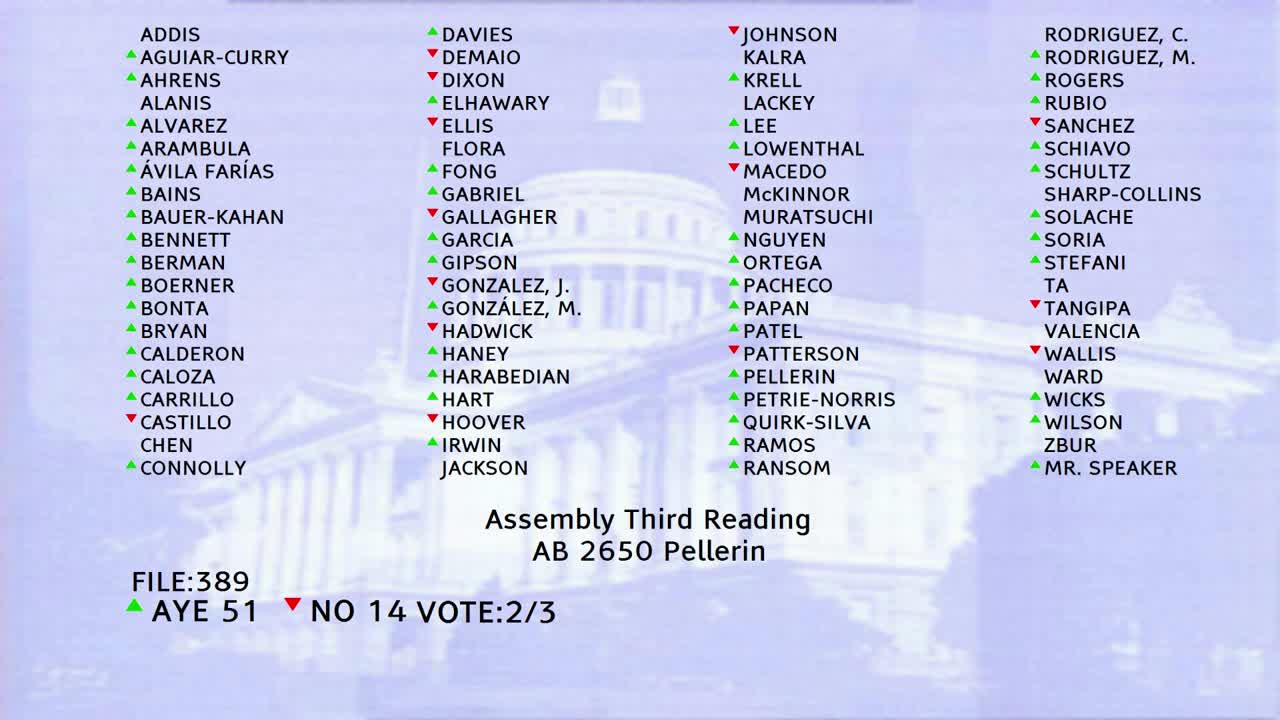 1MIN
Assembly Floor
 11MIN
Assembly Standing Committee on Public Employment and Retirement
 5MIN
Assembly Standing Committee on Privacy and Consumer Protection
Bill Author

Bill Co-Author(s):