AB 2673: Personal Income Tax Law: Corporation Tax Law: credit: childcare.
- Session Year: 2025-2026
- House: Assembly
- Latest Version Date: 2026-02-20
Current Status:
In Progress
(2026-04-27: In committee: Set, second hearing. Held under submission.)
Introduced
In Committee
Awaiting First Chamber Vote
Passed First Chamber
In Committee
Awaiting Second Chamber Vote
Passed Second Chamber
Enacted
The Personal Income Tax Law and the Corporation Tax Law allow various credits against the taxes imposed by those laws.
This bill would allow a credit against those taxes for each taxable year beginning on or after January 1, 2027, and before January 1, 2032, in an amount equal to 50% of qualified contributions to promote childcare, up to $100,000, as specified.
Existing law requires any bill authorizing a new tax expenditure, as defined, to include tax credits, to contain, among other things, specific goals, purposes, and objectives that the tax credit will achieve, detailed performance indicators, and data collection requirements.
This bill would include findings and reporting requirements in compliance with this requirement.
This bill would take effect immediately as a tax levy.
(a)For each taxable year beginning on or after January 1, 2027, and before January 1, 2032, there shall be allowed as a credit against the net tax, as defined in Section 17039, an amount equal to 50 percent of qualified contributions to promote childcare during the taxable year, not exceed one hundred thousand dollars ($100,000) per taxpayer per taxable year.
(b)For purposes of this section, the following shall apply:
(1)Childcare means care provided to a child 12 years of age or younger.
(2)Qualified childcare facility means a child day care facility as defined in Section 1596.750 of the Health and Safety Code.
(3)(A)Qualified contributions to promote childcare means any monetary contribution to promote childcare, including any of the following activities, and for which the taxpayer receives documentation from the recipient facility or program of the amount and purpose for the contribution:
(i)Donating money for the establishment or operation of a qualified childcare facility that uses the donation to provide childcare.
(ii)Donating money to establish a grant or loan program for a parent or parents in this state requiring financial assistance for childcare.
(iii)Pooling money of several businesses and donating the money for the establishment of a qualified childcare facility in this state.
(iv)Donating money for the establishment of an information dissemination program in the state to provide information and referral services to assist a parent or parents in obtaining childcare.
(B)Qualified contributions to promote childcare does not include any contribution that is not directly related to promoting childcare in the state or that a taxpayer makes to a childcare facility or program in which the taxpayer or a person related to the taxpayer has a financial interest.
(c)(1)In the case where the credit allowed by this section exceeds the net tax, the excess may be carried over to reduce the net tax in the following taxable year, and the succeeding four years, if necessary, until the credit is exhausted.
(2)A taxpayer claiming the credit allowed by this section shall submit the documentation described in subdivision (A) of paragraph (3) of subdivision (b) as prescribed by the Franchise Tax Board.
(d)The board may adopt rules and regulations as necessary to administer this section.
(e)(1)For purposes of complying with Section 41, with respect to the credit allowed by this section and Section 23627, the Legislature finds and declares the specific goal, purpose, and objective of the credit is to generate funding for the purpose of early childcare programs and to assist those most in need of childcare.
(2)To measure whether the credit achieves the purpose described in paragraph (1), on or before July 1, 2029, and annually thereafter, the Franchise Tax Board shall prepare and submit a report to the Legislature, in compliance with Section 9795 of the Government Code, containing all of the following:
(A)The number of taxpayers that have claimed the credit.
(B)The amount of each credit claimed and the total amount that was claimed per fiscal year.
(C)The top 10 qualified childcare facilities or programs that received contributions for which a credit was claimed.
(D)A list of the types of facilities or programs that received contributions for which a credit was claimed.
(3)The disclosure provisions of this subdivision shall be treated as an exception to Section 19542.
(f)This section shall remain in effect only until December 1, 2033, and as of that date is repealed.
SEC. 2.Section 23627 is added to the Revenue and Taxation Code, to read:23627.(a)For each taxable year beginning on or after January 1, 2027, and before January 1, 2032, there shall be allowed as a credit against the tax, as defined in Section 23036, an amount equal to 50 percent of qualified contributions to promote childcare during the taxable year, not exceed one hundred thousand dollars ($100,000) per taxpayer per taxable year.
(b)For purposes of this section, the following shall apply:
(1)Childcare means care provided to a child 12 years of age or younger.
(2)Qualified childcare facility means a child day care facility as defined in Section 1596.750 of the Health and Safety Code.
(3)(A)Qualified contributions to promote childcare means any monetary contribution to promote childcare, including any of the following activities, and for which the taxpayer receives documentation from the recipient facility or program of the amount and purpose for the contribution:
(i)Donating money for the establishment or operation of a qualified childcare facility that uses the donation to provide childcare.
(ii)Donating money to establish a grant or loan program for a parent or parents in this state requiring financial assistance for childcare.
(iii)Pooling money of several businesses and donating the money for the establishment of a qualified childcare facility in this state.
(iv)Donating money for the establishment of an information dissemination program in the state to provide information and referral services to assist a parent or parents in obtaining childcare.
(B)Qualified contributions to promote childcare does not include any contribution that is not directly related to promoting childcare in the state or that a taxpayer makes to a childcare facility or program in which the taxpayer or a person related to the taxpayer has a financial interest.
(c)(1)In the case where the credit allowed by this section exceeds the tax, the excess may be carried over to reduce the net tax in the following taxable year, and the succeeding four years, if necessary, until the credit is exhausted.
(2)A taxpayer claiming the credit allowed by this section shall submit the documentation described in subdivision (A) of paragraph (3) of subdivision (b) as prescribed by the Franchise Tax Board.
(d)The board may adopt rules and regulations as necessary to administer this section.
(e)This section shall remain in effect only until December 1, 2033, and as of that date is repealed.
SEC. 3.This act provides for a tax levy within the meaning of Article IV of the California Constitution and shall go into immediate effect.
|
Date
|
Status
|
|---|---|
| Apr 27, 2026 | In committee: Set, second hearing. Held under submission. |
| Apr 20, 2026 | In committee: Set, first hearing. Referred to REV. & TAX. suspense file. |
| Mar 16, 2026 | Referred to Com. on REV. & TAX. |
| Feb 21, 2026 | From printer. May be heard in committee March 23. |
| Feb 20, 2026 | Read first time. To print. |
This list shows positions taken on this bill by organizations on the date displayed, which is linked to the original source.
Positions by individuals are not included.
|
Organization
|
Position
|
Date
|
|---|---|---|
| California Chamber Of Commerce | ** Support | |
| California Teachers Association | ** Against |
Date of Hearing: April 27, 2026
ASSEMBLY COMMITTEE ON REVENUE AND TAXATION
Mike Gipson, Chair
ABPCA Bill Id:AB 2673 (
Author:Celeste Rodriguez) – As Introduced Ver:February 20, 2026
SUSPENSE
Majority vote. Tax levy. Fiscal committee.
SUBJECT: Personal Income Tax Law: Corporation Tax Law: credit: childcare
SUMMARY: Allows, under the Personal Income Tax (PIT) Law and the Corporation Tax (CT) Law, a credit equal to 50% of a taxpayer's "qualified contributions to promote childcare" in the taxable year, limited to $100,000 per taxpayer per taxable year. Specifically, this bill:
- Allows a credit for taxable years beginning on or after January 1, 2027, and before January 1, 2032, equal to 50% of "qualified contributions to promote childcare" during the taxable year.
- Limits the total credit amount to no more than $100,000 per taxpayer per taxable year.
- Defines "childcare" as care provided to a child 12 years of age or younger.
- Defines "qualified childcare facility" as a child day care facility as defined in Health and Safety Code (H&SC) Section 1596.750.
- Defines "qualified contributions to promote childcare" as any monetary contribution to promote childcare, including any of the following activities, and for which the taxpayer receives documentation from the recipient facility or program of the amount and purpose for the contribution:
- Donating money for the establishment or operation of a qualified childcare facility that uses the donation to provide childcare;
- Donating money to establish a grant or loan program for a parent or parents in this state requiring financial assistance for childcare;
- Pooling money of several businesses and donating the money for the establishment of a qualified childcare facility in this state; and,
- Donating money for the establishment of an information dissemination program in the state to provide information and referral services to assist a parent or parents in obtaining childcare.
- Provides that "qualified contributions to promote childcare" do not include any contribution that is not directly related to promoting childcare in the state or that a taxpayer makes to a childcare facility or program in which the taxpayer or a person related to the taxpayer has a financial interest.
- Provides that, if the credit allowed exceeds the amount of tax owed, the taxpayer may carry over unused credit amounts for up to four years until the credit is exhausted.
- Requires a taxpayer claiming the credit to submit documentation relating to the qualified contributions to promote childcare as prescribed by the Franchise Tax Board (FTB).
- Finds and declares the following for the purpose of satisfying the requirements of Revenue and Taxation Code (R&TC) Section 41:
- The specific goal, purpose, and objective of this bill is to provide an additional incentive for individuals to generate funding for the purpose of early childcare programs and to assist those most in need of childcare.
- To measure whether this bill achieves its intended purpose, the FTB shall prepare a written report on the following:
- The number of taxpayers claiming the credit;
- The amount of each credit claimed and the total amount that was claimed per fiscal year (FY); and,
- The top 10 qualified childcare facilities or programs that received contributions for which a credit was claimed.
- Requires the FTB to provide the written report required by this bill to the Legislature on or before July 1, 2029, and annually thereafter.
- Provides that the disclosure requirements of this bill shall be treated as an exception to R&TC Section 19542.
- Takes immediate effect as a tax levy.
- Sunsets the credit's statutory provisions on December 1, 2033.
EXISTING LAW:
- Allows a credit equal to the applicable percentage of qualifying expenses for household and dependent care services necessary for gainful employment. This credit is often referred to as the Child and Dependent Care Expense Credit. (Internal Revenue Code (IRC) Section 21.)
- Allows taxpayers to deduct charitable contributions, as specified. (IRC Section 170 and R&TC Section 17201.)
- Allows, under the PIT Law, a credit amount equal to a certain percentage of the Federal child and dependent care expense credit, depending on the taxpayer's adjusted gross income (AGI). (R&TC Section 17052.6.)
- For taxable years beginning on or after January 1, 2003, taxpayers are eligible for the following credits based on their AGI:
- Taxpayers with an AGI of $40,000 or less are eligible for a credit amount equal to 50% of the Federal credit amount;
- Taxpayers with an AGI over $40,000 but not over $70,000 are eligible for a credit amount equal to 43% of the Federal credit amount; and,
- Taxpayers with an AGI over $70,000 but not over $100,000 are eligible for a credit amount equal to 34% of the Federal credit amount.
- Provides that taxpayers with an AGI over $100,000 are not eligible to claim the credit.
- For taxable years beginning on or after January 1, 2003, taxpayers are eligible for the following credits based on their AGI:
- Requires any bill authorizing a new tax expenditure to contain all of the following:
- Specific goals, purposes, and objectives that the tax expenditure will achieve;
- Detailed performance indicators for the Legislature to use when measuring whether the tax expenditure meets the goals, purposes, and objectives stated in the bill; and,
- Data collection requirements to enable the Legislature to determine whether the tax expenditure is meeting, failing to meet, or exceeding those specific goals, purposes, and objectives. The requirements shall include the specific data and baseline measurements to be collected and remitted in each year the expenditure is in effect, for the Legislature to measure the change in performance indicators, and the specific taxpayers, state agencies, or other entities required to collect and remit data. (R&TC Section 41.)
FISCAL EFFECT: The FTB estimates that, for every $10 million of qualifying donations made, and applying the credit percentage of 50%, credits generated would be $5 million. It is assumed that approximately 70%, or $3.5 million, would be allowed to taxpayers with sufficient tax liability to offset with the credit. Of that amount, roughly 65%, or approximately $2.3 million, would be claimed in the year generated and the remaining credits would be used over the subsequent years or until exhausted. Accordingly, Committee staff estimate that the revenue losses resulting from the tax credits allowed pursuant to this bill exceed this Committee's Suspense File threshold.
COMMENTS:
- The author has provided the following statement in support of this bill:
California's childcare system is not just strained—it's fundamentally broken. Families are struggling to find affordable, reliable care. Providers are underpaid and overburdened. And too many children are missing out on the early developmental support that sets the foundation for lifelong success. If we are serious about improving the affordability and quality of life for California working families, strengthening early childcare and education, and fostering a stable, quality workforce, then we must treat childcare as the essential infrastructure that it is.
By incentivizing investment in the childcare sector, we can unlock resources, expand access, and help stabilize a system that families depend on every day. We don't have to start from scratch—Colorado has already demonstrated that this approach works, infusing millions of dollars into childcare programs. AB 2673 is an opportunity to deliver real results by ensuring that both private and public dollars are strategically invested to benefit the next generation of leaders. The economic case is just as clear: when parents can work, and children have access to quality care, our entire economy benefits. It is time to match our values with meaningful investment and build a childcare system that works for everyone.
- This bill is supported by the California Chamber of Commerce, which notes, in part:
At CalChamber, we recognize that access to affordable, reliable childcare is essential to maintaining a stable and productive workforce. This bill provides a practical and flexible mechanism for businesses to invest in childcare solutions - whether through supporting facility development, assisting working families directly, or partnering with other employers to expand local childcare capacity.
The proposed 50 percent tax credit, capped at $100,000 annually, strikes a thoughtful balance by encouraging meaningful participation from the employer community. By allowing carryforward of unused credits, the bill further enhances its accessibility for businesses of varying sizes.
Importantly, this policy directly benefits employees by expanding access to affordable, reliable childcare options. With greater support, working parents can more easily secure safe and consistent care for their children, reducing stress and financial strain. This allows employees to remain focused and engaged at work, maintain stable employment, and find better balance to their professional and familial responsibilities - leading to improved overall well-being.
- This bill is opposed by the California Teachers Association, which notes, in part:
In fiscal year 2025-26, the Department of Finance estimated a $94 billion dollar loss in general fund revenue due to existing tax expenditures. This is revenue that would have otherwise gone to the General Fund, of which approximately 40% would have gone
toward the Proposition 98 minimum guarantee. Once tax credits are passed with a simple majority, it takes a two-thirds vote of the Legislature to repeal them. While we understand that some of these bills are well intended, CTA does not support this approach, as it would reduce overall funding for education. CTA believes Proposition 98 should be protected from reductions through the creation of new or expanding existing tax expenditures.
- Committee Staff Comments:
- What is a "tax expenditure"? Existing law provides various credits, deductions, exclusions, and exemptions for particular taxpayer groups. In the late 1960s, U.S. Treasury officials began arguing that these features of the tax law should be referred to as "expenditures" since they are generally enacted to accomplish some governmental purpose and there is a determinable cost associated with each (in the form of foregone revenues).
As the Department of Finance notes in its annual Tax Expenditure Report, there are several key differences between tax expenditures and direct expenditures. First, tax expenditures are typically reviewed less frequently than direct expenditures. Second, there is generally no control over the amount of revenue losses associated with any given tax expenditure. Finally, it should also be noted that, once enacted, it takes a two-thirds vote to rescind an existing tax expenditure absent a sunset date. This effectively results in a "one-way ratchet" whereby tax expenditures can be conferred by majority vote, but cannot be rescinded, irrespective of their efficacy or cost, without a supermajority vote.
- What problem is this bill attempting to solve? According to the author, California's early care and education (ECE) system is significantly underfunded and the demand for publicly funded childcare continues to far exceed the supply. As a result, California families have difficulty finding childcare programs with availability that are conveniently located and families that do find childcare face unaffordable costs. These barriers have made California families reconsider having children or decide that they should move elsewhere to afford the increased costs associated with having children. Additionally, the author notes that many providers are operating at a deficit and that low pay for teachers and other childcare workers can compromise the consistency and quality of care children receive.[1]
Research has found that the annual median cost of childcare ranges from $10,980 to $24,636 across California, with center-based care for infants and toddlers being the most expensive. Childcare expenses make up 8% to 21% of household income and rural and agricultural counties account for the largest shares of household income.1 According to the United Ways of California's Real Cost Measure, which estimates the costs of meeting basic household needs and considers regional factors like housing markets, a typical household of two adults, one school-aged child, and one preschooler spends roughly $134,000 annually in the Bay Area, $120,000 annually in the Greater Los Angeles region, and $100,000 annually in the Greater Sacramento regions.[2] These household budgets estimate that the same family would spend $23,897 annually on childcare in the Bay Area, $20,336 in the Greater Los Angeles region, and $18,132 in the Greater Sacramento region.
- What problem is this bill attempting to solve? According to the author, California's early care and education (ECE) system is significantly underfunded and the demand for publicly funded childcare continues to far exceed the supply. As a result, California families have difficulty finding childcare programs with availability that are conveniently located and families that do find childcare face unaffordable costs. These barriers have made California families reconsider having children or decide that they should move elsewhere to afford the increased costs associated with having children. Additionally, the author notes that many providers are operating at a deficit and that low pay for teachers and other childcare workers can compromise the consistency and quality of care children receive.[1]
According to the California Budget & Policy Center, California's ECE system weathered severe cuts as a result of the Great Recession. While state leaders have responded in recent years by restoring funding, increases in spending were not even across all ECE programs. Spending for the California State Preschool Program (CSPP) experienced a significant increase due to state leaders' focus on California preschool programs. This resulted in spending levels higher than the Alternative Payment Program, CalWORKs programs, and General Child Care Program.[3]

- What does this bill do? This bill would allow a credit under the PIT Law and CT Law to taxpayers equal to 50% of the amount they contributed to promote childcare in California in the taxable year, up to a maximum of $100,000. Qualified contributions to promote childcare include donating money for the establishment or operation of a qualified childcare facility, to establish a grant or loan program for parents or parents requiring financial assistance for childcare, and to establish an information dissemination program to provide information and referral services to assist parents in obtaining childcare.
This bill specifically excludes contributions not directly related to promoting childcare in California from qualifying for the credit. Additionally, this bill provides that taxpayers cannot claim a credit for contributions to a childcare facility or program in which they have a financial interest. Taxpayers whose credit amounts exceed their tax liability can rollover unused amounts for up to four subsequent years. - Learning from Colorado's program: Colorado's Child Care Contribution Credit (CCCC) was originally established in 1990 and initially limited to enterprise zones. In 1998, the CCCC was removed from the enterprise zone program and expanded statewide. Subsequent legislation increased the credit percentage from 25% to 50% and clarified what childcare facilities and programs qualify. Any taxpayer that makes a qualifying contribution during the tax year can claim the CCCC. Individuals, estates, trusts, and C corporations may all claim the credit for their qualifying contributions. In the case of a qualifying contribution made by a partnership or S corporation, the CCCC is allowed to its partners or shareholders.[4]
To qualify for the CCCC, Colorado taxpayers must contribute to a qualifying childcare facility or program, which includes childcare centers and family childcare homes licensed by the Colorado Department of Early Childhood; child placement agencies, homeless youth shelters, residential childcare facilities, and secure residential treatment centers licensed by the Colorado Department of Human Services; and foster homes certified by a county department and an approved facility school, as specified, that is also affiliated with a licensed or certified hospital in Colorado that is also a nonprofit corporation.
- What does this bill do? This bill would allow a credit under the PIT Law and CT Law to taxpayers equal to 50% of the amount they contributed to promote childcare in California in the taxable year, up to a maximum of $100,000. Qualified contributions to promote childcare include donating money for the establishment or operation of a qualified childcare facility, to establish a grant or loan program for parents or parents requiring financial assistance for childcare, and to establish an information dissemination program to provide information and referral services to assist parents in obtaining childcare.
Qualifying contributions include monetary contributions made for the establishment or operation of a childcare program that is not a licensed childcare facility but provides childcare services similar to those provided by a childcare center licensed by the Colorado Department of Early Childhood or the Colorado Department of Human Services. Unlicensed childcare programs must register with the Department of Revenue to qualify for the credit by completing and submitting an application.
Similarly, contributions can qualify for the CCCC if they are made to a grant or loan program for parents requiring financial assistance for childcare, a training program for childcare providers, or an information dissemination and referral program. These types of programs must register with the Department of Revenue by completing and submitting an application.
To claim the CCCC, taxpayers must receive certification from the recipient of the contribution and provide the Department of Revenue a copy of the credit certificate prepared by the facility or program that received the contribution. The credit certification must be submitted with the taxpayer's return.
 It should be noted that, unlike California's progressive personal income tax structure, Colorado has a flat income tax rate of 4.40% for all taxable income. The table below displays the revenue impact of the CCCC in recent years:
Source: 2024 Tax Profile and Expenditure Report, Colorado Department of Revenue.
- Multiple benefits: This bill would allow credits for qualified contributions made to childcare facilities. Under current law, if the contribution is made to a qualified non-profit organization, the contribution would be deductible as a charitable contribution. Generally, a credit is allowed in lieu of a deduction to eliminate multiple tax benefits for the same item of expense. Providing both a credit and allowing a deduction would provide a double benefit for the same contribution.
- Implementation considerations:
- Registration and certification: As currently drafted, this bill requires a taxpayer claiming the credit to submit the necessary documentation as prescribed by the FTB. However, there is no requirement that the entity receiving the contribution certify that they actually received the contribution or register with the FTB. Additionally, while this bill cross-references H&SC 1596.750 for the definition of "qualified childcare facility", there is no requirement that the facility or program be licensed by a California agency or department. Under Colorado's CCCC, childcare programs that are not licensed must register separately with the Department of Revenue to be eligible to receive qualifying contributions. It is recommended that the author include explicit certification language to ensure contributions are directed toward legitimate childcare programs.
- No consideration: As currently drafted, parents that currently pay for childcare services could request their tuition be treated as a donation, which would then make them eligible for this credit without providing any additional resources to the childcare sector. It is recommended that this bill be amended to align with provisions in Colorado's statute which requires that the donor receives no consideration from the organization receiving the donation in exchange for the contribution.
- Disclosures: As currently drafted, this bill would require the FTB to report on or disclose information for qualified childcare facilities or programs that receive contributions. However, the FTB cannot report or disclose information on specific taxpayers. It is recommended that this bill be amended to remove the specific taxpayer reporting requirement and to provide that data requests are limited exclusively to anonymized, aggregate information.
- Pooling money: As currently drafted, this bill includes "pooling money of several businesses and donating the money for the establishment of a qualified childcare facility" as one type of qualifying contribution. It is unclear, however, how the credit should be allocated to the businesses that co-mingled their funds to generate the donation. If the author's intent is that each business receive a share of the credit proportional to their share of the donation, the bill should be amended accordingly.
- Definitions: As currently drafted, this bill defines "childcare" as care provided to a child 12 years of age or younger, but defines "qualified childcare facility" by cross-reference to a provision of the H&SC that defines "child day care facility" as a facility that provides nonmedical care to children under 18 years of age in need of personal services, supervision, or assistance essential for sustaining the activities of daily living or for the protection of the individual on less than a 24-hour basis. The author may wish to clarify the scope of the bill and ensure consistent definitions.
- Registration and certification: As currently drafted, this bill requires a taxpayer claiming the credit to submit the necessary documentation as prescribed by the FTB. However, there is no requirement that the entity receiving the contribution certify that they actually received the contribution or register with the FTB. Additionally, while this bill cross-references H&SC 1596.750 for the definition of "qualified childcare facility", there is no requirement that the facility or program be licensed by a California agency or department. Under Colorado's CCCC, childcare programs that are not licensed must register separately with the Department of Revenue to be eligible to receive qualifying contributions. It is recommended that the author include explicit certification language to ensure contributions are directed toward legitimate childcare programs.
- Committee's tax expenditure policy: Both R&TC Section 41 and Committee policy require any tax expenditure bill to outline specific goals, purposes, and objectives that the tax expenditure will achieve, along with detailed performance indicators for the Legislature to use when measuring whether the tax expenditure meets those stated goals, purposes, and objectives. A tax expenditure bill will not be eligible for a Committee vote unless it has complied with these requirements.
- Multiple benefits: This bill would allow credits for qualified contributions made to childcare facilities. Under current law, if the contribution is made to a qualified non-profit organization, the contribution would be deductible as a charitable contribution. Generally, a credit is allowed in lieu of a deduction to eliminate multiple tax benefits for the same item of expense. Providing both a credit and allowing a deduction would provide a double benefit for the same contribution.
In its current form, this bill states that the credit is designed to provide an additional incentive for individuals to generate funding for the purpose of early childcare programs and to assist those most in need of childcare. In addition, this bill provides that the credit's effectiveness shall be measured by the number of taxpayers claiming the credit, the amount of each credit claimed, the total amount that was claimed per YI, and, the top 10 qualified childcare facilities or programs that received contributions for which a credit was claimed.
In addition to the R&TC Section 41 requirements, this Committee's policy also requires that all tax expenditure proposals contain an appropriate sunset provision to be eligible for a vote. According to this policy, an "appropriate sunset provision" means five years, except in the case of a tax expenditure measure providing relief to California veterans, in which case "appropriate sunset provision" means ten years. This bill, as currently drafted, complies with the Committee's policy on sunset dates.
- Prior legislation:
- AB 14 (Davies), of the 2023-24 Legislative Session, would have allowed, under the PIT Law, an additional credit for taxpayers who qualify for the existing Federal child and dependent care expense credit, as specified. AB 14 was held on this Committee's Suspense File.
- SB 533 (Limón), of the 2023-24 Legislative Session, would have created the Employer Childcare Tax Credit and the Childcare Contribution Credit under the PIT Law and CT Law. The Employer Childcare Tax Credit would have allowed a credit equal to 30% of costs paid or incurred in startup expenses for establishing a childcare program or constructing a childcare facility in California, as specified. The Childcare Contribution Credit would have allowed a credit equal to 30% of the costs paid or incurred by the taxpayer for contributions to a qualified care plan made on behalf of any of the qualified dependents of the taxpayer's qualified employees. SB 533 was held on the Senate Committee on Appropriations' Suspense File.
- AB 1634 (Bauer-Kahan), of the 2023-24 Legislative Session, would have allowed a deduction under the PIT Law and CT Law for any costs paid or incurred by a taxpayer for qualified childcare provided to a qualified dependent, not to exceed $5,000 per taxable year per qualified dependent. AB 1634 was never heard by this Committee.
- AB 2803 (Valladares), of the 2021-22 Legislative Session would have provided a credit under the PIT Law and CT Law for contributions paid or incurred by an employer for qualified care for their employees' dependents. AB 2803 was heard for testimony only by this Committee.
- AB 14 (Davies), of the 2023-24 Legislative Session, would have allowed, under the PIT Law, an additional credit for taxpayers who qualify for the existing Federal child and dependent care expense credit, as specified. AB 14 was held on this Committee's Suspense File.
- Prior legislation:
REGISTERED SUPPORT / OPPOSITION:
Support
California Chamber of Commerce
Opposition
California Teachers Association
Analysis Prepared by: Wesley Whitaker / REV. & TAX. / (916) 319-2098
Gibbs, Brobst, Ninan, and Sanchez, The economics of the market for early childhood care and education in California, Stanford Institute for Economic Policy Research (January 2026), https://siepr.stanford.edu/publications/policy-brief/economics-market-early-childhood-care-and-education-california. ↑
The Real Cost Measure in California, United Ways of California, https://unitedwaysca.org/realcost/ (accessed April 14, 2026). ↑
Pryor and Schumacher, California Funding Trends for Early Care & Education Programs, California Budget & Policy Center (February 2025), https://calbudgetcenter.org/resources/california-funding-trends-for-early-care-education-programs/. ↑
Income Tax Topics: Child Care Contribution Credit, Colorado Department of Revenue, https://tax.colorado.gov/income-tax-topics-child-care-contribution-credit (accessed April 14, 2026). ↑
Date of Hearing: April 20, 2026
ASSEMBLY COMMITTEE ON REVENUE AND TAXATION
Mike Gipson, Chair
ABPCA Bill Id:AB 2673 (
Author:Celeste Rodriguez) – As Introduced Ver:February 20, 2026
Majority vote. Tax levy. Fiscal committee.
SUBJECT: Personal Income Tax Law: Corporation Tax Law: credit: childcare
SUMMARY: Allows, under the Personal Income Tax (PIT) Law and the Corporation Tax (CT) Law, a credit equal to 50% of a taxpayer's "qualified contributions to promote childcare" in the taxable year, limited to $100,000 per taxpayer per taxable year. Specifically, this bill:
- Allows a credit for taxable years beginning on or after January 1, 2027, and before January 1, 2032, equal to 50% of "qualified contributions to promote childcare" during the taxable year.
- Limits the total credit amount to no more than $100,000 per taxpayer per taxable year.
- Defines "childcare" as care provided to a child 12 years of age or younger.
- Defines "qualified childcare facility" as a child day care facility as defined in Health and Safety Code (H&SC) Section 1596.750.
- Defines "qualified contributions to promote childcare" as any monetary contribution to promote childcare, including any of the following activities, and for which the taxpayer receives documentation from the recipient facility or program of the amount and purpose for the contribution:
- Donating money for the establishment or operation of a qualified childcare facility that uses the donation to provide childcare;
- Donating money to establish a grant or loan program for a parent or parents in this state requiring financial assistance for childcare;
- Pooling money of several businesses and donating the money for the establishment of a qualified childcare facility in this state; and,
- Donating money for the establishment of an information dissemination program in the state to provide information and referral services to assist a parent or parents in obtaining childcare.
- Provides that "qualified contributions to promote childcare" do not include any contribution that is not directly related to promoting childcare in the state or that a taxpayer makes to a childcare facility or program in which the taxpayer or a person related to the taxpayer has a financial interest.
- Provides that, if the credit allowed exceeds the amount of tax owed, the taxpayer may carry over unused credit amounts for up to four years until the credit is exhausted.
- Requires a taxpayer claiming the credit to submit documentation relating to the qualified contributions to promote childcare as prescribed by the Franchise Tax Board (FTB).
- Finds and declares the following for the purpose of satisfying the requirements of Revenue and Taxation Code (R&TC) Section 41:
- The specific goal, purpose, and objective of this bill is to provide an additional incentive for individuals to generate funding for the purpose of early childcare programs and to assist those most in need of childcare.
- To measure whether this bill achieves its intended purpose, the FTB shall prepare a written report on the following:
- The number of taxpayers claiming the credit;
- The amount of each credit claimed and the total amount that was claimed per fiscal year (FY); and,
- The top 10 qualified childcare facilities or programs that received contributions for which a credit was claimed.
- Requires the FTB to provide the written report required by this bill to the Legislature on or before July 1, 2029, and annually thereafter.
- Provides that the disclosure requirements of this bill shall be treated as an exception to R&TC Section 19542.
- Takes immediate effect as a tax levy.
- Sunsets the credit's statutory provisions on December 1, 2033.
EXISTING LAW:
- Allows a credit equal to the applicable percentage of qualifying expenses for household and dependent care services necessary for gainful employment. This credit is often referred to as the Child and Dependent Care Expense Credit. (Internal Revenue Code (IRC) Section 21.)
- Allows taxpayers to deduct charitable contributions, as specified. (IRC Section 170 and R&TC Section 17201.)
- Allows, under the PIT Law, a credit amount equal to a certain percentage of the Federal child and dependent care expense credit, depending on the taxpayer's adjusted gross income (AGI). (R&TC Section 17052.6.)
- For taxable years beginning on or after January 1, 2003, taxpayers are eligible for the following credits based on their AGI:
- Taxpayers with an AGI of $40,000 or less are eligible for a credit amount equal to 50% of the Federal credit amount;
- Taxpayers with an AGI over $40,000 but not over $70,000 are eligible for a credit amount equal to 43% of the Federal credit amount; and,
- Taxpayers with an AGI over $70,000 but not over $100,000 are eligible for a credit amount equal to 34% of the Federal credit amount.
- Provides that taxpayers with an AGI over $100,000 are not eligible to claim the credit.
- For taxable years beginning on or after January 1, 2003, taxpayers are eligible for the following credits based on their AGI:
- Requires any bill authorizing a new tax expenditure to contain all of the following:
- Specific goals, purposes, and objectives that the tax expenditure will achieve;
- Detailed performance indicators for the Legislature to use when measuring whether the tax expenditure meets the goals, purposes, and objectives stated in the bill; and,
- Data collection requirements to enable the Legislature to determine whether the tax expenditure is meeting, failing to meet, or exceeding those specific goals, purposes, and objectives. The requirements shall include the specific data and baseline measurements to be collected and remitted in each year the expenditure is in effect, for the Legislature to measure the change in performance indicators, and the specific taxpayers, state agencies, or other entities required to collect and remit data. (R&TC Section 41.)
FISCAL EFFECT: The FTB estimates that, for every $10 million of qualifying donations made, and applying the credit percentage of 50%, credits generated would be $5 million. It is assumed that approximately 70%, or $3.5 million, would be allowed to taxpayers with sufficient tax liability to offset with the credit. Of that amount, roughly 65%, or approximately $2.3 million, would be claimed in the year generated and the remaining credits would be used over the subsequent years or until exhausted. Accordingly, Committee staff estimate that the revenue losses resulting from the tax credits allowed pursuant to this bill exceed this Committee's Suspense File threshold.
COMMENTS:
- The author has provided the following statement in support of this bill:
California's childcare system is not just strained—it's fundamentally broken. Families are struggling to find affordable, reliable care. Providers are underpaid and overburdened. And too many children are missing out on the early developmental support that sets the foundation for lifelong success. If we are serious about improving the affordability and quality of life for California working families, strengthening early childcare and education, and fostering a stable, quality workforce, then we must treat childcare as the essential infrastructure that it is.
By incentivizing investment in the childcare sector, we can unlock resources, expand access, and help stabilize a system that families depend on every day. We don't have to start from scratch—Colorado has already demonstrated that this approach works, infusing millions of dollars into childcare programs. AB 2673 is an opportunity to deliver real results by ensuring that both private and public dollars are strategically invested to benefit the next generation of leaders. The economic case is just as clear: when parents can work, and children have access to quality care, our entire economy benefits. It is time to match our values with meaningful investment and build a childcare system that works for everyone.
- This bill is supported by the California Chamber of Commerce, which notes, in part:
At CalChamber, we recognize that access to affordable, reliable childcare is essential to maintaining a stable and productive workforce. This bill provides a practical and flexible mechanism for businesses to invest in childcare solutions - whether through supporting facility development, assisting working families directly, or partnering with other employers to expand local childcare capacity.
The proposed 50 percent tax credit, capped at $100,000 annually, strikes a thoughtful balance by encouraging meaningful participation from the employer community. By allowing carryforward of unused credits, the bill further enhances its accessibility for businesses of varying sizes.
Importantly, this policy directly benefits employees by expanding access to affordable, reliable childcare options. With greater support, working parents can more easily secure safe and consistent care for their children, reducing stress and financial strain. This allows employees to remain focused and engaged at work, maintain stable employment, and find better balance to their professional and familial responsibilities - leading to improved overall well-being.
- This bill is opposed by the California Teachers Association, which notes, in part:
In fiscal year 2025-26, the Department of Finance estimated a $94 billion dollar loss in general fund revenue due to existing tax expenditures. This is revenue that would have otherwise gone to the General Fund, of which approximately 40% would have gone
toward the Proposition 98 minimum guarantee. Once tax credits are passed with a simple majority, it takes a two-thirds vote of the Legislature to repeal them. While we understand that some of these bills are well intended, CTA does not support this approach, as it would reduce overall funding for education. CTA believes Proposition 98 should be protected from reductions through the creation of new or expanding existing tax expenditures.
- Committee Staff Comments:
- What is a "tax expenditure"? Existing law provides various credits, deductions, exclusions, and exemptions for particular taxpayer groups. In the late 1960s, U.S. Treasury officials began arguing that these features of the tax law should be referred to as "expenditures" since they are generally enacted to accomplish some governmental purpose and there is a determinable cost associated with each (in the form of foregone revenues).
As the Department of Finance notes in its annual Tax Expenditure Report, there are several key differences between tax expenditures and direct expenditures. First, tax expenditures are typically reviewed less frequently than direct expenditures. Second, there is generally no control over the amount of revenue losses associated with any given tax expenditure. Finally, it should also be noted that, once enacted, it takes a two-thirds vote to rescind an existing tax expenditure absent a sunset date. This effectively results in a "one-way ratchet" whereby tax expenditures can be conferred by majority vote, but cannot be rescinded, irrespective of their efficacy or cost, without a supermajority vote.
- What problem is this bill attempting to solve? According to the author, California's early care and education (ECE) system is significantly underfunded and the demand for publicly funded childcare continues to far exceed the supply. As a result, California families have difficulty finding childcare programs with availability that are conveniently located and families that do find childcare face unaffordable costs. These barriers have made California families reconsider having children or decide that they should move elsewhere to afford the increased costs associated with having children. Additionally, the author notes that many providers are operating at a deficit and that low pay for teachers and other childcare workers can compromise the consistency and quality of care children receive.[1]
Research has found that the annual median cost of childcare ranges from $10,980 to $24,636 across California, with center-based care for infants and toddlers being the most expensive. Childcare expenses make up 8% to 21% of household income and rural and agricultural counties account for the largest shares of household income.1 According to the United Ways of California's Real Cost Measure, which estimates the costs of meeting basic household needs and considers regional factors like housing markets, a typical household of two adults, one school-aged child, and one preschooler spends roughly $134,000 annually in the Bay Area, $120,000 annually in the Greater Los Angeles region, and $100,000 annually in the Greater Sacramento regions.[2] These household budgets estimate that the same family would spend $23,897 annually on childcare in the Bay Area, $20,336 in the Greater Los Angeles region, and $18,132 in the Greater Sacramento region.
- What problem is this bill attempting to solve? According to the author, California's early care and education (ECE) system is significantly underfunded and the demand for publicly funded childcare continues to far exceed the supply. As a result, California families have difficulty finding childcare programs with availability that are conveniently located and families that do find childcare face unaffordable costs. These barriers have made California families reconsider having children or decide that they should move elsewhere to afford the increased costs associated with having children. Additionally, the author notes that many providers are operating at a deficit and that low pay for teachers and other childcare workers can compromise the consistency and quality of care children receive.[1]
According to the California Budget & Policy Center, California's ECE system weathered severe cuts as a result of the Great Recession. While state leaders have responded in recent years by restoring funding, increases in spending were not even across all ECE programs. Spending for the California State Preschool Program (CSPP) experienced a significant increase due to state leaders' focus on California preschool programs. This resulted in spending levels higher than the Alternative Payment Program, CalWORKs programs, and General Child Care Program.[3]
- What does this bill do? This bill would allow a credit under the PIT Law and CT Law to taxpayers equal to 50% of the amount they contributed to promote childcare in California in the taxable year, up to a maximum of $100,000. Qualified contributions to promote childcare include donating money for the establishment or operation of a qualified childcare facility, to establish a grant or loan program for parents or parents requiring financial assistance for childcare, and to establish an information dissemination program to provide information and referral services to assist parents in obtaining childcare.
This bill specifically excludes contributions not directly related to promoting childcare in California from qualifying for the credit. Additionally, this bill provides that taxpayers cannot claim a credit for contributions to a childcare facility or program in which they have a financial interest. Taxpayers whose credit amounts exceed their tax liability can rollover unused amounts for up to four subsequent years. - Learning from Colorado's program: Colorado's Child Care Contribution Credit (CCCC) was originally established in 1990 and initially limited to enterprise zones. In 1998, the CCCC was removed from the enterprise zone program and expanded statewide. Subsequent legislation increased the credit percentage from 25% to 50% and clarified what childcare facilities and programs qualify. Any taxpayer that makes a qualifying contribution during the tax year can claim the CCCC. Individuals, estates, trusts, and C corporations may all claim the credit for their qualifying contributions. In the case of a qualifying contribution made by a partnership or S corporation, the CCCC is allowed to its partners or shareholders.[4]
To qualify for the CCCC, Colorado taxpayers must contribute to a qualifying childcare facility or program, which includes childcare centers and family childcare homes licensed by the Colorado Department of Early Childhood; child placement agencies, homeless youth shelters, residential childcare facilities, and secure residential treatment centers licensed by the Colorado Department of Human Services; and foster homes certified by a county department and an approved facility school, as specified, that is also affiliated with a licensed or certified hospital in Colorado that is also a nonprofit corporation.
- What does this bill do? This bill would allow a credit under the PIT Law and CT Law to taxpayers equal to 50% of the amount they contributed to promote childcare in California in the taxable year, up to a maximum of $100,000. Qualified contributions to promote childcare include donating money for the establishment or operation of a qualified childcare facility, to establish a grant or loan program for parents or parents requiring financial assistance for childcare, and to establish an information dissemination program to provide information and referral services to assist parents in obtaining childcare.
Qualifying contributions include monetary contributions made for the establishment or operation of a childcare program that is not a licensed childcare facility but provides childcare services similar to those provided by a childcare center licensed by the Colorado Department of Early Childhood or the Colorado Department of Human Services. Unlicensed childcare programs must register with the Department of Revenue to qualify for the credit by completing and submitting an application.
Similarly, contributions can qualify for the CCCC if they are made to a grant or loan program for parents requiring financial assistance for childcare, a training program for childcare providers, or an information dissemination and referral program. These types of programs must register with the Department of Revenue by completing and submitting an application.
To claim the CCCC, taxpayers must receive certification from the recipient of the contribution and provide the Department of Revenue a copy of the credit certificate prepared by the facility or program that received the contribution. The credit certification must be submitted with the taxpayer's return.
It should be noted that, unlike California's progressive personal income tax structure, Colorado has a flat income tax rate of 4.40% for all taxable income. The table below displays the revenue impact of the CCCC in recent years:
Source: 2024 Tax Profile and Expenditure Report, Colorado Department of Revenue.
- Multiple benefits: This bill would allow credits for qualified contributions made to childcare facilities. Under current law, if the contribution is made to a qualified non-profit organization, the contribution would be deductible as a charitable contribution. Generally, a credit is allowed in lieu of a deduction to eliminate multiple tax benefits for the same item of expense. Providing both a credit and allowing a deduction would provide a double benefit for the same contribution.
- Implementation considerations:
- Registration and certification: As currently drafted, this bill requires a taxpayer claiming the credit to submit the necessary documentation as prescribed by the FTB. However, there is no requirement that the entity receiving the contribution certify that they actually received the contribution or register with the FTB. Additionally, while this bill cross-references H&SC 1596.750 for the definition of "qualified childcare facility", there is no requirement that the facility or program be licensed by a California agency or department. Under Colorado's CCCC, childcare programs that are not licensed must register separately with the Department of Revenue to be eligible to receive qualifying contributions. It is recommended that the author include explicit certification language to ensure contributions are directed toward legitimate childcare programs.
- No consideration: As currently drafted, parents that currently pay for childcare services could request their tuition be treated as a donation, which would then make them eligible for this credit without providing any additional resources to the childcare sector. It is recommended that this bill be amended to align with provisions in Colorado's statute which requires that the donor receives no consideration from the organization receiving the donation in exchange for the contribution.
- Disclosures: As currently drafted, this bill would require the FTB to report on or disclose information for qualified childcare facilities or programs that receive contributions. However, the FTB cannot report or disclose information on specific taxpayers. It is recommended that this bill be amended to remove the specific taxpayer reporting requirement and to provide that data requests are limited exclusively to anonymized, aggregate information.
- Pooling money: As currently drafted, this bill includes "pooling money of several businesses and donating the money for the establishment of a qualified childcare facility" as one type of qualifying contribution. It is unclear, however, how the credit should be allocated to the businesses that co-mingled their funds to generate the donation. If the author's intent is that each business receive a share of the credit proportional to their share of the donation, the bill should be amended accordingly.
- Definitions: As currently drafted, this bill defines "childcare" as care provided to a child 12 years of age or younger, but defines "qualified childcare facility" by cross-reference to a provision of the H&SC that defines "child day care facility" as a facility that provides nonmedical care to children under 18 years of age in need of personal services, supervision, or assistance essential for sustaining the activities of daily living or for the protection of the individual on less than a 24-hour basis. The author may wish to clarify the scope of the bill and ensure consistent definitions.
- Registration and certification: As currently drafted, this bill requires a taxpayer claiming the credit to submit the necessary documentation as prescribed by the FTB. However, there is no requirement that the entity receiving the contribution certify that they actually received the contribution or register with the FTB. Additionally, while this bill cross-references H&SC 1596.750 for the definition of "qualified childcare facility", there is no requirement that the facility or program be licensed by a California agency or department. Under Colorado's CCCC, childcare programs that are not licensed must register separately with the Department of Revenue to be eligible to receive qualifying contributions. It is recommended that the author include explicit certification language to ensure contributions are directed toward legitimate childcare programs.
- Committee's tax expenditure policy: Both R&TC Section 41 and Committee policy require any tax expenditure bill to outline specific goals, purposes, and objectives that the tax expenditure will achieve, along with detailed performance indicators for the Legislature to use when measuring whether the tax expenditure meets those stated goals, purposes, and objectives. A tax expenditure bill will not be eligible for a Committee vote unless it has complied with these requirements.
- Multiple benefits: This bill would allow credits for qualified contributions made to childcare facilities. Under current law, if the contribution is made to a qualified non-profit organization, the contribution would be deductible as a charitable contribution. Generally, a credit is allowed in lieu of a deduction to eliminate multiple tax benefits for the same item of expense. Providing both a credit and allowing a deduction would provide a double benefit for the same contribution.
In its current form, this bill states that the credit is designed to provide an additional incentive for individuals to generate funding for the purpose of early childcare programs and to assist those most in need of childcare. In addition, this bill provides that the credit's effectiveness shall be measured by the number of taxpayers claiming the credit, the amount of each credit claimed, the total amount that was claimed per YI, and, the top 10 qualified childcare facilities or programs that received contributions for which a credit was claimed.
In addition to the R&TC Section 41 requirements, this Committee's policy also requires that all tax expenditure proposals contain an appropriate sunset provision to be eligible for a vote. According to this policy, an "appropriate sunset provision" means five years, except in the case of a tax expenditure measure providing relief to California veterans, in which case "appropriate sunset provision" means ten years. This bill, as currently drafted, complies with the Committee's policy on sunset dates.
- Prior legislation:
- AB 14 (Davies), of the 2023-24 Legislative Session, would have allowed, under the PIT Law, an additional credit for taxpayers who qualify for the existing Federal child and dependent care expense credit, as specified. AB 14 was held on this Committee's Suspense File.
- SB 533 (Limón), of the 2023-24 Legislative Session, would have created the Employer Childcare Tax Credit and the Childcare Contribution Credit under the PIT Law and CT Law. The Employer Childcare Tax Credit would have allowed a credit equal to 30% of costs paid or incurred in startup expenses for establishing a childcare program or constructing a childcare facility in California, as specified. The Childcare Contribution Credit would have allowed a credit equal to 30% of the costs paid or incurred by the taxpayer for contributions to a qualified care plan made on behalf of any of the qualified dependents of the taxpayer's qualified employees. SB 533 was held on the Senate Committee on Appropriations' Suspense File.
- AB 1634 (Bauer-Kahan), of the 2023-24 Legislative Session, would have allowed a deduction under the PIT Law and CT Law for any costs paid or incurred by a taxpayer for qualified childcare provided to a qualified dependent, not to exceed $5,000 per taxable year per qualified dependent. AB 1634 was never heard by this Committee.
- AB 2803 (Valladares), of the 2021-22 Legislative Session would have provided a credit under the PIT Law and CT Law for contributions paid or incurred by an employer for qualified care for their employees' dependents. AB 2803 was heard for testimony only by this Committee.
- AB 14 (Davies), of the 2023-24 Legislative Session, would have allowed, under the PIT Law, an additional credit for taxpayers who qualify for the existing Federal child and dependent care expense credit, as specified. AB 14 was held on this Committee's Suspense File.
- Prior legislation:
REGISTERED SUPPORT / OPPOSITION:
Support
California Chamber of Commerce
Opposition
California Teachers Association
Analysis Prepared by: Wesley Whitaker / REV. & TAX. / (916) 319-2098
Gibbs, Brobst, Ninan, and Sanchez, The economics of the market for early childhood care and education in California, Stanford Institute for Economic Policy Research (January 2026), https://siepr.stanford.edu/publications/policy-brief/economics-market-early-childhood-care-and-education-california. ↑
The Real Cost Measure in California, United Ways of California, https://unitedwaysca.org/realcost/ (accessed April 14, 2026). ↑
Pryor and Schumacher, California Funding Trends for Early Care & Education Programs, California Budget & Policy Center (February 2025), https://calbudgetcenter.org/resources/california-funding-trends-for-early-care-education-programs/. ↑
Income Tax Topics: Child Care Contribution Credit, Colorado Department of Revenue, https://tax.colorado.gov/income-tax-topics-child-care-contribution-credit (accessed April 14, 2026). ↑
Discussed in Hearing
 4MIN
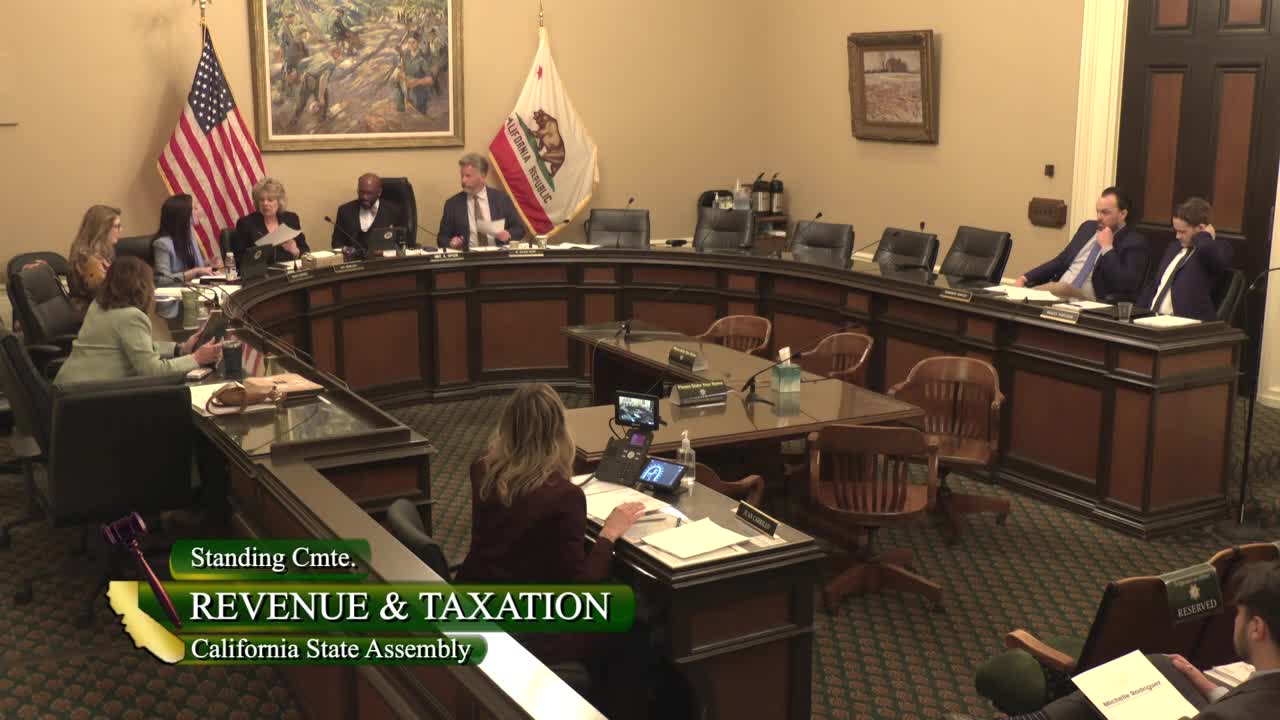
Assembly Standing Committee on Revenue and Taxation
Bill Author

Bill Co-Author(s):