AB 2674: State Air Resources Board: internet website: methane emissions data.
- Session Year: 2025-2026
- House: Assembly
- Latest Version Date: 2026-09-20
Current Status:
Passed
(2026-09-20: Chaptered by Secretary of State - Chapter 406, Statutes of 2026.)
Introduced
In Committee
Awaiting First Chamber Vote
Passed First Chamber
In Committee
Awaiting Second Chamber Vote
Passed Second Chamber
Enacted
The California Global Warming Solutions Act of 2006 designates the State Air Resources Board as the state agency charged with monitoring and regulating sources of emissions of greenhouse gases. Existing law requires the state board to approve and begin implementing a comprehensive short-lived climate pollutant strategy, as specified, to achieve a reduction in the statewide emissions of methane by 40% below 2013 levels by 2030, and requires methane emissions reduction goals to include specified targets to reduce the landfill disposal of organics. The state board has implemented regulations pursuant to the act for the purpose of reducing methane emissions from municipal solid waste landfills.
This bill would require the state board to post on its internet website temperature and monitoring data received by the state board regarding methane emissions from landfills.
The California Global Warming Solutions Act of 2006 designates the State Air Resources Board as the state agency charged with monitoring and regulating sources of emissions of greenhouse gases. Existing law requires the state board to approve and begin implementing a comprehensive short-lived climate pollutant strategy, as specified, to achieve a reduction in the statewide emissions of methane by 40% below 2013 levels by 2030, and requires methane emissions reduction goals to include specified targets to reduce the landfill disposal of organics. The state board has implemented regulations pursuant to the act for the purpose of reducing methane emissions from municipal solid waste landfills.
This bill would require the state board to post on its internet website temperature and monitoring data received by the state board regarding methane emissions from landfills.
The California Global Warming Solutions Act of 2006 designates the State Air Resources Board as the state agency charged with monitoring and regulating sources of emissions of greenhouse gases. Existing law requires the state board to approve and begin implementing a comprehensive short-lived climate pollutant strategy, as specified, to achieve a reduction in the statewide emissions of methane by 40% below 2013 levels by 2030, and requires methane emissions reduction goals to include specified targets to reduce the landfill disposal of organics. The state board has implemented regulations pursuant to the act for the purpose of reducing methane emissions from municipal solid waste landfills.
This bill would require the state board to post on its internet website temperature and monitoring data received by the state board regarding methane emissions from landfills.
Existing law generally regulates financial institutions, including the California Consumer Financial Protection Law that, among other things, requires the Department of Financial Protection and Innovation to exercise nonexclusive oversight and enforcement authority under California consumer financial laws.This bill would require a depository institution, as defined, to take certain actions that would help protect its customers from financial abuse and deception, as defined, including by requiring a depository institution that suspects financial abuse or deception with respect to any transaction to employ certain preventive measures, as prescribed, except as specified.Existing law generally regulates financial institutions, including the California Consumer Financial Protection Law that, among other things, requires the Department of Financial Protection and Innovation to exercise nonexclusive oversight and enforcement authority under California consumer financial laws.
This bill would require a depository institution, as defined, to take certain actions that would help protect its customers from financial abuse and deception, as defined, including by requiring a depository institution that suspects financial abuse or deception with respect to any transaction to employ certain preventive measures, as prescribed, except as specified.
This bill would authorize a customer who has suffered harm from financial abuse or deception and did not receive a required preventive measure to, within 60 calendar days of the relevant suspect transaction, provide oral or written notice to the depository institution, as specified. The bill would require a financial institution to investigate the noticed transaction and relevant account history and would provide a liability shield to a financial institution that refunds the amount of the suspect transaction plus interest, as prescribed.This bill would authorize a customer to bring a civil action to enforce its provisions, as specified.Existing law generally regulates financial institutions, including the California Consumer Financial Protection Law that, among other things, requires the Department of Financial Protection and Innovation to exercise nonexclusive oversight and enforcement authority under California consumer financial laws.
This bill would require a depository institution, as defined, to take certain actions that would help protect its customers from financial abuse and deception, as defined, including by requiring a depository institution that suspects financial abuse or deception with respect to any transaction to employ certain preventive measures, as prescribed, except as specified.
This bill would authorize a customer who has suffered harm from financial abuse or deception and did not receive a required preventive measure to, within 60 calendar days of the relevant suspect transaction, provide oral or written notice to the depository institution, as specified. The bill would require a financial institution to investigate the noticed transaction and relevant account history and would provide a liability shield to a financial institution that refunds the amount of the suspect transaction plus interest, as prescribed.
This bill would authorize a customer to bring a civil action to enforce its provisions, as specified.
(a)The Legislature hereby finds and declares all of the following:
(1)Californias original landfill methane regulations (LMRs) were adopted by the State Air Resources Board (state board) in 2010, as a discrete early action measure under the California Global Warming Solutions Act of 2006.
(2)The LMRs require owners and operators to install and optimally operate landfill gas collection and control systems to minimize emissions, monitor surface methane concentration and other performance parameters, repair emission exceedances and other performance issues, conduct source testing of combustion devices used to destroy methane, keep records of these actions and data, and report compliance information to the state board and local air pollution control districts and air quality management districts.
(3)In 2025, the state board recognized opportunities to improve the LMRs and strengthen the state boards and the air quality management districts and air pollution control districts ability to support safe and effective operation of landfill gas collection and control systems.
(4)The proposed amendments aim to leverage new technologies, the latest science and data, and lessons learned to drive further methane emissions reductions in support of the states ambitious methane emissions reduction goals.
(5)In addition to reducing methane emissions, improving landfill gas collection and control also reduces emissions of copollutants such as toxic air contaminants, volatile organic compounds, and odorous compounds.
(b)The Legislature further finds and declares the following:
(1)Implementation of the LMRs will support the states climate goals and reduce impacts to communities living and working near landfills.
(2)Publicly posting landfill temperature and monitoring data will increase trust and transparency while allowing communities to take proactive steps to protect and advocate for themselves.
SEC. 2.Section 39732 is added to the Health and Safety Code, to read:39732.The state board shall post on its internet website temperature and monitoring data received by the state board regarding methane emissions from landfills.
(a)The Legislature hereby finds and declares all of the following:
(1)Californias original landfill methane regulations (LMRs) were adopted by the State Air Resources Board (state board) in 2010, as a discrete early action measure under the California Global Warming Solutions Act of 2006.
(2)The LMRs require owners and operators to install and optimally operate landfill gas collection and control systems to minimize emissions, monitor surface methane concentration and other performance parameters, repair emission exceedances and other performance issues, conduct source testing of combustion devices used to destroy methane, keep records of these actions and data, and report compliance information to the state board and local air pollution control districts and air quality management districts.
(3)In 2025, the state board recognized opportunities to improve the LMRs and strengthen the state boards and the air quality management districts and air pollution control districts ability to support safe and effective operation of landfill gas collection and control systems.
(4)The proposed amendments aim to leverage new technologies, the latest science and data, and lessons learned to drive further methane emissions reductions in support of the states ambitious methane emissions reduction goals.
(5)In addition to reducing methane emissions, improving landfill gas collection and control also reduces emissions of copollutants such as toxic air contaminants, volatile organic compounds, and odorous compounds.
(b)The Legislature further finds and declares the following:
(1)Implementation of the LMRs will support the states climate goals and reduce impacts to communities living and working near landfills.
(2)Publicly posting landfill temperature and monitoring data will increase trust and transparency while allowing communities to take proactive steps to protect and advocate for themselves.
SEC. 2.Section 39732 is added to the Health and Safety Code, to read:39732.The state board shall post on its internet website temperature and monitoring data received by the state board regarding methane emissions from landfills.
(a)The Legislature hereby finds and declares all of the following:
(1)Californias original landfill methane regulations (LMRs) were adopted by the State Air Resources Board (state board) in 2010, as a discrete early action measure under the California Global Warming Solutions Act of 2006.
(2)The LMRs require owners and operators to install and optimally operate landfill gas collection and control systems to minimize emissions, monitor surface methane concentration and other performance parameters, repair emission exceedances and other performance issues, conduct source testing of combustion devices used to destroy methane, keep records of these actions and data, and report compliance information to the state board and local air pollution control districts and air quality management districts.
(3)In 2025, the state board recognized opportunities to improve the LMRs and strengthen the state boards and the air quality management districts and air pollution control districts ability to support safe and effective operation of landfill gas collection and control systems.
(4)The proposed amendments aim to leverage new technologies, the latest science and data, and lessons learned to drive further methane emissions reductions in support of the states ambitious methane emissions reduction goals.
(5)In addition to reducing methane emissions, improving landfill gas collection and control also reduces emissions of copollutants such as toxic air contaminants, volatile organic compounds, and odorous compounds.
(b)The Legislature further finds and declares the following:
(1)Implementation of the LMRs will support the states climate goals and reduce impacts to communities living and working near landfills.
(2)Publicly posting landfill temperature and monitoring data will increase trust and transparency while allowing communities to take proactive steps to protect and advocate for themselves.
SEC. 2.Section 39732 is added to the Health and Safety Code, to read:39732.The state board shall post on its internet website temperature and monitoring data received by the state board regarding methane emissions from landfills.
SECTION 1.Division 21 (commencing with Section 60000) is added to the Financial Code, to read:21.Financial Abuse and Deception60000.As used in this division:(a)Account means a contract for the deposit of funds between a depositor and a depository institution that meets either of the following criteria:(1)The account is a customer account owned by a customer, whether individually or with one or more other persons.(2)The account is a line of credit owned by a customer, whether individually or with one or more other persons.(b)Customer means an individual or sole proprietor who has transactional authority over an account with the depository institution.(c)Customer-interacting employee means an employee or contractor of a depository institution whose job duties may include communicating with customers.(d)Depository institution means a bank or credit union doing business in accordance with a license, certificate, or charter issued by the United States or any state, district, territory, or commonwealth of the United States.(e)Financial abuse or deception means any of the following:(1)Taking, appropriating, obtaining, or retaining the property of a customer, or attempting to take, appropriate, obtain, or retain the property of a customer, for a wrongful use or with intent to defraud.(2)The inducement of a payment, or attempted inducement of a payment, by a person misrepresenting that persons identity, that persons association with or authority to act on behalf of another person, or the ownership of an account to be credited.(3)An act or omission by a person, including through the use of a power of attorney, guardianship, trustee, or conservatorship of an eligible adult, intended to do either of the following:(A)Obtain control, through deception, intimidation, or undue influence, over a customers money, assets, or property to deprive the customer of the ownership, use, benefit, or possession of the customers money, assets, or property.(B)Convert money, assets, or property of the customer to deprive the customer of the ownership, use, benefit, or possession of the customers money, assets, or property.(f)Preventive measure means an action required of a depository institution by Section 60001.(g)Suspect transaction means account activity that is an attempted or successful transfer, withdrawal, or deposit of money, into or from the account, in which the surrounding circumstances are suspicious, unusual, consistent with known deceptive tactics, or likely to be the result of financial abuse or deception.(h)Trusted third party means an individual who is any of the following:(1)An adult authorized by the customer to be contacted by the depository institution or any individual who is a parent, spouse, or other adult family member of a customer who the depository institution believes is closely associated with the customer.(2)A coowner, additional authorized signatory, agent under a power of attorney, or beneficiary on a customers account.(3)A trustee, conservator, guardian, or other fiduciary.60001.(a)A depository institution shall provide to any customer-interacting employee both of the following when new information becomes available but no less often than once every six months:(1)Current information about new patterns, modes, and basis for financial abuse or deception.(2)Training to recognize the signs of financial abuse or deception in customers.(b)A depository institution shall not ignore or devalue any sign of financial abuse or deception based on the age, language capacity, or education of a customer.(c)A depository institution shall maintain and execute procedures, including those required by subdivision (d), to intervene for the purpose of eliminating or mitigating financial harm in any suspect transaction.(d)A depository institution that suspects financial abuse or deception with respect to any in-person suspect transaction shall employ all of the following preventive measures:(1)A depository institution shall advise the customer to contact the person for whom the customer is initiating the suspect transaction if the customer did not initiate the communication from which the suspected transaction originated and shall inform the customer that the transaction can wait for independent verification because the transaction cannot be undone.(2)A depository institution shall encourage the customer to contact a nonprofit, nationally recognized fraud hotline that can help determine if the situation is harmful.(3)If a customer has provided the depository institution with the contact information for an optional trusted third party and the depository institution does not have reason to believe that the trusted third party is causing, or will cause, financial harm to the customer, the depository institution may contact the trusted third party for assistance to intervene in the suspect transaction.(4)(A)For any suspect transaction, a depository institution shall disclose to the customer that the depository institution cannot be held liable for harms related to the suspect transaction that result in financial abuse or deception if it has complied with this section. (B)The disclosure required by this paragraph shall be provided in the same language in which the customer customarily conducts transactions or communications with the depository institution. (e)(1)A depository institution that suspects financial abuse or deception with respect to a suspect transaction that is not made in person and is not expedited shall intervene to prevent financial harm to the customer by, at a minimum, prominently providing the following warning to the customer in the preferred language of the customer and with the last two sentences in bold type that is larger than the other text in the warning:If this transaction is the result of a communication that was not initiated by you, you should independently verify the information with the person for whom you are making this transaction. Scammers work hard to rush victims and keep them from disengaging. If this is a legitimate request, verification should not be a problem. If you believe a loved one is in danger, contact the police or another loved one. The transaction cannot be reversed. This institution cannot be held liable pursuant to Division 21 (commencing with Section 60000) of the Financial Code for harms from this transaction related to financial abuse or deception.(2)The warning described in this subdivision shall be optimized for all electronic devices upon which a customer may complete a transaction.(f)(1)Except as provided in paragraph (2), a depository institution that complies with this section, whether it approves distribution of, delays, or denies funds, shall not be held liable for any harm related to financial abuse or deception that results from the specific suspect transaction.(2)Paragraph (1) does not apply with respect to a customer who is a minor.(g)A depository institution that denies a suspected transaction pursuant to contractual terms may do so without providing the customer with the preventative measures described in subdivisions (d) and (e).As used in this division:
(a)Account means a contract for the deposit of funds between a depositor and a depository institution that meets either of the following criteria:
(1)The account is a customer account owned by a customer, whether individually or with one or more other persons.
(2)The account is a line of credit owned by a customer, whether individually or with one or more other persons.
(b)Customer means an individual or sole proprietor who has transactional authority over an account with the depository institution.
(c)Customer-interacting employee means an employee or contractor of a depository institution whose job duties may include communicating with customers.
(d)Depository institution means a bank or credit union doing business in accordance with a license, certificate, or charter issued by the United States or any state, district, territory, or commonwealth of the United States.
(e)Financial abuse or deception means any of the following:
(1)Taking, appropriating, obtaining, or retaining the property of a customer, or attempting to take, appropriate, obtain, or retain the property of a customer, for a wrongful use or with intent to defraud.
(2)The inducement of a payment, or attempted inducement of a payment, by a person misrepresenting that persons identity, that persons association with or authority to act on behalf of another person, or the ownership of an account to be credited.
(3)An act or omission by a person, including through the use of a power of attorney, guardianship, trustee, or conservatorship of an eligible adult, intended to do either of the following:
(A)Obtain control, through deception, intimidation, or undue influence, over a customers money, assets, or property to deprive the customer of the ownership, use, benefit, or possession of the customers money, assets, or property.
(B)Convert money, assets, or property of the customer to deprive the customer of the ownership, use, benefit, or possession of the customers money, assets, or property.
(f)Preventive measure means an action required of a depository institution by Section 60001.
(g)Suspect transaction means account activity that is an attempted or successful transfer, withdrawal, or deposit of money, into or from the account, in which the surrounding circumstances are suspicious, unusual, consistent with known deceptive tactics, or likely to be the result of financial abuse or deception.
(h)Trusted third party means an individual who is any of the following:
(1)An adult authorized by the customer to be contacted by the depository institution or any individual who is a parent, spouse, or other adult family member of a customer who the depository institution believes is closely associated with the customer.
(2)A coowner, additional authorized signatory, agent under a power of attorney, or beneficiary on a customers account.
(3)A trustee, conservator, guardian, or other fiduciary.
60001.(a)A depository institution shall provide to any customer-interacting employee both of the following when new information becomes available but no less often than once every six months:
(1)Current information about new patterns, modes, and basis for financial abuse or deception.
(2)Training to recognize the signs of financial abuse or deception in customers.
(b)A depository institution shall not ignore or devalue any sign of financial abuse or deception based on the age, language capacity, or education of a customer.
(c)A depository institution shall maintain and execute procedures, including those required by subdivision (d), to intervene for the purpose of eliminating or mitigating financial harm in any suspect transaction.
(d)A depository institution that suspects financial abuse or deception with respect to any in-person suspect transaction shall employ all of the following preventive measures:
(1)A depository institution shall advise the customer to contact the person for whom the customer is initiating the suspect transaction if the customer did not initiate the communication from which the suspected transaction originated and shall inform the customer that the transaction can wait for independent verification because the transaction cannot be undone.
(2)A depository institution shall encourage the customer to contact a nonprofit, nationally recognized fraud hotline that can help determine if the situation is harmful.
(3)If a customer has provided the depository institution with the contact information for an optional trusted third party and the depository institution does not have reason to believe that the trusted third party is causing, or will cause, financial harm to the customer, the depository institution may contact the trusted third party for assistance to intervene in the suspect transaction.
(4)(A)For any suspect transaction, a depository institution shall disclose to the customer that the depository institution cannot be held liable for harms related to the suspect transaction that result in financial abuse or deception if it has complied with this section.
(B)The disclosure required by this paragraph shall be provided in the same language in which the customer customarily conducts transactions or communications with the depository institution.
(e)(1)A depository institution that suspects financial abuse or deception with respect to a suspect transaction that is not made in person and is not expedited shall intervene to prevent financial harm to the customer by, at a minimum, prominently providing the following warning to the customer in the preferred language of the customer and with the last two sentences in bold type that is larger than the other text in the warning:
If this transaction is the result of a communication that was not initiated by you, you should independently verify the information with the person for whom you are making this transaction. Scammers work hard to rush victims and keep them from disengaging. If this is a legitimate request, verification should not be a problem. If you believe a loved one is in danger, contact the police or another loved one. The transaction cannot be reversed. This institution cannot be held liable pursuant to Division 21 (commencing with Section 60000) of the Financial Code for harms from this transaction related to financial abuse or deception.
(2)The warning described in this subdivision shall be optimized for all electronic devices upon which a customer may complete a transaction.
(f)(1)Except as provided in paragraph (2), a depository institution that complies with this section, whether it approves distribution of, delays, or denies funds, shall not be held liable for any harm related to financial abuse or deception that results from the specific suspect transaction.
(2)Paragraph (1) does not apply with respect to a customer who is a minor.
(g)A depository institution that denies a suspected transaction pursuant to contractual terms may do so without providing the customer with the preventative measures described in subdivisions (d) and (e).
60002.(a)If a customer who has suffered harm from financial abuse or deception did not receive a required preventive measure, the customer may, within 60 calendar days of the relevant suspect transaction, provide oral or written notice to the depository institution that does both of the following:(1)Enables the depository institution to identify the name and account number of the customer and to identify the suspect transaction.(2)Indicates the customers belief that the suspect transaction resulted in harm from financial abuse or deception.(b)(1)A depository institution, within 30 calendar days of receiving a notice pursuant to subdivision (a), shall complete an investigation of the suspect transaction and relevant customer account history to determine if a preventive measure should have been employed.(2)(A)A depository institution that determines that any preventive measure should have been employed but was not shall notify the customer within one business day of completing its investigation.(B)A depository institution that determines that any preventative measure should have been employed but was not and refunds, within one business day of completing its investigation, to the customer the amount of the suspect transaction along with any interest that would have accrued but for the completed suspect transaction from the date of the notice shall be deemed to have cured any violation of this title.(3)(A)A depository institution that determines that a preventive measure was not necessary shall cause to be delivered to the customer an explanation of its findings within three business days after the conclusion of its investigation and provide a reproduction of any document that the depository institution relied on to make that determination.(4)A depository institution that cannot reasonably conduct an investigation within 30 calendar days shall notify the customer in writing before the conclusion of the 30 calendar days that it will utilize a 15-calendar-day extension.(B)As used in this paragraph, document includes any account records, internal call notes, audio records, video footage, automated teller machine (ATM) records, and any other evidence used by the depository institution to make its determination.60003.(a)A customer may bring a civil action for both of the following:(1)Statutory damages in an amount equal to one hundred dollars ($100) for each day that a depository institution is not in compliance with the requirement to complete an investigation pursuant to paragraph (1) of subdivision (b) of Section 60002.(2)Reasonable attorneys fees and costs.(b)A customer who suffered harm from financial abuse or deception arising from a suspect transaction with respect to which the depository institution did not comply with this title, or did not refund the customer pursuant to Section 60002, may bring a civil action for all of the following:(1)Actual damages.(2)(A)Statutory damages in an amount to be determined by the court of at least five thousand dollars ($5,000) but not more than ten thousand dollars ($10,000) per violation.(B)In determining the amount of statutory damages under this paragraph, the court shall consider, among any other thing the court deems relevant, the frequency and persistence of noncompliance with this title, the nature of that noncompliance, and the extent to which the noncompliance was intentional.(C)Each instance in which a financial institution does not comply with this title with respect to a specific suspect transaction constitutes a separate violation of this division.(3)A declaration that the customer is not obligated to the depository institution on the suspect transaction.(4)A declaration that any security interest or other interest the depository institution may have purportedly obtained in the victims property in connection with the suspect transaction is void and unenforceable.(5)An injunction restraining the depository institution from collecting, or attempting to collect, from the victim on the suspect transaction, from enforcing or attempting to enforce any security interest or other interest in the victims property in connection with the suspect transaction, or from enforcing or executing any judgment against the victim on the suspect transaction.(6)Reasonable attorneys fees and costs.(7)Any equitable relief that the court deems appropriate.(c)If, in a civil action brought pursuant to this section, the court finds that the depository institution unreasonably concluded that the depository institution did not err when it did not provide a preventive measure, the customer shall be entitled to treble damages.(d)If, in any action under this title, the court finds that the depository institution erroneously concluded that the depository institution did not err when it did not provide a preventive measure to a customer who is a senior citizen, as defined in Section 1761 of the Civil Code, the customer shall be entitled to treble damages.As used in this division:
(a)Account means a contract for the deposit of funds between a depositor and a depository institution that meets either of the following criteria:
(1)The account is a customer account owned by a customer, whether individually or with one or more other persons.
(2)The account is a line of credit owned by a customer, whether individually or with one or more other persons.
(b)Customer means an individual or sole proprietor who has transactional authority over an account with the depository institution.
(c)Customer-interacting employee means an employee or contractor of a depository institution whose job duties may include communicating with customers.
(d)Depository institution means a bank or credit union doing business in accordance with a license, certificate, or charter issued by the United States or any state, district, territory, or commonwealth of the United States.
(e)Financial abuse or deception means any of the following:
(1)Taking, appropriating, obtaining, or retaining the property of a customer, or attempting to take, appropriate, obtain, or retain the property of a customer, for a wrongful use or with intent to defraud.
(2)The inducement of a payment, or attempted inducement of a payment, by a person misrepresenting that persons identity, that persons association with or authority to act on behalf of another person, or the ownership of an account to be credited.
(3)An act or omission by a person, including through the use of a power of attorney, guardianship, trustee, or conservatorship of an eligible adult, intended to do either of the following:
(A)Obtain control, through deception, intimidation, or undue influence, over a customers money, assets, or property to deprive the customer of the ownership, use, benefit, or possession of the customers money, assets, or property.
(B)Convert money, assets, or property of the customer to deprive the customer of the ownership, use, benefit, or possession of the customers money, assets, or property.
(f)Preventive measure means an action required of a depository institution by Section 60001.
(g)Suspect transaction means account activity that is an attempted or successful transfer, withdrawal, or deposit of money, into or from the account, in which the surrounding circumstances are suspicious, unusual, consistent with known deceptive tactics, or likely to be the result of financial abuse or deception.
(h)Trusted third party means an individual who is any of the following:
(1)An adult authorized by the customer to be contacted by the depository institution or any individual who is a parent, spouse, or other adult family member of a customer who the depository institution believes is closely associated with the customer.
(2)A coowner, additional authorized signatory, agent under a power of attorney, or beneficiary on a customers account.
(3)A trustee, conservator, guardian, or other fiduciary.
60001.(a)A depository institution shall provide to any customer-interacting employee both of the following when new information becomes available but no less often than once every six months:
(1)Current information about new patterns, modes, and basis for financial abuse or deception.
(2)Training to recognize the signs of financial abuse or deception in customers.
(b)A depository institution shall not ignore or devalue any sign of financial abuse or deception based on the age, language capacity, or education of a customer.
(c)A depository institution shall maintain and execute procedures, including those required by subdivision (d), to intervene for the purpose of eliminating or mitigating financial harm in any suspect transaction.
(d)A depository institution that suspects financial abuse or deception with respect to any in-person suspect transaction shall employ all of the following preventive measures:
(1)A depository institution shall advise the customer to contact the person for whom the customer is initiating the suspect transaction if the customer did not initiate the communication from which the suspected transaction originated and shall inform the customer that the transaction can wait for independent verification because the transaction cannot be undone.
(2)A depository institution shall encourage the customer to contact a nonprofit, nationally recognized fraud hotline that can help determine if the situation is harmful.
(3)If a customer has provided the depository institution with the contact information for an optional trusted third party and the depository institution does not have reason to believe that the trusted third party is causing, or will cause, financial harm to the customer, the depository institution may contact the trusted third party for assistance to intervene in the suspect transaction.
(4)(A)For any suspect transaction, a depository institution shall disclose to the customer that the depository institution cannot be held liable for harms related to the suspect transaction that result in financial abuse or deception if it has complied with this section.
(B)The disclosure required by this paragraph shall be provided in the same language in which the customer customarily conducts transactions or communications with the depository institution.
(e)(1)A depository institution that suspects financial abuse or deception with respect to a suspect transaction that is not made in person and is not expedited shall intervene to prevent financial harm to the customer by, at a minimum, prominently providing the following warning to the customer in the preferred language of the customer and with the last two sentences in bold type that is larger than the other text in the warning:
If this transaction is the result of a communication that was not initiated by you, you should independently verify the information with the person for whom you are making this transaction. Scammers work hard to rush victims and keep them from disengaging. If this is a legitimate request, verification should not be a problem. If you believe a loved one is in danger, contact the police or another loved one. The transaction cannot be reversed. This institution cannot be held liable pursuant to Division 21 (commencing with Section 60000) of the Financial Code for harms from this transaction related to financial abuse or deception.
(2)The warning described in this subdivision shall be optimized for all electronic devices upon which a customer may complete a transaction.
(f)(1)Except as provided in paragraph (2), a depository institution that complies with this section, whether it approves distribution of, delays, or denies funds, shall not be held liable for any harm related to financial abuse or deception that results from the specific suspect transaction.
(2)Paragraph (1) does not apply with respect to a customer who is a minor.
(g)A depository institution that denies a suspected transaction pursuant to contractual terms may do so without providing the customer with the preventative measures described in subdivisions (d) and (e).
60002.(a)If a customer who has suffered harm from financial abuse or deception did not receive a required preventive measure, the customer may, within 60 calendar days of the relevant suspect transaction, provide oral or written notice to the depository institution that does both of the following:
(1)Enables the depository institution to identify the name and account number of the customer and to identify the suspect transaction.
(2)Indicates the customers belief that the suspect transaction resulted in harm from financial abuse or deception.
(b)(1)A depository institution, within 30 calendar days of receiving a notice pursuant to subdivision (a), shall complete an investigation of the suspect transaction and relevant customer account history to determine if a preventive measure should have been employed.
(2)(A)A depository institution that determines that any preventive measure should have been employed but was not shall notify the customer within one business day of completing its investigation.
(B)A depository institution that determines that any preventative measure should have been employed but was not and refunds, within one business day of completing its investigation, to the customer the amount of the suspect transaction along with any interest that would have accrued but for the completed suspect transaction from the date of the notice shall be deemed to have cured any violation of this title.
(3)(A)A depository institution that determines that a preventive measure was not necessary shall cause to be delivered to the customer an explanation of its findings within three business days after the conclusion of its investigation and provide a reproduction of any document that the depository institution relied on to make that determination.
(4)A depository institution that cannot reasonably conduct an investigation within 30 calendar days shall notify the customer in writing before the conclusion of the 30 calendar days that it will utilize a 15-calendar-day extension.
(B)As used in this paragraph, document includes any account records, internal call notes, audio records, video footage, automated teller machine (ATM) records, and any other evidence used by the depository institution to make its determination.
60003.(a)A customer may bring a civil action for both of the following:
(1)Statutory damages in an amount equal to one hundred dollars ($100) for each day that a depository institution is not in compliance with the requirement to complete an investigation pursuant to paragraph (1) of subdivision (b) of Section 60002.
(2)Reasonable attorneys fees and costs.
(b)A customer who suffered harm from financial abuse or deception arising from a suspect transaction with respect to which the depository institution did not comply with this title, or did not refund the customer pursuant to Section 60002, may bring a civil action for all of the following:
(1)Actual damages.
(2)(A)Statutory damages in an amount to be determined by the court of at least five thousand dollars ($5,000) but not more than ten thousand dollars ($10,000) per violation.
(B)In determining the amount of statutory damages under this paragraph, the court shall consider, among any other thing the court deems relevant, the frequency and persistence of noncompliance with this title, the nature of that noncompliance, and the extent to which the noncompliance was intentional.
(C)Each instance in which a financial institution does not comply with this title with respect to a specific suspect transaction constitutes a separate violation of this division.
(3)A declaration that the customer is not obligated to the depository institution on the suspect transaction.
(4)A declaration that any security interest or other interest the depository institution may have purportedly obtained in the victims property in connection with the suspect transaction is void and unenforceable.
(5)An injunction restraining the depository institution from collecting, or attempting to collect, from the victim on the suspect transaction, from enforcing or attempting to enforce any security interest or other interest in the victims property in connection with the suspect transaction, or from enforcing or executing any judgment against the victim on the suspect transaction.
(6)Reasonable attorneys fees and costs.
(7)Any equitable relief that the court deems appropriate.
(c)If, in a civil action brought pursuant to this section, the court finds that the depository institution unreasonably concluded that the depository institution did not err when it did not provide a preventive measure, the customer shall be entitled to treble damages.
(d)If, in any action under this title, the court finds that the depository institution erroneously concluded that the depository institution did not err when it did not provide a preventive measure to a customer who is a senior citizen, as defined in Section 1761 of the Civil Code, the customer shall be entitled to treble damages.
|
Date
|
Status
|
|---|---|
| Sep 20, 2026 | Chaptered by Secretary of State - Chapter 406, Statutes of 2026. |
| Sep 20, 2026 | Approved by the Governor. |
| Sep 8, 2026 | Enrolled and presented to the Governor at 3:30 p.m. |
| Aug 28, 2026 | Senate amendments concurred in. To Engrossing and Enrolling. (Ayes 77. Noes 0. Page 6784.). |
| Aug 28, 2026 | Senate amendments concurred in. To Engrossing and Enrolling. (Ayes 77. Noes 0.). |
| Aug 27, 2026 | From committee: That the Senate amendments be concurred in. (Ayes 14. Noes 0.) (August 27). |
| Aug 26, 2026 | Joint Rule 62(a), file notice suspended. (Page 6606.) |
| Aug 26, 2026 | Joint Rule 62(a), file notice suspended. |
| Aug 24, 2026 | Re-referred to Com. on NAT. RES. pursuant to Assembly Rule 77.2. |
| Aug 20, 2026 | In Assembly. Concurrence in Senate amendments pending. |
| Aug 20, 2026 | Read third time. Passed. Ordered to the Assembly. (Ayes 38. Noes 0. Page 5581.). |
| Aug 20, 2026 | Read third time. Passed. Ordered to the Assembly. (Ayes 38. Noes 0.). |
| Aug 4, 2026 | Read second time. Ordered to third reading. |
| Aug 3, 2026 | From committee: Be ordered to second reading pursuant to Senate Rule 28.8. |
| Jul 2, 2026 | From committee: Do pass and re-refer to Com. on APPR. (Ayes 6. Noes 0.) (July 1). Re-referred to Com. on APPR. |
| Jun 15, 2026 | Re-referred to Com. on E.Q. |
| Jun 12, 2026 | Re-referred to Com. on RLS. |
| Jun 12, 2026 | Withdrawn from committee. |
| Jun 11, 2026 | From committee chair, with author's amendments: Amend, and re-refer to committee. Read second time, amended, and re-referred to Com. on B. & F.I. |
| Jun 3, 2026 | Referred to Coms. on B. & F.I. and JUD. |
| May 27, 2026 | In Senate. Read first time. To Com. on RLS. for assignment. |
| May 26, 2026 | Read third time. Passed. Ordered to the Senate. (Ayes 62. Noes 3. Page 5340.) |
| May 26, 2026 | Read third time. Passed. Ordered to the Senate. (Ayes 62. Noes 3.) |
| May 26, 2026 | Read third time. Passed. Ordered to the Senate. |
| May 18, 2026 | Read second time. Ordered to third reading. |
| May 14, 2026 | From committee: Do pass. (Ayes 13. Noes 0.) (May 14). |
| May 6, 2026 | In committee: Set, first hearing. Referred to APPR. suspense file. |
| Apr 27, 2026 | Re-referred to Com. on APPR. |
| Apr 23, 2026 | Read second time and amended. |
| Apr 22, 2026 | From committee: Amend, and do pass as amended and re-refer to Com. on APPR. (Ayes 10. Noes 0.) (April 21). |
| Apr 21, 2026 | From committee: Do pass and re-refer to Com. on JUD. (Ayes 7. Noes 1.) (April 20). Re-referred to Com. on JUD. |
| Apr 13, 2026 | Assembly Rule 56 suspended. (Page 4580.) |
| Apr 13, 2026 | (Pending re-refer to Com. on JUD.) |
| Apr 13, 2026 | Assembly Rule 56 suspended. |
| Mar 16, 2026 | Referred to Coms. on B. & F. and JUD. |
| Feb 21, 2026 | From printer. May be heard in committee March 23. |
| Feb 20, 2026 | Read first time. To print. |
|
Date
|
Description
|
Location
|
Votes
|
|
|---|---|---|---|---|
| Aug 28, 2026 | AB 2674 Schiavo Concurrence in Senate Amendments | Assembly Floor |
Passed |
|
| Aug 27, 2026 | With recommendation: That Senate amendments be concurred in. | Assembly Standing Committee on Natural Resources |
Passed |
|
| Aug 20, 2026 | Assembly 3rd Reading AB2674 Schiavo By Blakespear | Senate Floor |
Passed |
|
| Jul 1, 2026 | Do pass, but first be re-referred to the Committee on [Appropriations] | Senate Standing Committee on Environmental Quality |
Passed |
|
| May 26, 2026 | AB 2674 Schiavo Assembly Third Reading | Assembly Floor |
Passed |
|
| May 14, 2026 | Do pass. | Assembly Standing Committee on Appropriations |
Passed |
|
| Apr 21, 2026 | Do pass as amended and be re-referred to the Committee on [Appropriations] | Assembly Standing Committee on Judiciary |
Passed |
|
| Apr 20, 2026 | Do pass and be re-referred to the Committee on [Judiciary] | Assembly Standing Committee on Banking and Finance |
Passed |
This list shows positions taken on this bill by organizations on the date displayed, which is linked to the original source.
Positions by individuals are not included.
|
Organization
|
Position
|
Date
|
|---|---|---|
| American Financial Services Association | ** Against | |
| California Alliance For Retired Americans | ** Support | |
| California Bankers Association | ** Against | |
| California Chamber Of Commerce | ** Against | |
| California Community Banking Network | ** Against | |
| California Credit Union League | ** Against | |
| California League of the United Latin American Citizens | ** Support | |
| California League of United Latin American Citizens | ** Support | |
| California League of United Latin American Citizens (ca Lulac) | ** Support | |
| California Retired Teachers Association | ** Support | |
| California Senior Legislature | ** Support | |
| Civil Justice Association of California (CJAC) | ** Against | |
| Santa Clarita Sierra Club Group | ** Support | |
| Santa Clarita Sierra Club Group | ** Support | |
| Santa Clarita Valley Committee on Aging Corporation | ** Support | |
| SCV Senior Center | ** Support | |
| Unite Here | ** Support |
Date of Hearing: August 27, 2026
ASSEMBLY COMMITTEE ON NATURAL RESOURCES
Isaac G. Bryan, Chair
ABPCA Bill Id:AB 2674 (
Author:Schiavo) – As Amended Ver:June 11, 2026
SUBJECT: State Air Resources Board: internet website: methane emissions data
SUMMARY: Requires the Air Resources Board (ARB) to post temperature and monitoring data regarding methane emissions from landfills on its website.
EXISTING LAW:
- Grants local and regional authorities the primary responsibility for controlling stationary source air pollution and establishes 35 air pollution control districts in the state. (Health & Safety Code (HSC) 40000 et seq.)
- Establishes requirements for handling and disposing of solid waste, as well as the permitting and operation of solid waste facilities. (Public Resources Code (PRC) 43000 et seq.)
- Requires the Department of Resources Recycling and Recovery (CalRecycle) to adopt certification requirements for local enforcement agencies (LEAs) that cover the permitting, inspection, and enforcement of regulations at solid waste facilities, as well as inspection and enforcement of litter, odor, and nuisance requirements. (PRC 43200)
- Requires municipal solid waste (MSW) landfills to install gas collection and control systems in compliance with various federal regulations on landfill emissions. (Section 60.36f of Title 40 of the Code of Federal Regulations)
- Establishes, by regulation under the landfill methane rule (LMR), requirements for landfill operators to report data on temperature, gas composition, and other data necessary to determine the presence and severity of a subsurface elevated temperature event at a landfill.
FISCAL EFFECT: According to the Senate Appropriations Committee, pursuant to Senate Rule 28.8, negligible state costs.
COMMENTS:
- Landfill monitoring. MSW landfill monitoring requirements are set by federal regulations established by the United States Environmental Protection agency (USEPA), and the frequency of the monitoring is generally dependent on what is being monitored. In most cases, landfills are subject to:
- Quarterly Monitoring:
- Surface emissions monitoring ensures methane emissions are kept below a certain level and to assess how effectively the gas collection and control systems (GCCS) are working.
- Components containing landfill gas under pressure must be monitored for leaks.
- Groundwater elevations measured to determine groundwater gradient and direction.
- Chemical analysis of groundwater samples may also be required, especially if certain constituents are detected at elevated levels.
- Monthly Monitoring:
- Wellheads at landfills using GCCS must conduct monthly monitoring of items such as temperature, oxygen, nitrogen, methane and pressure levels.
- Landfill covers are inspected monthly to identify and repair issues such as exposed waste, leachate breakouts, and erosion gullies.
- Weekly Monitoring:
- The overall integrity of a landfill site, including the cover material, drainage structures, potential erosion areas, and leachate piping and storage facilities.
- Quarterly Monitoring:
Pursuant to federal regulations, landfill operators are required to operate GCCS for each area, cell, or group of cells. Landfill gas wellheads must generally maintain temperatures below 131°F. Operators may request a waiver to operate at higher temperatures if they can demonstrate that the elevated temperature will not result in fire initiation or significantly impair anaerobic decomposition by killing methanogenic organisms. (Chiquita Canyon Landfill, which is currently experiencing a serious subsurface elevated temperature event, had a waiver at the time the event began.)
Landfill design and operational practices influence subsurface fire risk, severity, and duration. The USEPA provides general guidance correlating internal landfill temperatures with operational status: 90–131°F normal operating range; 131–145°F potential presence of exothermic chemical reactions; above 145°F inhibition of methane generation; and, above 165°F cessation of biological activity and elevated fire risk.
While temperature is an important characteristic indicating the presence of a landfill fire, temperature alone is not a definitive indicator of an active or imminent subsurface fire. Additional diagnostic parameters include the carbon dioxide-to-methane ratio, hydrogen concentration, rate of landfill settlement, and excess leachate generation.
- Regulation of landfill emissions. ARB implemented the LMR to monitor and reduce methane emissions from landfills in 2010. The LMR requires owners and operators of certain landfills to install and operate GCCS, monitor surface methane concentration and other performance parameters, repair emission exceedances and other performance issues, source test, keep records of these actions and data, and report specified information to ARB or the air districts. In November of last year, ARB updated the LMR to includes specific processes for monitoring, reporting, and dealing with SETs at landfills. The regulation establishes a tiered response framework for elevated subsurface temperatures at landfill gas collection wells, triggered at two critical thresholds: 131°F (55°C) and 145°F (62.8°C). These requirements apply to interior wellheads and are designed to detect and prevent subsurface fires. The new provisions include a shorter timeline by which landfill operators must respond to a leak and new monitoring requirements for landfills with and without gas collection and control systems. The state will also begin requiring operators to respond to detected leaks via third-party technology verified by ARB — including the California Satellite Methane Project.
LMR allows air districts to voluntarily enter into memoranda of understanding with ARB to implement and enforce the LMR and to assess fees to cover costs. Currently, 22 of the 35 local air districts are implementing and enforcing the LMR.
Additionally, federal, state, and local agencies all play a role in regulating landfills, including:
- Local air districts in California play a lead role in regulating stationary sources of air pollution, including issuing permits for landfill GCCS. Local air districts regulate enclosed flares and other landfill gas combustion devices used to destroy methane and co-pollutants, and respond to nuisance and odor complaints.
- CalRecycle regulates solid waste handling, processing, and disposal activities to protect public health and safety and the environment and certify local enforcement agencies.
- The State Water Resources Control Board and the regional water quality control boards regulate discharges to land that could impact surface water and groundwater quality, including regulatory and permitting requirements for landfills.
- The Department of Toxic Substances Control regulates the management of hazardous waste.
- USEPA regulates emissions of volatile organic compounds from landfills through requirements similar to those in the LMR.
- Author’s statement:
AB 2674 strengthens transparency and public accountability by requiring the California Air Resources Board to publicly post landfill temperature and monitoring data it receives from landfill operators. By providing communities, local governments, and regulators with accessible information, this measure will build public trust, support early awareness of potential landfill issues, and help ensure California's landfill methane reduction efforts protect both the environment and the people who live and work nearby.
- Related legislation. AB 28 (Shiavo) establishes a protocol for CalRecycle to require a corrective action plan in the event of a subsurface elevated temperature event at a landfill. Authorizes the Secretary of the California Environmental Protection Agency (CalEPA) to establish a multiagency coordination group to investigate and provide recommendations for addressing landfill fires. Authorizes CalRecycle to impose penalties of up to $100,000 per day for specified violations. This bill is awaiting concurrence in Senate amendments on the Assembly Floor.
REGISTERED SUPPORT / OPPOSITION:
Support
California League of the United Latin American Citizens
Santa Clarita Sierra Club Group
Opposition
None on file
Analysis Prepared by: Elizabeth MacMillan / NAT. RES. /
CONCURRENCE IN SENATE AMENDMENTS
CSA2 Bill Id:AB 2674
Author:(Schiavo)
As Amended Ver:June 11, 2026
Majority vote
SUMMARY
Original Committee of Reference: Banking and Finance
Requires the Air Resources Board (ARB) to post temperature and monitoring data regarding methane emissions from landfills on its website.
Senate Amendments
Current Committee Recommendation: Concur in Senate Amendments
- Delete the prior version of the bill.
- Require the ARB to post temperature and monitoring data regarding methane emissions on its website.
COMMENTS
Landfill monitoring. MSW landfill monitoring requirements are set by federal regulations established by the United States Environmental Protection agency (USEPA), and the frequency of the monitoring is generally dependent on what is being monitored. In most cases, landfills are subject to:
- Quarterly Monitoring:
- Surface emissions monitoring ensures methane emissions are kept below a certain level and to assess how effectively the gas collection and control systems (GCCS) are working.
- Components containing landfill gas under pressure must be monitored for leaks.
- Groundwater elevations measured to determine groundwater gradient and direction.
- Chemical analysis of groundwater samples may also be required, especially if certain constituents are detected at elevated levels.
- Monthly Monitoring:
- Wellheads at landfills using GCCS must conduct monthly monitoring of items such as temperature, oxygen, nitrogen, methane and pressure levels.
- Landfill covers are inspected monthly to identify and repair issues such as exposed waste, leachate breakouts, and erosion gullies.
- Weekly Monitoring:
- Quarterly Monitoring:
The overall integrity of a landfill site, including the cover material, drainage structures, potential erosion areas, and leachate piping and storage facilities.
Pursuant to federal regulations, landfill operators are required to operate GCCS for each area, cell, or group of cells. Landfill gas wellheads must generally maintain temperatures below 131°F. Operators may request a waiver to operate at higher temperatures if they can demonstrate that the elevated temperature will not result in fire initiation or significantly impair anaerobic decomposition by killing methanogenic organisms. (Chiquita Canyon Landfill, which is currently experiencing a serious subsurface elevated temperature event, had a waiver at the time the event began.)
Landfill design and operational practices influence subsurface fire risk, severity, and duration. The USEPA provides general guidance correlating internal landfill temperatures with operational status: 90–131°F normal operating range; 131–145°F potential presence of exothermic chemical reactions; above 145°F inhibition of methane generation; and, above 165°F cessation of biological activity and elevated fire risk.
While temperature is an important characteristic indicating the presence of a landfill fire, temperature alone is not a definitive indicator of an active or imminent subsurface fire. Additional diagnostic parameters include the carbon dioxide-to-methane ratio, hydrogen concentration, rate of landfill settlement, and excess leachate generation.
Regulation of landfill emissions. ARB implemented the LMR to monitor and reduce methane emissions from landfills in 2010. The LMR requires owners and operators of certain landfills to install and operate GCCS, monitor surface methane concentration and other performance parameters, repair emission exceedances and other performance issues, source test, keep records of these actions and data, and report specified information to ARB or the air districts. In November of last year, ARB updated the LMR to includes specific processes for monitoring, reporting, and dealing with SETs at landfills. The regulation establishes a tiered response framework for elevated subsurface temperatures at landfill gas collection wells, triggered at two critical thresholds: 131°F (55°C) and 145°F (62.8°C). These requirements apply to interior wellheads and are designed to detect and prevent subsurface fires. The new provisions include a shorter timeline by which landfill operators must respond to a leak and new monitoring requirements for landfills with and without gas collection and control systems. The state will also begin requiring operators to respond to detected leaks via third-party technology verified by ARB — including the California Satellite Methane Project.
LMR allows air districts to voluntarily enter into memoranda of understanding with ARB to implement and enforce the LMR and to assess fees to cover costs. Currently, 22 of the 35 local air districts are implementing and enforcing the LMR.
Additionally, federal, state, and local agencies all play a role in regulating landfills, including:
- Local air districts in California play a lead role in regulating stationary sources of air pollution, including issuing permits for landfill GCCS. Local air districts regulate enclosed flares and other landfill gas combustion devices used to destroy methane and co-pollutants, and respond to nuisance and odor complaints.
- CalRecycle regulates solid waste handling, processing, and disposal activities to protect public health and safety and the environment and certify local enforcement agencies.
- The State Water Resources Control Board and the regional water quality control boards regulate discharges to land that could impact surface water and groundwater quality, including regulatory and permitting requirements for landfills.
- The Department of Toxic Substances Control regulates the management of hazardous waste.
- USEPA regulates emissions of volatile organic compounds from landfills through requirements similar to those in the LMR.
Related legislation. AB 28 (Schiavo) establishes a protocol for CalRecycle to require a corrective action plan in the event of a subsurface elevated temperature event at a landfill. Authorizes the Secretary of the California Environmental Protection Agency (CalEPA) to establish a multiagency coordination group to investigate and provide recommendations for addressing landfill fires. Authorizes CalRecycle to impose penalties of up to $100,000 per day for specified violations. This bill is awaiting concurrence in Senate amendments on the Assembly Floor.
According to the Author
AB 2674 strengthens transparency and public accountability by requiring the California Air Resources Board to publicly post landfill temperature and monitoring data it receives from landfill operators. By providing communities, local governments, and regulators with accessible information, this measure will build public trust, support early awareness of potential landfill issues, and help ensure California's landfill methane reduction efforts protect both the environment and the people who live and work nearby.
Arguments in Support
The Santa Clarita Sierra Club Group states, "By improving public access to landfill monitoring data, A 2674 promotes accountability, strengthens public trust, and empowers communities with information necessary to understand environmental conditions in their neighborhoods."
Arguments in Opposition
None on file
FISCAL COMMENTS
According to the Senate Appropriations Committee, pursuant to Senate Rule 28.8, negligible state costs.
VOTES
ASM BANKING AND FINANCE: 7-1-1
YES: Valencia, Fong, Krell, Michelle Rodriguez, Blanca Rubio, Schiavo, Soria
NO: Dixon
ABS, ABST OR NV: Chen
ASM JUDICIARY: 10-0-2
YES: Kalra, Bauer-Kahan, Bryan, Connolly, Dixon, Harabedian, Papan, Sanchez, Stefani, Zbur
ABS, ABST OR NV: Macedo, Pacheco
ASM APPROPRIATIONS: 13-0-2
YES: Wicks, Aguiar-Curry, Calderon, Caloza, Dixon, Fong, Mark González, Krell, Pacheco, Pellerin, Sharp-Collins, Solache, Ta
ABS, ABST OR NV: Hoover, Tangipa
ASSEMBLY FLOOR: 62-3-15
YES: Addis, Aguiar-Curry, Ahrens, Alvarez, Arambula, Ávila Farías, Bains, Bauer-Kahan, Bennett, Berman, Boerner, Bonta, Bryan, Calderon, Caloza, Carrillo, Chen, Connolly, Davies, Elhawary, Fong, Gabriel, Garcia, Jeff Gonzalez, Mark González, Haney, Harabedian, Hart, Irwin, Jackson, Kalra, Krell, Lee, Lowenthal, McKinnor, Nguyen, Ortega, Pacheco, Papan, Patel, Pellerin, Quirk-Silva, Ramos, Ransom, Michelle Rodriguez, Rogers, Blanca Rubio, Sanchez, Schiavo, Schultz, Sharp-Collins, Solache, Soria, Stefani, Ta, Valencia, Wallis, Ward, Wicks, Wilson, Zbur, Rivas
NO: DeMaio, Dixon, Macedo
ABS, ABST OR NV: Alanis, Castillo, Ellis, Flora, Gallagher, Gipson, Hadwick, Hoover, Johnson, Lackey, Muratsuchi, Patterson, Petrie-Norris, Celeste Rodriguez, Tangipa
SENATE FLOOR: 38-0-2
YES: Allen, Alvarado-Gil, Archuleta, Arreguín, Ashby, Becker, Blakespear, Cabaldon, Caballero, Cervantes, Choi, Cortese, Dahle, Durazo, Gonzalez, Grayson, Grove, Hurtado, Jones, Laird, Limón, McGuire, McNerney, Menjivar, Niello, Ochoa Bogh, Pérez, Richardson, Rubio, Seyarto, Smallwood-Cuevas, Stern, Strickland, Umberg, Valladares, Wahab, Weber Pierson, Wiener
ABS, ABST OR NV: Padilla, Reyes
ASM NATURAL RESOURCES: 14-0-0
YES: Bryan, Ellis, Alanis, Connolly, Garcia, Haney, Hoover, Kalra, Macedo, Muratsuchi, Pellerin, Schultz, Wicks, Zbur
UPDATED
VERSION: June 11, 2026
CONSULTANT: Elizabeth MacMillan / NAT. RES. / (916) 319-2092 FN: 0004412
SENATE RULES COMMITTEE Office of Senate Floor Analyses (916) 651-4171 | AB 2674 |
THIRD READING
Bill No: AB 2674
Author: Schiavo (D)
Amended: 6/11/26 in Senate
Vote: 21
SENATE ENVIRONMENTAL QUALITY COMMITTEE: 6-0, 7/1/26
AYES: Blakespear, Valladares, Dahle, Gonzalez, Hurtado, Menjivar
NO VOTE RECORDED: Allen
SENATE APPROPRIATIONS COMMITTEE: Senate Rule 28.8
ASSEMBLY FLOOR: 62-3, 5/26/26 - See last page for vote
SUBJECT: State Air Resources Board: internet website: methane emissions data
SOURCE: Author
DIGEST:
This bill requires the California Air Resources Board (CARB) to post on its internet website temperature and monitoring data received by the state board regarding methane emissions from landfills.
ANALYSIS: Existing law:
- Gives local and regional authorities the primary responsibility for controlling stationary source air pollution and establishes 35 air pollution control districts in the state (Health & Safety Code (HSC) §40000 et seq.).
- Establishes requirements for handling and disposing of solid waste, as well as the permitting and operation of solid waste facilities (Public Resources Code (PRC) §43000 et seq.).
- Requires the Department of Resources Recycling and Recovery (CalRecycle) to adopt certification requirements for local enforcement agencies (LEAs) that cover the permitting, inspection, and enforcement of regulations at solid waste facilities, as well as inspection and enforcement of litter, odor, and nuisance regulations (PRC §43200).
- Requires, under Section 60.36f of Title 40 of the Code of Federal Regulations, municipal solid waste (MSW) landfills to install gas collection and control systems to comply with various federal regulations on landfill emissions.
- Establishes in regulation through the landfill methane rule, requirements for landfill operators to report data on temperature, gas composition, and other data necessary to determine the presence and severity of a subsurface elevated temperature event at a landfill.
This bill requires CARB to post on its internet website temperature and monitoring data from landfills regarding methane emissions.
Background
- Monitoring landfills. Municipal Solid Waste landfill monitoring requirements are set by federal regulations established by the U.S. EPA, and the frequency of the monitoring depends largely on what is being monitored. Generally speaking, the following requirements apply to most large-scale landfills that are actively accepting waste:
Monthly Monitoring
- Wellheads at landfills using gas collection and control systems (GCCS) must conduct monthly monitoring of items such as temperature, oxygen, nitrogen, methane and pressure levels.
- Landfill covers are inspected monthly to identify and repair issues such as exposed waste, leachate breakouts, and erosion gullies.
Quarterly Monitoring
- Surface emissions monitoring (SEM) is done quarterly to ensure methane emissions are kept below a certain level and to assess how effectively the GCCS is working.
- Components containing landfill gas under pressure must be monitored for leaks.
- Groundwater elevations are typically measured to determine groundwater gradient and direction.
- Chemical analysis of groundwater samples may also be required, especially if certain constituents are detected at elevated levels.
Weekly Monitoring
- The overall integrity of a landfill site, including the cover material, drainage structures, potential erosion areas, and leachate piping and storage facilities, is often inspected weekly.
Pursuant to Federal Law in 40 CFR 60.34(f), landfill operators are required to operate gas collection systems for each area, cell, or group of cells. Landfill gas wellheads must generally maintain temperatures below 131°F. Operators may request a waiver to operate at higher temperatures if they can demonstrate that the elevated temperature will not result in fire initiation or significantly impair anaerobic decomposition by killing methanogenic organisms. Such waivers require U.S. EPA approval.
Landfill design and operational practices influence subsurface fire risk, severity, and duration. The U.S. EPA provides general guidance correlating internal landfill temperatures with operational status:
- 90–131°F: Normal operating range
- 131–145°F: Potential presence of exothermic chemical reactions
- Above 145°F: Inhibition of methane generation
- Above 165°F: Cessation of biological activity; elevated fire risk
While temperature is an important characteristic indicating the presence of a landfill fire, temperature alone is not a definitive indicator of an active or imminent subsurface fire. Additional diagnostic parameters include the carbon dioxide-to-methane ratio, hydrogen concentration, rate of landfill settlement, and excess leachate generation.
- Regulation of landfill emissions. CARB implemented the landfill methane rule (LMR) to monitor and reduce methane emissions from landfills in 2010. LMR requires owners and operators of certain landfills to install and operate gas collection and control systems, monitor surface methane concentration and other performance parameters, repair emission exceedances and other performance issues, source test, keep records of these actions and data, and report certain information to CARB or the air districts. LMR allows air districts to voluntarily enter into memoranda of understanding with CARB to implement and enforce the regulation and to assess fees to cover costs. Currently, 22 of the 35 local air districts are implementing and enforcing LMR.
In addition to CARB, federal, State, and local agencies all play a role in regulating landfills including but not limited to:
- Local air districts in California play a lead role in regulating stationary sources of air pollution, including issuing permits for landfill GCCS. Local air districts regulate enclosed flares and other landfill gas combustion devices used to destroy methane and co-pollutants, and respond to nuisance and odor complaints
- CalRecycle regulates solid waste handling, processing, and disposal activities to protect public health and safety and the environment by supporting solid waste local enforcement agencies.
- The State Water Resources Control Board and their nine Regional Water Quality Control Boards (collectively, the Water Boards) regulate discharges to land that could impact surface water and groundwater quality, including regulatory and permitting requirements for landfills.
- The Department of Toxic Substances Control regulates facilities for disposal of hazardous waste.
- U.S. EPA regulates emissions of volatile organic compounds from landfills through requirements similar to those in the LMR.
Comments
Purpose of Bill. According to the author, “The Chiquita Canyon Landfill has been releasing toxic gas into communities within Assembly District 40 for over four years. While landfill operators already collect temperature and monitoring data under the Landfill Methane Regulation, that information is not consistently and readily available to the public. Communities living near landfills deserve access to timely information about conditions that may impact their health, safety, and quality of life.
“AB 2674 strengthens transparency and public accountability by requiring the California Air Resources Board to publicly post landfill temperature and monitoring data it receives from landfill operators. By providing communities, local governments, and regulators with accessible information, this measure will build public trust, support early awareness of potential landfill issues, and help ensure California's landfill methane reduction efforts protect both the environment and the people who live and work nearby.”
Breaking down the data. Current law requires landfill operators to collect and report temperature, methane, and other monitoring data to regulatory agencies, but much of this information is not readily accessible to the public. As a result, communities living and working near landfills may have limited visibility into landfill conditions, elevated temperature events, or potential risks to public health and the environment until problems arise. AB 2674 would require CARB to publicly post landfill temperature and monitoring data it receives from landfill operators.
The purpose of providing this information seems to be to add transparency to the public on elevated temperature events at landfills (landfill fires). However, determining what elevated temperatures, gas composition, depth and area of elevated temperature etc. pose a risk to nearby communities is not a simple task.
As the bill moves through the legislative process, the author may wish to identify what specific information is needed to inform the public on the potential impacts associated with the data that CARB will display. In addition, the author may wish to task CARB not only with presenting the data, but with creating a dashboard interpreting the data into risk for nearby residents.
As the bill moves through the process, the author may also wish to clarify the language to specify that CARB will post temperature, gas composition, and other data from landfills pursuant to the LMR.
AB 28, LMR, and 2647. AB 2674 builds off the recent work in the LMR, which was updated in November of 2025 to specifically include landfill monitoring for elevated temperature events and developed thresholds of a suite of landfill characteristics, including temperature and gas composition, that signal an elevated temperature event. This bill also dovetails with the provisions in AB 28 (Schiavo), which establishes stronger reporting, corrective action, and mitigation measures from landfill operators in the event of a subsurface elevated temperature event (i.e. an underground landfill fire), and which specifically requires community notification and engagement in the case of a landfill fire.
As AB 2674 continues through the legislative process, the author may wish to consider how this reporting data will be additive to the monitoring and reporting requirements in the updated LMR and the public engagement required in AB 28.
Related/Prior Legislation
AB 28 (Schiavo, 2026) establishes a protocol for CalRecycle to require a corrective action plan in the event of a subsurface elevated temperature event at a landfill. The bill also authorizes the Secretary of the California Environmental Protection Agency (CalEPA) to establish a multiagency coordination group (MCG) to investigate and provide recommendations for addressing a landfill’s subsurface elevated temperature event, and specifies that CalRecycle may impose a penalty of up to $100,000 per day to landfill operators that do not follow the requirements of the corrective action plan or recommendations of the MCG, among other provisions. Pending hearing in the Senate Environmental Quality Committee.
FISCAL EFFECT: Appropriation: No Fiscal Com.: Yes Local: No
SUPPORT: (Verified 8/3/26)
California League of United Latin American Citizens (ca Lulac)
California Retired Teachers Association
OPPOSITION: (Verified 8/3/26)
None received
ASSEMBLY FLOOR: 62-3, 5/26/26
AYES: Addis, Aguiar-Curry, Ahrens, Alvarez, Arambula, Ávila Farías, Bains, Bauer-Kahan, Bennett, Berman, Boerner, Bonta, Bryan, Calderon, Caloza, Carrillo, Chen, Connolly, Davies, Elhawary, Fong, Gabriel, Garcia, Jeff Gonzalez, Mark González, Haney, Harabedian, Hart, Irwin, Jackson, Kalra, Krell, Lee, Lowenthal, McKinnor, Nguyen, Ortega, Pacheco, Papan, Patel, Pellerin, Quirk-Silva, Ramos, Ransom, Michelle Rodriguez, Rogers, Blanca Rubio, Sanchez, Schiavo, Schultz, Sharp-Collins, Solache, Soria, Stefani, Ta, Valencia, Wallis, Ward, Wicks, Wilson, Zbur, Rivas
NOES: DeMaio, Dixon, Macedo
NO VOTE RECORDED: Alanis, Castillo, Ellis, Flora, Gallagher, Gipson, Hadwick, Hoover, Johnson, Lackey, Muratsuchi, Patterson, Petrie-Norris, Celeste Rodriguez, Tangipa
Prepared by: Brynn Cook / E.Q. / (916) 651-4108
8/5/26 15:12:54
**** END ****
SENATE COMMITTEE ON ENVIRONMENTAL QUALITY
Senator Blakespear, Chair
2025 - 2026 Regular
Bill No: AB 2674
Author: | Schiavo | ||
Version: | 6/11/2026 | Hearing Date: | 7/1/2026 |
Urgency: | No | Fiscal: | Yes |
Consultant: | Brynn Cook | ||
SUBJECT: State Air Resources Board: internet website: methane emissions data
DIGEST: This bill requires the California Air Resources Board to post on its internet website temperature and monitoring data received by the state board regarding methane emissions from landfills.
ANALYSIS:
Existing law:
- Gives local and regional authorities the primary responsibility for controlling stationary source air pollution and establishes 35 air pollution control districts in the state (Health & Safety Code (HSC) §40000 et seq.).
- Establishes requirements for handling and disposing of solid waste, as well as the permitting and operation of solid waste facilities (Public Resources Code (PRC) §43000 et seq.).
- Requires the Department of Resources Recycling and Recovery (CalRecycle) to adopt certification requirements for local enforcement agencies (LEAs) that cover the permitting, inspection, and enforcement of regulations at solid waste facilities, as well as inspection and enforcement of litter, odor, and nuisance regulations (PRC §43200).
- Requires, under Section 60.36f of Title 40 of the Code of Federal Regulations, municipal solid waste (MSW) landfills to install gas collection and control systems to comply with various federal regulations on landfill emissions.
- Establishes in regulation through the landfill methane rule, requirements for landfill operators to report data on temperature, gas composition, and other data necessary to determine the presence and severity of a subsurface elevated temperature event at a landfill.
This bill requires CARB to post on its internet website temperature and monitoring data from landfills regarding methane emissions.
Background
- Monitoring landfills. Municipal Solid Waste landfill monitoring requirements are set by federal regulations established by the U.S. EPA, and the frequency of the monitoring depends largely on what is being monitored. Generally speaking, the following requirements apply to most large-scale landfills that are actively accepting waste:
Monthly Monitoring
- Wellheads at landfills using gas collection and control systems (GCCS) must conduct monthly monitoring of items such as temperature, oxygen, nitrogen, methane and pressure levels.
- Landfill covers are inspected monthly to identify and repair issues such as exposed waste, leachate breakouts, and erosion gullies.
Quarterly Monitoring
- Surface emissions monitoring (SEM) is done quarterly to ensure methane emissions are kept below a certain level and to assess how effectively the GCCS is working.
- Components containing landfill gas under pressure must be monitored for leaks.
- Groundwater elevations are typically measured to determine groundwater gradient and direction.
- Chemical analysis of groundwater samples may also be required, especially if certain constituents are detected at elevated levels.
Weekly Monitoring
- The overall integrity of a landfill site, including the cover material, drainage structures, potential erosion areas, and leachate piping and storage facilities, is often inspected weekly.
Pursuant to Federal Law in 40 CFR 60.34(f), landfill operators are required to operate gas collection systems for each area, cell, or group of cells. Landfill gas wellheads must generally maintain temperatures below 131°F. Operators may request a waiver to operate at higher temperatures if they can demonstrate that the elevated temperature will not result in fire initiation or significantly impair anaerobic decomposition by killing methanogenic organisms. Such waivers require U.S. EPA approval.
Landfill design and operational practices influence subsurface fire risk, severity, and duration. The U.S. EPA provides general guidance correlating internal landfill temperatures with operational status:
- 90–131°F: Normal operating range
- 131–145°F: Potential presence of exothermic chemical reactions
- Above 145°F: Inhibition of methane generation
- Above 165°F: Cessation of biological activity; elevated fire risk
While temperature is an important characteristic indicating the presence of a landfill fire, temperature alone is not a definitive indicator of an active or imminent subsurface fire. Additional diagnostic parameters include the carbon dioxide-to-methane ratio, hydrogen concentration, rate of landfill settlement, and excess leachate generation.
- Regulation of landfill emissions. CARB implemented the landfill methane rule (LMR) to monitor and reduce methane emissions from landfills in 2010. LMR requires owners and operators of certain landfills to install and operate gas collection and control systems, monitor surface methane concentration and other performance parameters, repair emission exceedances and other performance issues, source test, keep records of these actions and data, and report certain information to CARB or the air districts. LMR allows air districts to voluntarily enter into memoranda of understanding with CARB to implement and enforce the regulation and to assess fees to cover costs. Currently, 22 of the 35 local air districts are implementing and enforcing LMR.
In addition to CARB, federal, State, and local agencies all play a role in regulating landfills including but not limited to:
- Local air districts in California play a lead role in regulating stationary sources of air pollution, including issuing permits for landfill GCCS. Local air districts regulate enclosed flares and other landfill gas combustion devices used to destroy methane and co-pollutants, and respond to nuisance and odor complaints
- CalRecycle regulates solid waste handling, processing, and disposal activities to protect public health and safety and the environment by supporting solid waste local enforcement agencies.
- The State Water Resources Control Board and their nine Regional Water Quality Control Boards (collectively, the Water Boards) regulate discharges to land that could impact surface water and groundwater quality, including regulatory and permitting requirements for landfills.
- The Department of Toxic Substances Control regulates facilities for disposal of hazardous waste.
- U.S. EPA regulates emissions of volatile organic compounds from landfills through requirements similar to those in the LMR.
Comments
- Purpose of Bill. According to the author, “The Chiquita Canyon Landfill has been releasing toxic gas into communities within Assembly District 40 for over four years. While landfill operators already collect temperature and monitoring data under the Landfill Methane Regulation, that information is not consistently and readily available to the public. Communities living near landfills deserve access to timely information about conditions that may impact their health, safety, and quality of life.
“AB 2674 strengthens transparency and public accountability by requiring the California Air Resources Board to publicly post landfill temperature and monitoring data it receives from landfill operators. By providing communities, local governments, and regulators with accessible information, this measure will build public trust, support early awareness of potential landfill issues, and help ensure California's landfill methane reduction efforts protect both the environment and the people who live and work nearby.”
- Breaking down the data. Current law requires landfill operators to collect and report temperature, methane, and other monitoring data to regulatory agencies, but much of this information is not readily accessible to the public. As a result, communities living and working near landfills may have limited visibility into landfill conditions, elevated temperature events, or potential risks to public health and the environment until problems. AB 2674 would require CARB to publicly post landfill temperature and monitoring data it receives from landfill operators.
The purpose of providing this information seems to be to add transparency to the public on elevated temperature events at landfills (landfill fires). However, determining what elevated temperatures, gas composition, depth and area of elevated temperature etc. pose a risk to nearby communities is not a simple task.
As the bill moves through the legislative process, the author and committee may wish to identify what specific information is needed to inform the public on the potential impacts associated with the data that CARB will display. In addition, the author and committee may wish to task CARB not only with presenting the data, but with creating a dashboard interpreting the data into risk for nearby residents.
As the bill moves through the process, the author may also wish to clarify the language to specify that CARB will post temperature, gas composition, and other data from landfills pursuant to the LMR.
- AB 28, LMR, and 2647. AB 2674 builds off the recent work in the LMR, which was updated in November of 2025 to specifically include landfill monitoring for elevated temperature events and developed thresholds of a suite of landfill characteristics, including temperature and gas composition, that signal an elevated temperature event. This bill also dovetails with the provisions in AB 28 (Schiavo), which establishes stronger reporting, corrective action, and mitigation measures from landfill operators in the event of a subsurface elevated temperature event (i.e. an underground landfill fire), and which specifically requires community notification and engagement in the case of a landfill fire.
As AB 2674 continues through the legislative process, the author may wish to consider how this reporting data will be additive to the monitoring and reporting requirements in the updated LMR and the public engagement required in AB 28.
Related/Prior Legislation
AB 28 (Schiavo, 2026) establishes a protocol for CalRecycle to require a corrective action plan in the event of a subsurface elevated temperature event at a landfill. The bill also authorizes the Secretary of the California Environmental Protection Agency (CalEPA) to establish a multiagency coordination group (MCG) to investigate and provide recommendations for addressing a landfill’s subsurface elevated temperature event, and specifies that CalRecycle may impose a penalty of up to $100,000 per day to landfill operators that do not follow the requirements of the corrective action plan or recommendations of the MCG, among other provisions. Pending hearing in the Senate Environmental Quality Committee.
SOURCE:
Author
SUPPORT:
California League of United Latin American Citizens (ca Lulac)
OPPOSITION:
None received
-- END --
SENATE COMMITTEE ON ENVIRONMENTAL QUALITY
Senator Blakespear, Chair
2025 - 2026 Regular
Bill No: AB 2674
Author: | Schiavo | ||
Version: | 6/11/2026 | Hearing Date: | 7/1/2026 |
Urgency: | No | Fiscal: | Yes |
Consultant: | Brynn Cook | ||
SUBJECT: State Air Resources Board: internet website: methane emissions data
DIGEST: This bill requires the California Air Resources Board to post on its internet website temperature and monitoring data received by the state board regarding methane emissions from landfills.
ANALYSIS:
Existing law:
- Gives local and regional authorities the primary responsibility for controlling stationary source air pollution and establishes 35 air pollution control districts in the state (Health & Safety Code (HSC) §40000 et seq.).
- Establishes requirements for handling and disposing of solid waste, as well as the permitting and operation of solid waste facilities (Public Resources Code (PRC) §43000 et seq.).
- Requires the Department of Resources Recycling and Recovery (CalRecycle) to adopt certification requirements for local enforcement agencies (LEAs) that cover the permitting, inspection, and enforcement of regulations at solid waste facilities, as well as inspection and enforcement of litter, odor, and nuisance regulations (PRC §43200).
- Requires, under Section 60.36f of Title 40 of the Code of Federal Regulations, municipal solid waste (MSW) landfills to install gas collection and control systems to comply with various federal regulations on landfill emissions.
- Establishes in regulation through the landfill methane rule, requirements for landfill operators to report data on temperature, gas composition, and other data necessary to determine the presence and severity of a subsurface elevated temperature event at a landfill.
This bill requires CARB to post on its internet website temperature and monitoring data from landfills regarding methane emissions.
Background
- Monitoring landfills. Municipal Solid Waste landfill monitoring requirements are set by federal regulations established by the U.S. EPA, and the frequency of the monitoring depends largely on what is being monitored. Generally speaking, the following requirements apply to most large-scale landfills that are actively accepting waste:
Monthly Monitoring
- Wellheads at landfills using gas collection and control systems (GCCS) must conduct monthly monitoring of items such as temperature, oxygen, nitrogen, methane and pressure levels.
- Landfill covers are inspected monthly to identify and repair issues such as exposed waste, leachate breakouts, and erosion gullies.
Quarterly Monitoring
- Surface emissions monitoring (SEM) is done quarterly to ensure methane emissions are kept below a certain level and to assess how effectively the GCCS is working.
- Components containing landfill gas under pressure must be monitored for leaks.
- Groundwater elevations are typically measured to determine groundwater gradient and direction.
- Chemical analysis of groundwater samples may also be required, especially if certain constituents are detected at elevated levels.
Weekly Monitoring
- The overall integrity of a landfill site, including the cover material, drainage structures, potential erosion areas, and leachate piping and storage facilities, is often inspected weekly.
Pursuant to Federal Law in 40 CFR 60.34(f), landfill operators are required to operate gas collection systems for each area, cell, or group of cells. Landfill gas wellheads must generally maintain temperatures below 131°F. Operators may request a waiver to operate at higher temperatures if they can demonstrate that the elevated temperature will not result in fire initiation or significantly impair anaerobic decomposition by killing methanogenic organisms. Such waivers require U.S. EPA approval.
Landfill design and operational practices influence subsurface fire risk, severity, and duration. The U.S. EPA provides general guidance correlating internal landfill temperatures with operational status:
- 90–131°F: Normal operating range
- 131–145°F: Potential presence of exothermic chemical reactions
- Above 145°F: Inhibition of methane generation
- Above 165°F: Cessation of biological activity; elevated fire risk
While temperature is an important characteristic indicating the presence of a landfill fire, temperature alone is not a definitive indicator of an active or imminent subsurface fire. Additional diagnostic parameters include the carbon dioxide-to-methane ratio, hydrogen concentration, rate of landfill settlement, and excess leachate generation.
- Regulation of landfill emissions. CARB implemented the landfill methane rule (LMR) to monitor and reduce methane emissions from landfills in 2010. LMR requires owners and operators of certain landfills to install and operate gas collection and control systems, monitor surface methane concentration and other performance parameters, repair emission exceedances and other performance issues, source test, keep records of these actions and data, and report certain information to CARB or the air districts. LMR allows air districts to voluntarily enter into memoranda of understanding with CARB to implement and enforce the regulation and to assess fees to cover costs. Currently, 22 of the 35 local air districts are implementing and enforcing LMR.
In addition to CARB, federal, State, and local agencies all play a role in regulating landfills including but not limited to:
- Local air districts in California play a lead role in regulating stationary sources of air pollution, including issuing permits for landfill GCCS. Local air districts regulate enclosed flares and other landfill gas combustion devices used to destroy methane and co-pollutants, and respond to nuisance and odor complaints
- CalRecycle regulates solid waste handling, processing, and disposal activities to protect public health and safety and the environment by supporting solid waste local enforcement agencies.
- The State Water Resources Control Board and their nine Regional Water Quality Control Boards (collectively, the Water Boards) regulate discharges to land that could impact surface water and groundwater quality, including regulatory and permitting requirements for landfills.
- The Department of Toxic Substances Control regulates facilities for disposal of hazardous waste.
- U.S. EPA regulates emissions of volatile organic compounds from landfills through requirements similar to those in the LMR.
Comments
- Purpose of Bill. According to the author, “The Chiquita Canyon Landfill has been releasing toxic gas into communities within Assembly District 40 for over four years. While landfill operators already collect temperature and monitoring data under the Landfill Methane Regulation, that information is not consistently and readily available to the public. Communities living near landfills deserve access to timely information about conditions that may impact their health, safety, and quality of life.
“AB 2674 strengthens transparency and public accountability by requiring the California Air Resources Board to publicly post landfill temperature and monitoring data it receives from landfill operators. By providing communities, local governments, and regulators with accessible information, this measure will build public trust, support early awareness of potential landfill issues, and help ensure California's landfill methane reduction efforts protect both the environment and the people who live and work nearby.”
- Breaking down the data. Current law requires landfill operators to collect and report temperature, methane, and other monitoring data to regulatory agencies, but much of this information is not readily accessible to the public. As a result, communities living and working near landfills may have limited visibility into landfill conditions, elevated temperature events, or potential risks to public health and the environment until problems. AB 2674 would require CARB to publicly post landfill temperature and monitoring data it receives from landfill operators.
The purpose of providing this information seems to be to add transparency to the public on elevated temperature events at landfills (landfill fires). However, determining what elevated temperatures, gas composition, depth and area of elevated temperature etc. pose a risk to nearby communities is not a simple task.
As the bill moves through the legislative process, the author and committee may wish to identify what specific information is needed to inform the public on the potential impacts associated with the data that CARB will display. In addition, the author and committee may wish to task CARB not only with presenting the data, but with creating a dashboard interpreting the data into risk for nearby residents.
The author and committee may also wish to clarify the language to specify that CARB will post temperature, gas composition, and other data from landfills pursuant to the LMR (right now, the bill simply says regarding methane).
- AB 28, LMR, and 2647. AB 2674 builds off the recent work in the LMR, which was updated in November of 2025 to specifically include landfill monitoring for elevated temperature events and developed thresholds of a suite of landfill characteristics, including temperature and gas composition, that signal an elevated temperature event. This bill also dovetails with the provisions in AB 28 (Schiavo), which establishes stronger reporting, corrective action, and mitigation measures from landfill operators in the event of a subsurface elevated temperature event (i.e. an underground landfill fire), and which specifically requires community notification and engagement in the case of a landfill fire.
As AB 2674 continues through the legislative process, the author may wish to consider how this reporting data will be additive to the monitoring and reporting requirements in the updated LMR and the public engagement required in AB 28.
Related/Prior Legislation
AB 28 (Schiavo, 2026) establishes a protocol for CalRecycle to require a corrective action plan in the event of a subsurface elevated temperature event at a landfill. The bill also authorizes the Secretary of the California Environmental Protection Agency (CalEPA) to establish a multiagency coordination group (MCG) to investigate and provide recommendations for addressing a landfill’s subsurface elevated temperature event, and specifies that CalRecycle may impose a penalty of up to $100,000 per day to landfill operators that do not follow the requirements of the corrective action plan or recommendations of the MCG, among other provisions. Pending hearing in the Senate Environmental Quality Committee.
SOURCE:
Author
SUPPORT:
California League of United Latin American Citizens (ca Lulac)
OPPOSITION:
None received
-- END --
ASSEMBLY THIRD READING
ATR Bill Id:AB 2674
Author:(Schiavo)
As Amended Ver:April 23, 2026
Majority vote
SUMMARY
This bill requires financial institutions to take specified preventive measures to help protect customers from financial harm stemming from suspect transactions.
Major Provisions
- Defines "suspect transaction" to mean account activity that is an attempted or successful transfer, withdrawal, or deposit of money, into or from the account, in which the surrounding circumstances are suspicious, unusual, consistent with known deceptive tactics, or likely to be the result of financial abuse or deception.
- Requires a depository institution (DI), as specified, to provide scam recognition and prevention training to employees no less often than once every six months.
- Prohibits a DI from ignoring or devaluing any sign of financial abuse or deception based on the age, language capacity, or education of a customer.
- Requires a DI that suspects financial abuse or deception with respect to any in-person suspect transaction shall employ all of the following preventive measures:
- Advise the customer to independently verify the information and inform the customer that the transaction cannot be undone.
- Encourage the customer to contact a nonprofit, nationally recognized fraud hotline that can help determine if the situation is harmful.
- If a customer has provided the depository institution with the contact information for an optional trusted third party and the depository institution does not have reason to believe that the trusted third party is causing, or will cause, financial harm to the customer, the depository institution may contact the trusted third party.
- For any suspect transaction, a depository institution shall disclose to the customer that the depository institution cannot be held liable for harms related to the suspect transaction that result in financial abuse or deception if it has complied with this section.
- Requires the DI to display a notice containing information to warn the customer of a scams and fraud if a suspected translation occurs online and not in an expedited transaction.
COMMENTS
- The Current Issue
Federal Trade Commission data show that consumers reported losing more than $12.5 billion to fraud in 2024, which represents a 25% increase over the prior year.[1] Of people who reported their age, those aged 20-29 reported losing money to fraud in 44% of reports filed with the FTC, while people aged 70-79 reported losing money in 24% of their reports and people aged 80 and over reported it in 21% of their reports.[2] Despite credit card fraud accumulating the greatest number of reports, bank transfers and payments accounted for the highest aggregate losses reported in 2024 ($2.09 billion); losses were over seven times the amount reported lost to credit card fraud.[3] The same report found that military consumers reported over 99,000 fraud complaints, including 44,587 imposter scams that reportedly cost them over $199 million in 2024. As of 2022, 99% of families owned at least one financial asset, and 98.6% owned a transaction account.[4]
- Fraud v. Identity Theft
The difference between fraud and identity theft is the difference between a victim having a claim to recover their funds or not. Identity theft is the unauthorized use of a victim's identity or other personal identifying information to gain access to their property. Fraud[5] is the inducement of action by the victim under false pretenses in order to gain access to their property. Aside from statutory recourse under the California Identity Theft Act and the federal Electronic Funds Transfer Act, at a fundamental level, because some unauthorized person conducts the transaction, identity theft is a breach of the contractual agreement against unauthorized transactions for credit cards and DIs with their customers. But the latter, fraud, is not because the customer is the party that conducts the transaction; state of mind is not consequential. From a theoretical standpoint, this is conventionally sound; customers should have access to their funds upon demand. However, existing law recognizes the need for further safeguards from DIs given their unique vantage point.
Under existing law, employees of DIs are trained to recognize behaviors and patterns that may indicate that an elderly customer[6] is falling victim to a scam. Common examples of such indicators are confusion, out of pattern spending, changes in transaction patterns, and requests that fall outside of a customer's normal behavior. Upon recognition of the scam, employees are trained to use different discreet intervention methods to attempt to dissuade the customer from completing the suspicious transaction. Ultimately, under the current law, the DI can choose to entirely deny the transaction or complete the transaction as requested by the customer. AB 2674 builds on these existing practices by requiring additional interventions, both in-person and online, when a transaction is suspected to be a result of fraud.
- What the Bill Does-In-Person Transactions
In 2024, the Federal Bureau of Investigations (FBI) issued an announcement about the use of generative artificial intelligence (AI) to commit financial fraud.[7] The announcement shared the ways criminals used generative AI to create convincing text, images, voice cloning, and videos to fool consumers into financial traps. One of the tips for consumers to protect themselves provided in the announcement was independent verification: "Verify the identity of the person calling you by hanging up the phone, researching the contact of the bank or organization purporting to call you, and call the phone number directly." The Consumer Financial Protection Bureau (CFPB) warns[8] "Criminals and con artists use many scams to target unsuspecting people—of all ages—who have access to money. Consumer scams happen on the phone, through the mail, e-mail, or over the internet. They can occur in person, at home, or at a business." The CFPB lists several signs of a scam, but categorically, these signs share a common theme of pressuring a person to pay immediately, in a form that is cash-like and irreversible.
AB 2674 requires the DI's employees to deploy their fraud recognition and prevention training when a suspicious transaction arises as well as 1) encourage the customer to independently verify the need for the transaction by contacting the person for whom the transaction is initiated if the customer did not initiate the first communication, 2) encourage the customer to contact a nationally recognized third-party fraud support hotline to help determine if the situation is harmful, 3) contact a trusted designated contact person if the DI does not have reason to suspect that the contact person would cause harm, and 4) notify the customer that the DI cannot be held liable for harm caused by any deception related to the transaction if it completed these steps.
Under the first intervention, the customer is encouraged to independently verify the need for the transaction by calling not the source of the original communication, but rather the subject for whom the transaction is made. For example, if the caller is seeking bail money for a niece, call the niece directly, or look up the number of the jail independently to verify, not the number of the jail if one is provided by the caller. Because financial frauds rely on a sense of urgency and emotional attachment, an intervention to break the illusion can be effective, though not in all instances. There are scams where there is no ability to independently verify information reliably.
The second and third interventions encourage the customer to seek help from an outside party. Experts have recommended a national fraud hotline as an effective tool because some customers believe that a relative or known person may be unreliable because they stand to gain an inheritance or gift. Additionally, the hotline helps victims walk through their illusion to better differentiate fact from fiction.
The fourth intervention is another approach to appealing to a customer's judgement. This intervention puts forward the risk involved with the transaction. Taken in context with the other interventions, naming the risk that the customer is about to incur can be effective enough to encourage the customer to follow through with independent verification.
Furthermore, a scammer can coach a person into bypassing known intervention. For this reason, the training to recognize and intervene in suspected fraud is left broad 1) for flexibility as fraud techniques change, 2) to prevent criminals from coaching victims through all possible interventions if otherwise prescribed by law, and 3) to permit DI to develop trainings on a localized level that is effective for its customers.
Conversely, if a customer makes an out-of-pattern transaction that they are certain is legitimate, these interventions do not stop the transaction or otherwise prevent the customer from receiving their money from the DI.
The author acknowledges that this bill will not capture all scam, such as long-term fraud like romance scams or "pig butchering"--the name given to scams involving the building of trust over time to gain a victim's confidence to invest largely in a fake business or investment. However, it will help a significant number of consumers, especially since the banks are better positioned to see trends than a consumer who may encounter a trendy scam for the first time.
- What the Bill Does- Online Transactions
The bill also seeks to address online transfers of money to scammers. The bill applies to non-expedited bank transfers and requires a warning message to be displayed in the language that the consumer customarily conducts business.
Advocates have concerns about the effectiveness of a single warning. Consumers disillusioned by fraud usually require guided questioning to allow the consumer to reach their own conclusion. This approach is used for seniors considering reverse mortgages.[9] Additionally, similar warnings are prevalent in other money transmission applications in addition to many DIs, albeit in different terms. Given the frequency of such warnings, there is an argument that this warning may not be particularly effective due to warning desensitization.
According to the Author
"AB 2674 helps protect people from increasingly common and sophisticated financial scams. Today's scams often use tactics like impersonating trusted individuals, creating a sense of urgency, or even using artificial intelligence to sound convincing, which can lead to devastating and irreversible financial losses. This bill requires banks and financial institutions to better train their employees to recognize these scams, step in when something seems suspicious, and clearly warn customers before money is sent. By taking these simple but important steps, AB 2674 makes it easier to stop fraud before it happens."
Arguments in Support
"Financial scams, including impersonation, coercion, and deception schemes, continue to cause devastating and often irreversible harm to Californians. While banks invest billions of dollars annually in cybersecurity infrastructure, fraud detection systems, and network monitoring tools, these systems are often primarily designed to protect institutional platforms rather than intervene when consumers themselves are being deceived. As a result, consumers frequently bear the full financial loss, even when warning signs were detectable in real time.
AB 2674 takes a balanced and pragmatic approach to tackle this difficult and persistent problem. Through increased education and stronger mechanisms to prevent and intervene in suspicious transactions, AB 2674 tackles financial abuse from all angles." Unite Here
Arguments in Opposition
"A fundamental concern with AB 2674 is that it effectively shifts liability to financial institutions for authorized transactions that were induced by fraud. Under longstanding payment system rules and federal law, including the Electronic Fund Transfer Act and Regulation E, the key legal distinction in fraud cases is whether a transaction was authorized or unauthorized. When a consumer personally initiates a payment—even if that consumer was deceived by a scam—the transaction is treated as authorized within the payment system. Financial institutions typically have no visibility into external communications or circumstances that led the consumer to initiate the payment. These scams frequently occur through text messages, phone calls, social media platforms, or online marketplaces that exist entirely outside the financial services system.
By creating liability for transactions that consumers themselves authorized, AB 2674 places responsibility on banks and credit unions for events that occur outside their control and beyond their ability to monitor. In practice, this standard would expose financial institutions to lawsuits whenever a consumer later claims they were persuaded or pressured into making a payment." California Bankers Association
FISCAL COMMENTS
The following comments are from the analysis of the Assembly Appropriations Committee.
- Minor and absorbable costs to the Department of Financial Protection and Innovation to update informational materials and examinations to reflect required training, interventions, and warnings a licensee must follow.
- Ongoing cost pressures of an unknown amount, potentially in excess of $150,000, to the courts in additional workload by creating new requirements for a depository institution enforceable under the Unfair Competition Law (UCL) (General Fund (GF) or Trial Court Trust Fund (TCTF)). A claim under the UCL may be brought by either a public prosecutor or a person who lost money or property as the result of the unlawful conduct. It is unclear how many civil actions may be filed statewide and how much court time may be needed to resolve each case, but it generally costs approximately $1,000 to operate a courtroom for one hour. Although courts are not funded on the basis of workload, increased pressure on staff and the TCTF may create a demand for increased court funding from the GF. The state budget provides annual GF backfills to the TCTF to offset revenue reductions, totaling approximately $117.3 million in fiscal year 2025-26.
VOTES
ASM BANKING AND FINANCE: 7-1-1
YES: Valencia, Fong, Krell, Michelle Rodriguez, Blanca Rubio, Schiavo, Soria
NO: Dixon
ABS, ABST OR NV: Chen
ASM JUDICIARY: 10-0-2
YES: Kalra, Bauer-Kahan, Bryan, Connolly, Dixon, Harabedian, Papan, Sanchez, Stefani, Zbur
ABS, ABST OR NV: Macedo, Pacheco
ASM APPROPRIATIONS: 13-0-2
YES: Wicks, Aguiar-Curry, Calderon, Caloza, Dixon, Fong, Mark González, Krell, Pacheco, Pellerin, Sharp-Collins, Solache, Ta
ABS, ABST OR NV: Hoover, Tangipa
UPDATED
VERSION: April 23, 2026
CONSULTANT: Desiree NguyenOrth / B. & F. / (916) 319-3081 FN: 0002801
https://www.ftc.gov/news-events/news/press-releases/2025/03/new-ftc-data-show-big-jump-reported-losses-fraud-125-billion-2024https://www.ftc.gov/news-events/news/press-releases/2025/03/new-ftc-data-show-big-jump-reported-losses-fraud-125-billion-2024 Last accessed 4/13/26. ↑
Data Book 2024. Consumer Sentinel Network, 2024. pp 4. ↑
Ibid. ↑
Changes in U.S. Family Finances from 2019 to 2022, https://www.federalreserve.gov/publications/october-2023-changes-in-us-family-finances-from-2019-to-2022.htm at page 16. A "transaction account" includes checking accounts, savings accounts, money market accounts, call accounts, and prepaid debit cards. ↑
The terms "fraud" and "scam" may be used interchangeably. ↑
Customers of credit unions are referred to as "members". For purposes of this analysis, the term "customer" will be used to mean both bank customers and credit union members. ↑
https://www.ic3.gov/PSA/2024/PSA241203. Last visited 4/14/26 ↑
https://www.consumerfinance.gov/ask-cfpb/what-are-some-classic-warning-signs-of-possible-fraud-and-scams-en-2094/ Last visited 4/14/26 ↑
https://canhr.org/reverse-mortgage-suitability-self-evaluation-worksheet/ Last visited 4/14/26. ↑
Date of Hearing: May 6, 2026
ASSEMBLY COMMITTEE ON APPROPRIATIONS
Buffy Wicks, Chair
ABPCA Bill Id:AB 2674
Author:(Schiavo) – As Amended Ver:April 23, 2026
Policy Committee: | Banking and Finance | Vote: | 7 - 1 |
Judiciary | 10 - 0 | ||
|
|
Urgency: No State Mandated Local Program: No Reimbursable: No
SUMMARY:
This bill requires a depository institution to take certain actions to help protect customers from financial abuse and deception.
Specifically, this bill:
- Requires a depository institution to provide, when new information is available but no less often than once every six months, a customer-interacting employee current information about new patterns, modes, and basis for financial abuse or deception and training to recognize the signs of financial abuse or deception in customers.
- Requires a depository institution to maintain and execute procedures to intervene to eliminate or mitigate harm in a suspect transaction and employ certain preventative measures when the depository institution suspects financial abuse or deception with respect to an in-person suspect transaction, including encouraging the customer to contact a fraud hotline to help determine if the situation is harmful.
- Requires a depository institution to, at a minimum, prominently provide a specified warning message to the customer in the customer’s preferred language when the depository institution suspects financial abuse or deception with respect to a suspect transaction that is not made in person and not expedited.
- Prohibits a depository institution that complies with these provisions from being held liable for harm related to financial abuse or deception resulting from the suspect transaction and provides that a depository institution that denies a suspect transaction may do so without employing otherwise required preventative measures.
FISCAL EFFECT:
- Minor and absorbable costs to the Department of Financial Protection and Innovation to update informational materials and examinations to reflect required training, interventions, and warnings a licensee must follow.
- Ongoing cost pressures of an unknown amount, potentially in excess of $150,000, to the courts in additional workload by creating new requirements for a depository institution enforceable under the Unfair Competition Law (UCL) (General Fund (GF) or Trial Court Trust Fund (TCTF)). A claim under the UCL may be brought by either a public prosecutor or a person who lost money or property as the result of the unlawful conduct. It is unclear how many civil actions may be filed statewide and how much court time may be needed to resolve each case, but it generally costs approximately $1,000 to operate a courtroom for one hour. Although courts are not funded on the basis of workload, increased pressure on staff and the TCTF may create a demand for increased court funding from the GF. The state budget provides annual GF backfills to the TCTF to offset revenue reductions, totaling approximately $117.3 million in fiscal year 2025-26.
COMMENTS:
- Purpose. According to the author:
Today’s scams often use tactics like impersonating trusted individuals, creating a sense of urgency, or even using artificial intelligence to sound convincing, which can lead to devastating and irreversible financial losses. This bill requires banks and financial institutions to better train their employees to recognize these scams, step in when something seems suspicious, and clearly warn customers before money is sent. By taking these simple but important steps, AB 2674 makes it easier to stop fraud before it happens.
- Background. Financial Abuse. Financial abuse occurs when someone takes or assists in taking the property of an elder or dependent adult for a wrongful use or with intent to defraud. However, courts have inconsistently interpreted whether a person can be liable for assisting in abuse if the person is not part of the fraud but plays an essential part in the fraud’s success, such as when a bank employee allows a transaction to be completed even if they knew the transaction is likely the result of fraud.
Preventing Elder Financial Abuse. The Elder Abuse and Dependent Adult Civil Protection Act (Act) requires certain employees of entities that counsel, care for, or handle the finances of seniors and dependent adults to serve as “mandated reporters” who report suspected abuse to the authorities, with a civil penalty of up to $1,000 for failure to report and $5,000 for willful failure to report. The penalty must be paid by the financial institution employing the mandated reporter, to the party bringing the civil action. Nevertheless, financial institutions often struggle to convince a customer that a requested transaction stems from a scam or fraud.
Although this bill does not do so by expanding requirements under the Act, thus sidestepping the Act’s enforcement framework, this bill requires a depository institution to provide training to customer-interacting employees to recognize signs of financial abuse or deception and deploy certain customer interventions to prevent financial abuse or deception when the depository institution identifies a suspect transaction. This bill also protects a depository institution that implements the preventative measures from liability for any harm that arises from a suspect transaction.
- Support and Opposition. This bill is supported by a labor organization and senior citizen groups, with the California Alliance for Retired Americans arguing, “By establishing clear, uniform standards in state law, AB 2674 helps shift the burden away from victims and toward a system where financial institutions use the tools they already possess to meaningfully protect seniors.”
This bill is opposed by a coalition of financial services and business organizations, led by the California Bankers Association, which argues this bill “does not align with how fraud detection actually occurs” and “could delay payments and reduce consumer access to services.”
- Related Legislation. AB 871 (Stefani) requires a financial institution to provide annual training on certain topics to its mandated reporters under the Act and requires a financial institution that discovers suspected financial abuse of an elder or dependent adult within 48 hours of a transaction to share information on reporting mechanisms with the impacted elder or adult, but provides that a violation of this information sharing requirement is not subject to the Act’s civil penalties. AB 871 is pending referral by the Senate Rules Committee.
AB 909 (Schiavo) increases civil penalties for financial abuse against an elder or dependent adult under the Act and enacts various provisions to protect an elder or dependent adult from a fraudulently induced transaction. AB 909 was not set for hearing in the Assembly Banking and Finance Committee.
- Prior Legislation. SB 278 (Dodd), of the 2023-24 Legislative Session, would have required a financial institution to establish an emergency financial contact program for an elder or dependent adult accountholder and would have subjected a financial institution to liability for certain violations. SB 278 was vetoed by Governor Newsom, who stated:
The mandatory three-day hold on transactions suspected of abuse could lead to unintended consequences, such as delaying legitimate transactions and restricting access to funds, thereby undermining the financial independence of affected account holders. Furthermore, the proposed enforcement provisions need further review to ensure they are legally sound and minimize the risk of costly litigation – a burden that would ultimately fall on taxpayers and diminish the overall effectiveness of the bill.
Analysis Prepared by: Irene Ho / APPR. / (916) 319-2081
Date of Hearing: April 21, 2026
ASSEMBLY COMMITTEE ON JUDICIARY
Ash Kalra, Chair
ABPCA Bill Id:AB 2674
Author:(Schiavo) – As Introduced Ver:February 20, 2026
As Proposed to be Amended
SUBJECT: Financial abuse and deception: preventive measures
KEY ISSUE: SHOULD FINANCIAL INSTITUTIONS BE REQUIRED TO TAKE PREVENTIVE MEASURES TO PROTECT CUSTOMERS FROM FINANCIAL HARM IN A SUSPECT TRANSACTION?
SYNOPSIS
According to the Federal Trade Commission (FTC), in 2025, Californians reported over $700 million in financial losses related to fraud. Often scammers pretend to be government employees or business representatives and falsely tell unsuspecting individuals that they have an unpaid fine or their computer has been compromised. Worried about the consequences, these potential victims will do what the scammer asks and wire money out of their bank account. But often, in order to execute the transfer, a potential victim comes in contact with an employee of their financial institution. This employee can be another line of defense in preventing financial fraud and scams. This bill requires financial institutions to take specified preventive measures to help protect their customers from financial abuse or deception. Of note to this Committee, the bill provides financial institutions with protection from liability for any harm that arises from a suspected transaction, if the financial institution implemented the specified preventive measures.
This author-sponsored bill is supported by senior citizen advocacy organizations. The bill is opposed by the California Chamber of Commerce and banking advocacy organizations. The Assembly Committee on Banking and Finance will be hearing this bill the day prior to this Committee. Pending its passage, and due to the shortened timeframe to hear the measure in two committees, the author will take amendments agreed to with the Committee on Banking and Finance in this Committee. The amendments are reflected in the analysis.
SUMMARY: Requires financial institutions to take specified preventive measures to help protect customers from financial harm stemming from suspect transactions. Specifically, this bill:
- Requires a depository institution to provide any customer-interacting employee both of the following when new information becomes available but no less often than once every six months:
- Current information about new patterns, modes, and basis for financial abuse or deception; and
- Training to recognize the signs of financial abuse or deception in customers.
- Prohibits a depository institution from ignoring or devaluing any sign of financial abuse or deception based on the age, language capacity, or education of a customer.
- Requires a depository institution to maintain and execute procedures, including those required by 4), to intervene for the purpose of eliminating or mitigating financial harm in any suspect transaction.
- Requires a depository institution that suspects financial abuse or deception with respect to any in-person suspect transaction to employ all of the following preventive measures:
- Advise the customer to contact the person for whom the customer is initiating the suspect transaction if the customer did not initiate the communication from which the suspected transaction originated and inform the customer that the transaction can wait for independent verification because the transaction cannot be undone;
- Encourage the customer to contact a nonprofit, nationally recognized fraud hotline that can help determine if the situation is harmful;
- If a customer has provided the depository institution with contact information for an optional trusted third party and the depository institution does not have reason to believe that the trusted third party is causing, or will cause, financial harm to the customer, the depository institution may contact the trusted third party for assistance to intervene in the suspect transaction;
- For any suspect transaction, disclose to the customer, in the same language the customer customarily conducts transactions or communications, that the depository institution cannot be held liable for harms related to the suspect transaction that result in financial abuse or deception if it has complied with this section.
- Requires a depository institution, at a minimum, to provide a specified warning to a customer, if the financial institution suspects a transaction, not made in person, of financial abuse or deception.
- Protects a depository institution from liability for any harm related to financial abuse or deception that results from a specific suspect transaction if the depository institution has complied with this section, and approved the distribution of, delayed, or denied funds for the suspect transaction. This protection does not apply to a customer who is a minor.
- Allows a depository institution to deny a suspected transaction pursuant to contractual terms without providing the customer with the preventive measures described in 4) and 5).
- Defines the following terms:
- “Account” means a contract for the deposit of funds between a depositor and a depository institution that meets either of the following criteria:
- The account is a customer account owned by a customer, whether individually or with one or more other persons; or
- The account is a line of credit owned by a customer, whether individually or with one or more other persons.
- “Customer” means an individual or sole proprietor who has transactional authority over an account with the depository institution.
- “Customer-interacting employee” means an employee or contractor of a depository institution whose job duties may include communicating with customers.
- “Depository institution” means a bank or credit union doing business in accordance with a license, certificate, or charter issued by the United States or any state, district, territory, or commonwealth of the United States.
- “Financial abuse or deception” means any of the following:
- Taking, appropriating, obtaining, or retaining the property of a customer, or attempting to take, appropriate, obtain, or retain the property of a customer, for a wrongful use or with intent to defraud;
- The inducement of a payment, or attempted inducement of a payment, by a person misrepresenting that person’s identity, that person’s association with or authority to act on behalf of another person, or the ownership of an account to be credited;
- An act or omission by a person, including through the use of a power of attorney, guardianship, trustee, or conservatorship of an eligible adult, intended to either obtain control or convert the customer’s money, assets, or property.
- “Preventive measure” means an action required of a depository institution by 4).
- “Suspect transaction” means account activity that is an attempted or successful transfer, withdrawal, or deposit of money, into or from the account, in which the surrounding circumstances are suspicious, unusual, consistent with known deceptive tactics, or likely to be the result of financial abuse or deception.
- “Trusted third party” means an individual who is any of the following:
- An adult authorized by the customer to be contacted by the depository institution or any individual who is a parent, spouse, or other adult family member of a customer who the depository institution believes is closely associated with the customer;
- A coowner, additional authorized signatory, agent under a power of attorney, or beneficiary on a customer’s account; or
- A trustee, conservator, guardian, or other fiduciary.
EXISTING LAW establishes the California Consumer Financial Protection Law which, among other things, protects consumers from discrimination and unfair, deceptive, and abusive acts and practices in connection with financial practices and services. (Financial Code Section 90000 et seq.)
FISCAL EFFECT: As currently in print this bill is keyed fiscal.
COMMENTS: According to the Federal Trade Commission (FTC), in 2025, Californians reported over $700 million in financial losses related to fraud. (Little Hoover Com., Financial Scams & Frauds (March 2025), p. 5.) Often scammers pretend to be government employees or business representatives and falsely tell unsuspecting individuals that they have an unpaid fine or their computer has been compromised. Worried about the consequences, these potential victims will do what the scammer asks and wire money out of their bank account. But often, in order to execute the transfer, a potential victim comes in contact with an employee of their financial institution. This employee can be another line of defense in preventing financial fraud and scams.
The author writes in support of this bill:
AB 2674 helps protect people from increasingly common and sophisticated financial scams. Today’s scams often use tactics like impersonating trusted individuals, creating a sense of urgency, or even using artificial intelligence to sound convincing, which can lead to devastating and irreversible financial losses. This bill requires banks and financial institutions to better train their employees to recognize these scams, step in when something seems suspicious, and clearly warn customers before money is sent. By taking these simple but important steps, AB 2674 makes it easier to stop fraud before it happens.
Background. Scammers steal millions of dollars from Californians each year. (Id. at p. 1) This theft is done using modern technology, frequently with the scammers impersonating government or business entities. Younger Californians report theft most frequently; however, reflecting their lifetime of accumulated wealth, older Californians report greater amounts lost. The Little Hoover Commission, in 2026, released a report about the severity of financial scams and fraud in the state. The report detailed the problem and put forward several recommendations for how to combat the issue. One of the recommendations from the report is to “enact legislation to strengthen fraud prevention and detection measures for financial institutions.” (Id. at p. 2.) Scammers will attempt to utilize bank transfers as a way to steal money from their victims.
This bill requires banks and credit unions to take preventive measures to prevent financial scams and deception. These preventative measures include advising the customer to independently verify the validity of the other party in a transaction, encouraging the customer to contact a national fraud hotline for any suspicious potential transactions, contacting a third party—trusted by the customer—to help intervene in a suspected transaction. If the financial institution believes the customer is executing a suspected transaction, then the financial institution must provide the customer with a specified disclosure that warns of the customer’s liability for any loss related to the suspected transaction.
In addition to the preventive measures discussed above, this bill also requires regular training for financial institution employees on how to identify financial scams and the current patterns and modes of financial scams. If a financial institution takes the specified preventive measures, then they will avoid liability for any harm the customer may suffer from the suspicious transaction. This liability shield was one of the proposed fraud prevention and detection measures recommended by the Little Hoover Commission. (Id. at p. 23.)
Proposed Amendments Narrow the Scope of the Bill. As now in print, this bill requires depository institutions to investigate, when noticed, suspect transactions and whether the institutions should have employed any of the specified preventive measures. The bill also allows for a private right of action against the financial institutions for a failure to investigate or a failure to utilize preventive measures. The author has asked to remove this part of the bill. To accomplish this, the author proposes to amend the bill as follows:
Beginning on page 5, remove Sections 60002 and 60003.
ARGUMENTS IN SUPPORT: The California Alliance for Retired Americans writes in support:
In 2022, adults 60 years of age and older reported 88,262 complaints to the Federal Bureau of Investigation (FBI), with a total loss of $3.1 billion. The Sacramento FBI reports that in 2024, there were a total of $4.885 billion in losses from 147,127 complaints. This is a 46% increase in complaints from 2023, as well as a 43% increase in losses. In California, total losses were $832,710,048 in 2024.
AB 2674 takes a balanced and pragmatic approach. The bill requires depository institutions to take a more active role in protecting consumers by:
- Providing regular training to customer-interacting employees on emerging fraud and deception tactics.
- Maintaining and following procedures to intervene in suspicious transactions; and
- Advising customers to independently verify suspicious requests and warn them that such transactions may be irreversible.
California Senior Legislature write in support:
Financial exploitation is one of the most prevalent and devastating forms of abuse affecting older adults. Aging Californians are disproportionately targeted by scams, fraud, and deceptive financial practices, often resulting in significant financial loss and long-term impacts on their independence and well-being. For many seniors living on fixed incomes, even a single fraudulent transaction can jeopardize their ability to meet basic needs such as housing, food, and healthcare.
AB 2674 takes meaningful steps to address this growing concern by requiring financial institutions to act when they suspect financial abuse or deception. By mandating preventive measures in response to suspicious activity, the bill creates an important first line of defense that can stop exploitation before significant harm occurs.
ARGUMENTS IN OPPOSITION: In opposition to the bill, the California Bankers Association, California Chamber of Commerce, and others jointly write:
While we share the objective of reducing financial fraud, AB 2674 raises serious concerns regarding liability standards, litigation exposure, and operational feasibility within modern payment systems. As currently drafted, the bill establishes a new legal framework that exposes financial institutions to broad civil liability for transactions they did not initiate, control, or have the ability to prevent. In doing so, the bill risks encouraging litigation rather than improving fraud prevention and may ultimately lead to slower payment processing and reduced access to certain services for consumers. For these reasons, we must respectfully oppose AB 2674.
REGISTERED SUPPORT / OPPOSITION:
Support
California Alliance for Retired Americans
California Retired Teachers Association
California Senior Legislature
SCV Senior Center
Unite Here International Union, AFL-CIO
Opposition
American Financial Services Association
California Bankers Association
California Chamber of Commerce
California Community Banking Network
California Credit Union League
Civil Justice Association of California (CJAC)
Analysis Prepared by: Griff Ryan-Roberts / JUD. / (916) 319-2334
Date of Hearing: April 20, 2026
ASSEMBLY COMMITTEE ON BANKING AND FINANCE
Avelino Valencia, Chair
ABPCA Bill Id:AB 2674 (
Author:Schiavo) – As Introduced Ver:February 20, 2026
SUBJECT: Financial abuse and deception: preventive measures
SUMMARY: Specifically, this bill:
- Defines “customer-interacting employee” to mean an employee or contractor of a depository institution whose job duties may include communicating with customers.
- Defines “financial abuse or deception” to mean any of the following:
- Taking, appropriating, obtaining, or retaining the property of a customer, or attempting to take, appropriate, obtain, or retain the property of a customer, for a wrongful use or with intent to defraud.
- The inducement of a payment, or attempted inducement of a payment, by a person misrepresenting that person’s identity, that person’s association with or authority to act on behalf of another person, or the ownership of an account to be credited.
- An act or omission by a person, including through the use of a power of attorney, guardianship, trustee, or conservatorship of an eligible adult, intended to do either of the following:
- Obtain control, through deception, intimidation, or undue influence, over a customer’s money, assets, or property to deprive the customer of the ownership, use, benefit, or possession of the customer’s money, assets, or property.
- Convert money, assets, or property of the customer to deprive the customer of the ownership, use, benefit, or possession of the customer’s money, assets, or property.
- Defines “suspect transaction” to mean account activity that is an attempted or successful transfer, withdrawal, or deposit of money, into or from the account, in which the surrounding circumstances are suspicious, unusual, consistent with known deceptive tactics, or likely to be the result of financial abuse or deception.
- Requires a depository institution (DI), as specified, to provide any customer-interacting employee information about new patterns and modes of fraud and training to recognize the signs of fraud when new information becomes available but no less often than once every six months.
- Prohibits a DI from ignoring or devaluing any sign of financial abuse or deception based on the age, language capacity, or education of a customer.
- Requires a DI that suspects financial abuse or deception with respect to any in-person suspect transaction shall employ all of the following preventive measures:
- Advise the customer to contact the person for whom the customer is initiating the suspect transaction if the customer did not initiate the communication from which the suspected transaction originated and shall inform the customer that the transaction can wait for independent verification because the transaction cannot be undone.
- Encourage the customer to contact a nonprofit, nationally recognized fraud hotline that can help determine if the situation is harmful.
- If a customer has provided the depository institution with the contact information for an optional trusted third party and the depository institution does not have reason to believe that the trusted third party is causing, or will cause, financial harm to the customer, the depository institution may contact the trusted third party for assistance to intervene in the suspect transaction, and
- For any suspect transaction, a depository institution shall disclose to the customer that the depository institution cannot be held liable for harms related to the suspect transaction that result in financial abuse or deception if it has complied with this section.
- The disclosure required by this paragraph shall be provided in the same language in which the customer customarily conducts transactions or communications with the depository institution.
- Requires the DI to display a notice containing information to warn the customer of a scams and fraud if a suspected translation occurs online and not in an expedited transaction.
- Holds harmless the DI if it has met its requirements when it encounters a suspect transaction and the transaction is found to be harmful to the consumer.
- This does not apply to customers who are minors
- Does not require a DI to engage in the activities described in #6 if the DI elects to deny a suspected transaction based on its contractual terms.
- Permits a customer who has 1) suffered harm from financial abuse and 2) did not receive the interventions in #6 to notify the DI of the harm within 60 days of the transaction using oral or written means. The notice must:
- Enable the depository institution to identify the name and account number of the customer and to identify the suspect transaction.
- Indicate the customer’s belief that the suspect transaction resulted in harm from financial abuse or deception.
- Requires the DI to conduct an investigation with 30 days of receiving the notice into whether or not the interventions of #6 should have been applied. A DI can extend the time needed for investigation by 15 days by notifying the customer in writing of the extension before the expiration of the initial 30 days.
- Requires a DI that determines that any preventive measure should have been employed but was not to notify the customer within one business day of completing its investigation.
- Any DI that refunds, within one business day of completing its investigation, to the customer the amount of the suspect transaction along with any interest that would have accrued but for the completed suspect transaction from the date of the notice is deemed to have cured any violation of the title.
- Requires a DI to deliver to the customer an explanation of its findings within three business days after the conclusion of its investigation and provide a reproduction of any document that the DI relied on to make its determination if the DI determined that no interventions were needed.
- Permits a customer to bring a civil action against a DI if the customer was 1) harmed by financial fraud or deception 2) arising from a suspect transaction 3) with respect to which the depository institution did not comply with this title, or did not refund the customer.
- Permits recovery in a successful action by a customer for actual damages; statutory damages between $5,000-$10,000 per violation; declaratory relief as to obligations on the suspect transaction to the DI and any security interests obtained by the DI against the customer in connection with the suspect transaction are void and unenforceable; an injunction restraining the DI for from collecting, or attempting to collect from the victim amounts or security interest related to the suspect transaction; reasonable attorneys fees and costs; treble damages if the customer is a a senior citizen, or if the DI unreasonably concluded that it did not err when it did not provide preventative measures.
EXISTING LAW:
California
- Defines “mandated reporter of suspected financial abuse of an elder or dependent adult” as all officers and employees of financial institutions. Welfare and Institutions Code Section 15630.1(a).
- Defines “financial abuse” as:
- Taking, secreting, appropriating, obtaining, or retaining real or personal property of an elder or dependent adult for a wrongful use or with intent to defraud, or both.
- Assisting in taking, secreting, appropriating, obtaining, or retaining real or personal property of an elder or dependent adult for a wrongful use or with intent to defraud, or both.
- Taking, secreting, appropriating, obtaining, or retaining, or assisting in taking, secreting, appropriating, obtaining, or retaining, real or personal property of an elder or dependent adult by undue influence. W.I.C. Section 15610.30.
- Defines “suspected financial abuse of an elder or dependent adult” as occurring when a mandated reporter observes or has knowledge of behavior or unusual circumstances or transactions, or a pattern of behavior or unusual circumstances or transactions, that would lead an individual with like training or experience, based on the same facts, to form a reasonable belief that an elder or dependent adult is the victim of financial abuse. W.I.C. Section 15630.1(h).
- Requires a mandated reporter of suspected financial abuse of an elder or dependent adult who:
- Has direct contact with the person or reviews or approves their transactions records, or documents in connection with providing financial services, and
- Within the scope of their employment, has observed or has knowledge of an incident directly related to the matter within the scope of employment that reasonably appears to be financial abuse; or
- Does not have direct contact with the elder or dependent adult and reasonably suspects financial abuse based solely on information before them at the time of reviewing or approving the transaction, record, or document
to report the known or suspected instance of financial abuse by telephone or from a confidential internet reporting tool immediately or as soon as practicably possible. A report made by telephone must also be submitted in writing, or a confidential internet report made within two working days to the adult protective services agency or local law enforcement. W.I.C. Section 15630.1 (d)(1).
- Does not require a mandated reporter of suspected financial abuse of an elder or dependent adult to investigate any accusations if the mandated reporter is not aware of other corroborating or independent evidence of alleged financial abuse of an elder or dependent adult. W.I.C. Section 15630.1(e)(2).
- The requirement to report financial abuse, suspected or actual, of an elder or dependent adult is not sufficiently triggered by a mere allegation as described in #5, and in the exercise of their professional judgment, the mandatory reporter reasonably believes that financial abuse of an elder or dependent adult did not occur. W.I.C. Section 15630.1(e).
- Provides the Attorney General, district attorney, or county counsel the exclusive ability to pursue a civil action against the financial institution to recover no more than $1,000 failure to report financial abuse, or no more than $5,000 if the failure to report is willful. W.I.C. Section 15630.1(f) and (g).
Federal Law
- Provides the Secretary of the Treasury authority to require any financial institution and any director, officer, employee, or agent of any financial institution, to report any suspicious transaction relevant to a possible violation of law or regulation. 31 U.S.C. 5318(g).
- Requires every bank to file with the Treasury Department, a report of any suspicious transaction relevant to a possible violation of law or regulation. 31 C.F.R. § 1020.320 (a)(1).
- Requires reporting if a transaction:
- Is conducted or attempted by, at or through a bank,
- It involves or aggregates at $5,000 in funds or other assets, and the bank knows or has reason to suspect:
- That the transaction involves funds derived from illegal activities or is intended or conducted in order to hide or disguise funds or assets derived from illegal activities (including, without limitation, the ownership, nature, source, location, or control of such funds or assets) as part of a plan to violate or evade any Federal law or regulation or to avoid any transaction reporting requirement under Federal law or regulation;
- The transaction is designed to evade any requirements of other regulations promulgated under the Bank Secrecy Act; or
- The transaction has no business or apparent lawful purpose or is not the sort in which the particular customer would normally be expected to engage, and the bank knows of no reasonable explanation for the transaction after examining the available facts, including the background and possible purpose of the transaction. 31 C.F.R. § 1020.320 (a)(2).
FISCAL EFFECT: Unknown. This bill is keyed Fiscal by Legislative Counsel.
COMMENTS:
- Purpose
Statement from the Author
“AB 2674 helps protect people from increasingly common and sophisticated financial scams. Today’s scams often use tactics like impersonating trusted individuals, creating a sense of urgency, or even using artificial intelligence to sound convincing, which can lead to devastating and irreversible financial losses. This bill requires banks and financial institutions to better train their employees to recognize these scams, step in when something seems suspicious, and clearly warn customers before money is sent. By taking these simple but important steps, AB 2674 makes it easier to stop fraud before it happens.”
Arguments in Support
“Financial scams, including impersonation, coercion, and deception schemes, continue to cause devastating and often irreversible harm to Californians. While banks invest billions of dollars annually in cybersecurity infrastructure, fraud detection systems, and network monitoring tools, these systems are often primarily designed to protect institutional platforms rather than intervene when consumers themselves are being deceived. As a result, consumers frequently bear the full financial loss, even when warning signs were detectable in real time.
AB 2674 takes a balanced and pragmatic approach to tackle this difficult and persistent problem. Through increased education and stronger mechanisms to prevent and intervene in suspicious transactions, AB 2674 tackles financial abuse from all angles.”--Unite Here
Arguments in Opposition
“A fundamental concern with AB 2674 is that it effectively shifts liability to financial institutions for authorized transactions that were induced by fraud. Under longstanding payment system rules and federal law, including the Electronic Fund Transfer Act and Regulation E, the key legal distinction in fraud cases is whether a transaction was authorized or unauthorized. When a consumer personally initiates a payment—even if that consumer was deceived by a scam—the transaction is treated as authorized within the payment system. Financial institutions typically have no visibility into external communications or circumstances that led the consumer to initiate the payment. These scams frequently occur through text messages, phone calls, social media platforms, or online marketplaces that exist entirely outside the financial services system.
By creating liability for transactions that consumers themselves authorized, AB 2674 places responsibility on banks and credit unions for events that occur outside their control and beyond their ability to monitor. In practice, this standard would expose financial institutions to lawsuits whenever a consumer later claims they were persuaded or pressured into making a payment.”--California Bankers Association
- Background
Prior Legislation
In 2024 SB 278 attempted to address the issue of financial fraud at the depository institution[1] level as it pertains to elder adults by, in relevant part, requiring a depository institution to contact a designated third party or joint accountholder if a transaction is reasonably suspected to be a result of financial fraud. This bill would also require depository institutions to delay by at least three business days, a transaction suspected to be the result of financial fraud which would make a depository institution immune from administrative, civil, or other liability that might arise from a delayed or refused transaction. Ultimately, the bill was vetoed by the Governor with the following statement:
The mandatory three-day hold on transactions suspected of abuse could lead to unintended consequences, such as delaying legitimate transactions and restricting access to funds, thereby undermining the financial independence of affected account holders. Furthermore, the proposed enforcement provisions need further review to ensure they are legally sound and minimize the risk of costly litigation - a burden that would ultimately fall on taxpayers and diminish the overall effectiveness of the bill.[2]
- The Current Issue
Federal Trade Commission data show that consumers reported losing more than $12.5 billion to fraud in 2024, which represents a 25% increase over the prior year.[3] Of people who reported their age, those aged 20-29 reported losing money to fraud in 44% of reports filed with the FTC, while people aged 70-79 reported losing money in 24% of their reports and people aged 80 and over reported it in 21% of their reports.[4] Despite credit card fraud accumulating the greatest number of reports, bank transfers and payments accounted for the highest aggregate losses reported in 2024 ($2.09 billion); losses were over seven times the amount reported lost to credit card fraud.[5] The same report found that military consumers reported over 99,000 fraud complaints, including 44,587 imposter scams that reportedly cost them over $199 million in 2024. As of 2022, 99% of families owned at least one financial asset, and 98.6% owned a transaction account.[6]

- Fraud v. Identity Theft
The difference between fraud and identity theft is the difference between a victim having a claim to recover their funds or not. Identity theft is the unauthorized use of a victim’s identity or other personal identifying information to gain access to their property. Fraud[7] is the inducement of action by the victim under false pretenses in order to gain access to their property. Aside from statutory recourse under the California Identity Theft Act and the federal Electronic Funds Transfer Act, at a fundamental level, because some unauthorized person conducts the transaction, identity theft is a breach of the contractual agreement against unauthorized transactions for credit cards and DIs with their customers. But the latter, fraud, is not because the customer is the party that conducts the transaction; state of mind is not consequential. From a theoretical standpoint, this is conventionally sound; customers should have access to their funds upon demand. However, existing law recognizes the need for further safeguards from DIs given their unique vantage point.
Under existing law, employees of DIs are trained to recognize behaviors and patterns that may indicate that an elderly customer[8] is falling victim to a scam. Common examples of such indicators are confusion, out of pattern spending, changes in transaction patterns, and requests that fall outside of a customer’s normal behavior. Upon recognition of the scam, employees are trained to use different discreet intervention methods to attempt to dissuade the customer from completing the suspicious transaction. Ultimately, under the current law, the DI can choose to entirely deny the transaction or complete the transaction as requested by the customer. AB 2674 builds on these existing practices by requiring additional interventions, both in-person and online, when a transaction is suspected to be a result of fraud.
- What the Bill Does-In-Person Transactions
In 2024, the Federal Bureau of Investigations (FBI) issued an announcement about the use of generative artificial intelligence (AI) to commit financial fraud.[9] The announcement shared the ways criminals used generative AI to create convincing text, images, voice cloning, and videos to fool consumers into financial traps. One of the tips for consumers to protect themselves provided in the announcement was independent verification: “Verify the identity of the person calling you by hanging up the phone, researching the contact of the bank or organization purporting to call you, and call the phone number directly.” The Consumer Financial Protection Bureau (CFPB) warns[10] “Criminals and con artists use many scams to target unsuspecting people—of all ages—who have access to money. Consumer scams happen on the phone, through the mail, e-mail, or over the internet. They can occur in person, at home, or at a business.” The CFPB lists several signs of a scam, but categorically, these signs share a common theme of pressuring a person to pay immediately, in a form that is cash-like and irreversible.
AB 2674 requires the DI’s employees to deploy their fraud recognition and prevention training when a suspicious transaction arises as well as 1) encourage the customer to independently verify the need for the transaction by contacting the person for whom the transaction is initiated if the customer did not initiate the first communication, 2) encourage the customer to contact a nationally recognized third-party fraud support hotline to help determine if the situation is harmful, 3) contact a trusted designated contact person if the DI does not have reason to suspect that the contact person would cause harm, and 4) notify the customer that the DI cannot be held liable for harm caused by any deception related to the transaction if it completed these steps.
Under the first intervention, the customer is encouraged to independently verify the need for the transaction by calling not the source of the original communication, but rather the subject for whom the transaction is made. For example, if the caller is seeking bail money for a niece, call the niece directly, or look up the number of the jail independently to verify, not the number of the jail if one is provided by the caller. Because financial frauds rely on a sense of urgency and emotional attachment, an intervention to break the illusion can be effective, though not in all instances. There are scams where there is no ability to independently verify information reliably.
The second and third interventions encourage the customer to seek help from an outside party. Experts have recommended a national fraud hotline as an effective tool because some customers believe that a relative or known person may be unreliable because they stand to gain an inheritance or gift. Additionally, the hotline helps victims walk through their illusion to better differentiate fact from fiction.
The fourth intervention is another approach to appealing to a customer’s judgement. This intervention puts forward the risk involved with the transaction. Taken in context with the other interventions, naming the risk that the customer is about to incur can be effective enough to encourage the customer to follow through with independent verification.
Furthermore, a scammer can coach a person into bypassing known intervention. For this reason, the training to recognize and intervene in suspected fraud is left broad 1) for flexibility as fraud techniques change, 2) to prevent criminals from coaching victims through all possible interventions if otherwise prescribed by law, and 3) to permit DI to develop trainings on a localized level that is effective for its customers.
Conversely, if a customer makes an out-of-pattern transaction that they are certain is legitimate, these interventions do not stop the transaction or otherwise prevent the customer from receiving their money from the DI.
The author acknowledges that this bill will not capture all scam, such as long-term fraud like romance scams or “pig butchering”--the name given to scams involving the building of trust over time to gain a victim’s confidence to invest largely in a fake business or investment. However, it will help a significant number of consumers, especially since the banks are better positioned to see trends than a consumer who may encounter a trendy scam for the first time.
- What the Bill Does- Online Transactions
The bill also seeks to address online transfers of money to scammers. The bill applies to non-expedited bank transfers and requires a warning message to be displayed in the language that the consumer customarily conducts business.
Advocates have concerns about the effectiveness of a single warning. Consumers disillusioned by fraud usually require guided questioning to allow the consumer to reach their own conclusion. This approach is used for seniors considering reverse mortgages.[11] Additionally, similar warnings are prevalent in other money transmission applications in addition to many DIs, albeit in different terms. Given the frequency of such warnings, there is an argument that this warning may not be particularly effective due to warning desensitization.
- What the Bill Does- Transaction Dispute
The bill permits a consumer who has been defrauded, but did not receive at least the statutory interventions to request an investigation by the DI within 60 days of the transaction to determine whether or not interventions should have been provided for the transaction. There are three possible outcomes:
- If the DI finds that an intervention should have been provided, and chooses to refund the consumer for the amount of the transaction, the DI would have no further obligations or liability as to that transaction.
- If the finding is such, but the DI decides not to refund the consumer, the consumer would be required to seek the refund through a civil action, but the consumer would be entitled to recover reasonable attorneys’ fees and costs, statutory damages, and injunctive relief. Treble damages are available for consumers who are senior citizens as defined, and where there is evidence that a DI unreasonably determined that it did not err.
- If the DI determines that no intervention was necessary, it must provide the consumer with the documents upon which it made its determination. The consumer would then need to determine whether or not to pursue a civil action. If the consumer prevails, the same recovery in #2 would be available.
Unlike other consumer protection laws,[12] this bill would limit the right to bring a claim to a party who has suffered actual harm, and only after an investigation has been conducted. Arguably, the investigation requirement could reduce litigation risk under the proposal as an early dispute resolution tool. Even if a DI were to determine that no intervention was necessary, the requirement to produce the documents upon which they relied to make the determination allows the consumer, likely through a potential attorney, to make an early judgement as to the likelihood of success if a case were to be brought.
This dispute process is similar to the federal Electronic Funds Transfer Act (EFTA).[13] All DIs are subject to the EFTA. The EFTA applies to the use of electronic systems to transfer funds; commonly, but not limited to unauthorized transactions. The EFTA also provides a 60 window for a consumer to report an error and it requires an investigation by the DI as to whether or not an error did occur.[14] Unlike this bill, the EFTA requires a DI to correct the error, including any applicable interest if an error is found.[15] Unlike this bill, if an error is not found, the DI need only provide an explanation of its findings to the consumer, however a consumer may request the documents upon which the DI relied on to make its determination. The EFTA also permits treble damages for willful behavior, or a bad faith investigation.
- Preemption
The opponents of this bill argue that requiring a refund where it is determined that interventions should have been provided would be preempted by federal law. The bill makes providing a refund optional. Even so, preemption is very narrow with specific requirements. In its the 2024 opinion, the Supreme Court unanimously held “in applying the significant-interference test under Barnett Bank, 116 S.Ct. 1103… to the issue of whether the National Bank Act preempts a state law must make a practical assessment of the nature and degree of the interference caused by the state law; if the state law prevents or significantly interferes with the national bank's exercise of its powers, the law is preempted, but if the state law does not prevent or significantly interfere with the national bank's exercise of its powers, the law is not preempted”[16]
The Court’s decision provides a clear framework for determining the question of federal preemption of state laws regulating banks in relation to the Dodd-Frank Wall Street Reform and Consumer Protection Act of 2010, which ruled out field preemption.
“Instead, Dodd-Frank provides that the National Bank Act preempts a state law “only if” the state law (i) discriminates against national banks as compared to state banks; or (ii) “prevents or significantly interferes with the exercise by the national bank of its powers,” as determined “in accordance with the legal standard for preemption”[17]
Because this bill does not apply to a financial institution based on its charter, any potential questions of preemption can only be raised on the “prevents or significantly interferes” preemption standard.
There is no clear demarcation of where a state law significantly interferes with a national bank’s ability to exercise its powers, and thus prior decisions must be taken into account. For example, in the Barnett case, a dispute arose because a national bank wanted to sell insurance in a small Florida town, but the state prohibited most banks from selling insurance. The Court held the Florida law was preempted because it significantly interfered with the national bank's ability to sell insurance—a federally authorized power. The Court reasoned that “normally Congress would not want states to forbid, or to impair significantly, the exercise of a power that Congress explicitly granted.”[18] However, in National Bank v. Commonwealth, the Court determined that a Kentucky tax law was not preempted. The Kentucky law at issue there taxed the shareholders of all banks on their shares of bank stock.
“The Court explained that national banks are “exempted from State legislation, so far as that legislation may interfere with, or impair their efficiency in performing the functions” that federal law authorizes them to perform. But national banks are not “wholly withdrawn from the operation of State legislation”; rather, they remain subject to state law governing “their daily course of business” such as generally applicable state contract, property, and debt-collection laws.”[19]
As applied to this bill in its current form, any issues of preemption would hinder on whether or not an option to refund defraud funds to a consumer who should have received interventions prevents or significantly interferes with the financial institution’s ability to exercise its powers. This seems unlikely for two reasons 1) the refund is optional, and 2) refunding money pursuant to a known error is already required as part of federal banking law.
COMMITTEE AMENDMENTS
While the Committee is in support of interventions to address the real issue of fraud, amendments to the bill have removed the investigation requirement and private right of action for defrauded consumers. While the DI is the last touchpoint between the consumer and their money, the DI, nonetheless, is not the perpetrator of the scam. Nor will the DI find all transactions based in fraud to be suspicious enough to trigger an intervention. The Committee has concerns that creating a private right of action in an area that has a growing issue under a vague standard of “suspicion” will lead to abuse of the legal system.
To address these concerns the Committee recommends:
Repeal Sections 60002 and 60003
REGISTERED SUPPORT / OPPOSITION:
Support
Last verified 4/15/26
California Alliance for Retired Americans
California Retired Teachers Association
California Senior Legislature
Santa Clarita Valley Committee on Aging Corporation
Unite Here International Union, Afl-cio
Opposition
Last verified 4/15/26
American Financial Services Association
California Bankers Association
California Chamber of Commerce
California Community Banking Network
California Credit Union League
Civil Justice Association of California (CJAC)
Analysis Prepared by: Desiree Nguyen Orth / B. & F. / (916) 319-3081
The term “depository institution” was not used in SB 278, but rather “covered person or entity”. The term “depository institution” is used in this analysis in reference to SB 278 for continuity with the current AB 2674. ↑
https://www.gov.ca.gov/wp-content/uploads/2024/09/SB-278-Veto-Message.pdf ↑
https://www.ftc.gov/news-events/news/press-releases/2025/03/new-ftc-data-show-big-jump-reported-losses-fraud-125-billion-2024https://www.ftc.gov/news-events/news/press-releases/2025/03/new-ftc-data-show-big-jump-reported-losses-fraud-125-billion-2024 Last accessed 4/13/26. ↑
Data Book 2024. Consumer Sentinel Network, 2024. pp 4. ↑
Ibid. ↑
Changes in U.S. Family Finances from 2019 to 2022, https://www.federalreserve.gov/publications/october-2023-changes-in-us-family-finances-from-2019-to-2022.htm at page 16. A “transaction account” includes checking accounts, savings accounts, money market accounts, call accounts, and prepaid debit cards. ↑
The terms “fraud” and “scam” may be used interchangeably. ↑
Customers of credit unions are referred to as “members”. For purposes of this analysis, the term “customer” will be used to mean both bank customers and credit union members. ↑
https://www.ic3.gov/PSA/2024/PSA241203. Last visited 4/14/26 ↑
https://www.consumerfinance.gov/ask-cfpb/what-are-some-classic-warning-signs-of-possible-fraud-and-scams-en-2094/ Last visited 4/14/26 ↑
https://canhr.org/reverse-mortgage-suitability-self-evaluation-worksheet/ Last visited 4/14/26. ↑
See Yeh v. Barrington Pacific, Cal.App.5th (2026) ↑
15 U.S.C. §1693 et seq. ↑
15 U.S.C. §1693f(a) ↑
15 U.S.C. §1693f(b) ↑
Cantero v. Bank of America, N. A. (2024) 144 S.Ct. 1290 ↑
Id. citing Barnett Bank of Marion Cty., N. A. v. Nelson, 517 U.S. 25, 116 S.Ct. 1103 ↑
Barnett Bank of Marion Cty., N. A. v. Nelson, 517 U.S. 25, 116 S.Ct. 1103 ↑
National Bank v. Commonwealth, 9 Wall. 353, 76 U.S. 353, 361-362 (1870) ↑
Discussed in Hearing
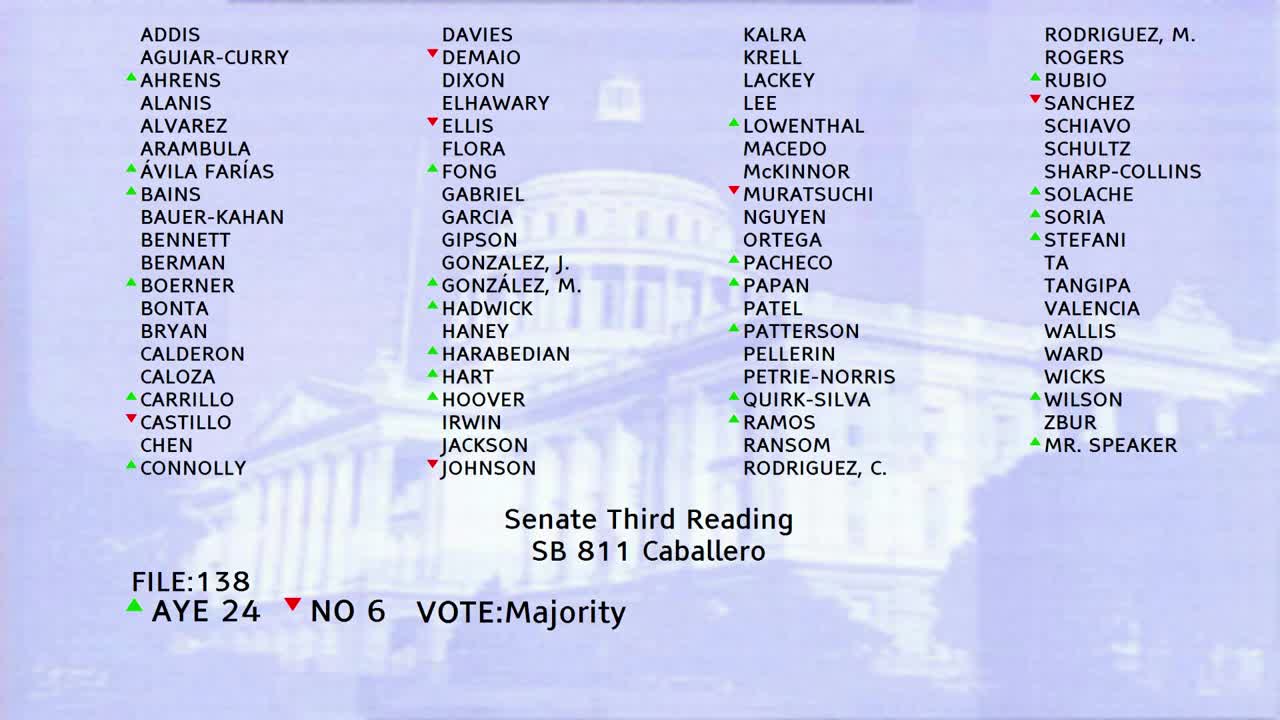 1MIN
Assembly Floor
 2MIN
Senate Floor
 5MIN
Senate Standing Committee on Environmental Quality
 1MIN
Assembly Floor
 3MIN
Assembly Standing Committee on Judiciary
 11MIN
Assembly Standing Committee on Banking and Finance
Bill Author