AB 2692: Common interest developments: reinstatement of terminated declarations: County of Los Angeles.
- Session Year: 2025-2026
- House: Assembly
- Latest Version Date: 2026-08-24
Current Status:
Passed
(2026-08-24: Chaptered by Secretary of State - Chapter 124, Statutes of 2026.)
Introduced
In Committee
Awaiting First Chamber Vote
Passed First Chamber
In Committee
Awaiting Second Chamber Vote
Passed Second Chamber
Enacted
Existing law, the Davis-Stirling Common Interest Development (act), governs the creation and operation of common interest developments. The act requires a declaration to be recorded to create a common interest development, and authorizes the declaration to be amended pursuant to the declarations provisions or pursuant to processes specified in the act.
This bill would establish a process for reinstating a declaration that has been terminated by operation of the provisions that set forth the initial term of the declaration. As a condition for reinstatement, the bill would require approval by the percentage of members that the declaration required for extending the term of the declaration. If the declaration does not specify that percentage, the bill would require approval by a majority of all members. The bill would make the declaration effective upon satisfaction of additional requirements, including certification of member approval and recording the declaration in the county recorders office. The bill would make the extension of the terms of the declaration equal to the number of years of the initial term of the declaration or 20 years, whichever is less. The bill would make the bills provisions applicable only to the County of Los Angeles and would repeal the provisions on January 1, 2028.
This bill would make legislative findings and declarations as to the necessity of a special statute for the County of Los Angeles.
This bill would declare that it is to take effect immediately as an urgency statute.
Existing law, the Davis-Stirling Common Interest Development (act), governs the creation and operation of common interest developments. The act requires a declaration to be recorded to create a common interest development, and authorizes the declaration to be amended pursuant to the declarations provisions or pursuant to processes specified in the act.
This bill would establish a process for reinstating a declaration that has been terminated by operation of the provisions that set forth the initial term of the declaration. As a condition for reinstatement, the bill would require approval by the percentage of members that the declaration required for extending the term of the declaration. If the declaration does not specify that percentage, the bill would require approval by a majority of all members. The bill would make the declaration effective upon satisfaction of additional requirements, including certification of member approval and recording the declaration in the county recorders office. The bill would make the bills provisions applicable only to the County of Los Angeles and would repeal the provisions on January 1, 2028.
This bill would make legislative findings and declarations as to the necessity of a special statute for the County of Los Angeles.
Existing law requires the planning agency to prepare, and the legislative body of each county and city to adopt, a comprehensive, long-term general plan for the physical development of the county or city, and of any land outside its boundaries that in the planning agencys judgment bears relation to its planning. Existing law requires the general plan to include specified elements.This bill would make a nonsubstantive change to the provisions that describe the required elements of a general plan.Existing law requires the planning agency to prepare, and the legislative body of each county and city to adopt, a comprehensive, long-term general plan for the physical development of the county or city, and of any land outside its boundaries that in the planning agencys judgment bears relation to its planning. Existing law requires the general plan to include specified elements.
This bill would make a nonsubstantive change to the provisions that describe the required elements of a general plan.
(a)Notwithstanding any other law, a declaration that has terminated by operation of the provisions that set forth the initial term of the declaration may be reinstated pursuant to this section if approved by the percentage of members required by the declaration for extending the term of the declaration. If the declaration does not specify the percentage of members who must approve the extension of the declaration, a declaration may be reinstated pursuant to this section if approved by a majority of all members.
(b)Balloting on reinstatement shall be conducted in accordance with the governing documents, this act, and any other applicable law. A reasonably diligent effort shall be made to permit all eligible members to vote.
(c)The reinstatement of the declaration is effective after all of the following requirements have been met:
(1)The reinstatement of the declaration has been approved by the percentage of members specified in subdivision (a).
(2)Approval by the members has been certified in a writing executed and acknowledged by the officer designated in the declaration by the association for that purpose or, if no one is designated, by the president of the association.
(3)The declaration has been recorded in the county recorders office.
(d)The extension of the terms of the declaration made pursuant to this section shall be equal to the number of years of the initial term of the declaration or 20 years, whichever is less.
(e)Within a reasonable time after the reinstated declaration is recorded, the association shall deliver to each member, by individual delivery, pursuant to Section 4040, a copy of the reinstated declaration, together with a statement that the reinstated declaration has been recorded.
(f)This section shall be applicable only to the County of Los Angeles.
(g)This section shall remain in effect only until January 1, 2028, and as of that date is repealed.
SEC. 2.The Legislature finds and declares that a special statute is necessary and that a general statute cannot be made applicable within the meaning of Section 16 of Article IV of the California Constitution because of the need to prevent displacement and promote the rebuilding of common interest developments that were damaged or destroyed as a result of the 2025 Palisades and Eaton Fires in Los Angeles.
SEC. 3.This act is an urgency statute necessary for the immediate preservation of the public peace, health, or safety within the meaning of Article IV of the California Constitution and shall go into immediate effect. The facts constituting the necessity are:
In order to prevent displacement and promote the rebuilding of common interest developments that were damaged or destroyed as a result of the 2025 Palisades and Eaton Fires in Los Angeles, it is necessary for this act to take effect immediately.
(a)Notwithstanding any other law, a declaration that has terminated by operation of the provisions that set forth the initial term of the declaration may be reinstated pursuant to this section if approved by the percentage of members required by the declaration for extending the term of the declaration. If the declaration does not specify the percentage of members who must approve the extension of the declaration, a declaration may be reinstated pursuant to this section if approved by a majority of all members.
(b)Balloting on reinstatement shall be conducted in accordance with the governing documents, this act, and any other applicable law. A reasonably diligent effort shall be made to permit all eligible members to vote.
(c)The reinstatement of the declaration is effective after all of the following requirements have been met:
(1)The reinstatement of the declaration has been approved by the percentage of members specified in subdivision (a).
(2)Approval by the members has been certified in a writing executed and acknowledged by the officer designated in the declaration by the association for that purpose or, if no one is designated, by the president of the association.
(3)The declaration has been recorded in the county recorders office.
(d)The extension of the terms of the declaration made pursuant to this section shall be equal to the number of years of the initial term of the declaration or 20 years, whichever is less.
(d)(e)Within a reasonable time after the reinstated declaration is recorded, the association shall deliver to each member, by individual delivery, pursuant to Section 4040, a copy of the reinstated declaration, together with a statement that the reinstated declaration has been recorded.
(e)(f)This section shall be applicable only to the County of Los Angeles.
(f)(g)This section shall remain in effect only until January 1, 2028, and as of that date is repealed.
SEC. 2.The Legislature finds and declares that a special statute is necessary and that a general statute cannot be made applicable within the meaning of Section 16 of Article IV of the California Constitution because of the need to prevent displacement and promote the rebuilding of common interest developments that were damaged or destroyed as a result of the 2025 Palisades and Eaton Fires in Los Angeles.
SEC. 3.This act is an urgency statute necessary for the immediate preservation of the public peace, health, or safety within the meaning of Article IV of the California Constitution and shall go into immediate effect. The facts constituting the necessity are:
In order to prevent displacement and promote the rebuilding of common interest developments that were damaged or destroyed as a result of the 2025 Palisades and Eaton Fires in Los Angeles, it is necessary for this act to take effect immediately.
(a)Notwithstanding any other law, a declaration that has terminated by operation of the provisions that set forth the initial term of the declaration may be reinstated pursuant to this section if approved by the percentage of members required by the declaration for extending the term of the declaration. If the declaration does not specify the percentage of members who must approve the extension of the declaration, a declaration may be reinstated pursuant to this section if approved by a majority of all members.
(b)Balloting on reinstatement shall be conducted in accordance with the governing documents, this act, and any other applicable law. A reasonably diligent effort shall be made to permit all eligible members to vote.
(c)The reinstatement of the declaration is effective after all of the following requirements have been met:
(1)The reinstatement of the declaration has been approved by the percentage of members specified in subdivision (a).
(2)Approval by the members has been certified in a writing executed and acknowledged by the officer designated in the declaration by the association for that purpose or, if no one is designated, by the president of the association.
(3)The declaration has been recorded in the county recorders office.
(d)Within a reasonable time after the reinstated declaration is recorded, the association shall deliver to each member, by individual delivery, pursuant to Section 4040, a copy of the reinstated declaration, together with a statement that the reinstated declaration has been recorded.
(e)This section shall be applicable only to the County of Los Angeles.
(f)This section shall remain in effect only until January 1, 2028, and as of that date is repealed.
SEC. 2.The Legislature finds and declares that a special statute is necessary and that a general statute cannot be made applicable within the meaning of Section 16 of Article IV of the California Constitution because of the need to prevent displacement and promote the rebuilding of common interest developments that were destroyed as a result of the 2025 Palisades and Eaton Fires in Los Angeles.
SECTION 1.Section 65302 of the Government Code is amended to read:65302.The general plan shall consist of a statement of development policies and shall include a diagram or diagrams and text setting forth objectives, principles, standards, and plan proposals. The plan shall include the following elements:(a)A land use element that designates the proposed general distribution and general location and extent of the uses of the land for housing, business, industry, open space, including agriculture, natural resources, recreation, and enjoyment of scenic beauty, education, public buildings and grounds, solid and liquid waste disposal facilities, greenways, as defined in Section 816.52 of the Civil Code, and other categories of public and private uses of land. The location and designation of the extent of the uses of the land for public and private uses shall consider the identification of land and natural resources pursuant to paragraph (3) of subdivision (d). The land use element shall include a statement of the standards of population density and building intensity recommended for the various districts and other territory covered by the plan. The land use element shall identify and annually review those areas covered by the plan that are subject to flooding identified by flood plain mapping prepared by the Federal Emergency Management Agency (FEMA) or the Department of Water Resources. The land use element shall also do both of the following:(1)Designate in a land use category that provides for timber production those parcels of real property zoned for timberland production pursuant to the California Timberland Productivity Act of 1982 (Chapter 6.7 (commencing with Section 51100) of Part 1 of Division 1 of Title 5).(2)Consider the impact of new growth on military readiness activities carried out on military bases, installations, and operating and training areas, when proposing zoning ordinances or designating land uses covered by the general plan for land, or other territory adjacent to military facilities, or underlying designated military aviation routes and airspace.(A)In determining the impact of new growth on military readiness activities, information provided by military facilities shall be considered. Cities and counties shall address military impacts based on information from the military and other sources.(B)The following definitions govern this paragraph:(i)Military readiness activities mean all of the following:(I)Training, support, and operations that prepare the members of the military for combat.(II)Operation, maintenance, and security of any military installation.(III)Testing of military equipment, vehicles, weapons, and sensors for proper operation or suitability for combat use.(ii)Military installation means a base, camp, post, station, yard, center, homeport facility for any ship, or other activity under the jurisdiction of the United States Department of Defense as defined in paragraph (1) of subsection (g) of Section 2687 of Title 10 of the United States Code.(b)(1)A circulation element consisting of the general location and extent of existing and proposed major thoroughfares, transportation routes, terminals, any military airports and ports, and other local public utilities and facilities, all correlated with the land use element of the plan.(2)(A)Beginning January 1, 2011, upon any substantive revision of the circulation element, the legislative body shall modify the circulation element to plan for a balanced, multimodal transportation network that meets the needs of all users of streets, roads, and highways for safe and convenient travel in a manner that is suitable to the rural, suburban, or urban context of the general plan.(B)Upon any substantive revision of the circulation element on or after January 1, 2025, the legislative body shall do all of the following:(i)Incorporate the principles of the Federal Highway Administrations Safe System Approach, in the circulation element by including policies that aim to eliminate fatal and serious injuries for all road users through a holistic view of the roadway system, including provisions that account for human error, recognize vulnerable road users, and promote redundant and proactive safety measures.(ii)Develop bicycle plans, pedestrian plans, and traffic calming plans based on the policies and goals in the circulation element that shall address all of the following for any urbanized area within the scope of the general plan:(I)Identify safety corridors and any land or facility that generates high concentrations of bicyclists or pedestrians.(II)Use evidence-based strategies, including strategies identified in the United States Department of Transportations Strategic Highway Safety Plan to develop safety measures specific to those areas that are intended to eliminate traffic fatalities, with an emphasis on fatalities of bicyclists, pedestrians, and users of any other form of micromobility device in the areas identified in subclause (I).(III)Set goals for initiation and completion of all actions identified in the plans within 25 years of the date of adoption of the modified circulation element based upon projected development activities within urbanized areas within the scope of the general plan and projected availability of revenues.(C)(i)A county or city shall begin implementation of the modified circulation element plan specified in subparagraph (B) within two years of the date of adoption of the plan.(ii)A county or city shall regularly review the progress towards and identify impediments to completing implementation of the plan for a multimodal transportation network, including all bicycle plans, pedestrian plans, and traffic calming plans iterated in the modified circulation element, and the construction of any related infrastructure.(iii)A county or city shall consider revising the circulation element if, following the review under clause (ii), the county or city determines it will not reach the goals of the bicycle, pedestrian, or traffic calming plans within 25 years of the date of adoption of the modified circulation element.(D)For the purposes of this paragraph, the following definitions shall apply:(i)Business activity district has the same meaning as defined in Section 22358.9 of the Vehicle Code.(ii)Land facilities that generate high concentrations of bicyclists or pedestrians has the same meaning as described in Section 22358.7 of the Vehicle Code.(iii)Micromobility device means a bicycle, electric bicycle, or motorized scooter as those terms are defined and described in Division 1 (commencing with Section 100) of the Vehicle Code.(iv)Safety corridor has the same meaning as defined in Section 22358.7 of the Vehicle Code.(v)Urbanized area has the same meaning as defined in Section 21071 of the Public Resources Code.(E)For purposes of this paragraph, users of streets, roads, and highways mean bicyclists, children, persons with disabilities, motorists, movers of commercial goods, pedestrians, users of public transportation, and seniors.(c)A housing element as provided in Article 10.6 (commencing with Section 65580).(d)(1)A conservation element for the conservation, development, and utilization of natural resources, including water and its hydraulic force, forests, soils, rivers and other waters, harbors, fisheries, wildlife, minerals, and other natural resources. The conservation element shall consider the effect of development within the jurisdiction, as described in the land use element, on natural resources located on public lands, including military installations. The conservation element shall consider the effect of development within the jurisdiction, as described in the land use element, on the movement of wildlife and habitat connectivity. That portion of the conservation element including waters shall be developed in coordination with any countywide water agency and with all district and city agencies, including flood management, water conservation, or groundwater agencies that have developed, served, controlled, managed, or conserved water of any type for any purpose in the county or city for which the plan is prepared. Coordination shall include the discussion and evaluation of any water supply and demand information described in Section 65352.5, if that information has been submitted by the water agency to the city or county.(2)The conservation element may also cover all of the following:(A)The reclamation of land and waters.(B)Prevention and control of the pollution of streams and other waters.(C)Regulation of the use of land in stream channels and other areas required for the accomplishment of the conservation plan.(D)Prevention, control, and correction of the erosion of soils, beaches, and shores.(E)Protection of watersheds.(F)The location, quantity, and quality of the rock, sand, and gravel resources.(3)Upon the next revision of the housing element on or after January 1, 2009, the conservation element shall identify rivers, creeks, streams, flood corridors, riparian habitats, and land that may accommodate floodwater for purposes of groundwater recharge and stormwater management.(4)Upon the adoption or next revision of one or more elements on or after January 1, 2028, the conservation element shall be updated to:(A)Identify and analyze connectivity areas, permeability, and natural landscape areas within the jurisdiction, as those terms are defined in Section 158 of the Streets and Highways Code.(B)Identify and analyze existing or planned wildlife passage features, as defined in Section 158 of the Streets and Highways Code, including, but not limited to, wildlife passage features included in the inventory of connectivity needs on the state highway system, as described in Section 158.1 of the Streets and Highways Code, to ensure that planned development does not undermine the effectiveness of existing and potential wildlife passage features, as defined in Section 158 of the Streets and Highways Code.(C)(i)Consider the impacts of development and the barriers caused by development to wildlife and habitat connectivity.(ii)For the purposes of this subparagraph, wildlife has the same meaning as defined in Section 89.5 of the Fish and Game Code.(D)Avoid, minimize, or mitigate impacts and barriers to wildlife movement to the extent feasible.(E)Analyze and consider opportunities to remediate existing barriers to wildlife connectivity and restore degraded habitat and open space.(5)If a city, county, or city and county has already included policies in existing plans, including its certified local coastal plan, that meet the requirements of paragraph (4), the city, county, or city and county may incorporate the plan by reference into the general plan to comply with this section.(6)In preparing to update the conservation element, the city, county, or city and county may do any of the following:(A)Consider incorporating appropriate standards, policies, and feasible implementation programs such as wildlife-friendly fencing and lighting, buffers from sensitive resources, prohibitions on invasive plants, habitat connectivity overlay zones, and compact development standards, or consider whether adoption of ordinances is necessary to feasibly implement these standards, policies, and implementation programs, and include goals to adopt any necessary ordinances.(B)Consult with the Department of Fish and Wildlife, any California Native American tribe that is on the contact list maintained by the Native American Heritage Commission and that has traditional lands located within the city, county, or city and countys jurisdiction, and any open-space district that owns lands designated for conservation within the city, county, or city and countys jurisdiction. Upon receiving a request for consultation, the department, tribe, or district may, in its sole discretion, accept or refuse to consult, based on the priority of natural resources impacted or other factors.(C)Consider relevant best available science as appropriate, including, but not limited to, peer-reviewed literature, citable publicly available datasets, publicly sourced online datasets, and information and reports from government agencies, California Native American tribes, and academic institutions.(D)Consider the most appropriately scaled scientific information on linkages, corridors, and other locations that are essential to maintain landscape connectivity, including, but not limited to, any of the following:(i)Habitat linkages and wildlife corridors, such as those identified and summarized in the Areas of Conservation Emphasis, as defined by subdivision (a) of Section 1851 of the Fish and Game Code, and in regional habitat connectivity assessments.(ii)Wildlife corridors, such as migration corridors identified by global positioning system collar studies.(iii)Wildlife movement barriers, such as connectivity areas, as defined by subdivision (a) of Section 158 of the Street and Highways Code, and barriers identified by the Department of Fish and Wildlifes Restoring Californias Wildlife Connectivity report.(iv)Other connectivity considerations, such as those outlined in the State Wildlife Action Plan, habitat conservation plans approved pursuant to Section 1539 of Title 16 of the United States Code, natural community conservation plans approved pursuant to Chapter 10 (commencing with Section 2800) of Division 3 of the Fish and Game Code, regional conservation investment strategies approved pursuant to Chapter 9 (commencing with Section 1850) of Division 2 of the Fish and Game Code, and other relevant plans, policies, and ordinances adopted by neighboring jurisdictions.(7)In preparing to update the conservation element, the city, county, or city and county may consult with other appropriate local, state, or federal agencies, or academic institutions, as deemed appropriate by the city or county.(8)The city, county, or city and county may meet the requirements in paragraphs (4) through (6), inclusive, in a separate component or section of the general plan entitled a wildlife connectivity element.(e)An open-space element as provided in Article 10.5 (commencing with Section 65560).(f)(1)A noise element that shall identify and appraise noise problems in the community. The noise element shall analyze and quantify, to the extent practicable, as determined by the legislative body, current and projected noise levels for all of the following sources:(A)Highways and freeways.(B)Primary arterials and major local streets.(C)Passenger and freight online railroad operations and ground rapid transit systems.(D)Commercial, general aviation, heliport, helistop, and military airport operations, aircraft overflights, jet engine test stands, and all other ground facilities and maintenance functions related to airport operation.(E)Local industrial plants, including, but not limited to, railroad classification yards.(F)Other ground stationary noise sources, including, but not limited to, military installations, identified by local agencies as contributing to the community noise environment.(2)Noise contours shall be shown for all of these sources and stated in terms of community noise equivalent level (CNEL) or day-night average sound level (Ldn). The noise contours shall be prepared on the basis of noise monitoring or following generally accepted noise modeling techniques for the various sources identified in subparagraphs (A) to (F) of paragraph (1), inclusive.(3)The noise contours shall be used as a guide for establishing a pattern of land uses in the land use element that minimizes the exposure of community residents to excessive noise.(4)The noise element shall include implementation measures and possible solutions that address existing and foreseeable noise problems, if any. The adopted noise element shall serve as a guideline for compliance with the states noise insulation standards.(g)(1)A safety element for the protection of the community from any unreasonable risks associated with the effects of seismically induced surface rupture, ground shaking, ground failure, tsunami, seiche, and dam failure; slope instability leading to mudslides and landslides; subsidence; liquefaction; and other seismic hazards identified pursuant to Chapter 7.8 (commencing with Section 2690) of Division 2 of the Public Resources Code, and other geologic hazards known to the legislative body; flooding; and wildland and urban fires. The safety element shall include mapping of known seismic and other geologic hazards. It shall also address evacuation routes, military installations, peakload water supply requirements, and minimum road widths and clearances around structures, as those items relate to identified fire and geologic hazards.(2)The safety element, upon the next revision of the housing element on or after January 1, 2009, shall also do the following:(A)Identify information regarding flood hazards, including, but not limited to, the following:(i)Flood hazard zones. As used in this subdivision, flood hazard zone means an area subject to flooding that is delineated as either a special hazard area or an area of moderate or minimal hazard on an official flood insurance rate map issued by FEMA. The identification of a flood hazard zone does not imply that areas outside the flood hazard zones or uses permitted within flood hazard zones will be free from flooding or flood damage.(ii)National Flood Insurance Program maps published by FEMA.(iii)Information about flood hazards that is available from the United States Army Corps of Engineers.(iv)Designated floodway maps that are available from the Central Valley Flood Protection Board.(v)Dam failure inundation maps prepared pursuant to Section 6161 of the Water Code that are available from the Department of Water Resources.(vi)Awareness Floodplain Mapping Program maps and 200-year flood plain maps that are or may be available from, or accepted by, the Department of Water Resources.(vii)Maps of levee protection zones.(viii)Areas subject to inundation in the event of the failure of project or nonproject levees or floodwalls.(ix)Historical data on flooding, including locally prepared maps of areas that are subject to flooding, areas that are vulnerable to flooding after wildfires, and sites that have been repeatedly damaged by flooding.(x)Existing and planned development in flood hazard zones, including structures, roads, utilities, and essential public facilities.(xi)Local, state, and federal agencies with responsibility for flood protection, including special districts and local offices of emergency services.(B)Establish a set of comprehensive goals, policies, and objectives based on the information identified pursuant to subparagraph (A), for the protection of the community from the unreasonable risks of flooding, including, but not limited to:(i)Avoiding or minimizing the risks of flooding to new development.(ii)Evaluating whether new development should be located in flood hazard zones, and identifying construction methods or other methods to minimize damage if new development is located in flood hazard zones.(iii)Maintaining the structural and operational integrity of essential public facilities during flooding.(iv)Locating, when feasible, new essential public facilities outside of flood hazard zones, including hospitals and health care facilities, emergency shelters, fire stations, emergency command centers, and emergency communications facilities or identifying construction methods or other methods to minimize damage if these facilities are located in flood hazard zones.(v)Establishing cooperative working relationships among public agencies with responsibility for flood protection.(C)Establish a set of feasible implementation measures designed to carry out the goals, policies, and objectives established pursuant to subparagraph (B).(3)Upon the next revision of the housing element on or after January 1, 2014, the safety element shall be reviewed and updated as necessary to address the risk of fire for land classified as state responsibility areas, as defined in Section 4102 of the Public Resources Code, and land classified as very high fire hazard severity zones, as defined in Section 51177. This review shall consider the advice included in the Office of Planning and Researchs most recent publication of Fire Hazard Planning, General Plan Technical Advice Series and shall also include all of the following:(A)Information regarding fire hazards, including, but not limited to, all of the following:(i)Fire hazard severity zone maps available from the Office of the State Fire Marshal.(ii)Any historical data on wildfires available from local agencies or a reference to where the data can be found.(iii)Information about wildfire hazard areas that may be available from the United States Geological Survey.(iv)General location and distribution of existing and planned uses of land in very high fire hazard severity zones and in state responsibility areas, including structures, roads, utilities, and essential public facilities. The location and distribution of planned uses of land shall not require defensible space compliance measures required by state law or local ordinance to occur on publicly owned lands or open-space designations of homeowner associations.(v)Local, state, and federal agencies with responsibility for fire protection, including special districts and local offices of emergency services.(B)A set of goals, policies, and objectives based on the information identified pursuant to subparagraph (A) for the protection of the community from the unreasonable risk of wildfire.(C)A set of feasible implementation measures designed to carry out the goals, policies, and objectives based on the information identified pursuant to subparagraph (B), including, but not limited to, all of the following:(i)Avoiding or minimizing the wildfire hazards associated with new uses of land.(ii)Locating, when feasible, new essential public facilities outside of high fire risk areas, including, but not limited to, hospitals and health care facilities, emergency shelters, emergency command centers, and emergency communications facilities, or identifying construction methods or other methods to minimize damage if these facilities are located in a state responsibility area or very high fire hazard severity zone.(iii)Designing adequate infrastructure if a new development is located in a state responsibility area or in a very high fire hazard severity zone, including safe access for emergency response vehicles, visible street signs, and water supplies for structural fire suppression.(iv)Working cooperatively with public agencies with responsibility for fire protection.(D)If a city or county has adopted a fire safety plan or document separate from the general plan, an attachment of, or reference to, a city or countys adopted fire safety plan or document that fulfills commensurate goals and objectives and contains information required pursuant to this paragraph.(4)Upon the next revision of a local hazard mitigation plan, adopted in accordance with the federal Disaster Mitigation Act of 2000 (Public Law 106-390), on or after January 1, 2017, or, if a local jurisdiction has not adopted a local hazard mitigation plan, beginning on or before January 1, 2022, the safety element shall be reviewed and updated as necessary to address climate adaptation and resiliency strategies applicable to the city or county. This review shall consider advice provided in the Office of Planning and Researchs General Plan Guidelines and shall include all of the following:(A)(i)A vulnerability assessment that identifies the risks that climate change poses to the local jurisdiction and the geographic areas at risk from climate change impacts, including, but not limited to, an assessment of how climate change may affect the risks addressed pursuant to paragraphs (2) and (3).(ii)Information that may be available from federal, state, regional, and local agencies that will assist in developing the vulnerability assessment and the adaptation policies and strategies required pursuant to subparagraph (B), including, but not limited to, all of the following:(I)Information from the internet-based Cal-Adapt tool.(II)Information from the most recent version of the California Adaptation Planning Guide.(III)Information from local agencies on the types of assets, resources, and populations that will be sensitive to various climate change exposures.(IV)Information from local agencies on their current ability to deal with the impacts of climate change.(V)Historical data on natural events and hazards, including locally prepared maps of areas subject to previous risk, areas that are vulnerable, and sites that have been repeatedly damaged.(VI)Existing and planned development in identified at-risk areas, including structures, roads, utilities, and essential public facilities.(VII)Federal, state, regional, and local agencies with responsibility for the protection of public health and safety and the environment, including special districts and local offices of emergency services.(B)A set of adaptation and resilience goals, policies, and objectives based on the information specified in subparagraph (A) for the protection of the community.(C)A set of feasible implementation measures designed to carry out the goals, policies, and objectives identified pursuant to subparagraph (B), including, but not limited to, all of the following:(i)Feasible methods to avoid or minimize climate change impacts associated with new uses of land.(ii)The location, when feasible, of new essential public facilities outside of at-risk areas, including, but not limited to, hospitals and health care facilities, emergency shelters, emergency command centers, and emergency communications facilities, or identifying construction methods or other methods to minimize damage if these facilities are located in at-risk areas.(iii)The designation of adequate and feasible infrastructure located in an at-risk area.(iv)Guidelines for working cooperatively with relevant local, regional, state, and federal agencies.(v)The identification of natural infrastructure that may be used in adaptation projects, where feasible. Where feasible, the plan shall use existing natural features and ecosystem processes, or the restoration of natural features and ecosystem processes, when developing alternatives for consideration. For purposes of this clause, natural infrastructure means using natural ecological systems or processes to reduce vulnerability to climate change related hazards, or other related climate change effects, while increasing the long-term adaptive capacity of coastal and inland areas by perpetuating or restoring ecosystem services. This includes, but is not limited to, the conservation, preservation, or sustainable management of any form of aquatic or terrestrial vegetated open space, such as beaches, dunes, tidal marshes, reefs, seagrass, parks, rain gardens, and urban tree canopies. It also includes systems and practices that use or mimic natural processes, such as permeable pavements, bioswales, and other engineered systems, such as levees that are combined with restored natural systems, to provide clean water, conserve ecosystem values and functions, and provide a wide array of benefits to people and wildlife.(D)(i)If a city or county has adopted the local hazard mitigation plan, or other climate adaptation plan or document that fulfills commensurate goals and objectives and contains the information required pursuant to this paragraph, separate from the general plan, an attachment of, or reference to, the local hazard mitigation plan or other climate adaptation plan or document.(ii)Cities or counties that have an adopted hazard mitigation plan, or other climate adaptation plan or document that substantially complies with this section, or have substantially equivalent provisions to this subdivision in their general plans, may use that information in the safety element to comply with this subdivision, and shall summarize and incorporate by reference into the safety element the other general plan provisions, climate adaptation plan or document, specifically showing how each requirement of this subdivision has been met.(5)Upon the next revision of the housing element on or after January 1, 2020, the safety element shall be reviewed and updated as necessary to identify residential developments in any hazard area identified in the safety element that do not have at least two emergency evacuation routes.(6)After the initial revision of the safety element pursuant to paragraphs (2), (3), (4), and (5), the planning agency shall review and, if necessary, revise the safety element upon each revision of the housing element or local hazard mitigation plan, but not less than once every eight years, to identify new information relating to flood and fire hazards and climate adaptation and resiliency strategies applicable to the city or county that was not available during the previous revision of the safety element.(7)Cities and counties that have flood plain management ordinances that have been approved by FEMA that substantially comply with this section, or have substantially equivalent provisions to this subdivision in their general plans, may use that information in the safety element to comply with this subdivision, and shall summarize and incorporate by reference into the safety element the other general plan provisions or the flood plain ordinance, specifically showing how each requirement of this subdivision has been met.(8)Before the periodic review of its general plan and before preparing or revising its safety element, each city and county shall consult the California Geological Survey of the Department of Conservation, the Central Valley Flood Protection Board, if the city or county is located within the boundaries of the Sacramento and San Joaquin Drainage District, as set forth in Section 8501 of the Water Code, and the Office of Emergency Services for the purpose of including information known by and available to the department, the agency, and the board required by this subdivision.(9)To the extent that a countys safety element is sufficiently detailed and contains appropriate policies and programs for adoption by a city, a city may adopt that portion of the countys safety element that pertains to the citys planning area in satisfaction of the requirement imposed by this subdivision.(h)(1)An environmental justice element, or related goals, policies, and objectives integrated in other elements, that identifies disadvantaged communities within the area covered by the general plan of the city, county, or city and county, if the city, county, or city and county has a disadvantaged community. The environmental justice element, or related environmental justice goals, policies, and objectives integrated in other elements, shall do all of the following:(A)Identify objectives and policies to reduce the unique or compounded health risks in disadvantaged communities by means that include, but are not limited to, the reduction of pollution exposure, including the improvement of air quality, and the promotion of public facilities, food access, safe and sanitary homes, and physical activity.(B)Identify objectives and policies to promote civic engagement in the public decisionmaking process.(C)Identify objectives and policies that prioritize improvements and programs that address the needs of disadvantaged communities.(2)A city, county, or city and county subject to this subdivision shall adopt or review the environmental justice element, or the environmental justice goals, policies, and objectives in other elements, upon the adoption or next revision of two or more elements concurrently on or after January 1, 2018.(3)By adding this subdivision, the Legislature does not intend to require a city, county, or city and county to take any action prohibited by the United States Constitution or the California Constitution.(4)For purposes of this subdivision, the following terms shall apply:(A)Disadvantaged communities means an area identified by the California Environmental Protection Agency pursuant to Section 39711 of the Health and Safety Code or an area that is a low-income area that is disproportionately affected by environmental pollution and other hazards that can lead to negative health effects, exposure, or environmental degradation.(B)Public facilities includes public improvements, public services, and community amenities, as defined in subdivision (d) of Section 66000.(C)Low-income area means an area with household incomes at or below 80 percent of the statewide median income or with household incomes at or below the threshold designated as low income by the Department of Housing and Community Developments list of state income limits adopted pursuant to Section 50093 of the Health and Safety Code.The general plan shall consist of a statement of development policies and shall include a diagram or diagrams and text setting forth objectives, principles, standards, and plan proposals. The plan shall include the following elements:
(a)A land use element that designates the proposed general distribution and general location and extent of the uses of the land for housing, business, industry, open space, including agriculture, natural resources, recreation, and enjoyment of scenic beauty, education, public buildings and grounds, solid and liquid waste disposal facilities, greenways, as defined in Section 816.52 of the Civil Code, and other categories of public and private uses of land. The location and designation of the extent of the uses of the land for public and private uses shall consider the identification of land and natural resources pursuant to paragraph (3) of subdivision (d). The land use element shall include a statement of the standards of population density and building intensity recommended for the various districts and other territory covered by the plan. The land use element shall identify and annually review those areas covered by the plan that are subject to flooding identified by flood plain mapping prepared by the Federal Emergency Management Agency (FEMA) or the Department of Water Resources. The land use element shall also do both of the following:
(1)Designate in a land use category that provides for timber production those parcels of real property zoned for timberland production pursuant to the California Timberland Productivity Act of 1982 (Chapter 6.7 (commencing with Section 51100) of Part 1 of Division 1 of Title 5).
(2)Consider the impact of new growth on military readiness activities carried out on military bases, installations, and operating and training areas, when proposing zoning ordinances or designating land uses covered by the general plan for land, or other territory adjacent to military facilities, or underlying designated military aviation routes and airspace.
(A)In determining the impact of new growth on military readiness activities, information provided by military facilities shall be considered. Cities and counties shall address military impacts based on information from the military and other sources.
(B)The following definitions govern this paragraph:
(i)Military readiness activities mean all of the following:
(I)Training, support, and operations that prepare the members of the military for combat.
(II)Operation, maintenance, and security of any military installation.
(III)Testing of military equipment, vehicles, weapons, and sensors for proper operation or suitability for combat use.
(ii)Military installation means a base, camp, post, station, yard, center, homeport facility for any ship, or other activity under the jurisdiction of the United States Department of Defense as defined in paragraph (1) of subsection (g) of Section 2687 of Title 10 of the United States Code.
(b)(1)A circulation element consisting of the general location and extent of existing and proposed major thoroughfares, transportation routes, terminals, any military airports and ports, and other local public utilities and facilities, all correlated with the land use element of the plan.
(2)(A)Commencing Beginning January 1, 2011, upon any substantive revision of the circulation element, the legislative body shall modify the circulation element to plan for a balanced, multimodal transportation network that meets the needs of all users of streets, roads, and highways for safe and convenient travel in a manner that is suitable to the rural, suburban, or urban context of the general plan.
(B)Upon any substantive revision of the circulation element on or after January 1, 2025, the legislative body shall do all of the following:
(i)Incorporate the principles of the Federal Highway Administrations Safe System Approach, in the circulation element by including policies that aim to eliminate fatal and serious injuries for all road users through a holistic view of the roadway system, including provisions that account for human error, recognize vulnerable road users, and promote redundant and proactive safety measures.
(ii)Develop bicycle plans, pedestrian plans, and traffic calming plans based on the policies and goals in the circulation element that shall address all of the following for any urbanized area within the scope of the general plan:
(I)Identify safety corridors and any land or facility that generates high concentrations of bicyclists or pedestrians.
(II)Use evidence-based strategies, including strategies identified in the United States Department of Transportations Strategic Highway Safety Plan to develop safety measures specific to those areas that are intended to eliminate traffic fatalities, with an emphasis on fatalities of bicyclists, pedestrians, and users of any other form of micromobility device in the areas identified in subclause (I).
(III)Set goals for initiation and completion of all actions identified in the plans within 25 years of the date of adoption of the modified circulation element based upon projected development activities within urbanized areas within the scope of the general plan and projected availability of revenues.
(C)(i)A county or city shall begin implementation of the modified circulation element plan specified in subparagraph (B) within two years of the date of adoption of the plan.
(ii)A county or city shall regularly review the progress towards and identify impediments to completing implementation of the plan for a multimodal transportation network, including all bicycle plans, pedestrian plans, and traffic calming plans iterated in the modified circulation element, and the construction of any related infrastructure.
(iii)A county or city shall consider revising the circulation element if, following the review under clause (ii), the county or city determines it will not reach the goals of the bicycle, pedestrian, or traffic calming plans within 25 years of the date of adoption of the modified circulation element.
(D)For the purposes of this paragraph, the following definitions shall apply:
(i)Business activity district has the same meaning as defined in Section 22358.9 of the Vehicle Code.
(ii)Land facilities that generate high concentrations of bicyclists or pedestrians has the same meaning as described in Section 22358.7 of the Vehicle Code.
(iii)Micromobility device means a bicycle, electric bicycle, or motorized scooter as those terms are defined and described in Division 1 (commencing with Section 100) of the Vehicle Code.
(iv)Safety corridor has the same meaning as defined in Section 22358.7 of the Vehicle Code.
(v)Urbanized area has the same meaning as defined in Section 21071 of the Public Resources Code.
(E)For purposes of this paragraph, users of streets, roads, and highways mean bicyclists, children, persons with disabilities, motorists, movers of commercial goods, pedestrians, users of public transportation, and seniors.
(c)A housing element as provided in Article 10.6 (commencing with Section 65580).
(d)(1)A conservation element for the conservation, development, and utilization of natural resources, including water and its hydraulic force, forests, soils, rivers and other waters, harbors, fisheries, wildlife, minerals, and other natural resources. The conservation element shall consider the effect of development within the jurisdiction, as described in the land use element, on natural resources located on public lands, including military installations. The conservation element shall consider the effect of development within the jurisdiction, as described in the land use element, on the movement of wildlife and habitat connectivity. That portion of the conservation element including waters shall be developed in coordination with any countywide water agency and with all district and city agencies, including flood management, water conservation, or groundwater agencies that have developed, served, controlled, managed, or conserved water of any type for any purpose in the county or city for which the plan is prepared. Coordination shall include the discussion and evaluation of any water supply and demand information described in Section 65352.5, if that information has been submitted by the water agency to the city or county.
(2)The conservation element may also cover all of the following:
(A)The reclamation of land and waters.
(B)Prevention and control of the pollution of streams and other waters.
(C)Regulation of the use of land in stream channels and other areas required for the accomplishment of the conservation plan.
(D)Prevention, control, and correction of the erosion of soils, beaches, and shores.
(E)Protection of watersheds.
(F)The location, quantity, and quality of the rock, sand, and gravel resources.
(3)Upon the next revision of the housing element on or after January 1, 2009, the conservation element shall identify rivers, creeks, streams, flood corridors, riparian habitats, and land that may accommodate floodwater for purposes of groundwater recharge and stormwater management.
(4)Upon the adoption or next revision of one or more elements on or after January 1, 2028, the conservation element shall be updated to:
(A)Identify and analyze connectivity areas, permeability, and natural landscape areas within the jurisdiction, as those terms are defined in Section 158 of the Streets and Highways Code.
(B)Identify and analyze existing or planned wildlife passage features, as defined in Section 158 of the Streets and Highways Code, including, but not limited to, wildlife passage features included in the inventory of connectivity needs on the state highway system, as described in Section 158.1 of the Streets and Highways Code, to ensure that planned development does not undermine the effectiveness of existing and potential wildlife passage features, as defined in Section 158 of the Streets and Highways Code.
(C)(i)Consider the impacts of development and the barriers caused by development to wildlife and habitat connectivity.
(ii)For the purposes of this subparagraph, wildlife has the same meaning as defined in Section 89.5 of the Fish and Game Code.
(D)Avoid, minimize, or mitigate impacts and barriers to wildlife movement to the extent feasible.
(E)Analyze and consider opportunities to remediate existing barriers to wildlife connectivity and restore degraded habitat and open space.
(5)If a city, county, or city and county has already included policies in existing plans, including its certified local coastal plan, that meet the requirements of paragraph (4), the city, county, or city and county may incorporate the plan by reference into the general plan to comply with this section.
(6)In preparing to update the conservation element, the city, county, or city and county may do any of the following:
(A)Consider incorporating appropriate standards, policies, and feasible implementation programs such as wildlife-friendly fencing and lighting, buffers from sensitive resources, prohibitions on invasive plants, habitat connectivity overlay zones, and compact development standards, or consider whether adoption of ordinances is necessary to feasibly implement these standards, policies, and implementation programs, and include goals to adopt any necessary ordinances.
(B)Consult with the Department of Fish and Wildlife, any California Native American tribe that is on the contact list maintained by the Native American Heritage Commission and that has traditional lands located within the city, county, or city and countys jurisdiction, and any open-space district that owns lands designated for conservation within the city, county, or city and countys jurisdiction. Upon receiving a request for consultation, the department, tribe, or district may, in its sole discretion, accept or refuse to consult, based on the priority of natural resources impacted or other factors.
(C)Consider relevant best available science as appropriate, including, but not limited to, peer-reviewed literature, citable publicly available datasets, publicly sourced online datasets, and information and reports from government agencies, California Native American tribes, and academic institutions.
(D)Consider the most appropriately scaled scientific information on linkages, corridors, and other locations that are essential to maintain landscape connectivity, including, but not limited to, any of the following:
(i)Habitat linkages and wildlife corridors, such as those identified and summarized in the Areas of Conservation Emphasis, as defined by subdivision (a) of Section 1851 of the Fish and Game Code, and in regional habitat connectivity assessments.
(ii)Wildlife corridors, such as migration corridors identified by global positioning system collar studies.
(iii)Wildlife movement barriers, such as connectivity areas, as defined by subdivision (a) of Section 158 of the Street and Highways Code, and barriers identified by the Department of Fish and Wildlifes Restoring Californias Wildlife Connectivity report.
(iv)Other connectivity considerations, such as those outlined in the State Wildlife Action Plan, habitat conservation plans approved pursuant to Section 1539 of Title 16 of the United States Code, natural community conservation plans approved pursuant to Chapter 10 (commencing with Section 2800) of Division 3 of the Fish and Game Code, regional conservation investment strategies approved pursuant to Chapter 9 (commencing with Section 1850) of Division 2 of the Fish and Game Code, and other relevant plans, policies, and ordinances adopted by neighboring jurisdictions.
(7)In preparing to update the conservation element, the city, county, or city and county may consult with other appropriate local, state, or federal agencies, or academic institutions, as deemed appropriate by the city or county.
(8)The city, county, or city and county may meet the requirements in paragraphs (4) through (6), inclusive, in a separate component or section of the general plan entitled a wildlife connectivity element.
(e)An open-space element as provided in Article 10.5 (commencing with Section 65560).
(f)(1)A noise element that shall identify and appraise noise problems in the community. The noise element shall analyze and quantify, to the extent practicable, as determined by the legislative body, current and projected noise levels for all of the following sources:
(A)Highways and freeways.
(B)Primary arterials and major local streets.
(C)Passenger and freight online railroad operations and ground rapid transit systems.
(D)Commercial, general aviation, heliport, helistop, and military airport operations, aircraft overflights, jet engine test stands, and all other ground facilities and maintenance functions related to airport operation.
(E)Local industrial plants, including, but not limited to, railroad classification yards.
(F)Other ground stationary noise sources, including, but not limited to, military installations, identified by local agencies as contributing to the community noise environment.
(2)Noise contours shall be shown for all of these sources and stated in terms of community noise equivalent level (CNEL) or day-night average sound level (Ldn). The noise contours shall be prepared on the basis of noise monitoring or following generally accepted noise modeling techniques for the various sources identified in subparagraphs (A) to (F) of paragraph (1), inclusive.
(3)The noise contours shall be used as a guide for establishing a pattern of land uses in the land use element that minimizes the exposure of community residents to excessive noise.
(4)The noise element shall include implementation measures and possible solutions that address existing and foreseeable noise problems, if any. The adopted noise element shall serve as a guideline for compliance with the states noise insulation standards.
(g)(1)A safety element for the protection of the community from any unreasonable risks associated with the effects of seismically induced surface rupture, ground shaking, ground failure, tsunami, seiche, and dam failure; slope instability leading to mudslides and landslides; subsidence; liquefaction; and other seismic hazards identified pursuant to Chapter 7.8 (commencing with Section 2690) of Division 2 of the Public Resources Code, and other geologic hazards known to the legislative body; flooding; and wildland and urban fires. The safety element shall include mapping of known seismic and other geologic hazards. It shall also address evacuation routes, military installations, peakload water supply requirements, and minimum road widths and clearances around structures, as those items relate to identified fire and geologic hazards.
(2)The safety element, upon the next revision of the housing element on or after January 1, 2009, shall also do the following:
(A)Identify information regarding flood hazards, including, but not limited to, the following:
(i)Flood hazard zones. As used in this subdivision, flood hazard zone means an area subject to flooding that is delineated as either a special hazard area or an area of moderate or minimal hazard on an official flood insurance rate map issued by FEMA. The identification of a flood hazard zone does not imply that areas outside the flood hazard zones or uses permitted within flood hazard zones will be free from flooding or flood damage.
(ii)National Flood Insurance Program maps published by FEMA.
(iii)Information about flood hazards that is available from the United States Army Corps of Engineers.
(iv)Designated floodway maps that are available from the Central Valley Flood Protection Board.
(v)Dam failure inundation maps prepared pursuant to Section 6161 of the Water Code that are available from the Department of Water Resources.
(vi)Awareness Floodplain Mapping Program maps and 200-year flood plain maps that are or may be available from, or accepted by, the Department of Water Resources.
(vii)Maps of levee protection zones.
(viii)Areas subject to inundation in the event of the failure of project or nonproject levees or floodwalls.
(ix)Historical data on flooding, including locally prepared maps of areas that are subject to flooding, areas that are vulnerable to flooding after wildfires, and sites that have been repeatedly damaged by flooding.
(x)Existing and planned development in flood hazard zones, including structures, roads, utilities, and essential public facilities.
(xi)Local, state, and federal agencies with responsibility for flood protection, including special districts and local offices of emergency services.
(B)Establish a set of comprehensive goals, policies, and objectives based on the information identified pursuant to subparagraph (A), for the protection of the community from the unreasonable risks of flooding, including, but not limited to:
(i)Avoiding or minimizing the risks of flooding to new development.
(ii)Evaluating whether new development should be located in flood hazard zones, and identifying construction methods or other methods to minimize damage if new development is located in flood hazard zones.
(iii)Maintaining the structural and operational integrity of essential public facilities during flooding.
(iv)Locating, when feasible, new essential public facilities outside of flood hazard zones, including hospitals and health care facilities, emergency shelters, fire stations, emergency command centers, and emergency communications facilities or identifying construction methods or other methods to minimize damage if these facilities are located in flood hazard zones.
(v)Establishing cooperative working relationships among public agencies with responsibility for flood protection.
(C)Establish a set of feasible implementation measures designed to carry out the goals, policies, and objectives established pursuant to subparagraph (B).
(3)Upon the next revision of the housing element on or after January 1, 2014, the safety element shall be reviewed and updated as necessary to address the risk of fire for land classified as state responsibility areas, as defined in Section 4102 of the Public Resources Code, and land classified as very high fire hazard severity zones, as defined in Section 51177. This review shall consider the advice included in the Office of Planning and Researchs most recent publication of Fire Hazard Planning, General Plan Technical Advice Series and shall also include all of the following:
(A)Information regarding fire hazards, including, but not limited to, all of the following:
(i)Fire hazard severity zone maps available from the Office of the State Fire Marshal.
(ii)Any historical data on wildfires available from local agencies or a reference to where the data can be found.
(iii)Information about wildfire hazard areas that may be available from the United States Geological Survey.
(iv)General location and distribution of existing and planned uses of land in very high fire hazard severity zones and in state responsibility areas, including structures, roads, utilities, and essential public facilities. The location and distribution of planned uses of land shall not require defensible space compliance measures required by state law or local ordinance to occur on publicly owned lands or open-space designations of homeowner associations.
(v)Local, state, and federal agencies with responsibility for fire protection, including special districts and local offices of emergency services.
(B)A set of goals, policies, and objectives based on the information identified pursuant to subparagraph (A) for the protection of the community from the unreasonable risk of wildfire.
(C)A set of feasible implementation measures designed to carry out the goals, policies, and objectives based on the information identified pursuant to subparagraph (B), including, but not limited to, all of the following:
(i)Avoiding or minimizing the wildfire hazards associated with new uses of land.
(ii)Locating, when feasible, new essential public facilities outside of high fire risk areas, including, but not limited to, hospitals and health care facilities, emergency shelters, emergency command centers, and emergency communications facilities, or identifying construction methods or other methods to minimize damage if these facilities are located in a state responsibility area or very high fire hazard severity zone.
(iii)Designing adequate infrastructure if a new development is located in a state responsibility area or in a very high fire hazard severity zone, including safe access for emergency response vehicles, visible street signs, and water supplies for structural fire suppression.
(iv)Working cooperatively with public agencies with responsibility for fire protection.
(D)If a city or county has adopted a fire safety plan or document separate from the general plan, an attachment of, or reference to, a city or countys adopted fire safety plan or document that fulfills commensurate goals and objectives and contains information required pursuant to this paragraph.
(4)Upon the next revision of a local hazard mitigation plan, adopted in accordance with the federal Disaster Mitigation Act of 2000 (Public Law 106-390), on or after January 1, 2017, or, if a local jurisdiction has not adopted a local hazard mitigation plan, beginning on or before January 1, 2022, the safety element shall be reviewed and updated as necessary to address climate adaptation and resiliency strategies applicable to the city or county. This review shall consider advice provided in the Office of Planning and Researchs General Plan Guidelines and shall include all of the following:
(A)(i)A vulnerability assessment that identifies the risks that climate change poses to the local jurisdiction and the geographic areas at risk from climate change impacts, including, but not limited to, an assessment of how climate change may affect the risks addressed pursuant to paragraphs (2) and (3).
(ii)Information that may be available from federal, state, regional, and local agencies that will assist in developing the vulnerability assessment and the adaptation policies and strategies required pursuant to subparagraph (B), including, but not limited to, all of the following:
(I)Information from the internet-based Cal-Adapt tool.
(II)Information from the most recent version of the California Adaptation Planning Guide.
(III)Information from local agencies on the types of assets, resources, and populations that will be sensitive to various climate change exposures.
(IV)Information from local agencies on their current ability to deal with the impacts of climate change.
(V)Historical data on natural events and hazards, including locally prepared maps of areas subject to previous risk, areas that are vulnerable, and sites that have been repeatedly damaged.
(VI)Existing and planned development in identified at-risk areas, including structures, roads, utilities, and essential public facilities.
(VII)Federal, state, regional, and local agencies with responsibility for the protection of public health and safety and the environment, including special districts and local offices of emergency services.
(B)A set of adaptation and resilience goals, policies, and objectives based on the information specified in subparagraph (A) for the protection of the community.
(C)A set of feasible implementation measures designed to carry out the goals, policies, and objectives identified pursuant to subparagraph (B), including, but not limited to, all of the following:
(i)Feasible methods to avoid or minimize climate change impacts associated with new uses of land.
(ii)The location, when feasible, of new essential public facilities outside of at-risk areas, including, but not limited to, hospitals and health care facilities, emergency shelters, emergency command centers, and emergency communications facilities, or identifying construction methods or other methods to minimize damage if these facilities are located in at-risk areas.
(iii)The designation of adequate and feasible infrastructure located in an at-risk area.
(iv)Guidelines for working cooperatively with relevant local, regional, state, and federal agencies.
(v)The identification of natural infrastructure that may be used in adaptation projects, where feasible. Where feasible, the plan shall use existing natural features and ecosystem processes, or the restoration of natural features and ecosystem processes, when developing alternatives for consideration. For purposes of this clause, natural infrastructure means using natural ecological systems or processes to reduce vulnerability to climate change related hazards, or other related climate change effects, while increasing the long-term adaptive capacity of coastal and inland areas by perpetuating or restoring ecosystem services. This includes, but is not limited to, the conservation, preservation, or sustainable management of any form of aquatic or terrestrial vegetated open space, such as beaches, dunes, tidal marshes, reefs, seagrass, parks, rain gardens, and urban tree canopies. It also includes systems and practices that use or mimic natural processes, such as permeable pavements, bioswales, and other engineered systems, such as levees that are combined with restored natural systems, to provide clean water, conserve ecosystem values and functions, and provide a wide array of benefits to people and wildlife.
(D)(i)If a city or county has adopted the local hazard mitigation plan, or other climate adaptation plan or document that fulfills commensurate goals and objectives and contains the information required pursuant to this paragraph, separate from the general plan, an attachment of, or reference to, the local hazard mitigation plan or other climate adaptation plan or document.
(ii)Cities or counties that have an adopted hazard mitigation plan, or other climate adaptation plan or document that substantially complies with this section, or have substantially equivalent provisions to this subdivision in their general plans, may use that information in the safety element to comply with this subdivision, and shall summarize and incorporate by reference into the safety element the other general plan provisions, climate adaptation plan or document, specifically showing how each requirement of this subdivision has been met.
(5)Upon the next revision of the housing element on or after January 1, 2020, the safety element shall be reviewed and updated as necessary to identify residential developments in any hazard area identified in the safety element that do not have at least two emergency evacuation routes.
(6)After the initial revision of the safety element pursuant to paragraphs (2), (3), (4), and (5), the planning agency shall review and, if necessary, revise the safety element upon each revision of the housing element or local hazard mitigation plan, but not less than once every eight years, to identify new information relating to flood and fire hazards and climate adaptation and resiliency strategies applicable to the city or county that was not available during the previous revision of the safety element.
(7)Cities and counties that have flood plain management ordinances that have been approved by FEMA that substantially comply with this section, or have substantially equivalent provisions to this subdivision in their general plans, may use that information in the safety element to comply with this subdivision, and shall summarize and incorporate by reference into the safety element the other general plan provisions or the flood plain ordinance, specifically showing how each requirement of this subdivision has been met.
(8)Before the periodic review of its general plan and before preparing or revising its safety element, each city and county shall consult the California Geological Survey of the Department of Conservation, the Central Valley Flood Protection Board, if the city or county is located within the boundaries of the Sacramento and San Joaquin Drainage District, as set forth in Section 8501 of the Water Code, and the Office of Emergency Services for the purpose of including information known by and available to the department, the agency, and the board required by this subdivision.
(9)To the extent that a countys safety element is sufficiently detailed and contains appropriate policies and programs for adoption by a city, a city may adopt that portion of the countys safety element that pertains to the citys planning area in satisfaction of the requirement imposed by this subdivision.
(h)(1)An environmental justice element, or related goals, policies, and objectives integrated in other elements, that identifies disadvantaged communities within the area covered by the general plan of the city, county, or city and county, if the city, county, or city and county has a disadvantaged community. The environmental justice element, or related environmental justice goals, policies, and objectives integrated in other elements, shall do all of the following:
(A)Identify objectives and policies to reduce the unique or compounded health risks in disadvantaged communities by means that include, but are not limited to, the reduction of pollution exposure, including the improvement of air quality, and the promotion of public facilities, food access, safe and sanitary homes, and physical activity.
(B)Identify objectives and policies to promote civic engagement in the public decisionmaking process.
(C)Identify objectives and policies that prioritize improvements and programs that address the needs of disadvantaged communities.
(2)A city, county, or city and county subject to this subdivision shall adopt or review the environmental justice element, or the environmental justice goals, policies, and objectives in other elements, upon the adoption or next revision of two or more elements concurrently on or after January 1, 2018.
(3)By adding this subdivision, the Legislature does not intend to require a city, county, or city and county to take any action prohibited by the United States Constitution or the California Constitution.
(4)For purposes of this subdivision, the following terms shall apply:
(A)Disadvantaged communities means an area identified by the California Environmental Protection Agency pursuant to Section 39711 of the Health and Safety Code or an area that is a low-income area that is disproportionately affected by environmental pollution and other hazards that can lead to negative health effects, exposure, or environmental degradation.
(B)Public facilities includes public improvements, public services, and community amenities, as defined in subdivision (d) of Section 66000.
(C)Low-income area means an area with household incomes at or below 80 percent of the statewide median income or with household incomes at or below the threshold designated as low income by the Department of Housing and Community Developments list of state income limits adopted pursuant to Section 50093 of the Health and Safety Code.
|
Date
|
Status
|
|---|---|
| Aug 24, 2026 | Chaptered by Secretary of State - Chapter 124, Statutes of 2026. |
| Aug 24, 2026 | Approved by the Governor. |
| Aug 12, 2026 | Enrolled and presented to the Governor at 12 p.m. |
| Aug 6, 2026 | Urgency clause adopted. Senate amendments concurred in. To Engrossing and Enrolling. (Ayes 75. Noes 0. Page 6074.). |
| Aug 6, 2026 | Urgency clause adopted. Senate amendments concurred in. To Engrossing and Enrolling. (Ayes 75. Noes 0.). |
| Jul 2, 2026 | In Assembly. Concurrence in Senate amendments pending. |
| Jul 2, 2026 | Read third time. Urgency clause adopted. Passed. Ordered to the Assembly. (Ayes 37. Noes 0. Page 5187.). |
| Jul 2, 2026 | Read third time. Urgency clause adopted. Passed. Ordered to the Assembly. (Ayes 37. Noes 0.). |
| Jun 25, 2026 | Read second time and amended. Ordered to consent calendar. |
| Jun 24, 2026 | From committee: Amend, and do pass as amended. To Consent Calendar. (Ayes 13. Noes 0.) (June 23). |
| Jun 11, 2026 | From committee: Do pass and re-refer to Com. on JUD. (Ayes 10. Noes 0.) (June 10). Re-referred to Com. on JUD. |
| May 20, 2026 | Referred to Coms. on HOUSING and JUD. |
| May 7, 2026 | In Senate. Read first time. To Com. on RLS. for assignment. |
| May 7, 2026 | Read third time. Urgency clause adopted. Passed. Ordered to the Senate. (Ayes 66. Noes 0. Page 4967.). |
| May 7, 2026 | Read third time. Urgency clause adopted. Passed. Ordered to the Senate. (Ayes 66. Noes 0.). |
| Apr 30, 2026 | Read second time. Ordered to Consent Calendar. |
| Apr 29, 2026 | Read second time and amended. Ordered returned to second reading. |
| Apr 28, 2026 | From committee: Amend, and do pass as amended. To Consent Calendar. (Ayes 12. Noes 0.) (April 28). |
| Apr 23, 2026 | From committee: Do pass and re-refer to Com. on JUD. with recommendation: To Consent Calendar. (Ayes 12. Noes 0.) (April 22). Re-referred to Com. on JUD. |
| Mar 23, 2026 | Re-referred to Com. on H. & C.D. |
| Mar 19, 2026 | From committee chair, with author's amendments: Amend, and re-refer to Com. on H. & C.D. Read second time and amended. |
| Mar 19, 2026 | Referred to Coms. on H. & C.D. and JUD. |
| Feb 21, 2026 | From printer. May be heard in committee March 23. |
| Feb 20, 2026 | Read first time. To print. |
|
Date
|
Description
|
Location
|
Votes
|
|
|---|---|---|---|---|
| Aug 6, 2026 | AB 2692 Irwin Concurrence in Senate Amendments | Assembly Floor |
Passed |
|
| Jul 2, 2026 | Consent Calendar 2nd AB2692 Irwin Urgency Clause | Senate Floor |
Passed |
|
| Jun 23, 2026 | Do pass as amended, and be ordered to the Consent Calendar | Senate Standing Committee on Judiciary |
Passed |
|
| Jun 10, 2026 | Do pass, but first be re-referred to the Committee on [Judiciary] | Senate Standing Committee on Housing |
Passed |
|
| May 7, 2026 | AB 2692 Irwin Consent Calendar Second Day | Assembly Floor |
Passed |
|
| Apr 28, 2026 | Do pass as amended. To Consent Calendar. | Assembly Standing Committee on Judiciary |
Passed |
|
| Apr 22, 2026 | Do pass and be re-referred to the Committee on [Judiciary] with recommendation: To Consent Calendar | Assembly Standing Committee on Housing and Community Development |
Passed |
This list shows positions taken on this bill by organizations on the date displayed, which is linked to the original source.
Positions by individuals are not included.
|
Organization
|
Position
|
Date
|
|---|---|---|
| CAI-CLAC | ** Support | |
| Community Associations Institute - California Legislative Action Committee | ** Support | |
| Community Associations Institute's California Legislative Action Committee | ** Support | |
| Via de la Paz HOA | ** Support | |
| Via De LA Paz Homeowner Association | ** Support | |
| Via de la Paz Homeowners Association | ** Support |
CONCURRENCE IN SENATE AMENDMENTS
CSA1 Bill Id:AB 2692
Author:(Irwin)
As Amended Ver:June 25, 2026
2/3 vote
SUMMARY
Authorizes a homeowners' association (HOA) in Los Angeles County to reinstate a declaration that has terminated if approved by the requisite number of members in the HOA. Contains an urgency clause.
Senate Amendments
Specify that the extension of the terms of the declaration shall be equal to the number of years of the initial term of the declaration or 20 years, whichever is less.
COMMENTS
Davis Stirling Common Interest Development Act: Common interest developments (CIDs) are governed by the Davis Stirling Common Interest Development Act (Act) along with the governing documents of the HOA (Covenants, Conditions, and Restrictions, or CC&Rs), including bylaws, declaration, and operating rules. The Act provides the legal framework for the creation and management of HOAs, including rules related to governance, assessments, dispute resolution, maintenance responsibilities, and member rights. The law aims to balance the authority of HOAs with the rights of individual property owners, ensuring that communities are managed efficiently and fairly.
Over time, the Act has been amended to address the evolving needs of CIDs and to increase transparency, accountability, and consumer protections. Key provisions include requirements for open meetings, financial disclosures, election procedures, and architectural review processes. The Act also provides mechanisms for resolving disputes, including internal dispute resolution and alternative dispute resolution before certain legal actions can proceed. As CIDs continue to represent a significant portion of California's housing stock, the Act plays a critical role in shaping the living environment and governance of millions of residents across the state.
CC&Rs: CC&Rs are essentially the constitution of any given HOA community. They establish the rules, restrictions, and rights that bind all owners, covering everything from architectural standards to pet policies to how the association itself is governed. Because CC&Rs are recorded against the property, they run with the land, binding future owners to the governing documents as well as the current owners. CC&Rs often require amendments to address the changing needs of any given community. However, amending an HOA's CC&Rs is intentionally difficult. Most declarations require approval from a supermajority of all members, often ranging from 50-75% of all HOA members, not just all voting members. In a large HOA development, this can mean thousands of individual owners must affirmatively cast ballots. This can present logistical challenges even under the best circumstances, as HOA voting rates tend to be low.
Under the Act, there is an existing process through which HOA members can seek to address this difficulty in obtaining a majority of votes of all HOA members: if an amendment to the HOA's CC&Rs falls short of the voting threshold required by the HOA documents, an HOA or member can petition a superior court to approve the amendment anyway, so long as the court finds the process was fair, the effort to reach members was diligent, and the amendment is reasonable. But even under the court petition process in existing law, at least 50% of members must have voted in favor of the proposed amendment.
Eaton and Palisades fires: Climate change continues to pose significant risks to California, including more extreme heat events, larger wildfires, prolonged droughts, flooding, and other climate-related impacts. In early January 2025, extremely dry conditions and high winds in Los Angeles resulted in two of the most destructive wildfires in state history. The Palisades fire, which started on January 7th, burned a total of 23,448 acres and damaged or destroyed almost 8,000 structures in the Pacific Palisades and Topanga State Park area of west Los Angeles.[1] The Eaton fire also started on January 7th. It consumed 14,021 acres and damaged or destroyed more than 10,000 structures, including significant portions of the city of Altadena.[2]
This bill: The fires in Los Angeles County revealed a narrow but consequential gap in existing law governing CIDs, arising in the unusual circumstance where a development's CC&Rs have expired pursuant to its own terms shortly before a disaster. Under the Act, declarations may be amended or extended by the HOA prior to expiration; however, existing law does not provide a mechanism to reinstate a declaration once it has terminated. In the rare case where a declaration expires without the HOA's knowledge, and a catastrophic event subsequently damages the property, the HOA may be left without a legally operative governance structure that is needed to coordinate rebuilding and disaster recovery.
The experience of a condominium association in Pacific Palisades illustrates this gap. There, a 107-unit development (Via de la Paz) lost a majority of its units in the 2025 wildfires, only to discover that its declaration had expired in January of 2024, approximately one year before the disaster. Of the 107 homeowners in the community, 101 voted to reinstate the governing documents, with four not voting, and two voting in opposition. A unanimous vote would be required to reinstate the CC&Rs without a legislative fix. Due to the inability of the CID to obtain unanimous consent, the community is unable to expend insurance funds or move forward with reconstruction. More broadly, the situation experienced in this condo community raises concerns about prolonged displacement of the residents and the potential long-term loss of housing in communities affected by disaster.
According to the author, compounding the crisis is the time-sensitive nature of recovery assistance. Some of the members of the CID were approved for a $150,000, zero-interest, 30-year loan from Habitat for Humanity, as well as an additional $300,000 from the Small Business Administration. Both programs require funds to be drawn down and construction to begin within strict post-disaster timelines, often within two years. If this recovery remains stalled in court or receivership or legally ambiguous territory, these families risk losing access to the funds designed to help them rebuild, turning temporary displacement into permanent loss.
This bill proposes a limited, targeted solution by establishing a statutory process to reinstate an expired declaration upon approval of the membership at the threshold required to extend the declaration, or, if unspecified, by a majority vote. This bill specifies that the extension of the terms of the declaration made pursuant to this bill must be equal to the number of years of the initial term of the declaration or 20 years, whichever is less. This bill requires certification and recordation of the reinstated declaration and applies only in Los Angeles County, with a sunset date of January 1, 2028. While, ideally, CIDs would take proactive measures to prevent CC&Rs from expiring, in this instance, a retroactive measure may be necessary. In providing for this retroactive pathway, the bill seeks to restore governance to affected CIDs and allow communities to access funding, coordinate rebuilding, and determine their path forward following disaster-related losses.
According to the Author
"AB 2692 provides a tailored legislative fix that will allow the members of the Via de la Paz HOA in Pacific Palisades to reinstate their expired CCRs. The bill specifies for reinstatement, approval is required by the percentage of members required to extend the term of their original declaration. If the declaration does not specify that percentage, the bill would require approval by a majority of all members. In the case of Via de la Paz, a 75% vote was required to extend the declaration."
"AB 2692 is applicable to only the Los Angeles County and will be effective only one year until January 1, 2028. These limits are intended to ensure this bill's provisions are only applicable to fire-affected HOAs in response to the 2025 wildfires. Additionally, reinstatement of the declaration requires the vote to be certified in writing and recorded with the county recorder's office."
"This bill is necessary to provide residents with certainty to move forward with their insurance claims and allow the board to take appropriate action, which they are currently not legally able to do."
Arguments in Support
According to the Via de la Paz HOA, "The urgency of this legislation cannot be overstated. The Association has already secured approximately $43 million from the California FAIR Plan – the maximum available for reconstruction – and architectural plans have been submitted to the City of Los Angeles for plan check. Construction estimates are within approximately plus or minus $7 million of available proceeds. The funds are in hand, the plans are ready, and the community is prepared to rebuild. Every month of continued delay imposes mounting costs on our displaced residents in temporary housing, storage, and living expenses that are steadily depleting their personal resources."
According to the Community Associations Institute's California Legislative Action Committee, "The bill provides a commonsense solution by creating a defined pathway for associations to reinstate a previously terminated declaration. By clarifying procedures and requirements, the bill helps ensure continuity of governance, avoids costly legal disputes, and protects both associations and individual homeowners from unintended consequences."
Arguments in Opposition
None on file.
FISCAL COMMENTS
Unknown. This bill is keyed non-fiscal by the Legislative Counsel.
VOTES:
ASM HOUSING AND COMMUNITY DEVELOPMENT: 12-0-0
YES: Haney, Patterson, Ávila Farías, Caloza, Garcia, Kalra, Lee, Quirk-Silva, Ta, Tangipa, Wicks, Wilson
ASM JUDICIARY: 12-0-0
YES: Kalra, Bauer-Kahan, Bryan, Connolly, Dixon, Harabedian, Johnson, Pacheco, Papan, Sanchez, Lee, Zbur
ASSEMBLY FLOOR: 66-0-14
YES: Addis, Aguiar-Curry, Ahrens, Alanis, Alvarez, Ávila Farías, Bains, Bauer-Kahan, Bennett, Berman, Boerner, Bryan, Calderon, Caloza, Carrillo, Castillo, Connolly, Davies, DeMaio, Dixon, Elhawary, Ellis, Fong, Gabriel, Garcia, Gipson, Jeff Gonzalez, Mark González, Hadwick, Haney, Harabedian, Jackson, Johnson, Kalra, Krell, Lackey, Lee, Lowenthal, Macedo, McKinnor, Muratsuchi, Nguyen, Ortega, Pacheco, Patel, Patterson, Pellerin, Quirk-Silva, Ramos, Ransom, Michelle Rodriguez, Rogers, Blanca Rubio, Sanchez, Schiavo, Schultz, Sharp-Collins, Solache, Soria, Stefani, Ta, Tangipa, Ward, Wilson, Zbur, Rivas
ABS, ABST OR NV: Arambula, Bonta, Chen, Flora, Gallagher, Hart, Hoover, Irwin, Papan, Petrie-Norris, Celeste Rodriguez, Valencia, Wallis, Wicks
SENATE FLOOR: 37-0-3
YES: Allen, Archuleta, Arreguín, Ashby, Becker, Blakespear, Cabaldon, Caballero, Cervantes, Choi, Cortese, Dahle, Durazo, Gonzalez, Grayson, Grove, Hurtado, Jones, Laird, Limón, McGuire, McNerney, Menjivar, Niello, Ochoa Bogh, Padilla, Pérez, Reyes, Seyarto, Smallwood-Cuevas, Stern, Strickland, Umberg, Valladares, Wahab, Weber Pierson, Wiener
ABS, ABST OR NV: Alvarado-Gil, Richardson, Rubio
UPDATED
VERSION: June 25, 2026
CONSULTANT: Juan Reyes / H. & C.D. / (916) 319-2085 FN: 0003277
SENATE RULES COMMITTEE Office of Senate Floor Analyses (916) 651-4171 | AB 2692 |
CONSENT
Bill No: AB 2692
Author: Irwin (D)
Amended: 4/29/26 in Assembly
Vote: 27 - Urgency
SENATE HOUSING COMMITTEE: 10-0, 6/10/26
AYES: Arreguín, Seyarto, Cabaldon, Caballero, Cortese, Durazo, Grayson, Ochoa Bogh, Padilla, Pérez
SENATE JUDICIARY COMMITTEE: 13-0, 6/23/26
AYES: Umberg, Niello, Allen, Ashby, Caballero, Durazo, Laird, Reyes, Stern, Valladares, Wahab, Weber Pierson, Wiener
ASSEMBLY FLOOR: 66-0, 5/7/26 (Consent) - See last page for vote
SUBJECT: Common interest developments: reinstatement of terminated declarations: County of Los Angeles
SOURCE: CAI-CLAC
Via De La Paz HOA
DIGEST:
This bill allows a homeowner’s association (HOA) in Los Angeles County, until January 1, 2028, to reinstate an expired declaration via majority vote of all members, unless another threshold is specified in the governing documents.
ANALYSIS:
Existing law:
- Establishes the Davis-Stirling Act (Act) to govern the creation and operation of common interest developments (CIDs), including HOAs.
- Defines a “declaration” as the recorded document that creates a CID and sets forth the applicable covenants, conditions, and restrictions (CC&Rs).
- Provides that a declaration may be amended pursuant to the procedures specified in the declaration or as otherwise provided in the Act.
- Requires approval of the HOA’s membership for certain amendments to the declaration, generally based on the voter approval threshold specified in the governing documents.
- Authorizes a court petition to approve amendments to a declaration when the HOA cannot obtain the required level of member approval, if specified statutory conditions are met.
- Requires that a declaration and any amendment be recorded in the county recorder’s office in order to be effective and enforceable.
- Establishes election and voting procedures for associations, including requirements related to member voting, notices, and balloting.
This bill:
- Establishes, notwithstanding any other law, a process to reinstate a terminated declaration for an HOA that expired pursuant to its stated term.
- Authorizes reinstatement of the declaration upon approval of the HOA membership, as follows:
- Requires approval by the percentage of HOA members specified in the declaration for extending its term; or,
- If the declaration does not specify the percentage of members who must approve the extension of the declaration, a declaration may be reinstated if approved by a majority of all members.
- Requires the reinstatement vote to be conducted in accordance with the Act, the HOA’s governing documents, and any other applicable law. Requires a reasonably diligent effort to allow all eligible members to vote.
- Provides that reinstatement of the declaration is effective after all of the following requirements are met:
- Approval by the required percentage of members in 2);
- Certification of that approval in a written, executed, and acknowledged document by the appropriate association officer; and,
- Recordation of the reinstated declaration in the county recorder’s office.
- Provides that the extension of the terms of the declaration made pursuant to this section shall be equal to the number of years of the initial term of the declaration or 20 years, whichever is less.
- Requires the HOA to provide individual notice to all HOA members that includes a copy of the reinstated declaration, and a statement that the reinstated declaration has been recorded, within a reasonable timeframe of recordation.
- Limits the applicability of these provisions to Los Angeles County.
- Sunsets the reinstatement authority on January 1, 2028.
Background
Davis-Stirling Act. The Act went into effect in 1986 and is the primary state law governing CIDs and HOAs in California. The Act provides the legal framework for the creation and management of HOAs, including rules related to governance, assessments, dispute resolution, maintenance responsibilities, and member rights. The law aims to balance the authority of HOAs with the rights of individual property owners, ensuring that communities are managed efficiently and fairly. Over time, the Act has been amended to address the evolving needs of CIDs and HOAs, including increased transparency, accountability, and consumer protections. Key provisions of the Act include requirements for open meetings, financial disclosures, election procedures, and architectural review processes. The Act also provides mechanisms for resolving disputes, including internal dispute resolution and alternative dispute resolution before certain legal actions can proceed. As the majority of new housing construction in California is part of an HOA, the Act plays a critical role in shaping the environment and governance of these communities and the tens of millions of residents who reside in them.
CC&Rs. CC&Rs are the legally binding documents that establish the rules, restrictions, and rights that impact all HOA members, covering everything from architectural standards to pet policies to how the association itself is governed. Because CC&Rs are recorded against the property, they run with the land, binding current owners to the governing documents, as well as any future owners of a separate interest. CC&Rs often require amendments to address the changing needs of any given community. However, amending an HOA’s CC&Rs is intentionally difficult. Most declarations require approval from a supermajority of all members, often ranging from 50-75% of all HOA members, not just all voting members. In a large HOA development, this can mean thousands of individual owners must affirmatively cast ballots. This can present logistical challenges even under the best circumstances, as HOA voting rates tend to be low.
Under the Act, there is a process through which HOA members can seek to address this difficulty in obtaining a majority of votes of all HOA members: if an amendment to the HOA’s CC&Rs falls short of the voting threshold required by the HOA documents, an HOA or member can petition a superior court to approve the amendment anyway, so long as the court finds the process was fair, the effort to reach members was diligent, and the amendment is reasonable. But even under the court petition process in existing law, at least 50% of members must have voted in favor of the proposed amendment. This bill reflects that majority approval threshold to allow for the reinstatement of a declaration to proceed.
Comments
- Author’s statement. “The 2025 LA Wildfires wreaked havoc on our communities—destroying homes, threatening retirement assets and leaving neighborhoods paralyzed. While some have been able to begin the process of rebuilding, others remain stuck due to a legal barrier. One specific condominium complex in Pacific Palisades discovered their governing documents—referred to as Covenants, Conditions and Restrictions (CCRs)—expired shortly before the fires wiped out over half of their 107 units. Because of this minor oversight, the Homeowners Association (HOA) Board is legally prevented from taking any action, including voting to rebuild or sell. Residents have remained displaced for over a year as the Board sits on $41 million in insurance funds that cannot be spent without valid CCRs. Via de la Paz remains one of the few naturally affordable housing options in Pacific Palisades and preserving this community is critical to addressing California’s housing shortage. AB 2692 provides a tailored legislative fix to allow these fire victims to reinstate their HOA’s expired CCRs. This bill is only applicable to Los Angeles County for one year until January 1, 2028, providing displaced residents with a narrow window to take appropriate action and move forward with recovery.”
- The Aftermath of the Eaton and Palisades Fires. On January 7th, 2025, the devastating Eaton and Palisades Fires ignited in Los Angeles County. The Eaton Fire ignited in Eaton Canyon, near Altadena, burning more than 14,000 acres and destroying over 9,400 structures. The Palisades Fire began in the Santa Monica Mountains, rapidly spreading across 23,000+ acres and destroying over 6,800 structures, primarily in the Pacific Palisades community of the City of Los Angeles. By the time the fires were fully contained on January 31st, 2025, more than 16,000 homes and other structures were destroyed, the vast majority of which were located in what is referred to as the wildland-urban interface, or WUI. The WUI is where human development meets or mixes with the undeveloped natural environment or wildlands.
- Once the fires settled, next came more issues. The 2025 L.A. fires have revealed a narrow, but consequential gap in existing law governing HOAs, arising in the unusual circumstance where a development’s CC&Rs have expired, pursuant to its own terms, shortly before a disaster. Under the Act, declarations may be amended or extended by the HOA prior to expiration; however, existing law does not provide a mechanism to reinstate a declaration once it has terminated. In the rare case where a declaration expires without the HOA’s knowledge, and a catastrophic event subsequently damages the property, the HOA may be left without a legally operative governance structure that is needed to coordinate rebuilding and disaster recovery. Further, if an association’s CC&Rs do not spell out a specific voter threshold to extend the declaration, it is assumed it must receive unanimous approval – something which virtually no HOA will ever render on any issue, let alone a big decision like deciding the renew the association’s declaration.
This issue bore out in an 107-unit condo development (Via de la Paz) in Pacific Palisades, which lost a majority of its units in the 2025 wildfires, only to discover that its declaration had expired in January of 2024, approximately one year before the disaster. Of the 107 homeowners in the community, 101 voted to reinstate the governing documents, with four not voting, and two voting in opposition. A unanimous vote would be required to reinstate the CC&Rs without a legislative fix. Due to the inability of the HOA to obtain unanimous approval, the community is unable to expend insurance funds or move forward with reconstruction. More broadly, the situation experienced in this condo community raises concerns about prolonged displacement of the residents and the potential long-term loss of housing in communities affected by disaster.
According to the author, compounding the crisis is the time-sensitive nature of recovery assistance. Some of the members of the HOA were approved for a $150,000, zero-interest, 30-year loan from Habitat for Humanity, as well as an additional $300,000 from the federal Small Business Administration. However, both programs require funds to be drawn down and construction to begin within strict post-disaster timelines, often within two years. If this recovery remains stalled in court, receivership, or legally ambiguous territory, these families risk losing access to the funds designed to help them rebuild.
- A targeted solution. This bill proposes a limited, targeted solution by establishing a statutory process to reinstate an expired declaration upon approval of the membership at the threshold required to extend the declaration, or, if unspecified, by a majority vote. This bill requires certification and recordation of the reinstated declaration and applies only in Los Angeles County, with a sunset date of January 1, 2028. While, ideally, HOAs would take proactive measures to prevent CC&Rs from expiring, in this instance, a retroactive measure may be necessary. In providing for this retroactive pathway, the bill seeks to restore governance to affected HOAs and allow communities to access funding, coordinate rebuilding, and determine their path forward following disaster-related losses.
- Double-referral. This bill was also heard in the Senate Judiciary Committee on June 23rd, 2026, where it passed on a vote of 13-0.
FISCAL EFFECT: Appropriation: No Fiscal Com.: No Local: No
SUPPORT: (Verified 6/26/2026)
CAI-CLAC (Co-source)
Via De La Paz HOA (Co-source)
OPPOSITION: (Verified 6/26/2026)
None received.
ARGUMENTS IN SUPPORT: Those writing in support argue that this bill will provide a commonsense solution by creating a defined pathway for associations to reinstate a previously terminated declaration—ensuring continuity of governance, avoiding costly legal disputes, and protecting both associations and individual homeowners from unintended consequences.
ARGUMENTS IN OPPOSITION: None received.
ASSEMBLY FLOOR: 66-0, 5/7/26
AYES: Addis, Aguiar-Curry, Ahrens, Alanis, Alvarez, Ávila Farías, Bains, Bauer-Kahan, Bennett, Berman, Boerner, Bryan, Calderon, Caloza, Carrillo, Castillo, Connolly, Davies, DeMaio, Dixon, Elhawary, Ellis, Fong, Gabriel, Garcia, Gipson, Jeff Gonzalez, Mark González, Hadwick, Haney, Harabedian, Jackson, Johnson, Kalra, Krell, Lackey, Lee, Lowenthal, Macedo, McKinnor, Muratsuchi, Nguyen, Ortega, Pacheco, Patel, Patterson, Pellerin, Quirk-Silva, Ramos, Ransom, Michelle Rodriguez, Rogers, Blanca Rubio, Sanchez, Schiavo, Schultz, Sharp-Collins, Solache, Soria, Stefani, Ta, Tangipa, Ward, Wilson, Zbur, Rivas
NO VOTE RECORDED: Arambula, Bonta, Chen, Flora, Gallagher, Hart, Hoover, Irwin, Papan, Petrie-Norris, Celeste Rodriguez, Valencia, Wallis, Wicks
Prepared by: Ryan Hardmeyer / HOUSING / (916) 651-4124
6/26/26 15:58:43
**** END ****
Senator Thomas Umberg, Chair
2025-2026 Regular Session
Bill No: AB 2692 (Author:Irwin)
Version: April 29, 2026
Hearing Date: June 23, 2026
Fiscal: No
Urgency: Yes
Consultant: ID
SUBJECT
Common interest developments: reinstatement of terminated declarations: County of Los Angeles
DIGEST
This bill permits the declaration of a common interest development that has terminated to be reinstated by approval of the owners of the development’s separate interests, as specified, limits the applicability of its provisions to the County of Los Angeles, and repeals its provisions on January 1, 2028.
EXECUTIVE SUMMARY
Common Interest Developments (CIDs) are self-governing housing developments comprised of individually-owned housing units and common space that all homeowners and residents of the CID can enjoy. CIDs are managed and governed by homeowner associations (HOAs), of which every owner within the CID is a member. The guiding framework and rules of the HOA and the CID are encompassed in the declaration of covenants, conditions, and restrictions (declaration, or CC&Rs) that are recorded with the county when the CID is established. Some CID declarations include a termination date for the declaration. Current law permits the declaration to be amended and extended by approval of the members, but it does not provide for the reinstatement of a declaration that has terminated. This gap has recently caused significant issues for at least one CID in the Pacific Palisades area that burned down in the 2025 Palisades fire, as the community has been unable to make progress on rebuilding without declaration. This bill permits the reinstatement of a terminated declaration by approval of the members, either by the percentage required by the declaration for an extension of the declaration, or by a majority of the members. AB 2692’s provisions apply only to Los Angeles county, and sunset January 1, 2028. This bill includes an urgency clause.
AB 2692 is author-sponsored, and is supported by the Community Associations Institute – California Legislative Action Committee, and by the Via de la Paz Homeowners Association. The Committee has received no timely letters of opposition. AB 2692 previously passed out of the Senate Housing Committee by a vote of 10 to 0.
PROPOSED CHANGES TO THE LAW
Existing law:
- Establishes the Davis-Stirling Common Interest Development Act, providing rules and regulations governing the establishment and operation of residential common interest developments (CIDs) and the rights and responsibilities of a CID’s homeowner association (HOA) and its members. (Civ. Code §§ 4000 et seq.)
- Specifies that a CID is created whenever a separate interest coupled with an interest in a common area or membership in an association is conveyed, provided that a declaration, condominium plan, if any, and a final map or parcel map are recorded. (Civ. Code § 4200.)
- Requires the declaration to contain a legal description of the CID, a statement that the CID is a community apartment project, condominium project, planned development, stock cooperative, or a combination thereof, and set forth the name of the HOA and the restrictions on the use or enjoyment of any portion of the CID that are intended to be enforceable equitable servitudes. (Civ. Code § 4250.)
- Provides that, unless otherwise provided in the declaration of a CID, the HOA is responsible for repairing, replacing, and maintaining the common area; the owners of each separate interest are responsible for repairing, replacing, and maintaining their separate interest; and the owner of each separate interest is responsible for maintaining the exclusive use common area appurtenant to that separate interest; and the association is responsible for repairing and replacing the exclusive use common area. (Civ. Code § 4775.)
- Permits the declaration of a CID that specifies a termination date but does not contain provisions for an extension of the termination date, before its termination date, to be extended by the approval of the members by the percentage required by the declaration for an amendment to the declaration, or by a majority of all members if no percentage is specified in the declaration, the certification of this approval, and the recordation of the amendment in each county in which a portion of the CID is located, as specified. (Civ. Code §§ 4265, 4270.)
- Permits the declaration of a CID to be amended pursuant to the declaration or statute, except where an alternative process for amending the declaration is provided in specified sections of law, and makes the amendment effective after:
- the amendment has been approved by the percentage of members required by the declaration and any other person whose approval is required by the declaration, or by a majority of members if a percentage is not specified in the declaration;
- the approval has been certified in a writing executed and acknowledged by the officer designated in the declaration, or by the President of the HOA if none is designated; and
- the amendment is recorded in each county in which a portion of the CID is located. (Civ. Code § 4270.)
- Specifies that, if the CID’s declaration requires members with more than 50 percent of the votes of the HOA to approve an amendment to the declaration, the HOA or any member may petition the county superior court for an order reducing the percentage of votes necessary for an amendment, and requires the petition to describe the effort that has been made to solicit approval of the members in the manner provided by the declaration, the number of affirmative and negative votes actually received, the number or percentage of affirmative votes required under the existing declaration, and other matters the petitioner considers relevant to the court’s determination, as well as copies of specified documents.
- Permits the court to grant the petition if it finds that the petitioner has given at least 15 days written notice of the court hearing to all members, the mortgagee or beneficiary of a deed of trust entitled to notice under the declaration, and to the city, county, or city and county; balloting was conducted in accordance with the governing documents; a reasonably diligent effort was made to permit all eligible members to vote; members with more than 50 percent of the votes voted in favor of the amendment; the amendment is reasonable; and granting the petition is not improper for any specified reason. (Civ. Code § 4275.)
This bill:
- Permits, notwithstanding any other law, a CID’s declaration that was terminated by operation of the provisions of the declaration to be reinstated if approved by the percentage of members required by the declaration for extending the term of the declaration. Specifies that, if the declaration does not specify the percentage of members who must approve the extension, the declaration may be reinstated if approved by a majority of all members.
- Requires balloting on reinstatement to be conducted in accordance with the governing documents, the Davis-Sterling act, and any other applicable law. Requires that a reasonably diligent effort be made to permit all eligible members to vote.
- Specifies that reinstatement of the declaration is effective after all of the following requirements are met:
- The reinstatement has been approved by the members, as provided;
- Approval by the members was certified in a writing executed and acknowledged by the officer designated in the declaration for that purpose, or if no one is designated, by the president of the association; and
- The declaration is recorded in the county recorder’s office.
- Requires the association, within a reasonable time after the reinstated declaration is recorded, to deliver to each member, by individual delivery pursuant to Civil Code section 4040, a copy of the reinstated declaration, together with a statement that the reinstated declaration has been recorded.
- Applies its provisions only to the County of Los Angeles.
- Specifies that its provisions remain in effect only until January 1, 2028, and as of that date are repealed.
- Makes various findings and declarations regarding the necessity of a special statute and an urgency statute.
COMMENTS
- Author’s statement
According to the author:
The 2025 LA Wildfires wreaked havoc on our communities—destroying homes, threatening retirement assets and leaving neighborhoods paralyzed. While some have been able to begin the process of rebuilding, others remain stuck due to a legal barrier.
One specific condominium complex in Pacific Palisades discovered their governing documents—referred to as Covenants, Conditions and Restrictions (CCRs)—expired shortly before the fires wiped out over half of their 107 units. Because of this minor oversight, the complex is no longer legally bound together, which prevents the Homeowners Association (HOA) Board from taking any action, including voting to rebuild or sell. Residents have remained displaced for over a year. Despite the Board acquiring $41 million in FAIR Plan insurance, the community is unable to spend this money on repairs without valid CCRs.
Many of the affected residents are retired adults on fixed incomes who inherited their homes and rely on them as retirement vehicles. Via de la Paz remains one of the few naturally affordable housing options in Pacific Palisades and preserving this community is critical to addressing California’s housing shortage.
AB 2692 provides a tailored legislative fix to allow these fire victims to reinstate their HOA’s expired CCRs. This bill is only applicable to Los Angeles County for one year until January 1, 2028, providing displaced residents with a narrow window to take appropriate action and move forward with recovery.
- Common Interest Developments in California
Common Interest Developments (CIDs) are self-governing housing developments comprised of individually-owned housing units and common space that all homeowners and residents of the CID can enjoy. Arrangements of CIDs can vary widely, from condominiums, townhouses, and detached single-family homes, to apartment-like high rises. They may be comprised of only a few housing units, or thousands. CIDs are commonly referred to as homeowner associations, or HOAs, for the body that provides for the CID’s self-governance. There are an estimated 51,700 CIDs in the state, housing an estimated 14,489,00 Californians.[1]
The laws that regulate CIDs are encompassed in the Davis-Sterling Common Interest Development Act (Civ. Code §§ 4000 et seq.). Many of the rules and structural elements of a CID are determined by the Declaration of Covenants, Conditions, and Restrictions (CC&Rs) that are filed with the county recorder when the CID is established by the developer. These CC&Rs are the guiding rules of the CID and outline the CID’s common area, the HOA’s responsibilities, the obligation of the HOA to collect assessments from homeowners to cover the HOA’s expenses, and a variety of other topics. The CC&Rs of the CID run with the land, as in they apply to each homeowner’s property and remain on the land after a sale or transfer, encumbering future owners of the land.
All homeowners in the CID are members of the HOA, which is often incorporated as a mutual benefit corporation upon the formation of the CID. The HOA manages the CID and maintains its common space. To do so, the HOA elects a board of directors (board), and passes bylaws outlining the governance rules of the HOA and its board of directors. The board has a number of duties and powers for the management of the community, including setting the regular, monthly assessments that members must pay in order to cover communal expenses. When a homeowner in the CID does not pay their assessments, the HOA board has the authority to impose a lien and foreclose on the individual’s property. (Civ. Code §§ 5660, 5700.) The HOA may also impose fines on individual members for violations of the rules of the HOA.
- Current law allows CC&Rs to be amended and extended before their termination
As the CC&Rs bind current and future property owners and are the guiding documents of the CID, they are typically designed to be difficult to change. They often include language specifying how they may be amended, including the vote threshold of the HOA required to pass amendments. If the CC&Rs do not include provisions for their amendment, they may be amended by approval of a majority of all HOA members and the recording of the amendment. (Civ. Code § 4270.) If the vote threshold in the CC&Rs proves too burdensome, the law also allows a court to lower the threshold to a majority in certain circumstances. (Civ. Code § 4275.) Amendments to the CID’s CC&Rs are applied retroactively to every member regardless of when they purchased their unit. (Villa de las Palmas Homeowners Assn. v. Terifaj (2004) 33 Cal. 4th 73, 79.)
Many CC&Rs also include a date by which they expire. However, they may also be extended, or restated. This permits the members to revisit the CC&Rs and amend or extend them without their encumbrances lasting in perpetuity. The CC&Rs may themselves include provisions to extend their validity, or they may be extended before their termination by the approval of a majority of the HOA members. (Civ. Code §§ 4265, 4270.)
However, if the CC&Rs expire without being extended, it can cause significant issues for the HOA. After the CC&Rs expire, the HOA would cease to exist, its board would be unable to collect dues for the HOA’s operations and maintenance of the CID, and HOA members would not be bound by any previous rules of the HOA. Such a termination can result in significant legal uncertainty regarding the common areas of the CID and individual members’ interests. Moreover, once the CC&Rs expire, they currently may only be re-instituted by a unanimous vote of all of the members.
- The Via de la Paz condominium complex was destroyed by the Palisades fire after the expiration of its CC&Rs
Unfortunately, this was exactly the scenario that happened to the Via de la Paz condominium complex (Via de la Paz) in Pacific Palisades. Via de la Paz was burned in the January 2025 Palisades fire that destroyed substantial swaths of the Pacific Palisades. The Palisades fire burned a total of 23,448 acres and damaged or destroyed almost 8,000 structures in the Pacific Palisades and the Topanga State Park area of west Los Angeles, destroying about half of all properties in the city.[2]
The Via de la Paz condominium complex was one of the buildings destroyed by the fire. 67 of the complex’s 107 units were destroyed, and many of the remaining units suffered considerable damage.[3] However, as the HOA began the process to rebuild, they ran into another roadblock: the CID’s CC&Rs had expired in January 2024. Without proper CC&Rs, the complex has been unable to rebuild, and the HOA has been unable to utilize the funds meant to rebuild. In attempting to reinstate the community’s CC&Rs, the HOA obtained the approval of 101 of 107 members; however, because the CC&Rs had already expired, it needed to obtain unanimous approval. The HOA also filed a lawsuit seeking a judicial solution that would reinstate the CC&Rs, but the court denied the request. (Via de la Paz Homeowners Ass’n v. N/A (2026) 25SMCP00504 2026 Cal. Super. 5390.)
- AB 2692 provides a narrow solution for HOAs in Los Angeles to reinstitute expired CC&Rs
To resolve this issue and help the Via de la Paz community rebuild, AB 2692 creates a narrowly-tailored process by which an HOA may reinstate expired CC&Rs. It would permit expired CC&Rs to be reinstated if the reinstatement is approved by the same percentage of members as the HOA’s CC&Rs require for an extension of the CC&Rs. If the CC&Rs do not specify the percentage of members who must approve an extension, AB 2692 would permit reinstatement by a majority of members.
AB 2692 specifies that reinstatement would be effective once it is approved by the requisite required percentage of members, the approval has been certified in a writing executed and acknowledged by a designated officer or the president of the HOA, and the reinstated declaration has been recorded. AB 2692 also requires that, within a reasonable time from the recordation of the reinstated CC&Rs, the HOA must deliver a copy of the reinstated CC&Rs to each member, along with a statement that the reinstated declaration has been recorded.
While AB 2692 is an urgency measure that will apply upon enactment, its provisions apply narrowly. They only apply to HOAs within the County of Los Angeles, and sunset on January 1, 2028.
The amendment or extension of CC&Rs is a significant act, considering that CC&Rs encumber the properties to which they apply, and do so for substantial periods of time. Thus, they substantially affect property rights and the alienability of the land to which they apply. However, the CC&Rs also help with the organization of the CID and the HOA, as well as management of common area, and should benefit the individual properties to which they apply. Whether an HOA’s CC&Rs expire due to mistake or failure of the HOA to agree to their extension or amendment, substantial legal uncertainty can be avoided by extending or permitting the reinstatement of CC&Rs. For the Via de la Paz HOA, doing so would help the community rebuild after the Palisades fire.
- Amendments
The author has agreed to amendments that will clarify the term for the reinstated CC&Rs, considering the terminated CC&Rs have a termination date that will have passed. These amendments make the term equal to the term of the original CC&Rs, or 20 years, whichever is less. This language is consistent with that in the provisions of the Davis-Sterling Act relating to extending CC&Rs. A full mock-up is attached at the end of this analysis.
SUPPORT
Community Associations Institute – California Legislative Action Committee
Via de la Paz Homeowners Association
OPPOSITION
None received
RELATED LEGISLATION
Pending Legislation:
AB 2035 (Dixon, 2026) permits a court to lower the threshold to amend an HOA’s CC&Rs to 37 percent of the votes if the court finds that the CID is a senior citizen housing development, the separate interests in the CID meet specified criteria, and the CC&R has not been amended in at least 35 years. AB 2035 is currently pending before this Committee.
AB 1184 (Patterson, 2025) excludes a vote for an amendment of an HOA’s governing documents from the requirement that the vote be held by secret ballot, among other things. AB 1184 is currently pending before this Committee.
Prior Legislation:
AB 21 (DeMaio, 2024) would have, among other things, excluded a vote for an amendment of an HOA’s governing documents from the requirement that the vote be held by secret ballot, among other things. AB 1184 failed reconsideration in the Assembly Housing and Community Development Committee.
AB 805 (Torres, Ch. 180, Stats. 2012) comprehensively reorganized and recodified the Davis-Sterling Common Interest Development Act into its current code sections and Civil Code sections 4000 et seq., and made a number of substantive changes to the Act.
(Sterling, Ch. 874, Stats. 1985) established the Davis-Sterling Common Interest Development Act.
PRIOR VOTES:
Senate Housing Committee (Ayes 10, Noes 0)
Assembly Floor (Ayes 66, Noes 0)
Assembly Judiciary Committee (Ayes 12, Noes 0)
Assembly Housing and Community Development Committee (Ayes 12, Noes 0)
**************
Mock-up of Proposed Amendments for 2025-2026 AB-2692 (Irwin)
(Amendments may be subject to technical changes required by Legislative Counsel)
Mock-up based on Version Number 97 - Amended Assembly 4/29/26
The people of the State of California do enact as follows:
SECTION 1. Section 4276 is added to the Civil Code, to read:
4276. (a) Notwithstanding any other law, a declaration that has terminated by operation of the provisions that set forth the initial term of the declaration may be reinstated pursuant to this section if approved by the percentage of members required by the declaration for extending the term of the declaration. If the declaration does not specify the percentage of members who must approve the extension of the declaration, a declaration may be reinstated pursuant to this section if approved by a majority of all members.
(b) Balloting on reinstatement shall be conducted in accordance with the governing documents, this act, and any other applicable law. A reasonably diligent effort shall be made to permit all eligible members to vote.
(c) The reinstatement of the declaration is effective after all of the following requirements have been met:
(1) The reinstatement of the declaration has been approved by the percentage of members specified in subdivision (a).
(2) Approval by the members has been certified in a writing executed and acknowledged by the officer designated in the declaration by the association for that purpose or, if no one is designated, by the president of the association.
(3) The declaration has been recorded in the county recorder’s office.
(d) The extension of the terms of the declaration made pursuant to this section shall be equal to the number of years of the initial term of the declaration or 20 years, whichever is less.
(e) Within a reasonable time after the reinstated declaration is recorded, the association shall deliver to each member, by individual delivery, pursuant to Section 4040, a copy of the reinstated declaration, together with a statement that the reinstated declaration has been recorded.
(e)
(f) This section shall be applicable only to the County of Los Angeles.
(f)
(g) This section shall remain in effect only until January 1, 2028, and as of that date is repealed.
SEC. 2. The Legislature finds and declares that a special statute is necessary and that a general statute cannot be made applicable within the meaning of Section 16 of Article IV of the California Constitution because of the need to prevent displacement and promote the rebuilding of common interest developments that were damaged or destroyed as a result of the 2025 Palisades and Eaton Fires in Los Angeles.
SEC. 3. This act is an urgency statute necessary for the immediate preservation of the public peace, health, or safety within the meaning of Article IV of the California Constitution and shall go into immediate effect. The facts constituting the necessity are:
In order to prevent displacement and promote the rebuilding of common interest developments that were damaged or destroyed as a result of the 2025 Palisades and Eaton Fires in Los Angeles, it is necessary for this act to take effect immediately.
Foundation for Community Association Research, Community Association Fact Book 2025: 2025 U.S. National and State Statistical Review (2025). ↑
CalFire, “Palisades Fire,” (3/27/2025) https://www.fire.ca.gov/incidents/2025/1/7/palisades-fire. ↑
CBS News, “Legal issues some condominium residents face following Palisades fire,” (Feb. 19, 2026) https://www.cbsnews.com/losangeles/video/legal-issues-some-condominium-residents-face-following-palisades-fire/. ↑
SENATE COMMITTEE ON HOUSING
Senator Jesse Arreguín, Chair
2025 - 2026 Regular
Bill No: AB 2692 Hearing Date: 6/10/2026
Author: | Irwin | ||
Version: | 4/29/2026 Amended | ||
Urgency: | Yes | Fiscal: | No |
Consultant: | Ryan Hardmeyer | ||
SUBJECT: Common interest developments: reinstatement of terminated declarations: County of Los Angeles
DIGEST: This bill allows a homeowner’s association (HOA) in Los Angeles County, until January 1, 2028, to reinstate an expired declaration via majority vote of all members, unless another threshold is specified in the governing documents.
ANALYSIS:
Existing law:
- Establishes the Davis-Stirling Act (Act) to govern the creation and operation of common interest developments (CIDs), including HOAs.
- Defines a “declaration” as the recorded document that creates a CID and sets forth the applicable covenants, conditions, and restrictions (CC&Rs).
- Provides that a declaration may be amended pursuant to the procedures specified in the declaration or as otherwise provided in the Act.
- Requires approval of the HOA’s membership for certain amendments to the declaration, generally based on the voter approval threshold specified in the governing documents.
- Authorizes a court petition to approve amendments to a declaration when the HOA cannot obtain the required level of member approval, if specified statutory conditions are met.
- Requires that a declaration and any amendment be recorded in the county recorder’s office in order to be effective and enforceable.
- Establishes election and voting procedures for associations, including requirements related to member voting, notices, and balloting.
This bill:
- Establishes, notwithstanding any other law, a process to reinstate a terminated declaration for an HOA that expired pursuant to its stated term.
- Authorizes reinstatement of the declaration upon approval of the HOA membership, as follows:
- Requires approval by the percentage of HOA members specified in the declaration for extending its term; or,
- If the declaration does not specify the percentage of members who must approve the extension of the declaration, a declaration may be reinstated if approved by a majority of all members.
- Requires the reinstatement vote to be conducted in accordance with the Act, the HOA’s governing documents, and any other applicable law. Requires a reasonably diligent effort to allow all eligible members to vote.
- Provides that reinstatement of the declaration is effective after all of the following requirements are met:
- Approval by the required percentage of members in 2);
- Certification of that approval in a written, executed, and acknowledged document by the appropriate association officer; and,
- Recordation of the reinstated declaration in the county recorder’s office.
- Requires the HOA to provide individual notice to all HOA members that includes a copy of the reinstated declaration, and a statement that the reinstated declaration has been recorded, within a reasonable timeframe of recordation.
- Limits the applicability of these provisions to Los Angeles County.
- Sunsets the reinstatement authority on January 1, 2028.
Background
Davis-Stirling Act. The Act went into effect in 1986 and is the primary state law governing CIDs and HOAs in California. The Act provides the legal framework for the creation and management of HOAs, including rules related to governance, assessments, dispute resolution, maintenance responsibilities, and member rights. The law aims to balance the authority of HOAs with the rights of individual property owners, ensuring that communities are managed efficiently and fairly. Over time, the Act has been amended to address the evolving needs of CIDs and HOAs, including increased transparency, accountability, and consumer protections. Key provisions of the Act include requirements for open meetings, financial disclosures, election procedures, and architectural review processes. The Act also provides mechanisms for resolving disputes, including internal dispute resolution and alternative dispute resolution before certain legal actions can proceed. As the majority of new housing construction in California is part of an HOA, the Act plays a critical role in shaping the environment and governance of these communities and the tens of millions of residents who reside in them.
CC&Rs. CC&Rs are the legally binding documents that establish the rules, restrictions, and rights that impact all HOA members, covering everything from architectural standards to pet policies to how the association itself is governed. Because CC&Rs are recorded against the property, they run with the land, binding current owners to the governing documents, as well as any future owners of a separate interest. CC&Rs often require amendments to address the changing needs of any given community. However, amending an HOA’s CC&Rs is intentionally difficult. Most declarations require approval from a supermajority of all members, often ranging from 50-75% of all HOA members, not just all voting members. In a large HOA development, this can mean thousands of individual owners must affirmatively cast ballots. This can present logistical challenges even under the best circumstances, as HOA voting rates tend to be low.
Under the Act, there is a process through which HOA members can seek to address this difficulty in obtaining a majority of votes of all HOA members: if an amendment to the HOA’s CC&Rs falls short of the voting threshold required by the HOA documents, an HOA or member can petition a superior court to approve the amendment anyway, so long as the court finds the process was fair, the effort to reach members was diligent, and the amendment is reasonable. But even under the court petition process in existing law, at least 50% of members must have voted in favor of the proposed amendment. This bill reflects that majority approval threshold to allow for the reinstatement of a declaration to proceed.
Comments
- Author’s statement. “The 2025 LA Wildfires wreaked havoc on our communities—destroying homes, threatening retirement assets and leaving neighborhoods paralyzed. While some have been able to begin the process of rebuilding, others remain stuck due to a legal barrier. One specific condominium complex in Pacific Palisades discovered their governing documents—referred to as Covenants, Conditions and Restrictions (CCRs)—expired shortly before the fires wiped out over half of their 107 units. Because of this minor oversight, the Homeowners Association (HOA) Board is legally prevented from taking any action, including voting to rebuild or sell. Residents have remained displaced for over a year as the Board sits on $41 million in insurance funds that cannot be spent without valid CCRs. Via de la Paz remains one of the few naturally affordable housing options in Pacific Palisades and preserving this community is critical to addressing California’s housing shortage. AB 2692 provides a tailored legislative fix to allow these fire victims to reinstate their HOA’s expired CCRs. This bill is only applicable to Los Angeles County for one year until January 1, 2028, providing displaced residents with a narrow window to take appropriate action and move forward with recovery.”
- The Aftermath of the Eaton and Palisades Fires. On January 7th, 2025, the devastating Eaton and Palisades Fires ignited in Los Angeles County. The Eaton Fire ignited in Eaton Canyon, near Altadena, burning more than 14,000 acres and destroying over 9,400 structures. The Palisades Fire began in the Santa Monica Mountains, rapidly spreading across 23,000+ acres and destroying over 6,800 structures, primarily in the Pacific Palisades community of the City of Los Angeles. By the time the fires were fully contained on January 31st, 2025, more than 16,000 homes and other structures were destroyed, the vast majority of which were located in what is referred to as the wildland-urban interface, or WUI. The WUI is where human development meets or mixes with the undeveloped natural environment or wildlands.
- Once the fires settled, next came more issues. The 2025 L.A. fires have revealed a narrow, but consequential gap in existing law governing HOAs, arising in the unusual circumstance where a development’s CC&Rs have expired, pursuant to its own terms, shortly before a disaster. Under the Act, declarations may be amended or extended by the HOA prior to expiration; however, existing law does not provide a mechanism to reinstate a declaration once it has terminated. In the rare case where a declaration expires without the HOA’s knowledge, and a catastrophic event subsequently damages the property, the HOA may be left without a legally operative governance structure that is needed to coordinate rebuilding and disaster recovery. Further, if an association’s CC&Rs do not spell out a specific voter threshold to extend the declaration, it is assumed it must receive unanimous approval – something which virtually no HOA will ever render on any issue, let alone a big decision like deciding the renew the association’s declaration.
This issue bore out in an 107-unit condo development (Via de la Paz) in Pacific Palisades, which lost a majority of its units in the 2025 wildfires, only to discover that its declaration had expired in January of 2024, approximately one year before the disaster. Of the 107 homeowners in the community, 101 voted to reinstate the governing documents, with four not voting, and two voting in opposition. A unanimous vote would be required to reinstate the CC&Rs without a legislative fix. Due to the inability of the HOA to obtain unanimous approval, the community is unable to expend insurance funds or move forward with reconstruction. More broadly, the situation experienced in this condo community raises concerns about prolonged displacement of the residents and the potential long-term loss of housing in communities affected by disaster.
According to the author, compounding the crisis is the time-sensitive nature of recovery assistance. Some of the members of the HOA were approved for a $150,000, zero-interest, 30-year loan from Habitat for Humanity, as well as an additional $300,000 from the federal Small Business Administration. However, both programs require funds to be drawn down and construction to begin within strict post-disaster timelines, often within two years. If this recovery remains stalled in court, receivership, or legally ambiguous territory, these families risk losing access to the funds designed to help them rebuild.
- A targeted solution. This bill proposes a limited, targeted solution by establishing a statutory process to reinstate an expired declaration upon approval of the membership at the threshold required to extend the declaration, or, if unspecified, by a majority vote. This bill requires certification and recordation of the reinstated declaration and applies only in Los Angeles County, with a sunset date of January 1, 2028. While, ideally, HOAs would take proactive measures to prevent CC&Rs from expiring, in this instance, a retroactive measure may be necessary. In providing for this retroactive pathway, the bill seeks to restore governance to affected HOAs and allow communities to access funding, coordinate rebuilding, and determine their path forward following disaster-related losses.
- Double-referral. This bill is also referred to the Senate Judiciary Committee.
Related/Prior Legislation
AB 2035 (Dixon, 2026) — would allow a Superior Court Judge to approve amendments to the governing documents in an HOA, as specified, if the change is approved by 37% of the owners, rather than 50%, and the association took reasonable measures to obtain the sufficient voting threshold. This bill will be heard in the Senate Housing and Judiciary Committees.
FISCAL EFFECT: Appropriation: Fiscal Com.: Local:
POSITIONS: (Communicated to the committee before noon on Wednesday, June 3rd, 2026.)
SUPPORT:
CAI-CLAC
OPPOSITION:
None Received.
-- END --
Date of Hearing: April 28, 2026
ASSEMBLY COMMITTEE ON JUDICIARY
Ash Kalra, Chair
ABPCA Bill Id:AB 2692
Author:(Irwin) – As Amended Ver:March 19, 2026
propoSed consent (As Proposed to be Amended Adding an Urgency Clause)
SUBJECT: Common interest developments: reinstatement of terminated declarations: County of Los Angeles
KEY ISSUE: should homeowner assocIations impActed by the 2025 los angeles county wildfires be permitted to reinstate lapsed Covenants, Conditions, and Restrictions via a vote of the majority of the members of the assocIation?
SYNOPSIS
Common interest developments, while managed by the board of their homeowner association, are principally governed by the terms of the Covenants, Conditions, and Restrictions (CC&Rs) adopted at the creation of the development. Given their critical importance, CC&Rs are designed to be difficult to amend, especially when compared to the operating rules for the association adopted by the board. However, some associations recognized that over time, changes to the CC&Rs may be necessary. Accordingly, seeking to encourage the entire homeowner association to come together and revisit the CC&Rs, some of these documents were originally drafted to include provisions invalidating the CC&Rs after a set period of time. While lapsed CC&Rs are never good for homeowner associations, the association can largely operate in their absence for short period of time. Unfortunately for one homeowner association in the Pacific Palisades, their CC&Rs lapsed immediately before the development was destroyed in the 2025 Palisades Fire.
Seeking to help this association, Via de la Paz condominium development, as well as any other similarly situated homeowner association impacted by the 2025 Los Angeles County wildfires, this bill adopts a process to revive lapsed CC&Rs absent a unanimous vote of the association members. The bill would permit an association to revive CC&Rs using the original vote threshold and have the CC&Rs rerecorded with the county. Recognizing that most homeowner associations should not let CC&Rs lapse, the bill is limited to Los Angeles County and sunsets in 2028. Proposed amendments adopt an urgency clause and correct a technical error in the findings authorizing a specific statute.
This bill is supported by the Via de la Paz Homeowner Association as well as the Community Associations Institute - California Legislative Action Committee. The proponents highlight the need to help the 107 families living in the Via de la Paz development access the insurance funds necessary to rebuild. This bill has no known opposition and was approved by the Committee on Housing and Community Development on consent.
SUMMARY: Permits homeowner associations impacted by the 2025 Los Angeles County wildfires to revive lapsed Covenants, Conditions, and Restrictions to aide in the rebuilding process. Specifically, this bill:
- Provides that, notwithstanding any other law, a declaration within a covenant, condition or restriction of a common interest development that has terminated by operation of the provisions that set forth the initial term of the declaration may be reinstated if approved by the percentage of members required by the declaration for extending the term of the declaration, or by a majority of the members if no such percentage exists.
- Requires that balloting on reinstatement be conducted in accordance with the governing documents, Davis-Stirling Common Interest Development Act, and any other applicable law.
- Requires when conducting the balloting specified in 2) the homeowner association to conduct a reasonably diligent effort to permit all eligible members to vote.
- Provides that a reinstatement of the declaration is effective after all of the following requirements have been met:
- The reinstatement of the declaration has been approved by the percentage of members specified in 1);
- Approval by the members has been certified in a writing executed and acknowledged by the officer designated in the declaration by the association for that purpose or, if no one is designated, by the president of the association; and
- The declaration has been recorded in the county recorder’s office.
- Requires, within a reasonable time after the reinstated declaration is recorded, the association to deliver to each member, by individual delivery a copy of the reinstated declaration, together with a statement that the reinstated declaration has been recorded.
- Limits the bill’s applicability to Los Angeles County and makes the appropriate findings for a special statute.
- Adopts an urgency clause.
- Adopts a sunset date of January 1, 2028.
EXISTING LAW:
- Establishes the Davis-Stirling Common Interest Development Act and provides for the rules and regulations governing the operation of a residential common interest development and the respective rights and duties of the homeowner association and its members. (Civil Code Section 4000 et seq.)
- Requires homeowner association election ballots and two preaddressed envelopes with instructions on how to return ballots to be mailed by first-class mail or delivered by the association to every member no less than 30 days prior to the deadline for voting, and requires associations to use procedures used by California counties for ensuring confidentiality of vote by mail ballots, as specified. (Civil Code 5115 (c).)
- For incorporated associations, requires a quorum at a meeting of members to be one-third of the voting power, represented in person or by proxy. Authorizes corporation bylaws to set a different quorum subject to specified restrictions. (Corporations Code 7512.)
- Authorizes a homeowner association or member to petition the superior court to reduce the percentage of affirmative votes required to amend the declaration when the declaration requires more than 50% approval of the membership (or of multiple voting classes). (Civil Code 4275 (a).)
- Establishes that the petition must include documentation such as the governing documents, the full amendment text, solicitation materials, vote results, and an explanation of the amendment. (Ibid.)
- Provides that the court may approve the amendment if it finds that:
- Proper notice of the hearing was given;
- The balloting complied with governing documents and applicable law;
- The HOA made a reasonably diligent effort to obtain votes;
- More than 50% of the votes actually cast supported the amendment, including a majority of each required voting class; and
- The amendment is reasonable and approval is not otherwise improper;
- Authorizes the court to confirm the amendment as valid based on the votes actually received and to waive quorum or higher voting thresholds required by the governing documents. (Civil Code Section 4275 (c).)
- Requires that after recordation, the homeowner association must deliver a copy of the amendment to all members with notice that it has been recorded. (Civil Code Section 4275 (g).)
FISCAL EFFECT: As currently in print this bill is keyed non-fiscal.
COMMENTS: On January 7, 2025 the massive urban conflagrations in Los Angeles County destroyed huge swaths of the Pacific Palisades, Altadena, and Pasadena. Combined, the Palisades and Eaton Fires destroyed more than 11,000 homes in a matter of hours. Given that 36 percent of homes in California are located within a common interest development governed by homeowner associations, it is unsurprising that several common interest developments were destroyed during the fires. One highly unlucky homeowner association, Via de la Paz condominium development in Pacific Palisades, had its Covenants, Conditions, and Restrictions (CC&Rs) expire by their own terms right before the fire. Given that CC&Rs essentially serve as the homeowner association’s “constitution,” lacking valid CC&Rs made is virtually impossible for Via de la Paz to rebuild. This bill aims to assist that community, as well as any other similarly situated homeowner association impacted by the 2025 wildfires, restore their CC&Rs and commence the rebuilding process. In support of the bill, the author states:
The 2025 LA Wildfires wreaked havoc on our communities—destroying homes, threatening retirement assets and leaving neighborhoods paralyzed. While some have been able to begin the process of rebuilding, others remain stuck due to a legal barrier.
One specific condominium complex in Pacific Palisades discovered their governing documents—referred to as Covenants, Conditions and Restrictions (CCRs)—expired shortly before the fires wiped out over half of their 107 units. Because of this minor and simple oversight, the complex is no longer legally bound together, which prevents the Homeowners Association (HOA) Board from taking any action, including voting to rebuild or sell. Residents have remained displaced for over a year. Despite the Board acquiring $41 million in FAIR Plan insurance, the community is unable to spend this money on repairs without valid CCRs.
Many of the affected residents are retired adults on fixed incomes who inherited their homes and rely on them as retirement vehicles. Via de la Paz remains one of the few naturally affordable housing options in Pacific Palisades and preserving this community is critical to addressing California’s housing shortage.
AB 2692 provides a tailored legislative fix to allow these fire victims to reinstate their HOA’s expired CCRs. This bill is only applicable to Los Angeles County for one year until January 1, 2028, providing displaced residents with a narrow window to take appropriate action and move forward with recovery.
CC&Rs are the foundation of homeowner association governance. While homeowner association boards set the day-to-day guidelines governing the association, the CC&Rs are the bedrock rules for the association. The CC&Rs are originally established by an association’s developer and essentially function as the “constitution” for a common interest development. Because CC&Rs are recorded against the property, they run with the land, binding future owners to the governing documents as well as the current owners. Accordingly, CC&Rs are designed to be difficult to change and often require amendments to address the changing needs of any given community that must be approved by at least a majority of all association members, not just those choosing to vote.
Recognizing that some CC&Rs will eventually need updates, in order to spur agreement between homeowners, some CC&Rs are drafted in a manner that triggers an automatic expiration date. The rationale behind such provisions is that if the association members know the documents will expire, they will be forced to revisit the CC&Rs and (hopefully) achieve consensus as to how the documents should be updated. However, if the CC&Rs are permitted to lapse by operation of their own terms, it becomes nearly impossible to manage the affairs of a homeowner association. While an association can likely sneak by without CC&Rs during normal operations, in the event of an emergency, the lack of a CC&R can cause significant problems.
The 2025 Los Angeles County Wildfires and the tragic situation facing the Via de la Paz homeowner association. As noted, thousands of homes were damaged or destroyed during the January 2025 wildfires that struck Los Angeles County. Unfortunately, 67 units within the Via de la Paz condominium development in Pacific Palisades were among them. Beyond the 67 units destroyed, several units in the surviving portion of the development suffered extensive water damage. Thankfully, the homeowner association maintained adequate insurance to rebuild following a wildfire. However, when seeking to access the insurance funds, it was discovered that the association’s CC&Rs, originally adopted in 1974, had lapsed in 2024 by operation of their own terms.
Without valid CC&Rs in place, legally, the homeowner association does not exist and therefore cannot access its insurance funds. Further compounding the issue, because the vote thresholds to modify the original CC&Rs technically no longer applied, the association needed unanimous consent of all members to reinstate the lapsed CC&Rs. Although 101 of the 107 homeowners in the development voted to readopt the CC&Rs, absent all 107 voting in favor, the CC&Rs remain lapsed and the insurance funds inaccessible.
This bill. Seeking to assist the residents of the Via de la Paz condominium development, and any other similarly situated homeowner associations impacted by the 2025 wildfires, this bill adopts a targeted process to reinstate lapsed CC&Rs absent unanimous consent of all homeowners. The bill would permit a vote of the members of an association to reestablish the CC&Rs using the original threshold from the lapsed CC&Rs or a fifty percent vote of the membership if no such threshold existed. If the vote is successful, the CC&Rs would be executed by the association board president and rerecorded with the county recorder. The new CC&Rs would be sent to all association members and would be binding as of the date of the execution of the documents. Seeking to limit the scope of the bill, the provisions apply only to Los Angeles County and are slated to sunset in 2028.
Proposed amendments adopt an urgency clause. Recognizing the need to quickly help the residents of Via de la Paz, the author is proposing to adopt an urgency clause to this measure. Proposed amendments also correct a minor grammatical error in the provisions of the bill declaring a special statute for Los Angeles County related to the 2025 wildfires.
ARGUMENTS IN SUPPORT: This bill is supported by the Via de la Paz homeowner Association as well as the Community Associations Institute - California Legislative Action Committee. In support of this bill the residents of Via de la Paz write:
Our 107-unit condominium community was devastated in the fire, with over half of the units destroyed and the remaining units heavily smoke-damaged. As we began the recovery process, we discovered that our governing documents–Covenants, Conditions, and Restrictions (CC&Rs) originally recorded in 1974–had expired on January 1, 2024. Under current law, including the Davis-Stirling Common Interest Development Act, because the CC&Rs had already expired, there is no mechanism to reinstate them. We have sought judicial relief, and the courts have confirmed that they cannot provide the remedy we need. Our only avenue of relief is through this legislation.
The urgency of this legislation cannot be overstated. The Association has already secured approximately $43 million from the California FAIR Plan — the maximum available for reconstruction — and architectural plans have been submitted to the City of Los Angeles for plan check. Construction estimates are within approximately plus or minus $7 million of available proceeds. The funds are in hand, the plans are ready, and the community is prepared to rebuild. Every month of continued delay imposes mounting costs on our displaced residents in temporary housing, storage, and living expenses that are steadily depleting their personal resources.
Critically, this is not a contested governance dispute. An overwhelming 103 of the Association’ 107 unit owners (96 percent) have already voted in favor of reinstating the CC&Rs. AB 2692 would simply allow the community to formalize and implement what its members have already clearly and decisively endorsed. The legislation would not impose CC&Rs on an unwilling membership — it would give legal effect to a vote that has already been taken and already reflects the near-unanimous will of the community.
The human cost of continued inaction falls disproportionately on the most vulnerable members of our community. Via de la Paz is the largest condominium building in Pacific Palisades and plays a critical role in the local housing landscape, where the median single-family home price exceeds $3.5 million. Our community includes many elderly residents on fixed incomes and families with young children who have no realistic alternative housing options. Stan Sarwar faces the prospect of homelessness or returning to a contaminated unit. Bettina Comey, a 50-year resident of the building, is recovering from major surgeries while living on a relative’s couch. Keri White has cycled through more than a dozen temporary rentals during this prolonged displacement. The repopulation of our complex is also vital to the small, locally owned businesses in the Palisades that are truly suffering during the rebuilding period. AB 2692 provides a practical, narrow, and time-limited solution to allow communities like ours to recover and rebuild. We cannot overstate the importance of this legislation to the 107 families in our complex and to the broader Palisades community. We strongly urge the Committee’s support.
REGISTERED SUPPORT / OPPOSITION:
Support
Community Associations Institute - California Legislative Action Committee
Via De LA Paz Homeowner Association
Opposition
None on file
Analysis Prepared by: Nicholas Liedtke / JUD. / (916) 319-2334
Date of Hearing: April 22, 2026
ASSEMBLY COMMITTEE ON HOUSING AND COMMUNITY DEVELOPMENT
Matt Haney, Chair
ABPCA Bill Id:AB 2692 (
Author:Irwin) – As Amended Ver:March 19, 2026
SUBJECT: Common interest developments: reinstatement of terminated declarations: County of Los Angeles
SUMMARY: Allows a homeowner’s association (HOA) in Los Angeles County, until January 1, 2028, to reinstate a declaration via majority vote of all members. Specifically, this bill:
- Establishes, notwithstanding any other law, a process to reinstate a terminated declaration for an HOA that expired pursuant to its stated term.
- Authorizes reinstatement of the declaration upon approval of the HOA membership, as follows:
- Requires approval by the percentage of HOA members specified in the declaration for extending its term; or
- If no percentage is specified, requires approval by a majority of all HOA members.
- Requires the reinstatement vote to be conducted in accordance with the Davis-Stirling Act (Act), the HOA’s governing documents, and other applicable law, and requires a reasonably diligent effort to allow all eligible members to vote.
- Provides that reinstatement is effective only upon completion of specified steps, including:
- Approval by the required percentage of members in 2);
- Certification of that approval in a written, executed, and acknowledged document by the appropriate association officer; and
- Recordation of the reinstated declaration in the county recorder’s office.
- Requires the HOA to provide individual notice to all HOA members that includes a copy of the reinstated declaration, and a statement that the reinstated declaration has been recorded, within a reasonable timeframe of recordation.
- Limits the applicability of these provisions to Los Angeles County.
- Sunsets the reinstatement authority on January 1, 2028.
- Makes legislative findings that a special statute is necessary due to the need to support rebuilding and prevent displacement in HOAs that were destroyed as a result of the 2025 Palisades and Eaton Fires.
EXISTING LAW:
- Establishes the Act to govern the creation and operation of common interest developments (CIDs), including HOAs. (Civil Code (CIV) Section 4000 et seq.)
- Defines a “declaration” as the recorded document that creates a CID and sets forth the covenants, conditions, and restrictions (CC&Rs) applicable to the development. (CIV 4135)
- Provides that a declaration may be amended pursuant to the procedures specified in the declaration or as otherwise provided in the Act. (CIV 4270–4275.)
- Requires approval of the HOA membership for certain amendments to the declaration, generally based on the percentage specified in the governing documents. (CIV 4270, 4275.)
- Authorizes a court petition to approve amendments to a declaration when the HOA cannot obtain the required level of member approval, if specified statutory conditions are met. (CIV 4275.)
- Requires that a declaration and any amendment be recorded in the county recorder’s office in order to be effective and enforceable. (CIV 4270)
- Establishes election and voting procedures for associations, including requirements related to member voting, notice, and balloting. (CIV 5100 et seq.)
FISCAL EFFECT: Unknown.
COMMENTS:
Author’s Statement: According to the author, “AB 2692 provides a tailored legislative fix that will allow the members of the Via de la Paz HOA in Pacific Palisades to reinstate their expired CCRs. The bill specifies for reinstatement, approval is required by the percentage of members required to extend the term of their original declaration. If the declaration does not specify that percentage, the bill would require approval by a majority of all members. In the case of Via de la Paz, a 75% vote was required to extend the declaration.
AB 2692 is applicable to only the Los Angeles County and will be effective only one year until January 1, 2028. These limits are intended to ensure this bill’s provisions are only applicable to fire-affected HOAs in response to the 2025 wildfires. Additionally, reinstatement of the declaration requires the vote to be certified in writing and recorded with the county recorder’s office.
This bill is necessary to provide residents with certainty to move forward with their insurance claims and allow the board to take appropriate action, which they are currently not legally able to do.”
Common Interest Developments: There are over 50,000 CIDs in the state that range in size from three to 27,000 units, with the average CID having 286 residents. CIDs make up roughly 4.7 million housing units, and 36% of Californians (over 14 million Californians) live in a CID. These rates are even higher for homeowners, with approximately 65% of homeowners living in a CID. CIDs include condominiums, community apartment projects, housing cooperatives, and planned unit developments. They are characterized by a separate ownership of dwelling space coupled with an undivided interest in a common property, restricted by covenants and conditions that limit the use of common area, and the separate ownership interests and the management of common property and enforcement of restrictions by an HOA. CIDs are governed by the Davis-Stirling Common Interest Development Act (the Act) as well as the governing documents of the association (Covenants, Conditions, and Restrictions, or CC&Rs), including bylaws, declaration, and operating rules.
Davis-Stirling Common Interest Development Act: The Davis-Stirling Act (Act) went into effect in 1986 and is the primary body of law governing CIDs in California. The Act provides the legal framework for the creation and management of HOAs, including rules related to governance, assessments, dispute resolution, maintenance responsibilities, and member rights. The law aims to balance the authority of HOAs with the rights of individual property owners, ensuring that communities are managed efficiently and fairly.
Over time, the Act has been amended to address the evolving needs of CIDs and to increase transparency, accountability, and consumer protections. Key provisions include requirements for open meetings, financial disclosures, election procedures, and architectural review processes. The Act also provides mechanisms for resolving disputes, including internal dispute resolution and alternative dispute resolution before certain legal actions can proceed. As CIDs continue to represent a significant portion of California’s housing stock, the Act plays a critical role in shaping the living environment and governance of millions of residents across the state.
CC&Rs: CC&Rs are essentially the constitution of any given HOA community. They establish the rules, restrictions, and rights that bind all owners, covering everything from architectural standards to pet policies to how the association itself is governed. Because CC&Rs are recorded against the property, they run with the land, binding future owners to the governing documents as well as the current owners. CC&Rs often require amendments to address the changing needs of any given community. However, amending an HOA’s CC&Rs is intentionally difficult. Most declarations require approval from a supermajority of all members, often ranging from 50-75% of all HOA members, not just all voting members. In a large HOA development, this can mean thousands of individual owners must affirmatively cast ballots. This can present logistical challenges even under the best circumstances, as HOA voting rates tend to be low.
Under the Act, there is an existing process through which HOA members can seek to address this difficulty in obtaining a majority of votes of all HOA members: if an amendment to the HOA’s CC&Rs falls short of the voting threshold required by the HOA documents, an HOA or member can petition a superior court to approve the amendment anyway, so long as the court finds the process was fair, the effort to reach members was diligent, and the amendment is reasonable. But even under the court petition process in existing law, at least 50% of members must have voted in favor of the proposed amendment.
Palisades and Eaton Fires: On January 7, 2025, two devastating wildfires, the Palisades Fire and Eaton Fire, both ignited in Los Angeles County. The Palisades Fire began in the Santa Monica Mountains, rapidly spreading across over 23,000 acres and destroying over 6,800 structures, primarily in the Pacific Palisades community of the City of Los Angeles.[1] The Eaton Fire ignited in Eaton Canyon near Altadena, burning more than 14,000 acres, destroying over 9,400 structures.[2] Both fires were fully contained by January 31, 2025. Of the more than 16,000 homes and other structures destroyed, the vast majority were located in what is referred to as the wildland-urban interface, or WUI.[3] The WUI is where human development meets or mixes with the undeveloped natural environment or wildlands.[4]
This Bill: The aforementioned wildfires in Los Angeles County have revealed a narrow but consequential gap in existing law governing CIDs, arising in the unusual circumstance where a development’s CC&R’s have expired pursuant to its own terms shortly before a disaster. Under the Act, declarations may be amended or extended by the HOA prior to expiration; however, existing law does not provide a mechanism to reinstate a declaration once it has terminated. In the rare case where a declaration expires without the HOA’s knowledge, and a catastrophic event subsequently damages the property, the HOA may be left without a legally operative governance structure that is needed to coordinate rebuilding and disaster recovery.
The experience of a condominium association in Pacific Palisades illustrates this gap. There, a 107-unit development (Via de la Paz) lost a majority of its units in the 2025 wildfires, only to discover that its declaration had expired in January of 2024, approximately one year before the disaster. Of the 107 homeowners in the community, 101 voted to reinstate the governing documents, with four not voting, and two voting in opposition. A unanimous vote would be required to reinstate the CC&Rs without a legislative fix. Due to the inability of the CID to obtain unanimous consent, the community is unable to expend insurance funds or move forward with reconstruction. More broadly, the situation experienced in this condo community raises concerns about prolonged displacement of the residents and the potential long-term loss of housing in communities affected by disaster.
According to the author, compounding the crisis is the time-sensitive nature of recovery assistance. Some of the members of the CID were approved for a $150,000, zero-interest, 30-year loan from Habitat for Humanity, as well as an additional $300,000 from the Small Business Administration. Both programs require funds to be drawn down and construction to begin within strict post-disaster timelines, often within two years. If this recovery remains stalled in court or receivership or legally ambiguous territory, these families risk losing access to the funds designed to help them rebuild, turning temporary displacement into permanent loss.
This bill proposes a limited, targeted solution by establishing a statutory process to reinstate an expired declaration upon approval of the membership at the threshold required to extend the declaration, or, if unspecified, by a majority vote. This bill requires certification and recordation of the reinstated declaration and applies only in Los Angeles County, with a sunset date of January 1, 2028. While, ideally, CIDs would take proactive measures to prevent CC&Rs from expiring, in this instance, a retroactive measure may be necessary. In providing for this retroactive pathway, the bill seeks to restore governance to affected CIDs and allow communities to access funding, coordinate rebuilding, and determine their path forward following disaster-related losses.
Arguments in Support: The Via De La Paz Association writes in support: “Our 107-unit condominium community was devastated in the fire, with over half of the units destroyed and the remaining units heavily smoke-damaged. As we began the recovery process, we discovered that our governing documents–Covenants, Conditions, and Restrictions (CC&Rs) originally recorded in 1974–had expired on January 1, 2024. Under current law, including the Davis-Stirling Common Interest Development Act, because the CC&Rs had already expired, there is no mechanism to reinstate them. We have sought judicial relief, and the courts have confirmed that they cannot provide the remedy we need. Our only avenue of relief is through this legislation.”
Arguments in Opposition: None on file.
Committee Amendment: The Committee may wish to consider the following amendment:
Sec. 2.
The Legislature finds and declares that a special statute is necessary and that a general statute cannot be made applicable within the meaning of Section 16 of Article IV of the California Constitution because of the need to prevent displacement and promote the rebuilding of common interest developments that were damaged or destroyed as a result of the 2025 Palisades and Eaton Fires in Los Angeles.
Related Legislation:
AB 2035 (Dixon) of this legislative session would allow a court to approve a change to the governing documents (CC&Rs) in a homeowners association (HOA), meeting specified criteria, if the change is approved by 37% of the owners, rather than 50%. AB 2035 passed this Committee with a 12-0 vote and is pending in the Assembly Committee on Judiciary.
Double-Referred: This bill was also referred to the Committee on Judiciary, where it will be heard should it pass out of this Committee.
REGISTERED SUPPORT / OPPOSITION:
Support
Via de la Paz HOA
Opposition
None on file.
Analysis Prepared by: Dori Ganetsos / H. & C.D. / (916) 319-2085
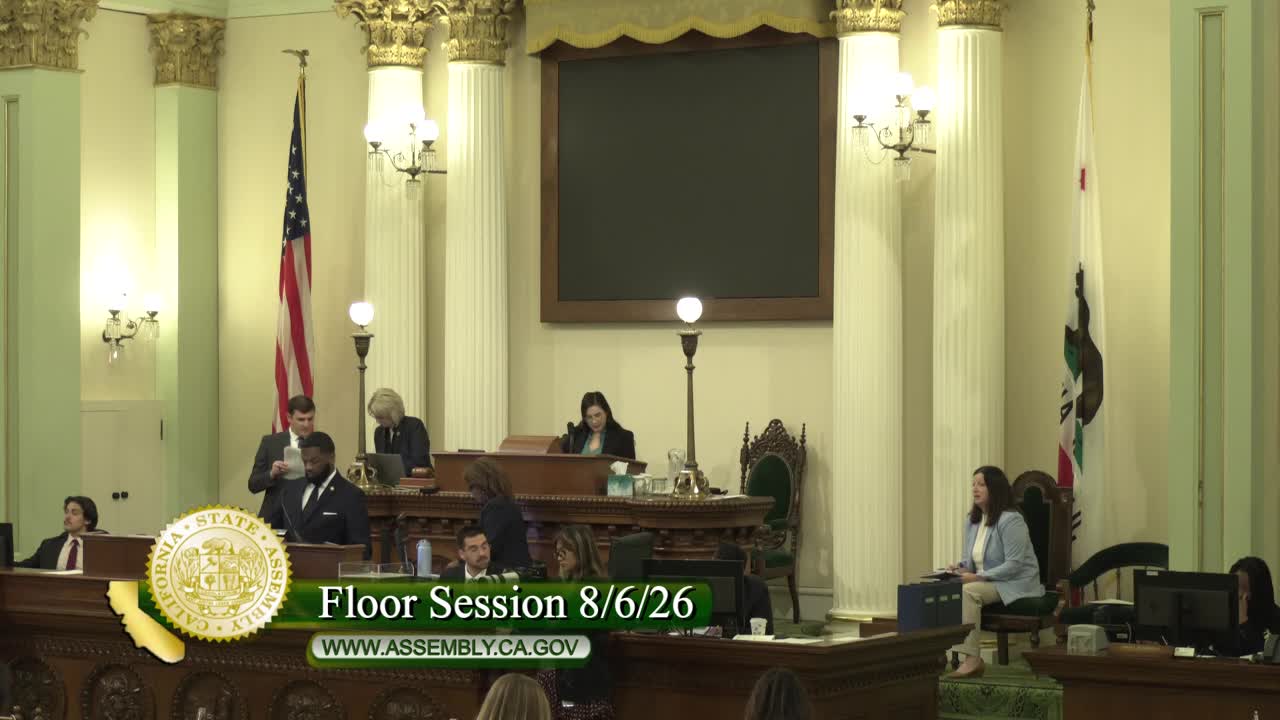
Bill Author

Bill Co-Author(s):