AB 2700: Public Utilities Commission: electrical corporations: wildfire victim restitution shortfalls: report: restitution mechanisms.
- Session Year: 2025-2026
- House: Assembly
- Latest Version Date: 2026-09-30
Current Status:
Passed
(2026-09-30: Chaptered by Secretary of State - Chapter 959, Statutes of 2026.)
Introduced
In Committee
Awaiting First Chamber Vote
Passed First Chamber
In Committee
Awaiting Second Chamber Vote
Passed Second Chamber
Enacted
Existing law vests the Public Utilities Commission with regulatory authority over public utilities, including electrical corporations. Existing law requires the Wildfire Fund Administrator, in consultation with the commission and other entities, to prepare and submit to the Legislature and the Governor a report that evaluates and sets forth recommendations on new models or approaches that mitigate damage, accelerate recovery, and responsibly and equitably allocate the burdens from natural catastrophes, including catastrophic wildfires, across stakeholders, as provided.
This bill would require the commission, on or before January 1, 2028, to generate a report assessing the verified restitution shortfalls for victims of wildfires caused by electrical corporations occurring before July 12, 2019, and to recommend restitution mechanisms for electrical corporations to address restitution shortfalls, as provided. The bill would require the commission, in developing the restitution mechanisms, to ensure, among other things, that the verified restitution shortfalls are consistently and fairly paid to ensure full compensation is issued in a timely manner.
Existing law vests the Public Utilities Commission with regulatory authority over public utilities, including electrical corporations. Existing law requires the Wildfire Fund Administrator, in consultation with the commission and other entities, to prepare and submit to the Legislature and the Governor a report that evaluates and sets forth recommendations on new models or approaches that mitigate damage, accelerate recovery, and responsibly and equitable allocate burdens from natural catastrophes, including catastrophic wildfires, across stakeholders, as provided.
This bill would require the commission, on or before January 1, 2028, to generate a report assessing the verified restitution shortfalls for victims of wildfires caused by electrical corporations occurring before July 12, 2019, and to recommend restitution mechanisms for electrical corporations to address restitution shortfalls, as provided. The bill would require the commission, in developing the restitution mechanisms, to ensure, among other things, that the verified restitution shortfalls are consistently and fairly paid to ensure full compensation is issued in a timely manner.
Existing law vests the Public Utilities Commission with regulatory authority over public utilities, including electrical corporations. Existing law requires the Wildfire Fund Administrator, in consultation with the commission and other entities, to prepare and submit to the Legislature and the Governor a report that evaluates and sets forth recommendations on new models or approaches that mitigate damage, accelerate recovery, and responsibly and equitable allocate burdens from natural catastrophes, including catastrophic wildfires, across stakeholders, as provided.This bill would require the commission, on or before January 1, 2028, to generate a report assessing the verified restitution shortfalls for victims of wildfires caused by electrical corporations occurring before July 12, 2019. The bill would further require the commission to recommend mechanisms for electrical corporations to address those shortfalls, as provided.Existing law vests the Public Utilities Commission with regulatory authority over public utilities, including electrical corporations. Existing law requires the Wildfire Fund Administrator, in consultation with the commission and other entities, to prepare and submit to the Legislature and the Governor a report that evaluates and sets forth recommendations on new models or approaches that mitigate damage, accelerate recovery, and responsibly and equitable allocate burdens from natural catastrophes, including catastrophic wildfires, across stakeholders, as provided.
This bill would require the commission, on or before January 1, 2028, to generate a report assessing the verified restitution shortfalls for victims of wildfires caused by electrical corporations occurring before July 12, 2019. The bill would further require the commission to recommend mechanisms for electrical corporations to address those shortfalls, as provided.
Existing law vests the Public Utilities Commission with regulatory authority over public utilities, including electrical corporations. Existing law authorizes the commission to fix the rates and charges for every public utility and requires that those rates and charges be just and reasonable. Existing law requires the Wildfire Fund Administrator, in consultation with the commission and other entities, to prepare and submit to the Legislature and the Governor a report that evaluates and sets forth recommendations on new models or approaches that mitigate damage, accelerate recovery, and responsibly and equitable allocate burdens from natural catastrophes, including catastrophic wildfires, across stakeholders, as provided.
This bill would require the commission to generate a report outlining recommendations to decrease the kilowatt-per-hour rate for electricity charged to ratepayers by not less than 30% by January 1, 2028. The bill would require the commission, in making those rate-reduction recommendations, to take certain actions, including to review, and evaluate the cost effectiveness of, certain public purposes programs and to audit electrical corporation wildfire mitigation plan costs, as specified. The bill would require the commission to also include in its commission, on or before January 1, 2028, to generate a report an assessment of assessing the verified restitution shortfalls for victims of wildfires caused by electrical corporations occurring before July 12, 2019. The bill would further require the commission to recommend mechanisms for electrical corporations to address those shortfalls, as provided.
Existing law vests the Public Utilities Commission with regulatory authority over public utilities, including electrical corporations. Existing law authorizes the commission to fix the rates and charges for every public utility and requires that those rates and charges be just and reasonable.
This bill would require the commission to generate a report outlining recommendations to decrease the kilowatt-per-hour rate for electricity charged to ratepayers by not less than 30% by January 1, 2028. The bill would require the commission, in making those rate-reduction recommendations, to take certain actions, including to review, and evaluate the cost effectiveness of, certain public purposes programs and to audit electrical corporation wildfire mitigation plan costs, as specified. The bill would require the commission to also include in its report an assessment of verified restitution shortfalls for victims of wildfires caused by electrical corporations occurring before July 12, 2019. The bill would further require the commission to recommend mechanisms for electrical corporations to address those shortfalls, as provided.
Existing law vests the Public Utilities Commission with regulatory authority over public utilities, including electrical corporations. Existing law authorizes the commission to fix the rates and charges for every public utility and requires that those rates and charges be just and reasonable.
This bill would require the commission to generate a report outlining recommendations to decrease the kilowatt-per-hour rate for electricity charged to ratepayers by not less than 30% by January 1, 2028. The bill would require the commission, in making those rate-reduction recommendations, to take certain actions, including to review, and evaluate the cost effectiveness of, certain public purposes programs and to audit electrical corporation wildfire mitigation plan costs, as specified.
Existing law vests the Public Utilities Commission with regulatory jurisdiction over public utilities. Existing law requires the commission, in establishing rates for a public utility operating any portion of its line, plant, or system within a federally designated nonattainment area, to determine which expenses related to compliance with state and local air pollution control requirements for using clean-burning fuels in that area are reasonable and necessary and to approve those expenses.This bill would make a nonsubstantive change to that requirement.Existing law vests the Public Utilities Commission with regulatory jurisdiction over public utilities. Existing law requires the commission, in establishing rates for a public utility operating any portion of its line, plant, or system within a federally designated nonattainment area, to determine which expenses related to compliance with state and local air pollution control requirements for using clean-burning fuels in that area are reasonable and necessary and to approve those expenses.
This bill would make a nonsubstantive change to that requirement.
(a)The Legislature finds and declares all of the following:
(1)The Public Utilities Commissions authority includes the ability to condition financial approvals and rate determinations on compliance with public interest obligations, including wildfire safety and victim compensation.
(2)The commission should support utility wildfire victim restitution consistent with its constitutional and statutory obligation to balance the financial integrity of public utilities with the protection of ratepayers and the financial interest of the public, including wildfire victims.
(3)On April 7, 2026, the Wildfire Fund Administrator, pursuant to Section 719 of the Public Utilities Code, issued a report titled, Enhancing Californias Resiliency to Natural Catastrophes: Senate Bill 254 (2025) Study Report (SB 254 Report) identifying the need for integrated solutions to ensure affordable rates and the timely and just compensation of wildfire victims.
(4)The SB 254 Report further recognizes that delays in compensation, like those stemming from the 2015 to 2018, inclusive, wildfires caused by the Pacific Gas and Electric Company, create high transaction costs, materially reduce recovery for wildfire victims, undermine public confidence in legislative and regulatory processes, and are unjust for victims.
(5)State supportive mechanisms, such as the Wildfire Fund and the Continuation Account, should be considered, but the Legislature recognizes that the ultimate responsibility and accountability for ensuring the fair, full, and timely restitution of wildfire victims rests with the electrical corporation that ignited the wildfire.
(b)In enacting this act, it is the intent of the Legislature to ensure all of the following:
(1)The establishment of the policy of the State of California that the victims of utility-caused wildfires should be fully, fairly, and timely compensated for their losses.
(2)Utility financial incentives, including authorized return on equity, should be aligned with public outcomes, including, but not limited to, energy affordability and the full compensation of wildfire victims.
(3)Restitution mechanisms should be expedited and implemented by identifying wildfire victim restitution shortfalls and establishing mechanisms to ensure that utility wildfire victims are made whole.
(4)Restitution provided pursuant to Section 719.3 of the Public Utilities Code should be paid directly to wildfire victims and not be paid for attorneys fees.
SEC. 2.Section 719.3 is added to the Public Utilities Code, immediately following Section 719, to read:719.3.(a)For purposes of this section, all of the following definitions apply:
(1)Fire Victim Trust means the Fire Victim Trust created pursuant to the order of the United States Bankruptcy Court for the Northern District of California dated June 20, 2020, case number 19-30088, docket number 8053.
(2)(A)Full compensation, for a victim of a wildfire caused by the Pacific Gas and Electric Company between January 1, 2015, and December 31, 2018, inclusive, that was litigated through the United States Bankruptcy Court, means payment of 100 percent of the verified economic and noneconomic losses of the victim, as indicated within the Fire Victim Trust Determination Notices issued pursuant to the Fire Victim Trust.
(B)Full compensation, for a victim of a wildfire not described in subparagraph (A) but caused by an electrical corporation, means 100 percent of the financial damages as determined by a court order, settlement agreement, utility compensation program, or other restitution mechanism.
(3)Timely means within a timeframe established by the commission to balance commercially reasonable timing for electrical corporations and a reasonable recovery period for victims based on their date of wildfire loss.
(4)(A)Verified restitution shortfalls means uncompensated or undercompensated losses as determined through a court-approved trust administration process, settlement agreement, or commission-recognized methodology, except as specified in subparagraph (B).
(B)Verified restitution shortfalls, for a victim of a wildfire who is partially compensated through the Fire Victim Trust, means the total amount of all economic and noneconomic losses as indicated within the Fire Victim Trusts Determination Notices issued pursuant to the Fire Victim Trust.
(b)On or before January 1, 2028, the commission shall generate a report assessing the verified restitution shortfalls for victims of wildfires caused by electrical corporations occurring before July 12, 2019, and recommend restitution mechanisms for electrical corporations to address those shortfalls to ensure victims are fully and fairly compensated in a timely manner while supporting long-term rate stability. The recommended restitution mechanisms shall not include any measures that authorize rate recovery for restitution payments.
(c)(1)In developing the restitution mechanisms to be included in the report, the commission shall ensure all of the following:
(A)Verified restitution shortfalls are consistently and fairly paid to ensure full compensation is issued in a timely manner.
(B)Incremental payments, if any, to wildfire victims are made on a proportional basis relative to the verified losses where full and immediate payment is not feasible.
(C)Establishment of timelines and benchmarks for achieving full compensation.
(2)The restitution mechanisms shall include assessments of verified restitution shortfalls for all victims of wildfires caused by an electrical corporation that prioritize and expedite remedies for victims of wildfires occurring between January 1, 2015, and July 12, 2019.
(d)In addition to subdivision (c), the restitution mechanisms developed for the report shall do all of the following:
(1)Ensure there is a path to full restitution for wildfire victims of Pacific Gas and Electric Company from wildfires occurring between calendar years 2015 and 2018, inclusive.
(2)Set a foundation and precedent for ensuring equitable restitution for all wildfire victims, including victims of the 2025 Eaton Fire, if it is determined that an electrical corporation caused that wildfire.
(3)Establish a framework within existing commission processes and those established through the Wildfire Fund to reduce costs for administration and streamline victim restitution processes.
(e)The commission shall not consider restitution mechanisms that include any measures that authorize rate recovery for restitution payments. The commission shall instead consider restitution mechanisms that rely on other measures, including, but not limited to, all of the following:
(1)Deferred or reduced shareholder dividends.
(2)Retained earnings or equity contributions.
(3)Bonds or other unstructured or structured debt mechanisms.
(4)Access to existing wildfire-related financial structures, where permissible.
(5)Other financial tools that preserve utility financial stability while ensuring full victim compensation.
(f)This section does not require the taking of private property but establishes conditions on the continued exercise of utility privileges granted by the State of California, including the authorization to collect rates, access capital markets, and operate as a regulated monopoly under a certificate of public convenience and necessity.
(g)The commission shall not implement the restitution mechanisms developed pursuant to this section unless explicitly authorized by statute.
(a)The Legislature finds and declares all of the following:
(1)The Public Utilities Commissions authority includes the ability to condition financial approvals and rate determinations on compliance with public interest obligations, including wildfire safety and victim compensation.
(2)The commission should support utility wildfire victim restitution consistent with its constitutional and statutory obligation to balance the financial integrity of public utilities with the protection of ratepayers and the financial interest of the public, including wildfire victims.
(3)On April 7, 2026, the Wildfire Fund Administrator, pursuant to Section 719 of the Public Utilities Code, issued a report titled, Enhancing Californias Resiliency to Natural Catastrophes: Senate Bill 254 (2025) Study Report (SB 254 Report) identifying the need for integrated solutions to ensure affordable rates and the timely and just compensation of wildfire victims.
(4)The SB 254 Report further recognizes that delays in compensation, like those stemming from the 2015 to 2018, inclusive, wildfires caused by the Pacific Gas and Electric Company, create high transaction costs, materially reduce recovery for wildfire victims, undermine public confidence in legislative and regulatory processes, and are unjust for victims.
(5)State supportive mechanisms, such as the Wildfire Fund and the Continuation Account, should be considered, but the Legislature recognizes that the ultimate responsibility and accountability for ensuring the fair, full, and timely restitution of wildfire victims rests with the electrical corporation that ignited the wildfire.
(b)In enacting this act, it is the intent of the Legislature to ensure all of the following:
(1)The establishment of the policy of the State of California that the victims of utility-caused wildfires should be fully, fairly, and timely compensated for their losses.
(2)Utility financial incentives, including authorized return on equity, should be aligned with public outcomes, including, but not limited to, energy affordability and the full compensation of wildfire victims.
(3)Restitution mechanisms should be expedited and implemented by identifying wildfire victim restitution shortfalls and establishing mechanisms to ensure that utility wildfire victims are made whole.
(4)Restitution provided pursuant to Section 719.3 of the Public Utilities Code should be paid directly to wildfire victims and not be paid for attorneys fees.
SEC. 2.Section 719.3 is added to the Public Utilities Code, immediately following Section 719, to read:719.3.(a)For purposes of this section, all of the following definitions apply:
(1)Fire Victim Trust means the Fire Victim Trust created pursuant to the order of the United States Bankruptcy Court for the Northern District of California dated June 20, 2020, case number 19-30088, docket number 8053.
(2)(A)Full compensation, for a victim of a wildfire caused by the Pacific Gas and Electric Company between January 1, 2015, and December 31, 2018, inclusive, that was litigated through the United States Bankruptcy Court, means payment of 100 percent of the verified economic and noneconomic losses of the victim, as indicated within the Fire Victim Trust Determination Notices issued pursuant to the Fire Victim Trust.
(B)Full compensation, for a victim of a wildfire not described in subparagraph (A) but caused by an electrical corporation, means 100 percent of the financial damages as determined by a court order, settlement agreement, utility compensation program, or other restitution mechanism.
(3)Timely means within a timeframe established by the commission to balance commercially reasonable timing for electrical corporations and a reasonable recovery period for victims based on their date of wildfire loss.
(4)(A)Verified restitution shortfalls means uncompensated or undercompensated losses as determined through a court-approved trust administration process, settlement agreement, or commission-recognized methodology, except as specified in subparagraph (B).
(B)Verified restitution shortfalls, for a victim of a wildfire who is partially compensated through the Fire Victim Trust, means the total amount of all economic and noneconomic losses as indicated within the Fire Victim Trusts Determination Notices issued pursuant to the Fire Victim Trust.
(b)On or before January 1, 2028, the commission shall generate a report assessing the verified restitution shortfalls for victims of wildfires caused by electrical corporations occurring before July 12, 2019, and recommend restitution mechanisms for electrical corporations to address those shortfalls to ensure victims are fully and fairly compensated in a timely manner while supporting long-term rate stability. The recommended restitution mechanisms shall not include any measures that authorize rate recovery for restitution payments.
(c)(1)In developing the restitution mechanisms, mechanisms to be included in the report, the commission shall ensure all of the following:
(A)Verified restitution shortfalls are consistently and fairly paid to ensure full compensation is issued in a timely manner.
(B)Incremental payments, if any, to wildfire victims are made on a proportional basis relative to the verified losses where full and immediate payment is not feasible.
(C)Establishment of timelines and benchmarks for achieving full compensation.
(2)The restitution mechanisms shall include assessments of verified restitution shortfalls for all victims of wildfires caused by an electrical corporation that prioritize and expedite remedies for victims of wildfires occurring between January 1, 2015, and July 12, 2019.
(d)In addition to subdivision (c), the restitution mechanisms developed for the report shall do all of the following:
(1)Ensure there is a path to full restitution for wildfire victims of Pacific Gas and Electric Company from wildfires occurring between calendar years 2015 and 2018, inclusive.
(2)Set a foundation and precedent for ensuring equitable restitution for all wildfire victims, including victims of the 2025 Eaton Fire, if it is determined that an electrical corporation caused that wildfire.
(3)Establish a framework within existing commission processes and those established through the Wildfire Fund to reduce costs for administration and streamline victim restitution processes.
(e)The commission shall not consider restitution mechanisms that include any measures that authorize rate recovery for restitution payments. The commission shall instead consider restitution mechanisms that rely on other measures, including, but not limited to, all of the following:
(1)Deferred or reduced shareholder dividends.
(2)Retained earnings or equity contributions.
(3)Bonds or other unstructured or structured debt mechanisms.
(4)Access to existing wildfire-related financial structures, where permissible.
(5)Other financial tools that preserve utility financial stability while ensuring full victim compensation.
(f)This section does not require the taking of private property but establishes conditions on the continued exercise of utility privileges granted by the State of California, including the authorization to collect rates, access capital markets, and operate as a regulated monopoly under a certificate of public convenience and necessity.
(g)The commission shall not implement the restitution mechanisms developed pursuant to this section unless explicitly authorized by statute.
(a)The Legislature finds and declares all of the following:
(1)The Public Utilities Commissions authority includes the ability to condition financial approvals and rate determinations on compliance with public interest obligations, including wildfire safety and victim compensation.
(2)The commission should support utility wildfire victim restitution consistent with its constitutional and statutory obligation to balance the financial integrity of public utilities with the protection of ratepayers and the financial interest of the public, including wildfire victims.
(3)On April 7, 2026, the Wildfire Fund Administrator, pursuant to Section 719 of the Public Utilities Code, issued a report titled, Enhancing Californias Resiliency to Natural Catastrophes: Senate Bill 254 (2025) Study Report (SB 254 Report) identifying the need for integrated solutions to ensure affordable rates and the timely and just compensation of wildfire victims.
(4)The SB 254 Report further recognizes that delays in compensation, like those stemming from the 2015 to 2018, inclusive, wildfires caused by the Pacific Gas and Electric Company, create high transaction costs, materially reduce recovery for wildfire victims, undermine public confidence in legislative and regulatory processes, and are unjust for victims.
(5)State supportive mechanisms, such as the Wildfire Fund and the Continuation Account, should be considered, but the Legislature recognizes that the ultimate responsibility and accountability for ensuring the fair, full, and timely restitution of wildfire victims rests with the electrical corporation that ignited the wildfire.
(b)In enacting this act, it is the intent of the Legislature to ensure all of the following:
(1)The establishment of the policy of the State of California that the victims of utility-caused wildfires should be fully, fairly, and timely compensated for their losses.
(2)Utility financial incentives, including authorized return on equity, should be aligned with public outcomes, including, but not limited to, energy affordability and the full compensation of wildfire victims.
(3)Restitution mechanisms should be expedited and implemented by identifying wildfire victim restitution shortfalls and establishing mechanisms to ensure that utility wildfire victims are made whole.
(4)Restitution provided pursuant to Section 719.3 of the Public Utilities Code should be paid directly to wildfire victims and not be paid for attorneys fees.
SEC. 2.Section 719.3 is added to the Public Utilities Code, immediately following Section 719, to read:719.3.(a)For purposes of this section, all of the following definitions apply:
(1)Fire Victim Trust means the Fire Victim Trust created pursuant to the order of the United States Bankruptcy Court for the Northern District of California dated June 20, 2020, case number 19-30088, docket number 8053.
(2)(A)Full compensation, for a victim of a wildfire caused by the Pacific Gas and Electric Company between January 1, 2015, and December 31, 2018, inclusive, that was litigated through the United States Bankruptcy Court, means payment of 100 percent of the verified economic and noneconomic losses of the victim, as indicated within the Fire Victim Trust Determination Notices issued pursuant to the Fire Victim Trust.
(B)Full compensation, for a victim of a wildfire not described in subparagraph (A) but caused by an electrical corporation, means 100 percent of the financial damages as determined by a court order, settlement agreement, utility compensation program, or other restitution mechanism.
(3)Timely means within a timeframe established by the commission to balance commercially reasonable timing for electrical corporations and a reasonable recovery period for victims based on their date of wildfire loss.
(4)(A)Verified restitution shortfalls means uncompensated or undercompensated losses as determined through a court-approved trust administration process, settlement agreement, or commission-recognized methodology, except as specified in subparagraph (B).
(B)Verified restitution shortfalls, for a victim of a wildfire who is partially compensated through the Fire Victim Trust, means the total amount of all economic and noneconomic losses as indicated within the Fire Victim Trusts Determination Notices issued pursuant to the Fire Victim Trust.
(b)On or before January 1, 2028, the commission shall generate a report assessing the verified restitution shortfalls for victims of wildfires caused by electrical corporations occurring before July 12, 2019, and recommend restitution mechanisms for electrical corporations to address those shortfalls to ensure victims are fully and fairly compensated in a timely manner while supporting long-term rate stability. The recommended restitution mechanisms shall not include any measures that authorize rate recovery for restitution payments.
(c)(1)In developing the restitution mechanisms, the commission shall ensure all of the following:
(A)Verified restitution shortfalls are consistently and fairly paid to ensure full compensation is issued in a timely manner.
(B)Incremental payments, if any, to wildfire victims are made on a proportional basis relative to the verified losses where full and immediate payment is not feasible.
(C)Establishment of timelines and benchmarks for achieving full compensation.
(2)The restitution mechanisms shall include assessments of verified restitution shortfalls for all victims of wildfires caused by an electrical corporation that prioritize and expedite remedies for victims of wildfires occurring between January 1, 2015, and July 12, 2019.
(d)In addition to subdivision (c), the restitution mechanisms shall do all of the following:
(1)Ensure there is a path to full restitution for wildfire victims of Pacific Gas and Electric Company from wildfires occurring between calendar years 2015 and 2018, inclusive.
(2)Set a foundation and precedent for ensuring equitable restitution for all wildfire victims, including victims of the 2025 Eaton Fire, if it is determined that an electrical corporation caused that wildfire.
(3)Establish a framework within existing commission processes and those established through the Wildfire Fund to reduce costs for administration and streamline victim restitution processes.
(e)The commission shall not consider restitution mechanisms that include any measures that authorize rate recovery for restitution payments. The commission shall instead consider restitution mechanisms that rely on other measures, including, but not limited to, all of the following:
(1)Deferred or reduced shareholder dividends.
(2)Retained earnings or equity contributions.
(3)Bonds or other unstructured or structured debt mechanisms.
(4)Access to existing wildfire-related financial structures, where permissible.
(5)Other financial tools that preserve utility financial stability while ensuring full victim compensation.
(f)This section does not require the taking of private property but establishes conditions on the continued exercise of utility privileges granted by the State of California, including the authorization to collect rates, access capital markets, and operate as a regulated monopoly under a certificate of public convenience and necessity.
(g)The commission shall not implement the restitution mechanisms developed pursuant to this section unless explicitly authorized by statute.
SECTION 1.Section 719.3 is added to the Public Utilities Code, immediately following Section 719, to read:719.3.On or before January 1, 2028, the commission shall generate a report assessing the verified restitution shortfalls for victims of wildfires caused by electrical corporations occurring before July 12, 2019, and recommend mechanisms for electrical corporations to address those verified restitution shortfalls to ensure victims are fully and fairly compensated in a timely manner while supporting long-term rate stability. The recommendations shall not include any measures that authorize rate recovery for restitution payments.On or before January 1, 2028, the commission shall generate a report assessing the verified restitution shortfalls for victims of wildfires caused by electrical corporations occurring before July 12, 2019, and recommend mechanisms for electrical corporations to address those verified restitution shortfalls to ensure victims are fully and fairly compensated in a timely manner while supporting long-term rate stability. The recommendations shall not include any measures that authorize rate recovery for restitution payments.
On or before January 1, 2028, the commission shall include in the generate a report an assessment of assessing the verified restitution shortfalls for victims of wildfires caused by electrical corporations occurring before July 12, 2019, and recommend mechanisms for electrical corporations to address those shortfalls to ensure victims are fully and fairly compensated in a timely manner while supporting long-term rate stability. The recommendations shall not include any measures that authorize rate recovery for restitution payments.
(a)The commission shall generate a report outlining recommendations to decrease the kilowatt-per-hour rate for electricity charged to ratepayers by not less than 30 percent by January 1, 2028.
(b)In making the rate reduction recommendations pursuant to subdivision (a), the commission shall do all of the following:
(1)Review each public purpose program that is not cost effective, and evaluate each public purpose program that the commission has not yet evaluated for cost-effectiveness.
(2)For purposes of the climate credit described in Section 748.5, consider adopting the suggestions made by the commission in its CPUC Response to Executive Order No. N-5-24 (February 18, 2025).
(3)Pursuant to the commissions authority under Section 314.6, audit costs claimed by an electrical corporation for implementing its wildfire mitigation plans and, to the extent those costs are unreasonable, recommend reducing rates accordingly.
(4)Evaluate each program listed in Table A-2 of the commissions CPUC Response to Executive Order No. N-5-24 (February 18, 2025) for cost-effectiveness, if the commission has not yet evaluated the program for cost-effectiveness. For a program that the commission determines is not cost effective, eliminate, reform, or recommend action by the Legislature.
(c)In addition to the rate reduction recommendations required pursuant to subdivision (a), the commission shall include in the report an assessment of verified restitution shortfalls for victims of wildfires caused by electrical corporations occurring before July 12, 2019, and recommend mechanisms for electrical corporations to address those shortfalls to ensure victims are fully and fairly compensated in a timely manner while supporting long-term rate stability. The recommendations shall not include any measures that authorize rate recovery for restitution payments.
REVISIONS: HeadingLine 2.(a)The commission shall generate a report outlining recommendations to decrease the kilowatt-per-hour rate for electricity charged to ratepayers by not less than 30 percent by January 1, 2028.
(b)In making the reduction recommendations pursuant to subdivision (a), the commission shall do all of the following:
(1)Review each public purpose program that is not cost effective, and evaluate each public purpose program that the commission has not yet evaluated for cost-effectiveness.
(2)For purposes of the climate credit described in Section 748.5, consider adopting the suggestions made by the commission in its CPUC Response to Executive Order No. N-5-24 (February 18, 2025).
(3)Pursuant to the commissions authority under Section 314.6, audit costs claimed by an electrical corporation for implementing its wildfire mitigation plans and, to the extent those costs are unreasonable, recommend reducing rates accordingly.
(4)Evaluate each program listed in Table A-2 of the commissions CPUC Response to Executive Order No. N-5-24 (February 18, 2025) for cost-effectiveness, if the commission has not yet evaluated the program for cost-effectiveness. For a program that the commission determines is not cost effective, eliminate, reform, or recommend action by the Legislature.
SECTION 1.Section 738.6 of the Public Utilities Code is amended to read:738.6.In establishing rates for a public utility operating a portion of its line, plant, or system within a federally designated nonattainment area, the commission shall determine which expenses related to compliance with state and local air pollution control requirements for using clean-burning fuels in that area are reasonable and necessary and shall approve those expenses.In establishing rates for a public utility operating any a portion of its line, plant, or system within a federally designated nonattainment area, the commission shall determine which expenses related to compliance with state and local air pollution control requirements for using clean-burning fuels in that area are reasonable and necessary and shall approve those expenses.
|
Date
|
Status
|
|---|---|
| Sep 30, 2026 | Chaptered by Secretary of State - Chapter 959, Statutes of 2026. |
| Sep 30, 2026 | Approved by the Governor. |
| Sep 15, 2026 | Enrolled and presented to the Governor at 3 p.m. |
| Aug 31, 2026 | Senate amendments concurred in. To Engrossing and Enrolling. (Ayes 78. Noes 0. Page 6987.). |
| Aug 31, 2026 | Assembly Rule 63 suspended. (Page 6985.) |
| Aug 31, 2026 | Senate amendments concurred in. To Engrossing and Enrolling. (Ayes 78. Noes 0.). |
| Aug 31, 2026 | Senate amendments concurred in. To Engrossing and Enrolling. |
| Aug 31, 2026 | Assembly Rule 63 suspended. |
| Aug 31, 2026 | From committee: That the Senate amendments be concurred in. (Ayes 17. Noes 0.) (August 30). |
| Aug 25, 2026 | Re-referred to Com. on U. & E. pursuant to Assembly Rule 77.2. |
| Aug 24, 2026 | In Assembly. Concurrence in Senate amendments pending. |
| Aug 24, 2026 | Read third time. Passed. Ordered to the Assembly. (Ayes 40. Noes 0. Page 5708.). |
| Aug 24, 2026 | Read third time. Passed. Ordered to the Assembly. (Ayes 39. Noes 0.). |
| Aug 17, 2026 | Read second time. Ordered to third reading. |
| Aug 13, 2026 | Read second time and amended. Ordered returned to second reading. |
| Aug 13, 2026 | From committee: Amend, and do pass as amended. (Ayes 7. Noes 0.) (August 13). |
| Aug 10, 2026 | In committee: Referred to APPR. suspense file. |
| Aug 3, 2026 | From committee chair, with author's amendments: Amend, and re-refer to committee. Read second time, amended, and re-referred to Com. on APPR. |
| Jul 29, 2026 | In committee: Hearing postponed by committee. |
| Jun 30, 2026 | From committee: Do pass and re-refer to Com. on APPR. (Ayes 16. Noes 0.) (June 30). Re-referred to Com. on APPR. |
| Jun 24, 2026 | From committee chair, with author's amendments: Amend, and re-refer to committee. Read second time, amended, and re-referred to Com. on E., U & C. |
| Jun 10, 2026 | Referred to Com. on E., U & C. |
| Jun 1, 2026 | In Senate. Read first time. To Com. on RLS. for assignment. |
| May 28, 2026 | Read third time. Passed. Ordered to the Senate. (Ayes 76. Noes 0. Page 5539.) |
| May 28, 2026 | Read third time. Passed. Ordered to the Senate. (Ayes 76. Noes 0.) |
| May 19, 2026 | Read second time. Ordered to third reading. |
| May 18, 2026 | Read second time and amended. Ordered returned to second reading. |
| May 14, 2026 | Joint Rule 62(a), file notice suspended. (Page 5030.) |
| May 14, 2026 | From committee: Amend, and do pass as amended. (Ayes 15. Noes 0.) (May 14). |
| May 14, 2026 | Joint Rule 62(a), file notice suspended. |
| May 13, 2026 | In committee: Set, first hearing. Referred to APPR. suspense file. |
| Apr 9, 2026 | From committee: Do pass and re-refer to Com. on APPR. with recommendation: To Consent Calendar. (Ayes 17. Noes 0.) (April 8). Re-referred to Com. on APPR. |
| Apr 9, 2026 | Coauthors revised. |
| Mar 24, 2026 | Re-referred to Com. on U. & E. |
| Mar 23, 2026 | From committee chair, with author's amendments: Amend, and re-refer to Com. on U. & E. Read second time and amended. |
| Mar 11, 2026 | Re-referred to Com. on U. & E. |
| Mar 10, 2026 | From committee chair, with author's amendments: Amend, and re-refer to Com. on U. & E. Read second time and amended. |
| Mar 9, 2026 | Referred to Com. on U. & E. |
| Feb 21, 2026 | From printer. May be heard in committee March 23. |
| Feb 20, 2026 | Read first time. To print. |
|
Date
|
Description
|
Location
|
Votes
|
|
|---|---|---|---|---|
| Aug 31, 2026 | AB 2700 PATTERSON Concurrence in Senate Amendments By PATTERSON | Assembly Floor |
Passed |
|
| Aug 30, 2026 | With recommendation: That Senate amendments be concurred in. | Assembly Standing Committee on Utilities and Energy |
Passed |
|
| Aug 24, 2026 | Assembly 3rd Reading AB2700 Patterson et al. | Senate Floor |
Passed |
|
| Aug 13, 2026 | Do pass as amended | Senate Standing Committee on Appropriations |
Passed |
|
| Aug 10, 2026 | Placed on suspense file | Senate Standing Committee on Appropriations |
Passed |
|
| Jun 30, 2026 | Do pass, but first be re-referred to the Committee on [Appropriations] | Senate Standing Committee on Energy, Utilities and Communications |
Passed |
|
| May 28, 2026 | AB 2700 Gallagher Assembly Third Reading | Assembly Floor |
Passed |
|
| May 14, 2026 | Do pass as amended. | Assembly Standing Committee on Appropriations |
Passed |
|
| Apr 8, 2026 | Do pass and be re-referred to the Committee on [Appropriations] with recommendation: To Consent Calendar | Assembly Standing Committee on Utilities and Energy |
Passed |
This list shows positions taken on this bill by organizations on the date displayed, which is linked to the original source.
Positions by individuals are not included.
|
Organization
|
Position
|
Date
|
|---|---|---|
| 19 Individuals | ** Support | |
| Adler Law Group | ** Support | |
| After The Fire | ** Support | |
| California Farm Bureau | ** Support | |
| Camp Fire Survivors | ** Support | |
| County of Butte | ** Support | |
| Cutter Law | ** Support | |
| Easton Fire Residents United | ** Support | |
| Green Power Institute | ** Support | |
| KastleRock Foundation | ** Support | |
| Mayor Steve Crowder, Town of Paradise | ** Support | |
| Numerous individuals | ** Support | |
| Pacific Gas and Electric (PG&E) | ** Against | |
| San Diego Gas and Electric Company | ** Support | |
| Southern California Edison (SCE) | ** Against | |
| Supervisor Robert Rickman, San Joaquin County District 5 | ** Support | |
| The Utility Wildfire Survivor Coalition | ** Support | |
| Utility Wildfire Survivor Coalition | ** Support |
(Without Reference to File)
CONCURRENCE IN SENATE AMENDMENTS
CSA2 Bill Id:AB 2700
Author:(Patterson)
As Amended Ver:August 13, 2026
Majority vote
SUMMARY
Original Committee of Reference: Utilities and Energy
Requires the California Public Utilities Commission (CPUC), on or before January 1, 2028, to generate a report assessing the verified restitution shortfalls for victims of wildfires caused by electrical corporations occurring before July 12, 2019, and to recommend restitution mechanisms for electrical corporations to address restitution shortfalls, as provided.
Senate Amendments
Current Committee Recommendation: Senate Amendments Be Concurred In
Provide specific direction to the CPUC regarding the report requirements for assessing the verified restitution shortfalls for victims of wildfires caused by electrical corporations occurring before July 12, 2019. These details include the following:
- Requires the CPUC, in developing the restitution mechanisms in the report, to ensure, among other things, that the verified restitution shortfalls are consistently and fairly paid to ensure full compensation is issued in a timely manner while supporting long-term rate stability.
- Requires the CPUC to ensure the restitution mechanisms in the report provide, among other requirements, a path to full restitution for wildfire victims of Pacific Gas and Electric (PG&E) Company from wildfires occurring between calendar years 2015 and 2018.
- Prohibits recommendations that include any measures that authorize rate recovery for restitution payments.
COMMENTS
On July 12, 2019, Governor Newsom signed AB 1054, which established the California Wildfire Fund. A "covered wildfire" under that law is only one ignited on or after July 12, 2019. This means that while electrical corporations are still liable for damages caused by wildfires caused by their equipment prior to July 12, 2019, they cannot access the Wildfire Fund to pay those liabilities. The fires at issue primarily include the 2015 Butte Fire, 2017 North Bay Fires (including the Tubbs Fire), 2017 Thomas Fire, and 2018 Camp Fire. For victims of the 2015 Butte Fire, 2017 North Bay Fires, and 2018 Camp Fire, the primary restitution mechanism is the PG&E Fire Victim Trust (Trust), established as a condition of PG&E's bankruptcy reorganization. PG&E funded the Trust with $5.4 billion in cash and 22.19% of stock in the reorganized PG&E. Tying compensation to PG&E stock value proved problematic for victims. As of October 2024, the pro rata payment percentage stood at 70%, with no mechanism to recover the remaining 30%. The stock held in the Trust is fully liquidated, with the final distribution expected this summer following resolution on a settlement agreement with a utility vegetation management contractor. As of the last reporting, the Trust has paid out $13.71 billion in claims with a total of $19.57 billion in determination for economic and noneconomic claims.
According to the Author
According to the author, "Wildfire victims have lost their properties, their homes, and sometimes even their loved ones. Despite these significant losses, wildfire victims have waited years to be paid what they were promised. No amount of compensation can fully redress the pain and heartache victims have suffered but even this meager help has not been provided them. AB 2700 is an important step to ensure that victims of wildfires can receive the compensation they deserve."
Arguments in Support
According to the Utility Wildfire Survivor Coalition, "Many wildfire survivors from the 2015-2018 PG&E fires continue to suffer from dramatically incomplete compensation, unrepaired homes, vacant lots, unpaid medical liens, financial instability, and years of delayed recovery. PG&E has not made good on their stated commitments to fully and fairly pay fire victims…AB 2700 does not predetermine the outcome of the CPUC's work. It simply requires the CPUC to assess verified restitution shortfalls and recommend mechanisms for electrical corporations to address them."
Arguments in Opposition
In joint opposition, Pacific Gas and Electric (PG&E) and Southern California Edison (SCE) write "AB 2700 is counterproductive, impractical and legally flawed. It offers no workable solution to California's pressing wildfire and affordability challenges. Instead, it increases utility financial instability, discourages investment in critical infrastructure, and undermines the timely grid upgrades that a safe, reliable and carbon-free energy system require."
FISCAL COMMENTS
According to the Senate Committee on Appropriations, the CPUC estimates one-time costs of $5 million to conduct the study.
VOTES
ASM UTILITIES AND ENERGY: 17-0-1
YES: Petrie-Norris, Patterson, Boerner, Calderon, Davies, Mark González, Harabedian, Hart, Irwin, Kalra, Papan, Rogers, Schiavo, Schultz, Ta, Wallis, Zbur
ABS, ABST OR NV: Chen
ASM APPROPRIATIONS: 15-0-0
YES: Wicks, Hoover, Aguiar-Curry, Calderon, Caloza, Dixon, Fong, Mark González, Krell, Pacheco, Pellerin, Sharp-Collins, Solache, Ta, Tangipa
ASSEMBLY FLOOR: 76-0-4
YES: Addis, Aguiar-Curry, Ahrens, Alanis, Alvarez, Arambula, Ávila Farías, Bains, Bauer-Kahan, Bennett, Berman, Boerner, Bonta, Bryan, Calderon, Caloza, Carrillo, Castillo, Chen, Connolly, Davies, DeMaio, Dixon, Elhawary, Ellis, Flora, Fong, Gabriel, Gallagher, Garcia, Gipson, Jeff Gonzalez, Mark González, Hadwick, Haney, Harabedian, Hart, Hoover, Irwin, Johnson, Kalra, Krell, Lackey, Lowenthal, Macedo, McKinnor, Muratsuchi, Nguyen, Ortega, Pacheco, Papan, Patel, Patterson, Pellerin, Petrie-Norris, Ramos, Ransom, Michelle Rodriguez, Rogers, Blanca Rubio, Sanchez, Schiavo, Schultz, Sharp-Collins, Solache, Soria, Stefani, Ta, Tangipa, Valencia, Wallis, Ward, Wicks, Wilson, Zbur, Rivas
ABS, ABST OR NV: Jackson, Lee, Quirk-Silva, Celeste Rodriguez
SENATE FLOOR: 40-0-0
YES: Allen, Alvarado-Gil, Archuleta, Arreguín, Ashby, Becker, Blakespear, Cabaldon, Caballero, Cervantes, Choi, Cortese, Dahle, Durazo, Gonzalez, Grayson, Grove, Hurtado, Jones, Laird, Limón, McGuire, McNerney, Menjivar, Niello, Ochoa Bogh, Padilla, Pérez, Reyes, Richardson, Rubio, Seyarto, Smallwood-Cuevas, Stern, Strickland, Umberg, Valladares, Wahab, Weber Pierson, Wiener
ASM UTILITIES AND ENERGY: 17-0-1
YES: Petrie-Norris, Patterson, Boerner, Calderon, Chen, Davies, Harabedian, Hart, Irwin, Kalra, Papan, Rogers, Schiavo, Schultz, Ta, Wallis, Zbur
ABS, ABST OR NV: Mark González
UPDATED
VERSION: August 13, 2026
CONSULTANT: Laura Shybut / U. & E. / (916) 319-2083 FN: 0004545
CONCURRENCE IN SENATE AMENDMENTS
CSA1 Bill Id:AB 2700
Author:(Patterson)
As Amended Ver:August 13, 2026
Majority vote
SUMMARY
This bill requires the California Public Utilities Commission (CPUC), on or before January 1, 2028, to generate a report assessing the verified restitution shortfalls for victims of wildfires caused by electrical corporations occurring before July 12, 2019, and to recommend restitution mechanisms for electrical corporations to address restitution shortfalls, as provided.
Senate Amendments
This bill was amended in the Senate to provide more direction to the CPUC regarding the report requirements for assessing the verified restitution shortfalls for victims of wildfires caused by electrical corporations occurring before July 12, 2019. These details include the following:
- Requires the CPUC, in developing the restitution mechanisms in the report, to ensure, among other things, that the verified restitution shortfalls are consistently and fairly paid to ensure full compensation is issued in a timely manner while supporting long-term rate stability.
- Requires the CPUC to ensure the restitution mechanisms in the report provide, among other requirements, a path to full restitution for wildfire victims of Pacific Gas and Electric (PG&E) Company from wildfires occurring between calendar years 2015 and 2018.
- Prohibits recommendations that include any measures that authorize rate recovery for restitution payments.
COMMENTS
On July 12, 2019, Governor Newsom signed AB 1054 (Holden) Chapter 79, Statutes of 2019 which established the California Wildfire Fund. A "covered wildfire" under that law is only one ignited on or after July 12, 2019. This means that while electrical corporations are still liable for damages caused by wildfires caused by their equipment prior to July 12, 2019, they cannot access the Wildfire Fund to pay those liabilities. The fires at issue primarily include the 2015 Butte Fire, 2017 North Bay Fires (including the Tubbs Fire), 2017 Thomas Fire, and 2018 Camp Fire. For victims of the 2015 Butte Fire, 2017 North Bay Fires, and 2018 Camp Fire, the primary restitution mechanism is the PG&E Fire Victim Trust (Trust), established as a condition of PG&E's bankruptcy reorganization. PG&E funded the Trust with $5.4 billion in cash and 22.19% of stock in the reorganized PG&E. Tying compensation to PG&E stock value proved problematic for victims. As of October 2024, the pro rata payment percentage stood at 70%, with no mechanism to recover the remaining 30%. The stock held in the Trust is fully liquidated, with the final distribution expected this summer following resolution on a settlement agreement with a utility vegetation management contractor. As of the last reporting, the Trust has paid out $13.71 billion in claims with a total of $19.57 billion in determination for economic and noneconomic claims.
According to the Author
According to the author, "Wildfire victims have lost their properties, their homes, and sometimes even their loved ones. Despite these significant losses, wildfire victims have waited years to be paid what they were promised. No amount of compensation can fully redress the pain and heartache victims have suffered but even this meager help has not been provided them. AB 2700 is an important step to ensure that victims of wildfires can receive the compensation they deserve."
Arguments in Support
According to the Utility Wildfire Survivor Coalition, "Many wildfire survivors from the 2015-2018 PG&E fires continue to suffer from dramatically incomplete compensation, unrepaired homes, vacant lots, unpaid medical liens, financial instability, and years of delayed recovery. PG&E has not made good on their stated commitments to fully and fairly pay fire victims…AB 2700 does not predetermine the outcome of the CPUC's work. It simply requires the CPUC to assess verified restitution shortfalls and recommend mechanisms for electrical corporations to address them."
Arguments in Opposition
In joint opposition, Pacific Gas and Electric (PG&E) and Southern California Edison (SCE) write "AB 2700 is counterproductive, impractical and legally flawed. It offers no workable solution to California's pressing wildfire and affordability challenges. Instead, it increases utility financial instability, discourages investment in critical infrastructure, and undermines the timely grid upgrades that a safe, reliable and carbon-free energy system require."
FISCAL COMMENTS
According to the Senate Committee on Appropriations, the CPUC estimates one-time costs of $5 million to conduct the study.
VOTES:
ASM UTILITIES AND ENERGY: 17-0-1
YES: Petrie-Norris, Patterson, Boerner, Calderon, Davies, Mark González, Harabedian, Hart, Irwin, Kalra, Papan, Rogers, Schiavo, Schultz, Ta, Wallis, Zbur
ABS, ABST OR NV: Chen
ASM APPROPRIATIONS: 15-0-0
YES: Wicks, Hoover, Aguiar-Curry, Calderon, Caloza, Dixon, Fong, Mark González, Krell, Pacheco, Pellerin, Sharp-Collins, Solache, Ta, Tangipa
ASSEMBLY FLOOR: 76-0-4
YES: Addis, Aguiar-Curry, Ahrens, Alanis, Alvarez, Arambula, Ávila Farías, Bains, Bauer-Kahan, Bennett, Berman, Boerner, Bonta, Bryan, Calderon, Caloza, Carrillo, Castillo, Chen, Connolly, Davies, DeMaio, Dixon, Elhawary, Ellis, Flora, Fong, Gabriel, Gallagher, Garcia, Gipson, Jeff Gonzalez, Mark González, Hadwick, Haney, Harabedian, Hart, Hoover, Irwin, Johnson, Kalra, Krell, Lackey, Lowenthal, Macedo, McKinnor, Muratsuchi, Nguyen, Ortega, Pacheco, Papan, Patel, Patterson, Pellerin, Petrie-Norris, Ramos, Ransom, Michelle Rodriguez, Rogers, Blanca Rubio, Sanchez, Schiavo, Schultz, Sharp-Collins, Solache, Soria, Stefani, Ta, Tangipa, Valencia, Wallis, Ward, Wicks, Wilson, Zbur, Rivas
ABS, ABST OR NV: Jackson, Lee, Quirk-Silva, Celeste Rodriguez
SENATE FLOOR: 40-0-0
YES: Allen, Alvarado-Gil, Archuleta, Arreguín, Ashby, Becker, Blakespear, Cabaldon, Caballero, Cervantes, Choi, Cortese, Dahle, Durazo, Gonzalez, Grayson, Grove, Hurtado, Jones, Laird, Limón, McGuire, McNerney, Menjivar, Niello, Ochoa Bogh, Padilla, Pérez, Reyes, Richardson, Rubio, Seyarto, Smallwood-Cuevas, Stern, Strickland, Umberg, Valladares, Wahab, Weber Pierson, Wiener
UPDATED
VERSION: August 13, 2026
CONSULTANT: Alexa Cohill-Milanick / U. & E. / (916) 319-2083 FN: 0004072
SENATE RULES COMMITTEE Office of Senate Floor Analyses (916) 651-4171 | AB 2700 |
THIRD READING
Bill No: AB 2700
Author: Patterson (R), et al.
Amended: 8/13/26 in Senate
Vote: 21
SENATE ENERGY, U. & C. COMMITTEE: 16-0, 6/30/26
AYES: Allen, Ochoa Bogh, Arreguín, Ashby, Becker, Caballero, Dahle, Gonzalez, Grove, Hurtado, McNerney, Reyes, Richardson, Stern, Strickland, Wahab
NO VOTE RECORDED: Archuleta
SENATE APPROPRIATIONS COMMITTEE: 7-0, 8/13/26
AYES: Cervantes, Seyarto, Cabaldon, Dahle, Grayson, Richardson, Wahab
ASSEMBLY FLOOR: 76-0, 5/28/26 - See last page for vote
SUBJECT: Public Utilities Commission: electrical corporations: wildfire victim restitution shortfalls: report: restitution mechanisms
SOURCE: Author
DIGEST:
This bill requires the California Public Utilities Commission (CPUC), on or before January 1, 2028, to generate a report assessing the verified restitution shortfalls for victims of wildfires caused by electrical corporations occurring before July 12, 2019, and to recommend restitution mechanisms for electrical corporations to address restitution shortfalls, as provided.
ANALYSIS:
Existing law:
- Establishes and vests the CPUC with regulatory authority over public utilities, including electrical corporations. (Article 12 of the California Constitution)
- Establishes the Wildfire Fund, which is not a fund in the State Treasury, administered by the Wildfire Fund Administrator, pursuant to Section 8899.72 of the Government Code, subject to the direction of the California Catastrophe Response Council, pursuant to Section 8899.70 of the Government Code, to provide funds to participating electrical corporations to satisfy eligible claims arising from a covered wildfire. (Public Utilities Code §3284)
- Requires the Wildfire Fund to be capitalized from initial and annual contributions from shareholders of the large electrical corporations and nonbypassable charges assessed on customers of the large electrical corporations, which combined would provide approximately $21 billion in total capitalization. (Public Utilities Code §§3285, 3289)
- Establishes the Wildfire Fund Continuation Account to provide funds to participating electrical corporations to satisfy eligible claims arising from a covered wildfire ignited on or after September 19, 2025. Requires the Wildfire Fund Continuation Account to be capitalized from annual and any additional contributions from shareholders of the large electrical corporations and an extension of the nonbypassable charges assessed on customers of the large electrical corporations, which combined would provide approximately $18 billion in total capitalization. (Public Utilities Code §3298 et seq.)
- Requires the Wildfire Fund Administrator, in consultation with the CPUC and other entities, to prepare and submit to the Legislature and the Governor a report that evaluates and sets forth recommendations on new models or approaches that mitigate damage, accelerate recovery, and responsibly and equitable allocate burdens from natural catastrophes, including catastrophic wildfires, across stakeholders, as provided. (Public Utilities Code §719)
This bill:
- Makes several findings and declarations concerning the CPUC’s authority to include the ability to condition financial approvals, stating the CPUC should support utility wildfire victim restitution, the Wildfire Fund Administrator’s SB 254 (Becker, Chapter 119, Statute of 2025) Report, the intent of the Legislature to ensure restitution mechanisms should be expedited and implemented by identifying wildfire victim restitution shortfalls and establishing mechanisms to ensure that utility wildfire victims are made whole.
- Defines “Fire Victim Trust” to mean the Fire Victim Trust created pursuant to the order of the U.S. Bankruptcy Court for the Northern District of California, dated June 20, 2020, case number 19-300088, docket number 8053.
- Provides that “full compensation” for a victim of a wildfire caused by the Pacific Gas & Electric (PG&E) Company between January 1, 2015 and December 31, 2018, that was litigated through the U.S. Bankruptcy Court, means payment of 100% of the verified economic and noneconomic losses of the victims, as indicated with Fire Victim Trust Determination Notices issued pursuant to the Fire Victim Trust. Provides that “full compensation” for a victim of a wildfire not caused by PG&E Company, as specified above, but caused by an electrical corporation means 100% of the financial damages, as determined by the court order, settlement agreement, utility compensation program, or other restitution mechanism.
- Defines “timely” to mean within a timeframe established by the CPUC to balance commercially reasonable timing for electrical corporations and a reasonable recovery period for victims based on their date of wildfire loss.
- Defines “verified restitution shortfalls” to mean uncompensated or undercompensated losses as determined through a court-approved trust administration process, settlement agreement, or CPUC-recognized methodology, except as specified. Provides that “verified restitution shortfalls” for a victim of a wildfire who is partially compensated through the Fire Victim Trust, means the total amount of all economic and noneconomic losses as indicated within the Fire Victim Trust’s Determination Notices issued pursuant to the Fire Victim Trust.
- Requires the CPUC, on or before January 1, 2028, to generate a report assessing the verified restitution shortfalls for victims of wildfires caused by electrical corporations occurring before July 12, 2019, and to recommend restitution mechanisms for electrical corporations to address restitution shortfalls.
- Requires the CPUC, in developing the restitution mechanisms in the report, to ensure, among other things, that the verified restitution shortfalls are consistently and fairly paid to ensure full compensation is issued in a timely manner while supporting long-term rate stability.
- Requires the CPUC to ensure the restitution mechanisms in the report provide, among other requirements, there is a path to full restitution for wildfire victims of PG&E Company from wildfires occurring between calendar years 2015 and 2018.
- Prohibits recommendations that include any measures that authorize rate recovery for restitution payments.
Background
Need for this bill. The author states:
Wildfire victims have lost their properties, their homes, and sometimes even their loved ones. Despite these significant losses, wildfire victims have waited years to be paid what they were promised. No amount of compensation can fully redress the pain and heartache victims have suffered but even this meager help has not been provided them. AB 2700 is an important step to ensure that victims of wildfires can receive the compensation they deserve.
Wildfires before July 12, 2019. The Wildfire Fund was established by AB 1054 (Holden, Chapter 79, Statutes of 2019) to help pay eligible claims from fires ignited by electrical corporation infrastructure whose costs fall above $1 billion in the aggregate within a calendar year (or over the amount of the utility’s required insurance coverage). The legislation was enacted on July 12, 2019, to help address liabilities from wildfires ignited by electric utility infrastructure. The legislation provides that “covered wildfire” for which a participating electrical corporation can tap into the Wildfire Fund is a wildfire ignited by its infrastructure on or after July 12, 2019. As such, previous fires ignited by electrical corporation infrastructure were not covered wildfires for purposes of the Wildfire Fund and those liabilities would be handled with the electrical corporation as had been the practice up until the creation of the Wildfire Fund. In this regard, wildfires before AB 1054 was signed into law include: the 2015 Butte Fire (PG&E), 2017 North Bay Fires (PG&E), 2017 Thomas Fires (SCE), and 2018 Camp Fire (PG&E).
PG&E Federal Bankruptcy Court Settlement. For victims of the 2015 Butte Fire, 2017 North Bay Fires, and 2018 Camp Fire, the primary restitution mechanism is the PG&E Fire Victim Trust, established as a condition of PG&E’s bankruptcy reorganization. PG&E funded the Fire Victim Trust with $5.4 billion in cash and 22.19% of stock in the reorganized PG&E Company. Tying compensation to PG&E stock value proved problematic for victims. As of October 2024, the pro rata payment percentage stood at 70%, with no mechanism to recover the remaining 30%. The stock held in the Trust is fully liquidated, with the final distribution expected this spring or summer following resolution on a settlement agreement with a utility vegetation management contractor.[1] As of the last reporting, the Trust has paid out $13.71 billion in claims with a total of $19.57 billion in determination for economic and noneconomic claims.[2]
Wildfire Fund Continuation Account. The Wildfire Fund Continuation Account, established by SB 254 (Becker, Chapter 119, Statute of 2025), provides funds to participating electrical corporations to satisfy eligible claims arising from a covered wildfire ignited on or after September 19, 2025. The account is capitalized from annual and any additional contributions from shareholders of the large electrical corporations and an extension of the nonbypassable charges (roughly $0.005/kilowatt hour) assessed on customers of the large electrical corporations, which combined would provide approximately $18 billion in total capitalization.
Wildfire Fund Administrator's report. Existing law requires the Wildfire Fund Administrator, in consultation with the CPUC and other entities, to prepare and submit to the Legislature and the Governor a report, the SB 254 Study Report, that evaluates and sets forth recommendations on new models or approaches that mitigate damage, accelerate recovery, and responsibly and equitably allocate burdens from natural catastrophes, including catastrophic wildfires, across stakeholders. On April 7th, the Wildfire Fund Administrator released the report, Enhancing California’s Resiliency to Natural Catastrophes[3] which includes a myriad of recommendations concerning community mitigation, changes to property insurance markets, and changes to policies requiring electric utilities (and their customers) to absorb costs from catastrophic fires.
Prior/Related Legislation
SB 254 (Becker, Chapter 119, Statute of 2025) among its provisions, established the Wildfire Fund Continuation Account.
AB 1054 (Holden, Chapter 79, Statutes of 2019) among its provisions, established the Wildfire Fund to help pay eligible claims from fires ignited by electrical corporation infrastructure.
FISCAL EFFECT: Appropriation: No Fiscal Com.: Yes Local: No
According to the Senate Appropriations Committee, the CPUC estimates one-time costs of $5 million (ratepayer funds) to calculate verified restitution shortfalls for victims of wildfires, develop recommendations to address shortfalls, and produce the report.
SUPPORT: (Verified 8/13/26)
Mayor Steve Crowder, Town of Paradise
Supervisor Robert Rickman, San Joaquin County District 5
Adler Law Group
After the Fire
California Farm Bureau
County of Butte
Cutter Law
Easton Fire Residents United
Green Power Institute
Utility Wildfire Survivor Coalition
19 Individuals
OPPOSITION: (Verified 8/13/26)
Pacific Gas and Electric Company
Southern California Edison
ARGUMENTS IN SUPPORT: According to the Utility Wildfire Survivor Coalition:
Many wildfire survivors from the 2015-2018 PG&E fires continue to suffer from dramatically incomplete compensation, unrepaired homes, vacant lots, unpaid medical liens, financial instability, and years of delayed recovery. Indeed, the suffering of tens of thousands of wildfire survivors are due to the ongoing actions of PG&E to delay and otherwise interfere with victim recovery to advance their own corporate and investor interests. PG&E has not made good on their stated commitments to fully and fairly pay fire victims. Instead, they actively work with their investors and with organizations like “Wildfire Victims First” to undermine victim recovery. If we do not ultimately hold utilities responsible for FULL victim restitution, these same problems will threaten future wildfire survivors. That said, AB 2700 does not predetermine the outcome of the CPUC’s work. It simply requires the CPUC to assess verified restitution shortfalls and recommend mechanisms for electrical corporations to address them.
ARGUMENTS IN OPPOSITION: According to PG&E and SCE:
AB 2700 is counterproductive, impractical and legally flawed. It offers no workable solution to California's pressing wildfire and affordability challenges. Instead, it increases utility financial instability, discourages investment in critical infrastructure, and undermines the timely grid upgrades that a safe, reliable and carbon-free energy system require.
AB 2700 suffers from fatal legal flaws that indicate the bill is unconstitutional under multiple legal theories, including but not limited to conflicts with federal bankruptcy law and constitutional protections for utilities under the Fifth and Fourteenth amendments. PG&E emerged from bankruptcy in 2020 through a court-approved reorganization that established a comprehensive framework for addressing wildfire liabilities. The resolution of those bankruptcy proceedings provided funding to satisfy all wildfire claims asserted against PG&E. In particular, funding of the Fire Victim Trust as provided in the Plan of Reorganization was “in restitution and full and final satisfaction, release, and discharge of all Fire Victim Claims.” This funding was accepted by the class of wildfire victims through a structured legal process. PG&E therefore has satisfied in full its obligations to those impacted by the Camp and other fires. AB 2700 attempts to rewrite the outcome of those long-settled federal proceedings and would be subject to significant and protracted legal challenges.
ASSEMBLY FLOOR: 76-0, 5/28/26
AYES: Addis, Aguiar-Curry, Ahrens, Alanis, Alvarez, Arambula, Ávila Farías, Bains, Bauer-Kahan, Bennett, Berman, Boerner, Bonta, Bryan, Calderon, Caloza, Carrillo, Castillo, Chen, Connolly, Davies, DeMaio, Dixon, Elhawary, Ellis, Flora, Fong, Gabriel, Gallagher, Garcia, Gipson, Jeff Gonzalez, Mark González, Hadwick, Haney, Harabedian, Hart, Hoover, Irwin, Johnson, Kalra, Krell, Lackey, Lowenthal, Macedo, McKinnor, Muratsuchi, Nguyen, Ortega, Pacheco, Papan, Patel, Patterson, Pellerin, Petrie-Norris, Ramos, Ransom, Michelle Rodriguez, Rogers, Blanca Rubio, Sanchez, Schiavo, Schultz, Sharp-Collins, Solache, Soria, Stefani, Ta, Tangipa, Valencia, Wallis, Ward, Wicks, Wilson, Zbur, Rivas
NO VOTE RECORDED: Jackson, Lee, Quirk-Silva, Celeste Rodriguez
Prepared by: Nidia Bautista / E., U. & C. / (916) 651-4107
8/17/26 9:53:49
**** END ****
Letter from Trustee Cathy Yanni, https://www.firevictimtrust.com/ViewPDFDoc.aspx?letter%20from%20the%20trustee%20(12-31-25).pdf, December 31, 2025. ↑
https://www.firevictimtrust.com/ accessed on June 26, 2026. ↑
California Earthquake Authority: Administrator of the Wildfire Fund. SB 254 Study Report, Enhancing California's Resiliency to Natural Catastrophes Senate Bill 254 (2025) Study Report, April 7, 2026. https://www.cawildfirefund.com/sites/wildfire/files/documents/2026/sb254-natcatresiliencyreport-locked-4-7-26.pdf ↑
SENATE COMMITTEE ON
Senator Sabrina Cervantes, Chair
2025 - 2026 Regular Session
AB 2700 (Patterson) - Public Utilities Commission: electrical corporations: wildfire victim restitution shortfalls: report: restitution mechanisms
Version: | Policy Vote: |
Urgency: | Mandate: |
Hearing Date: | Consultant: |
Bill Summary:
This bill would require the California Public Utilities Commission (CPUC) to generate a report assessing the verified restitution shortfalls for victims of wildfires caused by electrical corporations, as provided, and to recommend restitution mechanisms for electrical corporations to address those shortfalls.
*********** ANALYSIS ADDENDUM – SUSPENSE FILE ***********
The following information is revised to reflect amendments
adopted by the committee on August 13, 2026
Fiscal Impact:
- The CPUC estimates one-time costs of $5 million (ratepayer funds) to calculate verified restitution shortfalls for victims of wildfires, develop recommendations to address shortfalls, and produce the report.
Committee Amendments:
Committee amendments would clarify further that that the scope of this bill is limited to a study.
-- END --
SENATE COMMITTEE ON
Senator Sabrina Cervantes, Chair
2025 - 2026 Regular Session
AB 2700 (Patterson) - Public Utilities Commission: electrical corporations: wildfire victim restitution shortfalls: report: restitution mechanisms
Version: | Policy Vote: |
Urgency: | Mandate: |
Hearing Date: | Consultant: |
Bill Summary:
This bill would require the California Public Utilities Commission (CPUC) to generate a report assessing the verified restitution shortfalls for victims of wildfires caused by electrical corporations, as provided, and to recommend restitution mechanisms for electrical corporations to address those shortfalls.
Fiscal Impact:
- The CPUC estimates one-time costs of $5 million (ratepayer funds) to calculate verified restitution shortfalls for victims of wildfires, develop recommendations to address shortfalls, and produce the report.
Background:
The Wildfire Fund. The Wildfire Fund was established by AB 1054 (Holden, 2019) to help pay eligible claims from fires ignited by electrical corporation infrastructure whose costs fall above $1 billion in the aggregate within a calendar year, or over the amount of the utility's required insurance coverage. The Wildfire Fund is not a fund in the State Treasury; it is administered by the Wildfire Fund Administrator, subject to the direction of the California Catastrophe Response Council, and provides funds to participating electrical corporations to satisfy eligible claims arising from a covered wildfire. The fund is capitalized from initial and annual contributions from shareholders of the large electrical corporations and nonbypassable charges assessed on customers of the large electrical corporations, which combined would provide approximately $21 billion in total capitalization. A "covered wildfire" for which a participating electrical corporation can tap into the Wildfire Fund is a wildfire ignited by its infrastructure on or after July 12, 2019, the date AB 1054 was enacted. Previous fires ignited by electrical corporation infrastructure were not covered wildfires, and those liabilities remained with the electrical corporation as had been the practice before the fund's creation. Wildfires preceding AB 1054 include the 2015 Butte Fire (PG&E), the 2017 North Bay Fires (PG&E), the 2017 Thomas Fires (SCE), and the 2018 Camp Fire (PG&E).
Wildfire Fund Continuation Account. The Wildfire Fund Continuation Account, established by SB 254 (Becker, 2025), provides funds to participating electrical corporations to satisfy eligible claims arising from a covered wildfire ignited on or after September 19, 2025. The account is capitalized from annual and any additional contributions from shareholders of the large electrical corporations and an extension of the nonbypassable charges assessed on customers of the large electrical corporations, which combined would provide approximately $18 billion in total capitalization.
Wildfire Fund Administrator's report. Existing law requires the Wildfire Fund Administrator, in consultation with the CPUC and other entities, to prepare and submit to the Legislature and the Governor a report that evaluates and sets forth recommendations on new models or approaches that mitigate damage, accelerate recovery, and responsibly and equitably allocate burdens from natural catastrophes, including catastrophic wildfires, across stakeholders.
The Fire Victim Trust. For victims of the 2015 Butte Fire, the 2017 North Bay Fires, and the 2018 Camp Fire, the primary restitution mechanism is the PG&E Fire Victim Trust, established as a condition of PG&E's bankruptcy reorganization. PG&E funded the Fire Victim Trust with $5.4 billion in cash and 22.19% of stock in the reorganized PG&E company. As of October 2024, the pro rata payment percentage stood at 70%, with no mechanism to recover the remaining 30%. The stock held in the trust is fully liquidated, with the final distribution expected in the spring or summer of 2026 following resolution of a settlement agreement with a utility vegetation management contractor. As of the trust's last reporting, it has paid out $13.71 billion in claims, with a total of $19.57 billion in determinations for economic and noneconomic claims.
Proposed Law:
This bill would:
- Require the CPUC, on or before January 1, 2028, to generate a report assessing the verified restitution shortfalls for victims of wildfires caused by electrical corporations occurring before July 12, 2019.
- Require the CPUC to recommend restitution mechanisms for electrical corporations to address those shortfalls to ensure victims are fully and fairly compensated in a timely manner while supporting long-term rate stability.
- Prohibit the recommended restitution mechanisms from including any measures that authorize rate recovery for restitution payments.
- Define, for purposes of these provisions, "Fire Victim Trust," "full compensation," "timely," and "verified restitution shortfalls."
- Define "full compensation," for a victim of a wildfire caused by the Pacific Gas and Electric Company (PG&E) between January 1, 2015, and December 31, 2018, inclusive, that was litigated through the United States Bankruptcy Court, as payment of 100 percent of the verified economic and noneconomic losses of the victim, as indicated within the Fire Victim Trust Determination Notices.
- Require the CPUC, in developing the restitution mechanisms, to ensure all of the following:
- Verified restitution shortfalls are consistently and fairly paid to ensure full compensation is issued in a timely manner.
- Incremental payments, if any, to wildfire victims are made on a proportional basis relative to the verified losses where full and immediate payment is not feasible.
- Timelines and benchmarks are established for achieving full compensation.
- Also require the restitution mechanisms to include assessments of verified restitution shortfalls for all victims of wildfires caused by an electrical corporation that prioritize and expedite remedies for victims of wildfires occurring between January 1, 2015, and July 12, 2019.
- Require the restitution mechanisms to do all of the following:
- Ensure there is a path to full restitution for wildfire victims of PG&E from wildfires occurring between calendar years 2015 and 2018, inclusive.
- Set a foundation and precedent for ensuring equitable restitution for all wildfire victims, including victims of the 2025 Eaton Fire, if it is determined that an electrical corporation caused that wildfire.
- Establish a framework within existing CPUC processes and those established through the Wildfire Fund to reduce costs for administration and streamline victim restitution processes.
- Prohibit the CPUC from considering restitution mechanisms that include any measures that authorize rate recovery for restitution payments, and require the CPUC to instead consider restitution mechanisms that rely on other measures, including, but not limited to, all of the following:
- Deferred or reduced shareholder dividends.
- Retained earnings or equity contributions.
- Bonds or other unstructured or structured debt mechanisms.
- Access to existing wildfire-related financial structures, where permissible.
- Other financial tools that preserve utility financial stability while ensuring full victim compensation.
- Provide that these provisions do not require the taking of private property but establish conditions on the continued exercise of utility privileges granted by the State of California, including the authorization to collect rates, access capital markets, and operate as a regulated monopoly under a certificate of public convenience and necessity.
- Prohibit the CPUC from implementing the restitution mechanisms developed pursuant to these provisions unless explicitly authorized by statute.
- Make findings and declarations regarding the CPUC's authority to condition financial approvals and rate determinations on public interest obligations, the Wildfire Fund Administrator's report issued pursuant to SB 254 (2025), and the ultimate responsibility of the electrical corporation that ignited a wildfire for ensuring fair, full, and timely restitution; and declare the intent of the Legislature that victims of utility-caused wildfires be fully, fairly, and timely compensated, that utility financial incentives be aligned with public outcomes, that restitution mechanisms be expedited, and that restitution paid pursuant to these provisions be paid directly to wildfire victims and not be paid for attorney's fees.
Related Legislation:
SB 254 (Becker, 2025), makes numerous changes to energy policy, including the creation of the Continuation Account within the Wildfire Fund and the extension of the nonbypassable charge on ratepayers for an additional ten year (to 2045).
AB 111 (Budget, 2019) establishes the California Energy Infrastructure Safety Act and creates governmental structures to carry out the Act, including an administrator for the Wildfire Fund.
AB 1054 (Holden, 2019) creates an electrical corporation and ratepayer jointly funded Wildfire Fund to address future wildfire liabilities and creates additional safety oversight and processes for utility infrastructure.
-- END --
SENATE COMMITTEE ON ENERGY, UTILITIES AND COMMUNICATIONS
Senator Benjamin Allen, Chair
2025 - 2026 Regular
Bill No: Hearing Date: 6/30/2026
Author: | |||
Version: | Amended | ||
Urgency: | Fiscal: | ||
Consultant: | |||
SUBJECT:
DIGEST: This bill requires the CPUC on or before January 1, 2028, to generate a report assessing the verified restitution shortfalls for victims of wildfires caused by electrical corporations occurring before July 12, 2019.
ANALYSIS:
Existing law:
- Establishes and vests the California Public Utilities Commission (CPUC) with regulatory authority over public utilities, including electrical corporations. (Article 12 of the California Constitution)
- Establishes the Wildfire Fund, which is not a fund in the State Treasury, administered by the Wildfire Fund Administrator, pursuant to Section 8899.72 of the Government Code, subject to the direction of the California Catastrophe Response Council, pursuant to Section 8899.70 of the Government Code, to provide funds to participating electrical corporations to satisfy eligible claims arising from a covered wildfire. (Public Utilities Code §3284)
- Requires the Wildfire Fund to be capitalized from initial and annual contributions from shareholders of the large electrical corporations and nonbypassable charges assessed on customers of the large electrical corporations, which combined would provide approximately $21 billion in total capitalization. (Public Utilities Code §§3285, 3289)
- Establishes the Wildfire Fund Continuation Account to provide funds to participating electrical corporations to satisfy eligible claims arising from a covered wildfire ignited on or after September 19, 2025. Requires the Wildfire Fund Continuation Account to be capitalized from annual and any additional contributions from shareholders of the large electrical corporations and an extension of the nonbypassable charges assessed on customers of the large electrical corporations, which combined would provide approximately $18 billion in total capitalization. (Public Utilities Code §3298 et seq.)
- Requires the Wildfire Fund Administrator, in consultation with the CPUC and other entities, to prepare and submit to the Legislature and the Governor a report that evaluates and sets forth recommendations on new models or approaches that mitigate damage, accelerate recovery, and responsibly and equitable allocate burdens from natural catastrophes, including catastrophic wildfires, across stakeholders, as provided. (Public Utilities Code §719)
This bill:
- Requires the CPUC on or before January 1, 2028, to generate a report assessing the verified restitution shortfalls for victims of wildfires caused by electrical corporations occurring before July 12, 2019.
- Requires the CPUC to recommend mechanisms for electrical corporations to address those shortfalls to ensure victims are fully and fairly compensated in a timely manner while supporting long-term rate stability.
- Prohibits recommendations that include any measures that authorize rate recovery for restitution payments.
Background
Wildfires before July 12, 2019. The Wildfire Fund was established by AB 1054 (Holden, Chapter 79, Statutes of 2019) to help pay eligible claims from fires ignited by electrical corporation infrastructure whose costs fall above $1 billion in the aggregate within a calendar year (or over the amount of the utility’s required insurance coverage). The legislation was enacted on July 12, 2019, to help address liabilities from wildfires ignited by electric utility infrastructure. The legislation provides that “covered wildfire” for which a participating electrical corporation can tap into the Wildfire Fund is a wildfire ignited by its infrastructure on or after July 12, 2019. As such, previous fires ignited by electrical corporation infrastructure were not covered wildfires for purposes of the Wildfire Fund and those liabilities would be handled with the electrical corporation as had been the practice up until the creation of the Wildfire Fund. In this regard, wildfires before AB 1054 was signed into law include: the 2015 Butte Fire (PG&E), 2017 North Bay Fires (PG&E), 2017 Thomas Fires (SCE), and 2018 Camp Fire (PG&E).
PG&E Federal Bankruptcy Court Settlement. For victims of the 2015 Butte Fire, 2017 North Bay Fires, and 2018 Camp Fire, the primary restitution mechanism is the PG&E Fire Victim Trust, established as a condition of PG&E’s bankruptcy reorganization. PG&E funded the Fire Victim Trust with $5.4 billion in cash and 22.19% of stock in the reorganized PG&E company. Tying compensation to PG&E stock value proved problematic for victims. As of October 2024, the pro rata payment percentage stood at 70%, with no mechanism to recover the remaining 30%. The stock held in the Trust is fully liquidated, with the final distribution expected this spring or summer following resolution on a settlement agreement with a utility vegetation management contractor.[1] As of the last reporting, the Trust has paid out $13.71 billion in claims with a total of $19.57 billion in determination for economic and noneconomic claims.[2]
Comments
Need for this bill. The author states:
Wildfire victims have lost their properties, their homes, and sometimes even their loved ones. Despite these significant losses, wildfire victims have waited years to be paid what they were promised. No amount of compensation can fully redress the pain and heartache victims have suffered but even this meager help has not been provided them. AB 2700 is an important step to ensure that victims of wildfires can receive the compensation they deserve.
This bill requires the CPUC, by January 1, 2028, to generate a report that includes an assessment of verified restitution shortfalls for victims of wildfires caused by electrical corporations that occurred prior to July 12, 2019. The bill also requires the CPUC to recommend mechanisms for electrical corporations to address those shortfalls to ensure victims are fully and fairly compensated in a timely manner. The bill prohibits the CPUC from recommending rate recovery from ratepayers for
restitution payments. As the bill moves forward, the author may wish to consider whether the CPUC should consider a time-limited range of wildfires, such as 10 years.
Prior/Related Legislation
SB 254 (Becker, Chapter 119, Statute of 2025) among its provisions, established the Wildfire Fund Continuation Account.
AB 1054 (Holden, Chapter 79, Statutes of 2019) among its provisions, established the Wildfire Fund to help pay eligible claims from fires ignited by electrical corporation infrastructure.
FISCAL EFFECT: Appropriation: Fiscal Com.: Local:
SUPPORT:
Mayor Steve Crowder, Town of Paradise
Supervisor Robert Rickman, San Joaquin County District 5
Adler Law Group
After the Fire
California Farm Bureau
County of Butte
Cutter Law
Easton Fire Residents United
Green Power Institute
KastleRock Foundation
Utility Wildfire Survivor Coalition
19 Individuals
OPPOSITION:
None received
ARGUMENTS IN SUPPORT: According to the Utility Wildfire Survivor Coalition:
Many wildfire survivors from the 2015-2018 PG&E fires continue to suffer from dramatically incomplete compensation, unrepaired homes, vacant lots, unpaid medical liens, financial instability, and years of delayed recovery. Indeed, the suffering of tens of thousands of wildfire survivors are due to the ongoing actions of PG&E to delay and otherwise interfere with victim recovery to advance their own corporate and investor interests. PG&E has not made good on their stated commitments to fully and fairly pay fire victims. Instead, they actively work with their investors and with organizations like “Wildfire Victims First” to undermine victim recovery. If we do not ultimately hold utilities responsible for FULL victim restitution, these same problems will threaten future wildfire survivors. That said, AB 2700 does not predetermine the outcome of the CPUC’s work. It simply requires the CPUC to assess verified restitution shortfalls and recommend mechanisms for electrical corporations to address them.
-- END --
Letter from Trustee Cathy Yanni, https://www.firevictimtrust.com/ViewPDFDoc.aspx?letter%20from%20the%20trustee%20(12-31-25).pdf, December 31, 2025. ↑
https://www.firevictimtrust.com/ accessed on June 26, 2026. ↑
ASSEMBLY THIRD READING
ATR Bill Id:AB 2700
Author:(Gallagher)
As Amended Ver:May 18, 2026
Majority vote
SUMMARY
Mandates the California Public Utilities Commission (CPUC) to generate a report to make recommendations to address restitution shortfalls for victims of wildfires caused by electrical corporations occurring before July 12, 2019.
Major Provisions
Specifically, this bill: Directs the CPUC to generate a report assessing the verified restitution shortfalls for victims of electrical-corporation-caused wildfires occurring before July 12, 2019, and recommend mechanisms for electrical corporations to address those shortfalls without rate recovery.
COMMENTS
Significance of July 12, 2019 – On July 12, 2019, Governor Newsom signed AB 1054, which established the California Wildfire Fund. A “covered wildfire” under that law is only one ignited on or after July 12, 2019. This means that while electrical corporations are still liable for damages caused by wildfires caused by their equipment prior to July 12, 2019, they cannot access the Wildfire Fund to pay those liabilities. The fires at issue primarily include the 2015 Butte Fire, 2017 North Bay Fires (including the Tubbs Fire), 2017 Thomas Fire, and 2018 Camp Fire. For victims of the 2015 Butte Fire, 2017 North Bay Fires, and 2018 Camp Fire, the primary restitution mechanism is the PG&E Fire Victim Trust (Trust), established as a condition of PG&E's bankruptcy reorganization. PG&E funded the Trust with $5.4 billion in cash and 22.19% of stock in the reorganized PG&E. Tying compensation to PG&E stock value proved problematic for victims. As of October 2024, the pro rata payment percentage stood at 70%, with no mechanism to recover the remaining 30%. The stock held in the Trust is fully liquidated, with the final distribution expected this spring or summer following resolution on a settlement agreement with a utility vegetation management contractor.
According to the Author
"AB 2700 directs the Public Utilities Commission to assess verified restitution shortfalls for victims of utility-caused wildfires that occurred prior to July 12, 2019, and recommend mechanisms for electrical corporations to fully and fairly compensate those victims in a timely manner, without shifting those costs to ratepayers. This bill delivers long-overdue justice for wildfire survivors."
Arguments in Support
Utility wildfire survivors are supportive of the directive to the Commission to recommend mechanisms for utilities to fully and fairly compensate victims in a timely manner, without shifting those costs to ratepayers.
Arguments in Opposition
None on file
FISCAL COMMENTS
According to the Assembly Appropriations Committee: One-time costs to the CPUC of an unknown, but likely significant amount, likely in the range of hundreds of thousands of dollars (Public Utilities Commission Utilities Reimbursement Account) to assess verified restitution shortfalls for victims of wildfires caused by electrical corporations (also known as investor-owned utilities (IOUs)) occurring before July 12, 2019, and to recommend mechanisms for electrical IOUs to address those shortfalls to ensure victims are fully and fairly compensated in a timely manner while supporting long-term rate stability.
VOTES
ASM UTILITIES AND ENERGY: 17-0-1
YES: Petrie-Norris, Patterson, Boerner, Calderon, Davies, Mark González, Harabedian, Hart, Irwin, Kalra, Papan, Rogers, Schiavo, Schultz, Ta, Wallis, Zbur
ABS, ABST OR NV: Chen
ASM APPROPRIATIONS: 15-0-0
YES: Wicks, Hoover, Aguiar-Curry, Calderon, Caloza, Dixon, Fong, Mark González, Krell, Pacheco, Pellerin, Sharp-Collins, Solache, Ta, Tangipa
UPDATED
VERSION: May 18, 2026
CONSULTANT: Suman Tatapudy / U. & E. / (916) 319-2083 FN: 0003012
Date of Hearing: May 13, 2026
ASSEMBLY COMMITTEE ON APPROPRIATIONS
Buffy Wicks, Chair
ABPCA Bill Id:AB 2700
Author:(Gallagher) – As Amended Ver:March 23, 2026
Policy Committee: | Utilities and Energy | Vote: | 17 - 0 |
|
| ||
|
|
Urgency: No State Mandated Local Program: No Reimbursable: No
SUMMARY:
This bill requires the California Public Utilities Commission (CPUC) generate a report outlining recommendations to decrease the kilowatt-per-hour rate for electricity charged to ratepayers by not less than 30% by January 1, 2028.
In addition, the bill directs the CPUC to include in the report an assessment of verified restitution shortfalls for victims of wildfires caused by electrical corporations (also known as investor-owned utilities (IOUs)) occurring before July 12, 2019, and recommend mechanisms for electrical IOUs to address those shortfalls to ensure victims are fully and fairly compensated in a timely manner while supporting long-term rate stability. The bill specifies the recommendations are to not include any measures that authorize rate recovery for restitution payments.
FISCAL EFFECT:
This bill creates very significant analytical workload of the CPUC: identifying ways to eliminate nearly one-third of per-unit electricity rates within a year of the bill’s implementation is a major undertaking. The effort will entail the work of a great deal of staff and, presumably, outside experts.
For its part, the CPUC estimates these costs to be approximately $11.1 million (Public Utilities Commission Utilities Reimbursement Account) for 22 positions across various disciplines, as well as $6.3 million for outside consultants and travel. For some reason, the CPUC believes these 22 new staff members will need to be permanent positions.
COMMENTS:
The California Constitution establishes the CPUC as a five-member body, each member appointed by the Governor and approved by the Senate, a majority of the membership concurring, for staggered six-year terms. The constitution charges the CPUC to, among other things, fix rates, establish rules, examine records, issue subpoenas, administer oaths, take testimony, punish for contempt and prescribe a uniform system of accounts for all public utilities subject to its jurisdiction. Such public utilities are commonly referred to as IOUs.
Existing state law—section 451 of the Public Resources Code—specifies the requirements of charges, such as rates, imposed by an IOU:
- All charges demanded or received by any public utility, or by any two or more public utilities, for any product or commodity furnished or to be furnished or any service rendered or to be rendered shall be just and reasonable. Every unjust or unreasonable charge demanded or received for such product or commodity or service is unlawful.
- Every public utility shall furnish and maintain such adequate, efficient, just, and reasonable service, instrumentalities, equipment and facilities, including telephone facilities, as defined in Section 54.1 of the Civil Code, as are necessary to promote the safety, health, comfort and convenience of its patrons, employees and the public.
- All rules made by a public utility affecting or pertaining to its charges or service to the public shall be just and reasonable.
It is the CPUC’s job to authorize an IOU to collect only those rates for service that are just and reasonable.
Nonetheless, the rates charged by the state’s electric IOUs have risen considerably over the past decade or so. Today California’s rates for each unit of electricity are among the very highest in the nation.
The author describes these rate increases as “unchecked” and asserts rates could be reduced through “rigorous review and reform of non-cost-effective public purpose programs, audits of wildfire mitigation spending to eliminate unreasonable costs, and optimization of the California Climate Credit.”
Somewhat separately, the bill directs the CPUC to assess verified restitution shortfalls for victims of utility-caused wildfires that occurred prior to July 12, 2019, and recommend mechanisms for electrical corporations to fully and fairly compensate those victims in a timely manner, without shifting those costs to ratepayers. The author describes such restitution as “long-overdue justice for wildfire survivors.” Likely so.
Victims of utility-caused wildfires want even more and have suggested amendments to this bill to the committee that, as summarized by one dogged advocate, (1) ensure there is a path to full restitution for Pacific Gas and Electric fire victims, (2) sets a foundation and precedent for ensuring equitable restitution for all fire victims and (3) establishes a framework within existing CPUC processes and those established through the California Wildfire Fund to reduce costs for administration and streamline victim restitution processes.
Analysis Prepared by: Jay Dickenson / APPR. / (916) 319-2081
Date of Hearing: April 8, 2026
ASSEMBLY COMMITTEE ON UTILITIES AND ENERGY
Cottie Petrie-Norris, Chair
ABPCA Bill Id:AB 2700 (
Author:Gallagher) – As Amended Ver:March 23, 2026
SUBJECT: Electricity: rate reduction: report
SUMMARY: Mandates the California Public Utilities Commission (CPUC) to generate a report to outline recommendations to reduce the cost of electricity by no less than 30% by January 1, 2028, and to make recommendations to address restitution shortfalls for victims of wildfires caused by electrical corporations occurring before July 12, 2019.
Specifically, this bill:
- Mandates the CPUC to generate a report to assess ways to decrease the cost of kilowatt-per-hour rates for electricity by 30%.
- Requires the CPUC to do all of the following in making its rate reduction recommendations:
- Review each public purpose program that is not cost-effective and evaluate each public purpose program that the CPUC has not yet evaluated for cost-effectiveness.
- Consider adopting the suggestions made by the CPUC in its CPUC Response to Executive Order No. N-5-24 (February 18, 2025).
- Audit costs claimed by an electrical corporation for implementing its wildfire mitigation plans and, to the extent those costs are unreasonable, recommend reducing rates accordingly.
- Evaluate each program listed in Table A-2 of the CPUC’s Response to Executive Order No. N-5-24 (February 18, 2025) for cost-effectiveness, if the CPUC has not yet evaluated the program for cost-effectiveness. For a program that the CPUC determines is not cost-effective, eliminate, reform, or recommend action by the Legislature.
- Directs the CPUC to include in its report an assessment of verified restitution shortfalls for victims of electrical-corporation-caused wildfires occurring before July 12, 2019, and recommendations for electrical corporations to address those shortfalls without rate recovery.
EXISTING LAW:
- Establishes the CPUC with jurisdiction over all public utilities and grants the CPUC certain general powers over all public utilities and common carriers, subject to control by the Legislature. (California Constitution, Article XII)
- Requires the CPUC to regulate utilities, establish just and reasonable rates for service, and establish a division of the CPUC responsible for consumer protection and safety. (Public Utilities Code §§ 451, 309.7)
- Mandates the CPUC to appoint a Chief Internal Auditor who is responsible for planning, initiating, and performing audits of key financial, management, operational, and information technology functions within the CPUC. The Chief Internal Auditor reports directly to an audit subcommittee of the CPUC. (Public Utilities Code § 307.6)
- Establishes the CARE program, a low-income residential assistance program for IOU customers with annual household incomes less than 200% of federal poverty guidelines. CARE discounts must be between 30% and 35% of the entire bill. (Public Utilities Code § 739.1)
- Establishes the FERA program, a low-income residential assistance program for IOU customers whose household income ranges between 20% and 250% of the federal poverty guidelines. FERA provides an 18% line-item discount on eligible customers’ bills. (Public Utilities Code § 739.12)
- Mandates each electric and gas corporation to develop and implement a rate assistance program at a fixed percentage to eligible food banks. (Public Utilities Code § 739.3)
- Establishes the Energy Savings Assistance Program (ESA), which requires electric and gas corporations to provide weatherization assistance for low-income customers. (Public Utilities Code § 2790 (a), (b))
- Creates a charge on electricity and natural gas consumption to fund cost-effective energy efficiency and conservation activities. (Public Utilities Code §§ 381, 890, and 1615)
- Establishes the BioRAM program. Mandates that within the Renewables Portfolio Standard Program, electrical corporations procure 125 MW generating capacity from bioenergy projects that produce its generation using specified minimum percentages of certain types of forest feedstock, including from Tier 1 and Tier 2 high hazard zones. (Public Utilities Code § 399.20.3)
- Establishes the Office of Energy Infrastructure Safety, which oversees electrical corporation wildfire safety compliance, including a field audit program for wildfire mitigation plan compliance by each electrical corporation. (Government Code § 15473 et seq.; Public Utilities Code § 326)
- Requires a local publicly owned electric utility or electrical cooperative to prepare a wildfire mitigation plan and submit the plan to the California Wildfire Safety Advisory Board at least once every four years on a schedule determined by the Board. (Public Utilities Code § 8387)
- Allows the CPUC to permit electrical corporations to establish a memorandum account to track costs for wildfire mitigation. The CPUC will review costs during the General Rate Case and can disallow unreasonable costs, or electrical corporations can apply for cost recovery that is not otherwise covered by their revenue requirements. (Public Utilities Code § 8386.4)
- Establishes the Wildfire Fund, administered by the Wildfire Fund Administrator, and overseen by the California Catastrophe Response Council, to provide a source of liquidity for the three large electrical corporations to pay eligible claims arising from electrical corporation-caused wildfires ignited on or after July 12, 2019. (Public Utilities Code §§ 3280-3296)
- Capitalizes the Wildfire Fund through two sources – mandatory shareholder equity contributions from the three large electrical corporations and ratepayer surcharges, bringing the Fund’s total capitalization to approximately $21 billion. (Public Utilities Code §§ 3285-3298)
- Establishes the Wildfire Fund Continuation Account to provide a source of liquidity for the three large electrical corporations to pay eligible claims arising from electrical corporation-caused wildfires ignited on or after September 19, 2025. (Public Utilities Code §§ 3298-3299.20)
- Capitalizes the Wildfire Fund Continuation Account through two sources – mandatory shareholder equity contributions from the three large electrical corporations and ratepayer surcharges, bringing the Fund’s total possible capitalization to approximately $18 billion. (Public Utilities Code §§ 3299 – 3299.3)
FISCAL EFFECT: Unknown. This bill is keyed fiscal and will be referred to the Assembly Committee on Appropriations for its review.
BACKGROUND:
Prior Legislation – An almost identical bill was considered by the Legislature in 2025. (AB 286, Gallagher, Died – Assembly Committee on Appropriations). For additional background on this issue, please refer to the analyses prepared for that legislation. The background provided in this section is specific to this bill’s addition of a new requirement that the CPUC include in its report an assessment of verified restitution shortfalls for victims of electrical corporation-caused wildfires occurring before July 12, 2019, and recommendations for electrical corporations to address those shortfalls without rate recovery.
Significance of July 12, 2019 – On July 12, 2019, Governor Newsom signed AB 1054, which established the California Wildfire Fund. A “covered wildfire” under that law is only one ignited on or after July 12, 2019. This means that while electrical corporations are still liable for damages caused by wildfires caused by their equipment prior to July 12, 2019, they cannot access the Wildfire Fund to pay those liabilities. The fires at issue primarily include the 2015 Butte Fire, 2017 North Bay Fires (including the Tubbs Fire), 2017 Thomas Fire, and 2018 Camp Fire. For victims of the 2015 Butte Fire, 2017 North Bay Fires, and 2018 Camp Fire, the primary restitution mechanism is the PG&E Fire Victim Trust (Trust), established as a condition of PG&E’s bankruptcy reorganization. PG&E funded the Trust with $5.4 billion in cash and 22.19% of stock in the reorganized PG&E. Tying compensation to PG&E stock value proved problematic for victims. As of October 2024, the pro rata payment percentage stood at 70%, with no mechanism to recover the remaining 30%. The stock held in the Trust is fully liquidated, with the final distribution expected this spring or summer following resolution on a settlement agreement with a utility vegetation management contractor.[1]
COMMENTS:
- Author’s Statement. According to the author, “The skyrocketing cost of electricity in California remains unacceptable and unsustainable, burdening families, small businesses, and vulnerable communities with unaffordable bills. AB 2700 directs the Public Utilities Commission to deliver concrete recommendations for at least a 30% reduction in kilowatt-hour rates by 2028 – through rigorous review and reform of non-cost-effective public purpose programs, audits of wildfire mitigation spending to eliminate unreasonable costs, and optimization of the California Climate Credit. In addition, the bill requires the Commission to assess verified restitution shortfalls for victims of utility-caused wildfires that occurred prior to July 12, 2019, and recommend mechanisms for electrical corporations to fully and fairly compensate those victims in a timely manner, without shifting those costs to ratepayers. Energy is a basic necessity, not a luxury; this bill prioritizes Californians over unchecked rate increases and delivers both affordability relief and long-overdue justice for wildfire survivors.”
- Purpose of Bill. This bill requires the CPUC to generate a report with specific recommendations to reduce the kilowatt-per-hour rate for electricity by at least 30% by January 1, 2028. Additionally, the bill requires the report to assess verified restitution shortfalls for victims of electrical corporation-caused wildfires occurring prior to July 12, 2019, and recommend mechanisms for electrical corporations to address those shortfalls – without authorizing rate recovery for restitution payments.
- Related Legislation.
AB 1774 (Boerner) would require the CPUC to conduct an independent audit of an electrical corporation’s prior wildfire mitigation expenditures before the electrical corporation may recover, collect, or expend ratepayer funds for new or ongoing wildfire mitigation programs. Status: Set for hearing before the Assembly Committee on Utilities and Energy on April 8, 2026.
AB 2508 (Hoover) would eliminate from electric investor-owned utility rates the costs of various programs and instead establish a Public Utilities Public Purpose Programs Fund in the State Treasury, funded by appropriations from the Greenhouse Gas Reduction Fund, to fund the programs. Status: Set for hearing before the Assembly Committee on Utilities and Energy on April 8, 2026.
- Previous Legislation.
AB 286 (Gallagher, 2025) largely the same bill as this measure, but did not include the directive to the CPUC to include in its report an assessment of verified restitution shortfalls for victims of electrical corporation-caused wildfires occurring before July 12, 2019, and recommendations for electrical corporations to address those shortfalls without rate recovery. Status: Assembly – Died – Appropriations.
AB 2205 (Patterson, 2024) would have required the CPUC to reduce the kilowatt-per-hour rate for electricity charged to ratepayers by not less than 30 percent. Status: Assembly – Died – Utilities and Energy.
REGISTERED SUPPORT / OPPOSITION:
Support
Butte County
California Farm Bureau Federation
Camp Fire Survivors
San Diego Gas and Electric Company
The Utility Wildfire Survivor Coalition
Numerous Individuals
Opposition
None on file.
Analysis Prepared by: Suman Tatapudy / U. & E. / (916) 319-2083
Letter from Trustee Cathy Yanni, https://www.firevictimtrust.com/ViewPDFDoc.aspx?letter%20from%20the%20trustee%20(12-31-25).pdf, December 31, 2025. ↑
Discussed in Hearing
 1MIN
Assembly Floor
 3MIN
Assembly Standing Committee on Utilities and Energy
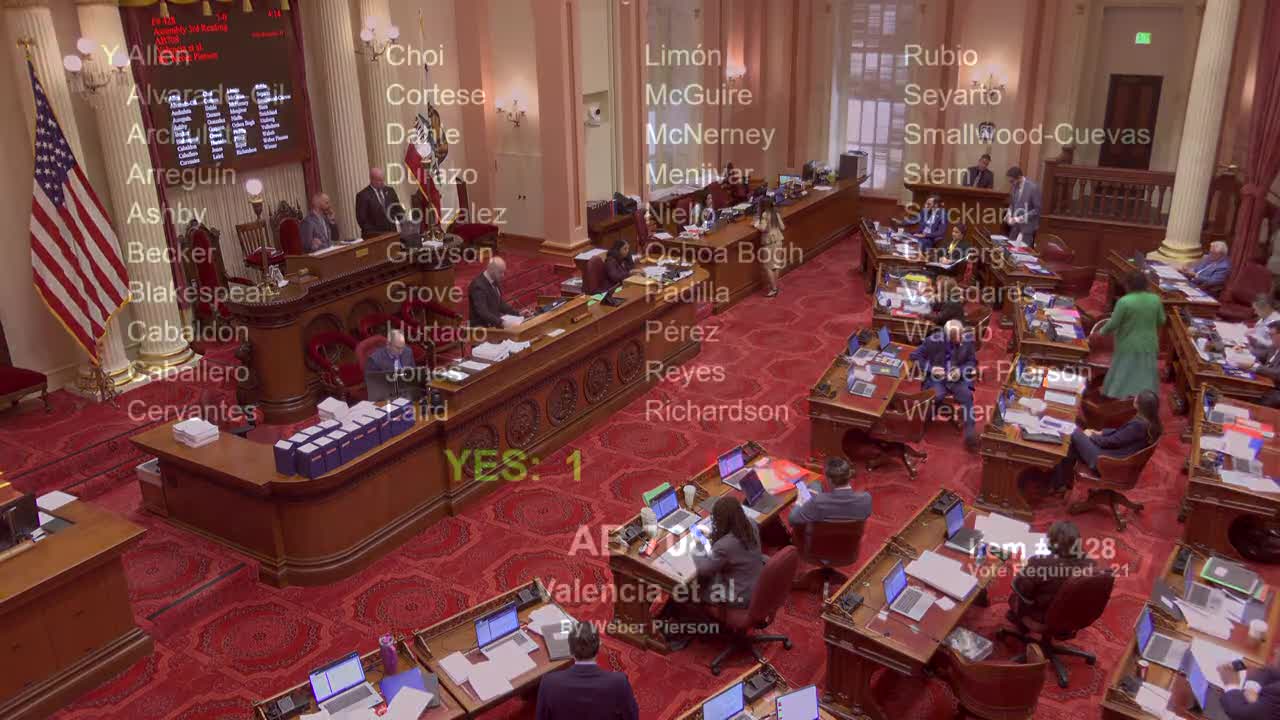 3MIN
Senate Floor
 15MIN
Senate Standing Committee on Appropriations
 23MIN
Senate Standing Committee on Energy, Utilities and Communications
 5SEC
Assembly Floor
4MIN
Assembly Floor
 8MIN
Assembly Standing Committee on Appropriations


Bill Co-Author(s):