AB 2713: California AI Transparency Act: system provenance data.
- Session Year: 2025-2026
- House: Assembly
- Latest Version Date: 2026-09-30
Current Status:
Passed
(2026-09-30: Chaptered by Secretary of State - Chapter 856, Statutes of 2026.)
Introduced
In Committee
Awaiting First Chamber Vote
Passed First Chamber
In Committee
Awaiting Second Chamber Vote
Passed Second Chamber
Enacted
Existing law, the California AI Transparency Act, requires, among other things, a person that creates, codes, or otherwise produces a generative artificial intelligence (AI) system that has over 1,000,000 monthly visitors or users and is publicly accessible within the geographic boundaries of the state to make available an AI detection tool at no cost to the user. Existing law requires the AI detection tool to, among other things, allow a user to assess whether the image, video, or audio content was created or altered by that persons generative AI system. Existing law defines terms for these purposes and makes these provisions generally operative on August 2, 2026.
Existing law also requires a large online platform to comply with specific duties relating to artificial intelligence, including, among other duties, allowing a user to inspect all available system provenance data that is compliant with widely adopted specifications adopted by an established standards-setting body by specified means. Existing law prohibits a large online platform from knowingly stripping any system provenance data or digital signature that is compliant with widely adopted specifications adopted by an established standards-setting body from content uploaded or distributed on the large online platform. Existing law makes these provisions, relating to a large online platform, operative on January 1, 2027.
This bill would revise the duties and prohibitions applicable to a large online platform relating to artificial intelligence, including the requirement for allowing a user to inspect system provenance data. The bill would specify that these provisions do not require a large online platform to take any action with respect to provenance data, system provenance data, or digital signatures that are not compliant with widely adopted specifications issued by an established standards-setting body.
Existing law, the California AI Transparency Act, requires, among other things, a person that creates, codes, or otherwise produces a generative artificial intelligence (AI) system that has over 1,000,000 monthly visitors or users and is publicly accessible within the geographic boundaries of the state to make available an AI detection tool at no cost to the user. The act Existing law requires the AI detection tool to, among other things, allow a user to assess whether the image, video, or audio content was created or altered by that persons generative AI system. Existing law makes the act defines terms for these purposes and makes these provisions generally operative on August 2, 2026.
The act requires a large online platform to detect whether any provenance data that is compliant with widely adopted specifications adopted by an established standards-setting body is embedded into or attached to content distributed on the large online platform.This bill would instead require a large online platform to detect any system provenance data that is embedded into, attached to, or associated with content, as specified.The California AI Transparency Act requires a large online platform to provide a user interface that, among other things, makes certain information clearly and conspicuously available to users. The act requires that information to include whether provenance data or digital signatures are available.This bill would instead require that information to include whether provenance data or digital signatures are embedded into, attached to, or otherwise associated with the content.The California AI Transparency Act requires a large online platform to allow a user to inspect all available system provenance data that is compliant with widely adopted specifications adopted by an established standards-setting body in an easily accessible manner. The act specifies 3 means of inspection, including directly through the large online platforms user interface, allowing a user to download a version of the content with its attached system provenance data, and providing a link to the contents system provenance data displayed on an internet website or in another application either by the large online platform or a third party.This bill would instead require a large online platform to allow a user to inspect any system provenance data that is embedded into, attached to, or associated with content, as specified. The bill would allow a large online platform to satisfy that requirement by any of the 3 means of inspection, as revised by the bill. The first would be by displaying the system provenance data directly through the large online platforms user interface. The second would be by providing a link to an internet website or other application that displays the system provenance data, including a website or application operated by a third party. The third would be by allowing a user to download any provenance data embedded into, attached to, or otherwise associated with the content, subject to any applicable federal copyright laws, in a format that cannot be easily embedded into, attached to, or associated with unrelated content.The California AI Transparency Act prohibits a large online platform from knowingly stripping provenance data or a digital signature, as specified, from content uploaded or distributed on the large online platform.This bill would prohibit a large online platform from knowingly stripping provenance data or a digital signature that is downloaded from the large online platform.Existing law also requires a large online platform to comply with specific duties relating to artificial intelligence, including, among other duties, allowing a user to inspect all available system provenance data that is compliant with widely adopted specifications adopted by an established standards-setting body by specified means. Existing law prohibits a large online platform from knowingly stripping any system provenance data or digital signature that is compliant with widely adopted specifications adopted by an established standards-setting body from content uploaded or distributed on the large online platform. Existing law makes these provisions, relating to a large online platform, operative on January 1, 2027.
This bill would revise the duties and prohibitions applicable to a large online platform relating to artificial intelligence, including the requirement for allowing a user to inspect system provenance data. The bill would specify that these provisions do not require a large online platform to take any action with respect to provenance data, system provenance data, or digital signatures that are not compliant with widely adopted specifications issued by an established standards-setting body.
Existing law, the California AI Transparency Act, requires, among other things, a person that creates, codes, or otherwise produces a generative artificial intelligence (AI) system that has over 1,000,000 monthly visitors or users and is publicly accessible within the geographic boundaries of the state to make available an AI detection tool at no cost to the user. The act requires the AI detection tool to, among other things, allow a user to assess whether the image, video, or audio content was created or altered by that persons generative AI system. Existing law makes the act operative on August 2, 2026.
The act requires a large online platform to allow a user to inspect all available system provenance data, as specified, in an easily accessible manner. The act specifies the means of inspection to include directly through the large online platforms user interface, allowing a user to download a version of the content with its attached system provenance data, or providing a link to the contents system provenance data, as specified. detect whether any provenance data that is compliant with widely adopted specifications adopted by an established standards-setting body is embedded into or attached to content distributed on the large online platform.
The bill would specify that the large online platform may satisfy the inspection requirement by any of the above-described means of allowing inspection. The bill would make the option of allowing the user to download a version of the content with its attached system provenance data subject to applicable federal copyright laws.This bill would instead require a large online platform to detect any system provenance data that is embedded into, attached to, or associated with content, as specified.
The California AI Transparency Act requires a large online platform to provide a user interface that, among other things, makes certain information clearly and conspicuously available to users. The act requires that information to include whether provenance data or digital signatures are available.
This bill would instead require that information to include whether provenance data or digital signatures are embedded into, attached to, or otherwise associated with the content.
The California AI Transparency Act requires a large online platform to allow a user to inspect all available system provenance data that is compliant with widely adopted specifications adopted by an established standards-setting body in an easily accessible manner. The act specifies 3 means of inspection, including directly through the large online platforms user interface, allowing a user to download a version of the content with its attached system provenance data, and providing a link to the contents system provenance data displayed on an internet website or in another application either by the large online platform or a third party.
This bill would instead require a large online platform to allow a user to inspect any system provenance data that is embedded into, attached to, or associated with content, as specified. The bill would allow a large online platform to satisfy that requirement by any of the 3 means of inspection, as revised by the bill. The first would be by displaying the system provenance data directly through the large online platforms user interface. The second would be by providing a link to an internet website or other application that displays the system provenance data, including a website or application operated by a third party. The third would be by allowing a user to download any provenance data embedded into, attached to, or otherwise associated with the content, subject to any applicable federal copyright laws, in a format that cannot be easily embedded into, attached to, or associated with unrelated content.
The California AI Transparency Act prohibits a large online platform from knowingly stripping provenance data or a digital signature, as specified, from content uploaded or distributed on the large online platform.
This bill would prohibit a large online platform from knowingly stripping provenance data or a digital signature that is downloaded from the large online platform.
Existing law, the California AI Transparency Act, requires, among other things, a person that creates, codes, or otherwise produces a generative artificial intelligence (AI) system that has over 1,000,000 monthly visitors or users and is publicly accessible within the geographic boundaries of the state to make available an AI detection tool at no cost to the user. The act requires the AI detection tool to, among other things, allow a user to assess whether the image, video, or audio content was created or altered by that persons generative AI system. The act makes a violator of its provisions liable for a civil penalty in the amount of $5,000 per violation, which is collectable in a civil action filed by the Attorney General, a city attorney, or a county counsel. Existing law makes the act operative on August 2, 2026.
This bill would increase the civil penalty to $5,500 per violation.The act requires a large online platform to allow a user to inspect all available system provenance data, as specified, in an easily accessible manner. The act specifies the means of inspection to include directly through the large online platforms user interface, allowing a user to download a version of the content with its attached system provenance data, or providing a link to the contents system provenance data, as specified.
The bill would specify that the large online platform may satisfy the inspection requirement by any of the above-described means of allowing inspection. The bill would make the option of allowing the user to download a version of the content with its attached system provenance data subject to applicable federal copyright laws.
Existing law, the California AI Transparency Act, requires, among other things, a person that creates, codes, or otherwise produces a generative artificial intelligence (AI) system that has over 1,000,000 monthly visitors or users and is publicly accessible within the geographic boundaries of the state to make available an AI detection tool at no cost to the user. The act requires the AI detection tool to, among other things, allow a user to assess whether the image, video, or audio content was created or altered by that persons generative AI system. The act makes a violator of its provisions liable for a civil penalty in the amount of $5,000 per violation, which is collectable in a civil action filed by the Attorney General, a city attorney, or a county counsel. Existing law makes the act operative on August 2, 2026.
This bill would increase the civil penalty to $5,500 per violation.
Existing law provides that the forms of pleadings in civil actions, and the rules by which the sufficiency of the pleadings is to be determined, are those prescribed in the Code of Civil Procedure.This bill would make nonsubstantive changes to this provision.Existing law provides that the forms of pleadings in civil actions, and the rules by which the sufficiency of the pleadings is to be determined, are those prescribed in the Code of Civil Procedure.
This bill would make nonsubstantive changes to this provision.
(a)A large online platform shall do all of the following:
(1)Detect whether any provenance data is embedded into, attached to, or otherwise associated with content distributed on the large online platform.
(2)(A)Provide a user interface that reliably indicates whether any system provenance data or digital signature embedded into, attached to, or otherwise associated with content identifies the content as having been generated or substantially altered by a GenAI system or captured by a capture device.
(B)The user interface required by this paragraph shall make clearly and conspicuously available to users information sufficient to identify the contents authenticity, origin, or history of modification, including, but not limited to, all of the following:
(i)Whether provenance data is embedded into, attached to, or otherwise associated with the content.
(ii)The name of the GenAI system or capture device that created or substantially altered the content, if applicable.
(iii)Whether any digital signatures are embedded into, attached to, or otherwise associated with the content.
(3)Allow a user to inspect any system provenance data embedded into, attached to, or otherwise associated with the content in an easily accessible manner. The large online platform may satisfy this requirement by any of the following means:
(A)Displaying the system provenance data directly through the large online platforms user interface pursuant to paragraph (2).
(B)Providing a link to an internet website or other application that displays the system provenance data, including a website or application operated by a third party.
(C)Allowing a user to download any provenance data embedded into, attached to, or otherwise associated with the content, subject to any applicable federal copyright laws, in a format that cannot be easily embedded into, attached to, or associated with unrelated content.
(b)The obligations set forth in subdivision (a) shall not be construed to require a large online platform to maintain, display, or allow a user to download personal information.
(c)A large online platform shall not, to the extent technically feasible, knowingly strip any system provenance data or digital signature from content uploaded to, distributed on, or downloaded from the large online platform.
(d)This section does not require a large online platform to take any action with respect to provenance data, system provenance data, or digital signatures that are not compliant or interoperable with widely adopted specifications issued by an established standards-setting body.
(e)This section shall become operative on January 1, 2027.
(a)A large online platform shall do all of the following:
(1)Detect whether any provenance data is embedded into, attached to, or otherwise associated with content distributed on the large online platform.
(2)(A)Provide a user interface that reliably indicates whether content was any system provenance data or digital signature embedded into, attached to, or otherwise associated with content identifies the content as having been generated or substantially altered by a GenAI system or captured by a capture device.
(B)The user interface required by this paragraph shall make clearly and conspicuously available to users information sufficient to identify the contents authenticity, origin, or history of modification, including, but not limited to, all of the following:
(i)Whether provenance data is embedded into, attached to, or otherwise associated with the content.
(ii)The name of the GenAI system or capture device that created or substantially altered the content, if applicable.
(iii)Whether any digital signatures are embedded into, attached, attached to, or otherwise associated with the content.
(3)Allow a user to inspect any system provenance data embedded into, attached to, or otherwise associated with the content in an easily accessible manner. The large online platform may satisfy this requirement by any of the following means:
(A)Displaying the system provenance data directly through the large online platforms user interface pursuant to paragraph (2).
(B)Providing a link to an internet website or other application that displays the system provenance data, including a website or application operated by a third party.
(C)Allowing a user to download any provenance data embedded into, attached to, or otherwise associated with the content, subject to any applicable federal copyright laws, in a format that cannot be easily embedded into, attached to, or associated with unrelated content.
(b)The obligations set forth in subdivision (a) shall not be construed to require a large online platform to maintain, display, or allow a user to download personal information.
(b)(c)A large online platform shall not, to the extent technically feasible, knowingly strip any system provenance data or digital signature from content uploaded to, distributed on, or downloaded from the large online platform.
(c)(d)This section does not require a large online platform to take any action with respect to provenance data, system provenance data, or digital signatures that are not compliant or interoperable with widely adopted specifications issued by an established standards-setting body.
(d)(e)This section shall become operative on January 1, 2027.
(a)A large online platform shall do all of the following:
(1)Detect whether any provenance data that is compliant with widely adopted specifications adopted by an established standards-setting body is embedded into or attached to is embedded into, attached to, or otherwise associated with content distributed on the large online platform.
(2)(A)Provide a user interface to disclose the availability of system provenance data that reliably indicates that the whether content was generated or substantially altered by a GenAI system or captured by a capture device.
(B)The user interface required by this paragraph shall make clearly and conspicuously available to users information sufficient to identify the contents authenticity, origin, or history of modification, including, but not limited to, all of the following:
(i)Whether provenance data is available. embedded into, attached to, or otherwise associated with the content.
(ii)The name of the GenAI system or capture device that created or substantially altered the content, if applicable.
(iii)Whether any digital signatures are available. embedded into, attached, to, or otherwise associated with the content.
(3)Allow a user to inspect all available any system provenance data that is compliant with widely adopted specifications adopted by an established standards-setting body embedded into, attached to, or otherwise associated with the content in an easily accessible manner. The large online platform may satisfy this requirement by any of the following means:
(A)Allow the user to inspect Displaying the system provenance data directly through the large online platforms user interface pursuant to paragraph (2).
(B)Providing a link to an internet website or other application that displays the system provenance data, including a website or application operated by a third party.
(B)Allow the(C)Allowing a user to download a version of the content with its attached system provenance data, any provenance data embedded into, attached to, or otherwise associated with the content, subject to any applicable federal copyright laws. laws, in a format that cannot be easily embedded into, attached to, or associated with unrelated content.
(C)Provide a link to the contents system provenance data displayed on an internet website or in another application provided either by the large online platform or a third party.(b)A large online platform shall not, to the extent technically feasible, knowingly strip any system provenance data or digital signature that is compliant with widely adopted specifications adopted by an established standards-setting body from content uploaded or distributed on from content uploaded to, distributed on, or downloaded from the large online platform.
(c)This section does not require a large online platform to take any action with respect to provenance data, system provenance data, or digital signatures that are not compliant with widely adopted specifications issued by an established standards-setting body.
(c)(d)This section shall become operative on January 1, 2027.
(a)A large online platform shall do all of the following:
(1)Detect whether any provenance data that is compliant with widely adopted specifications adopted by an established standards-setting body is embedded into or attached to content distributed on the large online platform.
(2)(A)Provide a user interface to disclose the availability of system provenance data that reliably indicates that the content was generated or substantially altered by a GenAI system or captured by a capture device.
(B)The user interface required by this paragraph shall make clearly and conspicuously available to users information sufficient to identify the contents authenticity, origin, or history of modification, including, but not limited to, all of the following:
(i)Whether provenance data is available.
(ii)The name of the GenAI system or capture device that created or substantially altered the content, if applicable.
(iii)Whether any digital signatures are available.
(3)Allow a user to inspect all available system provenance data that is compliant with widely adopted specifications adopted by an established standards-setting body in an easily accessible manner manner. The large online platform may satisfy this requirement by any of the following means:
(A)Directly Allow the user to inspect the system provenance data directly through the large online platforms user interface pursuant to paragraph (2).
(B)Allow the user to download a version of the content with its attached system provenance data. data, subject to any applicable federal copyright laws.
(C)Provide a link to the contents system provenance data displayed on an internet website or in another application provided either by the large online platform or a third party.
(b)A large online platform shall not, to the extent technically feasible, knowingly strip any system provenance data or digital signature that is compliant with widely adopted specifications adopted by an established standards-setting body from content uploaded or distributed on the large online platform.
(c)This section shall become operative on January 1, 2027.
SECTION 1.Section 22757.4 of the Business and Professions Code is amended to read:22757.4.(a)(1)A violator of this chapter shall be liable for a civil penalty in the amount of five thousand five hundred dollars ($5,500) per violation to be collected in a civil action filed by the Attorney General, a city attorney, or a county counsel.(2)A prevailing plaintiff in an action brought pursuant to this subdivision shall be entitled to all reasonable attorneys costs and fees.(b)Each day that a covered provider, large online platform, or capture device manufacturer is in violation of this chapter shall be deemed a discrete violation.(c)For a violation by a third-party licensee of paragraph (3) of subdivision (c) of Section 22757.3, the Attorney General, a county counsel, or a city attorney may bring a civil action for both of the following:(1)Injunctive relief.(2)Reasonable attorneys fees and costs.(a)(1)A violator of this chapter shall be liable for a civil penalty in the amount of five thousand five hundred dollars ($5,000) ($5,500) per violation to be collected in a civil action filed by the Attorney General, a city attorney, or a county counsel.
(2)A prevailing plaintiff in an action brought pursuant to this subdivision shall be entitled to all reasonable attorneys costs and fees.
(b)Each day that a covered provider, large online platform, or capture device manufacturer is in violation of this chapter shall be deemed a discrete violation.
(c)For a violation by a third-party licensee of paragraph (3) of subdivision (c) of Section 22757.3, the Attorney General, a county counsel, or a city attorney may bring a civil action for both of the following:
(1)Injunctive relief.
(2)Reasonable attorneys fees and costs.
SECTION 1.Section 421 of the Code of Civil Procedure is amended to read:421.The forms of pleading in civil actions, and the rules by which the sufficiency of those pleadings is to be determined, are those prescribed in this code.The forms of pleading in civil actions, and the rules by which the sufficiency of the those pleadings is to be determined, are those prescribed in this Code. code.
|
Date
|
Status
|
|---|---|
| Sep 30, 2026 | Chaptered by Secretary of State - Chapter 856, Statutes of 2026. |
| Sep 30, 2026 | Approved by the Governor. |
| Sep 8, 2026 | Enrolled and presented to the Governor at 3:30 p.m. |
| Aug 28, 2026 | Senate amendments concurred in. To Engrossing and Enrolling. (Ayes 78. Noes 0. Page 6813.). |
| Aug 28, 2026 | Senate amendments concurred in. To Engrossing and Enrolling. (Ayes 78. Noes 0.). |
| Aug 27, 2026 | In Assembly. Concurrence in Senate amendments pending. |
| Aug 27, 2026 | Read third time. Passed. Ordered to the Assembly. (Ayes 40. Noes 0. Page 6035.). |
| Aug 27, 2026 | Read third time. Passed. Ordered to the Assembly. (Ayes 40. Noes 0.). |
| Aug 24, 2026 | Read second time. Ordered to third reading. |
| Aug 21, 2026 | Read third time and amended. Ordered to second reading. |
| Jun 17, 2026 | Read second time. Ordered to third reading. |
| Jun 16, 2026 | From committee: Do pass. (Ayes 8. Noes 0.) (June 15). |
| Jun 3, 2026 | Referred to Com. on P., D.T., & C.P. |
| May 21, 2026 | In Senate. Read first time. To Com. on RLS. for assignment. |
| May 21, 2026 | Read third time. Passed. Ordered to the Senate. (Ayes 74. Noes 0. Page 5233.) |
| May 21, 2026 | Read third time. Passed. Ordered to the Senate. (Ayes 74. Noes 0.) |
| Apr 22, 2026 | Read second time. Ordered to third reading. |
| Apr 21, 2026 | Read second time and amended. Ordered returned to second reading. |
| Apr 20, 2026 | From committee: Amend, and do pass as amended. (Ayes 15. Noes 0.) (April 16). |
| Apr 7, 2026 | Re-referred to Com. on P. & C.P. |
| Apr 6, 2026 | From committee chair, with author's amendments: Amend, and re-refer to Com. on P. & C.P. Read second time and amended. |
| Mar 31, 2026 | In committee: Hearing postponed by committee. |
| Mar 23, 2026 | Re-referred to Com. on P. & C.P. |
| Mar 19, 2026 | From committee chair, with author's amendments: Amend, and re-refer to Com. on P. & C.P. Read second time and amended. |
| Mar 19, 2026 | Referred to Coms. on P. & C.P. and JUD. |
| Feb 21, 2026 | From printer. May be heard in committee March 23. |
| Feb 20, 2026 | Read first time. To print. |
|
Date
|
Description
|
Location
|
Votes
|
|
|---|---|---|---|---|
| Aug 28, 2026 | AB 2713 Wicks Concurrence in Senate Amendments | Assembly Floor |
Passed |
|
| Aug 27, 2026 | Assembly 3rd Reading AB2713 Wicks et al. By Becker | Senate Floor |
Passed |
|
| Jun 15, 2026 | Do pass | Senate Standing Committee on Privacy, Digital Technologies, and Consumer Protection |
Passed |
|
| May 21, 2026 | AB 2713 Wicks Assembly Third Reading | Assembly Floor |
Passed |
|
| Apr 16, 2026 | Do pass as amended. | Assembly Standing Committee on Privacy and Consumer Protection |
Passed |
This list shows positions taken on this bill by organizations on the date displayed, which is linked to the original source.
Positions by individuals are not included.
|
Organization
|
Position
|
Date
|
|---|---|---|
| Center for AI and Digital Policy | ** Support | |
| Entertainment Union Coalition | ** Support | |
| Motion Picture Association Of America | ** Support | |
| Recording Industry Association Of America | ** Support |
CONCURRENCE IN SENATE AMENDMENTS
CSA1 Bill Id:AB 2713
Author:(Wicks)
As Amended Ver:August 21, 2026
Majority vote
SUMMARY
Updates the California AI Transparency Act by allowing large online platforms to permit users to download content provenance data directly from a platform, and prohibiting large online platforms from knowingly stripping system provenance data or a digital signature from user-downloaded content.
Senate Amendments
- Clarify that a large online platform shall provide a user interface that reliably indicates whether any system provenance data or digital signature embedded into, attached to, or otherwise associated with content identifies the content as having been generated or substantially altered by a GenAI system or captured by a capture device.
- Provide that the bill does not require a large online platform to maintain, display, or allow a user to download personal information.
- Clarify that the bill does not require a large online platform to take any action with respect to provenance data, system provenance data, or digital signatures that are not compliant or interoperable with widely adopted specifications issued by an established standards-setting body.
COMMENTS
Background. Over the past three years, as generative artificial intelligence (GenAI) technologies have become more realistic and accessible, online content that appears genuine, but is actually false, has flooded social media and other large online platforms. This unmitigated spread of synthetic content threatens to harm Californians in numerous ways, such as through the proliferation of nonconsensual deepfake pornography, scams, and the distribution of targeted political disinformation.
Seeking to enact a comprehensive content provenance framework to combat the rapid online proliferation of AI-generated content, the Legislature passed SB 942 (Becker, Stats. 2024, Ch. 291). The law applies to "covered providers" – developers of publicly-accessible GenAI systems with over one million monthly users – requiring them to provide a free, publicly accessible tool that allows users to detect whether audio, image, or video content was generated or altered by their systems. The bill permits visible disclosures and requires latent, machine-detectable provenance data to be embedded into content generated by these provides' GenAI systems.
While SB 942 focused primarily on developers of large GenAI systems, AB 853 (Wicks) Chapter 674 Statutes of 2025 imposed disclosure requirements on large online platforms and manufacturers of devices capable of capturing digital content (e.g. digital cameras.) Together, these bills effectively require GenAI developers to disclose that content generated by their systems is "fake" beginning in mid-2026, recording device manufacturers to disclose that content captured by their devices is "real" beginning in early 2028, and large online platforms to prominently disclose this provenance data to users beginning in early 2027.
What this bill would do. This bill would allow large online platforms to permit users to download provenance data attached to content, rather than the content itself, and would prohibit large online platforms from stripping provenance data out of user-downloaded content.
Analysis. AB 853 provided large online platforms with three options for disclosing content provenance data to users of the platform: (1) directly disclosing the data through a user interface created by the platform, (2) providing a link to an external website displaying the content, and (3) permitting users to download any content with its provenance data attached. According to the author, various groups representing copyright owners have expressed concern with this third mechanism: they claim that enabling users to download content directly from social media platforms will facilitate online piracy. To address this concern, this bill adjusts this mechanism to instead allow a platform to permit users to download content provenance data directly from a large online platform, in a format that cannot be easily integrated into unrelated content. The bill also prohibits a large online platform from knowingly stripping system provenance data or a digital signature from content a user downloads from the large online platform.
According to the Author
New and emerging developments of generative AI (GenAI) tools have made it easier to create, edit, and doctor images, video, and audio. GenAI technologies can create and manipulate content to look realistic and convincing, which allow bad actors to create harmful content and spread disinformation. With the passage of AB 853, there would be more transparency of AI-generated content in the digital information ecosystem, and users would have more information to understand the source of content. AB 2713 would provide additional clarification within existing law in order that any requirements to share provenance information on large online platforms would have to be operationalized in a way that protects content creators and allow for large online platforms to provide meaningful information for users on their platforms.
Arguments in Support
The Center for AI and Digital Policy writes:
AB 2713 is a clear step toward enhanced transparency for AI-generated content. The bill establishes baseline mechanisms enabling users, journalists, researchers, and enforcement authorities to inspect provenance of content online. It strengthens existing law with new language that secures users' right to access provenance data and requires companies to ensure transparency and traceability.
Arguments in Opposition
None on file.
FISCAL COMMENTS
None.
VOTES:
ASM PRIVACY AND CONSUMER PROTECTION: 15-0-0
YES: Bauer-Kahan, Macedo, Aguiar-Curry, Bryan, DeMaio, Hoover, Irwin, Lowenthal, McKinnor, Ortega, Patterson, Petrie-Norris, Ward, Wicks, Wilson
ASSEMBLY FLOOR: 74-0-6
YES: Addis, Aguiar-Curry, Ahrens, Alanis, Alvarez, Ávila Farías, Bains, Bauer-Kahan, Bennett, Berman, Boerner, Bonta, Bryan, Calderon, Caloza, Carrillo, Castillo, Connolly, Davies, DeMaio, Dixon, Elhawary, Ellis, Flora, Fong, Gabriel, Gallagher, Gipson, Jeff Gonzalez, Mark González, Hadwick, Haney, Harabedian, Hart, Hoover, Irwin, Jackson, Johnson, Kalra, Krell, Lee, Lowenthal, Macedo, McKinnor, Muratsuchi, Nguyen, Ortega, Pacheco, Papan, Patel, Patterson, Pellerin, Petrie-Norris, Quirk-Silva, Ransom, Michelle Rodriguez, Rogers, Blanca Rubio, Sanchez, Schiavo, Schultz, Sharp-Collins, Solache, Soria, Stefani, Ta, Tangipa, Valencia, Wallis, Ward, Wicks, Wilson, Zbur, Rivas
ABS, ABST OR NV: Arambula, Chen, Garcia, Lackey, Ramos, Celeste Rodriguez
SENATE FLOOR: 40-0-0
YES: Allen, Alvarado-Gil, Archuleta, Arreguín, Ashby, Becker, Blakespear, Cabaldon, Caballero, Cervantes, Choi, Cortese, Dahle, Durazo, Gonzalez, Grayson, Grove, Hurtado, Jones, Laird, Limón, McGuire, McNerney, Menjivar, Niello, Ochoa Bogh, Padilla, Pérez, Reyes, Richardson, Rubio, Seyarto, Smallwood-Cuevas, Stern, Strickland, Umberg, Valladares, Wahab, Weber Pierson, Wiener
UPDATED
VERSION: August 21, 2026
CONSULTANT: Slater Sharp / P. & C.P. / (916) 319-2200 FN: 0004423
SENATE RULES COMMITTEE Office of Senate Floor Analyses (916) 651-4171 | AB 2713 |
THIRD READING
Bill No: AB 2713
Author: Wicks (D), et al.
Amended: 8/21/26 in Senate
Vote: 21
SENATE PRIV., DIGITAL TECH. & CONS. PROT. COMMITTEE: 8-0, 6/15/26
AYES: Cabaldon, Gonzalez, McNerney, Ochoa Bogh, Padilla, Reyes, Umberg, Wiener
NO VOTE RECORDED: Jones
ASSEMBLY FLOOR: 74-0, 5/21/26 - See last page for vote
SUBJECT: California AI Transparency Act: system provenance data
SOURCE: Author
DIGEST:
This bill reworks certain provisions of the recently enacted California AI Transparency Act (CAIT) that apply to large online platforms.
Senate Floor amendments of 8/21/26 refine provisions related to the user interface that must be provided by large online platforms and clarify the requirements as they relate to downloading of personal information.
ANALYSIS:
Existing law:
- Establishes the California AI Transparency Act, which becomes operative, in part, on August 2, 2026, and requires certain “covered providers” to make an artificial intelligence (AI) detection tool available at no cost by which a person can assess whether content was created or altered by the provider’s GenAI system. (Business (Bus.) & Profession (Prof.) Code § 22757 et seq.)
- Requires a “covered provider,” a person that creates, codes, or otherwise produces a generative artificial intelligence (GenAI) system that has over 1 million monthly visitors or users and is publicly accessible within the geographic boundaries of the state, to offer users the option to include in AI-generated image, video, or audio content created by its own generative AI system a manifest disclosure that meets specified criteria, including that it identifies the content as AI-generated content. (Bus. & Prof. Code § 22757.3(a).)
- Requires a covered provider to include in AI-generated image, audio, and video content created by its generative AI system a latent disclosure that is detectable by the tool specified above and is, to the extent technically feasible, permanent or extraordinarily difficult to remove. (Bus. & Prof. Code § 22757.3(b).)
- Prohibits a covered provider from doing any of the following in carrying out the duties above:
- Collect or retain personal information when a person utilizes the covered provider’s AI detection tool, except that it may collect and retain the contact information of a person who submitted feedback.
- Retain any content submitted to the AI detection tool for longer than is necessary to comply with this law. (Bus. & Prof. Code § 22757.2(c).)
- Requires a large online platform, starting January 1, 2027, to do one of the following:
- Detect whether any provenance data that is compliant with widely adopted specifications adopted by an established standards-setting body is embedded into or attached to content distributed on the large online platform.
- Provide a user interface to disclose the availability of system provenance data that reliably indicates that the content was generated or substantially altered by a GenAI system or captured by a capture device. The user interface shall make clearly and conspicuously available to users information sufficient to identify the content’s authenticity, origin, or history of modification, including specified information such as whether provenance data is available.
- Allow a user to inspect all available system provenance data that is compliant with widely adopted specifications adopted by an established standards-setting body in an easily accessible manner by any of several specified means. (Bus. & Prof. Code § 22757.3.1(a).)
- Prohibits, starting January 1, 2027, a large online platform from, to the extent technically feasible, knowingly stripping any system provenance data or digital signature that is compliant with widely adopted specifications adopted by an established standards-setting body from content uploaded or distributed on the large online platform. (Bus. & Prof. Code § 22757.3.1(b).)
- Provides that violators of the above provisions are liable for a civil penalty in the amount of $5,000 per violation to be collected in a civil action filed by the Attorney General, a city attorney, or a county counsel. Each day in violation is deemed a discrete violation. (Bus. & Prof. Code § 22757.4.)
- Provides that the CAIT Act does not apply to any product, service, website, or application that provides exclusively non-user-generated video game, television, streaming, movie, or interactive experiences. (Bus. & Prof. Code § 22757.5.)
This bill:
- Reworks provisions of the CAIT Act that apply to large online platforms, making stylistic and technical changes.
- Allows a large online platform to permit users to download content provenance data directly from the platform, in a format that cannot be easily integrated into unrelated content, rather than downloading content with provenance data attached as currently provided in the CAIT Act.
- Clarifies that the obligations imposed on these platforms shall not be construed to require them to maintain, display, or allow a user to download personal information.
- Prohibits a large online platform from knowingly stripping system provenance data or a digital signature from content a user downloads from the large online platform.
Background
The rapid advancement of AI technology, specifically the wide-scale introduction of GenAI models, has made it drastically cheaper and easier to produce synthetic content, audio, images, text, and video recordings that are not real, but that are so realistic that they are virtually impossible to distinguish from authentic content. One method that has been increasingly relied upon is embedding into content certain “provenance data,” which is data that is embedded into digital content, or that is included in the content’s metadata, for the purpose of verifying the digital content’s authenticity, origin, or history of modification.
Last session, the Legislature passed the CAIT Act, which, beginning August 2, 2026, regulates provenance data disclosure in AI-generated content. “Covered providers” are required to embed latent provenance disclosures in content generated by their GenAI systems and to offer manifest disclosures. Providers are required to make available an AI detection tool at no cost to the user that meets certain criteria, including that it allows a user to assess whether content was created or altered by the covered provider’s system. Last year, AB 853 (Wicks, Chapter 674, Statutes of 2025) bolstered the CAIT Act by establishing similar transparency requirements on large online platforms, capture device manufacturers, and GenAI system hosting platforms.
This bill reworks provisions added by AB 853 that apply to large online platforms. The bill is author-sponsored and supported by the Center for AI and Digital Policy. No timely opposition was received.
Comments
Last session, the Legislature responded to some of these issues by passing the CAIT Act, SB 942 (Becker, Chapter 291, Statutes of 2024), which is set to become operative, in part, later this year. The CAIT Act imposes obligations on “covered providers,” persons that create, code, or otherwise produce a GenAI system that has over 1 million monthly visitors or users and is publicly accessible within the geographic boundaries of the state. It requires such providers to make an AI detection tool available at no cost by which a person can assess whether content was created or altered by the provider’s GenAI system.
Covered providers are required to include a latent disclosure in AI-generated image, video, or audio content that is created by their GenAI system that is detectable using the above tool, and that is, to the extent technically feasible, permanent or extraordinarily difficult to remove. This latent disclosure must identify the provider, the tool, and the time and date of the content’s creation or alteration. Covered providers are also required to provide users making such content with their system with the option to include a manifest disclosure that identifies it as AI-generated content.
Last year, AB 853 bolstered the CAIT Act by establishing similar transparency requirements on large online platforms, capture device manufacturers, and GenAI system hosting platforms.
This bill seeks to rework provisions of the Act added by AB 853 that apply to large online platforms and respond to some concerns raised by stakeholders. It includes a number of technical and clarifying amendments, including extension of the disclosure requirements to provenance data embedded into or attached to content, and provenance data otherwise associated with the content.
Currently, the law provides several options for platforms to disclose content provenance data to users. This bill amends one of those options and permits large online platforms to meet their obligations by allowing users to download provenance data attached to content rather than allowing them to download the content itself with the attached system provenance data. This must be provided in a format that cannot be easily embedded into, attached to, or associated with unrelated content. This comes in the wake of concerns about potential copyright issues and piracy of protected materials posted to these platforms.
In addition, the law currently prohibits a large online platform, to the extent technically feasible, from knowingly stripping any system provenance data or digital signature from content uploaded or distributed on the platform. This bill extends this prohibition to content downloaded from the platform.
According to the author:
New and emerging developments of generative AI (GenAI) tools have made it easier to create, edit, and doctor images, video, and audio. GenAI technologies can create and manipulate content to look realistic and convincing, which allow bad actors to create harmful content and spread disinformation. With the passage of AB 853, there would be more transparency of AI-generated content in the digital information ecosystem, and users would have more information to understand the source of content. AB 2713 would provide additional clarification within existing law in order that any requirements to share provenance information on large online platforms would have to be operationalized in a way that protects content creators and allow for large online platforms to provide meaningful information for users on their platforms.
FISCAL EFFECT: Appropriation: No Fiscal Com.: No Local: No
SUPPORT: (Verified 8/23/26)
Center for AI and Digital Policy
Entertainment Union Coalition
Motion Picture Association of America
Recording Industry Association of America
OPPOSITION: (Verified 8/23/26)
None received
ARGUMENTS IN SUPPORT: The Center for AI and Digital Policy writes, “AB 2713 takes a lifecycle approach and requires that provenance data persists with synthetic content. Without this requirement, disclosures and labels collapse into formalities that fail at the point of greatest exposure, when content leaves controlled device environments and circulates in the broader information ecosystem. California's existing AI Transparency Act requires large online platforms to "provide a user interface that reliably indicates whether content was generated or substantially altered by a GenAI system" but its anti-stripping prohibition reaches only content uploaded or distributed on the platform. AB 2713 closes this gap by extending the anti-stripping prohibition to content downloaded from the platform.”
ASSEMBLY FLOOR: 74-0, 5/21/26
AYES: Addis, Aguiar-Curry, Ahrens, Alanis, Alvarez, Ávila Farías, Bains, Bauer-Kahan, Bennett, Berman, Boerner, Bonta, Bryan, Calderon, Caloza, Carrillo, Castillo, Connolly, Davies, DeMaio, Dixon, Elhawary, Ellis, Flora, Fong, Gabriel, Gallagher, Gipson, Jeff Gonzalez, Mark González, Hadwick, Haney, Harabedian, Hart, Hoover, Irwin, Jackson, Johnson, Kalra, Krell, Lee, Lowenthal, Macedo, McKinnor, Muratsuchi, Nguyen, Ortega, Pacheco, Papan, Patel, Patterson, Pellerin, Petrie-Norris, Quirk-Silva, Ransom, Michelle Rodriguez, Rogers, Blanca Rubio, Sanchez, Schiavo, Schultz, Sharp-Collins, Solache, Soria, Stefani, Ta, Tangipa, Valencia, Wallis, Ward, Wicks, Wilson, Zbur, Rivas
NO VOTE RECORDED: Arambula, Chen, Garcia, Lackey, Ramos, Celeste Rodriguez
Prepared by: Christian Kurpiewski / P., D.T., & C.P. / (916) 651-1548
8/24/26 11:57:59
**** END ****
SENATE RULES COMMITTEE Office of Senate Floor Analyses (916) 651-4171 | AB 2713 |
THIRD READING
Bill No: AB 2713
Author: Wicks (D), et al.
Amended: 4/21/26 in Assembly
Vote: 21
SENATE PRIV., DIGITAL TECH. & CONS. PROT. COMMITTEE: 8-0, 6/15/26
AYES: Cabaldon, Gonzalez, McNerney, Ochoa Bogh, Padilla, Reyes, Umberg, Wiener
NO VOTE RECORDED: Jones
ASSEMBLY FLOOR: 74-0, 5/21/26 - See last page for vote
SUBJECT: California AI Transparency Act: system provenance data
SOURCE: Author
DIGEST:
This bill reworks certain provisions of the recently enacted California AI Transparency Act (CAIT) that apply to large online platforms.
ANALYSIS:
Existing law:
- Establishes the California AI Transparency Act, which becomes operative, in part, on August 2, 2026, and requires certain “covered providers” to make an artificial intelligence (AI) detection tool available at no cost by which a person can assess whether content was created or altered by the provider’s GenAI system. (Business (Bus.) & Profession (Prof.) Code § 22757 et seq.)
- Requires a “covered provider,” a person that creates, codes, or otherwise produces a GenAI system that has over 1 million monthly visitors or users and is publicly accessible within the geographic boundaries of the state, to offer users the option to include in AI-generated image, video, or audio content created by its own generative AI system a manifest disclosure that meets specified criteria, including that it identifies the content as AI-generated content. (Bus. & Prof. Code § 22757.3(a).)
- Requires a covered provider to include in AI-generated image, audio, and video content created by its generative AI system a latent disclosure that is detectable by the tool specified above and is, to the extent technically feasible, permanent or extraordinarily difficult to remove. (Bus. & Prof. Code § 22757.3(b).)
- Prohibits a covered provider from doing any of the following in carrying out the duties above:
- Collect or retain personal information when a person utilizes the covered provider’s AI detection tool, except that it may collect and retain the contact information of a person who submitted feedback.
- Retain any content submitted to the AI detection tool for longer than is necessary to comply with this law. (Bus. & Prof. Code § 22757.2(c).)
- Requires a large online platform, starting January 1, 2027, to do one of the following:
- Detect whether any provenance data that is compliant with widely adopted specifications adopted by an established standards-setting body is embedded into or attached to content distributed on the large online platform.
- Provide a user interface to disclose the availability of system provenance data that reliably indicates that the content was generated or substantially altered by a GenAI system or captured by a capture device. The user interface shall make clearly and conspicuously available to users information sufficient to identify the content’s authenticity, origin, or history of modification, including specified information such as whether provenance data is available.
- Allow a user to inspect all available system provenance data that is compliant with widely adopted specifications adopted by an established standards-setting body in an easily accessible manner by any of several specified means. (Bus. & Prof. Code § 22757.3.1(a).)
- Prohibits, starting January 1, 2027, a large online platform from, to the extent technically feasible, knowingly stripping any system provenance data or digital signature that is compliant with widely adopted specifications adopted by an established standards-setting body from content uploaded or distributed on the large online platform. (Bus. & Prof. Code § 22757.3.1(b).)
- Provides that violators of the above provisions are liable for a civil penalty in the amount of $5,000 per violation to be collected in a civil action filed by the Attorney General, a city attorney, or a county counsel. Each day in violation is deemed a discrete violation. (Bus. & Prof. Code § 22757.4.)
- Provides that the CAIT Act does not apply to any product, service, website, or application that provides exclusively non-user-generated video game, television, streaming, movie, or interactive experiences. (Bus. & Prof. Code § 22757.5.)
This bill:
- Reworks provisions of the CAIT Act that apply to large online platforms, making stylistic and technical changes.
- Allows a large online platform to permit users to download content provenance data directly from the platform, in a format that cannot be easily integrated into unrelated content, rather than downloading content with provenance data attached as currently provided in the CAIT Act.
- Prohibits a large online platform from knowingly stripping system provenance data or a digital signature from content a user downloads from the large online platform.
Background
The rapid advancement of AI technology, specifically the wide-scale introduction of GenAI models, has made it drastically cheaper and easier to produce synthetic content, audio, images, text, and video recordings that are not real, but that are so realistic that they are virtually impossible to distinguish from authentic content. One method that has been increasingly relied upon is embedding into content certain “provenance data,” which is data that is embedded into digital content, or that is included in the content’s metadata, for the purpose of verifying the digital content’s authenticity, origin, or history of modification.
Last session, the Legislature passed the California AI Transparency Act (CAIT), which, beginning August 2, 2026, regulates provenance data disclosure in AI-generated content. “Covered providers” are required to embed latent provenance disclosures in content generated by their GenAI systems and to offer manifest disclosures. Providers are required to make available an AI detection tool at no cost to the user that meets certain criteria, including that it allows a user to assess whether content was created or altered by the covered provider’s system. Last year, AB 853 (Wicks, Chapter 674, Statutes of 2025) bolstered the CAIT Act by establishing similar transparency requirements on large online platforms, capture device manufacturers, and GenAI system hosting platforms.
This bill reworks provisions added by AB 853 that apply to large online platforms. The bill is author-sponsored and supported by the Center for AI and Digital Policy. No timely opposition was received.
Comments
Last session, the Legislature responded to some of these issues by passing the CAIT Act, SB 942 (Becker, Chapter 291, Statutes of 2024), which is set to become operative, in part, later this year. The CAIT Act imposes obligations on “covered providers,” persons that create, code, or otherwise produce a GenAI system that has over 1 million monthly visitors or users and is publicly accessible within the geographic boundaries of the state. It requires such providers to make an AI detection tool available at no cost by which a person can assess whether content was created or altered by the provider’s GenAI system.
Covered providers are required to include a latent disclosure in AI-generated image, video, or audio content that is created by their GenAI system that is detectable using the above tool, and that is, to the extent technically feasible, permanent or extraordinarily difficult to remove. This latent disclosure must identify the provider, the tool, and the time and date of the content’s creation or alteration. Covered providers are also required to provide users making such content with their system with the option to include a manifest disclosure that identifies it as AI-generated content.
Last year, AB 853 bolstered the CAIT Act by establishing similar transparency requirements on large online platforms, capture device manufacturers, and GenAI system hosting platforms.
This bill seeks to rework provisions of the Act added by AB 853 that apply to large online platforms and respond to some concerns raised by stakeholders. It includes a number of technical and clarifying amendments, including extension of the disclosure requirements to provenance data not only embedded into or attached to content, but also provenance data otherwise associated with the content.
Currently, the law provides several options for platforms to disclose content provenance data to users. This bill amends one of those options and permits large online platforms to meet their obligations by allowing users to download provenance data attached to content rather than allowing them to download the content itself with the attached system provenance data. This must be provided in a format that cannot be easily embedded into, attached to, or associated with unrelated content. This comes in the wake of concerns about potential copyright issues and piracy of protected materials posted to these platforms.
In addition, the law currently prohibits a large online platform, to the extent technically feasible, from knowingly stripping any system provenance data or digital signature from content uploaded or distributed on the platform. This bill extends this prohibition to content downloaded from the platform.
According to the author:
New and emerging developments of generative AI (GenAI) tools have made it easier to create, edit, and doctor images, video, and audio. GenAI technologies can create and manipulate content to look realistic and convincing, which allow bad actors to create harmful content and spread disinformation. With the passage of AB 853, there would be more transparency of AI-generated content in the digital information ecosystem, and users would have more information to understand the source of content. AB 2713 would provide additional clarification within existing law in order that any requirements to share provenance information on large online platforms would have to be operationalized in a way that protects content creators and allow for large online platforms to provide meaningful information for users on their platforms.
FISCAL EFFECT: Appropriation: No Fiscal Com.: No Local: No
SUPPORT: (Verified 6/17/26)
Center for AI and Digital Policy
Entertainment Union Coalition
Motion Picture Association of America
Recording Industry Association of America
OPPOSITION: (Verified 6/17/26)
None received
ARGUMENTS IN SUPPORT: The Center for AI and Digital Policy writes:
AB 2713 takes a lifecycle approach and requires that provenance data persists with synthetic content. Without this requirement, disclosures and labels collapse into formalities that fail at the point of greatest exposure, when content leaves controlled device environments and circulates in the broader information ecosystem. California's existing AI Transparency Act requires large online platforms to "provide a user interface that reliably indicates whether content was generated or substantially altered by a GenAI system" but its anti-stripping prohibition reaches only content uploaded or distributed on the platform. AB 2713 closes this gap by extending the anti-stripping prohibition to content downloaded from the platform.
ASSEMBLY FLOOR: 74-0, 5/21/26
AYES: Addis, Aguiar-Curry, Ahrens, Alanis, Alvarez, Ávila Farías, Bains, Bauer-Kahan, Bennett, Berman, Boerner, Bonta, Bryan, Calderon, Caloza, Carrillo, Castillo, Connolly, Davies, DeMaio, Dixon, Elhawary, Ellis, Flora, Fong, Gabriel, Gallagher, Gipson, Jeff Gonzalez, Mark González, Hadwick, Haney, Harabedian, Hart, Hoover, Irwin, Jackson, Johnson, Kalra, Krell, Lee, Lowenthal, Macedo, McKinnor, Muratsuchi, Nguyen, Ortega, Pacheco, Papan, Patel, Patterson, Pellerin, Petrie-Norris, Quirk-Silva, Ransom, Michelle Rodriguez, Rogers, Blanca Rubio, Sanchez, Schiavo, Schultz, Sharp-Collins, Solache, Soria, Stefani, Ta, Tangipa, Valencia, Wallis, Ward, Wicks, Wilson, Zbur, Rivas
NO VOTE RECORDED: Arambula, Chen, Garcia, Lackey, Ramos, Celeste Rodriguez
Prepared by: Christian Kurpiewski / P., D.T., & C.P. / (916) 651-1548
6/17/26 16:49:15
**** END ****
SENATE PRIVACY, DIGITAL TECHNOLOGIES, AND CONSUMER PROTECTION COMMITTEE
Senator Christopher Cabaldon, Chair
2025-2026 Regular Session
Bill No: AB 2713 (Author:Wicks)
Version: April 21, 2026
Hearing Date: June 15, 2026
Fiscal: No
Urgency: No
Consultant: CK
SUBJECT
California AI Transparency Act: system provenance data
DIGEST
This bill reworks certain provisions of the recently enacted California AI Transparency Act (CAIT) that apply to large online platforms.
EXECUTIVE SUMMARY
The rapid advancement of AI technology, specifically the wide-scale introduction of GenAI models, has made it drastically cheaper and easier to produce synthetic content, audio, images, text, and video recordings that are not real, but that are so realistic that they are virtually impossible to distinguish from authentic content. One method that has been increasingly relied upon is embedding into content certain “provenance data,” which is data that is embedded into digital content, or that is included in the content’s metadata, for the purpose of verifying the digital content’s authenticity, origin, or history of modification.
Last session, the Legislature passed the California AI Transparency Act (CAIT), which, beginning August 2, 2026, regulates provenance data disclosure in AI-generated content. “Covered providers” are required to embed latent provenance disclosures in content generated by their GenAI systems and to offer manifest disclosures. Providers are required to make available an AI detection tool at no cost to the user that meets certain criteria, including that it allows a user to assess whether content was created or altered by the covered provider’s system. Last year, AB 853 (Wicks, Ch. 674, Stats. 2025) bolstered the CAIT Act by establishing similar transparency requirements on large online platforms, capture device manufacturers, and GenAI system hosting platforms.
This bill reworks provisions added by AB 853 that apply to large online platforms. The bill is author-sponsored and supported by the Center for AI and Digital Policy. No timely opposition was received by the Committee.
PROPOSED CHANGES TO THE LAW
Existing law:
- Establishes the California AI Transparency Act, which becomes operative, in part, on August 2, 2026, and requires certain “covered providers” to make an AI detection tool available at no cost by which a person can assess whether content was created or altered by the provider’s GenAI system. (Bus. & Prof. Code § 22757 et seq.)
- Requires a “covered provider,” a person that creates, codes, or otherwise produces a GenAI system that has over 1,000,000 monthly visitors or users and is publicly accessible within the geographic boundaries of the state, to offer users the option to include in AI-generated image, video, or audio content created by its own generative AI system a manifest disclosure that meets specified criteria, including that it identifies the content as AI-generated content. (Bus. & Prof. Code § 22757.3(a).)
- Requires a covered provider to include in AI-generated image, audio, and video content created by its generative AI system a latent disclosure that is detectable by the tool specified above and is, to the extent technically feasible, permanent or extraordinarily difficult to remove. (Bus. & Prof. Code § 22757.3(b).)
- Prohibits a covered provider from doing any of the following in carrying out the duties above:
- Collect or retain personal information when a person utilizes the covered provider’s AI detection tool, except that it may collect and retain the contact information of a person who submitted feedback.
- Retain any content submitted to the AI detection tool for longer than is necessary to comply with this law. (Bus. & Prof. Code § 22757.2(c).)
- Requires a large online platform, starting January 1, 2027, to do one of the following:
- Detect whether any provenance data that is compliant with widely adopted specifications adopted by an established standards-setting body is embedded into or attached to content distributed on the large online platform.
- Provide a user interface to disclose the availability of system provenance data that reliably indicates that the content was generated or substantially altered by a GenAI system or captured by a capture device. The user interface shall make clearly and conspicuously available to users information sufficient to identify the content’s authenticity, origin, or history of modification, including specified information such as whether provenance data is available.
- Allow a user to inspect all available system provenance data that is compliant with widely adopted specifications adopted by an established standards-setting body in an easily accessible manner by any of several specified means. (Bus. & Prof. Code § 22757.3.1(a).)
- Prohibits, starting January 1, 2027, a large online platform from, to the extent technically feasible, knowingly stripping any system provenance data or digital signature that is compliant with widely adopted specifications adopted by an established standards-setting body from content uploaded or distributed on the large online platform. (Bus. & Prof. Code § 22757.3.1(b).)
- Provides that violators of the above provisions are liable for a civil penalty in the amount of $5,000 per violation to be collected in a civil action filed by the Attorney General, a city attorney, or a county counsel. Each day in violation is deemed a discrete violation. (Bus. & Prof. Code § 22757.4.)
- Provides that the CAIT Act does not apply to any product, service, website, or application that provides exclusively non-user-generated video game, television, streaming, movie, or interactive experiences. (Bus. & Prof. Code § 22757.5.)
This bill:
- Reworks provisions of the CAIT Act that apply to large online platforms, making stylistic and technical changes.
- Allows a large online platform to permit users to download content provenance data directly from the platform, in a format that cannot be easily integrated into unrelated content, rather than downloading content with provenance data attached as currently provided in the CAIT Act.
- Prohibits a large online platform from knowingly stripping system provenance data or a digital signature from content a user downloads from the large online platform.
COMMENTS
- Blurring reality: AI-generated content
GenAI can create new content, including text, images, code, or music, by learning from existing data. GenAI models can produce realistic and novel artifacts that resemble the data they were trained on, but do not copy it. The world has been in awe of the powers of this new technology, but the capabilities of these advanced systems lead to a blurring between reality and fiction. The National Institute for Standards and Technology frames the issue presented:
In recent years, the quality of digital content generated by artificial intelligence (AI) has advanced considerably across various modalities, including image, video, audio, and text. This surge in generative AI capability presents both opportunities and challenges—generative AI has facilitated creative expression and production, enabling artists, designers, and writers to create digital content at a much faster pace, but has also raised concerns regarding the authenticity and integrity of digital media, especially as it has become increasingly difficult to distinguish AI-generated content from human-generated content.[1]
The relevant issue here is not about the growing incidence of synthetic content alone, but about the quickly blurring line between what is real and what is not. As one recent article phrased it, there is a “New Authenticity Crisis”:
OpenAI launched Sora 2 recently, an app that generates photorealistic video from text prompts. Within a week, Hollywood talent agencies called it exploitation. The Motion Picture Association objected to its copyright policies. Then came the flood of videos featuring copyrighted characters in unauthorized scenes. Despite being invite-only, the app hit one million downloads in five days. Faster than ChatGPT’s launch. Social media is now overwhelmed with synthetic clips so convincing that Zelda Williams, daughter of Robin Williams, publicly asked strangers to stop sending her AI-generated videos of her deceased father.
This is not an isolated technology story. It represents the acceleration of something larger happening across business and wider society.[2]
- Cleaning up CAIT
Last session, the Legislature responded to some of these issues by passing the CAIT Act, SB 942 (Becker, Ch. 291, Stats. 2024), which is set to become operative, in part, later this year. The CAIT Act imposes obligations on “covered providers,” persons that create, code, or otherwise produce a GenAI system that has over 1,000,000 monthly visitors or users and is publicly accessible within the geographic boundaries of the state. It requires such providers to make an AI detection tool available at no cost by which a person can assess whether content was created or altered by the provider’s GenAI system.
Covered providers are required to include a latent disclosure in AI-generated image, video, or audio content that is created by their GenAI system that is detectable using the above tool, and that is, to the extent technically feasible, permanent or extraordinarily difficult to remove. This latent disclosure must identify the provider, the tool, and the time and date of the content’s creation or alteration. Covered providers are also required to provide users making such content with their system with the option to include a manifest disclosure that identifies it as AI-generated content.
Last year, AB 853 (Wicks, Ch. 674, Stats. 2025) bolstered the CAIT Act by establishing similar transparency requirements on large online platforms, capture device manufacturers, and GenAI system hosting platforms.
This bill seeks to rework provisions of the Act added by AB 853 that apply to large online platforms and respond to some concerns raised by stakeholders. It includes a number of technical and clarifying amendments, including extension of the disclosure requirements to provenance data not only embedded into or attached to content, but also provenance data otherwise associated with the content.
Currently, the law provides several options for platforms to disclose content provenance data to users. The bill amends one of those options and permits large online platforms to meet their obligations by allowing users to download provenance data attached to content rather than allowing them to download the content itself with the attached system provenance data. This must be provided in a format that cannot be easily embedded into, attached to, or associated with unrelated content. This comes in the wake of concerns about potential copyright issues and piracy of protected materials posted to these platforms.
In addition, the law currently prohibits a large online platform, to the extent technically feasible, from knowingly stripping any system provenance data or digital signature from content uploaded or distributed on the platform. This bill extends this prohibition to content downloaded from the platform.
According to the author:
New and emerging developments of generative AI (GenAI) tools have made it easier to create, edit, and doctor images, video, and audio. GenAI technologies can create and manipulate content to look realistic and convincing, which allow bad actors to create harmful content and spread disinformation. With the passage of AB 853, there would be more transparency of AI-generated content in the digital information ecosystem, and users would have more information to understand the source of content. AB 2713 would provide additional clarification within existing law in order that any requirements to share provenance information on large online platforms would have to be operationalized in a way that protects content creators and allow for large online platforms to provide meaningful information for users on their platforms.
The Center for AI and Digital Policy writes in support:
AB 2713 takes a lifecycle approach and requires that provenance data persists with synthetic content. Without this requirement, disclosures and labels collapse into formalities that fail at the point of greatest exposure, when content leaves controlled device environments and circulates in the broader information ecosystem. California's existing AI Transparency Act requires large online platforms to "provide a user interface that reliably indicates whether content was generated or substantially altered by a GenAI system" but its anti-stripping prohibition reaches only content uploaded or distributed on the platform. AB 2713 closes this gap by extending the anti-stripping prohibition to content downloaded from the platform.
Center for AI and Digital Policy
OPPOSITION
None received
RELATED LEGISLATION
SB 1000 (Becker, 2026) makes a number of changes to the CAIT Act, including eliminating the requirement to offer manifest disclosures, removing the user threshold on the definition of “covered provider,” and amending other definitions and exemptions. SB 1000 is currently in the Assembly Privacy and Consumer Protection Committee.
SB 1050 (Ashby, 2026) makes it an unlawful practice for a person to create and cause to be published in an advertising medium an advertisement that includes a synthetic performer without a clear and conspicuous disclosure that the performer is synthetic. SB 1050 is currently pending referral in the Assembly.
SB 1146 (Gonzalez, 2026) requires, in part, an advertisement that includes the image, audio, or video of a digital replica or synthetic performer depicted as a health care provider that is generated or substantially altered using AI or other computer technology to promote the sale of a health-related consumer product or service to include a clear and conspicuous disclosure that the image, audio, or video, as applicable, of the person in the advertisement was generated or substantially altered by AI and that no human health care provider is depicted. SB 1146 is currently in the Assembly Privacy and Consumer Protection Committee.
AB 853 (Wicks, Ch. 674, Stats. 2025) See Comment 2.
SB 942 (Becker, Ch. 291, Stats. 2024) See Comment 2.
PRIOR VOTES:
Assembly Floor (Ayes 74, Noes 0)
Assembly Privacy and Consumer Protection Committee (Ayes 15, Noes 0)
**************
NIST, GenAI: Text 2026, https://ai-challenges.nist.gov/text-2026. All internet citations are current as of June 6, 2026. ↑
Prashant Saxena, Authenticity in the Age of AI (December 22, 2025) California Management Review, https://cmr.berkeley.edu/assets/documents/pdf/2025-12-authenticity-in-the-age-of-ai.pdf. ↑
ASSEMBLY THIRD READING
ATR Bill Id:AB 2713
Author:(Wicks)
As Amended Ver:April 21, 2026
Majority vote
SUMMARY
Updates the California Artificial Intelligence (AI) Transparency Act to allow a large online platform to permit users to download content provenance data directly from the platform, and to prohibit a large online platform from knowingly stripping system provenance data or a digital signature from user-downloaded content.
Major Provisions
- Allows a large online platform to permit users to download content provenance data directly from the platform, in a format that cannot be easily integrated into unrelated content, rather than downloading content with provenance data attached.
- Prohibits a large online platform from knowingly stripping system provenance data or a digital signature from content a user downloads from the large online platform.
COMMENTS
Background. Over the past three years, as generative artificial intelligence (GenAI) technologies have become more realistic and accessible, online content that appears genuine, but that is actually false, has flooded social media and other large online platforms. This unmitigated spread of synthetic content threatens to harm Californians in numerous ways, such as through the proliferation of nonconsensual deepfake pornography, scams, and the distribution of targeted political disinformation.
Seeking to enact a comprehensive content provenance framework to combat the rapid online proliferation of AI-generated content, the Legislature passed SB 942 (Becker) Chapter 291, Statutes 2024. The law applies to "covered providers" – developers of publicly-accessible GenAI systems with over one million monthly users – requiring them to provide a free, publicly accessible tool that allows users to detect whether audio, image, or video content was generated or altered by their systems. The bill permits visible disclosures and requires latent, machine-detectable provenance data to be embedded into content generated by these provides' GenAI systems.
While SB 942 focused primarily on developers of large GenAI systems, AB 853 (Wicks) Chapter 674, Statutes 2025 imposed disclosure requirements on large online platforms and manufacturers of devices capable of capturing digital content (e.g. digital cameras.) Together, these bills effectively require GenAI developers to disclose that content generated by their systems is "fake" beginning in mid-2026, recording device manufacturers to disclose that content captured by their devices is "real" beginning in early 2028, and large online platforms to prominently disclose this provenance data to users beginning in early 2027.
What this bill would do. This bill would allow large online platforms to permit users to download provenance data attached to content, rather than the content itself, and would prohibit large online platforms from stripping provenance data out of user-downloaded content.
Analysis. AB 853 provided large online platforms with three options for disclosing content provenance data to users of the platform: (1) directly disclosing the data through a user interface created by the platform, (2) providing a link to an external website displaying the content, and (3) permitting users to download any content with its provenance data attached. According to the author, various groups representing copyright owners have expressed concern with this third mechanism: they claim that enabling users to download content directly from social media platforms will facilitate online piracy. To address this concern, this bill adjusts this mechanism to instead allow a platform to permit users to download content provenance data directly from a large online platform, in a format that cannot be easily integrated into unrelated content. The bill also prohibits a large online platform from knowingly stripping system provenance data or a digital signature from content a user downloads from the large online platform.
According to the Author
New and emerging developments of generative AI (GenAI) tools have made it easier to create, edit, and doctor images, video, and audio. GenAI technologies can create and manipulate content to look realistic and convincing, which allow bad actors to create harmful content and spread disinformation. With the passage of AB 853, there would be more transparency of AI-generated content in the digital information ecosystem, and users would have more information to understand the source of content.
AB 2713 would provide additional clarification within existing law in order that any requirements to share provenance information on large online platforms would have to be operationalized in a way that protects content creators and allow for large online platforms to provide meaningful information for users on their platforms.
Arguments in Support
None on file.
Arguments in Opposition
None on file.
FISCAL COMMENTS
None.
VOTES
ASM PRIVACY AND CONSUMER PROTECTION: 15-0-0
YES: Bauer-Kahan, Macedo, Aguiar-Curry, Bryan, DeMaio, Hoover, Irwin, Lowenthal, McKinnor, Ortega, Patterson, Petrie-Norris, Ward, Wicks, Wilson
UPDATED
VERSION: April 21, 2026
CONSULTANT: Slater Sharp / P. & C.P. / (916) 319-2200 FN: 0002385
Date of Hearing: April 16, 2026
Fiscal: Yes
ASSEMBLY COMMITTEE ON PRIVACY AND CONSUMER PROTECTION
Rebecca Bauer-Kahan, Chair
ABPCA Bill Id:AB 2713 (
Author:Wicks) – As Amended Ver:April 6, 2026
PROPOSED AMENDMENTS
SUBJECT: California AI Transparency Act: system provenance data: inspection
SYNOPSIS
Over the past three years, as generative artificial intelligence (GenAI) technologies have become more realistic and accessible, online content that appears genuine, but that is actually false, has flooded social media and other large online platforms. This unmitigated spread of synthetic content threatens to harm Californians in numerous ways, such as through the proliferation of nonconsensual deepfake pornography, scams, and the distribution of targeted political disinformation.
Over the past two years, California has sought to tackle the issue of GenAI-produced online content through a three-step plan: label all GenAI content “fake,” label a significant portion of real content “real,” and prominently display these labels online. Beginning this August, SB 942 (Becker, 2024) requires large GenAI platforms to include machine-detectable “latent disclosures” in their outputs. Beginning in 2028, AB 853 (Wicks, 2025) requires “capture devices” such as cameras to include provenance data in their outputs by default. And beginning in 2027, AB 853 (Wicks, 2025) requires large online platforms to prominently display provenance data detected in user-uploaded content.
According to the author of this bill, the inclusion of language in AB 853 permitting users to download content from online platforms has led copyright owners to privately express piracy concerns. This bill attempts to address that concern by clarifying that the download of content by users is “subject to any applicable federal laws.” Committee amendments described in Comment #4 go further, replacing the controversial provision with language permitting users to download provenance data attached to content rather than the content itself. Committee amendments additionally prohibit large online platforms from stripping provenance data out of user-downloaded content and make various non-substantive drafting changes.
This bill has no formal support or opposition.
EXISTING LAW:
- Defines the following terms:
- “Artificial intelligence” or “AI” to mean an engineered or machine-based system that varies in its level of autonomy and that can, for explicit or implicit objectives, infer from the input it receives how to generate outputs that can influence physical or virtual environments.
- “Capture device” to mean a device that can record photographs, audio, or video content, including, but not limited to, video and still photography cameras, mobile phones with built-in cameras or microphones, and voice recorders.
- “Covered provider” to mean a person that creates, codes, or otherwise produces a generative artificial intelligence system that has over 1,000,000 monthly visitors or users and is publicly accessible within the geographic boundaries of the state.
- “Digital signature” to mean a cryptography-based method that identifies the user or entity that attests to the information provided in the signed section.
- “Generative artificial intelligence system” or “GenAI system” to mean an artificial intelligence that can generate derived synthetic content, including text, images, video, and audio, that emulates the structure and characteristics of the system’s training data.
- “Large online platform” to mean a public-facing social media platform, file-sharing platform, mass messaging platform, or stand-alone search engine that distributes content to users who did not create or collaborate in creating the content that exceeded 2,000,000 unique monthly users during the preceding 12 months. “Large online platform” does not include either a broadband internet access service, as defined in Section 3100 of the Civil Code, or a telecommunications service, as defined in Section 153 of Title 47 of the United States Code.
- “Provenance data” to mean data that is embedded into digital content, or that is included in the digital content’s metadata, for the purpose of verifying the digital content’s authenticity, origin, or history of modification.
- “System provenance data” to mean provenance data that is not reasonably capable of being associated with a particular user and that contains either information regarding the type of device, system, or service that was used to generate a piece of digital content, or information related to content authenticity. (Bus. & Prof. Code § 22757.1.)
- Beginning August 2, 2026, requires a covered provider to include a latent disclosure in AI-generated image, video, or audio content, or content that is any combination thereof, created by the covered provider’s GenAI system that, to the extent technically feasible and reasonable, conveys the name of the covered provider, the name and version number of the GenAI system that created or altered the content, the time and date of the content’s creation or alteration, and a unique identifier, either directly or through a link to a permanent internet website. (Bus. & Prof. Code § 22757.3.)
- Beginning January 1, 2028, requires a capture device manufacturer to, with respect to any capture device the capture device manufacturer first produced for sale in the state on or after January 1, 2028, provide a user with the option to include a latent disclosure in content captured by the capture device, and to embed latent disclosures in content captured by the device by default.
- Beginning January 1, 2027, requires a large online platform to allow a user to inspect all available system provenance data embedded into or attached to content through any of the following means:
- Directly through a user interface provided by the large online platform.
- By allowing the user to download a version of the content with its attached system provenance data.
- By providing a link to an internet website or another application displaying the content’s system provenance data. (Bus. & Prof. Code § 22757.3.1)
- Directly through a user interface provided by the large online platform.
- Beginning January 1, 2027, prohibits a large online platform from knowingly stripping any system provenance data or digital signature from content uploaded or distributed on the large online platform, to the extent technically feasible, provided the provenance data or signature are compliant with widely adopted specifications adopted by an established standards-setting body. (Bus. & Prof. Code § 22757.1.)
THIS BILL:
- Clarifies a platform may allow a user to download a version of content hosted on the platform along with any attached system provenance data “subject to any applicable federal copyright laws.”
COMMENTS:
- Author’s statement. According to the author:
New and emerging developments of generative AI (GenAI) tools have made it easier to create, edit, and doctor images, video, and audio. GenAI technologies can create and manipulate content to look realistic and convincing, which allow bad actors to create harmful content and spread disinformation. With the passage of AB 853, there would be more transparency of AI-generated content in the digital information ecosystem, and users would have more information to understand the source of content.
AB 2713 would provide additional clarification within existing law in order that any requirements to share provenance information on large online platforms would have to be operationalized in a way that protects content creators and allow for large online platforms to provide meaningful information for users on their platforms.
- Background. AI and GenAI. The development of GenAI is creating exciting opportunities to grow California’s economy and improve the lives of its residents. GenAI can generate compelling text, images and audio in an instant – but with novel technologies come novel safety concerns.
In brief, AI is the mimicking of human intelligence by artificial systems such as computers. AI uses algorithms – sets of rules – to transform inputs into outputs. Inputs and outputs can be anything a computer can process: numbers, text, audio, video, or movement. AI is not fundamentally different from other computer functions; its novelty lies in its application. Unlike traditional computer functions, AI can accomplish tasks that are normally performed by humans. AI that is trained on small, specific datasets in order to make recommendations and predictions is sometimes referred to as “predictive AI.” This differentiates it from GenAI, which is trained on massive datasets in order to produce detailed text and images. When Netflix suggests a TV show to a viewer, that recommendation is produced by predictive AI that has been trained on the viewing habits of Netflix users. When ChatGPT generates text in clear, concise paragraphs, it uses GenAI that has been trained on the written contents of the internet.
Deepfakes and Disinformation. Image manipulation and video doctoring have existed for nearly as long as photography and recording equipment, but they have historically required great effort and talent. In the past few years the rapid development of GenAI has drastically reduced those barriers to entry, allowing a vast quantity of convincing, but ultimately fake, content to be generated in an instant. The creation of imagery, video, and audio by GenAI has the potential to change the world by automating repetitive tasks and fostering creativity. When employed by bad actors, however, these capabilities have the potential to destroy lives and destabilize societies.
Deepfake pornography. Since its inception, GenAI has been used to subject women and girls to image-based sexual abuse. While high-profile celebrities were most often targeted when this technology was first developed,[1] open-source GenAI models have been exploited to make this technology more accessible and affordable. This has led to a proliferation of websites and phone-based apps that offer user-friendly interfaces for uploading clothed images of real people to generate photorealistic nude images of not only adults, but also children. According to a New York Times article:
Boys in several states have used widely available “nudification” apps to pervert real, identifiable photos of their clothed female classmates, shown attending events like school proms, into graphic, convincing-looking images of the girls with exposed A.I.-generated breasts and genitalia. In some cases, boys shared the faked images in the school lunchroom, on the school bus or through group chats on platforms like Snapchat and Instagram, according to school and police reports.[2]
In February 2024, deepfake nude images of 16 eighth-grade students were circulated among students at a California middle school.[3] Similar reports of abuse have been reported across the country and show no sign of abating.[4] In the first six months of 2024, nudification sites had been visited over 200 million times.[5] Meanwhile, a 2024 study from Center on Democracy and Technology reports that 40% of students were aware of deepfakes being shared at school, 15% of which depicted an individual in a sexually explicit or intimate manner. In over 60% of these cases, the images were distributed via social media.[6]
Scams. GenAI-powered speech and video is driving a new era in scamming. These AI tools are often trained on publicly available data, and as a result, the more data a target has online, the easier it is to develop a passable imitation of them or their loved ones. This is especially true of wealthy clients, whose public appearances, including speeches, are often widely available on the internet.[7] For example, a complicated scam utilizing both deepfake video and false audio was recently performed in Hong Kong. A multinational company lost $25.6 million after employees were fooled by deepfake technology, with one incident involving a digitally recreated version of its chief financial officer ordering money transfers in a video conference call. Everyone present on the video call, except the victim, was a fake representation of real people. The scammers applied deepfake technology to turn publicly available video and other footage into convincing versions of the meeting’s participants.[8]
In December 2024, the FBI issued a public service announcement warning about the potential dangers posed by GenAI.[9] Among the concerns highlighted was the technology’s ability to significantly lower the barrier for producing counterfeit documents, such as fake IDs, passports, and other fraudulent government-issued identification, which could greatly facilitate identity theft. Additionally, GenAI enables the creation of entirely fictitious profiles on social media and dating platforms, which can be used to exploit individuals both financially and emotionally.
Elections. Deepfake technology is being used around the world to spread disinformation and propaganda. This has already been observed in Slovakia, where deepfake audio influenced an election in 2023:
Days before a pivotal election in Slovakia to determine who would lead the country, a damning audio recording spread online in which one of the top candidates seemingly boasted about how he’d rigged the election. And if that wasn’t bad enough, his voice could be heard on another recording talking about raising the cost of beer. The recordings immediately went viral on social media, and the candidate, who is pro-NATO and aligned with Western interests, was defeated in September by an opponent who supported closer ties to Moscow and Russian President Vladimir Putin.[10]
Similar deepfakes surfaced in the United States ahead of the 2024 presidential election. In July 2024, Elon Musk shared a video featuring an AI-generated voice clone of then-Vice President Kamala Harris, in which the fabricated voice claimed she was a “diversity hire” due to being a woman of color and that she “did not know the first thing about running a country.”[11] Although Musk admitted two days after posting that the video was intended as satire, the potential impact of such content on political campaigns remains a serious concern. In 2023, the Legislature enacted a trio of bills aimed at addressing elections deepfakes: AB 2655 (Berman, Stats. 2024, Ch. 261), which imposes removal and disclosure obligations on large online platforms during the four months leading up to an election; AB 2839 (Pellerin, Stats. 2024, Ch. 262), which prohibits the distribution of election materials containing certain types of deceptively altered digital content; and AB 2355 (Carillo, Stats. 2024, Ch. 260), which requires AI-altered campaign materials to include clear disclosures. The first two bills, however, have been blocked from enforcement in legal proceedings.
Content Provenance. Many of the issues associated with deepfakes could be resolved, if only there were a reliable way to identify GenAI content. While at present no single solution exists, there are ongoing efforts to embed information related to “content provenance,” the verifiable history of a piece of content, into both GenAI products and the products of real-life recorders, such as digital cameras. Under this framework, the users of social media platforms would be able to rely on provenance data to identify trustworthy content.
Metadata. The Merriam-Webster Dictionary defines metadata as “data that provides information about other data.” In practice, metadata is a structured set of descriptors attached to digital content. A photograph’s metadata might include information about the camera used to take the photo, the time and date the photo was taken, and the photo’s precise geolocation. A written document’s metadata may include details about its author, its creation date, and the number of times the document has been edited. Metadata can be used to verify content authenticity, helping to combat fake news by providing a traceable history of content creation and modification. But metadata can also contain personal information about the individual who creates or modifies a piece of content.
Watermarking. Watermarking is the process of embedding an identifiable marker into digital content. This “watermark” can be visible, such as a logo or text overlay, or it can be invisible, data embedded into a file in a manner that does not noticeably alter the content. As a technology, watermarking is in its infancy. Watermarks can be stripped from content relatively easily by common screenshotting tools, file compression software, and image editing programs like Photoshop. They can also be faked by treating a GenAI system like a copy machine: a real image or video can be fed into a GenAI system and spit back out, unaltered except for the addition of a watermark. The system’s user receives a piece of authentic content that has been incorrectly marked as inauthentic, ready to be posted online in order to create confusion and sow discord. Furthermore, while progress has been made towards developing standards for watermarking of images and video, how text should be watermarked is far less clear.
SB 942 and AB 853. Seeking to enact a comprehensive content provenance framework to combat the rapid online proliferation of AI-generated content, the Legislature passed SB 942 (Becker, Stats. 2024, Ch. 291). The law applies to “covered providers” – developers of publicly-accessible GenAI systems with over one million monthly users – requiring them to provide a free, publicly accessible tool that allows users to detect whether audio, image, or video content was generated or altered by their systems. The bill permits visible disclosures and requires latent, machine-detectable provenance data to be embedded into content generated by these provides’ GenAI systems.
While SB 942 focused primarily on developers of large GenAI systems, AB 853 (Wicks, Stats. 2025, Ch. 674) imposed disclosure requirements on large online platforms and manufacturers of devices capable of capturing digital content (e.g. digital cameras.) Together, these bills effectively require GenAI developers to disclose that content generated by their systems is “fake” beginning in mid-2026, recording device manufacturers to disclose that content captured by their devices is “real” beginning in early 2028, and large online platforms to prominently disclose this provenance data to users beginning in early 2027.
- What this bill would do. AB 853 provided large online platforms with three options for disclosing content provenance data to users of the platform: (1) directly disclosing the data through a user interface created by the platform, (2) providing a link to an external website displaying the content, and (3) permitting users to download any content with its provenance data attached. According to the author, various groups representing copyright owners have expressed concern with this third mechanism: they claim that enabling users to download content directly from social media platforms will facilitate online piracy. To address this concern, AB 2713 clarifies that users may download a version of content with its attached provenance data “subject to any applicable federal copyright laws.”
- Committee amendments. To more directly address the piracy concern raised by copyright owners, the author has agreed to amendments that do all of the following:
- Allow a user to download content provenance directly from a large online platform, in a format that cannot be easily integrated into unrelated content, instead of downloading content with provenance data attached.
- Prohibit a large online platform from knowingly stripping system provenance data or a digital signature from content a user downloads from the large online platform.
- Make various non-substantive drafting changes.
The full text of the bill as proposed to be amended follows:
22757.3.1. (a) A large online platform shall do all of the following:
(1) Detect whether any provenance data that is compliant with widely adopted specifications adopted by an established standards-setting body is embedded into or, attached to, or otherwise associated with content distributed on the large online platform.
(2) (A) Provide a user interface to disclose the availability of system provenance data that reliably indicates that the whether content was generated or substantially altered by a GenAI system or captured by a capture device.
(B) The user interface required by this paragraph shall make clearly and conspicuously available to users information sufficient to identify the content’s authenticity, origin, or history of modification, including, but not limited to, all of the following:
(i) Whether provenance data is available embedded into, attached to, or otherwise associated with the content.
(ii) The name of the GenAI system or capture device that created or substantially altered the content, if applicable.
(iii) Whether any digital signatures are available embedded into, attached to, or otherwise associated with the content.
(3) Allow a user to inspect all available any system provenance data that is compliant with widely adopted specifications adopted by an established standards-setting body embedded into, attached to, or otherwise associated with content in an easily accessible manner. The large online platform may satisfy this requirement by any of the following means:
(A) Allow the user to inspect Displaying the system provenance data directly through the large online platform’s user interface pursuant to paragraph (2).
(B) Providing a link to an internet website or other application displaying the system provenance data, including a website or application operated by a third party.
(BC) Allow the Allowing a user to download a version of the content with its attached any system provenance data embedded into, attached to, or otherwise associated with the content, subject to any applicable federal copyright laws, in a format that cannot be easily embedded into, attached to, or associated with unrelated content.(C) Provide a link to the content’s system provenance data displayed on an internet website or in another application provided either by the large online platform or a third party.
(b) A large online platform shall not, to the extent technically feasible, knowingly strip any system provenance data or digital signature that is compliant with widely adopted specifications adopted by an established standards-setting body from content uploaded or distributed on uploaded to, distributed on, or downloaded from the large online platform.
(c) This section does not require a large online platform to take any action with respect to provenance data, system provenance data, or digital signatures that are not compliant with widely adopted specifications issued by an established standards-setting body.
(cd) This section shall become operative on January 1, 2027.
REGISTERED SUPPORT / OPPOSITION:
Support
None on file.
Opposition
None on file.
Analysis Prepared by: Slater Sharp / P. & C.P. / (916) 319-2200
Brian Contreras, “Tougher AI Policies Could Protect Taylor Swift—And Everyone Else—From Deepfakes,” Scientific American (Feb. 8. 2024) accessed at www.scientificamerican.com/article/tougher-ai-policies-could-protect-taylor-swift-and-everyone-else-from-deepfakes/. ↑
Natasha Singer, “Teen Girls Confront an Epidemic of Deepfake Nudes in Schools”, The New York Times (Apr. 8, 2024), https://www.nytimes.com/2024/04/08/technology/deepfake-ai-nudes-westfield-high-school.html. ↑
Mackenzie Tatananni, “ ‘Inappropriate images’ circulate at yet another California high school, as officials grapple with how to protect teens from AI porn created by classmates,” Daily Mail (Apr. 11, 2024) accessed at https://www.dailymail.co.uk/news/article-13295475/Inappropriate-images-California-Fairfax-High-School-AI-deepfake.html. ↑
Tim McNicholas, “New Jersey high school students accused of making AI-generated pornographic images of classmates,” CBS News (Nov. 2, 2023), https://www.cbsnews.com/newyork/news/westfield-high-school-ai-pornographic-images-students/; Lauraine Langreo, “Students Are Sharing Sexually Explicit ‘Deepfakes.’ Are Schools Prepared?” Ed Week (Sept. 26, 2024), https://www.edweek.org/leadership/studentsare-sharing-sexually-explicit-deepfakes-are-schools-prepared/2024/09; Gabrielle Hunt and Daryl Higgens “AI nudes of Victorian students were allegedly shared online. How can schools and parents respond to deepfake porn?,” The Guardian (June, 12, 2024),
https://www.theguardian.com/australia-news/article/2024/jun/12/ai-nudes-of-victorian-students-were-allegedly-shared-online-how-canschools-and-parents-respond-to-deepfake-porn. ↑
People of the State of California v. Sol Ecom, Inc, et al. (2024) Case No. CGC-24-617237, p. 2, https://www.sfcityattorney.org/wp-content/uploads/2024/08/2024-08-16-First-Amended-Complaint_Redacted.pdf ↑
Elizabeth Laird, Maddy Dwyer and Kristin Woelfel, “In Deep Trouble: Surfacing Tech-Powered Sexual Harassment in K-12 Schools,” Center for Democracy & Technology (Sept. 26, 2024), https://cdt.org/wp-content/uploads/2024/09/FINAL-UPDATED-CDT-2024-NCII-Polling-Slide-Deck. Pdf. ↑
Emily Flitter and Stacy Cowley, "Voice Deepfakes Are Coming for Your Bank Balance", New York Times (Aug. 30, 2023), www.nytimes.com/2023/08/30/business/voice-deepfakes-bank-scams.html. ↑
Harvey Kong, "‘Everyone looked real’: multinational firm’s Hong Kong office loses HK$200 million after scammers stage deepfake video meeting," South China Morning Post (Feb. 4, 2024), www.scmp.com/news/hong-kong/law-and-crime/article/3250851/everyone-looked-real-multinational-firms-hong-kong-office-loses-hk200-million-after-scammers-stage. ↑
Department of Justice Federal Bureau of Investigations, “Criminals Use Generative Artificial Intelligence to Facilitate Financial Fraud” (Dec. 3, 2024) , https://www.ic3.gov/PSA/2024/PSA241203. ↑
Curt Devine, Donie O'Sullivan, Sean Lyngass, "A fake recording of a candidate saying he’d rigged the election went viral. Experts say it’s only the beginning," CNN (Feb. 1, 2024), www.cnn.com/2024/02/01/politics/election-deepfake-threats-invs/index.html. ↑
Ken Bensinger, “Elon Musk Shares Manipulated Harris Video, in Seeming Violation of X’s Policies”, The New York Times (July 27, 2024), https://www.nytimes.com/2024/07/27/us/politics/elon-musk-kamala-harris-deepfake.html ↑
Discussed in Hearing
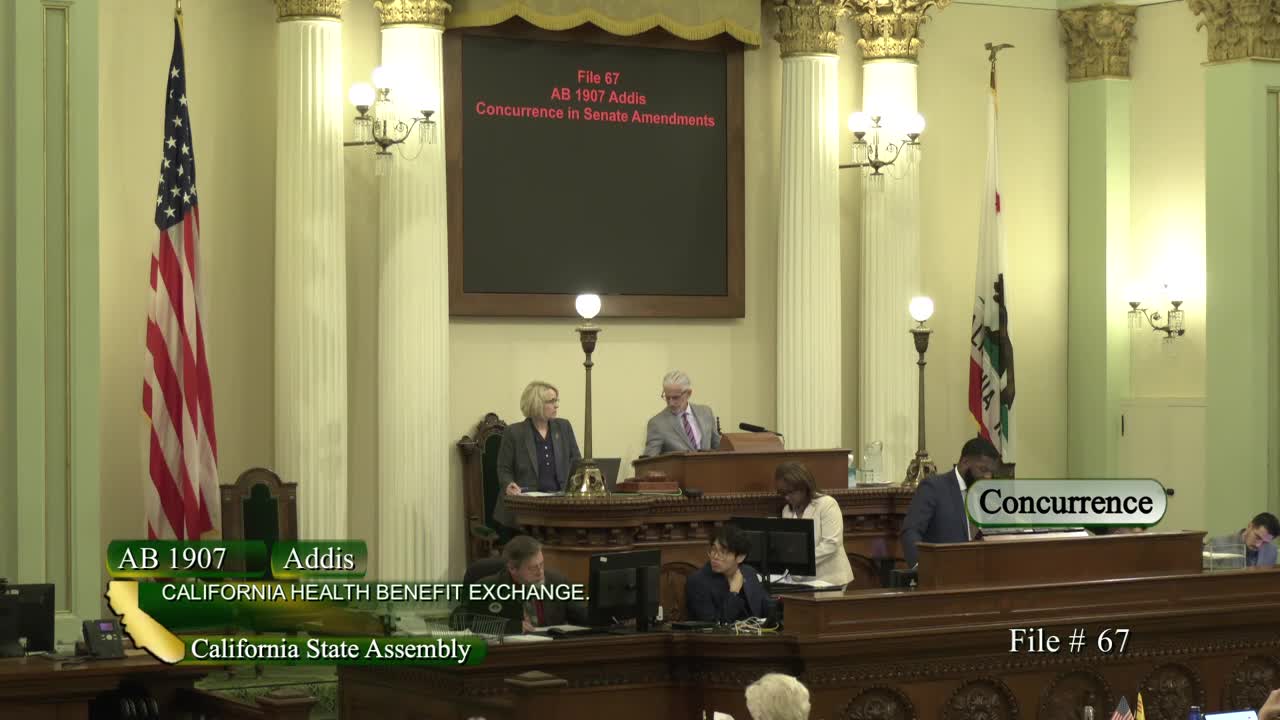 1MIN
Assembly Floor
 2MIN
Senate Floor
 3MIN
Senate Standing Committee on Privacy, Digital Technologies, and Consumer Protection
 54SEC
Assembly Floor
 4MIN
Assembly Standing Committee on Privacy and Consumer Protection
Bill Author

Bill Co-Author(s):
