AB 2720: Human trafficking victim support coordinator.
- Session Year: 2025-2026
- House: Assembly
- Latest Version Date: 2026-06-17
Current Status:
In Progress
(2026-08-13: In committee: Held under submission.)
Introduced
In Committee
Awaiting First Chamber Vote
Passed First Chamber
In Committee
Awaiting Second Chamber Vote
Passed Second Chamber
Enacted
Existing law generally provides for the regulation of law enforcement agencies. Existing law establishes the Commission on Peace Officer Standards and Training (POST) and charges it with, among other duties, developing and disseminating guidelines and training for all peace officers in this state. Existing law requires POST to develop and implement a course of instruction for the training of law enforcement officers on the handling of human trafficking complaints, as specified.
This bill would require each law enforcement agency with more than 25 peace officers agency, as defined, to designate at least one human trafficking victim support coordinator by January 1, 2028. The bill would require the coordinator to take the above-described course of instruction no later than 6 months after designation designation, except as specified, and, upon completion of the course, serve as a liaison between the law enforcement agency, trusted community-based organizations organizations, and victims. The bill would require each law enforcement agency to, by July 1, 2028, display specified information on their internet website, including specified contact information of any human trafficking victim support coordinators. By imposing new requirements on local law enforcement agencies, the bill would impose a state-mandated local program.
The California Constitution requires the state to reimburse local agencies and school districts for certain costs mandated by the state. Statutory provisions establish procedures for making that reimbursement.
This bill would provide that, if the Commission on State Mandates determines that the bill contains costs mandated by the state, reimbursement for those costs shall be made pursuant to the statutory provisions noted above.
Existing law generally provides for the regulation of law enforcement agencies. Existing law establishes the Commission on Peace Officer Standards and Training (POST) and charges it with, among other duties, developing and disseminating guidelines and training for all peace officers in this state. Existing law requires POST to develop and implement a course of instruction for the training of peace officers on commercial sexual exploitation of children and victims of human trafficking that includes, but is not limited to, certain topics and activities. law enforcement officers on the handling of human trafficking complaints, as specified.
This bill would require each law enforcement agency with more than 25 peace officers to designate at least one human trafficking victim support coordinator by January 1, 2028. The bill would require the coordinator to take the above-described course of instruction no later than 6 months after designation and, upon completion of the course, serve as a liaison between trusted community-based organizations and victims. The bill would require each law enforcement agency to, by July 1, 2028, display specified information on their internet website, including specified contact information of any human trafficking victim support coordinators. By imposing new requirements on local law enforcement agencies, the bill would impose a state-mandated local program.
The California Constitution requires the state to reimburse local agencies and school districts for certain costs mandated by the state. Statutory provisions establish procedures for making that reimbursement.
This bill would provide that, if the Commission on State Mandates determines that the bill contains costs mandated by the state, reimbursement for those costs shall be made pursuant to the statutory provisions noted above.
Existing law generally provides for the regulation of law enforcement agencies. Existing law establishes the Commission on Peace Officer Standards and Training (POST) and charges it with, among other duties, developing and disseminating guidelines and training for all peace officers in this state. Existing law requires POST to develop and implement a course of instruction for the training of peace officers on commercial sexual exploitation of children and victims of human trafficking that includes, but is not limited to, certain topics and activities.
This bill would require each law enforcement agency with more than 25 peace officers to designate a at least one human trafficking victim support coordinator by January 1, 2028. The bill would require the coordinator to take the above-described course of instruction no later than 6 months after designation and, upon completion of the course, serve as a liaison between trusted community-based organizations and victims. The bill would require each law enforcement agency to, by July 1, 2028, display specified information on their internet website, including the specified contact information of the of any human trafficking victim support coordinator. coordinators. By imposing new requirements on local law enforcement agencies, the bill would impose a state-mandated local program.
The California Constitution requires the state to reimburse local agencies and school districts for certain costs mandated by the state. Statutory provisions establish procedures for making that reimbursement.
This bill would provide that, if the Commission on State Mandates determines that the bill contains costs mandated by the state, reimbursement for those costs shall be made pursuant to the statutory provisions noted above.
Existing law generally provides for the regulation of law enforcement agencies. Existing law establishes the Commission on Peace Officer Standards and Training (POST) and charges it with, among other duties, developing and disseminating guidelines and training for all peace officers in this state. Existing law requires POST to develop and implement a course of instruction for the training of peace officers on commercial sexual exploitation of children and victims of human trafficking that includes, but is not limited to, certain topics and activities.
This bill would require each law enforcement agency with more than 25 peace officers to designate a human trafficking victim support coordinator by January 1, 2028. The bill would require the coordinator to take the above-described course of instruction no later than 6 months after designation and, upon completion of the course, serve as a liaison between trusted community-based organizations and victims. The bill would require each law enforcement agency to, by July 1, 2028, display specified information on their internet website, including the contact information of the human trafficking victim support coordinator. By imposing new requirements on local law enforcement agencies, the bill would impose a state-mandated local program.
The California Constitution requires the state to reimburse local agencies and school districts for certain costs mandated by the state. Statutory provisions establish procedures for making that reimbursement.
This bill would provide that, if the Commission on State Mandates determines that the bill contains costs mandated by the state, reimbursement for those costs shall be made pursuant to the statutory provisions noted above.
Existing law makes it a crime for a person to knowingly or willfully cause another person to engage in the unlawful manufacture of firearms or knowingly or willfully aid, abet, prompt, or facilitate the unlawful manufacture of firearms, including the manufacture of assault weapons or .50 BMG rifles or the manufacture of any firearm using a three-dimensional printer or computer numerical control milling machine, as specified. Existing law makes a violation of these provisions a misdemeanor.This bill would make a technical, nonsubstantive change to these provisions.Existing law makes it a crime for a person to knowingly or willfully cause another person to engage in the unlawful manufacture of firearms or knowingly or willfully aid, abet, prompt, or facilitate the unlawful manufacture of firearms, including the manufacture of assault weapons or .50 BMG rifles or the manufacture of any firearm using a three-dimensional printer or computer numerical control milling machine, as specified. Existing law makes a violation of these provisions a misdemeanor.
This bill would make a technical, nonsubstantive change to these provisions.
(a)(1)Each law enforcement agency that employs more than 25 full-time sworn peace officers shall designate at least one human trafficking victim support coordinator by no later than January 1, 2028.
(2)A human trafficking victim support coordinator may be a nonsworn employee.
(b)A human trafficking victim support coordinator shall take the course of instruction described in Section 13519.14 no later than six months after designation. designation, unless the human trafficking victim support coordinator is a sworn peace officer that has taken the course within the past five years. Upon completion of the course, the human trafficking victim support coordinator shall serve as a liaison between the law enforcement agency, trusted community-based organizations organizations, and victims.
(c)By July 1, 2028, each law enforcement agency subject to subdivision (a) shall display on their internet website the following information:
(1)A list of trusted community-based organizations available to support human trafficking victims within the agencys jurisdiction.
(2)If applicable pursuant to subdivision (a), the The email address and the direct office phone telephone line of any designated human trafficking victim support coordinators.
(d)For purposes of this section, the following definitions apply:
(1)Human trafficking means a violation of Section 236.1 of the Penal Code.
(2)Law enforcement agency means any department or agency of the state, or any local government, special district, or other political subdivision thereof, that employs any peace officer, as described in Section 830. a local police department or sheriffs office that employs at least 25 full-time sworn peace officers, the Department of the California Highway Patrol, and the Department of Justice.
SEC. 2.If the Commission on State Mandates determines that this act contains costs mandated by the state, reimbursement to local agencies and school districts for those costs shall be made pursuant to Part 7 (commencing with Section 17500) of Division 4 of Title 2 of the Government Code.
(a)(1)Each law enforcement agency that employs more than 25 full-time sworn peace officers shall designate at least one human trafficking victim support coordinator by no later than January 1, 2028.
(2)A human trafficking victim support coordinator may be a nonsworn employee.
(b)A human trafficking victim support coordinator shall take the course of instruction described in Section 13516.5 13519.14 no later than six months after designation. Upon completion of the course, the human trafficking victim support coordinator shall serve as a liaison between trusted community-based organizations and victims.
(c)By July 1, 2028, each law enforcement agency shall display on their internet website the following information:
(1)A list of trusted community-based organizations available to support human trafficking victims within the agencys jurisdiction.
(2)If applicable pursuant to subdivision (a), the email address and the direct office phone line of any designated human trafficking victim support coordinators.
(d)For purposes of this section, the following definitions apply:
(1)Human trafficking means a violation of Section 236.1 of the Penal Code.
(2)Law enforcement agency means any department or agency of the state, or any local government, special district, or other political subdivision thereof, that employs any peace officer, as described in Section 830.
SEC. 2.If the Commission on State Mandates determines that this act contains costs mandated by the state, reimbursement to local agencies and school districts for those costs shall be made pursuant to Part 7 (commencing with Section 17500) of Division 4 of Title 2 of the Government Code.
(a)(1)Each law enforcement agency that employs more than 25 full-time sworn peace officers shall designate a at least one human trafficking victim support coordinator by no later than January 1, 2028.
(2)A human trafficking victim support coordinator may be a nonsworn employee.
(b)A human trafficking victim support coordinator shall take the course of instruction described in Section 13516.5 no later than six months after designation. Upon completion of the course, the human trafficking victim support coordinator shall serve as a liaison between trusted community-based organizations and victims.
(c)By July 1, 2028, each law enforcement agency shall display on their internet website the following information:
(1)A list of trusted community-based organizations available to support human trafficking victims within the agencys jurisdiction.
(2)Email If applicable pursuant to subdivision (a), the email address and any other contact information the direct office phone line of the any designated human trafficking victim support coordinator. coordinators.
(d)For purposes of this section, the following definitions apply:
(1)Human trafficking means a violation of Section 236.1 of the Penal Code.
(2)Law enforcement agency means any department or agency of the state, or any local government, special district, or other political subdivision thereof, that employs any peace officer, as described in Section 830.
SEC. 2.If the Commission on State Mandates determines that this act contains costs mandated by the state, reimbursement to local agencies and school districts for those costs shall be made pursuant to Part 7 (commencing with Section 17500) of Division 4 of Title 2 of the Government Code.
(a)Each law enforcement agency that employs more than 25 full-time sworn peace officers shall designate a human trafficking victim support coordinator by no later than January 1, 2028.
(b)A human trafficking victim support coordinator shall take the course of instruction described in Section 13516.5 no later than six months after designation. Upon completion of the course, the human trafficking victim support coordinator shall serve as a liaison between trusted community-based organizations and victims.
(c)By July 1, 2028, each law enforcement agency shall display on their internet website the following information:
(1)A list of trusted community-based organizations available to support human trafficking victims within the agencys jurisdiction.
(2)Email address and any other contact information of the designated human trafficking victim support coordinator.
(d)For purposes of this section, the following definitions apply:
(1)Human trafficking means a violation of Section 236.1 of the Penal Code.
(2)Law enforcement agency means any department or agency of the state, or any local government, special district, or other political subdivision thereof, that employs any peace officer, as described in Section 830.
SEC. 2.If the Commission on State Mandates determines that this act contains costs mandated by the state, reimbursement to local agencies and school districts for those costs shall be made pursuant to Part 7 (commencing with Section 17500) of Division 4 of Title 2 of the Government Code.
SECTION 1.Section 29186 of the Penal Code is amended to read:29186.(a)It is unlawful to knowingly or willfully cause another person to engage in the unlawful manufacture of firearms, or to knowingly or willfully aid, abet, promote, or facilitate the unlawful manufacture of firearms.(b)For the purposes of this section, the unlawful manufacture of firearms includes any of the following:(1)The manufacture of a firearm by a minor, or by a person who is prohibited from owning or possessing firearms under California law.(2)The manufacture of four or more firearms within the state in the same calendar year by an individual who is not licensed to manufacture firearms pursuant to California law, in violation of Section 29010.(3)The manufacture of any firearm using a three-dimensional printer or computer numerical control milling machine by an individual who is not licensed to manufacture firearms pursuant to California law, in violation of Section 29185.(4)The manufacture of a firearm by a person who is not a federally licensed firearms manufacturer, for the purpose of selling or transferring ownership of that firearm to another person who is not a federally licensed firearms manufacturer, in violation of subdivision (d) of Section 29180.(5)The manufacture of a firearm for the purpose of selling, loaning, or transferring the firearm to another person, with the intent to complete the sale, loan, or transfer without a required background check on the transferee initiated by a licensed firearms dealer, in violation of Section 27520.(6)The manufacture of any of the following:(A)Assault weapons or .50 BMG rifles, in violation of Section 30600.(B)Firearms that are not immediately recognizable as firearms, in violation of Section 24510.(C)Firearms that are not imprinted with a valid state or federal serial number or mark of identification, in violation of subdivision (f) of Section 29180.(D)Large-capacity magazines or large-capacity magazine conversion kits, in violation of Section 32310 or 32311.(E)Machineguns, in violation of Section 32625.(F)Multiburst trigger activators, in violation of Section 32900.(G)Short-barreled rifles or short-barreled shotguns, in violation of Section 33215.(H)Undetectable firearms, in violation of Section 24610.(I)Unsafe handguns, in violation of Section 32000.(J)Zip guns, in violation of Section 33600.(K)Any other weapon defined as a generally prohibited weapon under Section 16590.(c)A violation of this section is a misdemeanor.(a)It is unlawful to knowingly or willfully cause another person to engage in the unlawful manufacture of firearms, or to knowingly or willfully aid, abet, promote, or facilitate the unlawful manufacture of firearms.
(b)For the purposes of this section, the unlawful manufacture of firearms includes any of the following:
(1)The manufacture of a firearm by a minor, or by a person who is prohibited from owning or possessing firearms under California law.
(2)The manufacture of four or more firearms within the state in the same calendar year by an individual who is not licensed to manufacture firearms pursuant to California law, in violation of Section 29010.
(3)The manufacture of any firearm using a three-dimensional printer or computer numerical control (CNC) milling machine by an individual who is not licensed to manufacture firearms pursuant to California law, in violation of Section 29185.
(4)The manufacture of a firearm by a person who is not a federally licensed firearms manufacturer, for the purpose of selling or transferring ownership of that firearm to another person who is not a federally licensed firearms manufacturer, in violation of subdivision (d) of Section 29180.
(5)The manufacture of a firearm for the purpose of selling, loaning, or transferring the firearm to another person, with the intent to complete the sale, loan, or transfer without a required background check on the transferee initiated by a licensed firearms dealer, in violation of Section 27520.
(6)The manufacture of any of the following:
(A)Assault weapons or .50 BMG rifles, in violation of Section 30600.
(B)Firearms that are not immediately recognizable as firearms, in violation of Section 24510.
(C)Firearms that are not imprinted with a valid state or federal serial number or mark of identification, in violation of subdivision (f) of Section 29180.
(D)Large-capacity magazines or large-capacity magazine conversion kits, in violation of Section 32310 or 32311.
(E)Machineguns, in violation of Section 32625.
(F)Multiburst trigger activators, in violation of Section 32900.
(G)Short-barreled rifles or short-barreled shotguns, in violation of Section 33215.
(H)Undetectable firearms, in violation of Section 24610.
(I)Unsafe handguns, in violation of Section 32000.
(J)Zip guns, in violation of Section 33600.
(K)Any other weapon defined as a generally prohibited weapon under Section 16590.
(c)A violation of this section is a misdemeanor.
|
Date
|
Status
|
|---|---|
| Aug 13, 2026 | In committee: Held under submission. |
| Jun 29, 2026 | In committee: Referred to APPR. suspense file. |
| Jun 17, 2026 | Read second time and amended. Re-referred to Com. on APPR. |
| Jun 16, 2026 | From committee: Amend, and do pass as amended and re-refer to Com. on APPR. with recommendation: To Consent Calendar. (Ayes 6. Noes 0.) (June 16). |
| Jun 3, 2026 | Referred to Com. on PUB. S. |
| May 27, 2026 | In Senate. Read first time. To Com. on RLS. for assignment. |
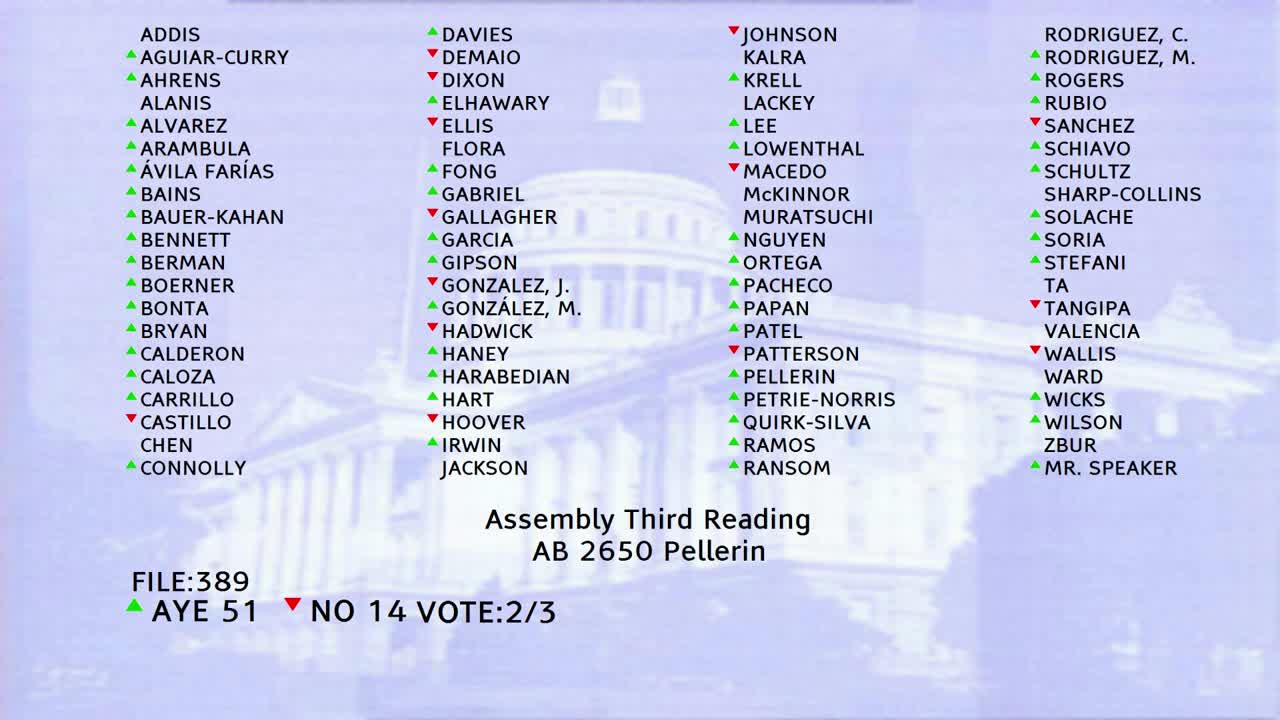
| May 26, 2026 | Read third time. Passed. Ordered to the Senate. (Ayes 78. Noes 0. Page 5389.) |
| May 26, 2026 | Read third time. Passed. Ordered to the Senate. (Ayes 78. Noes 0.) |
| May 26, 2026 | Read third time. Passed. Ordered to the Senate. |
| May 19, 2026 | Read second time. Ordered to third reading. |
| May 18, 2026 | Read second time and amended. Ordered returned to second reading. |
| May 14, 2026 | From committee: Amend, and do pass as amended. (Ayes 11. Noes 0.) (May 14). |
| May 6, 2026 | In committee: Set, first hearing. Referred to APPR. suspense file. |
| Apr 20, 2026 | Re-referred to Com. on APPR. |
| Apr 16, 2026 | Read second time and amended. |
| Apr 15, 2026 | From committee: Amend, and do pass as amended and re-refer to Com. on APPR. with recommendation: To Consent Calendar. (Ayes 9. Noes 0.) (April 14). |
| Mar 17, 2026 | Re-referred to Com. on PUB. S. |
| Mar 16, 2026 | From committee chair, with author's amendments: Amend, and re-refer to Com. on PUB. S. Read second time and amended. |
| Mar 16, 2026 | Referred to Com. on PUB. S. |
| Feb 21, 2026 | From printer. May be heard in committee March 23. |
| Feb 20, 2026 | Read first time. To print. |
|
Date
|
Description
|
Location
|
Votes
|
|
|---|---|---|---|---|
| Jun 29, 2026 | Placed on suspense file | Senate Standing Committee on Appropriations |
Passed |
|
| Jun 16, 2026 | Do pass as amended, but first amend, and re-refer to the Committee on [Appropriations] with the recommendation: To Consent Calendar | Senate Standing Committee on Public Safety |
Passed |
|
| May 26, 2026 | AB 2720 Schiavo Assembly Third Reading | Assembly Floor |
Passed |
|
| May 14, 2026 | Do pass as amended. | Assembly Standing Committee on Appropriations |
Passed |
|
| Apr 14, 2026 | Do pass as amended, and be re-referred to the Committee on [Appropriations] with recommendation: To Consent Calendar | Assembly Standing Committee on Public Safety |
Passed |
This list shows positions taken on this bill by organizations on the date displayed, which is linked to the original source.
Positions by individuals are not included.
|
Organization
|
Position
|
Date
|
|---|---|---|
| California Survivor Coalition | ** Support | |
| Private Individual | ** Support |
SENATE COMMITTEE ON
Senator Sabrina Cervantes, Chair
2025 - 2026 Regular Session
AB 2720 (Schiavo) - Human trafficking victim support coordinator
Version: | Policy Vote: |
Urgency: | Mandate: |
Hearing Date: | Consultant: |
Bill Summary:
AB 2720 would require law enforcement agencies with more than 25 full time peace officers to designate at least one human trafficking victim support coordinator by January 1, 2028.
Fiscal Impact:
Unknown, potentially major state mandate claim costs annually, to reimburse law enforcement agencies for the cost to hire, train and employ a human trafficking victim support coordinator.
Significant costs to the Department of Justice (DOJ) and the California Highway Patrol (CHP) and to hire, train and employ a human trafficking victim support coordinator.
Background:
The Commission on Peace Officer Standards and Training (POST) offers a course of instruction for the training of law enforcement officers in the handling of human trafficking complaints and offers guidelines for law enforcement response to human trafficking. The course of instruction stresses the dynamics and manifestations of human trafficking, identifying and communicating with victims, providing documentation that satisfy the law enforcement agency endorsement required by federal law, collaboration with federal law enforcement officials. Completion of the course may be satisfied by telecommunication, video training tape, or other instruction.
Law enforcement officers assigned field or investigative duties complete a minimum of two hours of training in a course of instruction pertaining to the handling of human trafficking complaints within six months of being assigned to that position.
There are 345 local law enforcement agencies with 25 or more full time peace officers. There are 628 such agencies with peace officers statewide.
The need for a human trafficking victim support coordinator will vary by agency. For example, the Mono County Sheriff’s Office had 25 full time peace officers but may not encounter enough human trafficking activity to warrant dedicating a full time position. At the same time, if the cost of employing such a position can be reimbursed through the state mandate claims process, and there is sufficient need, a local law enforcement agency may choose to employ a full time position.
Proposed Law:
The human trafficking victim support coordinator may be a nonsworn employee.
Upon completion of the training course, the human trafficking victim support coordinator shall serve as a liaison between the law enforcement agency and community based organizations and victims.
DOJ estimates an annual cost of approximately $170,000 to employ a human trafficking victim support coordinator. CHP will have a similar cost.
Staff Comments:
It is unclear if the intent of the bill is for the human trafficking victim support coordinator is to be a new hire after January 1, 2028 (when some larger law enforcement agencies may already employ such persons) or whether designating a current employee who taken, or will take, the POST training would be sufficient.
Recommended Amendments:
Staff Recommends allowing local law enforcement agencies to meet the requirements of the bill by designating a current employee who is performing the functions described in the bill as the human trafficking victim support coordinator or amending a duty statement in order to be in compliance. This could significantly reduce potential state mandated cost reimbursement.
SENATE COMMITTEE ON PUBLIC SAFETY
Senator Jesse Arreguín, Chair
2025 - 2026 Regular
Bill No: AB 2720 Hearing Date: June 16, 2026
Author: | Schiavo | ||
Version: | May 18, 2026 | ||
Urgency: | No | Fiscal: | Yes |
Consultant: | AB | ||
Subject: Human trafficking victim support coordinator
HISTORY
Source: Santa Clara Human Trafficking Task Force
Prior Legislation: SB 376 (Rubio), Ch. 109, Stats. of 2023
AB 449 (Ting), Ch. 524, Stats. of 2023
SB 86 (Seyarto), Ch. 105, Stats. of 2023
AB 1947 (Ting), died on Senate Inactive File, 2022
AB 998 (Grayson), Ch. 802, Stats. of 2018
AB 22 (Lieber), Ch. 240, Stats. of 2006
Support: Unknown
Opposition: None known
Assembly Floor Vote: 78 - 0
PURPOSE
The purpose of this bill is to require each law enforcement agency with more than 25 peace officers to designate at least one human trafficking victim support coordinator by January 1, 2028.
Existing law establishes the Commission on Peace Officer Standards and Training (POST) to set minimum standards for the recruitment and training of peace officers, develop training courses and curriculum, and establish a professional certificate program that awards different levels of certification based on training, education, experience, and other relevant prerequisites. (Pen. Code, §§ 830-832.10; 13500 et seq.)
Existing law provides that POST has, among others, the power to develop and implement programs to increase the effectiveness of law enforcement and, when those programs involve training and education courses, to cooperate with and secure the cooperation of state-level peace officers, agencies, and bodies having jurisdiction over systems of public higher education in continuing the development of college-level training and education programs. (Pen. Code, § 13500.3, subd. (e).)
Existing law requires POST to submit annually a report to the Legislature on the overall effectiveness of any additional funding for improving peace officer training, including the number of peace officers trained by law enforcement agency, by course, and by how the training was delivered, as well as the training provided and the descriptions of the training. (Pen. Code, § 13500.5, subds. (a) & (b).)
Existing law requires POST to develop and deliver training courses for peace officers on a wide array of topics, including, the use of tear gas, SWAT operations, elder abuse, persons with disabilities, behavioral health, technology crimes, sexual assault, first aid, missing persons, gang and drug enforcement, use of force and human trafficking, among others. (Pen. Code, §§ 13514-13519.15.)
Existing law requires POST to develop and implement a course or courses of instruction for the training of peace officers in California on commercial sexual exploitation of children (CSEC) and victims of human trafficking that shall include specified topics and be developed with input from survivors of commercial sexual exploitation, the appropriate local and state agencies, and advocates that have expertise in CSEC and human trafficking, as specified. (Pen. Code, § 13516.5.)
Existing law requires POST, in consultation with subject-matter experts including, but not limited to, law enforcement agencies, civil rights groups, academic experts, and the DOJ, to develop guidelines and a course of instruction and training for law enforcement officers who are employed as peace officers, or who are not yet employed as a peace officer but are enrolled in a training academy for law enforcement officers, addressing hate crimes. (Pen. Code, § 13519.6, subd. (a).)
Existing law requires POST to implement a course of instruction for the training of law enforcement officers in California on the handling of human trafficking complaints to develop guidelines for law enforcement response to human trafficking. The course of instruction and the guidelines shall stress the dynamics and manifestations of human trafficking, identifying and communicating with victims, providing documentation that satisfy the Law Enforcement Agency (LEA) endorsement required by federal law, collaboration with federal law enforcement officials, therapeutically appropriate investigative techniques, the availability of civil and immigration remedies and community resources, and protection of the victim. Where appropriate, the training presenters shall include human trafficking experts with experience in the delivery of direct services to victims of human trafficking. (Pen. Code, § 13519.14.)
Existing law authorizes a city, county, city and county, or community-based non-profit to establish a domestic violence multidisciplinary personnel team and a human trafficking multidisciplinary personnel team consisting of two or more person strained in the prevention, identification, management, or treatment of domestic violence or human trafficking. (Pen. Code, § 1370.)
Existing law gives a victim of sex assault has the right to have a victim advocate and a support person at law enforcement interviews. (Pen. Code, § 679.04)
Existing law states that a person who deprives or violates the personal liberty of another with the intent to obtain forced labor or services is guilty of human trafficking and shall be punished by imprisonment in the state prison for 5, 8, or 12 years and a fine of not more than $500,000. (Pen. Code, § 236.1, subd. (a).)
Existing law states that a person who deprives or violates the personal liberty of another with the intent to commit specified sex crimes including pimping, pandering, or child pornography, is guilty of human trafficking and shall be punished by imprisonment in the state prison for 8, 14, or 20 years and a fine of not more than $500,000. (Pen. Code, § 236.1, subd. (b).)
Existing law specifies that a person who causes, induces, or persuades, or attempts to cause, induce, or persuade, a person who is a minor at the time of commission of the offense to engage in a commercial sex act, with the intent to commit specified crimes including pimping, pandering, or child pornography, is guilty of human trafficking. A violation is punishable by imprisonment in the state prison as follows:
- Five, 8, or 12 years and a fine of not more than $500,000; or,
- 15 years-to-life and a fine of not more than $500,000 when the offense involves force, fear, fraud, deceit, coercion, violence, duress, menace, or threat of unlawful injury to the victim or to another person. (Pen. Code, § 236.1, subd. (c).)
Existing law defines “human trafficking caseworker” as a person working for a human trafficking victim service organization, whether financially compensated or not, for the purpose of rendering advice or assistance to victims of human trafficking, who meets the following requirements:
- Has an advanced degree or license, such as a master’s degree in counseling, social work, or a related field and at least one year of experience in a caseworker role working directly with victims of human trafficking.
- Has at least 40 hours of training, as specified, and is supervised by an individual who qualifies as a human trafficking caseworker. (Evid. Code, § 1038.2, subd. (c).)
Existing law defines “human trafficking victim service organization” as a nongovernmental organization or entity that provides shelter, program, or other support services to victims of human trafficking and their children and that does all of the following:
- Employs staff that meet the requirements of a human trafficking caseworker as set forth in this section.
- Operates a telephone hotline, advertised to the public, for survivor crisis calls.
- Offers psychological support and peer counseling provided in accordance with this section.
- Makes staff available during normal business hours to assist victims of human trafficking who need shelter, programs, or other support services. (Evid. Code, § 1038.2, subd. (d).)
Existing law provides that a victim of human trafficking or abuse has the right to have a human trafficking advocate, as defined, and a support person of the victim’s choosing present at an interview by a law enforcement authority, prosecutor, or the suspect’s defense attorney, although the law enforcement officer or prosecutor may exclude the support person from the interview if the law enforcement officer or prosecutor believes that the support person’s presence would be detrimental to the process. (Pen. Code, § 236.21, subd. (a).)
Existing law provides that prior to the commencement of the initial interview by a law enforcement authority or a prosecutor pertaining to a criminal action arising out of a human trafficking incident, a victim of human trafficking or abuse shall be notified orally or in writing by the attending law enforcement authority or prosecutor that the victim has the right to have a human trafficking advocate and a support person of the victim’s choosing present at the interview. (Pen. Code, § 236.21, subd. (b).)
This bill provides that each law enforcement agency that employs more than 25 full-time sworn peace officers shall designate at least one human trafficking victim support coordinator by no later than January 1, 2028.
This bill provides that a human trafficking victim support coordinator may be a nonsworn employee.
This bill requires a human trafficking victim support coordinator to take the course of instruction described above related to the handling of human trafficking complaints by law enforcement no later than 6 months after designation, and provides that upon completion of the course, the coordinator shall service as a liaison between trusted community-based organizations and victims
This bill provides that by July 1, 2028 each law enforcement agency shall display on their internet website the following information:
- A list of trusted community-based organizations available to support human trafficking victims within the agency’s jurisdiction.
- If applicable, the email address and the direct office phone line of any designated human trafficking victim support coordinators.
This bill defines “human trafficking” consistent with the definition of the crime of human trafficking in existing law.
This bill defines “law enforcement agency” as any department or agency of the state, or any local government, special district, or other political subdivision thereof, that employs any peace officer.
COMMENTS
- Need for This Bill
According to the author:
Community-based human trafficking organizations are on the front-line providing housing, health and many other essential services for victims. These organizations often alert law enforcement agencies when children go missing and serve as an essential link between officers investigating cases and families. Too often though, when these organizations attempt to follow up with law enforcement agencies on specific cases or outcomes there is not a single point of contact to assist them or direct victims towards services they provide. AB 2720 will strengthen the partnership between agencies and trusted community organizations by designating a human trafficking victim support coordinator to serve as a liaison between the agency and community organizations. It takes a whole of community approach to ensure that victims don’t fall through the cracks and receive the services they need to keep them safe.
- Human Trafficking and Existing Criminal Penalties
According to the California Department of Justice, human trafficking, also known as trafficking in persons or modern-day slavery, is a crime that involves compelling or coercing a person to provide labor or services, or to engage in commercial sex acts. The coercion can be subtle or overt, physical or psychological, and may involve the use of violence, threats, lies, or debt bondage, and does not require travel or transportation of the victim across local, state or international borders.[1] Human trafficking is among the world's fastest growing criminal enterprises and is estimated to be a $150 billion-a-year global industry, and the DOJ asserts that the perpetrators of human trafficking have become more sophisticated and organized, requiring an equally sophisticated response from law enforcement and its partners to disrupt and dismantle their networks.[2]
The United States is widely regarded as a destination country for human trafficking. Federal reports have estimated that 14,500 to 17,500 victims are trafficked into the United States annually, which does not include the number of victims who are trafficked within the United States each year. Moreover, California – a populous border state with a significant immigrant population and the world's fifth largest economy – is one of the nation's top destination states for trafficking human beings. According to the National Human Trafficking Hotline, nearly 12,000 cases of human trafficking were identified in 2024, involving 21,865 distinct victims. California was home to 1,733 of those cases, involving 3,603 victims, most of which involved sex trafficking.[3]
The DOJ’s website on human trafficking underscores that there is no single profile of a human trafficking victim:
Victims of human trafficking include not only men and women lured into forced labor by the promise of a better life in the United States, but also boys and girls who were born and raised here in California. Trafficking victims come from diverse backgrounds in terms of race, color, national origin, disability, religion, age, gender, sexual orientation, gender identity, socioeconomic status, education level, and citizenship status, but one characteristic that they usually share is some form of vulnerability. Trafficking victims are often isolated from their families and social networks and, in some cases, are separated from their country of origin, native language, and culture. Many domestic victims of sex trafficking are runaway or homeless youth and/or come from backgrounds of sexual and physical abuse, incest, poverty, or addiction. Traffickers exploit these vulnerabilities, promising the victims love, a good job, or a more stable life.[4]
The California Trafficking Victims Protection Act (TVPA), enacted in 2006, established human trafficking for forced labor or services as a felony crime.[5] The crime of human trafficking in existing law is committed when a person deprives or violates the personal liberty of another with the intent to obtain forced labor or services, and is punishable as a felony in state prison for 5, 8, or 12 years and a fine of up to $500,000.[6]
Human trafficking with the intent to commit specified sex crimes including pimping, pandering, or child pornography, is a felony punishable by imprisonment for 8, 14, or 20 years and a fine of up to $500,000.[7] A person who causes or induces a person who is a minor at the time of commission of the offense to engage in a commercial sex act, with the intent to commit specified crimes including pimping, pandering, or child pornography, is guilty of human trafficking, punishable by imprisonment in the state prison for 5, 8, or 12 years; or, when the offense involves force, fear, fraud, deceit, coercion, violence, duress, menace, or threat of unlawful injury to the victim or to another person, for 15 years to life.[8]
- Support for Victims of Human Traffickng
In addition to criminalizing the act of human trafficking, the TVPA also enacted a related evidentiary protection granting communications between a human trafficking caseworker and a victim privileged status.[9] Since then, as awareness of the vulnerability of human trafficking victims has grown, the Legislature has enacted additional measures focused on supporting and protecting victims. For instance, in 2019, AB 2992 (Daly), Chapter 973, Statutes of 2018, required POST to develop and implement a training specifically dedicated to commercial sexual exploitation of children and victims of human trafficking.[10] Most notably, in 2023, SB 376 (Rubio) Chapter 109, Statutes of 2023 provided that a victim of human trafficking has the right to have a human trafficking advocate and a support person of the victim’s choosing present at an interview by a law enforcement authority, prosecutor, or the suspect’s defense attorney.[11]
California is home to myriad community based organizations focused on providing direct services to victims of human trafficking, such as the Coalition to Abolish Slavery and Trafficking (CAST).[12] However, as cited in comment 1 of the analysis, the author of this bill argues that these organizations often face challenges in connecting with law enforcement agencies responsible for the a victim’s case. Moreover, according to the author, “existing law does not facilitate cooperation between law enforcement agencies (LEA) and human trafficking victim serving organizations. When human trafficking organizations inquire about individual cases or missing persons suspected of being trafficked there is no single individual that is the point of contact.”
Accordingly, this bill requires each law enforcement agency that employs more than 25 full-time sworn peace offices to designate at least 1 human trafficking victim support coordinator by no later than January 1, 2028. This coordinator, who may be a nonsworn employee and is required to take a specified POST training on handling human trafficking complaints, will be tasked with serving as a “liaison between trusted community-based organizations and victims.” This provision raises several issues that the author and committee should consider: first, it is unclear which organizations might be considered trusted. Is this up to the discretion of the law enforcement agency, or should the term “trusted” be defined in the bill? Second, although the bill specifies that the coordinator will act as a “liaison between trusted community-based organizations and victims,” this language seems incongruous with the bill’s stated goal, which is to facilitate communication between victims (who may be represented by trusted organizations) and the law enforcement agencies themselves. Thus, language that is more likely to effectuate the author’s goal might provide that the coordinator shall “act as a liaison between trusted community-based organizations, victims, and the law enforcement agency.” Third, as mentioned above, the bill requires the coordinator to take a POST course on human trafficking complaints. What if the coordinator is a sworn officer who has already taken that course, perhaps recently? Another provision of this bill requires law enforcement agencies subject to its provisions to display a list of trusted organizations and coordinator contact information on their internet website. This provision of the bill applies to all law enforcement agencies in the state, which include any state or local agency that employs peace officers. Thus, the bill would require agencies like the Department of Alcoholic Beverage Control or the Department of Fish and Wildlife, to post a list of such organizations. Given that many of these agencies hardly intersect with human trafficking investigations, if at all, is this requirement too broad?
-- END --
“What is Human Trafficking?” Department of Justice, https://oag.ca.gov/human-trafficking/what-is#top ↑
“Human Trafficking.” Department of Justice, https://oag.ca.gov/human-trafficking ↑
National Human Trafficking Hotline website, https://humantraffickinghotline.org/en/statistics/california (as of June 3, 2026.) ↑
See website linked in fn. 1, supra. ↑
AB 22 (Lieber), Ch. 240, Stats. of 2006. ↑
Pen. Code, § 236.1, subd. (a). ↑
Pen. Code, § 236.1, subd. (b). ↑
Pen. Code, § 236.1, subd. (c). These crimes also involve a financial penalty of $500,000. ↑
Evid. Code, § 1038. ↑
Pen. Code, § 13516.5. ↑
Pen. Code, § 236.21. ↑
https://www.castla.org ↑
ASSEMBLY THIRD READING
ATR Bill Id:AB 2720
Author:(Schiavo)
As Amended Ver:May 18, 2026
Majority vote
SUMMARY
Requires each law enforcement agency with 25 peace officers to designate at least one human trafficking victim support coordinator by January 1, 2028.
Major Provisions
- Provides each law enforcement agency that employs more than 25 full-time sworn peace officers shall designate at least one human trafficking victim support coordinator no later than January 1, 2028.
- Provides that a human trafficking victim support coordinator may be a nonsworn employee.
- Provides that a human traffic coordinator shall take the Peace Officer Standards and Training (POST) course on the handling of human trafficking complaints no later than six months after designation.
- Provides that upon completion of the POST course, the human trafficking victim support coordinator shall serve as a liaison between trusted community-based organizations and victims.
- Requires, by July 1, 2028, each law enforcement agency to display on their website the following information:
- A list of trusted community-based organizations available to support human trafficking within the agency′s jurisdiction.
- If applicable, the email address and the direct office phone line of any designated human trafficking support coordinators.
- Defines ″human trafficking″ as a violation of 236,1 of the Penal Code.
- Defines ″law enforcement agency″ as any department or agency of the state, or any local government, special district, or other political subdivision thereof, that employs any peace officer.
COMMENTS
According to the Author
″Existing law does not facilitate cooperation between law enforcement agencies (LEA) and human trafficking victim serving organizations. When human trafficking organizations inquire about individual cases or missing persons suspected of being trafficked there is no single individual that is the point of contact. This bill will ensure that all LEAs have a human trafficking victim support coordinator that will serve as a liaison between the agency and trusted victim serving organizations.″
Arguments in Support
According to the California Survivor Coalition, ″For survivors of trafficking, the first interaction with law enforcement is often decisive. It determines whether a victim is identified, believed, and connected to services, or whether they are misidentified, criminalized, retraumatized, left without support.
″This bill addresses a critical gap by requiring law enforcement agencies to assign specially trained officers or staffers to handle human trafficking cases. This ensures that when victims come into contact with law enforcement, they are met with the knowledge necessary to identify exploitation and respond effectively.
″Recognition is the first step toward safety. Human trafficking cases involve coercion, trauma responses, and complex victim-offender dynamics that differ significantly from other crimes. Without specific training, these indicators are frequently missed. A dedicated point-person brings the expertise to recognize the signs of all forms of trafficking, whether commercial sexual exploitation, labor trafficking, familial trafficking or third party, and the skills to respond in ways that do not retraumatize survivors or compromise investigations.
″The need for this bill is something our coalition knows firsthand. One survivor in our coalition was questioned on the curb in a Starbucks parking lot. Although she shared a detailed evidentiary report expressly identifying herself as a victim of labor trafficking, the officers did not record it as trafficking and did not believe her. Another survivor, a CSEC victim who had been trafficked by a family member, described interacting with multiple officers before encountering one who understood her trauma responses—the inconsistencies in her story, her reluctance to name her trafficker—as symptoms of exploitation rather than signs of dishonesty. Specialized training made the difference between an investigation that moved forward and one that would have ended before it began.
″AB 2720 invests in the expertise our communities need and our survivors deserve.″
Arguments in Opposition
None submitted.
FISCAL COMMENTS
According to the Assembly Appropriations Committee, ″Potentially minor reimbursable state-mandated local program costs (General Fund) for local law enforcement agencies to designate coordinators and establish required website postings. Actual reimbursement is contingent on Commission on State Mandates determination.″
VOTES
ASM PUBLIC SAFETY: 9-0-0
YES: Schultz, Alanis, Mark González, Haney, Harabedian, Lackey, Nguyen, Ramos, Sharp-Collins
ASM APPROPRIATIONS: 11-0-4
YES: Wicks, Aguiar-Curry, Calderon, Caloza, Fong, Mark González, Krell, Pacheco, Pellerin, Sharp-Collins, Solache
ABS, ABST OR NV: Hoover, Dixon, Ta, Tangipa
UPDATED
VERSION: May 18, 2026
CONSULTANT: Mary Kennedy / PUB. S. / (916) 319-3744 FN: 0002931
Date of Hearing: May 6, 2026
ASSEMBLY COMMITTEE ON APPROPRIATIONS
Buffy Wicks, Chair
ABPCA Bill Id:AB 2720
Author:(Schiavo) – As Amended Ver:April 16, 2026
Policy Committee: | Public Safety | Vote: | 9 - 0 |
|
| ||
|
|
Urgency: No State Mandated Local Program: Yes Reimbursable: Yes
SUMMARY:
This bill requires law enforcement agencies that employ more than 25 full-time sworn peace officers to designate at least one human trafficking victim support coordinator by January 1, 2028, and requires all law enforcement agencies to post specified trafficking-related information on the agency website by July 1, 2028.
Specifically, this bill:
- Requires the designated coordinator to complete the existing POST human trafficking and commercial sexual exploitation of children course within six months of designation, and thereafter serve as a liaison between the agency and trusted community-based organizations.
- Requires each law enforcement agency to post on its website a list of trusted community-based organizations supporting trafficking victims within the agency’s jurisdiction and, where applicable, the direct contact information for the designated coordinator.
- Defines “law enforcement agency” as any state or local agency employing a peace officer as described in Penal Code section 830.
FISCAL EFFECT:
- Potentially reimbursable state-mandated local program costs (General Fund), likely in the low millions one-time and minor ongoing, for local law enforcement agencies to designate coordinators, complete the required POST training, and establish required website postings. One-time training costs include both tuition/enrollment and, where agencies designate a sworn officer, backfill costs to maintain patrol and investigative coverage while the officer is in training — typically several thousand dollars per officer for a multi-day specialized POST course. The bill’s authorization to designate a nonsworn employee materially mitigates this cost, as nonsworn designees do not require sworn backfill. Actual reimbursement is contingent on Commission on State Mandates determination.
- Approximately $150,000 annually (POST Training Fund) for reimbursements associated with sending coordinators through the POST course of instruction described in Penal Code Section 13516.5, based on POST’s estimate that 345 local agencies would be subject to the coordinator-designation requirement. POST notes that the referenced course is specific to commercial sexual exploitation of children (CSEC) and victims of human trafficking and is not a course most peace officers have previously completed, which drives the training reimbursement cost.
COMMENTS:
- Purpose. According to the author:
Existing law does not facilitate cooperation between law enforcement agencies (LEA) and human trafficking victim serving organizations. When human trafficking organizations inquire about individual cases or missing persons suspected of being trafficked there is no single individual that is the point of contact. This bill will ensure that all LEAs have a human trafficking victim support coordinator that will serve as a liaison between the agency and trusted victim serving organizations.
- Background. Human trafficking under Penal Code Section 236.1 includes both labor trafficking and sex trafficking. POST currently maintains two relevant courses of instruction: a two-hour course required of every officer assigned field or investigative duties under Penal Code Section 13519.14, focused on handling human trafficking complaints; and a separate course under Penal Code Section 13516.5, focused on commercial sexual exploitation of children (CSEC) and victims of human trafficking. This bill requires designated coordinators to complete the latter, more in-depth course rather than the broadly completed two-hour course.
Existing law also authorizes localities to establish multidisciplinary human trafficking personnel teams, often known as Family Justice Centers. According to the California Family Justice Network, 28 such centers operate in the state with two additional centers in development. The coordinator role created by this bill would supplement, not replace, those existing structures. POST reports that amending the training reference to either Penal Code Section 13519.14 (the general two-hour human trafficking complaints course required of officers assigned to field or investigative duties) or, alternatively, to any POST-certified human trafficking training would substantially reduce or eliminate the training reimbursement cost, as those courses are already widely completed by law enforcement personnel.
As noted in the policy committee analysis, the website posting requirement is not clearly limited to agencies with more than 25 peace officers; on its face, it applies to every law enforcement agency in the state. Smaller agencies that are not required to designate a coordinator would still need to post a list of trusted community-based organizations.
Analysis Prepared by: Shiran Zohar / APPR. / (916) 319-2081
Date of Hearing:
Counsel: Mary Kennedy
ASSEMBLY COMMITTEE ON PUBLIC SAFETY
Nick Schultz, Chair
ABPCA Bill Id:AB 2720
Author:(Schiavo) – As Amended Ver:March 16, 2026
As Proposed to be Amended in Committee
SUMMARY: Requires each law enforcement agency with 25 peace officers to designate at least one human trafficking victim support coordinator by January 1, 2028. Specifically, this bill:
- Provides each law enforcement agency that employs more than 25 full-time sworn peace officers shall designate at least one human trafficking victim support coordinator no later than January 1, 2028.
- Provides that a human trafficking victim support coordinator may be a nonsworn employee.
- Provides that a human traffic coordinator shall take the Peace Officer Standards and Training (POST) course on the commercial sexual exploitation of children and human trafficking no later than six months after designation.
- Provides that upon completion of the POST course, the human trafficking victim support coordinator shall serve as a liaison between trusted community-based organizations and victims.
- Requires, by July 1, 2028, each law enforcement agency to display on their website the following information:
- A list of trusted community-based organizations available to support human trafficking within the agency’s jurisdiction.
- If applicable, the email address and the direct office phone line of any designated human trafficking support coordinators.
- Defines “human trafficking” as a violation of 236,1 of the Penal Code.
- Defines “law enforcement agency” as any department or agency of the state, or any local government, special district, or other political subdivision thereof, that employs any peace officer.
EXISTING LAW:
- States that a person who deprives or violates the personal liberty of another with the intent to obtain forced labor or services, guilty of human trafficking and shall be punished by imprisonment in the state prison for 5, 8, or 12 years and a fine of not more than five hundred thousand dollars. (Pen. Code, § 236.1, subd. (a).)
- States that a person who deprives or violates the personal liberty of another with the intent to effect or maintain a violation of specified sex offenses is guilty of human trafficking and shall be punished by imprisonment tin the state prison for 8, 14, or 20 years and a fine of not more than $500.000. (Pen. Code, § 236.1, subd. (b).)
- States that a person who causes, induces, or persuades, or attempts to cause, induce, or persuade, a person who is a minor at the time of commission of the offense to engage in a commercial sex act, with the intent to effect or maintain a violation of specified sex offenses is guilty of human trafficking. (Pen. Code, § 236.1, subd. (c).)
- Authorizes a city, county, city and county, or community-based non-profit to establish a domestic violence multidisciplinary personnel team and a human trafficking multidisciplinary personnel team consisting of two or more person strained in the prevention, identification, management, or treatment of domestic violence or human trafficking. (Pen. Code, § 1370)
- Requires POST, in consultation with subject-matter experts including, but not limited to, law enforcement agencies, civil rights groups, academic experts, and the DOJ, to develop guidelines and a course of instruction and training for law enforcement officers who are employed as peace officers, or who are not yet employed as a peace officer but are enrolled in a training academy for law enforcement officers, addressing hate crimes. (Pen. Code, § 13519.6, subd. (a).)
FISCAL EFFECT: Unknown
COMMENTS:
- Author’s Statement: According to the author, “Existing law does not facilitate cooperation between law enforcement agencies (LEA) and human trafficking victim serving organizations. When human trafficking organizations inquire about individual cases or missing persons suspected of being trafficked there is no single individual that is the point of contact. This bill will ensure that all LEAs have a human trafficking victim support coordinator that will serve as a liaison between the agency and trusted victim serving organizations.”
- Requirement of a human trafficking support coordinator: According to background from the author, not all police agencies work well with community organizations designed to help human trafficking victims. This bill would require police agencies with 25 or more peace officers to designate a human trafficking victim support coordinator who will be trained by POST and be a liaison between trusted community-based organizations and victims.
Under existing law, a locality may create an interdisciplinary personnel team to help human trafficking victims and improve their access to treatment and programs, known as Family Justice Centers. According to the California Family Justice Network, 28 such centers have been developed and two more are in the process of opening. The liaison within the police agency in this bill would be in addition to any existing Family Justice Center.
- Information to be published on an agency’s website: In order to give victims an ability to more easily find the assistance they need, this bill would require each law enforcement agency to display on their website a list of trusted community-based organizations available to support human trafficking victims within the agency’s jurisdiction. Agencies shall also display the email address and any other contact information of the designated human trafficking victim support coordinator.
The requirement that agencies publish on their website trusted community groups and contact information for their liaison is not clearly limited to law enforcement agencies with 25 or more peace officers. If the bill is amended in the future the author may wish to make this clarification.
- Argument in Opposition: None submitted
- Prior Legislation
- AB 449 (Ting), Chapter 524, Statutes 2023, required state and local law enforcement agencies to adopt a hate crime policy by July 1, 2024, and to submit those policies to the Department of Justice.
- AB 1947 (Ting), of the 2021-2022 Legislative Session, would have required law enforcement agencies to report their hate crime policy and brochure to the Department of Justice by a specified date and to require POST to develop a model hate crimes policy. AB 1947 died on the Senate inactive file.
- AB 998 (Grayson), Chapter 802, Statutes 2018, authorized a city, county, city and county, or community-based non-profit to establish a domestic violence multidisciplinary personnel team and a human trafficking multidisciplinary personnel team consisting of two or more person strained in the prevention, identification, management, or treatment of domestic violence or human trafficking.
REGISTERED SUPPORT / OPPOSITION:
Support
1 Private Individual
Opposition
None submitted.
Analysis Prepared by:
Mary Kennedy / PUB. S. / (916) 319-3744
Bill Author

Bill Co-Author(s):