AB 2727: Corrections: parole and prerelease treatment.
- Session Year: 2025-2026
- House: Assembly
- Latest Version Date: 2026-09-30
Current Status:
Passed
(2026-09-30: Chaptered by Secretary of State - Chapter 962, Statutes of 2026.)
Introduced
In Committee
Awaiting First Chamber Vote
Passed First Chamber
In Committee
Awaiting Second Chamber Vote
Passed Second Chamber
Enacted
Existing law requires the Board of Parole Hearings, among other responsibilities, to conduct parole suitability hearings and determine whether an individual is suitable for parole. Existing law establishes the Elderly Parole Program for the purpose of reviewing parole suitability of inmates who are 50 years of age or older and who have served a minimum of 20 years of continuous incarceration on their sentence. Existing law requires the Board of Parole Hearings, when considering the release of qualifying inmates, to give special consideration to whether certain criteria have reduced the elderly inmates risk for future violence. Existing law excludes various persons from these provisions, including persons sentenced pursuant to existing sentencing provisions commonly known as the 3 strikes law. Under an existing court order, although statutorily excluded, an individual may be eligible for parole under the Elderly Parole Program when they are 60 years of age or older and have been continuously incarcerated for at least 25 years.
This bill would instead specify that persons convicted of various sexual offenses, including rape, sodomy, or aggravated sexual assault of a child, or sentenced pursuant to a provision applicable where the crimes involved had multiple victims, as specified, are not eligible for parole under the Elderly Parole Program, unless the person is 65 years of age or older and has served a minimum of 25 years of continuous incarceration on their current sentence. The bill would require the board to review a sexual dangerousness screening of an individual sentenced to an indeterminate sentence for a sexually violent offense, as defined, and would require the board to refer a person whose sexual dangerousness screening indicates that they may qualify as a sexually violent predator to the State Department of State Hospitals for further evaluation, as described. The bill would require commissioners who conduct hearings to undergo training in sex offender behaviors and risks.
Existing law defines a sexually violent predator to mean a person who has been convicted of a sexually violent offense against one or more victims and who has a diagnosed mental disorder that makes the person a danger to the health and safety of others in that it is likely that the person will engage in sexually violent criminal behavior. For purposes of this definition, a conviction for a sexually violent offense includes convictions that resulted in either a determinate or an indeterminate prison sentence, as specified. Existing law requires the Secretary of the Department of Corrections and Rehabilitation to refer a person who is in custody under that departments jurisdiction, and who is serving a determinate sentence or whose parole has been revoked, for evaluation by the State Department of State Hospitals at least 6 months prior to that individuals scheduled date for release from prison if the secretary determines that the person may be a sexually violent predator. Existing law requires a petition for commitment as a sexually violent predator to be filed in the county in which the person was convicted of the sexual offense for which the person was committed to the jurisdiction of the Department of Corrections and Rehabilitation.
This bill would also require the Executive Officer of the Board of Parole Hearings to make that referral and revise the criteria for referral to additionally apply to a person who is serving an indeterminate prison sentence. The bill would also authorize the secretary, or the Executive Officer of the Board of Parole Hearings, to refer the person for evaluation if the persons scheduled release date is less than 4 months after the date of the decision to grant parole, or if the person will be scheduled for a parole hearing in the next 6 months. By imposing additional duties on counties regarding commitment of persons as sexually violent predators, this bill would impose a state-mandated local program.
The California Constitution requires the state to reimburse local agencies and school districts for certain costs mandated by the state. Statutory provisions establish procedures for making that reimbursement.
This bill would provide that, if the Commission on State Mandates determines that the bill contains costs mandated by the state, reimbursement for those costs shall be made pursuant to the statutory provisions noted above.
Existing law requires the Board of Parole Hearings, among other responsibilities, to conduct parole suitability hearings and determine whether an individual is suitable for parole. Existing law establishes the Elderly Parole Program for the purpose of reviewing parole suitability of inmates who are 50 years of age or older and who have served a minimum of 20 years of continuous incarceration on their sentence. Existing law requires the Board of Parole Hearings, when considering the release of qualifying inmates, to give special consideration to whether certain criteria have reduced the elderly inmates risk for future violence. Existing law excludes various persons from these provisions, including persons sentenced pursuant to existing sentencing provisions commonly known as the 3 strikes law. Under an existing court order, although statutorily excluded, an individual may be eligible for parole under the Elderly Parole Program when they are 60 years of age or older and have been continuously incarcerated for at least 25 years.
This bill would instead specify that persons convicted of various sexual offenses, including rape, sodomy, or aggravated sexual assault of a child, or sentenced pursuant to a provision applicable where the crimes involved had multiple victims, as specified, are not suitable eligible for parole under the Elderly Parole Program, unless the person is 65 years of age or older and has served a minimum of 25 years of continuous incarceration on their current sentence. The bill would require the board to review a sexual dangerousness screening of an individual sentenced to an indeterminate sentence for a sexually violent offense, as defined, and would require the board to refer a person whose sexual dangerousness screening indicates that they may qualify as a sexually violent predator to the State Department of State Hospitals for further evaluation, as described. The bill would require commissioners who conduct hearings to undergo training in sex offender behaviors and risks.
Existing law defines a sexually violent predator to mean a person who has been convicted of a sexually violent offense against one or more victims and who has a diagnosed mental disorder that makes the person a danger to the health and safety of others in that it is likely that the person will engage in sexually violent criminal behavior. For purposes of this definition, a conviction for a sexually violent offense includes convictions that resulted in either a determinate or an indeterminate prison sentence, as specified. Existing law requires the Secretary of the Department of Corrections and Rehabilitation to refer a person who is in custody under that departments jurisdiction, and who is serving a determinate sentence or whose parole has been revoked, for evaluation by the State Department of State Hospitals at least 6 months prior to that individuals scheduled date for release from prison if the secretary determines that the person may be a sexually violent predator. Existing law requires a petition for commitment as a sexually violent predator to be filed in the county in which the person was convicted of the sexual offense for which the person was committed to the jurisdiction of the Department of Corrections and Rehabilitation.
This bill would also require the Executive Officer of the Board of Parole Hearings to make that referral and revise the criteria for referral to additionally apply to a person who is serving an indeterminate prison sentence. The bill would also authorize the secretary, or the Executive Officer of the Board of Parole Hearings, to refer the person for evaluation if the persons scheduled release date is less than 4 months after the date of the decision to grant parole, or if the person will be scheduled for a parole hearing in the next 6 months. By imposing additional duties on counties regarding commitment of persons as sexually violent predators, this bill would impose a state-mandated local program.
The California Constitution requires the state to reimburse local agencies and school districts for certain costs mandated by the state. Statutory provisions establish procedures for making that reimbursement.
This bill would provide that, if the Commission on State Mandates determines that the bill contains costs mandated by the state, reimbursement for those costs shall be made pursuant to the statutory provisions noted above.
Existing law establishes the Elderly Parole Program for the purpose of reviewing parole suitability of inmates who are 50 years of age or older and who have served a minimum of 20 years of continuous incarceration on their sentence. Existing law requires the Board of Parole Hearings, when considering the release of qualifying inmates, to give special consideration to whether certain criteria have reduced the elderly inmates risk for future violence. Existing law excludes various persons from these provisions, including persons sentenced pursuant to existing sentencing provisions commonly known as the 3 strikes law. Under an existing court order, although statutorily excluded, an individual may be eligible for parole under the Elderly Parole Program when they are 60 years of age or older and have been continuously incarcerated for at least 25 years.
This bill would instead specify that persons convicted of various sexual offenses, including rape, sodomy, or aggravated sexual assault of a child, or sentenced pursuant to a provision applicable where the crimes involved had multiple victims, as specified, are not suitable for parole under the Elderly Parole Program. The bill would allow certain persons convicted of other specified sex offenses to be eligible for parole only if the person is 75 years of age or older and has served a minimum of 30 years of continuous incarceration on their current sentence. Program, unless the person is 65 years of age or older and has served a minimum of 25 years of continuous incarceration on their current sentence.
Existing law defines a sexually violent predator to mean a person who has been convicted of a sexually violent offense against one or more victims and who has a diagnosed mental disorder that makes the person a danger to the health and safety of others in that it is likely that the person will engage in sexually violent criminal behavior. For purposes of this definition , definition, a conviction for a sexually violent offense includes convictions that resulted in either a determinate or an indeterminate prison sentence, as specified. Existing law requires the Secretary of the Department of Corrections and Rehabilitation to refer a person who is in custody under that departments jurisdiction, and who is serving a determinate sentence or whose parole has been revoked, for evaluation by the State Department of State Hospitals at least 6 months prior to that individuals scheduled date for release from prison if the secretary determines that the person may be a sexually violent predator. Existing law requires a petition for commitment as a sexually violent predator to be filed in the county in which the person was convicted of the sexual offense for which the person was committed to the jurisdiction of the Department of Corrections and Rehabilitation.
This bill would also require the Executive Officer of the Board of Parole Hearings to make that referral and revise the criteria for referral to additionally apply to a person who is serving an indeterminate prison sentence. The bill would also authorize the secretary secretary, or the Executive Officer of the Board of Parole Hearings, to refer the person for evaluation if the persons scheduled release date is less than 4 months after the date of the decision to grant parole. parole, or if the person will be scheduled for a parole hearing in the next 6 months. By imposing additional duties on counties regarding commitment of persons as sexually violent predators, this bill would impose a state-mandated local program.
The California Constitution requires the state to reimburse local agencies and school districts for certain costs mandated by the state. Statutory provisions establish procedures for making that reimbursement.
This bill would provide that, if the Commission on State Mandates determines that the bill contains costs mandated by the state, reimbursement for those costs shall be made pursuant to the statutory provisions noted above.
Existing law establishes the Elderly Parole Program for the purpose of reviewing parole suitability of inmates who are 50 years of age or older and who have served a minimum of 20 years of continuous incarceration on their sentence. Existing law requires the Board of Parole Hearings, when considering the release of qualifying inmates, to give special consideration to whether certain criteria have reduced the elderly inmates risk for future violence. Existing law excludes various persons from these provisions, including persons sentenced pursuant to existing sentencing provisions commonly known as the 3 strikes law. Under an existing court order, although statutorily excluded, an individual may be eligible for parole under the Elderly Parole Program when they are 60 years of age or older and have been continuously incarcerated for at least 25 years.
This bill would instead specify that persons convicted of various sexual offenses, including rape, sodomy, or aggravated sexual assault of a child, or sentenced pursuant to a provision applicable where the crimes involved had multiple victims, as specified, are not suitable for parole under the Elderly Parole Program. The bill would allow certain persons convicted of other specified sex offenses to be eligible for parole only if the person is 75 years of age or older and has served a minimum of 30 years of continuous incarceration on their current sentence.
Existing law defines a sexually violent predator to mean a person who has been convicted of a sexually violent offense against one or more victims and who has a diagnosed mental disorder that makes the person a danger to the health and safety of others in that it is likely that the person will engage in sexually violent criminal behavior. For purposes of this definition , a conviction for a sexually violent offense includes convictions that resulted in either a determinate or an indeterminate prison sentence, as specified. Existing law requires the Secretary of the Department of Corrections and Rehabilitation to refer a person who is in custody under that departments jurisdiction, and who is serving a determinate sentence or whose parole has been revoked, for evaluation by the State Department of State Hospitals at least 6 months prior to that individuals scheduled date for release from prison if the secretary determines that the person may be a sexually violent predator. Existing law requires a petition for commitment as a sexually violent predator to be filed in the county in which the person was convicted of the sexual offense for which the person was committed to the jurisdiction of the Department of Corrections and Rehabilitation.
This bill would revise the criteria for referral to additionally apply to a person who is serving an indeterminate prison sentence. The bill would also authorize the secretary to refer the person for evaluation if the persons scheduled release date is less than 4 months after the date of the decision to grant parole. By imposing additional duties on counties regarding commitment of persons as sexually violent predators, this bill would impose a state-mandated local program.
The California Constitution requires the state to reimburse local agencies and school districts for certain costs mandated by the state. Statutory provisions establish procedures for making that reimbursement.
This bill would provide that, if the Commission on State Mandates determines that the bill contains costs mandated by the state, reimbursement for those costs shall be made pursuant to the statutory provisions noted above.
Existing law requires the clerk of the superior court to keep an index, as specified, for reference to any action or proceeding filed in the court.This bill would make technical, nonsubstantive changes to those provisions.Existing law requires the clerk of the superior court to keep an index, as specified, for reference to any action or proceeding filed in the court.
This bill would make technical, nonsubstantive changes to those provisions.
(a)If an incarcerated person has a prior conviction for a sexually violent offense, as defined in subdivision (b) of Section 6600 of the Welfare and Institutions Code, the board shall consider the results of a comprehensive risk assessment for sex offenders in considering parole.
(b)(1)Before the board meets to review or consider the parole suitability of an incarcerated person sentenced to an indeterminate sentence for a sexually violent offense, as defined in subdivision (b) of Section 6600 of the Welfare and Institutions Code, the board shall review a sexual dangerousness screening to determine if a person is likely to be a sexually violent predator. The screening shall be conducted by a licensed psychologist.
(2)Individuals may be referred to the State Department of State Hospitals after the initial screening, under certain circumstances, including, but not limited to, any of the following:
(A)The evaluator opinions that the individual has either of the following:
(i)A complex sexual violence risk.
(ii)An equivocal predatory element to their sexual violence risk.
(B)The individual has complex sexually violent predator relevant diagnoses linked to criminal sexual offending.
(C)The person has received sex offender-specific treatment or interventions, and in the professional opinion of the evaluator performing the sexual dangerousness screening, it is unclear if the screening adequately addresses the individuals risk factors.
(D)Other complex cases as requested by the Board of Parole Hearings and approved by the Director of State Hospitals or a designee.
(c)The board shall consider the results of the sexual dangerousness screening or screenings in determining if an individual is suitable for parole.
(d)If the board grants parole to an individual whose sexual dangerousness screening indicates they may qualify as a sexually violent predator, they shall immediately be referred to the State Department of State Hospitals for a sexually violent predator evaluation pursuant to Article 4 (commencing with Section 6600) of Chapter 2 of Part 2 of Division 6 of the Welfare and Institutions Code.
(e)(1)The sexual dangerousness screening shall be jointly created by the board and the State Department of State Hospitals. The screening shall be a review that considers the incarcerated persons sexual dangerousness, informed by the Sexually Violent Predators Act as described in Article 4 (commencing with Section 6600) of Chapter 2 of Part 2 of Division 6 of the Welfare and Institutions Code. The screening shall include, but is not limited to, both of the following factors:
(A)The victim demographics and selection, and the nature of the violence perpetrated against the victim or victims, and persistence of offending.
(B)Evidence of sexual deviance, as demonstrated by objective indicators.
(2)The sexual dangerousness screening shall be reviewed at least every three years by the board and the State Department of State Hospitals, and updated as appropriate to reflect current research on sexually violent predators and risk assessments for people convicted of sex offenses.
SEC. 2.Section 3055 of the Penal Code is amended to read:3055.(a)The Elderly Parole Program is hereby established, to be administered by the Board of Parole Hearings, for purposes of reviewing the parole suitability of any incarcerated person who is 50 years of age or older and has served a minimum of 20 years of continuous incarceration on their current sentence, serving either a determinate or indeterminate sentence.
(b)(1)For purposes of this code, the term elderly parole eligible date means the date on which an incarcerated person who qualifies as an elderly offender is eligible for release from prison.
(2)For purposes of this section, incarceration means detention in a city or county jail, local juvenile facility, a mental health facility, a Division of Juvenile Justice facility, or a Department of Corrections and Rehabilitation facility.
(c)When considering the release of an incarcerated person specified by subdivision (a) pursuant to Section 3041, the board shall give special consideration to whether age, time served, and diminished physical condition, if any, have reduced the elderly incarcerated persons risk for future violence.
(d)When scheduling a parole consideration hearing date pursuant to subdivision (b) of Section 3041.5 or when considering a request for an advance hearing pursuant to subdivision (d) of Section 3041.5, the board shall consider whether the incarcerated person meets or will meet the criteria specified in subdivision (a).
(e)An individual who is subject to this section shall meet with the board pursuant to subdivision (a) of Section 3041. If an incarcerated person is found suitable for parole under the Elderly Parole Program, the board shall release the individual on parole as provided in Section 3041.
(f)If parole is not granted, the board shall set the time for a subsequent elderly parole hearing in accordance with paragraph (3) of subdivision (b) of Section 3041.5. No subsequent elderly parole hearing shall be necessary if the offender is released pursuant to other statutory provisions prior to the date of the subsequent hearing.
(g)This section does not apply to cases in which sentencing occurs pursuant to Section 1170.12, subdivisions (b) to (i), inclusive, of Section 667, or in cases which an individual was sentenced to life in prison without the possibility of parole or death.
(h)(1)Notwithstanding subdivision (a), a person sentenced pursuant to Sections 269, 288.7, 667.61, and 667.71 shall not be eligible for parole pursuant to this section unless the person is 65 years of age or older and has served a minimum of 25 years of continuous incarceration on their current sentence.
(2)Effective January 1, 2027, the Department of Corrections and Rehabilitation shall recalculate Elderly Parole Eligible Dates for people designated in this subdivision. Effective January 1, 2027, the Board of Parole Hearings shall cancel parole hearings for people designated in this subdivision that were previously scheduled based solely on an Elderly Parole Eligible Date calculated using 50 years of age and 20 years of continuous incarceration, as described in subdivision (a).
(i)This section does not apply if the person was convicted of first-degree murder if the victim was a peace officer, as defined in Section 830.1, 830.2, 830.3, 830.31, 830.32, 830.33, 830.34, 830.35, 830.36, 830.37, 830.4, 830.5, 830.6, 830.10, 830.11, or 830.12, who was killed while engaged in the performance of their duties, and the individual knew, or reasonably should have known, that the victim was a peace officer engaged in the performance of their duties, or the victim was a peace officer or a former peace officer under any of the above-enumerated sections, and was intentionally killed in retaliation for the performance of their official duties.
(j)This section does not alter the rights of victims at parole hearings.
(k)By December 31, 2022, the board shall complete all elderly parole hearings for individuals who were sentenced to determinate or indeterminate terms and who, on the effective date of the bill that added this subdivision, are or will be entitled to have their parole suitability considered at an elderly parole hearing before January 1, 2023.
SEC. 3.Section 5075.6 of the Penal Code is amended to read:5075.6.(a)Commissioners and deputy commissioners hearing matters concerning adults under the jurisdiction of the Department of Corrections and Rehabilitation shall have a broad background in criminal justice and an ability for appraisal of adult offenders, the crimes for which those persons are committed, and the evaluation of an individuals progress toward reformation. Insofar as practicable, commissioners and deputy commissioners shall have a varied interest in adult correction work, public safety, and shall have experience or education in the fields of corrections, sociology, law, law enforcement, medicine, mental health, or education. In addition, insofar as practicable, commissioners and deputy commissioners may have professional or lived experience or educational background that may enhance the expertise of the parole board, including, but not limited to, the areas of social work, substance use disorder treatment, foster care, rehabilitation, community reentry, or the effects of trauma and poverty.
(b)All commissioners and deputy commissioners who conduct hearings for the purpose of considering the parole suitability of incarcerated persons, the setting of a parole release date for incarcerated persons, or the revocation of parole for adult parolees, shall, within 60 days of appointment and annually thereafter undergo a minimum of 48 hours of training in the following areas:
(1)Treatment and training programs provided to incarcerated persons at Department of Corrections and Rehabilitation institutions, including, but not limited to, educational, vocational, mental health, medical, substance abuse, psychotherapeutic counseling, and sex offender treatment programs.
(2)Parole services.
(3)Commissioner duties and responsibilities.
(4)Knowledge of laws and regulations applicable to conducting parole hearings, including the rights of victims, witnesses, and incarcerated persons.
(5)Sex offender behaviors, risks, and treatment considerations, to be provided by the State Department of State Hospitals.
SEC. 4.Section 6600 of the Welfare and Institutions Code is amended to read:6600.As used in this article, the following terms have the following meanings:
(a)(1)Sexually violent predator means a person who has been convicted of a sexually violent offense against one or more victims and who has a diagnosed mental disorder that makes the person a danger to the health and safety of others in that it is likely that they will engage in sexually violent criminal behavior.
(2)For purposes of this subdivision any of the following shall be considered a conviction for a sexually violent offense:
(A)A prior or current conviction that resulted in a determinate or indeterminate prison sentence for an offense described in subdivision (b).
(B)A conviction for an offense described in subdivision (b) that was committed prior to July 1, 1977, and that resulted in an indeterminate prison sentence.
(C)A prior conviction in another jurisdiction for an offense that includes all of the elements of an offense described in subdivision (b).
(D)A conviction for an offense under a predecessor statute that includes all of the elements of an offense described in subdivision (b).
(E)A prior conviction for which the incarcerated person received a grant of probation for an offense described in subdivision (b).
(F)A prior finding of not guilty by reason of insanity for an offense described in subdivision (b).
(G)A conviction resulting in a finding that the person was a mentally disordered sex offender.
(H)A prior conviction for an offense described in subdivision (b) for which the person was committed to the Division of Juvenile Facilities, Department of Corrections and Rehabilitation pursuant to Section 1731.5.
(3)Conviction of one or more of the crimes enumerated in this section shall constitute evidence that may support a court or jury determination that a person is a sexually violent predator, but shall not be the sole basis for the determination. The existence of any prior convictions may be shown with documentary evidence. The details underlying the commission of an offense that led to a prior conviction, including a predatory relationship with the victim, may be shown by documentary evidence, including, but not limited to, preliminary hearing transcripts, trial transcripts, probation and sentencing reports, and evaluations by the State Department of State Hospitals. Jurors shall be admonished that they may not find a person a sexually violent predator based on prior offenses absent relevant evidence of a currently diagnosed mental disorder that makes the person a danger to the health and safety of others in that it is likely that they will engage in sexually violent criminal behavior.
(4)The provisions of this section shall apply to any person against whom proceedings were initiated for commitment as a sexually violent predator on or after January 1, 1996.
(b)Sexually violent offense means the following acts when committed by force, violence, duress, menace, fear of immediate and unlawful bodily injury on the victim or another person, or threatening to retaliate in the future against the victim or any other person, and that are committed on, before, or after the effective date of this article and result in a conviction or a finding of not guilty by reason of insanity, as defined in subdivision (a): a felony violation of Section 261, 262, 264.1, 269, 286, 287, 288, 288.5, or 289 of, or former Section 288a of, the Penal Code, or any felony violation of Section 207, 209, or 220 of the Penal Code, committed with the intent to commit a violation of Section 261, 262, 264.1, 286, 287, 288, or 289 of, or former Section 288a of, the Penal Code.
(c)Diagnosed mental disorder includes a congenital or acquired condition affecting the emotional or volitional capacity that predisposes the person to the commission of criminal sexual acts in a degree constituting the person a menace to the health and safety of others.
(d)Danger to the health and safety of others does not require proof of a recent overt act while the offender is in custody.
(e)Predatory means an act is directed toward a stranger, a person of casual acquaintance with whom no substantial relationship exists, or an individual with whom a relationship has been established or promoted for the primary purpose of victimization.
(f)Recent overt act means any criminal act that manifests a likelihood that the actor may engage in sexually violent predatory criminal behavior.
(g)Notwithstanding any other provision of law and for purposes of this section, a prior juvenile adjudication of a sexually violent offense may constitute a prior conviction for which the person received a determinate term if all of the following apply:
(1)The juvenile was 16 years of age or older at the time they committed the prior offense.
(2)The prior offense is a sexually violent offense as specified in subdivision (b).
(3)The juvenile was adjudged a ward of the juvenile court within the meaning of Section 602 because of the persons commission of the offense giving rise to the juvenile court adjudication.
(4)The juvenile was committed to the Division of Juvenile Facilities, Department of Corrections and Rehabilitation for the sexually violent offense.
(h)A minor adjudged a ward of the court for commission of an offense that is defined as a sexually violent offense shall be entitled to specific treatment as a sexual offender. The failure of a minor to receive that treatment shall not constitute a defense or bar to a determination that any person is a sexually violent predator within the meaning of this article.
SEC. 5.Section 6601 of the Welfare and Institutions Code is amended to read:6601.(a)(1)(A)When the Secretary of the Department of Corrections and Rehabilitation or the Executive Officer of the Board of Parole Hearings determines that an individual who is in custody under the jurisdiction of the Department of Corrections and Rehabilitation, who is either serving a determinate or indeterminate prison sentence or whose parole has been revoked, and who is not in custody for the commission of a new offense committed while the individual was serving an indeterminate term in a state hospital as a sexually violent predator, may be a sexually violent predator, the secretary or the Executive Officer of the Board of Parole Hearings shall, refer the person for evaluation in accordance with this section at least six months prior that individuals release date or upon grant of parole, whichever occurs first. However, if the incarcerated person was received by the department with less than nine months of their sentence to serve, if the incarcerated persons release date is modified by judicial or administrative action, if the incarcerated persons scheduled release date is less than four months after the decision to grant parole is made, or if the incarcerated person will be scheduled for a parole hearing in the next six months, the secretary or the Executive Officer of the Board of Parole Hearings may refer the person for evaluation in accordance with this section at a date that is less than six months prior to the incarcerated persons scheduled release date.
(B)Except as provided in subparagraph (C) and consistent with subdivision (d) of section 3053.9 of the Penal Code, when an incarcerated person whose sexual dangerousness screening, conducted pursuant to Section 3053.9 of the Penal Code, indicates they may qualify as a sexually violent predator is granted parole, the Secretary of the Department of Corrections and Rehabilitation or the executive officer of the Board of Parole Hearings shall immediately refer the person for evaluation as described in this section.
(C)Notwithstanding subparagraph (B), a referral for evaluation of an incarcerated person whose sexual dangerousness screening, conducted pursuant to Section 3053.9 of the Penal Code, indicates they may qualify as a sexually violent predator is granted parole may be waived by the mutual agreement of the State Department of State Hospitals and the Department of Corrections and Rehabilitation, if the incarcerated person is permanently medically incapacitated as described in paragraph (2) of subdivision (b) of Section 1172.2 of the Penal Code.
(2)When an individual is in custody under the jurisdiction of the Department of Corrections and Rehabilitation for the commission of a new offense committed while the individual was serving an indeterminate term in a state hospital as a sexually violent predator, the Secretary of the Department of Corrections and Rehabilitation shall, at least six months prior to the individuals scheduled date for release from prison, refer the person directly to the State Department of State Hospitals for a full evaluation of whether the person still meets the criteria in Section 6600. However, if the incarcerated person was received by the department with less than nine months of their sentence to serve, or if the incarcerated persons release date is modified by judicial or administrative action, the secretary may refer the person for evaluation in accordance with this section at a date that is less than six months prior to the incarcerated persons scheduled release date. The evaluation shall be conducted in accordance with subdivisions (c) to (g), inclusive. If both evaluators concur that the person has a diagnosed mental disorder so that the person is likely to engage in acts of sexual violence without appropriate treatment and custody, the Director of State Hospitals shall forward a request for a court order no less than 20 calendar days prior to the scheduled release date of the person to the county designated in subdivision (i) authorizing a transfer of the individual from the Department of Corrections and Rehabilitation to the State Department of State Hospitals to continue serving the remainder of the individuals original indeterminate commitment as a sexually violent predator if the original petition has not been dismissed. If the petition has previously been dismissed, the Director of State Hospitals shall forward a request for a new petition to be filed for commitment to the county designated in subdivision (i) no less than 20 calendar days prior to the scheduled release date of the person consistent with subdivision (d).
(3)A petition may be filed under this section if the individual was in custody pursuant to a prison term, parole revocation term, or a hold placed pursuant to Section 6601.3, at the time the petition is filed. A petition shall not be dismissed on the basis of a later judicial or administrative determination that the individuals custody was unlawful, if the unlawful custody was the result of a good faith mistake of fact or law. This paragraph applies to any petition filed on or after January 1, 1996.
(4)Paragraphs (1) and (3) of this subdivision shall apply retroactively to any individual in the custody of the Department of Corrections and Rehabilitation on January 1, 2027, regardless of the date the individuals sentence was imposed or the date the underlying offense was committed.
(b)The person shall be screened by the Department of Corrections and Rehabilitation and the Board of Parole Hearings based on whether the person has committed a sexually violent predatory offense and on a review of the persons social, criminal, and institutional history. This screening shall be conducted in accordance with a structured screening instrument developed and updated by the State Department of State Hospitals in consultation with the Department of Corrections and Rehabilitation. If as a result of this screening it is determined that the person is likely to be a sexually violent predator, the Department of Corrections and Rehabilitation shall refer the person to the State Department of State Hospitals for a full evaluation of whether the person meets the criteria in Section 6600.
(c)The State Department of State Hospitals shall evaluate the person in accordance with a standardized assessment protocol, developed and updated by the State Department of State Hospitals, to determine whether the person is a sexually violent predator as defined in this article. The standardized assessment protocol shall require assessment of diagnosable mental disorders, as well as various factors known to be associated with the risk of reoffense among sex offenders. Risk factors to be considered shall include criminal and psychosexual history, type, degree, and duration of sexual deviance, and severity of mental disorder.
(d)Pursuant to subdivision (c), the person shall be evaluated by two practicing psychiatrists or psychologists, or one practicing psychiatrist and one practicing psychologist, designated by the Director of State Hospitals. If both evaluators concur that the person has a diagnosed mental disorder so that the person is likely to engage in acts of sexual violence without appropriate treatment and custody, the Director of State Hospitals shall forward a request for a petition for commitment under Section 6602 to the county designated in subdivision (i). Copies of the evaluation reports and any other supporting documents shall be made available to the attorney designated by the county pursuant to subdivision (i) who may file a petition for commitment.
(e)If one of the professionals performing the evaluation pursuant to subdivision (d) does not concur that the person meets the criteria specified in subdivision (d), but the other professional concludes that the person meets those criteria, the Director of State Hospitals shall arrange for further examination of the person by two independent professionals selected in accordance with subdivision (g).
(f)If an examination by independent professionals pursuant to subdivision (e) is conducted, a petition to request commitment under this article shall only be filed if both independent professionals who evaluate the person pursuant to subdivision (e) concur that the person meets the criteria for commitment specified in subdivision (d). The professionals selected to evaluate the person pursuant to subdivision (g) shall inform the person that the purpose of their examination is not treatment but to determine if the person meets certain criteria to be involuntarily committed pursuant to this article. It is not required that the person appreciate or understand that information.
(g)An independent professional who is designated by the Secretary of the Department of Corrections and Rehabilitation or the Director of State Hospitals for purposes of this section shall not be a state government employee, shall have at least five years of experience in the diagnosis and treatment of mental disorders, and shall include psychiatrists and licensed psychologists who have a doctoral degree in psychology. The requirements set forth in this section also shall apply to professionals appointed by the court to evaluate the person for purposes of any other proceedings under this article.
(h)(1)If the State Department of State Hospitals determines that the person is a sexually violent predator as defined in this article, the Director of State Hospitals shall forward a request for a petition to be filed for commitment under this article to the county designated in subdivision (i) no less than 20 calendar days prior to the release of the person. Copies of the evaluation reports and any other supporting documents shall be made available to the attorney designated by the county pursuant to subdivision (i) who may file a petition for commitment in the superior court.
(2)If a hold is placed pursuant to Section 6601.3 and the State Department of State Hospitals determines that the person is a sexually violent predator as defined in this article, the Director of State Hospitals shall forward a request for a petition to be filed for commitment under this article to the county designated in subdivision (i) no less than 20 calendar days prior to the end of the hold.
(3)The person shall have no right to enforce the time limit set forth in this subdivision and shall have no remedy for its violation.
(i)If the countys designated counsel concurs with the recommendation, a petition for commitment shall be filed in the superior court of the county in which the person was convicted of the offense for which the person was committed to the jurisdiction of the Department of Corrections and Rehabilitation. The petition shall be filed, and the proceedings shall be handled, by either the district attorney or the county counsel of that county. A persons subsequent conviction for an offense that is not a sexually violent offense committed while in the custody of the Department of Corrections and Rehabilitation or the State Department of State Hospitals that occurs prior to the resolution of a petition filed pursuant to this section shall not change jurisdiction for the petition from the county in which the person was convicted of the offense for which the person was committed to the jurisdiction of the Department of Corrections and Rehabilitation. If a person is convicted of a subsequent sexually violent offense committed while in the custody of the Department of Corrections and Rehabilitation or the State Department of State Hospitals that occurs prior to the resolution of a petition filed pursuant to this section a subsequent petition for commitment as a sexually violent predator pursuant to this section shall be filed in the superior court of the county in which the person was convicted of the subsequent sexually violent offense. The county board of supervisors shall designate either the district attorney or the county counsel to assume responsibility for proceedings under this article.
(j)An order issued by a judge pursuant to Section 6601.5, finding that the petition, on its face, supports a finding of probable cause to believe that the individual named in the petition is likely to engage in sexually violent predatory criminal behavior upon release, shall toll that persons parole pursuant to paragraph (4) of subdivision (a) of Section 3000 of the Penal Code, if that individual is determined to be a sexually violent predator.
(k)The attorney designated by the county pursuant to subdivision (i) shall notify the State Department of State Hospitals of its decision regarding the filing of a petition for commitment pursuant to subdivision (d) within 15 days of making that decision.
SEC. 6.Section 6601.3 of the Welfare and Institutions Code is amended to read:6601.3.(a)Upon a showing of good cause, the Board of Parole Hearings may order that a person referred to the State Department of State Hospitals pursuant to subdivision (b) of Section 6601 remain in custody for no more than 45 days beyond the persons scheduled release date for full evaluation pursuant to subdivisions (c) to (i), inclusive, of Section 6601.
(b)Upon a showing of good cause, the Board of Parole Hearings may order that a person referred to the State Department of State Hospitals pursuant to subparagraph (B) of paragraph (1) of subdivision (a) of Section 6601 remain in custody for no more than 90 days beyond the persons scheduled release date for full evaluation pursuant to subdivisions (c) to (i), inclusive, of Section 6601.
(c)For the purposes of subdivision (a), good cause means circumstances where there is a recalculation of credits or a restoration of denied or lost credits by any custodial agency or court, a resentencing by a court, the receipt of the prisoner into custody, or equivalent exigent circumstances that result in there being less than 45 days prior to the persons scheduled release date for the full evaluation described in subdivisions (c) to (i), inclusive, of Section 6601.
(d)For the purposes of subdivision (b), good cause means circumstances where there are less than 180 days prior to the persons scheduled release date for the full evaluation described in subdivisions (c) to (i), inclusive, of Section 6601.
SEC. 7.If the Commission on State Mandates determines that this act contains costs mandated by the state, reimbursement to local agencies and school districts for those costs shall be made pursuant to Part 7 (commencing with Section 17500) of Division 4 of Title 2 of the Government Code.
(a)If an incarcerated person has a prior conviction for a sexually violent offense, as defined in subdivision (b) of Section 6600 of the Welfare and Institutions Code, the board shall consider the results of a comprehensive risk assessment for sex offenders in considering parole.
(b)(1)Before the board meets to review or consider the parole suitability of an incarcerated person sentenced to an indeterminate sentence for a sexually violent offense, as defined in subdivision (b) of Section 6600 of the Welfare and Institutions Code, the board shall review a sexual dangerousness screening to determine if a person is likely to be a sexually violent predator. The screening shall be conducted by a licensed psychologist.
(2)Individuals may be referred to the State Department of State Hospitals after the initial screening, under certain circumstances, including, but not limited to, any of the following:
(A)The evaluator opinions that the individual has either of the following:
(i)A complex sexual violence risk.
(ii)An equivocal predatory element to their sexual violence risk.
(B)The individual has complex sexually violent predator relevant diagnoses linked to criminal sexual offending.
(C)The person has received sex offender-specific treatment or interventions, and in the professional opinion of the evaluator performing the sexual dangerousness screening, it is unclear if the screening adequately addresses the individuals risk factors.
(D)Other complex cases as requested by the Board of Parole Hearings and approved by the Director of State Hospitals or a designee.
(c)The board shall consider the results of the sexual dangerousness screening or screenings in determining if an individual is suitable for parole.
(d)If the board grants parole to an individual whose sexual dangerousness screening indicates they may qualify as a sexually violent predator, they shall immediately be referred to the State Department of State Hospitals for a sexually violent predator evaluation pursuant to Article 4 (commencing with Section 6600) of Chapter 2 of Part 2 of Division 6 of the Welfare and Institutions Code.
(e)(1)The sexual dangerousness screening shall be jointly created by the board and the State Department of State Hospitals. The screening shall be a review that considers the incarcerated persons sexual dangerousness, informed by the Sexually Violent Predators Act as described in Article 4 (commencing with Section 6600) of Chapter 2 of Part 2 of Division 6 of the Welfare and Institutions Code. The screening shall include, but is not limited to, both of the following factors:
(A)The victim demographics and selection, and the nature of the violence perpetrated against the victim or victims, and persistence of offending.
(B)Evidence of sexual deviance, as demonstrated by objective indicators.
(2)The sexual dangerousness screening shall be reviewed at least every three years by the board and the State Department of State Hospitals, and updated as appropriate to reflect current research on sexually violent predators and risk assessments for people convicted of sex offenses.
SEC. 2.Section 3055 of the Penal Code is amended to read:3055.(a)The Elderly Parole Program is hereby established, to be administered by the Board of Parole Hearings, for purposes of reviewing the parole suitability of any incarcerated person who is 50 years of age or older and has served a minimum of 20 years of continuous incarceration on their current sentence, serving either a determinate or indeterminate sentence.
(b)(1)For purposes of this code, the term elderly parole eligible date means the date on which an incarcerated person who qualifies as an elderly offender is eligible for release from prison.
(2)For purposes of this section, incarceration means detention in a city or county jail, local juvenile facility, a mental health facility, a Division of Juvenile Justice facility, or a Department of Corrections and Rehabilitation facility.
(c)When considering the release of an incarcerated person specified by subdivision (a) pursuant to Section 3041, the board shall give special consideration to whether age, time served, and diminished physical condition, if any, have reduced the elderly incarcerated persons risk for future violence.
(d)When scheduling a parole consideration hearing date pursuant to subdivision (b) of Section 3041.5 or when considering a request for an advance hearing pursuant to subdivision (d) of Section 3041.5, the board shall consider whether the incarcerated person meets or will meet the criteria specified in subdivision (a).
(e)An individual who is subject to this section shall meet with the board pursuant to subdivision (a) of Section 3041. If an incarcerated person is found suitable for parole under the Elderly Parole Program, the board shall release the individual on parole as provided in Section 3041.
(f)If parole is not granted, the board shall set the time for a subsequent elderly parole hearing in accordance with paragraph (3) of subdivision (b) of Section 3041.5. No subsequent elderly parole hearing shall be necessary if the offender is released pursuant to other statutory provisions prior to the date of the subsequent hearing.
(g)This section does not apply to cases in which sentencing occurs pursuant to Section 1170.12, subdivisions (b) to (i), inclusive, of Section 667, or in cases which an individual was sentenced to life in prison without the possibility of parole or death.
(h)(1)Notwithstanding subdivision (a), a person sentenced pursuant to Sections 269, 288.7, 667.61, and 667.71 shall not be eligible for parole pursuant to this section unless the person is 65 years of age or older and has served a minimum of 25 years of continuous incarceration on their current sentence.
(2)Effective January 1, 2027, the Department of Corrections and Rehabilitation shall recalculate Elderly Parole Eligible Dates for people designated in this subdivision. Effective January 1, 2027, the Board of Parole Hearings shall cancel parole hearings for people designated in this subdivision that were previously scheduled based solely on an Elderly Parole Eligible Date calculated using 50 years of age and 20 years of continuous incarceration, as described in subdivision (a).
(i)This section does not apply if the person was convicted of first-degree murder if the victim was a peace officer, as defined in Section 830.1, 830.2, 830.3, 830.31, 830.32, 830.33, 830.34, 830.35, 830.36, 830.37, 830.4, 830.5, 830.6, 830.10, 830.11, or 830.12, who was killed while engaged in the performance of their duties, and the individual knew, or reasonably should have known, that the victim was a peace officer engaged in the performance of their duties, or the victim was a peace officer or a former peace officer under any of the above-enumerated sections, and was intentionally killed in retaliation for the performance of their official duties.
(j)This section does not alter the rights of victims at parole hearings.
(k)By December 31, 2022, the board shall complete all elderly parole hearings for individuals who were sentenced to determinate or indeterminate terms and who, on the effective date of the bill that added this subdivision, are or will be entitled to have their parole suitability considered at an elderly parole hearing before January 1, 2023.
SEC. 3.Section 5075.6 of the Penal Code is amended to read:5075.6.(a)Commissioners and deputy commissioners hearing matters concerning adults under the jurisdiction of the Department of Corrections and Rehabilitation shall have a broad background in criminal justice and an ability for appraisal of adult offenders, the crimes for which those persons are committed, and the evaluation of an individuals progress toward reformation. Insofar as practicable, commissioners and deputy commissioners shall have a varied interest in adult correction work, public safety, and shall have experience or education in the fields of corrections, sociology, law, law enforcement, medicine, mental health, or education. In addition, insofar as practicable, commissioners and deputy commissioners may have professional or lived experience or educational background that may enhance the expertise of the parole board, including, but not limited to, the areas of social work, substance use disorder treatment, foster care, rehabilitation, community reentry, or the effects of trauma and poverty.
(b)All commissioners and deputy commissioners who conduct hearings for the purpose of considering the parole suitability of incarcerated persons, the setting of a parole release date for incarcerated persons, or the revocation of parole for adult parolees, shall, within 60 days of appointment and annually thereafter undergo a minimum of 48 hours of training in the following areas:
(1)Treatment and training programs provided to incarcerated persons at Department of Corrections and Rehabilitation institutions, including, but not limited to, educational, vocational, mental health, medical, substance abuse, psychotherapeutic counseling, and sex offender treatment programs.
(2)Parole services.
(3)Commissioner duties and responsibilities.
(4)Knowledge of laws and regulations applicable to conducting parole hearings, including the rights of victims, witnesses, and incarcerated persons.
(5)Sex offender behaviors, risks, and treatment considerations, to be provided by the State Department of State Hospitals.
SEC. 4.Section 6600 of the Welfare and Institutions Code is amended to read:6600.As used in this article, the following terms have the following meanings:
(a)(1)Sexually violent predator means a person who has been convicted of a sexually violent offense against one or more victims and who has a diagnosed mental disorder that makes the person a danger to the health and safety of others in that it is likely that they will engage in sexually violent criminal behavior.
(2)For purposes of this subdivision any of the following shall be considered a conviction for a sexually violent offense:
(A)A prior or current conviction that resulted in a determinate or indeterminate prison sentence for an offense described in subdivision (b).
(B)A conviction for an offense described in subdivision (b) that was committed prior to July 1, 1977, and that resulted in an indeterminate prison sentence.
(C)A prior conviction in another jurisdiction for an offense that includes all of the elements of an offense described in subdivision (b).
(D)A conviction for an offense under a predecessor statute that includes all of the elements of an offense described in subdivision (b).
(E)A prior conviction for which the incarcerated person received a grant of probation for an offense described in subdivision (b).
(F)A prior finding of not guilty by reason of insanity for an offense described in subdivision (b).
(G)A conviction resulting in a finding that the person was a mentally disordered sex offender.
(H)A prior conviction for an offense described in subdivision (b) for which the person was committed to the Division of Juvenile Facilities, Department of Corrections and Rehabilitation pursuant to Section 1731.5.
(3)Conviction of one or more of the crimes enumerated in this section shall constitute evidence that may support a court or jury determination that a person is a sexually violent predator, but shall not be the sole basis for the determination. The existence of any prior convictions may be shown with documentary evidence. The details underlying the commission of an offense that led to a prior conviction, including a predatory relationship with the victim, may be shown by documentary evidence, including, but not limited to, preliminary hearing transcripts, trial transcripts, probation and sentencing reports, and evaluations by the State Department of State Hospitals. Jurors shall be admonished that they may not find a person a sexually violent predator based on prior offenses absent relevant evidence of a currently diagnosed mental disorder that makes the person a danger to the health and safety of others in that it is likely that they will engage in sexually violent criminal behavior.
(4)The provisions of this section shall apply to any person against whom proceedings were initiated for commitment as a sexually violent predator on or after January 1, 1996.
(b)Sexually violent offense means the following acts when committed by force, violence, duress, menace, fear of immediate and unlawful bodily injury on the victim or another person, or threatening to retaliate in the future against the victim or any other person, and that are committed on, before, or after the effective date of this article and result in a conviction or a finding of not guilty by reason of insanity, as defined in subdivision (a): a felony violation of Section 261, 262, 264.1, 269, 286, 287, 288, 288.5, or 289 of, or former Section 288a of, the Penal Code, or any felony violation of Section 207, 209, or 220 of the Penal Code, committed with the intent to commit a violation of Section 261, 262, 264.1, 286, 287, 288, or 289 of, or former Section 288a of, the Penal Code.
(c)Diagnosed mental disorder includes a congenital or acquired condition affecting the emotional or volitional capacity that predisposes the person to the commission of criminal sexual acts in a degree constituting the person a menace to the health and safety of others.
(d)Danger to the health and safety of others does not require proof of a recent overt act while the offender is in custody.
(e)Predatory means an act is directed toward a stranger, a person of casual acquaintance with whom no substantial relationship exists, or an individual with whom a relationship has been established or promoted for the primary purpose of victimization.
(f)Recent overt act means any criminal act that manifests a likelihood that the actor may engage in sexually violent predatory criminal behavior.
(g)Notwithstanding any other provision of law and for purposes of this section, a prior juvenile adjudication of a sexually violent offense may constitute a prior conviction for which the person received a determinate term if all of the following apply:
(1)The juvenile was 16 years of age or older at the time they committed the prior offense.
(2)The prior offense is a sexually violent offense as specified in subdivision (b).
(3)The juvenile was adjudged a ward of the juvenile court within the meaning of Section 602 because of the persons commission of the offense giving rise to the juvenile court adjudication.
(4)The juvenile was committed to the Division of Juvenile Facilities, Department of Corrections and Rehabilitation for the sexually violent offense.
(h)A minor adjudged a ward of the court for commission of an offense that is defined as a sexually violent offense shall be entitled to specific treatment as a sexual offender. The failure of a minor to receive that treatment shall not constitute a defense or bar to a determination that any person is a sexually violent predator within the meaning of this article.
SEC. 5.Section 6601 of the Welfare and Institutions Code is amended to read:6601.(a)(1)(A)When the Secretary of the Department of Corrections and Rehabilitation or the Executive Officer of the Board of Parole Hearings determines that an individual who is in custody under the jurisdiction of the Department of Corrections and Rehabilitation, who is either serving a determinate or indeterminate prison sentence or whose parole has been revoked, and who is not in custody for the commission of a new offense committed while the individual was serving an indeterminate term in a state hospital as a sexually violent predator, may be a sexually violent predator, the secretary or the Executive Officer of the Board of Parole Hearings shall, refer the person for evaluation in accordance with this section at least six months prior that individuals release date or upon grant of parole, whichever occurs first. However, if the incarcerated person was received by the department with less than nine months of their sentence to serve, if the incarcerated persons release date is modified by judicial or administrative action, if the incarcerated persons scheduled release date is less than four months after the decision to grant parole is made, or if the incarcerated person will be scheduled for a parole hearing in the next six months, the secretary or the Executive Officer of the Board of Parole Hearings may refer the person for evaluation in accordance with this section at a date that is less than six months prior to the incarcerated persons scheduled release date.
(B)Except as provided in subparagraph (C) and consistent with subdivision (d) of section 3053.9 of the Penal Code, when an incarcerated person whose sexual dangerousness screening, conducted pursuant to Section 3053.9 of the Penal Code, indicates they may qualify as a sexually violent predator is granted parole, the Secretary of the Department of Corrections and Rehabilitation or the executive officer of the Board of Parole Hearings shall immediately refer the person for evaluation as described in this section.
(C)Notwithstanding subparagraph (B), a referral for evaluation of an incarcerated person whose sexual dangerousness screening, conducted pursuant to Section 3053.9 of the Penal Code, indicates they may qualify as a sexually violent predator is granted parole may be waived by the mutual agreement of the State Department of State Hospitals and the Department of Corrections and Rehabilitation, if the incarcerated person is permanently medically incapacitated as described in paragraph (2) of subdivision (b) of Section 1172.2 of the Penal Code.
(2)When an individual is in custody under the jurisdiction of the Department of Corrections and Rehabilitation for the commission of a new offense committed while the individual was serving an indeterminate term in a state hospital as a sexually violent predator, the Secretary of the Department of Corrections and Rehabilitation shall, at least six months prior to the individuals scheduled date for release from prison, refer the person directly to the State Department of State Hospitals for a full evaluation of whether the person still meets the criteria in Section 6600. However, if the incarcerated person was received by the department with less than nine months of their sentence to serve, or if the incarcerated persons release date is modified by judicial or administrative action, the secretary may refer the person for evaluation in accordance with this section at a date that is less than six months prior to the incarcerated persons scheduled release date. The evaluation shall be conducted in accordance with subdivisions (c) to (g), inclusive. If both evaluators concur that the person has a diagnosed mental disorder so that the person is likely to engage in acts of sexual violence without appropriate treatment and custody, the Director of State Hospitals shall forward a request for a court order no less than 20 calendar days prior to the scheduled release date of the person to the county designated in subdivision (i) authorizing a transfer of the individual from the Department of Corrections and Rehabilitation to the State Department of State Hospitals to continue serving the remainder of the individuals original indeterminate commitment as a sexually violent predator if the original petition has not been dismissed. If the petition has previously been dismissed, the Director of State Hospitals shall forward a request for a new petition to be filed for commitment to the county designated in subdivision (i) no less than 20 calendar days prior to the scheduled release date of the person consistent with subdivision (d).
(3)A petition may be filed under this section if the individual was in custody pursuant to a prison term, parole revocation term, or a hold placed pursuant to Section 6601.3, at the time the petition is filed. A petition shall not be dismissed on the basis of a later judicial or administrative determination that the individuals custody was unlawful, if the unlawful custody was the result of a good faith mistake of fact or law. This paragraph applies to any petition filed on or after January 1, 1996.
(4)Paragraphs (1) and (3) of this subdivision shall apply retroactively to any individual in the custody of the Department of Corrections and Rehabilitation on January 1, 2027, regardless of the date the individuals sentence was imposed or the date the underlying offense was committed.
(b)The person shall be screened by the Department of Corrections and Rehabilitation and the Board of Parole Hearings based on whether the person has committed a sexually violent predatory offense and on a review of the persons social, criminal, and institutional history. This screening shall be conducted in accordance with a structured screening instrument developed and updated by the State Department of State Hospitals in consultation with the Department of Corrections and Rehabilitation. If as a result of this screening it is determined that the person is likely to be a sexually violent predator, the Department of Corrections and Rehabilitation shall refer the person to the State Department of State Hospitals for a full evaluation of whether the person meets the criteria in Section 6600.
(c)The State Department of State Hospitals shall evaluate the person in accordance with a standardized assessment protocol, developed and updated by the State Department of State Hospitals, to determine whether the person is a sexually violent predator as defined in this article. The standardized assessment protocol shall require assessment of diagnosable mental disorders, as well as various factors known to be associated with the risk of reoffense among sex offenders. Risk factors to be considered shall include criminal and psychosexual history, type, degree, and duration of sexual deviance, and severity of mental disorder.
(d)Pursuant to subdivision (c), the person shall be evaluated by two practicing psychiatrists or psychologists, or one practicing psychiatrist and one practicing psychologist, designated by the Director of State Hospitals. If both evaluators concur that the person has a diagnosed mental disorder so that the person is likely to engage in acts of sexual violence without appropriate treatment and custody, the Director of State Hospitals shall forward a request for a petition for commitment under Section 6602 to the county designated in subdivision (i). Copies of the evaluation reports and any other supporting documents shall be made available to the attorney designated by the county pursuant to subdivision (i) who may file a petition for commitment.
(e)If one of the professionals performing the evaluation pursuant to subdivision (d) does not concur that the person meets the criteria specified in subdivision (d), but the other professional concludes that the person meets those criteria, the Director of State Hospitals shall arrange for further examination of the person by two independent professionals selected in accordance with subdivision (g).
(f)If an examination by independent professionals pursuant to subdivision (e) is conducted, a petition to request commitment under this article shall only be filed if both independent professionals who evaluate the person pursuant to subdivision (e) concur that the person meets the criteria for commitment specified in subdivision (d). The professionals selected to evaluate the person pursuant to subdivision (g) shall inform the person that the purpose of their examination is not treatment but to determine if the person meets certain criteria to be involuntarily committed pursuant to this article. It is not required that the person appreciate or understand that information.
(g)An independent professional who is designated by the Secretary of the Department of Corrections and Rehabilitation or the Director of State Hospitals for purposes of this section shall not be a state government employee, shall have at least five years of experience in the diagnosis and treatment of mental disorders, and shall include psychiatrists and licensed psychologists who have a doctoral degree in psychology. The requirements set forth in this section also shall apply to professionals appointed by the court to evaluate the person for purposes of any other proceedings under this article.
(h)(1)If the State Department of State Hospitals determines that the person is a sexually violent predator as defined in this article, the Director of State Hospitals shall forward a request for a petition to be filed for commitment under this article to the county designated in subdivision (i) no less than 20 calendar days prior to the release of the person. Copies of the evaluation reports and any other supporting documents shall be made available to the attorney designated by the county pursuant to subdivision (i) who may file a petition for commitment in the superior court.
(2)If a hold is placed pursuant to Section 6601.3 and the State Department of State Hospitals determines that the person is a sexually violent predator as defined in this article, the Director of State Hospitals shall forward a request for a petition to be filed for commitment under this article to the county designated in subdivision (i) no less than 20 calendar days prior to the end of the hold.
(3)The person shall have no right to enforce the time limit set forth in this subdivision and shall have no remedy for its violation.
(i)If the countys designated counsel concurs with the recommendation, a petition for commitment shall be filed in the superior court of the county in which the person was convicted of the offense for which the person was committed to the jurisdiction of the Department of Corrections and Rehabilitation. The petition shall be filed, and the proceedings shall be handled, by either the district attorney or the county counsel of that county. A persons subsequent conviction for an offense that is not a sexually violent offense committed while in the custody of the Department of Corrections and Rehabilitation or the State Department of State Hospitals that occurs prior to the resolution of a petition filed pursuant to this section shall not change jurisdiction for the petition from the county in which the person was convicted of the offense for which the person was committed to the jurisdiction of the Department of Corrections and Rehabilitation. If a person is convicted of a subsequent sexually violent offense committed while in the custody of the Department of Corrections and Rehabilitation or the State Department of State Hospitals that occurs prior to the resolution of a petition filed pursuant to this section a subsequent petition for commitment as a sexually violent predator pursuant to this section shall be filed in the superior court of the county in which the person was convicted of the subsequent sexually violent offense. The county board of supervisors shall designate either the district attorney or the county counsel to assume responsibility for proceedings under this article.
(j)An order issued by a judge pursuant to Section 6601.5, finding that the petition, on its face, supports a finding of probable cause to believe that the individual named in the petition is likely to engage in sexually violent predatory criminal behavior upon release, shall toll that persons parole pursuant to paragraph (4) of subdivision (a) of Section 3000 of the Penal Code, if that individual is determined to be a sexually violent predator.
(k)The attorney designated by the county pursuant to subdivision (i) shall notify the State Department of State Hospitals of its decision regarding the filing of a petition for commitment pursuant to subdivision (d) within 15 days of making that decision.
SEC. 6.Section 6601.3 of the Welfare and Institutions Code is amended to read:6601.3.(a)Upon a showing of good cause, the Board of Parole Hearings may order that a person referred to the State Department of State Hospitals pursuant to subdivision (b) of Section 6601 remain in custody for no more than 45 days beyond the persons scheduled release date for full evaluation pursuant to subdivisions (c) to (i), inclusive, of Section 6601.
(b)Upon a showing of good cause, the Board of Parole Hearings may order that a person referred to the State Department of State Hospitals pursuant to subparagraph (B) of paragraph (1) of subdivision (a) of Section 6601 remain in custody for no more than 180 90 days beyond the persons scheduled release date for full evaluation pursuant to subdivisions (c) to (i), inclusive, of Section 6601.
(c)For the purposes of subdivision (a), good cause means circumstances where there is a recalculation of credits or a restoration of denied or lost credits by any custodial agency or court, a resentencing by a court, the receipt of the prisoner into custody, or equivalent exigent circumstances that result in there being less than 45 days prior to the persons scheduled release date for the full evaluation described in subdivisions (c) to (i), inclusive, of Section 6601.
(d)For the purposes of subdivision (b), good cause means circumstances where there are less than 180 days prior to the persons scheduled release date for the full evaluation described in subdivisions (c) to (i), inclusive, of Section 6601.
SEC. 7.If the Commission on State Mandates determines that this act contains costs mandated by the state, reimbursement to local agencies and school districts for those costs shall be made pursuant to Part 7 (commencing with Section 17500) of Division 4 of Title 2 of the Government Code.
(a)If an inmate incarcerated person has a prior conviction for a sexually violent offense, as defined in subdivision (b) of Section 6600 of the Welfare and Institutions Code, the board shall consider the results of a comprehensive risk assessment for sex offenders in considering parole.
(b)(1)Before the board meets to review or consider the parole suitability of an incarcerated person sentenced to an indeterminate sentence for a sexually violent offense, as defined in subdivision (b) of Section 6600 of the Welfare and Institutions Code, the board shall review a sexual dangerousness screening to determine if a person is likely to be a sexually violent predator. The screening shall be conducted by a licensed psychologist.
(2)Individuals may be referred to the State Department of State Hospitals after the initial screening, under certain circumstances, including, but not limited to, any of the following:
(A)The evaluator opinions that the individual has either of the following:
(i)A complex sexual violence risk.
(ii)An equivocal predatory element to their sexual violence risk.
(B)The individual has complex sexually violent predator relevant diagnoses linked to criminal sexual offending.
(C)The person has received sex offender-specific treatment or interventions, and in the professional opinion of the evaluator performing the sexual dangerousness screening, it is unclear if the screening adequately addresses the individuals risk factors.
(D)Other complex cases as requested by the Board of Parole Hearings and approved by the Director of State Hospitals or a designee.
(c)The board shall consider the results of the sexual dangerousness screening or screenings in determining if an individual is suitable for parole.
(d)If the board grants parole to an individual whose sexual dangerousness screening indicates they may qualify as a sexually violent predator, they shall immediately be referred to the State Department of State Hospitals for a sexually violent predator evaluation pursuant to Article 4 (commencing with Section 6600) of Chapter 2 of Part 2 of Division 6 of the Welfare and Institutions Code.
(e)(1)The sexual dangerousness screening shall be jointly created by the board and the State Department of State Hospitals. The screening shall be a review that considers the incarcerated persons sexual dangerousness, informed by the Sexually Violent Predators Act as described in Article 4 (commencing with Section 6600) of Chapter 2 of Part 2 of Division 6 of the Welfare and Institutions Code. The screening shall include, but is not limited to, both of the following factors:
(A)The victim demographics and selection, and the nature of the violence perpetrated against the victim or victims, and persistence of offending.
(B)Evidence of sexual deviance, as demonstrated by objective indicators.
(2)The sexual dangerousness screening shall be reviewed at least every three years by the board and the State Department of State Hospitals, and updated as appropriate to reflect current research on sexually violent predators and risk assessments for people convicted of sex offenses.
SECTION 1.SEC. 2.Section 3055 of the Penal Code is amended to read:3055.(a)The Elderly Parole Program is hereby established, to be administered by the Board of Parole Hearings, for purposes of reviewing the parole suitability of any inmate incarcerated person who is 50 years of age or older and has served a minimum of 20 years of continuous incarceration on the inmates their current sentence, serving either a determinate or indeterminate sentence.
(b)(1)For purposes of this code, the term elderly parole eligible date means the date on which an inmate incarcerated person who qualifies as an elderly offender is eligible for release from prison.
(2)For purposes of this section, incarceration means detention in a city or county jail, local juvenile facility, a mental health facility, a Division of Juvenile Justice facility, or a Department of Corrections and Rehabilitation facility.
(c)When considering the release of an inmate incarcerated person specified by subdivision (a) pursuant to Section 3041, the board shall give special consideration to whether age, time served, and diminished physical condition, if any, have reduced the elderly inmates incarcerated persons risk for future violence.
(d)When scheduling a parole consideration hearing date pursuant to subdivision (b) of Section 3041.5 or when considering a request for an advance hearing pursuant to subdivision (d) of Section 3041.5, the board shall consider whether the inmate incarcerated person meets or will meet the criteria specified in subdivision (a).
(e)An individual who is subject to this section shall meet with the board pursuant to subdivision (a) of Section 3041. If an inmate incarcerated person is found suitable for parole under the Elderly Parole Program, the board shall release the individual on parole as provided in Section 3041.
(f)If parole is not granted, the board shall set the time for a subsequent elderly parole hearing in accordance with paragraph (3) of subdivision (b) of Section 3041.5. No subsequent elderly parole hearing shall be necessary if the offender is released pursuant to other statutory provisions prior to the date of the subsequent hearing.
(g)This section does not apply to cases in which sentencing occurs pursuant to Section 1170.12, subdivisions (b) to (i), inclusive, of Section 667, or in cases which an individual was sentenced to life in prison without the possibility of parole or death.
(h)(1)Notwithstanding subdivision (a), a person sentenced pursuant to Sections 269, 288.7, 667.61, and 667.71 shall not be suitable eligible for parole pursuant to this section unless the person is 65 years of age or older and has served a minimum of 25 years of continuous incarceration on their current sentence.
(2)Effective January 1, 2027, the Department of Corrections and Rehabilitation shall recalculate Elderly Parole Eligible Dates for people designated in this subdivision. Effective January 1, 2027, the Board of Parole Hearings shall cancel parole hearings for people designated in this subdivision that were previously scheduled based solely on an Elderly Parole Eligible Date calculated using 50 years of age and 20 years of continuous incarceration, as described in subdivision (a).
(i)This section does not apply if the person was convicted of first-degree murder if the victim was a peace officer, as defined in Section 830.1, 830.2, 830.3, 830.31, 830.32, 830.33, 830.34, 830.35, 830.36, 830.37, 830.4, 830.5, 830.6, 830.10, 830.11, or 830.12, who was killed while engaged in the performance of their duties, and the individual knew, or reasonably should have known, that the victim was a peace officer engaged in the performance of their duties, or the victim was a peace officer or a former peace officer under any of the above-enumerated sections, and was intentionally killed in retaliation for the performance of their official duties.
(j)This section does not alter the rights of victims at parole hearings.
(k)By December 31, 2022, the board shall complete all elderly parole hearings for individuals who were sentenced to determinate or indeterminate terms and who, on the effective date of the bill that added this subdivision, are or will be entitled to have their parole suitability considered at an elderly parole hearing before January 1, 2023.
SEC. 3.Section 5075.6 of the Penal Code is amended to read:5075.6.(a)Commissioners and deputy commissioners hearing matters concerning adults under the jurisdiction of the Department of Corrections and Rehabilitation shall have a broad background in criminal justice and an ability for appraisal of adult offenders, the crimes for which those persons are committed, and the evaluation of an individuals progress toward reformation. Insofar as practicable, commissioners and deputy commissioners shall have a varied interest in adult correction work, public safety, and shall have experience or education in the fields of corrections, sociology, law, law enforcement, medicine, mental health, or education. In addition, insofar as practicable, commissioners and deputy commissioners may have professional or lived experience or educational background that may enhance the expertise of the parole board, including, but not limited to, the areas of social work, substance use disorder treatment, foster care, rehabilitation, community reentry, or the effects of trauma and poverty.
(b)All commissioners and deputy commissioners who conduct hearings for the purpose of considering the parole suitability of inmates, incarcerated persons, the setting of a parole release date for inmates, incarcerated persons, or the revocation of parole for adult parolees, shall, within 60 days of appointment and annually thereafter undergo a minimum of 40 48 hours of training in the following areas:
(1)Treatment and training programs provided to inmates incarcerated persons at Department of Corrections and Rehabilitation institutions, including, but not limited to, educational, vocational, mental health, medical, substance abuse, psychotherapeutic counseling, and sex offender treatment programs.
(2)Parole services.
(3)Commissioner duties and responsibilities.
(4)Knowledge of laws and regulations applicable to conducting parole hearings, including the rights of victims, witnesses, and inmates. incarcerated persons.
(5)Sex offender behaviors, risks, and treatment considerations, to be provided by the State Department of State Hospitals.
SEC. 4.Section 6600 of the Welfare and Institutions Code is amended to read:6600.As used in this article, the following terms have the following meanings:
(a)(1)Sexually violent predator means a person who has been convicted of a sexually violent offense against one or more victims and who has a diagnosed mental disorder that makes the person a danger to the health and safety of others in that it is likely that he or she they will engage in sexually violent criminal behavior.
(2)For purposes of this subdivision any of the following shall be considered a conviction for a sexually violent offense:
(A)A prior or current conviction that resulted in a determinate or indeterminate prison sentence for an offense described in subdivision (b).
(B)A conviction for an offense described in subdivision (b) that was committed prior to July 1, 1977, and that resulted in an indeterminate prison sentence.
(C)A prior conviction in another jurisdiction for an offense that includes all of the elements of an offense described in subdivision (b).
(D)A conviction for an offense under a predecessor statute that includes all of the elements of an offense described in subdivision (b).
(E)A prior conviction for which the inmate incarcerated person received a grant of probation for an offense described in subdivision (b).
(F)A prior finding of not guilty by reason of insanity for an offense described in subdivision (b).
(G)A conviction resulting in a finding that the person was a mentally disordered sex offender.
(H)A prior conviction for an offense described in subdivision (b) for which the person was committed to the Division of Juvenile Facilities, Department of Corrections and Rehabilitation pursuant to Section 1731.5.
(I)A prior conviction for an offense described in subdivision (b) that resulted in an indeterminate prison sentence.(3)Conviction of one or more of the crimes enumerated in this section shall constitute evidence that may support a court or jury determination that a person is a sexually violent predator, but shall not be the sole basis for the determination. The existence of any prior convictions may be shown with documentary evidence. The details underlying the commission of an offense that led to a prior conviction, including a predatory relationship with the victim, may be shown by documentary evidence, including, but not limited to, preliminary hearing transcripts, trial transcripts, probation and sentencing reports, and evaluations by the State Department of State Hospitals. Jurors shall be admonished that they may not find a person a sexually violent predator based on prior offenses absent relevant evidence of a currently diagnosed mental disorder that makes the person a danger to the health and safety of others in that it is likely that he or she they will engage in sexually violent criminal behavior.
(4)The provisions of this section shall apply to any person against whom proceedings were initiated for commitment as a sexually violent predator on or after January 1, 1996.
(b)Sexually violent offense means the following acts when committed by force, violence, duress, menace, fear of immediate and unlawful bodily injury on the victim or another person, or threatening to retaliate in the future against the victim or any other person, and that are committed on, before, or after the effective date of this article and result in a conviction or a finding of not guilty by reason of insanity, as defined in subdivision (a): a felony violation of Section 261, 262, 264.1, 269, 286, 287, 288, 288.5, or 289 of, or former Section 288a of, the Penal Code, or any felony violation of Section 207, 209, or 220 of the Penal Code, committed with the intent to commit a violation of Section 261, 262, 264.1, 286, 287, 288, or 289 of, or former Section 288a of, the Penal Code.
(c)Diagnosed mental disorder includes a congenital or acquired condition affecting the emotional or volitional capacity that predisposes the person to the commission of criminal sexual acts in a degree constituting the person a menace to the health and safety of others.
(d)Danger to the health and safety of others does not require proof of a recent overt act while the offender is in custody.
(e)Predatory means an act is directed toward a stranger, a person of casual acquaintance with whom no substantial relationship exists, or an individual with whom a relationship has been established or promoted for the primary purpose of victimization.
(f)Recent overt act means any criminal act that manifests a likelihood that the actor may engage in sexually violent predatory criminal behavior.
(g)Notwithstanding any other provision of law and for purposes of this section, a prior juvenile adjudication of a sexually violent offense may constitute a prior conviction for which the person received a determinate term if all of the following apply:
(1)The juvenile was 16 years of age or older at the time he or she they committed the prior offense.
(2)The prior offense is a sexually violent offense as specified in subdivision (b).
(3)The juvenile was adjudged a ward of the juvenile court within the meaning of Section 602 because of the persons commission of the offense giving rise to the juvenile court adjudication.
(4)The juvenile was committed to the Division of Juvenile Facilities, Department of Corrections and Rehabilitation for the sexually violent offense.
(h)A minor adjudged a ward of the court for commission of an offense that is defined as a sexually violent offense shall be entitled to specific treatment as a sexual offender. The failure of a minor to receive that treatment shall not constitute a defense or bar to a determination that any person is a sexually violent predator within the meaning of this article.
SEC. 2.SEC. 5.Section 6601 of the Welfare and Institutions Code is amended to read:6601.(a)(1)(A)When the Secretary of the Department of Corrections and Rehabilitation or the Executive Officer of the Board of Parole Hearings determines that an individual who is in custody under the jurisdiction of the Department of Corrections and Rehabilitation, who is either serving a determinate or indeterminate prison sentence or whose parole has been revoked, and who is not in custody for the commission of a new offense committed while the individual was serving an indeterminate term in a state hospital as a sexually violent predator, may be a sexually violent predator, the secretary or the Executive Officer of the Board of Parole Hearings shall, at least six months prior to that individuals scheduled date for release from prison, refer the person for evaluation in accordance with this section. However, if the inmate section at least six months prior that individuals release date or upon grant of parole, whichever occurs first. However, if the incarcerated person was received by the department with less than nine months of their sentence to serve, if the inmates incarcerated persons release date is modified by judicial or administrative action, if the inmates incarcerated persons scheduled release date is less than four months after the decision to grant parole is made, or if the incarcerated person will be scheduled for a parole hearing in the next six months, the secretary or the Executive Officer of the Board of Parole Hearings may refer the person for evaluation in accordance with this section at a date that is less than six months prior to the inmates incarcerated persons scheduled release date.
(B)Except as provided in subparagraph (C) and consistent with subdivision (d) of section 3053.9 of the Penal Code, when an incarcerated person whose sexual dangerousness screening, conducted pursuant to Section 3053.9 of the Penal Code, indicates they may qualify as a sexually violent predator is granted parole, the Secretary of the Department of Corrections and Rehabilitation or the executive officer of the Board of Parole Hearings shall immediately refer the person for evaluation as described in this section.
(C)Notwithstanding subparagraph (B), a referral for evaluation of an incarcerated person whose sexual dangerousness screening, conducted pursuant to Section 3053.9 of the Penal Code, indicates they may qualify as a sexually violent predator is granted parole may be waived by the mutual agreement of the State Department of State Hospitals and the Department of Corrections and Rehabilitation, if the incarcerated person is permanently medically incapacitated as described in paragraph (2) of subdivision (b) of Section 1172.2 of the Penal Code.
(2)When an individual is in custody under the jurisdiction of the Department of Corrections and Rehabilitation for the commission of a new offense committed while the individual was serving an indeterminate term in a state hospital as a sexually violent predator, the Secretary of the Department of Corrections and Rehabilitation shall, at least six months prior to the individuals scheduled date for release from prison, refer the person directly to the State Department of State Hospitals for a full evaluation of whether the person still meets the criteria in Section 6600. However, if the inmate incarcerated person was received by the department with less than nine months of their sentence to serve, or if the inmates incarcerated persons release date is modified by judicial or administrative action, the secretary may refer the person for evaluation in accordance with this section at a date that is less than six months prior to the inmates incarcerated persons scheduled release date. The evaluation shall be conducted in accordance with subdivisions (c) to (g), inclusive. If both evaluators concur that the person has a diagnosed mental disorder so that the person is likely to engage in acts of sexual violence without appropriate treatment and custody, the Director of State Hospitals shall forward a request for a court order no less than 20 calendar days prior to the scheduled release date of the person to the county designated in subdivision (i) authorizing a transfer of the individual from the Department of Corrections and Rehabilitation to the State Department of State Hospitals to continue serving the remainder of the individuals original indeterminate commitment as a sexually violent predator if the original petition has not been dismissed. If the petition has previously been dismissed, the Director of State Hospitals shall forward a request for a new petition to be filed for commitment to the county designated in subdivision (i) no less than 20 calendar days prior to the scheduled release date of the person consistent with subdivision (d).
(3)A petition may be filed under this section if the individual was in custody pursuant to a prison term, parole revocation term, or a hold placed pursuant to Section 6601.3, at the time the petition is filed. A petition shall not be dismissed on the basis of a later judicial or administrative determination that the individuals custody was unlawful, if the unlawful custody was the result of a good faith mistake of fact or law. This paragraph applies to any petition filed on or after January 1, 1996.
(4)Paragraphs (1) and (3) of this subdivision shall apply retroactively to any individual in the custody of the Department of Corrections and Rehabilitation on January 1, 2027, regardless of the date the individuals sentence was imposed or the date the underlying offense was committed.
(b)The person shall be screened by the Department of Corrections and Rehabilitation and the Board of Parole Hearings based on whether the person has committed a sexually violent predatory offense and on a review of the persons social, criminal, and institutional history. This screening shall be conducted in accordance with a structured screening instrument developed and updated by the State Department of State Hospitals in consultation with the Department of Corrections and Rehabilitation. If as a result of this screening it is determined that the person is likely to be a sexually violent predator, the Department of Corrections and Rehabilitation shall refer the person to the State Department of State Hospitals for a full evaluation of whether the person meets the criteria in Section 6600.
(c)The State Department of State Hospitals shall evaluate the person in accordance with a standardized assessment protocol, developed and updated by the State Department of State Hospitals, to determine whether the person is a sexually violent predator as defined in this article. The standardized assessment protocol shall require assessment of diagnosable mental disorders, as well as various factors known to be associated with the risk of reoffense among sex offenders. Risk factors to be considered shall include criminal and psychosexual history, type, degree, and duration of sexual deviance, and severity of mental disorder.
(d)Pursuant to subdivision (c), the person shall be evaluated by two practicing psychiatrists or psychologists, or one practicing psychiatrist and one practicing psychologist, designated by the Director of State Hospitals. If both evaluators concur that the person has a diagnosed mental disorder so that the person is likely to engage in acts of sexual violence without appropriate treatment and custody, the Director of State Hospitals shall forward a request for a petition for commitment under Section 6602 to the county designated in subdivision (i). Copies of the evaluation reports and any other supporting documents shall be made available to the attorney designated by the county pursuant to subdivision (i) who may file a petition for commitment.
(e)If one of the professionals performing the evaluation pursuant to subdivision (d) does not concur that the person meets the criteria specified in subdivision (d), but the other professional concludes that the person meets those criteria, the Director of State Hospitals shall arrange for further examination of the person by two independent professionals selected in accordance with subdivision (g).
(f)If an examination by independent professionals pursuant to subdivision (e) is conducted, a petition to request commitment under this article shall only be filed if both independent professionals who evaluate the person pursuant to subdivision (e) concur that the person meets the criteria for commitment specified in subdivision (d). The professionals selected to evaluate the person pursuant to subdivision (g) shall inform the person that the purpose of their examination is not treatment but to determine if the person meets certain criteria to be involuntarily committed pursuant to this article. It is not required that the person appreciate or understand that information.
(g)An independent professional who is designated by the Secretary of the Department of Corrections and Rehabilitation or the Director of State Hospitals for purposes of this section shall not be a state government employee, shall have at least five years of experience in the diagnosis and treatment of mental disorders, and shall include psychiatrists and licensed psychologists who have a doctoral degree in psychology. The requirements set forth in this section also shall apply to professionals appointed by the court to evaluate the person for purposes of any other proceedings under this article.
(h)(1)If the State Department of State Hospitals determines that the person is a sexually violent predator as defined in this article, the Director of State Hospitals shall forward a request for a petition to be filed for commitment under this article to the county designated in subdivision (i) no less than 20 calendar days prior to the release of the person. Copies of the evaluation reports and any other supporting documents shall be made available to the attorney designated by the county pursuant to subdivision (i) who may file a petition for commitment in the superior court.
(2)If a hold is placed pursuant to Section 6601.3 and the State Department of State Hospitals determines that the person is a sexually violent predator as defined in this article, the Director of State Hospitals shall forward a request for a petition to be filed for commitment under this article to the county designated in subdivision (i) no less than 20 calendar days prior to the end of the hold.
(3)The person shall have no right to enforce the time limit set forth in this subdivision and shall have no remedy for its violation.
(i)If the countys designated counsel concurs with the recommendation, a petition for commitment shall be filed in the superior court of the county in which the person was convicted of the offense for which the person was committed to the jurisdiction of the Department of Corrections and Rehabilitation. The petition shall be filed, and the proceedings shall be handled, by either the district attorney or the county counsel of that county. A persons subsequent conviction for an offense that is not a sexually violent offense committed while in the custody of the Department of Corrections and Rehabilitation or the State Department of State Hospitals that occurs prior to the resolution of a petition filed pursuant to this section shall not change jurisdiction for the petition from the county in which the person was convicted of the offense for which the person was committed to the jurisdiction of the Department of Corrections and Rehabilitation. If a person is convicted of a subsequent sexually violent offense committed while in the custody of the Department of Corrections and Rehabilitation or the State Department of State Hospitals that occurs prior to the resolution of a petition filed pursuant to this section a subsequent petition for commitment as a sexually violent predator pursuant to this section shall be filed in the superior court of the county in which the person was convicted of the subsequent sexually violent offense. The county board of supervisors shall designate either the district attorney or the county counsel to assume responsibility for proceedings under this article.
(j)An order issued by a judge pursuant to Section 6601.5, finding that the petition, on its face, supports a finding of probable cause to believe that the individual named in the petition is likely to engage in sexually violent predatory criminal behavior upon release, shall toll that persons parole pursuant to paragraph (4) of subdivision (a) of Section 3000 of the Penal Code, if that individual is determined to be a sexually violent predator.
(k)The attorney designated by the county pursuant to subdivision (i) shall notify the State Department of State Hospitals of its decision regarding the filing of a petition for commitment pursuant to subdivision (d) within 15 days of making that decision.
SEC. 6.Section 6601.3 of the Welfare and Institutions Code is amended to read:6601.3.(a)Upon a showing of good cause, the Board of Parole Hearings may order that a person referred to the State Department of State Hospitals pursuant to subdivision (b) of Section 6601 remain in custody for no more than 45 days beyond the persons scheduled release date for full evaluation pursuant to subdivisions (c) to (i), inclusive, of Section 6601.
(b)Upon a showing of good cause, the Board of Parole Hearings may order that a person referred to the State Department of State Hospitals pursuant to subparagraph (B) of paragraph (1) of subdivision (a) of Section 6601 remain in custody for no more than 180 days beyond the persons scheduled release date for full evaluation pursuant to subdivisions (c) to (i), inclusive, of Section 6601.
(b)(c)For purposes of this section, the purposes of subdivision (a), good cause means circumstances where there is a recalculation of credits or a restoration of denied or lost credits by any custodial agency or court, a resentencing by a court, the receipt of the prisoner into custody, or equivalent exigent circumstances that result in there being less than 45 days prior to the persons scheduled release date for the full evaluation described in subdivisions (c) to (i), inclusive, of Section 6601.
(d)For the purposes of subdivision (b), good cause means circumstances where there are less than 180 days prior to the persons scheduled release date for the full evaluation described in subdivisions (c) to (i), inclusive, of Section 6601.
SEC. 3.SEC. 7.If the Commission on State Mandates determines that this act contains costs mandated by the state, reimbursement to local agencies and school districts for those costs shall be made pursuant to Part 7 (commencing with Section 17500) of Division 4 of Title 2 of the Government Code.
(a)The Elderly Parole Program is hereby established, to be administered by the Board of Parole Hearings, for purposes of reviewing the parole suitability of any inmate who is 50 years of age or older and has served a minimum of 20 years of continuous incarceration on the inmates current sentence, serving either a determinate or indeterminate sentence.
(b)(1)For purposes of this code, the term elderly parole eligible date means the date on which an inmate who qualifies as an elderly offender is eligible for release from prison.
(2)For purposes of this section, incarceration means detention in a city or county jail, local juvenile facility, a mental health facility, a Division of Juvenile Justice facility, or a Department of Corrections and Rehabilitation facility.
(c)When considering the release of an inmate specified by subdivision (a) pursuant to Section 3041, the board shall give special consideration to whether age, time served, and diminished physical condition, if any, have reduced the elderly inmates risk for future violence.
(d)When scheduling a parole consideration hearing date pursuant to subdivision (b) of Section 3041.5 or when considering a request for an advance hearing pursuant to subdivision (d) of Section 3041.5, the board shall consider whether the inmate meets or will meet the criteria specified in subdivision (a).
(e)An individual who is subject to this section shall meet with the board pursuant to subdivision (a) of Section 3041. If an inmate is found suitable for parole under the Elderly Parole Program, the board shall release the individual on parole as provided in Section 3041.
(f)If parole is not granted, the board shall set the time for a subsequent elderly parole hearing in accordance with paragraph (3) of subdivision (b) of Section 3041.5. No subsequent elderly parole hearing shall be necessary if the offender is released pursuant to other statutory provisions prior to the date of the subsequent hearing.
(g)This section does not apply to cases in which sentencing occurs pursuant to Section 1170.12, subdivisions (b) to (i), inclusive, of Section 667, or in cases which an individual was sentenced to life in prison without the possibility of parole or death.
(h)Notwithstanding subdivision (a), this section does not apply to any of the following persons:(1)A person convicted pursuant to Section 269.(2)A person convicted pursuant to subdivision (b) of Section 288.(3)A person convicted pursuant to Section 288.7.(4)A person sentenced pursuant to paragraph (4) of subdivision (e) of Section 667.61.(5)Except as otherwise provided in paragraphs (2) and (4), a person sentenced pursuant to Section 667.61, unless the person is 75 years of age or older and has served a minimum of 30 years of continuous incarceration on their current sentence.(6)Except as otherwise provided in paragraphs (1) and (2), a person sentenced pursuant to Section 667.71, unless the person is 75 years of age or older and has served a minimum of 30 years of continuous incarceration on their current sentence.(h)Notwithstanding subdivision (a), a person sentenced pursuant to Sections 269, 288.7, 667.61, 667.71 shall not be suitable for parole pursuant to this section unless the person is 65 years of age or older and has served a minimum of 25 years of continuous incarceration on their current sentence.
(i)This section does not apply if the person was convicted of first-degree murder if the victim was a peace officer, as defined in Section 830.1, 830.2, 830.3, 830.31, 830.32, 830.33, 830.34, 830.35, 830.36, 830.37, 830.4, 830.5, 830.6, 830.10, 830.11, or 830.12, who was killed while engaged in the performance of their duties, and the individual knew, or reasonably should have known, that the victim was a peace officer engaged in the performance of their duties, or the victim was a peace officer or a former peace officer under any of the above-enumerated sections, and was intentionally killed in retaliation for the performance of their official duties.
(j)This section does not alter the rights of victims at parole hearings.
(k)By December 31, 2022, the board shall complete all elderly parole hearings for individuals who were sentenced to determinate or indeterminate terms and who, on the effective date of the bill that added this subdivision, are or will be entitled to have their parole suitability considered at an elderly parole hearing before January 1, 2023.
SEC. 2.Section 6601 of the Welfare and Institutions Code is amended to read:6601.(a)(1)When the Secretary of the Department of Corrections and Rehabilitation or the Executive Officer of the Board of Parole Hearings determines that an individual who is in custody under the jurisdiction of the Department of Corrections and Rehabilitation, who is either serving a prison sentence or whose parole has been revoked, and who is not in custody for the commission of a new offense committed while the individual was serving an indeterminate term in a state hospital as a sexually violent predator, may be a sexually violent predator, the secretary or the Executive Officer of the Board of Parole Hearings shall, at least six months prior to that individuals scheduled date for release from prison, refer the person for evaluation in accordance with this section. However, if the inmate was received by the department with less than nine months of their sentence to serve, if the inmates release date is modified by judicial or administrative action, or if the inmates scheduled release date is less than four months after the decision to grant parole is made, or if the incarcerated person will be scheduled for a parole hearing in the next six months, the secretary or the Executive Officer of the Board of Parole Hearings may refer the person for evaluation in accordance with this section at a date that is less than six months prior to the inmates scheduled release date.
(2)When an individual is in custody under the jurisdiction of the Department of Corrections and Rehabilitation for the commission of a new offense committed while the individual was serving an indeterminate term in a state hospital as a sexually violent predator, the Secretary of the Department of Corrections and Rehabilitation shall, at least six months prior to the individuals scheduled date for release from prison, refer the person directly to the State Department of State Hospitals for a full evaluation of whether the person still meets the criteria in Section 6600. However, if the inmate was received by the department with less than nine months of their sentence to serve, or if the inmates release date is modified by judicial or administrative action, the secretary may refer the person for evaluation in accordance with this section at a date that is less than six months prior to the inmates scheduled release date. The evaluation shall be conducted in accordance with subdivisions (c) to (g), inclusive. If both evaluators concur that the person has a diagnosed mental disorder so that the person is likely to engage in acts of sexual violence without appropriate treatment and custody, the Director of State Hospitals shall forward a request for a court order no less than 20 calendar days prior to the scheduled release date of the person to the county designated in subdivision (i) authorizing a transfer of the individual from the Department of Corrections and Rehabilitation to the State Department of State Hospitals to continue serving the remainder of the individuals original indeterminate commitment as a sexually violent predator if the original petition has not been dismissed. If the petition has previously been dismissed, the Director of State Hospitals shall forward a request for a new petition to be filed for commitment to the county designated in subdivision (i) no less than 20 calendar days prior to the scheduled release date of the person consistent with subdivision (d).
(3)A petition may be filed under this section if the individual was in custody pursuant to a prison term, parole revocation term, or a hold placed pursuant to Section 6601.3, at the time the petition is filed. A petition shall not be dismissed on the basis of a later judicial or administrative determination that the individuals custody was unlawful, if the unlawful custody was the result of a good faith mistake of fact or law. This paragraph applies to any petition filed on or after January 1, 1996.
(4)Paragraphs (1) and (3) of this subdivision shall apply retroactively to any individual in the custody of the Department of Corrections and Rehabilitation on January 1, 2027, regardless of the date the individuals sentence was imposed or the date the underlying offense was committed.
(b)The person shall be screened by the Department of Corrections and Rehabilitation and the Board of Parole Hearings based on whether the person has committed a sexually violent predatory offense and on a review of the persons social, criminal, and institutional history. This screening shall be conducted in accordance with a structured screening instrument developed and updated by the State Department of State Hospitals in consultation with the Department of Corrections and Rehabilitation. If as a result of this screening it is determined that the person is likely to be a sexually violent predator, the Department of Corrections and Rehabilitation shall refer the person to the State Department of State Hospitals for a full evaluation of whether the person meets the criteria in Section 6600.
(c)The State Department of State Hospitals shall evaluate the person in accordance with a standardized assessment protocol, developed and updated by the State Department of State Hospitals, to determine whether the person is a sexually violent predator as defined in this article. The standardized assessment protocol shall require assessment of diagnosable mental disorders, as well as various factors known to be associated with the risk of reoffense among sex offenders. Risk factors to be considered shall include criminal and psychosexual history, type, degree, and duration of sexual deviance, and severity of mental disorder.
(d)Pursuant to subdivision (c), the person shall be evaluated by two practicing psychiatrists or psychologists, or one practicing psychiatrist and one practicing psychologist, designated by the Director of State Hospitals. If both evaluators concur that the person has a diagnosed mental disorder so that the person is likely to engage in acts of sexual violence without appropriate treatment and custody, the Director of State Hospitals shall forward a request for a petition for commitment under Section 6602 to the county designated in subdivision (i). Copies of the evaluation reports and any other supporting documents shall be made available to the attorney designated by the county pursuant to subdivision (i) who may file a petition for commitment.
(e)If one of the professionals performing the evaluation pursuant to subdivision (d) does not concur that the person meets the criteria specified in subdivision (d), but the other professional concludes that the person meets those criteria, the Director of State Hospitals shall arrange for further examination of the person by two independent professionals selected in accordance with subdivision (g).
(f)If an examination by independent professionals pursuant to subdivision (e) is conducted, a petition to request commitment under this article shall only be filed if both independent professionals who evaluate the person pursuant to subdivision (e) concur that the person meets the criteria for commitment specified in subdivision (d). The professionals selected to evaluate the person pursuant to subdivision (g) shall inform the person that the purpose of their examination is not treatment but to determine if the person meets certain criteria to be involuntarily committed pursuant to this article. It is not required that the person appreciate or understand that information.
(g)An independent professional who is designated by the Secretary of the Department of Corrections and Rehabilitation or the Director of State Hospitals for purposes of this section shall not be a state government employee, shall have at least five years of experience in the diagnosis and treatment of mental disorders, and shall include psychiatrists and licensed psychologists who have a doctoral degree in psychology. The requirements set forth in this section also shall apply to professionals appointed by the court to evaluate the person for purposes of any other proceedings under this article.
(h)(1)If the State Department of State Hospitals determines that the person is a sexually violent predator as defined in this article, the Director of State Hospitals shall forward a request for a petition to be filed for commitment under this article to the county designated in subdivision (i) no less than 20 calendar days prior to the release of the person. Copies of the evaluation reports and any other supporting documents shall be made available to the attorney designated by the county pursuant to subdivision (i) who may file a petition for commitment in the superior court.
(2)If a hold is placed pursuant to Section 6601.3 and the State Department of State Hospitals determines that the person is a sexually violent predator as defined in this article, the Director of State Hospitals shall forward a request for a petition to be filed for commitment under this article to the county designated in subdivision (i) no less than 20 calendar days prior to the end of the hold.
(3)The person shall have no right to enforce the time limit set forth in this subdivision and shall have no remedy for its violation.
(i)If the countys designated counsel concurs with the recommendation, a petition for commitment shall be filed in the superior court of the county in which the person was convicted of the offense for which the person was committed to the jurisdiction of the Department of Corrections and Rehabilitation. The petition shall be filed, and the proceedings shall be handled, by either the district attorney or the county counsel of that county. A persons subsequent conviction for an offense that is not a sexually violent offense committed while in the custody of the Department of Corrections and Rehabilitation or the State Department of State Hospitals that occurs prior to the resolution of a petition filed pursuant to this section shall not change jurisdiction for the petition from the county in which the person was convicted of the offense for which the person was committed to the jurisdiction of the Department of Corrections and Rehabilitation. If a person is convicted of a subsequent sexually violent offense committed while in the custody of the Department of Corrections and Rehabilitation or the State Department of State Hospitals that occurs prior to the resolution of a petition filed pursuant to this section a subsequent petition for commitment as a sexually violent predator pursuant to this section shall be filed in the superior court of the county in which the person was convicted of the subsequent sexually violent offense. The county board of supervisors shall designate either the district attorney or the county counsel to assume responsibility for proceedings under this article.
(j)An order issued by a judge pursuant to Section 6601.5, finding that the petition, on its face, supports a finding of probable cause to believe that the individual named in the petition is likely to engage in sexually violent predatory criminal behavior upon release, shall toll that persons parole pursuant to paragraph (4) of subdivision (a) of Section 3000 of the Penal Code, if that individual is determined to be a sexually violent predator.
(k)The attorney designated by the county pursuant to subdivision (i) shall notify the State Department of State Hospitals of its decision regarding the filing of a petition for commitment pursuant to subdivision (d) within 15 days of making that decision.
SEC. 3.If the Commission on State Mandates determines that this act contains costs mandated by the state, reimbursement to local agencies and school districts for those costs shall be made pursuant to Part 7 (commencing with Section 17500) of Division 4 of Title 2 of the Government Code.
(a)The Elderly Parole Program is hereby established, to be administered by the Board of Parole Hearings, for purposes of reviewing the parole suitability of any inmate who is 50 years of age or older and has served a minimum of 20 years of continuous incarceration on the inmates current sentence, serving either a determinate or indeterminate sentence.
(b)(1)For purposes of this code, the term elderly parole eligible date means the date on which an inmate who qualifies as an elderly offender is eligible for release from prison.
(2)For purposes of this section, incarceration means detention in a city or county jail, local juvenile facility, a mental health facility, a Division of Juvenile Justice facility, or a Department of Corrections and Rehabilitation facility.
(c)When considering the release of an inmate specified by subdivision (a) pursuant to Section 3041, the board shall give special consideration to whether age, time served, and diminished physical condition, if any, have reduced the elderly inmates risk for future violence.
(d)When scheduling a parole consideration hearing date pursuant to subdivision (b) of Section 3041.5 or when considering a request for an advance hearing pursuant to subdivision (d) of Section 3041.5, the board shall consider whether the inmate meets or will meet the criteria specified in subdivision (a).
(e)An individual who is subject to this section shall meet with the board pursuant to subdivision (a) of Section 3041. If an inmate is found suitable for parole under the Elderly Parole Program, the board shall release the individual on parole as provided in Section 3041.
(f)If parole is not granted, the board shall set the time for a subsequent elderly parole hearing in accordance with paragraph (3) of subdivision (b) of Section 3041.5. No subsequent elderly parole hearing shall be necessary if the offender is released pursuant to other statutory provisions prior to the date of the subsequent hearing.
(g)This section does not apply to cases in which sentencing occurs pursuant to Section 1170.12, subdivisions (b) to (i), inclusive, of Section 667, or in cases which an individual was sentenced to life in prison without the possibility of parole or death.
(h)Notwithstanding subdivision (a), this section does not apply to any of the following persons:
(1)A person convicted pursuant to Section 269.
(2)A person convicted pursuant to subdivision (b) of Section 288.
(3)A person convicted pursuant to Section 288.7.
(4)A person sentenced pursuant to paragraph (4) of subdivision (e) of Section 667.61.
(5)Except as otherwise provided in paragraphs (2) and (4), a person sentenced pursuant to Section 667.61, unless the person is 75 years of age or older and has served a minimum of 30 years of continuous incarceration on their current sentence.
(6)Except as otherwise provided in paragraphs (1) and (2), a person sentenced pursuant to Section 667.71, unless the person is 75 years of age or older and has served a minimum of 30 years of continuous incarceration on their current sentence.
(h)(i)This section does not apply if the person was convicted of first-degree murder if the victim was a peace officer, as defined in Section 830.1, 830.2, 830.3, 830.31, 830.32, 830.33, 830.34, 830.35, 830.36, 830.37, 830.4, 830.5, 830.6, 830.10, 830.11, or 830.12, who was killed while engaged in the performance of their duties, and the individual knew, or reasonably should have known, that the victim was a peace officer engaged in the performance of their duties, or the victim was a peace officer or a former peace officer under any of the above-enumerated sections, and was intentionally killed in retaliation for the performance of their official duties.
(i)(j)This section does not alter the rights of victims at parole hearings.
(j)(k)By December 31, 2022, the board shall complete all elderly parole hearings for individuals who were sentenced to determinate or indeterminate terms and who, on the effective date of the bill that added this subdivision, are or will be entitled to have their parole suitability considered at an elderly parole hearing before January 1, 2023.
SEC. 2.Section 6601 of the Welfare and Institutions Code is amended to read:6601.(a)(1)When the Secretary of the Department of Corrections and Rehabilitation determines that an individual who is in custody under the jurisdiction of the Department of Corrections and Rehabilitation, who is either serving a determinate prison sentence or whose parole has been revoked, and who is not in custody for the commission of a new offense committed while the individual was serving an indeterminate term in a state hospital as a sexually violent predator, may be a sexually violent predator, the secretary shall, at least six months prior to that individuals scheduled date for release from prison, refer the person for evaluation in accordance with this section. However, if the inmate was received by the department with less than nine months of their sentence to serve, or if the inmates release date is modified by judicial or administrative action, or if the inmates scheduled release date is less than four months after the decision to grant parole is made, the secretary may refer the person for evaluation in accordance with this section at a date that is less than six months prior to the inmates scheduled release date.
(2)When an individual is in custody under the jurisdiction of the Department of Corrections and Rehabilitation for the commission of a new offense committed while the individual was serving an indeterminate term in a state hospital as a sexually violent predator, the Secretary of the Department of Corrections and Rehabilitation shall, at least six months prior to the individuals scheduled date for release from prison, refer the person directly to the State Department of State Hospitals for a full evaluation of whether the person still meets the criteria in Section 6600. However, if the inmate was received by the department with less than nine months of their sentence to serve, or if the inmates release date is modified by judicial or administrative action, the secretary may refer the person for evaluation in accordance with this section at a date that is less than six months prior to the inmates scheduled release date. The evaluation shall be conducted in accordance with subdivisions (c) to (g), inclusive. If both evaluators concur that the person has a diagnosed mental disorder so that the person is likely to engage in acts of sexual violence without appropriate treatment and custody, the Director of State Hospitals shall forward a request for a court order no less than 20 calendar days prior to the scheduled release date of the person to the county designated in subdivision (i) authorizing a transfer of the individual from the Department of Corrections and Rehabilitation to the State Department of State Hospitals to continue serving the remainder of the individuals original indeterminate commitment as a sexually violent predator if the original petition has not been dismissed. If the petition has previously been dismissed, the Director of State Hospitals shall forward a request for a new petition to be filed for commitment to the county designated in subdivision (i) no less than 20 calendar days prior to the scheduled release date of the person consistent with subdivision (d).
(3)A petition may be filed under this section if the individual was in custody pursuant to a determinate prison term, parole revocation term, or a hold placed pursuant to Section 6601.3, at the time the petition is filed. A petition shall not be dismissed on the basis of a later judicial or administrative determination that the individuals custody was unlawful, if the unlawful custody was the result of a good faith mistake of fact or law. This paragraph applies to any petition filed on or after January 1, 1996.
(b)The person shall be screened by the Department of Corrections and Rehabilitation and the Board of Parole Hearings based on whether the person has committed a sexually violent predatory offense and on a review of the persons social, criminal, and institutional history. This screening shall be conducted in accordance with a structured screening instrument developed and updated by the State Department of State Hospitals in consultation with the Department of Corrections and Rehabilitation. If as a result of this screening it is determined that the person is likely to be a sexually violent predator, the Department of Corrections and Rehabilitation shall refer the person to the State Department of State Hospitals for a full evaluation of whether the person meets the criteria in Section 6600.
(c)The State Department of State Hospitals shall evaluate the person in accordance with a standardized assessment protocol, developed and updated by the State Department of State Hospitals, to determine whether the person is a sexually violent predator as defined in this article. The standardized assessment protocol shall require assessment of diagnosable mental disorders, as well as various factors known to be associated with the risk of reoffense among sex offenders. Risk factors to be considered shall include criminal and psychosexual history, type, degree, and duration of sexual deviance, and severity of mental disorder.
(d)Pursuant to subdivision (c), the person shall be evaluated by two practicing psychiatrists or psychologists, or one practicing psychiatrist and one practicing psychologist, designated by the Director of State Hospitals. If both evaluators concur that the person has a diagnosed mental disorder so that the person is likely to engage in acts of sexual violence without appropriate treatment and custody, the Director of State Hospitals shall forward a request for a petition for commitment under Section 6602 to the county designated in subdivision (i). Copies of the evaluation reports and any other supporting documents shall be made available to the attorney designated by the county pursuant to subdivision (i) who may file a petition for commitment.
(e)If one of the professionals performing the evaluation pursuant to subdivision (d) does not concur that the person meets the criteria specified in subdivision (d), but the other professional concludes that the person meets those criteria, the Director of State Hospitals shall arrange for further examination of the person by two independent professionals selected in accordance with subdivision (g).
(f)If an examination by independent professionals pursuant to subdivision (e) is conducted, a petition to request commitment under this article shall only be filed if both independent professionals who evaluate the person pursuant to subdivision (e) concur that the person meets the criteria for commitment specified in subdivision (d). The professionals selected to evaluate the person pursuant to subdivision (g) shall inform the person that the purpose of their examination is not treatment but to determine if the person meets certain criteria to be involuntarily committed pursuant to this article. It is not required that the person appreciate or understand that information.
(g)An independent professional who is designated by the Secretary of the Department of Corrections and Rehabilitation or the Director of State Hospitals for purposes of this section shall not be a state government employee, shall have at least five years of experience in the diagnosis and treatment of mental disorders, and shall include psychiatrists and licensed psychologists who have a doctoral degree in psychology. The requirements set forth in this section also shall apply to professionals appointed by the court to evaluate the person for purposes of any other proceedings under this article.
(h)(1)If the State Department of State Hospitals determines that the person is a sexually violent predator as defined in this article, the Director of State Hospitals shall forward a request for a petition to be filed for commitment under this article to the county designated in subdivision (i) no less than 20 calendar days prior to the scheduled release date release of the person. Copies of the evaluation reports and any other supporting documents shall be made available to the attorney designated by the county pursuant to subdivision (i) who may file a petition for commitment in the superior court.
(2)If a hold is placed pursuant to Section 6601.3 and the State Department of State Hospitals determines that the person is a sexually violent predator as defined in this article, the Director of State Hospitals shall forward a request for a petition to be filed for commitment under this article to the county designated in subdivision (i) no less than 20 calendar days prior to the end of the hold.
(3)The person shall have no right to enforce the time limit set forth in this subdivision and shall have no remedy for its violation.
(i)If the countys designated counsel concurs with the recommendation, a petition for commitment shall be filed in the superior court of the county in which the person was convicted of the offense for which the person was committed to the jurisdiction of the Department of Corrections and Rehabilitation. The petition shall be filed, and the proceedings shall be handled, by either the district attorney or the county counsel of that county. A persons subsequent conviction for an offense that is not a sexually violent offense committed while in the custody of the Department of Corrections and Rehabilitation or the State Department of State Hospitals that occurs prior to the resolution of a petition filed pursuant to this section shall not change jurisdiction for the petition from the county in which the person was convicted of the offense for which the person was committed to the jurisdiction of the Department of Corrections and Rehabilitation. If a person is convicted of a subsequent sexually violent offense committed while in the custody of the Department of Corrections and Rehabilitation or the State Department of State Hospitals that occurs prior to the resolution of a petition filed pursuant to this section a subsequent petition for commitment as a sexually violent predator pursuant to this section shall be filed in the superior court of the county in which the person was convicted of the subsequent sexually violent offense. The county board of supervisors shall designate either the district attorney or the county counsel to assume responsibility for proceedings under this article.
(j)An order issued by a judge pursuant to Section 6601.5, finding that the petition, on its face, supports a finding of probable cause to believe that the individual named in the petition is likely to engage in sexually violent predatory criminal behavior upon release, shall toll that persons parole pursuant to paragraph (4) of subdivision (a) of Section 3000 of the Penal Code, if that individual is determined to be a sexually violent predator.
(k)The attorney designated by the county pursuant to subdivision (i) shall notify the State Department of State Hospitals of its decision regarding the filing of a petition for commitment pursuant to subdivision (d) within 15 days of making that decision.
SEC. 3.If the Commission on State Mandates determines that this act contains costs mandated by the state, reimbursement to local agencies and school districts for those costs shall be made pursuant to Part 7 (commencing with Section 17500) of Division 4 of Title 2 of the Government Code.
SECTION 1.Section 69842 of the Government Code is amended to read:69842.The clerk of the superior court shall keep an index to ensure ready reference to any action or proceeding filed in the court. There shall be separate indices of plaintiffs and defendants in civil actions and of defendants in criminal actions. The name of each plaintiff and defendant shall be indexed and there shall appear opposite each name indexed the number of the action or proceeding and the name or names of the adverse litigant or litigants.The clerk of the superior court shall keep such indexes as will insure an index to ensure ready reference to any action or proceeding filed in the court. There shall be separate indexes indices of plaintiffs and defendants in civil actions and of defendants in criminal actions. The name of each plaintiff and defendant shall be indexed and there shall appear opposite each name indexed the number of the action or proceeding and the name or names of the adverse litigant or litigants.
|
Date
|
Status
|
|---|---|
| Sep 30, 2026 | Chaptered by Secretary of State - Chapter 962, Statutes of 2026. |
| Sep 30, 2026 | Approved by the Governor. |
| Sep 15, 2026 | Enrolled and presented to the Governor at 3 p.m. |
| Aug 31, 2026 | Senate amendments concurred in. To Engrossing and Enrolling. (Ayes 69. Noes 0. Page 7009.). |
| Aug 31, 2026 | Senate amendments concurred in. To Engrossing and Enrolling. (Ayes 69. Noes 0.). |
| Aug 31, 2026 | Senate amendments concurred in. To Engrossing and Enrolling. |
| Aug 31, 2026 | In Assembly. Concurrence in Senate amendments pending. |
| Aug 31, 2026 | Read third time. Passed. Ordered to the Assembly. (Ayes 37. Noes 0.). |
| Aug 30, 2026 | Read second time. Ordered to third reading. |
| Aug 28, 2026 | Read third time and amended. Ordered to second reading. |
| Aug 27, 2026 | From committee: That the measure be returned to Senate Floor for consideration. (Ayes 6. Noes 0.) (August 27) |
| Aug 26, 2026 | From committee: Pursuant to Senate Rule 29.10 that the measure be re-referred to Com. on APPR. pursuant to Joint Rule 10.5. (Ayes 5. Noes 1.) (August 26). |
| Aug 24, 2026 | From committee: Be re-referred to Com. on PUB. S. pursuant to Senate Rule 29.10 (b). (Ayes 5. Noes 0.) Re-referred to Com. on PUB. S. |
| Aug 24, 2026 | Re-referred to Com. on RLS. pursuant to Senate Rule 29.10 (b). |
| Aug 24, 2026 | Read second time. Ordered to third reading. |
| Aug 21, 2026 | Read third time and amended. Ordered to second reading. |
| Aug 13, 2026 | Read second time. Ordered to third reading. |
| Aug 13, 2026 | From committee: Do pass. (Ayes 7. Noes 0.) (August 13). |
| Aug 3, 2026 | In committee: Referred to APPR. suspense file. |
| Jul 1, 2026 | From committee: Do pass and re-refer to Com. on APPR. (Ayes 6. Noes 0.) (June 30). Re-referred to Com. on APPR. |
| Jun 10, 2026 | Referred to Com. on PUB. S. |
| Jun 1, 2026 | In Senate. Read first time. To Com. on RLS. for assignment. |
| May 28, 2026 | Read third time. Passed. Ordered to the Senate. (Ayes 70. Noes 0. Page 5531.) |
| May 28, 2026 | Read third time. Passed. Ordered to the Senate. (Ayes 70. Noes 0.) |
| May 18, 2026 | Read second time. Ordered to third reading. |
| May 14, 2026 | From committee: Do pass. (Ayes 13. Noes 0.) (May 14). |
| Apr 29, 2026 | In committee: Set, first hearing. Referred to APPR. suspense file. |
| Apr 13, 2026 | Re-referred to Com. on APPR. |
| Apr 9, 2026 | Read second time and amended. |
| Apr 8, 2026 | From committee: Amend, and do pass as amended and re-refer to Com. on APPR. (Ayes 8. Noes 0.) (April 7). |
| Mar 10, 2026 | Re-referred to Com. on PUB. S. |
| Mar 9, 2026 | From committee chair, with author's amendments: Amend, and re-refer to Com. on PUB. S. Read second time and amended. |
| Mar 9, 2026 | Referred to Com. on PUB. S. |
| Feb 21, 2026 | From printer. May be heard in committee March 23. |
| Feb 20, 2026 | Read first time. To print. |
|
Date
|
Description
|
Location
|
Votes
|
|
|---|---|---|---|---|
| Aug 31, 2026 | AB 2727 Nguyen Concurrence in Senate Amendments | Assembly Floor |
Passed |
|
| Aug 31, 2026 | Assembly 3rd Reading AB2727 Nguyen et al. By Rubio | Senate Floor |
Passed |
|
| Aug 27, 2026 | That the measure be returned to Senate Floor for consideration. Ordered to third reading. | Senate Standing Committee on Appropriations |
Passed |
|
| Aug 26, 2026 | Pursuant to Senate Rule 29.10, that the measure be re-referred to the Committee on Appropriations pursuant to Joint Rule 10.5 | Senate Standing Committee on Public Safety |
Passed |
|
| Aug 13, 2026 | Do pass | Senate Standing Committee on Appropriations |
Passed |
|
| Aug 3, 2026 | Placed on suspense file | Senate Standing Committee on Appropriations |
Passed |
|
| Jun 30, 2026 | Do pass, but first be re-referred to the Committee on [Appropriations] | Senate Standing Committee on Public Safety |
Passed |
|
| May 28, 2026 | AB 2727 Nguyen Assembly Third Reading | Assembly Floor |
Passed |
|
| May 14, 2026 | Do pass. | Assembly Standing Committee on Appropriations |
Passed |
|
| Apr 7, 2026 | Do pass as amended and be re-referred to the Committee on [Appropriations] | Assembly Standing Committee on Public Safety |
Passed |
This list shows positions taken on this bill by organizations on the date displayed, which is linked to the original source.
Positions by individuals are not included.
|
Organization
|
Position
|
Date
|
|---|---|---|
| 4 Private Individuals | ** Against | |
| Aclu California Action | ** Against | |
| Alliance for Constitutional Sex Offense Laws | ** Against | |
| A New PATH | ** Against | |
| Bend the Arc: Jewish Action, California | ** Against | |
| California Attorneys For Criminal Justice | ** Against | |
| California Coalition for Women Prisoners | ** Against | |
| California District Attorneys Association | ** Support | |
| Californians United for a Responsible Budget | ** Against | |
| California Police Chiefs Association | ** Support | |
| California Public Defenders Association | ** Against | |
| California State Sheriffs' Association | ** Support | |
| California State Sheriffs’ Association | ** Support | |
| Care First California | ** Against | |
| Chief Probation Officers’ of California | ** Support | |
| County of Orange, Through its Office of The District Attorney/public Administrator | ** Support | |
| Courage California | ** Against | |
| Cure California | ** Against | |
| Dignity and Power Now | ** Against | |
| Ella Baker Center For Human Rights | ** Against | |
| Fair Chance Project | ** Against | |
| Felony Murder Elimination Project | ** Against | |
| Friends Committee On Legislation Of California | ** Against | |
| Initiate Justice | ** Against | |
| Justice2jobs Coalition | ** Against | |
| LA Defensa | ** Against | |
| Legal Services for Prisoners with Children | ** Against | |
| Orange County District Attorney’s Office | ** Support | |
| Orange County District Attorney’s Office (co-source) | ** Support | |
| Peace Officers Research Association Of California | ** Support | |
| Prison Law Office | ** Against | |
| Prison Policy Initiative | ** Against | |
| Riverside County District Attorney | ** Support | |
| Rubicon Programs | ** Against | |
| Sacramento County District Attorney's Office | ** Support | |
| Sacramento County District Attorney’s Office | ** Support | |
| San Francisco Public Defender | ** Against | |
| San Quentin Skunkworks | ** Against | |
| Santa Clara County District Attorney’s Office | ** Support | |
| Saving Lives in Custody California | ** Against | |
| Smart Justice California | ** Against | |
| The W. Haywood Burns Institute | ** Against | |
| Uncommon Law | ** Against | |
| Universidad Popular | ** Against |
CONCURRENCE IN SENATE AMENDMENTS
CSA1 Bill Id:AB 2727
Author:(Nguyen)
As Amended Ver:August 28, 2026
Majority vote
SUMMARY
Changes the threshold eligibility for the Elderly Parole Program for specified sex crimes and requires, among other things, Board of Parole Hearings (BPH) to consider the results of a sexual dangerousness screening to determine if a person sentenced to an indeterminate term for a sexually violent offense is likely to be a sexually violent predator before determining if an individual is suitable for parole.
Senate Amendments
- Requires the BPH, before meeting to review or consider the parole suitability of an incarcerated person sentenced to an indeterminate sentence for a sexually violent offense, to review a sexual dangerousness screening to determine if a person is likely to be a sexually violent predator. The screening shall be conducted by a licensed psychologist.
- Provide that individuals may be referred to the State Department of State Hospitals (DSH) after the initial screening, under certain circumstances, including, but not limited to, any of the following:
- The evaluator opinions that the individual has either a complex sexual violence risk or an equivocal predatory element to their sexual violence risk.
- The individual has complex sexually violent predator relevant diagnoses linked to criminal sexual offending.
- The person has received sex offender-specific treatment or interventions, and in the professional opinion of the evaluator performing the sexual dangerousness screening, it is unclear if the screening adequately addresses the individual's risk factors.
- Other complex cases as requested by the BPH and approved by the Director of DSH or a designee.
- Requires BPH to consider the results of the sexual dangerousness screening or screenings in determining if an individual is suitable for parole.
- Provide that, if BPH grants parole to an individual whose sexual dangerousness screening indicates they may qualify as a sexually violent predator, they shall immediately be referred to DSH for a sexually violent predator evaluation, as specified.
- Provide that the sexual dangerousness screening shall be jointly created by BPH and DSH. The screening shall be a review that considers the incarcerated person's sexual dangerousness, informed by the Sexually Violent Predators Act, as specified.
- Provide that the screening shall include, but is not limited to, both of the following factors:
- The victim demographics and selection, and the nature of the violence perpetrated against the victim or victims, and persistence of offending; and,
- Evidence of sexual deviance, as demonstrated by objective indicators.
- Provide that the sexual dangerousness screening shall be reviewed at least every three years by BPH and the DSH, and updated as appropriate to reflect current research on sexually violent predators and risk assessments for people convicted of sex offenses.
- Provide that, effective January 1, 2027, the Department of Corrections and Rehabilitation (CDCR) shall recalculate Elderly Parole Eligible Dates for people sentenced for a one-strike sex offense, as a habitual sex offender, for aggravated sexual assault of a child, or for specified sex acts on a child 10 years of age or younger; and, provide that, effective January 1, 2027, BPH shall cancel parole hearings for these people that were previously scheduled based solely on an Elderly Parole Eligible Date calculated using 50 years of age and 20 years of continuous incarceration.
- Increase the annual training requirement for commissioners and deputy commissioners from 40 to 48 hours.
- Requires all commissioners and deputy commissioners who conduct hearings, as specified, to undergo training on sex offender behaviors, risks, and treatment considerations, to be provided by DSH.
- Provide that, except as specified, when an incarcerated person whose sexual dangerousness screening indicates they may qualify as a sexually violent predator is granted parole, the Secretary of the CDCR or the executive officer of BPH shall immediately refer the person for evaluation, as described.
- Provide a referral for evaluation of an incarcerated person whose sexual dangerousness screening indicates they may qualify as a sexually violent predator is granted parole may be waived by the mutual agreement of DSH and CDCR, if the incarcerated person is permanently medically incapacitated, as specified.
- Provide that, upon a showing of good cause, BPH may order that a person, referred to the DSH following a grant of parole but for whom a sexual dangerousness screening indicates they may qualify as a sexually violate predator, remain in custody for no more than 90 days beyond the person's scheduled release date for full evaluation, as specified.
- Provide that "good cause" means circumstances where there are less than 180 days prior to the person's scheduled release date for the full evaluation, as specified.
- Makes technical and conforming changes.
COMMENTS
As Passed by the Assembly, this bill: Changed the threshold eligibility for the Elderly Parole Program for specified sex crimes.
Major Provisions
- Provided that a person sentenced for a one-strike sex offense, as a habitual sex offender, for aggravated sexual assault of a child, or for specified sex acts on a child 10 years of age or younger, is ineligible for elderly parole until the person is 65 years old or older and has served a minimum of 25 years of continuous incarceration on their current sentence.
- Extended to the Executive Officer of the Board of Parole Hearings (BPH) the authority to refer an individual, at least six months prior to that individual's scheduled release date, for an evaluation to determine if the person has a diagnosed mental health disorder so that the person is likely to engage in acts of sexual violence without appropriate treatment and custody.
- Added that the referral by the Secretary of the Department of Corrections and Rehabilitation (CDCR) or the Executive Officer of BPH for the evaluation may be made less than six months prior to the person's scheduled release date if the scheduled release date is less than four months after the decision to grant parole is made or if the incarcerated person will be scheduled for a parole hearing in the next six months.
- Eliminated the limitation that a referral for a sexually violent predator (SVP) evaluation for an individual in CDCR custody be for an individual serving a determinate term.
- Provided that the provisions of this bill granting the Executive Officer of BPH referral authority, and adding additional grounds for referring an incarcerated person for an evaluation less than six months prior to their scheduled release date, apply retroactively to any individual in CDCR's custody on or after the effective date of the bill, regardless of the date the individual's sentence was imposed or the date the underlying offense was committed.
- Made conforming changes.
According to the Author
"When someone preys on children, the impact is devastating and it stays with victims for life. Recent cases, including the David Funston case, have raised serious concerns about how California's elderly parole program is being applied, especially when it comes to individuals convicted of violent sexual offenses against children.
"That's why I introduced AB 2727. It takes a more targeted approach and draws a clear line for the most serious sexual offenses, including cases involving multiple victims, while raising the bar for others before they can even be considered for release. It also strengthens the process by requiring referral for a sexually violent predator evaluation prior to release consideration. At the end of the day, this is about protecting our communities and making sure the most serious crimes are treated with the seriousness they deserve."
Arguments in Support
According to the Sacramento County District Attorney's Office, "After victims are attacked, they are forced to undergo a series of invasive and at times offensive events to secure a conviction. There is a forensic medical exam, a forensic interview, direct and cross examination which can last hours, if not days. After a defendant is convicted, the presiding judge, who heard the facts and has full knowledge of the defendant's history, hands down the appropriate sentence. Only the worst sexual offenders receive a life sentence. At the time of sentencing victims are told they are safe, and their attackers will not be able to assault any other victim.
"Elder parole changed that. It broke that promise. It has allowed for dangerous sexual violent predators to be released early. Many of these offenders release into the community, sometimes decades early, never complete programs that reduce their risk of reoffending. Frankly, that's because no such program exists.
"AB 2727 would have prevented the recent Elder Parole of serial and violent child sex predators—David Funston and Gregory Vogelsang. That's because AB 2727 also closes the loophole that precluded them from being considered sexually violent predators (SVPs) which could have kept them in indefinitely.
"I have heard the community's outrage and concern over the granting of Elder Parole for both of these child sex offenders. Hundreds of people voiced their objection to Vogelsang's early parole at an En Banc parole hearing – they showed up in person, called or emailed objecting to his early parole. I ask you to honor their voices by supporting this bill."
Arguments in Opposition
According to the Prison Policy Initiative, "Our work has shown that elderly parole is a vital mechanism of release for people in prisons that poses minimal risk to public safety and should not be bound by offense restrictions, particularly as research has shown time and time again that people with sexually-based convictions have among the lowest risk of re-offense of anyone released from prison, as do those who are released from prison after the age of 55.
"AB 2727 represents a dramatic and unwarranted rollback of a program that over a decade has effectively protected public safety while saving critical state resources. Despite its stated intent, AB 2727 does not advance public safety. Indeed, there has never been a documented case of sexual re-offense by someone released through the Elderly Parole program. Instead, AB 2727 promotes fear-based policymaking that is inconsistent with empirical criminal justice research, locking California into decades of wasteful prison spending without any tangible public safety benefit.
"The Elderly Parole Process is Already Rigorous, Especially for People with Sex Offenses
"Since its implementation, California's Elderly Parole program has proven to be extraordinarily effective at protecting public safety. The three-year recidivism rate for people released through California's elderly parole hearing process is remarkably low –– among the lowest in the nation –– at 1.8%, or just 0.6% when accounting for crimes against another person. This is even lower than the low recidivism rate for California's general parole hearing process, which is consistently about 2 to 3% –– nearly 20 times lower than the roughly 40% recidivism rate for all people released from CDCR custody –– or less than 1% for violent re-offense. Furthermore, there has never been a documented case of sexual re-offense by someone released through the Elderly Parole program, further undermining the premise of this bill.
"These positive outcomes are consistent with a substantial body of research demonstrating that people age out of crime, with recidivism rates dropping sharply after age 50 and approaching zero by age 65. Notably, this pattern holds true across crime types, including for sexual offenses. In fact, contrary to common misconception, most people convicted of sexual offenses do not reoffend sexually, and the likelihood of sexual re-offense declines significantly with age.
"Nonetheless, this is a conservative release program with very low grant rates; between 2022 and 2024, only 16% of elderly parole hearings resulted in a parole grant, with just 9% of first-time elderly parole hearings leading to a grant. These numbers decline dramatically for people with sexual offenses. Even in elderly parole hearings held for people already assessed as a low risk by the parole board's Forensic Assessment Division, the parole board denies parole roughly 40% of the time. Rather than guaranteeing release, Elderly Parole affords candidates an opportunity to undergo a rigorous parole suitability evaluation by the parole board, including extensive evaluation of rehabilitation informed by forensic psychological assessments and actuarial risk tools.
"People with Sex Offenses Who Are Paroled Are Subject to Highly Restrictive Supervision
"On top of standard sex registry requirements, the victim-centered "Containment Model" California employs requires highly coordinated supervision among teams composed of a parole officer, sex offense treatment provider, and polygraph examiner; GPS ankle monitoring, mandatory participation in both individual and group sex offense-specific treatment tailored to risk level, continuous risk assessment administration, and regular polygraph testing. Furthermore, sex registrants in the highest risk tier are placed on lifetime intensive parole supervision. This intensive supervision framework already empowers law enforcement with ample tools for monitoring people paroled for sex offenses, rendering expanded civil commitment for this population unnecessary
"Expanding the SVP Program for People with Indeterminate Sentences is Duplicative, Costly, and Will Not Improve Public Safety
"AB 2727's expansion of the Sexually Violent Predator (SVP) program is unnecessary and counterproductive. The parole board already conducts thorough, structured assessments of risk before granting parole, rendering parallel SVP referrals duplicative. For people with sexual convictions, both the parole suitability and supervision processes additionally require the administration of research-validated, actuarial risk instruments specifically for assessing sexual re-offense risk, Including the Static-99R and the STABLE 2007. It would waste critical state resources to also conduct SVP proceedings duplicating a public safety inquiry the parole board has already completed.
"Furthermore, applying SVP proceedings to individuals already deemed suitable for parole invites the use of civil commitment as a back-end mechanism to override release decisions, particularly in cases that attract public scrutiny. AB 2727 also expands one of the most inefficient and costly public safety systems in the state, as SVP proceedings are notoriously resource-intensive, often involving years of litigation, multiple expert evaluations, and extended detention, placing substantial strain on courts, prosecutors, public defenders, and the Department of State Hospitals. The costs are unjustifiable without any demonstrated public safety benefit, and divert limited resources from more effective strategies.
"AB 2727 Imposes Excessive Fiscal and Human Costs California Cannot Bear
"At the same time, AB 2727 would impose major fiscal costs on the state by keeping aging people incarcerated far beyond the point of any meaningful public safety benefit. Older incarcerated people are the most expensive to imprison because of age-related medical needs. Delaying or eliminating parole eligibility for this population will increase correctional and healthcare spending while producing no public safety return. On top of the yearly per capita incarceration cost of $138,000, average annual healthcare costs for an individual who is 80 or older is $240,000, climbing to upwards of $450,000 for certain individuals. In other words, this bill will cost billions in taxpayer dollars over the next decade.
"The bill also raises serious humanitarian and legal concerns. In practice, delaying Elderly Parole eligibility until age 75 for some people will function as a death-in-prison sentence for individuals who were not sentenced to die in prison, especially given the reduced life span of incarcerated people. The creation of the Elderly Parole program was to address a constitutional overcrowding crisis in California's state prisons. Release of elderly people was the safest and most fiscally sound option to reduce the prison population. AB 2727 threatens to undo that progress and open the door to more litigation. The court order that initially created the Elderly Parole program is still in effect, and this bill contradicts its requirements. AB 2727 creates legal exposure for California, imposing even further fiscal and human costs that the state is in no position to bear."
FISCAL COMMENTS
According to the Senate Appropriations Committee, "Major annual costs in the millions of dollars to the California Department of Corrections and Rehabilitation (CDCR) for extended incarceration of the affected population. A person sentenced for one of the specified sex offenses is eligible for elderly parole consideration at age 50 after 20 years served. This bill delays eligibility to age 65 after 25 years served. At CDCR's average per capita incarceration cost of approximately $138,000 annually, each additional year of incarceration for an affected individual represents a cost of that magnitude. Aggregate costs will depend on the size of the affected population and the extent to which current-law elderly parole grants would otherwise have resulted in release. CDCR notes that some affected individuals may remain eligible for earlier parole consideration through youth offender parole or their minimum eligible parole date, which partially offsets the delayed-eligibility effect.
"Annual costs to the California Correctional Health Care Services for geriatric medical care for the affected population. Incarcerated individuals over age 55 incur substantially higher healthcare costs than the general CDCR population due to age-related chronic conditions, long-term care needs, and end-of-life care.
"Annual costs in the low millions of dollars for expanded SVP screening and referral workload. The bill's elimination of the determinate-term limitation on SVP referrals would require CDCR to conduct SVP screenings and referrals for indeterminately sentenced persons with qualifying offenses in advance of parole hearings.
"Projected $4.13 million annually to the Department of State Hospitals (DSH) for expanded SVP evaluations. Eliminating the determinate-term limitation on SVP referrals expands the universe of inmates potentially subject to evaluation to include indeterminate-term inmates up for parole, and the new referral authority in the Board of Parole Hearings (BPH) adds an additional referral pathway. Assuming BPH will refer these incarcerated persons to DSH for SVP evaluation before granting parole at the same rate they do for incarcerated persons who have already been granted parole, DSH estimates it would need to evaluate approximately 250 additional individuals referred each year. To do so, DSH would require ten SVP evaluators, one senior psychologist supervisor, and two analyst positions. Further, if the two initial evaluators disagree on whether the individual meets SVP criteria, two independent evaluators must complete another evaluation. Based on the current 10 percent rate of difference of opinions, DSH would need to fund 50 additional independent evaluations (25 cases of differing opinion, requiring two additional evaluators per case).
"Projected $10.23 million to $20.46 million annually to treat additional SVP patients. If DSH assumes 10% to 20% of the anticipated 250 additional SVP evaluations result in positive SVP determinations, DSH SVP commitments would increase by 25 to 50 patients annually. Since SVP patients' length of stay is about 12 years, this would significantly impact DSH bed space. As of March 2026, DSH had a total population of 954 SVP patients. Based on fiscal year (FY) 2024-25 expenditures, the average cost of inpatient treatment per day at DSH is $1,121. All available units at DSH-Coalinga are activated and serving SVP patients, incarcerated persons from CDCR, and Offender with Mental Health Disorder (OMD) patients. Depending upon the actual number of SVP patients referred to DSH as a result of this bill, DSH may need to relocate OMD patients to other DSH facilities, which may impact overall bed availability in the DSH system for other patient types. To the extent DSH will need to contract for additional bed capacity to meet these needs, there are additional unknown costs. (General Fund)
"Unknown costs to trial courts, county district attorneys, and county public defenders for SVP commitment proceedings generated by the expanded referral population. SVP proceedings are resource-intensive, often involving years of litigation, multiple expert evaluations, and probable cause hearings. These county costs are potentially reimbursable by the state, subject to a determination by the Commission on State Mandates. Although courts are not funded on the basis of workload, increased pressure on the Trial Court Trust Fund may create a demand for increased funding for courts from the General Fund. The FY 2026-27 Budget appropriated $70 million to backfill revenue reductions (Trial Court Trust Fund, General Fund)."
VOTES:
ASM PUBLIC SAFETY: 8-0-1
YES: Schultz, Alanis, Mark González, Haney, Harabedian, Lackey, Nguyen, Ramos
ABS, ABST OR NV: Sharp-Collins
ASM APPROPRIATIONS: 13-0-2
YES: Wicks, Hoover, Aguiar-Curry, Calderon, Dixon, Fong, Mark González, Krell, Pacheco, Pellerin, Solache, Ta, Tangipa
ABS, ABST OR NV: Caloza, Sharp-Collins
ASSEMBLY FLOOR: 70-0-10
YES: Addis, Aguiar-Curry, Ahrens, Alanis, Alvarez, Arambula, Ávila Farías, Bains, Bauer-Kahan, Bennett, Berman, Boerner, Bonta, Calderon, Carrillo, Castillo, Chen, Connolly, Davies, DeMaio, Dixon, Ellis, Flora, Fong, Gabriel, Gallagher, Gipson, Jeff Gonzalez, Mark González, Hadwick, Haney, Harabedian, Hart, Hoover, Irwin, Johnson, Kalra, Krell, Lackey, Lee, Lowenthal, Macedo, Muratsuchi, Nguyen, Ortega, Pacheco, Papan, Patel, Patterson, Pellerin, Petrie-Norris, Ramos, Ransom, Michelle Rodriguez, Rogers, Blanca Rubio, Sanchez, Schiavo, Schultz, Solache, Soria, Stefani, Ta, Tangipa, Valencia, Wallis, Wicks, Wilson, Zbur, Rivas
ABS, ABST OR NV: Bryan, Caloza, Elhawary, Garcia, Jackson, McKinnor, Quirk-Silva, Celeste Rodriguez, Sharp-Collins, Ward
UPDATED
VERSION: August 21, 2026
CONSULTANT: Andrew Ironside / PUB. S. / (916) 319-3744 FN: 0004551
SENATE RULES COMMITTEE Office of Senate Floor Analyses (916) 651-4171 | AB 2727 |
THIRD READING
Bill No: AB 2727
Author: Nguyen (D), et al.
Amended: 8/28/26 in Senate
Vote: 21
SENATE PUBLIC SAFETY COMMITTEE: 6-0, 6/30/26
AYES: Arreguín, Seyarto, Caballero, Cortese, Pérez, Wiener
SENATE APPROPRIATIONS COMMITTEE: 7-0, 8/13/26
AYES: Cervantes, Seyarto, Cabaldon, Dahle, Grayson, Richardson, Wahab
ASSEMBLY FLOOR: 70-0, 5/28/26 - See last page for vote
SUBJECT: Corrections: parole and prerelease treatment
SOURCE: Orange County District Attorney’s Office
Sacramento County District Attorney’s Office
DIGEST:
This bill requires that individuals convicted of specified sex crimes are 65 years of age or older and have served a minimum of 25 years on their current sentence in order to be eligible for the Elderly Parole Program; makes the sexually violent predator (SVP) referral process applicable to indeterminately sentenced individuals; and provides that the change to the SVP referral process is retroactive regardless of the date an individual was sentenced or the date the offense was committed.
Senate Floor Amendments of 8/27/26 reduce the length of time a person can be held past their scheduled release date for purposes of completion of an SVP evaluation from 180 days to 90 days.
Senate Floor Amendments of 8/21/26 require the Board of Parole Hearings (BPH) to review a sexual dangerousness screening for a person who is indeterminately sentenced for a sexually violent offense prior to reviewing or considering the person’s parole suitability; outline the process and requirements for the sexual dangerousness screening; require BPH to refer a person granted parole whose sexual dangerousness screening indicates the person may qualify as an SVP to the Department of State Hospitals (DSH) for an SVP evaluation; allow BPH to order a person referred to DSH for an SVP evaluation to remain in custody for up to 180 days past the person’s scheduled release date in order to complete the evaluation when there are fewer than 180 days prior to the person’s scheduled release date to complete the full evaluation; require, effective January 1, 2027, the California Department for Corrections and Rehabilitation to recalculate the Elderly Parole Eligible Dates for individuals convicted of specified sex offenses and to cancel parole hearings that were previously scheduled based solely on the Elderly Parole statutory criteria in effect prior to that date; and add a training requirement for BPH commissioners and deputy commissioners on sex offender behaviors, risks, and treatment.
ANALYSIS:
Existing law:
- Requires the Board of Parole Hearings (BPH) to meet with each incarcerated person during the sixth year prior to the person’s minimum eligible parole date (MEPD) for the purposes of reviewing and documenting the person’s activities and conduct pertinent to both parole eligibility. Requires that the BPH provide the person with information about the parole hearing process, legal factors relevant to his or her suitability or unsuitability for parole, and individualized recommendations for the person regarding his or her work assignments, rehabilitative programs, and institutional behavior during the consultation. (Penal [Pen.] Code, § 3041, subd. (a)(1).)
- Provides that one year prior to the incarcerated person’s MEPD, a panel of two or more commissioners or deputy commissioners shall meet with the person and shall normally grant parole. (Pen. Code, § 3041, subd. (a)(2).)
- Requires that an incarcerated person be released upon a grant of parole, subject to all applicable review periods. Prohibits the release of an incarcerated person who has not reached their MEPD unless the person is eligible for earlier release pursuant to their youth offender parole eligibility date or elderly parole eligible date. (Pen. Code, § 3041, subd. (a)(4).)
- Requires the BPH to grant parole to an incarcerated person unless it determines that the gravity of the current convicted offense or offenses, or the timing and gravity of current or past convicted offense or offenses, is such that consideration of the public safety requires a more lengthy period of incarceration for this individual. (Pen. Code, § 3041, subd. (b)(1).)
- Prohibits a person imprisoned under a life sentence from being paroled until they have served the greater of the following: 1) a term of at least seven calendar years; or 2) a term as established pursuant to any other law that establishes a minimum term or minimum period of confinement under a life sentence before eligibility for parole. Requires that notwithstanding this provision of law, an incarcerated person found suitable for parole pursuant to a youth offender parole hearing or an elderly parole hearing be paroled regardless of the manner in which BPH sets release dates pursuant to other provisions of current law, as applicable. (Pen. Code, § 3046, subds. (a) & (c).)
- Establishes the Elderly Parole Program, to be administered by BPH, for purposes of reviewing the parole suitability of any incarcerated person who is 50 years of age or older and has served a minimum of 20 years of continuous incarceration on the person’s current sentence, serving either a determinate or indeterminate sentence. Defines “elderly parole eligible date” as the date on which an incarcerated person who qualifies as an elderly offender is eligible for release from prison. (Pen. Code, § 3055, subds. (a) & (b).)
- Requires the BPH to give special consideration to whether age, time served, and diminished physical condition, if any, have reduced the elderly incarcerated individual’s risk for future violence, when considering the person’s release. (Pen. Code, § 3055, subd. (c).)
- Requires the BPH to consider whether the incarcerated person meets or will meet the criteria for the Elderly Parole Program. (Pen. Code, § 3055, subd. (d).)
- Requires the BPH to set the time for a subsequent elderly parole hearing if parole is not granted. Provides that no subsequent elderly parole hearing is necessary if the offender is released pursuant to other statutory provisions prior to the date of the subsequent hearing. (Pen. Code, § 3055, subd. (f).)
- Excludes the following individuals from elderly parole eligibility: a person who was sentenced pursuant to the “Three Strikes” law; a person who was sentenced to life in prison without the possibility of parole or death; a person who was convicted of first-degree murder of a peace officer who was killed while engaged in the performance of their duties, and the individual knew, or reasonably should have known, that the victim was a peace officer engaged in the performance of their duties, or the victim was a peace officer or a former peace officer, and was intentionally killed in retaliation for the performance of their official duties, as defined. (Pen. Code, § 3055, subds. (g) & (h).)
- Provides for the civil commitment for psychiatric and psychological treatment of an individual incarcerated in state prison found to be a sexually violent predator (SVP) after the person has served his or her prison commitment. (Welfare and Institutions Code [Welf. & Inst. Code], § 6600, et seq.)
- Defines a “sexually violent predator” as “a person who has been convicted of a sexually violent offense against one or more victims and who has a diagnosed mental disorder that makes the person a danger to the health and safety of others in that it is likely that he or she will engage in sexually violent criminal behavior.” (Welf. & Inst. Code, § 6600, subd. (a)(1).)
- Requires the Secretary of California Department of Corrections and Rehabilitation (CDCR), when they have determined that an individual who is in custody (who is either serving a determinate prison sentence or whose parole has been revoked, and who is not in custody for the commission of a new offense committed while the individual was serving an indeterminate term in a state hospital as an SVP) may be an SVP, to refer the person for evaluation at least six months prior to that individual’s scheduled release date for release from prison. Allows the referral to be made less than six months prior to the person’s scheduled release date if the person was received by CDCR with less than nine months of their sentence to serve, or if the person’s release date is modified by judicial or administrative action. (Welf. & Inst. Code, § 6601, subd. (a)(1).)
This bill:
- Changes the Elderly Parole Program eligibility criteria for individuals convicted of the following crimes or sentenced under the following statutes, by requiring that such a person is 65 years of age or older and has served a minimum of 25 continuous years on their current sentence:
- Aggravated sexual assault of a child (i.e., commits rape; rape or sexual penetration, in concert; sodomy; oral copulation; or sexual penetration on a child under 14 and seven or more years younger than the person).
- Sexual intercourse or sodomy with a child who is 10 years of age or younger.
- Oral copulation or sexual penetration with a child who is 10 years of age or younger.
- One Strike Sex Offense statute.
- Habitual sexual offender statute.
- Makes the SVP referral process applicable to indeterminately sentenced individuals.
- Provides that the change to the SVP referral process is retroactive regardless of the date an individual was sentenced or the date the offense was committed.
Background
Elderly Parole. As the result of severe prison overcrowding, the Three-Judge Court ordered CDCR to implement several population reduction measures, including to “[f]inalize and implement a new parole process whereby inmates who are 60 years of age or older and have served a minimum of twenty-five years of their sentence will be referred to the Board of Parole Hearings to determine suitability for parole.” (February 10, 2014 Order, 2:90-cv-0520 LKK DAD PC, 3-Judge Court, Coleman v. Brown, Plata v. Brown) In response to the order, BPH created the Elderly Parole Program and began holding elderly parole hearings on October 1, 2014. Incarcerated individuals with determinate terms as well as those sentenced to life with the possibility of parole are eligible for the program. (CDCR, Elderly Parole Hearings, available at <https://www.cdcr.ca.gov/bph/elderly-parole-hearings-overview/ .) Incarcerated individuals who are sentenced to life without the possibility of parole, or who are sentenced to death are not eligible for the program. (Ibid.)
AB 1448 (Weber, Chapter 676, Statutes of 2017), codified the Elderly Parole Program. However, AB 1448 narrowed the eligibility criteria by excluding individuals who were sentenced pursuant to the “Three Strikes” law or who were convicted of first-degree murder of a peace officer from the Elderly Parole Program. (Pen. Code, § 3055, subds. (g) & (h).) AB 3234 (Ting), Chapter 334, Statutes of 2020, expanded the eligibility criteria for elderly parole. Specifically, AB 3234 lowered the minimum age at which an incarcerated individual is eligible for elderly parole from 60 to 50 and the amount of time that must be served from 25 years to 20 years. Incarcerated individuals who meet the eligibility criteria of the court-ordered Elderly Parole Program but who are excluded from the statutory Elderly Parole Program are eligible for elderly parole consideration under the court-ordered program. (BPH, Elderly Parole Fact Sheet (Mar. 2022), p. 1 available at <https://www.cdcr.ca.gov/bph/wp-content/uploads/sites/161/2022/03/Elderly-Parole-Fact-Sheet3_18-1.pdf .)
The most recent data on recidivism rates for individuals released through the Elderly Parole Program indicate that the three-year conviction rate for all individuals released via the program during fiscal year 2019-2020 is 1.8%, and the three-year conviction rate for individuals released via the program the same year who had an indeterminate term is 0.6%. (CDCR, Office of Research, Recidivism Rates for Individuals Released Through Board of Parole Hearing Processes in Fiscal Year 2019-20 (Jul. 2025), p. 6 available at <https://www.cdcr.ca.gov/research/wp-content/uploads/sites/174/2025/07/FY-2019-20-BPH-Supplemental-Recidivism-Report.pdf .)
Sexually Violent Predator Act. The Sexually Violent Predator Act (SVPA) established an extended civil commitment scheme for sex offenders who are about to be released from prison but are referred to DSH for treatment in a state hospital because they have suffered from a mental illness which causes them to be a danger to the safety of others. The initial screening is conducted by the California Department of Corrections and Rehabilitation (CDCR) and the Board of Parole Hearings. (Welf. & Inst. Code, § 6601, subd. (b).) If a determination is made that the person is likely a sexually violent predator, CDCR is required to refer to the person to DSH for a full evaluation. (Ibid.)
Under existing law, a person may be deemed an SVP if: the person has been convicted of specified sex offenses against one or more victims; the person has been diagnosed with a mental disorder that makes the person a danger to the health and safety of others in that it is likely that the person will engage in sexually violent criminal behavior; and, two licensed psychiatrists or psychologists concur in the diagnosis. (Welf. & Inst. Code, §§ 6600, subd. (a), 6601, subd. (d).)
If DSH finds that the person meets the criteria to be considered an SVP, the case is referred to the county’s designated counsel who may file a petition for civil commitment. (Welf. & Inst. Code, § 6601, subd. (i).) Once a petition has been filed, a judge holds a probable cause hearing. (Welf. & Inst. Code, § 6602.) If probable cause is found, the case proceeds to a trial at which the prosecutor must prove beyond a reasonable doubt that the person meets the statutory criteria to be considered an SVP. (Welf. & Inst. Code, § 6604.) If the prosecutor meets this burden, the person can be civilly committed to a DSH facility for treatment.
This bill has two components: changing the Elderly Parole eligibility criteria for individuals convicted of certain felony sex offense and making the SVP referral process applicable to indeterminately sentenced individuals.
First, this bill changes the Elderly Parole Program eligibility criteria for individuals convicted of the following crimes or sentenced under the following statutes, by requiring that such persons are 65 years of age or older and have served a minimum of 25 continuous years on their current sentence:
- Aggravated sexual assault of a child (i.e., commits rape; rape or sexual penetration, in concert; sodomy; oral copulation; or sexual penetration on a child under 14 and seven or more years younger than the person).
- Sexual intercourse or sodomy with a child who is 10 years of age or younger.
- Oral copulation or sexual penetration with a child who is 10 years of age or younger.
- One Strike Sex Offense statute.
- Habitual sexual offender statute.
Under current law, these individuals are eligible for the statutory Elderly Parole Program once a person reaches the age of 50 and has served a minimum of 20 continuous years on their current sentence. As mentioned earlier in the analysis, these individuals are eligible for the court-ordered Elderly Parole Program once the person reaches the age of 65 and has served a minimum of 25 continuous years on their current sentence.
This bill additionally makes the mandatory SVP referral process applicable to indeterminately sentenced individuals. Under current law, only individuals who were determinately sentenced (i.e., a person who was sentenced to a finite term of years such as 10 years as opposed to an open-ended sentence such as 15 years-to-life) are referred for SVP evaluation. Finally, this bill makes the change to the SVP referral process retroactive regardless of the date an individual was sentenced or the date the offense was committed.
FISCAL EFFECT: Appropriation: No Fiscal Com.: Yes Local: Yes
According to the Senate Appropriations Committee:
Major annual costs in the millions of dollars to the California Department of Corrections and Rehabilitation (CDCR) for extended incarceration of the affected population. A person sentenced for one of the specified sex offenses is eligible for elderly parole consideration at age 50 after 20 years served. This bill delays eligibility to age 65 after 25 years served. At CDCR’s average per capita incarceration cost of approximately $138,000 annually, each additional year of incarceration for an affected individual represents a cost of that magnitude. Aggregate costs will depend on the size of the affected population and the extent to which current-law elderly parole grants would otherwise have resulted in release. CDCR notes that some affected individuals may remain eligible for earlier parole consideration through youth offender parole or their minimum eligible parole date, which partially offsets the delayed-eligibility effect.
Annual costs to the California Correctional Health Care Services for geriatric medical care for the affected population. Incarcerated individuals over age 55 incur substantially higher healthcare costs than the general CDCR population due to age-related chronic conditions, long-term care needs, and end-of-life care.
Annual costs in the low millions of dollars for expanded SVP screening and referral workload. The bill’s elimination of the determinate-term limitation on SVP referrals would require CDCR to conduct SVP screenings and referrals for indeterminately sentenced persons with qualifying offenses in advance of parole hearings.
Projected $4.13 million annually to the Department of State Hospitals (DSH) for expanded SVP evaluations. Eliminating the determinate-term limitation on SVP referrals expands the universe of inmates potentially subject to evaluation to include indeterminate-term inmates up for parole, and the new referral authority in the Board of Parole Hearings (BPH) adds an additional referral pathway. Assuming BPH will refer these incarcerated persons to DSH for SVP evaluation before granting parole at the same rate they do for incarcerated persons who have already been granted parole, DSH estimates it would need to evaluate approximately 250 additional individuals referred each year. To do so, DSH would require ten SVP evaluators, one senior psychologist supervisor, and two analyst positions. Further, if the two initial evaluators disagree on whether the individual meets SVP criteria, two independent evaluators must complete another evaluation. Based on the current 10% rate of difference of opinions, DSH would need to fund 50 additional independent evaluations (25 cases of differing opinion, requiring two additional evaluators per case).
Projected $10.23 million to $20.46 million annually to treat additional SVP patients. If DSH assumes 10 percent to 20% of the anticipated 250 additional SVP evaluations result in positive SVP determinations, DSH SVP commitments would increase by 25 to 50 patients annually. Since SVP patients’ length of stay is about 12 years, this would significantly impact DSH bed space. As of March 2026, DSH had a total population of 954 SVP patients. Based on FY 2024-25 expenditures, the average cost of inpatient treatment per day at DSH is $1,121. All available units at DSH-Coalinga are activated and serving SVP patients, incarcerated persons from CDCR, and Offender with Mental Health Disorder (OMD) patients. Depending upon the actual number of SVP patients referred to DSH as a result of this bill, DSH may need to relocate OMD patients to other DSH facilities, which may impact overall bed availability in the DSH system for other patient types. To the extent DSH will need to contract for additional bed capacity to meet these needs, there are additional unknown costs. (General Fund)
Unknown costs to trial courts, county district attorneys, and county public defenders for SVP commitment proceedings generated by the expanded referral population. SVP proceedings are resource-intensive, often involving years of litigation, multiple expert evaluations, and probable cause hearings. These county costs are potentially reimbursable by the state, subject to a determination by the Commission on State Mandates. Although courts are not funded on the basis of workload, increased pressure on the Trial Court Trust Fund may create a demand for increased funding for courts from the General Fund. The FY 2026-27 Budget appropriated $70 million to backfill revenue reductions (Trial Court Trust Fund, General Fund).
SUPPORT: (Verified 8/27/26)
Orange County District Attorney’s Office (co-source)
Sacramento County District Attorney’s Office (co-source)
California Police Chiefs Association
California State Sheriffs’ Association
Chief Probation Officers’ of California
Peace Officers Research Association of California
Santa Clara County District Attorney’s Office
OPPOSITION: (Verified 8/27/26)
ACLU California Action
California Attorneys for Criminal Justice
California Coalition for Women Prisoners
California Public Defenders Association
Californians United for a Responsible Budget
Ella Baker Center for Human Rights
Fair Chance Project
Friends Committee on Legislation of California
Initiate Justice
Justice2Jobs Coalition
La Defensa
Legal Services for Prisoners With Children
San Francisco Public Defender
Smart Justice California
UnCommon Law
ASSEMBLY FLOOR: 70-0, 5/28/26
AYES: Addis, Aguiar-Curry, Ahrens, Alanis, Alvarez, Arambula, Ávila Farías, Bains, Bauer-Kahan, Bennett, Berman, Boerner, Bonta, Calderon, Carrillo, Castillo, Chen, Connolly, Davies, DeMaio, Dixon, Ellis, Flora, Fong, Gabriel, Gallagher, Gipson, Jeff Gonzalez, Mark González, Hadwick, Haney, Harabedian, Hart, Hoover, Irwin, Johnson, Kalra, Krell, Lackey, Lee, Lowenthal, Macedo, Muratsuchi, Nguyen, Ortega, Pacheco, Papan, Patel, Patterson, Pellerin, Petrie-Norris, Ramos, Ransom, Michelle Rodriguez, Rogers, Blanca Rubio, Sanchez, Schiavo, Schultz, Solache, Soria, Stefani, Ta, Tangipa, Valencia, Wallis, Wicks, Wilson, Zbur, Rivas
NO VOTE RECORDED: Bryan, Caloza, Elhawary, Garcia, Jackson, McKinnor, Quirk-Silva, Celeste Rodriguez, Sharp-Collins, Ward
Prepared by: Stephanie Jordan / PUB. S. /916-651-4118
8/30/26 14:44:15
**** END ****
SENATE COMMITTEE ON
Senator Sabrina Cervantes, Chair
2025 - 2026 Regular Session
AB 2727 (Nguyen) - Corrections: parole and prerelease treatment
Version: | Policy Vote: |
Urgency: | Mandate: |
Hearing Date: | Consultant: |
Bill Summary:
AB 2727 requires individuals convicted of specified sex crimes to be 65 years of age or older and have served a minimum of 25 years on their current sentence in order to be eligible for the Elderly Parole Program; makes the sexually violent predator (SVP) referral process applicable to indeterminately sentenced individuals; and makes the change to the SVP referral process is retroactive.
Fiscal Impact:
Major annual costs in the millions of dollars to the California Department of Corrections and Rehabilitation (CDCR) for extended incarceration of the affected population. A person sentenced for one of the specified sex offenses is eligible for elderly parole consideration at age 50 after 20 years served. This bill delays eligibility to age 65 after 25 years served. At CDCR’s average per capita incarceration cost of approximately $138,000 annually, each additional year of incarceration for an affected individual represents a cost of that magnitude. Aggregate costs will depend on the size of the affected population and the extent to which current-law elderly parole grants would otherwise have resulted in release. CDCR notes that some affected individuals may remain eligible for earlier parole consideration through youth offender parole or their minimum eligible parole date, which partially offsets the delayed-eligibility effect.
Annual costs to the California Correctional Health Care Services for geriatric medical care for the affected population. Incarcerated individuals over age 55 incur substantially higher healthcare costs than the general CDCR population due to age-related chronic conditions, long-term care needs, and end-of-life care.
Annual costs in the low millions of dollars for expanded SVP screening and referral workload. The bill’s elimination of the determinate-term limitation on SVP referrals would require CDCR to conduct SVP screenings and referrals for indeterminately sentenced persons with qualifying offenses in advance of parole hearings.
Assuming BPH will refer indeterminately sentenced incarcerated persons to DSH for Sexual Dangerousness Screenings (SDS) before granting parole at the same rate they do for incarcerated persons who have already been granted parole, DSH estimates it would need to screen 335 additional individuals referred each year. This includes individuals eligible under standard parole processes as well as via the more stringent Elderly Parole Program (EPP) eligibility standards proposed by this bill. To do so, DSH would require 3 SVP evaluators ($861K), one Supervisor I ($155K), and one Analyst II position ($133K), at a cost of $1.15M General Fund ongoing.
As with the indeterminately sentenced individuals described above, this bill will also have individuals eligible for the EPP with qualifying offenses and determinate sentences referred to DSH for SDSs. However, this bill raises the minimum age and time served, for certain offenses, in order for someone to be EPP-eligible. As a result, while DSH will experience new workload due to new pre-parole SDSs, AB 2727’s changes to Penal Code § 3055 will reduce that impact significantly.
Assuming BPH will refer determinately sentenced incarcerated persons from the EPP to DSH for SDSs before granting parole at the same rate they do for incarcerated persons who have already been granted parole, DSH estimates it would need to screen approximately 17 additional individuals. DSH would be able to absorb this additional workload within its existing resources.
To the extent any incarcerated person with a positive SDS is granted parole, this bill requires they be sent to DSH for a full SVP evaluation. It is expected that some portion of those individuals will receive a positive SVP finding and be civilly committed to DSH for treatment. The average cost of inpatient treatment at DSH is $1,121 per day; thus, the additional cost to treat additional SVP patients annually could potentially be in the millions of dollars ongoing. DSH is unable to estimate the number of individuals that may be paroled and evaluated to meet the SVP criteria as a result of this bill. As of July 2026, DSH had a total population of 957 SVP patients. Available units at DSH-Coalinga are activated and serving SVPs, incarcerated persons from CDCR, and Offender with Mental Health Disorder (OMD) patients. DSH will monitor the impact of the bill’s implementation and depending upon the actual number of SVP patients referred to DSH as a result of this bill, DSH may need to request funding to address any hospital SVP census impacts through its enrollment, caseload, and population estimates.
As a result of these changes, DSH estimates AB 2727 will have a total ongoing General Fund cost of $1.15M on the low end and a potential unknown cost of up to millions of dollars depending upon the number of individuals paroled and ultimately evaluated to meet SVP criteria for commitment to DSH.
Unknown costs to trial courts, county district attorneys, and county public defenders for SVP commitment proceedings generated by the expanded referral population. SVP proceedings are resource-intensive, often involving years of litigation, multiple expert evaluations, and probable cause hearings. These county costs are potentially reimbursable by the state, subject to a determination by the Commission on State Mandates. Although courts are not funded on the basis of workload, increased pressure on the Trial Court Trust Fund may create a demand for increased funding for courts from the General Fund. The FY 2026-27 Budget appropriated $70 million to backfill revenue reductions (Trial Court Trust Fund, General Fund).
Background:
As the result of severe prison overcrowding, CDCR was ordered to implement several population reduction measures, including “a new parole process whereby inmates who are 60 years of age or older and have served a minimum of twenty-five years of their sentence will be referred to the Board of Parole Hearings to determine suitability for parole.”[1] In response to the order, BPH created the Elderly Parole Program and began holding elderly parole hearings on October 1, 2014.
The court-ordered elderly parole applies to individuals who are age 60 and have served 25 years of continuous incarceration. Certain individuals are excluded from this program such as individuals sentenced under California’s strike laws as a second or third strike or individuals sentenced to life without the possibility of parole, and individuals convicted of first-degree murder of a peace officer or former peace officer in connection with the performance of their official duties.
In addition, California enacted a statutory elderly parole program. AB 1448 (Weber), Chapter 676, Statutes of 2017, codified the Elderly Parole Program. AB 1448 narrowed the eligibility criteria by excluding individuals who were sentenced pursuant to “Three Strikes” or who were convicted of first-degree murder of a peace officer from the Elderly Parole Program. AB 3234 (Ting), Chapter 334, Statutes of 2020, expanded the eligibility criteria for elderly parole. Specifically, AB 3234 lowered the minimum age at which an incarcerated individual is eligible for elderly parole from 60 to 50 and the amount of time that must be served from 25 years to 20 years.
Inclusion in the Elderly Parole Program is not a get out of jail free card. The program affects when an incarcerated individual has their initial parole hearing, which can be attended by victims and prosecutors. An incarcerated individual will not automatically be released from prison solely because they meet the eligibility criteria for the program. Rather, BPH will give “special consideration to whether age, time served, and diminished physical condition, if any, have reduced the elderly inmate’s risk for future violence, when considering the release of an inmate.”[2] If an incarcerated person is denied parole at an elderly parole hearing, they will behave to wait a period of 15, 10, 7, 5, or 3 years for their next parole hearing.
Proposed Law:
- Requires BPH to review a sexual dangerousness screening to determine if a person is likely to be an SVP before it meets to review or consider the parole suitability of an incarcerated person sentenced to an indeterminate sentence for a sexually violent offense. Requires the screening to be conducted by a licensed psychologist.
- Provides that individuals may be referred to Department of State Hospitals (DSH) after the initial screening, under certain circumstances.
- Requires BPH to consider the results of the sexual dangerousness screening or screenings in determining if an individual is suitable for parole.
- Requires, if BPH grants parole to an individual whose sexual dangerousness screening indicates they may qualify as an SVP, the person to immediately be referred to DSH for an SVP evaluation.
- Requires the sexual dangerousness screening to be jointly created by BPH and DSH.
- Requires the sexual dangerousness screening to be reviewed at least every three years by BPH and DSH, and updated as appropriate to reflect current research on sexually violent predators and risk assessments for people convicted of sex offenses.
- Changes the Elderly Parole Program eligibility criteria for individuals convicted of the following crimes or sentenced under the following statutes, by requiring that such a person is 65 years of age or older and has served a minimum of 25 continuous years on their current sentence, as specified.
- Requires CDCR, effective January 1, 2027, to recalculate Elderly Parole Eligible Dates for incarcerated individuals. Requires BPH, effective January 1, 2027, to cancel parole hearings for people who were previously scheduled based solely on an Elderly Parole Eligible Date calculated using 50 years of age and 20 years of continuous incarceration.
- Increases the minimum number of annual training hours that BPH commissioners and deputy commissioners must undergo from 40 hours to 48 hours. Adds training on sex offender behaviors, risks, and treatment considerations to the required annual training.
- Makes the SVP referral process applicable to indeterminately sentenced individuals.
- Provides that a referral for evaluation of an incarcerated person whose sexual dangerousness screening indicates they may qualify as an SVP and who is granted parole may be waived by the mutual agreement of DSH and CDCR, if the incarcerated person is permanently medically incapacitated, as defined.
- Provides that the change to the SVP referral process is retroactive regardless of the date an individual was sentenced or the date the offense was committed.
- Authorizes BPH, upon a showing of good cause, to order that a person referred to DSH for an SVP evaluation remain in custody for up to 180 days beyond the person’s scheduled release date. Provides that good cause means circumstances where there are less than 180 days prior to the person’s scheduled release date for the full SVP evaluation.
Related Legislation:
SB 286 (Jones), held in Senate Appropriations, 2025, would have would excluded individuals convicted of specified sex offenses from Elderly Parole eligibility.
Staff Comments:
As people age, their likelihood of reoffending drops sharply[3]—but the cost of keeping them locked up skyrockets.[4] According to the LAO, it costs two to three times more to incarcerate an elderly inmate (over the age 55), as compared to the average inmate. This is largely due to age-related health issues, which are even more pronounced behind bars, where incarcerated adults often experience accelerated aging. By age 50, many prisoners already require extensive medical care, mobility assistance, and mental health services.[5] As discussed above, this bill could cost the state over $2 billion over the next decade. Every dollar spent incarcerating aging adults, is a dollar diverted from more effective public investments like rehabilitation and support for victims. Using General Fund resources for long-term incarceration of aging individuals is a failed investment, especially when there is little public safety justification.
Many individuals who have spent more than two decades behind bars were incarcerated during a time when California embraced a series of rigid, one-size-fits-all sentencing laws that prioritized punishment over rehabilitation. These “tough on crime” policies emphasized punishment over rehabilitation, contributed to severe overcrowding in state prisons, and disproportionately harmed communities of color.[6] It was not until the mid-2000s that California began to shift course as lawsuits filed on behalf of incarcerated adults forced the state to reckon with prison overcrowding.[7] In more recent years, the state has enacted criminal justice reforms that take a more individualized, rehabilitative approach and intended to reduce racial disparities.[8] Had these policies been in place decades ago, many of today’s elderly incarcerated individuals might have received shorter sentences, been eligible for earlier parole consideration, or diverted into rehabilitation programs instead of long-term incarceration.
-- END --
February 10, 2014 Order, 2:90-cv-0520 LKK DAD PC, 3-Judge Court, Coleman v. Brown, Plata v. Brown.
↑Pen. Code, § 3055, subd. (c). ↑
For example, in 2018-19, 164 individuals were released from CDCR through the Elderly Parole Program. There were only four subsequent convictions within three years. Of these, only one conviction was for a crime against persons, the other three convictions were related to drugs and alcohol. (CDCR, Recidivism Rates For Individuals Released Through Board Of Parole Hearings Processes In Fiscal Year 2018-19; See also: CDCR, Recidivism Report for Offenders Released from CDCR in Fiscal Year 2015-16, Available at: https://www.cdcr.ca.gov/research/outcomes-characteristics/offender-recidivism/; LAO, Elderly Inmates in California Prisons. Available at: https://lao.ca.gov/handouts/crimjust/2010/Elderly_Inmates_05_11_10.pdf; U.S. Department of Justice, Recidivism of Prisoners Released in 34 States in 2012: A 5-Year Follow-Up Period (2012–2017). Available at: https://bjs.ojp.gov/sites/g/files/xyckuh236/files/media/document/rpr34s125yfup1217.pdf; United States Sentencing Commission. The Effects of Aging on Recidivism among Federal Offenders. Available at: https://www.ussc.gov/sites/default/files/pdf/research-and-publications/research-publications/2017/20171207_Recidivism-Age.pdf; CDCR, 2010 Adult Institutions
Outcome Evaluation Report 15 (2010); and Travis Hirschi & Michael Gottfredson, Age and the
Explanation of Crime, 89 AM. J. SOC. 552, 556–61 (1983) [criminal propensity tends to peak in
the late-teens].)
↑LAO, Elderly Inmates in California Prisons. Available at: https://lao.ca.gov/handouts/crimjust/2010/Elderly_Inmates_05_11_10.pdf. ↑
Kaiksow FA, Brown L, Merss KB. Caring for the Rapidly Aging Incarcerated Population: The Role of Policy. J Gerontol Nurs. (2023). Available at: https://pmc.ncbi.nlm.nih.gov/articles/PMC10129364/. ↑
PPIC, Three Decades of Major Criminal Justice Shifts in California. Available at: https://www.ppic.org/blog/three-decades-of-major-criminal-justice-shifts-in-california/. ↑
Overcrowding peaked in 2007, less than two decades ago, and California was ordered in 2009 to reduce overcrowding to no more than 137.5% of the prison system’s capacity – an order that remains in effect today. (Brown v. Plata (2011) 563 U.S. 493.) ↑
See, e.g., Public Safety Realignment of 2011; Proposition 36 (2012) [voters revised three-strikes]; Proposition 47 (2014) [reducing punishment for some drug and theft offenses and led to notable decreases in racial/ethnic disparities in arrests and bookings]; Proposition 57 (2016) [allowing earlier eligibility for parole and increased credit earning]; and, the Racial Justice Act of 2020 [prohibiting the state from pursuing convictions or sentences based on race, ethnicity, or national origin.]. ↑
SENATE COMMITTEE ON PUBLIC SAFETY
Senator Jesse Arreguín, Chair
2025 - 2026 Regular
Bill No: AB 2727 Hearing Date: August 26, 2026
Author: | Nguyen | ||
Version: | August 21, 2026 | ||
Urgency: | No | Fiscal: | Yes |
Consultant: | SJ | ||
Subject: Corrections: parole and prerelease treatment
HISTORY
Source: Orange County District Attorney’s Office; Sacramento County District Attorney’s Office
Prior Legislation: SB 286 (Jones), held in Senate Appropriations, 2025
AB 47 (Nguyen), held in Assembly Appropriations, 2025
SB 445 (Jones), failed passage in Senate Public Safety, 2021
AB 3234 (Ting), Ch. 334, Stats. of 2020
SB 411 (Jones), not heard in Senate Public Safety, 2019
AB 1448 (Weber), Ch. 676, Stats. of 2017
SB 224 (Liu), ordered to the Inactive File on the Senate Floor, 2015
Support: California Police Chiefs Association; California State Sheriffs’ Association; Chief Probation Officers’ of California; Peace Officers Research Association of California
Opposition: ACLU California Action; California Attorneys for Criminal Justice; California Coalition for Women Prisoners; California Public Defenders Association; Californians United for a Responsible Budget; Ella Baker Center for Human Rights; Initiate Justice; Justice2Jobs Coalition; La Defensa; San Francisco Public Defender; Smart Justice California; UnCommon Law
Assembly Floor Vote: 70 - 0
PURPOSE
The purpose of this bill is to require that individuals convicted of specified sex crimes are 65 years of age or older and have served a minimum of 25 years on their current sentence in order to be eligible for the Elderly Parole Program; make the sexually violent predator (SVP) referral process applicable to indeterminately sentenced individuals; and provide that the change to the SVP referral process is retroactive regardless of the date an individual was sentenced or the date the offense was committed.
Existing law requires the Board of Parole Hearings (BPH) to meet with each incarcerated person during the sixth year prior to the person’s minimum eligible parole date (MEPD) for the purposes of reviewing and documenting the person’s activities and conduct pertinent to both parole eligibility. Requires that the BPH provide the person with information about the parole hearing process, legal factors relevant to his or her suitability or unsuitability for parole, and individualized recommendations for the person regarding his or her work assignments, rehabilitative programs, and institutional behavior during the consultation. (Pen. Code, § 3041, subd. (a)(1).)
Existing law provides that one year prior to the incarcerated person’s MEPD, a panel of two or more commissioners or deputy commissioners shall meet with the person and shall normally grant parole. (Pen. Code, § 3041, subd. (a)(2).)
Existing law requires that an incarcerated person be released upon a grant of parole, subject to all applicable review periods. Prohibits the release of an incarcerated person who has not reached his or her MEPD unless the person is eligible for earlier release pursuant to his or her youth offender parole eligibility date or elderly parole eligible date. (Pen. Code, § 3041, subd. (a)(4).)
Existing law requires the BPH to grant parole to an incarcerated person unless it determines that the gravity of the current convicted offense or offenses, or the timing and gravity of current or past convicted offense or offenses, is such that consideration of the public safety requires a more lengthy period of incarceration for this individual. (Pen. Code, § 3041, subd. (b)(1).)
Existing law prohibits a person imprisoned under a life sentence from being paroled until he or she has served the greater of the following: 1) a term of at least seven calendar years; or 2) a term as established pursuant to any other law that establishes a minimum term or minimum period of confinement under a life sentence before eligibility for parole. Requires that notwithstanding this provision of law, an incarcerated person found suitable for parole pursuant to a youth offender parole hearing or an elderly parole hearing be paroled regardless of the manner in which BPH sets release dates pursuant to other provisions of current law, as applicable. (Pen. Code, § 3046, subds. (a) & (c).)
Existing law requires BPH, if an incarcerated person has a prior conviction for a sexually violent offense, to consider the results of a comprehensive risk assessment for sex offenders in considering parole. (Pen. Code, § 3053.9.)
Existing law establishes the Elderly Parole Program, to be administered by BPH, for purposes of reviewing the parole suitability of any incarcerated person who is 50 years of age or older and has served a minimum of 20 years of continuous incarceration on the person’s current sentence, serving either a determinate or indeterminate sentence. (Pen. Code, § 3055, subd. (a).)
Existing law defines “elderly parole eligible date” as the date on which an incarcerated person who qualifies as an elderly offender is eligible for release from prison. (Pen. Code, § 3055, subd. (b)(1).)
Existing law defines “incarceration” as detention in a city or county jail, local juvenile facility, a mental health facility, a Division of Juvenile Justice facility, or a Department of Corrections and Rehabilitation (CDCR) facility. (Pen. Code, § 3055, subd. (b)(2).)
Existing law requires the BPH to give special consideration to whether age, time served, and diminished physical condition, if any, have reduced the elderly incarcerated individual’s risk for future violence, when considering the person’s release. (Pen. Code, § 3055, subd. (c).)
Existing law requires the BPH to consider whether the incarcerated person meets or will meet the criteria for the Elderly Parole Program. (Pen. Code, § 3055, subd. (d).)
Existing law requires that an individual who is eligible for an elderly parole hearing meet with the BPH pursuant to existing provisions of law regarding parole hearings. Requires the BPH to release the individual on parole, as provided, if the person is found suitable for parole under the Elderly Parole Program. (Pen. Code, § 3055, subd. (e).)
Existing law requires the BPH to set the time for a subsequent elderly parole hearing if parole is not granted. Provides that no subsequent elderly parole hearing is necessary if the offender is released pursuant to other statutory provisions prior to the date of the subsequent hearing. (Pen. Code, § 3055, subd. (f).)
Existing law excludes the following individuals from elderly parole eligibility: a person who was sentenced pursuant to the “Three Strikes” law; a person who was sentenced to life in prison without the possibility of parole or death; a person who was convicted of first-degree murder of a peace officer who was killed while engaged in the performance of their duties, and the individual knew, or reasonably should have known, that the victim was a peace officer engaged in the performance of their duties, or the victim was a peace officer or a former peace officer, and was intentionally killed in retaliation for the performance of their official duties, as defined. (Pen. Code, § 3055, subds. (g) & (h).)
Existing law provides that the Elderly Parole Program does not alter the rights of victims at parole hearings. (Pen. Code, § 3055, subd. (i).)
Existing law provides that any person who commits any of the following acts upon a child who is under 14 years of age and seven or more years younger than the person is guilty of aggravated sexual assault of a child, punishable by imprisonment in the state prison for 15 years to life:
- Rape.
- Rape or sexual penetration, in concert.
- Sodomy.
- Oral copulation.
- Sexual penetration. (Pen. Code, § 269, subds. (a), (b).)
Existing law provides that any person 18 years of age or older who engages in sexual intercourse or sodomy with a child who is 10 years of age or younger is guilty of a felony, punishable by imprisonment in the state prison for a term of 25 years to life. (Pen. Code, § 288.7, subd. (a).)
Existing law provides that any person 18 years of age or older who engages in oral copulation or sexual penetration with a child who is 10 years of age or younger is guilty of a felony, punishable by imprisonment in the state prison for a term of 15 years to life. (Pen. Code, § 288.7, subd. (b).)
Existing law, the One Strike Sex Offense statute, provides for a mandatory sentence of 15-years-to-life or 25-years-to-life if a person is convicted of one several specified felony sex offenses under one or more circumstances, as provided. (Pen. Code, § 667.61, subds. (b)-(e).)
Existing law provides that a habitual sexual offender is a person who has previously been convicted of one or more of the following offenses and who is convicted in the present proceeding of one of these offenses:
- Rape by means of force, violence, duress, menace, or fear of immediate and unlawful bodily injury, or threat to retaliate in the future.
- Rape of a spouse by means of force, violence, duress, menace, or fear of immediate and unlawful bodily injury, or threat to retaliate in the future.
- Rape or sexual penetration, in concert.
- Lewd or lascivious act on a child under 14, and lewd or lascivious act on a child under 14 by use of force, violence, duress, menace, or fear of immediate and unlawful bodily injury.
- Sexual penetration, by means of force, violence, duress, menace, or fear of immediate and unlawful bodily injury or sexual penetration of a person who is under 14 years of age and who is more than 10 years younger.
- Continuous sexual abuse of a child.
- Sodomy of a person who is under 14 years of age and more than 10 years younger, or in concert.
- Oral copulation of a person who is under 14 years of age and more than 10 years younger, or in concert.
- Kidnapping with intent to commit a lewd and lascivious act on a child under 14.
- Kidnapping to commit specified sex offenses.
- Kidnapping with intent to commit rape, oral copulation, sodomy, or other specified sex offense.
- Aggravated sexual assault of a child.
- An offense committed in another jurisdiction that includes all of the elements of one of the above offenses. (Pen. Code, § 667.71, subds. (a), (c).)
Existing law provides that a habitual sexual offender shall be punished by imprisonment in the state prison for 25 years to life. (Pen. Code, § 667.71, subd. (b).)
Existing law provides for the civil commitment for psychiatric and psychological treatment of an individual incarcerated in state prison found to be a sexually violent predator (SVP) after the person has served his or her prison commitment. (Welf. & Inst. Code, § 6600, et seq.)
Existing law defines a “sexually violent predator” as “a person who has been convicted of a sexually violent offense against one or more victims and who has a diagnosed mental disorder that makes the person a danger to the health and safety of others in that it is likely that he or she will engage in sexually violent criminal behavior.” (Welf. & Inst. Code, § 6600, subd. (a)(1).)
Existing law requires the Secretary of CDCR, when they have determined that an individual who is in custody (who is either serving a determinate prison sentence or whose parole has been revoked, and who is not in custody for the commission of a new offense committed while the individual was serving an indeterminate term in a state hospital as an SVP) may be an SVP, to refer the person for evaluation at least six months prior to that individual’s scheduled release date for release from prison. Allows the referral to be made less than six months prior to the person’s scheduled release date if the person was received by CDCR with less than nine months of their sentence to serve, or if the person’s release date is modified by judicial or administrative action. (Welf. & Inst. Code, § 6601, subd. (a)(1).)
This bill requires BPH to review a sexual dangerousness screening to determine if a person is likely to be an SVP before it meets to review or consider the parole suitability of an incarcerated person sentenced to an indeterminate sentence for a sexually violent offense. Requires the screening to be conducted by a licensed psychologist.
This bill provides that individuals may be referred to Department of State Hospitals (DSH) after the initial screening, under certain circumstances, including, but not limited to, any of the following:
- The evaluator opinions that the individual has either of the following:
- A complex sexual violence risk.
- An equivocal predatory element to their sexual violence risk.
- The individual has complex sexually violent predator relevant diagnoses linked to criminal sexual offending.
- The person has received sex offender-specific treatment or interventions, and in the professional opinion of the evaluator performing the sexual dangerousness screening, it is unclear if the screening adequately addresses the individual’s risk factors.
- Other complex cases as requested by the Board of Parole Hearings and approved by the Director of State Hospitals or a designee.
This bill requires BPH to consider the results of the sexual dangerousness screening or screenings in determining if an individual is suitable for parole.
This bill requires, if BPH grants parole to an individual whose sexual dangerousness screening indicates they may qualify as an SVP, the person to immediately be referred to DSH for an SVP evaluation.
This bill requires the sexual dangerousness screening to be jointly created by BPH and DSH. Requires the screening to be a review that considers the incarcerated person’s sexual dangerousness, informed by the SVPA. Requires the screening to include, but is not limited to, both of the following factors:
- The victim demographics and selection, and the nature of the violence perpetrated against the victim or victims, and persistence of offending.
- Evidence of sexual deviance, as demonstrated by objective indicators.
This bill requires the sexual dangerousness screening to be reviewed at least every three years by BPH and DSH, and updated as appropriate to reflect current research on sexually violent predators and risk assessments for people convicted of sex offenses.
This bill changes the Elderly Parole Program eligibility criteria for individuals convicted of the following crimes or sentenced under the following statutes, by requiring that such a person is 65 years of age or older and has served a minimum of 25 continuous years on their current sentence:
- Aggravated sexual assault of a child (i.e., commits rape; rape or sexual penetration, in concert; sodomy; oral copulation; or sexual penetration on a child under 14 and seven or more years younger than the person).
- Sexual intercourse or sodomy with a child who is 10 years of age or younger.
- Oral copulation or sexual penetration with a child who is 10 years of age or younger.
- One Strike Sex Offense statute.
- Habitual sexual offender statute.
This bill requires CDCR, effective January 1, 2027, to recalculate Elderly Parole Eligible Dates for incarcerated individuals. Requires BPH, effective January 1, 2027, to cancel parole hearings for people who were previously scheduled based solely on an Elderly Parole Eligible Date calculated using 50 years of age and 20 years of continuous incarceration.
This bill increases the minimum number of annual training hours that BPH commissioners and deputy commissioners must undergo from 40 hours to 48 hours. Adds training on sex offender behaviors, risks, and treatment considerations to the required annual training.
This bill makes the SVP referral process applicable to indeterminately sentenced individuals.
This bill provides that a referral for evaluation of an incarcerated person whose sexual dangerousness screening indicates they may qualify as an SVP and who is granted parole may be waived by the mutual agreement of DSH and CDCR, if the incarcerated person is permanently medically incapacitated, as defined.
This bill provides that the change to the SVP referral process is retroactive regardless of the date an individual was sentenced or the date the offense was committed.
This bill authorizes BPH, upon a showing of good cause, to order that a person referred to DSH for an SVP evaluation remain in custody for up to 180 days beyond the person’s scheduled release date. Provides that good cause means circumstances where there are less than 180 days prior to the person’s scheduled release date for the full SVP evaluation.
COMMENTS
- Need For This Bill
According to the author:
When someone preys on children, the impact is devastating and it stays with victims for life. Recent cases, including the David Funston case, have raised serious concerns about how California’s elderly parole program is being applied, especially when it comes to individuals convicted of violent sexual offenses against children.
That’s why I introduced AB 2727. It takes a more targeted approach and draws a clear line for the most serious sexual offenses, including cases involving multiple victims, while raising the bar for others before they can even be considered for release. It also strengthens the process by requiring referral for a sexually violent predator evaluation prior to release consideration. At the end of the day, this is about protecting our communities and making sure the most serious crimes are treated with the seriousness they deserve.
- Elderly Parole Program
As the result of severe prison overcrowding, the Three-Judge Court ordered CDCR to implement several population reduction measures, including to “[f]inalize and implement a new parole process whereby inmates who are 60 years of age or older and have served a minimum of twenty-five years of their sentence will be referred to the Board of Parole Hearings to determine suitability for parole.” (February 10, 2014 Order, 2:90-cv-0520 LKK DAD PC, 3-Judge Court, Coleman v. Brown, Plata v. Brown) In response to the order, BPH created the Elderly Parole Program and began holding elderly parole hearings on October 1, 2014. Incarcerated individuals with determinate terms as well as those sentenced to life with the possibility of parole are eligible for the program. (CDCR, Elderly Parole Hearings, available at <https://www.cdcr.ca.gov/bph/elderly-parole-hearings-overview/>.) Incarcerated individuals who are sentenced to life without the possibility of parole, or who are sentenced to death are not eligible for the program. (Ibid.)
AB 1448 (Weber), Chapter 676, Statutes of 2017, codified the Elderly Parole Program. However, AB 1448 narrowed the eligibility criteria by excluding individuals who were sentenced pursuant to the “Three Strikes” law or who were convicted of first-degree murder of a peace officer from the Elderly Parole Program. (Pen. Code, § 3055, subds. (g) & (h).) AB 3234 (Ting), Chapter 334, Statutes of 2020, expanded the eligibility criteria for elderly parole. Specifically, AB 3234 lowered the minimum age at which an incarcerated individual is eligible for elderly parole from 60 to 50 and the amount of time that must be served from 25 years to 20 years. Incarcerated individuals who meet the eligibility criteria of the court-ordered Elderly Parole Program but who are excluded from the statutory Elderly Parole Program are eligible for elderly parole consideration under the court-ordered program. (BPH, Elderly Parole Fact Sheet (Mar. 2022), p. 1 available at <https://www.cdcr.ca.gov/bph/wp-content/uploads/sites/161/2022/03/Elderly-Parole-Fact-Sheet3_18-1.pdf>.)
The most recent data on recidivism rates for individuals released through the Elderly Parole Program indicate that the three-year conviction rate for all individuals released via the program during fiscal year 2019-2020 is 1.8 percent, and the three-year conviction rate for individuals released via the program the same year who had an indeterminate term is 0.6 percent. (CDCR, Office of Research, Recidivism Rates for Individuals Released Through Board of Parole Hearing Processes in Fiscal Year 2019-20 (Jul. 2025), p. 6 available at <https://www.cdcr.ca.gov/research/wp-content/uploads/sites/174/2025/07/FY-2019-20-BPH-Supplemental-Recidivism-Report.pdf>.)[1]
This bill changes the Elderly Parole Program eligibility criteria for individuals convicted of the following crimes or sentenced under the following statutes, by requiring that such persons are 65 years of age or older and have served a minimum of 25 continuous years on their current sentence:
- Aggravated sexual assault of a child (i.e., commits rape; rape or sexual penetration, in concert; sodomy; oral copulation; or sexual penetration on a child under 14 and seven or more years younger than the person).
- Sexual intercourse or sodomy with a child who is 10 years of age or younger.
- Oral copulation or sexual penetration with a child who is 10 years of age or younger.
- One Strike Sex Offense statute.
- Habitual sexual offender statute.
Under current law, these individuals are eligible for the statutory Elderly Parole Program once a person reaches the age of 50 and has served a minimum of 20 continuous years on their current sentence. As mentioned above, these individuals are eligible for the court-ordered Elderly Parole Program once the person reaches the age of 60 and has served a minimum of 25 continuous years on their current sentence.
- SVP Background
The Sexually Violent Predator Act (SVPA) establishes an extended civil commitment scheme for sex offenders who are about to be released from prison but are referred to DSH for treatment in a state hospital because they have suffered from a mental illness which causes them to be a danger to the safety of others. The initial screening is conducted by the California Department of Corrections and Rehabilitation (CDCR) and the Board of Parole Hearings. (Welf. & Inst. Code, § 6601, subd. (b).) If a determination is made that the person is likely a sexually violent predator, CDCR is required to refer to the person to DSH for a full evaluation. (Ibid.)
Under existing law, a person may be deemed an SVP if: the person has been convicted of specified sex offenses against one or more victims; the person has been diagnosed with a mental disorder that makes the person a danger to the health and safety of others in that it is likely that the person will engage in sexually violent criminal behavior; and, two licensed psychiatrists or psychologists concur in the diagnosis. (Welf. & Inst. Code, §§ 6600, subd. (a), 6601, subd. (d).)
If DSH finds that the person meets the criteria to be considered an SVP, the case is referred to the county’s designated counsel who may file a petition for civil commitment. (Welf. & Inst. Code, § 6601, subd. (i).)
Once a petition has been filed, a judge holds a probable cause hearing. (Welf. & Inst. Code, § 6602.) If probable cause is found, the case proceeds to a trial at which the prosecutor must prove beyond a reasonable doubt that the person meets the statutory criteria to be considered an SVP. (Welf. & Inst. Code, § 6604.) If the prosecutor meets this burden, the person can be civilly committed to a DSH facility for treatment.
DSH must conduct an examination of an SVP’s mental condition at least annually and submit an annual report to the court. (Welf. & Inst. Code, § 6604.9, subd. (a).) This annual review is prepared by a professionally qualified person. (Ibid.) In addition, DSH has an obligation to seek judicial review any time it believes a person committed as an SVP no longer meets the criteria. (Welf. & Inst. Code, § 6607.)
The SVPA was substantially amended by Proposition 83 (“Jessica’s Law”) which became operative on November 7, 2006. An SVP commitment, as originally enacted, was for two years and subject to possible extension. Under Jessica’s Law, a person committed as an SVP may be held for an indeterminate term upon commitment or until it is shown that the defendant no longer poses a danger to others. (See People v. McKee (2010) 47 Cal.4th 1172, 1185-87.) Jessica’s Law also amended the SVPA to make it more difficult for SVPs to petition for less restrictive alternatives to commitment. These changes have survived due process, ex post facto, and equal protection challenges. (See Id. at p. 1193 (finding no due process violation because the SVPA has appropriate constitutional protections in place and the committed person “may not be held in civil commitment when he or she no longer meets the requisites of such commitment” (i.e., the person has the opportunity for release); People v. McKee (2012) 207 Cal.App.4th 1325; People v. Superior Court (Karsai) (2013) 213 Cal.App.4th 774.) Due to the significant deprivation of a person’s liberty while SVP proceedings are conducted, and potentially indefinitely after being committed as an SVP, the California Supreme Court recently held that all trial courts in the state are required to advise criminal defendants prior to pleading guilty or nolo contendere to an offense enumerated in the SVPA, or in cases where the court is aware that the defendant has a prior conviction for such an offense, of potential repercussions related to the SVPA. (In re Tellez (2024) 17 Cal.5th 77, 92.)
This bill makes the mandatory SVP referral process applicable to indeterminately sentenced individuals. Under current law, only individuals who were determinately sentenced (i.e., a person who was sentenced to a finite term of years such as 10 years as opposed to an open-ended sentence such as 15 years-to-life) are referred for SVP evaluation. This change to existing law is likely to result in a greater number of individuals being committed to a state hospital as an SVP following completion of their prison sentence because the number of incarcerated individuals who CDCR will be required to refer for SVP evaluation will be expanded. Finally, this bill makes the change to the SVP referral process retroactive regardless of the date an individual was sentenced or the date the offense was committed.
- Recent Amendments
This bill was heard in this Committee on June 30, 2026. Recent amendments taken on the Senate Floor on August 21, 2026 do the following:
- Require BPH to review a sexual dangerousness screening for a person who is indeterminately sentenced for a sexually violent offense prior to reviewing or considering the person’s parole suitability;
- Outline the process and requirements for the sexual dangerousness screening;
- Require BPH to refer a person granted parole whose sexual dangerousness screening indicates the person may qualify as an SVP to DSH for an SVP evaluation;
- Allow BPH to order a person referred to DSH for an SVP evaluation to remain in custody for up to 180 days past the person’s scheduled release date in order to complete the evaluation when there are fewer than 180 days prior to the person’s scheduled release date to complete the full evaluation;
- Require, effective January 1, 2027, CDCR to recalculate the Elderly Parole Eligible Dates for individuals convicted of specified sex offenses and to cancel parole hearings that were previously scheduled based solely on the Elderly Parole statutory criteria in effect prior to that date; and
- Add a training requirement for BPH commissioners and deputy commissioners on sex offender behaviors, risks, and treatment, and increase the minimum number of annual hours of training from 40 to 48 hours.
- Argument in Support
The California Police Chiefs Association writes:
AB 2727 makes important and narrowly tailored improvements to California's elderly parole and sexually violent predator review processes by ensuring that individuals convicted of the most serious sexual offenses are subject to appropriate safeguards before being considered for release into the community. The bill recognizes that while California’s elderly parole program serves an important purpose, certain violent sexual offenders warrant additional scrutiny due to the nature of their crimes and the lasting harm inflicted on victims.
Specifically, AB 2727 limits elderly parole eligibility for individuals convicted of specified serious sexual offenses, including aggravated sexual offenses against children and offenses involving multiple victims, unless they have reached an advanced age and served a substantially longer period of incarceration. The bill also strengthens existing sexually violent predator review procedures by requiring referrals for evaluation in additional circumstances and ensuring that individuals serving indeterminate sentences are appropriately screened before release.
From a law enforcement perspective, these changes provide important public safety safeguards while preserving the overall framework of California’s elderly parole system. The bill does not eliminate elderly parole eligibility generally, nor does it alter the Board of Parole Hearings’ responsibility to conduct individualized suitability determinations. Instead, it recognizes that certain offenders—particularly those convicted of predatory sexual crimes against children or multiple victims—present unique public safety concerns that justify additional review and heightened eligibility standards.
AB 2727 also helps ensure that sexually violent predator evaluations are conducted whenever appropriate before an offender is released. These evaluations serve a critical public safety function by identifying individuals who may continue to present a significant danger to others due to a diagnosed mental disorder. By closing procedural gaps and expanding referral authority, the bill strengthens confidence that potentially dangerous offenders will receive appropriate review before release decisions are finalized.
The bill further promotes fairness and transparency for victims and their families. Victims of serious sexual offenses often endure lifelong trauma, and many reasonably expect that offenders convicted of particularly egregious crimes will be subject to rigorous review before being released into the community. AB 2727 helps ensure that the parole process appropriately accounts for the severity of these offenses while maintaining the state’s commitment to individualized consideration and due process.
More broadly, AB 2727 reflects a balanced approach to public safety and corrections policy. The measure preserves opportunities for parole consideration while establishing additional guardrails for a limited category of offenders whose crimes warrant heightened scrutiny. In doing so, it strengthens public confidence in California’s parole system, improves protections for victims and communities, and enhances the state’s ability to identify individuals who may continue to pose a
serious risk if released.
- Argument in Opposition
According to the ACLU California Action:
AB 2727 represents a dramatic and unwarranted rollback of a program that over a decade has effectively protected public safety while saving critical state resources. Despite its stated intent, AB 2727 does not advance public safety. Instead, AB 2727 promotes fear-based policymaking that is inconsistent with empirical criminal justice research, locking California into decades of wasteful prison spending without any tangible public safety benefit.
Since its implementation, California’s Elderly Parole program has proven to be extraordinarily effective at protecting public safety. The three-year recidivism rate for people released through California’s elderly parole hearing process is remarkably low –– among the lowest in the nation –– at 1.8%, or just 0.6% when accounting for crimes against another person. This is even lower than the low recidivism rate for California’s general parole hearing process, which is consistently about 2 to 3% –– nearly 20 times lower than the roughly 40% recidivism rate for all people released from CDCR custody –– or less than 1% for violent re-offense. Furthermore, there has never been a documented case of sexual re-offense by someone released through the Elderly Parole program, further undermining the premise of this bill.
These positive outcomes are consistent with a substantial body of research demonstrating that people age out of crime, with recidivism rates dropping sharply after age 50 and approaching zero by age 65. Notably, this pattern holds true across crime types, including for sexual offenses. In fact, contrary to common misconception, most people convicted of sexual offenses do not reoffend sexually, and the likelihood of sexual re-offense declines significantly with age.
Nonetheless, this is a conservative release program with very low grant rates; between 2022 and 2024, only 16% of elderly parole hearings resulted in a parole grant, with just 9% of first-time elderly parole hearings leading to a grant. These numbers decline dramatically for people with sexual offenses. Even in elderly parole hearings held for people already assessed as a low risk by the parole board’s Forensic Assessment Division, the parole board denies parole roughly 40% of the time. Rather than guaranteeing release, Elderly Parole affords candidates an opportunity to undergo a rigorous parole suitability evaluation by the parole board, including extensive evaluation of rehabilitation informed by forensic psychological assessments and actuarial risk tools.
On top of standard sex registry requirements, the victim-centered “Containment Model” California employs requires highly coordinated supervision among teams composed of a parole officer, sex offense treatment provider, and polygraph examiner; GPS ankle monitoring, mandatory participation in both individual and group sex offense-specific treatment tailored to risk level, continuous risk assessment administration, and regular polygraph testing. Furthermore, sex registrants in the highest risk tier are placed on lifetime intensive parole supervision. This intensive supervision framework already empowers law enforcement with ample tools for monitoring people paroled for sex offenses, rendering expanded civil commitment for this population unnecessary.
AB 2727’s expansion of the Sexually Violent Predator (SVP) program is unnecessary and counterproductive. The parole board already conducts thorough, structured assessments of risk before granting parole, rendering parallel SVP referrals duplicative. For people with sexual convictions, both the parole suitability and supervision processes additionally require the administration of research-validated, actuarial risk instruments specifically for assessing sexual re-offense risk, including the Static-99R and the STABLE 2007. It would waste critical state resources to also conduct SVP proceedings duplicating a public safety inquiry the parole board has already completed.
Furthermore, applying SVP proceedings to individuals already deemed suitable for parole invites the use of civil commitment as a back-end mechanism to override release decisions, particularly in cases that attract public scrutiny. AB 2727 also expands one of the most inefficient and costly public safety systems in the state, as SVP proceedings are notoriously resource-intensive …
At the same time, AB 2727 would impose major fiscal costs on the state by keeping aging people incarcerated far beyond the point of any meaningful public safety benefit. Older people that are incarcerated are the most expensive to imprison because of age-related medical needs. … [The] average annual healthcare costs for an individual who is 80 or older is $240,000, climbing to upwards of $450,000 for certain individuals. In other words, this bill will cost billions in taxpayer dollars over the next decade.
The bill also raises serious humanitarian and legal concerns. … The creation of the Elderly Parole program was to address a constitutional overcrowding crisis in
California’s state prisons. Release of elderly people was the safest and most fiscally sound option to reduce the prison population. AB 2727 threatens to undo that progress and open the door to more litigation. …
-- END --
Data from fiscal year 2019-20 is the most current year that data is available. Individuals released during fiscal year 2019-20 via the Elderly Parole Program met the eligibility criteria that existed at that time (i.e., all individuals were at least 60 years old and had served at least 25 years). ↑
SENATE RULES COMMITTEE Office of Senate Floor Analyses (916) 651-4171 | AB 2727 |
THIRD READING
Bill No: AB 2727
Author: Nguyen (D), et al.
Amended: 8/21/26 in Senate
Vote: 21
SENATE PUBLIC SAFETY COMMITTEE: 6-0, 6/30/26
AYES: Arreguín, Seyarto, Caballero, Cortese, Pérez, Wiener
SENATE APPROPRIATIONS COMMITTEE: 7-0, 8/13/26
AYES: Cervantes, Seyarto, Cabaldon, Dahle, Grayson, Richardson, Wahab
ASSEMBLY FLOOR: 70-0, 5/28/26 - See last page for vote
SUBJECT: Corrections: parole and prerelease treatment
SOURCE: Orange County District Attorney’s Office
Sacramento County District Attorney’s Office
DIGEST:
This bill requires that individuals convicted of specified sex crimes are 65 years of age or older and have served a minimum of 25 years on their current sentence in order to be eligible for the Elderly Parole Program; makes the sexually violent predator (SVP) referral process applicable to indeterminately sentenced individuals; and provides that the change to the SVP referral process is retroactive regardless of the date an individual was sentenced or the date the offense was committed.
Senate Floor Amendments of 8/21/26 require the Board of Parole Hearings (BPH) to review a sexual dangerousness screening for a person who is indeterminately sentenced for a sexually violent offense prior to reviewing or considering the person’s parole suitability; outline the process and requirements for the sexual dangerousness screening; require BPH to refer a person granted parole whose sexual dangerousness screening indicates the person may qualify as an SVP to the Department of State Hospitals (DSH) for an SVP evaluation; allow BPH to order a person referred to DSH for an SVP evaluation to remain in custody for up to 180 days past the person’s scheduled release date in order to complete the evaluation when there are fewer than 180 days prior to the person’s scheduled release date to complete the full evaluation; require, effective January 1, 2027, the California Department for Corrections and Rehabilitation to recalculate the Elderly Parole Eligible Dates for individuals convicted of specified sex offenses and to cancel parole hearings that were previously scheduled based solely on the Elderly Parole statutory criteria in effect prior to that date; and add a training requirement for BPH commissioners and deputy commissioners on sex offender behaviors, risks, and treatment.
ANALYSIS:
Existing law:
- Requires the Board of Parole Hearings (BPH) to meet with each incarcerated person during the sixth year prior to the person’s minimum eligible parole date (MEPD) for the purposes of reviewing and documenting the person’s activities and conduct pertinent to both parole eligibility. Requires that the BPH provide the person with information about the parole hearing process, legal factors relevant to his or her suitability or unsuitability for parole, and individualized recommendations for the person regarding his or her work assignments, rehabilitative programs, and institutional behavior during the consultation. (Penal [Pen.] Code, § 3041, subd. (a)(1).)
- Provides that one year prior to the incarcerated person’s MEPD, a panel of two or more commissioners or deputy commissioners shall meet with the person and shall normally grant parole. (Pen. Code, § 3041, subd. (a)(2).)
- Requires that an incarcerated person be released upon a grant of parole, subject to all applicable review periods. Prohibits the release of an incarcerated person who has not reached their MEPD unless the person is eligible for earlier release pursuant to their youth offender parole eligibility date or elderly parole eligible date. (Pen. Code, § 3041, subd. (a)(4).)
- Requires the BPH to grant parole to an incarcerated person unless it determines that the gravity of the current convicted offense or offenses, or the timing and gravity of current or past convicted offense or offenses, is such that consideration of the public safety requires a more lengthy period of incarceration for this individual. (Pen. Code, § 3041, subd. (b)(1).)
- Prohibits a person imprisoned under a life sentence from being paroled until they have served the greater of the following: 1) a term of at least seven calendar years; or 2) a term as established pursuant to any other law that establishes a minimum term or minimum period of confinement under a life sentence before eligibility for parole. Requires that notwithstanding this provision of law, an incarcerated person found suitable for parole pursuant to a youth offender parole hearing or an elderly parole hearing be paroled regardless of the manner in which BPH sets release dates pursuant to other provisions of current law, as applicable. (Pen. Code, § 3046, subds. (a) & (c).)
- Establishes the Elderly Parole Program, to be administered by BPH, for purposes of reviewing the parole suitability of any incarcerated person who is 50 years of age or older and has served a minimum of 20 years of continuous incarceration on the person’s current sentence, serving either a determinate or indeterminate sentence. Defines “elderly parole eligible date” as the date on which an incarcerated person who qualifies as an elderly offender is eligible for release from prison. (Pen. Code, § 3055, subds. (a) & (b).)
- Requires the BPH to give special consideration to whether age, time served, and diminished physical condition, if any, have reduced the elderly incarcerated individual’s risk for future violence, when considering the person’s release. (Pen. Code, § 3055, subd. (c).)
- Requires the BPH to consider whether the incarcerated person meets or will meet the criteria for the Elderly Parole Program. (Pen. Code, § 3055, subd. (d).)
- Requires the BPH to set the time for a subsequent elderly parole hearing if parole is not granted. Provides that no subsequent elderly parole hearing is necessary if the offender is released pursuant to other statutory provisions prior to the date of the subsequent hearing. (Pen. Code, § 3055, subd. (f).)
- Excludes the following individuals from elderly parole eligibility: a person who was sentenced pursuant to the “Three Strikes” law; a person who was sentenced to life in prison without the possibility of parole or death; a person who was convicted of first-degree murder of a peace officer who was killed while engaged in the performance of their duties, and the individual knew, or reasonably should have known, that the victim was a peace officer engaged in the performance of their duties, or the victim was a peace officer or a former peace officer, and was intentionally killed in retaliation for the performance of their official duties, as defined. (Pen. Code, § 3055, subds. (g) & (h).)
- Provides for the civil commitment for psychiatric and psychological treatment of an individual incarcerated in state prison found to be a sexually violent predator (SVP) after the person has served his or her prison commitment. (Welfare and Institutions Code [Welf. & Inst. Code], § 6600, et seq.)
- Defines a “sexually violent predator” as “a person who has been convicted of a sexually violent offense against one or more victims and who has a diagnosed mental disorder that makes the person a danger to the health and safety of others in that it is likely that he or she will engage in sexually violent criminal behavior.” (Welf. & Inst. Code, § 6600, subd. (a)(1).)
- Requires the Secretary of California Department of Corrections and Rehabilitation (CDCR), when they have determined that an individual who is in custody (who is either serving a determinate prison sentence or whose parole has been revoked, and who is not in custody for the commission of a new offense committed while the individual was serving an indeterminate term in a state hospital as an SVP) may be an SVP, to refer the person for evaluation at least six months prior to that individual’s scheduled release date for release from prison. Allows the referral to be made less than six months prior to the person’s scheduled release date if the person was received by CDCR with less than nine months of their sentence to serve, or if the person’s release date is modified by judicial or administrative action. (Welf. & Inst. Code, § 6601, subd. (a)(1).)
This bill:
- Changes the Elderly Parole Program eligibility criteria for individuals convicted of the following crimes or sentenced under the following statutes, by requiring that such a person is 65 years of age or older and has served a minimum of 25 continuous years on their current sentence:
- Aggravated sexual assault of a child (i.e., commits rape; rape or sexual penetration, in concert; sodomy; oral copulation; or sexual penetration on a child under 14 and seven or more years younger than the person).
- Sexual intercourse or sodomy with a child who is 10 years of age or younger.
- Oral copulation or sexual penetration with a child who is 10 years of age or younger.
- One Strike Sex Offense statute.
- Habitual sexual offender statute.
- Makes the SVP referral process applicable to indeterminately sentenced individuals.
- Provides that the change to the SVP referral process is retroactive regardless of the date an individual was sentenced or the date the offense was committed.
Background
Elderly Parole. As the result of severe prison overcrowding, the Three-Judge Court ordered CDCR to implement several population reduction measures, including to “[f]inalize and implement a new parole process whereby inmates who are 60 years of age or older and have served a minimum of twenty-five years of their sentence will be referred to the Board of Parole Hearings to determine suitability for parole.” (February 10, 2014 Order, 2:90-cv-0520 LKK DAD PC, 3-Judge Court, Coleman v. Brown, Plata v. Brown) In response to the order, BPH created the Elderly Parole Program and began holding elderly parole hearings on October 1, 2014. Incarcerated individuals with determinate terms as well as those sentenced to life with the possibility of parole are eligible for the program. (CDCR, Elderly Parole Hearings, available at <https://www.cdcr.ca.gov/bph/elderly-parole-hearings-overview/ .) Incarcerated individuals who are sentenced to life without the possibility of parole, or who are sentenced to death are not eligible for the program. (Ibid.)
AB 1448 (Weber, Chapter 676, Statutes of 2017), codified the Elderly Parole Program. However, AB 1448 narrowed the eligibility criteria by excluding individuals who were sentenced pursuant to the “Three Strikes” law or who were convicted of first-degree murder of a peace officer from the Elderly Parole Program. (Pen. Code, § 3055, subds. (g) & (h).) AB 3234 (Ting), Chapter 334, Statutes of 2020, expanded the eligibility criteria for elderly parole. Specifically, AB 3234 lowered the minimum age at which an incarcerated individual is eligible for elderly parole from 60 to 50 and the amount of time that must be served from 25 years to 20 years. Incarcerated individuals who meet the eligibility criteria of the court-ordered Elderly Parole Program but who are excluded from the statutory Elderly Parole Program are eligible for elderly parole consideration under the court-ordered program. (BPH, Elderly Parole Fact Sheet (Mar. 2022), p. 1 available at <https://www.cdcr.ca.gov/bph/wp-content/uploads/sites/161/2022/03/Elderly-Parole-Fact-Sheet3_18-1.pdf .)
The most recent data on recidivism rates for individuals released through the Elderly Parole Program indicate that the three-year conviction rate for all individuals released via the program during fiscal year 2019-2020 is 1.8%, and the three-year conviction rate for individuals released via the program the same year who had an indeterminate term is 0.6%. (CDCR, Office of Research, Recidivism Rates for Individuals Released Through Board of Parole Hearing Processes in Fiscal Year 2019-20 (Jul. 2025), p. 6 available at <https://www.cdcr.ca.gov/research/wp-content/uploads/sites/174/2025/07/FY-2019-20-BPH-Supplemental-Recidivism-Report.pdf .)
Sexually Violent Predator Act. The Sexually Violent Predator Act (SVPA) established an extended civil commitment scheme for sex offenders who are about to be released from prison but are referred to DSH for treatment in a state hospital because they have suffered from a mental illness which causes them to be a danger to the safety of others. The initial screening is conducted by the California Department of Corrections and Rehabilitation (CDCR) and the Board of Parole Hearings. (Welf. & Inst. Code, § 6601, subd. (b).) If a determination is made that the person is likely a sexually violent predator, CDCR is required to refer to the person to DSH for a full evaluation. (Ibid.)
Under existing law, a person may be deemed an SVP if: the person has been convicted of specified sex offenses against one or more victims; the person has been diagnosed with a mental disorder that makes the person a danger to the health and safety of others in that it is likely that the person will engage in sexually violent criminal behavior; and, two licensed psychiatrists or psychologists concur in the diagnosis. (Welf. & Inst. Code, §§ 6600, subd. (a), 6601, subd. (d).)
If DSH finds that the person meets the criteria to be considered an SVP, the case is referred to the county’s designated counsel who may file a petition for civil commitment. (Welf. & Inst. Code, § 6601, subd. (i).) Once a petition has been filed, a judge holds a probable cause hearing. (Welf. & Inst. Code, § 6602.) If probable cause is found, the case proceeds to a trial at which the prosecutor must prove beyond a reasonable doubt that the person meets the statutory criteria to be considered an SVP. (Welf. & Inst. Code, § 6604.) If the prosecutor meets this burden, the person can be civilly committed to a DSH facility for treatment.
This bill has two components: changing the Elderly Parole eligibility criteria for individuals convicted of certain felony sex offense and making the SVP referral process applicable to indeterminately sentenced individuals.
First, this bill changes the Elderly Parole Program eligibility criteria for individuals convicted of the following crimes or sentenced under the following statutes, by requiring that such persons are 65 years of age or older and have served a minimum of 25 continuous years on their current sentence:
- Aggravated sexual assault of a child (i.e., commits rape; rape or sexual penetration, in concert; sodomy; oral copulation; or sexual penetration on a child under 14 and seven or more years younger than the person).
- Sexual intercourse or sodomy with a child who is 10 years of age or younger.
- Oral copulation or sexual penetration with a child who is 10 years of age or younger.
- One Strike Sex Offense statute.
- Habitual sexual offender statute.
Under current law, these individuals are eligible for the statutory Elderly Parole Program once a person reaches the age of 50 and has served a minimum of 20 continuous years on their current sentence. As mentioned earlier in the analysis, these individuals are eligible for the court-ordered Elderly Parole Program once the person reaches the age of 65 and has served a minimum of 25 continuous years on their current sentence.
This bill additionally makes the mandatory SVP referral process applicable to indeterminately sentenced individuals. Under current law, only individuals who were determinately sentenced (i.e., a person who was sentenced to a finite term of years such as 10 years as opposed to an open-ended sentence such as 15 years-to-life) are referred for SVP evaluation. Finally, this bill makes the change to the SVP referral process retroactive regardless of the date an individual was sentenced or the date the offense was committed.
FISCAL EFFECT: Appropriation: No Fiscal Com.: Yes Local: Yes
According to the Senate Appropriations Committee:
Major annual costs in the millions of dollars to the California Department of Corrections and Rehabilitation (CDCR) for extended incarceration of the affected population. A person sentenced for one of the specified sex offenses is eligible for elderly parole consideration at age 50 after 20 years served. This bill delays eligibility to age 65 after 25 years served. At CDCR’s average per capita incarceration cost of approximately $138,000 annually, each additional year of incarceration for an affected individual represents a cost of that magnitude. Aggregate costs will depend on the size of the affected population and the extent to which current-law elderly parole grants would otherwise have resulted in release. CDCR notes that some affected individuals may remain eligible for earlier parole consideration through youth offender parole or their minimum eligible parole date, which partially offsets the delayed-eligibility effect.
Annual costs to the California Correctional Health Care Services for geriatric medical care for the affected population. Incarcerated individuals over age 55 incur substantially higher healthcare costs than the general CDCR population due to age-related chronic conditions, long-term care needs, and end-of-life care.
Annual costs in the low millions of dollars for expanded SVP screening and referral workload. The bill’s elimination of the determinate-term limitation on SVP referrals would require CDCR to conduct SVP screenings and referrals for indeterminately sentenced persons with qualifying offenses in advance of parole hearings.
Projected $4.13 million annually to the Department of State Hospitals (DSH) for expanded SVP evaluations. Eliminating the determinate-term limitation on SVP referrals expands the universe of inmates potentially subject to evaluation to include indeterminate-term inmates up for parole, and the new referral authority in the Board of Parole Hearings (BPH) adds an additional referral pathway. Assuming BPH will refer these incarcerated persons to DSH for SVP evaluation before granting parole at the same rate they do for incarcerated persons who have already been granted parole, DSH estimates it would need to evaluate approximately 250 additional individuals referred each year. To do so, DSH would require ten SVP evaluators, one senior psychologist supervisor, and two analyst positions. Further, if the two initial evaluators disagree on whether the individual meets SVP criteria, two independent evaluators must complete another evaluation. Based on the current 10 percent rate of difference of opinions, DSH would need to fund 50 additional independent evaluations (25 cases of differing opinion, requiring two additional evaluators per case).
Projected $10.23 million to $20.46 million annually to treat additional SVP patients. If DSH assumes 10 percent to 20 percent of the anticipated 250 additional SVP evaluations result in positive SVP determinations, DSH SVP commitments would increase by 25 to 50 patients annually. Since SVP patients’ length of stay is about 12 years, this would significantly impact DSH bed space. As of March 2026, DSH had a total population of 954 SVP patients. Based on FY 2024-25 expenditures, the average cost of inpatient treatment per day at DSH is $1,121. All available units at DSH-Coalinga are activated and serving SVP patients, incarcerated persons from CDCR, and Offender with Mental Health Disorder (OMD) patients. Depending upon the actual number of SVP patients referred to DSH as a result of this bill, DSH may need to relocate OMD patients to other DSH facilities, which may impact overall bed availability in the DSH system for other patient types. To the extent DSH will need to contract for additional bed capacity to meet these needs, there are additional unknown costs. (General Fund)
Unknown costs to trial courts, county district attorneys, and county public defenders for SVP commitment proceedings generated by the expanded referral population. SVP proceedings are resource-intensive, often involving years of litigation, multiple expert evaluations, and probable cause hearings. These county costs are potentially reimbursable by the state, subject to a determination by the Commission on State Mandates. Although courts are not funded on the basis of workload, increased pressure on the Trial Court Trust Fund may create a demand for increased funding for courts from the General Fund. The FY 2026-27 Budget appropriated $70 million to backfill revenue reductions (Trial Court Trust Fund, General Fund).
SUPPORT: (Verified 8/21/26)
Orange County District Attorney’s Office (co-source)
Sacramento County District Attorney’s Office (co-source)
California Police Chiefs Association
California State Sheriffs’ Association
Chief Probation Officers’ of California
Peace Officers Research Association of California
Santa Clara County District Attorney’s Office
OPPOSITION: (Verified 8/21/26)
ACLU California Action
California Attorneys for Criminal Justice
California Coalition for Women Prisoners
California Public Defenders Association
Californians United for a Responsible Budget
Ella Baker Center for Human Rights
Fair Chance Project
Friends Committee on Legislation of California
Initiate Justice
Justice2Jobs Coalition
La Defensa
Legal Services for Prisoners With Children
San Francisco Public Defender
Smart Justice California
UnCommon Law
ASSEMBLY FLOOR: 70-0, 5/28/26
AYES: Addis, Aguiar-Curry, Ahrens, Alanis, Alvarez, Arambula, Ávila Farías, Bains, Bauer-Kahan, Bennett, Berman, Boerner, Bonta, Calderon, Carrillo, Castillo, Chen, Connolly, Davies, DeMaio, Dixon, Ellis, Flora, Fong, Gabriel, Gallagher, Gipson, Jeff Gonzalez, Mark González, Hadwick, Haney, Harabedian, Hart, Hoover, Irwin, Johnson, Kalra, Krell, Lackey, Lee, Lowenthal, Macedo, Muratsuchi, Nguyen, Ortega, Pacheco, Papan, Patel, Patterson, Pellerin, Petrie-Norris, Ramos, Ransom, Michelle Rodriguez, Rogers, Blanca Rubio, Sanchez, Schiavo, Schultz, Solache, Soria, Stefani, Ta, Tangipa, Valencia, Wallis, Wicks, Wilson, Zbur, Rivas
NO VOTE RECORDED: Bryan, Caloza, Elhawary, Garcia, Jackson, McKinnor, Quirk-Silva, Celeste Rodriguez, Sharp-Collins, Ward
Prepared by: Stephanie Jordan / PUB. S. /916-651-4118
8/24/26 11:08:34
**** END ****
SENATE RULES COMMITTEE Office of Senate Floor Analyses (916) 651-4171 | AB 2727 |
THIRD READING
Bill No: AB 2727
Author: Nguyen (D), et al.
Amended: 4/9/26 in Assembly
Vote: 21
SENATE PUBLIC SAFETY COMMITTEE: 6-0, 6/30/26
AYES: Arreguín, Seyarto, Caballero, Cortese, Pérez, Wiener
SENATE APPROPRIATIONS COMMITTEE: 7-0, 8/13/26
AYES: Cervantes, Seyarto, Cabaldon, Dahle, Grayson, Richardson, Wahab
ASSEMBLY FLOOR: 70-0, 5/28/26 - See last page for vote
SUBJECT: Corrections: parole and prerelease treatment
SOURCE: Orange County District Attorney’s Office;
Sacramento County District Attorney’s Office
DIGEST:
This bill requires that individuals convicted of specified sex crimes are 65 years of age or older and have served a minimum of 25 years on their current sentence in order to be eligible for the Elderly Parole Program; makes the sexually violent predator (SVP) referral process applicable to indeterminately sentenced individuals; and provides that the change to the SVP referral process is retroactive regardless of the date an individual was sentenced or the date the offense was committed.
ANALYSIS:
Existing law:
- Requires the Board of Parole Hearings (BPH) to meet with each incarcerated person during the sixth year prior to the person’s minimum eligible parole date (MEPD) for the purposes of reviewing and documenting the person’s activities and conduct pertinent to both parole eligibility. Requires that the BPH provide the person with information about the parole hearing process, legal factors relevant to his or her suitability or unsuitability for parole, and individualized recommendations for the person regarding his or her work assignments, rehabilitative programs, and institutional behavior during the consultation. (Penal [Pen.] Code, § 3041, subd. (a)(1).)
- Provides that one year prior to the incarcerated person’s MEPD, a panel of two or more commissioners or deputy commissioners shall meet with the person and shall normally grant parole. (Pen. Code, § 3041, subd. (a)(2).)
- Requires that an incarcerated person be released upon a grant of parole, subject to all applicable review periods. Prohibits the release of an incarcerated person who has not reached their MEPD unless the person is eligible for earlier release pursuant to their youth offender parole eligibility date or elderly parole eligible date. (Pen. Code, § 3041, subd. (a)(4).)
- Requires the BPH to grant parole to an incarcerated person unless it determines that the gravity of the current convicted offense or offenses, or the timing and gravity of current or past convicted offense or offenses, is such that consideration of the public safety requires a more lengthy period of incarceration for this individual. (Pen. Code, § 3041, subd. (b)(1).)
- Prohibits a person imprisoned under a life sentence from being paroled until they have served the greater of the following: 1) a term of at least seven calendar years; or 2) a term as established pursuant to any other law that establishes a minimum term or minimum period of confinement under a life sentence before eligibility for parole. Requires that notwithstanding this provision of law, an incarcerated person found suitable for parole pursuant to a youth offender parole hearing or an elderly parole hearing be paroled regardless of the manner in which BPH sets release dates pursuant to other provisions of current law, as applicable. (Pen. Code, § 3046, subds. (a) & (c).)
- Establishes the Elderly Parole Program, to be administered by BPH, for purposes of reviewing the parole suitability of any incarcerated person who is 50 years of age or older and has served a minimum of 20 years of continuous incarceration on the person’s current sentence, serving either a determinate or indeterminate sentence. Defines “elderly parole eligible date” as the date on which an incarcerated person who qualifies as an elderly offender is eligible for release from prison. (Pen. Code, § 3055, subds. (a) & (b).)
- Requires the BPH to give special consideration to whether age, time served, and diminished physical condition, if any, have reduced the elderly incarcerated individual’s risk for future violence, when considering the person’s release. (Pen. Code, § 3055, subd. (c).)
- Requires the BPH to consider whether the incarcerated person meets or will meet the criteria for the Elderly Parole Program. (Pen. Code, § 3055, subd. (d).)
- Requires the BPH to set the time for a subsequent elderly parole hearing if parole is not granted. Provides that no subsequent elderly parole hearing is necessary if the offender is released pursuant to other statutory provisions prior to the date of the subsequent hearing. (Pen. Code, § 3055, subd. (f).)
- Excludes the following individuals from elderly parole eligibility: a person who was sentenced pursuant to the “Three Strikes” law; a person who was sentenced to life in prison without the possibility of parole or death; a person who was convicted of first-degree murder of a peace officer who was killed while engaged in the performance of their duties, and the individual knew, or reasonably should have known, that the victim was a peace officer engaged in the performance of their duties, or the victim was a peace officer or a former peace officer, and was intentionally killed in retaliation for the performance of their official duties, as defined. (Pen. Code, § 3055, subds. (g) & (h).)
- Provides for the civil commitment for psychiatric and psychological treatment of an individual incarcerated in state prison found to be a sexually violent predator (SVP) after the person has served his or her prison commitment. (Welfare and Institutions Code [Welf. & Inst. Code], § 6600, et seq.)
- Defines a “sexually violent predator” as “a person who has been convicted of a sexually violent offense against one or more victims and who has a diagnosed mental disorder that makes the person a danger to the health and safety of others in that it is likely that he or she will engage in sexually violent criminal behavior.” (Welf. & Inst. Code, § 6600, subd. (a)(1).)
- Requires the Secretary of California Department of Corrections and Rehabilitation (CDCR), when they have determined that an individual who is in custody (who is either serving a determinate prison sentence or whose parole has been revoked, and who is not in custody for the commission of a new offense committed while the individual was serving an indeterminate term in a state hospital as an SVP) may be an SVP, to refer the person for evaluation at least six months prior to that individual’s scheduled release date for release from prison. Allows the referral to be made less than six months prior to the person’s scheduled release date if the person was received by CDCR with less than nine months of their sentence to serve, or if the person’s release date is modified by judicial or administrative action. (Welf. & Inst. Code, § 6601, subd. (a)(1).)
This bill:
- Changes the Elderly Parole Program eligibility criteria for individuals convicted of the following crimes or sentenced under the following statutes, by requiring that such a person is 65 years of age or older and has served a minimum of 25 continuous years on their current sentence:
- Aggravated sexual assault of a child (i.e., commits rape; rape or sexual penetration, in concert; sodomy; oral copulation; or sexual penetration on a child under 14 and seven or more years younger than the person).
- Sexual intercourse or sodomy with a child who is 10 years of age or younger.
- Oral copulation or sexual penetration with a child who is 10 years of age or younger.
- One Strike Sex Offense statute.
- Habitual sexual offender statute.
- Makes the SVP referral process applicable to indeterminately sentenced individuals.
- Provides that the change to the SVP referral process is retroactive regardless of the date an individual was sentenced or the date the offense was committed.
Background
Elderly Parole. As the result of severe prison overcrowding, the Three-Judge Court ordered CDCR to implement several population reduction measures, including to “[f]inalize and implement a new parole process whereby inmates who are 60 years of age or older and have served a minimum of twenty-five years of their sentence will be referred to the Board of Parole Hearings to determine suitability for parole.” (February 10, 2014 Order, 2:90-cv-0520 LKK DAD PC, 3-Judge Court, Coleman v. Brown, Plata v. Brown) In response to the order, BPH created the Elderly Parole Program and began holding elderly parole hearings on October 1, 2014. Incarcerated individuals with determinate terms as well as those sentenced to life with the possibility of parole are eligible for the program. (CDCR, Elderly Parole Hearings, available at <https://www.cdcr.ca.gov/bph/elderly-parole-hearings-overview/ .) Incarcerated individuals who are sentenced to life without the possibility of parole, or who are sentenced to death are not eligible for the program. (Ibid.)
AB 1448 (Weber, Chapter 676, Statutes of 2017), codified the Elderly Parole Program. However, AB 1448 narrowed the eligibility criteria by excluding individuals who were sentenced pursuant to the “Three Strikes” law or who were convicted of first-degree murder of a peace officer from the Elderly Parole Program. (Pen. Code, § 3055, subds. (g) & (h).) AB 3234 (Ting), Chapter 334, Statutes of 2020, expanded the eligibility criteria for elderly parole. Specifically, AB 3234 lowered the minimum age at which an incarcerated individual is eligible for elderly parole from 60 to 50 and the amount of time that must be served from 25 years to 20 years. Incarcerated individuals who meet the eligibility criteria of the court-ordered Elderly Parole Program but who are excluded from the statutory Elderly Parole Program are eligible for elderly parole consideration under the court-ordered program. (BPH, Elderly Parole Fact Sheet (Mar. 2022), p. 1 available at <https://www.cdcr.ca.gov/bph/wp-content/uploads/sites/161/2022/03/Elderly-Parole-Fact-Sheet3_18-1.pdf .)
The most recent data on recidivism rates for individuals released through the Elderly Parole Program indicate that the three-year conviction rate for all individuals released via the program during fiscal year 2019-2020 is 1.8%, and the three-year conviction rate for individuals released via the program the same year who had an indeterminate term is 0.6%. (CDCR, Office of Research, Recidivism Rates for Individuals Released Through Board of Parole Hearing Processes in Fiscal Year 2019-20 (Jul. 2025), p. 6 available at <https://www.cdcr.ca.gov/research/wp-content/uploads/sites/174/2025/07/FY-2019-20-BPH-Supplemental-Recidivism-Report.pdf .)
Sexually Violent Predator Act. The Sexually Violent Predator Act (SVPA) established an extended civil commitment scheme for sex offenders who are about to be released from prison but are referred to DSH for treatment in a state hospital because they have suffered from a mental illness which causes them to be a danger to the safety of others. The initial screening is conducted by the California Department of Corrections and Rehabilitation (CDCR) and the Board of Parole Hearings. (Welf. & Inst. Code, § 6601, subd. (b).) If a determination is made that the person is likely a sexually violent predator, CDCR is required to refer to the person to DSH for a full evaluation. (Ibid.)
Under existing law, a person may be deemed an SVP if: the person has been convicted of specified sex offenses against one or more victims; the person has been diagnosed with a mental disorder that makes the person a danger to the health and safety of others in that it is likely that the person will engage in sexually violent criminal behavior; and, two licensed psychiatrists or psychologists concur in the diagnosis. (Welf. & Inst. Code, §§ 6600, subd. (a), 6601, subd. (d).)
If DSH finds that the person meets the criteria to be considered an SVP, the case is referred to the county’s designated counsel who may file a petition for civil commitment. (Welf. & Inst. Code, § 6601, subd. (i).) Once a petition has been filed, a judge holds a probable cause hearing. (Welf. & Inst. Code, § 6602.) If probable cause is found, the case proceeds to a trial at which the prosecutor must prove beyond a reasonable doubt that the person meets the statutory criteria to be considered an SVP. (Welf. & Inst. Code, § 6604.) If the prosecutor meets this burden, the person can be civilly committed to a DSH facility for treatment.
This bill has two components: changing the Elderly Parole eligibility criteria for individuals convicted of certain felony sex offense and making the SVP referral process applicable to indeterminately sentenced individuals.
First, this bill changes the Elderly Parole Program eligibility criteria for individuals convicted of the following crimes or sentenced under the following statutes, by requiring that such persons are 65 years of age or older and have served a minimum of 25 continuous years on their current sentence:
- Aggravated sexual assault of a child (i.e., commits rape; rape or sexual penetration, in concert; sodomy; oral copulation; or sexual penetration on a child under 14 and seven or more years younger than the person).
- Sexual intercourse or sodomy with a child who is 10 years of age or younger.
- Oral copulation or sexual penetration with a child who is 10 years of age or younger.
- One Strike Sex Offense statute.
- Habitual sexual offender statute.
Under current law, these individuals are eligible for the statutory Elderly Parole Program once a person reaches the age of 50 and has served a minimum of 20 continuous years on their current sentence. As mentioned earlier in the analysis, these individuals are eligible for the court-ordered Elderly Parole Program once the person reaches the age of 65 and has served a minimum of 25 continuous years on their current sentence.
This bill additionally makes the mandatory SVP referral process applicable to indeterminately sentenced individuals. Under current law, only individuals who were determinately sentenced (i.e., a person who was sentenced to a finite term of years such as 10 years as opposed to an open-ended sentence such as 15 years-to-life) are referred for SVP evaluation. Finally, this bill makes the change to the SVP referral process retroactive regardless of the date an individual was sentenced or the date the offense was committed.
FISCAL EFFECT: Appropriation: No Fiscal Com.: Yes Local: Yes
According to the Senate Appropriations Committee:
Major annual costs in the millions of dollars to the California Department of Corrections and Rehabilitation (CDCR) for extended incarceration of the affected population. A person sentenced for one of the specified sex offenses is eligible for elderly parole consideration at age 50 after 20 years served. This bill delays eligibility to age 65 after 25 years served. At CDCR’s average per capita incarceration cost of approximately $138,000 annually, each additional year of incarceration for an affected individual represents a cost of that magnitude. Aggregate costs will depend on the size of the affected population and the extent to which current-law elderly parole grants would otherwise have resulted in release. CDCR notes that some affected individuals may remain eligible for earlier parole consideration through youth offender parole or their minimum eligible parole date, which partially offsets the delayed-eligibility effect.
Annual costs to the California Correctional Health Care Services for geriatric medical care for the affected population. Incarcerated individuals over age 55 incur substantially higher healthcare costs than the general CDCR population due to age-related chronic conditions, long-term care needs, and end-of-life care.
Annual costs in the low millions of dollars for expanded SVP screening and referral workload. The bill’s elimination of the determinate-term limitation on SVP referrals would require CDCR to conduct SVP screenings and referrals for indeterminately sentenced persons with qualifying offenses in advance of parole hearings.
Projected $4.13 million annually to the Department of State Hospitals (DSH) for expanded SVP evaluations. Eliminating the determinate-term limitation on SVP referrals expands the universe of inmates potentially subject to evaluation to include indeterminate-term inmates up for parole, and the new referral authority in the Board of Parole Hearings (BPH) adds an additional referral pathway. Assuming BPH will refer these incarcerated persons to DSH for SVP evaluation before granting parole at the same rate they do for incarcerated persons who have already been granted parole, DSH estimates it would need to evaluate approximately 250 additional individuals referred each year. To do so, DSH would require ten SVP evaluators, one senior psychologist supervisor, and two analyst positions. Further, if the two initial evaluators disagree on whether the individual meets SVP criteria, two independent evaluators must complete another evaluation. Based on the current 10 percent rate of difference of opinions, DSH would need to fund 50 additional independent evaluations (25 cases of differing opinion, requiring two additional evaluators per case).
Projected $10.23 million to $20.46 million annually to treat additional SVP patients. If DSH assumes 10 percent to 20 percent of the anticipated 250 additional SVP evaluations result in positive SVP determinations, DSH SVP commitments would increase by 25 to 50 patients annually. Since SVP patients’ length of stay is about 12 years, this would significantly impact DSH bed space. As of March 2026, DSH had a total population of 954 SVP patients. Based on FY 2024-25 expenditures, the average cost of inpatient treatment per day at DSH is $1,121. All available units at DSH-Coalinga are activated and serving SVP patients, incarcerated persons from CDCR, and Offender with Mental Health Disorder (OMD) patients. Depending upon the actual number of SVP patients referred to DSH as a result of this bill, DSH may need to relocate OMD patients to other DSH facilities, which may impact overall bed availability in the DSH system for other patient types. To the extent DSH will need to contract for additional bed capacity to meet these needs, there are additional unknown costs. (General Fund)
Unknown costs to trial courts, county district attorneys, and county public defenders for SVP commitment proceedings generated by the expanded referral population. SVP proceedings are resource-intensive, often involving years of litigation, multiple expert evaluations, and probable cause hearings. These county costs are potentially reimbursable by the state, subject to a determination by the Commission on State Mandates. Although courts are not funded on the basis of workload, increased pressure on the Trial Court Trust Fund may create a demand for increased funding for courts from the General Fund. The FY 2026-27 Budget appropriated $70 million to backfill revenue reductions (Trial Court Trust Fund, General Fund).
SUPPORT: (Verified 8/13/26)
Orange County District Attorney’s Office (co-source)
Sacramento County District Attorney’s Office (co-source)
California Police Chiefs Association
California State Sheriffs’ Association
Chief Probation Officers’ of California
Peace Officers Research Association of California
Santa Clara County District Attorney’s Office
OPPOSITION: (Verified 8/13/26)
ACLU California Action
California Attorneys for Criminal Justice
California Coalition for Women Prisoners
California Public Defenders Association
Californians United for a Responsible Budget
Ella Baker Center for Human Rights
Fair Chance Project
Friends Committee on Legislation of California
Initiate Justice
Justice2Jobs Coalition
La Defensa
Legal Services for Prisoners With Children
San Francisco Public Defender
Smart Justice California
UnCommon Law
ASSEMBLY FLOOR: 70-0, 5/28/26
AYES: Addis, Aguiar-Curry, Ahrens, Alanis, Alvarez, Arambula, Ávila Farías, Bains, Bauer-Kahan, Bennett, Berman, Boerner, Bonta, Calderon, Carrillo, Castillo, Chen, Connolly, Davies, DeMaio, Dixon, Ellis, Flora, Fong, Gabriel, Gallagher, Gipson, Jeff Gonzalez, Mark González, Hadwick, Haney, Harabedian, Hart, Hoover, Irwin, Johnson, Kalra, Krell, Lackey, Lee, Lowenthal, Macedo, Muratsuchi, Nguyen, Ortega, Pacheco, Papan, Patel, Patterson, Pellerin, Petrie-Norris, Ramos, Ransom, Michelle Rodriguez, Rogers, Blanca Rubio, Sanchez, Schiavo, Schultz, Solache, Soria, Stefani, Ta, Tangipa, Valencia, Wallis, Wicks, Wilson, Zbur, Rivas
NO VOTE RECORDED: Bryan, Caloza, Elhawary, Garcia, Jackson, McKinnor, Quirk-Silva, Celeste Rodriguez, Sharp-Collins, Ward
Prepared by: Stephanie Jordan / PUB. S. /
8/14/26 14:26:29
**** END ****
SENATE COMMITTEE ON
Senator Sabrina Cervantes, Chair
2025 - 2026 Regular Session
AB 2727 (Nguyen) - Corrections: parole and prerelease treatment
Version: | Policy Vote: |
Urgency: | Mandate: |
Hearing Date: | Consultant: |
Bill Summary:
AB 2727 would require that individuals convicted of specified sex crimes are 65 years of age or older and have served a minimum of 25 years on their current sentence to be eligible for the Elderly Parole Program. The bill would make the sexually violent predator (SVP) referral process applicable to indeterminately sentenced individuals; and provide that the change to the referral process is retroactive regardless of the date an individual was sentenced or the date the offense was committed.
Fiscal Impact:
Major annual costs in the millions of dollars to the California Department of Corrections and Rehabilitation (CDCR) for extended incarceration of the affected population. A person sentenced for one of the specified sex offenses is eligible for elderly parole consideration at age 50 after 20 years served. This bill delays eligibility to age 65 after 25 years served. At CDCR’s average per capita incarceration cost of approximately $138,000 annually, each additional year of incarceration for an affected individual represents a cost of that magnitude. Aggregate costs will depend on the size of the affected population and the extent to which current-law elderly parole grants would otherwise have resulted in release. CDCR notes that some affected individuals may remain eligible for earlier parole consideration through youth offender parole or their minimum eligible parole date, which partially offsets the delayed-eligibility effect.
Annual costs to the California Correctional Health Care Services for geriatric medical care for the affected population. Incarcerated individuals over age 55 incur substantially higher healthcare costs than the general CDCR population due to age-related chronic conditions, long-term care needs, and end-of-life care.
Annual costs in the low millions of dollars for expanded SVP screening and referral workload. The bill’s elimination of the determinate-term limitation on SVP referrals would require CDCR to conduct SVP screenings and referrals for indeterminately sentenced persons with qualifying offenses in advance of parole hearings.
Projected $4.13 million annually to the Department of State Hospitals (DSH) for expanded SVP evaluations. Eliminating the determinate-term limitation on SVP referrals expands the universe of inmates potentially subject to evaluation to include indeterminate-term inmates up for parole, and the new referral authority in the Board of Parole Hearings (BPH) adds an additional referral pathway. Assuming BPH will refer these incarcerated persons to DSH for SVP evaluation before granting parole at the same rate they do for incarcerated persons who have already been granted parole, DSH estimates it would need to evaluate approximately 250 additional individuals referred each year. To do so, DSH would require ten SVP evaluators, one senior psychologist supervisor, and two analyst positions. Further, if the two initial evaluators disagree on whether the individual meets SVP criteria, two independent evaluators must complete another evaluation. Based on the current 10 percent rate of difference of opinions, DSH would need to fund 50 additional independent evaluations (25 cases of differing opinion, requiring two additional evaluators per case).
Projected $10.23 million to $20.46 million annually to treat additional SVP patients. If DSH assumes 10 percent to 20 percent of the anticipated 250 additional SVP evaluations result in positive SVP determinations, DSH SVP commitments would increase by 25 to 50 patients annually. Since SVP patients’ length of stay is about 12 years, this would significantly impact DSH bed space. As of March 2026, DSH had a total population of 954 SVP patients. Based on FY 2024-25 expenditures, the average cost of inpatient treatment per day at DSH is $1,121. All available units at DSH-Coalinga are activated and serving SVP patients, incarcerated persons from CDCR, and Offender with Mental Health Disorder (OMD) patients. Depending upon the actual number of SVP patients referred to DSH as a result of this bill, DSH may need to relocate OMD patients to other DSH facilities, which may impact overall bed availability in the DSH system for other patient types. To the extent DSH will need to contract for additional bed capacity to meet these needs, there are additional unknown costs. (General Fund)
Unknown costs to trial courts, county district attorneys, and county public defenders for SVP commitment proceedings generated by the expanded referral population. SVP proceedings are resource-intensive, often involving years of litigation, multiple expert evaluations, and probable cause hearings. These county costs are potentially reimbursable by the state, subject to a determination by the Commission on State Mandates. Although courts are not funded on the basis of workload, increased pressure on the Trial Court Trust Fund may create a demand for increased funding for courts from the General Fund. The FY 2026-27 Budget appropriated $70 million to backfill revenue reductions (Trial Court Trust Fund, General Fund).
Background:
The BPH administers the Elderly Parole Program for purposes of reviewing the parole suitability of any inmate who is 50 years of age or older and has served a minimum of 20 years of continuous incarceration on the inmate’s current sentence, serving either a determinate or indeterminate sentence
Proposed Law:
This bill changes the Elderly Parole Program eligibility criteria for individuals convicted of the following crimes or sentenced under the following statutes, by requiring that such a person is 65 years of age or older and has served a minimum of 25 continuous years on their current sentence:
- Aggravated sexual assault of a child, that is, commits rape; rape or sexual penetration, in concert; sodomy; oral copulation; or sexual penetration on a child under 14 and seven or more years younger than the person.
- Sexual intercourse or sodomy with a child who is 10 years of age or younger.
- Oral copulation or sexual penetration with a child who is 10 years of age or younger.
- One Strike Sex Offense statute.
- Habitual sexual offender statute.
This bill provides that the change to the SVP referral process is retroactive regardless of the date an individual was sentenced or the date the offense was committed.
This bill additionally makes the mandatory SVP referral process applicable to indeterminately sentenced individuals. Under current law, only individuals who were determinately sentenced, that is, a person who was sentenced to a finite term of years such as 10 years as opposed to an open-ended sentence such as 15 years-to-life, are referred for SVP evaluation. This change to existing law is likely to result in a greater number of individuals being committed to a state hospital as an SVP following completion of their prison sentence because the number of incarcerated individuals who CDCR will be required to refer for SVP evaluation will be expanded.
Related Legislation:
SB 1446 (Judiciary) would allow for referral of individuals with indeterminate sentences to the DSH for an SVP evaluation before the parole hearing and parole decision occurs. SB 1446 is pending in the Assembly Appropriations Committee.
SENATE COMMITTEE ON PUBLIC SAFETY
Senator Jesse Arreguín, Chair
2025 - 2026 Regular
Bill No: AB 2727 Hearing Date: June 30, 2026
Author: | Nguyen | ||
Version: | April 9, 2026 | ||
Urgency: | No | Fiscal: | Yes |
Consultant: | SJ | ||
Subject: Corrections: parole and prerelease treatment
HISTORY
Source: Orange County District Attorney’s Office; Sacramento County District Attorney’s Office
Prior Legislation: SB 286 (Jones), held in Senate Appropriations, 2025
AB 47 (Nguyen), held in Assembly Appropriations, 2025
SB 445 (Jones), failed passage in Senate Public Safety, 2021
AB 3234 (Ting), Ch. 334, Stats. 2020
SB 411 (Jones), not heard in Senate Public Safety, 2019
AB 1448 (Weber), Ch. 676, Stats. 2017
SB 224 (Liu), ordered to the Inactive File on the Senate Floor, 2015
Support: California Police Chiefs Association; California State Sheriffs’ Association; Chief Probation Officers’ of California; Peace Officers Research Association of California
Opposition: ACLU California Action; California Attorneys for Criminal Justice; California Coalition for Women Prisoners; California Public Defenders Association; Californians United for a Responsible Budget; Ella Baker Center for Human Rights; Initiate Justice; Justice2Jobs Coalition; La Defensa; San Francisco Public Defender; Smart Justice California; UnCommon Law
Assembly Floor Vote: 70 - 0
PURPOSE
The purpose of this bill is to require that individuals convicted of specified sex crimes are 65 years of age or older and have served a minimum of 25 years on their current sentence in order to be eligible for the Elderly Parole Program; make the sexually violent predate (SVP) referral process applicable to indeterminately sentenced individuals; and provide that the change to the SVP referral process is retroactive regardless of the date an individual was sentenced or the date the offense was committed.
Existing law requires the Board of Parole Hearings (BPH) to meet with each incarcerated person during the sixth year prior to the person’s minimum eligible parole date (MEPD) for the purposes of reviewing and documenting the person’s activities and conduct pertinent to both parole eligibility. Requires that the BPH provide the person with information about the parole hearing process, legal factors relevant to his or her suitability or unsuitability for parole, and individualized recommendations for the person regarding his or her work assignments, rehabilitative programs, and institutional behavior during the consultation. (Pen. Code, § 3041, subd. (a)(1).)
Existing law provides that one year prior to the incarcerated person’s MEPD, a panel of two or more commissioners or deputy commissioners shall meet with the person and shall normally grant parole. (Pen. Code, § 3041, subd. (a)(2).)
Existing law requires that an incarcerated person be released upon a grant of parole, subject to all applicable review periods. Prohibits the release of an incarcerated person who has not reached his or her MEPD unless the person is eligible for earlier release pursuant to his or her youth offender parole eligibility date or elderly parole eligible date. (Pen. Code, § 3041, subd. (a)(4).)
Existing law requires the BPH to grant parole to an incarcerated person unless it determines that the gravity of the current convicted offense or offenses, or the timing and gravity of current or past convicted offense or offenses, is such that consideration of the public safety requires a more lengthy period of incarceration for this individual. (Pen. Code, § 3041, subd. (b)(1).)
Existing law prohibits a person imprisoned under a life sentence from being paroled until he or she has served the greater of the following: 1) a term of at least seven calendar years; or 2) a term as established pursuant to any other law that establishes a minimum term or minimum period of confinement under a life sentence before eligibility for parole. Requires that notwithstanding this provision of law, an incarcerated person found suitable for parole pursuant to a youth offender parole hearing or an elderly parole hearing be paroled regardless of the manner in which BPH sets release dates pursuant to other provisions of current law, as applicable. (Pen. Code, § 3046, subds. (a) & (c).)
Existing law establishes the Elderly Parole Program, to be administered by BPH, for purposes of reviewing the parole suitability of any incarcerated person who is 50 years of age or older and has served a minimum of 20 years of continuous incarceration on the person’s current sentence, serving either a determinate or indeterminate sentence. (Pen. Code, § 3055, subd. (a).)
Existing law defines “elderly parole eligible date” as the date on which an incarcerated person who qualifies as an elderly offender is eligible for release from prison. (Pen. Code, § 3055, subd. (b)(1).)
Existing law defines “incarceration” as detention in a city or county jail, local juvenile facility, a mental health facility, a Division of Juvenile Justice facility, or a Department of Corrections and Rehabilitation (CDCR) facility. (Pen. Code, § 3055, subd. (b)(2).)
Existing law requires the BPH to give special consideration to whether age, time served, and diminished physical condition, if any, have reduced the elderly incarcerated individual’s risk for future violence, when considering the person’s release. (Pen. Code, § 3055, subd. (c).)
Existing law requires the BPH to consider whether the incarcerated person meets or will meet the criteria for the Elderly Parole Program. (Pen. Code, § 3055, subd. (d).)
Existing law requires that an individual who is eligible for an elderly parole hearing meet with the BPH pursuant to existing provisions of law regarding parole hearings. Requires the BPH to release the individual on parole, as provided, if the person is found suitable for parole under the Elderly Parole Program. (Pen. Code, § 3055, subd. (e).)
Existing law requires the BPH to set the time for a subsequent elderly parole hearing if parole is not granted. Provides that no subsequent elderly parole hearing is necessary if the offender is released pursuant to other statutory provisions prior to the date of the subsequent hearing. (Pen. Code, § 3055, subd. (f).)
Existing law excludes the following individuals from elderly parole eligibility: a person who was sentenced pursuant to the “Three Strikes” law; a person who was sentenced to life in prison without the possibility of parole or death; a person who was convicted of first-degree murder of a peace officer who was killed while engaged in the performance of their duties, and the individual knew, or reasonably should have known, that the victim was a peace officer engaged in the performance of their duties, or the victim was a peace officer or a former peace officer, and was intentionally killed in retaliation for the performance of their official duties, as defined. (Pen. Code, § 3055, subds. (g) & (h).)
Existing law provides that the Elderly Parole Program does not alter the rights of victims at parole hearings. (Pen. Code, § 3055, subd. (i).)
Existing law provides that any person who commits any of the following acts upon a child who is under 14 years of age and seven or more years younger than the person is guilty of aggravated sexual assault of a child, punishable by imprisonment in the state prison for 15 years to life:
- Rape.
- Rape or sexual penetration, in concert.
- Sodomy.
- Oral copulation.
- Sexual penetration. (Pen. Code, § 269, subds. (a), (b).)
Existing law provides that any person 18 years of age or older who engages in sexual intercourse or sodomy with a child who is 10 years of age or younger is guilty of a felony, punishable by imprisonment in the state prison for a term of 25 years to life. (Pen. Code, § 288.7, subd. (a).)
Existing law provides that any person 18 years of age or older who engages in oral copulation or sexual penetration with a child who is 10 years of age or younger is guilty of a felony, punishable by imprisonment in the state prison for a term of 15 years to life. (Pen. Code, § 288.7, subd. (b).)
Existing law, the One Strike Sex Offense statute, provides for a mandatory sentence of 15-years-to-life or 25-years-to-life if a person is convicted of one several specified felony sex offenses under one or more circumstances, as provided. (Pen. Code, § 667.61, subds. (b)-(e).)
Existing law provides that a habitual sexual offender is a person who has previously been convicted of one or more of the following offenses and who is convicted in the present proceeding of one of these offenses:
- Rape by means of force, violence, duress, menace, or fear of immediate and unlawful bodily injury, or threat to retaliate in the future.
- Rape of a spouse by means of force, violence, duress, menace, or fear of immediate and unlawful bodily injury, or threat to retaliate in the future.
- Rape or sexual penetration, in concert.
- Lewd or lascivious act on a child under 14, and lewd or lascivious act on a child under 14 by use of force, violence, duress, menace, or fear of immediate and unlawful bodily injury.
- Sexual penetration, by means of force, violence, duress, menace, or fear of immediate and unlawful bodily injury or sexual penetration of a person who is under 14 years of age and who is more than 10 years younger.
- Continuous sexual abuse of a child.
- Sodomy of a person who is under 14 years of age and more than 10 years younger, or in concert.
- Oral copulation of a person who is under 14 years of age and more than 10 years younger, or in concert.
- Kidnapping with intent to commit a lewd and lascivious act on a child under 14.
- Kidnapping to commit specified sex offenses.
- Kidnapping with intent to commit rape, oral copulation, sodomy, or other specified sex offense.
- Aggravated sexual assault of a child.
- An offense committed in another jurisdiction that includes all of the elements of one of the above offenses. (Pen. Code, § 667.71, subds. (a), (c).)
Existing law provides that a habitual sexual offender shall be punished by imprisonment in the state prison for 25 years to life. (Pen. Code, § 667.71, subd. (b).)
Existing law provides for the civil commitment for psychiatric and psychological treatment of an individual incarcerated in state prison found to be a sexually violent predator (SVP) after the person has served his or her prison commitment. (Welf. & Inst. Code, § 6600, et seq.)
Existing law defines a “sexually violent predator” as “a person who has been convicted of a sexually violent offense against one or more victims and who has a diagnosed mental disorder that makes the person a danger to the health and safety of others in that it is likely that he or she will engage in sexually violent criminal behavior.” (Welf. & Inst. Code, § 6600, subd. (a)(1).)
Existing law requires the Secretary of CDCR, when they have determined that an individual who is in custody (who is either serving a determinate prison sentence or whose parole has been revoked, and who is not in custody for the commission of a new offense committed while the individual was serving an indeterminate term in a state hospital as an SVP) may be an SVP, to refer the person for evaluation at least six months prior to that individual’s scheduled release date for release from prison. Allows the referral to be made less than six months prior to the person’s scheduled release date if the person was received by CDCR with less than nine months of their sentence to serve, or if the person’s release date is modified by judicial or administrative action. (Welf. & Inst. Code, § 6601, subd. (a)(1).)
This bill changes the Elderly Parole Program eligibility criteria for individuals convicted of the following crimes or sentenced under the following statutes, by requiring that such a person is 65 years of age or older and has served a minimum of 25 continuous years on their current sentence:
- Aggravated sexual assault of a child (i.e., commits rape; rape or sexual penetration, in concert; sodomy; oral copulation; or sexual penetration on a child under 14 and seven or more years younger than the person).
- Sexual intercourse or sodomy with a child who is 10 years of age or younger.
- Oral copulation or sexual penetration with a child who is 10 years of age or younger.
- One Strike Sex Offense statute.
- Habitual sexual offender statute.
This bill makes the SVP referral process applicable to indeterminately sentenced individuals.
This bill provides that the change to the SVP referral process is retroactive regardless of the date an individual was sentenced or the date the offense was committed.
COMMENTS
- Need For This Bill
According to the author:
When someone preys on children, the impact is devastating and it stays with victims for life. Recent cases, including the David Funston case, have raised serious concerns about how California’s elderly parole program is being applied, especially when it comes to individuals convicted of violent sexual offenses against children.
That’s why I introduced AB 2727. It takes a more targeted approach and draws a clear line for the most serious sexual offenses, including cases involving multiple victims, while raising the bar for others before they can even be considered for release. It also strengthens the process by requiring referral for a sexually violent predator evaluation prior to release consideration. At the end of the day, this is about protecting our communities and making sure the most serious crimes are treated with the seriousness they deserve.
- Elderly Parole Program
As the result of severe prison overcrowding, the Three-Judge Court ordered CDCR to implement several population reduction measures, including to “[f]inalize and implement a new parole process whereby inmates who are 60 years of age or older and have served a minimum of twenty-five years of their sentence will be referred to the Board of Parole Hearings to determine suitability for parole.” (February 10, 2014 Order, 2:90-cv-0520 LKK DAD PC, 3-Judge Court, Coleman v. Brown, Plata v. Brown) In response to the order, BPH created the Elderly Parole Program and began holding elderly parole hearings on October 1, 2014. Incarcerated individuals with determinate terms as well as those sentenced to life with the possibility of parole are eligible for the program. (CDCR, Elderly Parole Hearings, available at <https://www.cdcr.ca.gov/bph/elderly-parole-hearings-overview/>.) Incarcerated individuals who are sentenced to life without the possibility of parole, or who are sentenced to death are not eligible for the program. (Ibid.)
AB 1448 (Weber), Chapter 676, Statutes of 2017, codified the Elderly Parole Program. However, AB 1448 narrowed the eligibility criteria by excluding individuals who were sentenced pursuant to the “Three Strikes” law or who were convicted of first-degree murder of a peace officer from the Elderly Parole Program. (Pen. Code, § 3055, subds. (g) & (h).) AB 3234 (Ting), Chapter 334, Statutes of 2020, expanded the eligibility criteria for elderly parole. Specifically, AB 3234 lowered the minimum age at which an incarcerated individual is eligible for elderly parole from 60 to 50 and the amount of time that must be served from 25 years to 20 years. Incarcerated individuals who meet the eligibility criteria of the court-ordered Elderly Parole Program but who are excluded from the statutory Elderly Parole Program are eligible for elderly parole consideration under the court-ordered program. (BPH, Elderly Parole Fact Sheet (Mar. 2022), p. 1 available at <https://www.cdcr.ca.gov/bph/wp-content/uploads/sites/161/2022/03/Elderly-Parole-Fact-Sheet3_18-1.pdf>.)
The most recent data on recidivism rates for individuals released through the Elderly Parole Program indicate that the three-year conviction rate for all individuals released via the program during fiscal year 2019-2020 is 1.8 percent, and the three-year conviction rate for individuals released via the program the same year who had an indeterminate term is 0.6 percent. (CDCR, Office of Research, Recidivism Rates for Individuals Released Through Board of Parole Hearing Processes in Fiscal Year 2019-20 (Jul. 2025), p. 6 available at <https://www.cdcr.ca.gov/research/wp-content/uploads/sites/174/2025/07/FY-2019-20-BPH-Supplemental-Recidivism-Report.pdf>.)[1]
- SVP Background
The Sexually Violent Predator Act (SVPA) establishes an extended civil commitment scheme for sex offenders who are about to be released from prison but are referred to DSH for treatment in a state hospital because they have suffered from a mental illness which causes them to be a danger to the safety of others. The initial screening is conducted by the California Department of Corrections and Rehabilitation (CDCR) and the Board of Parole Hearings. (Welf. & Inst. Code, § 6601, subd. (b).) If a determination is made that the person is likely a sexually violent predator, CDCR is required to refer to the person to DSH for a full evaluation. (Ibid.)
Under existing law, a person may be deemed an SVP if: the person has been convicted of specified sex offenses against one or more victims; the person has been diagnosed with a mental disorder that makes the person a danger to the health and safety of others in that it is likely that the person will engage in sexually violent criminal behavior; and, two licensed psychiatrists or psychologists concur in the diagnosis. (Welf. & Inst. Code, §§ 6600, subd. (a), 6601, subd. (d).)
If DSH finds that the person meets the criteria to be considered an SVP, the case is referred to the county’s designated counsel who may file a petition for civil commitment. (Welf. & Inst. Code, § 6601, subd. (i).)
Once a petition has been filed, a judge holds a probable cause hearing. (Welf. & Inst. Code, § 6602.) If probable cause is found, the case proceeds to a trial at which the prosecutor must prove beyond a reasonable doubt that the person meets the statutory criteria to be considered an SVP. (Welf. & Inst. Code, § 6604.) If the prosecutor meets this burden, the person can be civilly committed to a DSH facility for treatment.
DSH must conduct an examination of an SVP’s mental condition at least annually and submit an annual report to the court. (Welf. & Inst. Code, § 6604.9, subd. (a).) This annual review is prepared by a professionally qualified person. (Ibid.) In addition, DSH has an obligation to seek judicial review any time it believes a person committed as an SVP no longer meets the criteria. (Welf. & Inst. Code, § 6607.)
The SVPA was substantially amended by Proposition 83 (“Jessica’s Law”) which became operative on November 7, 2006. An SVP commitment, as originally enacted, was for two years and subject to possible extension. Under Jessica’s Law, a person committed as an SVP may be held for an indeterminate term upon commitment or until it is shown that the defendant no longer poses a danger to others. (See People v. McKee (2010) 47 Cal.4th 1172, 1185-87.) Jessica’s Law also amended the SVPA to make it more difficult for SVPs to petition for less restrictive alternatives to commitment. These changes have survived due process, ex post facto, and equal protection challenges. (See Id. at p. 1193 (finding no due process violation because the SVPA has appropriate constitutional protections in place and the committed person “may not be held in civil commitment when he or she no longer meets the requisites of such commitment” (i.e., the person has the opportunity for release); People v. McKee (2012) 207 Cal.App.4th 1325; People v. Superior Court (Karsai) (2013) 213 Cal.App.4th 774.) Due to the significant deprivation of a person’s liberty while SVP proceedings are conducted, and potentially indefinitely after being committed as an SVP, the California Supreme Court recently held that all trial courts in the state are required to advise criminal defendants prior to pleading guilty or nolo contendere to an offense enumerated in the SVPA, or in cases where the court is aware that the defendant has a prior conviction for such an offense, of potential repercussions related to the SVPA. (In re Tellez (2024) 17 Cal.5th 77, 92.)
- Effect of This Bill
This bill has two components: changing the Elderly Parole eligibility criteria for individuals convicted of certain felony sex offense and making the SVP referral process applicable to indeterminately sentenced individuals.
First, this bill changes the Elderly Parole Program eligibility criteria for individuals convicted of the following crimes or sentenced under the following statutes, by requiring that such persons are 65 years of age or older and have served a minimum of 25 continuous years on their current sentence:
- Aggravated sexual assault of a child (i.e., commits rape; rape or sexual penetration, in concert; sodomy; oral copulation; or sexual penetration on a child under 14 and seven or more years younger than the person).
- Sexual intercourse or sodomy with a child who is 10 years of age or younger.
- Oral copulation or sexual penetration with a child who is 10 years of age or younger.
- One Strike Sex Offense statute.
- Habitual sexual offender statute.
Under current law, these individuals are eligible for the statutory Elderly Parole Program once a person reaches the age of 50 and has served a minimum of 20 continuous years on their current sentence. As mentioned earlier in the analysis, these individuals are eligible for the court-ordered Elderly Parole Program once the person reaches the age of 60 and has served a minimum of 25 continuous years on their current sentence.
This bill additionally makes the mandatory SVP referral process applicable to indeterminately sentenced individuals. Under current law, only individuals who were determinately sentenced (i.e., a person who was sentenced to a finite term of years such as 10 years as opposed to an open-ended sentence such as 15 years-to-life) are referred for SVP evaluation. This change to existing law is likely to result in a greater number of individuals being committed to a state hospital as an SVP following completion of their prison sentence because the number of incarcerated individuals who CDCR will be required to refer for SVP evaluation will be expanded. Finally, this bill makes the change to the SVP referral process retroactive regardless of the date an individual was sentenced or the date the offense was committed.
Notably, this Committee passed SB 1446 on April 21, 2026, which authorizes but does not require an indeterminately sentenced individual to be referred for SVP evaluation if the Secretary of CDCR or the executive officer of the Board of Parole Hearings determines that the person may be an SVP.
- Argument in Support
The California Police Chiefs Association writes:
AB 2727 makes important and narrowly tailored improvements to California's elderly parole and sexually violent predator review processes by ensuring that individuals convicted of the most serious sexual offenses are subject to appropriate safeguards before being considered for release into the community. The bill recognizes that while California’s elderly parole program serves an important purpose, certain violent sexual offenders warrant additional scrutiny due to the nature of their crimes and the lasting harm inflicted on victims.
Specifically, AB 2727 limits elderly parole eligibility for individuals convicted of specified serious sexual offenses, including aggravated sexual offenses against children and offenses involving multiple victims, unless they have reached an advanced age and served a substantially longer period of incarceration. The bill also strengthens existing sexually violent predator review procedures by requiring referrals for evaluation in additional circumstances and ensuring that individuals serving indeterminate sentences are appropriately screened before release.
From a law enforcement perspective, these changes provide important public safety safeguards while preserving the overall framework of California’s elderly parole system. The bill does not eliminate elderly parole eligibility generally, nor does it alter the Board of Parole Hearings’ responsibility to conduct individualized suitability determinations. Instead, it recognizes that certain offenders—particularly those convicted of predatory sexual crimes against children or multiple victims—present unique public safety concerns that justify additional review and heightened eligibility standards.
AB 2727 also helps ensure that sexually violent predator evaluations are conducted whenever appropriate before an offender is released. These evaluations serve a critical public safety function by identifying individuals who may continue to present a significant danger to others due to a diagnosed mental disorder. By closing procedural gaps and expanding referral authority, the bill strengthens confidence that potentially dangerous offenders will receive appropriate review before release decisions are finalized.
The bill further promotes fairness and transparency for victims and their families. Victims of serious sexual offenses often endure lifelong trauma, and many reasonably expect that offenders convicted of particularly egregious crimes will be subject to rigorous review before being released into the community. AB 2727 helps ensure that the parole process appropriately accounts for the severity of these offenses while maintaining the state’s commitment to individualized consideration and due process.
More broadly, AB 2727 reflects a balanced approach to public safety and corrections policy. The measure preserves opportunities for parole consideration while establishing additional guardrails for a limited category of offenders whose crimes warrant heightened scrutiny. In doing so, it strengthens public confidence in California’s parole system, improves protections for victims and communities, and enhances the state’s ability to identify individuals who may continue to pose a
serious risk if released.
- Argument in Opposition
According to the ACLU California Action:
AB 2727 represents a dramatic and unwarranted rollback of a program that over a decade has effectively protected public safety while saving critical state resources. Despite its stated intent, AB 2727 does not advance public safety. Instead, AB 2727 promotes fear-based policymaking that is inconsistent with empirical criminal justice research, locking California into decades of wasteful prison spending without any tangible public safety benefit.
Since its implementation, California’s Elderly Parole program has proven to be extraordinarily effective at protecting public safety. The three-year recidivism rate for people released through California’s elderly parole hearing process is remarkably low –– among the lowest in the nation –– at 1.8%, or just 0.6% when accounting for crimes against another person. This is even lower than the low recidivism rate for California’s general parole hearing process, which is consistently about 2 to 3% –– nearly 20 times lower than the roughly 40% recidivism rate for all people released from CDCR custody –– or less than 1% for violent re-offense. Furthermore, there has never been a documented case of sexual re-offense by someone released through the Elderly Parole program, further undermining the premise of this bill.
These positive outcomes are consistent with a substantial body of research demonstrating that people age out of crime, with recidivism rates dropping sharply after age 50 and approaching zero by age 65. Notably, this pattern holds true across crime types, including for sexual offenses. In fact, contrary to common misconception, most people convicted of sexual offenses do not reoffend sexually, and the likelihood of sexual re-offense declines significantly with age.
Nonetheless, this is a conservative release program with very low grant rates; between 2022 and 2024, only 16% of elderly parole hearings resulted in a parole grant, with just 9% of first-time elderly parole hearings leading to a grant. These numbers decline dramatically for people with sexual offenses. Even in elderly parole hearings held for people already assessed as a low risk by the parole board’s Forensic Assessment Division, the parole board denies parole roughly 40% of the time. Rather than guaranteeing release, Elderly Parole affords candidates an opportunity to undergo a rigorous parole suitability evaluation by the parole board, including extensive evaluation of rehabilitation informed by forensic psychological assessments and actuarial risk tools.
On top of standard sex registry requirements, the victim-centered “Containment Model” California employs requires highly coordinated supervision among teams composed of a parole officer, sex offense treatment provider, and polygraph examiner; GPS ankle monitoring, mandatory participation in both individual and group sex offense-specific treatment tailored to risk level, continuous risk assessment administration, and regular polygraph testing. Furthermore, sex registrants in the highest risk tier are placed on lifetime intensive parole supervision. This intensive supervision framework already empowers law enforcement with ample tools for monitoring people paroled for sex offenses, rendering expanded civil commitment for this population unnecessary.
AB 2727’s expansion of the Sexually Violent Predator (SVP) program is unnecessary and counterproductive. The parole board already conducts thorough, structured assessments of risk before granting parole, rendering parallel SVP referrals duplicative. For people with sexual convictions, both the parole suitability and supervision processes additionally require the administration of research-validated, actuarial risk instruments specifically for assessing sexual re-offense risk, including the Static-99R and the STABLE 2007. It would waste critical state resources to also conduct SVP proceedings duplicating a public safety inquiry the parole board has already completed.
Furthermore, applying SVP proceedings to individuals already deemed suitable for parole invites the use of civil commitment as a back-end mechanism to override release decisions, particularly in cases that attract public scrutiny. AB 2727 also expands one of the most inefficient and costly public safety systems in the state, as SVP proceedings are notoriously resource-intensive …
At the same time, AB 2727 would impose major fiscal costs on the state by keeping aging people incarcerated far beyond the point of any meaningful public safety benefit. Older people that are incarcerated are the most expensive to imprison because of age-related medical needs. … [The] average annual healthcare costs for an individual who is 80 or older is $240,000, climbing to upwards of $450,000 for certain individuals. In other words, this bill will cost billions in taxpayer dollars over the next decade.
The bill also raises serious humanitarian and legal concerns. … The creation of the Elderly Parole program was to address a constitutional overcrowding crisis in
California’s state prisons. Release of elderly people was the safest and most fiscally sound option to reduce the prison population. AB 2727 threatens to undo that progress and open the door to more litigation. …
-- END --
Data from fiscal year 2019-20 is the most current year that data is available. Individuals released during fiscal year 2019-20 via the Elderly Parole Program met the eligibility criteria that existed at that time (i.e., all individuals were at least 60 years old and had served at least 25 years). ↑
ASSEMBLY THIRD READING
ATR Bill Id:AB 2727
Author:(Nguyen)
As Amended Ver:April 9, 2026
Majority vote
SUMMARY
Changes the threshold eligibility for the Elderly Parole Program for specified sex crimes.
Major Provisions
- Provides that a person sentenced for a one-strike sex offense, as a habitual sex offender, for aggravated sexual assault of a child, or for specified sex acts on a child 10 years of age or younger, is ineligible for elderly parole until the person is 65 years old or older and has served a minimum of 25 years of continuous incarceration on their current sentence.
- Extends to the Executive Officer of the Board of Parole Hearings (BPH) the authority to refer an individual, at least six months prior to that individual's scheduled release date, for an evaluation to determine if the person has a diagnosed mental health disorder so that the person is likely to engage in acts of sexual violence without appropriate treatment and custody.
- Adds that the referral by the Secretary of the Department of Corrections and Rehabilitation (CDCR) or the Executive Officer of BPH for the evaluation may be made less than six months prior to the person's scheduled release date if the scheduled release date is less than four months after the decision to grant parole is made or if the incarcerated person will be scheduled for a parole hearing in the next six months.
- Eliminates the limitation that a referral for a sexually violent predator (SVP) evaluation for an individual in CDCR custody be for an individual serving a determinate term.
- Provides that the provisions of this bill granting the Executive Officer of BPH referral authority, and adding additional grounds for referring an incarcerated person for an evaluation less than six months prior to their scheduled release date, apply retroactively to any individual in CDCR's custody on or after the effective date of the bill, regardless of the date the individual's sentence was imposed or the date the underlying offense was committed.
- Makes conforming changes.
COMMENTS
According to the Author
"When someone preys on children, the impact is devastating and it stays with victims for life. Recent cases, including the David Funston case, have raised serious concerns about how California's elderly parole program is being applied, especially when it comes to individuals convicted of violent sexual offenses against children.
"That's why I introduced AB 2727. It takes a more targeted approach and draws a clear line for the most serious sexual offenses, including cases involving multiple victims, while raising the bar for others before they can even be considered for release. It also strengthens the process by requiring referral for a sexually violent predator evaluation prior to release consideration. At the end of the day, this is about protecting our communities and making sure the most serious crimes are treated with the seriousness they deserve."
Arguments in Support
According to the Sacramento County District Attorney's Office, "After victims are attacked, they are forced to undergo a series of invasive and at times offensive events to secure a conviction. There is a forensic medical exam, a forensic interview, direct and cross examination which can last hours, if not days. After a defendant is convicted, the presiding judge, who heard the facts and has full knowledge of the defendant's history, hands down the appropriate sentence. Only the worst sexual offenders receive a life sentence. At the time of sentencing victims are told they are safe, and their attackers will not be able to assault any other victim.
"Elder parole changed that. It broke that promise. It has allowed for dangerous sexual violent predators to be released early. Many of these offenders release into the community, sometimes decades early, never complete programs that reduce their risk of reoffending. Frankly, that's because no such program exists.
"AB 2727 would have prevented the recent Elder Parole of serial and violent child sex predators—David Funston and Gregory Vogelsang. That's because AB 2727 also closes the loophole that precluded them from being considered sexually violent predators (SVPs) which could have kept them in indefinitely.
"I have heard the community's outrage and concern over the granting of Elder Parole for both of these child sex offenders. Hundreds of people voiced their objection to Vogelsang's early parole at an En Banc parole hearing – they showed up in person, called or emailed objecting to his early parole. I ask you to honor their voices by supporting this bill."
Arguments in Opposition
According to the Prison Policy Initiative, "Our work has shown that elderly parole is a vital mechanism of release for people in prisons that poses minimal risk to public safety and should not be bound by offense restrictions, particularly as research has shown time and time again that people with sexually-based convictions have among the lowest risk of re-offense of anyone released from prison, as do those who are released from prison after the age of 55.
"AB 2727 represents a dramatic and unwarranted rollback of a program that over a decade has effectively protected public safety while saving critical state resources. Despite its stated intent, AB 2727 does not advance public safety. Indeed, there has never been a documented case of sexual re-offense by someone released through the Elderly Parole program. Instead, AB 2727 promotes fear-based policymaking that is inconsistent with empirical criminal justice research, locking California into decades of wasteful prison spending without any tangible public safety benefit.
"The Elderly Parole Process is Already Rigorous, Especially for People with Sex Offenses
"Since its implementation, California's Elderly Parole program has proven to be extraordinarily effective at protecting public safety. The three-year recidivism rate for people released through California's elderly parole hearing process is remarkably low –– among the lowest in the nation –– at 1.8%, or just 0.6% when accounting for crimes against another person. This is even lower than the low recidivism rate for California's general parole hearing process, which is consistently about 2 to 3% –– nearly 20 times lower than the roughly 40% recidivism rate for all people released from CDCR custody –– or less than 1% for violent re-offense. Furthermore, there has never been a documented case of sexual re-offense by someone released through the Elderly Parole program, further undermining the premise of this bill.
"These positive outcomes are consistent with a substantial body of research demonstrating that people age out of crime, with recidivism rates dropping sharply after age 50 and approaching zero by age 65. Notably, this pattern holds true across crime types, including for sexual offenses. In fact, contrary to common misconception, most people convicted of sexual offenses do not reoffend sexually, and the likelihood of sexual re-offense declines significantly with age.
"Nonetheless, this is a conservative release program with very low grant rates; between 2022 and 2024, only 16% of elderly parole hearings resulted in a parole grant, with just 9% of first-time elderly parole hearings leading to a grant. These numbers decline dramatically for people with sexual offenses. Even in elderly parole hearings held for people already assessed as a low risk by the parole board's Forensic Assessment Division, the parole board denies parole roughly 40% of the time. Rather than guaranteeing release, Elderly Parole affords candidates an opportunity to undergo a rigorous parole suitability evaluation by the parole board, including extensive evaluation of rehabilitation informed by forensic psychological assessments and actuarial risk tools.
"People with Sex Offenses Who Are Paroled Are Subject to Highly Restrictive Supervision
"On top of standard sex registry requirements, the victim-centered "Containment Model" California employs requires highly coordinated supervision among teams composed of a parole officer, sex offense treatment provider, and polygraph examiner; GPS ankle monitoring, mandatory participation in both individual and group sex offense-specific treatment tailored to risk level, continuous risk assessment administration, and regular polygraph testing. Furthermore, sex registrants in the highest risk tier are placed on lifetime intensive parole supervision. This intensive supervision framework already empowers law enforcement with ample tools for monitoring people paroled for sex offenses, rendering expanded civil commitment for this population unnecessary
"Expanding the SVP Program for People with Indeterminate Sentences is Duplicative, Costly, and Will Not Improve Public Safety
"AB 2727's expansion of the Sexually Violent Predator (SVP) program is unnecessary and counterproductive. The parole board already conducts thorough, structured assessments of risk before granting parole, rendering parallel SVP referrals duplicative. For people with sexual convictions, both the parole suitability and supervision processes additionally require the administration of research-validated, actuarial risk instruments specifically for assessing sexual re-offense risk, Including the Static-99R and the STABLE 2007. It would waste critical state resources to also conduct SVP proceedings duplicating a public safety inquiry the parole board has already completed.
"Furthermore, applying SVP proceedings to individuals already deemed suitable for parole invites the use of civil commitment as a back-end mechanism to override release decisions, particularly in cases that attract public scrutiny. AB 2727 also expands one of the most inefficient and costly public safety systems in the state, as SVP proceedings are notoriously resource-intensive, often involving years of litigation, multiple expert evaluations, and extended detention, placing substantial strain on courts, prosecutors, public defenders, and the Department of State Hospitals. The costs are unjustifiable without any demonstrated public safety benefit, and divert limited resources from more effective strategies.
"AB 2727 Imposes Excessive Fiscal and Human Costs California Cannot Bear
"At the same time, AB 2727 would impose major fiscal costs on the state by keeping aging people incarcerated far beyond the point of any meaningful public safety benefit. Older incarcerated people are the most expensive to imprison because of age-related medical needs. Delaying or eliminating parole eligibility for this population will increase correctional and healthcare spending while producing no public safety return. On top of the yearly per capita incarceration cost of $138,000, average annual healthcare costs for an individual who is 80 or older is $240,000, climbing to upwards of $450,000 for certain individuals. In other words, this bill will cost billions in taxpayer dollars over the next decade.
"The bill also raises serious humanitarian and legal concerns. In practice, delaying Elderly Parole eligibility until age 75 for some people will function as a death-in-prison sentence for individuals who were not sentenced to die in prison, especially given the reduced life span of incarcerated people. The creation of the Elderly Parole program was to address a constitutional overcrowding crisis in California's state prisons. Release of elderly people was the safest and most fiscally sound option to reduce the prison population. AB 2727 threatens to undo that progress and open the door to more litigation. The court order that initially created the Elderly Parole program is still in effect, and this bill contradicts its requirements. AB 2727 creates legal exposure for California, imposing even further fiscal and human costs that the state is in no position to bear."
FISCAL COMMENTS
According to the Assembly Committee on Appropriations:
- Ongoing General Fund costs to CDCR for extended incarceration of the affected population. Under existing law, a person sentenced for one of the specified sex offenses is eligible for elderly parole consideration at age 50 after 20 years served; under the bill, eligibility is delayed to age 65 after 25 years served. CDCR confirms the bill would result in longer incarceration periods for certain individuals currently in custody and a corresponding increase in the state prison population. At CDCR's current average per capita incarceration cost (approximately $133,000 annually), each additional year of incarceration for an affected individual represents a cost of that magnitude; aggregate cost will depend on the size of the affected population and the extent to which current-law elderly parole grants would otherwise have resulted in release. CDCR notes that some affected individuals may remain eligible for earlier parole consideration through youth offender parole or their minimum eligible parole date, which partially offsets the delayed-eligibility effect.
- Unknown, significant ongoing California Correctional Health Care Services (CCHCS) costs (General Fund) for geriatric medical care for the affected population. Incarcerated individuals over age 55 incur substantially higher healthcare costs than the general CDCR population due to age-related chronic conditions, long-term care needs, and end-of-life care.
- Ongoing CDCR costs of low millions of dollars annually for expanded SVP screening and referral workload (General Fund). The bill's elimination of the determinate-term limitation on SVP referrals would require CDCR to conduct SVP screenings and referrals for indeterminately sentenced persons with qualifying offenses in advance of parole hearings. CDCR anticipates this represents a significant increase in ongoing screening workload.
- The Department of State Hospitals (DSH) estimates $4.13 million ongoing costs (General Fund) for expanded SVP evaluations. Eliminating the determinate-term limitation on SVP referrals expands the universe of inmates potentially subject to evaluation to include indeterminate-term inmates up for parole, and the new referral authority in BPH adds an additional referral pathway. Assuming BPH will refer these incarcerated persons to DSH for SVP evaluation before granting parole at the same rate they do for incarcerated persons who have already been granted parole, DSH estimates it would need to evaluate approximately 250 additional individuals referred each year. To do so, DSH would require ten SVP evaluators, one senior psychologist supervisor, and two analyst positions. Further, if the two initial evaluators disagree on whether the individual meets SVP criteria, two independent evaluators must complete another evaluation. Based on the current 10 % rate of difference of opinions, DSH would need to fund 50 additional independent evaluations (25 cases of differing opinion, requiring two additional evaluators per case).
- DSH estimates $10.23 million to $20.46 million ongoing costs (General Fund) to treat additional SVP patients. If DSH assumes 10% to 20% of the anticipated 250 additional SVP evaluations result in positive SVP determinations, DSH SVP commitments would increase by 25 to 50 patients annually. Since SVP patients' length of stay is about 12 years, this would significantly impact DSH bed space. As of March 2026, DSH had a total population of 954 SVP patients. Based on FY 2024-25 expenditures, the average cost of inpatient treatment per day at DSH is $1,121. All available units at DSH-Coalinga are activated and serving SVP patients, incarcerated persons from CDCR, and Offender with Mental Health Disorder (OMD) patients. Depending upon the actual number of SVP patients referred to DSH as a result of this bill, DSH may need to relocate OMD patients to other DSH facilities, which may impact overall bed availability in the DSH system for other patient types. To the extent DSH will need to contract for additional bed capacity to meet these needs, there are additional unknown costs.
- Unknown costs to trial courts (Trial Court Trust Fund), county district attorneys, and county public defenders for SVP commitment proceedings generated by the expanded referral population. SVP proceedings are resource-intensive, often involving years of litigation, multiple expert evaluations, and probable cause hearings. These county costs are potentially reimbursable by the state, subject to a determination by the Commission on State Mandates. Although courts are not funded on the basis of workload, increased pressure on the Trial Court Trust Fund may create a demand for increased funding for courts from the General Fund. The state budget provides annual General Fund backfills to the Trial Court Trust Fund to offset revenue reductions, totaling approximately $117.3 million in 2025-26.
The Legislative Analyst's Office recently warned of General Fund structural deficits of around $35 billion per year beginning in the 2027-28 fiscal year.
VOTES
ASM PUBLIC SAFETY: 8-0-1
YES: Schultz, Alanis, Mark González, Haney, Harabedian, Lackey, Nguyen, Ramos
ABS, ABST OR NV: Sharp-Collins
ASM APPROPRIATIONS: 13-0-2
YES: Wicks, Hoover, Aguiar-Curry, Calderon, Dixon, Fong, Mark González, Krell, Pacheco, Pellerin, Solache, Ta, Tangipa
ABS, ABST OR NV: Caloza, Sharp-Collins
UPDATED
VERSION: April 9, 2026
CONSULTANT: Andrew Ironside / PUB. S. / (916) 319-3744 FN: 0002883
Date of Hearing: April 29, 2026
ASSEMBLY COMMITTEE ON APPROPRIATIONS
Buffy Wicks, Chair
ABPCA Bill Id:AB 2727
Author:(Nguyen) – As Amended Ver:April 9, 2026
Policy Committee: | Public Safety | Vote: | 8 - 0 |
|
| ||
|
|
Urgency: No State Mandated Local Program: Yes Reimbursable: Yes
SUMMARY:
This bill delays elderly parole eligibility for persons sentenced for specified sex offenses and expands the authority and timing of referrals for sexually violent predator (SVP) evaluation.
Specifically, this bill:
- Provides that persons sentenced under the one-strike sex offense statute, as a habitual sex offender, for aggravated sexual assault of a child, or for specified sex acts on a child 10 years of age or younger are ineligible for elderly parole until age 65 and after serving a minimum of 25 years of continuous incarceration.
- Extends to the Executive Officer of the Board of Parole Hearings (BPH) the authority, currently held only by the Secretary of the Department of Corrections and Rehabilitation (CDCR), to refer an individual for an SVP evaluation.
- Eliminates the existing limitation that SVP referrals be made only for individuals serving determinate terms, and adds new timing triggers allowing referrals less than six months prior to scheduled release.
- Applies the SVP referral changes retroactively to any individual in CDCR custody on or after the effective date of the bill.
FISCAL EFFECT:
- Ongoing General Fund costs to CDCR for extended incarceration of the affected population. Under existing law, a person sentenced for one of the specified sex offenses is eligible for elderly parole consideration at age 50 after 20 years served; under the bill, eligibility is delayed to age 65 after 25 years served. CDCR confirms the bill would result in longer incarceration periods for certain individuals currently in custody and a corresponding increase in the state prison population. At CDCR’s current average per capita incarceration cost (approximately $133,000 annually), each additional year of incarceration for an affected individual represents a cost of that magnitude; aggregate cost will depend on the size of the affected population and the extent to which current-law elderly parole grants would otherwise have resulted in release. CDCR notes that some affected individuals may remain eligible for earlier parole consideration through youth offender parole or their minimum eligible parole date, which partially offsets the delayed-eligibility effect.
- Unknown, significant ongoing California Correctional Health Care Services (CCHCS) costs (General Fund) for geriatric medical care for the affected population. Incarcerated individuals over age 55 incur substantially higher healthcare costs than the general CDCR population due to age-related chronic conditions, long-term care needs, and end-of-life care.
- Ongoing CDCR costs of low millions of dollars annually for expanded SVP screening and referral workload (General Fund). The bill’s elimination of the determinate-term limitation on SVP referrals would require CDCR to conduct SVP screenings and referrals for indeterminately sentenced persons with qualifying offenses in advance of parole hearings. CDCR anticipates this represents a significant increase in ongoing screening workload.
- The Department of State Hospitals (DSH) estimates $4.13 million ongoing costs (General Fund) for expanded SVP evaluations. Eliminating the determinate-term limitation on SVP referrals expands the universe of inmates potentially subject to evaluation to include indeterminate-term inmates up for parole, and the new referral authority in BPH adds an additional referral pathway. Assuming BPH will refer these incarcerated persons to DSH for SVP evaluation before granting parole at the same rate they do for incarcerated persons who have already been granted parole, DSH estimates it would need to evaluate approximately 250 additional individuals referred each year. To do so, DSH would require ten SVP evaluators, one senior psychologist supervisor, and two analyst positions. Further, if the two initial evaluators disagree on whether the individual meets SVP criteria, two independent evaluators must complete another evaluation. Based on the current 10 % rate of difference of opinions, DSH would need to fund 50 additional independent evaluations (25 cases of differing opinion, requiring two additional evaluators per case).
- DSH estimates $10.23 million to $20.46 million ongoing costs (General Fund) to treat additional SVP patients. If DSH assumes 10% to 20% of the anticipated 250 additional SVP evaluations result in positive SVP determinations, DSH SVP commitments would increase by 25 to 50 patients annually. Since SVP patients’ length of stay is about 12 years, this would significantly impact DSH bed space. As of March 2026, DSH had a total population of 954 SVP patients. Based on FY 2024-25 expenditures, the average cost of inpatient treatment per day at DSH is $1,121. All available units at DSH-Coalinga are activated and serving SVP patients, incarcerated persons from CDCR, and Offender with Mental Health Disorder (OMD) patients. Depending upon the actual number of SVP patients referred to DSH as a result of this bill, DSH may need to relocate OMD patients to other DSH facilities, which may impact overall bed availability in the DSH system for other patient types. To the extent DSH will need to contract for additional bed capacity to meet these needs, there are additional unknown costs.
- Unknown costs to trial courts (Trial Court Trust Fund), county district attorneys, and county public defenders for SVP commitment proceedings generated by the expanded referral population. SVP proceedings are resource-intensive, often involving years of litigation, multiple expert evaluations, and probable cause hearings. These county costs are potentially reimbursable by the state, subject to a determination by the Commission on State Mandates. Although courts are not funded on the basis of workload, increased pressure on the Trial Court Trust Fund may create a demand for increased funding for courts from the General Fund. The state budget provides annual General Fund backfills to the Trial Court Trust Fund to offset revenue reductions, totaling approximately $117.3 million in 2025-26.
The Legislative Analyst’s Office recently warned of General Fund structural deficits of around $35 billion per year beginning in the 2027-28 fiscal year.
COMMENTS:
- Purpose. According to the author, recent cases — including the David Funston case — have raised concerns about how the Elderly Parole Program is being applied to individuals convicted of violent sexual offenses against children. The author contends that this bill draws a clear line for the most serious sex offenses by raising the age and time-served thresholds for elderly parole eligibility and by strengthening the SVP referral process to ensure evaluation occurs before release in appropriate cases.
- Background. The Elderly Parole Program was established in response to a 2014 order of the three-judge federal court overseeing California’s prison overcrowding litigation (Coleman v. Brown / Plata v. Brown). BPH began conducting elderly parole hearings on October 1, 2014. AB 1448 (Weber), Chapter 676, Statutes of 2017 codified the program in statute. AB 3234 (Ting), Chapter 334, Statutes of 2020 lowered the minimum age from 60 to 50 and reduced the time-served requirement from 25 years to 20 years.
Eligibility for elderly parole is not equivalent to release. The Board of Parole Hearings (BPH) holds a suitability hearing and may grant parole only after considering the full range of suitability factors under title 15 of the California Code of Regulations, including the gravity of the offense, institutional behavior, remorse, rehabilitation, and risk of future violence. For individuals convicted of sex offenses, BPH is also required under Penal Code section 3053.9 to obtain a comprehensive risk assessment conducted by a licensed psychologist using actuarial instruments. Between 2022 and 2024, approximately 16% of elderly parole hearings resulted in a grant of parole, with grant rates declining substantially for individuals with sex offense convictions. Individuals excluded from the statutory Elderly Parole Program may remain eligible for elderly parole consideration under the court-ordered program, which operates under the three-judge court’s 2014 order and uses a separate age-60 / 25-year-served threshold.
Sexually Violent Predator Evaluation. Under the Sexually Violent Predator Act (Welfare and Institutions Code section 6600 et seq.), CDCR may refer an individual for evaluation by the Department of State Hospitals (DSH) if CDCR determines the person may be an SVP. An SVP is defined as a person convicted of a sexually violent offense who has a diagnosed mental disorder that makes the person likely to engage in sexually violent criminal behavior. Evaluation is conducted by two designated psychiatrists or psychologists; if both concur, the Director of DSH may request a petition for commitment in the county of last conviction. If found to be an SVP, the person is committed to DSH for an indeterminate term.
This bill expands the SVP referral framework in three ways. First, it adds the Executive Officer of BPH as a referring authority alongside the Secretary of CDCR. Second, it eliminates the existing limitation that SVP referrals concern only individuals serving determinate terms, allowing referrals for indeterminate-term inmates (for example, lifers up for parole). Third, it adds new timing triggers that allow referrals less than six months prior to scheduled release where the release date is less than four months after the grant-of-parole decision or the person is scheduled for a parole hearing in the next six months.
Retroactivity. The bill provides that the SVP referral changes apply retroactively to any individual in CDCR custody on or after the effective date, regardless of the date of sentence or offense. This ensures the expanded referral authority reaches the current inmate population immediately upon enactment.
- Support and Opposition. The bill is supported by law enforcement, probation officers, and district attorneys. Supporters argue that recent elderly parole grants for serial and violent child sex offenders — specifically citing the David Funston and Gregory Vogelsang cases — have broken the promise made to victims at sentencing that the most serious offenders would remain incarcerated, and that the bill targets the narrow population of the most serious sex offenders while strengthening SVP evaluation to protect public safety. The bill is opposed by a broad coalition of civil rights, criminal justice reform, and defense organizations. Opponents argue that the Elderly Parole Program has produced very low recidivism rates — with no documented case of sexual re-offense by an elderly parolee — that people age out of crime including sexual offenses, that the existing parole suitability process and SVP framework are already rigorous and the bill’s expansions are duplicative, and that delaying parole eligibility for aging individuals concentrates state incarceration and healthcare spending at the most expensive end of the age distribution without a corresponding public safety benefit.
Analysis Prepared by: Shiran Zohar / APPR. / (916) 319-2081
Date of Hearing:
Chief Counsel: Andrew Ironside
ASSEMBLY COMMITTEE ON
Nick Schultz, Chair
ABPCA Bill Id:
Author:() – As Ver:
As Proposed to be Amended in Committee
SUMMARY:
Changes the threshold eligibility for the Elderly Parole Program for specified sex crimes. Specifically, this bill:
- Provides that a person sentenced for a one-strike sex offense, as a habitual sex offender, for aggravated sexual assault of a child, or for specified sex acts on a child 10 years of age or younger, is ineligible for elderly parole until the person is 65 years old or older and has served a minimum of 25 years of continuous incarceration on their current sentence.
- Extends to the Executive Officer of the Board of Parole Hearings (BPH) the authority to refer an individual, at least six months prior to that individual’s scheduled release date, for an evaluation to determine if the person has a diagnosed mental health disorder so that the person is likely to engage in acts of sexual violence without appropriate treatment and custody.
- Adds that the referral by the Secretary of the Department of Corrections and Rehabilitation (CDCR) or the Executive Officer of BPH for the evaluation may be made less than six months prior to the person’s scheduled release date if the scheduled release date is less than four months after the decision to grant parole is made or if the incarcerated person will be scheduled for a parole hearing in the next six months.
- Eliminates the limitation that a referral for a sexually violent predator (SVP) evaluation for an individual in CDCR custody be for an individual serving a determinate term.
- Provides that the provisions of this bill granting the Executive Officer of BPH referral authority, and adding additional grounds for referring an incarcerated person for an evaluation less than six months prior to their scheduled release date, apply retroactively to any individual in CDCR’s custody on or after the effective date of the bill, regardless of the date the individual's sentence was imposed or the date the underlying offense was committed.
- Makes conforming changes.
EXISTING LAW:
- Establishes the Elderly Parole Program, to be administered by BPH, for purposes of reviewing the parole suitability of any inmate who is 50 years of age or older and has served a minimum of 20 years of continuous incarceration on the inmate’s current sentence, serving either a determinate or indeterminate sentence. (Pen. Code, § 3055, subd. (a).)
- Requires BPH, when considering the release of an inmate, as specified, to give special consideration to whether age, time served, and diminished physical condition, if any, have reduced the elderly inmate’s risk for future violence. (Pen. Code, § 3055, subd. (c).)
- States that an individual who is subject to this section shall meet with BPH pursuant to subdivision (a) of Section 3041. (Pen. Code, § 3055, subd. (e).)
- Requires BPH, if an inmate is found suitable for parole under the Elderly Parole Program, to release the individual on parole, as specified. (Pen. Code, § 3055, subd. (e).)
- Requires BPH, if parole is not granted, to set the time for a subsequent elderly parole hearing, as specified, and provides that no subsequent elderly parole hearing shall be necessary if the offender is released pursuant to other statutory provisions prior to the date of the subsequent hearing. (Pen. Code, § 3055, subd. (f).)
- Provides the following exceptions to the Elderly Parole Program:
- Persons who had a prior conviction for a serious or violent felony;
- Persons who were sentenced to life in prison without the possibility of parole or death; or,
- Persons convicted of first-degree murder of a peace officer, as defined, who was killed while engaged in the performance of their duties, and the individual knew, or reasonably should have known, that the victim was a peace officer engaged in the performance of their duties, or the victim was a peace officer or a former peace officer and was intentionally killed in retaliation for the performance of their official duties. (Pen. Code, § 3055, subd. (g) & (h).)
- Persons who had a prior conviction for a serious or violent felony;
- Provides that the provisions of the Elderly Parole Program do not alter the rights of victims at parole hearings. (Pen. Code, § 3055, subd. (i).)
- Provides that one year before the inmate’s minimum eligible parole date a panel of two or more commissioners or deputy commissioners shall again meet with the inmate and shall normally grant parole, as specified. (Pen. Code, § 3041, subd. (a)(2).)
- Provides that, upon a grant of parole, the inmate shall be released subject to all applicable review periods, except an inmate shall not be released before reaching his or her minimum eligible parole date, as specified, unless the inmate is eligible for earlier release under their youth offender parole eligibility date or elderly parole eligibility date. (Pen. Code, § 3041, subd. (a)(4).)
- Requires BPH to grant parole to an inmate unless it determines that the gravity of the current convicted offense or offenses, or the timing and gravity of current or past convicted offense or offenses, is such that consideration of the public safety requires a more lengthy period of incarceration for this individual. (Pen. Code, § 3041, subd. (b)(1).)
- Provides for, under the One Strike Sex Offense statute, a mandatory sentence of 15-years-to-life or 25-years-to-life if a person is convicted of one of the several specified felony sex offenses under one or more circumstances, as provided. (Pen. Code, § 667.61, subds. (b)-(e).)
- Provides for a sentence of 25-years-to-life for any person who has previously been convicted of one or more of the following offenses and who is convicted in the present proceeding of one of these offenses:
- Rape by means of force, violence, duress, menace, or fear of immediate and unlawful bodily injury, or threat to retaliate in the future;
- Rape of a spouse by means of force, violence, duress, menace, or fear of immediate and unlawful bodily injury, or threat to retaliate in the future;
- Rape or sexual penetration, in concert;
- Lewd or lascivious act on a child under 14, and lewd or lascivious act on a child under 14 by use of force, violence, duress, menace, or fear of immediate and unlawful bodily injury;
- Sexual penetration, by means of force, violence, duress, menace, or fear of immediate and unlawful bodily injury or sexual penetration of a person who is under 14 years of age and who is more than 10 years younger;
- Continuous sexual abuse of a child;
- Sodomy of a person who is under 14 years of age and more than 10 years younger, or in concert;
- Oral copulation of a person who is under 14 years of age and more than 10 years younger, or in concert;
- Kidnapping with intent to commit a lewd and lascivious act on a child under 14;
- Kidnapping to commit specified sex offenses;
- Kidnapping with intent to commit rape, oral copulation, sodomy, or other specified sex offense;
- Aggravated sexual assault of a child; or,
- An offense committed in another jurisdiction that includes all of the elements of one of the above offenses. (Pen. Code, § 667.71, subds. (a)-(c).)
- Rape by means of force, violence, duress, menace, or fear of immediate and unlawful bodily injury, or threat to retaliate in the future;
- Provides that any person who commits any of the following acts upon a child who is under 14 years of age and seven or more years younger than the person is guilty of aggravated sexual assault of a child and shall be sentenced to state prison for a term of 15 years to life:
- Rape, as specified;
- Rape or sexual penetration, in concert, as specified;
- Sodomy, as specified;
- Oral copulation, as specified;
- Sexual penetration, as specified. (Pen. Code, § 269, subds. (a) & (b).)
- Rape, as specified;
- Provides that any person 18 years of age or older who engages in sexual intercourse or sodomy with a child who is 10 years of age or younger is guilty of a felony and shall be punished by imprisonment in the state prison for a term of 25 years to life. (Pen. Code, § 288.7, subd. (a).)
- Provides that any person 18 years of age or older who engages in oral copulation or sexual penetration, as defined, with a child who is 10 years of age or younger is guilty of a felony and shall be punished by imprisonment in the state prison for a term of 15 years to life. (Pen. Code, § 288.7, subd. (b).)
- Defines “sexually violent predator” as a person who has been convicted of a sexually violent offense against one or more victims and who has a diagnosed mental disorder that makes the person a danger to the health and safety of others in that it is likely that he or she will engage in sexually violent criminal behavior. (Welf. & Inst., § 6600, subd. (a).)
- Provides that, if the victim of an underlying specified offense is a child under the age of 14, the offense shall constitute a “sexually violent offense.” (Welf. & Inst., § 6600.1.)
- When the Secretary of CDCR determines that an individual who is in custody under CDCR’s jurisdiction, who is either serving a determinate prison sentence or whose parole has been revoked, and who is not in custody for the commission of a new offense committed while the individual was serving an indeterminate term in a state hospital as a sexually violent predator, may be a sexually violent predator, the secretary shall, at least six months prior to that individual’s scheduled date for release from prison, refer the person for evaluation in accordance with this section. However, if the inmate was received by the department with less than nine months of their sentence to serve, or if the inmate’s release date is modified by judicial or administrative action, the secretary may refer the person for evaluation in accordance with this section at a date that is less than six months prior to the inmate’s scheduled release date. (Welf. & Inst., § 6601, subd. (a).)
FISCAL EFFECT:
Unknown
COMMENTS:
- Author's Statement: According to the author, “When someone preys on children, the impact is devastating and it stays with victims for life. Recent cases, including the David Funston case, have raised serious concerns about how California’s elderly parole program is being applied, especially when it comes to individuals convicted of violent sexual offenses against children.
“That’s why I introduced AB 2727. It takes a more targeted approach and draws a clear line for the most serious sexual offenses, including cases involving multiple victims, while raising the bar for others before they can even be considered for release. It also strengthens the process by requiring referral for a sexually violent predator evaluation prior to release consideration. At the end of the day, this is about protecting our communities and making sure the most serious crimes are treated with the seriousness they deserve.” - Elderly Parole Program: As the result of severe prison overcrowding, the Three-Judge Court ordered CDCR to implement several population reduction measures, including to “[f]inalize and implement a new parole process whereby inmates who are 60 years of age or older and have served a minimum of twenty-five years of their sentence will be referred to the Board of Parole Hearings to determine suitability for parole.” (February 10, 2014 Order, 2:90-cv-0520 LKK DAD PC, 3-Judge Court, Coleman v. Brown, Plata v. Brown.) In response to the order, BPH created the Elderly Parole Program and began holding elderly parole hearings on October 1, 2014. Inmates with determinate terms as well as those sentenced to life with the possibility of parole are eligible for the program.[1] Inmates who are sentenced to life without the possibility of parole, or who are sentenced to death, are not eligible for the program.[2]
AB 1448 (Weber), Chapter 676, Statutes of 2017, codified the Elderly Parole Program. However, AB 1448 narrowed the eligibility criteria by excluding individuals who were sentenced pursuant to “Three Strikes” or who were convicted of first-degree murder of a peace officer from the Elderly Parole Program. (Pen. Code, § 3055, subds. (g) & (h).) AB 3234 (Ting), Chapter 334, Statutes of 2020, expanded the eligibility criteria for elderly parole. Specifically, AB 3234 lowered the minimum age at which an incarcerated individual is eligible for elderly parole from 60- to 50-years-old and the amount of time that must be served from 25 years to 20 years. Incarcerated individuals who meet the eligibility criteria of the court-ordered Elderly Parole Program but who are excluded from the statutory Elderly Parole Program are eligible for elderly parole consideration under the court-ordered program.[3] - Effect of this Bill: This bill provides that person sentenced for a one-strike sex offense, as a habitual sex offender, for aggravated sexual assault of a child, or for specified sex acts on a child 10 years of age or younger, is ineligible for elderly parole until the person is 65 years old or older and has served a minimum of 25 years of continuous incarceration on their current sentence.
It is worth noting that some incarcerated individuals who are currently eligible for elderly parole were already in the parole suitability hearing cycle based on their original minimum eligible parole date (MEPD). The parole eligibility of these individuals is not based on their inclusion in the Elderly Parole Program as their sentences have always permitted an opportunity for parole. Similarly, there are incarcerated individuals who are eligible for parole but not yet in the parole suitability hearing cycle because they have not reached their MEPD. Irrespective of inclusion in the Elderly Parole Program, these individuals will have an opportunity for parole once they have reached their MEPD. This means that even if certain categories of offenders are excluded from the Elderly Parole Program, the incarcerated individual will have parole hearings upon reaching their MEPD if the person otherwise has a sentence that permits parole (i.e., a sentence other than life without the possibility of parole or death).
Inclusion in the Elderly Parole Program may affect when an incarcerated individual has their initial parole hearing. However, inclusion in the Elderly Parole Program does not mean that an incarcerated individual will automatically be released from prison solely because the person meets the eligibility criteria for the program. - General Overview of the Parole Process: This bill would delay the time persons convicted of specified sex crimes are eligible for elderly parole. Notably, a person eligible for elderly parole does not mean they are suitable for parole, but rather that they are eligible for a hearing to determine their suitability.
BPH is required to hold a hearing on a person’s suitability for parole one year before the person’s MEPD to determine if the person should be released from prison. (Pen. Code, § 3041, subd. (a)(2).) Existing law requires BPH to grant parole unless it determines that the gravity of the current convicted offense or offenses, or the timing and gravity of current or past convicted offense or offenses, is such that consideration of the public safety requires a more lengthy period of incarceration for this individual. (Pen. Code, § 3041, subd. (b)(1).)
The Elderly Parole Program requires BPH “to give special consideration to whether age, time served, and diminished physical condition, if any, have reduced the elderly inmate’s risk for future violence, when considering the release of an inmate.” (Pen. Code, § 3055, subd. (c).) BPH can consider all relevant, reliable information available. (Cal. Code Regs., tit. 15, § 2281, subd. (b).) Factors showing unsuitability include, among others, whether the person abused their victim during the offense or the offense was exceptionally cruel or callous; and, whether the person has an unstable social history, committed a sadistic sexual offense, demonstrates a lack of remorse, or has engaged in serious misconduct while incarcerated. (Cal. Code Regs., tit. 15, § 2281, subd. (c).) Circumstances tending to show suitability include, among others, a stable social history, signs of remorse, age, understanding and future plans, and positive institutional behavior. (Cal. Code Regs., tit. 15, § 2281, subd. (d).) Regardless of the length of time served, a person must be found unsuitable for and denied parole if BPH determines that the person poses an unreasonable risk of danger to society if released from prison. (Cal. Code Regs., tit. 15, § 2281, subd. (a).)
Existing law also requires a person convicted of sexually violent offense and up for parole to undergo a comprehensive risk assessment for sexual offenders. (Pen. Code, § 3053.9.) The risk assessment is conducted by licensed psychologist employed by BPH who consider factors impacting the person’s risk of violence. (Ibid.)
If found suitable for parole, a person released from custody is subject to supervision. Persons who are eligible for release under this bill are subject to parole supervision for at least 10 years, and could even receive lifetime parole under certain circumstances. (Pen. Code, §§ 3000, subd. (b)(3); 3001.01, subd. (d)(1); 3000.1, subd. (a)(2).) Existing law requires BPH, within 10 days following any decision granting parole, to send the incarcerated person a written statement setting forth the reason or reasons for granting parole, the conditions the person must meet in order to be released, and the consequences of failure to meet those conditions. (Pen. Code, § 3041.5, subd. (b)(1).) Existing law provides that the parole agency can impose additional and appropriate conditions of supervision if the person violated a parole condition. (Pen. Code, § 3000.08, subd. (d).) Failure to comply with the conditions of parole could result in parole revocation and return to custody. (Pen. Code, § 3000.08, subd. (f)(1).) - Sexually Violent Predator Act (SVPA): Enacted in 1996, the SVPA authorizes an involuntary civil commitment of any person “who has been convicted of a sexually violent offense … and who has a diagnosed mental disorder that makes the person a danger to the health and safety of others in that it is likely that he or she will engage in sexually violent criminal behavior.” (Welf. & Inst. Code, § 6601, subd. (a).) The SVPA was designed to accomplish the dual goals of protecting the public, by confining violent sexual predators likely to reoffend, and providing treatment to those offenders. “Those committed pursuant to the SVPA are to be treated not as criminals, but as sick persons. They are to receive treatment for their disorders and must be released when they no longer constitute a threat to society.” (People v. Superior Court (Karsai) (2013) 213 Cal.App.4th 774, 783, citing Welf. & Inst. Code, § 6250.)
Civil commitment is not a prison sentence. Once a person has been deemed no longer a threat to public safety, they must, as a matter of law, be released from custody. Involuntary commitment under the SVPA only begins after a person has completed their prison sentence. Originally, the SVP laws provided for an initial commitment of two years and then a review every two years thereafter. However, effective September 20, 2006, the law now provides for indeterminate commitments for persons found to be sexually violent predators. (Welf. & Inst. Code § 6604.)
A SVP is a person convicted of specified sex offenses against at least one person and who has a diagnosed mental disorder that makes the person a danger to the health and safety of others in that it is likely that he or she will engage in sexually violent criminal behavior. (Welf. & Inst. Code, § 6600, subd. (a)(1).) Welfare and Institutions Code, section 6600 further defines a sexually violent predator as someone who suffered the following: aprior or current conviction that resulted in a determinate prison sentence for a sexually violent offense; conviction for a sexually violent offense that was committed prior to July 1, 1977, and that resulted in an indeterminate prison sentence; a prior conviction in another jurisdiction for an offense that includes all of the elements of a sexually violent offense; a conviction for an offense under a predecessor statute that includes all of the elements of a sexually violent offense; a prior conviction for which the inmate received a grant of probation for a sexually violent offense; a prior finding of not guilty by reason of insanity for a sexually violent offense; a conviction resulting in a finding that the person was a mentally disordered sex offender; a prior conviction for a sexually violent offense for which the person was committed to the Division of Juvenile Facilities, Department of Corrections and Rehabilitation, as specified; or, a prior conviction for a sexually violent offense that resulted in an indeterminate prison sentence. (Welf. & Inst. Code, § 6600, subd. (a)(1)(A-I).)
A sexually violent offense means any of the following crimes when committed by force, violence, duress, menace, fear of immediate and unlawful bodily injury on the victim or another person, or threatening to retaliate in the future against the victim or any other person, and that are committed on, before, or after the effective date of the SVPA and resulted in a conviction or a finding of not guilty by reason of insanity: (i) a felony violation of rape, (ii) former provision of spousal rape, (iii) aiding abetting rape or sexual penetration, (iv) aggravated sexual assault of a child, (v) sodomy, (vi) forcible oral copulation, (vii) child molestation, (viii) continuous sexual abuse of a child, or (ix) sexual penetration, or (x) former provision on child molest, or any felony violation of (xi) kidnapping, (xii) kidnapping with intent to commit robbery or rape, or (xiii) assault with intent to commit rape, (xiv) former provision of spousal rape, (xv) aiding and abetting rape, (xvi) sodomy, (xvii) forcible oral copulation, (xviii) child molest, or (xix) sexual penetration. (Welf. & Inst. Code, § 6600, subd. (b).)
When the CDCR determines that an inmate “may be a sexually violent predator,” the CDCR Secretary refers the inmate to the DSH for a thorough evaluation. (Hubbart v. Superior Court (1999) 19 Cal.4th 1138, 1145; Welf. & Inst., § 6601, subd. (b).) A “diagnosed mental disorder” for purposes of determining whether someone is a SVP means a “congenital or acquired condition affecting the emotional or volitional capacity that predisposes the person to the commission of criminal sexual acts in a degree constituting the person a menace to the health and safety of others.” (Welf. & Inst. Code, § 6600, subd. (c).)
An evaluation “must be conducted by at least two practicing psychiatrists or psychologists in accordance with a standardized assessment protocol[.]” (Welf. & Inst. Code, § 6601, subd. (c)-(d).) If the two evaluators agree the inmate is likely to reoffend without treatment or custody due to their mental disorder, the Director of DSH must request a petition for commitment pursuant to the Welfare and Institutions Code section 6602 to the county in which the inmate was last convicted. (Welf. & Inst. Code, § 6601, subd. (d).) Thereafter, the county district attorney will file a petition for civil commitment. Due process requires any deprivation of liberty by the state requires notice and a meaningful opportunity to be heard.
Accordingly, a court then reviews the petition and determines whether there is probable cause to believe the inmate “is likely to engage in sexually violent predatory criminal behavior upon their release. If the court or jury determines that the person is a sexually violent predator, the person [is] committed for an indeterminate term” to a state mental hospital “for appropriate treatment and confinement.” (Welf. & Inst. Code, § 6604.)
The burden then shifts to the “offender seeking his or her release from an SVPA commitment” to prove he or she is no longer a significant risk to society. (Ashley Felando (2012) California’s Sexually Violent Predator Act and the Dangerous Patient Exception, 40 W. St. U. L.Rev. 73, 76; Note (2014) Examining the Conditions of Confinement for Civil Detainees under California's Sexually Violent Predators Act, 68 Hastings L.J. 1441, 1444-1446.)
If the Director of DSH determines that the inmate’s diagnosed mental disorder has so changed that the inmate is not likely to commit acts of predatory sexual violence while under supervision and treatment in the community, the Director will forward a report and recommendation for conditional release. If the court at the hearing determines that the SVP would not be a danger to others due to his or her diagnosed mental disorder while under supervision and treatment in the community, the court will order the person placed with an appropriate forensic conditional release program operated by the state for one year, a substantial portion of which is required to include outpatient supervision and treatment. (Welf. & Inst. Code, § 6608, subd. (f).)
After a judicial determination that a person would not be a danger to the health and safety of others (i.e., in that it is not likely that the person will engage in sexually violent criminal behavior due to the person’s diagnosed mental disorder while under supervision and treatment in the community), they will be placed in their pre-incarceration county of domicile, unless the court finds that extraordinary circumstances require placement outside the county domicile. (Welf. & Inst. Code, § 6608.5, subd. (a); see Welf. & Inst. Code, § 6608.5, subd. (b).)
This bill would extend to the Executive Officer of the BPH the authority to refer an individual for an evaluation to determine if the person has a diagnosed mental health disorder so that the person is likely to engage in acts of sexual violence without appropriate treatment and custody. It also adds that the referral by the Secretary of CDCR or the Executive Officer of BPH for the evaluation may be made less than six months prior to the person’s scheduled release date if the scheduled release date is less than four months after the decision to grant parole is made, or if the incarcerated person will be scheduled for a parole hearing in the next six months. It also eliminates the limitation that a referral for an SVP evaluation for individual in CDCR custody be for an individual serving a determinate term.
- Retroactivity: Retroactivity means whether a change in sentencing or constitutional interpretation should be applied to cases where the penalty may already be imposed and appeals exhausted. As a general matter, Penal Code section 3 states “No part of it (meaning the codes) is retroactive, unless expressly so declared.” If retroactivity is not specified, the law is not applied retroactively.
However, beginning in 1965, if a defendant’s case is still pending at the time of the change and the law seeks to lessen a criminal penalty, they may be eligible for application of the new law. (In re Estrada (1965) 63 Cal.2d 740, 746 (hereinafter “Estrada”).) Estrada and other cases since 1965 have held “new laws that reduce the punishment for a crime are presumptively to be applied to defendants whose judgments are not yet final.” (People v. Conley (2016) 63 Cal.4th 646, 656, citing Estrada, 63 Cal.2d at 746).).
The California Supreme Court in People v. Burgos (2024) 16 Cal.5th 1 ruled that a defendant was not eligible for a bifurcated trial on a gang enhancement pursuant to Penal Code section 1109, as enacted in 2021 (Stats. 2021, ch. 699, § 5.) The Court correctly rejected Estrada as applied to the defendant’s case because Penal Code section 1109 was not a criminal penalty reduction, but rather a “prophylactic rule of criminal procedure….” Accordingly, the general rule rejecting retroactivity unless otherwise specified by the statute controlled. In his concurrence, Justice Gorban asked the Legislature to consider the retroactive application of new laws, particularly where the statute is not a clear reduction of a criminal penalty, and to express their intent regarding whether any changes in that kind of legislation should be applied retroactively.
The proposed legislation explicitly provides that the provisions of this bill granting the Executive Officer of BPH referral authority, and adding additional grounds for referring an incarcerated person for an evaluation less than six months prior to their scheduled release date, apply retroactively to any individual in CDCR’s custody on or after the effective date of the bill, regardless of the date the individual's sentence was imposed or the date the underlying offense was committed.
- Argument in Support: According to the Sacramento County District Attorney’s Office, “After victims are attacked, they are forced to undergo a series of invasive and at times offensive events to secure a conviction. There is a forensic medical exam, a forensic interview, direct and cross examination which can last hours, if not days. After a defendant is convicted, the presiding judge, who heard the facts and has full knowledge of the defendant’s history, hands down the appropriate sentence. Only the worst sexual offenders receive a life sentence. At the time of sentencing victims are told they are safe, and their attackers will not be able to assault any other victim.
“Elder parole changed that. It broke that promise. It has allowed for dangerous sexual violent predators to be released early. Many of these offenders released into the community, sometimes decades early, never complete programs that reduce their risk of reoffending. Frankly, that’s because no such program exists.
“AB 2727 would have prevented the recent Elder Parole of serial and violent child sex predators—David Funston and Gregory Vogelsang. That’s because AB 2727 also closes the loophole that precluded them from being considered sexually violent predators (SVPs) which could have kept them in indefinitely.
“I have heard the community’s outrage and concern over the granting of Elder Parole for both of these child sex offenders. Hundreds of people voiced their objection to Vogelsang’s early parole at an En Banc parole hearing – they showed up in person, called or emailed objecting to his early parole. I ask you to honor their voices by supporting this bill.” - Argument in Opposition: According to the Prison Policy Initiative, “Our work has shown that elderly parole is a vital mechanism of release for people in prisons that poses minimal risk to public safety and should not be bound by offense restrictions, particularly as research has shown time and time again that people with sexually-based convictions have among the lowest risk of re-offense of anyone released from prison, as do those who are released from prison after the age of 55.
“AB 2727 represents a dramatic and unwarranted rollback of a program that over a decade has effectively protected public safety while saving critical state resources. Despite its stated intent, AB 2727 does not advance public safety. Indeed, there has never been a documented case of sexual re-offense by someone released through the Elderly Parole program. Instead, AB 2727 promotes fear-based policymaking that is inconsistent with empirical criminal justice research, locking California into decades of wasteful prison spending without any tangible public safety benefit.
“The Elderly Parole Process is Already Rigorous, Especially for People with Sex Offenses
“Since its implementation, California’s Elderly Parole program has proven to be extraordinarily effective at protecting public safety. The three-year recidivism rate for people released through California’s elderly parole hearing process is remarkably low –– among the lowest in the nation –– at 1.8%, or just 0.6% when accounting for crimes against another person. This is even lower than the low recidivism rate for California’s general parole hearing process, which is consistently about 2 to 3% –– nearly 20 times lower than the roughly 40% recidivism rate for all people released from CDCR custody –– or less than 1% for violent re-offense. Furthermore, there has never been a documented case of sexual re-offense by someone released through the Elderly Parole program, further undermining the premise of this bill.
“These positive outcomes are consistent with a substantial body of research demonstrating that people age out of crime, with recidivism rates dropping sharply after age 50 and approaching zero by age 65. Notably, this pattern holds true across crime types, including for sexual offenses. In fact, contrary to common misconception, most people convicted of sexual offenses do not reoffend sexually, and the likelihood of sexual re-offense declines significantly with age.
“Nonetheless, this is a conservative release program with very low grant rates; between 2022 and 2024, only 16% of elderly parole hearings resulted in a parole grant, with just 9% of first-time elderly parole hearings leading to a grant. These numbers decline dramatically for people with sexual offenses. Even in elderly parole hearings held for people already assessed as a low risk by the parole board’s Forensic Assessment Division, the parole board denies parole roughly 40% of the time. Rather than guaranteeing release, Elderly Parole affords candidates an opportunity to undergo a rigorous parole suitability evaluation by the parole board, including extensive evaluation of rehabilitation informed by forensic psychological assessments and actuarial risk tools.
“People with Sex Offenses Who Are Paroled Are Subject to Highly Restrictive Supervision
“On top of standard sex registry requirements, the victim-centered “Containment Model” California employs requires highly coordinated supervision among teams composed of a parole officer, sex offense treatment provider, and polygraph examiner; GPS ankle monitoring, mandatory participation in both individual and group sex offense-specific treatment tailored to risk level, continuous risk assessment administration, and regular polygraph testing. Furthermore, sex registrants in the highest risk tier are placed on lifetime intensive parole supervision. This intensive supervision framework already empowers law enforcement with ample tools for monitoring people paroled for sex offenses, rendering expanded civil commitment for this population unnecessary
“Expanding the SVP Program for People with Indeterminate Sentences is Duplicative, Costly, and Will Not Improve Public Safety
“AB 2727’s expansion of the Sexually Violent Predator (SVP) program is unnecessary and counterproductive. The parole board already conducts thorough, structured assessments of risk before granting parole, rendering parallel SVP referrals duplicative. For people with sexual convictions, both the parole suitability and supervision processes additionally require the administration of research-validated, actuarial risk instruments specifically for assessing sexual re-offense risk, Including the Static-99R and the STABLE 2007. It would waste critical state resources to also conduct SVP proceedings duplicating a public safety inquiry the parole board has already completed.
“Furthermore, applying SVP proceedings to individuals already deemed suitable for parole invites the use of civil commitment as a back-end mechanism to override release decisions, particularly in cases that attract public scrutiny. AB 2727 also expands one of the most inefficient and costly public safety systems in the state, as SVP proceedings are notoriously resource-intensive, often involving years of litigation, multiple expert evaluations, and extended detention, placing substantial strain on courts, prosecutors, public defenders, and the Department of State Hospitals. The costs are unjustifiable without any demonstrated public safety benefit, and divert limited resources from more effective strategies.
“AB 2727 Imposes Excessive Fiscal and Human Costs California Cannot Bear
“At the same time, AB 2727 would impose major fiscal costs on the state by keeping aging people incarcerated far beyond the point of any meaningful public safety benefit. Older incarcerated people are the most expensive to imprison because of age-related medical needs. Delaying or eliminating parole eligibility for this population will increase correctional and healthcare spending while producing no public safety return. On top of the yearly per capita incarceration cost of $138,000, average annual healthcare costs for an individual who is 80 or older is $240,000, climbing to upwards of $450,000 for certain individuals. In other words, this bill will cost billions in taxpayer dollars over the next decade.
“The bill also raises serious humanitarian and legal concerns. In practice, delaying Elderly Parole eligibility until age 75 for some people will function as a death-in-prison sentence for individuals who were not sentenced to die in prison, especially given the reduced life span of incarcerated people. The creation of the Elderly Parole program was to address a constitutional overcrowding crisis in California’s state prisons. Release of elderly people was the safest and most fiscally sound option to reduce the prison population. AB 2727 threatens to undo that progress and open the door to more litigation. The court order that initially created the Elderly Parole program is still in effect, and this bill contradicts its requirements. AB 2727 creates legal exposure for California, imposing even further fiscal and human costs that the state is in no position to bear.” - Related Legislation:
- AB 2232 (Patterson) would eliminate the BPH’s authority to advance, and an incarcerated person’s ability to request an advance of, a parole suitability hearing when, after considering the views and interests of the victim, there has a been a change in circumstances or new information that establishes a reasonable likelihood that consideration of public safety does not require the additional period of incarceration of the individual. AB 2232 is pending a hearing in this committee.
- AB 2342 (Hoover) would authorize the Governor, subject to a constitutional amendment approved by the voters, to reverse or modify a BPH decision to grant parole to an incarcerated person convicted of a violent felony, as specified, if the inmate is serving an indeterminate term for an offense other than murder or the inmate is serving a determinate term and has not completed that term, but only if the board’s decision was the result of Youth Offender Parole or Elderly Parole Program proceedings. AB 2342 is pending a hearing in this committee.
- AB 2570 (Lackey) would increase the age at which an incarcerated person becomes eligible for the Elderly Parole Program from 50- to 65-years-old. AB 2570 is pending a hearing in this committee.
- SB 356 (Jones) would increase the minimum age limitation for the Elderly Parole Program to inmates who are 60 years of age and who have served a minimum of 25 years. SB 356 is pending hearing in this committee.
- SB 1278 (Niello) would exclude persons sentenced for a one-strike sex offense, as a habitual sex offender, or for specified sex offenses classified as a “violent” and/or “serious” felony. SB 1278 is pending referral in the Senate Rules Committee.
- AB 2232 (Patterson) would eliminate the BPH’s authority to advance, and an incarcerated person’s ability to request an advance of, a parole suitability hearing when, after considering the views and interests of the victim, there has a been a change in circumstances or new information that establishes a reasonable likelihood that consideration of public safety does not require the additional period of incarceration of the individual. AB 2232 is pending a hearing in this committee.
- Prior Legislation:
- AB 47 (Nguyen) would have provided that a person sentenced for a one-strike sex offense or as a habitual sex offender is ineligible for elderly parole until the person is 60 years old or older and has served a minimum of 25 years of continuous incarceration on their current sentence. AB 47 was held in suspense in the Assembly Appropriations Committee.
- SB 286 would have exclude from Elderly Parole eligibility individuals convicted of murder or specified felony sex offenses, or sentenced as a habitual sex offender or under the One Strike Sex Offense statute. SB 286 was held in suspense in the Senate Appropriations Committee.
- SB 445 (Jones), of the 2021-2022 Legislative Session, would have excluded “One Strike” sex offenses from the Elderly Parole Program. SB 445 failed passage in the Senate Public Safety Committee.
- AB 3234 (Ting), Chapter 334, Statutes of 2020, lowered the minimum age limitation for the Elderly Parole Program to inmates who are 50 years of age and who have served a minimum of 20 years.
- SB 411 (Jones), of the 2019-2020 Legislative Session, was nearly identical to SB 445 above. SB 411 did not receive a hearing in the Senate Public Safety Committee.
- AB 1448 (Weber), Chapter 676, Statutes of 2017, codified the Elderly Parole Program, to be administered by the Board of Parole Hearings.
- SB 224 (Liu), of the 2015-2016 Legislative Session, was substantially similar to AB 1448 above. SB 224 was ordered to the Inactive File on the Senate Floor.
- AB 47 (Nguyen) would have provided that a person sentenced for a one-strike sex offense or as a habitual sex offender is ineligible for elderly parole until the person is 60 years old or older and has served a minimum of 25 years of continuous incarceration on their current sentence. AB 47 was held in suspense in the Assembly Appropriations Committee.
REGISTERED SUPPORT / OPPOSITION:
Support
California District Attorneys Association
California Police Chiefs Association
California State Sheriffs' Association
Chief Probation Officers' of California (CPOC)
County of Orange, Through its Office of the District Attorney/public Administrator
Peace Officers Research Association of California (PORAC)
Riverside County District Attorney
Sacramento County District Attorney
Opposition
A New Path
ACLU California Action
Alliance for Constitutional Sex Offense Laws
Bend the Arc: Jewish Action, California
California Coalition for Women Prisoners
California Coalition for Women's Prisoners
California Public Defenders Association
Californians United for a Responsible Budget
Care First California
Courage California
Cure California
Dignity and Power Now
Ella Baker Center for Human Rights
Felony Murder Elimination Project
Friends Committee on Legislation of California
Initiate Justice
Justice2jobs Coalition
LA Defensa
Prison Law Office
Prison Policy Initiative
Rubicon Programs
San Quentin Skunkworks
Saving Lives in Custody California
Smart Justice California, a Project of Beyond Impact
The W. Haywood Burns Institute
Uncommon Law
Universidad Popular
4 Private Individuals
Analysis Prepared by:
Discussed in Hearing
 2MIN
Senate Floor
 3MIN
Assembly Floor
 2MIN
Senate Standing Committee on Appropriations
 31MIN
Senate Standing Committee on Public Safety
 18MIN
Senate Standing Committee on Public Safety
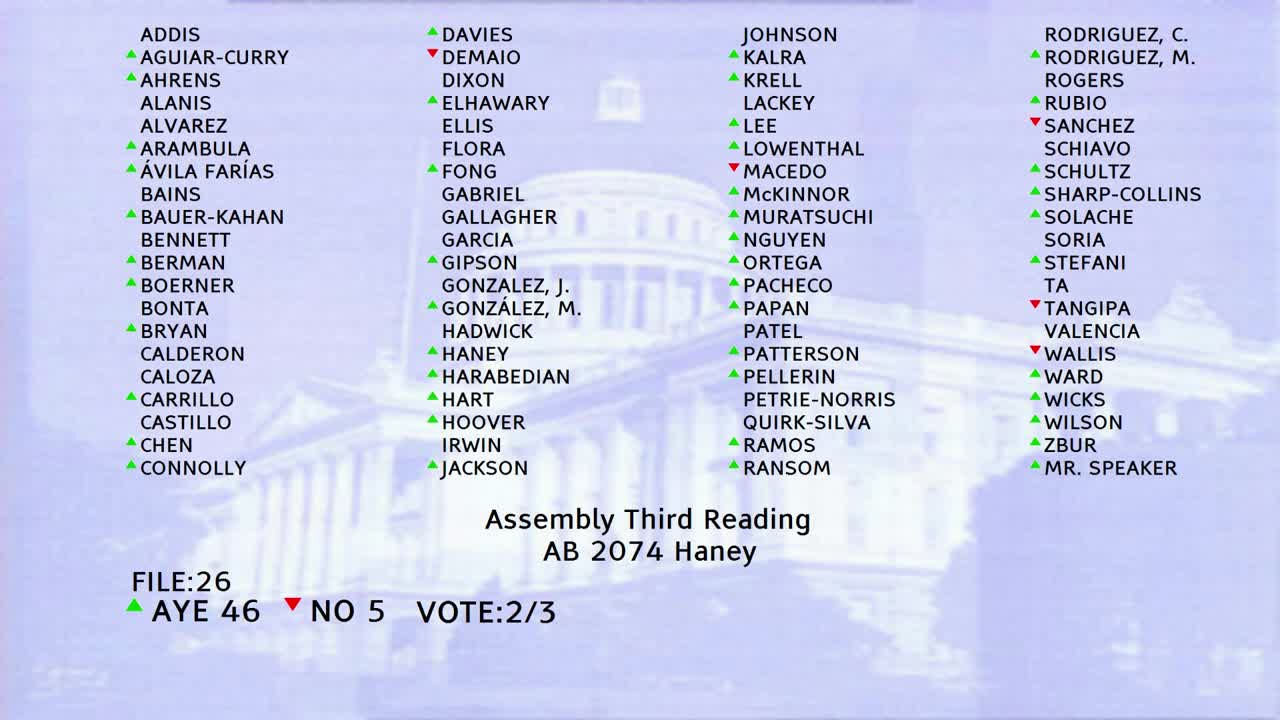 21MIN
Assembly Floor
 27MIN
Assembly Standing Committee on Public Safety
Bill Author