AB 2741: Housing element: inventory of land: substantial compliance.
- Session Year: 2025-2026
- House: Assembly
- Latest Version Date: 2026-04-23
Current Status:
In Progress
(2026-04-29: In committee: Set, first hearing. Failed passage. Reconsideration granted.)
Introduced
In Committee
Awaiting First Chamber Vote
Passed First Chamber
In Committee
Awaiting Second Chamber Vote
Passed Second Chamber
Enacted
The Planning and Zoning Law requires a city or county to adopt a general plan for land use development within its boundaries that includes, among other things, a housing element. Existing law requires the housing element to include, among other things, an inventory of land suitable and available for residential development. Existing law requires a city or county, based on that inventory of land, to determine whether each site in the inventory can accommodate the development of some portion of its share of the regional housing need by income level during the planning period, as provided. Existing law requires local governments to rezone sites according to a specified program if the inventory of sites suitable and available for residential development does not identify adequate sites to accommodate the need for groups of all household income levels. Existing law requires that program to accommodate 100% of the need for housing for specified lower income households on sites required to be zoned to permit owner-occupied and rental multifamily residential use, as provided, and requires these sites to be zoned with specified minimum density and development standards, as provided.
This bill would provide that these zoning requirements would be met by applying a zoning classification, including, but not limited to, an affordable housing overlay zone, mixed-use zone, combining district, or similar zone that permits owner-occupied and rental multifamily residential use with the above-described minimum density and development standards, as specified. The bill would require a program that includes application of this zoning classification to include a written explanation of the housing and affordability incentives of the zoning classification. The bill would permit this zoning classification to allow a mix of uses if it meets prescribed requirements. The bill would define key terms for these purposes. The bill would apply these provisions only to the 6th housing element revision cycle and retroactively to January 1, 2019.
Existing law, commonly referred to as the Housing Element Law, prescribes requirements for a citys or countys preparation of, and compliance with, its housing element, and requires the Department of Housing and Community Development to review and determine whether the housing element substantially complies with the Housing Element Law, as specified. Existing law provides that a housing element or amendment is considered substantially compliant with the Housing Element Law when the local agency has adopted a housing element or amendment, the department or a court of competent jurisdiction determines the adopted housing element or amendment to be in substantial compliance with the Housing Element Law, and the departments compliance findings have not been superseded by subsequent contrary findings by the department or by a decision of a court of competent jurisdiction or the courts decision has not been overturned or superseded by a subsequent court decision or by statute.
Existing law, the Housing Accountability Act, among other things, prohibits a local agency from disapproving, or conditioning approval in a manner that renders infeasible, a housing development project for very low, low-, or moderate-income households unless the local agency makes written findings as to one of certain sets of conditions, as specified. One set of conditions is that (1) the jurisdiction has adopted a housing element that is in substantial compliance with the Housing Element Law, and (2) the jurisdiction has met or exceeded its share of the regional housing need allocation for the planning period for the income category proposed for the housing development project. Existing law requires a housing element or amendment to be considered in substantial compliance with the Housing Element Law only if the element or amendment was determined to be in substantial compliance when a preliminary application or complete application was submitted, as specified.
This bill would require, if a court of competent jurisdiction finds an adopted housing element or amendment to be to be out of compliance despite the departments findings of substantial compliance, that the housing element or amendment be considered in substantial compliance until either the date the department finds that a newly adopted housing element or amendment is in substantial compliance, or 275 days after a court order, writ, or judgment is issued requiring the local agency to bring its housing element into substantial compliance, whichever is earlier.
The Planning and Zoning Law requires a city or county to adopt a general plan for land use development within its boundaries that includes, among other things, a housing element. Existing law requires the housing element to include, among other things, an inventory of land suitable and available for residential development. Existing law requires a city or county, based on that inventory of land, to determine whether each site in the inventory can accommodate the development of some portion of its share of the regional housing need by income level during the planning period, as provided. Existing law requires local governments to rezone sites according to a specified program if the inventory of sites suitable and available for residential development does not identify adequate sites to accommodate the need for groups of all household income levels. Existing law requires that program to accommodate 100% of the need for housing for specified lower income households on sites required to be zoned to permit owner-occupied and rental multifamily residential use, as provided, and requires these sites to be zoned with specified minimum density and development standards, as provided.
This bill would provide that these zoning requirements would be met by applying a zoning classification, including, but not limited to, an affordable housing overlay zone, that permits owner-occupied and rental multifamily residential use with the above-described minimum density and development standards, as specified. The bill would require a program that includes application of this zoning classification to include a written explanation of the housing and affordability incentives of the zoning classification. The bill would permit this zoning classification to allow a mix of uses if it meets prescribed requirements. The bill would define key terms for these purposes.
Existing law, commonly referred to as the Housing Element Law, prescribes requirements for a citys or countys preparation of, and compliance with, its housing element, and requires the Department of Housing and Community Development to review and determine whether the housing element substantially complies with the Housing Element Law, as specified. Existing law provides that a housing element or amendment is considered substantially compliant with the Housing Element Law when the local agency has adopted a housing element or amendment, the department or a court of competent jurisdiction determines the adopted housing element or amendment to be in substantial compliance with the Housing Element Law, and the departments compliance findings have not been superseded by subsequent contrary findings by the department or by a decision of a court of competent jurisdiction or the courts decision has not been overturned or superseded by a subsequent court decision or by statute.
Existing law, the Housing Accountability Act, among other things, prohibits a local agency from disapproving, or conditioning approval in a manner that renders infeasible, a housing development project for very low, low-, or moderate-income households unless the local agency makes written findings as to one of certain sets of conditions, as specified. One set of conditions is that (1) the jurisdiction has adopted a housing element that is in substantial compliance with the Housing Element Law, and (2) the jurisdiction has met or exceeded its share of the regional housing need allocation for the planning period for the income category proposed for the housing development project. Existing law requires a housing element or amendment to be considered in substantial compliance with the Housing Element Law only if the element or amendment was determined to be in substantial compliance when a preliminary application or complete application was submitted, as specified.
This bill would require, if a court of competent jurisdiction finds an adopted housing element or amendment to be to be out of compliance despite the departments findings of substantial compliance, that the housing element or amendment be considered in substantial compliance until either the date the department finds that a newly adopted housing element or amendment is in substantial compliance, or 275 days after a court order, writ, or judgment is issued requiring the local agency to bring its housing element into substantial compliance, whichever is earlier.
The Planning and Zoning Law requires a city or county to adopt a general plan for land use development within its boundaries that includes, among other things, a housing element. Existing law requires the housing element to include, among other things, an inventory of land suitable and available for residential development. Existing law requires a city or county, based on that inventory of land, to determine whether each site in the inventory can accommodate the development of some portion of its share of the regional housing need by income level during the planning period, as provided.Existing law, commonly referred to as the Housing Element Law, prescribes requirements for a citys or countys preparation of, and compliance with, its housing element, and requires the Department of Housing and Community Development to review and determine whether the housing element substantially complies with the Housing Element Law, as specified.This bill would express the intent of the Legislature to enact legislation relating to the use of residential overlay zones in housing element compliance determinations and to the finding of substantial compliance following decertification by a court.The Planning and Zoning Law requires a city or county to adopt a general plan for land use development within its boundaries that includes, among other things, a housing element. Existing law requires the housing element to include, among other things, an inventory of land suitable and available for residential development. Existing law requires a city or county, based on that inventory of land, to determine whether each site in the inventory can accommodate the development of some portion of its share of the regional housing need by income level during the planning period, as provided.
Existing law, commonly referred to as the Housing Element Law, prescribes requirements for a citys or countys preparation of, and compliance with, its housing element, and requires the Department of Housing and Community Development to review and determine whether the housing element substantially complies with the Housing Element Law, as specified.
This bill would express the intent of the Legislature to enact legislation relating to the use of residential overlay zones in housing element compliance determinations and to the finding of substantial compliance following decertification by a court.
(a)A citys or countys inventory of land suitable for residential development pursuant to paragraph (3) of subdivision (a) of Section 65583 shall be used to identify sites throughout the community, consistent with paragraph (10) of subdivision (c) of Section 65583, that can be developed for housing within the planning period and that are sufficient to provide for the jurisdictions share of the regional housing need for all income levels pursuant to Section 65584. As used in this section, land suitable for residential development includes all of the following sites that meet the standards set forth in subdivisions (c) and (g):
(1)Vacant sites zoned for residential use.
(2)Vacant sites zoned for nonresidential use that allows residential development.
(3)Residentially zoned sites that are capable of being developed at a higher density, including sites owned or leased by a city, county, or city and county.
(4)Sites zoned for nonresidential use that can be redeveloped for residential use, and for which the housing element includes a program to rezone the site, as necessary, rezoned for, to permit residential use, including sites owned or leased by a city, county, or city and county.
(b)The inventory of land shall include all of the following:
(1)A listing of properties by assessor parcel number.
(2)The size of each property listed pursuant to paragraph (1), and the general plan designation and zoning of each property.
(3)For nonvacant sites, a description of the existing use of each property. If a site subject to this paragraph is owned by the city or county, the description shall also include whether there are any plans to dispose of the property during the planning period and how the city or county will comply with Article 8 (commencing with Section 54220) of Chapter 5 of Part 1 of Division 2 of Title 5.
(4)A general description of any environmental constraints to the development of housing within the jurisdiction, the documentation for which has been made available to the jurisdiction. This information need not be identified on a site-specific basis.
(5)(A)A description of existing or planned water, sewer, and other dry utilities supply, including the availability and access to distribution facilities.
(B)Parcels included in the inventory must have sufficient water, sewer, and dry utilities supply available and accessible to support housing development or be included in an existing general plan program or other mandatory program or plan, including a program or plan of a public or private entity providing water or sewer service, to secure sufficient water, sewer, and dry utilities supply to support housing development. This paragraph does not impose any additional duty on the city or county to construct, finance, or otherwise provide water, sewer, or dry utilities to parcels included in the inventory.
(6)Sites identified as available for housing for above moderate-income households in areas not served by public sewer systems. This information need not be identified on a site-specific basis.
(7)A map that shows the location of the sites included in the inventory, such as the land use map from the jurisdictions general plan, for reference purposes only.
(c)Based on the information provided in subdivision (b), a city or county shall determine whether each site in the inventory can accommodate the development of some portion of its share of the regional housing need by income level during the planning period, as determined pursuant to Section 65584. The inventory shall specify for each site the number of units that can realistically be accommodated on that site and whether the site is adequate to accommodate lower income housing, moderate-income housing, or above moderate-income housing. A nonvacant site identified pursuant to paragraph (3) or (4) of subdivision (a) in a prior housing element and a vacant site that has been included in two or more consecutive planning periods that was not approved to develop a portion of the localitys housing need shall not be deemed adequate to accommodate a portion of the housing need for lower income households that must be accommodated in the current housing element planning period unless the site is zoned at residential densities consistent with paragraph (3) of this subdivision and the site is subject to a program in the housing element requiring rezoning by the applicable deadline for rezoning set forth in subparagraph (A) of paragraph (1) of subdivision (c) of Section 65583 to allow residential use by right for housing developments in which at least 20 percent of the units are affordable to lower income households. An unincorporated area in a nonmetropolitan county pursuant to clause (ii) of subparagraph (B) of paragraph (3) shall not be subject to the requirements of this subdivision to allow residential use by right. The analysis shall determine whether the inventory can provide for a variety of types of housing, including multifamily rental housing, factory-built housing, mobilehomes, housing for agricultural employees, supportive housing, single-room occupancy units, emergency shelters, and transitional housing, and whether the inventory affirmatively furthers fair housing. The city or county shall determine the number of housing units that can be accommodated on each site as follows:
(1)If local law or regulations require the development of a site at a minimum density, the department shall accept the planning agencys calculation of the total housing unit capacity on that site based on the established minimum density. If the city or county does not adopt a law or regulation requiring the development of a site at a minimum density, then it shall demonstrate how the number of units determined for that site pursuant to this subdivision will be accommodated.
(2)The number of units calculated pursuant to paragraph (1) shall be adjusted as necessary, based on the land use controls and site improvements requirement identified in paragraph (5) of subdivision (a) of Section 65583, the realistic development capacity for the site, typical densities of existing or approved residential developments at a similar affordability level in that jurisdiction, and on the current or planned availability and accessibility of sufficient water, sewer, and dry utilities.
(A)A site smaller than half an acre shall not be deemed adequate to accommodate lower income housing need unless the locality can demonstrate that sites of equivalent size were successfully developed during the prior planning period for an equivalent number of lower income housing units as projected for the site or unless the locality provides other evidence to the department that the site is adequate to accommodate lower income housing.
(B)A site larger than 10 acres shall not be deemed adequate to accommodate lower income housing need unless the locality can demonstrate that sites of equivalent size were successfully developed during the prior planning period for an equivalent number of lower income housing units as projected for the site or unless the locality provides other evidence to the department that the site can be developed as lower income housing. For purposes of this subparagraph, site means that portion of a parcel or parcels designated to accommodate lower income housing needs pursuant to this subdivision.
(C)A site may be presumed to be realistic for development to accommodate lower income housing need if, at the time of the adoption of the housing element, a development affordable to lower income households has been proposed and approved for development on the site.
(3)For the number of units calculated to accommodate its share of the regional housing need for lower income households pursuant to paragraph (2), a city or county shall do either of the following:
(A)Provide an analysis demonstrating how the adopted densities accommodate this need. The analysis shall include, but is not limited to, factors such as market demand, financial feasibility, or information based on development project experience within a zone or zones that provide housing for lower income households.
(B)The following densities shall be deemed appropriate to accommodate housing for lower income households:
(i)For an incorporated city within a nonmetropolitan county and for a nonmetropolitan county that has a micropolitan area: sites allowing at least 15 units per acre.
(ii)For an unincorporated area in a nonmetropolitan county not included in clause (i): sites allowing at least 10 units per acre.
(iii)For a suburban jurisdiction: sites allowing at least 20 units per acre.
(iv)For a jurisdiction in a metropolitan county: sites allowing at least 30 units per acre.
(4)(A)For a metropolitan jurisdiction:
(i)At least 25 percent of the jurisdictions share of the regional housing need for moderate-income housing shall be allocated to sites with zoning that allows at least four units of housing, but not more than 100 units per acre of housing.
(ii)At least 25 percent of the jurisdictions share of the regional housing need for above moderate-income housing shall be allocated to sites with zoning that allows at least 4 units of housing.
(B)The allocation of moderate-income and above moderate-income housing to sites pursuant to this paragraph shall not be a basis for the jurisdiction to do either of the following:
(i)Deny a project that does not comply with the allocation.
(ii)Impose a price minimum, price maximum, price control, or any other exaction or condition of approval in lieu thereof. This clause does not prohibit a jurisdiction from imposing any price minimum, price maximum, price control, exaction, or condition in lieu thereof, pursuant to any other law.
(iii)The provisions of this subparagraph do not constitute a change in, but are declaratory of, existing law with regard to the allocation of sites pursuant to this section.
(C)This paragraph does not apply to an unincorporated area.
(D)For purposes of this paragraph:
(i)Housing development project has the same meaning as defined in paragraph (2) of subdivision (h) of Section 65589.5.
(ii)Unit of housing does not include an accessory dwelling unit or junior accessory dwelling unit that could be approved pursuant to Article 2 (commencing with Section 66314) or Article 3 (commencing with Section 66333) of Chapter 13 or through a local ordinance or other provision implementing either of those articles. This paragraph shall not limit the ability of a local government to count the actual production of accessory dwelling units or junior accessory dwelling units in an annual progress report submitted pursuant to Section 65400 or other progress report as determined by the department.
(E)Nothing in this subdivision shall preclude the subdivision of a parcel, provided that the subdivision is subject to the Subdivision Map Act (Division 2 (commencing with Section 66410)) or any other applicable law authorizing the subdivision of land.
(d)For purposes of this section, a metropolitan county, nonmetropolitan county, and nonmetropolitan county with a micropolitan area shall be as determined by the United States Census Bureau. A nonmetropolitan county with a micropolitan area includes the following counties: Del Norte, Humboldt, Lake, Mendocino, Nevada, Tehama, and Tuolumne and other counties as may be determined by the United States Census Bureau to be nonmetropolitan counties with micropolitan areas in the future.
(e)(1)Except as provided in paragraph (2), a jurisdiction shall be considered suburban if the jurisdiction does not meet the requirements of clauses (i) and (ii) of subparagraph (B) of paragraph (3) of subdivision (c) and is located in a Metropolitan Statistical Area (MSA) of less than 2,000,000 in population, unless that jurisdictions population is greater than 100,000, in which case it shall be considered metropolitan. A county, not including the City and County of San Francisco, shall be considered suburban unless the county is in an MSA of 2,000,000 or greater in population, in which case the county shall be considered metropolitan.
(2)(A)(i)Notwithstanding paragraph (1), if a county that is in the San Francisco-Oakland-Fremont California MSA has a population of less than 400,000, that county shall be considered suburban. If this county includes an incorporated city that has a population of less than 100,000, this city shall also be considered suburban. This paragraph shall apply to a housing element revision cycle, as described in subparagraph (A) of paragraph (3) of subdivision (e) of Section 65588, that is in effect from July 1, 2014, to December 31, 2028, inclusive.
(ii)A county subject to this subparagraph shall utilize the sum existing in the countys housing trust fund as of June 30, 2013, for the development and preservation of housing affordable to low- and very low income households.
(B)A jurisdiction that is classified as suburban pursuant to this paragraph shall report to the Assembly Committee on Housing and Community Development, the Senate Committee on Housing, and the Department of Housing and Community Development regarding its progress in developing low- and very low income housing consistent with the requirements of Section 65400. The report shall be provided three times: once, on or before December 31, 2019, which report shall address the initial four years of the housing element cycle, a second time, on or before December 31, 2023, which report shall address the subsequent four years of the housing element cycle, and a third time, on or before December 31, 2027, which report shall address the subsequent four years of the housing element cycle and the cycle as a whole. The reports shall be provided consistent with the requirements of Section 9795.
(f)A jurisdiction shall be considered metropolitan if the jurisdiction does not meet the requirements for suburban area above and is located in an MSA of 2,000,000 or greater in population, unless that jurisdictions population is less than 25,000 in which case it shall be considered suburban.
(g)(1)For sites described in paragraph (3) of subdivision (b), the city or county shall specify the additional development potential for each site within the planning period and shall provide an explanation of the methodology used to determine the development potential. The methodology shall consider factors including the extent to which existing uses may constitute an impediment to additional residential development, the citys or countys past experience with converting existing uses to higher density residential development, the current market demand for the existing use, an analysis of any existing leases or other contracts that would perpetuate the existing use or prevent redevelopment of the site for additional residential development, development trends, market conditions, and regulatory or other incentives or standards to encourage additional residential development on these sites.
(2)In addition to the analysis required in paragraph (1), when a city or county is relying on nonvacant sites described in paragraph (3) of subdivision (b) to accommodate 50 percent or more of its housing need for lower income households, the methodology used to determine additional development potential shall demonstrate that the existing use identified pursuant to paragraph (3) of subdivision (b) does not constitute an impediment to additional residential development during the period covered by the housing element. An existing use shall be presumed to impede additional residential development, absent findings based on substantial evidence that the use is likely to be discontinued during the planning period.
(3)Notwithstanding any other law, and in addition to the requirements in paragraphs (1) and (2), sites that currently have residential uses, or within the past five years have had residential uses that have been vacated or demolished, that are or were subject to a recorded covenant, ordinance, or law that restricts rents to levels affordable to persons and families of low or very low income, subject to any other form of rent or price control through a public entitys valid exercise of its police power, or occupied by low- or very low income households, shall be subject to a policy requiring the replacement of all those units affordable to the same or lower income level as a condition of any development on the site. Replacement requirements shall be consistent with those set forth in paragraph (3) of subdivision (c) of Section 65915.
(h)(1)The program required by subparagraph (A) of paragraph (1) of subdivision (c) of Section 65583 shall accommodate 100 percent of the need for housing for lower income households allocated pursuant to Section 65584 for which site capacity has not been identified in the inventory of sites pursuant to paragraph (3) of subdivision (a) on sites that shall be zoned to permit owner-occupied and rental multifamily residential use by right for developments in which at least 20 percent of the units are affordable to lower income households during the planning period.
(2)These sites shall be zoned with minimum density and development standards that permit at least 16 units per site at a density of at least 16 units per acre in jurisdictions described in clause (i) of subparagraph (B) of paragraph (3) of subdivision (c), shall be at least 20 units per acre in jurisdictions described in clauses (iii) and (iv) of subparagraph (B) of paragraph (3) of subdivision (c), and shall meet the standards set forth in subparagraph (B) of paragraph (5) of subdivision (b). At least 50 percent of the lower income housing need shall be accommodated on sites designated for residential use and for which nonresidential uses or mixed uses are not permitted, except that a city or county may accommodate all of the lower income housing need on sites designated for mixed use if those sites allow 100 percent residential use and require that residential use occupy 50 percent of the total floor area of a mixed-use project.
(3)(A)For the purposes of this subdivision, shall be zoned includes applying a zoning classification, including, but not limited to, an affordable housing overlay zone overlay zone, mixed-use zone, combining district, or similar zone that permits owner-occupied and rental multifamily residential use with the minimum density and development standards described in paragraphs (1) and (2). A program that includes application of a zoning classification permitted pursuant to this paragraph shall include a written explanation of the housing and affordability incentives of the zoning classification.
(B)The zoning classification permitted pursuant to this subdivision may allow a mix of uses if it allows 100 percent residential use and requires that, if an applicant seeks to develop a mixed-use project that includes both residential and nonresidential uses on a single site, at least 50 percent of the total floor area on the site shall be dedicated to residential uses. either of the following apply:
(i)At least 50 percent of the lower income housing need is accommodated on sites designated for residential use and for which nonresidential uses or mixed uses are not permitted.
(ii)All of the lower income housing need is accommodated on sites that allow a mix of uses, provided that those sites allow 100 percent residential use and require that, if an applicant seeks to develop a mixed-use project that includes both residential and nonresidential uses on a single site, at least 50 percent of the total floor area of the mixed-use project be dedicated to residential uses.
(C)For the purposes of this paragraph, the following definitions shall apply:
(i)Allow for a mix of uses shall mean that the zoning for the site permits any of the following:
(I)Residential use.
(II)Nonresidential use.
(III)A mix of residential and nonresidential uses, including, without limitation, vertical, and horizontal mixed-use projects.
(ii)Total floor area shall combine the floor area for existing uses that are proposed to remain with the floor area for new proposed uses. For the purposes of calculating the total floor area for the project, site shall be defined as the parcel or assemblage of parcels upon which the project is proposed.
(4)Changes made to this subdivision by the act adding this paragraph apply only to the sixth housing element revision cycle and are retroactive to January 1, 2019.
(i)For purposes of this section and Section 65583, the phrase use by right shall mean that the local governments review of the owner-occupied or multifamily residential use may not require a conditional use permit, planned unit development permit, or other discretionary local government review or approval that would constitute a project for purposes of Division 13 (commencing with Section 21000) of the Public Resources Code. Any subdivision of the sites shall be subject to all laws, including, but not limited to, the local government ordinance implementing the Subdivision Map Act. A local ordinance may provide that use by right does not exempt the use from design review. However, that design review shall not constitute a project for purposes of Division 13 (commencing with Section 21000) of the Public Resources Code. Use by right for all rental multifamily residential housing shall be provided in accordance with subdivision (f) of Section 65589.5.
(j)Notwithstanding any other provision of this section, within one-half mile of a Sonoma-Marin Area Rail Transit station, housing density requirements in place on June 30, 2014, shall apply.
(k)For purposes of subdivisions (a) and (b), the department shall provide guidance to local governments to properly survey, detail, and account for sites listed pursuant to Section 65585.
(l)(1)The changes to this section made by Chapter 193 of the Statutes of 2020 shall become operative on January 1, 2022.
(2)The changes to this section made by Chapter 193 of the Statutes of 2020 shall not apply to a housing element revision that is originally due on or before January 1, 2022, regardless of the date of adoption by the local agency.
(m)This section shall remain in effect only until December 31, 2028, and as of that date is repealed.
SEC. 2.Section 65583.2 of the Government Code, as amended by Section 7.5 of Chapter 282 of the Statutes of 2024, is amended to read:65583.2.(a)A citys or countys inventory of land suitable for residential development pursuant to paragraph (3) of subdivision (a) of Section 65583 shall be used to identify sites throughout the community, consistent with paragraph (10) of subdivision (c) of Section 65583, that can be developed for housing within the planning period and that are sufficient to provide for the jurisdictions share of the regional housing need for all income levels pursuant to Section 65584. As used in this section, land suitable for residential development includes all of the following sites that meet the standards set forth in subdivisions (c) and (g):
(1)Vacant sites zoned for residential use.
(2)Vacant sites zoned for nonresidential use that allows residential development.
(3)Residentially zoned sites that are capable of being developed at a higher density, and sites owned or leased by a city, county, or city and county.
(4)Sites zoned for nonresidential use that can be redeveloped for residential use, and for which the housing element includes a program to rezone the site, as necessary, to permit residential use, including sites owned or leased by a city, county, or city and county.
(b)The inventory of land shall include all of the following:
(1)A listing of properties by assessor parcel number.
(2)The size of each property listed pursuant to paragraph (1), and the general plan designation and zoning of each property.
(3)For nonvacant sites, a description of the existing use of each property. If a site subject to this paragraph is owned by the city or county, the description shall also include whether there are any plans to dispose of the property during the planning period and how the city or county will comply with Article 8 (commencing with Section 54220) of Chapter 5 of Part 1 of Division 2 of Title 5.
(4)A general description of any environmental constraints to the development of housing within the jurisdiction, the documentation for which has been made available to the jurisdiction. This information need not be identified on a site-specific basis.
(5)(A)A description of existing or planned water, sewer, and other dry utilities supply, including the availability and access to distribution facilities.
(B)Parcels included in the inventory must have sufficient water, sewer, and dry utilities supply available and accessible to support housing development or be included in an existing general plan program or other mandatory program or plan, including a program or plan of a public or private entity providing water or sewer service, to secure sufficient water, sewer, and dry utilities supply to support housing development. This paragraph does not impose any additional duty on the city or county to construct, finance, or otherwise provide water, sewer, or dry utilities to parcels included in the inventory.
(6)Sites identified as available for housing for above moderate-income households in areas not served by public sewer systems. This information need not be identified on a site-specific basis.
(7)A map that shows the location of the sites included in the inventory, such as the land use map from the jurisdictions general plan for reference purposes only.
(c)Based on the information provided in subdivision (b), a city or county shall determine whether each site in the inventory can accommodate the development of some portion of its share of the regional housing need by income level during the planning period, as determined pursuant to Section 65584. The inventory shall specify for each site the number of units that can realistically be accommodated on that site and whether the site is adequate to accommodate lower income housing, moderate-income housing, or above moderate-income housing. A nonvacant site identified pursuant to paragraph (3) or (4) of subdivision (a) in a prior housing element and a vacant site that has been included in two or more consecutive planning periods that was not approved to develop a portion of the localitys housing need shall not be deemed adequate to accommodate a portion of the housing need for lower income households that must be accommodated in the current housing element planning period unless the site is zoned at residential densities consistent with paragraph (3) of this subdivision and the site is subject to a program in the housing element requiring rezoning by the applicable deadline for rezoning set forth in subparagraph (A) of paragraph (1) of subdivision (c) of Section 65583 to allow residential use by right for housing developments in which at least 20 percent of the units are affordable to lower income households. An unincorporated area in a nonmetropolitan county pursuant to clause (ii) of subparagraph (B) of paragraph (3) shall not be subject to the requirements of this subdivision to allow residential use by right. The analysis shall determine whether the inventory can provide for a variety of types of housing, including multifamily rental housing, factory-built housing, mobilehomes, housing for agricultural employees, supportive housing, single-room occupancy units, emergency shelters, and transitional housing, and whether the inventory affirmatively furthers fair housing. The city or county shall determine the number of housing units that can be accommodated on each site as follows:
(1)If local law or regulations require the development of a site at a minimum density, the department shall accept the planning agencys calculation of the total housing unit capacity on that site based on the established minimum density. If the city or county does not adopt a law or regulation requiring the development of a site at a minimum density, then it shall demonstrate how the number of units determined for that site pursuant to this subdivision will be accommodated.
(2)The number of units calculated pursuant to paragraph (1) shall be adjusted as necessary, based on the land use controls and site improvements requirement identified in paragraph (5) of subdivision (a) of Section 65583, the realistic development capacity for the site, typical densities of existing or approved residential developments at a similar affordability level in that jurisdiction, and on the current or planned availability and accessibility of sufficient water, sewer, and dry utilities.
(A)A site smaller than half an acre shall not be deemed adequate to accommodate lower income housing need unless the locality can demonstrate that sites of equivalent size were successfully developed during the prior planning period for an equivalent number of lower income housing units as projected for the site or unless the locality provides other evidence to the department that the site is adequate to accommodate lower income housing.
(B)A site larger than 10 acres shall not be deemed adequate to accommodate lower income housing need unless the locality can demonstrate that sites of equivalent size were successfully developed during the prior planning period for an equivalent number of lower income housing units as projected for the site or unless the locality provides other evidence to the department that the site can be developed as lower income housing. For purposes of this subparagraph, site means that portion of a parcel or parcels designated to accommodate lower income housing needs pursuant to this subdivision.
(C)A site may be presumed to be realistic for development to accommodate lower income housing need if, at the time of the adoption of the housing element, a development affordable to lower income households has been proposed and approved for development on the site.
(3)For the number of units calculated to accommodate its share of the regional housing need for lower income households pursuant to paragraph (2), a city or county shall do either of the following:
(A)Provide an analysis demonstrating how the adopted densities accommodate this need. The analysis shall include, but is not limited to, factors such as market demand, financial feasibility, or information based on development project experience within a zone or zones that provide housing for lower income households.
(B)The following densities shall be deemed appropriate to accommodate housing for lower income households:
(i)For an incorporated city within a nonmetropolitan county and for a nonmetropolitan county that has a micropolitan area: sites allowing at least 15 units per acre.
(ii)For an unincorporated area in a nonmetropolitan county not included in clause (i): sites allowing at least 10 units per acre.
(iii)For a suburban jurisdiction: sites allowing at least 20 units per acre.
(iv)For a jurisdiction in a metropolitan county: sites allowing at least 30 units per acre.
(4)(A)For a metropolitan jurisdiction:
(i)At least 25 percent of the jurisdictions share of the regional housing need for moderate-income housing shall be allocated to sites with zoning that allows at least four units of housing, but not more than 100 units per acre of housing.
(ii)At least 25 percent of the jurisdictions share of the regional housing need for above moderate-income housing shall be allocated to sites with zoning that allows at least 4 units of housing.
(B)The allocation of moderate-income and above moderate-income housing to sites pursuant to this paragraph shall not be a basis for the jurisdiction to do either of the following:
(i)Deny a project that does not comply with the allocation.
(ii)Impose a price minimum, price maximum, price control, or any other exaction or condition of approval in lieu thereof. This clause does not prohibit a jurisdiction from imposing any price minimum, price maximum, price control, exaction, or condition in lieu thereof, pursuant to any other law.
(iii)The provisions of this subparagraph do not constitute a change in, but are declaratory of, existing law with regard to the allocation of sites pursuant to this section.
(C)This paragraph does not apply to an unincorporated area.
(D)For purposes of this paragraph:
(i)Housing development project has the same meaning as defined in paragraph (2) of subdivision (h) of Section 65589.5.
(ii)Unit of housing does not include an accessory dwelling unit or junior accessory dwelling unit that could be approved pursuant to Article 2 (commencing with Section 66314) or Article 3 (commencing with Section 66333) of Chapter 13 or through a local ordinance or other provision implementing either of those articles. This paragraph shall not limit the ability of a local government to count the actual production of accessory dwelling units or junior accessory dwelling units in an annual progress report submitted pursuant to Section 65400 or other progress report as determined by the department.
(E)Nothing in this subdivision shall preclude the subdivision of a parcel, provided that the subdivision is subject to the Subdivision Map Act (Division 2 (commencing with Section 66410)) or any other applicable law authorizing the subdivision of land.
(d)For purposes of this section, a metropolitan county, nonmetropolitan county, and nonmetropolitan county with a micropolitan area shall be as determined by the United States Census Bureau. A nonmetropolitan county with a micropolitan area includes the following counties: Del Norte, Humboldt, Lake, Mendocino, Nevada, Tehama, and Tuolumne and other counties as may be determined by the United States Census Bureau to be nonmetropolitan counties with micropolitan areas in the future.
(e)A jurisdiction shall be considered suburban if the jurisdiction does not meet the requirements of clauses (i) and (ii) of subparagraph (B) of paragraph (3) of subdivision (c) and is located in a Metropolitan Statistical Area (MSA) of less than 2,000,000 in population, unless that jurisdictions population is greater than 100,000, in which case it shall be considered metropolitan. A county, not including the City and County of San Francisco, shall be considered suburban unless the county is in an MSA of 2,000,000 or greater in population in which case the county shall be considered metropolitan.
(f)A jurisdiction shall be considered metropolitan if the jurisdiction does not meet the requirements for suburban area above and is located in an MSA of 2,000,000 or greater in population, unless that jurisdictions population is less than 25,000 in which case it shall be considered suburban.
(g)(1)For sites described in paragraph (3) of subdivision (b), the city or county shall specify the additional development potential for each site within the planning period and shall provide an explanation of the methodology used to determine the development potential. The methodology shall consider factors including the extent to which existing uses may constitute an impediment to additional residential development, the citys or countys past experience with converting existing uses to higher density residential development, the current market demand for the existing use, an analysis of any existing leases or other contracts that would perpetuate the existing use or prevent redevelopment of the site for additional residential development, development trends, market conditions, and regulatory or other incentives or standards to encourage additional residential development on these sites.
(2)In addition to the analysis required in paragraph (1), when a city or county is relying on nonvacant sites described in paragraph (3) of subdivision (b) to accommodate 50 percent or more of its housing need for lower income households, the methodology used to determine additional development potential shall demonstrate that the existing use identified pursuant to paragraph (3) of subdivision (b) does not constitute an impediment to additional residential development during the period covered by the housing element. An existing use shall be presumed to impede additional residential development, absent findings based on substantial evidence that the use is likely to be discontinued during the planning period.
(3)Notwithstanding any other law, and in addition to the requirements in paragraphs (1) and (2), sites that currently have residential uses, or within the past five years have had residential uses that have been vacated or demolished, that are or were subject to a recorded covenant, ordinance, or law that restricts rents to levels affordable to persons and families of low or very low income, subject to any other form of rent or price control through a public entitys valid exercise of its police power, or occupied by low- or very low income households, shall be subject to a policy requiring the replacement of all those units affordable to the same or lower income level as a condition of any development on the site. Replacement requirements shall be consistent with those set forth in paragraph (3) of subdivision (c) of Section 65915.
(h)(1)The program required by subparagraph (A) of paragraph (1) of subdivision (c) of Section 65583 shall accommodate 100 percent of the need for housing for lower income households allocated pursuant to Section 65584 for which site capacity has not been identified in the inventory of sites pursuant to paragraph (3) of subdivision (a) on sites that shall be zoned to permit owner-occupied and rental multifamily residential use by right for developments in which at least 20 percent of the units are affordable to lower income households during the planning period.
(2)These sites shall be zoned with minimum density and development standards that permit at least 16 units per site at a density of at least 16 units per acre in jurisdictions described in clause (i) of subparagraph (B) of paragraph (3) of subdivision (c), shall be at least 20 units per acre in jurisdictions described in clauses (iii) and (iv) of subparagraph (B) of paragraph (3) of subdivision (c), and shall meet the standards set forth in subparagraph (B) of paragraph (5) of subdivision (b). At least 50 percent of the lower income housing need shall be accommodated on sites designated for residential use and for which nonresidential uses or mixed uses are not permitted, except that a city or county may accommodate all of the lower income housing need on sites designated for mixed use if those sites allow 100 percent residential use and require that residential use occupy 50 percent of the total floor area of a mixed-use project.
(3)(A)For the purposes of this subdivision, shall be zoned includes applying a zoning classification, including, but not limited to, an affordable housing overlay zone, overlay zone, mixed-use zone, combining district, or similar zone that permits owner-occupied and rental multifamily residential use with the minimum density and development standards described in paragraphs (1) and (2). A program that includes application of a zoning classification permitted pursuant to this paragraph shall include a written explanation of the housing and affordability incentives of the zoning classification.
(B)The zoning classification permitted pursuant to this subdivision may allow a mix of uses if it allows 100 percent residential use and requires that, if an applicant seeks to develop a mixed-use project that includes both residential and nonresidential uses on a single site, at least 50 percent of the total floor area on the site shall be dedicated to residential uses. either of the following apply:
(i)At least 50 percent of the lower income housing need is accommodated on sites designated for residential use and for which nonresidential uses or mixed uses are not permitted.
(ii)All of the lower income housing need is accommodated on sites that allow a mix of uses, provided that those sites allow 100 percent residential use and require that, if an applicant seeks to develop a mixed-use project that includes both residential and nonresidential uses on a single site, at least 50 percent of the total floor area of the mixed-use project be dedicated to residential uses.
(C)For the purposes of this paragraph, the following definitions shall apply:
(i)Allow for a mix of uses shall mean that the zoning for the site permits any of the following:
(I)Residential use.
(II)Nonresidential use.
(III)A mix of residential and nonresidential uses, including, without limitation, vertical, and horizontal mixed-use projects.
(ii)Total floor area shall combine the floor area for existing uses that are proposed to remain with the floor area for new proposed uses. For the purposes of calculating the total floor area for the project, site shall be defined as the parcel or assemblage of parcels upon which the project is proposed.
(4)Changes made to this subdivision by the act adding this paragraph apply only to the sixth housing element revision cycle and are retroactive to January 1, 2019.
(i)For purposes of this section and Section 65583, the phrase use by right shall mean that the local governments review of the owner-occupied or multifamily residential use may not require a conditional use permit, planned unit development permit, or other discretionary local government review or approval that would constitute a project for purposes of Division 13 (commencing with Section 21000) of the Public Resources Code. Any subdivision of the sites shall be subject to all laws, including, but not limited to, the local government ordinance implementing the Subdivision Map Act. A local ordinance may provide that use by right does not exempt the use from design review. However, that design review shall not constitute a project for purposes of Division 13 (commencing with Section 21000) of the Public Resources Code. Use by right for all rental multifamily residential housing shall be provided in accordance with subdivision (f) of Section 65589.5.
(j)For purposes of subdivisions (a) and (b), the department shall provide guidance to local governments to properly survey, detail, and account for sites listed pursuant to Section 65585.
(k)This section shall become operative on December 31, 2028.
SEC. 3.Section 65585.03 of the Government Code is amended to read:65585.03.(a)A housing element or amendment shall be considered to be in substantial compliance with this article when the local agency adopts the housing element or amendment for the current planning period in accordance with Section 65585 and either of the following apply:
(1)The department finds that the adopted housing element or amendment is in substantial compliance with this article.
(2)A court of competent jurisdiction determines that the adopted housing element or amendment substantially complies with this article.
(b)If a court of competent jurisdiction finds that, despite the departments findings of substantial compliance, the adopted housing element or amendment is not in substantial compliance with this article, the adopted housing element or amendment shall be considered in substantial compliance with this article until the earlier of the following:
(1)The date the department finds that a newly adopted housing element or amendment is in substantial compliance with this article.
(2)Two hundred seventy days after a court order, writ, or judgment is issued in accordance with Section 65754 requiring the local agency to bring its housing element into compliance.
SEC. 4.Section 65589.55 of the Government Code is amended to read:65589.55.(a)For purposes of a local agencys approval, conditional approval, or disapproval of a housing development project pursuant to subdivision (d) of Section 65589.5, a housing element or amendment shall be considered in substantial compliance with this article only if the element or amendment was in substantial compliance, as determined by the department or a court of competent jurisdiction, when a preliminary application, including all of the information required by subdivision (a) of Section 65941.1, was submitted or, if a preliminary application was not submitted, when a complete application pursuant to Section 65943 was submitted.
(b)If a court of competent jurisdiction determines that, despite the departments findings of substantial compliance, the adopted housing element or amendment is not in substantial compliance with this article, the adopted housing element or amendment shall be considered in substantial compliance with this article until the earlier of the following:
(1)The date the department determines that a newly adopted housing element or amendment is in substantial compliance with this article.
(2)Two hundred seventy days after a court order, writ, or judgment, is issued in accordance with Section 65754 requiring the local agency to bring its housing element into compliance.
(c)For purposes of this section, a determination by a court of competent jurisdiction shall refer only to a determination of substantial compliance.
(a)A citys or countys inventory of land suitable for residential development pursuant to paragraph (3) of subdivision (a) of Section 65583 shall be used to identify sites throughout the community, consistent with paragraph (10) of subdivision (c) of Section 65583, that can be developed for housing within the planning period and that are sufficient to provide for the jurisdictions share of the regional housing need for all income levels pursuant to Section 65584. As used in this section, land suitable for residential development includes all of the following sites that meet the standards set forth in subdivisions (c) and (g):
(1)Vacant sites zoned for residential use.
(2)Vacant sites zoned for nonresidential use that allows residential development.
(3)Residentially zoned sites that are capable of being developed at a higher density, including sites owned or leased by a city, county, or city and county.
(4)Sites zoned for nonresidential use that can be redeveloped for residential use, and for which the housing element includes a program to rezone the site, as necessary, rezoned for, to permit residential use, including sites owned or leased by a city, county, or city and county.
(b)The inventory of land shall include all of the following:
(1)A listing of properties by assessor parcel number.
(2)The size of each property listed pursuant to paragraph (1), and the general plan designation and zoning of each property.
(3)For nonvacant sites, a description of the existing use of each property. If a site subject to this paragraph is owned by the city or county, the description shall also include whether there are any plans to dispose of the property during the planning period and how the city or county will comply with Article 8 (commencing with Section 54220) of Chapter 5 of Part 1 of Division 2 of Title 5.
(4)A general description of any environmental constraints to the development of housing within the jurisdiction, the documentation for which has been made available to the jurisdiction. This information need not be identified on a site-specific basis.
(5)(A)A description of existing or planned water, sewer, and other dry utilities supply, including the availability and access to distribution facilities.
(B)Parcels included in the inventory must have sufficient water, sewer, and dry utilities supply available and accessible to support housing development or be included in an existing general plan program or other mandatory program or plan, including a program or plan of a public or private entity providing water or sewer service, to secure sufficient water, sewer, and dry utilities supply to support housing development. This paragraph does not impose any additional duty on the city or county to construct, finance, or otherwise provide water, sewer, or dry utilities to parcels included in the inventory.
(6)Sites identified as available for housing for above moderate-income households in areas not served by public sewer systems. This information need not be identified on a site-specific basis.
(7)A map that shows the location of the sites included in the inventory, such as the land use map from the jurisdictions general plan, for reference purposes only.
(c)Based on the information provided in subdivision (b), a city or county shall determine whether each site in the inventory can accommodate the development of some portion of its share of the regional housing need by income level during the planning period, as determined pursuant to Section 65584. The inventory shall specify for each site the number of units that can realistically be accommodated on that site and whether the site is adequate to accommodate lower income housing, moderate-income housing, or above moderate-income housing. A nonvacant site identified pursuant to paragraph (3) or (4) of subdivision (a) in a prior housing element and a vacant site that has been included in two or more consecutive planning periods that was not approved to develop a portion of the localitys housing need shall not be deemed adequate to accommodate a portion of the housing need for lower income households that must be accommodated in the current housing element planning period unless the site is zoned at residential densities consistent with paragraph (3) of this subdivision and the site is subject to a program in the housing element requiring rezoning by the applicable deadline for rezoning set forth in subparagraph (A) of paragraph (1) of subdivision (c) of Section 65583 to allow residential use by right for housing developments in which at least 20 percent of the units are affordable to lower income households. An unincorporated area in a nonmetropolitan county pursuant to clause (ii) of subparagraph (B) of paragraph (3) shall not be subject to the requirements of this subdivision to allow residential use by right. The analysis shall determine whether the inventory can provide for a variety of types of housing, including multifamily rental housing, factory-built housing, mobilehomes, housing for agricultural employees, supportive housing, single-room occupancy units, emergency shelters, and transitional housing, and whether the inventory affirmatively furthers fair housing. The city or county shall determine the number of housing units that can be accommodated on each site as follows:
(1)If local law or regulations require the development of a site at a minimum density, the department shall accept the planning agencys calculation of the total housing unit capacity on that site based on the established minimum density. If the city or county does not adopt a law or regulation requiring the development of a site at a minimum density, then it shall demonstrate how the number of units determined for that site pursuant to this subdivision will be accommodated.
(2)The number of units calculated pursuant to paragraph (1) shall be adjusted as necessary, based on the land use controls and site improvements requirement identified in paragraph (5) of subdivision (a) of Section 65583, the realistic development capacity for the site, typical densities of existing or approved residential developments at a similar affordability level in that jurisdiction, and on the current or planned availability and accessibility of sufficient water, sewer, and dry utilities.
(A)A site smaller than half an acre shall not be deemed adequate to accommodate lower income housing need unless the locality can demonstrate that sites of equivalent size were successfully developed during the prior planning period for an equivalent number of lower income housing units as projected for the site or unless the locality provides other evidence to the department that the site is adequate to accommodate lower income housing.
(B)A site larger than 10 acres shall not be deemed adequate to accommodate lower income housing need unless the locality can demonstrate that sites of equivalent size were successfully developed during the prior planning period for an equivalent number of lower income housing units as projected for the site or unless the locality provides other evidence to the department that the site can be developed as lower income housing. For purposes of this subparagraph, site means that portion of a parcel or parcels designated to accommodate lower income housing needs pursuant to this subdivision.
(C)A site may be presumed to be realistic for development to accommodate lower income housing need if, at the time of the adoption of the housing element, a development affordable to lower income households has been proposed and approved for development on the site.
(3)For the number of units calculated to accommodate its share of the regional housing need for lower income households pursuant to paragraph (2), a city or county shall do either of the following:
(A)Provide an analysis demonstrating how the adopted densities accommodate this need. The analysis shall include, but is not limited to, factors such as market demand, financial feasibility, or information based on development project experience within a zone or zones that provide housing for lower income households.
(B)The following densities shall be deemed appropriate to accommodate housing for lower income households:
(i)For an incorporated city within a nonmetropolitan county and for a nonmetropolitan county that has a micropolitan area: sites allowing at least 15 units per acre.
(ii)For an unincorporated area in a nonmetropolitan county not included in clause (i): sites allowing at least 10 units per acre.
(iii)For a suburban jurisdiction: sites allowing at least 20 units per acre.
(iv)For a jurisdiction in a metropolitan county: sites allowing at least 30 units per acre.
(4)(A)For a metropolitan jurisdiction:
(i)At least 25 percent of the jurisdictions share of the regional housing need for moderate-income housing shall be allocated to sites with zoning that allows at least four units of housing, but not more than 100 units per acre of housing.
(ii)At least 25 percent of the jurisdictions share of the regional housing need for above moderate-income housing shall be allocated to sites with zoning that allows at least 4 units of housing.
(B)The allocation of moderate-income and above moderate-income housing to sites pursuant to this paragraph shall not be a basis for the jurisdiction to do either of the following:
(i)Deny a project that does not comply with the allocation.
(ii)Impose a price minimum, price maximum, price control, or any other exaction or condition of approval in lieu thereof. This clause does not prohibit a jurisdiction from imposing any price minimum, price maximum, price control, exaction, or condition in lieu thereof, pursuant to any other law.
(iii)The provisions of this subparagraph do not constitute a change in, but are declaratory of, existing law with regard to the allocation of sites pursuant to this section.
(C)This paragraph does not apply to an unincorporated area.
(D)For purposes of this paragraph:
(i)Housing development project has the same meaning as defined in paragraph (2) of subdivision (h) of Section 65589.5.
(ii)Unit of housing does not include an accessory dwelling unit or junior accessory dwelling unit that could be approved pursuant to Article 2 (commencing with Section 66314) or Article 3 (commencing with Section 66333) of Chapter 13 or through a local ordinance or other provision implementing either of those articles. This paragraph shall not limit the ability of a local government to count the actual production of accessory dwelling units or junior accessory dwelling units in an annual progress report submitted pursuant to Section 65400 or other progress report as determined by the department.
(E)Nothing in this subdivision shall preclude the subdivision of a parcel, provided that the subdivision is subject to the Subdivision Map Act (Division 2 (commencing with Section 66410)) or any other applicable law authorizing the subdivision of land.
(d)For purposes of this section, a metropolitan county, nonmetropolitan county, and nonmetropolitan county with a micropolitan area shall be as determined by the United States Census Bureau. A nonmetropolitan county with a micropolitan area includes the following counties: Del Norte, Humboldt, Lake, Mendocino, Nevada, Tehama, and Tuolumne and other counties as may be determined by the United States Census Bureau to be nonmetropolitan counties with micropolitan areas in the future.
(e)(1)Except as provided in paragraph (2), a jurisdiction shall be considered suburban if the jurisdiction does not meet the requirements of clauses (i) and (ii) of subparagraph (B) of paragraph (3) of subdivision (c) and is located in a Metropolitan Statistical Area (MSA) of less than 2,000,000 in population, unless that jurisdictions population is greater than 100,000, in which case it shall be considered metropolitan. A county, not including the City and County of San Francisco, shall be considered suburban unless the county is in an MSA of 2,000,000 or greater in population, in which case the county shall be considered metropolitan.
(2)(A)(i)Notwithstanding paragraph (1), if a county that is in the San Francisco-Oakland-Fremont California MSA has a population of less than 400,000, that county shall be considered suburban. If this county includes an incorporated city that has a population of less than 100,000, this city shall also be considered suburban. This paragraph shall apply to a housing element revision cycle, as described in subparagraph (A) of paragraph (3) of subdivision (e) of Section 65588, that is in effect from July 1, 2014, to December 31, 2028, inclusive.
(ii)A county subject to this subparagraph shall utilize the sum existing in the countys housing trust fund as of June 30, 2013, for the development and preservation of housing affordable to low- and very low income households.
(B)A jurisdiction that is classified as suburban pursuant to this paragraph shall report to the Assembly Committee on Housing and Community Development, the Senate Committee on Housing, and the Department of Housing and Community Development regarding its progress in developing low- and very low income housing consistent with the requirements of Section 65400. The report shall be provided three times: once, on or before December 31, 2019, which report shall address the initial four years of the housing element cycle, a second time, on or before December 31, 2023, which report shall address the subsequent four years of the housing element cycle, and a third time, on or before December 31, 2027, which report shall address the subsequent four years of the housing element cycle and the cycle as a whole. The reports shall be provided consistent with the requirements of Section 9795.
(f)A jurisdiction shall be considered metropolitan if the jurisdiction does not meet the requirements for suburban area above and is located in an MSA of 2,000,000 or greater in population, unless that jurisdictions population is less than 25,000 in which case it shall be considered suburban.
(g)(1)For sites described in paragraph (3) of subdivision (b), the city or county shall specify the additional development potential for each site within the planning period and shall provide an explanation of the methodology used to determine the development potential. The methodology shall consider factors including the extent to which existing uses may constitute an impediment to additional residential development, the citys or countys past experience with converting existing uses to higher density residential development, the current market demand for the existing use, an analysis of any existing leases or other contracts that would perpetuate the existing use or prevent redevelopment of the site for additional residential development, development trends, market conditions, and regulatory or other incentives or standards to encourage additional residential development on these sites.
(2)In addition to the analysis required in paragraph (1), when a city or county is relying on nonvacant sites described in paragraph (3) of subdivision (b) to accommodate 50 percent or more of its housing need for lower income households, the methodology used to determine additional development potential shall demonstrate that the existing use identified pursuant to paragraph (3) of subdivision (b) does not constitute an impediment to additional residential development during the period covered by the housing element. An existing use shall be presumed to impede additional residential development, absent findings based on substantial evidence that the use is likely to be discontinued during the planning period.
(3)Notwithstanding any other law, and in addition to the requirements in paragraphs (1) and (2), sites that currently have residential uses, or within the past five years have had residential uses that have been vacated or demolished, that are or were subject to a recorded covenant, ordinance, or law that restricts rents to levels affordable to persons and families of low or very low income, subject to any other form of rent or price control through a public entitys valid exercise of its police power, or occupied by low- or very low income households, shall be subject to a policy requiring the replacement of all those units affordable to the same or lower income level as a condition of any development on the site. Replacement requirements shall be consistent with those set forth in paragraph (3) of subdivision (c) of Section 65915.
(h)(1)The program required by subparagraph (A) of paragraph (1) of subdivision (c) of Section 65583 shall accommodate 100 percent of the need for housing for lower income households allocated pursuant to Section 65584 for which site capacity has not been identified in the inventory of sites pursuant to paragraph (3) of subdivision (a) on sites that shall be zoned to permit owner-occupied and rental multifamily residential use by right for developments in which at least 20 percent of the units are affordable to lower income households during the planning period.
(2)These sites shall be zoned with minimum density and development standards that permit at least 16 units per site at a density of at least 16 units per acre in jurisdictions described in clause (i) of subparagraph (B) of paragraph (3) of subdivision (c), shall be at least 20 units per acre in jurisdictions described in clauses (iii) and (iv) of subparagraph (B) of paragraph (3) of subdivision (c), and shall meet the standards set forth in subparagraph (B) of paragraph (5) of subdivision (b). At least 50 percent of the lower income housing need shall be accommodated on sites designated for residential use and for which nonresidential uses or mixed uses are not permitted, except that a city or county may accommodate all of the lower income housing need on sites designated for mixed use if those sites allow 100 percent residential use and require that residential use occupy 50 percent of the total floor area of a mixed-use project.
(3)(A)For the purposes of this subdivision, shall be zoned includes applying a zoning classification, including, but not limited to, an affordable housing overlay zone that permits owner-occupied and rental multifamily residential use with the minimum density and development standards described in paragraphs (1) and (2). A program that includes application of a zoning classification permitted pursuant to this paragraph shall include a written explanation of the housing and affordability incentives of the zoning classification.
(B)The zoning classification permitted pursuant to this subdivision may allow a mix of uses if it allows 100 percent residential use and requires that, if an applicant seeks to develop a mixed-use project that includes both residential and nonresidential uses on a single site, at least 50 percent of the total floor area on the site shall be dedicated to residential uses.
(C)For the purposes of this paragraph, the following definitions shall apply:
(i)Allow for a mix of uses shall mean that the zoning for the site permits any of the following:
(I)Residential use.
(II)Nonresidential use.
(III)A mix of residential and nonresidential uses, including, without limitation, vertical, and horizontal mixed-use projects.
(ii)Total floor area shall combine the floor area for existing uses that are proposed to remain with the floor area for new proposed uses. For the purposes of calculating the total floor area for the project, site shall be defined as the parcel or assemblage of parcels upon which the project is proposed.
(i)For purposes of this section and Section 65583, the phrase use by right shall mean that the local governments review of the owner-occupied or multifamily residential use may not require a conditional use permit, planned unit development permit, or other discretionary local government review or approval that would constitute a project for purposes of Division 13 (commencing with Section 21000) of the Public Resources Code. Any subdivision of the sites shall be subject to all laws, including, but not limited to, the local government ordinance implementing the Subdivision Map Act. A local ordinance may provide that use by right does not exempt the use from design review. However, that design review shall not constitute a project for purposes of Division 13 (commencing with Section 21000) of the Public Resources Code. Use by right for all rental multifamily residential housing shall be provided in accordance with subdivision (f) of Section 65589.5.
(j)Notwithstanding any other provision of this section, within one-half mile of a Sonoma-Marin Area Rail Transit station, housing density requirements in place on June 30, 2014, shall apply.
(k)For purposes of subdivisions (a) and (b), the department shall provide guidance to local governments to properly survey, detail, and account for sites listed pursuant to Section 65585.
(l)(1)The changes to this section made by Chapter 193 of the Statutes of 2020 shall become operative on January 1, 2022.
(2)The changes to this section made by Chapter 193 of the Statutes of 2020 shall not apply to a housing element revision that is originally due on or before January 1, 2022, regardless of the date of adoption by the local agency.
(m)This section shall remain in effect only until December 31, 2028, and as of that date is repealed.
SEC. 2.Section 65583.2 of the Government Code, as amended by Section 7.5 of Chapter 282 of the Statutes of 2024, is amended to read:65583.2.(a)A citys or countys inventory of land suitable for residential development pursuant to paragraph (3) of subdivision (a) of Section 65583 shall be used to identify sites throughout the community, consistent with paragraph (10) of subdivision (c) of Section 65583, that can be developed for housing within the planning period and that are sufficient to provide for the jurisdictions share of the regional housing need for all income levels pursuant to Section 65584. As used in this section, land suitable for residential development includes all of the following sites that meet the standards set forth in subdivisions (c) and (g):
(1)Vacant sites zoned for residential use.
(2)Vacant sites zoned for nonresidential use that allows residential development.
(3)Residentially zoned sites that are capable of being developed at a higher density, and sites owned or leased by a city, county, or city and county.
(4)Sites zoned for nonresidential use that can be redeveloped for residential use, and for which the housing element includes a program to rezone the site, as necessary, to permit residential use, including sites owned or leased by a city, county, or city and county.
(b)The inventory of land shall include all of the following:
(1)A listing of properties by assessor parcel number.
(2)The size of each property listed pursuant to paragraph (1), and the general plan designation and zoning of each property.
(3)For nonvacant sites, a description of the existing use of each property. If a site subject to this paragraph is owned by the city or county, the description shall also include whether there are any plans to dispose of the property during the planning period and how the city or county will comply with Article 8 (commencing with Section 54220) of Chapter 5 of Part 1 of Division 2 of Title 5.
(4)A general description of any environmental constraints to the development of housing within the jurisdiction, the documentation for which has been made available to the jurisdiction. This information need not be identified on a site-specific basis.
(5)(A)A description of existing or planned water, sewer, and other dry utilities supply, including the availability and access to distribution facilities.
(B)Parcels included in the inventory must have sufficient water, sewer, and dry utilities supply available and accessible to support housing development or be included in an existing general plan program or other mandatory program or plan, including a program or plan of a public or private entity providing water or sewer service, to secure sufficient water, sewer, and dry utilities supply to support housing development. This paragraph does not impose any additional duty on the city or county to construct, finance, or otherwise provide water, sewer, or dry utilities to parcels included in the inventory.
(6)Sites identified as available for housing for above moderate-income households in areas not served by public sewer systems. This information need not be identified on a site-specific basis.
(7)A map that shows the location of the sites included in the inventory, such as the land use map from the jurisdictions general plan for reference purposes only.
(c)Based on the information provided in subdivision (b), a city or county shall determine whether each site in the inventory can accommodate the development of some portion of its share of the regional housing need by income level during the planning period, as determined pursuant to Section 65584. The inventory shall specify for each site the number of units that can realistically be accommodated on that site and whether the site is adequate to accommodate lower income housing, moderate-income housing, or above moderate-income housing. A nonvacant site identified pursuant to paragraph (3) or (4) of subdivision (a) in a prior housing element and a vacant site that has been included in two or more consecutive planning periods that was not approved to develop a portion of the localitys housing need shall not be deemed adequate to accommodate a portion of the housing need for lower income households that must be accommodated in the current housing element planning period unless the site is zoned at residential densities consistent with paragraph (3) of this subdivision and the site is subject to a program in the housing element requiring rezoning by the applicable deadline for rezoning set forth in subparagraph (A) of paragraph (1) of subdivision (c) of Section 65583 to allow residential use by right for housing developments in which at least 20 percent of the units are affordable to lower income households. An unincorporated area in a nonmetropolitan county pursuant to clause (ii) of subparagraph (B) of paragraph (3) shall not be subject to the requirements of this subdivision to allow residential use by right. The analysis shall determine whether the inventory can provide for a variety of types of housing, including multifamily rental housing, factory-built housing, mobilehomes, housing for agricultural employees, supportive housing, single-room occupancy units, emergency shelters, and transitional housing, and whether the inventory affirmatively furthers fair housing. The city or county shall determine the number of housing units that can be accommodated on each site as follows:
(1)If local law or regulations require the development of a site at a minimum density, the department shall accept the planning agencys calculation of the total housing unit capacity on that site based on the established minimum density. If the city or county does not adopt a law or regulation requiring the development of a site at a minimum density, then it shall demonstrate how the number of units determined for that site pursuant to this subdivision will be accommodated.
(2)The number of units calculated pursuant to paragraph (1) shall be adjusted as necessary, based on the land use controls and site improvements requirement identified in paragraph (5) of subdivision (a) of Section 65583, the realistic development capacity for the site, typical densities of existing or approved residential developments at a similar affordability level in that jurisdiction, and on the current or planned availability and accessibility of sufficient water, sewer, and dry utilities.
(A)A site smaller than half an acre shall not be deemed adequate to accommodate lower income housing need unless the locality can demonstrate that sites of equivalent size were successfully developed during the prior planning period for an equivalent number of lower income housing units as projected for the site or unless the locality provides other evidence to the department that the site is adequate to accommodate lower income housing.
(B)A site larger than 10 acres shall not be deemed adequate to accommodate lower income housing need unless the locality can demonstrate that sites of equivalent size were successfully developed during the prior planning period for an equivalent number of lower income housing units as projected for the site or unless the locality provides other evidence to the department that the site can be developed as lower income housing. For purposes of this subparagraph, site means that portion of a parcel or parcels designated to accommodate lower income housing needs pursuant to this subdivision.
(C)A site may be presumed to be realistic for development to accommodate lower income housing need if, at the time of the adoption of the housing element, a development affordable to lower income households has been proposed and approved for development on the site.
(3)For the number of units calculated to accommodate its share of the regional housing need for lower income households pursuant to paragraph (2), a city or county shall do either of the following:
(A)Provide an analysis demonstrating how the adopted densities accommodate this need. The analysis shall include, but is not limited to, factors such as market demand, financial feasibility, or information based on development project experience within a zone or zones that provide housing for lower income households.
(B)The following densities shall be deemed appropriate to accommodate housing for lower income households:
(i)For an incorporated city within a nonmetropolitan county and for a nonmetropolitan county that has a micropolitan area: sites allowing at least 15 units per acre.
(ii)For an unincorporated area in a nonmetropolitan county not included in clause (i): sites allowing at least 10 units per acre.
(iii)For a suburban jurisdiction: sites allowing at least 20 units per acre.
(iv)For a jurisdiction in a metropolitan county: sites allowing at least 30 units per acre.
(4)(A)For a metropolitan jurisdiction:
(i)At least 25 percent of the jurisdictions share of the regional housing need for moderate-income housing shall be allocated to sites with zoning that allows at least four units of housing, but not more than 100 units per acre of housing.
(ii)At least 25 percent of the jurisdictions share of the regional housing need for above moderate-income housing shall be allocated to sites with zoning that allows at least 4 units of housing.
(B)The allocation of moderate-income and above moderate-income housing to sites pursuant to this paragraph shall not be a basis for the jurisdiction to do either of the following:
(i)Deny a project that does not comply with the allocation.
(ii)Impose a price minimum, price maximum, price control, or any other exaction or condition of approval in lieu thereof. This clause does not prohibit a jurisdiction from imposing any price minimum, price maximum, price control, exaction, or condition in lieu thereof, pursuant to any other law.
(iii)The provisions of this subparagraph do not constitute a change in, but are declaratory of, existing law with regard to the allocation of sites pursuant to this section.
(C)This paragraph does not apply to an unincorporated area.
(D)For purposes of this paragraph:
(i)Housing development project has the same meaning as defined in paragraph (2) of subdivision (h) of Section 65589.5.
(ii)Unit of housing does not include an accessory dwelling unit or junior accessory dwelling unit that could be approved pursuant to Article 2 (commencing with Section 66314) or Article 3 (commencing with Section 66333) of Chapter 13 or through a local ordinance or other provision implementing either of those articles. This paragraph shall not limit the ability of a local government to count the actual production of accessory dwelling units or junior accessory dwelling units in an annual progress report submitted pursuant to Section 65400 or other progress report as determined by the department.
(E)Nothing in this subdivision shall preclude the subdivision of a parcel, provided that the subdivision is subject to the Subdivision Map Act (Division 2 (commencing with Section 66410)) or any other applicable law authorizing the subdivision of land.
(d)For purposes of this section, a metropolitan county, nonmetropolitan county, and nonmetropolitan county with a micropolitan area shall be as determined by the United States Census Bureau. A nonmetropolitan county with a micropolitan area includes the following counties: Del Norte, Humboldt, Lake, Mendocino, Nevada, Tehama, and Tuolumne and other counties as may be determined by the United States Census Bureau to be nonmetropolitan counties with micropolitan areas in the future.
(e)A jurisdiction shall be considered suburban if the jurisdiction does not meet the requirements of clauses (i) and (ii) of subparagraph (B) of paragraph (3) of subdivision (c) and is located in a Metropolitan Statistical Area (MSA) of less than 2,000,000 in population, unless that jurisdictions population is greater than 100,000, in which case it shall be considered metropolitan. A county, not including the City and County of San Francisco, shall be considered suburban unless the county is in an MSA of 2,000,000 or greater in population in which case the county shall be considered metropolitan.
(f)A jurisdiction shall be considered metropolitan if the jurisdiction does not meet the requirements for suburban area above and is located in an MSA of 2,000,000 or greater in population, unless that jurisdictions population is less than 25,000 in which case it shall be considered suburban.
(g)(1)For sites described in paragraph (3) of subdivision (b), the city or county shall specify the additional development potential for each site within the planning period and shall provide an explanation of the methodology used to determine the development potential. The methodology shall consider factors including the extent to which existing uses may constitute an impediment to additional residential development, the citys or countys past experience with converting existing uses to higher density residential development, the current market demand for the existing use, an analysis of any existing leases or other contracts that would perpetuate the existing use or prevent redevelopment of the site for additional residential development, development trends, market conditions, and regulatory or other incentives or standards to encourage additional residential development on these sites.
(2)In addition to the analysis required in paragraph (1), when a city or county is relying on nonvacant sites described in paragraph (3) of subdivision (b) to accommodate 50 percent or more of its housing need for lower income households, the methodology used to determine additional development potential shall demonstrate that the existing use identified pursuant to paragraph (3) of subdivision (b) does not constitute an impediment to additional residential development during the period covered by the housing element. An existing use shall be presumed to impede additional residential development, absent findings based on substantial evidence that the use is likely to be discontinued during the planning period.
(3)Notwithstanding any other law, and in addition to the requirements in paragraphs (1) and (2), sites that currently have residential uses, or within the past five years have had residential uses that have been vacated or demolished, that are or were subject to a recorded covenant, ordinance, or law that restricts rents to levels affordable to persons and families of low or very low income, subject to any other form of rent or price control through a public entitys valid exercise of its police power, or occupied by low- or very low income households, shall be subject to a policy requiring the replacement of all those units affordable to the same or lower income level as a condition of any development on the site. Replacement requirements shall be consistent with those set forth in paragraph (3) of subdivision (c) of Section 65915.
(h)(1)The program required by subparagraph (A) of paragraph (1) of subdivision (c) of Section 65583 shall accommodate 100 percent of the need for housing for lower income households allocated pursuant to Section 65584 for which site capacity has not been identified in the inventory of sites pursuant to paragraph (3) of subdivision (a) on sites that shall be zoned to permit owner-occupied and rental multifamily residential use by right for developments in which at least 20 percent of the units are affordable to lower income households during the planning period.
(2)These sites shall be zoned with minimum density and development standards that permit at least 16 units per site at a density of at least 16 units per acre in jurisdictions described in clause (i) of subparagraph (B) of paragraph (3) of subdivision (c), shall be at least 20 units per acre in jurisdictions described in clauses (iii) and (iv) of subparagraph (B) of paragraph (3) of subdivision (c), and shall meet the standards set forth in subparagraph (B) of paragraph (5) of subdivision (b). At least 50 percent of the lower income housing need shall be accommodated on sites designated for residential use and for which nonresidential uses or mixed uses are not permitted, except that a city or county may accommodate all of the lower income housing need on sites designated for mixed use if those sites allow 100 percent residential use and require that residential use occupy 50 percent of the total floor area of a mixed-use project.
(3)(A)For the purposes of this subdivision, shall be zoned includes applying a zoning classification, including, but not limited to, an affordable housing overlay zone, that permits owner-occupied and rental multifamily residential use with the minimum density and development standards described in paragraphs (1) and (2). A program that includes application of a zoning classification permitted pursuant to this paragraph shall include a written explanation of the housing and affordability incentives of the zoning classification.
(B)The zoning classification permitted pursuant to this subdivision may allow a mix of uses if it allows 100 percent residential use and requires that, if an applicant seeks to develop a mixed-use project that includes both residential and nonresidential uses on a single site, at least 50 percent of the total floor area on the site shall be dedicated to residential uses.
(C)For the purposes of this paragraph, the following definitions shall apply:
(i)Allow for a mix of uses shall mean that the zoning for the site permits any of the following:
(I)Residential use.
(II)Nonresidential use.
(III)A mix of residential and nonresidential uses, including, without limitation, vertical, and horizontal mixed-use projects.
(ii)Total floor area shall combine the floor area for existing uses that are proposed to remain with the floor area for new proposed uses. For the purposes of calculating the total floor area for the project, site shall be defined as the parcel or assemblage of parcels upon which the project is proposed.
(i)For purposes of this section and Section 65583, the phrase use by right shall mean that the local governments review of the owner-occupied or multifamily residential use may not require a conditional use permit, planned unit development permit, or other discretionary local government review or approval that would constitute a project for purposes of Division 13 (commencing with Section 21000) of the Public Resources Code. Any subdivision of the sites shall be subject to all laws, including, but not limited to, the local government ordinance implementing the Subdivision Map Act. A local ordinance may provide that use by right does not exempt the use from design review. However, that design review shall not constitute a project for purposes of Division 13 (commencing with Section 21000) of the Public Resources Code. Use by right for all rental multifamily residential housing shall be provided in accordance with subdivision (f) of Section 65589.5.
(j)For purposes of subdivisions (a) and (b), the department shall provide guidance to local governments to properly survey, detail, and account for sites listed pursuant to Section 65585.
(k)This section shall become operative on December 31, 2028.
SEC. 3.Section 65585.03 of the Government Code is amended to read:65585.03.(a)A housing element or amendment shall be considered to be in substantial compliance with this article when the local agency adopts the housing element or amendment for the current planning period in accordance with Section 65585 and either of the following apply:
(a)(1)The department finds that the adopted housing element or amendment is in substantial compliance with this article and the departments compliance findings have not been superseded by subsequent contrary findings by the department or by a decision of a court of competent jurisdiction. article.
(b)(2)A court of competent jurisdiction determines that the adopted housing element or amendment substantially complies with this article and the courts decision has not been overturned or superseded by a subsequent court decision or by statute. article.
(b)If a court of competent jurisdiction finds that, despite the departments findings of substantial compliance, the adopted housing element or amendment is not in substantial compliance with this article, the adopted housing element or amendment shall be considered in substantial compliance with this article until the earlier of the following:
(1)The date the department finds that a newly adopted housing element or amendment is in substantial compliance with this article.
(2)Two hundred seventy days after a court order, writ, or judgment is issued in accordance with Section 65754 requiring the local agency to bring its housing element into compliance.
SEC. 4.Section 65589.55 of the Government Code is amended to read:65589.55.(a)For purposes of a local agencys approval, conditional approval, or disapproval of a housing development project pursuant to subdivision (d) of Section 65589.5, a housing element or amendment shall be considered in substantial compliance with this article only if the element or amendment was in substantial compliance, as determined by the department or a court of competent jurisdiction, when a preliminary application, including all of the information required by subdivision (a) of Section 65941.1, was submitted or, if a preliminary application was not submitted, when a complete application pursuant to Section 65943 was submitted.
(b)This section does not constitute a change in, but is declaratory of, existing law.(b)If a court of competent jurisdiction determines that, despite the departments findings of substantial compliance, the adopted housing element or amendment is not in substantial compliance with this article, the adopted housing element or amendment shall be considered in substantial compliance with this article until the earlier of the following:
(1)The date the department determines that a newly adopted housing element or amendment is in substantial compliance with this article.
(2)Two hundred seventy days after a court order, writ, or judgment, is issued in accordance with Section 65754 requiring the local agency to bring its housing element into compliance.
(c)For purposes of this section, a determination by a court of competent jurisdiction shall refer only to a determination of substantial compliance.
SECTION 1.It is the intent of the Legislature to enact legislation relating to the use of residential overlay zones in housing element compliance determinations and to the finding of substantial compliance following decertification by a court.It is the intent of the Legislature to enact legislation relating to the use of residential overlay zones in housing element compliance determinations and to the finding of substantial compliance following decertification by a court.
|
Date
|
Status
|
|---|---|
| Apr 29, 2026 | In committee: Set, first hearing. Failed passage. Reconsideration granted. |
| Apr 27, 2026 | Re-referred to Com. on L. GOV. |
| Apr 23, 2026 | Read second time and amended. |
| Apr 22, 2026 | From committee: Amend, and do pass as amended and re-refer to Com. on L. GOV. (Ayes 9. Noes 0.) (April 22). |
| Mar 23, 2026 | Re-referred to Com. on H. & C.D. |
| Mar 19, 2026 | From committee chair, with author's amendments: Amend, and re-refer to Com. on H. & C.D. Read second time and amended. |
| Mar 19, 2026 | Referred to Coms. on H. & C.D. and L. GOV. |
| Feb 21, 2026 | From printer. May be heard in committee March 23. |
| Feb 20, 2026 | Read first time. To print. |
|
Date
|
Description
|
Location
|
Votes
|
|
|---|---|---|---|---|
| Apr 29, 2026 | Reconsideration. | Assembly Standing Committee on Local Government |
Passed |
|
| Apr 29, 2026 | Do pass. | Assembly Standing Committee on Local Government |
Failed |
|
| Apr 22, 2026 | Do pass as amended and be re-referred to the Committee on [Local Government] | Assembly Standing Committee on Housing and Community Development |
Passed |
This list shows positions taken on this bill by organizations on the date displayed, which is linked to the original source.
Positions by individuals are not included.
|
Organization
|
Position
|
Date
|
|---|---|---|
| American Planning Association California Chapter | ** Support | |
| American Planning Association California Chapter (If Amended) | ** Support | |
| California Building Industry Association | ** Against | |
| California Rural Legal Assistance Foundation, INC. (Unless Amended) | ** Against | |
| California State Association of Counties (CSAC) (If Amended) | ** Support | |
| California YIMBY | ** Against | |
| City of Hermosa Beach (If Amended) | ** Support | |
| City of Rancho Palos Verdes (If Amended) | ** Support | |
| City of Redondo Beach | ** Support | |
| City of Torrance | ** Support | |
| League of California Cities (if amended) | ** Support | |
| Public Advocates (Unless Amended) | ** Against | |
| Public Interest Law Project | ** Against | |
| Public Interest Law Project (Unless Amended) | ** Against | |
| Rural County Representatives of California (RCRC) (If Amended) | ** Support | |
| South Bay Cities Council of Governments | ** Support | |
| South Pasadena Residents for Responsible Growth | ** Against | |
| Urban Counties of California (UCC) (If Amended) | ** Support | |
| Western Center on Law & Poverty (Unless Amended) | ** Against |
Date of Hearing: April 29, 2026
ASSEMBLY COMMITTEE ON LOCAL GOVERNMENT
Juan Carrillo, Chair
ABPCA Bill Id:AB 2741 (
Author:Muratsuchi) – As Amended Ver:April 23, 2026
SUBJECT: Housing element: inventory of land: substantial compliance
SUMMARY: Allows a local government to use a zoning classification that allows for a “mix of uses” for owner-occupied and rental multifamily residential use with specified minimum densities to satisfy the requirement to rezone sites for lower income households in their housing element if they have not met their Regional Housing Needs Allocation (RHNA) in the previous housing element cycle. Specifically, this bill:
- Defines, for purposes of the bill, the following:
- “Allow for a mix of uses” means that the zoning for the site permits residential use, nonresidential use, or a mix of residential and nonresidential uses, including, without limitation, vertical, and horizontal mixed-use projects.
- “Total floor area” means to combine the floor area for existing uses that are proposed to remain with the floor area for new proposed uses. For the purposes of calculating the total floor area for the project, “site” shall be defined as the parcel or assemblage of parcels upon which the project is proposed.
- “Determination by a court of competent jurisdiction” only refers to a determination of substantial compliance.
- Allows a local government to use a zoning classification that includes, but is not limited to, an overlay zone, mixed-use zone, combining district, or similar zone (mixed-use or overlay zone) that permits owner-occupied and rental multifamily residential use with minimum density and development standards to satisfy the requirement to rezone sites for lower income households in their housing element.
- Requires a rezoning program that uses a mixed-use or overlay zone to include a written explanation of the housing and affordability incentives of the mixed-use or overlay zone.
- Allows a mixed-use or overlay zone to allow a mix of uses if either of the following apply:
- At least 50% of the lower income housing need is accommodated on sites designated for residential uses and for which nonresidential uses or mixed uses are not permitted.
- All of the lower income housing need is accommodated on sites that allow a mix of uses, provided that those sites allow 100% residential use and require that, if an applicant seeks to develop a mixed-use project that includes both residential and nonresidential uses on a single site, at least 50% of the total floor area of the mixed-use project be dedicated to residential uses.
- Provides that the changes made by this bill to Housing Element Law shall apply only to the sixth housing element revision cycle and retroactive to January 1, 2019.
- Removes the provision in existing law that finds a housing element or amendment to be in substantial compliance if either of the following apply:
- The findings of the Department of Housing and Community Development (HCD) have not been superseded by subsequent contrary findings by HCD or by a decision of a court.
- The decision of a court has not been overturned or superseded by a subsequent court decision or by statute.
- Provides that if a court of competent jurisdiction finds that, despite HCD’s finding of substantial compliance, the adopted housing element or amendment is not in substantial compliance with Housing Element Law, the adopted housing element or amendment shall be considered to be in substantial compliance until the earlier of the following:
- The date HCD finds that a newly adopted housing element or amendment is in substantial compliance with Housing Element Law.
- Two hundred seventy days after a court order, writ, or judgment is issued requiring the local agency to bring its housing element into compliance.
EXISTING LAW:
- Requires all of the following for a rezone program necessary to accommodate a jurisdiction’s lower income regional housing needs allocation (RHNA):
- Requires sites to accommodate 100% of the need for housing for lower income households for which site capacity has not been identified in the inventory of sites on sites that shall be zoned to permit owner-occupied and rental multifamily residential use by right for developments in which at least 20% of the units are affordable to lower income households during the planning period;
- Requires sites in a rezone program to be zoned with minimum density and development standards that permit at least 16 units per acre in an incorporated city within a nonmetropolitan county and shall be at least 20 units per acre in suburban jurisdiction and metropolitan counties and have adequate infrastructure, as defined; and
- Requires that at least 50% of the lower income housing need shall be accommodated on sites designated for residential use and for which nonresidential uses or mixed uses are not permitted, except that a city or county may accommodate all of the lower income housing need on sites designated for mixed use if those sites allow 100% residential use and require that residential use occupy 50% of the total floor area of a mixed-use project. (Government Code (GOV) § 65583.2).
- Establishes that a local agency’s housing element or housing element amendment is considered to be in “substantial compliance” with Housing Element Law if either of the following applies:
- HCD has found the adopted housing element or amendment to be in substantial compliance, and that finding has not been superseded; or,
- A court of competent jurisdiction has determined the housing element or amendment to be in substantial compliance, and that determination has not been overturned or superseded. (GOV § 65585.03)
- Provides, for purposes of the Housing Accountability Act (HAA), that a housing element or amendment is considered in substantial compliance only if it was in substantial compliance, based on a determination by HCD or a court, at the time a preliminary application was submitted, or, if no preliminary application was submitted, at the time a complete application was submitted. (GOV § 65589.55)
FISCAL EFFECT: None.
COMMENTS:
- Author’s Statement. According to the author, “California cities are working in good faith to comply with state housing law by submitting housing elements to the California Department of Housing and Community Development for certification. However, recent court decisions have created uncertainty around the use of residential overlay zoning—an essential tool for identifying housing sites in built-out communities. Without legislative clarity, previously certified housing elements across the state are vulnerable to legal challenge and potential exposure to immediate ‘builder’s remedy’ projects.
“This bill provides clarity by affirming the lawful use of overlays and allowing jurisdictions that relied on state guidance the opportunity to correct their housing elements if a court finds them noncompliant. Cities should not be penalized for acting in good faith to follow California law and take meaningful steps to increase housing production.”
- Background. The RHNA process is used to determine how many new homes, and the affordability level of those homes, each local government must plan for in its housing element to cover the duration of the next planning cycle. The regional housing need determination (RHND) is assigned at the COG level, while RHNA is suballocated to subregions of the COG or directly to local governments. RHNA is currently assigned via 4 income categories: very low-income (0-50% of AMI), low-income (50-80% of AMI), moderate income (80-120% of AMI), and above moderate income (120% or more of AMI). Beginning with the seventh cycle, two new income categories will be incorporated for acutely low-income (0-15% of AMI) and extremely low-income (15-30% of AMI).
The cycle begins with HCD and DOF projecting new RHND numbers every five or eight years, depending on the region. DOF produces population projections and the COG also develops projections during its Regional Transportation Plan update. Then, 26 months before the housing element due date for the region, HCD must meet and consult with the COG and share the data assumptions and methodology that they will use to produce the RHND. The COG provides HCD with its own regional data on several criteria, including:
- Anticipated household growth associated with projected population increases.
- Household size data and trends in household size.
- The percentage of households that are overcrowded, as defined, and the overcrowding rate for a comparable housing market, as defined.
- The rate of household formation, or headship rates, based on age, gender, ethnicity, or other established demographic measures.
- The vacancy rates in existing housing stock, and the vacancy rates for healthy housing market functioning and regional mobility, as well as housing replacement needs, as specified.
- Other characteristics of the composition of the projected population.
- The relationship between jobs and housing, including any imbalance between jobs and housing.
- The percentage of households that are cost burdened and the rate of housing cost burden for a healthy housing market, as defined.
- The loss of units during a declared state of emergency during the planning period immediately preceding the relevant housing element cycle that have yet to be rebuilt or replaced at the time of the data request.
HCD can take this information and use it to modify its own methodology, if it agrees with the data the COG produced, or can reject it if there are other factors or data that HCD feels are better or more accurate. Then, after a consultation with the COG, HCD makes written determinations on the data it is using for each of the factors noted above and provides that information in writing to the COG. HCD uses that data to produce the final RHND, which must be distributed at least two years prior to the region’s expected housing element due date. The COG must then take the RHND and create an allocation methodology that distributes the housing need equitably amongst all the local governments in its region.
The RHNA methodology is statutorily obligated to further all of the following objectives:
- Increase the housing supply and mix of housing types, tenure, and affordability in all cities and counties within the region in an equitable manner, which must result in each jurisdiction receiving an allocation of units for low- and very low-income households.
- Promote infill development, socioeconomic equity, the protection of environmental and agricultural resources, and achievement of regional climate change reduction targets.
- Promote an improved intraregional relationship between jobs and housing, including an improved balance between the number of low-wage jobs and the number of housing units affordable to low-wage workers in each jurisdiction.
- Allocate a lower proportion of housing needs to an income category when a jurisdiction already has a disproportionately high share of households in that income category.
- Affirmatively further fair housing.
- Adoption and Implementation of Housing Elements. Counties and cities must plan for new housing through the housing element of each community’s General Plan, which outlines a long-term plan for meeting the community’s existing and projected housing needs. Cities and counties are required to update their housing elements every eight years in most of the high population parts of the state, and five years in areas with smaller populations. Localities must adopt a legally valid housing element by their statutory deadline for adoption. Failure to do so can result in certain escalating penalties, including an accelerated deadline for completing rezoning, exposure to the “builder’s remedy,” public or private lawsuits, financial penalties, potential loss of permitting authority, or even court receivership.
Among other things, the housing element must demonstrate how the community plans to accommodate its share of its region’s RHNA, described above. To do so, each community establishes an inventory of sites designated for new housing that is sufficient to accommodate its fair share. Where a community does not already contain the existing capacity to accommodate its fair share of housing, it must undertake a rezoning program to accommodate the housing planned for in the housing element. Depending on whether the jurisdiction met its statutory deadline for housing element adoption, it will have either one year (if it failed to meet the deadline) or three years (if it met the deadline) from its adoption deadline to complete that rezoning program.
Local governments have a statutory deadline to submit a housing element based on region. Ninety days before the deadline to adopt a housing element, localities must submit a draft to HCD. HCD must review the draft element within 90 days of receipt and provide written findings as to whether the draft amendment substantially complies with Housing Element Law. If HCD finds that the draft element does not substantially comply with the law, the local agency may either make changes to the draft element to substantially comply with the law or adopt the element and make findings as to why it complies with the law despite HCD’s findings.
Following adoption of a housing element, a local agency submits it to HCD. When a local government adopts its housing element without making the changes HCD provides, the process is called “self-certification.” Despite the fact that the process allows a local agency to adopt a housing element without making the changes required by HCD to be in substantial compliance, a local agency is not considered compliant until receiving ultimate approval from HCD. AB 1886 (Alvarez), Chapter 267, Statutes of 2024, further clarified that a housing element is in compliance when both a local agency has adopted a housing element and HCD has found the element in compliance.
- New Commune DTLA LLC v. City of Redondo Beach. As part of the Housing Element, local governments must prepare a site inventory and zone sites to accommodate all the RHNA for lower income households. When the site inventory does not identify enough sites to accommodate each income level of the RHNA a local government must include a rezoning program to address this shortfall. A rezoning program to address unmet needs for lower income housing shall “permit owner-occupied and rental multifamily residential use by right for developments in which at least 20% of the units are affordable to lower income households during the planning period.” The sites must be zoned with “minimum density and development standards” of “at least 20 units per acre” in suburban jurisdictions. Further, at least 50% of the lower income housing is required to be “accommodated on sites designated for residential use and for which nonresidential uses or mixed uses are not permitted.”
However, for certain mixed-use sites, existing law allows a local government to “accommodate all of the lower income housing need on sites designated for mixed use if those sites allow 100% residential use and require that residential use occupy 50% of the total floor area of a mixed-use project.”
In the 6th RHNA cycle, HCD approved over 100 housing elements that relied on the use of “overlay zones.” These “overlay zones” permitted residential uses, even where the underlying zoning did not require residential use at the density required for a rezoning program under Housing Element Law. For example, a local government could have used a residential overlay zone on a site with 100% commercial base zoning. This use of an overlay zone may allow a commercial project to be approved without any residential component.
In a recent court case, New Commune DTLA LLC v. City of Redondo Beach, the court invalidated the City of Redondo Beach’s housing element because “overlay zones cannot be used to satisfy the minimum density and residential use requirements…where the base zoning expressly permits development that does not include housing.” The court found that an overlay zone does not meet the standard required for rezoning programs intended to accommodate lower income housing.
As a result of this case, more than 100 cities’ housing elements may be out of compliance with Housing Element Law and are vulnerable to legal challenge, despite following HCD’s guidance and having a HCD certified housing element. If a housing element is found by the courts to be out of compliance with Housing Element law, a city or county is subject to the Builder’s Remedy, which makes housing an eligible use on sites that are not zoned residential with certain restrictions.
- Bill Summary. This bill allows local governments to use mixed use or overlay zones if either of following apply:
- At least 50% of the lower income housing need is accommodated on sites designated exclusively for residential use.
- All of the lower income housing need is accommodated on sites that allow 100% residential use and require, if an applicant seeks to develop a mix of residential and nonresidential uses, that a minimum of 50% of the total floor area is dedicated to residential uses.
This bill defines “allow for a mix of uses” to mean that the zoning for the site permits residential use, nonresidential use, or a mix of residential and nonresidential uses, including, without limitation, vertical, and horizontal mixed-use projects. This bill requires “total floor area” to combine the floor area for existing uses that are proposed to remain with the floor area for new proposed uses. For the purposes of calculating the total floor area for the project, “site” means the parcel or assemblage of parcels upon which the project is proposed.
This bill also creates a safe harbor of 270 days for local governments that have an HCD-approved housing element that a court finds out of compliance. The housing element would be in compliance until the date HCD finds the newly adopted housing element in compliance or 270 days after the judgment.
The changes established by this bill apply to the 6th housing element cycle and onward.
This bill is author sponsored.
- Policy Considerations. This bill provides a city or county with 270 days to adopt a compliant Housing Element after a court has found the city’s or county’s housing element to be out of compliance with Housing Element Law, despite a previous determination of substantial compliance by HCD. This safe harbor provision applies any time a housing element is deemed to be out of compliance by a court, which may include occasions where a city has not completed its rezoning program or implementation program as required by existing Housing Element Law. The Committee may wish to consider if this “safe harbor” provision should apply this broadly.
- Previous Legislation. AB 1886 (Alvarez), Chapter 267, Statutes of 2024, clarified that a housing element or amendment is not considered substantially compliant with housing element law until the local agency has adopted a housing element that HCD has determined is in substantial compliance with housing element law, as specified.
AB 1889 (Wicks), Chapter 268, Statutes of 2024, amended the HAA to revise the standards a housing development project must meet in order to qualify for the “Builder’s Remedy,” which authorizes projects to bypass local development standards in jurisdictions that fail to adopt a substantially compliant housing element. AB 1889 also expanded the scope of actions that constitute disapproval of a housing development project by a local government for the purposes of the HAA.
- Arguments in Support. The City of Redondo Beach writes in support, “AB 2741 addresses two areas that have created uncertainty for local governments. First, the bill confirms that cities may satisfy required rezoning programs by applying a zoning classification, such as an affordable housing overlay zone, that permit owner-occupied and rental multifamily housing at required minimum densities and development standards. This clarification is particularly important for built-out community like ours, where infill opportunities are limited and flexible zoning tools are essential to meeting Regional Housing Needs Allocation (RHNA) requirements. The flexibility of a housing overlay zone makes it more appealing and affordable to a property owner or developer to build housing on a portion of a property without fully eliminating existing uses that may be necessary for fiscal feasibility.
“The bill also provides clearer guidance on how HCD determines whether a housing element remains in substantial compliance with state law. Establishing more predictable standards helps cities address identified deficiencies while continuing to process housing applications, and it provides greater certainty for both local governments and housing developers.”
- Arguments in Opposition. The California Building Industry Association writes in opposition, “AB 2741 would allow a housing element that has been found out of compliance by a court to continue to be treated as “substantially compliant” for up to 270 days. This provision weakens one of the accountability mechanisms in state housing law. Under current law, consequences for noncompliance—such as the application of the Builder’s Remedy—serve as a critical incentive for jurisdictions to adopt compliant housing elements in a timely manner. By delaying the consequences of noncompliance even after a judicial determination, the bill reduces the urgency for jurisdictions to correct deficiencies and risks prolonging barriers to housing development…
“The bill’s provisions related to the use of overlay zones and minimum density standards introduce additional complexity into housing element compliance. While CBIA supports flexible approaches that can facilitate housing development, these changes may create ambiguity in how jurisdictions demonstrate adequate site capacity and could lead to inconsistent application across jurisdictions.
“AB 2741 would effectively overturn recent court interpretations regarding housing element compliance, raising concerns about legal uncertainty and potential unintended consequences.”
- Double-Referral. This bill is double-referred to the Assembly Housing and Community Development Committee, where it passed on a 9-0 vote on April 22, 2026.
REGISTERED SUPPORT / OPPOSITION:
Support
American Planning Association California Chapter (If Amended)
California State Association of Counties (CSAC) (If Amended)
City of Hermosa Beach (If Amended)
City of Rancho Palos Verdes (If Amended)
City of Redondo Beach
City of Torrance
League of California Cities (If Amended)
Rural County Representatives of California (RCRC) (If Amended)
South Bay Cities Council of Governments
Urban Counties of California (UCC) (If Amended)
Opposition
California Building Industry Association
California Rural Legal Assistance Foundation, INC. (Unless Amended)
California YIMBY
Public Advocates (Unless Amended)
Public Interest Law Project (Unless Amended)
South Pasadena Residents for Responsible Growth
Western Center on Law & Poverty (Unless Amended)
Analysis Prepared by: Linda Rios / L. GOV. / (916) 319-3958
Date of Hearing: April 22, 2026
ASSEMBLY COMMITTEE ON HOUSING AND COMMUNITY DEVELOPMENT
Matt Haney, Chair
ABPCA Bill Id:AB 2741 (
Author:Muratsuchi) – As Amended Ver:March 19, 2026
SUBJECT: Housing element: inventory of land: substantial compliance
SUMMARY: Allows a local government to use a zoning classification, including an “affordable overlay zone” that allows for a “mix of uses” for owner-occupied and rental multifamily residential use with specified minimum densities to satisfy the requirement to rezone sites for lower income households in their housing element if they have not met their Regional Housing Needs Allocation (RHNA) in the previous housing element cycle. Specifically, this bill:
- Allows a local government to use an affordable overlay zone that permits owner-occupied and rental multifamily residential use with specified minimum densities to satisfy the requirement to rezone sites for lower income households in their housing element.
- Requires a rezoning program that includes an overlay zone to include a written explanation of the housing and affordability incentives of the zoning classification.
- Provides the following for a zoning classification:
- It may allow for a mix of uses if it allows for 100% residential use; and
- It is required that if an applicant seeks to develop a mixed-used project that includes both residential and nonresidential uses on a single site, at least 50% of the total floor area on the site must be dedicated to residential uses.
- Defines “allow for a mix of uses” to mean that the zoning permits any of the following:
- Residential use;
- Nonresidential use; and
- A mix of residential and nonresidential uses include without limitation, vertical and horizontal mixed use projects.
- Provides that “total floor area” shall combine the floor area for existing uses that are proposed to remain with the floor area for new proposed uses. For the purposes of calculating the total floor area for the project, “site” shall be defined as the parcel or assemblage of parcels upon which the project is proposed.
- Deletes the existing provision that finds that a housing element or amendment is out of substantial compliance if HCD’s determination that a housing element is in compliance has been superseded by a subsequent contrary findings by the Department of Housing and Community Development (HCD) or by a court of competent jurisdiction.
- Provides that if a court of finds that housing element is out of compliance, despite HCD’s findings of substantial compliance, the adopted housing element or amendment shall be considered in substantial compliance with this article until the earlier of the following:
- The date HCD finds the newly adopted housing element in compliance; or
- 270 days after a court order, writ or judgement is issued requiring a local agency to bring its housing element into compliance.
EXISTING LAW:
- Requires all of the following for a rezone program necessary to accommodate a jurisdiction’s lower income RHNA:
- Requires sites to accommodate 100% of the need for housing for lower income households for which site capacity has not been identified in the inventory of sites on sites that shall be zoned to permit owner-occupied and rental multifamily residential use by right for developments in which at least 20% of the units are affordable to lower income households during the planning period;
- Requires sites in a rezone program to be zoned with minimum density and development standards that permit at least 16 units per site at a density of at least 16 units per acre in an incorporated city within a nonmetropolitan county and for a nonmetropolitan county that has a micropolitan and shall be at least 20 units per acre in suburban jurisdiction and metropolitan counties and have adequate infrastructure, as defined; and
- Requires that at least 50% of the lower income housing need shall be accommodated on sites designated for residential use and for which nonresidential uses or mixed uses are not permitted, except that a city or county may accommodate all of the lower income housing need on sites designated for mixed use if those sites allow 100% residential use and require that residential use occupy 50% of the total floor area of a mixed-use project. (Government Code (GOV) 65583.2).
- Establishes that a local agency’s housing element or housing element amendment is considered to be in “substantial compliance” with Housing Element Law if either of the following applies:
- HCD has found the adopted housing element or amendment to be in substantial compliance, and that finding has not been superseded; or,
- A court of competent jurisdiction has determined the housing element or amendment to be in substantial compliance, and that determination has not been overturned or superseded. (GOV 65585.03)
- Provides, for purposes of the Housing Accountability Act (HAA), that a housing element or amendment is considered in substantial compliance only if it was in substantial compliance, based on a determination by HCD or a court, at the time a preliminary application was submitted, or, if no preliminary application was submitted, at the time a complete application was submitted. (GOV 65589.55)
FISCAL EFFECT: Unknown. This bill has been keyed non-fiscal by the Legislative Counsel.
COMMENTS:
Author’s Statement: According to the author, “California cities are working in good faith to comply with state housing law by submitting housing elements to the California Department of Housing and Community Development for certification. However, recent court decisions have created uncertainty around the use of residential overlay zoning—an essential tool for identifying housing sites in built-out communities. Without legislative clarity, previously certified housing elements across the state are vulnerable to legal challenge and potential exposure to immediate “builder’s remedy” projects. This bill provides clarity by affirming the lawful use of overlays and allowing jurisdictions that relied on state guidance the opportunity to correct their housing elements if a court finds them noncompliant. Cities should not be penalized for acting in good faith to follow California law and take meaningful steps to increase housing production.”
Adoption and Implementation of Housing Elements: All the state’s 540 cities and counties are required to appropriately plan for new housing through the housing element of each community’s General Plan, which outlines a long-term plan for meeting the community’s existing and projected housing needs. Cities and counties are required to update their housing elements every eight years in most of the high population parts of the state, and five years in areas with smaller populations. Localities must adopt a legally valid housing element by their statutory deadline for adoption. Failure to do so can result in certain escalating penalties, including an accelerated deadline for completing rezoning, exposure to the “builder’s remedy,” public or private lawsuits, financial penalties, potential loss of permitting authority, or even court receivership.
Among other things, the housing element must demonstrate how the community plans to accommodate its share of its region’s RHNA, described above. To do so, each community establishes an inventory of sites designated for new housing that is sufficient to accommodate its fair share. Where a community does not already contain the existing capacity to accommodate its fair share of housing, it must undertake a rezoning program to accommodate the housing planned for in the housing element. Depending on whether the jurisdiction met its statutory deadline for housing element adoption, it will have either one year (if it failed to meet the deadline) or three years (if it met the deadline) from its adoption deadline to complete that rezoning program.
It is critical that local jurisdictions adopt legally compliant housing elements on time in order to meet statewide housing goals and create the environment locally for the successful construction of desperately needed housing at all income levels. Unless communities plan for production and preservation of affordable housing, new housing will be slow to build. Adequate zoning, removal of regulatory barriers, protection of existing stock and targeting of resources are essential to obtaining a sufficient permanent supply of housing affordable to all economic segments of the community. Although not requiring the community to develop the housing, Housing Element Law requires the community to plan for housing. Recognizing that local governments may lack adequate resources to house all those in need, the law nevertheless mandates that the community do all that it can and that it not engage in exclusionary and harmful practices.
Local governments have a statutory deadline to submit a housing element based on region. Ninety days before the deadline to adopt a housing element, localities must submit a draft to HCD. HCD is required to review the draft element within 90 days of receipt and provide written findings as to whether the draft amendment substantially complies with Housing Element Law. If HCD finds that the draft element does not substantially comply with the law, the local agency may either make changes to the draft element to substantially comply with the law or adopt the element and make findings as to why it complies with the law despite the findings of the department. Following adoption of a housing element, a local agency submits it to HCD. When a local government adopts its housing element without making the changes HCD provides, the process is called “self-certification.” Despite the fact that the process allows a local agency to adopt a housing element without making the changes required by HCD to be in substantial compliance, a local agency is not considered compliant until receiving ultimate approval from HCD. In 2024, AB 1886 (Alvarez), Chapter 267, further clarified that a housing element is in compliance when both a local agency has adopted a housing element and HCD had found the element in compliance.
New Commune DTLA LLC v. City of Redondo Beach:. As part of the Housing Element, local governments must prepare a site inventory that includes specific actions that will be taken to zone sites to accommodate all the RHNA for lower income households. When the site inventory does not identify enough sites to accommodate each income level of the RHNA a local government must include a rezoning program to address this shortfall. A rezoning program to address unmet needs for lower income housing shall “permit owner-occupied and rental multifamily residential use by right for developments in which at least 20% of the units are affordable to lower income households during the planning period.” The sites must be zoned with “minimum density and development standards” of “at least 20 units per acre” in suburban jurisdictions. Further, at least 50% of the lower income housing is required to be “accommodated on sites designated for residential use and for which nonresidential uses or mixed uses are not permitted.”
There is an exception to this rule for certain mixed-use sites, which allows a local government to “accommodate all of the lower income housing need on sites designated for mixed use if those sites allow 100% residential use and require that residential use occupy 50% of the total floor area of a mixed-use project.”
In the 6th RHNA cycle, HCD approved over 100 housing elements that relied on the use “overlay zones” that permitted residential uses, evenwhere the underlying zoning did not require residential use at the density required for a rezoning program under Housing Element Law. For example, a site with 100% commercial base zoning and a residential overlay, where a commercial project could be approved without any residential component.
In a recent court case, New Commune DTLA LLC v. City of Redondo Beach, the court invalidated the City of Redondo Beach’s housing element because an “overlay zones cannot be used to satisfy the minimum density and residential use requirements…where the base zoning expressly permits development that does not include housing.” The court found that an overlay zone does not meet the standard required for rezoning programs intended to accommodate lower income housing.
As a result of this case, more 100 of cities’ housing elements may be found to be out of compliance with Housing Element Law and are vulnerable to legal challenge. The state has put in place significant consequences for local jurisdictions if a housing element is out of compliance. The most significant of these consequences, the Builder’s Remedy, makes housing an eligible use on sites that are not zoned residential with certain restrictions.
The cities that utilized overlay zones had HCD-approve housing elements and followed HCD’s guidance on how to complete their local housing elements in compliance with Housing Element Law, but were found out of compliance by the court. HCD allowed overlay zones to be used to accommodate local governments’ obligations to rezone sites to meet their sixth cycle RHNA.
To get back in compliance with Housing Element Law and avoid penalties, local governments must rezone sites where they used overlay zones and the underlying zones does not permit residential use at the densities required for a compliant rezoning program. According to some local governments, this could take over a year to complete, likely requiring the use of outside consultants, depending on the local approval process for the housing element, after which HCD must review the local housing element and determine compliance.
This outcome may raise significant policy concerns for local governments and the state’s broader housing planning framework. Updating a housing element is a costly and resource-intensive process, often requiring extensive staff time, consultant support, environmental review, and multiple rounds of public engagement and state review. Jurisdictions that relied on overlay zoning approaches or certain mixed-use zoning strategies, all of which were reviewed and approved by HCD during the 6th cycle, may now be required to undertake substantial rezoning efforts on an accelerated timeline to avoid litigation that might bring them out of compliance with Housing Element Law. This creates potential fiscal and administrative strain, particularly for smaller jurisdictions, and may divert limited local capacity away from actual housing production toward corrective planning efforts.
Conversely, some stakeholders view the decision as a necessary corrective to prior practice, arguing that the use of overlay zones and certain mixed-use designations allowed jurisdictions to identify “paper sites” that did not realistically accommodate lower income housing. From this perspective, requiring underlying zoning to permit residential use at appropriate densities ensures that housing elements more accurately reflect true development capacity. These stakeholders may also support the increased exposure to the Builder’s Remedy, viewing it as an enforcement mechanism that incentivizes compliance and facilitates housing production in jurisdictions that have historically underperformed.
This Bill: This bill allows for the use of “affordable housing overlay zone” to meet the rezone requirements under Housing Element Law. The zoning classification would be required to permit but not zone for either a zoning mix of uses if it allows 100% residential use and requires that, if an applicant seeks to develop a mixed-use project that includes both residential and nonresidential uses on a single site, or at least 50% of the total floor area on the site shall be dedicated to residential uses. This change would bring those housing elements that are out of compliance into compliance without having to amend their housing element. The bill does not have an urgency, so this change would not take effect until January 1, 2027 if the bill is signed by the Governor.
This change would apply more broadly than to just the 6th Cycle of RHNA, which would lead to sites that don’t have a realistic chance of being developed into housing because there are exiting uses and the underlying zoning is not residential to be included in a jurisdiction’s sites inventory. The committee may wish to consider limiting the amendments to this section to the 6th RHNA cycle. In the 7th and all future housing element cycles local governments would have to identify sites for rezone and rezone them for the appropriate densities. By applying this provision to the 6th cycle, it protects those cities that relied on HCDs guidance, and allows them to avoid penalties like the Builders Remedy. It does not require the sites that were included in a housing element using overaly zones to do additional rezoning in this cycle in order for a jurisdiction to maintain compliance with Housing Element Law. This could result in fewer sites that can accommodate the 6th cycle RHNA, because some of the sites in an overlay zone had existing businesses on them and would not be developed for housing during this planning cycle.
Several organizations representing local governments and city planners maintain that allowing for the use of zoning overlays in the housing element rezoning process beyond the 6th cycle may be necessary. The American Planning Association, Rural Couty Representatives of California, CSAC, League of Cities and Urban Counties of California, write, “Zoning overlays remain an important affordable housing tool for local governments and have been a state-endorsed method for cities and counties to create thousands of additional housing units at all income levels. These overlays help support walkable, infill development near transit, jobs, and services, while promoting higher-density affordable housing. Eliminating or unduly restricting these tools would make it significantly more difficult for local governments to achieve the Legislature’s priorities including transit-oriented development and balanced economic and residential growth….Additionally, we firmly believe that overlay zones should remain a tool local agencies can use to comply with RHNA obligations and balance the need for economic development and residential growth. We remain open to ongoing dialogue and conversations on these issues and strongly encourage the legislature to act with urgency, as more local governments may face lawsuits soon.”
This bill also creates a safe harbor of 270 days for local governments that have an HCD-approved housing element that a court finds out of compliance. The housing element would be in compliance until the date HCD finds the newly adopted housing element in compliance or 270 days after the judgment. This provision does not apply solely to the New Commune DTLA LLC v. City of Redondo Beach, but to any ruling in which HCD has approved a housing element that is found out of compliance by a court. This change would have broader consequences than just the immediate issue facing Redondo Beach and other cities and could lead to an outcome in which the court makes a ruling that the HCD and the Legislature do not align. It would also require that a city be sued in order for the safe harbor to apply, which would not help cities who have not been sued to deal with the current challenge of being out of compliance due to the New Commune DTLA LLC v. City of Redondo Beach ruling.
Arguments in Support: The City of Redondo Beach writes in support, “AB 2741 addresses two areas that have created uncertainty for local governments. First, the bill confirms that cities may satisfy required rezoning programs by applying a zoning classification, such as an affordable housing overlay zone, that permits owner-occupied and rental multifamily housing at required minimum densities and development standards. This clarification is particularly important for built-out communities like ours, where infill opportunities are limited and flexible zoning tools are essential to meeting Regional Housing Needs Allocation (RHNA) requirements. The flexibility of a housing overlay zone makes it more appealing and affordable to a property owner or developer to build housing on a portion of a property without fully eliminating existing uses that may be necessary for fiscal feasibility. The bill also provides clearer guidance on how HCD determines whether a housing element remains in substantial compliance with state law. Establishing more predictable standards helps cities address identified deficiencies while continuing to process housing applications, and it provides greater certainty for both local governments and housing developers. Finally, the bill alleviates the many cities that have used affordable housing overlay zones in their certified housing elements from having to modify and resubmit their housing element mid-term to protect from developer lawsuits whose intent is to use Builder's Remedy if their lawsuit prevails. This would create fiscal and staff workload impacts to cities and HCD.”
Arguments in Opposition:
California Rural Legal Assistance Foundation, Public Interest Law Project, Public Advocates, and Western Center on Law and Poverty write in opposition:
“We agree that the court in New Commune correctly interpreted the law. Housing Element Law
requires that if a jurisdiction does not have sufficient sites to meet its RHNA obligations, the
housing element must include a rezone program that commits the jurisdiction to rezoning
sufficient sites early in the housing element planning period. Government Code Section
65583.2(h)(2) establishes minimum density and other requirements for these sites… Sites that are subject to a zoning overlay that allows residential use but where the underlying
zoning is industrial, commercial, or some other use and that can develop with no housing at all
do not meet the minimum residential density standard of 16 or 20 units per acre…In addition to failing to meet the minimum density requirement, the court in New Commune found that Redondo Beach also did not meet the other requirements that it accommodate at least half of its lower-income RHNA allocation on sites zoned exclusively residential and that if more than half of its lower-income RHNA allocation was met through mixed-use sites that must allow uses other than residential, those sites must allow 100% residential uses and for projects with mixed uses, that residential uses must occupy half of the total floor area.
In addition to Redondo Beach, over 100 other jurisdictions similarly relied on HCD’s guidance
related to rezone program sites requirements in adopting their 6th cycle housing elements. We
are sympathize to the position these jurisdictions are in and believe that they should have time
to remedy the zoning deficiencies before facing any consequences, but we also believe that
long-standing law related to sites requirements must remain intact. The strong zoning
requirements in Housing Element Law are crucial to ensuring that communities have sufficient
sites to support affordable housing development. An interpretive error affecting the current
planning period is not a reason to weaken Housing Element Law for all future planning periods,
no matter how many jurisdictions have been impacted, and doing so would also be unfair to the
hundreds of other jurisdictions that did the hard work of rezoning sites that do meet legal
requirements.
As such, we ask that you strike Sections 1 and 2 of the bill, which would weaken existing sites
requirements, from the bill and focus on Section 3. Though we think the language of Section 3
needs refinement, we agree with the general approach of providing more time to remedy
zoning deficiencies to ensure that every community has adequate sites to support affordable
housing development. We are happy to work with your office and with local government
partners and other stakeholders to refine that language as the bill moves forward.”
California YIMBY also writes in opposition:
“AB 2741 would grant jurisdictions whose housing elements are found out of compliance by a court a 270 day period during which key enforcement consequences are effectively suspended. This change would fatally undermine third party litigation as a mechanism for correcting inadequate housing elements, removing an essential tool for enforcing state housing law. Additionally, this bill would apply to a broad variety of cases beyond the Redondo Beach case, including those in which a city is sued for failure to faithfully implement the commitments in their housing element. The Legislature should not create a precedent to shield cities that have failed to meet their obligations under state housing law from consequences.
AB 2741 would also allow cities to include unrealistic sites with little prospect of housing development in the inventory of sites to meet their housing needs. One reason that the housing element process failed for decades to meet California’s housing needs was the practice by some cities of using unrealistic or flat out undevelopable sites to “accommodate” their housing needs. The Legislature took action against this “paper zoning” in 2017 with AB 1397 (Low, 2017), which strengthened the standards sites must meet to be included in a city’s inventory
Those stronger standards were at the heart of the court ruling in New Commune v. City of Redondo Beach that this bill seeks to undo. In the aftermath of that ruling, we have seen property owners asking cities to withdraw their sites from the city’s sites because they do not wish to commit to possible residential development. This represents the court ruling, and law, working as the Legislature intended: sites where the owner is not interested in pursuing new housing are screened out, and the city has to instead identify sites where housing is a realistic prospect.
California YIMBY is open to reforming sites inventory standards in ways that give cities more flexibility, including the option to use overlays that allow for either residential or nonresidential use. However, AB 2741 lacks essential guardrails such as likelihood of development accounting to ensure that overlays are implemented in a responsible manner that furthers the state’s housing goals.”
Policy Considerations: The Committee may wish to consider limiting this bill to solely to allowing local governments that relied about HCD guidance and have compliant housing elements to use overlay zones to maintain compliance for the 6th RHNA cycle. This limitation would mean that in the 7th RHNA cycle the court ruling in New Commune would apply, and local governments would be required to zone sites as part of a rezone program at the appropriate levels to accommodate the low income RHNA and could not use overlay zones.
Committee Amendments: The Committee may wish to consider the following amendments:
Section 65583.2 of the Government Code, as amended by Section 6.5 of Chapter 282 of the Statutes of 2024, is amended to read:
65583.2.
…
(3) (A) For the purposes of this subdivision, “shall be zoned” includes applying a zoning classification, including, but not limited to, an affordable housing overlay zone mixed-use zone, combining district, or similar zone that permits owner-occupied and rental multifamily residential use with the minimum density and development standards described in paragraphs (1) and (2). A program that includes application of a zoning classification permitted pursuant to this paragraph shall include a written explanation of the housing and affordability incentives of the zoning classification.
(B) The zoning classification permitted pursuant to this subdivision may allow a mix of uses if either of the following apply:
(i) at least 50 percent of the lower income housing need is accommodated on sites designated for residential use and for which nonresidential uses or mixed uses are not permitted.
(ii)all of the lower income housing need is accommodated on sites that allow a mixes of uses if those sites allow it allows 100 percent residential use and requires that, if an applicant seeks to develop a mixed-use project that includes both residential and nonresidential uses on a single site, at least 50 percent of the total floor area of the mixed-use project shall be dedicated to residential uses.
…
(m) This section shall remain in effect only until December 31, 2028, and as of that date is repealed.
(4) Changes made to this subdivision by the act adding this paragraph apply only to the sixth housing element revision cycle and are retroactive to January 1, 2019. SEC. 2.
Section 65583.2 of the Government Code, as amended by Section 7.5 of Chapter 282 of the Statutes of 2024, is amended to read:
SEC. 2.
Section 65583.2 of the Government Code, as amended by Section 7.5 of Chapter 282 of the Statutes of 2024, is amended to read:
…
(3) (A) For the purposes of this subdivision, “shall be zoned” includes applying a zoning classification, including, but not limited to, an affordable housing overlay zone mixed-use zone, combining district, or similar zone that permits owner-occupied and rental multifamily residential use with the minimum density and development standards described in paragraphs (1) and (2). A program that includes application of a zoning classification permitted pursuant to this paragraph shall include a written explanation of the housing and affordability incentives of the zoning classification.
(B) The zoning classification permitted pursuant to this subdivision may allow a mix of uses if either of the following apply:
(i)At least 50 percent of the lower income housing need is accommodated on sites designated for residential use and for which nonresidential uses or mixed uses are not permitted.
(i) All of the lower income housing need is accommodated on sites that allow a mixes of uses if those sites allow it allows 100 percent residential use and requires that, if an applicant seeks to develop a mixed-use project that includes both residential and nonresidential uses on a single site, at least 50 percent of the total floor area of the mixed-use project shall be dedicated to residential uses.
…
(m) This section shall remain in effect only until December 31, 2028, and as of that date is repealed.
(4) Changes made to this subdivision by the act adding this paragraph apply only to the sixth housing element revision cycle and are retroactive to January 1, 2019. SEC. 2.
Section 65583.2 of the Government Code, as amended by Section 7.5 of Chapter 282 of the Statutes of 2024, is amended to read:
SEC. 3.
Section 65585.03 of the Government Code is amended to read:
65585.03.
(a) A housing element or amendment shall be considered to be in substantial compliance with this article when the local agency adopts the housing element or amendment for the current planning period in accordance with Section 65585 and either of the following apply:
(a) (1) The department finds that the adopted housing element or amendment is in substantial compliance with this article and the department’s compliance findings have not been superseded by subsequent contrary findings by the department or by a decision of a court of competent jurisdiction. article.
(b) (2) A court of competent jurisdiction determines that the adopted housing element or amendment substantially complies with this article and the court’s decision has not been overturned or superseded by a subsequent court decision or by statute. article.
(b) If a court of competent jurisdiction finds that, despite the department’s findings of substantial compliance, the adopted housing element or amendment is not in substantial compliance with this article, the adopted housing element or amendment shall be considered in substantial compliance with this article until the earlier of the following:
(1) The date the department finds that a newly adopted housing element or amendment is in substantial compliance with this article.
(2) Two hundred seventy days after a court order, writ, or judgment is issued in accordance with Section 65754 requiring the local agency to bring its housing element into compliance.
SEC. 4.
Section 65589.55 of the Government Code is amended to read:
65589.55.
(a) For purposes of a local agency’s approval, conditional approval, or disapproval of a housing development project pursuant to subdivision (d) of Section 65589.5, a housing element or amendment shall be considered in substantial compliance with this article only if the element or amendment was in substantial compliance, as determined by the department or a court of competent jurisdiction, when a preliminary application, including all of the information required by subdivision (a) of Section 65941.1, was submitted or, if a preliminary application was not submitted, when a complete application pursuant to Section 65943 was submitted.
(b) This section does not constitute a change in, but is declaratory of, existing law. If a court of competent jurisdiction determines that, despite the department’s findings of substantial compliance, the adopted housing element or amendment is not in substantial compliance with this article, the adopted housing element or amendment shall be considered in substantial compliance with this article until the earlier of the following:
(1) The date the department determines that a newly adopted housing element or amendment is in substantial compliance with this article.
(2) Two hundred seventy days after a court order, writ, or judgment, is issued in accordance with Section 65754 requiring the local agency to bring its housing element into compliance.
(c) For purposes of this section, a “determination by a court of competent jurisdiction” shall refer only to a determination of substantial compliance.
Double-Referred: This bill was also referred to the Assembly Committee on Local Government where it will be heard should it pass out of this Committee.
REGISTERED SUPPORT / OPPOSITION:
Support
City of Redondo Beach
Support If Amended
American Planning Association California Chapter
California State Association of Counties
League of California Cities
Rural County Representatives of California
Urban Counties of California
Opposition
California YIMBY
South Pasadena Residents for Responsible Growth
Oppose Unless Amended
California Rural Legal Assistance Foundation.
Public Advocates
Public Interest Law Project
Western Center on Law & Poverty
Analysis Prepared by: Lisa Engel / H. & C.D. / (916) 319-2085
Discussed in Hearing
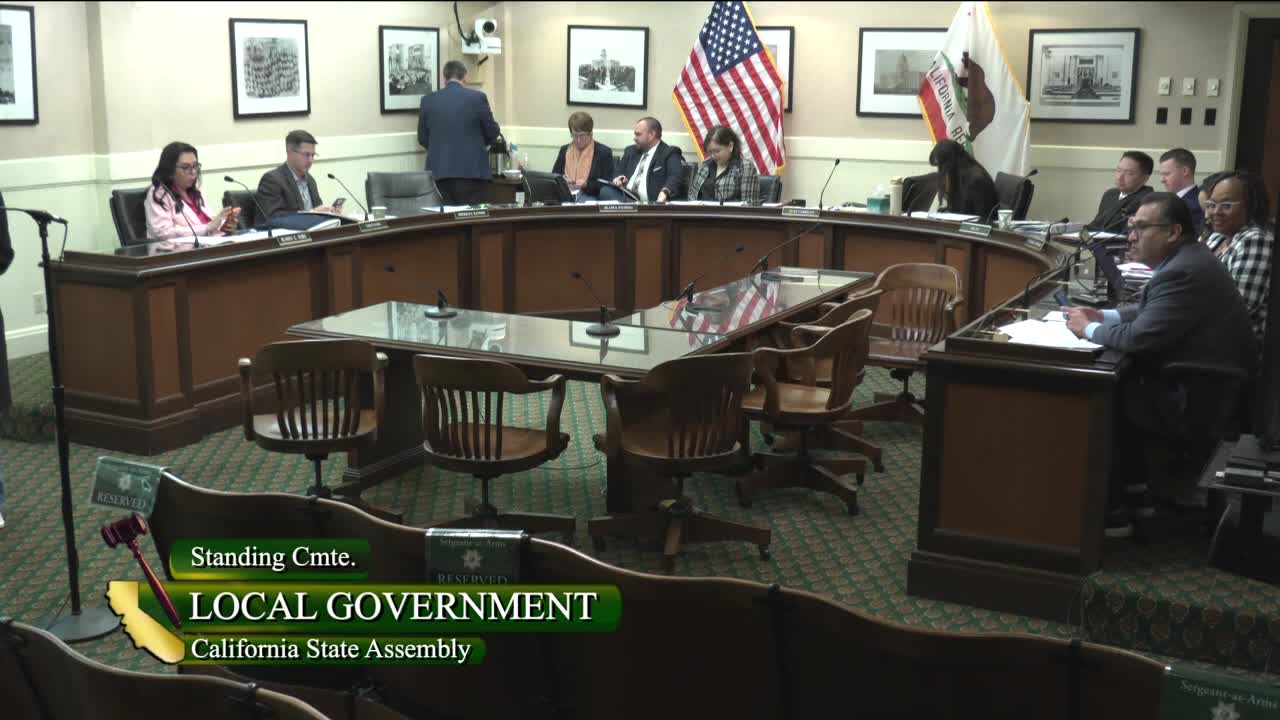 44MIN
Assembly Standing Committee on Local Government
 23MIN
Assembly Standing Committee on Housing and Community Development
Bill Author

Bill Co-Author(s):