AB 2748: Building standards: affordable housing developments: electric vehicle charging.
- Session Year: 2025-2026
- House: Assembly
- Latest Version Date: 2026-07-02
Current Status:
In Progress
(2026-08-13: In committee: Held under submission.)
Introduced
In Committee
Awaiting First Chamber Vote
Passed First Chamber
In Committee
Awaiting Second Chamber Vote
Passed Second Chamber
Enacted
Existing law, the State Housing Law, establishes statewide construction and occupancy standards for buildings used for human habitation. Existing law requires the building department of every city or county to enforce within its jurisdiction all the provisions published in the California Building Standards Code and the provisions of the State Housing Law, as provided. Existing law makes any violation of the State Housing Law a misdemeanor punishable by a fine not exceeding $1,000, by imprisonment not exceeding 6 months, or by both.
Existing law requires the California Building Standards Commission and the Department of Housing and Community Development to research and develop, and authorizes those entities to propose for adoption by the commission, mandatory building standards for the installation of electric vehicle charging stations in existing multifamily dwellings, hotels, motels, and nonresidential developments, as provided.
This bill would exempt require a new or existing affordable housing development, as defined, for which a permit application is submitted between January 1, 2025, and December 31, 2030, from 2028, to comply with either the requirements for installation of low power Level 2 or higher electric vehicle charging receptacles in the 2025 California Green Building Standards Code, as provided. The bill would, instead, require those affordable housing developments for which a permit application is submitted between January 1, 2025, and December 31, 2030, to comply with provided, or the applicable requirements for installation of low power Level 2 or higher electric vehicle charging receptacles in the 2024 supplement to the 2022 edition of the California Green Building Standards Code. The bill would repeal these provisions on January 1, 2032. 2030. By adding to the duties of local officials, and by expanding the scope of a crime, this bill would impose a state-mandated local program.
The bill would include findings that changes proposed by this bill address a matter of statewide concern rather than a municipal affair and, therefore, apply to all cities, including charter cities.
The California Constitution requires the state to reimburse local agencies and school districts for certain costs mandated by the state. Statutory provisions establish procedures for making that reimbursement.
This bill would provide that with regard to certain mandates no reimbursement is required by this act for a specified reason.
With regard to any other mandates, this bill would provide that, if the Commission on State Mandates determines that the bill contains costs so mandated by the state, reimbursement for those costs shall be made pursuant to the statutory provisions noted above.
Existing law, the State Housing Law, establishes statewide construction and occupancy standards for buildings used for human habitation. Existing law requires the building department of every city or county to enforce within its jurisdiction all the provisions published in the California Building Standards Code and the provisions of the State Housing Law, as provided. Existing law makes any violation of the State Housing Law a misdemeanor punishable by a fine not exceeding $1,000, by imprisonment not exceeding 6 months, or by both.
Existing law requires the California Building Standards Commission and the Department of Housing and Community Development to research and develop, and authorizes those entities to propose for adoption by the commission, mandatory building standards for the installation of electric vehicle charging stations in existing multifamily dwellings, hotels, motels, and nonresidential developments, as provided.
This bill would exempt a new or existing affordable housing development, as defined, for which a permit application is submitted between January 1, 2025, and December 31, 2035, 2030, from the requirements for installation of low power Level 2 or higher electric vehicle charging receptacles in the 2025 California Green Building Standards Code, as provided. The bill would, instead, require those affordable housing developments for which a permit application is submitted between January 1, 2025, and December 31, 2035, 2030, to comply with the applicable requirements for installation of low power Level 2 or higher electric vehicle charging receptacles in the 2022 edition of the California Building Standards Code. The bill would repeal these provisions on January 1, 2037. 2032. By adding to the duties of local officials, and by expanding the scope of a crime, this bill would impose a state-mandated local program.
The bill would include findings that changes proposed by this bill address a matter of statewide concern rather than a municipal affair and, therefore, apply to all cities, including charter cities.
The California Constitution requires the state to reimburse local agencies and school districts for certain costs mandated by the state. Statutory provisions establish procedures for making that reimbursement.
This bill would provide that with regard to certain mandates no reimbursement is required by this act for a specified reason.
With regard to any other mandates, this bill would provide that, if the Commission on State Mandates determines that the bill contains costs so mandated by the state, reimbursement for those costs shall be made pursuant to the statutory provisions noted above.
Existing law, the State Housing Law, establishes statewide construction and occupancy standards for buildings used for human habitation. Existing law requires the building department of every city or county to enforce within its jurisdiction all the provisions published in the California Building Standards Code and the provisions of the State Housing Law, as provided. Existing law makes any violation of the State Housing Law a misdemeanor punishable by a fine not exceeding $1,000, by imprisonment not exceeding 6 months, or by both.
Existing law requires the California Building Standards Commission and the Department of Housing and Community Development to research and develop, and authorizes those entities to propose for adoption by the commission, mandatory building standards for the installation of electric vehicle charging stations in existing multifamily dwellings, hotels, motels, and nonresidential developments, as provided.
This bill would exempt a new or existing affordable housing development, as defined, for which a permit application is submitted between January 1, 2025, and December 31, 2035, from the requirements for installation of low power Level 2 or higher electric vehicle charging receptacles in the 2025 California Green Building Standards Code, as provided. The bill would, instead, require those affordable housing developments for which a permit application is submitted between January 1, 2025, and December 31, 2035, to comply with the applicable requirements for installation of low power Level 2 or higher electric vehicle charging receptacles in the 2022 edition of the California Building Standards Code. The bill would repeal these provisions on January 1, 2037. By adding to the duties of local officials, and by expanding the scope of a crime, this bill would impose a state-mandated local program.
The bill would include findings that changes proposed by this bill address a matter of statewide concern rather than a municipal affair and, therefore, apply to all cities, including charter cities.
The California Constitution requires the state to reimburse local agencies and school districts for certain costs mandated by the state. Statutory provisions establish procedures for making that reimbursement.
This bill would provide that with regard to certain mandates no reimbursement is required by this act for a specified reason.
With regard to any other mandates, this bill would provide that, if the Commission on State Mandates determines that the bill contains costs so mandated by the state, reimbursement for those costs shall be made pursuant to the statutory provisions noted above.
(a)(1)A new or existing affordable housing development for which a permit application is submitted between January 1, 2025, and December 31, 2030, 2028, shall be exempt from the comply with one of the following:
(1)The requirements for installation of low power Level 2 or higher electric vehicle charging receptacles in Section 4.106.4.2.2 of Chapter 4 of the 2025 California Green Building Standards Code (Part 11 of Title 24 of the California Code of Regulations), including any subsequent editions and any other state or local building standards requiring the equivalent.
(2)A new or existing affordable housing development for which a permit application is submitted between January 1, 2025, and December 31, 2030, shall comply with the The applicable requirements for installation of low power Level 2 or higher electric vehicle charging receptacles in the 2024 supplement to the 2022 edition of the California Green Building Standards Code (Part 11 of Title 24 of the California Code of Regulations).
(b)For purposes of this section, affordable housing development means a housing development project in which 100 percent of the units, excluding managers units, are restricted by deed, regulatory restriction contained in an agreement with a governmental agency, or other recorded document, as affordable housing for persons and families of low or moderate income, as defined in Section 50093, or subject to an agreement that provides housing subsidies for affordable housing for persons and families of low or moderate income, as defined in Section 50093 or comparable federal statutes.
(c)This section shall remain in effect only until January 1, 2032, 2030, and as of that date is repealed.
SEC. 2.The Legislature finds and declares that reducing cost in affordable housing development is a matter of statewide concern and is not a municipal affair as that term is used in Section 5 of Article XI of the California Constitution. Therefore, Section 1 of this act adding Section 17929.1 to the Health and Safety Code applies to all cities, including charter cities.
SEC. 3.No reimbursement is required by this act pursuant to Section 6 of Article XIIIB of the California Constitution for certain costs that may be incurred by a local agency or school district because, in that regard, this act creates a new crime or infraction, eliminates a crime or infraction, or changes the penalty for a crime or infraction, within the meaning of Section 17556 of the Government Code, or changes the definition of a crime within the meaning of Section 6 of Article XIIIB of the California Constitution.
However, if the Commission on State Mandates determines that this act contains other costs mandated by the state, reimbursement to local agencies and school districts for those costs shall be made pursuant to Part 7 (commencing with Section 17500) of Division 4 of Title 2 of the Government Code.
(a)(1)A new or existing affordable housing development for which a permit application is submitted between January 1, 2025, and December 31, 2035, 2030, shall be exempt from the requirements for installation of low power Level 2 or higher electric vehicle charging receptacles in Section 4.106.4.2.2 of Chapter 4 of the 2025 California Green Building Standards Code (Part 11 of Title 24 of the California Code of Regulations), including any subsequent editions and any other state or local building standards requiring the equivalent.
(2)A new or existing affordable housing development for which a permit application is submitted between January 1, 2025, and December 31, 2035, 2030, shall comply with the applicable requirements for installation of low power Level 2 or higher electric vehicle charging receptacles in the 2022 edition of the California Green Building Standards Code (Part 11 of Title 24 of the California Code of Regulations).
(b)For purposes of this section, affordable housing development means a housing development project in which 100 percent of the units, excluding managers units, are restricted by deed, regulatory restriction contained in an agreement with a governmental agency, or other recorded document, as affordable housing for persons and families of low or moderate income, as defined in Section 50093, or subject to an agreement that provides housing subsidies for affordable housing for persons and families of low or moderate income, as defined in Section 50093 or comparable federal statutes.
(c)This section shall remain in effect only until January 1, 2037, 2032, and as of that date is repealed.
SEC. 2.The Legislature finds and declares that reducing cost in affordable housing development is a matter of statewide concern and is not a municipal affair as that term is used in Section 5 of Article XI of the California Constitution. Therefore, Section 1 of this act adding Section 17929.1 to the Health and Safety Code applies to all cities, including charter cities.
SEC. 3.No reimbursement is required by this act pursuant to Section 6 of Article XIIIB of the California Constitution for certain costs that may be incurred by a local agency or school district because, in that regard, this act creates a new crime or infraction, eliminates a crime or infraction, or changes the penalty for a crime or infraction, within the meaning of Section 17556 of the Government Code, or changes the definition of a crime within the meaning of Section 6 of Article XIIIB of the California Constitution.
However, if the Commission on State Mandates determines that this act contains other costs mandated by the state, reimbursement to local agencies and school districts for those costs shall be made pursuant to Part 7 (commencing with Section 17500) of Division 4 of Title 2 of the Government Code.
(a)(1)A new or existing affordable housing development for which a permit application is submitted between January 1, 2025, and December 31, 2035, shall be exempt from the requirements for installation of low power Level 2 or higher electric vehicle charging receptacles in Section 4.106.4.2.2 of Chapter 4 of the 2025 California Green Building Standards Code (Part 11 of Title 24 of the California Code of Regulations), including any subsequent editions and any other state or local building standards requiring the equivalent.
(2)A new or existing affordable housing development for which a permit application is submitted between January 1, 2025, and December 31, 2035, shall comply with the applicable requirements for installation of low power Level 2 or higher electric vehicle charging receptacles in the 2022 edition of the California Green Building Standards Code (Part 11 of Title 24 of the California Code of Regulations).
(b)For purposes of this section, affordable housing development means a housing development project in which 100 percent of the units, excluding managers units, are restricted by deed, regulatory restriction contained in an agreement with a governmental agency, or other recorded document, as affordable housing for persons and families of low or moderate income, as defined in Section 50093, or subject to an agreement that provides housing subsidies for affordable housing for persons and families of low or moderate income, as defined in Section 50093 or comparable federal statutes.
(c)This section shall remain in effect only until January 1, 2037, and as of that date is repealed.
SEC. 2.The Legislature finds and declares that reducing cost in affordable housing development is a matter of statewide concern and is not a municipal affair as that term is used in Section 5 of Article XI of the California Constitution. Therefore, Section 1 of this act adding Section 17929.1 to the Health and Safety Code applies to all cities, including charter cities.
SEC. 3.No reimbursement is required by this act pursuant to Section 6 of Article XIIIB of the California Constitution for certain costs that may be incurred by a local agency or school district because, in that regard, this act creates a new crime or infraction, eliminates a crime or infraction, or changes the penalty for a crime or infraction, within the meaning of Section 17556 of the Government Code, or changes the definition of a crime within the meaning of Section 6 of Article XIIIB of the California Constitution.
However, if the Commission on State Mandates determines that this act contains other costs mandated by the state, reimbursement to local agencies and school districts for those costs shall be made pursuant to Part 7 (commencing with Section 17500) of Division 4 of Title 2 of the Government Code.
|
Date
|
Status
|
|---|---|
| Aug 13, 2026 | In committee: Held under submission. |
| Aug 3, 2026 | In committee: Referred to APPR. suspense file. |
| Jul 2, 2026 | Read second time and amended. Re-referred to Com. on APPR. |
| Jul 1, 2026 | From committee: Amend, and do pass as amended and re-refer to Com. on APPR. (Ayes 8. Noes 0.) (June 30). |
| Jun 3, 2026 | Referred to Com. on HOUSING. |
| May 27, 2026 | In Senate. Read first time. To Com. on RLS. for assignment. |
| May 26, 2026 | Read third time. Passed. Ordered to the Senate. (Ayes 58. Noes 4. Page 5390.) |
| May 26, 2026 | Read third time. Passed. Ordered to the Senate. (Ayes 58. Noes 4.) |
| May 26, 2026 | Read third time. Passed. Ordered to the Senate. |
| May 19, 2026 | Read second time. Ordered to third reading. |
| May 18, 2026 | Read second time and amended. Ordered returned to second reading. |
| May 14, 2026 | Joint Rule 62(a), file notice suspended. (Page 5030.) |
| May 14, 2026 | From committee: Amend, and do pass as amended. (Ayes 13. Noes 2.) (May 14). |
| May 14, 2026 | Joint Rule 62(a), file notice suspended. |
| May 13, 2026 | In committee: Set, first hearing. Referred to APPR. suspense file. |
| Apr 23, 2026 | From committee: Do pass and re-refer to Com. on APPR. (Ayes 8. Noes 0.) (April 22). Re-referred to Com. on APPR. |
| Mar 16, 2026 | Referred to Com. on H. & C.D. |
| Feb 21, 2026 | From printer. May be heard in committee March 23. |
| Feb 20, 2026 | Read first time. To print. |
|
Date
|
Description
|
Location
|
Votes
|
|
|---|---|---|---|---|
| Aug 3, 2026 | Placed on suspense file | Senate Standing Committee on Appropriations |
Passed |
|
| Jun 30, 2026 | Do pass as amended, but first amend, and re-refer to the Committee on [Appropriations] | Senate Standing Committee on Housing |
Passed |
|
| May 26, 2026 | AB 2748 Quirk-Silva Assembly Third Reading | Assembly Floor |
Passed |
|
| May 14, 2026 | Do pass as amended. | Assembly Standing Committee on Appropriations |
Passed |
|
| Apr 22, 2026 | Do pass and be re-referred to the Committee on [Appropriations] | Assembly Standing Committee on Housing and Community Development |
Passed |
This list shows positions taken on this bill by organizations on the date displayed, which is linked to the original source.
Positions by individuals are not included.
|
Organization
|
Position
|
Date
|
|---|---|---|
| 350 Bay Area Action | ** Against | |
| Acterra: Action for A Healthy Planet | ** Against | |
| Active San Gabriel Valley | ** Against | |
| Advanced Energy United | ** Against | |
| American EV Jobs Alliance | ** Against | |
| American Planning Association, California Chapter | ** Support | |
| American Resilience Project | ** Against | |
| Bay Area Council | ** Support | |
| California Coalition For Rural Housing | ** Support | |
| California Council For Affordable Housing | ** Support | |
| California Electric Transportation Coalition | ** Against | |
| California Environmental Voters | ** Against | |
| California Housing Consortium | ** Support | |
| California Housing Partnership | ** Support | |
| California State Association Of Electrical Workers | ** Against | |
| California State Pipe Trades Council | ** Against | |
| Carbon Free Palo Alto | ** Against | |
| Center For Environmental Health | ** Against | |
| Center for Sustainable Energy | ** Against | |
| Charge Across Town | ** Against | |
| Clean Earth 4 Kids | ** Against | |
| Climate Action California | ** Against | |
| Climate Health Now Action Fund | ** Against | |
| Coalition For Clean Air | ** Against | |
| Community Corporation of Santa Monica | ** Against | |
| Community Environmental Council | ** Against | |
| Earthjustice | ** Against | |
| Eden Housing | ** Support | |
| Electric Vehicle Association | ** Against | |
| Environmental Protection Information Center (EPIC) | ** Against | |
| EV Nirvana | ** Against | |
| EV Plugbox | ** Against | |
| EV Plugbox LLC | ** Against | |
| GreenLatinos | ** Against | |
| Green Sanctuary Committee of the Unitarian Universalist Church of Palo Alto | ** Against | |
| Green Technical Education & Employment | ** Against | |
| Green Technical Education & Employment (Green Tech) | ** Against | |
| Habitat For Humanity California | ** Support | |
| Housing California | ** Support | |
| LeadingAge California | ** Support | |
| MidPen Housing | ** Support | |
| Mothers Out Front California | ** Against | |
| Mothers Out Front Marin | ** Against | |
| Mothers Out Front Silicon Valley | ** Against | |
| National Charging Access Coalition | ** Against | |
| Natural Resources Defense Council | ** Against | |
| Non-profit Housing Association of Northern California (NPH) | ** Support | |
| peninsula interfaith climate action | ** Against | |
| People's Self-Help Housing | ** Support | |
| Plug In America | ** Against | |
| Project Green Home | ** Against | |
| Redwood Energy | ** Against | |
| Resources for Community Development | ** Support | |
| Sacramento Electric Vehicle Association | ** Against | |
| San Diego Housing Federation | ** Support | |
| San Francisco Bay Physicians for Social Responsibility | ** Against | |
| Santa Cruz Climate Action Network | ** Against | |
| Self-Help Enterprises | ** Support | |
| Sierra Club California | ** Against | |
| The Climate Center | ** Against | |
| The Two Hundred for Homeownership | ** Support | |
| Union Of Concerned Scientists | ** Against | |
| Unitarian Universalist Church of Palo Alto Green Sanctuary Committee | ** Against | |
| United Latinos | ** Against | |
| Urban Environmentalists, Los Angeles | ** Against | |
| USGBC California | ** Against | |
| U.S. Green Building Council, California | ** Against | |
| US Green Building Council California | ** Against | |
| Western States Council Sheet Metal, Air, Rail And Transportation | ** Against |
SENATE COMMITTEE ON
Senator Sabrina Cervantes, Chair
2025 - 2026 Regular Session
AB 2748 (Quirk-Silva) - Building standards: affordable housing developments: electric vehicle charging
Version: | Policy Vote: |
Urgency: | Mandate: |
Hearing Date: | Consultant: |
Bill Summary:
AB 2748 would provide the option for a developer of a new or existing affordable housing development for which a permit application is submitted between January 1, 2025 and December 31, 2028 to comply with the requirements specified in either the 2025 California Green Building Standards (CalGreen) or the 2024 supplement to the 2022 edition of CalGreen for the installation of low power Level 2 or higher electric vehicle (EV) charging receptacles, as specified.
Fiscal Impact:
- The Department of Housing and Community Development (HCD) estimates costs of $199,000 annually until 2030 for 1.0 limited-term PY of staff to develop and publish information bulletins, guidance, and other memoranda to enumerate the technical distinctions between the CalGreen requirements, and to respond to significant technical assistance inquiries from local jurisdictions, developers, and other stakeholders. (General Fund)
- Unknown local costs to update permitting and inspection processes and procedures to account for the option for developers to use either the current or previous CalGreen standards for EV charging infrastructure for certain affordable housing developments for which a permit is issued between January 1, 2025 and the end of 2028. These costs should not be reimbursable by the state because local agencies have the authority to charge and adjust planning and permitting fees to cover any costs related to new planning mandates. (local funds)
Background:
Existing law requires the California Building Standards Commission (CBSC) to publish the CalGreen Code, which includes both mandatory and voluntary building standards, every three years. Since 2010, each published version has included updates and additions to the previous edition, including more stringent water conservation and recycling measures, electric vehicle infrastructure and charging readiness, and changes intended to eliminate conflicts with the California Energy Code, all reflecting evolving environmental and climate policy goals. Cities and counties generally have the administrative authority to exceed the CalGreen Code and adopt more protective standards which apply to their jurisdiction.
In new residential construction, the regulations require that parking spaces include infrastructure to support EV charging, but the requirements vary by housing type. For single-family homes, at least one parking space must be EV capable, meaning it includes a dedicated circuit and panel capacity for a future charger. For multifamily housing, the requirements are scaled, based on the number of units and parking spaces, and include a mix of EV capable spaces (basic electrical capacity), EV ready spaces (with conduit and wiring installed), and a smaller percentage of spaces with installed charging equipment. These standards apply to apartments, condominiums, and mixed-use residential developments and are intended to reduce future retrofit costs as EV adoption increases. For multifamily developments, the 2024 supplement to the 2022 edition of CalGreen requires 40% of the total number of parking spaces to be equipped with low power Level 2 EV charging receptacles, as specified, and 10% of the total number of parking spaces must be equipped with Level 2 EV chargers. Functionally, 50% of all parking spaces must be capable of charging an EV.
The 2025 edition of CalGreen revises EV parking requirements for multifamily housing and restructures how those requirements are applied. Under the 2025 code, EV charging receptacle requirements are tied more directly to dwelling units and parking configuration, including assigned, unassigned, and mixed parking. The updated provisions require installation of low power Level 2 charging receptacles in an amount determined by the number of dwelling units and available parking spaces, rather than relying solely on fixed percentages of total parking. Specifically, where dwelling units are provided with assigned parking spaces equal to or greater than the number of dwelling units, at least one low power Level 2 EV charging receptacle must be provided at an assigned parking space for each dwelling unit. In the case where the total number of dwelling units exceeds the number of assigned parking spaces, all assigned parking spaces must be provided with one low power Level 2 charging receptacle. For developments with unassigned or common-use parking, 25% of all unassigned spaces that are not already provided with low power Level 2 EV charging receptacles must be equipped with Level 2 EV chargers.
Proposed Law:
AB 2748 would require a new or existing affordable housing development for which a permit application is submitted between January 1, 2025 and December 31, 2028 to comply with either of the following requirements for installation of low power Level 2 or higher EV charging receptacles:
- The requirements in a specified section of the 2025 edition of CalGreen, including any subsequent editions and any other state or local building standards requiring the equivalent.
- The applicable requirements in the 2024 supplement to the 2022 edition of CalGreen.
The bill defines “affordable housing development” as a housing development project in which 100% of the units, excluding managers′ units, are restricted by deed, regulatory restriction contained in an agreement with a governmental agency, or other recorded document, as affordable housing for persons and families of low- or moderate-income, as specified, or subject to an agreement that provides housing subsidies for affordable housing for persons and families of low- or moderate-income, as specified.
Related Legislation:
AB 1738 (Boerner-Horvath), Chap. 687/2022, authorized HCD to propose mandatory building standards for adoption for the installation of EV charging stations in existing multifamily dwellings and nonresidential development when existing parking facilities are being retrofitted, added, or altered.
Staff Comments:
This bill would provide flexibility to developers of affordable housing in which 100% of the units are affordable to low- and moderate-income households by allowing them to choose which of the two most recent versions of the CalGreen Code to follow regarding the requirements for installing low power Level 2 or higher EV charging receptacles. Proponents of this bill assert that the 2025 CalGreen standards require most parking spaces in new apartment buildings to include EV-ready infrastructure, adding substantial costs to construction. Opponents, however, point out that the 2025 standards were developed with overwhelming stakeholder support to change metrics from a percentage of parking spaces to dwelling units, and removing the requirement for more expensive full EV chargers when parking is assigned, which incentivizes developers to provide increased access to the most affordable way to charge, with capability for wired, individually metered charging. Opponents further assert that, if parking is assigned, development costs under the 2025 Code are approximately the same as they would be under the 2024 supplement to the 2022 Code when there are fewer parking spaces than units, and costs under the 2025 CalGreen Code are lower than the previous version when parking spaces exceed dwelling units.
HCD expects that some of the complications related to conducting aa comparative analysis necessary to determine which version of the CalGreen standards to use is likely to drive a substantial increase in technical assistance inquiries.
-- END --
SENATE COMMITTEE ON HOUSING
Senator Jesse Arreguín, Chair
2025 - 2026 Regular
Bill No: AB 2748 Hearing Date: 6/30/2026
Author: | Quirk-Silva | ||
Version: | 5/18/2026 Amended | ||
Urgency: | No | Fiscal: | Yes |
Consultant: | Hank Brady | ||
SUBJECT: Building standards: affordable housing developments: electric vehicle charging
DIGEST: This bill exempts new or existing affordable housing projects for which a permit application is submitted between January 1, 2025, and December 31, 2030, from specified electric vehicle (EV) charging receptacle installation requirements in the 2025 California Green Building Standards Code, including any subsequent editions, and instead requires the affordable housing project to comply with the EV charging receptacle installation requirements in the 2022 edition of the California Green Building Standards Code.
ANALYSIS:
Existing law:
- Authorizes the California Building Standards Commission (BSC) to approve and adopt building standards. Every three years, BSC, in coordination with relevant state agencies, undertakes rulemaking to revise and update the California Building Standards Code (Title 24 of the California Code of Regulations). These building codes serve as the basis for the design and construction of buildings in California.
- Establishes, under the California Building Code, accessible parking standards and minimum levels of parking spaces accessible to persons with disabilities that must be included in new developments.
- Establishes building standards for EV charging infrastructure and charger installation in new residential and non-residential development.
- Prohibits the BSC and any other adopting agency, from October 1, 2025, until June 1, 2031, from considering, approving, or adopting any proposed building standards affecting residential units, with limited exceptions. Prohibits a city or county from making changes or modifications to building standards affecting residential units, including to green building standards, from October 1, 2025 until June 1, 2031, with limited exceptions. Requires BSC to reject a modification or change to any building standard affecting a residential unit filed by the governing body of a city or county, from October 1, 2025, until June 1, 2031, with limited exceptions.
- Requires each city and county to adopt an ordinance that specifies how it will implement state Density Bonus Law (DBL). Requires cities and counties to grant a density bonus when an applicant for a housing development of five or more units seeks and agrees to construct a project that will contain at least one of the following:
- 10% of the total units of a housing development for lower income households;
- 5% of the total units of a housing development for very low-income (VLI) households;
- A senior citizen housing development or mobile home park;
- 10% of the units in a common interest development (CID) for moderate-income households;
- 10% of the total units for transitional foster youth, veterans, or people experiencing homelessness; or
- 20% of the total units for lower-income students in a student housing development.
- 100% of the units of a housing development for lower-income households, except that 20% of units may be for moderate-income households.
- Provides that upon the request of a developer, a city or county shall not require a vehicular parking ratio, inclusive of disabled and guest parking, that exceeds the following ratios:
- Zero to one bedroom — one onsite parking space.
- Two to three bedrooms — one and one-half onsite parking spaces.
- Four and more bedrooms — two and one-half parking spaces.
- Notwithstanding (4) above, provides that a city or county shall not impose a parking ratio higher than 0.5 spaces per unit, nor any parking standards, for a project that is:
- Located within one-half mile of a major transit stop and the residents have unobstructed access to the transit stop; or
- A for-rent housing development for individuals who are 62 years or older and the residents have either access to paratransit service or unobstructed access, within one-half mile, to fixed bus route service that operates at least eight times per day.
- Notwithstanding (4) and (5) above, provides that a city or county shall not impose any minimum parking requirement on a housing development that consists solely of rental units for lower-income families and the is either a special needs or a supportive housing development.
This bill:
- Exempts a new or existing affordable housing development, as defined, for which a permit application is submitted between January 1, 2025, and December 31, 2030, from the requirements for installation of low power Level 2 or higher EV charging receptacles, as specified, in the 2025 California Green Building Standards Code.
- Requires a new or existing affordable housing development for which a permit is submitted between January 1, 2025, and December 31, 2030, to comply with the applicable requirements for installation of low power Level 2 or higher EV charging receptacles in the 2022 edition of the California Green Building Standards Code.
- Defines ″affordable housing development″ as a housing development project in which 100% of the units, excluding managers′ units, are restricted by deed, regulatory restriction contained in an agreement with a governmental agency, or other recorded document, as affordable housing for persons and families of low- or moderate-income, as specified, or subject to an agreement that provides housing subsidies for affordable housing for persons and families of low- or moderate-income, as specified.
Background
EV Targets. In recent years, California aggressively accelerated its push to transition to EVs. In September of 2020, Governor Newsom signed Executive Order N-79-20. The order established a state policy goal that 100% of in-state sales of new passenger cars and trucks will be zero-emission by 2035. To achieve this target, the order, among other policies, directed the California Energy Commission (CEC), in consultation with the California Air Resource Board (CARB) and the California Public Utilities Commission (CPUC), to update its statewide assessment of zero-emission vehicle infrastructure required to support the new levels of EV adoption.
Building Standards. The California Building Standards Law establishes the process for adopting state building standards by the BSC. Statewide building standards are intended to provide uniformity in buildings across the state. The BSC’s duties include the following: receiving proposed building standards from state agencies for consideration in each triennial and intervening building code adoption cycle; reviewing and approving building standards submitted by state agencies; adopting building standards for state buildings where no other state agency is authorized by law; and publishing the approved building standards in the California Building Standards Code.
Most building standards currently in use in California are developed and vetted at the national level every three years by technical organizations, academics, and trade associations that develop consensus standards, which are then incorporated into the international and the national model code used by most U.S. jurisdictions. At the state level, agencies with authority over specified occupancies then review the model code and amend as necessary for California’s specific needs. There are approximately 20 state agencies that develop building standards and propose them for adoption to the BSC.
After the proposal of building standards by state agencies, the proposals undergo a public vetting process. A code advisory committee composed of experts in a particular scope of code reviews the proposed standards, followed by public review. The proposing agency considers feedback and may then amend the standards and re-submit them to the BSC for consideration. BSC reviews and adopts the standards and files them with the Secretary of State for codification and publishing, and there is a 180-day period during which local agencies file modifications and changes to the state codes (though they are not limited to this window). The new codes then take effect January 1 of the subsequent year following publication.
Updates and changes to building standards are adopted on two timelines: through the triennial code adoption cycle which occurs every three years, and through the intervening code adoption cycle which provides an update to codes 18 months after the publication of the triennial codes. Regulatory activities for each cycle begin over two years before the effective date of the codes.
The Department of Housing and Community Development (HCD) is responsible for the standards for residential buildings, hotels, and motels. The California Building Code and California Residential Code govern general standards for multifamily and single-family residential construction. The Office of the State Fire Marshal is responsible for adopting building standards focused on fire and panic safety for residential occupancies. Within the codes, there are certain requirements that are mandatory for all newly constructed dwellings or buildings, and certain provisions that are optional or voluntary – meaning the requirements must be followed only if an entity chooses to construct certain items or systems.
As a matter of practice, the Legislature typically offers guidelines or directs agencies to consider certain standards, rather than requires the adoption of specific standards, in order to provide flexibility and allow for subject matter experts to determine appropriateness and weigh the many considerations that must be evaluated when recommending new or modified building standards.
Comments
- Author’s Statement. “California’s housing crisis requires us to make hard choices about what comes first. We are committed to our climate goals, but we cannot keep adding costs that stall affordable housing before it even breaks ground. For the families we serve, the question is not about charging infrastructure, it is about whether they can find a safe, stable place to call home. AB 2748 keeps us focused on building now. It gives affordable housing the breathing room to move forward without abandoning our long-term climate goals. When we talk about equity, it starts with whether we build housing people can actually live in. This bill helps us do that, and it helps us do it now.”
- Local Parking Standards. Cities and counties generally establish parking standards that capture various types of facilities and uses. Parking standards are commonly indexed to conditions related to the building or facility they are associated with. For example, shopping centers may have parking requirements linked to total floor space, restaurants may be linked to the total number of seats, and hotels may have parking spaces linked to the number of beds or rooms present at the facility. In 2019, CARB staff reviewed over 200 municipal codes and found that for nonresidential construction, an average of at least one parking space is installed for every 275 square feet of nonresidential building floor space. Accounting for the fact that approximately 60% of reviewed municipal codes already allow developers to reduce parking by an average of 30%, CARB staff estimated that between 1.4 million and 1.7 million new nonresidential parking spaces would be constructed from 2021-2024.
- State and Federal Parking Requirements. The state does not establish minimum requirements related to the number of vehicle parking spaces that must be provided for new developments; however, state regulations include requirements relative to the type of vehicle parking that must be provided as a percentage of the total parking required per development. For example, California Green Building Code requires a portion of the parking spaces built for new residential and nonresidential developments to include EV charging equipment. State and federal law additionally require cities and counties to ensure that a specified percentage of vehicle parking spaces at new developments are accessible to persons with disabilities.
- EV charging infrastructure. In a recent assessment of EV charging infrastructure, the CEC estimated the anticipated rate of EV adoption and the corresponding charging infrastructure needed in California to support and foster the increased number of EVs. The report states that to meet the projected need of 15.2 million light duty EVs on California’s roads in 2035, the state will need 2.11 million public and shared private chargers “shared private chargers” includes chargers in private parking garages and lots e.g., multifamily parking lots or office/work parking lots. Of the 2.11 million public and shared private spaces 577,000 are needed in multifamily housing parking lots. As a point of comparison this report anticipates that 978,000 “while at work” chargers, and 474,000 public chargers will be needed to meet the projected need. An additional 72,000 direct current (DC) fast chargers are also anticipated for longer trips.[1] The CEC estimates that as of September 2025, California has 216,000 public and shared private chargers.[2] Retrofitting existing parking structures can be cost-prohibitive; as a result the state has long recognized that requiring a certain number of newly built parking spaces to include EV charging infrastructure is necessary to achieve the states EV goals.
- California Green Building Standards (CalGreen): In 2010, the BSC adopted CalGreen, which included both mandatory and voluntary building standards. CalGreen is updated on a regular three-year cycle as part of California’s broader building standards update process. The BSC oversees the adoption of each new edition, while multiple state agencies develop and propose updates within their areas of authority. Each iteration of CalGreen continues to refine and expand requirements, including more stringent water efficiency measures, EV charging infrastructure readiness, and construction waste diversion thresholds, reflecting California’s evolving environmental and climate policy goals. Additionally, cities and counties generally have the administrative authority to exceed the CalGreen standards and adopt more protective standards which apply to their jurisdiction. AB 130 (Committee on Budget, Chapter 22, Statutes of 2025) placed a five-year moratorium (from October 1, 2025- June 1, 2031), on state updates to CalGreen and prohibited cities and counties from adopting additional standards that exceed CalGreen and other state building code standards. In effect AB 130 locks the EV parking standards that apply to new residential construction that were in effect on October 1, 2025 in place until 2031.
In new residential construction, the regulations require that parking spaces include infrastructure to support EV charging, but the requirements vary by housing type. For single-family homes, at least one parking space must be EV capable, meaning it includes a dedicated circuit and panel capacity for a future charger. For multifamily housing, the requirements scale based on the number of units and parking spaces and include a mix of EV capable spaces (basic electrical capacity), EV ready spaces (with conduit and wiring installed), and a smaller percentage of spaces with installed charging equipment. These standards apply to apartments, condominiums, and mixed-use residential developments and are intended to reduce future retrofit costs as EV adoption increases.
- 2022 CalGreen vs. 2025 CalGreen. The 2025 CalGreen EV parking standard currently applies to residential developments in California. This bill seeks to allow 100% affordable housing developments use lower EV parking standards adopted in the 2024 supplement to the 2022 CalGreen standard. Under the July 2024 Supplement, 40% of the total number of parking spaces must be equipped with low power Level 2 EV charging receptacles, as specified, and 10% of the total number of parking spaces must be equipped with Level 2 EV chargers (functionally 50% of all parking spaces must be capable of charging an EV).
The 2025 CalGreen edition revises EV parking requirements for multifamily housing and restructures how those requirements are applied. Under the 2025 code, EV charging receptacle requirements are tied more directly to dwelling units and parking configuration, including assigned, unassigned, and mixed parking. The updated provisions require installation of low-power Level 2 charging receptacles in an amount determined by the number of dwelling units and available parking spaces, rather than relying solely on fixed percentages of total parking. Specifically, where dwelling units are provided with assigned parking spaces equal to or greater than the number of dwelling units, at least one low power Level 2 EV charging receptacle must be provided at an assigned parking space for each dwelling unit. In the case where the total number of dwelling units exceeds the number of assigned parking spaces, all assigned parking spaces must be provided with one low power Level 2 charging receptacle. For developments with unassigned parking, 25% of all unassigned spaces that are not already provided with low power level 2 EV charging receptacles must include level 2 EV chargers.
- Density Bonus Law and parking. While there are limited sources of state dollars to subsidize affordable developments, the state provides other incentives for affordable housing developments through the relaxation of local standards. One tool the state provides is Density Bonus Law (DBL). Under DBL, the state requires local agencies to allow affordable housing developers to increase the density of affordable housing projects and provide development incentives or concessions that will lower the cost of the housing development. The ability to relax development standards functions as a “regulatory subsidy” that reduces the overall cost of the development in order to offset the cost of including deed restricted affordable units in a development. The amount of increased density and the number of incentives and concessions that a local jurisdiction must approve for a density bonus project depends on the project’s depth of affordability (i.e., more affordable projects are entitled to greater density increases and greater numbers of incentives and concessions).
In addition to density and development incentives and concessions, DBL establishes a default DBL parking (DBL(p)) ratio that density bonus projects can use as an alternative to the local jurisdiction’s parking standards. Affordable developers can achieve substantial cost savings by providing parking at DBL(p) ratios rather than the level established by the local government. Outlined below are DBL(p) ratios:
Single bedroom/studio units | 1 parking space per unit |
2-3 bedrooms | 1.5 parking spaces per unit |
4+ bedrooms | 2.5 parking spaces per unit. |
Single bedspace in a student housing development | zero parking spaces |
Affordable developers can also reduce the cost of their project by using concessions to reduce the number of parking spaces the project provides below the DBL(p) ratio. Additionally, AB 2097 (Friedman, Chapter 459, Statutes of 2022), prohibits local jurisdictions from imposing minimum parking requirements on residential and nonresidential developments that are located within 0.5 miles of a major transit station unless the local jurisdictions make specified findings. If a local agency makes the necessary findings allowing it to impose parking requirements on a housing development located within 0.5 miles of a major transit station, DBL provides that density bonus projects located within 0.5 miles of a major transit station are entitled to only provide half of the DBL(p) level of parking required. 100% affordable projects located within 0.5 miles of a major transit station are not required to provide any parking.
- Reducing EV parking. This bill allows 100% affordable housing developments to apply the 2024, rather than the 2025 CalGreen EV parking standard, to the number of parking spaces provided in the development. The sponsors note that this will help lower the cost of developing affordable housing. Effectively this measure reduces the amount of EV parking spaces that must be provided in affordable housing projects from one EV parking space per unit of housing with assigned parking to 50% of all parking spaces. DBL already allows affordable housing developers to avoid EV parking obligations entirely by reducing the number of parking spaces that are included in the development. This bill will multiply the impact of parking reductions by reducing the standards that apply to any remaining parking spaces provided in the development.
The CalGreen EV parking standards are developed in consultation with state agencies responsible for achieving the state’s transportation and emission reductions goals. The new 2025 standards reflect the fact that the state needs a tenfold increase in the number of EV parking spaces available in public and shared private parking spaces by 2035.
To contextualize how this bill will affect projects that are eligible for DBL(p) parking ratios and additional concessions, the chart below demonstrates how existing requirements, and the alternative requirements allowed in this bill will apply to a 100-unit project comprised entirely of two and three bedroom units.
The Committee may wish to consider the cumulative impact of watering down the minimum ratio of EV parking spaces that apply to projects that are already able to reduce or eliminate the total number of parking spaces they are required to provide.
- Amendments. The Committee may wish to consider the following amendments.
- Author’s amendments. The author would like the committee to incorporate the following clarifying amendments.
- 2024 CalGreen Supplement. The language currently in the bill could be read to allow a developer to use 2022 EV parking standard rather than the 2024 Supplement which is higher than the 2022 standard. The author would like to clarify that the option available to developers is to use the higher 2024 supplemental standard.
- 2024 Supplement or 2025 Standard. The bill currently could be read to require a developer to use the July 2024 Supplemental standard even if the 2025 standard — which does not require as many spaces to be equipped with high power charging infrastructure — is more cost effective. The author would like to clarify that a developer can use either standard. The Committee may wish to adopt this author’s amendment.
- Committee amendments. To ensure that this measure does not lead to a prolonged reduction in EV parking spaces available to residents of affordable housing developments, The Committee may wish to reduce the effective period of the bill to a total of three years.
- Author’s amendments. The author would like the committee to incorporate the following clarifying amendments.
- Support. This bill is sponsored and supported by a coalition of affordable housing developers. The supporters argue that the state has taken meaningful measures to control the cost of construction. They argue that the 2025 standards for EV parking spaces conflict with the state’s interest in reducing costs that hinder the development of affordable housing. They further note that affordable housing developers anticipate significant increased per unit costs to comply with the 2025 requirement and that this bill will help avoid those costs.
- Opposition. A coalition of environmental groups and labor organizations oppose this bill. The opponents argue that the 2025 EV parking standard was adopted through an extensive public rulemaking process and that the proper venue to revise a building standard is through the public rulemaking process, not legislation. They further note that residents of new publicly funded housing development should enjoy the same access to EV charging as residents of newly developed market rate housing.
Related/Prior Legislation
AB 130 (Committee on Budget, Chapter 22, Statutes of 2025) — prohibits the BSC and any other adopting agency, from October 1, 2025, until June 1, 2031, from considering, approving, or adopting any proposed building standards affecting residential units, with limited exceptions. Prohibits a city or county from making changes or modifications to building standards affecting residential units, including green building standards, from October 1, 2025, until June 1, 2031, with limited exceptions. Requires BSC to reject a modification or change to any building standard affecting a residential unit filed by the governing body of a city or county, from October 1, 2025, until June 1, 2031, with limited exceptions.
AB 2097 (Friedman, Chapter 459, Statutes of 2022) — prohibited public agencies from imposing minimum automobile parking requirements on specified residential, commercial and other developments located within one-half mile of public transit.
FISCAL EFFECT: Appropriation: Fiscal Com.: Local:
POSITIONS: (Communicated to the committee before noon on Wednesday, June 24th, 2026)
SUPPORT:
California Council for Affordable Housing (CCAH) (Sponsor)
California Housing Consortium (Co-Sponsor)
American Planning Association, California Chapter
Bay Area Council
California Coalition for Rural Housing
California Council for Affordable Housing
California Housing Partnership
Eden Housing
Habitat for Humanity California
Housing California
Leadingage California
Midpen Housing
Non-profit Housing Association of Northern California (NPH)
People's Self-help Housing
Resources for Community Development
San Diego Housing Federation
Self-help Enterprises
The Two Hundred for Homeownership
OPPOSITION:
350 Bay Area Action
Acterra: Action for a Healthy Planet
Active San Gabriel Valley
Advanced Energy United
Advanced Energy United
American Ev Jobs Alliance; the
American Resilience Project
California Electric Transportation Coalition
California Environmental Voters
California State Association of Electrical Workers
California State Pipe Trades Council
Carbon Free Palo Alto
Center for Environmental Health
Center for Sustainable Energy
Charge Across Town
Clean Earth 4 Kids
Climate Action California
Climate Health Now Action Fund
Coalition for Clean Air
Community Corporation of Santa Monica
Community Environmental Council
Earthjustice
Electric Vehicle Association
Environmental Protection Information Center (EPIC)
EV Nirvana
EV Plugbox LLC
Green Sanctuary Committee of the Unitarian Universalist Church of Palo Alto
Green Technical Education & Employment
GreenLatinos
Mothers Out Front California
Mothers Out Front Marin
Mothers Out Front Silicon Valley
National Charging Access Coalition
Natural Resources Defense Council
Peninsula Interfaith Climate Action
Plug in America
Project Green Home
Redwood Energy
Sacramento Electric Vehicle Association
San Francisco Bay Physicians for Social Responsibility
Santa Cruz Climate Action Network
Sierra Club California
The Climate Center
U.S. Green Building Council, California
Union of Concerned Scientists
United Latinos
Urban Environmentalists, Los Angeles
US Green Building Council California
USGBC California
Western States Council Sheet Metal, Air, Rail and Transportation
-- END --
Adam Davis, Tiffany Hoang, Thanh Lopez, Jeffrey Lu, Taylor Nguyen, Bob Nolty, Larry Rillera, Dustin Schell, and Micah Wofford, Assembly Bill 2127 Second Electric Vehicle Charging Infrastructure Assessment: Assessing Charging Needs to Support Zero-Emission Vehicles in 2030 and 2035 (Sacramento: California Energy Commission, February 2024), 51–53, CEC-600-2024-003-CMR. ↑
California Energy Commission, "Electric Vehicle Chargers in California," data last updated September 24, 2025, accessed June 14, 2026, https://www.energy.ca.gov/zevstats. ↑
ASSEMBLY THIRD READING
ATR Bill Id:AB 2748
Author:(Quirk-Silva)
As Amended Ver:May 18, 2026
Majority vote
SUMMARY
Exempts a new or existing affordable housing development for which a permit application is submitted between January 1, 2025, and December 31, 2030, from specified electric vehicle (EV) charging receptacle installation requirements in the 2025 California Green Building Standards Code, including any subsequent editions, and instead requires the affordable housing development to comply with the EV charging receptacle installation requirements in the 2022 edition of the California Green Building Standards Code.
Major Provisions
- Exempts a new or existing affordable housing development, as defined, for which a permit application is submitted between January 1, 2025, and December 31, 2030, from the requirements for installation of low power Level 2 or higher EV charging receptacles, as specified, in the 2025 California Green Building Standards Code.
- Specifies the exemption in 1), above, includes any subsequent editions and any other state or local building standards requiring the equivalent.
- Requires a new or existing affordable housing development for which a permit is submitted between January 1, 2025, and December 31, 2030, to comply with the applicable requirements for installation of low power Level 2 or higher EV charging receptacles in the 2022 edition of the California Green Building Standards Code.
- Defines ″affordable housing development″ as a housing development project in which 100% of the units, excluding managers′ units, are restricted by deed, regulatory restriction contained in an agreement with a governmental agency, or other recorded document, as affordable housing for persons and families of low or moderate income, as specified, or subject to an agreement that provides housing subsidies for affordable housing for persons and families of low or moderate income, as specified.
- Includes a sunset date of January 1, 2032.
- Makes findings and declarations that reducing cost in affordable housing development is a matter of statewide concern and is not a municipal affair as that term is used in Section 5 of Article XI of the California Constitution. Therefore, Section 1 of this bill applies to all cities, including charter cities.
COMMENTS
Housing crisis in California: California′s housing shortage has developed over many decades. Long-term underbuilding has left the state with far fewer homes than needed, driving up both rents and home prices. As costs rise, many residents are forced to prioritize housing over essentials like food, medical care, child care, and transportation, which reduces overall quality of life. Roughly one in three households does not earn enough to cover basic needs, and in 2024 more than 187,000 people in California were experiencing homelessness on any given night.
Over the past decade, the state has built fewer than 100,000 homes annually, with fewer than 10,000 affordable units produced each year. Expanding housing supply across both market-rate and deed-restricted affordable categories is widely viewed as necessary to ease cost pressures and improve access to housing across income levels.
The effects of the housing crisis are not evenly distributed. Research and testimony from the Terner Center for Housing Innovation at University of California, Berkeley indicate that lower-income households, single-earner families, Black and Latino Californians, younger and older residents, and those living in or seeking to move to high-cost regions experience the most severe impacts.Climate mitigation efforts and EV charging need: The California Global Warming Solutions Act of 2006 was passed as AB 32 (Núñez), Chapter 488, Statutes 2006 and established California′s core climate framework by requiring the state to reduce greenhouse gas emissions to 1990 levels by 2020, and then an 80% reduction below 1990 levels by 2050. Later, SB 32 (Pavley), Chapter 249, Statutes of 2016, strengthened the framework by setting a new target of reducing emissions to 40% below 1990 levels by 2030. More recently, AB 1279 (Muratsuchi), Chapter 337, Statutes of 2022, added a long-term goal requiring the state to achieve carbon neutrality by 2045 and maintain net negative emissions, extending the state′s climate policy beyond fixed percentage reductions toward a net-zero emissions framework.
According to the California Air Resources Board, the transportation sector is the largest source of emissions in the state, accounting for roughly 40% of total greenhouse gas emissions in recent years. Within that sector, light-duty passenger vehicles, including cars, SUVs, and pickup trucks, are the largest source of transportation-related emissions.
To address this issue and help the state reach its emissions reductions targets, Governor Brown signed Executive Order B-16-2012, which established a goal of putting 1.5 million zero emissions vehicles (ZEV) on California′s roads by 2025. Governor Brown revised California′s ZEV deployment target in January 2018, by signing Executive Order B-48-18. This order called for deploying five million ZEVs in California by 2030. The order also increased ZEV infrastructure targets. Specifically, the order establishes a goal of installing 200 hydrogen fueling stations and 250,000 EV chargers, including 10,000 direct current fast chargers, by 2025. In 2020, Governor Newsom issued Executive Order N-79-20, directing the state to require that all new passenger cars and trucks sold in California be zero-emission by 2035. The state currently has over 1.9 million EVs on the roads and over 200,000 chargers to support them as of September 2025, according to the California Energy Commission. This is more than double the number of chargers statewide in 2022, and nearly five times as many as in 2019.
California Green Building Standards (CALGreen): In 2010, the California Building Standards Commission (CBSC) adopted CALGreen, which included both mandatory and voluntary building standards. The purpose of CALGreen is to improve public health, safety, and general welfare by enhancing the design and construction of buildings through the use of building concepts having a reduced negative impact or positive environmental impact and encouraging sustainable construction practices in five categories: planning and design; energy efficiency; water efficiency and conservation; material conservation and resource efficiency; and environmental quality. Cities and counties also have the authority to exceed the CALGreen standards and adopt more protective standards which apply to their jurisdiction.
CALGreen is updated on a regular three-year cycle as part of California′s broader building standards update process. The CBSC oversees the adoption of each new edition, while multiple state agencies develop and propose updates within their areas of authority. Each iteration of CALGreen continues to refine and expand requirements, including more stringent water efficiency measures, EV charging infrastructure readiness, and construction waste diversion thresholds, reflecting California′s evolving environmental and climate policy goals.
2022 CALGreen vs. 2025 CALGreen: CALGreen establishes EV charging infrastructure requirements for multifamily housing in Sections 4.106.4.2.2 and 4.106.4.3. Initially, the 2022 CALGreen edition required, for newly constructed multifamily buildings with 20 or more dwelling units, a tiered framework: 10% of parking spaces must be EV capable, 25% must be EV ready with low-power Level 2 receptacles, and 5% must include installed Level 2 EV supply equipment (EVSE), with at least one charger located in common-use parking where such parking is provided (2022 CALGreen, Section 4.106.4.2.2). For existing buildings, the 2022 code does not impose retroactive requirements but instead applies when parking facilities are added or altered, in which case 10% of those added or altered spaces must be made EV capable (2022 CALGreen, Section 4.106.4.3). During the intervening period, the July 2024 Supplement was adopted and made changes to the EV charging requirements effective July 1, 2024. Under the July 2024 Supplement, 40% of the total number of parking spaces must be EV ready equipped with low power Level 2 EV charging receptacles, as specified, and 10% of the total number of parking spaces must be equipped with Level 2 EV chargers. Effective January 1, 2026, the 2025 CALGreen edition revises Section 4.106.4.2.2 to expand EV requirements for multifamily housing and restructures how those requirements are applied. Under the 2025 code, EV charging receptacle requirements are tied more directly to dwelling units and parking configuration, including assigned, unassigned, and mixed parking. The updated provisions require installation of low-power Level 2 charging receptacles in an amount determined by the number of dwelling units and available parking spaces, rather than relying solely on fixed percentages of total parking (2025 CALGreen, Section 4.106.4.2.2). Specifically, where dwelling units are provided with assigned parking spaces equal to or greater than the number of dwelling units, at least one low power Level 2 EV charging receptacle must be provided at an assigned parking space for each dwelling unit. In the case where the total number of dwelling units exceeds the number of assigned parking spaces, all assigned parking spaces must be provided with one low power Level 2 charging receptacle. Similarly, for unassigned parking, at least one low power Level 2 EV charging receptacle must be provided at an unassigned parking space for each dwelling unit. For parking facilities with a mix of assigned and unassigned parking spaces equal to or greater than the number of dwelling units, at least one low power Level 2 EV charging receptacle must all be provided for each dwelling unit at either the assigned or unassigned parking space, but not both.
The 2025 code also increases the minimum number of installed EV chargers by requiring 25% of unassigned or common-use parking spaces, not already provided with lower power Level 2 EV charging receptacles, include Level 2 EV chargers. The 2025 code adds more detailed electrical provisions, including requirements related to branch circuits and the use of load management systems (2025 CALGreen, Section 4.106.4.2.2). The alterations provisions in Section 4.106.4.3 remain trigger-based in the 2025 edition, such that when existing parking facilities are altered or new parking spaces are added to existing parking facilities and the work requires a building permit, each parking space added or altered must have access to either a low power Level 2 EV charging receptacle or Level 2 EV charger. However, the regulation allows for an exception if the project builder or designer determines these addition or alteration requirements infeasible and the local enforcement agency concurs.
This bill: This bill exempts new or existing 100% affordable housing developments for which a permit application is submitted between January 1, 2025, and December 31, 2030, from the 2025 CALGreen EV charging requirements, including any subsequent editions or any other state or local building standards requiring the equivalent. Instead, this bill requires those developments to comply with the 2022 CALGreen EV charging requirements. This bill specifies that 100% of the units in the affordable housing development are for persons and families of lower or moderate income (i.e., incomes that do not exceed 120% of the area median income). According to proponents of this bill, EV ready infrastructure costs approximately $2,000 per unit today, rising to $2,500–$3,000 per unit under the proposed code changes, while fully installed Level 2 chargers can cost $5,000–$15,000 per parking space, excluding major utility upgrades. For a 100‑unit apartment complex, these requirements can translate into hundreds of thousands of dollars in added costs. According to the author, without a sustained funding source for affordable housing, any additional costs like those associated with the EV charging requirements can threaten the viability of a project.
According to the Author
″California′s housing crisis requires us to make hard choices about what comes first. We are committed to our climate goals, but we cannot keep adding costs that stall affordable housing before it even breaks ground. For the families we serve, the question is not about charging infrastructure, it is about whether they can find a safe, stable place to call home. AB 2748 keeps us focused on building now. It gives affordable housing the breathing room to move forward without abandoning our long-term climate goals. When we talk about equity, it starts with whether we build housing people can actually live in. This bill helps us do that, and it helps us do it now.″
Arguments in Support
The California Housing Consortium and the California Council for Affordable Housing, the co-sponsors of this bill, write in a support position: ″California is in the midst of a housing crisis and the state is facing a shortage of more than one million homes affordable to low-income people. Over the past several years, our state leaders have acknowledged the high cost of building housing in California and have highlighted the need to take meaningful measures to control the cost of construction. Allowing this requirement to be implemented would be in conflict with the state′s interest in reducing development costs.″ ″Affordable housing operates under uniquely constrained financial conditions. Rents are capped by state and federal affordability requirements and cannot be increased to absorb new mandates. Affordable housing projects lack flexibility to offset rising costs. As a result, added requirements, including the expanded EV charger readiness requirement, often force developers to reduce project scope, eliminate units, or delay or abandon projects entirely. Every dollar added to development costs directly undermines the ability to maximize unit production and serve more low-income Californians.″
Arguments in Opposition
The National Charging Access Coalition and the California Electric Transportation Coalition write in an opposition position: ″As gas prices surge and the cost of EVs drop, low-income and disadvantaged communities are precisely those who most need and deserve access to the most affordable, reliable, and safe place to charge: at home. In California, the cost to charge at a public charging station is often much more expensive than home charging. Having access to residential electricity rates is incredibly valuable. In recent weeks, California EV drivers who charge at home have widened their fuel cost savings advantage over gasoline car drivers to $166/month (which adds up to nearly $2000 per year).″ ″Therefore, if a new affordable housing project provides parking, it′s vital that one parking space for each of those housing units has a way to charge an EV. Without access to home charging, few, if any, of the residents will be able to take advantage of what are rapidly becoming the most affordable cars on the market – used EVs – and the least expensive way to fuel them – charging at home.″ ″Some skeptics may argue that most residents of affordable housing don′t drive an EV, so why do they need charging? The reality is, the number one barrier to owning an EV is not the purchase price – it′s the lack of at-home charging. Denying affordable housing residents access to home charging because they don′t (currently) drive EVs is a self-fulfilling prophecy, perpetuating barriers to full participation in the EV revolution.″
FISCAL COMMENTS
According to the Assembly Committee on Appropriations:
- The Department of Housing and Community Development (HCD) estimates ongoing General Fund costs of $199,000 in fiscal year 2027-28 and annually thereafter for one position. To address the exemption in this bill, HCD indicates it would need to consider and propose amendments to CalGreen. This includes preparing the appropriate code change packages for submission to the California Building Standards Commission (CBSC); communicating these changes to the public; developing and publishing an Information Bulletin and Frequently Asked Questions documents; responding to ongoing questions from local jurisdictions, developers, and other stakeholders; and participating in building standards meetings and hearings.
- Minor and absorbable costs to the CBSC.
- Local costs to cities and counties of an unknown amount to accommodate the modified requirements. These costs are potentially reimbursable by the state, subject to a determination by the Commission on State Mandates.
The Legislative Analyst′s Office recently warned of General Fund structural deficits of around $35 billion per year in the 2027-28 fiscal year and ongoing.
VOTES
ASM HOUSING AND COMMUNITY DEVELOPMENT: 8-0-4
YES: Haney, Patterson, Ávila Farías, Caloza, Garcia, Quirk-Silva, Ta, Wicks
ABS, ABST OR NV: Kalra, Lee, Tangipa, Wilson
ASM APPROPRIATIONS: 13-2-0
YES: Wicks, Hoover, Aguiar-Curry, Calderon, Caloza, Fong, Mark González, Krell, Pacheco, Pellerin, Sharp-Collins, Solache, Ta
NO: Dixon, Tangipa
UPDATED
VERSION: May 18, 2026
CONSULTANT: Juan Reyes / H. & C.D. / (916) 319-2085 FN: 0002684
Date of Hearing: May 13, 2026
ASSEMBLY COMMITTEE ON APPROPRIATIONS
Buffy Wicks, Chair
ABPCA Bill Id:AB 2748
Author:(Quirk-Silva) – As Introduced Ver:February 20, 2026
Policy Committee: | Housing and Community Development | Vote: | 8 - 0 |
|
| ||
|
|
Urgency: No State Mandated Local Program: Yes Reimbursable: Yes
SUMMARY:
This bill exempts new or existing affordable housing projects for which a permit application is submitted between January 1, 2025, and December 31, 2035, from specified electric vehicle (EV) charging receptacle installation requirements in the 2025 California Green Building Standards Code (CALGreen Code), and instead requires the affordable housing project to comply with the EV charging receptacle installation requirements in the 2022 edition of the California Green Building Standards Code
Specifically, this bill:
- Exempts a new or existing affordable housing development, as defined, for which a permit application is submitted between January 1, 2025, and December 31, 2035, from the requirements for installation of low-power Level 2 or higher EV charging receptacles, as specified, in the 2025 CALGreen Code.
- Specifies the exemption above includes any subsequent editions and any other state or local building standards requiring the equivalent.
- Requires a new or existing affordable housing development for which a permit is submitted between January 1, 2025, and December 31, 2035, to instead comply with the applicable requirements for installation of low power Level 2 or higher EV charging receptacles in the 2022 edition of the CALGreen Code.
FISCAL EFFECT:
- The Department of Housing and Community Development (HCD) estimates ongoing General Fund costs of $199,000 in fiscal year 2027-28 and annually thereafter for one position. To address the exemption in this bill, HCD indicates it would need to consider and propose amendments to CalGreen. This includes preparing the appropriate code change packages for submission to the California Building Standards Commission (CBSC); communicating these changes to the public; developing and publishing an Information Bulletin and Frequently Asked Questions documents; responding to ongoing questions from local jurisdictions, developers, and other stakeholders; and participating in building standards meetings and hearings.
- Minor and absorbable costs to the CBSC.
- Local costs to cities and counties of an unknown amount to accommodate the modified requirements. These costs are potentially reimbursable by the state, subject to a determination by the Commission on State Mandates.
The Legislative Analyst’s Office recently warned of General Fund structural deficits of around $35 billion per year in the 2027-28 fiscal year and ongoing.
COMMENTS:
- Purpose. According to the author:
California’s housing crisis requires us to make hard choices about what comes first. We are committed to our climate goals, but we cannot keep adding costs that stall affordable housing before it even breaks ground. For the families we serve, the question is not about charging infrastructure, it is about whether they can find a safe, stable place to call home.
[This bill] keeps us focused on building now. It gives affordable housing the breathing room to move forward without abandoning our long-term climate goals. When we talk about equity, it starts with whether we build housing people can actually live in. This bill helps us do that, and it helps us do it now.
- Background. Existing law requires CBSC to publish the CALGreen Code once every three years. Initially, the 2022 CALGreen edition required newly constructed multifamily buildings with 20 or more dwelling units to have 10% of parking spaces EV capable, 25% EV ready with low-power Level 2 receptacles, and 5% installed with Level 2 EV supply equipment (EVSE), with at least one charger located in common-use parking. For existing buildings, the 2022 code applies when parking facilities are added or altered, in which case 10% of those added or altered spaces must be made EV capable. Under the July 2024 Supplement, 40% of the total number of parking spaces must be EV ready equipped with low-power Level 2 EV charging receptacles, as specified, and 10% of the total number of parking spaces must be equipped with Level 2 EV chargers.
Effective January 1, 2026, the 2025 CALGreen edition ties EV charging receptacle requirements for multifamily housing directly to dwelling units and parking configurations, including assigned, unassigned, and mixed parking. Specifically, where dwelling units are provided with assigned parking spaces equal to or greater than the number of dwelling units, at least one low-power Level 2 EV charging receptacle must be provided at an assigned parking space for each dwelling unit. The 2025 code also increases the minimum number of installed EV chargers by requiring 25% of unassigned or common-use parking spaces, not already provided with lower power Level 2 EV charging receptacles, include Level 2 EV chargers.
Proponents assert EV ready infrastructure costs approximately $2,000 per unit today, rising to between $2,500 and $3,000 per unit under the 2025 proposed code changes, while fully installed Level 2 chargers can cost between $5,000 and $15,000 per parking space. According to the author, without a sustained funding source for affordable housing, any additional costs like those associated with the 2025 EV charging requirements can threaten the viability of an affordable housing project.
This bill exempts new or existing 100% affordable housing developments from the 2025 CALGreen EV charging requirements, including any subsequent editions or any other state or local building standards requiring the equivalent, until December 31, 2035, and instead requires those developments to comply with the 2022 CALGreen EV charging requirements.
- Arguments in Support. According to the California Housing Consortium and the California Council for Affordable Housing, the co-sponsors of this bill:
Affordable housing operates under uniquely constrained financial conditions. Rents are capped by state and federal affordability requirements and cannot be increased to absorb new mandates. Affordable housing projects lack flexibility to offset rising costs. As a result, added requirements, including the expanded EV charger readiness requirement, often force developers to reduce project scope, eliminate units, or delay or abandon projects entirely. Every dollar added to development costs directly undermines the ability to maximize unit production and serve more low-income Californians.
- Arguments in Opposition. According to the National Charging Access Coalition and the California Electric Transportation Coalition:
As gas prices surge and the cost of EVs drop, low-income and disadvantaged communities are precisely those who most need and deserve access to the most affordable, reliable, and safe place to charge: at home. In California, the cost to charge at a public charging station is often much more expensive than home charging. The number one barrier to owning an EV is not the purchase price – it’s the lack of at-home charging. Denying affordable housing residents access to home charging because they don’t (currently) drive EVs is a self-fulfilling prophecy, perpetuating barriers to full participation in the EV revolution.
Analysis Prepared by: Jennifer Swenson / APPR. / (916) 319-2081
Date of Hearing: April 22, 2026
ASSEMBLY COMMITTEE ON HOUSING AND COMMUNITY DEVELOPMENT
Matt Haney, Chair
ABPCA Bill Id:AB 2748 (
Author:Quirk-Silva) – As Introduced Ver:February 20, 2026
SUBJECT: Building standards: affordable housing developments: electric vehicle charging
SUMMARY: Exempts new or existing affordable housing projects for which a permit application is submitted between January 1, 2025, and December 31, 2035, from specified electric vehicle (EV) charging receptacle installation requirements in the 2025 California Green Building Standards Code, including any subsequent editions, and instead requires the affordable housing project to comply with the EV charging receptacle installation requirements in the 2022 edition of the California Green Building Standards Code. Specifically, this bill:
- Exempts a new or existing affordable housing development, as defined, for which a permit application is submitted between January 1, 2025, and December 31, 2035, from the requirements for installation of low power Level 2 or higher EV charging receptacles, as specified, in the 2025 California Green Building Standards Code.
- Specifies the exemption in 1) includes any subsequent editions and any other state or local building standards requiring the equivalent.
- Requires a new or existing affordable housing development for which a permit is submitted between January 1, 2025, and December 31, 2035, to comply with the applicable requirements for installation of low power Level 2 or higher EV charging receptacles in the 2022 edition of the California Green Building Standards Code.
- Defines “affordable housing development” as a housing development project in which 100% of the units, excluding managers’ units, are restricted by deed, regulatory restriction contained in an agreement with a governmental agency, or other recorded document, as affordable housing for persons and families of low or moderate income, as specified, or subject to an agreement that provides housing subsidies for affordable housing for persons and families of low or moderate income, as specified.
- Includes a sunset date of January 1, 2037.
- Makes findings and declarations that reducing cost in affordable housing development is a matter of statewide concern and is not a municipal affair as that term is used in Section 5 of Article XI of the California Constitution. Therefore, Section 1 of this bill applies to all cities, including charter cities.
EXISTING LAW:
- Pauses changes to building standards affecting residential units at the state and local level from October 1, 2025, to June 1, 2031, with limited exceptions. (Health and Safety Code (HSC) Section 18929.1(c), HSC 18930(g), HSC 17958(b))
- Establishes the California Building Standards Commission (CBSC) within the Department of General Services and requires the commission to approve and adopt building standards and to codify those standards in the California Building Standards Code. Requires CBSC to publish editions of the code in its entirety once every three years. In the intervening period the commission must publish supplements as necessary. (HSC 18942 and 18930)
- Requires CBSC to receive proposed building standards from a state agency for consideration in an 18-month code adoption cycle. Requires CBSC to adopt regulations governing the procedures for 18-month code adoption cycle, which must include adequate provision of the following:
- Public participation in the development of standards;
- Notice in written form to the public of the compiled building standards with justifications;
- Technical review of the proposed building standards and accompanying justification by advisory boards appointed by CBSC; and
- Time for review of recommendations by the advisory boards prior to CBSC taking action. (HSC 18929.1)
- Requires proposed building standards that are submitted to CBSC for consideration to be accompanied by an analysis completed by the appropriate state agency that justifies approval based on the following criteria:
- The building standard does not conflict with, overlap, or duplicate other building standards;
- The proposed standard is within the parameters of the agency's jurisdiction;
- The public interest requires the adoption of the building standard;
- The standard is not unreasonable, arbitrary, unfair, or capricious;
- The cost to the public is reasonable, based on the overall benefit to be derived from the building standard;
- The standard is not unnecessarily ambiguous or vague; and
- The applicable national specifications, published standards, and model codes have been appropriately incorporated into the standard. (HSC 18930)
- Establishes building standards for EV charging infrastructure and charger installation in new residential and non-residential development. Pursuant to the CALGreen Code, requires future EV capacity when certain additions and alterations of existing parking facilities (Sections 4.106.4, 4.106.4.2 and 5.106.5.3, Title 24, Part 11, California Code of Regulations)
FISCAL EFFECT: Unknown.
COMMENTS:
Author’s statement: According to the author, “California’s housing crisis requires us to make hard choices about what comes first. We are committed to our climate goals, but we cannot keep adding costs that stall affordable housing before it even breaks ground. For the families we serve, the question is not about charging infrastructure, it is about whether they can find a safe, stable place to call home.
AB 2748 keeps us focused on building now. It gives affordable housing the breathing room to move forward without abandoning our long-term climate goals. When we talk about equity, it starts with whether we build housing people can actually live in. This bill helps us do that, and it helps us do it now.”
Housing crisis in California: California’s housing shortage has developed over many decades. Long-term underbuilding has left the state with far fewer homes than needed, driving up both rents and home prices. As costs rise, many residents are forced to prioritize housing over essentials like food, medical care, child care, and transportation, which reduces overall quality of life. Roughly one in three households does not earn enough to cover basic needs, and in 2024 more than 187,000 people in California were experiencing homelessness on any given night.
Over the past decade, the state has built fewer than 100,000 homes annually, with fewer than 10,000 affordable units produced each year. Expanding housing supply across both market-rate and deed-restricted affordable categories is widely viewed as necessary to ease cost pressures and improve access to housing across income levels.
The effects of the housing crisis are not evenly distributed. Research and testimony from the Terner Center for Housing Innovation at University of California, Berkeley indicate that lower-income households, single-earner families, Black and Latino Californians, younger and older residents, and those living in or seeking to move to high-cost regions experience the most severe impacts.
Climate mitigation efforts and EV charging need: The California Global Warming Solutions Act of 2006 was passed as AB 32 (Núñez), Chapter 488, Statutes 2006 and established California’s core climate framework by requiring the state to reduce greenhouse gas emissions to 1990 levels by 2020, and then an 80% reduction below 1990 levels by 2050. Later, SB 32 (Pavley), Chapter 249, Statutes of 2016, strengthened the framework by setting a new target of reducing emissions to 40% below 1990 levels by 2030. More recently, AB 1279 (Muratsuchi), Chapter 337, Statutes of 2022, added a long-term goal requiring the state to achieve carbon neutrality by 2045 and maintain net negative emissions, extending the state’s climate policy beyond fixed percentage reductions toward a net-zero emissions framework.
According to the California Air Resources Board, the transportation sector is the largest source of emissions in the state, accounting for roughly 40% of total greenhouse gas emissions in recent years. Within that sector, light-duty passenger vehicles, including cars, SUVs, and pickup trucks, are the largest source of transportation-related emissions.
To address this issue and help the state reach its emissions reductions targets, Governor Brown signed Executive Order B-16-2012, which established a goal of putting 1.5 million zero emissions vehicles (ZEV) on California’s road by 2025. Governor Brown revised California’s ZEV deployment target in January 2018, by signing Executive Order B-48-18. This order called for deploying five million ZEVs in California by 2030. The order also increased ZEV infrastructure targets. Specifically, the order establishes a goal of installing 200 hydrogen fueling stations and 250,000 EV chargers, including 10,000 direct current fast chargers, by 2025. In 2020, Governor Newsom issued Executive Order N-79-20, directing the state to require that all new passenger cars and trucks sold in California be zero-emission by 2035. The state currently has over 1.9 million EVs on the roads and over 200,000 chargers to support them as of September 2025, according to the California Energy Commission. This is more than double the number of chargers statewide in 2022, and nearly five times as many as in 2019.
Building Standards: The California Building Standards Law establishes the process for adopting state building standards by the Commission. Statewide building standards are intended to provide uniformity in buildings across the state. The CBSC’s duties include the following: receiving proposed building standards from state agencies for consideration in each triennial and intervening building code adoption cycle; reviewing and approving building standards submitted by state agencies; adopting building standards for state buildings where no other state agency is authorized by law; and publishing the approved building standards in the California Building Standards Code (CCR, Title 24).
Most building standards currently in use in California are developed and vetted at the national level every three years by technical organizations, academics, and trade associations that develop consensus standards, which are then incorporated into the IBC, the national model code used by most U.S. jurisdictions. At the state level, agencies with authority over specified occupancies then review the IBC and amend as necessary for California’s specific needs. There are approximately 20 state agencies that develop building standards and propose them for adoption to the CBSC.
After the proposal of building standards by state agencies, the proposals undergo a public vetting process. A code advisory committee composed of experts in a particular scope of code reviews the proposed standards, followed by public review. The proposing agency considers feedback and may then amend the standards and re-submit them to the CBSC for consideration. CBSC reviews and adopts the standards and files them with the Secretary of State for codification and publishing, and there is a 180-day period during which local agencies file modifications and changes to the state codes (though they are not limited to this window). The new codes then take effect January 1 of the subsequent year following publication.
Updates and changes to building standards are adopted on two timelines: through the triennial code adoption cycle which occurs every three years, and through the intervening code adoption cycle which provides an update to codes 18 months after the publication of the triennial codes. Regulatory activities for each cycle begin over two years before the effective date of the codes.
HCD is responsible for the standards for residential buildings, hotels and motels. The California Building Code and California Residential Code govern general standards for multifamily and single-family residential construction. The Office of the State Fire Marshal is responsible for adopting building standards focused on fire and panic safety for residential occupancies. Within the codes, there are certain requirements that are mandatory for all newly constructed dwellings or buildings, and certain provisions that are optional or voluntary – meaning the requirements must be followed only if an entity chooses to construct certain items or systems.
As a matter of practice, the Legislature typically offers guidelines or directs agencies to consider certain standards, rather than requires the adoption of specific standards, in order to provide flexibility and allow for subject matter experts to determine appropriateness and weigh the many considerations that must be evaluated when recommending new or modified building standards.
Numerous Directives and Mandates Leading to Standards Freeze: The Legislature and Governor have enacted multiple additional directives to research and propose new building standards in recent years, including for rainwater catchment, EV charging, water efficiency and reuse, adaptive reuse projects, and beyond. Some of the most impactful mandates in recent years have also come from outside stakeholders or the adopting agencies themselves (rather than the Legislature), like solar panel mandates and fire sprinkler requirements. There are several legitimate and important concerns that are addressed by these and many other elements of building standards for housing. However, the framework for proposing and adopting new standards leaves agencies in silos regarding the volume or costs of new proposals that counterpart agencies are also simultaneously developing. Cost analyses are performed on each individual modification or for each respective chapter, not on the accumulation of the entirety of changes in each intervening or triennial cycle across all agencies. Holistic review is therefore difficult and while individual standards may increase costs by what appears a reasonable amount, from a different lens, the cost of the totality of all cumulative changes may be less reasonable.
In response to concerns regarding the rapid pace of modifications to building standards, the deadly Los Angeles fires of January 2025, and a need to find methods to stem increases in housing construction costs, the Legislature and Governor enacted several significant changes to building standards in the 2025 housing budget trailer bill, AB 130 (Committee on Budget), Chapter 22. The most significant change is a freeze to any new building standards or changes to existing building standards affecting residential units at both the state and local level until 2031, with limited exceptions.
AB 130 (Committee on Budget) also curtailed the practice of incorporating significant new building standards into the codes via the intervening code cycle (instead only technical or emergency changes may be made in this manner), and allowed phased residential developments utilizing model home designs to continue using approved building permits until those designs substantially change or for a period of 10 years, rather than at each new code cycle
California Green Building Standards (CALGreen): In 2010, the CBSC adopted CALGreen, which included both mandatory and voluntary building standards. The purpose of CALGreen is to improve public health, safety, and general welfare by enhancing the design and construction of buildings through the use of building concepts having a reduced negative impact or positive environmental impact and encouraging sustainable construction practices in five categories: planning and design; energy efficiency; water efficiency and conservation; material conservation and resource efficiency; and environmental quality. Cities and counties also have the administrative authority to exceed the CALGreen standards and adopt more protective standards which apply to their jurisdiction.
CALGreen is updated on a regular three-year cycle as part of California’s broader building standards update process. The CBSC oversees the adoption of each new edition, while multiple state agencies develop and propose updates within their areas of authority. Each iteration of CALGreen continues to refine and expand requirements, including more stringent water efficiency measures, EV charging infrastructure readiness, and construction waste diversion thresholds, reflecting California’s evolving environmental and climate policy goals.
In new residential construction, the regulations require that parking spaces include infrastructure to support EV charging, but the level of requirement varies by housing type. For single-family homes, at least one parking space must typically be EV capable, meaning it includes a dedicated circuit and panel capacity for a future charger. For multifamily housing, the requirements scale based on the number of units and parking spaces and include a mix of EV capable spaces (basic electrical capacity), EV ready spaces (with conduit and wiring installed), and a smaller percentage of spaces with installed charging equipment. These standards apply to apartments, condominiums, and mixed-use residential developments and are intended to reduce future retrofit costs as EV adoption increases
For existing buildings, the requirements are more limited and do not impose broad retroactive EV requirements on all properties. Instead, EV infrastructure requirements are typically triggered only when a project involves new construction, additions, or certain alterations that affect parking facilities or electrical systems. Under CALGreen, when multifamily or nonresidential buildings undergo qualifying alterations, the code may require the installation of EV capable or EV ready infrastructure in a portion of parking spaces, depending on the scope of work and number of spaces. However, routine remodels that do not impact parking or electrical capacity generally do not trigger these requirements.
2022 CALGreen vs. 2025 CALGreen: As mentioned previously, CALGreen establishes EV charging infrastructure requirements for multifamily housing in Sections 4.106.4.2.2 and 4.106.4.3. Initially, the 2022 CALGreen edition, required for newly constructed multifamily buildings with 20 or more dwelling units, a tiered framework: 10% of parking spaces must be EV capable, 25% must be EV ready with low-power Level 2 receptacles, and 5% must include installed Level 2 EV supply equipment (EVSE), with at least one charger located in common-use parking where such parking is provided (2022 CALGreen, Section 4.106.4.2.2). For existing buildings, the 2022 code does not impose retroactive requirements but instead applies when parking facilities are added or altered, in which case 10% of those added or altered spaces must be made EV capable (2022 CALGreen, Section 4.106.4.3). During the intervening period, the July 2024 Supplement was adopted and made changes to the EV charging requirements effective July 1, 2024. Under the July 2024 Supplement, 40% of the total number of parking spaces must be EV ready equipped with low power Level 2 EV charging receptacles, as specified, and 10% of the total number of parking spaces must be equipped with Level 2 EV chargers.
Effective January 1, 2026, the 2025 CALGreen edition revises Section 4.106.4.2.2 to expand EV requirements for multifamily housing and restructures how those requirements are applied. Under the 2025 code, EV charging receptacle requirements are tied more directly to dwelling units and parking configuration, including assigned, unassigned, and mixed parking. The updated provisions require installation of low-power Level 2 charging receptacles in an amount determined by the number of dwelling units and available parking spaces, rather than relying solely on fixed percentages of total parking (2025 CALGreen, Section 4.106.4.2.2). Specifically, where dwelling units are provided with assigned parking spaces equal to or greater than the number of dwelling units, at least one low power Level 2 EV charging receptacle must be provided at an assigned parking space for each dwelling unit. In the case where the total number of dwelling units exceeds the number of assigned parking spaces, all assigned parking spaces must be provided with one low power Level 2 charging receptacle. Similarly, for unassigned parking, at least one low power Level 2 EV charging receptacle must be provided at an unassigned parking space for each dwelling unit. For parking facilities with a mix of assigned and unassigned parking spaces equal to or greater than the number of dwelling units, at least one low power Level 2 EV charging receptacle must all be provided for each dwelling unit at either the assigned or unassigned parking space, but not both.
The 2025 code also increases the minimum number of installed EV chargers by requiring 25% of unassigned or common-use parking spaces, not already provided with lower power Level 2 EV charging receptacles, include Level 2 EV chargers. The 2025 code adds more detailed electrical provisions, including requirements related to branch circuits and the use of load management systems (2025 CALGreen, Section 4.106.4.2.2). The alterations provisions in Section 4.106.4.3 remain trigger-based in the 2025 edition, such that when existing parking facilities are altered or new parking spaces are added to existing parking facilities and the work requires a building permit, each parking space added or altered must have access to either a low power Level 2 EV charging receptacle or Level 2 EV charger. However, the regulation allows for an exception if the project builder or designer determines these addition or alteration requirements infeasible and the local enforcement agency concurs.
This bill: This bill exempts new or existing 100% affordable housing developments from the 2025 CALGreen EV charging requirements, including any subsequent editions or any other state or local building standards requiring the equivalent, until December 31, 2035, and instead requires those developments to comply with the 2022 CALGreen EV charging requirements. This bill specifies that 100% of the units in the affordable housing development are for persons and families of lower or moderate income (i.e., incomes that do not exceed 120% of the area median income). Proponents provided the committee with initial cost estimates for complying with the EV charging requirements in 2025 CALGreen. EV ready infrastructure costs approximately $2,000 per unit today, rising to $2,500–$3,000 per unit under the proposed code changes, while fully installed Level 2 chargers can cost $5,000–$15,000 per parking space, excluding major utility upgrades. For a 100‑unit apartment complex, these requirements can translate into hundreds of thousands of dollars in added costs. According to the author, without a sustained funding source for affordable housing, any additional costs like those associated with the EV charging requirements can threaten the viability of a project.
Arguments in support: According to the California Housing Consortium and the California Council for Affordable Housing, the co-sponsors of this bill, “California is in the midst of a housing crisis and the state is facing a shortage of more than one million homes affordable to low-income people. Over the past several years, our state leaders have acknowledged the high cost of building housing in California and have highlighted the need to take meaningful measures to control the cost of construction. Allowing this requirement to be implemented would be in conflict with the state’s interest in reducing development costs.” “Affordable housing operates under uniquely constrained financial conditions. Rents are capped by state and federal affordability requirements and cannot be increased to absorb new mandates. Affordable housing projects lack flexibility to offset rising costs. As a result, added requirements, including the expanded EV charger readiness requirement, often force developers to reduce project scope, eliminate units, or delay or abandon projects entirely. Every dollar added to development costs directly undermines the ability to maximize unit production and serve more low-income Californians.”
Arguments in opposition: According to the National Charging Access Coalition and the California Electric Transportation Coalition, “As gas prices surge and the cost of EVs drop, low-income and disadvantaged communities are precisely those who most need and deserve access to the most affordable, reliable, and safe place to charge: at home. In California, the cost to charge at a public charging station is often much more expensive than home charging. Having access to residential electricity rates is incredibly valuable. In recent weeks, California EV drivers who charge at home have widened their fuel cost savings advantage over gasoline car drivers to $166/month (which adds up to nearly $2000 per year).” “Therefore, if a new affordable housing project provides parking, it’s vital that one parking space for each of those housing units has a way to charge an EV. Without access to home charging, few, if any, of the residents will be able to take advantage of what are rapidly becoming the most affordable cars on the market – used EVs – and the least expensive way to fuel them – charging at home.” “Some skeptics may argue that most residents of affordable housing don’t drive an EV, so why do they need charging? The reality is, the number one barrier to owning an EV is not the purchase price – it’s the lack of at-home charging. Denying affordable housing residents access to home charging because they don’t (currently) drive EVs is a self-fulfilling prophecy, perpetuating barriers to full participation in the EV revolution.”
Related Legislation:
AB 130 (Committee on Budget), Chapter 22, Statutes of 2025. Prohibits the CSBC and any other adopting agency, from October 1, 2025, until June 1, 2031, from considering, approving, or adopting any proposed building standards affecting residential units, with limited exceptions. Prohibits a city or county from making changes or modifications to building standards affecting residential units, including to green building standards, from October 1, 2025 until June 1, 2031, with limited exceptions. Requires CBSC to reject a modification or change to any building standard affecting a residential unit filed by the governing body of a city or county, from October 1, 2025, until June 1, 2031, with limited exceptions.
SB 1482 (Allen, 2022). Required HCD to research, develop, and propose mandatory building standards for EV charging infrastructure in parking spaces in multifamily dwellings. SB 1482 was vetoed by the Governor. The Governor’s veto message reads:
To the Members of the California State Senate:
I am returning Senate Bill 1482 without my signature.
This bill requires the Department of Housing and Community Development to research, develop, and consider proposing for adoption mandatory building standards for the installation of electric charging infrastructure for parking spaces in new, multifamily dwellings.
I agree with the author's intent to increase access to EV charging technology for Californians living in multifamily housing, which is necessary to increase the number of zero emission vehicles on the road. However, I believe this issue is best addressed administratively in order to balance our charging objectives with our efforts to expand affordable housing.
The Department of Housing and Community Development is already working with numerous stakeholders and state agencies in a deliberative public process to aggressively expand mandatory EV charging requirements in new housing developments. This approach allows for other important considerations, such as the cost of affordable housing and feasibility of implementation.
For these reasons, I cannot sign this bill.
Sincerely,
Gavin Newsom
AB 1738 (Boerner Horvath), Chapter 687, Statutes of 2022. Requires HCD to research and develop building standards for EV charging stations when retrofits are completed in existing residential structures and gives HCD the option of proposing those standards for adoption.
REGISTERED SUPPORT / OPPOSITION:
Support
California Council for Affordable Housing (Sponsor)
California Housing Consortium (Sponsor)
American Planning Association, California Chapter
Bay Area Council
California Coalition for Rural Housing
California Council for Affordable Housing
California Housing Partnership
Habitat for Humanity California
Housing California
LeadingAge California
MidPen Housing Corporation
Non-profit Housing Association of Northern California
People's Self-help Housing
Resources for Community Development
San Diego Housing Federation
Self-help Enterprises
The Two Hundred for Homeownership
Opposition
National Charging Access Coalition
350 Bay Area Action
Acterra: Action for a Healthy Planet
Advanced Energy United
American Resilience Project
California Electric Transportation Coalition
California Environmental Voters
Carbon Free Palo Alto
Center for Environmental Health
Clean Earth 4 Kids
Climate Action California
Coalition for Clean Air
Community Environmental Council
Electric Vehicle Association
Environmental Protection Information Center
EV Plugbox
GreenLatinos
Green Technical Education & Employment (Green Tech)
Mothers Out Front Silicon Valley
Natural Resources Defense Council
Peninsula Interfaith Climate Action
Plug In America
Project Green Home
Redwood Energy
Sacramento Electric Vehicle Association
San Francisco Bay Physicians for Social Responsibility
Santa Cruz Climate Action Network
Sierra Club California
Union of Concerned Scientists
Unitarian Universalist Church of Palo Alto Green Sanctuary Committee
US Green Building Council
Individuals (1)
Analysis Prepared by: Juan Reyes / H. & C.D. / (916) 319-2085
Date of Hearing: April 22, 2026
ASSEMBLY COMMITTEE ON HOUSING AND COMMUNITY DEVELOPMENT
Matt Haney, Chair
ABPCA Bill Id:AB 2748 (
Author:Quirk-Silva) – As Introduced Ver:February 20, 2026
SUBJECT: Building standards: affordable housing developments: electric vehicle charging
SUMMARY: Exempts new or existing affordable housing projects for which a permit application is submitted between January 1, 2025, and December 31, 2025, from specified electric vehicle (EV) charging receptacle installation requirements in the 2025 California Green Building Standards Code and instead requires the affordable housing project to comply with the EV charging receptacle installation requirements in the 2022 edition of the California Green Building Standards Code. Specifically, this bill:
- Exempts a new or existing affordable housing development, as defined, for which a permit application is submitted between January 1, 2025, and December 31, 2026, from the requirements for installation of low power Level 2 or higher EV charging receptacles, as specified, in the 2025 California Green Building Standards Code.
- Specifies the exemption in 1) includes any subsequent editions and any other state or local building standards requiring the equivalent.
- Requires a new or existing affordable housing development for which a permit is submitted between January 1, 2025, and December 31, 2026, to comply with the applicable requirements for installation of low power Level 2 or higher EV charging receptacles in the 2022 edition of the California Green Building Standards Code.
- Defines “affordable housing development” as a housing development project in which 100% of the units, excluding managers’ units, are restricted by deed, regulatory restriction contained in an agreement with a governmental agency, or other recorded document, as affordable housing for persons and families of low or moderate income, as specified, or subject to an agreement that provides housing subsidies for affordable housing for persons and families of low or moderate income, as specified.
- Includes a sunset date of January 1, 2037.
- Makes findings and declarations that reducing cost in affordable housing development is a matter of statewide concern and is not a municipal affair as that term is used in Section 5 of Article XI of the California Constitution. Therefore, Section 1 of this bill applies to all cities, including charter cities.
EXISTING LAW:
- Pauses changes to building standards affecting residential units at the state and local level from October 1, 2025, to June 1, 2031, with limited exceptions. (Health and Safety Code (HSC) Section 18929.1(c), HSC 18930(g), HSC 17958(b))
- Establishes the California Building Standards Commission (CBSC) within the Department of General Services and requires the commission to approve and adopt building standards and to codify those standards in the California Building Standards Code. Requires CBSC to publish editions of the code in its entirety once every three years. In the intervening period the commission must publish supplements as necessary. (HSC 18942 and 18930)
- Requires CBSC to receive proposed building standards from a state agency for consideration in an 18-month code adoption cycle. Requires CBSC to adopt regulations governing the procedures for 18-month code adoption cycle, which must include adequate provision of the following:
- Public participation in the development of standards;
- Notice in written form to the public of the compiled building standards with justifications;
- Technical review of the proposed building standards and accompanying justification by advisory boards appointed by CBSC; and
- Time for review of recommendations by the advisory boards prior to CBSC taking action. (HSC 18929.1)
- Requires proposed building standards that are submitted to CBSC for consideration to be accompanied by an analysis completed by the appropriate state agency that justifies approval based on the following criteria:
- The building standard does not conflict with, overlap, or duplicate other building standards;
- The proposed standard is within the parameters of the agency's jurisdiction;
- The public interest requires the adoption of the building standard;
- The standard is not unreasonable, arbitrary, unfair, or capricious;
- The cost to the public is reasonable, based on the overall benefit to be derived from the building standard;
- The standard is not unnecessarily ambiguous or vague; and
- The applicable national specifications, published standards, and model codes have been appropriately incorporated into the standard. (HSC 18930)
- Establishes building standards for EV charging infrastructure and charger installation in new residential and non-residential development. Pursuant to the CALGreen Code, requires future EV capacity when certain additions and alterations of existing parking facilities (Sections 4.106.4, 4.106.4.2 and 5.106.5.3, Title 24, Part 11, California Code of Regulations)
FISCAL EFFECT: Unknown
COMMENTS:
Author’s statement: According to the author, “California’s housing crisis requires us to make hard choices about what comes first. We are committed to our climate goals, but we cannot keep adding costs that stall affordable housing before it even breaks ground. For the families we serve, the question is not about charging infrastructure, it is about whether they can find a safe, stable place to call home.
AB 2748 keeps us focused on building now. It gives affordable housing the breathing room to move forward without abandoning our long-term climate goals. When we talk about equity, it starts with whether we build housing people can actually live in. This bill helps us do that, and it helps us do it now.”
Housing crisis in California: California’s housing shortage has developed over many decades. Long-term underbuilding has left the state with far fewer homes than needed, driving up both rents and home prices. As costs rise, many residents are forced to prioritize housing over essentials like food, medical care, child care, and transportation, which reduces overall quality of life. Roughly one in three households does not earn enough to cover basic needs, and in 2024 more than 187,000 people in California were experiencing homelessness on any given night.
Over the past decade, the state has built fewer than 100,000 homes annually, with fewer than 10,000 affordable units produced each year. Expanding housing supply across both market-rate and deed-restricted affordable categories is widely viewed as necessary to ease cost pressures and improve access to housing across income levels.
The effects of the housing crisis are not evenly distributed. Research and testimony from the Terner Center for Housing Innovation at University of California, Berkeley indicate that lower-income households, single-earner families, Black and Latino Californians, younger and older residents, and those living in or seeking to move to high-cost regions experience the most severe impacts.
Climate mitigation efforts and EV charging need: The California Global Warming Solutions Act of 2006 was passed as AB 32 (Núñez), Chapter 488, Statutes 2006 and established California’s core climate framework by requiring the state to reduce greenhouse gas emissions to 1990 levels by 2020, and then an 80% reduction below 1990 levels by 2050. Later, SB 32 (Pavley), Chapter 249, Statutes of 2016, strengthened the framework by setting a new target of reducing emissions to 40% below 1990 levels by 2030. More recently, AB 1279 (Muratsuchi), Chapter 337, Statutes of 2022, added a long-term goal requiring the state to achieve carbon neutrality by 2045 and maintain net negative emissions, extending the state’s climate policy beyond fixed percentage reductions toward a net-zero emissions framework.
According to the California Air Resources Board, the transportation sector is the largest source of emissions in the state, accounting for roughly 40% of total greenhouse gas emissions in recent years. Within that sector, light-duty passenger vehicles, including cars, SUVs, and pickup trucks, are the largest source of transportation-related emissions.
To address this issue and help the state reach its emissions reductions targets, Governor Brown signed Executive Order B-16-2012, which established a goal of putting 1.5 million zero emissions vehicles (ZEV) on California’s road by 2025. Governor Brown revised California’s ZEV deployment target in January 2018, by signing Executive Order B-48-18. This order called for deploying five million ZEVs in California by 2030. The order also increased ZEV infrastructure targets. Specifically, the order establishes a goal of installing 200 hydrogen fueling stations and 250,000 EV chargers, including 10,000 direct current fast chargers, by 2025. In 2020, Governor Newsom issued Executive Order N-79-20, directing the state to require that all new passenger cars and trucks sold in California be zero-emission by 2035. The state currently has over 1.9 million EVs on the roads and over 200,000 chargers to support them as of September 2025, according to the California Energy Commission. This is more than double the number of chargers statewide in 2022, and nearly five times as many as in 2019.
Building Standards: The California Building Standards Law establishes the process for adopting state building standards by the Commission. Statewide building standards are intended to provide uniformity in buildings across the state. The CBSC’s duties include the following: receiving proposed building standards from state agencies for consideration in each triennial and intervening building code adoption cycle; reviewing and approving building standards submitted by state agencies; adopting building standards for state buildings where no other state agency is authorized by law; and publishing the approved building standards in the California Building Standards Code (CCR, Title 24).
Most building standards currently in use in California are developed and vetted at the national level every three years by technical organizations, academics, and trade associations that develop consensus standards, which are then incorporated into the IBC, the national model code used by most U.S. jurisdictions. At the state level, agencies with authority over specified occupancies then review the IBC and amend as necessary for California’s specific needs. There are approximately 20 state agencies that develop building standards and propose them for adoption to the CBSC.
After the proposal of building standards by state agencies, the proposals undergo a public vetting process. A code advisory committee composed of experts in a particular scope of code reviews the proposed standards, followed by public review. The proposing agency considers feedback and may then amend the standards and re-submit them to the CBSC for consideration. CBSC reviews and adopts the standards and files them with the Secretary of State for codification and publishing, and there is a 180-day period during which local agencies file modifications and changes to the state codes (though they are not limited to this window). The new codes then take effect January 1 of the subsequent year following publication.
Updates and changes to building standards are adopted on two timelines: through the triennial code adoption cycle which occurs every three years, and through the intervening code adoption cycle which provides an update to codes 18 months after the publication of the triennial codes. Regulatory activities for each cycle begin over two years before the effective date of the codes.
HCD is responsible for the standards for residential buildings, hotels and motels. The California Building Code and California Residential Code govern general standards for multifamily and single-family residential construction. The Office of the State Fire Marshal is responsible for adopting building standards focused on fire and panic safety for residential occupancies. Within the codes, there are certain requirements that are mandatory for all newly constructed dwellings or buildings, and certain provisions that are optional or voluntary – meaning the requirements must be followed only if an entity chooses to construct certain items or systems.
As a matter of practice, the Legislature typically offers guidelines or directs agencies to consider certain standards, rather than requires the adoption of specific standards, in order to provide flexibility and allow for subject matter experts to determine appropriateness and weigh the many considerations that must be evaluated when recommending new or modified building standards.
Numerous Directives and Mandates Leading to Standards Freeze: The Legislature and Governor have enacted multiple additional directives to research and propose new building standards in recent years, including for rainwater catchment, EV charging, water efficiency and reuse, adaptive reuse projects, and beyond. Some of the most impactful mandates in recent years have also come from outside stakeholders or the adopting agencies themselves (rather than the Legislature), like solar panel mandates and fire sprinkler requirements. There are several legitimate and important concerns that are addressed by these and many other elements of building standards for housing. However, the framework for proposing and adopting new standards leaves agencies in silos regarding the volume or costs of new proposals that counterpart agencies are also simultaneously developing. Cost analyses are performed on each individual modification or for each respective chapter, not on the accumulation of the entirety of changes in each intervening or triennial cycle across all agencies. Holistic review is therefore difficult and while individual standards may increase costs by what appears a reasonable amount, from a different lens, the cost of the totality of all cumulative changes may be less reasonable.
In response to concerns regarding the rapid pace of modifications to building standards, the deadly Los Angeles fires of January 2025, and a need to find methods to stem increases in housing construction costs, the Legislature and Governor enacted several significant changes to building standards in the 2025 housing budget trailer bill, AB 130 (Committee on Budget), Chapter 22. The most significant change is a freeze to any new building standards or changes to existing building standards affecting residential units at both the state and local level until 2031, with limited exceptions.
AB 130 (Committee on Budget) also curtailed the practice of incorporating significant new building standards into the codes via the intervening code cycle (instead only technical or emergency changes may be made in this manner), and allowed phased residential developments utilizing model home designs to continue using approved building permits until those designs substantially change or for a period of 10 years, rather than at each new code cycle
California Green Building Standards (CALGreen): In 2010, the CBSC adopted CALGreen, which included both mandatory and voluntary building standards. The purpose of CALGreen is to improve public health, safety, and general welfare by enhancing the design and construction of buildings through the use of building concepts having a reduced negative impact or positive environmental impact and encouraging sustainable construction practices in five categories: planning and design; energy efficiency; water efficiency and conservation; material conservation and resource efficiency; and environmental quality. Cities and counties also have the administrative authority to exceed the CALGreen standards and adopt more protective standards which apply to their jurisdiction.
CALGreen is updated on a regular three-year cycle as part of California’s broader building standards update process. The CBSC oversees the adoption of each new edition, while multiple state agencies develop and propose updates within their areas of authority. Each iteration of CALGreen continues to refine and expand requirements, including more stringent water efficiency measures, EV charging infrastructure readiness, and construction waste diversion thresholds, reflecting California’s evolving environmental and climate policy goals.
In new residential construction, the regulations require that parking spaces include infrastructure to support EV charging, but the level of requirement varies by housing type. For single-family homes, at least one parking space must typically be EV capable, meaning it includes a dedicated circuit and panel capacity for a future charger. For multifamily housing, the requirements scale based on the number of units and parking spaces and include a mix of EV capable spaces (basic electrical capacity), EV ready spaces (with conduit and wiring installed), and a smaller percentage of spaces with installed charging equipment. These standards apply to apartments, condominiums, and mixed-use residential developments and are intended to reduce future retrofit costs as EV adoption increases
For existing buildings, the requirements are more limited and do not impose broad retroactive EV requirements on all properties. Instead, EV infrastructure requirements are typically triggered only when a project involves new construction, additions, or certain alterations that affect parking facilities or electrical systems. Under CALGreen, when multifamily or nonresidential buildings undergo qualifying alterations, the code may require the installation of EV capable or EV ready infrastructure in a portion of parking spaces, depending on the scope of work and number of spaces. However, routine remodels that do not impact parking or electrical capacity generally do not trigger these requirements.
2022 CALGreen vs. 2025 CALGreen: As mentioned previously, CALGreen establishes EV charging infrastructure requirements for multifamily housing in Sections 4.106.4.2.2 and 4.106.4.3. Initially, the 2022 CALGreen edition, required for newly constructed multifamily buildings with 20 or more dwelling units, a tiered framework: 10% of parking spaces must be EV capable, 25% must be EV ready with low-power Level 2 receptacles, and 5% must include installed Level 2 EV supply equipment (EVSE), with at least one charger located in common-use parking where such parking is provided (2022 CALGreen, Section 4.106.4.2.2). For existing buildings, the 2022 code does not impose retroactive requirements but instead applies when parking facilities are added or altered, in which case 10% of those added or altered spaces must be made EV capable (2022 CALGreen, Section 4.106.4.3). During the intervening period, the July 2024 Supplement was adopted and made changes to the EV charging requirements effective July 1, 2024. Under the July 2024 Supplement, 40% of the total number of parking spaces must be EV ready equipped with low power Level 2 EV charging receptacles, as specified, and 10% of the total number of parking spaces must be equipped with Level 2 EV chargers.
Effective January 1, 2026, the 2025 CALGreen edition revises Section 4.106.4.2.2 to expand EV requirements for multifamily housing and restructures how those requirements are applied. Under the 2025 code, EV charging receptacle requirements are tied more directly to dwelling units and parking configuration, including assigned, unassigned, and mixed parking. The updated provisions require installation of low-power Level 2 charging receptacles in an amount determined by the number of dwelling units and available parking spaces, rather than relying solely on fixed percentages of total parking (2025 CALGreen, Section 4.106.4.2.2). Specifically, where dwelling units are provided with assigned parking spaces equal to or greater than the number of dwelling units, at least one low power Level 2 EV charging receptacle must be provided at an assigned parking space for each dwelling unit. In the case where the total number of dwelling units exceeds the number of assigned parking spaces, all assigned parking spaces must be provided with one low power Level 2 charging receptacle. Similarly, for unassigned parking, at least one low power Level 2 EV charging receptacle must be provided at an unassigned parking space for each dwelling unit. For parking facilities with a mix of assigned and unassigned parking spaces equal to or greater than the number of dwelling units, at least one low power Level 2 EV charging receptacle must all be provided for each dwelling unit at either the assigned or unassigned parking space, but not both.
The 2025 code also increases the minimum number of installed EV chargers by requiring 25% of unassigned or common-use parking spaces, not already provided with lower power Level 2 EV charging receptacles, include Level 2 EV chargers. The 2025 code adds more detailed electrical provisions, including requirements related to branch circuits and the use of load management systems (2025 CALGreen, Section 4.106.4.2.2). The alterations provisions in Section 4.106.4.3 remain trigger-based in the 2025 edition, such that when existing parking facilities are altered or new parking spaces are added to existing parking facilities and the work requires a building permit, each parking space added or altered must have access to either a low power Level 2 EV charging receptacle or Level 2 EV charger. However, the regulation allows for an exception if the project builder or designer determines these addition or alteration requirements infeasible and the local enforcement agency concurs.
This bill: This bill exempts new or existing 100% affordable housing developments from the 2025 CALGreen EV charging requirements for 10 years and instead requires those developments to comply with the 2022 CALGreen EV charging requirements. This bill specifies that 100% of the units in the affordable housing development are for persons and families of lower or moderate income (i.e., incomes that do not exceed 120% of the area median income). Proponents provided the committee with initial cost estimates for complying with the EV charging requirements in 2025 CALGreen. EV ready infrastructure costs approximately $2,000 per unit today, rising to $2,500–$3,000 per unit under the proposed code changes, while fully installed Level 2 chargers can cost $5,000–$15,000 per parking space, excluding major utility upgrades. For a 100‑unit apartment complex, these requirements can translate into hundreds of thousands of dollars in added costs. According to the author, without a sustained funding source for affordable housing, any additional costs like those associated with the EV charging requirements can threaten the viability of a project.
Arguments in support: According to the California Housing Consortium and the California Council for Affordable Housing, the co-sponsors of this bill, “California is in the midst of a housing crisis and the state is facing a shortage of more than one million homes affordable to low-income people. Over the past several years, our state leaders have acknowledged the high cost of building housing in California and have highlighted the need to take meaningful measures to control the cost of construction. Allowing this requirement to be implemented would be in conflict with the state’s interest in reducing development costs.” “Affordable housing operates under uniquely constrained financial conditions. Rents are capped by state and federal affordability requirements and cannot be increased to absorb new mandates. Affordable housing projects lack flexibility to offset rising costs. As a result, added requirements, including the expanded EV charger readiness requirement, often force developers to reduce project scope, eliminate units, or delay or abandon projects entirely. Every dollar added to development costs directly undermines the ability to maximize unit production and serve more low-income Californians.”
Arguments in opposition: According to the National Charging Access Coalition and the California Electric Transportation Coalition, “As gas prices surge and the cost of EVs drop, low-income and disadvantaged communities are precisely those who most need and deserve access to the most affordable, reliable, and safe place to charge: at home. In California, the cost to charge at a public charging station is often much more expensive than home charging. Having access to residential electricity rates is incredibly valuable. In recent weeks, California EV drivers who charge at home have widened their fuel cost savings advantage over gasoline car drivers to $166/month (which adds up to nearly $2000 per year).” “Therefore, if a new affordable housing project provides parking, it’s vital that one parking space for each of those housing units has a way to charge an EV. Without access to home charging, few, if any, of the residents will be able to take advantage of what are rapidly becoming the most affordable cars on the market – used EVs – and the least expensive way to fuel them – charging at home.” “Some skeptics may argue that most residents of affordable housing don’t drive an EV, so why do they need charging? The reality is, the number one barrier to owning an EV is not the purchase price – it’s the lack of at-home charging. Denying affordable housing residents access to home charging because they don’t (currently) drive EVs is a self-fulfilling prophecy, perpetuating barriers to full participation in the EV revolution.”
Related Legislation:
AB 130 (Committee on Budget), Chapter 22, Statutes of 2025. Prohibits the CSBC and any other adopting agency, from October 1, 2025, until June 1, 2031, from considering, approving, or adopting any proposed building standards affecting residential units, with limited exceptions. Prohibits a city or county from making changes or modifications to building standards affecting residential units, including to green building standards, from October 1, 2025 until June 1, 2031, with limited exceptions. Requires CBSC to reject a modification or change to any building standard affecting a residential unit filed by the governing body of a city or county, from October 1, 2025, until June 1, 2031, with limited exceptions.
SB 1482 (Allen, 2022). Required HCD to research, develop, and propose mandatory building standards for EV charging infrastructure in parking spaces in multifamily dwellings. SB 1482 was vetoed by the Governor. The Governor’s veto message reads:
To the Members of the California State Senate:
I am returning Senate Bill 1482 without my signature.
This bill requires the Department of Housing and Community Development to research, develop, and consider proposing for adoption mandatory building standards for the installation of electric charging infrastructure for parking spaces in new, multifamily dwellings.
I agree with the author's intent to increase access to EV charging technology for Californians living in multifamily housing, which is necessary to increase the number of zero emission vehicles on the road. However, I believe this issue is best addressed administratively in order to balance our charging objectives with our efforts to expand affordable housing.
The Department of Housing and Community Development is already working with numerous stakeholders and state agencies in a deliberative public process to aggressively expand mandatory EV charging requirements in new housing developments. This approach allows for other important considerations, such as the cost of affordable housing and feasibility of implementation.
For these reasons, I cannot sign this bill.
Sincerely,
Gavin Newsom
AB 1738 (Boerner Horvath), Chapter 687, Statutes of 2022. Requires HCD to research and develop building standards for EV charging stations when retrofits are completed in existing residential structures and gives HCD the option of proposing those standards for adoption.
REGISTERED SUPPORT / OPPOSITION:
Support
California Council for Affordable Housing (Sponsor)
California Housing Consortium (Sponsor)
American Planning Association, California Chapter
Bay Area Council
California Coalition for Rural Housing
California Council for Affordable Housing
California Housing Partnership
Habitat for Humanity California
Housing California
LeadingAge California
MidPen Housing Corporation
Non-profit Housing Association of Northern California
People's Self-help Housing
Resources for Community Development
San Diego Housing Federation
Self-help Enterprises
The Two Hundred for Homeownership
Opposition
National Charging Access Coalition
350 Bay Area Action
Acterra: Action for a Healthy Planet
Advanced Energy United
American Resilience Project
California Electric Transportation Coalition
California Environmental Voters
Carbon Free Palo Alto
Center for Environmental Health
Clean Earth 4 Kids
Climate Action California
Coalition for Clean Air
Community Environmental Council
Electric Vehicle Association
Environmental Protection Information Center
EV Plugbox
GreenLatinos
Green Technical Education & Employment (Green Tech)
Mothers Out Front Silicon Valley
Natural Resources Defense Council
Peninsula Interfaith Climate Action
Plug In America
Project Green Home
Redwood Energy
Sacramento Electric Vehicle Association
San Francisco Bay Physicians for Social Responsibility
Santa Cruz Climate Action Network
Sierra Club California
Union of Concerned Scientists
Unitarian Universalist Church of Palo Alto Green Sanctuary Committee
US Green Building Council
Individuals (1)
Analysis Prepared by: Juan Reyes / H. & C.D. / (916) 319-2085
Discussed in Hearing
 26MIN
Senate Standing Committee on Housing
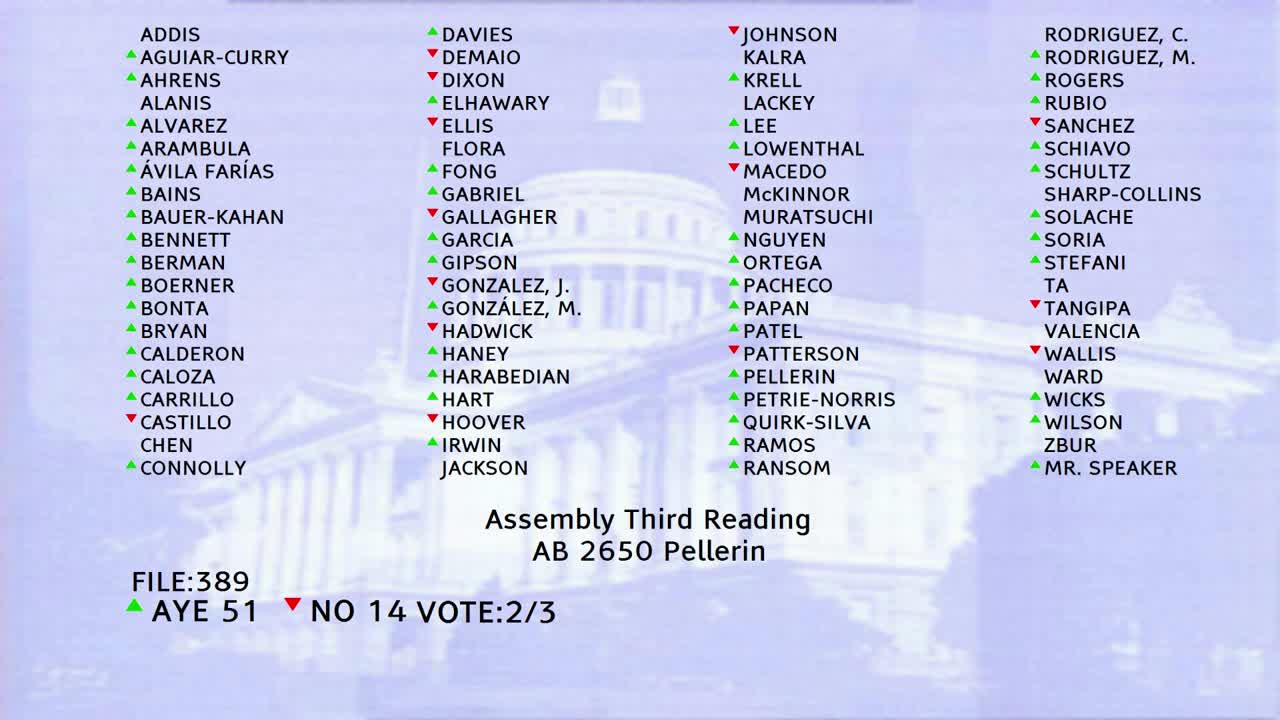 3MIN
Assembly Floor
 21MIN
Assembly Standing Committee on Housing and Community Development
Bill Author

Bill Co-Author(s):