AB 2768: Student financial aid: waiver or deferment of fees and costs: foster youth.
- Session Year: 2025-2026
- House: Assembly
- Latest Version Date: 2026-09-27
Current Status:
Passed
(2026-09-27: Chaptered by Secretary of State - Chapter 637, Statutes of 2026.)
Introduced
In Committee
Awaiting First Chamber Vote
Passed First Chamber
In Committee
Awaiting Second Chamber Vote
Passed Second Chamber
Enacted
Existing law establishes the California Community Colleges, the California State University, the University of California, independent institutions of higher education, and private postsecondary educational institutions as the segments of postsecondary education in the state. Existing law establishes various programs that provide financial aid to students attending institutions in each of the segments.
This bill would require the California State University, community college districts, and private postsecondary educational institutions and independent institutions of higher education that receive state financial assistance to, and would request the University of California to, for a student who has submitted a specified financial aid application and is a foster youth or former foster youth, as defined, upon the students initial enrollment at the postsecondary educational institution, either (1) waive the unpaid portion of enrollment fees and costs, or (2) defer the unpaid portion of enrollment fees and costs until the student has received an initial disbursement of the students financial aid award, as provided. If the postsecondary educational institution is unable to waive or defer costs related to books, supplies, materials, or equipment, the bill would require the institution to provide the student with clear information regarding available campus resources, institutional programs, or community-based assistance to help the student cover those costs. By imposing new duties on community college districts, the bill would impose a state-mandated local program.
The California Constitution requires the state to reimburse local agencies and school districts for certain costs mandated by the state. Statutory provisions establish procedures for making that reimbursement.
This bill would provide that, if the Commission on State Mandates determines that the bill contains costs mandated by the state, reimbursement for those costs shall be made pursuant to the statutory provisions noted above.
Existing law establishes the California Community Colleges, the California State University, the University of California, independent institutions of higher education, and private postsecondary educational institutions as the segments of postsecondary education in the state. Existing law establishes various programs that provide financial aid to students attending institutions in each of the segments.
This bill would require the California State University, community college districts, and private postsecondary educational institutions and independent institutions of higher education that receive state financial assistance to, and would request the University of California to, waive or defer the unpaid portion of enrollment fees and costs for a student who has submitted a specified financial aid application and is a foster youth or former foster youth, as defined, upon the students initial enrollment at the postsecondary educational institutional institution, either (1) waive the unpaid portion of enrollment fees and costs, or (2) defer the unpaid portion of enrollment fees and costs until the student has received an initial disbursement of the students financial aid award, as provided. If the postsecondary educational institution is unable to waive or defer costs related to books, supplies, materials, or equipment, the bill would require the institution to provide the student with clear information regarding available campus resources, institutional programs, or community-based assistance to help the student cover those costs. By imposing new duties on community college districts, the bill would impose a state-mandated local program.
The California Constitution requires the state to reimburse local agencies and school districts for certain costs mandated by the state. Statutory provisions establish procedures for making that reimbursement.
This bill would provide that, if the Commission on State Mandates determines that the bill contains costs mandated by the state, reimbursement for those costs shall be made pursuant to the statutory provisions noted above.
Existing law establishes the California Community Colleges, the California State University, the University of California, independent institutions of higher education, and private postsecondary educational institutions as the segments of postsecondary education in the state. Existing law establishes various programs that provide financial aid to students attending institutions in each of the segments.
This bill would require the California State University, community college districts, and private postsecondary educational institutions and independent institutions of higher education that receive state financial assistance to, and would request the University of California to, waive or defer the unpaid portion of enrollment fees and costs for a student that who has submitted a specified financial aid application and is a foster youth or former foster youth, as defined, upon the students initial enrollment at the postsecondary educational institutional until the student has received an initial disbursement of the students financial aid award, as provided. If the postsecondary educational institution is unable to waive or defer costs related to books, supplies, materials, or equipment, the bill would require the institution to provide the student with clear information regarding available campus resources, institutional programs, or community-based assistance to help the student cover those costs. By imposing new duties on community college districts, the bill would impose a state-mandated local program.
The California Constitution requires the state to reimburse local agencies and school districts for certain costs mandated by the state. Statutory provisions establish procedures for making that reimbursement.
This bill would provide that, if the Commission on State Mandates determines that the bill contains costs mandated by the state, reimbursement for those costs shall be made pursuant to the statutory provisions noted above.
Existing law establishes the California Community Colleges, the California State University, the University of California, independent institutions of higher education, and private postsecondary educational institutions as the segments of postsecondary education in the state. Existing law establishes various programs that provide financial aid to students attending institutions in each of the segments.
This bill would require the California State University, community college districts, and private postsecondary educational institutions and independent institutions of higher education that receive state financial assistance to, and would request the University of California to, defer the unpaid portion of enrollment fees and costs for a student that is a foster youth or former foster youth, as defined, upon the students initial enrollment at the postsecondary educational institutional until the student has received an initial disbursement of the students financial aid award, as provided. By imposing new duties on community college districts, the bill would impose a state-mandated local program.
The California Constitution requires the state to reimburse local agencies and school districts for certain costs mandated by the state. Statutory provisions establish procedures for making that reimbursement.
This bill would provide that, if the Commission on State Mandates determines that the bill contains costs mandated by the state, reimbursement for those costs shall be made pursuant to the statutory provisions noted above.
(a)(1)Commencing with the 202728 academic year, the California State University, each community college district, and private postsecondary educational institutions and independent institutions of higher education that receive state financial assistance shall, and the University of California is requested to, for a student who has submitted a Free Application for Federal Student Aid or California Dream Act Application, if applicable, and is a foster youth or former foster youth, as defined pursuant to paragraph (1) of subdivision (b) of Section 66025.9, and as verified by a financial aid administrator for the postsecondary educational institution, upon the students initial enrollment at the postsecondary educational institution, do either of the following:
(A)Waive the unpaid portion of enrollment fees and costs.
(B)Defer the unpaid portion of enrollment fees and costs until the student has received an initial disbursement of the students financial aid award.
(2)For purposes of paragraph (1), enrollment fees and costs include, but shall not be limited to, all of the following:
(A)Registration fees, including a statement of intent to register.
(B)Mandatory campus fees.
(C)Campus housing and meals, including any required deposits.
(D)Health insurance.
(E)Books, supplies, materials, and equipment that may be required for enrolled courses, except as provided in subdivision (b).
(F)Any associated costs of a summer course or program required to be taken for the students chosen major.
(b)If a postsecondary educational institution is unable to waive or defer the costs described in subparagraph (E) of paragraph (2) of subdivision (a), the institution shall provide the student with clear information regarding available campus resources, institutional programs, or community-based assistance to help the student cover those costs.
(c)Community college districts are encouraged to use existing funding sources to implement this section, including, but not limited to, funding received pursuant to the NextUp program established pursuant to Article 7 (commencing with Section 79220) of Chapter 9 of Part 48 of Division 7 and funding received pursuant to the Student Equity and Achievement Program established pursuant to Section 78222.
SEC. 2.If the Commission on State Mandates determines that this act contains costs mandated by the state, reimbursement to local agencies and school districts for those costs shall be made pursuant to Part 7 (commencing with Section 17500) of Division 4 of Title 2 of the Government Code.
(a)(1)Commencing with the 202728 academic year, the California State University, each community college district, and private postsecondary educational institutions and independent institutions of higher education that receive state financial assistance shall, and the University of California is requested to, waive or defer the unpaid portion of enrollment fees and costs for a student who has submitted a Free Application for Federal Student Aid or California Dream Act Application, if applicable, and is a foster youth or former foster youth, as defined pursuant to paragraph (1) of subdivision (b) of Section 66025.9, and as verified by a financial aid administrator for the postsecondary educational institution, upon the students initial enrollment at the postsecondary educational institution until the student has received an initial disbursement of the students financial aid award. Enrollment institution, do either of the following:
(A)Waive the unpaid portion of enrollment fees and costs.
(B)Defer the unpaid portion of enrollment fees and costs until the student has received an initial disbursement of the students financial aid award.
(2)For purposes of paragraph (1), enrollment fees and costs include, but shall not be limited to, all of the following:
(1)(A)Registration fees, including a statement of intent to register.
(2)(B)Mandatory campus fees.
(3)(C)Campus housing and meals, including any required deposits.
(4)(D)Health insurance.
(5)(E)Books, supplies, materials, and equipment that may be required for enrolled courses, except as provided in subdivision (b).
(6)(F)Any associated costs of a summer course or program required to be taken for the students chosen major.
(b)If a postsecondary educational institution is unable to waive or defer the costs described in paragraph (5) subparagraph (E) of paragraph (2) of subdivision (a), the institution shall provide the student with clear information regarding available campus resources, institutional programs, or community-based assistance to help the student cover those costs.
(c)Community college districts are encouraged to use existing funding sources to implement this section, including, but not limited to, funding received pursuant to the NextUp program established pursuant to Article 7 (commencing with Section 79220) of Chapter 9 of Part 48 of Division 7 and funding received pursuant to the Student Equity and Achievement Program established pursuant to Section 78222.
SEC. 2.If the Commission on State Mandates determines that this act contains costs mandated by the state, reimbursement to local agencies and school districts for those costs shall be made pursuant to Part 7 (commencing with Section 17500) of Division 4 of Title 2 of the Government Code.
(a)Commencing with the 202728 academic year, the California State University, each community college district, and private postsecondary educational institutions and independent institutions of higher education that receive state financial assistance shall, and the University of California is requested to, waive or defer the unpaid portion of enrollment fees and costs for a student that who has submitted a Free Application for Federal Student Aid or California Dream Act Application, if applicable, and is a foster youth or former foster youth, as defined pursuant to paragraph (1) of subdivision (b) of Section 66025.9, and as verified by a financial aid administrator for the postsecondary educational institution, upon the students initial enrollment at the postsecondary educational institution until the student has received an initial disbursement of the students financial aid award. Enrollment fees and costs include, but shall not be limited to, all of the following:
(a)(1)Registration fees, including a statement of intent to register.
(b)(2)Mandatory campus fees.
(c)(3)Campus housing and meals, including any required deposits.
(d)(4)Health insurance.
(e)(5)Books, supplies, materials, and equipment that may be required for enrolled courses. courses, except as provided in subdivision (b).
(f)(6)Any associated costs of a summer course or program required to be taken for the students chosen major.
(b)If a postsecondary educational institution is unable to waive or defer the costs described in paragraph (5) of subdivision (a), the institution shall provide the student with clear information regarding available campus resources, institutional programs, or community-based assistance to help the student cover those costs.
(c)Community college districts are encouraged to use existing funding sources to implement this section, including, but not limited to, funding received pursuant to the NextUp program established pursuant to Article 7 (commencing with Section 79220) of Chapter 9 of Part 48 of Division 7 and funding received pursuant to the Student Equity and Achievement Program established pursuant to Section 78222.
SEC. 2.If the Commission on State Mandates determines that this act contains costs mandated by the state, reimbursement to local agencies and school districts for those costs shall be made pursuant to Part 7 (commencing with Section 17500) of Division 4 of Title 2 of the Government Code.
Commencing with the 202728 academic year, the California State University, each community college district, and private postsecondary educational institutions and independent institutions of higher education that receive state financial assistance shall, and the University of California is requested to, defer the unpaid portion of enrollment fees and costs for a student that is a foster youth or former foster youth, as defined pursuant to paragraph (1) of subdivision (b) of Section 66025.9, and as verified by a financial aid administrator for the postsecondary educational institution, upon the students initial enrollment at the postsecondary educational institution until the student has received an initial disbursement of the students financial aid award. Enrollment fees and costs include, but shall not be limited to, all of the following:
(a)Registration fees, including a statement of intent to register.
(b)Mandatory campus fees.
(c)Campus housing and meals, including any required deposits.
(d)Health insurance.
(e)Books, supplies, materials, and equipment that may be required for enrolled courses.
(f)Any associated costs of a summer course or program required to be taken for the students chosen major.
SEC. 2.If the Commission on State Mandates determines that this act contains costs mandated by the state, reimbursement to local agencies and school districts for those costs shall be made pursuant to Part 7 (commencing with Section 17500) of Division 4 of Title 2 of the Government Code.
|
Date
|
Status
|
|---|---|
| Sep 27, 2026 | Chaptered by Secretary of State - Chapter 637, Statutes of 2026. |
| Sep 27, 2026 | Approved by the Governor. |
| Sep 3, 2026 | Enrolled and presented to the Governor at 4 p.m. |
| Aug 26, 2026 | Senate amendments concurred in. To Engrossing and Enrolling. (Ayes 79. Noes 0. Page 6606.). |
| Aug 26, 2026 | Senate amendments concurred in. To Engrossing and Enrolling. (Ayes 79. Noes 0.). |
| Aug 26, 2026 | In Assembly. Concurrence in Senate amendments pending. |
| Aug 25, 2026 | Read third time. Passed. Ordered to the Assembly. (Ayes 40. Noes 0. Page 5812.). |
| Aug 25, 2026 | Read third time. Passed. Ordered to the Assembly. (Ayes 39. Noes 0.). |
| Aug 17, 2026 | Read second time. Ordered to third reading. |
| Aug 13, 2026 | Read second time and amended. Ordered returned to second reading. |
| Aug 13, 2026 | From committee: Amend, and do pass as amended. (Ayes 7. Noes 0.) (August 13). |
| Aug 3, 2026 | In committee: Referred to APPR. suspense file. |
| Jun 25, 2026 | From committee: Do pass and re-refer to Com. on APPR. (Ayes 7. Noes 0.) (June 24). Re-referred to Com. on APPR. |
| Jun 15, 2026 | From committee chair, with author's amendments: Amend, and re-refer to committee. Read second time, amended, and re-referred to Com. on ED. |
| Jun 3, 2026 | Referred to Com. on ED. |
| May 27, 2026 | In Senate. Read first time. To Com. on RLS. for assignment. |
| May 26, 2026 | Read third time. Passed. Ordered to the Senate. (Ayes 78. Noes 0. Page 5345.) |
| May 26, 2026 | Read third time. Passed. Ordered to the Senate. (Ayes 78. Noes 0.) |
| May 26, 2026 | Read third time. Passed. Ordered to the Senate. |
| May 18, 2026 | Read second time. Ordered to third reading. |
| May 14, 2026 | From committee: Do pass. (Ayes 15. Noes 0.) (May 14). |
| May 6, 2026 | In committee: Set, first hearing. Referred to APPR. suspense file. |
| Apr 22, 2026 | From committee: Do pass and re-refer to Com. on APPR. with recommendation: To Consent Calendar. (Ayes 10. Noes 0.) (April 21). Re-referred to Com. on APPR. |
| Mar 16, 2026 | Referred to Com. on HIGHER ED. |
| Feb 21, 2026 | From printer. May be heard in committee March 23. |
| Feb 20, 2026 | Read first time. To print. |
|
Date
|
Description
|
Location
|
Votes
|
|
|---|---|---|---|---|
| Aug 26, 2026 | AB 2768 Ahrens Concurrence in Senate Amendments | Assembly Floor |
Passed |
|
| Aug 25, 2026 | Assembly 3rd Reading AB2768 Ahrens et al. By Pérez | Senate Floor |
Passed |
|
| Aug 13, 2026 | Do pass as amended | Senate Standing Committee on Appropriations |
Passed |
|
| Aug 3, 2026 | Placed on suspense file | Senate Standing Committee on Appropriations |
Passed |
|
| Jun 24, 2026 | Do pass, but first be re-referred to the Committee on [Appropriations] | Senate Standing Committee on Education |
Passed |
|
| May 26, 2026 | AB 2768 Ahrens Assembly Third Reading | Assembly Floor |
Passed |
|
| May 14, 2026 | Do pass. | Assembly Standing Committee on Appropriations |
Passed |
|
| Apr 21, 2026 | Do pass and be re-referred to the Committee on [Appropriations] with recommendation: To Consent Calendar | Assembly Standing Committee on Higher Education |
Passed |
This list shows positions taken on this bill by organizations on the date displayed, which is linked to the original source.
Positions by individuals are not included.
|
Organization
|
Position
|
Date
|
|---|---|---|
| Alameda County Office Of Education | ** Support | |
| Alliance for Children’s Rights | ** Support | |
| ASPIRANET | ** Support | |
| California Association Of School Counselors | ** Support | |
| California Community Colleges, Chancellor’s Office | ** Support | |
| California County Superintendents | ** Support | |
| CFT – a Union of Educators & Classified Professionals, AFT, AFL-CIO | ** Support | |
| Children Now | ** Support | |
| County of Santa Clara | ** Support | |
| Edwin Gomez, Ed.D. | ** Support | |
| Faculty Association Of California Community Colleges | ** Support | |
| Indivisible Ca State Strong | ** Support | |
| Los Angeles County Office Of Education | ** Support | |
| Los Angeles Unified School District | ** Support | |
| Office of the Riverside County Superintendent of Schools | ** Support | |
| Office of the Riverside County Superintendent of Schools (sponsor) | ** Support | |
| Placer County Office Of Education | ** Support | |
| Riverside County Superintendent of Schools (Edwin Gomez, Ed.D.) | ** Support | |
| Riverside County Superintendent of Schools (Sponsor) | ** Support | |
| San Bernardino Community College District | ** Support | |
| San Diego Unified School District | ** Support | |
| San Jose-Evergreen Community College District | ** Support | |
| San Mateo County Office Of Education | ** Support | |
| The Institute for College Access & Success | ** Support | |
| University of California | ** Support | |
| University of California Office of the President | ** Support |
CONCURRENCE IN SENATE AMENDMENTS
CSA1 Bill Id:AB 2768
Author:(Ahrens)
As Amended Ver:August 13, 2026
Majority vote
SUMMARY
Requires California State University (CSU), each California Community College (CCC) district, and private and independent institutions of higher education that receive state financial assistance and requests University of California (UC) commencing with the 2027-2028 academic year, to waive unpaid portion of enrollment fees or other costs, or defer fees or costs until the student has received an initial disbursement of their financial aid award for current or former foster youth upon initial enrollment.
Senate Amendments
- Request CCC districts to use existing funding sources to implement the measure, including, but not limited to, funding received pursuant to the NextUp program, as specified.
- Make clarifying changes to require CSU, CCC, and private and independent institutions of higher education to either waive the unpaid portion of enrollment fees and costs or defer the unpaid portion of enrollment fees and costs, as specified.
COMMENTS
Addressing timing gaps in financial aid. Financial aid is often disbursed after the start of the academic term, while enrollment-related costs are due earlier. This timing misalignment can disproportionately impact foster youth, who may lack financial resources or family support to bridge the gap. This measure appears to address said gap by requiring institutions to defer payment until aid is received.
Scope of covered costs. This measure applies broadly to multiple categories of student expenses, including tuition, housing, food, and educational materials. By including non-tuition costs, the measure recognizes that barriers to enrollment extend beyond registration fees and may include basic living and academic readiness expenses.
NextUp Program. The NextUp Program provides traditional student support services such as orientation, in addition to outreach and recruitment, consultation and eligibility verification, consultation and referrals for students deemed ineligible, service coordination, counseling, book and supply grants, tutoring, independent living and financial literacy skills support, frequent in-person contact, career guidance, transfer counseling, child care and transportation assistance, and referrals to health services, mental health services, housing assistance, and other related services. This bill encourages community colleges to use NextUP funds to defer or waive costs associated with the implementation of this bill's requirements.
According to the Author
According to the author, "this bill holds deep personal significance for me, as I have firsthand experience navigating the foster care system and facing homelessness. My journey through the community college system and higher education played a transformative role in my life, providing me with the opportunities and support needed to build the career I have today. I am profoundly grateful for the access and resources that made this path possible."
The author further states that, "at the same time, my experiences have shown me that there are still gaps in support for students facing similar challenges. Many foster youth encounter barriers that make it difficult to navigate higher education, from financial instability to a lack of consistent guidance and resources. I believe there is more we can do to ensure these students not only access college but also succeed once they are there. This bill reflects my commitment to strengthening those support systems. By addressing these gaps, it aims to make college more accessible, navigable, and equitable for foster youth. Ultimately, it aligns with my goal of helping create a more supportive and empowering environment so that students with backgrounds like mine have every opportunity to thrive."
Lastly the author states, "AB 2768 seeks to eliminate inequities in higher education by directly addressing financial barriers that disproportionately affect foster youth, a historically underrepresented and vulnerable student population. Foster youth tend to experience higher rates of housing instability, food insecurity, and financial insecurity compared to their peers, all of which can impede their ability to enroll and persist in college. Although tuition may be waived, many essential costs such as housing, meals, books, and required summer programs remain and are often due before financial aid is disbursed. By allowing these costs to be deferred during a student's first term, the bill removes a key structural barrier and ensures that foster youth have equitable access to the same opportunities as other students."
Arguments in Support
According to the Riverside County Superintendent of Schools (Edwin Gomez, Ed.D.), the sponsor of this measure, "foster youth face unique and significant educational challenges, including lower rates of academic achievement, graduation, attendance, and post-secondary attainment. According to the California Department of Education, only 60% of foster youth graduate high school, compared to 86% of non‑foster youth. Frequent placement and school changes further disrupt learning, often resulting in the loss of critical academic documents and progress."
Dr. Gomez goes on to state that, "AB 2768 would allow first-term foster youth students to defer payment of essential enrollment costs—including the Statement of Intent to Register (SIR), any summer coursework or programs required for a student's declared major, on-campus housing deposits, and the purchase of textbooks—until their financial aid is available. While California has taken important steps to support foster youth by waiving systemwide tuition, tuition waivers do not cover campus-based costs. These expenses can create substantial obstacles that delay enrollment, set the students behind in their studies, and/or force foster youth students to alter their academic plans. AB 2768 is a step in the right direction toward leveling the playing field for these students."
Arguments in Opposition
None on file.
FISCAL COMMENTS
According to the Senate Committee on Appropriations:
- The CCC Chancellor's Office estimates General Fund costs of up to $15,000 per district, or $1.1 million statewide, to update policies deferring fees for foster youth students. These costs could be reduced to the extent that existing policies meet requirements of the bill. For example, some community college districts have policies that defer fees under "anticipated aid."
- The UC and CSU indicate that the bill's costs would be minor and absorbable.
VOTES:
ASM HIGHER EDUCATION: 10-0-0
YES: Fong, DeMaio, Boerner, Macedo, Jackson, Muratsuchi, Patel, Ramos, Sharp-Collins, Tangipa
ASM APPROPRIATIONS: 15-0-0
YES: Wicks, Hoover, Aguiar-Curry, Calderon, Caloza, Dixon, Fong, Mark González, Krell, Pacheco, Pellerin, Sharp-Collins, Solache, Ta, Tangipa
ASSEMBLY FLOOR: 78-0-2
YES: Addis, Aguiar-Curry, Ahrens, Alanis, Alvarez, Arambula, Ávila Farías, Bains, Bauer-Kahan, Bennett, Berman, Boerner, Bonta, Bryan, Calderon, Caloza, Carrillo, Castillo, Chen, Connolly, Davies, DeMaio, Dixon, Elhawary, Ellis, Flora, Fong, Gabriel, Gallagher, Garcia, Gipson, Jeff Gonzalez, Mark González, Hadwick, Haney, Harabedian, Hart, Hoover, Irwin, Jackson, Johnson, Kalra, Krell, Lackey, Lee, Lowenthal, Macedo, McKinnor, Nguyen, Ortega, Pacheco, Papan, Patel, Patterson, Pellerin, Petrie-Norris, Quirk-Silva, Ramos, Ransom, Michelle Rodriguez, Rogers, Blanca Rubio, Sanchez, Schiavo, Schultz, Sharp-Collins, Solache, Soria, Stefani, Ta, Tangipa, Valencia, Wallis, Ward, Wicks, Wilson, Zbur, Rivas
ABS, ABST OR NV: Muratsuchi, Celeste Rodriguez
SENATE FLOOR: 40-0-0
YES: Allen, Alvarado-Gil, Archuleta, Arreguín, Ashby, Becker, Blakespear, Cabaldon, Caballero, Cervantes, Choi, Cortese, Dahle, Durazo, Gonzalez, Grayson, Grove, Hurtado, Jones, Laird, Limón, McGuire, McNerney, Menjivar, Niello, Ochoa Bogh, Padilla, Pérez, Reyes, Richardson, Rubio, Seyarto, Smallwood-Cuevas, Stern, Strickland, Umberg, Valladares, Wahab, Weber Pierson, Wiener
UPDATED
VERSION: August 13, 2026
CONSULTANT: Jeanice Warden / HIGHER ED. / (916) 319-3960 FN: 0004221
SENATE RULES COMMITTEE Office of Senate Floor Analyses (916) 651-4171 | AB 2768 |
THIRD READING
Bill No: AB 2768
Author: Ahrens (D), et al.
Amended: 8/13/26 in Senate
Vote: 21
SENATE EDUCATION COMMITTEE: 7-0, 6/24/26
AYES: Pérez, Ochoa Bogh, Cabaldon, Choi, Cortese, Gonzalez, Reyes
SENATE APPROPRIATIONS COMMITTEE: 7-0, 8/13/26
AYES: Cervantes, Seyarto, Cabaldon, Dahle, Grayson, Richardson, Wahab
ASSEMBLY FLOOR: 78-0, 5/26/26 - See last page for vote
SUBJECT: Student financial aid: waiver or deferment of fees and costs: foster youth
SOURCE: Office of the Riverside County Superintendent of Schools
DIGEST:
This bill, commencing with the 2027-2028 academic year, requires California State University (CSU), each community college district, and private and independent institutions of higher education that receive state financial assistance and requests University of California (UC) to waive unpaid portion of enrollment fees or other costs, or defer fees or costs until the student has received an initial disbursement of their financial aid award for current or former foster youth upon initial enrollment.
ANALYSIS:
Existing law:
- Establishes the CSU, under the administration of the Trustees of the CSU, the UC, under the administration of the Regents of the UC, the California Community Colleges (CCC), under the administration of the Board of Governors of the CCC, and independent institutions of higher education, as defined, as four segments of postsecondary education in the State. (Education Code (EC) § 66010.4, et seq.)
- Requires the CSU and each Community College District (CCD), and requests the UC to, with respect to each campus in their respective jurisdictions that administers a priority enrollment system, grant priority in that system for registration for enrollment to a foster youth, former foster youth, homeless youth, or former homeless youth. Defines “foster youth” and “former foster youth” as a person in California whose dependency was established or continued by a court of competent jurisdiction, including a tribal court, on or after the youth’s 13th birthday and who is no older than 25 years of age at the commencement of the academic year. (EC § 66025.9)
- Requests CCC campuses to give priority housing to foster and homeless youth and priority access to year-round housing at no extra cost during breaks. (EC § 76010)
- Requires CSU campuses to give priority housing to foster and homeless youth and priority access to year-round housing at no extra cost during breaks. (EC § 90001.5)
- Requires UC campuses to give priority housing to foster and homeless youth, and priority access to year-round housing at no extra cost during breaks subject to the UC Regents issuing a resolution of approval. (EC § 92660)
This bill:
- Requires, commencing with the 2027-2028 academic year, CSU, each community college district, private postsecondary educational institutions, and independent institutions of higher education to receive state financial assistance, and the UC is requested to waive unpaid portion of enrollment fees or other costs, or defer those fees or costs until the student has received an initial disbursement of their financial aid award for current or former foster youth upon initial enrollment. Enrollment fees and costs include, but are not limited to, all of the following:
- Registration fees, including a statement of intent to register.
- Mandatory campus fees.
- Campus housing and meals, including any required deposits.
- Health insurance.
- Books, supplies, materials, and equipment that may be required for enrolled courses, except if an institution is unable to waive or defer these costs, it must provide the student with clear information regarding available campus resources, institutional programs, or community-based assistance to help the student cover those costs.
- Any associated costs of a summer course or program required to be taken for the student’s chosen major.
- Encourages community college districts to use existing funding sources to implement the provisions of this bill, including NextUP Program funding and Student Equity and Achievement Program funding.
Comments
Need for the bill. According to the author, “This bill holds deep personal significance for me, as I have firsthand experience navigating the foster care system and facing homelessness. My journey through the community college system and higher education played a transformative role in my life, providing me with the opportunities and support needed to build the career I have today. I am profoundly grateful for the access and resources that made this path possible.
At the same time, my experiences have shown me that there are still gaps in support for students facing similar challenges. Many foster youth encounter barriers that make it difficult to navigate higher education, from financial instability to a lack of consistent guidance and resources. I believe there is more we can do to ensure these students not only access college but also succeed once they are there.
This bill reflects my commitment to strengthening those support systems. By addressing these gaps, it aims to make the college more accessible, navigable, and equitable for foster youth. Ultimately, it aligns with my goal of helping create a more supportive and empowering environment so that students with backgrounds like mine have every opportunity to thrive.”
Who is eligible? The bill applies to current and former foster youth, as defined in current law. Under that definition, an eligible student is a person whose dependency was established or continued by a court on or after the youth’s 13th birthday and who is no older than 25 years of age at the commencement of the academic year. This definition aligns eligibility for this benefit with other higher education programs and services available to foster youth.
Existing supports for foster youth. Existing law provides various supports to foster youth pursuing higher education, including priority registration, tuition assistance, financial aid, and priority access to campus housing. Current law also requires public higher education institutions to provide priority access for year-round campus housing at no extra cost during campus breaks. This bill expands those benefits by addressing a period of transition into college and the timing of enrollment related costs that foster youth may encounter when first enrolling in college.
Costs eligible for waiver or deferral. This bill requires public higher education institutions and private institutions receiving state assistance to waive or defer various costs during a foster youth’s initial enrollment, including enrollment fees, mandatory campus fees, housing and meal costs, health insurance, and required summer program expenses. This bill also includes books, supplies, materials, and equipment required for enrolled courses. Unlike many enrollment related charges that are directly billed by an institution, books and supplies are often obtained through third party vendors and may not be cost that a campus can readily waive or defer. This bill permits institutions that are unable to waiver or defer these costs to instead provide information regarding available campus resources, institutional programs or community based assistance. The author may wish to further clarify that health insurance costs apply to campus sponsored health insurance costs assessed by the institution.
NextUp. The NextUp Program provides traditional student support services such as orientation, in addition to outreach and recruitment, consultation and eligibility verification, consultation and referrals for students deemed ineligible, service coordination, counseling, book and supply grants, tutoring, independent living and financial literacy skills support, frequent in-person contact, career guidance, transfer counseling, child care and transportation assistance, and referrals to health services, mental health services, housing assistance, and other related services. This bill encourages community colleges to use NextUP funds to defer or waive costs associated with the implementation of this bill’s requirements.
FISCAL EFFECT: Appropriation: No Fiscal Com.: Yes Local: Yes
According to the Senate Appropriations Committee analysis, this bill would have the following fiscal impact:
- The Chancellor’s Office estimates General Fund costs of up to $15,000 per district, or $1.1 million statewide, to update policies deferring fees for foster youth students. These costs could be reduced to the extent that existing policies meet requirements of the bill. For example, some community college districts have policies that defer fees under “anticipated aid.”
- The UC and CSU indicate that the bill’s costs would be minor and absorbable.
SUPPORT: (Verified 8/15/26)
Office of the Riverside County Superintendent of Schools (source)
Alameda County Office of Education
Alliance for Children’s Rights
Aspiranet
California Association of School Counselors
California Community Colleges, Chancellor’s Office
California County Superintendents
CFT – A Union of Educators & Classified Professionals, AFT, AFL-CIO
Children Now
County of Santa Clara
Faculty Association of California Community Colleges
Indivisible CA State Strong
Los Angeles County Office of Education
Los Angeles Unified School District
Placer County Office of Education
San Bernardino Community College District
San Diego Unified School District
San Jose-Evergreen Community College District
The Institute for College Access & Success
University of California
OPPOSITION: (Verified 8/15/16)
None received
ASSEMBLY FLOOR: 78-0, 5/26/26
AYES: Addis, Aguiar-Curry, Ahrens, Alanis, Alvarez, Arambula, Ávila Farías, Bains, Bauer-Kahan, Bennett, Berman, Boerner, Bonta, Bryan, Calderon, Caloza, Carrillo, Castillo, Chen, Connolly, Davies, DeMaio, Dixon, Elhawary, Ellis, Flora, Fong, Gabriel, Gallagher, Garcia, Gipson, Jeff Gonzalez, Mark González, Hadwick, Haney, Harabedian, Hart, Hoover, Irwin, Jackson, Johnson, Kalra, Krell, Lackey, Lee, Lowenthal, Macedo, McKinnor, Nguyen, Ortega, Pacheco, Papan, Patel, Patterson, Pellerin, Petrie-Norris, Quirk-Silva, Ramos, Ransom, Michelle Rodriguez, Rogers, Blanca Rubio, Sanchez, Schiavo, Schultz, Sharp-Collins, Solache, Soria, Stefani, Ta, Tangipa, Valencia, Wallis, Ward, Wicks, Wilson, Zbur, Rivas
NO VOTE RECORDED: Muratsuchi, Celeste Rodriguez
Prepared by: Olgalilia Ramirez / ED. / (916) 651-4105
8/17/26 10:54:46
**** END ****
SENATE COMMITTEE ON
Senator Sabrina Cervantes, Chair
2025 - 2026 Regular Session
AB 2768 (Ahrens) - Student financial aid: waiver or deferment of fees and costs: foster youth
Version: | Policy Vote: |
Urgency: | Mandate: |
Hearing Date: | Consultant: |
Bill Summary:
This bill requires the California State University (CSU), community college districts, and private and independent institutions of higher education that receive state financial assistance, and requests the University of California (UC), to waive or defer the unpaid portion of enrollment fees and other costs for current or former foster youth upon initial enrollment until the student has received an initial disbursement of their financial aid award.
*********** ANALYSIS ADDENDUM – SUSPENSE FILE ***********
The following information is revised to reflect amendments
adopted by the committee on August 13, 2026
Fiscal Impact:
The Chancellor’s Office estimates General Fund costs of up to $15,000 per district, or $1.1 million statewide, to update policies deferring fees for foster youth students. These costs could be reduced to the extent that existing policies meet requirements of the bill. For example, some community college districts have policies that defer fees under “anticipated aid.”
The UC and CSU indicate that the bill’s costs would be minor and absorbable.
Author Amendments:
Make clarifying changes to require CSU, community colleges, and private and independent institutions of higher education to either waive the unpaid portion of enrollment fees and costs or defer the unpaid portion of enrollment fees and costs, as specified.
-- END --
SENATE COMMITTEE ON
Senator Sabrina Cervantes, Chair
2025 - 2026 Regular Session
AB 2768 (Ahrens) - Student financial aid: waiver or deferment of fees and costs: foster youth
Version: | Policy Vote: |
Urgency: | Mandate: |
Hearing Date: | Consultant: |
Bill Summary:
This bill requires the California State University (CSU), community college districts, and private and independent institutions of higher education that receive state financial assistance, and requests the University of California (UC), to waive or defer the unpaid portion of enrollment fees and other costs for current or former foster youth upon initial enrollment until the student has received an initial disbursement of their financial aid award.
Fiscal Impact:
The Chancellor’s Office estimates General Fund costs of up to $15,000 per district, or $1.1 million statewide, to update policies deferring fees for foster youth students. These costs could be reduced to the extent that existing policies meet requirements of the bill. For example, some community college districts have policies that defer fees under “anticipated aid.”
The UC and CSU indicate that the bill’s costs would be minor and absorbable.
Background:
Existing law requires the CSU and each community college district, and requests the UC to, with respect to each campus in their respective jurisdictions that administers a priority enrollment system, grant priority in that system for registration for enrollment to a foster youth, former foster youth, homeless youth, or former homeless youth. Defines “foster youth” and “former foster youth” as a person in California whose dependency was established or continued by a court of competent jurisdiction, including a tribal court, on or after the youth’s 13th birthday and who is no older than 25 years of age at the commencement of the academic year.
Existing law requests community college campuses to give priority housing to foster and homeless youth and priority access to year-round housing at no extra cost during breaks.
Existing law requires CSU campuses to give priority housing to foster and homeless youth and priority access to year-round housing at no extra cost during breaks.
Existing law requires UC campuses to give priority housing to foster and homeless youth, and priority access to year-round housing at no extra cost during breaks subject to the UC Regents issuing a resolution of approval.
Proposed Law:
This bill requires, commencing with the 2027-2028 academic year, requires CSU, each community college district, private postsecondary educational institutions, and independent institutions of higher education to receive state financial assistance, and the UC is requested to waive or defer the unpaid portion of enrollment for current or former foster youth upon initial enrollment until the student has received an initial disbursement of their financial aid award.
This bill provides that enrollment fees and costs include, but are not limited to, all of the following: registration fees, including a statement of intent to register; mandatory campus fees; campus housing and meals, including any required deposits; health insurance; books, supplies, materials, and equipment that may be required for enrolled courses, except if an institution is unable to waive or defer these costs, it must provide the student with clear information regarding available campus resources, institutional programs, or community-based assistance to help the student cover those costs; and any associated costs of a summer course or program required to be taken for the student’s chosen major.
This bill encourages community college districts to use existing funding sources to implement the provisions of the bill, including NextUP Program funding and Student Equity and Achievement Program funding.
Related Legislation:
AB 2766 (Ahrens, 2026) requires, instead of requests, housing priority at a community college be granted to foster and homeless youth, and requires CSU and community colleges, and requests UC, to waive or defer housing costs for foster and homeless youth until they have received their financial aid disbursement. AB 2766 is pending in this committee.
Staff Comments:
Existing law provides various supports to foster youth pursuing higher education, including priority registration, tuition assistance, financial aid, and priority access to campus housing. Current law also requires public higher education institutions to provide priority access for year-round campus housing at no extra cost during campus breaks. This bill is intended to address a period of transition into college and the timing of enrollment related costs that foster youth may encounter when first enrolling in college. Specifically, the bill requires public higher education institutions and private institutions receiving state assistance to waive or defer various costs during a foster youth’s initial enrollment, including enrollment fees, mandatory campus fees, housing and meal costs, health insurance, and required summer program expenses.
-- END --
SENATE COMMITTEE ON EDUCATION
Senator Sasha Renée Pérez, Chair
2025 - 2026 Regular
Bill No: Hearing Date: June 24, 2026
Author: | |||
Version: |
| ||
Urgency: | Fiscal: | ||
Consultant: | |||
Subject: .
SUMMARY
This bill, commencing with the 2027-2028 academic year, requires California State University (CSU), each community college district, and private and independent institutions of higher education that receive state financial assistance and requests University of California (UC) to waive or defer the unpaid portion of enrollment fees and other costs for current or former foster youth upon initial enrollment until the student has received an initial disbursement of their financial aid award.
BACKGROUND
Existing law:
- Establishes the CSU, under the administration of the Trustees of the CSU, the UC, under the administration of the Regents of the UC, the California Community Colleges (CCC), under the administration of the Board of Governors of the CCC, and independent institutions of higher education, as defined, as four segments of postsecondary education in the State. (Education Code (EC) § 66010.4, et seq.)
- Requires the CSU and each CCD, and requests the UC to, with respect to each campus in their respective jurisdictions that administers a priority enrollment system, grant priority in that system for registration for enrollment to a foster youth, former foster youth, homeless youth, or former homeless youth. Defines “foster youth” and “former foster youth” as a person in California whose dependency was established or continued by a court of competent jurisdiction, including a tribal court, on or after the youth’s 13th birthday and who is no older than 25 years of age at the commencement of the academic year. (EC § 66025.9)
- Requests CCC campuses to give priority housing to foster and homeless youth and priority access to year-round housing at no extra cost during breaks. (EC § 76010)
- Requires CSU campuses to give priority housing to foster and homeless youth and priority access to year-round housing at no extra cost during breaks. (EC § 90001.5)
- Requires UC campuses to give priority housing to foster and homeless youth, and priority access to year-round housing at no extra cost during breaks subject to the UC Regents issuing a resolution of approval. (EC § 92660)
ANALYSIS
This bill:
- Requires, commencing with the 2027-2028 academic year, requires CSU, each community college district, private postsecondary educational institutions, and independent institutions of higher education to receive state financial assistance, and the UC is requested to waive or defer the unpaid portion of enrollment for current or former foster youth upon initial enrollment until the student has received an initial disbursement of their financial aid award. Enrollment fees and costs include, but are not limited to, all of the following:
- Registration fees, including a statement of intent to register.
- Mandatory campus fees.
- Campus housing and meals, including any required deposits.
- Health insurance.
- Books, supplies, materials, and equipment that may be required for
enrolled courses, except if an institution is unable to waive or defer these costs, it must provide the student with clear information regarding available campus resources, institutional programs, or community-based assistance to help the student cover those costs.
- Any associated costs of a summer course or program required to be taken
for the student’s chosen major.
- Encourages community college districts to use existing funding sources to implement the provisions of the bill, including NextUP Program funding and Student Equity and Achievement Program funding.
STAFF COMMENTS
- Need for the bill. According to the author, “This bill holds deep personal significance for me, as I have firsthand experience navigating the foster care system and facing homelessness. My journey through the community college system and higher education played a transformative role in my life, providing me with the opportunities and support needed to build the career I have today. I am profoundly grateful for the access and resources that made this path possible.
“At the same time, my experiences have shown me that there are still gaps in support for students facing similar challenges. Many foster youth encounter barriers that make it difficult to navigate higher education, from financial instability to a lack of consistent guidance and resources. I believe there is more we can do to ensure these students not only access college but also succeed once they are there.
“This bill reflects my commitment to strengthening those support systems. By addressing these gaps, it aims to make the college more accessible, navigable, and equitable for foster youth. Ultimately, it aligns with my goal of helping create a more supportive and empowering environment so that students with backgrounds like mine have every opportunity to thrive.”
- Who is eligible? The bill applies to current and former foster youth, as defined in current law. Under that definition, an eligible student is a person whose dependency was established or continued by a court on or after the youth’s 13th birthday and who is no older than 25 years of age at the commencement of the academic year. This definition aligns eligibility for this benefit with other higher education programs and services available to foster youth.
- Financial barriers facing foster youth. According to the author, foster youth often lack family financial support, savings, or access to credit to bridge the gap between when college costs are due and when financial aid is disbursed. While financial aid programs such as the Chafee Grant, Cal Grant, and tuition waivers are available to eligible foster youth, students may still be required to pay enrollment deposits, housing costs, fees, and other expenses before receiving their first financial aid disbursement. According to the 2024 NextUp report, foster youth often lack caregivers who can assist with the complexities of college admissions and financial aid. Once enrolled, they frequently face limited access to critical resources such as stable housing and financial support. These barriers contribute to disproportionate rates of poverty, housing insecurity, and homelessness, which in turn negatively impact academic performance, credit accumulation, and eligibility for financial aid. A 2023 study, Housing Insecurity and Homelessness Among College Students, reports that housing insecurity and homelessness show a strong, statistically significant negative relationship with college completion rates, persistence, and credit attainment. This bill seeks to address those upfront financial costs by requiring institutions to waive or defer specified costs associated with college attendance until financial aid is disbursed.
- Existing supports for foster youth. Existing law provides various supports to foster youth pursuing higher education, including priority registration, tuition assistance, financial aid, and priority access to campus housing. Current law also requires public higher education institutions to provide priority access for year-round campus housing at no extra cost during campus breaks. This bill expands those benefits by addressing a period of transition into college and the timing of enrollment related costs that foster youth may encounter when first enrolling in college.
- Costs eligible for waiver or deferral. The bill requires public higher education institutions and private institutions receiving state assistance to waive or defer various costs during a foster youth’s initial enrollment, including enrollment fees, mandatory campus fees, housing and meal costs, health insurance, and required summer program expenses. The bill also includes books, supplies, materials, and equipment required for enrolled courses. Unlike many enrollment related charges that are directly billed by an institution, books and supplies are often obtained through third party vendors and may not be cots that a campus can readily waive or defer. The bill permits institutions that are unable to waiver or defer these costs to instead provide information regarding available campus resources, institutional programs or community based assistance. The author may wish to further clarify that health insurance costs apply to campus sponsored health insurance costs assessed by the institution.
- NextUp. The NextUp Program provides traditional student support services such as orientation, in addition to outreach and recruitment, consultation and eligibility verification, consultation and referrals for students deemed ineligible, service coordination, counseling, book and supply grants, tutoring, independent living and financial literacy skills support, frequent in-person contact, career guidance, transfer counseling, child care and transportation assistance, and referrals to health services, mental health services, housing assistance, and other related services.
Existing law requires the CCC Board of Governors to report biennially, describing its efforts to serve students who are current and former foster youth, and include:- A review on a campus-by-campus basis of the enrollment, retention, transfer, and completion rates of foster youth, including categorical funding of those programs.
- Recommendations on whether and how the program under this article can be expanded to all community college districts and campuses.
- A review on a campus-by-campus basis of the enrollment, retention, transfer, and completion rates of foster youth, including categorical funding of those programs.
The 2020 report recommends that programs place a strong emphasis on student outreach, growth, and retention by expanding the wraparound support services and individualized case management. This bill encourages community colleges to use NextUP funds to defer or waive costs associated with the implementation of this bill’s requirements.
- Related legislation.
AB 2766 (Ahrens, 2026) requires, instead of requests, housing priority at a CCC be granted to foster and homeless youth, and requires a CCC, CSU and requests UC to waive or defer housing costs for foster and homeless youth until they have received their financial aid disbursement. It further expands priority registration for enrollment to foster youth to include those enrolled in the NextUp program at a CCC. AB 2766 was heard and passed by this Committee on June 10 and is currently awaiting a hearing in the Senate Human Services Committee.
SUPPORT
Office of the Riverside County Superintendent of Schools (sponsor)
Alameda County Office of Education
Alliance for Children's Rights
Aspiranet
California Association of School Counselors
California Community Colleges, Chancellor's Office
California County Superintendents
CFT – A Union of Educators & Classified Professionals, AFT, AFL-CIO
Children Now
County of Santa Clara
Faculty Association of California Community Colleges
Institute for College Access & Success; the
Los Angeles County Office of Education
Los Angeles Unified School District
San Diego Unified School District
San Jose-Evergreen Community College District
University of California
OPPOSITION
None received
-- END --
ASSEMBLY THIRD READING
ATR Bill Id:AB 2768
Author:(Ahrens)
As Introduced Ver:February 20, 2026
Majority vote
SUMMARY
Requires the California State University (CSU), California Community Colleges (CCC) districts (CCD), and private postsecondary educational institutions and independent institutions of higher education that receive state financial assistance to, and would request the University of California (UC) to, defer the unpaid portion of enrollment fees and costs for a student that is a foster youth or former foster youth, as defined, upon the student′s initial enrollment at the postsecondary educational institutional until the student has received an initial disbursement of the student′s financial aid award, as provided.
Major Provisions
- Requires, commencing with the 2027-28 academic year, CSU, CCDs, and private postsecondary educational institutions and independent institutions of higher education that receive state financial assistance to defer the unpaid portion of enrollment fees and costs for students who are foster youth or former foster youth upon their initial enrollment.
- Requests the University of California (UC) to adopt the same deferment policy as enumerated in (1) above.
- Applies the deferment to students who are foster youth or former foster youth, as defined, and as verified by a financial aid administrator.
- Requires that deferment apply upon a student′s initial enrollment and remain in place until the student receives an initial disbursement of financial aid.
- Stipulates that enrollment fees and costs include, but are not limited to, all of the following:
- Registration fees, including a statement of intent to register;
- Mandatory campus fees;
- Campus housing and meals (including any required deposits);
- Health insurance;
- Books, supplies, materials, equipment that may be required for enrolled courses; and,
- Any associated costs of a summer course or program required to be taken for the student′s chosen major.
COMMENTS
Addressing timing gaps in financial aid. Financial aid is often disbursed after the start of the academic term, while enrollment-related costs are due earlier. This timing misalignment can disproportionately impact foster youth, who may lack financial resources or family support to bridge the gap. This measure appears to address said gap by requiring institutions to defer payment until aid is received.
Scope of covered costs. This measure applies broadly to multiple categories of student expenses, including tuition, housing, food, and educational materials. By including non-tuition costs, the measure recognizes that barriers to enrollment extend beyond registration fees and may include basic living and academic readiness expenses.
According to the Author
According to the author, ″this bill holds deep personal significance for me, as I have firsthand experience navigating the foster care system and facing homelessness. My journey through the community college system and higher education played a transformative role in my life, providing me with the opportunities and support needed to build the career I have today. I am profoundly grateful for the access and resources that made this path possible.″
The author further states that, ″at the same time, my experiences have shown me that there are still gaps in support for students facing similar challenges. Many foster youth encounter barriers that make it difficult to navigate higher education, from financial instability to a lack of consistent guidance and resources. I believe there is more we can do to ensure these students not only access college but also succeed once they are there. This bill reflects my commitment to strengthening those support systems. By addressing these gaps, it aims to make college more accessible, navigable, and equitable for foster youth. Ultimately, it aligns with my goal of helping create a more supportive and empowering environment so that students with backgrounds like mine have every opportunity to thrive.″
Lastly the author states, ″AB 2768 seeks to eliminate inequities in higher education by directly addressing financial barriers that disproportionately affect foster youth, a historically underrepresented and vulnerable student population. Foster youth tend to experience higher rates of housing instability, food insecurity, and financial insecurity compared to their peers, all of which can impede their ability to enroll and persist in college. Although tuition may be waived, many essential costs such as housing, meals, books, and required summer programs remain and are often due before financial aid is disbursed. By allowing these costs to be deferred during a student′s first term, the bill removes a key structural barrier and ensures that foster youth have equitable access to the same opportunities as other students.″
Arguments in Support
According to the Riverside County Superintendent of Schools (Edwin Gomez, Ed.D.), the sponsor of this measure, ″foster youth face unique and significant educational challenges, including lower rates of academic achievement, graduation, attendance, and post-secondary attainment. According to the California Department of Education, only 60% of foster youth graduate high school, compared to 86% of non‑foster youth. Frequent placement and school changes further disrupt learning, often resulting in the loss of critical academic documents and progress.″
Dr. Gomez goes on to state that, ″AB 2768 would allow first-term foster youth students to defer payment of essential enrollment costs—including the Statement of Intent to Register (SIR), any summer coursework or programs required for a student′s declared major, on-campus housing deposits, and the purchase of textbooks—until their financial aid is available. While California has taken important steps to support foster youth by waiving systemwide tuition, tuition waivers do not cover campus-based costs. These expenses can create substantial obstacles that delay enrollment, set the students behind in their studies, and/or force foster youth students to alter their academic plans. AB 2768 is a step in the right direction toward leveling the playing field for these students.″
Arguments in Opposition
None on file.
FISCAL COMMENTS
According to the Assembly Committee on Appropriations:
- One-time Proposition 98 General Fund costs of an unknown but potentially significant amount, approximately $1 million to $2 million, for CCDs, collectively statewide, to update policies regarding fee deferrals for eligible students. To the extent a CCD′s existing policies meet the requirements of this bill costs would be less.
- Minor and absorbable costs to the CSU, UC.
According to the CSU, many campuses already defer or waive these costs for foster and homeless youth.
VOTES
ASM HIGHER EDUCATION: 10-0-0
YES: Fong, DeMaio, Boerner, Macedo, Jackson, Muratsuchi, Patel, Ramos, Sharp-Collins, Tangipa
ASM APPROPRIATIONS: 15-0-0
YES: Wicks, Hoover, Aguiar-Curry, Calderon, Caloza, Dixon, Fong, Mark González, Krell, Pacheco, Pellerin, Sharp-Collins, Solache, Ta, Tangipa
UPDATED
VERSION: February 20, 2026
CONSULTANT: Jeanice Warden / HIGHER ED. / (916) 319-3960 FN: 0002744
Date of Hearing: May 6, 2026
ASSEMBLY COMMITTEE ON APPROPRIATIONS
Buffy Wicks, Chair
ABPCA Bill Id:AB 2768
Author:(Ahrens) – As Introduced Ver:February 20, 2026
Policy Committee: | Higher Education | Vote: | 10 - 0 |
|
| ||
|
|
Urgency: No State Mandated Local Program: Yes Reimbursable: Yes
SUMMARY:
This bill requires the California State University (CSU), each community college district (CCD), and private postsecondary educational institutions and independent institution of higher education (IHE), and requests the University of California (UC), to defer the unpaid portion of enrollment fees and costs, as defined, for a foster youth or former foster youth student until the student has received an initial disbursement of financial aid.
FISCAL EFFECT:
- One-time Proposition 98 General Fund costs of an unknown but potentially significant amount, approximately $1 million to $2 million, for CCDs, collectively statewide, to update policies regarding fee deferrals for eligible students. To the extent a CCD’s existing policies meet the requirements of this bill costs would be less.
- Minor and absorbable costs to the CSU, UC.
According to the CSU, many campuses already defer or waive these costs for foster and homeless youth.
COMMENTS:
- Purpose. According to the author:
AB 2768 seeks to eliminate inequities in higher education by directly addressing financial barriers that disproportionately affect foster youth, a historically underrepresented and vulnerable student population. Foster youth tend to experience higher rates of housing instability, food insecurity, and financial insecurity compared to their peers, all of which can impede their ability to enroll and persist in college. Although tuition may be waived, many essential costs such as housing, meals, books, and required summer programs remain and are often due before financial aid is disbursed.
- Background. At the start of an academic term, enrollment costs and fees may be due before a student receives a disbursement of financial aid. This can delay students’ academic progress until such costs are paid. Current law waives systemwide tuition costs for foster youth students but does not waive campus-based costs. This bill expands that waiver to include all enrollment costs and fees, including but not limited to mandatory campus fees, campus housing and meal costs, health insurance, books or materials, and any cost associated with a required summer course.
According to the CDE, there were 27,466 foster youth students attending K-12 public schools in the 2024-25 school year. However, foster youth graduate high school at a rate of 60% compared to 86% for non-foster youth. Speaking in support of this bill, the Riverside County Superintendent of Schools states “AB 2768 is a step in the right direction toward leveling the playing field for these students.”
Analysis Prepared by: Aaron Heredia / APPR. / (916) 319-2081
Date of Hearing: April 21, 2026
ASSEMBLY COMMITTEE ON HIGHER EDUCATION
Mike Fong, Chair
ABPCA Bill Id:AB 2768 (
Author:Ahrens) – As Introduced Ver:February 20, 2026
SUBJECT: Student financial aid: deferment of fees and costs: foster youth.
SUMMARY: Requires the California State University (CSU), California Community Colleges (CCC) districts (CCD), and private postsecondary educational institutions and independent institutions of higher education that receive state financial assistance to, and would request the University of California (UC) to, defer the unpaid portion of enrollment fees and costs for a student that is a foster youth or former foster youth, as defined, upon the student’s initial enrollment at the postsecondary educational institutional until the student has received an initial disbursement of the student’s financial aid award, as provided. Specifically, this bill:
- Requires, commencing with the 2027-28 academic year, CSU, CCDs, and private postsecondary educational institutions and independent institutions of higher education that receive state financial assistance to defer the unpaid portion of enrollment fees and costs for students who are foster youth or former foster youth upon their initial enrollment.
- Requests the University of California (UC) to adopt the same deferment policy as enumerated in (1) above.
- Applies the deferment to students who are foster youth or former foster youth, as defined, and as verified by a financial aid administrator.
- Requires that deferment apply upon a student’s initial enrollment and remain in place until the student receives an initial disbursement of financial aid.
- Stipulates that enrollment fees and costs include, but are not limited to, all of the following:
- Registration fees, including a statement of intent to register;
- Mandatory campus fees;
- Campus housing and meals (including any required deposits);
- Health insurance;
- Books, supplies, materials, equipment that may be required for enrolled courses; and,
- Any associated costs of a summer course or program required to be taken for the student’s chosen major.
EXISTING LAW:
- Establishes the CSU, under the administration of the Trustees of the CSU, the UC, under the administration of the Regents of the UC, the CCC, under the administration of the Board of Governors of the CCC, and independent institutions of higher education, as defined, as four segments of postsecondary education in the State (Education Code (EC) Section 66010.4, et seq.).
- Requires the CSU and each CCD, and requests the UC to, with respect to each campus in their respective jurisdictions that administers a priority enrollment system, grant priority in that system for registration for enrollment to a foster youth, former foster youth, homeless youth, or former homeless youth. Defines "foster youth" and "former foster youth" as a person in California whose dependency was established or continued by a court of competent jurisdiction, including a tribal court, on or after the youth’s 13th birthday and who is no older than 25 years of age at the commencement of the academic year (EC Section 66025.9).
- Requests CCC campuses to give priority housing to foster and homeless youth and provide year-round housing at no extra cost during breaks (EC Section 76010).
- Requires CSU campuses to give priority housing to foster and homeless youth (EC Section 90001.5).
- Requires UC campuses to give priority housing to foster and homeless youth, subject to the UC Regents issuing a resolution approval (EC Section 92660).
FISCAL EFFECT: Unknown
COMMENTS: Purpose of this measure. According to the author, “this bill holds deep personal significance for me, as I have firsthand experience navigating the foster care system and facing homelessness. My journey through the community college system and higher education played a transformative role in my life, providing me with the opportunities and support needed to build the career I have today. I am profoundly grateful for the access and resources that made this path possible.”
The author further states that, “at the same time, my experiences have shown me that there are still gaps in support for students facing similar challenges. Many foster youth encounter barriers that make it difficult to navigate higher education, from financial instability to a lack of consistent guidance and resources. I believe there is more we can do to ensure these students not only access college but also succeed once they are there. This bill reflects my commitment to strengthening those support systems. By addressing these gaps, it aims to make college more accessible, navigable, and equitable for foster youth. Ultimately, it aligns with my goal of helping create a more supportive and empowering environment so that students with backgrounds like mine have every opportunity to thrive.”
Lastly the author states, “AB 2768 seeks to eliminate inequities in higher education by directly addressing financial barriers that disproportionately affect foster youth, a historically underrepresented and vulnerable student population. Foster youth tend to experience higher rates of housing instability, food insecurity, and financial insecurity compared to their peers, all of which can impede their ability to enroll and persist in college. Although tuition may be waived, many essential costs such as housing, meals, books, and required summer programs remain and are often due before financial aid is disbursed. By allowing these costs to be deferred during a student’s first term, the bill removes a key structural barrier and ensures that foster youth have equitable access to the same opportunities as other students.”
Addressing timing gaps in financial aid. Financial aid is often disbursed after the start of the academic term, while enrollment-related costs are due earlier. This timing misalignment can disproportionately impact foster youth, who may lack financial resources or family support to bridge the gap. This measure appears to address said gap by requiring institutions to defer payment until aid is received.
Scope of covered costs. This measure applies broadly to multiple categories of student expenses, including tuition, housing, food, and educational materials. By including non-tuition costs, the measure recognizes that barriers to enrollment extend beyond registration fees and may include basic living and academic readiness expenses.
Committee comments. Institutions may experience administrative and operational impacts related to tracking eligible students, verifying status, and deferring payments across multiple cost categories. Additionally, institutions may face short-term revenue timing challenges due to delayed fee collection.
Moving forward, the author may wish to explore if a budgetary request is warranted in order to ensure the segments are able to fully implement this measure.
Arguments in support. According to the Riverside County Superintendent of Schools (Edwin Gomez, Ed.D.), the sponsor of this measure, “foster youth face unique and significant educational challenges, including lower rates of academic achievement, graduation, attendance, and post-secondary attainment. According to the California Department of Education, only 60% of foster youth graduate high school, compared to 86% of non‑foster youth. Frequent placement and school changes further disrupt learning, often resulting in the loss of critical academic documents and progress.”
Dr. Gomez goes on to state that, “AB 2768 would allow first-term foster youth students to defer payment of essential enrollment costs—including the Statement of Intent to Register (SIR), any summer coursework or programs required for a student’s declared major, on-campus housing deposits, and the purchase of textbooks—until their financial aid is available. While California has taken important steps to support foster youth by waiving systemwide tuition, tuition waivers do not cover campus-based costs. These expenses can create substantial obstacles that delay enrollment, set the students behind in their studies, and/or force foster youth students to alter their academic plans. AB 2768 is a step in the right direction toward leveling the playing field for these students.”
Related legislation. AB 2766 (Ahrens), which is awaiting a hearing by the Assembly Committee on Appropriations, in part, requires the CCC to provide priority housing to current and former foster and homeless youth; and, requires the CSU and UC campuses to implement housing application identification questions, defer housing-related costs until financial aid disbursement, and post eligibility information on their websites.
Prior legislation. AB 1228 (Gipson), Chapter 571, Statutes of 2015, in part, extends priority for housing at the UC, the CSU, and the CCC to homeless youth, and requests campuses to develop plans to ensure that homeless and foster youth have housing during breaks.
REGISTERED SUPPORT / OPPOSITION:
Support
Alameda County Office of Education
Alliance for Children's Rights
California County Superintendents
CFT – a Union of Educators & Classified Professionals, AFT, AFL-CIO
Faculty Association of California Community Colleges
Indivisible CA Statestrong
Los Angeles County Office of Education
Los Angeles Unified School District
Riverside County Superintendent of Schools (Sponsor)
San Diego Unified School District
San Jose-evergreen Community College District
San Mateo County Office of Education
University of California Office of the President
Opposition
None on file.
Analysis Prepared by: Jeanice Warden / HIGHER ED. / (916) 319-3960
Discussed in Hearing
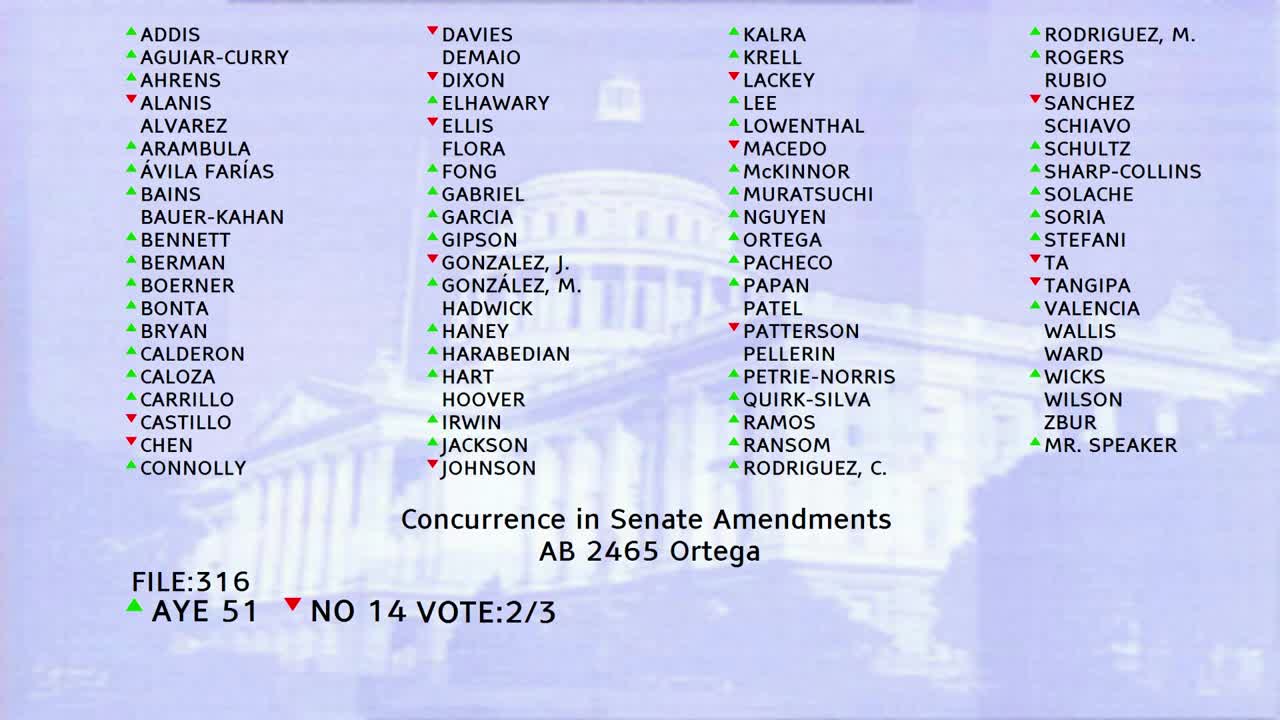 1MIN
Assembly Floor
 2MIN
Senate Floor
 9MIN
Senate Standing Committee on Education
 47SEC
Assembly Floor
Bill Author