AB 2790: California Teleconnect Fund Administrative Committee Fund program.
- Session Year: 2025-2026
- House: Assembly
- Latest Version Date: 2026-09-27
Current Status:
Passed
(2026-09-27: Chaptered by Secretary of State - Chapter 643, Statutes of 2026.)
Introduced
In Committee
Awaiting First Chamber Vote
Passed First Chamber
In Committee
Awaiting Second Chamber Vote
Passed Second Chamber
Enacted
Existing law vests the Public Utilities Commission with regulatory authority over public utilities, including telephone corporations. Existing law requires the commission to develop, implement, and administer a program to advance universal service by providing discounted rates to qualifying schools maintaining kindergarten or any of grades 1 to 12, inclusive, community colleges, libraries, hospitals, health clinics, and community organizations.
This bill would require that the discounted rates also be provided to qualifying schools, school districts, and county offices of education serving preschools, transitional kindergarten, kindergarten, or any of grades 1 to 12, inclusive, public libraries and public library systems, rather than libraries, and noninstructional facilities operated or contracted by qualifying schools, school districts, county offices of education, community colleges, community college districts, public libraries, and public library systems, including their associated data centers or administrative offices, as provided.
Existing law authorizes all customers eligible to receive discounts for telecommunications services under the federal Universal Service E-rate program to also apply for discounts on telecommunications services provided through the California Teleconnect Fund Administrative Committee Fund program. Existing law requires the commission to first apply an E-rate discount if the customer, in the determination of the commission, meets the requirements for an E-rate discount, as provided.
This bill would instead require the service provider to first apply an E-rate discount, as determined by the commission, if the customer, in the determination of the commission, meets the requirements for an E-rate discount, except as provided.
Under existing law, a violation of the Public Utilities Act or any order, decision, rule, direction, demand, or requirement of the commission is a crime.
Because the provisions of this bill would be part of the act and a violation of a commission action implementing the bills requirements would be a crime, the bill would impose a state-mandated local program.
The California Constitution requires the state to reimburse local agencies and school districts for certain costs mandated by the state. Statutory provisions establish procedures for making that reimbursement.
This bill would provide that no reimbursement is required by this act for a specified reason.
Existing law vests the Public Utilities Commission with regulatory authority over public utilities, including telephone corporations. Existing law requires the commission to develop, implement, and administer a program to advance universal service by providing discounted rates to qualifying schools maintaining kindergarten or any of grades 1 to 12, inclusive, community colleges, libraries, hospitals, health clinics, and community organizations.
This bill would require that the discounted rates also be provided to qualifying schools, school districts, and county offices of education serving preschools, transitional kindergarten, kindergarten, or any of grades 1 to 12, inclusive, public libraries and public library systems, rather than libraries, and noninstructional facilities operated or contracted by qualifying schools, school districts, county offices of education, community colleges, community college districts, public libraries, and public library systems, including their associated data centers or administrative offices, as provided.
Existing law authorizes all customers eligible to receive discounts for telecommunications services under the federal Universal Service E-rate program to also apply for discounts on telecommunications services provided through the California Teleconnect Fund Administrative Committee Fund. Fund program. Existing law requires the commission to first apply an E-rate discount if the customer, in the determination of the commission, meets the requirements for an E-rate discount, as provided.
This bill would instead require the service provider to first apply an E-rate discount discount, as determined by the commission, if the customer, in the determination of the commission, meets the requirements for an E-rate discount, except as provided.
Under existing law, a violation of the Public Utilities Act or any order, decision, rule, direction, demand, or requirement of the commission is a crime.
Because the provisions of this bill would be part of the act and a violation of a commission action implementing the bills requirements would be a crime, the bill would impose a state-mandated local program.
The California Constitution requires the state to reimburse local agencies and school districts for certain costs mandated by the state. Statutory provisions establish procedures for making that reimbursement.
This bill would provide that no reimbursement is required by this act for a specified reason.
Existing law vests the Public Utilities Commission with regulatory authority over public utilities, including telephone corporations. Existing law requires the commission to develop, implement, and administer a program to advance universal service by providing discounted rates to qualifying schools maintaining kindergarten or any of grades 1 to 12, inclusive, community colleges, libraries, hospitals, health clinics, and community organizations.
This bill would require that the discounted rates also be provided to qualifying schools, school districts, and county offices of education serving preschools, transitional kindergarten, kindergarten, or any of grades 1 to 12, inclusive, public libraries and public library systems, rather than libraries, and noninstructional facilities operated or contracted by qualifying schools, school districts, county offices of education, community colleges, public libraries, and public library systems, including their associated data centers or administrative offices, as provided.
Existing law authorizes all customers eligible to receive discounts for telecommunications services under the federal Universal Service E-rate program to also apply for discounts on telecommunications services provided through the California Teleconnect Fund Administrative Committee Fund. Existing law requires the commission to first apply an E-rate discount if the customer, in the determination of the commission, meets the requirements for an E-rate discount, as provided.
This bill would instead require the service provider to first apply an E-rate discount if the customer, in the determination of the commission, meets the requirements for an E-rate discount, except as provided.
Under existing law, a violation of the Public Utilities Act or any order, decision, rule, direction, demand, or requirement of the commission is a crime.
Because the provisions of this bill would be part of the act and a violation of a commission action implementing the bills requirements would be a crime, the bill would impose a state-mandated local program.
The California Constitution requires the state to reimburse local agencies and school districts for certain costs mandated by the state. Statutory provisions establish procedures for making that reimbursement.
This bill would provide that no reimbursement is required by this act for a specified reason.
(a)The commission shall develop, implement, and administer a program to advance universal service by providing discounted rates to qualifying schools, school districts, and county offices of education serving preschools, transitional kindergarten, kindergarten, or any of grades 1 to 12, inclusive, community colleges, community college districts, public libraries, public library systems, hospitals, health clinics, and community organizations, consistent with Chapter 278 of the Statutes of 1994. All noninstructional facilities operated or contracted by qualifying schools, school districts, county offices of education, community colleges, community college districts, public libraries, and public library systems, including, but not limited to, their associated data centers or administrative offices, shall also be eligible for discounted rates pursuant to the program.
(b)There is hereby created the California Teleconnect Fund Administrative Committee, which is an advisory board to advise the commission regarding the development, implementation, and administration of a program to advance universal service by providing discounted rates to qualifying schools, school districts, and county offices of education serving preschool, transitional kindergarten, kindergarten, or any of grades 1 to 12, inclusive, community colleges, community college districts, public libraries, public library systems, hospitals, health clinics, community organizations, and noninstructional facilities operated or contracted by qualifying schools, school districts, county offices of education, community colleges, community college districts, public libraries, and public library systems, consistent with Chapter 278 of the Statutes of 1994, and to carry out the program pursuant to the commissions direction, control, and approval.
(c)All revenues collected by telephone corporations in rates authorized by the commission to fund the program specified in subdivision (a) shall be submitted to the commission pursuant to a schedule established by the commission. The commission shall transfer the moneys received to the Controller for deposit into the California Teleconnect Fund Administrative Committee Fund. All interest earned by moneys in the fund shall be deposited into the fund.
(d)Moneys appropriated from the California Teleconnect Fund Administrative Committee Fund to the commission shall be used exclusively by the commission for the program specified in subdivision (a), including all costs of the board and the commission associated with the administration and oversight of the program and the fund.
SEC. 2.Section 884.5 of the Public Utilities Code is amended to read:884.5.(a)This section shall apply to all customers eligible to receive discounts for telecommunications services under the federal Universal Service E-rate program administered by the Schools and Libraries Division of the Universal Service Administrative Company that also apply for discounts on telecommunications services provided through the California Teleconnect Fund Administrative Committee Fund program pursuant to subdivision (a) of Section 280.
(b)A teleconnect discount shall be applied after applying an E-rate discount. The service provider shall first apply an E-rate discount, as determined by the commission, regardless of whether the customer has applied for an E-rate discount or has been approved, if the customer, in the determination of the commission, meets the eligibility requirements for an E-rate discount. This subdivision does not apply to a customer who is ineligible to receive an E-rate discount due to a programmatic restriction or eligibility limitation imposed under federal law.
(c)Notwithstanding subdivision (b), the teleconnect discount shall be applied without regard to an E-rate discount for a school district that meets the conditions specified for compensation pursuant to Article 4 (commencing with Section 42280) of Chapter 7 of Part 24 of Division 3 of Title 2 of the Education Code, unless that school district has applied for, and been approved to receive, the E-rate discount.
(d)In establishing a discount under the California Teleconnect Fund Administrative Committee Fund program, the commission shall give priority to bridging the digital divide by encouraging expanded access to state-of-the-art technologies for rural, inner-city, low-income, and disabled Californians.
(e)As used in this section:
(1)E-rate discount means an actual discount under the E-rate program, or a representative discount figure as determined by the commission.
(2)E-rate program means the federal Universal Service E-rate program administered by the Schools and Libraries Division of the Universal Service Administrative Company.
(3)Teleconnect discount means a discount on telecommunications services provided through the California Teleconnect Fund Administrative Committee Fund program set forth in subdivision (a) of Section 280.
SEC. 3.No reimbursement is required by this act pursuant to Section 6 of Article XIIIB of the California Constitution because the only costs that may be incurred by a local agency or school district will be incurred because this act creates a new crime or infraction, eliminates a crime or infraction, or changes the penalty for a crime or infraction, within the meaning of Section 17556 of the Government Code, or changes the definition of a crime within the meaning of Section 6 of Article XIIIB of the California Constitution.
(a)The commission shall develop, implement, and administer a program to advance universal service by providing discounted rates to qualifying schools, school districts, and county offices of education serving preschools, transitional kindergarten, kindergarten, or any of grades 1 to 12, inclusive, community colleges, public libraries, public library systems, hospitals, health clinics, and community organizations, consistent with Chapter 278 of the Statutes of 1994. All noninstructional facilities operated or contracted by qualifying schools, school districts, county offices of education, community colleges, public libraries, and public library systems, including, but not limited to, their associated data centers or administrative offices, shall also be eligible for discounted rates pursuant to the program.
(b)There is hereby created the California Teleconnect Fund Administrative Committee, which is an advisory board to advise the commission regarding the development, implementation, and administration of a program to advance universal service by providing discounted rates to qualifying schools, school districts, and county offices of education serving preschool, transitional kindergarten, kindergarten, or any of grades 1 to 12, inclusive, community colleges, public libraries, public library systems, hospitals, health clinics, and community organizations, and noninstructional facilities operated or contracted by qualifying schools, school districts, county offices of education, community colleges, public libraries, and public library systems, consistent with Chapter 278 of the Statutes of 1994, and to carry out the program pursuant to the commissions direction, control, and approval.
(c)All revenues collected by telephone corporations in rates authorized by the commission to fund the program specified in subdivision (a) shall be submitted to the commission pursuant to a schedule established by the commission. The commission shall transfer the moneys received to the Controller for deposit into the California Teleconnect Fund Administrative Committee Fund. All interest earned by moneys in the fund shall be deposited into the fund.
(d)Moneys appropriated from the California Teleconnect Fund Administrative Committee Fund to the commission shall be used exclusively by the commission for the program specified in subdivision (a), including all costs of the board and the commission associated with the administration and oversight of the program and the fund.
SEC. 2.Section 884.5 of the Public Utilities Code is amended to read:884.5.(a)This section shall apply to all customers eligible to receive discounts for telecommunications services under the federal Universal Service E-rate program administered by the Schools and Libraries Division of the Universal Service Administrative Company that also apply for discounts on telecommunications services provided through the California Teleconnect Fund Administrative Committee Fund program pursuant to subdivision (a) of Section 280.
(b)A teleconnect discount shall be applied after applying an E-rate discount. The service provider shall first apply an E-rate discount, regardless of whether the customer has applied for an E-rate discount or has been approved, if the customer, in the determination of the commission, meets the eligibility requirements for an E-rate discount. This subdivision does not apply to a customer who is ineligible to receive an E-rate discount due to a programmatic restriction or eligibility limitation imposed under federal law.
(c)Notwithstanding subdivision (b), the teleconnect discount shall be applied without regard to an E-rate discount for a school district that meets the conditions specified for compensation pursuant to Article 4 (commencing with Section 42280) of Chapter 7 of Part 24 of Division 3 of Title 2 of the Education Code, unless that school district has applied for, and been approved to receive, the E-rate discount.
(d)In establishing a discount under the California Teleconnect Fund Administrative Committee Fund program, the commission shall give priority to bridging the digital divide by encouraging expanded access to state-of-the-art technologies for rural, inner-city, low-income, and disabled Californians.
(e)As used in this section:
(1)E-rate discount means an actual discount under the E-rate program, or a representative discount figure as determined by the commission.
(2)E-rate program means the federal Universal Service E-rate program administered by the Schools and Libraries Division of the Universal Service Administrative Company.
(3)Teleconnect discount means a discount on telecommunications services provided through the California Teleconnect Fund Administrative Committee Fund program set forth in subdivision (a) of Section 280.
SEC. 3.The amendments of Sections 280 and 884.5 of the Public Utilities Code made by this act do not constitute changes in, but are declaratory of, existing law.SEC. 4.SEC. 3.No reimbursement is required by this act pursuant to Section 6 of Article XIIIB of the California Constitution because the only costs that may be incurred by a local agency or school district will be incurred because this act creates a new crime or infraction, eliminates a crime or infraction, or changes the penalty for a crime or infraction, within the meaning of Section 17556 of the Government Code, or changes the definition of a crime within the meaning of Section 6 of Article XIIIB of the California Constitution.
(a)The commission shall develop, implement, and administer a program to advance universal service by providing discounted rates to qualifying schools maintaining kindergarten schools, school districts, and county offices of education serving preschools, transitional kindergarten, kindergarten, or any of grades 1 to 12, inclusive, community colleges, public libraries, public library systems, hospitals, health clinics, and community organizations, consistent with Chapter 278 of the Statutes of 1994. All noninstructional facilities operated or contracted by qualifying schools, school districts, county offices of education, community colleges, public libraries, and public library systems, including, but not limited to, their associated data centers or administrative offices, shall also be eligible for discounted rates pursuant to the program.
(b)There is hereby created the California Teleconnect Fund Administrative Committee, which is an advisory board to advise the commission regarding the development, implementation, and administration of a program to advance universal service by providing discounted rates to qualifying schools maintaining kindergarten or schools, school districts, and county offices of education serving preschool, transitional kindergarten, kindergarten, or any of grades 1 to 12, inclusive, community colleges, public libraries, public library systems, hospitals, health clinics, and community organizations, consistent with Chapter 278 of the Statutes of 1994, and to carry out the program pursuant to the commissions direction, control, and approval.
(c)All revenues collected by telephone corporations in rates authorized by the commission to fund the program specified in subdivision (a) shall be submitted to the commission pursuant to a schedule established by the commission. The commission shall transfer the moneys received to the Controller for deposit in into the California Teleconnect Fund Administrative Committee Fund. All interest earned by moneys in the fund shall be deposited in into the fund.
(d)Except as provided in subdivisions (e) and (g), moneys Moneys appropriated from the California Teleconnect Fund Administrative Committee Fund to the commission shall be utilized used exclusively by the commission for the program specified in subdivision (a), including all costs of the board and the commission associated with the administration and oversight of the program and the fund.
(e)Moneys loaned from the California Teleconnect Fund Administrative Committee Fund in the Budget Act of 2003 are subject to Section 16320 of the Government Code. If the commission determines a need for moneys in the California Teleconnect Fund Administrative Committee Fund, the commission shall notify the Director of Finance of the need, as specified in Section 16320 of the Government Code. The commission may not increase the rates authorized by the commission to fund the program specified in subdivision (b) while moneys loaned from the California Teleconnect Fund Administrative Committee Fund in the Budget Act of 2003 are outstanding unless both of the following conditions are satisfied:(1)The Director of Finance, after making a determination pursuant to subdivision (b) of Section 16320 of the Government Code, does not order repayment of all or a portion of any loan from the California Teleconnect Fund Administrative Committee Fund within 30 days of notification by the commission of the need for the moneys.(2)The commission notifies the Director of Finance and the Chairperson of the Joint Legislative Budget Committee in writing that it intends to increase the rates authorized by the commission to fund the program specified in subdivision (a). The notification required pursuant to this paragraph shall be made 30 days in advance of the intended rate increase.(f)Subdivision (e) shall become inoperative upon full repayment or discharge of all moneys loaned from the California Teleconnect Fund Administrative Committee Fund in the Budget Act of 2003.(g)(1)Consistent with Decision 11-09-016 (September 8, 2011) Decision Granting Authority to Provide Emergency Access to 211 Services in Counties and Localities Without Existing 211 Centers and to Appoint a 211 Lead Entity, if it determines that doing so is an appropriate use of funds collected from ratepayers, the commission may expend up to one million five hundred thousand dollars ($1,500,000) from the California Teleconnect Fund Administrative Committee Fund for one-time costs to help close 2-1-1 service gaps in counties lacking access to disaster preparedness, response, and recovery information and referral services, where technically feasible, through available 2-1-1 service. As the lead agency appointed by the commission in Decision 11-09-016, 2-1-1 California may apply to the commission for use of the funds in the counties that lack 2-1-1 service. If the commission determines that doing so is an appropriate use of funds collected from ratepayers, these costs may include local implementation of a coordinated database that is owned by a city or county to provide referrals to help with nonemergency aspects of disaster planning, recovery, and response.(2)This subdivision shall become inoperative on January 1, 2023.SEC. 2.Section 884.5 of the Public Utilities Code is amended to read:884.5.(a)This section shall apply to all customers eligible to receive discounts for telecommunications services under the federal Universal Service E-rate program administered by the Schools and Libraries Division of the Universal Service Administrative Company that also apply for discounts on telecommunications services provided through the California Teleconnect Fund Administrative Committee Fund program pursuant to subdivision (a) of Section 280.
(b)A teleconnect discount shall be applied after applying an E-rate discount. The commission service provider shall first apply an E-rate discount, regardless of whether the customer has applied for an E-rate discount or has been approved, if the customer, in the determination of the commission, meets the eligibility requirements for an E-rate discount. This subdivision does not apply to a customer who is ineligible to receive an E-rate discount due to a programmatic restriction or eligibility limitation imposed under federal law.
(c)Notwithstanding subdivision (b), the teleconnect discount shall be applied without regard to an E-rate discount for a school district that meets the conditions specified for compensation pursuant to Article 4 (commencing with Section 42280) of Chapter 7 of Part 24 of Division 3 of Title 2 of the Education Code, unless that school district has applied for, and been approved to receive, the E-rate discount.
(d)In establishing a discount under the California Teleconnect Fund Administrative Committee Fund program, the commission shall give priority to bridging the digital divide by encouraging expanded access to state-of-the-art technologies for rural, inner-city, low-income, and disabled Californians.
(e)As used in this section:
(1)E-rate discount means an actual discount under the E-rate program, or a representative discount figure as determined by the commission.
(2)E-rate program means the federal Universal Service E-rate program administered by the Schools and Libraries Division of the Universal Service Administrative Company.
(3)Teleconnect discount means a discount on telecommunications services provided through the California Teleconnect Fund Administrative Committee Fund program set forth in subdivision (a) of Section 280.
SEC. 3.The amendments of Sections 280 and 884.5 of the Public Utilities Code made by this act do not constitute changes in, but are declaratory of, existing law.
SEC. 4.No reimbursement is required by this act pursuant to Section 6 of Article XIIIB of the California Constitution because the only costs that may be incurred by a local agency or school district will be incurred because this act creates a new crime or infraction, eliminates a crime or infraction, or changes the penalty for a crime or infraction, within the meaning of Section 17556 of the Government Code, or changes the definition of a crime within the meaning of Section 6 of Article XIIIB of the California Constitution.
|
Date
|
Status
|
|---|---|
| Sep 27, 2026 | Chaptered by Secretary of State - Chapter 643, Statutes of 2026. |
| Sep 27, 2026 | Approved by the Governor. |
| Sep 3, 2026 | Enrolled and presented to the Governor at 4 p.m. |
| Aug 26, 2026 | Senate amendments concurred in. To Engrossing and Enrolling. (Ayes 79. Noes 0. Page 6593.). |
| Aug 26, 2026 | Senate amendments concurred in. To Engrossing and Enrolling. (Ayes 79. Noes 0.). |
| Aug 25, 2026 | In Assembly. Concurrence in Senate amendments pending. |
| Aug 25, 2026 | Read third time. Passed. Ordered to the Assembly. (Ayes 40. Noes 0. Page 5785.). |
| Aug 25, 2026 | Read third time. Passed. Ordered to the Assembly. (Ayes 38. Noes 0.). |
| Aug 24, 2026 | Read second time. Ordered to third reading. |
| Aug 21, 2026 | Read third time and amended. Ordered to second reading. |
| Aug 19, 2026 | Ordered to third reading. |
| Aug 19, 2026 | From special consent calendar. |
| Aug 18, 2026 | Ordered to special consent calendar. |
| Aug 13, 2026 | Read second time. Ordered to third reading. |
| Aug 13, 2026 | From committee: Do pass. (Ayes 7. Noes 0.) (August 13). |
| Aug 3, 2026 | In committee: Referred to APPR. suspense file. |
| Jun 30, 2026 | Read second time and amended. Re-referred to Com. on APPR. |
| Jun 29, 2026 | From committee: Amend, and do pass as amended and re-refer to Com. on APPR. with recommendation: To Consent Calendar. (Ayes 17. Noes 0.) (June 24). |
| Jun 3, 2026 | Referred to Com. on E., U & C. |
| May 27, 2026 | In Senate. Read first time. To Com. on RLS. for assignment. |
| May 26, 2026 | Read third time. Passed. Ordered to the Senate. (Ayes 78. Noes 0. Page 5353.) |
| May 26, 2026 | Read third time. Passed. Ordered to the Senate. (Ayes 78. Noes 0.) |
| May 26, 2026 | Read third time. Passed. Ordered to the Senate. |
| May 18, 2026 | Read second time. Ordered to third reading. |
| May 14, 2026 | Joint Rule 62(a), file notice suspended. (Page 5030.) |
| May 14, 2026 | From committee: Do pass. (Ayes 15. Noes 0.) (May 14). |
| May 14, 2026 | Joint Rule 62(a), file notice suspended. |
| May 13, 2026 | In committee: Set, first hearing. Referred to APPR. suspense file. |
| Apr 22, 2026 | From committee: Do pass and re-refer to Com. on APPR. (Ayes 9. Noes 0.) (April 21). Re-referred to Com. on APPR. |
| Mar 23, 2026 | Referred to Com. on C. & C. |
| Mar 17, 2026 | From printer. May be heard in committee April 16. |
| Mar 16, 2026 | Read first time. To print. |
|
Date
|
Description
|
Location
|
Votes
|
|
|---|---|---|---|---|
| Aug 26, 2026 | AB 2790 Communications and Conve Concurrence in Senate Amendments By BOERNER | Assembly Floor |
Passed |
|
| Aug 25, 2026 | Assembly 3rd Reading AB2790 C. & C. (Boerner) By Rubio | Senate Floor |
Passed |
|
| Aug 13, 2026 | Do pass | Senate Standing Committee on Appropriations |
Passed |
|
| Aug 3, 2026 | Placed on suspense file | Senate Standing Committee on Appropriations |
Passed |
|
| Jun 24, 2026 | Do pass as amended, but first amend, and re-refer to the Committee on [Appropriations] with the recommendation: To Consent Calendar | Senate Standing Committee on Energy, Utilities and Communications |
Passed |
|
| May 26, 2026 | AB 2790 Communications and Conve Assembly Third Reading By BOERNER | Assembly Floor |
Passed |
|
| May 14, 2026 | Do pass. | Assembly Standing Committee on Appropriations |
Passed |
|
| Apr 21, 2026 | Do pass and be re-referred to the Committee on [Appropriations] | Assembly Standing Committee on Communications and Conveyance |
Passed |
This list shows positions taken on this bill by organizations on the date displayed, which is linked to the original source.
Positions by individuals are not included.
|
Organization
|
Position
|
Date
|
|---|---|---|
| California Community Colleges Chancellor’s Office | ** Support | |
| California Department of Education | ** Support | |
| California Library Association | ** Support | |
| California Special Districts Association | ** Support | |
| Comcast | ** Support | |
| Corporation For Education Network Initiatives In California | ** Support | |
| Department of Education | ** Support | |
| Los Angeles County Office Of Education | ** Support | |
| Napa County Office Of Education | ** Support | |
| State Superintendent of Public Instruction | ** Support |
CONCURRENCE IN SENATE AMENDMENTS
CSA1 Bill Id:AB 2790
Author:(Committee on Communications and Conveyance)
As Amended Ver:August 21, 2026
Majority vote
SUMMARY
This bill would implement various changes to the eligibility and administrative procedures for the California Teleconnect Fund (CTF) program administered by the California Public Utilities Commission (CPUC). Additionally, this bill strikes inoperative statutes relating to the CTF program.
Senate Amendments
- Clarify the entities that are eligible for a CTF discount.
- Add "community college districts" to the list of eligible entities for the CTF program.
- Authorize the CPUC to determine how a service provider shall first apply a federal E-Rate discount.
COMMENTS
- CTF Program Background. The Legislature established the CTF program to advance universal service goals by providing discounted rates on advanced telecommunications services to qualifying entities. Qualifying entities are expressly listed in existing law, which includes schools for kindergarten or any grades 1 to 12, inclusive, community colleges, libraries, hospitals, health clinics, and community organizations. The CTF program offers discounted rates of 50% on recurring monthly charges for advanced communication services to qualifying entities. The CTF program works in tandem with a similar federal program called E-Rate. CTF participants may combine the CTF discount with the federal E-Rate program to reduce their costs even further. In addition to educational entities, existing law also authorizes community based organizations (CBOs) to be eligible for a CTF program discount.
The CTF program approved budget for Fiscal Year (FY) 2025-2026 was $108 million. This budget has been relatively stable since FY 2019-2020, although the program is down from a high of nearly $149 million in 2015-2016. The program is funded through an end-user surcharge assed on telephone access lines assed by the CUC. The current surcharge rate as of May 1, 2025, is $0.90-cents per line, of which only $0.06-cents per line is for CTF.
- This bill would impact an ongoing CPUC Proceeding. In August 2025 the CPUC initiated a new rulemaking (Rulemaking R. 25-08-005) to consider updates to the California Teleconnect Fund program rules. In the rulemaking the CPUC is intending to address modifying the qualifying participant categories and related rules, including modifying the CBO revenue cap, addressing how the program considers school districts and county education offices, Healthcare/Health Service Community Based Organization (HCBOs), government hospitals and healthcare districts, tribes, school annexes, libraries, and backbone services. While the CPUC has proposed to make school districts and county offices of education eligible, some of the stakeholders in that proceeding have expressed concern that the direction of the proceeding so far may impact essential backbone services in noninstructional facilities that may be housed at those locations.
Given the concern from educational stakeholders, which was reported to the committee during an oversight hearing in late February, the committee initiated this bill to complement the CPUC′s ongoing rulemaking and ensure the statute is implemented appropriately in that rulemaking.
- This bill modifies the list of entities eligible for the CTF. Existing law specifically lists the eligible entities for the program: schools maintaining kindergarten or any of grades 1 to 12, inclusive, community colleges, libraries, hospitals, health clinics, and community organizations. Based on that statute, the CPUC has initiated a rulemaking to add school districts and county offices of education, meaning the agency believes those entities are already covered by the existing law.
Similarly, this bill would revise the statute by explicitly adding transitional kindergarten, school districts, community college districts and county offices of education, and also specifying that libraries must be public libraries. Additionally, this bill specifies that non-instructional facilities operated or contracted by an eligible entity shall also be eligible, such including data centers. While on one hand this list does add explicit categories, the new categories are aligned with existing eligible and the CPUC′s interpretation of the statute in the existing proceeding. One difference is that this bill also adds community college districts, whereas the CPUC's proceeding does not. However, this change is still aligned with the general direction of the proceeding, which is to make administration of the grant easier by authorizing districts to administer the grant. Accordingly, this bill modifies existing law to explicitly state that those entities are eligible, including their non-instructional facilities where data centers may be located. Notably, the E-Rate program already has specific rules for non-instructional facilities, because these facilities are often the backbone of a school network.
- This bill repeals inoperative statutes. Existing law generally requires the CTF program funds to be used for the administration and support of the CTF program, except for two exceptions. First, existing law authorized loans from the CTF program to address the 2001–02, 2002–03, and 2003–04 fiscal year budgetary shortfalls. That statute has since become inoperative. Additionally, existing law authorized the CPUC to expend up to $1.5 million dollars from the CTF program fund to support 2-1-1 services. That statute has also since become inoperative. This bill strikes those provisions of existing law as maintenance of the codes.
According to the Author
This is a committee bill and accordingly has no author's statement.
Arguments in Support
According to the Department of Education, strengthening and clarifying eligibility within the CTF program directly advances educational equity by reducing the cost burden of broadband services and ensuring that all students – especially those in underserved communities – have access to the digital tool necessary for learning and success.
Arguments in Opposition
None on file.
FISCAL COMMENTS
According to the Assembly Appropriations Committee, by expanding the CTF program eligibility, this bill creates new costs for the CPUC. The CPUC estimates these costs to total approximately $2.1 million: $1.1 million in ongoing costs for six new positions and $1 million in one-time costs.
VOTES:
ASM COMMUNICATIONS AND CONVEYANCE: 9-0-0
YES: Boerner, Hoover, Bonta, Caloza, Castillo, Krell, Lowenthal, Rogers, Blanca Rubio
ASM APPROPRIATIONS: 15-0-0
YES: Wicks, Hoover, Aguiar-Curry, Calderon, Caloza, Dixon, Fong, Mark González, Krell, Pacheco, Pellerin, Sharp-Collins, Solache, Ta, Tangipa
ASSEMBLY FLOOR: 78-0-2
YES: Addis, Aguiar-Curry, Ahrens, Alanis, Alvarez, Arambula, Ávila Farías, Bains, Bauer-Kahan, Bennett, Berman, Boerner, Bonta, Bryan, Calderon, Caloza, Carrillo, Castillo, Chen, Connolly, Davies, DeMaio, Dixon, Elhawary, Ellis, Flora, Fong, Gabriel, Gallagher, Garcia, Gipson, Jeff Gonzalez, Mark González, Hadwick, Haney, Harabedian, Hart, Hoover, Irwin, Jackson, Johnson, Kalra, Krell, Lackey, Lee, Lowenthal, Macedo, McKinnor, Nguyen, Ortega, Pacheco, Papan, Patel, Patterson, Pellerin, Petrie-Norris, Quirk-Silva, Ramos, Ransom, Michelle Rodriguez, Rogers, Blanca Rubio, Sanchez, Schiavo, Schultz, Sharp-Collins, Solache, Soria, Stefani, Ta, Tangipa, Valencia, Wallis, Ward, Wicks, Wilson, Zbur, Rivas
ABS, ABST OR NV: Muratsuchi, Celeste Rodriguez
UPDATED
VERSION: August 21, 2026
CONSULTANT: Emilio Perez / C. & C. / (916) 319-2637 FN: 0004184
SENATE RULES COMMITTEE Office of Senate Floor Analyses (916) 651-4171 | AB 2790 |
THIRD READING
Bill No: AB 2790
Author: Committee on Communications and Conveyance
Amended: 8/21/26 in Senate
Vote: 21
SENATE ENERGY, U. & C. COMMITTEE: 17-0, 6/24/26
AYES: Allen, Ochoa Bogh, Archuleta, Arreguín, Becker, Caballero, Dahle, Gonzalez, Grove, Hurtado, McNerney, Reyes, Richardson, Rubio, Stern, Strickland, Wahab
SENATE APPROPRIATIONS COMMITTEE: 7-0, 8/13/26
AYES: Cervantes, Seyarto, Cabaldon, Dahle, Grayson, Richardson, Wahab
ASSEMBLY FLOOR: 78-0, 5/26/26 - See last page for vote
SUBJECT: California Teleconnect Fund Administrative Committee Fund
SOURCE: Author
DIGEST:
This bill expands the scope of educational facilities eligible for discounted internet services through the California Teleconnect Fund (CTF) to include school districts, community college districts, county offices of education serving preschools, transitional kindergarten, public library systems, and noninstructional facilities operated or contracted by qualifying schools and libraries, including data centers and administrative offices for eligible educational and library facilities.
Senate Floor Amendments of 8/21/26 clarify that community college districts are eligible for the CTF program and clarify the California Public Utilities Commission’s (CPUC’s) authority to administer the CTF program in conjunction with the federal E-rate communications subsidies.
ANALYSIS:
Existing law:
- Requires the CPUC to establish the CTF, which is funded through a surcharge on telephone rates. Under existing law, the CTF provides discounted internet service to kindergarten schools, K-12 schools, community colleges, libraries, hospitals, health clinics, and certain community organizations. (Public Utilities Code §280)
- Authorizes the CPUC to use up to $1.5 million from the CTF to fund service gaps in the 211 system, if the CPUC determines that doing so is an appropriate use of funds collected from ratepayers. Existing law sunsets this funding authorization on January 1, 2023. (Public Utilities Code §280)
This bill:
- Expands the list of entities eligible for discounted internet rates through CTF to include the following entities:
- School districts.
- County offices of education serving preschools.
- Community college districts.
- Transitional kindergartens.
- Public library systems.
- Noninstructional facilities operated or contracted by qualifying educational and library institutions, including data centers and administrative offices for those institutions.
- Deletes outdated code pertaining to prior budget allocations and one-time 2-1-1 funding from the CTF.
- Makes technical and conforming changes to use of the CTF in conjunction with federal subsidies.
Background
The CTF is one of California’s Universal Telecommunications Service Programs. The CPUC administers six Universal Service programs to provide funding for telecommunications services that address specific gaps to achieving the state’s goals of ensuring universal access to telecommunications services. The CTF program provides K-12 schools, community colleges, libraries, and certain non-profit and public health and community institutions with a 50% discount on monthly recurring internet services. While some schools and libraries are eligible for discounted telecommunications services through the E-rate program administered by the Federal Communications Commission (FCC), the E-rate program does not provide subsidies to a variety of facilities that are eligible for funding under the CTF program. For example, community colleges are not eligible for the FCC’s E-rate program; however, they are eligible for subsidies from the CTF. Like all Universal Service programs, the CTF is funded by a surcharge on telecommunications lines in the state. The CTF’s budget in the 2025-26 fiscal year was approximately $108.6 million.
Bill expands the types of facilities eligible for CTF subsidies. Eligibility for CTF funds has evolved over time to reflect changing needs of educational, public health, and non-profit institutions. When the CTF was created in 1996, facilities had limited access to high-speed internet, and many of the eligible entities retained hardcopy records. Over time, educational, health, and community non-profit institutions have increasingly shifted to using broadband-based communications and expanded the use of digital records and services. The growth of cloud-based applications has increased the digital storage demands for these institutions. Large academic institutions, library consortia, and research institutions have increasingly relied on custom networking and data center solutions to support electronic services and computing. This bill expands the list of entities eligible for CTF funding to include several types of educational and library facilities that are not expressly eligible for CTF subsidies under existing law, including data centers for facilities that would otherwise be eligible for CTF subsidies.
Related/Prior Legislation
SB 1212 (Hueso, Chapter 841, Statutes of 2016) authorized the CPUC to spend up to $1.5 million from the CTF to help close service gaps in counties lacking access to 2-1-1 referral service, including implementation of a coordinated publicly owned database to support local referrals for non-emergency assistance services. The bill sunset this funding authorization on January 1, 2023.
FISCAL EFFECT: Appropriation: No Fiscal Com.: Yes Local: Yes
According to the Senate Appropriations Committee, the California Public Utilities Commission (CPUC) estimates ongoing costs of $2.1 million in the first year and $1.1 million annually thereafter (CTF) due to the expanded CTF program eligibility.
SUPPORT: (Verified 8/21/26)
California Community Colleges Chancellor’s Office
California Department of Education
California Library Association
California Special Districts Association
Comcast
Corporation for Education Network Initiatives in California
Los Angeles County Office of Education
Napa County Office of Education
OPPOSITION: (Verified 8/21/26)
None received
ARGUMENTS IN SUPPORT: In support, the State Superintendent of Public Instruction states:
Strengthening and clarifying eligibility within the CTF program directly advances educational equity by reducing the cost burden of broadband services and ensuring that all students, especially those in underserved communities have access to the digital tools necessary for learning and success. These improvements support California’s broader goal of closing opportunity gaps and ensuring consistent access to high-quality educational services.
ASSEMBLY FLOOR: 78-0, 5/26/26
AYES: Addis, Aguiar-Curry, Ahrens, Alanis, Alvarez, Arambula, Ávila Farías, Bains, Bauer-Kahan, Bennett, Berman, Boerner, Bonta, Bryan, Calderon, Caloza, Carrillo, Castillo, Chen, Connolly, Davies, DeMaio, Dixon, Elhawary, Ellis, Flora, Fong, Gabriel, Gallagher, Garcia, Gipson, Jeff Gonzalez, Mark González, Hadwick, Haney, Harabedian, Hart, Hoover, Irwin, Jackson, Johnson, Kalra, Krell, Lackey, Lee, Lowenthal, Macedo, McKinnor, Nguyen, Ortega, Pacheco, Papan, Patel, Patterson, Pellerin, Petrie-Norris, Quirk-Silva, Ramos, Ransom, Michelle Rodriguez, Rogers, Blanca Rubio, Sanchez, Schiavo, Schultz, Sharp-Collins, Solache, Soria, Stefani, Ta, Tangipa, Valencia, Wallis, Ward, Wicks, Wilson, Zbur, Rivas
NO VOTE RECORDED: Muratsuchi, Celeste Rodriguez
Prepared by: Sarah Smith / E., U. & C. / (916) 651-4107
8/24/26 11:39:44
**** END ****
SENATE RULES COMMITTEE Office of Senate Floor Analyses (916) 651-4171 | AB 2790 |
THIRD READING
Bill No: AB 2790
Author: Committee on Communications and Conveyance
Amended: 6/30/26 in Senate
Vote: 21
SENATE ENERGY, U. & C. COMMITTEE: 17-0, 6/24/26
AYES: Allen, Ochoa Bogh, Archuleta, Arreguín, Becker, Caballero, Dahle, Gonzalez, Grove, Hurtado, McNerney, Reyes, Richardson, Rubio, Stern, Strickland, Wahab
SENATE APPROPRIATIONS COMMITTEE: 7-0, 8/13/26
AYES: Cervantes, Seyarto, Cabaldon, Dahle, Grayson, Richardson, Wahab
ASSEMBLY FLOOR: 78-0, 5/26/26 - See last page for vote
SUBJECT: California Teleconnect Fund Administrative Committee Fund
SOURCE: Author
DIGEST:
This bill expands the scope of educational facilities eligible for discounted internet services through the California Teleconnect Fund (CTF) to include school districts, and county offices of education serving preschools, transitional kindergarten, public library systems, and noninstructional facilities operated or contracted by qualifying schools and libraries, including data centers and administrative offices for eligible educational and library facilities.
ANALYSIS:
Existing law:
- Requires the California Public Utilities Commission (CPUC) to establish the CTF, which is funded through a surcharge on telephone rates. Under existing law, the CTF provides discounted internet service to kindergarten schools, K-12 schools, community colleges, libraries, hospitals, health clinics, and certain community organizations. (Public Utilities Code §280)
- Authorizes the CPUC to use up to $1.5 million from the CTF to fund service gaps in the 211 system, if the CPUC determines that doing so is an appropriate use of funds collected from ratepayers. Existing law sunsets this funding authorization on January 1, 2023. (Public Utilities Code §280)
This bill:
- Expands the list of entities eligible for discounted internet rates through CTF to include the following entities:
- School districts.
- County offices of education serving preschools.
- Transitional kindergartens.
- Public library systems.
- Noninstructional facilities operated or contracted by qualifying educational and library institutions, including data centers and administrative offices for those institutions.
- Deletes outdated code pertaining to prior budget allocations and one-time 2-1-1 funding from the CTF.
- Makes technical and conforming changes to use of the CTF in conjunction with federal subsidies.
Background
The CTF is one of California’s Universal Telecommunications Service Programs. The CPUC administers six Universal Service programs to provide funding for telecommunications services that address specific gaps to achieving the state’s goals of ensuring universal access to telecommunications services. The CTF program provides K-12 schools, community colleges, libraries, and certain non-profit and public health and community institutions with a 50% discount on monthly recurring internet services. While some schools and libraries are eligible for discounted telecommunications services through the E-rate program administered by the Federal Communications Commission (FCC), the E-rate program does not provide subsidies to a variety of facilities that are eligible for funding under the CTF program. For example, community colleges are not eligible for the FCC’s E-rate program; however, they are eligible for subsidies from the CTF. Like all Universal Service programs, the CTF is funded by a surcharge on telecommunications lines in the state. The CTF’s budget in the 2025-26 fiscal year was approximately $108.6 million.
Bill expands the types of facilities eligible for CTF subsidies. Eligibility for CTF funds have evolved over time to reflect changing needs of educational, public health, and non-profit institutions. When the CTF was created in 1996, facilities had limited access to high-speed internet, and many of the eligible entities retained hardcopy records. Over time, educational, health, and community non-profit institutions have increasingly shifted to using broadband-based communications and expanded the use of digital records and services. The growth of cloud-based applications has increased the digital storage demands for these institutions. Large academic institutions, library consortia, and research institutions have increasingly relied on custom networking and data center solutions to support electronic services and computing. This bill would expand the list of entities eligible for CTF funding to include several types of educational and library facilities that are not expressly eligible for CTF subsidies under existing law, including data centers for facilities that would otherwise be eligible for CTF subsidies.
Related/Prior Legislation
SB 1212 (Hueso, Chapter 841, Statutes of 2016) authorized the CPUC to spend up to $1.5 million from the CTF to help close service gaps in counties lacking access to 2-1-1 referral service, including implementation of a coordinated publicly owned database to support local referrals for non-emergency assistance services. The bill sunset this funding authorization on January 1, 2023.
FISCAL EFFECT: Appropriation: No Fiscal Com.: Yes Local: Yes
According to the Senate Appropriations Committee, the California Public Utilities Commission (CPUC) estimates ongoing costs of $2.1 million in the first year and $1.1 million annually thereafter (CTF) due to the expanded CTF program eligibility.
SUPPORT: (Verified 8/13/26)
California Department of Education
California Library Association
California Special Districts Association
Comcast
Corporation for Education Network Initiatives in California
Los Angeles County Office of Education
OPPOSITION: (Verified 8/13/26)
None received
ARGUMENTS IN SUPPORT: In support, the State Superintendent of Public Instruction states:
Strengthening and clarifying eligibility within the CTF program directly advances educational equity by reducing the cost burden of broadband services and ensuring that all students, especially those in underserved communities have access to the digital tools necessary for learning and success. These improvements support California’s broader goal of closing opportunity gaps and ensuring consistent access to high-quality educational services.
ASSEMBLY FLOOR: 78-0, 5/26/26
AYES: Addis, Aguiar-Curry, Ahrens, Alanis, Alvarez, Arambula, Ávila Farías, Bains, Bauer-Kahan, Bennett, Berman, Boerner, Bonta, Bryan, Calderon, Caloza, Carrillo, Castillo, Chen, Connolly, Davies, DeMaio, Dixon, Elhawary, Ellis, Flora, Fong, Gabriel, Gallagher, Garcia, Gipson, Jeff Gonzalez, Mark González, Hadwick, Haney, Harabedian, Hart, Hoover, Irwin, Jackson, Johnson, Kalra, Krell, Lackey, Lee, Lowenthal, Macedo, McKinnor, Nguyen, Ortega, Pacheco, Papan, Patel, Patterson, Pellerin, Petrie-Norris, Quirk-Silva, Ramos, Ransom, Michelle Rodriguez, Rogers, Blanca Rubio, Sanchez, Schiavo, Schultz, Sharp-Collins, Solache, Soria, Stefani, Ta, Tangipa, Valencia, Wallis, Ward, Wicks, Wilson, Zbur, Rivas
NO VOTE RECORDED: Muratsuchi, Celeste Rodriguez
Prepared by: Sarah Smith / E., U. & C. / (916) 651-4107
8/14/26 14:17:50
**** END ****
SENATE COMMITTEE ON
Senator Sabrina Cervantes, Chair
2025 - 2026 Regular Session
AB 2790 (Committee on Communications and Conveyance) - California Teleconnect Fund Administrative Committee Fund
Version: | Policy Vote: |
Urgency: | Mandate: |
Hearing Date: | Consultant: |
Bill Summary:
This bill would expand the scope of educational facilities eligible for discounted internet services through the California Teleconnect Fund (CTF) to include school districts, and county offices of education serving preschools, transitional kindergarten, public library systems, and noninstructional facilities operated or contracted by qualifying schools and libraries, including data centers and administrative offices for eligible educational and library facilities.
Fiscal Impact:
- The California Public Utilities Commission (CPUC) estimates ongoing costs of $2.1 million in the first year and $1.1 million annually thereafter (CTF) due to the expanded CTF program eligibility.
Background:
The CTF is one of California’s Universal Telecommunications Service Programs. The CPUC administers six Universal Service programs to provide funding for telecommunications services that address specific gaps to achieving the state’s goals of ensuring universal access to telecommunications services. The CTF program provides K-12 schools, community colleges, libraries, and certain non-profit and public health and community institutions with a 50% discount on monthly recurring internet services. While some schools and libraries are eligible for discounted telecommunications services through the E-rate program administered by the Federal Communications Commission (FCC), the E-rate program does not provide subsidies to a variety of facilities that are eligible for funding under the CTF program. For example, community colleges are not eligible for the FCC’s E-rate program; however, they are eligible for subsidies from the CTF. Like all Universal Service programs, the CTF is funded by a surcharge on telecommunications lines in the state. The CTF’s budget in the 2025-26 fiscal year was approximately $108.6 million.
Proposed Law:
This bill would:
- Expand the list of entities eligible for discounted internet rates through CTF to include the following entities:
- School districts.
- County offices of education serving preschools.
- Transitional kindergartens.
- Public library systems.
- Noninstructional facilities operated or contracted by qualifying educational and library institutions, including data centers and administrative offices for those institutions.
- Make conforming changes to the charge of the California Teleconnect Fund Administrative Committee to reflect the expanded list of eligible entities, including noninstructional facilities.
- Delete outdated code pertaining to prior budget allocations and one-time 2-1-1 funding from the CTF.
- Make technical and conforming changes to use of the CTF in conjunction with federal subsidies, including shifting responsibility for applying the E-rate discount from the commission to the service provider, and providing that the sequencing requirement would not apply to a customer ineligible for an E-rate discount due to a programmatic restriction or eligibility limitation imposed under federal law.
Related Legislation:
SB 1212 (Hueso, Chapter 841, Statutes of 2016) authorized the CPUC to spend up to $1.5 million from the CTF to help close service gaps in counties lacking access to 2-1-1 referral service, including implementation of a coordinated publicly owned database to support local referrals for non-emergency assistance services. The bill sunset this funding authorization on January 1, 2023.
Staff Comments:
This bill would expand the types of facilities eligible for CTF subsidies. Eligibility for CTF funds has evolved over time to reflect changing needs of educational, public health, and non-profit institutions. When the CTF was created in 1996, facilities had limited access to high-speed internet, and many of the eligible entities retained hardcopy records. Over time, educational, health, and community non-profit institutions have increasingly shifted to using broadband-based communications and expanded the use of digital records and services. The growth of cloud-based applications has increased the digital storage demands for these institutions. Large academic institutions, library consortia, and research institutions have increasingly relied on custom networking and data center solutions to support electronic services and computing. This bill would expand the list of entities eligible for CTF funding to include several types of educational and library facilities that are not expressly eligible for CTF subsidies under existing law, including data centers for facilities that would otherwise be eligible for CTF subsidies.
-- END --
SENATE COMMITTEE ON ENERGY, UTILITIES AND COMMUNICATIONS
Senator Benjamin Allen, Chair
2025 - 2026 Regular
Bill No: Hearing Date: 6/24/2026
Author: | |||
Version: | Introduced | ||
Urgency: | Fiscal: | ||
Consultant: | |||
SUBJECT:
DIGEST: This bill expands the scope of educational facilities eligible for discounted internet services through the California Teleconnect Fund (CTF) to include school districts, and county offices of education serving preschools, transitional kindergarten, public library systems, and noninstructional facilities operated or contracted by qualifying schools and libraries, including data centers and administrative offices for eligible educational and library facilities.
ANALYSIS:
Existing law:
- Requires the California Public Utilities Commission (CPUC) to establish the CTF, which is funded through a surcharge on telephone rates. Under existing law, the CTF provides discounted internet service to kindergarten schools, K-12 schools, community colleges, libraries, hospitals, health clinics, and certain community organizations. (Public Utilities Code §280)
- Authorizes the CPUC to use up to $1.5 million from the CTF to fund service gaps in the 211 system, if the CPUC determines that doing so is an appropriate use of funds collected from ratepayers. Existing law sunsets this funding authorization on January 1, 2023. (Public Utilities Code §280)
This bill:
- Expands the list of entities eligible for discounted internet rates through CTF to include the following entities:
- School districts.
- County offices of education serving preschools.
- Transitional kindergartens.
- Public library systems.
- Noninstructional facilities operated or contracted by qualifying educational and library institutions, including data centers and administrative offices for those institutions.
- Deletes outdated code pertaining to prior budget allocations and one-time 2-1-1 funding from the CTF.
- Makes technical and conforming changes to use of the CTF in conjunction with federal subsidies.
Background
The CTF is one of California’s Universal Telecommunications Service Programs. The CPUC administers six Universal Service programs to provide funding for telecommunications services that address specific gaps to achieving the state’s goals of ensuring universal access to telecommunications services. The CTF program provides K-12 schools, community colleges, libraries, and certain non-profit and public health and community institutions with a 50% discount on monthly recurring internet services. While some schools and libraries are eligible for discounted telecommunications services through the E-rate program administered by the Federal Communications Commission (FCC), the E-rate program does not provide subsidies to a variety of facilities that are eligible for funding under the CTF program. For example, community colleges are not eligible for the FCC’s E-rate program; however, they are eligible for subsidies from the CTF. Like all Universal Service programs, the CTF is funded by a surcharge on telecommunications lines in the state. The CTF’s budget in the 2025-26 fiscal year was approximately $108.6 million.
Bill expands the types of facilities eligible for CTF subsidies. Eligibility for CTF funds have evolved over time to reflect changing needs of educational, public health, and non-profit institutions. When the CTF was created in 1996, facilities had limited access to high-speed internet, and many of the eligible entities retained hardcopy records. Over time, educational, health, and community non-profit institutions have increasingly shifted to using broadband-based communications and expanded the use of digital records and services. The growth of cloud-based applications has increased the digital storage demands for these institutions. Large academic institutions, library consortia, and research institutions have increasingly relied on custom networking and data center solutions to support electronic services and computing. This bill would expand the list of entities eligible for CTF funding to include several types of educational and library facilities that are not expressly eligible for CTF subsidies under existing law, including data centers for facilities that would otherwise be eligible for CTF subsidies.
Need for Amendments. As currently drafted, this bill contains two provisions with differing lists of entities eligible for discounted telecommunications rates through CTF. To ensure clarity about the types of facilities eligible for CTF subsidies, the author and committee may wish to amend this bill to make the list of eligible entities identical in each of these provisions.
Prior/Related Legislation
SB 1212 (Hueso, Chapter 841, Statutes of 2016) authorized the CPUC to spend up to $1.5 million from the CTF to help close service gaps in counties lacking access to 2-1-1 referral service, including implementation of a coordinated publicly owned database to support local referrals for non-emergency assistance services. The bill sunset this funding authorization on January 1, 2023.
FISCAL EFFECT: Appropriation: Fiscal Com.: Local:
SUPPORT:
California Department of Education
California Library Association
California Special Districts Association
Corporation for Education Network Initiatives in California
Los Angeles County Office of Education
OPPOSITION:
None received
ARGUMENTS IN SUPPORT: In support, the State Superintendent of Public Instruction states:
Strengthening and clarifying eligibility within the CTF program directly advances educational equity by reducing the cost burden of broadband services and ensuring that all students, especially those in underserved communities have access to the digital tools necessary for learning and success. These improvements support California’s broader goal of closing opportunity gaps and ensuring consistent access to high-quality educational services.
-- END --
ASSEMBLY THIRD READING
ATR Bill Id:AB 2790
Author:(Committee on Communications and Conveyance)
As Introduced Ver:March 16, 2026
Majority vote
SUMMARY
This bill would implement various changes to the eligibility and administrative procedures for the California Teleconnect Fund (CTF) program administered by the California Public Utilities Commission (CPUC).
Major Provisions
- Specifies that schools, school districts, and county offices of education serving preschools, transitional kindergarten, kindergarten, public libraries, and public library systems are eligible for the CTF program.
- Specifies that noninstructional facilities operated by or contracted by eligible entities shall also be eligible for discounted rates pursuant to the program.
- Exempts customers who are ineligible to receive federal E-Rate discounts due to a programmatic restriction or eligibility limitation imposed under federal law from existing state law requiring the CTF program discount to be applied after applying an E-rate discount.
- Strikes inoperative language relating to loans from the CTF program to fund unrelated government programs, including the 2-1-1 system.
COMMENTS
- CTF Program Background. The Legislature established the CTF program to advance universal service goals by providing discounted rates on advanced telecommunications services to qualifying entities. Qualifying entities are expressly listed in existing law, which includes schools for kindergarten or any grades 1 to 12, inclusive, community colleges, libraries, hospitals, health clinics, and community organizations. The CTF program offers discounted rates of 50% on recurring monthly charges for advanced communication services to qualifying entities. The CTF program works in tandem with a similar federal program called E-Rate. CTF participants may combine the CTF discount with the federal E-Rate program to reduce their costs even further. In addition to educational entities, existing law also authorizes community based organizations (CBOs) to be eligible for a CTF program discount.
The CTF program approved budget for Fiscal Year (FY) 2025-2026 was $108 million. This budget has been relatively stable since FY 2019-2020, although the program is down from a high of nearly $149 million in 2015-2016. The program is funded through an end-user surcharge assed on telephone access lines assed by the CUC. The current surcharge rate as of May 1, 2025, is $0.90-cents per line, of which only $0.06-cents per line is for CTF.
- This bill would impact an ongoing CPUC Proceeding. In August 2025 the CPUC initiated a new rulemaking (Rulemaking R. 25-08-005) to consider updates to the California Teleconnect Fund program rules. In the rulemaking the CPUC is intending to address modifying the qualifying participant categories and related rules, including modifying the CBO revenue cap, addressing how the program considers school districts and county education offices, HCBOs, government hospitals and healthcare districts, tribes, school annexes, libraries, and backbone services. While the CPUC has proposed to make school districts and county offices of education eligible, some of the stakeholders have expressed concern that the direction of the proceeding so far may impact essential backbone services in noninstructional facilities that may be housed at those locations.
Given the concern from educational stakeholders, which was reported to the committee during an oversight hearing in late February, the committee initiated this bill to complement the CPUC′s ongoing rulemaking and ensure the statute is implemented appropriately in that rulemaking.
- Does this bill expand the scope of the CTF program? Existing law specifically lists the eligible entities for the program: schools maintaining kindergarten or any of grades 1 to 12, inclusive, community colleges, libraries, hospitals, health clinics, and community organizations. Based on that statute, the CPUC has initiated a rulemaking to add school districts and county offices of education. Similarly, this bill would revise the statute by explicitly adding transitional kindergarten, school districts, and county offices of education, and also specifying that libraries must be public libraries. Additionally, this bill specifies that non-instructional facilities operated or contracted by an eligible entity shall also be eligible, such including data centers. While on one hand this list does add explicit categories, this is aligned what the CPUC′s interpretation in the proceeding and is not intended as a material expansion of the program.
For example, the program has always supported kindergartens, but the Legislature recently expanded public education to include universal transitional kindergarten. This change is consistent with that policy direction. Additionally, while school districts and county offices of education were not specifically listed, CPUC rules have allowed those entities to apply on behalf of individual school sites. In practice, it is the districts and schools that manage the technology needs of individual school sites, and at those district offices instruction also takes place. Accordingly, this bill clarifies that those entities are eligible, including their non-instructional facilities where data centers may be located. Notably, the E-Rate program already has specific rules for non-instructional facilities, because these facilities are often the backbone of a school network.
- This bill repeals inoperative statutes. Existing law generally requires the CTF program funds to be used for the administration and support of the CTF program, except for two exceptions. First, existing law authorized loans from the CTF program to address the 2001–02, 2002–03, and 2003–04 fiscal year budgetary shortfalls. That statute has since become inoperative. Additionally, existing law authorized the CPUC to expend up to $1.5 million dollars from the CTF program fund to support 2-1-1 services. That statute has also since become inoperative. This bill strikes those provisions of existing law as maintenance of the codes.
According to the Author
This a committee bill, and accordingly there is no author′s statement.
Arguments in Support
According to the Department of Education, strengthening and clarifying eligibility within the CTF program directly advances educational equity by reducing the cost burden of broadband services and ensuring that all students – especially those in underserved communities – have access to the digital tool necessary for learning and success.
Arguments in Opposition
None on file.
FISCAL COMMENTS
According to the Assembly Appropriations Committee, by expanding the CTF program eligibility, this bill creates new costs for the CPUC. The CPUC estimates these costs to total approximately $2.1 million: $1.1 million in ongoing costs for six new positions and $1 million in one-time costs.
VOTES
ASM COMMUNICATIONS AND CONVEYANCE: 9-0-0
YES: Boerner, Hoover, Bonta, Caloza, Castillo, Krell, Lowenthal, Rogers, Blanca Rubio
ASM APPROPRIATIONS: 15-0-0
YES: Wicks, Hoover, Aguiar-Curry, Calderon, Caloza, Dixon, Fong, Mark González, Krell, Pacheco, Pellerin, Sharp-Collins, Solache, Ta, Tangipa
UPDATED
VERSION: March 16, 2026
CONSULTANT: Emilio Perez / C. & C. / (916) 319-2637 FN: 0002647
Date of Hearing: May 13, 2026
ASSEMBLY COMMITTEE ON APPROPRIATIONS
Buffy Wicks, Chair
ABPCA Bill Id:AB 2790
Author:(Committee on Communications and Conveyance) – As Introduced Ver:March 16, 2026
Policy Committee: | Communications and Conveyance | Vote: | 9 - 0 |
|
| ||
|
|
Urgency: No State Mandated Local Program: Yes Reimbursable: No
SUMMARY:
This bill, authored by the Assembly Committee on Communications and Conveyance (ACC&C), makes changes to existing law regarding the eligibility and administrative procedures for the California Teleconnect Fund (CTF) program, which is administered by the California Public Utilities Commission (CPUC).
Specifically, this bill:
- States that schools, school districts and county offices of education serving preschools, transitional kindergarten, kindergarten, public libraries and public library systems are eligible for the CTF program and that noninstructional facilities operated by or contracted by eligible entities shall also be eligible for discounted rates pursuant to the CTF program.
- Exempts from existing state law, which requires the CTF program discount be applied after applying an E-rate discount, a customer who is ineligible to receive federal E-Rate discounts because of a programmatic restriction or eligibility limitation imposed under federal law.
- Strikes inoperative language relating to loans from the CTF program to fund unrelated government programs.
FISCAL EFFECT:
By expanding the CTF program eligibility, this bill creates new costs for the CPUC. The CPUC estimates these costs to total approximately $2.1 million: $1.1 million in ongoing costs for six new positions and $1 million in one-time costs (CTF).
COMMENTS:
- Background. The CTF program provides a 50% discount on advanced communication services, including high-speed internet access and broadband services, to qualifying schools, libraries, school and library annexes, community colleges, government-owned hospitals and health clinics, community-based organizations, and healthcare community-based organizations. The CTF program is funded through a surcharge on all customers that purchase intrastate telecommunications services and has an adopted budget of nearly $109 million for fiscal year 2025-26.
- Purpose. The staff of the ACC&C described the bill as follows. As the ACC&C is the author of this bill, this analysis takes these statements as author’s statements of intent. According to the ACC&C analysis:
The are two primary policy changes with the CTF program that are the genesis of this bill. First, the Trump Administration has instituted changes to the federal E-Rate program that have impacted participants in the CTF program. Secondly, the CPUC’s rulemaking proceeding has raised concerns from stakeholders about the direction of the proceeding, that may result in currently eligible categories becoming ineligible. This bill is intended to provide clarity to the process and update the CTF statute in alignment with those two changes happening in the regulatory space and at the federal level.
The ACC&C analysis goes on to asset that “While on one hand this [bill] does add explicit categories [to CTF program eligibility], it is not intended as a material expansion of the program.”
- Support and Opposition. This bill is supported by the Department of Education. There is no opposition registered against this bill.
Analysis Prepared by: Jay Dickenson / APPR. / (916) 319-2081
Date of Hearing: April 21, 2026
ASSEMBLY COMMITTEE ON COMMUNICATIONS AND CONVEYANCE
Tasha Boerner, Chair
ABPCA Bill Id:AB 2790 (
Author:Committee on Communications and Conveyance) – As Introduced Ver:March 16, 2026
SUBJECT: California Teleconnect Fund Administrative Committee Fund
SUMMARY: This bill would implement various changes to the eligibility and administrative procedures for the California Teleconnect Fund (CTF) program administered by the California Public Utilities Commission (CPUC).
Specifically, this bill:
- Specifies that schools, school districts, and county offices of education serving preschools, transitional kindergarten, kindergarten, public libraries, and public library systems are eligible for the CTF program.
- Specifies that noninstructional facilities operated by or contracted by eligible entities shall also be eligible for discounted rates pursuant to the program.
- Exempts customers who are ineligible to receive federal E-Rate discounts due to a programmatic restriction or eligibility limitation imposed under federal law from existing state law requiring the CTF program discount to be applied after applying an E-rate discount.
- Strikes inoperative language relating to loans from the CTF program to fund unrelated government programs, including the 2-1-1 system.
EXISTING LAW:
- Establishes the California Teleconnect Fund Administrative Committee Fund. (Public Utilities Code § 270)
- Requires the CPUC to develop, implement, and administer the CTF program to advance universal service by providing discounted rates to qualifying schools maintaining kindergarten or any of grades 1 to 12, inclusive, community colleges, libraries, hospitals, health clinics, and community organizations, as specified. (Public Utilities Code § 280 (a))
- Specifies that moneys appropriated from the California Teleconnect Fund Administrative Committee Fund to the commission shall be utilized exclusively by the commission for the CTF program, including all costs of the board and the commission associated with the administration and oversight of the program and the fund. (Public Utilities Code § 280(d))
- Authorizes moneys from the CTF program fund to be loaned to any other state fund or account to address the 2001–02, 2002–03, and 2003–04 fiscal year budgetary shortfalls. (Public Utilities Code § 280(e))
- Authorizes, until January 1, 2023, the CPUC to expend up to one million five hundred thousand dollars ($1,500,000) from the California Teleconnect Fund Administrative Committee Fund for one-time costs to help close 2-1-1 service gaps in counties lacking access to disaster preparedness, response, and recovery information and referral services, where technically feasible, through available 2-1-1 service. (Public Utilities Code § 280(g))
FISCAL EFFECT: Unknown. This bill has been keyed fiscal by the Legislative Counsel.
COMMENTS:
- CTF Program Background. The Legislature established the CTF program to advance universal service goals by providing discounted rates on advanced telecommunications services to qualifying entities. Qualifying entities are expressly listed in existing law, which includes schools for kindergarten or any grades 1 to 12, inclusive, community colleges, libraries, hospitals, health clinics, and community organizations. The CTF program offers discounted rates of 50% on recurring monthly charges for advanced communication services to qualifying entities. The CTF program works in tandem with a similar federal program called E-Rate. CTF participants may combine the CTF discount with the federal E-Rate
Program to reduce their costs even further.
In addition to educational entities, existing law also authorizes community based organizations (CBOs) to be eligible for a CTF program discount. Pursuant to CPUC regulations, generally CBOs with annual revenue of less than five million ($5,000,000) dollars are eligible to participate. The CTF discount applies only to charges for internet/broadband services used primarily by community members. Internet/broadband services used primarily by the CBO staff for administrative purposes are not eligible for the CTF discount. Separately, CPUC regulations also establish a subcategory of CBO, a Healthcare/Health Service Community Based Organization (HCBO), for which the revenue cap is higher at fifty million ($50,000,000) per year. For those HCBOs, the benefit is used to assist those CBOs in delivering licensed healthcare services as their primary function. Those services are limited to services covered by Medi-Cal and/or the Department of Veterans Affairs. Qualifying HCBOs must accept Medi-Cal, Department of Veterans Affairs insurance, and/or provide services without charge or at a minimal fee.
The CTF program approved budget for Fiscal Year (FY) 2025-2026 was $108 million. This budget has been relatively stable since FY 2019-2020, although the program is down from a high of nearly $149 million in 2015-2016. The program is funded through an end-user surcharge assed on telephone access lines assed by the CUC. The current surcharge rate as of May 1, 2025, is $0.90-cents per line, of which only $0.06-cents per line is for CTF. The remaining funds are used to support the state’s other universal service programs including the Lifeline program, the California Advanced Services Fund, the Deaf and Disabled Telecommunications Program, and the High-Cost Fund A and B programs.
- CPUC Rulemaking on Updating the CTF Program. In August 2025 the CPUC initiated a new rulemaking (Rulemaking R. 25-08-005) to consider updates to the California Teleconnect Fund program rules. The program was last comprehensively updated in 2019, when the CPUC eliminated support for voice and VoIP services and implanted other programmatic changes. Additionally, in December 2024 the CPUC approved a resolution modifying the categories of advanced communication services that are eligible for the CTF program to incorporate mobile broadband services, such as services via Wi-Fi Hotspots and portable satellite devices. Expanding the list of technologies eligible for the CTF discount aligned the program with the changes to the E-Rate program, changes which have since been repealed by the Trump Administration.
In the rulemaking the CPUC is intending to address modifying the qualifying participant categories and related rules, including modifying the CBO revenue cap, addressing how the program considers school districts and county education offices, HCBOs, government hospitals and healthcare districts, tribes, school annexes, libraries, and backbone services. While the CPUC has proposed to make school districts and county offices of education eligible, some of the stakeholders have expressed concern that the direction of the proceeding so far may impact essential backbone services in noninstructional facilities that may be housed at those locations.
- What policy issue is this bill addressing and clarifying? The are two primary policy changes with the CTF program that are the genesis of this bill. First, the Trump Administration has instituted changes to the federal E-Rate program that have impacted participants in the CTF program. Secondly, the CPUC’s rulemaking proceeding has raised concerns from stakeholders about the direction of the proceeding, that may result in currently eligible categories becoming ineligible. This bill is intended to provide clarity to the process and update the CTF statute in alignment with those two changes happening in the regulatory space and at the federal level.
In March of this year the Communications and Conveyance committee held an oversight hearing of the CPUC. During that hearing, the public expressed concern about the implementation of the CTF program. Additionally, the State Superintendent of Public Instruction testified that the CPUC had not consulted with the Department of Education about the proposed changes and how those may impact schools. Members of the committee expressed their own concerns about the lack of coordination and potential negative impact on schools. This bill has been introduced as a follow-up to that hearing.
Additionally, changes at the federal level implemented by the Trump Administration have impacted the administration of the E-Rate program. For example, in 2025 the FCC moved to reverse recent expansions of the E-rate program, specifically cutting funding for off-premises Wi-Fi hotspots and school bus Wi-Fi. These changes aimed to limit E-rate usage to on-campus connectivity, dismantling initiatives designed to bridge the "homework gap" and reversing 2024 rules that allowed subsidies for home internet access. Given that state law requires the CTF discount to be applied after E-Rate, this bill proposes to exempt that requirement from customers that have become ineligible because of those changes.
- Does this bill expand the scope of the CTF program? Existing law specifically lists the eligible entities for the program: schools maintaining kindergarten or any of grades 1 to 12, inclusive, community colleges, libraries, hospitals, health clinics, and community organizations. This bill would revise that list by adding transitional kindergarten, school districts, and county offices of education, and also specifying that libraries must be public libraries. Additionally, this bill specifies that non-instructional facilities operated or contracted by an eligible entity shall also be eligible, such including data centers. While on one hand this list does add explicit categories, it is not intended as a material expansion of the program.
For example, the program has always supported kindergartens, but the Legislature recently expanded public education to include universal transitional kindergarten. This change is consistent with that policy direction. Additionally, while school districts and county offices of education were not specifically listed, CPUC rules have allowed those entities to apply on behalf of individual school sites. In practice, it is the districts and schools that manage the technology needs of individual school sites, and at those district offices instruction also takes place. Accordingly, this bill clarifies that those entities are eligible, including their non-instructional facilities where data centers may be located. Notably, the E-Rate program already has specific rules for non-instructional facilities, because these facilities are often the backbone of a school network.
- This bill repeals inoperative statutes. Existing law generally requires the CTF program funds to be used for the administration and support of the CTF program, except for two exceptions. First, existing law authorized loans from the CTF program to address the 2001–02, 2002–03, and 2003–04 fiscal year budgetary shortfalls. That statute has since become inoperative. Additionally, existing law authorized the CPUC to expend up to $1.5 million dollars from the CTF program fund to support 2-1-1 services. That statute has also since become inoperative. This bill strikes those provisions of existing law as maintenance of the codes.
- Similar/related legislation.
- AB 2289 (Boerner) of this session would establish the Office of Broadband and Digital Equity, and transfer administration of the CTF program to the Office as of July 1, 2028.
- SB 1212 (Hueso), Chapter 841, Statutes of 2016, authorized the CPUC to expend up to $1.5 million from the California Teleconnect Fund (CTF) Administrative Committee to help close telephone service gaps in counties lacking access to 2-1-1 referral service, including implementation of a coordinated publicly owned database.
REGISTERED SUPPORT / OPPOSITION:
Support
Corporation for Education Network Initiatives in California
Opposition
None on file.
Analysis Prepared by: Emilio Perez / C. & C. / (916) 319-2637
Discussed in Hearing
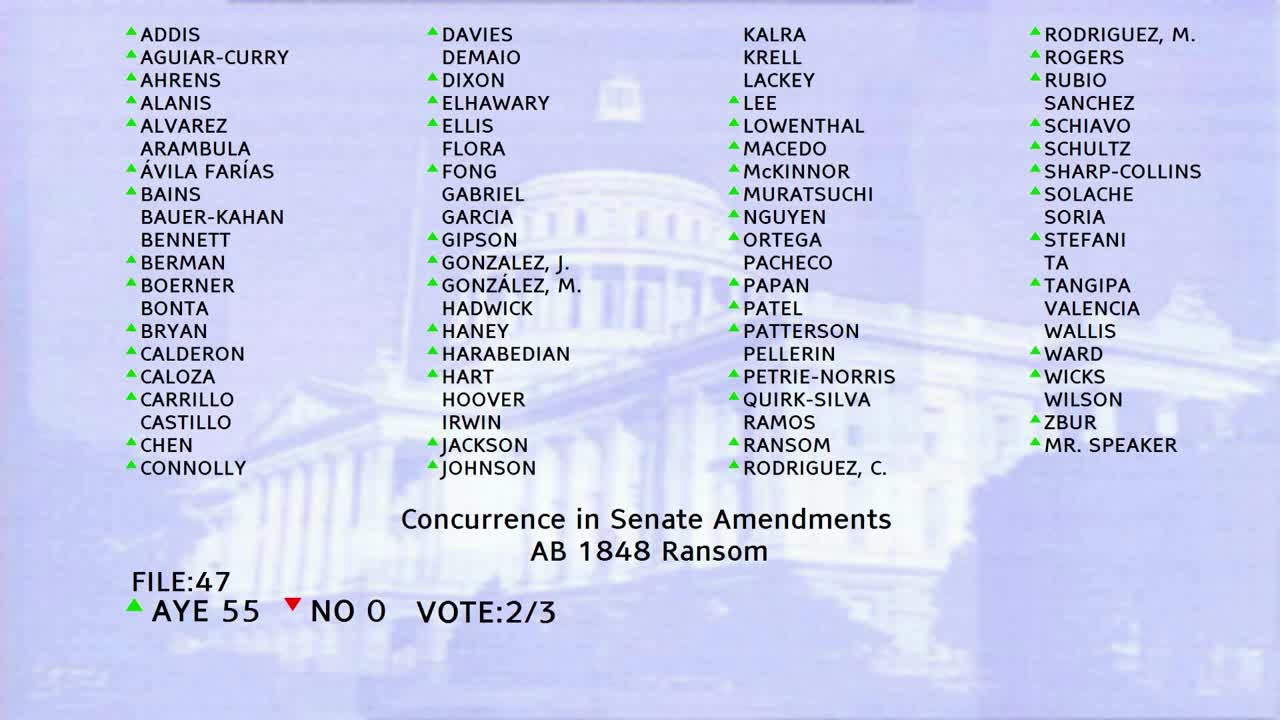 1MIN
Assembly Floor
 51SEC
Senate Floor
 57SEC
Assembly Floor
 11MIN
Assembly Standing Committee on Communications and Conveyance
Bill Author
Bill Co-Author(s):