AB 310: Nevaeh Youth Sports Safety Act.
- Session Year: 2025-2026
- House: Assembly
- Latest Version Date: 2025-10-03
Current Status:
Passed
(2025-10-03: Chaptered by Secretary of State - Chapter 254, Statutes of 2025.)
Introduced
In Committee
Awaiting First Chamber Vote
Passed First Chamber
In Committee
Awaiting Second Chamber Vote
Passed Second Chamber
Enacted
Existing law, the Nevaeh Youth Sports Safety Act, requires a youth sports organization to ensure, by January 1, 2027, that its athletes have access to an automated external defibrillator (AED) during any practice or match. Existing law requires the AED to be administered by a medical professional or other certified and qualified person designated by a youth sports organization.
This bill would delay the requirement to have access to an AED until January 1, 2028, would remove the requirement that it be administered by a medical professional, and would also require, by January 1, 2027, a youth sports organization to ensure that its coaches are certified, as specified, to perform cardiopulmonary resuscitation and to operate an AED. The bill would require, by January 1, 2027, a youth sports organization to have a written emergency response plan that includes certain information, including the location and procedures to be followed during a sudden cardiac event. The bill would require, by January 1, 2028, a youth sports organization to properly maintain and test its AED, as specified.
Existing law, the Nevaeh Youth Sports Safety Act, requires a youth sports organization to ensure, by January 1, 2027, that its athletes have access to an automated external defibrillator (AED) during any practice or match. Existing law requires the AED to be administered by a medical professional or other certified and qualified person designated by a youth sports organization.
This bill would instead delay the requirement to have access to an AED until January 1, 2028, would remove the requirement that it be administered by a medical professional, and would also require, by January 1, 2028, 2027, a youth sports organization to ensure that its coaches are certified, as specified, to perform cardiopulmonary resuscitation and to operate an AED. The bill would require, by January 1, 2028, 2027, a youth sports organization to have a written emergency response plan that includes certain information, including the location and procedures to be followed during a sudden cardiac event. The bill would require, by January 1, 2028, a youth sports organization to properly maintain and test its AED, as specified.
Existing law, the Nevaeh Youth Sports Safety Act, requires a youth sports organization to ensure, by January 1, 2027, that its athletes have access to an automated external defibrilator defibrillator (AED) during any practice or match. Existing law requires the AED to be administered by a medical professional or other certified and qualified person designated by a youth sports organization.
This bill would instead require, by January 1, 2027, 2028, a youth sports organization to ensure that its coaches are certified certified, as specified, to perform cardiopulmonary resuscitation and to operate an AED. The bill would require, by January 1, 2027, 2028, a youth sports organization to have a written emergency response plan that includes certain information, including the location and procedures to be followed during a sudden cardiac event. The bill would require, by January 1, 2027, 2028, a youth sports organization to properly maintain and test its AED, as specified.
Existing law, the Nevaeh Youth Sports Safety Act, requires a youth sports organization to ensure, by January 1, 2027, that its athletes have access to an automated external defibrilator (AED) during any practice or match. Existing law requires the AED to be administered by a medical professional or other certified and qualified person designated by a youth sports organization.
This bill would instead require, by January 1, 2027, a youth sports organization to ensure that its coaches are certified to perform cardiopulmonary resuscitation and to operate an AED. The bill would require, by January 1, 2027, a youth sports organization to have a written emergency response plan that includes certain information, including the location and procedures to be followed during a sudden cardiac event. The bill would require, by January 1, 2027, a youth sports organization to properly maintain and test its AED, as specified.
(a)Commencing January 1, 2028, a youth sports organization that elects to offer an athletic program shall ensure that its athletes have access to an automated external defibrillator (AED) during any official practice or match, subject to subdivisions (b) and (c).
(b)Commencing January 1, 2027, a youth sports organization shall ensure that its coaches are certified, and recertified at least every two years, to perform cardiopulmonary resuscitation and operate an AED and that there is a written cardiac emergency response plan. Certified training may be conducted in person or online and shall be offered by an accredited organization, consistent with national evidence-based cardiovascular care guidelines. The written cardiac emergency response plan shall be reviewed annually with coaches and staff. The written emergency response plan shall be consistent with nationally recognized, evidence-based standards and shall detail all of the following:
(1)The location of any AEDs and procedures to be followed in the event of sudden cardiac arrest.
(2)The responsibilities of the coach, administration, and athletes during the event.
(3)How the coach, administration, and athletes will be notified and trained on the emergency response plan.
(4)An annual electronic communication to the parents or guardians of enrolled participants that includes the cardiac emergency response plan or an internet link to the plan, the location or locations of any AEDs, and identifies the staff members designated to be notified in the event of a sudden cardiac event.
(c)Commencing January 1, 2028, a youth sports organization shall ensure that its AED is maintained and tested according to the operation and maintenance guidelines established by the manufacturer of that AED and the applicable rules and regulations of the federal Food and Drug Administration or any other applicable state or federal authority.
(a)Commencing January 1, 2028, a youth sports organization that elects to offer an athletic program shall ensure that its athletes have access to an automated external defibrillator (AED) during any official practice or match, subject to subdivisions (b) and (c).
(b)Commencing January 1, 2028, 2027, a youth sports organization shall ensure that its coaches are certified, and recertified at least every two years, to perform cardiopulmonary resuscitation and operate an AED and that there is a written cardiac emergency response plan. Certified training may be conducted in person or online and shall be offered by an accredited organization. organization, consistent with national evidence-based cardiovascular care guidelines. The written cardiac emergency response plan shall be reviewed annually with coaches and staff. The written emergency response plan shall be consistent with nationally recognized, evidence-based standards and shall detail all of the following:
(1)The location of any AEDs and procedures to be followed in the event of sudden cardiac arrest.
(2)The responsibilities of the coach, administration, athletes, and bystanders and athletes during the event.
(3)How the coach, administration, athletes, and bystanders and athletes will be notified and trained on the emergency response plan.
(4)An annual electronic communication to the parents or guardians of enrolled participants that includes the cardiac emergency response plan or an internet link to the plan, the location or locations of any AEDs AEDs, and identifies the staff members designated to be notified in the event of a sudden cardiac event.
(5)An announcement before the start of any official match or event, excluding practices, made over the public address system that identifies the location or locations of any AEDs and the staff members designated to respond in the event of a sudden cardiac event. If a public address system is not available, a written notice identifying the location or locations of any AEDs and the designated staff shall be posted in a visible and centrally accessible location at the event site.(c)Commencing January 1, 2028, a youth sports organization shall ensure that its AED is maintained and tested according to the operation and maintenance guidelines established by the manufacturer of that AED and the applicable rules and regulations of the federal Food and Drug Administration or any other applicable state or federal authority.
(a)Commencing January 1, 2027, 2028, a youth sports organization that elects to offer an athletic program shall ensure that its athletes have access to an automated external defibrillator (AED) during any official practice or match, subject to subdivisions (b) and (c).
(b)Commencing January 1, 2027, 2028, a youth sports organization shall ensure that its coaches are certified certified, and recertified at least every two years, to perform cardiopulmonary resuscitation and operate an AED and that there is a written and well-practiced cardiac emergency response plan. Certified training may be conducted in person or online and shall be offered by an accredited organization. The written cardiac emergency response plan shall be reviewed annually with coaches and staff. The written emergency response plan shall be consistent with nationally recognized, evidence-based standards and shall detail all of the following:
(1)The location and procedures to be followed in the event of sudden cardiac arrest.
(2)The responsibilities of the coach, administration, athletes, and bystanders during the event.
(3)How the coach, administration, athletes, and bystanders will be notified and trained on the emergency response plan.
(4)An annual electronic communication to the parents or guardians of enrolled participants that includes the location or locations of any AEDs and identifies the staff members designated to be notified in the event of a sudden cardiac event.
(5)An announcement before the start of any official match or event, excluding practices, made over the public address system that identifies the location or locations of any AEDs and the staff members designated to respond in the event of a sudden cardiac event. If a public address system is not available, a written notice identifying the location or locations of any AEDs and the designated staff shall be posted in a visible and centrally accessible location at the event site.
(c)Commencing January 1, 2027, 2028, a youth sports organization shall ensure that its AED is maintained and regularly tested according to the operation and maintenance guidelines established by the manufacturer of that AED and the applicable rules and regulations of the federal Food and Drug Administration or any other applicable state or federal authority.
(a)Commencing January 1, 2027, a youth sports organization that elects to offer an athletic program shall ensure that its athletes have access to an automated external defibrillator (AED) during any official practice or match, subject to subdivision (b). subdivisions (b) and (c).
(b)For purposes of subdivision (a), if an AED is administered during an applicable medical circumstance, the AED shall be administered by a medical professional, coach, or other person designated by the youth sports organization, who holds AED certification and who complies with any other qualifications required pursuant to federal and state law applicable to the use of an AED.(b)Commencing January 1, 2027, a youth sports organization shall ensure that its coaches are certified to perform cardiopulmonary resuscitation and operate an AED and that there is a written and well-practiced cardiac emergency response plan. The written emergency response plan shall be consistent with nationally recognized, evidence-based standards and shall detail all of the following:
(1)The location and procedures to be followed in the event of sudden cardiac arrest.
(2)The responsibilities of the coach, administration, athletes, and bystanders during the event.
(3)How the coach, administration, athletes, and bystanders will be notified and trained on the emergency response plan.
(c)Commencing January 1, 2027, a youth sports organization shall ensure that its AED is maintained and regularly tested according to the operation and maintenance guidelines established by the manufacturer of that AED and the applicable rules and regulations of the federal Food and Drug Administration or any other applicable state or federal authority.
|
Date
|
Status
|
|---|---|
| Oct 3, 2025 | Chaptered by Secretary of State - Chapter 254, Statutes of 2025. |
| Oct 3, 2025 | Approved by the Governor. |
| Sep 15, 2025 | Enrolled and presented to the Governor at 4:30 p.m. |
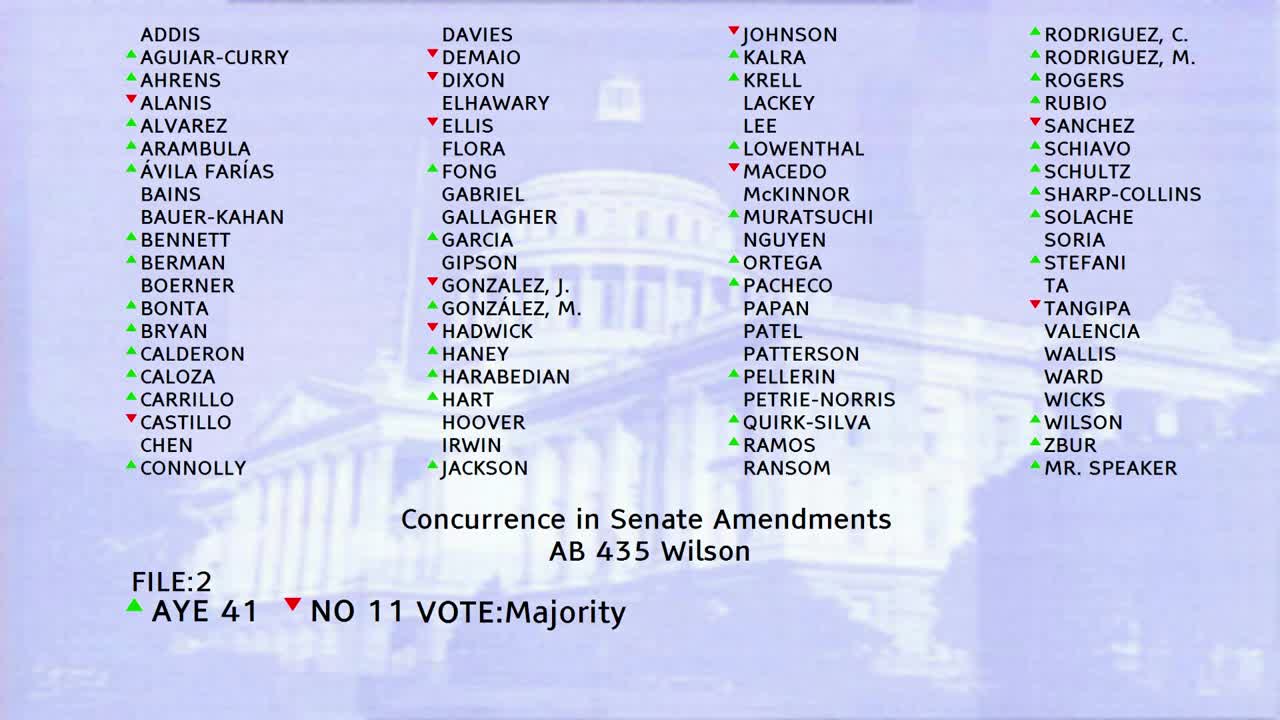
| Sep 8, 2025 | Senate amendments concurred in. To Engrossing and Enrolling. (Ayes 78. Noes 0. Page 3015.). |
| Sep 3, 2025 | In Assembly. Concurrence in Senate amendments pending. |
| Sep 3, 2025 | Read third time. Passed. Ordered to the Assembly. (Ayes 38. Noes 0. Page 2429.). |
| Jul 7, 2025 | Read second time and amended. Ordered to third reading. |
| Jul 3, 2025 | From committee: Amend, and do pass as amended. (Ayes 11. Noes 0.) (July 2). |
| Jun 24, 2025 | From committee chair, with author's amendments: Amend, and re-refer to committee. Read second time, amended, and re-referred to Com. on HEALTH. |
| May 7, 2025 | Referred to Com. on HEALTH. |
| Mar 28, 2025 | In Senate. Read first time. To Com. on RLS. for assignment. |
| Mar 28, 2025 | Read third time. Passed. Ordered to the Senate. (Ayes 61. Noes 0. Page 912.) |
| Mar 19, 2025 | Read second time. Ordered to third reading. |
| Mar 18, 2025 | From committee: Do pass. (Ayes 9. Noes 0.) (March 18). |
| Feb 10, 2025 | Referred to Com. on A.,E.,S.,T. |
| Jan 24, 2025 | From printer. May be heard in committee February 23. |
| Jan 23, 2025 | Read first time. To print. |
|
Date
|
Description
|
Location
|
Votes
|
|
|---|---|---|---|---|
| Sep 8, 2025 | AB 310 Alanis Concurrence in Senate Amendments | Assembly Floor |
Passed |
|
| Sep 3, 2025 | Assembly 3rd Reading AB310 Alanis et al. By Valladares | Senate Floor |
Passed |
|
| Jul 2, 2025 | Do pass as amended | Senate Standing Committee on Health |
Passed |
|
| Mar 28, 2025 | AB 310 Alanis Assembly Third Reading | Assembly Floor |
Passed |
|
| Mar 18, 2025 | Do pass. | Assembly Standing Committee on Arts, Entertainment, Sports, and Tourism |
Passed |
This list shows positions taken on this bill by organizations on the date displayed, which is linked to the original source.
Positions by individuals are not included.
|
Organization
|
Position
|
Date
|
|---|---|---|
| American Heart Association | ** Support | |
| American Youth Soccer Organization | ** Support | |
| Avive Solutions, Inc. | ** Support | |
| California Alliance For Golf | ** Support | |
| California Athletic Trainers Association | ** Support | |
| California chapter of the American College of Cardiology | ** Support | |
| California Coalition for Childrens Safety and Health | ** Support | |
| California State PTA | ** Support | |
| California Youth Soccer Association – North (Cal North) | ** Against | |
| Cal North Soccer | ** Against | |
| City SC Carlsbad | ** Support | |
| Corning Youth Soccer | ** Against | |
| Davis Ayso Region 218 | ** Against | |
| Elk Grove Youth Baseball | ** Against | |
| Elk Grove Youth Soccer League | ** Against | |
| Eric Paredes Save a Life Foundation | ** Support | |
| Grossmont Healthcare District | ** Support | |
| Habematolel Pomo Of Upper Lake | ** Support | |
| Hanford Youth Soccer League | ** Against | |
| Heartfelt Help Foundation | ** Support | |
| Heartshield Project | ** Support | |
| Just1mike | ** Support | |
| Kyle J. Taylor Foundation | ** Support | |
| Laguna Youth Baseball | ** Against | |
| National School District | ** Support | |
| Parent Heart Watch | ** Support | |
| Rohnert Park Soccer Club | ** Against | |
| San Juan Bautista Soccer Club | ** Against | |
| Stockton Youth Soccer | ** Against | |
| Sudden Arrhythmia Death Syndromes Foundation | ** Support | |
| Sudden Cardiac Arrest Foundation | ** Support | |
| Via Heart Project | ** Support | |
| West Contra Costa Youth Soccer League | ** Against |
CONCURRENCE IN SENATE AMENDMENTS
CSA1 Bill Id:AB 310
Author:(Alanis)
As Amended Ver:July 7, 2025
Majority vote
SUMMARY
This bill delays the implementation of a requirement, from January 1, 2027 to January 1, 2028, that youth sports organizations ensure their athletes have access to an automated external defibrillator (AED) during any official practice or match. The bill also requires youth sports organizations to ensure that their coaches are certified to perform Cardiopulmonary Resuscitation (CPR) and operate an AED, and have a written cardiac emergency response plan, beginning January 1, 2027.
Senate Amendments
- Move up the requirement, from January 1, 2028 to instead be January 1, 2027, that coaches of a youth sports organization are certified to perform CPR and operate an AED, and that there is a written cardiac emergency plan. (The January 1, 2028 deadline to ensure access to an AED remains unchanged.)
- Deletes “bystanders” from the list of individuals that have responsibilities and training requirements as part of the cardiac emergency plan.
- Require the annual electronic communication to parents about the location of any AEDs to also include the cardiac emergency response plan.
- Delete the requirement that there be an announcement over a public address system, or if there is no public address system, then a centralized posting of a written notice, of the location of any AEDs.
COMMENTS
Background. According to the American College of Cardiology (ACC), when playing sports, an athlete’s heart is working faster and pumping harder. Adrenaline is pumped throughout the body, and the heart needs more oxygen than normal. Dehydration, fever, or changes in electrolytes can also play a part. In people whose hearts are not normal to begin with, these extra stresses can sometimes trigger the electrical system of the heart and cause sudden cardiac arrest (SCA). While rare, SCA is the leading medical cause of death in young athletes. ACC states that warning signs during exercise include passing out, dizziness, chest pain, shortness of breath, and seizures. The Centers for Disease Control and Prevention estimates that every year in the U.S., approximately 2,000 patients younger than 25 years will die of SCA. The likelihood of child and young adult SCA for those with underlying cardiovascular disease is increased by athletic participation. According to a study published in December 2017, a loss of consciousness in athletes during sports activity is usually not immediately recognized as SCA and time is wasted by checking breathing and body movement. Immediate CPR and defibrillation with an AED should be initiated if an athlete is experiencing SCA. Without defibrillation, the probability of surviving declines by 10% per minute.
Background on AEDs. According to the American Heart Association (AHA), an AED is a lightweight, portable device that delivers an electric shock through the chest to the heart. The shock can stop an irregular rhythm and allow a normal rhythm to resume in a heart in sudden cardiac arrest. The AED has a built-in computer, which assesses the patient's heart rhythm, determines whether the person is in cardiac arrest, and signals whether to administer the shock. Inside the AED box are pads and a diagram that shows where to place them on the bare skin. Once the device is turned on, a voice tells the person using it exactly what to do. The AHA states that more than 15% of out-of-hospital cardiac arrests occur in a public location, and therefore public access AEDs and community training have a large role to play in early defibrillation. However, the number of patients who have an AED applied by a bystander remains low, occurring after only 10.2% of public cardiac arrests. According to the AHA, nine in ten cardiac arrest victims who receive a shock from an AED in the first minute live. The AHA states that children over age eight can be treated with a standard AED, and for children ages one through eight, the AHA recommends the pediatric attenuated pads that are purchased separately.
CPR and AED certification training. There are many organizations that offer certification classes in CPR and AED use, and most classes combine CPR and AED training into one class. The American Red Cross offers combination CPR/AED online-only classes for $37, though the Red Cross notes that this class is not Occupational Safety and Health Administration (OSHA) workplace compliant, which requires an additional instructor-led skill session within 90 days of completing the online course. The Red Cross also offers Adult and Pediatric CPR/AED courses that combine both online and classroom instruction, or classroom only, and that meet OSHA workplace requirements. Costs vary, with local prices in Sacramento ranging from $59 to more than $100. Other organizations offer much less expensive options, though they are generally online only: the National CPR Foundation offers online certification classes for $14.95, while NFHS offers an online CPR and AED training program for $10 that it developed in partnership with the Vanderbilt Youth Sports Health Center to specifically help school programs.
According to the Author
“This bill strengthens the Nevaeh Youth Sports Safety Act from 2023 to further California’s commitment to providing safe and fun access to youth sports programs. Sudden cardiac arrest is the number one cause of death among student athletes. When sudden cardiac events take place, timely intervention is critical. This bill will require youth sports organizations to have a written emergency response plan in place that includes the location of an AED and outlines standard procedures for responding to a cardiac emergency. The bill would also require that youth sports organizations properly maintain and test their AED(s) and that coaches are trained to use an AED. This bill aims to provide more clarity on the Nevaeh Youth Sports Safety Act by enhancing protections and offering families a greater sense of safety and confidence in the programs that their children participate in.”
Arguments in Support
This bill is sponsored by the Eric Paredes Save a Life Foundation, which states that this bill corrects a conflict from the Nevaeh Youth Sports Safety Act where the language suggests that only certified individuals are allowed to administer an AED. The sponsor points out that existing law does not limit who can use an AED in a sudden cardiac arrest emergency. Additionally, this bill would require a youth sports organization to have a written emergency response plan that identifies the location of the AED, requires the plan to be reviewed annually, and requires coaches to be CPR/AED certified every two years. The sponsors state that research continues to show a critical lack of awareness about AEDs, which, when used within minutes of collapse, could flip the outcome for a sudden cardiac arrest victim to a near 90% survival rate. Numerous organizations support this bill. The California Coalition for Children’s Safety and Health states in support that it recommends, just like the legislature has done to address sports related concussions, that coaches, assistant coaches, parents, and athletes should have knowledge about sports related cardiac arrest, CPR and AED knowledge, and this bill is a step in the right direction. The California Chapter of the American College of Cardiology states that by supporting the use of CPR and AEDs, cardiologists aim to improve survival rates and outcomes for sudden cardiac arrest victims.
Arguments in Opposition
A number of youth sports organizations, including California Youth Soccer Association – North (Cal North), Elk Grove Youth Baseball, and many others, submitted oppose unless amended letters to a prior version of this bill. These organizations pointed out that this bill is building on previous legislation, AB 1467 from 2023, which required all youth sports organizations to ensure AED access during practices and matches. It is unclear whether recent amendments, which in part delayed the implementation of the AED requirement in AB 1467 to 2028, have addressed these concerns. Opponents stated that while they appreciate the intent of these bills, fulfilling these obligations imposes significant financial challenges on youth sports organizations. Opponents argued that the combined costs of this bill and AB 1467 is substantial, and will likely require organizations to double or triple their per-player fees, potentially pricing many families out of youth sports. These organizations requested amendments to require cities, counties, and park districts to provide AEDs at public parks. These organizations stated that it is reasonable to require local governments to make AEDs available at their facilities, and that AEDs can be securely stored and accessed with a code provided during emergencies, significantly reducing costs for sports organizations.
FISCAL COMMENTS
None. This measure was keyed non-fiscal by the Legislative Counsel.
VOTES:
ASM ARTS, ENTERTAINMENT, SPORTS, AND TOURISM: 9-0-0
YES: Ward, Lackey, Elhawary, Jeff Gonzalez, McKinnor, Ortega, Quirk-Silva, Valencia, Zbur
ASSEMBLY FLOOR: 61-0-19
YES: Addis, Aguiar-Curry, Ahrens, Alanis, Alvarez, Arambula, Ávila Farías, Bains, Berman, Bonta, Bryan, Calderon, Caloza, Carrillo, Castillo, Connolly, Davies, Dixon, Elhawary, Ellis, Fong, Gallagher, Garcia, Gipson, Jeff Gonzalez, Mark González, Hadwick, Haney, Harabedian, Hart, Hoover, Irwin, Jackson, Kalra, Krell, Lackey, Lowenthal, Macedo, McKinnor, Muratsuchi, Nguyen, Ortega, Pacheco, Pellerin, Ramos, Ransom, Celeste Rodriguez, Michelle Rodriguez, Blanca Rubio, Sanchez, Schultz, Solache, Soria, Stefani, Ta, Tangipa, Valencia, Wallis, Wicks, Wilson, Rivas
ABS, ABST OR NV: Bauer-Kahan, Bennett, Boerner, Chen, DeMaio, Essayli, Flora, Gabriel, Lee, Papan, Patel, Patterson, Petrie-Norris, Quirk-Silva, Rogers, Schiavo, Sharp-Collins, Ward, Zbur
SENATE FLOOR: 38-0-2
YES: Allen, Alvarado-Gil, Archuleta, Arreguín, Becker, Blakespear, Caballero, Cervantes, Choi, Cortese, Dahle, Durazo, Gonzalez, Grayson, Grove, Hurtado, Jones, Laird, Limón, McGuire, McNerney, Menjivar, Niello, Ochoa Bogh, Padilla, Pérez, Reyes, Richardson, Rubio, Seyarto, Smallwood-Cuevas, Stern, Strickland, Umberg, Valladares, Wahab, Weber Pierson, Wiener
ABS, ABST OR NV: Ashby, Cabaldon
UPDATED
VERSION: July 7, 2025
CONSULTANT: Brian V. Anderson, Jr. / A.,E.,S., & T. / (916) 319-3450 FN: 0001558
SENATE RULES COMMITTEE Office of Senate Floor Analyses (916) 651-1520 Fax: (916) 327-4478 | AB 310 |
THIRD READING
Bill No: AB 310
Author: Alanis (R), et al.
Amended: 7/7/25 in Senate
Vote: 21
SENATE HEALTH COMMITTEE: 11-0, 7/2/25
AYES: Menjivar, Valladares, Durazo, Gonzalez, Grove, Limón, Padilla, Richardson, Rubio, Weber Pierson, Wiener
ASSEMBLY FLOOR: 61-0, 3/28/25 - See last page for vote
SUBJECT: Nevaeh Youth Sports Safety Act
SOURCE: Eric Paredes Save a Life Foundation
DIGEST: This bill (1) delays the implementation of a requirement, from January 1, 2027 to January 1, 2028, that youth sports organizations ensure their athletes have access to an automated external defibrillator (AED) during any official practice or match. (2) Requires youth sports organizations to ensure their coaches are certified to perform CPR and operate an AED, and have a written cardiac emergency response plan, beginning January 1, 2027.
ANALYSIS:
Existing law:
- Defines a “youth sports organization” as an organization, business, nonprofit entity, or a local governmental agency that sponsors or conducts amateur sports competitions, training, camps, or clubs in which persons 17 years of age or younger participate. [Health & Safety Code (HSC) §124235 (b)(4)]
- Requires each coach, administrator, and referee, umpire, or other game official of the youth sports organization to successfully complete concussion and head injury and sudden cardiac arrest prevention education at least once, either online or in person, before supervising an athlete in an activity of the youth sports organization. [HSC §124235(a)(5)]
- Requires “sudden cardiac arrest prevention education and educational materials” and a “sudden cardiac arrest information sheet” to include, at a minimum, information relating to cardiac conditions and their potential consequences, the signs and symptoms of sudden cardiac arrest, best practices for removal of an athlete from an athletic activity after fainting or a suspected cardiac condition is observed, steps for returning an athlete to activity, and what to do in the event of a cardiac emergency, which includes calling 911, performing hands-only CPR, and using an AED if available. [HSC §124235(b)(3)]
- Establishes the California Youth Football Act, which establishes additional requirements on youth sports organizations that conduct a tackle football program, including requiring a minimum of one certified emergency medical technician, state-licensed paramedic, or higher-level medical professional to be present during all games, and requiring coaches to annually receive first aid, CPR, and AED certification. [HSC §124240 et seq. and §124241(h) and (i)]
- Requires, as part of the California Youth Football Act, that at least one independent nonrostered individual, appointed by the youth sports organization, to be present at all practice locations, and requires the individual to hold current certifications in first aid, CPR, AED, and concussion protocols. [HSC §124241(j)]
- Requires a school district or charter school that offers any interscholastic athletic program to acquire at least one AED for each school that participates in the program, and encourages the school district or charter school to ensure that the AED is available for the purpose of rendering emergency care or treatment within a recommended three to five minutes of sudden cardiac arrest to pupils, spectators, and any other individuals in attendance at the program’s on-campus activities or events, and to ensure that the AED is available to athletic trainers and coaches and authorized persons at these activities or events. [EDC §35179.6]
- Requires a person or entity that acquires an AED to comply with all regulations governing its placement, notify an agent of the local emergency medical services agency of the existence, location, and type of AED acquired, ensure that the AED is maintained and tested according to the operation and maintenance guidelines of the manufacturer, ensure that it is tested at least biannually and after each use, ensure that an inspection is made of all AEDs on the premises at least every 90 days for potential issues related to operability, and ensure that maintenance and testing records are maintained. [HSC §1797.196]
- Exempts a person or entity that acquires an AED for emergency use from liability for any civil damages resulting from the use of the AED if the person or entity has complied with the requirements in 8) above. [Civil Code (CIV) §1714.21(d)]
- Exempts any person who, in good faith and not for compensation, renders emergency care or treatment by use of an AED at the scene of an emergency from liability for any civil damages resulting from any acts or omissions in rendering the emergency care. [CIV §1714.21(b)]
This bill:
- Delays, from January 1, 2027 to January 1, 2028, a requirement that a youth sports organization that elects to offer an athletic program to ensure that its athletes have access to an AED during any official practice or match.
- Deletes a requirement, for purposes of youth sports organizations ensuring access to an AED, that the AED be administered by a medical professional, coach, or other person designated by the youth sports organization who holds AED certification.
- Requires a youth sports organization, beginning January 1, 2027, to ensure that its coaches are certified, and recertified at least every two years, to perform CPR and operate an AED and that there is a written cardiac emergency response plan. Permits certified training to be conducted in-person or online and to be offered by an accredited organization, consistent with national evidence-based cardiovascular care guidelines.
- Requires the written cardiac emergency response plan to be reviewed annually with coaches and staff, to be consistent with nationally recognized, evidence-based standards, and to detail:
- The location of any AEDs and procedures to be followed in the event of sudden cardiac arrest;
- The responsibilities of the coach, administration, and athletes during the event;
- How the coach, administration, and athletes will be notified and trained on the emergency response plan; and,
- An annual electronic communication to the parents or guardians of enrolled participants that includes the cardiac emergency response plan or an internet link to the plan, the location or locations of any AEDs, and identifies the staff members designated to be notified in the event of a sudden cardiac event.
- Requires a youth sports organization, beginning January 1, 2028, to ensure that its AED is maintained and tested according to the operation and maintenance guidelines established by the manufacturer and the applicable rules and regulations of the federal Food and Drug Administration or any other applicable state or federal authority.
Comments
According to the author of this bill:
This bill strengthens the Nevaeh Youth Sports Safety Act from 2023 to further California’s commitment to providing safe and fun access to youth sports programs. Sudden cardiac arrest is the number one cause of death among student athletes. When sudden cardiac events take place, timely intervention is critical. This bill will require youth sports organizations to have a written emergency response plan in place that includes the location of an AED and outlines standard procedures for responding to a cardiac emergency. The bill would also require that youth sports organizations properly maintain and test their AED(s) and that coaches are trained to use an AED. This bill aims to provide more clarity on the Nevaeh Youth Sports Safety Act by enhancing protections and offering families a greater sense of safety and confidence in the programs that their children participate in.
Background
Background on sudden cardiac arrest. According to the National Heart, Blood, and Lung Institute, sudden cardiac arrest (SCA) is a condition in which the heart suddenly and unexpectedly stops beating, and usually causes death if it's not treated within minutes. SCA is not the same as a heart attack. A heart attack is when blood flow to the heart is blocked, and SCA is when the heart malfunctions and suddenly stops beating unexpectedly. A heart attack is a “circulation” problem and sudden cardiac arrest is an “electrical” problem. However, SCA can happen after or during recovery from a heart attack. Ventricular fibrillation (v-fib), a type of arrhythmia, causes most SCAs. During v-fib, the heart's lower chambers don't beat normally, and instead quiver very rapidly and irregularly and little or no blood is pumped to the body. Other problems with the heart's electrical system can also cause SCA. For example, SCA can occur if the rate of the heart's electrical signals becomes very slow and stops. SCA also can occur if the heart muscle doesn't respond to the heart's electrical signals. Coronary heart disease; severe physical stress; certain inherited disorders; and structural changes in the heart can also cause SCA.
According to the American College of Cardiology (ACC), when playing sports, an athlete’s heart is working faster and pumping harder. Adrenaline is pumped throughout the body, and the heart needs more oxygen than normal. Dehydration, fever, or changes in electrolytes can also play a part. In people whose hearts are not normal to begin with, these extra stresses can sometimes trigger the electrical system of the heart and cause SCA. While rare, SCA is the leading medical cause of death in young athletes. ACC states that warning signs during exercise include passing out, dizziness, chest pain, shortness of breath, and seizures. The Centers for Disease Control and Prevention estimates that every year in the U.S., approximately 2,000 patients younger than 25 years will die of SCA. The likelihood of child and young adult SCA for those with underlying cardiovascular disease is increased by athletic participation. According to a study published in December 2017, a loss of consciousness in athletes during sports activity is usually not immediately recognized as SCA and time is wasted by checking breathing and body movement. Immediate CPR and defibrillation with an AED should be initiated if an athlete is experiencing SCA. Without defibrillation, the probability of surviving declines by 10% per minute.
Background on AEDs. According to the American Heart Association (AHA), an AED is a lightweight, portable device that delivers an electric shock through the chest to the heart. The shock can stop an irregular rhythm and allow a normal rhythm to resume in a heart in sudden cardiac arrest. The AED has a built-in computer, which assesses the patient's heart rhythm, determines whether the person is in cardiac arrest, and signals whether to administer the shock. Inside the AED box are pads and a diagram that shows where to place them on the bare skin. Once the device is turned on, a voice tells the person using it exactly what to do. The AHA states that more than 15% of out-of-hospital cardiac arrests occur in a public location, and therefore public access AEDs and community training have a large role to play in early defibrillation. However, the number of patients who have an AED applied by a bystander remains low, occurring after only 10.2% of public cardiac arrests. According to the AHA, nine in ten cardiac arrest victims who receive a shock from an AED in the first minute live. The AHA states that children over age eight can be treated with a standard AED, and for children ages one through eight, the AHA recommends the pediatric attenuated pads that are purchased separately.
CPR and AED certification training. There are many organizations that offer certification classes in CPR and AED use, and most classes combine CPR and AED training into one class. The American Red Cross offers combination CPR/AED online-only classes for $37, though the Red Cross notes that this class is not Occupational Safety and Health Administration (OSHA) workplace compliant, which requires an additional instructor-led skill session within 90 days of completing the online course. The Red Cross also offers Adult and Pediatric CPR/AED courses that combine both online and classroom instruction, or classroom only, and that meet OSHA workplace requirements. Costs vary, with local prices in Sacramento ranging from $59 to more than $100. Other organizations offer much less expensive options, though they are generally online only: the National CPR Foundation offers online certification classes for $14.95, while NFHS offers an online CPR and AED training program for $10 that it developed in partnership with the Vanderbilt Youth Sports Health Center to specifically help school programs.
FISCAL EFFECT: Appropriation: No Fiscal Com.: No Local: No
SUPPORT: (Verified 7/7/25)
Eric Paredes Save a Life Foundation (source)
American Heart Association
American Youth Soccer Organization
Avive Solutions, Inc.
California Alliance for Golf
California Athletic Trainers Association
California Chapter American College of Cardiology
California Coalition for Children’s Safety and Health
California State PTA
City SC Carlsbad
Grossmont Healthcare District
Habematolel Pomo of Upper Lake
Heartfelt Help Foundation
Heartshield Project
Just1Mike
Kyle J. Taylor Foundation
National School District
Parent Heart Watch
Sudden Arrhythmia Death Syndromes Foundation
Sudden Cardiac Arrest Foundation
Via Heart Project
OPPOSITION: (Verified 7/7/25)
(This list of opposition was to a prior version of this bill)
California Youth Soccer Association – North (unless amended)
Corning Youth Soccer (unless amended)
Davis American Youth Soccer Organization- Region 218 (unless amended)
Elk Grove Youth Baseball (unless amended)
Elk Grove Youth Soccer League (unless amended)
Hanford Youth Soccer League (unless amended)
Laguna Youth Baseball (unless amended)
NorCal Premier Soccer League (unless amended)
Oroville Youth Soccer Club (unless amended)
Rancho FC (unless amended)
Rohnert Park Soccer Club (unless amended)
Salinas Soccer Femenil (unless amended)
San Juan Bautista Soccer Club (unless amended)
Stockton Youth Soccer (unless amended)
Sunnyvale Alliance Soccer Club (unless amended)
Trinity Youth Soccer League (unless amended)
West Contra Costa Youth Soccer League (unless amended)
ARGUMENTS IN SUPPORT: This bill is sponsored by the Eric Paredes Save a Life Foundation, which states that this bill corrects a conflict from the Nevaeh Youth Sports Safety Act where the language suggests that only certified individuals are allowed to administer an AED. The sponsor points out that existing law does not limit who can use an AED in a sudden cardiac arrest emergency. Additionally, this bill would require a youth sports organization to have a written emergency response plan that identifies the location of the AED, requires the plan to be reviewed annually, and requires coaches to be CPR/AED certified every two years. The sponsors state that research continues to show a critical lack of awareness about AEDs, which, when used within minutes of collapse, could flip the outcome for a sudden cardiac arrest victim to a near 90% survival rate. Numerous organizations support this bill. The California Coalition for Children’s Safety and Health states in support that it recommends, just like the legislature has done to address sports related concussions, that coaches, assistant coaches, parents, and athletes should have knowledge about sports related cardiac arrest, CPR and AED knowledge, and this bill is a step in the right direction. The California Chapter of the American College of Cardiology states that by supporting the use of CPR and AEDs, cardiologists aim to improve survival rates and outcomes for sudden cardiac arrest victims.
The American Youth Soccer Organization (AYSO) states that it supports this version of this bill, along with a related bill, AB 387 (described in related legislation above). AYSO states that the amended versions of this bill and AB 387 represent a thoughtful, practical approach to improving athlete safety without placing undue burdens on the volunteer-driven programs that form the backbone of youth sports. AYSO states that these measures provide critical safeguards while allowing organizations like ours to continue delivering safe, inclusive, and accessible opportunities for children to play, grow, and thrive.
ARGUMENTS IN OPPOSITION: A number of youth sports organizations, including California Youth Soccer Association – North (Cal North), Elk Grove Youth Baseball, and many others, submitted oppose unless amended letters to a prior version of this bill. These organizations pointed out that this bill is building on previous legislation, AB 1467 from 2023, which required all youth sports organizations to ensure AED access during practices and matches. It is unclear whether recent amendments, which in part delayed the implementation of the AED requirement in AB 1467 to 2028, have addressed these concerns. Opponents stated that while they appreciate the intent of these bills, fulfilling these obligations imposes significant financial challenges on youth sports organizations. Opponents argued that the combined costs of this bill and AB 1467 is substantial, and will likely require organizations to double or triple their per-player fees, potentially pricing many families out of youth sports. These organizations requested amendments to require cities, counties, and park districts to provide AEDs at public parks. These organizations stated that it is reasonable to require local governments to make AEDs available at their facilities, and that AEDs can be securely stored and accessed with a code provided during emergencies, significantly reducing costs for sports organizations.
ASSEMBLY FLOOR: 61-0, 3/28/25
AYES: Addis, Aguiar-Curry, Ahrens, Alanis, Alvarez, Arambula, Ávila Farías, Bains, Berman, Bonta, Bryan, Calderon, Caloza, Carrillo, Castillo, Connolly, Davies, Dixon, Elhawary, Ellis, Fong, Gallagher, Garcia, Gipson, Jeff Gonzalez, Mark González, Hadwick, Haney, Harabedian, Hart, Hoover, Irwin, Jackson, Kalra, Krell, Lackey, Lowenthal, Macedo, McKinnor, Muratsuchi, Nguyen, Ortega, Pacheco, Pellerin, Ramos, Ransom, Celeste Rodriguez, Michelle Rodriguez, Blanca Rubio, Sanchez, Schultz, Solache, Soria, Stefani, Ta, Tangipa, Valencia, Wallis, Wicks, Wilson, Rivas
NO VOTE RECORDED: Bauer-Kahan, Bennett, Boerner, Chen, DeMaio, Essayli, Flora, Gabriel, Lee, Papan, Patel, Patterson, Petrie-Norris, Quirk-Silva, Rogers, Schiavo, Sharp-Collins, Ward, Zbur
Prepared by: Vincent D. Marchand / HEALTH / (916) 651-4111
7/8/25 16:45:18
**** END ****
ASSEMBLY THIRD READING
ATR Bill Id:AB 310
Author:(Alanis)
As Introduced Ver:January 23, 2025
Majority vote
SUMMARY
Adds certification requirements for coaches within youth sports organizations to the Nevaeh Youth Sports Safety Act, which will require, beginning January 1, 2027, youth sports organizations to provide their athletes with access to an automated external defibrillator (AED) during any official practice or match.
Major Provisions
- Beginning January 1, 2027, this bill will require youth sports organizations to ensure that its coaches are certified to perform Cardiopulmonary Resuscitation (CPR) and operate an AED, and that there is a written and well-practiced cardiac emergency response plan. The written emergency response plan shall be consistent with nationally recognized, evidence-based standards and shall detail all of the following:
- The location and procedures to be followed in the event of sudden cardiac arrest.
- The responsibilities of the coach, administration, athletes, and bystanders during the event.
- How the coach, administration, athletes, and bystanders will be notified and trained on the emergency response plan.
- The organizations would also be required to ensure that its AED is maintained and regularly tested according to the operation and maintenance guidelines established by the manufacturer.
COMMENTS
An AED is a portable electronic device used to treat individuals experiencing cardiac arrest through the application of an electrical shock (defibrillation) to restore a normal heart rhythm. The key technical components include:
- Electrodes that monitor the heart's electrical activity and administer a shock if needed.
- A microprocessor that interprets the heart's rhythm and determines whether a shock is necessary.
- An easy-to-follow interface that provides voice prompts and visual cues to guide the user through the process of defibrillation.
Their simplicity, coupled with the effectiveness of modern automated diagnostics, means that anyone, regardless of medical training, can potentially save a life.
More than 356,000 out-of-hospital cardiac arrests (OHCAs) are reported annually in the United States by the Centers for Disease Control and Prevention (CDC). An estimated 70% to 90% of people experiencing OHCA die before reaching the hospital. CPR and the use of an AED within minutes of cardiac arrest can dramatically raise survival rates, but are not always commonly used or available. One study reported AED use at 10.8% in public settings before emergency medical services arrive.
Research further suggests that the availability of an AED in communities is associated with nearly a doubling of survival after out-of-hospital cardiac arrest, reinforcing the importance of strategically expanding community-based AED programs.
On January 2, 2023, during a Monday Night Football game between the Buffalo Bills and Cincinnati Bengals, Bills safety Demar Hamlin collapsed on the field after tackling a Bengals wide receiver. Hamlin remained motionless at midfield while team athletic trainers and paramedics rushed to his side within 10 seconds. First responders initiated CPR, AED, and other treatments to Hamlin on the field for 10 minutes. It was later reported that Hamlin had initially suffered cardiac arrest and his heartbeat was restored on-field.
Nevaeh Johnson, whom the 2023 Act is named after, collapsed during a sports practice in Waterford, CA in August 2022. Coaches were unaware she was suffering a brain aneurysm, and her heart had stopped. She tragically passed away a few days later, at just 10 years old. Her family believes that if an AED was accessible at the time, she would still be here today.
According to the Author
"AEDs are critical pieces of medical equipment that can save lives, if used properly within minutes of a cardiac emergency. When parents and guardians let their child participate in an athletic program, they should feel comfortable knowing their child will remain safe in the event of an emergency. AB 310 demonstrates a commitment to both youth athletes and their families that in the event of an emergency, there will be someone present with the necessary skills to respond."
Arguments in Support
According to the California Athletic Trainers' Association in support, "Existing law does not limit who can use an AED in a sudden cardiac arrest emergency. To save more lives we need to encourage access and education for bystanders to take immediate action to help a sudden cardiac arrest victim. AB 310 would require a youth sports organization to have a written and well-practiced emergency response plan that identifies the location of the AED and the protocol for the coach, administration, athletes and bystanders to use the AED to respond to a cardiac emergency… Research continues to show a critical lack of awareness about AEDs, which, when used within minutes of collapse, could flip the outcome for a sudden cardiac arrest victim to a near 90% survival rate. AB 310's education for and empowerment of anyone to use an AED recognizes this pinnacle step in the cardiac chain of survival. In the name of all youth lost to a tragedy that could be prevented, we resoundingly sponsor and support AB 310."
Arguments in Opposition
According to the California Youth Soccer Association-North in opposition, "While we deeply appreciate the intent of both bills and understand the tragedy behind them—our hearts go out to Nevaeh Johnson's family—fulfilling these obligations imposes significant financial challenges on youth sports organizations like ours. Despite our efforts to keep membership fees low and soccer accessible to all children, the combined costs of AB 310 and AB 1467 compliance is substantial. For example, the compliance costs for our combined leagues and clubs is estimated at $15 million in year one with added costs for education and maintenance of AEDs over the years. This will likely require most of our organizations to double or triple their per-player fees, potentially pricing many families out of youth sports."
FISCAL COMMENTS
None. This measure has been keyed non-fiscal by the Legislative Counsel.
VOTES
ASM ARTS, ENTERTAINMENT, SPORTS, AND TOURISM: 9-0-0
YES: Ward, Lackey, Elhawary, Jeff Gonzalez, McKinnor, Ortega, Quirk-Silva, Valencia, Zbur
UPDATED
VERSION: January 23, 2025
CONSULTANT: Brian V. Anderson, Jr. / A.,E.,S., & T. / (916) 319-3450 FN: 0000163
Date of Hearing:
ASSEMBLY COMMITTEE ON ARTS, ENTERTAINMENT, SPORTS, AND TOURISM
Christopher M. Ward, Chair
ABPCA Bill Id:AB 310 (
Author:Alanis) – As Introduced Ver:January 23, 2025
SUBJECT: Nevaeh Youth Sports Safety Act
SUMMARY: Adds certification requirements for coaches within youth sports organizations to the Nevaeh Youth Sports Safety Act, which will require, beginning January 1, 2027, youth sports organizations to provide their athletes with access to an automated external defibrillator (AED) during any official practice or match.
Specifically, this bill:
- Beginning January 1, 2027, this bill will require youth sports organizations to ensure that its coaches are certified to perform CPR and operate an AED, and that there is a written and well-practiced cardiac emergency response plan. The written emergency response plan shall be consistent with nationally recognized, evidence-based standards and shall detail all of the following:
- The location and procedures to be followed in the event of sudden cardiac arrest.
- The responsibilities of the coach, administration, athletes, and bystanders during the event.
- How the coach, administration, athletes, and bystanders will be notified and trained on the emergency response plan.
- The organizations would also be required to ensure that its AED is maintained and regularly tested according to the operation and maintenance guidelines established by the manufacturer.
EXISTING LAW:
Provides the following definitions in Health and Safety Code (HSC) 124238:
- Defines “Coach” to mean a person appointed by the youth sports organization to supervise or instruct a participant in a sport.
- Defines “Official practice or match” to mean a sport session in which live action or one or more drills are conducted, or a match, as scheduled by the youth sports organization, the coach, or other designee of the organization.
- Defines a “Youth sports organization” to mean an organization, business, nonprofit entity, or a local governmental agency that sponsors or conducts amateur sports competitions, training, camps, or clubs in which persons 17 years of age or younger participate.
Requires a youth sports organization that elects to offer an athletic program to comply with all of the following from HSC 124238.5:
- Commencing January 1, 2027, a youth sports organization that elects to offer an athletic program must ensure that its athletes have access to an AED during any official practice or match.
- If an AED is administered during an applicable medical circumstance, the AED shall be administered by a medical professional, coach, or other person designated by the youth sports organization, who holds AED certification and who complies with any other qualifications required pursuant to federal and state law applicable to the use of an AED.
FISCAL EFFECT: None. This measure is keyed non-fiscal by the Legislative Counsel.
COMMENTS:
- Author’s Statement. According to the author, “AEDs are critical pieces of medical equipment that can save lives, if used properly within minutes of a cardiac emergency. When parents and guardians let their child participate in an athletic program, they should feel comfortable knowing their child will remain safe in the event of an emergency. AB 310 demonstrates a commitment to both youth athletes and their families that in the event of an emergency, there will be someone present with the necessary skills to respond.”
- About AEDs. An AED is a portable electronic device used to treat individuals experiencing cardiac arrest through the application of an electrical shock (defibrillation) to restore a normal heart rhythm. The key technical components include:
- Electrodes that monitor the heart's electrical activity and administer a shock if needed.
- A microprocessor that interprets the heart's rhythm and determines whether a shock is necessary.
- An easy-to-follow interface that provides voice prompts and visual cues to guide the user through the process of defibrillation.
Their simplicity, coupled with the effectiveness of modern automated diagnostics, means that anyone, regardless of medical training, can potentially save a life.
More than 356,000 out-of-hospital cardiac arrests (OHCAs) are reported annually in the United States by the Centers for Disease Control and Prevention (CDC). An estimated 70% to 90% of people experiencing OHCA die before reaching the hospital. CPR and the use of an AED within minutes of cardiac arrest can dramatically raise survival rates, but are not always commonly used or available. One study reported AED use at 10.8% in public settings before emergency medical services arrive.
Research further suggests that the availability of an AED in communities is associated with nearly a doubling of survival after out-of-hospital cardiac arrest, reinforcing the importance of strategically expanding community-based AED programs.
- Sports related medical emergencies. On January 2, 2023, during a Monday Night Football game between the Buffalo Bills and Cincinnati Bengals, Bills safety Demar Hamlin collapsed on the field after tackling a Bengals wide receiver. Hamlin remained motionless at midfield while team athletic trainers and paramedics rushed to his side within 10 seconds. First responders initiated CPR, AED, and other treatments to Hamlin on the field for 10 minutes. It was later reported that Hamlin had initially suffered cardiac arrest and his heartbeat was restored on-field.
Nevaeh Johnson, whom the 2023 Act is named after, collapsed during a sports practice in Waterford, CA in August 2022. Coaches were unaware she was suffering a brain aneurysm, and her heart had stopped. She tragically passed away a few days later, at just 10 years old. Her family believes that if an AED was accessible at the time, she would still be here today.
- Policy Considerations. The policies in this bill are generally consistent with health and safety regulations that have previously passed through the California Legislature. There are a few issues to consider however, on the impacts to youth sports organizations and their coaches as this bill moves forward. Youth organization coaches, which in many cases are the parent/guardian of a participant on the team they are coaching, are unpaid volunteers. There are many CPR and AED certification programs available online. The AED.com website list a training program for CPR, AED, and first aid for $35. Volunteers may express concerns over the time commitment and cost of maintaining certification.
Additionally, AEDs are not inexpensive pieces of equipment, ranging in price on the AED.com website from $900, to over $2,200. There may be concerns by youth sports organizations in less affluent communities on the cost to obtain, upkeep, and meet certification requirements. Will organizations be expected to provide teams and coaches with a device for each of their practices and games, or will individual teams be required to purchase their own as a condition of registration? Will this cost be passed along to participants? Depending on how well a device is maintained and used, AED devices can last between 8 to 15 years. Other questions may include to whom organizations report information in order to ensure compliance, and who determines what a reasonable amount of time is for rehearsal purposes?
- Arguments in Support. According to the California Athletic Trainers’ Association in support, “Existing law does not limit who can use an AED in a sudden cardiac arrest emergency. To save more lives we need to encourage access and education for bystanders to take immediate action to help a sudden cardiac arrest victim. AB 310 would require a youth sports organization to have a written and well-practiced emergency response plan that identifies the location of the AED and the protocol for the coach, administration, athletes and bystanders to use the AED to respond to a cardiac emergency… Research continues to show a critical lack of awareness about AEDs, which, when used within minutes of collapse, could flip the outcome for a sudden cardiac arrest victim to a near 90% survival rate. AB 310’s education for and empowerment of anyone to use an AED recognizes this pinnacle step in the cardiac chain of survival. In the name of all youth lost to a tragedy that could be prevented, we resoundingly sponsor and support AB 310.”
- Arguments in opposition. According to the California Youth Soccer Association – North in opposition, “While we deeply appreciate the intent of both bills and understand the tragedy behind them—our hearts go out to Nevaeh Johnson’s family—fulfilling these obligations imposes significant financial challenges on youth sports organizations like ours. Despite our efforts to keep membership fees low and soccer accessible to all children, the combined costs of AB 310 and AB 1467 compliance is substantial. For example, the compliance costs for our combined leagues and clubs is estimated at $15 million in year one with added costs for education and maintenance of AEDs over the years. This will likely require most of our organizations to double or triple their per-player fees, potentially pricing many families out of youth sports.”
- Prior and related legislation.
- AB 1467 (Alanis), Chapter 24, Statutes of 2023, establishes the Nevaeh Youth Sports Safety Act, which requires youth sports organizations to provide their athletes with access to an automated external defibrillator (AED) during any official practice or match.
- AB 245 (McKinnor), Chapter 422, Statutes of 2023, requires the governing board of a school district, or the governing body of a charter school, that elects to offer any interscholastic athletic program, to ensure that there is a written emergency action plan (EAP) in place. The EAP must include a description of the manner and frequency at which the procedures to be followed in the event of sudden cardiac arrest and other medical emergencies related to the athletic program's activities or events will be rehearsed. Amendments also add certification in the use of an AED in addition to CPR and first aid, and clarify that a certification in CPR and use of an AED shall be consistent with national evidence-based emergency cardiovascular care guidelines.
- AB 1 (Cooper), Chapter 158, Statutes of 2019, among other provisions, required a coach appointed by a youth sports organization to supervise or instruct a participant in the sport of youth tackle football to annually receive first aid, cardiopulmonary resuscitation, and AED certification. Required at least one independent non-rostered individual, appointed by the youth sports organization, to be present at all practice locations. Requires the individual to hold current and active certification in first aid, CPR, AED, and concussion protocols.
- AB 379 (Maienschein), Chapter 174, Statutes of 2019, added “an athlete who has passed out or fainted” to existing law that prohibits an athlete from returning to athletic activity until being evaluated and cleared by a health care provider. Required the athlete, if the health care provider suspects that the athlete has a cardiac condition that puts the athlete at risk for sudden cardiac arrest or other heart-related issues, to remain under the care of the healthcare provider to pursue follow-up testing until the athlete is cleared to play.
- AB 2009 (Maienschein), Chapter 646, Statutes of 2018, Required a school district or charter school that elects to offer any interscholastic athletic program to ensure that there is a written emergency action plan in place and acquire at least one automated external defibrillator (AED) for each school for the purpose of emergency care in the event of cardiac arrest and other related medical emergencies. Clarifies that existing law providing conditional liability protections to those acquiring or using these AEDs would apply.
- AB 2007 (McCarty), Chapter 516, Statutes of 2016, required amateur youth sports organizations to adopt concussion treatment and recognition protocols similar to those in existing law for student athletes in 27 designated sports, as specified. Also required youth sports organizations to develop return-to-play protocols, and provide yearly concussion and head injury information sheets and education, as provided.
- AB 1639 (Mainschein), Chapter 792, Statutes of 2016, established the Eric Paredes Sudden Cardiac Arrest Prevention Act that requires the California Department of Education (CDE) to make available specified guidelines and materials on sudden cardiac arrest (SCA): pupils and parents to sign informational materials before athletic participation; training of coaches; and set requirements for action in the event a pupil experiences specified symptoms.
- AB 2127 (Cooley), Chapter 165, Statutes of 2014, among other things, limits full-contact practices for high school and middle school football teams for concussion and head injury prevention, and requires that a return-to-play protocol after concussion or head injury be no less than seven days in duration.
- AB 588 (Fox), Chapter 423, Statutes of 2013, applies existing law relating to students who sustain, or are suspecting of sustaining, a concussion during a school-sponsored athletic activity to charter schools and private schools.
- AB 1451 (Hayashi), Chapter 173, Statutes of 2012, includes a basic understanding of the signs and symptoms of concussions and the appropriate response to concussions within the California High School Coaching Education and Training Program, administered by school districts.
- AB 25 (Hayashi), Chapter 465, Statutes of 2011, requires a school district that elects to offer athletic programs to immediately remove an athlete who is suspected of sustaining a concussion or head injury during that activity; prohibits the return of the athlete to that activity until he or she is evaluated by, and receives written clearance from, a licensed health care provider; requires, on a yearly basis, a concussion and head injury information sheet to be signed and returned by the athlete and the athlete’s parent or guardian before the athlete’s initiating practice or competition.
REGISTERED SUPPORT / OPPOSITION:
Support
California Athletic Trainers Association
California Chapter American College of Cardiology
Eric Paredes Save a Life Foundation
Grossmont Healthcare District
Heartfelt Help Foundation
Just1mike
Kyle J. Taylor Foundation
National School District
Parent Heart Watch
Sudden Arrhythmia Death Syndromes Foundation
Sudden Cardiac Arrest Foundation
Via Heart Project
Opposition
Cal North Soccer
Oppose Unless Amended
Corning Youth Soccer
Davis Ayso Region 218
Elk Grove Youth Baseball
Elk Grove Youth Soccer League
Hanford Youth Soccer League
Laguna Youth Baseball
Rohnert Park Soccer Club
San Juan Bautista Soccer Club
Stockton Youth Soccer
West Contra Costa Youth Soccer League
Analysis Prepared by: Brian V. Anderson, Jr. / A.,E.,S., & T. / (916) 319-3450
Bill Author