AB 314: Affordable Housing and Sustainable Communities Program: project eligibility.
- Session Year: 2025-2026
- House: Assembly
- Latest Version Date: 2025-04-30
Current Status:
Failed
(2026-02-02: From committee: Filed with the Chief Clerk pursuant to Joint Rule 56.)
Introduced
In Committee
Awaiting First Chamber Vote
Passed First Chamber
In Committee
Awaiting Second Chamber Vote
Passed Second Chamber
Enacted
Existing law requires the Strategic Growth Council to develop and administer the Affordable Housing and Sustainable Communities Program to reduce greenhouse gas emissions through projects that implement land use, housing, transportation, and agricultural land preservation practices to support infill and compact development, and that support other related and coordinated public policy objectives. Existing law specifies the types of projects eligible for funding under the program, including, among others, transit capital projects, active transportation capital projects, and transit-oriented development projects, as provided.
This bill would expressly include certain transit capital projects, active transportation capital projects, projects and transit-oriented development projects near planned high-speed rail stations that meet specific criteria as eligible for funding under the program.
Existing law requires the Strategic Growth Council to develop and administer the Affordable Housing and Sustainable Communities Program to reduce greenhouse gas emissions through projects that implement land use, housing, transportation, and agricultural land preservation practices to support infill and compact development, and that support other related and coordinated public policy objectives. Existing law specifies the types of projects eligible for funding under the program, including, among others, transit capital projects, active transportation capital projects, and transit-oriented development projects, as provided.
This bill would expressly include certain transit capital projects, active transportation capital projects, and transit-oriented development projects near planned high-speed rail stations as eligible for funding under the program.
The California Environmental Quality Act (CEQA) requires a lead agency, as defined, to prepare, or cause to be prepared, and certify the completion of an environmental impact report on a project that it proposes to carry out or approve that may have a significant effect on the environment or to adopt a negative declaration if it finds that the project will not have that effect. CEQA also requires a lead agency to prepare a mitigated negative declaration for a project that may have a significant effect on the environment if revisions in the project would avoid or mitigate that effect and there is no substantial evidence that the project, as revised, would have a significant effect on the environment.CEQA exempts from its requirements residential projects on infill sites and transit priority projects that meet certain requirements, including a requirement that the projects are located within 1/2 mile of a major transit stop. CEQA defines major transit stop to include, among other locations, the intersection of 2 or more major bus routes with a frequency of service interval of 15 minutes or less during the morning and afternoon peak commute periods.This bill would additionally define major transit stop to include a planned or existing high-speed rail station. Because the bill would require a lead agency to make an additional determination as to whether a location is a major transit stop for purposes of determining whether residential or mixed-use residential projects are exempt from CEQA, this bill would impose a state-mandated local program.The California Constitution requires the state to reimburse local agencies and school districts for certain costs mandated by the state. Statutory provisions establish procedures for making that reimbursement.This bill would provide that no reimbursement is required by this act for a specified reason.The California Environmental Quality Act (CEQA) requires a lead agency, as defined, to prepare, or cause to be prepared, and certify the completion of an environmental impact report on a project that it proposes to carry out or approve that may have a significant effect on the environment or to adopt a negative declaration if it finds that the project will not have that effect. CEQA also requires a lead agency to prepare a mitigated negative declaration for a project that may have a significant effect on the environment if revisions in the project would avoid or mitigate that effect and there is no substantial evidence that the project, as revised, would have a significant effect on the environment.
CEQA exempts from its requirements residential projects on infill sites and transit priority projects that meet certain requirements, including a requirement that the projects are located within 1/2 mile of a major transit stop. CEQA defines major transit stop to include, among other locations, the intersection of 2 or more major bus routes with a frequency of service interval of 15 minutes or less during the morning and afternoon peak commute periods.
This bill would additionally define major transit stop to include a planned or existing high-speed rail station. Because the bill would require a lead agency to make an additional determination as to whether a location is a major transit stop for purposes of determining whether residential or mixed-use residential projects are exempt from CEQA, this bill would impose a state-mandated local program.
The California Constitution requires the state to reimburse local agencies and school districts for certain costs mandated by the state. Statutory provisions establish procedures for making that reimbursement.
This bill would provide that no reimbursement is required by this act for a specified reason.
Projects eligible for funding pursuant to the program include any of the following:
(a)Intermodal, affordable rental or owner-occupied housing projects that support infill and compact development.
(b)Transit capital projects and programs supporting transit ridership, including water-borne transit.
(c)Active transportation capital projects that qualify under the Active Transportation Program, including pedestrian and bicycle facilities and supportive infrastructure, including connectivity to transit stations.
(d)Noninfrastructure-related active transportation projects that qualify under the Active Transportation Program, including activities that encourage active transportation goals conducted in conjunction with infrastructure improvement projects.
(e)Transit-oriented development projects, including affordable rental or owner-occupied housing and infrastructure at or near transit stations or connecting those developments to transit stations.
(f)Capital projects that implement local complete streets programs.
(g)Other projects or programs designed to reduce greenhouse gas emissions and other criteria air pollutants by reducing automobile trips and vehicle miles traveled within a community.
(h)Acquisition of easements or other approaches or tools that protect agricultural lands that are under pressure of being converted to nonagricultural uses, particularly those adjacent to areas most at risk of urban or suburban sprawl or those of special environmental significance.
(i)Planning to support implementation of a sustainable communities strategy, including implementation of local plans supporting greenhouse gas emissions reduction efforts and promoting infill and compact development.
(j)(1)Transit capital projects, active transportation capital projects, projects and transit-oriented development projects aimed at building infrastructure, increasing pedestrian access, or similar purposes near planned high-speed rail stations for which environmental documentation precisely identifying the locations of the high-speed rail stations have been posted on the High-Speed Rail Authoritys internet website. that meet all of the following criteria:
(A)The planned high-speed rail station has received full funding for construction from the authority.
(B)Construction of the planned high-speed rail station has started.
(C)At least 10 percent of the funding received for construction of the planned high-speed rail station from the authority has been spent.
(2)Projects Transit capital projects and transit-oriented development projects described in paragraph (1) shall be deemed to reduce as receiving credit for reducing greenhouse gas emission due to proximity to high-speed rail service, irrespective of when the planned high-speed rail station is operational.
Projects eligible for funding pursuant to the program include any of the following:
(a)Intermodal, affordable rental or owner-occupied housing projects that support infill and compact development.
(b)Transit capital projects and programs supporting transit ridership, including water-borne transit.
(c)Active transportation capital projects that qualify under the Active Transportation Program, including pedestrian and bicycle facilities and supportive infrastructure, including connectivity to transit stations.
(d)Noninfrastructure-related active transportation projects that qualify under the Active Transportation Program, including activities that encourage active transportation goals conducted in conjunction with infrastructure improvement projects.
(e)Transit-oriented development projects, including affordable rental or owner-occupied housing and infrastructure at or near transit stations or connecting those developments to transit stations.
(f)Capital projects that implement local complete streets programs.
(g)Other projects or programs designed to reduce greenhouse gas emissions and other criteria air pollutants by reducing automobile trips and vehicle miles traveled within a community.
(h)Acquisition of easements or other approaches or tools that protect agricultural lands that are under pressure of being converted to nonagricultural uses, particularly those adjacent to areas most at risk of urban or suburban sprawl or those of special environmental significance.
(i)Planning to support implementation of a sustainable communities strategy, including implementation of local plans supporting greenhouse gas emissions reduction efforts and promoting infill and compact development.
(j)(1)Transit capital projects, active transportation capital projects, and transit-oriented development projects aimed at building infrastructure, increasing pedestrian access, or similar purposes near planned high-speed rail stations for which environmental documentation precisely identifying the locations of the high-speed rail stations have been posted on the High-Speed Rail Authoritys internet website.
(2)Projects described in paragraph (1) shall be deemed to reduce greenhouse gas emission due to proximity to high-speed rail service, irrespective of when the high-speed rail station is operational.
SECTION 1.Section 21064.3 of the Public Resources Code is amended to read:21064.3.Major transit stop means a site containing any of the following:(a)An existing rail or bus rapid transit station.(b)A ferry terminal served by either a bus or rail transit service.(c)The intersection of two or more major bus routes with a frequency of service interval of 20 minutes or less during the morning and afternoon peak commute periods.(d)A planned or existing high-speed rail station.SEC. 2.No reimbursement is required by this act pursuant to Section 6 of Article XIIIB of the California Constitution because a local agency or school district has the authority to levy service charges, fees, or assessments sufficient to pay for the program or level of service mandated by this act, within the meaning of Section 17556 of the Government Code.Major transit stop means a site containing any of the following:
(a)An existing rail or bus rapid transit station.
(b)A ferry terminal served by either a bus or rail transit service.
(c)The intersection of two or more major bus routes with a frequency of service interval of 20 minutes or less during the morning and afternoon peak commute periods.
(d)A planned or existing high-speed rail station.
SEC. 2.No reimbursement is required by this act pursuant to Section 6 of Article XIIIB of the California Constitution because a local agency or school district has the authority to levy service charges, fees, or assessments sufficient to pay for the program or level of service mandated by this act, within the meaning of Section 17556 of the Government Code.
|
Date
|
Status
|
|---|---|
| Feb 2, 2026 | From committee: Filed with the Chief Clerk pursuant to Joint Rule 56. |
| Jan 31, 2026 | Died pursuant to Art. IV, Sec. 10(c) of the Constitution. |
| May 23, 2025 | In committee: Held under submission. |
| May 14, 2025 | In committee: Set, first hearing. Referred to suspense file. |
| May 1, 2025 | Re-referred to Com. on APPR. |
| Apr 30, 2025 | Read second time and amended. |
| Apr 29, 2025 | From committee: Amend, and do pass as amended and re-refer to Com. on APPR. (Ayes 12. Noes 4.) (April 28). |
| Apr 21, 2025 | Re-referred to Com. on TRANS. pursuant to Assembly Rule 96. |
| Apr 21, 2025 | Re-referred to Com. on NAT. RES. |
| Apr 10, 2025 | From committee chair, with author's amendments: Amend, and re-refer to Com. on NAT. RES. Read second time and amended. |
| Feb 10, 2025 | Referred to Com. on NAT. RES. |
| Jan 24, 2025 | From printer. May be heard in committee February 23. |
| Jan 23, 2025 | Read first time. To print. |
|
Date
|
Description
|
Location
|
Votes
|
|
|---|---|---|---|---|
| Apr 28, 2025 | Do pass as amended and be re-referred to the Committee on [Appropriations] | Assembly Standing Committee on Transportation |
Passed |
This list shows positions taken on this bill by organizations on the date displayed, which is linked to the original source.
Positions by individuals are not included.
|
Organization
|
Position
|
Date
|
|---|---|---|
| Central Valley Community Foundation | ** Support | |
| Downtown Fresno Partnership | ** Support |
Date of Hearing: May 14, 2025
ASSEMBLY COMMITTEE ON APPROPRIATIONS
Buffy Wicks, Chair
ABPCA Bill Id:AB 314
Author:(Arambula) – As Amended Ver:April 30, 2025
Policy Committee: | Transportation | Vote: | 12 - 4 |
|
| ||
|
|
Urgency: No State Mandated Local Program: No Reimbursable: No
SUMMARY:
This bill (1) makes transit capital projects and transit-oriented development projects aimed at building infrastructure, increasing pedestrian access, or similar purposes near planned high-speed rail stations that meet specified criteria eligible for funding under the Affordable Housing and Sustainable Communities (AHSC) program, and (2) deems these projects as “receiving credit for reducing greenhouse gas emission due to proximity to high-speed rail service, irrespective of when the planned high-speed rail station is operational.”
A project, as described above, must meet all of the following criteria to be eligible for funding under AHSC: (1) the planned high-speed rail station has received full funding for construction from the authority, (2) construction of the planned high-speed rail station has started, and (3) at least 10% of the funding received for construction of the planned high-speed rail station from the authority has been spent.
FISCAL EFFECT:
1) By expressly including certain transit capital projects and transit-oriented development projects near planned high-speed rail stations that meet specific criteria as eligible for funding under the AHSC program – and making these projects more competitive under AHSC’s scoring guidelines – this bill results in cost pressures of an unknown but significant amount, potentially in the millions of dollars ongoing – to either increase funding for the AHSC program or decrease the number or size of grants provided to other eligible projects, or both (Greenhouse Gas Reduction Fund).
2) SGC reports minor and absorbable administrative costs as a result of this bill.
COMMENTS:
1) Purpose. According to the author:
AB 314 will drive communities near existing and planned high speed rail stations to become more modern, economically diverse, and accessible. Transit-oriented development is a key strategy that allows us to address California’s longstanding issues with housing shortages and traffic congestion in urban centers. This bill will ensure we take full advantage of state dollars invested in high speed rail by allowing for more development in station communities.
2) Background. The Strategic Growth Council (SGC) administers the AHSC program, which invests in projects that facilitate greenhouse gas (GHG) reductions by supporting compact, infill development patterns, encouraging active transportation and transit usage, and protecting agricultural land from sprawl development. AHSC projects integrate low-carbon transportation projects and affordable housing, with an emphasis on providing benefits to disadvantaged and low-income communities.
The AHSC program awards funds based on the merits of the application to support a sustainable housing development that expands and improves transit, walking, and biking infrastructure and providing opportunities to reduce vehicle miles traveled by supporting connectivity between housing and destinations to reduce GHG emissions. The scoring criteria to award funding is divided into three broad categories, including estimated GHG reductions (30 points), quantitative policy (50 points), and narrative-based policy (20 points), totaling 100 points. The highest scoring applications that meet all the requirements are recommended to SGC for funding. To meet GHG scoring requirements, all applications are required to use the AHSC Benefits Calculator tool to estimate GHG reductions.
According to SGC, AHSC has provided over $4 billion in funding for eligible projects – helping to facilitate the construction of over 22,000 affordable homes. The program has completed eight rounds of awards since 2015. Applications for round nine are due in May of this year. The Governor’s fiscal year 2024-25 cap-and-trade spending plan proposes to allocate $729 million to AHSC.
SB 1420 (Kopp), Chapter 796, Statutes of 1996 established the California High-Speed Rail Authority (CHSRA) to plan and construct a high‑speed rail system that would link the state’s major population centers. In November 2008, voters approved Proposition 1A, which authorized the state to sell $10 billion in general obligation bonds to partially fund the system, as well as related projects. The project also receives a 25% continuous appropriation from the Greenhouse Gas Reduction Fund supported by the state’s cap-and-trade program and has received billions in federal funding.
The high-speed rail project faces significant challenges in terms of funding and project delivery. High-speed rail’s Inspector General recently identified a funding shortfall of $6.5 billion to complete the Merced-to-Bakersfield segment. In addition, the federal government may withdraw billions in funding it has already appropriated.
This bill makes transit capital projects and transit-oriented development projects near planned high-speed rail stations more competitive under AHSC program’s scoring guidelines by deeming the projects as receiving credit for reducing GHG emissions. Absent this provision, these projects are less competitive because no portions of the high-speed rail project have completed construction, so building affordable housing developments near a planned station may not reduce VMT and may, in fact, increase VMT prior to high-speed rail being operational.
Analysis Prepared by: Nikita Koraddi / APPR. / (916) 319-2081
Date of Hearing: April 28, 2025
ASSEMBLY COMMITTEE ON TRANSPORTATION
Lori D. Wilson, Chair
ABPCA Bill Id:AB 314 (
Author:Arambula) – As Amended Ver:April 10, 2025
SUBJECT: Affordable Housing and Sustainable Communities Program: project eligibility
SUMMARY: Makes transit and active transportation capital projects and transit-oriented development projects near planned high-speed rail (HSR) stations eligible for funding under the Affordable Housing and Sustainable Communities Program and deems these projects to reduce greenhouse gas (GHG) emissions due to proximity to the HSR service, irrespective of when the station is operational.
EXISTING LAW:
- Requires the Strategic Growth Council to administer the Affordable Housing and Sustainable Communities (AHSC) program to reduce GHG emissions through projects that implement land use, housing, transportation, and agricultural land preservation. (Public Resources Code (PRC) 75210)
- Identifies the following projects as eligible for AHSC funding. (PRC 75212)
- Intermodal, affordable housing projects that support infill and compact development;
- Transit capital projects and programs supporting transit ridership;
- Active transportation capital projects that qualify under the Active Transportation Program (ATP), including pedestrian and bicycle facilities and supportive infrastructure, including connectivity to transit stations;
- Noninfrastructure-related active transportation projects that qualify ATP, including activities that encourage active transportation goals conducted in conjunction with infrastructure improvement projects;
- Transit-oriented development projects, including affordable housing and infrastructure at or near transit stations or connecting those developments to transit stations;
- Capital projects that implement local complete streets programs;
- Other projects or programs designed to reduce GHG emissions and other criteria air pollutants by reducing automobile trips and vehicle miles traveled within a community;
- Acquisition of easements or other approaches or tools that protect agricultural lands that are under pressure of being converted to nonagricultural uses, particularly those adjacent to areas most at risk of urban or suburban sprawl or those of special environmental significance; and,
- Planning to support implementation of a sustainable communities strategy, including implementation of local plans supporting greenhouse gas emissions reduction efforts and promoting infill and compact development.
FISCAL EFFECT: Unknown
COMMENTS: The Strategic Growth Council (SGC) administers the AHSC program. The AHSC Program furthers the purposes of AB 32 (Nunez), Chapter 488, Statutes of 2006, SB 375 (Steinberg), Chapter 728, Statutes of 2008, and SB 32 (Pavley), Chapter 249, Statutes of 2016 by investing in projects that facilitate GHG reduction by supporting more compact, infill development patterns, encouraging active transportation and transit usage, and protecting agricultural land from sprawl development. AHSC projects integrate low-carbon transportation projects and affordable housing, with an emphasis on providing benefits to Disadvantaged and Low-Income Communities. The project types AHSC funds include transit oriented development (TOD)—35% of awarded projects, integrated connectivity projects (ICP)—35% of awarded projects, and rural innovation projects (RIPA)—10% of awarded projects. Remaining funds are designated to an eligible project area type that meets the goals, including geography, tribal entity, and DACs. 50% of available funding is reserved for affordable housing developments and housing related infrastructure. The other 50% of available funds are for projects benefitting disadvantaged communities.
Author’s statement: “AB 314 will drive communities near existing and planned high speed rail stations to become more modern, economically diverse, and accessible. Transit-oriented development is a key strategy that allows us to address California’s longstanding issues with housing shortages and traffic congestion in urban centers. This bill will ensure we take full advantage of state dollars invested in high speed rail by allowing for more development in station communities.”
The AHSC program awards funds based on the merits of the application to support a sustainable housing development that expands and improves transit, walking, and biking infrastructure, providing opportunities to reduce vehicle miles traveled (VMT) by supporting connectivity between housing and destinations to reduce GHG emissions. The scoring criteria to award funding is divided into three broad categories, including estimated GHG reductions (30 points), quantitative policy (50 points), and narrative-based policy (20 points), totaling 100 points. The highest scoring applications that meet all the requirements are recommended to the SGC for funding. To meet GHG scoring requirements, all applications are required to use the AHSC Benefits Calculator tool to estimate GHG reductions.
SB 1420 (Kopp), Chapter 796, Statutes of 1996 established the California High-Speed Rail Authority (CHSRA) to plan and construct a high‑speed rail system that would link the state’s major population centers. In November 2008, voters approved Proposition 1A, which authorized the state to sell $10 billion in general obligation bonds to partially fund the system, as well as related projects. Proposition 1A also specified certain criteria and conditions that the system must ultimately achieve. For example, the measure requires that the system be designed to be capable of specified travel times along certain routes, such as nonstop travel from San Francisco to Los Angeles within two hours and forty minutes. The project also receives 25% of the annual Greenhouse Gas Reduction Funds from the state Cap and Trade program and has received billions in federal funding.
The HSR project faces significant challenges in terms of funding and project delivery. The HSR Inspector General recently identified a funding shortfall of $6.5 billion to complete the Merced to Bakersfield segment, including potential cap and trade revenues through 2030. In addition, the federal government may withdraw billions in funding it has already appropriated. Generally, the state’s contracts for the project are costing 2 to 3.5 times more than their initial award value and taking 2.5 to 3.5 times longer to complete.
The full high-speed rail system planned between San Francisco and Los Angeles includes up to 24 stations, though it remains highly uncertain whether most of them will ever be built. The stations most likely to move forward are those on the Merced to Bakersfield segment, with planned stops in downtown Merced, Madera, downtown Fresno, Kings/Tulare, and Bakersfield. However, construction on these stations has yet to begin.
Committee comments. This bill makes transit capital projects, active transportation capital projects, and TOD projects near planned high-speed rail stations more competitive under AHSC program’s scoring guidelines by deeming the projects to reduce GHG emissions. Absent this provision, these projects are less competitive because no portions of the high-speed rail project have completed construction, so building affordable housing developments near a planned station may not reduce VMT and in fact, it may increase VMT prior to high-speed rail being operational. Deeming the types of projects identified in this bill to reduce GHG emissions could potentially affect the types of projects awarded funding under the AHSC program and result in projects that do reduce GHGs from receiving funding.
The committee may wish to amend the bill with the following:
(j) (1) Transit capital projects, active transportation capital projects, and transit-oriented development projects aimed at building infrastructure, increasing pedestrian access, or similar purposes near planned high-speed rail stations that meet both of the following criteria:
(A) The planned high-speed rail station has received full funding for construction from the authority.
(B) Construction of the planned high-speed rail station has started and at least 10% of the funding received for construction from the authority has been spent.
(2) Transit capital projects and transit-oriented development projects described in paragraph (1) shall be deemed as receiving credit for reducing greenhouse gas emission due to proximity to high-speed rail service, irrespective of when the high-speed rail station is operational.
In support, the Downtown Fresno Partnership writes, “As the State is building the first stretch of its High-Speed Rail system, in Downtown Fresno we are working with urgency to be prepared for the new train and station. High-Speed Rail stands to benefit our Downtown significantly; conversely, we also recognize that as a destination, the quality of the amenities in Downtown Fresno will have a major impact on train ridership. This includes the quality of the experience accessing the station from its immediate surroundings.
Our community has learned from experience that it can take years to assemble funding and
develop urban housing projects as well as ancillary infrastructure. Because of these timelines
and because it is in the State’s interest to ensure that these amenities are online when High-
Speed Rail service starts, State policy should begin incentivizing these investments as soon as
future stations are identified and planned, regardless of when rail service is expected to begin.”
Previous legislation. AB 1095 (Cooley), Chapter 355, Statutes of 2021 clarifies that funding from the AHSC can be used for owner-occupied housing, in addition to rental housing.
SB 862 (Budget), Chapter 36, Statutes of 2014 established the SGC as the administrator of the AHSC program, which funds building projects that implement land-use, housing, transportation, and agricultural land preservation practices that reduce GHG emissions.
SB 732 (Steinberg), Chapter 729, Statutes of 2008 established the Strategic Growth Council (SGC) to coordinate activities of state agencies that improve environmental quality and provide affordable housing to communities in need within California.
REGISTERED SUPPORT / OPPOSITION:
Support
Central Valley Community Foundation
Downtown Fresno Partnership
Opposition
None on file
Analysis Prepared by: AJ Mendiola / TRANS. / (916) 319-2093
Discussed in Hearing
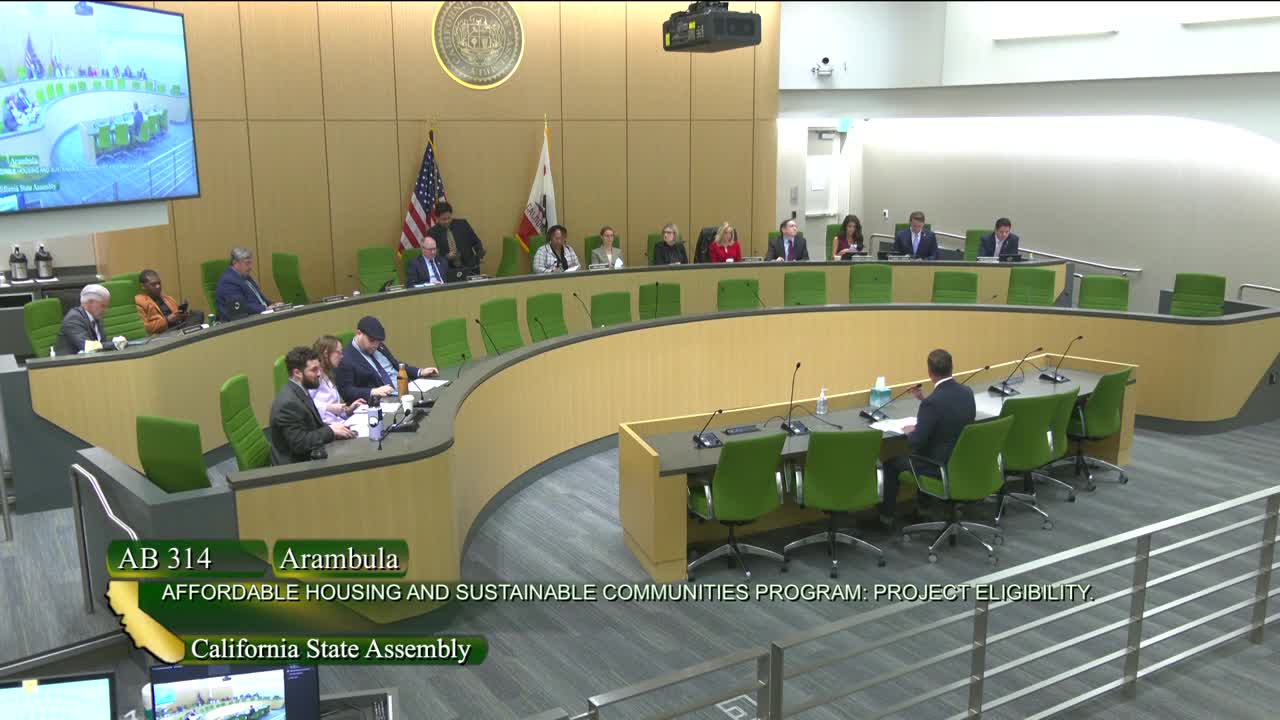 8MIN
Assembly Standing Committee on Transportation
Bill Author

Bill Co-Author(s):