AB 336: Criminal penalties: wildfires.
- Session Year: 2025-2026
- House: Assembly
- Latest Version Date: 2025-01-28
Current Status:
Failed
(2025-04-02: From committee: Without further action pursuant to Joint Rule 62(a).)
Introduced
In Committee
Awaiting First Chamber Vote
Passed First Chamber
In Committee
Awaiting Second Chamber Vote
Passed Second Chamber
Enacted
Existing law prohibits unlawfully causing a fire by recklessly setting fire to, burning, or causing to be burned, any structure, forest land, or property. A violation of this prohibition that causes great bodily injury, that causes an inhabited structure or property to burn, or that causes a fire of a structure or forest land is punishable either as a felony or a misdemeanor.
This bill would make the above-described violations punishable only as a felony including a fine not to exceed $10,000. By increasing the punishment of a crime, this bill would impose a state-mandated local program.
The California Constitution requires the state to reimburse local agencies and school districts for certain costs mandated by the state. Statutory provisions establish procedures for making that reimbursement.
This bill would provide that no reimbursement is required by this act for a specified reason.
A person is guilty of unlawfully causing a fire when they recklessly set fire to, burn, or cause to be burned any structure, forest land, or property.
(a)Unlawfully causing a fire that causes great bodily injury is a felony punishable by imprisonment in the state prison for two, four, or six years, or by imprisonment in the county jail for not more than one year, or by a fine, or by both such imprisonment and fine. and by a fine not to exceed ten thousand dollars ($10,000).
(b)Unlawfully causing a fire that causes an inhabited structure or inhabited property to burn is a felony punishable by imprisonment in the state prison for two, three, or four years, or by imprisonment in the county jail for not more than one year, or by a fine, or by both such imprisonment and fine. and by a fine not to exceed ten thousand dollars ($10,000).
(c)Unlawfully causing a fire of a structure or forest land is a felony punishable by imprisonment in the state prison for 16 months, two or three years, or by imprisonment in the county jail for not more than six months, or by a fine, or by both such imprisonment and fine. and by a fine not to exceed ten thousand dollars ($10,000).
(d)Unlawfully causing a fire of property is a misdemeanor. For purposes of this paragraph, unlawfully causing a fire of property does not include one burning or causing to be burned their own personal property unless there is injury to another person or to another persons structure, forest land, or property.
(e)In the case of any person convicted of violating this section while confined in a state prison, prison road camp, prison forestry camp, or other prison camp or prison farm, or while confined in a county jail while serving a term of imprisonment for a felony or misdemeanor conviction, any sentence imposed shall be consecutive to the sentence for which the person was then confined.
(f)For purposes of sentencing for a violation of this section, the fact that the offense was carried out within a merchants premises in order to facilitate organized retail theft, as defined in Section 490.4, shall be a factor in aggravation.
SEC. 2.No reimbursement is required by this act pursuant to Section 6 of Article XIIIB of the California Constitution because the only costs that may be incurred by a local agency or school district will be incurred because this act creates a new crime or infraction, eliminates a crime or infraction, or changes the penalty for a crime or infraction, within the meaning of Section 17556 of the Government Code, or changes the definition of a crime within the meaning of Section 6 of Article XIIIB of the California Constitution.
|
Date
|
Status
|
|---|---|
| Apr 2, 2025 | From committee: Without further action pursuant to Joint Rule 62(a). |
| Mar 4, 2025 | In committee: Set, first hearing. Failed passage. |
| Feb 10, 2025 | Referred to Com. on PUB. S. |
| Jan 29, 2025 | From printer. May be heard in committee February 28. |
| Jan 28, 2025 | Read first time. To print. |
|
Date
|
Description
|
Location
|
Votes
|
|
|---|---|---|---|---|
| Mar 4, 2025 | Do pass and be re-referred to the Committee on [Appropriations] | Assembly Standing Committee on Public Safety |
Failed |
This list shows positions taken on this bill by organizations on the date displayed, which is linked to the original source.
Positions by individuals are not included.
|
Organization
|
Position
|
Date
|
|---|---|---|
| Aclu California Action | ** Against | |
| Arcadia Police Officers' Association | ** Support | |
| Brea Police Association | ** Support | |
| Burbank Police Officers' Association | ** Support | |
| California Association Of Highway Patrolmen | ** Support | |
| California Association of School Police Chiefs | ** Support | |
| California Coalition of School Safety Professionals | ** Support | |
| California District Attorneys Association | ** Support | |
| California Narcotic Officers' Association | ** Support | |
| Californians United for a Responsible Budget | ** Against | |
| California Police Chiefs Association | ** Support | |
| California Public Defenders Association | ** Against | |
| California Reserve Peace Officers Association | ** Support | |
| CLAREMONT POLICE OFFICERS ASSOCIATION | ** Support | |
| Culver City Police Officers' Association | ** Support | |
| Ella Baker Center For Human Rights | ** Against | |
| Friends Committee On Legislation Of California | ** Against | |
| Fullerton Police Officers' Association | ** Support | |
| Initiate Justice | ** Against | |
| Initiate Justice Action | ** Against | |
| LA Defensa | ** Against | |
| Local 148 La County Public Defenders Union | ** Against | |
| Los Angeles School Police Management Association | ** Support | |
| los angeles school police officers association | ** Support | |
| Murrieta Police Officers' Association | ** Support | |
| Newport Beach Police Association | ** Support | |
| Palos Verdes Police Officers Association | ** Support | |
| Peace Officers Research Association Of California | ** Support | |
| Placer County Deputy Sheriffs' Assocation | ** Support | |
| Pomona Police Officers' Association | ** Support | |
| RIVERSIDE POLICE OFFICERS ASSOCIATION | ** Support | |
| Riverside Sheriffs' Association | ** Support | |
| San Francisco Public Defender | ** Against | |
| Santa Ana Police Officers Association | ** Support | |
| Smart Justice California, a project of Tides Advocacy | ** Against | |
| Vera Institute Of Justice | ** Against |
Date of Hearing: March 4, 2025
Counsel: Dustin Weber
ASSEMBLY COMMITTEE ON
Nick Schultz, Chair
ABPCA Bill Id:
Author:() – As Ver:
SUMMARY:
Changes the penalty for causing a fire by recklessly setting fire to, burning, or causing to be burned, any structure, forest land, or property from an alternate misdemeanor/felony to a straight felony. Specifically, this bill:
- Makes unlawfully causing a fire that causes great bodily injury a straight felony punishable in state prison for two, four, or six years, rather than an alternate misdemeanor/felony.
- Makes unlawfully causing a fire of a structure or forestland a straight felony punishable in state prison for 16 months, two years, or three years, rather than an alternate misdemeanor/felony.
- Requires a fine of up to $10,000 for the crimes above and for unlawfully causing a fire that causes an inhabited structure or property to burn, eliminating the fine of up to $1,000 previously available for a misdemeanor for unlawfully causing a fire.
EXISTING LAW:
- Defines unlawfully causing a fire as recklessly setting fire to, burning, or causing to be burned any structure, forest land, or property. (Pen. Code, § 452).
- Provides that unlawfully causing a fire that causes great bodily injury is a felony punishable by imprisonment in the state prison for two, four, or six years, or by imprisonment in the county jail for not more than one year, or by a fine, or by both such imprisonment and fine. (Pen. Code, § 452, subd. (a).)
- Provides that unlawfully causing a fire that causes an inhabited structure or inhabited property to burn is a felony punishable by imprisonment in the state prison for two, three, or four years, or by imprisonment in the county jail for not more than one year, or by a fine, or by both such imprisonment and fine. (Pen. Code, § 452, subd. (b).)
- Provides that unlawfully causing a fire of a structure or forest land is a felony punishable by imprisonment in the state prison for 16 months, two or three years, or by imprisonment in the county jail for not more than six months, or by a fine, or by both such imprisonment and fine. (Pen. Code, § 452, subd. (c).)
- Provides that unlawfully causing a fire of property is a misdemeanor, not including someone burning or causing to be burned their own personal property unless there is injury to another person or to another person’s structure, forest land, or property. (Pen. Code, § 452, subd. (d).)
- Authorizes a one-, two-, or three-year enhancement for unlawfully causing a fire if the defendant has a prior conviction for arson or unlawfully causing a fire; a specified first responder suffered great bodily injury as a result of the offense; or the defendant proximately caused either great bodily injury to more than one victim or multiple structures to burn. (Pen. Code, § 452.1, subd. (a)(1)-(4).)
- Defines arson as willfully and maliciously setting fire to or burning or causing to be burned or aiding, counseling, or procuring the burning of, any structure, forest land, or property. (Pen. Code, § 451).
- Makes arson that causes great bodily injury a felony punishable by imprisonment in state prison for five, seven, or nine years. (Pen. Code, § 451, subd. (a).)
- Requires imprisonment in state prison for five, seven, or nine years for every person who commits arson or unlawfully causes a fire during state of emergency. (Pen. Code, § 454, subds. (a)(2) & (b).)
- Defines “maliciously” as importing a wish to vex, defraud, annoy, or injure another person, or an intent to do a wrongful act. (Pen. Code, § 450, subd. (e).)
- Defines “recklessly” as being aware of and consciously disregarding a substantial and unjustifiable risk that his or her act will set fire to, burn, or cause to burn a structure, forest land, or property. The risk shall be of such nature and degree that disregard thereof constitutes a gross deviation from the standard of conduct that a reasonable person would observe in the situation. (Pen. Code, § 450, subd. (f).)
- Authorizes the court to impose a fine upon conviction for any crime punishable by imprisonment in county jail or state prison, where no fine is prescribed, of up to $1,000 for misdemeanors or $10,000 for felonies. (Pen. Code, § 672.)
FISCAL EFFECT:
Unknown
COMMENTS:
- Author’s Statement: According to the author, “Reckless burning is a serious threat to our communities, especially when we consider the 2 million acres of land in California classified as high or very high fire risk. With so many areas vulnerable to wildfires, we cannot afford to let negligence slide by. Small acts of recklessness can lead to catastrophic consequences, as we've seen time and time again. We need to close the loophole that allows these offenses to be treated as misdemeanors. It's crucial to hold those responsible accountable [sic] to protect our communities, stop the cycle of burning and rebuilding, and ensure that we don’t repeat the same devastating losses year after year. Bills like AB 336 are key to this effort, and we must act now to safeguard lives and property.”
- Effect of the Bill: This bill would change the punishment for recklessly setting fire to, burning, or causing to be burned, any structure, forestland, or property from an alternate misdemeanor/felony to a straight felony and require payment of a fine up to $10,000.
Like the penalties for arson (Pen. Code, § 451), this bill would require felony penalties for recklessly and unlawfully causing fires. Unlike arson, however, this bill would require imposition of a substantial fine in conjunction with incarceration. As a result, this bill would require imposition of nearly identical and sometimes greater penalties for two distinct crimes – arson and recklessly causing a fire.
Delineating between different criminal acts and assigning proportionate punishment for those distinct acts is a foundational responsibility of representative legislative bodies. Thomas Jefferson wrote, “[I]t becomes a duty in the legislature to arrange in a proper scale the crimes which it may be necessary for them to repress, and to adjust thereto a corresponding gradation of punishments.”[1]
This legislative responsibility is arguably frustrated where imposition of the maximum penalty under this bill would be 6 years’ incarceration and a $10,000 fine for the lesser offense of unlawfully causing a fire, while the minimum penalty for the greater offense of arson is 5 years’ imprisonment. As our Supreme Court stated, it is a fact “that reckless burning is a lesser offense of arson.” (People v. Atkins (2001) 25 Cal.4th 76, 88.) The statutes themselves make clear the difference in these crimes by including separate definitions for malicious and reckless. (Pen. Code, § 450, subds. (e) & (f).)
The court in Atkins went on to state,
Arson's . . . willful and malice requirement ensures that the setting of the fire must be a deliberate and intentional act, as distinguished from an accidental or unintentional ignition or act of setting a fire. On the other hand, the offense of unlawfully causing a fire covers reckless accidents or unintentional fires, which, by definition, is committed by a person who is ‘aware of and consciously disregards a substantial and unjustifiable risk that his or her act will set fire to, burn, or cause to burn a structure, forest land, or property.’ For example, such reckless accidents or unintentional fires may include those caused by a person who recklessly lights a match near highly combustible materials.” (Atkins, supra, 25 Cal.4th 76, 88-89.)
Under this bill, the person in the court’s example who carelessly lights a match near highly combustible materials could be punished more severely than a person who calculatedly sets fire to those same combustible materials intending to produce widespread destruction.
- Incongruent Penalties for Arson and Unlawfully Causing a Fire: Penalties in this statutory scheme are already significant. Possession of a flammable or combustible substance with an intent to commit arson is an alternate misdemeanor/felony. (Pen. Code, § 453, subd. (a).) One- to three-year enhancements are available for unlawfully causing a fire, for example, with a prior conviction for arson or unlawfully causing a fire that results in great bodily injury. (Pen. Code, § 452.1, subds. (a)(1) & (2).) Unlawfully causing a fire under a state of emergency authorizes incarceration of five, seven, or nine years in state prison. (Pen. Code, § 454, subd. (a)(2).)
This bill also appears to make inconsistent and perplexing changes to the statute. Under current law, the three crimes modified in this bill are all alternate felony/misdemeanors. This bill would make two of them straight felonies and retain the alternate felony/misdemeanor for one of them. Yet, the bill punishes all three crimes with the same fine. The reason for the incongruent penalties, but the same fines, for these crimes is unclear.
More confusingly still, this bill retains the alternate felony/misdemeanor for a crime that carries a higher maximum state prison sentence than one of the crimes for which the alternate felony/misdemeanor was eliminated. Again, no clear reason for this difference has been provided.
- Impact of Increased Penalties on Criminal Deterrence: This bill would increase prison lengths and require fines.
It is unclear whether increasing penalties has a deterrent effect. There is reliable evidence showing increased penalties generally fails to deter criminal behavior.[2] Data shows greater deterrent effects as the likelihood of being caught and the perception that one will get caught rises.[3] In contrast, the act of punishment and the length of punishment largely do not increase deterrence.[4]
Criminal fines and the collection of those fines is commonly misunderstood. The breakdown and supporting information below is illustrative.
Example: Penalty assessments and fees on a base fine of $1,000:
Pen. Code, § 1464 state penalty on fines: 1,000 ($10 for every $10)
Pen. Code, § 1465.7 state surcharge: 200 (20% surcharge)
Pen. Code, § 1465.8 court operation assessment: 40 ($40 fee per criminal offense)
Gov. Code, § 70372 court construction penalty: 500 ($5 for every $10)
Gov. Code, § 70373 assessment: 30 ($30 for felony or misdemeanor)
Gov. Code, § 76000 penalty: 700 ($7 for every $10)
Gov. Code, § 76000.5 EMS penalty: 200 ($2 for every $10)
Gov. Code, § 76104.6 DNA fund penalty: 100 ($1 for every $10)
Gov. Code, § 76104.7 additional DNA fund penalty:400 ($4 for every $10)
Total Fine with Assessments: $4,170
Thus, imposing the maximum fine under this bill along with the associated fines and fees amounts to approximately $41,700, which would eat up more than 50% of a US family’s median household income.[5] Criminal fines rapidly balloon into unpayable amounts for most of the population, which then create significant downstream economic consequences for impacted individuals and society. Unsurprisingly, the judicial branch reported that $8.6 billion in fines and fees remained unpaid at the end of 2019-20.[6]
With evidence also showing that increasing criminal fines increases felony recidivism, specifically among a population that historically has faced inexplicably disproportionate punishment in the criminal justice system,[7] it remains questionable whether increasing criminal punishment, as this bill does, would produce the desired impact.
- Reducing Discretion and the Costs of Incarceration: This bill would require charging felonies and imposing fines for recklessly causing a fire. Rather than retaining the option for prosecutors to charge either a misdemeanor or felony for unlawfully causing a fire, this bill would require felony charges, except in one case. The effect of this mandate, among other things, would reduce prosecutorial and judicial discretion. Reducing the discretion of judges and prosecutors in these cases would eliminate their abilities to make certain critical decisions based on the unique context of each case. The freedom to make these vital decisions potentially has important public safety implications.
The alternate misdemeanor/felony, also known as a “wobbler”, gives prosecutors and judges a measure of discretion in case dispositions. A “wobbler” is a crime that can charged as, and result in a conviction for, a felony or a misdemeanor. A district attorney has the discretion to charge a “wobbler” as a felony or a misdemeanor. If a defendant is charged with a felony for a crime that is a “wobbler” a judge has discretion, under certain circumstances, to reduce the charge to a misdemeanor, or sentence the defendant as a misdemeanor.
More people sentenced to state prison for longer terms of confinement means larger prison populations. In 2011, the U.S. Supreme Court ordered California to reduce its prison population because of overcrowding. (Brown, et al. v. Plata, et al. (2011) 463 U.S. 593.) The costs of incarcerating a person have also risen dramatically in recent years—from $91,000 per person in 2019 to $133,000 per person in 2024.[8] Therefore, one might reasonably question whether removing the discretion of prosecutors and judges to charge or sentence defendants for misdemeanors in appropriate cases is sound public policy.
- Argument in Support: According to the California District Attorneys Association, “Wildfires pose a severe and increasing threat to California communities, endangering lives, destroying homes, and causing billions of dollars in damage. Existing law allows for misdemeanor punishments in certain cases of recklessly causing a fire, even when it results in great bodily injury or the destruction of inhabited structures. AB 336 appropriately increases accountability by classifying these crimes as straight felonies, ensuring that individuals who recklessly cause catastrophic wildfires face meaningful consequences. The proposed legislation aligns with California’s commitment to public safety and wildfire prevention. By deterring reckless behavior that leads to devastating wildfires, AB 336 will help protect our residents, first responders, and natural resources.”
- Argument in Opposition: According to the California Public Defenders Association, “Many criminal offenses, known as ‘wobblers,’ can be charged as misdemeanors or felonies, depending on the seriousness of the offense. The conduct underlying these cases encompasses a range of seriousness and criminal culpability. Allowing such conduct to be charged and convicted as a misdemeanor or felony gives discretion to the prosecution and judges to ensure that the seriousness of the crime is appropriately reflected in the charges and punishment. It is a means to achieve just results.
“For example, prosecutorial and judicial discretion are essential to distinguish teenagers who are setting off fireworks on the 4th of July who cause a fire from a mentally sound adult who has been warned by the park ranger about the high fire conditions and then leaves their campfire unattended allowing it to destroy the forest.
“More serious conduct involving unlawfully causing a fire already has more serious punishments. The conduct AB 336 seeks to address should remain as a wobbler to provide prosecutors and judges the discretion appropriate to achieve just outcomes.”
- Related Legislation: AB 297 (Hadwick), would authorize punishment with a three-, four-, or five-year enhancement for a person who proximately caused 500 or more acres of forestland to burn. AB 297 is scheduled to be heard in this committee today.
- Prior Legislation:
- SB 1242 (Min), Chapter 173, Statutes of 2024, provides that for the crime of reckless fire setting, if the offense was carried out within a merchant’s premises in order to facilitate organized retail theft, it shall be a factor in aggravation at sentencing.
- SB 281 (McGuire), Chapter 706, Statutes of 2023, increases the dollar amount of property damages and other losses required to be an aggravating factor to $10,100,000, exclusive of damage to, or destruction of, inhabited dwellings and extend the operation of the former aggravated arson offense until January 1, 2029.
- SB 177 (Nielsen), of the 2019-2020 Legislative Session, would have made technical changes to Pen. Code § 451, relating to arson. SB 177 was not heard in policy committee and subsequently returned to the Senate desk.
REGISTERED SUPPORT / OPPOSITION:
Support
Arcadia Police Officers' Association
Brea Police Association
Burbank Police Officers' Association
California Association of Highway Patrolmen
California Association of School Police Chiefs
California Coalition of School Safety Professionals
California District Attorneys Association
California Narcotic Officers' Association
California Police Chiefs Association
California Reserve Peace Officers Association
Claremont Police Officers Association
Culver City Police Officers' Association
Fullerton Police Officers' Association
Los Angeles School Police Management Association
Los Angeles School Police Officers Association
Murrieta Police Officers' Association
Newport Beach Police Association
Palos Verdes Police Officers Association
Peace Officers Research Association of California (PORAC)
Placer County Deputy Sheriffs' Assocation
Pomona Police Officers' Association
Riverside Police Officers Association
Riverside Sheriffs' Association
Santa Ana Police Officers Association
Oppose
ACLU California Action
California Public Defenders Association (CPDA)
Californians United for A Responsible Budget
Ella Baker Center for Human Rights
Friends Committee on Legislation of California
Initiate Justice
Initiate Justice Action
LA Defensa
Local 148 LA County Public Defenders Union
San Francisco Public Defender
Smart Justice California, a Project of Tides Advocacy
Vera Institute of Justice
Analysis Prepared by:
Thomas Jefferson, “64. A Bill for Proportioning Crimes and Punishments in Cases Heretofore Capital” (June 18, 1779) <https://founders.archives.gov/documents/Jefferson/01-02-02-0132-0004-0064#TSJN-01-02-0206-fn-0001.> [as of Feb. 25, 2025]. ↑
Five Things About Deterrence (May 2016) National Institute of Justice <https://www.ojp.gov/pdffiles1/nij/247350.pdf> [as of Feb. 25, 2025]. ↑
Ibid. ↑
Ibid. ↑
Median Household Income by County in the US (Sept. 2024) U.S. Census Bureau <https://www.census.gov/library/visualizations/interactive/median-household-income.html> [as of Feb. 25, 2025]. ↑
Overview of Criminal Fine and Fee System (May 13, 2021) Legislative Analyst’s Office <https://lao.ca.gov/Publications/Detail/4427> [as of Feb. 25, 2025]. ↑
One recent study has shown that the increase in fines levied for criminal punishment increased the likelihood of felony recidivism, especially among Black defendants. Giles, The Government Revenue, Recidivism, and Financial Health Effects of Criminal Fines and Fees (Sept. 9, 2023) Wellesley College <http://dx.doi.org/10.2139/ssrn.4568724> [as of Feb. 25, 2025]. ↑
Harris, et al., California’s Prison Population (Sept. 2024) Public Policy Institute of California <https://www.ppic.org/publication/californias-prison-population/> [as of Feb. 27, 2025]. ↑
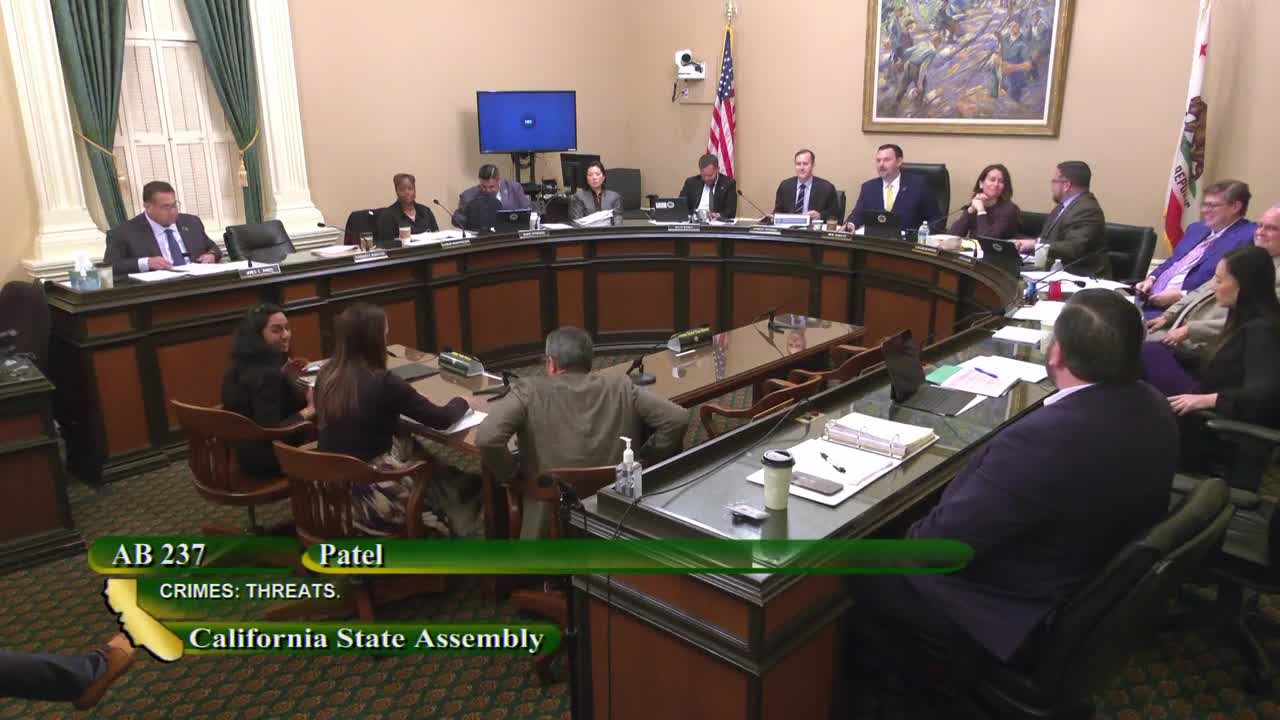
Discussed in Hearing
 15MIN
Assembly Standing Committee on Public Safety
Bill Author