AB 352: Crimes: criminal threats.
- Session Year: 2025-2026
- House: Assembly
- Latest Version Date: 2025-10-10
Current Status:
Passed
(2025-10-10: Chaptered by Secretary of State - Chapter 554, Statutes of 2025.)
Introduced
In Committee
Awaiting First Chamber Vote
Passed First Chamber
In Committee
Awaiting Second Chamber Vote
Passed Second Chamber
Enacted
Existing law makes it a crime to willfully threaten to commit a crime that will result in death or great bodily injury to another person, with the specific intent that the statement is to be taken as a threat that, on its face and under the circumstances in which it is made, is so unequivocal, unconditional, immediate, and specific as to convey to the person threatened a gravity of purpose and an immediate prospect of execution of the threat, and thereby reasonably causes the threatened person to be in sustained fear for their own safety or the safety of their immediate family, as defined. Under existing law, this crime is punishable as a misdemeanor or in state prison as a felony.
This bill would, for the purposes of sentencing for a felony violation of these provisions, authorize the court to consider, as a factor in aggravation, that the defendant willfully threatened to commit a crime that would result in the death or great bodily injury of a person the defendant knew was a state constitutional officer, a Member of the Legislature, or a judge or court commissioner, as specified.
Existing law makes it a crime to willfully threaten to commit a crime that will result in death or great bodily injury to another person, with the specific intent that the statement is to be taken as a threat that, on its face and under the circumstances in which it is made, is so unequivocal, unconditional, immediate, and specific as to convey to the person threatened a gravity of purpose and an immediate prospect of execution of the threat, and thereby reasonably causes the threatened person to be in sustained fear for their own safety or the safety of their immediate family, as defined. Under existing law, this crime is punishable as a misdemeanor or in state prison as a felony.
This bill would, for the purposes of sentencing for a felony violation of these provisions, authorize the court to consider, as a factor in aggravation, that the defendant knowingly and willfully threatened to commit a crime that would result in the death or great bodily injury of a person the defendant knew was a state constitutional officer, a Member of the Legislature, or a judge or court commissioner, as specified.
Existing law makes it a crime to willfully threaten to commit a crime that will result in death or great bodily injury to another person, with the specific intent that the statement is to be taken as a threat that, on its face and under the circumstances in which it is made, is so unequivocal, unconditional, immediate, and specific as to convey to the person threatened a gravity of purpose and an immediate prospect of execution of the threat, and thereby reasonably causes the threatened person to be in sustained fear for their own safety or the safety of their immediate family, as defined. Under existing law, this crime is punishable as a misdemeanor or in state prison as a felony.
This bill would, for the purposes of sentencing for a felony violation of these provisions, authorize the court to consider, as a factor in aggravation, that the defendant knowingly and willfully threatened to commit a crime that would result in the death or great bodily injury of a state constitutional officer, a Member of the Legislature, or a judge or court commissioner, as specified.
Existing law makes it a crime to willfully threaten to commit a crime that will result in death or great bodily injury to another person, with the specific intent that the statement is to be taken as a threat that, on its face and under the circumstances in which it is made, is so unequivocal, unconditional, immediate, and specific as to convey to the person threatened a gravity of purpose and an immediate prospect of execution of the threat, and thereby reasonably causes the threatened person to be in sustained fear for their own safety or the safety of their immediate family, as defined. Under existing law, this crime is punishable as a misdemeanor or in state prison as a felony.
This bill would, for the purposes of sentencing for a felony violation of these provisions, authorize the court to consider, as a factor in aggravation, that the defendant knowingly and willfully threatened to commit a crime that would result in the death or great bodily injury of a judge or court commissioner. commissioner, as specified.
Existing law makes it a crime to willfully threaten to commit a crime that will result in death or great bodily injury to another person, with the specific intent that the statement is to be taken as a threat that, on its face and under the circumstances in which it is made, is so unequivocal, unconditional, immediate, and specific as to convey to the person threatened a gravity of purpose and an immediate prospect of execution of the threat, and thereby reasonably causes the threatened person to be in sustained fear for their own safety or the safety of their immediate family, as defined. Under existing law, this crime is punishable as a misdemeanor or in state prison as a felony.
This bill would, for the purposes of sentencing for a felony violation of these provisions, authorize the court to consider, as a factor in aggravation, that the defendant willfully threatened to commit a crime that would result in the death or great bodily injury of a judge or court commissioner.
Existing law makes it a misdemeanor for a person to picket or parade in or near a building that houses a court of this state with the intent to interfere with, obstruct, or impede the administration of justice or with the intent to influence any judge, juror, witness, or officer of the court in the discharge of their duty.This bill would additionally make it a misdemeanor to picket or parade in or near a building or residence occupied by or used by any judge, juror, witness, or officer of the court with the intent to interfere with, obstruct, or impede the administration of justice or with the intent to influence any judge, juror, witness, or officer of the court in the discharge of their duty. By creating a new crime, the bill would impose a state-mandated local program.The California Constitution requires the state to reimburse local agencies and school districts for certain costs mandated by the state. Statutory provisions establish procedures for making that reimbursement.This bill would provide that no reimbursement is required by this act for a specified reason.Existing law makes it a misdemeanor for a person to picket or parade in or near a building that houses a court of this state with the intent to interfere with, obstruct, or impede the administration of justice or with the intent to influence any judge, juror, witness, or officer of the court in the discharge of their duty.
This bill would additionally make it a misdemeanor to picket or parade in or near a building or residence occupied by or used by any judge, juror, witness, or officer of the court with the intent to interfere with, obstruct, or impede the administration of justice or with the intent to influence any judge, juror, witness, or officer of the court in the discharge of their duty. By creating a new crime, the bill would impose a state-mandated local program.
The California Constitution requires the state to reimburse local agencies and school districts for certain costs mandated by the state. Statutory provisions establish procedures for making that reimbursement.
This bill would provide that no reimbursement is required by this act for a specified reason.
(a)Any person who willfully threatens to commit a crime which will result in death or great bodily injury to another person, with the specific intent that the statement, made verbally, in writing, or by means of an electronic communication device, is to be taken as a threat, even if there is no intent of actually carrying it out, which, on its face and under the circumstances in which it is made, is so unequivocal, unconditional, immediate, and specific as to convey to the person threatened, a gravity of purpose and an immediate prospect of execution of the threat, and thereby causes that person reasonably to be in sustained fear for their own safety or for their immediate familys safety, shall be punished by imprisonment in the county jail not to exceed one year, or by imprisonment in the state prison.
(b)In sentencing a person convicted of a felony violation of subdivision (a), the court may consider, as a factor in aggravation, that the defendant willfully threatened to commit a crime that would result in the death or great bodily injury of a person the defendant knew was a state constitutional officer, a Member of the Legislature, or a judge or court commissioner, as defined in subdivisions (a), (b), (c), (n), and (q) of Section 7920.500 of the Government Code.
(c)(1)For purposes of this section, immediate family means any spouse, whether by marriage or not, parent, child, any person related by consanguinity or affinity within the second degree, or any other person who regularly resides in the household, or who, within the prior six months, regularly resided in the household.
(2)For purposes of this section, electronic communication device includes, but is not limited to, telephones, cellular telephones, computers, video recorders, fax machines, or pagers. Electronic communication has the same meaning as the term is defined in Subsection 12 of Section 2510 of Title 18 of the United States Code.
(a)Any person who willfully threatens to commit a crime which will result in death or great bodily injury to another person, with the specific intent that the statement, made verbally, in writing, or by means of an electronic communication device, is to be taken as a threat, even if there is no intent of actually carrying it out, which, on its face and under the circumstances in which it is made, is so unequivocal, unconditional, immediate, and specific as to convey to the person threatened, a gravity of purpose and an immediate prospect of execution of the threat, and thereby causes that person reasonably to be in sustained fear for their own safety or for their immediate familys safety, shall be punished by imprisonment in the county jail not to exceed one year, or by imprisonment in the state prison.
(b)In sentencing a person convicted of a felony violation of subdivision (a), the court may consider, as a factor in aggravation, that the defendant knowingly and willfully threatened to commit a crime that would result in the death or great bodily injury of a person the defendant knew was a state constitutional officer, a Member of the Legislature, or a judge or court commissioner, as defined in subdivisions (a), (b), (c), (n), and (q) of Section 7920.500 of the Government Code.
(c)(1)For purposes of this section, immediate family means any spouse, whether by marriage or not, parent, child, any person related by consanguinity or affinity within the second degree, or any other person who regularly resides in the household, or who, within the prior six months, regularly resided in the household.
(2)For purposes of this section, electronic communication device includes, but is not limited to, telephones, cellular telephones, computers, video recorders, fax machines, or pagers. Electronic communication has the same meaning as the term is defined in Subsection 12 of Section 2510 of Title 18 of the United States Code.
(a)Any person who willfully threatens to commit a crime which will result in death or great bodily injury to another person, with the specific intent that the statement, made verbally, in writing, or by means of an electronic communication device, is to be taken as a threat, even if there is no intent of actually carrying it out, which, on its face and under the circumstances in which it is made, is so unequivocal, unconditional, immediate, and specific as to convey to the person threatened, a gravity of purpose and an immediate prospect of execution of the threat, and thereby causes that person reasonably to be in sustained fear for their own safety or for their immediate familys safety, shall be punished by imprisonment in the county jail not to exceed one year, or by imprisonment in the state prison.
(b)(1)In sentencing a person convicted of a felony violation of subdivision (a), the court may consider, as a factor in aggravation, that the defendant knowingly and willfully threatened to commit a crime that would result in the death or great bodily injury of a state constitutional officer, a Member of the Legislature, or a judge or court commissioner, as defined in subdivisions (a), (b), (c), (n), and (q) of Section 7920.500 of the Government Code.
(2)In sentencing a person convicted of a felony violation pursuant to subdivision (a), the court shall only consider the circumstances in paragraph (1) as a factor in aggravation if the defendant knew at the time of the threat, that they were threatening a judge or court commissioner, as defined in subdivisions (c), (n), and (q) of Section 7920.500 of the Government Code.(c)(1)For purposes of this section, immediate family means any spouse, whether by marriage or not, parent, child, any person related by consanguinity or affinity within the second degree, or any other person who regularly resides in the household, or who, within the prior six months, regularly resided in the household.
(2)For purposes of this section, electronic communication device includes, but is not limited to, telephones, cellular telephones, computers, video recorders, fax machines, or pagers. Electronic communication has the same meaning as the term defined in Subsection 12 of Section 2510 of Title 18 of the United States Code.
(a)Any person who willfully threatens to commit a crime which will result in death or great bodily injury to another person, with the specific intent that the statement, made verbally, in writing, or by means of an electronic communication device, is to be taken as a threat, even if there is no intent of actually carrying it out, which, on its face and under the circumstances in which it is made, is so unequivocal, unconditional, immediate, and specific as to convey to the person threatened, a gravity of purpose and an immediate prospect of execution of the threat, and thereby causes that person reasonably to be in sustained fear for their own safety or for their immediate familys safety, shall be punished by imprisonment in the county jail not to exceed one year, or by imprisonment in the state prison.
(b)(1)In sentencing a person convicted of a felony violation of subdivision (a), the court may consider, as a factor in aggravation, that the defendant willfully threatened to commit a crime that would result in the death or great bodily injury of a judge or court commissioner, as defined in subdivisions (c), (n), and (q) of Section 7920.500 of the Government Code.
(2)In sentencing a person convicted of a felony violation pursuant to subdivision (a), the court shall only consider the circumstances in paragraph (1) as a factor in aggravation if the defendant knew at the time of the threat, that they were threatening a judge or court commissioner, as defined in subdivisions (c), (n), and (q) of Section 7920.500 of the Government Code.
(c)(1)For purposes of this section, immediate family means any spouse, whether by marriage or not, parent, child, any person related by consanguinity or affinity within the second degree, or any other person who regularly resides in the household, or who, within the prior six months, regularly resided in the household.
(2)For purposes of this section, electronic communication device includes, but is not limited to, telephones, cellular telephones, computers, video recorders, fax machines, or pagers. Electronic communication has the same meaning as the term defined in Subsection 12 of Section 2510 of Title 18 of the United States Code.
(a)Any person who willfully threatens to commit a crime which will result in death or great bodily injury to another person, with the specific intent that the statement, made verbally, in writing, or by means of an electronic communication device, is to be taken as a threat, even if there is no intent of actually carrying it out, which, on its face and under the circumstances in which it is made, is so unequivocal, unconditional, immediate, and specific as to convey to the person threatened, a gravity of purpose and an immediate prospect of execution of the threat, and thereby causes that person reasonably to be in sustained fear for his or her their own safety or for his or her their immediate familys safety, shall be punished by imprisonment in the county jail not to exceed one year, or by imprisonment in the state prison.
(b)In sentencing a person convicted of a felony violation of subdivision (a), the court may consider, as a factor in aggravation, that the defendant willfully threatened to commit a crime that would result in the death or great bodily injury of a judge or court commissioner, as defined in subdivisions (c), (n), and (q) of Section 7920.500 of the Government Code.
(b)(c)(1)For purposes of this section, immediate family means any spouse, whether by marriage or not, parent, child, any person related by consanguinity or affinity within the second degree, or any other person who regularly resides in the household, or who, within the prior six months, regularly resided in the household.
(c)Electronic(2)For purposes of this section, electronic communication device includes, but is not limited to, telephones, cellular telephones, computers, video recorders, fax machines, or pagers. Electronic communication has the same meaning as the term defined in Subsection 12 of Section 2510 of Title 18 of the United States Code.
SECTION 1.Section 169 of the Penal Code is amended to read:169.A person who pickets or parades in or near a building that houses a court of this state, or in or near a building or residence occupied by or used by any judge, juror, witness, or officer of the court, with the intent to interfere with, obstruct, or impede the administration of justice or with the intent to influence any judge, juror, witness, or officer of the court in the discharge of their duty is guilty of a misdemeanor.SEC. 2.No reimbursement is required by this act pursuant to Section 6 of Article XIIIB of the California Constitution because the only costs that may be incurred by a local agency or school district will be incurred because this act creates a new crime or infraction, eliminates a crime or infraction, or changes the penalty for a crime or infraction, within the meaning of Section 17556 of the Government Code, or changes the definition of a crime within the meaning of Section 6 of Article XIIIB of the California Constitution.Any A person who pickets or parades in or near a building which that houses a court of this state state, or in or near a building or residence occupied by or used by any judge, juror, witness, or officer of the court, with the intent to interfere with, obstruct, or impede the administration of justice or with the intent to influence any judge, juror, witness, or officer of the court in the discharge of his their duty is guilty of a misdemeanor.
SEC. 2.No reimbursement is required by this act pursuant to Section 6 of Article XIIIB of the California Constitution because the only costs that may be incurred by a local agency or school district will be incurred because this act creates a new crime or infraction, eliminates a crime or infraction, or changes the penalty for a crime or infraction, within the meaning of Section 17556 of the Government Code, or changes the definition of a crime within the meaning of Section 6 of Article XIIIB of the California Constitution.
|
Date
|
Status
|
|---|---|
| Oct 10, 2025 | Chaptered by Secretary of State - Chapter 554, Statutes of 2025. |
| Oct 10, 2025 | Approved by the Governor. |
| Sep 15, 2025 | Enrolled and presented to the Governor at 4:30 p.m. |
| Sep 8, 2025 | Senate amendments concurred in. To Engrossing and Enrolling. (Ayes 75. Noes 0. Page 3025.). |
| Sep 4, 2025 | In Assembly. Concurrence in Senate amendments pending. |
| Sep 4, 2025 | Read third time. Passed. Ordered to the Assembly. (Ayes 39. Noes 0. Page 2519.). |
| Sep 2, 2025 | Read second time. Ordered to third reading. |
| Aug 29, 2025 | Read second time and amended. Ordered returned to second reading. |
| Aug 29, 2025 | From committee: Amend, and do pass as amended. (Ayes 7. Noes 0.) (August 29). |
| Jul 7, 2025 | In committee: Referred to APPR. suspense file. |
| Jun 25, 2025 | Read second time and amended. Re-referred to Com. on APPR. |
| Jun 24, 2025 | From committee: Amend, and do pass as amended and re-refer to Com. on APPR. with recommendation: To Consent Calendar. (Ayes 6. Noes 0.) (June 24). |
| Jun 12, 2025 | From committee chair, with author's amendments: Amend, and re-refer to committee. Read second time, amended, and re-referred to Com. on PUB. S. |
| Jun 11, 2025 | Referred to Com. on PUB. S. |
| Jun 3, 2025 | In Senate. Read first time. To Com. on RLS. for assignment. |
| Jun 2, 2025 | Read third time. Passed. Ordered to the Senate. (Ayes 77. Noes 0. Page 1821.) |
| May 27, 2025 | Read second time. Ordered to third reading. |
| May 23, 2025 | From committee: Do pass. (Ayes 14. Noes 0.) (May 23). |
| Apr 9, 2025 | In committee: Set, first hearing. Referred to APPR. suspense file. |
| Mar 26, 2025 | From committee: Do pass and re-refer to Com. on APPR. (Ayes 9. Noes 0.) (March 25). Re-referred to Com. on APPR. |
| Mar 18, 2025 | Re-referred to Com. on PUB. S. |
| Mar 17, 2025 | From committee chair, with author's amendments: Amend, and re-refer to Com. on PUB. S. Read second time and amended. |
| Mar 5, 2025 | In committee: Set, second hearing. Hearing canceled at the request of author. |
| Mar 4, 2025 | In committee: Set, first hearing. Hearing canceled at the request of author. |
| Feb 10, 2025 | Referred to Com. on PUB. S. |
| Jan 31, 2025 | From printer. May be heard in committee March 2. |
| Jan 30, 2025 | Read first time. To print. |
|
Date
|
Description
|
Location
|
Votes
|
|
|---|---|---|---|---|
| Sep 8, 2025 | AB 352 Pacheco Concurrence in Senate Amendments | Assembly Floor |
Passed |
|
| Sep 4, 2025 | Assembly 3rd Reading AB352 Pacheco By Ashby | Senate Floor |
Passed |
|
| Aug 29, 2025 | Do pass as amended | Senate Standing Committee on Appropriations |
Passed |
|
| Jul 7, 2025 | Placed on suspense file | Senate Standing Committee on Appropriations |
Passed |
|
| Jun 24, 2025 | Do pass as amended, but first amend, and re-refer to the Committee on [Appropriations] with the recommendation: To Consent Calendar | Senate Standing Committee on Public Safety |
Passed |
|
| Jun 2, 2025 | AB 352 Pacheco Assembly Third Reading | Assembly Floor |
Passed |
|
| May 23, 2025 | Do pass. | Assembly Standing Committee on Appropriations |
Passed |
|
| Mar 25, 2025 | Do pass and be re-referred to the Committee on [Appropriations] | Assembly Standing Committee on Public Safety |
Passed |
This list shows positions taken on this bill by organizations on the date displayed, which is linked to the original source.
Positions by individuals are not included.
|
Organization
|
Position
|
Date
|
|---|---|---|
| Aclu California Action | ** Against | |
| Arcadia Police Officers' Association | ** Support | |
| Brea Police Association | ** Support | |
| Burbank Police Officers' Association | ** Support | |
| California Association of School Police Chiefs | ** Support | |
| California Civil Liberties Advocacy | ** Support | |
| California Coalition of School Safety Professionals | ** Support | |
| California Department of Justice | ** Support | |
| California District Attorneys Association | ** Support | |
| California Judges Association | ** Support | |
| California Narcotic Officers' Association | ** Support | |
| Californians United for a Responsible Budget | ** Against | |
| California Reserve Peace Officers Association | ** Support | |
| CLAREMONT POLICE OFFICERS ASSOCIATION | ** Support | |
| Corona Police Officers Association | ** Support | |
| Culver City Police Officers' Association | ** Support | |
| Felony Murder Elimination Project | ** Against | |
| Fullerton Police Officers' Association | ** Support | |
| Initiate Justice | ** Against | |
| Legal Services for Prisoners with Children | ** Against | |
| Los Angeles School Police Management Association | ** Support | |
| los angeles school police officers association | ** Support | |
| Murrieta Police Officers' Association | ** Support | |
| Newport Beach Police Association | ** Support | |
| Palos Verdes Police Officers Association | ** Support | |
| PLACER COUNTY DEPUTY SHERIFFS ASSOCIATION | ** Support | |
| Pomona Police Officers' Association | ** Support | |
| RIVERSIDE POLICE OFFICERS ASSOCIATION | ** Support | |
| Riverside Sheriffs' Association | ** Support | |
| Universidad Popular | ** Against |
CONCURRENCE IN SENATE AMENDMENTS
CSA1 Bill Id:AB 352
Author:(Pacheco)
As Amended Ver:August 29, 2025
Majority vote
SUMMARY
Authorizes a court, in sentencing a person for willfully making criminal threats, against a judge, commissioner, state constitutional officer, or Member of the Legislature, as specified, to consider that fact as a factor in aggravation.
Senate Amendments
- Authorizes a court to sentence a defendant convicted of felony criminal threats toward state constitutional officers and Members of the Legislature, as well as judges and commissioners.
- States a defendant must willfully threaten a person they know to be a judge, commissioner, state constitutional officer, or Member of the Legislature, as specified, for a court to consider the threat as a factor in aggravation.
COMMENTS
As passed by the Assembly: This bill authorized a court, in sentencing a person for making criminal threats, against a judge or commissioner, as specified, as a factor in aggravation.
According to the Author
"Rising threats and violence against California's judiciary endanger both court commissioner and litigant access to justice. Recent incidents include courthouse bomb threats, courtroom attacks on judges, and targeted threats against judicial officers across the state.
"AB 352 addresses this problem by adding a subdivision to Penal Code Section 422 to make threats against judges and court commissioners a factor in sentencing. This change enables the courts to impose the maximum three-year sentence for felony criminal threats when appropriate, providing necessary protection for judicial officers while maintaining sentencing discretion. This targeted approach helps to ensure that all Californians maintain safe access to justice.
"Judges play an essential role in upholding the rule of law, making impartial decisions, and ensuring justice is served. However, in recent years, there has been a sharp increase in threats and violence against judicial officers, which undermines the integrity of the legal system and those seeking justice within courthouses. According to the U.S. Marshals Service, between 2021 and 2022, federal judges faced nearly 6,000 threats and inappropriate communications. Similarly, a 2020 National Judicial College Survey revealed that most judges feared for their safety and believed more protections were necessary. These threats are not just theoretical; they pose real dangers that can disrupt judicial proceedings and the safety of each judicial officer and their families.
"Several high-profile incidents highlight the severity of the problem. In California, an explosive device detonated at the Santa Maria Superior Courthouse led to a series of threats and evacuations at other state courthouses, demonstrating the persistent danger faced by judicial officers. Likewise, the tragic murder of Judge Esther Salas' son in New Jersey underscored the need for enhanced protections, as the perpetrator was able to locate the judge's home address through public records. In response to such threats, states and the federal government have taken steps to bolster judicial security, such as passing the federal Daniel Anderl Judicial Security and Privacy Act to protect judges' personal information.
"California Penal Code 422 makes it a crime to make criminal threats against another person, regardless of the person's official capacity. However, if the threaten person is a judicial officer seeking to execute their official duties, the law treats these actions no different than any other criminal threat. AB 352 proposes to provide that if a defendant is convicted of making such criminal threats against a judge or commissioner, then that is a factor in aggravation that the court can consider. This enables for the possibility of the maximum sentence of three years under Penal Code 422 to be imposed when an individual is convicted of a felony criminal threat. This is necessary to prevent attempts to intimidate or retaliate against judicial officers and to reinforce the safety needs for members of the judiciary. Adding a factor in aggravation helps to strengthen the law for judicial officers, thus ensuring they can carry out their duties without fear of their safety."
Arguments in Support
According to the California Judges Association: "Nationwide elected and appointed officials face rising threats and violence against themselves and their family members. According to the U.S. Marshals Service, the entity in charge of protecting federal judges, they assessed 5,873 threats and inappropriate communications against the judiciary between 2021 and 2022. A 2020 National Judicial College Survey of 572 judges found a majority of judges feared for their safety and believed more effective measures should be taken to protect them. Additionally, state court facilities have recently been targeted nationwide by bomb threats, while state Supreme Court justices handling controversial cases experience rising incidents of threats and intimidation.
"Unfortunately, the recent assassination of a Kentucky district judge in his own chamber, the attempted murder of a Nevada district judge, and the violent threats made towards judicial officers and their family members highlight the continued need to provide safeguards for the judiciary. AB 352 recognizes this need for additional safeguards by potentially heightening the sentence for criminal threats when those threats are made against judicial officers.
"Presently, Penal Code Section 422 provides that any person who willfully threatens to commit a crime which will result in death or great bodily injury with the specific intent that the statement – made verbally, in writing or electronically – is to be taken as a threat. PC 422 applies regardless if the threat is intended to actually be carried out, so long as the threat is so unequivocal, unconditional, immediate, and specific as to convey to the threaten person to cause them to reasonably be in sustained fear for their own safety. Specifically, AB 352 adds a new subdivision outlining that threats made against judicial officers is a factor in aggravation when determining the defendant's sentencing under PC 422. We believe this change is warranted and needed to help to address this increased level of unprecedented violence aimed at judicial officers."
Arguments in Opposition
According to ACLU California Action: While ensuring that the safety of judges and court commissioners is of the utmost importance, we do not believe this bill is necessary to accomplish that goal. Current law, Penal Code Section 422, makes it a felony to willfully threaten to commit a crime which will result in death or great bodily injury to another person, with the specific intent that the statement is to be taken as a threat, even if there is no intent of carrying the threat out.
"This law punishes criminal threats in all settings, directed at any person. Research shows that allowing threats against judges to be an aggravating factor leading to longer sentences will not improve public safety.
- Even the federal Department of Justice discourages AB 352's approach of increased punishments, noting that longer sentencing schemes do little to deter crime.
- Moreover, we caution against expanding Section 422 because the existing law's enforcement is often problematic. Penal Code Section 422 is often misused to penalize conduct that does not truly belong in the criminal justice system.
"Penal Code section 422, like AB 352, does not require that the person making the threat have either the intent or the ability to carry it out, or that the person take any action to carry out the threat. Defendants – often young people, or individuals with mental health issues – face criminal punishment for mere words even when they have no intent to take any action. This is particularly true for those with mental health conditions, who often suffer from crippling paranoia and delusions. The fear they experience can lead them to say things that are easily misinterpreted as threats. Creating harsher penalties under this statute will not address the underlying issue."
FISCAL COMMENTS
According to the Senate Appropriations Committee:
- Trial Courts: Unknown, potentially significant costs to the state funded trial court system (Trial Court Trust Fund, General Fund) to adjudicate the increased criminal penalties in this bill. Defendants are constitutionally guaranteed certain rights during criminal proceedings, including the right to a jury trial and the right to counsel (at public expense if the defendants are unable to afford the costs of representation). The Sixth Amendment right to a jury trial applies to any factual finding necessary to warrant any sentence beyond the presumptive maximum – e.g., a factor in aggravation.[1] Increasing penalties leads to lengthier and more complex court proceedings with attendant workload and resource costs to the court. The fiscal impact of this bill to the courts will depend on many unknowns, including the numbers of people charged with an offense and the factors unique to each case. An eight-hour court day costs approximately $10,500 in staff in workload. This is a conservative estimate, based on the hourly rate of court personnel including at minimum the judge, clerk, bailiff, court reporter, jury administrator, administrative staff, and jury per-diems. If court days exceed 10, costs to the trial courts could reach hundreds of thousands of dollars. While the courts are not funded on a workload basis, an increase in workload could result in delayed court services and would put pressure on the General Fund to fund additional staff and resources and to increase the amount appropriated to backfill for trial court operations.
- County Jail: Unknown, potentially significant costs (local funds) to the counties to incarcerate people for a longer period under this bill. The average annual cost to incarcerate one person in county jail varies by county, but likely ranges from $70,000 to $90,000 per year. For example, in 2021, Los Angeles County budgeted $1.3 billion for jail spending, including $89,580 per incarcerated person. Actual incarceration costs to counties will depend on the number of convictions and the length of each sentence. Generally, county incarceration costs are not reimbursable state mandates pursuant to Proposition 30 (2012).
- California Department of Corrections and Rehabilitation (CDCR): Unknown, potentially significant costs (General Fund) to the Department of Corrections and Rehabilitation (CDCR) to incarcerate people for a longer period under this bill. The Legislative Analyst's Office (LAO) estimates the average annual cost to incarcerate one person in state prison is $133,000. The annual cost of operating a mental health crisis bed at CDCR is around $400,000. As part of the ongoing Coleman court case, CDCR has been incurring fines monthly since April 2023 for failing to reduce vacancy rates for five mental health classifications. The state has paid over $200 million in fines to date, and is still accruing fines. Thus, if even if just one person is sentenced to state prison for an additional year under this bill, it will add significant costs pressures to CDCR. The May Revision to the Governor's 2025-26 Budget proposes total funding of $13.6 billion ($13.2 billion General Fund and $385.4 million other funds) for CDCR in 2025-26. Of this amount, $4.1 billion General Fund is for health care programs.
- Department of State Hospitals (DSH): Potential cost pressures (General Fund) to the Department of State Hospitals (DSH), in order to adequately house, treat, and care for persons committed to DSH that otherwise would not. Cost pressures to DSH are connected with an increase in state prison sentences. Increasing sentences will increase the number of defendants declared incompetent to stand trial (IST), or committed to DSH due to their being not guilty by reason of insanity. DSH's proposed budget for fiscal year 2025-26 totals $3.4 billion – an increase of $3.4 million from the 2024 Budget Act. An increase the DSH population would result in the need for additional funding.
VOTES:
ASM PUBLIC SAFETY: 9-0-0
YES: Schultz, Alanis, Mark González, Haney, Harabedian, Lackey, Nguyen, Ramos, Sharp-Collins
ASM APPROPRIATIONS: 14-0-1
YES: Wicks, Arambula, Calderon, Caloza, Dixon, Elhawary, Fong, Mark González, Hart, Pacheco, Pellerin, Solache, Ta, Tangipa
ABS, ABST OR NV: Sanchez
ASSEMBLY FLOOR: 77-0-2
YES: Addis, Aguiar-Curry, Ahrens, Alanis, Alvarez, Arambula, Ávila Farías, Bains, Bauer-Kahan, Bennett, Berman, Boerner, Bonta, Calderon, Caloza, Carrillo, Castillo, Chen, Connolly, Davies, DeMaio, Dixon, Ellis, Flora, Fong, Gabriel, Gallagher, Garcia, Gipson, Jeff Gonzalez, Mark González, Hadwick, Haney, Harabedian, Hart, Hoover, Irwin, Jackson, Kalra, Krell, Lackey, Lee, Lowenthal, Macedo, McKinnor, Muratsuchi, Nguyen, Ortega, Pacheco, Papan, Patel, Patterson, Pellerin, Petrie-Norris, Quirk-Silva, Ramos, Ransom, Celeste Rodriguez, Michelle Rodriguez, Rogers, Blanca Rubio, Sanchez, Schiavo, Schultz, Sharp-Collins, Solache, Soria, Stefani, Ta, Tangipa, Valencia, Wallis, Ward, Wicks, Wilson, Zbur, Rivas
ABS, ABST OR NV: Bryan, Elhawary
UPDATED
VERSION: June 25, 2025
CONSULTANT: Kimberly Horiuchi / PUB. S. / (916) 319-3744 FN: 0001655
Apprendi v. New Jersey (2000) 530 U.S. 466, 490; Blakely v. Washington (2004) 524 U.S. 296, 301, 303-04; see also Cunningham v. California (2007) 549 U.S. 270. ↑
SENATE RULES COMMITTEE Office of Senate Floor Analyses (916) 651-1520 Fax: (916) 327-4478 | AB 352 |
THIRD READING
Bill No: AB 352
Author: Pacheco (D)
Amended: 8/29/25 in Senate
Vote: 21
SENATE PUBLIC SAFETY COMMITTEE: 6-0, 6/24/25
AYES: Arreguín, Seyarto, Caballero, Gonzalez, Pérez, Wiener
SENATE APPROPRIATIONS COMMITTEE: 7-0, 8/29/25
AYES: Caballero, Seyarto, Cabaldon, Dahle, Grayson, Richardson, Wahab
ASSEMBLY FLOOR: 77-0, 6/2/25 - See last page for vote
SUBJECT: Crimes: criminal threats
SOURCE: California Judges Association
DIGEST:
This bill provides that for purposes of sentencing a person for a felony violation of criminal threats, the court may consider as an aggravating factor that the defendant willfully threatened to commit a crime that would result in the death or great bodily injury of a person the defendant knew to be a constitutional officer, member of the Legislature, judge, or court commissioner.
ANALYSIS:
Existing law:
- States that any person who willfully threatens to commit a crime which will result in death or great bodily injury to another person, with the specific intent that the statement made (either verbally, in writing, or by means of an electronic device) is to be taken as a threat, even if there is no intent of carrying it out, which, on its face and under the circumstances in which it is made, is so unequivocal, unconditional, immediate, and specific as to convey to the person threatened a gravity of purpose and an immediate prospect of execution, and which thereby causes the person reasonably to be in sustained fear for their own safety or that of their family, is guilty of criminal threats. (Penal Code (Pen. Code), § 422, subd. (a).)
- Punishes criminal threats either as a misdemeanor, or as felony with the sentence to be served in state prison. (Pen. Code, § 422, subd. (a).)
- Provides that when a judgment of imprisonment is to be imposed and the statute specifies three possible terms, the court shall in its sound discretion order imposition of a sentence not to exceed the middle term, except as specified. (Pen. Code, § 1170, subd. (b)(1).)
- Authorizes the court to impose a sentence exceeding the middle term only when there are circumstances in aggravation of the crime that justify the imposition of a term of imprisonment exceeding the middle term and the facts underlying those circumstances have been stipulated to by the defendant or have been found true beyond a reasonable doubt at trial by the jury or by the judge in a court trial. (Pen. Code, § 1170, subd. (b)(2).)
- Provides that notwithstanding the presumption for the middle term, and unless the court finds that the aggravating circumstances outweigh the mitigating circumstances and that imposition of the lower term would be contrary to the interests of justice, the court shall order imposition of the lower term if the defendant experienced psychological, physical, or childhood trauma, is a youth (under age 26), or is or has been a victim of domestic violence or human trafficking. (Pen. Code, § 1170, subd. (b)(6).)
- Requires the sentencing judge to consider relevant criteria enumerated in the Rules of Court. (California (Cal.) Rules of Court, rule 4.409.)
- Enumerates circumstances in aggravation, relating both to the crime and to the defendant, as specified. In addition, any other factors statutorily declared to be circumstances in aggravation or that reasonably relate to the defendant or the circumstances under which the crime was committed can be considered in aggravation. (Cal. Rules of Court, rule 4.421.)
- Enumerates circumstances in mitigation, relating both to the crime and to the defendant, as specified. In addition, any other factors statutorily declared to be circumstances in mitigation or that reasonably relate to the defendant or the circumstances under which the crime was committed can be considered. (Cal. Rules of Court, rule 4.423.)
This bill:
- States that the fact that a defendant willfully threatened to commit a crime that would result in the death or great bodily injury of a person that the defendant knew was a constitutional officer, member of the Legislature, judge or court commissioner is a factor in aggravation for purposes of sentencing a defendant convicted of a criminal threat.
- Includes within the definition of “judge or court commissioner” a judge, court commissioner, state administrative law judge, or a judge of a federally recognized Indian tribe.
Background
California’s sentencing scheme is, for the most part, determinate, meaning there is a set amount of time specified for incarceration, and is referred to as the Determinate Sentencing Law (DSL). (Pen. Code, § 1170, subd. (b).) Any person convicted of a felony is sentenced to one of three sentences referred to as the “triad.” For instance, a person convicted of a felony shall be sentenced to 16 months, two years, or three years in the county jail or state prison, unless the statute specifies another term. (Pen. Code, § 18, subd. (a).)
“The court may impose a sentence exceeding the middle term only when there are circumstances in aggravation of the crime that justify the imposition of a term of imprisonment exceeding the middle term and the facts underlying those circumstances have been stipulated to by the defendant or have been found true beyond a reasonable doubt at trial by the jury or by the judge in a court trial. (Pen. Code, § 1170, subd. (b)(2).)
Additionally, where certain factors contributed to the offense, the court is required to impose the low term unless aggravating circumstances outweigh mitigating circumstances. These factors are where the defendant experienced psychological, physical, or childhood trauma, is a youth (under age 26), or is or has been a victim of domestic violence or human trafficking. (Pen. Code, § 1170, subd. (b)(6).)
“In sentencing the convicted person, the court shall apply the sentencing rules of the Judicial Council.” (Pen. Code, § 1170, subd. (a)(3).) The California Rules of Court, rule 4.421 states that circumstances in aggravation include factors relating to the crime (12 enumerated criteria) and factors relating to the defendant (five enumerated criteria). Finally the rule notes that the court can consider “[a]ny other factors statutorily declared to be circumstances in aggravation or that reasonably relate to the defendant or the circumstances under which the crime was committed.” (Cal. Rules of Court, rule 4.421(c).)
Similarly, rule 4.423 states circumstances in mitigation that a court should consider. There are 10 enumerated criteria in mitigation relating to the crime, 15 enumerated criteria related to the defendant, and a residual clause allowing the court to consider any other factors statutorily enumerated or that reasonably related to the defendant or the circumstances under which the crime was committed. (Ibid.)
This bill will create a statutorily enumerated factor in aggravation with regards to willfully committing a criminal threat against a person the defendant knew was constitutional officer, member of the Legislature, judge, or court commissioner. While arguably, a sentencing court can already consider this factor, the sponsors believe it is necessary because of the rise in threats against elected and appointed officials and members of the judiciary.
The Sixth Amendment right to a jury applies to any factual finding, other than that of a prior conviction, necessary to warrant any sentence beyond the presumptive maximum. (Apprendi v. New Jersey (2000) 530 U.S. 466, 490; Blakely v. Washington (2004) 524 U.S. 296, 301, 303-04.) Thus, in order to consider this proposed factor in aggravation, it will have to be either admitted by the defendant, or found to be true beyond a reasonable doubt by the jury, or by the judge in the case of a court trial.
Recently, in Lovelace v. Superior Court (2025) 108 Cal.App.5th 1081, the Court of Appeal held that the residual clause in California Rules of Court, rule 4.421(c)[1], allowing unenumerated aggravating factors was “so vacuous as to be devoid of meaning.” (Id. at p. 1089.) The court found it violated the separation of powers clause in the California Constitution, because “by granting prosecutors—and ultimately juries—an open-ended power to define sentencing criteria on an ad hoc basis, the residual clause exceeds the Judicial Council's delegated authority to adopt rules designed to 'promote uniformity in sentencing' under section 1170.3.” (Ibid.)
Rather than rely on the now-questionable residual clause in rule 4.421(c), this bill statutorily declares that, for purposes of sentencing a defendant convicted of a criminal threat, it is a factor in aggravation if a defendant knowingly and willfully threatened to commit a crime that would result in the death or great bodily injury of a constitutional officer, member of the Legislature, judge or court commissioner.
FISCAL EFFECT: Appropriation: No Fiscal Com.: Yes Local: No
According to the Senate Appropriations Committee:
Unknown, potentially significant costs to the state funded trial court system (Trial Court Trust Fund, General Fund) to adjudicate the increased criminal penalties in this bill. Defendants are constitutionally guaranteed certain rights during criminal proceedings, including the right to a jury trial and the right to counsel (at public expense if the defendants are unable to afford the costs of representation). Unknown, potentially significant costs (local funds) to the counties to incarcerate people for a longer period under this bill. Unknown, potentially significant costs (General Fund) to the Department of Corrections and Rehabilitation (CDCR) to incarcerate people for a longer period under this bill. Potential cost pressures (General Fund) to the Department of State Hospitals (DSH), in order to adequately house, treat, and care for persons committed to DSH that otherwise would not. Cost pressures to DSH are connected with an increase in state prison sentences. Increasing sentences will increase the number of defendants declared incompetent to stand trial (IST), or committed to DSH due to their being not guilty by reason of insanity.
SUPPORT: (Verified 8/29/25)
California Judges Association (Source)
Arcadia Police Officers' Association
Brea Police Association
Burbank Police Officers' Association
California Association of School Police Chiefs
California Coalition of School Safety Professionals
California Department of Justice
California District Attorneys Association
California Narcotic Officers' Association
California Reserve Peace Officers Association
Claremont Police Officers Association
Corona Police Officers Association
Culver City Police Officers' Association
Fullerton Police Officers' Association
Los Angeles School Police Management Association
Los Angeles School Police Officers Association
Murrieta Police Officers' Association
Newport Beach Police Association
Palos Verdes Police Officers Association
Placer County Deputy Sheriffs' Association
Pomona Police Officers' Association
Riverside Police Officers Association
Riverside Sheriffs' Association
OPPOSITION: (Verified 8/29/25)
None received
ARGUMENTS IN SUPPORT: According to the California Judge’s Association:
Nationwide elected and appointed officials face rising threats and violence against themselves and their family members. According to the U.S. Marshals Service, the entity in charge of protecting federal judges, they assessed 5,873 threats and inappropriate communications against the judiciary between 2021 and 2022. A 2020 National Judicial College Survey of 572 judges found a majority of judges feared for their safety and believed more effective measures should be taken to protect them. Additionally, state court facilities have recently been targeted nationwide by bomb threats, while state supreme court justices handling controversial cases experience rising incidents of threats and intimidation.
Unfortunately, the recent assassination of a Kentucky district judge in his own chamber, the attempted murder of a Nevada district judge, and the violent threats made towards judicial officers and their family members highlight the continued need to provide safeguards for the judiciary. AB 352 recognizes this need for additional safeguards by potentially heightening the sentence for criminal threats when those threats are made against judicial officers. Presently, Penal Code Section 422 provides that any person who willfully threatens to commit a crime which will result in death or great bodily injury with the specific intent that the statement – made verbally, in writing or electronically – is to be taken as a threat. PC 422 applies regardless if the threat is intended to actually be carried out, so long as the threat is so unequivocal, unconditional, immediate, and specific as to convey to the threaten person to cause them to reasonably be in sustained fear for their own safety. Specifically, AB 352 adds a new subdivision outlining that threats made against judicial officers is a factor in aggravation when determining the defendant’s sentencing under PC 422. We believe this change is warranted and needed to help to address this increased level of unprecedented violence aimed at judicial officers.
ASSEMBLY FLOOR: 77-0, 6/2/25
AYES: Addis, Aguiar-Curry, Ahrens, Alanis, Alvarez, Arambula, Ávila Farías, Bains, Bauer-Kahan, Bennett, Berman, Boerner, Bonta, Calderon, Caloza, Carrillo, Castillo, Chen, Connolly, Davies, DeMaio, Dixon, Ellis, Flora, Fong, Gabriel, Gallagher, Garcia, Gipson, Jeff Gonzalez, Mark González, Hadwick, Haney, Harabedian, Hart, Hoover, Irwin, Jackson, Kalra, Krell, Lackey, Lee, Lowenthal, Macedo, McKinnor, Muratsuchi, Nguyen, Ortega, Pacheco, Papan, Patel, Patterson, Pellerin, Petrie-Norris, Quirk-Silva, Ramos, Ransom, Celeste Rodriguez, Michelle Rodriguez, Rogers, Blanca Rubio, Sanchez, Schiavo, Schultz, Sharp-Collins, Solache, Soria, Stefani, Ta, Tangipa, Valencia, Wallis, Ward, Wicks, Wilson, Zbur, Rivas
NO VOTE RECORDED: Bryan, Elhawary
Prepared by: Sandy Uribe / PUB. S. /
9/2/25 17:56:22
**** END ****
The residual clause states: “Any other factors statutorily declared to be circumstances in aggravation or that reasonably relate to the defendant or the circumstances under which the crime was committed.” ↑
SENATE COMMITTEE ON
Senator Anna Caballero, Chair
2025 - 2026 Regular Session
AB 352 (Pacheco) - Crimes: criminal threats
Version: | Policy Vote: |
Urgency: | Mandate: |
Hearing Date: | Consultant: |
Bill Summary:
Allows the court to consider, as a factor in aggravation when a person is charged with felony for making a threat, that fact that defendant threatened to commit a crime that would result in the death or great bodily injury of a state constitutional officer, a Member of the Legislature, or a judge or court commissioner.
*********** ANALYSIS ADDENDUM – SUSPENSE FILE ***********
The following information is revised to reflect amendments
adopted by the committee on August 29, 2025
Fiscal Impact:
- Trial Courts: Unknown, potentially significant costs to the state funded trial court system (Trial Court Trust Fund, General Fund) to adjudicate the increased criminal penalties in this bill. Defendants are constitutionally guaranteed certain rights during criminal proceedings, including the right to a jury trial and the right to counsel (at public expense if the defendants are unable to afford the costs of representation). The Sixth Amendment right to a jury trial applies to any factual finding necessary to warrant any sentence beyond the presumptive maximum – e.g., a factor in aggravation.[1] Increasing penalties leads to lengthier and more complex court proceedings with attendant workload and resource costs to the court. The fiscal impact of this bill to the courts will depend on many unknowns, including the numbers of people charged with an offense and the factors unique to each case. An eight-hour court day costs approximately $10,500 in staff in workload. This is a conservative estimate, based on the hourly rate of court personnel including at minimum the judge, clerk, bailiff, court reporter, jury administrator, administrative staff, and jury per-diems. If court days exceed 10, costs to the trial courts could reach hundreds of thousands of dollars. While the courts are not funded on a workload basis, an increase in workload could result in delayed court services and would put pressure on the General Fund to fund additional staff and resources and to increase the amount appropriated to backfill for trial court operations.
- County Jail: Unknown, potentially significant costs (local funds) to the counties to incarcerate people for a longer period under this bill. The average annual cost to incarcerate one person in county jail varies by county, but likely ranges from $70,000 to $90,000 per year. For example, in 2021, Los Angeles County budgeted $1.3 billion for jail spending, including $89,580 per incarcerated person. Actual incarceration costs to counties will depend on the number of convictions and the length of each sentence. Generally, county incarceration costs are not reimbursable state mandates pursuant to Proposition 30 (2012).
- California Department of Corrections and Rehabilitation (CDCR): Unknown, potentially significant costs (General Fund) to the Department of Corrections and Rehabilitation (CDCR) to incarcerate people for a longer period under this bill. The Legislative Analyst’s Office (LAO) estimates the average annual cost to incarcerate one person in state prison is $133,000. The annual cost of operating a mental health crisis bed at CDCR is around $400,000. As part of the ongoing Coleman court case, CDCR has been incurring fines monthly since April 2023 for failing to reduce vacancy rates for five mental health classifications. The state has paid over $200 million in fines to date, and is still accruing fines. Thus, if even if just one person is sentenced to state prison for an additional year under this bill, it will add significant costs pressures to CDCR. The May Revision to the Governor’s 2025-26 Budget proposes total funding of $13.6 billion ($13.2 billion General Fund and $385.4 million other funds) for CDCR in 2025-26. Of this amount, $4.1 billion General Fund is for health care programs.
- Department of State Hospitals (DSH): Potential cost pressures (General Fund) to the Department of State Hospitals (DSH), in order to adequately house, treat, and care for persons committed to DSH that otherwise would not. Cost pressures to DSH are connected with an increase in state prison sentences. Increasing sentences will increase the number of defendants declared incompetent to stand trial (IST), or committed to DSH due to their being not guilty by reason of insanity. DSH’s proposed budget for fiscal year 2025-26 totals $3.4 billion – an increase of $3.4 million from the 2024 Budget Act. An increase the DSH population would result in the need for additional funding.
Author Amendments:
Provide that, in sentencing a person convicted of a felony violation, the court may consider, as a factor in aggravation, that the defendant willfully threatened to commit a crime that would result in the death or great bodily injury of a person the defendant knew was a state constitutional officer, a Member of the Legislature, or a judge or court commissioner.
.
-- END --
Apprendi v. New Jersey (2000) 530 U.S. 466, 490; Blakely v. Washington (2004) 524 U.S. 296, 301, 303-04; see also Cunningham v. California (2007) 549 U.S. 270. ↑
SENATE COMMITTEE ON PUBLIC SAFETY
Senator Jesse Arreguín, Chair
2025 - 2026 Regular
Bill No: AB 352 Hearing Date: June 24, 2025
Author: | Pacheco | ||
Version: | June 12, 2025 | ||
Urgency: | No | Fiscal: | Yes |
Consultant: | SU | ||
Subject: Crimes: criminal threats
HISTORY
Source: California Judges Association
Prior Legislation: SB 567 (Bradford), Ch. 731, Stats. of 2021
Support: Arcadia Police Officers' Association; Brea Police Association; Burbank Police Officers' Association; California Association of School Police Chiefs; California Coalition of School Safety Professionals; California District Attorneys Association; California Narcotic Officers' Association; California Reserve Peace Officers Association; Claremont Police Officers Association; Corona Police Officers Association; Culver City Police Officers' Association; Fullerton Police Officers' Association; Los Angeles School Police Management Association; Los Angeles School Police Officers Association; Murrieta Police Officers' Association; Newport Beach Police Association; Palos Verdes Police Officers Association; Placer County Deputy Sheriffs' Association; Pomona Police Officers' Association; Riverside Police Officers Association; Riverside Sheriffs' Association
Opposition: Initiate Justice
Assembly Floor Vote: 77 - 0
AS PROPOSED TO BE AMENDED IN COMMITTEE
PURPOSE
The purpose of this bill is to explicitly recognize the fact that a defendant knowingly and willfully threatened to commit a crime that would result in the death or great bodily injury of a constitutional officer, member of the Legislature, judge or court commissioner as a factor in aggravation for purposes of sentencing a defendant convicted of a criminal threat.
Existing law states that any person who willfully threatens to commit a crime which will result in death or great bodily injury to another person, with the specific intent that the statement made (either verbally, in writing, or by means of an electronic device) is to be taken as a threat, even if there is no intent of carrying it out, which, on its face and under the circumstances in which it is made, is so unequivocal, unconditional, immediate, and specific as to convey to the person threatened a gravity of purpose and an immediate prospect of execution, and which thereby causes the person reasonably to be in sustained fear for their own safety or that of their family, is guilty of criminal threats. (Pen. Code, § 422, subd. (a).)
Existing law provides that criminal threats is punishable either as a misdemeanor, or as felony with the sentence to be served in state prison. (Pen. Code, § 422, subd. (a).)
Existing law provides that when a judgment of imprisonment is to be imposed and the statute specifies three possible terms, the court shall in its sound discretion order imposition of a sentence not to exceed the middle term, except as specified. (Pen. Code, § 1170, subd. (b)(1).)
Existing law provides that the court may impose a sentence exceeding the middle term only when there are circumstances in aggravation of the crime that justify the imposition of a term of imprisonment exceeding the middle term and the facts underlying those circumstances have been stipulated to by the defendant or have been found true beyond a reasonable doubt at trial by the jury or by the judge in a court trial. (Pen. Code, § 1170, subd. (b)(2).)
Existing law provides that notwithstanding the presumption for the middle term, and unless the court finds that the aggravating circumstances outweigh the mitigating circumstances and that imposition of the lower term would be contrary to the interests of justice, the court shall order imposition of the lower term if the defendant experienced psychological, physical, or childhood trauma, is a youth (under age 26), or is or has been a victim of domestic violence or human trafficking. (Pen. Code, § 1170, subd. (b)(6).)
Existing law provides that sentencing choices requiring a statement of a reason include "[s]electing one of the three authorized prison terms referred to in section 1170(b) for either an offense or an enhancement." (Cal. Rules of Court, rule 4.406(b)(4).)
Existing law requires the sentencing judge to consider relevant criteria enumerated in the Rules of Court. (Cal. Rules of Court, rule 4.409.)
Existing law enumerates circumstances in aggravation, relating both to the crime and to the defendant, as specified. In addition, any other factors statutorily declared to be circumstances in aggravation or that reasonably relate to the defendant or the circumstances under which the crime was committed can be considered in aggravation. (Cal. Rules of Court, rule 4.421.)
Existing law enumerates circumstances in mitigation, relating both to the crime and to the defendant, as specified. In addition, any other factors statutorily declared to be circumstances in mitigation or that reasonably relate to the defendant or the circumstances under which the crime was committed can be considered. (Cal. Rules of Court, rule 4.423.)
This bill provides that for purposes of sentencing a person for a felony violation of criminal threats, the court may consider that the defendant knowingly and willfully threatened to commit a crime that would result in the death or great bodily injury of a constitutional officer, member of the Legislature, judge or court commissioner, as specified, as an aggravating factor.
This bill includes within the definition of “judge or court commissioner” a judge, court commissioner, state administrative law judge, or a judge of a federally recognized Indian tribe.
COMMENTS
- Need for This Bill
According to the author:
Rising threats and violence against California's judiciary endanger both court commissioner and litigant access to justice. Recent incidents include courthouse bomb threats, courtroom attacks on judges, and targeted threats against judicial officers across the state. AB 352 addresses this problem by adding a subdivision to Penal Code Section 422 to make threats against judges and court commissioners a factor in sentencing. This change enables the courts to impose the maximum three-year sentence for felony criminal threats when appropriate, providing necessary protection for judicial officers while maintaining sentencing discretion. This targeted approach helps to ensure that all Californians maintain safe access to justice.
- Criminal Threat Prosecutions
In order to convict a person under the criminal threat statute, Penal Code section 422, the prosecutor must prove the following:
- that the defendant willfully threatened to commit a crime which will result in death or great bodily injury to another person;
- that the defendant made the threat;
- that the defendant intended that the statement is to be taken as a threat, even if there is no intent of actually carrying it out;
- that the threat was so unequivocal, unconditional, immediate, and specific as to convey to the person threatened, a gravity of purpose and an immediate prospect of execution of the threat;
- that the threat actually caused the person threatened to be in sustained fear for his or her own safety or for his or her immediate family's safety; and,
- that the threatened person's fear was reasonable under the circumstances. (Pen. Code, §422; CALCRIM No. 1300; see also People v. Toledo (2001) 26 Cal.4th 221, 227-228.)
Penal Code section 422 applies to all criminal threats which will result in death or great bodily injury regardless of the person threatened, the location, or the exact type of violence that is threatened.
The crime of criminal threats is punishable as either a misdemeanor or a felony. (Pen. Code, § 422.) When a criminal threats conviction is punished as a felony, it is also becomes a serious felony for purposes of enhanced punishment under the Three Strikes Law (Pen. Code, 1192.7. subd. (c)(38)) and the five-year prison enhancement for prior serious felony convictions (Pen. Code, § 667). Additionally it triggers credit earning limitations. (Pen. Code, § 1170.12.) (See also People v. Moore (2004) 118 Cal.App.4th 74.)
- Determinate Sentencing Triads and Factors in Aggravation
California’s sentencing scheme is, for the most part, determinate, meaning there is a set amount of time specified for incarceration, and is referred to as the Determinate Sentencing Law (DSL). (Pen. Code, § 1170, subd. (b).) Any person convicted of a felony is sentenced to one of three sentences referred to as the “triad.” For instance, a person convicted of a felony shall be sentenced to 16 months, two years, or three years in the county jail or state prison, unless the statute specifies another term. (Pen. Code, § 18, subd. (a).)
“The court may impose a sentence exceeding the middle term only when there are circumstances in aggravation of the crime that justify the imposition of a term of imprisonment exceeding the middle term and the facts underlying those circumstances have been stipulated to by the defendant or have been found true beyond a reasonable doubt at trial by the jury or by the judge in a court trial. (Pen. Code, § 1170, subd. (b)(2).)
Additionally, where certain factors contributed to the offense, the court is required to impose the low term unless aggravating circumstances outweigh mitigating circumstances. These factors are where the defendant experienced psychological, physical, or childhood trauma, is a youth (under age 26), or is or has been a victim of domestic violence or human trafficking. (Pen. Code, § 1170, subd. (b)(6).)
“In sentencing the convicted person, the court shall apply the sentencing rules of
the Judicial Council.” (Pen. Code, § 1170, subd. (a)(3).) The California Rules of Court, rule 4.421 states that circumstances in aggravation include factors relating to the crime (12 enumerated criteria) and factors relating to the defendant (five enumerated criteria). Finally the rule notes that the court can consider “[a]ny other factors statutorily declared to be circumstances in aggravation or that reasonably relate to the defendant or the circumstances under which the crime was committed.” (Cal. Rules of Court, rule 4.421(c).)
Similarly, rule 4.423 states circumstances in mitigation that a court should consider. There are 10 enumerated criteria in mitigation relating to the crime, 15 enumerated criteria related to the defendant, and a residual clause allowing the court to consider any other factors statutorily enumerated or that reasonably related to the defendant or the circumstances under which the crime was committed. (Ibid.)
This bill will create a statutorily enumerated factor in aggravation with regards to knowingly committing a criminal threat against a judge or court commissioner. As proposed to be amended in committee, the same aggravating factor will apply to criminal threats knowingly made against constitutional officers and members of the Legislature.
- Sixth Amendment Right to a Jury Trial and Factors in Aggravation
The Sixth Amendment right to a jury applies to any factual finding, other than that of a prior conviction, necessary to warrant any sentence beyond the presumptive maximum. (Apprendi v. New Jersey (2000) 530 U.S. 466, 490; Blakely v. Washington (2004) 524 U.S. 296, 301, 303-04.)
In Cunningham v. California (2007) 549 U.S. 270, the United States Supreme Court held California's Determinate Sentencing Law (DSL) violated a defendant's right to trial by jury by placing sentence-elevating fact finding within the judge's province. (Id. at p. 274.) The DSL
authorized the court to increase the defendant's sentence by finding facts not reflected in the jury verdict. Specifically, the trial judge could find factors in aggravation by a preponderance of
evidence to increase the offender's sentence from the presumptive middle term to the upper term and, as such, was constitutionally flawed. The Court stated, "Because the DSL authorizes the judge, not the jury, to find the facts permitting an upper term sentence, the sentence cannot withstand measurement against our Sixth Amendment precedent." (Id. at p. 293.)
The Supreme Court provided direction as to what steps the Legislature could take to address the constitutional infirmities of the DSL:
"As to the adjustment of California's sentencing system in light of our decision, the ball . . . lies in [California's] court. We note that several States have modified their systems in the wake of Apprendi and Blakely to retain determinate sentencing. They have done so by calling upon the jury - either at trial or in a separate sentencing proceeding - to find any fact necessary to the imposition of an elevated sentence. As earlier noted, California already employs juries in this manner to determine statutory sentencing enhancements. Other States have chosen to permit judges genuinely to exercise broad discretion . . . within a statutory range, which, everyone agrees, encounters no Sixth Amendment shoal. California may follow the paths taken by its sister States or otherwise alter its system, so long as the State observes Sixth Amendment limitations declared in this Court's decisions." (Cunningham, supra, 549 U.S. at pp. 293-294.)
Following Cunningham, the Legislature amended the DSL, specifically Penal Code sections 1170 and 1170.1, to make the choice of lower, middle, or upper prison terms one within the sound discretion of the court. (See SB 40 (Romero) - Chapter 3, Statutes of 2007 & SB 150 (Wright), Chapter 171, Statutes of 2009.) The procedure removed the mandatory middle term and the requirement of weighing aggravation against mitigation before imposition of the upper term. SB 40 contained a sunset provision so that the amendment to the DSL would be repealed on a certain date if further legislative action was not taken before that date. Following SB 40, several bills extended the sunset date on the amended DSL to continue allowing judges the discretion to impose the lower, middle or upper term of imprisonment authorized by statute.
Then in 2021, the Legislature passed SB 567 (Bradford), Chapter 731, Statutes of 2021, which made significant changes to the sentencing law, specifically to make the middle term presumptive and to limit the court’s ability to impose the upper term. As noted above, now the upper term may be imposed only “when there are circumstances in aggravation of the crime that justify the imposition of a term of imprisonment exceeding the middle term and the facts underlying those circumstances have been stipulated to by the defendant or have been found true beyond a reasonable doubt at trial by the jury or by the judge in a court trial.”[1] (Pen. Code, § 1170, subd. (b)(2.))
This bill explicitly provides that the court may consider as a factor in aggravation in sentencing a defendant for criminal threats that the defendant knowingly and willfully threatened to commit a crime that would result in the death or great bodily injury of a constitutional officer, member of the Legislature, judge or court commissioner. In order to consider this factor in aggravation, it will have to be either admitted by the defendant, or found to be true beyond a reasonable doubt by the jury, or by the judge in the case of a court trial.
- Separation of Powers Issues in Sentencing Decisions
In California, as in the federal government, the power to govern is divided among three equal branches: the executive, the legislative, and the judicial. The California Constitution provides that the branch charged with the exercise of one power may not exercise any other. (Cal. Const., art. III, § 3.) With regards to criminal law, the legislative branch defines crimes that can be charged and fixes the penalties, the executive branch decides what crimes to charge, and the judicial branch decides whether to sustain those charges. (Chavez Zepeda v. Superior Court (2023) 97 Cal.App.5th 65, 78.)
Recently, in Lovelace v. Superior Court (2025) 108 Cal.App.5th 1081, the Court of Appeal held that the residual clause in California Rules of Court, rule 4.421(c) allowing unenumerated aggravating factors was “so vacuous as to be devoid of meaning.” (Id. at p. 1089.) The court found it violated the separation of powers clause in the California Constitution, because “by granting prosecutors—and ultimately juries—an open-ended power to define sentencing criteria on an ad hoc basis, the residual clause exceeds the Judicial Council's delegated authority to adopt rules designed to 'promote uniformity in sentencing' under section 1170.3.” (Ibid.)
Rather than rely on the now-questionable residual clause in rule 4.421(c), this bill statutorily declares that, for purposes of sentencing a defendant convicted of a criminal threat, it is a factor in aggravation that authorizing imposition of the upper term if a defendant knowingly and willfully threatened to commit a crime that would result in the death or great bodily injury of a constitutional officer, member of the Legislature, judge or court commissioner.
- Related Legislation
AB 848 (Soria) explicitly allows the court to consider as a factor in aggravation for purposes of sentencing a defendant convicted of sexual battery that the defendant was employed at a hospital where the offense occurred and that victim was in the defendant’s care or seeking medical care at the hospital. AB 848 is being heard in this Committee today.
- Argument in Support
According to the California District Attorneys Association:
Threats and intimidation tactics directed at judicial officers erode public confidence in our justice system and create an environment of fear that can compromise fair proceedings. As an example, threats to judicial officers often result in judicial recusals, forcing courts to rearrange personnel and causing delays in multiple cases.
As amended, AB 352 will help ensure that individuals who attempt to intimidate members of the judiciary face appropriate consequences.
- Argument in Opposition
According to Initiate Justice:
While the safety of judicial officers is critically important, this bill is not the appropriate means to ensure it….
California Penal Code § 422 already makes it a felony to willfully threaten to commit a crime that would result in death or great bodily injury, with the specific intent that the threat be taken seriously, regardless of whether there is any intention or ability to carry it out. This law applies broadly, protecting all individuals, including members of the judiciary.
AB 352 would allow threats against judges to serve as an aggravating factor for sentencing, yet research shows that enhanced penalties do not improve public safety or deter threats. Even the U.S. Department of Justice has found that longer sentencing schemes have limited impact on crime prevention.
Expanding § 422 raises additional concerns. The statute is already prone to overreach, particularly when applied to individuals experiencing mental health crises. It criminalizes statements without requiring intent or steps toward action, leading to disproportionate consequences—especially for youth and people with mental illness. These individuals may express delusional or paranoid thoughts that are misinterpreted as threats, even though they pose no real danger. Adding harsher penalties under such circumstances risks deepening the cycle of criminalization without addressing root causes.
-- END –
There is an exception to this jury trial requirement for consideration of the defendant’s prior convictions. (Pen. Code, § 1170, subd. (b)(3.)) ↑
ASSEMBLY THIRD READING
ATR Bill Id:AB 352
Author:(Pacheco)
As Amended Ver:March 17, 2025
Majority vote
SUMMARY
Authorizes a court, in sentencing a person for making criminal threats, against a judge or commissioner, as specified, as a factor in aggravation.
Major Provisions
COMMENTS
According to the Author
"Rising threats and violence against California's judiciary endanger both court commissioner and litigant access to justice. Recent incidents include courthouse bomb threats, courtroom attacks on judges, and targeted threats against judicial officers across the state.
"AB 352 addresses this problem by adding a subdivision to Penal Code Section 422 to make threats against judges and court commissioners a factor in sentencing. This change enables the courts to impose the maximum three-year sentence for felony criminal threats when appropriate, providing necessary protection for judicial officers while maintaining sentencing discretion. This targeted approach helps to ensure that all Californians maintain safe access to justice.
"Judges play an essential role in upholding the rule of law, making impartial decisions, and ensuring justice is served. However, in recent years, there has been a sharp increase in threats and violence against judicial officers, which undermines the integrity of the legal system and those seeking justice within courthouses. According to the U.S. Marshals Service, between 2021 and 2022, federal judges faced nearly 6,000 threats and inappropriate communications. Similarly, a 2020 National Judicial College Survey revealed that most judges feared for their safety and believed more protections were necessary. These threats are not just theoretical; they pose real dangers that can disrupt judicial proceedings and the safety of each judicial officer and their families.
"Several high-profile incidents highlight the severity of the problem. In California, an explosive device detonated at the Santa Maria Superior Courthouse led to a series of threats and evacuations at other state courthouses, demonstrating the persistent danger faced by judicial officers. Likewise, the tragic murder of Judge Esther Salas' son in New Jersey underscored the need for enhanced protections, as the perpetrator was able to locate the judge's home address through public records. In response to such threats, states and the federal government have taken steps to bolster judicial security, such as passing the federal Daniel Anderl Judicial Security and Privacy Act to protect judges' personal information.
"California Penal Code 422 makes it a crime to make criminal threats against another person, regardless of the person's official capacity. However, if the threaten person is a judicial officer seeking to execute their official duties, the law treats these actions no different than any other criminal threat. AB 352 proposes to provide that if a defendant is convicted of making such criminal threats against a judge or commissioner, then that is a factor in aggravation that the court can consider. This enables for the possibility of the maximum sentence of three years under Penal Code 422 to be imposed when an individual is convicted of a felony criminal threat. This is necessary to prevent attempts to intimidate or retaliate against judicial officers and to reinforce the safety needs for members of the judiciary. Adding a factor in aggravation helps to strengthen the law for judicial officers, thus ensuring they can carry out their duties without fear of their safety."
Arguments in Support
According to the California Judges Association: "Nationwide elected and appointed officials face rising threats and violence against themselves and their family members. According to the U.S. Marshals Service, the entity in charge of protecting federal judges, they assessed 5,873 threats and inappropriate communications against the judiciary between 2021 and 2022. A 2020 National Judicial College Survey of 572 judges found a majority of judges feared for their safety and believed more effective measures should be taken to protect them. Additionally, state court facilities have recently been targeted nationwide by bomb threats, while state Supreme Court justices handling controversial cases experience rising incidents of threats and intimidation.
"Unfortunately, the recent assassination of a Kentucky district judge in his own chamber, the attempted murder of a Nevada district judge, and the violent threats made towards judicial officers and their family members highlight the continued need to provide safeguards for the judiciary. AB 352 recognizes this need for additional safeguards by potentially heightening the sentence for criminal threats when those threats are made against judicial officers.
"Presently, Penal Code Section 422 provides that any person who willfully threatens to commit a crime which will result in death or great bodily injury with the specific intent that the statement – made verbally, in writing or electronically – is to be taken as a threat. PC 422 applies regardless if the threat is intended to actually be carried out, so long as the threat is so unequivocal, unconditional, immediate, and specific as to convey to the threaten person to cause them to reasonably be in sustained fear for their own safety. Specifically, AB 352 adds a new subdivision outlining that threats made against judicial officers is a factor in aggravation when determining the defendant's sentencing under PC 422. We believe this change is warranted and needed to help to address this increased level of unprecedented violence aimed at judicial officers.
Arguments in Opposition
According to ACLU California Action: While ensuring that the safety of judges and court commissioners is of the utmost importance, we do not believe this bill is necessary to accomplish that goal. Current law, Penal Code Section 422, makes it a felony to willfully threaten to commit a crime which will result in death or great bodily injury to another person, with the specific intent that the statement is to be taken as a threat, even if there is no intent of carrying the threat out.
"This law punishes criminal threats in all settings, directed at any person. Research shows that allowing threats against judges to be an aggravating factor leading to longer sentences will not improve public safety.1 Even the federal Department of Justice discourages AB 352's approach of increased punishments, noting that longer sentencing schemes do little to deter crime.2 Moreover, we caution against expanding section 422 because the existing law's enforcement is often problematic. Penal Code Section 422 is often misused to penalize conduct that does not truly belong in the criminal justice system.
"Penal Code section 422, like AB 352, does not require that the person making the threat have either the intent or the ability to carry it out, or that the person take any action to carry out the threat. Defendants – often young people, or individuals with mental health issues – face criminal punishment for mere words even when they have no intent to take any action. This is particularly true for those with mental health conditions, who often suffer from crippling paranoia and delusions. The fear they experience can lead them to say things that are easily misinterpreted as threats. Creating harsher penalties under this statute will not address the underlying issue."
FISCAL COMMENTS
According to the Assembly Appropriations Committee, "Costs (General Fund) to the California Department of Corrections and Rehabilitation (CDCR) to incarcerate people convicted of criminal threats against a judge for longer periods of time than provided under existing law. As described in more detail below, this bill permits a judge to impose a longer prison sentence for felony criminal threats if the defendant's threat was directed at a judge or court commissioner. The annual incidence of felony convictions for threats against judges in California is unknown, but data from CDCR shows 652 new felony admissions in 2024 for which criminal threats was the primary offense. The Legislative Analyst's Office estimates the average annual cost to incarcerate one person in state prison is $133,000. If even two people serve an additional one year each in prison because of this bill, the resulting incarceration costs to CDCR would exceed this committee's suspense threshold. Actual costs will depend on the number of relevant offenses and judicial discretion."
VOTES
ASM PUBLIC SAFETY: 9-0-0
YES: Schultz, Alanis, Mark González, Haney, Harabedian, Lackey, Nguyen, Ramos, Sharp‑Collins
ASM APPROPRIATIONS: 14-0-1
YES: Wicks, Arambula, Calderon, Caloza, Dixon, Elhawary, Fong, Mark González, Hart, Pacheco, Pellerin, Solache, Ta, Tangipa
ABS, ABST OR NV: Sanchez
UPDATED
VERSION: March 17, 2025
CONSULTANT: Kimberly Horiuchi / PUB. S. / (916) 319-3744 FN: 0000703
Date of Hearing: April 9, 2025
ASSEMBLY COMMITTEE ON APPROPRIATIONS
Buffy Wicks, Chair
ABPCA Bill Id:AB 352
Author:(Pacheco) – As Amended Ver:March 17, 2025
Policy Committee: | Public Safety | Vote: | 9 - 0 |
|
| ||
|
|
Urgency: No State Mandated Local Program: No Reimbursable: No
SUMMARY:
When a court is sentencing a defendant convicted of felony criminal threats, this bill allows the court to consider the fact that the defendant threatened a judge or court commissioner as aggravating factor that may justify a longer sentence.
FISCAL EFFECT:
Costs (General Fund) to the California Department of Corrections and Rehabilitation (CDCR) to incarcerate people convicted of criminal threats against a judge for longer periods of time than provided under existing law. As described in more detail below, this bill permits a judge to impose a longer prison sentence for felony criminal threats if the defendant’s threat was directed at a judge or court commissioner. The annual incidence of felony convictions for threats against judges in California is unknown, but data from CDCR shows 652 new felony admissions in 2024 for which criminal threats was the primary offense. The Legislative Analyst’s Office estimates the average annual cost to incarcerate one person in state prison is $133,000. If even two people serve an additional one year each in prison because of this bill, the resulting incarceration costs to CDCR would exceed this committee’s suspense threshold. Actual costs will depend on the number of relevant offenses and judicial discretion.
COMMENTS:
- Purpose. This bill is sponsored by the California Judges Association. According to the author:
Rising threats and violence against California's judiciary endanger both court commissioner and litigant access to justice. Recent incidents include courthouse bomb threats, courtroom attacks on judges, and targeted threats against judicial officers across the state. AB 352 addresses this problem by adding a subdivision to Penal Code Section 422 to make threats against judges and court commissioners a factor in sentencing. This change enables the courts to impose the maximum three-year sentence for felony criminal threats when appropriate, providing necessary protection for judicial officers while maintaining sentencing discretion.
- Background. Under existing law, it is a criminal offense for a person to willfully threaten to commit a crime that will result in death or great bodily injury to another person, with the specific intent that the person’s statement is to be taken as a threat, even if the person had no intent of actually carrying the threat out. Criminal threats is a wobbler, meaning the offense may be charged as a felony or a misdemeanor at the discretion of a prosecutor. Felony criminal threats is punishable by 16 months, two years, or three years in state prison.
Where three possible sentences are prescribed by statute, the court must determine which sentence to impose in each case. Generally, the court must impose the lower or middle term unless there are circumstances in aggravation of the crime that justify imposing the upper term. The court may impose the upper term only if the defendant admits an aggravating circumstance or the aggravating circumstance is found true beyond a reasonable doubt at trial.
This bill allows a judge to consider the fact that the defendant willfully threatened to commit a crime that would result in the death or great bodily injury of a judge or court commissioner as an aggravating factor at sentencing. If this fact is admitted by the defendant or found true in trial, this bill permits a judge to impose the upper sentence of three years in prison for felony criminal threats, rather than the middle term of two years or the lower term of 16 months. As a result, the bill may result in longer terms of incarceration for people convicted of criminal threats against judges than authorized under existing law.
Research shows that lengthy criminal sentences, which are costly to state and local governments, do not effectively deter crime. In general, the certainty that someone will be punished for an offense plays a larger role in deterring their criminal activity, rather than the length of their potential punishment.
Analysis Prepared by: Annika Carlson / APPR. / (916) 319-2081
Date of Hearing:
Counsel: Kimberly Horiuchi
ASSEMBLY COMMITTEE ON PUBLIC SAFETY
Nick Schultz, Chair
ABPCA Bill Id:AB 352
Author:(Pacheco) – As Amended Ver:March 17, 2025
SUMMARY:
Authorizes a court, in sentencing a person for making criminal threats, against a judge or commissioner, as specified, as a factor in aggravation.
EXISTING LAW:
- States any person who willfully threatens to commit a crime which will result in death or great bodily injury to another person, with the specific intent that the statement, made verbally, in writing, or by means of an electronic communication device, is to be taken as a threat, even if there is no intent of actually carrying it out, which, on its face and under the circumstances in which it is made, is so unequivocal, unconditional, immediate, and specific as to convey to the person threatened, a gravity of purpose and an immediate prospect of execution of the threat, and thereby causes that person reasonably to be in sustained fear for his or her own safety or for his or her immediate family’s safety, shall be punished by imprisonment in the county jail not to exceed one year, or by imprisonment in the state prison not to exceed three years. (Pen. Code, § 422, subd. (a).)
- Defines “electronic communication device” includes, but is not limited to, telephones, cellular telephones, computers, video recorders, fax machines, or pagers. “Electronic communication” has the same meaning as the term defined in Subsection 12 of Section 2510 of Title 18 of the United States Code. (Pen. Code, § 422, subd. (c).)
- States a person, whether or not acting under color of law, shall not, by force or threat of force, willfully injure, intimidate, interfere with, oppress, or threaten any other person in the free exercise or enjoyment of a right or privilege secured by the Constitution or laws of this state or by the Constitution or laws of the United States in whole or in part because of one or more of the actual or perceived characteristics of the victim. (Pen. Code, § 422.6, subd. (a).)
- Provides that all state and local agencies shall use the definition of “hate crime” stated above except as other explicit provisions of state or federal law may require otherwise. (Pen. Code, § 422.9.)
- Specifies “hate crimes” include, but are not limited to, violating or interfering with the exercise of civil rights, or knowingly defacing, destroying, or damaging property because of actual or perceived characteristics of the victim that fit the “hate crime definition.” (Pen. Code, §§ 422.55, subd. (b). & 422.6., subd. (a) and (b).)
- Specifies that “Victim” includes, but is not limited to, a community center, educational facility, entity, family, group, individual, office, meeting hall, person, place of worship, private institution, public agency, library, or other victim or intended victim of the offense. (Pen. Code, § 422.56, subd. (i).)
- Requires the Department of Justice (DOJ), on or before July 1st of each year, to update the OpenJustice Web portal with information obtained from local law enforcement agencies regarding hate crimes. (Pen. Code, § 13023, subd. (b).)
- Requires the California Commission on Peace Officer Standards and Training (POST), in consultation with subject-matter experts, including, but not limited to, law enforcement agencies, civil rights groups, academic experts, and the DOJ, to develop guidelines and a course of instruction and training for law enforcement officers who are employed as peace officers, or who are not yet employed as a peace officer but are enrolled in a training academy for law enforcement officers, addressing hate crimes. (Pen. Code, § 13519.6, subd. (a).)
- Defines “elected or appointed official” to include, but is not limited to, all of the following:
- State constitutional officer.
- Member of the Legislature.
- Judge or court commissioner.
- District attorney.
- Public defender.
- Member of a city council.
- Member of a board of supervisors.
- Appointee of the Governor.
- Appointee of the Legislature.
- Mayor.
- City attorney.
- Police chief or sheriff.
- Public safety official.
- State administrative law judge.
- Federal judge or federal defender.
- Member of the United States Congress or appointee of the President of the United States.
- Judge of a federally recognized Indian tribe. (Gov. Code, § 7920.500.)
- State constitutional officer.
- Prohibits any state or local agency from publicly posting the home address, telephone number, or the name and assessor parcel number associated with the home address of any elected or appointed official on the internet without first obtaining the written permission of that individual. (Gov. Code, § 7928.205, subd. (a).)
FISCAL EFFECT:
Unknown
COMMENTS:
- Author's Statement: According to the author, “Rising threats and violence against California's judiciary endanger both court commissioner and litigant access to justice. Recent incidents include courthouse bomb threats, courtroom attacks on judges, and targeted threats against judicial officers across the state.
“AB 352 addresses this problem by adding a subdivision to Penal Code Section 422 to make threats against judges and court commissioners a factor in sentencing. This change enables the courts to impose the maximum three-year sentence for felony criminal threats when appropriate, providing necessary protection for judicial officers while maintaining sentencing discretion. This targeted approach helps to ensure that all Californians maintain safe access to justice.
“Judges play an essential role in upholding the rule of law, making impartial decisions, and ensuring justice is served. However, in recent years, there has been a sharp increase in threats and violence against judicial officers, which undermines the integrity of the legal system and those seeking justice within courthouses. According to the U.S. Marshals Service, between 2021 and 2022, federal judges faced nearly 6,000 threats and inappropriate communications. Similarly, a 2020 National Judicial College Survey revealed that most judges feared for their safety and believed more protections were necessary. These threats are not just theoretical; they pose real dangers that can disrupt judicial proceedings and the safety of each judicial officer and their families.
“Several high-profile incidents highlight the severity of the problem. In California, an explosive device detonated at the Santa Maria Superior Courthouse led to a series of threats and evacuations at other state courthouses, demonstrating the persistent danger faced by judicial officers. Likewise, the tragic murder of Judge Esther Salas’ son in New Jersey underscored the need for enhanced protections, as the perpetrator was able to locate the judge’s home address through public records. In response to such threats, states and the federal government have taken steps to bolster judicial security, such as passing the federal Daniel Anderl Judicial Security and Privacy Act to protect judges' personal information.
“California Penal Code 422 makes it a crime to make criminal threats against another person, regardless of the person’s official capacity. However, if the threaten person is a judicial officer seeking to execute their official duties, the law treats these actions no different than any other criminal threat. AB 352 proposes to provide that if a defendant is convicted of making such criminal threats against a judge or commissioner, then that is a factor in aggravation that the court can consider. This enables for the possibility of the maximum sentence of three years under Penal Code 422 to be imposed when an individual is convicted of a felony criminal threat. This is necessary to prevent attempts to intimidate or retaliate against judicial officers and to reinforce the safety needs for members of the judiciary. Adding a factor in aggravation helps to strengthen the law for judicial officers, thus ensuring they can carry out their duties without fear of their safety.
- Factors in Aggravation: California’s sentencing scheme is, for the most part, determinate – it is referred to as the determinate sentencing law (DSL). (Pen. Code, § 1170, subd. (b)(1).) Any person convicted of a felony is sentenced to one of three sentences referred to the “triad.” For instance, a person convicted or a felony offense that may be charged as either a misdemeanor or felony (known as a “wobbler”) shall be sentenced to 16 months, two years, or three years in either county jail or state prison, unless the statute specifies another sentence. Burglary of a home or occupied residence, for example, may be sentenced to two, three, or four years. The court must consider factors in aggravation and those factors must be proven to the trier of fact beyond a reasonable doubt before imposing the upper term. (Pen. Code, § 1170, subd. (b)(2) and (6).)
The Sixth Amendment right to a jury trial applies to any factual finding, other than that of a prior conviction, necessary to warrant any sentence beyond the presumptive maximum. (Apprendi v. New Jersey (2000) 530 U.S. 466, 490; Blakely v. Washington (2004) 524 U.S. 296, 301, 303-04.) Prior to 2007, the DSL required imposition of the middle term. However, the Supreme Court, following its ruling in Blakely upended the way California sentenced a defendant convicted of a felony.
In Cunningham v. California (2007) 549 U.S. 270, the United States Supreme Court held California's Determinate Sentencing Law (DSL) violated a defendant's right to trial by jury by placing sentence-elevating fact finding within the judge's province. (Id. at p. 274.) The DSL authorized the court to increase the defendant's sentence by finding facts not reflected in the jury verdict. Specifically, the trial judge could find factors in aggravation by a preponderance of evidence to increase the defendant’s sentence from the presumptive middle term to the upper term and, as such, was constitutionally flawed. The Court stated, “Because the DSL authorizes the judge, not the jury, to find the facts permitting an upper term sentence, the sentence cannot withstand measurement against our Sixth Amendment precedent.” (Id. at p. 293.)
The Supreme Court provided direction as to what steps the Legislature could take to address the constitutional infirmities in the DSL:
"As to the adjustment of California's sentencing system in light of our decision, the ball . . . lies in [California's] court. We note that several States have modified their systems in the wake of Apprendi and Blakely to retain determinate sentencing. They have done so by calling upon the jury - either at trial or in a separate sentencing proceeding - to find any fact necessary to the imposition of an elevated sentence. As earlier noted, California already employs juries in this manner to determine statutory sentencing enhancements. Other States have chosen to permit judges genuinely to exercise broad discretion . . . within a statutory range, which, everyone agrees, encounters no Sixth Amendment shoal. California may follow the paths taken by its sister States or otherwise alter its system, so long as the State observes Sixth Amendment limitations declared in this Court's decisions." (Cunningham, supra, 549 U.S. at pp. 293-294.)
Following Cunningham, the Legislature amended the DSL, specifically Penal Code Sections 1170 and 1170.1, to make the choice of the lower, middle, or upper prison term one within the sound discretion of the court. (See SB 40 (Romero), Chapter 3, Statutes of 2007.) This approach was embraced by the California Supreme Court in People v. Sandoval (2007) 41 Cal.4th 825, 843-852. The new procedure removes the mandatory middle term and the requirement of weighing aggravation against mitigation before imposition of the upper term. In 2021, the Legislature enacted SB 567 (Bradford), Chapter 731, Statutes of 2021 which requires that any aggravating factors, except for prior convictions, relied upon by the court to impose a sentence exceeding the middle term either for a criminal offense or for an enhancement be submitted to the trier of facts and found to be true, or be admitted by the defendant. This bill would add criminal threats against a judge or commissioner as a possible factor in aggravation that may authorize imposition of the upper term if the jury finds it true beyond a reasonable doubt.
- Existing Penalties and Address Confidentiality: First, existing law punishes any person who assaults a judge or the family member of a judge in retaliation for or to prevent performance of the judge’s official duties to up to three years in county jail. (Pen. Code, § 217.1, subd. (a).)
Second, existing law already protects a judicial officer’s address. Government Code section 7928.210 prohibits any person from knowingly posting the home address or phone number of any elected or appointed official, or the official’s spouse or children knowing that person is an elected or appointed official and intending to cause imminent great bodily harm that is likely to occur or threatening to cause imminent great bodily harm to that individual. (See Gov. Code, § 7928.210, subd. (a).) Posting an elected or appointed official’s address on the internet is a misdemeanor punishable by up to six months in the county jail – same as a violation of Penal Code section 169. (Gov. Code, § 7928.210, subd. (b).)
Existing law also prohibits any person, business, or association from soliciting, selling, or trading on the internet the home address or telephone number of an elected or appointed official with the intent to cause imminent great bodily harm to the official or to any person residing at the official’s home address. (Gov. Code, § 7928.230.) Vehicle Code section 1808.4 also requires the Department of Motor Vehicles (DMV) to keep any judge or retired judge’s address confidential in their own records. (Veh. Code, § 1808.4, subd. (a)(4).)
The law provides a broad amount of protection for judges despite being elected officials. Materials provided by the author appear to indicate that judges are concerned about people protesting at their home, but there are several laws that prohibit sharing a judge’s address.
- Argument in Support: According to the California Judges Association: “Nationwide elected and appointed officials face rising threats and violence against themselves and their family members. According to the U.S. Marshals Service, the entity in charge of protecting federal judges, they assessed 5,873 threats and inappropriate communications against the judiciary between 2021 and 2022. A 2020 National Judicial College Survey of 572 judges found a majority of judges feared for their safety and believed more effective measures should be taken to protect them. Additionally, state court facilities have recently been targeted nationwide by bomb threats, while state Supreme Court justices handling controversial cases experience rising incidents of threats and intimidation.
“Unfortunately, the recent assassination of a Kentucky district judge in his own chamber, the attempted murder of a Nevada district judge, and the violent threats made towards judicial officers and their family members highlight the continued need to provide safeguards for the judiciary. AB 352 recognizes this need for additional safeguards by potentially heightening the sentence for criminal threats when those threats are made against judicial officers.
“Presently, Penal Code Section 422 provides that any person who willfully threatens to commit a crime which will result in death or great bodily injury with the specific intent that the statement – made verbally, in writing or electronically – is to be taken as a threat. PC 422 applies regardless if the threat is intended to actually be carried out, so long as the threat is so unequivocal, unconditional, immediate, and specific as to convey to the threaten person to cause them to reasonably be in sustained fear for their own safety. Specifically, AB 352 adds a new subdivision outlining that threats made against judicial officers is a factor in aggravation when determining the defendant’s sentencing under PC 422. We believe this change is warranted and needed to help to address this increased level of unprecedented violence aimed at judicial officers.
- Argument in Opposition: According to ACLU California Action: While ensuring that the safety of judges and court commissioners is of the utmost importance, we do not believe this bill is necessary to accomplish that goal. Current law, Penal Code § 422, makes it a felony to willfully threaten to commit a crime which will result in death or great bodily injury to another person, with the specific intent that the statement is to be taken as a threat, even if there is no intent of carrying the threat out.
“This law punishes criminal threats in all settings, directed at any person. Research shows that allowing threats against judges to be an aggravating factor leading to longer sentences will not improve public safety.1 Even the federal Department of Justice discourages AB 352’s approach of increased punishments, noting that longer sentencing schemes do little to deter crime.2 Moreover, we caution against expanding §422 because the existing law’s enforcement is often problematic. Penal Code Section §422 is often misused to penalize conduct that does not truly belong in the criminal justice system.
“Penal Code section §422, like AB 352, does not require that the person making the threat have either the intent or the ability to carry it out, or that the person take any action to carry out the threat. Defendants – often young people, or individuals with mental health issues – face criminal punishment for mere words even when they have no intent to take any action. This is particularly true for those with mental health conditions, who often suffer from crippling paranoia and delusions. The fear they experience can lead them to say things that are easily misinterpreted as threats. Creating harsher penalties under this statute will not address the underlying issue.
- Related Legislation:
- AB 32 (Soria) makes it a crime for a person to assault a judge or former judge of a tribal court in retaliation for or to prevent the performance of their official duties. AB 32 is pending hearing in the Assembly Committee on Transportation.
- AB 343 (Pacheco) includes in the definition of the term “elected or appointed official,” a retired judge or court commissioner, a retired federal judge or federal defender, a retired judge of a federally recognized Indian tribe, and an appointee of a court to serve as children’s counsel in a family or dependency proceeding. AB 343 is pending hearing in the Assembly Committee on Judiciary.
- AB 32 (Soria) makes it a crime for a person to assault a judge or former judge of a tribal court in retaliation for or to prevent the performance of their official duties. AB 32 is pending hearing in the Assembly Committee on Transportation.
- Prior Legislation:
- AB 32 (Lieu), Chapter 403, Statutes of 2009, required the removal of personal information of specified officials from the Internet, and permits employers or professional organizations to assert the rights of the official in removing the personal information from the Internet.
- AB 2707 (Keene), of the 2005-06 Legislative Session, would have created a new misdemeanor for picketing within 300 feet of a burial site, mortuary, or church. AB 2707 failed passage in this committee.
- AB 32 (Lieu), Chapter 403, Statutes of 2009, required the removal of personal information of specified officials from the Internet, and permits employers or professional organizations to assert the rights of the official in removing the personal information from the Internet.
REGISTERED SUPPORT / OPPOSITION:
Support
California Civil Liberties Advocacy
California Judges Association
Oppose
ACLU California Action
Californians United for A Responsible Budget
Felony Murder Elimination Project
Legal Services for Prisoners With Children
Universidad Popular
Analysis Prepared by:
Kimberly Horiuchi / PUB. S. / (916) 319-3744
Discussed in Hearing
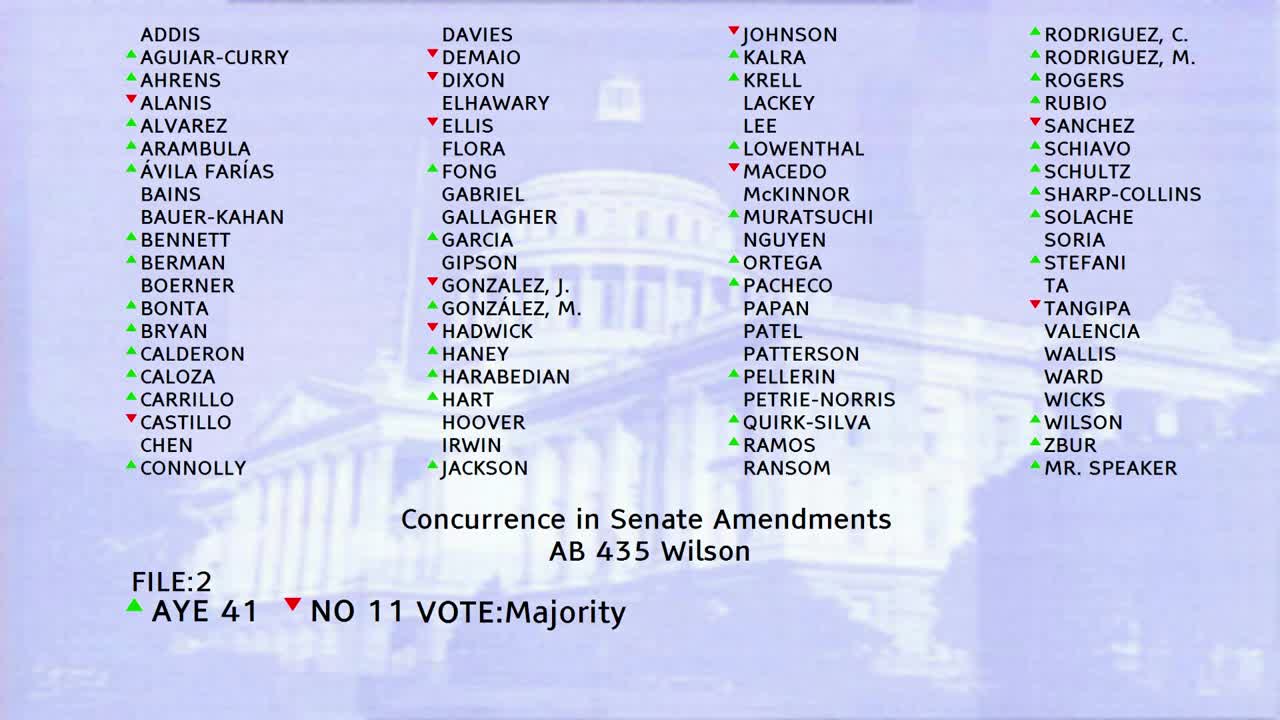 54SEC
Assembly Floor
 2MIN
Senate Floor
 1MIN
Assembly Floor
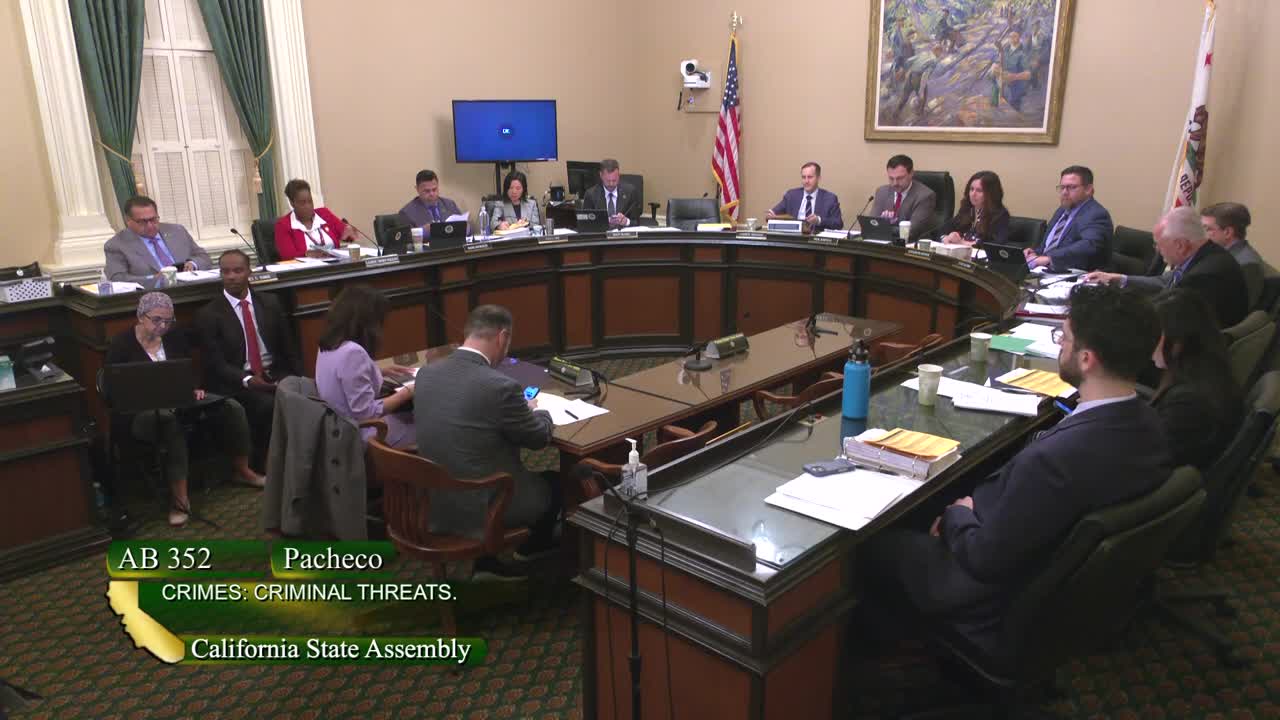 11MIN
Assembly Standing Committee on Public Safety
Bill Author

Bill Co-Author(s):