AB 365: The Justin Kropp Safety Act: electrical utilities: AED availability at worksites.
- Session Year: 2025-2026
- House: Assembly
- Latest Version Date: 2025-10-06
Current Status:
Passed
(2025-10-06: Chaptered by Secretary of State - Chapter 361, Statutes of 2025.)
Introduced
In Committee
Awaiting First Chamber Vote
Passed First Chamber
In Committee
Awaiting Second Chamber Vote
Passed Second Chamber
Enacted
Existing law vests the Public Utilities Commission with regulatory authority over public utilities, including electrical corporations, while local publicly owned electric utilities are under the direction of their governing board. Existing law authorizes the commission to establish rules for all public utilities, subject to control by the Legislature. The Public Utilities Act authorizes the commission, after a hearing, to require every public utility to construct, maintain, and operate its line, plant, system, equipment, apparatus, tracks, and premises in a manner so as to promote and safeguard the health and safety of its employees, passengers, customers, and the public, and authorizes the commission to prescribe the installation, use, maintenance, and operation of appropriate safety or other devices or appliances.
Existing law requires a person or entity that acquires an automated external defibrillator (AED) to comply with all regulations governing the placement of an AED, notify an agent of the local emergency medical service agency of the existence, location, and type of AED acquired, ensure the AED is maintained and tested according to the operation and maintenance guidelines set forth by the manufacturer, ensure that the AED is tested at least biannually and after each use, ensure that a specified inspection is made of all AEDs on the premises at least every 90 days, and ensure that records of this maintenance and testing are maintained.
Existing law provides that any person who, in good faith and not for compensation, renders emergency care or treatment by the use of an AED at the scene of an emergency is not liable for any civil damages resulting from any acts or omissions in rendering the emergency care, except in the case of personal injury or wrongful death that results from the gross negligence or willful or wanton misconduct of the person who renders emergency care or treatment by the use of an AED.
This bill, the Justin Kropp Safety Act, would require each utility, which is defined to mean an electrical corporation, electrical cooperative, or local publicly owned electric utility, and an independent contractor or subcontractor of the utility, to have an AED available at every worksite where 2 or more electrical utility workers are performing work on transmission or distribution lines of 601 volts or more (AED requirement). The bill would require the utility, and the independent contractor or subcontractor of the utility, to adopt specified written policies and procedures (policy requirement), and to comply with the placement, notification, maintenance, testing, inspection, and recordkeeping requirements described above.
This bill would provide that the above-described exemption from civil liability applies to a person who renders, in good faith and not for compensation, emergency care and treatment by use of an AED. The bill would also apply that exemption to a utility, and an independent contractor or subcontractor of the utility, that acquires an AED for emergency use, makes reasonable efforts to comply with the AED and policy requirements, and complies with the above-described placement, notification, maintenance, testing, inspection and recordkeeping requirements. The bill would not apply the civil liability exemption in case of gross negligence or willful or wanton misconduct by the person rendering emergency care or treatment by the use of an AED.
Under existing law, a violation of the Public Utilities Act or any order, decision, rule, direction, demand, or requirement of the commission is a crime.
Because a violation of a commission action implementing the bills requirements would be a crime, the bill would impose a state-mandated local program.
Additionally, by placing additional duties on local publicly owned electric utilities, the bill would impose a state-mandated local program.
The California Constitution requires the state to reimburse local agencies and school districts for certain costs mandated by the state. Statutory provisions establish procedures for making that reimbursement.
This bill would provide that no reimbursement is required by this act for specified reasons.
Existing law vests the Public Utilities Commission with regulatory authority over public utilities, including electrical corporations, while local publicly owned electric utilities are under the direction of their governing board. Existing law authorizes the commission to establish rules for all public utilities, subject to control by the Legislature. The Public Utilities Act authorizes the commission, after a hearing, to require every public utility to construct, maintain, and operate its line, plant, system, equipment, apparatus, tracks, and premises in a manner so as to promote and safeguard the health and safety of its employees, passengers, customers, and the public, and authorizes the commission to prescribe the installation, use, maintenance, and operation of appropriate safety or other devices or appliances.
Existing law requires a person or entity that acquires an automated external defibrillator (AED) to comply with all regulations governing the placement of an AED, notify an agent of the local emergency medical service agency of the existence, location, and type of AED acquired, ensure the AED is maintained and tested according to the operation and maintenance guidelines set forth by the manufacturer, ensure that the AED is tested at least biannually and after each use, ensure that a specified inspection is made of all AEDs on the premises at least every 90 days, and ensure that records of this maintenance and testing are maintained. Existing
Existing law provides that any person who, in good faith and not for compensation, renders emergency care or treatment by the use of an AED at the scene of an emergency is not liable for any civil damages resulting from any acts or omissions in rendering the emergency care, except in the case of personal injury or wrongful death that results from the gross negligence or willful or wanton misconduct of the person who renders emergency care or treatment by the use of an AED.
This bill, the Justin Kropp Safety Act, would require a local publicly owned electric utility and electrical corporation, each utility, as defined, and an independent contractor or subcontractor of the utility, to have an AED available at every worksite where 2 or more electrical utility workers are performing work on transmission or distribution lines of 601 volts or more. more (AED requirement). The bill would require the utility, and the independent contractor or subcontractor of the utility, to adopt specified written policies and procedures, procedures (policy requirement), and to comply with the placement, notification, maintenance, testing, and recordkeeping requirements described above. The
This bill would provide that the same above-described exemption from civil liability that applies to a person who renders renders, in good faith and not for compensation, emergency care and treatment by use of an AED. The bill would also apply that exemption to a local publicly owned electric utility and electrical corporation, utility, and an independent contractor or subcontractor of the utility, that acquires an AED for emergency use and use, that makes reasonable efforts to comply with these the AED and policy requirements except and complies with the above-described placement, notification, maintenance, testing, and recordkeeping requirements. The bill would not apply the civil liability exemption in case of gross negligence or willful or wanton misconduct by the person rendering emergency care or treatment by the use of an AED. The bill would require a local publicly owned electric utility and electrical corporation, and an independent contractor or subcontractor of the utility, to ensure that specified procedures are followed.
Under existing law, a violation of the Public Utilities Act or any order, decision, rule, direction, demand, or requirement of the commission is a crime.
Because a violation of a commission action implementing the bills requirements would be a crime, the bill would impose a state-mandated local program.
Additionally, by placing additional duties on local publicly owned electric utilities, the bill would impose a state-mandated local program.
The California Constitution requires the state to reimburse local agencies and school districts for certain costs mandated by the state. Statutory provisions establish procedures for making that reimbursement.
This bill would provide that no reimbursement is required by this act for specified reasons.
Existing law vests the Public Utilities Commission with regulatory authority over public utilities, including electrical corporations, while local publicly owned electric utilities are under the direction of their governing board. Existing law authorizes the commission to establish rules for all public utilities, subject to control by the Legislature. The Public Utilities Act authorizes the commission, after a hearing, to require every public utility to construct, maintain, and operate its line, plant, system, equipment, apparatus, tracks, and premises in a manner so as to promote and safeguard the health and safety of its employees, passengers, customers, and the public, and authorizes the commission to prescribe the installation, use, maintenance, and operation of appropriate safety or other devices or appliances.
Existing law requires a person or entity that acquires an automated external defibrillator (AED) to comply with all regulations governing the placement of an AED, notify an agent of the local emergency medical service agency of the existence, location, and type of AED acquired, ensure the AED is maintained and tested according to the operation and maintenance guidelines set forth by the manufacturer, ensure that the AED is tested at least biannually and after each use, ensure that a specified inspection is made of all AEDs on the premises at least every 90 days, and ensure that records of this maintenance and testing are maintained. Existing law provides that any person who, in good faith and not for compensation, renders emergency care or treatment by the use of an AED at the scene of an emergency is not liable for any civil damages resulting from any acts or omissions in rendering the emergency care, except in the case of personal injury or wrongful death that results from the gross negligence or willful or wanton misconduct of the person who renders emergency care or treatment by the use of an AED.
This bill, the Justin Kropp Safety Act, would require a local publicly owned electric utility and electrical corporation, and an independent contractor or subcontractor of the utility, to have an AED available at every worksite where 2 or more electrical utility workers are performing work on transmission or distribution lines of any voltage. 601 volts or more. The bill would require the utility, and the independent contractor or subcontractor of the utility, to adopt specified written policies and procedures, and to comply with the placement, notification, maintenance, testing, and recordkeeping requirements described above. The bill would provide that the same exemption from civil liability that applies to a person who renders emergency care and treatment to a local publicly owned electric utility and electrical corporation, and an independent contractor or subcontractor of the utility, that acquires an AED for emergency use and that complies makes reasonable efforts to comply with these requirements except in case of gross negligence or willful or wanton misconduct by the person rendering emergency care or treatment by the use of an AED. The bill would require a local publicly owned electric utility and electrical corporation, and an independent contractor or subcontractor of the utility, to ensure that specified procedures are followed.
Under existing law, a violation of the Public Utilities Act or any order, decision, rule, direction, demand, or requirement of the commission is a crime.
Because a violation of a commission action implementing the bills requirements would be a crime, the bill would impose a state-mandated local program.
Additionally, by placing additional duties on local publicly owned electric utilities, the bill would impose a state-mandated local program.
The California Constitution requires the state to reimburse local agencies and school districts for certain costs mandated by the state. Statutory provisions establish procedures for making that reimbursement.
This bill would provide that no reimbursement is required by this act for specified reasons.
Existing law vests the Public Utilities Commission with regulatory authority over public utilities, including electrical corporations, while local publicly owned electric utilities are under the direction of their governing board. Existing law authorizes the commission to establish rules for all public utilities, subject to control by the Legislature. The Public Utilities Act authorizes the commission, after a hearing, to require every public utility to construct, maintain, and operate its line, plant, system, equipment, apparatus, tracks, and premises in a manner so as to promote and safeguard the health and safety of its employees, passengers, customers, and the public, and authorizes the commission to prescribe the installation, use, maintenance, and operation of appropriate safety or other devices or appliances.
Existing law requires a person or entity that acquires an automated external defibrillator (AED) to comply with all regulations governing the placement of an AED, notify an agent of the local emergency medical service agency of the existence, location, and type of AED acquired, ensure the AED is maintained and tested according to the operation and maintenance guidelines set forth by the manufacturer, ensure that the AED is tested at least biannually and after each use, ensure that a specified inspection is made of all AEDs on the premises at least every 90 days, and ensure that records of this maintenance and testing are maintained. Existing law provides that any person who, in good faith and not for compensation, renders emergency care or treatment by the use of an AED at the scene of an emergency is not liable for any civil damages resulting from any acts or omissions in rendering the emergency care, except in the case of personal injury or wrongful death that results from the gross negligence or willful or wanton misconduct of the person who renders emergency care or treatment by the use of an AED.
This bill, the Justin Kropp Safety Act, would require a local publicly owned electric utility and electrical corporation, and an independent contractor or subcontractor of the utility, to have an AED available at every worksite where electrical utility workers are performing work on transmission or distribution lines of any voltage and voltage. The bill would require the utility, and the independent contractor or subcontractor of the utility, to adopt specified written policies and procedures, and to comply with those the placement, notification, maintenance, testing, and recordkeeping requirements. requirements described above. The bill would provide that the same exemption from civil liability that applies to a person who renders emergency care and treatment to a local publicly owned electric utility and electrical corporation, and an independent contractor or subcontractor of the utility, that acquires an AED for emergency use and that complies with these requirements except in case of gross negligence or willful or wanton misconduct by the person rendering emergency care or treatment by the use of an AED. The bill would require a local publicly owned electric utility and electrical corporation, and an independent contractor or subcontractor of the utility, to ensure that specified procedures are followed.
Under existing law, a violation of the Public Utilities Act or any order, decision, rule, direction, demand, or requirement of the commission is a crime.
Because a violation of a commission action implementing the bills requirements would be a crime, the bill would impose a state-mandated local program.
Additionally, by placing additional duties on local publicly owned electric utilities, the bill would impose a state-mandated local program.
The California Constitution requires the state to reimburse local agencies and school districts for certain costs mandated by the state. Statutory provisions establish procedures for making that reimbursement.
This bill would provide that no reimbursement is required by this act for specified reasons.
Existing law vests the Public Utilities Commission with regulatory authority over public utilities, including electrical corporations. corporations, while local publicly owned electric utilities are under the direction of their governing board. Existing law authorizes the commission to establish rules for all public utilities, subject to control by the Legislature. The Public Utilities Act authorizes the commission, after a hearing, to require every public utility to construct, maintain, and operate its line, plant, system, equipment, apparatus, tracks, and premises in a manner so as to promote and safeguard the health and safety of its employees, passengers, customers, and the public, and authorizes the commission to prescribe the installation, use, maintenance, and operation of appropriate safety or other devices or appliances.
Existing law requires a person or entity that acquires an automated external defibrillator (AED) to comply with all regulations governing the placement of an AED, notify an agent of the local emergency medical service agency of the existence, location, and type of AED acquired, ensure the AED is maintained and tested according to the operation and maintenance guidelines set forth by the manufacturer, ensure that the AED is tested at least biannually and after each use, ensure that a specified inspection is made of all AEDs on the premises at least every 90 days, and ensure that records of this maintenance and testing are maintained. Existing law provides that any person who, in good faith and not for compensation, renders emergency care or treatment by the use of an AED at the scene of an emergency is not liable for any civil damages resulting from any acts or omissions in rendering the emergency care, except in the case of personal injury or wrongful death that results from the gross negligence or willful or wanton misconduct of the person who renders emergency care or treatment by the use of an AED.
This bill, the Justin Kropp Safety Act, would require a public utility, local publicly owned electric utility and electrical corporation, and an independent contractor or subcontractor of the public utility, to have an AED available at every worksite that has where electrical utility workers are performing work on transmission or distribution lines of any voltage an automatic external defibrillator (AED) and would require the public utility, and the independent contractor or subcontractor of the public utility, to comply with certain standards and ensure specified procedures are followed. those placement, notification, maintenance, testing, and recordkeeping requirements. The bill would provide an exemption from civil liability for a public utility, that the same exemption from civil liability that applies to a person who renders emergency care and treatment to a local publicly owned electric utility and electrical corporation, and an independent contractor or subcontractor of the public utility, or a person when the person renders emergency care or treatment through the use, attempted use, or nonuse of an AED, except in case of gross negligence or willful or wanton misconduct by the person rendering aid. By creating a new crime, this bill would impose a state-mandated local program. emergency care or treatment by the use of an AED. The bill would require a local publicly owned electric utility and electrical corporation, and an independent contractor or subcontractor of the utility, to ensure that specified procedures are followed.
Under existing law, a violation of the Public Utilities Act or any order, decision, rule, direction, demand, or requirement of the commission is a crime.
Because the provisions of this bill would be part of the act and because a violation of a commission action implementing the bills requirements would be a crime, the bill would impose a state-mandated local program.
Additionally, by placing additional duties on local publicly owned electric utilities, the bill would impose a state-mandated local program.
The California Constitution requires the state to reimburse local agencies and school districts for certain costs mandated by the state. Statutory provisions establish procedures for making that reimbursement.This bill would provide that no reimbursement is required by this act for a specified reason.The California Constitution requires the state to reimburse local agencies and school districts for certain costs mandated by the state. Statutory provisions establish procedures for making that reimbursement.
This bill would provide that no reimbursement is required by this act for specified reasons.
Existing law vests the Public Utilities Commission with regulatory authority over public utilities, including electrical corporations. Existing law authorizes the commission to establish rules for all public utilities, subject to control by the Legislature. The Public Utilities Act authorizes the commission, after a hearing, to require every public utility to construct, maintain, and operate its line, plant, system, equipment, apparatus, tracks, and premises in a manner so as to promote and safeguard the health and safety of its employees, passengers, customers, and the public, and authorizes the commission to prescribe the installation, use, maintenance, and operation of appropriate safety or other devices or appliances.
This bill, the Justin Kropp Safety Act, would require a public utility, and an independent contractor or subcontractor of the public utility, to have available at every worksite that has transmission or distribution lines of any voltage an automatic external defibrillator (AED) and would require the public utility, and the independent contractor or subcontractor of the public utility, to comply with certain standards and ensure specified procedures are followed. The bill would provide an exemption from civil liability for a public utility, and an independent contractor or subcontractor of the public utility, or a person when the person renders emergency care or treatment through the use, attempted use, or nonuse of an AED, except in case of gross negligence or willful or wanton misconduct by the person rendering aid. By creating a new crime, this bill would impose a state-mandated local program.
Under existing law, a violation of the Public Utilities Act or any order, decision, rule, direction, demand, or requirement of the commission is a crime.
Because the provisions of this bill would be part of the act and because a violation of a commission action implementing the bills requirements would be a crime, the bill would impose a state-mandated local program.
The California Constitution requires the state to reimburse local agencies and school districts for certain costs mandated by the state. Statutory provisions establish procedures for making that reimbursement.
This bill would provide that no reimbursement is required by this act for a specified reason.
This act shall be known, and may be cited, as the Justin Kropp Safety Act.
SEC. 2.Chapter 1.5 (commencing with Section 8310) is added to Division 4.1 of the Public Utilities Code, to read:1.5.Worksite Automated External Defibrillators8310.(a)Each utility, and independent contractor or subcontractor of a utility, shall do both of the following:
(1)Have an automated external defibrillator (AED) available for emergency use at each worksite where two or more electrical utility workers are performing work on electrical transmission or distribution lines of 601 volts or more.
(2)Adopt, consistent with its duty to furnish and use safety devices and safeguards as required by Section 6401 of the Labor Code and as part of its injury prevention program that conforms to the requirements of Section 6401.7 of the Labor Code, a written program of policies and procedures to ensure both of the following:
(A)Any person who renders emergency care or treatment to a person in cardiac arrest by using an AED shall activate the emergency medical services system as soon as possible and report the use of the AED to the local EMS agency.
(B)All employees, contractors, and subcontractors shall be trained on the use of an AED and the procedures to be followed in the event of an emergency, including, but not limited to, the requirement to activate the emergency medical services system as soon as possible and report the use of the AED to the local EMS agency.
(b)Each utility, and independent contractor or subcontractor of a utility, shall comply with the requirements of Section 1797.196 of the Health and Safety Code.
(c)A person who, in good faith and not for compensation, renders emergency care or treatment by the use of an AED is not liable for civil damages resulting from any acts or omissions of the person rendering the emergency care as provided in subdivision (b) of Section 1714.21 of the Civil Code.
(d)A utility or an independent contractor or subcontractor of a utility that acquires an AED for emergency use, makes reasonable efforts to comply with the requirements of subdivision (a), and complies with subdivision (b), is not liable for any civil damages resulting from the emergency use of the AED as provided in subdivision (d) of Section 1714.21 of the Civil Code.
(e)A person who renders emergency treatment by means of an AED and is not compensated for doing so, but receives compensation for other actions as a result of their unrelated employment, does not render emergency medical care for compensation.
(f)Subdivisions (c) and (d) do not apply in cases described in subdivision (e) of Section 1714.21 of the Civil Code.
(g)For purposes of this section, all of the following definitions apply:
(1)Electrical cooperative has the same meaning as defined in Section 2776.
(2)Electrical corporation has the same meaning as defined in Section 218.
(3)Local EMS agency means an agency described in Section 1797.200 of the Health and Safety Code.
(4)Local publicly owned electric utility has the same meaning as defined in Section 224.3.
(5)Utility means an electrical corporation, electrical cooperative, or local publicly owned electric utility.
SEC. 3.No reimbursement is required by this act pursuant to Section 6 of Article XIIIB of the California Constitution because a local agency or school district has the authority to levy service charges, fees, or assessments sufficient to pay for the program or level of service mandated by this act or because costs that may be incurred by a local agency or school district will be incurred because this act creates a new crime or infraction, eliminates a crime or infraction, or changes the penalty for a crime or infraction, within the meaning of Section 17556 of the Government Code, or changes the definition of a crime within the meaning of Section 6 of Article XIIIB of the California Constitution.
This act shall be known, and may be cited, as the Justin Kropp Safety Act.
SEC. 2.Chapter 1.5 (commencing with Section 8310) is added to Division 4.1 of the Public Utilities Code, to read:1.5.Worksite Automated External Defibrillators8310.(a)Each utility, and independent contractor or subcontractor of a utility, shall do all both of the following:
(1)Have an automated external defibrillator (AED) available for emergency use at each worksite where two or more electrical utility workers are performing work on electrical transmission or distribution lines of 601 volts or more.
(2)Adopt, consistent with its duty to furnish and use safety devices and safeguards as required by Section 6401 of the Labor Code and as part of its injury prevention program that conforms to the requirements of Section 6401.7 of the Labor Code, a written program of policies and procedures to ensure both of the following:
(A)Any person who renders emergency care or treatment to a person in cardiac arrest by using an AED shall activate the emergency medical services system as soon as possible and report the use of the AED to the local EMS agency.
(B)All employees, contractors, and subcontractors shall be trained on the use of an AED and the procedures to be followed in the event of an emergency, including, but not limited to, the requirement to activate the emergency medical services system as soon as possible and report the use of the AED to the local EMS agency.
(3)Comply with(b)Each utility, and independent contractor or subcontractor of a utility, shall comply with the requirements of Section 1797.196 of the Health and Safety Code.
(b)(c)A person who, in good faith and not for compensation, renders emergency care or treatment by the use of an AED is not liable for civil damages resulting from any acts or omissions of the person rendering the emergency care as provided in subdivision (b) of Section 1714.21 of the Civil Code.
(c)(d)A utility or an independent contractor or subcontractor of a utility that acquires an AED for emergency use and use, makes reasonable efforts to comply with the requirements of subdivision (a) (a), and complies with subdivision (b), is not liable for any civil damages resulting from the emergency use of the AED as provided in subdivision (d) of Section 1714.21 of the Civil Code.
(d)(e)A person who renders emergency treatment by means of an AED and is not compensated for doing so, but receives compensation for other actions as a result of their unrelated employment, does not render emergency medical care for compensation.
(e)(f)Subdivisions (b) and (c) (c) and (d) do not apply in cases described in subdivision (e) of Section 1714.21 of the Civil Code.
(f)(g)For purposes of this section, all of the following definitions apply:
(1)Electrical cooperative has the same meaning as defined in Section 2776.
(2)Electrical corporation has the same meaning as defined in Section 218.
(3)Local EMS agency means an agency described in Section 1797.200 of the Health and Safety Code.
(4)Local publicly owned electric utility has the same meaning as defined in Section 224.3.
(5)Utility means an electrical corporation, electrical cooperative, or local publicly owned electric utility.
SEC. 3.No reimbursement is required by this act pursuant to Section 6 of Article XIIIB of the California Constitution because a local agency or school district has the authority to levy service charges, fees, or assessments sufficient to pay for the program or level of service mandated by this act or because costs that may be incurred by a local agency or school district will be incurred because this act creates a new crime or infraction, eliminates a crime or infraction, or changes the penalty for a crime or infraction, within the meaning of Section 17556 of the Government Code, or changes the definition of a crime within the meaning of Section 6 of Article XIIIB of the California Constitution.
This act shall be known, and may be cited, as the Justin Kropp Safety Act.
SEC. 2.Chapter 1.5 (commencing with Section 8310) is added to Division 4.1 of the Public Utilities Code, to read:1.5.Worksite Automated External Defibrillators8310.(a)Each utility, and independent contractor or subcontractor of a utility, shall do all of the following:
(1)Have an automated external defibrillator (AED) available for emergency use at each worksite where two or more electrical utility workers are performing work on electrical transmission or distribution lines of any voltage. 601 volts or more.
(2)Adopt, consistent with its duty to furnish and use safety devices and safeguards as required by Section 6401 of the Labor Code and as part of its injury prevention program that conforms to the requirements of Section 6401.7 of the Labor Code, a written program of policies and procedures to ensure both of the following:
(A)Any person who renders emergency care or treatment to a person in cardiac arrest by using an AED shall activate the emergency medical services system as soon as possible and report the use of the AED to the local EMS agency.
(B)All employees, contractors, and subcontractors shall be trained on the use of an AED and the procedures to be followed in the event of an emergency, including including, but not limited to, the requirement to activate the emergency medical services system as soon as possible and report the use of the AED to the local EMS agency.
(3)Comply with the requirements of Section 1797.196 of the Health and Safety Code.
(b)A person who, in good faith and not for compensation, renders emergency care or treatment by the use of an AED is not liable for civil damages resulting from any acts or omissions of the person rendering the emergency care as provided in subdivision (b) of Section 1714.21 of the Civil Code.
(c)A utility or an independent contractor or subcontractor of a utility that acquires an AED for emergency use and complies makes reasonable efforts to comply with the requirements of subdivision (a) is not liable for any civil damages resulting from the emergency use of the AED as provided in subdivision (d) of Section 1714.21 of the Civil Code.
(d)A person who renders emergency treatment by means of an AED and is not compensated for doing so, but receives compensation for other actions as a result of their unrelated employment, does not render emergency medical care for compensation.
(e)Subdivisions (b) and (c) do not apply in cases described in subdivision (e) of Section 1714.21 of the Civil Code.
(f)For purposes of this section, all of the following definitions apply:
(1)Electrical cooperative has the same meaning as defined in Section 2776.
(1)(2)Electrical corporation has the same meaning as defined in Section 218.
(2)(3)Local EMS agency means an agency described in Section 1797.200 of the Health and Safety Code.
(3)(4)Local publicly owned electric utility has the same meaning as defined in Section 224.3.
(4)(5)Utility means an electrical corporation corporation, electrical cooperative, or local publicly owned electric utility.
SEC. 3.No reimbursement is required by this act pursuant to Section 6 of Article XIIIB of the California Constitution because a local agency or school district has the authority to levy service charges, fees, or assessments sufficient to pay for the program or level of service mandated by this act or because costs that may be incurred by a local agency or school district will be incurred because this act creates a new crime or infraction, eliminates a crime or infraction, or changes the penalty for a crime or infraction, within the meaning of Section 17556 of the Government Code, or changes the definition of a crime within the meaning of Section 6 of Article XIIIB of the California Constitution.
This act shall be known, and may be cited, as the Justin Kropp Safety Act.
SEC. 2.Chapter 1.5 (commencing with Section 8310) is added to Division 4.1 of the Public Utilities Code, to read:1.5.Worksite Automated External Defibrillators8310.(a)Each utility, and independent contractor or subcontractor of a utility, shall have an do all of the following:
(1)Have an automated external defibrillator (AED) available for emergency use at each worksite where electrical utility workers are performing work on electrical transmission or distribution lines of any voltage.
(2)Adopt, consistent with its duty to furnish and use safety devices and safeguards as required by Section 6401 of the Labor Code and as part of its injury prevention program that conforms to the requirements of Section 6401.7 of the Labor Code, a written program of policies and procedures to ensure both of the following:
(A)Any person who renders emergency care or treatment to a person in cardiac arrest by using an AED shall activate the emergency medical services system as soon as possible and report the use of the AED to the local EMS agency.
(B)All employees, contractors, and subcontractors shall be trained on the use of an AED and the procedures to be followed in the event of an emergency, including but not limited to, the requirement to activate the emergency medical services system as soon as possible and report the use of the AED to the local EMS agency.
(3)Comply with the requirements of Section 1797.196 of the Health and Safety Code.
(b)A person who who, in good faith and not for compensation, renders emergency care or treatment using the by the use of an AED is not liable for civil damages pursuant to resulting from any acts or omissions of the person rendering the emergency care as provided in subdivision (b) of Section 1714.21 of the Civil Code.
(c)When a utility, A utility or an independent contractor or subcontractor of a utility, utility that acquires an AED for emergency use, the utility, contractor, or subcontractor shall not be liable for civil damages pursuant to use and complies with the requirements of subdivision (a) is not liable for any civil damages resulting from the emergency use of the AED as provided in subdivision (d) of Section 1714.21 of the Civil Code.
(d)A utility, or an independent contractor or subcontractor of a utility, shall comply with Section 1797.196 of the Health and Safety Code.(e)A utility, or independent contractor or subcontractor of a utility, shall ensure both of the following occur:(1)A person who renders emergency care or treatment to a person in cardiac arrest by using the AED activates the emergency medical services system as soon as possible and reports the use of the AED to the local emergency medical service agency.(2)There is a written plan that describes the procedures to be followed in the event of an emergency that may involve the use of the AED to ensure compliance with the requirements of this section. The written plan shall include, but not be limited to, immediate notification of the emergency medical services system at the start of AED procedures.(d)A person who renders emergency treatment by means of an AED and is not compensated for doing so, but receives compensation for other actions as a result of their unrelated employment, does not render emergency medical care for compensation.
(f)(e)Subdivisions (b) and (c) do not apply in cases described in subdivision (e) of Section 1714.21 of the Civil Code.
(g)(f)For purposes of this section, all of the following definitions apply:
(1)Electrical corporation has the same meaning as defined in Section 218.
(2)Local EMS agency means an agency described in Section 1797.200 of the Health and Safety Code.
(2)(3)Local publicly owned electric utility has the same meaning as defined in Section 224.3.
(3)(4)Utility means an electrical corporation or local publicly owned electric utility.
SEC. 3.No reimbursement is required by this act pursuant to Section 6 of Article XIIIB of the California Constitution because a local agency or school district has the authority to levy service charges, fees, or assessments sufficient to pay for the program or level of service mandated by this act or because costs that may be incurred by a local agency or school district will be incurred because this act creates a new crime or infraction, eliminates a crime or infraction, or changes the penalty for a crime or infraction, within the meaning of Section 17556 of the Government Code, or changes the definition of a crime within the meaning of Section 6 of Article XIIIB of the California Constitution.
This act shall be known, and may be cited, as the Justin Kropp Safety Act.
SEC. 2.Chapter 1.5 (commencing with Section 8310) is added to Division 4.1 of the Public Utilities Code, to read:1.5.Worksite Automated External Defibrillators8310.(a)Each utility, and independent contractor or subcontractor of a utility, shall have an automated external defibrillator (AED) available at each worksite where electrical utility workers are performing work on electrical transmission or distribution lines of any voltage.
(b)A person who renders emergency care or treatment using the AED is not liable for civil damages pursuant to subdivision (b) of Section 1714.21 of the Civil Code.
(c)When a utility, or an independent contractor or subcontractor of a utility, acquires an AED for emergency use, the utility, contractor, or subcontractor shall not be liable for civil damages pursuant to subdivision (d) of Section 1714.21 of the Civil Code.
(d)A utility, or an independent contractor or subcontractor of a utility, shall comply with Section 1797.196 of the Health and Safety Code.
(e)A utility, or independent contractor or subcontractor of a utility, shall ensure both of the following occur:
(1)A person who renders emergency care or treatment to a person in cardiac arrest by using the AED activates the emergency medical services system as soon as possible and reports the use of the AED to the local emergency medical service agency.
(2)There is a written plan that describes the procedures to be followed in the event of an emergency that may involve the use of the AED to ensure compliance with the requirements of this section. The written plan shall include, but not be limited to, immediate notification of the emergency medical services system at the start of AED procedures.
(f)Subdivisions (b) and (c) do not apply in cases described in subdivision (e) of Section 1714.21 of the Civil Code.
(g)For purposes of this section, all of the following definitions apply:
(1)Electrical corporation has the same meaning as defined in Section 218.
(2)Local publicly owned electric utility has the same meaning as defined in Section 224.3.
(3)Utility means an electrical corporation or local publicly owned electric utility.
SEC. 2.Section 768.2 is added to the Public Utilities Code, to read:768.2.(a)Each public utility, and independent contractor or subcontractor of the public utility, shall have available at every worksite that has transmission or distribution lines of any voltage an automatic external defibrillator (AED) pursuant to this section.(b)A person who renders emergency care or treatment is not liable for civil damages resulting from the use, attempted use, or nonuse of an AED, except as provided in subdivision (e).(c)When a person uses, does not use, or attempts to use an AED consistent with the requirements of this section to render emergency care or treatment, the public utility, and independent contractor or subcontractor of the utility, is not liable for civil damages resulting from an act or omission in rendering the emergency care or treatment, including the use or nonuse of an AED, except as provided in subdivision (e).(d)The public utility, and independent contractor or subcontractor of the public utility, shall do both of the following:(1)Comply with all regulations governing the placement of the AED.(2)Ensure all of the following:(A)The AED is maintained and regularly tested according to the operation and maintenance guidelines set forth by the manufacturer, the American Heart Association, or the American Red Cross, and according to applicable rules and regulations set forth by the governmental authority under the federal Food and Drug Administration and any other applicable state and federal authority.(B)The AED is checked for readiness after each use and at least once every 30 days if the AED has not been used in the preceding 30 days.(C)A person who renders emergency care or treatment to a person in cardiac arrest by using the AED activates the emergency medical services system as soon as possible and reports the use of the AED to the local EMS agency.(D)There is a written plan that exists that describes the procedures to be followed in the event of an emergency that may involve the use of the AED, to ensure compliance with the requirements of this section. The written plan shall include, but not be limited to, immediate notification of the emergency medical services system at the start of AED procedures.(e)Subdivisions (b) and (c) shall not apply when personal injury or wrongful death results from gross negligence or willful or wanton misconduct on the part of the person who uses, attempts to use, or maliciously fails to use an AED to render emergency care or treatment.SEC. 3.No reimbursement is required by this act pursuant to Section 6 of Article XIIIB of the California Constitution because the only costs that may be incurred by a local agency or school district will be incurred because this act creates a new crime or infraction, eliminates a crime or infraction, or changes the penalty for a crime or infraction, within the meaning of Section 17556 of the Government Code, or changes the definition of a crime within the meaning of Section 6 of Article XIIIB of the California Constitution.SEC. 3.No reimbursement is required by this act pursuant to Section 6 of Article XIIIB of the California Constitution because a local agency or school district has the authority to levy service charges, fees, or assessments sufficient to pay for the program or level of service mandated by this act or because costs that may be incurred by a local agency or school district will be incurred because this act creates a new crime or infraction, eliminates a crime or infraction, or changes the penalty for a crime or infraction, within the meaning of Section 17556 of the Government Code, or changes the definition of a crime within the meaning of Section 6 of Article XIIIB of the California Constitution.
This act shall be known, and may be cited, as the Justin Kropp Safety Act.
SEC. 2.Section 768.2 is added to the Public Utilities Code, to read:768.2.(a)Each public utility, and independent contractor or subcontractor of the public utility, shall have available at every worksite that has transmission or distribution lines of any voltage an automatic external defibrillator (AED) pursuant to this section.
(b)A person who renders emergency care or treatment is not liable for civil damages resulting from the use, attempted use, or nonuse of an AED, except as provided in subdivision (e).
(c)When a person uses, does not use, or attempts to use an AED consistent with the requirements of this section to render emergency care or treatment, the public utility, and independent contractor or subcontractor of the utility, is not liable for civil damages resulting from an act or omission in rendering the emergency care or treatment, including the use or nonuse of an AED, except as provided in subdivision (e).
(d)The public utility, and independent contractor or subcontractor of the public utility, shall do both of the following:
(1)Comply with all regulations governing the placement of the AED.
(2)Ensure all of the following:
(A)The AED is maintained and regularly tested according to the operation and maintenance guidelines set forth by the manufacturer, the American Heart Association, or the American Red Cross, and according to applicable rules and regulations set forth by the governmental authority under the federal Food and Drug Administration and any other applicable state and federal authority.
(B)The AED is checked for readiness after each use and at least once every 30 days if the AED has not been used in the preceding 30 days.
(C)A person who renders emergency care or treatment to a person in cardiac arrest by using the AED activates the emergency medical services system as soon as possible and reports the use of the AED to the local EMS agency.
(D)There is a written plan that exists that describes the procedures to be followed in the event of an emergency that may involve the use of the AED, to ensure compliance with the requirements of this section. The written plan shall include, but not be limited to, immediate notification of the emergency medical services system at the start of AED procedures.
(e)Subdivisions (b) and (c) shall not apply when personal injury or wrongful death results from gross negligence or willful or wanton misconduct on the part of the person who uses, attempts to use, or maliciously fails to use an AED to render emergency care or treatment.
SEC. 3.No reimbursement is required by this act pursuant to Section 6 of Article XIIIB of the California Constitution because the only costs that may be incurred by a local agency or school district will be incurred because this act creates a new crime or infraction, eliminates a crime or infraction, or changes the penalty for a crime or infraction, within the meaning of Section 17556 of the Government Code, or changes the definition of a crime within the meaning of Section 6 of Article XIIIB of the California Constitution.
|
Date
|
Status
|
|---|---|
| Oct 6, 2025 | Chaptered by Secretary of State - Chapter 361, Statutes of 2025. |
| Oct 6, 2025 | Approved by the Governor. |
| Sep 15, 2025 | Enrolled and presented to the Governor at 4:30 p.m. |
| Sep 8, 2025 | Senate amendments concurred in. To Engrossing and Enrolling. (Ayes 79. Noes 0. Page 3015.). |
| Sep 3, 2025 | In Assembly. Concurrence in Senate amendments pending. |
| Sep 3, 2025 | Read third time. Passed. Ordered to the Assembly. (Ayes 40. Noes 0. Page 2460.). |
| Aug 20, 2025 | Read second time. Ordered to third reading. |
| Aug 19, 2025 | From committee: Be ordered to second reading pursuant to Senate Rule 28.8. |
| Jul 3, 2025 | Read second time and amended. Re-referred to Com. on APPR. |
| Jul 2, 2025 | From committee: Amend, and do pass as amended and re-refer to Com. on APPR. (Ayes 13. Noes 0.) (July 1). |
| Jun 23, 2025 | Read second time and amended. Re-referred to Com. on JUD. |
| Jun 19, 2025 | From committee: Amend, and do pass as amended and re-refer to Com. on JUD. (Ayes 14. Noes 0.) (June 17). |
| May 14, 2025 | Referred to Coms. on E., U & C. and JUD. |
| May 1, 2025 | In Senate. Read first time. To Com. on RLS. for assignment. |
| May 1, 2025 | Read third time. Passed. Ordered to the Senate. (Ayes 76. Noes 0. Page 1386.) |
| Apr 24, 2025 | Read second time. Ordered to Consent Calendar. |
| Apr 23, 2025 | From committee: Do pass. To Consent Calendar. (Ayes 15. Noes 0.) (April 23). |
| Apr 8, 2025 | From committee: Do pass and re-refer to Com. on APPR. with recommendation: To Consent Calendar. (Ayes 12. Noes 0.) (April 8). Re-referred to Com. on APPR. |
| Apr 3, 2025 | Re-referred to Com. on JUD. |
| Apr 2, 2025 | From committee chair, with author's amendments: Amend, and re-refer to Com. on JUD. Read second time and amended. |
| Apr 1, 2025 | Re-referred to Com. on JUD. |
| Mar 28, 2025 | Read second time and amended. |
| Mar 27, 2025 | From committee: Amend, and do pass as amended and re-refer to Com. on JUD. with recommendation: To Consent Calendar. (Ayes 18. Noes 0.) (March 26). |
| Feb 18, 2025 | Referred to Coms. on U. & E. and JUD. |
| Feb 4, 2025 | From printer. May be heard in committee March 6. |
| Feb 3, 2025 | Read first time. To print. |
|
Date
|
Description
|
Location
|
Votes
|
|
|---|---|---|---|---|
| Sep 8, 2025 | AB 365 Schiavo Concurrence in Senate Amendments | Assembly Floor |
Passed |
|
| Sep 3, 2025 | Assembly 3rd Reading AB365 Schiavo By Durazo | Senate Floor |
Passed |
|
| Jul 1, 2025 | Do pass as amended, but first amend, and re-refer to the Committee on [Appropriations] | Senate Standing Committee on Judiciary |
Passed |
|
| Jun 17, 2025 | Do pass as amended, but first amend, and re-refer to the Committee on [Judiciary] | Senate Standing Committee on Energy, Utilities and Communications |
Passed |
|
| May 1, 2025 | AB 365 Schiavo Consent Calendar Second Day Regular Session | Assembly Floor |
Passed |
|
| Apr 23, 2025 | Do pass. To Consent Calendar. | Assembly Standing Committee on Appropriations |
Passed |
|
| Apr 8, 2025 | Do pass and be re-referred to the Committee on [Appropriations] with recommendation: To Consent Calendar | Assembly Standing Committee on Judiciary |
Passed |
|
| Mar 26, 2025 | Do pass as amended, and be re-referred to the Committee on [Judiciary] with recommendation: To Consent Calendar | Assembly Standing Committee on Utilities and Energy |
Passed |
This list shows positions taken on this bill by organizations on the date displayed, which is linked to the original source.
Positions by individuals are not included.
|
Organization
|
Position
|
Date
|
|---|---|---|
| American Medical Response | ** Support | |
| California chapter of the American College of Cardiology | ** Support | |
| California Emergency Nurses Association | ** Support | |
| California State Association Of Electrical Workers | ** Support | |
| Coalition of California Utility Employees | ** Support | |
| Consumer Attorneys Of California | ** Support | |
| Everyday Responder Project | ** Support | |
| Global Medical Response | ** Support | |
| Teamsters California | ** Support |
CONCURRENCE IN SENATE AMENDMENTS
CSA1 Bill Id:AB 365
Author:(Schiavo)
As Amended Ver:July 3, 2025
Majority vote
SUMMARY
Requires electric utilities, and their contractors and subcontractors to have an automated external defibrillator (AED) available for emergency use at each worksite where two or more utility workers are performing work on electrical transmission and distribution lines above 601 volts.
Senate Amendments
- Clarifies that the AED requirements apply to worksites with two or more utility workers performing work on electrical transmission and distribution lines above 601 volts.
- Lowers the liability threshold for utility or independent contractor or subcontractor of a utility from ″complies″ with AED requirements to ″makes reasonable effort to comply″ with AED requirements, as specified.
- Adds electrical cooperative to the qualifying utilities.
COMMENTS
Electric infrastructure worksite safety. Electric power industry workers, or linemen, work in dangerous working conditions with high rates of injury. On average, 19.2 linemen per 100,000 are killed on the job every year nationwide. This is twice the fatality rate of police officers and firefighters. Of the 70,692 occupational fatalities from 2011-2023, 1,940 were a result of contact with electricity, making it one of the leading causes of occupational fatality. The main risk to healthy linemen as a result of electrocution is sudden death due to cardiac arrhythmias or irregular heart rhythms. These arrhythmias can be dangerous and lead to sudden cardiac arrest. Out-of-hospital cardiac arrest results in an 8-10% survival rate. As a result of these risks, there are many workplace safety requirements for electrical infrastructure facilities, many of which are under the OSHA under the U.S. Department of Labor at the federal level and at the state level at the DIR within the California Labor and Workforce Agency via the Division of Occupational Safety and Health (better known as Cal/OSHA). These worksite safety requirements are in addition to any requirements by the CPUC or other regulatory agencies of regulated public utilities, electric generating assets, and other entities.
OSHA regulations for electrical worksites. At both the federal and state level, there are occupational safety regulations that apply to electric power generation, transmission, and distribution worksites. These safety regulations include work related to electrical line-clearance, to address specific workplace hazards for these sites, and specific requirements related to the type of work during construction, operations, and maintenance of these sites. As such, occupational safety regulations apply to electric utilities, but also firms that own power generation, and contractors of these entities, including regulations concerning construction and line-clearance activities of these facilities.
Occupational safety regulations concerning medical services and first aid. In general, state occupational safety regulations must be as effective and protective as federal standards. These occupational safety requirements include regulations concerning protective equipment, signage, handling exposed electrical infrastructure, along with first aid and medical services, including in relation to training and availability of trained employees for CPR when work is being performed on equipment that is energized at 50 volts or more. The number of trained employees that must be available varies depending on the number of employees at the work site, the type of work site or location, and the type of work being performed. Employers must also provide, maintain, and inspect first aid kits and supplies. These CPR and first aid requirements are largely (if not exactly) consistent with the federal OSHA regulations found in 29 Code of Federal Regulations Parts 1910 and 1926.
Automated External Defibrillator Devices. An AED is a medical device designed to analyze the heart rhythm and deliver an electric shock to restore a normal heart rhythm when a person is suffering from arrhythmia or sudden cardiac arrest. The survival rate of individuals suffering from out-of-hospital cardiac arrest significantly increases to 50-74% when an AED device is available and immediate defibrillation is performed. The integration of AED devices into standard electric utility safety protocols is now underway. Many electric utility companies already require AED units on all their service trucks and there are many examples of life-saving implementation of these devices in the field. Southern California Edison reports 1,831 AED devices deployed across its territory with 1,600 AEDs in vehicles and 230 AEDs in other facilities like substations and generation locations. The committee is unaware of the status of AED devices across other California utility service territories.
Washington State law. In 2023, the state of Washington adopted legislation, House Bill 1542 (Bronoske, et al, Chapter 253), which requires, by January 1, 2025, any employer with employees who operate, maintain, or construct high voltage lines and equipment or who conduct line clearance tree trimming in close proximity to high voltage lines and equipment to make an AED available and accessible to employees when work is being performed on, or in close proximity to, high voltage lines and equipment by two or more employees. Subsequently, the Washington State Department of Labor and Industries filed an expedited regulation in September 2024 (WSR 24-18-111) to incorporate the AED requirements of the legislation into the occupational safety regulations. Those regulations require AED at certain sites where there are two or more workers for high-voltage electrical lines of 601 volts or more. These were largely included within regulations concerning medical services and first aid for Washington State that are similar to those medical services and first aid requirements included in the federal and California occupational safety regulations for electrical work performed (as noted above) in proximity to electrical infrastructure.
Federal government declined to require AEDs. In 2014, the U.S. Department of Labor′s OSHA updated various regulations in relation to the electric power generation, transmission, and distribution worksites. As part of the rule update, OSHA considered and sought comments on whether to require AEDs at these worksites. OSHA stated AEDs could be beneficial at worksites where line clearing was being performed. However, OSHA declined to require AEDs in the final rule due to insufficient evidence in the record that AEDs would perform when exposed to environmental extremes typical of electrical line field work, including concerns that the interior of trucks would be significantly hotter than the 50-degree Celsius recommended maximum for operating ranges of the AED. However, OSHA did encourage employers to purchase and deploy AEDs in areas where they could be useful and efficacious and further stated that the action would save lives and provide OSHA with ″useful information on the use of AEDs under a wide range of conditions.″
According to the Author
- According to the author, ″Working around high voltage electrical lines, Journeymen have one of the most dangerous jobs in California. AEDs are lifesaving devices required by law at large venues like stadiums, but they are not currently required at high voltage worksites. Tragically, had an AED been present on Justin Kropp′s worksite, he would still be with us today. It is our duty to protect our frontline workers and Assembly bill 365 will do just that.″
Arguments in Support
Supporters of the bill include the California State Association of Electrical Workers, the Coalition of California Utility Employees, and Teamsters California, as well as a multiple medical groups and associations. The Coalition of California Utility Employees and the California State Association of Electrical Workers state:
Electrical lineworkers and utility employees perform inherently dangerous tasks, often in remote or high-risk environments. Sudden cardiac arrest can be a tragic consequence of electrical exposure, strenuous activity, or unforeseen medical emergencies. The presence of an AED at these worksites can mean the difference between life and death. By ensuring that public utilities and their contractors comply with established safety standards and protocols for AED accessibility, this bill will provide essential protections for workers and the public alike.
Arguments in Opposition
None on file.
FISCAL COMMENTS
According the Assembly Committee on Appropriations, this bill will incur minimal cost to the state, if any.
VOTES:
ASM UTILITIES AND ENERGY: 18-0-0
YES: Petrie-Norris, Patterson, Boerner, Calderon, Chen, Davies, Mark González, Harabedian, Hart, Irwin, Kalra, Papan, Rogers, Schiavo, Schultz, Ta, Wallis, Zbur
ASM JUDICIARY: 12-0-0
YES: Kalra, Dixon, Wicks, Bryan, Connolly, Harabedian, Pacheco, Papan, Sanchez, Stefani, Zbur, Tangipa
ASM APPROPRIATIONS: 15-0-0
YES: Wicks, Sanchez, Arambula, Calderon, Caloza, Dixon, Elhawary, Fong, Mark González, Hart, Pacheco, Pellerin, Solache, Ta, Tangipa
ASSEMBLY FLOOR: 76-0-3
YES: Addis, Aguiar-Curry, Ahrens, Alanis, Alvarez, Arambula, Ávila Farías, Bains, Bauer-Kahan, Bennett, Berman, Boerner, Bonta, Bryan, Calderon, Caloza, Carrillo, Castillo, Connolly, Davies, DeMaio, Dixon, Elhawary, Ellis, Flora, Fong, Gabriel, Gallagher, Garcia, Gipson, Jeff Gonzalez, Mark González, Hadwick, Haney, Harabedian, Hart, Hoover, Irwin, Jackson, Kalra, Krell, Lackey, Lee, Lowenthal, Macedo, Muratsuchi, Nguyen, Ortega, Pacheco, Patel, Patterson, Pellerin, Petrie-Norris, Quirk-Silva, Ramos, Ransom, Celeste Rodriguez, Michelle Rodriguez, Rogers, Blanca Rubio, Sanchez, Schiavo, Schultz, Sharp-Collins, Solache, Soria, Stefani, Ta, Tangipa, Valencia, Wallis, Ward, Wicks, Wilson, Zbur, Rivas
ABS, ABST OR NV: Chen, McKinnor, Papan
UPDATED
VERSION: July 3, 2025
CONSULTANT: Kristen Koenig / U. & E. / (916) 319-2083 FN: 0001577
SENATE RULES COMMITTEE Office of Senate Floor Analyses (916) 651-1520 Fax: (916) 327-4478 | AB 365 |
THIRD READING
Bill No: AB 365
Author: Schiavo (D)
Amended: 7/3/25 in Senate
Vote: 21
SENATE ENERGY, U. & C. COMMITTEE: 14-0, 6/17/25
AYES: Becker, Ochoa Bogh, Allen, Archuleta, Arreguín, Caballero, Dahle, Hurtado, Limón, McNerney, Rubio, Stern, Strickland, Wahab
NO VOTE RECORDED: Ashby, Gonzalez, Grove
SENATE JUDICIARY COMMITTEE: 13-0, 7/1/25
AYES: Umberg, Niello, Allen, Arreguín, Ashby, Caballero, Durazo, Laird, Stern, Valladares, Wahab, Weber Pierson, Wiener
SENATE APPROPRIATIONS COMMITTEE: Senate Rule 28.8
ASSEMBLY FLOOR: 76-0, 5/1/25 (Consent) - See last page for vote
SUBJECT: The Justin Kropp Safety Act: electrical utilities: AED availability at worksites
SOURCE: Author
DIGEST:
This bill requires electric utilities, and their contractors and subcontractors, to have an automated external defibrillator (AED) available for emergency use at each worksite where two or more utility workers are performing work on electrical transmission and distribution lines above 601 volts.
ANALYSIS:
Existing law:
- Establishes and vests the California Public Utilities Commission (CPUC) with regulatory authority over public utilities, including electrical corporations. Authorizes the CPUC to establish rules for all public utilities, subject to control by the Legislature. (Article XII of the California Constitution)
- Authorizes the CPUC, under the Public Utilities Act, after a hearing, to require every public utility to construct, maintain, and operate its line, plant, system, equipment, apparatus, tracks, and premises in a manner so as to promote and safeguard the health and safety of its employees, passengers, customers, and the public, and authorizes the CPUC to prescribe the installation, use, maintenance, and operation of appropriate safety or other devices or appliances. (Public Utilities Code §768)
- Establishes the Occupational Safety and Health Standards Board, within the Department of Industrial Relations (DIR), and authorizes, by an affirmative vote of at least four members, to adopt, amend or repeal occupational safety and health standards and orders. Provides that the Division of Occupational Safety and Health (Cal/OSHA) to be the only agency in the state authorized to adopt occupational safety and health standards. (Labor Code §§140 and 142.3)
- Requires every employer to furnish and use safety devices and safeguards, and to adopt and use practices, means, methods, operations, and processes which are reasonably adequate to render such employment and place of employment safe and healthful. Every employer shall do every other thing reasonably necessary to protect the life, safety, and health of employees. (Labor Code §6401)
- Requires every employer to establish, implement, and maintain an effective injury prevention program. (Labor Code §6401.7)
- Requires a person or entity that acquires an AED to comply with all regulations governing the placement of an AED, notify an agent of the local emergency medical service agency of the existence, location, and type of AED acquired, ensure the AED is maintained and tested according to the operation and maintenance guidelines set forth by the manufacturer, ensure that the AED is tested at least biannually and after each use, ensure that a specified inspection is made of all AEDs on the premises at least every 90 days, and ensure that records of this maintenance and testing are maintained. (Health and Safety Code §1797.196)
- Authorizes each county to develop an emergency medical services program, and requires such a program to designate a local emergency medical services agency. (Health and Safety Code §1797.20 et seq.)
- Provides immunity from civil liability to any person who renders emergency care in good faith. (Health and Safety Code §1799.102)
- Requires new buildings and structures of specific type to install an AED device. (Health and Safety Code §19300)
- Provides that any person who, in good faith and not for compensation, renders emergency care or treatment of cardiopulmonary resuscitation (CPR), if completed a training course on CPR, or by the use of an AED at the scene of an emergency is not liable for any civil damages resulting from any acts or omissions in rendering the emergency care, except in the case of personal injury or wrongful death that results from the gross negligence or willful or wanton misconduct of the person who renders emergency care or treatment of CPR or by the use of an AED. (Civil Code §§1714.2 and 1714.21)
This bill:
- Establishes the Justin Kropp Safety Act, and requires each utility – defined as a local electric publicly owned utility (POU), electrical cooperative, and electrical corporation – and an independent contractor or subcontractor of the utility, to have an AED available at every worksite where two or more utility workers are performing work on electrical transmission or distribution lines of 601 volts or more.
- Requires the utility, and the independent contractor or subcontractor of the utility, to adopt written policies and procedures that conform to Labor Code requirements, and to comply with the placement, notification, maintenance, testing, and recordkeeping requirements.
- Requires a utility, and an independent contractor or subcontractor of the utility, to ensure that specified procedures are followed.
- Applies the same exemption from civil liability that applies to a person who renders, in good faith and not for compensation, emergency care and treatment by use of an AED.
- Applies the civil liability exemption to a utility, and an independent contractor or subcontractor of the utility, that acquires an AED for emergency use and that makes reasonable efforts to comply with the requirements and complies with the prescribed placement, notification, maintenance, testing, and recordkeeping requirements.
- Provides that a person who renders emergency treatment by means of an AED and is not compensated for doing so, but receives compensation for other actions as a result of their unrelated employment, does not render emergency medical care “for compensation.”
- Prohibits the application of the civil liability exemption in case of gross negligence or willful or wanton misconduct by the person rendering emergency care or treatment by the use of an AED.
Background
Electric infrastructure worksite safety. Employees who perform work on electrical infrastructure, including distribution and transmission lines, face many risks that can result in serious injury and death. These risks include falling from high locations (for example from utility poles and transmission towers); burns from arcs or fires; being struck by, or caught between, objects; in addition to the risk of electric shock or electrocution. As a result, there are many workplace safety requirements for electrical infrastructure facilities, many of which are under the OSHA under the U.S. Department of Labor at the federal level and at the state level at the DIR within the California Labor and Workforce Agency via the Division of Occupational Safety and Health (better known as Cal/OSHA). These worksite safety requirements are in addition to any requirements by the CPUC or other regulatory agencies of regulated public utilities, electric generating assets, and other entities.
OSHA regulations for electrical worksites. At both the federal and state level, there are occupational safety regulations that apply to electric power generation, transmission, and distribution worksites. These safety regulations include work related to electrical line-clearance, to address specific workplace hazards for these sites, and specific requirements related to the type of work during construction, operations, and maintenance of these sites. As such, occupational safety regulations apply to electric utilities, but also firms that own power generation, and contractors of these entities, including regulations concerning construction and line-clearance activities of these facilities. In adopting workplace safety requirements, the agencies are generally required to consider the effectiveness of the preventative measure to substantially reduce a significant risk, the cost-effectiveness and feasibility to implement the measure, consistency with prior agency actions, and whether the measure is supported by substantial evidence, among other considerations.
Occupational safety regulations concerning medical services and first aid. In general, state occupational safety regulations must be as effective and protective as federal standards. These occupational safety requirements include regulations concerning protective equipment, signage, handling exposed electrical infrastructure, along with first aid and medical services, including in relation to training and availability of trained employees for CPR when work is being performed on equipment that is energized at 50 volts or more. The number of trained employees that must be available varies depending on the number of employees at the work site, the type of work site or location, and the type of work being performed. Employers must also provide, maintain, and inspect first aid kits and supplies. These CPR and first aid requirements are largely (if not exactly) consistent with the federal OSHA regulations found in 29 Code of Federal Regulations Parts 1910 and 1926.
About AEDs. AEDs are used to help individuals experiencing sudden cardiac arrest. AEDs are light-weight, portable, easy-to-use, medical devices that can analyze the heart’s rhythm and deliver an electrical shock, or defibrillation, to help the heart re-establish an effective rhythm. AEDs require at least one individual to administer and operate the AED on the individual who is experiencing cardiac arrest (AEDs are not intended to be self-administered). AEDs have a built-in computer which assesses the patient’s heart rhythm, determines whether the person is in cardiac arrest, and signals whether to administer the shock. Audible cues guide the user through the process. According to the American Heart Association, for every minute that passes without CPR and defibrillation, the chance of survival decreases by 7-10%. As a result, quick action is needed to prevent death from sudden cardiac arrest.
Washington State law. In 2023, the state of Washington adopted legislation, House Bill 1542 (Bronoske, et al, Chapter 253), which requires, by January 1, 2025, any employer with employees who operate, maintain, or construct high voltage lines and equipment or who conduct line clearance tree trimming in close proximity to high voltage lines and equipment to make an AED available and accessible to employees when work is being performed on, or in close proximity to, high voltage lines and equipment by two or more employees. Subsequently, the Washington State Department of Labor and Industries filed an expedited regulation in September 2024 (WSR 24-18-111) to incorporate the AED requirements of the legislation into the occupational safety regulations. Those regulations require AED at certain sites where there are two or more workers for high-voltage electrical lines of 601 volts or more. These were largely included within regulations concerning medical services and first aid for Washington State that are similar to those medical services and first aid requirements included in the federal and California occupational safety regulations for electrical work performed (as noted above) in proximity to electrical infrastructure.
Comments
Need for this bill. The proponents and author of this bill contend the need to require AEDs where work is being performed at electrical distribution and transmission lines. They cite the Washington State regulation as a model for this bill. This bill is named after Justin Kropp, a journeyman lineman who sustained injuries from electrocution that resulted in his death in January 2018 while working for Herman Weissker Incorporated, a firm on contract with Southern California Edison, to work on the Kramer-Coolwater 115 kilovolts (kV) circuit near the intersection of Highways 395 and 58 at Kramer Junction in San Bernardino County. The supporters state that AEDs can be helpful to prevent deaths from sudden cardiac arrest at these worksites, particularly when these employees are injured from electric shock or other workplace hazards.
Federal government declined to require AEDs. In 2014, the U.S. Department of Labor’s OSHA updated various regulations in relation to the electric power generation, transmission, and distribution worksites. As part of the rule update, OSHA considered and sought comments on whether to require AEDs at these worksites. OSHA stated AEDs could be beneficial at worksites where line clearing was being performed. However, OSHA declined to require AEDs in the final rule due to insufficient evidence in the record that AEDs would perform when exposed to environmental extremes typical of electrical line field work, including concerns that the interior of trucks would be significantly hotter than the 50-degree Celsius recommended maximum for operating ranges of the AED. However, OSHA did encourage employers to purchase and deploy AEDs in areas where they could be useful and efficacious and further stated that the action would save lives and provide OSHA with “useful information on the use of AEDs under a wide range of conditions.”
Need for consistency with existing regulations. Unlike the federal and state regulations for CPR, and the Washington State law that promulgated the need for regulations for AEDs at electrical worksites, this bill does not propose a regulation but instead would require AEDs are prescribed in statute. A regulation could better account for the many nuances that are needed for requiring AEDs, as they also require training, testing, and maintenance. As an example, OSHA regulations apply to all electric and power generation worksites regardless of the owner of the firm, therefore, not exclusively on electric utilities or their contractors. However, this bill only applies to electric utilities in the state, and their contractors and subcontractors, but does not include owners of power generation, and other firms that might be contracted by these entities, for which the existing OSHA workplace safety regulations also apply. Additionally, this bill does not account for some of the nuances addressed in existing regulations such as distinctions between field and fixed worksite locations, or new employees under training. With regards to voltage, the federal and state CPR requirements are for electric work near 50 volts or more. The Washington State law for AEDs is for high voltage worksites (with the regulations determining 601 or more volts).
Risks to utility ratepayers? This bill would require AEDs, known life-saving devices, to better protect employees who are exposed to many life-threatening hazards. This bill includes language to protect persons administering the required AEDs from civil liability, often referred to as “good samaritan” provisions, and consistent with other bills requiring AEDs. However, this bill could raise additional liability on electric utilities if they or their contractors and subcontractors are not providing the required AEDs, perhaps including if the AEDs are not performing when needed. The liability risks could result in increase costs of utility operations that could increase costs to ratepayers.
Prior/Related Legislation
SB 502 (Portantino, Chapter 602, Statutes of 2018) required all operators of commuter rail systems, by July 1, 2020, to ensure that each train be equipped with an Automated External Defibrillator.
SB 1397 (Hill, Chapter 1014, Statutes of 2018) required an AED to be installed in high-occupancy structures that are built or undergo modifications, renovations, or tenant improvements amounting to at least $100,000.
SB 658 (Hill, Chapter 264, Statutes of 2015) revised the maintenance and training requirements for placement of AEDs in commercial buildings and K-12 schools that are conditions for obtaining qualified immunity from civil liability for the selection, installation, placement, and use of AEDs in those facilities.
SB 287 (Hueso, Chapter 449, Statutes of 2015) required certain buildings with capacities of 200 persons or greater, as specified, constructed on or after January 1, 2017, to have an AED on the premises.
SB 1436 (Lowenthal, Chapter 71, Statutes of 2012) removed the sunset date, thereby making permanent, the existing protections that provide immunity from civil damages in connection with the use of AEDs.
AB 2083 (Vargas, Chapter 85, Statutes of 2006) extended the sunset date from 2008 to 2013 on the operative provisions of existing law which provide immunity from civil damages for persons or entities that acquire AEDs and comply with maintenance, testing, and training requirements.
AB 2041 (Vargas, Chapter 718, Statutes of 2002) expanded the immunity protections for the use or purchase of an AED, and included a sunset date of 2008.
SB 911 (Figueroa, Chapter 163, Statutes of 1999) created qualified immunity from civil liability for trained persons who use in good faith and without compensation an AED in rendering emergency care or treatment at the scene of an emergency.
FISCAL EFFECT: Appropriation: No Fiscal Com.: Yes Local: Yes
SUPPORT: (Verified 8/18/25)
American Medical Response
California Chapter of the American College of Cardiology
California Emergency Nurses Association
California State Association of Electrical Workers
Coalition of California Utility Employees
Consumer Attorneys of California
Everyday Responder Project
Teamsters California
OPPOSITION: (Verified 8/18/25)
None received
ARGUMENTS IN SUPPORT: The Coalition of California Utility Employees and the California State Association of Electrical Workers state:
Electrical lineworkers and utility employees perform inherently dangerous tasks, often in remote or high-risk environments. Sudden cardiac arrest can be a tragic consequence of electrical exposure, strenuous activity, or unforeseen medical emergencies. The presence of an AED at these worksites can mean the difference between life and death. By ensuring that public utilities and their contractors comply with established safety standards and protocols for AED accessibility, this bill will provide essential protections for workers and the public alike.
ASSEMBLY FLOOR: 76-0, 5/1/25
AYES: Addis, Aguiar-Curry, Ahrens, Alanis, Alvarez, Arambula, Ávila Farías, Bains, Bauer-Kahan, Bennett, Berman, Boerner, Bonta, Bryan, Calderon, Caloza, Carrillo, Castillo, Connolly, Davies, DeMaio, Dixon, Elhawary, Ellis, Flora, Fong, Gabriel, Gallagher, Garcia, Gipson, Jeff Gonzalez, Mark González, Hadwick, Haney, Harabedian, Hart, Hoover, Irwin, Jackson, Kalra, Krell, Lackey, Lee, Lowenthal, Macedo, Muratsuchi, Nguyen, Ortega, Pacheco, Patel, Patterson, Pellerin, Petrie-Norris, Quirk-Silva, Ramos, Ransom, Celeste Rodriguez, Michelle Rodriguez, Rogers, Blanca Rubio, Sanchez, Schiavo, Schultz, Sharp-Collins, Solache, Soria, Stefani, Ta, Tangipa, Valencia, Wallis, Ward, Wicks, Wilson, Zbur, Rivas
NO VOTE RECORDED: Chen, McKinnor, Papan
Prepared by: Nidia Bautista / E., U. & C. / (916) 651-4107
8/20/25 23:06:55
**** END ****
Senator Thomas Umberg, Chair
2025-2026 Regular Session
Bill No: AB 365 (Author:Schiavo)
Version: June 23, 2025
Hearing Date: July 1, 2025
Fiscal: Yes
Urgency: No
Consultant: CK
SUBJECT
The Justin Kropp Safety Act: electrical utilities: AED availability at worksites
DIGEST
This bill requires specified utilities to have an automated external defibrillator (AED) available for emergency use at each worksite, as provided, and provides qualified immunity for acquiring and using such AEDs in emergency situations.
EXECUTIVE SUMMARY
An AED is a medical device which is used to administer an electric shock through the chest wall to the heart after someone suffers cardiac arrest. Built-in computers assess the patient’s heart rhythm, determine whether the person is in cardiac arrest, and signal whether to administer the shock. Audible cues guide the user through the process.
According to the American Red Cross:
AEDs are a user-friendly, lifesaving technology used to treat the effects of sudden cardiac arrest, which is triggered by an electrical malfunction in the heart. With the heart unable to pump blood to the brain, lungs, and other vital organs, death can happen in minutes. In 2016 there were over 350,000 out-of-hospital cardiac arrests in the United States, and of this figure an estimated 10,200 out-of-hospital cardiac arrests happen to children. Sadly, only 12% of victims who suffer cardiac arrest outside of a hospital setting survive, largely in part because many victims do not receive timely CPR or AED application.
Existing law requires AEDs to be made available in various contexts and provides qualified immunity for those providing and using AEDs in emergency situations, as specified. This bill requires AEDs to be made available at the worksites of electrical utility workers and provides similar qualified immunity as that provided in other contexts.
This bill is author-sponsored. It is supported by several groups, including the Coalition of California Utility Employees. No timely opposition has been received by the Committee. This bill passed out of the Senate Energy, Utilities and Communications Committee on a vote of 14 to 0.
PROPOSED CHANGES TO THE LAW
Existing law:
- Provides that every person is responsible, not only for the result of their willful acts, but also for an injury occasioned to another by the person’s want of ordinary care or skill in the management of their property or person, except so far as the latter has, willfully or by want of ordinary care, brought the injury upon themselves. (Civ. Code § 1714(a).)
- Provides that no person who, in good faith, and not for compensation, renders emergency medical or nonmedical care at the scene of an emergency shall be liable for any civil damages resulting from any act or omission. The scene of an emergency shall not include emergency departments and other places where medical care is usually offered. This applies only to medical, law enforcement, and emergency personnel, as specified. (Health & Saf. Code § 1799.102(a).)
- Extends to all other persons not covered by the above who are rendering medical or nonmedical care or other assistance in such situations immunity from civil damages resulting from any act or omission other than acts or omissions constituting gross negligence or willful or wanton misconduct. (Health & Saf. Code § 1799.102(b).)
- Provides that any person who, in good faith and not for compensation, renders emergency care or treatment by the use of an AED at the scene of an emergency is not liable for any civil damages resulting from any acts or omissions in rendering the emergency care. (Civ. Code § 1714.21(b).)
- Provides that a person or entity who provides CPR and AED training to a person who renders emergency care is not liable for any civil damages resulting from any acts or omissions of the person rendering the emergency care. (Civ. Code § 1714.21(c).)
- Provides that a person or entity that acquires an AED for emergency use pursuant to this section is not liable for any civil damages resulting from any acts or omissions in the rendering of the emergency care by use of an AED if that person or entity has complied with subdivision (b) of Section 1797.196 of the Health and Safety Code, which requires compliance with specified regulations and specific maintenance and training protocols. (Civ. Code § 1714.21(d).)
- Provides that the above immunities related to AEDs do not apply in the case of personal injury or wrongful death that results from the gross negligence or willful or wanton misconduct of the person who renders emergency care or treatment by the use of an AED. (Civ. Code § 1714.21(e).)
This bill:
- Establishes the Justin Kropp Safety Act.
- Requires each utility, and independent contractor or subcontractor of a utility, to do all of the following:
- Have an AED available for emergency use at each worksite where two or more electrical utility workers are performing work on electrical transmission or distribution lines of 601 volts or more.
- Adopt, consistent with its duty to furnish and use safety devices and safeguards as required by Section 6401 of the Labor Code and as part of its injury prevention program that conforms to the requirements of Section 6401.7 of the Labor Code, a written program of policies and procedures to ensure both of the following:
- Any person who renders emergency care or treatment to a person in cardiac arrest by using an AED shall activate the emergency medical services system as soon as possible and report the use of the AED to the local EMS agency.
- All employees, contractors, and subcontractors shall be trained on the use of an AED and the procedures to be followed in the event of an emergency, including the above requirement.
- Comply with the requirements of Section 1797.196 of the Health and Safety Code.
- Provides that any person who, in good faith and not for compensation, renders emergency care or treatment by the use of an AED is not liable for civil damages resulting from any acts or omissions of the person rendering the emergency care as provided in subdivision (b) of Section 1714.21 of the Civil Code.
- Provides that a utility or an independent contractor or subcontractor of a utility that acquires an AED for emergency use and makes reasonable efforts to comply with the above requirements is not liable for any civil damages resulting from the emergency use of the AED as provided in subdivision (d) of Section 1714.21 of the Civil Code.
- Clarifies that a person who renders emergency treatment by means of an AED and is not compensated for doing so, but receives compensation for other actions as a result of their unrelated employment, does not render emergency medical care “for compensation.”
- Provides that the above immunities do not apply in cases described in subdivision (e) of Section 1714.21 of the Civil Code.
COMMENTS
- Civil liability and immunity
As a general rule, California law provides that persons are responsible, not only for the result of their willful acts, but also for an injury occasioned to another by their want of ordinary care or skill in the management of their property or person, except so far as the latter has, willfully or by want of ordinary care, brought the injury upon themselves. (Civ. Code § 1714(a).) Liability has the primary effect of ensuring that some measure of recourse exists for those persons injured by the negligent or willful acts of others; the risk of that liability has the primary effect of ensuring parties act reasonably to avoid harm to those to whom they owe a duty.
Conversely, immunity from liability disincentivizes careful planning and acting on the part of individuals and entities. When one enjoys immunity from civil liability, they are relieved of the responsibility to act with due regard and an appropriate level of care in the conduct of their activities. Immunity provisions are also disfavored because they, by their nature, preclude parties from recovering when they are injured, and force injured parties to absorb losses for which they are not responsible. Liability acts not only to allow a victim to be made whole, but to encourage appropriate compliance with legal requirements.
Although immunity provisions are rarely preferable, the Legislature has, in limited scenarios, approved measured immunity from liability (as opposed to blanket immunities) to promote other policy goals that could benefit the public. Immunities are generally afforded when needed to ensure the willingness of individuals to continue taking on certain roles that may involve some risk and to incentivize certain conduct, such as the provision of life-saving or other critical services. Examples include protections for use of CPR (Civ. Code § 1714.2); providing emergency care at the scene of an emergency (Health & Saf. Code §§ 1799.102, 1799.106); and performing emergency rescue services (Health & Saf. Code § 1799.107). However, as indicated above, rarely is immunity absolute, and these immunities generally do not cover grossly negligent conduct or intentional misconduct.
- Extending existing liability protections to those acquiring or using AEDs at utility worksites
In 1999, the Legislature passed and the Governor signed SB 911 (Figueroa, Ch. 163, Stats. 1999) which created a qualified immunity from civil liability for trained persons who use AEDs in good faith and without compensation when rendering emergency care or treatment at the scene of an emergency. The bill also provided qualified immunity from liability for building owners who installed AEDs as long as they ensured that expected AED users completed a training course. AB 2041 (Vargas, Ch. 718, Stats. 2002) expanded this immunity by repealing the training requirements for good faith users and also relaxing the requirement that building owners must ensure that expected users complete training as a condition of immunity. AB 2041 was enacted with a five-year sunset which was extended another five years to January 1, 2013, by AB 2083 (Vargas, Ch. 85, Stats. 2006). SB 1436 (Lowenthal, Ch. 71, Stats. 2012) was enacted to delete the sunset, thereby extending the operation of those provisions indefinitely. SB 658 (Hill, Ch. 264, Stats. 2015) amended the various requirements relating to persons and entities acquiring AEDs, including reducing the requirements for inspections and certain requirements regarding training. It also amended the provisions applying to schools.
AB 2009 (Maienschein, Ch. 646, Stats. 2018) and AB 1766 (Maienschein, Ch. 270, Stats. 2018) required AEDs to be made available at schools offering certain athletic programs and at public swimming pools, respectively.
The law provides protection from civil liability for persons or entities acquiring AEDs in the above situations for emergency use resulting from acts or omissions through such uses. (Civ. Code § 1714.21(d).) The goal of such immunity provisions is to incentivize the acquisition and use of AEDs to save a person’s life when in cardiac arrest. At the same time, however, to reduce the chance of harm arising to individuals and to ensure the AEDs’ effectiveness in saving lives, the statutory immunity provided in Section 1714.21 is conditioned upon compliance with certain safeguards laid out in Section 1797.196 of the Health and Safety Code.
Section 1797.196 provides that, in order to ensure public safety, a person or entity that acquires an AED shall do all of the following:
- comply with all regulations governing the placement of an AED;
- notify an agent of the local EMS agency of the existence, location, and type of AED acquired;
- ensure that the AED is maintained and tested according to the operation and maintenance guidelines set forth by the manufacturer;
- ensure that the AED is tested at least biannually and after each use;
- ensure that an inspection is made of all AEDs on the premises at least every 90 days for potential issues related to operability of the device, including a blinking light or other obvious defect that may suggest tampering or that another problem has arisen with the functionality of the AED; and
- ensure that records of the maintenance and testing required pursuant to this paragraph are maintained. (Health & Saf. Code § 1797.196(b)(1).)
Section 1797.196 also details additional requirements specifically for AEDs placed in public or private K-12 schools.
Essentially, a person or entity that acquires an AED and fails to comply with the statutory requirements of Section 1797.196 is not eligible for the protections from liability afforded by Section 1714.21.
Similarly, Section 1714.21(b) provides qualified immunity to those using AEDs in emergencies: “Any person who, in good faith and not for compensation, renders emergency care or treatment by the use of an AED at the scene of an emergency is not liable for any civil damages resulting from any acts or omissions in rendering the emergency care.” This immunity does not apply “in the case of personal injury or wrongful death that results from the gross negligence or willful or wanton misconduct of the person who renders emergency care or treatment by the use of an AED.” (Civ. Code § 1714.21(e).)
This bill requires each electrical corporation or local publicly owned electric utility, and its independent contractors and subcontractors, to make available AEDs at worksites where electrical workers are performing work on electrical transmission or distribution lines of any voltage. The bill extends the immunities discussed above to the provision and use of AEDs in these locations. However, recent amendments only require utilities or independent contractors to “make reasonable efforts to comply” with the requirements of the bill. As discussed, current law provides qualified immunity for a person or entity that acquires an AED for emergency use if that person or entity has complied with subdivision (b) of Section 1797.196 of the Health and Safety Code and the law requires, “in order to ensure public safety,” that a person or entity that acquires an AED to carry out certain actions pursuant to Section 1797.196. To ensure no conflicts with existing law, the author has agreed to an amendment that requires compliance with that section, and ties the qualified immunity provided by the bill to such compliance.
The Coalition of California Utility Employees and the California State Association of Electrical Workers write jointly in support:
Electrical lineworkers and utility employees perform inherently dangerous tasks, often in remote or high-risk environments. Sudden cardiac arrest can be a tragic consequence of electrical exposure, strenuous activity, or unforeseen medical emergencies. The presence of an AED at these worksites can mean the difference between life and death. By ensuring that public utilities and their contractors comply with established safety standards and protocols for AED accessibility, this bill will provide essential protections for workers and the public alike.
Additionally, the bill includes reasonable liability protections, ensuring that utilities, contractors, subcontractors, and individuals rendering emergency aid with an AED are shielded from civil liability, except in cases of gross negligence or willful misconduct. This provision encourages the use of AEDs in good faith without fear of legal repercussions, further reinforcing a culture of workplace safety.
This bill is inspired by the tragic death of Justin Kropp, a lineman who died on the job while working on power lines in California. According to the author:
Working around high voltage electrical lines, Journeymen have one of the most dangerous jobs in California. AEDs are lifesaving devices required by law at large venues like stadiums, but they are not currently required at high voltage worksites. Tragically, had an AED been present on Justin Kropp’s worksite, he may still be with us today. It is our duty to protect our frontline workers and Assembly Bill 365 will do just that by requiring AEDs on high voltage worksites.
SUPPORT
California Chapter American College of Cardiology
California State Association of Electrical Workers
Coalition of California Utility Employees
OPPOSITION
None received
RELATED LEGISLATION
Pending Legislation:
SB 466 (Caballero, 2025) provides total immunity from liability to a public water system in a civil case brought by non-governmental entities or individuals harmed by the water system’s acts or failure to act related to hexavalent chromium in drinking water during specified time periods. SB 466 is currently in the Assembly Environmental Safety and Toxic Materials Committee.
AB 369 (Michelle Rodriguez, 2025) provides qualified immunity to those administering, in good faith, anti-seizure rescue medication at the scene of an emergency, as provided. AB 369 is currently on the Senate Floor.
AB 463 (Michelle Rodriguez, 2025) authorizes specified ambulance operators to transport a police canine or a search and rescue dog injured in the line of duty to specified facility, as provided. The bill authorizes emergency responders to provide basic first aid to such dogs during transit and provides them qualified immunity. AB 463 is currently in this Committee and is being heard the same day as this bill.
AB 1172 (Nguyen, 2025) authorizes individuals with developmental disabilities to receive emergency seizure medication by creating a training pathway for employees of licensed facilities that choose to volunteer to administer the medication. It provides qualified immunity to volunteers who so administer the medication. AB 1172 is currently in the Senate Human Services Committee.
Prior Legislation:
AB 1766 (Maienschein, Ch. 270, Stats. 2018) See Comment 2.
AB 2009 (Maienschein, Ch. 646, Stats. 2018) See Comment 2.
SB 658 (Hill, Ch. 264, Stats. 2015) See Comment 2.
SB 1436 (Lowenthal, Ch. 71, Stats. 2012) See Comment 2.
AB 2083 (Vargas, Ch. 85, Stats. 2006) See Comment 2.
AB 2041 (Vargas, Ch. 718, Stats. 2002) See Comment 2.
SB 911 (Figueroa, Ch. 163 Stats. 1999) See Comment 2.
PRIOR VOTES:
Senate Energy, Utilities and Communications Committee (Ayes 14, Noes 0)
Assembly Floor (Ayes 76, Noes 0)
Assembly Appropriations Committee (Ayes 15, Noes 0)
Assembly Judiciary Committee (Ayes 12, Noes 0)
Assembly Utilities and Energy Committee (Ayes 18, Noes 0)
**************
SENATE COMMITTEE ON ENERGY, UTILITIES AND COMMUNICATIONS
Senator Josh Becker, Chair
2025 - 2026 Regular
Bill No: Hearing Date: 6/17/2025
Author: | |||
Version: | Amended | ||
Urgency: | Fiscal: | ||
Consultant: | |||
SUBJECT:
DIGEST: This bill requires electric utilities, and their contractors and subcontractors, to have an automated external defibrillator (AED) available for emergency use at each worksite where utility workers are performing work on electrical transmission and distribution lines.
ANALYSIS:
Existing law:
- Establishes and vests the California Public Utilities Commission (CPUC) with regulatory authority over public utilities, including electrical corporations. Authorizes the CPUC to establish rules for all public utilities, subject to control by the Legislature. (Article XII of the California Constitution)
- Authorizes the CPUC, under the Public Utilities Act, after a hearing, to require every public utility to construct, maintain, and operate its line, plant, system, equipment, apparatus, tracks, and premises in a manner so as to promote and safeguard the health and safety of its employees, passengers, customers, and the public, and authorizes the CPUC to prescribe the installation, use, maintenance, and operation of appropriate safety or other devices or appliances. (Public Utilities Code §768)
- Establishes the Occupational Safety and Health Standards Board, within the Department of Industrial Relations (DIR), and authorizes, by an affirmative vote of at least four members, to adopt, amend or repeal occupational safety and health standards and orders. Provides that the Division of Occupational Safety and Health (Cal/OSHA) to be the only agency in the state authorized to adopt occupational safety and health standards. (Labor Code §§140 and 142.3)
- Requires every employer to furnish and use safety devices and safeguards, and to adopt and use practices, means, methods, operations, and processes which are reasonably adequate to render such employment and place of employment safe and healthful. Every employer shall do every other thing reasonably necessary to protect the life, safety, and health of employees. (Labor Code §6401)
- Requires every employer to establish, implement, and maintain an effective injury prevention program. (Labor Code §6401.7)
- Requires a person or entity that acquires an AED to comply with all regulations governing the placement of an AED, notify an agent of the local emergency medical service agency of the existence, location, and type of AED acquired, ensure the AED is maintained and tested according to the operation and maintenance guidelines set forth by the manufacturer, ensure that the AED is tested at least biannually and after each use, ensure that a specified inspection is made of all AEDs on the premises at least every 90 days, and ensure that records of this maintenance and testing are maintained. (Health and Safety Code §1797.196)
- Authorizes each county to develop an emergency medical services program, and requires such a program to designate a local emergency medical services agency. (Health and Safety Code §1797.20 et seq.)
- Provides immunity from civil liability to any person who renders emergency care in good faith. (Health and Safety Code §1799.102)
- Requires new buildings and structures of specific type to install an AED device. (Health and Safety Code §19300)
- Provides that any person who, in good faith and not for compensation, renders emergency care or treatment of cardiopulmonary resuscitation (CPR), if completed a training course on CPR, or by the use of an AED at the scene of an emergency is not liable for any civil damages resulting from any acts or omissions in rendering the emergency care, except in the case of personal injury or wrongful death that results from the gross negligence or willful or wanton misconduct of the person who renders emergency care or treatment of CPR or by the use of an AED. (Civil Code §§1714.2 and 1714.21)
This bill:
- Establishes the Justin Kropp Safety Act, and requires a local electric publicly owned utility (POU) and electrical corporation, and an independent contractor or subcontractor of the utility, to have an AED available at every worksite where electrical utility workers are performing work on transmission or distribution lines of any voltage.
- Requires the utility, and the independent contractor or subcontractor of the utility, to adopt written policies and procedures, that conform to Labor Code requirements, and to comply with the placement, notification, maintenance, testing, and recordkeeping requirements
- Provides that the same exemption from civil liability that applies to a person who renders emergency care and treatment to a local electric POU and electrical corporation, and an independent contractor or subcontractor of the utility, that acquires an AED for emergency use and that complies with these requirements except in case of gross negligence or willful or wanton misconduct by the person rendering emergency care or treatment by the use of an AED.
- Requires a local electric POU and electrical corporation, and an independent contractor or subcontractor of the utility, to ensure that specified procedures are followed.
Background
Electric infrastructure worksite safety. Employees who perform work on electrical infrastructure, including distribution and transmission lines, face many risks that can result in serious injury and death. These risks include falling from high locations (for example from utility poles and transmission towers); burns from arcs or fires; being struck by, or caught between, objects; in addition to the risk of electric shock or electrocution. As a result, there are many workplace safety requirements for electrical infrastructure facilities, many of which are under the Occupational Safety and Health Administration (OSHA) under the U.S. Department of Labor at the federal level and at the state level at the DIR within the California Labor and Workforce Agency via the Division of Occupational Safety and Health (better known as Cal/OSHA). These worksite safety requirements are in addition to any requirements by the CPUC or other regulatory agencies of regulated public utilities, electric generating assets, and other entities. At both the federal and state level, there are occupational safety regulations that apply to electric power generation, transmission, and distribution worksites, including line-clearance, to address specific workplace hazards for these sites including during construction, operations, and maintenance of these sites. As such, these regulations apply to electric utilities, but also firms that own power generation, and of contractors of these entities, including regulations concerning construction and line-clearance activities of these facilities. In adopting workplace safety requirements, the agencies are generally required to consider the effectiveness of the preventative measure to substantially reduce a significant risk, the cost-effectiveness and feasibility to implement the measure, consistency with prior agency actions, and whether the measure is supported by substantial evidence, among other considerations.
In general, state occupational safety regulations must be as effective and protective as federal standards. These occupational safety requirements include regulations concerning protective equipment, signage, handling exposed electrical infrastructure, along with first aid and medical services, including in relation to training and availability of trained employees for cardiopulmonary resuscitation (CPR) when work is being performed on equipment that is energized at 50 volts or more. The number of trained employees that must be available varies depending on the number of employees, the type of work site or location, and the type of work being performed. Employers must also provide, maintain, and inspect first aid kits and supplies. These CPR and first aid requirements are largely (if not exactly) consistent with the federal OSHA regulations found in 29 Code of Federal Regulations Parts 1910 and 1926.
About AEDs. AEDs are used to help individuals experiencing sudden cardiac arrest. AEDs are light-weight, portable, easy-to-use, medical devices that can analyze the heart’s rhythm and deliver an electrical shock, or defibrillation, to help the heart re-establish an effective rhythm. AEDs require at least one individual to administer and operate the AED on the individual who is experiencing cardiac arrest (AEDs are not intended to be self-administered). AEDs have a built-in computer which assesses the patient’s heart rhythm, determines whether the person is in cardiac arrest, and signals whether to administer the shock. Audible cues guide the user through the process. According to the American Heart Association, for every minute that passes without CPR and defibrillation, the chance of survival decreases by 7-10%. As a result, quick action is needed to prevent death from sudden cardiac arrest.
Washington State law. In 2023, the state of Washington adopted legislation, House Bill 1542 (Bronoske, et al, Chapter 253), which requires, by January 1, 2025, any employer with employees who operate, maintain, or construct high voltage lines and equipment or who conduct line clearance tree trimming in close proximity to high voltage lines and equipment to make an AED available and accessible to employees when work is being performed on, or in close proximity to, high voltage lines and equipment by two or more employees. Subsequently, the Washington State Department of Labor and Industries filed an expedited regulation in September 2024 (WSR 24-18-111) to incorporate the AED requirements of the legislation into the occupational safety regulations. These were largely included within regulations concerning medical services and first aid for Washington State that are similar to those medical services and first aid requirements, as noted above, included in the federal and California regulations for electrical work performed in proximity to electrical infrastructure, except the Washington AED regulations are required for high-voltage electrical lines of 601 volts or more.
Comments
Need for bill. The proponents and author of this bill contend the need to require AEDs where work is being performed at distribution and transmission lines. They cite the Washington State law as a model for this bill. This bill is named after Justin Kropp, a journeyman lineman who sustained injuries from electrocution that resulted in his death in January 2018 while working for Herman Weissker Incorporated, a firm on contract with Southern California Edison, to work on the Kramer-Coolwater 115 kilovolts (kV) circuit near the intersection of Highways 395 and 58 at Kramer Junction in San Bernardino County. The supporters state that AEDs can be helpful to prevent deaths from sudden cardiac arrest at these worksites, particularly when these employees are injured from electric shock or other workplace hazards.
Federal government declined to require AEDs. In 2014, the U.S. Department of Labor’s OSHA updated various regulations in relation to the electric power generation, transmission, and distribution worksites. As part of the rule update, OSHA considered and sought comments on whether to require AEDs at these worksites. OSHA stated AEDs could be beneficial at worksites where line clearing was being performed. However, OSHA declined to require AEDs in the final rule due to insufficient evidence in the record that AEDs would perform when exposed to environmental extremes typical of electrical line field work, including concerns that the interior of trucks would be significantly hotter than the 50-degree Celsius recommended maximum for operating ranges of the AED. However, OSHA did encourage employers to purchase and deploy AEDs in areas where they could be useful and efficacious and further stated that the action would save lives and provide OSHA with “useful information on the use of AEDs under a wide range of conditions.”
Need for consistency with existing regulations. Unlike the federal and state regulations for CPR, and the Washington State law for AEDs, this bill does not propose a regulation but instead would require AEDs by statute. A regulation could better account for the many nuances that are needed for requiring AEDs, as they also require training, testing, and maintenance. As an example, OSHA regulations apply to all worksites regardless of the owner of the firm, therefore, not exclusively on electric utilities or their contractors. However, this bill only applies to most electric utilities in the state – both investor-owned and publicly owned – and their contractors and subcontractors, but does not include electrical cooperatives or owners of power generation, and other firms that might be contracted by these entities, for which the existing OSHA workplace safety regulations also apply. Additionally, this bill does not account for some of the nuances addressed in existing regulations such as the number of employees at the worksite or a minimum voltage threshold, nor does it consider distinctions between field and fixed worksite locations, or new employees under training. As noted above, AEDs can not be self-administered, therefore it would seem to be reasonable to ensure AEDs are deployed when at least two employees are at the worksite. With regards to voltage, the federal and state CPR requirements are for electric work near 50 volts or more. The Washington State law for AEDs is for high voltage worksites (601 or more volts). However, this bill does not require any minimum voltage threshold for the AED requirement.
Risks to utility ratepayers. This bill would require AEDs, known life-saving devices, to better protect employees who are exposed to many life-threatening hazards. This bill includes language to protect persons administering the required AEDs from civil liability, often referred to as “good Samaritan” provisions, and consistent with other bills requiring AEDs. However, this bill could raise additional civil liability on electric utilities if they or their contractors and subcontractors are not providing the required AEDs, perhaps including if the AEDs are not performing when needed. These issues merit further consideration of the liability provisions and the risks that such requirements could have to utilities and the potential subsequent costs to their customers. This bill is double-referred to the Senate Judiciary Committee who can help address these and related concerns.
Need for amendments. To better account for the nuances necessary to appropriately require AEDs at worksites where work is being performed on electrical infrastructure, the author and committee may wish to recast this bill to require the Cal/OSHA to incorporate requirements for AEDs at worksites where electrical work is performed with consideration for a voltage threshold, the need to ensure at least two employees are on site, and to ensure consistency with federal and state occupational safety regulations.
Dual Referral. Should this bill be approved by this committee, it will be re-referred to the Senate Judiciary Committee.
Prior/Related Legislation
SB 502 (Portantino, Chapter 602, Statutes of 2018) required all operators of commuter rail systems, by July 1, 2020, to ensure that each train be equipped with an Automated External Defibrillator.
SB 1397 (Hill, Chapter 1014, Statutes of 2018) required an AED to be installed in high-occupancy structures that are built or undergo modifications, renovations, or tenant improvements amounting to at least $100,000.
SB 658 (Hill, Chapter 264, Statutes of 2015) revised the maintenance and training requirements for placement of AEDs in commercial buildings and K-12 schools that are conditions for obtaining qualified immunity from civil liability for the selection, installation, placement, and use of AEDs in those facilities.
SB 287 (Hueso, Chapter 449, Statutes of 2015) required certain buildings with capacities of 200 persons or greater, as specified, constructed on or after January 1, 2017, to have an AED on the premises.
SB 1436 (Lowenthal, Chapter 71, Statutes of 2012) removed the sunset date, thereby making permanent, the existing protections that provide immunity from civil damages in connection with the use of AEDs.
AB 2083 (Vargas, Chapter 85, Statutes of 2006) extended the sunset date from 2008 to 2013 on the operative provisions of existing law which provide immunity from civil damages for persons or entities that acquire AEDs and comply with maintenance, testing, and training requirements.
AB 2041 (Vargas, Chapter 718, Statutes of 2002) expanded the immunity protections for the use or purchase of an AED, and included a sunset date of 2008.
SB 911 (Figueroa, Chapter 163, Statutes of 1999) created qualified immunity from civil liability for trained persons who use in good faith and without compensation an AED in rendering emergency care or treatment at the scene of an emergency.
FISCAL EFFECT: Appropriation: Fiscal Com.: Local:
SUPPORT:
American Medical Response
California Chapter of the American College of Cardiology
California Emergency Nurses Association
California State Association of Electrical Workers
Coalition of California Utility Employees
Consumer Attorneys of California
Everyday Responder Project
OPPOSITION:
None received
ARGUMENTS IN SUPPORT: The Coalition of California Utility Employees and the California State Association of Electrical Workers state:
Electrical lineworkers and utility employees perform inherently dangerous tasks, often in remote or high-risk environments. Sudden cardiac arrest can be a tragic consequence of electrical exposure, strenuous activity, or unforeseen medical emergencies. The presence of an AED at these worksites can mean the difference between life and death. By ensuring that public utilities and their contractors comply with established safety standards and protocols for AED accessibility, this bill will provide essential protections for workers and the public alike.
-- END --
Date of Hearing: April 23, 2025
ASSEMBLY COMMITTEE ON APPROPRIATIONS
Buffy Wicks, Chair
ABPCA Bill Id:AB 365
Author:(Schiavo) – As Amended Ver:April 2, 2025
Policy Committee: | Utilities and Energy | Vote: | 18 - 0 |
Judiciary | 12 - 0 | ||
|
|
Urgency: No State Mandated Local Program: Yes Reimbursable: No
SUMMARY:
This bill requires every electrical utility, whether an investor-owned utility or a municipal utility, and any independent contractor or subcontractor of an electrical utility, to have an automated external defibrillator (AED) available for emergency use at each worksite where electrical utility workers are performing work on electrical transmission or distribution lines of any voltage. The bill also generally provides immunity from civil liability to an electrical utility that acquires an AED for use on a worksite and to a person that provides emergency aid using an AED.
FISCAL EFFECT:
Minimal state costs, if any.
COMMENTS:
The American Red Cross describes an AED as a medical device that can analyze the heart's rhythm and, if necessary, deliver an electrical shock to help the heart re-establish an effective rhythm. Over the years, California law has required installation of AEDs in numerous locations, such as high-occupancy buildings and commuter trains, and specified installation and maintenance requirements. The state has also provided qualified immunity from civil liability to a person who attempts to render emergency care by using an AED. This bill similarly requires installation of an AED at each electrical utility worksite, subject to the same installation, maintenance and qualified immunity provisions found in existing law.
The author was inspired to introduce this bill by the case of Justin Kropp, an employee of Herman Weissker, Inc., a subcontractor of the electrical utility Southern California Edison, who was killed while working on the utility’s electrical equipment. According to the author:
Working around high voltage electrical lines, Journeymen have one of the most dangerous jobs in California. AEDs are lifesaving devices required by law at large venues like stadiums, but they are not currently required at high voltage worksites. Tragically, had an AED been present on Justin Kropp’s worksite, he would still be with us today. It is our duty to protect our frontline workers and Assembly bill 365 will do just that.
Analysis Prepared by: Jay Dickenson / APPR. / (916) 319-2081
Date of Hearing: April 8, 2025
ASSEMBLY COMMITTEE ON JUDICIARY
Ash Kalra, Chair
ABPCA Bill Id:AB 365
Author:(Schiavo) – As Amended Ver:April 2, 2025
PROPOSED CONSENT
SUBJECT: The Justin Kropp Safety Act: electrical utilities: AED availability at worksites
KEY ISSUES:
- SHOULD UTILITIES (AND CONTRACTORS AND SUBCONTRACTORS THEREOF) BE REQUIRED TO HAVE AEDs AVAILABLE AT THEIR WORKSITES AND TO ADOPT POLICIES AND PROCEDURES REGARDING USE OF THE AEDs?
- SHOULD A UTILITY (OR A CONTRACTOR OR SUBCONTRACTOR THEREOF) BE IMMUNE FROM CIVIL LIABILITY FOR INJURIES CAUSED BY USE OF THE AED, ASSUMING THEY ABIDE BY ALL OF THE BILL’S REQUIREMENTS; AND SHOULD THE LAW BE CLARIFIED TO REITERATE THAT ANY PERSON WHO ACTS AS A GOOD SAMARITAN IS IMMUNE FROM CIVIL LIABILITY FOR USE OF THE AED?
SYNOPSIS
Under existing common law tort rules, a person who voluntarily comes to the aid of another person suffering a medical emergency is immune from liability for injuries and even death, so long as that person acts in a reasonably prudent manner under the circumstances. In addition, in 2009, California adopted a so-called "Good Samaritan" statute. In recent years, this Committee has heard, the Legislature has approved, and the Governor has enacted bills providing express immunity from liability for lay people (as well as off-duty professionals) who voluntarily render medical aid in a specific emergency situation, such as administering cardiopulmonary resuscitation (CPR), using an AED, using a trauma kit, or giving an opioid antidote, among other voluntary actions.
In order to make utility worksites more safe, this author-sponsored bill requires utilities (and contractors and subcontractors thereof) to have AEDs on site and to adopt policies and procedures regarding use of the AEDs. More relevant to the jurisdiction of this Committee, the bill also seeks to encourage Good Samaritan-type behavior that is morally admirable, but not required by law. It does so by providing immunity from civil liability for any injuries suffered as a result of use of an AED to both the utility (or a contractor or subcontractor thereof) that abides by the bill’s requirements and clarifying that any person who acts as a Good Samaritan by using the AED at the scene of a medical emergency is immune from civil liability for injuries caused by their good faith intervention. The bill is supported by organizations representing utility workers, Consumer Attorneys of California, the California Chapter of the American College of Cardiology (California ACC) and Global Medical Response. It has no opposition on file.
SUMMARY: Requires utilities (and contractors and subcontractors thereof) to have AEDs available at their worksites and to adopt policies and procedures regarding use of the AEDs; and provides immunity from civil liability to both the utility (or a contractor or subcontractor thereof) and to any person who acts as a Good Samaritan by using the AED at the scene of a medical emergency, subject to specified conditions. Specifically, this bill:
- Provides that the bill shall be known, and may be cited, as the Justin Kropp Safety Act.
- Requires each utility, and independent contractor or subcontractor of a utility, to do all of the following:
- Have an automated external defibrillator (AED) available for emergency use at each worksite where electrical utility workers are performing work on electrical transmission or distribution lines of any voltage.
- Adopt, consistent with its duty to furnish and use safety devices and safeguards as required by Section 6401 of the Labor Code and as part of its injury prevention program that conforms to the requirements of Section 6401.7 of the Labor Code, a written program of policies and procedures to ensure both of the following:
- Any person who renders emergency care or treatment to a person in cardiac arrest by using an AED shall activate the emergency medical services system as soon as possible and report the use of the AED to the local EMS agency.
- All employees, contractors, and subcontractors shall be trained on the use of an AED and the procedures to be followed in the event of an emergency, including but not limited to, the requirement to activate the emergency medical services system as soon as possible and report the use of the AED to the local EMS agency.
- Comply with the requirements of the AED maintenance and inspection requirements set forth in Section 1797.196 of the Health and Safety Code.
- Provides that a person who, in good faith and not for compensation, renders emergency care or treatment by the use of an AED is not liable for civil damages resulting from any acts or commissions of a Good Samaritan rendering the emergency care by means of an AED as provided in existing law (Section 1714.21 (b) of the Civil Code).
- Provides that a utility or an independent contractor or subcontractor of a utility that acquires an AED for emergency use and complies with the requirements of 2), above, is not liable for any civil damages resulting from the emergency use of the AED as provided to other entities that install AED devices for emergency use in existing law (in Section 1714.21 (d) of the Civil Code).
- Clarifies that a person who renders emergency treatment by means of an AED and is not compensated for doing so, but receives compensation for other actions as a result of their unrelated employment, does not render emergency medical care “for compensation.”
- Provides that the immunities in 3) and 4) do not apply in cases of gross negligence or willful or wanton misconduct as provided in existing law (in Section 1714.21 (e) of the Civil Code).
- Defines, for purposes of the bill, all of the following:
- “Electrical corporation” has the same meaning as defined in Section 218 of the Public Utilities Code.
- “Local EMS agency” means an agency described in Section 1797.200 of the Health and Safety Code.
- “Local publicly owned electric utility” has the same meaning as defined in Section 224.3 of the Public Utilities Code.
- “Utility” means an electrical corporation or local publicly owned electric utility.
EXISTING LAW:
- Provides that a “Good Samaritan” who in good faith, and not for compensation, renders medical or nonmedical care at the scene of an emergency shall not be liable for any civil damages resulting from any act or omission other than an act or omission constituting gross negligence or willful or wanton misconduct. (Health and Safety Code (HSC) Section 1799.102.)
- Requires certain buildings and structures that are occupied to have an automated external defibrillator (AED) installed on their premises. (HSC Section 19300.)
- Provides that a person or entity that acquires an AED for emergency use is not liable for any civil damages resulting from any acts or omissions when the AED is used to render emergency care, provided that the person or entity has complied with all of the following specified maintenance, training, and notice requirements:
- Comply with all regulations governing the placement of an AED.
- Notify an agent of the local EMS agency of the existence, location, and type of AED acquired.
- Ensure that the AED is maintained and tested according to the operation and maintenance guidelines set forth by the manufacturer.
- Ensure that the AED is tested at least biannually and after each use.
- Ensure that an inspection is made of all AEDs on the premises at least every 90 days for potential issues related to operability of the device, including a blinking light or other obvious defect that may suggest tampering or that another problem has arisen with the functionality of the AED.
- Ensure that records of the maintenance and testing required pursuant to this paragraph are maintained. (HSC Section 1797.196 (b)(1).)
- Requires every employer to furnish employment and a place of employment that is safe and healthful for the employees therein. (Labor Code Section 6400 (a).)
- Requires every employer to furnish and use safety devices and safeguards, and shall adopt and use practices, means, methods, operations, and processes which are reasonably adequate to render such employment and place of employment safe and healthful. Every employer shall do every other thing reasonably necessary to protect the life, safety, and health of employees. (Labor Code Section 6401.)
- Requires every employer to establish, implement, and maintain an effective injury prevention program. The program shall be written, except as provided, and shall include, specified elements, including the following:
- An occupational health and safety training program designed to instruct employees in general safe and healthy work practices and to provide specific instruction with respect to hazards specific to each employee’s job assignment.
- The employer’s system for communicating with employees on occupational health and safety matters, including provisions designed to encourage employees to inform the employer of hazards at the worksite without fear of reprisal.
- The employer’s system for ensuring that employees comply with safe and healthy work practices, which may include disciplinary action.
- A workplace violence prevention plan that conforms to specified requirements. (Labor Code Section 6401.7 (a).)
- Pursuant to Department of Industrial Relations (DIR) regulations, requires all employers to “ensure the ready availability of medical personnel for advice and consultation on matters of industrial health or injury.” (8 CCR section 3400 (a).)
- Pursuant to DIR regulations, requires all employers, in the absence of an infirmary, clinic, or hospital, in near proximity to the workplace, which is used for the treatment of all injured employees, to have a person or persons adequately trained to render first aid. Training shall be equal to that of the American Red Cross or the Mine Safety and Health Administration. (8 CCR section 3400 (b).)
- Pursuant to DIR regulations, requires all employers, to have specific medical and first aid equipment. (8 CCR section 3400 (f).)
FISCAL EFFECT: As currently in print this bill is keyed fiscal.
COMMENTS: In order to make utility workplace sites more safe, this author-sponsored bill requires utilities (and contractors and subcontractors thereof) to have AEDs on site and to adopt policies and procedures regarding use of the AEDs. More relevant to the jurisdiction of this Committee, the bill also seeks to encourage Good Samaritan-type behavior that is morally admirable, but not required by law. It does so by providing immunity from civil liability for any injuries suffered as a result of use of an AED to both the utility (or a contractor or subcontractor thereof) that abides by the bill’s requirements and to any person who acts as a Good Samaritan by using the AED at the scene of a medical emergency. According to the author:
Working around high voltage electrical lines, Journeymen have one of the most dangerous jobs in California. AEDs are lifesaving devices required by law at large venues like stadiums, but they are not currently required at high voltage worksites. Tragically, had an AED been present on Justin Kropp’s worksite, he would still be with us today. It is our duty to protect our frontline workers and Assembly bill 365 will do just that.
The "Good Samaritan" Law. Under existing common law tort rules, a person who voluntarily comes to the aid of another person suffering a medical emergency is immune from liability for injuries and even death, so long as that person acts in a reasonably prudent manner under the circumstances. In addition, in 2009, California adopted a so-called "Good Samaritan" statute. (The term refers to the parable in the Gospel of Luke about the "lowly" Samaritan who came to the aid of a stranger left for dead while supposedly more upstanding citizens ignored the cries of the dying man.) California's Good Samaritan statute (Health & Safety Code (HSC) Section 1799.102) grants qualified immunity to any person who renders medical or non-medical aid in an emergency, so long as that person acts in good faith and not for compensation, and so long as that person's conduct is not grossly negligent or does not constitute willful or wanton misconduct.
In recent years, this Committee has heard, the Legislature has approved, and the Governor has enacted bills providing express immunity from liability for lay people (as well as off-duty professionals) who voluntarily render a specific form of medical aid in a emergency situation, such as administering cardiopulmonary resuscitation (CPR), using an AED, using a trauma kit, or giving an opioid antidote. These provisions were and are unnecessary, given that all of these methods of administering medical care at the scene of an emergency would certainly qualify as rendering medical aid in an emergency by a Good Samaritan (pursuant to common law and the general Good Samaritan statute in HSC Section 1799.102), regardless of the mechanism or medication; and regardless of whether a statute specifically recognizes that specific mechanism or medication.
The tragedy of Justin Kropp and the occupational risks to electrical utility workers like him. On January 18, 2018, 32 year-old Justin Kropp was injured working as a lineman in southern California for a subcontractor of Southern California Edison: Herman Weissker, Inc. He died the next day because of his injuries. Electric power industry workers, or linemen, work in dangerous working conditions with high rates of injury. On average, 19.2 linemen per 100,000 are killed on the job every year nationwide. (Volberg, Vitaly, et al. "Injuries among electric power industry workers, 1995–2013." Journal of safety research 60 (2017): 9-16; Herrington, A., & Tacy, J., 2020, July. “Crossing the power line: Using virtual simulation to prepare the first responders of utility linemen.” In Informatics (Vol. 7, No. 3, p. 26). MDPI.) This is twice the fatality rate of police officers and firefighters. Of the 70,692 occupational fatalities from 2011-2023, 1,940 were a result of contact with electricity, making it one of the leading causes of occupational fatality. (“Workplace Injury & Fatality Statistics,” Daniel Majano, Electrical Safety Foundation International. January 23, 2025. https://www.esfi.org/workplace-safety/workplace-injury-fatality-statistics/.) The main risk to healthy electrical line workers as a result of electrocution is sudden death due to cardiac arrhythmias or irregular heart rhythms. (Benjamin, Emelia J., et al. "Heart disease and stroke statistics—2018 update: a report from the American Heart Association." Circulation 137.12 (2018): e67-e492.) These arrhythmias can be dangerous and lead to sudden cardiac arrest. Out-of-hospital cardiac arrest results in an 8-10% survival rate. (Ibid.)
The bill, like many other similar measures codifying immunity protections for Good Samaritans who administer a specific type of emergency medical care at the scene of an emergency, is not technically or legally necessary. As detailed above, HSC Section 1799.102 protects from civil liability any person who renders medical or non-medical aid in an emergency, so long as that person acts in good faith and not for compensation, and so long as that person's conduct is not grossly negligent and does not constitute willful or wanton misconduct. The use of an AED constitutes the administration of medical aid, so HSC Section 1799.102 should provide immunity from civil liability to anyone who administers such care in an emergency.
Nevertheless, the bill, like many of those prior well-intentioned measures, seeks to encourage Good Samaritan-type behavior that is morally admirable, but not otherwise required by law. In this case, the bill requires utilities to make AEDs available at worksites and provides immunity from civil liability to utilities (and their contractors and subcontractors) for injuries caused by use of an AED, as long as they meet specified requirements in the bill. This is similar to the approach that has been used to apply to other employers and locations, such as school administrators and private office building owners (see summary of Prior Legislation, below). The bill also clarifies that utility workers and other bystanders who provide emergency medical care at the scene of a medical emergency by means of an AED are immune from civil liability, subject to not acting with gross negligence, or in a willful or wanton manner.
Recent amendments. The bill, as recently amended, incorporates language commonly used in Good Samaritan statutes and consolidates all of the conditions that are prerequisite for a utility (or contractor or subcontractor thereof) to be immune from civil liability under the bill. Therefore, it is clear that in order to be immune from civil liability for injuries caused by use of an AED (in the unlikely case of an injury caused by emergency use of an AED), the utility would need to do all of the following:
- Have an automated external defibrillator (AED) available for emergency use at each worksite where electrical utility workers are performing work on electrical transmission or distribution lines of any voltage.
- Adopt, consistent with its duty to furnish and use safety devices and safeguards as required by Section 6401 of the Labor Code and as part of its injury prevention program that conforms to the requirements of Section 6401.7 of the Labor Code, a written program of policies and procedures to ensure both of the following:
- Any person who renders emergency care or treatment to a person in cardiac arrest by using an AED shall activate the emergency medical services system as soon as possible and report the use of the AED to the local EMS agency.
- All employees, contractors, and subcontractors shall be trained on the use of an AED and the procedures to be followed in the event of an emergency, including but not limited to, the requirement to activate the emergency medical services system as soon as possible and report the use of the AED to the local EMS agency.
- Comply with the requirements of the AED maintenance and inspection requirements set forth in Section 1797.196 of the Health and Safety Code.
These recent amendments also incorporate and acknowledge a utility’s existing duties, as an employer, to have an injury prevention program that meets specified requirements and take other steps to ensure a safe workplace (See 4) – 9) of EXISTING LAW, above).
PRIOR LEGISLATION: AB 3262 (Maienschein, 2023-24) requires schools serving students in grades 6 to 12 to implement specific processes at the time of AED placement. The principal must ensure that students annually receive information that describes the school’s emergency response plan and the proper use of an AED, and notify students of the locations of all AED units on campus. Status: Chap. 19, Stats. 2024.
SB 1397 (Hill, 2017-18) requires an AED to be installed in high-occupancy (private) structures that are built or undergo modifications, renovations, or tenant improvements amounting to at least $100,000. Status: Chapter 1014, Stats. 2018.
AB 939 (Melendez, 2013- 14) would have provided qualified immunity for a school district and its employees who use, attempt to use, or do not use an AED to render emergency care. It also would have permitted schools to solicit and receive nonstate funds for the purpose of acquiring an AED. Status: AB 939 was held on the Senate Appropriations Committee Suspense file.
AB 1145 (S. Horton, 2003-2004) requires the Department of General Services to apply for specified federal funds for the purchase of AEDs to be located within state-owned and leased buildings. Did not include an immunity provision. Status: Chap. 5, Stats. 2004.
ARGUMENTS IN SUPPORT: In a joint letter, the California State Association of Electrical Workers and the Coalition of California Utility Employees write:
Electrical lineworkers and utility employees perform inherently dangerous tasks, often in remote or high-risk environments. Sudden cardiac arrest can be a tragic consequence of electrical exposure, strenuous activity, or unforeseen medical emergencies. The presence of an AED at these worksites can mean the difference between life and death. By ensuring that public utilities and their contractors comply with established safety standards and protocols for AED accessibility, this bill will provide essential protections for workers and the public alike.
Additionally, the bill includes reasonable liability protections, ensuring that utilities, contractors, subcontractors, and individuals rendering emergency aid with an AED are shielded from civil liability, except in cases of gross negligence or willful misconduct. This provision encourages the use of AEDs in good faith without fear of legal repercussions, further reinforcing a culture of workplace safety.
REGISTERED SUPPORT / OPPOSITION:
Support
California Chapter of the American College of Cardiology (California ACC)
California Emergency Nurses Association
California State Association of Electrical Workers
Coalition of California Utility Employees
Consumer Attorneys of California
Global Medical Response
Opposition
None on file
Analysis Prepared by: Alison Merrilees / JUD. / (916) 319-2334
Date of Hearing: March 26, 2025
ASSEMBLY COMMITTEE ON UTILITIES AND ENERGY
Cottie Petrie-Norris, Chair
ABPCA Bill Id:AB 365 (
Author:Schiavo) – As Introduced Ver:February 3, 2025
SUBJECT: The Justin Kropp Safety Act: Public utilities: AED availability at worksites
SUMMARY: Mandates that all public utilities and independent contractors of utilities have Automated External Defibrillator (AED) devices at all worksites with electrical lines. It also defines liability protections for those who use or do not use the AED devices in the context of an emergency. Finally, it outlines maintenance and reporting requirements for the public utilities and contractors who acquire AED devices.
Specifically, this bill:
- Requires each public utility, and independent contractor or subcontractor of the public utility to outfit every worksite with electrical lines with an AED.
- Holds a person who renders emergency care or treatment not liable for civil damages resulting from the use, attempted use, or nonuse of an AED.
- Holds the public utility, and independent contractor or subcontractor of the public utility not liable for civil damages resulting from the use, attempted use, or nonuse of an AED.
- Requires the public utility, and independent contractor or subcontractor of the public utility to do the following:
- Comply with all regulations governing the placement of the AED.
- Maintain and regularly test the AED according to the operation and maintenance guidelines set forth by the manufacturer, the American Heart Association, or the American Red Cross.
- Check the AED for readiness after each use and at least once every 30 days.
- Activate the emergency medical services system as soon as possible once emergency care or treatment to a person in cardiac arrest is rendered with an AED, and report the use of the AED to the local emergency medical services (EMS) agency.
- Create a written plan that describes the procedures to be followed in the event of an emergency that may involve the use of the AED, including immediate notification of the EMS system.
EXISTING LAW:
- Outlines the requirements for a person or entity that acquires an AED for the purpose of emergency care. This includes general notification and maintenance procedures. (Health and Safety Code § 1797.196)
- Provides a person who renders emergency care in good faith immunity from civil liability. (Health and Safety Code § 1799.102)
- Requires new buildings and structures of specific type to install an AED device. (Health and Safety Code § 19300)
- Provides immunity from civil liability for the good faith use of an AED, as long as the personal injury or wrongful death is not resulting from gross negligence or willful or wanton misconduct. (Civil Code § 1714.21)
FISCAL EFFECT: Unknown. This bill is keyed fiscal and will be referred to the Assembly Committee on Appropriations for its review.
CONSUMER COST IMPACTS: This bill adds a new requirement on electrical utilities and their contractors and subcontractors. The cost of complying with such requirements is usually borne by utility ratepayers, leading to increased utility bills. However, the committee would anticipate the cost impacts to consumers of this measure to be minor or negligible.
BACKGROUND:
Risks to Electrical Utility Workers
On January 18, 2018, Justin Kropp was injured working as a lineman in southern California for a subcontractor of Southern California Edison, Herman Weissker Inc. On January 19th, Justin Kropp died at the age of 32 years old as a result of his injuries. Electric power industry workers, or linemen, work in dangerous working conditions with high rates of injury. On average, 19.2 linemen per 100,000 are killed on the job every year nationwide.[1],[2] This is twice the fatality rate of police officers and firefighters. Of the 70,692 occupational fatalities from 2011-2023, 1,940 were a result of contact with electricity, making it one of the leading causes of occupational fatality.[3] The main risk to healthy linemen as a result of electrocution is sudden death due to cardiac arrhythmias or irregular heart rhythms.[4] These arrhythmias can be dangerous and lead to sudden cardiac arrest. Out-of-hospital cardiac arrest results in an 8-10% survival rate.[5]
Automated External Defibrillator Devices
An AED is a medical device designed to analyze the heart rhythm and deliver an electric shock to restore a normal heart rhythm when a person is suffering from arrhythmia or sudden cardiac arrest.[6] The survival rate of individuals suffering from out-of-hospital cardiac arrest significantly increases to 50-74% when an AED device is available and immediate defibrillation is performed.[7] The integration of AED devices into standard electric utility safety protocols is now underway. Many electric utility companies already require AED units on all their service trucks and there are many examples of life-saving implementation of these devices in the field.[8], [9], [10] Southern California Edison reports 1,831 AED devices deployed across its territory with 1,600 AEDs in vehicles and 230 AEDs in other facilities like substations and generation locations.[11] The committee is unaware of the status of AED devices across other California utility service territories.
COMMENTS:
- Author’s Statement. According to the author, “Working around high voltage electrical lines, Journeymen have one of the most dangerous jobs in California. AEDs are lifesaving devices required by law at large venues like stadiums, but they are not currently required at high voltage worksites. Tragically, had an AED been present on Justin Kropp’s worksite, he would still be with us today. It is our duty to protect our frontline workers and Assembly bill 365 will do just that.”
- Clarity on the definition of “public utility.” AB 365 identifies “Each public utility, and independent contractor or subcontractor of the public utility” as the responsible party within this legislation. However, the designation of “public utility” is very broad in statute, and not specific to electric utilities. In Public Utility Code § 216,
“Public utility” includes every common carrier, toll bridge corporation, pipeline corporation, gas corporation, electrical corporation, telephone corporation, telegraph corporation, water corporation, sewer system corporation, and heat corporation, where the service is performed for, or the commodity is delivered to, the public or any portion thereof.
As noted above by the author, the goal of the legislation is to protect electrical utility works. Therefore narrowing this legislation to electrical utilities is aligned with the author’s stated intent and prudent for implementation. The committee recommends striking “public utility,” and instead using “local publicly owned electric utility and electrical corporation.”
- Clarity on the definition of “worksite.” AB 365 requires an AED to be available at “every worksite that has transmission or distribution lines of any voltage.” This definition of worksite is non-specific, as nearly every worksite in the state has some level of electrical infrastructure. The presence of the infrastructure does not necessarily pose the hazard; rather it is performing work with or near that infrastructure that risks may be elevated. Therefore the committee recommends language to clarify that the worksite is one where electrical utility workers are present and performing work on the electrical infrastructure.
- Inconsistencies with existing AED regulation. AB 365, as written, has many requirements that differ from California’s existing statute regulating AEDs. An example includes the time frame between AED readiness checks, which is required every 30 days in AB 365 versus every 90 days in current statute HSC § 1797.196. This is one of multiple discrepancies between AED provisions outlined in the bill and those in statute. The committee is unaware of any benefit in having different AED standards apply to electric utilities relative to other California businesses and public spaces. The committee recommends aligning this bill with preexisting California statute by striking conflicting paragraphs, and making reference to Health and Safety Code § 1797.196 and Civil Code § 1714.21 where appropriate.
- Double Referral. This bill is double-referred. Should it pass out of this committee, it will next be considered in the Assembly Committee on Judiciary.
- Related legislation
AB 310 (Alanis, 2025) Adds certification requirements for coaches within youth sports organizations to the Nevaeh Youth Sports Safety Act, which will require, beginning January 1, 2027, youth sports organizations to provide their athletes with access to an automated external defibrillator (AED) during any official practice or match. Status: Assembly Floor – Third Reading, after passage in the Assembly Committee on Arts, Entertainment, Sports and Tourism 9-0.
- Prior legislation:
AB 3262 (Maienschein) required schools serving students in grades 6 to 12 to implement specific processes at the time of AED placement. The principal must ensure that students annually receive information that describes the school’s emergency response plan and the proper use of an AED, and notify students of the locations of all AED units on campus. Status: Chapter 19, Statutes of 2024.
SB 502 (Portantino) amends the Public Utilities Code to require all operators of commuter rail systems, by July 1, 2020, to ensure that each train be equipped with an Automated External Defibrillator. Status: Chapter 602, Statutes of 2018.
SB 1397 (Hill) required an AED to be installed in high-occupancy structures that are built or undergo modifications, renovations, or tenant improvements amounting to at least $100,000. Status: Chapter 1014, Statutes of 2018.
SB 658 (Hill) revised the maintenance and training requirements for placement of AEDs in commercial buildings and K-12 schools that are conditions for obtaining qualified immunity from civil liability for the selection, installation, placement, and use of AEDs in those facilities Status: Chapter 264, Statutes of 2015.
AB 939 (Melendez, 2013) provided qualified immunity for a school district and its employees who use, attempt to use, or do not use an AED to render emergency care. It also permitted schools to solicit and receive nonstate funds for the purpose of acquiring an AED. Status: AB 939 was held on the Senate Appropriations Committee suspense file.
SB 1436 (Lowenthal) removed the sunset date, thereby making permanent, the existing protections that provide immunity from civil damages in connection with the use of AEDs. Status: Chapter 71, Statutes of 2012.
SB 63 (Price, 2011) required that all public high schools acquire and maintain an AED, or to continue to use and maintain an existing AED, comply with specified requirements. Status: SB 63 was held in the Senate Appropriations Committee.
SB 1281 (Padilla, 2010) made the civil immunity protection unconditional for persons or entities that acquire an AED. It eliminated all requirements relating to the acquisition of AEDs. Status: SB 1281 failed passage in Senate Judiciary Committee.
SB 127 (Calderon) removed the July 1, 2012 sunset date for existing requirements that every health studio acquires and maintains an AED and trains personnel in its use thereby extending. Status: Chapter 500, Statutes of 2010.
AB 1312 (Swanson, 2009) made the current requirements for health studios to purchase, maintain, and train staff in the use of AEDs applicable to amusement parks and golf courses. This bill also proposed to extend the sunset date on this requirement from July 1, 2012 to July 1, 2014. Status: AB 1312 was vetoed by the Governor.
AB 2083 (Vargas), extended the sunset date from 2008 to 2013 on the operative provisions of existing law which provide immunity from civil damages for persons or entities that acquire AEDs and comply with maintenance, testing, and training requirements. Status: Chapter 85, Statutes of 2006.
AB 1507 (Pavley) required all health studios in the state to have automatic external defibrillators (AEDs) available with properly trained personnel until July 1, 2012. Status: Chapter 431, Statutes of 2005.
AB 254 (Nakanishi) required the principal of a public or private K-12 school to meet certain requirements in order to be exempt from liability for civil damages associated with the use of an AED. Status: Chapter 111, Statutes of 2005.
AB 1145 (Horton) designated federal funds for the purchase of AEDs for state buildings and mandated a number of regulations in the placement and use of AEDs according to standards outlined by the American Heart Association, the American Red Cross and the Emergency Medical Services Authority. Status: Chapter 5, Statutes of 2004.
AB 2041 (Vargas) expanded the immunity protections for the use or purchase of an AED, and included a sunset date of 2008. Status: Chapter 718, Statutes of 2002.
SB 911 (Figueroa) created qualified immunity from civil liability for trained persons who use in good faith and without compensation an AED in rendering emergency care or treatment at the scene of an emergency. Status: Chapter 163, Statutes of 1999.
REGISTERED SUPPORT / OPPOSITION:
Support
Coalition of California Utility Employees
California State Association of Electrical Workers
Consumer Attorneys of California
Global Medical Response
Opposition
None on file.
Analysis Prepared by: Kristen Koenig / U. & E. / (916) 319-2083
Volberg, Vitaly, et al. "Injuries among electric power industry workers, 1995–2013." Journal of safety research 60 (2017): 9-16. ↑
Herrington, A., & Tacy, J., 2020, July. “Crossing the power line: Using virtual simulation to prepare the first responders of utility linemen.” In Informatics (Vol. 7, No. 3, p. 26). MDPI. ↑
“Workplace Injury & Fatality Statistics,” Daniel Majano, Electrical Safety Foundation International. January 23, 2025. https://www.esfi.org/workplace-safety/workplace-injury-fatality-statistics/ ↑
Waldmann, Victor, et al. "Electrical cardiac injuries: current concepts and management." European heart journal 39.16 (2018): 1459-1465. ↑
Benjamin, Emelia J., et al. "Heart disease and stroke statistics—2018 update: a report from the American Heart Association." Circulation 137.12 (2018): e67-e492. ↑
“Saving Sudden Cardiac Arrest Victims in the Workplace”, Occupational Safety and Health Administration, OSHA 3185-09N 2003 ↑
Elhussain, Mohamed O., et al. "The role of automated external defibrillator use in the out-of-hospital cardiac arrest survival rate and outcome: a systematic review." Cureus 15.10 (2023). ↑
“Jackson EMC Installs AED Devices on Lineman Trucks” October 15, 2024, https://news.jacksonemc.com/jackson-emc-installs-aed-devices-on-lineman-trucks ↑
“SRP Equips Trucks with AEDs to Save Lives”, Matt Collins, March 1, 2013, https://www.tdworld.com/overhead-transmission/article/20962906/srp-equips-trucks-with-aeds-to-save-lives ↑
“Ameren Illinois Equips Line Trucks with Life-Saving AEDs”, December 5, 2017 https://www.tdworld.com/electric-utility-operations/article/20970570/ameren-illinois-equips-line-trucks-with-life-saving-aeds ↑
Communication from Southern California Edison, March 14. 2025 ↑
Discussed in Hearing
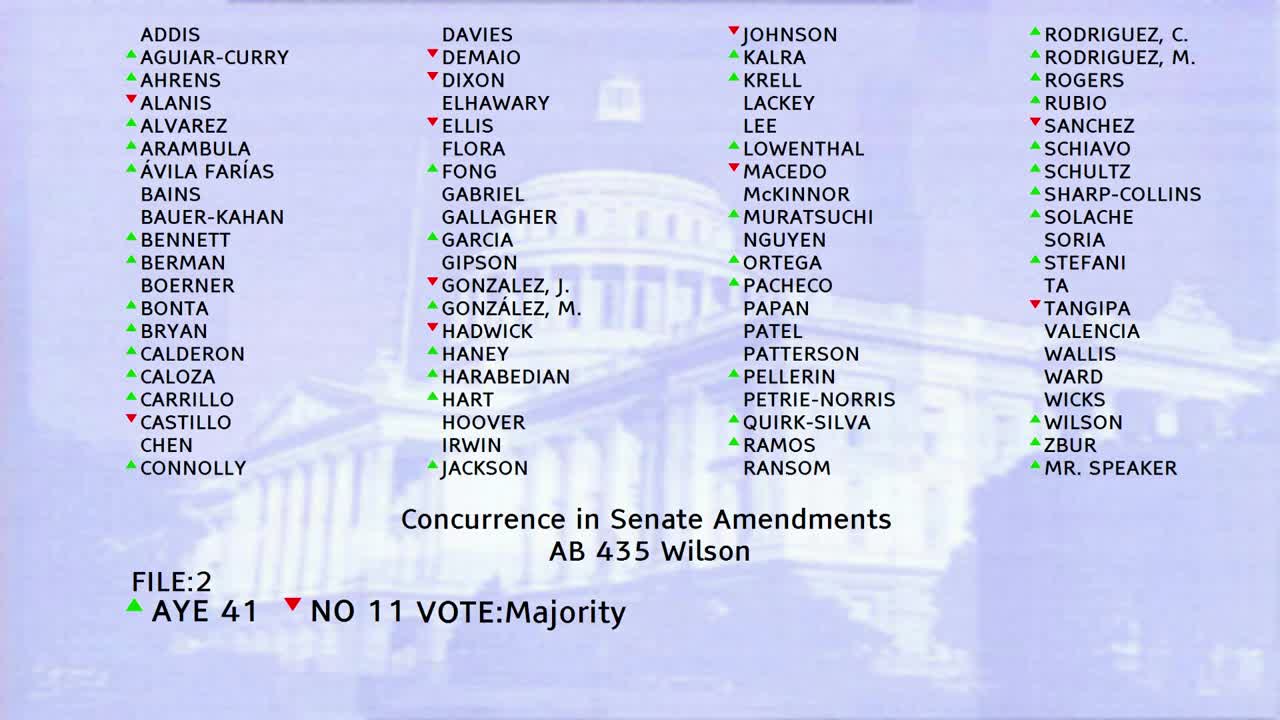 1MIN
Assembly Floor
 2MIN
Senate Floor
 7MIN
Senate Standing Committee on Judiciary
 24MIN
Senate Standing Committee on Energy, Utilities and Communications
 1MIN
Senate Standing Committee on Energy, Utilities and Communications
Bill Author

Bill Co-Author(s):