AB 40: California Environmental Quality Act: environmental impact reports: coal handling, storage, and export.
- Session Year: 2025-2026
- House: Assembly
- Latest Version Date: 2026-09-30
Current Status:
Passed
(2026-09-30: Chaptered by Secretary of State - Chapter 864, Statutes of 2026.)
Introduced
In Committee
Awaiting First Chamber Vote
Passed First Chamber
In Committee
Awaiting Second Chamber Vote
Passed Second Chamber
Enacted
The California Environmental Quality Act (CEQA) requires a lead agency, as defined, to prepare, or cause to be prepared, and certify the completion of, an environmental impact report (EIR) on a project that it proposes to carry out or approve that may have a significant effect on the environment or to adopt a negative declaration if it finds that the project will not have that effect. CEQA also requires a lead agency to prepare a mitigated negative declaration for a project that may have a significant effect on the environment if revisions in the project would avoid or mitigate that effect and there is no substantial evidence that the project, as revised, would have a significant effect on the environment. CEQA provides that when an EIR has been prepared for a project, no subsequent or supplemental EIR shall be required by a lead agency or responsible agency, unless specified events occur.
This bill would require a lead agency, before issuing the initial discretionary approval for a large-volume bulk coal facility, defined as a facility with a design capacity exceeding 5,000,000 short tons per year of coal handling, storage, or export to prepare or cause to be prepared an EIR. The bill would prohibit a lead agency, air pollution control district, or air quality management district from relying on an existing EIR to issue a discretionary approval for, or to, a large-volume bulk coal facility, and would require a subsequent or new EIR to be prepared, if any of a list of specified conditions are met, including that there is an increase in design capacity of a project that did not previously meet the definition of a large-volume bulk coal facility, as provided; there is a change in the type of coal handled, stored, or exported, or the EIR did not explicitly address the type of coal handled, stored, or exported; or there is a significant increase in the quantity of coal handled, stored, or exported, or the EIR did not explicitly disclose the quantity of coal to be handled, stored, or exported. The bill would require an EIR or subsequent EIR prepared pursuant to these provisions to, among other things, evaluate the large-volume bulk coal facilitys potential to generate PM2.5 and PM10 fugitive dust emissions during construction and operations, and to require mitigation measures, as provided. The bill would apply these provisions to a discretionary approval that is pending or made after June 4, 2026, as specified.
Because the bill would create new duties for a lead agency, the bill would impose a state-mandated local program.
The California Constitution requires the state to reimburse local agencies and school districts for certain costs mandated by the state. Statutory provisions establish procedures for making that reimbursement.
This bill would provide that no reimbursement is required by this act for a specified reason.
The California Environmental Quality Act (CEQA) requires a lead agency, as defined, to prepare, or cause to be prepared, and certify the completion of, an environmental impact report (EIR) on a project that it proposes to carry out or approve that may have a significant effect on the environment or to adopt a negative declaration if it finds that the project will not have that effect. CEQA also requires a lead agency to prepare a mitigated negative declaration for a project that may have a significant effect on the environment if revisions in the project would avoid or mitigate that effect and there is no substantial evidence that the project, as revised, would have a significant effect on the environment. CEQA provides that when an EIR has been prepared for a project, no subsequent or supplemental EIR shall be required by a lead agency or responsible agency, unless specified events occur.
This bill would require a lead agency, before issuing the initial discretionary approval for a large-volume bulk coal facility, defined as a facility or site with a design capacity exceeding 5,000,000 short tons per year of coal handling, storage, or export to prepare or cause to be prepared an EIR. The bill would prohibit a lead agency, air pollution control district, or air quality management district from relying on an existing EIR to issue a discretionary approval for, or to, a large-volume bulk coal facility, and would require a subsequent or new EIR to be prepared, if any of a list of specified conditions are met, including that there is an increase in design capacity of a project that did not previously meet the definition of a large-volume bulk coal facility, as provided; there is a change in the type of coal handled, stored, or exported, or the EIR did not explicitly address the type of coal handled, stored, or exported; or there is a significant increase in the quantity of coal handled, stored, or exported, or the EIR did not explicitly disclose the quantity of coal to be handled, stored, or exported. The bill would require an EIR or subsequent EIR prepared pursuant to these provisions to, among other things, evaluate the large-volume bulk coal facilitys potential to generate PM2.5 and PM10 fugitive dust emissions during construction and operations, and to require mitigation measures, as provided. The bill would apply these provisions to a discretionary approval that is pending or made after June 4, 2026, as specified.
Because the bill would create new duties for a lead agency, the bill would impose a state-mandated local program.
The California Constitution requires the state to reimburse local agencies and school districts for certain costs mandated by the state. Statutory provisions establish procedures for making that reimbursement.
This bill would provide that no reimbursement is required by this act for a specified reason.
The California Environmental Quality Act (CEQA) requires a lead agency, as defined, to prepare, or cause to be prepared, and certify the completion of, an environmental impact report (EIR) on a project that it proposes to carry out or approve that may have a significant effect on the environment or to adopt a negative declaration if it finds that the project will not have that effect. CEQA also requires a lead agency to prepare a mitigated negative declaration for a project that may have a significant effect on the environment if revisions in the project would avoid or mitigate that effect and there is no substantial evidence that the project, as revised, would have a significant effect on the environment. CEQA provides that when an environmental impact report EIR has been prepared for a project, no subsequent or supplemental environmental impact report EIR shall be required by a lead agency or responsible agency, unless specified events occur.
This bill would require every public agency with a lead agency, before issuing the initial discretionary approval over any portion of a new project for a large-volume bulk coal facility, defined as a facility or site with a design capacity exceeding 5,000,000 short tons per year of coal handling, storage, or export to prepare or cause to be prepared an environmental impact report. The bill would require a subsequent environmental impact report if EIR. The bill would prohibit a lead agency, air pollution control district, or air quality management district from relying on an existing EIR to issue a discretionary approval for, or to, a large-volume bulk coal facility, and would require a subsequent EIR to be prepared, if any of a list of specified conditions are met, including that there is an increase in design capacity, capacity of a project that did not previously meet the definition of a large-volume bulk coal facility, as provided; there is a change in the type, rank, type of coal handled, stored, or exported, or the EIR did not explicitly address the type of coal handled, stored, or exported; or there is a significant increase in the quantity of coal handled, stored, or exported; or if the environmental impact report for a project with a design capacity exceeding 5,000,000 short tons is 10 or more years old. exported, or the EIR did not explicitly disclose the quantity of coal to be handled, stored, or exported. The bill would require an environmental impact report EIR or subsequent EIR prepared pursuant to these provisions that identifies significant air quality impacts unless the project proponent fully mitigates to, among other things, evaluate the large-volume bulk coal facilitys potential to generate PM2.5 and PM10 fugitive dust emissions. emissions during construction and operations, and to require mitigation measures, as provided. The bill would apply these provisions to a discretionary approval that is pending or made after June 4, 2026, as specified.
Because the bill would create new duties for a public agency, which includes a local agency, and a lead agency, the bill would impose a state-mandated local program.
The California Constitution requires the state to reimburse local agencies and school districts for certain costs mandated by the state. Statutory provisions establish procedures for making that reimbursement.
This bill would provide that no reimbursement is required by this act for a specified reason.
The California Environmental Quality Act (CEQA) requires a lead agency, as defined, to prepare, or cause to be prepared, and certify the completion of, an environmental impact report on a project that it proposes to carry out or approve that may have a significant effect on the environment or to adopt a negative declaration if it finds that the project will not have that effect. CEQA also requires a lead agency to prepare a mitigated negative declaration for a project that may have a significant effect on the environment if revisions in the project would avoid or mitigate that effect and there is no substantial evidence that the project, as revised, would have a significant effect on the environment. CEQA provides that when an environmental impact report has been prepared for a project, no subsequent or supplemental environmental impact report shall be required by a lead agency or responsible agency, unless specified events occur.
This bill would require every public agency with discretionary approval over any portion of a new project, or material expansion of an existing project, project with a design capacity exceeding 5,000,000 short tons per year of coal handling, storage, or export to prepare or cause to be prepared an environmental impact report. The bill would require a subsequent or supplemental environmental impact report if there is an increase in design capacity, as provided; a change in the type type, rank, or a substantial change significant increase in the quantity of coal handled, stored, or exported or exported; or if the environmental impact report for a project with a design capacity exceeding 5,000,000 short tons is 10 or more years old. The bill would also prohibit a lead agency from certifying require an environmental impact report pursuant to these provisions that identifies significant air quality impacts unless the project proponent demonstrates enforceable mitigation measures to reduce fine and coarse pollutants, as specified. fully mitigates PM2.5 and PM10 fugitive dust emissions.
Because the bill would create new duties for a public agency, which includes a local agency, and a lead agency, the bill would impose a state-mandated local program.
The California Constitution requires the state to reimburse local agencies and school districts for certain costs mandated by the state. Statutory provisions establish procedures for making that reimbursement.
This bill would provide that no reimbursement is required by this act for a specified reason.
The California Environmental Quality Act (CEQA) requires a lead agency, as defined, to prepare, or cause to be prepared, and certify the completion of, an environmental impact report on a project that it proposes to carry out or approve that may have a significant effect on the environment or to adopt a negative declaration if it finds that the project will not have that effect. CEQA also requires a lead agency to prepare a mitigated negative declaration for a project that may have a significant effect on the environment if revisions in the project would avoid or mitigate that effect and there is no substantial evidence that the project, as revised, would have a significant effect on the environment. CEQA provides that when an environmental impact report has been prepared for a project, no subsequent or supplemental environmental impact report shall be required by a lead agency or responsible agency, unless specified events occur.
This bill would require every public agency with discretionary approval over any portion of a new project, or material expansion of an existing project, with a design capacity exceeding 5,000,000 short tons per year of coal handling, storage, or export to prepare or cause to be prepared an environmental impact report. The bill would require a subsequent or supplemental environmental impact report if there is a change in the type or a substantial change in the quantity of coal handled, stored, or exported or if the environmental impact report is 10 or more years old. The bill would also prohibit a lead agency from certifying an environmental impact report pursuant to these provisions that identifies significant air quality impacts unless the project proponent demonstrates enforceable mitigation measures to reduce fine and coarse pollutants, as specified.
Because the bill would create new duties for a public agency, which includes a local agency, and a lead agency, the bill would impose a state-mandated local program.
The California Constitution requires the state to reimburse local agencies and school districts for certain costs mandated by the state. Statutory provisions establish procedures for making that reimbursement.
This bill would provide that no reimbursement is required by this act for a specified reason.
The California Constitution requires the Citizens Redistricting Commission to adjust the boundary lines of the congressional, State Senate, Assembly, and State Board of Equalization districts in each year ending in 1.If approved by the electors, ACA 8 of the 202526 Regular Session would temporarily adopt new congressional district boundaries until 2031. The new congressional district boundaries are set forth in AB 604 of the 202526 Regular Session, which specifies that those district boundaries would become operative only if ACA 8 is approved by the electors.This bill would instead make the congressional district boundaries in AB 604 operative only if ACA 8 is approved by the electors and another state adopts a new congressional district map that takes effect after August 1, 2025, and before January 1, 2031, and that was not required by a federal court order.This bill would declare that it is to take effect immediately as an urgency statute.The California Constitution requires the Citizens Redistricting Commission to adjust the boundary lines of the congressional, State Senate, Assembly, and State Board of Equalization districts in each year ending in 1.
If approved by the electors, ACA 8 of the 202526 Regular Session would temporarily adopt new congressional district boundaries until 2031. The new congressional district boundaries are set forth in AB 604 of the 202526 Regular Session, which specifies that those district boundaries would become operative only if ACA 8 is approved by the electors.
This bill would instead make the congressional district boundaries in AB 604 operative only if ACA 8 is approved by the electors and another state adopts a new congressional district map that takes effect after August 1, 2025, and before January 1, 2031, and that was not required by a federal court order.
This bill would declare that it is to take effect immediately as an urgency statute.
Existing law provides for the licensing and regulation of health facilities by the State Department of Public Health and makes a violation of those provisions a crime. Existing law, the Knox-Keene Health Care Service Plan Act of 1975, provides for the licensure and regulation of health care service plans by the Department of Managed Health Care and makes a willful violation of the act a crime. Existing law requires a health facility to provide emergency services and care upon request or when a person is in danger of loss of life or serious injury or illness, and requires a health care service plan to reimburse providers for emergency services and care. Existing law defines emergency services and care for these purposes to mean medical screening, examination, and evaluation by a physician and surgeon, or other appropriate licensed persons under the supervision of a physician and surgeon, to determine if an emergency medical condition or active labor exists and, if it does, the care, treatment, and surgery, if within the scope of that persons license, necessary to relieve or eliminate the emergency medical condition, within the capability of the facility, among other things.
This bill would additionally define emergency services and care for the above-described purposes to mean reproductive health services, including abortion. By expanding the applicability of a crime with respect to health facilities and health care service plans, the bill would impose a state-mandated local program.
The California Constitution requires the state to reimburse local agencies and school districts for certain costs mandated by the state. Statutory provisions establish procedures for making that reimbursement.
This bill would provide that no reimbursement is required by this act for a specified reason.
This bill would declare that it is to take effect immediately as an urgency statute.
The Legislature finds and declares all of the following:
(a)The West Oakland community has a high cumulative air pollution exposure burden, a significant number of sensitive receptors, and includes census tracts that have been designated as disadvantaged communities. West Oakland is impacted by mobile sources of pollution, including diesel trucks and buses, and pollution from industry operations and adjacent Interstates 580, 980, and 880.
(b)West Oakland was selected as a first-year priority community under the Community Air Protection Program pursuant to Assembly Bill 617 (Chapter 136 of the Statutes of 2017).
(c)West Oakland residents are predominantly people of color, and the life expectancy for an African American child born and raised in West Oakland is at least 15 years fewer than for a white child born and raised in wealthier Oakland neighborhoods.
(d)The State Air Resources Board funded peer-reviewed research that identified significant increases in fine particulate matter (PM2.5) in California due to passing coal-carrying trains, the staging of full and empty coal train cars, and coal storage and handling at an export terminal.
(e)PM2.5 and other air pollution from shipping, handling, and storing coal have significant health effects that disproportionately impact communities of color and low-income individuals.
(f)The classification of coal as lignite, subbituminous, bituminous, or anthracite describes the coals properties and bears on its environmental impacts.
(g)The United States Environmental Protection Agency found that PM2.5 poses the greatest risk to health of particulate matter pollutants.
SEC. 2.Section 21080.52 is added to the Public Resources Code, to read:21080.52.(a)For purposes of this section, both of the following definitions apply:
(1)Large-volume bulk coal facility means a facility with a design capacity exceeding 5,000,000 short tons per year of coal handling, storage, or export. Large-volume bulk coal facility does not include a building, use, or infrastructure located at the same site, located within the same specific plan or redevelopment area, or covered by the same environmental impact report as a large-volume bulk coal facility, if that building, use, or infrastructure does not handle, store, transport, or export coal, even if the building, use, or infrastructure was considered to be part of an overall project previously evaluated in an environmental impact report that also addressed the large-volume bulk coal facility.
(2)Type of coal refers to the classification of coal as lignite, subbituminous, bituminous, or anthracite.
(b)Before issuing the initial discretionary approval for a large-volume bulk coal facility, a lead agency shall prepare or cause to be prepared an environmental impact report pursuant to this division.
(c)Issuance of any permit by an air pollution control district or air quality management district that authorizes construction, or increases potential emissions, of a large-volume bulk coal facility shall be considered a discretionary approval, as that term is used in subdivision (a) of Section 21080, and shall not be exempt from this division.
(d)Independent of the conditions for a subsequent environmental impact report set forth in Section 21166 and guidelines adopted pursuant to Section 21083, a lead agency, air pollution control district, or air quality management district shall not rely on an existing environmental impact report to issue a discretionary approval for or to a large-volume bulk coal facility, and a subsequent environmental impact report, or a new environmental impact report pursuant to subdivision (e), shall be required, if any of the following conditions are met:
(1)There is a change in the type of coal handled, stored, or exported, or the environmental impact report did not explicitly address the type of coal to be handled, stored, or exported.
(2)There is a significant increase in the quantity of coal handled, stored, or exported, or the environmental impact report did not explicitly disclose the quantity of coal to be handled, stored, or exported.
(3)There is an increase in the design capacity of a project that did not previously meet the definition of a large-volume bulk coal facility so that the total amount of coal handled, stored, or exported exceeds 5,000,000 short tons per year.
(e)(1)If a previously certified environmental impact report for a large-volume bulk coal facility did not specifically analyze the environmental impacts of coal handling, storage, and transportation, that environmental impact report does not retain informational value.
(2)A lead agency, air pollution control district, or air quality management district shall not rely on an environmental impact report described in paragraph (1) and shall treat a large-volume bulk coal facility analyzed in that environmental impact report as a new project, independent of the project that was analyzed in that environmental impact report.
(f)In addition to the other requirements of this division and guidelines adopted pursuant to Section 21083, an environmental impact report or subsequent environmental impact report prepared pursuant to this section shall not be certified, and the project shall not be approved, unless the environmental impact report or subsequent environmental impact report does both of the following:
(1)Identify the type or types of coal and potential volume of coal that may be handled, stored, or exported at a large-volume bulk coal facility, and evaluate the environmental impacts of, and mitigation for, the handling, storage, or export of the coal type or types and volume of coal.
(2)(A)Evaluate the large-volume bulk coal facilitys potential to generate fugitive dust emissions of fine particulate matter (PM2.5) and coarse particulate matter (PM10) during construction and operations and require mitigation measures sufficient to prevent a significant increase in ambient concentrations of PM2.5 and PM10 beyond the facilitys boundaries.
(B)Where the local air pollution control district or air quality management district has adopted a numeric individual project threshold for increases in ambient concentrations of PM2.5 or PM10, those thresholds shall be used to determine significance for purposes of this paragraph.
(g)Nothing in this section shall be construed to do any of the following:
(1)Require a new, subsequent, or supplemental environmental impact report for a building, use, or infrastructure that is not a large-volume bulk coal facility.
(2)Affect the validity of a previously certified environmental impact report or other determination made pursuant to this division for a building, use, or infrastructure that is not a large-volume bulk coal facility.
(3)Affect the ability of a lead agency, air pollution control district, or air quality management district to rely on or tier from, a previously certified environmental impact report or other determination made pursuant to this division for a building, use, or infrastructure that is not a large-volume bulk coal facility.
(h)This section shall apply retroactively to any discretionary approval for a large-volume bulk coal facility by a lead agency, air pollution control district, or air quality management district that is pending or made between June 4, 2026, and January 1, 2027.
(i)The provisions of this section are severable. If any provision of this section or its application is held invalid, that invalidity shall not affect other provisions or applications that can be given effect without the invalid provision or application.
SEC. 3.No reimbursement is required by this act pursuant to Section 6 of Article XIIIB of the California Constitution because a local agency or school district has the authority to levy service charges, fees, or assessments sufficient to pay for the program or level of service mandated by this act, within the meaning of Section 17556 of the Government Code.
The Legislature finds and declares all of the following:
(a)The West Oakland community has a high cumulative air pollution exposure burden, a significant number of sensitive receptors, and includes census tracts that have been designated as disadvantaged communities. West Oakland is impacted by mobile sources of pollution, including diesel trucks and buses, and pollution from industry operations and adjacent Interstates 580, 980, and 880.
(b)West Oakland was selected as a first-year priority community under the Community Air Protection Program pursuant to Assembly Bill 617 (Chapter 136 of the Statutes of 2017).
(c)West Oakland residents are predominantly people of color, and the life expectancy for an African American child born and raised in West Oakland is at least 15 years fewer than for a white child born and raised in wealthier Oakland neighborhoods.
(d)The State Air Resources Board funded peer-reviewed research that identified significant increases in fine particulate matter (PM2.5) in California due to passing coal-carrying trains, the staging of full and empty coal train cars, and coal storage and handling at an export terminal.
(e)PM2.5 and other air pollution from shipping, handling, and storing coal have significant health effects that disproportionately impact communities of color and low-income individuals.
(f)The classification of coal as lignite, subbituminous, bituminous, or anthracite describes the coals properties and bears on its environmental impacts.
(g)The United States Environmental Protection Agency found that PM2.5 poses the greatest risk to health of particulate matter pollutants.
SEC. 2.Section 21080.52 is added to the Public Resources Code, to read:21080.52.(a)For purposes of this section, both of the following definitions apply:
(1)Large-volume bulk coal facility means a facility or site with a design capacity exceeding 5,000,000 short tons per year of coal handling, storage, or export. Large-volume bulk coal facility does not include a building, use, or infrastructure located at the same site, located within the same specific plan or redevelopment area, or covered by the same environmental impact report as a large-volume bulk coal facility, if that building, use, or infrastructure does not handle, store, transport, or export coal, even if the building, use, or infrastructure was considered to be part of an overall project previously evaluated in an environmental impact report that also addressed the large-volume bulk coal facility.
(2)Type of coal refers to the classification of coal as lignite, subbituminous, bituminous, or anthracite.
(b)Before issuing the initial discretionary approval for a large-volume bulk coal facility, a lead agency shall prepare or cause to be prepared an environmental impact report pursuant to this division.
(c)Issuance of any permit by an air pollution control district or air quality management district that authorizes construction, or increases potential emissions, of a large-volume bulk coal facility shall be considered a discretionary approval, as that term is used in subdivision (a) of Section 21080, and shall not be exempt from this division.
(d)Independent of the conditions for a subsequent environmental impact report set forth in Section 21166 and guidelines adopted pursuant to Section 21083, a lead agency, air pollution control district, or air quality management district shall not rely on an existing environmental impact report to issue a discretionary approval for or to a large-volume bulk coal facility, and a subsequent environmental impact report report, or a new environmental impact report pursuant to subdivision (e), shall be required, if any of the following conditions are met:
(1)There is a change in the type of coal handled, stored, or exported, or the environmental impact report did not explicitly address the type of coal to be handled, stored, or exported.
(2)There is a significant increase in the quantity of coal handled, stored, or exported, or the environmental impact report did not explicitly disclose the quantity of coal to be handled, stored, or exported.
(3)There is an increase in the design capacity of a project that did not previously meet the definition of a large-volume bulk coal facility so that the total amount of coal handled, stored, or exported exceeds 5,000,000 short tons per year.
(e)(1)If a previously certified environmental impact report for a large-volume bulk coal facility did not specifically analyze the environmental impacts of coal handling, storage, and transportation, that environmental impact report does not retain informational value.
(2)A lead agency, air pollution control district, or air quality management district shall not rely on an environmental impact report described in paragraph (1) and shall treat a large-volume bulk coal facility analyzed in that environmental impact report as a new project, independent of the project that was analyzed in that environmental impact report.
(f)In addition to the other requirements of this division and guidelines adopted pursuant to Section 21083, an environmental impact report or subsequent environmental impact report prepared pursuant to this section shall do not be certified, and the project shall not be approved, unless the environmental impact report or subsequent environmental impact report does both of the following:
(1)Identify the type or types of coal and potential volume of coal that may be handled, stored, or exported at a large-volume bulk coal facility, and evaluate the environmental impacts of, and mitigation for, the handling, storage, or export of the coal type or types and volume of coal.
(2)(A)Evaluate the large-volume bulk coal facilitys potential to generate fugitive dust emissions of fine particulate matter (PM2.5) and coarse particulate matter (PM10) during construction and operations and require mitigation measures sufficient to prevent a significant increase in ambient concentrations of PM2.5 and PM10 beyond the facilitys boundaries.
(g)(B)Where the local air pollution control district or air quality management district has adopted a numeric individual project threshold for increases in ambient concentrations of PM2.5 or PM10, those thresholds shall be used to determine significance for purposes of this paragraph.
(g)Nothing in this section shall be construed to do any of the following:
(1)Require a new, subsequent, or supplemental environmental impact report for a building, use, or infrastructure that is not a large-volume bulk coal facility.
(2)Affect the validity of a previously certified environmental impact report or other determination made pursuant to this division for a building, use, or infrastructure that is not a large-volume bulk coal facility.
(3)Affect the ability of a lead agency, air pollution control district, or air quality management district to rely on or tier from, a previously certified environmental impact report or other determination made pursuant to this division for a building, use, or infrastructure that is not a large-volume bulk coal facility.
(h)This section shall apply retroactively to any discretionary approval for a large-volume bulk coal facility by a lead agency, air pollution control district, or air quality management district that is pending or made between June 4, 2026, and January 1, 2027.
(h)(i)The provisions of this section are severable. If any provision of this section or its application is held invalid, that invalidity shall not affect other provisions or applications that can be given effect without the invalid provision or application.
SEC. 3.No reimbursement is required by this act pursuant to Section 6 of Article XIIIB of the California Constitution because a local agency or school district has the authority to levy service charges, fees, or assessments sufficient to pay for the program or level of service mandated by this act, within the meaning of Section 17556 of the Government Code.
The Legislature finds and declares all of the following:
(a)The West Oakland community has a high cumulative air pollution exposure burden, a significant number of sensitive receptors, and includes census tracts that have been designated as disadvantaged communities. West Oakland is impacted by mobile sources of pollution, including diesel trucks and buses, and pollution from industry operations and adjacent Interstates 580, 980, and 880.
(b)West Oakland was selected as a first-year priority community under the Community Air Protection Program pursuant to Assembly Bill 617 (Chapter 136 of the Statutes of 2017).
(c)West Oakland residents are predominantly people of color, and the life expectancy for an African American child born and raised in West Oakland is at least 15 years fewer than for a white child born and raised in wealthier Oakland neighborhoods.
(d)The State Air Resources Board funded peer-reviewed research that identified significant increases in fine particulate matter (PM2.5) in California due to passing coal-carrying trains and found that trains with empty coal cars also generated increases in PM2.5. trains, the staging of full and empty coal train cars, and coal storage and handling at an export terminal.
(e)Coal train PM2.5 and other air pollution has from shipping, handling, and storing coal have significant health effects that disproportionately impact communities of color and low-income individuals.
(f)The classification of coal as lignite, subbituminous, bituminous, or anthracite describes the coals properties and bears on its environmental impacts.
(f)(g)The United States Environmental Protection Agency found that PM2.5 poses the greatest risk to health of particulate matter pollutants.
SEC. 2.Section 21080.52 is added to the Public Resources Code, to read:21080.52.(a)Notwithstanding any other provision of this division, a public agency with a discretionary approval over any portion of a new project with a design capacity exceeding 5,000,000 short tons per year of coal handling, storage, or export shall prepare or cause to be prepared an environmental impact report pursuant to this division.21080.52.(a)For purposes of this section, both of the following definitions apply:
(1)Large-volume bulk coal facility means a facility or site with a design capacity exceeding 5,000,000 short tons per year of coal handling, storage, or export.
(2)Type of coal refers to the classification of coal as lignite, subbituminous, bituminous, or anthracite.
(b)Before issuing the initial discretionary approval for a large-volume bulk coal facility, a lead agency shall prepare or cause to be prepared an environmental impact report pursuant to this division.
(c)Issuance of any permit by an air pollution control district or air quality management district that authorizes construction, or increases potential emissions, of a large-volume bulk coal facility shall be considered a discretionary approval, as that term is used in subdivision (a) of Section 21080, and shall not be exempt from this division.
(b)(d)Independent of the conditions for a subsequent environmental impact report set forth in Section 21166 and guidelines adopted pursuant to Section 21083, a lead agency, air pollution control district, or air quality management district shall not rely on an existing environmental impact report to issue a discretionary approval for or to a large-volume bulk coal facility, and a subsequent environmental impact report shall be required for a project if any of the following apply: required, if any of the following conditions are met:
(1)There is a change in the type or rank of coal handled, stored, or exported. exported, or the environmental impact report did not explicitly address the type of coal to be handled, stored, or exported.
(2)There is a significant increase in the quantity of coal handled, stored, or exported. exported, or the environmental impact report did not explicitly disclose the quantity of coal to be handled, stored, or exported.
(3)There is an increase in the design capacity of a project that did not previously meet the definition of a large-volume bulk coal facility so that the total amount of coal handled, stored, or exported exceeds 5,000,000 short tons per year.
(4)The environmental impact report for a project with a design capacity exceeding 5,000,000 short tons per year of coal handling, storage, or export is 10 or more years old.(c)If an environmental impact report prepared pursuant to this section identifies significant air quality impacts, a lead agency shall not certify the environmental impact report unless the project proponent fully mitigates PM2.5 and PM10 fugitive dust emissions.(e)(1)If a previously certified environmental impact report for a large-volume bulk coal facility did not specifically analyze the environmental impacts of coal handling, storage, and transportation, that environmental impact report does not retain informational value.
(2)A lead agency, air pollution control district, or air quality management district shall not rely on an environmental impact report described in paragraph (1) and shall treat a large-volume bulk coal facility analyzed in that environmental impact report as a new project, independent of the project that was analyzed in that environmental impact report.
(f)In addition to the other requirements of this division and guidelines adopted pursuant to Section 21083, an environmental impact report or subsequent environmental impact report prepared pursuant to this section shall do both of the following:
(1)Identify the type or types of coal and potential volume of coal that may be handled, stored, or exported at a large-volume bulk coal facility, and evaluate the environmental impacts of, and mitigation for, the handling, storage, or export of the coal type or types and volume of coal.
(2)Evaluate the large-volume bulk coal facilitys potential to generate fugitive dust emissions of fine particulate matter (PM2.5) and coarse particulate matter (PM10) during construction and operations and require mitigation measures sufficient to prevent a significant increase in ambient concentrations of PM2.5 and PM10 beyond the facilitys boundaries.
(g)This section shall apply retroactively to any discretionary approval for a large-volume bulk coal facility by a lead agency, air pollution control district, or air quality management district that is pending or made between June 4, 2026, and January 1, 2027.
(h)The provisions of this section are severable. If any provision of this section or its application is held invalid, that invalidity shall not affect other provisions or applications that can be given effect without the invalid provision or application.
SEC. 3.No reimbursement is required by this act pursuant to Section 6 of Article XIIIB of the California Constitution because a local agency or school district has the authority to levy service charges, fees, or assessments sufficient to pay for the program or level of service mandated by this act, within the meaning of Section 17556 of the Government Code.
The Legislature finds and declares all of the following:
(a)The West Oakland community has a high cumulative air pollution exposure burden, a significant number of sensitive receptors, and includes census tracts that have been designated as disadvantaged communities. West Oakland is impacted by mobile sources of pollution, including diesel trucks and buses, and pollution from industry operations and adjacent Interstates 580, 980, and 880.
(b)West Oakland was selected as a first-year priority community under the Community Air Protection Program pursuant to Assembly Bill 617 (Chapter 136 of the Statutes of 2017).
(c)West Oakland residents are predominantly people of color, and the life expectancy for an African American child born and raised in West Oakland is at least 15 years fewer than for a white child born and raised in wealthier Oakland neighborhoods.
(d)The State Air Resources Board funded peer-reviewed research that identified significant increases in fine particulate matter (PM2.5) in California due to passing coal-carrying trains and found that trains with empty coal cars also generated increases in PM2.5.
(e)Coal train pollution has significant health effects that disproportionately impact communities of color and low-income individuals.
(f)The United States Environmental Protection Agency found that PM2.5 poses the greatest risk to health of particulate matter pollutants.
SEC. 2.Section 21080.52 is added to the Public Resources Code, to read:21080.52.(a)Notwithstanding any other provision of this division, a public agency with a discretionary approval over any portion of a new project, or material expansion of an existing project, project with a design capacity exceeding 5,000,000 short tons per year of coal handling, storage, or export shall prepare or cause to be prepared an environmental impact report pursuant to this division.
(b)Notwithstanding any other provision of this division, a Independent of the conditions for a subsequent environmental impact report set forth in Section 21166 and guidelines adopted pursuant to Section 21083, a subsequent or supplemental environmental impact report shall be required for a project described in subdivision (a) if any of the following apply:
(1)There is a change in the type or rank of coal handled, stored, or exported.
(2)There is a significant change increase in the quantity of coal handled, stored, or exported.
(3)There is an increase in the design capacity of a project so that the total amount of coal handled, stored, or exported exceeds 5,000,000 short tons per year.
(3)(4)The environmental impact report for a project with a design capacity exceeding 5,000,000 short tons per year of coal handling, storage, or export is 10 or more years old.
(c)If an environmental impact report prepared pursuant to this section identifies significant air quality impacts, a lead agency shall not certify the environmental impact report unless the project proponent demonstrates enforceable mitigation measures to reduce fine and coarse pollutants to within the threshold limit set by the lead agency. fully mitigates PM2.5 and PM10 fugitive dust emissions.
SEC. 3.No reimbursement is required by this act pursuant to Section 6 of Article XIIIB of the California Constitution because a local agency or school district has the authority to levy service charges, fees, or assessments sufficient to pay for the program or level of service mandated by this act, within the meaning of Section 17556 of the Government Code.
The Legislature finds and declares all of the following:
(a)The West Oakland community has a high cumulative air pollution exposure burden, a significant number of sensitive receptors, and includes census tracts that have been designated as disadvantaged communities. West Oakland is impacted by mobile sources of pollution, including diesel trucks and buses, and pollution from industry operations and adjacent Interstates 580, 980, and 880.
(b)West Oakland was selected as a first-year priority community under the Community Air Protection Program pursuant to Assembly Bill 617 (Chapter 136 of the Statutes of 2017).
(c)West Oakland residents are predominantly people of color, and the life expectancy for an African American child born and raised in West Oakland is at least 15 years fewer than for a white child born and raised in wealthier Oakland neighborhoods.
(d)The State Air Resources Board funded peer-reviewed research that identified significant increases in fine particulate matter (PM2.5) in California due to passing coal-carrying trains and found that trains with empty coal cars also generated increases in PM2.5.
(e)Coal train pollution has significant health effects that disproportionately impact communities of color and low-income individuals.
(f)The United States Environmental Protection Agency found that PM2.5 poses the greatest risk to health of particulate matter pollutants.
SEC. 2.Section 21080.52 is added to the Public Resources Code, to read:21080.52.(a)Notwithstanding any other provision of this division, a public agency with a discretionary approval over any portion of a new project, or material expansion of an existing project, with a design capacity exceeding 5,000,000 short tons per year of coal handling, storage, or export shall prepare or cause to be prepared an environmental impact report pursuant to this division.
(b)Notwithstanding any other provision of this division, a subsequent or supplemental environmental impact report shall be required for a project described in subdivision (a) if any of the following apply:
(1)There is a change in the type of coal handled, stored, or exported.
(2)There is a significant change in the quantity of coal handled, stored, or exported.
(3)The environmental impact report is 10 or more years old.
(c)If an environmental impact report pursuant to this section identifies significant air quality impacts, a lead agency shall not certify the environmental impact report unless the project proponent demonstrates enforceable mitigation measures to reduce fine and coarse pollutants to within the threshold limit set by the lead agency.
SEC. 3.No reimbursement is required by this act pursuant to Section 6 of Article XIIIB of the California Constitution because a local agency or school district has the authority to levy service charges, fees, or assessments sufficient to pay for the program or level of service mandated by this act, within the meaning of Section 17556 of the Government Code.
SECTION 1.Section 21454 of the Elections Code, as proposed to be added by Assembly Bill 604 of the 202526 Regular Session, is amended to read:21454.This chapter shall become operative only if both of the following conditions are satisfied:(a)Assembly Constitutional Amendment 8 of the 202526 Regular Session is approved by the voters and takes effect.(b)(1)Texas, Florida, or another state adopts a new congressional district map that takes effect after August 1, 2025, and before January 1, 2031, and such redistricting is not required by a federal court order.(2)The condition described in paragraph (1) shall include a new congressional district map adopted by the State of Ohio only if the map is adopted pursuant to division (F)(3) of Section 1 of Article XIX of the Ohio Constitution.SEC. 2.This act is an urgency statute necessary for the immediate preservation of the public peace, health, or safety within the meaning of Article IV of the California Constitution and shall go into immediate effect. The facts constituting the necessity are:In order that congressional redistricting plans may be implemented as soon as possible, and to ensure the rights of all Californians to equal protection of the laws, it is necessary that this act take effect immediately.This chapter shall become operative only if Assembly both of the following conditions are satisfied:
(a)Assembly Constitutional Amendment 8 of the 202526 Regular Session is approved by the voters and takes effect, and subdivision (b) of Section 4 of Article XXI of the California Constitution, as added by that constitutional amendment, becomes operative. effect.
(b)(1)Texas, Florida, or another state adopts a new congressional district map that takes effect after August 1, 2025, and before January 1, 2031, and such redistricting is not required by a federal court order.
(2)The condition described in paragraph (1) shall include a new congressional district map adopted by the State of Ohio only if the map is adopted pursuant to division (F)(3) of Section 1 of Article XIX of the Ohio Constitution.
SEC. 4.SEC. 2.This act is an urgency statute necessary for the immediate preservation of the public peace, health, or safety within the meaning of Article IV of the California Constitution and shall go into immediate effect. The facts constituting the necessity are:
In order to protect the public from actions that are contrary to the public policy and laws of this state, including actions that interfere with a persons ability to access the emergency medical reproductive care they need, it is necessary that this act take effect immediately.In order that congressional redistricting plans may be implemented as soon as possible, and to ensure the rights of all Californians to equal protection of the laws, it is necessary that this act take effect immediately.
The Legislature finds and declares that Californians have the constitutional right that expressly provides that the state shall not deny or interfere with an individual's reproductive freedom in their most intimate decisions, which includes their fundamental right to choose to have an abortion. It is the intent of the Legislature in enacting this act to clarify that existing law related to emergency services and care necessary to relieve or eliminate an emergency medical condition includes reproductive health services, including abortion.
SEC. 2.Section 1317.1 of the Health and Safety Code is amended to read:1317.1.Unless the context otherwise requires, the following definitions shall control the construction of this article and Section 1371.4:
(a)(1)Emergency services and care means medical screening, examination, and evaluation by a physician and surgeon, or, to the extent permitted by applicable law, by other appropriate licensed persons under the supervision of a physician and surgeon, to determine if an emergency medical condition or active labor exists and, if it does, the care, treatment, and surgery, surgery, and reproductive health services, including abortion, if within the scope of that persons license, necessary to relieve or eliminate the emergency medical condition, within the capability of the facility.
(2)Emergency services and care also means reproductive health services, including abortion. (3)(2)(A)Emergency services and care also means an additional screening, examination, and evaluation by a physician, or other personnel to the extent permitted by applicable law and within the scope of their licensure and clinical privileges, to determine if a psychiatric emergency medical condition exists, and the care and treatment necessary to relieve or eliminate the psychiatric emergency medical condition, within the capability of the facility.
(B)The care and treatment necessary to relieve or eliminate a psychiatric emergency medical condition may include admission or transfer to a psychiatric unit within a general acute care hospital, as defined in subdivision (a) of Section 1250, or to an acute psychiatric hospital, as defined in subdivision (b) of Section 1250, pursuant to subdivision (k). This subparagraph does not permit a transfer that is in conflict with the Lanterman-Petris-Short Act (Part 1 (commencing with Section 5000) of Division 5 of the Welfare and Institutions Code), or the federal Emergency Medical Treatment and Labor Act (Section 1395dd of Title 42 of the United States Code).
(C)For the purposes of Section 1371.4, emergency services and care as defined in subparagraph (A) shall not apply to Medi-Cal managed care plan contracts entered into with the State Department of Health Care Services pursuant to Chapter 7 (commencing with Section 14000), Chapter 8 (commencing with Section 14200), and Chapter 8.75 (commencing with Section 14591) of Part 3 of Division 9 of the Welfare and Institutions Code, to the extent that those services are excluded from coverage under those contracts.
(D)This paragraph does not expand, restrict, or otherwise affect the scope of licensure or clinical privileges for clinical psychologists or other medical personnel.
(b)Emergency medical condition means a medical condition manifesting itself by acute symptoms of sufficient severity (including severe pain) such that the absence of immediate medical attention could reasonably be expected to result in any of the following:
(1)Placing the patients health in serious jeopardy.
(2)Serious impairment to bodily functions.
(3)Serious dysfunction of any bodily organ or part.
(c)Active labor means a labor at a time at which either of the following would occur:
(1)There is inadequate time to effect safe transfer to another hospital prior to delivery.
(2)A transfer may pose a threat to the health and safety of the patient or the fetus.
(d)Hospital means all hospitals with an emergency department licensed by the state department.
(e)State department means the State Department of Public Health.
(f)Medical hazard means a material deterioration in medical condition in, or jeopardy to, a patients medical condition or expected chances for recovery.
(g)Board means the Medical Board of California.
(h)Within the capability of the facility means those capabilities that the hospital is required to have as a condition of its emergency medical services permit and services specified on Services Inventory Form 7041 filed by the hospital with the Department of Health Care Access and Information.
(i)Consultation means the rendering of an opinion or advice, prescribing treatment, or the rendering of a decision regarding hospitalization or transfer by telephone or other means of communication. When determined to be medically necessary, jointly by the treating physician and surgeon, or by other appropriate licensed persons acting within their scope of licensure, under the supervision of a physician and surgeon, and the consulting physician and surgeon, consultation includes review of the patients medical record, examination, and treatment of the patient in person by a consulting physician and surgeon, or by other appropriate licensed persons acting within their scope of licensure under the supervision of a consulting physician and surgeon, who is qualified to give an opinion or render the necessary treatment in order to stabilize the patient. A request for consultation shall be made by the treating physician and surgeon, or by other appropriate licensed persons acting within their scope of licensure under the supervision of a treating physician and surgeon, provided the request is made with the contemporaneous approval of the treating physician and surgeon. The treating physician and surgeon may request to communicate directly with the consulting physician and surgeon, and when determined to be medically necessary, jointly by the treating physician and surgeon and the consulting physician and surgeon, the consulting physician and surgeon shall examine and treat the patient in person. The consulting physician and surgeon is ultimately responsible for providing the necessary consultation to the patient, regardless of who makes the in-person appearance.
(j)A patient is stabilized or stabilization has occurred when, in the opinion of the treating physician and surgeon, or other appropriate licensed persons acting within their scope of licensure under the supervision of a treating physician and surgeon, the patients medical condition is such that, within reasonable medical probability, no material deterioration of the patients condition is likely to result from, or occur during, the release or transfer of the patient as provided for in Section 1317.2, Section 1317.2a, or other pertinent statute.
(k)(1)Psychiatric emergency medical condition means a mental health disorder that manifests itself by acute symptoms of sufficient severity that it renders the patient as being either of the following, regardless of whether the patient is voluntary or involuntarily detained for assessment, evaluation, and crisis intervention, or placement for evaluation and treatment pursuant to the Lanterman-Petris-Short Act (Part 1 (commencing with Section 5000) of Division 5 of the Welfare and Institutions Code):
(A)An immediate danger to themselves or to others.
(B)Immediately unable to provide for, or utilize, food, shelter, or clothing, due to the mental health disorder.
(2)This subdivision does not expand, restrict, or otherwise affect the scope of licensure or clinical privileges for clinical psychologists or medical personnel.
(l)This section does not expand the scope of licensure for licensed persons providing services pursuant to this section.
(m)This section does not require a transfer or admission that is in conflict with the Lanterman-Petris-Short Act (Part 1 (commencing with Section 5000) of Division 5 of the Welfare and Institutions Code) or with the requirements of the federal Emergency Medical Treatment and Labor Act (42 U.S.C. Sec. 1395dd).
SEC. 3.No reimbursement is required by this act pursuant to Section 6 of Article XIIIB of the California Constitution because the only costs that may be incurred by a local agency or school district will be incurred because this act creates a new crime or infraction, eliminates a crime or infraction, or changes the penalty for a crime or infraction, within the meaning of Section 17556 of the Government Code, or changes the definition of a crime within the meaning of Section 6 of Article XIIIB of the California Constitution.
SEC. 4.This act is an urgency statute necessary for the immediate preservation of the public peace, health, or safety within the meaning of Article IV of the California Constitution and shall go into immediate effect. The facts constituting the necessity are:
In order to protect the public from actions that are contrary to the public policy and laws of this state, including actions that interfere with a persons ability to access the emergency medical reproductive care they need, it is necessary that this act take effect immediately.
The Legislature finds and declares that Californians have the constitutional right that expressly provides that the state shall not deny or interfere with an individual's reproductive freedom in their most intimate decisions, which includes their fundamental right to choose to have an abortion. It is the intent of the Legislature in enacting this act to clarify that existing law related to emergency services and care necessary to relieve or eliminate an emergency medical condition includes reproductive health services, including abortion.
SEC. 2.Section 1317.1 of the Health and Safety Code is amended to read:1317.1.Unless the context otherwise requires, the following definitions shall control the construction of this article and Section 1371.4:
(a)(1)Emergency services and care means medical screening, examination, and evaluation by a physician and surgeon, or, to the extent permitted by applicable law, by other appropriate licensed persons under the supervision of a physician and surgeon, to determine if an emergency medical condition or active labor exists and, if it does, the care, treatment, and surgery, if within the scope of that persons license, necessary to relieve or eliminate the emergency medical condition, within the capability of the facility.
(2)Emergency services and care also means reproductive health services, including abortion.
(2)(3)(A)Emergency services and care also means an additional screening, examination, and evaluation by a physician, or other personnel to the extent permitted by applicable law and within the scope of their licensure and clinical privileges, to determine if a psychiatric emergency medical condition exists, and the care and treatment necessary to relieve or eliminate the psychiatric emergency medical condition, within the capability of the facility.
(B)The care and treatment necessary to relieve or eliminate a psychiatric emergency medical condition may include admission or transfer to a psychiatric unit within a general acute care hospital, as defined in subdivision (a) of Section 1250, or to an acute psychiatric hospital, as defined in subdivision (b) of Section 1250, pursuant to subdivision (k). This subparagraph does not permit a transfer that is in conflict with the Lanterman-Petris-Short Act (Part 1 (commencing with Section 5000) of Division 5 of the Welfare and Institutions Code), or the federal Emergency Medical Treatment and Labor Act (Section 1395dd of Title 42 of the United States Code).
(C)For the purposes of Section 1371.4, emergency services and care as defined in subparagraph (A) shall not apply to Medi-Cal managed care plan contracts entered into with the State Department of Health Care Services pursuant to Chapter 7 (commencing with Section 14000), Chapter 8 (commencing with Section 14200), and Chapter 8.75 (commencing with Section 14591) of Part 3 of Division 9 of the Welfare and Institutions Code, to the extent that those services are excluded from coverage under those contracts.
(D)This paragraph does not expand, restrict, or otherwise affect the scope of licensure or clinical privileges for clinical psychologists or other medical personnel.
(b)Emergency medical condition means a medical condition manifesting itself by acute symptoms of sufficient severity (including severe pain) such that the absence of immediate medical attention could reasonably be expected to result in any of the following:
(1)Placing the patients health in serious jeopardy.
(2)Serious impairment to bodily functions.
(3)Serious dysfunction of any bodily organ or part.
(c)Active labor means a labor at a time at which either of the following would occur:
(1)There is inadequate time to effect safe transfer to another hospital prior to delivery.
(2)A transfer may pose a threat to the health and safety of the patient or the fetus.
(d)Hospital means all hospitals with an emergency department licensed by the state department.
(e)State department means the State Department of Public Health.
(f)Medical hazard means a material deterioration in medical condition in, or jeopardy to, a patients medical condition or expected chances for recovery.
(g)Board means the Medical Board of California.
(h)Within the capability of the facility means those capabilities that the hospital is required to have as a condition of its emergency medical services permit and services specified on Services Inventory Form 7041 filed by the hospital with the Department of Health Care Access and Information.
(i)Consultation means the rendering of an opinion or advice, prescribing treatment, or the rendering of a decision regarding hospitalization or transfer by telephone or other means of communication. When determined to be medically necessary, jointly by the treating physician and surgeon, or by other appropriate licensed persons acting within their scope of licensure, under the supervision of a physician and surgeon, and the consulting physician and surgeon, consultation includes review of the patients medical record, examination, and treatment of the patient in person by a consulting physician and surgeon, or by other appropriate licensed persons acting within their scope of licensure under the supervision of a consulting physician and surgeon, who is qualified to give an opinion or render the necessary treatment in order to stabilize the patient. A request for consultation shall be made by the treating physician and surgeon, or by other appropriate licensed persons acting within their scope of licensure under the supervision of a treating physician and surgeon, provided the request is made with the contemporaneous approval of the treating physician and surgeon. The treating physician and surgeon may request to communicate directly with the consulting physician and surgeon, and when determined to be medically necessary, jointly by the treating physician and surgeon and the consulting physician and surgeon, the consulting physician and surgeon shall examine and treat the patient in person. The consulting physician and surgeon is ultimately responsible for providing the necessary consultation to the patient, regardless of who makes the in-person appearance.
(j)A patient is stabilized or stabilization has occurred when, in the opinion of the treating physician and surgeon, or other appropriate licensed persons acting within their scope of licensure under the supervision of a treating physician and surgeon, the patients medical condition is such that, within reasonable medical probability, no material deterioration of the patients condition is likely to result from, or occur during, the release or transfer of the patient as provided for in Section 1317.2, Section 1317.2a, or other pertinent statute.
(k)(1)Psychiatric emergency medical condition means a mental health disorder that manifests itself by acute symptoms of sufficient severity that it renders the patient as being either of the following, regardless of whether the patient is voluntary or involuntarily detained for assessment, evaluation, and crisis intervention, or placement for evaluation and treatment pursuant to the Lanterman-Petris-Short Act (Part 1 (commencing with Section 5000) of Division 5 of the Welfare and Institutions Code):
(A)An immediate danger to themselves or to others.
(B)Immediately unable to provide for, or utilize, food, shelter, or clothing, due to the mental health disorder.
(2)This subdivision does not expand, restrict, or otherwise affect the scope of licensure or clinical privileges for clinical psychologists or medical personnel.
(l)This section does not expand the scope of licensure for licensed persons providing services pursuant to this section.
(m)This section does not require a transfer or admission that is in conflict with the Lanterman-Petris-Short Act (Part 1 (commencing with Section 5000) of Division 5 of the Welfare and Institutions Code) or with the requirements of the federal Emergency Medical Treatment and Labor Act (42 U.S.C. Sec. 1395dd).
SEC. 3.No reimbursement is required by this act pursuant to Section 6 of Article XIIIB of the California Constitution because the only costs that may be incurred by a local agency or school district will be incurred because this act creates a new crime or infraction, eliminates a crime or infraction, or changes the penalty for a crime or infraction, within the meaning of Section 17556 of the Government Code, or changes the definition of a crime within the meaning of Section 6 of Article XIIIB of the California Constitution.
SEC. 4.This act is an urgency statute necessary for the immediate preservation of the public peace, health, or safety within the meaning of Article IV of the California Constitution and shall go into immediate effect. The facts constituting the necessity are:
In order to protect the public from actions that are contrary to the public policy and laws of this state, including actions that interfere with a persons ability to access the emergency medical reproductive care they need, it is necessary that this act take effect immediately.
|
Date
|
Status
|
|---|---|
| Sep 30, 2026 | Chaptered by Secretary of State - Chapter 864, Statutes of 2026. |
| Sep 30, 2026 | Approved by the Governor. |
| Sep 8, 2026 | Enrolled and presented to the Governor at 3:30 p.m. |
| Aug 28, 2026 | Senate amendments concurred in. To Engrossing and Enrolling. (Ayes 50. Noes 17. Page 6784.). |
| Aug 28, 2026 | Senate amendments concurred in. To Engrossing and Enrolling. (Ayes 50. Noes 17.). |
| Aug 27, 2026 | From committee: That the Senate amendments be concurred in. (Ayes 10. Noes 4.) (August 27). |
| Aug 26, 2026 | Joint Rule 62(a), file notice suspended. (Page 6606.) |
| Aug 26, 2026 | Joint Rule 62(a), file notice suspended. |
| Aug 26, 2026 | Re-referred to Com. on NAT. RES. pursuant to Assembly Rule 77.2. |
| Aug 25, 2026 | In Assembly. Concurrence in Senate amendments pending. |
| Aug 25, 2026 | Read third time. Passed. Ordered to the Assembly. (Ayes 30. Noes 10. Page 5791.). |
| Aug 25, 2026 | Read third time. Passed. Ordered to the Assembly. (Ayes 30. Noes 9.). |
| Aug 24, 2026 | Read second time. Ordered to third reading. |
| Aug 21, 2026 | Read third time and amended. Ordered to second reading. |
| Aug 18, 2026 | Read second time. Ordered to third reading. |
| Aug 17, 2026 | Read third time and amended. Ordered to second reading. |
| Aug 4, 2026 | Read second time. Ordered to third reading. |
| Aug 3, 2026 | From committee: Be ordered to second reading pursuant to Senate Rule 28.8. |
| Jul 2, 2026 | Read second time and amended. Re-referred to Com. on APPR. |
| Jul 2, 2026 | From committee: Amend, and do pass as amended and re-refer to Com. on APPR. (Ayes 4. Noes 2.) (July 1). |
| Jun 22, 2026 | Re-referred to Com. on E.Q. |
| Jun 15, 2026 | Re-referred to Com. on RLS. pursuant to Senate Rule 29.10 (c). |
| Jun 15, 2026 | Read second time and amended. Ordered returned to second reading. |
| Jun 15, 2026 | Ordered to second reading. |
| Jun 15, 2026 | From inactive file. |
| Sep 13, 2025 | Ordered to inactive file at the request of Senator Grayson. |
| Aug 25, 2025 | Read second time. Ordered to third reading. |
| Aug 21, 2025 | (Ayes 30. Noes 8. Page 2233.) |
| Aug 21, 2025 | Read second time and amended. Ordered returned to second reading. |
| Aug 21, 2025 | Ordered to second reading. |
| Aug 21, 2025 | From inactive file. |
| Jul 7, 2025 | Ordered to inactive file at the request of Senator Menjivar. |
| Jul 1, 2025 | Read second time. Ordered to third reading. |
| Jun 30, 2025 | From committee: Be ordered to second reading pursuant to Senate Rule 28.8. |
| Jun 12, 2025 | From committee: Do pass and re-refer to Com. on APPR. (Ayes 7. Noes 1.) (June 11). Re-referred to Com. on APPR. |
| May 7, 2025 | Referred to Com. on HEALTH. |
| Apr 21, 2025 | In Senate. Read first time. To Com. on RLS. for assignment. |
| Apr 21, 2025 | Read third time. Urgency clause adopted. Passed. Ordered to the Senate. (Ayes 58. Noes 9. Page 1174.). |
| Apr 10, 2025 | Read second time. Ordered to third reading. |
| Apr 9, 2025 | From committee: Do pass. (Ayes 10. Noes 3.) (April 9). |
| Mar 26, 2025 | From committee: Do pass and re-refer to Com. on APPR. (Ayes 12. Noes 0.) (March 25). Re-referred to Com. on APPR. |
| Mar 6, 2025 | Re-referred to Com. on HEALTH. |
| Mar 5, 2025 | From committee chair, with author's amendments: Amend, and re-refer to Com. on HEALTH. Read second time and amended. |
| Feb 3, 2025 | Referred to Com. on HEALTH. |
| Dec 3, 2024 | From printer. May be heard in committee January 2. |
| Dec 2, 2024 | Read first time. To print. |
|
Date
|
Description
|
Location
|
Votes
|
|
|---|---|---|---|---|
| Aug 28, 2026 | AB 40 Bonta Concurrence in Senate Amendments | Assembly Floor |
Passed |
|
| Aug 27, 2026 | With recommendation: That Senate amendments be concurred in. | Assembly Standing Committee on Natural Resources |
Passed |
|
| Aug 25, 2026 | Assembly 3rd Reading AB40 Bonta et al. By Arreguín | Senate Floor |
Passed |
|
| Jul 1, 2026 | Do pass as amended, but first amend, and re-refer to the Committee on [Appropriations] | Senate Standing Committee on Environmental Quality |
Passed |
|
| Jun 11, 2025 | Do pass, but first be re-referred to the Committee on [Appropriations] | Senate Standing Committee on Health |
Passed |
|
| Apr 21, 2025 | AB 40 Bonta Third Reading Urgency | Assembly Floor |
Passed |
|
| Apr 9, 2025 | Do pass. | Assembly Standing Committee on Appropriations |
Passed |
|
| Mar 25, 2025 | Do pass and be re-referred to the Committee on [Appropriations] | Assembly Standing Committee on Health |
Passed |
This list shows positions taken on this bill by organizations on the date displayed, which is linked to the original source.
Positions by individuals are not included.
|
Organization
|
Position
|
Date
|
|---|---|---|
| 1000 Grandmothers for Future Generations | ** Support | |
| 350 Bay Area Action | ** Support | |
| 350 Humboldt | ** Support | |
| AAPI Equity Alliance | ** Support | |
| Access Bridge | ** Support | |
| AFSCME California | ** Support | |
| Alameda County Board of Supervisors, District 5 | ** Support | |
| Alliance for A Better Community | ** Support | |
| Alliance San Diego | ** Against | |
| Altadena Chamber of Commerce | ** Support | |
| American College Of Obstetricians And Gynecologists District Ix | ** Support | |
| APEN Action | ** Support | |
| Arab Resource & Organizing Center Action | ** Support | |
| Asian American Drug Abuse Program | ** Support | |
| Battleground California | ** Support | |
| Bay Area Council | ** Against | |
| Bay Area-System Change Not Climate Change | ** Support | |
| Biofuelwatch | ** Support | |
| Black Women Organizing for Political Action | ** Support | |
| Borderlands for Equity | ** Support | |
| CA Church IMPACT | ** Support | |
| California Academy Of Family Physicians | ** Support | |
| California Business Properties Association | ** Against | |
| California Business Roundtable | ** Against | |
| California Catholic Conference | ** Against | |
| California Chamber Of Commerce | ** Against | |
| California Chapter of the American College of Emergency Physicians | ** Support | |
| California Common Cause | ** Against | |
| California Consumer Advocates for Affordability and Safety | ** Against | |
| California Democratic Party | ** Support | |
| California Donor Table | ** Support | |
| California Environmental Justice Alliance | ** Support | |
| California Environmental Voters | ** Support | |
| California Federation of Labor Unions, Afl-cio | ** Support | |
| California Federation Of Teachers | ** Support | |
| California Green New Deal Coalition | ** Support | |
| California Hispanic Chamber Of Commerce | ** Against | |
| California Manufacturers And Technology Association | ** Against | |
| California Medical Association | ** Support | |
| Californians for Energy Choice | ** Support | |
| California Nurses Association | ** Support | |
| California Nurses for Environmental Health & Justice | ** Support | |
| California Pan-Ethnic Health Network | ** Support | |
| California Professional Firefighters | ** Support | |
| California Railroads | ** Against | |
| California Retailers Associaiton | ** Against | |
| California Sportfishing Protection Alliance | ** Support | |
| California Teachers Association | ** Support | |
| CalTax | ** Against | |
| CAUSE Action Fund | ** Support | |
| Ceja Action | ** Support | |
| Center For Biological Diversity | ** Support | |
| Center For Environmental Health | ** Support | |
| Center on Race, Poverty and the Environment | ** Support | |
| Central Valley Immigrant Integration Collaborative | ** Support | |
| Child Care Providers United | ** Support | |
| Citizens' Climate Lobby | ** Support | |
| City of Alameda | ** Support | |
| City of Berkeley | ** Support | |
| City of Emeryville | ** Support | |
| cleanearth4kids.org | ** Support | |
| Clean Water Action | ** Support | |
| Climate Action California | ** Support | |
| Climate Action Campaign | ** Support | |
| Climate Future California | ** Support | |
| Climate Health Now Action Fund | ** Support | |
| Climate Reality Project Bay Area Chapter | ** Support | |
| Coalition For Clean Air | ** Support | |
| Commercial Real Estate Development Association | ** Against | |
| Common Vision | ** Support | |
| Communities for a Better Environment | ** Support | |
| Compass Family Services | ** Support | |
| Costa Mesa Democrats | ** Support | |
| Dayenu: A Jewish Call to Climate Action | ** Support | |
| Democracy Strategy Partners | ** Support | |
| Democratic Party of Orange County | ** Support | |
| DEMOCRATIC PARTY OF SAN FERNANDO VALLEY | ** Support | |
| Earthjustice | ** Support | |
| East Bay Democratic Socialists of America | ** Support | |
| East Bay Permanent Real Estate Cooperative | ** Support | |
| El Concilio California | ** Support | |
| Elders Climate Action Northern California and Southern California Chapters | ** Support | |
| Elders Climate Action Northern California Chapter | ** Support | |
| Elders Climate Action Southern California Chapter | ** Support | |
| Eleni Kounalakis, California Lieutenant Governor | ** Support | |
| Environmental Protection Information Center | ** Support | |
| Essential Access Health | ** Support | |
| Extinction Rebellion San Francisco Bay Area | ** Support | |
| Facts Families Advocating for Chemical and Toxics Safety | ** Support | |
| Families Advocating for Chemical and Tech Safety | ** Support | |
| Food & Water Watch | ** Support | |
| Fossil Free California Votes | ** Support | |
| Friends Committee On Legislation Of California | ** Support | |
| Govern for California | ** Against | |
| Greater High Desert Chamber of Commerce | ** Against | |
| Greater San Fernando Valley Chamber of Commerce | ** Against | |
| Greenaction for Health and Environmental Justice | ** Support | |
| green party of alameda county | ** Support | |
| HB Huddle | ** Support | |
| Healthy Martinez | ** Support | |
| Holy Spirit Respect Life Ministry | ** Against | |
| Immaculate Heart Community Environmental Commission | ** Support | |
| Imperial Valley Equity and Justice | ** Support | |
| Independent Voter Education | ** Against | |
| Independent Voter Project | ** Against | |
| Indivisible California: Statestrong | ** Support | |
| Indivisible El Dorado | ** Support | |
| Indivisible Stanislaus | ** Support | |
| Inland Empire United | ** Support | |
| Insight Terminal Solutions | ** Against | |
| Insight Terminal Solutions, LLC | ** Against | |
| Jose Medina, Riverside County Supervisor, District 1 | ** Support | |
| Kevin W. Crye, Shasta County Supervisor, District 1 | ** Against | |
| Labor Rise Climate Jobs Action Group | ** Support | |
| Little Manila Rising | ** Support | |
| Los Angeles County Democratic Party | ** Support | |
| LOS ANGELES COUNTY YOUNG DEMOCRATS | ** Support | |
| NAIOP of California | ** Against | |
| NFIB | ** Against | |
| No Coal in Oakland | ** Support | |
| NRDC | ** Support | |
| Oil & Gas Action Network | ** Support | |
| Our City SF | ** Support | |
| Outdoor Outreach | ** Support | |
| Pacific Merchant Shipping Association | ** Against | |
| Paloma Aguirre, San Diego County Supervisor, District 1 | ** Support | |
| Pesticide Action and Agroecology Network | ** Support | |
| Physicians for Social Responsibility - Los Angeles | ** Support | |
| Planned Parenthood Affiliates Of California | ** Support | |
| Planning And Conservation League | ** Support | |
| Protect the Voters FIRST Act | ** Against | |
| Reimagine Richmond | ** Support | |
| Reproductive Freedom for All California | ** Support | |
| Resource Renewal Institute | ** Support | |
| Richmond Shoreline Alliance | ** Support | |
| San Francisco Baykeeper | ** Support | |
| San Francisco Bay Physicians for Social Responsibility | ** Support | |
| San Francisco Democratic Party | ** Support | |
| San Francisco Policy Action Team / Climate Reality Bay Area | ** Support | |
| Santa Cruz Climate Action Network | ** Support | |
| Scientist Rebellion Turtle Island West | ** Support | |
| Search To Involve Pilipino Americans | ** Support | |
| SEIU California | ** Support | |
| Sierra Club | ** Support | |
| Sierra Club California | ** Support | |
| Simi Valley Chamber of Commerce | ** Against | |
| Skyline Community Church Ucc | ** Support | |
| Solidarityinfoservice | ** Support | |
| South Asian Network | ** Support | |
| SPUR | ** Support | |
| Starting Over Strong | ** Support | |
| St. Columba Catholic Church | ** Support | |
| Stop Oak Expansion Coalition | ** Support | |
| Sunflower Alliance | ** Support | |
| TEACH | ** Support | |
| Teamsters California | ** Support | |
| Terra Lawson-Remer, San Diego County Supervisor, District 3 | ** Support | |
| The Climate Center | ** Support | |
| The Two Hundred for Homeownership | ** Against | |
| The Unity Council | ** Support | |
| Thousands of individuals | ** Against | |
| Thousands of individuals | ** Support | |
| Training In Early Abortion For Comprehensive Healthcare | ** Support | |
| TruEvolution | ** Support | |
| UDW/AFSCME Local 3930 | ** Support | |
| United Food And Commercial Workers Western States Council | ** Support | |
| United Latinos Action | ** Against | |
| United Native Americans | ** Support | |
| United Way Santa Cruz County | ** Support | |
| UNITE HERE Local 2 | ** Support | |
| Unity Party of California | ** Against | |
| Voices for Progress | ** Support | |
| WDN Action | ** Support | |
| Wellstone Democratic Renewal Club | ** Support | |
| West Berkeley Alliance for Clean Air and Safe Jobs | ** Support | |
| Western States Petroleum Association | ** Against | |
| West Oakland Environmental Indicators Project | ** Support | |
| West Oakland Neighbors | ** Support | |
| Women’s March Foundation | ** Support | |
| Youth vs. Apocalypse | ** Support |
Date of Hearing: August 27, 2026
ASSEMBLY COMMITTEE ON NATURAL RESOURCES
Isaac G. Bryan, Chair
ABPCA Bill Id:AB 40 (
Author:Bonta) – As Amended Ver:August 21, 2026
SUBJECT: California Environmental Quality Act: environmental impact reports: coal handling, storage, and export
SUMMARY: Requires that new projects for the handling, storage, or export of more than 5 million tons per year of coal be reviewed in an environmental impact report (EIR) under the California Environmental Quality Act (CEQA) and that certain conditions, including changing the type of coal or increasing the quantity of coal handled, stored, or exported, triggers a subsequent EIR, among other provisions.
EXISTING LAW:
- Requires lead agencies with the principal responsibility for carrying out or approving a proposed discretionary project to prepare a negative declaration, mitigated negative declaration, or an EIR for this action, unless the project is exempt from CEQA (CEQA includes various statutory exemptions, as well as categorical exemptions in the CEQA Guidelines). (Public Resources Code (PRC) 21000 et seq.)
- Requires a lead agency or responsible agency to prepare a subsequent or supplemental EIR only if specified events occur, such as when new information, which was not known and could not have been known at the time the EIR was certified as complete, becomes available. (PRC 21166 (c))
- Requires the Office of Land Use and Climate Innovation to prepare and develop proposed guidelines for the implementation of CEQA by public agencies. Requires the guidelines to include objectives and criteria for the orderly evaluation of projects and the preparation of EIRs and negative declarations in a manner consistent with the statute. (PRC 21083)
THIS BILL:
- Defines the following terms:
- “Large-volume bulk coal facility” as a facility with a design capacity exceeding 5 million short tons per year of coal handling, storage, or export. Excludes a building, use, or infrastructure located at the same site, located within the same specific plan or redevelopment area, or covered by the same EIR as a large-volume bulk coal facility, if that building, use, or infrastructure does not handle, store, transport, or export coal, even if the building, use, or infrastructure was considered to be part of an overall project previously evaluated in an EIR that also addressed the large-volume bulk coal facility.
- “Type of coal” refers to the classification of coal as lignite, subbituminous, bituminous, or anthracite.
- Requires, before issuing the initial discretionary approval for a large-volume bulk coal facility, a lead agency to prepare or cause to be prepared an EIR.
- Requires issuance of any permit by an air pollution control district or air quality management district that authorizes construction, or increases potential emissions, of a large-volume bulk coal facility to be considered a discretionary approval and not be exempt from CEQA.
- Prohibits, independent of the conditions for a subsequent EIR and adopted guidelines, a lead agency, air pollution control district, or air quality management district from relying on an existing EIR to issue a discretionary approval for or to a large-volume bulk coal facility, and a subsequent EIR, or a new EIR required, if any of the following conditions are met:
- There is a change in the type of coal handled, stored, or exported, or the EIR did not explicitly address the type of coal to be handled, stored, or exported;
- There is a significant increase in the quantity of coal handled, stored, or exported, or the EIR did not explicitly disclose the quantity of coal to be handled, stored, or exported; or,
- There is an increase in the design capacity of a project that did not previously meet the definition of a large-volume bulk coal facility so that the total amount of coal handled, stored, or exported exceeds 5 million short tons per year.
- Provides that if a previously certified EIR for a large-volume bulk coal facility did not specifically analyze the environmental impacts of coal handling, storage, and transportation, that EIR does not retain informational value.
- Prohibits a lead agency, air pollution control district, or air quality management district from relying on an EIR described above and requires those entities to treat a large-volume bulk coal facility analyzed in that EIR as a new project, independent of the project that was analyzed in that EIR.
- Prohibits, in addition to the other requirements under CEQA and adopted guidelines, an EIR or subsequent EIR prepared pursuant to this bill from being certified, and prohibits the project from being approved, unless the EIR or subsequent EIR does both of the following:
- Identifies the type or types of coal and potential volume of coal that may be handled, stored, or exported at a large-volume bulk coal facility, and evaluate the environmental impacts of, and mitigation for, the handling, storage, or export of the coal type or types and volume of coal; and,
- Evaluates the large-volume bulk coal facility’s potential to generate fugitive dust emissions of fine particulate matter (PM2.5) and coarse particulate matter (PM10) during construction and operations and require mitigation measures sufficient to prevent a significant increase in ambient concentrations of PM2.5 and PM10 beyond the facility’s boundaries. Requires, where the local air pollution control district or air quality management district has adopted a numeric individual project threshold for increases in ambient concentrations of PM2.5 or PM10, those thresholds to be used to determine significance.
- Provides that nothing in this bill shall be construed to do any of the following:
- Require a new, subsequent, or supplemental EIR for a building, use, or infrastructure that is not a large-volume bulk coal facility;
- Affect the validity of a previously certified EIR or other determination made for a building, use, or infrastructure that is not a large-volume bulk coal facility; and,
- Affect the ability of a lead agency, air pollution control district, or air quality management district to rely on or tier from, a previously certified EIR or other determination made pursuant to this division for a building, use, or infrastructure that is not a large-volume bulk coal facility.
- Requires the provisions of this bill to apply retroactively to any discretionary approval for a large-volume bulk coal facility by a lead agency, air pollution control district, or air quality management district that is pending or made between June 4, 2026, and January 1, 2027.
- Provides that the provisions of this bill are severable.
- Provides that no reimbursement is required by this act pursuant to Section 6 of Article XIII B of the California Constitution.
FISCAL EFFECT: Unknown
COMMENTS:
- Coal. While California's native coal deposits are limited to lignite, the state tracks all four major ranks of coal when reviewing regional energy markets, industrial uses, or legacy imports:
- Lignite is the lowest rank of coal with the highest moisture content and lowest heat value, and has is low in carbon (25–35%). Because it is poor fuel for burning, California's lignite was historically used to extract wax for products like candles, shoe polish, and lipstick rather than generating electricity.
- Subbituminous is a dull black coal with a lower heating value than bituminous. It has a carbon content around 40%.
- Bituminous is a middle-to-high rank, dense, and commonly used in coal powered plants or steel production.
- Anthracite is the highest rank and has the highest carbon content (86–97%).
There are no active commercial coal mines in California and the state eliminated all coal-fired electricity generation, yet coal is still transported through the state along freight railways and near freight facilities.
- Increased coal pollution in California. On June 4, 2026, the Trump Administration announced $700 million in federal funding to support coal-fired power plants and coal export infrastructure, including $425 million for 13 coal plants nationwide and $75 million for construction of the Oakland Bulk and Oversized Terminal (OBOT). The terminal has a documented design capacity of 9–10 million short tons of coal annually and is expected to begin operations in 2028.
The U.S. coal mining industry, especially companies with mines in western states, have long sought greater access to export markets due to declining domestic demand and closures of domestic coal plants.
This investment in Oakland would facilitate the transport of millions of tons of coal through communities across U.S., increasing exposure to coal dust, diesel emissions, and other environmental and public health risks.
A 2023 Air Resources Board-funded assessment found that passing coal trains significantly increase ambient PM2.5 concentrations. PM2.5 exposure is causally linked to a wide range of adverse health outcomes, including premature mortality, cardiovascular and respiratory diseases, adverse birth outcomes, and cognitive/developmental impairments.
- California Environmental Quality Act. The CEQA process is intended to: (1) inform government decision-makers and the public about the potential environmental effects of proposed activities; (2) identify the ways that environmental damage can be avoided or significantly reduced; (3) prevent significant, avoidable environmental damage by requiring changes in projects, either by the adoption of alternatives or imposition of mitigation measures; and, (4) disclose to the public why a project was approved if that project has significant environmental impacts that cannot be mitigated to a less than significant level.
An EIR is the central document prepared when a proposed project is likely to have significant environmental impacts that cannot be avoided or mitigated to a less than significant amount. When an EIR has been prepared for a project, no further environmental review is needed, except in the following circumstances:
- Substantial changes are proposed in the project which will require major revisions of the EIR.
- Substantial changes occur with respect to the circumstances under which the project is being undertaken which will require major revisions in the EIR.
- New information, which was not known and could not have been known at the time the EIR was certified as complete, becomes available.
In these cases, the project would have to do a subsequent EIR. A subsequent EIR is given the same public review process as a project EIR, providing another opportunity for public engagement with the new information.
- Oakland terminal. In 2002, the City of Oakland (City) prepared an EIR that evaluated the environmental impacts of the Oakland Army Base (OAB) Redevelopment Plan and Army Base Reuse Plan. On July 29, 2002, the City Planning Commission certified the 2002 EIR, and the Oakland Base Reuse Authority adopted the 2002 EIR and approved the Reuse Plan. The EIR does not discuss the possibility of developing a bulk goods terminal for coal.
In 2012, as the City and the Port of Oakland substantially refined a portion of the Redevelopment Plan, the City prepared an Initial Study/Addendum to the 2002 EIR for the 2012 OAB Project. The City expressly considered whether the changed project required a subsequent or supplemental EIR. It concluded that a new EIR was not needed and that an addendum was appropriate because the changes would not result in new significant environmental effects. The 2012 Addendum discussed developing a bulk goods terminal but did not identify or analyze coal as a potential commodity.
In 2012 and 2013, the City entered into agreements with developers including OBOT to develop a bulk cargo shipping terminal at the former OAB. The proposed terminal was envisioned as a bulk-cargo facility where bulk goods would arrive by rail, be transferred to ships, and be exported. The initial environmental review did not identify coal as a commodity to be handled at the terminal because coal was not envisioned as part of the project.
In 2015, after news reports surfaced that the OBOT project would be built to export coal from Utah, Environmental organizations filed a CEQA lawsuit in Alameda County Superior Court arguing that Oakland had failed to perform the environmental review required before approving a coal-export operation. The groups voluntarily dismissed their lawsuit without prejudice after the City of Oakland represented that the City was exploring actions to address the possibility that the terminal would be used for coal.
There has never been a stand-alone CEQA EIR prepared specifically for the OBOT as the terminal was treated as part of the redevelopment of the former OAB and addressed in the 2002 EIR and 2012 Addendum for that project.
- This bill. AB 40 requires a full EIR before a lead agency can grant an initial discretionary approval for a new or expanded bulk coal handling, storage, or export facility with a design capacity exceeding 5 million short tons per year. It also requires updated environmental review when the type or quantity of coal changes and would prohibit an air district from granting discretionary approval without such review. Lastly, the bill requires every relevant EIR to evaluate the facility's potential to generate fugitive dust emissions and to include mitigation sufficient to prevent a significant increase in ambient concentrations beyond the facility's boundaries.
The bill applies retroactively to discretionary approval for a large-volume bulk coal facility that is pending or made between June 4, 2026, and January 1, 2027, to ensure it covers OBOT.
- According to the author:
California's environmental review framework was not built for what is happening in West Oakland right now. The Trump administration has invoked a Cold War-era emergency law to direct $75 million toward the construction of a bulk coal export terminal on one of the most environmentally overburdened communities in California, a community that was designated a first-year priority under AB 617's Community Air Protection Program precisely because of its documented cumulative pollution burden.
The environmental review that the terminal's operators rely upon is over a decade old. It did not account for the type of coal now planned, nor the volumes now projected, which have grown dramatically. And it predates peer-reviewed, CARB-funded science establishing that coal trains measurably increase dangerous levels of fine particulate matter in the communities they pass through. AB 40 closes that gap. It ensures that before any public agency issues a discretionary approval for a large-scale coal terminal in California, there is a full EIR that reflects the actual coal, the actual volume, and the actual science, and that where significant air quality impacts are found, the developer must demonstrate enforceable mitigation before any approval can be issued.
REGISTERED SUPPORT / OPPOSITION:
Support
1000 Grandmothers for Future Generations
350 Bay Area Action
350 Humboldt
Alameda County Board of Supervisors, District 5
Apen Action
Bay Area-system Change Not Climate Change
Biofuelwatch
California Democratic Party
California Environmental Justice Alliance
California Environmental Voters
California Green New Deal Coalition
California Nurses for Environmental Health & Justice
California Sportfishing Protection Alliance
Californians for Energy Choice
Ceja Action
Center for Biological Diversity
Center for Environmental Health
Center on Race, Poverty and the Environment
Citizens' Climate Lobby
City of Alameda
City of Berkeley
City of Emeryville
Clean Water Action
Cleanearth4kids.org
Climate Action California
Climate Future California
Climate Health Now Action Fund
Climate Reality Project Bay Area Chapter
Coalition for Clean Air
Common Vision
Communities for a Better Environment
Dayenu: a Jewish Call to Climate Action
Earthjustice
East Bay Democratic Socialists of America
East Bay Permanent Real Estate Cooperative
Elders Climate Action Northern California and Southern California Chapters
Environmental Protection Information Center
Extinction Rebellion San Francisco Bay Area
Facts Families Advocating for Chemical and Toxics Safety
Families Advocating for Chemical and Tech Safety
Food & Water Watch
Fossil Free California Votes
Friends Committee on Legislation of California
Green Party of Alameda County
Greenaction for Health and Environmental Justice
Healthy Martinez
Immaculate Heart Community Environmental Commission
Labor Rise Climate Jobs Action Group
No Coal in Oakland
NRDC
Oil & Gas Action Network
Our City Sf
Pesticide Action and Agroecology Network
Physicians for Social Responsibility - Los Angeles
Planning and Conservation League
Reimagine Richmond
Resource Renewal Institute
Richmond Shoreline Alliance
San Francisco Bay Physicians for Social Responsibility
San Francisco Baykeeper
San Francisco Policy Action Team / Climate Reality Bay Area
Santa Cruz Climate Action Network
Scientist Rebellion Turtle Island West
Sierra Club
Sierra Club California
Skyline Community Church UCC
Solidarityinfoservice
Spur
St. Columba Catholic Church
Stop Oak Expansion Coalition
Sunflower Alliance
The Climate Center
Unite Here Local 2
United Native Americans
Wellstone Democratic Renewal Club
West Berkeley Alliance for Clean Air and Safe Jobs
West Oakland Environmental Indicators Project
West Oakland Neighbors
Youth Vs. Apocalypse
Opposition
Bay Area Council
California Chamber of Commerce
California Manufacturers and Technology Association
Commercial Real Estate Development Association
Naiop of California
Insight Terminal Solutions, LLC
Pacific Merchant Shipping Association
Western States Petroleum Association
Analysis Prepared by: Paige Brokaw / NAT. RES. /
CONCURRENCE IN SENATE AMENDMENTS
CSA2 Bill Id:AB 40
Author:()
As Ver:August 21, 2026
SUMMARY
Original Committee of Reference: Assembly Health Committee
Requires that new projects for the handling, storage, or export of more than five million tons per year of coal be reviewed in an environmental impact report (EIR) under the California Environmental Quality Act (CEQA) and that certain conditions, including changing the type of coal or increasing the quantity of coal handled, stored, or exported, triggers a subsequent EIR, among other provisions.
Senate Amendments
Current Committee Recommendation: Concur in Senate Amendments
- Delete prior version of the bill.
- Require, before issuing the initial discretionary approval for a large-volume bulk coal facility, a lead agency to prepare or cause to be prepared an EIR.
- Require issuance of any permit by an air pollution control district or air quality management district that authorizes construction, or increases potential emissions, of a large-volume bulk coal facility to be considered a discretionary approval and not be exempt from CEQA.
- Prohibit, independent of the conditions for a subsequent EIR and adopted guidelines, a lead agency, air pollution control district, or air quality management district from relying on an existing EIR to issue a discretionary approval for or to a large-volume bulk coal facility, and a subsequent EIR, or a new EIR required if any of the specified conditions are met.
- Provide that if a previously certified EIR for a large-volume bulk coal facility did not specifically analyze the environmental impacts of coal handling, storage, and transportation, that EIR does not retain informational value.
- Require the provisions of this bill to apply retroactively to any discretionary approval for a large-volume bulk coal facility by a lead agency, air pollution control district, or air quality management district that is pending or made between June 4, 2026, and January 1, 2027.
COMMENTS
On June 4, 2026, the Trump Administration announced $700 million in federal funding to support coal-fired power plants and coal export infrastructure, including $425 million for 13 coal plants nationwide and $75 million for construction of the Oakland Bulk and Oversized Terminal (OBOT). The terminal has a documented design capacity of nine–10 million short tons of coal annually and is expected to begin operations in 2028.
There has never been a stand-alone CEQA EIR prepared specifically for the OBOT as the terminal was treated as part of the redevelopment of the former OAB and addressed in the 2002 EIR and 2012 Addendum for that project.
AB 40 requires a full EIR before a lead agency can grant an initial discretionary approval for a new or expanded bulk coal handling, storage, or export facility with a design capacity exceeding five million short tons per year. It also requires updated environmental review when the type or quantity of coal changes and would prohibit an air district from granting discretionary approval without such review. Lastly, the bill requires every relevant EIR to evaluate the facility's potential to generate fugitive dust emissions and to include mitigation sufficient to prevent a significant increase in ambient concentrations beyond the facility's boundaries.
According to the Author
California's environmental review framework was not built for what is happening in West Oakland right now. The Trump administration has invoked a Cold War-era emergency law to direct $75 million toward the construction of a bulk coal export terminal on one of the most environmentally overburdened communities in California, a community that was designated a first-year priority under AB 617's Community Air Protection Program precisely because of its documented cumulative pollution burden.
The environmental review that the terminal's operators rely upon is over a decade old. It did not account for the type of coal now planned, nor the volumes now projected, which have grown dramatically. And it predates peer-reviewed, California Air Resources Board (CARB)-funded science establishing that coal trains measurably increase dangerous levels of fine particulate matter in the communities they pass through. AB 40 closes that gap. It ensures that before any public agency issues a discretionary approval for a large-scale coal terminal in California, there is a full EIR that reflects the actual coal, the actual volume, and the actual science, and that where significant air quality impacts are found, the developer must demonstrate enforceable mitigation before any approval can be issued.
Arguments in Support
A coalition of environmental and environmental justice advocates write that AB 40 narrowly and appropriately targets large-scale bulk coal projects with the greatest potential to impact public health and the environment by reasonably requiring an up-to-date environmental review for facilities that transport five million or more short tons of coal annually.
Arguments in Opposition
A coalition of developers, oil industry, and business groups write that the bill's broad use of the term "project" risks upending established CEQA standards creating uncertainty for projects throughout California at a time when the Legislature has rightly sought to reform CEQA to provide greater project certainty.
FISCAL COMMENTS
The Senate Appropriations Committee approved this bill pursuant to Senate Rule 28.8.
VOTES
ASM HEALTH: 12-0-3
YES: Bonta, Addis, Aguiar-Curry, Arambula, Carrillo, Mark González, Krell, Patel, Celeste Rodriguez, Schiavo, Sharp-Collins, Stefani
ABS, ABST OR NV: Chen, Flora, Sanchez
ASM APPROPRIATIONS: 10-3-2
YES: Wicks, Arambula, Calderon, Caloza, Elhawary, Fong, Mark González, Hart, Pacheco, Solache
NO: Sanchez, Hadwick, Ta
ABS, ABST OR NV: Dixon, Pellerin
ASSEMBLY FLOOR: 58-9-12
YES: Addis, Aguiar-Curry, Ahrens, Alvarez, Arambula, Ávila Farías, Bains, Bauer-Kahan, Bennett, Berman, Boerner, Bonta, Bryan, Calderon, Caloza, Carrillo, Connolly, Elhawary, Fong, Gabriel, Garcia, Gipson, Mark González, Haney, Harabedian, Hart, Irwin, Jackson, Kalra, Krell, Lee, Lowenthal, McKinnor, Muratsuchi, Nguyen, Ortega, Pacheco, Patel, Pellerin, Petrie-Norris, Quirk-Silva, Ransom, Celeste Rodriguez, Michelle Rodriguez, Rogers, Blanca Rubio, Schiavo, Schultz, Solache, Soria, Stefani, Valencia, Wallis, Ward, Wicks, Wilson, Zbur, Rivas
NO: DeMaio, Ellis, Hadwick, Lackey, Macedo, Patterson, Sanchez, Ta, Tangipa
ABS, ABST OR NV: Alanis, Castillo, Chen, Davies, Dixon, Flora, Gallagher, Jeff Gonzalez, Hoover, Papan, Ramos, Sharp-Collins
SENATE FLOOR: 30-10-0
YES: Allen, Archuleta, Arreguín, Ashby, Becker, Blakespear, Cabaldon, Caballero, Cervantes, Cortese, Durazo, Gonzalez, Grayson, Hurtado, Laird, Limón, McGuire, McNerney, Menjivar, Padilla, Pérez, Reyes, Richardson, Rubio, Smallwood-Cuevas, Stern, Umberg, Wahab, Weber Pierson, Wiener
NO: Alvarado-Gil, Choi, Dahle, Grove, Jones, Niello, Ochoa Bogh, Seyarto, Strickland, Valladares
ASM NATURAL RESOURCES: 10-4-0
YES: Bryan, Connolly, Garcia, Haney, Kalra, Muratsuchi, Pellerin, Schultz, Wicks, Zbur
NO: Ellis, Alanis, Hoover, Macedo
UPDATED
VERSION: August 21, 2026
CONSULTANT: Lawrence Lingbloom / NAT. RES. / (916) 319-2092 FN: 0004419
SENATE RULES COMMITTEE Office of Senate Floor Analyses (916) 651-4171 | AB 40 |
THIRD READING
Bill No: AB 40
Author: Bonta (D), et al.
Amended: 8/21/26 in Senate
Vote: 21
SENATE HEALTH COMMITTEE: 7-1, 6/11/25
AYES: Menjivar, Durazo, Limón, Padilla, Richardson, Rubio, Wiener
NOES: Grove
NO VOTE RECORDED: Valladares, Gonzalez, Weber Pierson
SENATE APPROPRIATIONS COMMITTEE: Senate Rule 28.8
SENATE ENVIRONMENTAL QUALITY COMMITTEE: 4-2, 7/1/26
AYES: Blakespear, Allen, Gonzalez, Menjivar
NOES: Valladares, Dahle
NO VOTE RECORDED: Hurtado
SENATE APPROPRIATIONS COMMITTEE: Senate Rule 28.8
ASSEMBLY FLOOR: 58-9, 4/21/25 - See last page for vote
SUBJECT: California Environmental Quality Act: environmental impact reports: coal handling, storage, and export
SOURCE: Author
DIGEST:
This bill requires that new projects for the handling, storage, or export of more than 5,000,000 tons per year of coal be reviewed in an environmental impact report (EIR) under the California Environmental Quality Act (CEQA) and that certain conditions, including changing the type of coal or increasing the quantity of coal handled, stored, or exported, triggers a subsequent EIR, among other provisions.
Senate floor amendments of 8/21/26 specify that the requirements that this bill applies to “large-volume bulk coal facility” do not include buildings that are nearby and are within the same area and covered by the same master / program / general plan EIR as the coal facility, and add clarity on the requirements for air pollution mitigation under CEQA for these facilities.
ANALYSIS:
Existing law:
- Requires lead agencies with the principal responsibility for carrying out or approving a proposed discretionary project to prepare a negative declaration, mitigated negative declaration, or environmental impact report (EIR) for this action, unless the project is exempt from CEQA (CEQA includes various statutory exemptions, as well as categorical exemptions in the CEQA Guidelines). (Public Resources Code (PRC) §21000 et seq.)
- Requires a lead agency or responsible agency to prepare a subsequent or supplemental EIR only if specified events occur, such as when new information, which was not known and could not have been known at the time the EIR was certified as complete, becomes available. (PRC §21166(c))
This bill:
- Requires that a lead agency conduct an EIR, pursuant to CEQA, before approving a new large-volume bulk coal facility (a facility that handles, stores, or exports 5,000,000 short tons of coal or more per year).
- Specifies that an air pollution control district or air quality management district permit for construction or expansion of a large-volume bulk coal facility that increases emissions shall be deemed discretionary and not exempt from CEQA.
- Specifies that a lead, air pollution control district, or air quality management district shall not rely on an EIR when issuing a discretionary approval for or to a large-volume bulk coal facility if:
- There is a change in the type of coal handled at the facility that was not addressed in the existing EIR.
- There is a significant increase in the amount of coal handled, or the EIR did not explicitly disclose the quantity of coal that would be handled.
- There is an increase in design capacity that pushes a facility over the limit of handling 5,000,000 tons of coal per year, making it a ‘large-volume bulk coal facility’.
- Specifies that a previously certified EIR that did not specifically analyze the environmental impacts of coal handling cannot be relied on for environmental review by a lead agency, air pollution control district, or air quality management district.
- Specifies that an EIR or Subsequent (SEIR) shall not be certified or approved unless it:
- Identifies the type or types of coal and potential volume of coal that may be handled at a large-volume bulk coal facility, and evaluate the environmental impacts of, and mitigation for, the handling, storage, or export of the coal type or types and volume of coal.
- Evaluates the large-volume bulk coal facility’s potential to generate fine and coarse particulate matter during construction and operations, and require mitigation measures sufficient to prevent a significant increase in ambient concentrations of fine particulate matter (PM2.5) and PM10 beyond the facility’s boundaries. Specifies that where the local air pollution control district or air quality management district has adopted a numeric individual project threshold for increases in ambient concentrations of PM2.5 or PM10, those thresholds shall be used to determine significance for purposes of this paragraph.
- Specify that “Large-volume bulk coal facility” does not include a building, use, or infrastructure at the same site reviewed in the same EIR as coal facility.
- Specify that these provisions do not affect existing EIRs, among other clarifications.
- Applies the requirements of AB 40 retroactively for discretionary approvals made between June 4, 2026, and January 1, 2027.
Background
- Coal through Oakland Port. The Oakland Bulk and Oversized Terminal (OBOT) is a planned bulk export terminal at the former Oakland Army Base, located on Port of Oakland. When the Oakland Army Base closed in 1999, part of the property reverted to the City of Oakland while another portion went to the Port of Oakland. In 2009, the Port of Oakland secured Trade Corridor Improvement Fund (TCIF) funding for a project to develop warehouse space, logistics facilities, and a rail terminal on the site. By diverting freight from trucks to trains, the new rail terminal complex was expected to reduce diesel particulate matter emissions while simultaneously increasing the efficiency of goods movement through the port.
In 2013, City of Oakland and OBOT signed a Development Agreement. In 2015, plans for the development, including that the developer of OBOT had arranged $53 million in Utah funding in exchange for coal shipping rights, sparked public backlash. Despite the controversy, the city finalized a 66-year Ground Lease with OBOT in 2016, but then separately passed an ordinance banning coal handling and storage within Oakland, a move reinforced by state legislation cutting off public funding for coal port projects (SB 1279, Hancock Chapter 215, Statutes of 2016). OBOT responded by suing, arguing the coal ban was unconstitutional and preempted by federal law, and in 2018 a federal judge ruled in the developer's favor, finding the city's health and safety evidence insufficient to justify the ban — though the ruling left open the possibility that Oakland could try again with stronger evidence. Rather than revisit the ban, the city instead terminated OBOT's lease over missed construction deadlines, and after settlement talks collapsed in 2022, the dispute shifted to state court over whether the city had breached its contract.
Oakland lost this case at the trial court level and again on appeal, and in September 2025 the California Supreme Court declined further review, bringing the decade-long legal fight to a close in OBOT's favor. As a result, OBOT now has a clear legal path to build the terminal, with the coal ban effectively dead as applied to this project. As planned, OBOT would export up to 7.4–10 million tons of coal per year, primarily from Utah, by rail through West Oakland.[1]
- Expected Health Impacts of Coal at OBOT. A 2023 California Air Resources Board (CARB)-funded assessment found that passing coal trains significantly increase ambient PM2.5 concentrations. [2] PM2.5 exposure is causally linked to a wide range of adverse health outcomes, including premature mortality, cardiovascular and respiratory diseases, adverse birth outcomes, and cognitive/developmental impairments. Health risks are present even at concentrations below current regulatory standards, with no known safe level of PM2.5. The most vulnerable populations- infants, children, elderly, people of color, low-income residents, and those with pre-existing health conditions – bear a disproportionate burden of exposure and health impacts.[3]
Several studies, including those commissioned by the City of Oakland during their legal battle against OBOT’s coal shipping plans, have examined the health implications of shipping and handling millions of tons of coal through the port of Oakland specifically. In 2016, A panel of public health experts conducted a Health Impact Assessment, and concluded that coal trains significantly increase concentrations of fine particulate matter (PM2.5) in communities along rail lines due to emissions of both coal dust and diesel exhaust[4]. These findings were supported in a 2024 study by the UC Davis Air Quality Research Center.[5] This study modeled PM2.5 exposure along the rail corridor from Oakland to Martinez, finding that coal train pollution would have significant health effects that disproportionately impact communities of color and people who are young, old, or have low incomes. The City of Oakland commissioned a study (Environmental Science Associates, 2016) ahead of the City Council's vote on a coal ban, which concluded that coal dust from the proposed terminal would worsen air quality, and that the degraded air quality would impact largely low-income and minority neighborhoods.
Another study by UC Berkeley Energy and Resources Group, analyzed the proposed Oakland bulk export terminal. It concluded that coal transport would generate hazardous fugitive coal dust and diesel emissions, leading to measurable increases in asthma, heart disease, hospitalizations, and mortality for nearby West Oakland residents and workers.
The study also reviewed the potential mitigations that have been proposed, including covering the rail cars carrying the coal and storing the coal indoors at the Army Base, and found that these mitigations are unproven and largely experimental.[6]
- Ranking the naughty list: Types of coal and their health impacts. There are four main types (or ranks) of coal: anthracite, bituminous, subbituminous, and lignite.
Lignite. Lignite is softest type of coal and has the lowest carbon and energy content of the four. It contains up to 70% water by weight: because so much energy is lost evaporating that water during combustion, lignite is among the most polluting coals per unit of usable energy produced.
Sub-bituminous. This type of coal contains less water and is more energy dense than lignite. However, it has less carbon, more water and is a less efficient source of heat for boilers than bituminous coal, though it is often lower in sulfur content than eastern bituminous coals, which somewhat reduces its sulfur dioxide and acid rain contribution.
Bituminous coal. This is the most commonly used type of coal in the US: it is denser and more carbon-rich, and burns hotter and more efficiently than lignite or sub-bituminous coal. It is mined chiefly in the Midwest and Appalachian regions and commonly used in power plant boilers for generation of electric power. Its principal environmental liability is its high sulfur content that when burned creates oxides of sulfur. Utilities often blend high-sulfur Appalachian bituminous coal with low-sulfur Powder River Basin coal specifically to manage SOx emissions and regulatory compliance costs.
Anthracite. This is the highest and rarest rank, has the greatest carbon content (up to 95% carbon) and burns the cleanest and most efficiently of the four types, producing the least pollution per unit of energy, but it is rare and used primarily in specialized applications (like steel smelting).
Across all ranks, the core health and environmental concerns are similar in kind but differ in magnitude: PM2.5 and coal dust released during mining, transport, and combustion are linked to respiratory and cardiovascular disease; sulfur and nitrogen oxides contribute to acid rain and smog formation; mercury and other trace heavy metals can bioaccumulate in waterways and food chains.
- CEQA and EIRs. CEQA is designed to (a) make government agencies and the public aware of the environmental impacts of a proposed project, (b) ensure the public can take part in the review process, and (c) identify and implement measures to mitigate or eliminate any negative impact the project may have on the environment. CEQA is enforced by civil lawsuits that can challenge any project’s environmental review. Nonprofits, private individuals, public agencies, advocacy groups, and other organizations can all file lawsuits under CEQA.
Under CEQA, projects (unless they have a specific exemption) must undergo environmental analysis. This process starts with an initial study which determines what level of further environmental review is needed for a given project. If a project has no significant effects on the environment, or if those effects can be fully mitigated, the project can move forward with a negative declaration (ND) or mitigated negative declaration (MND). If the initial study finds that the project has potential significant effects on the environment, then a full EIR is required. An EIR provides thorough environmental review of a proposed project, analyzing the significant direct and indirect environmental impacts of a proposed project on water quality, transportation, air quality and greenhouse gas emissions, terrestrial and aquatic biological resources, surface and subsurface hydrology, land use and agricultural resources, aesthetics, geology and soils, recreation, public services and utilities such as water supply and wastewater disposal, and cultural resources, among other factors. The EIR also includes proposed mitigation measures for any significant effects that it identifies. It also requires a consideration of alternatives to the proposed project, and a consideration of cumulative and growth-inducing impacts.
- Subsequent and Supplemental EIR. When an EIR has been prepared for a project, no further environmental review is needed, except in the following circumstances:
(a) Substantial changes are proposed in the project which will require major revisions of the environmental impact report.
(b) Substantial changes occur with respect to the circumstances under which the project is being undertaken which will require major revisions in the environmental impact report.
(c) New information, which was not known and could not have been known at the time the environmental impact report was certified as complete, becomes available.
In these cases, the project would have to do a subsequent EIR. A subsequent EIR is given the same public review process as a project EIR, providing another opportunity for public engagement with the new information.
Comments
- Purpose of Bill. According to the author, “California's environmental review framework was not built for what is happening in West Oakland right now. The Trump administration has invoked a Cold War-era emergency law to direct $75 million toward the construction of a bulk coal export terminal on one of the most environmentally overburdened communities in California, a community that was designated a first-year priority under AB 617's Community Air Protection Program precisely because of its documented cumulative pollution burden.
“The environmental review that the terminal's operators rely upon is over a decade old. It did not account for the type of coal now planned, nor the volumes now projected, which have grown dramatically. And it predates peer-reviewed, CARB-funded science establishing that coal trains measurably increase dangerous levels of fine particulate matter in the communities they pass through. AB 40 closes that gap. It ensures that before any public agency issues a discretionary approval for a large-scale coal terminal in California, there is a full Environmental Impact Report that reflects the actual coal, the actual volume, and the actual science, and that where significant air quality impacts are found, the developer must demonstrate enforceable mitigation before any approval can be issued.”
- Beautiful Coal. In June of 2026, President Trump announced that he would invoke the Defense Production Act, a Cold War-era emergency law, to allocate nearly $700 million into coal plants and a new Oakland export terminal under the guise of national security. In announcing the action, President Trump said, “Starting this summer, the West Gateway project will break ground and by summer 2028, over 12 million tons of clean beautiful coal per year will be shipped to countries all around the world.”
Given the potentially significant environmental impact of coal transportation, it may be prudent to ensure that full CEQA review is carried out in its entirety for this (or any comparable) project. AB 40 ensures that this will be the case by requiring large scale coal handling projects to go through a full EIR, rather than an ND/MND or exemption, and requiring that changes to the type of coal or significant increases in coal being handled would trigger a subsequent EIR.
- Beyond everyday EIR? AB 40 may go further than existing requirements under CEQA with regards to air pollution. This bill specifies that an EIR include mitigation measures that are sufficient to prevent a significant increase in ambient concentrations of PM2.5 and PM10 beyond the facility’s boundaries: while CEQA requires that projects mitigate significant impacts to below-significance thresholds, that significance threshold, which is developed by air districts or the lead agency, is often much higher than ambient conditions. For example, the Bay Area Air Quality Management District, which has fairly stringent standards for air pollution, sets its CEQA significance thresholds for PM10 at eighty pounds of emitted PM10 per day. The CEQA significance threshold for PM 2.5 is 54 pounds per day. AB 40’s requirement that facilities mitigate so that there is no significant increase in ambient concentration could be more stringent than the CEQA significance thresholds, which determines whether or not a project has a significant effect on the environment.
Related/Prior Legislation
SB 1279 (Hancock Chapter 215, Statutes of 2016) prohibits the California Transportation Commission (CTC) from programming or allocating funds for any new bulk-coal terminal project proposed on or after January 1, 2017
FISCAL EFFECT: Appropriation: No Fiscal Com.: Yes Local: Yes
None
SUPPORT: (Verified 8/24/26)
350 Bay Area Action
350 Humboldt
Alameda County Board of Supervisors, District 5
Apen Action
Bay Area-system Change Not Climate Change
Berkeley; City of
Biofuelwatch
California Environmental Voters
California Nurses Association
California Sportfishing Protection Alliance
Californians for Energy Choice
Center for Biological Diversity
Center for Environmental Health
Center on Race, Poverty and the Environment
Citizens' Climate Lobby
City of Alameda
Clean Water Action
Cleanearth4kids.org
Climate Action California
Climate Future California
Climate Reality Project Bay Area Chapter
Coalition for Clean Air
Common Vision
Communities for a Better Environment
Earthjustice
East Bay Democratic Socialists of America
East Bay Permanent Real Estate Cooperative
Elders Climate Action Northern California Chapter
Elders Climate Action Southern California Chapter
Emeryville; City of
Extinction Rebellion San Francisco Bay Area
Facts Families Advocating for Chemical and Toxics Safety
Fossil Free California Votes
Friends Committee on Legislation of California
Green Party of Alameda County
Greenaction for Health and Environmental Justice
Healthy Martinez
Labor Rise Climate Jobs Action Group
No Coal in Oakland
Oil and Gas Action Network
Our City Sf
Pesticide Action and Agroecology Network
Physicians for Social Responsibility - Los Angeles
Planning and Conservation League
Reimagine Richmond
Resource Renewal Institute
Richmond Shoreline Alliance
San Francisco Bay Physicians for Social Responsibility
San Francisco Baykeeper
San Francisco Policy Action Team / Climate Reality Bay Area
Santa Cruz Climate Action Network
Scientist Rebellion Turtle Island West
Sierra Club
Sierra Club California
Skyline Community Church Ucc
Solidarityinfoservice
Spur
St. Columba Catholic Church
Stop Oak Expansion Coalition
Sunflower Alliance
The Climate Center
United Native Americans
Wellstone Democratic Renewal Club
West Berkeley Alliance for Clean Air and Safe Jobs
West Oakland Environmental Indicators Project
West Oakland Neighbors
Youth Vs. Apocalypse
OPPOSITION: (Verified 8/24/26)
Bay Area Council
California Business Properties Association
California Business Roundtable
California Chamber of Commerce
California Manufacturers & Technology Association
California Railroads
California Retailers Associaiton
Insight Terminal Solutions, LLC
Naiop California
Pacific Merchant Shipping Association
Western States Petroleum Association
Cal Chamber
Commercial Real Estate Development Association, Naiop of California
Insight Terminal Solutions
Wspa
ASSEMBLY FLOOR: 58-9, 4/21/25
AYES: Addis, Aguiar-Curry, Ahrens, Alvarez, Arambula, Ávila Farías, Bains, Bauer-Kahan, Bennett, Berman, Boerner, Bonta, Bryan, Calderon, Caloza, Carrillo, Connolly, Elhawary, Fong, Gabriel, Garcia, Gipson, Mark González, Haney, Harabedian, Hart, Irwin, Jackson, Kalra, Krell, Lee, Lowenthal, McKinnor, Muratsuchi, Nguyen, Ortega, Pacheco, Patel, Pellerin, Petrie-Norris, Quirk-Silva, Ransom, Celeste Rodriguez, Michelle Rodriguez, Rogers, Blanca Rubio, Schiavo, Schultz, Solache, Soria, Stefani, Valencia, Wallis, Ward, Wicks, Wilson, Zbur, Rivas
NOES: DeMaio, Ellis, Hadwick, Lackey, Macedo, Patterson, Sanchez, Ta, Tangipa
NO VOTE RECORDED: Alanis, Castillo, Chen, Davies, Dixon, Flora, Gallagher, Jeff Gonzalez, Hoover, Papan, Ramos, Sharp-Collins
Prepared by: Brynn Cook / E.Q. / (916) 651-4108
8/24/26 12:19:33
**** END ****
https://www.phi.org/press/study-backs-oaklands-case-for-blocking-coal-terminal/ ↑
https://ucdavis.app.box.com/s/sh55sgeix0r39k07zfsai1tcamux8qpw ↑
An Assessment of the Health and Safety Implications of Coal Transport through Oakland, ↑
stro B, Fang Y, Sospedra MC, Kuiper H, Ebisu K, Spada N. Health impact assessment of PM2.5 from uncovered coal trains in the San Francisco Bay Area: Implications for global exposures. Environ Res. 2024 Jul 1;252(Pt 1):118787. doi: 10.1016/j.envres.2024.118787. Epub 2024 Mar 29. PMID: 38555092; PMCID: PMC11467780. ↑
An Assessment of the Health and Safety Implications of Coal Transport through Oakland Public Health Advisory Panel on Coal in Oakland Oakland, California June 14, 2016 ↑
SENATE RULES COMMITTEE Office of Senate Floor Analyses (916) 651-4171 | AB 40 |
THIRD READING
Bill No: AB 40
Author: Bonta (D), et al.
Amended: 8/17/26 in Senate
Vote: 21
SENATE HEALTH COMMITTEE: 7-1, 6/11/25
AYES: Menjivar, Durazo, Limón, Padilla, Richardson, Rubio, Wiener
NOES: Grove
NO VOTE RECORDED: Valladares, Gonzalez, Weber Pierson
SENATE APPROPRIATIONS COMMITTEE: Senate Rule 28.8
SENATE ENVIRONMENTAL QUALITY COMMITTEE: 4-2, 7/1/26
AYES: Blakespear, Allen, Gonzalez, Menjivar
NOES: Valladares, Dahle
NO VOTE RECORDED: Hurtado
SENATE APPROPRIATIONS COMMITTEE: Senate Rule 28.8
ASSEMBLY FLOOR: 58-9, 4/21/25 - See last page for vote
SUBJECT: California Environmental Quality Act: environmental impact reports: coal handling, storage, and export
SOURCE: Author
This bill requires that new projects for the handling, storage, or export of more than 5,000,000 tons per year of coal of be reviewed in an environmental impact report (EIR) under the California Environmental Quality Act (CEQA) and that certain conditions, including changing the type of coal or increasing the quantity of coal handled, stored, or exported, triggers a subsequent EIR, among other provisions.
Senate floor amendments of 8/17/26 add clarity and prescriptiveness to the required EIRs for bulk facilities and adds retroactive conditions to this bill for project approvals made between June 4, 2026, and January 1, 2027.
ANALYSIS:
Existing law:
- Requires lead agencies with the principal responsibility for carrying out or approving a proposed discretionary project to prepare a negative declaration, mitigated negative declaration, or environmental impact report (EIR) for this action, unless the project is exempt from CEQA (CEQA includes various statutory exemptions, as well as categorical exemptions in the CEQA Guidelines). (Public Resources Code (PRC) §21000 et seq.)
- Requires a lead agency or responsible agency to prepare a subsequent or supplemental EIR only if specified events occur, such as when new information, which was not known and could not have been known at the time the EIR was certified as complete, becomes available. (PRC §21166(c))
This bill:
- Requires that a lead agency conduct an EIR, pursuant to CEQA, before approving a new large-volume bulk coal facility (a facility that handles, stores, or exports 5,000,000 short tons of coal or more per year).
- Specifies that any an air pollution control district or air quality management district permit for a construction or increases potential emissions for a large-volume bulk coal facility shall be deemed discretionary and not exempt from CEQA.
- Specifies that a lead, air pollution control district, or air quality management district shall not rely on an EIR when issuing a discretionary approval for or to a large-volume bulk coal facility if:
- There is a change in the type of coal handled at the facility that was not addressed in the existing EIR.
- There is a significant increase in the amount of coal handled, or the EIR did not explicitly disclose the quantity of coal that would be handled.
- There is an increase in design capacity that pushes a facility over the limit of handling 5,00,000 tons of coal per year, making it a ‘large-volume bulk coal facility’.
- Specifies that a previously certified EIR that did not specifically analyze the environmental impacts of coal handling cannot be relied on for environmental review by a lead agency, air pollution control district, or air quality management district.
- Specifies that an EIR or Subsequent (SEIR) shall:
- Identify the type or types of coal and potential volume of coal that may be handled at a large-volume bulk coal facility, and evaluate the environmental impacts of, and mitigation for, the handling, storage, or export of the coal type or types and volume of coal.
- Evaluate the large-volume bulk coal facility’s potential to generate fine and coarse particulate matter during construction and operations, and require mitigation measures sufficient to prevent a significant increase in ambient concentrations of fine particulate matter (PM2.5) and PM10 beyond the facility’s boundaries.
- Applies the requirements of AB 40 retroactively for discretionary approvals made between June 4, 2026, and January 1, 2027.
Background
- Coal through Oakland Port. The Oakland Bulk and Oversized Terminal (OBOT) is a planned bulk export terminal at the former Oakland Army Base, located on Port of Oakland. When the Oakland Army Base closed in 1999, part of the property reverted to the City of Oakland while another portion went to the Port of Oakland. In 2009, the Port of Oakland secured Trade Corridor Improvement Fund (TCIF) funding for a project to develop warehouse space, logistics facilities, and a rail terminal on the site. By diverting freight from trucks to trains, the new rail terminal complex was expected to reduce diesel particulate matter emissions while simultaneously increasing the efficiency of goods movement through the port.
In 2013, City of Oakland and OBOT signed a Development Agreement. In 2015, plans for the development, including that the developer of OBOT had arranged $53 million in Utah funding in exchange for coal shipping rights, sparked public backlash. Despite the controversy, the city finalized a 66-year Ground Lease with OBOT in 2016, but then separately passed an ordinance banning coal handling and storage within Oakland, a move reinforced by state legislation cutting off public funding for coal port projects (SB 1279, Hancock Chapter 215, Statutes of 2016). OBOT responded by suing, arguing the coal ban was unconstitutional and preempted by federal law, and in 2018 a federal judge ruled in the developer's favor, finding the city's health and safety evidence insufficient to justify the ban — though the ruling left open the possibility that Oakland could try again with stronger evidence. Rather than revisit the ban, the city instead terminated OBOT's lease over missed construction deadlines, and after settlement talks collapsed in 2022, the dispute shifted to state court over whether the city had breached its contract.
Oakland lost this case at the trial court level and again on appeal, and in September 2025 the California Supreme Court declined further review, bringing the decade-long legal fight to a close in OBOT's favor. As a result, OBOT now has a clear legal path to build the terminal, with the coal ban effectively dead as applied to this project. As planned, OBOT would export up to 7.4–10 million tons of coal per year, primarily from Utah, by rail through West Oakland.[1]
- Expected Health Impacts of Coal at OBOT. A 2023 CARB-funded assessment found that passing coal trains significantly increase ambient PM2.5 concentrations. [2] PM2.5 exposure is causally linked to a wide range of adverse health outcomes, including premature mortality, cardiovascular and respiratory diseases, adverse birth outcomes, and cognitive/developmental impairments. Health risks are present even at concentrations below current regulatory standards, with no known safe level of PM2.5. The most vulnerable populations- infants, children, elderly, people of color, low-income residents, and those with pre-existing health conditions – bear a disproportionate burden of exposure and health impacts.[3]
Several studies, including those commissioned by the City of Oakland during their legal battle against OBOT’s coal shipping plans, have examined the health implications of shipping and handling millions of tons of coal through the port of Oakland specifically. In 2016, A panel of public health experts conducted a Health Impact Assessment, and concluded that coal trains significantly increase concentrations of fine particulate matter (PM2.5) in communities along rail lines due to emissions of both coal dust and diesel exhaust[4]. These findings were supported in a 2024 study by the UC Davis Air Quality Research Center.[5] This study modeled PM2.5 exposure along the rail corridor from Oakland to Martinez, finding that coal train pollution would have significant health effects that disproportionately impact communities of color and people who are young, old, or have low incomes. The City of Oakland commissioned a study (Environmental Science Associates, 2016) ahead of the City Council's vote on a coal ban, which concluded that coal dust from the proposed terminal would worsen air quality, and that the degraded air quality would impact largely low-income and minority neighborhoods.
Another study by UC Berkeley Energy and Resources Group, analyzed the proposed Oakland bulk export terminal. It concluded that coal transport would generate hazardous fugitive coal dust and diesel emissions, leading to measurable increases in asthma, heart disease, hospitalizations, and mortality for nearby West Oakland residents and workers.
The study also reviewed the potential mitigations that have been proposed, including covering the rail cars carrying the coal and storing the coal indoors at the Army Base, and found that these mitigations are unproven and largely experimental.[6]
- Ranking the naughty list: Types of coal and their health impacts. There are four main types (or ranks) of coal: anthracite, bituminous, subbituminous, and lignite.
Lignite. Lignite is softest type of coal and has the lowest carbon and energy content of the four. It contains up to 70% water by weight: because so much energy is lost evaporating that water during combustion, lignite is among the most polluting coals per unit of usable energy produced.
Sub-bituminous. This type of coal contains less water and is more energy dense than lignite. However, it has less carbon, more water and is a less efficient source of heat for boilers than bituminous coal, though it is often lower in sulfur content than eastern bituminous coals, which somewhat reduces its sulfur dioxide and acid rain contribution.
Bituminous coal. This is the most commonly used type of coal in the US: it is denser and more carbon-rich, and burns hotter and more efficiently than lignite or sub-bituminous coal. It is mined chiefly in the Midwest and Appalachian regions and commonly used in power plant boilers for generation of electric power. Its principal environmental liability is its high sulfur content that when burned creates oxides of sulfur. Utilities often blend high-sulfur Appalachian bituminous coal with low-sulfur Powder River Basin coal specifically to manage SOx emissions and regulatory compliance costs.
Anthracite. This is the highest and rarest rank, has the greatest carbon content (up to 95% carbon) and burns the cleanest and most efficiently of the four types, producing the least pollution per unit of energy, but it is rare and used primarily in specialized applications (like steel smelting).
Across all ranks, the core health and environmental concerns are similar in kind but differ in magnitude: PM2.5 and coal dust released during mining, transport, and combustion are linked to respiratory and cardiovascular disease; sulfur and nitrogen oxides contribute to acid rain and smog formation; mercury and other trace heavy metals can bioaccumulate in waterways and food chains.
- CEQA and EIRs. CEQA is designed to (a) make government agencies and the public aware of the environmental impacts of a proposed project, (b) ensure the public can take part in the review process, and (c) identify and implement measures to mitigate or eliminate any negative impact the project may have on the environment. CEQA is enforced by civil lawsuits that can challenge any project’s environmental review. Nonprofits, private individuals, public agencies, advocacy groups, and other organizations can all file lawsuits under CEQA.
Under CEQA, projects (unless they have a specific exemption) must undergo environmental analysis. This process starts with an initial study which determines what level of further environmental review is needed for a given project. If a project has no significant effects on the environment, or if those effects can be fully mitigated, the project can move forward with a negative declaration (ND) or mitigated negative declaration (MND). If the initial study finds that the project has potential significant effects on the environment, then a full EIR is required. An EIR provides thorough environmental review of a proposed project, analyzing the significant direct and indirect environmental impacts of a proposed project on water quality, transportation, air quality and greenhouse gas emissions, terrestrial and aquatic biological resources, surface and subsurface hydrology, land use and agricultural resources, aesthetics, geology and soils, recreation, public services and utilities such as water supply and wastewater disposal, and cultural resources, among other factors. The EIR also includes proposed mitigation measures for any significant effects that it identifies. It also requires a consideration of alternatives to the proposed project, and a consideration of cumulative and growth-inducing impacts.
- Subsequent and Supplemental EIR. When an EIR has been prepared for a project, no further environmental review is needed, except in the following circumstances:
(a) Substantial changes are proposed in the project which will require major revisions of the environmental impact report.
(b) Substantial changes occur with respect to the circumstances under which the project is being undertaken which will require major revisions in the environmental impact report.
(c) New information, which was not known and could not have been known at the time the environmental impact report was certified as complete, becomes available.
In these cases, the project would have to do a subsequent EIR. A subsequent EIR is given the same public review process as a project EIR, providing another opportunity for public engagement with the new information.
Comments
- Purpose of Bill. According to the author, “California's environmental review framework was not built for what is happening in West Oakland right now. The Trump administration has invoked a Cold War-era emergency law to direct $75 million toward the construction of a bulk coal export terminal on one of the most environmentally overburdened communities in California, a community that was designated a first-year priority under AB 617's Community Air Protection Program precisely because of its documented cumulative pollution burden.
“The environmental review that the terminal's operators rely upon is over a decade old. It did not account for the type of coal now planned, nor the volumes now projected, which have grown dramatically. And it predates peer-reviewed, CARB-funded science establishing that coal trains measurably increase dangerous levels of fine particulate matter in the communities they pass through. AB 40 closes that gap. It ensures that before any public agency issues a discretionary approval for a large-scale coal terminal in California, there is a full Environmental Impact Report that reflects the actual coal, the actual volume, and the actual science, and that where significant air quality impacts are found, the developer must demonstrate enforceable mitigation before any approval can be issued.”
- Beautiful Coal. In June of 2026, President Trump announced that he would invoke the Defense Production Act, a Cold War-era emergency law, to allocate nearly $700 million into coal plants and a new Oakland export terminal under the guise of national security. In announcing the action, President Trump said, “Starting this summer, the West Gateway project will break ground and by summer 2028, over 12 million tons of clean beautiful coal per year will be shipped to countries all around the world.”
Given the potentially significant environmental impact of coal transportation, it may be prudent to ensure that full CEQA review is carried out in its entirety for this (or any comparable) project. AB 40 ensures that this will be the case by requiring large scale coal handling projects to go through a full EIR, rather than an ND/MND or exemption, and requiring that changes to the type of coal or significant increases in coal being handled would trigger a subsequent EIR.
- Beyond everyday EIR? AB 40 may go further than existing requirements under CEQA with regards to air pollution. This bill specifies that an EIR include mitigation measures that are sufficient to prevent a significant increase in ambient concentrations of PM2.5 and PM10 beyond the facility’s boundaries: while CEQA requires that projects mitigate significant impacts to below-significance thresholds, that significance threshold, which is developed by air districts or the lead agency, is often much higher than ambient conditions. For example, the Bay Area Air Quality Management District, which has fairly stringent standards for air pollution, sets its CEQA significance thresholds for PM10 at eighty pounds of emitted PM10 per day. The CEQA significance threshold for PM 2.5 is 54 pounds per day. AB 40’s requirement that facilities mitigate so that there is no significant increase in ambient concentration could be more stringent than the CEQA significance thresholds, which determines whether or not a project has a significant effect on the environment.
Related/Prior Legislation
SB 1279, Hancock Chapter 215, Statutes of 2016, prohibits the California Transportation Commission (CTC) from programming or allocating funds for any new bulk-coal terminal project proposed on or after January 1, 2017
FISCAL EFFECT: Appropriation: No Fiscal Com.: Yes Local: Yes
None
SUPPORT: (Verified 8/18/26)
350 Bay Area Action
350 Humboldt
Alameda County Board of Supervisors, District 5
Apen Action
Bay Area-system Change Not Climate Change
Biofuelwatch
California Environmental Voters
California Nurses Association
California Sportfishing Protection Alliance
Californians for Energy Choice
Center for Biological Diversity
Center for Environmental Health
Center on Race, Poverty and the Environment
Citizens' Climate Lobby
City of Alameda
Clean Water Action
Cleanearth4kids.org
Climate Action California
Climate Future California
Climate Reality Project Bay Area Chapter
Coalition for Clean Air
Common Vision
Communities for a Better Environment
Earthjustice
East Bay Democratic Socialists of America
East Bay Permanent Real Estate Cooperative
Elders Climate Action Northern California Chapter
Elders Climate Action Southern California Chapter
Emeryville; City of
Extinction Rebellion San Francisco Bay Area
Facts Families Advocating for Chemical and Toxics Safety
Fossil Free California Votes
Friends Committee on Legislation of California
Green Party of Alameda County
Greenaction for Health and Environmental Justice
Healthy Martinez
Labor Rise Climate Jobs Action Group
No Coal in Oakland
Oil and Gas Action Network
Our City Sf
Pesticide Action and Agroecology Network
Physicians for Social Responsibility - Los Angeles
Planning and Conservation League
Reimagine Richmond
Resource Renewal Institute
Richmond Shoreline Alliance
San Francisco Bay Physicians for Social Responsibility
San Francisco Baykeeper
San Francisco Policy Action Team / Climate Reality Bay Area
Santa Cruz Climate Action Network
Scientist Rebellion Turtle Island West
Sierra Club
Sierra Club California
Skyline Community Church Ucc
Solidarityinfoservice
Spur
St. Columba Catholic Church
Stop Oak Expansion Coalition
Sunflower Alliance
The Climate Center
United Native Americans
Wellstone Democratic Renewal Club
West Berkeley Alliance for Clean Air and Safe Jobs
West Oakland Environmental Indicators Project
West Oakland Neighbors
Youth Vs. Apocalypse
OPPOSITION: (Verified 8/18/26)
Bay Area Council
California Business Properties Association
California Business Roundtable
California Chamber of Commerce
California Manufacturers & Technology Association
California Railroads
California Retailers Associaiton
Insight Terminal Solutions, LLC
Naiop California
Pacific Merchant Shipping Association
Western States Petroleum Association
ASSEMBLY FLOOR: 58-9, 4/21/25
AYES: Addis, Aguiar-Curry, Ahrens, Alvarez, Arambula, Ávila Farías, Bains, Bauer-Kahan, Bennett, Berman, Boerner, Bonta, Bryan, Calderon, Caloza, Carrillo, Connolly, Elhawary, Fong, Gabriel, Garcia, Gipson, Mark González, Haney, Harabedian, Hart, Irwin, Jackson, Kalra, Krell, Lee, Lowenthal, McKinnor, Muratsuchi, Nguyen, Ortega, Pacheco, Patel, Pellerin, Petrie-Norris, Quirk-Silva, Ransom, Celeste Rodriguez, Michelle Rodriguez, Rogers, Blanca Rubio, Schiavo, Schultz, Solache, Soria, Stefani, Valencia, Wallis, Ward, Wicks, Wilson, Zbur, Rivas
NOES: DeMaio, Ellis, Hadwick, Lackey, Macedo, Patterson, Sanchez, Ta, Tangipa
NO VOTE RECORDED: Alanis, Castillo, Chen, Davies, Dixon, Flora, Gallagher, Jeff Gonzalez, Hoover, Papan, Ramos, Sharp-Collins
Prepared by: Brynn Cook / E.Q. / (916) 651-4108
8/18/26 16:10:21
**** END ****
https://www.phi.org/press/study-backs-oaklands-case-for-blocking-coal-terminal/ ↑
https://ucdavis.app.box.com/s/sh55sgeix0r39k07zfsai1tcamux8qpw ↑
An Assessment of the Health and Safety Implications of Coal Transport through Oakland, ↑
stro B, Fang Y, Sospedra MC, Kuiper H, Ebisu K, Spada N. Health impact assessment of PM2.5 from uncovered coal trains in the San Francisco Bay Area: Implications for global exposures. Environ Res. 2024 Jul 1;252(Pt 1):118787. doi: 10.1016/j.envres.2024.118787. Epub 2024 Mar 29. PMID: 38555092; PMCID: PMC11467780. ↑
An Assessment of the Health and Safety Implications of Coal Transport through Oakland Public Health Advisory Panel on Coal in Oakland Oakland, California June 14, 2016 ↑
SENATE RULES COMMITTEE Office of Senate Floor Analyses (916) 651-4171 | AB 40 |
THIRD READING
Bill No: AB 40
Author: Bonta (D), et al.
Amended: 7/2/26 in Senate
Vote: 21
SENATE HEALTH COMMITTEE: 7-1, 6/11/25
AYES: Menjivar, Durazo, Limón, Padilla, Richardson, Rubio, Wiener
NOES: Grove
NO VOTE RECORDED: Valladares, Gonzalez, Weber Pierson
SENATE ENVIRONMENTAL QUALITY COMMITTEE: 4-2, 7/1/26
AYES: Blakespear, Allen, Gonzalez, Menjivar
NOES: Valladares, Dahle
NO VOTE RECORDED: Hurtado
SENATE APPROPRIATIONS COMMITTEE: Senate Rule 28.8
ASSEMBLY FLOOR: 58-9, 4/21/25 - See last page for vote
SUBJECT: California Environmental Quality Act: environmental impact reports: coal handling, storage, and export
SOURCE: Author
DIGEST:
This bill requires that new projects for the handling, storage, or export of more than 5 million tons per year of coal of be reviewed in an environmental impact report (EIR) under the California Environmental Quality Act (CEQA) and that certain conditions, including changing the type of coal or increasing the quantity of coal handled, stored, or exported, would trigger a subsequent EIR, among other provisions.
ANALYSIS:
Existing law:
- Requires lead agencies with the principal responsibility for carrying out or approving a proposed discretionary project to prepare a negative declaration, mitigated negative declaration, or EIR for this action, unless the project is exempt from CEQA (CEQA includes various statutory exemptions, as well as categorical exemptions in the CEQA Guidelines). (Public Resources Code (PRC) §21000 et seq.)
- Requires a lead agency or responsible agency to prepare a subsequent or supplemental EIR only if specified events occur, such as when new information, which was not known and could not have been known at the time the EIR was certified as complete, becomes available. (PRC §21166(c))
This bill:
- Requires that an EIR, pursuant to CEQA, be conducted for new projects that handle, store, or export 5 million short tons of coal or more per year.
- Specifies that a subsequent environmental impact report will be required for expanded projects that handle, store, or export 5 million short tons of coal or more per year if any of the following apply:
- There is a change in the type of coal handled, stored, or exported.
- There is a significant change in the quantity of coal handled, stored, or exported.
- The environmental impact report is 10 or more years old.
- Requires that a lead agency shall not certify an EIR pursuant to these provisions unless the project proponent demonstrates enforceable mitigation measures to fully mitigate PM2.5 and PM10 fugitive dust emissions.
Background
- Coal through Oakland Port. The Oakland Bulk and Oversized Terminal (OBOT) is a planned bulk export terminal at the former Oakland Army Base, located on Port of Oakland. When the Oakland Army Base closed in 1999, part of the property reverted to the City of Oakland while another portion went to the Port of Oakland. In 2009, the Port of Oakland secured Trade Corridor Improvement Fund (TCIF) funding for a project to develop warehouse space, logistics facilities, and a rail terminal on the site. By diverting freight from trucks to trains, the new rail terminal complex was expected to reduce diesel particulate matter emissions while simultaneously increasing the efficiency of goods movement through the port.
In 2013, City of Oakland and OBOT signed a Development Agreement. In 2015, plans for the development, including that the developer of OBOT had arranged $53 million in Utah funding in exchange for coal shipping rights, sparked public backlash. Despite the controversy, the city finalized a 66-year Ground Lease with OBOT in 2016, but then separately passed an ordinance banning coal handling and storage within Oakland, a move reinforced by state legislation cutting off public funding for coal port projects (SB 1279 (Hancock Chapter 215, Statutes of 2016)). OBOT responded by suing, arguing the coal ban was unconstitutional and preempted by federal law, and in 2018 a federal judge ruled in the developer's favor, finding the city's health and safety evidence insufficient to justify the ban — though the ruling left open the possibility that Oakland could try again with stronger evidence. Rather than revisit the ban, the city instead terminated OBOT's lease over missed construction deadlines, and after settlement talks collapsed in 2022, the dispute shifted to state court over whether the city had breached its contract.
Oakland lost this case at the trial court level and again on appeal, and in September 2025 the California Supreme Court declined further review, bringing the decade-long legal fight to a close in OBOT's favor. As a result, OBOT now has a clear legal path to build the terminal, with the coal ban effectively dead as applied to this project. As planned, OBOT would export up to 7.4–10 million tons of coal per year, primarily from Utah, by rail through West Oakland.[1]
- Expected Health Impacts of Coal at OBOT. A 2023 CARB-funded assessment found that passing coal trains significantly increase ambient PM2.5 concentrations. [2] PM2.5 exposure is causally linked to a wide range of adverse health outcomes, including premature mortality, cardiovascular and respiratory diseases, adverse birth outcomes, and cognitive/developmental impairments. Health risks are present even at concentrations below current regulatory standards, with no known safe level of PM2.5. The most vulnerable populations- infants, children, elderly, people of color, low-income residents, and those with pre-existing health conditions – bear a disproportionate burden of exposure and health impacts.[3]
Several studies, including those commissioned by the City of Oakland during their legal battle against OBOT’s coal shipping plans, have examined the health implications of shipping and handling millions of tons of coal through the port of Oakland specifically. In 2016, A panel of public health experts conducted a Health Impact Assessment, and concluded that coal trains significantly increase concentrations of fine particulate matter (PM2.5) in communities along rail lines due to emissions of both coal dust and diesel exhaust[4]. These findings were supported in a 2024 study by the UC Davis Air Quality Research Center.[5] This study modeled PM2.5 exposure along the rail corridor from Oakland to Martinez, finding that coal train pollution would have significant health effects that disproportionately impact communities of color and people who are young, old, or have low incomes. The City of Oakland commissioned a study (Environmental Science Associates, 2016) ahead of the City Council's vote on a coal ban, which concluded that coal dust from the proposed terminal would worsen air quality, and that the degraded air quality would impact largely low-income and minority neighborhoods.
Another study by UC Berkeley Energy and Resources Group, analyzed the proposed Oakland bulk export terminal. It concluded that coal transport would generate hazardous fugitive coal dust and diesel emissions, leading to measurable increases in asthma, heart disease, hospitalizations, and mortality for nearby West Oakland residents and workers.
The study also reviewed the potential mitigations that have been proposed, including covering the rail cars carrying the coal and storing the coal indoors at the Army Base, and found that these mitigations are unproven and largely experimental.[6]
- Ranking the naughty list: Types of coal and their health impacts. There are four main types (or ranks) of coal: anthracite, bituminous, subbituminous, and lignite.
Lignite. Lignite is softest type of coal and has the lowest carbon and energy content of the four. It contains up to 70% water by weight: because so much energy is lost evaporating that water during combustion, lignite is among the most polluting coals per unit of usable energy produced.
Sub-bituminous. This type of coal contains less water and is more energy dense than lignite. However, it has less carbon, more water and is a less efficient source of heat for boilers than bituminous coal, though it is often lower in sulfur content than eastern bituminous coals, which somewhat reduces its sulfur dioxide and acid rain contribution.
Bituminous coal. This is the most commonly used type of coal in the US: it is denser and more carbon-rich, and burns hotter and more efficiently than lignite or sub-bituminous coal. It is mined chiefly in the Midwest and Appalachian regions and commonly used in power plant boilers for generation of electric power. Its principal environmental liability is its high sulfur content that when burned creates oxides of sulfur. Utilities often blend high-sulfur Appalachian bituminous coal with low-sulfur Powder River Basin coal specifically to manage SOx emissions and regulatory compliance costs.
Anthracite. This is the highest and rarest rank, has the greatest carbon content (up to 95% carbon) and burns the cleanest and most efficiently of the four types, producing the least pollution per unit of energy, but it is rare and used primarily in specialized applications (like steel smelting).
Across all ranks, the core health and environmental concerns are similar in kind but differ in magnitude: fine particulate matter (PM2.5) and coal dust released during mining, transport, and combustion are linked to respiratory and cardiovascular disease; sulfur and nitrogen oxides contribute to acid rain and smog formation; mercury and other trace heavy metals can bioaccumulate in waterways and food chains.
- CEQA and EIRs. CEQA is designed to (a) make government agencies and the public aware of the environmental impacts of a proposed project, (b) ensure the public can take part in the review process, and (c) identify and implement measures to mitigate or eliminate any negative impact the project may have on the environment. CEQA is enforced by civil lawsuits that can challenge any project’s environmental review. Nonprofits, private individuals, public agencies, advocacy groups, and other organizations can all file lawsuits under CEQA.
Under CEQA, projects (unless they have a specific exemption) must undergo environmental analysis. This process starts with an initial study which determines what level of further environmental review is needed for a given project. If a project has no significant effects on the environment, or if those effects can be fully mitigated, the project can move forward with a negative declaration (ND) or mitigated negative declaration (MND). If the initial study finds that the project has potential significant effects on the environment, then a full EIR is required. An EIR provides thorough environmental review of a proposed project, analyzing the significant direct and indirect environmental impacts of a proposed project on water quality, transportation, air quality and greenhouse gas emissions, terrestrial and aquatic biological resources, surface and subsurface hydrology, land use and agricultural resources, aesthetics, geology and soils, recreation, public services and utilities such as water supply and wastewater disposal, and cultural resources, among other factors. The EIR also includes proposed mitigation measures for any significant effects that it identifies. It also requires a consideration of alternatives to the proposed project, and a consideration of cumulative and growth-inducing impacts.
- Subsequent and Supplemental EIR. When an EIR has been prepared for a project, no further environmental review is needed, except in the following circumstances:
(a) Substantial changes are proposed in the project which will require major revisions of the environmental impact report.
(b) Substantial changes occur with respect to the circumstances under which the project is being undertaken which will require major revisions in the environmental impact report.
(c) New information, which was not known and could not have been known at the time the environmental impact report was certified as complete, becomes available.
In these cases, the project would have to do a subsequent EIR. A subsequent EIR is given the same public review process as a project EIR, providing another opportunity for public engagement with the new information.
Comments
- Purpose of Bill. According to the author, “California's environmental review framework was not built for what is happening in West Oakland right now. The Trump administration has invoked a Cold War-era emergency law to direct $75 million toward the construction of a bulk coal export terminal on one of the most environmentally overburdened communities in California, a community that was designated a first-year priority under AB 617's Community Air Protection Program precisely because of its documented cumulative pollution burden.
“The environmental review that the terminal's operators rely upon is over a decade old. It did not account for the type of coal now planned, nor the volumes now projected, which have grown dramatically. And it predates peer-reviewed, CARB-funded science establishing that coal trains measurably increase dangerous levels of fine particulate matter in the communities they pass through. AB 40 closes that gap. It ensures that before any public agency issues a discretionary approval for a large-scale coal terminal in California, there is a full Environmental Impact Report that reflects the actual coal, the actual volume, and the actual science, and that where significant air quality impacts are found, the developer must demonstrate enforceable mitigation before any approval can be issued.”
- Beautiful Coal. In June of 2026, President Trump announced that he would invoke the Defense Production Act, a Cold War-era emergency law, to allocate nearly $700 million into coal plants and a new Oakland export terminal under the guise of national security. In announcing the action, President Trump said, “Starting this summer, the West Gateway project will break ground and by summer 2028, over 12 million tons of clean beautiful coal per year will be shipped to countries all around the world.”
Given the potentially significant environmental impact of coal transportation, and the rapid timeline, it may be prudent to ensure that full CEQA review is carried out in its entirety for this (or any comparable) project. AB 40 ensures that this will be the case by requiring large scale coal handling projects to go through a full EIR, rather than an ND/MND or exemption, and requiring that changes to the type of coal or significant increases in coal being handled would trigger a subsequent EIR.
Related/Prior Legislation
SB 1279, Hancock Chapter 215, Statutes of 2016, prohibits the California Transportation Commission (CTC) from programming or allocating funds for any new bulk-coal terminal project proposed on or after January 1, 2017
FISCAL EFFECT: Appropriation: No Fiscal Com.: Yes Local: Yes
SUPPORT: (Verified 8/4/26)
350 Bay Area Action
350 Humboldt
Apen Action
Bay Area-system Change Not Climate Change
Biofuelwatch
California Environmental Voters
California Sportfishing Protection Alliance
Californians for Energy Choice
Center for Biological Diversity
Center for Environmental Health
Center on Race, Poverty and the Environment
Citizens' Climate Lobby
City of Alameda
Clean Water Action
Cleanearth4kids.org
Climate Action California
Climate Future California
Climate Reality Project Bay Area Chapter
Coalition for Clean Air
Common Vision
Communities for a Better Environment
Earthjustice
East Bay Democratic Socialists of America
East Bay Permanent Real Estate Cooperative
Elders Climate Action Northern California Chapter
Elders Climate Action Southern California Chapter
Emeryville; City of
Extinction Rebellion San Francisco Bay Area
Facts Families Advocating for Chemical and Toxics Safety
Fossil Free California Votes
Friends Committee on Legislation of California
Green Party of Alameda County
Greenaction for Health and Environmental Justice
Healthy Martinez
Labor Rise Climate Jobs Action Group
No Coal in Oakland
Oil and Gas Action Network
Our City Sf
Pesticide Action and Agroecology Network
Physicians for Social Responsibility - Los Angeles
Planning and Conservation League
Reimagine Richmond
Resource Renewal Institute
Richmond Shoreline Alliance
San Francisco Bay Physicians for Social Responsibility
San Francisco Baykeeper
San Francisco Policy Action Team / Climate Reality Bay Area
Santa Cruz Climate Action Network
Scientist Rebellion Turtle Island West
Sierra Club
Sierra Club California
Skyline Community Church Ucc
Solidarityinfoservice
Spur
St. Columba Catholic Church
Stop Oak Expansion Coalition
Sunflower Alliance
The Climate Center
United Native Americans
Wellstone Democratic Renewal Club
West Berkeley Alliance for Clean Air and Safe Jobs
West Oakland Environmental Indicators Project
West Oakland Neighbors
Youth Vs. Apocalypse
OPPOSITION: (Verified 8/4/2026)
Bay Area Council
California Business Properties Association
California Business Roundtable
California Chamber of Commerce
California Manufacturers & Technology Association
California Railroads
California Retailers Associaiton
Insight Terminal Solutions, LLC
Naiop California
Pacific Merchant Shipping Association
Western States Petroleum Association
ASSEMBLY FLOOR: 58-9, 4/21/25
AYES: Addis, Aguiar-Curry, Ahrens, Alvarez, Arambula, Ávila Farías, Bains, Bauer-Kahan, Bennett, Berman, Boerner, Bonta, Bryan, Calderon, Caloza, Carrillo, Connolly, Elhawary, Fong, Gabriel, Garcia, Gipson, Mark González, Haney, Harabedian, Hart, Irwin, Jackson, Kalra, Krell, Lee, Lowenthal, McKinnor, Muratsuchi, Nguyen, Ortega, Pacheco, Patel, Pellerin, Petrie-Norris, Quirk-Silva, Ransom, Celeste Rodriguez, Michelle Rodriguez, Rogers, Blanca Rubio, Schiavo, Schultz, Solache, Soria, Stefani, Valencia, Wallis, Ward, Wicks, Wilson, Zbur, Rivas
NOES: DeMaio, Ellis, Hadwick, Lackey, Macedo, Patterson, Sanchez, Ta, Tangipa
NO VOTE RECORDED: Alanis, Castillo, Chen, Davies, Dixon, Flora, Gallagher, Jeff Gonzalez, Hoover, Papan, Ramos, Sharp-Collins
Prepared by: Brynn Cook / E.Q. / (916) 651-4108
8/5/26 14:57:25
**** END ****
https://www.phi.org/press/study-backs-oaklands-case-for-blocking-coal-terminal/ ↑
https://ucdavis.app.box.com/s/sh55sgeix0r39k07zfsai1tcamux8qpw ↑
An Assessment of the Health and Safety Implications of Coal Transport through Oakland, ↑
stro B, Fang Y, Sospedra MC, Kuiper H, Ebisu K, Spada N. Health impact assessment of PM2.5 from uncovered coal trains in the San Francisco Bay Area: Implications for global exposures. Environ Res. 2024 Jul 1;252(Pt 1):118787. doi: 10.1016/j.envres.2024.118787. Epub 2024 Mar 29. PMID: 38555092; PMCID: PMC11467780. ↑
An Assessment of the Health and Safety Implications of Coal Transport through Oakland Public Health Advisory Panel on Coal in Oakland Oakland, California June 14, 2016 ↑
SENATE COMMITTEE ON ENVIRONMENTAL QUALITY
Senator Blakespear, Chair
2025 - 2026 Regular
Bill No: AB 40
Author: | Bonta | ||
Version: | 6/15/2026 | Hearing Date: | 7/1/2026 |
Urgency: | No | Fiscal: | Yes |
Consultant: | Brynn Cook | ||
SUBJECT: California Environmental Quality Act: environmental impact reports: coal handling, storage, and export
DIGEST: This bill would require that new or expanded projects for the handling, storage, or export of more than 5,000,000 tons per year of coal of be reviewed in an environmental impact report (EIR) under the California Environmental Quality Act (CEQA) and that certain conditions, including changing the type of coal or increasing the quantity of coal handled, stored, or exported, would trigger a subsequent or supplemental EIR, among other provisions.
ANALYSIS:
Existing law:
- Requires lead agencies with the principal responsibility for carrying out or approving a proposed discretionary project to prepare a negative declaration, mitigated negative declaration, or environmental impact report (EIR) for this action, unless the project is exempt from CEQA (CEQA includes various statutory exemptions, as well as categorical exemptions in the CEQA Guidelines). (Public Resources Code (PRC) §21000 et seq.)
- Requires a lead agency or responsible agency to prepare a subsequent or supplemental EIR only if specified events occur, such as when new information, which was not known and could not have been known at the time the EIR was certified as complete, becomes available. (PRC §21166(c))
This bill:
- Requires that an EIR, pursuant to CEQA, be conducted for new or expanded projects that handle, store, or export 5,000,000 short tons of coal or more per year.
- Specifies that a subsequent or supplemental environmental impact report will be required for new or expanded projects that handle, store, or export 5,000,000 short tons of coal or more per year if any of the following apply:
- There is a change in the type of coal handled, stored, or exported.
- There is a significant change in the quantity of coal handled, stored, or exported.
- The environmental impact report is 10 or more years old.
- Requires that a lead agency shall not certify an EIR pursuant to these provisions unless the project proponent demonstrates enforceable mitigation measures to reduce fine and coarse pollutants to within the threshold limit set by the lead agency.
Background
- Coal through Oakland Port. The Oakland Bulk and Oversized Terminal (OBOT) is a planned bulk export terminal at the former Oakland Army Base, located on Port of Oakland. When the Oakland Army Base closed in 1999, part of the property reverted to the City of Oakland while another portion went to the Port of Oakland. In 2009, the Port of Oakland secured Trade Corridor Improvement Fund (TCIF) funding for a project to develop warehouse space, logistics facilities, and a rail terminal on the site. By diverting freight from trucks to trains, the new rail terminal complex was expected to reduce diesel particulate matter emissions while simultaneously increasing the efficiency of goods movement through the port.
In 2013, City of Oakland and OBOT signed a Development Agreement. In 2015, plans for the development, including that the developer of OBOT had arranged $53 million in Utah funding in exchange for coal shipping rights, sparked public backlash. Despite the controversy, the city finalized a 66-year Ground Lease with OBOT in 2016, but then separately passed an ordinance banning coal handling and storage within Oakland, a move reinforced by state legislation cutting off public funding for coal port projects (SB 1279, Hancock Chapter 215, Statutes of 2016). OBOT responded by suing, arguing the coal ban was unconstitutional and preempted by federal law, and in 2018 a federal judge ruled in the developer's favor, finding the city's health and safety evidence insufficient to justify the ban — though the ruling left open the possibility that Oakland could try again with stronger evidence. Rather than revisit the ban, the city instead terminated OBOT's lease over missed construction deadlines, and after settlement talks collapsed in 2022, the dispute shifted to state court over whether the city had breached its contract.
Oakland lost this case at the trial court level and again on appeal, and in September 2025 the California Supreme Court declined further review, bringing the decade-long legal fight to a close in OBOT's favor. As a result, OBOT now has a clear legal path to build the terminal, with the coal ban effectively dead as applied to this project. As planned, OBOT would export up to 7.4–10 million tons of coal per year, primarily from Utah, by rail through West Oakland.[1]
- Expected Health Impacts of Coal at OBOT. A 2023 CARB-funded assessment found that passing coal trains significantly increase ambient PM2.5 concentrations. [2] PM2.5 exposure is causally linked to a wide range of adverse health outcomes, including premature mortality, cardiovascular and respiratory diseases, adverse birth outcomes, and cognitive/developmental impairments. Health risks are present even at concentrations below current regulatory standards, with no known safe level of PM2.5. The most vulnerable populations- infants, children, elderly, people of color, low-income residents, and those with pre-existing health conditions – bear a disproportionate burden of exposure and health impacts.[3]
Several studies, including those commissioned by the City of Oakland during their legal battle against OBOT’s coal shipping plans, have examined the health implications of shipping and handling millions of tons of coal through the port of Oakland specifically. In 2016, A panel of public health experts conducted a Health Impact Assessment, and concluded that coal trains significantly increase concentrations of fine particulate matter (PM2.5) in communities along rail lines due to emissions of both coal dust and diesel exhaust[4]. These findings were supported in a 2024 study by the UC Davis Air Quality Research Center.[5] This study modeled PM2.5 exposure along the rail corridor from Oakland to Martinez, finding that coal train pollution would have significant health effects that disproportionately impact communities of color and people who are young, old, or have low incomes. The City of Oakland commissioned a study (Environmental Science Associates, 2016) ahead of the City Council's vote on a coal ban, which concluded that coal dust from the proposed terminal would worsen air quality, and that the degraded air quality would impact largely low-income and minority neighborhoods.
Another study by UC Berkeley Energy and Resources Group, analyzed the proposed Oakland bulk export terminal. It concluded that coal transport would generate hazardous fugitive coal dust and diesel emissions, leading to measurable increases in asthma, heart disease, hospitalizations, and mortality for nearby West Oakland residents and workers.
The study also reviewed the potential mitigations that have been proposed, including covering the rail cars carrying the coal and storing the coal indoors at the Army Base, and found that these mitigations are unproven and largely experimental.[6]
- Ranking the naughty list: Types of coal and their health impacts. There are four main types (or ranks) of coal: anthracite, bituminous, subbituminous, and lignite.
Lignite. Lignite is softest type of coal and has the lowest carbon and energy content of the four. It contains up to 70% water by weight: because so much energy is lost evaporating that water during combustion, lignite is among the most polluting coals per unit of usable energy produced.
Sub-bituminous. This type of coal contains less water and is more energy dense than lignite. However, it has less carbon, more water and is a less efficient source of heat for boilers than bituminous coal, though it is often lower in sulfur content than eastern bituminous coals, which somewhat reduces its sulfur dioxide and acid rain contribution.
Bituminous coal. This is the most commonly used type of coal in the US: it is denser and more carbon-rich, and burns hotter and more efficiently than lignite or sub-bituminous coal. It is mined chiefly in the Midwest and Appalachian regions and commonly used in power plant boilers for generation of electric power. Its principal environmental liability is its high sulfur content that when burned creates oxides of sulfur. Utilities often blend high-sulfur Appalachian bituminous coal with low-sulfur Powder River Basin coal specifically to manage SOx emissions and regulatory compliance costs.
Anthracite. This is the highest and rarest rank, has the greatest carbon content (up to 95% carbon) and burns the cleanest and most efficiently of the four types, producing the least pollution per unit of energy, but it is rare and used primarily in specialized applications (like steel smelting).
Across all ranks, the core health and environmental concerns are similar in kind but differ in magnitude: fine particulate matter (PM2.5) and coal dust released during mining, transport, and combustion are linked to respiratory and cardiovascular disease; sulfur and nitrogen oxides contribute to acid rain and smog formation; mercury and other trace heavy metals can bioaccumulate in waterways and food chains.
- CEQA and EIRs. CEQA is designed to (a) make government agencies and the public aware of the environmental impacts of a proposed project, (b) ensure the public can take part in the review process, and (c) identify and implement measures to mitigate or eliminate any negative impact the project may have on the environment. CEQA is enforced by civil lawsuits that can challenge any project’s environmental review. Nonprofits, private individuals, public agencies, advocacy groups, and other organizations can all file lawsuits under CEQA.
Under CEQA, projects (unless they have a specific exemption) must undergo environmental analysis. This process starts with an initial study which determines what level of further environmental review is needed for a given project. If a project has no significant effects on the environment, or if those effects can be fully mitigated, the project can move forward with a negative declaration (ND) or mitigated negative declaration (MND). If the initial study finds that the project has potential significant effects on the environment, then a full EIR is required. An EIR provides thorough environmental review of a proposed project, analyzing the significant direct and indirect environmental impacts of a proposed project on water quality, transportation, air quality and greenhouse gas emissions, terrestrial and aquatic biological resources, surface and subsurface hydrology, land use and agricultural resources, aesthetics, geology and soils, recreation, public services and utilities such as water supply and wastewater disposal, and cultural resources, among other factors. The EIR also includes proposed mitigation measures for any significant effects that it identifies. It also requires a consideration of alternatives to the proposed project, and a consideration of cumulative and growth-inducing impacts.
- Subsequent and Supplemental EIR. When an EIR has been prepared for a project, no further environmental review is needed, except in the following circumstances:
(a) Substantial changes are proposed in the project which will require major revisions of the environmental impact report.
(b) Substantial changes occur with respect to the circumstances under which the project is being undertaken which will require major revisions in the environmental impact report.
(c) New information, which was not known and could not have been known at the time the environmental impact report was certified as complete, becomes available.
In these cases, the project would have to do a subsequent EIR. A subsequent EIR is given the same public review process as a project EIR, providing another opportunity for public engagement with the new information.
In contrast to a subsequent EIR, a supplement to an EIR can be prepared when only minor changes are needed to the EIR. The supplemental EIR is more akin to a simple revision of the project EIR. When evaluated by the agency, the project EIR is considered with the supplement to the EIR as a revision for the relevant changes. The supplemental EIR is still subject to the same public review process, but only the supplement to the EIR needs to be circulated.
Comments
- Purpose of Bill. According to the author, “California's environmental review framework was not built for what is happening in West Oakland right now. The Trump administration has invoked a Cold War-era emergency law to direct $75 million toward the construction of a bulk coal export terminal on one of the most environmentally overburdened communities in California, a community that was designated a first-year priority under AB 617's Community Air Protection Program precisely because of its documented cumulative pollution burden.
“The environmental review that the terminal's operators rely upon is over a decade old. It did not account for the type of coal now planned, nor the volumes now projected, which have grown dramatically. And it predates peer-reviewed, CARB-funded science establishing that coal trains measurably increase dangerous levels of fine particulate matter in the communities they pass through. AB 40 closes that gap. It ensures that before any public agency issues a discretionary approval for a large-scale coal terminal in California, there is a full Environmental Impact Report that reflects the actual coal, the actual volume, and the actual science, and that where significant air quality impacts are found, the developer must demonstrate enforceable mitigation before any approval can be issued”
- Beautiful Coal. In June of 2026, President Trump announced that he would invoke the Defense Production Act, a Cold War-era emergency law, to allocate nearly $700 million into coal plants and a new Oakland export terminal under the guise of national security. In announcing the action, President Trump said, “Starting this summer, the West Gateway project will break ground and by summer 2028, over 12 million tons of clean beautiful coal per year will be shipped to countries all around the world.”
Given the enormous environmental impact of coal, the unprecedented nature of the project, and the promised rapid timeline, it may be prudent to ensure that full CEQA review is carried out in its entirety for this (or any comparable project). AB 40 ensures that this will be the case by requiring large scale coal handling projects to go through a full EIR, rather than an ND/MND or exemption. While a project that involves the movement, handling, and storage of large volumes of coal would likely be subject to an EIR or subsequent EIR given the significant amounts of air pollution associated with coal handling, AB 40 ensures that this is the case.
- SEIR or SEIR? AB 40 specifies that certain changes, including changing the type of coal going through the port, or changes in the quantity of coal, trigger a subsequent or supplemental EIR, notwithstanding any other law. The type of coal used at a site, and significant increases in coal throughput, are both likely to have significant impacts on the environment and human health, given both the profound environmental and human health impacts associated with coal and the specific risks associated with different types of coal (as identified in the background section). In these situations, a subsequent EIR, which is required for significant changes to a project in existing law, may be better suited than a supplemental EIR, which is primarily for small modifications to the existing EIR.
The author and committee may wish to amend the bill to specify that expanding a coal facility significantly can trigger a subsequent, not a supplemental EIR.
In addition, the author and committee may wish to clarify that the conditions pertaining to large-scale coal and storage projects that trigger a subsequent EIR are additional to the existing triggers for subsequent EIRs that apply to all projects in CEQA broadly, among other technical and clarifying changes.
Finally, the author and committee may wish to specific what constitutes a ‘significant’ increase in handling and storing of coal projects that would trigger a subsequent EIR.
- Committee amendments. Staff recommends the committee adopt the bolded amendments contained in comment 3.
Related/Prior Legislation
SB 1279, Hancock Chapter 215, Statutes of 2016, prohibits the California Transportation Commission (CTC) from programming or allocating funds for any new bulk-coal terminal project proposed on or after January 1, 2017
SOURCE:
Author
SUPPORT:
350 Bay Area Action
350 Humboldt
Apen Action
Bay Area-system Change Not Climate Change
Biofuelwatch
California Environmental Voters
California Sportfishing Protection Alliance
Californians for Energy Choice
Center for Biological Diversity
Center for Environmental Health
Center on Race, Poverty and the Environment
Citizens' Climate Lobby
City of Alameda
Clean Water Action
Cleanearth4kids.org
Climate Action California
Climate Future California
Climate Reality Project Bay Area Chapter
Coalition for Clean Air
Common Vision
Communities for a Better Environment
Earthjustice
East Bay Democratic Socialists of America
East Bay Permanent Real Estate Cooperative
Elders Climate Action Northern California Chapter
Elders Climate Action Southern California Chapter
Emeryville; City of
Extinction Rebellion San Francisco Bay Area
Facts Families Advocating for Chemical and Toxics Safety
Fossil Free California Votes
Green Party of Alameda County
Greenaction for Health and Environmental Justice
Healthy Martinez
Labor Rise Climate Jobs Action Group
No Coal in Oakland
Oil and Gas Action Network
Our City Sf
Pesticide Action and Agroecology Network
Physicians for Social Responsibility - Los Angeles
Planning and Conservation League
Reimagine Richmond
Resource Renewal Institute
Richmond Shoreline Alliance
San Francisco Bay Physicians for Social Responsibility
San Francisco Baykeeper
San Francisco Policy Action Team / Climate Reality Bay Area
Santa Cruz Climate Action Network
Scientist Rebellion Turtle Island West
Sierra Club
Sierra Club California
Skyline Community Church Ucc
Solidarityinfoservice
Spur
St. Columba Catholic Church
Stop Oak Expansion Coalition
Sunflower Alliance
The Climate Center
United Native Americans
Wellstone Democratic Renewal Club
West Berkeley Alliance for Clean Air and Safe Jobs
West Oakland Environmental Indicators Project
West Oakland Neighbors
Youth Vs. Apocalypse
OPPOSITION:
Bay Area Council
California Business Properties Association
California Business Roundtable
California Chamber of Commerce
California Manufacturers & Technology Association (CMTA)
California Railroads
California Retailers Associaiton
Insight Terminal Solutions, LLC
Naiop California
Western States Petroleum Association
-- END --
https://www.phi.org/press/study-backs-oaklands-case-for-blocking-coal-terminal/ ↑
https://ucdavis.app.box.com/s/sh55sgeix0r39k07zfsai1tcamux8qpw ↑
An Assessment of the Health and Safety Implications of Coal Transport through Oakland, ↑
stro B, Fang Y, Sospedra MC, Kuiper H, Ebisu K, Spada N. Health impact assessment of PM2.5 from uncovered coal trains in the San Francisco Bay Area: Implications for global exposures. Environ Res. 2024 Jul 1;252(Pt 1):118787. doi: 10.1016/j.envres.2024.118787. Epub 2024 Mar 29. PMID: 38555092; PMCID: PMC11467780. ↑
An Assessment of the Health and Safety Implications of Coal Transport through Oakland Public Health Advisory Panel on Coal in Oakland Oakland, California June 14, 2016 ↑
SENATE RULES COMMITTEE Office of Senate Floor Analyses (916) 651-1520 Fax: (916) 327-4478 | AB 40 |
THIRD READING
Bill No: AB 40
Author: Bryan (D) and Berman (D)
Amended: 8/21/25 in Senate
SENATE HEALTH COMMITTEE: 7-1, 6/11/25
AYES: Menjivar, Durazo, Limón, Padilla, Richardson, Rubio, Wiener
NOES: Grove
NO VOTE RECORDED: Valladares, Gonzalez, Weber Pierson
SENATE APPROPRIATIONS COMMITTEE: Senate Rule 28.8
ASSEMBLY FLOOR: 58-9, 4/21/25 - See last page for vote
SUBJECT: Redistricting: congressional districts
SOURCE: Author
DIGEST:
This bill provides that the Congressional district maps contained in AB 604 (Aguiar-Curry, Chapter 96, Statutes of 2025) become operative only if ACA 8 (Rivas, Resolution Chapter 156, Statutes of 2025) is approved by voters and if Texas, Florida, or another state adopts a new congressional district map after August 1, 2025, and prior to January 1, 2031, and such redistricting is not required by a federal court order.
Senate Floor Amendments of 8/21/25 replace the contents of this bill with language stating that the bill containing the legal descriptions of the congressional district maps does not take effect unless specified conditions are met.
ANALYSIS:
Existing law contained in Article XXI of the California Constitution:
- Requires that in the year following the year in which a national census is taken under the direction of Congress at the start of a decade, the Citizens Redistricting Commission (CRC) adjusts the lines of congressional, State Senatorial, Assembly and Board of Equalization districts, pursuant to specified standards and procedures.
- Creates the CRC in each year ending in the number zero to consist of 14 members, five who are registered with the largest political party in the state; five who are registered with the second largest political party in the state; four who are not registered to either of those parties.
- Specifies that the CRC shall create single-member districts that comply with the U.S. Constitution and the federal Voting Rights Act, among other requirements.
- Requires the CRC to issue both maps of districts and a report explaining how the maps comply with the constitutional requirements for districts.
- Places original and exclusive jurisdiction for legal challenges to a map with the California Supreme Court.
This bill:
- Provides that the provisions in AB 604 become operative if both of the following conditions are satisfied:
- ACA 8 is approved by the voters and takes effect.
- Texas, Florida, or another state adopts a new congressional district map that takes effect after August 1, 2025, and before January 1, 2031, and such redistricting is not required by a federal court order. In the State of Ohio, this includes a new congressional district map adopted pursuant to a specified partisan process prescribed in the Ohio State Constitution.
- Contains an urgency clause.
Background
Prior to 2011, Article XXI of the California Constitution gave the California Legislature the power to establish district maps for congressional and state offices once every ten years following a U.S. Census.
In November 2008, the voters passed Proposition 11, which amended Article XXI to the California Constitution to create an independent redistricting commission, the CRC, to redistrict State Senatorial, Assembly, and Board of Equalization districts every ten years following a U.S. Census. In November 2010, Proposition 20 passed and added establishing congressional district maps to the duties of the CRC.
The CRC created congressional, State Senatorial, Assembly, and Board of Equalization districts for the first time in 2011 and then again in 2021.
Comments
- Effective Date. ACA 8 will appear on the ballot as Proposition 50 at a special election called by SB 280 (Cervantes, Chapter 97, Statutes of 2025) for November 4, 2025. Should ACA 8 pass at that election, the new maps for congressional districts contained in AB 604 would be used only if, pursuant to this bill, another state puts into use its own new congressional districts that are not required by a federal court order or by a specified process in Ohio. Thus, California’s new congressional district maps could be triggered any time between now and the 2030 election.
- Support and Opposition. Communications of support and opposition received relate to mid-decade redistricting in general, and not to a specific measure within this legislative package. Supporters in general assert that this legislation is a needed response to the actions others states, specifically Texas, are taking at the urging of President Trump. They also point out that this legislation asks the voters of the state to decide on whether to approve new congressional districts, rather than politicians making the decision. Supporters further note that the legislation reaffirms California’s support of independent redistricting commissions both here and nationwide.
Opponents’ concerns center on the financial burden of the special election, the short timeframe for public comment on this legislative package, and that California’s congressional delegation already includes relatively few Republican members. The League of Women Voters of California (LWV) notes that it stands “entirely apart from political parties on mid-cycle redistricting and squarely in the fight against President Trump’s authoritarian and dangerous policies that threaten the civil rights and liberties of all Americans.” The LWV here and in other states, however, opposes all attempts to gerrymander congressional lines on a partisan basis.
Related/Prior Legislation
AB 604 (Aguiar-Curry and Gonzalez, Chapter 96, Statutes of 2025) contains the legal descriptions of California congressional districts that would be adopted pursuant to this proposed constitutional amendment.
ACA 8 (Rivas and McGuire, Resolution Chapter 156, Statutes of 2025) would, if approved by the voters, implement new congressional districts pursuant to AB 604 that could take effect as soon as the 2026 elections.
SB 280 (Cervantes and Pellerin, Chapter 97, Statutes of 2025) calls a special election for November 4, 2025, requires the Secretary of State to submit ACA 8 to the voters at that election as Proposition 50, and provides for the conduct of that election.
FISCAL EFFECT: Appropriation: No Fiscal Com.: Yes Local: No
SUPPORT: (Verified 8/21/25)
Please see comment #2 for more details about support and opposition.
Eleni Kounalakis, California Lieutenant Governor
Jose Medina, Riverside County Supervisor, District 1
Paloma Aguirre, San Diego County Supervisor, District 1
Terra Lawson-Remer, San Diego County Supervisor, District 3
AAPI Equity Alliance
AFSCME California
Alliance for a Better Community
Altadena Chamber of Commerce
Arab Resource & Organizing Center Action
Asian American Drug Abuse Program
Battleground California
Black Women Organizing for Political Action
Borderlands for Equity
CA Church IMPACT
CAUSE Action Fund
California Donor Table
California Federation of Labor Unions, AFL-CIO
California Nurses Association
California Professional Firefighters
California Teachers Association
Central Valley Immigrant Integration Collaborative
Child Care Providers United
Climate Action Campaign
Compass Family Services
Costa Mesa Democrats
Democracy Strategy Partners
Democratic Party of Orange County
Democratic Party of San Fernando Valley
El Concilio California
HB Huddle
Imperial Valley Equity and Justice
Indivisible California: StateStrong
Indivisible El Dorado
Indivisible Stanislaus
Inland Empire United
Little Manila Rising
Los Angeles County Democratic Party
Los Angeles County Young Democrats
Outdoor Outreach
Planned Parenthood Affiliates of California
Reproductive Freedom for All California
San Francisco Democratic Party
Search to Involve Pilipino Americans
SEIU California
South Asian Network
Starting Over Strong
Teamsters California
TruEvolution
UDW/AFSCME Local 3930
United Food and Commercial Workers Western States Council
United Way Santa Cruz County
The Unity Council
Voices for Progress
WDN Action
Women’s March Foundation
Thousands of individuals
OPPOSITION: (Verified 8/21/25)
Please see comment #2 for more details about support and opposition.
Kevin W. Crye, Shasta County Supervisor, District 1
Alliance San Diego
California Business Roundtable
California Common Cause
California Consumer Advocates for Affordability and Safety
California Hispanic Chamber of Commerce
California Manufacturers and Technology Association
CalTax
Greater High Desert Chamber of Commerce
Govern for California
Greater San Fernando Valley Chamber of Commerce
Independent Voter Education
Independent Voter Project
NFIB
Protect the Voters FIRST Act
Simi Valley Chamber of Commerce
The Two Hundred for Homeownership
United Latinos Action
Unity Party of California
Thousands of individuals
ASSEMBLY FLOOR: 58-9, 4/21/25
AYES: Addis, Aguiar-Curry, Ahrens, Alvarez, Arambula, Ávila Farías, Bains, Bauer-Kahan, Bennett, Berman, Boerner, Bonta, Bryan, Calderon, Caloza, Carrillo, Connolly, Elhawary, Fong, Gabriel, Garcia, Gipson, Mark González, Haney, Harabedian, Hart, Irwin, Jackson, Kalra, Krell, Lee, Lowenthal, McKinnor, Muratsuchi, Nguyen, Ortega, Pacheco, Patel, Pellerin, Petrie-Norris, Quirk-Silva, Ransom, Celeste Rodriguez, Michelle Rodriguez, Rogers, Blanca Rubio, Schiavo, Schultz, Solache, Soria, Stefani, Valencia, Wallis, Ward, Wicks, Wilson, Zbur, Rivas
NOES: DeMaio, Ellis, Hadwick, Lackey, Macedo, Patterson, Sanchez, Ta, Tangipa
NO VOTE RECORDED: Alanis, Castillo, Chen, Davies, Dixon, Flora, Gallagher, Jeff Gonzalez, Hoover, Papan, Ramos, Sharp-Collins
Prepared by: Carrie Cornwell and Scott Matsumoto / E. & C.A. / (916) 651-4106
8/26/25 9:11:40
**** END ****
SENATE COMMITTEE ON HEALTH
Senator Caroline Menjivar, Chair
BILL NO: AB 40
AUTHOR: | Bonta | ||
VERSION: | March 5, 2025 | ||
HEARING DATE: | June 11, 2025 | ||
CONSULTANT: | Melanie Moreno | ||
SUBJECT: Emergency services and care
SUMMARY:
Adds “reproductive health services, including abortion” to the definition of "emergency services and care" in existing law for purposes of provisions requiring hospitals and physicians to provide emergency care to patients without regard to ability to pay. Contains an urgency clause that will make this bill effective upon enactment.
Existing law:
- Licenses and regulates hospitals by the California Department of Public Health (CDPH). Permits general acute care hospitals, in addition to the basic services all hospitals are required to offer, to be approved by CDPH to offer special services, including, among other services, an emergency department (ED). [HSC §1250, et seq.]
- Requires EDs, under the federal Emergency Medical Treatment and Active Labor Act (EMTALA) and also under similar provisions of state law (state EMTALA), to provide emergency screening and stabilization services without regard to the patient’s insurance status or ability to pay. Federal EMTALA imposes this requirement on any hospital that participates in Medicare. State EMTALA imposes this requirement on any hospital that operates an ED. [42 USC §1395dd and HSC §1317]
- Defines “emergency services and care,” under state EMTALA, as medical screening, examination, and evaluation by a physician to determine if an emergency medical condition or active labor exists and, if it does, the care, treatment, and surgery, if within the scope of that person’s license, necessary to relieve or eliminate the emergency medical condition, within the capability of the facility. [HSC §1317.1 (a)(1)]
- Establishes penalties for violations of state EMTALA, with hospitals subject to civil penalties of up to $25,000 per violation, and physicians subject to civil penalties from the Medical Board of California of up to $5,000 per violation. Establishes federal penalties for violation of EMTALA of up to $50,000 for hospitals (up to $25,000 for hospitals with less than 100 beds), and up to $50,000 for physicians. [HSC §1317.6(a) and (c) and 42 USC §1395dd(d)]
- Establishes the Reproductive Privacy Act, which prohibits the state from denying or interfering with a woman’s right to choose or obtain an abortion prior to viability of the fetus, or when the abortion is necessary to protect the life or health of the woman. [HSC §123460, et seq.]
This bill:
- Adds “reproductive health services, including abortion” to the definition of "emergency services and care" in the state EMTALA.
- Contains an urgency clause that will make this bill effective upon enactment.
FISCAL EFFECT:
According to the Assembly Appropriations Committee, CDPH estimates minor and absorbable costs to conduct periodic surveys and a small number of related complaint investigations (Licensing and Certification Program Fund).
PRIOR VOTES:
Assembly Floor: | 58 - 9 |
Assembly Appropriations Committee: | 10 - 3 |
Assembly Health Committee: | 12 - 0 |
COMMENTS:
- Author’s statement. According to the author, no one facing an emotional, vulnerable, and potentially life-threatening decision should be denied care, told to go home, or forced to drive to the next hospital. Abortion is healthcare, including emergency care, and this bill makes clear California treats it as such. The author points to American College of Obstetricians and Gynecologists data that notes that severe complications where an abortion might be necessary to save a person’s health or life include certain placenta-related conditions, preeclampsia or eclampsia, and heart or kidney conditions. The author states that about 50,000 people in the U.S. develop life-threatening pregnancy complications each year, including major blood loss, sepsis or the loss of reproductive organs, and concludes that in rare cases, doctors might need to terminate a pregnancy to protect the health of the pregnant person, especially in cases where there is no chance for a fetus to survive.
- EMTALA. EMTALA was passed to address the problem of hospitals refusing to treat indigent, uninsured, or Medicaid patients, or “dumping” these patients by transferring them to county hospitals or other charity hospitals. Federal EMTALA obligates Medicare-participating hospitals that offer emergency services to provide a medical screening and treatment for an emergency medical condition, including active labor, regardless of an individual's ability to pay. State EMTALA imposes its obligation on any hospital that operates an ED, and has similar requirements to federal EMTALA. Hospitals are required to provide stabilizing treatment for patients with an emergency medical condition. A patient is “stabilized” when the patient’s medical condition is such that, within reasonable medical probability, no material deterioration of the patient’s condition is likely to result from the release or transfer of the patient. If a hospital is unable to stabilize a patient within its capability, then a patient is required to be transferred to an appropriate facility with the necessary specialized treatment services. Once a patient is stabilized, if the patient needs post-stabilization care, the hospital will typically seek more information about the medical history of the patient, including whether the patient has insurance.
- EDs and pregnant patients. According to the California Health Care Foundation’s California Emergency Departments Almanac: 2023, California’s EDs provide a critical source of health care to people with acute medical conditions and those who have experienced trauma or injury, and are an important entry point for inpatient hospital care. In 2021, 325 acute care hospitals in California operated a licensed ED. Between 2011 and 2021, the number of EDs remained relatively stable, while the number of individual treatment stations increased 21% (from 7,168 to 8,667). In 2021, California’s EDs handled 12.9 million visits, 7% more than in 2011. According to a study published in February 2017 in the American Journal of Obstetrics and Gynecology, ED utilization among pregnant women is common despite the fact that they are generally regarded as having access to insurance and regularly scheduled medical care. A national study found that pregnancy-related problems were the fifth most common reason for presentation to the ED and the fourth most common ED discharge diagnosis in women aged 15 to 65 years old. Among a smaller cohort of pregnant women, 50% accessed the ED for care during their pregnancy. According to a 2021 study published in the Journal of the American College of Emergency Physicians, early pregnancy loss (EPL) related care accounts for over 900,000 ED visits in the U.S. each year. Compared with women ages 15 to 44 years presenting to the ED for other reasons, those presenting for EPL-related care were younger and more likely to be Black or Hispanic. Although some individuals present to their primary providers for EPL, many seek care in the ED due to lack of an established provider, delays in accessing care, and timing or urgency of symptoms.
- Abortion. According to the Center for Diseases Control and Prevention (CDC), a legal induced abortion is defined as an intervention performed by a licensed clinician that is intended to terminate an ongoing pregnancy. Ending a pregnancy with medications is an option for women who are less than ten weeks pregnant and would like to have an abortion at home with a less invasive procedure. The CDC reports that 613,383 abortions were reported nationally from 48 reporting areas in 2022. From 2021 to 2022, the total number of abortions decreased 2%, and the number decreased 5% between 2013 and 2022. In 2022, women in their 20s accounted for more than half of abortions (56.5%). By contrast, adolescents under 15 years (0.2%) and women over 40 (3.6%) years accounted for the lowest percentages of abortions. In 2022, nearly all abortions (92.8%) were performed at or less than 13 weeks gestation. That year, the highest proportion of abortions were performed by early medication abortion at or less than nine weeks’ gestation (53.3%), followed by surgical abortion at or less than 13 weeks gestation (35.5%), surgical abortion at more than 13 weeks gestation (6.9%), and medication abortion at more than nine weeks gestation (4.3%). In 2021, the most recent year for which data were reviewed for pregnancy-related deaths, five women died as a result of complications from legal induced abortion.
- California data. According to the Guttmacher Institute, 182,170 abortions were provided by clinicians in California in 2024, though not all those abortions were provided to state residents. In January 2025, there were an estimated 17,020 clinician-provided abortions, and that number was consistent with the previous six-month period (average of 15,000 abortions per month). Data for 2023, the first full year after the U.S. Supreme Court overturned Roe v. Wade, show that an estimated total of 179,120 clinician-provided abortions took place in California (an increase of 1.7%).
- Idaho. Following the U.S. Supreme Court's 2022 decision in Dobbs v. Jackson Women's Health Organization (Dobbs), one of the most restrictive abortion bans in the country went into effect in Idaho. Abortion is banned with very limited exceptions, Medicaid and private insurance is prohibited from covering it, and in those cases where it is permitted, patients must wait 24 hours after counseling to obtain an abortion. The law also includes criminal penalties with a prison term of up to five years for anyone who performs or assists in an abortion. The Biden Administration Department of Justice (DOJ) filed a lawsuit against Idaho in August 2022, seeking an injunction to allow patients to receive emergency abortions, as required under federal EMTALA. According to a PBS News report from March 2025, the DOJ argued that Idaho’s abortion ban prevented ED doctors from offering an abortion if a woman needs one in a medical emergency. In response, Idaho’s Attorney General pointed out that federal law also requires hospitals to consider the health of the “unborn child” in its treatment. The U.S. District Court of Idaho (Southern Division) granted the injunction, but Idaho state legislative leaders appealed that ruling to the U.S. Supreme Court. In March 2024, the American Civil Liberties Union filed an amicus brief in the case explaining that Idaho's arguments cannot be justified under the Supreme Court's own precedents, and that all three branches of government have long recognized that hospitals are required under EMTALA to provide emergency abortion care to any patient who needs it. In June 2024, the U.S. Supreme Court dismissed the case on procedural grounds and stated that the merits of the case would not be addressed. The decision effectively reinstated the preliminary injunction from the lower court, which meant criminal and civil penalties under Idaho’s ban were paused for the remaining duration of the case. However, on March 5, 2025, the Trump Administration DOJ dropped the Biden-era lawsuit, meaning the state can enforce its abortion ban in the treatment of pregnant women with medical emergencies.
- CMS guidance. On May 29, 2025, the Centers for Medicare and Medicaid Services (CMS) rescinded Biden-era guidance that had reaffirmed protections under federal EMTALA for emergency abortion care when medically necessary. In July 2022, shortly after the Dobbs decision, CMS issued guidance stating that: “A physician’s professional and legal duty to provide stabilizing medical treatment to a patient… preempts any directly conflicting state law or mandate that might otherwise prohibit or prevent such treatment.” The guidance clarified that hospitals and physicians have obligations to provide stabilizing care, including abortion, if that is necessary to stabilize a patient experiencing an emergency medical condition. The 2025 guidance confirms that CMS will not enforce EMTALA when hospitals do not provide emergency abortion care necessary to stabilize a patient’s health. According to analysis by Impact Health Policy Partners, the new guidance will likely intensify the chilling effect among hospitals and physicians, particularly in states with total abortion bans that do not make exceptions for the health of the pregnant person (Arkansas, Idaho, Mississippi, Oklahoma, and South Dakota). Hospitals and physicians in these states are legally prohibited from providing abortion as a stabilizing treatment for a pregnant patient experiencing an emergency medical condition, unless the condition becomes life-threatening. Even in states with exceptions to abortion bans, which are often narrow and vague, hospitals and physicians may be reluctant to provide emergency abortion care.
- California case. According to a September 2024 California Attorney General (AG) press release announcing a lawsuit against Providence St. Joseph Hospital in Eureka, the hospital violated multiple California laws due to its refusal to provide emergency abortion care to people experiencing obstetric emergencies. According to the AG, in February 2024, Anna Nusslock was fifteen weeks pregnant with twins when she visited Providence in pain and severely bleeding after her water prematurely broke. At Providence, the doctor diagnosed Nusslock with Previable Premature Pre-labor Rupture of Membranes (Previable PPROM) and confirmed her twins would not survive. Her diagnosis also meant that without abortion care, she was at increased risk of permanent harm or death from infection and hemorrhage. Providence informed her that hospital policy prohibited them from providing this emergency care as long as one of her twins had a “detectable heartbeat.” Only once there was an immediate risk to Nusslock’s life would the hospital give her the treatment she needed. Providence discharged her with instructions to drive to a small community hospital nearly 12 miles away. On the way out the door, Providence handed Nusslock a bucket and towels “in case something happens in the car.” According to the AG, Providence’s policy bars doctors from providing life-saving or stabilizing emergency treatment when doing so would terminate a pregnancy, even when the pregnancy is not viable. This violates state EMTALA and discriminates against pregnant patients as the hospital chooses the decision for them. According to a May 21, 2025 article in Cal Matters, Providence’s lead attorney argued in court that religious freedoms protect Providence’s alleged actions. “The elephant in the room so to speak on this case is there is no court that has ordered a Catholic hospital to perform an abortion under circumstances that the hospital has determined is contrary to the hospital’s faith.” The hospital denies that it discriminated against Nusslock or improperly denied care to her. Providence’s attorney argued that federal law allows secular hospitals to transfer patients if they do not have the expertise or technical ability to perform a procedure, which is no different from a faith-based hospital saying it cannot perform a procedure that “contravenes” its beliefs.
- Related legislation. AB 54 (Krell, Aguilar-Curry) prohibits a manufacturer, distributor, authorized health care provider, pharmacist, or individual from being subject to civil or criminal liability, or professional disciplinary action, for accessing, mailing, shipping, receiving, transporting, distributing, dispensing, or administering mifepristone or misoprostol after January 1, 2020. AB 54 is set to be heard in this Committee on June 11, 2025.
AB 260 (Aguiar-Curry), among other provisions: a) permits CDPH to adopt regulations specific to medication abortion drugs, including exempting those drugs from certain requirements if they are no longer approved by the FDA; b) prohibits CDPH from taking criminal, civil, professional discipline, or licensing action against a clinic or health facility for manufacturing, transporting, or engaging in certain acts relating to medication abortion drugs; c) prohibits a health plan contract or a health insurance policy that covers prescription drugs from limiting or excluding coverage for brand name or generic mifepristone, regardless of its FDA approval status; and, d) requires DHCS to update provider enrollment requirements and procedures for providers who offer reproductive health care services exclusively thorough telehealth. AB 260 is set to be heard in this Committee on June 11, 2025.
- Prior legislation. AB 2490 (Petrie-Norris of 2024) would have established the Reproductive Health Emergency Preparedness Program for the purpose of expanding and improving access to reproductive and sexual health care in EDs. AB 2490 was vetoed by Governor Newsom, who stated in part: I strongly support increasing the availability of and promoting access to safe and affordable reproductive health core in California. The 2022-23 Budget Act appropriated $120 million to HCAI to establish five programs designed to expand abortion-related care and reproductive health services across the State, including the Reproductive Health Service Corps. I appreciate the author's continued partnership and efforts to increase and improve access to reproductive care and trained providers. However, this bill is unfunded.
- Support. The California Chapter of the American College of Emergency Physicians states that this bill will build on the state’s commitment by clarifying that guaranteeing patients’ rights to receiving emergency medical services and care includes providing reproductive services when necessary to eliminate the emergency medical condition. The American College of Obstetricians and Gynecologists state that since the Dobbs decision, they have seen increased confusion and hesitation among some providers regarding the provision of emergency reproductive care, especially abortion. By explicitly stating that reproductive health services fall under the umbrella of emergency medical care, this bill provides needed clarity, protects health care providers, and ensures that patients receive the timely, medically appropriate care they need. Access Bridge states that the most common entry points to the health care system (often the ED) must be equipped to offer appropriate, evidence-based treatment for standard reproductive health needs to ensure people across our state have timely access to essential reproductive health services. Planned Parenthood Affiliates of California writes that following the Dobbs decision, abortion rights were left to individual states, leading to an increase in restrictions and efforts to ban abortions across the country. In Idaho, the state legislature passed an abortion ban that resulted in hospitals flying pregnant patients out of state to get emergency care – prompting the Biden Administration to file a lawsuit arguing that EMTALA – a federal law that requires hospitals to provide emergency care – preempts Idaho’s abortion ban. The federal government, under the second Trump Administration, has recently moved to dismiss this case, putting Idaho health care providers in a difficult position of providing life-saving care to patients under the threat of state action. Supporters further state that since the Dobbs decision, California has passed several pieces of legislation to further strengthen and protect the reproductive rights of Californians, and those who seek care in California. California is a reproductive freedom state. Californians have a constitutional right that expressly provides that the state shall not deny or interfere with an individual's reproductive freedom in their most intimate decisions, which includes their fundamental right to choose to have an abortion. However, we must realize that our state is not immune to incidents of not receiving emergency abortion care and provide additional protections.
- Opposition. The California Catholic Conference writes that calling out abortion as the only specifically required medical intervention in emergency services gives abortion disproportionate weight for clinicians examining and evaluating pregnant patients. Promoting specific procedures is contrary to the goals of the Emergency Services Law, which encourages emergency departments and physicians to use their best medical judgement for treatment and stabilization. This bill does not include consideration for the fetal patient, as EMTALA provides. Emergency medicine that recognizes both the pregnant patient and the fetal patient balances the life and health of both. Life-saving medical interventions are permitted when they cannot be safely postponed until the unborn child is viable, even if they will result in the death of the unborn child. Holy Spirit Respect Life Ministry states that redefining emergency health services to include abortion will force EDs to prioritize abortion over caring for both mom and baby, mandating the performance of direct abortions which are always wrong and go against Catholic teaching.
SUPPORT AND OPPOSITION:
Support: Access Bridge
American College of Obstetricians and Gynecologists- District IX
California Academy of Family Physicians
California Chapter of the American College of Emergency Physicians
California Federation of Teachers
California Medical Association
California Pan-Ethnic Health Network
City of Alameda
Essential Access Health
Planned Parenthood Affiliates of California
Reproductive Freedom for All
Training in Early Abortion for Comprehensive Healthcare
Oppose: California Catholic Conference
Holy Spirit Respect Life Ministry
Two individuals
-- END --
ASSEMBLY THIRD READING
ATR Bill Id:AB 40
Author:(Bonta)
As Amended Ver:March 5, 2025
2/3 vote. Urgency
SUMMARY
Clarifies in current law that "emergency services and care" includes abortion and other reproductive health services, as necessary to relieve or eliminate an emergency medical condition. Contains an urgency clause to ensure that the provisions of this bill go into immediate effect upon enactment.
Major Provisions
COMMENTS
EMTALA. EMTALA was passed to address the problem of hospitals refusing to treat indigent, uninsured, or Medicaid patients, or "dumping" these patients by transferring them to county hospitals or other charity hospitals. Federal EMTALA obligates Medicare-participating hospitals that offer emergency services to provide a medical screening and treatment for an emergency medical condition, including active labor, regardless of an individual's ability to pay. State EMTALA imposes its obligation on any hospital that operates an emergency department (ED), and has similar requirements to federal EMTALA. Hospitals are required to provide stabilizing treatment for patients with an emergency medical condition. A patient is "stabilized" when the patient's medical condition is such that, within reasonable medical probability, no material deterioration of the patient's condition is likely to result from the release or transfer of the patient. If a hospital is unable to stabilize a patient within its capability, then a patient is required to be transferred to an appropriate facility with the necessary specialized treatment services.
Transfers. EMTALA requires patients to be treated and stabilized, and a hospital cannot refuse emergency care to patients based on their inability to pay, age, color, disability, ethnicity, immigration status, lack of insurance coverage, lack of pre-authorization, or national origin. EMTALA also requires hospitals with specialized services, such as a burn unit, to accept patients needing those services. This prevents specialized hospitals from refusing transfers based on the patient's ability to pay or insurance status. When an ED contacts a hospital with specialized services, they can ask no questions regarding insurance. If a specialized facility has the capacity (i.e., available beds and the ability to care for the patient), they cannot refuse an otherwise appropriate transfer.
Idaho. Following the U.S. Supreme Court's 2022 decision in Dobbs v. Jackson Women's Health Organization, one of the most restrictive abortion bans in the country went into effect in Idaho. The federal Department of Justice (DOJ) filed a lawsuit against Idaho in August 2022, seeking an injunction to allow patients to receive emergency abortions, as required under federal law. A lower court granted the injunction, but anti-abortion elected officials appealed that ruling to the Supreme Court, which lifted the injunction and took the case. In March 2024, the American Civil Liberties Union filed an amicus brief in the case explaining that Idaho's arguments cannot be justified under the Supreme Court's own precedents, and that all three branches of government have long recognized that hospitals are required under EMTALA to provide emergency abortion care to any patient who needs it. As a result of the ban, medical providers in Idaho found themselves having to decide between providing necessary emergency care to a pregnant patient and facing criminal prosecution from the state, or declining medical care and leaving a patient in crisis while facing federal sanctions for violating EMTALA. Since Idaho's abortion ban took effect, Idaho has lost nearly one in five obstetricians and gynecologists who chose to leave the state and practice elsewhere, which led to hospital obstetrics programs around the state closing their doors. On Wednesday, March 5, 2025, the DOJ dropped the lawsuit against Idaho that sought to protect abortion access in medical emergencies leaving birthing people in Idaho at risk.
According to the Author
No one facing an emotional, vulnerable, and potentially life-threatening decision should be denied care, told to go home, or forced to drive to the next hospital. Abortion is healthcare, including emergency care, and this bill makes clear California treats it as such.
The author points to American College of Obstetricians and Gynecologists data that notes that severe complications where an abortion might be necessary to save a person's health or life include certain placenta-related conditions, preeclampsia or eclampsia, and heart or kidney conditions. The author states that about 50,000 people in the U.S. develop life-threatening pregnancy complications each year, including major blood loss, sepsis or the loss of reproductive organs, and concludes that in rare cases, doctors might need to terminate a pregnancy to protect the health of the pregnant person, especially in cases where there is no chance for a fetus to survive.
Arguments in Support
Access Bridge, (a program of the Public Health Institute) and TEACH (Training in Early Abortion for Comprehensive Healthcare), support this bill and state that the U.S. Supreme Court's 1973 decision in Roe v. Wade protected the constitutional right to an abortion. This pivotal decision protected the right to an abortion in all 50 states and set a precedent that lasted nearly 50 years. Unfortunately, Roe v. Wade was overturned by Dobbs v. Jackson Women's Health Organization in 2022 and now states across the country have the power to restrict or ban abortion access. The supporters note that since the Dobbs decision, California has passed several pieces of legislation to further strengthen and protect the reproductive rights of Californians, and those who seek care in California.
Access Bridge states that their program was launched shortly after the Dobbs decision when it became clear that expanding access to reproductive care in emergency departments could prevent illness and death. Since 2022, the program has grown from a proof-of-concept pilot to a national movement scaling in 29 states. Clinical experts created ED-specific protocols on miscarriage, contraception, ectopic pregnancy, and medication abortion that empower doctors to make life-saving decisions in partnership with patients. Access Bridge states that they are currently implementing their work in 15 emergency departments in California, with the potential to scale to over 100 EDs as California continues to take brave steps to strengthen and protect reproductive rights.
Access Bridge states that as an organization that is led by emergency physicians, they know that their colleagues need to understand evidence-based practices, as well as how to make the case for change, how to work with differing moral and religious beliefs, and how to convince stakeholders that this essential service requires multiple access points to meet California's promise of access for all. To create a safety net that works, the most common entry points to the health care system (often the ED) must be equipped to offer appropriate, evidence-based treatment for standard reproductive health needs to ensure people across our state have timely access to essential reproductive health services. The supporters conclude that California is a reproductive freedom state and Californians have a constitutional right that expressly provides that the state shall not deny or interfere with an individual's reproductive freedom in their most intimate decisions, which includes their fundamental right to choose to have an abortion.
Arguments in Opposition
The California Catholic Conference (CCC) opposes this bill and states that it does not include consideration for the fetal patient, as EMTALA provides. Emergency medicine that recognizes both the pregnant patient and the fetal patient balances the life and health of both. Life-saving medical interventions are permitted when they cannot be safely postponed until the unborn child is viable, even if they will result in the death of the unborn child. Catholic social teaching champions excellent, respectful, compassionate healthcare that respects the life and dignity of each person. CCC concludes that direct abortion, which has as its primary aim the demise of the fetal patient, is not emergency healthcare.
FISCAL COMMENTS
According to the Assembly Appropriations Committee, the Department of Public Health estimates minor and absorbable costs to conduct periodic surveys and a small number of related complaint investigations (Licensing and Certification Program Fund).
VOTES
ASM HEALTH: 12-0-3
YES: Bonta, Addis, Aguiar-Curry, Arambula, Carrillo, Mark González, Krell, Patel, Celeste Rodriguez, Schiavo, Sharp-Collins, Stefani
ABS, ABST OR NV: Chen, Flora, Sanchez
ASM APPROPRIATIONS: 10-3-2
YES: Wicks, Arambula, Calderon, Caloza, Elhawary, Fong, Mark González, Hart, Pacheco, Solache
NO: Sanchez, Hadwick, Ta
ABS, ABST OR NV: Dixon, Pellerin
UPDATED
VERSION: March 5, 2025
CONSULTANT: Lara Flynn / HEALTH / (916) 319-2097 FN: 0000219
Date of Hearing: April 9, 2025
ASSEMBLY COMMITTEE ON APPROPRIATIONS
Buffy Wicks, Chair
ABPCA Bill Id:AB 40
Author:(Bonta) – As Amended Ver:March 5, 2025
Policy Committee: | Health | Vote: | 12 - 0 |
|
| ||
|
|
Urgency: Yes State Mandated Local Program: Yes Reimbursable: No
SUMMARY:
This bill clarifies that the term “emergency services and care,” as used in existing law, includes reproductive health services, including abortion, if necessary to relieve or eliminate an emergency medical condition, and within the scope of a physician’s license and the capability of the facility. The bill contains an urgency clause to ensure the provisions of the bill go into immediate effect.
FISCAL EFFECT:
The California Department of Public Health (CDPH) estimates minor and absorbable costs to conduct periodic surveys and a small number of related complaint investigations (Licensing and Certification Program Fund).
COMMENTS:
- Purpose. According to the author:
No one facing an emotional, vulnerable, and potentially life-threatening decision should be denied care, told to go home, or forced to drive to the next hospital. Abortion is healthcare, including emergency care, and this bill makes clear California treats it as such.
- Background. The federal Emergency Medical Treatment and Active Labor Act (EMTALA) and similar provisions of state law (known as state EMTALA) require emergency departments (EDs), to provide emergency screening and stabilization services without regard to the patient’s insurance status or ability to pay. Federal EMTALA imposes this requirement on any hospital that participates in Medicare. State EMTALA imposes this requirement on any hospital that operates an ED. State EMTALA also defines “emergency services and care” as medical screening, examination, and evaluation by a physician to determine if an emergency medical condition or active labor exists and the care, treatment, and surgery, if within the scope of that person’s license, necessary to relieve or eliminate the emergency medical condition, within the capability of the facility.
- Related Legislation. In recent years, California legislators have introduced numerous measures to ensure access to reproductive health care, including abortion, and to protect those who seek or provide such care. Examples of related legislation from the current legislative session include:
- AB 260 (Aguiar-Curry) repeals or deletes unconstitutional or obsolete laws relating to criminal abortion penalties. AB 260 also authorizes the California Department of Public Health to adopt regulations specific to medication abortion drugs and includes various requirements and prohibitions related to mifepristone and other medication abortion drugs. AB 260 is pending in the Assembly Committee on Health.
- AB 290 (Bauer-Kahan) increases, from $1,000 per day to $1 million per day, the fine for a hospital’s failure to adopt the policies and protocols required for the provision of emergency services and care. AB 290 is pending in the Assembly Committee on Health.
Analysis Prepared by: Allegra Kim / APPR. / (916) 319-2081
Date of Hearing: March 25, 2025
ASSEMBLY COMMITTEE ON HEALTH
Mia Bonta, Chair
ABPCA Bill Id:AB 40
Author:(Bonta) – As Amended Ver:March 5, 2025
SUBJECT: Emergency services and care.
SUMMARY: Clarifies in current law that “emergency services and care” includes abortion and other reproductive health services, as necessary to relieve or eliminate an emergency medical condition. Contains an urgency clause to ensure that the provisions of this bill go into immediate effect upon enactment.
EXISTING LAW:
- Establishes the Reproductive Privacy Act and provides that the Legislature finds and declares that every individual possesses a fundamental right of privacy with respect to personal reproductive decisions and, therefore, it is the public policy of the State of California that:
- Every individual has the fundamental right to choose or refuse birth control; and
- Every individual has the fundamental right to choose to bear a child or to choose to obtain an abortion, with specified limited exceptions. [Health & Safety Code Sections (HSC) 123460 et seq., 123462 (a)-(b).]
- Prohibits the state from denying or interfering with a person’s right to choose or obtain an abortion prior to viability of the fetus or when the abortion is necessary to protect the life or health of the person. [HSC § 123462 (c), 123466.]
- Requires emergency departments (EDs), under the federal Emergency Medical Treatment and Active Labor Act (EMTALA) and also under similar provisions of state law (state EMTALA), to provide emergency screening and stabilization services without regard to the patient’s insurance status or ability to pay. Federal EMTALA imposes this requirement on any hospital that participates in Medicare. State EMTALA imposes this requirement on any hospital that operates an ED. [42 United States Code § 1395dd; HSC § 1317]
- Defines “emergency services and care,” under state EMTALA, as medical screening, examination, and evaluation by a physician to determine if an emergency medical condition or active labor exists and, if it does, the care, treatment, and surgery, if within the scope of that person’s license, necessary to relieve or eliminate the emergency medical condition, within the capability of the facility. [HSC § 1317.1 (a)(1)]
- Defines “emergency services and care,” under state EMTALA, to also mean an additional screening, examination, and evaluation by a physician, or other personnel to the extent permitted by the scope of their licensure and clinical privileges, to determine if a psychiatric emergency medical condition exists, and the care and treatment necessary to relieve or eliminate the psychiatric emergency medical condition, within the capability of the facility. Specifies that the care and treatment necessary to relieve or eliminate a psychiatric emergency medical condition may include admission or transfer to a psychiatric unit within a general acute care hospital, or to an acute psychiatric hospital. [HSC § 1317.1 (a)(2)]
- Prohibits a person needing emergency services and care from being transferred from a hospital to another hospital for any nonmedical reason (such as the person’s inability to pay for any emergency service or care) unless certain conditions are met, including that the person has been provided with emergency services so that it can be determined, within reasonable medical probability, that the transfer will not create a medical hazard to the person. [HSC § 1317.2]
FISCAL EFFECT: Unknown. This bill has not yet been analyzed by a fiscal committee.
COMMENTS:
- PURPOSE OF THIS BILL. According to the author, no one facing an emotional, vulnerable, and potentially life-threatening decision should be denied care, told to go home, or forced to drive to the next hospital. Abortion is healthcare, including emergency care, and this bill makes clear California treats it as such.
The author points to American College of Obstetricians and Gynecologists data that notes that severe complications where an abortion might be necessary to save a person’s health or life include certain placenta-related conditions, preeclampsia or eclampsia, and heart or kidney conditions. The author states that about 50,000 people in the U.S. develop life-threatening pregnancy complications each year, including major blood loss, sepsis or the loss of reproductive organs, and concludes that in rare cases, doctors might need to terminate a pregnancy to protect the health of the pregnant person, especially in cases where there is no chance for a fetus to survive.
- BACKGROUND.
- EMTALA. EMTALA was passed to address the problem of hospitals refusing to treat indigent, uninsured, or Medicaid patients, or “dumping” these patients by transferring them to county hospitals or other charity hospitals. Federal EMTALA obligates Medicare-participating hospitals that offer emergency services to provide a medical screening and treatment for an emergency medical condition, including active labor, regardless of an individual's ability to pay. State EMTALA imposes its obligation on any hospital that operates an ED, and has similar requirements to federal EMTALA. Hospitals are required to provide stabilizing treatment for patients with an emergency medical condition. A patient is “stabilized” when the patient’s medical condition is such that, within reasonable medical probability, no material deterioration of the patient’s condition is likely to result from the release or transfer of the patient. If a hospital is unable to stabilize a patient within its capability, then a patient is required to be transferred to an appropriate facility with the necessary specialized treatment services.
- Transfers. EMTALA requires patients to be treated and stabilized, and a hospital cannot refuse emergency care to patients based on their inability to pay, age, color, disability, ethnicity, immigration status, lack of insurance coverage, lack of pre-authorization, or national origin. EMTALA also requires hospitals with specialized services, such as a burn unit, to accept patients needing those services. This prevents specialized hospitals from refusing transfers based on the patient's ability to pay or insurance status. When an ED contacts a hospital with specialized services, they can ask no questions regarding insurance. If a specialized facility has the capacity (i.e., available beds and the ability to care for the patient), they cannot refuse an otherwise appropriate transfer.
- Idaho. Following the U.S. Supreme Court’s 2022 decision in Dobbs v. Jackson Women’s Health Organization, one of the most restrictive abortion bans in the country went into effect in Idaho. The federal Department of Justice (DOJ) filed a lawsuit against Idaho in August 2022, seeking an injunction to allow patients to receive emergency abortions, as required under federal law. A lower court granted the injunction, but anti-abortion elected officials appealed that ruling to the Supreme Court, which lifted the injunction and took the case. In March 2024, the American Civil Liberties Union (ACLU) filed an amicus brief in the case explaining that Idaho’s arguments cannot be justified under the Supreme Court’s own precedents, and that all three branches of government have long recognized that hospitals are required under EMTALA to provide emergency abortion care to any patient who needs it. As a result of the ban, medical providers in Idaho found themselves having to decide between providing necessary emergency care to a pregnant patient and facing criminal prosecution from the state, or declining medical care and leaving a patient in crisis while facing federal sanctions for violating EMTALA. Since Idaho’s abortion ban took effect, Idaho has lost nearly one in five obstetricians and gynecologists who chose to leave the state and practice elsewhere, which led to hospital obstetrics programs around the state closing their doors. On Wednesday, March 5, 2025, the DOJ dropped the lawsuit against Idaho that sought to protect abortion access in medical emergencies leaving birthing people in Idaho at risk.
- SUPPORT. Access Bridge, (a program of the Public Health Institute) and TEACH (Training in Early Abortion for Comprehensive Healthcare), support this bill and state that the U.S. Supreme Court’s 1973 decision in Roe v. Wade protected the constitutional right to an abortion. This pivotal decision protected the right to an abortion in all 50 states and set a precedent that lasted nearly 50 years. Unfortunately, Roe v. Wade was overturned by Dobbs v. Jackson Women’s Health Organization in 2022 and now states across the country have the power to restrict or ban abortion access. The supporters note that since the Dobbs decision, California has passed several pieces of legislation to further strengthen and protect the reproductive rights of Californians, and those who seek care in California.
Access Bridge states that their program was launched shortly after the Dobbs decision when it became clear that expanding access to reproductive care in emergency departments could prevent illness and death. Since 2022, the program has grown from a proof-of-concept pilot to a national movement scaling in 29 states. Clinical experts created ED-specific protocols on miscarriage, contraception, ectopic pregnancy, and medication abortion that empower doctors to make life-saving decisions in partnership with patients. Access Bridge states that they are currently implementing their work in 15 emergency departments in California, with the potential to scale to over 100 EDs as California continues to take brave steps to strengthen and protect reproductive rights.
Access Bridge states that as an organization that is led by emergency physicians, they know that their colleagues need to understand evidence-based practices, as well as how to make the case for change, how to work with differing moral and religious beliefs, and how to convince stakeholders that this essential service requires multiple access points to meet California’s promise of access for all. To create a safety net that works, the most common entry points to the health care system (often the ED) must be equipped to offer appropriate, evidence-based treatment for standard reproductive health needs to ensure people across our state have timely access to essential reproductive health services. The supporters conclude that California is a reproductive freedom state and Californians have a constitutional right that expressly provides that the state shall not deny or interfere with an individual's reproductive freedom in their most intimate decisions, which includes their fundamental right to choose to have an abortion.
- RELATED LEGISLATION.
- AB 54 (Krell) makes legislative findings about medication abortion, with a focus on use of the drugs mifepristone and misoprostol. States the intent of the Legislature to enact legislation that would ensure access to medication abortion.
- AB 67 (Bauer-Kahan) would impose a civil penalty not exceeding $25,000 upon any person or governmental entity that violates any provision of the Reproductive Privacy Act and a civil penalty for violation of the bill’s provisions. The bill would require any costs, fees, and civil penalties collected pursuant to these provisions to be available to the office of the Attorney General upon appropriation of the Legislature for exclusive use by the Attorney General for enforcement of act.
- AB 260 (Aguiar-Curry) repeals unconstitutional, and deletes obsolete provisions of current law relating to criminal abortion penalties. Authorizes the California Department of Public Health (DPH) to adopt regulations specific to mifepristone and other medication abortion drugs, including excluding those drugs from certain requirements if the drugs are no longer approved by the United States Food and Drug Administration (FDA). Places various requirements on pharmacists related to prescribing and dispensing mifepristone or other medical abortion drugs. Prohibits DPH from taking criminal, civil, professional discipline, or licensing action against a clinic or health facility for manufacturing, transporting, or engaging in certain acts relating to mifepristone or other medication abortion drugs. Requires the Department of Health Care Services (DHCS) to update provider enrollment requirements and procedures for remote service providers who offer reproductive health care services exclusively thorough telehealth modalities. Prohibits a health care service plan contract or a group or individual disability insurance policy that covers prescription drugs from limiting or excluding coverage for brand name or generic mifepristone, regardless of its FDA approval status. Makes various changes to requirements specific to healing arts practitioners who are authorized to prescribe, furnish, order, or administer certain drugs. AB 260 is pending in the Assembly Health Committee. AB 260 is pending hearing in Assembly Health Committee.
- AB 290 (Bauer-Kahan) would increase the fine for a hospital’s failure to adopt the policies and protocols required for the provision of emergency services and care from $1,000 a day to $1,000,000 per day.
- AB 551 (Krell) would, upon appropriation by the Legislature or the availability of funds from private sources, establish the Reproductive Health Emergency Preparedness Program (RHEPP) for the purpose of expanding and improving access to reproductive and sexual health care in emergency departments across California.
- AB 1500 (Schiavo) states the intent of the Legislature to enact legislation relating to an awareness campaign on abortion services within the state. AB 1500 is pending referral in the Assembly Rules Committee.
- PREVIOUS LEGISLATION.
- AB 2490 (Petrie-Norris) of 2024 would have established the Reproductive Health Emergency Preparedness Program (RHEPP), upon appropriation by the Legislature, to expand and improve access to reproductive and sexual health care in emergency departments. The bill would have required the Department of Health Care Access and Information to award grants and administer the RHEPP in collaboration with a California-based organization to serve as the grant administrator, trainer, and technical assistance provider. AB 2490 was vetoed by Governor Newsom, who stated in part: “I strongly support increasing the availability of and promoting access to safe and affordable reproductive health care in California. The 2022-23 Budget Act appropriated $120 million to HCAI to establish five programs designed to expand abortion-related care and reproductive health services across the State, including the Reproductive Health Service Corps. I appreciate the author's continued partnership and efforts to increase and improve access to reproductive care and trained providers. However, this bill is unfunded.”
- AB 1918 (Petrie-Norris), Chapter 561, Statutes of 2022, establishes the California Reproductive Health Service Corps program within HCAI to reduce the debt burden of current and future health care professionals dedicated to providing reproductive health care in underserved areas of California.
- AB 2091 (Mia Bonta), Chapter 628, Statutes of 2022, prohibits compelling a person to identify or provide information that would identify an individual who has sought or obtained an abortion in a state, county, city, or other local criminal, administrative, legislative, or other proceeding.
- AB 2134 (Akilah Weber), Chapter 562, Statutes of 2022, establishes the California Reproductive Health Equity Program within HCAI to ensure abortion and contraception services are affordable for and accessible to all patients and to provide financial support for safety net providers of these services.
- AB 2223 (Wicks), Chapter 629, Statutes of 2022, prohibits a person from being subject to civil or criminal liability, or otherwise deprived of their rights, based on their actions or omissions with respect to their pregnancy or actual, potential, or alleged pregnancy outcome or based solely on their actions to aid or assist a pregnant person who is exercising their reproductive rights.
- SB 1301 (Sheila Kuehl), Chapter 385, Statutes of 2002, enacts the Reproductive Privacy Act, which provides that every individual possesses a fundamental right of privacy with respect to reproductive decisions, including the fundamental right to choose or refuse birth control, and the fundamental right to choose to bear a child or obtain an abortion.
REGISTERED SUPPORT / OPPOSITION:
Support
Access Bridge
American College of Obstetricians & Gynecologists - District IX
California Pan - Ethnic Health Network
Reproductive Freedom for All California
Teach
One Individual
Opposition
One Individual
Analysis Prepared by: Lara Flynn / HEALTH / (916) 319-2097
Discussed in Hearing
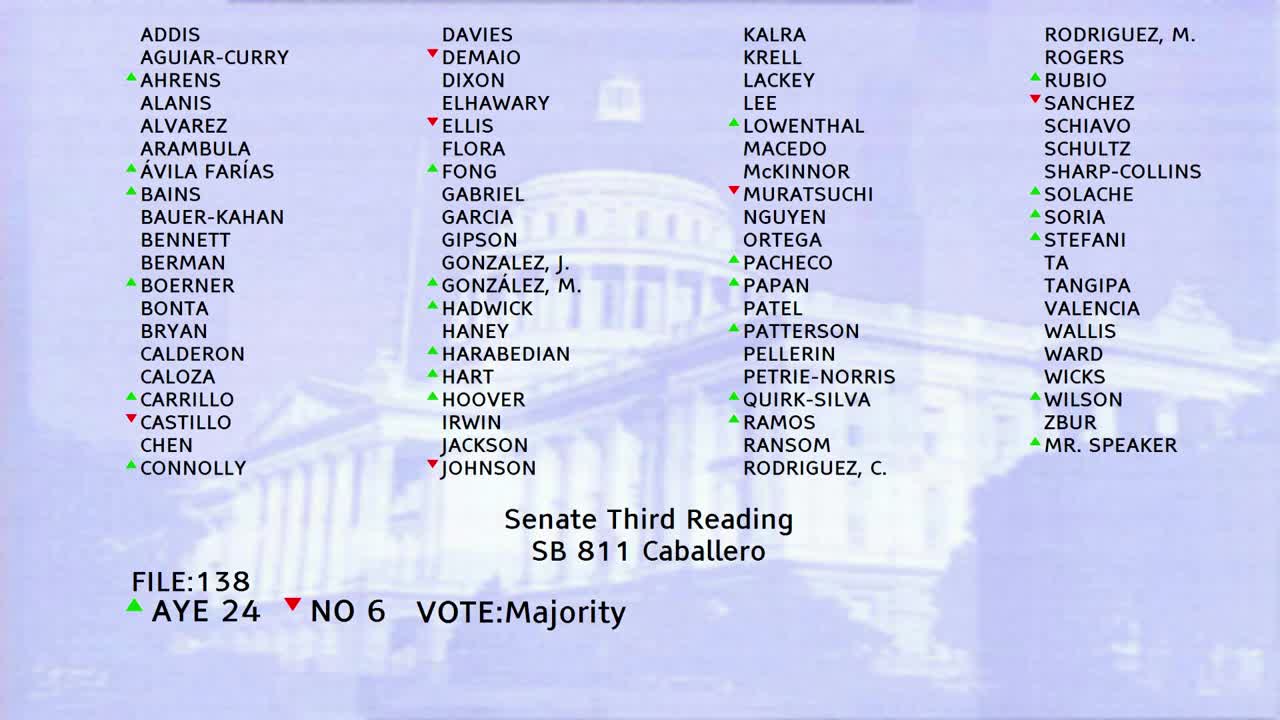 2MIN
Assembly Floor
 28MIN
Assembly Standing Committee on Natural Resources
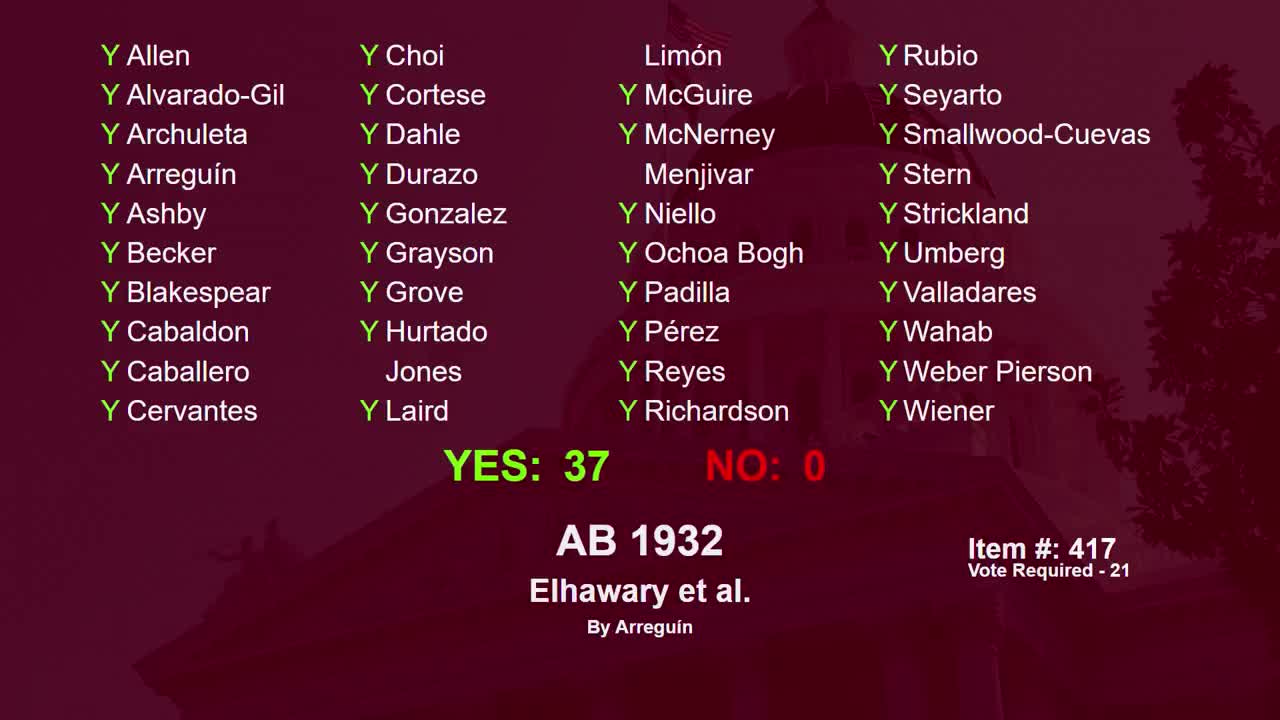 4MIN
Senate Floor
 18MIN
Senate Standing Committee on Environmental Quality
 2MIN
Senate Floor
 17MIN
Senate Standing Committee on Health
 3MIN
Assembly Floor
 1MIN