AB 400: Commission on Peace Officer Standards and Training: police canines.
- Session Year: 2025-2026
- House: Assembly
- Latest Version Date: 2025-09-16
Current Status:
Failed
(2026-01-22: Consideration of Governor's veto stricken from file.)
Introduced
In Committee
Awaiting First Chamber Vote
Passed First Chamber
In Committee
Awaiting Second Chamber Vote
Passed Second Chamber
Enacted
Existing law establishes the Commission on Peace Officer Standards and Training within the Department of Justice and requires the commission to, among other things, develop and disseminate guidelines for all peace officers in California.
This bill would require, on or before July 1, 2028, the commission to study and issue recommendations to the Legislature on the use of canines by law enforcement. The bill would require the commission to consider in its recommendations, among other things, instances of appropriate patrol use with a canine, as specified, and instances of appropriate use with a canine for detection, as specified. The bill would repeal these provisions on July 1, 2031.
Existing law establishes the Commission on Peace Officer Standards and Training within the Department of Justice and requires the commission to, among other things, develop and disseminate guidelines for all peace officers in California.
This bill would require, on or before July 1, 2027, 2028, the commission to study and issue recommendations to the Legislature on the use of canines by law enforcement. The bill would require the commission to consider in its recommendations, among other things, instances of appropriate patrol use with a canine, as specified, and instances of appropriate use with a canine for detection, as specified. The bill would repeal these provisions on July 1, 2031.
Existing law establishes the Commission on Peace Officer Standards and Training within the Department of Justice and requires the commission to, among other things, develop and disseminate guidelines for all peace officers in California.
This bill would require, on or before July 1, 2027, the commission to study and issue recommendations to the Legislature on the use of canines by law enforcement. The bill would require the commission to consider in its recommendations, among other things, instances of appropriate patrol use with a canine, as specified, and instances of appropriate use with a canine for detection, as specified. The bill would repeal these provisions on July 1, 2031.
Existing law requires law enforcement agencies to maintain a policy on the use of force, as specified. Existing law establishes the Commission on Peace Officer Standards and Training (POST) and charges it with, among other duties, developing uniform, minimum guidelines for adoption and promulgation by law enforcement agencies for use of force.This bill would require, on or before January 1, 2027, every law enforcement agency, as defined, with a canine unit to maintain a policy for the use of canines by the agency that, at a minimum, complies with the most recent standards established by POST. Because the bill would impose additional duties on local law enforcement agencies, the bill would impose a state-mandated local program.The California Constitution requires the state to reimburse local agencies and school districts for certain costs mandated by the state. Statutory provisions establish procedures for making that reimbursement.This bill would provide that, if the Commission on State Mandates determines that the bill contains costs mandated by the state, reimbursement for those costs shall be made pursuant to the statutory provisions noted above.Existing law requires law enforcement agencies to maintain a policy on the use of force, as specified. Existing law establishes the Commission on Peace Officer Standards and Training (POST) and charges it with, among other duties, developing uniform, minimum guidelines for adoption and promulgation by law enforcement agencies for use of force.
This bill would require, on or before January 1, 2027, every law enforcement agency, as defined, with a canine unit to maintain a policy for the use of canines by the agency that, at a minimum, complies with the most recent standards established by POST. Because the bill would impose additional duties on local law enforcement agencies, the bill would impose a state-mandated local program.
The California Constitution requires the state to reimburse local agencies and school districts for certain costs mandated by the state. Statutory provisions establish procedures for making that reimbursement.
This bill would provide that, if the Commission on State Mandates determines that the bill contains costs mandated by the state, reimbursement for those costs shall be made pursuant to the statutory provisions noted above.
(a)On or before July 1, 2028, the Commission on Peace Officer Standards and Training shall study and issue recommendations to the Legislature on the use of canines by law enforcement. The commission shall consider all of the following in its recommendations:
(1)The use of canines by law enforcement personnel is of important concern to the community and law enforcement and law enforcement should safeguard the life, dignity, and liberty of all persons, without prejudice to anyone.
(2)Officers shall carry out duties, including use of force with respect to canines, in a manner that is fair and unbiased.
(3)Instances of appropriate patrol use with a canine, including standards for obedience, search, apprehension, and handler protection.
(4)Instances of appropriate use with a canine for detection, including standards for control, alert, and odor detection.
(5)Factors for evaluating and reviewing all canine use of force incidents.
(6)Other considerations that will keep the public, the handler, and the canine safe, including how to provide a warning to a suspect within a deployment area upon the potential release of a canine.
(b)(1)A report to be submitted pursuant to subdivision (a) shall be submitted in compliance with Section 9795 of the Government Code.
(2)Pursuant to Section 10231.5 of the Government Code, this section is repealed on July 1, 2031.
(a)On or before July 1, 2027, 2028, the Commission on Peace Officer Standards and Training shall study and issue recommendations to the Legislature on the use of canines by law enforcement. The commission shall consider all of the following in its recommendations:
(1)The use of canines by law enforcement personnel is of important concern to the community and law enforcement and law enforcement should safeguard the life, dignity, and liberty of all persons, without prejudice to anyone.
(2)Officers shall carry out duties, including use of force with respect to canines, in a manner that is fair and unbiased.
(3)Instances of appropriate patrol use with a canine, including standards for obedience, search, apprehension, and handler protection.
(4)Instances of appropriate use with a canine for detection, including standards for control, alert, and odor detection.
(5)Factors for evaluating and reviewing all canine use of force incidents.
(6)Other considerations that will keep the public, the handler, and the canine safe, including how to provide a warning to a suspect within a deployment area upon the potential release of a canine.
(b)(1)A report to be submitted pursuant to subdivision (a) shall be submitted in compliance with Section 9795 of the Government Code.
(2)Pursuant to Section 10231.5 of the Government Code, this section is repealed on July 1, 2031.
(a)On or before July 1, 2027, the Commission on Peace Officer Standards and Training shall study and issue recommendations to the Legislature on the use of canines by law enforcement. The commission shall consider all of the following in its recommendations:
(1)The use of canines by law enforcement personnel is of important concern to the community and law enforcement and law enforcement should safeguard the life, dignity, and liberty of all persons, without prejudice to anyone.
(2)Officers shall carry out duties, including use of force with respect to canines, in a manner that is fair and unbiased.
(3)Instances of appropriate patrol use with a canine, including standards for obedience, search, apprehension, and handler protection.
(4)Instances of appropriate use with a canine for detection, including standards for control, alert, and odor detection.
(5)Factors for evaluating and reviewing all canine use of force incidents.
(6)Other considerations that will keep the public, the handler, and the canine safe, including how to provide a warning to a suspect within a deployment area upon the potential release of a canine.
(b)(1)A report to be submitted pursuant to subdivision (a) shall be submitted in compliance with Section 9795 of the Government Code.
(2)Pursuant to Section 10231.5 of the Government Code, this section is repealed on July 1, 2031.
SECTION 1.Section 13671 is added to the Penal Code, to read:13671.(a)For purposes of this section, law enforcement agency means any department or agency of the state or any local government, special district, or other political subdivision thereof, that employs any peace officer, as described in Section 830.(b)On or before January 1, 2027, every law enforcement agency with a canine unit shall maintain a policy for the use of canines by the agency that, at a minimum, complies with the most recent standards established by the Commission on Peace Officer Standards and Training.SEC. 2.If the Commission on State Mandates determines that this act contains costs mandated by the state, reimbursement to local agencies and school districts for those costs shall be made pursuant to Part 7 (commencing with Section 17500) of Division 4 of Title 2 of the Government Code.(a)For purposes of this section, law enforcement agency means any department or agency of the state or any local government, special district, or other political subdivision thereof, that employs any peace officer, as described in Section 830.
(b)On or before January 1, 2027, every law enforcement agency with a canine unit shall maintain a policy for the use of canines by the agency that, at a minimum, complies with the most recent standards established by the Commission on Peace Officer Standards and Training.
SEC. 2.If the Commission on State Mandates determines that this act contains costs mandated by the state, reimbursement to local agencies and school districts for those costs shall be made pursuant to Part 7 (commencing with Section 17500) of Division 4 of Title 2 of the Government Code.
REVISIONS: HeadingLine 2.|
Date
|
Status
|
|---|---|
| Jan 22, 2026 | Consideration of Governor's veto stricken from file. |
| Oct 1, 2025 | Consideration of Governor's veto pending. |
| Oct 1, 2025 | Vetoed by Governor. |
| Sep 24, 2025 | Enrolled and presented to the Governor at 3 p.m. |
| Sep 12, 2025 | Senate amendments concurred in. To Engrossing and Enrolling. (Ayes 73. Noes 0. Page 3373.). |
| Sep 12, 2025 | In Assembly. Concurrence in Senate amendments pending. |
| Sep 11, 2025 | Read third time. Passed. Ordered to the Assembly. (Ayes 40. Noes 0. Page 2934.). |
| Sep 9, 2025 | Ordered to special consent calendar. |
| Sep 8, 2025 | Read second time. Ordered to third reading. |
| Sep 5, 2025 | Read third time and amended. Ordered to second reading. |
| Sep 2, 2025 | Read second time. Ordered to third reading. |
| Aug 29, 2025 | Read second time and amended. Ordered returned to second reading. |
| Aug 29, 2025 | From committee: Amend, and do pass as amended. (Ayes 7. Noes 0.) (August 29). |
| Jul 14, 2025 | In committee: Referred to APPR. suspense file. |
| Jul 2, 2025 | From committee: Do pass and re-refer to Com. on APPR. (Ayes 5. Noes 0.) (July 1). Re-referred to Com. on APPR. |
| Jun 11, 2025 | Referred to Com. on PUB. S. |
| Jun 3, 2025 | In Senate. Read first time. To Com. on RLS. for assignment. |
| Jun 2, 2025 | Read third time. Passed. Ordered to the Senate. (Ayes 71. Noes 0. Page 1825.) |
| May 27, 2025 | Read second time. Ordered to third reading. |
| May 23, 2025 | From committee: Do pass. (Ayes 14. Noes 0.) (May 23). |
| Apr 9, 2025 | In committee: Set, first hearing. Referred to APPR. suspense file. |
| Mar 11, 2025 | From committee: Do pass and re-refer to Com. on APPR. (Ayes 8. Noes 0.) (March 11). Re-referred to Com. on APPR. |
| Mar 11, 2025 | Coauthors revised. |
| Feb 18, 2025 | Referred to Com. on PUB. S. |
| Feb 5, 2025 | From printer. May be heard in committee March 7. |
| Feb 4, 2025 | Read first time. To print. |
|
Date
|
Description
|
Location
|
Votes
|
|
|---|---|---|---|---|
| Sep 12, 2025 | AB 400 Pacheco Concurrence in Senate Amendments | Assembly Floor |
Passed |
|
| Sep 11, 2025 | Special Consent AB400 Pacheco et al. By Rubio | Senate Floor |
Passed |
|
| Aug 29, 2025 | Do pass as amended | Senate Standing Committee on Appropriations |
Passed |
|
| Jul 14, 2025 | Placed on suspense file | Senate Standing Committee on Appropriations |
Passed |
|
| Jul 1, 2025 | Do pass, but first be re-referred to the Committee on [Appropriations] | Senate Standing Committee on Public Safety |
Passed |
|
| Jun 2, 2025 | AB 400 Pacheco Assembly Third Reading | Assembly Floor |
Passed |
|
| May 23, 2025 | Do pass. | Assembly Standing Committee on Appropriations |
Passed |
|
| Mar 11, 2025 | Do pass and be re-referred to the Committee on [Appropriations] | Assembly Standing Committee on Public Safety |
Passed |
This list shows positions taken on this bill by organizations on the date displayed, which is linked to the original source.
Positions by individuals are not included.
|
Organization
|
Position
|
Date
|
|---|---|---|
| Aclu California Action | ** Against | |
| All of Us or None Los Angeles | ** Against | |
| American Kennel Club, INC. | ** Support | |
| ARCADIA POLICE OFFICERS ASSOCIATION | ** Support | |
| Asian Law Alliance | ** Against | |
| Association For Los Angeles Deputy Sheriffs | ** Support | |
| Brea Police Association | ** Support | |
| Burbank Police Officers Association | ** Support | |
| California Association Of Highway Patrolmen | ** Support | |
| California Association of School Police Chiefs | ** Support | |
| California Coalition of School Safety Professionals | ** Support | |
| California Narcotic Officers Association | ** Support | |
| Californians United for a Responsible Budget | ** Against | |
| California Peace Officers Association | ** Support | |
| California Police Chiefs Association | ** Support | |
| California Public Defenders Association | ** Against | |
| California Reserve Peace Officers Association | ** Support | |
| California State Sheriffs Association | ** Support | |
| CLAREMONT POLICE OFFICERS ASSOCIATION | ** Support | |
| Communities United for Restorative Youth Justice | ** Against | |
| Corona Police Officers Association | ** Support | |
| Council on American-Islamic Relations, California | ** Against | |
| Culver City Police Officers' Association | ** Support | |
| FULLERTON POLICE OFFICERS ASSOCIATION | ** Support | |
| Initiate Justice Action | ** Against | |
| Justice2jobs Coalition | ** Against | |
| LA Defensa | ** Against | |
| League Of California Cities | ** Support | |
| Legal Services for Prisoners with Children | ** Against | |
| Los Angeles County Professional Peace Officers Association | ** Support | |
| Los Angeles County SheriffS Department | ** Support | |
| Los Angeles School Police Management Association | ** Support | |
| los angeles school police officers association | ** Support | |
| MURRIETA POLICE OFFICERS ASSOCIATION | ** Support | |
| National Police Accountability Project | ** Against | |
| Newport Beach Police Association | ** Support | |
| Palos Verdes Police Officers Association | ** Support | |
| Peace Officers Research Association Of California | ** Support | |
| Placer County Deputy Sheriffs’ Association | ** Support | |
| POMONA POLICE OFFICERS ASSOCIATION | ** Support | |
| RIVERSIDE POLICE OFFICERS ASSOCIATION | ** Support | |
| Riverside Sheriffs Association | ** Support | |
| Santa Ana Police Officers Association | ** Support | |
| Sister Warriors Freedom Coalition | ** Against |
GOVERNOR′S VETO
GV Bill Id:AB 400
Author:(Pacheco)
As Enrolled Ver:September 16, 2025
2/3 vote
SUMMARY
- Requires, on or before July 1, 2028, the Commission on Peace Officer Standards and Training (POST) to study and issue recommendations to the Legislature on the use of canines by law enforcement.
- Requires POST to consider all of the following in its recommendations:
- The use of canines by law enforcement personnel is of important concern to the community and law enforcement and law enforcement should safeguard the life, dignity, and liberty of all persons, without prejudice to anyone;
- Officers shall carry out duties, including use of force with respect to canines, in a manner that is fair and unbiased;
- Instances of appropriate patrol use with a canine, including standards for obedience, search, apprehension, and handler protection;
- Instances of appropriate use with a canine for detection, including standards for control, alert, and odor detection;
- Factors for evaluating and reviewing all canine use of force incidents; and,
- Other considerations will keep the public, the handler, and the canine safe, including how to provide a warning to a suspect within a deployment area upon the potential release of a canine.
Senate Amendments
- Remove existing bill language requiring every law enforcement agency with a canine unit to maintain a policy for the use of canines, as specified, and instead require the above POST study.
- Changed the date by which POST must complete the study and issue recommendations from July 1, 2027, to July 1, 2028.
Governor′s Veto Message
″This bill would require the Commission on Peace Officer Standards and Training (POST) to study and issue recommendations to the Legislature regarding the use of canines by law enforcement.
″I share the author′s goal of ensuring the safe and unbiased use of canines by law enforcement. However, this bill is unnecessary. POST has provided guidelines regarding the use of police canines since 1991. It recently updated these guidelines after convening meeting with a variety of subject matter experts in canine use, including employees of urban and rural sheriff′s offices and police departments, the California Department of Fish and Wildlife, California Highway Patrol, and California State Parks. The makeup of these convenings reflected the many situations in which canines are relied upon by law enforcement statewide. As to bias in canine deployment, the POST Use of Force guidelines already being with the directive: ″Officers shall carry out their duties, including use of force, in a manner that is fair and unbiased.″
″For this reason I cannot sign this bill.″
COMMENTS
- As passed by the Assembly: This bill required every law enforcement agency with a canine unit, on or before January 1, 2027, to maintain a policy for the use of canines by the agency that, at a minimum, complies with the most recent standards established by the Commission on Peace Officer Standards and Training (POST).
- Police Canine Use and Deployment Policies: Law enforcement agencies view the use of police canines as indispensable to protecting the public and law enforcement personnel. According the Los Angeles County Sheriff′s Department:
The prompt and proper utilization of a trained canine team has proven to be a valuable use of a unique resource in law enforcement. When properly used, a canine team greatly increases the degree of safety to citizens within a contained search area, enhances individual officer safety, significantly increases the likelihood of suspect apprehension, and dramatically reduces the amount of time necessary to conduct a search.[1]
Despite their importance to law enforcement, there is limited direction to local law enforcement on the use and deployment of police canines.
In 2024, POST updated the minimum training and performance standards for police canines. According to POST, ″Patrol K-9 teams should meet minimum standards regarding obedience, search, apprehension, control, de-escalation, and tracking/trailing.″[2] POST apprehension guidelines require, ″[u]nder the direction of the handler and while off-leash, the K-9 team will pursue and apprehend the agitator/decoy.″[3] It adds, ″The K-9 team will demonstrate a ″pursuit and call off″ prior to apprehension… On command from the handler, the K-9 will pursue and apprehend the agitator/decoy. From a reasonable distance and on verbal command only, the K-9 will cease the apprehension.″[4] POST detection guidelines advise ″[t]he evaluator [to] be fully apprised of the pertinent agency policies and regulations prior to commencement of the exercise. The ′correct′ response or reach of the handler, the K-9, or the two acting together, may differ from agency to agency, based on prevailing agency policy.″[5]
Regarding ″call-off″ procedures, POST states that ″[t]his function is critical and separates the K-9 from all other less-than-lethal force options in that the handler has the ability to call of the K-9 prior to making contact with the agitator/decoy, within reason, to avoid a use of force.″[6] POST training requires ″[t]he K-9 [to] be sent on a directed apprehension, from approximately 30 yards, on a visible and accessible agitator/decoy… Once the K-9 is in the pursuit and committed to the agitator/decoy (approximately halfway), the handler will call off the apprehension using only voice commands.″[7]
POST patrol guidelines also provide, ″The release of a K-9 to search for or apprehend a suspect should be based upon the handler′s reasonable belief that the suspect has committed, is committing, or is threatening to commit a serious offense under any of the following conditions: There is a reasonable belief that the suspect poses an imminent or immediate threat of violence or serious harm to the public or an officer. The suspect is physically resisting or threatening to resist arrest and the use of a K-9 reasonably appears necessary to overcome such resistance. Officers reasonably believe the suspect is concealed in an area where entry by a person would pose a threat to the safety of officers or the public. Unless the handler reasonably believes that it would pose an imminent threat of danger to the officer or other persons or substantially increase the risk of a suspect′s escape, a warning, clearly audible, within the deployment area announcing the potential release of a police K-9 if the suspect does not surrender should be given prior to the release of the K-9. Once given, the handler should allow a reasonable opportunity for the suspect to comply with any warning, if feasible.″[8]
This bill would require every law enforcement agency with a canine unit, on or before January 1, 2027, to maintain a police for the use of canines by the agency that, at a minimum, complies with the most recent standards established by POST.
- Department of Justice Data on Use of Force Incidents Involving Police Canines: According to data collected by the DOJ′s Criminal Justice Statistics Center, law enforcement used a police canine in a use of force incident that resulted in serious bodily injury or death 76 times in 2020, accounting for 10.2% of the total such use of force incidents by law enforcement.[9] Of those 76 incidents, 49 were against persons of color—nine Black individuals, 33 Hispanic individuals, three Asian/Pacific Islander individuals, and two multi-race individuals.[10] In 29 of the 76 incidents, the officer did not perceive that the civilian was armed.[11] The civilian was later confirmed armed in 24 of the 76 of incidents.[12] In two incidents, the civilian did not resist.[13]
According to the raw data on use of force incidents in 2020, 14 use of force incidents involving canine contact also involved the discharge of a firearm by the officer, six of which resulted in fatalities and three of which resulted in critical or serious injuries. Of those 14 incidents involving the use of both a canine and a firearm, eight were against people of color.[14]
In 2021, law enforcement used a canine in a use of force incident that resulted in serious bodily injury or death 77 times, or 11.7% of the total use of force incidents by law enforcement against a civilian.[15] Of those 77 incidents, 50 were against persons of color—13 Black individuals, 36 Hispanic individuals, and 1 American Indian individual.[16] In 37 of the 77 incidents, the officer did not perceive that the civilian was armed.[17] The civilian was later confirmed armed in 27 of the 77 incidents.[18] In five of those incidents the civilian did not resist.[19]
There were 63 use of force incidents involving a canine reported to DOJ in 2022, which amounted to 10.3% of the total use of force incidents.[20] Arrests were made in 62 of the 63 incidents, and 49 of the 63 incidents were against people of color—11 Black individuals, 36 Hispanic individuals, and two Asian/Pacific Islander individuals.[21] The officer did not perceive the individual to be armed in 22 of the 63 incidents.[22] The civilian was later confirmed to be armed in 26 of the 63 incidents.[23]
The DOJ′s 2023 report on the use of force by law enforcement found 94 incidents involving the use of canine, or roughly 14.3% of all reported uses of force.[24] Law enforcement made an arrest in 93 of the 94 reported incidents. Of the 94 incidents, police use of force using canines occurred 60 times against people of color—12 Black individuals, 44 Hispanic individuals, one American Indian, one Asian Indian, and two Asian/Pacific Islanders.[25] The officer did not perceive the individual to be armed in 17 of 94 incidents, and the civilian was later confirmed not to be armed in 23 of the 94 incidents.[26]
- Limitations on Use of Force by Law Enforcement: The legislature has acted to limit the authority of law enforcement to use specific types of force. Following the death of George Floyd in Minneapolis, MN, California banned the use of carotid restraint control holds by law enforcement.[27] According to the DOJ′s Use of Force Incident Reporting data, these holds resulted in serious bodily injury or death at similar rates as police canines, and the racial disparities among those who suffered the injuries mirrored those of police canines. For example, of the 60 carotid restraint hold incidents in the year before the ban, 37 were used on people of color.[28]
According to the Author
″AB 400 will ensure uniformity, accountability, and excellence in the use of police canines throughout our state, enhancing both officer and community safety. By implementing these comprehensive standards, California will continue to lead the nation in responsible and effective law enforcement practices.″
Arguments in Support
According to the California Police Chiefs Association, a co-sponsor of the bill: ″CPCA is committed to supporting legislation that ensures law enforcement agencies operate in a manner that prioritizes both public safety and the responsible use of force. Police K9 units have long been valuable tool for law enforcement in executing critical duties such as tracking suspects, detecting narcotics, and ensuring officer safety in dangerous situations. It is essential that their use is governed by clear, up-to-date, and comprehensive policies that reflect best practices and maintain public trust.
″AB 400 mandates that, by January 1, 2027, every law enforcement agency with a K9 unit must have a policy that complies with POST′s most recent standards for the use of K9s. This ensures that agencies adopt uniform, high-quality protocols that protect both the public and law enforcement officers.
″We understand the critical importance of ensuring that all law enforcement agencies adhere to consistent, evidence-based standards that improve public safety while maintaining a commitment to transparency and accountability. By supporting this bill, we believe California will further strengthen its leadership in responsible and professional law enforcement practices.″
Arguments in Opposition
According to Initiate Justice Action, ″Police dogs are currently used in a number of problematic ways. Despite what law enforcement tells us, public records from the last few years show that out of the hundreds of Californians who were disfigured by attack dogs, most were unarmed, about half exhibited signs of mental crisis before the dog was released, and many were suspected only of a minor offense, or no offense at all. In Richmond, police dogs caused 60% of all use of force incidents resulting in great bodily injury or death over a six-year period. Clearly, the Legislature must limit the use of these dogs as it does other severe uses of force by police. Unfortunately, AB 400 is not the answer.
″Beyond reviving language the Legislature recently rejected, POST′s latest guidelines will not solve any issues as they simply repeat the policies most agencies already have in place, including those with proven records of abusively deploying police dogs. For example, every part of Bakersfield Police Department′s canine apprehension policy, written by Lexipol, is found in POST′s latest guidelines. And these policies have completely failed to stop egregious practices in Bakersfield – 89% of police dog attacks resulting in severe injuries were against Black or Latine residents, a federal DOJ investigation concluded that Bakersfield PD used police dogs ″primarily″ to ″apprehend persons under the influence of drugs and/or alcohol or persons with mental illness,″ and an alarming 97% of dog deployments were not to ″defend another or self.″ Instead of requiring substantial reform in light of these facts, AB 400 would give state approval to Bakersfield PD′s policy, and the policies of most agencies, as is.
″Year after year, news articles report police dogs mauling or killing innocent Californians. In addition to the unimaginable human cost, these incidents also lead to million-dollar settlements out of local government budgets. Californians deserve real solutions to this problem. Sadly, AB 400 greatly misses the mark.″
FISCAL COMMENTS
According to the Senate Appropriations Committee, ″Unknown, potential costs to the Commission on Peace Officer Standards and Training to study the use of police canines and issue recommendations.″
VOTES
ASM PUBLIC SAFETY: 8-0-1
YES: Schultz, Alanis, Mark González, Haney, Harabedian, Lackey, Nguyen, Sharp-Collins
ABS, ABST OR NV: Ramos
ASM APPROPRIATIONS: 14-0-1
YES: Wicks, Arambula, Calderon, Caloza, Dixon, Elhawary, Fong, Mark González, Hart, Pacheco, Pellerin, Solache, Ta, Tangipa
ABS, ABST OR NV: Sanchez
ASSEMBLY FLOOR: 71-0-8
YES: Addis, Aguiar-Curry, Ahrens, Alanis, Alvarez, Arambula, Ávila Farías, Bains, Bauer-Kahan, Bennett, Berman, Boerner, Calderon, Caloza, Carrillo, Castillo, Chen, Connolly, Davies, DeMaio, Dixon, Ellis, Flora, Fong, Gabriel, Gallagher, Garcia, Gipson, Jeff Gonzalez, Mark González, Hadwick, Haney, Harabedian, Hart, Hoover, Irwin, Krell, Lackey, Lowenthal, Macedo, Muratsuchi, Nguyen, Ortega, Pacheco, Papan, Patel, Patterson, Pellerin, Petrie-Norris, Quirk-Silva, Ramos, Ransom, Celeste Rodriguez, Michelle Rodriguez, Rogers, Blanca Rubio, Sanchez, Schiavo, Schultz, Sharp-Collins, Solache, Soria, Stefani, Ta, Tangipa, Valencia, Wallis, Wicks, Wilson, Zbur, Rivas
ABS, ABST OR NV: Bonta, Bryan, Elhawary, Jackson, Kalra, Lee, McKinnor, Ward
SENATE FLOOR: 40-0-0
YES: Allen, Alvarado-Gil, Archuleta, Arreguín, Ashby, Becker, Blakespear, Cabaldon, Caballero, Cervantes, Choi, Cortese, Dahle, Durazo, Gonzalez, Grayson, Grove, Hurtado, Jones, Laird, Limón, McGuire, McNerney, Menjivar, Niello, Ochoa Bogh, Padilla, Pérez, Reyes, Richardson, Rubio, Seyarto, Smallwood-Cuevas, Stern, Strickland, Umberg, Valladares, Wahab, Weber Pierson, Wiener
ASSEMBLY FLOOR: 73-0-7
YES: Addis, Aguiar-Curry, Ahrens, Alanis, Alvarez, Arambula, Ávila Farías, Bains, Bauer-Kahan, Bennett, Berman, Boerner, Calderon, Caloza, Carrillo, Castillo, Chen, Connolly, Davies, DeMaio, Dixon, Ellis, Flora, Fong, Gabriel, Gallagher, Garcia, Gipson, Jeff Gonzalez, Mark González, Hadwick, Haney, Harabedian, Hart, Hoover, Irwin, Johnson, Krell, Lackey, Lowenthal, Macedo, McKinnor, Muratsuchi, Nguyen, Ortega, Pacheco, Papan, Patel, Patterson, Pellerin, Petrie-Norris, Quirk-Silva, Ramos, Ransom, Celeste Rodriguez, Michelle Rodriguez, Rogers, Blanca Rubio, Sanchez, Schiavo, Schultz, Sharp-Collins, Solache, Soria, Stefani, Ta, Tangipa, Valencia, Wallis, Wicks, Wilson, Zbur, Rivas
ABS, ABST OR NV: Bonta, Bryan, Elhawary, Jackson, Kalra, Lee, Ward
UPDATED
VERSION: September 16, 2025
CONSULTANT: Andrew Ironside / PUB. S. / (916) 319-3744 FN: 0002133
Field Operations Direction (FOD): 86-037 Canine Deployment, Search and Force Policy, at p. 2; see also VanSickle et al., When Police Violence Is a Dog Bite, The Marshall Project (Oct. 2, 2020) <https://www.themarshallproject.org/2020/10/02/when-police-violence-is-a-dog-bite> [last viewed Apr. 4, 2024] [a joint investigation with USA Today, AL.com, and the Invisible Institute] and Kaste, Videos Reveal A Close, Gory View of Police Dog Bites, NPR (Nov. 20, 2017) <https://www.npr.org/2017/11/20/563973584/videos-reveal-a-close-gory-view-of-police-dog-bites> [last visited Apr. 4, 2024]. ↑
POST, Law Enforcement K-9 Guidelines, p. ix <https://post.ca.gov/Portals/0/post_docs/publications/K-9.pdf> [last viewed Mar. 6, 2025]. ↑
Id. at p. 4. ↑
Ibid. ↑
Id. at 8. ↑
Id. at 7. ↑
Ibid. ↑
Id. at 3. ↑
The DOJ's Use of Force Incident Reporting contains only incidents where use of force resulted in serious bodily injury or death. DOJ, Use of Force Incident Reporting (2021) p. 1 <https://data-openjustice.doj.ca.gov/sites/default/files/2022-08/USE OF FORCE 2020.pdf> [last visited Apr. 4, 2024].) ↑
Id. at 34 [2 individuals are identified as "other"]. ↑
Id. at 37. ↑
Id. at 39. ↑
Id. at 40. ↑
2020 URSUS Use of Force Data. ↑
DOJ, Use of Force Incident Reporting (2021) p. 31 <https://data-openjustice.doj.ca.gov/sites/default/files/2022-08/USE OF FORCE 2021.pdf> [last visited Apr. 1, 2024]. ↑
Id. at 35. ↑
Id. at 38. ↑
Id. at 39. ↑
Id. at 40. ↑
DOJ, Use of Force Incident Reporting (2022) p. 38 <https://data-openjustice.doj.ca.gov/sites/default/files/2023-06/USE OF FORCE 2022f.pdf> [last visited Apr. 1, 2024]. ↑
Id. at p. 32. ↑
Id. at p. 35. ↑
Id. at p. 36. ↑
DOJ, Use of Force Incident Reporting (2023) p. 29 < https://data-openjustice.doj.ca.gov/sites/default/files/2024-07/use-of-force-2023.pdf> [last visited Mar. 5, 2025]. ↑
Id. at p. 33. ↑
Id. at pp. 36-37. ↑
Gov. Code, § 7286.5; AB 96 (Gipson), Chapter 324, Statutes of 2020. ↑
DOJ, Use of Force Incident Reporting (2019) p. 34 <https://data-openjustice.doj.ca.gov/sites/default/files/2022-08/USE OF FORCE 2019.pdf> [last visited Apr. 4, 2024]. ↑
CONCURRENCE IN SENATE AMENDMENTS
CSA1 Bill Id:AB 400
Author:(Pacheco)
As Amended Ver:September 5, 2025
Majority vote
SUMMARY
- Requires, on or before July 1, 2028, the Commission on Peace Officer Standards and Training (POST) to study and issue recommendations to the Legislature on the use of canines by law enforcement.
- Requires POST to consider all of the following in its recommendations:
- The use of canines by law enforcement personnel is of important concern to the community and law enforcement and law enforcement should safeguard the life, dignity, and liberty of all persons, without prejudice to anyone;
- Officers shall carry out duties, including use of force with respect to canines, in a manner that is fair and unbiased;
- Instances of appropriate patrol use with a canine, including standards for obedience, search, apprehension, and handler protection;
- Instances of appropriate use with a canine for detection, including standards for control, alert, and odor detection;
- Factors for evaluating and reviewing all canine use of force incidents; and,
- Other considerations will keep the public, the handler, and the canine safe, including how to provide a warning to a suspect within a deployment area upon the potential release of a canine.
Senate Amendments
- Remove existing bill language requiring every law enforcement agency with a canine unit to maintain a policy for the use of canines, as specified, and instead require the above POST study.
- Changed the date by which POST must complete the study and issue recommendations from July 1, 2027, to July 1, 2028.
COMMENTS
- As passed by the Assembly: This bill required every law enforcement agency with a canine unit, on or before January 1, 2027, to maintain a policy for the use of canines by the agency that, at a minimum, complies with the most recent standards established by the Commission on Peace Officer Standards and Training (POST).
- Police Canine Use and Deployment Policies: Law enforcement agencies view the use of police canines as indispensable to protecting the public and law enforcement personnel. According the Los Angeles County Sheriff's Department:
The prompt and proper utilization of a trained canine team has proven to be a valuable use of a unique resource in law enforcement. When properly used, a canine team greatly increases the degree of safety to citizens within a contained search area, enhances individual officer safety, significantly increases the likelihood of suspect apprehension, and dramatically reduces the amount of time necessary to conduct a search.[1]
Despite their importance to law enforcement, there is limited direction to local law enforcement on the use and deployment of police canines.
In 2024, POST updated the minimum training and performance standards for police canines. According to POST, "Patrol K-9 teams should meet minimum standards regarding obedience, search, apprehension, control, de-escalation, and tracking/trailing."[2] POST apprehension guidelines require, "[u]nder the direction of the handler and while off-leash, the K-9 team will pursue and apprehend the agitator/decoy."[3] It adds, "The K-9 team will demonstrate a "pursuit and call off" prior to apprehension… On command from the handler, the K-9 will pursue and apprehend the agitator/decoy. From a reasonable distance and on verbal command only, the K-9 will cease the apprehension."[4] POST detection guidelines advise "[t]he evaluator [to] be fully apprised of the pertinent agency policies and regulations prior to commencement of the exercise. The 'correct' response or reach of the handler, the K-9, or the two acting together, may differ from agency to agency, based on prevailing agency policy."[5]
Regarding "call-off" procedures, POST states that "[t]his function is critical and separates the K-9 from all other less-than-lethal force options in that the handler has the ability to call of the K-9 prior to making contact with the agitator/decoy, within reason, to avoid a use of force."[6] POST training requires "[t]he K-9 [to] be sent on a directed apprehension, from approximately 30 yards, on a visible and accessible agitator/decoy… Once the K-9 is in the pursuit and committed to the agitator/decoy (approximately halfway), the handler will call off the apprehension using only voice commands."[7]
POST patrol guidelines also provide, "The release of a K-9 to search for or apprehend a suspect should be based upon the handler's reasonable belief that the suspect has committed, is committing, or is threatening to commit a serious offense under any of the following conditions: There is a reasonable belief that the suspect poses an imminent or immediate threat of violence or serious harm to the public or an officer. The suspect is physically resisting or threatening to resist arrest and the use of a K-9 reasonably appears necessary to overcome such resistance. Officers reasonably believe the suspect is concealed in an area where entry by a person would pose a threat to the safety of officers or the public. Unless the handler reasonably believes that it would pose an imminent threat of danger to the officer or other persons or substantially increase the risk of a suspect's escape, a warning, clearly audible, within the deployment area announcing the potential release of a police K-9 if the suspect does not surrender should be given prior to the release of the K-9. Once given, the handler should allow a reasonable opportunity for the suspect to comply with any warning, if feasible."[8]
This bill would require every law enforcement agency with a canine unit, on or before January 1, 2027, to maintain a police for the use of canines by the agency that, at a minimum, complies with the most recent standards established by POST.
- Department of Justice Data on Use of Force Incidents Involving Police Canines: According to data collected by the DOJ's Criminal Justice Statistics Center, law enforcement used a police canine in a use of force incident that resulted in serious bodily injury or death 76 times in 2020, accounting for 10.2% of the total such use of force incidents by law enforcement.[9] Of those 76 incidents, 49 were against persons of color—nine Black individuals, 33 Hispanic individuals, three Asian/Pacific Islander individuals, and two multi-race individuals.[10] In 29 of the 76 incidents, the officer did not perceive that the civilian was armed.[11] The civilian was later confirmed armed in 24 of the 76 of incidents.[12] In two incidents, the civilian did not resist.[13]
According to the raw data on use of force incidents in 2020, 14 use of force incidents involving canine contact also involved the discharge of a firearm by the officer, six of which resulted in fatalities and three of which resulted in critical or serious injuries. Of those 14 incidents involving the use of both a canine and a firearm, eight were against people of color.[14]
In 2021, law enforcement used a canine in a use of force incident that resulted in serious bodily injury or death 77 times, or 11.7% of the total use of force incidents by law enforcement against a civilian.[15] Of those 77 incidents, 50 were against persons of color—13 Black individuals, 36 Hispanic individuals, and 1 American Indian individual.[16] In 37 of the 77 incidents, the officer did not perceive that the civilian was armed.[17] The civilian was later confirmed armed in 27 of the 77 incidents.[18] In five of those incidents the civilian did not resist.[19]
There were 63 use of force incidents involving a canine reported to DOJ in 2022, which amounted to 10.3% of the total use of force incidents.[20] Arrests were made in 62 of the 63 incidents, and 49 of the 63 incidents were against people of color—11 Black individuals, 36 Hispanic individuals, and two Asian/Pacific Islander individuals.[21] The officer did not perceive the individual to be armed in 22 of the 63 incidents.[22] The civilian was later confirmed to be armed in 26 of the 63 incidents.[23]
The DOJ's 2023 report on the use of force by law enforcement found 94 incidents involving the use of canine, or roughly 14.3% of all reported uses of force.[24] Law enforcement made an arrest in 93 of the 94 reported incidents. Of the 94 incidents, police use of force using canines occurred 60 times against people of color—12 Black individuals, 44 Hispanic individuals, one American Indian, one Asian Indian, and two Asian/Pacific Islanders.[25] The officer did not perceive the individual to be armed in 17 of 94 incidents, and the civilian was later confirmed not to be armed in 23 of the 94 incidents.[26]
- Limitations on Use of Force by Law Enforcement: The legislature has acted to limit the authority of law enforcement to use specific types of force. Following the death of George Floyd in Minneapolis, MN, California banned the use of carotid restraint control holds by law enforcement.[27] According to the DOJ's Use of Force Incident Reporting data, these holds resulted in serious bodily injury or death at similar rates as police canines, and the racial disparities among those who suffered the injuries mirrored those of police canines. For example, of the 60 carotid restraint hold incidents in the year before the ban, 37 were used on people of color.[28]
According to the Author
"AB 400 will ensure uniformity, accountability, and excellence in the use of police canines throughout our state, enhancing both officer and community safety. By implementing these comprehensive standards, California will continue to lead the nation in responsible and effective law enforcement practices."
Arguments in Support
According to the California Police Chiefs Association, a co-sponsor of the bill: "CPCA is committed to supporting legislation that ensures law enforcement agencies operate in a manner that prioritizes both public safety and the responsible use of force. Police K9 units have long been valuable tool for law enforcement in executing critical duties such as tracking suspects, detecting narcotics, and ensuring officer safety in dangerous situations. It is essential that their use is governed by clear, up-to-date, and comprehensive policies that reflect best practices and maintain public trust.
"AB 400 mandates that, by January 1, 2027, every law enforcement agency with a K9 unit must have a policy that complies with POST's most recent standards for the use of K9s. This ensures that agencies adopt uniform, high-quality protocols that protect both the public and law enforcement officers.
"We understand the critical importance of ensuring that all law enforcement agencies adhere to consistent, evidence-based standards that improve public safety while maintaining a commitment to transparency and accountability. By supporting this bill, we believe California will further strengthen its leadership in responsible and professional law enforcement practices."
Arguments in Opposition
According to Initiate Justice Action, "Police dogs are currently used in a number of problematic ways. Despite what law enforcement tells us, public records from the last few years show that out of the hundreds of Californians who were disfigured by attack dogs, most were unarmed, about half exhibited signs of mental crisis before the dog was released, and many were suspected only of a minor offense, or no offense at all. In Richmond, police dogs caused 60% of all use of force incidents resulting in great bodily injury or death over a six-year period. Clearly, the Legislature must limit the use of these dogs as it does other severe uses of force by police. Unfortunately, AB 400 is not the answer.
"Beyond reviving language the Legislature recently rejected, POST's latest guidelines will not solve any issues as they simply repeat the policies most agencies already have in place, including those with proven records of abusively deploying police dogs. For example, every part of Bakersfield Police Department's canine apprehension policy, written by Lexipol, is found in POST's latest guidelines. And these policies have completely failed to stop egregious practices in Bakersfield – 89% of police dog attacks resulting in severe injuries were against Black or Latine residents, a federal DOJ investigation concluded that Bakersfield PD used police dogs "primarily" to "apprehend persons under the influence of drugs and/or alcohol or persons with mental illness," and an alarming 97% of dog deployments were not to "defend another or self." Instead of requiring substantial reform in light of these facts, AB 400 would give state approval to Bakersfield PD's policy, and the policies of most agencies, as is.
"Year after year, news articles report police dogs mauling or killing innocent Californians. In addition to the unimaginable human cost, these incidents also lead to million-dollar settlements out of local government budgets. Californians deserve real solutions to this problem. Sadly, AB 400 greatly misses the mark."
FISCAL COMMENTS
According to the Senate Appropriations Committee, "Unknown, potential costs to the Commission on Peace Officer Standards and Training to study the use of police canines and issue recommendations."
VOTES:
ASM PUBLIC SAFETY: 8-0-1
YES: Schultz, Alanis, Mark González, Haney, Harabedian, Lackey, Nguyen, Sharp-Collins
ABS, ABST OR NV: Ramos
ASM APPROPRIATIONS: 14-0-1
YES: Wicks, Arambula, Calderon, Caloza, Dixon, Elhawary, Fong, Mark González, Hart, Pacheco, Pellerin, Solache, Ta, Tangipa
ABS, ABST OR NV: Sanchez
ASSEMBLY FLOOR: 71-0-8
YES: Addis, Aguiar-Curry, Ahrens, Alanis, Alvarez, Arambula, Ávila Farías, Bains, Bauer-Kahan, Bennett, Berman, Boerner, Calderon, Caloza, Carrillo, Castillo, Chen, Connolly, Davies, DeMaio, Dixon, Ellis, Flora, Fong, Gabriel, Gallagher, Garcia, Gipson, Jeff Gonzalez, Mark González, Hadwick, Haney, Harabedian, Hart, Hoover, Irwin, Krell, Lackey, Lowenthal, Macedo, Muratsuchi, Nguyen, Ortega, Pacheco, Papan, Patel, Patterson, Pellerin, Petrie-Norris, Quirk-Silva, Ramos, Ransom, Celeste Rodriguez, Michelle Rodriguez, Rogers, Blanca Rubio, Sanchez, Schiavo, Schultz, Sharp-Collins, Solache, Soria, Stefani, Ta, Tangipa, Valencia, Wallis, Wicks, Wilson, Zbur, Rivas
ABS, ABST OR NV: Bonta, Bryan, Elhawary, Jackson, Kalra, Lee, McKinnor, Ward
UPDATED
VERSION: September 5, 2025
CONSULTANT: Andrew Ironside / PUB. S. / (916) 319-3744 FN: 0002059
Field Operations Direction (FOD): 86-037 Canine Deployment, Search and Force Policy, at p. 2; see also VanSickle et al., When Police Violence Is a Dog Bite, The Marshall Project (Oct. 2, 2020) <https://www.themarshallproject.org/2020/10/02/when-police-violence-is-a-dog-bite> [last viewed Apr. 4, 2024] [a joint investigation with USA Today, AL.com, and the Invisible Institute] and Kaste, Videos Reveal A Close, Gory View of Police Dog Bites, NPR (Nov. 20, 2017) <https://www.npr.org/2017/11/20/563973584/videos-reveal-a-close-gory-view-of-police-dog-bites> [last visited Apr. 4, 2024]. ↑
POST, Law Enforcement K-9 Guidelines, p. ix <https://post.ca.gov/Portals/0/post_docs/publications/K-9.pdf> [last viewed Mar. 6, 2025]. ↑
Id. at p. 4. ↑
Ibid. ↑
Id. at 8. ↑
Id. at 7. ↑
Ibid. ↑
Id. at 3. ↑
The DOJ's Use of Force Incident Reporting contains only incidents where use of force resulted in serious bodily injury or death. DOJ, Use of Force Incident Reporting (2021) p. 1 <https://data-openjustice.doj.ca.gov/sites/default/files/2022-08/USE OF FORCE 2020.pdf> [last visited Apr. 4, 2024].) ↑
Id. at 34 [2 individuals are identified as "other"]. ↑
Id. at 37. ↑
Id. at 39. ↑
Id. at 40. ↑
2020 URSUS Use of Force Data. ↑
DOJ, Use of Force Incident Reporting (2021) p. 31 <https://data-openjustice.doj.ca.gov/sites/default/files/2022-08/USE OF FORCE 2021.pdf> [last visited Apr. 1, 2024]. ↑
Id. at 35. ↑
Id. at 38. ↑
Id. at 39. ↑
Id. at 40. ↑
DOJ, Use of Force Incident Reporting (2022) p. 38 <https://data-openjustice.doj.ca.gov/sites/default/files/2023-06/USE OF FORCE 2022f.pdf> [last visited Apr. 1, 2024]. ↑
Id. at p. 32. ↑
Id. at p. 35. ↑
Id. at p. 36. ↑
DOJ, Use of Force Incident Reporting (2023) p. 29 < https://data-openjustice.doj.ca.gov/sites/default/files/2024-07/use-of-force-2023.pdf> [last visited Mar. 5, 2025]. ↑
Id. at p. 33. ↑
Id. at pp. 36-37. ↑
Gov. Code, § 7286.5; AB 96 (Gipson), Chapter 324, Statutes of 2020. ↑
DOJ, Use of Force Incident Reporting (2019) p. 34 <https://data-openjustice.doj.ca.gov/sites/default/files/2022-08/USE OF FORCE 2019.pdf> [last visited Apr. 4, 2024]. ↑
SENATE RULES COMMITTEE Office of Senate Floor Analyses (916) 651-1520 Fax: (916) 327-4478 | AB 400 |
THIRD READING
Bill No: AB 400
Author: Pacheco (D), et al.
Amended: 9/5/25 in Senate
Vote: 21
SENATE PUBLIC SAFETY COMMITTEE: 5-0, 7/1/25
AYES: Arreguín, Seyarto, Caballero, Pérez, Wiener
NO VOTE RECORDED: Gonzalez
SENATE APPROPRIATIONS COMMITTEE: 7-0, 8/29/25
AYES: Caballero, Seyarto, Cabaldon, Dahle, Grayson, Richardson, Wahab
ASSEMBLY FLOOR: 71-0, 6/2/25 - See last page for vote
SUBJECT: Commission on Peace Officer Standards and Training: police canines
SOURCE: California Police Chiefs Association
DIGEST:
This bill requires, on or before January 1, 2027, the Commission on Peace Officer Standards and Training (POST) to study and issue recommendations to the Legislature on the use of canines by law enforcement, as specified.
Senate Floor Amendments of 9/5/25 delay the date on or before which POST must issue recommendations to the Legislature, from July 1, 2027 to July 1, 2028.
ANALYSIS:
Existing law:
- Declares the intent of the Legislature that the authority to use physical force, conferred on peace officers by existing law, is a serious responsibility that shall be exercised judiciously and with respect for human rights and dignity and for the sanctity of every human life, and that every person has a right to be free from excessive use of force by officers acting under color of law. (Penal (Pen.) Code, § 835a, subd. (a)(1)).
- Includes a legislative finding and declaration that the decision by a peace officer to use force shall be evaluated carefully and thoroughly, in a manner that reflects the gravity of that authority and the serious consequences of the use of force by peace officers, in order to ensure that officers use force consistent with law and agency policies. (Pen. Code, § 835a, subd. (a)(3)).
- Authorizes a peace officer who has reasonable cause to believe that a person to be arrested has committed a public offense to use objectively reasonable force to effect the arrest, to prevent escape, or to overcome resistance. (Pen. Code, § 835a, subd. (b)).
- Permits a peace officer who is authorized to make an arrest and who has stated their intention to do so, to use all necessary means to effect the arrest if the person to be arrested either flees or forcibly resists. (Pen. Code, § 843).
- Provides that any person owning or having custody or control of a dog trained to fight, attack, or kill is guilty of a felony or a misdemeanor, as specified, except for a veterinarian, on-duty animal control officer while in the performance of his or her duties, or a peace officer if that officer is assigned to a canine unit. (Pen. Code, § 399.5).
- Establishes POST to set minimum standards for the recruitment and training of peace officers, develop training courses and curriculum, and establish a professional certificate program that awards different levels of certification based on training, education, experience, and other relevant prerequisites. Authorizes POST to cancel a certificate that was awarded in error or fraudulently obtained; however, POST is prohibited from canceling a properly issued certificate. (Pen. Code, §§ 830-832.10 and 13500 et seq.).
- Provides that POST has, among others, the power to develop and implement programs to increase the effectiveness of law enforcement and, when those programs involve training and education courses, to cooperate with and secure the cooperation of state-level peace officers, agencies, and bodies having jurisdiction over systems of public higher education in continuing the development of college-level training and education programs. (Pen. Code, § 13500.3, subd. (e)).
- Requires POST to submit annually a report to the Legislature on the overall effectiveness of any additional funding for improving peace officer training, including the number of peace officers trained by law enforcement agency, by course, and by how the training was delivered, as well as the training provided and the descriptions of the training. (Pen. Code, § 13500.5, subd. (a) & (b)).
- Requires POST to develop and deliver training courses for peace officers on a wide array of topics, including, the use of tear gas, SWAT operations, elder abuse, persons with disabilities, behavioral health, technology crimes, sexual assault, first aid, missing persons, gang and drug enforcement, use of force and human trafficking, among others. (Pen. Code, §§13514 – 13519.15).
- Requires POST to implement a course or courses of instruction for the training of law enforcement officers in the use of force and to develop uniform, minimum guidelines for adoption by law enforcement agencies regarding use of force, as specified. (Pen. Code, § 13519.10).
- Requires POST to post on its internet website all current standards, policies, practices, operating procedures and education and training materials, as specified. (Pen. Code, § 13650).
- Requires each law enforcement agency to provide to the Department of Justice, on a monthly basis, a report of all instances when a peace officer that is employed by the agency is involved in shootings and use of force incidents, as specified. (Government Code, § 12525.2(a)).
This bill:
- Provides that on or before July 1, 2028, POST shall study and issue recommendations to the Legislature on the use of canines by law enforcement.
- Specifies that POST shall consider all of the following in its recommendations:
- The use of canines by law enforcement personnel is of important concern to the community and law enforcement and law enforcement should safeguard the life, dignity, and liberty of all persons, without prejudice to anyone.
- Officers shall carry out duties, including use of force with respect to canines, in a manner that is fair and unbiased.
- Instances of appropriate patrol use with a canine, including standards for obedience, search, apprehension, and handler protection.
- Instances of appropriate use with a canine for detection, including standards for control, alert, and odor detection.
- Factors for evaluating and reviewing all canine use of force incidents.
- Other considerations that will keep the public, the handler, and the canine safe, including how to provide a warning to a suspect within a deployment area upon the potential release of a canine.
- Provides that a report submitted pursuant to this bill must be submitted in compliance with existing laws regarding the submission of a report to the Legislature.
- Specifies that the provisions of this bill are repealed on July 1, 2031.
Comments
California law enforcement agencies view the use of police canines as indispensable to protecting both the public and law enforcement personnel in the discharge of their duties. According to the Los Angeles County Sheriff’s Department:
The prompt and proper utilization of a trained canine team has proven to be a valuable use of a unique resource in law enforcement. When properly used, a canine team greatly increases the degree of safety to citizens within a contained search area, enhances individual officer safety, significantly increases the likelihood of suspect apprehension, and dramatically reduces the amount of time necessary to conduct a search.
In 1992, POST approved a set of voluntary guidelines designed to assist agencies with minimum training and performance standards for two primary canine uses: patrol and detection. In January 2014, POST updated these guidelines keeping in mind the more specialized canine team functions that had developed in the two decades since initial publication, and noted that the guidelines “are sufficiently general to accommodate differing agencies’ policies regarding operational deployment of K-9 teams.” These guidelines were updated once again in 2024, although because the 2014 guidelines are no longer available to the public, most specific changes to the guidelines in the latest version could not be ascertained. According to the 2024 guidelines, which will be further discussed in comment 4 below, the “apprehension” competency provides:
Under the direction of the handler and while off leash, the K-9 will pursue and apprehend an agitator/decoy. The K-9 team will demonstrate a pursuit and call off prior to apprehension. On command from the handler, the K-9 will pursue and apprehend the agitator/decoy. From a reasonable distance and within a reasonable amount of time, on verbal command only, the K-9 will cease the apprehension. Handlers must demonstrate a tactical release from a prone agitator/decoy. Handlers will identify supplemental equipment they will have available to aid with the release and demonstrate its use. Supplemental equipment may include but are not limited to breaker bar, e-collar, pinch collar or other devices.
As these guidelines are limited and provide only minimum standards, law enforcement agencies across the state have developed their own policies and practices related to canines. These policies often include standards and definitions that, while not inconsistent, are certainly not uniform, and may be amended completely at the discretion of the agency. For instance, the Sacramento Police Department canine policy sets forth the following:
The SPD’s primary use of canines is to safely locate suspects in areas that are difficult or dangerous to search, while preserving the handler’s option to use minimal force or avoid force altogether, to apprehend and place the suspect in custody. […] The SPD primarily deploys canines using voice commands from the handler as a method of control. Repeated notice on the presence of a canine and request to surrender are given during a deployment when possible. The canines are deployed for suspects wanted for violent felonies, specific felonies provided in the policy, other crimes where a suspect is fleeing and officers believe the suspect is armed with a weapon, or when a suspect is actively resisting arrest.
By contrast, the Los Angeles Sheriff’s Department provides for police canine deployment for “[s]earches for felony suspects, or armed misdemeanor suspects, who are wanted for serious crimes and the circumstances of the situation present a clear danger to deputy personnel who would otherwise conduct a search without a canine.” Further, while the San Diego Police Department canine policy defines “dog bite” as ‘any gripping of a person’s body or clothing by the dog’s mouth, irrespective of injury or damage,” the Orange County Sherriff’s Office defines “canine bite” as “when there is a break in the skin, however slight.”
Effective January 1, 2016, AB 71 (Rodriguez, Chapter 462, Statutes of 2015) required all law enforcement agencies in California to begin collecting specified data regarding use of force incidents and report that data to the DOJ beginning January 1, 2017. Pursuant to AB 71, law enforcement agencies have collected and reported various data elements related to the use of police canines. In 2023, the most recent year for which there is data, there were 94 use of force incidents involving a canine reported to DOJ, which amounted to 14.3% of the total use of force incidents. Arrests were made in 93 of the 94 incidents, and 60 of the 94 incidents were against people of color—12 Black individuals, 44 Hispanic individuals, 2 Asian/Pacific Islander individuals, 1 Asian Indian individual, and one American Indian individual. The officer did not perceive the individual to be armed in 17 of the 94 incidents, and the civilian was later confirmed to be armed in 70 of the 94 incidents.
In 2024, two members of the Assembly, including the Author of this bill, advanced measures through the Legislature seeking to enact different approaches to regulating the use of police K9s. One measure, AB 2042 (Jackson), would have required POST to develop guidelines for the use of police K9s and required law enforcement agencies, by July 1, 2027, to adopt a K9 policy complying with these guidelines. The bill required that the guidelines include a specific K9 use of force standard, requirements related to apprehension of suspects by unleashed canines, a general prohibition on the use of canines for crowd control, and procedures to minimize harm to innocent bystanders by an unleashed canine. The bill was held in the Senate Appropriations Committee.
AB 3241 (Pacheco), the other of the two measures advanced last year, initially required POST to develop specific guidelines related to police canines and required law enforcement agencies to adopt policies consistent with these standards. An earlier version of the bill also required law enforcement agencies to publish specified data regarding the use of canines, required POST to develop police canine training courses, and critically, included a use of force standard for canines. Ultimately, the POST guideline and training course requirements, as well as the use of force standard, were removed from the bill in Senate Appropriations Committee, and the most recent version only included the data publication requirement and a requirement that POST study and issue recommendations to the Legislature on the use of canines by law enforcement. AB 2042 and AB 3241 were linked by contingent enactment clauses in both bills. Because this language was never removed, when AB 2042 failed in Senate Appropriations and AB 3241 advanced to the Senate Floor, the latter bill was ultimately moved to the Senate Inactive File, where it remained.
This bill, like the most recently amended version of AB 3241 from 2024, requires POST to study and issue recommendations to the Legislature on the use of canines by law enforcement, and requires POST to consider several specified factors in the development of those recommendations.
FISCAL EFFECT: Appropriation: No Fiscal Com.: Yes Local: No
According to the Senate Appropriations Committee:
- Unknown, potential costs to the Commission on Peace Officer Standards and Training to study the use of police canines and issue recommendations.
SUPPORT: (Verified 9/5/25)
California Police Chiefs Association (source)
American Kennel Club, INC.
Arcadia Police Officers’ Association
Association for Los Angeles Deputy Sheriffs
Brea Police Association
Burbank Police Officers’ Association
California Association of Highway Patrolmen
California Association of School Police Chiefs
California Coalition of School Safety Professionals
California Narcotic Officers’ Association
California Peace Officers Association
California Reserve Peace Officers Association
California State Sheriffs’ Association
Claremont Police Officers Association
Corona Police Officers Association
Culver City Police Officers’ Association
Fullerton Police Officers’ Association
League of California Cities
Los Angeles County Professional Peace Officers Association
Los Angeles County Sheriff’s Department
Los Angeles School Police Management Association
Los Angeles School Police Officers Association
Murrieta Police Officers’ Association
Newport Beach Police Association
Palos Verdes Police Officers Association
Peace Officers Research Association of California
Placer County Deputy Sheriffs’ Association
Pomona Police Officers’ Association
Riverside Police Officers Association
Riverside Sheriffs’ Association
OPPOSITION: (Verified 9/5/25)
ACLU California Action
California Public Defenders Association
Californians United for a Responsible Budget
Council on American-Islamic Relations, California
Initiate Justice
Initiate Justice Action
Justice2Jobs Coalition
LA Defensa
ASSEMBLY FLOOR: 71-0, 6/2/25
AYES: Addis, Aguiar-Curry, Ahrens, Alanis, Alvarez, Arambula, Ávila Farías, Bains, Bauer-Kahan, Bennett, Berman, Boerner, Calderon, Caloza, Carrillo, Castillo, Chen, Connolly, Davies, DeMaio, Dixon, Ellis, Flora, Fong, Gabriel, Gallagher, Garcia, Gipson, Jeff Gonzalez, Mark González, Hadwick, Haney, Harabedian, Hart, Hoover, Irwin, Krell, Lackey, Lowenthal, Macedo, Muratsuchi, Nguyen, Ortega, Pacheco, Papan, Patel, Patterson, Pellerin, Petrie-Norris, Quirk-Silva, Ramos, Ransom, Celeste Rodriguez, Michelle Rodriguez, Rogers, Blanca Rubio, Sanchez, Schiavo, Schultz, Sharp-Collins, Solache, Soria, Stefani, Ta, Tangipa, Valencia, Wallis, Wicks, Wilson, Zbur, Rivas
NO VOTE RECORDED: Bonta, Bryan, Elhawary, Jackson, Kalra, Lee, McKinnor, Ward
Prepared by: Alex Barnett / PUB. S. /
9/8/25 21:10:20
**** END ****
SENATE RULES COMMITTEE Office of Senate Floor Analyses (916) 651-1520 Fax: (916) 327-4478 | AB 400 |
THIRD READING
Bill No: AB 400
Author: Pacheco (D), et al.
Amended: 8/29/25 in Senate
Vote: 21
SENATE PUBLIC SAFETY COMMITTEE: 5-0, 7/1/25
AYES: Arreguín, Seyarto, Caballero, Pérez, Wiener
NO VOTE RECORDED: Gonzalez
SENATE APPROPRIATIONS COMMITTEE: 7-0, 8/29/25
AYES: Caballero, Seyarto, Cabaldon, Dahle, Grayson, Richardson, Wahab
ASSEMBLY FLOOR: 71-0, 6/2/25 - See last page for vote
SUBJECT: Commission on Peace Officer Standards and Training: police canines
SOURCE: California Police Chiefs Association
DIGEST:
This bill requires, on or before January 1, 2027, the Commission on Peace Officer Standards and Training (POST) to study and issue recommendations to the Legislature on the use of canines by law enforcement, as specified.
ANALYSIS:
Existing law:
- Declares the intent of the Legislature that the authority to use physical force, conferred on peace officers by existing law, is a serious responsibility that shall be exercised judiciously and with respect for human rights and dignity and for the sanctity of every human life, and that every person has a right to be free from excessive use of force by officers acting under color of law. (Penal (Pen.) Code, § 835a, subd. (a)(1)).
- Includes a legislative finding and declaration that the decision by a peace officer to use force shall be evaluated carefully and thoroughly, in a manner that reflects the gravity of that authority and the serious consequences of the use of force by peace officers, in order to ensure that officers use force consistent with law and agency policies. (Pen. Code, § 835a, subd. (a)(3)).
- Authorizes a peace officer who has reasonable cause to believe that a person to be arrested has committed a public offense to use objectively reasonable force to effect the arrest, to prevent escape, or to overcome resistance. (Pen. Code, § 835a, subd. (b)).
- Permits a peace officer who is authorized to make an arrest and who has stated their intention to do so, to use all necessary means to effect the arrest if the person to be arrested either flees or forcibly resists. (Pen. Code, § 843).
- Provides that any person owning or having custody or control of a dog trained to fight, attack, or kill is guilty of a felony or a misdemeanor, as specified, except for a veterinarian, on-duty animal control officer while in the performance of his or her duties, or a peace officer if that officer is assigned to a canine unit. (Pen. Code, § 399.5).
- Establishes POST to set minimum standards for the recruitment and training of peace officers, develop training courses and curriculum, and establish a professional certificate program that awards different levels of certification based on training, education, experience, and other relevant prerequisites. Authorizes POST to cancel a certificate that was awarded in error or fraudulently obtained; however, POST is prohibited from canceling a properly issued certificate. (Pen. Code, §§ 830-832.10 and 13500 et seq.).
- Provides that POST has, among others, the power to develop and implement programs to increase the effectiveness of law enforcement and, when those programs involve training and education courses, to cooperate with and secure the cooperation of state-level peace officers, agencies, and bodies having jurisdiction over systems of public higher education in continuing the development of college-level training and education programs. (Pen. Code, § 13500.3, subd. (e)).
- Requires POST to submit annually a report to the Legislature on the overall effectiveness of any additional funding for improving peace officer training, including the number of peace officers trained by law enforcement agency, by course, and by how the training was delivered, as well as the training provided and the descriptions of the training. (Pen. Code, § 13500.5, subd. (a) & (b)).
- Requires POST to develop and deliver training courses for peace officers on a wide array of topics, including, the use of tear gas, SWAT operations, elder abuse, persons with disabilities, behavioral health, technology crimes, sexual assault, first aid, missing persons, gang and drug enforcement, use of force and human trafficking, among others. (Pen. Code, §§13514 – 13519.15).
- Requires POST to implement a course or courses of instruction for the training of law enforcement officers in the use of force and to develop uniform, minimum guidelines for adoption by law enforcement agencies regarding use of force, as specified. (Pen. Code, § 13519.10).
- Requires POST to post on its internet website all current standards, policies, practices, operating procedures and education and training materials, as specified. (Pen. Code, § 13650).
- Requires each law enforcement agency to provide to the Department of Justice, on a monthly basis, a report of all instances when a peace officer that is employed by the agency is involved in shootings and use of force incidents, as specified. (Gov. Code, § 12525.2(a)).
This bill:
- Provides that on or before July 1, 2027, POST shall study and issue recommendations to the Legislature on the use of canines by law enforcement.
- Specifies that POST shall consider all of the following in its recommendations:
- The use of canines by law enforcement personnel is of important concern to the community and law enforcement and law enforcement should safeguard the life, dignity, and liberty of all persons, without prejudice to anyone.
- Officers shall carry out duties, including use of force with respect to canines, in a manner that is fair and unbiased.
- Instances of appropriate patrol use with a canine, including standards for obedience, search, apprehension, and handler protection.
- Instances of appropriate use with a canine for detection, including standards for control, alert, and odor detection.
- Factors for evaluating and reviewing all canine use of force incidents.
- Other considerations that will keep the public, the handler, and the canine safe, including how to provide a warning to a suspect within a deployment area upon the potential release of a canine.
- Provides that a report submitted pursuant to this bill must be submitted in compliance with existing laws regarding the submission of a report to the Legislature.
- Specifies that the provisions of this bill are repealed on July 1, 2031.
Comments
California law enforcement agencies view the use of police canines as indispensable to protecting both the public and law enforcement personnel in the discharge of their duties. According to the Los Angeles County Sheriff’s Department:
The prompt and proper utilization of a trained canine team has proven to be a valuable use of a unique resource in law enforcement. When properly used, a canine team greatly increases the degree of safety to citizens within a contained search area, enhances individual officer safety, significantly increases the likelihood of suspect apprehension, and dramatically reduces the amount of time necessary to conduct a search.
In 1992, POST approved a set of voluntary guidelines designed to assist agencies with minimum training and performance standards for two primary canine uses: patrol and detection. In January 2014, POST updated these guidelines keeping in mind the more specialized canine team functions that had developed in the two decades since initial publication, and noted that the guidelines “are sufficiently general to accommodate differing agencies’ policies regarding operational deployment of K-9 teams.” These guidelines were updated once again in 2024, although because the 2014 guidelines are no longer available to the public, most specific changes to the guidelines in the latest version could not be ascertained. According to the 2024 guidelines, which will be further discussed in comment 4 below, the “apprehension” competency provides:
Under the direction of the handler and while off leash, the K-9 will pursue and apprehend an agitator/decoy. The K-9 team will demonstrate a pursuit and call off prior to apprehension. On command from the handler, the K-9 will pursue and apprehend the agitator/decoy. From a reasonable distance and within a reasonable amount of time, on verbal command only, the K-9 will cease the apprehension. Handlers must demonstrate a tactical release from a prone agitator/decoy. Handlers will identify supplemental equipment they will have available to aid with the release and demonstrate its use. Supplemental equipment may include but are not limited to breaker bar, e-collar, pinch collar or other devices.
As these guidelines are limited and provide only minimum standards, law enforcement agencies across the state have developed their own policies and practices related to canines. These policies often include standards and definitions that, while not inconsistent, are certainly not uniform, and may be amended completely at the discretion of the agency. For instance, the Sacramento Police Department canine policy sets forth the following:
The SPD’s primary use of canines is to safely locate suspects in areas that are difficult or dangerous to search, while preserving the handler’s option to use minimal force or avoid force altogether, to apprehend and place the suspect in custody. […] The SPD primarily deploys canines using voice commands from the handler as a method of control. Repeated notice on the presence of a canine and request to surrender are given during a deployment when possible. The canines are deployed for suspects wanted for violent felonies, specific felonies provided in the policy, other crimes where a suspect is fleeing and officers believe the suspect is armed with a weapon, or when a suspect is actively resisting arrest.
By contrast, the Los Angeles Sheriff’s Department provides for police canine deployment for “[s]earches for felony suspects, or armed misdemeanor suspects, who are wanted for serious crimes and the circumstances of the situation present a clear danger to deputy personnel who would otherwise conduct a search without a canine.” Further, while the San Diego Police Department canine policy defines “dog bite” as ‘any gripping of a person’s body or clothing by the dog’s mouth, irrespective of injury or damage,” the Orange County Sherriff’s Office defines “canine bite” as “when there is a break in the skin, however slight.”
Effective January 1, 2016, AB 71 (Rodriguez, Chapter 462, Statutes of 2015) required all law enforcement agencies in California to begin collecting specified data regarding use of force incidents and report that data to the DOJ beginning January 1, 2017. Pursuant to AB 71, law enforcement agencies have collected and reported various data elements related to the use of police canines. In 2023, the most recent year for which there is data, there were 94 use of force incidents involving a canine reported to DOJ, which amounted to 14.3% of the total use of force incidents. Arrests were made in 93 of the 94 incidents, and 60 of the 94 incidents were against people of color—12 Black individuals, 44 Hispanic individuals, 2 Asian/Pacific Islander individuals, 1 Asian Indian individual, and one American Indian individual. The officer did not perceive the individual to be armed in 17 of the 94 incidents, and the civilian was later confirmed to be armed in 70 of the 94 incidents.
In 2024, two members of the Assembly, including the Author of this bill, advanced measures through the Legislature seeking to enact different approaches to regulating the use of police K9s. One measure, AB 2042 (Jackson), would have required POST to develop guidelines for the use of police K9s and required law enforcement agencies, by July 1, 2027, to adopt a K9 policy complying with these guidelines. The bill required that the guidelines include a specific K9 use of force standard, requirements related to apprehension of suspects by unleashed canines, a general prohibition on the use of canines for crowd control, and procedures to minimize harm to innocent bystanders by an unleashed canine. The bill was held in the Senate Appropriations Committee.
AB 3241 (Pacheco), the other of the two measures advanced last year, initially required POST to develop specific guidelines related to police canines and required law enforcement agencies to adopt policies consistent with these standards. An earlier version of the bill also required law enforcement agencies to publish specified data regarding the use of canines, required POST to develop police canine training courses, and critically, included a use of force standard for canines. Ultimately, the POST guideline and training course requirements, as well as the use of force standard, were removed from the bill in Senate Appropriations Committee, and the most recent version only included the data publication requirement and a requirement that POST study and issue recommendations to the Legislature on the use of canines by law enforcement. AB 2042 and AB 3241 were linked by contingent enactment clauses in both bills. Because this language was never removed, when AB 2042 failed in Senate Appropriations and AB 3241 advanced to the Senate Floor, the latter bill was ultimately moved to the Senate Inactive File, where it remained.
This bill, like the most recently amended version of AB 3241 from 2024, requires POST to study and issue recommendations to the Legislature on the use of canines by law enforcement, and requires POST to consider several specified factors in the development of those recommendations.
FISCAL EFFECT: Appropriation: No Fiscal Com.: Yes Local: No
According to the Senate Appropriations Committee:
- Unknown, potential costs to the Commission on Peace Officer Standards and Training to study the use of police canines and issue recommendations.
SUPPORT: (Verified 8/29/25)
California Police Chiefs Association (source)
American Kennel Club, INC.
Arcadia Police Officers’ Association
Association for Los Angeles Deputy Sheriffs
Brea Police Association
Burbank Police Officers’ Association
California Association of Highway Patrolmen
California Association of School Police Chiefs
California Coalition of School Safety Professionals
California Narcotic Officers’ Association
California Peace Officers Association
California Reserve Peace Officers Association
California State Sheriffs’ Association
Claremont Police Officers Association
Corona Police Officers Association
Culver City Police Officers’ Association
Fullerton Police Officers’ Association
League of California Cities
Los Angeles County Professional Peace Officers Association
Los Angeles County Sheriff’s Department
Los Angeles School Police Management Association
Los Angeles School Police Officers Association
Murrieta Police Officers’ Association
Newport Beach Police Association
Palos Verdes Police Officers Association
Peace Officers Research Association of California
Placer County Deputy Sheriffs’ Association
Pomona Police Officers’ Association
Riverside Police Officers Association
Riverside Sheriffs’ Association
OPPOSITION: (Verified 8/29/25)
ACLU California Action
California Public Defenders Association
Californians United for a Responsible Budget
Council on American-Islamic Relations, California
Initiate Justice
Initiate Justice Action
Justice2Jobs Coalition
LA Defensa
ASSEMBLY FLOOR: 71-0, 6/2/25
AYES: Addis, Aguiar-Curry, Ahrens, Alanis, Alvarez, Arambula, Ávila Farías, Bains, Bauer-Kahan, Bennett, Berman, Boerner, Calderon, Caloza, Carrillo, Castillo, Chen, Connolly, Davies, DeMaio, Dixon, Ellis, Flora, Fong, Gabriel, Gallagher, Garcia, Gipson, Jeff Gonzalez, Mark González, Hadwick, Haney, Harabedian, Hart, Hoover, Irwin, Krell, Lackey, Lowenthal, Macedo, Muratsuchi, Nguyen, Ortega, Pacheco, Papan, Patel, Patterson, Pellerin, Petrie-Norris, Quirk-Silva, Ramos, Ransom, Celeste Rodriguez, Michelle Rodriguez, Rogers, Blanca Rubio, Sanchez, Schiavo, Schultz, Sharp-Collins, Solache, Soria, Stefani, Ta, Tangipa, Valencia, Wallis, Wicks, Wilson, Zbur, Rivas
NO VOTE RECORDED: Bonta, Bryan, Elhawary, Jackson, Kalra, Lee, McKinnor, Ward
Prepared by: Alex Barnett / PUB. S. /
9/2/25 17:56:27
**** END ****
SENATE COMMITTEE ON APPROPRIATIONS
Senator Anna Caballero, Chair
2025 - 2026 Regular Session
AB 400 (Pacheco) - Law enforcement: police canines
Version: February 4, 2025 | Policy Vote: PUB. S. 5 - 0 |
Urgency: No | Mandate: Yes |
Hearing Date: August 29, 2025 | Consultant: Liah Burnley |
Bill Summary:
Requires the Commission on Peace Officer Standards and Training to study the use of police canines and issue recommendations to the legislature.
*********** ANALYSIS ADDENDUM – SUSPENSE FILE ***********
The following information is revised to reflect amendments
adopted by the committee on August 29, 2025
Fiscal Impact:
Unknown, potential costs to the Commission on Peace Officer Standards and Training to study the use of police canines and issue recommendations.
Committee Amendments:
- Strike provisions of the bill defining law enforcement agency and requiring every law enforcement agency to maintain a policy for the use of canines.
- Require, on or before July 1, 2027, the Commission on Peace Officer Standards and Training to study and issue recommendations to the Legislature on the use of canines by law enforcement. The commission shall consider all of the following in its recommendations:
- The use of canines by law enforcement personnel is of important concern to the community and law enforcement and that law enforcement should safeguard the life, dignity, and liberty of all persons, without prejudice to anyone;
- Officers shall carry out duties, including use of force with respect to canines, in a manner that is fair and unbiased;
- Instances of appropriate patrol use with a canine, including standards for obedience, search, apprehension, and handler protection;
- Instances of appropriate use with a canine for detection, including standards for control, alert, and odor detection;
- Factors for evaluating and reviewing all canine use of force incidents; and,
- Other considerations that will keep the public, the handler, and the canine safe, including how to provide a warning to a suspect within a deployment area upon the potential release of a canine.
- Provide that the recommendations shall be submitted in compliance with Section 9795 of the Government Code.
- Sunset these provisions on July 1, 2031.
-- END --
SENATE COMMITTEE ON APPROPRIATIONS
Senator Anna Caballero, Chair
2025 - 2026 Regular Session
AB 400 (Pacheco) - Law enforcement: police canines
Version: February 4, 2025 | Policy Vote: PUB. S. 5 - 0 |
Urgency: No | Mandate: Yes |
Hearing Date: July 14, 2025 | Consultant: Liah Burnley |
Bill Summary:
AB 400 requires a law enforcement agency with a canine unit to maintain a policy for use of police canines by the agency that, at a minimum, complies with standards established by the Commission on Peace Officer Standards and Training (POST).
Fiscal Impact:
- Minor and absorbable costs to state law enforcement agencies. California Highway Patrol, Department of Parks and Recreation, and California Department of Corrections and Rehabilitation (CDCR) each report minor and absorbable costs. CDCR anticipates likely absorbable increased training costs and notes it does not have a canine use of force policy because its canines are used only for detection of contraband.
- Likely reimbursable costs (local funds, General Fund) of an unknown but potentially significant amount to local law enforcement agencies. Each law enforcement agency with a canine unit must ensure its canine use policy conforms to POST’s current canine guidelines, and, if POST releases any future updates to the guidelines, make corresponding changes to the agency’s policy. Costs to an individual agency may be relatively minor, but in the aggregate, costs may be in the hundreds of thousands of dollars statewide. General Fund costs will depend on whether the duties imposed by this bill constitute a reimbursable state mandate, as determined by the Commission on State Mandates.
Background:
As explained in the Assembly Public Safety Committee’s policy analysis of this bill:
Efforts to examine the effect and scope of police canine use by law enforcement agencies are stymied by a familiar problem: insufficient data. There currently is no statewide data on the use of police canines. No entity is charged with collecting information that would help contextualize existing practices.
For example, supporters and opponents of the use of police canines by law enforcement dispute the effectiveness of call-off procedures. Police dog-handlers “point out that a dog can be called back after it's been unleashed — unlike the deployment of a Taser or the firing of a gun.” Indeed, the Los Angeles County Sheriff’s Department reasonably requires a handler to “call off the dog at the first moment the canine can be safely released.”
But opponents point to instances where police canines do not obey call-off commands by their handlers. One report states, “Although training experts said dogs should release a person after a verbal command, we found dozens of cases where handlers had to yank dogs off, hit them on the head, choke them or use shock collars.” According to another, “Privately, handlers often talk about having trouble getting a dog to ‘out,’ or open its jaws. It's a concern that comes up on discussion boards, and in this K9 training video.”
Law enforcement does not appear to collect data on the frequency with which police canines obey call-off commands. Some agencies require officers to document how long a bite lasted, but that does not appear to be a consistent practice throughout the state.
Proposed Law:
Requires every law enforcement agency with a canine unit, on or before January 1, 2027, to maintain a policy for the use of canines by the agency that, at a minimum, complies with the most recent standards established by POST.
Related Legislation:
- AB 2042 (Jackson), of the 2023-24 Legislative Session, would have required POST to develop guidelines for use of canines by law enforcement and required law enforcement agencies to adopt conforming policies. The bill provided direction to POST about what to include in its guidelines. AB 2042 was held on the this Committee’s suspense file.
- AB 3241 (Pacheco), of the 2023-24 Legislative Session, would have required POST to study and issue recommendations to the Legislature on use of canines by law enforcement, and required annual law enforcement agency reporting regarding use of police canines. AB 3241 was ordered to the inactive file in the Senate.
- AB 742 (Jackson), of the 2023-2024 Legislative Session, would have prohibited use of canines by peace officers for arrest and apprehension, and in any circumstances to bite a person. AB 742 was ordered to the inactive file in the Assembly.
-- END --
ASSEMBLY THIRD READING
ATR Bill Id:AB 400
Author:(Pacheco)
As Introduced Ver:February 4, 2025
Majority vote
SUMMARY
Requires every law enforcement agency with a canine unit, on or before January 1, 2027, to maintain a policy for the use of canines by the agency that, at a minimum, complies with the most recent standards established by the Commission on Peace Officer Standards and Training (POST).
Major Provisions
COMMENTS
- Police Canine Use and Deployment Policies: Law enforcement agencies view the use of police canines as indispensable to protecting the public and law enforcement personnel. According the Los Angeles County Sheriff's Department,
The prompt and proper utilization of a trained canine team has proven to be a valuable use of a unique resource in law enforcement. When properly used, a canine team greatly increases the degree of safety to citizens within a contained search area, enhances individual officer safety, significantly increases the likelihood of suspect apprehension, and dramatically reduces the amount of time necessary to conduct a search.[1]
Despite their importance to law enforcement, there is limited direction to local law enforcement on the use and deployment of police canines.
In 2024, POST updated the minimum training and performance standards for police canines. According to POST, "Patrol K-9 teams should meet minimum standards regarding obedience, search, apprehension, control, de-escalation, and tracking/trailing."[2] POST apprehension guidelines require, "[u]nder the direction of the handler and while off-leash, the K-9 team will pursue and apprehend the agitator/decoy."[3] It adds, "The K-9 team will demonstrate a "pursuit and call off" prior to apprehension… On command from the handler, the K-9 will pursue and apprehend the agitator/decoy. From a reasonable distance and on verbal command only, the K-9 will cease the apprehension."[4] POST detection guidelines advise "[t]he evaluator [to] be fully apprised of the pertinent agency policies and regulations prior to commencement of the exercise. The 'correct' response or reach of the handler, the K-9, or the two acting together, may differ from agency to agency, based on prevailing agency policy."[5]
Regarding "call-off" procedures, POST states that "[t]his function is critical and separates the K-9 from all other less-than-lethal force options in that the handler has the ability to call of the K-9 prior to making contact with the agitator/decoy, within reason, to avoid a use of force."[6] POST training requires "[t]he K-9 [to] be sent on a directed apprehension, from approximately 30 yards, on a visible and accessible agitator/decoy… Once the K-9 is in the pursuit and committed to the agitator/decoy (approximately halfway), the handler will call off the apprehension using only voice commands."[7]
POST patrol guidelines also provide, "The release of a K-9 to search for or apprehend a suspect should be based upon the handler's reasonable belief that the suspect has committed, is committing, or is threatening to commit a serious offense under any of the following conditions: There is a reasonable belief that the suspect poses an imminent or immediate threat of violence or serious harm to the public or an officer. The suspect is physically resisting or threatening to resist arrest and the use of a K-9 reasonably appears necessary to overcome such resistance. Officers reasonably believe the suspect is concealed in an area where entry by a person would pose a threat to the safety of officers or the public. Unless the handler reasonably believes that it would pose an imminent threat of danger to the officer or other persons or substantially increase the risk of a suspect's escape, a warning, clearly audible, within the deployment area announcing the potential release of a police K-9 if the suspect does not surrender should be given prior to the release of the K-9. Once given, the handler should allow a reasonable opportunity for the suspect to comply with any warning, if feasible."[8]
This bill would require every law enforcement agency with a canine unit, on or before January 1, 2027, to maintain a police for the use of canines by the agency that, at a minimum, complies with the most recent standards established by POST.
- Department of Justice Data on Use of Force Incidents Involving Police Canines: According to data collected by the DOJ's Criminal Justice Statistics Center, law enforcement used a police canine in a use of force incident that resulted in serious bodily injury or death 76 times in 2020, accounting for 10.2% of the total such use of force incidents by law enforcement.[9] Of those 76 incidents, 49 were against persons of color—nine Black individuals, 33 Hispanic individuals, three Asian/Pacific Islander individuals, and two multi-race individuals.[10] In 29 of the 76 incidents, the officer did not perceive that the civilian was armed.[11] The civilian was later confirmed armed in 24 of the 76 of incidents.[12] In two incidents, the civilian did not resist.[13]
According to the raw data on use of force incidents in 2020, 14 use of force incidents involving canine contact also involved the discharge of a firearm by the officer, six of which resulted in fatalities and three of which resulted in critical or serious injuries. Of those 14 incidents involving the use of both a canine and a firearm, eight were against people of color.[14]
In 2021, law enforcement used a canine in a use of force incident that resulted in serious bodily injury or death 77 times, or 11.7% of the total use of force incidents by law enforcement against a civilian.[15] Of those 77 incidents, 50 were against persons of color—13 Black individuals, 36 Hispanic individuals, and 1 American Indian individual.[16] In 37 of the 77 incidents, the officer did not perceive that the civilian was armed.[17] The civilian was later confirmed armed in 27 of the 77 incidents.[18] In five of those incidents the civilian did not resist.[19]
There were 63 use of force incidents involving a canine reported to DOJ in 2022, which amounted to 10.3% of the total use of force incidents.[20] Arrests were made in 62 of the 63 incidents, and 49 of the 63 incidents were against people of color—11 Black individuals, 36 Hispanic individuals, and 2 Asian/Pacific Islander individuals.[21] The officer did not perceive the individual to be armed in 22 of the 63 incidents.[22] The civilian was later confirmed to be armed in 26 of the 63 incidents.[23]
The DOJ's 2023 report on the use of force by law enforcement found 94 incidents involving the use of canine, or roughly 14.3% of all reported uses of force.[24] Law enforcement made an arrest in 93 of the 94 reported incidents. Of the 94 incidents, police use of force using canines occurred 60 times against people of color—12 Black individuals, 44 Hispanic individuals, one American Indian, one Asian Indian, and two Asian/Pacific Islanders.[25] The officer did not perceive the individual to be armed in 17 of 94 incidents, and the civilian was later confirmed not to be armed in 23 of the 94 incidents.[26]
- Limitations on Use of Force by Law Enforcement: The legislature has acted to limit the authority of law enforcement to use specific types of force. Following the death of George Floyd in Minneapolis, MN, California banned the use of carotid restraint control holds by law enforcement.[27] According to the DOJ's Use of Force Incident Reporting data, these holds resulted in serious bodily injury or death at similar rates as police canines, and the racial disparities among those who suffered the injuries mirrored those of police canines. For example, of the 60 carotid restraint hold incidents in the year before the ban, 37 were used on people of color.[28]
According to the Author
"AB 400 will ensure uniformity, accountability, and excellence in the use of police canines throughout our state, enhancing both officer and community safety. By implementing these comprehensive standards, California will continue to lead the nation in responsible and effective law enforcement practices."
Arguments in Support
According to the California Police Chiefs Association, a co-sponsor of the bill: "CPCA is committed to supporting legislation that ensures law enforcement agencies operate in a manner that prioritizes both public safety and the responsible use of force. Police K9 units have long been valuable tool for law enforcement in executing critical duties such as tracking suspects, detecting narcotics, and ensuring officer safety in dangerous situations. It is essential that their use is governed by clear, up-to-date, and comprehensive policies that reflect best practices and maintain public trust.
"AB 400 mandates that, by January 1, 2027, every law enforcement agency with a K9 unit must have a policy that complies with POST's most recent standards for the use of K9s. This ensures that agencies adopt uniform, high-quality protocols that protect both the public and law enforcement officers.
"We understand the critical importance of ensuring that all law enforcement agencies adhere to consistent, evidence-based standards that improve public safety while maintaining a commitment to transparency and accountability. By supporting this bill, we believe California will further strengthen its leadership in responsible and professional law enforcement practices."
Arguments in Opposition
According to Initiate Justice Action, "Police dogs are currently used in a number of problematic ways. Despite what law enforcement tells us, public records from the last few years show that out of the hundreds of Californians who were disfigured by attack dogs, most were unarmed, about half exhibited signs of mental crisis before the dog was released, and many were suspected only of a minor offense, or no offense at all. In Richmond, police dogs caused 60% of all use of force incidents resulting in great bodily injury or death over a six-year period. Clearly, the Legislature must limit the use of these dogs as it does other severe uses of force by police. Unfortunately, AB 400 is not the answer.
"Beyond reviving language the Legislature recently rejected, POST's latest guidelines will not solve any issues as they simply repeat the policies most agencies already have in place, including those with proven records of abusively deploying police dogs. For example, every part of Bakersfield Police Department's canine apprehension policy, written by Lexipol, is found in POST's latest guidelines. And these policies have completely failed to stop egregious practices in Bakersfield – 89% of police dog attacks resulting in severe injuries were against Black or Latine residents, a federal DOJ investigation concluded that Bakersfield PD used police dogs "primarily" to "apprehend persons under the influence of drugs and/or alcohol or persons with mental illness," and an alarming 97% of dog deployments were not to "defend another or self." Instead of requiring substantial reform in light of these facts, AB 400 would give state approval to Bakersfield PD's policy, and the policies of most agencies, as is.
"Year after year, news articles report police dogs mauling or killing innocent Californians. In addition to the unimaginable human cost, these incidents also lead to million-dollar settlements out of local government budgets. Californians deserve real solutions to this problem. Sadly, AB 400 greatly misses the mark."
FISCAL COMMENTS
According to the Assembly Appropriations Committee:
- Likely no significant costs to state law enforcement agencies. California Highway Patrol, Department of Parks and Recreation, and California Department of Corrections and Rehabilitation (CDCR) each report minor and absorbable costs. CDCR anticipates likely absorbable increased training costs and notes it does not have a canine use of force policy because its canines are used only for detection of contraband.
- Possibly reimbursable costs (local funds, General Fund) of an unknown but potentially significant amount to local law enforcement agencies. Each law enforcement agency with a canine unit must ensure its canine use policy conforms to POST's current canine guidelines, and, if POST releases any future updates to the guidelines, make corresponding changes to the agency's policy. Costs to an individual agency may be relatively minor, but in the aggregate, costs may be in the hundreds of thousands of dollars statewide. General Fund costs will depend on whether the duties imposed by this bill constitute a reimbursable state mandate, as determined by the Commission on State Mandates.
VOTES
ASM PUBLIC SAFETY: 8-0-1
YES: Schultz, Alanis, Mark González, Haney, Harabedian, Lackey, Nguyen, Sharp-Collins
ABS, ABST OR NV: Ramos
ASM APPROPRIATIONS: 14-0-1
YES: Wicks, Arambula, Calderon, Caloza, Dixon, Elhawary, Fong, Mark González, Hart, Pacheco, Pellerin, Solache, Ta, Tangipa
ABS, ABST OR NV: Sanchez
UPDATED
VERSION: February 4, 2025
CONSULTANT: Andrew Ironside / PUB. S. / (916) 319-3744 FN: 0000711
Field Operations Direction (FOD): 86-037 Canine Deployment, Search and Force Policy, at p. 2; see also VanSickle et al., When Police Violence Is a Dog Bite, The Marshall Project (Oct. 2, 2020) <https://www.themarshallproject.org/2020/10/02/when-police-violence-is-a-dog-bite> [last viewed Apr. 4, 2024] [a joint investigation with USA Today, AL.com, and the Invisible Institute] and Kaste, Videos Reveal A Close, Gory View of Police Dog Bites, NPR (Nov. 20, 2017) <https://www.npr.org/2017/11/20/563973584/videos-reveal-a-close-gory-view-of-police-dog-bites> [last visited Apr. 4, 2024]. ↑
POST, Law Enforcement K-9 Guidelines, p. ix <https://post.ca.gov/Portals/0/post_docs/publications/K-9.pdf> [last viewed Mar. 6, 2025]. ↑
Id. at p. 4. ↑
Ibid. ↑
Id. at 8. ↑
Id. at 7. ↑
Ibid. ↑
Id. at 3. ↑
The DOJ's Use of Force Incident Reporting contains only incidents where use of force resulted in serious bodily injury or death. DOJ, Use of Force Incident Reporting (2021) p. 1 <https://data-openjustice.doj.ca.gov/sites/default/files/2022-08/USE OF FORCE 2020.pdf> [last visited Apr. 4, 2024].) ↑
Id. at 34 [2 individuals are identified as "other"]. ↑
Id. at 37. ↑
Id. at 39. ↑
Id. at 40. ↑
2020 URSUS Use of Force Data. ↑
DOJ, Use of Force Incident Reporting (2021) p. 31 <https://data-openjustice.doj.ca.gov/sites/default/files/2022-08/USE OF FORCE 2021.pdf> [last visited Apr. 1, 2024]. ↑
Id. at 35. ↑
Id. at 38. ↑
Id. at 39. ↑
Id. at 40. ↑
DOJ, Use of Force Incident Reporting (2022) p. 38 <https://data-openjustice.doj.ca.gov/sites/default/files/2023-06/USE OF FORCE 2022f.pdf> [last visited Apr. 1, 2024]. ↑
Id. at p. 32. ↑
Id. at p. 35. ↑
Id. at p. 36. ↑
DOJ, Use of Force Incident Reporting (2023) p. 29 < https://data-openjustice.doj.ca.gov/sites/default/files/2024-07/use-of-force-2023.pdf> [last visited Mar. 5, 2025]. ↑
Id. at p. 33. ↑
Id. at pp. 36-37. ↑
Gov. Code, § 7286.5; AB 96 (Gipson), Chapter 324, Statutes of 2020. ↑
DOJ, Use of Force Incident Reporting (2019) p. 34 <https://data-openjustice.doj.ca.gov/sites/default/files/2022-08/USE OF FORCE 2019.pdf> [last visited Apr. 4, 2024]. ↑
Date of Hearing: April 9, 2025
ASSEMBLY COMMITTEE ON APPROPRIATIONS
Buffy Wicks, Chair
ABPCA Bill Id:AB 400
Author:(Pacheco) – As Introduced Ver:February 4, 2025
Policy Committee: | Public Safety | Vote: | 8 - 0 |
|
| ||
|
|
Urgency: No State Mandated Local Program: Yes Reimbursable: Yes
SUMMARY:
This bill requires a law enforcement agency with a canine unit to maintain a policy for use of police canines by the agency that, at a minimum, complies with standards established by the Commission on Peace Officer Standards and Training (POST).
FISCAL EFFECT:
- Likely no significant costs to state law enforcement agencies. California Highway Patrol, Department of Parks and Recreation, and California Department of Corrections and Rehabilitation (CDCR) each report minor and absorbable costs. CDCR anticipates likely absorbable increased training costs and notes it does not have a canine use of force policy because its canines are used only for detection of contraband.
- Possibly reimbursable costs (local funds, General Fund) of an unknown but potentially significant amount to local law enforcement agencies. Each law enforcement agency with a canine unit must ensure its canine use policy conforms to POST’s current canine guidelines, and, if POST releases any future updates to the guidelines, make corresponding changes to the agency’s policy. Costs to an individual agency may be relatively minor, but in the aggregate, costs may be in the hundreds of thousands of dollars statewide. General Fund costs will depend on whether the duties imposed by this bill constitute a reimbursable state mandate, as determined by the Commission on State Mandates.
COMMENTS:
- Purpose. This bill is co-sponsored by the California Association of Highway Patrolmen, California Police Chiefs Association, and the California State Sheriffs’ Association. According to the author:
AB 400 will ensure uniformity, accountability, and excellence in the use of police canines throughout our state, enhancing both officer and community safety. By implementing these comprehensive standards, California will continue to lead the nation in responsible and effective law enforcement practices.
- Background. Police canines used for apprehension are considered a less-than-lethal use of force option for law enforcement officers to deploy when trying to arrest or apprehend a suspect. However, police canines’ bites are very powerful, and have resulted in serious injuries to those they bite. In general, police use of force is disproportionately deployed against people of color, particularly Black people. As pointed out in the analysis of this bill by the Assembly Committee of Public Safety, the lack of statewide data on use of police canines makes it difficult to analyze and evaluate outcomes from canine use in the aggregate.
Unlike other types of use of force by peace officers, there are no uniform, statewide standards that govern use of police canines for apprehension. In 2024, POST released updated guidelines for minimum training and performance standards for police canine patrol and detection. The guidelines are voluntary and were specifically designed to accommodate the varying operational needs and challenges of different law enforcement agencies. Currently, each law enforcement agency may develop its own policies to govern its use of police canines and related training, and police canine policies vary among agencies.
This bill requires each law enforcement agency with a canine unit to maintain a policy for use of police canines that conforms to POST’s current canine guidelines. As described above, the POST guidelines include specific prescriptions on some topics, and provide recommendations on others. As a result, under this bill, police canine policies will presumably continue to vary by law enforcement agency to some extent.
- Prior Legislation. AB 2042 (Jackson), of the 2023-24 Legislative Session, would have required POST to develop guidelines for use of canines by law enforcement and required law enforcement agencies to adopt conforming policies. The bill provided direction to POST about what to include in its guidelines. AB 2042 was held on the Senate Appropriations Committee’s suspense file.
AB 3241 (Pacheco), of the 2023-24 Legislative Session, would have required POST to study and issue recommendations to the Legislature on use of canines by law enforcement, and required annual law enforcement agency reporting regarding use of police canines. AB 3241 was ordered to the inactive file in the Senate.
AB 742 (Jackson), of the 2023-2024 Legislative Session, would have prohibited use of canines by peace officers for arrest and apprehension, and in any circumstances to bite a person. AB 742 was ordered to the inactive file in the Assembly.
Analysis Prepared by: Annika Carlson / APPR. / (916) 319-2081
Date of Hearing:
Chief Counsel: Andrew Ironside
ASSEMBLY COMMITTEE ON PUBLIC SAFETY
Nick Schultz, Chair
ABPCA Bill Id:AB 400
Author:(Pacheco) – As Introduced Ver:February 4, 2025
SUMMARY:
Requires every law enforcement agency with a canine unit, on or before January 1, 2027, to maintain a policy for the use of canines by the agency that, at a minimum, complies with the most recent standards established by the Commission on Peace Officer Standards and Training (POST).
EXISTING LAW:
- Establishes POST. (Pen. Code, § 13500, et seq.)
- Provides that POST has, among others, the power to develop and implement programs to increase the effectiveness of law enforcement and, when those programs involve training and education courses, to cooperate with and secure the cooperation of state-level peace officers, agencies, and bodies having jurisdiction over systems of public higher education in continuing the development of college-level training and education programs. (Pen. Code, § 13500.3, subd. (e).)
- Requires POST to submit annually a report to the Legislature on the overall effectiveness of any additional funding for improving peace officer training, including the number of peace officers trained by law enforcement agency, by course, and by how the training was delivered, as well as the training provided and the descriptions of the training. (Pen. Code, § 13500.5, subd. (a) & (b).)
- Authorizes a peace officer who has reasonable cause to believe that a person to be arrested has committed a public offense to use objectively reasonable force to effect the arrest, to prevent escape, or to overcome resistance. (Pen. Code, § 835a, subd. (b).)
- Authorizes a peace officer to use deadly force when the officer believes, based on the totality of the circumstances, that such force is necessary for either of the following reasons:
- To defend against an imminent threat of death or serious bodily injury to the officer or to another person; or,
- To apprehend a fleeing person for any felony that threatened or resulted in death or serious bodily injury, if the officer reasonably believes that the person will cause death or serious bodily injury to another unless immediately apprehended. Where feasible, a peace officer shall, prior to the use of force, make reasonable efforts to identify themselves as a peace officer and to warn that deadly force may be used, unless the officer has objectively reasonable grounds to believe the person is aware of those facts. (Pen. Code, § 835a, subd. (c)(1)(A) & (B).)
- To defend against an imminent threat of death or serious bodily injury to the officer or to another person; or,
- Prohibits a peace officer from using deadly force against a person based on the danger that person poses to themselves, if an objectively reasonable officer would believe the person does not pose an imminent threat of death or serious bodily injury to the peace officer or to another person. (Pen. Code, § 835a, subd. (c)(2).)
- Defines “deadly force” as any use of force that creates a substantial risk of causing death or serious bodily injury, including, but not limited to, the discharge of a firearm. (Pen. Code, § 835a, subd. (e)(1).)
- Provides that an arrest is made by an actual restraint of the person, or by submission to the custody of an officer, and that the person arrested may be subjected to such restraint as is reasonable for their arrest and detention. (Pen. Code, § 835.)
- Permits a peace officer who is authorized to make an arrest and who has stated their intention to do so, to use all necessary means to effect the arrest if the person to be arrested either flees or forcibly resists. (Pen. Code, § 843.)
FISCAL EFFECT:
Unknown
COMMENTS:
- Author's Statement: According to the author, “AB 400 will ensure uniformity, accountability, and excellence in the use of police canines throughout our state, enhancing both officer and community safety. By implementing these comprehensive standards, California will continue to lead the nation in responsible and effective law enforcement practices.”
- Police Canine Use and Deployment Policies: Law enforcement agencies view the use of police canines as indispensable to protecting the public and law enforcement personnel. According the Los Angeles County Sheriff’s Department,
The prompt and proper utilization of a trained canine team has proven to be a valuable use of a unique resource in law enforcement. When properly used, a canine team greatly increases the degree of safety to citizens within a contained search area, enhances individual officer safety, significantly increases the likelihood of suspect apprehension, and dramatically reduces the amount of time necessary to conduct a search.[1]
Despite their importance to law enforcement, there is limited direction to local law enforcement on the use and deployment of police canines.
In 2024, POST updated the minimum training and performance standards for police canines. According to POST, “Patrol K-9 teams should meet minimum standards regarding obedience, search, apprehension, control, de-escalation, and tracking/trailing.”[2] POST apprehension guidelines require, “[u]nder the direction of the handler and while off-leash, the K-9 team will pursue and apprehend the agitator/decoy.”[3] It adds, “The K-9 team will demonstrate a “pursuit and call off” prior to apprehension… On command from the handler, the K-9 will pursue and apprehend the agitator/decoy. From a reasonable distance and on verbal command only, the K-9 will cease the apprehension.”[4] POST detection guidelines advise “[t]he evaluator [to] be fully apprised of the pertinent agency policies and regulations prior to commencement of the exercise. The ‘correct’ response or reach of the handler, the K-9, or the two acting together, may differ from agency to agency, based on prevailing agency policy.”[5]
Regarding “call-off” procedures, POST states that “[t]his function is critical and separates the K-9 from all other less-than-lethal force options in that the handler has the ability to call of the K-9 prior to making contact with the agitator/decoy, within reason, to avoid a use of force.”[6] POST training requires “[t]he K-9 [to] be sent on a directed apprehension, from approximately 30 yards, on a visible and accessible agitator/decoy… Once the K-9 is in the pursuit and committed to the agitator/decoy (approximately halfway), the handler will call off the apprehension using only voice commands.”[7]
POST patrol guidelines also provide, “The release of a K-9 to search for or apprehend a suspect should be based upon the handler’s reasonable belief that the suspect has committed, is committing, or is threatening to commit a serious offense under any of the following conditions: There is a reasonable belief that the suspect poses an imminent or immediate threat of violence or serious harm to the public or an officer. The suspect is physically resisting or threatening to resist arrest and the use of a K-9 reasonably appears necessary to overcome such resistance. Officers reasonably believe the suspect is concealed in an area where entry by a person would pose a threat to the safety of officers or the public. Unless the handler reasonably believes that it would pose an imminent threat of danger to the officer or other persons or substantially increase the risk of a suspect’s escape, a warning, clearly audible, within the deployment area announcing the potential release of a police K-9 if the suspect does not surrender should be given prior to the release of the K-9. Once given, the handler should allow a reasonable opportunity for the suspect to comply with any warning, if feasible.”[8]
This bill would require every law enforcement agency with a canine unit, on or before January 1, 2027, to maintain a police for the use of canines by the agency that, at a minimum, complies with the most recent standards established by POST.
- Lack of Comprehensive Data: Efforts to examine the effect and scope of police canine use by law enforcement agencies are stymied by a familiar problem: insufficient data. There currently is no statewide data on the use of police canines. No entity is charged with collecting information that would help contextualize existing practices.
For example, supporters and opponents of the use of police canines by law enforcement dispute the effectiveness of call-off procedures. Police dog-handlers “point out that a dog can be called back after it's been unleashed — unlike the deployment of a Taser or the firing of a gun.”[9] Indeed, the Los Angeles County Sheriff’s Department reasonably requires a handler to “call off the dog at the first moment the canine can be safely released.”[10]
But opponents point to instances where police canines do not obey call-off commands by their handlers. One report states, “Although training experts said dogs should release a person after a verbal command, we found dozens of cases where handlers had to yank dogs off, hit them on the head, choke them or use shock collars.”[11] According to another, “Privately, handlers often talk about having trouble getting a dog to ‘out,’ or open its jaws. It's a concern that comes up on discussion boards, and in this K9 training video.”[12]
Law enforcement does not appear to collect data on the frequency with which police canines obey call-off commands. Some agencies require officers to document how long a bite lasted, but that does not appear to be a consistent practice throughout the state.[13] - Department of Justice Data on Use of Force Incidents Involving Police Canines: According to data collected by the DOJ’s Criminal Justice Statistics Center, law enforcement used a police canine in a use of force incident that resulted in serious bodily injury or death 76 times in 2020, accounting for 10.2% of the total such use of force incidents by law enforcement.[14] Of those 76 incidents, 49 were against persons of color—9 Black individuals, 33 Hispanic individuals, 3 Asian/Pacific Islander individuals, and 2 multi-race individuals.[15] In 29 of the 76 incidents, the officer did not perceive that the civilian was armed.[16] The civilian was later confirmed armed in 24 of the 76 of incidents.[17] In two incidents, the civilian did not resist.[18]
According to the raw data on use of force incidents in 2020, 14 use of force incidents involving canine contact also involved the discharge of a firearm by the officer, six of which resulted in fatalities and three of which resulted in critical or serious injuries. Of those 14 incidents involving the use of both a canine and a firearm, eight were against people of color.[19]
In 2021, law enforcement used a canine in a use of force incident that resulted in serious bodily injury or death 77 times, or 11.7% of the total use of force incidents by law enforcement against a civilian.[20] Of those 77 incidents, 50 were against persons of color—13 Black individuals, 36 Hispanic individuals, and 1 American Indian individual.[21] In 37 of the 77 incidents, the officer did not perceive that the civilian was armed.[22] The civilian was later confirmed armed in 27 of the 77 incidents.[23] In five of those incidents the civilian did not resist.[24]
There were 63 use of force incidents involving a canine reported to DOJ in 2022, which amounted to 10.3% of the total use of force incidents.[25] Arrests were made in 62 of the 63 incidents, and 49 of the 63 incidents were against people of color—11 Black individuals, 36 Hispanic individuals, and 2 Asian/Pacific Islander individuals.[26] The officer did not perceive the individual to be armed in 22 of the 63 incidents.[27] The civilian was later confirmed to be armed in 26 of the 63 incidents.[28]
The DOJ’s 2023 report on the use of force by law enforcement found 94 incidents involving the use of canine, or roughly 14.3% of all reported uses of force.[29] Law enforcement made an arrest in 93 of the 94 reported incidents. Of the 94 incidents, police use of force using canines occurred 60 times against people of color—12 Black individuals, 44 Hispanic individuals, one American Indian, one Asian Indian, and two Asian/Pacific Islanders.[30] The officer did not perceive the individual to be armed in 17 of 94 incidents, and the civilian was later confirmed not to be armed in 23 of the 94 incidents.[31] - Past Use of Police Dogs: In July 2022, the California Task Force to Study and Develop Reparations Proposals for African Americans issued an interim report documenting the history of, among other things, the enslavement, racial terror, political disenfranchisement, and mistreatment of African Americans in the justice system. The report briefly discussed the role of police dogs in that history:
Slave patrols also used dogs to attack enslaved people by biting them but also to instill fear, and used bloodhounds to track down enslaved people. Freedom seekers learned to run without shoes and put black pepper in their socks to make the slave patrols’ bloodhounds sneeze and throw them off their scent.
Much like slave patrols, police have continued to use dogs against African Americans in the 20th century through the present. Police used dogs against demonstrators during the civil rights movement. The United States Department of Justice noted in its 2015 report that the Ferguson Police Department “exclusively set their dogs against black individuals, often in cases where doing so was not justified by the danger presented.” In Baton Rouge, Louisiana, police dogs bit at least 146 people from 2017 to 2019 and almost all of whom were Black…
In the 1980s, the Los Angeles Police Department, which is the largest police department in California and one of the largest in the country, referred to Black suspects as “dog biscuits.” Victims of police dogs sued and alleged that the department disproportionately used dogs in minority neighborhoods, which resulted in police dogs inflicting 90 percent of their reported bites on African Americans or Latinos. In 2013, the Special Counsel to the Los Angeles County Sheriff’s Department, which is the largest sheriff’s department in California and the country, found that African Americans and Latinos comprised 89 percent of the total individuals who were bitten by the department’s dogs from 2004 to 2012. During the same time, the Special Counsel found that the number of African Americans that police dogs bit increased 33 percent. [32]
There remain “stark racial disparities in police interactions and use of force, particularly for Black people.”[33]
- Police Canine Bites: Given the history and contemporary uses of police canines by law enforcement, the question is whether this particular law enforcement tool is unique.
Police canines are considered less than lethal. Law enforcement hopes that the presence of a canine will de-escalate a situation by intimidating the sought individual with the threat of a canine attack. The fear is supposed to make the person submit. If they do not surrender, and occasionally even when they do, law enforcement releases the canine who subdues the individual by biting them.
According to canine handlers, a police canine’s bite should not cause serious injury.[34] However, as one report observed, “police videos shows some officers using biting dogs against people who show minimal threat to officers, and a degree of violence that would be unacceptable if inflicted directly by the officers.”[35] A police canine’s bite causes more damage than a domestic dog bite. According to one study, “Police dog bite victims were usually bitten multiple times…were bitten more often in the head, neck, chest, and flank. They were hospitalized more often, underwent more operations and had more invasive diagnostic tests.”[36]
Indeed, police canine bites are “strong enough to punch through sheet metal” and have been compared to shark attacks.[37] One article argued that “the police canine needs to be reconceptualized as the physical equivalent of a police baton with spikes three centimeters in length, the approximate length of German Shepherd teeth (i.e., a spiked impact weapon capable of sustained puncturing, compression-pressure, pulling and tearing).”[38] By comparison, for the purpose of DOJ use of force investigations, a deadly weapon includes a billy or blackjack.[39]
Moreover, individuals suspected of a crime are not the only ones injured by police canines. Occasionally, a police canine bites an individual who is not a suspect of a crime.[40] Sometimes, a law enforcement officer is the victim. According to NPR, “In 2016, California's workers compensation system recorded 190 law enforcement officers reporting on-the-job injuries involving police dogs.”[41] - Limitations on Use of Force by Law Enforcement: The legislature has acted to limit the authority of law enforcement to use specific types of force. Following the death of George Floyd in Minneapolis, MN, California banned the use of carotid restraint control holds by law enforcement.[42] According to the DOJ’s Use of Force Incident Reporting data, these holds resulted in serious bodily injury or death at similar rates as police canines, and the racial disparities among those who suffered the injuries mirrored those of police canines. For example, of the 60 carotid restraint hold incidents in the year before the ban, 37 were used on people of color.[43]
- Argument in Support: According to the California Police Chiefs Association, a co-sponsor of the bill: “CPCA is committed to supporting legislation that ensures law enforcement agencies operate in a manner that prioritizes both public safety and the responsible use of force. Police K9 units have long been valuable tool for law enforcement in executing critical duties such as tracking suspects, detecting narcotics, and ensuring officer safety in dangerous situations. It is essential that their use is governed by clear, up-to-date, and comprehensive policies that reflect best practices and maintain public trust.
“AB 400 mandates that, by January 1, 2027, every law enforcement agency with a K9 unit must have a policy that complies with POST’s most recent standards for the use of K9s. This ensures that agencies adopt uniform, high-quality protocols that protect both the public and law enforcement officers.
“We understand the critical importance of ensuring that all law enforcement agencies adhere to consistent, evidence-based standards that improve public safety while maintaining a commitment to transparency and accountability. By supporting this bill, we believe California will further strengthen its leadership in responsible and professional law enforcement practices.” - Argument in Opposition: According to Initiate Justice Action, “Police dogs are currently used in a number of problematic ways. Despite what law enforcement tells us, public records from the last few years show that out of the hundreds of Californians who were disfigured by attack dogs, most were unarmed, about half exhibited signs of mental crisis before the dog was released, and many were suspected only of a minor offense, or no offense at all. In Richmond, police dogs caused 60% of all use of force incidents resulting in great bodily injury or death over a six-year period. Clearly, the Legislature must limit the use of these dogs as it does other severe uses of force by police. Unfortunately, AB 400 is not the answer.
“Beyond reviving language the Legislature recently rejected, POST’s latest guidelines will not solve any issues as they simply repeat the policies most agencies already have in place, including those with proven records of abusively deploying police dogs. For example, every part of Bakersfield Police Department’s canine apprehension policy, written by Lexipol, is found in POST’s latest guidelines. And these policies have completely failed to stop egregious practices in Bakersfield – 89% of police dog attacks resulting in severe injuries were against Black or Latine residents, a federal DOJ investigation concluded that Bakersfield PD used police dogs “primarily” to “apprehend persons under the influence of drugs and/or alcohol or persons with mental illness,” and an alarming 97% of dog deployments were not to “defend another or self.” Instead of requiring substantial reform in light of these facts, AB 400 would give state approval to Bakersfield PD’s policy, and the policies of most agencies, as is.
“Year after year, news articles report police dogs mauling or killing innocent Californians. In addition to the unimaginable human cost, these incidents also lead to million-dollar settlements out of local government budgets. Californians deserve real solutions to this problem. Sadly, AB 400 greatly misses the mark.” - Related Legislation: AB 463 (M. Rodriguez) would authorize a paramedic or emergency medical technician to provide emergency medical care to a police canine injured in the line of duty if no person requires medical attention or transport. AB 463 is pending referral in the Assembly Rules Committee.
- Prior Legislation:
- AB 2042 (Jackson) would have required POST to develop guidelines for the use of canines by law enforcement and would have required law enforcement agencies to adopt a policy for the use of canines, as specified. AB 2042 was held in the Senate Appropriations Committee on the Suspense File.
- AB 3241 (Pacheco) would have required POST, by July 1, 2026, to study and issue recommendations to the Legislature on the use of canines by law enforcement, and would have required each law enforcement agency with a canine unit to annually publish a report regarding the use of canines on its internet website, as specified. AB 3241 was ordered to the inactive file in the Senate.
- AB 742 (Jackson), of the 2023-2024 Legislative Session, would have prohibited the use of canines by peace officers for arrest and apprehension, or in any circumstances to bite a person, but permits their use of canines for search and rescue, explosives detection, and narcotics detection. AB 742 was ordered to the inactive file in the Assembly.
- AB 1196 (Gibson), Chapter 324, Statutes of 2020, prohibited a law enforcement agency for authorizing the use of a carotid restraint or a choke hold, as defined, and further prohibits techniques or transport methods that involve a substantial risk of positional asphyxia, as defined.
- AB 2042 (Jackson) would have required POST to develop guidelines for the use of canines by law enforcement and would have required law enforcement agencies to adopt a policy for the use of canines, as specified. AB 2042 was held in the Senate Appropriations Committee on the Suspense File.
REGISTERED SUPPORT / OPPOSITION:
Support
American Kennel Club, INC.
Arcadia Police Officers' Association
Brea Police Association
Burbank Police Officers' Association
California Association of Highway Patrolmen
California Association of School Police Chiefs
California Coalition of School Safety Professionals
California Narcotic Officers' Association
California Police Chiefs Association
California Reserve Peace Officers Association
California State Sheriffs' Association
Claremont Police Officers Association
Culver City Police Officers' Association
Fullerton Police Officers' Association
League of California Cities
Los Angeles School Police Management Association
Los Angeles School Police Officers Association
Murrieta Police Officers' Association
Newport Beach Police Association
Palos Verdes Police Officers Association
Peace Officers Research Association of California (PORAC)
Placer County Deputy Sheriffs' Association
Pomona Police Officers' Association
Riverside Police Officers Association
Riverside Sheriffs' Association
Santa Ana Police Officers Association
Oppose
ACLU California Action
All of Us or None Los Angeles
Asian Law Alliance
California Public Defenders Association (CPDA)
Californians United for A Responsible Budget
Communities United for Restorative Youth Justice (CURYJ)
Initiate Justice Action
Justice2jobs Coalition
LA Defensa
Legal Services for Prisoners With Children
National Police Accountability Project
Sister Warriors Freedom Coalition
Analysis Prepared by:
Andrew Ironside / PUB. S. / (916) 319-3744
Field Operations Direction (FOD): 86-037 Canine Deployment, Search and Force Policy, at p. 2; see also VanSickle et al., When Police Violence Is a Dog Bite, The Marshall Project (Oct. 2, 2020) <https://www.themarshallproject.org/2020/10/02/when-police-violence-is-a-dog-bite> [last viewed Apr. 4, 2024] [a joint investigation with USA Today, AL.com, and the Invisible Institute] and Kaste, Videos Reveal A Close, Gory View of Police Dog Bites, NPR (Nov. 20, 2017) <https://www.npr.org/2017/11/20/563973584/videos-reveal-a-close-gory-view-of-police-dog-bites> [last visited Apr. 4, 2024]. ↑
POST, Law Enforcement K-9 Guidelines, p. ix <https://post.ca.gov/Portals/0/post_docs/publications/K-9.pdf> [last viewed Mar. 6, 2025]. ↑
Id. at p. 4. ↑
Ibid. ↑
Id. at 8. ↑
Id. at 7. ↑
Ibid. ↑
Id. at 3. ↑
FOD: 86-037, supra, at p. 2.) ↑
VanSickle et al., supra. ↑
Kaste, supra. ↑
See FOD: 86-037, supra, at p. 2 [providing that “[w]ithout exception, a reference to the duration of the canine’s contact with a suspect shall be included in the handler’s supplemental report”]. ↑
The DOJ’s Use of Force Incident Reporting contains only incidents where use of force resulted in serious bodily injury or death. DOJ, Use of Force Incident Reporting (2021) p. 1 <https://data-openjustice.doj.ca.gov/sites/default/files/2022-08/USE OF FORCE 2020.pdf> [last visited Apr. 4, 2024].) ↑
Id. at 34 [2 individuals are identified as “other”]. ↑
Id. at 37. ↑
Id. at 39. ↑
Id. at 40. ↑
2020 URSUS Use of Force Data. ↑
DOJ, Use of Force Incident Reporting (2021) p. 31 <https://data-openjustice.doj.ca.gov/sites/default/files/2022-08/USE OF FORCE 2021.pdf> [last visited Apr. 1, 2024]. ↑
Id. at 35. ↑
Id. at 38. ↑
Id. at 39. ↑
Id. at 40. ↑
DOJ, Use of Force Incident Reporting (2022) p. 38 <https://data-openjustice.doj.ca.gov/sites/default/files/2023-06/USE OF FORCE 2022f.pdf> [last visited Apr. 1, 2024]. ↑
Id. at p. 32. ↑
Id. at p. 35. ↑
Id. at p. 36. ↑
DOJ, Use of Force Incident Reporting (2023) p. 29 < https://data-openjustice.doj.ca.gov/sites/default/files/2024-07/use-of-force-2023.pdf> [last visited Mar. 5, 2025]. ↑
Id. at p. 33. ↑
Id. at pp. 36-37. ↑
California Task Force to Study and Develop Reparations Proposals for African Americans, Interim Report (June 2022) p. 376, 380 <https://oag.ca.gov/system/files/media/ab3121-reparations-interim-report-2022.pdf> [last visited Apr. 4, 2024]. ↑
Premkumar et al., Police Use of Force and Misconduct in California, PPIC (Oct. 2021) <https://www.ppic.org/publication/police-use-of-force-and-misconduct-in-california/> [last visited Apr. 4, 2024]. ↑
VanSickle et al., supra.) ↑
Kaste, supra. ↑
https://www.sciencedirect.com/science/article/pii/S1572346106000596. ↑
VanSickle et al., supra. ↑
McCauley et al., The Police Canine Bite: Force, Injury, and Liability, The Center for Research in Criminology (Nov. 2008) <k9-crc-report-11-08-final-for-pds_1_.pdf (iup.edu)> [last visited Apr. 4, 2024]. ↑
Gov. Code, § 12525.3, subd. (a)(1). ↑
VanSickle et al., supra. ↑
Kaste, supra. ↑
Gov. Code, § 7286.5; AB 96 (Gipson), Chapter 324, Statutes of 2020. ↑
DOJ, Use of Force Incident Reporting (2019) p. 34 <https://data-openjustice.doj.ca.gov/sites/default/files/2022-08/USE OF FORCE 2019.pdf> [last visited Apr. 4, 2024]. ↑

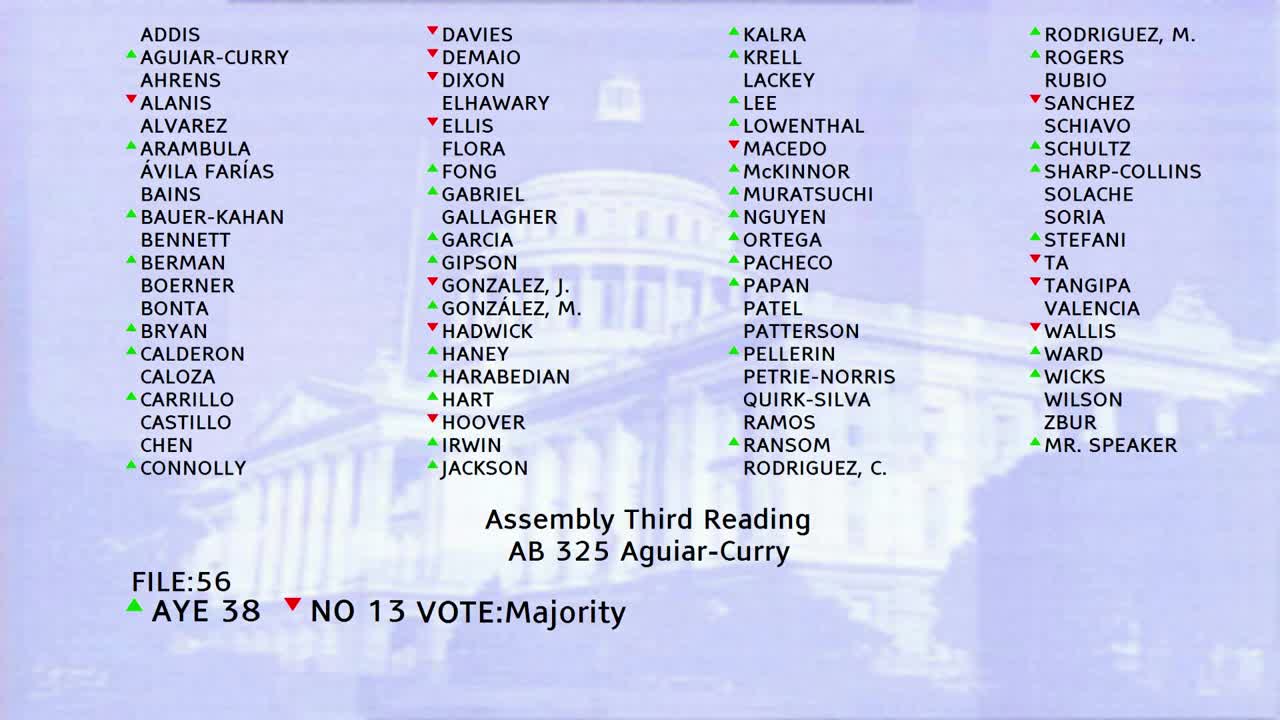
Bill Author