AB 432: Menopause.
- Session Year: 2025-2026
- House: Assembly
- Latest Version Date: 2025-09-12
Current Status:
Failed
(2026-01-22: Consideration of Governor's veto stricken from file.)
Introduced
In Committee
Awaiting First Chamber Vote
Passed First Chamber
In Committee
Awaiting Second Chamber Vote
Passed Second Chamber
Enacted
(1)Existing law, the Medical Practice Act, provides for the licensure and regulation of physicians and surgeons by the Medical Board of California and requires the board to adopt and administer standards for the continuing education of those licensees. Existing law requires the board, in determining its continuing education requirements, to consider including a course in menopausal mental or physical health.
This bill would delete that requirement of the board. The bill would require, beginning July 1, 2026, and until July 1, 2032, a qualifying physician and surgeon, as defined, who completes continuing medical education courses in perimenopause, menopause, and postmenopausal care to receive 2 hours of credit for each hour completed of that coursework, as specified.
Existing law, the Osteopathic Act, provides for the licensure and regulation of osteopathic physicians and surgeons by the Osteopathic Medical Board of California and requires the board to adopt and administer standards for the continuing education of those licensees.
This bill would require osteopathic physicians and surgeons to receive the same credit as described above for completed coursework relating to perimenopause, menopause, and postmenopausal care.
(2)Existing law, the Knox-Keene Health Care Service Plan Act of 1975, provides for the licensure and regulation of health care service plans by the Department of Managed Health Care and makes a willful violation of the act a crime. Existing law also provides for the regulation of health insurers by the Department of Insurance. Existing law sets forth specified coverage requirements for health care service plan contracts and health insurance policies.
This bill would require a health care service plan contract or health insurance policy that covers outpatient prescription drugs, except as specified, that is issued, amended, or renewed on or after January 1, 2026, to include coverage for evaluation and treatment options for symptoms of perimenopause and menopause. The bill would require a health care service plan or health insurer to annually provide clinical care recommendations, as specified, for hormone therapy to all contracted primary care providers who treat individuals with perimenopause and menopause. Because a willful violation of these provisions by a health care service plan would be a crime, the bill would impose a state-mandated local program.
(3)The California Constitution requires the state to reimburse local agencies and school districts for certain costs mandated by the state. Statutory provisions establish procedures for making that reimbursement.
This bill would provide that no reimbursement is required by this act for a specified reason.
(1)Existing law, the Medical Practice Act, provides for the licensure and regulation of physicians and surgeons by the Medical Board of California and requires the board to adopt and administer standards for the continuing education of those licensees. Existing law requires the board, in determining its continuing education requirements, to consider including a course in menopausal mental or physical health.
This bill would delete that requirement of the board. The bill would require, beginning July 1, 2026, a and until July 1, 2032, a qualifying physician and surgeon surgeon, as defined, who completes continuing medical education courses in perimenopause, menopause, and postmenopausal care to receive 2 hours of credit for each hour completed of that coursework, as specified.
Existing law, the Osteopathic Act, provides for the licensure and regulation of osteopathic physicians and surgeons by the Osteopathic Medical Board of California and requires the board to adopt and administer standards for the continuing education of those licensees.
This bill would require osteopathic physicians and surgeons to receive the same credit as described above for completed coursework relating to perimenopause, menopause, and postmenopausal care.
(2)Existing law, the Knox-Keene Health Care Service Plan Act of 1975, provides for the licensure and regulation of health care service plans by the Department of Managed Health Care and makes a willful violation of the act a crime. Existing law also provides for the regulation of health insurers by the Department of Insurance. Existing law sets forth specified coverage requirements for health care service plan contracts and health insurance policies.
This bill would require a health care service plan contract or health insurance policy that covers outpatient prescription drugs, except as specified, that is issued, amended, or renewed on or after January 1, 2026, to include coverage for evaluation and treatment options for symptoms of perimenopause and menopause. The bill would require a health care service plan or health insurer to annually provide clinical care recommendations, as specified, for hormone therapy to all contracted primary care providers who treat individuals with perimenopause and menopause. Because a willful violation of these provisions by a health care service plan would be a crime, the bill would impose a state-mandated local program.
(3)The California Constitution requires the state to reimburse local agencies and school districts for certain costs mandated by the state. Statutory provisions establish procedures for making that reimbursement.
This bill would provide that no reimbursement is required by this act for a specified reason.
(1)Existing law, the Medical Practice Act, provides for the licensure and regulation of physicians and surgeons by the Medical Board of California and requires the board to adopt and administer standards for the continuing education of those licensees. Existing law requires the board, in determining its continuing education requirements, to consider including a course in menopausal mental or physical health.
This bill would delete that requirement of the board. The bill would require, beginning July 1, 2026, a physician and surgeon who completes continuing medical education courses in perimenopause, menopause, and postmenopausal care to receive 2 hours of credit for each hour completed of that coursework, as specified.
Existing law, the Osteopathic Act, provides for the licensure and regulation of osteopathic physicians and surgeons by the Osteopathic Medical Board of California and requires the board to adopt and administer standards for the continuing education of those licensees.
This bill would require osteopathic physicians and surgeons to receive the same credit as described above for completed coursework relating to perimenopause, menopause, and postmenopausal care.
(2)Existing law, the Knox-Keene Health Care Service Plan Act of 1975, provides for the licensure and regulation of health care service plans by the Department of Managed Health Care and makes a willful violation of the act a crime. Existing law also provides for the regulation of health insurers by the Department of Insurance. Existing law sets forth specified coverage requirements for health care service plan contracts and health insurance policies.
This bill would require a health care service plan contract or health insurance policy that covers outpatient prescription drugs, except as specified, that is issued, amended, or renewed on or after January 1, 2026, to include coverage for evaluation and treatment options for symptoms of perimenopause and menopause. The bill would require a health care service plan or health insurer to annually provide clinical care recommendations, as specified, for hormone therapy to all contracted primary care providers who treat individuals with perimenopause and menopause. Because a willful violation of these provisions by a health care service plan would be a crime, the bill would impose a state-mandated local program.
(3)The California Constitution requires the state to reimburse local agencies and school districts for certain costs mandated by the state. Statutory provisions establish procedures for making that reimbursement.
This bill would provide that no reimbursement is required by this act for a specified reason.
(1)Existing law, the Medical Practice Act, provides for the licensure and regulation of physicians and surgeons by the Medical Board of California and requires the board to adopt and administer standards for the continuing education of those licensees. Existing law requires the board, in determining its continuing education requirements, to consider including a course in menopausal mental or physical health.
This bill would delete that requirement of the board. The bill would require, beginning July 1, 2026, a physician and surgeon who completes continuing medical education courses in perimenopause, menopause, and postmenopausal care to receive 2 hours of credit for each hour completed of that coursework, as specified.
Existing law, the Osteopathic Act, provides for the licensure and regulation of osteopathic physicians and surgeons by the Osteopathic Medical Board of California and requires the board to adopt and administer standards for the continuing education of those licensees.
This bill would require osteopathic physicians and surgeons to receive the same credit as described above for completed coursework relating to perimenopause, menopause, and postmenopausal care.
(2)Existing law, the Knox-Keene Health Care Service Plan Act of 1975, provides for the licensure and regulation of health care service plans by the Department of Managed Health Care and makes a willful violation of the act a crime. Existing law also provides for the regulation of health insurers by the Department of Insurance. Existing law sets forth specified coverage requirements for health care service plan contracts and health insurance policies.
This bill would require a health care service plan contract or health insurance policy, policy that covers outpatient prescription drugs, except as specified, that is issued, amended, or renewed on or after January 1, 2026, to include coverage for evaluation and treatment options for symptoms of perimenopause and menopause. The bill would require a health care service plan or health insurer to annually provide clinical care recommendations, as specified, for hormone therapy to all contracted primary care providers who treat individuals with perimenopause and menopause. Because a willful violation of these provisions by a health care service plan would be a crime, the bill would impose a state-mandated local program.
(3)The California Constitution requires the state to reimburse local agencies and school districts for certain costs mandated by the state. Statutory provisions establish procedures for making that reimbursement.
This bill would provide that no reimbursement is required by this act for a specified reason.
(1)Existing law, the Medical Practice Act, provides for the licensure and regulation of physicians and surgeons by the Medical Board of California and requires the board to adopt and administer standards for the continuing education of those licensees. Existing law requires the board, in determining its continuing education requirements, to consider including a course in menopausal mental or physical health.
This bill would delete that requirement of the board and, instead, require specified physicians whose patient population is composed of 25% or more adult women under 65 years of age, for their first license renewal after July 1, 2026, and every 4 years thereafter, to complete at least 5 hours of mandatory continuing medical education in a course in perimenopause, menopause, and postmenopausal care. board. The bill would require, beginning July 1, 2026, a physician and surgeon who completes continuing medical education courses in perimenopause, menopause, and postmenopausal care to receive 2 hours of credit for each hour completed of that coursework, as specified.
Existing law, the Osteopathic Act, provides for the licensure and regulation of osteopathic physicians and surgeons by the Osteopathic Medical Board of California and requires the board to adopt and administer standards for the continuing education of those licensees.
This bill would require specified osteopathic physicians to meet the above-described continuing medical education requirement osteopathic physicians and surgeons to receive the same credit as described above for completed coursework relating to perimenopause, menopause, and postmenopausal care.
(2)Existing law, the Knox-Keene Health Care Service Plan Act of 1975, provides for the licensure and regulation of health care service plans by the Department of Managed Health Care and makes a willful violation of the act a crime. Existing law also provides for the regulation of health insurers by the Department of Insurance. Existing law sets forth specified coverage requirements for health care service plan contracts and health insurance policies.
This bill would require a health care service plan contract or health insurance policy, except as specified, that is issued, amended, or renewed on or after January 1, 2026, to include coverage for evaluation and treatment options for perimenopause and menopause. The bill would require a health care service plan or health insurer to annually provide clinical care recommendations, as specified, for hormone therapy to all contracted primary care providers who treat individuals with perimenopause and menopause. Because a willful violation of these provisions by a health care service plan would be a crime, the bill would impose a state-mandated local program.
(3)The California Constitution requires the state to reimburse local agencies and school districts for certain costs mandated by the state. Statutory provisions establish procedures for making that reimbursement.
This bill would provide that no reimbursement is required by this act for a specified reason.
(1)Existing law, the Medical Practice Act, provides for the licensure and regulation of physicians and surgeons by the Medical Board of California and requires the board to adopt and administer standards for the continuing education of those licensees. Existing law requires the board, in determining its continuing education requirements, to consider including a course in menopausal mental or physical health.
This bill would delete that requirement of the board and, instead, require specified physicians who have a whose patient population is composed of 25% or more of adult women under 65 years of age age, for their first license renewal after July 1, 2026, and every 4 years thereafter, to complete at least 10% of all 5 hours of mandatory continuing medical education hours in a course in perimenopause, menopause, and postmenopausal care.
Existing law, the Osteopathic Act, provides for the licensure and regulation of osteopathic physicians and surgeons by the Osteopathic Medical Board of California and requires the board to adopt and administer standards for the continuing education of those licensees.
This bill would require specified osteopathic physicians to meet the above-described continuing medical education requirement relating to perimenopause, menopause, and postmenopausal care.
(2)Existing law, the Knox-Keene Health Care Service Plan Act of 1975, provides for the licensure and regulation of health care service plans by the Department of Managed Health Care and makes a willful violation of the act a crime. Existing law also provides for the regulation of health insurers by the Department of Insurance. Existing law sets forth specified coverage requirements for health care service plan contracts and health insurance policies.
This bill would require a health care service plan contract or health insurance policy, except as specified, that is issued, amended, or renewed on or after January 1, 2026, to include coverage for evaluation and treatment options for perimenopause and menopause. The bill would require a health care service plan or health insurer to annually provide clinical care recommendations, as specified, for hormone therapy to all contracted primary care providers who treat individuals with perimenopause and menopause. Because a willful violation of these provisions by a health care service plan would be a crime, the bill would impose a state-mandated local program.
(3)The California Constitution requires the state to reimburse local agencies and school districts for certain costs mandated by the state. Statutory provisions establish procedures for making that reimbursement.
This bill would provide that no reimbursement is required by this act for a specified reason.
(1)Existing law, the Medical Practice Act, provides for the licensure and regulation of physicians and surgeons by the Medical Board of California and requires the board to adopt and administer standards for the continuing education of those licensees. Existing law requires the board, in determining its continuing education requirements, to consider including a course in menopausal mental or physical health.
This bill would instead require the board, in determining its continuing education requirements, to include a course in menopausal mental or physical health. The bill would require delete that requirement of the board and, instead, require specified physicians who have a patient population composed of 25% or more of adult women under 65 years of age to complete a at least 10% of all mandatory continuing medical education hours in a course in perimenopause, menopause, and postmenopausal care.
(2)Existing law, the Knox-Keene Health Care Service Plan Act of 1975, provides for the licensure and regulation of health care service plans by the Department of Managed Health Care and makes a willful violation of the act a crime. Existing law also provides for the regulation of health insurers by the Department of Insurance. Existing law sets forth specified coverage requirements for health care service plan contracts and health insurance policies.
This bill would require a health care service plan contract or health insurance policy, except as specified, that is issued, amended, or renewed on or after January 1, 2026, to include coverage for evaluation and treatment options for perimenopause and menopause. The bill would require a health care service plan or health insurer to annually provide clinical care recommendations, as specified, for hormone therapy to all contracted primary care providers who treat individuals with perimenopause and menopause. Because a willful violation of these provisions by a health care service plan would be a crime, the bill would impose a state-mandated local program.
(3)The California Constitution requires the state to reimburse local agencies and school districts for certain costs mandated by the state. Statutory provisions establish procedures for making that reimbursement.
This bill would provide that no reimbursement is required by this act for a specified reason.
(1)Existing law, the Medical Practice Act, provides for the licensure and regulation of physicians and surgeons by the Medical Board of California and requires the board to adopt and administer standards for the continuing education of those licensees. Existing law requires the board, in determining its continuing education requirements, to consider including a course in menopausal mental or physical health.
This bill would instead require the board, in determining its continuing education requirements, to include a course in menopausal mental or physical health. The bill would require physicians who have a patient population composed of 25% or more of women to complete a mandatory continuing medical education course in perimenopause, menopause, and postmenopausal care.
(2)Existing law, the Knox-Keene Health Care Service Plan Act of 1975, provides for the licensure and regulation of health care service plans by the Department of Managed Health Care and makes a willful violation of the act a crime. Existing law also provides for the regulation of health insurers by the Department of Insurance. Existing law sets forth specified coverage requirements for health care service plan contracts and health insurance policies.
This bill would require a health care service plan contract or health insurance policy, except as specified, that is issued, amended, or renewed on or after January 1, 2026, to include coverage for evaluation and treatment options for perimenopause and menopause. The bill would require a health care service plan or health insurer to annually provide clinical care recommendations, as specified, for hormone therapy to all contracted primary care providers who treat individuals with perimenopause and menopause. Because a willful violation of these provisions by a health care service plan would be a crime, the bill would impose a state-mandated local program.
(3)The California Constitution requires the state to reimburse local agencies and school districts for certain costs mandated by the state. Statutory provisions establish procedures for making that reimbursement.
This bill would provide that no reimbursement is required by this act for a specified reason.
(a)For purposes of this section, qualifying physician and surgeon means a holder of a physicians and surgeons certificate from the board who is certified by a member board of the American Board of Medical Specialties as a general internist, family physician, obstetrician and gynecologist, cardiologist, endocrinologist, neurologist, or psychiatrist and whose patient population is composed of 25 percent or more of adult women under 65 years of age.
(b)Beginning July 1, 2026, and until July 1, 2032, a qualifying physician and surgeon who completes continuing medical education courses in perimenopause, menopause, and postmenopausal care shall receive two hours of credit for each hour completed of that coursework, for a total earned credit that does not exceed eight course hours, toward the requirement set forth in Section 1336 of Title 16 of the California Code of Regulations.
SEC. 2.Section 2191 of the Business and Professions Code is amended to read:2191.(a)In determining its continuing education requirements, the board shall consider including a course in human sexuality, defined as the study of a human being as a sexual being and how they function with respect thereto, and nutrition to be taken by those licensees whose practices may require knowledge in those areas.
(b)The board shall consider including a course in child abuse detection and treatment to be taken by those licensees whose practices are of a nature that there is a likelihood of contact with abused or neglected children.
(c)The board shall consider including a course in acupuncture to be taken by those licensees whose practices may require knowledge in the area of acupuncture and whose education has not included instruction in acupuncture.
(d)The board shall encourage every physician and surgeon to take nutrition as part of their continuing education, particularly a physician and surgeon involved in primary care.
(e)The board shall consider including a course in elder abuse detection and treatment to be taken by those licensees whose practices are of a nature that there is a likelihood of contact with abused or neglected persons 65 years of age and older.
(f)In determining its continuing education requirements, the board shall consider including a course in the early detection and treatment of substance abusing pregnant women to be taken by those licensees whose practices are of a nature that there is a likelihood of contact with these women.
(g)In determining its continuing education requirements, the board shall consider including a course in the special care needs of drug-addicted infants to be taken by those licensees whose practices are of a nature that there is a likelihood of contact with these infants.
(h)In determining its continuing education requirements, the board shall consider including a course providing training and guidelines on how to routinely screen for signs exhibited by abused women, particularly for physicians and surgeons in emergency, surgical, primary care, pediatric, prenatal, and mental health settings. In the event the board establishes a requirement for continuing education coursework in spousal or partner abuse detection or treatment, that requirement shall be met by each licensee within no more than four years from the date the requirement is imposed.
(i)In determining its continuing education requirements, the board shall consider including a course in the special care needs of individuals and their families facing end-of-life issues, including, but not limited to, all of the following:
(1)Pain and symptom management.
(2)The psychosocial dynamics of death.
(3)Dying and bereavement.
(4)Hospice care.
(j)In determining its continuing education requirements, the board shall give its highest priority to considering a course on pain management and the risks of addiction associated with the use of Schedule II drugs.
(k)In determining its continuing education requirements, the board shall consider including a course in geriatric care for emergency room physicians and surgeons.
SEC. 3.Section 2454.7 is added to the Business and Professions Code, to read:2454.7.Beginning July 1, 2026, an osteopathic physician and surgeon who completes continuing medical education courses in perimenopause, menopause, and postmenopausal care shall receive two hours of credit for each hour completed of that coursework, for a total earned credit that does not exceed eight course hours, toward the requirement set forth in Section 1635 of Title 16 of the California Code of Regulations.
SEC. 4.Section 1367.252 is added to the Health and Safety Code, to read:1367.252.(a)A health care service plan contract that covers outpatient prescription drugs, except for a specialized health care service plan contract, that is issued, amended, or renewed on or after January 1, 2026, shall include coverage for evaluation and treatment options for symptoms of perimenopause and menopause, as is deemed medically necessary by the treating health care provider under contract with the health care service plan or in accordance with the contract if there is an out-of-network benefit, without utilization management for treatments approved by the federal Food and Drug Administration, that includes, but is not limited to, all of the following:
(1)At least one outpatient prescription drug in each formulation of, and the associated method of administration for, federal Food and Drug Administration-regulated systemic hormone therapy.
(2)At least one outpatient prescription drug in each formulation of, and the associated method of administration for, nonhormonal medications for each menopause symptom.
(3)At least one outpatient prescription drug in each formulation of, and the associated method of administration for, treatment for genitourinary syndrome of menopause.
(4)At least one outpatient prescription drug from each class of medications approved to prevent and treat osteoporosis.
(b)Coverage required under this section includes authority for the treating provider to adjust the dose of a drug consistent with clinical care recommendations.
(c)A health care service plan shall annually provide current clinical care recommendations for hormone therapy from the Menopause Society or other nationally recognized professional associations to all contracted primary care providers who treat enrollees with perimenopause and menopause. A health care service plan shall encourage primary care providers to review those recommendations.
(d)For purposes of this section, the following terms have the following meanings:
(1)Formulation means all of the following:
(A)A tablet or capsule.
(B)A transdermal patch.
(C)A topical spray.
(D)A cream, gel, or lotion.
(E)A suppository, cream, or silicone ring.
(2)Method of administration means administering a formulation via an oral, topical, vaginal, rectal, subcutaneous, injectable, or intravenous route of administration.
(e)Coverage for the evaluation and treatment options for symptoms of perimenopause and menopause shall be provided without discrimination on the basis of gender expression or identity.
(f)Nothing in this section shall be construed to limit coverage for medically necessary outpatient prescription drugs pursuant to Section 1342.71 or any other provision under this chapter.
(g)This section does not apply to a Medi-Cal managed care plan contract with the State Department of Health Care Services pursuant to Chapter 7 (commencing with Section 14000) or Chapter 8 (commencing with Section 14200) of Part 3 of Division 9 of the Welfare and Institutions Code.
SEC. 5.Section 10123.1962 is added to the Insurance Code, to read:10123.1962.(a)A health insurance policy that covers outpatient prescription drugs, except for a specialized health insurance policy, that is issued, amended, or renewed on or after January 1, 2026, shall include coverage for evaluation and treatment options for symptoms of perimenopause and menopause, as is deemed medically necessary by the treating health care provider under contract with the health insurer or in accordance with the policy for out-of-network benefits, without utilization management for treatments approved by the federal Food and Drug Administration, that includes, but is not limited to, all of the following:
(1)At least one outpatient prescription drug in each formulation of, and the associated method of administration for, federal Food and Drug Administration-regulated systemic hormone therapy.
(2)At least one outpatient prescription drug in each formulation of, and the associated method of administration for, nonhormonal medications for each menopause symptom.
(3)At least one outpatient prescription drug in each formulation of, and the associated method of administration for, treatment for genitourinary syndrome of menopause.
(4)At least one outpatient prescription drug from each class of medications approved to prevent and treat osteoporosis.
(b)Coverage required under this section includes authority for the treating provider to adjust the dose of a drug consistent with clinical care recommendations.
(c)A health insurer shall annually provide current clinical care recommendations for hormone therapy from the Menopause Society or other nationally recognized professional associations to all contracted primary care providers who treat insureds with perimenopause and menopause. A health insurer shall encourage primary care providers to review those recommendations.
(d)For purposes of this section, the following terms have the following meanings:
(1)Formulation means all of the following:
(A)A tablet or capsule.
(B)A transdermal patch.
(C)A topical spray.
(D)A cream, gel, or lotion.
(E)A suppository, cream, or silicone ring.
(2)Method of administration means administering a formulation via an oral, topical, vaginal, rectal, subcutaneous, injectable, or intravenous route of administration.
(e)Coverage for the evaluation and treatment options for symptoms of perimenopause and menopause shall be provided without discrimination on the basis of gender expression or identity.
(f)Nothing in this section shall be construed to limit coverage for medically necessary outpatient prescription drugs pursuant to Section 10123.193 or any other provision under this chapter.
SEC. 6.No reimbursement is required by this act pursuant to Section 6 of Article XIIIB of the California Constitution because the only costs that may be incurred by a local agency or school district will be incurred because this act creates a new crime or infraction, eliminates a crime or infraction, or changes the penalty for a crime or infraction, within the meaning of Section 17556 of the Government Code, or changes the definition of a crime within the meaning of Section 6 of Article XIIIB of the California Constitution.
Beginning (a)For purposes of this section, qualifying physician and surgeon means a holder of a physicians and surgeons certificate from the board who is certified by a member board of the American Board of Medical Specialties as a general internist, family physician, obstetrician and gynecologist, cardiologist, endocrinologist, neurologist, or psychiatrist and whose patient population is composed of 25 percent or more of adult women under 65 years of age.
(b)Beginning July 1, 2026, a and until July 1, 2032, a qualifying physician and surgeon who completes continuing medical education courses in perimenopause, menopause, and postmenopausal care shall receive two hours of credit for each hour completed of that coursework, for a total earned credit that does not exceed eight course hours, toward the requirement set forth in Section 1336 of Title 16 of the California Code of Regulations.
SEC. 2.Section 2191 of the Business and Professions Code is amended to read:2191.(a)In determining its continuing education requirements, the board shall consider including a course in human sexuality, defined as the study of a human being as a sexual being and how they function with respect thereto, and nutrition to be taken by those licensees whose practices may require knowledge in those areas.
(b)The board shall consider including a course in child abuse detection and treatment to be taken by those licensees whose practices are of a nature that there is a likelihood of contact with abused or neglected children.
(c)The board shall consider including a course in acupuncture to be taken by those licensees whose practices may require knowledge in the area of acupuncture and whose education has not included instruction in acupuncture.
(d)The board shall encourage every physician and surgeon to take nutrition as part of their continuing education, particularly a physician and surgeon involved in primary care.
(e)The board shall consider including a course in elder abuse detection and treatment to be taken by those licensees whose practices are of a nature that there is a likelihood of contact with abused or neglected persons 65 years of age and older.
(f)In determining its continuing education requirements, the board shall consider including a course in the early detection and treatment of substance abusing pregnant women to be taken by those licensees whose practices are of a nature that there is a likelihood of contact with these women.
(g)In determining its continuing education requirements, the board shall consider including a course in the special care needs of drug-addicted infants to be taken by those licensees whose practices are of a nature that there is a likelihood of contact with these infants.
(h)In determining its continuing education requirements, the board shall consider including a course providing training and guidelines on how to routinely screen for signs exhibited by abused women, particularly for physicians and surgeons in emergency, surgical, primary care, pediatric, prenatal, and mental health settings. In the event the board establishes a requirement for continuing education coursework in spousal or partner abuse detection or treatment, that requirement shall be met by each licensee within no more than four years from the date the requirement is imposed.
(i)In determining its continuing education requirements, the board shall consider including a course in the special care needs of individuals and their families facing end-of-life issues, including, but not limited to, all of the following:
(1)Pain and symptom management.
(2)The psychosocial dynamics of death.
(3)Dying and bereavement.
(4)Hospice care.
(j)In determining its continuing education requirements, the board shall give its highest priority to considering a course on pain management and the risks of addiction associated with the use of Schedule II drugs.
(k)In determining its continuing education requirements, the board shall consider including a course in geriatric care for emergency room physicians and surgeons.
SEC. 3.Section 2454.7 is added to the Business and Professions Code, to read:2454.7.Beginning July 1, 2026, an osteopathic physician and surgeon who completes continuing medical education courses in perimenopause, menopause, and postmenopausal care shall receive two hours of credit for each hour completed of that coursework, for a total earned credit that does not exceed eight course hours, toward the requirement set forth in Section 1635 of Title 16 of the California Code of Regulations.
SEC. 4.Section 1367.252 is added to the Health and Safety Code, to read:1367.252.(a)A health care service plan contract that covers outpatient prescription drugs, except for a specialized health care service plan contract, that is issued, amended, or renewed on or after January 1, 2026, shall include coverage for evaluation and treatment options for symptoms of perimenopause and menopause, as is deemed medically necessary by the treating health care provider under contract with the health care service plan or in accordance with the contract if there is an out-of-network benefit, without utilization management for treatments approved by the federal Food and Drug Administration, that includes, but is not limited to, all of the following:
(1)At least one outpatient prescription drug in each formulation of, and the associated method of administration for, federal Food and Drug Administration-regulated systemic hormone therapy.
(2)At least one outpatient prescription drug in each formulation of, and the associated method of administration for, nonhormonal medications for each menopause symptom.
(3)At least one outpatient prescription drug in each formulation of, and the associated method of administration for, treatment for genitourinary syndrome of menopause.
(4)At least one outpatient prescription drug from each class of medications approved to prevent and treat osteoporosis.
(b)Coverage required under this section includes authority for the treating provider to adjust the dose of a drug consistent with clinical care recommendations.
(c)A health care service plan shall annually provide current clinical care recommendations for hormone therapy from the Menopause Society or other nationally recognized professional associations to all contracted primary care providers who treat enrollees with perimenopause and menopause. A health care service plan shall encourage primary care providers to review those recommendations.
(d)For purposes of this section, the following terms have the following meanings:
(1)Formulation means all of the following:
(A)A tablet or capsule.
(B)A transdermal patch.
(C)A topical spray.
(D)A cream, gel, or lotion.
(E)A suppository, cream, or silicone ring.
(2)Method of administration means administering a formulation via an oral, topical, vaginal, rectal, subcutaneous, injectable, or intravenous route of administration.
(e)Coverage for the evaluation and treatment options for symptoms of perimenopause and menopause shall be provided without discrimination on the basis of gender expression or identity.
(f)Nothing in this section shall be construed to limit coverage for medically necessary outpatient prescription drugs pursuant to Section 1342.71 or any other provision under this chapter.
(g)This section does not apply to a Medi-Cal managed care plan contract with the State Department of Health Care Services pursuant to Chapter 7 (commencing with Section 14000) or Chapter 8 (commencing with Section 14200) of Part 3 of Division 9 of the Welfare and Institutions Code.
SEC. 5.Section 10123.1962 is added to the Insurance Code, to read:10123.1962.(a)A health insurance policy that covers outpatient prescription drugs, except for a specialized health insurance policy, that is issued, amended, or renewed on or after January 1, 2026, shall include coverage for evaluation and treatment options for symptoms of perimenopause and menopause, as is deemed medically necessary by the treating health care provider under contract with the health insurer or in accordance with the policy for out-of-network benefits, without utilization management for treatments approved by the federal Food and Drug Administration, that includes, but is not limited to, all of the following:
(1)At least one outpatient prescription drug in each formulation of, and the associated method of administration for, federal Food and Drug Administration-regulated systemic hormone therapy.
(2)At least one outpatient prescription drug in each formulation of, and the associated method of administration for, nonhormonal medications for each menopause symptom.
(3)At least one outpatient prescription drug in each formulation of, and the associated method of administration for, treatment for genitourinary syndrome of menopause.
(4)At least one outpatient prescription drug from each class of medications approved to prevent and treat osteoporosis.
(b)Coverage required under this section includes authority for the treating provider to adjust the dose of a drug consistent with clinical care recommendations.
(c)A health insurer shall annually provide current clinical care recommendations for hormone therapy from the Menopause Society or other nationally recognized professional associations to all contracted primary care providers who treat insureds with perimenopause and menopause. A health insurer shall encourage primary care providers to review those recommendations.
(d)For purposes of this section, the following terms have the following meanings:
(1)Formulation means all of the following:
(A)A tablet or capsule.
(B)A transdermal patch.
(C)A topical spray.
(D)A cream, gel, or lotion.
(E)A suppository, cream, or silicone ring.
(2)Method of administration means administering a formulation via an oral, topical, vaginal, rectal, subcutaneous, injectable, or intravenous route of administration.
(e)Coverage for the evaluation and treatment options for symptoms of perimenopause and menopause shall be provided without discrimination on the basis of gender expression or identity.
(f)Nothing in this section shall be construed to limit coverage for medically necessary outpatient prescription drugs pursuant to Section 10123.193 or any other provision under this chapter.
SEC. 6.No reimbursement is required by this act pursuant to Section 6 of Article XIIIB of the California Constitution because the only costs that may be incurred by a local agency or school district will be incurred because this act creates a new crime or infraction, eliminates a crime or infraction, or changes the penalty for a crime or infraction, within the meaning of Section 17556 of the Government Code, or changes the definition of a crime within the meaning of Section 6 of Article XIIIB of the California Constitution.
Beginning July 1, 2026, a physician and surgeon who completes continuing medical education courses in perimenopause, menopause, and postmenopausal care shall receive two hours of credit for each hour completed of that coursework, for a total earned credit that does not exceed eight course hours, toward the requirement set forth in Section 1336 of Title 16 of the California Code of Regulations.
SEC. 2.Section 2191 of the Business and Professions Code is amended to read:2191.(a)In determining its continuing education requirements, the board shall consider including a course in human sexuality, defined as the study of a human being as a sexual being and how they function with respect thereto, and nutrition to be taken by those licensees whose practices may require knowledge in those areas.
(b)The board shall consider including a course in child abuse detection and treatment to be taken by those licensees whose practices are of a nature that there is a likelihood of contact with abused or neglected children.
(c)The board shall consider including a course in acupuncture to be taken by those licensees whose practices may require knowledge in the area of acupuncture and whose education has not included instruction in acupuncture.
(d)The board shall encourage every physician and surgeon to take nutrition as part of their continuing education, particularly a physician and surgeon involved in primary care.
(e)The board shall consider including a course in elder abuse detection and treatment to be taken by those licensees whose practices are of a nature that there is a likelihood of contact with abused or neglected persons 65 years of age and older.
(f)In determining its continuing education requirements, the board shall consider including a course in the early detection and treatment of substance abusing pregnant women to be taken by those licensees whose practices are of a nature that there is a likelihood of contact with these women.
(g)In determining its continuing education requirements, the board shall consider including a course in the special care needs of drug-addicted infants to be taken by those licensees whose practices are of a nature that there is a likelihood of contact with these infants.
(h)In determining its continuing education requirements, the board shall consider including a course providing training and guidelines on how to routinely screen for signs exhibited by abused women, particularly for physicians and surgeons in emergency, surgical, primary care, pediatric, prenatal, and mental health settings. In the event the board establishes a requirement for continuing education coursework in spousal or partner abuse detection or treatment, that requirement shall be met by each licensee within no more than four years from the date the requirement is imposed.
(i)In determining its continuing education requirements, the board shall consider including a course in the special care needs of individuals and their families facing end-of-life issues, including, but not limited to, all of the following:
(1)Pain and symptom management.
(2)The psychosocial dynamics of death.
(3)Dying and bereavement.
(4)Hospice care.
(j)In determining its continuing education requirements, the board shall give its highest priority to considering a course on pain management and the risks of addiction associated with the use of Schedule II drugs.
(k)In determining its continuing education requirements, the board shall consider including a course in geriatric care for emergency room physicians and surgeons.
SEC. 3.Section 2454.7 is added to the Business and Professions Code, to read:2454.7.Beginning July 1, 2026, an osteopathic physician and surgeon who completes continuing medical education courses in perimenopause, menopause, and postmenopausal care shall receive two hours of credit for each hour completed of that coursework, for a total earned credit that does not exceed eight course hours, toward the requirement set forth in Section 1635 of Title 16 of the California Code of Regulations.
SEC. 4.Section 1367.252 is added to the Health and Safety Code, to read:1367.252.(a)A health care service plan contract that covers outpatient prescription drugs, except for a specialized health care service plan contract, that is issued, amended, or renewed on or after January 1, 2026, shall include coverage for evaluation and treatment options for symptoms of perimenopause and menopause, as is deemed medically necessary by the treating health care provider under contract with the health care service plan or in accordance with the contract if there is an out-of-network benefit, without utilization management for treatments approved by the federal Food and Drug Administration, that includes, but is not limited to, all of the following:
(1)At least one outpatient prescription drug in each formulation of, and the associated method of administration for, federal Food and Drug Administration-regulated systemic hormone therapy.
(2)At least one outpatient prescription drug in each formulation of, and the associated method of administration for, nonhormonal medications for each menopause symptom.
(3)At least one outpatient prescription drug in each formulation of, and the associated method of administration for, treatment for genitourinary syndrome of menopause.
(4)At least one outpatient prescription drug from each class of medications approved to prevent and treat osteoporosis.
(b)Coverage required under this section includes authority for the treating provider to adjust the dose of a drug consistent with clinical care recommendations.
(c)A health care service plan shall annually provide current clinical care recommendations for hormone therapy from the Menopause Society or other nationally recognized professional associations to all contracted primary care providers who treat enrollees with perimenopause and menopause. A health care service plan shall encourage primary care providers to review those recommendations.
(d)For purposes of this section, the following terms have the following meanings:
(1)Formulation means all of the following:
(A)A tablet or capsule.
(B)A transdermal patch.
(C)A topical spray.
(D)A cream, gel, or lotion.
(E)A suppository, cream, or silicone ring.
(2)Method of administration means administering a formulation via an oral, topical, vaginal, rectal, subcutaneous, injectable, or intravenous route of administration.
(e)Coverage for the evaluation and treatment options for symptoms of perimenopause and menopause shall be provided without discrimination on the basis of gender expression or identity.
(f)Nothing in this section shall be construed to limit coverage for medically necessary outpatient prescription drugs pursuant to Section 1342.71 or any other provision under this chapter.
(g)This section does not apply to a Medi-Cal managed care plan contract with the State Department of Health Care Services pursuant to Chapter 7 (commencing with Section 14000) or Chapter 8 (commencing with Section 14200) of Part 3 of Division 9 of the Welfare and Institutions Code.
SEC. 5.Section 10123.1962 is added to the Insurance Code, to read:10123.1962.(a)A health insurance policy that covers outpatient prescription drugs, except for a specialized health insurance policy, that is issued, amended, or renewed on or after January 1, 2026, shall include coverage for evaluation and treatment options for symptoms of perimenopause and menopause, as is deemed medically necessary by the treating health care provider under contract with the health insurer or in accordance with the policy for out-of-network benefits, without utilization management for treatments approved by the federal Food and Drug Administration, that includes, but is not limited to, all of the following:
(1)At least one outpatient prescription drug in each formulation of, and the associated method of administration for, federal Food and Drug Administration-regulated systemic hormone therapy.
(2)At least one outpatient prescription drug in each formulation of, and the associated method of administration for, nonhormonal medications for each menopause symptom.
(3)At least one outpatient prescription drug in each formulation of, and the associated method of administration for, treatment for genitourinary syndrome of menopause.
(4)At least one outpatient prescription drug from each class of medications approved to prevent and treat osteoporosis.
(b)Coverage required under this section includes authority for the treating provider to adjust the dose of a drug consistent with clinical care recommendations.
(c)A health insurer shall annually provide current clinical care recommendations for hormone therapy from the Menopause Society or other nationally recognized professional associations to all contracted primary care providers who treat insureds with perimenopause and menopause. A health insurer shall encourage primary care providers to review those recommendations.
(d)For purposes of this section, the following terms have the following meanings:
(1)Formulation means all of the following:
(A)A tablet or capsule.
(B)A transdermal patch.
(C)A topical spray.
(D)A cream, gel, or lotion.
(E)A suppository, cream, or silicone ring.
(2)Method of administration means administering a formulation via an oral, topical, vaginal, rectal, subcutaneous, injectable, or intravenous route of administration.
(e)Coverage for the evaluation and treatment options for symptoms of perimenopause and menopause shall be provided without discrimination on the basis of gender expression or identity.
(f)Nothing in this section shall be construed to limit coverage for medically necessary outpatient prescription drugs pursuant to Section 10123.193 or any other provision under this chapter.
SEC. 6.No reimbursement is required by this act pursuant to Section 6 of Article XIIIB of the California Constitution because the only costs that may be incurred by a local agency or school district will be incurred because this act creates a new crime or infraction, eliminates a crime or infraction, or changes the penalty for a crime or infraction, within the meaning of Section 17556 of the Government Code, or changes the definition of a crime within the meaning of Section 6 of Article XIIIB of the California Constitution.
Beginning July 1, 2026, a physician and surgeon who completes continuing medical education courses in perimenopause, menopause, and postmenopausal care shall receive two hours of credit for each hour completed of that coursework, for a total earned credit that does not exceed eight course hours, toward the requirement set forth in Section 1336 of Title 16 of the California Code of Regulations.
SEC. 2.Section 2191 of the Business and Professions Code is amended to read:2191.(a)In determining its continuing education requirements, the board shall consider including a course in human sexuality, defined as the study of a human being as a sexual being and how they function with respect thereto, and nutrition to be taken by those licensees whose practices may require knowledge in those areas.
(b)The board shall consider including a course in child abuse detection and treatment to be taken by those licensees whose practices are of a nature that there is a likelihood of contact with abused or neglected children.
(c)The board shall consider including a course in acupuncture to be taken by those licensees whose practices may require knowledge in the area of acupuncture and whose education has not included instruction in acupuncture.
(d)The board shall encourage every physician and surgeon to take nutrition as part of their continuing education, particularly a physician and surgeon involved in primary care.
(e)The board shall consider including a course in elder abuse detection and treatment to be taken by those licensees whose practices are of a nature that there is a likelihood of contact with abused or neglected persons 65 years of age and older.
(f)In determining its continuing education requirements, the board shall consider including a course in the early detection and treatment of substance abusing pregnant women to be taken by those licensees whose practices are of a nature that there is a likelihood of contact with these women.
(g)In determining its continuing education requirements, the board shall consider including a course in the special care needs of drug-addicted infants to be taken by those licensees whose practices are of a nature that there is a likelihood of contact with these infants.
(h)In determining its continuing education requirements, the board shall consider including a course providing training and guidelines on how to routinely screen for signs exhibited by abused women, particularly for physicians and surgeons in emergency, surgical, primary care, pediatric, prenatal, and mental health settings. In the event the board establishes a requirement for continuing education coursework in spousal or partner abuse detection or treatment, that requirement shall be met by each licensee within no more than four years from the date the requirement is imposed.
(i)In determining its continuing education requirements, the board shall consider including a course in the special care needs of individuals and their families facing end-of-life issues, including, but not limited to, all of the following:
(1)Pain and symptom management.
(2)The psychosocial dynamics of death.
(3)Dying and bereavement.
(4)Hospice care.
(j)In determining its continuing education requirements, the board shall give its highest priority to considering a course on pain management and the risks of addiction associated with the use of Schedule II drugs.
(k)In determining its continuing education requirements, the board shall consider including a course in geriatric care for emergency room physicians and surgeons.
SEC. 3.Section 2454.7 is added to the Business and Professions Code, to read:2454.7.Beginning July 1, 2026, an osteopathic physician and surgeon who completes continuing medical education courses in perimenopause, menopause, and postmenopausal care shall receive two hours of credit for each hour completed of that coursework, for a total earned credit that does not exceed eight course hours, toward the requirement set forth in Section 1635 of Title 16 of the California Code of Regulations.
SEC. 4.Section 1367.252 is added to the Health and Safety Code, to read:1367.252.(a)A health care service plan contract, contract that covers outpatient prescription drugs, except for a specialized health care service plan contract, that is issued, amended, or renewed on or after January 1, 2026, shall include coverage for evaluation and treatment options for symptoms of perimenopause and menopause, as is deemed medically necessary by the treating health care provider under contract with the health care service plan or in accordance with the contract if there is an out-of-network benefit, without utilization management, management for treatments approved by the federal Food and Drug Administration, that includes, but is not limited to, all of the following:
(1)At least one option outpatient prescription drug in each formulation of, and the associated method of administration for, federal Food and Drug Administration-regulated systemic hormone therapy.
(2)At least one option outpatient prescription drug in each formulation of, and the associated method of administration for, nonhormonal medications for each menopause symptom.
(3)At least one option outpatient prescription drug in each formulation of, and the associated method of administration for, treatment for genitourinary syndrome of menopause.
(4)At least one outpatient prescription drug from each class of medications approved to prevent and treat osteoporosis.
(b)Coverage required under this section includes authority for the treating provider to adjust the dose of a drug consistent with clinical care recommendations.
(c)A health care service plan shall annually provide current clinical care recommendations for hormone therapy from the Menopause Society or other nationally recognized professional associations to all contracted primary care providers who treat enrollees with perimenopause and menopause. A health care service plan shall encourage primary care providers to review those recommendations.
(d)For purposes of this section, the following terms have the following meanings:
(1)Formulation means all of the following:
(A)A tablet or capsule.
(B)A transdermal patch.
(C)A topical spray.
(D)A cream, gel, or lotion.
(E)A vaginal suppository, cream, or silicone ring.
(2)Method of administration means administering a formulation via an oral, topical, vaginal, rectal, subcutaneous, injectable, or intravenous route of administration.
(e)Coverage for the evaluation and treatment options for symptoms of perimenopause and menopause shall be provided without discrimination on the basis of gender expression or identity.
(f)Nothing in this section shall be construed to limit coverage for medically necessary outpatient prescription drugs pursuant to Section 1342.71 or any other provision under this chapter.
SEC. 5.Section 10123.1962 is added to the Insurance Code, to read:10123.1962.(a)A health insurance policy, policy that covers outpatient prescription drugs, except for a specialized health insurance policy, that is issued, amended, or renewed on or after January 1, 2026, shall include coverage for evaluation and treatment options for symptoms of perimenopause and menopause, as is deemed medically necessary by the treating health care provider under contract with the health insurer or in accordance with the policy for out-of-network benefits, without utilization management, management for treatments approved by the federal Food and Drug Administration, that includes, but is not limited to, all of the following:
(1)At least one option outpatient prescription drug in each formulation of, and the associated method of administration for, federal Food and Drug Administration-regulated systemic hormone therapy.
(2)At least one option outpatient prescription drug in each formulation of, and the associated method of administration for, nonhormonal medications for each menopause symptom.
(3)At least one option outpatient prescription drug in each formulation of, and the associated method of administration for, treatment for genitourinary syndrome of menopause.
(4)At least one outpatient prescription drug from each class of medications approved to prevent and treat osteoporosis.
(b)Coverage required under this section includes authority for the treating provider to adjust the dose of a drug consistent with clinical care recommendations.
(c)A health insurer shall annually provide current clinical care recommendations for hormone therapy from the Menopause Society or other nationally recognized professional associations to all contracted primary care providers who treat insureds with perimenopause and menopause. A health insurer shall encourage primary care providers to review those recommendations.
(d)For purposes of this section, the following terms have the following meanings:
(1)Formulation means all of the following:
(A)A tablet or capsule.
(B)A transdermal patch.
(C)A topical spray.
(D)A cream, gel, or lotion.
(E)A vaginal suppository, cream, or silicone ring.
(2)Method of administration means administering a formulation via an oral, topical, vaginal, rectal, subcutaneous, injectable, or intravenous route of administration.
(e)Coverage for the evaluation and treatment options for symptoms of perimenopause and menopause shall be provided without discrimination on the basis of gender expression or identity.
(f)Nothing in this section shall be construed to limit coverage for medically necessary outpatient prescription drugs pursuant to Section 10123.193 or any other provision under this chapter.
SEC. 6.No reimbursement is required by this act pursuant to Section 6 of Article XIIIB of the California Constitution because the only costs that may be incurred by a local agency or school district will be incurred because this act creates a new crime or infraction, eliminates a crime or infraction, or changes the penalty for a crime or infraction, within the meaning of Section 17556 of the Government Code, or changes the definition of a crime within the meaning of Section 6 of Article XIIIB of the California Constitution.
Beginning July 1, 2026, a physician and surgeon who completes continuing medical education courses in perimenopause, menopause, and postmenopausal care shall receive two hours of credit for each hour completed of that coursework, for a total earned credit that does not exceed eight course hours, toward the requirement set forth in Section 1336 of Title 16 of the California Code of Regulations.
SEC. 2.Section 2191 of the Business and Professions Code is amended to read:2191.(a)In determining its continuing education requirements, the board shall consider including a course in human sexuality, defined as the study of a human being as a sexual being and how they function with respect thereto, and nutrition to be taken by those licensees whose practices may require knowledge in those areas.
(b)The board shall consider including a course in child abuse detection and treatment to be taken by those licensees whose practices are of a nature that there is a likelihood of contact with abused or neglected children.
(c)The board shall consider including a course in acupuncture to be taken by those licensees whose practices may require knowledge in the area of acupuncture and whose education has not included instruction in acupuncture.
(d)The board shall encourage every physician and surgeon to take nutrition as part of their continuing education, particularly a physician and surgeon involved in primary care.
(e)The board shall consider including a course in elder abuse detection and treatment to be taken by those licensees whose practices are of a nature that there is a likelihood of contact with abused or neglected persons 65 years of age and older.
(f)In determining its continuing education requirements, the board shall consider including a course in the early detection and treatment of substance abusing pregnant women to be taken by those licensees whose practices are of a nature that there is a likelihood of contact with these women.
(g)In determining its continuing education requirements, the board shall consider including a course in the special care needs of drug-addicted infants to be taken by those licensees whose practices are of a nature that there is a likelihood of contact with these infants.
(h)In determining its continuing education requirements, the board shall consider including a course providing training and guidelines on how to routinely screen for signs exhibited by abused women, particularly for physicians and surgeons in emergency, surgical, primary care, pediatric, prenatal, and mental health settings. In the event the board establishes a requirement for continuing education coursework in spousal or partner abuse detection or treatment, that requirement shall be met by each licensee within no more than four years from the date the requirement is imposed.
(i)In determining its continuing education requirements, the board shall consider including a course in the special care needs of individuals and their families facing end-of-life issues, including, but not limited to, all of the following:
(1)Pain and symptom management.
(2)The psychosocial dynamics of death.
(3)Dying and bereavement.
(4)Hospice care.
(j)In determining its continuing education requirements, the board shall give its highest priority to considering a course on pain management and the risks of addiction associated with the use of Schedule II drugs.
(k)In determining its continuing education requirements, the board shall consider including a course in geriatric care for emergency room physicians and surgeons.
SEC. 3.Section 2454.7 is added to the Business and Professions Code, to read:2454.7.Every general internist, family physician, obstetrician and gynecologist, cardiologist, endocrinologist, and neurologist whose patient population is composed of 25 percent or more adult women under 65 years of age, for their first license renewal after July 1, 2026, and every four years thereafter, shall complete at least five hours of mandatory continuing medical education in a course in perimenopause, menopause, and postmenopausal care.SEC. 3.Section 2454.7 is added to the Business and Professions Code, to read:2454.7.Beginning July 1, 2026, an osteopathic physician and surgeon who completes continuing medical education courses in perimenopause, menopause, and postmenopausal care shall receive two hours of credit for each hour completed of that coursework, for a total earned credit that does not exceed eight course hours, toward the requirement set forth in Section 1635 of Title 16 of the California Code of Regulations.
SEC. 4.Section 1367.252 is added to the Health and Safety Code, to read:1367.252.(a)A health care service plan contract, except for a specialized health care service plan contract, that is issued, amended, or renewed on or after January 1, 2026, shall include coverage for evaluation and treatment options for perimenopause and menopause, as is deemed medically necessary by the treating health care provider without utilization management, that includes, but is not limited to, all of the following:
(1)At least one option in each formulation of, and the associated method of administration for, federal Food and Drug Administration-regulated systemic hormone therapy.
(2)At least one option in each formulation of, and the associated method of administration for, nonhormonal medications for each menopause symptom.
(3)At least one option in each formulation of, and the associated method of administration for, treatment for genitourinary syndrome of menopause.
(4)At least one from each class of medications approved to prevent and treat osteoporosis.
(b)Coverage required under this section includes authority for the treating provider to adjust the dose of a drug consistent with clinical care recommendations.
(c)A health care service plan shall annually provide current clinical care recommendations for hormone therapy from the Menopause Society or other nationally recognized professional associations to all contracted primary care providers who treat enrollees with perimenopause and menopause. A health care service plan shall encourage primary care providers to review those recommendations.
(d)For purposes of this section, the following terms have the following meanings:
(1)Formulation means all of the following:
(A)A tablet or capsule.
(B)A transdermal patch.
(C)A topical spray.
(D)A cream, gel, or lotion.
(E)A vaginal suppository, cream, or silicone ring.
(2)Method of administration means administering a formulation via an oral, topical, vaginal, subcutaneous, injectable, or intravenous route of administration.
(e)Coverage for the evaluation and treatment options for perimenopause and menopause shall be provided without discrimination on the basis of gender expression or identity.
(f)Nothing in this section shall be construed to limit coverage for medically necessary outpatient prescription drugs pursuant to Section 1342.71 or any other provision under this chapter.
SEC. 5.Section 10123.1962 is added to the Insurance Code, to read:10123.1962.(a)A health insurance policy, except for a specialized health insurance policy, that is issued, amended, or renewed on or after January 1, 2026, shall include coverage for evaluation and treatment options for perimenopause and menopause, as is deemed medically necessary by the treating health care provider without utilization management, that includes, but is not limited to, all of the following:
(1)At least one option in each formulation of, and the associated method of administration for, federal Food and Drug Administration-regulated systemic hormone therapy.
(2)At least one option in each formulation of, and the associated method of administration for, nonhormonal medications for each menopause symptom.
(3)At least one option in each formulation of, and the associated method of administration for, treatment for genitourinary syndrome of menopause.
(4)At least one from each class of medications approved to prevent and treat osteoporosis.
(b)Coverage required under this section includes authority for the treating provider to adjust the dose of a drug consistent with clinical care recommendations.
(c)A health insurer shall annually provide current clinical care recommendations for hormone therapy from the Menopause Society or other nationally recognized professional associations to all contracted primary care providers who treat insureds with perimenopause and menopause. A health insurer shall encourage primary care providers to review those recommendations.
(d)For purposes of this section, the following terms have the following meanings:
(1)Formulation means all of the following:
(A)A tablet or capsule.
(B)A transdermal patch.
(C)A topical spray.
(D)A cream, gel, or lotion.
(E)A vaginal suppository, cream, or silicone ring.
(2)Method of administration means administering a formulation via an oral, topical, vaginal, subcutaneous, injectable, or intravenous route of administration.
(e)Coverage for the evaluation and treatment options for perimenopause and menopause shall be provided without discrimination on the basis of gender expression or identity.
(f)Nothing in this section shall be construed to limit coverage for medically necessary outpatient prescription drugs pursuant to Section 10123.193 or any other provision under this chapter.
SEC. 6.No reimbursement is required by this act pursuant to Section 6 of Article XIIIB of the California Constitution because the only costs that may be incurred by a local agency or school district will be incurred because this act creates a new crime or infraction, eliminates a crime or infraction, or changes the penalty for a crime or infraction, within the meaning of Section 17556 of the Government Code, or changes the definition of a crime within the meaning of Section 6 of Article XIIIB of the California Constitution.
All general internists, family physicians, obstetricians and gynecologists, cardiologists, endocrinologists, and neurologists who have a Every general internist, family physician, obstetrician and gynecologist, cardiologist, endocrinologist, and neurologist whose patient population is composed of 25 percent or more of adult women under 65 years of age age, for their first license renewal after July 1, 2026, and every four years thereafter, shall complete at least 10 percent five hours of all mandatory continuing medical education hours in a course in perimenopause, menopause, and postmenopausal care.
SEC. 2.Section 2191 of the Business and Professions Code is amended to read:2191.(a)In determining its continuing education requirements, the board shall consider including a course in human sexuality, defined as the study of a human being as a sexual being and how they function with respect thereto, and nutrition to be taken by those licensees whose practices may require knowledge in those areas.
(b)The board shall consider including a course in child abuse detection and treatment to be taken by those licensees whose practices are of a nature that there is a likelihood of contact with abused or neglected children.
(c)The board shall consider including a course in acupuncture to be taken by those licensees whose practices may require knowledge in the area of acupuncture and whose education has not included instruction in acupuncture.
(d)The board shall encourage every physician and surgeon to take nutrition as part of their continuing education, particularly a physician and surgeon involved in primary care.
(e)The board shall consider including a course in elder abuse detection and treatment to be taken by those licensees whose practices are of a nature that there is a likelihood of contact with abused or neglected persons 65 years of age and older.
(f)In determining its continuing education requirements, the board shall consider including a course in the early detection and treatment of substance abusing pregnant women to be taken by those licensees whose practices are of a nature that there is a likelihood of contact with these women.
(g)In determining its continuing education requirements, the board shall consider including a course in the special care needs of drug-addicted infants to be taken by those licensees whose practices are of a nature that there is a likelihood of contact with these infants.
(h)In determining its continuing education requirements, the board shall consider including a course providing training and guidelines on how to routinely screen for signs exhibited by abused women, particularly for physicians and surgeons in emergency, surgical, primary care, pediatric, prenatal, and mental health settings. In the event the board establishes a requirement for continuing education coursework in spousal or partner abuse detection or treatment, that requirement shall be met by each licensee within no more than four years from the date the requirement is imposed.
(i)In determining its continuing education requirements, the board shall consider including a course in the special care needs of individuals and their families facing end-of-life issues, including, but not limited to, all of the following:
(1)Pain and symptom management.
(2)The psychosocial dynamics of death.
(3)Dying and bereavement.
(4)Hospice care.
(j)In determining its continuing education requirements, the board shall give its highest priority to considering a course on pain management and the risks of addiction associated with the use of Schedule II drugs.
(k)In determining its continuing education requirements, the board shall consider including a course in geriatric care for emergency room physicians and surgeons.
SEC. 3.Section 2454.7 is added to the Business and Professions Code, to read:2454.7.Every general internist, family physician, obstetrician and gynecologist, cardiologist, endocrinologist, and neurologist whose patient population is composed of 25 percent or more adult women under 65 years of age, for their first license renewal after July 1, 2026, and every four years thereafter, shall complete at least five hours of mandatory continuing medical education in a course in perimenopause, menopause, and postmenopausal care.
SEC. 3.SEC. 4.Section 1367.252 is added to the Health and Safety Code, to read:1367.252.(a)A health care service plan contract, except for a specialized health care service plan contract, that is issued, amended, or renewed on or after January 1, 2026, shall include coverage for evaluation and treatment options for perimenopause and menopause, as is deemed medically necessary by the treating health care provider without utilization management, that includes, but is not limited to, all of the following:
(1)At least one option in each formulation of, and the associated method of administration for, federal Food and Drug Administration-regulated systemic hormone therapy.
(2)At least one option in each formulation of, and the associated method of administration for, nonhormonal medications for each menopause symptom.
(3)At least one option in each formulation of, and the associated method of administration for, treatment for genitourinary syndrome of menopause.
(4)At least one from each class of medications approved to prevent and treat osteoporosis.
(b)Coverage required under this section includes authority for the treating provider to adjust the dose of a drug consistent with clinical care recommendations.
(c)A health care service plan shall annually provide current clinical care recommendations for hormone therapy from the Menopause Society or other nationally recognized professional associations to all contracted primary care providers who treat enrollees with perimenopause and menopause. A health care service plan shall encourage primary care providers to review those recommendations.
(d)For purposes of this section, the following terms have the following meanings:
(1)Formulation means all of the following:
(A)A tablet or capsule.
(B)A transdermal patch.
(C)A topical spray.
(D)A cream, gel, or lotion.
(E)A vaginal suppository, cream, or silicone ring.
(2)Method of administration means administering a formulation via an oral, topical, vaginal, subcutaneous, injectable, or intravenous route of administration.
(e)Coverage for the evaluation and treatment options for perimenopause and menopause shall be provided without discrimination on the basis of gender expression or identity.
(f)Nothing in this section shall be construed to limit coverage for medically necessary outpatient prescription drugs pursuant to Section 1342.71 or any other provision under this chapter.
SEC. 4.SEC. 5.Section 10123.1962 is added to the Insurance Code, to read:10123.1962.(a)A health insurance policy, except for a specialized health insurance policy, that is issued, amended, or renewed on or after January 1, 2026, shall include coverage for evaluation and treatment options for perimenopause and menopause, as is deemed medically necessary by the treating health care provider without utilization management, that includes, but is not limited to, all of the following:
(1)At least one option in each formulation of, and the associated method of administration for, federal Food and Drug Administration-regulated systemic hormone therapy.
(2)At least one option in each formulation of, and the associated method of administration for, nonhormonal medications for each menopause symptom.
(3)At least one option in each formulation of, and the associated method of administration for, treatment for genitourinary syndrome of menopause.
(4)At least one from each class of medications approved to prevent and treat osteoporosis.
(b)Coverage required under this section includes authority for the treating provider to adjust the dose of a drug consistent with clinical care recommendations.
(c)A health insurer shall annually provide current clinical care recommendations for hormone therapy from the Menopause Society or other nationally recognized professional associations to all contracted primary care providers who treat insureds with perimenopause and menopause. A health insurer shall encourage primary care providers to review those recommendations.
(d)For purposes of this section, the following terms have the following meanings:
(1)Formulation means all of the following:
(A)A tablet or capsule.
(B)A transdermal patch.
(C)A topical spray.
(D)A cream, gel, or lotion.
(E)A vaginal suppository, cream, or silicone ring.
(2)Method of administration means administering a formulation via an oral, topical, vaginal, subcutaneous, injectable, or intravenous route of administration.
(e)Coverage for the evaluation and treatment options for perimenopause and menopause shall be provided without discrimination on the basis of gender expression or identity.
(f)Nothing in this section shall be construed to limit coverage for medically necessary outpatient prescription drugs pursuant to Section 10123.193 or any other provision under this chapter.
SEC. 5.SEC. 6.No reimbursement is required by this act pursuant to Section 6 of Article XIIIB of the California Constitution because the only costs that may be incurred by a local agency or school district will be incurred because this act creates a new crime or infraction, eliminates a crime or infraction, or changes the penalty for a crime or infraction, within the meaning of Section 17556 of the Government Code, or changes the definition of a crime within the meaning of Section 6 of Article XIIIB of the California Constitution.
All physicians general internists, family physicians, obstetricians and gynecologists, cardiologists, endocrinologists, and neurologists who have a patient population composed of 25 percent or more of adult women under 65 years of age shall complete a at least 10 percent of all mandatory continuing medical education hours in a course in perimenopause, menopause, and postmenopausal care.
SEC. 2.Section 2191 of the Business and Professions Code is amended to read:2191.(a)In determining its continuing education requirements, the board shall consider including a course in human sexuality, defined as the study of a human being as a sexual being and how they function with respect thereto, and nutrition to be taken by those licensees whose practices may require knowledge in those areas.
(b)The board shall consider including a course in child abuse detection and treatment to be taken by those licensees whose practices are of a nature that there is a likelihood of contact with abused or neglected children.
(c)The board shall consider including a course in acupuncture to be taken by those licensees whose practices may require knowledge in the area of acupuncture and whose education has not included instruction in acupuncture.
(d)The board shall encourage every physician and surgeon to take nutrition as part of their continuing education, particularly a physician and surgeon involved in primary care.
(e)The board shall consider including a course in elder abuse detection and treatment to be taken by those licensees whose practices are of a nature that there is a likelihood of contact with abused or neglected persons 65 years of age and older.
(f)In determining its continuing education requirements, the board shall consider including a course in the early detection and treatment of substance abusing pregnant women to be taken by those licensees whose practices are of a nature that there is a likelihood of contact with these women.
(g)In determining its continuing education requirements, the board shall consider including a course in the special care needs of drug-addicted infants to be taken by those licensees whose practices are of a nature that there is a likelihood of contact with these infants.
(h)In determining its continuing education requirements, the board shall consider including a course providing training and guidelines on how to routinely screen for signs exhibited by abused women, particularly for physicians and surgeons in emergency, surgical, primary care, pediatric, prenatal, and mental health settings. In the event the board establishes a requirement for continuing education coursework in spousal or partner abuse detection or treatment, that requirement shall be met by each licensee within no more than four years from the date the requirement is imposed.
(i)In determining its continuing education requirements, the board shall consider including a course in the special care needs of individuals and their families facing end-of-life issues, including, but not limited to, all of the following:
(1)Pain and symptom management.
(2)The psychosocial dynamics of death.
(3)Dying and bereavement.
(4)Hospice care.
(j)In determining its continuing education requirements, the board shall give its highest priority to considering a course on pain management and the risks of addiction associated with the use of Schedule II drugs.
(k)In determining its continuing education requirements, the board shall consider including a course in geriatric care for emergency room physicians and surgeons.
(l)In determining its continuing education requirements, the board shall include a course in menopausal mental or physical health.SEC. 3.Section 1367.252 is added to the Health and Safety Code, to read:1367.252.(a)A health care service plan contract, except for a specialized health care service plan contract, that is issued, amended, or renewed on or after January 1, 2026, shall include coverage for evaluation and treatment options for perimenopause and menopause, as is deemed medically necessary by the treating health care provider without utilization management, that includes, but is not limited to, all of the following:
(1)At least one option in each formulation of, and the associated method of administration for, federal Food and Drug Administration-regulated systemic hormone therapy.
(2)At least one option in each formulation of, and the associated method of administration for, nonhormonal medications for each menopause symptom.
(3)At least one option in each formulation of, and the associated method of administration for, treatment for genitourinary syndrome of menopause.
(4)At least one from each class of medications approved to prevent and treat osteoporosis.
(b)Coverage required under this section includes authority for the treating provider to adjust the dose of a drug consistent with clinical care recommendations.
(c)A health care service plan shall annually provide current clinical care recommendations for hormone therapy from the Menopause Society or other nationally recognized professional associations to all contracted primary care providers who treat enrollees with perimenopause and menopause. A health care service plan shall encourage primary care providers to review those recommendations.
(d)For purposes of this section, the following terms have the following meanings:
(1)Formulation means all of the following:
(A)A tablet or capsule.
(B)A transdermal patch.
(C)A topical spray.
(D)A cream, gel, or lotion.
(E)A vaginal suppository, cream, or silicone ring.
(2)Method of administration means administering a formulation via an oral, topical, vaginal, subcutaneous, injectable, or intravenous route of administration.
(e)Coverage for the evaluation and treatment options for perimenopause and menopause shall be provided without discrimination on the basis of gender expression or identity.
(f)Nothing in this section shall be construed to limit coverage for medically necessary outpatient prescription drugs pursuant to Section 1342.71 or any other provision under this chapter.
SEC. 4.Section 10123.1962 is added to the Insurance Code, to read:10123.1962.(a)A health insurance policy, except for a specialized health insurance policy, that is issued, amended, or renewed on or after January 1, 2026, shall include coverage for evaluation and treatment options for perimenopause and menopause, as is deemed medically necessary by the treating health care provider without utilization management, that includes, but is not limited to, all of the following:
(1)At least one option in each formulation of, and the associated method of administration for, federal Food and Drug Administration-regulated systemic hormone therapy.
(2)At least one option in each formulation of, and the associated method of administration for, nonhormonal medications for each menopause symptom.
(3)At least one option in each formulation of, and the associated method of administration for, treatment for genitourinary syndrome of menopause.
(4)At least one from each class of medications approved to prevent and treat osteoporosis.
(b)Coverage required under this section includes authority for the treating provider to adjust the dose of a drug consistent with clinical care recommendations.
(c)A health insurer shall annually provide current clinical care recommendations for hormone therapy from the Menopause Society or other nationally recognized professional associations to all contracted primary care providers who treat insureds with perimenopause and menopause. A health insurer shall encourage primary care providers to review those recommendations.
(d)For purposes of this section, the following terms have the following meanings:
(1)Formulation means all of the following:
(A)A tablet or capsule.
(B)A transdermal patch.
(C)A topical spray.
(D)A cream, gel, or lotion.
(E)A vaginal suppository, cream, or silicone ring.
(2)Method of administration means administering a formulation via an oral, topical, vaginal, subcutaneous, injectable, or intravenous route of administration.
(e)Coverage for the evaluation and treatment options for perimenopause and menopause shall be provided without discrimination on the basis of gender expression or identity.
(f)Nothing in this section shall be construed to limit coverage for medically necessary outpatient prescription drugs pursuant to Section 10123.193 or any other provision under this chapter.
SEC. 5.No reimbursement is required by this act pursuant to Section 6 of Article XIIIB of the California Constitution because the only costs that may be incurred by a local agency or school district will be incurred because this act creates a new crime or infraction, eliminates a crime or infraction, or changes the penalty for a crime or infraction, within the meaning of Section 17556 of the Government Code, or changes the definition of a crime within the meaning of Section 6 of Article XIIIB of the California Constitution.
REVISIONS: HeadingLine 2.All physicians who have a patient population composed of 25 percent or more of women shall complete a mandatory continuing medical education course in perimenopause, menopause, and postmenopausal care.
SEC. 2.Section 2191 of the Business and Professions Code is amended to read:2191.(a)In determining its continuing education requirements, the board shall consider including a course in human sexuality, defined as the study of a human being as a sexual being and how they function with respect thereto, and nutrition to be taken by those licensees whose practices may require knowledge in those areas.
(b)The board shall consider including a course in child abuse detection and treatment to be taken by those licensees whose practices are of a nature that there is a likelihood of contact with abused or neglected children.
(c)The board shall consider including a course in acupuncture to be taken by those licensees whose practices may require knowledge in the area of acupuncture and whose education has not included instruction in acupuncture.
(d)The board shall encourage every physician and surgeon to take nutrition as part of their continuing education, particularly a physician and surgeon involved in primary care.
(e)The board shall consider including a course in elder abuse detection and treatment to be taken by those licensees whose practices are of a nature that there is a likelihood of contact with abused or neglected persons 65 years of age and older.
(f)In determining its continuing education requirements, the board shall consider including a course in the early detection and treatment of substance abusing pregnant women to be taken by those licensees whose practices are of a nature that there is a likelihood of contact with these women.
(g)In determining its continuing education requirements, the board shall consider including a course in the special care needs of drug-addicted infants to be taken by those licensees whose practices are of a nature that there is a likelihood of contact with these infants.
(h)In determining its continuing education requirements, the board shall consider including a course providing training and guidelines on how to routinely screen for signs exhibited by abused women, particularly for physicians and surgeons in emergency, surgical, primary care, pediatric, prenatal, and mental health settings. In the event the board establishes a requirement for continuing education coursework in spousal or partner abuse detection or treatment, that requirement shall be met by each licensee within no more than four years from the date the requirement is imposed.
(i)In determining its continuing education requirements, the board shall consider including a course in the special care needs of individuals and their families facing end-of-life issues, including, but not limited to, all of the following:
(1)Pain and symptom management.
(2)The psychosocial dynamics of death.
(3)Dying and bereavement.
(4)Hospice care.
(j)In determining its continuing education requirements, the board shall give its highest priority to considering a course on pain management and the risks of addiction associated with the use of Schedule II drugs.
(k)In determining its continuing education requirements, the board shall consider including a course in geriatric care for emergency room physicians and surgeons.
(l)In determining its continuing education requirements, the board shall consider including include a course in menopausal mental or physical health.
SEC. 3.Section 1367.252 is added to the Health and Safety Code, to read:1367.252.(a)A health care service plan contract, except for a specialized health care service plan contract, that is issued, amended, or renewed on or after January 1, 2026, shall include coverage for evaluation and treatment options for perimenopause and menopause, as is deemed medically necessary by the treating health care provider without utilization management, that includes, but is not limited to, all of the following:
(1)At least one option in each formulation of, and the associated method of administration for, federal Food and Drug Administration-regulated systemic hormone therapy.
(2)At least one option in each formulation of, and the associated method of administration for, nonhormonal medications for each menopause symptom.
(3)At least one option in each formulation of, and the associated method of administration for, treatment for genitourinary syndrome of menopause.
(4)At least one from each class of medications approved to prevent and treat osteoporosis.
(b)Coverage required under this section includes authority for the treating provider to adjust the dose of a drug consistent with clinical care recommendations.
(c)A health care service plan shall annually provide current clinical care recommendations for hormone therapy from the Menopause Society or other nationally recognized professional associations to all contracted primary care providers who treat enrollees with perimenopause and menopause. A health care service plan shall encourage primary care providers to review those recommendations.
(d)For purposes of this section, the following terms have the following meanings:
(1)Formulation means all of the following:
(A)A tablet or capsule.
(B)A transdermal patch.
(C)A topical spray.
(D)A cream, gel, or lotion.
(E)A vaginal suppository, cream, or silicone ring.
(2)Method of administration means administering a formulation via an oral, topical, vaginal, subcutaneous, injectable, or intravenous route of administration.
(e)Coverage for the evaluation and treatment options for perimenopause and menopause shall be provided without discrimination on the basis of gender expression or identity.
(f)Nothing in this section shall be construed to limit coverage for medically necessary outpatient prescription drugs pursuant to Section 1342.71 or any other provision under this chapter.
SEC. 4.Section 10123.1962 is added to the Insurance Code, to read:10123.1962.(a)A health insurance policy, except for a specialized health insurance policy, that is issued, amended, or renewed on or after January 1, 2026, shall include coverage for evaluation and treatment options for perimenopause and menopause, as is deemed medically necessary by the treating health care provider without utilization management, that includes, but is not limited to, all of the following:
(1)At least one option in each formulation of, and the associated method of administration for, federal Food and Drug Administration-regulated systemic hormone therapy.
(2)At least one option in each formulation of, and the associated method of administration for, nonhormonal medications for each menopause symptom.
(3)At least one option in each formulation of, and the associated method of administration for, treatment for genitourinary syndrome of menopause.
(4)At least one from each class of medications approved to prevent and treat osteoporosis.
(b)Coverage required under this section includes authority for the treating provider to adjust the dose of a drug consistent with clinical care recommendations.
(c)A health insurer shall annually provide current clinical care recommendations for hormone therapy from the Menopause Society or other nationally recognized professional associations to all contracted primary care providers who treat insureds with perimenopause and menopause. A health insurer shall encourage primary care providers to review those recommendations.
(d)For purposes of this section, the following terms have the following meanings:
(1)Formulation means all of the following:
(A)A tablet or capsule.
(B)A transdermal patch.
(C)A topical spray.
(D)A cream, gel, or lotion.
(E)A vaginal suppository, cream, or silicone ring.
(2)Method of administration means administering a formulation via an oral, topical, vaginal, subcutaneous, injectable, or intravenous route of administration.
(e)Coverage for the evaluation and treatment options for perimenopause and menopause shall be provided without discrimination on the basis of gender expression or identity.
(f)Nothing in this section shall be construed to limit coverage for medically necessary outpatient prescription drugs pursuant to Section 10123.193 or any other provision under this chapter.
SEC. 5.No reimbursement is required by this act pursuant to Section 6 of Article XIIIB of the California Constitution because the only costs that may be incurred by a local agency or school district will be incurred because this act creates a new crime or infraction, eliminates a crime or infraction, or changes the penalty for a crime or infraction, within the meaning of Section 17556 of the Government Code, or changes the definition of a crime within the meaning of Section 6 of Article XIIIB of the California Constitution.
|
Date
|
Status
|
|---|---|
| Jan 22, 2026 | Consideration of Governor's veto stricken from file. |
| Oct 13, 2025 | Consideration of Governor's veto pending. |
| Oct 13, 2025 | Vetoed by Governor. |
| Sep 22, 2025 | Enrolled and presented to the Governor at 3 p.m. |
| Sep 10, 2025 | Senate amendments concurred in. To Engrossing and Enrolling. (Ayes 77. Noes 1. Page 3224.). |
| Sep 9, 2025 | In Assembly. Concurrence in Senate amendments pending. |
| Sep 9, 2025 | Read third time. Passed. Ordered to the Assembly. (Ayes 39. Noes 0. Page 2748.). |
| Sep 8, 2025 | Read second time. Ordered to third reading. |
| Sep 5, 2025 | Read third time and amended. Ordered to second reading. |
| Sep 2, 2025 | Read second time. Ordered to third reading. |
| Aug 29, 2025 | Read second time and amended. Ordered returned to second reading. |
| Aug 29, 2025 | From committee: Amend, and do pass as amended. (Ayes 7. Noes 0.) (August 29). |
| Aug 18, 2025 | In committee: Referred to suspense file. |
| Jul 17, 2025 | Read second time and amended. Re-referred to Com. on APPR. |
| Jul 17, 2025 | From committee: Amend, and do pass as amended and re-refer to Com. on APPR. (Ayes 10. Noes 0.) (July 16). |
| Jul 9, 2025 | From committee chair, with author's amendments: Amend, and re-refer to committee. Read second time, amended, and re-referred to Com. on HEALTH. |
| Jul 7, 2025 | From committee: Do pass and re-refer to Com. on HEALTH. (Ayes 9. Noes 0.) (July 7). Re-referred to Com. on HEALTH. |
| Jun 18, 2025 | Referred to Coms. on B. P. & E.D. and HEALTH. |
| Jun 4, 2025 | In Senate. Read first time. To Com. on RLS. for assignment. |
| Jun 3, 2025 | Read third time. Passed. Ordered to the Senate. (Ayes 70. Noes 1. Page 2020.) |
| May 28, 2025 | Read second time. Ordered to third reading. |
| May 27, 2025 | Read second time and amended. Ordered returned to second reading. |
| May 27, 2025 | From committee: Amend, and do pass as amended. (Ayes 11. Noes 0.) (May 23). |
| May 27, 2025 | Assembly Rule 63 suspended. (Ayes 51. Noes 16. Page 1644.) |
| May 14, 2025 | In committee: Set, first hearing. Referred to suspense file. |
| Apr 30, 2025 | From committee: Do pass and re-refer to Com. on APPR. (Ayes 15. Noes 0.) (April 29). Re-referred to Com. on APPR. |
| Apr 30, 2025 | Coauthors revised. |
| Apr 24, 2025 | Re-referred to Com. on HEALTH. |
| Apr 23, 2025 | Read second time and amended. |
| Apr 22, 2025 | From committee: Amend, and do pass as amended and re-refer to Com. on HEALTH. (Ayes 14. Noes 0.) (April 22). |
| Mar 27, 2025 | In committee: Set, first hearing. Hearing canceled at the request of author. |
| Mar 10, 2025 | Re-referred to Coms. on B. & P. and HEALTH pursuant to Assembly Rule 96. |
| Feb 18, 2025 | Referred to Coms. on HEALTH and B. & P. |
| Feb 6, 2025 | From printer. May be heard in committee March 8. |
| Feb 5, 2025 | Read first time. To print. |
|
Date
|
Description
|
Location
|
Votes
|
|
|---|---|---|---|---|
| Sep 10, 2025 | AB 432 Bauer-Kahan Concurrence in Senate Amendments | Assembly Floor |
Passed |
|
| Sep 9, 2025 | Assembly 3rd Reading AB432 Bauer-Kahan et al. By Rubio | Senate Floor |
Passed |
|
| Aug 29, 2025 | Do pass as amended | Senate Standing Committee on Appropriations |
Passed |
|
| Aug 18, 2025 | Placed on suspense file | Senate Standing Committee on Appropriations |
Passed |
|
| Jul 16, 2025 | Do pass as amended, but first amend, and re-refer to the Committee on [Appropriations] | Senate Standing Committee on Health |
Passed |
|
| Jul 7, 2025 | Do pass, but first be re-referred to the Committee on [Health] | Senate Standing Committee on Business, Professions and Economic Development |
Passed |
|
| Jun 3, 2025 | AB 432 Bauer-Kahan Assembly Third Reading | Assembly Floor |
Passed |
|
| May 23, 2025 | Do pass as amended. | Assembly Standing Committee on Appropriations |
Passed |
|
| Apr 29, 2025 | Do pass and be re-referred to the Committee on [Appropriations] | Assembly Standing Committee on Health |
Passed |
|
| Apr 22, 2025 | Do pass as amended and be re-referred to the Committee on [Health] | Assembly Standing Committee on Business and Professions |
Passed |
This list shows positions taken on this bill by organizations on the date displayed, which is linked to the original source.
Positions by individuals are not included.
|
Organization
|
Position
|
Date
|
|---|---|---|
| American Association Of University Women - California | ** Support | |
| Association Of California Life And Health Insurance Companies | ** Against | |
| Astellas Pharma US, Inc. | ** Support | |
| Bayer US LLC | ** Support | |
| Black Women For Wellness Action Project | ** Support | |
| California Association Of Health Plans | ** Against | |
| California Behavioral Health Association | ** Support | |
| California Chapter American College Of Cardiology | ** Against | |
| California Commission on the Status of Women and Girls | ** Support | |
| California Department of Insurance | ** Support | |
| California Legislative Women's Caucus | ** Support | |
| California Life Sciences Association | ** Support | |
| California Medical Association | ** Support | |
| California Orthopedic Association | ** Against | |
| California Retired Teachers Association | ** Support | |
| California Rheumatology Alliance | ** Against | |
| California Society Of Plastic Surgeons | ** Against | |
| Hims & Hers | ** Support | |
| Insurance Commissioner Ricardo Lara | ** Support | |
| Medical Board of California | ** Support | |
| National Women's Political Caucus of California | ** Support | |
| Osteopathic Medical Board of California | ** Support | |
| Planned Parenthood Affiliates Of California | ** Support | |
| Women Lawyers of Sacramento | ** Support |
GOVERNOR′S VETO
GV Bill Id:AB 432
Author:(Bauer-Kahan)
As Enrolled Ver:September 12, 2025
2/3 vote
SUMMARY
Authorizes qualifying physicians and surgeons to earn double credit for menopause-related continuing education and requires health care service plan contracts and health insurance policies to cover the evaluation and treatment of perimenopause and menopause, as specified.
Senate Amendments
- Replace the continuing education mandate with an incentive-based approach whereby from July 1, 2026, to July 1, 2032, a qualifying physician and surgeon who completes continuing medical education courses in perimenopause, menopause, and postmenopausal care shall receive two hours of credit for each hour completed of that coursework, for a total earned credit that does not exceed eight course hours.
- Define ″qualifying physician and surgeon″ to mean a holder of a physician′s and surgeon′s certificate from the Medical Board of California or the Osteopathic Medical Board of California who is certified by a member board of the American Board of Medical Specialties as a general internist, family physician, obstetrician and gynecologist, cardiologist, endocrinologist, neurologist, or psychiatrist and whose patient population is composed of 25 percent or more of adult women under 65 years of age.
- Clarify that only health care service plan contracts and health care insurance policies that cover outpatient prescription drugs are required to include coverage for the evaluation and treatment of perimenopause and menopause.
- Requires the treating provider to be in network with the health plan or insurer, or if the health plan or insurer offers an out-of-network benefit, an out-of-network treating provider based on the terms of the health plan contract or insurance policy.
- Exempt Medi-Cal managed care plans from the requirement to cover the evaluation and treatment options for symptoms of perimenopause and menopause.
- Require treatments to be approved by the federal Food and Drug Administration.
- Make other clarifying changes and add co-authors.
Governor′s Veto Message
I am returning Assembly Bill 432 without my signature.
This bill would require certain health plan and health insurer contracts to cover the costs of evaluation and treatment options for symptoms of perimenopause and menopause, as deemed medically necessary by a health care provider without utilization management (UM).
Last year, I vetoed a substantially similar bill, stating that it would limit the ability of health plans to engage in practices that have been shown to ensure appropriate care while limiting unnecessary costs. That is still the case with this bill - despite my call for a more tailored solution. This bill′s expansive coverage mandate, in conjunction with a prohibition on UM, is too far-reaching. Health plans use UM to ensure enrollees receive the right care at the right time, which is especially important when there are new and emerging treatments.
I strongly support the author′s goal of ensuring quality care and access to evaluation and treatment of perimenopause and menopause symptoms. However, these factors, along with a lack of clarity in AB 432 regarding undefined terms, still raise significant cost and implementation concerns. The Legislature has twice now sent me a bill that does not strike the important, and achievable, balance between expanding access to this essential treatment and the affordability of care. This is especially important as consumers are facing double-digit rate increases in their health care premiums across the nation.
As such, I am directing the California Health and Human Services Agency to identify additional policy changes or investments to address perimenopause and menopause evaluation and treatments for consideration as part of next year′s budget process.
For these reasons, I cannot sign this bill.
COMMENTS
Menopause. Menopause refers to a singular point in time marking the natural end of fertility for a woman or person assigned female at birth. It is diagnosed after 12 consecutive months without a menstrual cycle. In the United States, the average age of menopause is 52. Perimenopause usually begins in a person′s 40s. It is the period before menopause in which a person′s ovaries produce less and less estrogen and progesterone, resulting in the end of menstrual periods. Many people experience symptoms such as hot flashes, insomnia, and mood swings, for which there are a variety of treatment options, including hormone therapy, nonhormonal medications, and lifestyle changes. Researchers who studied the impact of menopause symptoms on work outcomes in 2023 estimated an annual loss of $1.8 billion in the United States based on workdays missed due to menopause symptoms. Postmenopause follows menopause and lasts the rest of a person′s life. Symptoms may improve during postmenopause, but risks of adverse health conditions such as osteoporosis and heart disease increase. A needs assessment survey completed by 99 of 145 U.S. OBGYN residency program directors in 2022 revealed substantial gaps in education and resources and a strong desire for a standardized menopause curriculum. Fewer than 32% of respondents reported having a menopause curriculum in their residency program, and less than 30% of respondents reported that residents had dedicated time assigned to a menopause clinic.
Continuing Education for Physicians. Physicians and surgeons must complete 50 hours of approved CE every two years as a condition of license renewal. While existing law requires the MBC to consider requiring CE related to various topics (e.g., nutrition), there are only two subject-specific CE requirements in statute. Physicians are otherwise afforded great latitude in choosing which CE courses to take to satisfy their 50 hours. This bill would allow qualifying physicians and surgeons, as defined, to earn two hours of credit for each hour completed of a CE course related to menopause, up to eight hours of credit total.
Additionally, this bill would require health care service plans and insurance policies that cover outpatient prescription drugs to include coverage for the evaluation and treatment options for symptoms of perimenopause and menopause. Please see the Assembly Health Committee analysis for discussion of this bill′s health plan and insurer mandates.
According to the Author
″Although menopause is a natural occurrence that 1 million Americans experience every year, it has been treated as unworthy of proper care, research, and basic understanding. According to a recent survey, a majority of women felt that they were ′not informed at all′ when it came to menopause and perimenopause. Additionally, medical students get less than one hour training in menopause, and 80% of graduating OB/GYN residents admit to feeling ″barely comfortable″ talking to their patients about menopause. Quality, evidence-based care is critical as the hormonal changes that occur at menopause have profound effects on health and wellbeing for the remainder of a woman′s life. Menopause impacts women who are often in the peak of their careers and when not provided adequate treatment and support it can cause massive financial ramifications. According to Mayo Clinic, the annual cost of untreated menopause symptoms in workplace productivity and related health care costs is $150 billion globally and 26.6 billion in the United States. [This bill] mandates coverage for healthcare treatment plans for people experiencing perimenopause and menopause related symptoms. This bill also requires that certain physician specialties take menopause continuing education as part of their bi-annual re-licensure process. Menopause isn′t just a personal experience; it′s a public health issue that deserves our attention and action. It is time we stop devaluing women after their reproductive years.″
Arguments in Support
The Planned Parenthood Affiliates of California write in support:
This bill increases equitable access to menopause and perimenopause care by requiring health plans to include coverage for evaluation and medically necessary treatment options without utilization management. PPAC supports policies that support the maintenance and growth of women′s health programs. According to the National Institutes of Health, most women felt that they were ′not informed at all′ when it came to menopause and perimenopause. The lack of health care research in this field leaves many women feeling confused and vulnerable to misinformation and mistreatment. There is also an alarming disparity in access for women of color seeking adequate menopause care. Evidence confirms that Black women experiencing menopause are likely to face more severe symptoms compared to white women. Additionally, medical students get less than one hour training in menopause, and 80% of graduating OB/GYN residents admit to feeling ″barely comfortable″ talking to their patients about menopause. [This bill] establishes that continuing medical education courses in perimenopause, menopause, and postmenopausal care receive two hours of credit for each hour of coursework completed. This incentive encourages physicians to participate in evidence-based menopause training to better care for their patients.
Arguments in Opposition
Together, the California Association of Health Plans and the Association of California Life and Health Insurance Companies write in opposition:
While we greatly appreciate the author′s interest in expanding coverage, we feel this bill not only expands but also opens up the care model to dangerous levels of waste, fraud, and abuse. Specifically, our concerns are centered around the bill granting the treating provider unfettered authority to determine medical necessity while also limiting a plan′s ability to employ any utilization management tools. The bill also allows physicians to modify the dosage as they see fit without any oversight from the plan to ensure the modification does, in fact, meet the general clinical care recommendations. [This bill] would implement extremely broad criteria on health plans and insurers that would encourage the use of riskier drugs based on a broad range of symptoms and clinical standards that negate the important oversight role health plans and other medical societies have endorsed. These broad standards will indeed drive-up costs for consumers by encouraging the use of expensive brand-name drugs when a generic or lower-cost brand equivalent is available and clinically appropriate.
FISCAL COMMENTS
According to the Senate Appropriations Committee:
- The Department of Managed Health Care (DMHC) reports total costs of approximately $504,000 and 2.0 personnel years (PYs) in Fiscal year (FY) 2026-27 and $490,000 and 2.0 PYs in FY 2027-28 and annually ongoing (Managed Care Fund). Costs will be to the DMHC′s Office of Plan Monitoring, Office of Administrative Services, and Office of Technology and Innovation.
- Unknown, likely significant increase to health plan premiums (General Fund and federal funds). The California Health Benefits Review Program (CHBRP) estimates DMHC-regulated California Public Employees′ Retirement System (CalPERS) plan premiums would increase by $3.49 million.
- The California Department of Insurance (CDI) reports costs of approximately $11,000 in FY 2025-26, $23,000 in FY 2026-27, and $5,000 annually ongoing (Insurance Fund).
- The Medical Board of California (MBC) and Osteopathic Medical Board of California anticipate minor and absorbable costs to update CME regulations, materials, procedures, trainings, and guides, as well as create new enforcement codes.
VOTES
ASM BUSINESS AND PROFESSIONS: 14-0-4
YES: Berman, Flora, Ahrens, Alanis, Bauer-Kahan, Caloza, Elhawary, Haney, Irwin, Jackson, Krell, Lowenthal, Nguyen, Pellerin
ABS, ABST OR NV: Bains, Chen, Hadwick, Macedo
ASM HEALTH: 15-0-1
YES: Bonta, Addis, Aguiar-Curry, Arambula, Carrillo, Flora, Mark González, Krell, Patel, Patterson, Celeste Rodriguez, Sanchez, Schiavo, Sharp-Collins, Stefani
ABS, ABST OR NV: Chen
ASM APPROPRIATIONS: 11-0-4
YES: Wicks, Arambula, Calderon, Caloza, Elhawary, Fong, Mark González, Hart, Pacheco, Pellerin, Solache
ABS, ABST OR NV: Sanchez, Dixon, Ta, Tangipa
ASSEMBLY FLOOR: 70-1-8
YES: Addis, Aguiar-Curry, Ahrens, Alanis, Alvarez, Arambula, Ávila Farías, Bauer-Kahan, Bennett, Berman, Boerner, Bonta, Bryan, Calderon, Caloza, Carrillo, Connolly, Davies, Dixon, Elhawary, Flora, Fong, Gabriel, Garcia, Gipson, Jeff Gonzalez, Mark González, Haney, Harabedian, Hart, Hoover, Irwin, Jackson, Kalra, Krell, Lackey, Lee, Lowenthal, McKinnor, Muratsuchi, Nguyen, Ortega, Pacheco, Papan, Patel, Patterson, Pellerin, Petrie-Norris, Quirk-Silva, Ramos, Ransom, Celeste Rodriguez, Michelle Rodriguez, Rogers, Blanca Rubio, Sanchez, Schiavo, Schultz, Sharp-Collins, Solache, Soria, Stefani, Ta, Valencia, Wallis, Ward, Wicks, Wilson, Zbur, Rivas
NO: DeMaio
ABS, ABST OR NV: Bains, Castillo, Chen, Ellis, Gallagher, Hadwick, Macedo, Tangipa
SENATE FLOOR: 39-0-1
YES: Allen, Alvarado-Gil, Archuleta, Arreguín, Ashby, Becker, Blakespear, Cabaldon, Caballero, Cervantes, Cortese, Dahle, Durazo, Gonzalez, Grayson, Grove, Hurtado, Jones, Laird, Limón, McGuire, McNerney, Menjivar, Niello, Ochoa Bogh, Padilla, Pérez, Reyes, Richardson, Rubio, Seyarto, Smallwood-Cuevas, Stern, Strickland, Umberg, Valladares, Wahab, Weber Pierson, Wiener
ABS, ABST OR NV: Choi
ASSEMBLY FLOOR: 77-1-2
YES: Addis, Aguiar-Curry, Ahrens, Alanis, Alvarez, Arambula, Ávila Farías, Bauer-Kahan, Bennett, Berman, Boerner, Bonta, Bryan, Calderon, Caloza, Carrillo, Castillo, Chen, Connolly, Davies, Dixon, Elhawary, Ellis, Flora, Fong, Gabriel, Gallagher, Garcia, Gipson, Jeff Gonzalez, Mark González, Hadwick, Haney, Harabedian, Hart, Hoover, Irwin, Jackson, Johnson, Kalra, Krell, Lackey, Lee, Lowenthal, Macedo, McKinnor, Muratsuchi, Nguyen, Ortega, Pacheco, Papan, Patel, Patterson, Pellerin, Petrie-Norris, Quirk-Silva, Ramos, Ransom, Celeste Rodriguez, Michelle Rodriguez, Rogers, Blanca Rubio, Sanchez, Schiavo, Schultz, Sharp-Collins, Solache, Soria, Stefani, Ta, Valencia, Wallis, Ward, Wicks, Wilson, Zbur, Rivas
NO: DeMaio
ABS, ABST OR NV: Bains, Tangipa
UPDATED
VERSION: September 12, 2025
CONSULTANT: Kaitlin Curry / B. & P. / (916) 319-3301 FN: 0002188
CONCURRENCE IN SENATE AMENDMENTS
CSA1 Bill Id:AB 432
Author:(Bauer-Kahan)
As Amended Ver:September 5, 2025
Majority vote
SUMMARY
Requires a health plan or health insurer that covers outpatient prescription drugs to include coverage for evaluation and treatment options for symptoms of perimenopause and menopause, as is deemed medically necessary by the treating health care provider under contract with the health plan or health insurer, or in accordance with the contract if there is an out-of-network benefit, without utilization management for specified treatments approved by the federal Food and Drug Administration (FDA), that includes at least one outpatient prescription drug in specified formulations and the associated method of administration. Requires, beginning July 1, 2026, and until July 1, 2032, a qualifying physician and surgeon who completes continuing medical education (CME) courses in perimenopause, menopause, and postmenopausal care to receive two hours of credit for each hour completed of that coursework, for a total earned credit that does not exceed eight course hours, toward the CME requirement set forth in existing state regulation.
Major Provisions
- Defines, for purposes of the CME requirement, a "qualifying physician and surgeon" to mean a holder of a physician's and surgeon's certificate from the Medical Board who is certified by a member board of the American Board of Medical Specialties as a general internist, family physician, obstetrician and gynecologist, cardiologist, endocrinologist, neurologist, or psychiatrist and whose patient population is composed of 25% or more of adult women under 65 years of age.
- Requires, beginning July 1, 2026, an osteopathic physician and surgeon who completes CME courses in perimenopause, menopause, and postmenopausal care to receive two hours of credit for each hour completed of that coursework, for a total earned credit that does not exceed eight course hours, toward the requirement set forth in existing state regulation.
- Requires health plans and insurers to provide coverage for FDA-approved treatments that include, but is not limited to, all of the following:
- At least one outpatient prescription drug in each formulation (as defined) of, and the associated method of administration (as defined) for, federal FDA-regulated systemic hormone therapy;
- At least one outpatient prescription drug in each formulation of, and the associated method of administration for, nonhormonal medications for each menopause symptom;
- At least one outpatient prescription drug in each formulation of, and the associated method of administration for, treatment for genitourinary syndrome of menopause; and,
- At least one outpatient prescription drug from each class of medications approved to prevent and treat osteoporosis.
- Requires coverage under this bill to include the authority for the treating provider to adjust the dose of a drug consistent with clinical care recommendations.
- Requires a health plan and health insurer to annually provide current clinical care recommendations for hormone therapy from the Menopause Society or other nationally recognized professional associations to all contracted primary care providers who treat enrollees with perimenopause and menopause. Requires a health plan and health insurer to encourage primary care providers to review those recommendations.
- Requires coverage for the evaluation and treatment options for symptoms of perimenopause and menopause to be provided without discrimination on the basis of gender expression or identity.
- Prohibits this bill from being construed to limit coverage for medically necessary outpatient prescription drugs pursuant to a specified provision of law requiring coverage for medically necessary prescription drugs, or any other provision of law under the Knox-Keene Act or the Insurance Code.
- Defines "formulation" to mean all of the following:
- A tablet or capsule;
- A transdermal patch;
- A topical spray;
- A cream, gel, or lotion; and,
- A suppository, cream, or silicone ring.
- Defines "method of administration" to mean administering a formulation via an oral, topical, vaginal, rectal, subcutaneous, injectable, or intravenous route of administration.
Senate Amendments
- Exempt Medi-Cal managed care plans contracting with the Department of Health Care Services from the health plan provisions of this bill.
- Delete the Assembly-approved CME requirements, which would have required specified providers, who have a patient population composed of 25% or more adult women, to complete at least five hours of mandatory CME in perimenopause, menopause, and postmenopausal care every four years, and replace those provisions with the above-described provisions.
COMMENTS
Existing law requires health plan contracts and health insurance policies that provide coverage for outpatient prescription drugs to cover medically necessary prescription drugs. Existing Medical Board of California and Osteopathic Medical Board regulations establish CME requirements for their licenses. For physicians and surgeons, each physician is required to complete not less than 50 hours of approved CME during each two-year period immediately preceding the expiration date of the physician's license; for an osteopathic physician is required to complete 150 hours within a three-year period to satisfy the CME requirement.
Menopause is part of the normal aging process in which menstruation has ceased for 12 consecutive months. This transition to a new stage of life (rather than a condition or disease) is experienced by every woman and most often occurs naturally between ages 45 and 55 years but may occur between ages 40 and 64 years (median age 51 years). Some women experience bothersome symptoms prompting requests for treatment. Perimenopause is the stage where menstruation becomes irregular in frequency, duration, and bleeding intensity for a variable amount of time (median duration 4 years) before periods stop completely. Menopause is the stage where there is a complete cessation of menstruation for 12 consecutive months. The period after the 12 consecutive months is sometimes referred to as "postmenopause." There are approximately five million women aged 40 to 64 years in California, many of whom experience mild, moderate, or severe menopause symptoms for a few months to more than 12 years.
Genitourinary (vaginal atrophy and/or dryness) and vasomotor symptoms (night sweats, hot flushes - colloquially called hot flashes) are the two most commonly reported symptoms of menopause and can occur throughout the menopausal stages. The genitourinary syndrome of menopause (GSM) includes symptoms such as dysuria (burning, stinging, itching during urination), and dyspareunia (painful intercourse due to vaginal dryness or atrophy). For those who experience moderate-to-severe vasomotor symptoms (VMS), sleep disruption and insomnia can occur which, in turn, may affect memory, cognition, and mood (irritability or depression). Memory and cognition (without sleep disruption) may decline during the early menopausal stage, but decrements can reverse during later menopause.
Women may also experience decreased libido, which could be related to other menopause symptoms such as GSM or depression. A subset of menopausal women with low libido may be diagnosed with hypoactive sexual desire disorder (HSDD), which is defined as persistent or recurrent absence of desire for sexual activity which causes personal distress or interpersonal difficulties. Additionally, accelerated loss of bone density and strength occurs in early menopause but slows during the later stages; menopause experienced at younger ages produces lower bone density as women age, which results in more fractures.
According to the Author
Although menopause is a natural occurrence that one million Americans experience every year, it has been treated as unworthy of proper care, research, and basic understanding. The author cites a recent survey which found a majority of women felt that they were 'not informed at all' when it came to menopause and perimenopause. The author continues that medical students get less than one hour training in menopause, and 80% of graduating OB/GYN residents admit to feeling "barely comfortable" talking to their patients about menopause. The author states that quality, evidence-based care is critical as the hormonal changes that occur at menopause have profound effects on health and wellbeing for the remainder of a woman's life. The author continues that menopause impacts women who are often in the peak of their careers and when not provided adequate treatment and support it can cause massive financial ramifications. The author states that according to the Mayo Clinic, the annual cost of untreated menopause symptoms in workplace productivity and related health care costs is $150 billion globally and 26.6 billion in the United States. The author continues that this bill mandates coverage for healthcare treatment plans for people experiencing perimenopause and menopause related symptoms. The author argues that menopause isn't just a personal experience; it's a public health issue that deserves our attention and action. The author concludes that it is time we stop devaluing women after their reproductive years.
Arguments in Support
The California Legislative Women's Caucus and other groups support this bill, stating that menopause and perimenopause affect 50% of the population, and yet the research and knowledge surrounding these conditions are far from adequate. These natural changes women experience continue to be a taboo subject, forcing women to "tough it out" in silence rather than seek professional medical advice and treatment. The Caucus argues that California does not have adequate healthcare coverage options for women experiencing perimenopause or menopause, and doctors are not adequately prepared to treat and support their menopause patients. The Caucus notes that currently, continuing menopause education is only a suggested course for physicians. The Caucus continues that there is an alarming disparity for women of color trying to receive adequate care during menopause. The Caucus states that evidence confirms that Black women experiencing menopause are more likely to face harsher symptoms compared to their female white counterparts. The Caucus concludes that substantial gains in health, financial stability, and well-being are possible by ensuring quality menopause care for all women.
Arguments in Opposition
The California Association of Health Plans (CAHP) and Association of California Life and Health Insurance Companies (ACLHIC), write that they are opposed to this bill unless it is amended to align with the most recent technical assistance (TA) provided by the Department of Managed Health Care (DMHC), which would delete the language prohibiting utilization management, limit the bill to only those drugs that are consistent with federal Food and Drug Administration (FDA) approved treatments, and limit the list of covered treatment types to those contained in AB 2467 (Bauer-Kahan) of 2024. CAHP and ACLHIC state that they see themselves as partners in the effort to expand medically necessary, safe, and effective coverage for people experiencing perimenopause and menopause, but this bill as written, dramatically opens up the care model to dangerous levels of waste, fraud, and abuse, potentially causing unknown spikes in the cost of care.
FISCAL COMMENTS
According to the Senate Appropriations Committee, DMHC reports total costs of approximately $504,000 and 2.0 personnel years (PYs) in Fiscal year (FY) 2026-27 and $490,000 and 2.0 PYs in FY 2027-28 and annually ongoing. The bill will also result in unknown, likely significant increase to health plan premiums. The California Health Benefits Review Program (CHBRP) estimates DMHC-regulated California Public Employees' Retirement System (CalPERS) plan premiums would increase by $3.49 million. The California Department of Insurance reports costs of approximately $11,000 in FY 2025-26, $23,000 in FY 2026-27, and $5,000 annually ongoing. The Medical Board of California and Osteopathic Medical Board of California anticipate minor and absorbable costs to update CME regulations, materials, procedures, trainings, and guides, as well as create new enforcement codes.
VOTES:
ASM BUSINESS AND PROFESSIONS: 14-0-4
YES: Berman, Flora, Ahrens, Alanis, Bauer-Kahan, Caloza, Elhawary, Haney, Irwin, Jackson, Krell, Lowenthal, Nguyen, Pellerin
ABS, ABST OR NV: Bains, Chen, Hadwick, Macedo
ASM HEALTH: 15-0-1
YES: Bonta, Addis, Aguiar-Curry, Arambula, Carrillo, Flora, Mark González, Krell, Patel, Patterson, Celeste Rodriguez, Sanchez, Schiavo, Sharp-Collins, Stefani
ABS, ABST OR NV: Chen
ASM APPROPRIATIONS: 11-0-4
YES: Wicks, Arambula, Calderon, Caloza, Elhawary, Fong, Mark González, Hart, Pacheco, Pellerin, Solache
ABS, ABST OR NV: Sanchez, Dixon, Ta, Tangipa
ASSEMBLY FLOOR: 70-1-8
YES: Addis, Aguiar-Curry, Ahrens, Alanis, Alvarez, Arambula, Ávila Farías, Bauer-Kahan, Bennett, Berman, Boerner, Bonta, Bryan, Calderon, Caloza, Carrillo, Connolly, Davies, Dixon, Elhawary, Flora, Fong, Gabriel, Garcia, Gipson, Jeff Gonzalez, Mark González, Haney, Harabedian, Hart, Hoover, Irwin, Jackson, Kalra, Krell, Lackey, Lee, Lowenthal, McKinnor, Muratsuchi, Nguyen, Ortega, Pacheco, Papan, Patel, Patterson, Pellerin, Petrie-Norris, Quirk-Silva, Ramos, Ransom, Celeste Rodriguez, Michelle Rodriguez, Rogers, Blanca Rubio, Sanchez, Schiavo, Schultz, Sharp-Collins, Solache, Soria, Stefani, Ta, Valencia, Wallis, Ward, Wicks, Wilson, Zbur, Rivas
NO: DeMaio
ABS, ABST OR NV: Bains, Castillo, Chen, Ellis, Gallagher, Hadwick, Macedo, Tangipa
UPDATED
VERSION: July 9, 2025
CONSULTANT: Scott Bain and Riana King / HEALTH / (916) 319-2097 FN: 0001909
SENATE RULES COMMITTEE Office of Senate Floor Analyses (916) 651-1520 Fax: (916) 327-4478 | AB 432 |
THIRD READING
Bill No: AB 432
Author: Bauer-Kahan (D), et al.
Amended: 9/5/25 in Senate
Vote: 21
SENATE BUS., PROF. & ECON. DEV. COMMITTEE: 9-0, 7/7/25
AYES: Ashby, Archuleta, Arreguín, Grayson, Menjivar, Smallwood-Cuevas, Strickland, Umberg, Weber Pierson
NO VOTE RECORDED: Choi, Niello
SENATE HEALTH COMMITTEE: 10-0, 7/16/25
AYES: Menjivar, Valladares, Durazo, Gonzalez, Limón, Padilla, Richardson, Rubio, Weber Pierson, Wiener
NO VOTE RECORDED: Grove
SENATE APPROPRIATIONS COMMITTEE: 7-0, 8/29/25
AYES: Caballero, Seyarto, Cabaldon, Dahle, Grayson, Richardson, Wahab
ASSEMBLY FLOOR: 70-1, 6/3/25 - See last page for vote
SUBJECT: Menopause
SOURCE: Author
DIGEST:
This bill authorizes, beginning July 1, 2026 and until July 1, 2032, certain specialty physicians licensed by the Medical Board of California (MBC) and all physicians licensed by the Osteopathic Medical Board of California (OMBC) who complete continuing medical education (CME) courses in perimenopause, menopause, and postmenopausal care to receive two hours of credit for each hour completed. Requires certain health plan contracts and health insurers, other than those specified, to include coverage for evaluation and treatment options for symptoms of perimenopause and menopause, as is deemed medically necessary by the treating health care provider without utilization management.
Senate Floor Amendments of 9/5/25 narrow the allowance to earn double CME credit for completing courses in perimenopause, menopause, and postmenopausal care to only certain named MBC-licensed specialty physicians only until July 1, 2032.
ANALYSIS:
Existing law:
- Establishes various practice acts in the Business and Professions Code (BPC) governed by various boards within the Department of Consumer Affairs which provide for the licensing and regulation of health care professionals including physicians and surgeons (under the Medical Practice Act by MBC) and osteopathic physicians and surgeons (under the Osteopathic Medical Practice Act by the OMBC), among others.
- Requires MBC, in determining CME requirements, to consider including courses in a number of specified topics, including but not limited to menopausal mental or physical health. (BPC § 2191)
- Requires OMBC to adopt and administer standards for the continuing education (CE) of OMBC licensed osteopathic physician and required licensees to demonstrate satisfaction of the CE as a condition for the renewal of a license at intervals of not less than one year nor more than two years. OMBC requires each licensed osteopathic physician and surgeo0n to complete a minimum of 50 hours of American Osteopathic Association CE hours during each two-year cycle, of which 20 hours shall be completed in American Osteopathic Association Category 1 CE hours and the remaining 30 hours shall be either American Osteopathic Association or American Medical Association accredited as a condition for renewal of an active license. Requires OMBC licensed osteopathic physicians and surgeons to complete a course on the risks of addiction associated with the use of Schedule II drugs. (BPC § 2454.5)
- Establishes the Department of Managed Health Care (DMHC) to regulate health plans under the Knox-Keene Health Care Service Plan Act of 1975 (Knox-Keene Act); California Department of Insurance to regulate health and other insurance; and, the Department of Health Care Services (DHCS) to administer the Medi-Cal program. (Health and Safety Code (HSC) §1340, et seq., Insurance Code (INS) §106, et seq, and Welfare and Institutions Code (WIC) §14000, et seq.)
- Requires a health plan contract that provides coverage for outpatient prescription drugs to cover medically necessary prescription drugs, including nonformulary drugs determined to be medically necessary consistent with the Knox-Keene Act. (HSC §1342.71)
This bill:
- Authorizes, beginning July 1, 2026 until July 1, 2032 a MBC-licensed physician who is certified by a member board of the American Board of Medical Specialties as a general internist, family physician, obstetrician and gynecologist, cardiologist, endocrinologist, neurologist, or psychiatrist and whose patient population is composed of 25 percent or more of adult women under 65 years of age, who completes CME courses in perimenopause, menopause, and postmenopausal, to receive two hours of credit for each hour completed of that coursework, for a total earned credit that does not exceed eight course hours, toward mandatory CME. Strikes the requirement for MBC to consider including a course in menopausal mental or physical health in determining its CME requirements.
- Authorizes any OMBC-licensed physician, beginning July 1, 2026 and in perpetuity, who completes CME courses in perimenopause, menopause, and postmenopausal, to receive two hours of credit for each hour completed of that coursework.
- Requires a health care service plan contract (except for a specialized health plan contract and a Medi-Cal managed care plan contract with DHCS) that covers outpatient prescription drugs and a health insurance policy that covers outpatient prescription drugs that is issued, amended, or renewed on or after January 1, 2026, to include coverage for evaluation and treatment options for symptoms of perimenopause and menopause, as is deemed medically necessary by the treating health care provider under contract with the health care service plan or health insurance policy, in accordance with the contract or policy if there is an out-of-network benefit, without utilization management, for specified treatments approved by the federal Food and Drug Administration.
- Requires coverage to include authority for the treating provider to adjust the dose of a drug consistent with clinical care recommendations.
- Requires coverage for the evaluation and treatment options for symptoms of perimenopause and menopause to be provided without discrimination on the basis of gender expression or identity.
- Requires a health care service plan or health insurer to annually provide current clinical care recommendations for hormone therapy from the Menopause Society or other nationally recognized professional associations to all contracted primary care providers who treat enrollees or insureds with perimenopause and menopause. Requires a health care service plan or health insurer to encourage primary care providers to review those recommendations.
- Indicates nothing in this bill should be construed to limit coverage for medically necessary outpatient prescription drugs pursuant to existing law.
Background
Continuing Medical Education for Physicians. All physicians and surgeons licensed by the MBC must complete a minimum of 50 hours of approved CME during each two-year license renewal cycle. CME requirements can be met by taking a variety of approved courses. The only exception to this requirement is for a physician who takes and passes a certifying or recertifying examination administered by a recognized specialty board; the individual can be granted credit for four consecutive years of CME credit for purposes of licensure renewal. Upon renewal, physicians are required to self-certify under penalty of perjury that they have met each of the CME requirements, that they have met the conditions exempting them from all or part of the requirements, or that they hold a permanent CME waiver. MBC is authorized to audit a random sample of physicians who have reported compliance with the CME requirements for verification purposes. MBC reports that it currently audits approximately one percent of the total number of renewing physicians per year.
Approved CME consists of courses or programs designated by the American Medical Association or the Institute for Medical Quality/California Medical Association related to patient care, community health or public health, preventive medicine, quality assurance or improvement, risk management, health facility standards, the legal aspects of clinical medicine, bioethics, professional ethics or improvement of the physician-patient relationship.
The only specifically required courses are a one-time, 12-hour training in pain management and the treatment of terminally ill patients, and a requirement that general internists and family physicians whose patient populations are over 25% 65 years of age and older must take at least 20% of their continuing education in the field of geriatric medicine. All approved CME courses must contain curriculum that includes cultural and linguistic competency in the practice of medicine and the understanding of implicit bias.
Osteopathic physicians and surgeons licensed by OMBC are required to complete a minimum of 50 hours of American Osteopathic Association CE hours during each two-year cycle, of which 20 hours shall be completed in American Osteopathic Association Category 1 CE hours and the remaining 30 hours shall be either American Osteopathic Association or American Medical Association accredited as a condition for renewal of an active license. Licensed osteopathic physicians and surgeons are also required to complete a course on the risks of addiction associated with the use of Schedule II drugs.
2024 Joint Informational Hearing. Background information prepared for a May 2024 Joint Hearing of the Senate Committee on Health and Assembly Select Committee on Reproductive Health, Menopause: Access to Treatment and Coverage finds:
“Knowledge gaps around menopausal symptoms and treatments exist, preventing providers from and midlife patients to prepare for what to expect during MT. This knowledge gap sometimes results in providers being wary of prescribing certain treatments for patients (like hormone therapy (HT) and testosterone) to address menopause symptoms based on flawed studies and stigmatization of treating sexual functioning for women. These gaps also cause some patients to not understand what’s happening to their body, and so they’re not prepared to engage with their health care team in a helpful way. Additionally, people of color tend to have different experiences compared to white women, including having more severe and intense symptoms as well as entering menopause at an earlier age. Health care providers should take these factors into consideration when determining the best individualized care for their patients, and research needs to prioritize more diverse populations to better understand the disparities among non-white individuals. Investing in more research and improving curriculums for medical students is important to close these gaps to better treat midlife individuals in a new and unfamiliar stage of their life.”
FISCAL EFFECT: Appropriation: No Fiscal Com.: Yes Local: Yes
According to the Senate Appropriations Committee, DMHC reports total costs of approximately $504,000 and 2.0 personnel years (PYs) in Fiscal year (FY) 2026-27 and $490,000 and 2.0 PYs in FY 2027-28 and annually ongoing. The bill will also result in unknown, likely significant increase to health plan premiums. The California Health Benefits Review Program (CHBRP) estimates DMHC-regulated California Public Employees’ Retirement System (CalPERS) plan premiums would increase by $3.49 million. The California Department of Insurance reports costs of approximately $11,000 in FY 2025-26, $23,000 in FY 2026-27, and $5,000 annually ongoing. MBC and OMBC anticipate minor and absorbable costs to update CME regulations, materials, procedures, trainings, and guides, as well as create new enforcement codes.
SUPPORT: (Verified 9/9/25)
Insurance Commissioner Ricardo Lara
American Association of University Women - California
Astellas Pharma Us, INC.
Bayer US LLC
Black Women for Wellness Action Project
CA Legislative Women's Caucus
California Behavioral Health Association
California Commission on the Status of Women and Girls
California Department of Insurance
California Life Sciences Association
California Medical Association
California Retired Teachers Association
Hims & Hers
Medical Board of California
National Women's Political Caucus of California
Osteopathic Medical Board of California
Planned Parenthood Affiliates of California
Women Lawyers of Sacramento
OPPOSITION: (Verified 9/9/25)
Association of California Life & Health Insurance Companies
California Association of Health Plans
ARGUMENTS IN SUPPORT: Supporters write that “According to a recent survey, a majority of women felt that they were ‘not informed at all’ when it came to menopause and perimenopause. Nearly half of people experiencing menopause do not know the distinction between perimenopause and menopause. The lack of healthcare research into this field leaves many women feeling confused and vulnerable to misinformation and mistreatment. There is also an alarming disparity for women of color trying to receive adequate care during menopause. Evidence confirms that Black women experiencing menopause are more likely to face harsher symptoms compared to their female white counterparts. California does not have adequate healthcare coverage options for women experiencing perimenopause or menopause, and doctors are not adequately prepared to treat and support their menopause patients. Currently, continuing menopause education is only a suggested course for physicians.”
ARGUMENTS IN OPPOSITION:
According to the California Association of Health Plans and Association of California Life and Health Insurance Companies, “Medical management practices such as utilization management are key tools used by health plans to ensure patients receive the highest quality medical care. The imperative is to ensure that enrollees are getting the right care, at the right time, from the right provider. These practices are key to promoting safe, effective, and smart care for plan enrollees and insureds… AB 432 would implement extremely broad criteria on health plans and insurers that would encourage the use of riskier drugs based on a broad range of symptoms and clinical standards that negate the important oversight role health plans and other medical societies have endorsed. These broad standards will indeed drive-up costs for consumers by encouraging the use of expensive brand-name drugs when a generic or lower-cost brand equivalent is available and clinically appropriate…While we believe there is a path forward that will allow all patients to access critically important healthcare services, we are very concerned that this bill, as drafted, will dramatically open the care model to dangerous levels of waste, fraud, and abuse, causing unknown spikes in the cost of care.”
ASSEMBLY FLOOR: 70-1, 6/3/25
AYES: Addis, Aguiar-Curry, Ahrens, Alanis, Alvarez, Arambula, Ávila Farías, Bauer-Kahan, Bennett, Berman, Boerner, Bonta, Bryan, Calderon, Caloza, Carrillo, Connolly, Davies, Dixon, Elhawary, Flora, Fong, Gabriel, Garcia, Gipson, Jeff Gonzalez, Mark González, Haney, Harabedian, Hart, Hoover, Irwin, Jackson, Kalra, Krell, Lackey, Lee, Lowenthal, McKinnor, Muratsuchi, Nguyen, Ortega, Pacheco, Papan, Patel, Patterson, Pellerin, Petrie-Norris, Quirk-Silva, Ramos, Ransom, Celeste Rodriguez, Michelle Rodriguez, Rogers, Blanca Rubio, Sanchez, Schiavo, Schultz, Sharp-Collins, Solache, Soria, Stefani, Ta, Valencia, Wallis, Ward, Wicks, Wilson, Zbur, Rivas
NOES: DeMaio
NO VOTE RECORDED: Bains, Castillo, Chen, Ellis, Gallagher, Hadwick, Macedo, Tangipa
Prepared by: Sarah Mason / B., P. & E.D. /
9/9/25 9:41:22
**** END ****
SENATE RULES COMMITTEE Office of Senate Floor Analyses (916) 651-1520 Fax: (916) 327-4478 | AB 432 |
THIRD READING
Bill No: AB 432
Author: Bauer-Kahan (D), et al.
Amended: 9/5/25 in Senate
Vote: 21
SENATE BUS., PROF. & ECON. DEV. COMMITTEE: 9-0, 7/7/25
AYES: Ashby, Archuleta, Arreguín, Grayson, Menjivar, Smallwood-Cuevas, Strickland, Umberg, Weber Pierson
NO VOTE RECORDED: Choi, Niello
SENATE HEALTH COMMITTEE: 10-0, 7/16/25
AYES: Menjivar, Valladares, Durazo, Gonzalez, Limón, Padilla, Richardson, Rubio, Weber Pierson, Wiener
NO VOTE RECORDED: Grove
SENATE APPROPRIATIONS COMMITTEE: 7-0, 8/29/25
AYES: Caballero, Seyarto, Cabaldon, Dahle, Grayson, Richardson, Wahab
ASSEMBLY FLOOR: 70-1, 6/3/25 - See last page for vote
SUBJECT: Menopause
SOURCE: Author
DIGEST:
This bill authorizes, beginning July 1, 2026 and until July 1, 2032, certain specialty physicians licensed by the Medical Board of California (MBC) and all physicians licensed by the Osteopathic Medical Board of California (OMBC) who complete continuing medical education (CME) courses in perimenopause, menopause, and postmenopausal care to receive two hours of credit for each hour completed. Requires certain health plan contracts and health insurers, other than those specified, to include coverage for evaluation and treatment options for symptoms of perimenopause and menopause, as is deemed medically necessary by the treating health care provider without utilization management.
Senate Floor Amendments of 9/5/25 narrow the allowance to earn double CME credit for completing courses in perimenopause, menopause, and postmenopausal care to only certain named MBC-licensed specialty physicians only until July 1, 2032.
ANALYSIS:
Existing law:
- Establishes various practice acts in the Business and Professions Code (BPC) governed by various boards within the Department of Consumer Affairs which provide for the licensing and regulation of health care professionals including physicians and surgeons (under the Medical Practice Act by MBC) and osteopathic physicians and surgeons (under the Osteopathic Medical Practice Act by the OMBC), among others.
- Requires MBC, in determining CME requirements, to consider including courses in a number of specified topics, including but not limited to menopausal mental or physical health. (BPC § 2191)
- Requires OMBC to adopt and administer standards for the continuing education (CE) of OMBC licensed osteopathic physician and required licensees to demonstrate satisfaction of the CE as a condition for the renewal of a license at intervals of not less than one year nor more than two years. OMBC requires each licensed osteopathic physician and surgeo0n to complete a minimum of 50 hours of American Osteopathic Association CE hours during each two-year cycle, of which 20 hours shall be completed in American Osteopathic Association Category 1 CE hours and the remaining 30 hours shall be either American Osteopathic Association or American Medical Association accredited as a condition for renewal of an active license. Requires OMBC licensed osteopathic physicians and surgeons to complete a course on the risks of addiction associated with the use of Schedule II drugs. (BPC § 2454.5)
- Establishes the Department of Managed Health Care (DMHC) to regulate health plans under the Knox-Keene Health Care Service Plan Act of 1975 (Knox-Keene Act); California Department of Insurance to regulate health and other insurance; and, the Department of Health Care Services (DHCS) to administer the Medi-Cal program. (Health and Safety Code (HSC) §1340, et seq., Insurance Code (INS) §106, et seq, and Welfare and Institutions Code (WIC) §14000, et seq.)
- Requires a health plan contract that provides coverage for outpatient prescription drugs to cover medically necessary prescription drugs, including nonformulary drugs determined to be medically necessary consistent with the Knox-Keene Act. (HSC §1342.71)
This bill:
- Authorizes, beginning July 1, 2026 until July 1, 2032 a MBC-licensed physician who is certified by a member board of the American Board of Medical Specialties as a general internist, family physician, obstetrician and gynecologist, cardiologist, endocrinologist, neurologist, or psychiatrist and whose patient population is composed of 25 percent or more of adult women under 65 years of age, who completes CME courses in perimenopause, menopause, and postmenopausal, to receive two hours of credit for each hour completed of that coursework, for a total earned credit that does not exceed eight course hours, toward mandatory CME. Strikes the requirement for MBC to consider including a course in menopausal mental or physical health in determining its CME requirements.
- Authorizes any OMBC-licensed physician, beginning July 1, 2026 and in perpetuity, who completes CME courses in perimenopause, menopause, and postmenopausal, to receive two hours of credit for each hour completed of that coursework.
- Requires a health care service plan contract (except for a specialized health plan contract and a Medi-Cal managed care plan contract with DHCS) that covers outpatient prescription drugs and a health insurance policy that covers outpatient prescription drugs that is issued, amended, or renewed on or after January 1, 2026, to include coverage for evaluation and treatment options for symptoms of perimenopause and menopause, as is deemed medically necessary by the treating health care provider under contract with the health care service plan or health insurance policy, in accordance with the contract or policy if there is an out-of-network benefit, without utilization management, for specified treatments approved by the federal Food and Drug Administration.
- Requires coverage to include authority for the treating provider to adjust the dose of a drug consistent with clinical care recommendations.
- Requires coverage for the evaluation and treatment options for symptoms of perimenopause and menopause to be provided without discrimination on the basis of gender expression or identity.
- Requires a health care service plan or health insurer to annually provide current clinical care recommendations for hormone therapy from the Menopause Society or other nationally recognized professional associations to all contracted primary care providers who treat enrollees or insureds with perimenopause and menopause. Requires a health care service plan or health insurer to encourage primary care providers to review those recommendations.
- Indicates nothing in this bill should be construed to limit coverage for medically necessary outpatient prescription drugs pursuant to existing law.
Background
Continuing Medical Education for Physicians. All physicians and surgeons licensed by the MBC must complete a minimum of 50 hours of approved CME during each two-year license renewal cycle. CME requirements can be met by taking a variety of approved courses. The only exception to this requirement is for a physician who takes and passes a certifying or recertifying examination administered by a recognized specialty board; the individual can be granted credit for four consecutive years of CME credit for purposes of licensure renewal. Upon renewal, physicians are required to self-certify under penalty of perjury that they have met each of the CME requirements, that they have met the conditions exempting them from all or part of the requirements, or that they hold a permanent CME waiver. MBC is authorized to audit a random sample of physicians who have reported compliance with the CME requirements for verification purposes. MBC reports that it currently audits approximately one percent of the total number of renewing physicians per year.
Approved CME consists of courses or programs designated by the American Medical Association or the Institute for Medical Quality/California Medical Association related to patient care, community health or public health, preventive medicine, quality assurance or improvement, risk management, health facility standards, the legal aspects of clinical medicine, bioethics, professional ethics or improvement of the physician-patient relationship.
The only specifically required courses are a one-time, 12-hour training in pain management and the treatment of terminally ill patients, and a requirement that general internists and family physicians whose patient populations are over 25% 65 years of age and older must take at least 20% of their continuing education in the field of geriatric medicine. All approved CME courses must contain curriculum that includes cultural and linguistic competency in the practice of medicine and the understanding of implicit bias.
Osteopathic physicians and surgeons licensed by OMBC are required to complete a minimum of 50 hours of American Osteopathic Association CE hours during each two-year cycle, of which 20 hours shall be completed in American Osteopathic Association Category 1 CE hours and the remaining 30 hours shall be either American Osteopathic Association or American Medical Association accredited as a condition for renewal of an active license. Licensed osteopathic physicians and surgeons are also required to complete a course on the risks of addiction associated with the use of Schedule II drugs.
2024 Joint Informational Hearing. Background information prepared for a May 2024 Joint Hearing of the Senate Committee on Health and Assembly Select Committee on Reproductive Health, Menopause: Access to Treatment and Coverage finds:
“Knowledge gaps around menopausal symptoms and treatments exist, preventing providers from and midlife patients to prepare for what to expect during MT. This knowledge gap sometimes results in providers being wary of prescribing certain treatments for patients (like hormone therapy (HT) and testosterone) to address menopause symptoms based on flawed studies and stigmatization of treating sexual functioning for women. These gaps also cause some patients to not understand what’s happening to their body, and so they’re not prepared to engage with their health care team in a helpful way. Additionally, people of color tend to have different experiences compared to white women, including having more severe and intense symptoms as well as entering menopause at an earlier age. Health care providers should take these factors into consideration when determining the best individualized care for their patients, and research needs to prioritize more diverse populations to better understand the disparities among non-white individuals. Investing in more research and improving curriculums for medical students is important to close these gaps to better treat midlife individuals in a new and unfamiliar stage of their life.”
FISCAL EFFECT: Appropriation: No Fiscal Com.: Yes Local: Yes
According to the Senate Appropriations Committee, DMHC reports total costs of approximately $504,000 and 2.0 personnel years (PYs) in Fiscal year (FY) 2026-27 and $490,000 and 2.0 PYs in FY 2027-28 and annually ongoing. The bill will also result in unknown, likely significant increase to health plan premiums. The California Health Benefits Review Program (CHBRP) estimates DMHC-regulated California Public Employees’ Retirement System (CalPERS) plan premiums would increase by $3.49 million. The California Department of Insurance reports costs of approximately $11,000 in FY 2025-26, $23,000 in FY 2026-27, and $5,000 annually ongoing. MBC and OMBC anticipate minor and absorbable costs to update CME regulations, materials, procedures, trainings, and guides, as well as create new enforcement codes.
SUPPORT: (Verified 9/5/25)
Insurance Commissioner Ricardo Lara
American Association of University Women - California
Astellas Pharma Us, INC.
Bayer US LLC
Black Women for Wellness Action Project
CA Legislative Women's Caucus
California Behavioral Health Association
California Commission on the Status of Women and Girls
California Life Sciences Association
California Medical Association
California Retired Teachers Association
Hims & Hers
California Department of Insurance
National Women's Political Caucus of California
Osteopathic Medical Board of California
Planned Parenthood Affiliates of California
Women Lawyers of Sacramento
OPPOSITION: (Verified 9/5/25)
Association of California Life & Health Insurance Companies
California Association of Health Plans
Medical Board of California
ARGUMENTS IN SUPPORT: Supporters write that “According to a recent survey, a majority of women felt that they were ‘not informed at all’ when it came to menopause and perimenopause. Nearly half of people experiencing menopause do not know the distinction between perimenopause and menopause. The lack of healthcare research into this field leaves many women feeling confused and vulnerable to misinformation and mistreatment. There is also an alarming disparity for women of color trying to receive adequate care during menopause. Evidence confirms that Black women experiencing menopause are more likely to face harsher symptoms compared to their female white counterparts. California does not have adequate healthcare coverage options for women experiencing perimenopause or menopause, and doctors are not adequately prepared to treat and support their menopause patients. Currently, continuing menopause education is only a suggested course for physicians.”
ARGUMENTS IN OPPOSITION: The Medical Board of California believes that physicians should decide for themselves which type of CME is most appropriate for their medical practice, to help ensure that they are able to adequately serve the diverse needs of their patients.
According to the California Association of Health Plans and Association of California Life and Health Insurance Companies, “Medical management practices such as utilization management are key tools used by health plans to ensure patients receive the highest quality medical care. The imperative is to ensure that enrollees are getting the right care, at the right time, from the right provider. These practices are key to promoting safe, effective, and smart care for plan enrollees and insureds… AB 432 would implement extremely broad criteria on health plans and insurers that would encourage the use of riskier drugs based on a broad range of symptoms and clinical standards that negate the important oversight role health plans and other medical societies have endorsed. These broad standards will indeed drive-up costs for consumers by encouraging the use of expensive brand-name drugs when a generic or lower-cost brand equivalent is available and clinically appropriate…While we believe there is a path forward that will allow all patients to access critically important healthcare services, we are very concerned that this bill, as drafted, will dramatically open the care model to dangerous levels of waste, fraud, and abuse, causing unknown spikes in the cost of care.”
ASSEMBLY FLOOR: 70-1, 6/3/25
AYES: Addis, Aguiar-Curry, Ahrens, Alanis, Alvarez, Arambula, Ávila Farías, Bauer-Kahan, Bennett, Berman, Boerner, Bonta, Bryan, Calderon, Caloza, Carrillo, Connolly, Davies, Dixon, Elhawary, Flora, Fong, Gabriel, Garcia, Gipson, Jeff Gonzalez, Mark González, Haney, Harabedian, Hart, Hoover, Irwin, Jackson, Kalra, Krell, Lackey, Lee, Lowenthal, McKinnor, Muratsuchi, Nguyen, Ortega, Pacheco, Papan, Patel, Patterson, Pellerin, Petrie-Norris, Quirk-Silva, Ramos, Ransom, Celeste Rodriguez, Michelle Rodriguez, Rogers, Blanca Rubio, Sanchez, Schiavo, Schultz, Sharp-Collins, Solache, Soria, Stefani, Ta, Valencia, Wallis, Ward, Wicks, Wilson, Zbur, Rivas
NOES: DeMaio
NO VOTE RECORDED: Bains, Castillo, Chen, Ellis, Gallagher, Hadwick, Macedo, Tangipa
Prepared by: Sarah Mason / B., P. & E.D. /
9/8/25 21:10:22
**** END ****
SENATE RULES COMMITTEE Office of Senate Floor Analyses (916) 651-1520 Fax: (916) 327-4478 | AB 432 |
THIRD READING
Bill No: AB 432
Author: Bauer-Kahan (D), et al.
Amended: 8/29/25 in Senate
Vote: 21
SENATE BUS., PROF. & ECON. DEV. COMMITTEE: 9-0, 7/7/25
AYES: Ashby, Archuleta, Arreguín, Grayson, Menjivar, Smallwood-Cuevas, Strickland, Umberg, Weber Pierson
NO VOTE RECORDED: Choi, Niello
SENATE HEALTH COMMITTEE: 10-0, 7/16/25
AYES: Menjivar, Valladares, Durazo, Gonzalez, Limón, Padilla, Richardson, Rubio, Weber Pierson, Wiener
NO VOTE RECORDED: Grove
SENATE APPROPRIATIONS COMMITTEE: 7-0, 8/29/25
AYES: Caballero, Seyarto, Cabaldon, Dahle, Grayson, Richardson, Wahab
ASSEMBLY FLOOR: 70-1, 6/3/25 - See last page for vote
SUBJECT: Menopause
SOURCE: Author
DIGEST:
This bill authorizes, beginning July 1, 2026, physicians who complete continuing medical education (CME) courses in perimenopause, menopause, and postmenopausal care to receive two hours of credit for each hour completed. Requires certain health plan contracts and health insurers, other than those specified, to include coverage for evaluation and treatment options for symptoms of perimenopause and menopause, as is deemed medically necessary by the treating health care provider without utilization management.
ANALYSIS:
Existing law:
- Establishes various practice acts in the Business and Professions Code (BPC) governed by various boards within the Department of Consumer Affairs (DCA) which provide for the licensing and regulation of health care professionals including physicians and surgeons (under the Medical Practice Act by MBC) and osteopathic physicians and surgeons (under the Osteopathic Medical Practice Act by the Osteopathic Medical Board of California (OMBC)), among others.
- Requires MBC, in determining CME requirements, to consider including courses in a number of specified topics, including but not limited to menopausal mental or physical health. (Business and Professions Code (BPC) § 2191)
- Requires OMBC to adopt and administer standards for the continuing education (CE) of OMBC licensed osteopathic physician and required licensees to demonstrate satisfaction of the CE as a condition for the renewal of a license at intervals of not less than one year nor more than two years. OMBC requires each licensed osteopathic physician and surgeo0n to complete a minimum of 50 hours of American Osteopathic Association CE hours during each two-year cycle, of which 20 hours shall be completed in American Osteopathic Association Category 1 CE hours and the remaining 30 hours shall be either American Osteopathic Association or American Medical Association accredited as a condition for renewal of an active license. Requires OMBC licensed osteopathic physicians and surgeons to complete a course on the risks of addiction associated with the use of Schedule II drugs. (BPC § 2454.5)
- Establishes the Department of Managed Health Care (DMHC) to regulate health plans under the Knox-Keene Health Care Service Plan Act of 1975 (Knox-Keene Act); California Department of Insurance (CDI) to regulate health and other insurance; and, the Department of Health Care Services (DHCS) to administer the Medi-Cal program. (Health and Safety Code (HSC) §1340, et seq., Insurance Code (INS) §106, et seq, and Welfare and Institutions Code (WIC) §14000, et seq.)
- Requires a health plan contract that provides coverage for outpatient prescription drugs to cover medically necessary prescription drugs, including nonformulary drugs determined to be medically necessary consistent with the Knox-Keene Act. (HSC §1342.71)
This bill:
- Authorizes, Beginning July 1, 2026, a MBC-licensed and OMBC-licensed physician and surgeon who completes CME courses in perimenopause, menopause, and postmenopausal to receive two hours of credit for each hour completed of that coursework, for a total earned credit that does not exceed eight course hours, toward mandatory CME and CE requirements. Strikes the requirement for MBC to consider including a course in menopausal mental or physical health in determining its CME requirements.
- Requires a health care service plan contract (except for a specialized health plan contract and a Medi-Cal managed care plan contract with DHCS) that covers outpatient prescription drugs and a health insurance policy that covers outpatient prescription drugs that is issued, amended, or renewed on or after January 1, 2026, to include coverage for evaluation and treatment options for symptoms of perimenopause and menopause, as is deemed medically necessary by the treating health care provider under contract with the health care service plan or health insurance policy, in accordance with the contract or policy if there is an out-of-network benefit, without utilization management, for specified treatments approved by the federal Food and Drug Administration.
- Requires coverage to include authority for the treating provider to adjust the dose of a drug consistent with clinical care recommendations.
- Requires coverage for the evaluation and treatment options for symptoms of perimenopause and menopause to be provided without discrimination on the basis of gender expression or identity.
- Requires a health care service plan or health insurer to annually provide current clinical care recommendations for hormone therapy from the Menopause Society or other nationally recognized professional associations to all contracted primary care providers who treat enrollees or insureds with perimenopause and menopause. Requires a health care service plan or health insurer to encourage primary care providers to review those recommendations.
- Indicates nothing in this bill should be construed to limit coverage for medically necessary outpatient prescription drugs pursuant to existing law.
Background
Continuing Medical Education for Physicians. All physicians and surgeons licensed by the MBC must complete a minimum of 50 hours of approved CME during each two-year license renewal cycle. CME requirements can be met by taking a variety of approved courses. The only exception to this requirement is for a physician who takes and passes a certifying or recertifying examination administered by a recognized specialty board; the individual can be granted credit for four consecutive years of CME credit for purposes of licensure renewal. Upon renewal, physicians are required to self-certify under penalty of perjury that they have met each of the CME requirements, that they have met the conditions exempting them from all or part of the requirements, or that they hold a permanent CME waiver. MBC is authorized to audit a random sample of physicians who have reported compliance with the CME requirements for verification purposes. MBC reports that it currently audits approximately one percent of the total number of renewing physicians per year.
Approved CME consists of courses or programs designated by the American Medical Association or the Institute for Medical Quality/California Medical Association related to patient care, community health or public health, preventive medicine, quality assurance or improvement, risk management, health facility standards, the legal aspects of clinical medicine, bioethics, professional ethics or improvement of the physician-patient relationship.
The only specifically required courses are a one-time, 12-hour training in pain management and the treatment of terminally ill patients, and a requirement that general internists and family physicians whose patient populations are over 25% 65 years of age and older must take at least 20% of their continuing education in the field of geriatric medicine. All approved CME courses must contain curriculum that includes cultural and linguistic competency in the practice of medicine and the understanding of implicit bias.
Osteopathic physicians and surgeons licensed by OMBC are required to complete a minimum of 50 hours of American Osteopathic Association CE hours during each two-year cycle, of which 20 hours shall be completed in American Osteopathic Association Category 1 CE hours and the remaining 30 hours shall be either American Osteopathic Association or American Medical Association accredited as a condition for renewal of an active license. Licensed osteopathic physicians and surgeons are also required to complete a course on the risks of addiction associated with the use of Schedule II drugs.
2024 Joint Informational Hearing. Background information prepared for a May 2024 Joint Hearing of the Senate Committee on Health and Assembly Select Committee on Reproductive Health, Menopause: Access to Treatment and Coverage finds:
“Knowledge gaps around menopausal symptoms and treatments exist, preventing providers from and midlife patients to prepare for what to expect during MT. This knowledge gap sometimes results in providers being wary of prescribing certain treatments for patients (like hormone therapy (HT) and testosterone) to address menopause symptoms based on flawed studies and stigmatization of treating sexual functioning for women. These gaps also cause some patients to not understand what’s happening to their body, and so they’re not prepared to engage with their health care team in a helpful way. Additionally, people of color tend to have different experiences compared to white women, including having more severe and intense symptoms as well as entering menopause at an earlier age. Health care providers should take these factors into consideration when determining the best individualized care for their patients, and research needs to prioritize more diverse populations to better understand the disparities among non-white individuals. Investing in more research and improving curriculums for medical students is important to close these gaps to better treat midlife individuals in a new and unfamiliar stage of their life.”
FISCAL EFFECT: Appropriation: No Fiscal Com.: Yes Local: Yes
According to the Senate Appropriations Committee, DMHC reports total costs of approximately $504,000 and 2.0 personnel years (PYs) in Fiscal year (FY) 2026-27 and $490,000 and 2.0 PYs in FY 2027-28 and annually ongoing. The bill will also result in unknown, likely significant increase to health plan premiums. The California Health Benefits Review Program (CHBRP) estimates DMHC-regulated California Public Employees’ Retirement System (CalPERS) plan premiums would increase by $3.49 million. The California Department of Insurance reports costs of approximately $11,000 in FY 2025-26, $23,000 in FY 2026-27, and $5,000 annually ongoing. MBC and OMBC anticipate minor and absorbable costs to update CME regulations, materials, procedures, trainings, and guides, as well as create new enforcement codes.
SUPPORT: (Verified 8/29/25)
Insurance Commissioner Ricardo Lara
American Association of University Women - California
Astellas Pharma Us, INC.
Bayer US LLC
Black Women for Wellness Action Project
CA Legislative Women's Caucus
California Behavioral Health Association
California Commission on the Status of Women and Girls
California Life Sciences Association
California Medical Association
California Retired Teachers Association
Hims & Hers
California Department of Insurance
National Women's Political Caucus of California
Osteopathic Medical Board of California
Planned Parenthood Affiliates of California
Women Lawyers of Sacramento
OPPOSITION: (Verified 8/29/25)
Association of California Life & Health Insurance Companies
California Association of Health Plans
Medical Board of California
ARGUMENTS IN SUPPORT: Supporters write that “According to a recent survey, a majority of women felt that they were ‘not informed at all’ when it came to menopause and perimenopause. Nearly half of people experiencing menopause do not know the distinction between perimenopause and menopause. The lack of healthcare research into this field leaves many women feeling confused and vulnerable to misinformation and mistreatment. There is also an alarming disparity for women of color trying to receive adequate care during menopause. Evidence confirms that Black women experiencing menopause are more likely to face harsher symptoms compared to their female white counterparts. California does not have adequate healthcare coverage options for women experiencing perimenopause or menopause, and doctors are not adequately prepared to treat and support their menopause patients. Currently, continuing menopause education is only a suggested course for physicians.”
ARGUMENTS IN OPPOSITION: The Medical Board of California believes that physicians should decide for themselves which type of CME is most appropriate for their medical practice, to help ensure that they are able to adequately serve the diverse needs of their patients.
According to the California Association of Health Plans and Association of California Life and Health Insurance Companies, “Medical management practices such as utilization management are key tools used by health plans to ensure patients receive the highest quality medical care. The imperative is to ensure that enrollees are getting the right care, at the right time, from the right provider. These practices are key to promoting safe, effective, and smart care for plan enrollees and insureds… AB 432 would implement extremely broad criteria on health plans and insurers that would encourage the use of riskier drugs based on a broad range of symptoms and clinical standards that negate the important oversight role health plans and other medical societies have endorsed. These broad standards will indeed drive-up costs for consumers by encouraging the use of expensive brand-name drugs when a generic or lower-cost brand equivalent is available and clinically appropriate…While we believe there is a path forward that will allow all patients to access critically important healthcare services, we are very concerned that this bill, as drafted, will dramatically open the care model to dangerous levels of waste, fraud, and abuse, causing unknown spikes in the cost of care.”
ASSEMBLY FLOOR: 70-1, 6/3/25
AYES: Addis, Aguiar-Curry, Ahrens, Alanis, Alvarez, Arambula, Ávila Farías, Bauer-Kahan, Bennett, Berman, Boerner, Bonta, Bryan, Calderon, Caloza, Carrillo, Connolly, Davies, Dixon, Elhawary, Flora, Fong, Gabriel, Garcia, Gipson, Jeff Gonzalez, Mark González, Haney, Harabedian, Hart, Hoover, Irwin, Jackson, Kalra, Krell, Lackey, Lee, Lowenthal, McKinnor, Muratsuchi, Nguyen, Ortega, Pacheco, Papan, Patel, Patterson, Pellerin, Petrie-Norris, Quirk-Silva, Ramos, Ransom, Celeste Rodriguez, Michelle Rodriguez, Rogers, Blanca Rubio, Sanchez, Schiavo, Schultz, Sharp-Collins, Solache, Soria, Stefani, Ta, Valencia, Wallis, Ward, Wicks, Wilson, Zbur, Rivas
NOES: DeMaio
NO VOTE RECORDED: Bains, Castillo, Chen, Ellis, Gallagher, Hadwick, Macedo, Tangipa
Prepared by: Sarah Mason / B., P. & E.D. /
9/2/25 17:56:28
**** END ****
SENATE COMMITTEE ON APPROPRIATIONS
Senator Anna Caballero, Chair
2025 - 2026 Regular Session
AB 432 (Bauer-Kahan) - Menopause
Version: July 17, 2025 | Policy Vote: B., P. & E.D. 9 - 0, HEALTH 10 - 0 |
Urgency: No | Mandate: Yes |
Hearing Date: August 29, 2025 | Consultant: Janelle Miyashiro |
Bill Summary:
AB 432 revises continuing medical education (CME) course requirements for physicians and osteopathic physicians who complete courses in perimenopause, menopause, and postmenopausal care. AB 432 also requires health plans and insurers to include coverage for evaluation and treatment options for perimenopause and menopause, as is deemed medically necessary by the treating health care provider without utilization management for treatments approved by the federal Food and Drug Administration (FDA), as specified.
*********** ANALYSIS ADDENDUM – SUSPENSE FILE ***********
The following information is revised to reflect amendments
adopted by the committee on August 29, 2025
Fiscal Impact:
- The Department of Managed Health Care (DMHC) reports total costs of approximately $504,000 and 2.0 personnel years (PYs) in Fiscal year (FY) 2026-27 and $490,000 and 2.0 PYs in FY 2027-28 and annually ongoing (Managed Care Fund). Costs will be to the DMHC’s Office of Plan Monitoring, Office of Administrative Services, and Office of Technology and Innovation.
- Unknown, likely significant increase to health plan premiums (General Fund and federal funds). The California Health Benefits Review Program (CHBRP) estimates DMHC-regulated California Public Employees’ Retirement System (CalPERS) plan premiums would increase by $3.49 million.
- The California Department of Insurance (CDI) reports costs of approximately $11,000 in FY 2025-26, $23,000 in FY 2026-27, and $5,000 annually ongoing (Insurance Fund).
- The Medical Board of California (MBC) and Osteopathic Medical Board of California anticipate minor and absorbable costs to update CME regulations, materials, procedures, trainings, and guides, as well as create new enforcement codes.
Committee Amendments:
Exempt a Medi-Cal managed care plan contracted with the Department of Health Care Services pursuant to Chapter 7 (commencing with Section 14000) or Chapter 8 (commencing with Section 14200) of Part 3 of Division 9 of the Welfare and Institutions Code.
-- END --
SENATE COMMITTEE ON
Senator Anna Caballero, Chair
2025 - 2026 Regular Session
AB 432 (Bauer-Kahan) - Menopause
Version: | Policy Vote: |
Urgency: | Mandate: |
Hearing Date: | Consultant: |
Bill Summary:
AB 432 revises continuing medical education (CME) course requirements for physicians and osteopathic physicians who complete courses in perimenopause, menopause, and postmenopausal care. AB 432 also requires health plans and insurers to include coverage for evaluation and treatment options for perimenopause and menopause, as is deemed medically necessary by the treating health care provider without utilization management for treatments approved by the federal Food and Drug Administration (FDA), as specified.
Fiscal Impact:
- The Department of Managed Health Care (DMHC) reports total costs of approximately $504,000 and 2.0 personnel years (PYs) in Fiscal year (FY) 2026-27 and $490,000 and 2.0 PYs in FY 2027-28 and annually ongoing (Managed Care Fund). Costs will be to the DMHC’s Office of Plan Monitoring, Office of Administrative Services, and Office of Technology and Innovation.
- Unknown, likely significant increase to health plan premiums (General Fund and federal funds). The California Health Benefits Review Program (CHBRP) estimates an overall increase of $748,000 to Medi-Cal Managed Care plan premiums and $170,000 to Medi-Cal County Organized plan premiums based upon removal of utilization management requirements on drugs. CHBRP estimates DMHC-regulated California Public Employees’ Retirement System (CalPERS) plan premiums would increase by $3.49 million.
- The California Department of Insurance (CDI) reports costs of approximately $11,000 in FY 2025-26, $23,000 in FY 2026-27, and $5,000 annually ongoing (Insurance Fund).
- The Medical Board of California (MBC) and Osteopathic Medical Board of California anticipate minor and absorbable costs to update CME regulations, materials, procedures, trainings, and guides, as well as create new enforcement codes.
Background:
The DMHC regulates health plans under the Knox-Keene Act and the CDI regulates health insurance. Current law requires DMHC-regulated health plans that provide coverage for outpatient prescription drugs to cover medically necessary prescription drugs, including nonformulary drugs determined to be medically necessary consistent with the Knox-Keene Act. If a health plan or insurer that provides coverage for prescription drugs fails to respond to a prior authorization or step therapy exception request within 72 hours for non-urgent requests, and within 24 hours if exigent circumstances exist, upon the receipt of a completed form, the request is deemed granted. Current law also requires a health plan or insurer to expeditiously grant a request for a step therapy exception if the provider submits the necessary justification and clinical detail, as specified.
Proposed Law:
- Requires, beginning July 1, 2026, a physician or an osteopathic physician who completes CME courses in perimenopause, menopause, and postmenopausal care to receive two hours of credit for each hour completed of that coursework, for a total earned credit not exceeding eight course hours, toward the requirement set forth in regulations. Deletes a requirement that the MBC consider including a continuing medical education course in menopausal mental or physical health.
- Requires a health plan contract or insurance policy that covers outpatient prescription drugs, except for a specialized health plan contract or insurance policy, that is issued, amended, or renewed on or after January 1, 2026, to include coverage for evaluation and treatment options for perimenopause and menopause, as is deemed medically necessary by the treating health care provider under contract with the health care service plan or in accordance with the contract if there is an out-of-network benefit, without utilization management for treatments approved by the FDA, as specified.
- Requires this coverage to include authority for the treating provider to adjust the dose of a drug consistent with clinical care recommendations.
- Requires health plans and insurers to annually provide current clinical care recommendations for hormone therapy from the Menopause Society or other nationally recognized professional associations to all contracted primary care providers who treat enrollees or insureds with perimenopause and menopause. Requires plans and insurers to encourage primary care providers to review those recommendations.
- Requires coverage for the evaluation and treatment options for perimenopause and menopause to be provided without discrimination on the basis of gender expression or identity. Requires this bill not to be construed to limit coverage for medically necessary outpatient prescription drugs, as specified, or any other provision under the law.
Related Legislation:
AB 2467 (Bauer-Kahan, 2024) was substantially similar to this bill and would have likewise required health plans and insurers to provide coverage for the evaluation and treatment options for perimenopause and menopause, as is deemed medically necessary by the treating health care provider without utilization management. AB 2467 was vetoed.
AB 2270 (Maienschein, Chapter 636, Statutes of 2024) requires various health professional licensing boards to consider including a course in menopausal mental or physical health to standards and requirements for licensee continuing education.
-- END --
SENATE COMMITTEE ON HEALTH
Senator Caroline Menjivar, Chair
BILL NO: AB 432
AUTHOR: | Bauer-Kahan | ||
VERSION: | July 9, 2025 | ||
HEARING DATE: | July 16, 2025 | ||
CONSULTANT: | Teri Boughton | ||
SUBJECT: Menopause
SUMMARY:
Requires health plans and insurers to include coverage for evaluation and treatment options for perimenopause and menopause, as is deemed medically necessary by the treating health care provider without utilization management.
Existing law:
- Establishes the Department of Managed Health Care (DMHC) to regulate health plans under the Knox-Keene Health Care Service Plan Act of 1975 (Knox-Keene Act); California Department of Insurance (CDI) to regulate health and other insurance; and, the Department of Health Care Services (DHCS) to administer the Medi-Cal program. [HSC §1340, et seq., INS §106, et seq., and WIC §14000, et seq.]
- Requires a health plan contract that provides coverage for outpatient prescription drugs to cover medically necessary prescription drugs, including nonformulary drugs determined to be medically necessary consistent with the Knox-Keene Act. [HSC §1342.71 and INS §10123.193]
- Requires health plans that provide prescription drug benefits to maintain an expeditious process by which prescribing providers may obtain authorization for a medically necessary nonformulary prescription drug. Requires any plan that disapproves a request by a prescribing provider to obtain authorization for a nonformulary drug to provide the reasons for the disapproval in a notice provided to the enrollee. Requires the notice to indicate that the enrollee may file a grievance with the plan if the enrollee objects to the disapproval, including any alternative drug or treatment offered by the plan. [HSC §1367.24]
- Requires, if a health plan or insurer that provides coverage for prescription drugs or a contracted physician group fails to respond to a prior authorization or step therapy exception request, within 72 hours for nonurgent requests, and within 24 hours if exigent circumstances exist, upon the receipt of a completed request form, the request to be deemed granted. [HSC §1367.241 and INS §10123.191]
- Requires an external exception request review process for a denial of a prior authorization or step therapy exception request. Requires an independent review organization’s reversal of a health plan or insurer denial of a request for an exception, prior authorization, or step therapy exception to be binding and apply for the duration of the prescription, and refills. [HSC
§1367.241 and INS §10123.191]
- Requires health plans to establish and maintain a system approved by DMHC under which enrollees may submit grievances to the plan. Requires a plan’s response to also comply with federal requirements. [HSC §1368]
- Establishes an Independent Medical Review (IMR) process, under which enrollee and insured grievances involving a disputed health care service are eligible for review. Defines “disputed health care service” as any health care service eligible for coverage and payment under the contract that has been denied, modified, or delayed by a decision of the plan/insurer, or contracting provider, in whole or in part due to a finding that the service is not medically necessary. [HSC §1374.30 and INS §10169]
This bill:
- Requires a health plan contract or insurance policy, except for a specialized health plan contract or insurance policy, that is issued, amended, or renewed on or after January 1, 2026, to include coverage for evaluation and treatment options for perimenopause and menopause, as is deemed medically necessary by the treating health care provider without utilization management, including but not limited to:
- At least one option in each formulation of, and the associated method of administration for, federal Food and Drug Administration (FDA)-regulated systemic hormone therapy;
- At least one option in each formulation of, and the associated method of administration for, nonhormonal medications for each menopause symptom;
- At least one option in each formulation of, and the associated method of administration for, treatment for genitourinary syndrome of menopause; and,
- At least one from each class of medications approved to prevent and treat osteoporosis.
- Requires this coverage to include authority for the treating provider to adjust the dose of a drug consistent with clinical care recommendations.
- Requires health plans and insurers to annually provide current clinical care recommendations for hormone therapy from the Menopause Society or other nationally recognized professional associations to all contracted primary care providers who treat enrollees or insureds with perimenopause and menopause. Requires plans and insurers to encourage primary care providers to review those recommendations.
- Defines “formulation” to mean: a tablet or capsule; a transdermal patch; a topical spray; a cream, gel, or lotion; and, a vaginal suppository, cream, or silicone ring. Defines “method of administration” to mean administering a formulation via an oral, topical, vaginal, subcutaneous, injectable, or intravenous route of administration.
- Requires coverage for the evaluation and treatment options for perimenopause and menopause to be provided without discrimination on the basis of gender expression or identity.
- Requires this bill not to be construed to limit coverage for medically necessary outpatient prescription drugs, as specified, or any other provision under the law.
- Requires, beginning July 1, 2026, a physician or an osteopathic physician who completes continuing medical education (CME) courses in perimenopause, menopause, and postmenopausal care to receive two hours of credit for each hour completed of that coursework, for a total earned credit not exceeding eight course hours, toward the requirement set forth in regulations. Deletes a requirement that the Medical Board of California (MBC) consider including a continuing medical education course in menopausal mental or physical health.
FISCAL EFFECT:
According to the Assembly Committee on Appropriations, the MBC and the Osteopathic Medical Board of California anticipate a minor and absorbable fiscal impact related to updating CME-related materials, web content, and procedures. DMHC estimates costs of approximately $980,000 in fiscal year (FY) 2026-27, and $970,000 in FY 2027-28 and annually thereafter for state administration. CDI estimated no new costs. CHBRP estimated annual increases of $748,000 to Medi-Cal managed care plans and $170,000 to Medi-Cal County Organized Health Systems, based on removal of utilization management requirements on drugs administered in a medical setting. The analysis notes that for AB 2467 (Bauer-Kahan, 2024), which had coverage requirements identical to those in this bill, the Department of Finance estimated costs for the Medi-Cal program likely in the millions to tens of millions of dollars General Fund to the extent Medi-Cal managed health plans cover services pursuant to this bill. For the California Public Employees Retirement System (CalPERS), CHBRP estimates premiums will increase by $3.49 million per year; approximately 54% of CalPERS enrollees are state-affiliated, so state costs could increase by about $1.89 million.
PRIOR VOTES:
Senate Business, Professions and Economic Development Committee: Assembly Floor: | 9 - 0 70 - 1 |
Assembly Appropriations Committee: | 11 - 0 |
Assembly Health Assembly Business and Professions Committee: | 15 - 0 14 - 0 |
COMMENTS:
- Author’s statement. According to the author, although menopause is a natural occurrence that one million Americans experience every year, it has been treated as unworthy of proper care, research, and basic understanding. According to a recent survey, a majority of women felt that they were ‘not informed at all’ when it came to menopause and perimenopause. Additionally, medical students get less than one hour training in menopause, and 80% of graduating OB/GYN residents admit to feeling “barely comfortable” talking to their patients about menopause. Quality, evidence-based care is critical as the hormonal changes that occur at menopause have profound effects on health and wellbeing for the remainder of a woman’s life. Menopause impacts women who are often in the peak of their careers and when not provided adequate treatment and support it can cause massive financial ramifications. According to Mayo Clinic, the annual cost of untreated menopause symptoms in workplace productivity and related health care costs is $150 billion globally and $26.6 billion in the U.S. This bill mandates coverage for healthcare treatment plans for people experiencing perimenopause and menopause related symptoms. Menopause isn't just a personal experience; it's a public health issue that deserves our attention and action. It is time we stop devaluing women after their reproductive years.
- Joint hearing. The Senate Health Committee and the Assembly Select Committee on Reproductive Health held an informational hearing on May 8, 2024 titled Menopause: Access to Treatment and Coverage. During the hearing, medical and academic experts and community members provided testimony regarding menopause; its symptoms and available treatments and therapy; knowledge of healthcare providers’ patients; disparities in experiences among people of color; and, health insurance coverage. A primary conclusion from the hearing was that California should prioritize destigmatizing menopause by improving the educational curriculum for health care providers, researching the impact of menopause on a person’s health, understanding the disparities of experiences among people of color, and continuing coverage of treatments proven to effectively treat menopause transition symptoms.
- California Health Benefits Review Program (CHBRP) report. AB 1996 (Thomson, Chapter 795, Statutes of 2002) requests the University of California to assess legislation proposing a mandated benefit or service and prepare a written analysis with relevant data on the medical, economic, and public health impacts of proposed health plan and health insurance benefit mandate legislation. CHBRP was created in response to AB 1996, and reviewed this bill. Key findings include:
- Coverage impacts and enrollees covered. This bill would apply to the health insurance of approximately 22,207,000 enrollees (58.8% of all Californians). This includes enrollees in commercial or CalPERS, DMHC and CDI regulated products, and Medi-Cal beneficiaries enrolled in DMHC-regulated plans. CHBRP assumes enrollees in Medi-Cal county organized health system (COHS) plans would also have coverage that would be expected to comply with this bill.
- Medical effectiveness. The medical effectiveness review conducted by CHBRP includes findings from evidence on the effectiveness of high- and low-dose vaginal estrogens, systemic testosterone therapy (oral and non-oral), fezolinetant, ospemifene, and prasterone. CHBRP found that both high and low dose vaginal estrogens proved to be effective in reducing moderate-to-severe vasomotor symptoms (VMS) and improved urogenital symptoms in menopausal women. CHBRP also found very strong evidence that systemic testosterone therapy for the treatment of hypoactive sexual dysfunction disorder caused by menopause is effective, based on a systematic review and meta-analysis including 36 studies. The findings regarding the use of fezolinetant also suggest there is strong evidence that it is effective for treatment of VMS due to menopause based on four systematic reviews (of the same five randomized controlled trials) and one additional randomized controlled trial that compared it to placebo. Both ospemifine and prasterone have proven to be effective in improving symptoms of vaginal dryness and dyspareunia (painful intercourse) in menopausal women compared to placebo. CHBRP concluded that these medications have been proven effective in treating a variety of menopausal symptoms, with limited side effects. There is evidence of side effects and potential harms from drugs that treat menopause symptoms. However, for FDA-approved drugs, there is evidence that the benefits of symptom relief outweigh the potential harms
(assuming the drugs are appropriately prescribed, and patients are monitored properly).
- Utilization. CHBRP assumed no changes in utilization due to no changes in coverage and no changes in utilization management for the following tests and drugs: Lab tests used for the evaluation of menopause symptoms; FDA-regulated oral systemic, topical systemic, transdermal systemic, and vaginal hormone therapy (with the exception of combination estrogen-selective estrogen receptor modulator (SERM) oral systemic therapy, testosterone systemic therapy, and high-dose systemic vaginal estrogen via the vaginal ring [e.g., Femring] and low-dose local vaginal estrogen via the vaginal ring [e.g., Estring]); low-dose antidepressants; and low-dose anticonvulsants (e.g., gabapentin). Baseline utilization for oral systemic combination estrogen and SERM therapy increases from an estimated 14 monthly 30-day prescriptions at baseline to 99 monthly 30-day prescriptions post-mandate (607 %). Similarly, utilization for high dose systemic vaginal estrogen increases from an estimated 299 monthly 30-day prescriptions at baseline to 891 monthly 30-day prescriptions post-mandate (198). Changes in utilization for fezolinetant and ospemifene would increase 226% and 167%, respectively. For example, utilization of fezolinetant will increase from 4,246 monthly 30-day prescriptions at baseline to 13,837 monthly 30-day prescriptions post-mandate.
- Medi-Cal. This bill includes only Medi-Cal beneficiaries enrolled in DMHC-regulated plans. In addition, CHBRP estimates that there would also be a proportional increase of $170,000 for Medi-Cal beneficiaries enrolled in COHS managed care.
- Impact on expenditures. For DMHC-regulated plans and CDI-regulated policies, this bill would increase total premiums by $74,501,000 (0.05%). Cost sharing for covered benefits for enrollees would increase by $21,083,000 and enrollee out-of-pocket expenses for non-covered benefits would decrease overall by $33,365,000. As a result, total net expenditures would increase by $62,220,000 (0.04%). Of the total expenditure impact due to this bill, CHBRP estimates that 86% (or $53.5 million) is due to additional benefit coverage, while the other 14% (or $8.7 million) is due to the removal of utilization management on medications impacted by this bill.
- Public health. Within the first year postmandate, CHBRP finds that this bill would improve the health of ~22,274 women who may receive new prescriptions for menopause symptoms under new coverage and removal of utilization management. In the long run, management of VMS may also prevent or reduce the risk of cardiovascular disease and cognitive decline. Health benefits include improved quality of life through reduction in genitourinary syndrome symptoms (e.g., vaginal dryness, vulvovaginal atrophy, burning and itching during urination, and/or painful intercourse) and/or VMS such as hot flashes/night sweats. VMS can cause or exacerbate sleep problems and memory/cognitive function. Furthermore, some women experiencing moderate-to-severe VMS may experience reduced productivity, capacity to work, and poorer work experience. Use of the newly covered drugs may improve sleep and memory/cognitive function as symptoms abate. Additionally, some of these women may experience improved productivity or presentism as their VMS subside (and sleep improves).
- Essential health benefits (EHBs). This bill does not exceed EHBs under the Affordable Care Act.
- Double referral. The bill was heard in the Senate Business, Professions and Economic Development Committee on July 7, 2025 and passed with a 9-0 vote.
- Prior legislation. AB 2467 (Bauer-Kahan of 2024) was substantially similar to this bill. AB 2467 was vetoed by Governor Newsom, who stated:
This bill would require health plans to cover the costs of evaluation and treatment options for perimenopause and menopause, without utilization review, and require this coverage to include at least one option in each formulation of specified perimenopause and menopause treatments. Health plans would also be required to provide clinical care recommendations for hormone therapy to contracted primary care providers annually.
I appreciate the author's intent to ensure access to comprehensive and up-to-date treatment of perimenopause and menopause. However, this bill's expansive coverage mandate in conjunction with a prohibition on utilization management (UM) is too far-reaching. Health plans use UM to ensure enrollees receive the right care at the right time, which is especially important when there are new and emerging treatments. Further, a mandate to cover non-FDA approved treatments, without UM, is unprecedented. These factors, in conjunction with ambiguities in the bill for undefined terms, raise concerns for cost containment and bill implementation. I encourage the Legislature and stakeholders to continue to work towards a more tailored solution that can improve access to perimenopause and menopause care, inform patients of their options, and encourage providers to stay informed of the latest clinical care recommendations.
AB 2270 (Maienschein, Chapter 636, Statutes of 2024) requires various health professional licensing boards to consider including a course in menopausal mental or physical health to standards and requirements for licensee continuing education.
- Support. The American Association of University Women of California (AAUW of California) believe that access to quality health care is a right that should be extended to all members of society, particularly women experiencing the complex impacts of menopause and perimenopause. AAUW of California writes that menopause and perimenopause affect approximately 50% of the population, although it continues to be a taboo subject, forcing women to “tough it out” in silence rather than seek professional medical advice and treatment, and, these women should instead be receiving quality, evidence-based care that is critical as the hormonal changes that occur at menopause have profound effects on the health and wellbeing for the remainder of a woman’s life. AAUW of California also writes that the annual cost of untreated menopause symptoms in workplace productivity and related health care costs is $150 billion globally and $26.6 billion in the United States. Other groups also write in support arguing that according to a recent survey, a majority of women felt that they were ‘not informed at all’ when it came to menopause and perimenopause. Additionally, medical students get less than one hour of training in menopause, and 80% of graduating OB/GYN residents admit to feeling “barely comfortable” talking to their patients about menopause. For these reasons, it’s crucial to ensure that all California women at midlife have access to the menopause education and care they deserve. The California Medical Association (CMA) believes by offering enhanced CME credit rather than imposing a one-size-fits-all requirement, this bill promotes broader engagement in this critical area of menopausal care while respecting the diversity of medical specialties. The Osteopathic Medical Board writes, “The historic lag in medical research dedicated to women’s unique health conditions has largely been ignored which has widened this gap further. However, the marketplace has not ignored the needs and has created a variety of unregulated products. There is still much unknown about how this condition presents in women and physicians do need more training to better care for their women patients. The bill’s recommendation for insurance coverage of menopause treatment is also needed because these treatments may not be available for physicians to recommend. Without this bill, women are left to navigate the wellness market of products that may or may not have physician recommendations. Insurance coverage would not only make these products be part an insurance coverage, but it would add the credibility of insurance review of products they cover.”
- Opposition. The California Association of Health Plans (CAHP) and the Association of California Life and Health Insurance Companies (ACLHIC) argue that this bill mandates broad coverage, without the use of any utilization management tools. Additionally, CAHP and ACLHIC write the broad criteria encourages the use of riskier drugs based on a wide range of symptoms and clinical standards that negate the important oversight role health plans and other medical societies have endorsed. CAHP and ACLHIC believe these drugs include everything from expensive GLP1 drugs for weight management to ketamine for treating depression to pain management drugs such as oxycodone for joint pain without allowing plans to employ the simplest of oversight, such as quantity limits. CAHP and ACLHIC say there is a path forward that will allow all patients to access critically important healthcare services; however, they are very concerned that this bill, as drafted, will dramatically open the care model to dangerous levels of waste, fraud, and abuse, causing unknown spikes in the cost of care. The California Rheumatology Alliance (CRA) and the California Society of Plastic Surgeons (CSPS) also write in opposition of this bill because they argue that CME courses should be picked by physicians based on the needs of their patients related to the specialty in which their physician is trained. For rheumatologists or plastic surgeons to be required to take a CME course which may not be a central part of the scope of services they provide, it would take away from CME courses aimed at providing better care for their patients. The California Orthopedic Association also argues in opposition of this bill because they believe that the California Medical Board is far better suited to determine continuing education requirements than the Legislature.
- Amendments. The author is requesting the committee adopt amendments to indicate that utilization management is not required for treatments approved by the FDA, and other clarifying changes. The committee may wish to further clarify that the treating provider is in network with the health plan contract or health insurance policy.
SUPPORT AND OPPOSITION:
Support: American Association of University Women - California
Astellas Pharma Us, Inc.
Bayer US
Black Women for Wellness Action Project
California Behavioral Health Association
California Legislative Women's Caucus
California Life Sciences Association
California Medical Association
California Retired Teachers Association
National Women's Political Caucus of California
Osteopathic Medical Board of California
Women Lawyers of Sacramento
Oppose: Association of California Life & Health Insurance Companies
California Association of Health Plans
California Chapter American College of Cardiology (unless amended)
California Orthopedic Association
California Rheumatology Alliance
California Society of Plastic Surgeons
Medical Board of California (unless amended)
-- END --
ASSEMBLY THIRD READING
ATR Bill Id:AB 432
Author:(Bauer-Kahan)
As Amended Ver:May 27, 2025
Majority vote
SUMMARY
Requires a health care service plan (health plan) or health insurer to cover evaluation and treatment options for perimenopause and menopause, without utilization management (UM). Requires a health plan or health insurer to annually provide clinical care recommendations, as specified, for hormone therapy to all contracted primary care providers who treat individuals with perimenopause and menopause. Requires specified providers, who have a patient population composed of 25% or more adult women, to complete at least five hours of mandatory continuing medical education (CME) in perimenopause, menopause, and postmenopausal care every four years.
Major Provisions
COMMENTS
Background. Menopause is part of the normal aging process in which menstruation has ceased for 12 consecutive months. This transition to a new stage of life (rather than a condition or disease) is experienced by every woman and most often occurs naturally between ages 45 and 55 years but may occur between ages 40 and 64 years (median age 51 years). Some women experience bothersome symptoms prompting requests for treatment. Perimenopause is the stage where menstruation becomes irregular in frequency, duration, and bleeding intensity for a variable amount of time (median duration 4 years) before periods stop completely. Menopause is the stage where there is a complete cessation of menstruation for 12 consecutive months. The period after the 12 consecutive months is sometimes referred to as "postmenopause." There are approximately 5 million women aged 40 to 64 years in California, many of whom experience mild, moderate, or severe menopause symptoms for a few months to more than 12 years.
Menopause symptoms. Genitourinary (vaginal atrophy and/or dryness) and vasomotor symptoms (night sweats, hot flushes - colloquially called hot flashes) are the two most commonly reported symptoms of menopause and can occur throughout the menopausal stages. The genitourinary syndrome of menopause (GSM) includes symptoms such as dysuria (burning, stinging, itching during urination), and dyspareunia (painful intercourse due to vaginal dryness or atrophy). For those who experience moderate-to-severe vasomotor symptoms (VMS), sleep disruption and insomnia can occur which, in turn, may affect memory, cognition, and mood (irritability or depression). Memory and cognition (without sleep disruption) may decline during the early menopausal stage, but decrements can reverse during later menopause.
Women may also experience decreased libido, which could be related to other menopause symptoms such as GSM or depression. A subset of menopausal women with low libido may be diagnosed with hypoactive sexual desire disorder (HSDD), which is defined as persistent or recurrent absence of desire for sexual activity which causes personal distress or interpersonal difficulties. Additionally, accelerated loss of bone density and strength occurs in early menopause but slows during the later stages; menopause experienced at younger ages produces lower bone density as women age, which results in more fractures.
California Health Benefits Review Program (CHBRP). CHBRP was created in response to AB 1996 (Thomson), Chapter 795, Statutes of 2002, which requests the University of California to assess legislation proposing a mandated benefit or service and prepare a written analysis with relevant data on the medical, economic, and public health impacts of proposed health plan and health insurance benefit mandate legislation. SB 125 (Hernandez), Chapter 9, Statutes of 2015, added an impact assessment on essential health benefits (EHBs), and legislation that impacts health insurance benefit designs, cost sharing, premiums, and other health insurance topics to CHBRP's purview.
- Baseline coverage. CHBRP determined that at baseline, no enrollees are in plans or policies that are fully compliant with this bill because not all medications are included in benefit coverage as would be required by this bill, and several medications or medication classes have utilization management at baseline.
- Utilization. CHBRP estimates no changes in utilization for evaluation of menopause symptoms and medications since lab tests used for evaluation are fully covered without utilization management at baseline. Utilization of medications would increase due to 1) changes in baseline benefit coverage and/or 2) elimination of utilization management.
- Systemic and Local Hormone Drug Therapies. CHBRP estimates that utilization for the oral systemic combination estrogen-SERM therapy increases from an estimated 14 monthly prescriptions at baseline to 99 monthly prescriptions under this bill. High-dose systemic vaginal systemic therapy utilization would increase from an estimated 299 monthly prescriptions at baseline to 891 monthly prescriptions. Utilization of prasterone would increase from an estimated 106 monthly prescriptions at baseline to 394 monthly prescriptions. CHBRP further estimates that utilization for topical systemic testosterone, and low-dose local vaginal estrogen would increase more modestly due to higher existing coverage at baseline, with the changes driven by the removal of utilization management. Utilization of topical systemic testosterone would increase from an estimated 276 monthly prescriptions at baseline to 385 monthly prescriptions. Utilization of low-dose local vaginal estrogen would increase by 3%.
- Nonhormonal Drug Therapies. Utilization for fezolinetant and ospemifene would increase substantially due to both an increase in coverage and the removal of utilization management. Changes in utilization for these two therapies would be 226% and 167%, respectively. For example, utilization of fezolinetant would increase from 4,246 monthly prescriptions at baseline to 13,837 monthly prescriptions. Additionally, a portion of baseline utilization would shift from non-covered to being covered.
- Osteoporosis Medications. CHBRP assumed a small (2%) increase in utilization due to the removal of utilization management for the following drugs for the prevention and treatment of osteoporosis that had 100% coverage at baseline: bisphosphonates, monoclonal antibodies, and synthetic parathyroid hormone. CHBRP assumed a larger (190%) increase in the utilization of selective estrogen receptor modulators (SERMs) due to both increased coverage and the removal of utilization management.
- Cost impact. CHBRP estimates that in 2026 this bill would increase total premiums by $74,501,000 (0.05%). Cost sharing for covered benefits for enrollees would increase by $21,083,000, and enrollee out-of-pocket expenses for non-covered benefits would decrease overall by $33,365,000. As a result, total net expenditures would increase by $62,220,000 (0.04%). Of the total expenditure impact due to this bill, CHBRP estimates that 86% (or $53.5 million) would be due to additional benefit coverage, whereas the other 14% (or $8.7 million) would be due to the removal of utilization management on medications impacted by this bill. Although many women already receive treatment for menopause symptoms at baseline, CHBRP projects that the bill would result in an additional 22,274 women who may receive new prescriptions for menopause symptoms in the first year of this bill going into effect. This increase in utilization would improve quality of life for these women.
- Medical effectiveness. CHBRP found several treatments are endorsed by existing clinical practice guidelines and widely covered by insurance without utilization management. CHBRP reviewed the literature for medications that are not fully covered by insurance at baseline and/or have utilization management. CHBRP found that high-dose vaginal estrogen and fezolinetant are effective at treating vasomotor symptoms and that ospemifene, vaginal dehydroepiandrosterone, and low-dose estrogen are effective at treating genitourinary syndrome of menopause. CHBRP also found that systemic testosterone therapy (oral and non-oral) can improve symptoms of hypoactive sexual desire disorder. Of the drugs that prevent and treat osteoporosis, CHBRP found that bisphosphonates are effective as first-line treatment and that monoclonal antibodies and synthetic parathyroid hormone are effective as second-line treatments.
- Public health impacts. CHBRP found that health impacts include improved quality of life through reduction in GSM and VMS symptoms. Some women experiencing moderate-to-severe VMS may experience reduced productivity, reduced capacity to work, and poorer work experience. Use of the newly covered drugs may improve sleep and memory/cognitive function as symptoms abate. Additionally, some of these women may experience improved productivity or presenteeism as their VMS subside (and sleep improves). CHBRP notes that these women may also experience drug side effects, which may or may not influence decisions to continue the drug therapy.
There is evidence of side effects and potential harms from drugs that treat menopause symptoms. However, for drugs approved by the United States Food and Drug Administration, there is evidence that the benefits of symptom relief outweigh the potential harms (assuming the drugs are appropriately prescribed, and patients are monitored properly).
- Long-term impacts. CHBRP notes that most drugs across the bill-specified categories are already covered at baseline. Therefore, CHBRP anticipates that a limited number of women (especially those with high risk for or history of hormone-sensitive cancers) will access the newly covered medications or may access different treatments due to the removal of utilization management. These women would be expected to experience reductions in or abatement of moderate-to-severe VMS and GSM over the course of their treatment, which might last four to 12 years after they start menopause. These treatments rarely have negative long-term effects, so no population-level harms are expected in the long-term.
Office of Health Care Affordability (OHCA) cost targets. OHCA was established in 2022 in response to widespread cost-related access challenges across California. According to the California Health Care Foundation, over half of Californians say they skip or delay care due to costs. OHCA collects, analyzes, and publicly reports data on total health care expenditures and enforces spending targets. OHCA's spending targets are intended to reduce excess spending and slow health care spending growth. In April of 2024, OHCA approved a statewide cost growth target of 3.5% starting in 2025 and phasing down to 3% by 2029. Health care entities, including health plans, are subject to the statewide spending target and are subject to progressive enforcement if the entity's costs exceed the target. Some entities have raised concerns that new legislative benefit mandates will make it difficult for them to meet the established cost growth target.
Current law does not explicitly require OHCA to adjust the cost growth targets based on changes to state policy, such as mandates, that may increase spending. However, it does require OHCA to consider state benefit mandates in its development and enforcement of cost growth targets. Specifically, when establishing cost growth target methodology, OHCA is required to review relevant state policy changes impacting covered benefits, provider reimbursement, and costs, among other factors. In addition, in enforcing cost growth targets, OHCA is required to consider factors that contribute to spending in excess of the applicable target, and the extent to which each entity has control over the applicable components of its cost target.
According to the Author
Although menopause is a natural occurrence that one million Americans experience every year, it has been treated as unworthy of proper care, research, and basic understanding. The author cites a recent survey which found a majority of women felt that they were 'not informed at all' when it came to menopause and perimenopause. The author continues that medical students get less than one hour training in menopause, and 80% of graduating OB/GYN residents admit to feeling "barely comfortable" talking to their patients about menopause. The author states that quality, evidence-based care is critical as the hormonal changes that occur at menopause have profound effects on health and wellbeing for the remainder of a woman's life. The author continues that menopause impacts women who are often in the peak of their careers and when not provided adequate treatment and support it can cause massive financial ramifications. The author states that according to the Mayo Clinic, the annual cost of untreated menopause symptoms in workplace productivity and related health care costs is $150 billion globally and 26.6 billion in the United States. The author continues that this bill mandates coverage for healthcare treatment plans for people experiencing perimenopause and menopause related symptoms. The author argues that menopause isn't just a personal experience; it's a public health issue that deserves our attention and action. The author concludes that it is time we stop devaluing women after their reproductive years.
Arguments in Support
The California Legislative Women's Caucus supports this bill, stating that menopause and perimenopause affect 50% of the population, and yet the research and knowledge surrounding these conditions are far from adequate. These natural changes women experience continue to be a taboo subject, forcing women to "tough it out" in silence rather than seek professional medical advice and treatment. The Caucus argues that California does not have adequate healthcare coverage options for women experiencing perimenopause or menopause, and doctors are not adequately prepared to treat and support their menopause patients. The Caucus notes that currently, continuing menopause education is only a suggested course for physicians. The Caucus continues that there is an alarming disparity for women of color trying to receive adequate care during menopause. The Caucus states that evidence confirms that Black women experiencing menopause are more likely to face harsher symptoms compared to their female white counterparts. The Caucus concludes that substantial gains in health, financial stability, and well-being are possible by ensuring quality menopause care for all women.
Arguments in Opposition
The California Chapter of the American College of Cardiology (California ACC) opposes this bill. California ACC believes CME courses should be chosen by physicians based on the needs of their patients related to the specialty in which the physician is trained. California ACC states that for cardiologists to be required to take a CME course which may not be a central part of the scope of services they provide would take away from CME courses they would take to provide better care for their patients. California ACC continues this would not preclude cardiologists from taking a course on menopause rather it would be left to the physician to choose what courses are needed to provide the best care for their patients. The California Rheumatology Alliance, California Orthopedic Association, and California Society of Plastic Surgeons oppose on similar grounds.
FISCAL COMMENTS
According to the Assembly Committee on Appropriations:
- CME Requirement. The Medical Board of California and the Osteopathic Medical Board of California anticipate minor and absorbable fiscal impact related to updating CME-related materials, web content, and procedures.
- Coverage for Menopause Care without Utilization Management.
- The Department of Health Care Services (DHCS) estimates General Fund costs between $10 million and $100 million, much of which stems from an increase to capitation payments to Medi-Cal Managed Care Plans (MCPs) to pay for treatments that have been carved out of their contracts and from a loss of federal financial participation from testing and treatments that do not meet federal requirements for medical necessity. DHCS notes that because this bill would shift coverage that is currently partially carved out to Fee-For-Service (FFS) to MCPs, there would also be a reduction in costs of an unknown amount to the FFS delivery system. Further, DHCS states there may be a loss from forfeiture of drug rebates for drug purchases reimbursed through the managed care rather than through Medi-Cal Rx.
In contrast, the CHBRP estimated annual increases of $748,000 to MCPs and $170,000 to Medi-Cal County Organized Health Systems, based on removal of utilization management requirements on drugs administered in a medical setting (GF, federal funds). However, in developing its estimate, CHBRP assumed this bill would not require coverage of medications that are not FDA-approved, such as certain compounded bioidentical hormones. CHBRP acknowledged that if the bill were interpreted to require such coverage, impacts would be greater. The author's intent was to include such treatments.
- Department of Managed Health Care (DMHC) estimates costs of approximately $980,000 in fiscal year (FY) 2026-27, and $970,000 in FY 2027-28 and annually thereafter for state administration (Managed Care Fund).
- The Department of Insurance estimates no new costs.
- For the California Public Employees Retirement System (CalPERS), CHBRP estimates premiums will increase by $3.49 million per year; approximately 58% of CalPERS enrollees are state-affiliated and 84% of premiums are paid by employers, so state costs could increase by approximately $1.70 million (GF).
VOTES
ASM BUSINESS AND PROFESSIONS: 14-0-4
YES: Berman, Flora, Ahrens, Alanis, Bauer-Kahan, Caloza, Elhawary, Haney, Irwin, Jackson, Krell, Lowenthal, Nguyen, Pellerin
ABS, ABST OR NV: Bains, Chen, Hadwick, Macedo
ASM HEALTH: 15-0-1
YES: Bonta, Addis, Aguiar-Curry, Arambula, Carrillo, Flora, Mark González, Krell, Patel, Patterson, Celeste Rodriguez, Sanchez, Schiavo, Sharp-Collins, Stefani
ABS, ABST OR NV: Chen
ASM APPROPRIATIONS: 11-0-4
YES: Wicks, Arambula, Calderon, Caloza, Elhawary, Fong, Mark González, Hart, Pacheco, Pellerin, Solache
ABS, ABST OR NV: Sanchez, Dixon, Ta, Tangipa
UPDATED
VERSION: May 27, 2025
CONSULTANT: Riana King / HEALTH / (916) 319-2097 FN: 0000868
Date of Hearing: May 14, 2025
ASSEMBLY COMMITTEE ON APPROPRIATIONS
Buffy Wicks, Chair
ABPCA Bill Id:AB 432
Author:(Bauer-Kahan) – As Amended Ver:April 23, 2025
Policy Committee: | Business and Professions | Vote: | 14 - 0 |
Health | 15 - 0 | ||
|
|
Urgency: No State Mandated Local Program: Yes Reimbursable: No
SUMMARY:
This bill requires specified physicians who have a patient population composed of 25% or more of adult women under 65 years of age to complete at least 10% of all mandatory continuing medical education (CME) hours in a course in perimenopause, menopause, and postmenopausal care. The bill also requires a health plan or health insurer to include, without utilization management, coverage for evaluation and treatment options for perimenopause and menopause.
Specifically, this bill:
- Requires all general internists, family physicians, obstetricians and gynecologists, cardiologists, endocrinologists, and neurologists who have a patient population composed of 25% or more of adult women under 65 years of age shall complete at least 10% of all mandatory CME hours in a course in perimenopause, menopause, and postmenopausal care.
- Requires a health plan or health insurance policy, except a specialized health plan contract or insurance policy, issued, amended, or renewed on or after January 1, 2026, to include coverage without utilization management for evaluation and treatment options for perimenopause and menopause, as deemed medically necessary by the treating health care provider. The treatment options must include the following, as specified:
- Federal Food and Drug Administration-regulated systemic hormone therapy.
- Nonhormonal medications for each menopause symptom.
- Treatment for genitourinary syndrome of menopause.
- Medications to prevent and treat osteoporosis.
- Federal Food and Drug Administration-regulated systemic hormone therapy.
- Requires a health plan annually provide, and encourage providers to review, current clinical care recommendations for hormone therapy from the Menopause Society or other nationally recognized professional associations to all contracted primary care providers who treat enrollees with perimenopause and menopause.
- Prohibits a health plan or insurer from discriminating on the basis of gender expression or identity when providing coverage for the evaluation and treatment options for perimenopause and menopause.
FISCAL EFFECT:
- CME Requirement. The Medical Board of California and the Osteopathic Medical Board of California anticipate minor and absorbable fiscal impact related to updating CME-related materials, web content, and procedures.
- Coverage for Menopause Care without Utilization Management.
- The Department of Managed Health Care (DMHC) estimates costs of approximately $980,000 in fiscal year (FY) 2026-27, and $970,000 in FY 2027-28 and annually thereafter for state administration (Managed Care Fund).
- The Department of Insurance estimated no new costs.
- The California Health Benefits Review Program (CHBRP) estimated annual increases of $748,000 to Medi-Cal managed care plans and $170,000 to Medi-Cal County Organized Health Systems, based on removal of utilization management requirements on drugs administered in a medical setting (General Fund, federal funds). However, for AB 2467 (Bauer-Kahan), of the 2023-24 Legislative Session, which had coverage requirements identical to those in this bill, the Department of Finance estimated “costs for the Medi-Cal program likely in the millions to tens of millions of dollars General Fund to the extent Medi-Cal managed health plans cover services pursuant to this bill.”
- For the California Public Employees Retirement System (CalPERS), CHBRP estimates premiums will increase by $3.49 million per year; approximately 54% of CalPERS enrollees are state-affiliated, so state costs could increase by about $1.89 million (Public Employee Retirement Fund).
- The Department of Managed Health Care (DMHC) estimates costs of approximately $980,000 in fiscal year (FY) 2026-27, and $970,000 in FY 2027-28 and annually thereafter for state administration (Managed Care Fund).
COMMENTS:
- Purpose. According to the author:
Although menopause is a natural occurrence that 1 million Americans experience every year, it has been treated as unworthy of proper care, research, and basic understanding. According to a recent survey, a majority of women felt that they were ‘not informed at all’ when it came to menopause and perimenopause. Additionally, medical students get less than one hour training in menopause, and 80% of graduating OB/GYN residents admit to feeling “barely comfortable” talking to their patients about menopause. Quality, evidence-based care is critical as the hormonal changes that occur at menopause have profound effects on health and wellbeing for the remainder of a woman’s life. Menopause impacts women who are often in the peak of their careers and when not provided adequate treatment and support it can cause massive financial ramifications. According to Mayo Clinic, the annual cost of untreated menopause symptoms in workplace productivity and related health care costs is $150 billion globally and 26.6 billion in the United States.
[This bill] mandates coverage for healthcare treatment plans for people experiencing perimenopause and menopause related symptoms. This bill also requires that certain physician specialties take menopause continuing education as part of their bi-annual re-licensure process. Menopause isn't just a personal experience; it's a public health issue that deserves our attention and action. It is time we stop devaluing women after their reproductive years.
- Prior Legislation. AB 2467 (Bauer-Kahan), of the 2023-24 Legislative Session, also would have mandated coverage for perimenopause and menopause, but did not include continuing medical education requirements in this bill. Governor Newsom vetoed AB 2467, stating:
[T]his bill's expansive coverage mandate in conjunction with a prohibition on utilization management (UM) is too far-reaching. Health plans use UM to ensure enrollees receive the right care at the right time, which is especially important when there are new and emerging treatments. Further, a mandate to cover non-FDA approved treatments, without UM, is unprecedented. These factors, in conjunction with ambiguities in the bill for undefined terms, raise concerns for cost containment and bill implementation.
I encourage the Legislature and stakeholders to continue to work towards a more tailored solution that can improve access to perimenopause and menopause care, inform patients of their options, and encourage providers to stay informed of the latest clinical care recommendations.”
This bill, through its CME provisions, addresses the suggestion for a solution that encourages providers stay informed, but does not address the Governor’s comments about the prohibition on utilization management.
Analysis Prepared by: Allegra Kim / APPR. / (916) 319-2081
Date of Hearing: April 29, 2025
ASSEMBLY COMMITTEE ON HEALTH
Mia Bonta, Chair
ABPCA Bill Id:AB 432
Author:(Bauer-Kahan) – As Amended Ver:April 23, 2025
SUBJECT: Menopause.
SUMMARY: Requires a health care service plan (health plan) or health insurer to cover evaluation and treatment options for perimenopause and menopause, without utilization management (UM). Requires a health plan or health insurer to annually provide clinical care recommendations, as specified, for hormone therapy to all contracted primary care providers who treat individuals with perimenopause and menopause. Specifically, this bill:
- Requires a health plan or health insurance contract issued, amended, or renewed on or after January 1, 2026 to cover, without UM, evaluation and treatment options for perimenopause and menopause, including:
- At least one option in each formulation of, and the associated method of administration for, federal Food and Drug Administration-regulated systemic hormone therapy;
- At least one option in each formulation of, and the associated method of administration for, nonhormonal medications for each menopause symptom;
- At least one option in each formulation of, and the associated method of administration for, treatment for genitourinary syndrome of menopause; and,
- At least one from each class of medications approved to prevent and treat osteoporosis.
- Requires coverage under this section to authority for the treating provider to adjust the dose of a drug consistent with clinical care recommendations.
- Requires a health plan or health insurer to annually provide current clinical care recommendations for hormone therapy from the Menopause Society or other nationally recognized professional associations to all contracted primary care providers who treat enrollees with perimenopause and menopause. Requires a health plan or health insurer to encourage primary care providers to review those recommendations.
- Defines “formulation” as all of the following:
- A tablet or capsule;
- A transdermal patch;
- A topical spray;
- A cream, gel, or lotion; and,
- A vaginal suppository, cream, or silicone ring.
- Defines “method of administration” as a formulation via an oral, topical, vaginal, subcutaneous, injectable, or intravenous route of administration.
- Prohibits discrimination on the basis of gender expression or identity in coverage for the evaluation and treatment options for perimenopause and menopause.
- Requires physicians who have a patient population composed of 25% or more adult women under 65 years of age to complete at least 10% of all mandatory continuing medical education (CME) hours in a course in perimenopause, menopause, and postmenopausal care.
EXISTING LAW:
- Establishes the Department Managed Health Care (DMHC) to regulate health plans under the Knox-Keene Health Care Service Plan Act of 1975 and California Department of Insurance (CDI) to regulate health insurers. [Health and Safety Code (HSC) § 1340, et seq. and Insurance Code (INS) § 106, et seq.]
- Establishes California's essential health benefits (EHBs) benchmark under the federal Patient Protection and Affordable Care Act (ACA) as the Kaiser Small Group Health Maintenance Organization contract, establishes existing California health insurance mandates and the 10 ACA mandated benefits. [HSC § 1367.005 and INS § 10112.27]
- Defines “basic health care services” as all of the following:
- Physician services, including consultation and referral;
- Hospital inpatient services and ambulatory care services;
- Diagnostic laboratory and therapeutic radiologic services;
- Home health services;
- Preventive health services;
- Emergency health care services; and,
- Hospice care, as specified. [HSC § 1345 and INS § 10112.281]
- Requires the criteria or guidelines used by health plans and insurers, or any entities with which plans or insurers contract for utilization review or utilization management functions, to determine whether to authorize, modify, or deny health care services to:
- Be developed with involvement from actively practicing health care providers;
- Be consistent with sound clinical principles and processes;
- Be evaluated, and updated if necessary, at least annually;
- If used as the basis of a decision to modify, delay, or deny services in a specified case under review, be disclosed to the provider and the enrollee or insured in that specified case; and,
- Be available to the public upon request. [HSC § 1363.5 and INS § 10123.135]
- Requires reviews, for purposes of Independent Medical Review (IMR), to determine whether the disputed health care service was medically necessary based on the specific medical needs of the enrollee or insured and any of the following:
- Peer-reviewed scientific and medical evidence regarding the effectiveness of the disputed service;
- Nationally recognized professional standards;
- Expert opinion;
- Generally accepted standards of medical practice; or,
- Treatments that are likely to provide a benefit to a patient for conditions for which other treatments are not clinically efficacious. [HSC § 1374.33 and INS § 10169.3]
- Requires every health plan or disability insurer that covers hospital, medical, or surgical benefits and health plan to provide an external IMR to examine the plan’s or insurer’s coverage decisions regarding experimental or investigational therapies for an individual with a life-threatening or seriously debilitating condition, as specified. [HSC § 1370.4 and INS § 10145.3]
FISCAL EFFECT: Unknown. This bill has not been analyzed by a fiscal committee.
COMMENTS:
- PURPOSE OF THIS BILL. According to the author, although menopause is a natural occurrence that one million Americans experience every year, it has been treated as unworthy of proper care, research, and basic understanding. The author cites a recent survey which found a majority of women felt that they were ‘not informed at all’ when it came to menopause and perimenopause. The author continues that medical students get less than one hour training in menopause, and 80% of graduating OB/GYN residents admit to feeling “barely comfortable” talking to their patients about menopause. The author states that quality, evidence-based care is critical as the hormonal changes that occur at menopause have profound effects on health and wellbeing for the remainder of a woman’s life. The author continues that menopause impacts women who are often in the peak of their careers and when not provided adequate treatment and support it can cause massive financial ramifications. The author states that according to the Mayo Clinic, the annual cost of untreated menopause symptoms in workplace productivity and related health care costs is $150 billion globally and 26.6 billion in the United States. The author continues that this bill mandates coverage for healthcare treatment plans for people experiencing perimenopause and menopause related symptoms. The author argues that menopause isn't just a personal experience; it's a public health issue that deserves our attention and action. The author concludes that it is time we stop devaluing women after their reproductive years.
- BACKGROUND. Menopause is part of the normal aging process in which menstruation has ceased for 12 consecutive months. This transition to a new stage of life (rather than a condition or disease) is experienced by every woman and most often occurs naturally between ages 45 and 55 years but may occur between ages 40 and 64 years (median age 51 years). Some women experience bothersome symptoms prompting requests for treatment. Perimenopause is the stage where menstruation becomes irregular in frequency, duration, and bleeding intensity for a variable amount of time (median duration 4 years) before periods stop completely. Menopause is the stage where there is a complete cessation of menstruation for 12 consecutive months. The period after the 12 consecutive months is sometimes referred to as “postmenopause.” There are approximately 5 million women aged 40 to 64 years in California, many of whom experience mild, moderate, or severe menopause symptoms for a few months to more than 12 years.
- Menopause symptoms. Genitourinary (vaginal atrophy and/or dryness) and vasomotor symptoms (night sweats, hot flushes - colloquially called hot flashes) are the two most commonly reported symptoms of menopause and can occur throughout the menopausal stages. The genitourinary syndrome of menopause (GSM) includes symptoms such as dysuria (burning, stinging, itching during urination), and dyspareunia (painful intercourse due to vaginal dryness or atrophy). For those who experience moderate-to-severe vasomotor symptoms (VMS), sleep disruption and insomnia can occur which, in turn, may affect memory, cognition, and mood (irritability or depression). Memory and cognition (without sleep disruption) may decline during the early menopausal stage, but decrements can reverse during later menopause.
Women may also experience decreased libido, which could be related to other menopause symptoms such as GSM or depression. A subset of menopausal women with low libido may be diagnosed with hypoactive sexual desire disorder (HSDD), which is defined as persistent or recurrent absence of desire for sexual activity which causes personal distress or interpersonal difficulties. Additionally, accelerated loss of bone density and strength occurs in early menopause but slows during the later stages; menopause experienced at younger ages produces lower bone density as women age, which results in more fractures.
- California Health Benefits Review Program (CHBRP). CHBRP was created in response to AB 1996 (Thomson), Chapter 795, Statutes of 2002, which requests the University of California to assess legislation proposing a mandated benefit or service and prepare a written analysis with relevant data on the medical, economic, and public health impacts of proposed health plan and health insurance benefit mandate legislation. SB 125 (Hernandez), Chapter 9, Statutes of 2015, added an impact assessment on EHBs, and legislation that impacts health insurance benefit designs, cost sharing, premiums, and other health insurance topics to CHBRP’s purview.
- Baseline coverage. CHBRP determined that at baseline, no enrollees are in plans or policies that are fully compliant with this bill because not all medications are included in benefit coverage as would be required by this bill, and several medications or medication classes have utilization management at baseline. This bill would not exceed essential health benefits (EHBs).
- Utilization. CHBRP estimates no changes in utilization for evaluation of menopause symptoms and medications since lab tests used for evaluation are fully covered without utilization management at baseline. Utilization of medications would increase due to 1) changes in baseline benefit coverage and/or 2) elimination of utilization management.
- Systemic and Local Hormone Drug Therapies. CHBRP estimates that utilization for the oral systemic combination estrogen-SERM therapy increases from an estimated 14 monthly prescriptions at baseline to 99 monthly prescriptions under this bill. High-dose systemic vaginal systemic therapy utilization would increase from an estimated 299 monthly prescriptions at baseline to 891 monthly prescriptions. Utilization of prasterone would increase from an estimated 106 monthly prescriptions at baseline to 394 monthly prescriptions. CHBRP further estimates that utilization for topical systemic testosterone, and low-dose local vaginal estrogen would increase more modestly due to higher existing coverage at baseline, with the changes driven by the removal of utilization management. Utilization of topical systemic testosterone would increase from an estimated 276 monthly prescriptions at baseline to 385 monthly prescriptions. Utilization of low-dose local vaginal estrogen would increase by 3%.
- Nonhormonal Drug Therapies. Utilization for fezolinetant and ospemifene would increase substantially due to both an increase in coverage and the removal of utilization management. Changes in utilization for these two therapies would be 226% and 167%, respectively. For example, utilization of fezolinetant would increase from 4,246 monthly prescriptions at baseline to 13,837 monthly prescriptions. Additionally, a portion of baseline utilization would shift from non-covered to being covered.
- Osteoporosis Medications. CHBRP assumed a small (2%) increase in utilization due to the removal of utilization management for the following drugs for the prevention and treatment of osteoporosis that had 100% coverage at baseline: bisphosphonates, monoclonal antibodies, and synthetic parathyroid hormone. CHBRP assumed a larger (190%) increase in the utilization of SERMs due to both increased coverage and the removal of utilization management.
- Cost impact. CHBRP estimates that in 2026 this bill would increase total premiums by $74,501,000 (0.05%). Cost sharing for covered benefits for enrollees would increase by $21,083,000, and enrollee out-of-pocket expenses for non-covered benefits would decrease overall by $33,365,000. As a result, total net expenditures would increase by $62,220,000 (0.04%). Of the total expenditure impact due to this bill, CHBRP estimates that 86% (or $53.5 million) would be due to additional benefit coverage, whereas the other 14% (or $8.7 million) would be due to the removal of utilization management on medications impacted by this bill. Although many women already receive treatment for menopause symptoms at baseline, CHBRP projects that the bill would result in an additional 22,274 women who may receive new prescriptions for menopause symptoms in the first year of this bill going into effect. This increase in utilization would improve quality of life for these women.
- Medical effectiveness. CHBRP found several treatments are endorsed by existing clinical practice guidelines and widely covered by insurance without utilization management. CHBRP reviewed the literature for medications that are not fully covered by insurance at baseline and/or have utilization management. CHBRP found that high-dose vaginal estrogen and fezolinetant are effective at treating vasomotor symptoms and that ospemifene, vaginal DHEA, and low-dose estrogen are effective at treating genitourinary syndrome of menopause. CHBRP also found that systemic testosterone therapy (oral and non-oral) can improve symptoms of hypoactive sexual desire disorder. Of the drugs that prevent and treat osteoporosis, CHBRP found that bisphosphonates are effective as first-line treatment and that monoclonal antibodies and synthetic parathyroid hormone are effective as second-line treatments.
- Public health impacts. CHBRP found that health impacts include improved quality of life through reduction in GSM and VMS symptoms. Some women experiencing moderate-to-severe VMS may experience reduced productivity, reduced capacity to work, and poorer work experience. Use of the newly covered drugs may improve sleep and memory/cognitive function as symptoms abate. Additionally, some of these women may experience improved productivity or presenteeism as their VMS subside (and sleep improves). CHBRP notes that these women may also experience drug side effects, which may or may not influence decisions to continue the drug therapy.
- California Health Benefits Review Program (CHBRP). CHBRP was created in response to AB 1996 (Thomson), Chapter 795, Statutes of 2002, which requests the University of California to assess legislation proposing a mandated benefit or service and prepare a written analysis with relevant data on the medical, economic, and public health impacts of proposed health plan and health insurance benefit mandate legislation. SB 125 (Hernandez), Chapter 9, Statutes of 2015, added an impact assessment on EHBs, and legislation that impacts health insurance benefit designs, cost sharing, premiums, and other health insurance topics to CHBRP’s purview.
There is evidence of side effects and potential harms from drugs that treat menopause symptoms. However, for drugs approved by the United States Food and Drug Administration, there is evidence that the benefits of symptom relief outweigh the potential harms (assuming the drugs are appropriately prescribed, and patients are monitored properly).
- Long-term impacts. CHBRP notes that most drugs across the bill-specified categories are already covered at baseline. Therefore, CHBRP anticipates that a limited number of women (especially those with high risk for or history of hormone-sensitive cancers) will access the newly covered medications or may access different treatments due to the removal of utilization management. These women would be expected to experience reductions in or abatement of moderate-to-severe VMS and GSM over the course of their treatment, which might last four to 12 years after they start menopause. These treatments rarely have negative long-term effects, so no population-level harms are expected in the long-term.
- EHBs. The ACA requires health plans sold in the individual and small group markets to offer a comprehensive package of items and services, EHBs, with no dollar limits. Under the ACA, the federal government gave each state the authority to choose its “benchmark” EHB plan. EHBs require plans to cover ten categories of services: (1) ambulatory patient services (outpatient care); (2) emergency services; (3) hospitalization; (4) maternity and newborn care; (5) mental health and substance use disorder services, including behavioral health treatment; (6) prescription drugs; (7) rehabilitative and habilitative services and devices; (8) laboratory services; (9) preventive and wellness services and chronic disease management; and, (10) pediatric services, including dental and vision care. Under the ACA, if states require plans to cover services beyond those defined as EHBs in law, states must pay the costs of those benefits, either by paying the enrollee directly or by paying the qualified health plan (offered through Covered California). The federal department of Health and Human Services (HHS) issued rules in 2018, 2019, and 2024 that provided states with new flexibilities to augment their EHBs. California is currently undergoing the process of updating the state’s benchmark EHB plan. After a series of public meetings and a Legislative hearing, DMHC announced California’s intent to submit a proposal to the federal government to add three new benefits to the state’s EHB benchmark plan: hearing aids, durable medical equipment, and infertility treatment. Notification from DMHC to HHS must take place by May 7, 2025 for the new benchmark to take effect by the January 1, 2027 plan year. If the proposed EHB benchmark is approved, legislation to codify the new benchmark plan will be necessary. AB 224 (Bonta) and SB 62 (Menjivar) have been introduced this session to codify any benchmark changes that may come out of this process.
- Office of Health Care Affordability (OHCA) cost targets. OHCA was established in 2022 in response to widespread cost-related access challenges across California. According to the California Health Care Foundation, over half of Californians say they skip or delay care due to costs. OHCA collects, analyzes, and publicly reports data on total health care expenditures and enforces spending targets. OHCA’s spending targets are intended to reduce excess spending and slow health care spending growth. In April of 2024, OHCA approved a statewide cost growth target of 3.5% starting in 2025 and phasing down to 3% by 2029. Health care entities, including health plans, are subject to the statewide spending target and are subject to progressive enforcement if the entity’s costs exceed the target. Some entities have raised concerns that new legislative benefit mandates will make it difficult for them to meet the established cost growth target.
Current law does not explicitly require OHCA to adjust the cost growth targets based on changes to state policy, such as mandates, that may increase spending. However, it does require OHCA to consider state benefit mandates in its development and enforcement of cost growth targets. Specifically, when establishing cost growth target methodology, OHCA is required to review relevant state policy changes impacting covered benefits, provider reimbursement, and costs, among other factors. In addition, in enforcing cost growth targets, OHCA is required to consider factors that contribute to spending in excess of the applicable target, and the extent to which each entity has control over the applicable components of its cost target.
- SUPPORT. The California Legislative Women’s Caucus supports this bill, stating that menopause and perimenopause affect 50% of the population, and yet the research and knowledge surrounding these conditions are far from adequate. These natural changes women experience continue to be a taboo subject, forcing women to “tough it out” in silence rather than seek professional medical advice and treatment. The Caucus argues that California does not have adequate healthcare coverage options for women experiencing perimenopause or menopause, and doctors are not adequately prepared to treat and support their menopause patients. The Caucus notes that currently, continuing menopause education is only a suggested course for physicians. The Caucus continues that there is an alarming disparity for women of color trying to receive adequate care during menopause. The Caucus states that evidence confirms that Black women experiencing menopause are more likely to face harsher symptoms compared to their female white counterparts. The Caucus concludes that substantial gains in health, financial stability, and well-being are possible by ensuring quality menopause care for all women.
- OPPOSITION. The California Chapter of the American College of Cardiology (California ACC) opposes this bill. California ACC believes CME courses should be chosen by physicians based on the needs of their patients related to the specialty in which the physician is trained. California ACC states that for cardiologists to be required to take a CME course which may not be a central part of the scope of services they provide would take away from CME courses they would take to provide better care for their patients. California ACC continues this would not preclude cardiologists from taking a course on menopause rather it would be left to the physician to choose what courses are needed to provide the best care for their patients. The California Rheumatology Alliance, California Orthopedic Association, and California Society of Plastic Surgeons oppose on similar grounds.
- OPPOSED UNLESS AMENDED. The American College of Obstetricians and Gynecologists (ACOG) District IX writes with concerns about this bill’s requirement for physicians to complete a mandatory CME course. ACOG states that while increasing education on under-discussed conditions through CME may seem beneficial, imposing mandates sets a concerning precedent that could lead to legislative requirements for numerous medical topics, many of which may be more effectively addressed by expanding educational opportunities and public awareness campaigns. While ACOG recognizes and respect the author’s goal, they cannot agree with the current approach and are opposed to this bill unless amended to remove the CME mandate from the bill. The California Medical Association is also opposed unless the mandatory CME course requirement is removed.
- PREVIOUS LEGISLATION.
- AB 2467 (Bauer-Kahan), of 2024, was substantially similar to this bill. AB 2467 was vetoed by Governor Newsom, who stated in part:
“I appreciate the author's intent to ensure access to comprehensive and up-to-date treatment of perimenopause and menopause. However, this bill's expansive coverage mandate in conjunction with a prohibition on UM is too far-reaching. Health plans use UM to ensure enrollees receive the right care at the right time, which is especially important when there are new and emerging treatments. Further, a mandate to cover non-FDA approved treatments, without UM, is unprecedented. These factors, in conjunction with ambiguities in the bill for undefined terms, raise concerns for cost containment and bill implementation.
I encourage the Legislature and stakeholders to continue to work towards a more tailored solution that can improve access to perimenopause and menopause care, inform patients of their options, and encourage providers to stay informed of the latest clinical care recommendations.”
- SB 523 (Leyva), Chapter 630, Statutes of 2022, establishes the Contraceptive Equity Act of 2022, and makes various changes to expand coverage of contraceptives by a health plan contract or health insurance policy issued, amended, renewed, or delivered on and after January 1, 2024, including requiring a health plan or health insurer to provide point-of-sale coverage for over-the-counter FDA-approved contraceptive drugs, devices, and products at in-network pharmacies without cost sharing or medical management restrictions.
REGISTERED SUPPORT / OPPOSITION:
Support
Black Women for Wellness Action Project
CA Legislative Women's Caucus
California Commission on the Status of Women and Girls (CCSWG)
National Women's Political Caucus of California
One individual
Opposition
California Chapter American College of Cardiology
California Orthopedic Association
California Rheumatology Alliance
California Society of Plastic Surgeons
Analysis Prepared by: Riana King / HEALTH / (916) 319-2097
Date of Hearing: April 22, 2025
ASSEMBLY COMMITTEE ON BUSINESS AND PROFESSIONS
Marc Berman, Chair
ABPCA Bill Id:AB 432
Author:(Bauer-Kahan) – As Introduced Ver:February 5, 2025
NOTE: This bill is double-referred, and if passed by this Committee, will be re-referred to the Assembly Health Committee.
SUBJECT: Menopause.
SUMMARY: Requires physicians with a patient population of 25% or more of women to complete a mandatory continuing medical education course in perimenopause, menopause, and postmenopausal care, mandates the Medical Board of California (MBC) to require a continuing education (CE) course in menopausal mental or physical health, and requires health care service plan contracts and health insurance policies to cover the evaluation and treatment of perimenopause and menopause, as specified.
EXISTING LAW:
- Establishes the Medical Practice Act, which provides for the state’s licensure and regulation of physicians and surgeons, and the Osteopathic Act, which includes the state’s licensure and regulation of osteopathic physicians and surgeons. (Business and Professions Code (BPC) §§ 2000 et seq.)
- Establishes the MBC within the Department of Consumer Affairs (DCA) to implement and enforce the Medical Practice Act. (BPC § 2001)
- Establishes the OMBC within the DCA to implement and enforce the Osteopathic Act and the Medical Practice Act when applicable. (BPC § 2701)
- Specifies that references to the MBC in the Medical Practice Act also refer to the OMBC, as specified. (BPC § 2451)
- Requires the MBC to adopt and administer standards for the CE of its licensees; authorizes the MBC to set content standards for any education regarding the prevention and treatment of a chronic disease; and mandates that the MBC require licensees to demonstrate satisfaction of CE requirements every four to six years. (BPC § 2190)
- Requires all general internists and family physicians who have a patient population of which over 25% are 65 years of age or older to complete at least 20% of all mandatory CE hours in a course in the field of geriatric medicine, the special care needs of patients with dementia, or the care of older patients. (BPC § 2190.3)
- Requires a physician and surgeon to complete not less than 50 hours of approved CE every two years as a condition of license renewal. (California Code of Regulations, Title 16, § 1336)
- Requires physicians and surgeons to complete a one-time CE course in pain management and the treatment of terminally ill and dying patients, which must include the subject of the risks of addiction associated with the use of Schedule II drugs, except as specified. (BPC § 2190.5)
- Authorizes a physician and surgeon to complete a one-time CE course on the treatment and management of opiate-dependent patients as an alternative to the required course in pain management and the treatment of terminally ill and dying patients. (BPC § 2190.6)
- Requires the MBC, in determining CE requirements for licensees, to consider including courses related to following subjects: human sexuality; child abuse detection and treatment; acupuncture; elder abuse and treatment; early detection and treatment of substance abusing pregnant women; special care needs of drug-addicted infants; screening for spousal or partner abuse detection or treatment; special care needs of individuals and their families facing end-of-life issues; menopausal mental or physical health; geriatric care for emergency room physicians and surgeons; integrating HIV/AIDS pre-exposure and post-exposure prophylaxis medication maintenance and counseling in primary care settings; integrating mental and physical health care in primary care settings; infection-associated chronic conditions; and maternal mental health. Requires the MBC to give its highest priority to considering a course on pain management and the risks of addiction associated with the use of Schedule II drugs. (BPC §§ 2191, 2191.4, 2191.5, 2191.6, 2196.9)
- Requires the MBC to encourage licensees to take a CE course related to nutrition, pharmacology and pharmaceuticals, and geriatric medicine. (BPC §§ 2191(d), 2191.1, 2191.2)
- Requires the OMBC to adopt and administer standards for CE of osteopathic physicians and surgeons. Mandates that the OMBC require licensed osteopathic physicians and surgeons to complete a minimum of 50 hours of CE of American Osteopathic Association CE hours, as specified, and demonstrate satisfaction of CE requirements every two years as a condition of license renewal. Requires osteopathic physicians and surgeons to complete a course on the risks of addiction associated with the use of Schedule II drugs. (BPC § 2454.5)
THIS BILL:
- Requires all physicians with a patient population of 25% or more of women to complete a mandatory continuing medical education course in perimenopause, menopause, and postmenopausal care.
- Requires the MBC, in determining its CE requirements, to include a course in menopausal mental or physical health.
- Requires a health care service plan contract and a health insurance policy, except as specified, that is issued, amended, or renewed on or after January 1, 2026, to include coverage for evaluation and treatment options for perimenopause and menopause, as is deemed medically necessary by the treating health care provider without utilization management, as specified.
- Specifies that coverage required by this bill includes authority for the treating provider to adjust the dose of a drug consistent with clinical care recommendations.
- Requires a health care service plan and a health insurer to annually provide current clinical care recommendations for hormone therapy from the Menopause Society or other nationally recognized professional associations to all contracted primary care providers who treat enrollees with perimenopause and menopause. A health care service plan and a health insurer must encourage primary care providers to review those recommendations.
- Requires coverage for the evaluation and treatment options for perimenopause and menopause to be provided without discrimination based on gender expression or identity.
- Specifies that nothing in the bill shall be construed to limit coverage for medically necessary outpatient prescription drugs under existing law.
FISCAL EFFECT: Unknown. This bill is keyed fiscal by the Legislative Counsel.
COMMENTS:
Purpose. This bill is author-sponsored. According to the author:
Although menopause is a natural occurrence that 1 million Americans experience every year, it has been treated as unworthy of proper care, research, and basic understanding. According to a recent survey, a majority of women felt that they were ‘not informed at all’ when it came to menopause and perimenopause. Additionally, medical students get less than one hour training in menopause, and 80% of graduating OB/GYN residents admit to feeling “barely comfortable” talking to their patients about menopause. Quality, evidence-based care is critical as the hormonal changes that occur at menopause have profound effects on health and wellbeing for the remainder of a woman’s life. Menopause impacts women who are often in the peak of their careers and when not provided adequate treatment and support it can cause massive financial ramifications. According to Mayo Clinic, the annual cost of untreated menopause symptoms in workplace productivity and related health care costs is $150 billion globally and 26.6 billion in the United States.
[This bill] mandates coverage for healthcare treatment plans for people experiencing perimenopause and menopause related symptoms. This bill also requires that certain physician specialties take menopause continuing education as part of their bi-annual re-licensure process. Menopause isn't just a personal experience; it's a public health issue that deserves our attention and action. It is time we stop devaluing women after their reproductive years.
Background.
Continuing Education for Physicians. Physicians and surgeons must complete 50 hours of approved CE every two years as a condition of license renewal. Both the MBC and the OMBC require CE courses to be accredited or approved by specified organizations such as the American Medical Association and the Accreditation Council for Continuing Medical Education. Osteopathic physicians and surgeons are required to complete a minimum of 20 CE hours certified by the American Osteopathic Association. While existing law requires the MBC to consider requiring CE related to various topics (e.g., nutrition), there are only two subject-specific CE requirements in statute. The majority of physicians and surgeons are required to complete a one-time, 12-hour training in either the pain management and treatment of terminally ill and dying patients or the treatment and management of opiate-dependent patients. Additionally, general internists and family physicians with a patient population of over 25% who are 65 years of age or older must complete at least 20% of their mandatory CE in the field of geriatric medicine. Licensees may take one or more courses of their choosing, provided they comply with the relevant statutory and regulatory requirements. Physicians are otherwise afforded great latitude in choosing which CE courses to take to satisfy their 50 hours. This bill would require physicians and surgeons who have a patient population composed of 25% or more of women to complete a mandatory CE course in perimenopause, menopause, and postmenopausal care. This bill would also mandate the MBC, in determining its CE requirements, to include a course in menopausal mental or physical health.
Menopause. Menopause refers to a singular point in time marking the natural end of fertility for a woman or person assigned female at birth. It is diagnosed after 12 consecutive months without a menstrual cycle.[1] In the United States, the average age of menopause is 52. Perimenopause usually begins in a person’s 40s. It is the period before menopause in which a person’s ovaries produce less and less estrogen and progesterone, resulting in the end of menstrual periods. Many people experience symptoms such as hot flashes, insomnia, and mood swings, for which there are a variety of treatment options, including hormone therapy, nonhormonal medications, and lifestyle changes. Researchers who studied the impact of menopause symptoms on work outcomes in 2023 estimated an annual loss of $1.8 billion in the United States based on workdays missed due to menopause symptoms.[2] Postmenopause follows menopause and lasts the rest of a person’s life. Symptoms may improve during postmenopause, but risks of adverse health conditions such as osteoporosis and heart disease increase.
A 2017 survey of 183 postgraduates in family medicine, internal medicine, and obstetrics and gynecology residency programs across the United States highlighted knowledge gaps concerning hormone therapy and menopause management strategies.[3] Notably, 20% of respondents (36) reported a lack of menopause lectures during residency, and just 6.8% (12) felt adequately prepared to manage menopausal patients. Moreover, a needs assessment survey completed by 99 or 145 U.S. OBGYN residency program directors in 2022 revealed substantial gaps in education and resources and a strong desire for a standardized menopause curriculum. Fewer than 32% of respondents reported having a menopause curriculum in their residency program, and less than 30% of respondents reported that residents had dedicated time assigned to a menopause clinic. Nearly 84% of respondents agreed that their programs needed more menopause educational resources, and approximately 93% of respondents strongly agreed that there should be a standardized menopause curriculum.
This bill would require physicians with a patient population of 25% or more of women to complete a mandatory CE course in perimenopause, menopause, and postmenopausal care and would mandate that the MBC require a CE course in menopausal mental or physical health. According to the author, this bill would help address inequities in health care for women, particularly women of color, as research indicates, for example, that Black and Hispanic women report worse and longer side effects of menopause.[4]
This bill is double-referred to the Assembly Health Committee, which has jurisdiction over sections three and four of the bill pertaining to health care service plans and health insurers.
Current Related Legislation.
AB 360 (Papan) would require the Department of Health Care Access and Information shall work with the MBC, the OMBC, and state higher education entities to assess physicians’ education and training regarding menopause diagnosis and management and trends in practice patterns regarding menopause diagnosis and treatment by specialty, region, sex, race or ethnicity, medical practice setting, and experience. AB 360 is pending in the Assembly Appropriations Committee.
Prior Related Legislation.
AB 2467 (Bauer-Kahan) of 2024 would have required a health care service plan contract or health insurance policy, except for a specialized contract or policy that is issued, amended, or renewed on or after January 1, 2025, to include coverage for treatment of perimenopause and menopause. AB 2467 was vetoed.
AB 2229 (Wilson), Chapter 706, Statutes of 2024, required comprehensive sexual health education to include instruction and materials on menopause, among other topics related to menstruation.
AB 2270 (Maienschein), Chapter 636, Statutes of 2024, required the MBC, Board of Registered Nursing, Board of Psychology, Physician Assistants Board, and Board of Behavioral Sciences to, in determining their CE requirements, consider including a course in menopausal mental or physical health.
AB 487 (Aroner), Chapter 518, Statutes of 2001, required all physicians to complete a mandatory CE course in the subjects of pain management and the treatment of terminally ill and dying patients.
AB 1820 (Wright), Chapter 440, Statutes of 2000, as it relates to this bill, required all general internists and family physicians who have a patient population of which more than 25% are 65 years of age or older to complete at least 20% of all mandatory continuing education hours in a course in the field of geriatric medicine or the care of older patients.
ARGUMENTS IN SUPPORT:
The California Retired Teachers Association writes in support:
Unfortunately, not enough education and support have been provided in the medical community to support women facing both perimenopause and menopause, which are a natural change that impacts half of California’s population. This lack of awareness and education can have negative impacts on the multitudes of women as they go through these changes. Women compose 72 percent of educators in California public schools and should have equitable representation in the knowledge their medical providers receive.
ARGUMENTS IN OPPOSITION:
The California Orthopedic Association writes in opposition:
While our members do not disagree that training in menopause is important, we believe the California Medical Board is best suited to determine continuing education requirements. The Medical Board already requires each California licensed physician to complete 50 hours of CME Each biennial (two year) cycle. The medical board takes into consideration account the nature of the specialty in determining if the CME Is appropriate. For example, education in pain management, and the treatment of terminally ill patients – but pathologists and radiologists are exempt from this requirement. Orthopedists are vey aware of and concerned about osteoporosis, osteoarthritis, and the bone issues related to menopause, but they believe the Medical Board is better suited than is the legislature to dictate physician training.
POLICY ISSUE(S) FOR CONSIDERATION:
Impact on physicians’ discretion to choose CE. Physicians have long advocated for discretion to choose CE to ensure its applicability to their medical practice. Subject-specific CE mandates, such as the one contemplated by this bill, require physicians to take CE on a specific topic at the expense of another.
Breadth. This bill would require any physician for whom a quarter of their patients are women to take a mandatory CE course on menopause, regardless of applicability to their medical practice. For example, otolaryngologists (ear, nose, and throat specialists), ophthalmologists (eye doctors), and pediatricians would be required to take menopause-related CE if more than a quarter of their patients are women. Additionally, while most people who go through menopause do so around the age of 50, with perimenopause beginning sometime in their forties, this bill would apply to any physician for whom at least 25% of their patients are women of any age.
IMPLEMENTATION ISSUES:
Vagueness. As drafted, whether the bill’s requirements are intended to be one-time or recurring is unclear. Additionally, this bill does not specify the length of the course or any date by which licensees must comply.
Conflicting requirements. Although the author intends to require menopause-related CE for physicians for whom women make up more than a quarter of their patients, this bill additionally mandates the MBC, in determining its CE requirements, to include a course in menopausal mental or physical health, which would require every physician to take menopause-related CE.
AMENDMENTS:
To address the issues of relevance and vagueness, and to eliminate conflicting requirements, amend the bills as follows:
On page two, after line two:
2190.4. All physicians general internists, family physicians, obstetricians and gynecologists, cardiologists, endocrinologists, and neurologists who have a patient population composed of 25 percent or more of adult women under 65 years of age shall complete aat least 10 percent of all mandatory continuing medical education hours in a course in perimenopause, menopause, and postmenopausal care.
On page four, after line seven, strike:
(l) In determining its continuing education requirements, the board shall include a course in menopausal mental or physical health.
REGISTERED SUPPORT:
Bayer U.S. LLC
California Retired Teachers Association
California Commission on the Status of Women and Girls
National Women’s Political Caucus of California
Two individuals
REGISTERED OPPOSITION:
American College of Obstetricians & Gynecologists - District IX (unless amended)
California Chapter American College of Cardiology
California Chapter of the American College of Emergency Physicians (unless amended)
California Medical Association (unless amended)
California Orthopedic Association
California Rheumatology Alliance
California Society of Plastic Surgeons
Analysis Prepared by: Kaitlin Curry / B. & P. / (916) 319-3301
Cleveland Clinic, Menopause, https://my.clevelandclinic.org/health/diseases/21841-menopause#overview. ↑
Stefania D’Angelo et al., Impact of Menopausal Symptoms on Work: Findings from Women in the Health and Employment after Fifty (HEAF) Study, 20 Int’l J. Env’t Rsch. & Pub. Health 295 (Dec. 24, 2022). ↑
Juliana M. Kling et al., Menopause Management Knowledge in Postgraduate Family Medicine, Internal Medicine, and Obstetrics and Gynecology Residents: A Cross-Sectional Survey, 94 Mayo Clinic Proc. 242 (Feb. 2019). ↑
FP Analytics, The Health and Economic Impacts of Menopause, https://impactsofmenopause.com/. ↑
Discussed in Hearing
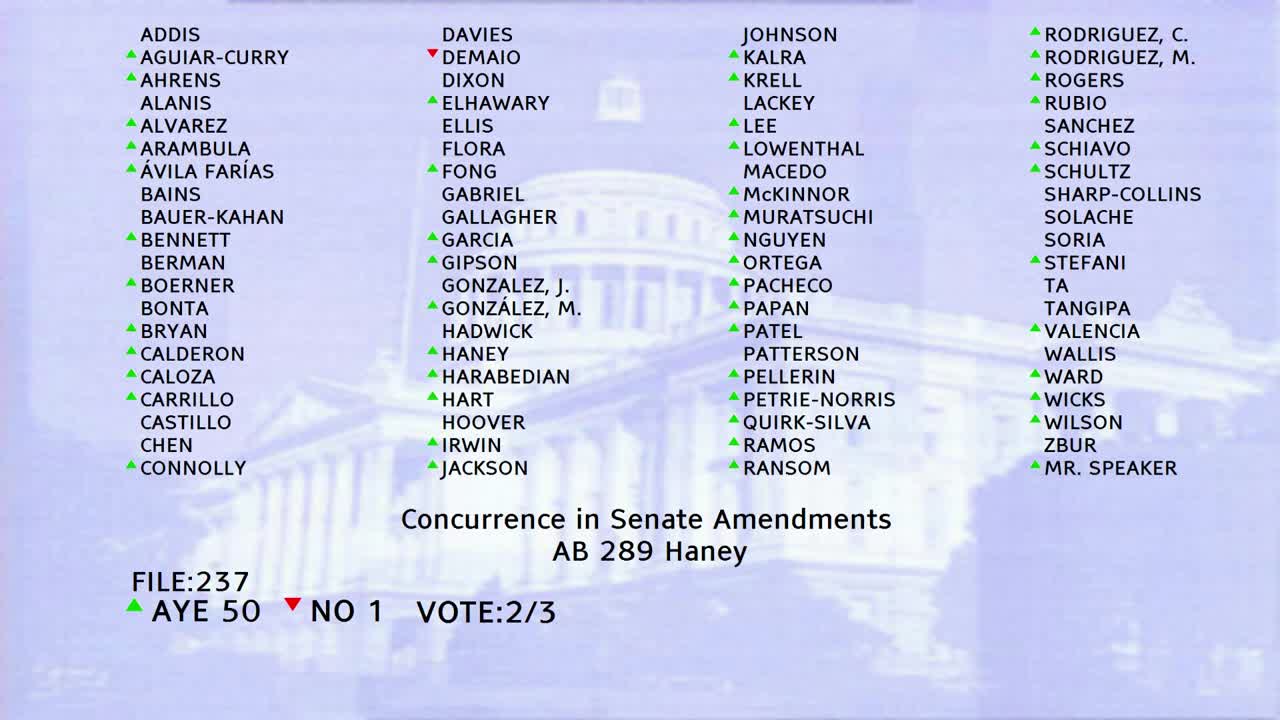 50SEC
Assembly Floor
 3MIN
Senate Floor
 45SEC
Senate Standing Committee on Appropriations
 24MIN
Senate Standing Committee on Health
 44MIN
Senate Standing Committee on Business, Professions and Economic Development
 5MIN
Assembly Floor
 14MIN
Assembly Standing Committee on Health
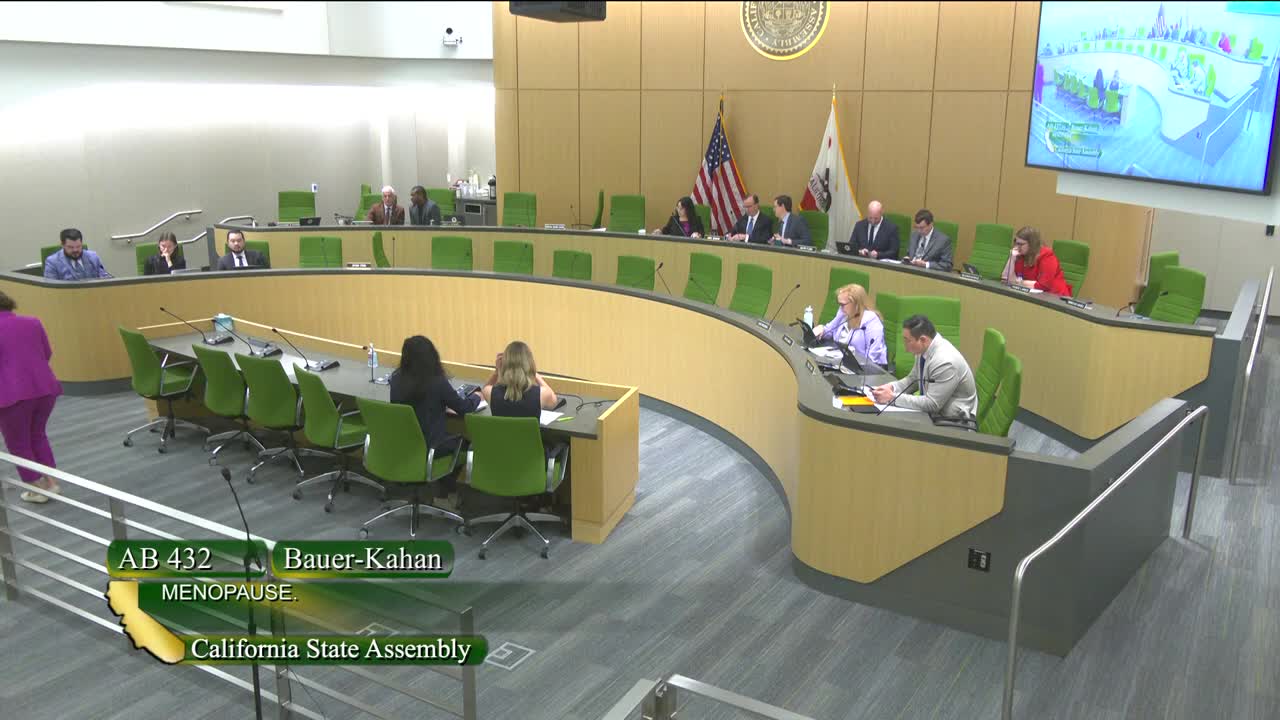 25MIN
Assembly Standing Committee on Business and Professions
Bill Author