AB 44: Energy: electrical demand forecasts.
- Session Year: 2025-2026
- House: Assembly
- Latest Version Date: 2025-09-12
Current Status:
Failed
(2026-01-22: Consideration of Governor's veto stricken from file.)
Introduced
In Committee
Awaiting First Chamber Vote
Passed First Chamber
In Committee
Awaiting Second Chamber Vote
Passed Second Chamber
Enacted
Existing law requires the State Energy Resources Conservation and Development Commission, at least every 2 years, to conduct assessments and forecasts of all aspects of energy industry supply, production, transportation, delivery and distribution, demand, and prices. Existing law authorizes the commission to require the submission of demand forecasts from electrical utilities, among other entities, to perform its assessments and forecasts. Existing law requires the commission to adopt an integrated energy policy report every 2 years.
This bill would require the commission, on or before December 1, 2026, and in consultation with load-serving entities and resource aggregators, to define and publicize methodologies for load modification protocols by which a load-serving entity may reduce or modify its electrical demand forecast upon aggregated system operation of behind-the-meter load modifying technologies and programmatic measures deemed to reliably reduce or modify the load-serving entitys electrical demand, as specified.
Existing law requires the State Energy Resources Conservation and Development Commission, at least every 2 years, to conduct assessments and forecasts of all aspects of energy industry supply, production, transportation, delivery and distribution, demand, and prices. Existing law authorizes the commission to require the submission of demand forecasts from electrical utilities, among other entities, to perform its assessments and forecasts. Existing law requires the commission to adopt an integrated energy policy report every 2 years.
This bill would require the commission, on or before December 1, 2026, and in consultation with load-serving entities and resource aggregators, to define and publicize methodologies for load modification protocols by which a load-serving entity may reduce or modify its electrical demand forecast upon aggregated system operation of behind-the-meter load modifying technologies and programmatic measures deemed to reliably reduce or modify the load-serving entitys electrical demand, as specified. The bill would require the commission to evaluate new and existing mechanisms that can support or expand opportunities for load-serving entities to modify their hourly resource adequacy obligations through load management, and would authorize the commission to include its findings and recommendations in its integrated energy policy report.
Existing law requires the State Energy Resources Conservation and Development Commission, at least every 2 years, to conduct assessments and forecasts of all aspects of energy industry supply, production, transportation, delivery and distribution, demand, and prices. Existing law authorizes the commission to require the submission of demand forecasts from electrical utilities, among other entities, to perform its assessments and forecasts. Existing law requires the commission to adopt an integrated energy policy report every 2 years.
This bill would require the commission, on or before December 1, 2026, and in consultation with load-serving entities and resource aggregators, to define and publicize methodologies for load modification protocols by which a load-serving entity may reduce or modify its electrical demand forecast upon aggregated system operation, operation of behind-the-meter load modifying technologies and programmatic measures deemed to reliably reduce or modify the load-serving entitys electrical demand, as specified. The bill would require the commission to evaluate new and existing mechanisms that can support or expand opportunities for load-serving entities to modify their hourly resource adequacy obligations through load management, and would authorize the commission to include its findings and recommendations in its integrated energy policy report.
Existing law requires the State Energy Resources Conservation and Development Commission (Energy Commission), Commission, at least every 2 years, to conduct assessments and forecasts of all aspects of energy industry supply, production, transportation, delivery and distribution, demand, and prices. Existing law authorizes the commission to require the submission of demand forecasts from electrical utilities, among other entities, to perform its assessments and forecasts. Existing law requires the Energy Commission commission to adopt an integrated energy policy report every 2 years.
This bill would require the Energy Commission, commission, on or before December 1, 2026, and in consultation with the Public Utilities Commission, Independent System Operator, load-serving entities, load-serving entities and resource aggregators, to adopt a set of upfront technical requirements and load modification protocols, as defined, to provide the option for define and publicize methodologies for load modification protocols by which a load-serving entity to may reduce or modify its electrical demand forecast upon aggregated system operation, as specified. The bill would require the commission to evaluate new and existing mechanisms that can support or expand opportunities for load-serving entities to modify their hourly resource adequacy obligations through load management, and would authorize the Energy Commission commission to include its findings and recommendations in its integrated energy policy report.
Existing law requires the State Energy Resources Conservation and Development Commission, Commission (Energy Commission), at least every 2 years, to conduct assessments and forecasts of all aspects of energy industry supply, production, transportation, delivery and distribution, demand, and prices. Existing law authorizes the commission to require the submission of demand forecasts from electrical utilities, among other entities, to perform its assessments and forecasts. Existing law requires the Energy Commission to adopt an integrated energy policy report every 2 years.
This bill would state the intent of the Legislature to enact subsequent legislation that would require the commission to develop a set of technical guidance and load modification protocols to enable the state to reduce or modify its electrical demand forecast to improve grid reliability, as provided. require the Energy Commission, on or before December 1, 2026, and in consultation with the Public Utilities Commission, Independent System Operator, load-serving entities, and resource aggregators, to adopt a set of upfront technical requirements and load modification protocols, as defined, to provide the option for a load-serving entity to reduce or modify its electrical demand forecast upon aggregated system operation, as specified. The bill would require the commission to evaluate new and existing mechanisms that can support or expand opportunities for load-serving entities to modify their hourly resource adequacy obligations through load management, and would authorize the Energy Commission to include its findings and recommendations in its integrated energy policy report.
Existing law requires the State Energy Resources Conservation and Development Commission, at least every 2 years, to conduct assessments and forecasts of all aspects of energy industry supply, production, transportation, delivery and distribution, demand, and prices. Existing law authorizes the commission to require the submission of demand forecasts from electrical utilities, among other entities, to perform its assessments and forecasts.
This bill would state the intent of the Legislature to enact subsequent legislation that would require the commission to develop a set of technical guidance and load modification protocols to enable the state to reduce or modify its electrical demand forecast to improve grid reliability, as provided.
(a)The Legislature finds and declares all of the following:
(1)Decarbonization of Californias economy will require improved alignment between the operation of a renewable and greenhouse gas emission-free generation supply portfolio and increased demand flexibility.
(2)Reducing Californias reliance on generation from fossil fuels to maintain grid reliability will require incorporating flexible and automated demand management capabilities into the states reliability planning and market operations.
(3)Historically, the State Energy Resources Conservation and Development Commission has included the load impact of demand-side management programs in the states electricity demand forecast for reliability planning purposes. This process, however, does not account for the ability of commercially available demand management tools to provide dispatchable, programmable, and automated load shifts in response to electrical system needs, thereby limiting the ability for these resources to fully support reliability planning through commercial operations to mitigate the consequences of extreme weather events and wholesale market volatility.
(4)In recent years, the Legislature has provided the State Energy Resources Conservation and Development Commission with authority to set load management standards to increase demand flexibility on the grid, develop plans and programs to support investments in clean energy resources, and increase electrical reliability through demand-side approaches. These policy and budgetary tools, in combination with the State Energy Resources Conservation and Development Commissions responsibility to forecast electrical demand, can be synergized to support the integration of demand flexibility into the states reliability planning and wholesale capacity market.
(5)Successful commercialization of demand flexibility market products or services will require these resources to perform, so that the intended demand reduction or load shift can be relied on with a high degree of confidence by grid operators and electricity market participants alike.
(b)It is the intent of the Legislature to require the State Energy Resources Conservation and Development Commission to implement appropriate transparency measures regarding the methodologies for load modification protocols by which a load-serving entity may reduce or modify its electrical demand forecast to improve grid reliability and affordability.
SEC. 2.Section 25403.6 is added to the Public Resources Code, to read:25403.6.(a)(1)On or before December 1, 2026, the commission, in consultation with load-serving entities and resource aggregators, shall define and publicize methodologies for load modification protocols by which a load-serving entity may reduce or modify its electrical demand forecast submitted pursuant to Section 25301 upon aggregated system operation of behind-the-meter load modifying technologies and programmatic measures deemed by the commission, Public Utilities Commission, and Independent System Operator to reliably reduce or modify the load-serving entitys electrical demand.
(2)The commission may use available funding appropriated by the Legislature to test a variety of technological and programmatic approaches in partnership with interested load-serving entities and behind-the-meter distributed energy resource aggregators to facilitate a high degree of confidence for flexible demand performance.
(b)For purposes of this section, load-serving entity has the same meaning as defined in Section 380 of the Public Utilities Code.
(a)The Legislature finds and declares all of the following:
(1)Decarbonization of Californias economy will require improved alignment between the operation of a renewable and greenhouse gas emission-free generation supply portfolio and increased demand flexibility.
(2)Reducing Californias reliance on generation from fossil fuels to maintain grid reliability will require incorporating flexible and automated demand management capabilities into the states reliability planning and market operations.
(3)Historically, the State Energy Resources Conservation and Development Commission has included the load impact of demand-side management programs in the states electricity demand forecast for reliability planning purposes. This process, however, does not account for the ability of commercially available demand management tools to provide dispatchable, programmable, and automated load shifts in response to electrical system needs, thereby limiting the ability for these resources to fully support reliability planning through commercial operations to mitigate the consequences of extreme weather events and wholesale market volatility.
(4)In recent years, the Legislature has provided the State Energy Resources Conservation and Development Commission with authority to set load management standards to increase demand flexibility on the grid, develop plans and programs to support investments in clean energy resources, and increase electrical reliability through demand-side approaches. These policy and budgetary tools, in combination with the State Energy Resources Conservation and Development Commissions responsibility to forecast electrical demand, can be synergized to support the integration of demand flexibility into the states reliability planning and wholesale capacity market.
(5)Successful commercialization of demand flexibility market products or services will require these resources to perform, so that the intended demand reduction or load shift can be relied on with a high degree of confidence by grid operators and electricity market participants alike.
(b)It is the intent of the Legislature to require the State Energy Resources Conservation and Development Commission to implement appropriate transparency measures regarding the methodologies for load modification protocols by which a load-serving entity may reduce or modify its electrical demand forecast to improve grid reliability and affordability.
SEC. 2.Section 25403.6 is added to the Public Resources Code, to read:25403.6.(a)(1)On or before December 1, 2026, the commission, in consultation with load-serving entities and resource aggregators, shall define and publicize methodologies for load modification protocols by which a load-serving entity may reduce or modify its electrical demand forecast submitted pursuant to Section 25301 upon aggregated system operation of behind-the-meter load modifying technologies and programmatic measures deemed by the commission, Public Utilities Commission, and Independent System Operator to reliably reduce or modify the load-serving entitys electrical demand.
(2)The commission may use available funding appropriated by the Legislature to test a variety of technological and programmatic approaches in partnership with interested load-serving entities and behind-the-meter distributed energy resource aggregators to facilitate a high degree of confidence for flexible demand performance.
(b)The commission shall evaluate new and existing mechanisms that can support or expand opportunities for load-serving entities to modify their hourly resource adequacy obligations through load management, and may include its findings and recommendations in an integrated energy policy report prepared pursuant to Section 25302.(c)(b)For purposes of this section, load-serving entity has the same meaning as defined in Section 380 of the Public Utilities Code.
(a)The Legislature finds and declares all of the following:
(1)Decarbonization of Californias economy will require improved alignment between the operation of a renewable and greenhouse gas emission-free generation supply portfolio and increased demand flexibility.
(2)Reducing Californias reliance on generation from fossil fuels to maintain grid reliability will require incorporating flexible and automated demand management capabilities into the states reliability planning and market operations.
(3)Historically, the State Energy Resources Conservation and Development Commission has included the load impact of demand-side management programs into in the states electricity demand forecast for reliability planning purposes. This process, however, does not account for the ability of commercially available demand management tools to provide dispatchable, programmable, and automated load shifts in response to electrical system needs, thereby limiting the ability for these resources to fully support reliability planning through commercial operations to mitigate the consequences of extreme weather events and wholesale market volatility.
(4)In recent years, the Legislature has provided the State Energy Resources Conservation and Development Commission with authority to set load management standards to increase demand flexibility on the grid, develop plans and programs to support investments in clean energy resources, and increase electrical reliability through demand-side approaches. These policy and budgetary tools, in combination with the State Energy Resources Conservation and Development Commissions responsibility to forecast electrical demand, can be synergized to support the integration of demand flexibility into the states reliability planning and wholesale capacity market.
(5)Successful commercialization of demand flexibility market products or services will require these resources to perform, so that the intended demand reduction or load shift can be relied on with a high degree of confidence by grid operators and electricity market participants alike.
(b)It is the intent of the Legislature to require the State Energy Resources Conservation and Development Commission to implement appropriate transparency measures regarding the methodologies for load modification protocols by which a load-serving entity may reduce or modify its electrical demand forecast to improve grid reliability and affordability.
SEC. 2.Section 25403.6 is added to the Public Resources Code, to read:25403.6.(a)(1)On or before December 1, 2026, the commission, in consultation with load-serving entities and resource aggregators, shall define and publicize methodologies for load modification protocols by which a load-serving entity may reduce or modify its electrical demand forecast submitted pursuant to Section 25301 upon aggregated system operation of behind-the-meter load modifying technologies and programmatic measures deemed by the commission, Public Utilities Commission, and Independent System Operator to reliably reduce or modify the load-serving entitys electrical demand.
(2)The commission may use available funding appropriated by the Legislature to test a variety of technological and programmatic approaches in partnership with interested load-serving entities and behind-the-meter distributed energy resource aggregators to facilitate a high degree of confidence for flexible demand performance.
(b)The commission shall evaluate new and existing mechanisms that can support or expand opportunities for load-serving entities to modify their hourly resource adequacy obligations through load management, and may include its findings and recommendations in an integrated energy policy report prepared pursuant to Section 25302.
(c)For purposes of this section, load-serving entity has the same meaning as defined in Section 380 of the Public Utilities Code.
(a)The Legislature finds and declares all of the following:
(1)Decarbonization of Californias economy will require improved alignment between the operation of a renewable and greenhouse gas emission-free generation supply portfolio and increased demand flexibility.
(2)Reducing Californias reliance on generation from fossil fuels to maintain grid reliability will require incorporating flexible and automated demand management capabilities into the states reliability planning and market operations.
(3)Historically, the State Energy Resources Conservation and Development Commission has included the load impact of demand-side management programs into the states electricity demand forecast for reliability planning purposes. This process, however, does not account for the ability of commercially available demand management tools to provide dispatchable, programmable, and automated load shifts in response to electrical system needs, thereby limiting the ability for these resources to fully support reliability planning through commercial operations to mitigate the consequences of extreme weather events and wholesale market volatility.
(4)In recent years, the Legislature has provided the State Energy Resources Conservation and Development Commission with authority to set load management standards to increase demand flexibility on the grid, develop plans and programs to support investments in clean energy resources, and increase electrical reliability through demand-side approaches. These policy and budgetary tools, in combination with the State Energy Resources Conservation and Development Commissions responsibility to forecast electrical demand, can be synergized to support the integration of demand flexibility into the states reliability planning and wholesale capacity market.
(5)Successful commercialization of demand flexibility market products or services will require these resources to perform, so that the intended demand reduction or load shift can be relied on with a high degree of confidence by grid operators and electricity market participants alike.
(b)It is the intent of the Legislature to require the State Energy Resources Conservation and Development Commission to, through its load flexibility initiatives, proceedings, and experience developing distributed resource plans and programs, develop a set of upfront technical requirements and load modification protocols to enable the state to implement appropriate transparency measures regarding the methodologies for load modification protocols by which a load-serving entity may reduce or modify its electrical demand forecast to improve grid reliability. reliability and affordability.
SEC. 2.Section 25403.6 is added to the Public Resources Code, to read:25403.6.(a)(1)On or before December 1, 2026, the commission, in consultation with the Public Utilities Commission, Independent System Operator, load-serving entities, load-serving entities and resource aggregators, shall adopt a set of upfront technical requirements and load modification protocols to provide the option for define and publicize methodologies for load modification protocols by which a load-serving entity to may reduce or modify its electrical demand forecast submitted pursuant to Section 25301 upon aggregated system operation. These requirements and protocols shall be met by a resource aggregator through the deployment operation of load modifying technologies and programmatic measures deemed by the commission, Public Utilities Commission, and Independent System Operator to reliably reduce or modify the load-serving entitys electrical demand.
(2)In developing the requirements and protocols pursuant to paragraph (1), the The commission may use available funding appropriated by the Legislature to test a variety of technological and programmatic approaches in partnership with interested load-serving entities and distributed energy resource aggregators to facilitate a high degree of confidence for flexible demand performance under the adopted requirements and protocols. performance.
(b)The commission shall evaluate new and existing mechanisms that can support or expand opportunities for load-serving entities to modify their hourly resource adequacy obligations through load management, and may include its findings and recommendations in an integrated energy policy report prepared pursuant to Section 25302.
(c)For purposes of this section, the following definitions shall apply: load-serving entity has the same meaning as defined in Section 380 of the Public Utilities Code.
(1)Load modification protocols means a combination of capabilities and operational parameters to confidently reduce a load-serving entitys electrical demand forecast for any specified hour or hours.(2)Load-serving entity has the same meaning as defined in Section 380 of the Public Utilities Code.(a)The Legislature finds and declares all of the following:
(1)Decarbonization of Californias economy will require improved alignment between the operation of a renewable and greenhouse gas emission-free generation supply portfolio and increased demand flexibility enabled by load automation technologies. flexibility.
(2)Reducing Californias reliance on generation from fossil fuels to maintain grid reliability will require incorporating flexible and automated demand management capabilities into the states reliability planning and market operations.
(3)Historically, the State Energy Resources Conservation and Development Commission has included the load impact of demand-side management programs into the states electricity demand forecast for reliability planning purposes. This process, however, does not account for the ability of commercially available demand management tools to provide dispatchable, programmable, and automated load shifts in response to wholesale market electrical system needs, thereby limiting the ability for these resources to fully support reliability planning through commercial operations to mitigate the consequences of extreme weather events and wholesale market volatility. This has led to an increased reliance on costly emergency-based approaches and out-of-market fossil fuel-based resource procurement to reduce near-term grid outage risks.
(4)In recent years, the Legislature has provided the State Energy Resources Conservation and Development Commission with authority to set load management standards to increase demand flexibility on the grid and has appropriated funding for demand-side and distributed energy resource incentives. grid, develop plans and programs to support investments in clean energy resources, and increase electrical reliability through demand-side approaches. These policy and budgetary tools, in combination with the State Energy Resources Conservation and Development Commissions responsibility to forecast electrical demand, can be synergized to support the integration of demand flexibility into the states reliability planning and wholesale capacity market to reduce the states reliance on costly emergency-based or out-of-market approaches. market.
(5)Successful commercialization of demand flexibility market products or services will require these resources to perform, so that the intended demand reduction or load shift can be relied on with a high degree of confidence by grid operators and electricity market participants alike.
(b)It is the intent of the Legislature to enact subsequent legislation that would require the State Energy Resources Conservation and Development Commission to, through its load management rulemaking proceeding and experience administering distributed resource incentives, flexibility initiatives, proceedings, and experience developing distributed resource plans and programs, develop a set of technical guidance upfront technical requirements and load modification protocols to enable the state to reduce or modify its electrical demand forecast to improve grid reliability.
SEC. 2.Section 25403.6 is added to the Public Resources Code, to read:25403.6.(a)(1)On or before December 1, 2026, the commission, in consultation with the Public Utilities Commission, Independent System Operator, load-serving entities, and resource aggregators, shall adopt a set of upfront technical requirements and load modification protocols to provide the option for a load-serving entity to reduce or modify its electrical demand forecast submitted pursuant to Section 25301 upon aggregated system operation. These requirements and protocols shall be met by a resource aggregator through the deployment of load modifying technologies and programmatic measures deemed by the commission, Public Utilities Commission, and Independent System Operator to reliably reduce or modify the load-serving entitys electrical demand.
(2)In developing the requirements and protocols pursuant to paragraph (1), the commission may use available funding appropriated by the Legislature to test a variety of technological and programmatic approaches in partnership with interested load-serving entities and distributed energy resource aggregators to facilitate a high degree of confidence for flexible demand performance under the adopted requirements and protocols.
(b)The commission shall evaluate new and existing mechanisms that can support or expand opportunities for load-serving entities to modify their hourly resource adequacy obligations through load management, and may include its findings and recommendations in an integrated energy policy report prepared pursuant to Section 25302.
(c)For purposes of this section, the following definitions shall apply:
(1)Load modification protocols means a combination of capabilities and operational parameters to confidently reduce a load-serving entitys electrical demand forecast for any specified hour or hours.
(2)Load-serving entity has the same meaning as defined in Section 380 of the Public Utilities Code.
(a)The Legislature finds and declares all of the following:
(1)Decarbonization of Californias economy will require improved alignment between the operation of a renewable and greenhouse gas emission-free generation supply portfolio and increased demand flexibility enabled by load automation technologies.
(2)Reducing Californias reliance on generation from fossil fuels to maintain grid reliability will require incorporating flexible and automated demand management capabilities into the states reliability planning and market operations.
(3)Historically, the State Energy Resources Conservation and Development Commission has included the load impact of demand-side management programs into the states electricity demand forecast for reliability planning purposes. This process, however, does not account for the ability of commercially available demand management tools to provide dispatchable, programmable, and automated load shifts in response to wholesale market needs, thereby limiting the ability for these resources to fully support reliability planning through commercial operations to mitigate the consequences of extreme weather events and wholesale market volatility. This has led to an increased reliance on costly emergency-based approaches and out-of-market fossil fuel-based resource procurement to reduce near-term grid outage risks.
(4)In recent years, the Legislature has provided the State Energy Resources Conservation and Development Commission with authority to set load management standards to increase demand flexibility on the grid and has appropriated funding for demand-side and distributed energy resource incentives. These policy and budgetary tools, in combination with the State Energy Resources Conservation and Development Commissions responsibility to forecast electrical demand, can be synergized to support the integration of demand flexibility into the states reliability planning and wholesale capacity market to reduce the states reliance on costly emergency-based or out-of-market approaches.
(5)Successful commercialization of demand flexibility market products or services will require these resources to perform, so that the intended demand reduction or load shift can be relied on with a high degree of confidence by grid operators and electricity market participants alike.
(b)It is the intent of the Legislature to enact subsequent legislation that would require the State Energy Resources Conservation and Development Commission to, through its load management rulemaking proceeding and experience administering distributed resource incentives, develop a set of technical guidance and load modification protocols to enable the state to reduce or modify its electrical demand forecast to improve grid reliability.
|
Date
|
Status
|
|---|---|
| Jan 22, 2026 | Consideration of Governor's veto stricken from file. |
| Oct 1, 2025 | Consideration of Governor's veto pending. |
| Oct 1, 2025 | Vetoed by Governor. |
| Sep 22, 2025 | Enrolled and presented to the Governor at 3 p.m. |
| Sep 10, 2025 | Senate amendments concurred in. To Engrossing and Enrolling. (Ayes 78. Noes 0. Page 3211.). |
| Sep 9, 2025 | In Assembly. Concurrence in Senate amendments pending. |
| Sep 9, 2025 | Read third time. Passed. Ordered to the Assembly. (Ayes 40. Noes 0. Page 2662.). |
| Sep 3, 2025 | Read second time. Ordered to third reading. |
| Sep 2, 2025 | Read third time and amended. Ordered to second reading. |
| Aug 29, 2025 | Read second time. Ordered to third reading. |
| Aug 29, 2025 | From committee: Do pass. (Ayes 7. Noes 0.) (August 29). |
| Aug 18, 2025 | In committee: Referred to suspense file. |
| Jul 17, 2025 | Read second time and amended. Re-referred to Com. on APPR. |
| Jul 17, 2025 | From committee: Amend, and do pass as amended and re-refer to Com. on APPR. (Ayes 15. Noes 1.) (July 15). |
| Jun 27, 2025 | In committee: Hearing postponed by committee. |
| Jun 11, 2025 | Referred to Com. on E., U & C. |
| May 29, 2025 | In Senate. Read first time. To Com. on RLS. for assignment. |
| May 29, 2025 | Read third time. Passed. Ordered to the Senate. (Ayes 69. Noes 0. Page 1776.) |
| May 27, 2025 | Read second time. Ordered to third reading. |
| May 23, 2025 | From committee: Do pass. (Ayes 14. Noes 0.) (May 23). |
| May 14, 2025 | In committee: Set, first hearing. Referred to suspense file. |
| Apr 24, 2025 | From committee: Do pass and re-refer to Com. on APPR. with recommendation: To Consent Calendar. (Ayes 18. Noes 0.) (April 23). Re-referred to Com. on APPR. |
| Apr 8, 2025 | Re-referred to Com. on U. & E. |
| Apr 7, 2025 | From committee chair, with author's amendments: Amend, and re-refer to Com. on U. & E. Read second time and amended. |
| Mar 26, 2025 | Re-referred to Com. on U. & E. |
| Mar 25, 2025 | From committee chair, with author's amendments: Amend, and re-refer to Com. on U. & E. Read second time and amended. |
| Mar 24, 2025 | Referred to Com. on U. & E. |
| Dec 3, 2024 | From printer. May be heard in committee January 2. |
| Dec 2, 2024 | Read first time. To print. |
|
Date
|
Description
|
Location
|
Votes
|
|
|---|---|---|---|---|
| Sep 10, 2025 | AB 44 Schultz Concurrence in Senate Amendments | Assembly Floor |
Passed |
|
| Sep 9, 2025 | Assembly 3rd Reading AB44 Schultz By McNerney | Senate Floor |
Passed |
|
| Aug 29, 2025 | Do pass | Senate Standing Committee on Appropriations |
Passed |
|
| Aug 18, 2025 | Placed on suspense file | Senate Standing Committee on Appropriations |
Passed |
|
| Jul 15, 2025 | Do pass as amended, but first amend, and re-refer to the Committee on [Appropriations] | Senate Standing Committee on Energy, Utilities and Communications |
Passed |
|
| May 29, 2025 | AB 44 Schultz Assembly Third Reading | Assembly Floor |
Passed |
|
| May 23, 2025 | Do pass. | Assembly Standing Committee on Appropriations |
Passed |
|
| Apr 23, 2025 | Do pass and be re-referred to the Committee on [Appropriations] with recommendation: To Consent Calendar | Assembly Standing Committee on Utilities and Energy |
Passed |
This list shows positions taken on this bill by organizations on the date displayed, which is linked to the original source.
Positions by individuals are not included.
|
Organization
|
Position
|
Date
|
|---|---|---|
| 350 Bay Area Action | ** Support | |
| Advanced Energy United (Source) | ** Support | |
| Ava Community Energy | ** Support | |
| Ban SUP | ** Support | |
| California Energy Storage Alliance | ** Support | |
| California Solar & Storage Association | ** Support | |
| Long Beach Alliance for Clean Energy | ** Support | |
| Mainspring Energy | ** Support | |
| Natural Resources Defense Council | ** Support | |
| Nrg Energy | ** Support | |
| Renew Home | ** Support | |
| San Diego Community Power | ** Support | |
| Sierra Club California | ** Support | |
| Solar Energy Industries Association | ** Support | |
| Sunrun | ** Support | |
| The Clean Coalition | ** Support | |
| The Climate Center | ** Support | |
| The Climate Reality Project, Bay Area Chapter | ** Support | |
| The Climate Reality Project, California State Coalition | ** Support | |
| The Climate Reality Project, Los Angeles Chapter | ** Support | |
| The Climate Reality Project Orange County Chapter | ** Support | |
| The Climate Reality Project, Riverside County Chapter | ** Support | |
| The Climate Reality Project, Sacramento Chapter | ** Support | |
| The Climate Reality Project San Diego Chapter | ** Support | |
| The Climate Reality Project, San Fernando Valley, CA Chapter | ** Support | |
| Union Of Concerned Scientists | ** Support | |
| Urban Ecology Project | ** Support |
GOVERNOR'S VETO
GV Bill Id:AB 44
Author:(Schultz)
As Enrolled Ver:September 12, 2025
2/3 vote
SUMMARY
Requires the California Energy Commission (CEC) on or before December 1, 2026, and in consultation with load-serving entities (LSEs) and resource aggregators, to create and publicize methodologies for load modification protocols by which an LSE may reduce or modify its energy demand forecasts (i.e. "load modification protocols").
Senate Amendments
- Clarifies that the aggregators and DERS envisioned by the bill are behind-the-meter.
- Deletes the requirement to evaluate new and existing mechanisms that can support LSEs' opportunities to modify their resource adequacy (RA) obligations and related reporting by the CEC.
Governor's Veto Message
This bill would require the CEC, in consultation with load-serving entities and resource aggregators, to develop and publish methodologies for "electric load modification protocols" to adjust electric demand forecasts.
While I support expanding electric load flexibility, this bill does not align with the California Public Utilities Commission's Resource Adequacy framework. As a result, the requirements of this bill would not improve electric grid reliability planning and could create uncertainty around energy resource planning and procurement processes.
COMMENTS
In the context of electric service, "load," is anything that uses electricity. LSEs, therefore, are the entities that provide the electricity to meet the electrical demand created by load. DER is a catch-all term used for a variety of generation, storage, or load modifying resources that are usually connected to the utility distribution system. DERs include both generation technologies that reduce customer load when consumed on-site (e.g., customer-sited rooftop solar) and load modifying technologies that reduce customer load by actively shifting or reducing customer energy usage (e.g., demand response programs). In other words, DERs can affect either the supply or demand of energy, but are usually located behind the customer meter; and thus to the larger grid may be viewed solely as modifying customer load. Resource aggregators are generally third-party providers who combine supply/load from multiple distributed energy resources.
Alongside other planning guidance focusing on energy generation needs in both the mid- and long-term, the CEC conducts an IEPR to forecast all aspects of energy industry supply, production, transportation, delivery, distribution, demand, and pricing. The demand forecast the CEC adopts in its IEPR informs the generation planning processes at the CPUC, as the supply provided by the CPUC analysis must match the customer demand provided by the CEC.
The CEC is responsible for producing both statewide and LSE-specific demand forecasts to inform both policy and grid operations. LSEs annually submit their own year ahead peak demand forecast to the CEC, including any relevant DER load modifiers that lower their peak demand. The CEC team reviews LSE forecasts, compares them to their own forecasts, and makes adjustments to resolve discrepancies between the two. The load reductions from a LSE program are then incorporated into the CEC's final adjusted forecast. The CPUC uses the CEC's forecasts to determine individual LSE RA obligations.
In 2022, the Legislature required the CEC to develop a statewide goal for load shifting to reduce net peak electrical demand (SB 846, Dodd, Chapter 239, Statutes of 2022). In May 2023, the CEC published their final report where they established the statewide goal of 7 gigawatts (GW) of load-shift by 2030, estimating that roughly 3.1-3.6 GWs of load was shifted in 2022. The CEC noted their view that "the proposed target is aspirational but achievable with robust policy support," and made 18 policy recommendations to consider in order to reach the goal. Among those recommendations were policies included in this measure, including allocating funding for the CEC to supplement demand response, reforming availability rules and RA resource requirements, and promoting load-modifying program development and measurement, including reducing RA requirements on LSEs with these programs.
This bill requires the CEC to adopt a set of requirements to enable LSEs to use these demand-side resources to reduce their demand forecast. However, caution may be in order, as these demand-side resources can vary greatly in their design – from virtual power plants to aggregated residential thermostats – and vary in their visibility to the state agencies and California's energy market. This bill seems to recognize this caution by not mandating adoption of these technologies, but rather enabling state agencies and the California Independent System Operator (CAISO) to set all the requirements and protocols and requiring any deployed technology to be deemed effective and reliable by the state agencies and CAISO.
According to the Author
"AB 44 would enhance a tool that retail providers can use to increase grid reliability and better manage energy procurement costs for consumers, augmenting downward pressure on rates for all customers. By enhancing transparency in the process by which load-modifying technologies could shift or reduce the state's resource adequacy needs during the most expensive hours, this bill would increase uptake in this cost-saving method. Distributed energy providers would have more clarity on what functionalities they must offer retail providers to produce cost-saving value, retail providers would have assurances would reduce the cost of serving customers, and energy planning agencies would have greater confidence in the reliability performance of aggregated distributed energy resources."
Arguments in Support
This bill is supported by a coalition of demand response, clean energy, and climate organizations. The supporters note distributed energy technologies and demand management strategies exist that could "cost-effectively reduce or shift peak electricity usage." However, these bill proponents assert there is currently insufficient deployment of such technologies, and that this bill will "allow for more predictable and timely participation, reduce risk for those investing in load flexibility, and ultimately deliver savings to customers."
Arguments in Opposition
None on file.
FISCAL COMMENTS
According to the Senate Appropriations Committee: the CEC estimates one-time costs of $250,000 and ongoing costs of $433,000 annually (Energy Resources Program Account [ERPA]) to execute the required analysis and updated recommended protocols, among other things.
VOTES
ASM UTILITIES AND ENERGY: 18-0-0
YES: Petrie-Norris, Patterson, Boerner, Calderon, Chen, Davies, Mark González, Harabedian, Hart, Irwin, Kalra, Papan, Rogers, Schiavo, Schultz, Ta, Wallis, Zbur
ASM APPROPRIATIONS: 14-0-1
YES: Wicks, Arambula, Calderon, Caloza, Dixon, Elhawary, Fong, Mark González, Hart, Pacheco, Pellerin, Solache, Ta, Tangipa
ABS, ABST OR NV: Sanchez
ASSEMBLY FLOOR: 69-0-10
YES: Addis, Aguiar-Curry, Ahrens, Alanis, Arambula, Ávila Farías, Bains, Bauer-Kahan, Bennett, Berman, Boerner, Bonta, Calderon, Caloza, Carrillo, Castillo, Connolly, Davies, DeMaio, Dixon, Elhawary, Ellis, Flora, Fong, Gabriel, Gallagher, Garcia, Gipson, Mark González, Hadwick, Haney, Harabedian, Hart, Hoover, Irwin, Jackson, Kalra, Krell, Lackey, Lee, Lowenthal, Macedo, McKinnor, Muratsuchi, Ortega, Pacheco, Papan, Patel, Patterson, Pellerin, Petrie-Norris, Quirk-Silva, Ramos, Ransom, Celeste Rodriguez, Michelle Rodriguez, Rogers, Blanca Rubio, Sanchez, Schiavo, Schultz, Stefani, Ta, Valencia, Wallis, Wicks, Wilson, Zbur, Rivas
ABS, ABST OR NV: Alvarez, Bryan, Chen, Jeff Gonzalez, Nguyen, Sharp-Collins, Solache, Soria, Tangipa, Ward
SENATE FLOOR: 40-0-0
YES: Allen, Alvarado-Gil, Archuleta, Arreguín, Ashby, Becker, Blakespear, Cabaldon, Caballero, Cervantes, Choi, Cortese, Dahle, Durazo, Gonzalez, Grayson, Grove, Hurtado, Jones, Laird, Limón, McGuire, McNerney, Menjivar, Niello, Ochoa Bogh, Padilla, Pérez, Reyes, Richardson, Rubio, Seyarto, Smallwood-Cuevas, Stern, Strickland, Umberg, Valladares, Wahab, Weber Pierson, Wiener
ASSEMBLY FLOOR: 78-0-2
YES: Addis, Aguiar-Curry, Ahrens, Alanis, Alvarez, Arambula, Ávila Farías, Bains, Bauer-Kahan, Bennett, Berman, Boerner, Bonta, Bryan, Calderon, Caloza, Carrillo, Castillo, Chen, Connolly, Davies, DeMaio, Dixon, Elhawary, Ellis, Fong, Gabriel, Gallagher, Garcia, Gipson, Jeff Gonzalez, Mark González, Hadwick, Haney, Harabedian, Hart, Hoover, Irwin, Jackson, Johnson, Kalra, Krell, Lackey, Lee, Lowenthal, Macedo, McKinnor, Muratsuchi, Nguyen, Ortega, Pacheco, Papan, Patel, Patterson, Pellerin, Petrie-Norris, Quirk-Silva, Ramos, Ransom, Celeste Rodriguez, Michelle Rodriguez, Rogers, Blanca Rubio, Sanchez, Schiavo, Schultz, Sharp-Collins, Solache, Soria, Stefani, Ta, Valencia, Wallis, Ward, Wicks, Wilson, Zbur, Rivas
ABS, ABST OR NV: Flora, Tangipa
UPDATED
VERSION: September 12, 2025
CONSULTANT: Laura Shybut / U. & E. / (916) 319-2083 FN: 0002160
CONCURRENCE IN SENATE AMENDMENTS
CSA1 Bill Id:AB 44
Author:(Schultz)
As Amended Ver:September 2, 2025
Majority vote
SUMMARY
Requires the California Energy Commission (CEC) on or before December 1, 2026, and in consultation with load-serving entities (LSEs) and resource aggregators, to create and publicize methodologies for load modification protocols by which an LSE may reduce or modify its energy demand forecasts (i.e. ″load modification protocols″).
Senate Amendments
- Clarifies that the aggregators and DERS envisioned by the bill are behind-the-meter.
- Deletes the requirement to evaluate new and existing mechanisms that can support LSEs′ opportunities to modify their resource adequacy (RA) obligations and related reporting by the CEC.
COMMENTS
In the context of electric service, ″load,″ is anything that uses electricity. LSEs, therefore, are the entities that provide the electricity to meet the electrical demand created by load. DER is a catch-all term used for a variety of generation, storage, or load modifying resources that are usually connected to the utility distribution system. DERs include both generation technologies that reduce customer load when consumed on-site (e.g., customer-sited rooftop solar) and load modifying technologies that reduce customer load by actively shifting or reducing customer energy usage (e.g., demand response programs). In other words, DERs can affect either the supply or demand of energy, but are usually located behind the customer meter; and thus to the larger grid may be viewed solely as modifying customer load. Resource aggregators are generally third-party providers who combine supply/load from multiple distributed energy resources.
Alongside other planning guidance focusing on energy generation needs in both the mid- and long-term, the CEC conducts an IEPR to forecast all aspects of energy industry supply, production, transportation, delivery, distribution, demand, and pricing. The demand forecast the CEC adopts in its IEPR informs the generation planning processes at the CPUC, as the supply provided by the CPUC analysis must match the customer demand provided by the CEC.
The CEC is responsible for producing both statewide and LSE-specific demand forecasts to inform both policy and grid operations. LSEs annually submit their own year ahead peak demand forecast to the CEC, including any relevant DER load modifiers that lower their peak demand. The CEC team reviews LSE forecasts, compares them to their own forecasts, and makes adjustments to resolve discrepancies between the two. The load reductions from a LSE program are then incorporated into the CEC′s final adjusted forecast. The CPUC uses the CEC′s forecasts to determine individual LSE RA obligations.
In 2022, the Legislature required the CEC to develop a statewide goal for load shifting to reduce net peak electrical demand (SB 846, Dodd, Chapter 239, Statutes of 2022). In May 2023, the CEC published their final report where they established the statewide goal of seven gigawatts (GW) of load-shift by 2030, estimating that roughly 3.1-3.6 GWs of load was shifted in 2022. The CEC noted their view that ″the proposed target is aspirational but achievable with robust policy support,″ and made 18 policy recommendations to consider in order to reach the goal. Among those recommendations were policies included in this measure, including allocating funding for the CEC to supplement demand response, reforming availability rules and RA resource requirements, and promoting load-modifying program development and measurement, including reducing RA requirements on LSEs with these programs.
This bill requires the CEC to adopt a set of requirements to enable LSEs to use these demand-side resources to reduce their demand forecast. However, caution may be in order, as these demand-side resources can vary greatly in their design – from virtual power plants to aggregated residential thermostats – and vary in their visibility to the state agencies and California′s energy market. This bill seems to recognize this caution by not mandating adoption of these technologies, but rather enabling state agencies and the California Independent System Operator (CAISO) to set all the requirements and protocols and requiring any deployed technology to be deemed effective and reliable by the state agencies and CAISO.
According to the Author
″AB 44 would enhance a tool that retail providers can use to increase grid reliability and better manage energy procurement costs for consumers, augmenting downward pressure on rates for all customers. By enhancing transparency in the process by which load-modifying technologies could shift or reduce the state′s resource adequacy needs during the most expensive hours, this bill would increase uptake in this cost-saving method. Distributed energy providers would have more clarity on what functionalities they must offer retail providers to produce cost-saving value, retail providers would have assurances would reduce the cost of serving customers, and energy planning agencies would have greater confidence in the reliability performance of aggregated distributed energy resources.″
Arguments in Support
This bill is supported by a coalition of demand response, clean energy, and climate organizations. The supporters note distributed energy technologies and demand management strategies exist that could ″cost-effectively reduce or shift peak electricity usage.″ However, these bill proponents assert there is currently insufficient deployment of such technologies, and that this bill will ″allow for more predictable and timely participation, reduce risk for those investing in load flexibility, and ultimately deliver savings to customers.″
Arguments in Opposition
None on file.
FISCAL COMMENTS
According to the Senate Appropriations Committee: the CEC estimates one-time costs of $250,000 and ongoing costs of $433,000 annually (Energy Resources Program Account [ERPA]) to execute the required analysis and updated recommended protocols, among other things.
VOTES:
ASM UTILITIES AND ENERGY: 18-0-0
YES: Petrie-Norris, Patterson, Boerner, Calderon, Chen, Davies, Mark González, Harabedian, Hart, Irwin, Kalra, Papan, Rogers, Schiavo, Schultz, Ta, Wallis, Zbur
ASM APPROPRIATIONS: 14-0-1
YES: Wicks, Arambula, Calderon, Caloza, Dixon, Elhawary, Fong, Mark González, Hart, Pacheco, Pellerin, Solache, Ta, Tangipa
ABS, ABST OR NV: Sanchez
ASSEMBLY FLOOR: 69-0-10
YES: Addis, Aguiar-Curry, Ahrens, Alanis, Arambula, Ávila Farías, Bains, Bauer-Kahan, Bennett, Berman, Boerner, Bonta, Calderon, Caloza, Carrillo, Castillo, Connolly, Davies, DeMaio, Dixon, Elhawary, Ellis, Flora, Fong, Gabriel, Gallagher, Garcia, Gipson, Mark González, Hadwick, Haney, Harabedian, Hart, Hoover, Irwin, Jackson, Kalra, Krell, Lackey, Lee, Lowenthal, Macedo, McKinnor, Muratsuchi, Ortega, Pacheco, Papan, Patel, Patterson, Pellerin, Petrie-Norris, Quirk-Silva, Ramos, Ransom, Celeste Rodriguez, Michelle Rodriguez, Rogers, Blanca Rubio, Sanchez, Schiavo, Schultz, Stefani, Ta, Valencia, Wallis, Wicks, Wilson, Zbur, Rivas
ABS, ABST OR NV: Alvarez, Bryan, Chen, Jeff Gonzalez, Nguyen, Sharp-Collins, Solache, Soria, Tangipa, Ward
UPDATED
VERSION: September 2, 2025
CONSULTANT: Laura Shybut / U. & E. / (916) 319-2083 FN: 0001950
SENATE RULES COMMITTEE Office of Senate Floor Analyses (916) 651-1520 Fax: (916) 327-4478 | AB 44 |
THIRD READING
Bill No: AB 44
Author: Schultz (D)
Amended: 9/2/25 in Senate
Vote: 21
SENATE ENERGY, U. & C. COMMITTEE: 15-1, 7/15/25
AYES: Becker, Ochoa Bogh, Allen, Archuleta, Arreguín, Caballero, Dahle, Gonzalez, Grove, Hurtado, Limón, McNerney, Rubio, Stern, Wahab
NOES: Strickland
NO VOTE RECORDED: Ashby
SENATE APPROPRIATIONS COMMITTEE: 7-0, 8/29/25
AYES: Caballero, Seyarto, Cabaldon, Dahle, Grayson, Richardson, Wahab
ASSEMBLY FLOOR: 69-0, 5/29/25 - See last page for vote
SUBJECT: Energy: electrical demand forecasts
SOURCE: Advanced Energy United
DIGEST:
This bill requires the California Energy Commission (CEC) on or before December 1, 2026, and in consultation with load-serving entities (LSEs) and resource aggregators, to define and publicize methodologies for load modification protocols by which a LSE may reduce or modify its electrical demand forecast.
Senate Floor Amendments of 9/02/25 delete the proposed requirement in this bill to evaluate new and existing mechanisms that can support LSEs’ opportunities to modify their resource adequacy obligations and related reporting by the CEC.
ANALYSIS:
Existing law:
- Requires the State Energy Resources Conservation and Development Commission (known as the California Energy Commission (CEC)), at least every two years, to conduct assessments and forecasts of all aspects of energy industry supply, production, transportation, delivery and distribution, demand, and prices. Authorizes the CEC to require the submission of demand forecasts from electrical utilities, among other entities, to perform its assessments and forecasts. (Public Resources Code (PRC) §25301)
- Requires the CEC to adopt an integrated energy policy report (IEPR) every two years, which must contain an overview of major energy trends and issues facing the state, including, but not limited to, supply, demand, pricing, reliability, efficiency, and impacts on public health and safety, the economy, resources, and the environment. (PRC §25302)
- Requires the CEC to adopt a goal for load shifting by June 1, 2023, to reduce net peak electrical demand, and requires biennial updates to the targets. Requires the CEC to make recommendations to increase load shifting that does not increase greenhouse gas (GHG) emissions or increase electric rates. (PRC §25302.7)
- Defines “load-serving entities” as investor-owned utilities (IOUs), electric service providers (ESPs), and community choice aggregators (CCAs). (Public Utilities Code (PUC) §380 (k))
- Requires the California Public Utilities Commission (CPUC) to work with the California Independent System Operator (CAISO) to establish resource adequacy (RA) requirements for LSEs. (PUC §380)
This bill:
- Makes several findings and declarations concerning the need to provide electricity demand flexibility and the intent to implement appropriate transparency measures regarding the methodologies for load modification protocols.
- Requires the CEC on or before December 1, 2026, and in consultation with LSEs and resource aggregators (generally third-party providers who combine supply/load from multiple distributed energy resources), to define and publicize methodologies for load modification protocols by which a LSE may reduce or modify its electrical demand forecast upon aggregated system operation of behind-the-meter load modifying technologies and programmatic measures deemed to reliably reduce or modify the LSE’s electrical demand.
Background
Load Modifiers, Demand Response, and Distributed Energy Resources (DER). In the context of electric service, “load,” is anything that uses electricity. LSEs, therefore, are the entities that provide the electricity to meet the electrical demand created by load. DER is a catch-all term used for a variety of generation, storage, or load modifying resources that are usually connected to the utility distribution system. DERs include both generation technologies that reduce customer load when consumed on-site (e.g., customer-sited rooftop solar) and load modifying technologies that reduce customer load by actively shifting or reducing customer energy usage (e.g., demand response programs). In other words, DERs can affect either the supply or demand of energy, but are usually located behind the customer meter; and thus to the larger grid may be viewed solely as modifying customer load. Resource aggregators are generally third-party providers who combine supply/load from multiple distributed energy resources.
CEC IEPR (demand forecast). Alongside other planning guidance focusing on energy generation needs in both the mid- and long-term, the CEC conducts an energy demand forecast on all aspects of energy industry supply, production, transportation, delivery, distribution, demand, and pricing. The demand forecast the CEC adopts in its IEPR informs the generation planning processes at the CPUC, as the supply provided by the CPUC analysis (IRP and RA) must match the customer demand (IEPR) provided by the CEC. The CEC is responsible for producing both statewide and LSE-specific demand forecasts to inform both policy and grid operations. LSEs annually submit their own year ahead peak demand forecast to the CEC, including any relevant DER load modifiers that lower their peak demand. The CEC reviews LSE forecasts, compares them to their own forecasts, and makes adjustments to resolve discrepancies between the two. The load reductions from a LSE program are then incorporated into the CEC's final adjusted forecast.
Resource adequacy. The CPUC uses the CEC’s forecasts to determine individual LSE RA obligations. The statute directs the CPUC, in consultation with the CAISO, to establish RA requirements for all LSEs, including electric IOUs, ESPs, and CCAs. The current RA program consists of system, local, and flexible requirements for each month of a compliance year. In October of each year, LSEs must demonstrate that they have procured 90% of their system RA obligations for the five summer months (May-September) of the following year, as well as 100% of their local requirements, and 90% of their flexible requirements for each month of the coming compliance year. In recent years, the CPUC has adopted changes to the RA program, including increasing the planning reserve margin for all LSEs and implementing a slice-of-day framework that assesses the hourly use of resources. The CPUC also assesses penalties on the LSEs who fail to satisfy their RA obligations, including limiting the expansion of CCAs if they are deficient in their RA requirements.
CEC SB 846 Load-Shift Goal Report. In May 2023, the CEC issued the report required in SB 846 (Dodd, Chapter 239, Statutes of 2022) on establishing a load-shifting goal and informed by the 2020 Lawrence Berkeley National Laboratory report on the Shift Resource through 2030, and other relevant research, as required by the statute. The CEC developed a statewide load-shift goal for 2030 of 7,000 megawatts (MW), including 3,400-3,900 MW of incremental resources. The CEC cautions the statewide goal is based on economic potential, but notes that further analysis is needed to determine the cost-effectiveness of specific load flexibility resources and programs.
Load-modifiers and RA. LSEs have two venues to meet or adjust their RA requirements, utilizing either supply- or demand-side resources. The supply-side involves generation resources that are shown to the CPUC during the LSE’s annual and monthly RA reports. The demand-side involves load modifying resources that are annually shown to the CEC as a reduction in the LSE’s peak demand forecast, which the CEC then uses to adjust its final demand forecast of that LSE – and thus reducing that LSE’s RA obligation. Both the CEC and the CPUC provide instructions to LSEs on how to include load modifiers in RA forecasts, including what types of modifications are eligible. These instructions are posted annually on the CPUC RA compliance website. To be eligible as a load modifier for purposes of the CPUC RA demand forecast, load modification must be daily, consistent, predictable and verifiable. Event-based load modifications are not eligible.
Comments
Need for this bill. The author states:
Current processes at the California Energy Commission lack clear and standardized protocols for load-serving entities (LSEs) to reduce their forecasted electricity demand using demand-side resources like batteries and smart thermostats. As a result, many cost-effective demand flexibility solutions are excluded from resource adequacy (RA) planning and procurement, missing opportunities to reduce ratepayer costs and improve grid reliability. Existing processes are opaque, inconsistent, and inaccessible to almost all distributed energy resource (DER) aggregators, which limits participation and effectiveness.
Seeking greater transparency on load modification methodologies. The supporters of this bill contend that additional transparency of the CEC’s load modification protocols at the upstream will help increase opportunities for aggregators to work with LSEs to help reduce downstream RA requirements. While recent Senate Floor amendments remove language in the bill that explicitly mentioned LSEs hourly RA obligations, the author and supporters still intend that the load modification methodologies would affect electrical demand forecasts that would also affect RA obligations. They contend that the goals of this bill are twofold: (1) provide downward pressure in the state’s wholesale capacity market, including RA market, by allowing behind-the-meter load-shaping technologies to help reduce individual LSEs’ demand forecast, and lower their respective RA procurement requirements; and (2) align demand response and distributed energy technology deployment and operation to provide grid reliability and cost saving value. The supporters contend that the lack of information on the methodology for the load modifications is an important gap in information that if better understood can help catalyze greater deployment of aggregators to modify loads for LSEs in order to provide real value in RA requirement reductions. It is unclear whether the CEC (or CPUC) agree. The CEC does note it does not currently provide this type of information.
Related/Prior Legislation
AB 1117 (Schultz) of 2025, creates optional, dynamic electricity rates for electrical corporation customers. These rates would change based on real-time conditions of the electricity grid and market prices. The bill is pending in the Senate.
SB 541 (Becker) of 2025, requires a number of actions towards achieving a goal for electric load shifting, the concept of shifting or shedding electric load or demand away from times when electricity is expensive, polluting, and scarce. The bill is pending in the Assembly.
FISCAL EFFECT: Appropriation: No Fiscal Com.: Yes Local: No
According to the Senate Appropriations Committee: the CEC estimates one-time costs of $250,000 and ongoing costs of $433,000 annually (Energy Resources Program Account [ERPA]) to execute the required analysis and updated recommended protocols, among other things.
SUPPORT: (Verified 9/2/25)
Advanced Energy United (Source)
350 Bay Area Action
Ava Community Energy
California Energy Storage Alliance
California Solar & Storage Association
Mainspring Energy
Natural Resources Defense Council
NRG Energy
Renew Home
San Diego Community Power
Sierra Club California
Solar Energy Industries Association
Sunrun
The Clean Coalition
The Climate Center
The Climate Reality Project Bay Area Chapter
The Climate Reality Project Orange County Chapter
The Climate Reality Project, California State Coalition
The Climate Reality Project, Los Angeles Chapter
The Climate Reality Project, Riverside County Chapter
The Climate Reality Project, Sacramento Chapter
The Climate Reality Project, San Diego Chapter
The Climate Reality Project, San Fernando Valley CA Chapter
Union of Concerned Scientists
OPPOSITION: (Verified 9/2/25)
None received
ARGUMENTS IN SUPPORT: Advanced Energy United, the sponsor of this bill, states:
Behind-the-meter energy technologies—such as batteries, smart thermostats, and flexible EV chargers—offer a key solution. When aggregated and dispatched during peak hours, these resources can reduce an LSE’s demand forecast and associated RA procurement needs. In fact, because of California’s planning reserve margin, 1 MW of demand reduction can reduce RA obligations by up to 1.17 MW, multiplying the savings potential. Yet despite this opportunity, participation in the CEC’s existing load modification process has been limited. While the CEC does allow LSEs to propose load forecast adjustments based on distributed energy resources, the current process lacks transparency and predictability. There are no publicly available criteria detailing how technologies are evaluated or what performance data is required, creating uncertainty for both LSEs and technology providers. This opacity, combined with long time lags between deployment and forecast modification, discourages uptake of load-modifying strategies that could reduce grid costs and bolster reliability. Further, the process is only accessible to LSEs—not aggregators or technology providers— making it difficult for providers to align product functionality with the needs of utilities or ratepayers.
ASSEMBLY FLOOR: 69-0, 5/29/25
AYES: Addis, Aguiar-Curry, Ahrens, Alanis, Arambula, Ávila Farías, Bains, Bauer-Kahan, Bennett, Berman, Boerner, Bonta, Calderon, Caloza, Carrillo, Castillo, Connolly, Davies, DeMaio, Dixon, Elhawary, Ellis, Flora, Fong, Gabriel, Gallagher, Garcia, Gipson, Mark González, Hadwick, Haney, Harabedian, Hart, Hoover, Irwin, Jackson, Kalra, Krell, Lackey, Lee, Lowenthal, Macedo, McKinnor, Muratsuchi, Ortega, Pacheco, Papan, Patel, Patterson, Pellerin, Petrie-Norris, Quirk-Silva, Ramos, Ransom, Celeste Rodriguez, Michelle Rodriguez, Rogers, Blanca Rubio, Sanchez, Schiavo, Schultz, Stefani, Ta, Valencia, Wallis, Wicks, Wilson, Zbur, Rivas
NO VOTE RECORDED: Alvarez, Bryan, Chen, Jeff Gonzalez, Nguyen, Sharp-Collins, Solache, Soria, Tangipa, Ward
Prepared by: Nidia Bautista / E., U. & C. / (916) 651-4107
9/3/25 18:31:18
**** END ****
SENATE RULES COMMITTEE Office of Senate Floor Analyses (916) 651-1520 Fax: (916) 327-4478 | AB 44 |
THIRD READING
Bill No: AB 44
Author: Schultz (D)
Amended: 7/17/25 in Senate
Vote: 21
SENATE ENERGY, U. & C. COMMITTEE: 15-1, 7/15/25
AYES: Becker, Ochoa Bogh, Allen, Archuleta, Arreguín, Caballero, Dahle, Gonzalez, Grove, Hurtado, Limón, McNerney, Rubio, Stern, Wahab
NOES: Strickland
NO VOTE RECORDED: Ashby
SENATE APPROPRIATIONS COMMITTEE: 7-0, 8/29/25
AYES: Caballero, Seyarto, Cabaldon, Dahle, Grayson, Richardson, Wahab
ASSEMBLY FLOOR: 69-0, 5/29/25 - See last page for vote
SUBJECT: Energy: electrical demand forecasts
SOURCE: Advanced Energy United
DIGEST:
This bill requires the California Energy Commission (CEC) on or before December 1, 2026, and in consultation with load-serving entities (LSEs) and resource aggregators, to define and publicize methodologies for load modification protocols by which a LSE may reduce or modify its electrical demand forecast.
ANALYSIS:
Existing law:
- Requires the State Energy Resources Conservation and Development Commission (known as the California Energy Commission (CEC)), at least every two years, to conduct assessments and forecasts of all aspects of energy industry supply, production, transportation, delivery and distribution, demand, and prices. Authorizes the CEC to require the submission of demand forecasts from electrical utilities, among other entities, to perform its assessments and forecasts. (Public Resources Code (PRC) §25301)
- Requires the CEC to adopt an integrated energy policy report (IEPR) every two years, which must contain an overview of major energy trends and issues facing the state, including, but not limited to, supply, demand, pricing, reliability, efficiency, and impacts on public health and safety, the economy, resources, and the environment. (PRC §25302)
- Requires the CEC to adopt a goal for load shifting by June 1, 2023, to reduce net peak electrical demand, and requires biennial updates to the targets. Requires the CEC to make recommendations to increase load shifting that does not increase greenhouse gas (GHG) emissions or increase electric rates. (PRC §25302.7)
- Defines “load-serving entities” as investor-owned utilities (IOUs), electric service providers (ESPs), and community choice aggregators (CCAs). (Public Utilities Code (PUC) §380 (k))
- Requires the California Public Utilities Commission (CPUC) to work with the California Independent System Operator (CAISO) to establish resource adequacy (RA) requirements for LSEs. (PUC §380)
This bill:
- Makes several findings and declarations concerning the need to provide electricity demand flexibility and the intent to implement appropriate transparency measures regarding the methodologies for load modification protocols.
- Requires the CEC on or before December 1, 2026, and in consultation with LSEs and resource aggregators (generally third-party providers who combine supply/load from multiple distributed energy resources), to define and publicize methodologies for load modification protocols by which a LSE may reduce or modify its electrical demand forecast upon aggregated system operation of behind-the-meter load modifying technologies and programmatic measures deemed to reliably reduce or modify the LSE’s electrical demand.
- Requires the CEC to evaluate new and existing mechanisms that can support or expand opportunities for LSEs to modify their hourly RA obligations through load management, and would authorize the CEC to include its findings and recommendations in its IEPR.
Background
Load Modifiers, Demand Response, and Distributed Energy Resources (DER). In the context of electric service, “load,” is anything that uses electricity. LSEs, therefore, are the entities that provide the electricity to meet the electrical demand created by load. DER is a catch-all term used for a variety of generation, storage, or load modifying resources that are usually connected to the utility distribution system. DERs include both generation technologies that reduce customer load when consumed on-site (e.g., customer-sited rooftop solar) and load modifying technologies that reduce customer load by actively shifting or reducing customer energy usage (e.g., demand response programs). In other words, DERs can affect either the supply or demand of energy, but are usually located behind the customer meter; and thus to the larger grid may be viewed solely as modifying customer load. Resource aggregators are generally third-party providers who combine supply/load from multiple distributed energy resources.
CEC IEPR (demand forecast). Alongside other planning guidance focusing on energy generation needs in both the mid- and long-term, the CEC conducts an energy demand forecast on all aspects of energy industry supply, production, transportation, delivery, distribution, demand, and pricing. The demand forecast the CEC adopts in its IEPR informs the generation planning processes at the CPUC, as the supply provided by the CPUC analysis (IRP and RA) must match the customer demand (IEPR) provided by the CEC. The CEC is responsible for producing both statewide and LSE-specific demand forecasts to inform both policy and grid operations. LSEs annually submit their own year ahead peak demand forecast to the CEC, including any relevant DER load modifiers that lower their peak demand. The CEC reviews LSE forecasts, compares them to their own forecasts, and makes adjustments to resolve discrepancies between the two. The load reductions from a LSE program are then incorporated into the CEC's final adjusted forecast.
Resource adequacy. The CPUC uses the CEC’s forecasts to determine individual LSE RA obligations. The statute directs the CPUC, in consultation with the CAISO, to establish RA requirements for all LSEs, including electric IOUs, ESPs, and CCAs. The current RA program consists of system, local, and flexible requirements for each month of a compliance year. In October of each year, LSEs must demonstrate that they have procured 90% of their system RA obligations for the five summer months (May-September) of the following year, as well as 100% of their local requirements, and 90% of their flexible requirements for each month of the coming compliance year. In recent years, the CPUC has adopted changes to the RA program, including increasing the planning reserve margin for all LSEs and implementing a slice-of-day framework that assesses the hourly use of resources. The CPUC also assesses penalties on the LSEs who fail to satisfy their RA obligations, including limiting the expansion of CCAs if they are deficient in their RA requirements.
CEC SB 846 Load-Shift Goal Report. In May 2023, the CEC issued the report required in SB 846 (Dodd, Chapter 239, Statutes of 2022) on establishing a load-shifting goal and informed by the 2020 Lawrence Berkeley National Laboratory report on the Shift Resource through 2030, and other relevant research, as required by the statute. The CEC developed a statewide load-shift goal for 2030 of 7,000 megawatts (MW), including 3,400-3,900 MW of incremental resources. The CEC cautions the statewide goal is based on economic potential, but notes that further analysis is needed to determine the cost-effectiveness of specific load flexibility resources and programs.
Load-modifiers and RA. LSEs have two venues to meet or adjust their RA requirements, utilizing either supply- or demand-side resources. The supply-side involves generation resources that are shown to the CPUC during the LSE’s annual and monthly RA reports. The demand-side involves load modifying resources that are annually shown to the CEC as a reduction in the LSE’s peak demand forecast, which the CEC then uses to adjust its final demand forecast of that LSE – and thus reducing that LSE’s RA obligation. Both the CEC and the CPUC provide instructions to LSEs on how to include load modifiers in RA forecasts, including what types of modifications are eligible. These instructions are posted annually on the CPUC RA compliance website. To be eligible as a load modifier for purposes of the CPUC RA demand forecast, load modification must be daily, consistent, predictable and verifiable. Event-based load modifications are not eligible.
Comments
Need for this bill. The author states:
Current processes at the California Energy Commission lack clear and standardized protocols for load-serving entities (LSEs) to reduce their forecasted electricity demand using demand-side resources like batteries and smart thermostats. As a result, many cost-effective demand flexibility solutions are excluded from resource adequacy (RA) planning and procurement, missing opportunities to reduce ratepayer costs and improve grid reliability. Existing processes are opaque, inconsistent, and inaccessible to almost all distributed energy resource (DER) aggregators, which limits participation and effectiveness.
Seeking greater transparency on load modification methodologies. The supporters of this bill contend that additional transparency of the CEC’s load modification protocols at the upstream will help increase opportunities for aggregators to work with LSEs to help reduce downstream RA requirements. They contend that the goals of this bill are twofold: (1) provide downward pressure in the state’s wholesale capacity (i.e. resource adequacy or “RA”) market by allowing behind-the-meter load-shaping technologies to help reduce individual LSEs’ demand forecast, and lower their respective RA procurement requirements, and (2) align demand response and distributed energy technology deployment and operation to provide grid reliability and cost saving value. The supporters suggest the lack of information on the methodology for the load modifications is an important gap in information that if better understood can help catalyze greater deployment of aggregators to modify loads for LSEs that can provide real value in RA requirement reductions. It is unclear whether the CEC (or CPUC) agree. The CEC does note it does not currently provide this type of information. The author may wish to consider whether to have the CEC work in consultation with the CPUC, given its critical role in developing RA requirements, not solely the LSEs and aggregators as this bill requires. While this level of consultation may increase costs for both agencies, it can also help ensure alignment on critical electricity reliability policy.
Related/Prior Legislation
AB 1117 (Schultz) of 2025, creates optional, dynamic electricity rates for electrical corporation customers. These rates would change based on real-time conditions of the electricity grid and market prices. The bill is pending in the Senate.
SB 541 (Becker) of 2025, requires a number of actions towards achieving a goal for electric load shifting, the concept of shifting or shedding electric load or demand away from times when electricity is expensive, polluting, and scarce. The bill is pending in the Assembly.
FISCAL EFFECT: Appropriation: No Fiscal Com.: Yes Local: No
According to the Senate Appropriations Committee: the CEC estimates one-time costs of $250,000 and ongoing costs of $433,000 annually (Energy Resources Program Account [ERPA]) to execute the required analysis and updated recommended protocols, among other things.
SUPPORT: (Verified 8/29/25)
Advanced Energy United (Source)
350 Bay Area Action
Ava Community Energy
California Energy Storage Alliance
California Solar & Storage Association
Mainspring Energy
Natural Resources Defense Council
NRG Energy
Renew Home
San Diego Community Power
Sierra Club California
Solar Energy Industries Association
Sunrun
The Clean Coalition
The Climate Center
The Climate Reality Project Bay Area Chapter
The Climate Reality Project Orange County Chapter
The Climate Reality Project, California State Coalition
The Climate Reality Project, Los Angeles Chapter
The Climate Reality Project, Riverside County Chapter
The Climate Reality Project, Sacramento Chapter
The Climate Reality Project, San Diego Chapter
The Climate Reality Project, San Fernando Valley CA Chapter
Union of Concerned Scientists
OPPOSITION: (Verified 8/29/25)
None received
ARGUMENTS IN SUPPORT: Advanced Energy United, the sponsor of this bill, states:
Behind-the-meter energy technologies—such as batteries, smart thermostats, and flexible EV chargers—offer a key solution. When aggregated and dispatched during peak hours, these resources can reduce an LSE’s demand forecast and associated RA procurement needs. In fact, because of California’s planning reserve margin, 1 MW of demand reduction can reduce RA obligations by up to 1.17 MW, multiplying the savings potential. Yet despite this opportunity, participation in the CEC’s existing load modification process has been limited. While the CEC does allow LSEs to propose load forecast adjustments based on distributed energy resources, the current process lacks transparency and predictability. There are no publicly available criteria detailing how technologies are evaluated or what performance data is required, creating uncertainty for both LSEs and technology providers. This opacity, combined with long time lags between deployment and forecast modification, discourages uptake of load-modifying strategies that could reduce grid costs and bolster reliability. Further, the process is only accessible to LSEs—not aggregators or technology providers— making it difficult for providers to align product functionality with the needs of utilities or ratepayers.
ASSEMBLY FLOOR: 69-0, 5/29/25
AYES: Addis, Aguiar-Curry, Ahrens, Alanis, Arambula, Ávila Farías, Bains, Bauer-Kahan, Bennett, Berman, Boerner, Bonta, Calderon, Caloza, Carrillo, Castillo, Connolly, Davies, DeMaio, Dixon, Elhawary, Ellis, Flora, Fong, Gabriel, Gallagher, Garcia, Gipson, Mark González, Hadwick, Haney, Harabedian, Hart, Hoover, Irwin, Jackson, Kalra, Krell, Lackey, Lee, Lowenthal, Macedo, McKinnor, Muratsuchi, Ortega, Pacheco, Papan, Patel, Patterson, Pellerin, Petrie-Norris, Quirk-Silva, Ramos, Ransom, Celeste Rodriguez, Michelle Rodriguez, Rogers, Blanca Rubio, Sanchez, Schiavo, Schultz, Stefani, Ta, Valencia, Wallis, Wicks, Wilson, Zbur, Rivas
NO VOTE RECORDED: Alvarez, Bryan, Chen, Jeff Gonzalez, Nguyen, Sharp-Collins, Solache, Soria, Tangipa, Ward
Prepared by: Nidia Bautista / E., U. & C. / (916) 651-4107
8/29/25 20:24:10
**** END ****
SENATE COMMITTEE ON
Senator Anna Caballero, Chair
2025 - 2026 Regular Session
AB 44 (Schultz) - Energy: electrical demand forecasts
Version: | Policy Vote: |
Urgency: | Mandate: |
Hearing Date: | Consultant: |
Bill Summary:
This bill would require the California Energy Commission (CEC) on or before December 1, 2026, and in consultation with load-serving entities (LSEs) and resource aggregators, to define and publicize methodologies for load modification protocols by which a LSE may reduce or modify its electrical demand forecast.
Fiscal Impact:
- The CEC estimates one-time costs of $250,000 and ongoing costs of $433,000 annually (Energy Resources Program Account [ERPA]) to execute the required analysis and updated recommended protocols, among other things.
Background:
Load Modifiers, Demand Response, and Distributed Energy Resources (DER). In the context of electric service, “load,” is anything that uses electricity. LSEs, therefore, are the entities that provide the electricity to meet the electrical demand created by load. DER is a catch-all term used for a variety of generation, storage, or load modifying resources that are usually connected to the utility distribution system. DERs include both generation technologies that reduce customer load when consumed on-site (e.g., customer-sited rooftop solar) and load modifying technologies that reduce customer load by actively shifting or reducing customer energy usage (e.g., demand response programs). In other words, DERs can affect either the supply or demand of energy, but are usually located behind the customer meter; and thus to the larger grid may be viewed solely as modifying customer load.
The IEPR (demand forecast). Alongside other planning guidance focusing on energy generation needs in both the mid- and long-term, the CEC conducts an energy demand forecast on all aspects of energy industry supply, production, transportation, delivery, distribution, demand, and pricing. The demand forecast the CEC adopts in its IEPR informs the generation planning processes at the CPUC, as the supply provided by the CPUC analysis (IRP and RA) must match the customer demand (IEPR) provided by the CEC. The CEC is responsible for producing both statewide and LSE-specific demand forecasts to inform both policy and grid operations. LSEs annually submit their own year ahead peak demand forecast to the CEC, including any relevant DER load modifiers that lower their peak demand. The CEC reviews LSE forecasts, compares them to their own forecasts, and makes adjustments to resolve discrepancies between the two. The load reductions from a LSE program are then incorporated into the CEC's final adjusted forecast. The CPUC uses the CEC’s forecasts to determine individual LSE RA obligations.
Resource adequacy (RA). Following the California energy crisis of 2000-01, the California Legislature enacted legislation to prevent future incidents of widespread blackouts and rolling brownouts due to lack of electric generating capacity. Among the reforms adopted in response to the crisis was the adoption of Public Utilities Code §380 as an effort to better ensure reliability of electricity generation supply. The statute directs the CPUC, in consultation with the CAISO, to establish RA requirements for all LSEs, including electric IOUs, ESPs, and now includes CCAs, which did not exist at the time of the crisis. The current RA program consists of system, local, and flexible requirements for each month of a compliance year. In October of each year, LSEs must demonstrate that they have procured 90% of their system RA obligations for the five summer months (May-September) of the following year, as well as 100% of their local requirements, and 90% of their flexible requirements for each month of the coming compliance year. In recent years, the CPUC has adopted changes to the RA program, including increasing the planning reserve margin for all LSEs. The CPUC also assesses penalties on the LSEs who fail to satisfy their RA obligations, including limiting the expansion of CCAs if they are deficient in their RA requirements. The CPUC has recently adopted a significant change to the RA program by implementing a slice-of-day framework that assesses the hourly use of resources. The CPUC has been developing the slice-of-day structure for a few years and is now rolling out the new framework for 2025’s RA program. The CPUC also adopted a 17% planning reserve margin for the slice-of-day framework, consistent with previous planning reserve margins.
Proposed Law:
This bill would require the commission, on or before December 1, 2026, and in consultation with load-serving entities and resource aggregators, to define and publicize methodologies for load modification protocols by which a load-serving entity may reduce or modify its electrical demand forecast upon aggregated system operation of behind-the-meter load modifying technologies and programmatic measures deemed to reliably reduce or modify the load-serving entity’s electrical demand, as specified. The bill would require the commission to evaluate new and existing mechanisms that can support or expand opportunities for load-serving entities to modify their hourly resource adequacy obligations through load management, and would authorize the commission to include its findings and recommendations in its integrated energy policy report.
Related Legislation:
AB 1117 (Schultz) of 2025, would create optional, dynamic electricity rates for electrical corporation customers. These rates would change based on real-time conditions of the electricity grid and market prices.
SB 541 (Becker) of 2025, would require a number of actions towards achieving a goal for electric load shifting, the concept of shifting or shedding electric load or demand away from times when electricity is expensive, polluting, and scarce.
-- END --
SENATE COMMITTEE ON ENERGY, UTILITIES AND COMMUNICATIONS
Senator Josh Becker, Chair
2025 - 2026 Regular
Bill No: AB 44 Hearing Date: 7/15/2025
Author: | Schultz | ||
Version: | 4/7/2025 Amended | ||
Urgency: | No | Fiscal: | Yes |
Consultant: | Nidia Bautista | ||
SUBJECT: Energy: electrical demand forecasts
DIGEST: This bill requires the California Energy Commission (CEC) on or before December 1, 2026, and in consultation with load-serving entities (LSEs) and resource aggregators, to define and publicize methodologies for load modification protocols by which a LSE may reduce or modify its electrical demand forecast.
ANALYSIS:
Existing law:
- Requires the State Energy Resources Conservation and Development Commission (known as the California Energy Commission (CEC)), at least every two years, to conduct assessments and forecasts of all aspects of energy industry supply, production, transportation, delivery and distribution, demand, and prices. Authorizes the CEC to require the submission of demand forecasts from electrical utilities, among other entities, to perform its assessments and forecasts. (Public Resources Code §25301)
- Requires the CEC to adopt an integrated energy policy report (IEPR) every two years, which must contain an overview of major energy trends and issues facing the state, including, but not limited to, supply, demand, pricing, reliability, efficiency, and impacts on public health and safety, the economy, resources, and the environment. (Public Resources Code §25302)
- Requires the CEC to adopt a goal for load shifting by June 1, 2023, to reduce net peak electrical demand, and requires biennial updates to the targets. Requires the CEC to make recommendations to increase load shifting that does not increase greenhouse gas (GHG) emissions or increase electric rates. (Public Resources Code §25302.7)
- Defines “load-serving entities” as investor-owned utilities (IOUs), electric service providers (ESPs), and community choice aggregators (CCAs). (Public Utilities Code §380 (k))
- Requires the California Public Utilities Commission (CPUC) to work with the California Independent System Operator (CAISO) to establish resource adequacy (RA) requirements for LSEs. Existing law specifies the criteria the CPUC must consider when establishing RA requirements and specifies that an electrical corporation’s reasonable costs for meeting RA are recoverable from customers through non-bypassable charges. (Public Utilities Code §380)
- Requires the CEC to adopt standards for appliances to facilitate the deployment of flexible demand technologies. These regulations may include labeling provisions to promote the use of appliances with flexible demand capabilities. The flexible demand appliance standards must be based on the ability of the appliance’s functions to be scheduled, shifted, or curtailed to reduce GHG emissions associated with electricity generation. The standards shall become effective no sooner than one year after the date of their adoption or updating. (Public Resources Code §25402(f))
This bill:
- Makes several findings and declarations concerning the need to provide electricity demand flexibility and the intent to implement appropriate transparency measures regarding the methodologies for load modification protocols.
- Requires the CEC on or before December 1, 2026, and in consultation with LSEs and resource aggregators, to define and publicize methodologies for load modification protocols by which a LSE may reduce or modify its electrical demand forecast upon aggregated system operation.
- Requires the CEC to evaluate new and existing mechanisms that can support or expand opportunities for LSEs to modify their hourly RA obligations through load management, and would authorize the CEC to include its findings and recommendations in its IEPR.
Background
Load Modifiers, Demand Response, and Distributed Energy Resources (DER). In the context of electric service, “load,” is anything that uses electricity. LSEs, therefore, are the entities that provide the electricity to meet the electrical demand created by load. DER is a catch-all term used for a variety of generation, storage, or load modifying resources that are usually connected to the utility distribution system. DERs include both generation technologies that reduce customer load when consumed on-site (e.g., customer-sited rooftop solar) and load modifying technologies that reduce customer load by actively shifting or reducing customer energy usage (e.g., demand response programs). In other words, DERs can affect either the supply or demand of energy, but are usually located behind the customer meter; and thus to the larger grid may be viewed solely as modifying customer load.
The IEPR (demand forecast). Alongside other planning guidance focusing on energy generation needs in both the mid- and long-term, the CEC conducts an energy demand forecast on all aspects of energy industry supply, production, transportation, delivery, distribution, demand, and pricing. The demand forecast the CEC adopts in its IEPR informs the generation planning processes at the CPUC, as the supply provided by the CPUC analysis (IRP and RA) must match the customer demand (IEPR) provided by the CEC. The CEC is responsible for producing both statewide and LSE-specific demand forecasts to inform both policy and grid operations. LSEs annually submit their own year ahead peak demand forecast to the CEC, including any relevant DER load modifiers that lower their peak demand. The CEC reviews LSE forecasts, compares them to their own forecasts, and makes adjustments to resolve discrepancies between the two. The load reductions from a LSE program are then incorporated into the CEC's final adjusted forecast. The CPUC uses the CEC’s forecasts to determine individual LSE RA obligations.
Resource adequacy (RA). Following the California energy crisis of 2000-01, the California Legislature enacted legislation to prevent future incidents of widespread blackouts and rolling brownouts due to lack of electric generating capacity. Among the reforms adopted in response to the crisis was the adoption of Public Utilities Code §380 as an effort to better ensure reliability of electricity generation supply. The statute directs the CPUC, in consultation with the CAISO, to establish RA requirements for all LSEs, including electric IOUs, ESPs, and now includes CCAs, which did not exist at the time of the crisis. The current RA program consists of system, local, and flexible requirements for each month of a compliance year. In October of each year, LSEs must demonstrate that they have procured 90% of their system RA obligations for the five summer months (May-September) of the following year, as well as 100% of their local requirements, and 90% of their flexible requirements for each month of the coming compliance year. In recent years, the CPUC has adopted changes to the RA program, including increasing the planning reserve margin for all LSEs. The CPUC also assesses penalties on the LSEs who fail to satisfy their RA obligations, including limiting the expansion of CCAs if they are deficient in their RA requirements. The CPUC has recently adopted a significant change to the RA program by implementing a slice-of-day framework that assesses the hourly use of resources. The CPUC has been developing the slice-of-day structure for a few years and is now rolling out the new framework for 2025’s RA program. The CPUC also adopted a 17% planning reserve margin for the slice-of-day framework, consistent with previous planning reserve margins.
CEC SB 846 Load-Shift Goal Report. In May 2023, the CEC issued the report required in SB 846 on establishing a load-shifting goal and informed by the 2020 Lawrence Berkeley National Laboratory report on the Shift Resource through 2030, and other relevant research, as required by the statute. The CEC developed a statewide load-shift goal for 2030 of 7,000 megawatts (MW), including 3,400-3,900 MW of incremental resources. The goal encompasses three categories of load flexibility resources:
- Load-modifying demand flexibility resources (3,000 MW) directly impact the load forecast and resource procurement requirements of LSEs. The most common category is time-varying rates, such as time-of-use or hourly dynamic rates that reflect actual grid conditions.
- Resource planning and procurement load flexibility resources (1,620-1,775 MW) either contributes to meeting RA requirements or reduces RA requirements as a credit. This category includes supply-side demand response that participates in the CAISO as economic or reliability demand response.
- Incremental and emergency load-flexibility resource programs (1,175 MW) intended to increase resource availability during extreme events and do not contribute to meeting RA requirements. These include the Emergency Load Reduction Program and the Demand Side Grid Support program which can be activated during emergency grid events.
The CEC report cautions the statewide goal is based on economic potential.
Further analysis is needed to determine the cost-effectiveness of specific load flexibility resources and programs. …The proposed goal is not intended to suggest that the state should pursue these targets without the evaluation of the cost-effectiveness of specific resources or programs that would contribute to the goal.
The report also includes 18 policy recommendations to support deployment of the three categories of resources.
Load-modifiers and RA. LSEs have two venues to meet or adjust their RA requirements, utilizing either supply- or demand-side resources. The supply-side involves generation resources that are shown to the CPUC during the LSE’s annual and monthly RA reports. The demand-side involves load modifying resources that are annually shown to the CEC as a reduction in the LSE’s peak demand forecast, which the CEC then uses to adjust its final demand forecast of that LSE – and thus reducing that LSE’s RA obligation. Both the CEC and the CPUC provide instructions to LSEs on how to include load modifiers in RA forecasts, including what types of modifications are eligible. These instructions are posted annually on the CPUC RA compliance website. To be eligible as a load modifier for purposes of the CPUC RA demand forecast, load modification must be daily, consistent, predictable and verifiable. Event-based load modifications are not eligible.
Comments
Need for this bill. The author states:
Current processes at the California Energy Commission lack clear and standardized protocols for load-serving entities (LSEs) to reduce their forecasted electricity demand using demand-side resources like batteries and smart thermostats. As a result, many cost-effective demand flexibility solutions are excluded from resource adequacy (RA) planning and procurement, missing opportunities to reduce ratepayer costs and improve grid reliability. Existing processes are opaque, inconsistent, and inaccessible to almost all distributed energy resource (DER) aggregators, which limits participation and effectiveness.
Seeking greater transparency on load modification methodologies. The supporters of this bill contend that additional transparency about the CEC’s load modification protocols at the upstream will help increase opportunities for aggregators to work with LSEs to help reduce downstream RA requirements. They contend that the goals of this bill are twofold: (1) provide downward pressure in the state’s wholesale capacity (i.e. resource adequacy or “RA”) market by allowing behind-the-meter load-shaping technologies to help reduce individual LSEs’ demand forecast, and lower their respective RA procurement requirements, and (2) align demand response and distributed energy technology deployment and operation to provide grid reliability and cost saving value. The supporters suggest the lack of information on the methodology for the load modifications is an important gap in information that if better understood can help catalyze greater deployment of aggregators to modify loads for LSEs that can provide real value in RA requirement reductions. It is unclear whether the CEC (or CPUC) agree. The CEC does note it does not currently provide this type of information. The author may wish to consider whether to have the CEC work in consultation with the CPUC, given its critical role in developing RA requirements, not solely the LSEs and aggregators as this bill requires. While this level of consultation may increase costs for both agencies, it can also help ensure alignment on critical electricity reliability policy.
Amendments. The author and committee may wish to amend the bill to clarify that the aggregators and DERS envisioned by the bill are behind-the-meter.
Prior/Related Legislation
AB 1117 (Schultz) of 2025, creates optional, dynamic electricity rates for electrical corporation customers. These rates would change based on real-time conditions of the electricity grid and market prices. The bill is pending in this committee.
SB 541 (Becker) of 2025, requires a number of actions towards achieving a goal for electric load shifting, the concept of shifting or shedding electric load or demand away from times when electricity is expensive, polluting, and scarce. The bill is pending the Assembly Utilities and Energy Committee.
FISCAL EFFECT: Appropriation: No Fiscal Com.: Yes Local: No
SUPPORT:
Advanced Energy United (Sponsor)
350 Bay Area Action
California Energy Storage Alliance
California Solar & Storage Association
Mainspring Energy
Natural Resources Defense Council
Renew Home
Sierra Club California
Solar Energy Industries Association
Sunrun
The Clean Coalition
The Climate Center
The Climate Reality Project, Bay Area Chapter
The Climate Reality Project, California State Coalition
The Climate Reality Project, Los Angeles Chapter
The Climate Reality Project, Orange County Chapter
The Climate Reality Project, Riverside County Chapter
The Climate Reality Project, Sacramento Chapter
The Climate Reality Project, San Diego Chapter
The Climate Reality Project, San Fernando Valley CA Chapter
Union of Concerned Scientists
OPPOSITION:
None received
ARGUMENTS IN SUPPORT: Advanced Energy United, the sponsor of this bill, states:
Behind-the-meter energy technologies—such as batteries, smart thermostats, and flexible EV chargers—offer a key solution. When aggregated and dispatched during peak hours, these resources can reduce an LSE’s demand forecast and associated RA procurement needs. In fact, because of California’s planning reserve margin, 1 MW of demand reduction can reduce RA obligations by up to 1.17 MW, multiplying the savings potential. Yet despite this opportunity, participation in the CEC’s existing load modification process has been limited. While the CEC does allow LSEs to propose load forecast adjustments based on distributed energy resources, the current process lacks transparency and predictability. There are no publicly available criteria detailing how technologies are evaluated or what performance data is required, creating uncertainty for both LSEs and technology providers. This opacity, combined with long time lags between deployment and forecast modification, discourages uptake of load-modifying strategies that could reduce grid costs and bolster reliability. Further, the process is only accessible to LSEs—not aggregators or technology providers— making it difficult for providers to align product functionality with the needs of utilities or ratepayers
-- END --
ASSEMBLY THIRD READING
ATR Bill Id:AB 44
Author:(Schultz)
As Amended Ver:April 7, 2025
Majority vote
SUMMARY
Directs the California Energy Commission (CEC) to create and share methods for adjusting load-serving entities' (LSEs) energy demand forecasts (i.e., "load modification protocols"). These methods will be based on the use of technologies and programs that reliably reduce or shift electricity use. Requires this work to be complete by December 1, 2026.
Major Provisions
COMMENTS
There exists a process at the CEC to reduce LSE resource adequacy (RA) procurement obligations by utilizing demand-side resources – a catch-all term used for a variety of generation, storage, or load modifying resources that are usually connected to the utility distribution system. However, the author notes this process has seen limited participation by LSEs due to a lag between deploying technologies and when the LSE's demand forecast is reduced. Supporters for this bill note this creates a financial risk for LSEs, where they have to purchase supply-side RA resources to cover a demand that is actually being reduced by demand-side resources; in simple terms, the reporting between the supply and demand programs is delayed, leading to increased compliance cost.
This bill requires the CEC to adopt a set of requirements to enable LSEs to use these demand-side resources to reduce their demand forecast, and subsequently their RA (supply-side) obligations. However, caution may be in order, as these demand-side resources can vary greatly in their design – from virtual power plants to aggregated residential thermostats – and vary in their visibility to the state agencies and California's energy market. It is essential for resources counted as RA to show up when expected. This bill seems to recognize this caution by not mandating adoption of these technologies, but rather enabling state agencies and the California Independent System Operator (CAISO) to set all the requirements and protocols and requiring any deployed technology to be deemed effective and reliable by the state agencies and CAISO.
The actions in this measure seem aligned with recommendations the CEC adopted as part of its 2023 Load-Shift Goal Report, calling for seven gigawatts of load-shifting by 2030.
According to the Author
According to the author, "AB 44 would enhance a tool that retail providers can use to increase grid reliability and better manage energy procurement costs for consumers, augmenting downward pressure on rates for all customers. By enhancing transparency in the process by which load-modifying technologies could shift or reduce the state's resource adequacy needs during the most expensive hours, this bill would increase uptake in this cost-saving method. Distributed energy providers would have more clarity on what functionalities they must offer retail providers to produce cost-saving value, retail providers would have assurances would reduce the cost of serving customers, and energy planning agencies would have greater confidence in the reliability performance of aggregated distributed energy resources."
Arguments in Support
This bill is supported by a coalition of demand response, clean energy, and climate organizations. The supporters note distributed energy technologies and demand management strategies exist that could "cost-effectively reduce or shift peak electricity usage." However, these bill proponents assert there is currently insufficient deployment of such technologies, and that this bill will "allow for more predictable and timely participation, reduce risk for those investing in load flexibility, and ultimately deliver savings to customers."
Arguments in Opposition
None on file.
FISCAL COMMENTS
According the Assembly Committee on Appropriations, this bill will entail significant new analytical work for the CEC. The CEC estimates it will need $250,000 one-time and $443,000 annually, and cautions their existing funding account cannot absorb resources to implement this bill as it is operating at a structural deficit.
VOTES
ASM UTILITIES AND ENERGY: 18-0-0
YES: Petrie-Norris, Patterson, Boerner, Calderon, Chen, Davies, Mark González, Harabedian, Hart, Irwin, Kalra, Papan, Rogers, Schiavo, Schultz, Ta, Wallis, Zbur
ASM APPROPRIATIONS: 14-0-1
YES: Wicks, Arambula, Calderon, Caloza, Dixon, Elhawary, Fong, Mark González, Hart, Pacheco, Pellerin, Solache, Ta, Tangipa
ABS, ABST OR NV: Sanchez
UPDATED
VERSION: April 7, 2025
CONSULTANT: Laura Shybut / U. & E. / (916) 319-2083 FN: 0000686
Date of Hearing: May 14, 2025
ASSEMBLY COMMITTEE ON APPROPRIATIONS
Buffy Wicks, Chair
ABPCA Bill Id:AB 44
Author:(Schultz) – As Amended Ver:April 7, 2025
Policy Committee: | Utilities and Energy | Vote: | 18 - 0 |
|
| ||
|
|
Urgency: No State Mandated Local Program: No Reimbursable: No
SUMMARY:
This bill directs the California Energy Commission (CEC) to define and publicize methodologies for electrical load modification protocols by which a load-serving entity (meaning, very generally, an electrical utility) may reduce or modify its electrical demand forecast.
Specifically, this bill:
- Requires the CEC, on or before December 1, 2026, and in consultation with load-serving entities (LSEs) and resource aggregators (RAs), to define and publicize methodologies for load modification protocols by which an LSE may reduce or modify the electrical demand forecast the LSE submits, every two years, to the CEC pursuant to existing law, using aggregated system operation of load modifying technologies and programmatic measures, provided the CEC, the California Public Utilities Commission (CPUC) and the California Independent System Operator (CAISO) deem the methodologies to reliably reduce or modify the LSE’s electrical demand.
- Requires the CEC to evaluate new and existing mechanisms that can support or expand opportunities for LSEs to modify their hourly resource adequacy obligations through load management, and authorizes the CEC to include its findings and recommendations in the integrated energy policy report (IEPR) that the CEC publishes periodically, pursuant to existing law.
FISCAL EFFECT:
This bill will entail significant new analytical work for the CEC to compile research on load modifying strategies and develop an initial set of recommendations, and to continuously update the recommendations.
The CEC estimates it will need $250,000 one time in fiscal year (FY) 2025-26 to pay for external technical support and $433,000 annually ongoing, beginning in FY 2025-26, for two energy specialists (Energy Resources Programs Account (ERPA)).
The CEC warns ERPA cannot absorb the resources needed to implement this bill.
COMMENTS:
- Purpose. The author intends the protocols to be developed pursuant to this bill to provide greater certainty about the standards load-modifying technologies must meet in order for LSEs and regulators to rely on them, thereby increasing the use of such technologies to manage electric load. According to the author:
AB 44 would enhance a tool that retail providers can use to increase grid reliability and better manage energy procurement costs for consumers, augmenting downward pressure on rates for all customers. By enhancing transparency in the process by which load-modifying technologies could shift or reduce the state’s resource adequacy needs during the most expensive hours, this bill would increase uptake in this cost-saving method. Distributed energy providers would have more clarity on what functionalities they must offer retail providers to produce costsaving value, retail providers would have assurances would reduce the cost of serving customers, and energy planning agencies would have greater confidence in the reliability performance of aggregated distributed energy resources.
- Background. In the context of electric service, “load,” in a very general sense, is anything that uses electricity. LSEs, therefore, are the organizations that provide the electricity to meet the electrical demand created by load. These organizations include publicly owned utilities (POUs) and investor-owned utilities (IOUs), as well as other utility-like entities that supply electricity to customers.
The state energy regulators work together in an iterative process to ensure there is enough electricity supplied to the electrical “grid” to satisfy the demand for electrical load. The process is complex, but generally can be summarized as follows:
- The Air Resources Board’s Scoping Plan establishes a target range for the electricity sector’s greenhouse gas (GHG) emission reductions.
- The CEC’s Integrated Energy Policy Report (IEPR) provides a demand forecast to anticipate statewide load in the next decade or longer.
- The CPUC’s integrated resource plan (IRP) forecasts system generation resource needs to meet the customer demand forecast by the IEPR 10 years in the future.
- The CPUC’s resources adequacy process identifies resources needed to meet customer demand and ensure reliability today.
- CAISO’s transmission planning process (TPP) identifies the transmission needs to interconnect and balance the system supply described by the IRP with the customer demand projected by the IEPR.
- The TPP relies on the CPUC’s IRP planning targets. CAISO receives the IRP results as inputs into its TPP. The CAISO also considers recommendations from the CEC’s IEPR. The plan is updated annually, and culminates in a CAISO Board of Governors-approved transmission plan that identifies the needed transmission solutions and authorizes cost recovery through CAISO transmission rates, subject to federal regulatory approval.
This bill seeks to effect, primarily, the CEC’s demand forecast of statewide load and the CPUC’s RA process. The CEC forecasts demand for electricity, both for California as a whole and by regions and subregions. The CEC’s demand forecast is the foundation for the CPUC’s RA process, in which the CPUC requires LSEs to procure certain amounts of electricity to meet forecast demand.
The CEC provides LSEs an opportunity to modify their forecast electricity demand by demonstrating deployment of a variety of technologies that reduce customer demand for electricity. These technologies are oftentimes summed up as “distributed energy resources,” a blanket term that usually describes technologies—such as solar panels or batteries, to name just two well-known examples—located on the customer-side of the electrical meter that, when deployed en masse can substantially reduce an LSE’s overall load.
Despite the potential for such load-modifying technologies to reduce LSE demand and, consequentially, an LSE’s RA procurement obligations, the deployment of such technologies to reduce load, especially at times of peak electricity demand, has been underwhelming. The author and bill proponents—generally, entities that sell load-modifying technologies and services to LSEs and organizations that support their use in support of the state’s clean energy goals—think they know why.
According to a coalition of supporters—including the California Energy Storage Association—distributed energy technologies and demand management strategies exist that could “cost-effectively reduce or shift peak electricity usage.” However, these bill proponents assert, LSEs do not sufficiently employ such technologies and strategies because the rules around how they would do so are opaque. This bill, they contend, will lead the CEC to “define and publish protocols for how demandside technologies can be used to modify electric demand forecasts,” which will “allow for more predictable and timely participation, reduce risk for those investing in load flexibility, and ultimately deliver savings to customers.”
- Prior Legislation. AB 2891 (Friedman), of the 2023-24 Legislative Session, was similar to this bill and was held on this committee’s suspense file.
Analysis Prepared by: Jay Dickenson / APPR. / (916) 319-2081
Date of Hearing: April 23, 2025
ASSEMBLY COMMITTEE ON UTILITIES AND ENERGY
Cottie Petrie-Norris, Chair
ABPCA Bill Id:AB 44 (
Author:Schultz) – As Amended Ver:April 7, 2025
SUBJECT: Energy: electrical demand forecasts
SUMMARY: Requires by December 1, 2026, the California Energy Commission (CEC) to create and share methods for adjusting load-serving entities’ (LSEs) energy demand forecasts (i.e., “load modification protocols”). These methods will be based on the use of technologies and programs that reliably reduce or shift electricity use, as agreed upon by the CEC, the California Public Utilities Commission (CPUC), and the California Independent System Operator (CAISO).
EXISTING LAW:
- Requires the CEC to adopt a goal for load shifting by June 1, 2023, to reduce net peak electrical demand, and requires biennial updates to the targets. Requires the CEC to make recommendations to increase load shifting that does not increase greenhouse gas (GHG) emissions or increase electric rates. (Public Resources Code § 25302.7)
- Requires the CEC to adopt the Integrated Energy Policy Report (IEPR) every two years, which must contain an overview of major energy trends and issues facing the state, including, but not limited to, supply, demand, pricing, reliability, efficiency, and impacts on public health and safety, the economy, resources, and the environment. (Public Resources Code §§ 25300-25327)
- Defines “load-serving entities” as investor-owned utilities (IOUs), electric service providers (ESPs), and community choice aggregators (CCAs). (Public Utilities Code § 380 (k))
- Requires the CPUC to work with the CAISO to establish resource adequacy (RA) requirements for LSEs. Existing law specifies the criteria the CPUC must consider when establishing RA requirements and specifies that an electrical corporation’s reasonable costs for meeting RA are recoverable from customers through non-bypassable charges. (Public Utilities Code § 380)
- Requires the CEC to adopt standards for appliances to facilitate the deployment of flexible demand technologies. These regulations may include labeling provisions to promote the use of appliances with flexible demand capabilities. The flexible demand appliance standards must be based on the ability of the appliance’s functions to be scheduled, shifted, or curtailed to reduce GHG emissions associated with electricity generation. The standards shall become effective no sooner than one year after the date of their adoption or updating. (Public Resources Code § 25402(f))
FISCAL EFFECT: Unknown. This bill is keyed fiscal, and will be referred to the Assembly Committee on Appropriations for its review. A similar measure (AB 2891, Friedman, 2024) was introduced last year and reviewed by the Appropriations Committee. The CEC estimated approximately $923,000 annually to implement the bill; although the Appropriations staff noted the lack of clarity from the CEC as to why they needed those resources and associated positions on an annual basis, when the bill was specific to a one-time protocol.
CONSUMER COST IMPACTS: Unknown. This bill enables new technologies to potentially reduce a utility’s obligations under an existing compliance program (RA). The cost for program compliance is paid through electric rates, so reductions to compliance requirements may reduce cost. However, that is only if the cost of the new technologies is less than the cost to comply. The bill acknowledges this uncertainty by directing the CEC to use available non-ratepayer funding to test these new technologies.
BACKGROUND:
Load Modifiers, Demand Response, and Distributed Energy Resources (DER) – In the context of electric service, “load,” in a very general sense, is anything that uses electricity. LSEs, therefore, are the organizations that provide the electricity to meet the electrical demand created by load. These organizations include publicly owned utilities (POUs) and investor-owned utilities (IOUs), as well as other utility-like entities that supply electricity to customers.
DER is a catch-all term used for a variety of generation, storage, or load modifying resources that are usually connected to the utility distribution system. DERs include both generation technologies that reduce customer load when consumed on-site (e.g., customer-sited rooftop solar) and load modifying technologies that reduce customer load by actively shifting or reducing customer energy usage (e.g., demand response programs). In other words, DERs can affect either the supply or demand of energy, but are usually located behind the customer meter; and thus to the larger grid may be viewed solely as modifying customer load.
DERs have traditionally been “visible” to CAISO as load reduction resources, where their deployment reduces the overall system demand from an LSE’s territory. For example, behind-the-meter (BTM) rooftop solar reducing the need for alternative resources during the sunniest parts of the day and year. As growth in DERs continues, these resources seek greater participation in the CAISO market by not only modifying load but also seeking to export their power—often in aggregate—to be compensated for that export. The CAISO tariff does allow aggregations of DERs to participate in its markets.[1] However, CAISO’s most recent deliverability assessment for distributed generation showed scant amounts of DER selected in LSE resource portfolios, and thus hardly any was studied.[2] The recently established Emergency Load Reduction Program at the CPUC creates a test case for some of these DER challenges, by compensating BTM generation for exported energy under emergency conditions.[3]
Resource Adequacy (RA) – The RA process, overseen by the CPUC and CAISO, is designed to identify resources needed to ensure reliability. Following the California energy crisis of 2000-01, the California Legislature enacted AB 380 (Nunez, Chapter 367, Statutes of 2005) to prevent future incidents of widespread blackouts and rolling brownouts due to lack of electricity. This statute established the RA program at the CPUC, which must work in consultation with the CAISO to establish RA requirements for all LSEs. The current RA program consists of system, local, and flexible requirements for each month of a compliance year. System requirements are determined for each LSE based on the CEC’s integrated energy policy report (IEPR) electricity forecast plus a 15% planning reserve margin.[4] Local requirements are determined based on an annual CAISO study using a 1-10 (once in ten years) weather year and an N-1-1 contingency.[5] Flexible requirements are based on an annual CAISO study that currently looks at the largest three-hour ramp for each month needed to run the system reliably. In October, LSEs must demonstrate that they have procured 90% of their system RA obligations for the five summer months (May-September) of the following year, as well as 100% of their local requirements, and 90% of their flexible requirements for each month of the coming compliance year. There is an additional monthly reporting requirement for RA, where LSEs must demonstrate they have procured 100% of their monthly system and flexible RA obligation.
The RA market has experienced significant constraint recently, largely driven by resource retirements across the western U.S. as well as extreme weather events causing California energy agencies to increase RA obligations for LSEs, such as the PRM adjusting from 15% to an “effective” 20-22.5% for the three large IOUs for summers 2022 and 2023.[6] These changes have led to a market rush, practically at any cost, to buy resources needed to meet RA obligations for the next few summers. Energy sellers have seemingly taken note. As shown in Figures 1 and 2 below, both system and local RA prices have increased significantly over the last few years, and were projected to be even higher for the coming summers. Anecdotal reports for this coming summer, however, suggest the market may be cooling with RA prices trending down.
Figure 1: Weighted Average Price of Figure 2: Weighted Average Prices for

 System RA, 2017-2022 ($/kW-month)[7] Local RA, 2019-2022 ($/kW-month)[8]
These RA requirements, matched with utilities’ desire to meet them and the recent, lucrative prices for RA, are critical factors in determining the market values of individual resources, to the point that the expectation that a resource would not be counted toward RA may severely disincentivize its development.
The IEPR (demand forecast) – Alongside other planning guidance focusing on energy generation needs in both the mid- and long-term, the CEC conducts an IEPR to forecast all aspects of energy industry supply, production, transportation, delivery, distribution, demand, and pricing. The demand forecast the CEC adopts in its IEPR informs the generation planning processes at the CPUC, as the supply provided by the CPUC analysis (IRP and RA) must match the customer demand (IEPR) provided by the CEC.
The CEC is responsible for producing both statewide and LSE-specific demand forecasts to inform both policy and grid operations. LSEs annually submit their own year ahead peak demand forecast to the CEC, including any relevant DER load modifiers that lower their peak demand. The CEC team reviews LSE forecasts, compares them to their own forecasts, and makes adjustments to resolve discrepancies between the two. The load reductions from a LSE program are then incorporated into the CEC's final adjusted forecast. The CPUC uses the CEC’s forecasts to determine individual LSE RA obligations.
As a consequence, LSEs have – in effect – two venues to meet or adjust their RA requirements, utilizing either supply- or demand-side resources. The supply-side involves generation resources that are shown to the CPUC during the LSE’s annual and monthly RA reports. The demand-side involves load modifying resources that are annually shown to the CEC as a reduction in the LSE’s peak demand forecast, which the CEC then uses to adjust its final demand forecast of that LSE – and thus reducing that LSE’s RA obligation.
Statewide Load-Shift Goal – In 2022, the Legislature required the CEC to develop a statewide goal for load shifting to reduce net peak electrical demand (SB 846, Dodd, Chapter 239, Statutes of 2022). In May 2023, the CEC published their final report where they established the statewide goal of 7 gigawatts (GW) of load-shift by 2030, estimating that roughly 3.1-3.6 GWs of load was shifted in 2022.[9] The CEC noted their view that “the proposed target is aspirational but achievable with robust policy support,”[10] and made 18 policy recommendations to consider in order to reach the goal. Among those recommendations were policies included in this measure, including allocating funding for the CEC to supplement DR,[11] reforming availability rules and RA resource requirements, [12] and promoting load-modifying program development and measurement, including reducing RA requirements on LSEs with these programs.[13]
COMMENTS:
- Author’s Statement. According to the author, “AB 44 would enhance a tool that retail providers can use to increase grid reliability and better manage energy procurement costs for consumers, augmenting downward pressure on rates for all customers. By enhancing transparency in the process by which load-modifying technologies could shift or reduce the state’s resource adequacy needs during the most expensive hours, this bill would increase uptake in this cost-saving method. Distributed energy providers would have more clarity on what functionalities they must offer retail providers to produce cost-saving value, retail providers would have assurances would reduce the cost of serving customers, and energy planning agencies would have greater confidence in the reliability performance of aggregated distributed energy resources.”
- Chicken or the Egg? As noted above, the state’s RA program exists to ensure enough resources are available each month to serve customer demand. Changing either the volume of resources supplying the market or the volume of customer demand will impact the needed RA. The RA market has experienced significant constraint recently, largely driven by resource retirements across the western U.S. as well as extreme weather events and ever-increasing RA obligations for the state’s LSEs.[14] These actions have affected the supply-side of the RA market.
For the past decade, demand has been relatively flat in California. However, the demand-side is expected to change over the coming decades due to increased electrification of transportation and housing, as well as climate events such as heatwaves. In fact, one of the contributing factors of recent summer shortfalls was a mismatch between the forecasted IEPR demand and the actual demand.[15]
As a result, the state has established a number load reduction programs over the past few years to help reduce customer demand during emergencies.[16] However, this bill’s author suggests these demand response programs have done little to reduce the pressures on the supply-side, and thus alleviate energy affordability. The author offers the CPUC’s Emergency Load Reduction Program (ELRP) as an example, which compensates participants at the premium rate of $1 per kilowatt-hour (kWh).[17] This compensation is double that of PG&E’s default residential rate, at $0.51 per kWh for baseline customers;[18] in other words, it is quite an expensive program. In establishing the program, the CPUC explicitly excluded the ELRP resources from being counted toward system RA. [19] Instead, LSEs must procure the same amount of RA as would be needed if the ELRP didn’t exist, essentially erasing any savings to the supply-side procurement obligations of the LSEs. The CPUC notes its view of the ELRP as “an insurance policy made available during emergency conditions to supplement the reliability already provided by the RA program,”[20] rather than a demand-side resource meant to contribute fully to the RA program. In this way, ELRP treats aggregated load modification resources in the traditional way: as emergency resources. This bill seeks to instead make clear the obligations of an aggregator if an LSE is to proactively use these resources as a demand modifier.
- Need for bill. As noted above, there exists a process at the CEC to reduce RA procurement obligations by utilizing demand-side resources. However, the author notes this process has seen limited participation by LSEs due to a lag between deploying technologies and when the LSE’s demand forecast is reduced. Supporters for this bill note this creates a financial risk for LSEs, where they have to purchase supply-side RA resources to cover a demand that is actually being reduced by demand-side resources; in simple terms, the reporting between the IEPR and the RA programs is delayed, leading to increased compliance cost.
This bill requires the CEC to adopt a set of requirements to enable LSEs to use these demand-side resources to reduce their IEPR demand forecast, and subsequently their RA obligations. However, caution may be in order, as these demand-side resources can vary greatly in their design – from virtual power plants to aggregated residential thermostats – and vary in their visibility to the state agencies and CAISO market. It is essential for resources counted as RA to show up when expected. This bill seems to recognize this caution by not mandating adoption of these technologies, but rather enabling state agencies and the CAISO to set all the requirements and protocols and requiring any deployed technology to be deemed effective and reliable by the state agencies and CAISO.
The actions in this measure seem aligned with recommendations the CEC adopted as part of its 2023 Load-Shift Goal Report, calling for 7GW of load-shifting by 2030, as noted above.[21]
- Related Legislation.
AB 740 (Harabedian, 2025) requires the CEC, on or before November 1, 2026, to adopt a strategy to enable virtual power plants to be deployed at scale, as specified. Status: Set for hearing in this committee on April 23, 2025.
AB 1117 (Schultz, 2025) creates optional, dynamic electricity rates for IOU customers. The bill also aims to ensure that adopting these new rates doesn’t unfairly shift costs between different customer groups. Status: In the Assembly Committee on Appropriations after passage in this committee on April 2, 2025 on a 14-0-4 vote.
SB 541 (Becker, 2025) requires the CEC, as part of each integrated energy policy report, to identify incremental load shifting targets to meet the statewide load-shifting goal, including biennial adjustments to the goal. Additionally requires all retail suppliers, as defined, to provide rate information to the CEC’s Market-Informed Demand Automation Server in order to provide third-party devices with access to real-time rate information; and requires the CPUC, on or before January 1, 2028, to require all load-serving entities to offer optional dynamic pricing tariffs, as specified, and the governing boards of each POU to consider offering dynamic pricing tariffs, as specified. Status: In Senate Committee on Energy, Utilities, and Communications where it is set for a hearing on April 21, 2025.
- Prior Legislation.
AB 2891 (Friedman, 2024) largely similar to this measure, required the CEC to adopt technical requirements and load modification protocol – meaning a combination of capabilities and operational parameters to confidently reduce an LSE’s electrical demand forecast for any specified hour or hours – to provide the option for an LSE to reduce or modify the LSE’s electrical demand forecast.. Status: Died – Assembly Committee on Appropriations.
AB 1623 (Muratsuchi, 2023) required the CPUC, on or before June 30, 2024, and as part of a new or existing proceeding, to revise the net qualifying capacity and effective flexible capacity methodologies for energy storage resources. Status: Died – Assembly Committee on Appropriations.
SB 846 (Dodd), among its many provisions, requires the CEC to adopt a goal for load shifting by June 1, 2023, to reduce net peak electrical demand, and requires biennial updates to the targets. Status: Chapter 239, Statutes of 2022.
SB 1432 (Hueso, 2022) made changes to the RA program and required the CPUC to develop a pilot program for aggregated customer-sited DER to assess the value of energy exports from those resources for purposes of fulfilling the requirements of the RA program. Status: Vetoed by the Governor, who cited “threshold issues” needing to be addressed before DER could contribute reliably to RA.
SB 49 (Skinner) expanded the CEC’s appliance energy efficiency authority by requiring the CEC develop standards for appliances to facilitate the deployment of flexible demand technologies. The standards must be based on the ability of an appliance’s operations to be scheduled, shifted, or curtailed to reduce GHG emissions associated with electricity generation. Status: Chapter 697, Statutes of 2019.
REGISTERED SUPPORT / OPPOSITION:
Support
350 South Bay Los Angeles
350 Southland Legislative Alliance
Advanced Energy United
Ban Sup (single Use Plastic)
California Energy Storage Alliance
California Solar & Storage Association
Long Beach Alliance for Clean Energy
Mainspring Energy
NRG Energy
Sunrun
The Climate Center
The Climate Reality Project Orange County Chapter
The Climate Reality Project, Bay Area Chapter
The Climate Reality Project, California State Coalition
The Climate Reality Project, Los Angeles Chapter
The Climate Reality Project, Riverside County Chapter
The Climate Reality Project, Sacramento Chapter
The Climate Reality Project, San Diego Chapter
The Climate Reality Project, San Fernando Valley CA Chapter
Urban Ecology Project
Opposition
None on file.
Analysis Prepared by: Laura Shybut / U. & E. / (916) 319-2083
ISO Tariff updated for Distributed energy resource provider, http://www.caiso.com/participate/Pages/DistributedEnergyResourceProvider/Default.aspx ↑
CAISO, “2022-2023 DG Deliverability Assessment Results” Resource Adequacy Deliverability for Distributed Generation, February 17, 2023. http://www.caiso.com/Documents/2022-2023-Deliverability-Distributed-Generation-Study-Results-Report.pdf ↑
Customers with DERs that can generate energy (BTM solar+storage, EVs, cogeneration, etc) that have permission to export are eligible to participate. https://www.cpuc.ca.gov/industries-and-topics/electrical-energy/electric-costs/demand-response-dr/emergency-load-reduction-program#:~:text=What%20is%20the%20Emergency%20Load,periods%20of%20electrical%20grid%20emergencies ↑
The CPUC has recently adopted changes to RA, including increasing the planning reserve margin from 15% to 17.5% and in some cases to 20-22%. ↑
N-1-1 Contingency: A sequence of events consisting of the initial loss of a single generator or transmission component (Primary Contingency), followed by system adjustments, followed by another loss of a single generator, or transmission component (Secondary Contingency). ↑
D. 21-12-015, CPUC, Phase 2 Decision Directing PG&E, SCE, and SDG&E to Take Actions to Prepare for Potential Extreme Weather in the Summers of 2022 and 2023, R. 20-11-003, December 2, 2021. ↑
Figure 4, pg. 30, CPUC, 2022 Resource Adequacy Report, May 2024; https://www.cpuc.ca.gov/-/media/cpuc-website/divisions/energy-division/documents/resource-adequacy-homepage/2022-ra-report_05022024.pdf ↑
Figure 5, pg. 31, 2022 Resource Adequacy Report, Ibid. ↑
Pg. 3, Table ES-1; CEC, Senate Bill 846 Load-Shift Goal Report, May 2023, CEC-200-2023-008; file:///C:/Users/shybutla/Downloads/TN250357_20230526T142745_SB%20846%20Load%20Shift%20Goal%20Commission%20Report%20(4).pdf ↑
Pg. 3, CEC Load-Shift Goal Report, 2023, Ibid. ↑
Recommendation 11; pg. 6; CEC Load-Shift Goal Report, 2023, Ibid. ↑
Recommendation 12; pg. 6; CEC Load-Shift Goal Report, 2023, Ibid. ↑
Recommendation 8; pg. 6; CEC Load-Shift Goal Report, 2023, Ibid. ↑
D. 21-12-015, CPUC, Phase 2 Decision Directing PG&E, SCE, and SDG&E to Take Actions to Prepare for Potential Extreme Weather in the Summers of 2022 and 2023, R. 20-11-003, December 2, 2021. ↑
Pg. 39-40, CAISO, FINAL Root Cause Analysis: Mid-August 2020 Extreme Heat Wave; January 13, 2021. ↑
CPUC Decision D.21-03-056 Attachment Page 22 at https://docs.cpuc.ca.gov/PublishedDocs/Published/G000/M428/K821/428821668.PDF ↑
Ibid. committed $201.7 million in ratepayer funds. https://docs.cpuc.ca.gov/PublishedDocs/Published/G000/M373/K973/373973362.PDF ↑
See PG&E residential TOU rate schedule comparison at https://www.pge.com/content/dam/pge/docs/account/rate-plans/residential-electric-rate-plan-pricing.pdf ↑
See page 2 of Attachment to D.21-12-015 at https://docs.cpuc.ca.gov/PublishedDocs/Published/G000/M428/K821/428821668.PDF ↑
Pg. 20, D. 21-03-056 ↑
CEC, Senate Bill 846 Load-Shift Goal Report, May 2023, CEC-200-2023-008; file:///C:/Users/shybutla/Downloads/TN250357_20230526T142745_SB%20846%20Load%20Shift%20Goal%20Commission%20Report%20(4).pdf ↑
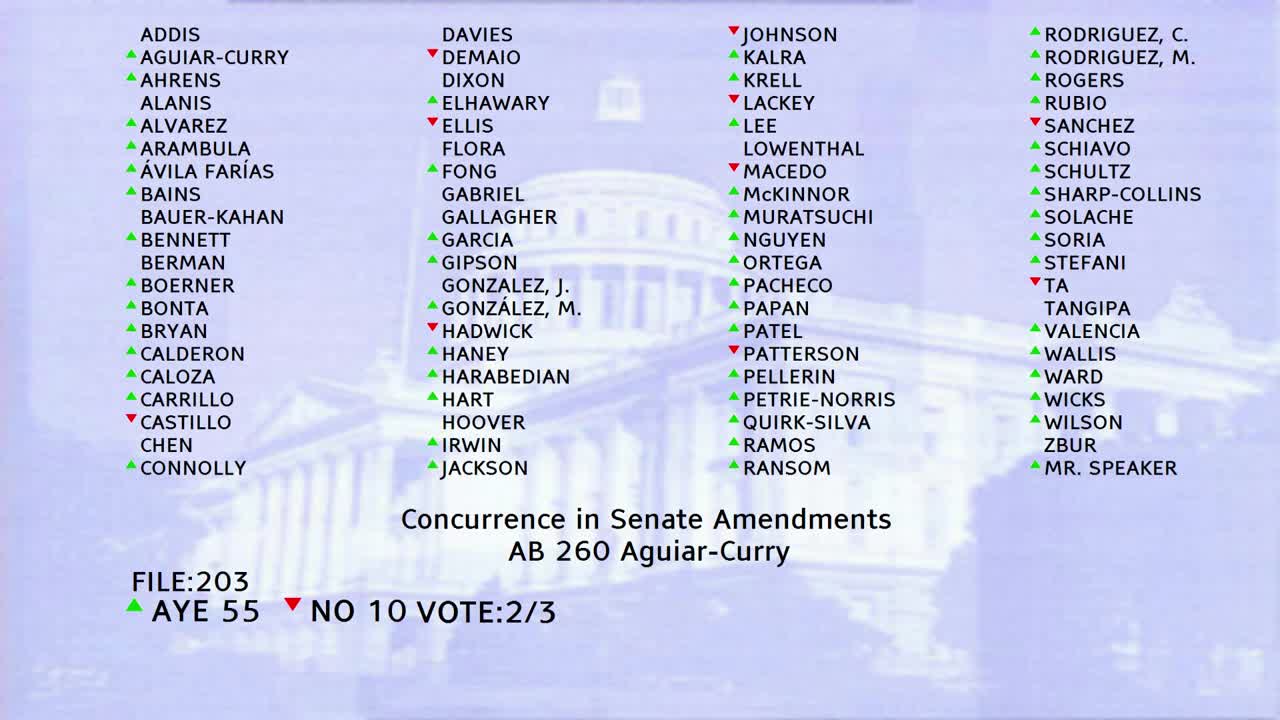
Bill Author

Bill Co-Author(s):