AB 451: Law enforcement policies: restraining orders.
- Session Year: 2025-2026
- House: Assembly
- Latest Version Date: 2025-10-13
Current Status:
Passed
(2025-10-13: Chaptered by Secretary of State - Chapter 693, Statutes of 2025.)
Introduced
In Committee
Awaiting First Chamber Vote
Passed First Chamber
In Committee
Awaiting Second Chamber Vote
Passed Second Chamber
Enacted
Existing law requires law enforcement agencies to maintain policies on specified subjects, including, among others, the use of force, gun violence restraining orders, and responding to domestic violence calls.
This bill would require each municipal police department and county sheriffs department, the Department of the California Highway Patrol, and the University of California and California State University Police Departments to, on or before January 1, 2027, develop, adopt, and implement written policies and standards to promote safe, consistent, and effective service, implementation, and enforcement of court protection and restraining orders that include firearm access restrictions. The bill would require these policies and standards to, among other things, provide a standard agency process for law enforcement to serve an order against a restrained person in a timely manner and ensure the agency consistently complies with specified requirements under California law governing service of protection and restraining orders. By expanding the duties of local law enforcement, this bill would impose a state-mandated local program.
The California Constitution requires the state to reimburse local agencies and school districts for certain costs mandated by the state. Statutory provisions establish procedures for making that reimbursement.
This bill would provide that, if the Commission on State Mandates determines that the bill contains costs mandated by the state, reimbursement for those costs shall be made pursuant to the statutory provisions noted above.
Existing law requires law enforcement agencies to maintain policies on specified subjects, including, among others, the use of force, gun violence restraining orders, and responding to domestic violence calls.
This bill would require each municipal police department and county sheriffs department, the Department of the California Highway Patrol, and the University of California and California State University Police Departments to, on or before January 1, 2027, develop, adopt, and implement written policies and standards to promote safe, consistent, and effective service, implementation, and enforcement of court protection and restraining orders that include firearm access restrictions. The bill would require these policies and standards to include specified elements, including, among others, ensuring compliance with specified laws and instructing officers about the array of civil and criminal protection restraining order options available under California law to law enforcement officers, to victim-survivors, and other petitioners. to, among other things, provide a standard agency process for law enforcement to serve an order against a restrained person in a timely manner and ensure the agency consistently complies with specified requirements under California law governing service of protection and restraining orders. By expanding the duties of local law enforcement, this bill would impose a state-mandated local program.
The California Constitution requires the state to reimburse local agencies and school districts for certain costs mandated by the state. Statutory provisions establish procedures for making that reimbursement.
This bill would provide that, if the Commission on State Mandates determines that the bill contains costs mandated by the state, reimbursement for those costs shall be made pursuant to the statutory provisions noted above.
Existing law requires law enforcement agencies to maintain policies on specified subjects, including, among others, the use of force, gun violence restraining orders, and responding to domestic violence calls.
This bill would require each municipal police department and county sheriffs department, the Department of the California Highway Patrol, and the University of California and California State University Police Departments to, on or before January 1, 2027, develop, adopt, and implement written policies and standards to promote safe, consistent, and effective service, implementation, and enforcement of court protection and restraining orders that include firearm access restrictions. The bill would require these policies and standards to include specified elements, including, among others, ensuring compliance with specified laws and instructing officers about the array of civil and criminal protection restraining order options available under California law to law enforcement officers, to victim-survivors, and other petitioners. By expanding the duties of local law enforcement, this bill would impose a state-mandated local program.
The California Constitution requires the state to reimburse local agencies and school districts for certain costs mandated by the state. Statutory provisions establish procedures for making that reimbursement.
This bill would provide that, if the Commission on State Mandates determines that the bill contains costs mandated by the state, reimbursement for those costs shall be made pursuant to the statutory provisions noted above.
(a)Each municipal police department and county sheriffs department, the Department of the California Highway Patrol, and the University of California and California State University Police Departments shall, on or before January 1, 2027, develop, adopt, and implement written policies and standards to promote safe, consistent, and effective service, implementation, and enforcement of court protection and restraining orders that include firearm access restrictions, including, but not limited to, civil harassment restraining orders, criminal protective orders, domestic violence restraining orders, emergency protective orders, juvenile restraining orders, postsecondary school violence restraining orders, workplace violence restraining orders, and elder or dependent adult abuse restraining orders other than orders described in paragraph (4) of subdivision (u) of Section 15657.03 of the Welfare and Institutions Code related to financial abuse.
(b)The policies and standards developed pursuant to this section shall ensure that the agency consistently complies with the requirements of California laws governing service and enforcement of protection and restraining orders and governing relinquishment of firearms by individuals who are armed and subject to those court orders, including new mandates and responsibilities placed on law enforcement agencies pursuant to Chapter 242 of the Statutes of 2023 and Chapter 544 of the Statutes of 2024.
(c)In developing these policies and standards, the law enforcement agency shall also review and update existing protocols, policies, or standards pertaining to protection or restraining orders and law enforcement responses to domestic violence incidents to ensure these relevant protocols, policies, and standards are consistent with one another and current law and to ensure that they provide consistent and accessible guidance to law enforcement officers.
(d)The policies and standards shall provide a standard agency process for law enforcement to serve the order against a restrained person in a timely manner and ensure the agency consistently complies with the requirements of California law governing service of protection and restraining orders, including pursuant to Section 6383 of the Family Code and Section 527.12 of the Code of Civil Procedure. These policies and standards shall ensure that officers who have served protection or restraining orders consistently accomplish all of the following steps as soon as possible and within one business day of serving the order:
(1)Completing the appropriate proof of service form developed by the Judicial Council for the protection or restraining order.
(2)Filing the proof of service form with the court.
(3)Ensuring proof of service information is entered into the California Restraining and Protective Order System through the California Law Enforcement Telecommunications System to record that the order has been served on the restrained person.
(e)The policies and standards shall ensure that officers effectuate firearm relinquishment at the time of service by requesting, at the time of service, that the restrained person immediately and safely relinquish to the officers control any firearms, ammunition, body armor, and other prohibited items in the restrained persons possession or control, or subject to the restrained persons possession or control. The policies and standards should ensure officers consistently accomplish the following steps upon serving a protection or restraining order:
(1)Notify the restrained person that they are required to immediately transfer all firearms and prohibited items they possess or control to the officer serving the order.
(2)Request that the restrained party immediately transfer to the officer, safely and unloaded, any firearms or other prohibited items they possess or control.
(3)Conduct a lawful search as necessary for the protection of the officer or other individuals present and take custody of any firearms or other prohibited items in plain sight or discovered pursuant to the lawful search.
(4)Complete the appropriate proof of firearm relinquishment form developed by the Judicial Council that serves as the receipt to document relinquished firearms and other prohibited items and issue the receipt form to the restrained person.
(5)Ensure the Automated Firearms System is updated to record any firearms that the restrained person relinquished to the law enforcement officer.
(6)Determine whether the restrained person possesses or controls other firearms that they have not relinquished to the officer. In making such a determination, the officer should be instructed to consider all relevant information, to the extent possible, including by reviewing the protection or restraining order to determine if the court made a finding that the restrained person has firearms, querying the Automated Firearms System to determine whether the restrained person is recorded as having legally acquired firearms in that database, and asking the restrained person or, if it is safe to do so, other persons present.
(f)The policies and standards shall do all of the following:
(1)(A)Provide a standard agency process for officers to promote firearm relinquishment compliance in circumstances where a restrained person owns, possesses, or controls firearms but credibly indicates that they cannot relinquish all firearms at the time of service, including circumstances where those firearms are stored in another location.
(B)The process in subparagraph (A) shall instruct officers to provide accessible local information about how the restrained person can lawfully comply with the court order by relinquishing possession or control of all firearms and other prohibited items, unloaded and in a safe manner, to a local law enforcement agency or to a licensed firearm dealer within 24 hours of being served with the order and by providing the proof of relinquishment compliance receipt form to the court and to the law enforcement agency within 48 hours or being served with the order to verify that the restrained person sold or transferred all firearms and other prohibited items that they possess or control.
(2)Instruct officers to inform the restrained person that failure to comply with the requirements and timelines in paragraph (1) may result in fines, arrest, and criminal penalties.
(3)Require officers to encourage restrained individuals to relinquish any firearms they cannot immediately relinquish to the officer through a designated third party or with law enforcement supervision to reduce the risk that the restrained person will access the firearms or other items to threaten or harm individuals protected by the court order or to otherwise harm themselves or others. The policies and standards shall encourage officers to proactively follow up with the restrained person to confirm that the restrained person relinquished all firearms and provided receipt forms verifying relinquishment within the required timeline.
(4)Instruct officers about how to respond if the restrained person credibly indicates that they do not possess or control firearms that had been associated with the restrained person in the Automated Firearms System, the court order, or other sources, including informing the restrained person to complete and submit to the court a standard form developed by the Department of Justice that declares under penalty of perjury that the restrained person is no longer in possession of one or more firearms, along with their response to the protection or restraining order and any other supporting documentation to verify that the restrained person no longer possesses or controls firearms.
(g)(1)The policies and standards shall provide a process for the agency, in coordination with court staff and other law enforcement agencies and stakeholders, to proactively identify restrained persons who are illegally armed in violation of the court order and state law.
(2)The policies and standards shall instruct officers to take one or more of the following steps, as appropriate for the circumstances, to ensure firearm relinquishment compliance and the safety of any individuals protected by the court order, if the agency receives credible information indicating that the restrained person has not relinquished all firearms or other prohibited items as required:
(A)Contact the restrained person to facilitate and verify immediate firearm relinquishment compliance.
(B)Take custody of firearms or other prohibited items at a location where there is probable cause to believe those items are located, including through a lawful search or by requesting a search warrant to search for and seize these items.
(C)Notify appropriate partners, such as court clerks, prosecutors, and petitioners or protected parties who may be in danger, that the restrained person has violated the protection or restraining orders firearm relinquishment requirements.
(D)Arrest the restrained person for violating the court order and state law.
(h)The law enforcement agency shall make the standards and policies developed pursuant to this section available to the public upon request and shall post information on the agencys website about how petitioners may request service of protection or restraining orders by that agency and how prohibited persons and other community members may relinquish firearms to the custody of the agency.
(i)In developing and updating the standards and policies developed pursuant to this section, law enforcement agencies are encouraged to consult and collaborate with domestic violence service providers and survivor advocates, gun violence prevention experts, local court staff, and guidance, technical assistance, or recommendations issued by the Department of Justice.
SEC. 2.If the Commission on State Mandates determines that this act contains costs mandated by the state, reimbursement to local agencies and school districts for those costs shall be made pursuant to Part 7 (commencing with Section 17500) of Division 4 of Title 2 of the Government Code.
(a)Each municipal police department and county sheriffs department, the Department of the California Highway Patrol, and the University of California and California State University Police Departments shall, on or before January 1, 2027, develop, adopt, and implement written policies and standards to promote safe, consistent, and effective service, implementation, and enforcement of court protection and restraining orders that include firearm access restrictions, including, but not limited to, civil harassment restraining orders, criminal protective orders, domestic violence restraining orders, emergency protective orders, gun violence restraining orders, orders, juvenile restraining orders, postsecondary school violence restraining orders, workplace violence restraining orders, and elder or dependent adult abuse restraining orders other than orders described in paragraph (4) of subdivision (u) of Section 15657.03 of the Welfare and Institutions Code related to financial abuse.
(b)The policies and standards developed pursuant to this section shall ensure that the agency consistently complies with the requirements of California laws governing service and enforcement of protection and restraining orders and governing relinquishment of firearms by individuals who are armed and subject to those court orders, including new mandates and responsibilities placed on law enforcement agencies pursuant to Chapter 242 of the Statutes of 2023 and Chapter 544 of the Statutes of 2024.
(c)In developing these policies and standards, the law enforcement agency shall also review and update existing protocols, policies, or standards pertaining to protection or restraining orders and law enforcement responses to domestic violence incidents to ensure these relevant protocols, policies, and standards are consistent with one another and current law and to ensure that they provide consistent and accessible guidance to law enforcement officers.
(d)(1)The policies and standards required pursuant to this section shall instruct officers about the array of civil and criminal protection and restraining order options available under California law to law enforcement officers, to victim-survivors, and to other eligible petitioners, as part of a range of potential crisis intervention and safety responses for individuals engaged in violent, abusive, or other dangerous conduct.(2)The policies and standards shall instruct officers about circumstances in which officers are authorized and encouraged to consider requesting emergency protective orders or gun violence restraining orders, including emergency, temporary, or final gun violence restraining orders after a hearing, and about circumstances in which the law enforcement agency may request workplace violence restraining orders to protect employees of the agency.(3)The policies and standards shall instruct officers about the other civil and criminal protection and restraining orders available to other non-law enforcement petitioners that include provisions restricting a restrained persons access to firearms under California law in order to ensure that officers may effectively advise community members about their safety options, and to ensure that officers effectively coordinate with victims, witnesses, or prosecutors to request criminal protective orders in appropriate cases.(e)(d)The policies and standards shall provide a standard agency process for law enforcement to serve the order against a restrained person in a timely manner and ensure the agency consistently complies with the requirements of California law governing service of protection and restraining orders, including pursuant to Section 6383 of the Family Code and Section 527.12 of the Code of Civil Procedure. These policies and standards shall do all of the following: ensure that officers who have served protection or restraining orders consistently accomplish all of the following steps as soon as possible and within one business day of serving the order:
(1)Provide a standard agency process for petitioners who have obtained protection or restraining orders to request that the law enforcement agency provide service of the order against a restrained person who resides in or is located in the agencys jurisdiction.(2)Provide policies and standards to ensure that the agency effectuates service of orders in a timely manner after receiving requests for service. Agencies are encouraged to develop these policies and standards governing service in coordination with court staff and other regional law enforcement agencies and stakeholders, and are encouraged to develop collaborative processes to identify protection or restraining orders that have not been served prior to a scheduled court date and to ensure that an appropriate agency promptly serves those orders and files proof of completed service forms so that court hearings on protection or restraining orders are not delayed.(3)Provide policies and standards to ensure that officers who have served protection or restraining orders consistently accomplish all of the following steps as soon as possible and within one business day of serving the order: (A)(1)Completing the appropriate proof of service form developed by the Judicial Council for the protection or restraining order.
(B)(2)Filing the proof of service form with the court.
(C)(3)Ensuring proof of service information is entered into the California Restraining and Protective Order System through the California Law Enforcement Telecommunications System to record that the order has been served on the restrained person.
(f)(e)The policies and standards shall ensure that officers effectuate firearm relinquishment at the time of service by requesting, at the time of service, that the restrained person immediately and safely relinquish to the officers control any firearms, ammunition, body armor, and other prohibited items in the restrained persons possession or control, or subject to the restrained persons possession or control. The policies and standards should ensure officers consistently accomplish the following steps upon serving a protection or restraining order:
(1)Notify the restrained person that they are required to immediately transfer all firearms and prohibited items they possess or control to the officer serving the order.
(2)Request that the restrained party immediately transfer to the officer, safely and unloaded, any firearms or other prohibited items they possess or control.
(3)Conduct a consent search or other lawful search as necessary for the protection of the officer or other individuals present and take custody of any firearms or other prohibited items in plain sight or discovered pursuant to the lawful search.
(4)Complete the appropriate proof of firearm relinquishment form developed by the Judicial Council that serves as the receipt to document relinquished firearms and other prohibited items and issue the receipt form to the restrained person.
(5)Ensure the Automated Firearms System is updated to record any firearms that the restrained person relinquished to the law enforcement officer.
(6)Determine whether the restrained person possesses or controls other firearms that they have not relinquished to the officer. In making such a determination, the officer should be instructed to consider all relevant information, to the extent possible, including by reviewing the protection or restraining order to determine if the court made a finding that the restrained person has firearms, querying the Automated Firearms System to determine whether the restrained person is recorded as having legally acquired firearms in that database, and asking the restrained person or, if it is safe to do so, other persons present.
(g)(f)The policies and standards shall do all of the following:
(1)(A)Provide a standard agency process for officers to promote firearm relinquishment compliance in circumstances where a restrained person owns, possesses, or controls firearms but credibly indicates that they cannot relinquish all firearms at the time of service, including circumstances where those firearms are stored in another location.
(B)The process in subparagraph (A) shall instruct officers to provide accessible local information about how the restrained person can lawfully comply with the court order by relinquishing possession or control of all firearms and other prohibited items, unloaded and in a safe manner, to a local law enforcement agency or to a licensed firearm dealer within 24 hours of being served with the order and by providing the proof of relinquishment compliance receipt form to the court and to the law enforcement agency within 48 hours or being served with the order to verify that the restrained person sold or transferred all firearms and other prohibited items that they possess or control.
(2)Instruct officers to inform the restrained person that failure to comply with the requirements and timelines in paragraph (1) may result in fines, arrest, and criminal penalties.
(3)Require officers to encourage restrained individuals to relinquish any firearms they cannot immediately relinquish to the officer through a designated third party or with law enforcement supervision to reduce the risk that the restrained person will access the firearms or other items to threaten or harm individuals protected by the court order or to otherwise harm themselves or others. The policies and standards shall encourage officers to proactively follow up with the restrained person to confirm that the restrained person relinquished all firearms and provided receipt forms verifying relinquishment within the required timeline.
(h)The policies and standards shall instruct(4)Instruct officers about how to provide accessible information respond if the restrained person credibly indicates that they do not possess or control firearms that had been associated with the restrained person in the Automated Firearms System, the court order, or other sources. These policies and standards shall instruct officers to inform sources, including informing the restrained person to complete and submit to the court a standard form developed by the Department of Justice that declares under penalty of perjury that the restrained person is no longer in possession of one or more firearms, along with their response to the protection or restraining order and any other supporting documentation to verify that the restrained person no longer possesses or controls firearms.
(i)(g)(1)The policies and standards shall provide a process for the agency, in coordination with court staff and other law enforcement agencies and stakeholders, to proactively identify restrained persons who are illegally armed in violation of the court order and state law.
(2)The policies and standards shall instruct officers to take one or more of the following steps, as appropriate for the circumstances, to ensure firearm relinquishment compliance and the safety of any individuals protected by the court order, if the agency receives credible information indicating that the restrained person has not relinquished all firearms or other prohibited items as required:
(A)Contact the restrained person to facilitate and verify immediate firearm relinquishment compliance.
(B)Take custody of firearms or other prohibited items at a location where there is probable cause to believe those items are located, including through a consent or other lawful search or by requesting a search warrant to search for and seize these items.
(C)Notify appropriate partners, such as court clerks, prosecutors, and petitioners or protected parties who may be in danger, that the restrained person has violated the protection or restraining orders firearm relinquishment requirements.
(D)Arrest the restrained person for violating the court order and state law.
(j)The policies and standards shall provide a standard process for restrained individuals and other community members to safely relinquish firearms to the custody of the agency, and for the agency to store and track relinquished firearms, assess reasonable fees for storage, and return relinquished firearms to the restrained person at the expiration of the order, upon request, if the firearm owner passes a background check verifying that they are the legal owner and are not otherwise prohibited from receiving the firearm. (k)(h)The law enforcement agency shall make the standards and policies developed pursuant to this section available to the public upon request and shall post information on the agencys website about how petitioners may request service of protection or restraining orders by that agency and how prohibited persons and other community members may relinquish firearms to the custody of the agency.
(l)(i)In developing and updating the standards and policies developed pursuant to this section, law enforcement agencies are encouraged to consult and collaborate with domestic violence service providers and survivor advocates, gun violence prevention experts, local court staff, and guidance, technical assistance, or recommendations issued by the Department of Justice.
SEC. 2.If the Commission on State Mandates determines that this act contains costs mandated by the state, reimbursement to local agencies and school districts for those costs shall be made pursuant to Part 7 (commencing with Section 17500) of Division 4 of Title 2 of the Government Code.
(a)Each municipal police department and county sheriffs department, the Department of the California Highway Patrol, and the University of California and California State University Police Departments shall, on or before January 1, 2027, develop, adopt, and implement written policies and standards to promote safe, consistent, and effective service, implementation, and enforcement of court protection and restraining orders that include firearm access restrictions, including, but not limited to, civil harassment restraining orders, criminal protective orders, domestic violence restraining orders, emergency protective orders, gun violence restraining orders, juvenile restraining orders, postsecondary school violence restraining orders, workplace violence restraining orders, and elder or dependent adult abuse restraining orders other than orders described in paragraph (4) of subdivision (u) of Section 15657.03 of the Welfare and Institutions Code related to financial abuse.
(b)The policies and standards developed pursuant to this section shall ensure that the agency consistently complies with the requirements of California laws governing service and enforcement of protection and restraining orders and governing relinquishment of firearms by individuals who are armed and subject to those court orders, including new mandates and responsibilities placed on law enforcement agencies pursuant to Chapter 242 of the Statutes of 2023 and Chapter 544 of the Statutes of 2024.
(c)In developing these policies and standards, the law enforcement agency shall also review and update existing protocols, policies, or standards pertaining to protection or restraining orders and law enforcement responses to domestic violence incidents to ensure these relevant protocols, policies, and standards are consistent with one another and current law and to ensure that they provide consistent and accessible guidance to law enforcement officers.
(d)(1)The policies and standards required pursuant to this section shall instruct officers about the array of civil and criminal protection and restraining order options available under California law to law enforcement officers, to victim-survivors, and to other eligible petitioners, as part of a range of potential crisis intervention and safety responses for individuals engaged in violent, abusive, or other dangerous conduct.
(2)The policies and standards shall instruct officers about circumstances in which officers are authorized and encouraged to consider requesting emergency protective orders or gun violence restraining orders, including emergency, temporary, or final gun violence restraining orders after a hearing, and about circumstances in which the law enforcement agency may request workplace violence restraining orders to protect employees of the agency.
(3)The policies and standards shall instruct officers about the other civil and criminal protection and restraining orders available to other non-law enforcement petitioners that include provisions restricting a restrained persons access to firearms under California law in order to ensure that officers may effectively advise community members about their safety options, and to ensure that officers effectively coordinate with victims, witnesses, or prosecutors to request criminal protective orders in appropriate cases.
(e)The policies and standards shall ensure the agency consistently complies with the requirements of California law governing service of protection and restraining orders, including pursuant to Section 6383 of the Family Code and Section 527.12 of the Code of Civil Procedure. These policies and standards shall do all of the following:
(1)Provide a standard agency process for petitioners who have obtained protection or restraining orders to request that the law enforcement agency provide service of the order against a restrained person who resides in or is located in the agencys jurisdiction.
(2)Provide policies and standards to ensure that the agency effectuates service of orders in a timely manner after receiving requests for service. Agencies are encouraged to develop these policies and standards governing service in coordination with court staff and other regional law enforcement agencies and stakeholders, and are encouraged to develop collaborative processes to identify protection or restraining orders that have not been served prior to a scheduled court date and to ensure that an appropriate agency promptly serves those orders and files proof of completed service forms so that court hearings on protection or restraining orders are not delayed.
(3)Provide policies and standards to ensure that officers who have served protection or restraining orders consistently accomplish all of the following steps as soon as possible and within one business day of serving the order:
(A)Completing the appropriate proof of service form developed by the Judicial Council for the protection or restraining order.
(B)Filing the proof of service form with the court.
(C)Ensuring proof of service information is entered into the California Restraining and Protective Order System through the California Law Enforcement Telecommunications System to record that the order has been served on the restrained person.
(f)The policies and standards shall ensure that officers effectuate firearm relinquishment at the time of service by requesting, at the time of service, that the restrained person immediately and safely relinquish to the officers control any firearms, ammunition, body armor, and other prohibited items in the restrained persons possession or control, or subject to the restrained persons possession or control. The policies and standards should ensure officers consistently accomplish the following steps upon serving a protection or restraining order:
(1)Notify the restrained person that they are required to immediately transfer all firearms and prohibited items they possess or control to the officer serving the order.
(2)Request that the restrained party immediately transfer to the officer, safely and unloaded, any firearms or other prohibited items they possess or control.
(3)Conduct a consent search or other lawful search as necessary for the protection of the officer or other individuals present and take custody of any firearms or other prohibited items in plain sight or discovered pursuant to the lawful search.
(4)Complete the appropriate proof of firearm relinquishment form developed by the Judicial Council that serves as the receipt to document relinquished firearms and other prohibited items and issue the receipt form to the restrained person.
(5)Ensure the Automated Firearms System is updated to record any firearms that the restrained person relinquished to the law enforcement officer.
(6)Determine whether the restrained person possesses or controls other firearms that they have not relinquished to the officer. In making such a determination, the officer should be instructed to consider all relevant information, to the extent possible, including by reviewing the protection or restraining order to determine if the court made a finding that the restrained person has firearms, querying the Automated Firearms System to determine whether the restrained person is recorded as having legally acquired firearms in that database, and asking the restrained person or, if it is safe to do so, other persons present.
(g)The policies and standards shall do all of the following:
(1)(A)Provide a standard agency process for officers to promote firearm relinquishment compliance in circumstances where a restrained person owns, possesses, or controls firearms but credibly indicates that they cannot relinquish all firearms at the time of service, including circumstances where those firearms are stored in another location.
(B)The process in subparagraph (A) shall instruct officers to provide accessible local information about how the restrained person can lawfully comply with the court order by relinquishing possession or control of all firearms and other prohibited items, unloaded and in a safe manner, to a local law enforcement agency or to a licensed firearm dealer within 24 hours of being served with the order and by providing the proof of relinquishment compliance receipt form to the court and to the law enforcement agency within 48 hours or being served with the order to verify that the restrained person sold or transferred all firearms and other prohibited items that they possess or control.
(2)Instruct officers to inform the restrained person that failure to comply with the requirements and timelines in paragraph (1) may result in fines, arrest, and criminal penalties.
(3)Require officers to encourage restrained individuals to relinquish any firearms they cannot immediately relinquish to the officer through a designated third party or with law enforcement supervision to reduce the risk that the restrained person will access the firearms or other items to threaten or harm individuals protected by the court order or to otherwise harm themselves or others. The policies and standards shall encourage officers to proactively follow up with the restrained person to confirm that the restrained person relinquished all firearms and provided receipt forms verifying relinquishment within the required timeline.
(h)The policies and standards shall instruct officers about how to provide accessible information if the restrained person credibly indicates that they do not possess or control firearms that had been associated with the restrained person in the Automated Firearms System, the court order, or other sources. These policies and standards shall instruct officers to inform the restrained person to complete and submit to the court a standard form developed by the Department of Justice that declares under penalty of perjury that the restrained person is no longer in possession of one or more firearms, along with their response to the protection or restraining order and any other supporting documentation to verify that the restrained person no longer possesses or controls firearms.
(i)(1)The policies and standards shall provide a process for the agency, in coordination with court staff and other law enforcement agencies and stakeholders, to proactively identify restrained persons who are illegally armed in violation of the court order and state law.
(2)The policies and standards shall instruct officers to take one or more of the following steps, as appropriate for the circumstances, to ensure firearm relinquishment compliance and the safety of any individuals protected by the court order, if the agency receives credible information indicating that the restrained person has not relinquished all firearms or other prohibited items as required:
(A)Contact the restrained person to facilitate and verify immediate firearm relinquishment compliance.
(B)Take custody of firearms or other prohibited items at a location where there is probable cause to believe those items are located, including through a consent or other lawful search or by requesting a search warrant to search for and seize these items.
(C)Notify appropriate partners, such as court clerks, prosecutors, and petitioners or protected parties who may be in danger, that the restrained person has violated the protection or restraining orders firearm relinquishment requirements.
(D)Arrest the restrained person for violating the court order and state law.
(j)The policies and standards shall provide a standard process for restrained individuals and other community members to safely relinquish firearms to the custody of the agency, and for the agency to store and track relinquished firearms, assess reasonable fees for storage, and return relinquished firearms to the restrained person at the expiration of the order, upon request, if the firearm owner passes a background check verifying that they are the legal owner and are not otherwise prohibited from receiving the firearm.
(k)The law enforcement agency shall make the standards and policies developed pursuant to this section available to the public upon request and shall post information on the agencys website about how petitioners may request service of protection or restraining orders by that agency and how prohibited persons and other community members may relinquish firearms to the custody of the agency.
(l)In developing and updating the standards and policies developed pursuant to this section, law enforcement agencies are encouraged to consult and collaborate with domestic violence service providers and survivor advocates, gun violence prevention experts, local court staff, and guidance, technical assistance, or recommendations issued by the Department of Justice.
SEC. 2.If the Commission on State Mandates determines that this act contains costs mandated by the state, reimbursement to local agencies and school districts for those costs shall be made pursuant to Part 7 (commencing with Section 17500) of Division 4 of Title 2 of the Government Code.
|
Date
|
Status
|
|---|---|
| Oct 13, 2025 | Chaptered by Secretary of State - Chapter 693, Statutes of 2025. |
| Oct 13, 2025 | Approved by the Governor. |
| Sep 24, 2025 | Enrolled and presented to the Governor at 3 p.m. |
| Sep 12, 2025 | Senate amendments concurred in. To Engrossing and Enrolling. (Ayes 80. Noes 0. Page 3375.). |
| Sep 12, 2025 | In Assembly. Concurrence in Senate amendments pending. |
| Sep 11, 2025 | Read third time. Passed. Ordered to the Assembly. (Ayes 40. Noes 0. Page 2920.). |
| Aug 29, 2025 | Read second time. Ordered to third reading. |
| Aug 29, 2025 | From committee: Do pass. (Ayes 7. Noes 0.) (August 29). |
| Aug 18, 2025 | In committee: Referred to suspense file. |
| Jul 9, 2025 | From committee: Do pass and re-refer to Com. on APPR. (Ayes 13. Noes 0.) (July 8). Re-referred to Com. on APPR. |
| Jun 25, 2025 | Read second time and amended. Re-referred to Com. on JUD. |
| Jun 24, 2025 | From committee: Amend, and do pass as amended and re-refer to Com. on JUD. (Ayes 6. Noes 0.) (June 24). |
| Jun 11, 2025 | Referred to Coms. on PUB. S. and JUD. |
| Jun 3, 2025 | In Senate. Read first time. To Com. on RLS. for assignment. |
| Jun 2, 2025 | Read third time. Passed. Ordered to the Senate. (Ayes 78. Noes 0. Page 1831.) |
| May 27, 2025 | Read second time. Ordered to third reading. |
| May 23, 2025 | From committee: Do pass. (Ayes 14. Noes 0.) (May 23). |
| Apr 9, 2025 | In committee: Set, first hearing. Referred to APPR. suspense file. |
| Mar 11, 2025 | From committee: Do pass and re-refer to Com. on APPR. with recommendation: To Consent Calendar. (Ayes 8. Noes 0.) (March 11). Re-referred to Com. on APPR. |
| Feb 18, 2025 | Referred to Com. on PUB. S. |
| Feb 7, 2025 | From printer. May be heard in committee March 9. |
| Feb 6, 2025 | Read first time. To print. |
|
Date
|
Description
|
Location
|
Votes
|
|
|---|---|---|---|---|
| Sep 12, 2025 | AB 451 Petrie-Norris Concurrence in Senate Amendments | Assembly Floor |
Passed |
|
| Sep 11, 2025 | Assembly 3rd Reading AB451 Petrie-Norris By Blakespear | Senate Floor |
Passed |
|
| Aug 29, 2025 | Do pass | Senate Standing Committee on Appropriations |
Passed |
|
| Aug 18, 2025 | Placed on suspense file | Senate Standing Committee on Appropriations |
Passed |
|
| Jul 8, 2025 | Do pass, but first be re-referred to the Committee on [Appropriations] | Senate Standing Committee on Judiciary |
Passed |
|
| Jun 24, 2025 | Do pass as amended, but first amend, and re-refer to the Committee on [Judiciary] | Senate Standing Committee on Public Safety |
Passed |
|
| Jun 2, 2025 | AB 451 Petrie-Norris Assembly Third Reading | Assembly Floor |
Passed |
|
| May 23, 2025 | Do pass. | Assembly Standing Committee on Appropriations |
Passed |
|
| Mar 11, 2025 | Do pass and be re-referred to the Committee on [Appropriations] with recommendation: To Consent Calendar | Assembly Standing Committee on Public Safety |
Passed |
This list shows positions taken on this bill by organizations on the date displayed, which is linked to the original source.
Positions by individuals are not included.
|
Organization
|
Position
|
Date
|
|---|---|---|
| Arcadia Police Officers' Association | ** Support | |
| Brea Police Association | ** Support | |
| Burbank Police Officers' Association | ** Support | |
| California Association of School Police Chiefs | ** Support | |
| California Coalition of School Safety Professionals | ** Support | |
| California Department of Justice | ** Support | |
| California District Attorneys Association | ** Support | |
| California Narcotic Officers' Association | ** Support | |
| California Reserve Peace Officers Association | ** Support | |
| City Of Beaumont | ** Against | |
| CLAREMONT POLICE OFFICERS ASSOCIATION | ** Support | |
| Corona Police Officers Association | ** Support | |
| Culver City Police Officers' Association | ** Support | |
| Fullerton Police Officers' Association | ** Support | |
| Giffords | ** Support | |
| Legislative Coalition to Prevent Child Abuse | ** Support | |
| Los Angeles School Police Management Association | ** Support | |
| los angeles school police officers association | ** Support | |
| Messaging for Success | ** Support | |
| Murrieta Police Officers' Association | ** Support | |
| Newport Beach Police Association | ** Support | |
| None received | ** Against | |
| Palos Verdes Police Officers Association | ** Support | |
| Peace Officers Research Association Of California | ** Support | |
| PLACER COUNTY DEPUTY SHERIFFS ASSOCIATION | ** Support | |
| Pomona Police Officers' Association | ** Support | |
| RIVERSIDE POLICE OFFICERS ASSOCIATION | ** Support | |
| Riverside Sheriffs' Association | ** Support | |
| San Diegans For Gun Violence Prevention | ** Support |
CONCURRENCE IN SENATE AMENDMENTS
CSA1 Bill Id:AB 451
Author:(Petrie-Norris)
As Amended Ver:June 25, 2025
Majority vote
SUMMARY
Requires state and local law enforcement agencies to develop and adopt policies and standards pertaining to enforcing firearm relinquishment requirements associated with specified protective and restraining orders.
Major Provisions
- Requires municipal police departments and county sheriff's departments, the Department of the California Highway Patrol ("CHP"), and the University of California and California State University Police Departments, on or before January 1, 2027, to develop, adopt, and implement written policies and standards to promote safe, consistent, and effective service, implementation, and enforcement of court protection and restraining orders that include firearm access restrictions, as specified.
- Specifies that the policies and standards would apply to orders with firearm relinquishment requirements including, but not limited to, civil harassment restraining orders, criminal protective orders, domestic violence restraining orders, emergency protective orders, juvenile restraining orders, postsecondary school violence restraining orders, workplace violence restraining orders, and elder or dependent adult abuse restraining orders.
- Provides that such policies and standards developed must ensure that the agency consistently complies with the requirements of California laws governing service and enforcement of protection and restraining orders and governing relinquishment of firearms by individuals who are armed and subject to those court orders, including new mandates and responsibilities placed on law enforcement agencies, as specified.
- Provides that in developing these policies and standards, the law enforcement agency shall also review and update existing protocols, policies, or standards pertaining to protection or restraining orders and law enforcement responses to domestic violence incidents to ensure these relevant protocols, policies, and standards are consistent with one another and current law and to ensure that they provide consistent and accessible guidance to law enforcement officers.
- Requires the policies and standards to provide a standard agency process for law enforcement to serve the order against a restrained person in a timely manner and ensure the agency consistently complies with the requirements of California law governing service of protection and restraining orders, as specified. These policies and standards shall ensure that officers who have served protection or restraining orders consistently accomplish all of the following steps as soon as possible and within one business day of serving the order:
- Completing the appropriate proof of service form developed by the Judicial Council for the protection or restraining order.
- Filing the proof of service form with the court.
- Ensuring proof of service information is entered into the California Restraining and Protective Order System through the California Law Enforcement Telecommunications System to record that the order has been served on the restrained person.
- Requires the policies and standards to ensure that officers effectuate firearm relinquishment at the time of service by requesting, at the time of service, that the restrained person immediately and safely relinquish to the officer's control any firearms, ammunition, body armor, and other prohibited items in the restrained person's possession or control, or subject to the restrained person's possession or control. The policies and standards should ensure officers consistently accomplish the following steps upon serving a protection or restraining order:
- Notify the restrained person that they are required to immediately transfer all firearms and prohibited items they possess or control to the officer serving the order.
- Request that the restrained party immediately transfer to the officer, safely and unloaded, any firearms or other prohibited items they possess or control.
- Conduct a lawful search as necessary for the protection of the officer or other individuals present and take custody of any firearms or other prohibited items in plain sight or discovered pursuant to the lawful search.
- Complete the appropriate proof of firearm relinquishment form developed by the Judicial Council that serves as the receipt to document relinquished firearms and other prohibited items and issue the receipt form to the restrained person.
- Ensure the Automated Firearms System is updated to record any firearms that the restrained person relinquished to the law enforcement officer.
- Determine whether the restrained person possesses or controls other firearms that they have not relinquished to the officer. In making such a determination, the officer should be instructed to consider all relevant information, to the extent possible, including by reviewing the protection or restraining order to determine if the court made a finding that the restrained person has firearms, querying the Automated Firearms System to determine whether the restrained person is recorded as having legally acquired firearms in that database, and asking the restrained person or, if it is safe to do so, other persons present.
- States that the policies and standards shall additionally do all of the following:
- Provide a standard agency process for officers to promote firearm relinquishment compliance in circumstances where a restrained person owns, possesses, or controls firearms but credibly indicates that they cannot relinquish all firearms at the time of service, including circumstances where those firearms are stored in another location.
- Instruct officers to provide accessible local information about how the restrained person can lawfully comply with the court order by relinquishing possession or control of all firearms and other prohibited items, unloaded and in a safe manner, to a local law enforcement agency or to a licensed firearm dealer within 24 hours of being served with the order and by providing the proof of relinquishment compliance receipt form to the court and to the law enforcement agency within 48 hours or being served with the order to verify that the restrained person sold or transferred all firearms and other prohibited items that they possess or control.
- Instruct officers to inform the restrained person that failure to comply with the above requirements and timelines may result in fines, arrest, and criminal penalties.
- Require officers to encourage restrained individuals to relinquish any firearms they cannot immediately relinquish to the officer through a designated third party or with law enforcement supervision to reduce the risk that the restrained person will access the firearms or other items to threaten or harm individuals protected by the court order or to otherwise harm themselves or others.
- Encourage officers to proactively follow up with the restrained person to confirm that the restrained person relinquished all firearms and provided receipt forms verifying relinquishment within the required timeline.
- Instruct officers about how to respond if the restrained person credibly indicates that they do not possess or control firearms that had been associated with the restrained person in the Automated Firearms System, the court order, or other sources, including informing the restrained person to complete and submit to the court a standard form developed by the Department of Justice ("DOJ") that declares under penalty of perjury that the restrained person is no longer in possession of one or more firearms, along with their response to the protection or restraining order and any other supporting documentation to verify that the restrained person no longer possesses or controls firearms.
- States that the policies and standards shall provide a process for the agency, in coordination with court staff and other law enforcement agencies and stakeholders, to proactively identify restrained persons who are illegally armed in violation of the court order and state law.
- Requires the policies and standards to instruct officers to take one or more of the following steps, as appropriate for the circumstances, to ensure firearm relinquishment compliance and the safety of any individuals protected by the court order, if the agency receives credible information indicating that the restrained person has not relinquished all firearms or other prohibited items as required:
- Contact the restrained person to facilitate and verify immediate firearm relinquishment compliance.
- Take custody of firearms or other prohibited items at a location where there is probable cause to believe those items are located, including through a consent or other lawful search or by requesting a search warrant to search for and seize these items.
- Notify appropriate partners, such as court clerks, prosecutors, and petitioners or protected parties who may be in danger, that the restrained person has violated the protection or restraining order's firearm relinquishment requirements.
- Arrest the restrained person for violating the court order and state law.
- Requires the law enforcement agency to make the standards and policies developed pursuant to this section available to the public upon request and shall post information on the agency's website about how petitioners may request service of protection or restraining orders by that agency and how prohibited persons and other community members may relinquish firearms to the custody of the agency.
- States that in developing and updating the standards and policies developed pursuant to this section, law enforcement agencies are encouraged to consult and collaborate with domestic violence service providers and survivor advocates, gun violence prevention experts, local court staff, and guidance, technical assistance, or recommendations issued by the DOJ.
Senate Amendments
- Removes gun violence restraining orders (GVROs) from the list of court protection and restraining orders that that this bill applies to.
- Removes the requirement that the policies and standards instruct officers about:
- The array of civil and criminal protection and restraining order options available under California law to law enforcement officers, to victim-survivors, and to other eligible petitioners, as part of a range of potential crisis intervention and safety responses for individuals engaged in violent, abusive, or other dangerous conduct.
- The circumstances in which officers are authorized and encouraged to consider requesting emergency protective orders or GVROs, including emergency, temporary, or final GVROs after a hearing, and about circumstances in which the law enforcement agency may request workplace violence restraining orders to protect employees of the agency.
- The other civil and criminal protection and restraining orders available to other non-law enforcement petitioners that include provisions restricting a restrained person's access to firearms under California law in order to ensure that officers may effectively advise community members about their safety options, and to ensure that officers effectively coordinate with victims, witnesses, or prosecutors to request criminal protective orders in appropriate cases.
- Specifies that the policies and standards must provide a standard agency process for law enforcement to serve the order against a restrained person in a timely manner and ensure the agency consistently complies with the requirements of California law governing service of protection and restraining orders, as specified, and that the policies and standards shall ensure that officers who have served protection or restraining orders consistently accomplish specified steps as soon as possible and within one business day of serving the order.
- Removes the requirement that the policies and standards provide a standard agency process for petitioners who have obtained protection or restraining orders to request that the law enforcement agency provide service of the order against a restrained person who resides in or is located in the agency's jurisdiction.
- Removes the provision of the bill encouraging agencies to develop these policies and standards governing service in coordination with court staff and other regional law enforcement agencies and stakeholders, to develop collaborative processes to identify protection or restraining orders that have not been served prior to a scheduled court date, and to ensure that an appropriate agency promptly serves those orders and files proof of completed service forms so that court hearings on protection or restraining orders are not delayed.
- Removes consent searches from the type of searches that the policies and standards must ensure an office conducts upon serving a protection or restraining order.
- Specifies that the policies and standards must instruct officers about how to respond, rather than how to provide accessible information, if a restrained person credibly indicates that they do not possess or control firearms that had been associated with the restrained person in the Automated Firearms System, the court order, or other sources.
- Removes the requirement that the policies and standards provide a standard process for restrained individuals and other community members to safely relinquish firearms to the custody of the agency, and for the agency to store and track relinquished firearms, assess reasonable fees for storage, and return relinquished firearms to the restrained person at the expiration of the order, upon request, if the firearm owner passes a background check verifying that they are the legal owner and are not otherwise prohibited from receiving the firearm.
COMMENTS
As passed by the Assembly: This bill required state and local law enforcement agencies to develop and adopt policies and standards pertaining to enforcing firearm relinquishment requirements associated with specified protective and restraining orders.
Major Provisions
- Required municipal police departments and county sheriff's departments, the Department of the California Highway Patrol ("CHP"), and the University of California and California State University Police Departments, on or before January 1, 2027, to develop, adopt, and implement written policies and standards to promote safe, consistent, and effective service, implementation, and enforcement of court protection and restraining orders that include firearm access restrictions, as specified.
- Specified that the policies and standards would apply to orders with firearm relinquishment requirements including, but not limited to, civil harassment restraining orders, criminal protective orders, domestic violence restraining orders, emergency protective orders, gun violence restraining orders ("GVROs") , juvenile restraining orders, postsecondary school violence restraining orders, workplace violence restraining orders, and elder or dependent adult abuse restraining orders.
- Provided that such policies and standards developed must ensure that the agency consistently complies with the requirements of California laws governing service and enforcement of protection and restraining orders and governing relinquishment of firearms by individuals who are armed and subject to those court orders, including new mandates and responsibilities placed on law enforcement agencies, as specified.
- Provided that in developing these policies and standards, the law enforcement agency shall also review and update existing protocols, policies, or standards pertaining to protection or restraining orders and law enforcement responses to domestic violence incidents to ensure these relevant protocols, policies, and standards are consistent with one another and current law and to ensure that they provide consistent and accessible guidance to law enforcement officers.
- Required the policies and standards to instruct officers about:
- The array of civil and criminal protection and restraining order options available under California law to law enforcement officers, to victim-survivors, and to other eligible petitioners, as part of a range of potential crisis intervention and safety responses for individuals engaged in violent, abusive, or other dangerous conduct.
- The circumstances in which officers are authorized and encouraged to consider requesting emergency protective orders or GVROs, including emergency, temporary, or final GVROs after a hearing, and about circumstances in which the law enforcement agency may request workplace violence restraining orders to protect employees of the agency.
- The other civil and criminal protection and restraining orders available to other non-law enforcement petitioners that include provisions restricting a restrained person's access to firearms under California law in order to ensure that officers may effectively advise community members about their safety options, and to ensure that officers effectively coordinate with victims, witnesses, or prosecutors to request criminal protective orders in appropriate cases.
- Required the policies and standards to ensure the agency consistently complies with the requirements of California law governing service of protection and restraining orders, as specified. These policies and standards shall do all of the following:
- Provide a standard agency process for petitioners who have obtained protection or restraining orders to request that the law enforcement agency provide service of the order against a restrained person who resides in or is located in the agency's jurisdiction.
- Provide policies and standards to ensure that the agency effectuates service of orders in a timely manner after receiving requests for service. Agencies are encouraged to develop these policies and standards governing service in coordination with court staff and other regional law enforcement agencies and stakeholders, and are encouraged to develop collaborative processes to identify protection or restraining orders that have not been served prior to a scheduled court date and to ensure that an appropriate agency promptly serves those orders and files proof of completed service forms so that court hearings on protection or restraining orders are not delayed.
- Provide policies and standards to ensure that officers who have served protection or restraining orders consistently accomplish all of the following steps as soon as possible and within one business day of serving the order:
- Completing the appropriate proof of service form developed by the Judicial Council for the protection or restraining order.
- Filing the proof of service form with the court.
- Ensuring proof of service information is entered into the California Restraining and Protective Order System through the California Law Enforcement Telecommunications System to record that the order has been served on the restrained person.
- The policies and standards shall ensure that officers effectuate firearm relinquishment at the time of service by requesting, at the time of service, that the restrained person immediately and safely relinquish to the officer's control any firearms, ammunition, body armor, and other prohibited items in the restrained person's possession or control, or subject to the restrained person's possession or control. The policies and standards should ensure officers consistently accomplish the following steps upon serving a protection or restraining order:
- Notify the restrained person that they are required to immediately transfer all firearms and prohibited items they possess or control to the officer serving the order.
- Request that the restrained party immediately transfer to the officer, safely and unloaded, any firearms or other prohibited items they possess or control.
- Conduct a consent search or other lawful search as necessary for the protection of the officer or other individuals present and take custody of any firearms or other prohibited items in plain sight or discovered pursuant to the lawful search.
- Complete the appropriate proof of firearm relinquishment form developed by the Judicial Council that serves as the receipt to document relinquished firearms and other prohibited items and issue the receipt form to the restrained person.
- Ensure the Automated Firearms System is updated to record any firearms that the restrained person relinquished to the law enforcement officer.
- Determine whether the restrained person possesses or controls other firearms that they have not relinquished to the officer. In making such a determination, the officer should be instructed to consider all relevant information, to the extent possible, including by reviewing the protection or restraining order to determine if the court made a finding that the restrained person has firearms, querying the Automated Firearms System to determine whether the restrained person is recorded as having legally acquired firearms in that database, and asking the restrained person or, if it is safe to do so, other persons present.
- The policies and standards shall additionally do all of the following:
- Provide a standard agency process for officers to promote firearm relinquishment compliance in circumstances where a restrained person owns, possesses, or controls firearms but credibly indicates that they cannot relinquish all firearms at the time of service, including circumstances where those firearms are stored in another location.
- This process shall instruct officers to provide accessible local information about how the restrained person can lawfully comply with the court order by relinquishing possession or control of all firearms and other prohibited items, unloaded and in a safe manner, to a local law enforcement agency or to a licensed firearm dealer within 24 hours of being served with the order and by providing the proof of relinquishment compliance receipt form to the court and to the law enforcement agency within 48 hours or being served with the order to verify that the restrained person sold or transferred all firearms and other prohibited items that they possess or control.
- Instruct officers to inform the restrained person that failure to comply with the above requirements and timelines may result in fines, arrest, and criminal penalties.
- Require officers to encourage restrained individuals to relinquish any firearms they cannot immediately relinquish to the officer through a designated third party or with law enforcement supervision to reduce the risk that the restrained person will access the firearms or other items to threaten or harm individuals protected by the court order or to otherwise harm themselves or others.
- Encourage officers to proactively follow up with the restrained person to confirm that the restrained person relinquished all firearms and provided receipt forms verifying relinquishment within the required timeline.
- The policies and standards shall instruct officers about how to provide accessible information if the restrained person credibly indicates that they do not possess or control firearms that had been associated with the restrained person in the Automated Firearms System, the court order, or other sources. These policies and standards shall instruct officers to inform the restrained person to complete and submit to the court a standard form developed by the Department of Justice ("DOJ") that declares under penalty of perjury that the restrained person is no longer in possession of one or more firearms, along with their response to the protection or restraining order and any other supporting documentation to verify that the restrained person no longer possesses or controls firearms.
- The policies and standards shall provide a process for the agency, in coordination with court staff and other law enforcement agencies and stakeholders, to proactively identify restrained persons who are illegally armed in violation of the court order and state law.
- The policies and standards shall instruct officers to take one or more of the following steps, as appropriate for the circumstances, to ensure firearm relinquishment compliance and the safety of any individuals protected by the court order, if the agency receives credible information indicating that the restrained person has not relinquished all firearms or other prohibited items as required:
- Contact the restrained person to facilitate and verify immediate firearm relinquishment compliance.
- Take custody of firearms or other prohibited items at a location where there is probable cause to believe those items are located, including through a consent or other lawful search or by requesting a search warrant to search for and seize these items.
- Notify appropriate partners, such as court clerks, prosecutors, and petitioners or protected parties who may be in danger, that the restrained person has violated the protection or restraining order's firearm relinquishment requirements.
- Arrest the restrained person for violating the court order and state law.
- The policies and standards shall provide a standard process for restrained individuals and other community members to safely relinquish firearms to the custody of the agency, and for the agency to store and track relinquished firearms, assess reasonable fees for storage, and return relinquished firearms to the restrained person at the expiration of the order, upon request, if the firearm owner passes a background check verifying that they are the legal owner and are not otherwise prohibited from receiving the firearm.
- The law enforcement agency shall make the standards and policies developed pursuant to this section available to the public upon request and shall post information on the agency's website about how petitioners may request service of protection or restraining orders by that agency and how prohibited persons and other community members may relinquish firearms to the custody of the agency.
- In developing and updating the standards and policies developed pursuant to this section, law enforcement agencies are encouraged to consult and collaborate with domestic violence service providers and survivor advocates, gun violence prevention experts, local court staff, and guidance, technical assistance, or recommendations issued by the DOJ.
According to the Author
"California has some of the strongest gun violence prevention laws in the nation, but inconsistent enforcement of firearm relinquishment laws continues to put lives at risk. Under current law, individuals subject to protective orders with firearm restrictions are required to surrender their firearms. However, in practice, enforcement of these orders varies widely from county to county. Some law enforcement agencies diligently ensure firearm relinquishment, while others lack clear policies, creating a dangerous gap in public safety. Survivors of domestic violence, stalking, and workplace harassment deserve the full protection of the law, but when firearm surrender laws are not uniformly enforced, these individuals remain vulnerable to potential harm.
"In 2023 alone, nearly 290,000 protective orders were issued in California, a 20% increase from 2020. Despite this high volume, some counties account for a disproportionate share of enforcement actions, while others rarely pursue firearm relinquishment at all. This disparity undermines the effectiveness of protective orders and creates an unequal system of justice where an individual's safety depends largely on their geographic location. No one should have to fear for their life simply because their county lacks enforcement policies that others have in place.
"AB 451 will ensure that all law enforcement agencies in California have standardized, enforceable policies for firearm relinquishment. By requiring firearms to be surrendered within 24 hours and proof of compliance to be submitted within 48 hours, this bill provides clear, actionable guidelines for law enforcement to follow. These policies will help prevent dangerous individuals from retaining access to firearms, reducing the risk of violence in communities across the state.
"Every Californian deserves to feel safe in their home, workplace, and community. By strengthening and standardizing firearm relinquishment enforcement, AB 451 will close critical gaps in existing law, enhance public safety, and provide equal protection for all individuals, regardless of where they live. I urge my colleagues to support this bill and take a crucial step toward preventing further violence in our state."
Arguments in Support
According to Giffords, "The bill will improve the implementation of protective orders by requiring all California law enforcement agencies to establish standardized protocols for the timely service and enforcement of restraining orders that include firearm restrictions.
"California has a robust array of protective orders that carry firearm prohibitions, including Domestic Violence Restraining Orders, Civil Harassment Protective Orders, and Gun Violence Restraining Orders, among others. They play a crucial role in preventing violence and protecting individuals at risk. In 2023, nearly 290,000 protective orders were reported to the California Department of Justice, a 20% increase over 2020.
"Successful implementation of these life-saving tools requires coordination between the courts issuing the order, the California Department of Justice, which registers the order, and, often, local law enforcement to enforce and serve the order. Unfortunately, although the law requires prohibited persons to relinquish their firearms within 24 hours of being served a protective order, there is often a delay.
"In 2022, GIFFORDS advocated for and the Legislature appropriated $40 million in one-time funding to the Judicial Council to support court-based firearm relinquishment programs to decrease these delays. While there has been considerable improvement, Los Angeles cases took an average of 49.5 days after the court order to relinquish firearms, Orange County cases took an average of 14.5 days, and San Diego cases took an average of 0.14 days.
"The inconsistent application of restraining orders across different parts of the state results in varying degrees of protection depending on where you live. By pushing law enforcement to establish clear, uniform protocols for service of all nine of California's protective orders, AB 451 will address critical enforcement gaps and enhance public safety. Standardized policies across protective orders and increased collaboration between the courts and law enforcement will ensure that protective orders are served promptly, firearms are relinquished in a timely fashion, and law enforcement officers have the necessary training to carry out their duties effectively."
Arguments in Opposition
According to the City of Beaumont, "While we acknowledge the intent to enhance the consistency and effectiveness of restraining order enforcement, AB 451 imposes a uniform policy requirement that may not account for the unique operational capacities, resources, and community needs of individual law enforcement agencies. The bill's broad scope could inadvertently strain local departments, particularly those with limited staffing and funding, by necessitating comprehensive policy overhauls and additional training without providing corresponding state support.
"Moreover, the City of Beaumont's Police Department has policies in place that our peace officers follow to ensure safety when performing checks during incidents with restraining orders.
"We are committed to protecting our community members and upholding the law. However, we believe that a more collaborative approach, which includes input from local agencies and considers the diverse needs across jurisdictions, would be more effective in achieving the desired outcomes without overextending local resources."
FISCAL COMMENTS
According to the Senate Appropriations Committee:
- Costs (local funds, General Fund) of an unknown but potentially significant amount to municipal police departments and country sheriff's offices to develop, adopt, and implement complying policies and standards. There are 58 sheriff's offices and hundreds of police departments in California. Costs to each individual agency may be relatively minor, but in the aggregate, costs may be in the hundreds of thousands of dollars statewide. General Fund costs will depend on whether the duties imposed by this bill constitute a reimbursable state mandate, as determined by the Commission on State Mandates.
- Likely minor and absorbable costs to CHP, if any, to ensure its existing policies comply with the bill's requirements. CHP reports it already has a written policy and trains officers about domestic violence incidents, providing victim assistance, and protective orders.
- CSU anticipates administrative costs in updating policies for implementation.
- UC estimates an annual ongoing workload cost of approximately $30,000 to develop, adopt, and implement complying policies and standards.
- The Department of Justice (DOJ) reports no significant fiscal impact. The DOJ does note, however that, the impact of AB 451 would not pose a significant impact to the DOJ, as numerous bills this session may result in no significant impact to the DOJ, should an aggregate of these bills chapter, the DOJ would submit a workload BCP for additional resources to process the increase to the DOJ workload.
VOTES:
ASM PUBLIC SAFETY: 8-0-1
YES: Schultz, Alanis, Mark González, Haney, Harabedian, Lackey, Nguyen, Sharp-Collins
ABS, ABST OR NV: Ramos
ASM APPROPRIATIONS: 14-0-1
YES: Wicks, Arambula, Calderon, Caloza, Dixon, Elhawary, Fong, Mark González, Hart, Pacheco, Pellerin, Solache, Ta, Tangipa
ABS, ABST OR NV: Sanchez
ASSEMBLY FLOOR: 78-0-1
YES: Addis, Aguiar-Curry, Ahrens, Alanis, Alvarez, Arambula, Ávila Farías, Bains, Bauer- Kahan, Bennett, Berman, Boerner, Bonta, Bryan, Calderon, Caloza, Carrillo, Castillo, Chen, Connolly, Davies, Dixon, Elhawary, Ellis, Flora, Fong, Gabriel, Gallagher, Garcia, Gipson, Jeff Gonzalez, Mark González, Hadwick, Haney, Harabedian, Hart, Hoover, Irwin, Jackson, Kalra, Krell, Lackey, Lee, Lowenthal, Macedo, McKinnor, Muratsuchi, Nguyen, Ortega, Pacheco, Papan, Patel, Patterson, Pellerin, Petrie-Norris, Quirk-Silva, Ramos, Ransom, Celeste Rodriguez, Michelle Rodriguez, Rogers, Blanca Rubio, Sanchez, Schiavo, Schultz, Sharp-Collins, Solache, Soria, Stefani, Ta, Tangipa, Valencia, Wallis, Ward, Wicks, Wilson, Zbur, Rivas
ABS, ABST OR NV: DeMaio
UPDATED
VERSION: June 25, 2025
CONSULTANT: Ilan Zur / PUB. S. / (916) 319-3744 FN: 0002083
SENATE RULES COMMITTEE Office of Senate Floor Analyses (916) 651-1520 Fax: (916) 327-4478 | AB 451 |
THIRD READING
Bill No: AB 451
Author: Petrie-Norris (D)
Amended: 6/25/25 in Senate
Vote: 21
SENATE PUBLIC SAFETY COMMITTEE: 6-0, 6/24/25
AYES: Arreguín, Seyarto, Caballero, Gonzalez, Pérez, Wiener
SENATE JUDICIARY COMMITTEE: 13-0, 7/8/25
AYES: Umberg, Niello, Allen, Arreguín, Ashby, Caballero, Durazo, Laird, Stern, Valladares, Wahab, Weber Pierson, Wiener
SENATE APPROPRIATIONS COMMITTEE: 7-0, 8/29/25
AYES: Caballero, Seyarto, Cabaldon, Dahle, Grayson, Richardson, Wahab
ASSEMBLY FLOOR: 78-0, 6/2/25 - See last page for vote
SUBJECT: Law enforcement policies: restraining orders
SOURCE: Giffords Law Center to Prevent Gun Violence
DIGEST:
This bill requires, on or before January 1, 2027, , California law enforcement agencies to develop, adopt, and implement written policies and standards regarding court protection and restraining orders that include firearm access restrictions, as specified.
ANALYSIS:
Existing law:
- Authorizes protective orders to be issued in domestic violence cases. (Family Code (Fam. Code), § 6380 et seq.)
- States that a person who is the subject of a domestic violence protective order issued by the court shall not own, possess, purchase, or receive a firearm or ammunition while the protective order is in effect. A violation of this prohibition is punishable as either a misdemeanor (owning or possessing a firearm when prohibited from doing so by a restraining order) or a wobbler (purchasing or receiving or attempting to purchase or receive a firearm when prohibited from doing so by a restraining order). (Fam. Code § 6389; Pen. Code § 29825.)
- States that upon issuance of a domestic violence restraining order, the court shall order the respondent to relinquish any firearm in the respondent’s immediate possession or control or subject to the respondent’s immediate possession or control. (Fam. Code § 6389, subd. (c)(1).)
- Requires the relinquishment to occur by immediately surrendering the firearm or ammunition in a safe manner, upon request of a law enforcement officer, to the control of the officer, after being served with the protective order. Alternatively, if the request is not made by a law enforcement officer, the relinquishment shall occur within 24 hours of being served, by either surrendering the firearms or ammunition in a safe manner to the control of local law enforcement, or by selling, transferring, or relinquishing for storage to a licensed gun dealer. (Fam. Code § 6389, subd. (c)(2).)
- Requires a receipt to be issued to the person relinquishing the firearm or ammunition at the time of relinquishment and requires, within 48 hours after being served the order, the person to file the receipt with the court that issued the protective order and file a copy of the receipt with the law enforcement agency that served the protective order. (Fam. Code § 6389, subd. (c)(2)(A) and (B).)
- Requires a person who is the subject of a civil harassment, workplace violence or postsecondary violence temporary restraining order or injunction, elder abuse restraining order, or a restraining order issued during the pendency of criminal proceedings or following specified criminal convictions, to relinquish any firearm in that person’s immediate possession or control, or subject to that person’s immediate possession or control, within 24 hours of being served with the order, either by surrendering the firearm to the control of local law enforcement officials, or by selling the firearm to a licensed gun dealer, as specified. (Code of Civil Procedure (Code Civ. Proc.), § 527.9, subd. (a)-(b).)
- Defines a gun violence restraining order (GVRO) as “an order, in writing, signed by the court, prohibiting and enjoining a named person from having in his or her custody or control, owning, purchasing, possessing, or receiving any firearms or ammunition.” (Penal Code (Pen. Code), § 18100.)
- Establishes a civil restraining order process to prohibit and enjoin the subject of a GVRO from having in his or her custody or control, owning, purchasing, possessing, or receiving any firearms or ammunition. (Id.)
- Requires each municipal police department and county sheriff’s department, the California Highway Patrol (CHP), and the University of California and California State University Police Departments to develop, adopt, and implement written policies and standards relating to GVROs, and update such policies and standards as necessary. (Pen. Code, § 18108, subd. (a).)
- Provides that the policies and standards relating to GVROs shall meet specified instructive criteria and encourage officers to act in accordance with certain best practices. (Pen. Code, § 18108, subds. (b) & (c).)
- Requires law enforcement GVRO policies to include standards and procedures for specified processes and actions carried out by officers when requesting and executing GVROs. (Pen. Code, § 18108, subd. (c).)
- Requires POST and each local law enforcement agency to conspicuously post on their internet websites all current standards, policies, practices, operating procedures, and education and training materials that would otherwise be available to the public if a request was made pursuant to the California Public Records Act. (Pen. Code, § 13650.)
This bill:
- Requires each municipal police department and county sheriff’s department, the CHP, and the University of California and California State University Police Departments, on or before January 1, 2027, to develop adopt, and implement written policies and standards to promote safe, consistent, and effective service, implementation, and enforcement of court protective and restraining orders that include firearm access restrictions, including, but not limited to, civil harassment restraining orders, criminal protective orders, domestic violence restraining orders, emergency protective orders, juvenile restraining orders, postsecondary school violence restraining orders, workplace violence restraining orders, and elder or dependent adult abuse restraining orders, as specified.
- Specifies that the policies and standards developed pursuant to the provision above shall ensure that the agency consistently complies with the requirements of California laws governing service and enforcement of protection and restraining orders and governing relinquishment of firearms by individuals who are armed and subject to those court orders, including new mandates and responsibilities placed on law enforcement agencies pursuant to specified measures from previous years.
- Provides that in developing these policies and standards, law enforcement agencies shall also review and update existing protocols, policies, or standards pertaining to protection or restraining orders and law enforcement responses to domestic violence incidents to ensure these relevant protocols, policies, and standards are consistent with one another and current law and to ensure that they provide consistent and accessible guidance to law enforcement officers.
- Specifies that the policies and standards shall provide a standard agency process for law enforcement to serve the order against a restrained person in a timely manner and ensure the agency consistently complies with the requirements of California law governing service of protection and restraining orders, as specified.
- Provides that the policies and standards shall ensure that officers who have served protection or restraining orders consistently accomplish all of the following steps as soon as possible and within one business day of serving the order:
- Completing the appropriate proof of service form developed by the Judicial Council for the protection or restraining order.
- Filing the proof of service form with the court.
- Ensuring proof of service information is entered into the California Restraining and Protective Order System through the California Law Enforcement Telecommunications System to record that the order has been served on the restrained person.
- Provides that the policies and standards shall ensure that officers effectuate firearm relinquishment at the time of service by requesting, at the time of service, that the restrained person immediately and safely relinquish to the officer’s control any firearms, ammunition, body armor, and other prohibited items in the restrained person’s possession or control, or subject to the restrained person’s possession or control, and shall ensure officers consistently accomplish specified actions upon serving a protection or restraining order.
- Provides that the policies and standards shall do all of the following:
- Provide a standard agency process for officers to promote firearm relinquishment compliance in circumstances where a restrained person owns, possesses, or controls firearms but credibly indicates that they cannot relinquish all firearms at the time of service, including circumstances where those firearms are stored in another location, as specified.
- Instruct officers to inform the restrained person that failure to comply with the requirements and timelines above may result in fines, arrest, and criminal penalties.
- Require officers to encourage restrained individuals to relinquish any firearms they cannot immediately relinquish to the officer through a designated third party or with law enforcement supervision to reduce the risk that the restrained person will access the firearms or other items to threaten or harm individuals protected by the court order or to otherwise harm themselves or others, as specified.
- Instruct officers about how to respond if the restrained person credibly indicates that they do not possess or control firearms that had been associated with the restrained person in the Automated Firearms System, the court order, or other sources, as specified.
- States that the policies and standards shall provide a process for the agency, in coordination with court staff and other law enforcement agencies and stakeholders, to proactively identify restrained persons who are illegally armed in violation of the court order and state law.
- Specifies that the policies and standards shall instruct officers to take one or more of several specified actions to ensure firearm relinquishment compliance and the safety of any individuals protected by the court order, if the agency receives credible information indicating that the restrained person has not relinquished all firearms or other prohibited items as required.
- Provides that the law enforcement agency shall make the standards and policies developed pursuant to this section available to the public upon request and shall post information on the agency’s website about how petitioners may request service of protection or restraining orders by that agency and how prohibited persons and other community members may relinquish firearms to the custody of the agency.
- Provides that in developing and updating the standards and policies developed pursuant to this section, law enforcement agencies are encouraged to consult and collaborate with domestic violence service providers and survivor advocates, gun violence prevention experts, local court staff, and guidance, technical assistance, or recommendations issued by the Department of Justice.
Comments
Existing law requires local law enforcement agencies, the CHP, and the University and Cal State University Police Departments to develop, adopt and implement written policies and standards relating to GVROs, which are required to instruct officers how to determine when the use of a GVRO is appropriate, specifically with regard to domestic violence situations and in encounters with individuals with mental health issues. Existing law provides that written policies and standards must be consistent with any POST training regarding GVROs and include standards and procedures for requesting, renewing and serving GVROs, seizing firearms and verifying the removal of firearms from the respondent, and obtaining and serving search warrants.
Additionally, existing law includes several permissive provisions suggesting that law enforcement agencies’ standards and policies related to GVROs “encourage” the use of GVROs in appropriate situations to prevent future firearm violence, and that the policies encourage officers to consider obtaining a mental health evaluations in certain scenarios. Existing law also encourages, but does not require, law enforcement agencies to train officers on GVRO standards and procedures and to consult with gun violence prevention experts and mental health professions in developing the GVRO standards.
Currently, GVROs are the only type of restraining order for which law enforcement agencies must develop such standards and procedures under California law. This bill seeks to change that by requiring each municipal police department and county sheriff’s department, as well as the CHP and the University of California and California State University Police Departments, by January 1, 2027, to develop, adopt and implement written policies and standards regarding court protection and restraining orders that include firearm restrictions, including all of the types of restraining orders discussed in comment 2 above. Like the policies and standards required for GVROs, those required under this bill must provide instruction to officers on what types of orders are available and when they are appropriate, so that the officers can effectively advise community members and coordinate with victims, witnesses or prosecutors. Additionally, this bill requires that agencies develop processes for serving the order on a restrained person in a timely manner, and includes a specific process that officers must follow within one business day of serving the order. This bill prescribes a similarly specific process that officers must follow when seeking the relinquishment of firearms and other prohibited items by a restrained party, and a separate process for instances where a restrained party credibly indicates that they cannot relinquish all firearms at the time of service. This bill also requires officers to proactively identify restrained persons who are illegally armed.
FISCAL EFFECT: Appropriation: No Fiscal Com.: Yes Local: Yes
According to the Senate Appropriations Committee:
- Costs (local funds, General Fund) of an unknown but potentially significant amount to municipal police departments and country sheriff’s offices to develop, adopt, and implement complying policies and standards. There are 58 sheriff’s offices and hundreds of police departments in California. Costs to each individual agency may be relatively minor, but in the aggregate, costs may be in the hundreds of thousands of dollars statewide. General Fund costs will depend on whether the duties imposed by this bill constitute a reimbursable state mandate, as determined by the Commission on State Mandates.
- Likely minor and absorbable costs to CHP, if any, to ensure its existing policies comply with the bill’s requirements. CHP reports it already has a written policy and trains officers about domestic violence incidents, providing victim assistance, and protective orders.
- CSU anticipates administrative costs in updating policies for implementation.
- UC estimates an annual ongoing workload cost of approximately $30,000 to develop, adopt, and implement complying policies and standards.
SUPPORT: (Verified 8/29/25)
Giffords Law Center to Prevent Gun Violence (Source)
Arcadia Police Officers' Association
Brea Police Association
Burbank Police Officers' Association
California Association of School Police Chiefs
California Coalition of School Safety Professionals
California District Attorneys Association
California Department of Justice
California Narcotic Officers' Association
California Reserve Peace Officers Association
Claremont Police Officers Association
Corona Police Officers Association
Culver City Police Officers' Association
Fullerton Police Officers' Association
Los Angeles School Police Management Association
Los Angeles School Police Officers Association
Murrieta Police Officers' Association
Newport Beach Police Association
Palos Verdes Police Officers Association
Peace Officers Research Association of California
Placer County Deputy Sheriffs' Association
Pomona Police Officers' Association
Riverside Police Officers Association
Riverside Sheriffs' Association
San Diegans for Gun Violence Prevention
OPPOSITION: (Verified 8/29/25)
None received
ASSEMBLY FLOOR: 78-0, 6/2/25
AYES: Addis, Aguiar-Curry, Ahrens, Alanis, Alvarez, Arambula, Ávila Farías, Bains, Bauer-Kahan, Bennett, Berman, Boerner, Bonta, Bryan, Calderon, Caloza, Carrillo, Castillo, Chen, Connolly, Davies, Dixon, Elhawary, Ellis, Flora, Fong, Gabriel, Gallagher, Garcia, Gipson, Jeff Gonzalez, Mark González, Hadwick, Haney, Harabedian, Hart, Hoover, Irwin, Jackson, Kalra, Krell, Lackey, Lee, Lowenthal, Macedo, McKinnor, Muratsuchi, Nguyen, Ortega, Pacheco, Papan, Patel, Patterson, Pellerin, Petrie-Norris, Quirk-Silva, Ramos, Ransom, Celeste Rodriguez, Michelle Rodriguez, Rogers, Blanca Rubio, Sanchez, Schiavo, Schultz, Sharp-Collins, Solache, Soria, Stefani, Ta, Tangipa, Valencia, Wallis, Ward, Wicks, Wilson, Zbur, Rivas
NO VOTE RECORDED: DeMaio
Prepared by: Alex Barnett / PUB. S. /
8/29/25 20:38:54
SENATE COMMITTEE ON
Senator Anna Caballero, Chair
2025 - 2026 Regular Session
AB 451 (Petrie-Norris) - Law enforcement policies: restraining orders
Version: | Policy Vote: |
Urgency: | Mandate: |
Hearing Date: | Consultant: |
Bill Summary:
AB 451 requires state and local law enforcement agencies to develop and adopt policies and standards pertaining to enforcing firearm relinquishment requirements associated with specified protective and restraining orders.
Fiscal Impact:
- Costs (local funds, General Fund) of an unknown but potentially significant amount to municipal police departments and country sheriff’s offices to develop, adopt, and implement complying policies and standards. There are 58 sheriff’s offices and hundreds of police departments in California. Costs to each individual agency may be relatively minor, but in the aggregate, costs may be in the hundreds of thousands of dollars statewide. General Fund costs will depend on whether the duties imposed by this bill constitute a reimbursable state mandate, as determined by the Commission on State Mandates.
- Likely minor and absorbable costs to CHP, if any, to ensure its existing policies comply with the bill’s requirements. CHP reports it already has a written policy and trains officers about domestic violence incidents, providing victim assistance, and protective orders.
- CSU anticipates administrative costs in updating policies for implementation.
- UC estimates an annual ongoing workload cost of approximately $30,000 to develop, adopt, and implement complying policies and standards.
- The Department of Justice (DOJ) reports no significant fiscal impact. The DOJ does note, however that, the impact of AB 451 would not pose a significant impact to the DOJ, as numerous bills this session may result in no significant impact to the DOJ, should an aggregate of these bills chapter, the DOJ would submit a workload BCP for additional resources to process the increase to the DOJ workload.
Background:
According to the author, “California has some of the strongest gun violence prevention laws in the nation, but inconsistent enforcement of firearm relinquishment laws continues to put lives at risk. Under current law, individuals subject to protective orders with firearm restrictions are required to surrender their firearms. However, in practice, enforcement of these orders varies widely from county to county. Some law enforcement agencies diligently ensure firearm relinquishment, while others lack clear policies, creating a dangerous gap in public safety. Survivors of domestic violence, stalking, and workplace harassment deserve the full protection of the law, but when firearm surrender laws are not uniformly enforced, these individuals remain vulnerable to potential harm.”
“In 2023 alone, nearly 290,000 protective orders were issued in California, a 20% increase from 2020. Despite this high volume, some counties account for a disproportionate share of enforcement actions, while others rarely pursue firearm relinquishment at all. This disparity undermines the effectiveness of protective orders and creates an unequal system of justice where an individual's safety depends largely on their geographic location. No one should have to fear for their life simply because their county lacks enforcement policies that others have in place.”
Proposed Law:
- Each municipal police department and county sheriff’s department, the Department of the California Highway Patrol, and the University of California and California State University Police Departments shall, on or before January 1, 2027, develop, adopt, and implement written policies and standards to promote safe, consistent, and effective service, implementation, and enforcement of court protection and restraining orders that include firearm access restrictions, including, but not limited to, civil harassment restraining orders, criminal protective orders, domestic violence restraining orders, emergency protective orders, juvenile restraining orders, postsecondary school violence restraining orders, workplace violence restraining orders, and elder or dependent adult abuse restraining orders other than orders described related to financial abuse.
- The policies and standards shall ensure that the agency consistently complies with the requirements of California laws governing service and enforcement of protection and restraining orders and governing relinquishment of firearms by individuals who are armed and subject to those court orders.
- In developing these policies and standards, the law enforcement agency shall also review and update existing protocols, policies, or standards pertaining to protection or restraining orders and law enforcement responses to domestic violence incidents to ensure these relevant protocols, policies, and standards are consistent with one another and current law and to ensure that they provide consistent and accessible guidance to law enforcement officers.
- The policies and standards shall provide a standard agency process for law enforcement to serve the order against a restrained person in a timely manner and ensure the agency consistently complies with the requirements of California law governing service of protection and restraining orders. These policies and standards shall ensure that officers who have served protection or restraining orders consistently accomplish all of the following steps as soon as possible and within one business day of serving the order:
- Completing the appropriate proof of service form developed by the Judicial Council for the protection or restraining order;
- Filing the proof of service form with the court; and,
- Ensuring proof of service information is entered into the California Restraining and Protective Order System through the California Law Enforcement Telecommunications System to record that the order has been served on the restrained person.
- Completing the appropriate proof of service form developed by the Judicial Council for the protection or restraining order;
- The policies and standards shall ensure that officers effectuate firearm relinquishment at the time of service by requesting, at the time of service, that the restrained person immediately and safely relinquish to the officer’s control any firearms, ammunition, body armor, and other prohibited items in the restrained person’s possession or control, or subject to the restrained person’s possession or control. The policies and standards should ensure officers consistently accomplish the following steps upon serving a protection or restraining order:
- Notify the restrained person that they are required to immediately transfer all firearms and prohibited items they possess or control to the officer serving the order;
- Request that the restrained party immediately transfer to the officer, safely and unloaded, any firearms or other prohibited items they possess or control;
- Conduct a lawful search as necessary for the protection of the officer or other individuals present and take custody of any firearms or other prohibited items in plain sight or discovered pursuant to the lawful search;
- Complete the appropriate proof of firearm relinquishment form developed by the Judicial Council that serves as the receipt to document relinquished firearms and other prohibited items and issue the receipt form to the restrained person;
- Ensure the Automated Firearms System is updated to record any firearms that the restrained person relinquished to the law enforcement officer; and,
- Determine whether the restrained person possesses or controls other firearms that they have not relinquished to the officer. In making such a determination, the officer should be instructed to consider all relevant information, to the extent possible, including by reviewing the protection or restraining order to determine if the court made a finding that the restrained person has firearms, querying the Automated Firearms System to determine whether the restrained person is recorded as having legally acquired firearms in that database, and asking the restrained person or, if it is safe to do so, other persons present.
- Notify the restrained person that they are required to immediately transfer all firearms and prohibited items they possess or control to the officer serving the order;
- The policies and standards shall do all of the following:
- Provide a standard agency process for officers to promote firearm relinquishment compliance in circumstances where a restrained person owns, possesses, or controls firearms but credibly indicates that they cannot relinquish all firearms at the time of service, including circumstances where those firearms are stored in another location;
- Instruct officers to inform the restrained person that failure to comply with the requirements and timelines may result in fines, arrest, and criminal penalties;
- Require officers to encourage restrained individuals to relinquish any firearms they cannot immediately relinquish to the officer through a designated third party or with law enforcement supervision to reduce the risk that the restrained person will access the firearms or other items to threaten or harm individuals protected by the court order or to otherwise harm themselves or others. The policies and standards shall encourage officers to proactively follow up with the restrained person to confirm that the restrained person relinquished all firearms and provided receipt forms verifying relinquishment within the required timeline; and,
- Instruct officers about how to respond if the restrained person credibly indicates that they do not possess or control firearms that had been associated with the restrained person in the Automated Firearms System, the court order, or other sources, including informing the restrained person to complete and submit to the court a standard form developed by the Department of Justice that declares under penalty of perjury that the restrained person is no longer in possession of one or more firearms, along with their response to the protection or restraining order and any other supporting documentation to verify that the restrained person no longer possesses or controls firearms.
- Provide a standard agency process for officers to promote firearm relinquishment compliance in circumstances where a restrained person owns, possesses, or controls firearms but credibly indicates that they cannot relinquish all firearms at the time of service, including circumstances where those firearms are stored in another location;
- The policies and standards shall provide a process for the agency, in coordination with court staff and other law enforcement agencies and stakeholders, to proactively identify restrained persons who are illegally armed in violation of the court order and state law.
- The policies and standards shall instruct officers to take one or more of the following steps, as appropriate for the circumstances, to ensure firearm relinquishment compliance and the safety of any individuals protected by the court order, if the agency receives credible information indicating that the restrained person has not relinquished all firearms or other prohibited items as required:
- Contact the restrained person to facilitate and verify immediate firearm relinquishment compliance;
- Take custody of firearms or other prohibited items at a location where there is probable cause to believe those items are located, including through a lawful search or by requesting a search warrant to search for and seize these items;
- Notify appropriate partners, such as court clerks, prosecutors, and petitioners or protected parties who may be in danger, that the restrained person has violated the protection or restraining order’s firearm relinquishment requirements; and,
- Arrest the restrained person for violating the court order and state law.
- Contact the restrained person to facilitate and verify immediate firearm relinquishment compliance;
- The law enforcement agency shall make the standards and policies developed pursuant to this section available to the public upon request and shall post information on the agency’s website about how petitioners may request service of protection or restraining orders by that agency and how prohibited persons and other community members may relinquish firearms to the custody of the agency.
- In developing and updating the standards and policies developed pursuant to this section, law enforcement agencies are encouraged to consult and collaborate with domestic violence service providers and survivor advocates, gun violence prevention experts, local court staff, and guidance, technical assistance, or recommendations issued by the Department of Justice.
-- END --
SENATE COMMITTEE ON PUBLIC SAFETY
Senator Jesse Arreguín, Chair
2025 - 2026 Regular
Bill No: AB 451 Hearing Date: June 24, 2025
Author: | Petrie-Norris | ||
Version: | February 6, 2025 | ||
Urgency: | No | Fiscal: | Yes |
Consultant: | AB | ||
Subject: Law enforcement policies: restraining orders
HISTORY
Source: Giffords Law Center to Prevent Gun Violence
Prior Legislation: SB 899 (Skinner), Ch. 544, Stats. of 2024
AB 2907 (Zbur), Ch. 538, Stats. of 2024
AB 2759 (Petrie-Norris), Ch. 535, Stats. of 2024
AB 2822 (Gabriel), Ch. 5465, Stats. of 2024
AB 3083 (Lackey), Ch. 541, Stats. of 2024
AB 36 (Gabriel), held in Assembly Appropriations, 2023
AB 818 (Petrie-Norris), Ch. 242, Stats. of 2023
SB 320 (Eggman), Ch. 685, Stats. of 2021
AB 339 (Irwin), Ch. 727, Stats. of 2019
Support: Arcadia Police Officers' Association; Brea Police Association; Burbank Police Officers' Association; California Association of School Police Chiefs; California Coalition of School Safety Professionals; California District Attorneys Association; California Narcotic Officers' Association; California Reserve Peace Officers Association; Claremont Police Officers Association; Corona Police Officers Association; Culver City Police Officers' Association; Fullerton Police Officers' Association; Los Angeles School Police Management Association; Los Angeles School Police Officers Association; Murrieta Police Officers' Association; Newport Beach Police Association; Palos Verdes Police Officers Association; Peace Officers Research Association of California; Placer County Deputy Sheriffs' Association; Pomona Police Officers' Association; Riverside Police Officers Association; Riverside Sheriffs' Association
Opposition: None known
Assembly Floor Vote: 78 - 0
PURPOSE
The purpose of this bill is to require, on or before January 1, 2027, California law enforcement agencies to develop, adopt, and implement written policies and standards regarding court protection and restraining orders that include firearm access restrictions, as specified.
Existing law authorizes protective orders to be issued in domestic violence cases. (Fam. Code, § 6380 et seq.)
Existing law states that a person who is the subject of a domestic violence protective order issued by the court shall not own, possess, purchase, or receive a firearm or ammunition while the protective order is in effect. A violation of this prohibition is punishable as either a misdemeanor (owning or possessing a firearm when prohibited from doing so by a restraining order) or a wobbler (purchasing or receiving or attempting to purchase or receive a firearm when prohibited from doing so by a restraining order). (Fam. Code § 6389; Pen. Code § 29825.)
Existing law states that upon issuance of a domestic violence restraining order, the court shall order the respondent to relinquish any firearm in the respondent’s immediate possession or control or subject to the respondent’s immediate possession or control. (Fam. Code § 6389, subd. (c)(1).)
Existing law requires the relinquishment to occur by immediately surrendering the firearm or ammunition in a safe manner, upon request of a law enforcement officer, to the control of the officer, after being served with the protective order. Alternatively, if the request is not made by a law enforcement officer, the relinquishment shall occur within 24 hours of being served, by either surrendering the firearms or ammunition in a safe manner to the control of local law enforcement, or by selling, transferring, or relinquishing for storage to a licensed gun dealer. (Fam. Code § 6389, subd. (c)(2).)
Existing law requires a receipt to be issued to the person relinquishing the firearm or ammunition at the time of relinquishment and requires, within 48 hours after being served the order, the person to file the receipt with the court that issued the protective order and file a copy of the receipt with the law enforcement agency that served the protective order. (Fam. Code § 6389, subd. (c)(2)(A) and (B).)
Existing law requires a person who is the subject of a civil harassment, workplace violence or postsecondary violence temporary restraining order or injunction, elder abuse restraining order, or a restraining order issued during the pendency of criminal proceedings or following specified criminal convictions, to relinquish any firearm in that person’s immediate possession or control, or subject to that person’s immediate possession or control, within 24 hours of being served with the order, either by surrendering the firearm to the control of local law enforcement officials, or by selling the firearm to a licensed gun dealer, as specified. (Code Civ. Proc., § 527.9, subd. (a)-(b).)
Existing law defines a gun violence restraining order (GVRO) as “an order, in writing, signed by the court, prohibiting and enjoining a named person from having in his or her custody or control, owning, purchasing, possessing, or receiving any firearms or ammunition.” (Pen. Code, § 18100.)
Existing law establishes a civil restraining order process to prohibit and enjoin the subject of a GVRO from having in his or her custody or control, owning, purchasing, possessing, or receiving any firearms or ammunition. (Id.)
Existing law requires each municipal police department and county sheriff’s department, the California Highway Patrol (CHP), and the University of California and California State University Police Departments to develop, adopt, and implement written policies and standards relating to GVROs, and update such policies and standards as necessary. (Pen. Code, § 18108, subd. (a).)
Existing law provides that the policies and standards relating to GVROs shall do all of the following:
- Instruct officers on the use of GVROs in appropriate situations to prevent future violence involving a firearm and encourage the use of deescalation practices for officer and civilian safety when responding to incidents involving a firearm.
- Instruct officers on the types of evidence a court considers in determining whether grounds exist for issuance of a GVRO.
- Instruct officers to consider whether a GVRO may be necessary during a response to any residence that is associated with a firearm registration or record, during a response in which a firearm is present, or during a response in which one of the involved parties owns or possesses a firearm, or expressed an intent to acquire a firearm.
- Inform officers about the different procedures and protections afforded by different types of firearm-prohibiting emergency protective orders that are available to law enforcement petitioners and provide examples of situations in which each type of emergency protective order is most appropriate.
- Instruct officers to consider whether a GVRO may be necessary during a contact with a person exhibiting mental health issues, including suicidal thoughts, statements, or actions, if that person owns or possesses a firearm or expressed an intent to acquire a firearm.
- Encourage officers encountering situations in which there is reasonable cause to believe that the person poses an immediate and present danger of causing personal injury to themselves or another person by having custody or control of a firearm to consider obtaining a mental health evaluation of the person by a medically trained professional or to detain the person for mental health evaluation pursuant to agency policy.
- Reflect the policy of the agency to prevent access to firearms by persons who, due to mental health issues, pose a danger to themselves or to others by owning or possessing a firearm.
- Encourage officers to provide information about mental health referral services during a contact with a person exhibiting mental health issues.
- Be consistent with any GVRO training administered by the Commission on Peace Officer Standards and Training (“POST”). (Pen. Code, § 18108, subds. (b) & (c).)
Existing law requires law enforcement GVRO policies to include standards and procedures for all of the following:
- Requesting and serving a temporary emergency GVRO, an ex parte GVRO, a GVRO issued after notice and hearing.
- Seizing firearms and ammunition at the time of issuance of a temporary emergency GVRO.
- Verifying or ensuring the removal of firearms and ammunition from the subject of a GVRO.
- Obtaining and serving a search warrant for firearms and ammunition.
- The responsibility of officers to attend GVRO hearings and diligently participate in the evidence presentation process.
- Requesting renewals of expiring GVROs.
- Storing firearms surrendered pursuant to a GVRO.
- Returning firearms upon the termination of a GVRO, including verification that the respondent is not otherwise legally prohibited from possessing firearms.
- Addressing violations of a GVRO. (Pen. Code, § 18108, subd. (c).)
Existing law requires POST and each local law enforcement agency to conspicuously post on their internet websites all current standards, policies, practices, operating procedures, and education and training materials that would otherwise be available to the public if a request was made pursuant to the California Public Records Act. (Pen. Code, § 13650.)
This bill requires each municipal police department and county sheriff’s department, the CHP, and the University of California and California State University Police Departments, on or before January 1, 2027, to develop adopt, and implement written policies and standards to promote safe, consistent, and effective service, implementation, and enforcement of court protective and restraining orders that include firearm access restrictions, including, but not limited to, civil harassment restraining orders, criminal protective orders, domestic violence restraining orders, emergency protective orders, gun violence restraining orders, juvenile restraining orders, postsecondary school violence restraining orders, workplace violence restraining orders, and elder or dependent adult abuse restraining orders, as specified.
This bill specifies that the policies and standards developed pursuant to the provision above shall ensure that the agency consistently complies with the requirements of California laws governing service and enforcement of protection and restraining orders and governing relinquishment of firearms by individuals who are armed and subject to those court orders, including new mandates and responsibilities placed on law enforcement agencies pursuant to specified measures from previous years.
This bill provides that in developing these policies and standards, law enforcement agencies shall also review and update existing protocols, policies, or standards pertaining to protection or restraining orders and law enforcement responses to domestic violence incidents to ensure these relevant protocols, policies, and standards are consistent with one another and current law and to ensure that they provide consistent and accessible guidance to law enforcement officers.
This bill specifies that the policies and standards shall instruct officers about all of the following:
- The array of civil and criminal protection and restraining order options available under California law to law enforcement officers, to victim-survivors, and to other eligible petitioners, as part of a range of potential crisis intervention and safety responses for individuals engaged in violent, abusive, or other dangerous conduct.
- The circumstances in which officers are authorized and encouraged to consider requesting emergency protective orders or gun violence restraining orders, including emergency, temporary, or final gun violence restraining orders after a hearing, and about circumstances in which the law enforcement agency may request workplace violence restraining orders to protect employees of the agency.
- The other civil and criminal protection and restraining orders available to other non-law enforcement petitioners that include provisions restricting a restrained person’s access to firearms under California law in order to ensure that officers may effectively advise community members about their safety options, and to ensure that officers effectively coordinate with victims, witnesses, or prosecutors to request criminal protective orders in appropriate cases.
This bill specifies that the policies and standards shall ensure the agency consistently complies with the requirements of California law governing service of protection and restraining orders, as specified, and shall do all of the following:
- Provide a standard agency process for petitioners who have obtained protection or restraining orders to request that the law enforcement agency provide service of the order against a restrained person who resides in or is located in the agency’s jurisdiction.
- Provide policies and standards to ensure that the agency effectuates service of orders in a timely manner after receiving requests for service, as specified.
- Provide policies and standards to ensure that officers who have served protection or restraining orders consistently accomplish all of the following steps as soon as possible and within one business day of serving the order:
- Completing the appropriate proof of service form developed by the Judicial Council for the protection or restraining order.
- Filing the proof of service form with the court.
- Ensuring proof of service information is entered into the California Restraining and Protective Order System through the California Law Enforcement Telecommunications System to record that the order has been served on the restrained person.
This bill provides that the policies and standards shall ensure that officers effectuate firearm relinquishment at the time of service by requesting, at the time of service, that the restrained person immediately and safely relinquish to the officer’s control any firearms, ammunition, body armor, and other prohibited items in the restrained person’s possession or control, or subject to the restrained person’s possession or control.
This bill provides that the policies and standards should ensure officers consistently accomplish the following steps upon serving a protection or restraining order:
- Notify the restrained person that they are required to immediately transfer all firearms and prohibited items they possess or control to the officer serving the order.
- Request that the restrained party immediately transfer to the officer, safely and unloaded, any firearms or other prohibited items they possess or control.
- Conduct a consent search or other lawful search as necessary for the protection of the officer or other individuals present and take custody of any firearms or other prohibited items in plain sight or discovered pursuant to the lawful search.
- Complete the appropriate proof of firearm relinquishment form developed by the Judicial Council that serves as the receipt to document relinquished firearms and other prohibited items and issue the receipt form to the restrained person.
- Ensure the Automated Firearms System is updated to record any firearms that the restrained person relinquished to the law enforcement officer.
- Determine whether the restrained person possesses or controls other firearms that they have not relinquished to the officer, as specified.
This bill provides that the policies and standards shall do all of the following:
- Provide a standard agency process for officers to promote firearm relinquishment compliance in circumstances where a restrained person owns, possesses, or controls firearms but credibly indicates that they cannot relinquish all firearms at the time of service, including circumstances where those firearms are stored in another location, as specified.
- Instruct officers to inform the restrained person that failure to comply with the requirements and timelines above may result in fines, arrest, and criminal penalties.
- Require officers to encourage restrained individuals to relinquish any firearms they cannot immediately relinquish to the officer through a designated third party or with law enforcement supervision to reduce the risk that the restrained person will access the firearms or other items to threaten or harm individuals protected by the court order or to otherwise harm themselves or others, as specified.
This bill provides that the policies and standards shall instruct officers about how to provide accessible information if the restrained person credibly indicates that they do not possess or control firearms that had been associated with the restrained person in the Automated Firearms System, the court order, or other sources, including information regarding the Department of Justice Relinquishment of Firearms Form and other responses to the protection or restraining order regarding firearms, as specified.
This bill states that the policies and standards shall provide a process for the agency, in coordination with court staff and other law enforcement agencies and stakeholders, to proactively identify restrained persons who are illegally armed in violation of the court order and state law.
This bill specifies that the policies and standards shall instruct officers to take one or more of the following steps to ensure firearm relinquishment compliance and the safety of any individuals protected by the court order, if the agency receives credible information indicating that the restrained person has not relinquished all firearms or other prohibited items as required:
- Contact the restrained person to facilitate and verify immediate firearm relinquishment compliance.
- Take custody of firearms or other prohibited items at a location where there is probable cause to believe those items are located, including through a consent or other lawful search or by requesting a search warrant to search for and seize these items.
- Notify appropriate partners, such as court clerks, prosecutors, and petitioners or protected parties who may be in danger, that the restrained person has violated the protection or restraining order’s firearm relinquishment requirements.
- Arrest the restrained person for violating the court order and state law.
This bill provides that the policies and standards shall provide a standard process for restrained individuals and other community members to safely relinquish firearms to the custody of the agency, and for the agency to store and track relinquished firearms, assess reasonable fees for storage, and return relinquished firearms to the restrained person at the expiration of the order, upon request, if the firearm owner passes a background check verifying that they are the legal owner and are not otherwise prohibited from receiving the firearm.
This bill requires the law enforcement agency to make the standards and policies available to the public upon request, and shall post the information on the agency’s website about how petitioners may request service of protection or restraining orders by that agency and how prohibited persons and other community members may relinquish firearms to the custody of the agency.
This bill encourages law enforcement to consult and collaborate with various specified entities in developing and updating the standards and policies required therein.
COMMENTS
- Need for This Bill
According to the Author:
California has some of the strongest gun violence prevention laws in the nation, but inconsistent enforcement of firearm relinquishment laws continues to put lives at risk. Under current law, individuals subject to protective orders must surrender their firearms—but in practice, enforcement varies widely from county to county. Some law enforcement agencies have strong policies in place, while others do not, creating a dangerous gap in public safety.
Survivors of domestic violence, stalking, and workplace harassment deserve full protection under the law. Yet when firearm surrender laws aren’t enforced, these individuals remain vulnerable. In 2023 alone, nearly 290,000 protective orders were issued in California—a 20% increase since 2020. Despite this, a small number of counties account for most enforcement actions, while others rarely follow through. This inconsistency undermines protective orders and creates an unequal system of justice where safety depends on geography.
AB 451 will change that by requiring all law enforcement agencies to adopt standardized, enforceable firearm relinquishment policies. The bill mandates that firearms be surrendered within 24 hours and that proof of compliance be submitted within 48 hours. These clear, statewide standards will help ensure dangerous individuals do not retain access to firearms. Every Californian deserves to feel safe—regardless of their ZIP code. AB 451 will close dangerous loopholes, strengthen enforcement, and bring fairness and consistency to our protective order system. I urge my colleagues to support this bill and take a crucial step toward preventing gun violence and saving lives.
- Protective Orders Involving Firearm Restrictions
California law allows for the issuance of restraining orders and protective orders in a wide range of contexts, including orders that may be issued before a criminal or civil trial occurs and orders that may only be issued upon conviction or finding of liability. As an initial matter, it is worth noting that there is often some confusion about the terminology surrounding protective orders and restraining orders. Generally, protective orders are shorter in duration (also called “temporary restraining orders, or TROs), and restraining orders are longer and issued only after notice to a respondent and a subsequent hearing (also called “restraining orders after hearing,” or ROAHs). Further, requests for protective orders are often submitted by law enforcement, or simply granted by the court sua sponte, whereas restraining order requests are usually lodged by the victim of the alleged abuse or misconduct.[1] For the purposes of this analysis, all such orders, both protective and restraining, will simply be referred to as “restraining orders.”
Generally, existing law sets forth six separate categories of restraining orders, including domestic violence restraining orders (DVROs), civil harassment restraining orders, elder abuse restraining orders, gun violence restraining orders (GVROs), workplace violence restraining orders, and school violence restraining orders.[2] DVROs are issued to protect a petitioner who presents “reasonable proof of a past act or acts of abuse,” and are among the most common restraining orders issued throughout the state, and can be issued either pretrial or post-conviction.[3] Civil harassment restraining orders offer protection against someone with whom the petitioner does not have a close relationship, such as a neighbor, certain relatives, a landlord, or a co-worker. Further, elder abuse restraining orders protect adults aged 65 or above or other dependent adults from someone abusing or neglecting them, while workplace and school violence protection orders allow employers and school administrators to petition for an order protecting an employee or student, respectively. Unlike the preceding types of restraining order, under which the primary focus is restricting contact between parties, GVROs are designed to temporarily remove firearms from individuals who pose a significant danger of causing injury to themselves or others.[4]
In addition to these six types of restraining order, courts can also issue protective orders in conjunction with a criminal case, which generally seek to protect victims either prior to trial or after conviction. These criminal protective orders (CPOs) are usually related to interpersonal abuse, such as victim or witness intimidation, elder or dependent adult abuse, stalking and domestic violence. Generally, these orders may be valid for up to 10 years at the judge’s discretion, and the Legislature has repeatedly expressed its intent that the length of these orders be based on the seriousness of the facts before the court, the probability of future violations, and the safety of the victim and their immediate family.[5]
The statutes establishing the six types of restraining orders discussed above, as well as both pretrial and post-conviction CPOs, also subject the restrained party to certain firearm restrictions. These provisions are fairly standard across all types of restraining order or CPO, and in addition to prohibiting the restrained party from possessing, purchasing, or receiving, or attempting to purchase or receive firearms while the orders are in effect, these provisions require the court to order the relinquishment of firearms under the subject’s control and prescribe penalties for a violation of the prohibition.[6]
- Firearm Relinquishment Procedures
In 2022, the Legislature strengthened the firearm relinquishment procedures that apply to persons subject to a DVRO.[7] Specifically, legislation required courts provide information about how any firearms or ammunition still in the restrained party’s possession are to be relinquished, according to local procedures, and the process for submitting a receipt to the court showing proof of relinquishment. If evidence of relinquishment has not been provided to the court, the court must notify law enforcement, and law enforcement must take all necessary actions to obtain the firearms and ammunition unlawfully in the possession of the restrained person. The law also required that if the court finds at a noticed hearing that the subject of the restraining order has violated the firearms prohibition, the violation shall be reported to the prosecuting attorney within two business days of the court hearing unless the respondent provides a receipt showing compliance at a subsequent hearing or by direct filing with the clerk of the court.
In 2024, the Legislature passed SB 899 (Skinner), Chapter 544, Statutes of 2024, which sought to promote uniformity of firearm relinquishment procedures by extending the firearm and ammunition relinquishment procedures for most other restraining orders into alignment with those that exist for DVROs.[8] These changes, which go into effect January 1, 2026, generally require that upon the issuance of a restraining order, the subject of the order must relinquish control of any firearms or ammunition within 24 hours, and must provide the court with proof of relinquishment within 48 hours of receiving the order. Under SB 899, the court must provide instructions to the restrained party on how to comply with these relinquishment provisions, and must notify law enforcement regarding any non-compliance.
- Effect of This Bill
Of particular relevance to this bill, existing law requires local law enforcement agencies, the CHP, and the University and Cal State University Police Departments to develop, adopt and implement written policies and standards relating to GVROs, which are required to instruct officers how to determine when the use of a GVRO is appropriate, specifically with regard to domestic violence situations and in encounters with individuals with mental health issues. Existing law provides that written policies and standards must be consistent with any POST training regarding GVROs and include standards and procedures for requesting, renewing and serving GVROs, seizing firearms and verifying the removal of firearms from the respondent, and obtaining and serving search warrants.[9]
Additionally, existing law includes several permissive provisions suggesting that law enforcement agencies’ standards and policies related to GVROs “encourage” the use of GVROs in appropriate situations to prevent future firearm violence, and that the policies encourage officers to consider obtaining a mental health evaluations in certain scenarios. Existing law also encourages, but does not require, law enforcement agencies to train officers on GVRO standards and procedures and to consult with gun violence prevention experts and mental health professions in developing the GVRO standards.[10]
Currently, GVROs are the only type of restraining order for which law enforcement agencies must develop such standards and procedures under California law. This bill seeks to change that by requiring each municipal police department and county sheriff’s department, as well as the CHP and the University of California and California State University Police Departments, by January 1, 2027, to develop, adopt and implement written policies and standards regarding court protection and restraining orders that include firearm restrictions, including all of the types of restraining orders discussed in comment 2 above. Like the policies and standards required for GVROs, those required under this bill must provide instruction to officers on what types of orders are available and when they are appropriate, so that the officers can effectively advise community members and coordinate with victims, witnesses or prosecutors. Additionally, the bill requires that agencies develop processes for serving the order on a restrained person in a timely manner, and includes a specific process that officers must follow within one business day of serving the order. The bill prescribes a similarly specific process that officers must follow when seeking the relinquishment of firearms and other prohibited items by a restrained party, and a separate process for instances where a restrained party credibly indicates that they cannot relinquish all firearms at the time of service. The bill also requires officers to proactively identify restrained persons who are illegally armed.
Broadly, given the recent legislation discussed above seeking to conform firearm and ammunition relinquishment procedures across various types of restraining orders, this bill’s efforts to require law enforcement agencies to standardize their internal restraining order procedures seems reasonable. However, the bill’s lengthy provisions may be overly prescriptive and in some cases are likely redundant, especially given existing requirements related to GVRO policies and standards. The Author and Committee may wish to amend the bill to ensure that it clearly does not apply to GVRO-related policies and standards, or conversely, may consider requiring agencies to include the other types of restraining orders in their GVRO policies and standards. In addition, the Author and Committee should consider condensing several provisions of the bill related to relinquishment processes. For instance, subdivisions (g), (h), and (i) of the bill all relate to certain aspects of relinquishment, but could be condensed into a single subdivision with some of the more prescriptive language struck to allow for agencies with different capacities and demographics to establish processes more appropriate to their specific circumstances.
There are several other provisions that the Author and Committee may wish to clarify. One provision requires officers to, upon serving a restraining order, “conduct a consent search or other lawful search as necessary for the protection of the officer or other individuals present and take custody of any firearms or other prohibited items in plain sight or discovered pursuant to the lawful search.” It is unclear why the bill specifically calls for officers to seek a consent search, when “any lawful search, as necessary” would be sufficient. Additionally, the bill refers to “other prohibited items” when describing what should be relinquished to officers, but it may be more appropriate to specify the particular items sought, such as ammunition, body armor or other prohibited weapons. Finally, another provision of the bill provides that the policies and standards “should” ensure that officers consistently accomplish certain steps when serving a restraining order. Is this intended to be permissive?
- Argument in Support
According to the Peace Officers Research Association of California:
This bill will help ensure agencies have clear and consistent guidance when serving and enforcing both civil and criminal protective orders. It also provides officers with the necessary training and information on the full range of restraining order options available under California law—for both petitioners and law enforcement personnel. As the largest statewide organization representing rank-and-file peace officers, PORAC supports policies that strengthen officer preparedness and promote safer outcomes during potentially high-risk situations. AB 451 aligns with these goals by encouraging thoughtful policy development and statewide consistency.
-- END –
“Guide to Protective Orders.” California Courts Self-Help Guide. Guide to Protective Orders | California Courts | Self Help Guide; Judges Guide to Restraining Orders: Domestic Violence Restraining Orders. Judicial Council of California, published October 2023, pp. 8-33. DVRO-benchguide.pdf ↑
Family Code § 6389; Code of Civil Procedure §§ 527.6, 527.8, 527.85; Welfare and Institutions Code § 15657.03; Penal Code § 18100 et. seq.; Types of restraining orders | California Courts | Self Help Guide ↑
Fam. Code, §§ 6218, 6300 ↑
GVROs can only be requested by certain parties, usually by law enforcement, but in certain cases by the subject’s immediate family, employer, co-worker, employee or teacher. ↑
Pen. Code §136.2 ↑
For an example of these firearm restriction provisions, see Code of Civil Procedure, § 527.8, subd. (t).) ↑
SB 320 (Eggman), Chapter 685, Statutes of 2021. ↑
SB 899 (Skinner), Chapter 544, Statutes of 2024; see Family Code, § 6389; Code of Civil Procedure, § 527.9. ↑
Pen. Code §18108. ↑
Ibid. ↑
ASSEMBLY THIRD READING
ATR Bill Id:AB 451
Author:(Petrie-Norris)
As Introduced Ver:February 6, 2025
Majority vote
SUMMARY
Requires state and local law enforcement agencies to develop and adopt policies and standards pertaining to enforcing firearm relinquishment requirements associated with specified protective and restraining orders.
Major Provisions
- Requires municipal police departments and county sheriff's departments, the Department of the California Highway Patrol ("CHP"), and the University of California and California State University Police Departments, on or before January 1, 2027, to develop, adopt, and implement written policies and standards to promote safe, consistent, and effective service, implementation, and enforcement of court protection and restraining orders that include firearm access restrictions, as specified.
- Specifies that the policies and standards would apply to orders with firearm relinquishment requirements including, but not limited to, civil harassment restraining orders, criminal protective orders, domestic violence restraining orders, emergency protective orders, gun violence restraining orders ("GVROs") , juvenile restraining orders, postsecondary school violence restraining orders, workplace violence restraining orders, and elder or dependent adult abuse restraining orders.
- Provides that such policies and standards developed must ensure that the agency consistently complies with the requirements of California laws governing service and enforcement of protection and restraining orders and governing relinquishment of firearms by individuals who are armed and subject to those court orders, including new mandates and responsibilities placed on law enforcement agencies, as specified.
- Provides that in developing these policies and standards, the law enforcement agency shall also review and update existing protocols, policies, or standards pertaining to protection or restraining orders and law enforcement responses to domestic violence incidents to ensure these relevant protocols, policies, and standards are consistent with one another and current law and to ensure that they provide consistent and accessible guidance to law enforcement officers.
- Requires the policies and standards to instruct officers about:
- The array of civil and criminal protection and restraining order options available under California law to law enforcement officers, to victim-survivors, and to other eligible petitioners, as part of a range of potential crisis intervention and safety responses for individuals engaged in violent, abusive, or other dangerous conduct.
- The circumstances in which officers are authorized and encouraged to consider requesting emergency protective orders or GVROs, including emergency, temporary, or final GVROs after a hearing, and about circumstances in which the law enforcement agency may request workplace violence restraining orders to protect employees of the agency.
- The other civil and criminal protection and restraining orders available to other non-law enforcement petitioners that include provisions restricting a restrained person's access to firearms under California law in order to ensure that officers may effectively advise community members about their safety options, and to ensure that officers effectively coordinate with victims, witnesses, or prosecutors to request criminal protective orders in appropriate cases.
- Requires the policies and standards to ensure the agency consistently complies with the requirements of California law governing service of protection and restraining orders, as specified. These policies and standards shall do all of the following:
- Provide a standard agency process for petitioners who have obtained protection or restraining orders to request that the law enforcement agency provide service of the order against a restrained person who resides in or is located in the agency's jurisdiction.
- Provide policies and standards to ensure that the agency effectuates service of orders in a timely manner after receiving requests for service. Agencies are encouraged to develop these policies and standards governing service in coordination with court staff and other regional law enforcement agencies and stakeholders, and are encouraged to develop collaborative processes to identify protection or restraining orders that have not been served prior to a scheduled court date and to ensure that an appropriate agency promptly serves those orders and files proof of completed service forms so that court hearings on protection or restraining orders are not delayed.
- Provide policies and standards to ensure that officers who have served protection or restraining orders consistently accomplish all of the following steps as soon as possible and within one business day of serving the order:
- Completing the appropriate proof of service form developed by the Judicial Council for the protection or restraining order.
- Filing the proof of service form with the court.
- Ensuring proof of service information is entered into the California Restraining and Protective Order System through the California Law Enforcement Telecommunications System to record that the order has been served on the restrained person.
- The policies and standards shall ensure that officers effectuate firearm relinquishment at the time of service by requesting, at the time of service, that the restrained person immediately and safely relinquish to the officer's control any firearms, ammunition, body armor, and other prohibited items in the restrained person's possession or control, or subject to the restrained person's possession or control. The policies and standards should ensure officers consistently accomplish the following steps upon serving a protection or restraining order:
- Notify the restrained person that they are required to immediately transfer all firearms and prohibited items they possess or control to the officer serving the order.
- Request that the restrained party immediately transfer to the officer, safely and unloaded, any firearms or other prohibited items they possess or control.
- Conduct a consent search or other lawful search as necessary for the protection of the officer or other individuals present and take custody of any firearms or other prohibited items in plain sight or discovered pursuant to the lawful search.
- Complete the appropriate proof of firearm relinquishment form developed by the Judicial Council that serves as the receipt to document relinquished firearms and other prohibited items and issue the receipt form to the restrained person.
- Ensure the Automated Firearms System is updated to record any firearms that the restrained person relinquished to the law enforcement officer.
- Determine whether the restrained person possesses or controls other firearms that they have not relinquished to the officer. In making such a determination, the officer should be instructed to consider all relevant information, to the extent possible, including by reviewing the protection or restraining order to determine if the court made a finding that the restrained person has firearms, querying the Automated Firearms System to determine whether the restrained person is recorded as having legally acquired firearms in that database, and asking the restrained person or, if it is safe to do so, other persons present.
- The policies and standards shall additionally do all of the following:
- Provide a standard agency process for officers to promote firearm relinquishment compliance in circumstances where a restrained person owns, possesses, or controls firearms but credibly indicates that they cannot relinquish all firearms at the time of service, including circumstances where those firearms are stored in another location.
- This process shall instruct officers to provide accessible local information about how the restrained person can lawfully comply with the court order by relinquishing possession or control of all firearms and other prohibited items, unloaded and in a safe manner, to a local law enforcement agency or to a licensed firearm dealer within 24 hours of being served with the order and by providing the proof of relinquishment compliance receipt form to the court and to the law enforcement agency within 48 hours or being served with the order to verify that the restrained person sold or transferred all firearms and other prohibited items that they possess or control.
- Instruct officers to inform the restrained person that failure to comply with the above requirements and timelines may result in fines, arrest, and criminal penalties.
- Require officers to encourage restrained individuals to relinquish any firearms they cannot immediately relinquish to the officer through a designated third party or with law enforcement supervision to reduce the risk that the restrained person will access the firearms or other items to threaten or harm individuals protected by the court order or to otherwise harm themselves or others.
- Encourage officers to proactively follow up with the restrained person to confirm that the restrained person relinquished all firearms and provided receipt forms verifying relinquishment within the required timeline.
- The policies and standards shall instruct officers about how to provide accessible information if the restrained person credibly indicates that they do not possess or control firearms that had been associated with the restrained person in the Automated Firearms System, the court order, or other sources. These policies and standards shall instruct officers to inform the restrained person to complete and submit to the court a standard form developed by the Department of Justice ("DOJ") that declares under penalty of perjury that the restrained person is no longer in possession of one or more firearms, along with their response to the protection or restraining order and any other supporting documentation to verify that the restrained person no longer possesses or controls firearms.
- The policies and standards shall provide a process for the agency, in coordination with court staff and other law enforcement agencies and stakeholders, to proactively identify restrained persons who are illegally armed in violation of the court order and state law.
- The policies and standards shall instruct officers to take one or more of the following steps, as appropriate for the circumstances, to ensure firearm relinquishment compliance and the safety of any individuals protected by the court order, if the agency receives credible information indicating that the restrained person has not relinquished all firearms or other prohibited items as required:
- Contact the restrained person to facilitate and verify immediate firearm relinquishment compliance.
- Take custody of firearms or other prohibited items at a location where there is probable cause to believe those items are located, including through a consent or other lawful search or by requesting a search warrant to search for and seize these items.
- Notify appropriate partners, such as court clerks, prosecutors, and petitioners or protected parties who may be in danger, that the restrained person has violated the protection or restraining order's firearm relinquishment requirements.
- Arrest the restrained person for violating the court order and state law.
- The policies and standards shall provide a standard process for restrained individuals and other community members to safely relinquish firearms to the custody of the agency, and for the agency to store and track relinquished firearms, assess reasonable fees for storage, and return relinquished firearms to the restrained person at the expiration of the order, upon request, if the firearm owner passes a background check verifying that they are the legal owner and are not otherwise prohibited from receiving the firearm.
- The law enforcement agency shall make the standards and policies developed pursuant to this section available to the public upon request and shall post information on the agency's website about how petitioners may request service of protection or restraining orders by that agency and how prohibited persons and other community members may relinquish firearms to the custody of the agency.
- In developing and updating the standards and policies developed pursuant to this section, law enforcement agencies are encouraged to consult and collaborate with domestic violence service providers and survivor advocates, gun violence prevention experts, local court staff, and guidance, technical assistance, or recommendations issued by the DOJ.
COMMENTS
According to the Author
"California has some of the strongest gun violence prevention laws in the nation, but inconsistent enforcement of firearm relinquishment laws continues to put lives at risk. Under current law, individuals subject to protective orders with firearm restrictions are required to surrender their firearms. However, in practice, enforcement of these orders varies widely from county to county. Some law enforcement agencies diligently ensure firearm relinquishment, while others lack clear policies, creating a dangerous gap in public safety. Survivors of domestic violence, stalking, and workplace harassment deserve the full protection of the law, but when firearm surrender laws are not uniformly enforced, these individuals remain vulnerable to potential harm.
"In 2023 alone, nearly 290,000 protective orders were issued in California, a 20% increase from 2020. Despite this high volume, some counties account for a disproportionate share of enforcement actions, while others rarely pursue firearm relinquishment at all. This disparity undermines the effectiveness of protective orders and creates an unequal system of justice where an individual's safety depends largely on their geographic location. No one should have to fear for their life simply because their county lacks enforcement policies that others have in place.
"AB 451 will ensure that all law enforcement agencies in California have standardized, enforceable policies for firearm relinquishment. By requiring firearms to be surrendered within 24 hours and proof of compliance to be submitted within 48 hours, this bill provides clear, actionable guidelines for law enforcement to follow. These policies will help prevent dangerous individuals from retaining access to firearms, reducing the risk of violence in communities across the state.
"Every Californian deserves to feel safe in their home, workplace, and community. By strengthening and standardizing firearm relinquishment enforcement, AB 451 will close critical gaps in existing law, enhance public safety, and provide equal protection for all individuals, regardless of where they live. I urge my colleagues to support this bill and take a crucial step toward preventing further violence in our state."
Arguments in Support
According to Giffords, "The bill will improve the implementation of protective orders by requiring all California law enforcement agencies to establish standardized protocols for the timely service and enforcement of restraining orders that include firearm restrictions.
"California has a robust array of protective orders that carry firearm prohibitions, including Domestic Violence Restraining Orders, Civil Harassment Protective Orders, and Gun Violence Restraining Orders, among others. They play a crucial role in preventing violence and protecting individuals at risk. In 2023, nearly 290,000 protective orders were reported to the California Department of Justice, a 20% increase over 2020.
"Successful implementation of these life-saving tools requires coordination between the courts issuing the order, the California Department of Justice, which registers the order, and, often, local law enforcement to enforce and serve the order. Unfortunately, although the law requires prohibited persons to relinquish their firearms within 24 hours of being served a protective order, there is often a delay.
"In 2022, GIFFORDS advocated for and the Legislature appropriated $40 million in one-time funding to the Judicial Council to support court-based firearm relinquishment programs to decrease these delays. While there has been considerable improvement, Los Angeles cases took an average of 49.5 days after the court order to relinquish firearms, Orange County cases took an average of 14.5 days, and San Diego cases took an average of 0.14 days.
"The inconsistent application of restraining orders across different parts of the state results in varying degrees of protection depending on where you live. By pushing law enforcement to establish clear, uniform protocols for service of all nine of California's protective orders, AB 451 will address critical enforcement gaps and enhance public safety. Standardized policies across protective orders and increased collaboration between the courts and law enforcement will ensure that protective orders are served promptly, firearms are relinquished in a timely fashion, and law enforcement officers have the necessary training to carry out their duties effectively."
Arguments in Opposition
According to the City of Beaumont, "While we acknowledge the intent to enhance the consistency and effectiveness of restraining order enforcement, AB 451 imposes a uniform policy requirement that may not account for the unique operational capacities, resources, and community needs of individual law enforcement agencies. The bill's broad scope could inadvertently strain local departments, particularly those with limited staffing and funding, by necessitating comprehensive policy overhauls and additional training without providing corresponding state support.
"Moreover, the City of Beaumont's Police Department has policies in place that our peace officers follow to ensure safety when performing checks during incidents with restraining orders.
"We are committed to protecting our community members and upholding the law. However, we believe that a more collaborative approach, which includes input from local agencies and considers the diverse needs across jurisdictions, would be more effective in achieving the desired outcomes without overextending local resources."
FISCAL COMMENTS
According to the Assembly Appropriations Committee:
- Costs (local funds, General Fund) of an unknown but potentially significant amount to municipal police departments and country sheriff's offices to develop, adopt, and implement complying policies and standards. There are 58 sheriff's offices and hundreds of police departments in California. Costs to each individual agency may be relatively minor, but in the aggregate, costs may be in the hundreds of thousands of dollars statewide. General Fund costs will depend on whether the duties imposed by this bill constitute a reimbursable state mandate, as determined by the Commission on State Mandates.
- Likely minor and absorbable costs to CHP, if any, to ensure its existing policies comply with the bill's requirements. CHP reports it already has a written policy and trains officers about domestic violence incidents, providing victim assistance, and protective orders.
- Costs (CSU General Fund), possibly in the tens of thousands of dollars annually, to the CSU in increased workload. CSU reports annual ongoing workload costs of approximately $69,000 to review and develop policies, provide officer training, and monitor compliance on an ongoing basis.
- Costs of an unknown but potentially significant amount to the UC to develop, adopt, and implement complying policies and standards. The UC was unable to provide an estimate of its costs in advance of this hearing.
VOTES
ASM PUBLIC SAFETY: 8-0-1
YES: Schultz, Alanis, Mark González, Haney, Harabedian, Lackey, Nguyen, Sharp-Collins
ABS, ABST OR NV: Ramos
ASM APPROPRIATIONS: 14-0-1
YES: Wicks, Arambula, Calderon, Caloza, Dixon, Elhawary, Fong, Mark González, Hart, Pacheco, Pellerin, Solache, Ta, Tangipa
ABS, ABST OR NV: Sanchez
UPDATED
VERSION: February 6, 2025
CONSULTANT: Ilan Zur / PUB. S. / (916) 319-3744 FN: 0000729
Date of Hearing: April 9, 2025
ASSEMBLY COMMITTEE ON APPROPRIATIONS
Buffy Wicks, Chair
ABPCA Bill Id:AB 451
Author:(Petrie-Norris) – As Introduced Ver:February 6, 2025
Policy Committee: | Public Safety | Vote: | 8 - 0 |
|
| ||
|
|
Urgency: No State Mandated Local Program: Yes Reimbursable: Yes
SUMMARY:
This bill requires specified law enforcement agencies to develop and implement policies and standards for enforcing firearm relinquishment required by restraining and protective orders.
Specifically, this bill requires each municipal police department, each county sheriff’s department, the California Highway Patrol (CHP), and the University of California (UC) and California State University (CSU) police departments (collectively, “law enforcement agencies” (LEAs)) to develop, adopt, and implement policies and standards that, among other things:
- Ensure the LEA consistently complies with the requirements of laws governing service and enforcement of protection and restraining orders and related relinquishment of firearms, including new mandates and responsibilities placed on LEAs.
- Instruct officers about the types of civil and criminal protection and restraining orders, and the circumstances in which officers are authorized and encouraged to consider requesting emergency protective orders or gun violence restraining orders.
- Ensure officers facilitate firearm relinquishment when they serve an order, including by (a) notifying a restrained person that the person must immediately transfer their firearms, (b) conducting a lawful search for firearms or other prohibited items, and (c) determining whether the restrained person has any firearms that have not been relinquished.
- Provide a process for the LEA to proactively identify a restrained person who is illegally armed in violation of a court order and state law.
- Instruct officers to ensure the safety of any individuals protected by a court order if the LEA receives credible information indicating a restrained person has not relinquished all firearms.
- Provide a standard process for restrained individuals and other community members to safely relinquish firearms to the custody of the LEA.
FISCAL EFFECT:
- Costs (local funds, General Fund) of an unknown but potentially significant amount to municipal police departments and country sheriff’s offices to develop, adopt, and implement complying policies and standards. There are 58 sheriff’s offices and hundreds of police departments in California. Costs to each individual agency may be relatively minor, but in the aggregate, costs may be in the hundreds of thousands of dollars statewide. General Fund costs will depend on whether the duties imposed by this bill constitute a reimbursable state mandate, as determined by the Commission on State Mandates.
- Likely minor and absorbable costs to CHP, if any, to ensure its existing policies comply with the bill’s requirements. CHP reports it already has a written policy and trains officers about domestic violence incidents, providing victim assistance, and protective orders.
- Costs (CSU General Fund), possibly in the tens of thousands of dollars annually, to the CSU in increased workload. CSU reports annual ongoing workload costs of approximately $69,000 to review and develop policies, provide officer training, and monitor compliance on an ongoing basis.
- Costs of an unknown but potentially significant amount to the UC to develop, adopt, and implement complying policies and standards. The UC was unable to provide an estimate of its costs in advance of this hearing.
COMMENTS:
- Purpose. This bill is sponsored by Giffords. According to the author:
AB 451 will ensure that all law enforcement agencies in California have standardized, enforceable policies for firearm relinquishment. By requiring firearms to be surrendered within 24 hours and proof of compliance to be submitted within 48 hours, this bill provides clear, actionable guidelines for law enforcement to follow. These policies will help prevent dangerous individuals from retaining access to firearms, reducing the risk of violence in communities across the state.
- Background. Existing law provides a number of circumstance-specific orders intended to provide legal protection to a person when another person makes credible threats against them. A member of the public may seek a gun violence restraining order, domestic violence restraining order, workplace violence restraining order, and school violence restraining order, among others. Additionally, a law enforcement officer may request an emergency protective order or emergency gun violence protective order, and a judge may issue a protective order during criminal proceedings. If a court issues a restraining or protective order, the person subject to the order may be required to provide any firearms and ammunition they possess or own to an LEA for the duration of the order. This process is known as firearm relinquishment.
This bill requires each LEA covered by the bill to develop and implement policies and standards to ensure the agency’s compliance with firearm relinquishment laws and ensure a standard approach to serving restraining and protective orders, collecting firearms required to be relinquished, and protecting members of the public who are protected by restraining or protective orders. Because the bill requires each covered agency to develop its own policies and standards, it is not clear how standardized LEA firearm relinquishment practices will be statewide under the bill.
Analysis Prepared by: Annika Carlson / APPR. / (916) 319-2081
Date of Hearing:
Counsel: Ilan Zur
ASSEMBLY COMMITTEE ON PUBLIC SAFETY
Nick Schultz, Chair
ABPCA Bill Id:AB 451
Author:(Petrie-Norris) – As Introduced Ver:February 6, 2025
SUMMARY:
Requires state and local law enforcement agencies to develop and adopt policies and standards pertaining to enforcing firearm relinquishment requirements associated with specified protective and restraining orders. Specifically, this bill:
- Requires municipal police departments and county sheriff’s departments, the Department of the California Highway Patrol (“CHP”), and the University of California and California State University Police Departments, on or before January 1, 2027, to develop, adopt, and implement written policies and standards to promote safe, consistent, and effective service, implementation, and enforcement of court protection and restraining orders that include firearm access restrictions, as specified.
- Specifies that the policies and standards would apply to orders with firearm relinquishment requirements including, but not limited to, civil harassment restraining orders, criminal protective orders, domestic violence restraining orders, emergency protective orders, gun violence restraining orders (“GVROs”) , juvenile restraining orders, postsecondary school violence restraining orders, workplace violence restraining orders, and elder or dependent adult abuse restraining orders.
- Provides that such policies and standards developed must ensure that the agency consistently complies with the requirements of California laws governing service and enforcement of protection and restraining orders and governing relinquishment of firearms by individuals who are armed and subject to those court orders, including new mandates and responsibilities placed on law enforcement agencies, as specified.
- Provides that in developing these policies and standards, the law enforcement agency shall also review and update existing protocols, policies, or standards pertaining to protection or restraining orders and law enforcement responses to domestic violence incidents to ensure these relevant protocols, policies, and standards are consistent with one another and current law and to ensure that they provide consistent and accessible guidance to law enforcement officers.
- Requires the policies and standards to instruct officers about:
- The array of civil and criminal protection and restraining order options available under California law to law enforcement officers, to victim-survivors, and to other eligible petitioners, as part of a range of potential crisis intervention and safety responses for individuals engaged in violent, abusive, or other dangerous conduct.
- The circumstances in which officers are authorized and encouraged to consider requesting emergency protective orders or GVROs, including emergency, temporary, or final GVROs after a hearing, and about circumstances in which the law enforcement agency may request workplace violence restraining orders to protect employees of the agency.
- The other civil and criminal protection and restraining orders available to other non-law enforcement petitioners that include provisions restricting a restrained person’s access to firearms under California law in order to ensure that officers may effectively advise community members about their safety options, and to ensure that officers effectively coordinate with victims, witnesses, or prosecutors to request criminal protective orders in appropriate cases.
- Requires the policies and standards to ensure the agency consistently complies with the requirements of California law governing service of protection and restraining orders, as specified. These policies and standards shall do all of the following:
- Provide a standard agency process for petitioners who have obtained protection or restraining orders to request that the law enforcement agency provide service of the order against a restrained person who resides in or is located in the agency’s jurisdiction.
- Provide policies and standards to ensure that the agency effectuates service of orders in a timely manner after receiving requests for service. Agencies are encouraged to develop these policies and standards governing service in coordination with court staff and other regional law enforcement agencies and stakeholders, and are encouraged to develop collaborative processes to identify protection or restraining orders that have not been served prior to a scheduled court date and to ensure that an appropriate agency promptly serves those orders and files proof of completed service forms so that court hearings on protection or restraining orders are not delayed.
- Provide policies and standards to ensure that officers who have served protection or restraining orders consistently accomplish all of the following steps as soon as possible and within one business day of serving the order:
- Completing the appropriate proof of service form developed by the Judicial Council for the protection or restraining order.
- Filing the proof of service form with the court.
- Ensuring proof of service information is entered into the California Restraining and Protective Order System through the California Law Enforcement Telecommunications System to record that the order has been served on the restrained person.
- The policies and standards shall ensure that officers effectuate firearm relinquishment at the time of service by requesting, at the time of service, that the restrained person immediately and safely relinquish to the officer’s control any firearms, ammunition, body armor, and other prohibited items in the restrained person’s possession or control, or subject to the restrained person’s possession or control. The policies and standards should ensure officers consistently accomplish the following steps upon serving a protection or restraining order:
- Notify the restrained person that they are required to immediately transfer all firearms and prohibited items they possess or control to the officer serving the order.
- Request that the restrained party immediately transfer to the officer, safely and unloaded, any firearms or other prohibited items they possess or control.
- Conduct a consent search or other lawful search as necessary for the protection of the officer or other individuals present and take custody of any firearms or other prohibited items in plain sight or discovered pursuant to the lawful search.
- Complete the appropriate proof of firearm relinquishment form developed by the Judicial Council that serves as the receipt to document relinquished firearms and other prohibited items and issue the receipt form to the restrained person.
- Ensure the Automated Firearms System is updated to record any firearms that the restrained person relinquished to the law enforcement officer.
- Determine whether the restrained person possesses or controls other firearms that they have not relinquished to the officer. In making such a determination, the officer should be instructed to consider all relevant information, to the extent possible, including by reviewing the protection or restraining order to determine if the court made a finding that the restrained person has firearms, querying the Automated Firearms System to determine whether the restrained person is recorded as having legally acquired firearms in that database, and asking the restrained person or, if it is safe to do so, other persons present.
- The policies and standards shall additionally do all of the following:
- Provide a standard agency process for officers to promote firearm relinquishment compliance in circumstances where a restrained person owns, possesses, or controls firearms but credibly indicates that they cannot relinquish all firearms at the time of service, including circumstances where those firearms are stored in another location.
- This process shall instruct officers to provide accessible local information about how the restrained person can lawfully comply with the court order by relinquishing possession or control of all firearms and other prohibited items, unloaded and in a safe manner, to a local law enforcement agency or to a licensed firearm dealer within 24 hours of being served with the order and by providing the proof of relinquishment compliance receipt form to the court and to the law enforcement agency within 48 hours or being served with the order to verify that the restrained person sold or transferred all firearms and other prohibited items that they possess or control.
- Instruct officers to inform the restrained person that failure to comply with the above requirements and timelines may result in fines, arrest, and criminal penalties.
- Require officers to encourage restrained individuals to relinquish any firearms they cannot immediately relinquish to the officer through a designated third party or with law enforcement supervision to reduce the risk that the restrained person will access the firearms or other items to threaten or harm individuals protected by the court order or to otherwise harm themselves or others.
- Encourage officers to proactively follow up with the restrained person to confirm that the restrained person relinquished all firearms and provided receipt forms verifying relinquishment within the required timeline.
- The policies and standards shall instruct officers about how to provide accessible information if the restrained person credibly indicates that they do not possess or control firearms that had been associated with the restrained person in the Automated Firearms System, the court order, or other sources. These policies and standards shall instruct officers to inform the restrained person to complete and submit to the court a standard form developed by the Department of Justice (“DOJ”) that declares under penalty of perjury that the restrained person is no longer in possession of one or more firearms, along with their response to the protection or restraining order and any other supporting documentation to verify that the restrained person no longer possesses or controls firearms.
- The policies and standards shall provide a process for the agency, in coordination with court staff and other law enforcement agencies and stakeholders, to proactively identify restrained persons who are illegally armed in violation of the court order and state law.
- The policies and standards shall instruct officers to take one or more of the following steps, as appropriate for the circumstances, to ensure firearm relinquishment compliance and the safety of any individuals protected by the court order, if the agency receives credible information indicating that the restrained person has not relinquished all firearms or other prohibited items as required:
- Contact the restrained person to facilitate and verify immediate firearm relinquishment compliance.
- Take custody of firearms or other prohibited items at a location where there is probable cause to believe those items are located, including through a consent or other lawful search or by requesting a search warrant to search for and seize these items.
- Notify appropriate partners, such as court clerks, prosecutors, and petitioners or protected parties who may be in danger, that the restrained person has violated the protection or restraining order’s firearm relinquishment requirements.
- Arrest the restrained person for violating the court order and state law.
- The policies and standards shall provide a standard process for restrained individuals and other community members to safely relinquish firearms to the custody of the agency, and for the agency to store and track relinquished firearms, assess reasonable fees for storage, and return relinquished firearms to the restrained person at the expiration of the order, upon request, if the firearm owner passes a background check verifying that they are the legal owner and are not otherwise prohibited from receiving the firearm.
- The law enforcement agency shall make the standards and policies developed pursuant to this section available to the public upon request and shall post information on the agency’s website about how petitioners may request service of protection or restraining orders by that agency and how prohibited persons and other community members may relinquish firearms to the custody of the agency.
- In developing and updating the standards and policies developed pursuant to this section, law enforcement agencies are encouraged to consult and collaborate with domestic violence service providers and survivor advocates, gun violence prevention experts, local court staff, and guidance, technical assistance, or recommendations issued by the DOJ.
EXISTING LAW:
- Requires each municipal police department and county sheriff’s department, CHP, and the University of California and California State University Police Departments to develop, adopt, and implement written policies and standards relating to GVROs, and update such policies and standards as necessary. (Pen. Code, § 18108, subd. (a).)
- The policies and standards shall:
- Instruct officers on the use of GVROs in appropriate situations to prevent future violence involving a firearm and shall encourage the use of de-escalation practices for officer and civilian safety when responding to incidents involving a firearm.
- Instruct officers on the types of evidence a court considers in determining whether grounds exist for issuance of a GVRO.
- Instruct officers to consider whether a GVRO may be necessary during a response to any residence that is associated with a firearm registration or record, during a response in which a firearm is present, or during a response in which one of the involved parties owns or possesses a firearm, or expressed an intent to acquire a firearm.
- Inform officers about the different procedures and protections afforded by different types of firearm-prohibiting emergency protective orders that are available to law enforcement petitioners and provide examples of situations in which each type of emergency protective order is most appropriate.
- Instruct officers to consider whether a GVRO may be necessary during a contact with a person exhibiting mental health issues, including suicidal thoughts, statements, or actions, if that person owns or possesses a firearm or expressed an intent to acquire a firearm.
- Encourage officers encountering situations in which there is reasonable cause to believe that the person poses an immediate and present danger of causing personal injury to themselves or another person by having custody or control of a firearm to consider obtaining a mental health evaluation of the person by a medically trained professional or to detain the person for mental health evaluation pursuant to agency policy.
- Reflect the policy of the agency to prevent access to firearms by persons who, due to mental health issues, pose a danger to themselves or to others by owning or possessing a firearm.
- Encourage officers to provide information about mental health referral services during a contact with a person exhibiting mental health issues.
- Be consistent with any GVRO training administered by the Commission on Peace Officer Standards and Training (“POST”). (Pen. Code, § 18108, subds. (b) & (c).)
- Include standards and procedures for:
- Requesting and serving a temporary emergency GVRO, an ex parte GVRO, a GVRO issued after notice and hearing.
- Seizing firearms and ammunition at the time of issuance of a temporary emergency GVRO.
- Verifying or ensuring the removal of firearms and ammunition from the subject of a GVRO.
- Obtaining and serving a search warrant for firearms and ammunition.
- The responsibility of officers to attend GVRO hearings and diligently participate in the evidence presentation process.
- Requesting renewals of expiring GVROs.
- Storing firearms surrendered pursuant to a GVRO.
- Returning firearms upon the termination of a GVRO, including verification that the respondent is not otherwise legally prohibited from possessing firearms.
- Addressing violations of a GVRO. (Pen. Code, § 18108, subd. (c).)
- Specifies that the aforementioned law enforcement agencies are encouraged to train officers on the standards and procedures. (Pen. Code, § 18108, subd. (e).)
- Requires POST and each local law enforcement agency to conspicuously post on their internet websites all current standards, policies, practices, operating procedures, and education and training materials that would otherwise be available to the public if a request was made pursuant to the California Public Records Act. (Pen. Code, § 13650.)
- Establishes firearm relinquishment procedures for DVROs, GVROs, civil harassment, workplace violence or postsecondary violence temporary restraining orders and injunctions, elder abuse restraining orders, and protective orders issued during the pendency of criminal proceedings and following specified criminal convictions. (Civ, Pro. Code §§ 527.9, 527.11, 527.12; Fam. Code, §§ 3044, 6389, Pen. Code, §§ 1524, 11108.2, 18120, 18120.5, 25555, 29810, 29830.
FISCAL EFFECT:
Unknown
COMMENTS:
- Author's Statement: According to the author, “California has some of the strongest gun violence prevention laws in the nation, but inconsistent enforcement of firearm relinquishment laws continues to put lives at risk. Under current law, individuals subject to protective orders with firearm restrictions are required to surrender their firearms. However, in practice, enforcement of these orders varies widely from county to county. Some law enforcement agencies diligently ensure firearm relinquishment, while others lack clear policies, creating a dangerous gap in public safety. Survivors of domestic violence, stalking, and workplace harassment deserve the full protection of the law, but when firearm surrender laws are not uniformly enforced, these individuals remain vulnerable to potential harm.
“In 2023 alone, nearly 290,000 protective orders were issued in California, a 20% increase from 2020. Despite this high volume, some counties account for a disproportionate share of enforcement actions, while others rarely pursue firearm relinquishment at all. This disparity undermines the effectiveness of protective orders and creates an unequal system of justice where an individual’s safety depends largely on their geographic location. No one should have to fear for their life simply because their county lacks enforcement policies that others have in place.
“AB 451 will ensure that all law enforcement agencies in California have standardized, enforceable policies for firearm relinquishment. By requiring firearms to be surrendered within 24 hours and proof of compliance to be submitted within 48 hours, this bill provides clear, actionable guidelines for law enforcement to follow. These policies will help prevent dangerous individuals from retaining access to firearms, reducing the risk of violence in communities across the state.
“Every Californian deserves to feel safe in their home, workplace, and community. By strengthening and standardizing firearm relinquishment enforcement, AB 451 will close critical gaps in existing law, enhance public safety, and provide equal protection for all individuals, regardless of where they live. I urge my colleagues to support this bill and take a crucial step toward preventing further violence in our state.”
- Enforcing Firearm Relinquishment Laws: According to the DOJ Office of Gun Violence Prevention:
[O]ver the last few years, there has been a significant increase in the utilization of every type of protection order in California, especially longer-term final protection orders. More survivors of violence and abuse are obtaining long-lasting protections that are vital to preventing gun violence and other harms. Just as declining protection order utilization likely contributed to spikes in gun violence during the height of the COVID-19 pandemic, increased utilization of protection orders since 2020 and 2021 has likely contributed to California’s significant recent progress in reducing gun violence.
But studies have also shown that lack of awareness and understanding continue to be a barrier to broader access, utilization, and implementation of these processes to prevent gun violence.13 Research and stakeholder interviews have also identified a need for more public data about court protection orders across our state.[1]
In 2022, the Legislature strengthened the firearm relinquishment procedures that apply to persons subject to a DVRO.[2] Specifically, legislation required courts provide information about how any firearms or ammunition still in the restrained party’s possession are to be relinquished, according to local procedures, and the process for submitting a receipt to the court showing proof of relinquishment. If evidence of relinquishment has not been provided to the court, the court must notify law enforcement, and law enforcement must take all necessary actions to obtain the firearms and ammunition unlawfully in the possession of the restrained person. The law also required that if the court finds at a noticed hearing that the subject of the restraining order has violated the firearms prohibition, the violation shall be reported to the prosecuting attorney within two business days of the court hearing unless the respondent provides a receipt showing compliance at a subsequent hearing or by direct filing with the clerk of the court. In 2024, the Legislature sought to promote uniformity of firearm relinquishment procedures by extending the firearm and ammunition relinquishment procedures that exist for purposes of DVROs to other specified protective orders.[3]
- Effect of this Bill: AB 451 seeks to improve enforcement of California’s firearm relinquishment laws by establishing uniform procedures for law enforcement agencies to follow when implementing specified protective orders containing firearm prohibitions.
This bill requires such policies and standards to: 1) ensure compliance with California laws governing service and enforcement of California’s various protective and restraining orders, and their associated firearm relinquishment requirements; 2) update such policies as necessary; 3) inform officers of the available criminal and civil orders that can be utilized; 3) provide standard processes for petitioners to request that law enforcement agency’s provide service of an order; 4) require officers serving orders to complete, within one business day of serving an order, the appropriate service form, file proof of service, and ensure proof of service is entered into California’s restraining order system; 5) require officers to effectuate relinquishment at the time of service, including requesting the restrained party to transfer to the officer any firearms or other prohibited items they possess and permitting officers to take custody of any firearms or other items upon serving an order.
Additionally, AB 451 requires such policies to create processes for firearm relinquishment when persons credibly indicate they are unable to relinquish all applicable firearms at the time of service, including giving firearms and other prohibited items to a licensed firearm dealer, or a designated third party. Similarly, the bill outlines procedures for when a restrained person credibly indicates they do not possess or control the firearms at issue. Additionally, the bill requires officers to proactively identify restrained persons who are illegally armed.
Finally such policies and procedures shall instruct officers, upon receiving credible information that a person has not relinquished all firearms or other prohibited items as required, to take one or more of the following steps: 1) contact the person to verify compliance; 2) take custody of the firearms or other prohibited items at a location where there is probable cause to believe those items are located; 3) notify appropriate partners, such as court clerks, prosecutors, and petitioners or protected parties who may be in danger, that the restrained person has violated the protection or restraining order’s firearm relinquishment requirements; and 4) arrest the restrained person for violating the court order and state law.
While this bill reasonably seeks to promote uniformity of firearm relinquishment procedures that author may wish to clarify certain portions of the bill. First, the bill repeatedly refers to relinquishment of firearms and “other prohibited items.” The author may wish to specify what this means so that the bill does not broadly authorize seizure of items otherwise prohibited by law. Second, law enforcement agencies are already required to adopt policies and standards relating to implementing GVROs, which includes similar provisions pertaining to service of such orders and relinquishment requirements (Pen. Code, § 18108, subd. (a).) The author may wish to consider how this separate requirement interacts with this bill to avoid redundancy. Some additional questions include: 1) what does it mean for a person to “credibly indicate” they cannot relinquish a firearm? 2) What entities constitute “designated third parties” for purposes of who a restrained individual can surrender firearms to? 3) What does it mean for “other community members” to relinquish firearms on behalf of a prohibited person? 4) Would it be more feasible for POST to develop model policies to be adopted by local law enforcement agencies?
- Argument in Support: According to Giffords, “The bill will improve the implementation of protective orders by requiring all California law enforcement agencies to establish standardized protocols for the timely service and enforcement of restraining orders that include firearm restrictions.
“California has a robust array of protective orders that carry firearm prohibitions, including Domestic Violence Restraining Orders, Civil Harassment Protective Orders, and Gun Violence Restraining Orders, among others. They play a crucial role in preventing violence and protecting individuals at risk. In 2023, nearly 290,000 protective orders were reported to the California Department of Justice, a 20% increase over 2020.
“Successful implementation of these life-saving tools requires coordination between the courts issuing the order, the California Department of Justice, which registers the order, and, often, local law enforcement to enforce and serve the order. Unfortunately, although the law requires prohibited persons to relinquish their firearms within 24 hours of being served a protective order, there is often a delay.
“In 2022, GIFFORDS advocated for and the Legislature appropriated $40 million in one-time funding to the Judicial Council to support court-based firearm relinquishment programs to decrease these delays. While there has been considerable improvement, Los Angeles cases took an average of 49.5 days after the court order to relinquish firearms, Orange County cases took an average of 14.5 days, and San Diego cases took an average of 0.14 days.
“The inconsistent application of restraining orders across different parts of the state results in varying degrees of protection depending on where you live. By pushing law enforcement to establish clear, uniform protocols for service of all nine of California’s protective orders, AB 451 will address critical enforcement gaps and enhance public safety. Standardized policies across protective orders and increased collaboration between the courts and law enforcement will ensure that protective orders are served promptly, firearms are relinquished in a timely fashion, and law enforcement officers have the necessary training to carry out their duties effectively.”
- Argument in Opposition: None submitted.
- Related Legislation:
- AB 824 (Stefani), makes clarifying and conforming changes to the procedures relating to the protective or restraining orders described above by explicitly requiring the restrained person to relinquish, in addition to any firearm, any ammunition in that person’s immediate possession or control.
- AB 1078 (Berman), require the review of the California Restraining and Protective Order System to include information concerning whether the applicant is reasonably likely to be a danger to self, others, or the community at large, as specified.
- Prior Legislation:
- SB 899 (Skinner), Chapter 544, Statutes of 2024, extends firearm and ammunition relinquishment procedures that exist for purposes of domestic violence restraining orders to other specified protective orders.
- AB 2759, Chapter 535, Statutes of 2024, revises the exemption in existing law pertaining to the issuance of a protective order or restraining order and the relinquishment of a firearm to clarify and expand the standard considered by the court in making determinations as to sown peace officers carrying a firearm either on or off duty, as a condition of employment.
- AB 36 (Gabriel) of the 2023-2024 Legislative Session, would have prohibited a person from possessing, purchasing, or receiving a firearm within three years of the expiration of a protective order issued against the person. AB 36 died in the Assembly Appropriations Committee.
- AB 3083 (Lackey, Chapter 541, Statutes of 2024, requires that a court conduct a search, or cause a search to be conducted, to determine whether the subject of a proposed order under the Domestic Violence Prevention Act (DVPA) owns or possesses a firearm as reflected in the DOJ Automated Firearms System; this provision replaces a search requirement that is conditioned on whether the court has funds for the search, as specified.
- AB 2822 (Gabriel), Chapter 536, Statutes of 2024, requires a law enforcement officer to make a notation in a domestic violence incident report if they remove a firearm or other deadly weapon.
- SB 320 (Eggman), Chapter 685, Statutes of 2021, codifies existing Rules of Court related to the relinquishment of a firearm by a person subject to a civil domestic violence restraining order and requires the courts to notify law enforcement and the county prosecutor’s office when there has been a violation of a firearm relinquishment order.
- AB 339 (Irwin), Chapter 727, Statutes of 2019, requires each municipal police department, county sheriff's department, the Department of California Highway Patrol, and the University of California and California State University Police Departments to develop and adopt written policies and standards regarding the use of GVROs on or before January 1, 2021.
REGISTERED SUPPORT / OPPOSITION:
Support
Giffords Law Center to Prevent Gun Violence (sponsor)
California District Attorneys Association
Legislative Coalition to Prevent Child Abuse
Messaging for Success
Opposition
None submitted
Analysis Prepared by:
Ilan Zur / PUB. S. / (916) 319-3744
DOJ: Office of Gun Violence Prevention, Pathways to Safety: California’s Nine Court Protection Orders to Prevent Gun Violence (June 2024), at p. 9, available at: https://oag.ca.gov/system/files/media/ogvp-restraining-order-report-062024.pdf ↑
SB 320 (Eggman), Ch. 685, Stats. 2021. ↑
SB 899 (Skinner), Chapter 544, Statutes of 2024. ↑
Discussed in Hearing
 53SEC
Assembly Floor
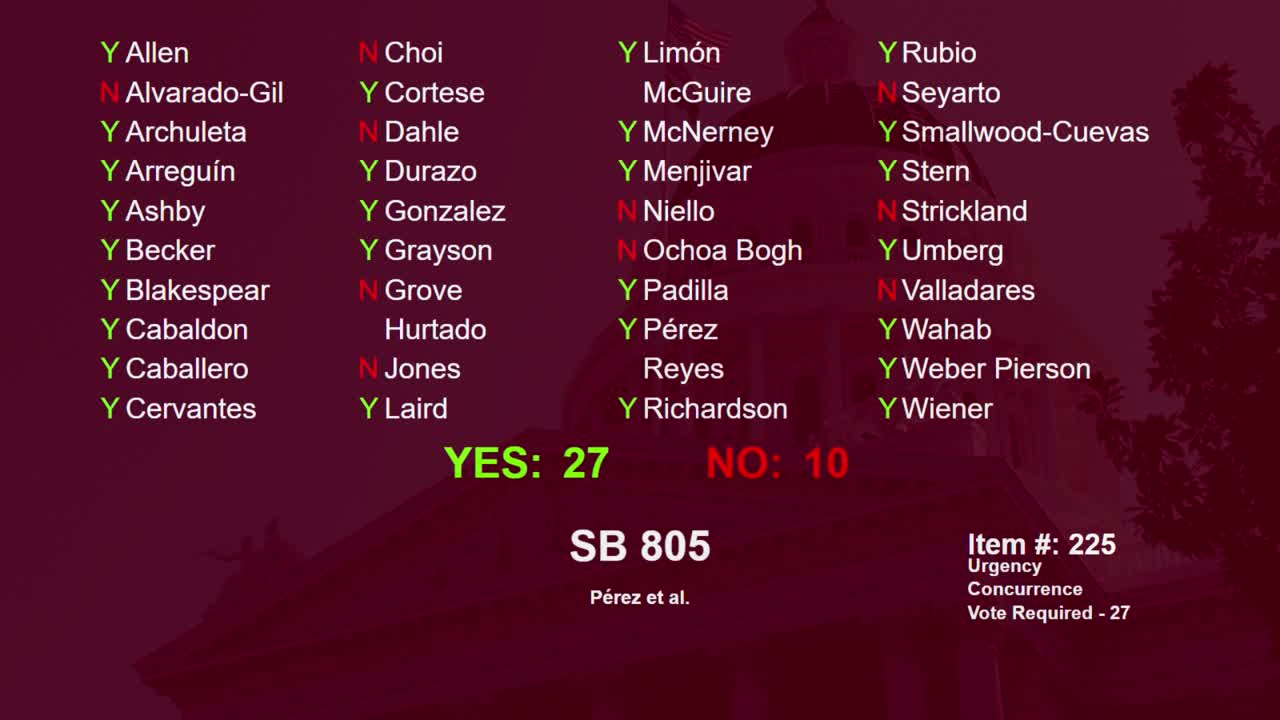 2MIN
Senate Floor
 25SEC
Senate Standing Committee on Appropriations
 6MIN
Senate Standing Committee on Judiciary
 5MIN
Senate Standing Committee on Public Safety
 1MIN
Assembly Floor
Bill Author

Bill Co-Author(s):