AB 46: Diversion.
- Session Year: 2025-2026
- House: Assembly
- Latest Version Date: 2026-06-29
Current Status:
Passed
(2026-06-29: Chaptered by Secretary of State - Chapter 18, Statutes of 2026.)
Introduced
In Committee
Awaiting First Chamber Vote
Passed First Chamber
In Committee
Awaiting Second Chamber Vote
Passed Second Chamber
Enacted
Existing law authorizes a court to grant pretrial diversion to a defendant suffering from a mental disorder, on an accusatory pleading alleging the commission of a misdemeanor or felony offense, in order to allow the defendant to undergo mental health treatment. Existing law provides that a defendant is eligible for diversion if they have been diagnosed with certain mental disorders and the court finds that the mental disorder was a significant factor in the commission of the charged offense, unless there is clear and convincing evidence that the disorder was not a motivating, causal, or contributing factor to the defendants involvement in the alleged offense. Existing law prohibits defendants charged with specified offenses, including murder, from being placed in this diversion program.
This bill would require that the diagnosis or rediagnosis with a mental disorder be within 5 years before the alleged offense.
Existing law makes a defendant suitable for this diversion program if, among other criteria, a qualified mental health expert opines that the defendants symptoms of the mental disorder that caused, contributed to, or motivated the criminal behavior, would respond to mental health treatment and the defendant will not pose an unreasonable risk of danger to public safety if treated in the community, as specified.
The bill would revise that standard and instead require the court to find that the defendant will not pose a substantial and undue risk to the physical safety of another person if treated in the community. The bill would require the mental health experts opinion to include that the proposed mental health diversion plan is clinically appropriate to address the symptoms of the defendants mental disorder, as specified. The bill would require the court to state the reasons for denial on the record.
Existing law authorizes a court to grant pretrial diversion to a defendant suffering from a mental disorder, on an accusatory pleading alleging the commission of a misdemeanor or felony offense, in order to allow the defendant to undergo mental health treatment. Existing law provides that a defendant is eligible for diversion if they have been diagnosed with certain mental disorders and the court finds that the mental disorder was a significant factor in the commission of the charged offense, unless there is clear and convincing evidence that the disorder was not a motivating, causal, or contributing factor to the defendants involvement in the alleged offense. Existing law prohibits defendants charged with specified offenses, including murder, from being placed in this diversion program.
This bill would, if the defendant has been diagnosed with a mental disorder within 5 years of the current offense, as specified, require the court to find that the defendants mental disorder was a significant factor in the commission of the offense, unless there is a preponderance of evidence that it was not a motivating, causal, or contributing factor to the defendants involvement in would require that the diagnosis with a mental disorder be within 5 years before the alleged offense.
Existing law makes a defendant eligible suitable for this diversion program if, among other criteria, a qualified mental health expert opines that the defendants symptoms of the mental disorder that caused, contributed to, or motivated the criminal behavior, would respond to mental health treatment and the defendant will not pose an unreasonable risk of danger to public safety if treated in the community, as specified.
The bill would specify that a court retains discretion to deny diversion, even if a defendant is otherwise suitable for diversion, upon a finding that it is more likely than not that the defendant will pose an unreasonable risk to the physical safety of another person. revise that standard and instead require the court to find that the defendant will not pose a substantial and undue risk to the physical safety of another person if treated in the community. The bill would require the mental health experts opinion to include that the proposed mental health diversion plan is clinically appropriate to address the symptoms of the defendants mental disorder, as specified. The bill would require the court to state the reasons for denial on the record.
Existing law authorizes a court to grant pretrial diversion to a defendant suffering from a mental disorder, on an accusatory pleading alleging the commission of a misdemeanor or felony offense, in order to allow the defendant to undergo mental health treatment. Existing law provides that a defendant is eligible for diversion if they have been diagnosed with certain mental disorders and the court finds that the mental disorder was a significant factor in the commission of the charged offense, unless there is clear and convincing evidence that the disorder was not a motivating, causal, or contributing factor to the defendants involvement in the alleged offense. Existing law prohibits defendants charged with specified offenses, including murder, from being placed in this diversion program.
This bill would, if the defendant has been diagnosed with a mental disorder within 5 years prior to of the current offense, as specified, require the court to find that the defendants mental disorder was a significant factor in the commission of the offense, unless there is clear and convincing a preponderance of evidence that it was not a motivating, causal, or contributing factor to the defendants involvement in the alleged offense.
Existing law makes a defendant eligible for this diversion program if, among other criteria, the defendant will not pose an unreasonable risk of danger to public safety if treated in the community, as specified.
The bill would instead require that the defendant not endanger public safety, as defined, if treated in the community.The bill would specify that a court retains discretion to deny diversion, even if a defendant is otherwise suitable for diversion, upon a finding that it is more likely than not that the defendant will pose an unreasonable risk to the physical safety of another person. The bill would require the court to state the reasons for denial on the record.
Existing law authorizes a court to grant pretrial diversion to a defendant suffering from a mental disorder, on an accusatory pleading alleging the commission of a misdemeanor or felony offense, in order to allow the defendant to undergo mental health treatment. Existing law provides that a defendant is eligible for diversion if they have been diagnosed with certain mental disorders and the court finds that the mental disorder was a significant factor in the commission of the charged offense, unless there is clear and convincing evidence that the disorder was not a motivating, causal, or contributing factor to the defendants involvement in the alleged offense. Existing law prohibits defendants charged with specified offenses, including murder, from being placed in this diversion program.
This bill would add attempted murder to the list of charged offenses that prohibit a defendant from being placed in this diversion program. The bill would disqualify a defendant from diversion if the defendant has been diagnosed, as specified, with a conduct disorder that causes or threatens physical harm to people and animals. The bill would delete the provision requiring the court to find a defendant, diagnosed with a mental disorder, eligible for diversion unless there is clear and convincing evidence that the disorder was not a motivating, causal, or contributing factor to the defendants involvement in the alleged offense.This bill would, if the defendant has been diagnosed with a mental disorder within 5 years prior to the current offense, as specified, require the court to find that the defendants mental disorder was a significant factor in the commission of the offense, unless there is clear and convincing evidence that it was not a motivating, causal, or contributing factor to the defendants involvement in the alleged offense.
Existing law makes a defendant eligible for this diversion program if, among other criteria, the defendant will not pose an unreasonable risk of danger to public safety if treated in the community, as specified.
The bill would instead require that the defendant not pose a risk of danger to public safety endanger public safety, as defined, if treated in the community.
Existing law authorizes a court to grant pretrial diversion to a defendant suffering from a mental disorder, on an accusatory pleading alleging the commission of a misdemeanor or felony offense, in order to allow the defendant to undergo mental health treatment. Existing law provides that a defendant is eligible for diversion if they have been diagnosed with certain mental disorders and the court finds that the mental disorder was a significant factor in the commission of the charged offense, unless there is clear and convincing evidence that the disorder was not a motivating, causal, or contributing factor to the defendants involvement in the alleged offense. Existing law prohibits defendants charged with specified offenses, including murder, from being placed in this diversion program.
This bill would state the intent of the Legislature to add attempted murder to the list of specified offenses that would prohibit a defendant from being placed in this diversion program.This bill would add attempted murder to the list of charged offenses that prohibit a defendant from being placed in this diversion program. The bill would disqualify a defendant from diversion if the defendant has been diagnosed, as specified, with a conduct disorder that causes or threatens physical harm to people and animals. The bill would delete the provision requiring the court to find a defendant, diagnosed with a mental disorder, eligible for diversion unless there is clear and convincing evidence that the disorder was not a motivating, causal, or contributing factor to the defendants involvement in the alleged offense.
Existing law makes a defendant eligible for this diversion program if, among other criteria, the defendant will not pose an unreasonable risk of danger to public safety if treated in the community, as specified.
The bill would instead require that the defendant not pose a risk of danger to public safety if treated in the community.
Existing law authorizes a court to grant pretrial diversion to a defendant suffering from a mental disorder, on an accusatory pleading alleging the commission of a misdemeanor or felony offense, in order to allow the defendant to undergo mental health treatment. Existing law prohibits defendants charged with specified offenses, including murder, from being placed in this diversion program.
This bill would state the intent of the Legislature to add attempted murder to the list of specified offenses that would prohibit a defendant from being placed in this diversion program.
(a)On an accusatory pleading alleging the commission of a misdemeanor or felony offense not set forth in subdivision (d), the court may, in its discretion, and after considering the positions of the defense and prosecution, grant pretrial diversion to a defendant pursuant to this section if the defendant satisfies the eligibility requirements for pretrial diversion set forth in subdivision (b) and the court determines that the defendant is suitable for that diversion under the factors set forth in subdivision (c). Diversion pursuant to this section is discretionary in all cases, when exercised consistent with subdivision (b) or (c).
(b)A defendant is eligible for pretrial diversion pursuant to this section if both of the following criteria are met:
(1)The defendant has been diagnosed with a mental disorder as identified in the most recent edition of the Diagnostic and Statistical Manual of Mental Disorders, including, but not limited to, bipolar disorder, schizophrenia, schizoaffective disorder, or post-traumatic stress disorder, but excluding antisocial personality disorder and pedophilia. Evidence of the defendants mental disorder shall be provided by the defense and shall include a diagnosis or treatment for a diagnosed mental disorder within the last five years by a qualified mental health expert. In opining that a defendant suffers from a qualifying disorder, the qualified mental health expert may rely on an examination of the defendant, the defendants medical records, arrest reports, or any other relevant evidence.
(2)The defendants mental disorder was a significant factor in the commission of the charged offense. If the defendant has been diagnosed or rediagnosed with a mental disorder within five years of the current offense, based on the evidence offered in paragraph (1), the court shall find that the defendants mental disorder was a significant factor in the commission of the offense unless there is clear and convincing evidence that it was not a motivating factor, causal factor, or contributing factor to the defendants involvement in the alleged offense. A court may consider any relevant and credible evidence, including, but not limited to, police reports, preliminary hearing transcripts, witness statements, statements by the defendants mental health treatment provider, medical records, records or reports by qualified medical experts, or evidence that the defendant displayed symptoms consistent with the relevant mental disorder at or near the time of the offense.
(c)(1)For any defendant who satisfies the eligibility requirements in subdivision (b), the court shall consider whether the defendant is suitable for pretrial diversion. A defendant is suitable for pretrial diversion if all of the following criteria are met:
(A)In the opinion of a qualified mental health expert, the proposed mental health diversion plan is clinically appropriate to address the symptoms of the defendants mental disorder that caused, contributed to, or motivated the charged offense.
(B)The defendant consents to diversion and waives the defendants right to a speedy trial, or a defendant has been found to be an appropriate candidate for diversion in lieu of commitment pursuant to clause (iii) of subparagraph (B) of, or clause (v) of subparagraph (C) of, paragraph (1) of subdivision (a) of Section 1370 or subparagraph (A) of paragraph (1) of subdivision (b) of Section 1370.01 and, as a result of the defendants mental incompetence, cannot consent to diversion or give a knowing and intelligent waiver of the defendants right to a speedy trial.
(C)The defendant agrees to comply with the proposed treatment as a condition of diversion, or the defendant has been found to be an appropriate candidate for diversion in lieu of commitment for restoration of competency treatment pursuant to clause (iii) of subparagraph (B) of, or clause (v) of subparagraph (C) of, paragraph (1) of subdivision (a) of Section 1370 or subparagraph (A) of paragraph (1) of subdivision (b) of Section 1370.01 and, as a result of the defendants mental incompetence, cannot agree to comply with treatment.
(D)The defendant will not pose a substantial and undue risk to the physical safety of another person, if treated in the community. The court may consider any factors that the court deems appropriate in making this determination, including, but not limited to, the opinions of the district attorney, the defense, or a qualified mental health expert, and may consider the defendants treatment plan, the defendants violence and criminal history, and the current charged offense. The court shall consider the victims rights under subdivision (b) of Section 28 of Article I of the California Constitution.
(2)If the court denies diversion under this section, the court shall orally state the reasons on the record.
(d)A defendant may not be placed into a diversion program, pursuant to this section, for the following current charged offenses:
(1)Murder or voluntary manslaughter.
(2)An offense for which a person, if convicted, would be required to register pursuant to Section 290, except for a violation of Section 314.
(3)Rape.
(4)Lewd or lascivious act on a child under 14 years of age.
(5)Assault with intent to commit rape, sodomy, or oral copulation, in violation of Section 220.
(6)Commission of rape or sexual penetration in concert with another person, in violation of Section 264.1.
(7)Continuous sexual abuse of a child, in violation of Section 288.5.
(8)A violation of subdivision (b) or (c) of Section 11418.
(e)At any stage of the proceedings, the court may require the defendant to make a prima facie showing that the defendant will meet the minimum requirements of eligibility for diversion and that the defendant and the offense are suitable for diversion. The hearing on the prima facie showing shall be informal and may proceed on offers of proof, reliable hearsay, and argument of counsel. If a prima facie showing is not made, the court may summarily deny the request for diversion or grant any other relief as may be deemed appropriate.
(f)As used in this chapter, the following terms have the following meanings:
(1)Pretrial diversion means the postponement of prosecution, either temporarily or permanently, at any point in the judicial process from the point at which the accused is charged until adjudication, to allow the defendant to undergo mental health treatment, subject to all of the following:
(A)(i)The court is satisfied that the recommended inpatient or outpatient program of mental health treatment will meet the specialized mental health treatment needs of the defendant and the treatment is consistent with the underlying purpose of mental health diversion, as described in Section 1001.35.
(ii)The defendant may be referred to a program of mental health treatment utilizing existing inpatient or outpatient mental health resources. Before approving a proposed treatment program, the court shall consider the request of the defense, the request of the prosecution, the needs of the defendant, and the interests of the community. The treatment may be procured using private or public funds, and a referral may be made to a county mental health agency, existing collaborative courts, or assisted outpatient treatment only if that entity has agreed to accept responsibility for the treatment of the defendant, and mental health services are provided only to the extent that resources are available and the defendant is eligible for those services.
(iii)If the court refers the defendant to a county mental health agency pursuant to this section and the agency determines that it is unable to provide services to the defendant, the court shall accept a written declaration to that effect from the agency in lieu of requiring live testimony. That declaration shall serve only to establish that the program is unable to provide services to the defendant at that time and does not constitute evidence that the defendant is unqualified or unsuitable for diversion under this section.
(B)The provider of the mental health treatment program in which the defendant has been placed shall provide regular reports to the court, the defense, and the prosecutor on the defendants progress in treatment.
(C)The period during which criminal proceedings against the defendant may be diverted is limited as follows:
(i)If the defendant is charged with a felony, the period shall be no longer than two years.
(ii)If the defendant is charged with a misdemeanor, the period shall be no longer than one year.
(D)Upon request, the court shall conduct a hearing to determine whether restitution, as defined in subdivision (f) of Section 1202.4, is owed to any victim as a result of the diverted offense and, if owed, order its payment during the period of diversion. However, a defendants inability to pay restitution due to indigence or mental disorder shall not be grounds for denial of diversion or a finding that the defendant has failed to comply with the terms of diversion.
(2)Qualified mental health expert includes, but is not limited to, a psychiatrist, psychologist, a person described in Section 5751.2 of the Welfare and Institutions Code, or a person whose knowledge, skill, experience, training, or education qualifies them as an expert.
(g)If any of the following circumstances exists, the court shall, after notice to the defendant, defense counsel, and the prosecution, hold a hearing to determine whether the criminal proceedings should be reinstated, whether the treatment should be modified, or whether the defendant should be conserved and referred to the conservatorship investigator of the county of commitment to initiate conservatorship proceedings for the defendant pursuant to Chapter 3 (commencing with Section 5350) of Part 1 of Division 5 of the Welfare and Institutions Code:
(1)The defendant is charged with an additional misdemeanor allegedly committed during the pretrial diversion and that reflects the defendants propensity for violence.
(2)The defendant is charged with an additional felony allegedly committed during the pretrial diversion.
(3)The defendant is engaged in criminal conduct rendering the defendant unsuitable for diversion.
(4)Based on the opinion of a qualified mental health expert whom the court may deem appropriate, either of the following circumstances exists:
(A)The defendant is performing unsatisfactorily in the assigned program.
(B)The defendant is gravely disabled, as defined in subparagraph (B) of paragraph (1) of subdivision (h) of Section 5008 of the Welfare and Institutions Code. A defendant shall only be conserved and referred to the conservatorship investigator pursuant to this finding.
(h)If the defendant has performed satisfactorily in diversion, at the end of the period of diversion, the court shall dismiss the defendants criminal charges that were the subject of the criminal proceedings at the time of the initial diversion. A court may conclude that the defendant has performed satisfactorily if the defendant has substantially complied with the requirements of diversion, has avoided significant new violations of law unrelated to the defendants mental health condition, and has a plan in place for long-term mental health care. If the court dismisses the charges, the clerk of the court shall file a record with the Department of Justice indicating the disposition of the case diverted pursuant to this section. Upon successful completion of diversion, if the court dismisses the charges, the arrest upon which the diversion was based shall be deemed never to have occurred, and the court shall order access to the record of the arrest restricted in accordance with Section 1001.9, except as specified in subdivisions (j) and (k). The defendant who successfully completes diversion may indicate in response to any question concerning the defendants prior criminal record that the defendant was not arrested or diverted for the offense, except as specified in subdivision (j).
(i)A record pertaining to an arrest resulting in successful completion of diversion, or any record generated as a result of the defendants application for or participation in diversion, shall not, without the defendants consent, be used in any way that could result in the denial of any employment, benefit, license, or certificate.
(j)The defendant shall be advised that, regardless of the defendants completion of diversion, both of the following apply:
(1)The arrest upon which the diversion was based may be disclosed by the Department of Justice to any peace officer application request and that, notwithstanding subdivision (i), this section does not relieve the defendant of the obligation to disclose the arrest in response to any direct question contained in any questionnaire or application for a position as a peace officer, as defined in Section 830.
(2)An order to seal records pertaining to an arrest made pursuant to this section has no effect on a criminal justice agencys ability to access and use those sealed records and information regarding sealed arrests, as described in Section 851.92.
(k)A finding that the defendant suffers from a mental disorder, any progress reports concerning the defendants treatment, including, but not limited to, any finding that the defendant be prohibited from owning or controlling a firearm because they are a danger to themselves or others pursuant to subdivision (m), or any other records related to a mental disorder that were created as a result of participation in, or completion of, diversion pursuant to this section or for use at a hearing on the defendants eligibility for diversion under this section may not be used in any other proceeding without the defendants consent, unless that information is relevant evidence that is admissible under the standards described in paragraph (2) of subdivision (f) of Section 28 of Article I of the California Constitution. However, when determining whether to exercise its discretion to grant diversion under this section, a court may consider previous records of participation in diversion under this section.
(l)The county agency administering the diversion, the defendants mental health treatment providers, the public guardian or conservator, and the court shall, to the extent not prohibited by federal law, have access to the defendants medical and psychological records, including progress reports, during the defendants time in diversion, as needed, for the purpose of providing care and treatment and monitoring treatment for diversion or conservatorship.
(m)(1)The prosecution may request an order from the court that the defendant be prohibited from owning or possessing a firearm until they successfully complete diversion because they are a danger to themselves or others pursuant to subdivision (i) of Section 8103 of the Welfare and Institutions Code.
(2)The prosecution shall bear the burden of proving, by clear and convincing evidence, both of the following are true:
(A)The defendant poses a significant danger of causing personal injury to themselves or another by having in their custody or control, owning, purchasing, possessing, or receiving a firearm.
(B)The prohibition is necessary to prevent personal injury to the defendant or any other person because less restrictive alternatives either have been tried and found to be ineffective or are inadequate or inappropriate for the circumstances of the defendant.
(3)(A)If the court finds that the prosecution has not met that burden, the court shall not order that the person is prohibited from having, owning, purchasing, possessing, or receiving a firearm.
(B)If the court finds that the prosecution has met the burden, the court shall order that the person is prohibited, and shall inform the person that they are prohibited, from owning or controlling a firearm until they successfully complete diversion because they are a danger to themselves or others.
(4)An order imposed pursuant to this subdivision shall be in effect until the defendant has successfully completed diversion or until their firearm rights are restored pursuant to paragraph (4) of subdivision (g) of Section 8103 of the Welfare and Institutions Code.
(a)On an accusatory pleading alleging the commission of a misdemeanor or felony offense not set forth in subdivision (d), the court may, in its discretion, and after considering the positions of the defense and prosecution, grant pretrial diversion to a defendant pursuant to this section if the defendant satisfies the eligibility requirements for pretrial diversion set forth in subdivision (b) and the court determines that the defendant is suitable for that diversion under the factors set forth in subdivision (c). Diversion pursuant to this section is discretionary in all cases. cases, when exercised consistent with subdivision (b) or (c).
(b)A defendant is eligible for pretrial diversion pursuant to this section if both of the following criteria are met:
(1)The defendant has been diagnosed with a mental disorder as identified in the most recent edition of the Diagnostic and Statistical Manual of Mental Disorders, including, but not limited to, bipolar disorder, schizophrenia, schizoaffective disorder, or post-traumatic stress disorder, but excluding antisocial personality disorder and pedophilia. Evidence of the defendants mental disorder shall be provided by the defense and shall include a diagnosis or treatment for a diagnosed mental disorder within the last five years by a qualified mental health expert. In opining that a defendant suffers from a qualifying disorder, the qualified mental health expert may rely on an examination of the defendant, the defendants medical records, arrest reports, or any other relevant evidence.
(2)The defendants mental disorder was a significant factor in the commission of the charged offense. If the defendant has been diagnosed with a mental disorder within five years of the current offense, based on the evidence offered in paragraph (1), the court shall find that the defendants mental disorder was a significant factor in the commission of the offense unless there is a preponderance of clear and convincing evidence that it was not a motivating factor, causal factor, or contributing factor to the defendants involvement in the alleged offense. A court may consider any relevant and credible evidence, including, but not limited to, police reports, preliminary hearing transcripts, witness statements, statements by the defendants mental health treatment provider, medical records, records or reports by qualified medical experts, or evidence that the defendant displayed symptoms consistent with the relevant mental disorder at or near the time of the offense.
(c)(1)For any defendant who satisfies the eligibility requirements in subdivision (b), the court shall consider whether the defendant is suitable for pretrial diversion. A defendant is suitable for pretrial diversion if all of the following criteria are met:
(A)In the opinion of a qualified mental health expert, the defendants symptoms of the mental disorder causing, contributing to, or motivating the criminal behavior would respond to mental health treatment. proposed mental health diversion plan is clinically appropriate to address the symptoms of the defendants mental disorder that caused, contributed to, or motivated the charged offense.
(B)The defendant consents to diversion and waives the defendants right to a speedy trial, or a defendant has been found to be an appropriate candidate for diversion in lieu of commitment pursuant to clause (iii) of subparagraph (B) of, or clause (v) of subparagraph (C) of, paragraph (1) of subdivision (a) of Section 1370 or subparagraph (A) of paragraph (1) of subdivision (b) of Section 1370.01 and, as a result of the defendants mental incompetence, cannot consent to diversion or give a knowing and intelligent waiver of the defendants right to a speedy trial.
(C)The defendant agrees to comply with the proposed treatment as a condition of diversion, or the defendant has been found to be an appropriate candidate for diversion in lieu of commitment for restoration of competency treatment pursuant to clause (iii) of subparagraph (B) of, or clause (v) of subparagraph (C) of, paragraph (1) of subdivision (a) of Section 1370 or subparagraph (A) of paragraph (1) of subdivision (b) of Section 1370.01 and, as a result of the defendants mental incompetence, cannot agree to comply with treatment.
(D)The defendant will not pose an unreasonable risk of danger to public safety, as defined in Section 1170.18, a substantial and undue risk to the physical safety of another person, if treated in the community. The court may consider any factors that the court deems appropriate in making this determination, including, but not limited to, the opinions of the district attorney, the defense, or a qualified mental health expert, and may consider the defendants treatment plan, the defendants violence and criminal history, and the current charged offense. The court shall consider the victims rights under subdivision (b) or of Section 28 of Article I of the California Constitution.
(2)Even if a defendant is otherwise suitable for diversion, a court retains discretion to deny diversion upon a finding that it is more likely than not that the defendant, if treated in the community, will pose an unreasonable risk to the physical safety of another person.(3)(2)If the court denies diversion under this section, the court shall orally state the reasons on the record.
(d)A defendant may not be placed into a diversion program, pursuant to this section, for the following current charged offenses:
(1)Murder or voluntary manslaughter.
(2)An offense for which a person, if convicted, would be required to register pursuant to Section 290, except for a violation of Section 314.
(3)Rape.
(4)Lewd or lascivious act on a child under 14 years of age.
(5)Assault with intent to commit rape, sodomy, or oral copulation, in violation of Section 220.
(6)Commission of rape or sexual penetration in concert with another person, in violation of Section 264.1.
(7)Continuous sexual abuse of a child, in violation of Section 288.5.
(8)A violation of subdivision (b) or (c) of Section 11418.
(e)At any stage of the proceedings, the court may require the defendant to make a prima facie showing that the defendant will meet the minimum requirements of eligibility for diversion and that the defendant and the offense are suitable for diversion. The hearing on the prima facie showing shall be informal and may proceed on offers of proof, reliable hearsay, and argument of counsel. If a prima facie showing is not made, the court may summarily deny the request for diversion or grant any other relief as may be deemed appropriate.
(f)As used in this chapter, the following terms have the following meanings:
(1)Pretrial diversion means the postponement of prosecution, either temporarily or permanently, at any point in the judicial process from the point at which the accused is charged until adjudication, to allow the defendant to undergo mental health treatment, subject to all of the following:
(A)(i)The court is satisfied that the recommended inpatient or outpatient program of mental health treatment will meet the specialized mental health treatment needs of the defendant. defendant and the treatment is consistent with the underlying purpose of mental health diversion, as described in Section 1001.35.
(ii)The defendant may be referred to a program of mental health treatment utilizing existing inpatient or outpatient mental health resources. Before approving a proposed treatment program, the court shall consider the request of the defense, the request of the prosecution, the needs of the defendant, and the interests of the community. The treatment may be procured using private or public funds, and a referral may be made to a county mental health agency, existing collaborative courts, or assisted outpatient treatment only if that entity has agreed to accept responsibility for the treatment of the defendant, and mental health services are provided only to the extent that resources are available and the defendant is eligible for those services.
(iii)If the court refers the defendant to a county mental health agency pursuant to this section and the agency determines that it is unable to provide services to the defendant, the court shall accept a written declaration to that effect from the agency in lieu of requiring live testimony. That declaration shall serve only to establish that the program is unable to provide services to the defendant at that time and does not constitute evidence that the defendant is unqualified or unsuitable for diversion under this section.
(B)The provider of the mental health treatment program in which the defendant has been placed shall provide regular reports to the court, the defense, and the prosecutor on the defendants progress in treatment.
(C)The period during which criminal proceedings against the defendant may be diverted is limited as follows:
(i)If the defendant is charged with a felony, the period shall be no longer than two years.
(ii)If the defendant is charged with a misdemeanor, the period shall be no longer than one year.
(D)Upon request, the court shall conduct a hearing to determine whether restitution, as defined in subdivision (f) of Section 1202.4, is owed to any victim as a result of the diverted offense and, if owed, order its payment during the period of diversion. However, a defendants inability to pay restitution due to indigence or mental disorder shall not be grounds for denial of diversion or a finding that the defendant has failed to comply with the terms of diversion.
(2)Qualified mental health expert includes, but is not limited to, a psychiatrist, psychologist, a person described in Section 5751.2 of the Welfare and Institutions Code, or a person whose knowledge, skill, experience, training, or education qualifies them as an expert.
(g)If any of the following circumstances exists, the court shall, after notice to the defendant, defense counsel, and the prosecution, hold a hearing to determine whether the criminal proceedings should be reinstated, whether the treatment should be modified, or whether the defendant should be conserved and referred to the conservatorship investigator of the county of commitment to initiate conservatorship proceedings for the defendant pursuant to Chapter 3 (commencing with Section 5350) of Part 1 of Division 5 of the Welfare and Institutions Code:
(1)The defendant is charged with an additional misdemeanor allegedly committed during the pretrial diversion and that reflects the defendants propensity for violence.
(2)The defendant is charged with an additional felony allegedly committed during the pretrial diversion.
(3)The defendant is engaged in criminal conduct rendering the defendant unsuitable for diversion.
(4)Based on the opinion of a qualified mental health expert whom the court may deem appropriate, either of the following circumstances exists:
(A)The defendant is performing unsatisfactorily in the assigned program.
(B)The defendant is gravely disabled, as defined in subparagraph (B) of paragraph (1) of subdivision (h) of Section 5008 of the Welfare and Institutions Code. A defendant shall only be conserved and referred to the conservatorship investigator pursuant to this finding.
(h)If the defendant has performed satisfactorily in diversion, at the end of the period of diversion, the court shall dismiss the defendants criminal charges that were the subject of the criminal proceedings at the time of the initial diversion. A court may conclude that the defendant has performed satisfactorily if the defendant has substantially complied with the requirements of diversion, has avoided significant new violations of law unrelated to the defendants mental health condition, and has a plan in place for long-term mental health care. If the court dismisses the charges, the clerk of the court shall file a record with the Department of Justice indicating the disposition of the case diverted pursuant to this section. Upon successful completion of diversion, if the court dismisses the charges, the arrest upon which the diversion was based shall be deemed never to have occurred, and the court shall order access to the record of the arrest restricted in accordance with Section 1001.9, except as specified in subdivisions (j) and (k). The defendant who successfully completes diversion may indicate in response to any question concerning the defendants prior criminal record that the defendant was not arrested or diverted for the offense, except as specified in subdivision (j).
(i)A record pertaining to an arrest resulting in successful completion of diversion, or any record generated as a result of the defendants application for or participation in diversion, shall not, without the defendants consent, be used in any way that could result in the denial of any employment, benefit, license, or certificate.
(j)The defendant shall be advised that, regardless of the defendants completion of diversion, both of the following apply:
(1)The arrest upon which the diversion was based may be disclosed by the Department of Justice to any peace officer application request and that, notwithstanding subdivision (i), this section does not relieve the defendant of the obligation to disclose the arrest in response to any direct question contained in any questionnaire or application for a position as a peace officer, as defined in Section 830.
(2)An order to seal records pertaining to an arrest made pursuant to this section has no effect on a criminal justice agencys ability to access and use those sealed records and information regarding sealed arrests, as described in Section 851.92.
(k)A finding that the defendant suffers from a mental disorder, any progress reports concerning the defendants treatment, including, but not limited to, any finding that the defendant be prohibited from owning or controlling a firearm because they are a danger to themselves or others pursuant to subdivision (m), or any other records related to a mental disorder that were created as a result of participation in, or completion of, diversion pursuant to this section or for use at a hearing on the defendants eligibility for diversion under this section may not be used in any other proceeding without the defendants consent, unless that information is relevant evidence that is admissible under the standards described in paragraph (2) of subdivision (f) of Section 28 of Article I of the California Constitution. However, when determining whether to exercise its discretion to grant diversion under this section, a court may consider previous records of participation in diversion under this section.
(l)The county agency administering the diversion, the defendants mental health treatment providers, the public guardian or conservator, and the court shall, to the extent not prohibited by federal law, have access to the defendants medical and psychological records, including progress reports, during the defendants time in diversion, as needed, for the purpose of providing care and treatment and monitoring treatment for diversion or conservatorship.
(m)(1)The prosecution may request an order from the court that the defendant be prohibited from owning or possessing a firearm until they successfully complete diversion because they are a danger to themselves or others pursuant to subdivision (i) of Section 8103 of the Welfare and Institutions Code.
(2)The prosecution shall bear the burden of proving, by clear and convincing evidence, both of the following are true:
(A)The defendant poses a significant danger of causing personal injury to themselves or another by having in their custody or control, owning, purchasing, possessing, or receiving a firearm.
(B)The prohibition is necessary to prevent personal injury to the defendant or any other person because less restrictive alternatives either have been tried and found to be ineffective or are inadequate or inappropriate for the circumstances of the defendant.
(3)(A)If the court finds that the prosecution has not met that burden, the court shall not order that the person is prohibited from having, owning, purchasing, possessing, or receiving a firearm.
(B)If the court finds that the prosecution has met the burden, the court shall order that the person is prohibited, and shall inform the person that they are prohibited, from owning or controlling a firearm until they successfully complete diversion because they are a danger to themselves or others.
(4)An order imposed pursuant to this subdivision shall be in effect until the defendant has successfully completed diversion or until their firearm rights are restored pursuant to paragraph (4) of subdivision (g) of Section 8103 of the Welfare and Institutions Code.
(a)On an accusatory pleading alleging the commission of a misdemeanor or felony offense not set forth in subdivision (d), the court may, in its discretion, and after considering the positions of the defense and prosecution, grant pretrial diversion to a defendant pursuant to this section if the defendant satisfies the eligibility requirements for pretrial diversion set forth in subdivision (b) and the court determines that the defendant is suitable for that diversion under the factors set forth in subdivision (c). Diversion pursuant to this section is discretionary in all cases.
(b)A defendant is eligible for pretrial diversion pursuant to this section if both of the following criteria are met:
(1)The defendant has been diagnosed with a mental disorder as identified in the most recent edition of the Diagnostic and Statistical Manual of Mental Disorders, including, but not limited to, bipolar disorder, schizophrenia, schizoaffective disorder, or post-traumatic stress disorder, but excluding antisocial personality disorder and pedophilia. Evidence of the defendants mental disorder shall be provided by the defense and shall include a diagnosis or treatment for a diagnosed mental disorder within the last five years by a qualified mental health expert. In opining that a defendant suffers from a qualifying disorder, the qualified mental health expert may rely on an examination of the defendant, the defendants medical records, arrest reports, or any other relevant evidence.
(2)The defendants mental disorder was a significant factor in the commission of the charged offense. If the defendant has been diagnosed with a mental disorder within five years prior to of the current offense, based on the evidence offered in paragraph (1), the court shall find that the defendants mental disorder was a significant factor in the commission of the offense unless there is clear and convincing a preponderance of evidence that it was not a motivating factor, causal factor, or contributing factor to the defendants involvement in the alleged offense. A court may consider any relevant and credible evidence, including, but not limited to, police reports, preliminary hearing transcripts, witness statements, statements by the defendants mental health treatment provider, medical records, records or reports by qualified medical experts, or evidence that the defendant displayed symptoms consistent with the relevant mental disorder at or near the time of the offense.
(c)(1)For any defendant who satisfies the eligibility requirements in subdivision (b), the court shall consider whether the defendant is suitable for pretrial diversion. A defendant is suitable for pretrial diversion if all of the following criteria are met:
(1)(A)In the opinion of a qualified mental health expert, the defendants symptoms of the mental disorder causing, contributing to, or motivating the criminal behavior would respond to mental health treatment.
(2)(B)The defendant consents to diversion and waives the defendants right to a speedy trial, or a defendant has been found to be an appropriate candidate for diversion in lieu of commitment pursuant to clause (iii) of subparagraph (B) of, or clause (v) of subparagraph (C) of, paragraph (1) of subdivision (a) of Section 1370 or subparagraph (A) of paragraph (1) of subdivision (b) of Section 1370.01 and, as a result of the defendants mental incompetence, cannot consent to diversion or give a knowing and intelligent waiver of the defendants right to a speedy trial.
(3)(C)The defendant agrees to comply with treatment as a condition of diversion, or the defendant has been found to be an appropriate candidate for diversion in lieu of commitment for restoration of competency treatment pursuant to clause (iii) of subparagraph (B) of, or clause (v) of subparagraph (C) of, paragraph (1) of subdivision (a) of Section 1370 or subparagraph (A) of paragraph (1) of subdivision (b) of Section 1370.01 and, as a result of the defendants mental incompetence, cannot agree to comply with treatment.
(4)(D)The defendant will not endanger public safety if treated in the community. Endanger public safety for purposes of this section means that the persons treatment in the community would likely result in physical injury or other serious danger to others. pose an unreasonable risk of danger to public safety, as defined in Section 1170.18, if treated in the community. The court may consider any factors that the court deems appropriate in making this determination, including, but not limited to, the opinions of the district attorney, the defense, or a qualified mental health expert, and may consider the defendants treatment plan, the defendants violence and criminal history, and the current charged offense. The court shall consider the victims rights under subdivision (b) or Section 28 of Article I of the California Constitution.
(2)Even if a defendant is otherwise suitable for diversion, a court retains discretion to deny diversion upon a finding that it is more likely than not that the defendant, if treated in the community, will pose an unreasonable risk to the physical safety of another person.
(3)If the court denies diversion under this section, the court shall orally state the reasons on the record.
(d)A defendant may not be placed into a diversion program, pursuant to this section, for the following current charged offenses:
(1)Murder or voluntary manslaughter.
(2)An offense for which a person, if convicted, would be required to register pursuant to Section 290, except for a violation of Section 314.
(3)Rape.
(4)Lewd or lascivious act on a child under 14 years of age.
(5)Assault with intent to commit rape, sodomy, or oral copulation, in violation of Section 220.
(6)Commission of rape or sexual penetration in concert with another person, in violation of Section 264.1.
(7)Continuous sexual abuse of a child, in violation of Section 288.5.
(8)A violation of subdivision (b) or (c) of Section 11418.
(e)At any stage of the proceedings, the court may require the defendant to make a prima facie showing that the defendant will meet the minimum requirements of eligibility for diversion and that the defendant and the offense are suitable for diversion. The hearing on the prima facie showing shall be informal and may proceed on offers of proof, reliable hearsay, and argument of counsel. If a prima facie showing is not made, the court may summarily deny the request for diversion or grant any other relief as may be deemed appropriate.
(f)As used in this chapter, the following terms have the following meanings:
(1)Pretrial diversion means the postponement of prosecution, either temporarily or permanently, at any point in the judicial process from the point at which the accused is charged until adjudication, to allow the defendant to undergo mental health treatment, subject to all of the following:
(A)(i)The court is satisfied that the recommended inpatient or outpatient program of mental health treatment will meet the specialized mental health treatment needs of the defendant.
(ii)The defendant may be referred to a program of mental health treatment utilizing existing inpatient or outpatient mental health resources. Before approving a proposed treatment program, the court shall consider the request of the defense, the request of the prosecution, the needs of the defendant, and the interests of the community. The treatment may be procured using private or public funds, and a referral may be made to a county mental health agency, existing collaborative courts, or assisted outpatient treatment only if that entity has agreed to accept responsibility for the treatment of the defendant, and mental health services are provided only to the extent that resources are available and the defendant is eligible for those services.
(iii)If the court refers the defendant to a county mental health agency pursuant to this section and the agency determines that it is unable to provide services to the defendant, the court shall accept a written declaration to that effect from the agency in lieu of requiring live testimony. That declaration shall serve only to establish that the program is unable to provide services to the defendant at that time and does not constitute evidence that the defendant is unqualified or unsuitable for diversion under this section.
(B)The provider of the mental health treatment program in which the defendant has been placed shall provide regular reports to the court, the defense, and the prosecutor on the defendants progress in treatment.
(C)The period during which criminal proceedings against the defendant may be diverted is limited as follows:
(i)If the defendant is charged with a felony, the period shall be no longer than two years.
(ii)If the defendant is charged with a misdemeanor, the period shall be no longer than one year.
(D)Upon request, the court shall conduct a hearing to determine whether restitution, as defined in subdivision (f) of Section 1202.4, is owed to any victim as a result of the diverted offense and, if owed, order its payment during the period of diversion. However, a defendants inability to pay restitution due to indigence or mental disorder shall not be grounds for denial of diversion or a finding that the defendant has failed to comply with the terms of diversion.
(2)Qualified mental health expert includes, but is not limited to, a psychiatrist, psychologist, a person described in Section 5751.2 of the Welfare and Institutions Code, or a person whose knowledge, skill, experience, training, or education qualifies them as an expert.
(g)If any of the following circumstances exists, the court shall, after notice to the defendant, defense counsel, and the prosecution, hold a hearing to determine whether the criminal proceedings should be reinstated, whether the treatment should be modified, or whether the defendant should be conserved and referred to the conservatorship investigator of the county of commitment to initiate conservatorship proceedings for the defendant pursuant to Chapter 3 (commencing with Section 5350) of Part 1 of Division 5 of the Welfare and Institutions Code:
(1)The defendant is charged with an additional misdemeanor allegedly committed during the pretrial diversion and that reflects the defendants propensity for violence.
(2)The defendant is charged with an additional felony allegedly committed during the pretrial diversion.
(3)The defendant is engaged in criminal conduct rendering the defendant unsuitable for diversion.
(4)Based on the opinion of a qualified mental health expert whom the court may deem appropriate, either of the following circumstances exists:
(A)The defendant is performing unsatisfactorily in the assigned program.
(B)The defendant is gravely disabled, as defined in subparagraph (B) of paragraph (1) of subdivision (h) of Section 5008 of the Welfare and Institutions Code. A defendant shall only be conserved and referred to the conservatorship investigator pursuant to this finding.
(h)If the defendant has performed satisfactorily in diversion, at the end of the period of diversion, the court shall dismiss the defendants criminal charges that were the subject of the criminal proceedings at the time of the initial diversion. A court may conclude that the defendant has performed satisfactorily if the defendant has substantially complied with the requirements of diversion, has avoided significant new violations of law unrelated to the defendants mental health condition, and has a plan in place for long-term mental health care. If the court dismisses the charges, the clerk of the court shall file a record with the Department of Justice indicating the disposition of the case diverted pursuant to this section. Upon successful completion of diversion, if the court dismisses the charges, the arrest upon which the diversion was based shall be deemed never to have occurred, and the court shall order access to the record of the arrest restricted in accordance with Section 1001.9, except as specified in subdivisions (j) and (k). The defendant who successfully completes diversion may indicate in response to any question concerning the defendants prior criminal record that the defendant was not arrested or diverted for the offense, except as specified in subdivision (j).
(i)A record pertaining to an arrest resulting in successful completion of diversion, or any record generated as a result of the defendants application for or participation in diversion, shall not, without the defendants consent, be used in any way that could result in the denial of any employment, benefit, license, or certificate.
(j)The defendant shall be advised that, regardless of the defendants completion of diversion, both of the following apply:
(1)The arrest upon which the diversion was based may be disclosed by the Department of Justice to any peace officer application request and that, notwithstanding subdivision (i), this section does not relieve the defendant of the obligation to disclose the arrest in response to any direct question contained in any questionnaire or application for a position as a peace officer, as defined in Section 830.
(2)An order to seal records pertaining to an arrest made pursuant to this section has no effect on a criminal justice agencys ability to access and use those sealed records and information regarding sealed arrests, as described in Section 851.92.
(k)A finding that the defendant suffers from a mental disorder, any progress reports concerning the defendants treatment, including, but not limited to, any finding that the defendant be prohibited from owning or controlling a firearm because they are a danger to themselves or others pursuant to subdivision (m), or any other records related to a mental disorder that were created as a result of participation in, or completion of, diversion pursuant to this section or for use at a hearing on the defendants eligibility for diversion under this section may not be used in any other proceeding without the defendants consent, unless that information is relevant evidence that is admissible under the standards described in paragraph (2) of subdivision (f) of Section 28 of Article I of the California Constitution. However, when determining whether to exercise its discretion to grant diversion under this section, a court may consider previous records of participation in diversion under this section.
(l)The county agency administering the diversion, the defendants mental health treatment providers, the public guardian or conservator, and the court shall, to the extent not prohibited by federal law, have access to the defendants medical and psychological records, including progress reports, during the defendants time in diversion, as needed, for the purpose of providing care and treatment and monitoring treatment for diversion or conservatorship.
(m)(1)The prosecution may request an order from the court that the defendant be prohibited from owning or possessing a firearm until they successfully complete diversion because they are a danger to themselves or others pursuant to subdivision (i) of Section 8103 of the Welfare and Institutions Code.
(2)The prosecution shall bear the burden of proving, by clear and convincing evidence, both of the following are true:
(A)The defendant poses a significant danger of causing personal injury to themselves or another by having in their custody or control, owning, purchasing, possessing, or receiving a firearm.
(B)The prohibition is necessary to prevent personal injury to the defendant or any other person because less restrictive alternatives either have been tried and found to be ineffective or are inadequate or inappropriate for the circumstances of the defendant.
(3)(A)If the court finds that the prosecution has not met that burden, the court shall not order that the person is prohibited from having, owning, purchasing, possessing, or receiving a firearm.
(B)If the court finds that the prosecution has met the burden, the court shall order that the person is prohibited, and shall inform the person that they are prohibited, from owning or controlling a firearm until they successfully complete diversion because they are a danger to themselves or others.
(4)An order imposed pursuant to this subdivision shall be in effect until the defendant has successfully completed diversion or until their firearm rights are restored pursuant to paragraph (4) of subdivision (g) of Section 8103 of the Welfare and Institutions Code.
(a)On an accusatory pleading alleging the commission of a misdemeanor or felony offense not set forth in subdivision (d), the court may, in its discretion, and after considering the positions of the defense and prosecution, grant pretrial diversion to a defendant pursuant to this section if the defendant satisfies the eligibility requirements for pretrial diversion set forth in subdivision (b) and the court determines that the defendant is suitable for that diversion under the factors set forth in subdivision (c). Diversion pursuant to this section is discretionary in all cases.
(b)A defendant is eligible for pretrial diversion pursuant to this section if both of the following criteria are met:
(1)The defendant has been diagnosed with a mental disorder as identified in the most recent edition of the Diagnostic and Statistical Manual of Mental Disorders, including, but not limited to, bipolar disorder, schizophrenia, schizoaffective disorder, or post-traumatic stress disorder, but excluding antisocial personality disorder, conduct disorder that causes or threatens physical harm to people or animals, disorder and pedophilia. Evidence of the defendants mental disorder shall be provided by the defense and shall include a diagnosis or treatment for a diagnosed mental disorder within the last five years by a qualified mental health expert. In opining that a defendant suffers from a qualifying disorder, the qualified mental health expert may rely on an examination of the defendant, the defendants medical records, arrest reports, or any other relevant evidence.
(2)The defendants mental disorder was a significant factor in the commission of the charged offense. If the defendant has been diagnosed with a mental disorder within five years prior to the current offense, based on the evidence offered in paragraph (1), the court shall find that the defendants mental disorder was a significant factor in the commission of the offense unless there is clear and convincing evidence that it was not a motivating factor, causal factor, or contributing factor to the defendants involvement in the alleged offense. A court may consider any relevant and credible evidence, including, but not limited to, police reports, preliminary hearing transcripts, witness statements, statements by the defendants mental health treatment provider, medical records, records or reports by qualified medical experts, or evidence that the defendant displayed symptoms consistent with the relevant mental disorder at or near the time of the offense.
(c)For any defendant who satisfies the eligibility requirements in subdivision (b), the court shall consider whether the defendant is suitable for pretrial diversion. A defendant is suitable for pretrial diversion if all of the following criteria are met:
(1)In the opinion of a qualified mental health expert, the defendants symptoms of the mental disorder causing, contributing to, or motivating the criminal behavior would respond to mental health treatment.
(2)The defendant consents to diversion and waives the defendants right to a speedy trial, or a defendant has been found to be an appropriate candidate for diversion in lieu of commitment pursuant to clause (iii) of subparagraph (B) of, or clause (v) of subparagraph (C) of, paragraph (1) of subdivision (a) of Section 1370 or subparagraph (A) of paragraph (1) of subdivision (b) of Section 1370.01 and, as a result of the defendants mental incompetence, cannot consent to diversion or give a knowing and intelligent waiver of the defendants right to a speedy trial.
(3)The defendant agrees to comply with treatment as a condition of diversion, or the defendant has been found to be an appropriate candidate for diversion in lieu of commitment for restoration of competency treatment pursuant to clause (iii) of subparagraph (B) of, or clause (v) of subparagraph (C) of, paragraph (1) of subdivision (a) of Section 1370 or subparagraph (A) of paragraph (1) of subdivision (b) of Section 1370.01 and, as a result of the defendants mental incompetence, cannot agree to comply with treatment.
(4)The defendant will not pose a risk of danger to public safety if treated in the community. The court may consider the opinions of the district attorney, the defense, or a qualified mental health expert, and may consider the defendants treatment plan, the defendants prior history in a pretrial diversion program, the defendants prior response to rehabilitation or counseling programs in the community, the degree of danger posed to the community as evidenced by the defendants prior violence and criminal history, the current charged offense, the severity of injuries to victims, records of the defendants conduct while in custody in any state or county facility while medication compliant, and any other factors that the court deems appropriate. not endanger public safety if treated in the community. Endanger public safety for purposes of this section means that the persons treatment in the community would likely result in physical injury or other serious danger to others. The court may consider any factors that the court deems appropriate in making this determination, including, but not limited to, the opinions of the district attorney, the defense, or a qualified mental health expert, and may consider the defendants treatment plan, the defendants violence and criminal history, and the current charged offense. The court shall consider the victims rights under subdivision (b) or Section 28 of Article I of the California Constitution.
(d)A defendant may not be placed into a diversion program, pursuant to this section, for the following current charged offenses:
(1)Murder, attempted murder, or Murder or voluntary manslaughter.
(2)An offense for which a person, if convicted, would be required to register pursuant to Section 290, except for a violation of Section 314.
(3)Rape.
(4)Lewd or lascivious act on a child under 14 years of age.
(5)Assault with intent to commit rape, sodomy, or oral copulation, in violation of Section 220.
(6)Commission of rape or sexual penetration in concert with another person, in violation of Section 264.1.
(7)Continuous sexual abuse of a child, in violation of Section 288.5.
(8)A violation of subdivision (b) or (c) of Section 11418.
(e)At any stage of the proceedings, the court may require the defendant to make a prima facie showing that the defendant will meet the minimum requirements of eligibility for diversion and that the defendant and the offense are suitable for diversion. The hearing on the prima facie showing shall be informal and may proceed on offers of proof, reliable hearsay, and argument of counsel. If a prima facie showing is not made, the court may summarily deny the request for diversion or grant any other relief as may be deemed appropriate.
(f)As used in this chapter, the following terms have the following meanings:
(1)Pretrial diversion means the postponement of prosecution, either temporarily or permanently, at any point in the judicial process from the point at which the accused is charged until adjudication, to allow the defendant to undergo mental health treatment, subject to all of the following:
(A)(i)The court is satisfied that the recommended inpatient or outpatient program of mental health treatment will meet the specialized mental health treatment needs of the defendant.
(ii)The defendant may be referred to a program of mental health treatment utilizing existing inpatient or outpatient mental health resources. Before approving a proposed treatment program, the court shall consider the request of the defense, the request of the prosecution, the needs of the defendant, and the interests of the community. The treatment may be procured using private or public funds, and a referral may be made to a county mental health agency, existing collaborative courts, or assisted outpatient treatment only if that entity has agreed to accept responsibility for the treatment of the defendant, and mental health services are provided only to the extent that resources are available and the defendant is eligible for those services.
(iii)If the court refers the defendant to a county mental health agency pursuant to this section and the agency determines that it is unable to provide services to the defendant, the court shall accept a written declaration to that effect from the agency in lieu of requiring live testimony. That declaration shall serve only to establish that the program is unable to provide services to the defendant at that time and does not constitute evidence that the defendant is unqualified or unsuitable for diversion under this section.
(B)The provider of the mental health treatment program in which the defendant has been placed shall provide regular reports to the court, the defense, and the prosecutor on the defendants progress in treatment.
(C)The period during which criminal proceedings against the defendant may be diverted is limited as follows:
(i)If the defendant is charged with a felony, the period shall be no longer than two years.
(ii)If the defendant is charged with a misdemeanor, the period shall be no longer than one year.
(D)Upon request, the court shall conduct a hearing to determine whether restitution, as defined in subdivision (f) of Section 1202.4, is owed to any victim as a result of the diverted offense and, if owed, order its payment during the period of diversion. However, a defendants inability to pay restitution due to indigence or mental disorder shall not be grounds for denial of diversion or a finding that the defendant has failed to comply with the terms of diversion.
(2)Qualified mental health expert includes, but is not limited to, a psychiatrist, psychologist, a person described in Section 5751.2 of the Welfare and Institutions Code, or a person whose knowledge, skill, experience, training, or education qualifies them as an expert.
(g)If any of the following circumstances exists, the court shall, after notice to the defendant, defense counsel, and the prosecution, hold a hearing to determine whether the criminal proceedings should be reinstated, whether the treatment should be modified, or whether the defendant should be conserved and referred to the conservatorship investigator of the county of commitment to initiate conservatorship proceedings for the defendant pursuant to Chapter 3 (commencing with Section 5350) of Part 1 of Division 5 of the Welfare and Institutions Code:
(1)The defendant is charged with an additional misdemeanor allegedly committed during the pretrial diversion and that reflects the defendants propensity for violence.
(2)The defendant is charged with an additional felony allegedly committed during the pretrial diversion.
(3)The defendant is engaged in criminal conduct rendering the defendant unsuitable for diversion.
(4)Based on the opinion of a qualified mental health expert whom the court may deem appropriate, either of the following circumstances exists:
(A)The defendant is performing unsatisfactorily in the assigned program.
(B)The defendant is gravely disabled, as defined in subparagraph (B) of paragraph (1) of subdivision (h) of Section 5008 of the Welfare and Institutions Code. A defendant shall only be conserved and referred to the conservatorship investigator pursuant to this finding.
(h)If the defendant has performed satisfactorily in diversion, at the end of the period of diversion, the court shall dismiss the defendants criminal charges that were the subject of the criminal proceedings at the time of the initial diversion. A court may conclude that the defendant has performed satisfactorily if the defendant has substantially complied with the requirements of diversion, has avoided significant new violations of law unrelated to the defendants mental health condition, and has a plan in place for long-term mental health care. If the court dismisses the charges, the clerk of the court shall file a record with the Department of Justice indicating the disposition of the case diverted pursuant to this section. Upon successful completion of diversion, if the court dismisses the charges, the arrest upon which the diversion was based shall be deemed never to have occurred, and the court shall order access to the record of the arrest restricted in accordance with Section 1001.9, except as specified in subdivisions (j) and (k). The defendant who successfully completes diversion may indicate in response to any question concerning the defendants prior criminal record that the defendant was not arrested or diverted for the offense, except as specified in subdivision (j).
(i)A record pertaining to an arrest resulting in successful completion of diversion, or any record generated as a result of the defendants application for or participation in diversion, shall not, without the defendants consent, be used in any way that could result in the denial of any employment, benefit, license, or certificate.
(j)The defendant shall be advised that, regardless of the defendants completion of diversion, both of the following apply:
(1)The arrest upon which the diversion was based may be disclosed by the Department of Justice to any peace officer application request and that, notwithstanding subdivision (i), this section does not relieve the defendant of the obligation to disclose the arrest in response to any direct question contained in any questionnaire or application for a position as a peace officer, as defined in Section 830.
(2)An order to seal records pertaining to an arrest made pursuant to this section has no effect on a criminal justice agencys ability to access and use those sealed records and information regarding sealed arrests, as described in Section 851.92.
(k)A finding that the defendant suffers from a mental disorder, any progress reports concerning the defendants treatment, including, but not limited to, any finding that the defendant be prohibited from owning or controlling a firearm because they are a danger to themselves or others pursuant to subdivision (m), or any other records related to a mental disorder that were created as a result of participation in, or completion of, diversion pursuant to this section or for use at a hearing on the defendants eligibility for diversion under this section may not be used in any other proceeding without the defendants consent, unless that information is relevant evidence that is admissible under the standards described in paragraph (2) of subdivision (f) of Section 28 of Article I of the California Constitution. However, when determining whether to exercise its discretion to grant diversion under this section, a court may consider previous records of participation in diversion under this section.
(l)The county agency administering the diversion, the defendants mental health treatment providers, the public guardian or conservator, and the court shall, to the extent not prohibited by federal law, have access to the defendants medical and psychological records, including progress reports, during the defendants time in diversion, as needed, for the purpose of providing care and treatment and monitoring treatment for diversion or conservatorship.
(m)(1)The prosecution may request an order from the court that the defendant be prohibited from owning or possessing a firearm until they successfully complete diversion because they are a danger to themselves or others pursuant to subdivision (i) of Section 8103 of the Welfare and Institutions Code.
(2)The prosecution shall bear the burden of proving, by clear and convincing evidence, both of the following are true:
(A)The defendant poses a significant danger of causing personal injury to themselves or another by having in their custody or control, owning, purchasing, possessing, or receiving a firearm.
(B)The prohibition is necessary to prevent personal injury to the defendant or any other person because less restrictive alternatives either have been tried and found to be ineffective or are inadequate or inappropriate for the circumstances of the defendant.
(3)(A)If the court finds that the prosecution has not met that burden, the court shall not order that the person is prohibited from having, owning, purchasing, possessing, or receiving a firearm.
(B)If the court finds that the prosecution has met the burden, the court shall order that the person is prohibited, and shall inform the person that they are prohibited, from owning or controlling a firearm until they successfully complete diversion because they are a danger to themselves or others.
(4)An order imposed pursuant to this subdivision shall be in effect until the defendant has successfully completed diversion or until their firearm rights are restored pursuant to paragraph (4) of subdivision (g) of Section 8103 of the Welfare and Institutions Code.
(a)On an accusatory pleading alleging the commission of a misdemeanor or felony offense not set forth in subdivision (d), the court may, in its discretion, and after considering the positions of the defense and prosecution, grant pretrial diversion to a defendant pursuant to this section if the defendant satisfies the eligibility requirements for pretrial diversion set forth in subdivision (b) and the court determines that the defendant is suitable for that diversion under the factors set forth in subdivision (c). Diversion pursuant to this section is discretionary in all cases.
(b)A defendant is eligible for pretrial diversion pursuant to this section if both of the following criteria are met:
(1)The defendant has been diagnosed with a mental disorder as identified in the most recent edition of the Diagnostic and Statistical Manual of Mental Disorders, including, but not limited to, bipolar disorder, schizophrenia, schizoaffective disorder, or post-traumatic stress disorder, but excluding antisocial personality disorder disorder, conduct disorder that causes or threatens physical harm to people or animals, and pedophilia. Evidence of the defendants mental disorder shall be provided by the defense and shall include a diagnosis or treatment for a diagnosed mental disorder within the last five years by a qualified mental health expert. In opining that a defendant suffers from a qualifying disorder, the qualified mental health expert may rely on an examination of the defendant, the defendants medical records, arrest reports, or any other relevant evidence.
(2)The defendants mental disorder was a significant factor in the commission of the charged offense. If the defendant has been diagnosed with a mental disorder, the court shall find that the defendants mental disorder was a significant factor in the commission of the offense unless there is clear and convincing evidence that it was not a motivating factor, causal factor, or contributing factor to the defendants involvement in the alleged offense. A court may consider any relevant and credible evidence, including, but not limited to, police reports, preliminary hearing transcripts, witness statements, statements by the defendants mental health treatment provider, medical records, records or reports by qualified medical experts, or evidence that the defendant displayed symptoms consistent with the relevant mental disorder at or near the time of the offense.
(c)For any defendant who satisfies the eligibility requirements in subdivision (b), the court must shall consider whether the defendant is suitable for pretrial diversion. A defendant is suitable for pretrial diversion if all of the following criteria are met:
(1)In the opinion of a qualified mental health expert, the defendants symptoms of the mental disorder causing, contributing to, or motivating the criminal behavior would respond to mental health treatment.
(2)The defendant consents to diversion and waives the defendants right to a speedy trial, or a defendant has been found to be an appropriate candidate for diversion in lieu of commitment pursuant to clause (iii) of subparagraph (B) of, or clause (v) of subparagraph (C), (C) of, paragraph (1) of subdivision (a) of Section 1370, 1370 or subparagraph (A) of paragraph (1) of subdivision (b) of Section 1370.01 and, as a result of the defendants mental incompetence, cannot consent to diversion or give a knowing and intelligent waiver of the defendants right to a speedy trial.
(3)The defendant agrees to comply with treatment as a condition of diversion, or the defendant has been found to be an appropriate candidate for diversion in lieu of commitment for restoration of competency treatment pursuant to clause (iii) of subparagraph (B) of, or clause (v) of subparagraph (C) of, paragraph (1) of subdivision (a) of Section 1370 or subparagraph (A) of paragraph (1) of subdivision (b) of Section 1370.01 and, as a result of the defendants mental incompetence, cannot agree to comply with treatment.
(4)The defendant will not pose an unreasonable a risk of danger to public safety, as defined in Section 1170.18, safety if treated in the community. The court may consider the opinions of the district attorney, the defense, or a qualified mental health expert, and may consider the defendants treatment plan, the defendants prior history in a pretrial diversion program, the defendants prior response to rehabilitation or counseling programs in the community, the degree of danger posed to the community as evidenced by the defendants prior violence and criminal history, the current charged offense, the severity of injuries to victims, records of the defendants conduct while in custody in any state or county facility while medication compliant, and any other factors that the court deems appropriate. The court shall consider the victims rights under subdivision (b) or Section 28 of Article I of the California Constitution.
(d)A defendant may not be placed into a diversion program, pursuant to this section, for the following current charged offenses:
(1)Murder Murder, attempted murder, or voluntary manslaughter.
(2)An offense for which a person, if convicted, would be required to register pursuant to Section 290, except for a violation of Section 314.
(3)Rape.
(4)Lewd or lascivious act on a child under 14 years of age.
(5)Assault with intent to commit rape, sodomy, or oral copulation, in violation of Section 220.
(6)Commission of rape or sexual penetration in concert with another person, in violation of Section 264.1.
(7)Continuous sexual abuse of a child, in violation of Section 288.5.
(8)A violation of subdivision (b) or (c) of Section 11418.
(e)At any stage of the proceedings, the court may require the defendant to make a prima facie showing that the defendant will meet the minimum requirements of eligibility for diversion and that the defendant and the offense are suitable for diversion. The hearing on the prima facie showing shall be informal and may proceed on offers of proof, reliable hearsay, and argument of counsel. If a prima facie showing is not made, the court may summarily deny the request for diversion or grant any other relief as may be deemed appropriate.
(f)As used in this chapter, the following terms have the following meanings:
(1)Pretrial diversion means the postponement of prosecution, either temporarily or permanently, at any point in the judicial process from the point at which the accused is charged until adjudication, to allow the defendant to undergo mental health treatment, subject to all of the following:
(A)(i)The court is satisfied that the recommended inpatient or outpatient program of mental health treatment will meet the specialized mental health treatment needs of the defendant.
(ii)The defendant may be referred to a program of mental health treatment utilizing existing inpatient or outpatient mental health resources. Before approving a proposed treatment program, the court shall consider the request of the defense, the request of the prosecution, the needs of the defendant, and the interests of the community. The treatment may be procured using private or public funds, and a referral may be made to a county mental health agency, existing collaborative courts, or assisted outpatient treatment only if that entity has agreed to accept responsibility for the treatment of the defendant, and mental health services are provided only to the extent that resources are available and the defendant is eligible for those services.
(iii)If the court refers the defendant to a county mental health agency pursuant to this section and the agency determines that it is unable to provide services to the defendant, the court shall accept a written declaration to that effect from the agency in lieu of requiring live testimony. That declaration shall serve only to establish that the program is unable to provide services to the defendant at that time and does not constitute evidence that the defendant is unqualified or unsuitable for diversion under this section.
(B)The provider of the mental health treatment program in which the defendant has been placed shall provide regular reports to the court, the defense, and the prosecutor on the defendants progress in treatment.
(C)The period during which criminal proceedings against the defendant may be diverted is limited as follows:
(i)If the defendant is charged with a felony, the period shall be no longer than two years.
(ii)If the defendant is charged with a misdemeanor, the period shall be no longer than one year.
(D)Upon request, the court shall conduct a hearing to determine whether restitution, as defined in subdivision (f) of Section 1202.4, is owed to any victim as a result of the diverted offense and, if owed, order its payment during the period of diversion. However, a defendants inability to pay restitution due to indigence or mental disorder shall not be grounds for denial of diversion or a finding that the defendant has failed to comply with the terms of diversion.
(2)Qualified mental health expert includes, but is not limited to, a psychiatrist, psychologist, a person described in Section 5751.2 of the Welfare and Institutions Code, or a person whose knowledge, skill, experience, training, or education qualifies them as an expert.
(g)If any of the following circumstances exists, the court shall, after notice to the defendant, defense counsel, and the prosecution, hold a hearing to determine whether the criminal proceedings should be reinstated, whether the treatment should be modified, or whether the defendant should be conserved and referred to the conservatorship investigator of the county of commitment to initiate conservatorship proceedings for the defendant pursuant to Chapter 3 (commencing with Section 5350) of Part 1 of Division 5 of the Welfare and Institutions Code:
(1)The defendant is charged with an additional misdemeanor allegedly committed during the pretrial diversion and that reflects the defendants propensity for violence.
(2)The defendant is charged with an additional felony allegedly committed during the pretrial diversion.
(3)The defendant is engaged in criminal conduct rendering the defendant unsuitable for diversion.
(4)Based on the opinion of a qualified mental health expert whom the court may deem appropriate, either of the following circumstances exists:
(A)The defendant is performing unsatisfactorily in the assigned program.
(B)The defendant is gravely disabled, as defined in subparagraph (B) of paragraph (1) of subdivision (h) of Section 5008 of the Welfare and Institutions Code. A defendant shall only be conserved and referred to the conservatorship investigator pursuant to this finding.
(h)If the defendant has performed satisfactorily in diversion, at the end of the period of diversion, the court shall dismiss the defendants criminal charges that were the subject of the criminal proceedings at the time of the initial diversion. A court may conclude that the defendant has performed satisfactorily if the defendant has substantially complied with the requirements of diversion, has avoided significant new violations of law unrelated to the defendants mental health condition, and has a plan in place for long-term mental health care. If the court dismisses the charges, the clerk of the court shall file a record with the Department of Justice indicating the disposition of the case diverted pursuant to this section. Upon successful completion of diversion, if the court dismisses the charges, the arrest upon which the diversion was based shall be deemed never to have occurred, and the court shall order access to the record of the arrest restricted in accordance with Section 1001.9, except as specified in subdivisions (j) and (k). The defendant who successfully completes diversion may indicate in response to any question concerning the defendants prior criminal record that the defendant was not arrested or diverted for the offense, except as specified in subdivision (j).
(i)A record pertaining to an arrest resulting in successful completion of diversion, or any record generated as a result of the defendants application for or participation in diversion, shall not, without the defendants consent, be used in any way that could result in the denial of any employment, benefit, license, or certificate.
(j)The defendant shall be advised that, regardless of the defendants completion of diversion, both of the following apply:
(1)The arrest upon which the diversion was based may be disclosed by the Department of Justice to any peace officer application request and that, notwithstanding subdivision (i), this section does not relieve the defendant of the obligation to disclose the arrest in response to any direct question contained in any questionnaire or application for a position as a peace officer, as defined in Section 830.
(2)An order to seal records pertaining to an arrest made pursuant to this section has no effect on a criminal justice agencys ability to access and use those sealed records and information regarding sealed arrests, as described in Section 851.92.
(k)A finding that the defendant suffers from a mental disorder, any progress reports concerning the defendants treatment, including, but not limited to, any finding that the defendant be prohibited from owning or controlling a firearm because they are a danger to themselves or others pursuant to subdivision (m), or any other records related to a mental disorder that were created as a result of participation in, or completion of, diversion pursuant to this section or for use at a hearing on the defendants eligibility for diversion under this section may not be used in any other proceeding without the defendants consent, unless that information is relevant evidence that is admissible under the standards described in paragraph (2) of subdivision (f) of Section 28 of Article I of the California Constitution. However, when determining whether to exercise its discretion to grant diversion under this section, a court may consider previous records of participation in diversion under this section.
(l)The county agency administering the diversion, the defendants mental health treatment providers, the public guardian or conservator, and the court shall, to the extent not prohibited by federal law, have access to the defendants medical and psychological records, including progress reports, during the defendants time in diversion, as needed, for the purpose of providing care and treatment and monitoring treatment for diversion or conservatorship.
(m)(1)The prosecution may request an order from the court that the defendant be prohibited from owning or possessing a firearm until they successfully complete diversion because they are a danger to themselves or others pursuant to subdivision (i) of Section 8103 of the Welfare and Institutions Code.
(2)The prosecution shall bear the burden of proving, by clear and convincing evidence, both of the following are true:
(A)The defendant poses a significant danger of causing personal injury to themselves or another by having in their custody or control, owning, purchasing, possessing, or receiving a firearm.
(B)The prohibition is necessary to prevent personal injury to the defendant or any other person because less restrictive alternatives either have been tried and found to be ineffective or are inadequate or inappropriate for the circumstances of the defendant.
(3)(A)If the court finds that the prosecution has not met that burden, the court shall not order that the person is prohibited from having, owning, purchasing, possessing, or receiving a firearm.
(B)If the court finds that the prosecution has met the burden, the court shall order that the person is prohibited, and shall inform the person that they are prohibited, from owning or controlling a firearm until they successfully complete diversion because they are a danger to themselves or others.
(4)An order imposed pursuant to this subdivision shall be in effect until the defendant has successfully completed diversion or until their firearm rights are restored pursuant to paragraph (4) of subdivision (g) of Section 8103 of the Welfare and Institutions Code.
SECTION 1.It is the intent of the Legislature to draft legislation to add attempted murder, as defined, to the list of crimes that would make a defendant ineligible for mental health diversion.It is the intent of the Legislature to draft legislation to add attempted murder, as defined, to the list of crimes that would make a defendant ineligible for mental health diversion.
CORRECTIONS: DigestPage 1.|
Date
|
Status
|
|---|---|
| Jun 29, 2026 | Chaptered by Secretary of State - Chapter 18, Statutes of 2026. |
| Jun 29, 2026 | Approved by the Governor. |
| Jun 23, 2026 | Enrolled and presented to the Governor at 11:30 a.m. |
| Jun 22, 2026 | Senate amendments concurred in. To Engrossing and Enrolling. (Ayes 60. Noes 1. Page 5790.). |
| Jun 22, 2026 | Senate amendments concurred in. To Engrossing and Enrolling. (Ayes 60. Noes 1.). |
| May 27, 2026 | In Assembly. Concurrence in Senate amendments pending. |
| May 27, 2026 | Read third time. Passed. Ordered to the Assembly. (Ayes 34. Noes 0. Page 4506.). |
| May 27, 2026 | Read third time. Passed. Ordered to the Assembly. (Ayes 34. Noes 0.). |
| May 18, 2026 | Read second time. Ordered to third reading. |
| May 14, 2026 | Read second time and amended. Ordered returned to second reading. |
| May 14, 2026 | From committee: Amend, and do pass as amended. (Ayes 7. Noes 0.) (May 14). |
| May 11, 2026 | In committee: Referred to APPR. suspense file. |
| Mar 17, 2026 | From committee: Do pass and re-refer to Com. on APPR. (Ayes 5. Noes 0.) (March 17). Re-referred to Com. on APPR. |
| Mar 4, 2026 | Re-referred to Com. on PUB. S. |
| Feb 17, 2026 | Re-referred to Com. on RLS. |
| Feb 17, 2026 | Withdrawn from committee. |
| Feb 13, 2026 | From committee chair, with author's amendments: Amend, and re-refer to committee. Read second time, amended, and re-referred to Com. on APPR. |
| Aug 18, 2025 | In committee: Hearing postponed by committee. |
| Aug 13, 2025 | In committee: Hearing postponed by committee. |
| Jul 10, 2025 | Read second time and amended. Re-referred to Com. on APPR. |
| Jul 9, 2025 | From committee: Amend, and do pass as amended and re-refer to Com. on APPR. (Ayes 4. Noes 0.) (July 8). |
| Jun 19, 2025 | In committee: Hearing postponed by committee. |
| May 28, 2025 | Referred to Com. on PUB. S. |
| May 20, 2025 | In Senate. Read first time. To Com. on RLS. for assignment. |
| May 19, 2025 | Read third time. Passed. Ordered to the Senate. (Ayes 56. Noes 7. Page 1601.) |
| May 15, 2025 | Read second time. Ordered to third reading. |
| May 14, 2025 | From committee: Do pass. (Ayes 13. Noes 1.) (May 14). |
| May 6, 2025 | Re-referred to Com. on APPR. |
| May 5, 2025 | Read second time and amended. |
| May 1, 2025 | From committee: Amend, and do pass as amended and re-refer to Com. on APPR. (Ayes 8. Noes 0.) (April 29). |
| Mar 11, 2025 | Re-referred to Com. on PUB. S. |
| Mar 10, 2025 | From committee chair, with author's amendments: Amend, and re-refer to Com. on PUB. S. Read second time and amended. |
| Mar 10, 2025 | Referred to Com. on PUB. S. |
| Dec 10, 2024 | Introduced measure version corrected. |
| Dec 3, 2024 | From printer. May be heard in committee January 2. |
| Dec 2, 2024 | Read first time. To print. |
|
Date
|
Description
|
Location
|
Votes
|
|
|---|---|---|---|---|
| Jun 22, 2026 | AB 46 Nguyen Concurrence in Senate Amendments | Assembly Floor |
Passed |
|
| May 27, 2026 | Assembly 3rd Reading AB46 Nguyen et al. By Blakespear | Senate Floor |
Passed |
|
| May 14, 2026 | Do pass as amended | Senate Standing Committee on Appropriations |
Passed |
|
| May 11, 2026 | Placed on suspense file | Senate Standing Committee on Appropriations |
Passed |
|
| Mar 17, 2026 | Do pass, but first be re-referred to the Committee on [Appropriations] | Senate Standing Committee on Public Safety |
Passed |
|
| Jul 8, 2025 | Do pass as amended, but first amend, and re-refer to the Committee on [Appropriations] | Senate Standing Committee on Public Safety |
Passed |
|
| May 19, 2025 | AB 46 Nguyen Assembly Third Reading | Assembly Floor |
Passed |
|
| May 14, 2025 | Do pass. | Assembly Standing Committee on Appropriations |
Passed |
|
| Apr 29, 2025 | Do pass as amended and be re-referred to the Committee on [Appropriations] | Assembly Standing Committee on Public Safety |
Passed |
This list shows positions taken on this bill by organizations on the date displayed, which is linked to the original source.
Positions by individuals are not included.
|
Organization
|
Position
|
Date
|
|---|---|---|
| Aclu California Action | ** Against | |
| An individual | ** Against | |
| Arcadia Police Officers’ Association | ** Support | |
| Brea Police Association | ** Support | |
| Burbank Police Officers’ Association | ** Support | |
| California Association of School Police Chiefs | ** Support | |
| California Attorneys For Criminal Justice | ** Against | |
| California Coalition of School Safety Professionals | ** Support | |
| California District Attorney’s Association | ** Support | |
| California Narcotic Officers’ Association | ** Support | |
| Californians for Safety and Justice | ** Against | |
| Californians United for a Responsible Budget | ** Against | |
| California Police Chiefs Association | ** Support | |
| California Public Defenders Association | ** Against | |
| California Reserve Peace Officers Association | ** Support | |
| California State Sheriffs Association | ** Support | |
| California State Sheriffs’ Association | ** Support | |
| Center for Empowering Refugees and Immigrants | ** Against | |
| Chief Probation Officers’ of California | ** Support | |
| Claremont Police Officers’ Association | ** Support | |
| Communities United for Restorative Youth Justice | ** Against | |
| Community Works West | ** Against | |
| Corona Police Officers Association | ** Support | |
| County Behavioral Health Directors Association | ** Against | |
| County of Los Angeles Board of Supervisors | ** Against | |
| Courage California | ** Against | |
| Crime Victims United Of California | ** Support | |
| Culver City Police Officers’ Association | ** Support | |
| Drug Policy Alliance | ** Against | |
| El Dorado County District Attorney’s Office | ** Support | |
| Ella Baker Center For Human Rights | ** Against | |
| Empowering Women Impacted by Incarceration | ** Against | |
| Fair Chance Project | ** Against | |
| Fresno County Public Defender | ** Against | |
| Friends Committee On Legislation Of California | ** Against | |
| Fullerton Police Officers’ Association | ** Support | |
| Immigrant Legal Resource Center | ** Against | |
| Individual | ** Against | |
| Initiate Justice | ** Against | |
| Initiate Justice Action | ** Against | |
| Justice2jobs Coalition | ** Against | |
| LA County Public Defenders Union, Local 148 | ** Against | |
| LA Defensa | ** Against | |
| Los Angeles County Public Defender's Office | ** Against | |
| Los Angeles County Public Defender’s Office | ** Against | |
| Los Angeles School Police Management Association | ** Support | |
| los angeles school police officers association | ** Support | |
| Marin County District Attorney’s Office | ** Support | |
| Murrieta Police Officers’ Association | ** Support | |
| National Alliance on Mental Illness | ** Against | |
| New Light Wellness | ** Against | |
| Newport Beach Police Association | ** Support | |
| Orange County District Attorney’s Office | ** Support | |
| Palos Verdes Police Officers Association | ** Support | |
| Placer County Deputy Sheriffs’ Association | ** Support | |
| Placer County District Attorney’s Office | ** Support | |
| Pomona Police Officers’ Association | ** Support | |
| Riverside County District Attorney | ** Support | |
| Riverside County District Attorney’s Office | ** Support | |
| RIVERSIDE POLICE OFFICERS ASSOCIATION | ** Support | |
| Riverside Sheriffs’ Association | ** Support | |
| Sacramento County District Attorney | ** Support | |
| Sacramento County District Attorney’s Office | ** Support | |
| Sacramento County Sheriff Jim Cooper | ** Support | |
| San Diego County District Attorney’s Office | ** Support | |
| San Francisco Public Defender | ** Against | |
| San Joaquin County District Attorney’s Office | ** Support | |
| Santa Cruz County District Attorney’s Office | ** Support | |
| Silicon Valley De-Bug | ** Against | |
| Smart Justice California, a project of Tides Advocacy | ** Against | |
| south bay people power | ** Against | |
| Universidad Popular | ** Against | |
| Vera Institute Of Justice | ** Against | |
| Yolo County District Attorney’s Office | ** Support |
CONCURRENCE IN SENATE AMENDMENTS
CSA1 Bill Id:AB 46
Author:(Nguyen)
As Amended Ver:May 14, 2026
Majority vote
SUMMARY
Makes various changes to mental health diversion program including modifying the public safety consideration in determining suitability of a particular defendant for diversion.
Senate Amendments
- State that if the court denies diversion, the court shall orally state the reasons on the record
- Clarify that diversion is discretionary in all cases when exercised consistent with the eligibility and suitability provisions.
- Require, for purposes of determining suitability of a defendant for diversion, that in the opinion of a qualified mental health expert, the proposed mental health diversion plan is clinically appropriate to address the symptoms of the defendant's mental disorder that caused, contributed to, or motivated the charged offense.
- Amend the suitability criteria that a court must consider when determining whether to grant diversion in existing law that requires a court to find that the defendant will not pose an unreasonable risk of danger to public safety, as defined, to instead require a finding that the defendant will not pose a substantial and undue risk to the physical safety of another person.
- Require that the court is satisfied that the recommended mental health treatment is consistent with the underlying purpose of mental health diversion
- Include being rediagnosed with a mental disorder within five years for the presumption to apply that defendant's mental disorder was a significant factor in the commission of the offense.
COMMENTS
As passed by the Assembly: This bill made various changes to mental health diversion program including modifying the public safety consideration in determining suitability of a particular defendant for diversion.
Major Provisions
- Amended the suitability criteria that a court must consider when determining whether to grant diversion in existing law that requires a court to find that the defendant will not pose an unreasonable risk of danger to public safety, as defined, and instead required that the defendant will not endanger public safety, as defined.
- Defined "endanger public safety" to mean that the person's treatment in the community would likely result in physical injury or other serious danger to others.
- Clarified that a defendant shall have been diagnosed with a mental disorder within the prior five years in order for the presumption to apply that the defendant's diagnosed mental disorder was a significant factor in the commission of the offense.
- Specified that the court shall consider the victim's rights under Marsy's Law.
- Restated that diversion is discretionary in all cases.
According to the Author
"AB 46 is about restoring balance to the court's decision-making process. Judges should have the discretion to decide when mental health diversion is appropriate in each case, especially in serious cases where public safety is at stake. Right now, the law ties their hands."
"In People v. Whitmill (2022), the court of Appeal made it clear:
'The statute clearly limits the discretion of courts to find in any particular case that mental health diversion creates a public safety risk… Our decision is compelled by the policy decision made by our elected representatives. We are duty-bound to enforce the law as written, whether or not we agree with the public safety risk the law accepts as permissible.'"
"As it stands, even if a judge believes diversion is not appropriate, they may still be forced to grant it. That's not justice. It's not fair to victims, and it's not fair to communities who expect the courts to keep them safe. I support mental health treatment and second chances, but I also believe judges need the ability to look at the facts, consider the seriousness of the case, and make a decision that reflects both accountability and rehabilitation."
"AB 46 puts that trust back in the courts. It says we believe in judicial discretion, and it says that when the stakes are this high, we need to make sure judges are equipped to do their job."
Arguments in Support
According to the Sacramento County District Attorney, the sponsor of this bill, "Changes to Mental Health Diversion under Penal Code section 1001.36 are needed as recent amendments have led to disastrous results that have undermined public safety."
"Courts have repeatedly expressed frustration at their lack of ability to exercise their judicial discretion when determining a defendant's amenability for the diversion program. Furthermore, upon acceptance into the program, defendants are released back into the community with minimal supervision and high likelihood of recidivism. Despite these flaws with the Mental Health Diversion program, the result can still lead to the expungement of their criminal records. The victims receive no protection or assurance they will ever be free from further victimization."
"AB 46 is a commonsense solution to the negative consequences the Mental Health Diversion statute has created. It gives discretion back to the court to determine an individual defendant's amenability to treatment. It allows prosecutors the ability to object to applicants that pose a risk to public safety and changes the unfair presumption of amenability for every applicant with a mental health diagnosis."
Arguments in Opposition
According to Ella Baker Center for Human Rights, "We oppose AB 46 because it will limit access to California's existing mental health diversion program, regardless of the circumstances of the case or of the person."
"California should continue to provide judges and prosecutors discretion to offer diversion in as wide a variety of cases as possible so that they can ensure safety, justice, and accountability. Diversion may not be suitable in many cases charged as an attempted murder, but removing the option is a step backward for California, eliminating much-needed flexibility and discretion. California already has rigorous screening factors in Penal Code 1000.36(c), including that the person does not present an unreasonable risk to public safety. This allows judges and prosecutors to make safer, more informed decisions than if their options were to be more broadly determined by charge type."
"Research shows diversion programs serve to reduce recidivism overall, which keeps us all safer. Diversion focuses on the drivers behind people's conduct, and it provides resources to address their unmet needs. Services such as treatment for substance use and mental health, job training, housing support, or education provide people with the means to thrive so that they are less likely to come into contact with the criminal legal system in the future. Diversion programs are particularly effective in cases of people suffering from mental illness. If someone with mental illness is a good candidate for diversion, judges and prosecutors should be allowed to pursue that option for the sake of public safety."
. . . .
"Finally, diversion programs reduce racial disparities in convictions and incarceration. Black and brown Californians remain more likely to be arrested because of over-policing, but if judges choose to extend the option to qualified candidates, diversion programs allow successful participants to avoid conviction histories. This means avoiding the long-term collateral consequences of incarceration includes difficulties accessing housing, employment, and education—consequences that are shown to increase recidivism in the United States."
FISCAL COMMENTS
According to Senate Appropriations Committee:
- This bill could result in additional cost pressures (Trial Court Trust Fund, General Fund) to the courts due to additional court time needed to determine eligibility for diversion. In addition, to the extent that it decreases the number of defendants deemed eligible and suitable for mental health diversion, defendants would go through typical criminal court proceedings instead, which are generally longer and more resource-intensive for courts than diversion proceedings. While the courts are not funded on the basis of workload, increased pressure on the Trial Court Trust Fund may create a demand for increased funding for courts from the General Fund. See Staff Comments.
- This bill could result in additional incarceration costs (local funds, General Fund) to counties and the California Department of Corrections and Rehabilitation to the extent that it decreases the number of defendants deemed eligible and suitable for mental health diversion. The actual costs will depend on the number of defendants excluded from diversion who would instead be convicted and incarcerated as a result of this bill. The annual cost to incarcerate one person in county jail varies by county but can range from $70,000 to $90,000 per year, and the estimated 2026-27 average annual cost to incarcerate one person in state prison is $138,000 (General Fund) based on an average daily population of 87,760 inmates. County incarceration costs are not subject to reimbursement by the state. However, overcrowding in county jails creates cost pressure on the General Fund because the state has historically granted new funding to counties to offset overcrowding resulting from public safety realignment.
VOTES:
ASM PUBLIC SAFETY: 8-0-1
YES: Schultz, Alanis, Mark González, Bonta, Harabedian, Lackey, Nguyen, Ramos
ABS, ABST OR NV: Sharp-Collins
ASM APPROPRIATIONS: 13-1-1
YES: Wicks, Sanchez, Arambula, Calderon, Caloza, Dixon, Fong, Mark González, Pacheco, Pellerin, Solache, Ta, Tangipa
NO: Elhawary
ABS, ABST OR NV: Hart
ASSEMBLY FLOOR: 56-7-16
YES: Addis, Aguiar-Curry, Ahrens, Alanis, Alvarez, Arambula, Ávila Farías, Bains, Bauer-Kahan, Bennett, Berman, Boerner, Calderon, Carrillo, Castillo, Chen, Davies, DeMaio, Ellis, Fong, Gabriel, Gallagher, Gipson, Mark González, Hadwick, Haney, Harabedian, Hoover, Irwin, Krell, Lackey, Lowenthal, Macedo, Muratsuchi, Nguyen, Pacheco, Patel, Patterson, Petrie-Norris, Ramos, Michelle Rodriguez, Blanca Rubio, Sanchez, Schiavo, Schultz, Solache, Soria, Stefani, Ta, Tangipa, Valencia, Wallis, Wicks, Wilson, Zbur, Rivas
NO: Bryan, Elhawary, Garcia, Jackson, McKinnor, Ortega, Ransom
ABS, ABST OR NV: Bonta, Caloza, Connolly, Dixon, Flora, Jeff Gonzalez, Hart, Kalra, Lee, Papan, Pellerin, Quirk-Silva, Celeste Rodriguez, Rogers, Sharp-Collins, Ward
SENATE FLOOR: 34-0-6
YES: Allen, Alvarado-Gil, Archuleta, Arreguín, Ashby, Becker, Blakespear, Cabaldon, Caballero, Cervantes, Choi, Cortese, Gonzalez, Grayson, Grove, Hurtado, Jones, Laird, Limón, McGuire, McNerney, Niello, Ochoa Bogh, Pérez, Reyes, Richardson, Rubio, Seyarto, Stern, Strickland, Umberg, Valladares, Wahab, Wiener
ABS, ABST OR NV: Dahle, Durazo, Menjivar, Padilla, Smallwood-Cuevas, Weber Pierson
UPDATED
VERSION: May 14, 2026
CONSULTANT: Stella Choe / PUB. S. / (916) 319-3744 FN: 0003140
SENATE RULES COMMITTEE Office of Senate Floor Analyses (916) 651-4171 | AB 46 |
THIRD READING
Bill No: AB 46
Author: Nguyen (D), et al.
Amended: 2/13/26 in Senate
Vote: 21
SENATE PUBLIC SAFETY COMMITTEE: 4-0, 7/8/25
AYES: Arreguín, Seyarto, Caballero, Wiener
NO VOTE RECORDED: Gonzalez, Pérez
SENATE PUBLIC SAFETY COMMITTEE: 5-0, 3/17/26
AYES: Arreguín, Seyarto, Caballero, Reyes, Wiener
NO VOTE RECORDED: Pérez
SENATE APPROPRIATIONS COMMITTEE: 7-0, 5/14/26
AYES: Cervantes, Seyarto, Cabaldon, Dahle, Grayson, Richardson, Wahab
ASSEMBLY FLOOR: 56-7, 5/19/25 - See last page for vote
SUBJECT: Diversion
SOURCE: California District Attorney’s Association
El Dorado County District Attorney’s Office
Marin County District Attorney’s Office
Orange County District Attorney’s Office
Placer County District Attorney’s Office
Riverside County District Attorney’s Office
Sacramento County District Attorney’s Office
Santa Cruz County District Attorney’s Office
San Diego County District Attorney’s Office
San Joaquin County District Attorney’s Office
Yolo County District Attorney’s Office
DIGEST:
This bill makes various changes to the mental health diversion law, including changing the public safety standard for finding a particular defendant suitable for diversion.
ANALYSIS:
Existing law:
- Enumerates a number of rights to victims of crime, including the right to have the safety of the victim and the victim’s family considered in fixing the amount of bail and release conditions for the defendant, and restitution, among others. (California Constitution, article I, § 28.)
- Allows a court, in its discretion, and after considering the positions of the defense and prosecution, to grant pretrial mental health diversion to a defendant charged with a misdemeanor or a felony if the defendant specified eligibility and suitability requirements. (Penal (Pen.) Code, § 1001.36, subd. (a).)
- Provides that a defendant is eligible for mental health diversion if both of the following criteria are met:
- The defendant suffers from a mental disorder as identified in the most recent edition of the Diagnostic and Statistical Manual of Mental Disorders, including, but not limited to, bipolar disorder, schizophrenia, schizoaffective disorder, or post-traumatic stress disorder, but excluding antisocial personality disorder and pedophilia. Requires the defense to produce evidence of the defendant’s mental disorder which must include a diagnosis or treatment by a qualified mental health expert within the last five years.
- The defendant’s mental disorder was a significant factor in the commission of the charged offense, as provided. (Pen. Code, § 1001.36, subd. (b).)
- Requires the court, for any defendant who meets the eligibility criteria, to consider whether the defendant is suitable for mental health diversion. (Pen. Code, § 1001.36, subd. (c).)
- Provides that a defendant is suitable for mental health diversion if all of the following criteria are met:
- In the opinion of a qualified mental health expert, the defendant’s symptoms of the mental disorder causing, contributing to, or motivating the criminal behavior would respond to mental health treatment.
- The defendant consents to diversion and waives their right to a speedy trial, unless a defendant has been found to be an appropriate candidate for diversion in lieu of commitment due to their mental incompetence and cannot consent to diversion or give a knowing and intelligent waiver of their right to a speedy trial;
- The defendant agrees to comply with treatment as a condition of diversion; or the defendant has been found to be an appropriate candidate for diversion in lieu of commitment for restoration of competency treatment and, as a result of the defendant’s mental incompetence, cannot agree to comply with treatment.
- The defendant will not pose an unreasonable risk of danger to public safety if treated in the community. In making this determination, the court may consider the opinions of the district attorney, the defense, or a qualified mental health expert, and may consider the defendant’s treatment plan, violence and criminal history, the current charged offense, and any other factors that the court deems appropriate. (Pen. Code, § 1001.36, subds. (c)(1)-(4).)
- Contains a presumption that the defendant’s diagnosed mental disorder was a significant factor in the commission of the offense unless there is clear and convincing evidence that it was not a motivating factor, causal factor, or contributing factor to the defendant’s involvement in the alleged offense. (Pen. Code § 1001.36, subd. (b)(2).)
- Excludes defendants from mental health diversion eligibility if they are charged with murder, voluntary manslaughter, an offense requiring sex offender registration (except for indecent exposure), or offenses involving weapons of mass destruction. (Pen. Code, § 1001.36, subd. (d).)
- States that at any stage of the proceedings, the court may require the defendant to make a prima facie showing that the defendant will meet the minimum requirements of eligibility for diversion and that the defendant and the offense are suitable for diversion. Authorizes the court to summarily deny the request for diversion or grant any other relief as may be deemed appropriate if a prima facie showing is not made. (Pen. Code, § 1001.36, subd. (e).)
- Defines “pretrial diversion” for purposes of mental health diversion as the postponement of prosecution, either temporarily or permanently, at any point in the judicial process from the point at which the accused is charged until adjudication, to allow the defendant to undergo mental health treatment, subject to the following conditions: the court is satisfied that the recommended inpatient or outpatient program of mental health treatment will meet the specialized mental health treatment needs of the defendant; the provider of the mental health treatment program in which the defendant has been placed must provide regular reports to the court, the defense, and the prosecutor on the defendant’s progress in treatment; and, a defendant may be diverted no longer than two years if it is a felony, and one year if it is a misdemeanor. (Pen. Code, § 1001.36, subd. (f).)
- Requires the court to hold a hearing, after proper notice, to determine whether the criminal proceedings should be reinstated, the treatment should be modified, or the defendant should be conserved, if any of the following circumstances exist:
- The defendant is charged with an additional misdemeanor allegedly committed during the pretrial diversion and that reflects the defendant’s propensity for violence;
- The defendant is charged with an additional felony allegedly committed during the pretrial diversion;
- The defendant is engaged in criminal conduct rendering him or her unsuitable for diversion; or,
- A qualified mental health expert opines that: the defendant is performing unsatisfactorily in the assigned program; or the defendant is gravely disabled, as defined. (Pen. Code, § 1001.36, subd. (g).)
- Requires the court to dismiss the criminal charges if the defendant has performed satisfactorily in diversion. Provides that a court may conclude that the defendant has performed satisfactorily if the defendant has substantially complied with the requirements of diversion, has avoided significant new violations of law unrelated to the defendant’s mental health condition, and has a plan in place for long-term mental health care. (Pen. Code, § 1001.36, subd. (h).)
- Provides that upon successful completion of diversion, if the court dismisses the charges, the arrest upon which the diversion was based shall be deemed never to have occurred. (Pen. Code, § 1001.36, subds. (h) & (j).)
This bill:
- Provides that the court has discretion to grant or deny diversion in all cases when exercised consistently with the eligibility and suitability provisions of the statute.
- Provides that the defendant must have been diagnosed with a mental disorder within five years prior to the offense for the presumption that the mental disorder was a significant factor in the commission of the offense to apply.
- Requires that the qualified mental health expert opine that the proposed mental health diversion plan is clinically appropriate to address the symptoms of the defendant’s mental disorder that caused, contributed to, or motivated the charged offense.
- Changes the public safety standard when determining a defendant’s suitability for mental health diversion to require that the defendant will not pose a substantial and undue risk to the physical safety of another person, if treated in the community.
- Requires the court to consider the victim’s rights, as specified.
- Requires a court to orally state the reasons for a denial of mental health diversion on the record.
- Requires that the court is satisfied that the recommended mental health treatment is consistent with the underlying purpose of mental health diversion.
Background
In 2018, the Legislature enacted Penal Code sections 1001.35 and 1001.36 which created a pretrial diversion program for certain defendants with mental health disorders. (Com. on Budget, Ch. 34, Stats. of 2018.) Pretrial diversion “allows for the suspension of criminal proceedings and potential dismissal of charges upon successful completion of mental health treatment.” (Sarmiento v. Superior Court (2024) 98 Cal.App.5th 882, 890 (Sarmiento).) The statute expressly states the purpose of this legislation was to “[i]ncrease[] diversion of [such] individuals” based on concerns that “incarceration only serves to aggravate [their] preexisting conditions and does little to deter future lawlessness.” (Sen. Com. on Public Safety, Analysis of Sen. Bill No. 215 (2017-2018 Reg. Sess.) as amended Jan. 3, 2018, p. 4.) Certain offenses are ineligible for pretrial diversion, including murder, rape, and registerable sex offenses, among others. (Pen. Code, § 1001.36, subd. (d).)
Under current law, Penal Code section 1001.36, subdivision (b), provides that a defendant is eligible for mental health diversion if both of the following criteria are met: the defendant suffers from a qualifying mental disorder, as evidenced by a diagnosis or treatment for a diagnosed mental disorder within the last five years by a qualified mental health expert; and, the disorder played a significant role in the commission of the charged offense. The second prong is presumptively satisfied unless there is clear and convincing evidence that the disorder was “not a motivating factor, causal factor, or contributing factor to the defendant’s involvement in the alleged offense.” (Pen. Code, § 1001.36, subd. (d).)
Once eligibility is established, a trial court must consider whether the defendant is suitable for pretrial diversion. (Pen. Code, § 1001.36, subd. (c).) A defendant is suitable if: (1) in the opinion of a qualified mental health expert, the defendant’s mental health disorder would respond to treatment; (2) the defendant consents to diversion and agrees to waive their speedy trial rights; (3) the defendant agrees to comply with treatment requirements; and (4) the defendant will not pose an unreasonable risk of danger to public safety as defined in Penal Code section 1170.18 (i.e., an unreasonable risk of committing certain violent felonies known as super strikes), if treated in the community. (Pen. Code, § 1001.36, subd. (c)(1)-(4).)
The maximum period of diversion is two years if the defendant is charged with a felony, and one year if the defendant is charged with a misdemeanor. (Pen. Code, § 1001.36, subd. (f).) If the defendant performs satisfactorily in diversion, the trial court must dismiss the criminal charges that were the subject of the criminal proceedings at the time of the initial diversion. (Pen. Code, § 1001.36, subd. (h).)
Existing law gives the trial court discretion to grant diversion if the minimum standards are met, and, correspondingly, to refuse to grant diversion even though the defendant meets all of the requirements. (J. Richard Couzens, Mental Health Diversion Under Penal Code Sections 1001.35 and 1001.36 (May 2024), p. 14 <https://capcentral.org/wp-content/uploads/2023/12/Judge-Couzens-Mental-Health-Diversion-MAY-2024.pdf ; see also Vaughn v. Superior Court (2024) 105 Cal.App.5th 124, 134.) But this “residual” discretion must be exercised “‘consistent with the principles and purpose of the [mental health diversion].’” (People v. Qualkinbush (2022) 79 Cal.App.5th 879, 891, quoting Wade v. Superior Court (2019) 33 Cal.App.5th 694, 710; see also Sarmiento, supra, 98 Cal.App.5th at p. 892.)
A court abuses its discretion when it makes an arbitrary or capricious decision by applying the wrong legal standard. (Vaughn, supra, 105 Cal.App.5th at p. 135.) For example, in People v. Whitmill (2022) 86 Cal.App.5th 1138, 1151, the Court of Appeal reversed the denial of mental health diversion because substantial evidence did not support finding that the defendant posed an unreasonable risk to public safety. The Court of Appeal reasoned it was “unclear” how the trial court determined that the expert opinion did not find a low risk for future dangerousness when the doctor expressly concluded that the appellant fit the mental health eligibility criteria. (Ibid.) In People v. Pacheco (2022) 75 Cal.App.5th 207, on the other hand, the Court of Appeal held the trial court properly denied mental health diversion to a defendant who started a brush fire. The court concluded the defendant, who suffered from schizophrenia and was addicted to methamphetamine, posed an unreasonable risk of danger to public safety. A clinical psychologist opined that if the defendant returned to using methamphetamine, he would become unstable and psychotic and be likely to reoffend, and the record supported that he would not refrain from using methamphetamine if treated in the community.
This bill makes several changes to the mental health diversion statute. First, this bill states that the court has discretion to grant or deny diversion in all cases when exercised consistently with the eligibility and suitability provisions of the statute. Second, this bill provides that the defendant must have been diagnosed with a mental disorder within five years of the offense for the presumption that the mental disorder was a significant factor in the commission of the offense to apply. While a defendant would still be eligible for mental health diversion if the diagnosis was not within five years of the current offense, the presumption that the mental disorder was a significant factor in commission of the offense would only apply if that diagnosis was in the five years preceding the offense.
This bill additionally amends the standard of risk to public safety for purposes of determining a defendant’s suitability for diversion. Under existing law, the standard is “unreasonable risk of public safety” which currently requires a showing that there is a likelihood that if the defendant is granted diversion, the defendant will commit one of the enumerated “super strike” violent felonies. This bill instead provides that a defendant could be found unsuitable for diversion if that person’s treatment in the community would “pose a substantial and undue risk to the physical safety of another person.” By providing a redefined risk to public safety standard, the bill gives courts more discretion to determine unsuitability of a person who otherwise meets the statutory eligibility requirements.
This bill also makes changes to another suitability factor by requiring that the qualified mental health expert opine that the proposed mental health diversion plan is clinically appropriate to address the symptoms of the defendant’s mental disorder that caused, contributed to, or motivated the charged offense. This bill refines a third suitability factor by requiring the defendant to agree to comply with the proposed treatment plan as a condition of diversion. This bill additionally requires that the court is satisfied that the recommended mental health treatment is consistent with the underlying purpose of mental health diversion.
Finally, this bill requires a court to orally state the reasons for a denial of mental health diversion on the record, and requires the court to consider the victim’s rights under Marsy’s Law.
FISCAL EFFECT: Appropriation: No Fiscal Com.: Yes Local: No
According to the Senate Appropriations Committee:
This bill could result in additional cost pressures (Trial Court Trust Fund, General Fund) to the courts due to additional court time needed to determine eligibility for diversion. In addition, to the extent that it decreases the number of defendants deemed eligible and suitable for mental health diversion, defendants would go through typical criminal court proceedings instead, which are generally longer and more resource-intensive for courts than diversion proceedings. While the courts are not funded on the basis of workload, increased pressure on the Trial Court Trust Fund may create a demand for increased funding for courts from the General Fund. See Staff Comments.
This bill could result in additional incarceration costs (local funds, General Fund) to counties and the California Department of Corrections and Rehabilitation to the extent that it decreases the number of defendants deemed eligible and suitable for mental health diversion. The actual costs will depend on the number of defendants excluded from diversion who would instead be convicted and incarcerated as a result of this bill. The annual cost to incarcerate one person in county jail varies by county but can range from $70,000 to $90,000 per year, and the estimated 2026-27 average annual cost to incarcerate one person in state prison is $138,000 (General Fund) based on an average daily population of 87,760 inmates. County incarceration costs are not subject to reimbursement by the state. However, overcrowding in county jails creates cost pressure on the General Fund because the state has historically granted new funding to counties to offset overcrowding resulting from public safety realignment.
SUPPORT: (Verified 5/14/26)
California District Attorney’s Association (co-source)
El Dorado County District Attorney’s Office (co-source)
Marin County District Attorney’s Office (co-source)
Orange County District Attorney’s Office (co-source)
Placer County District Attorney’s Office (co-source)
Riverside County District Attorney’s Office (co-source)
Sacramento County District Attorney’s Office (co-source)
Santa Cruz County District Attorney’s Office (co-source)
San Diego County District Attorney’s Office (co-source)
San Joaquin County District Attorney’s Office (co-source)
Yolo County District Attorney’s Office (co-source)
Arcadia Police Officers’ Association
Brea Police Association
Burbank Police Officers’ Association
California Association of School Police Chiefs
California Coalition of School Safety Professionals
California Narcotic Officers’ Association
California Police Chiefs Association
California Reserve Peace Officers Association
California State Sheriffs’ Association
Chief Probation Officers’ of California
Claremont Police Officers Association
Corona Police Officers Association
Culver City Police Officers’ Association
Fullerton Police Officers’ Association
Los Angeles School Police Management Association
Los Angeles School Police Officers Association
Murrieta Police Officers’ Association
Newport Beach Police Association
Palos Verdes Police Officers Association
Placer County Deputy Sheriffs’ Association
Pomona Police Officers’ Association
Riverside County District Attorney
Riverside Police Officers Association
Riverside Sheriffs’ Association
Sacramento County Sheriff Jim Cooper
OPPOSITION: (Verified 5/14/26)
ACLU California Action
California Attorneys for Criminal Justice
California Public Defenders Association
Californians for Safety and Justice
Californians United for a Responsible Budget
Center for Empowering Refugees and Immigrants
Communities United for Restorative Youth Justice
Community Works West
County of Los Angeles Board of Supervisors
County Behavioral Health Directors Association
Courage California
Drug Policy Alliance
Ella Baker Center for Human Rights
Empowering Women Impacted by Incarceration
Fresno County Public Defender
Friends Committee on Legislation of California
Immigrant Legal Resource Center
Initiate Justice
Initiate Justice Action
Justice2Jobs Coalition
La Defensa
LA County Public Defenders Union, Local 148
Los Angeles County Public Defender’s Office
New Light Wellness
San Francisco Public Defender
Silicon Valley De-Bug
South Bay People Power
Vera Institute of Justice
An individual
ASSEMBLY FLOOR: 56-7, 5/19/25
AYES: Addis, Aguiar-Curry, Ahrens, Alanis, Alvarez, Arambula, Ávila Farías, Bains, Bauer-Kahan, Bennett, Berman, Boerner, Calderon, Carrillo, Castillo, Chen, Davies, DeMaio, Ellis, Fong, Gabriel, Gallagher, Gipson, Mark González, Hadwick, Haney, Harabedian, Hoover, Irwin, Krell, Lackey, Lowenthal, Macedo, Muratsuchi, Nguyen, Pacheco, Patel, Patterson, Petrie-Norris, Ramos, Michelle Rodriguez, Blanca Rubio, Sanchez, Schiavo, Schultz, Solache, Soria, Stefani, Ta, Tangipa, Valencia, Wallis, Wicks, Wilson, Zbur, Rivas
NOES: Bryan, Elhawary, Garcia, Jackson, McKinnor, Ortega, Ransom
NO VOTE RECORDED: Bonta, Caloza, Connolly, Dixon, Flora, Jeff Gonzalez, Hart, Kalra, Lee, Papan, Pellerin, Quirk-Silva, Celeste Rodriguez, Rogers, Sharp-Collins, Ward
Prepared by: Stephanie Jordan / PUB. S. /
5/18/26 15:03:40
**** END ****
SENATE COMMITTEE ON
Senator Sabrina Cervantes, Chair
2025 - 2026 Regular Session
AB 46 (Nguyen) - Diversion
Version: | Policy Vote: |
Urgency: | Mandate: |
Hearing Date: | Consultant: |
Bill Summary:
This bill makes various changes to the mental health diversion statutes, including changing the public safety standard for finding a defendant suitable for diversion, as specified.
*********** ANALYSIS ADDENDUM – SUSPENSE FILE ***********
The following information is revised to reflect amendments
adopted by the committee on May 14, 2026
Fiscal Impact:
- This bill could result in additional cost pressures (Trial Court Trust Fund, General Fund) to the courts due to additional court time needed to determine eligibility for diversion. In addition, to the extent that it decreases the number of defendants deemed eligible and suitable for mental health diversion, defendants would go through typical criminal court proceedings instead, which are generally longer and more resource-intensive for courts than diversion proceedings. While the courts are not funded on the basis of workload, increased pressure on the Trial Court Trust Fund may create a demand for increased funding for courts from the General Fund. See Staff Comments.
- This bill could result in additional incarceration costs (local funds, General Fund) to counties and the California Department of Corrections and Rehabilitation to the extent that it decreases the number of defendants deemed eligible and suitable for mental health diversion. The actual costs will depend on the number of defendants excluded from diversion who would instead be convicted and incarcerated as a result of this bill. The annual cost to incarcerate one person in county jail varies by county but can range from $70,000 to $90,000 per year, and the estimated 2026-27 average annual cost to incarcerate one person in state prison is $138,000 (General Fund) based on an average daily population of 87,760 inmates. County incarceration costs are not subject to reimbursement by the state. However, overcrowding in county jails creates cost pressure on the General Fund because the state has historically granted new funding to counties to offset overcrowding resulting from public safety realignment.
Author Amendments:
Add the phrase “or rediagnosed” to a provision to clarify that a defendant must have been diagnosed, or rediagnosed with a mental disorder within five years prior to the offense for the presumption that the mental disorder was a significant factor in the commission of the offense to apply.
-- END --
SENATE COMMITTEE ON
Senator Sabrina Cervantes, Chair
2025 - 2026 Regular Session
AB 46 (Nguyen) - Diversion
Version: | Policy Vote: |
Urgency: | Mandate: |
Hearing Date: | Consultant: |
Bill Summary:
This bill makes various changes to the mental health diversion statutes, including changing the public safety standard for finding a defendant suitable for diversion, as specified.
Fiscal Impact:
- This bill could result in additional cost pressures (Trial Court Trust Fund, General Fund) to the courts due to additional court time needed to determine eligibility for diversion. In addition, to the extent that it decreases the number of defendants deemed eligible and suitable for mental health diversion, defendants would go through typical criminal court proceedings instead, which are generally longer and more resource-intensive for courts than diversion proceedings. While the courts are not funded on the basis of workload, increased pressure on the Trial Court Trust Fund may create a demand for increased funding for courts from the General Fund. See Staff Comments.
- This bill could result in additional incarceration costs (local funds, General Fund) to counties and the California Department of Corrections and Rehabilitation to the extent that it decreases the number of defendants deemed eligible and suitable for mental health diversion. The actual costs will depend on the number of defendants excluded from diversion who would instead be convicted and incarcerated as a result of this bill. The annual cost to incarcerate one person in county jail varies by county but can range from $70,000 to $90,000 per year, and the estimated 2026-27 average annual cost to incarcerate one person in state prison is $138,000 (General Fund) based on an average daily population of 87,760 inmates. County incarceration costs are not subject to reimbursement by the state. However, overcrowding in county jails creates cost pressure on the General Fund because the state has historically granted new funding to counties to offset overcrowding resulting from public safety realignment.
Background:
Mental health diversion is a form of pretrial diversion in which a judge suspends the criminal proceedings against a defendant while the defendant completes a mental health program. Existing law provides that the purpose of mental health diversion is to promote the following:
- Increased diversion of individuals with mental disorders to mitigate the individuals’ entry and reentry into the criminal justice system while protecting public safety;
- Allowing local discretion and flexibility for counties in the development and implementation of diversion for individuals with mental disorders across a continuum of care settings; and,
- Providing diversion that meets the unique mental health treatment and support needs of individuals with mental disorders.
Existing law allows a court, in its discretion, and after considering the positions of the defense and prosecution, to grant pretrial mental health diversion to a defendant charged with a misdemeanor or a felony if the defendant specified eligibility and suitability requirements.
Existing law provides that a defendant is eligible for mental health diversion if both of the following criteria are met: (1) the defendant suffers from a qualifying mental disorder as identified in the most recent edition of the Diagnostic and Statistical Manual of Mental Disorders (including bipolar disorder, schizophrenia, schizoaffective disorder, or post-traumatic stress disorder, but excluding antisocial personality disorder and pedophilia), which must have been diagnosed or treated within the previous five years; and (2) the defendant’s mental disorder was a significant factor in the commission of the charged offense, as provided.
Proposed Law:
SB 46 would revise the standards and procedures for a court to find that a defendant qualifies for mental health diversion. Specifically, this bill would:
- Explicitly provide that the court has discretion to grant or deny diversion in all cases when exercised consistently with the eligibility and suitability provisions of the statute.
- Require the defendant to have been diagnosed with a mental disorder within five years prior to the offense for the presumption that the mental disorder was a significant factor in the commission of the offense to apply.
- Require, in the opinion of the qualified mental health expert, that the proposed mental health diversion plan is clinically appropriate to address the symptoms of the defendant’s mental disorder that caused, contributed to, or motivated the charged offense.
- Change the public safety standard when determining a defendant’s suitability for mental health diversion to require that the defendant will not pose a substantial and undue risk to the physical safety of another person, if treated in the community (rather than posing “an unreasonable risk of danger to public safety”).
- Require the court to consider the victim’s rights under subdivision (b) of Section 28 of Article I of the California Constitution.
- Require the court to orally state the reasons for a denial of mental health diversion on the record.
- Require, as a condition of pretrial diversion, that the court is satisfied that the recommended mental health treatment is consistent with the underlying purpose of mental health diversion.
Related Legislation:
SB 483 (Stern), which was held on the Assembly Appropriations Committee’s Suspense File last year, would have authorized a court to deny pretrial diversion if it concludes that the defendant poses an unreasonable risk to the physical safety of another, despite the proposed treatment program and terms and conditions of diversion. That bill also required the defendant to agree that the recommended treatment plan would meet their specialized needs.
Staff Comments:
According to the analysis of this bill by the Senate Committee on Public Safety:
Under current law, Penal Code section 1001.36, subdivision (b), provides that a defendant is eligible for mental health diversion if both of the following criteria are met: the defendant suffers from a qualifying mental disorder, as evidenced by a diagnosis or treatment for a diagnosed mental disorder within the last five years by a qualified mental health expert; and, the disorder played a significant role in the commission of the charged offense. The second prong is presumptively satisfied unless there is clear and convincing evidence that the disorder was “not a motivating factor, causal factor, or contributing factor to the defendant's involvement in the alleged offense.” (Pen. Code, § 1001.36, subd. (d).)
Once eligibility is established, a trial court must consider whether the defendant is suitable for pretrial diversion. (Pen. Code, § 1001.36, subd. (c).) A defendant is suitable if: (1) in the opinion of a qualified mental health expert, the defendant’s mental health disorder would respond to treatment; (2) the defendant consents to diversion and agrees to waive their speedy trial rights; (3) the defendant agrees to comply with treatment requirements; and (4) the defendant will not pose an unreasonable risk of danger to public safety as defined in Penal Code section 1170.18 (i.e., an unreasonable risk of committing certain violent felonies known as super strikes), if treated in the community. (Pen. Code, § 1001.36, subd. (c)(1)-(4).)
The maximum period of diversion is two years if the defendant is charged with a felony, and one year if the defendant is charged with a misdemeanor. (Pen. Code, § 1001.36, subd. (f).) If the defendant performs satisfactorily in diversion, the trial court must dismiss the criminal charges that were the subject of the criminal proceedings at the time of the initial diversion. (Pen. Code, § 1001.36, subd. (h).)
According to the author: “AB 46 is about restoring balance to the court’s decision-making process. Judges should have the discretion to decide when mental health diversion is appropriate in each case, especially in serious cases where public safety is at stake. Right now, the law ties their hands.
In People v. Whitmill (2022), the Court of Appeal made it clear:
The statute clearly limits the discretion of courts to find in any particular case that mental health diversion creates a public safety risk… Our decision is compelled by the policy decision made by our elected representatives. We are duty-bound to enforce the law as written, whether or not we agree with the public safety risk the law accepts as permissible.
As it stands, even if a judge believes diversion is not appropriate, they may still be forced to grant it. That’s not justice. It’s not fair to victims, and it’s not fair to communities who expect the courts to keep them safe. I support mental health treatment and second chances, but I also believe judges need the ability to look at the facts, consider the seriousness of the case, and make a decision that reflects both accountability and rehabilitation.
AB 46 puts that trust back in the courts. It says we believe in judicial discretion, and it says that when the stakes are this high, we need to make sure judges are equipped to do their job.”
This bill would increase workload and impose additional cost pressures on the trial courts. Specifically, the bill would require judges, when considering the suitability of a defendant for mental health diversion, to make additional specified findings as a prerequisite to granting diversion, using a revised public safety standard. Evaluating the effectiveness of a treatment program for each defendant’s unique needs is complex and will require the expertise of behavioral health professionals. According to the Judicial Council, in 2023, there were 7,064 petitions for mental health diversion. If the court spends just one additional hour reviewing each defendant’s needs and treatment program, and is required to make a finding that the program will meet those needs prior to granting pretrial diversion, the annual cost would be in the millions (assuming $1,300 per court hour). Additionally, if fewer defendants are found suitable for diversion as a result of this bill, it could place significant cost pressures on the state-funded trial court system (Trial Court Trust Fund, General Fund) to adjudicate criminal trials.
Staff notes that trial court operations have cumulatively received over $1 billion from the General Fund over the last five Budget Acts to improve service levels. The Governor’s Proposed 2026-27 Budget includes $70 million in ongoing support from the General Fund to continue to backfill the fund imbalance in the Trial Court Trust Fund and help pay for trial court operations. The Proposed Budget includes total funding of $5.3 billion ($3.3 billion General Fund and $2 billion other funds) in 2026-27 for the Judicial Branch, of which $3 billion is provided to support trial court operations.
-- END --
SENATE COMMITTEE ON PUBLIC SAFETY
Senator Jesse Arreguín, Chair
2025 - 2026 Regular
Bill No: AB 46 Hearing Date: March 17, 2026
Author: | Nguyen | ||
Version: | February 13, 2026 | ||
Urgency: | No | Fiscal: | Yes |
Consultant: | SJ | ||
Subject: Diversion
HISTORY
Source: Sacramento County District Attorney’s Office; California District Attorney’s Association; San Diego County District Attorney’s Office; Riverside County District Attorney’s Office; San Diego County District Attorney’s Office; Orange County District Attorney’s Office; Marin County District Attorney’s Office; Placer County District Attorney’s Office; El Dorado County District Attorney’s Office; San Joaquin County District Attorney’s Office; Yolo County District Attorney’s Office; Santa Cruz County District Attorney’s Office
Prior Legislation: SB 483 (Stern), held in Assembly Appropriations, 2025
AB 433 (Krell), failed passage in Assembly Public Safety, 2025
SB 1323 (Menjivar), Ch. 646, Stats. of 2024
AB 1412 (Hart), Ch. 687, Stats. of 2023
SB 1223 (Becker), Ch. 735, Stats. of 2022
SB 666 (Stone), failed passage in Senate Public Safety, 2020
SB 215 (Beall), Ch. 1005, Stats. of 2018
AB 1810 (Com. on Budget), Ch. 34, Stats. of 2018
Support: Arcadia Police Officers’ Association; Brea Police Association; Burbank Police Officers’ Association; California Association of School Police Chiefs; California Coalition of School Safety Professionals; California Narcotic Officers’ Association; California Police Chiefs Association; California Reserve Peace Officers Association; California State Sheriffs’ Association; Chief Probation Officers’ of California; Claremont Police Officers Association; Corona Police Officers Association; Culver City Police Officers’ Association; Fullerton Police Officers’ Association; Los Angeles School Police Management Association; Los Angeles School Police Officers Association; Murrieta Police Officers’ Association; Newport Beach Police Association; Palos Verdes Police Officers Association; Placer County Deputy Sheriffs’ Association; Pomona Police Officers’ Association; Riverside Police Officers Association; Riverside Sheriffs’ Association; Sacramento County Sheriff Jim Cooper
Opposition: ACLU California Action; California Attorneys for Criminal Justice; California Public Defenders Association; Californians for Safety and Justice; Californians United for a Responsible Budget; Center for Empowering Refugees and Immigrants; Communities United for Restorative Youth Justice; Community Works West; County of Los Angeles Board of Supervisors; County Behavioral Health Directors Association; Courage California; Drug Policy Alliance; Ella Baker Center for Human Rights; Empowering Women Impacted by Incarceration; Fresno County Public Defender; Friends Committee on Legislation of California; Immigrant Legal Resource Center; Initiate Justice; Initiate Justice Action; Justice2Jobs Coalition; La Defensa; LA County Public Defenders Union, Local 148; Los Angeles County Public Defender’s Office; New Light Wellness; San Francisco Public Defender; Silicon Valley De-Bug; South Bay People Power; Vera Institute of Justice; An individual
Assembly Floor Vote: 56 - 7
PURPOSE
The purpose of this bill is to make various changes to the mental health diversion law, including changing the public safety standard for finding a particular defendant suitable for diversion.
Existing law, known as Marsy’s Law, enumerates a number of rights to victims of crime, including the right to have the safety of the victim and the victim’s family considered in fixing the amount of bail and release conditions for the defendant; to reasonable notice of all public proceedings, upon request, at which the defendant and the prosecutor are entitled to be present and of all parole or other post-conviction release proceedings, and to be present at all such proceedings; to restitution; to be informed of all parole procedures, to participate in the parole process, to provide information to the parole authority to be considered before the parole of the offender, and to be notified, upon request, of the parole or other release of the offender; and to be informed of their enumerated rights, among others. (Cal. Con., art. I, § 28.)
Existing law provides that the purpose of mental health diversion is to promote the following:
- Increased diversion of individuals with mental disorders to mitigate the individuals’ entry and reentry into the criminal justice system while protecting public safety;
- Allowing local discretion and flexibility for counties in the development and implementation of diversion for individuals with mental disorders across a continuum of care settings; and,
- Providing diversion that meets the unique mental health treatment and support needs of individuals with mental disorders. (Pen. Code, § 1001.35.)
Existing law allows a court, in its discretion, and after considering the positions of the defense and prosecution, to grant pretrial mental health diversion to a defendant charged with a misdemeanor or a felony if the defendant specified eligibility and suitability requirements. (Pen. Code, § 1001.36, subd. (a).)
Existing law provides that a defendant is eligible for mental health diversion if both of the following criteria are met:
- The defendant suffers from a mental disorder as identified in the most recent edition of the Diagnostic and Statistical Manual of Mental Disorders, including, but not limited to, bipolar disorder, schizophrenia, schizoaffective disorder, or post-traumatic stress disorder, but excluding antisocial personality disorder and pedophilia. Requires the defense to produce evidence of the defendant’s mental disorder which must include a diagnosis or treatment by a qualified mental health expert within the last five years.
- The defendant’s mental disorder was a significant factor in the commission of the charged offense, as provided. (Pen. Code, § 1001.36, subd. (b).)
Existing law requires the court, for any defendant who meet the eligibility criteria, to consider whether the defendant is suitable for mental health diversion. (Pen. Code, § 1001.36, subd. (c).)
Existing law provides that a defendant is suitable for mental health diversion if all of the following criteria are met:
- In the opinion of a qualified mental health expert, the defendant’s symptoms of the mental disorder causing, contributing to, or motivating the criminal behavior would respond to mental health treatment.
- The defendant consents to diversion and waives their right to a speedy trial, unless a defendant has been found to be an appropriate candidate for diversion in lieu of commitment due to their mental incompetence and cannot consent to diversion or give a knowing and intelligent waiver of their right to a speedy trial;
- The defendant agrees to comply with treatment as a condition of diversion; or the defendant has been found to be an appropriate candidate for diversion in lieu of commitment for restoration of competency treatment and, as a result of the defendant’s mental incompetence, cannot agree to comply with treatment.
- The defendant will not pose an unreasonable risk of danger to public safety—i.e., unreasonable risk of committing a super strike offense[1]—if treated in the community. In making this determination, the court may consider the opinions of the district attorney, the defense, or a qualified mental health expert, and may consider the defendant's treatment plan, violence and criminal history, the current charged offense, and any other factors that the court deems appropriate. (Pen. Code, § 1001.36, subds. (c)(1)-(4).)
Existing law contains a presumption that the defendant’s diagnosed mental disorder was a significant factor in the commission of the offense unless there is clear and convincing evidence that it was not a motivating factor, causal factor, or contributing factor to the defendant’s involvement in the alleged offense. Authorizes a court to consider any relevant and credible evidence, including, but not limited to, police reports, preliminary hearing transcripts, witness statements, statements by the defendant’s mental health treatment provider, medical records, records or reports by qualified medical experts, or evidence that the defendant displayed symptoms consistent with the relevant mental disorder at or near the time of the offense. (Pen. Code § 1001.36, subd. (b)(2).)
Existing law excludes defendants from mental health diversion eligibility if they are charged with murder, voluntary manslaughter, an offense requiring sex offender registration (except for indecent exposure), or offenses involving weapons of mass destruction. (Pen. Code, § 1001.36, subd. (d).)
Existing law states that at any stage of the proceedings, the court may require the defendant to make a prima facie showing that the defendant will meet the minimum requirements of eligibility for diversion and that the defendant and the offense are suitable for diversion. (Pen. Code, § 1001.36, subd. (e).)
Existing law provides that the hearing on the prima facie showing is informal and may proceed on offers of proof, reliable hearsay, and argument of counsel. Authorizes the court to summarily deny the request for diversion or grant any other relief as may be deemed appropriate if a prima facie showing is not made. (Pen. Code, § 1001.36, subd. (e).)
Existing law defines “pretrial diversion” for purposes of mental health diversion as the postponement of prosecution, either temporarily or permanently, at any point in the judicial process from the point at which the accused is charged until adjudication, to allow the defendant to undergo mental health treatment, subject to the following conditions:
- The court is satisfied that the recommended inpatient or outpatient program of mental health treatment will meet the specialized mental health treatment needs of the defendant;
- The provider of the mental health treatment program in which the defendant has been placed must provide regular reports to the court, the defense, and the prosecutor on the defendant’s progress in treatment; and,
- A defendant may be diverted no longer than two years if it is a felony, and one year if it is a misdemeanor. (Pen. Code, § 1001.36, subd. (f).)
Existing law requires the court to hold a hearing, after proper notice, to determine whether the criminal proceedings should be reinstated, the treatment should be modified, or the defendant should be conserved, if any of the following circumstances exist:
- The defendant is charged with an additional misdemeanor allegedly committed during the pretrial diversion and that reflects the defendant’s propensity for violence;
- The defendant is charged with an additional felony allegedly committed during the pretrial diversion;
- The defendant is engaged in criminal conduct rendering him or her unsuitable for diversion; or,
- A qualified mental health expert opines that: the defendant is performing unsatisfactorily in the assigned program; or the defendant is gravely disabled, as defined. (Pen. Code, § 1001.36, subd. (g).)
Existing law requires the court to dismiss the criminal charges if the defendant has performed satisfactorily in diversion. Provides that a court may conclude that the defendant has performed satisfactorily if the defendant has substantially complied with the requirements of diversion, has avoided significant new violations of law unrelated to the defendant’s mental health condition, and has a plan in place for long-term mental health care. (Pen. Code, § 1001.36, subd. (h).)
Existing law provides that upon successful completion of diversion, if the court dismisses the charges, the arrest upon which the diversion was based shall be deemed never to have occurred. Requires the court to order access to the record of the arrest restricted, as specified. Provides that the defendant who successfully completes diversion may indicate in response to any question concerning the defendant’s prior criminal record that the defendant was not arrested or diverted for the offense, except on an application for a position as a peace officer. (Pen. Code, § 1001.36, subds. (h) & (j).)
Existing law prohibits a record pertaining to an arrest resulting in successful completion of diversion, or any record generated as a result of the defendant’s application for or participation in diversion, from being used, without the defendant’s consent, in any way that could result in the denial of any employment, benefit, license, or certificate. (Pen. Code, § 1001.36, subd. (i).)
This bill provides that the court has discretion to grant or deny diversion in all cases when exercised consistently with the eligibility and suitability provisions of the statute.
This bill provides that the defendant must have been diagnosed with a mental disorder within five years prior to the offense for the presumption that the mental disorder was a significant factor in the commission of the offense to apply.
This bill requires that the qualified mental health expert opine that the proposed mental health diversion plan is clinically appropriate to address the symptoms of the defendant’s mental disorder that caused, contributed to, or motivated the charged offense.
This bill changes the public safety standard when determining a defendant’s suitability for mental health diversion to require that the defendant will not pose a substantial and undue risk to the physical safety of another person, if treated in the community.
This bill requires the court to consider the victim’s rights under subdivision (b) of Section 28 of Article I of the California Constitution.
This bill requires a court to orally state the reasons for a denial of mental health diversion on the record.
This bill requires that the court is satisfied that the recommended mental health treatment is consistent with the underlying purpose of mental health diversion.
COMMENTS
- Need For This Bill
According to the author:
AB 46 is about restoring balance to the court’s decision-making process. Judges should have the discretion to decide when mental health diversion is appropriate in each case, especially in serious cases where public safety is at stake. Right now, the law ties their hands.
In People v. Whitmill (2022), the Court of Appeal made it clear:
“The statute clearly limits the discretion of courts to find in any particular case that mental health diversion creates a public safety risk… Our decision is compelled by the policy decision made by our elected representatives. We are duty-bound to enforce the law as written, whether or not we agree with the public safety risk the law accepts as permissible.”
As it stands, even if a judge believes diversion is not appropriate, they may still be forced to grant it. That’s not justice. It’s not fair to victims, and it’s not fair to communities who expect the courts to keep them safe. I support mental health treatment and second chances, but I also believe judges need the ability to look at the facts, consider the seriousness of the case, and make a decision that reflects both accountability and rehabilitation.
AB 46 puts that trust back in the courts. It says we believe in judicial discretion, and it says that when the stakes are this high, we need to make sure judges are equipped to do their job.
- Mental Health Diversion
In 2018, the Legislature enacted Penal Code sections 1001.35 and 1001.36 which created a pretrial diversion program for certain defendants with mental health disorders. (Com. on Budget, Ch. 34, Stats. of 2018.) Pretrial diversion “allows for the suspension of criminal proceedings and potential dismissal of charges upon successful completion of mental health treatment.” (Sarmiento v. Superior Court (2024) 98 Cal.App.5th 882, 890 (Sarmiento).) The statute expressly states the purpose of this legislation was to “[i]ncrease[] diversion of [such] individuals” based on concerns that “incarceration only serves to aggravate [their] preexisting conditions and does little to deter future lawlessness.” (Sen. Com. on Public Safety, Analysis of Sen. Bill No. 215 (2017–2018 Reg. Sess.) as amended Jan. 3, 2018, p. 4.) Certain offenses are ineligible for pretrial diversion, including murder, rape, and registerable sex offenses, among others. (Pen. Code, § 1001.36, subd. (d).)
Under current law, Penal Code section 1001.36, subdivision (b), provides that a defendant is eligible for mental health diversion if both of the following criteria are met: the defendant suffers from a qualifying mental disorder, as evidenced by a diagnosis or treatment for a diagnosed mental disorder within the last five years by a qualified mental health expert; and, the disorder played a significant role in the commission of the charged offense. The second prong is presumptively satisfied unless there is clear and convincing evidence that the disorder was “not a motivating factor, causal factor, or contributing factor to the defendant's involvement in the alleged offense.” (Pen. Code, § 1001.36, subd. (d).)
Once eligibility is established, a trial court must consider whether the defendant is suitable for pretrial diversion. (Pen. Code, § 1001.36, subd. (c).) A defendant is suitable if: (1) in the opinion of a qualified mental health expert, the defendant’s mental health disorder would respond to treatment; (2) the defendant consents to diversion and agrees to waive their speedy trial rights; (3) the defendant agrees to comply with treatment requirements; and (4) the defendant will not pose an unreasonable risk of danger to public safety as defined in Penal Code section 1170.18 (i.e., an unreasonable risk of committing certain violent felonies known as super strikes), if treated in the community. (Pen. Code, § 1001.36, subd. (c)(1)-(4).)
The maximum period of diversion is two years if the defendant is charged with a felony, and one year if the defendant is charged with a misdemeanor. (Pen. Code, § 1001.36, subd. (f).) If the defendant performs satisfactorily in diversion, the trial court must dismiss the criminal charges that were the subject of the criminal proceedings at the time of the initial diversion. (Pen. Code, § 1001.36, subd. (h).)
Existing law gives the trial court discretion to grant diversion if the minimum standards are met, and, correspondingly, to refuse to grant diversion even though the defendant meets all of the requirements. (J. Richard Couzens, Mental Health Diversion Under Penal Code Sections 1001.35 and 1001.36 (May 2024), p. 14 <https://capcentral.org/wp-
content/uploads/2023/12/Judge-Couzens-Mental-Health-Diversion-MAY-2024.pdf>; see also Vaughn v. Superior Court (2024) 105 Cal.App.5th 124, 134.) But this “residual” discretion must be exercised “‘consistent with the principles and purpose of the [mental health diversion].’” (People v. Qualkinbush (2022) 79 Cal.App.5th 879, 891, quoting Wade v. Superior Court (2019) 33 Cal.App.5th 694, 710; see also Sarmiento, supra, 98 Cal.App.5th at p. 892.) A court abuses its discretion when it makes an arbitrary or capricious decision by applying the wrong legal standard. (Vaughn, supra, 105 Cal.App.5th at p. 135.) For example, in People v. Whitmill (2022) 86 Cal.App.5th 1138, 1151, the Court of Appeal reversed the denial of mental health diversion because substantial evidence did not support finding that the defendant posed an unreasonable risk to public safety. The Court of Appeal reasoned it was “unclear” how the trial court determined that the expert opinion did not find a low risk for future dangerousness when the doctor expressly concluded that the appellant fit the mental health eligibility criteria. (Ibid.) In People v. Pacheco (2022) 75 Cal.App.5th 207, on the other hand, the Court of Appeal held the trial court properly denied mental health diversion to a defendant who started a brush fire.
The court concluded the defendant, who suffered from schizophrenia and was addicted to methamphetamine, posed an unreasonable risk of danger to public safety. A clinical psychologist opined that if the defendant returned to using methamphetamine, he would become unstable and psychotic and be likely to reoffend, and the record supported that he would not refrain from using methamphetamine if treated in the community.
- Competency in Criminal Proceedings and Growing Incompetent to Stand Trial (IST) Population
The Due Process Clause of the U.S. Constitution prohibits the criminal prosecution of a defendant who is not mentally competent to stand trial. A defendant is IST if, as a result of a mental health disorder or developmental disability, the defendant cannot understand the nature of the criminal proceedings or assist counsel in their defense in a rational manner. (Pen. Code, § 1367, subd. (a).) The law specifies procedures for inquiring into and determining mental competence, including suspending criminal proceedings. (Pen. Code, §§ 1368, 1369.)
If a felony defendant is found mentally incompetent to stand trial, the court may grant the defendant treatment through mental health diversion if the court finds the defendant is an appropriate candidate and the defendant is found eligible for mental health diversion. (Pen. Code, §§ 1370, subd. (a)(1)(B)(iii), 1001.36, subd. (c)(2).). Otherwise, where restoring the defendant to competence is in the interests of justice, the court must order the defendant delivered to the Department of State Hospitals (DSH) or other treatment facility or placed on outpatient status for treatment to regain competency. (Pen. Code, § 1370, subd. (a)(1)(C)(i).)
California has seen a significant increase over the last decade in the number of individuals with serious mental illness who become justice-involved and deemed IST on felony charges. Courts have repeatedly held:
It is ultimately the state’s responsibility to ensure compliance with the law by providing an adequate number of state hospital beds or other authorized placements to safely house and treat those committed under its own statutes. California’s appellate courts have repeatedly urged the legislative and executive branches to remedy this long-standing problem. (In re Lerke (2024) 107 Cal.App.5th 685, 702, citing Stiavetti v. Clendenin (2021) 65 Cal.App.5th 691, 737 (Stiavetti).)
Due to increasingly long waiting periods to be admitted to DSH for treatment, the American Civil Liberties Union sued DSH in 2015. (See Stiavetti, supra, 65 Cal.App.5th 691.) In Stiavetti, the appellate court held that the long waitlist for competency restoration treatment violated the due process rights of people found to be IST. (Id. at p. 737.) The Court ordered DSH to begin substantive restoration services within 28 days of being placed on the list. (Id. at p. 730.) The court’s order is being implemented in phases.
In 2021, the Legislature charged the California Health & Human Services Agency and DSH to convene an IST Solutions Workgroup to identify actionable solutions that address this increasing population. The IST Workgroup released a report in November 2021 that outlined system improvements and one of the changes discussed was mental health diversion:
By FY 2017-18, DSH recognized that the demand for IST treatment services was not going to be met by capacity created within the State Hospital system. At this time the department began working to establish treatment pathways in the community with the long-term goal of decreasing demand for State Hospital services by connecting more people with Serious Mental Illness into ongoing community care. The Budget Act of 2018 included funding for two major new programs to help DSH realize this vision.
The Budget Act of 2018 allocated $13.1 million for DSH to contract with the Los Angeles County Office of Diversion and Reentry (ODR) for the first community-based restoration (CBR) program in the state. In this program, ODR subcontracts for housing and treatment services for IST patients in the community. Most IST patients in this program live in unlocked residential settings with wraparound treatment services provided on site. The original CBR program provided funding for 150 beds; investments in the LA program since 2018 has increased the program size to 515 beds. In addition, DSH has received funding to implement additional CBR programs across the state. The Budget Act of 2021 included ongoing funding to add an additional 252 CBR beds in counties outside of Los Angeles, bringing the total number of funded CBR beds to 767.
The Budget Act of 2018 also allocated DSH $100 million (one-time) to establish the DSH Felony Mental Health Diversion (Diversion) pilot program. Of this funding, $99.5 million was earmarked to send directly to counties that chose to contract with DSH to establish a pilot Diversion program (the remaining $500,000 was for program administration and data collection support at DSH). Assembly Bill 1810 (2018) established the legal (Penal Code (PC) 1001.35-1001.36) and programmatic (Welfare & Institutions Code (WIC) 4361) infrastructure to authorize general mental health diversion and the DSH-funded Diversion program. The original Diversion pilot program includes 24 counties who have committed to serving up to 820 individuals over the course of their three-year pilot programs….
(Incompetent to Stand Trial Solutions Workgroup, Report of Recommended Solutions (Nov. 2021), pp.17-18 <https://www.chhs.ca.gov/wp-content/uploads/2021/12/IST_Solutions_Report_Final_v2.pdf>.) The report noted that IST restoration of competency is not an adequate long-term treatment plan. The Workgroup looked at the three-year post discharge recidivism rates using the Department of Justice’s criminal offender record information data and found that recidivism rates are still high—about 70% rearrest post discharge—which shows that whatever circumstances led to an individual’s prior arrest have likely not changed and most IST patients are stuck cycling through the criminal justice system and DSH. The solutions identified by the report included expanding community-based treatment and diversion options for felony ISTs that will help end the cycle of criminalization by connecting patients to comprehensive behavioral health treatment.
This bill would give courts broader authority to deny diversion by changing the public safety standard in existing law. Removing diversion as an option will likely result in more people proceeding with the IST process with the goal of restoration of competency, presenting additional challenges for a system that is under a court order to provide services within a shortened time frame in order to meet constitutional standards.
- Effect of This Bill
This bill makes several changes to the mental health diversion statute. First, this bill states that the court has discretion to grant or deny diversion in all cases when exercised consistently with the eligibility and suitability provisions of the statute. Second, this bill provides that the defendant must have been diagnosed with a mental disorder within five years of the offense for the presumption that the mental disorder was a significant factor in the commission of the offense to apply. While a defendant would still be eligible for mental health diversion if the diagnosis was not within five years of the current offense, the presumption that the mental disorder was a significant factor in commission of the offense would only apply if that diagnosis was in the five years preceding the offense.
This bill additionally amends the standard of risk to public safety for purposes of determining a defendant’s suitability for diversion. Under existing law, the standard is “unreasonable risk of public safety” which currently requires a showing that there is a likelihood that if the defendant is granted diversion, the defendant will commit one of the enumerated “super strike” violent felonies. This bill instead provides that a defendant could be found unsuitable for diversion if that person’s treatment in the community would “pose a substantial and undue risk to the physical safety of another person.” By providing a redefined risk to public safety standard, the bill gives courts more discretion to determine unsuitability of a person who otherwise meets the statutory eligibility requirements.
This bill also makes changes to another suitability factor by requiring that the qualified mental health expert opine that the proposed mental health diversion plan is clinically appropriate to address the symptoms of the defendant’s mental disorder that caused, contributed to, or motivated the charged offense. This bill refines a third suitability factor by requiring the defendant to agree to comply with the proposed treatment plan as a condition of diversion. This bill additionally requires that the court is satisfied that the recommended mental health treatment is consistent with the underlying purpose of mental health diversion. These changes incorporate language from and capture the spirit of SB 483 (Stern) which did not advance out of the Assembly last year and would have required the defendant to agree that the recommended treatment plan will meet their specialized needs and that the court is satisfied that the recommended mental health treatment is consistent with the underlying purpose of mental health diversion.
Finally, this bill requires a court to orally state the reasons for a denial of mental health diversion on the record, and requires the court to consider the victim’s rights under Marsy’s Law. Notably, under Marsy’s Law, victims are provided with enumerated rights, such as the right to be informed of certain proceedings, the right to restitution, and the right to be heard upon request at proceedings. (Cal. Const., art. I, § 28.) Because Marsy’s Law is enshrined in the state Constitution, courts are already required to consider victim’s rights; however, this bill explicitly directs courts to consider the victim’s rights when considering whether to grant mental health diversion.
- Argument in Support
The Sacramento District Attorney’s Office, one of the bill’s co-sponsors, writes:
Changes to Mental Health Diversion under Penal Code section 1001.36 are needed as recent amendments have led to disastrous results that have undermined public safety.
Courts have repeatedly expressed frustration at their lack of ability to exercise their judicial discretion when determining a defendant’s amenability for the diversion program. Furthermore, upon acceptance into the program, defendants are released back into the community with minimal supervision and high likelihood of recidivism. Despite these flaws with the Mental Health Diversion program, the result can still lead to the expungement of their criminal records. The victims receive no protection or assurance they will ever be free from further victimization.
AB 46 is a commonsense solution to the negative consequences the Mental Health Diversion statute has created. It gives discretion back to the court to determine an individual defendant’s amenability and suitability for treatment. It allows prosecutors the ability to object to applicants that pose a risk to public safety without having to prove the defendant will commit a super strike.
- Argument in Opposition
According to the California Public Defenders Association:
AB 46 would unnecessarily create a barrier to mental health diversion by changing the public safety standard to the person will not pose “a substantial and undue risk to the physical safety of another person”, if treated in the community from the existing standard “an unreasonable risk of danger to public safety, as defined in Section 1170.18.”
This amendment would severely restrict mental health diversion by creating unworkable eligibility standards. This misguided approach would force courts to imprison mentally ill Californians instead of providing treatment—despite clear evidence that diversion reduces recidivism by over 30% compared to prison. The bill would increase costs, worsen public safety outcomes, and return California to the failed practice of mass incarceration of the mentally ill while ensuring that noncitizens suffering from mental illness will be torn from their families and deported.
Under current mental health diversion law, a court can only grant diversion if a defendant has been diagnosed with a mental disorder, that mental disorder was a significant factor in the commission of the charged offense, a treatment program is available, and the defendant can be safely treated in the community. Before issuing such an order, courts are required to consider public safety, as well as the opinions of qualified mental health experts, in order to determine if a diversion grant is appropriate. (Pen. Code § 1001.36.)
The law never requires courts to grant diversion, it merely gives the court the ability, where appropriate, to use its informed discretion to divert mentally disordered Californians out of the criminal system and into the mental health treatment system.
The mental health diversion law has been wildly successful - recidivism rates for mental health diversion graduates are more than 30% lower than for defendants sent to state prison.
The statute has similarly saved states and counties hundreds of millions of dollars, not only be reducing recidivism rates, but by removing the need for costly trials, lowering incarceration rates, and reducing reliance on State Hospital beds for Incompetent to Stand Trial (IST) defendants.
AB 46 would nonetheless remove the ability of judges to order mentally ill Californians into treatment unless the defense can somehow “prove” that the individual will not be a risk to another person if treated in the community – a standard which will effectively prevent courts from diverting almost any person ever.
Consider, for example, a typical mental health diversion case: A young person suffering from schizophrenia is charged with punching their parent while off their medication. The parent desperately wants their child to be ordered into treatment through the mental health diversion program. Under AB 46, however, unless the defense can prove that the child isn’t a risk to the parent, who is imploring the court to grant diversion, the court is powerless to order them into treatment. Because the defense and court don’t have crystal balls and therefore cannot “prove” that a person will never reoffend, that child will end up with a criminal record and no treatment.
The absurdity of this rule is particularly evident when one considers the fact that if a court is barred from using the mental health diversion statute, its only remaining options are probation (where the defendant will still be released into the community, but now with the added burden of a criminal record and without dedicated mental health treatment), or prison (where the defendant is warehoused for a few years only to be released back into the community, again with a criminal record and without treatment). In both of these alternative scenarios, outcomes are worse, both for the individual and his family, and the safety of the community at large. Additionally, if the child is a noncitizen they could also suffer the cruel consequence of deportation after being convicted of the misdemeanor battery or felony assault against their parent if it were deemed to be a crime of moral turpitude because the parent was injured.
The failure to understand that mental health diversion is the option with the best chances of success for the community and the individual is exactly what is wrong with AB 46. Instead of allowing the court to use its informed judgment to make the best possible decision based on the facts of an individual case, AB 46 tries to simply remove treatment as an option, unless the court can guarantee that treatment will work perfectly, forever. Because no such guarantees are possible in medicine or criminal law, however, and because the other options (probation and prison) generally have worse outcomes, AB 46 is simply horrendous public policy and promises only a return to the mass imprisonment of mentally ill Californians.
…
AB 46 will also impose massive costs on California’s courts, criminal justice system participants, and the State Hospital system at a time when budget deficits already threaten basic services.
…
Finally, AB 46 is bad public policy because it fails to recognize that imprisoning and prosecuting mentally ill Californians should always be the last choice. Imprisoning a mentally ill person is not only cruel and costly−it is pointless because it does nothing to address the underlying causes of their actions. AB 46 would nonetheless prevent courts from ordering mentally ill Californians into treatment – even when the judge with the most knowledge about the case concludes that diversion is far more likely to protect public safety.
-- END --
The violent felonies known as “super strikes” include murder, attempted murder, solicitation to commit murder, assault with a machine gun on a police officer, possession of a weapon of mass destruction, and any serious felony punishable by death or life imprisonment, and specified sex offenses. (Pen. Code, §§ 667, subd. (e)(2)(C)(iv) & 1170.18, subd. (c).) ↑
SENATE COMMITTEE ON PUBLIC SAFETY
Senator Jesse Arreguín, Chair
2025 - 2026 Regular
Bill No: AB 46 Hearing Date: March 17, 2026
Author: | Nguyen | ||
Version: | February 13, 2026 | ||
Urgency: | No | Fiscal: | Yes |
Consultant: | SJ | ||
Subject: Diversion
HISTORY
Source: Sacramento County District Attorney’s Office; California District Attorney’s Association; San Diego County District Attorney’s Office; Riverside County District Attorney’s Office; San Diego County District Attorney’s Office; Orange County District Attorney’s Office; Marin County District Attorney’s Office; Placer County District Attorney’s Office; El Dorado County District Attorney’s Office; San Joaquin County District Attorney’s Office; Yolo County District Attorney’s Office; Santa Cruz County District Attorney’s Office
Prior Legislation: SB 483 (Stern), held in Assembly Appropriations, 2025
AB 433 (Krell), failed passage in Assembly Public Safety, 2025
SB 1323 (Menjivar), Ch. 646, Stats. of 2024
AB 1412 (Hart), Ch. 687, Stats. of 2023
SB 1223 (Becker), Ch. 735, Stats. of 2022
SB 666 (Stone), failed passage in Senate Public Safety, 2020
SB 215 (Beall), Ch. 1005, Stats. of 2018
AB 1810 (Com. on Budget), Ch. 34, Stats. of 2018
Support: Arcadia Police Officers’ Association; Brea Police Association; Burbank Police Officers’ Association; California Association of School Police Chiefs; California Coalition of School Safety Professionals; California Narcotic Officers’ Association; California Police Chiefs Association; California Reserve Peace Officers Association; California State Sheriffs’ Association; Chief Probation Officers’ of California; Claremont Police Officers Association; Corona Police Officers Association; Culver City Police Officers’ Association; Fullerton Police Officers’ Association; Los Angeles School Police Management Association; Los Angeles School Police Officers Association; Murrieta Police Officers’ Association; Newport Beach Police Association; Palos Verdes Police Officers Association; Placer County Deputy Sheriffs’ Association; Pomona Police Officers’ Association; Riverside Police Officers Association; Riverside Sheriffs’ Association; Sacramento County Sheriff Jim Cooper
Opposition: ACLU California Action; California Attorneys for Criminal Justice; California Public Defenders Association; Californians for Safety and Justice; Californians United for a Responsible Budget; Center for Empowering Refugees and Immigrants; Communities United for Restorative Youth Justice; Community Works West; County of Los Angeles Board of Supervisors; Courage California; Drug Policy Alliance; Ella Baker Center for Human Rights; Empowering Women Impacted by Incarceration; Fresno County Public Defender; Friends Committee on Legislation of California; Immigrant Legal Resource Center; Initiate Justice; Initiate Justice Action; Justice2Jobs Coalition; La Defensa; LA County Public Defenders Union, Local 148; Los Angeles County Public Defender’s Office;
New Light Wellness; San Francisco Public Defender; Silicon Valley De-Bug; South Bay People Power; Vera Institute of Justice; Individual
Assembly Floor Vote: 56 - 7
PURPOSE
The purpose of this bill is to make various changes to the mental health diversion law, including changing the public safety standard for finding a particular defendant suitable for diversion.
Existing law, known as Marsy’s Law, enumerates a number of rights to victims of crime, including the right to have the safety of the victim and the victim’s family considered in fixing the amount of bail and release conditions for the defendant; to reasonable notice of all public proceedings, upon request, at which the defendant and the prosecutor are entitled to be present and of all parole or other post-conviction release proceedings, and to be present at all such proceedings; to restitution; to be informed of all parole procedures, to participate in the parole process, to provide information to the parole authority to be considered before the parole of the offender, and to be notified, upon request, of the parole or other release of the offender; and to be informed of their enumerated rights, among others. (Cal. Con., art. I, § 28.)
Existing law provides that the purpose of mental health diversion is to promote the following:
- Increased diversion of individuals with mental disorders to mitigate the individuals’ entry and reentry into the criminal justice system while protecting public safety;
- Allowing local discretion and flexibility for counties in the development and implementation of diversion for individuals with mental disorders across a continuum of care settings; and,
- Providing diversion that meets the unique mental health treatment and support needs of individuals with mental disorders. (Pen. Code, § 1001.35.)
Existing law allows a court, in its discretion, and after considering the positions of the defense and prosecution, to grant pretrial mental health diversion to a defendant charged with a misdemeanor or a felony if the defendant specified eligibility and suitability requirements. (Pen. Code, § 1001.36, subd. (a).)
Existing law provides that a defendant is eligible for mental health diversion if both of the following criteria are met:
- The defendant suffers from a mental disorder as identified in the most recent edition of the Diagnostic and Statistical Manual of Mental Disorders, including, but not limited to, bipolar disorder, schizophrenia, schizoaffective disorder, or post-traumatic stress disorder, but excluding antisocial personality disorder and pedophilia. Requires the defense to produce evidence of the defendant’s mental disorder which must include a diagnosis or treatment by a qualified mental health expert within the last five years.
- The defendant’s mental disorder was a significant factor in the commission of the charged offense, as provided. (Pen. Code, § 1001.36, subd. (b).)
Existing law requires the court, for any defendant who meet the eligibility criteria, to consider whether the defendant is suitable for mental health diversion. (Pen. Code, § 1001.36, subd. (c).)
Existing law provides that a defendant is suitable for mental health diversion if all of the following criteria are met:
- In the opinion of a qualified mental health expert, the defendant’s symptoms of the mental disorder causing, contributing to, or motivating the criminal behavior would respond to mental health treatment.
- The defendant consents to diversion and waives their right to a speedy trial, unless a defendant has been found to be an appropriate candidate for diversion in lieu of commitment due to their mental incompetence and cannot consent to diversion or give a knowing and intelligent waiver of their right to a speedy trial;
- The defendant agrees to comply with treatment as a condition of diversion; or the defendant has been found to be an appropriate candidate for diversion in lieu of commitment for restoration of competency treatment and, as a result of the defendant’s mental incompetence, cannot agree to comply with treatment.
- The defendant will not pose an unreasonable risk of danger to public safety—i.e., unreasonable risk of committing a super strike offense[1]—if treated in the community. In making this determination, the court may consider the opinions of the district attorney, the defense, or a qualified mental health expert, and may consider the defendant's treatment plan, violence and criminal history, the current charged offense, and any other factors that the court deems appropriate. (Pen. Code, § 1001.36, subds. (c)(1)-(4).)
Existing law contains a presumption that the defendant’s diagnosed mental disorder was a significant factor in the commission of the offense unless there is clear and convincing evidence that it was not a motivating factor, causal factor, or contributing factor to the defendant’s involvement in the alleged offense. Authorizes a court to consider any relevant and credible evidence, including, but not limited to, police reports, preliminary hearing transcripts, witness statements, statements by the defendant’s mental health treatment provider, medical records, records or reports by qualified medical experts, or evidence that the defendant displayed symptoms consistent with the relevant mental disorder at or near the time of the offense. (Pen. Code § 1001.36, subd. (b)(2).)
Existing law excludes defendants from mental health diversion eligibility if they are charged with murder, voluntary manslaughter, an offense requiring sex offender registration (except for indecent exposure), or offenses involving weapons of mass destruction. (Pen. Code, § 1001.36, subd. (d).)
Existing law states that at any stage of the proceedings, the court may require the defendant to make a prima facie showing that the defendant will meet the minimum requirements of eligibility for diversion and that the defendant and the offense are suitable for diversion. (Pen. Code, § 1001.36, subd. (e).)
Existing law provides that the hearing on the prima facie showing is informal and may proceed on offers of proof, reliable hearsay, and argument of counsel. Authorizes the court to summarily deny the request for diversion or grant any other relief as may be deemed appropriate if a prima facie showing is not made. (Pen. Code, § 1001.36, subd. (e).)
Existing law defines “pretrial diversion” for purposes of mental health diversion as the postponement of prosecution, either temporarily or permanently, at any point in the judicial process from the point at which the accused is charged until adjudication, to allow the defendant to undergo mental health treatment, subject to the following conditions:
- The court is satisfied that the recommended inpatient or outpatient program of mental health treatment will meet the specialized mental health treatment needs of the defendant;
- The provider of the mental health treatment program in which the defendant has been placed must provide regular reports to the court, the defense, and the prosecutor on the defendant’s progress in treatment; and,
- A defendant may be diverted no longer than two years if it is a felony, and one year if it is a misdemeanor. (Pen. Code, § 1001.36, subd. (f).)
Existing law requires the court to hold a hearing, after proper notice, to determine whether the criminal proceedings should be reinstated, the treatment should be modified, or the defendant should be conserved, if any of the following circumstances exist:
- The defendant is charged with an additional misdemeanor allegedly committed during the pretrial diversion and that reflects the defendant’s propensity for violence;
- The defendant is charged with an additional felony allegedly committed during the pretrial diversion;
- The defendant is engaged in criminal conduct rendering him or her unsuitable for diversion; or,
- A qualified mental health expert opines that: the defendant is performing unsatisfactorily in the assigned program; or the defendant is gravely disabled, as defined. (Pen. Code, § 1001.36, subd. (g).)
Existing law requires the court to dismiss the criminal charges if the defendant has performed satisfactorily in diversion. Provides that a court may conclude that the defendant has performed satisfactorily if the defendant has substantially complied with the requirements of diversion, has avoided significant new violations of law unrelated to the defendant’s mental health condition, and has a plan in place for long-term mental health care. (Pen. Code, § 1001.36, subd. (h).)
Existing law provides that upon successful completion of diversion, if the court dismisses the charges, the arrest upon which the diversion was based shall be deemed never to have occurred. Requires the court to order access to the record of the arrest restricted, as specified. Provides that the defendant who successfully completes diversion may indicate in response to any question concerning the defendant’s prior criminal record that the defendant was not arrested or diverted for the offense, except on an application for a position as a peace officer. (Pen. Code, § 1001.36, subds. (h) & (j).)
Existing law prohibits a record pertaining to an arrest resulting in successful completion of diversion, or any record generated as a result of the defendant’s application for or participation in diversion, from being used, without the defendant’s consent, in any way that could result in the denial of any employment, benefit, license, or certificate. (Pen. Code, § 1001.36, subd. (i).)
This bill provides that the court has discretion to grant or deny diversion in all cases when exercised consistently with the eligibility and suitability provisions of the statute.
This bill provides that the defendant must have been diagnosed with a mental disorder within five years prior to the offense for the presumption that the mental disorder was a significant factor in the commission of the offense to apply.
This bill requires that the qualified mental health expert opine that the proposed mental health diversion plan is clinically appropriate to address the symptoms of the defendant’s mental disorder that caused, contributed to, or motivated the charged offense.
This bill changes the public safety standard when determining a defendant’s suitability for mental health diversion to require that the defendant will not pose a substantial and undue risk to the physical safety of another person, if treated in the community.
This bill requires the court to consider the victim’s rights under subdivision (b) of Section 28 of Article I of the California Constitution.
This bill requires a court to orally state the reasons for a denial of mental health diversion on the record.
This bill requires that the court is satisfied that the recommended mental health treatment is consistent with the underlying purpose of mental health diversion.
COMMENTS
- Need For This Bill
According to the author:
AB 46 is about restoring balance to the court’s decision-making process. Judges should have the discretion to decide when mental health diversion is appropriate in each case, especially in serious cases where public safety is at stake. Right now, the law ties their hands.
In People v. Whitmill (2022), the Court of Appeal made it clear:
“The statute clearly limits the discretion of courts to find in any particular case that mental health diversion creates a public safety risk… Our decision is compelled by the policy decision made by our elected representatives. We are duty-bound to enforce the law as written, whether or not we agree with the public safety risk the law accepts as permissible.”
As it stands, even if a judge believes diversion is not appropriate, they may still be forced to grant it. That’s not justice. It’s not fair to victims, and it’s not fair to communities who expect the courts to keep them safe. I support mental health treatment and second chances, but I also believe judges need the ability to look at the facts, consider the seriousness of the case, and make a decision that reflects both accountability and rehabilitation.
AB 46 puts that trust back in the courts. It says we believe in judicial discretion, and it says that when the stakes are this high, we need to make sure judges are equipped to do their job.
- Mental Health Diversion
In 2018, the Legislature enacted Penal Code sections 1001.35 and 1001.36 which created a pretrial diversion program for certain defendants with mental health disorders. (Com. on Budget, Ch. 34, Stats. of 2018.) Pretrial diversion “allows for the suspension of criminal proceedings and potential dismissal of charges upon successful completion of mental health treatment.” (Sarmiento v. Superior Court (2024) 98 Cal.App.5th 882, 890 (Sarmiento).) The statute expressly states the purpose of this legislation was to “[i]ncrease[] diversion of [such] individuals” based on concerns that “incarceration only serves to aggravate [their] preexisting conditions and does little to deter future lawlessness.” (Sen. Com. on Public Safety, Analysis of Sen. Bill No. 215 (2017–2018 Reg. Sess.) as amended Jan. 3, 2018, p. 4.) Certain offenses are ineligible for pretrial diversion, including murder, rape, and registerable sex offenses, among others. (Pen. Code, § 1001.36, subd. (d).)
Under current law, Penal Code section 1001.36, subdivision (b), provides that a defendant is eligible for mental health diversion if both of the following criteria are met: the defendant suffers from a qualifying mental disorder, as evidenced by a diagnosis or treatment for a diagnosed mental disorder within the last five years by a qualified mental health expert; and, the disorder played a significant role in the commission of the charged offense. The second prong is presumptively satisfied unless there is clear and convincing evidence that the disorder was “not a motivating factor, causal factor, or contributing factor to the defendant's involvement in the alleged offense.” (Pen. Code, § 1001.36, subd. (d).)
Once eligibility is established, a trial court must consider whether the defendant is suitable for pretrial diversion. (Pen. Code, § 1001.36, subd. (c).) A defendant is suitable if: (1) in the opinion of a qualified mental health expert, the defendant’s mental health disorder would respond to treatment; (2) the defendant consents to diversion and agrees to waive their speedy trial rights; (3) the defendant agrees to comply with treatment requirements; and (4) the defendant will not pose an unreasonable risk of danger to public safety as defined in Penal Code section 1170.18 (i.e., an unreasonable risk of committing certain violent felonies known as super strikes), if treated in the community. (Pen. Code, § 1001.36, subd. (c)(1)-(4).)
The maximum period of diversion is two years if the defendant is charged with a felony, and one year if the defendant is charged with a misdemeanor. (Pen. Code, § 1001.36, subd. (f).) If the defendant performs satisfactorily in diversion, the trial court must dismiss the criminal charges that were the subject of the criminal proceedings at the time of the initial diversion. (Pen. Code, § 1001.36, subd. (h).)
Existing law gives the trial court discretion to grant diversion if the minimum standards are met, and, correspondingly, to refuse to grant diversion even though the defendant meets all of the requirements. (J. Richard Couzens, Mental Health Diversion Under Penal Code Sections 1001.35 and 1001.36 (May 2024), p. 14 <https://capcentral.org/wp-
content/uploads/2023/12/Judge-Couzens-Mental-Health-Diversion-MAY-2024.pdf>; see also Vaughn v. Superior Court (2024) 105 Cal.App.5th 124, 134.) But this “residual” discretion must be exercised “‘consistent with the principles and purpose of the [mental health diversion].’” (People v. Qualkinbush (2022) 79 Cal.App.5th 879, 891, quoting Wade v. Superior Court (2019) 33 Cal.App.5th 694, 710; see also Sarmiento, supra, 98 Cal.App.5th at p. 892.) A court abuses its discretion when it makes an arbitrary or capricious decision by applying the wrong legal standard. (Vaughn, supra, 105 Cal.App.5th at p. 135.) For example, in People v. Whitmill (2022) 86 Cal.App.5th 1138, 1151, the Court of Appeal reversed the denial of mental health diversion because substantial evidence did not support finding that the defendant posed an unreasonable risk to public safety. The Court of Appeal reasoned it was “unclear” how the trial court determined that the expert opinion did not find a low risk for future dangerousness when the doctor expressly concluded that the appellant fit the mental health eligibility criteria. (Ibid.) In People v. Pacheco (2022) 75 Cal.App.5th 207, on the other hand, the Court of Appeal held the trial court properly denied mental health diversion to a defendant who started a brush fire.
The court concluded the defendant, who suffered from schizophrenia and was addicted to methamphetamine, posed an unreasonable risk of danger to public safety. A clinical psychologist opined that if the defendant returned to using methamphetamine, he would become unstable and psychotic and be likely to reoffend, and the record supported that he would not refrain from using methamphetamine if treated in the community.
- Competency in Criminal Proceedings and Growing Incompetent to Stand Trial (IST) Population
The Due Process Clause of the U.S. Constitution prohibits the criminal prosecution of a defendant who is not mentally competent to stand trial. A defendant is IST if, as a result of a mental health disorder or developmental disability, the defendant cannot understand the nature of the criminal proceedings or assist counsel in their defense in a rational manner. (Pen. Code, § 1367, subd. (a).) The law specifies procedures for inquiring into and determining mental competence, including suspending criminal proceedings. (Pen. Code, §§ 1368, 1369.)
If a felony defendant is found mentally incompetent to stand trial, the court may grant the defendant treatment through mental health diversion if the court finds the defendant is an appropriate candidate and the defendant is found eligible for mental health diversion. (Pen. Code, §§ 1370, subd. (a)(1)(B)(iii), 1001.36, subd. (c)(2).). Otherwise, where restoring the defendant to competence is in the interests of justice, the court must order the defendant delivered to the Department of State Hospitals (DSH) or other treatment facility or placed on outpatient status for treatment to regain competency. (Pen. Code, § 1370, subd. (a)(1)(C)(i).)
California has seen a significant increase over the last decade in the number of individuals with serious mental illness who become justice-involved and deemed IST on felony charges. Courts have repeatedly held:
It is ultimately the state’s responsibility to ensure compliance with the law by providing an adequate number of state hospital beds or other authorized placements to safely house and treat those committed under its own statutes. California’s appellate courts have repeatedly urged the legislative and executive branches to remedy this long-standing problem. (In re Lerke (2024) 107 Cal.App.5th 685, 702, citing Stiavetti v. Clendenin (2021) 65 Cal.App.5th 691, 737 (Stiavetti).)
Due to increasingly long waiting periods to be admitted to DSH for treatment, the American Civil Liberties Union sued DSH in 2015. (See Stiavetti, supra, 65 Cal.App.5th 691.) In Stiavetti, the appellate court held that the long waitlist for competency restoration treatment violated the due process rights of people found to be IST. (Id. at p. 737.) The Court ordered DSH to begin substantive restoration services within 28 days of being placed on the list. (Id. at p. 730.) The court’s order is being implemented in phases.
In 2021, the Legislature charged the California Health & Human Services Agency and DSH to convene an IST Solutions Workgroup to identify actionable solutions that address this increasing population. The IST Workgroup released a report in November 2021 that outlined system improvements and one of the changes discussed was mental health diversion:
By FY 2017-18, DSH recognized that the demand for IST treatment services was not going to be met by capacity created within the State Hospital system. At this time the department began working to establish treatment pathways in the community with the long-term goal of decreasing demand for State Hospital services by connecting more people with Serious Mental Illness into ongoing community care. The Budget Act of 2018 included funding for two major new programs to help DSH realize this vision.
The Budget Act of 2018 allocated $13.1 million for DSH to contract with the Los Angeles County Office of Diversion and Reentry (ODR) for the first community-based restoration (CBR) program in the state. In this program, ODR subcontracts for housing and treatment services for IST patients in the community. Most IST patients in this program live in unlocked residential settings with wraparound treatment services provided on site. The original CBR program provided funding for 150 beds; investments in the LA program since 2018 has increased the program size to 515 beds. In addition, DSH has received funding to implement additional CBR programs across the state. The Budget Act of 2021 included ongoing funding to add an additional 252 CBR beds in counties outside of Los Angeles, bringing the total number of funded CBR beds to 767.
The Budget Act of 2018 also allocated DSH $100 million (one-time) to establish the DSH Felony Mental Health Diversion (Diversion) pilot program. Of this funding, $99.5 million was earmarked to send directly to counties that chose to contract with DSH to establish a pilot Diversion program (the remaining $500,000 was for program administration and data collection support at DSH). Assembly Bill 1810 (2018) established the legal (Penal Code (PC) 1001.35-1001.36) and programmatic (Welfare & Institutions Code (WIC) 4361) infrastructure to authorize general mental health diversion and the DSH-funded Diversion program. The original Diversion pilot program includes 24 counties who have committed to serving up to 820 individuals over the course of their three-year pilot programs….
(Incompetent to Stand Trial Solutions Workgroup, Report of Recommended Solutions (Nov. 2021), pp.17-18 <https://www.chhs.ca.gov/wp-content/uploads/2021/12/IST_Solutions_Report_Final_v2.pdf>.) The report noted that IST restoration of competency is not an adequate long-term treatment plan. The Workgroup looked at the three-year post discharge recidivism rates using the Department of Justice’s criminal offender record information data and found that recidivism rates are still high—about 70% rearrest post discharge—which shows that whatever circumstances led to an individual’s prior arrest have likely not changed and most IST patients are stuck cycling through the criminal justice system and DSH. The solutions identified by the report included expanding community-based treatment and diversion options for felony ISTs that will help end the cycle of criminalization by connecting patients to comprehensive behavioral health treatment.
This bill would give courts broader authority to deny diversion by changing the public safety standard in existing law. Removing diversion as an option will likely result in more people proceeding with the IST process with the goal of restoration of competency, presenting additional challenges for a system that is under a court order to provide services within a shortened time frame in order to meet constitutional standards.
- Effect of This Bill
This bill makes several changes to the mental health diversion statute. First, this bill states that the court has discretion to grant or deny diversion in all cases when exercised consistently with the eligibility and suitability provisions of the statute. Second, this bill provides that the defendant must have been diagnosed with a mental disorder within five years of the offense for the presumption that the mental disorder was a significant factor in the commission of the offense to apply. While a defendant would still be eligible for mental health diversion if the diagnosis was not within five years of the current offense, the presumption that the mental disorder was a significant factor in commission of the offense would only apply if that diagnosis was in the five years preceding the offense.
This bill additionally amends the standard of risk to public safety for purposes of determining a defendant’s suitability for diversion. Under existing law, the standard is “unreasonable risk of public safety” which currently requires a showing that there is a likelihood that if the defendant is granted diversion, the defendant will commit one of the enumerated “super strike” violent felonies. This bill instead provides that a defendant could be found unsuitable for diversion if that person’s treatment in the community would “pose a substantial and undue risk to the physical safety of another person.” By providing a redefined risk to public safety standard, the bill gives courts more discretion to determine unsuitability of a person who otherwise meets the statutory eligibility requirements.
This bill also makes changes to another suitability factor by requiring that the qualified mental health expert opine that the proposed mental health diversion plan is clinically appropriate to address the symptoms of the defendant’s mental disorder that caused, contributed to, or motivated the charged offense. This bill refines a third suitability factor by requiring the defendant to agree to comply with the proposed treatment plan as a condition of diversion. This bill additionally requires that the court is satisfied that the recommended mental health treatment is consistent with the underlying purpose of mental health diversion. These changes incorporate language from and capture the spirit of SB 483 (Stern) which did not advance out of the Assembly last year and would have required the defendant to agree that the recommended treatment plan will meet their specialized needs and that the court is satisfied that the recommended mental health treatment is consistent with the underlying purpose of mental health diversion.
Finally, this bill requires a court to orally state the reasons for a denial of mental health diversion on the record, and requires the court to consider the victim’s rights under Marsy’s Law. Notably, under Marsy’s Law, victims are provided with enumerated rights, such as the right to be informed of certain proceedings, the right to restitution, and the right to be heard upon request at proceedings. (Cal. Const., art. I, § 28.) Because Marsy’s Law is enshrined in the state Constitution, courts are already required to consider victim’s rights; however, this bill explicitly directs courts to consider the victim’s rights when considering whether to grant mental health diversion.
- Argument in Support
The Sacramento District Attorney’s Office, one of the bill’s co-sponsors, writes:
Changes to Mental Health Diversion under Penal Code section 1001.36 are needed as recent amendments have led to disastrous results that have undermined public safety.
Courts have repeatedly expressed frustration at their lack of ability to exercise their judicial discretion when determining a defendant’s amenability for the diversion program. Furthermore, upon acceptance into the program, defendants are released back into the community with minimal supervision and high likelihood of recidivism. Despite these flaws with the Mental Health Diversion program, the result can still lead to the expungement of their criminal records. The victims receive no protection or assurance they will ever be free from further victimization.
AB 46 is a commonsense solution to the negative consequences the Mental Health Diversion statute has created. It gives discretion back to the court to determine an individual defendant’s amenability and suitability for treatment. It allows prosecutors the ability to object to applicants that pose a risk to public safety without having to prove the defendant will commit a super strike.
- Argument in Opposition
According to the California Public Defenders Association:
AB 46 would unnecessarily create a barrier to mental health diversion by changing the public safety standard to the person will not pose “a substantial and undue risk to the physical safety of another person”, if treated in the community from the existing standard “an unreasonable risk of danger to public safety, as defined in Section 1170.18.”
This amendment would severely restrict mental health diversion by creating unworkable eligibility standards. This misguided approach would force courts to imprison mentally ill Californians instead of providing treatment—despite clear evidence that diversion reduces recidivism by over 30% compared to prison. The bill would increase costs, worsen public safety outcomes, and return California to the failed practice of mass incarceration of the mentally ill while ensuring that noncitizens suffering from mental illness will be torn from their families and deported.
Under current mental health diversion law, a court can only grant diversion if a defendant has been diagnosed with a mental disorder, that mental disorder was a significant factor in the commission of the charged offense, a treatment program is available, and the defendant can be safely treated in the community. Before issuing such an order, courts are required to consider public safety, as well as the opinions of qualified mental health experts, in order to determine if a diversion grant is appropriate. (Pen. Code § 1001.36.)
The law never requires courts to grant diversion, it merely gives the court the ability, where appropriate, to use its informed discretion to divert mentally disordered Californians out of the criminal system and into the mental health treatment system.
The mental health diversion law has been wildly successful - recidivism rates for mental health diversion graduates are more than 30% lower than for defendants sent to state prison.
The statute has similarly saved states and counties hundreds of millions of dollars, not only be reducing recidivism rates, but by removing the need for costly trials, lowering incarceration rates, and reducing reliance on State Hospital beds for Incompetent to Stand Trial (IST) defendants.
AB 46 would nonetheless remove the ability of judges to order mentally ill Californians into treatment unless the defense can somehow “prove” that the individual will not be a risk to another person if treated in the community – a standard which will effectively prevent courts from diverting almost any person ever.
Consider, for example, a typical mental health diversion case: A young person suffering from schizophrenia is charged with punching their parent while off their medication. The parent desperately wants their child to be ordered into treatment through the mental health diversion program. Under AB 46, however, unless the defense can prove that the child isn’t a risk to the parent, who is imploring the court to grant diversion, the court is powerless to order them into treatment. Because the defense and court don’t have crystal balls and therefore cannot “prove” that a person will never reoffend, that child will end up with a criminal record and no treatment.
The absurdity of this rule is particularly evident when one considers the fact that if a court is barred from using the mental health diversion statute, its only remaining options are probation (where the defendant will still be released into the community, but now with the added burden of a criminal record and without dedicated mental health treatment), or prison (where the defendant is warehoused for a few years only to be released back into the community, again with a criminal record and without treatment). In both of these alternative scenarios, outcomes are worse, both for the individual and his family, and the safety of the community at large. Additionally, if the child is a noncitizen they could also suffer the cruel consequence of deportation after being convicted of the misdemeanor battery or felony assault against their parent if it were deemed to be a crime of moral turpitude because the parent was injured.
The failure to understand that mental health diversion is the option with the best chances of success for the community and the individual is exactly what is wrong with AB 46. Instead of allowing the court to use its informed judgment to make the best possible decision based on the facts of an individual case, AB 46 tries to simply remove treatment as an option, unless the court can guarantee that treatment will work perfectly, forever. Because no such guarantees are possible in medicine or criminal law, however, and because the other options (probation and prison) generally have worse outcomes, AB 46 is simply horrendous public policy and promises only a return to the mass imprisonment of mentally ill Californians.
…
AB 46 will also impose massive costs on California’s courts, criminal justice system participants, and the State Hospital system at a time when budget deficits already threaten basic services.
…
Finally, AB 46 is bad public policy because it fails to recognize that imprisoning and prosecuting mentally ill Californians should always be the last choice. Imprisoning a mentally ill person is not only cruel and costly−it is pointless because it does nothing to address the underlying causes of their actions. AB 46 would nonetheless prevent courts from ordering mentally ill Californians into treatment – even when the judge with the most knowledge about the case concludes that diversion is far more likely to protect public safety.
-- END --
The violent felonies known as “super strikes” include murder, attempted murder, solicitation to commit murder, assault with a machine gun on a police officer, possession of a weapon of mass destruction, and any serious felony punishable by death or life imprisonment, and specified sex offenses. (Pen. Code, §§ 667, subd. (e)(2)(C)(iv) & 1170.18, subd. (c).) ↑
ASSEMBLY THIRD READING
ATR Bill Id:AB 46
Author:(Nguyen)
As Amended Ver:May 5, 2025
Majority vote
SUMMARY
Makes various changes to mental health diversion program including modifying the public safety consideration in determining suitability of a particular defendant for diversion.
Major Provisions
- Amends the suitability criteria that a court must consider when determining whether to grant diversion in existing law that requires a court to find that the defendant will not pose an unreasonable risk of danger to public safety, as defined, and instead requires that the defendant will not endanger public safety, as defined.
- Defines ″endanger public safety″ to mean that the person′s treatment in the community would likely result in physical injury or other serious danger to others.
- Clarifies that a defendant shall have been diagnosed with a mental disorder within the prior 5 years in order for the presumption to apply that the defendant′s diagnosed mental disorder was a significant factor in the commission of the offense.
- Specifies that the court shall consider the victim′s rights under Marsy′s Law.
- Restates that diversion is discretionary in all cases.
COMMENTS
According to the Author
″AB 46 is about restoring balance to the court′s decision-making process. Judges should have the discretion to decide when mental health diversion is appropriate in each case, especially in serious cases where public safety is at stake. Right now, the law ties their hands.
″In People v. Whitmill (2022), the court of Appeal made it clear: ′The statute clearly limits the discretion of courts to find in any particular case that mental health diversion creates a public safety risk… Our decision is compelled by the policy decision made by our elected representatives. We are duty-bound to enforce the law as written, whether or not we agree with the public safety risk the law accepts as permissible.′
″As it stands, even if a judge believes diversion is not appropriate, they may still be forced to grant it. That′s not justice. It′s not fair to victims, and it′s not fair to communities who expect the courts to keep them safe. I support mental health treatment and second chances, but I also believe judges need the ability to look at the facts, consider the seriousness of the case, and make a decision that reflects both accountability and rehabilitation.
″AB 46 puts that trust back in the courts. It says we believe in judicial discretion, and it says that when the stakes are this high, we need to make sure judges are equipped to do their job.″
Arguments in Support
According to the Sacramento County District Attorney, the sponsor of this bill, ″Changes to Mental Health Diversion under Penal Code section 1001.36 are needed as recent amendments have led to disastrous results that have undermined public safety.
″Courts have repeatedly expressed frustration at their lack of ability to exercise their judicial discretion when determining a defendant′s amenability for the diversion program. Furthermore, upon acceptance into the program, defendants are released back into the community with minimal supervision and high likelihood of recidivism. Despite these flaws with the Mental Health Diversion program, the result can still lead to the expungement of their criminal records. The victims receive no protection or assurance they will ever be free from further victimization.
″AB 46 is a commonsense solution to the negative consequences the Mental Health Diversion statute has created. It gives discretion back to the court to determine an individual defendant′s amenability to treatment. It allows prosecutors the ability to object to applicants that pose a risk to public safety and changes the unfair presumption of amenability for every applicant with a mental health diagnosis.″
Arguments in Opposition
According to Ella Baker Center for Human Rights, ″We oppose AB 46 because it will limit access to California′s existing mental health diversion program, regardless of the circumstances of the case or of the person.
″California should continue to provide judges and prosecutors discretion to offer diversion in as wide a variety of cases as possible so that they can ensure safety, justice, and accountability. Diversion may not be suitable in many cases charged as an attempted murder, but removing the option is a step backward for California, eliminating much-needed flexibility and discretion. California already has rigorous screening factors in Penal Code 1000.36(c), including that the person does not present an unreasonable risk to public safety. This allows judges and prosecutors to make safer, more informed decisions than if their options were to be more broadly determined by charge type.
″Research shows diversion programs serve to reduce recidivism overall, which keeps us all safer. Diversion focuses on the drivers behind people′s conduct, and it provides resources to address their unmet needs. Services such as treatment for substance use and mental health, job training, housing support, or education provide people with the means to thrive so that they are less likely to come into contact with the criminal legal system in the future. Diversion programs are particularly effective in cases of people suffering from mental illness. If someone with mental illness is a good candidate for diversion, judges and prosecutors should be allowed to pursue that option for the sake of public safety.
″Finally, diversion programs reduce racial disparities in convictions and incarceration. Black and brown Californians remain more likely to be arrested because of over-policing, but if judges choose to extend the option to qualified candidates, diversion programs allow successful participants to avoid conviction histories. This means avoiding the long-term collateral consequences of incarceration includes difficulties accessing housing, employment, and education—consequences that are shown to increase recidivism in the United States.″
FISCAL COMMENTS
According to the Assembly Appropriations Committee:
- Cost pressures (Trial Court Trust Fund, General Fund) to the courts, to the extent this bill decreases the number of defendants deemed eligible and suitable for mental health diversion. Such defendants must go through typical criminal court proceedings instead, which are generally longer and more resource-intensive for courts than diversion proceedings. Although courts are not funded on the basis of workload, increased pressure on the Trial Court Trust Fund may create a demand for increased funding for courts from the General Fund. The fiscal year 2024-25 state budget provides $37.3 million ongoing General Fund to backfill declining revenue to the Trial Court Trust Fund.
- Incarceration costs (local funds, General Fund) to the counties and the California Department of Corrections and Rehabilitation, to the extent this bill decreases the number of defendants deemed eligible and suitable for mental health diversion. Actual costs will depend on the number of defendants excluded from diversion, and instead convicted and incarcerated as a result of the bill. The average annual cost to incarcerate one person in county jail is approximately $29,000, though it is higher in larger counties. The Legislative Analyst′s Office estimates the average annual cost to incarcerate one person in state prison is $133,000. County incarceration costs are not subject to reimbursement by the state. However, overcrowding in county jails creates cost pressure on the General Fund because the state has historically granted new funding to counties to offset overcrowding resulting from public safety realignment.
VOTES
ASM PUBLIC SAFETY: 8-0-1
YES: Schultz, Alanis, Mark González, Bonta, Harabedian, Lackey, Nguyen, Ramos
ABS, ABST OR NV: Sharp-Collins
ASM APPROPRIATIONS: 13-1-1
YES: Wicks, Sanchez, Arambula, Calderon, Caloza, Dixon, Fong, Mark González, Pacheco, Pellerin, Solache, Ta, Tangipa
NO: Elhawary
ABS, ABST OR NV: Hart
UPDATED
VERSION: May 5, 2025
CONSULTANT: Stella Choe / PUB. S. / (916) 319-3744 FN: 0000411
Date of Hearing: May 14, 2025
ASSEMBLY COMMITTEE ON APPROPRIATIONS
Buffy Wicks, Chair
ABPCA Bill Id:AB 46
Author:(Nguyen) – As Amended Ver:May 5, 2025
Policy Committee: | Public Safety | Vote: | 8 - 0 |
|
| ||
|
|
Urgency: No State Mandated Local Program: No Reimbursable: No
SUMMARY:
This bill changes the standards a judge must use to determine whether a criminal defendant is eligible and suitable for mental health diversion.
Specifically, among other provisions, this bill:
- Allows a judge to presume, for the purpose of determining whether a defendant’s is eligible for mental health diversion, that the defendant’s diagnosed mental health disorder was a significant factor in the commission of their offense only if the defendant was diagnosed within five years prior to the offense.
- Changes one of the criteria for determining whether a defendant is suitable for mental health diversion, as follows:
- Strikes existing language that requires the court find the defendant “will not pose an unreasonable risk of danger to public safety.”
- Instead, requires the court find the defendant “will not endanger public safety.”
- Defines “endanger public safety” to mean the defendant’s treatment in the community would likely result in physical injury or other serious danger to others.
- States that mental health diversion is discretionary in all cases.
FISCAL EFFECT:
- Cost pressures (Trial Court Trust Fund, General Fund) to the courts, to the extent this bill decreases the number of defendants deemed eligible and suitable for mental health diversion. Such defendants must go through typical criminal court proceedings instead, which are generally longer and more resource-intensive for courts than diversion proceedings. Although courts are not funded on the basis of workload, increased pressure on the Trial Court Trust Fund may create a demand for increased funding for courts from the General Fund. The fiscal year 2024-25 state budget provides $37.3 million ongoing General Fund to backfill declining revenue to the Trial Court Trust Fund.
- Incarceration costs (local funds, General Fund) to the counties and the California Department of Corrections and Rehabilitation, to the extent this bill decreases the number of defendants deemed eligible and suitable for mental health diversion. Actual costs will depend on the number of defendants excluded from diversion, and instead convicted and incarcerated as a result of the bill. The average annual cost to incarcerate one person in county jail is approximately $29,000, though it is higher in larger counties. The Legislative Analyst’s Office estimates the average annual cost to incarcerate one person in state prison is $133,000. County incarceration costs are not subject to reimbursement by the state. However, overcrowding in county jails creates cost pressure on the General Fund because the state has historically granted new funding to counties to offset overcrowding resulting from public safety realignment.
COMMENTS:
- Purpose. This bill is sponsored by the Sacramento County District Attorney’s Office. According to the author, the existing mental health diversion statute does not allow enough judicial discretion, and in some cases judges have felt compelled by the law to order a defendant to complete diversion even if the judge believes diversion is not appropriate. The author writes:
AB 46 is about restoring balance to the court’s decision-making process. Judges should have the discretion to decide when mental health diversion is appropriate in each case, especially in serious cases where public safety is at stake. Right now, the law ties their hands…That’s not justice. It’s not fair to victims, and it’s not fair to communities who expect the courts to keep them safe. I support mental health treatment and second chances, but I also believe judges need the ability to look at the facts, consider the seriousness of the case, and make a decision that reflects both accountability and rehabilitation.
- Background. Mental health diversion is a form of pretrial diversion in which a judge suspends the criminal proceedings against a defendant while the defendant completes a mental health program. If the defendant does not successfully complete the diversion program, criminal proceedings resume and the defendant may proceed to trial or enter a plea. If the defendant successfully completes diversion, the criminal charges against them are dismissed. A court may grant mental health diversion to a criminal defendant if the court determines the defendant is both eligible and suitable for diversion.
Eligibility for diversion is based on whether the defendant has been diagnosed with a qualifying mental health disorder and whether the defendant’s mental health disorder was a significant factor in the commission of the offense currently being considered for diversion. In existing law, the court must presume a defendant’s mental health disorder was a significant factor in the commission of the offense unless there is clear and convicting evidence to the contrary. This bill instead allows the court to presume a defendant’s mental health disorder was a significant factor only if the defendant was diagnosed with the disorder within five years prior to the offense and there is not clear and convincing evidence to the contrary. This may reduce the number of defendants with older mental health diagnoses who are deemed eligible for diversion.
Suitability for diversion is based on several factors, including whether the defendant will pose an unreasonable risk of danger to public safety if they are treated in the community. Under existing law, this requires a showing that there is a likelihood that if the defendant is granted diversion, they will commit a specified violent felony offense. This bill imposes a different standard for this factor: whether the defendant will “endanger public safety,” meaning their treatment in the community would likely result in physical injury or other serious danger to others. The standard in the bill is more cautious than the standard in existing law and may result in judges finding more defendants unsuitable for diversion than under existing law.
Analysis Prepared by: Annika Carlson / APPR. / (916) 319-2081
Date of Hearing:
Deputy Chief Counsel: Stella Choe
ASSEMBLY COMMITTEE ON PUBLIC SAFETY
Nick Schultz, Chair
ABPCA Bill Id:AB 46
Author:(Nguyen) – As Amended Ver:March 10, 2025
As Proposed to be Amended in Committee
SUMMARY:
Makes various changes to mental health diversion program including modifying the public safety consideration in determining suitability of a particular defendant for diversion. Specifically, this bill:
- Amends the suitability criteria that a court must consider when determining whether to grant diversion in existing law that requires a court to find that the defendant will not pose an unreasonable risk of danger to public safety, as defined, and instead requires that the defendant will not endanger public safety, as defined.
- Defines “endanger public safety” to mean that the person’s treatment in the community would likely result in physical injury or other serious danger to others.
- Clarifies that a defendant shall have been diagnosed with a mental disorder within the prior 5 years in order for the presumption to apply that the defendant’s diagnosed mental disorder was a significant factor in the commission of the offense.
- Specifies that the court shall consider the victim’s rights under Marsy’s Law.
- Restates that diversion is discretionary in all cases.
EXISTING LAW:
- States that the purpose of mental health diversion is to promote the following:
- Increased diversion of individuals with mental disorders to mitigate the individuals’ entry and reentry into the criminal justice system while protecting public safety;
- Allowing local discretion and flexibility for counties in the development and implementation of diversion for individuals with mental disorders across a continuum of care settings; and,
- Providing diversion that meets the unique mental health treatment and support needs of individuals with mental disorders. (Pen. Code, § 1001.35.)
- Increased diversion of individuals with mental disorders to mitigate the individuals’ entry and reentry into the criminal justice system while protecting public safety;
- Authorizes a court to, after considering the positions of the defense and prosecution, grant pretrial mental health diversion to defendant charged with a misdemeanor or a felony if the defendant meets the following eligibility and suitability requirements:
- The defendant suffers from a mental disorder as identified in the most recent edition of the Diagnostic and Statistical Manual of Mental Disorders, including, but not limited to, bipolar disorder, schizophrenia, schizoaffective disorder, or post-traumatic stress disorder, but excluding antisocial personality disorder, borderline personality disorder, and pedophilia, and the defense produces evidence of the defendant’s mental disorder which must include a diagnosis by a qualified mental health expert within the last five years;
- The defendant’s mental disorder was a significant factor in the commission of the charged offense, as provided;
- In the opinion of a qualified mental health expert, the defendant’s symptoms of the mental disorder motivating the criminal behavior would respond to mental health treatment;
- The defendant consents to diversion and waives their right to a speedy trial, unless a defendant has been found to be an appropriate candidate for diversion in lieu of commitment due to the their mental incompetence and cannot consent to diversion or give a knowing and intelligent waiver of their right to a speedy trial;
- The defendant agrees to comply with treatment as a condition of diversion; and,
- The defendant will not pose an unreasonable risk of danger to public safety, as defined, if treated in the community. In making this determination, the court may consider the opinions of the district attorney, the defense, or a qualified mental health expert, and may consider the defendant’s treatment plan, violence and criminal history, the current charged offense, and any other factors that the court deems appropriate. (Pen. Code, § 1001.36, subds. (a)-(c).)
- The defendant suffers from a mental disorder as identified in the most recent edition of the Diagnostic and Statistical Manual of Mental Disorders, including, but not limited to, bipolar disorder, schizophrenia, schizoaffective disorder, or post-traumatic stress disorder, but excluding antisocial personality disorder, borderline personality disorder, and pedophilia, and the defense produces evidence of the defendant’s mental disorder which must include a diagnosis by a qualified mental health expert within the last five years;
- Contains a presumption that the defendant's mental disorder was a significant factor in the commission of the offense, which can be rebutted with clear and convincing evidence. (Pen. Code § 1001.36, subd. (b)(2).)
- Excludes defendants from mental health diversion eligibility if they are charged with murder, voluntary manslaughter, an offense requiring sex-offender registration (except for indecent exposure), or offenses involving weapons of mass destruction. (Pen. Code, § 1001.36, subd. (d).)
- States that at any stage of the proceedings, the court may require the defendant to make a prima facie showing that the defendant will meet the minimum requirements of eligibility for diversion and that the defendant and the offense are suitable for diversion. (Pen. Code, § 1001.36, subd. (e).)
- Provides that the hearing on the prima facie showing shall be informal and may proceed on offers of proof, reliable hearsay, and argument of counsel. If a prima facie showing is not made, the court may summarily deny the request for diversion or grant any other relief as may be deemed appropriate. (Ibid.)
- Defines “pretrial diversion” for purposes of mental health diversion as the postponement of prosecution, either temporarily or permanently, at any point in the judicial process from the point at which the accused is charged until adjudication, to allow the defendant to undergo mental health treatment, subject to the following conditions:
- The court is satisfied that the recommended inpatient or outpatient program of mental health treatment will meet the specialized mental health treatment needs of the defendant;
- The defendant may be referred to a program of mental health treatment utilizing existing inpatient or outpatient mental health resources. Before approving a proposed treatment program, the court shall consider the request of the defense, the request of the prosecution, the needs of the defendant, and the interests of the community. The treatment may be procured using private or public funds, and a referral may be made to a county mental health agency, existing collaborative courts, or assisted outpatient treatment only if that entity has agreed to accept responsibility for the treatment of the defendant, and mental health services are provided only to the extent that resources are available and the defendant is eligible for those services;
- The provider of the mental health treatment program in which the defendant has been placed shall provide regular reports to the court, the defense, and the prosecutor on the defendant’s progress in treatment. (Pen. Code, § 1001.36, subd. (f).)
- States that an offense may be diverted no longer than two years if it is a felony, and one year if it is a misdemeanor. (Pen. Code, § 1001.36, subd. (f)(1)(C).)
- States that if any of the following circumstances exists, the court shall, after proper notice, hold a hearing to determine whether the criminal proceedings should be reinstated, whether the treatment should be modified, or whether the defendant should be conserved and referred to the conservatorship investigator of the county of commitment to initiate conservatorship proceedings for the defendant:
- The defendant is charged with an additional misdemeanor allegedly committed during the pretrial diversion and that reflects the defendant’s propensity for violence;
- The defendant is charged with an additional felony allegedly committed during the pretrial diversion;
- The defendant is engaged in criminal conduct rendering him or her unsuitable for diversion; or,
- A qualified mental health expert opines that:
- The defendant is performing unsatisfactorily in the assigned program; or
- The defendant is gravely disabled, as defined. (Pen. Code, § 1001.36, subd. (g).)
- The defendant is performing unsatisfactorily in the assigned program; or
- The defendant is charged with an additional misdemeanor allegedly committed during the pretrial diversion and that reflects the defendant’s propensity for violence;
- Requires the court to dismiss the criminal charges if the defendant has performed satisfactorily in diversion. A court may conclude that the defendant has performed satisfactorily if the defendant has substantially complied with the requirements of diversion, has avoided significant new violations of law unrelated to the defendant’s mental health condition, and has a plan in place for long-term mental health care. (Pen. Code, § 1001.36, subd. (h).)
FISCAL EFFECT:
Unknown
COMMENTS:
- Author's Statement: According to the author, “AB 46 is about restoring balance to the court’s decision-making process. Judges should have the discretion to decide when mental health diversion is appropriate in each case, especially in serious cases where public safety is at stake. Right now, the law ties their hands.
“In People v. Whitmill (2022), the court of Appeal made it clear:
‘The statute clearly limits the discretion of courts to find in any particular case that mental health diversion creates a public safety risk… Our decision is compelled by the policy decision made by our elected representatives. We are duty-bound to enforce the law as written, whether or not we agree with the public safety risk the law accepts as permissible.’
“As it stands, even if a judge believes diversion is not appropriate, they may still be forced to grant it. That’s not justice. It’s not fair to victims, and it’s not fair to communities who expect the courts to keep them safe. I support mental health treatment and second chances, but I also believe judges need the ability to look at the facts, consider the seriousness of the case, and make a decision that reflects both accountability and rehabilitation.
“AB 46 puts that trust back in the courts. It says we believe in judicial discretion, and it says that when the stakes are this high, we need to make sure judges are equipped to do their job.”
- Incarceration of Offenders with Mental Disorders: Studies show that people with mental disorders are overrepresented in jails and prisons.[1] According to a 2019 study, more than 30% of the state’s prison and 23 % of the jail populations have a mental illness.[2] Not only have the numbers of inmates with mental illness increased, the severity of psychiatric symptoms among inmates is also on the rise.[3] This population tends to serve longer sentences than the general population[4] and have a higher recidivism rate. Promoting treatment over incarceration has shown positive results in reducing recidivism:
“To avoid incarceration, individuals with serious mental illness need to be diverted from the legal system and offered rehabilitative resources. The homeless comprise a significant share of individuals who come to the attention of law enforcement. A recent review revealed that lifetime arrest rates of homeless individuals with serious mental illness ranged from 62.9% to 90.0%, compared with approximately 15.0% in the general population. For this population, stable housing is a major issue. A recent randomized trial comparing housing first with assertive community treatment with treatment as usual demonstrated significantly decreased rates of arrest among those receiving assertive community treatment at 2 years. These results suggest that efforts to provide stable, affordable, and safe shelter for homeless individuals may lead to lower rates of involvement in the justice system...
“When individuals with serious mental illness are brought to court attention, several models have demonstrated positive outcomes, including mental health courts, drug courts, and Veterans Treatment Courts. Although they serve different populations, the common goal of all these court formats is to address the causes of behavior that brought an offender to police attention. Mental health courts are becoming more common in different communities, each with slight variations; however, common features include a specialized court docket that emphasizes problem solving, community-based treatment plans that are designed and supervised by judicial and clinical staff, regular follow-up with incentives and sanctions related to treatment adherence, and clearly defined “graduation” criteria. A recent prospective study of 169 individuals showed that the likelihood of perpetrating violence during the following year was significantly lower among participants processed through a mental health court than among individuals in a matched comparison group who were processed through traditional courts (odds ratio, 0.39; 95% CI, 0.16-0.95; P = .04).”[5]
- Mental Health Diversion: Diversion is the suspension of criminal proceedings for a prescribed time period with certain conditions. A defendant may not be required to admit guilt as a prerequisite for placement in a pretrial diversion program. If diversion is successfully completed, the criminal charges are dismissed and the defendant may, with certain exceptions, legally answer that he or she has never been arrested or charged for the diverted offense. If diversion is not successfully completed, the criminal proceedings resume, however, a hearing to terminate diversion is required.
In 2018, the Legislature enacted a law authorizing pretrial diversion of eligible defendants with mental disorders. Under the mental health diversion law, in order to be eligible for diversion, 1) the defendant must suffer from a mental disorder, except those specifically excluded, 2) that played a significant factor in the commission of the charged offense; 3) in the opinion of a qualified mental health expert, the defendant’s symptoms of the mental disorder causing, contributing to, or motivating the criminal behavior would respond to mental health treatment; 4) the defendant must consent to diversion and waive the right to a speedy trial; 5) the defendant must agree to comply with treatment as a condition of diversion; and 6) the court is satisfied that the defendant will not pose an unreasonable risk of danger to public safety, as defined, if treated in the community. (Pen. Code, § 1001.36, subds. (b)-(c).) The law also states that a defendant is not eligible if they are charged with specified crimes, including murder, voluntary manslaughter, specified sex crimes and any crime requiring sex offender registration. (Pen. Code, § 1001.36, subd. (d).)
In 2022, the Legislature amended the mental health diversion law to, among other things restate that granting diversion is in the trial court’s discretion in subdivision (a) (the original law provided the court’s discretion in subdivision (h)) and to require the court to find that the defendant’s mental disorder was a significant factor in the commission of the offense unless there is clear and convincing evidence that it was not.[6] The cited reason for this change was a recommendation from the Committee on the Revision of the Penal Code.[7] One of the Committee’s recommendations, after staff’s exhaustive research and receiving public testimony from expert witnesses including crime victims, law enforcement leaders, judges, and criminal defense experts and advocates, was to strengthen the mental health diversion law by increasing its use in appropriate cases, with include consideration of risk to public safety. Specifically, the Committee recommended that the law be changed to simplify the procedural process for obtaining diversion by presuming that a defendant’s diagnosed “mental disorder” has a connection to their offense. A judge could deny diversion if that presumption was rebutted or for other reasons currently permitted under the law, including finding that the individual would pose an unreasonable risk to public safety if placed in a diversion program.[8]
In addition to the eligibility requirements of the defendant, mental health treatment program must meet the following requirements: 1) the court is satisfied that the recommended inpatient or outpatient program of mental health treatment will meet the specialized mental health treatment needs of the defendant; 2) the defendant may be referred to a program of mental health treatment utilizing existing inpatient or outpatient mental health resources; 3) and the program must submit regular reports to the court and counsel regarding the defendant’s progress in treatment. (Pen. Code, § 1001.36, subd. (f).) The court has the discretion to select the specific program of diversion for the defendant. The county is not required to create a mental health program for the purposes of diversion, and even if a county has existing mental health programs suitable for diversion, the particular program selected by the court must agree to receive the defendant for treatment. (Pen. Code, § 1001.36, subd. (f)(1)(A).)
The diversion program cannot last more than two years for a felony and cannot last for more than a year on a misdemeanor. (Pen. Code, § 1001.36, subd. (f)(1)(C).) If there is a request for victim restitution, the court shall conduct a hearing to determine whether restitution is owed to any victim as a result of the diverted offense and, if owed, order its payment during the period of restitution. (Pen. Code, § 1001.36, subd. (f)(1)(D).)
The stated purpose of the diversion program is “to promote all of the following: . . . Allowing local discretion and flexibility for counties in the development and implementation of diversion for individuals with mental disorders across a continuum of care settings.” (Pen. Code, § 1001.35, subd. (b).) The law states that courts have discretion to grant diversion if the minimum standards are met, and, correspondingly, refuse to grant diversion even though the defendant meets all of the requirements[9]:
There may be times because of the defendant’s circumstances, where the interests of justice do not support diversion of the case. The defendant’s criminal or mental health history may reflect an unsuitability of the crime or the defendant for diversion. It may be that because of the defendant’s level of disability there is no reasonably available and suitable treatment program for the defendant. The defendant’s treatment history may indicate the prospect of successfully completing a program is quite poor. Conduct in prior diversion programs may indicate the defendant is now unsuitable. (See § 1001.36, subd. (k) [the court may consider past performance on diversion in determining suitability].) The court may consider whether the defendant and the community will be better served by the regimen of mental health court. (See §1001.36, subd. (f)(1)(A)(ii)) [the court may consider interests of the community in selecting a program].) The court is not limited to excluding persons only because of the risk of committing a “super strike.” (Qualkinbush, supra, 79 Cal.App.5th at pp. 888-889.) In exercising its discretion to grant or deny mental health diversion under subdivision (a), the court may consider any factor relevant to whether the defendant is suitable for diversion.4 (See Qualkinbush, supra, 79 Cal.App.5th at pp. 889-890.)
(J. Couzens, Memorandum RE: Mental Health Diversion (Penal Code §§ 1001.35-1001.36) (AB 1810 & SB 215) [revised] (May 2024), p. 4, fn. omitted.) While the court retains discretion to deny or grant diversion even where the defendant meets the threshold requirements for diversion (Pen. Code, § 1001.36, subd. (a)), this discretion must be exercised “consistent with the principles and purpose of the governing law.” (Sarmiento v. Superior Court (2024) 98 Cal.App.5th 882, 892.)
In Sarmiento, the defendant requested mental health diversion after she was charged with attempted robbery. (Id. at p. 886.) Although the trial court found defendant met many of the requirements for diversion, it denied her request, finding her inability to remain drug free after prior treatment indicated she would not respond well to mental health treatment. (Id. at pp. 887, 890.) However, the undisputed evidence indicated the defendant never received any coordinated treatment for her two primary mental health diagnoses (PTSD and major depressive disorder from childhood sexual abuse), and the doctor’s report submitted in support of her request for diversion made clear that defendant was unable to remain sober because her underlying mental health conditions were never addressed. The prosecutor presented no evidence to the contrary. (Id. at pp. 887-889.) Thus, there was insufficient evidence to conclude defendant’s symptoms would not respond to treatment. The evidence was also insufficient to support the trial court’s finding that defendant’s recommended treatment plan would not meet her “specialized mental health treatment needs” (§ 1001.36, subd. (f)(1)(A)(i)) because she had a history of receiving prior substance abuse treatment and then reoffending. The court found that this does not rationally support a conclusion that mental health treatment coupled with substance abuse treatment would not be sufficient, and the alleged failure of prior drug treatment plans says nothing about the adequacy of the current proposed treatment plan. (Id. at p. 893-895.)
The trial court in Sarmiento also relied on its discretion to find that the defendant posed an “unreasonable risk to public safety,” although it recognized that the term was expressly defined in the statute to mean a likelihood that if the defendant is granted diversion, she will commit one of the enumerated “super strike” violent felonies. (Id. at 895.) The court did not make a finding of such a likelihood and instead relied purely on its discretion without any further analysis. (Ibid.) In defining the parameters of the court’s discretion, the court held:
[W]hile it is clear a trial court retains “residual” discretion to deny diversion even if all the threshold requirements are met, that does not mean, as the court suggested here, that it could reject a request for diversion based on an alternative meaning of “public safety” inconsistent with the specific statutory definition in section 1001.36, subdivision (c)(4). In the guise of exercising its “residual” discretion, a court is not permitted to redefine public safety in a manner inconsistent with the Legislature's expressed intent.
(Id. at p. 896.) Thus, when exercising its discretion to deny diversion, the court’s conclusion that a defendant is not suitable for diversion must be supported by substantial evidence based on the individual facts of the case. If the facts do not support such a conclusion, the court’s denial may be overturned under an abuse of discretion standard which is a deferential standard: “A court abuses its discretion when it makes an arbitrary or capricious decision by applying the wrong legal standard, or bases its decision on express or implied factual findings that are not supported by substantial evidence.” (Id. at pp. 901-901, citing People v. Moine (2021) 62 Cal.App.5th 440, 449.)
- Effect of this bill: This bill would amend the standard of risk to public safety for purposes of determining a defendant’s suitability for diversion. Under existing law, the standard is “unreasonable risk of public safety” which currently requires a showing that there is a likelihood that if the defendant is granted diversion, they will commit one of the enumerated “super strike” violent felonies. This bill would instead provide that a defendant could be found unsuitable for diversion if that the person’s treatment in the community would “endanger public safety” which is defined to mean that the person’s treatment in the community would “likely result in physical injury or other serious danger to others.” By providing a redefined risk to public safety standard, the bill will give courts more discretion to determine suitability of a person who otherwise meets the statutory eligibility requirements.
This bill would also provide that the defendant must have been diagnosed with a mental disorder within 5 years prior to the offense for the presumption to apply that the mental disorder was a significant factor in the commission of the offense. This is intended to align the presumption with the requirement in existing law that in order to be eligible for diversion, the defendant must have been diagnosed with a mental disorder, as specified, and evidence in support of that shall be provided by the defendant that includes a diagnosis or treatment for a diagnosis within the last five years by a qualified mental health expert.
This bill provides that that the court shall consider the victim’s rights under Marsy’s Law. Under Marsy’s Law, the California Constitution article I, § 28, section (b), victims are provided with enumerated rights, such as the right to be informed of proceedings, the right to restitution, and the right to be heard upon request at proceedings. Since Marsy’s Law is enshrined in the California Constitution, courts are already required to consider victim’s rights.
This bill also restates that the court has discretion to grant or deny diversion in all cases, which is already expressly included in the statute, as amended in 2022.[10] Because this is already stated in the law, it is unclear what the effect of adding this to the statute will be or if it will cause confusion with the courts.
As stated by the proponents of this bill, these changes are intended to make denying diversion easier for judges, which may ultimately result in less people being diverted.
- Competency in Criminal Proceedings and Growing Incompetent to Stand Trial (IST) Population: The Due Process Clause of the United States Constitution prohibits the criminal prosecution of a defendant who is not mentally competent to stand trial. Existing law provides that if a person has been charged with a crime and is not able to understand the nature of the criminal proceedings and/or is not able to assist counsel in his or her defense, the court may determine that the offender is IST. (Pen. Code § 1367.) When the court issues an order for a hearing into the present mental competence of the defendant, all proceedings in the criminal prosecution are suspended until the question of present mental competence has been determined. (Pen. Code, §1368, subd. (c).)
In order to determine mental competence, the court must appoint a psychiatrist or licensed psychologist to examine the defendant. If defense counsel opposes a finding on incompetence, the court must appoint two experts: one chosen by the defense, one by the prosecution. (Pen. Code, § 11369, subd. (a).) The examining expert(s) must evaluate the defendant’s alleged mental disorder and the defendant’s ability to understand the proceedings and assist counsel, as well as address whether antipsychotic medication is medically appropriate. (Pen. Code, § 1369, subd. (a).)
Both parties have a right to a jury trial to decide competency. (Pen. Code, § 1369.) A formal trial is not required when jury trial has been waived. (People v. Harris (1993) 14 Cal.App.4th 984.) The burden of proof is on the party seeking a finding of incompetence. (People v. Skeirik (1991) 229 Cal.App.3d 444, 459-460.) In order to be competent to stand trial, “a defendant must have sufficient present ability to consult with his or her lawyer with a reasonable degree of rational understanding and a rational as well as factual understanding of the proceedings against him or her.” (People v. Oglesby (2008) 158 Cal.App.4th 818, 827 citing People v. Ramos (2004) 34 Cal.4th 494, 507.) Because a defendant is initially considered competent to stand trial (Medina v. California (1992) 505 U.S. 437), usually this means that the defense bears the burden of proof to establish incompetence. Therefore, defense counsel must first present evidence to support mental incompetence. However, if defense counsel does not want to offer evidence to have the defendant declared incompetent, the prosecution may. Each party may offer rebuttal evidence. Final arguments are presented to the court or jury, with the prosecution going first, followed by defense counsel. (Pen. Code, § 1369, subds. (b)-(e).)
If after an examination and hearing the defendant is found IST, the criminal proceedings are suspended and the court shall order the defendant to be referred to DSH, or to any other available public or private treatment facility, including a community-based residential treatment system if the facility has a secured perimeter or a locked and controlled treatment facility, approved by the community program director that will promote the defendant’s speedy restoration to mental competence, or placed on outpatient status, except as specified. (Pen. Code § 1368, subd. (c) and 1370, subd. (a)(1)(B).) The court may also make a determination as to whether the defendant is an appropriate candidate for mental health diversion pursuant to Penal Code section 1001.36.
California, similar to the rest of the nation, has seen a significant increase over the last decade in the number of individuals with serious mental illness who become justice-involved and deemed IST on felony charges. A 2017 study conducted by the National Association of State Mental Health Program Directors Research Institute found that from 1999 to 2014, the overall number of forensic patients in state hospitals increased by 74% while the number of IST patients increased by 72% during that same period.[11] Due to increasingly long waiting period to be admitted to the Department of State Hospitals (DSH) for treatment, in 2015, the American Civil Liberties Union sued DSH. (See Stiavetti v. Clendenin (2021) 65 Cal.App.5th 691.) In Stiavetti, the appellate court held that the long waitlist for competency restoration treatment violates the due process rights of people found to be IST. (Id. at p. 737.) The Court ordered that DSH must begin substantive restoration services within 28 days of being placed on the list. (Id. at p. 730.) The court’s order is being implemented in phases, with the original target date being set on February 27, 2024 to meet the 28 day standard.
However, on October 6, 2023, the court modified the interim benchmarks and final target date for compliance with the 28 day standard as follows: March 1, 2024 – provide substantive treatment services within 60 days; July 1, 2024 – within 45 days; November 1, 2024 – within 33 days; and March 1, 2025 – within 28 days.[12]
In 2021, the Legislature charged the California Health & Human Services Agency and the DSH to convene an IST Solutions Workgroup to identify actionable solutions that address this increasing population.[13] The IST Workgroup released a report in November 2021 that outlined system improvements and one of the changes discussed was mental health diversion[14]:
By FY 2017-18, DSH recognized that the demand for IST treatment services was not going to be met by capacity created within the State Hospital system. At this time the department began working to establish treatment pathways in the community with the long-term goal of decreasing demand for State Hospital services by connecting more people with Serious Mental Illness into ongoing community care. The Budget Act of 2018 included funding for two major new programs to help DSH realize this vision.
The Budget Act of 2018 allocated $13.1million for DSH to contract with the Los Angeles County Office of Diversion and Reentry (ODR) for the first community-based restoration (CBR) program in the state. In this program, ODR subcontracts for housing and treatment services for IST patients in the community. Most IST patients in this program live in unlocked residential settings with wraparound treatment services provided on site. The original CBR program provided funding for 150 beds; investments in the LA program since 2018 has increased the program size to 515 beds. In addition, DSH has received funding to implement additional CBR programs across the state. The Budget Act of 2021 included ongoing funding to add an additional 252 CBR beds in counties outside of Los Angeles, bringing the total number of funded CBR beds to 767.
The Budget Act of 2018 also allocated DSH $100 million (one-time) to establish the DSH Felony Mental Health Diversion (Diversion) pilot program. Of this funding, $99.5 million was earmarked to send directly to counties that chose to contract with DSH to establish a pilot Diversion program (the remaining $500,000 was for program administration and data collection support at DSH). Assembly Bill 1810 (2018) established the legal (Penal Code (PC) 1001.35-1001.36) and programmatic (Welfare & Institutions Code (WIC) 4361) infrastructure to authorize general mental health diversion and the DSH-funded Diversion program. The original Diversion pilot program includes 24 counties who have committed to serving up to 820 individuals over the course of their three-year pilot programs.
The report noted that IST restoration of competency is not an adequate long-term treatment plan. The Workgroup looked at the 3-year post discharge recidivism rates using the Department of Justice’s criminal offender record information data and found that recidivism rates are still high – about 70% rearrest post discharge – which shows that whatever circumstances led to an individual’s prior arrest have likely not hcanged and most IST patients are stuck looping through the criminal justice system and DSH.[15] The solutions identified by the report included expanding community-based treatment and diversion options for felony ISTs that will help end the cycle of criminalization by connecting patients to comprehensive behavioral health treatment.[16]
This bill would give courts broader authority to deny diversion by loosening the public safety standard in existing law. As discussed above, mental health diversion is an alternative to an IST finding. Removing diversion as an option will likely result in more people proceeding with the IST process with the goal of restoration of competency. This will place more burdens on an already overburdened system that are currently under a court order to provide services within a shortened time frame in order to meet constitutional standards that has already been shown to not be a long-term solution for the individual or the community in addressing public safety.
- Argument in Support: According to the Sacramento County District Attorney, the sponsor of this bill, “Changes to Mental Health Diversion under Penal Code section 1001.36 are needed as recent amendments have led to disastrous results that have undermined public safety.
“Courts have repeatedly expressed frustration at their lack of ability to exercise their judicial discretion when determining a defendant’s amenability for the diversion program. Furthermore, upon acceptance into the program, defendants are released back into the community with minimal supervision and high likelihood of recidivism. Despite these flaws with the Mental Health Diversion program, the result can still lead to the expungement of their criminal records. The victims receive no protection or assurance they will ever be free from further victimization.
“AB 46 is a commonsense solution to the negative consequences the Mental Health Diversion statute has created. It gives discretion back to the court to determine an individual defendant’s amenability to treatment. It allows prosecutors the ability to object to applicants that pose a risk to public safety and changes the unfair presumption of amenability for every applicant with a mental health diagnosis.”
- Argument in Opposition: According to Ella Baker Center for Human Rights, “We oppose AB 46 because it will limit access to California’s existing mental health diversion program, regardless of the circumstances of the case or of the person.
“California should continue to provide judges and prosecutors discretion to offer diversion in as wide a variety of cases as possible so that they can ensure safety, justice, and accountability. Diversion may not be suitable in many cases charged as an attempted murder, but removing the option is a step backward for California, eliminating much-needed flexibility and discretion. California already has rigorous screening factors in Penal Code 1000.36(c), including that the person does not present an unreasonable risk to public safety. This allows judges and prosecutors to make safer, more informed decisions than if their options were to be more broadly determined by charge type.
“Research shows diversion programs serve to reduce recidivism overall, which keeps us all safer. Diversion focuses on the drivers behind people’s conduct, and it provides resources to address their unmet needs. Services such as treatment for substance use and mental health, job training, housing support, or education provide people with the means to thrive so that they are less likely to come into contact with the criminal legal system in the future. Diversion programs are particularly effective in cases of people suffering from mental illness. If someone with mental illness is a good candidate for diversion, judges and prosecutors should be allowed to pursue that option for the sake of public safety.
. . . .
“Finally, diversion programs reduce racial disparities in convictions and incarceration. Black and brown Californians remain more likely to be arrested because of over-policing, but if judges choose to extend the option to qualified candidates, diversion programs allow successful participants to avoid conviction histories. This means avoiding the long-term collateral consequences of incarceration includes difficulties accessing housing, employment, and education—consequences that are shown to increase recidivism in the United States.”
- Related Legislation:
- AB 433 (Krell), would exclude additional crimes from eligibility for mental health diversion. AB 433 is pending hearing by this committee.
- SB 483 (Stern), would add another suitability factor for granting mental health diversion, requiring the court be satisfied that the recommended mental health treatment program is consistent with the purpose of diversion and will meet the defendant’s specialized treatment need. SB 483 is pending hearing by the Senate Appropriations Committee.
- Prior Legislation:
- AB 1412 (Hart), Chapter 687, Statutes of 2023, removed borderline personality disorder as an exclusion for mental health diversion.
- AB 1323 (Menjivar), Chapter 646, Statutes of 2024, required a court to determine whether the restoration of the defendant’s mental competence is in the interests of justice, and if it finds that it is not in the interests of justice, to hold a hearing to consider granting mental health diversion or other programs to the defendant.
- AB 455 (Quirk-Silva), Chapter 236, Statutes of 2023, authorized the prosecution to request an order from the court to prohibit a defendant subject to pretrial diversion from owning or possessing a firearm because they are a danger to themselves or others until they successfully complete diversion or their firearm rights are restored.
- SB 1223 (Becker), Chapter 735, Statutes of 2022, added a presumption for purposes of mental health diversion eligibility that the defendant’s mental disorder was a significant factor in the commission of the offense which could be overcome by clear and convincing evidence that it was not a motivating factor, causal factor, or contributing factor to the defendant’s involvement in the alleged offense.
- SB 666 (Stone), of the 2019-2020 Legislative Session, would have added offenses which would preclude an individual from being eligible for mental health diversion. SB 666 was held in the Senate Public Safety Committee.
- SB 215 (Beall), Chapter 1005, Statutes of 2018, specified ineligible offenses for mental health diversion and required the court to determine whether restitution is owed to any victim of the diverted offense.
- AB 1810 (Committee on Budget), Chapter 34, Statutes of 2018, created mental health diversion in statute and specified that when a defendant is determined to be IST, the court can find that they are an appropriate candidate for mental health diversion.
REGISTERED SUPPORT / OPPOSITION:
Support
Sacramento County District Attorney's Office (Sponsor)
California Police Chiefs Association
California State Sheriffs' Association
Crime Victims United of California
San Diego County District Attorney's Office
Opposition
ACLU California Action
California Attorneys for Criminal Justice
California Public Defenders Association (CPDA)
Californians United for a Responsible Budget
Ella Baker Center for Human Rights
Fair Chance Project
Friends Committee on Legislation of California
Initiate Justice
Initiate Justice Action
Justice2jobs Coalition
LA Defensa
Local 148 LA County Public Defenders Union
National Alliance on Mental Illness (NAMI-CA)
San Francisco Public Defender
Silicon Valley De-bug
Smart Justice California, a Project of Tides Advocacy
Universidad Popular
Vera Institute of Justice
1 Private Individual
Analysis Prepared by:
Stella Choe / PUB. S. / (916) 319-3744
Seth J. Prins, The Prevalence of Mental Illnesses in U.S. State Prisons: A Systemic Review (Jul. 2015). ↑
Stanford Justice Advocacy Project, Confronting California’s Continuing Prison Crisis: The Prevalence And Severity Of Mental Illness Among California Prisoners On The Rise https://law.stanford.edu/wp-content/uploads/2017/05/Stanford-Report-FINAL.pdf [accessed Feb. 26, 2025].) ↑
Id. at p. 2. ↑
Id. at p. 1. ↑
Hirschtritt & Binder, Interrupting the Mental Illness–Incarceration-Recidivism Cycle (Feb. 21, 2017) 317 JAMA 695-696, fn. omitted. ↑
SB 1223 (Becker), Ch. 735, Stats. 2022. ↑
The Committee on the Revision of the Penal Code was established within the Law Review Commission through SB 94, Ch. 25, Stats. 2019 to study the Penal Code and recommend statutory reforms. ↑
Annual Report and Recommendations 2021, Committee on Revision of the Penal Code, http://www.clrc.ca.gov/CRPC/Pub/Reports/CRPC_AR2021.pdf, p. 17 (accessed Apr. 9, 2025). ↑
J. Couzens, Memorandum RE: Mental Health Diversion Under Penal Code Sections 1001.35-1001.36 [revised] (May 2024), p. 14. ↑
Supra, footnote 1. ↑
Wik, A., Hollen, V., Fisher, W.H. (2017) Forensic Patients in State Psychiatric Hospitals: 1999-2016. ↑
See 24-25 Governor’s Budget Estimate: Department of State Hospitals (Jan. 10, 2025), p. 2. ↑
AB 133 (Committee on Budget), Chapter 143, Statutes of 2021. ↑
IST Solutions Workgroup Report of Recommended Solutions, A report of recommended solutions presented to the California Health and Human Services Agency and the California Department of Finance in Accordance with Section 4147 of the Welfare and Institutions Code (Nov. 2021) pp. 17-18. ↑
Id. at p. 11. ↑
Id. at p. 28. ↑
Discussed in Hearing
 4MIN
Assembly Floor
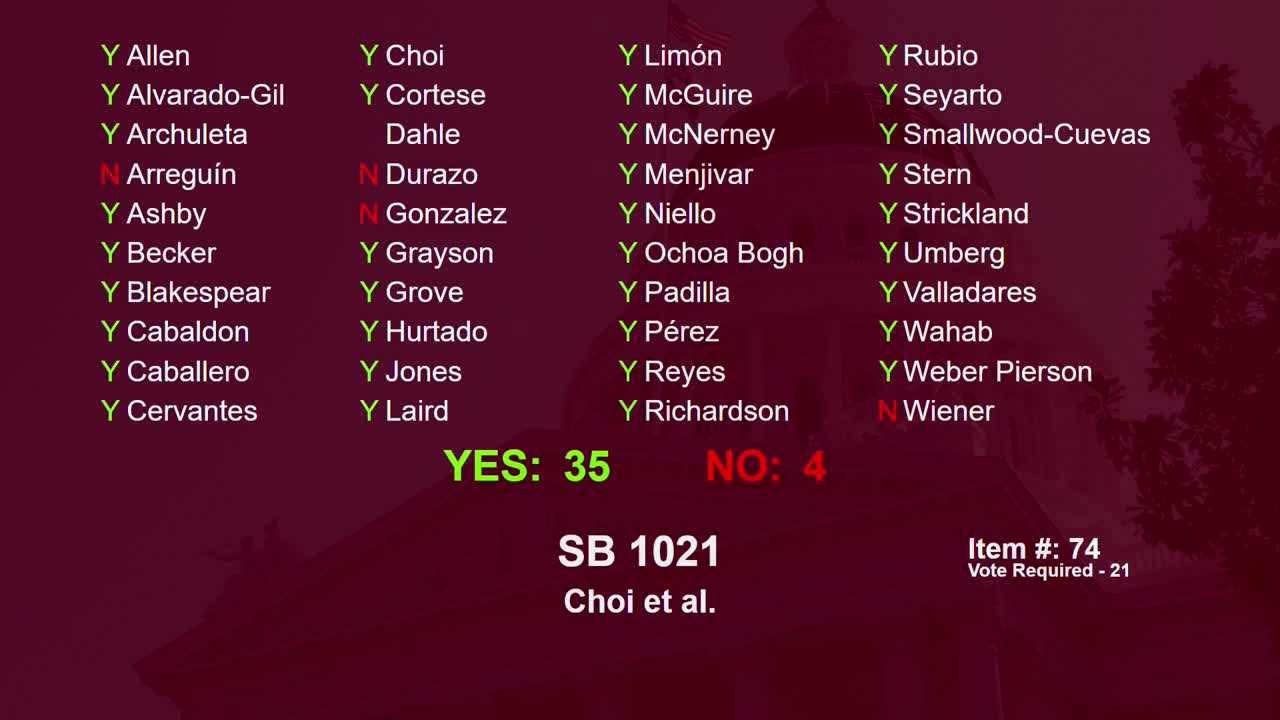 8MIN
Senate Floor
 25MIN
Senate Standing Committee on Public Safety
 39MIN
Senate Standing Committee on Public Safety
 3MIN
Assembly Floor
 1MIN
Assembly Standing Committee on Appropriations
 31MIN