AB 462: Land use: accessory dwelling units.
- Session Year: 2025-2026
- House: Assembly
- Latest Version Date: 2025-10-10
Current Status:
Passed
(2025-10-10: Chaptered by Secretary of State - Chapter 491, Statutes of 2025.)
Introduced
In Committee
Awaiting First Chamber Vote
Passed First Chamber
In Committee
Awaiting Second Chamber Vote
Passed Second Chamber
Enacted
Existing law provides for the creation by local ordinance, or by ministerial approval if a local agency has not adopted an ordinance, of accessory dwelling units in areas zoned for single-family or multifamily dwelling residential use in accordance with specified standards and conditions. Existing law prohibits a local agency from issuing a certificate of occupancy for an accessory dwelling unit before the local agency issues a certificate of occupancy for the primary dwelling.
This bill, notwithstanding that prohibition, would require a local agency to issue a certificate of occupancy for an accessory dwelling unit constructed in a county that is subject to a proclamation of a state of emergency made by the Governor on or after February 1, 2025, even if the primary dwelling has not yet been issued a certificate of occupancy, if certain requirements are met, including that the primary dwelling was substantially damaged or destroyed by an event referenced in the state of emergency proclamation. By imposing new duties on local agencies, the bill would impose a state-mandated local program.
Existing law requires a permitting agency to either approve or deny an application to create or serve an accessory dwelling unit within 60 days from the date the permitting agency receives a completed application if there is an existing single-family or multifamily dwelling on the lot. Existing law deems the application approved if the local agency has not approved or denied the completed application within 60 days. Under existing law, if the permit application to create or serve an accessory dwelling unit is submitted with a permit application to create or serve a new single-family or multifamily dwelling on the lot, the permitting agency may delay approving or denying the permit application for the accessory dwelling unit until the permitting agency approves or denies the permit application to create or serve the new single-family or multifamily dwelling, as provided.
The California Coastal Act of 1976, which is administered by the California Coastal Commission, requires any person wishing to perform or undertake any development in the coastal zone, as defined, to obtain a coastal development permit from a local government or the commission, except as provided. Existing law specifies that the laws governing accessory dwelling units do not supersede or in any way alter or lessen the effect or application of the act, except as specified.
This bill would create an exception to the above provision by requiring a local government or the commission, as specified, to either approve or deny a coastal development permit application for an accessory dwelling unit within 60 days of receiving a completed application. The bill would, notwithstanding that 60-day time limit, authorize the commission, if a coastal development permit application to create or serve an accessory dwelling unit is submitted with a coastal development permit application to create or serve a new single-family or multifamily dwelling on the lot, to delay approving or denying the coastal development permit application for the accessory dwelling unit until the commission approves or denies the coastal development permit application to create or serve the new single-family or multifamily dwelling. Under the bill, and except under the circumstance described above, if the commission has not approved or denied a completed application within 60 days, the application would be deemed approved.
The bill would include findings that changes proposed by this bill address a matter of statewide concern rather than a municipal affair and, therefore, apply to all cities, including charter cities.
The California Constitution requires the state to reimburse local agencies and school districts for certain costs mandated by the state. Statutory provisions establish procedures for making that reimbursement.
This bill would provide that no reimbursement is required by this act for a specified reason.
This bill would declare that it is to take effect immediately as an urgency statute.
Existing law provides for the creation by local ordinance, or by ministerial approval if a local agency has not adopted an ordinance, of accessory dwelling units in areas zoned for single-family or multifamily dwelling residential use in accordance with specified standards and conditions. Existing law prohibits a local agency from issuing a certificate of occupancy for an accessory dwelling unit before the local agency issues a certificate of occupancy for the primary dwelling.
This bill, notwithstanding that prohibition, would require a local agency to issue a certificate of occupancy for an accessory dwelling unit constructed in a county that is subject to a proclamation of a state of emergency made by the Governor on or after February 1, 2025, even if the primary dwelling has not yet been issued a certificate of occupancy, if certain requirements are met, including that the primary dwelling was substantially damaged or destroyed by an event referenced in the state of emergency proclamation. By imposing new duties on local agencies, the bill would impose a state-mandated local program.
Existing law requires a permitting agency to either approve or deny an application to create or serve an accessory dwelling unit within 60 days from the date the permitting agency receives a completed application if there is an existing single-family or multifamily dwelling on the lot. Existing law deems the application approved if the local agency has not approved or denied the completed application within 60 days. Under existing law, if the permit application to create or serve an accessory dwelling unit is submitted with a permit application to create or serve a new single-family or multifamily dwelling on the lot, the permitting agency may delay approving or denying the permit application for the accessory dwelling unit until the permitting agency approves or denies the permit application to create or serve the new single-family or multifamily dwelling, as provided. Existing law deems the application approved if the local agency has not approved or denied the completed application within 60 days.
The California Coastal Act of 1976, which is administered by the California Coastal Commission, requires any person wishing to perform or undertake any development in the coastal zone, as defined, to obtain a coastal development permit from a local government or the commission, except as provided. Existing law specifies that the laws governing accessory dwelling units do not supersede or in any way alter or lessen the effect or application of the act, except as specified.
This bill would create an exception to the above provision by requiring a local government or the commission, as specified, to either approve or deny a coastal development permit application for an accessory dwelling unit within 60 days of receiving a completed application. The bill would, notwithstanding that 60-day time limit, authorize the commission, if a coastal development permit application to create or serve an accessory dwelling unit is submitted with a coastal development permit application to create or serve a new single-family or multifamily dwelling on the lot, to delay approving or denying the coastal development permit application for the accessory dwelling unit until the commission approves or denies the coastal development permit application to create or serve the new single-family or multifamily dwelling. Under the bill, and except under the circumstance described above, if the commission has not approved or denied a completed application within 60 days, the application would be deemed approved.
The bill would include findings that changes proposed by this bill address a matter of statewide concern rather than a municipal affair and, therefore, apply to all cities, including charter cities.
The California Constitution requires the state to reimburse local agencies and school districts for certain costs mandated by the state. Statutory provisions establish procedures for making that reimbursement.
This bill would provide that no reimbursement is required by this act for a specified reason.
This bill would declare that it is to take effect immediately as an urgency statute.
Existing law provides for the creation by local ordinance, or by ministerial approval if a local agency has not adopted an ordinance, of accessory dwelling units in areas zoned for single-family or multifamily dwelling residential use in accordance with specified standards and conditions. Existing law prohibits a local agency from issuing a certificate of occupancy for an accessory dwelling unit before the local agency issues a certificate of occupancy for the primary dwelling.
This bill, notwithstanding that prohibition, would require a local agency to issue a certificate of occupancy for an accessory dwelling unit constructed in a county that is subject to a proclamation of a state of emergency made by the Governor on or after February 1, 2025, even if the primary dwelling has not yet been issued a certificate of occupancy, if certain requirements are met, including that the primary dwelling was substantially damaged or destroyed by an event referenced in the state of emergency proclamation. By imposing new duties on local agencies, the bill would impose a state-mandated local program.
Existing law requires a permitting agency to either approve or deny an application to create or serve an accessory dwelling unit within 60 days from the date the permitting agency receives a completed application if there is an existing single-family or multifamily dwelling on the lot. Under existing law, if the permit application to create or serve an accessory dwelling unit is submitted with a permit application to create or serve a new single-family or multifamily dwelling on the lot, the permitting agency may delay approving or denying the permit application for the accessory dwelling unit until the permitting agency approves or denies the permit application to create or serve the new single-family or multifamily dwelling, as provided. Existing law deems the application approved if the local agency has not approved or denied the completed application within 60 days.
The California Coastal Act of 1976, which is administered by the California Coastal Commission, requires any person wishing to perform or undertake any development in the coastal zone, as defined, to obtain a coastal development permit from a local government or the commission, except as provided. Existing law specifies that the laws governing accessory dwelling units do not supersede or in any way alter or lessen the effect or application of the California Coastal Act of 1976, act, except as specified.
This bill would exempt the construction of an accessory dwelling unit located within the County of Los Angeles, and in any county that is subject to a proclamation of a state of emergency made by the Governor on or after February 1, 2025, if housing is damaged, destroyed, or otherwise made uninhabitable by the state of emergency, from the need to obtain a coastal development permit if specified requirements are met, including that the accessory dwelling unit be set back at least 10 feet from a canyon bluff or at least 25 feet from a coastal bluff.This bill would make legislative findings and declarations as to the necessity of a special statute for the County of Los Angeles.This bill would create an exception to the above provision by requiring a local government or the commission, as specified, to either approve or deny a coastal development permit application for an accessory dwelling unit within 60 days of receiving a completed application. The bill would, notwithstanding that 60-day time limit, authorize the commission, if a coastal development permit application to create or serve an accessory dwelling unit is submitted with a coastal development permit application to create or serve a new single-family or multifamily dwelling on the lot, to delay approving or denying the coastal development permit application for the accessory dwelling unit until the commission approves or denies the coastal development permit application to create or serve the new single-family or multifamily dwelling. Under the bill, and except under the circumstance described above, if the commission has not approved or denied a completed application within 60 days, the application would be deemed approved.
The bill would include findings that changes proposed by this bill address a matter of statewide concern rather than a municipal affair and, therefore, apply to all cities, including charter cities.
The California Constitution requires the state to reimburse local agencies and school districts for certain costs mandated by the state. Statutory provisions establish procedures for making that reimbursement.
This bill would provide that no reimbursement is required by this act for a specified reason.
This bill would declare that it is to take effect immediately as an urgency statute.
Existing law provides for the creation by local ordinance, or by ministerial approval if a local agency has not adopted an ordinance, of accessory dwelling units in areas zoned for single-family or multifamily dwelling residential use in accordance with specified standards and conditions. The Existing law prohibits a local agency from issuing a certificate of occupancy for an accessory dwelling unit before the local agency issues a certificate of occupancy for the primary dwelling.
This bill, notwithstanding that prohibition, would require a local agency to issue a certificate of occupancy for an accessory dwelling unit constructed in a county that is subject to a proclamation of a state of emergency made by the Governor on or after February 1, 2025, even if the primary dwelling has not yet been issued a certificate of occupancy, if certain requirements are met, including that the primary dwelling was substantially damaged or destroyed by an event referenced in the state of emergency proclamation. By imposing new duties on local agencies, the bill would impose a state-mandated local program.
The California Coastal Act of 1976, which is administered by the California Coastal Commission, requires any person wishing to perform or undertake any development in the coastal zone, as defined, to obtain a coastal development permit from a local government or the commission, except as provided. Existing law specifies that the above-described provisions laws governing accessory dwelling units do not supersede or in any way alter or lessen the effect or application of the California Coastal Act of 1976, except as specified.
This bill would exempt the construction of an accessory dwelling unit located within the County of Los Angeles, and in any county that is subject to a proclamation of a state of emergency made by the Governor on or after February 1, 2025, as provided, if housing is damaged, destroyed, or otherwise made uninhabitable by the state of emergency, from the need to obtain a coastal development permit, as specified. permit if specified requirements are met, including that the accessory dwelling unit be set back at least 10 feet from a canyon bluff or at least 25 feet from a coastal bluff.
This bill would make legislative findings and declarations as to the necessity of a special statute for the County of Los Angeles.
The bill would include findings that changes proposed by this bill address a matter of statewide concern rather than a municipal affair and, therefore, apply to all cities, including charter cities.
The California Constitution requires the state to reimburse local agencies and school districts for certain costs mandated by the state. Statutory provisions establish procedures for making that reimbursement.
This bill would provide that no reimbursement is required by this act for a specified reason.
This bill would declare that it is to take effect immediately as an urgency statute.
Existing law provides for the creation by local ordinance, or by ministerial approval if a local agency has not adopted an ordinance, of accessory dwelling units in areas zoned for single-family or multifamily dwelling residential use in accordance with specified standards and conditions. The California Coastal Act of 1976, which is administered by the California Coastal Commission, requires any person wishing to perform or undertake any development in the coastal zone, as defined, to obtain a coastal development permit from a local government or the commission, except as provided. Existing law specifies that the above-described provisions governing accessory dwelling units do not supersede or in any way alter or lessen the effect or application of the California Coastal Act of 1976, except as specified.
This bill would exempt the construction of an accessory dwelling unit located within the County of Los Angeles, and in any county that is subject to a proclamation of a state of emergency made by the Governor on or after February 1, 2025, as provided, from the need to obtain a coastal development permit, as specified.
This bill would make legislative findings and declarations as to the necessity of a special statute for the County of Los Angeles.
The bill would include findings that changes proposed by this bill address a matter of statewide concern rather than a municipal affair and, therefore, apply to all cities, including charter cities.
This bill would declare that it is to take effect immediately as an urgency statute.
Existing law provides for the creation by local ordinance, or by ministerial approval if a local agency has not adopted an ordinance, of accessory dwelling units in areas zoned for single-family or multifamily dwelling residential use in accordance with specified standards and conditions. The California Coastal Act of 1976, which is administered by the California Coastal Commission, requires any person wishing to perform or undertake any development in the coastal zone, as defined, to obtain a coastal development permit from a local government or the commission, except as provided. Existing law specifies that the above-described provisions governing accessory dwelling units do not supersede or in any way alter or lessen the effect or application of the California Coastal Act of 1976, except as specified.
This bill would exempt the construction of an accessory dwelling unit located within the County of Los Angeles, and in any county that is subject to a proclamation of a state of emergency made by the Governor on or after February 1, 2025, from the need to obtain a coastal development permit, as specified.
This bill would make legislative findings and declarations as to the necessity of a special statute for the County of Los Angeles.
The bill would include findings that changes proposed by this bill address a matter of statewide concern rather than a municipal affair and, therefore, apply to all cities, including charter cities.
This bill would declare that it is to take effect immediately as an urgency statute.
(a)A local agency shall not issue a certificate of occupancy for an accessory dwelling unit before the local agency issues a certificate of occupancy for the primary dwelling.
(b)Notwithstanding subdivision (a), a local agency shall issue a certificate of occupancy for an accessory dwelling unit constructed in a county that is subject to a proclamation of a state of emergency made by the Governor on or after February 1, 2025, if both of the following requirements are met, even if the primary dwelling has not yet been issued a certificate of occupancy:
(1)The primary dwelling was substantially damaged or destroyed by an event referenced in the state of emergency proclamation issued by the Governor.
(2)The accessory dwelling unit has been issued construction permits and has passed all required inspections.
(c)Subdivision (b) does not apply to an accessory dwelling unit attached to the primary dwelling.
SEC. 2.Section 66329 of the Government Code is amended to read:66329.(a)Except as provided in subdivision (b), nothing in this article shall be construed to supersede or in any way alter or lessen the effect or application of the California Coastal Act of 1976 (Division 20 (commencing with Section 30000) of the Public Resources Code), except that the local government shall, pursuant to Section 66317, either approve or deny a coastal development permit application for an accessory dwelling within 60 days of receiving a completed application, and shall not be required to hold public hearings for coastal development permit applications for accessory dwelling units. The process to approve or deny a coastal development permit application under this subdivision shall happen concurrently with the process to approve or deny an application for an accessory dwelling unit under Section 66317.
(b)(1)If the local government does not have a certified local coastal plan or program, as defined in Section 31001 of the Public Resources Code, then the California Coastal Commission shall either approve or deny the coastal development permit application for an accessory dwelling unit within 60 days of receiving a completed application.
(2)A local government that does not have a certified local coastal plan or program shall immediately notify the California Coastal Commission that a permit application for an accessory dwelling unit is complete pursuant to Section 66317.
(3)The California Coastal Commissions review process to approve or deny a coastal development permit application shall happen concurrently with the process to approve or deny an application for an accessory dwelling unit under Section 66317 provided that the California Coastal Commission has received a completed application for a coastal development permit pursuant to Section 65943.
(4)Notwithstanding paragraph (1), if the coastal development permit application to create or serve an accessory dwelling unit is submitted with a coastal development permit application to create or serve a new single-family or multifamily dwelling on the lot, the California Coastal Commission may delay approving or denying the coastal development permit application for the accessory dwelling unit until the California Coastal Commission approves or denies the coastal development permit application to create or serve the new single-family or multifamily dwelling.
(5)Except as provided in paragraph (4), if the California Coastal Commission has not approved or denied the completed coastal development permit application for the accessory dwelling unit within 60 days, the application shall be deemed approved.
(c)Any decision of a local government pursuant to subdivision (a) is not subject to appeal under Section 30603 of the Public Resources Code.
SEC. 3.The Legislature finds and declares all of the following:
(a)The state faces a housing crisis of availability and affordability, in large part due to a severe shortage of housing.
(b)Solving the housing crisis therefore requires a multifaceted, statewide approach which will include, but is not limited to, any or some of the following:
(1)Encouraging an increase in the overall supply of housing.
(2)Encouraging the development of housing that is affordable to households at all income levels.
(3)Removing barriers to housing production.
(4)Expanding the availability of rental housing.
Therefore, addressing the housing crisis and the severe shortage of housing is a matter of statewide concern and is not a municipal affair as that term is used in Section 5 of Article XI of the California Constitution. Therefore, Sections 1 and 2 of this act amending Sections 66328 and 66329 of the Government Code apply to all cities, including charter cities.
SEC. 4.No reimbursement is required by this act pursuant to Section 6 of Article XIIIB of the California Constitution because a local agency or school district has the authority to levy service charges, fees, or assessments sufficient to pay for the program or level of service mandated by this act, within the meaning of Section 17556 of the Government Code.
SEC. 5.This act is an urgency statute necessary for the immediate preservation of the public peace, health, or safety within the meaning of Article IV of the California Constitution and shall go into immediate effect. The facts constituting the necessity are:
In order to avert economic and social harm as a result of natural disasters and the severe lack of affordable housing in the state, it is necessary for this act to take effect immediately.
(a)A local agency shall not issue a certificate of occupancy for an accessory dwelling unit before the local agency issues a certificate of occupancy for the primary dwelling.
(b)Notwithstanding subdivision (a), a local agency shall issue a certificate of occupancy for an accessory dwelling unit constructed in a county that is subject to a proclamation of a state of emergency made by the Governor on or after February 1, 2025, if both of the following requirements are met, even if the primary dwelling has not yet been issued a certificate of occupancy:
(1)The primary dwelling was substantially damaged or destroyed by an event referenced in the state of emergency proclamation issued by the Governor.
(2)The accessory dwelling unit has been issued construction permits and has passed all required inspections.
(c)Subdivision (b) does not apply to an accessory dwelling unit attached to the primary dwelling.
SEC. 2.Section 66329 of the Government Code is amended to read:66329.(a)Except as provided in subdivision (b), nothing in this article shall be construed to supersede or in any way alter or lessen the effect or application of the California Coastal Act of 1976 (Division 20 (commencing with Section 30000) of the Public Resources Code), except that the local government shall, pursuant to Section 66317, either approve or deny a coastal development permit application for an accessory dwelling within 60 days of receiving a completed application, and shall not be required to hold public hearings for coastal development permit applications for accessory dwelling units. The process to approve or deny a coastal development permit application under this subdivision shall happen concurrently with the process to approve or deny an application for an accessory dwelling unit under Section 66317.
(b)(1)If the local government does not have a certified local coastal plan or program, as defined in Section 31001 of the Public Resources Code, then the California Coastal Commission shall either approve or deny the coastal development permit application for an accessory dwelling unit within 60 days of receiving a completed application.
(2)A local government that does not have a certified local coastal plan or program shall immediately notify the California Coastal Commission that a permit application for an accessory dwelling unit is complete pursuant to Section 66317.
(3)The California Coastal Commissions review process to approve or deny a coastal development permit application shall happen concurrently with the process required to approve or deny an application for an accessory dwelling unit under Section 66317. 66317 provided that the California Coastal Commission has received a completed application for a coastal development permit pursuant to Section 65943.
(4)Notwithstanding paragraph (1), if the coastal development permit application to create or serve an accessory dwelling unit is submitted with a coastal development permit application to create or serve a new single-family or multifamily dwelling on the lot, the California Coastal Commission may delay approving or denying the coastal development permit application for the accessory dwelling unit until the California Coastal Commission approves or denies the coastal development permit application to create or serve the new single-family or multifamily dwelling.
(5)Except as provided in paragraph (4), if the California Coastal Commission has not approved or denied the completed coastal development permit application for the accessory dwelling unit within 60 days, the application shall be deemed approved.
(c)Any decision of a local government pursuant to subdivision (a) is not subject to appeal under Section 30603 of the Public Resources Code.
SEC. 3.The Legislature finds and declares all of the following:
(a)The state faces a housing crisis of availability and affordability, in large part due to a severe shortage of housing.
(b)Solving the housing crisis therefore requires a multifaceted, statewide approach which will include, but is not limited to, any or some of the following:
(1)Encouraging an increase in the overall supply of housing.
(2)Encouraging the development of housing that is affordable to households at all income levels.
(3)Removing barriers to housing production.
(4)Expanding the availability of rental housing.
Therefore, addressing the housing crisis and the severe shortage of housing is a matter of statewide concern and is not a municipal affair as that term is used in Section 5 of Article XI of the California Constitution. Therefore, Sections 1 and 2 of this act amending Sections 66328 and 66329 of the Government Code apply to all cities, including charter cities.
SEC. 4.No reimbursement is required by this act pursuant to Section 6 of Article XIIIB of the California Constitution because a local agency or school district has the authority to levy service charges, fees, or assessments sufficient to pay for the program or level of service mandated by this act, within the meaning of Section 17556 of the Government Code.
SEC. 5.This act is an urgency statute necessary for the immediate preservation of the public peace, health, or safety within the meaning of Article IV of the California Constitution and shall go into immediate effect. The facts constituting the necessity are:
In order to avert economic and social harm as a result of natural disasters and the severe lack of affordable housing in the state, it is necessary for this act to take effect immediately.
(a)A local agency shall not issue a certificate of occupancy for an accessory dwelling unit before the local agency issues a certificate of occupancy for the primary dwelling.
(b)Notwithstanding subdivision (a), a local agency shall issue a certificate of occupancy for an accessory dwelling unit constructed in a county that is subject to a proclamation of a state of emergency made by the Governor on or after February 1, 2025, if both of the following requirements are met, even if the primary dwelling has not yet been issued a certificate of occupancy:
(1)The primary dwelling was substantially damaged or destroyed by an event referenced in the state of emergency proclamation issued by the Governor.
(2)The accessory dwelling unit has been issued construction permits and has passed all required inspections.
(c)Subdivision (b) does not apply to an accessory dwelling unit attached to the primary dwelling.
SEC. 2.Section 66329 of the Government Code is amended to read:66329.(a)Except as provided in subdivision (b), nothing in this article shall be construed to supersede or in any way alter or lessen the effect or application of the California Coastal Act of 1976 (Division 20 (commencing with Section 30000) of the Public Resources Code), except that the local government shall shall, pursuant to Section 66317, either approve or deny a coastal development permit application for an accessory dwelling within 60 days of receiving a completed application, and shall not be required to hold public hearings for coastal development permit applications for accessory dwelling units. The process to approve or deny a coastal development permit application under this subdivision shall happen concurrently with the process to approve or deny an application for an accessory dwelling unit under Section 66317.
(b)(1)If the local government does not have a certified local coastal plan or program, as defined in Section 31001 of the Public Resources Code, then the California Coastal Commission shall either approve or deny the coastal development permit application for an accessory dwelling unit within 60 days of receiving a completed application. This
(2)A local government that does not have a certified local coastal plan or program shall immediately notify the California Coastal Commission that a permit application for an accessory dwelling unit is complete pursuant to Section 66317.
(3)The California Coastal Commissions review process shall happen concurrently with the process required under Section 66317.
(2)(4)Notwithstanding paragraph (1), if the coastal development permit application to create or serve an accessory dwelling unit is submitted with a coastal development permit application to create or serve a new single-family or multifamily dwelling on the lot, the California Coastal Commission may delay approving or denying the coastal development permit application for the accessory dwelling unit until the California Coastal Commission approves or denies the coastal development permit application to create or serve the new single-family or multifamily dwelling.
(3)(5)Except as provided in paragraph (2), (4), if the California Coastal Commission has not approved or denied the completed coastal development permit application for the accessory dwelling unit within 60 days, the application shall be deemed approved.
(c)Any decision of a local government pursuant to subdivision (a) is not subject to appeal under Section 30603 of the Public Resources Code.
SEC. 3.The Legislature finds and declares all of the following:
(a)The state faces a housing crisis of availability and affordability, in large part due to a severe shortage of housing.
(b)Solving the housing crisis therefore requires a multifaceted, statewide approach which will include, but is not limited to, any or some of the following:
(1)Encouraging an increase in the overall supply of housing.
(2)Encouraging the development of housing that is affordable to households at all income levels.
(3)Removing barriers to housing production.
(4)Expanding the availability of rental housing.
Therefore, addressing the housing crisis and the severe shortage of housing is a matter of statewide concern and is not a municipal affair as that term is used in Section 5 of Article XI of the California Constitution. Therefore, Sections 1 and 2 of this act amending Sections 66328 and 66329 of the Government Code apply to all cities, including charter cities.
SEC. 4.No reimbursement is required by this act pursuant to Section 6 of Article XIIIB of the California Constitution because a local agency or school district has the authority to levy service charges, fees, or assessments sufficient to pay for the program or level of service mandated by this act, within the meaning of Section 17556 of the Government Code.
SEC. 5.This act is an urgency statute necessary for the immediate preservation of the public peace, health, or safety within the meaning of Article IV of the California Constitution and shall go into immediate effect. The facts constituting the necessity are:
In order to avert economic and social harm as a result of natural disasters and the severe lack of affordable housing in the state, it is necessary for this act to take effect immediately.
(a)A local agency shall not issue a certificate of occupancy for an accessory dwelling unit before the local agency issues a certificate of occupancy for the primary dwelling.
(b)Notwithstanding subdivision (a), a local agency shall issue a certificate of occupancy for an accessory dwelling unit constructed in a county that is subject to a proclamation of a state of emergency made by the Governor on or after February 1, 2025, if both of the following requirements are met, even if the primary dwelling has not yet been issued a certificate of occupancy:
(1)The primary dwelling was substantially damaged or destroyed by an event referenced in the state of emergency proclamation issued by the Governor.
(2)The accessory dwelling unit has been issued construction permits and has passed all required inspections.
(c)Subdivision (b) does not apply to an accessory dwelling unit attached to the primary dwelling.
SEC. 2.Section 66329 of the Government Code is amended to read:66329.(a)Construction of an accessory dwelling unit within either of the following locations, and that meets the requirements of subdivision (b), shall be exempt from the requirement to obtain a coastal development permit pursuant to subdivision (a) of Section 30600 of the Public Resources Code:(1)The County of Los Angeles.(2)Any county that is subject to a proclamation of a state of emergency made by the Governor on or after February 1, 2025, if housing is damaged, destroyed, or otherwise made uninhabitable by the event that resulted in a state of emergency proclamation in that county. This exemption shall continue to apply even after the state of emergency proclamation has expired.(b)In order to qualify for the exemption pursuant to subdivision (a), an accessory dwelling unit shall comply with both of the following requirements, in addition to the requirements established or authorized by this chapter:(1)The accessory dwelling unit shall be set back at least 10 feet from a canyon bluff or at least 25 feet from a coastal bluff.(2)The accessory dwelling unit shall not encroach on a public access easement or public access deed restriction, except for an easement or deed restriction on the seaward side of a primary dwelling on the beach, and only to the extent that the accessory dwelling unit does not expand farther into a previously approved public view corridor, farther into an open space deed restriction, or farther seaward on the beach, than the primary dwelling, or, if the primary dwelling was damaged, destroyed, or otherwise made uninhabitable by the event that resulted in the state of emergency proclamation as described in paragraph (2) of subdivision (a), the primary dwelling as it existed immediately before the state of emergency.(c)(a)Except as provided in subdivisions (a) and subdivision (b), nothing in this article shall be construed to supersede or in any way alter or lessen the effect or application of the California Coastal Act of 1976 (Division 20 (commencing with Section 30000) of the Public Resources Code), except that the local government shall either approve or deny a coastal development permit application for an accessory dwelling within 60 days of receiving a completed application, and shall not be required to hold public hearings for coastal development permit applications for accessory dwelling units. The process to approve or deny a coastal development permit application under this subdivision shall happen concurrently with the process to approve or deny an application for an accessory dwelling unit under Section 66317.
(b)(1)If the local government does not have a certified local coastal plan or program, as defined in Section 31001 of the Public Resources Code, then the California Coastal Commission shall either approve or deny the coastal development permit application for an accessory dwelling unit within 60 days of receiving a completed application. This process shall happen concurrently with the process required under Section 66317.
(2)Notwithstanding paragraph (1), if the coastal development permit application to create or serve an accessory dwelling unit is submitted with a coastal development permit application to create or serve a new single-family or multifamily dwelling on the lot, the California Coastal Commission may delay approving or denying the coastal development permit application for the accessory dwelling unit until the California Coastal Commission approves or denies the coastal development permit application to create or serve the new single-family or multifamily dwelling.
(3)Except as provided in paragraph (2), if the California Coastal Commission has not approved or denied the completed coastal development permit application for the accessory dwelling unit within 60 days, the application shall be deemed approved.
(c)Any decision of a local government pursuant to subdivision (a) is not subject to appeal under Section 30603 of the Public Resources Code.
SEC. 3.The Legislature finds and declares that a special statute is necessary and that a general statute cannot be made applicable within the meaning of Section 16 of Article IV of the California Constitution because of the devastating effect of the wildfires in the County of Los Angeles.SEC. 4.SEC. 3.The Legislature finds and declares all of the following:
(a)The state faces a housing crisis of availability and affordability, in large part due to a severe shortage of housing.
(b)Solving the housing crisis therefore requires a multifaceted, statewide approach which will include, but is not limited to, any or some of the following:
(1)Encouraging an increase in the overall supply of housing.
(2)Encouraging the development of housing that is affordable to households at all income levels.
(3)Removing barriers to housing production.
(4)Expanding the availability of rental housing.
Therefore, addressing the housing crisis and the severe shortage of housing is a matter of statewide concern and is not a municipal affair as that term is used in Section 5 of Article XI of the California Constitution. Therefore, Sections 1 and 2 of this act amending Sections 66328 and 66329 of the Government Code apply to all cities, including charter cities.
SEC. 5.SEC. 4.No reimbursement is required by this act pursuant to Section 6 of Article XIIIB of the California Constitution because a local agency or school district has the authority to levy service charges, fees, or assessments sufficient to pay for the program or level of service mandated by this act, within the meaning of Section 17556 of the Government Code.
SEC. 6.SEC. 5.This act is an urgency statute necessary for the immediate preservation of the public peace, health, or safety within the meaning of Article IV of the California Constitution and shall go into immediate effect. The facts constituting the necessity are:
In order to avert economic and social harm as a result of natural disasters and the severe lack of affordable housing in the County of Los Angeles and the state, it is necessary for this act to take effect immediately.
(a)A local agency shall not issue a certificate of occupancy for an accessory dwelling unit before the local agency issues a certificate of occupancy for the primary dwelling.
(b)Notwithstanding subdivision (a), a local agency shall issue a certificate of occupancy for an accessory dwelling unit constructed in a county that is subject to a proclamation of a state of emergency made by the Governor on or after February 1, 2025, if both of the following requirements are met, even if the primary dwelling has not yet been issued a certificate of occupancy:
(1)The primary dwelling was substantially damaged or destroyed by an event referenced in the state of emergency proclamation issued by the Governor.
(2)The accessory dwelling unit has been issued construction permits and has passed all required inspections.
(c)Subdivision (b) does not apply to an accessory dwelling unit attached to the primary dwelling.
SECTION 1.SEC. 2.Section 66329 of the Government Code is amended to read:66329.(a)Construction of an accessory dwelling unit within either of the following locations locations, and that meets the requirements of subdivision (b), shall be exempt from the requirement to obtain a coastal development permit pursuant to subdivision (a) of Section 30600 of the Public Resources Code:
(1)The County of Los Angeles.
(2)Any county that is subject to a Governors proclamation of a state of emergency made by the Governor on or after February 1, 2025, if housing is damaged, destroyed, or otherwise made uninhabitable by the event that resulted in a state of emergency proclamation in that county. This exemption shall continue to apply even after the state of emergency proclamation has expired.
(b)In order to qualify for the exemption pursuant to subdivision (a), an accessory dwelling unit shall comply with both of the following requirements, in addition to the requirements established or authorized by this chapter:
(1)The accessory dwelling unit shall be set back at least 10 feet from a canyon bluff or at least 25 feet from a coastal bluff.
(2)The accessory dwelling unit shall not encroach on a public access easement or public access deed restriction, except for an easement or deed restriction on the seaward side of a primary dwelling on the beach, and only to the extent that the accessory dwelling unit does not expand farther into a previously approved public view corridor, farther into an open space deed restriction, or farther seaward on the beach, than the primary dwelling, or, if the primary dwelling was damaged, destroyed, or otherwise made uninhabitable by the event that resulted in the state of emergency proclamation as described in paragraph (2) of subdivision (a), the primary dwelling as it existed immediately before the state of emergency.
(b)(c)Except as provided in subdivision (a), subdivisions (a) and (b), nothing in this article shall be construed to supersede or in any way alter or lessen the effect or application of the California Coastal Act of 1976 (Division 20 (commencing with Section 30000) of the Public Resources Code), except that the local government shall not be required to hold public hearings for coastal development permit applications for accessory dwelling units.
SEC. 2.SEC. 3.The Legislature finds and declares that a special statute is necessary and that a general statute cannot be made applicable within the meaning of Section 16 of Article IV of the California Constitution because of the devastating effect of the wildfires in the County of Los Angeles.
SEC. 3.SEC. 4.The Legislature finds and declares all of the following:
(a)The state faces a housing crisis of availability and affordability, in large part due to a severe shortage of housing.
(b)Solving the housing crisis therefore requires a multifaceted, statewide approach which will include, but is not limited to, any or some of the following:
(1)Encouraging an increase in the overall supply of housing.
(2)Encouraging the development of housing that is affordable to households at all income levels.
(3)Removing barriers to housing production.
(4)Expanding the availability of rental housing.
Therefore, addressing the housing crisis and the severe shortage of housing is a matter of statewide concern and is not a municipal affair as that term is used in Section 5 of Article XI of the California Constitution. Therefore, Section 1 Sections 1 and 2 of this act amending Section Sections 66328 and 66329 of the Government Code applies apply to all cities, including charter cities.
SEC. 5.No reimbursement is required by this act pursuant to Section 6 of Article XIIIB of the California Constitution because a local agency or school district has the authority to levy service charges, fees, or assessments sufficient to pay for the program or level of service mandated by this act, within the meaning of Section 17556 of the Government Code.
SEC. 4.SEC. 6.This act is an urgency statute necessary for the immediate preservation of the public peace, health, or safety within the meaning of Article IV of the California Constitution and shall go into immediate effect. The facts constituting the necessity are:
In order to avert economic and social harm as a result of natural disasters and the severe lack of affordable housing in the County of Los Angeles and the state, it is necessary for this act to take effect immediately.
(a)Construction of an accessory dwelling unit within either of the following locations shall be exempt from the requirement to obtain a coastal development permit pursuant to subdivision (a) of Section 30600 of the Public Resources Code:
(1)The County of Los Angeles.
(2)Any county that is subject to a Governors proclamation of a state of emergency made by the Governor on or after February 1, 2025. 2025, if housing is damaged, destroyed, or otherwise made uninhabitable by the event that resulted in a state of emergency proclamation in that county.
(b)Except as provided in subdivision (a), nothing in this article shall be construed to supersede or in any way alter or lessen the effect or application of the California Coastal Act of 1976 (Division 20 (commencing with Section 30000) of the Public Resources Code), except that the local government shall not be required to hold public hearings for coastal development permit applications for accessory dwelling units.
SEC. 2.The Legislature finds and declares that a special statute is necessary and that a general statute cannot be made applicable within the meaning of Section 16 of Article IV of the California Constitution because of the devastating effect of the wildfires in the County of Los Angeles.
SEC. 3.The Legislature finds and declares all of the following:
(a)The state faces a housing crisis of availability and affordability, in large part due to a severe shortage of housing.
(b)Solving the housing crisis therefore requires a multifaceted, statewide approach which will include, but is not limited to, any or some of the following:
(1)Encouraging an increase in the overall supply of housing.
(2)Encouraging the development of housing that is affordable to households at all income levels.
(3)Removing barriers to housing production.
(4)Expanding the availability of rental housing.
Therefore, addressing the housing crisis and the severe shortage of housing is a matter of statewide concern and is not a municipal affair as that term is used in Section 5 of Article XI of the California Constitution. Therefore, Section 1 of this act amending Section 66329 of the Government Code applies to all cities, including charter cities.
SEC. 4.This act is an urgency statute necessary for the immediate preservation of the public peace, health, or safety within the meaning of Article IV of the California Constitution and shall go into immediate effect. The facts constituting the necessity are:
In order to avert economic and social harm as a result of natural disasters and the severe lack of affordable housing in the County of Los Angeles and the state, it is necessary for this act to take effect immediately.
REVISIONS: HeadingLine 2.Nothing (a)Construction of an accessory dwelling unit within either of the following locations shall be exempt from the requirement to obtain a coastal development permit pursuant to subdivision (a) of Section 30600 of the Public Resources Code:
(1)The County of Los Angeles.
(2)Any county that is subject to a Governors proclamation of a state of emergency made by the Governor on or after February 1, 2025.
(b)Except as provided in subdivision (a), nothing in this article shall be construed to supersede or in any way alter or lessen the effect or application of the California Coastal Act of 1976 (Division 20 (commencing with Section 30000) of the Public Resources Code), except that the local government shall not be required to hold public hearings for coastal development permit applications for accessory dwelling units.
SEC. 2.The Legislature finds and declares that a special statute is necessary and that a general statute cannot be made applicable within the meaning of Section 16 of Article IV of the California Constitution because of the devastating effect of the wildfires in the County of Los Angeles.
SEC. 3.The Legislature finds and declares all of the following:
(a)The state faces a housing crisis of availability and affordability, in large part due to a severe shortage of housing.
(b)Solving the housing crisis therefore requires a multifaceted, statewide approach which will include, but is not limited to, any or some of the following:
(1)Encouraging an increase in the overall supply of housing.
(2)Encouraging the development of housing that is affordable to households at all income levels.
(3)Removing barriers to housing production.
(4)Expanding the availability of rental housing.
Therefore, addressing the housing crisis and the severe shortage of housing is a matter of statewide concern and is not a municipal affair as that term is used in Section 5 of Article XI of the California Constitution. Therefore, Section 1 of this act amending Section 66329 of the Government Code applies to all cities, including charter cities.
SEC. 4.This act is an urgency statute necessary for the immediate preservation of the public peace, health, or safety within the meaning of Article IV of the California Constitution and shall go into immediate effect. The facts constituting the necessity are:
In order to avert economic and social harm as a result of natural disasters and the severe lack of affordable housing in the County of Los Angeles and the state, it is necessary for this act to take effect immediately.
|
Date
|
Status
|
|---|---|
| Oct 10, 2025 | Chaptered by Secretary of State - Chapter 491, Statutes of 2025. |
| Oct 10, 2025 | Approved by the Governor. |
| Sep 24, 2025 | Enrolled and presented to the Governor at 3 p.m. |
| Sep 12, 2025 | Senate amendments concurred in. To Engrossing and Enrolling. (Ayes 79. Noes 0. Page 3375.). |
| Sep 12, 2025 | In Assembly. Concurrence in Senate amendments pending. |
| Sep 11, 2025 | Read third time. Urgency clause adopted. Passed. Ordered to the Assembly. (Ayes 39. Noes 0. Page 2916.). |
| Sep 2, 2025 | Read second time. Ordered to third reading. |
| Aug 29, 2025 | Read second time and amended. Ordered returned to second reading. |
| Aug 29, 2025 | From committee: Amend, and do pass as amended. (Ayes 7. Noes 0.) (August 29). |
| Aug 18, 2025 | In committee: Referred to suspense file. |
| Jul 17, 2025 | Read second time and amended. Re-referred to Com. on APPR. |
| Jul 16, 2025 | From committee: Amend, and do pass as amended and re-refer to Com. on APPR. (Ayes 10. Noes 0.) (July 15). |
| Jul 10, 2025 | Read second time and amended. Re-referred to Com. on HOUSING. |
| Jul 9, 2025 | From committee: Amend, and do pass as amended and re-refer to Com. on HOUSING. (Ayes 7. Noes 0.) (July 8). |
| May 13, 2025 | From committee chair, with author's amendments: Amend, and re-refer to committee. Read second time, amended, and re-referred to Com. on N.R. & W. |
| Apr 23, 2025 | Re-referred to Coms. on N.R. & W. and HOUSING. |
| Apr 2, 2025 | In Senate. Read first time. To Com. on RLS. for assignment. |
| Apr 1, 2025 | Read third time. Urgency clause adopted. Passed. Ordered to the Senate. (Ayes 77. Noes 0. Page 955.). |
| Mar 20, 2025 | Read second time. Ordered to third reading. |
| Mar 19, 2025 | From committee: Do pass. (Ayes 15. Noes 0.) (March 19). |
| Mar 19, 2025 | Coauthors revised. |
| Mar 12, 2025 | From committee: Do pass and re-refer to Com. on APPR. (Ayes 11. Noes 0.) (March 12). Re-referred to Com. on APPR. |
| Feb 28, 2025 | Re-referred to Com. on H. & C.D. |
| Feb 27, 2025 | From committee chair, with author's amendments: Amend, and re-refer to Com. on H. & C.D. Read second time and amended. |
| Feb 18, 2025 | Referred to Com. on H. & C.D. |
| Feb 7, 2025 | From printer. May be heard in committee March 9. |
| Feb 6, 2025 | Read first time. To print. |
|
Date
|
Description
|
Location
|
Votes
|
|
|---|---|---|---|---|
| Sep 12, 2025 | AB 462 Lowenthal Concurrence in Senate Amendments | Assembly Floor |
Passed |
|
| Sep 11, 2025 | Assembly 3rd Reading AB462 Lowenthal et al. By Grayson Urgency Clause | Senate Floor |
Passed |
|
| Aug 29, 2025 | Do pass as amended | Senate Standing Committee on Appropriations |
Passed |
|
| Aug 18, 2025 | Placed on suspense file | Senate Standing Committee on Appropriations |
Passed |
|
| Jul 15, 2025 | Do pass as amended, but first amend, and re-refer to the Committee on [Appropriations] | Senate Standing Committee on Housing |
Passed |
|
| Jul 8, 2025 | Do pass as amended, but first amend, and re-refer to the Committee on [Housing] | Senate Standing Committee on Natural Resources and Water |
Passed |
|
| Apr 1, 2025 | AB 462 Lowenthal Third Reading Urgency | Assembly Floor |
Passed |
|
| Mar 19, 2025 | Do pass. | Assembly Standing Committee on Appropriations |
Passed |
|
| Mar 12, 2025 | Do pass and be re-referred to the Committee on [Appropriations] | Assembly Standing Committee on Housing and Community Development |
Passed |
This list shows positions taken on this bill by organizations on the date displayed, which is linked to the original source.
Positions by individuals are not included.
|
Organization
|
Position
|
Date
|
|---|---|---|
| AARP | ** Support | |
| American Planning Association, California Chapter | ** Support | |
| Apartment Association of Greater Los Angeles | ** Support | |
| Apartment Association Of Orange County | ** Support | |
| Audubon California | ** Against | |
| Azul | ** Against | |
| Bear River Band Of The Rohnerville Rancheria | ** Against | |
| Berkeley Property Owners Association | ** Support | |
| California Apartment Association | ** Support | |
| California Coastal Protection Network | ** Against | |
| California Democratic Party | ** Support | |
| California Nurses for Environmental Health and Justice | ** Against | |
| California Rental Housing Association | ** Support | |
| California State Association Of Counties | ** Support | |
| California YIMBY | ** Support | |
| CAUSE | ** Against | |
| City of Long Beach | ** Support | |
| County of Humboldt | ** Against | |
| County of Orange | ** Support | |
| Defenders Of Wildlife | ** Against | |
| East Bay Leadership Council | ** Support | |
| East Bay Rental Housing Association | ** Support | |
| Eden Housing | ** Support | |
| Endangered Habitats League | ** Against | |
| Environmental Action Committee of West Marin | ** Against | |
| Environmental Center of San Diego | ** Against | |
| Environmental Defense Center | ** Against | |
| Environmental Protection Information Center | ** Against | |
| Green Foothills | ** Against | |
| Humboldt Waterkeeper | ** Against | |
| Los Cerritos Wetlands Land Trust | ** Against | |
| Napa Valley Property Owners’ Association | ** Support | |
| Nor Cal Rental Property Association | ** Support | |
| Orange County Coastkeeper | ** Against | |
| Planning And Conservation League | ** Against | |
| Puvunga Wetlands Protectors | ** Against | |
| Salted Roots | ** Against | |
| Santa Barbara Apartment Association, Inc. | ** Support | |
| Santa Barbara Apartment Association, Inc. Dba Santa Barbara Rental Property Association | ** Support | |
| Santa Barbara Rental Property Association | ** Support | |
| Save Our Shores | ** Against | |
| Save the Sonoma Coast | ** Against | |
| Sierra Club California | ** Against | |
| SoCal 350 Climate Action | ** Against | |
| Sonoma Land Trust | ** Against | |
| Southern California Rental Housing Association | ** Support | |
| SPOSFI | ** Support | |
| Surfrider Foundation | ** Against | |
| Turtle Island Restoration Network | ** Against |
CONCURRENCE IN SENATE AMENDMENTS
CSA1 Bill Id:AB 462
Author:(Lowenthal and Rivas)
As Amended Ver:August 29, 2025
2/3 vote. Urgency
SUMMARY
This bill requires coastal development permits (CDPs) for accessory dwelling units (ADUs) to be approved or denied within 60 days, waives prohibitions on issuing certificates of occupancy for ADUs on lots without a primary dwelling unit following a disaster, and eliminates the ability to appeal a CDP for an ADU issued by a local government to the California Coastal Commission (Coastal Commission), among other provisions, as provided.
Senate Amendments
Amendments taken in the Senate:
- Delete the exemption from CDP requirements for the construction of ADUs in the County of Los Angeles, and in any county that is subject to a Governor's proclamation of a state of emergency on or after February 1, 2025 where housing is damaged, destroyed, or made uninhabitable.
- Adds provisions:
- Requiring CDPs to instead be approved or denied within 60 days during a concurrent review process with the ADU permit;
- Waiving prohibitions on issuing certificates of occupancy for ADUs on lots without a primary dwelling unit following a disaster; and
- Eliminatomg the ability to appeal a CDP for an ADU issued by a local government to the Coastal Commission.
COMMENTS
Palisades and Eaton Fires: On January 7, 2025, two devastating wildfires, the Palisades Fire and Eaton Fire, both ignited in Los Angeles County. The Palisades Fire began in the Santa Monica Mountains, rapidly spreading across over 23,000 acres and destroying over 6,800 structures, primarily in the Pacific Palisades community of the City of Los Angeles.[1] The Eaton Fire ignited in Eaton Canyon near Altadena, burning more than 14,000 acres, destroying over 9,400 structures.[2] Both fires were fully contained by January 31, 2025. In total, more than 16,000 homes and other structures were destroyed.
Governor's Executive Orders, ADUs, and the Coastal Commission: In response to the Palisades and Eaton fires, Governor Newsom issued four executive orders in January and February 2025 intended to help the Los Angeles region rebuild permanent housing quickly. These orders help to minimize regulatory barriers to rebuilding and bureaucratic processes, while implementing measures related to temporary housing for those whose homes were damaged or destroyed in the devastating Eaton and Palisades fires. These orders notably suspended certain environmental regulations, including the California Environmental Quality Act (CEQA) and the California Coastal Act, to facilitate rapid reconstruction.
On January 12, 2025, Executive Order N-4-25 suspended the application of CEQA and the Coastal Act for projects aimed at repairing, restoring, demolishing, or replacing properties substantially damaged by the fires. Following this initial executive order, the California Coastal Commission issued guidance indicating that certain permitting procedures under the Coastal Act might still apply to rebuilding efforts. In response to this guidance, Governor Newsom issued Executive Order N-14-25 on January 27, 2025 to clarify and reiterate that all Coastal Act requirements were suspended. Citing that guidance from the Coastal Commission as "legally erroneous," the Governor directed the Commission to refrain from issuing any guidance or taking actions that could interfere with or conflict with the intent of the previous executive orders.
The Governor also issued Executive Order N-9-25, which suspended the existing statutory requirement that prohibits the issuance of a certificate of occupancy for an ADU before the primary residence receives a certificate of occupancy on any residential property that was damaged or destroyed in the fires. Since ADUs typically experience much faster permitting and construction timelines than standard units, this suspension acknowledged that ADUs could serve as a valuable source of housing for those impacted by wildfires while the primary residence goes through the permitting and rebuilding process.
ADUs as a Solution: Recently, there has been a national trend to allow for more "gentle density," e.g., ADUs, duplexes, fourplexes, townhomes, and other moderately dense developments that were common before the imposition of zoning. The Legislature has taken a more active role in facilitating such gentle density in recent years. In 2016, SB 1069 (Wieckowski), Chapter 720 and AB 2299 (Bloom) Chapter 735 permitted ADUs by right on all residentially-zoned parcels in the state. By permitting attached, detached, and ADUs on all single-family lots, these laws, among others, facilitated the construction of missing middle housing in exclusionary single-family neighborhoods.[3] SB 1211 (Skinner), Chapter 296, Statues of 2024 furthered the trend towards gentle density by increasing the number of allowable ADUs on multifamily properties.
Taken as a whole, ADU laws have established a fast, predictable, uniform, and enforceable process for the approval of ADUs statewide. These laws have transformed ADUs from being less than 1% of new construction before 2017 to now being approximately 20%, with over 23,000 new ADUs legally completed in 2023.[4] The number of ADUs is expected to continue growing as the ADU construction and financing industry matures, which will help meet the market feasibility for ADUs that is estimated to be approximately 1.8 million units in California.[5]
This bill would remove barriers to the construction of ADUs in the Coastal Zone in Los Angeles County. ADUs, rented at all income levels, can promote housing affordability by increasing the supply of smaller, more cost-effective homes within existing neighborhoods. They allow homeowners to generate rental income, helping offset mortgage costs, while offering renters alternative rental options than apartment buildings or single-family homes. ADUs utilize existing infrastructure and land more efficiently, reducing development costs compared to new large-scale housing projects. They can create opportunities for multigenerational living, allowing families to share housing expenses while maintaining separate spaces. By diversifying housing options, ADUs help alleviate housing shortages and improve affordability in high-cost areas.
ADUs in the Coastal Zone: In 1976, the Legislature enacted the Coastal Act (Act), mandating that coastal counties manage the conservation and development of coastal resources through a comprehensive planning and regulatory program. The area that constitutes the Coastal Zone is defined by California's Public Resources Code. In significant coastal estuarine, habitat, and recreational areas, the Coastal Zone extends inland to the first major ridgeline paralleling the sea or five miles from the mean high tide line of the sea, whichever is less. In developed urban areas, the Coastal Zone generally extends inland less than 1,000 yards. The Coastal Zone does not include the area of jurisdiction of the San Francisco Bay Conservation and Development Commission, nor any area contiguous thereto, including any river, stream, tributary, creek, or flood control or drainage channel flowing into such area. California's coast is a vital natural resource and delicately balanced ecosystem, and an important economic and social resource for the state. However, not all of the Coastal Zone consists of natural resources; much of it encompasses developed urban areas, including affluent, high-opportunity coastal communities.
Homeowners in California's Coastal Zone do not enjoy the same streamlined, expedited, and predictable permitting process for ADUs as non-coastal homeowners. Coastal jurisdictions in California all develop their own Local Coastal Programs (LCPs), each with unique ADU development standards. Detached ADUs in the Coastal Zone must comply with both local development standards and the LCP, and they require a CDP to construct. These CDPs add costs in the form of additional permitting fees and time for additional review. The review is either conducted by the local government or the Commission, depending on whether the area has a certified LCP. Even in jurisdictions where the local government reviews the CDP, the decision may be appealable to the Commission. The CDP process to build an ADU can take years for a homeowner to successfully navigate, compared to the 60-day permitting timeframe mandated by state law for ADUs outside of the Coastal Zone. This poses a barrier to homeowners seeking to add much-needed housing supply, particularly in areas like Los Angeles County facing such a dearth of housing options.
According to a 2023 analysis by the Legislative Analyst's Office, "while many factors have a role in driving California's high housing costs, the most important is the significant shortage of housing, particularly within urban coastal communities. A shortage of housing along California's coast means households wishing to live there compete for limited housing. This competition increases home prices and rents. Some people who find California's coast unaffordable turn instead to California's inland communities, causing prices there to rise as well."[6]
This bill would require local governments and the Coastal Commission to approve or deny a CDP application for an ADU within 60 days of receiving a completed application, and to process CDP applications concurrently with ADU applications. In counties subject to a gubernatorial state of emergency on or after February 1, 2025, it would also allow local agencies to issue certificates of occupancy for ADUs even if the primary dwelling has not yet been rebuilt, provided certain conditions are met. AB 462 further deems ADU CDP applications approved if not acted upon within 60 days (with limited exceptions), prohibits appeals of local CDP approvals to the Commission, and applies these reforms to all cities, including charter cities. Declared an urgency statute, the bill takes effect immediately to address both the state's housing shortage and the urgent need for recovery housing in disaster-affected areas.
According to the Author
"This will ensure that those homeowners enjoy a 60-day permitting process when seeking to add an ADU to their property. These ADUs could be used to house those displaced from the Palisades and Eaton fires while they rebuild their primary residences or search for additional for-sale units nearby. This bill seeks to provide vital relief to the rental market that was already facing a serious housing crisis prior to the loss of property caused by the Eaton and Palisades fires."
Arguments in Support
AARP writes in support: "In January 2025, multiple wildfires burned in and around Los Angeles, ravaging neighborhoods, destroying thousands of structures, and forcing tens of thousands of people to evacuate their homes. In Pacific Palisades, Altadena, and other nearby areas, more than 23,000 acres burned, and at least 10,000 structures were destroyed, exacerbating Los Angeles' already dire 500,000-unit housing shortage by displacing thousands of Angelenos who now must seek new temporary or permanent housing.
AARP policy calls for expedited permitting in disaster-impacted regions, and ADUs are one tool that could help displaced individuals quickly find new housing. AB 462 can help to ensure that our members and their families can remain in their communities, close to friends, family and their support systems."
Arguments in Opposition
A coalition of environmental organizations writes in opposition unless amended: "While the recent amendments improved AB 462, they also included a new provision prohibiting appeals of local government approvals of coastal development permits for ADUs, by exempting them entirely from PRC 30603. Provisions (1) and (2) of subdivision (a) of PRC 30603 ensure any development isn't built in a place that would be unsafe for its residents or the public, such as sites that are flood prone, vulnerable to sea level rise, or on unstable bluffs. These provisions also maintain the public's legal right to access the coast. Moreover, Provision (3) also ensures that development does not impact a sensitive coastal resources area. PRC 30116 defines a "sensitive coastal resource area" to include "special marine and land habitat areas, wetlands, lagoons, and estuaries as mapped and designated in Part 4 of the coastal plan."
Prohibiting appeals under these three criteria are likely to harm the environment by reducing compliance with the Coastal Act, given that the threat of appeal is a strong incentive for project proponents to submit compliant plans in the first place."
FISCAL COMMENTS
According to the Assembly Committee on Appropriations for a prior bill version:
Both local governments and the California Coastal Commission (Commission) conduct reviews of CDP applications for ADUs, depending on who has jurisdiction over a particular application. In Los Angeles County, both local governments and the Commission are likely to see cost savings as a result of this bill, but the amount is unknown at this time. Similar savings may accrue to additional counties impacted by this bill in the future.
- Local governments in Los Angeles County will likely accrue ongoing cost savings to the extent they review fewer CDP applications for ADUs. However, any savings to local governments would be offset to the extent ADU permit applications increase under the standard streamlined process, now available for ADU construction in the Coastal Zone under this bill. This savings offset is difficult to evaluate because CDP applications are more complex and time consuming to review than streamlined ADU applications, and it is unclear to what extent ADU applications will increase as a result of this bill.
- The Commission will likely accrue ongoing cost savings in Los Angeles County because it will no longer review CDP applications for ADUs or process related appeals. Accordingly, the Commission anticipates no new costs as a result of this bill.
VOTES:
ASM HOUSING AND COMMUNITY DEVELOPMENT: 11-0-1
YES: Haney, Patterson, Ávila Farías, Caloza, Gallagher, Kalra, Lee, Quirk-Silva, Ta, Wicks, Wilson
ABS, ABST OR NV: Gabriel
ASM APPROPRIATIONS: 15-0-0
YES: Wicks, Sanchez, Arambula, Calderon, Caloza, Dixon, Elhawary, Fong, Mark González, Hadwick, Hart, Pacheco, Pellerin, Solache, Ta
ASSEMBLY FLOOR: 77-0-3
YES: Addis, Aguiar-Curry, Ahrens, Alanis, Arambula, Ávila Farías, Bains, Bauer-Kahan, Bennett, Berman, Boerner, Bonta, Bryan, Calderon, Caloza, Carrillo, Castillo, Chen, Connolly, DeMaio, Dixon, Elhawary, Ellis, Essayli, Flora, Fong, Gabriel, Gallagher, Garcia, Gipson, Jeff Gonzalez, Mark González, Hadwick, Haney, Harabedian, Hart, Hoover, Irwin, Jackson, Kalra, Krell, Lackey, Lee, Lowenthal, Macedo, McKinnor, Muratsuchi, Nguyen, Ortega, Pacheco, Papan, Patel, Patterson, Pellerin, Petrie-Norris, Quirk-Silva, Ramos, Ransom, Celeste Rodriguez, Michelle Rodriguez, Rogers, Blanca Rubio, Sanchez, Schiavo, Schultz, Sharp-Collins, Solache, Soria, Stefani, Ta, Tangipa, Valencia, Wallis, Ward, Wilson, Zbur, Rivas
ABS, ABST OR NV: Alvarez, Davies, Wicks
UPDATED
VERSION: August 29, 2025
CONSULTANT: Dori Ganetsos / H. & C.D. / (916) 319-2085 FN: 0001996
https://www.latimes.com/california/live/la-fire-updates-floods-mud-rain-closures-laguna-eaton-palisades ↑
IBID. ↑
https://www.hcd.ca.gov/sites/default/files/docs/policy-and-research/adu-handbook-update.pdf ↑
Per HCDs "APR Dashboard" https://www.hcd.ca.gov/planning-and-community-development/housing-open-data-tools/housing-element-implementation-and-apr-dashboard. Complete data for 2023 will be made available by June 30, 2024. This statistic relies on data pulled on May 28, 2024. ↑
Monkonnen et al, 2020, One to Four: The Market Potential of Fourplexes in California's Single-Family Neighborhoods, UCLA Working Paper Series: https://www.lewis.ucla.edu/research/market-potential-fourplexes/ ↑
Legislative Analyst's Office, California's Housing and Homelessness Challenges in Context (February 27, 2023), page 2, available at https://lao.ca.gov/handouts/socservices/2023/Housing-and-Homelessness-Challenges-020623.pdf. ↑
SENATE COMMITTEE ON APPROPRIATIONS
Senator Anna Caballero, Chair
2025 - 2026 Regular Session
AB 462 (Lowenthal) - Land use: accessory dwelling units
Version: July 17, 2025 | Policy Vote: N.R. & W. 7 - 0, HOUSING 10 - 0 |
Urgency: Yes | Mandate: Yes |
Hearing Date: August 18, 2025 | Consultant: Ashley Ames |
Bill Summary:
This bill would require coastal development permits (CDPs) for accessory dwelling units (ADUS) to be issued within 60 days, waive prohibitions on issuing certificates of occupancy for ADUs on lots without a primary dwelling unit following a disaster, and eliminate the ability to appeal a CDP for an ADU issued by a local government to the California Coastal Commission.
Fiscal Impact:
- The Coastal Commission anticipates a fiscal impact of approximately $200,000 annually (General Fund) for one position to process all Coastal Development Permit applications for ADUs within 60 days, though specific costs will depend on the number of applications received.
Background:
The Coastal Act outlines standards for development in the coastal zone including specific policies addressing shoreline public access, recreation, protection of habitats, development design, among other things. Local governments within the coastal zone can adopt an LCP. LCPs generally contain the rules for development and protection of coastal resources and basic planning tools used by the local government. Each LCP contains a land use plan and implementing measures (such as zoning and maps), some of which are subjective standards (such as requirements around design or community character), some of which are objective standards.
In order for the local government to have primary jurisdiction over development permitting in the coastal zone, however, the LCP must be approved by the CCC. Once the LCP is approved by the CCC, the local government assumes permitting authority over local developments, including housing, and the LCP is considered to be an extension of the Coastal Act. About 73% of local jurisdictions in the coastal zone have approved LCPs. In the remaining jurisdictions (i.e., those that do not have an approved LCP), CDPs are issued by the CCC directly. Additionally, permitting decisions made by a local government with an approved LCP can be appealed directly to the CCC under specified circumstances. In reviewing the permit, CCC generally must defer to those standards outlined in the LCP. This bill will eliminate the ability to appeal an ADU approved by a local government with an approved LCP.
Eaton and Palisades fires. California continues to experience the impacts of climate change with disasters of increasing scale and frequency destroying whole communities at an unprecedented scale. In the first month of 2025, major wildfires burned more than 50,000 acres. The Eaton and Palisades fires alone destroyed or damaged more than 18,000 structures including homes, small businesses, schools, and places of worship in Los Angeles County. The destruction of homes in Los Angeles County exacerbates the existing housing crises facing that region and California as a whole.
Prior to the wildfires, the Los Angeles region already suffered from an acute housing shortage. The sixth Regional Housing Needs Allocation (RHNA) cycle required the City of Los Angeles to plan for an additional 456,000 units of housing, and the unincorporated portions of Los Angeles County to plan for 90,000 units of housing in order to satisfy unmet housing demand. Halfway through the sixth cycle, the City of LA has issued 46,000 permits and the County of Los Angeles has issued 5,100 permits (ten percent and six percent of the demand identified in RHNA, respectively). The estimated 10,000 homes burned in the Eaton fire alone exceeds the number of permits the County of Los Angeles has issued for new housing developments in the current RHNA cycle.
Governor’s Executive Orders on rebuilding. The CESA grants expansive authority for the Governor to waive or suspend statutes and regulations that hinder efforts to mitigate the impacts of a declared emergency. Additionally, the California Environmental Quality Act (CEQA) and the Coastal Act include provisions that exempt projects to rebuild structures damaged by emergencies from environmental review and permitting requirements. Governor Newsom proclaimed a state of emergency to exist in Los Angeles and Ventura Counties due to fire and windstorm conditions and subsequently issued a series of executive orders in response to the wildfires. The provisions pertinent to rebuilding residential structures are contained in EO-N-45 and EO N-9-25. These orders were further modified by EO N-20-25.
Proposed Law:
This bill would:
- Require a local agency to issue a certificate of occupancy for an accessory dwelling unit constructed in a county that is subject to a proclamation of a state of emergency made by the Governor on or after February 1, 2025, even if the primary dwelling has not yet been issued a certificate of occupancy, if certain requirements are met, including that the primary dwelling was substantially damaged or destroyed by an event referenced in the state of emergency proclamation. By imposing new duties on local agencies, the bill would impose a state-mandated local program.
- Create an exception to the a provision of the California Coastal Act by requiring a local government or the commission, as specified, to either approve or deny a coastal development permit application for an accessory dwelling unit within 60 days of receiving a completed application.
- Notwithstanding the 60-day time limit, authorize the commission, if a coastal development permit application to create or serve an accessory dwelling unit is submitted with a coastal development permit application to create or serve a new single-family or multifamily dwelling on the lot, to delay approving or denying the coastal development permit application for the accessory dwelling unit until the commission approves or denies the coastal development permit application to create or serve the new single-family or multifamily dwelling.
- Under the bill, and except under specified circumstances, if the commission has not approved or denied a completed application within 60 days, the application would be deemed approved.
- Include findings that changes proposed by this bill address a matter of statewide concern rather than a municipal affair and, therefore, apply to all cities, including charter cities.
Related Legislation:
AB 543 (McNerny, 2025) — makes a series of organizational, technical, and clarifying changes to Accessory Dwelling Unit (ADU) Law, and Junior Accessory Dwelling Unit (JADU) Law.
-- END --
SENATE RULES COMMITTEE Office of Senate Floor Analyses (916) 651-1520 Fax: (916) 327-4478 | AB 462 |
THIRD READING
Bill No: AB 462
Author: Lowenthal (D) and Rivas (D), et al.
Amended: 8/29/25 in Senate
Vote: 27 - Urgency
SENATE NATURAL RES. & WATER COMMITTEE: 7-0, 7/8/25
AYES: Limón, Seyarto, Allen, Grove, Hurtado, Laird, Stern
SENATE HOUSING COMMITTEE: 10-0, 7/15/25
AYES: Wahab, Seyarto, Arreguín, Caballero, Cortese, Durazo, Gonzalez, Grayson, Ochoa Bogh, Padilla
NO VOTE RECORDED: Cabaldon
SENATE APPROPRIATIONS COMMITTEE: 7-0, 8/29/25
AYES: Caballero, Seyarto, Cabaldon, Dahle, Grayson, Richardson, Wahab
ASSEMBLY FLOOR: 77-0, 4/1/25 - See last page for vote
SUBJECT: Land use: accessory dwelling units
SOURCE: Author
DIGEST:
This bill requires coastal development permits (CDPs) for accessory dwelling units (ADUs) to be approved or denied within 60 days, waives prohibitions on issuing certificates of occupancy for ADUs on lots without a primary dwelling unit following a disaster, and eliminates the ability to appeal a CDP for an ADU issued by a local government to the California Coastal Commission (Coastal Commission), among other provisions, as provided.
ANALYSIS:
Existing law:
- The California Emergency Services Act authorizes the Governor to declare a state of emergency and local officials and local governments to declare a local emergency, when specified conditions of disaster or extreme peril to the safety of persons and property exist.
- Authorizes a local agency to provide for the creation of ADUs in areas zoned for residential use, as specified.
- Requires a permitting agency to consider and approve a completed application for an ADU ministerially within 60 days, as provided, if there is an existing single-family or multifamily dwelling on the lot (Government Code (GOV) §66317).
- Defines an ADU to mean an attached or a detached residential dwelling unit that provides complete independent living facilities for one or more persons and is located on a lot with a proposed or existing primary residence. An ADU is required to include permanent provisions for living, sleeping, eating, cooking, and sanitation on the same parcel as the single-family or multifamily dwelling is or will be situated, as specified (GOV §66313).
- Prohibits a local agency from issuing a certificate of occupancy for an ADU before the local agency issues a certificate of occupancy for the primary dwelling (GOV §66328).
- Provides in the state’s ADU laws that they shall not be construed to supersede or in any way alter or lessen the effect or application of the California Coastal Act of 1976 (Coastal Act) (Public Resources Code (PRC) §§30000 et seq.), except that the local government shall not be required to hold public hearings for CDP applications for ADUs (GOV §66329).
- Includes legislative findings and declarations in the Coastal Act that:
- The coastal zone is a distinct and valuable natural resource of vital and enduring interest to all the people, the permanent protection of the state’s natural and scenic resources is a paramount concern to present and future residents, and existing uses and future developments that are carefully planned and developed consistent with the Coastal Act are essential to the economic and social well-of the people of the state (PRC §30001).
- The basic goals of the state for the coastal zone include to:
- Protect, maintain, and, where feasible, enhance and restore the overall quality of the coastal zone environment and its natural and artificial resources,
- Ensure orderly, balanced utilization and conservation of coastal zone resources taking into account the social and economic needs of the people of the state, and
- Maximize public access to and along the coast and maximize public recreational opportunities in the coastal zone consistent with sound resources conservation principles and constitutionally protected rights of private property owners, among other things (PRC §30001.5).
- Provides for the planning and regulation of development within the coastal zone, as defined.
- A person planning to perform or undertake any development in the coastal zone is required to obtain a CDP from the Coastal Commission or local government enforcing a certified local coastal program (LCP) (PRC §30600).
- Requires a local government in the coastal zone to prepare a LCP. Requires the precise content of the LCP to be determined by the local government in full consultation with the Coastal Commission and with full public participation (PRC §30500). Provides for LCPs to be amended by the local government, but the amendment does not take effect until certified by the Coastal Commission (PRC §30514).
This bill:
- Requires a local agency to issue a certificate of occupancy for an accessory dwelling unit constructed in a county that is subject to a proclamation of a state of emergency made by the Governor on or after February 1, 2025, even if the primary dwelling has not yet been issued a certificate of occupancy, if certain requirements are met, including that the primary dwelling was substantially damaged or destroyed by an event referenced in a state of emergency proclamation, as specified.
- Requires a local government to either approve or deny a CDP application for an ADU within 60 days of receiving a completed application. Requires the process to approve or deny a CDP application for an ADU to happen concurrently with the process to approve or deny an ADU application, as provided.
- Requires the Coastal Commission to either approve or deny a CDP application for an ADU within 60 days of receiving a completed application when the local government does not have a certified LCP. Requires the local government that does not have a certified LCP to immediately notify the Coastal Commission that an ADU permit application is complete, as provided.
- Requires the Coastal Commission’s review process to approve or deny a CDP application to happen concurrently with the process to approve or deny an ADU application by the local government, as provided.
- Notwithstanding the 60-day time limit, authorizes the Coastal Commission, if a CDP application to create or serve an ADU is submitted with a CDP application to create or serve a new single-family or multifamily dwelling on the lot, to delay approving or denying the CDP application for the ADU until the Coastal Commission approves or denies the CDP application to create or serve the new single-family or multifamily dwelling.
- Deems the CDP application for an ADU approved if the Coastal Commission has not approved or denied a completed application within 60 days, except in certain circumstances, as specified.
- Makes legislative findings and declarations that addressing the housing crisis and the severe shortage of housing is a matter of statewide concern; is not a municipal affair; and therefore this act applies to all cities, including charter cities, as provided.
- Provides that no reimbursement is required to a local agency or school district, as specified.
- Justifies the necessity for an urgency statute to take effect immediately and necessary for the immediate preservation of the public peace, health or safety, as follows: in order to avert economic and social harm as a result of natural disasters and the severe lack of affordable housing in the state.
[NOTE: See the Senate Natural Resources and Water and Housing Committees’ analyses for additional information about this bill.]
FISCAL EFFECT: Appropriation: No Fiscal Com.: Yes Local: Yes
According to the Senate Appropriations Committee:
- Unknown ongoing costs, likely in the low hundred or hundreds of thousands of dollars annually (General Fund) for the Coastal Commission to process all Coastal Development Permit applications as specified.
SUPPORT: (Verified 8/29/25)
AARP
Apartment Association of Greater Los Angeles
Apartment Association of Orange County
American Planning Association, California Chapter
Berkeley Property Owners’ Association
California Apartment Association
California Democratic Party
California Rental Housing Association
California State Association of Counties
California YIMBY
City of Long Beach
County of Orange
East Bay Leadership Council
East Bay Rental Housing Association
Eden Housing
Napa Valley Property Owners’ Association
Nor Cal Rental Property Association
Santa Barbara Apartment Association, Inc.
Santa Barbara Rental Property Association
Southern California Rental Housing Association
SPOSFI
OPPOSITION: (Verified 8/29/25)
Audubon California
Azul
Bear River Band of the Rohnerville Rancheria
CAUSE
County of Humboldt
Defenders of Wildlife
Environmental Action Committee of West Marin
Environmental Defense Center
Planning and Conservation League
Salted Roots
Sierra Club California
SoCal 350 Climate Action
Sonoma Land Trust
Turtle Island Restoration Network
ARGUMENTS IN SUPPORT: According to the author, “AB 462 allows homeowners in the coastal zone throughout California to enjoy an expedited permitting process. The current coastal development permitting process to build an ADU in the coastal zone can take years for a homeowner to successfully navigate, compared to the 60-day expedited permitting timeframe mandated by state law for ADUs outside of the coastal zone. The current system poses a barrier for homeowners seeking to add much-needed housing supply, especially in areas that historically lack housing. AB 462 requires that completed ADU applications for a coastal development permit are either approved or denied within 60 days, requires that the review for a coastal development permit must happen concurrently with required ADU permitting by the local jurisdiction, and states that a local jurisdiction’s coastal development permit decision cannot be appealed to the Coastal Commission. It is essential to implement policies that facilitate the efficient construction of housing and ensure ADUs in the coastal zone can be approved faster with fewer delays.”
ARGUMENTS IN OPPOSITION: In a joint sign-on “oppose unless amended” letter, Defenders of Wildlife writes, “Prohibiting appeals under these three criteria are likely to harm the environment by reducing compliance with the Coastal Act, given that the threat of appeal is a strong incentive for project proponents to submit compliant plans in the first place.”
“The appeal ban could also perversely increase litigation against ADU applicants. Under AB 462 as currently written, the only remedy for a member of the public that believes issuance of a coastal development permit for an ADU violates the Coastal Act or the local coastal program would be to sue.”
The proposed amendment reinstates the ability to appeal an ADU’s approved CDP to the Coastal Commission in limited circumstances.
ASSEMBLY FLOOR: 77-0, 4/1/25
AYES: Addis, Aguiar-Curry, Ahrens, Alanis, Arambula, Ávila Farías, Bains, Bauer-Kahan, Bennett, Berman, Boerner, Bonta, Bryan, Calderon, Caloza, Carrillo, Castillo, Chen, Connolly, DeMaio, Dixon, Elhawary, Ellis, Essayli, Flora, Fong, Gabriel, Gallagher, Garcia, Gipson, Jeff Gonzalez, Mark González, Hadwick, Haney, Harabedian, Hart, Hoover, Irwin, Jackson, Kalra, Krell, Lackey, Lee, Lowenthal, Macedo, McKinnor, Muratsuchi, Nguyen, Ortega, Pacheco, Papan, Patel, Patterson, Pellerin, Petrie-Norris, Quirk-Silva, Ramos, Ransom, Celeste Rodriguez, Michelle Rodriguez, Rogers, Blanca Rubio, Sanchez, Schiavo, Schultz, Sharp-Collins, Solache, Soria, Stefani, Ta, Tangipa, Valencia, Wallis, Ward, Wilson, Zbur, Rivas
NO VOTE RECORDED: Alvarez, Davies, Wicks
Prepared by: Katharine Moore / N.R. & W. / (916) 651-4116
9/2/25 17:59:47
**** END ****
SENATE COMMITTEE ON
Senator Anna Caballero, Chair
2025 - 2026 Regular Session
AB 462 (Lowenthal) - Land use: accessory dwelling units
Version: | Policy Vote: |
Urgency: | Mandate: |
Hearing Date: | Consultant: |
Bill Summary:
This bill would require coastal development permits (CDPs) for accessory dwelling units (ADUS) to be issued within 60 days, waive prohibitions on issuing certificates of occupancy for ADUs on lots without a primary dwelling unit following a disaster, and eliminate the ability to appeal a CDP for an ADU issued by a local government to the California Coastal Commission.
*********** ANALYSIS ADDENDUM – SUSPENSE FILE ***********
The following information is revised to reflect amendments
adopted by the committee on August 29, 2025
Fiscal Impact:
- Unknown ongoing costs, likely in the low hundred or hundreds of thousands of dollars annually (General Fund) for the Coastal Commission to process all Coastal Development Permit applications as specified.
Author Amendments:
These amendments would ensure that the Coastal Commission receives a completed coastal development permit application.
-- END --
SENATE COMMITTEE ON
Senator Anna Caballero, Chair
2025 - 2026 Regular Session
AB 462 (Lowenthal) - Land use: accessory dwelling units
Version: | Policy Vote: |
Urgency: | Mandate: |
Hearing Date: | Consultant: |
Bill Summary:
This bill would require coastal development permits (CDPs) for accessory dwelling units (ADUS) to be issued within 60 days, waive prohibitions on issuing certificates of occupancy for ADUs on lots without a primary dwelling unit following a disaster, and eliminate the ability to appeal a CDP for an ADU issued by a local government to the California Coastal Commission.
Fiscal Impact:
- The Coastal Commission anticipates a fiscal impact of approximately $200k annually (General Fund) for one positions to process all Coastal Development Permit applications for ADUs within 60 days, though specific costs will depend on the number of applications received.
Background:
The Coastal Act outlines standards for development in the coastal zone including specific policies addressing shoreline public access, recreation, protection of habitats, development design, among other things. Local governments within the coastal zone can adopt an LCP. LCPs generally contain the rules for development and protection of coastal resources and basic planning tools used by the local government. Each LCP contains a land use plan and implementing measures (such as zoning and maps), some of which are subjective standards (such as requirements around design or community character), some of which are objective standards.
In order for the local government to have primary jurisdiction over development permitting in the coastal zone, however, the LCP must be approved by the CCC. Once the LCP is approved by the CCC, the local government assumes permitting authority over local developments, including housing, and the LCP is considered to be an extension of the Coastal Act. About 73% of local jurisdictions in the coastal zone have approved LCPs. In the remaining jurisdictions (i.e., those that do not have an approved LCP), CDPs are issued by the CCC directly. Additionally, permitting decisions made by a local government with an approved LCP can be appealed directly to the CCC under specified circumstances. In reviewing the permit, CCC generally must defer to those standards outlined in the LCP. This bill will eliminate the ability to appeal an ADU approved by a local government with an approved LCP.
Eaton and Palisades fires. California continues to experience the impacts of climate change with disasters of increasing scale and frequency destroying whole communities at an unprecedented scale. In the first month of 2025, major wildfires burned more than 50,000 acres. The Eaton and Palisades fires alone destroyed or damaged more than 18,000 structures including homes, small businesses, schools, and places of worship in Los Angeles County. The destruction of homes in Los Angeles County exacerbates the existing housing crises facing that region and California as a whole.
Prior to the wildfires, the Los Angeles region already suffered from an acute housing shortage. The sixth Regional Housing Needs Allocation (RHNA) cycle required the City of Los Angeles to plan for an additional 456,000 units of housing, and the unincorporated portions of Los Angeles County to plan for 90,000 units of housing in order to satisfy unmet housing demand. Halfway through the sixth cycle, the City of LA has issued 46,000 permits and the County of Los Angeles has issued 5,100 permits (ten percent and six percent of the demand identified in RHNA, respectively). The estimated 10,000 homes burned in the Eaton fire alone exceeds the number of permits the County of Los Angeles has issued for new housing developments in the current RHNA cycle.
Governor’s Executive Orders on rebuilding. The CESA grants expansive authority for the Governor to waive or suspend statutes and regulations that hinder efforts to mitigate the impacts of a declared emergency. Additionally, the California Environmental Quality Act (CEQA) and the Coastal Act include provisions that exempt projects to rebuild structures damaged by emergencies from environmental review and permitting requirements. Governor Newsom proclaimed a state of emergency to exist in Los Angeles and Ventura Counties due to fire and windstorm conditions and subsequently issued a series of executive orders in response to the wildfires. The provisions pertinent to rebuilding residential structures are contained in EO-N-45 and EO N-9-25. These orders were further modified by EO N-20-25.
Proposed Law:
This bill would:
- Require a local agency to issue a certificate of occupancy for an accessory dwelling unit constructed in a county that is subject to a proclamation of a state of emergency made by the Governor on or after February 1, 2025, even if the primary dwelling has not yet been issued a certificate of occupancy, if certain requirements are met, including that the primary dwelling was substantially damaged or destroyed by an event referenced in the state of emergency proclamation. By imposing new duties on local agencies, the bill would impose a state-mandated local program.
- Create an exception to the a provision of the California Coastal Act by requiring a local government or the commission, as specified, to either approve or deny a coastal development permit application for an accessory dwelling unit within 60 days of receiving a completed application.
- Notwithstanding the 60-day time limit, authorize the commission, if a coastal development permit application to create or serve an accessory dwelling unit is submitted with a coastal development permit application to create or serve a new single-family or multifamily dwelling on the lot, to delay approving or denying the coastal development permit application for the accessory dwelling unit until the commission approves or denies the coastal development permit application to create or serve the new single-family or multifamily dwelling.
- Under the bill, and except under specified circumstances, if the commission has not approved or denied a completed application within 60 days, the application would be deemed approved.
- Include findings that changes proposed by this bill address a matter of statewide concern rather than a municipal affair and, therefore, apply to all cities, including charter cities.
Related Legislation:
AB 543 (McNerny, 2025) — makes a series of organizational, technical, and clarifying changes to Accessory Dwelling Unit (ADU) Law, and Junior Accessory Dwelling Unit (JADU) Law.
-- END --
SENATE COMMITTEE ON HOUSING
Senator Aisha Wahab, Chair
2025 - 2026 Regular
Bill No: AB 462 Hearing Date: 7/15/2025
Author: | Lowenthal | ||
Version: | 7/10/2025 Amended | ||
Urgency: | Yes | Fiscal: | Yes |
Consultant: | Hank Brady | ||
SUBJECT: Land use: accessory dwelling units
DIGEST: This bill requires coastal development permits (CDPs) for accessory dwelling units (ADUS) to be issued within 60 days, waives prohibitions on issuing certificates of occupancy for ADUs on lots without a primary dwelling unit following a disaster, and eliminates the ability to appeal a CDP for an ADU issued by a local government to the California Coastal Commission (CCC).
ANALYSIS:
Existing law:
- The California Emergency Services Act (CESA) authorizes the Governor to declare a state of emergency and local officials and local governments to declare a local emergency, when specified conditions of disaster or extreme peril to the safety of persons and property exist.
The California Coastal Act (Coastal Act)
- Establishes the CCC in the California Natural Resources Agency.
- Includes legislative findings and declarations that:
- The coastal zone is a distinct and valuable natural resource of vital and enduring interest to all the people, the permanent protection of the state’s natural and scenic resources is a paramount concern to present and future residents, and existing uses and future developments that are carefully planned and developed consistent with the Coastal Act are essential to the economic and social well-of the people of the state.
- The basic goals of the state for the coastal zone include to:
- Protect, maintain, and, where feasible, enhance and restore the overall quality of the coastal zone environment and its natural and artificial resources;
- Ensure orderly, balanced utilization and conservation of coastal zone resources taking into account the social and economic needs of the people of the state; and,
- Maximize public access to and along the coast and maximize public recreational opportunities in the coastal zone consistent with sound resources conservation principles and constitutionally protected rights of private property owners, among other things.
- Provides for the planning and regulation of development within the coastal zone, as defined.
- A person planning to perform or undertake any development in the coastal zone is required to obtain a CDP from the Coastal Commission or local government enforcing a certified local coastal plan (LCP).
- Development means, among other things, the placement or erection of any solid material or structure on land or in water. Structure means building, road, pipe, flume, conduit, and electrical power transmission and distribution lines, among other things.
- The coastal zone means the coastal land and waters of California, and includes the lands that extend inland generally 1,000 yards from the mean high tide line, as specified, with various exceptions including the San Francisco Bay.
- A person planning to perform or undertake any development in the coastal zone is required to obtain a CDP from the Coastal Commission or local government enforcing a certified local coastal plan (LCP).
- Requires a local government in the coastal zone to prepare a LCP. Requires the precise content of the LCP to be determined by the local government in full consultation with the Coastal Commission and with full public participation. Provides for LCPs to be amended by the local government, but the amendment does not take effect until certified by the Coastal Commission.
- Provides that after certification of a LCP, an action taken by a local government on a coastal development permit application may be appealed to the CCC only for the following types of developments:
- Developments approved by the local government within a specified distance of the sea.
- Developments approved by the local government in specified tidelands submerged lands, public trust lands, and within 100 feet of a wetland, estuary, or stream, or within 300 feet of the top of the seaward face of a coastal bluff.
- Developments approved by the local government located in a sensitive coastal resource area.
- Any development approved by a coastal county not designated as the principal permitted use under the zoning ordinance or zoning district map.
- A development that constitutes a major public works project or a major energy facility.
ADU Law
- Defines an ADU as an attached or a detached residential dwelling unit that provides complete independent living facilities for one or more persons and is located on a lot with a proposed or existing primary residence. It must include permanent provisions for living, sleeping, eating, cooking, and sanitation on the same parcel as the single-family or multifamily dwelling is or will be situated.
- Requires a local government to ministerially approve an application for a building permit within a residential or mixed-use zone to create one or more ADUs that meet all state and local requirements within 60 days.
- Prohibits a local government from issuing a certificate of occupancy for an ADU before the local government issues a certificate of occupancy for the primary dwelling
- Provides in the state’s ADU laws that they shall not be construed to supersede or in any way alter or lessen the effect or application of the Coastal Act, except that the local government shall not be required to hold public hearings for CDP applications for ADUs.
This bill:
- Requires local agencies to issue a certificate of occupancy for a detached ADU, even if one has not been issued for the primary dwelling, if the ADU is built on a lot where the primary dwelling was substantially damaged or destroyed by an event for which the Governor declared a state of emergency on or after February 1, 2025.
- Requires a local government to approve or deny a CDP application for an ADU during the same 60-day period that it is required to approve or deny a completed application for an ADU.
- Requires the CCC, for areas where a local government does not have a certified LCP, to approve or deny the CDP for an ADU within 60 days of receiving a completed application, and specifies that this process shall happen concurrent with the 60-day period for the local government to approve or deny a completed application for an ADU.
- Provides that, for a CDP application for an ADU that is submitted with a CDP application for a new primary dwelling on the lot, the CCC may delay approving the ADU until the CCC approves or denies the application for primary dwelling.
- Provides that if the CCC does not approve or deny a completed CDP application for an ADU within 60 days, the application shall be deemed approved.
- Provides that any decision of local government to approve an ADU pursuant to the provisions of this bill is not subject to appeal to the CCC.
Background
Eaton and Palisades fires. California continues to experience the impacts of climate change with disasters of increasing scale and frequency destroying whole communities at an unprecedented scale. In the first month of 2025, major wildfires burned more than 50,000 acres. The Eaton and Palisades fires alone destroyed or damaged more than 18,000 structures including homes, small businesses, schools, and places of worship in Los Angeles County[1]. The destruction of homes in Los Angeles County exacerbates the existing housing crises facing that region and California as a whole.
Prior to the wildfires, the Los Angeles region already suffered from an acute housing shortage. The sixth Regional Housing Needs Allocation (RHNA) cycle required the City of Los Angeles to plan for an additional 456,000 units of housing, and the unincorporated portions of Los Angeles County to plan for 90,000 units of housing in order to satisfy unmet housing demand. Halfway through the sixth cycle, the City of LA has issued 46,000 permits and the County of Los Angeles has issued 5,100 permits (ten percent and six percent of the demand identified in RHNA, respectively). The estimated 10,000 homes burned in the Eaton fire alone exceeds the number of permits the County of Los Angeles has issued for new housing developments in the current RHNA cycle.[2]
Governor’s Executive Orders on rebuilding. The CESA grants expansive authority for the Governor to waive or suspend statutes and regulations that hinder efforts to mitigate the impacts of a declared emergency. Additionally, the California Environmental Quality Act (CEQA) and the Coastal Act include provisions that exempt projects to rebuild structures damaged by emergencies from environmental review and permitting requirements. Governor Newsom proclaimed a state of emergency to exist in Los Angeles and Ventura Counties due to fire and windstorm conditions and subsequently issued a series of executive orders in response to the wildfires. The provisions pertinent to rebuilding residential structures are contained in EO-N-45[3] and EO N-9-25.[4] These orders were further modified by EO N-20-25.[5] Among other provisions, these orders establish the following:
- Exempts the following projects from CEQA and any obligation to obtain a CDP:
- Primary structures that are in substantially the same location and do not exceed 110% of the footprint and height of original structures that existed immediately before the emergency;
- New ADUs on a residential property on which a primary residence was substantially damaged or destroyed as a result of the emergency, provided that the structures are a minimum distance from a canyon or coastal bluff, as specified;
- Accessory structures that do not exceed 110% of the footprint and height of accessory structures that existed immediately before the emergency, as specified; and,
- Supportive infrastructure, including, but not limited to, foundation systems, utilities and driveways, that is necessary to facilitate the reconstruction of structures identified above.
- Suspends for three years the prohibition on a local government from issuing a certificate of occupancy for an ADU before issuing the certificate of occupancy for the primary dwelling on any residential property substantially damaged or destroyed during the emergency.
- Suspends for three years any ordinance adopted by a local government in Los Angeles County that precludes the placement of manufactured, mobilehome or recreational vehicle on a private lot for use during the reconstruction or repair of any home damaged by the fires.
- Extends the expiration date of permits associated with properties affected by the fires.
- Exempts the following projects from CEQA and any obligation to obtain a CDP:
Comments
- Author’s Statement. “AB 462 allows homeowners in the coastal zone throughout California to enjoy an expedited permitting process. The current coastal development permitting process to build an ADU in the coastal zone can take years for a homeowner to successfully navigate, compared to the 60-day expedited permitting timeframe mandated by state law for ADUs outside of the coastal zone. The current system poses a barrier for homeowners seeking to add much-needed housing supply, especially in areas that historically lack housing. AB 462 requires that completed ADU applications for a coastal development permit are either approved or denied within 60 days, requires that the review for a coastal development permit must happen concurrently with required ADU permitting by the local jurisdiction, and states that a local jurisdiction’s coastal development permit decision cannot be appealed to the Coastal Commission. It is essential to implement policies that facilitate the efficient construction of housing and ensure ADUs in the coastal zone can be approved faster with fewer delays.”
- Housing permitting generally. Cities and counties enact zoning ordinances to implement their general plans. Zoning determines the type of housing that can be built throughout a jurisdiction. Before building new housing, housing developers must obtain one or more permits from local planning departments and must also obtain approval from local planning commissions, city councils, and/or county board of supervisors. Most housing projects that require discretionary review and approval are subject to review under CEQA, while projects permitted ministerially generally are not. Development opponents can appeal many individual decisions related to the CEQA review to the planning commission and to the city council or board of supervisors. Finally, litigation over approvals is also common. The building industry points to environmental reviews and other permitting hurdles as a hindrance to housing development. They argue that the high cost of building and delays in the approval process reduce builders’ incentives to develop housing.
- Developing in the coastal zone. The Coastal Act outlines standards for development in the coastal zone including specific policies addressing shoreline public access, recreation, protection of habitats, development design, among other things. Local governments within the coastal zone can adopt an LCP. LCPs generally contain the rules for development and protection of coastal resources and basic planning tools used by the local government. Each LCP contains a land use plan and implementing measures (such as zoning and maps), some of which are subjective standards (such as requirements around design or community character), some of which are objective standards.
In order for the local government to have primary jurisdiction over development permitting in the coastal zone, however, the LCP must be approved by the CCC. Once the LCP is approved by the CCC, the local government assumes permitting authority over local developments, including housing, and the LCP is considered to be an extension of the Coastal Act. About 73% of local jurisdictions in the coastal zone have approved LCPs. In the remaining jurisdictions (i.e., those that do not have an approved LCP), CDPs are issued by the CCC directly. Additionally, permitting decisions made by a local government with an approved LCP can be appealed directly to the CCC under specified circumstances. In reviewing the permit, CCC generally must defer to those standards outlined in the LCP. This bill will eliminate the ability to appeal an ADU approved by a local government with an approved LCP.
- Technical clarification needed. This bill requires the CCC, where there is no approved LCP and the CCC is the permitting authority, to approve or deny a CDP for an ADU within 60 days, and specifies that the 60-day timeframe for the CCC to approve or deny a CDP must be occur during the same 60 days that local governments are required to approve or deny an ADU application. The 60-day timeframe for a local government to review a completed ADU application commences once a complete application is provided to the local government. While this bill specifies that the CCC must conduct its review during the same 60-day period that commences once the local government has a completed application, there is not a direct obligation on the applicant to provide the completed application to the CCC, or for the local government to forward a completed application to the CCC.
- Committee Amendments. In order to address the issue raised in comment 4), the author has agreed to amend the bill to specify that a local government that does not have an approved LCP must notify the CCC once an ADU application is deemed complete.
- Double-referral. This bill was also referred to the Natural Resources and Water Committee, where it was approved by a 7-0 vote on July 8, 2025.
- Opposition. Several environmental advocates and local agencies opposed the previous version of the bill that would have exempt ADUs from the Coastal Act in specified circumstances. This bill was substantially amended in the Natural Resources and Water Committee on 7/9/2025 to remove the Coastal Act exemption. All support and opposition letters received by the Committee were based on the prior version of the bill.
Related/Prior Legislation
AB 543 (McNerny, 2025) — makes a series of organizational, technical, and clarifying changes to Accessory Dwelling Unit (ADU) Law, and Junior Accessory Dwelling Unit (JADU) Law.
FISCAL EFFECT: Appropriation: Fiscal Com.: Local:
POSITIONS: (Communicated to the committee before noon on Wednesday, July 9, 2025.)
SUPPORT:
Apartment Association of Greater Los Angeles
Apartment Association of Orange County
California Apartment Association (already in Support)
California Rental Housing Association
California Yimby
County of Orange
East Bay Rental Housing Association
Eden Housing
Nor Cal Rental Property Association
Santa Barbara Apartment Association, INC. Dba Santa Barbara Rental Property Association
Southern California Rental Housing Association
OPPOSITION:
Audubon California
Azul
Bear River Band of the Rohnerville Rancheria
California Coastal Protection Network
California Nurses for Environmental Health and Justice
CAUSE
County of Humboldt
Defenders of Wildlife
Endangered Habitats League
Environmental Action Committee of West Marin
Environmental Center of San Diego
Environmental Defense Center
Environmental Protection Information Center
Green Foothills
Humboldt County Board of Supervisors
Humboldt Waterkeeper
Los Cerritos Wetlands Land Trust
Orange County Coastkeeper
Planning and Conservation League
Puvunga Wetlands Protectors
Salted Roots
Save Our Shores
Save the Sonoma Coast
Sierra Club California
Socal 350 Climate Action
Sonoma Land Trust
Surfrider Foundation
Turtle Island Restoration Network
-- END --
https://www.fire.ca.gov/incidents/2025/1/7/eaton-fire/updates/262ba0be-593a-463c-94b1-a15d1e7f2a1e;
https://www.fire.ca.gov/incidents/2025/1/7/palisades-fire/updates/fc673f28-0d66-402b-9ebe-2380a9bf3c26 ↑
https://www.npr.org/2025/01/17/nx-s1-5261859/los-angeles-wildfires-houses-survived-defensible-space#:~:text=More%20than%2010%2C000%20houses%20have,are%20still%20standing%2C%20seemingly%20untouched. ↑
Governor Gavin Newsom, Executive Order N-4-25. 12 January 2025 ↑
Governor Gavin Newsom, Executive Order N-9-25. 16 January 2025 ↑
Governor Gavin Newsom, Executive Order N-20-25. 13 February 2025. ↑
ASSEMBLY THIRD READING
ATR Bill Id:AB 462
Author:(Lowenthal and Rivas)
As Amended Ver:February 27, 2025
2/3 vote. Urgency
SUMMARY
Exempts the construction of accessory dwelling units (ADUs) from the requirement to obtain a coastal development permit (CDP) in the County of Los Angeles, and in any county that is subject to a Governor’s proclamation of a state of emergency on or after February 1, 2025 where housing is damaged, destroyed, or made uninhabitable. This bill includes an urgency clause.
COMMENTS
Palisades and Eaton Fires: On January 7, 2025, two devastating wildfires, the Palisades Fire and Eaton Fire, both ignited in Los Angeles County. The Palisades Fire began in the Santa Monica Mountains, rapidly spreading across over 23,000 acres and destroying over 6,800 structures, primarily in the Pacific Palisades community of the City of Los Angeles.[1] The Eaton Fire ignited in Eaton Canyon near Altadena, burning more than 14,000 acres, destroying over 9,400 structures.[2] Both fires were fully contained by January 31, 2025. In total, more than 16,000 homes and other structures were destroyed.
ADUs as a Solution: Recently, there has been a national trend to allow for more "gentle density," e.g., ADUs, duplexes, fourplexes, townhomes, and other moderately dense developments that were common before the imposition of zoning. The Legislature has taken a more active role in facilitating such gentle density in recent years. In 2016, SB 1069 (Wieckowski), Chapter 720 and AB 2299 (Bloom) Chapter 735 permitted ADUs by right on all residentially-zoned parcels in the state. By permitting attached, detached, and ADUs on all single-family lots, these laws, among others, facilitated the construction of missing middle housing in exclusionary single-family neighborhoods.[3] SB 1211 (Skinner), Chapter 296, Statues of 2024 furthered the trend towards gentle density by increasing the number of allowable ADUs on multifamily properties.
Taken as a whole, ADU laws have established a fast, predictable, uniform, and enforceable process for the approval of ADUs statewide. These laws have transformed ADUs from being less than 1% of new construction before 2017 to now being approximately 20%, with over 23,000 new ADUs legally completed in 2023.[4] The number of ADUs is expected to continue growing as the ADU construction and financing industry matures, which will help meet the market feasibility for ADUs that is estimated to be approximately 1.8 million units in California.[5]
This bill would remove barriers to the construction of ADUs in the Coastal Zone in Los Angeles County. ADUs, rented at all income levels, can promote housing affordability by increasing the supply of smaller, more cost-effective homes within existing neighborhoods. They allow homeowners to generate rental income, helping offset mortgage costs, while offering renters alternative rental options than apartment buildings or single-family homes. ADUs utilize existing infrastructure and land more efficiently, reducing development costs compared to new large-scale housing projects. They can create opportunities for multigenerational living, allowing families to share housing expenses while maintaining separate spaces. By diversifying housing options, ADUs help alleviate housing shortages and improve affordability in high-cost areas.
ADUs in the Coastal Zone: In 1976, the Legislature enacted the Coastal Act (Act), mandating that coastal counties manage the conservation and development of coastal resources through a comprehensive planning and regulatory program. The area that constitutes the Coastal Zone is defined by California's Public Resources Code. In significant coastal estuarine, habitat, and recreational areas, the Coastal Zone extends inland to the first major ridgeline paralleling the sea or five miles from the mean high tide line of the sea, whichever is less. In developed urban areas, the Coastal Zone generally extends inland less than 1,000 yards. The Coastal Zone does not include the area of jurisdiction of the San Francisco Bay Conservation and Development Commission, nor any area contiguous thereto, including any river, stream, tributary, creek, or flood control or drainage channel flowing into such area. California's coast is a vital natural resource and delicately balanced ecosystem, and an important economic and social resource for the state. However, not all of the Coastal Zone consists of natural resources; much of it encompasses developed urban areas, including affluent, high-opportunity coastal communities.
Homeowners in California’s Coastal Zone do not enjoy the same streamlined, expedited, and predictable permitting process for ADUs as non-coastal homeowners. Coastal jurisdictions in California all develop their own Local Coastal Programs (LCPs), each with unique ADU development standards. Detached ADUs in the Coastal Zone must comply with both local development standards and the LCP, and they require a CDP to construct. These CDPs add costs in the form of additional permitting fees and time for additional review. The review is either conducted by the local government or the Commission, depending on whether the area has a certified LCP. Even in jurisdictions where the local government reviews the CDP, the decision may be appealable to the Commission. The CDP process to build an ADU can take years for a homeowner to successfully navigate, compared to the 60-day permitting timeframe mandated by state law for ADUs outside of the Coastal Zone. This poses a barrier to homeowners seeking to add much-needed housing supply, particularly in areas like Los Angeles County facing such a dearth of housing options.
According to a 2023 analysis by the Legislative Analyst's Office, "while many factors have a role in driving California’s high housing costs, the most important is the significant shortage of housing, particularly within urban coastal communities. A shortage of housing along California’s coast means households wishing to live there compete for limited housing. This competition increases home prices and rents. Some people who find California’s coast unaffordable turn instead to California’s inland communities, causing prices there to rise as well."[6]
This bill would allow homeowners in the Coastal Zone of Los Angeles County to simply obtain a ministerial building permit to construct an ADU, rather than going through the lengthy and costly CDP process. This will ensure that those homeowners have a 60-day permitting process when seeking to add an ADU to their property. These ADUs could be used to house those displaced from the Palisades and Eaton fires while they rebuild their primary residences or search for additional for-sale units nearby. This will relieve pressure on the rental market overall in a county that was already facing a severe housing shortage even before the loss of property caused by the Eaton and Palisades fires.
AB 462 also makes this exemption available to coastal communities where homes are damaged or destroyed in a state of emergency declared by the Governor in the future. This bill contains an urgency clause, so its provisions would become effective immediately in response to the dire affordability and homelessness crisis.
Governor’s Executive Orders, ADUs, and the Coastal Commission: In response to the Palisades and Eaton fires, Governor Newsom issued four executive orders in January and February 2025 intended to help the Los Angeles region rebuild permanent housing quickly. These orders help to minimize regulatory barriers to rebuilding and bureaucratic processes, while implementing measures related to temporary housing for those whose homes were damaged or destroyed in the devastating Eaton and Palisades fires. These orders notably suspended certain environmental regulations, including the California Environmental Quality Act (CEQA) and the California Coastal Act, to facilitate rapid reconstruction.
On January 12, 2025, Executive Order N-4-25 suspended the application of CEQA and the Coastal Act for projects aimed at repairing, restoring, demolishing, or replacing properties substantially damaged by the fires. Following this initial executive order, the California Coastal Commission issued guidance indicating that certain permitting procedures under the Coastal Act might still apply to rebuilding efforts. In response to this guidance, Governor Newsom issued Executive Order N-14-25 on January 27, 2025 to clarify and reiterate that all Coastal Act requirements were suspended. Citing that guidance from the Coastal Commission as "legally erroneous," the Governor directed the Commission to refrain from issuing any guidance or taking actions that could interfere with or conflict with the intent of the previous executive orders.
The Governor also issued Executive Order N-9-25, which suspended the existing statutory requirement that prohibits the issuance of a certificate of occupancy for an ADU before the primary residence receives a certificate of occupancy on any residential property that was damaged or destroyed in the fires. Since ADUs typically experience much faster permitting and construction timelines than standard units, this suspension acknowledged that ADUs could serve as a valuable source of housing for those impacted by wildfires while the primary residence goes through the permitting and rebuilding process.
This bill would go beyond the current requirements of the Governor's Executive Orders by waiving CDP requirements and expediting permitting not just for the rebuilding of existing ADUs, but for the new construction of ADUs in areas of the Coastal Zone where they did not previously exist. It would also apply to properties in a county that experienced a state of emergency, but were not necessarily damaged or destroyed by that emergency. Given that ADUs can be permitted and built much more quickly and cost effectively than standard homes, this could help to both provide temporary housing for those displaced by natural disasters, and to alleviate the pressure on an already constrained rental market in the Los Angeles region.
According to the Author
"AB 462 exempts the construction of Accessory Dwelling Units (ADUs) from Coastal Development Permit (CDP) requirements in Los Angeles County. This exemption will also be extended to coastal communities that may face destruction from wildfires in the future.
AB 462 allows homeowners in the coastal zone of Los Angeles County to simply obtain a ministerial building permit to construct an ADU, rather than going through the lengthy and costly CDP process. This will ensure that those homeowners enjoy a 60-day permitting process when seeking to add an ADU to their property. These ADUs could be used to house those displaced from the Palisades and Eaton fires while they rebuild their primary residences or search for additional for-sale units nearby. This bill seeks to provide vital relief to the rental market that was already facing a serious housing crisis prior to the loss of property caused by the Eaton and Palisades fires."
Arguments in Support
The American Planning Association, California Chapter, writes in support: "While the Legislature has passed several laws over the years to streamline housing production opportunities for various types of housing developments, including ADUs, these laws do not apply in the Coastal Zone. Instead, homeowners must obtain a coastal development permit for the construction of an ADU. AB 462 will simplify the permitting process for ADUs in the Coastal Zone, providing homeowners with more options to increase housing opportunities on their property and add additional housing resources that are desperately needed."
Arguments in Opposition
None on file.
FISCAL COMMENTS
According to the Assembly Committee on Appropriations:
Both local governments and the California Coastal Commission (Commission) conduct reviews of CDP applications for ADUs, depending on who has jurisdiction over a particular application. In Los Angeles County, both local governments and the Commission are likely to see cost savings as a result of this bill, but the amount is unknown at this time. Similar savings may accrue to additional counties impacted by this bill in the future.
- Local governments in Los Angeles County will likely accrue ongoing cost savings to the extent they review fewer CDP applications for ADUs. However, any savings to local governments would be offset to the extent ADU permit applications increase under the standard streamlined process, now available for ADU construction in the Coastal Zone under this bill. This savings offset is difficult to evaluate because CDP applications are more complex and time consuming to review than streamlined ADU applications, and it is unclear to what extent ADU applications will increase as a result of this bill.
- The Commission will likely accrue ongoing cost savings in Los Angeles County because it will no longer review CDP applications for ADUs or process related appeals. Accordingly, the Commission anticipates no new costs as a result of this bill.
VOTES
ASM HOUSING AND COMMUNITY DEVELOPMENT: 11-0-1
YES: Haney, Patterson, Ávila Farías, Caloza, Gallagher, Kalra, Lee, Quirk-Silva, Ta, Wicks, Wilson
ABS, ABST OR NV: Gabriel
ASM APPROPRIATIONS: 15-0-0
YES: Wicks, Sanchez, Arambula, Calderon, Caloza, Dixon, Elhawary, Fong, Mark González, Hadwick, Hart, Pacheco, Pellerin, Solache, Ta
UPDATED
VERSION: February 27, 2025
CONSULTANT: Dori Ganetsos / H. & C.D. / (916) 319-2085 FN: 0000169
https://www.latimes.com/california/live/la-fire-updates-floods-mud-rain-closures-laguna-eaton-palisades ↑
IBID. ↑
https://www.hcd.ca.gov/sites/default/files/docs/policy-and-research/adu-handbook-update.pdf ↑
Per HCDs “APR Dashboard” https://www.hcd.ca.gov/planning-and-community-development/housing-open-data-tools/housing-element-implementation-and-apr-dashboard. Complete data for 2023 will be made available by June 30, 2024. This statistic relies on data pulled on May 28, 2024. ↑
Monkonnen et al, 2020, One to Four: The Market Potential of Fourplexes in California’s Single-Family Neighborhoods, UCLA Working Paper Series: https://www.lewis.ucla.edu/research/market-potential-fourplexes/ ↑
Legislative Analyst’s Office, California’s Housing and Homelessness Challenges in Context (February 27, 2023), page 2, available at https://lao.ca.gov/handouts/socservices/2023/Housing-and-Homelessness-Challenges-020623.pdf. ↑
Date of Hearing: March 19, 2025
ASSEMBLY COMMITTEE ON APPROPRIATIONS
Buffy Wicks, Chair
ABPCA Bill Id:AB 462
Author:(Lowenthal and Rivas) – As Amended Ver:February 27, 2025
Policy Committee: | Housing and Community Development | Vote: | 11 - 0 |
|
| ||
|
|
Urgency: Yes State Mandated Local Program: No Reimbursable: No
SUMMARY:
This bill permanently exempts the construction of accessory dwelling units (ADUs) from the requirement to obtain a coastal development permit (CDP) in the County of Los Angeles, and in any county subject to a Governor’s proclamation of a state of emergency on or after February 1, 2025, where housing is damaged, destroyed, or made uninhabitable.
FISCAL EFFECT:
Both local governments and the California Coastal Commission (Commission) conduct reviews of CDP applications for ADUs, depending on who has jurisdiction over a particular application. In Los Angeles County, both local governments and the Commission are likely to see cost savings as a result of this bill, but the amount is unknown at this time. Similar savings may accrue to additional counties impacted by this bill in the future.
- Local governments in Los Angeles County will likely accrue ongoing cost savings to the extent they review fewer CDP applications for ADUs. However, any savings to local governments would be offset to the extent ADU permit applications increase under the standard streamlined process, now available for ADU construction in the Coastal Zone under this bill. This savings offset is difficult to evaluate because CDP applications are more complex and time consuming to review than streamlined ADU applications, and it is unclear to what extent ADU applications will increase as a result of this bill.
- The Commission will likely accrue ongoing cost savings in Los Angeles County because it will no longer review CDP applications for ADUs or process related appeals. Accordingly, the Commission anticipates no new costs as a result of this bill.
COMMENTS:
- Purpose. The author seeks to remove barriers to the construction of ADUs in the Coastal Zone in Los Angeles County. According to the Author:
This bill allows homeowners in the coastal zone of Los Angeles County to simply obtain a ministerial building permit to construct an ADU, rather than going through the lengthy and costly CDP process. This will ensure that those homeowners enjoy a 60-day permitting process when seeking to add an ADU to their property. These ADUs could be used to house those displaced from the Palisades and Eaton fires while they rebuild their primary residences or search for additional for-sale units nearby.
This bill is supported by AARP; the American Planning Association, CA Chapter; the California Apartment Association; the California State Association of Counties; California YIMBY; and the East Bay Leadership Council. There is no registered opposition.
- Background.
Coastal Zone. In 1976, the Legislature enacted the Coastal Act, mandating that coastal counties manage the conservation and development of coastal resources through a comprehensive planning and regulatory program. The geographic area of the Coastal Zone is defined by California's Public Resources Code. In significant coastal estuarine, habitat, and recreational areas, the Coastal Zone extends inland to the first major ridgeline paralleling the sea or five miles from the mean high tide line of the sea, whichever is less. In developed urban areas, the Coastal Zone generally extends inland less than 1,000 yards. There are 15 counties and 62 cities that lie, in whole or in part, in the California’s Coastal Zone, including most of the area impacted by the Palisades fire.
ADUs. An ADU is an attached or a detached residential dwelling unit that provides complete independent living facilities for one or more persons and is located on a lot with a proposed or existing primary residence. Existing law requires an ADU to include permanent provisions for living, sleeping, eating, cooking, and sanitation on the same parcel as the single-family or multifamily dwelling is or will be situated.
ADUs have become an increasingly important part of the state’s affordable housing stock, growing from less than 1% of new housing construction prior to 2017, to nearly 20% in 2023. In an effort to support and promote “gentle density” as part of the solution to the state’s housing crisis, existing law provides a streamlined, 60-day permitting process for constructing ADUs.
ADUs in the Coastal Zone. Each coastal jurisdiction in California develops its own Local Coastal Program (LCP), each with unique ADU development standards. Existing state law mandates a streamlined 60-day permitting timeframe for ADUs. However, detached ADUs in the Coastal Zone must comply with both local development standards and the LCP, and such an ADU requires a CDP to construct. CDPs have additional permitting fees and require time for additional review. The review is conducted either by the local government or the Commission, depending on whether the area has a certified LCP. Even in jurisdictions where the local government reviews the CDP, the decision may be appealable to the Commission.
Existing law, established by SB 1077 (Blakespear), Chapter 454, Statutes of 2024, requires the Commission and HCD to facilitate amendments to local government LCPs to clarify and simplify the permitting process for ADUs within the Coastal Zone by July 1, 2026.
This bill allows a homeowner in the Coastal Zone in Los Angeles County to obtain a ministerial building permit to construct an ADU, rather than going through the CDP process.
Los Angeles Wildfires and the Governor’s Executive Order (EOs). On January 7, 2025, two wildfires, the Palisades Fire and Eaton Fire, ignited in Los Angeles County. Together, these fires destroyed over 16,000 structures, including over 13,000 housing units. In response to these wildfires, Governor Newsom issued several EOs in January and February 2025 intended to help the Los Angeles region rebuild permanent housing quickly. Notably, Executive Order N-4-25, issued January 12, 2025, among other items, suspended the application of CEQA and the Coastal Act for projects aimed at repairing, restoring, demolishing, or replacing properties substantially damaged or destroyed by the fires.
This bill goes further than the EO by permanently waiving CDP requirements in the Coastal Zone in Los Angeles County and allowing new construction of ADUs in the Coastal Zone where they did not exist prior to the wildfires. This bill also provides this exemption in any county subject to a future Governor’s proclamation of a state of emergency where housing is damaged, destroyed, or made uninhabitable.
Analysis Prepared by: Jennifer Swenson / APPR. / (916) 319-2081
Date of Hearing: March 12, 2025
ASSEMBLY COMMITTEE ON HOUSING AND COMMUNITY DEVELOPMENT
Matt Haney, Chair
ABPCA Bill Id:AB 462 (
Author:Lowenthal) – As Amended Ver:February 27, 2025
SUBJECT: Land use: coastal development permits: accessory dwelling units
SUMMARY: Exempts the construction of accessory dwelling units (ADUs) from the requirement to obtain a coastal development permit (CDP) in the County of Los Angeles, and in any county that is subject to a Governor’s proclamation of a state of emergency on or after February 1, 2025 where housing is damaged, destroyed, or made uninhabitable. This bill includes an urgency clause.
EXISTING LAW:
- Defines an ADU as an attached or a detached residential dwelling unit that provides complete independent living facilities for one or more persons and is located on a lot with a proposed or existing primary residence. It shall include permanent provisions for living, sleeping, eating, cooking, and sanitation on the same parcel as the single-family or multifamily dwelling is or will be situated. (Government Code (GC) 66313)
- Authorizes a local agency to provide for the creation of ADUs in areas zoned for residential use, as specified. (GC 66314)
- Authorizes a local agency to provide for the creation of junior accessory dwelling units (JADUs) in single-family residential zones, as specified. (GC 66333)
- Establishes the Coastal Commission (Commission) in the Natural Resources Agency and requires the Commission to consist of 15 members (3 non-voting and 12 voting). (Public Resources Code (PRC) Section 31004)
- Requires each local government within the Coastal Zone to prepare a local coastal program (LCP) for that portion of the Coastal Zone within its jurisdiction. Authorizes any local government to request, in writing, the Commission to prepare an LCP or a portion thereof, for the local government. Prohibits amendments to an LCP for the purpose of developing a certified LCP from constituting an amendment of a general plan. (Public Resources Code (PRC) 30500)
- Provides the following for the planning and regulation of development within the coastal zone, generally:
- A person planning to perform or undertake any development in the coastal zone is required to obtain a coastal development permit (CDP) from Commission or local government enforcing an LCP that is certified by the Commission; (PRC 30600)
- An LCP cannot be required to include housing programs and policies; (PRC 30500.1)
- The coastal zone means the coastal land and waters of California, and includes the lands that extend inland generally 1,000 yards from the mean high tide line, as specified, with various exceptions including the San Francisco Bay; and (PRC 30103)
- Development means, among other things, the placement or construction of any solid material or structure on land or in water. (PRC 30106)
- A person planning to perform or undertake any development in the coastal zone is required to obtain a coastal development permit (CDP) from Commission or local government enforcing an LCP that is certified by the Commission; (PRC 30600)
- Provides that the development of an ADU is still required to conform with the relevant provisions of the California Coastal Act, except that a local government is not required to hold public hearings for CDP applications for ADUs. (GC 66329)
FISCAL EFFECT: Unknown.
COMMENTS:
Author’s Statement: According to the Author, “AB 462 exempts the construction of Accessory Dwelling Units (ADUs) from Coastal Development Permit (CDP) requirements in Los Angeles County. This exemption will also be extended to coastal communities that may face destruction from wildfires in the future.
AB 462 allows homeowners in the coastal zone of Los Angeles County to simply obtain a ministerial building permit to construct an ADU, rather than going through the lengthy and costly CDP process. This will ensure that those homeowners enjoy a 60-day permitting process when seeking to add an ADU to their property. These ADUs could be used to house those displaced from the Palisades and Eaton fires while they rebuild their primary residences or search for additional for-sale units nearby. This bill seeks to provide vital relief to the rental market that was already facing a serious housing crisis prior to the loss of property caused by the Eaton and Palisades fires.”
Palisades and Eaton Fires: On January 7, 2025, two devastating wildfires, the Palisades Fire and Eaton Fire, both ignited in Los Angeles County. The Palisades Fire began in the Santa Monica Mountains, rapidly spreading across over 23,000 acres and destroying over 6,800 structures, primarily in the Pacific Palisades community of the City of Los Angeles.[1] The Eaton Fire ignited in Eaton Canyon near Altadena, burning more than14,000 acres, destroying over 9,400 structures.[2] Both fires were fully contained by January 31, 2025. Of the more than 16,000 homes and other structures destroyed, the vast majority were located in what is referred to as the wildland-urban interface, or WUI.[3] The WUI is where human development meets or mixes with the undeveloped natural environment or wildlands.[4]
State and Local Housing Needs and Affordability: According to the Department of Housing and Community Development (HCD), California’s housing crisis is a half-century in the making. [5] After decades of underproduction, supply is far behind need and housing and rental costs are soaring. As a result, millions of Californians must make hard decisions about paying for housing at the expense of food, health care, child care, and transportation, directly impacting the quality of life in the state. One in three households in the state doesn’t earn enough money to meet their basic needs. In 2024, over 187,000 Californians experienced homelessness on a given night.[6]
To meet this housing need, HCD determined that California must plan for more than 2.5 million new homes, and no less than one million of those homes must be affordable to lower-income households, in the 6th Regional Housing Needs Allocation (RHNA). By contrast, housing production in the past decade has been under 100,000 units per year – including less than 10,000 units of affordable housing per year.[7] To keep pace with demand, Los Angeles County was tasked with building over 812,000 new homes by 2029. The destruction of homes caused by the Palisades and Eaton fires only exacerbated this housing shortage at the state, regional, and local level.
ADUs as a Solution: Increasing density and facilitating the construction of new housing can occur in multiple ways. This has often meant high-density housing near major transit stops. However, such housing is expensive to build and limited in geographic scope. In California, much of the land suitable for this type of housing has already been developed. The remaining vacant developable areas are typically far from job centers, in high-risk wildfire areas, or land that is environmentally sensitive or important for agriculture. Therefore, addressing the housing crisis in an environmentally responsible way will require increased density in already developed areas. This policy of incentivizing infill development is aligned with other state policy goals, such as reducing vehicle miles traveled and lowering greenhouse gas emissions.
Recently, there has been a national trend to allow for more “gentle density,” e.g., ADUs, duplexes, fourplexes, townhomes, and other moderately dense developments that were common before the imposition of zoning. The Legislature has taken a more active role in facilitating such gentle density in recent years. In 2016, SB 1069 (Wieckowski), Chapter 720 and AB 2299 (Bloom) Chapter 735 permitted ADUs by right on all residentially-zoned parcels in the state. By permitting attached, detached, and JADUs on all single-family lots, these laws, among others, facilitated the construction of missing middle housing in exclusionary single-family neighborhoods.[8] SB 9 (Atkins), Chapter 162, Statues of 2021 furthered this trend by making duplexes by-right on single-family zoned properties. SB 1211 (Skinner), Chapter 296, Statues of 2024 furthered the trend towards gentle density by increasing the number of allowable ADUs on multifamily properties.
Taken as a whole, ADU laws have established a fast, predictable, uniform, and enforceable process for the approval of ADUs statewide. These laws have transformed ADUs from being less than 1% of new construction before 2017 to now being approximately 20%, with over 23,000 new ADUs legally completed in 2023.[9] The number of ADUs is expected to continue growing as the ADU construction and financing industry matures, which will help meet the market feasibility for ADUs that is estimated to be approximately 1.8 million units in California.[10] With thousands of affordable ADUs being added every year, ADUs have already become an important part of the state’s stock of new affordable housing, with a growth potential that is not subject to the state’s funding allocations.
This bill would remove barriers to the construction of ADUs in the Coastal Zone in Los Angeles County. ADUs, rented at all income levels, can promote housing affordability by increasing the supply of smaller, more cost-effective homes within existing neighborhoods. They allow homeowners to generate rental income, helping offset mortgage costs, while offering renters alternative rental options than apartment buildings or single-family homes. ADUs utilize existing infrastructure and land more efficiently, reducing development costs compared to new large-scale housing projects. Additionally, they create opportunities for multigenerational living, allowing families to share housing expenses while maintaining separate spaces. By diversifying housing options, ADUs help alleviate housing shortages and improve affordability in high-cost areas.
ADUs in the Coastal Zone: In 1976, the Legislature enacted the Coastal Act (Act), mandating that coastal counties manage the conservation and development of coastal resources through a comprehensive planning and regulatory program. The area that constitutes the Coastal Zone is defined by California's Public Resources Code. In significant coastal estuarine, habitat, and recreational areas, the Coastal Zone extends inland to the first major ridgeline paralleling the sea or five miles from the mean high tide line of the sea, whichever is less. In developed urban areas, the Coastal Zone generally extends inland less than 1,000 yards. The Coastal Zone does not include the area of jurisdiction of the San Francisco Bay Conservation and Development Commission, nor any area contiguous thereto, including any river, stream, tributary, creek, or flood control or drainage channel flowing into such area. California's coast is a vital natural resource and delicately balanced ecosystem, as well as an important economic and social resource for the state. However, not all of the Coastal Zone consists of natural resources; much of it encompasses developed urban areas, including affluent, high-opportunity coastal communities.
Homeowners in California’s Coastal Zone do not enjoy the same streamlined, expedited, and predictable permitting process for ADUs as non-coastal homeowners. Coastal jurisdictions in California all develop their own Local Coastal Programs (LCPs), each with unique ADU development standards. Detached ADUs in the Coastal Zone must comply with both local development standards and the LCP, and they require a CDP to construct. These CDPs add costs in the form of additional permitting fees and time for additional review. The review is either conducted by the local government or the Commission, depending on whether the area has a certified LCP. Even in jurisdictions where the local government reviews the CDP, the decision may be appealable to the Commission.
The CDP process to build an ADU can take years for a homeowner to successfully navigate, compared to the 60-day permitting timeframe mandated by state law for ADUs outside of the Coastal Zone. This poses a barrier to homeowners seeking to add much-needed housing supply, particularly in areas like Los Angeles County facing such a dearth of housing options.
According to a 2023 analysis by the Legislative Analyst's Office, "while many factors have a role in driving California’s high housing costs, the most important is the significant shortage of housing, particularly within urban coastal communities. A shortage of housing along California’s coast means households wishing to live there compete for limited housing. This competition increases home prices and rents. Some people who find California’s coast unaffordable turn instead to California’s inland communities, causing prices there to rise as well.”[11]
This bill would allow homeowners in the Coastal Zone of Los Angeles County to simply obtain a ministerial building permit to construct an ADU, rather than going through the lengthy and costly CDP process. This will ensure that those homeowners have a 60-day permitting process when seeking to add an ADU to their property. These ADUs could be used to house those displaced from the Palisades and Eaton fires while they rebuild their primary residences or search for additional for-sale units nearby. This will relieve pressure on the rental market overall in a county that was already facing a severe housing shortage even before the loss of property caused by the Eaton and Palisades fires.
AB 462 also makes this exemption available to coastal communities where homes are damaged or destroyed in a state of emergency declared by the Governor in the future. This bill contains an urgency clause, so its provisions would become effective immediately in response to the dire affordability and homelessness crisis.
Governor’s Executive Orders, ADUs, and the Coastal Commission: In response to the Palisades and Eaton fires, Governor Newsom issued four executive orders in January and February 2025 intended to help the Los Angeles region rebuild permanent housing quickly. These orders help to minimize regulatory barriers to rebuilding and bureaucratic processes, while implementing measures related to temporary housing for those whose homes were damaged or destroyed in the devastating Eaton and Palisades fires. These orders notably suspended certain environmental regulations, including the California Environmental Quality Act (CEQA) and the California Coastal Act, to facilitate rapid reconstruction.
On January 12, 2025, Executive Order N-4-25 suspended the application of CEQA and the Coastal Act for projects aimed at repairing, restoring, demolishing, or replacing properties substantially damaged by the fires. Following this initial executive order, the California Coastal Commission issued guidance indicating that certain permitting procedures under the Coastal Act might still apply to rebuilding efforts. In response to this guidance, Governor Newsom issued Executive Order N-14-25 on January 27, 2025 to clarify and reiterate that all Coastal Act requirements were suspended. Citing that guidance from the Coastal Commission as “legally erroneous,” the Governor directed the Commission to refrain from issuing any guidance or taking actions that could interfere with or conflict with the intent of the previous executive orders.
The Governor also issued Executive Order N-9-25, which suspended the existing statutory requirement that prohibits the issuance of a certificate of occupancy for an ADU before the primary residence receives a certificate of occupancy on any residential property that was damaged or destroyed in the fires. Since ADUs typically experience much faster permitting and construction timelines than standard units, this suspension acknowledged that ADUs could serve as a valuable source of housing for those impacted by wildfires while the primary residence goes through the permitting and rebuilding process.
This bill would go beyond the current requirements of the Governor's Executive Orders by waiving CDP requirements and expediting permitting not just for the rebuilding of existing ADUs, but for the new construction of ADUs in areas of the Coastal Zone where they did not previously exist. It would also apply to properties in a county that experienced a state of emergency, but were not necessarily damaged or destroyed by that emergency. Given that ADUs can be permitted and built much more quickly and cost effectively than standard homes, this could help to both provide temporary housing for those displaced by natural disasters, and to alleviate the pressure on an already constrained rental market in the Los Angeles region.
Arguments in Support: The American Planning Association, California Chapter, writes in support: “While the Legislature has passed several laws over the years to streamline housing production opportunities for various types of housing developments, including ADUs, these laws do not apply in the Coastal Zone. Instead, homeowners must obtain a coastal development permit for the construction of an ADU. AB 462 will simplify the permitting process for ADUs in the Coastal Zone, providing homeowners with more options to increase housing opportunities on their property and add additional housing resources that are desperately needed. Particularly in communities where recent fires have destroyed the existing housing stock.”
Arguments in Opposition: None on file.
Related Legislation:
SB 1077 (Blakespear), Chapter 454, Statutes of 2024, requires the Coastal Commission and HCD to develop and provide guidance for local governments to facilitate the preparation of amendments to a LCPs to clarify and simplify the permitting process for ADUs within the Coastal Zone by July 1, 2026.
REGISTERED SUPPORT / OPPOSITION:
Support
AARP
American Planning Association, California Chapter
California Apartment Association
East Bay Leadership Council
Opposition
None on file.
Analysis Prepared by: Dori Ganetsos / H. & C.D. / (916) 319-2085
https://www.latimes.com/california/live/la-fire-updates-floods-mud-rain-closures-laguna-eaton-palisades ↑
IBID. ↑
https://calmatters.org/environment/wildfires/2025/01/la-county-fires-wildland-urban-interface/ ↑
IBID. ↑
California Department of Housing and Community Development, A Home for Every Californian: 2022 Statewide Housing Plan. March 2022, https://storymaps.arcgis.com/stories/94729ab1648d43b1811c1698a748c136 ↑
U.S. Department of Housing and Urban Development, Point in Time Counts. https://www.huduser.gov/portal/datasets/ahar/2023-ahar-part-1-pit-estimates-of-homelessness-in-the-us.html ↑
https://www.hcd.ca.gov/policy-research/housing-challenges.shtml ↑
https://www.hcd.ca.gov/sites/default/files/docs/policy-and-research/adu-handbook-update.pdf ↑
Per HCDs “APR Dashboard” https://www.hcd.ca.gov/planning-and-community-development/housing-open-data-tools/housing-element-implementation-and-apr-dashboard. Complete data for 2023 will be made available by June 30, 2024. This statistic relies on data pulled on May 28, 2024. ↑
Monkonnen et al, 2020, One to Four: The Market Potential of Fourplexes in California’s Single-Family Neighborhoods, UCLA Working Paper Series: https://www.lewis.ucla.edu/research/market-potential-fourplexes/ ↑
Legislative Analyst’s Office, California’s Housing and Homelessness Challenges in Context (February 27, 2023), page 2, available at https://lao.ca.gov/handouts/socservices/2023/Housing-and-Homelessness-Challenges-020623.pdf. ↑
Discussed in Hearing
 50SEC
Assembly Floor
 2MIN
Senate Floor
 8MIN
Senate Standing Committee on Housing
 14MIN
Senate Standing Committee on Natural Resources and Water
 6MIN
Assembly Floor
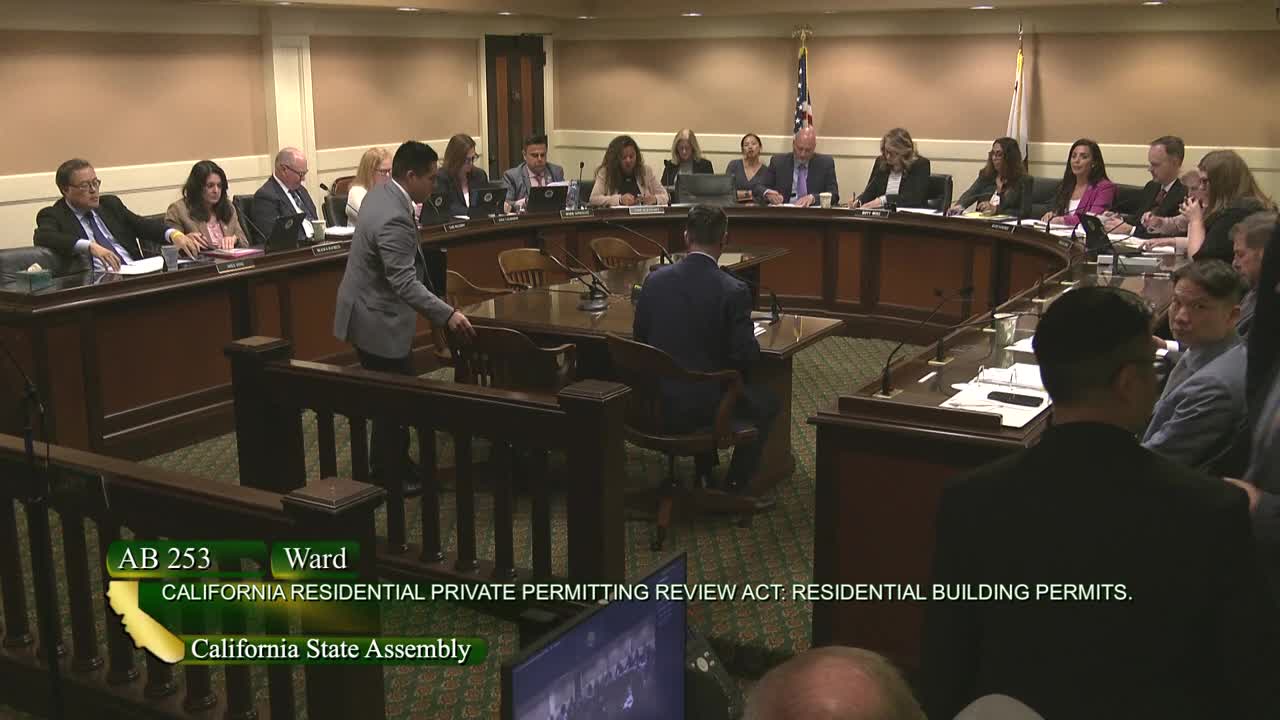 3MIN
Assembly Standing Committee on Appropriations


Bill Co-Author(s):
