AB 471: County air pollution control districts: Antelope Valley Air Quality Management District: board members: compensation.
- Session Year: 2025-2026
- House: Assembly
- Latest Version Date: 2025-10-06
Current Status:
Passed
(2025-10-06: Chaptered by Secretary of State - Chapter 366, Statutes of 2025.)
Introduced
In Committee
Awaiting First Chamber Vote
Passed First Chamber
In Committee
Awaiting Second Chamber Vote
Passed Second Chamber
Enacted
Existing law provides for the creation of a county air pollution control district in every county not included within other specified districts. Existing law requires, under certain circumstances, the membership of the governing board of each county air pollution control district to include one or more members who are mayors, city council members, or both, and one or more members who are county supervisors.
This bill would provide that a member of the board is entitled to reimbursement for actual and necessary expenses incurred in the performance of board duties, as specified. The bill would require, upon adoption of a resolution by the county district board, each member of the board to receive compensation, subject to specified daily and annual limits, while attending meetings of the board or any committee of the board or while engaged in the official business of the county district, as specified. The bill would require a county district board that elects to provide compensation to its board to submit a report containing specified information to the relevant committees of the Legislature within 3 years of the commencement of that compensation. The bill would provide that these provisions apply only to a county district board subject to the above-described membership requirement.
Existing law establishes the Antelope Valley Air Quality Management District, governed by a 7-member board, and prescribes the powers and duties of the district board with respect to the control of air pollution in the district.
This bill would provide that a member of the board is entitled to reimbursement for actual and necessary expenses incurred in the performance of board duties, as specified. The bill would require, upon adoption of a resolution by the district board, each member of the board to receive compensation, subject to specified daily and annual limits, while attending meetings of the board or any committee of the board or while engaged in the official business of the county district, as specified. The bill would require the district board, if it elects to provide compensation to its board, to submit a report containing specified information to the relevant committees of the Legislature within 3 years of the commencement of that compensation.
This bill would make legislative findings and declarations as to the necessity of a special statute for the boards.
Existing law provides for the creation of a county air pollution control district in every county not included within other specified districts. Existing law requires, under certain circumstances, the membership of the governing board of each county air pollution control district to include one or more members who are mayors, city council members, or both, and one or more members who are county supervisors.
This bill, which would apply only to a county district board subject to this membership requirement, bill would provide that a member of the board is entitled to reimbursement for actual and necessary expenses incurred in the performance of board duties, as specified. The bill would require, upon adoption of a resolution by the county district board, each member of the board to receive compensation, subject to specified daily and annual limits, for attending meetings of the board or any committee of the board or while engaged in the official business of the county district, as specified. The bill would require a county district board that elects to provide compensation to its board to submit a report containing specified information to the relevant committees of the Legislature within 3 years of the commencement of that compensation. The bill would provide that these provisions apply only to a county district board subject to the above-described membership requirement.
Existing law establishes the Antelope Valley Air Quality Management District, governed by a 7-member board, and prescribes the powers and duties of the district board with respect to the control of air pollution in the district.
This bill would provide that a member of the board is entitled to reimbursement for actual and necessary expenses incurred in the performance of board duties, as specified. The bill would require, upon adoption of a resolution by the district board, each member of the board to receive compensation, subject to specified daily and annual limits, for attending meetings of the board or any committee of the board or while engaged in the official business of the county district, as specified. The bill would require the Antelope Valley district board, if it elects to provide compensation to its board, to submit a report containing specified information to the relevant committees of the Legislature within 3 years of the commencement of that compensation.
This bill would make legislative findings and declarations as to the necessity of a special statute for the boards.
Existing law provides for the creation of a county air pollution control district in every county not included within other specified districts. Existing law requires, under certain circumstances, the membership of the governing board of each county air pollution control district to include one or more members who are mayors, city council members, or both, and one or more members who are county supervisors.
This bill, which would apply only to a county district board subject to this membership requirement, would provide that a member of the board is entitled to reimbursement for actual and necessary expenses incurred in the performance of board duties, as specified. The bill would require, upon adoption of a resolution by the county district board, each member of the board to receive compensation, subject to specified daily and annual limits, for attending meetings of the board or any committee of the board or while engaged in the official business of the county district, as specified.
Existing law establishes the Antelope Valley Air Quality Management District, governed by a 7-member board, and prescribes the powers and duties of the district board with respect to the control of air pollution in the district.
This bill would provide that a member of the board is entitled to reimbursement for actual and necessary expenses incurred in the performance of board duties, as specified. The bill would require, upon adoption of a resolution by the district board, each member of the board to receive compensation, subject to specified daily and annual limits, for attending meetings of the board or any committee of the board or while engaged in the official business of the county district, as specified.
This bill would make legislative findings and declarations as to the necessity of a special statute for the boards.
Existing law provides for the creation of a county air pollution control district in every county not included within other specified districts. Existing law requires, under certain circumstances, the membership of the governing board of each county air pollution control district to include one or more members who are mayors, city council members, or both, and one or more members who are county supervisors.
This bill, which would apply only to a county district board subject to this membership requirement, would provide that a member of the board is entitled to reimbursement for actual and necessary expenses incurred in the performance of board duties. duties, as specified. The bill would require, upon adoption of a resolution by the county district board, each member of the board to receive compensation, subject to specified daily and annual limits, for attending meetings of the board or any committee of the board or while engaged in the official business of the county district, as specified.
Existing law provides for the creation of a county air pollution control district in every county not included within other specified districts. Existing law requires, under certain circumstances, the membership of the governing board of each county air pollution control district to include one or more members who are mayors, city council members, or both, and one or more members who are county supervisors.
This bill, which would apply only to a county district board subject to this membership requirement, would provide that a member of the board is entitled to reimbursement for actual and necessary expenses incurred in the performance of board duties. The bill would require, upon adoption of a resolution by the county district board, each member of the board to receive compensation, subject to specified daily and annual limits, for attending meetings of the board or any committee of the board or while engaged in the official business of the county district, as specified.
(a)(1)Each member of a county district board shall be entitled to reimbursement for actual and necessary expenses incurred in the performance of board duties.
(2)The county district board shall not provide reimbursement for expenses pursuant to this subdivision to a member of the board if the member receives any reimbursement for the expenses covered by paragraph (1) by another entity.
(b)(1)In addition to the reimbursement for expenses provided pursuant to subdivision (a), upon adoption of a resolution by a county district board at an open regular meeting, each member of the county district board shall receive compensation of up to two hundred dollars ($200) per day attending meetings of the county district board or any committee of the county district board, or, upon authorization of the county district board, while engaged in the official business of the county district, but that compensation shall not exceed seven thousand two hundred dollars ($7,200) per board member in any one year.
(2)The compensation of each member of the county district board may be increased beyond the amounts provided in paragraph (1) by the county district board at an open regular meeting, but the amount of the increase shall not exceed the greater of either of the following:
(A)An amount equal to 5 percent for each calendar year from the operative date of the last adjustment of the compensation.
(B)Beginning January 1, 2026, an amount not to exceed 10 percent for each calendar year that is equal to the annual change in inflation as determined by the California Consumer Price Index for the area where the district board is located.
(3)The county district board shall not provide for automatic future increases in compensation for its members.
(4)The county district board shall not provide compensation pursuant to this subdivision to a member of the board if the member receives any compensation specifically provided for activities described in paragraph (1) from another entity.
(c)The reimbursement for expenses and compensation provided for in this section only applies to members of a county district board whose membership is determined pursuant to Section 40100.5.
(d)(1)Each county district board that elects to provide compensation to its board pursuant to subdivision (b) shall submit a report to the relevant committees of the Legislature within three years of the commencement of that compensation.
(2)The report shall include, but is not limited to, the following information:
(A)An assessment of whether providing the compensation changed the composition of the board membership and their backgrounds.
(B)An assessment of whether providing compensation improved the engagement and ability of board members to carry out their responsibilities on matters pertaining to the county district.
(3)A report to be submitted pursuant to this subdivision shall be submitted in compliance with Section 9795 of the Government Code.
SEC. 2.Section 41313 is added to the Health and Safety Code, to read:41313.(a)(1)Each member of the Antelope Valley district board shall be entitled to reimbursement for actual and necessary expenses incurred in the performance of board duties.
(2)The Antelope Valley district board shall not provide reimbursement for expenses pursuant to this subdivision to a member of the board if the member receives any reimbursement for the expenses covered by paragraph (1) by another entity.
(b)(1)In addition to the reimbursement for expenses provided pursuant to subdivision (a), upon adoption of a resolution by the Antelope Valley district board at an open regular meeting, each member of the Antelope Valley district board shall receive compensation of up to two hundred dollars ($200) per day attending meetings of the Antelope Valley district board or any committee of the Antelope Valley district board, or, upon authorization of the Antelope Valley district board, while engaged in the official business of the district, but that compensation shall not exceed seven thousand two hundred dollars ($7,200) per board member in any one year.
(2)The compensation of each member of the Antelope Valley district board may be increased beyond the amounts provided in paragraph (1) by the Antelope Valley district board at an open regular meeting, but the amount of the increase shall not exceed the greater of either of the following:
(A)An amount equal to 5 percent for each calendar year from the operative date of the last adjustment of the compensation.
(B)Beginning January 1, 2026, an amount not to exceed 10 percent for each calendar year that is equal to the annual change in inflation as determined by the California Consumer Price Index for the area where the Antelope Valley district board is located.
(3)The Antelope Valley district board shall not provide for automatic future increases in compensation for its members.
(4)The Antelope Valley district board shall not provide compensation pursuant to this subdivision to a member of the board if the member receives any compensation specifically provided for activities described in paragraph (1) from another entity.
(c)(1)If the Antelope Valley district board elects to provide compensation to its board pursuant to this section, it shall submit a report to the relevant committees of the Legislature within three years of the commencement of that compensation.
(2)The report shall include, but is not limited to, the following information:
(A)An assessment of whether providing the compensation changed the composition of the board membership and their backgrounds.
(B)An assessment of whether providing compensation improved the engagement and ability of board members to carry out their responsibilities on matters pertaining to the Antelope Valley district.
(3)A report to be submitted pursuant to this subdivision shall be submitted in compliance with Section 9795 of the Government Code.
SEC. 3.The Legislature finds and declares that a special statute is necessary and that a general statute cannot be made applicable within the meaning of Section 16 of Article IV of the California Constitution because of the need to specifically set forth that the governing boards of county air pollution control districts, whose membership is determined pursuant to Section 40100.5 of the Health and Safety Code, and the governing board of the Antelope Valley Air Quality Management District, may provide compensation to governing board members thereby ensuring board members are adequately compensated for the important public service they perform, along with other air pollution control and air quality management districts that have existing explicit statutory authority to do so.
(a)(1)Each member of a county district board shall be entitled to reimbursement for actual and necessary expenses incurred in the performance of board duties.
(2)The county district board shall not provide reimbursement for expenses pursuant to this subdivision to a member of the board if the member receives any reimbursement for the expenses covered by paragraph (1) by another entity.
(b)(1)In addition to the reimbursement for expenses provided pursuant to subdivision (a), upon adoption of a resolution by a county district board at an open regular meeting, each member of the county district board shall receive compensation of up to two hundred dollars ($200) per day attending meetings of the county district board or any committee of the county district board, or, upon authorization of the county district board, while engaged in the official business of the county district, but that compensation shall not exceed seven thousand two hundred dollars ($7,200) per board member in any one year.
(2)The compensation of each member of the county district board may be increased beyond the amounts provided in paragraph (1) by the county district board at an open regular meeting, but the amount of the increase shall not exceed the greater of either of the following:
(A)An amount equal to 5 percent for each calendar year from the operative date of the last adjustment of the compensation.
(B)Beginning January 1, 2026, an amount not to exceed 10 percent for each calendar year that is equal to the annual change in inflation as determined by the California Consumer Price Index for the area where the district board is located.
(3)The county district board shall not provide for automatic future increases in compensation for its members.
(4)The county district board shall not provide compensation pursuant to this subdivision to a member of the board if the member receives any compensation specifically provided for activities described in paragraph (1) from another entity.
(c)The reimbursement for expenses and compensation provided for in this section only applies to members of a county district board whose membership is determined pursuant to Section 40100.5.
SEC. 2.Section 41313 is added to the Health and Safety Code, to read:41313.(a)(1)Each member of the Antelope Valley district board shall be entitled to reimbursement for actual and necessary expenses incurred in the performance of board duties.
(2)The Antelope Valley district board shall not provide reimbursement for expenses pursuant to this subdivision to a member of the board if the member receives any reimbursement for the expenses covered by paragraph (1) by another entity.
(b)(1)In addition to the reimbursement for expenses provided pursuant to subdivision (a), upon adoption of a resolution by the Antelope Valley district board at an open regular meeting, each member of the Antelope Valley district board shall receive compensation of up to two hundred dollars ($200) per day attending meetings of the Antelope Valley district board or any committee of the Antelope Valley district board, or, upon authorization of the Antelope Valley district board, while engaged in the official business of the district, but that compensation shall not exceed seven thousand two hundred dollars ($7,200) per board member in any one year.
(2)The compensation of each member of the Antelope Valley district board may be increased beyond the amounts provided in paragraph (1) by the Antelope Valley district board at an open regular meeting, but the amount of the increase shall not exceed the greater of either of the following:
(A)An amount equal to 5 percent for each calendar year from the operative date of the last adjustment of the compensation.
(B)Beginning January 1, 2026, an amount not to exceed 10 percent for each calendar year that is equal to the annual change in inflation as determined by the California Consumer Price Index for the area where the Antelope Valley district board is located.
(3)The Antelope Valley district board shall not provide for automatic future increases in compensation for its members.
(4)The Antelope Valley district board shall not provide compensation pursuant to this subdivision to a member of the board if the member receives any compensation specifically provided for activities described in paragraph (1) from another entity.
SEC. 3.The Legislature finds and declares that a special statute is necessary and that a general statute cannot be made applicable within the meaning of Section 16 of Article IV of the California Constitution because of the need to specifically set forth that the governing boards of county air pollution control districts, whose membership is determined pursuant to Section 40100.5 of the Health and Safety Code, and the governing board of the Antelope Valley Air Quality Management District, may provide compensation to governing board members thereby ensuring board members are adequately compensated for the important public service they perform, along with other air pollution control and air quality management districts that have existing explicit statutory authority to do so.
(a)(1)Each member of a county district board shall be entitled to reimbursement for actual and necessary expenses incurred in the performance of board duties.
(2)The county district board shall not provide reimbursement for expenses pursuant to this subdivision to a member of the board if the member receives any reimbursement for the expenses covered by paragraph (1) by another entity.
(b)(1)In addition to the reimbursement for expenses provided pursuant to subdivision (a), upon adoption of a resolution by a county district board at an open regular meeting, each member of the county district board shall receive compensation of up to two hundred dollars ($200) per day attending meetings of the county district board or any committee of the county district board, or, upon authorization of the county district board, while engaged in the official business of the county district, but that compensation shall not exceed seven thousand two hundred dollars ($7,200) per board member in any one year.
(2)The compensation of each member of the county district board may be increased beyond the amounts provided in paragraph (1) by the county district board at an open regular meeting, but the amount of the increase shall not exceed the greater of either of the following:
(A)An amount equal to 5 percent for each calendar year from the operative date of the last adjustment of the compensation.
(B)Beginning January 1, 2026, an amount not to exceed 10 percent for each calendar year that is equal to the annual change in inflation as determined by the California Consumer Price Index for the area where the district board is located.
(3)The county district board shall not provide for automatic future increases in compensation for its members.
(4)The county district board shall not provide compensation pursuant to this subdivision to a member of the board if the member receives any compensation specifically provided for activities described in paragraph (1) from another entity.
(c)The reimbursement for expenses and compensation provided for in this section only applies to members of a county district board whose membership is determined pursuant to Section 40100.5.
(a)Each member of a county district board shall be entitled to reimbursement for actual and necessary expenses incurred in the performance of board duties.
(b)(1)In addition to the reimbursement for expenses provided pursuant to subdivision (a), upon adoption of a resolution by a county district board at an open regular meeting, each member of the county district board shall receive compensation of up to two hundred dollars ($200) per day attending meetings of the county district board or any committee of the county district board, or, upon authorization of the county district board, while engaged in the official business of the county district, but that compensation shall not exceed seven thousand two hundred dollars ($7,200) per board member in any one year.
(2)The compensation of each member of the county district board may be increased beyond the amounts provided in paragraph (1) by the county district board at an open regular meeting, but the amount of the increase shall not exceed the greater of either of the following:
(A)An amount equal to 5 percent for each calendar year from the operative date of the last adjustment of the compensation.
(B)Beginning January 1, 2026, an amount not to exceed 10 percent for each calendar year that is equal to the annual change in inflation as determined by the California Consumer Price Index for the area where the district board is located.
(3)The county district board shall not provide for automatic future increases in compensation for its members.
(c)The reimbursement for expenses and compensation provided for in this section only applies to members of a county district board whose membership is determined pursuant to Section 40100.5.
|
Date
|
Status
|
|---|---|
| Oct 6, 2025 | Chaptered by Secretary of State - Chapter 366, Statutes of 2025. |
| Oct 6, 2025 | Approved by the Governor. |
| Sep 11, 2025 | Enrolled and presented to the Governor at 4 p.m. |
| Sep 4, 2025 | Senate amendments concurred in. To Engrossing and Enrolling. (Ayes 74. Noes 2. Page 2917.). |
| Sep 3, 2025 | In Assembly. Concurrence in Senate amendments pending. |
| Sep 3, 2025 | Read third time. Passed. Ordered to the Assembly. (Ayes 33. Noes 0. Page 2458.). |
| Jul 17, 2025 | Read second time and amended. Ordered to third reading. |
| Jul 16, 2025 | From committee: Amend, and do pass as amended. (Ayes 5. Noes 1.) (July 16). |
| Jul 7, 2025 | From committee chair, with author's amendments: Amend, and re-refer to committee. Read second time, amended, and re-referred to Com. on L. GOV. |
| Jun 19, 2025 | Read second time and amended. Re-referred to Com. on L. GOV. |
| Jun 18, 2025 | From committee: Amend, and do pass as amended and re-refer to Com. on L. GOV. (Ayes 6. Noes 0.) (June 18). |
| May 7, 2025 | Referred to Coms. on E.Q. and L. GOV. |
| Apr 10, 2025 | In Senate. Read first time. To Com. on RLS. for assignment. |
| Apr 10, 2025 | Read third time. Passed. Ordered to the Senate. (Ayes 66. Noes 2. Page 1114.) |
| Mar 26, 2025 | Read second time. Ordered to third reading. |
| Mar 25, 2025 | From committee: Do pass. (Ayes 13. Noes 0.) (March 24). |
| Feb 24, 2025 | Referred to Com. on NAT. RES. |
| Feb 7, 2025 | From printer. May be heard in committee March 9. |
| Feb 6, 2025 | Read first time. To print. |
|
Date
|
Description
|
Location
|
Votes
|
|
|---|---|---|---|---|
| Sep 4, 2025 | AB 471 Hart Concurrence in Senate Amendments | Assembly Floor |
Passed |
|
| Sep 3, 2025 | Assembly 3rd Reading AB471 Hart et al. By Laird | Senate Floor |
Passed |
|
| Jul 16, 2025 | Do pass as amended | Senate Standing Committee on Local Government |
Passed |
|
| Jun 18, 2025 | Do pass as amended, but first amend, and re-refer to the Committee on [Local Government] | Senate Standing Committee on Environmental Quality |
Passed |
|
| Apr 10, 2025 | AB 471 Hart Assembly Third Reading | Assembly Floor |
Passed |
|
| Mar 24, 2025 | Do pass. | Assembly Standing Committee on Natural Resources |
Passed |
This list shows positions taken on this bill by organizations on the date displayed, which is linked to the original source.
Positions by individuals are not included.
|
Organization
|
Position
|
Date
|
|---|---|---|
| Antelope Valley Air Quality Management District | ** Support | |
| Butte County Air Quality Management District | ** Support | |
| California Air Pollution Control Officers Association | ** Support | |
| Eastern Kern Air Pollution Control District | ** Support | |
| Northern Sonoma County Air Pollution Control District | ** Support | |
| Placer County Air Pollution Control District | ** Support | |
| San Luis Obispo County Air Pollution Control District | ** Support | |
| Santa Barbara County Air Pollution Control District | ** Support | |
| Ventura County Air Pollution Control District | ** Support |
CONCURRENCE IN SENATE AMENDMENTS
CSA1 Bill Id:AB 471
Author:(Hart)
As Amended Ver:July 17, 2025
Majority vote
SUMMARY
Establishes reimbursement and per diem compensation standards for board members of certain single county air districts, and the Antelope Valley air district, permitting daily compensation up to $200 per day and annual compensation up to $7,200, and permits board approval of 5-10% annual increases going forward.
Senate Amendments
- Prohibit reimbursement and compensation if the board member receives reimbursement for the same expenses or compensation for the same activity from another entity.
- Require each district board that provides compensation pursuant to this bill to report to the Legislature, as specified.
- Add the Antelope Valley Air Quality Management District (encompassing the northern, desert portion of Los Angeles County).
COMMENTS
Existing law provides for the creation of a county air pollution control district in every county not included within other specified regional and multi-county districts. Existing law requires, under certain circumstances, the membership of the governing board of each county air pollution control district to include one or more members who are mayors, city council members, or both, and one or more members who are county supervisors. (Health and Safety Code 40100, et seq.)
Per diem compensation limits for certain air district board members were set in statute many years ago and, until last year, did not provide for inflation adjustment. For example, a $100/day limit for the South Coast district was established in 1987. AB 2522 (Wendy Carrillo), Chapter 406, Statutes of 2024, increased per diem compensation limits for board members of the Bay Area, Sacramento, San Diego, South Coast, and unified (i.e., consisting of two or more contiguous counties) air districts, doubling daily compensation from $100 per day to $200 per day and increasing corresponding monthly and annual compensation limits.
This bill establishes per diem compensation with comparable limits for single county air districts that include non-supervisor board members. The bill permits the governing boards to approve limited increases in future years, based on inflation. The bill applies to air districts in the counties of Santa Barbara, San Luis Obispo, Ventura, Placer, Butte, Northern Sonoma, Shasta, Eastern Kern, Amador, Lassen, and Siskiyou, as well as Antelope Valley in northern Los Angeles County.
These per diem payments come from local air district funds, so the bill is non-fiscal.
According to the Author
Assembly Bill 471 will help increase participation within local air district boards by providing equitable compensation to board members. Specifically, the bill will allow certain county air districts to provide per diem compensation to board members, while setting compensation limits and prohibiting automatic future increases.
AB 471 will facilitate broader and more diverse participation on air district boards. Better financial incentives can attract a wider range of candidates from diverse backgrounds who may have been discouraged from serving due to the financial burden.
Arguments in Support
According to sponsor California Air Pollution Control Officers Association, state law is unclear as to the authority to provide per diem compensation to board members engaging in the official duties of specified county air districts, resulting in board members not being provided any compensation whatsoever. AB 471 addresses this inequity by providing explicit statutory authority for specified county air districts. The bill's reasonable compensation limits, CPI adjustments, and transparency requirements are the same as what was authorized for unified air districts in AB 2522. AB 471 has no state cost.
This bill will facilitate broader and more diverse participation on air district boards. Financial incentives can attract a more comprehensive array of candidates with more varied backgrounds for whom the economic impracticality of serving may have previously deterred them from doing so.
Arguments in Opposition
None received.
FISCAL COMMENTS
Non-fiscal.
VOTES:
ASM NATURAL RESOURCES: 13-0-1
YES: Bryan, Alanis, Connolly, Davies, Flora, Garcia, Haney, Sanchez, Kalra, Muratsuchi, Pellerin, Schultz, Zbur
ABS, ABST OR NV: Wicks
ASSEMBLY FLOOR: 66-2-11
YES: Addis, Aguiar-Curry, Ahrens, Alanis, Alvarez, Arambula, Ávila Farías, Bains, Bennett, Berman, Boerner, Bonta, Bryan, Caloza, Carrillo, Castillo, Connolly, Davies, Dixon, Elhawary, Ellis, Flora, Fong, Gabriel, Garcia, Gipson, Jeff Gonzalez, Mark González, Hadwick, Harabedian, Hart, Irwin, Jackson, Kalra, Krell, Lackey, Lee, Lowenthal, Macedo, McKinnor, Muratsuchi, Nguyen, Pacheco, Papan, Patel, Pellerin, Quirk-Silva, Ramos, Ransom, Michelle Rodriguez, Rogers, Blanca Rubio, Schiavo, Schultz, Sharp-Collins, Solache, Soria, Stefani, Ta, Valencia, Wallis, Ward, Wicks, Wilson, Zbur, Rivas
NO: DeMaio, Patterson
ABS, ABST OR NV: Bauer-Kahan, Calderon, Chen, Gallagher, Haney, Hoover, Ortega, Petrie-Norris, Celeste Rodriguez, Sanchez, Tangipa
SENATE FLOOR: 33-0-7
YES: Allen, Archuleta, Arreguín, Ashby, Becker, Blakespear, Caballero, Cervantes, Choi, Cortese, Dahle, Durazo, Gonzalez, Grayson, Hurtado, Laird, Limón, McGuire, McNerney, Menjivar, Padilla, Pérez, Reyes, Richardson, Rubio, Smallwood-Cuevas, Stern, Strickland, Umberg, Valladares, Wahab, Weber Pierson, Wiener
ABS, ABST OR NV: Alvarado-Gil, Cabaldon, Grove, Jones, Niello, Ochoa Bogh, Seyarto
UPDATED
VERSION: July 17, 2025
CONSULTANT: Lawrence Lingbloom / NAT. RES. / (916) 319-2092 FN: 0001565
SENATE RULES COMMITTEE Office of Senate Floor Analyses (916) 651-1520 Fax: (916) 327-4478 | AB 471 |
THIRD READING
Bill No: AB 471
Author: Hart (D), et al.
Amended: 7/17/25 in Senate
Vote: 21
SENATE ENVIRONMENTAL QUALITY COMMITTEE: 6-0, 6/18/25
AYES: Blakespear, Valladares, Dahle, Hurtado, Menjivar, Pérez
NO VOTE RECORDED: Gonzalez, Padilla
SENATE LOCAL GOVERNMENT COMMITTEE: 5-1, 7/16/25
AYES: Durazo, Choi, Arreguín, Laird, Wiener
NOES: Seyarto
NO VOTE RECORDED: Cabaldon
ASSEMBLY FLOOR: 66-2, 4/10/25 - See last page for vote
SUBJECT: County air pollution control districts: Antelope Valley Air Quality Management District: board members: compensation
SOURCE: Author
DIGEST:
This bill (1) allows 12 air districts to set expense reimbursement and per diem compensation levels for board members of up to $200 per day (not to exceed $7,200 a year) and (2) permits air district boards to approve annual increases up to certain amounts going forward.
ANALYSIS:
Existing law:
- Requires a county board of supervisors to serve as the ex officio air board of their county, except in cases where a county is part of a multi-county air pollution control district (APCD) or forms a single-county APCD involving city elected officials (Health & Safety Code (HSC) §40100).
- Allows two or more contiguous counties to create a unified or multi-county APCD, sometimes referred to as an air quality management district (AQMD) that may include non-elected officials. Members of unified APCDs or AQMDs can receive compensation if their boards elect to provide it under the following guidelines (HSC §40150):
a) Each board member can be reimbursed for all actual and necessary expenses incurred while performing board duties;
b) Each board member can receive up to $200 per day in per diem compensation while engaged in board business, provided the compensation level is set during an open, regular meeting;
c) The annual compensation level is capped at $7,200;
d) A board can increase those pay levels annually by 5% (for any reason) or up to 10% (to match increases in inflation), provided the board does so in an open, regular meeting; and
e) A board cannot approve any automatic future compensation increases.
3) Allows counties to create a single-county APCD whose board – with one exception – consists solely of people who are elected mayors and/or city councilmembers and county supervisors and must include at least one mayor or city councilmember and one county supervisor. With the exception of the San Diego County APCD (SDAPCD), no compensation is provided to any board members of a single-county APCD (HSC §40100.5).
4) Establishes the seven-member Antelope Valley Air Quality Management District (AVAQMD). It consists of two members of the Lancaster City Council, two members of the Palmdale City Council, two people appointed by the Los Angeles County Board of Supervisors who represent a majority of the Board’s Antelope Valley district, and one public member appointed by the other six board members. No compensation is paid to these members (HSC §42310).
5) Establishes the 11-member SDAPCD whose members can be paid up to $200 per day – not to exceed $2,000 per month – to attend meetings and conduct SDAPCD business, and can be reimbursed 100% for actual and necessary expenses. The SDAPCD Board can increase those pay levels annually by 5% (for any reason) or up to 10% (to match increases in inflation), provided they do so in an open, regular meeting. The SDAPCD cannot approve any automatic future compensation increases (HSC §40100.6).
This bill:
- Allows the state’s 11 single-county APCDs and the AVAQMD to adopt a compensation structure that mirrors the structure unified APCDs and AQMDs can adopt. Specifically:
a) Each APCD board member can be reimbursed for all actual and necessary expenses incurred while performing board duties;
b) Each board member can receive up to $200 per day in per diem compensation while engaged in board business, provided the compensation level is set during an open, regular meeting;
c) The annual compensation level is capped at $7,200;
d) An APCD board can increase those pay levels annually by 5% (for any reason) or up to 10% (to match increases in inflation), provided the board does so in an open, regular meeting; and
e) An APCD board cannot approve any automatic future compensation increases.
2) Prohibits single-county APCDs and AQMDs, as well as the AVAQMD, from providing any compensation or reimbursement for expenses to a member who is compensated or reimbursed for their air district work by another entity.
3) Requires single county APCDs and AQMDs, as well as the AVAQMD, that vote to compensate members to submit a report to the Legislature within three years of beginning the compensation. The report must assess whether providing compensation changed the composition of the board membership and whether it improved the engagement and ability of board members to carry out their responsibilities.
Background
1) Attacking Air Pollution. California’s efforts to protect the public from the harmful effects of air pollution and help mitigate the effects of climate change involve federal, state, and local governments. The statewide California Air Resources Board (CARB) works with the U.S. Environmental Protection Agency and spearheads the state’s non-vehicular air pollution efforts through 35 APCDs and AQMDs (also referred to more generally as “air districts”).
2) Local Air Districts. CARB oversees the state’s 35 air districts, which adopt and enforce rules and regulations to achieve and maintain state and federal air quality standards. State law spells out the membership of the air district boards, but there are many variations. Some are county-specific, while others are regional entities with representation from more than one county. Some entities have their own specific governing statutes and some boards include public members, while others are restricted solely to elected officials who represent areas of the district.
3) Show Me The Money. Air districts generally receive funding from grants, subventions, permit fees, penalties, and/or a surcharge or fee on motor vehicles registered in the district. If these funding sources don’t provide a district with the money needed to meet its expenses, an air district can levy an annual per capita assessment on those cities that have a member on the air district board and on the county or counties included within the district. Any annual per capita assessment imposed on the cities and/or counties included in a district must be imposed on an equitable per capita basis.
Comments
1) Purpose of this bill. According to the author, “Assembly Bill 471 will help increase participation within local air district boards by providing equitable compensation to board members. Specifically, the bill will allow certain county air districts to provide per diem compensation to board members, while setting compensation limits and prohibiting automatic future increases. AB 471 will facilitate broader and more diverse participation on air district boards. Better financial incentives can attract a wider range of candidates from diverse backgrounds who may have been discouraged from serving due to the financial burden.”
2) Different Types of Air District Boards. There are different types of air district boards in statute, though the lines separating them aren’t always crystal clear. Generally speaking, there are:
- Single-county districts where the air district board consists solely of the five members of the county board of supervisors. There are 11 such boards in the state. These boards are not affected by this bill, and the board members receive no additional compensation beyond what they are paid as a member of a county board of supervisors.
- Single-county districts where the air district board consists solely of city councilmembers and/or city mayors, and members of the county board of supervisors – and does not include any public members. There are 11 such boards in the state and these boards are all affected by this bill.
- A partial-county district – the Antelope Valley AQMD – which is in northern Los Angeles County but does not overlap with the South Coast AQMD. Its board includes four city councilmembers, two members of the Los Angeles County Board of Supervisors, and one public member and is also affected by this bill.
- Unified air districts made up of two or more counties where the board consists of city councilmembers or city mayors and members of a county board of supervisors – and may include members of the public. There are eight such boards in the state and under AB 2522 (W. Carrillo, Chapter 406, Statutes of 2024), they were given the authority to roughly double the compensation provided to board members.
- Separate statute air districts. These can be multi-county or single-county air districts and may or may not include public members. The only things they have in common are (a) they were each created by an individual statute specifying their exact membership; (b) their board members receive compensation; and (c) they can be compensated at levels higher than unified air district board members and at levels higher than what is proposed in this bill. There are four such boards in the state – South Coast AQMD, Bay Area AQMD, SDACPD, and the Sacramento Metropolitan AQMD – and like unified air districts, they were given the authority under AB 2522 (W. Carrillo) to roughly double the compensation paid to board members.
3) You Look So Familiar, Have We Met Before? Last year, AB 2522 (W. Carrillo) was enacted to allow unified and separate statute air districts to increase their per diem compensation levels.
For the eight unified air districts, AB 2522 authorized them to raise the daily per diem from $100 to $200, with the annual cap doubling from $3,600 to $7,200.
For the four special statute air districts, AB 2522 authorized:
- The Bay Area AQMD to quadruple its annual cap from $6,000 to $24,000 while holding the daily maximum at $200 and eliminating a $100 per meeting maximum option;
- The South Coast AQMD and SDAPCD to double their daily maximums from $100 to $200 and double their annual maximums from $12,000 to $24,000; and
- The Sacramento Metropolitan AQMD to double its daily maximum from $100 to $200 and its annual maximum from $6,000 to $12,000.
This measure gives the 11 single-county air districts and the AVAQMD the ability to establish compensation levels for their board members set at a maximum of $200 per day and $7,200 per year.
The districts affected by this bill are those in Amador, Butte, Eastern Kern, Lassen, Northern Sonoma, Placer, San Luis Obispo, Santa Barbara, Shasta, Siskiyou, and Ventura counties, along with the AVAQMD.
4) Will This Really Increase Equity & Diversity Participation? The author and some proponents of AB 471 feel allowing air district board members to be compensated could attract a more diverse pool of candidates, including those from underrepresented communities who today may not be applying to serve as a board member due to the lack of compensation.
As noted above, in the single-county air districts affected by this bill, the board members are exclusively elected officials – they can only serve on an air district board because they have been elected as a city mayor, a city councilmember, or a county supervisor.
Now, it is certainly possible – and in some cases, highly likely – an elected official may not want to volunteer to serve on an air district board without additional compensation. This could be due to the additional work and time commitment involved, the additional travel expenses they may incur to attend meetings, or other reasons.
However, it should be noted the diversity this bill could achieve may be based solely on where a person is located in a county and/or their prior experiences, since the statute still requires all board members to be elected city councilmembers, mayors or members of a board of supervisors.
Other air districts, even those that compensate board members, have chosen (by virtue of their enabling statutes) to increase the diversity of their membership by having non-elected people on their boards.
For example, the SDAPCD has three public members on its 11-member board:
- One must be a practicing physician or public health professional who specializes in the health effects of air pollution on vulnerable populations;
- One must be a person representing environmental justice interests and who works directly with communities in the SDAPCD that are most significantly burdened by, and vulnerable to, high levels of pollution, including communities with diverse racial and ethnic populations and communities with low-income populations; and
- One must be a person with a scientific or technical background in air pollution, such as an environmental engineer, chemist, meteorologist, or air pollution specialist.
5) What Is The Right Level of Compensation? Setting up the appropriate per diem structure that will simultaneously encourage more people to apply to be an air district board member, appropriately pay them for the additional work they are doing, and not overburden taxpayers who are, directly or indirectly, financing the pay structure, is not an exact science.
AB 471 models its structure – the maximum pay levels and potential increases, how any increases can be approved, and the ban on automatic pay increases – on what is already in statute for many other air districts.
It may be valuable to crack out the abacas to see how the pay levels set forth in the bill could rise over time. Assuming an air district sets the maximum annual pay cap at $7,200 and assuming it approves a maximum 10% increase each year (which can only occur if the inflation level set by the Consumer Price Index is 10% or higher each year), the annual compensation would change as follows:
- Year 1 -- $7,200
- Year 2 -- $7,920
- Year 5 -- $10,541.52
- Year 10 -- $16,977.22
- Year 15 -- $27,341.99
Alternatively, assuming an air district sets the maximum annual pay cap at $7,200 and assuming it approves a maximum 5% increase each year (which is permitted under the bill for any reason), the annual compensation would change as follows:
- Year 1 -- $7,200
- Year 2 -- $7,560
- Year 5 -- $8,751.65
- Year 10 -- $11,169.57
- Year 15 -- $14,255.52
Whether the balance put forth in this bill achieves the perfect Goldilocks pay balance (not too high, not too low, but just right) is likely in the eye of the beholder.
FISCAL EFFECT: Appropriation: No Fiscal Com.: No Local: No
SUPPORT: (Verified 8/13/25)
California Air Pollution Control Officers Association (Sponsor)
Antelope Valley Air Quality Management District
Butte County Air Quality Management District
Eastern Kern Air Pollution Control District
Northern Sonoma County Air Pollution Control District
Placer County Air Pollution Control District
San Luis Obispo County Air Pollution Control District
Santa Barbara County Air Pollution Control District
Ventura County Air Pollution Control District
OPPOSITION: (Verified 8/13/25)
None received
ASSEMBLY FLOOR: 66-2, 4/10/25
AYES: Addis, Aguiar-Curry, Ahrens, Alanis, Alvarez, Arambula, Ávila Farías, Bains, Bennett, Berman, Boerner, Bonta, Bryan, Caloza, Carrillo, Castillo, Connolly, Davies, Dixon, Elhawary, Ellis, Flora, Fong, Gabriel, Garcia, Gipson, Jeff Gonzalez, Mark González, Hadwick, Harabedian, Hart, Irwin, Jackson, Kalra, Krell, Lackey, Lee, Lowenthal, Macedo, McKinnor, Muratsuchi, Nguyen, Pacheco, Papan, Patel, Pellerin, Quirk-Silva, Ramos, Ransom, Michelle Rodriguez, Rogers, Blanca Rubio, Schiavo, Schultz, Sharp-Collins, Solache, Soria, Stefani, Ta, Valencia, Wallis, Ward, Wicks, Wilson, Zbur, Rivas
NOES: DeMaio, Patterson
NO VOTE RECORDED: Bauer-Kahan, Calderon, Chen, Gallagher, Haney, Hoover, Ortega, Petrie-Norris, Celeste Rodriguez, Sanchez, Tangipa
Prepared by: Evan Goldberg / E.Q. / (916) 651-4108, Heather Walters / E.Q. / (916) 651-4108
8/14/25 16:22:49
**** END ****
SENATE COMMITTEE ON LOCAL GOVERNMENT
Senator María Elena Durazo, Chair
2025 - 2026 Regular
Bill No: | AB 471 | Hearing Date: | 7/16/25 |
Author: | Hart | Fiscal: | No |
Version: | 7/7/25 Click here to enter text. | Consultant: | Vargas |
County air pollution control districts: Antelope Valley Air Quality Management District: board members: compensation
Allows compensation for board members of county air districts and Antelope Valley Air Quality Management District.
Background
California Air Resources Board. California’s efforts to protect the public from the harmful effects of air pollution and help prepare the state for the effects of climate change involves federal, state, and local governments. The California Air Resources Board (CARB) works with the federal Environmental Protection Agency (EPA) and spearheads the state’s non-vehicular air pollution efforts through 35 air pollution control districts and air quality management districts (air districts). CARB is comprised of 16 members, including 12 members the Governor appoints and the Senate confirms. Five of these members serve on local air districts, four are experts in fields that shape air quality rules, two are members of the public, and one serves as the CARB chair. The remaining four members include two members who represent environmental justice communities (one each appointed by the Senate and the Assembly) and two non-voting members for Legislative oversight (also one each appointed by the Senate and the Assembly). AB 197 (Eduardo Garcia, 2016) established staggered six-year terms for CARB’s voting members.
Local air districts. CARB oversees the state’s 35 air districts, who adopt and enforce rules and regulations to achieve and maintain state and federal air quality standards affected by businesses and facilities, ranging from oil refineries to auto body shops to dry cleaners. State law spells out the membership of these local air districts’ governing boards, but there are many variations. Some are county-specific, while others are regional entities with representation from more than one county, and some have their own specific governing statutes. While governance structures vary, each district appoints an air pollution control officer, whose responsibilities include enforcing all orders, regulations, and rules the district board prescribes.
Air districts generally receive funding from grants, subventions, permit fees, penalties, and/or a surcharge or fee on motor vehicles registered in the district. If these funding sources do not provide the district with sufficient revenues to meet its expenses, an air district can levy an annual per capita assessment on the cities that have agreed to have a member on the district board and on the county or counties included within the district. Any annual per capita assessment imposed on the cities and/or counties included in a district must be imposed on an equitable per capita basis.
There are five different types of air district boards, specifically:
- Eleven single-county districts where the air district board consists only of the five members of the county board of supervisors:
- Calaveras County Air Pollution Control District (APCD), Colusa County APCD, El Dorado County APCD, Glenn County APCD, Imperial County APCD, Lake County APCD, Mariposa County APCD, Mendocino County APCD, Modoc County APCD, Tehama County APCD, and Tuolumne County APCD.
- Eleven single-county districts where the air district board consists of elected officials from cities and members of the county board of supervisors:
- Amador County APCD, Butte County Air Quality Management District (AQMD), Eastern Kern APCD, Lassen County APCD, Northern Sonoma County APCD, Placer County APCD, San Luis Obispo APCD, Santa Barbara County APCD, Shasta County APCD, Siskiyou County APCD, and Ventura County APCD..
- Eight unified air districts where the air district board consists of city councilmembers or city mayors, members of a county board of supervisors, and may include public members. There are 8 boards and include:
- Feather River AQMD, Great Basin Unified APCD, Mojave Desert AQMD, Monterey Bay Air Resources District, North Coast Unified AQMD, Northern Sierra AQMD, San Joaquin Valley APCD, and Yolo-Solano AQMD.
- Four air districts that consist of multi-county or single county air districts, each with an individual statute specifying their exact membership:
- Bay Area AQMD, South Coast AQMD, San Diego APCD, and Sacramento Metropolitan AQMD.
- The Antelope Valley AQMD where the air district board consists of four city councilmembers, two members of the Los Angeles County board of supervisors, and one public member.
AB 2522 (Wendy Carrillo, 2024). AB 2522 increased the compensation that members of various air districts may receive for attending a board meeting or any committee of the board, provided the board approves the increase during an open, regular meeting, specifically:
- Bay Area AQMD’s board compensation is set at $200/day, not to exceed $24,000/year, via ordinance;
- South Coast AQMD’s board compensation is set at $200/day, not to exceed $2,000/month;
- San Diego APCD’s board compensation is set at $200/day, not to exceed $2,000/month;
- Sacramento Metropolitan AQMD’s board compensation is set at $200/day, not to exceed $12,000/year, via board approval; and
- A unified APCD compensation is set at $200/day, not to exceed $7,200/year, via resolution.
AB 2522 also authorized South Coast AQMD, San Diego APCD, and the unified APCDs to further increase board member compensation, not to exceed the greater of either 5% annually or the California Consumer Price Index-determined annual change in inflation, not to exceed 10%. Sacramento Metropolitan AQMD can raise board member compensation once every 12 months, by either the percentage change in inflation or the California Consumer Price Index, whichever is higher, up to a maximum of 10%.
The California Air Pollution Control Officers Association want the Legislature to allow other air districts to compensate their board members in a manner similar to unified air districts.
Proposed Law
Assembly Bill 471 allows the state’s 11 single-county APCDs and the Antelope Valley AQMD to adopt a compensation structure that mirrors the structure unified APCDs and AQMDs can adopt.
Specifically, AB 471 allows:
- Each board member to be reimbursed for all actual and necessary expenses incurred while performing board duties, unless the board member receives reimbursement from another entity;
- Each board member to receive up to $200 per day, not to exceed $7,200 annually, in per diem compensation while engaged in board business, provided the compensation level is set during an open, regular meeting;
The air district board can increase those pay levels annually by 5% (for any reason) or up to 10% (to match increases in inflation), provided the board does so in an open, regular meeting. However, it cannot approve any automatic future compensation increases and it cannot provide compensation if the board member receives compensation specifically for activities for the APCD from another entity.
Comments
1. Purpose of the bill. According to the author, “Assembly Bill 471 will help increase participation within local air district boards by providing equitable compensation to board members. Specifically, the bill will allow certain air districts to provide per diem compensation to board members, while setting compensation limits and prohibiting automatic future increases. AB 471 will facilitate broader and more diverse participation on air district boards. Better financial incentives can attract a wider range of candidates from diverse backgrounds who may have been discouraged from serving due to the financial burden.”
2. Equity and diverse participation. APCDs and the Antelope Valley AQMD currently cannot provide compensation to their board members. Proponents of AB 471 claim that increased compensation could attract diverse candidates, including those from underrepresented communities that may have not been able to serve as a board member due to the limited compensation levels. However, as noted above, air district board members are, for the most part, elected officials such as county supervisors or city council members. There are a few, often only two or three, if any, members of the public who sit on air district boards. For elected officials that have a seat on the air district board by virtue of their other job, whether they are compensated for attending meetings is unlikely to change the board’s makeup. As a result, it is unclear if providing compensation will significantly increase diversity. To ascertain the impact of this measure, the Committee may wish to consider amending AB 471 to add a reporting requirement to evaluate how compensation changed the makeup of any board that opts to provide it.
3. Open and transparent. AB 471 will allow some air districts that cannot currently compensate their members to start doing so. One safeguard the measure establishes is that the board must set its compensation by taking action at an open, public meeting. This way, the board can provide a rationale and justification for their compensation, and the public can weigh in on the decision.
4. What’s the difference? With the authorization provided by AB 471, members of 24 out of 35 air district boards will become eligible for compensation and reimbursement for attending meetings. The only air district boards that would not be eligible to receive compensation or reimbursement are single-county air district boards with only county supervisors. All air districts boards covered by AB 471 and the single-county districts are made up of elected officials, with the exception of Antelope Valley which includes one public member. Given that all boards perform similar duties, should all air districts members receive compensation or reimbursement? The Committee may wish to consider whether compensation should be extended to all air districts to ensure consistency and fairness.
5. Incoming! The Senate Rules Committee has ordered a double referral of AB 471: first to the Committee on Environmental Quality, which approved AB 471 at its June 18th hearing on a vote of 6-0, and the second to the Committee on Local Government.
Assembly Actions
Assembly Natural Resources Committee: 13-0
Assembly Floor: 66-2
Support and Opposition
(7/11/25)
Support: California Air Pollution Control Officers Association (Sponsor)
Antelope Valley Air Quality Management District
Butte County Air Quality Management District
Eastern Kern Air Pollution Control District
Northern Sonoma County Air Pollution Control District
Placer County Air Pollution Control District
San Luis Obispo County Air Pollution Control District
Santa Barbara County Air Pollution Control District
Ventura County Air Pollution Control District
Opposition: None Submitted
-- END --
SENATE COMMITTEE ON ENVIRONMENTAL QUALITY
Senator Blakespear, Chair
2025 - 2026 Regular
Bill No: AB 471
Author: | Hart | ||
Version: | 2/6/2025 | Hearing Date: | 6/18/2025 |
Urgency: | No | Fiscal: | No |
Consultant: | Evan Goldberg | ||
SUBJECT: County air pollution control districts: board members: compensation
DIGEST: Allows 11 single-county air districts to set expense reimbursement and per diem compensation levels for board members of up to $200 per day (not to exceed $7,200 a year) and permits air district boards to approve annual increases up to certain amounts going forward.
ANALYSIS:
Existing law:
- Requires a county board of supervisors to serve as the ex officio air board of their county, except in cases where a county is part of a multi-county air pollution control district (APCD) or forms a single-county APCD involving city elected officials (Health & Safety Code (HSC) §40100).
- Allows two or more contiguous counties to create a unified or multi-county APCD, sometimes referred to as an air quality management district (AQMD) that may include non-elected officials. Members of unified APCDs or AQMDs can receive compensation if their boards elect to provide it under the following guidelines (HSC §40150):
- Each board member can be reimbursed for all actual and necessary expenses incurred while performing board duties;
- Each board member can receive up to $200 per day in per diem compensation while engaged in board business, provided the compensation level is set during an open, regular meeting;
- The annual compensation level is capped at $7,200;
- A board can increase those pay levels annually by 5% (for any reason) or up to 10% (to match increases in inflation), provided the board does so in an open, regular meeting; and
- A board cannot approve any automatic future compensation increases.
- Allows counties to create a single-county APCD whose board – with one exception – consists solely of people who are elected mayors and/or city councilmembers and county supervisors and must include at least one mayor or city councilmember and one county supervisor. With the exception of the San Diego County APCD (SDAPCD), no compensation is provided to any board members of a single-county APCD (HSC §40100.5).
- Establishes the 11-member SDAPCD whose members can be paid up to $200 per day – not to exceed $2,000 per month – to attend meetings and conduct SDAPCD business, and can be reimbursed 100% for actual and necessary expenses. The SDAPCD Board can increase those pay levels annually by 5% (for any reason) or up to 10% (to match increases in inflation), provided they do so in an open, regular meeting. The SDAPCD cannot approve any automatic future compensation increases (HSC §40100.6).
This bill:
- Allows the state’s 11 single-county APCDs to adopt a compensation structure that mirrors the structure unified APCDs and AQMDs can adopt. Specifically:
a) Each APCD board member can be reimbursed for all actual and necessary expenses incurred while performing board duties;
b) Each board member can receive up to $200 per day in per diem compensation while engaged in board business, provided the compensation level is set during an open, regular meeting;
c) The annual compensation level is capped at $7,200;
d) An APCD board can increase those pay levels annually by 5% (for any reason) or up to 10% (to match increases in inflation), provided the board does so in an open, regular meeting; and
e) An APCD board cannot approve any automatic future compensation increases.
Background
- Attacking Air Pollution. California’s efforts to protect the public from the harmful effects of air pollution and help prepare the state for the effects of climate change involves federal, state, and local governments. The statewide California Air Resources Board (CARB) works with the U.S. Environmental Protection Agency (U.S. EPA) and spearheads the state’s non-vehicular air pollution efforts through 35 APCDs and AQMDs (also referred to more generally as “air districts”).
- Local Air Districts. CARB oversees the state’s 35 air districts, which adopt and enforce rules and regulations to achieve and maintain state and federal air quality standards. State law spells out the membership of the air district boards, but there are many variations. Some are county-specific, while others are regional entities with representation from more than one county. Some entites have their own specific governing statutes and some board include public members, while others are restricted solely to elected officials who represent areas of the district.
- Show Me The Money. Air districts generally receive funding from grants, subventions, permit fees, penalties, and/or a surcharge or fee on motor vehicles registered in the district. If these funding sources don’t provide the district with the money needed to meet its expenses, an air district can levy an annual per capita assessment on those cities that have a member on the air district board and on the county or counties included within the district. Any annual per capita assessment imposed on the cities and/or counties included in a district must be imposed on an equitable per capita basis.
Comments
- Purpose of Bill. According to the author, “Assembly Bill 471 will help increase participation within local air district boards by providing equitable compensation to board members. Specifically, the bill will allow certain county air districts to provide per diem compensation to board members, while setting compensation limits and prohibiting automatic future increases. AB 471 will facilitate broader and more diverse participation on air district boards. Better financial incentives can attract a wider range of candidates from diverse backgrounds who may have been discouraged from serving due to the financial burden.”
- Different Types of Air District Boards. There are different types of air district boards in statute, though the lines separating them aren’t always crystal clear. Generally speaking, there are:
- Single-county districts where the air district board consists solely of the five members of the county board of supervisors. There are 11 such boards in the state. These boards are not affected by this bill, and the board members receive no additional compensation beyond what they are paid as a member of a county board of supervisors.
- Single-county districts where the air district board consists solely of city councilmembers and/or city mayors, and members of the county board of supervisors – and does not include any public members. There are 11 such boards in the state and these are the only boards affected by this bill.
- A partial-county district – the Antelope Valley AQMD – which is in northern Los Angeles County but does not overlap with the South Coast AQMD. Its board includes four city councilmembers, two members of the Los Angeles County Board of Supervisors, and one public member and is not affected by this bill.
- Unified air districts made up of two or more counties where the board consists of city councilmembers or city mayors and members of a county board of supervisors – and may include members of the public. There are eight such boards in the state and under AB 2522 (W. Carrillo, Chapter 406, Statutes of 2024), they were given the authority to roughly double the compensation provided to board members.
- Separate statute air districts. These can be multi-county or single-county air districts and may or may not include public members. The only things they have in common are (a) they were each created by an individual statute specifying their exact membership; (b) their board members receive compensation; and (c) they can be compensated at levels higher than unified air district board members and levels higher than what is proposed in this bill. There are four such boards in the state – South Coast AQMD, Bay Area AQMD, SDACPD, and the Sacramento Metropolitan AQMD – and like unified air districts, they were given the authority under AB 2522 (W. Carrillo) to roughly double the compensation paid to board members.
- You Look So Familiar, Have We Met Before? Last year, AB 2522 (W. Carrillo) was enacted to allow unified and separate statute air districts to increase their per diem compensation levels.
For the eight unified air districts, AB 2522 authorized them to raise the daily per diem from $100 to $200, with the annual cap doubling from $3,600 to $7,200.
For the four special statute air districts, AB 2522 authorized:
- The Bay Area AQMD to quadruple its annual cap from $6,000 to $24,000 while holding the daily maximum at $200 and eliminating a $100 per meeting maximum option;
- The South Coast AQMD and SDAPCD to double their daily maximums from $100 to $200 and double their annual maximums from $12,000 to $24,000; and
- The Sacramento Metropolitan AQMD to double its daily maximum from $100 to $200 and its annual maximum from $6,000 to $12,000.
This measure gives the 11 single-county air districts the ability to establish compensation levels for their board members set at a maximum of $200 per day and $7,200 per year.
The districts affected by this bill are those in Amador, Butte, Eastern Kern, Lassen, Northern Sonoma, Placer, San Luis Obispo, Santa Barbara, Shasta, Siskiyou, and Ventura counties.
4) Will This Really Increase Equity & Diversity Participation? The author and some proponents of AB 471 feel allowing the air district board members to be compensated could attract a more diverse pool of candidates, including those from underrepresented communities who may choose not to apply to serve as a board member due to the lack of compensation.
As noted above, in these single-county air districts affected by this bill, the board members are exclusively elected officials – they can only serve on an air district board because they have been elected as a city mayor, a city councilman, or a county supervisor.
Now, it is certainly possible – and in some cases, highly likely – an elected official may not want to volunteer to serve on an air district board without additional compensation. This could be due to the additional work and time commitment involved, the additional travel expenses they may incur to attend meetings, or other reasons.
However, it should be noted the diversity this bill could achieve may be based solely on where a person is located in a county and/or their prior experiences, since the statute still requires all board members to be elected city councilmembers, mayors or members of a board of supervisors.
Other air districts, even those that compensate board members, have chosen (by virtue of their enabling statutes) to increase the diversity of their membership by having non-elected people on their boards.
For example, the SDAPCD has three public members on its 11-member board:
- One must be a practicing physician or public health professional who specializes in the health effects of air pollution on vulnerable populations;
- One must be a person representing environmental justice interests and who works directly with communities in the SDAPCD that are most significantly burdened by, and vulnerable to, high levels of pollution, including communities with diverse racial and ethnic populations and communities with low-income populations; and
- One must be a person with a scientific or technical background in air pollution, such as an environmental engineer, chemist, meteorologist, or air pollution specialist.
5) What Is The Right Level of Compensation? Setting up the appropriate per diem structure that will simultaneously encourage more people to apply to be an air district board member, appropriately pay them for the additional work they are doing, and not overburden taxpayers who are, directly or indirectly, financing the pay structure, is not an exact science.
AB 471 models its structure – the maximum pay levels and potential increases, how any increases can be approved, and the ban on automatic pay increases – on what is already in statute for many other air districts.
It may be valuable to crack out the abacas to see how the pay levels set forth in the bill could rise over time. Assuming an air district sets the maximum annual pay cap at $7,200 and assuming it approves a maximum 10% increase each year (which can only occur if the inflation level set by the Consumer Price Index is 10% or higher each year), the annual compensation would change as follows:
- Year 1 -- $7,200
- Year 2 -- $7,920
- Year 5 -- $10,541.52
- Year 10 -- $16,977.22
- Year 15 -- $27,341.99
Alternatively, assuming an air district sets the maximum annual pay cap at $7,200 and assuming it approves a maximum 5% increase each year (which is permitted under the bill for any reason), the annual compensation would change as follows:
- Year 1 -- $7,200
- Year 2 -- $7,560
- Year 5 -- $8,751.65
- Year 10 -- $11,169.57
- Year 15 -- $14,255.52
Whether the balance put forth in this bill achieves the perfect Goldilocks pay balance (not too high, not too low, but just right) is likely in the eye of the beholder – and also may depend on what part of the state the increases are taking place.
6) Is Double Dipping Permitted? Whether an air district should be permitted to pay someone for being a member of a single-county air district board is the main question presented by this bill. However, a second question that arises is whether a person could or should be paid twice – beyond the salary they receive as a city councilmember, mayor, or member of a board of supervisors – for attending the same air district board meeting.
The sponsor of this bill, the California Air Pollution Control Officers Association (CAPCOA), is not aware of any single-county air district board member receiving any reimbursement or compensation – beyond the standard salary they receive as a city councilmember, mayor, or member of a board of supervisors – for being an air board member. However, there is nothing in statute or in this bill that would preclude such a situation in the future.
If this is an issue the committee is concerned about and would like to preclude, the author and committee may wish to amend the bill to prevent an air district from providing any reimbursement or compensation to any board member if that board member is being reimbursed or compensated – beyond the salary they receive as an elected official – by another entity for the same air district work.
7) Amendments. Committee staff recommends adopting the amendment in Comment 6.
DOUBLE REFERRAL:
If this measure is approved by the Senate Environmental Quality Committee, the do pass motion must include the action to re-refer the bill to the Senate Local Government Committee.
Related/Prior Legislation
AB 2522 (W. Carrillo, Chapter 406, Statutes of 2024) allowed multi-county APCDs and AQMDs to increase their compensation levels similar to the levels set in AB 471.
Prior Actions
Assembly Natural Resources Committee: 13-0
Assembly Floor: 66-2
SOURCE:
California Air Pollution Control Officers Association (CAPCOA)
SUPPORT:
Butte County Air Quality Management District
California Air Pollution Control Officers Association
Eastern Kern Air Pollution Control District
Northern Sonoma County Air Pollution Control District
Placer County Air Pollution Control District
San Luis Obispo County Air Pollution Control District
Santa Barbara County Air Pollution Control District
Ventura County Air Pollution Control District
OPPOSITION:
None received
-- END --
ASSEMBLY THIRD READING
ATR Bill Id:AB 471
Author:(Hart)
As Introduced Ver:February 6, 2025
Majority vote
SUMMARY
Establishes reimbursement and per diem compensation standards for board members of single county air districts, permitting daily compensation up to $200 per day and annual compensation up to $7,200, and permits board approval of 5-10% annual increases going forward.
Major Provisions
- Provides that each member of a county district board shall be entitled to reimbursement for actual and necessary expenses incurred in the performance of board duties and, upon adoption of a resolution by the board at an open regular meeting, compensation of up to $200 per day for attending meetings of the county district board or any committee of the county district board, or, upon authorization of the county district board, while engaged in the official business of the county district, not to exceed $7,200 per year.
- Authorizes increases by the board at an open regular meeting, not to exceed the greater of 5% per year or up to 10% per year that is equal to the annual change in inflation as determined by the California Consumer Price Index for the area where the district board is located.
- Prohibits automatic increases.
COMMENTS
Existing law provides for the creation of a county air pollution control district in every county not included within other specified regional and multi-county districts. Existing law requires, under certain circumstances, the membership of the governing board of each county air pollution control district to include one or more members who are mayors, city council members, or both, and one or more members who are county supervisors. (Health and Safety Code 40100, et seq.)
Per diem compensation limits for certain air district board members were set in statute many years ago and, until last year, did not provide for inflation adjustment. For example, a $100/day limit for the South Coast district was established in 1987. AB 2522 (Wendy Carrillo), Chapter 406, Statutes of 2024, increased per diem compensation limits for board members of the Bay Area, Sacramento, San Diego, South Coast, and unified (i.e., consisting of two or more contiguous counties) air districts, doubling daily compensation from $100 per day to $200 per day and increasing corresponding monthly and annual compensation limits.
This bill establishes per diem compensation with comparable limits for single county air districts, and permits the governing boards to approve limited increases in future years, based on inflation. The bill applies to air districts in the counties of Santa Barbara, San Luis Obispo, Ventura, Placer, Butte, Northern Sonoma, Shasta, and Eastern Kern.
These per diem payments come from local air district funds, so the bill is non-fiscal.
According to the Author
Assembly Bill 471 will help increase participation within local air district boards by providing equitable compensation to board members. Specifically, the bill will allow certain county air districts to provide per diem compensation to board members, while setting compensation limits and prohibiting automatic future increases.
AB 471 will facilitate broader and more diverse participation on air district boards. Better financial incentives can attract a wider range of candidates from diverse backgrounds who may have been discouraged from serving due to the financial burden.
Arguments in Support
According to sponsor California Air Pollution Control Officers Association, state law is unclear as to the authority to provide per diem compensation to board members engaging in the official duties of specified county air districts, resulting in board members not being provided any compensation whatsoever. AB 471 addresses this inequity by providing explicit statutory authority for specified county air districts. The bill’s reasonable compensation limits, CPI adjustments, and transparency requirements are the same as what was authorized for unified air districts in AB 2522. AB 471 has no state cost.
This bill will facilitate broader and more diverse participation on air district boards. Financial incentives can attract a more comprehensive array of candidates with more varied backgrounds for whom the economic impracticality of serving may have previously deterred them from doing so.
Arguments in Opposition
None received.
FISCAL COMMENTS
Non-fiscal.
VOTES
ASM NATURAL RESOURCES: 13-0-1
YES: Bryan, Alanis, Connolly, Davies, Flora, Garcia, Haney, Sanchez, Kalra, Muratsuchi, Pellerin, Schultz, Zbur
ABS, ABST OR NV: Wicks
UPDATED
VERSION: February 6, 2025
CONSULTANT: Lawrence Lingbloom / NAT. RES. / (916) 319-2092 FN: 0000178
Date of Hearing: March 24, 2025
ASSEMBLY COMMITTEE ON NATURAL RESOURCES
Isaac G. Bryan, Chair
ABPCA Bill Id:AB 471 (
Author:Hart) – As Introduced Ver:February 6, 2025
SUBJECT: County air pollution control districts: board members: compensation
SUMMARY: Establishes reimbursement and per diem compensation standards for board members of single county air districts, permitting daily compensation up to $200 per day and annual compensation up to $7,200, and permits board approval of 5-10% annual increases going forward.
EXISTING LAW provides for the creation of a county air pollution control district in every county not included within other specified regional and multi-county districts. Existing law requires, under certain circumstances, the membership of the governing board of each county air pollution control district to include one or more members who are mayors, city council members, or both, and one or more members who are county supervisors. (Health and Safety Code 40100, et seq.)
THIS BILL:
- Provides that each member of a county district board shall be entitled to reimbursement for actual and necessary expenses incurred in the performance of board duties and, upon adoption of a resolution by the board at an open regular meeting, compensation of up to $200 per day for attending meetings of the county district board or any committee of the county district board, or, upon authorization of the county district board, while engaged in the official business of the county district, not to exceed $7,200 per year.
- Authorizes increases by the board at an open regular meeting, not to exceed the greater of 5% per year or up to 10% per year that is equal to the annual change in inflation as determined by the California Consumer Price Index for the area where the district board is located.
- Prohibits automatic increases.
FISCAL EFFECT: Non-fiscal
COMMENTS:
- Background. Per diem compensation limits for certain air district board members were set in statute many years ago and, until last year, did not provide for inflation adjustment. For example, a $100/day limit for the South Coast district was established in 1987. AB 2522 (Wendy Carrillo), Chapter 406, Statutes of 2024, increased per diem compensation limits for board members of the Bay Area, Sacramento, San Diego, South Coast, and unified (i.e., consisting of two or more contiguous counties) air districts, doubling daily compensation from $100 per day to $200 per day and increasing corresponding monthly and annual compensation limits.
This bill establishes per diem compensation with comparable limits for single county air districts, and permits the governing boards to approve limited increases in future years, based on inflation. The bill applies to air districts in the counties of Santa Barbara, San Luis Obispo, Ventura, Placer, Butte, Northern Sonoma, Shasta, and Eastern Kern.
These per diem payments come from local air district funds, so the bill is non-fiscal.
- Author’s statement:
Assembly Bill 471 will help increase participation within local air district boards by providing equitable compensation to board members. Specifically, the bill will allow certain county air districts to provide per diem compensation to board members, while setting compensation limits and prohibiting automatic future increases.
AB 471 will facilitate broader and more diverse participation on air district boards. Better financial incentives can attract a wider range of candidates from diverse backgrounds who may have been discouraged from serving due to the financial burden.
REGISTERED SUPPORT / OPPOSITION:
Support
California Air Pollution Control Officers Association (sponsor)
Eastern Kern Air Pollution Control District
Northern Sonoma County Air Pollution Control District
Placer County Air Pollution Control District
San Luis Obispo County Air Pollution Control District
Santa Barbara County Air Pollution Control District
Ventura County Air Pollution Control District
Opposition
None on file
Analysis Prepared by: Lawrence Lingbloom / NAT. RES. /
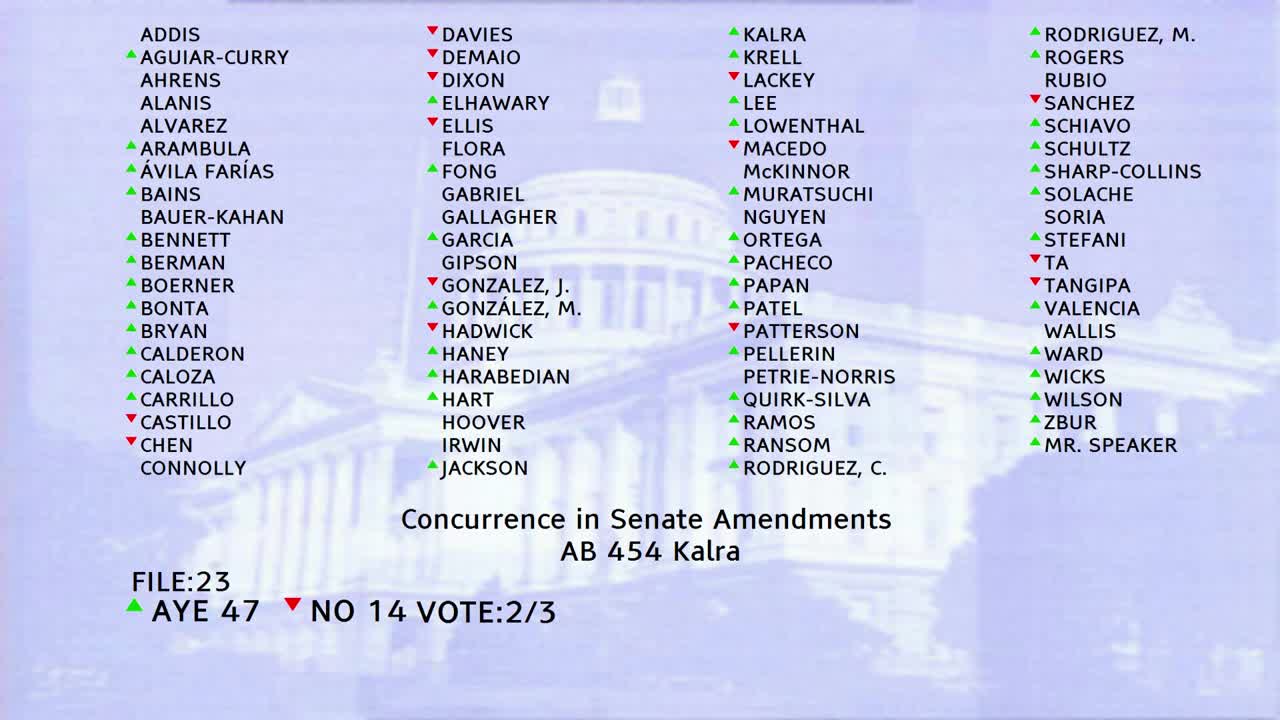
Bill Author
Bill Co-Author(s):