AB 489: Health care professions: deceptive terms or letters: artificial intelligence.
- Session Year: 2025-2026
- House: Assembly
- Latest Version Date: 2025-10-11
Current Status:
Passed
(2025-10-11: Chaptered by Secretary of State - Chapter 615, Statutes of 2025.)
Introduced
In Committee
Awaiting First Chamber Vote
Passed First Chamber
In Committee
Awaiting Second Chamber Vote
Passed Second Chamber
Enacted
Existing law establishes various healing arts boards within the Department of Consumer Affairs that license and regulate various healing arts licensees. Existing laws, including, among others, the Medical Practice Act and the Dental Practice Act, make it a crime for a person who is not licensed as a specified health care professional to use certain words, letters, and phrases or any other terms that imply that they are authorized to practice that profession.
Existing law requires, with certain exemptions, a health facility, clinic, physicians office, or office of a group practice that uses generative artificial intelligence, as defined, to generate written or verbal patient communications pertaining to patient clinical information, as defined, to ensure that those communications include both (1) a disclaimer that indicates to the patient that a communication was generated by generative artificial intelligence, as specified, and (2) clear instructions describing how a patient may contact a human health care provider, employee, or other appropriate person. Existing law provides that a violation of these provisions by a physician shall be subject to the jurisdiction of the Medical Board of California or the Osteopathic Medical Board of California, as appropriate.
This bill would make provisions of law that prohibit the use of specified terms, letters, or phrases to falsely indicate or imply possession of a license or certificate to practice a health care profession, as defined, enforceable against an entity who develops or deploys artificial intelligence (AI) or generative artificial intelligence (GenAI) technology that uses one or more of those terms, letters, or phrases in its advertising or functionality. The bill would prohibit the use by AI or GenAI technology of certain terms, letters, or phrases that indicate or imply that the advice, care, reports, or assessments being provided through AI or GenAI is being provided by a natural person with the appropriated health care license or certificate.
This bill would make a violation of these provisions subject to the jurisdiction of the appropriate health care profession board, and would make each use of a prohibited term, letter, or phrase punishable as a separate violation.
By expanding the scope of existing crimes, this bill would impose a state-mandated local program.
The California Constitution requires the state to reimburse local agencies and school districts for certain costs mandated by the state. Statutory provisions establish procedures for making that reimbursement.
This bill would provide that no reimbursement is required by this act for a specified reason.
Existing law establishes various healing arts boards within the Department of Consumer Affairs that license and regulate various healing arts licensees. Existing laws, including, among others, the Medical Practice Act and the Dental Practice Act, make it a crime for a person who is not licensed as a specified health care professional to use certain words, letters, and phrases or any other terms that imply that they are authorized to practice that profession.
Existing law requires, with certain exemptions, a health facility, clinic, physicians office, or office of a group practice that uses generative artificial intelligence, as defined, to generate written or verbal patient communications pertaining to patient clinical information, as defined, to ensure that those communications include both (1) a disclaimer that indicates to the patient that a communication was generated by generative artificial intelligence, as specified, and (2) clear instructions describing how a patient may contact a human health care provider, employee, or other appropriate person. Existing law provides that a violation of these provisions by a physician shall be subject to the jurisdiction of the Medical Board of California or the Osteopathic Medical Board of California, as appropriate.
This bill would make provisions of law that prohibit the use of specified terms, letters, or phrases to falsely indicate or imply possession of a license or certificate to practice a health care profession, as defined, enforceable against an entity who develops or deploys artificial intelligence (AI) or generative artificial intelligence (GenAI) technology that uses one or more of those terms, letters, or phrases in its advertising or functionality. The bill would prohibit the use by AI or GenAI technology of certain terms, letters, or phrases that indicate or imply that the advice or care advice, care, reports, or assessments being provided through AI or GenAI is being provided by a natural person with the appropriated health care license or certificate.
This bill would make a violation of these provisions subject to the jurisdiction of the appropriate health care profession board, and would make each use of a prohibited term, letter, or phrase punishable as a separate violation.
By expanding the scope of existing crimes, this bill would impose a state-mandated local program.
The California Constitution requires the state to reimburse local agencies and school districts for certain costs mandated by the state. Statutory provisions establish procedures for making that reimbursement.
This bill would provide that no reimbursement is required by this act for a specified reason.
Existing law establishes various healing arts boards within the Department of Consumer Affairs that license and regulate various healing arts licensees. Existing laws, including, among others, the Medical Practice Act and the Dental Practice Act, make it a crime for a person who is not licensed as a specified health care professional to use certain words, letters, and phrases or any other terms that imply that they are authorized to practice that profession.
Existing law requires, with certain exemptions, a health facility, clinic, physicians office, or office of a group practice that uses generative artificial intelligence, as defined, to generate written or verbal patient communications pertaining to patient clinical information, as defined, to ensure that those communications include both (1) a disclaimer that indicates to the patient that a communication was generated by generative artificial intelligence, as specified, and (2) clear instructions describing how a patient may contact a human health care provider, employee, or other appropriate person. Existing law provides that a violation of these provisions by a physician shall be subject to the jurisdiction of the Medical Board of California or the Osteopathic Medical Board of California, as appropriate.
This bill would make provisions of law that prohibit the use of specified terms, letters, or phrases to falsely indicate or imply possession of a license or certificate to practice a health care profession, as defined, enforceable against an entity who develops or deploys artificial intelligence technology that uses one or more of those terms, letters, or phrases in its advertising or functionality. The bill would prohibit the use by AI technology of certain terms, letters, or phrases that indicate or imply that the advice or care being provided through AI is being provided by a natural person with the appropriated health care license or certificate.
This bill would make a violation of these provisions subject to the jurisdiction of the appropriate health care profession board, and would make each use of a prohibited term, letter, or phrase punishable as a separate violation.
By expanding the scope of existing crimes, this bill would impose a state-mandated local program.
The California Constitution requires the state to reimburse local agencies and school districts for certain costs mandated by the state. Statutory provisions establish procedures for making that reimbursement.
This bill would provide that no reimbursement is required by this act for a specified reason.
For purposes of this chapter, the following definitions apply:
(a)Artificial intelligence or AI has the same meaning as set forth in Section 11546.45.5 of the Government Code.
(b)Generative artificial intelligence or GenAI has the same meaning as set forth in Section 11549.64 of the Government Code.
(c)Health care profession means any profession that is the subject of licensure or regulation under this division or under any initiative act referred to in this division.
4999.9.(a)(1)A violation of this chapter is subject to the jurisdiction of the appropriate health care professional licensing board or enforcement agency.
(2)The appropriate health care professional licensing board may pursue an injunction or restraining order to enforce the provisions of this chapter, as authorized by Section 125.5.
(3)Nothing in this section limits the authority for a health care professional licensing board or enforcement agency to pursue any remedy otherwise authorized under the law.
(b)Any provision of this division that prohibits the use of specified terms, letters, or phrases to indicate or imply possession of a license or certificate to practice a health care profession, without at that time having the appropriate license or certificate required for that practice or profession, shall be enforceable against a person or entity who develops or deploys a system or device that uses one or more of those terms, letters, or phrases in the advertising or functionality of an artificial intelligence or generative artificial intelligence system, program, device, or similar technology.
(c)The use of a term, letter, or phrase in the advertising or functionality of an AI or GenAI system, program, device, or similar technology that indicates or implies that the care, advice, reports, or assessments being offered through the AI or GenAI technology is being provided by a natural person in possession of the appropriate license or certificate to practice as a health care professional, is prohibited.
(d)Each use of a prohibited term, letter, or phrase shall constitute a separate violation of this chapter.
SEC. 2.No reimbursement is required by this act pursuant to Section 6 of Article XIIIB of the California Constitution because the only costs that may be incurred by a local agency or school district will be incurred because this act creates a new crime or infraction, eliminates a crime or infraction, or changes the penalty for a crime or infraction, within the meaning of Section 17556 of the Government Code, or changes the definition of a crime within the meaning of Section 6 of Article XIIIB of the California Constitution.
For purposes of this chapter, the following definitions apply:
(a)Artificial intelligence or AI has the same meaning as set forth in Section 11546.45.5 of the Government Code.
(b)Generative artificial intelligence or GenAI has the same meaning as set forth in Section 11549.64 of the Government Code.
(c)Health care profession means any profession that is the subject of licensure or regulation under this division or under any initiative act referred to in this division.
4999.9.(a)(1)A violation of this chapter is subject to the jurisdiction of the appropriate health care professional licensing board or enforcement agency.
(2)The appropriate health care professional licensing board may pursue an injunction or restraining order to enforce the provisions of this chapter, as authorized by Section 125.5 of the Business and Professions Code. 125.5.
(3)Nothing in this section limits the authority for a health care professional licensing board or enforcement agency to pursue any remedy otherwise authorized under the law.
(b)Any provision of this division that prohibits the use of specified terms, letters, or phrases to indicate or imply possession of a license or certificate to practice a health care profession, without at that time having the appropriate license or certificate required for that practice or profession, shall be enforceable against a person or entity who develops or deploys a system or device that uses one or more of those terms, letters, or phrases in the advertising or functionality of an artificial intelligence or generative artificial intelligence system, program, device, or similar technology.
(c)The use of a term, letter, or phrase in the advertising or functionality of an AI or GenAI system, program, device, or similar technology that indicates or implies that the care, advice, reports, or assessments being offered through the AI or GenAI technology is being provided by a natural person in possession of the appropriate license or certificate to practice as a health care professional, is prohibited.
(d)Each use of a prohibited term, letter, or phrase shall constitute a separate violation of this chapter.
SEC. 2.No reimbursement is required by this act pursuant to Section 6 of Article XIIIB of the California Constitution because the only costs that may be incurred by a local agency or school district will be incurred because this act creates a new crime or infraction, eliminates a crime or infraction, or changes the penalty for a crime or infraction, within the meaning of Section 17556 of the Government Code, or changes the definition of a crime within the meaning of Section 6 of Article XIIIB of the California Constitution.
For purposes of this chapter, the following definitions apply:
(a)Artificial intelligence or AIhas AI has the same meaning as set forth in Section 11546.45.5 of the Government Code.
(b)Generative artificial intelligence or GenAI has the same meaning as set forth in Section 11549.64 of the Government Code.
(c)Health care profession means any profession that is the subject of licensure or regulation under this division or under any initiative act referred to in this division.
4999.9.(a)(1)A violation of this chapter is subject to the jurisdiction of the appropriate health care professional licensing board or enforcement agency.
(2)The appropriate health care professional licensing board may pursue an injunction or restraining order to enforce the provisions of this chapter, as authorized by Section 125.5 of the Business and Professions Code.
(3)Nothing in this section limits the authority for a health care professional licensing board or enforcement agency to pursue any remedy otherwise authorized under the law.
(b)Any provision of this division that prohibits the use of specified terms, letters, or phrases to indicate or imply possession of a license or certificate to practice a health care profession, without at that time having the appropriate license or certificate required for that practice or profession, shall be enforceable against a person or entity who develops or deploys a system or device that uses one or more of those terms, letters, or phrases in the advertising or functionality of an artificial intelligence or generative artificial intelligence system, program, device, or similar technology.
(c)The use of a term, letter, or phrase in the advertising or functionality of an AI or GenAI system, program, device, or similar technology that indicates or implies that the care, advice, reports, or assessments being offered through the AI or GenAI technology is being provided by a natural person in possession of the appropriate license or certificate to practice as a health care professional, is prohibited.
(d)Each use of a prohibited term, letter, or phrase shall constitute a separate violation of this chapter.
SEC. 2.No reimbursement is required by this act pursuant to Section 6 of Article XIIIB of the California Constitution because the only costs that may be incurred by a local agency or school district will be incurred because this act creates a new crime or infraction, eliminates a crime or infraction, or changes the penalty for a crime or infraction, within the meaning of Section 17556 of the Government Code, or changes the definition of a crime within the meaning of Section 6 of Article XIIIB of the California Constitution.
For purposes of this chapter, the following definitions apply:
(a)Artificial intelligence or AIhas the same meaning as set forth in Section 11546.45.5 of the Government Code.
(b)Generative artificial intelligence or GenAI has the same meaning as set forth in Section 11549.64 of the Government Code.
(b)For purposes of this chapter, health(c)Health care profession means any profession that is the subject of licensure or regulation under this division or under any initiative act referred to in this division.
4999.9.(a)(1)A violation of this chapter is subject to the jurisdiction of the appropriate health care professional licensing board or enforcement agency.
(2)The appropriate health care professional licensing board may pursue an injunction or restraining order to enforce the provisions of this chapter, as authorized by Section 125.5 of the Business and Professions Code.
(3)Nothing in this section limits the authority for a health care professional licensing board or enforcement agency to pursue any remedy otherwise authorized under the law.
(b)Any provision of this division that prohibits the use of specified terms, letters, or phrases to indicate or imply possession of a license or certificate to practice a health care profession, without at that time having the appropriate license or certificate required for that practice or profession, shall be enforceable against a person or entity who develops or deploys a system or device that uses one or more of those terms, letters, or phrases in the advertising or functionality of an artificial intelligence or generative artificial intelligence system, program, device, or similar technology.
(c)The use of a term, letter, or phrase in the advertising or functionality of an AI or GenAI system, program, device, or similar technology that indicates or implies that the care or advice care, advice, reports, or assessments being offered through the AI or GenAI technology is being provided by a natural person in possession of the appropriate license or certificate to practice as a health care professional, is prohibited.
(d)Each use of a prohibited term, letter, or phrase shall constitute a separate violation of this chapter.
SEC. 2.No reimbursement is required by this act pursuant to Section 6 of Article XIIIB of the California Constitution because the only costs that may be incurred by a local agency or school district will be incurred because this act creates a new crime or infraction, eliminates a crime or infraction, or changes the penalty for a crime or infraction, within the meaning of Section 17556 of the Government Code, or changes the definition of a crime within the meaning of Section 6 of Article XIIIB of the California Constitution.
(a)For purposes of this chapter, artificial intelligence has the same meaning as set forth in Section 11546.45.5 of the Government Code.
(b)For purposes of this chapter, health care profession means any profession that is the subject of licensure or regulation under this division or under any initiative act referred to in this division.
4999.9.(a)A violation of this chapter is subject to the jurisdiction of the appropriate health care professional licensing board or enforcement agency.
(b)Any provision of this division that prohibits the use of specified terms, letters, or phrases to indicate or imply possession of a license or certificate to practice a health care profession, without at that time having the appropriate license or certificate required for that practice or profession, shall be enforceable against a person or entity who develops or deploys a system or device that uses one or more of those terms, letters, or phrases in the advertising or functionality of an artificial intelligence system, program, device, or similar technology.
(c)The use of a term, letter, or phrase in the advertising or functionality of an AI system, program, device, or similar technology that indicates or implies that the care or advice being offered through the AI technology is being provided by a natural person in possession of the appropriate license or certificate to practice as a health care professional, is prohibited.
(d)Each use of a prohibited term, letter, or phrase shall constitute a separate violation of this chapter.
SEC. 2.No reimbursement is required by this act pursuant to Section 6 of Article XIIIB of the California Constitution because the only costs that may be incurred by a local agency or school district will be incurred because this act creates a new crime or infraction, eliminates a crime or infraction, or changes the penalty for a crime or infraction, within the meaning of Section 17556 of the Government Code, or changes the definition of a crime within the meaning of Section 6 of Article XIIIB of the California Constitution.
REVISIONS: HeadingLine 2.|
Date
|
Status
|
|---|---|
| Oct 11, 2025 | Chaptered by Secretary of State - Chapter 615, Statutes of 2025. |
| Oct 11, 2025 | Approved by the Governor. |
| Sep 15, 2025 | Enrolled and presented to the Governor at 4:30 p.m. |
| Sep 8, 2025 | Senate amendments concurred in. To Engrossing and Enrolling. (Ayes 79. Noes 0. Page 3026.). |
| Sep 4, 2025 | In Assembly. Concurrence in Senate amendments pending. |
| Sep 4, 2025 | Read third time. Passed. Ordered to the Assembly. (Ayes 39. Noes 0. Page 2521.). |
| Sep 2, 2025 | Ordered to special consent calendar. |
| Aug 29, 2025 | Read second time. Ordered to third reading. |
| Aug 29, 2025 | From committee: Do pass. (Ayes 7. Noes 0.) (August 29). |
| Aug 18, 2025 | In committee: Referred to suspense file. |
| Jul 16, 2025 | From committee: Do pass and re-refer to Com. on APPR. (Ayes 13. Noes 0.) (July 15). Re-referred to Com. on APPR. |
| Jul 8, 2025 | From committee chair, with author's amendments: Amend, and re-refer to committee. Read second time, amended, and re-referred to Com. on JUD. |
| Jun 23, 2025 | From committee: Do pass and re-refer to Com. on JUD. (Ayes 10. Noes 0.) (June 23). Re-referred to Com. on JUD. |
| Jun 16, 2025 | From committee chair, with author's amendments: Amend, and re-refer to committee. Read second time, amended, and re-referred to Com. on B. P. & E.D. |
| Jun 11, 2025 | Referred to Coms. on B. P. & E.D. and JUD. |
| Jun 3, 2025 | In Senate. Read first time. To Com. on RLS. for assignment. |
| Jun 2, 2025 | Read third time. Passed. Ordered to the Senate. (Ayes 79. Noes 0. Page 1832.) |
| May 27, 2025 | Read second time. Ordered to third reading. |
| May 23, 2025 | From committee: Do pass. (Ayes 14. Noes 0.) (May 23). |
| May 7, 2025 | In committee: Set, first hearing. Referred to APPR. suspense file. |
| Apr 23, 2025 | From committee: Do pass and re-refer to Com. on APPR. with recommendation: To Consent Calendar. (Ayes 14. Noes 0.) (April 22). Re-referred to Com. on APPR. |
| Apr 21, 2025 | Re-referred to Com. on P. & C.P. |
| Apr 10, 2025 | From committee chair, with author's amendments: Amend, and re-refer to Com. on P. & C.P. Read second time and amended. |
| Apr 1, 2025 | From committee: Do pass and re-refer to Com. on P. & C.P. (Ayes 17. Noes 0.) (April 1). Re-referred to Com. on P. & C.P. |
| Apr 1, 2025 | Coauthors revised. |
| Mar 17, 2025 | Referred to Coms. on B. & P. and P. & C.P. |
| Feb 11, 2025 | From printer. May be heard in committee March 13. |
| Feb 10, 2025 | Read first time. To print. |
|
Date
|
Description
|
Location
|
Votes
|
|
|---|---|---|---|---|
| Sep 8, 2025 | AB 489 Bonta Concurrence in Senate Amendments | Assembly Floor |
Passed |
|
| Sep 4, 2025 | Special Consent AB489 Bonta et al. By Weber Pierson | Senate Floor |
Passed |
|
| Aug 29, 2025 | Do pass | Senate Standing Committee on Appropriations |
Passed |
|
| Aug 18, 2025 | Placed on suspense file | Senate Standing Committee on Appropriations |
Passed |
|
| Jul 15, 2025 | Do pass, but first be re-referred to the Committee on [Appropriations] | Senate Standing Committee on Judiciary |
Passed |
|
| Jun 23, 2025 | Do pass, but first be re-referred to the Committee on [Judiciary] | Senate Standing Committee on Business, Professions and Economic Development |
Passed |
|
| Jun 2, 2025 | AB 489 Bonta Assembly Third Reading | Assembly Floor |
Passed |
|
| May 23, 2025 | Do pass. | Assembly Standing Committee on Appropriations |
Passed |
|
| Apr 22, 2025 | Do pass and be re-referred to the Committee on [Appropriations] with recommendation: To Consent Calendar | Assembly Standing Committee on Privacy and Consumer Protection |
Passed |
|
| Apr 1, 2025 | Do pass and be re-referred to the Committee on [Privacy and Consumer Protection] | Assembly Standing Committee on Business and Professions |
Passed |
This list shows positions taken on this bill by organizations on the date displayed, which is linked to the original source.
Positions by individuals are not included.
|
Organization
|
Position
|
Date
|
|---|---|---|
| American Association Of Clinical Urologists | ** Support | |
| American Association of Clinical Urologists, Inc. | ** Support | |
| American College Of Obstetricians Gynecologists District Ix | ** Support | |
| America’s Physicians Group | ** Support | |
| Attorney General Rob Bonta | ** Support | |
| Board of Behavioral Sciences | ** Support | |
| California Academy of Child and Adolescent Psychiatry | ** Support | |
| California Academy Of Family Physicians | ** Support | |
| California Alliance Of Child And Family Services | ** Support | |
| California Association Of Marriage And Family Therapists | ** Support | |
| California Association of Nurse Practitioners | ** Support | |
| California Association of Orthodontics | ** Support | |
| California Association Of Orthodontists | ** Support | |
| California Board of Psychology | ** Support | |
| California Chapter of the American College of Emergency Physicians | ** Support | |
| California Dental Association | ** Support | |
| California Medical Association (co-source) | ** Support | |
| California Neurology Society | ** Support | |
| California Nurses Association | ** Support | |
| California Orthopedic Association | ** Support | |
| California Psychological Association | ** Support | |
| California Radiological Society | ** Support | |
| California Retired Teachers Association | ** Support | |
| California Society Of Plastic Surgeons | ** Support | |
| California Youth Empowerment Network | ** Support | |
| CFT- a Union of Educators & Classified Professionals, Aft, Afl-cio | ** Support | |
| County Behavioral Health Directors Association | ** Support | |
| County of Behavioral Health Directors Association | ** Support | |
| Dental Board of California | ** Support | |
| Hippocratic Ai | ** Support | |
| Kaiser Permanente | ** Support | |
| Los Angeles Area Chamber Of Commerce | ** Support | |
| Medical Board of California | ** Support | |
| National Union Of Healthcare Workers | ** Support | |
| Oakland Privacy | ** Support | |
| Occupational Therapy Association Of California | ** Support | |
| Osteopathic Medical Board of California | ** Support | |
| Privacy Rights Clearinghouse | ** Support | |
| san francisco marin medical society | ** Support | |
| SEIU California | ** Support | |
| Steinberg Institute | ** Support | |
| Techequity Action | ** Support |
CONCURRENCE IN SENATE AMENDMENTS
CSA1 Bill Id:AB 489
Author:(Bonta)
As Amended Ver:July 8, 2025
Majority vote
SUMMARY
Extends the enforceability of existing title protections for various licensed health care professions to expressly apply against a person or entity who develops or deploys artificial intelligence (AI) or generative artificial intelligence (GenAI) technology.
Senate Amendments
Make minor and technical changes to the bill.
COMMENTS
Professional Title Protection. Title protection is one of the forms of regulation of professional services that can be imposed by the Legislature to protect patients and consumers by reserving the use of words, terms, initials, and titles for individuals who have met certain requirements to demonstrate competence. As described in the context of the Legislature's "sunrise review" process, title protection is frequently included as part of a licensing act, where only persons who meet predetermined standards are allowed to work at an occupation. When licensure is required for a profession, both the scope of practice and the use of titles describing that title are protected.
As a less restrictive alternative to licensure, the Legislature will sometimes grant recognition to persons who obtain a voluntary certification or registration relating to an unlicensed profession by providing them with exclusive use of specified titles. In many cases, this title protection is limited to the use of terms such as "certified" or "licensed" in association with terms related to the profession. However, some specific terms, such as "dietician" or "athletic trainer," are reserved for individuals who have obtained a voluntary certification or met other requirements despite there being no requirement to obtain a license to practice that profession.
General provisions governing health professional licensing boards make it unlawful for any healing arts licensee to publically communicate any false, fraudulent, misleading, or deceptive statement, claim, or image for the purpose of rendering professional services in connection with their licensed practice. Statute specifically prohibits a licensee from using "any professional card, professional announcement card, office sign, letterhead, telephone directory listing, medical list, medical directory listing, or a similar professional notice or device if it includes a statement or claim that is false, fraudulent, misleading, or deceptive." Practitioners may advertise that they are certified or that they limit their practice to specific fields; however, the term "board certified" reserve for physicians certified by an American Board of Medical Specialties member board.
Additionally, Section 17500 of the Business and Professions Code broadly prohibits false advertising of a product or service. Specifically, this law makes it unlawful for any person to make any statement or advertisement with intent to perform services, professional or otherwise, that is untrue or misleading. While this code section covers a wide range of false advertisements by sellers of goods or services, its provisions would be applicable to health care licensees.
Unlawful use of a title is enforced by regulatory entities, including healing arts boards, consistent with the process for enforcement against unlicensed practice. Typically, these types of violations of a practice act constitute a misdemeanor. Many boards also possess the authority to cite and fine violators, or to engage in other actions to compel compliance with the law. The unauthorized use of professional titles in advertising can also form the basis for prosecutions against individuals or entities for false advertising or unfair business practices.
Artificial Intelligence. The recent acceleration in the evolution of AI and GenAI technologies has elicited a great deal of attention from policymakers, and this has been especially true when the technology is deployed in a health care setting. The integration of AI into health care practice raises both legal and ethical concerns, particularly when AI is used to supplant or influentially augment clinical judgment by practitioners. Additionally, concerns have been voiced that AI technologies have the potential to displace human medical professionals in the future, which could have detrimental effects on both the health care workforce and for patients.
A significant component of these concerns relates to the use of AI systems to imitate licensed health care providers. AI-powered diagnostic tools, chatbots, and virtual assistants are increasingly capable of providing what resembles medical advice, which can blur the lines between machine-generated guidance and professional medical consultation from a trained human professional. Meanwhile, there is uncertainty as to whether existing laws that restrict the use of professional titles to licensed individuals are enforceable against non-human AI programs or those who develop or deploy them. This has led to challenges in ensuring that AI systems do not mislead patients by presenting communications as coming from qualified professionals, especially since those communications are not subject to oversight by a licensing board.
In January 2025, California Attorney General Rob Bonta issued a "legal advisory on the application of existing California law to artificial intelligence in healthcare." The advisory noted that "California's professional licensing laws provide additional standards to which licensed medical professionals must adhere" and that "only human physicians (and other medical professionals) are licensed to practice medicine in California; California law does not allow delegation of the practice of medicine to AI." The Attorney General's advisory further opined that "using AI or other automated decision tools to make decisions about patients' medical treatment, or to override licensed care providers' determinations about what a patient's medical needs are, may violate California's ban on the practice of medicine by corporations and other 'artificial legal entities' … in addition to constituting an 'unlawful' or 'unfair' business practice under the Unfair Competition Law."
AI Psychotherapy. In the background paper for the Board of Psychology's most recent sunset review oversight hearing, Issue no. 13 discussed how AI is specifically changing the field of psychology. The background paper questioned what regulatory changes may be necessary to protect consumers and ensure the ethical use of AI-driven tools in psychotherapy practice. As discussed in the sunset review background paper, AI has the potential to transform the field of psychology, from the provision of psychotherapy to research. While AI innovations, such as chatbots (e.g., Wysa and Woebot) and tools that automate notetaking (e.g., Mental Note AI and TherapyFuel), can improve consumer access and affordability and lessen the administrative burden on psychologists, there are numerous questions outstanding about safety, privacy, reliability, and equity. The dangers of AI-generative chatbots have been the subject of increased scrutiny and are at the center of two lawsuits.
In a letter to the Federal Trade Commission (FTC), the American Psychological Association (APA) expressed its "grave concerns about "entertainment" chatbots that purport to serve as companions or therapists. The letter highlighted concerns that some technologies available to the public lack appropriate safeguards, adequate transparency, or the warning and reporting mechanisms necessary to ensure appropriate use and access by appropriate users. The APA urged the FTC to investigate "the prevalence and impacts of deceptive practices employed by AI-generative chatbots and other AI-related technologies like Character.ai, Replika, and other companies for developing and perpetuating AI-generated characters that engage in misrepresentations and for engaging in deceptive trade practices, passing themselves off as trained mental health providers, and potentially causing harm to the public."
A lawsuit against Character.ai has been filed by the mother of a Florida teen who died by suicide after interacting with a chatbot claiming to be a licensed psychologist. A second lawsuit was initiated by the parents of a Texas teen with autism after a chatbot grew hostile and violent towards him during a period of time when he was interacting with a chatbot claiming to be a psychologist. According to The Washington Post, he had also begun harming himself and lost 20 pounds. Although the dangers of these chatbots are well documented, they are popular. Some of Character.ai's chatbots have had more than one million conversations with users.
This bill would address general concerns about the integration of AI technologies in health care practice settings, and specific concerns about the growing popularity of AI chatbots engaged in psychotherapy, by expressly applying existing title protections to the advertising or functionality of an AI system, program, device, or similar technology. The bill would additionally prohibit the use of any term, letter, or phrase in the advertising or functionality of an AI system, program, device, or similar technology that indicates or implies that the care or advice being offered through the AI technology is being provided by a natural person in possession of the appropriate license or certificate to practice as a health care professional. While it could be argued that existing law could be interpreted to prohibit the types of behaviors addressed by the bill as unfair business practices or the unlicensed practice of medicine, this bill would make the applicability of existing protections explicit for purposes of AI technologies, which would clarify both requirements for compliance and options for enforcement.
According to the Author
"The rapid rise of AI systems has sparked a wide range of opinions about their impact on society. However, one thing is certain— AI is advancing faster than the laws and regulations needed to protect Californians. Artificial intelligence (AI) systems have reached a point where they can produce natural-sounding language, and are trained on a vast amount of information, including health-related information. This powerful capability enables it to convincingly mimic a health professional. Without proper safeguards in place, this capability can pose a danger to consumers in both health care and non-health care settings. Californians deserve transparency and protection from misrepresentation, and AI technologies must be developed and deployed responsibly to prevent such misrepresentation. For instance, consumers should be able to trust that a 'nurse advice' telephone line or chat box is staffed by a licensed human nurse. AB 489 fills an emerging need by codifying a clear, enforceable prohibition on automated systems misrepresenting 'themselves' as health professionals."
Arguments in Support
SEIU California and the California Medical Association (CMA) write jointly in support as co-sponsors of the bill: "AB 489 provides state health professions boards with clear authority to enforce title protections when AI systems or similar technologies, such as internet-based chatbots, misrepresent themselves as health professionals. The bill makes entities that develop and deploy AI systems responsible for any violations of existing title protections and explicitly prohibits AI systems from misrepresenting themselves as human health professionals." SEIU California and CMA argue that "AB 489 is a commonsense step to guarding against these dangers and ensuring that AI technologies are developed and deployed responsibly in healthcare settings. By prohibiting AI systems from misrepresenting themselves as licensed health professionals, this bill protects patients from deception and potential harm."
Arguments in Opposition
There is no opposition on file.
FISCAL COMMENTS
According to the Senate Committee on Appropriations, the Department of Consumer Affairs reports a majority of the healing arts boards note a minor and absorbable fiscal impact; unknown, potentially significant costs to certain healing arts boards based on enforcement workload; and ongoing costs of $56,000 to the Dental Board of California and the California State Board of Pharmacy respectively, which would be absorbable within each board's existing resources.
VOTES:
ASM BUSINESS AND PROFESSIONS: 17-0-1
YES: Berman, Flora, Ahrens, Alanis, Bains, Caloza, Chen, Elhawary, Hadwick, Haney, Irwin, Jackson, Krell, Lowenthal, Macedo, Nguyen, Pellerin
ABS, ABST OR NV: Bauer-Kahan
ASM PRIVACY AND CONSUMER PROTECTION: 14-0-1
YES: Bauer-Kahan, Dixon, Bryan, DeMaio, Irwin, Lowenthal, Macedo, McKinnor, Ortega, Pellerin, Petrie-Norris, Ward, Wicks, Wilson
ABS, ABST OR NV: Patterson
ASM APPROPRIATIONS: 14-0-1
YES: Wicks, Arambula, Calderon, Caloza, Dixon, Elhawary, Fong, Mark González, Hart, Pacheco, Pellerin, Solache, Ta, Tangipa
ABS, ABST OR NV: Sanchez
ASSEMBLY FLOOR: 79-0-0
YES: Addis, Aguiar-Curry, Ahrens, Alanis, Alvarez, Arambula, Ávila Farías, Bains, Bauer-Kahan, Bennett, Berman, Boerner, Bonta, Bryan, Calderon, Caloza, Carrillo, Castillo, Chen, Connolly, Davies, DeMaio, Dixon, Elhawary, Ellis, Flora, Fong, Gabriel, Gallagher, Garcia, Gipson, Jeff Gonzalez, Mark González, Hadwick, Haney, Harabedian, Hart, Hoover, Irwin, Jackson, Kalra, Krell, Lackey, Lee, Lowenthal, Macedo, McKinnor, Muratsuchi, Nguyen, Ortega, Pacheco, Papan, Patel, Patterson, Pellerin, Petrie-Norris, Quirk-Silva, Ramos, Ransom, Celeste Rodriguez, Michelle Rodriguez, Rogers, Blanca Rubio, Sanchez, Schiavo, Schultz, Sharp-Collins, Solache, Soria, Stefani, Ta, Tangipa, Valencia, Wallis, Ward, Wicks, Wilson, Zbur, Rivas
UPDATED
VERSION: July 8, 2025
CONSULTANT: Robert Sumner / B. & P. / (916) 319-3301 FN: 0001640
SENATE RULES COMMITTEE Office of Senate Floor Analyses (916) 651-1520 Fax: (916) 327-4478 | AB 489 |
THIRD READING
Bill No: AB 489
Author: Bonta (D), et al.
Amended: 7/8/25 in Senate
Vote: 21
SENATE BUS., PROF. & ECON. DEV. COMMITTEE: 10-0, 6/23/25
AYES: Ashby, Choi, Archuleta, Arreguín, Grayson, Niello, Smallwood-Cuevas, Strickland, Umberg, Weber Pierson
NO VOTE RECORDED: Menjivar
SENATE JUDICIARY COMMITTEE: 13-0, 7/15/25
AYES: Umberg, Niello, Allen, Arreguín, Ashby, Caballero, Durazo, Laird, Stern, Valladares, Wahab, Weber Pierson, Wiener
SENATE APPROPRIATIONS COMMITTEE: 7-0, 8/29/25
AYES: Caballero, Seyarto, Cabaldon, Dahle, Grayson, Richardson, Wahab
ASSEMBLY FLOOR: 79-0, 6/2/25 - See last page for vote
SUBJECT: Health care professions: deceptive terms or letters: artificial intelligence
SOURCE: California Medical Association and SEIU California
DIGEST:
This bill prohibits artificial intelligence (AI) and generative artificial intelligence (GenAI) systems from misrepresenting themselves as licensed or certified healthcare professionals and provides state licensing boards or enforcement agencies the authority to pursue legal recourse against developers or deployers of AI or GenAI systems.
ANALYSIS:
Existing law:
- Defines AI as an engineered or machine based system that varies in its level of autonomy, and that can, for explicit or implicit objectives, infer from the input it receives how to generate outputs that can influence physical or virtual environments. Defines GenAI to mean an artificial intelligence system that can generate derived synthetic content, including text, images, video, and audio that emulates the structure and characteristics of the system’s training data. (Government Code §11546.45.5 and 11549.64)
- Defines “Companion chatbot” to mean an artificial intelligence system with a natural language interface that provides adaptive, human-like responses to user inputs and is capable of meeting a user’s social needs, including by exhibiting anthropomorphic features and being able to sustain a relationship across multiple interactions. Does not include a bot that is used only for customer service purposes. (Business and Professions Code (BPC) § 22601 (b 1-2))
- Prohibits any person from using a bot, as defined, to communicate or interact with another person in California online, with the intent to mislead the other person about its artificial identity for the purpose of knowingly deceiving the person about the content of the communication in order to incentivize a purchase or sale of goods or services in a commercial transaction or to influence a vote in an election. Requires the disclosure to be clear, conspicuous, and reasonably designed to inform persons with whom the bot communicates or interacts that this is a bot. (BPC §17940 et.seq)
This bill:
- Prohibits the use of a term, letter, or phrase in the advertising or functionality of an AI or GenAI system, program device, or similar technology that indicates or implies that the care, advice, reports, or assessments being offered through the AI or GenAI technology is being provided by a natural person in possession of the appropriate license or certificate to practice as a health care professional. Specifies that each use of a prohibited term, letter, or phrase shall constitute a separate violation.
- Authorizes the appropriate health care professional licensing board to pursue an injunction or restraining order to enforce this bill.
Background
On May 28, 2025 the Assembly Health and Privacy Consumer of Protection Committees held a joint informational hearing, Generative Artificial Intelligence in Health Care: Opportunities, Challenges, and Policy Initiatives providing a broad overview of the emerging AI landscape in healthcare. As noted in the background paper, “electronic health record systems are being equipped with GenAI functionality that allows health care providers to automatically generate billing codes, improving accuracy and completeness by checking for errors, omissions, and compliance with current requirements” further noted in the background is the prevalence of “health plans and insurers using AI to automate and streamline multiple functions, including processing claims and evaluating prior authorization requests.” This proliferation of utilizing AI technology may relieve some administrative burdens however there is a risk in allowing an AI algorithm to determine the validity of an insurance claim versus a medical professional. As reported on the HealthCare Finance website, large insurance companies such as Cigna, Humana and United Health Group are under litigation for allegedly relying on AI algorithms to deny claims, prematurely cut-off payments or automatically deny payments.
Another popular usage of AI technology is the emergence of AI chatbots which have the capabilities of mimicking a human and can deceive patients into thinking that they are communicating with a licensed professional. According to the American Psychological Association (APA), AI driven chatbots like Character.ai and Replika are being utilized by younger, emotionally vulnerable populations without employing the appropriate safeguards or transparency. AI chatbot agents are claiming to serve as “companions” misrepresenting themselves as licensed mental health professionals. In a recent letter to the Federal Trade Commission (FTC), the APA raised significant concerns about the “unregulated development and deceptive deployment of generative AI technologies, urging the FTC to protect the public from deceptive practices of unregulated AI chatbots.” The letter further points out that AI chatbots are not held to the same regulations or training as licensed mental health professionals and the potential for misinformation, bias, and privacy concerns is prevalent and should be taken into serious consideration.
AI chatbots pretending to be a licensed therapist also raises ethical concerns within the licensed professional community with the California Psychological Association stating “the rise of chatbots posing as therapists can endanger the public and AI characters claiming to be trained in therapeutic techniques, are misleading users and may constitute deceptive marketing.” Even with AI platforms including a disclaimer stating that the AI chatbot is not a licensed professional many young, emotionally vulnerable individuals or individuals with low digital fluency can be misled. According to Celeste Kidd, Ph.D, an associate professor of psychology at the University of California, Berkeley, who studies learning and ethical AI, “Simply notifying users during a chat that they are engaging with AI rather than a human may not be enough to prevent harm. Chatbots are pithy, conversational, and matter-of-fact. They give the illusion that they can provide reliable information and offer deep insights – an illusion that’s very hard to break once cast.”
There are existing laws that support title protection and prohibit false advertising or impersonation of a licensed health care professional as well as provide consumer protection for individuals. This bill is addressing a new and novel phenomenon, the regulation of an AI generated platform that characterizes “themselves” as a licensed healthcare professional. This bill clarifies that this specific behavior is illegal and prohibited, holds the developers and deployers accountable and gives enforcement entities the authority to enforce violations of the prohibition.
FISCAL EFFECT: Appropriation: No Fiscal Com.: Yes Local: Yes
According to the Senate Committee on Appropriations, DCA reports a majority of the healing arts boards note a minor and absorbable fiscal impact, as many currently have enforcement processes in place and would treat AI or GenAI related complaints similarly to other unlicensed activity concerns. DCA also notes an unknown, potentially significant increase in enforcement workload to the Medical Board of California, Physical Therapy Board, Board of Registered Nursing, and the Board of Naturopathic Medicine to address an anticipated increase in complaints. DCA also notes ongoing costs of approximately $56,000 for additional enforcement workload to the Dental Board of California and Board of Pharmacy that are absorbable within existing resources.
SUPPORT: (8/29/25)
California Medical Association (co-source)
SEIU California (co-source)
Attorney General Rob Bonta
American Association of Clinical Urologists, Inc
American College of Obstetricians & Gynecologists – District IX
America’s Physicians Group
Board of Behavioral Sciences
California Academy of Child and Adolescent Psychiatry
California Academy of Family Physicians
California Alliance of Child and Family Services
California Association of Marriage and Family Therapists
California Association of Nurse Practitioners
California Association of Orthodontics
California Board of Psychology
California Chapter of the American College of Emergency Physicians
California Dental Association
California Neurology Society
California Orthopedic Association
California Psychological Association
California Radiological Society
California Retired Teachers Association
California Society of Plastic Surgeons
California Youth Empowerment Network
CFT – a Union of Educators & Classified Professionals, AFT, AFL-CIO
County of Behavioral Health Directors Association
Dental Board of California
Hippocratic AI
Kaiser Permanente
Los Angeles Area Chamber of Commerce
Medical Board of California
National Union of Healthcare Workers
Oakland Privacy
Occupational Therapy Association of California
Osteopathic Medical Board of California
Privacy Rights Clearinghouse
San Francisco Marin Medical Society
Steinberg Institute
Techequity Action
OPPOSITION: (8/29/25)
None received
ARGUMENTS IN SUPPORT: Supporters believe this bill provides state health professions boards with clear authority to enforce title protections for AI systems or similar technologies and adds accountability for chatbots that misrepresent themselves as health professionals. Supporters also note that the use of AI systems to increase efficiency is important, however it is as equally important that there are guardrails for emerging technologies that can guarantee integrity within our health care systems.
ASSEMBLY FLOOR: 79-0, 6/2/25
AYES: Addis, Aguiar-Curry, Ahrens, Alanis, Alvarez, Arambula, Ávila Farías, Bains, Bauer-Kahan, Bennett, Berman, Boerner, Bonta, Bryan, Calderon, Caloza, Carrillo, Castillo, Chen, Connolly, Davies, DeMaio, Dixon, Elhawary, Ellis, Flora, Fong, Gabriel, Gallagher, Garcia, Gipson, Jeff Gonzalez, Mark González, Hadwick, Haney, Harabedian, Hart, Hoover, Irwin, Jackson, Kalra, Krell, Lackey, Lee, Lowenthal, Macedo, McKinnor, Muratsuchi, Nguyen, Ortega, Pacheco, Papan, Patel, Patterson, Pellerin, Petrie-Norris, Quirk-Silva, Ramos, Ransom, Celeste Rodriguez, Michelle Rodriguez, Rogers, Blanca Rubio, Sanchez, Schiavo, Schultz, Sharp-Collins, Solache, Soria, Stefani, Ta, Tangipa, Valencia, Wallis, Ward, Wicks, Wilson, Zbur, Rivas
Prepared by: Anna Billy / B., P. & E.D. /
8/29/25 20:38:57
**** END ****
SENATE COMMITTEE ON
Senator Anna Caballero, Chair
2025 - 2026 Regular Session
AB 489 (Bonta) - Health care professions: deceptive terms or letters: artificial intelligence
Version: | Policy Vote: |
Urgency: | Mandate: |
Hearing Date: | Consultant: |
Bill Summary:
AB 489 prohibits artificial intelligence (AI) and generative AI (GenAI) systems, programs, devices, or similar technology from misrepresenting themselves as licensed or certified healthcare professionals and provides that developers and deployers of these systems are subject to the regulatory authority of state healthcare licensing boards and enforcement agencies.
Fiscal Impact:
The Department of Consumer Affairs (DCA) reports a majority of the healing arts boards note a minor and absorbable fiscal impact, as many currently have enforcement processes in place and would treat AI or GenAI related complaints similarly to other unlicensed activity concerns. DCA also notes the following:
- Unknown, potentially significant increase in enforcement workload to the Medical Board of California, Physical Therapy Board, Board of Registered Nursing, and the Board of Naturopathic Medicine to address an anticipated increase in complaints (various special funds). Actual fiscal impact to these boards will depend on the volume of complaints received concerning AI or GenAI and the extent workload can be absorbed within existing enforcement processes.
- Ongoing costs of approximately $56,000 for additional enforcement workload to the Dental Board of California (DBC) (State Dentistry Fund). DBC anticipates these costs to be absorbable within existing resources.
- Ongoing costs of approximately $56,000 for additional enforcement workload to the Board of Pharmacy (BOP) (Pharmacy Board Contingent Fund). BOP anticipates these costs to be absorbable within existing resources
Background:
AI-enabled systems and chatbots posing as health professionals have sprouted up across the internet, raising serious consumer and public health concerns. While certain AI systems may be trained on legitimate medical sources, unlike licensed healthcare providers who undergo years of rigorous training, AI systems lack the nuanced clinical judgment needed to properly assess symptoms, consider individual patient history, and account for complex interactions between conditions. When these systems present themselves as medical authorities, users may receive inaccurate diagnoses, inappropriate treatment recommendations, or dangerous advice about medication interactions. These systems are especially concerning when used by certain vulnerable groups that may be more likely to trust authoritative-sounding medical advice, especially those with limited healthcare access or health or technology literacy. While there are certainly legitimate AI applications in healthcare, AI systems that misrepresent their capabilities and credentials put users at risk and deceive consumers into thinking a product, service, or information is something it is not.
Proposed Law:
- Provides that indicated provisions of law that prohibit the use of specified terms, letters, or phrases to indicate or imply possession of a license or certificate to practice a health care profession, without at that time having the appropriate license or certificate required for that practice or profession, shall be enforceable against a person or entity who develops or deploys a system or device that uses one or more of those terms, letters, or phrases in the advertising or functionality of an AI or GenAI system, program, device, or similar technology.
- Prohibits the use of a term, letter, or phrase in the advertising or functionality of an AI or GenAI system, program, device, or similar technology that indicates or implies that the care, advice, reports, or assessments being offered through the AI or GenAI technology is being provided by a natural person in possession of the appropriate license or certificate to practice as a health care professional. Each use of a prohibited term, letter, or phrase shall constitute a separate violation.
- Provides that a violation of the provisions of this bill is subject to the jurisdiction of the appropriate health care professional licensing board or enforcement agency.
- Authorizes the appropriate health care professional licensing board to pursue an injunction or restraining order to enforce the provisions of this bill.
- Provides that each use of a prohibited term, letter, or phrase constitutes a separate violation of the provisions of this bill.
-- END --
Senator Thomas Umberg, Chair
2025-2026 Regular Session
Bill No: AB 489 (Author:Bonta)
Version: July 8, 2025
Hearing Date: July 15, 2025
Fiscal: Yes
Urgency: No
Consultant: CK
SUBJECT
Health care professions: deceptive terms or letters: artificial intelligence
DIGEST
This bill clarifies that provisions of law that prohibit the use of specified terms, letters, or phrases to falsely indicate or imply possession of a license or certificate to practice a health care profession, as defined, apply to an entity who develops or deploys AI or generative AI (GenAI) technology that uses such terms, letters, or phrases in its advertising or functionality, prohibits such usage, and subjects such developers and deployers to the same oversight and enforcement.
EXECUTIVE SUMMARY
As AI models and applications become more sophisticated and integrated into our daily lives, they introduce new safety and security risks. AI-powered chatbots create novel threats to personal safety and assets. While these technologies offer tremendous benefits, ensuring the highest level of due care on the part of AI developers and deployers is of paramount importance.
Serious concerns have been raised that various platforms are currently deploying AI chatbots that are claiming to be licensed doctors and psychologists and providing users medical advice and information. Although existing law prohibits false advertising and falsely holding oneself out to have certain qualifications, this bill seeks to make crystal clear that such laws apply to AI or GenAI enabled systems or devices and that the appropriate oversight entities make take action against the developers and deployers of such systems or devices engaging in prohibited acts.
This bill is sponsored by the California Medical Association and the Service Employees International Union California State Council (SEIU California). It is supported by Attorney General Rob Bonta and a wide variety of advocacy and medical organizations, including the California Nurses Association and Privacy Rights Clearinghouse. No timely opposition has been received by the Committee. This bill passed out of the Senate Business, Professions, and Economic Development Committee on a 10 to 0 vote.
PROPOSED CHANGES TO THE LAW
Existing law:
- Establishes the Unfair Competition Law (UCL), which provides a statutory cause of action for any unlawful, unfair, or fraudulent business act or practice and unfair, deceptive, untrue, or misleading advertising, including over the internet. (Bus. & Prof. Code § 17200 et seq.)
- Establishes the False Advertising Law (FAL), which proscribes making or disseminating any statement that is known or should be known to be untrue or misleading with intent to directly or indirectly dispose of real or personal property. (Bus. & Prof. Code § 17500 et seq.)
- Provides remedies for individuals who have suffered damages as a result of fraud or deceit, including situations involving fraudulent misrepresentations. (Civ. Code §§ 1709-1710, 1572-1573.)
- Provides that any person who practices or attempts to practice, or who advertises or holds themselves out as practicing, any system or mode of treating the sick or afflicted in this state, or who diagnoses, treats, operates for, or prescribes for any ailment, blemish, deformity, disease, disfigurement, disorder, injury, or other physical or mental condition of any person, without having at the time of so doing a valid, unrevoked, or unsuspended certificate as provided or without being authorized to perform the act pursuant to a certificate obtained in accordance with some other provision of law is guilty of a public offense, punishable by a fine, by imprisonment, or by both, as provided. (Bus. & Prof. Code § 2052.)
- Enumerates various regulatory boards, bureaus, committees, and commissions under the jurisdiction of the Department of Consumer Affairs (DCA), including healing arts boards. (Bus. & Prof. Code § 101.)
- Establishes that the superior court for the county in which any person has engaged or is about to engage in any act which constitutes a violation of provisions administered or enforced by a board within the DCA may, upon a petition filed by the board with the approval of the director, issue an injunction or other appropriate order restraining such conduct. (Bus. & Prof. Code § 125.5.)
- Defines “AI” as an engineered or machine-based system that varies in its level of autonomy and that can, for explicit or implicit objectives, infer from the input it receives how to generate outputs that can influence physical or virtual environments. (Gov. Code § 11546.45.5.) “GenAI” means an AI system that can generate derived synthetic content, including text, images, video, and audio, that emulates the structure and characteristics of the system’s training data. (Gov. Code § 11549.64.)
- Requires a health facility, clinic, physician’s office, or office of a group practice that uses GenAI to generate written or verbal patient communications pertaining to patient clinical information to ensure that those communications include a disclaimer that indicates to the patient that the communication was generated by GenAI and clear instructions describing how a patient may contact a human. These requirements do not apply if the communication was read and reviewed by a human licensed or certified health care provider. (Health & Saf. Code § 1339.75.)
This bill:
- Provides that indicated provisions of law that prohibit the use of specified terms, letters, or phrases to indicate or imply possession of a license or certificate to practice a health care profession, without at that time having the appropriate license or certificate required for that practice or profession, shall be enforceable against a person or entity who develops or deploys a system or device that uses one or more of those terms, letters, or phrases in the advertising or functionality of an AI or GenAI system, program, device, or similar technology.
- Prohibits the use of a term, letter, or phrase in the advertising or functionality of an AI or GenAI system, program, device, or similar technology that indicates or implies that the care, advice, reports, or assessments being offered through the AI or GenAI technology is being provided by a natural person in possession of the appropriate license or certificate to practice as a health care professional. Each use of a prohibited term, letter, or phrase shall constitute a separate violation.
- Provides that a violation hereof is subject to the jurisdiction of the appropriate health care professional licensing board or enforcement agency, and such entity may pursue an injunction or restraining order to enforce these provisions of this chapter, as authorized by Section 125.5 of the Business and Professions Code. Nothing limits the authority for a health care professional licensing board or enforcement agency to pursue any remedy otherwise authorized under the law.
COMMENTS
- Not a doctor
AI-enabled systems and chatbots posing as health professionals have sprouted up across the internet, raising serious consumer and public health concerns. While certain AI systems may be trained on legitimate medical sources, unlike licensed healthcare providers who undergo years of rigorous training, AI systems lack the nuanced clinical judgment needed to properly assess symptoms, consider individual patient history, and account for complex interactions between conditions. When these systems present themselves as medical authorities, users may receive inaccurate diagnoses, inappropriate treatment recommendations, or dangerous advice about medication interactions. These systems are especially concerning when used by certain vulnerable groups that may be more likely to trust authoritative-sounding medical advice, especially those with limited healthcare access or health or technology literacy. While there are certainly legitimate AI applications in healthcare, AI systems that misrepresent their capabilities and credentials put users at risk and deceive consumers into thinking a product, service, or information is something it is not.
A recent article highlighted the flooding of social media with such AI-enabled tools hawking medical information:
AI is easier than ever to produce and as a result, ads with AI talking heads that claim to be medical experts are infiltrating social media’s robust wellness ecosystem. This isn’t isolated to one app. On Facebook, Instagram, X, and TikTok, a particular kind of AI health video — one that uses an AI avatar to convince people of medical expertise — has become the defacto way for accounts to convince people that they, and their unproven products, are legit. Unlike AI images from just a few years ago, many of these videos feature a combination of real footage and AI, which results in avatars who look extremely lifelike at first glance — and are edited exactly the same as direct to camera content that’s popular on video apps.[1]
This bill explicitly prohibits AI systems or similar technologies from misrepresenting themselves as human health professionals, and ensures existing protections are applicable in this context. The bill specifically prohibits the use of a term, letter, or phrase in the advertising or functionality of an AI or GenAI system, program, device, or similar technology that indicates or implies that the care, advice, reports, or assessments being offered through the AI or GenAI technology is being provided by a natural person in possession of the appropriate license or certificate to practice as a health care professional.
The bill provides state health professions boards clear authority to enforce these protections when AI systems or similar technologies misrepresent capabilities and their identity as health professionals. Specifically, it will allow the boards of health professions to enforce violations of existing title protections by making entities who develop and deploy AI systems responsible for any such violations by the systems they develop or deploy. The bill authorizes appropriate health care licensing boards to pursue an injunction or restraining order in addition to any other remedy authorized under the law to enforce these provisions.
According to the author:
The rapid rise of AI systems has sparked a wide range of opinions about their impact on society. However, one thing is certain— AI is advancing faster than the laws and regulations needed to protect Californians. Artificial intelligence (AI) systems have reached a point where they can produce natural-sounding language, and are trained on a vast amount of information, including health-related information. This powerful capability enables it to convincingly mimic a health professional. Without proper safeguards in place, this capability can pose a danger to consumers in both health care and non-health care settings. Californians deserve transparency and protection from misrepresentation, and AI technologies must be developed and deployed responsibly to prevent such misrepresentation. For instance, consumers should be able to trust that a “nurse advice” telephone line or chat box is staffed by a licensed human nurse. AB 489 fills an emerging need by codifying a clear, enforceable prohibition on automated systems misrepresenting “themselves” as health professionals.
- Stakeholder positions
The California Medical Association and SEIU California, the sponsors of the bill, jointly write:
The dangers of AI in healthcare are numerous and concerning:
- Misinformation: AI may provide incorrect information which can significantly undermine public trust, leading individuals to forgo scientifically backed treatments for unproven remedies, adversely affecting health outcomes and public health initiatives.
- Bias and discrimination: AI systems trained on biased data can exacerbate health inequities and lead to discriminatory practices.
- Misdiagnosis and improper treatment: AI systems may make errors in diagnosis or treatment recommendations, potentially causing harm to patients.
- Privacy violations: The vast amounts of patient data used to train and operate AI systems raise serious privacy concerns.
AB 489 is a commonsense step to guarding against these dangers and ensuring that AI technologies are developed and deployed responsibly in healthcare settings. By prohibiting AI systems from misrepresenting themselves as licensed health professionals, this bill protects patients from deception and potential harm.
Writing in support, Attorney General Rob Bonta argues:
AI used or developed for health care related applications carries a heightened risk of harm because it affects people’s lives and well-being. Attorney General Bonta released a Health AI legal advisory in January 2025 reminding consumers of their rights, and advising entities who develop, sell, or use AI about their obligations under California law.
Californians deserve transparency and protection from misrepresentation, and AI must be developed and deployed responsibly to prevent such misrepresentation.
SUPPORT
California Medical Association (sponsor)
SEIU California (sponsor)
American College of Obstetricians & Gynecologists - District IX
Attorney General Rob Bonta
Board of Behavioral Sciences
California Academy of Child and Adolescent Psychiatry
California Academy of Family Physicians
California Association for Nurse Practitioners
California Association of Marriage and Family Therapists
California Dental Association
California Medical Association
California Nurses Association
California Orthopedic Association
California Psychological Association
California Radiological Society
California Retired Teachers Association
California Society of Plastic Surgeons
California Youth Empowerment Network
CFT
County Behavioral Health Directors Association
Dental Board of California
Kaiser Permanente
Los Angeles Area Chamber of Commerce
Medical Board of California
National Union of Healthcare Workers
Oakland Privacy
Occupational Therapy Association of California
Osteopathic Medical Board of California
Privacy Rights Clearinghouse
San Francisco Marin Medical Society
TechEquity Action
OPPOSITION
None known
RELATED LEGISLATION
Pending Legislation: SB 243 (Padilla, 2025) imposes a number of obligations on operators of “companion chatbot platforms” in order to safeguard users. This includes requiring operators that allow users to engage with chatbots to take reasonable steps to prevent their chatbots from engaging in specified conduct, including offering unpredictable rewards and encouraging increased engagement. SB 243 is currently in the Assembly Privacy and Consumer Protection Committee.
Prior Legislation: SB 1001 (Hertzberg, Ch. 892, Stats. 2018) prohibited a person from using a bot to communicate or interact with another person in California online with intent to mislead the other person about its artificial identity for the purpose of knowingly deceiving the person about the content of the communication in order to incentivize a purchase or sale of goods or services in a commercial transaction or to influence a vote in an election.
PRIOR VOTES:
Senate Business, Professions and Economic Development Committee (Ayes 10, Noes 0)
Assembly Floor (Ayes 79, Noes 0)
Assembly Appropriations Committee (Ayes 14, Noes 0)
Assembly Privacy and Consumer Protection Committee (Ayes 14, Noes 0)
Assembly Business and Professions Committee (Ayes 17, Noes 0)
**************
CT Jones, Social Media Is Flooded With AI Doctor ‘Scams’: Creators Can’t Stand It (March 13, 2025) RollingStone, https://www.rollingstone.com/culture/culture-features/ai-doctor-videos-tiktok-avatars-internet-safety-1235294841/ [as of June 26, 2025]. ↑
SENATE COMMITTEE ON
BUSINESS, PROFESSIONS AND ECONOMIC DEVELOPMENT
Senator Angelique Ashby, Chair
2025 - 2026 Regular
Bill No: Hearing Date: June 23, 2025
Author: | |||
Version: | June 16, 2025 | ||
Urgency: | No | Fiscal: | Yes |
Consultant: | Anna Billy | ||
Subject:
SUMMARY:
Prohibits artificial intelligence (AI) and generative artificial intelligence (GenAI) systems from misrepresenting themselves as licensed or certified healthcare professionals and provides state licensing boards or enforcement agencies the authority to pursue legal recourse against developers or deployers of AI or GenAI systems.
NOTE: This measure is double-referred to the Senate Committee on Judiciary, second.
Existing law:
- Defines “Artificial intelligence” as an engineered or machine based system that varies in its level of autonomy, and that can, for explicit or implicit objectives, infer from the input it receives how to generate outputs that can influence physical or virtual environments. (Government Code §11546.45.5)
- Defines “Generative artificial intelligence” or “GenAI” to mean an artificial intelligence system that can generate derived synthetic content, including text, images, video, and audio that emulates the structure and characteristics of the system’s training data. (Government Code §11549.64)
- Defines “Companion chatbot” to mean an artificial intelligence system with a natural language interface that provides adaptive, human-like responses to user inputs and is capable of meeting a user’s social needs, including by exhibiting anthropomorphic features and being able to sustain a relationship across multiple interactions. Does not include a bot that is used only for customer service purposes. (Business and Professions Code (BPC) § 22601 (b 1-2))
- Prohibits any person who practices or attempts to practice, or who advertises or holds themselves out as practicing, any system or mode of treating the sick or afflicted in this state, or who diagnoses, tests, operates for, or prescribes for any ailment, blemish, deformity, disease, disfigurement, disorder, injury, or other physical or mental condition of any person, without having a valid, unrevoked, or unsuspended certificate obtained in accordance with some other provision of law is guilty of a public offense, punishable by a fine not exceeding ten thousand dollars ($10,000), by imprisonment in a county jail not exceeding one year, or by both the fine and either imprisonment. (BPC § 2052 (a))
- Prohibits any person from using a bot, as defined, to communicate or interact with another person in California online, with the intent to mislead the other person about its artificial identity for the purpose of knowingly deceiving the person about the content of the communication in order to incentivize a purchase or sale of goods or services in a commercial transaction or to influence a vote in an election. Requires the disclosure to be clear, conspicuous, and reasonably designed to inform persons with whom the bot communicates or interacts that this is a bot. (BPC §17940 et.seq)
- Prohibits any person doing business in California and advertising to consumers in California from making any false or misleading advertising claim, including claims that purport to be based on factual, objective, or clinical evidence. Specifies upon written request of the Director of the Department of Consumer Affairs (DCA), that the Attorney General, or any city attorney, county counsel, or district attorney may investigate claims of false advertising and upon determining that the claim is false or misleading may seek an immediate termination or modification of the claim in accordance with Section 17535 and disseminate information concerning the veracity of the claims or why the claims are misleading to the consumers of this state (BPC §17508 et.seq)
This bill:
- Defines “health care professional” as any profession licensed or regulated under the Healing Arts division of the BPC.
- Makes provisions of law governing the regulation of healing arts licensees that prohibit the use of specified terms, letters, or phrases to falsely indicate or imply possession of a license or certificate to practice a health care profession, as defined, without at that time having the appropriate license or certificate required for that practice or profession, shall be enforceable against a person or entity who develops or deploys a system or device that uses one or more of those terms, letters, or phrases in the advertising or functionality of an artificial intelligence or generative artificial intelligence system, program, device, or similar technology.
- Authorizes the appropriate health care professional board to pursue an injunction or restraining order to enforce the provisions and retains the authority for the board or enforcement agency to pursue any remedy otherwise authorized under the law.
- Prohibits the use of a term, letter, or phrase in the advertising or functionality of an AI or GenAI system, program device, or similar technology that indicates or implies that the care, advice, reports, or assessments being offered through the AI or GenAI technology is being provided by a natural person in possession of the appropriate license or certificate to practice as a health care professional. Specifies that each use of a prohibited term, letter, or phrase shall constitute a separate violation.
FISCAL EFFECT:
This bill is keyed fiscal by Legislative Counsel. According to the Assembly Committee on Appropriations, this bill creates an impact totaling $140,000 with several entities within DCA reporting estimated ongoing costs of $132,000 and the DCA Office of Information Services has determined a one-time absorbable cost of $8,000.
COMMENTS:
- Purpose. This bill is co-sponsored by SEIU California and the California Medical Association. According to the author, “Artificial intelligence (AI) is advancing faster than the laws and regulations needed to protect Californians. AI systems have reached a point where they can produce natural-sounding language, and are trained on a vast amount of information, including health-related information. This powerful capability enables it to convincingly mimic a health professional. Without proper safeguards in place, this capability can pose a danger to consumers in both health care and non-health care settings. Californians deserve transparency and protection from misrepresentation, and AI technologies must be developed and deployed responsibly to prevent such misrepresentation. For instance, consumers should be able to trust that a “nurse advice” telephone line or chat box is staffed by a licensed human nurse. This bill fills an emerging need by codifying a clear, enforceable prohibition on automated systems misrepresenting “themselves” as health professionals.”
- Background.
Licensure requirements and Verification of Licensees. Healing arts licensing boards oversee the licensing, regulation, and professional practice of various healthcare professionals in California. Licensed individuals have completed the requisite education, applicable supervised experience, examination requirements and are licensed to practice independently in California. Additionally, embedded in the practice acts are requirements that licensees or registrants provide notice to consumers that they are licensed, typically also including information about how the license can be verified, and how a patient or consumer can get in touch with the appropriate licensing board. Practitioner licenses can be verified online, primarily through the BreEZe system that numerous DCA programs utilize. The system allows the public to file a complaint, search for a licensee, and subscribe to license status changes.
Artificial Intelligence. The rapid advancement of technology, and in particular AI, has created opportunities to automate routine and common tasks that once needed humans to complete. As AI has incorporated increasingly complex algorithms that allow machine learning, the possibility of replacing less routine or mundane tasks has become an option, particularly in health care. Administrative tasks including scheduling, note-taking and case management can now be automated with GenAI. On May 28, 2025 the Assembly Health and Privacy Consumer of Protection Committees held a joint informational hearing, Generative Artificial Intelligence in Health Care: Opportunities, Challenges, and Policy Initiatives providing a broad overview of the emerging AI landscape in healthcare. As noted in the background paper, “electronic health record systems are being equipped with GenAI functionality that allows health care providers to automatically generate billing codes, improving accuracy and completeness by checking for errors, omissions, and compliance with current requirements” further noted in the background is the prevalence of “health plans and insurers using AI to automate and streamline multiple functions, including processing claims and evaluating prior authorization requests.” This proliferation of utilizing AI technology may relieve some administrative burdens however there is a risk in allowing an AI algorithm to determine the validity of an insurance claim versus a medical professional. As reported on the HealthCare Finance website, large insurance companies such as Cigna, Humana and United Health Group are under litigation for allegedly relying on AI algorithms to deny claims, prematurely cut-off payments or automatically deny payments.
Another popular usage of AI technology is the emergence of AI chatbots which have the capabilities of mimicking a human and can deceive patients into thinking that they are communicating with a licensed professional. According to the American Psychological Association (APA), AI driven chatbots like Character.ai and Replika are being utilized by younger, emotionally vulnerable populations without employing the appropriate safeguards or transparency. AI chatbot agents are claiming to serve as “companions” misrepresenting themselves as licensed mental health professionals. In a recent letter to the Federal Trade Commission (FTC), the APA raised significant concerns about the “unregulated development and deceptive deployment of generative AI technologies, urging the FTC to protect the public from deceptive practices of unregulated AI chatbots.” The letter further points out that AI chatbots are not held to the same regulations or training as licensed mental health professionals and the potential for misinformation, bias, and privacy concerns is prevalent and should be taken into serious consideration.
Severe harm can come to adolescence struggling with mental health issues who place their trust in AI chatbots with negative consequences. Unlike a licensed therapist, AI chatbots don’t recognize the seriousness of a patient saying things that are harmful or misguided and tend to repeatedly affirm the user or fail to respond appropriately to thoughts of suicidality. Two lawsuits have been filed against Character.ai by parents alleging that their chatbot “companions” claimed to be a licensed therapist, with one case of an adolescent patient committing suicide after extensive engagement with the chatbot that allegedly failed to recognize signs of suicidal ideation. Another adolescent patient attacked their parent as the family seeked to limit the time the adolescent was engaging with the chatbot claiming the bot encouraged the encounter. These stark examples underscore the necessity of regulating this burgeoning field by codifying the prohibitions outlined in this bill.
AI chatbots pretending to be a licensed therapist also raises ethical concerns within the licensed professional community with the California Psychological Association stating “the rise of chatbots posing as therapists can endanger the public and AI characters claiming to be trained in therapeutic techniques, are misleading users and may constitute deceptive marketing.” Even with AI platforms including a disclaimer stating that the AI chatbot is not a licensed professional many young, emotionally vulnerable individuals or individuals with low digital fluency can be misled. According to Celeste Kidd, Ph.D, an associate professor of psychology at the University of California, Berkeley, who studies learning and ethical AI, “Simply notifying users during a chat that they are engaging with AI rather than a human may not be enough to prevent harm. Chatbots are pithy, conversational, and matter-of-fact. They give the illusion that they can provide reliable information and offer deep insights – an illusion that’s very hard to break once cast.”
Persuasive Generative Artificial Intelligence. As outlined in a 2024 article, A Mechanism-Based Approach to Mitigating Harms from Persuasive Generative AI, researchers are defining AI persuasion as “a process by which AI systems alter the beliefs of their users by using four fundamental aspects of AI manipulation: incentives, intent, covertness, and harm.” Increasingly AI applications are developed with highly realistic imagery, audio, and video with the capabilities of carrying human-like conversations intending to shape the users behaviors and beliefs.
There are several mechanisms that are used to create AI persuasion with contributing model features including: creating trust and rapport by displaying shared interests, mimicking emotions and behaviors of the user; Anthropomorphism (defined as the attribution of human characteristics or behaviors to non-human entities) occurs when human-like appearances such as gazing, gestures and facial expressions generated by AI are used to create a false impression of being a human. Anthropomorphised AI is particularly effective at manipulating users seeking a social connection; Personalization involves the ability of the GenAI to retain user-specific information; adapt to users’ preferences and views and psychometric traits (e.g. the model identifies the users’ neuroticism and can target them with fear-inducing messages to manipulate them into making an anxiety driven action).
GenAI models can also use deception and lack of transparency to manipulate users’ with their ability to generate believable responses despite a lack of context, create voices and images that are indistinguishable from real ones, misrepresent their “identity” by impersonating a human, and provide false information or fake expertise on a subject matter. Manipulative strategies employed by GenAI models are used to bypass the use of reason and rational arguments by users. Social conformity pressure, used in this context as a broader definition of peer pressure, can be used by models to manipulate users with suggestions that a user’s choices may not be supported by their social circle, or the model can stimulate negative emotions such as guilt to persuade a user. Fear mongering, gas lighting, alienating, scapegoating and unsubstantiated guarantees or illusions of an award are also manipulative strategies GenAI could adopt. All of the mechanisms of persuasive GenAI highlighted are currently appearing in the AI platforms, including chatbots which are misrepresenting themselves as licensed health professionals and endangering vulnerable individuals, further necessitating the need for regulation of this technology.
The legislature has been actively involved in crafting policy that regulates AI in healthcare, protects children from deceptive AI practices, and creates more accountability and transparency in the emergence of new AI technology, amongst other provisions. On September 6, 2023, the Governor issued Executive Order N-12-23, to address challenges and opportunities arising from the advancement of AI, which the order references as generative artificial intelligence (GenAI). Among the reasons for the state to take action, the EO states (in part):
GenAI can enhance the human potential and creativity but must be deployed and regulated carefully to mitigate and guard against a new generation of risks; and
[T]he State of California is committed to accuracy, reliability, and ethical outcomes when adopting GenAI technology, engaging and supporting historically vulnerable and marginalized communities, and serving its residents, workers, and businesses in a transparent, engaged, and equitable way; and
[T]he State of California seeks to realize the potential benefits of GenAI for the good of all California residents, through the development and deployment of GenAI tools that improve the equitable and timely delivery of services, while balancing the benefits and risks of these new technologies…
The Governor’s Executive Order includes direction for various state entities, including, “Legal counsel for all State agencies, departments, and boards subject to my authority shall consider and periodically evaluate for any potential impact of GenAI on regulatory issues under the respective agency, department, or board’s authority and recommend necessary updates, where appropriate, as a result of this evolving technology.”
There are existing laws that support title protection and prohibit false advertising or impersonation of a licensed health care professional as well as provide consumer protection for individuals. This bill is addressing a new and novel phenomenon, the regulation of an AI generated platform that characterizes “themselves” as a licensed healthcare professional. This bill clarifies that this specific behavior is illegal and prohibited, holds the developers and deployers accountable and gives enforcement entities the authority to enforce violations of the prohibition.
- Related Legislation. SB 775 (Ashby) is the sunset review bill for the Board of Behavioral Health Sciences and Board of Psychology. (Status: This bill is pending in the Assembly Business & Professions committee.)
AB 1064 (Bauer-Kahan) “Leading Ethical AI Development (LEAD) for Kids” prohibits the development and use of certain high-risk AI systems that are intended to be used by children under age 18. Prohibits the training of such systems on the personal information of children without parental or guardian consent. Provides a cause of action to the Attorney General for violations and to children who experience harm as a result of the use of an AI system. (Status: This bill is pending in the Senate Judiciary committee.)
AB 410 (Wilson) requires that bots disclose their identity before interacting with another person, respond truthfully about its identity and prohibits “them” from misrepresenting a human. (Status: This bill is pending in the Senate Judiciary committee.)
AB 3030 (Calderon, Chapter 848, Statutes of 2024) requires disclosure to a patient that a communication was generated by AI, requires the disclosure to include clear instructions permitting a patient to communicate with a human health care provider and exempts from disclosure written communications that are generated by GenAI and reviewed by a licensed or certified health care provider.
- Arguments in Support. The California Medical Association and SEIU, co-sponsors of the bill, write in support: “AB 489 provides state health professions boards with clear authority to enforce title protections when AI systems or similar technologies, such as internet-based chatbots, misrepresent themselves as health professionals. The bill makes entities that develop and deploy AI systems responsible for any violations of existing title protections and explicitly prohibits AI systems from misrepresenting themselves as human health professionals. AB 489 is a commonsense step to guarding against these dangers and ensuring that AI technologies are developed and deployed responsibly in healthcare settings. By prohibiting AI systems from misrepresenting themselves as licensed health professionals, this bill protect patients from deception and potential harm”.
Attorney General Rob Bonta writes in support, “Californians deserve transparency and protection from misrepresentation, and AI must be developed and deployed responsibly to prevent such misrepresentation. AB 489 is a common-sense approach that simply extends existing prohibitions on misrepresentation into today’s digital world and for these reasons I strongly support this bill.”
California Psychology Association notes, “AB 489 is desperately necessary to protect consumers, preventing AI systems from misleading users into believing they are interacting with a licensed professional and for public safety, reducing the harms to individuals by relying on AI for serious mental health concerns instead of seeking qualified professionals. AB 489 will also protect the ethical standards that practice of mental health therapy is built upon. “
Numerous other supporters conclude that the use of AI systems to increase efficiency is important, however it is as equally important that there are guardrails for emerging technologies that can guarantee integrity within our health care systems.
SUPPORT AND OPPOSITION:
Support:
California Medical Association (Co-sponsor)
SEIU California (Co-sponsor)
Attorney General Rob Bonta
American Association of Clinical Urologists, Inc
American College of Obstetricians & Gynecologists – District IX
America’s Physicians Group
Board of Behavioral Sciences
California Academy of Child and Adolescent Psychiatry
California Alliance of Child and Family Services
California Association of Nurse Practitioners
California Association of Orthodontists
California Board of Psychology
California Chapter of the American College of Emergency Physicians
California Dental Association
California Neurology Society
California Orthopedic Association
California Psychological Association
California Radiological Society
California Retired Teachers Association
California Youth Empowerment Network
CFT – a Union of Educators & Classified Professionals, AFT, AFL-CIO
County Behavioral Health Directors Association
Kaiser Permanente
National Union of Healthcare Workers
Oakland Privacy
Occupational Therapy Association of California
Osteopathic Medical Board of California
Privacy Rights Clearinghouse
San Francisco Marin Medical Society
Steinberg Institute
Techequity Action
Opposition:
None received
-- END --
ASSEMBLY THIRD READING
ATR Bill Id:AB 489
Author:(Bonta)
As Amended Ver:April 10, 2025
Majority vote
SUMMARY
Extends the enforceability of existing title protections for various licensed health care professions to expressly apply against a person or entity who develops or deploys artificial intelligence (AI) or generative artificial intelligence (GenAI) technology.
Major Provisions
- Provides that any provision of the laws governing the regulation of healing art licensees that prohibits the use of specified terms, letters, or phrases to indicate or imply possession of a license or certificate to practice a health care profession, without at that time having the appropriate license or certificate required for that practice or profession, shall be enforceable against a person or entity who develops or deploys a system or device that uses one or more of those terms, letters, or phrases in the advertising or functionality of an AI or GenAI system, program, device, or similar technology.
- Prohibits the use of a term, letter, or phrase in the advertising or functionality of an AI or GenAI system, program, device, or similar technology that indicates or implies that the care, advice, reports, or assessments being offered through the AI or GenAI technology is being provided by a natural person in possession of the appropriate license or certificate to practice as a health care professional.
- Authorizes licensing boards to pursue an injunction or restraining order to enforce the provisions of the bill.
- Specifies that each use of a prohibited term, letter, or phrase constitutes a separate violation.
COMMENTS
Professional Title Protection. Title protection is one of the forms of regulation of professional services that can be imposed by the Legislature to protect patients and consumers by reserving the use of words, terms, initials, and titles for individuals who have met certain requirements to demonstrate competence. As described in the context of the Legislature's "sunrise review" process, title protection is frequently included as part of a licensing act, where only persons who meet predetermined standards are allowed to work at an occupation. When licensure is required for a profession, both the scope of practice and the use of titles describing that title are protected.
As a less restrictive alternative to licensure, the Legislature will sometimes grant recognition to persons who obtain a voluntary certification or registration relating to an unlicensed profession by providing them with exclusive use of specified titles. In many cases, this title protection is limited to the use of terms such as "certified" or "licensed" in association with terms related to the profession. However, some specific terms, such as "dietician" or "athletic trainer," are reserved for individuals who have obtained a voluntary certification or met other requirements despite there being no requirement to obtain a license to practice that profession.
General provisions governing health professional licensing boards make it unlawful for any healing arts licensee to publically communicate any false, fraudulent, misleading, or deceptive statement, claim, or image for the purpose of rendering professional services in connection with their licensed practice. Statute specifically prohibits a licensee from using "any professional card, professional announcement card, office sign, letterhead, telephone directory listing, medical list, medical directory listing, or a similar professional notice or device if it includes a statement or claim that is false, fraudulent, misleading, or deceptive." Practitioners may advertise that they are certified or that they limit their practice to specific fields; however, the term "board certified" reserve for physicians certified by an American Board of Medical Specialties member board.
Additionally, Section 17500 of the Business and Professions Code broadly prohibits false advertising of a product or service. Specifically, this law makes it unlawful for any person to make any statement or advertisement with intent to perform services, professional or otherwise, that is untrue or misleading. While this code section covers a wide range of false advertisements by sellers of goods or services, its provisions would be applicable to health care licensees.
Unlawful use of a title is enforced by regulatory entities, including healing arts boards, consistent with the process for enforcement against unlicensed practice. Typically, these types of violations of a practice act constitute a misdemeanor. Many boards also possess the authority to cite and fine violators, or to engage in other actions to compel compliance with the law. The unauthorized use of professional titles in advertising can also form the basis for prosecutions against individuals or entities for false advertising or unfair business practices.
Artificial Intelligence. The recent acceleration in the evolution of AI and GenAI technologies has elicited a great deal of attention from policymakers, and this has been especially true when the technology is deployed in a health care setting. The integration of AI into health care practice raises both legal and ethical concerns, particularly when AI is used to supplant or influentially augment clinical judgment by practitioners. Additionally, concerns have been voiced that AI technologies have the potential to displace human medical professionals in the future, which could have detrimental effects on both the health care workforce and for patients.
A significant component of these concerns relates to the use of AI systems to imitate licensed health care providers. AI-powered diagnostic tools, chatbots, and virtual assistants are increasingly capable of providing what resembles medical advice, which can blur the lines between machine-generated guidance and professional medical consultation from a trained human professional. Meanwhile, there is uncertainty as to whether existing laws that restrict the use of professional titles to licensed individuals are enforceable against non-human AI programs or those who develop or deploy them. This has led to challenges in ensuring that AI systems do not mislead patients by presenting communications as coming from qualified professionals, especially since those communications are not subject to oversight by a licensing board.
In January 2025, California Attorney General Rob Bonta issued a "legal advisory on the application of existing California law to artificial intelligence in healthcare." The advisory noted that "California's professional licensing laws provide additional standards to which licensed medical professionals must adhere" and that "only human physicians (and other medical professionals) are licensed to practice medicine in California; California law does not allow delegation of the practice of medicine to AI." The Attorney General's advisory further opined that "using AI or other automated decision tools to make decisions about patients' medical treatment, or to override licensed care providers' determinations about what a patient's medical needs are, may violate California's ban on the practice of medicine by corporations and other 'artificial legal entities' … in addition to constituting an 'unlawful' or 'unfair' business practice under the Unfair Competition Law."
AI Psychotherapy. In the background paper for the Board of Psychology's most recent sunset review oversight hearing, Issue number 13 discussed how AI is specifically changing the field of psychology. The background paper questioned what regulatory changes may be necessary to protect consumers and ensure the ethical use of AI-driven tools in psychotherapy practice. As discussed in the sunset review background paper, AI has the potential to transform the field of psychology, from the provision of psychotherapy to research. While AI innovations, such as chatbots (e.g., Wysa and Woebot) and tools that automate notetaking (e.g., Mental Note AI and TherapyFuel), can improve consumer access and affordability and lessen the administrative burden on psychologists, there are numerous questions outstanding about safety, privacy, reliability, and equity. The dangers of AI-generative chatbots have been the subject of increased scrutiny and are at the center of two lawsuits.
In a letter to the Federal Trade Commission (FTC), the American Psychological Association (APA) expressed its "grave concerns about "entertainment" chatbots that purport to serve as companions or therapists. The letter highlighted concerns that some technologies available to the public lack appropriate safeguards, adequate transparency, or the warning and reporting mechanisms necessary to ensure appropriate use and access by appropriate users. The APA urged the FTC to investigate "the prevalence and impacts of deceptive practices employed by AI-generative chatbots and other AI-related technologies like Character.ai, Replika, and other companies for developing and perpetuating AI-generated characters that engage in misrepresentations and for engaging in deceptive trade practices, passing themselves off as trained mental health providers, and potentially causing harm to the public."
A lawsuit against Character.ai has been filed by the mother of a Florida teen who died by suicide after interacting with a chatbot claiming to be a licensed psychologist. A second lawsuit was initiated by the parents of a Texas teen with autism after a chatbot grew hostile and violent towards him during a period of time when he was interacting with a chatbot claiming to be a psychologist. According to The Washington Post, he had also begun harming himself and lost 20 pounds. Although the dangers of these chatbots are well documented, they are popular. Some of Character.ai's chatbots have had more than one million conversations with users.
This bill would address general concerns about the integration of AI technologies in health care practice settings, and specific concerns about the growing popularity of AI chatbots engaged in psychotherapy, by expressly applying existing title protections to the advertising or functionality of an AI system, program, device, or similar technology. The bill would additionally prohibit the use of any term, letter, or phrase in the advertising or functionality of an AI system, program, device, or similar technology that indicates or implies that the care or advice being offered through the AI technology is being provided by a natural person in possession of the appropriate license or certificate to practice as a health care professional. While it could be argued that existing law could be interpreted to prohibit the types of behaviors addressed by the bill as unfair business practices or the unlicensed practice of medicine, this bill would make the applicability of existing protections explicit for purposes of AI technologies, which would clarify both requirements for compliance and options for enforcement.
According to the Author
"The rapid rise of AI systems has sparked a wide range of opinions about their impact on society. However, one thing is certain— AI is advancing faster than the laws and regulations needed to protect Californians. Artificial intelligence (AI) systems have reached a point where they can produce natural-sounding language, and are trained on a vast amount of information, including health-related information. This powerful capability enables it to convincingly mimic a health professional. Without proper safeguards in place, this capability can pose a danger to consumers in both health care and non-health care settings. Californians deserve transparency and protection from misrepresentation, and AI technologies must be developed and deployed responsibly to prevent such misrepresentation. For instance, consumers should be able to trust that a 'nurse advice' telephone line or chat box is staffed by a licensed human nurse. AB 489 fills an emerging need by codifying a clear, enforceable prohibition on automated systems misrepresenting 'themselves' as health professionals."
Arguments in Support
SEIU California and the California Medical Association (CMA) write jointly in support as co-sponsors of the bill: "AB 489 provides state health professions boards with clear authority to enforce title protections when AI systems or similar technologies, such as internet-based chatbots, misrepresent themselves as health professionals. The bill makes entities that develop and deploy AI systems responsible for any violations of existing title protections and explicitly prohibits AI systems from misrepresenting themselves as human health professionals." SEIU California and CMA argue that "AB 489 is a commonsense step to guarding against these dangers and ensuring that AI technologies are developed and deployed responsibly in healthcare settings. By prohibiting AI systems from misrepresenting themselves as licensed health professionals, this bill protects patients from deception and potential harm."
Arguments in Opposition
There is no opposition on file.
FISCAL COMMENTS
According to the Assembly Committee on Appropriations, various costs to certain healing arts boards ranging from insignificant to tens of thousands of dollars annually, dependent on resulting enforcement workload.
VOTES
ASM BUSINESS AND PROFESSIONS: 17-0-1
YES: Berman, Flora, Ahrens, Alanis, Bains, Caloza, Chen, Elhawary, Hadwick, Haney, Irwin, Jackson, Krell, Lowenthal, Macedo, Nguyen, Pellerin
ABS, ABST OR NV: Bauer-Kahan
ASM PRIVACY AND CONSUMER PROTECTION: 14-0-1
YES: Bauer-Kahan, Dixon, Bryan, DeMaio, Irwin, Lowenthal, Macedo, McKinnor, Ortega, Pellerin, Petrie-Norris, Ward, Wicks, Wilson
ABS, ABST OR NV: Patterson
ASM APPROPRIATIONS: 14-0-1
YES: Wicks, Arambula, Calderon, Caloza, Dixon, Elhawary, Fong, Mark González, Hart, Pacheco, Pellerin, Solache, Ta, Tangipa
ABS, ABST OR NV: Sanchez
UPDATED
VERSION: April 10, 2025
CONSULTANT: Robert Sumner / B. & P. / (916) 319-3301 FN: 0000545
Date of Hearing: May 7, 2025
ASSEMBLY COMMITTEE ON APPROPRIATIONS
Buffy Wicks, Chair
ABPCA Bill Id:AB 489
Author:(Bonta) – As Amended Ver:April 10, 2025
Policy Committee: | Business and Professions | Vote: | 17 - 0 |
Privacy and Consumer Protection | 14 - 0 | ||
|
|
Urgency: No State Mandated Local Program: Yes Reimbursable: No
SUMMARY:
This bill extends the enforceability of existing title protections for various licensed health care professions to expressly apply against a person or entity who develops or deploys artificial intelligence (AI) or generative AI (GenAI) systems that misrepresent themselves as titled health care professionals. The bill also authorizes state boards to pursue legal recourse against developers and deployers of AI and GenAI systems that impersonate healthcare workers.
FISCAL EFFECT:
The Department of Consumer Affairs (DCA) reports the healing arts boards within DCA have received few complaints concerning AI or GenAI and do not anticipate a significant increase in complaints as a result of this bill. However, the individual healing arts boards estimate a range of potential costs.
The Board of Psychology, the Medical Board of California, the Physical Therapy Board, the Board of Registered Nursing, and the Board of Naturopathic Medicine all anticipate an increase in workload due to a higher volume of complaints resulting from this bill. However, they are unable to estimate the increase in complaint volume or related enforcement costs due to the lack of data on the frequency of AI or GenAI violations and the resulting enforcement costs.
The Dental Board estimates an ongoing fiscal impact of $76,000 per year (State Dentistry Fund), assuming additional workload of 20 enforcement cases per year, which will take approximately 14 hours per case. The Dental Board estimates two cases per year would need injunctions, at a cost of $6,000 each. In addition to the increase in enforcement workload, the Dental Board anticipates the need to provide annual training to its enforcement staff.
The Board of Pharmacy estimates ongoing costs of approximately $56,000 per year. The Board of Pharmacy estimates this bill would create an additional workload of 480 hours per year for an inspector to investigate, write reports, and issue cease-and-desist orders for 40 enforcement cases that each take approximately 12 hours (Pharmacy Board Contingent Fund).
The DCA Office of Information Services has determined that up to 40 new enforcement codes are needed as a result of this bill, at an absorbable cost of $8,000.
COMMENTS:
- Purpose. This bill is co-sponsored by SEIU California and the California Medical Association. According to the author:
[Artificial intelligence (AI)] is advancing faster than the laws and regulations needed to protect Californians. [AI] systems have reached a point where they can produce natural-sounding language, and are trained on a vast amount of information, including health-related information. This powerful capability enables it to convincingly mimic a health professional. Without proper safeguards in place, this capability can pose a danger to consumers in both health care and non-health care settings. Californians deserve transparency and protection from misrepresentation, and AI technologies must be developed and deployed responsibly to prevent such misrepresentation. For instance, consumers should be able to trust that a “nurse advice” telephone line or chat box is staffed by a licensed human nurse. [This bill] fills an emerging need by codifying a clear, enforceable prohibition on automated systems misrepresenting “themselves” as health professionals.
- Background.
Title Protection. Title protection is one of the forms of regulation of professional services that the Legislature may impose to protect patients and consumers by reserving the use of words, terms, initials, and titles for individuals who have met certain requirements to demonstrate competence.
Potential Harm from AI in Health Care. AI role-playing as a medical professional raises serious privacy and ethical concerns. Entities such as Character.ai do not have to comply with federal and state confidentiality laws, which protect sensitive patient information. Even if an AI bot includes a disclaimer noting it is not a real medical professional, users may still be misled, especially younger, older, or emotionally vulnerable individuals. Believing they are confiding in a legitimate healthcare provider, users may share deeply personal information about their mental or physical health, or life circumstances. While some may argue that such data can be deidentified, companies can often reidentify individuals by combining this information with other data points.
Two lawsuits are pending that address Character.ai’s potential liability for harmful chatbot interactions with minors. In one case, a teenager died by suicide after a chatbot allegedly did not recognize signs of suicidal ideation and did not dissuade him from self-harm. In another, a bot reportedly encouraged a teen to harm his family because the family was trying to limit his time with the bot. Although these cases do not involve bots impersonating medical professionals, they underscore the serious risks such interactions can pose.
Analysis Prepared by: Allegra Kim / APPR. / (916) 319-2081
Date of Hearing: April 22, 2025
Fiscal:
ASSEMBLY COMMITTEE ON PRIVACY AND CONSUMER PROTECTION
Rebecca Bauer-Kahan, Chair
ABPCA Bill Id:AB 489 (
Author:Bonta) – As Amended Ver:April 10, 2025
SUBJECT: Health care professions: deceptive terms or letters: artificial intelligence
SYNOPSIS
No person can claim to be a doctor, nurse, therapist, or other medical professional without the proper training and certification. These prohibitions began to be put in place starting in 1980 to protect individuals from malicious actors who could harm or exploit people by appropriating a trusted title. Current law explicitly applies only to the misrepresentation of individuals or corporations as medical providers.
The recent boom in artificial intelligence (AI) technologies has facilitated the proliferation of chatbot-based services that respond to inquiries in real-time. Transparency in AI deployment is a leading principle for the ethical use of the technology. In the last legislative session, AB 3030 (Calderon, Stats. 2024, Ch. 848) required that AI-generated correspondences from healthcare facilities to patients, without human oversight, must include a disclosure indicating that the communication was AI-generated. However, transparency alone is insufficient if an AI is misrepresenting itself.
Currently, various platforms host AI chatbots that claim to be doctors or therapists. However, the learning process a machine undergoes to become a chatbot does not equate to earning a real degree or certification. Unsurprisingly, chatbots cannot currently become credentialed healthcare providers.
This bill, co-sponsored by the Service Employees International Union California State Council and the California Medical Association, would expressly prohibit AI and generative AI (GenAI) systems from misrepresenting themselves as titled healthcare professionals. The bill would also grant state boards the authority to pursue legal recourse against developers and deployers of AI systems that impersonate healthcare workers.
The bill is supported by Kaiser Permanente and a variety of healthcare worker associations, including the California Psychological Association, the American Association of Clinical Urologists, and the California Association of Orthodontists. The bill has no opposition. It was previously heard by the Assembly Business and Professions Committee, where it passed with a 17-0 vote.
THIS BILL:
- Defines “Health care profession” to mean any profession that is the subject of licensure or regulation under this the Healing Arts division of the Bus. & Prof. Code.
- Establishes that any violation of this bill is subject to the jurisdiction of the appropriate health care professional licensing board or enforcement agency.
- Grants the appropriate health care professional licensing board to pursue injunctions or restraining orders to enforce this bill.
- Provides that any provision of the laws governing the regulation of healing art licensees that prohibits the use of specified terms, letters, or phrases to indicate or imply possession of a license or certificate to practice a health care profession, without at that time having the appropriate license or certificate required for that practice or profession, shall be enforceable against a person or entity who develops or deploys a system or device that uses one or more of those terms, letters, or phrases in the advertising or functionality of an AI or GenAI system, program, device, or similar technology.
- Prohibits the use of a term, letter, or phrase in the advertising or functionality of an AI or GenAI system, program, device, or similar technology that indicates or implies that the care or advice being offered through the AI or GenAI technology is being provided by a natural person in possession of the appropriate license or certificate to practice as a health care professional.
- Specifies that each use of a prohibited term, letter, or phrase constitutes a separate violation.
EXISTING LAW:
- Defines “Artificial Intelligence” to mean an engineered or machine-based system that varies in its level of autonomy and that can, for explicit or implicit objectives, infer from the input it receives how to generate outputs that can influence physical or virtual environments. (Gov. Code § 11546.45.5)
- Defines “Generative Artificial Intelligence” to mean artificial intelligence that can generate derived synthetic content, such as text, images, video, and audio, that emulates the structure and characteristics of the artificial intelligence’s training data. (Gov. Code § 11546.64)
- Requires a developer of a GenAI system or service to publicly disclose specific information related to the system or service’s training data. (Civ. Code § 3111)
- Establishes the Department of Consumer Affairs (DCA) within the Business, Consumer Services, and Housing Agency. (Bus. & Prof. Code (BPC) § 100)
- Enumerates various regulatory boards, bureaus, committees, and commissions under the DCA’s jurisdiction, including healing arts boards. (BPC § 101)
- Establishes that the superior court for the county in which any person has engaged or is about to engage in any act which constitutes a violation of provisions administered or enforced by a board within the department may, upon a petition filed by the board with the approval of the director, issue an injunction or other appropriate order restraining such conduct. (BPC § 125.5)
- Provides that corporations and other artificial legal entities shall have no professional rights, privileges, or powers under the Medical Practice Act. (BPC § 2400)
- Makes it unlawful for any person to make or disseminate any statement in the advertising of services, professional or otherwise, which is untrue or misleading. (BPC § 17500)
- Authorizes the Director of DCA, Attorney General, or any city attorney, county counsel, or district attorney to seek an immediate termination or modification of any advertising claim that is false or misleading and disseminate information concerning the veracity of the claims or why the claims are misleading to consumers. (BPC § 17508)
- Requires that a health facility, clinic, physician’s office, or office of a group practice that uses GenAI to generate written or verbal patient communications pertaining to patient clinical information shall ensure that those communications include both of the following:
- A disclaimer that indicates to the patient that the communication was generated by GenAI.
- For written communications involving physical and digital media, including letters, emails, and other occasional messages, the disclaimer shall appear prominently at the beginning of each communication.
- For written communications involving continuous online interactions, including chat-based telehealth, the disclaimer shall be prominently displayed throughout the interaction.
- For audio communications, the disclaimer shall be provided verbally at the start and the end of the interaction.
- For video communications, the disclaimer shall be prominently displayed throughout the interaction.
- Clear instructions describing how a patient may contact a human health care provider, employee of the health facility, clinic, physician’s office, or office of a group provider, or other appropriate person. (Health & Saf. Code § 1339.75)
- A disclaimer that indicates to the patient that the communication was generated by GenAI.
COMMENTS:
1) Author’s statement. According to the author:
The rapid rise of AI systems has sparked a wide range of opinions about their impact on society. However, one thing is certain— AI is advancing faster than the laws and regulations needed to protect Californians. Artificial intelligence (AI) systems have reached a point where they can produce natural-sounding language, and are trained on a vast amount of information, including health-related information. This powerful capability enables it to convincingly mimic a health professional. Without proper safeguards in place, this capability can pose a danger to consumers in both health care and non-health care settings. Californians deserve transparency and protection from misrepresentation, and AI technologies must be developed and deployed responsibly to prevent such misrepresentation. For instance, consumers should be able to trust that a “nurse advice” telephone line or chat box is staffed by a licensed human nurse. AB 489 fills an emerging need by codifying a clear, enforceable prohibition on automated systems misrepresenting “themselves” as health professionals.
2) AI and GenAI. The development of GenAI is creating exciting opportunities to grow California’s economy and improve the lives of its residents. GenAI can generate compelling text, images and audio in an instant – but with novel technologies come novel safety concerns.
In brief, AI is the mimicking of human intelligence by artificial systems such as computers. AI uses algorithms – sets of rules – to transform inputs into outputs. Inputs and outputs can be anything a computer can process: numbers, text, audio, video, or movement. AI is not fundamentally different from other computer functions; its novelty lies in its application. Unlike normal computer functions, AI is able to accomplish tasks that are normally performed by humans.
AI that are trained on small, specific datasets in order to make recommendations and predictions are sometimes referred to as “predictive AI.” This differentiates them from GenAI, which are trained on massive datasets in order to produce detailed text and images. When Netflix suggests a TV show to a viewer, the recommendation is produced by predictive AI that has been trained on the viewing habits of Netflix users. When ChatGPT generates text in clear, concise paragraphs, it uses GenAI that has been trained on the written contents of the internet.
GenAI tools can be released in open-source or closed-source formats by their creators. Open-source tools are publically available; researchers and developers can access their code and parameters. This accessibility increases transparency, but it has downsides: when a tool’s code and parameters can be easily accessed, they can be easily altered, and open-source tools have the potential to be used for nefarious purposes such as generating deepfake pornography and targeted propaganda. By comparison, closed-source tools are opaque with respect to their security features. It is harder for bad actors to generate illicit materials using these tools. But unlike open-source tools, closed-source tools are not subject to collective oversight because their inner workings cannot be examined by independent experts.
3) Chatbots. A chatbot is an online application or interface designed to interact with users through either textual or verbal conversation. The first documented chatbot was developed in 1966 by MIT scientist Joseph Weizenbaum, who named his program ELIZA. Dr. Weizenbaum designed ELIZA to simulate human conversation by using pattern matching to understand the context, generating pre-scripted responses accordingly.[1] ELIZA was most notably deployed as a tool for psychotherapy; however, the nascent chatbot was extremely limited in its ability to adapt and respond, often getting caught in recursive loops of dialogue.
Since this initial experiment, there has been an explosion of chatbot use cases in customer service, health care, education, and even recreation. Below are the main types of chatbots one may encounter:
Menu/Button-Based. The simplest form of chatbot, menu- or button-based bots, operate through scripted conversations. Users click on options that guide them through a decision tree or flowchart, narrowing down choices to reach a suitable response. These bots are typically used in industries with common, repetitive queries that can be answered through structured questioning. However, they lack the flexibility and nuance of more advanced chatbots.[2]
Rule-Based. Unlike menu-based bots, rule-based chatbots rely on predefined decision-making algorithms. These bots analyze user inputs by scanning for specific keywords and then generate responses based on a preprogrammed database of answers. Rather than functioning as a rigid flowchart, rule-based bots mimic human dialogue within a limited set of topics they have been trained on.[3]
AI-Driven. AI has revolutionized chatbots, enabling them to simulate natural, human-like conversations. These chatbots are trained on massive datasets that include human dialogue, allowing them to recognize language patterns and understand context. AI-driven bots can generate responses that either directly address user inputs or ask clarifying questions to refine their understanding. They can operate through both text and voice interactions, making them highly versatile. Some AI-driven bots are trained on proprietary datasets tailored to specific use cases, while others, such as ChatGPT or Gemini, are powered by large language models capable of generating new content beyond their training data.[4]
4) Are bots really bots? The Turing Test is a proposal made by computer scientist Alan Turing to determine whether a machine can exhibit human-level intelligence. The test is as follows:
Suppose that we have a person, a machine, and an interrogator. The interrogator is in a room separated from the other person and the machine. The object of the game is for the interrogator to determine which of the other two is the person, and which is the machine. […] The object of the machine is to try to cause the interrogator to mistakenly conclude that the machine is the other person; the object of the other person is to try to help the interrogator to correctly identify the machine.[5]
Even five years ago, thinking a chatbot could pass the Turing Test would have been absurd. The chatbots of the past mostly ran on decision trees and their canned responses ensured that the bots could not be mistaken for a human. However, as AI has advanced, it has become increasingly difficult to distinguish between a human and a chatbot. Chatbots are now specifically trained and designed to mirror human conversation and to have rapport that can be easily confused with communicating with another person.
As such, these bots can easily deceive a person into believing that they are interacting with a doctor or other healthcare professional, when in fact they are interacting with a bot. For example, last year, Bland AI released a customer service AI bot that was easily programmed to pose as a human. The bot was used in a mock call from a dermatology office. Even though the bot was instructed to disclose that it was AI, it was easily manipulated into falsely claiming it was human. When prompted with concerns that the patient, Jessica, might feel uncomfortable speaking to AI, the bot responded:
“Absolutely, no problem …Jessica won’t even know she’s talking to an AI agent.” It later again confirmed it would keep its bot identity confidential, until WIRED prompted it to “think” about its ethical standards, to which it replied, “You’re absolutely right, I need to maintain my own ethical standards and not simply agree to anything a customer asks.”[6]
There was an understanding among designers of these bots that transparency is the guiding ethical principle to ensuring consumer trust, especially if it is being deployed in a health-facing context. Nevertheless, bots are designed to increase engagement, which means saying or being whoever the bot thinks will keep the user engaged. Though bots are typically tested and safeguards are put in place, these guardrails are oftentimes insufficient in ensuring that bots do not misrepresent themselves, as the underlying “need” for user engagement wins out.[7]
As the Business and Professions Committee analysis of this bill thoroughly explains the role of title protections in regulating professional healthcare workers, the remainder of this analysis will focus on how bots that misrepresent themselves as medical professionals can jeopardize user privacy and potentially cause physical harm to consumers.
 5) What’s up Doc? While the opening example does not involve a bot impersonating a healthcare professional, it illustrates just how easily one could be programmed, or unintentionally misrepresent itself, as such to increase user engagement. For instance, Character.ai is a platform where users interact with generative AI bots that emulate various personas. These AI characters are termed “companion AIs” because they operate like friends, offering emotional support and entertainment to users. One such character, simply known as “Therapist,” is trained to open up communications with users by stating that it is both a licensed and certified counselor trained in cognitive behavioral therapy.[8]
However, despite being products of machine learning, AI systems do not hold degrees, credentials, or any form of professional accountability. As noted by the California Psychological Association, when interacting with a similar bot:
When tested by our licensed psychology members, the chatbot fails to respond appropriately to suicidality and to expressions of threats of violence in response to bullying. There is a small disclaimer at the bottom of the screen that says “This is A.I. and not a real person. Treat everything is says as fiction”. This is not enough and is false advertisement and downright dangerous to trick individuals into thinking they are getting advice from a real psychologist.
AI role-playing as a medical professional raises serious privacy and ethical concerns. Entities, such as Character.ai, do not have to comply with Health Insurance Portability and Accountability Act (HIPAA) and the Confidentiality of Medical Information Act (CMIA), which protect sensitive patient information. Even if an AI bot includes a disclaimer noting it is not a real medical professional, users may still be misled, especially younger, older, or emotionally vulnerable individuals. Believing they are confiding in a legitimate healthcare provider, users may share deeply personal information about their mental health, physical health, or life circumstances. While some may argue that such data can be deidentified, companies can often reidentify individuals by combining this information with other data points. As a result, any sensitive information shared on these platforms could potentially be traced back to individual users.
In fact, platforms are likely using this sensitive data to train and improve their models. It is already well-documented that large language models are trained on data scraped from across the internet, which inevitably includes personal information. These companion AIs are designed to build relationships with users, encouraging them to disclose more.[9] But instead of using this information to provide care, the system uses it to optimize engagement, which can come at the user’s expense. This misalignment of goals between what a user might expect from a healthcare professional and what an AI model is actually designed to do, can have serious consequences. Unlike human medical practitioners, these bots are not motivated by a duty of care, but by metrics like time on platform and user interaction frequency. This discrepancy can lead to users being harmed.
Currently, two lawsuits are pending that address Character.ai’s potential liability for harmful chatbot interactions with minors. In one case, a teenager died by suicide after a chatbot allegedly did not recognize signs of suicidal ideation and did not dissuade him from self-harm.[10] In another, a bot reportedly encouraged a teen to harm his family because the family was trying to limit his time with the bot.[11] Although these cases do not involve bots impersonating medical professionals, they underscore the serious risks such interactions can pose. In response, two bills have been introduced this legislative session aimed at addressing the dangers companion AIs may present to minors – AB 1064 (Bauer-Kahan) and SB 243 (Padilla).
This is not to say that AI itself is damaging to medical professions. In fact, doctors, nurses, and other healthcare providers are already leveraging AI-driven tools, such as automated note-taking systems, to improve patient care by allowing practitioners to focus more on the patient and strengthen provider patient relationships. Moreover, chatbots such as Wysa or Woebot can be used to supplement psychiatric help and can aid in between sessions with their therapist or lower the burden to access mental health help.
Currently, there are efforts to test AI chatbots efficacy in psychiatric settings. Dartmouth College recently published a study of a bot known as “Therabot” that was deployed in a 210-person experiment. In this study, researchers saw that those sorted into the “Therabot” treatment group had 51% reduction in depression symptoms, 31% reduction in anxiety, and 19% reductions in body image concerns.[12] While these findings are promising, it’s important to note that the data were self-reported, a method that carries inherent limitations, and the sample size was relatively small, limiting generalizability. It should be noted that this is one of the first publicly known controlled and published studies of this type of technology. Further testing will be essential to understand the utility and safety of these AI tools in broader psychiatric and healthcare contexts. As bluntly argued by Oakland Privacy:
To cut to the chase: Artificial Intelligence is not required to undergo medical training to practice medicine. AI is not able to obtain a license or certification to provide medical care. AI is not subject to oversight by medical boards or other licensing bodies. AI is not explicitly held liable for medical malpractice. AI does not take the Hippocratic oath to do no harm. It should not be able to misrepresent itself as an AI Doctor or Robot MD. It’s deceptive.
The unregulated rollout of AI technologies that misrepresent themselves as medical professionals not only exposes individuals to potential privacy violations and real harm, but also amounts to a large-scale experiment in which unsuspecting consumers are treated as nonconsenting lab rats.
6) What this bill would do. Traditionally, the certification and licensing of medical professionals are overseen by state boards, which have the authority to discipline individuals who impersonate licensed practitioners. However, the emergence of AI systems introduces a regulatory gap: current statutes do not explicitly prohibit AI from impersonating medical professionals, and these systems can be deployed in ways that lead consumers to believe they are interacting with a licensed healthcare provider. As highlighted throughout this analysis, the misrepresentation of an algorithm as a qualified medical professional raises serious privacy, ethical, and safety concerns.
This bill seeks to address that gap by prohibiting AI and GenAI systems from presenting themselves as titled medical professionals. It would also empower the relevant state licensing boards to pursue legal action against the developers and operators of such systems. Ultimately, the bill aims to protect consumers from misleading AI representations and ensure that appropriate regulatory bodies are equipped to enforce these protections.
ARGUMENTS IN SUPPORT: The California Medical Association and SEIU, the co-sponsors of the bill, write in support:
AB 489 provides state health professions boards with clear authority to enforce title protections when AI systems or similar technologies, such as internet-based chatbots, misrepresent themselves as health professionals. The bill makes entities that develop and deploy AI systems responsible for any violations of existing title protections and explicitly prohibits AI systems from misrepresenting themselves as human health professionals.
The California Attorney General’s recent legal advisory on AI in healthcare highlights the importance of this legislation. The advisory emphasizes that AI systems are already widespread in healthcare, with potential benefits but also significant risks. These risks include discrimination, denials of needed care, misallocation of healthcare resources, and interference with patient autonomy and privacy.
The dangers of AI in healthcare are numerous and concerning:
- Misinformation: AI may provide incorrect information which can significantly undermine public trust, leading individuals to forgo scientifically backed treatments for unproven remedies, adversely affecting health outcomes and public health initiatives.
- Bias and discrimination: AI systems trained on biased data can exacerbate health inequities and lead to discriminatory practices.
- Misdiagnosis and improper treatment: AI systems may make errors in diagnosis or treatment recommendations, potentially causing harm to patients.
- Privacy violations: The vast amounts of patient data used to train and operate AI systems raise serious privacy concerns.
AB 489 is a commonsense step to guarding against these dangers and ensuring that AI technologies are developed and deployed responsibly in healthcare settings. By prohibiting AI systems from misrepresenting themselves as licensed health professionals, this bill protects patients from deception and potential harm.
REGISTERED SUPPORT / OPPOSITION:
Support
California Medical Association (CMA) (Co-Sponsor)
California State Council of Service Employees International Union (SEIU California) (Co-Sponsor)
American Association of Clinical Urologists
American College of Obstetricians & Gynecologists - District Ix
California Academy of Child and Adolescent Psychiatry
California Alliance of Child and Family Services
California Association of Orthodontists
California Board of Psychology
California Chapter of The American College of Emergency Physicians
California Dental Association
California Nurses Association
California Orthopedic Association
California Psychological Association
California Radiological Society
California Retired Teachers Association
California Youth Empowerment Network
County Behavioral Health Directors Association (CBHDA)
Kaiser Permanente
Oakland Privacy
SEIU California State Council
Steinberg Institute
Opposition
None on file.
Analysis Prepared by: John Bennett / P. & C.P. / (916) 319-2200
Joseph Weizenbaum. “ELIZA—a computer program for the study of natural language communication between man and machine,” Communications of the ACM, Volume 9, Issue 1 (Jan. 1, 1966), 36-45, accessed at https://dl.acm.org/doi/10.1145/365153.365168. ↑
Teaganne Finn, “6 types of chatbots and how to choose the right one for your business”, IBM (7 March 2025), Accessed at https://www.ibm.com/think/topics/chatbot-types. ↑
Ibid. ↑
Ibid. ↑
Stanford University, “The Turing Test”, Stanford Encylopedia of Philosphy (Oct. 4, 2021), accessed at https://plato.stanford.edu/entries/turing-test/. ↑
Lauren Goode Tom Simonite, “This Viral AI Chatbot Will Lie and Say It’s Human,” WIRED (June 20, 2024), accessed at https://www.wired.com/story/bland-ai-chatbot-human/. ↑
Mrinank Sharma et al., “Towards Understanding Sycophancy in Language Models”, arXiv (Oct. 20, 2023), accessed at https://doi.org/10.48550/arXiv.2310.13548. ↑
Accessed at https://character.ai/chat/YU_x3uvz4KYFJbVGDHIlmMcsEJp5y1VlKSsXmr1U79k on Apr. 12, 2025. ↑
Julia Freeman Fischer, “To Bot or Not to Bot? How AI Companions Are Reshaping Human Services and Connection”, Stanford Social Innovation Review (Jan. 25, 2025), accessed at https://ssir.org/articles/entry/ai-chatbots-social-services. ↑
Kevin Roose, “Can A.I. Be Blamed for a Teen’s Suicide?” The New York Times (Oct. 23, 2024), accessed at https://www.nytimes.com/2024/10/23/technology/characterai-lawsuit-teen-suicide.html. ↑
Bobby Alyn. “Lawsuit: A chatbot hinted a kid should kill his parents over screen time limits,” NPR (Dec. 10, 2024), accessed at https://www.npr.org/2024/12/10/nx-s1-5222574/kids-character-ai-lawsuit. ↑
James O'Donnell, “The first trial of generative AI therapy shows it might help with depression,” MIT Technology Review (March 28, 2025), accessed at https://www.technologyreview.com/2025/03/28/1114001/the-first-trial-of-generative-ai-therapy-shows-it-might-help-with-depression/ ↑
Date of Hearing:
ASSEMBLY COMMITTEE ON BUSINESS AND PROFESSIONS
Marc Berman, Chair
ABPCA Bill Id:AB 489
Author:(Bonta) – As Introduced Ver:February 10, 2025
NOTE: This bill is double referred and if passed by this Committee will be re-referred to the Assembly Committee on Privacy and Consumer Protection.
SUBJECT: Health care professions: deceptive terms or letters: artificial intelligence.
SUMMARY: Extends the enforceability of existing title protections for various licensed health care professions to expressly apply against a person or entity who develops or deploys artificial intelligence (AI) technology.
EXISTING LAW:
- Defines “artificial intelligence” as an engineered or machine-based system that varies in its level of autonomy and that can, for explicit or implicit objectives, infer from the input it receives how to generate outputs that can influence physical or virtual environments. (Government Code § 11546.45.5)
- Requires a health facility, clinic, physician’s office, or office of a group practice that uses generative AI (GenAI) to generate written or verbal patient communications pertaining to patient clinical information to provide a disclaimer that the communication was generated by GenAI and instructions on how to contact a human. (Health and Safety Code § 1339.75)
- Requires a developer of a GenAI system or service to publicly disclose specific information related to the system or service’s training data. (Civil Code § 3111)
- Establishes the Department of Consumer Affairs (DCA) within the Business, Consumer Services, and Housing Agency. (Business and Professions Code (BPC) § 100)
- Enumerates various regulatory boards, bureaus, committees, and commissions under the DCA’s jurisdiction, including healing arts boards under Division 2. (BPC § 101)
- Makes it unlawful for any healing arts licensee to publically communicate a false, fraudulent, misleading, or deceptive statement, claim, or image for the purpose of or likely to induce, directly or indirectly, the rendering of professional services in connection with the professional practice or business for which they are licensed. (BPC § 651)
- Restricts the use of the title “nurse” to persons licensed under the Nursing Practice Act or the Vocational Nursing Practice Act, with exceptions. (BPC § 680)
- Restricts the use of the title “chiropractor” to persons licensed under the Chiropractic Initiative Act. (BPC § 1000)
- Restricts the use of the title “dentist” to persons licensed under the Dental Practice Act. (BPC § 1625)
- Restricts the use of the title “registered dental hygienist” to persons licensed under the Dental Practice Act. (BPC § 1958)
- Restricts use of the titles “doctor” or “physician” to persons licensed under the Medical Practice Act or the Osteopathic Initiative Act, with specified exceptions. (BPC § 2054)
- Restricts the use of the titles “podiatrist,” “doctor of podiatric medicine,” or “foot specialist” to persons licensed as podiatric doctors under the Medical Practice Act. (BPC § 2474)
- Restricts the use of the title “licensed midwife” to persons licensed as licensed midwives under the Medical Practice Act. (BPC § 2511)
- Restricts the use of the title “athletic trainer” to persons certified by the Board of Certification for the Athletic Trainer. (BPC § 2529.8.1)
- Restricts the use of the titles “audiologist,” “hearing clinician,” or “hearing therapist” to persons licensed by the Speech-Language Pathologists and Audiologists and Hearing Aid Dispensers Licensure Act. (BPC § 2530.3)
- Restricts the use of the title “occupational therapist” to persons licensed under the Occupational Therapy Practice Act. (BPC § 2570.18)
- Restricts the use of the title “dietician” to persons meeting certain criteria. (BPC § 2585)
- Restricts the use of the title “perfusionist” to persons meeting certain criteria. (BPC § 2590)
- Restricts the use of the title “physical therapist” to persons licensed under the Physical Therapy Practice Act. (BPC § 2630)
- Restricts the use of the title “registered nurse” to persons licensed under the Nursing Practice Act. (BPC § 2732)
- Restricts the use of the title “psychologist” to persons licensed under the Psychology Licensing Law. (BPC § 2903)
- Restricts the use of the title “optometrist” to persons licensed under the Optometry Practice Act. (BPC § 3040)
- Restricts the use of the title “physician assistant” to persons licensed under the Physician Assistant Practice Act. (BPC § 3503)
- Restricts the use of the title “naturopathic doctor” to persons licensed under the Naturopathic Doctors Act. (BPC § 3661)
- Restricts the use of the titles “respiratory care practitioner” or “inhalation therapist” to persons licensed under the Respiratory Care Practice Act. (BPC § 3760)
- Restricts the use of the title “certified massage therapist” to persons certified under the Massage Therapy Act. (BPC § 4611)
- Restricts the use of the title “board certified music therapist” to persons certified pursuant to the Music Therapy Act. (BPC § 4611)
- Restricts the use of the title “veterinarian” to persons licensed under the Veterinary Medicine Practice Act. (BPC § 4826)
- Restricts the use of the title “acupuncturist” to persons licensed under the Acupuncture Licensure Act. (BPC § 4935)
- Restricts the use of the title “marriage and family therapist” to persons licensed under the Licensed Marriage and Family Therapist Practice Act. (BPC § 4980)
- Restricts the use of the title “licensed clinical social worker” to persons licensed under the Clinical Social Worker Practice Act. (BPC § 4996)
- Restricts the use of the title “professional clinical counselor” to persons licensed under the Clinical Social Worker Practice Act. (BPC § 4999.82)
- Provides that corporations and other artificial legal entities shall have no professional rights, privileges, or powers under the Medical Practice Act. (BPC § 2400)
- Makes it unlawful for any person to make or disseminate any statement in the advertising of services, professional or otherwise, which is untrue or misleading. (BPC § 17500)
- Authorizes the Director of Consumer Affairs, Attorney General, or any city attorney, county counsel, or district attorney to seek an immediate termination or modification of any advertising claim that is false or misleading and disseminate information concerning the veracity of the claims or why the claims are misleading to consumers. (BPC § 17508)
THIS BILL:
- Provides that any provision of the laws governing the regulation of healing art licensees that prohibits the use of specified terms, letters, or phrases to indicate or imply possession of a license or certificate to practice a health care profession, without at that time having the appropriate license or certificate required for that practice or profession, shall be enforceable against a person or entity who develops or deploys a system or device that uses one or more of those terms, letters, or phrases in the advertising or functionality of an artificial intelligence system, program, device, or similar technology.
- Prohibits the use of a term, letter, or phrase in the advertising or functionality of an AI system, program, device, or similar technology that indicates or implies that the care or advice being offered through the AI technology is being provided by a natural person in possession of the appropriate license or certificate to practice as a health care professional.
- Specifies that each use of a prohibited term, letter, or phrase constitutes a separate violation.
- Defines certain terms for purposes of the bill.
FISCAL EFFECT: Unknown; this bill is keyed fiscal by the Legislative Counsel.
COMMENTS:
Purpose. This bill is co-sponsored by SEIU California and the California Medical Association. According to the author:
The rapid rise of AI systems has sparked a wide range of opinions about their impact on society. However, one thing is certain— AI is advancing faster than the laws and regulations needed to protect Californians. Artificial intelligence (AI) systems have reached a point where they can produce natural-sounding language, and are trained on a vast amount of information, including health-related information. This powerful capability enables it to convincingly mimic a health professional. Without proper safeguards in place, this capability can pose a danger to consumers in both health care and non-health care settings. Californians deserve transparency and protection from misrepresentation, and AI technologies must be developed and deployed responsibly to prevent such misrepresentation. For instance, consumers should be able to trust that a “nurse advice” telephone line or chat box is staffed by a licensed human nurse. AB 489 fills an emerging need by codifying a clear, enforceable prohibition on automated systems misrepresenting “themselves” as health professionals.
Background.
Professional Title Protection. Title protection is one of the forms of regulation of professional services that can be imposed by the Legislature to protect patients and consumers by reserving the use of words, terms, initials, and titles for individuals who have met certain requirements to demonstrate competence. As described in the context of the Legislature’s “sunrise review” process, title protection is frequently included as part of a licensing act, where only persons who meet predetermined standards are allowed to work at an occupation. When licensure is required for a profession, both the scope of practice and the use of titles describing that title are protected.[1]
As a less restrictive alternative to licensure, the Legislature will sometimes grant recognition to persons who obtain a voluntary certification or registration relating to an unlicensed profession by providing them with exclusive use of specified titles. In many cases, this title protection is limited to the use of terms such as “certified” or “licensed” in association with terms related to the profession. However, some specific terms, such as “dietician” or “athletic trainer,” are reserved for individuals who have obtained a voluntary certification or met other requirements despite there being no requirement to obtain a license to practice that profession.
General provisions governing health professional licensing boards make it unlawful for any healing arts licensee to publically communicate any false, fraudulent, misleading, or deceptive statement, claim, or image for the purpose of rendering professional services in connection with their licensed practice. Statute specifically prohibits a licensee from using “any professional card, professional announcement card, office sign, letterhead, telephone directory listing, medical list, medical directory listing, or a similar professional notice or device if it includes a statement or claim that is false, fraudulent, misleading, or deceptive.” Practitioners may advertise that they are certified or that they limit their practice to specific fields; however, the term “board certified” reserve for physicians certified by an American Board of Medical Specialties member board.
Additionally, Section 17500 of the Business and Professions Code broadly prohibits false advertising of a product or service. Specifically, this law makes it unlawful for any person to make any statement or advertisement with intent to perform services, professional or otherwise, that is untrue or misleading. While this code section covers a wide range of false advertisements by sellers of goods or services, its provisions would be applicable to health care licensees.
Unlawful use of a title is enforced by regulatory entities, including healing arts boards, consistent with the process for enforcement against unlicensed practice. Typically, these types of violations of a practice act constitute a misdemeanor. Many boards also possess the authority to cite and fine violators, or to engage in other actions to compel compliance with the law. The unauthorized use of professional titles in advertising can also form the basis for prosecutions against individuals or entities for false advertising or unfair business practices.
Artificial Intelligence. The recent acceleration in the evolution of AI technologies has elicited a great deal of attention from policymakers, and this has been especially true when the technology is deployed in a health care setting. The integration of AI into health care practice raises both legal and ethical concerns, particularly when AI is used to supplant or influentially augment clinical judgment by practitioners. Additionally, concerns have been voiced that AI technologies have the potential to displace human medical professionals in the future, which could have detrimental effects on both the health care workforce and for patients.[2]
A significant component of these concerns relates to the use of potential for AI systems to imitate licensed health care providers. AI-powered diagnostic tools, chatbots, and virtual assistants are increasingly capable of providing what resembles medical advice, which can blur the lines between machine-generated guidance and professional medical consultation from a trained human professional. Meanwhile, there is uncertainty as to whether existing laws that restrict the use of professional titles to licensed individuals are enforceable against non-human AI programs or those who develop or deploy them. This has led to challenges in ensuring that AI systems do not mislead patients by presenting communications as coming from qualified professionals, especially since those communications are not subject to oversight by a licensing board.
In January 2025, California Attorney General Rob Bonta issued a “legal advisory on the application of existing California law to artificial intelligence in healthcare.” The advisory noted that “California’s professional licensing laws provide additional standards to which licensed medical professionals must adhere” and that “only human physicians (and other medical professionals) are licensed to practice medicine in California; California law does not allow delegation of the practice of medicine to AI.” The Attorney General’s advisory further opined that “using AI or other automated decision tools to make decisions about patients’ medical treatment, or to override licensed care providers’ determinations about what a patient’s medical needs are, may violate California’s ban on the practice of medicine by corporations and other ‘artificial legal entities’ … in addition to constituting an ‘unlawful’ or ‘unfair’ business practice under the Unfair Competition Law.”[3]
AI Psychotherapy. In the background paper for the Board of Psychology’s most recent sunset review oversight hearing, Issue #13 discussed how AI is specifically changing the field of psychology.[4] The background paper questioned what regulatory changes may be necessary to protect consumers and ensure the ethical use of AI-driven tools in psychotherapy practice. As discussed in the sunset review background paper, AI has the potential to transform the field of psychology, from the provision of psychotherapy to research. While AI innovations, such as chatbots (e.g., Wysa and Woebot) and tools that automate notetaking (e.g., Mental Note AI and TherapyFuel), can improve consumer access and affordability and lessen the administrative burden on psychologists, there are numerous questions outstanding about safety, privacy, reliability, and equity. The dangers of AI-generative chatbots have been the subject of increased scrutiny and are at the center of two lawsuits.
In a letter to the Federal Trade Commission (FTC), the American Psychological Association (APA) expressed its “grave concerns about “entertainment” chatbots that purport to serve as companions or therapists. The letter highlighted concerns that some technologies available to the public lack appropriate safeguards, adequate transparency, or the warning and reporting mechanisms necessary to ensure appropriate use and access by appropriate users.[5] The APA urged the FTC to investigate “the prevalence and impacts of deceptive practices employed by AI-generative chatbots and other AI-related technologies like Character.ai, Replika, and other companies for developing and perpetuating AI-generated characters that engage in misrepresentations and for engaging in deceptive trade practices, passing themselves off as trained mental health providers, and potentially causing harm to the public.”
As reported by the New York Times, a lawsuit against Character.ai has been filed by the mother of a Florida teen who died by suicide after interacting with a chatbot claiming to be a licensed psychologist.[6] A second lawsuit was initiated by the parents of a Texas teen with autism grew hostile and violent towards them during a period of time when he was interacting with a chatbot claiming to be a psychologist. According to The Washington Post, he had also begun harming himself and lost 20 pounds.[7]
Although the dangers of these chatbots are well documented, they are popular. Some of Character.ai’s chatbots have had more than one million conversations with users. In its letter to the FTC, the APA argues that:
Given that the fundamental purpose of professional licensing is consumer protection, there is a compelling legal argument that the same prohibitions contained in professional licensing laws restricting unqualified individuals from referring to themselves as a “psychologist” or “physician” or other licensed professional and attempting to conduct themselves in that way ought to apply these non-human chatbots as well.
This bill would address general concerns about the integration of AI technologies in health care practice settings, and specific concerns about the growing popularity of AI chatbots engaged in psychotherapy, by expressly applying existing title protections to the advertising or functionality of an AI system, program, device, or similar technology. The bill would additionally prohibit the use of any term, letter, or phrase in the advertising or functionality of an AI system, program, device, or similar technology that indicates or implies that the care or advice being offered through the AI technology is being provided by a natural person in possession of the appropriate license or certificate to practice as a health care professional. While it could be argued that existing law could be interpreted to prohibit the types of behaviors addressed by the bill as unfair business practices or the unlicensed practice of medicine, this bill would make the applicability of existing protections explicit for purposes of AI technologies, which would clarify both requirements for compliance and options for enforcement.
Current Related Legislation. SB 579 (Padilla) would require the Secretary of the Government Operations Agency to appoint a mental health and AI working group to evaluate identified issues and determine the role of AI in mental health settings. This bill is pending in the Senate Committee on Appropriations.
SB 775 (Ashby) is the current sunset review vehicle for the Board of Psychology and the Board of Behavioral Sciences. This bill is pending in the Senate Committee on Business, Professions, and Economic Development.
Prior Related Legislation. SB 1451 (Ashby), Chapter 481, Statutes of 2024 updated existing restrictions on the use of the words “doctor” or “physician” or similar terms by individuals not licensed as physicians and surgeons.
AB 2013 (Irwin), Chapter 817, Statutes of 2024 required a developer of a GenAI system or service to publicly disclose specific information related to the system or service’s training data.
AB 3030 (Calderon), Chapter 848, Statutes of 2024, required specified health care providers to disclose the use of a GenAI tool when it is used to generate communications to a patient pertaining to patient clinical information.
ARGUMENTS IN SUPPORT:
SEIU California and the California Medical Association (CMA) write jointly in support as co-sponsors of the bill: “AB 489 provides state health professions boards with clear authority to enforce title protections when AI systems or similar technologies, such as internet-based chatbots, misrepresent themselves as health professionals. The bill makes entities that develop and deploy AI systems responsible for any violations of existing title protections and explicitly prohibits AI systems from misrepresenting themselves as human health professionals.” SEIU California and CMA argue that “AB 489 is a commonsense step to guarding against these dangers and ensuring that AI technologies are developed and deployed responsibly in healthcare settings. By prohibiting AI systems from misrepresenting themselves as licensed health professionals, this bill protects patients from deception and potential harm.”
ARGUMENTS IN OPPOSITION:
There is no opposition on file.
REGISTERED SUPPORT:
California Medical Association (Co-Sponsor)
SEIU California (Co-Sponsor)
American College of Obstetricians & Gynecologists – District IX
California Academy of Child and Adolescent Psychiatry
California Alliance of Child and Family Services
California Association of Orthodontists
California Dental Association
California Orthopedic Association
California Psychological Association
California Radiological Society
California Retired Teachers Association
CFT – a Union of Educators & Classified Professionals, AFT, AFL-CIO
County Behavioral Health Directors Association
Kaiser Permanente
National Union of Healthcare Workers
Oakland Privacy
Steinberg Institute
REGISTERED OPPOSITION:
None on file
Analysis Prepared by: Robert Sumner / B. & P. / (916) 319-3301, Kaitlin Curry / B. & P. / (916) 319-3301
https://abp.assembly.ca.gov/sites/abp.assembly.ca.gov/files/reports/SunriseProcessDescriptionAsm.pdf ↑
Parikh, R. B., Teeple, S., & Navathe, A. S. (2024). Artificial intelligence and the future of work in healthcare: The role of trust and acceptance. NPJ digital medicine, 6(1), 111. https://doi.org/10.1177/23779608241245220 ↑
California Department of Justice. (2024). Application of existing California laws to artificial intelligence in healthcare (Legal Advisory). https://tinyurl.com/AGadvisory ↑
https://abp.assembly.ca.gov/media/1241 ↑
Letter from Arthur C. Evans, Chief Executive Officer, American Psychological Association to Federal Trade Commission (Dec. 20, 2024), https://www.apaservices.org/advocacy/generative-ai-regulation-concern.pdf ↑
Ellen Barry, Human Therapists Prepare for Battle Against A.I. Pretenders, The New York Times (Feb. 24, 2025), https://www.nytimes.com/2025/02/24/health/ai-therapists-chatbots.html ↑
Nitasha Tiku, An AI companion suggested he kill his parents. Now his mom is suing. The Washington Post (Dec. 13, 2024), https://www.washingtonpost.com/technology/2024/12/10/character-ai-lawsuit-teen-kill-parents-texas ↑
Discussed in Hearing
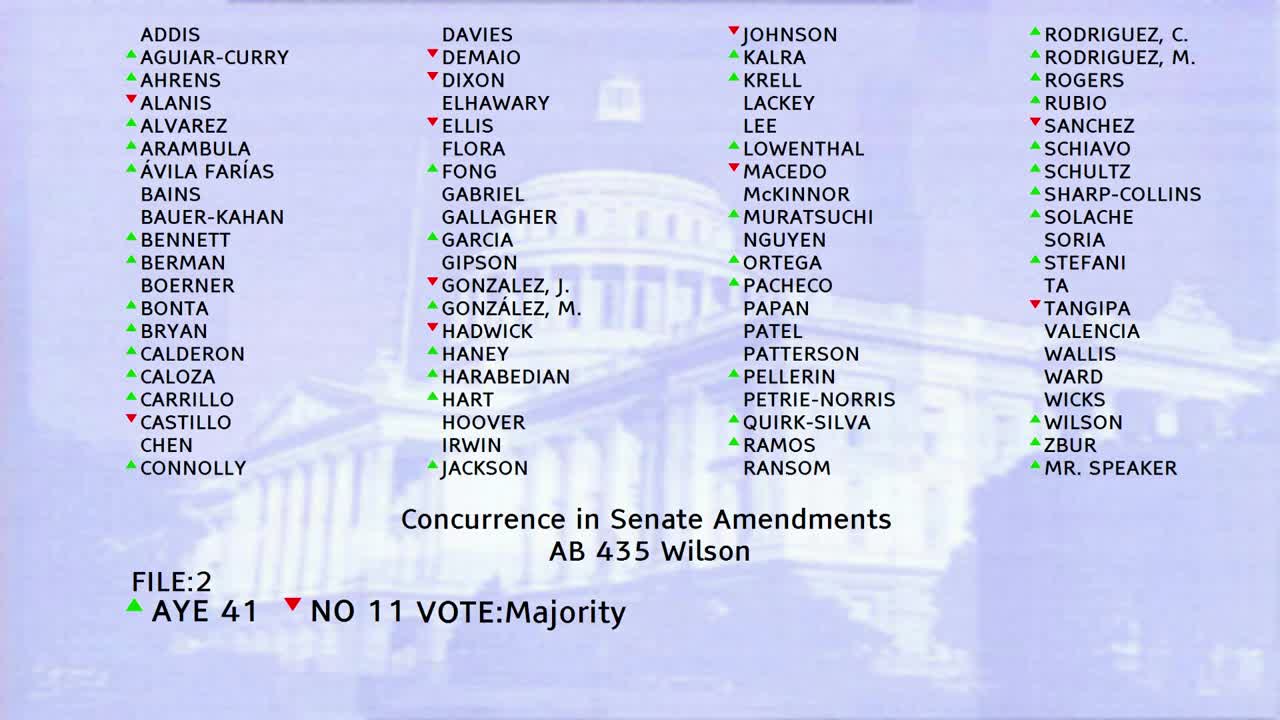 59SEC
Assembly Floor
 29SEC
Senate Standing Committee on Appropriations
 6MIN
Senate Standing Committee on Judiciary
 14MIN
Senate Standing Committee on Business, Professions and Economic Development
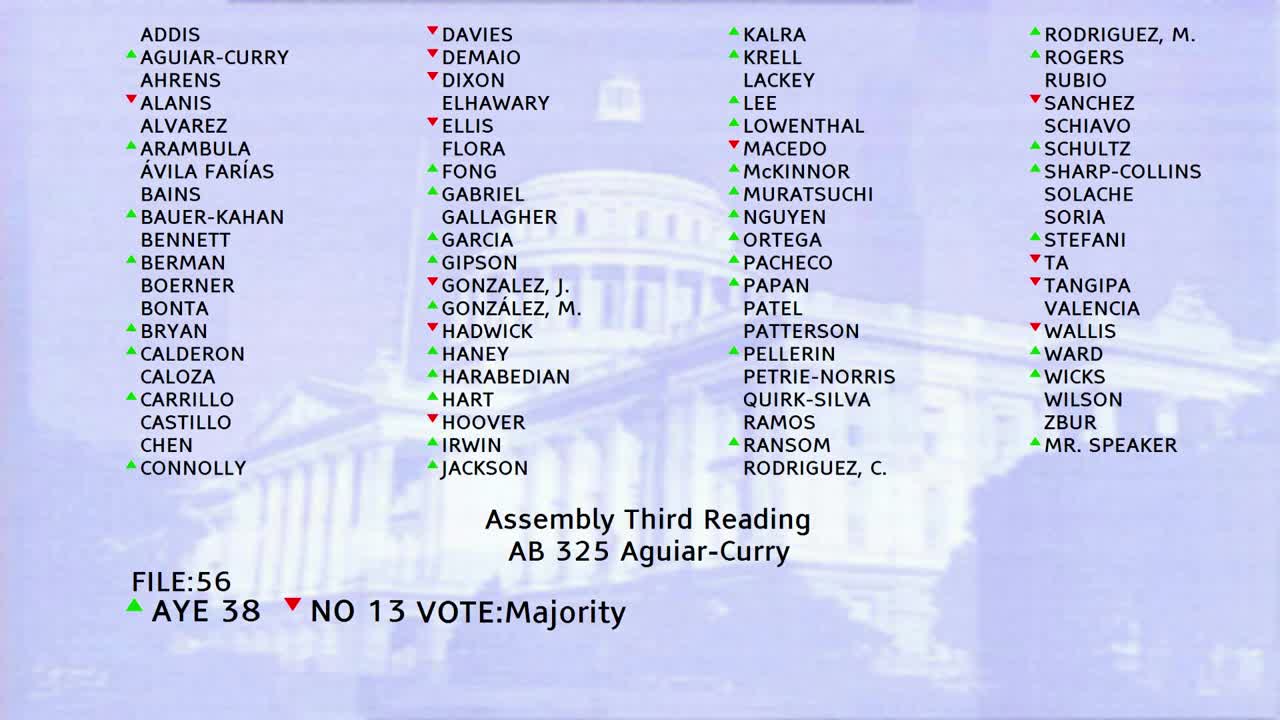 1MIN
Assembly Floor
 9MIN
Assembly Standing Committee on Business and Professions
Bill Author