AB 50: Pharmacists: furnishing contraceptives.
- Session Year: 2025-2026
- House: Assembly
- Latest Version Date: 2025-09-26
Current Status:
Passed
(2025-09-26: Chaptered by Secretary of State - Chapter 135, Statutes of 2025.)
Introduced
In Committee
Awaiting First Chamber Vote
Passed First Chamber
In Committee
Awaiting Second Chamber Vote
Passed Second Chamber
Enacted
Existing law, the Pharmacy Law, establishes in the Department of Consumer Affairs the California State Board of Pharmacy to license and regulate the practice of pharmacy. Exiting law requires a pharmacist, when furnishing self-administered hormonal contraceptives, to follow specified standardized procedures or protocols developed and approved by both the board and the Medical Board of California in consultation with the American Congress of Obstetricians and Gynecologists, the California Pharmacists Association, and other appropriate entities. Existing law requires those standardized procedures or protocols to require that the patient use a self-screening tool that will identify related patient risk factors and that require the pharmacist to refer the patient for appropriate followup care, as specified. Existing law requires the pharmacist to provide the recipient of the drug with a standardized factsheet that includes the indications and contraindications for use of the drug, the appropriate method for using the drug, the need for medical followup, and other appropriate information. Existing law authorizes a pharmacist furnishing an FDA-approved, self-administered hormonal contraceptive pursuant to the above-described protocols to furnish, at the patients request, up to a 12-month supply at one time.
This bill would limit the application of those requirements to self-administered hormonal contraceptives that are prescription-only, and would authorize a pharmacist to furnish over-the-counter contraceptives without following those standardized procedures or protocols. The bill would additionally authorize a pharmacist to furnish up to a 12-month supply at one time of over-the-counter contraceptives at the patients request. The bill would make related conforming changes.
This bill would declare that it is to take effect immediately as an urgency statute.
Existing law, the Pharmacy Law, establishes in the Department of Consumer Affairs the California State Board of Pharmacy to license and regulate the practice of pharmacy. Exiting law requires a pharmacist, when furnishing self-administered hormonal contraceptives, to follow specified standardized procedures or protocols developed and approved by both the board and the Medical Board of California in consultation with the American Congress of Obstetricians and Gynecologists, the California Pharmacists Association, and other appropriate entities. Existing law requires those standardized procedures or protocols to require that the patient use a self-screening tool that will identify related patient risk factors and that require the pharmacist to refer the patient for appropriate followup care, as specified. Existing law requires the pharmacist to provide the recipient of the drug with a standardized factsheet that includes the indications and contraindications for use of the drug, the appropriate method for using the drug, the need for medical followup, and other appropriate information.
This bill would limit the application of those requirements to self-administered hormonal contraceptives that are prescription-only, and would authorize a pharmacist to furnish over-the-counter contraceptives without following those standardized procedures or protocols. The bill would make related conforming changes.
This bill would declare that it is to take effect immediately as an urgency statute.
(a)A licentiate shall not obstruct a patient in obtaining a prescription drug or device that has been legally prescribed or ordered for that patient. A violation of this section constitutes unprofessional conduct by the licentiate and shall subject the licentiate to disciplinary or administrative action by their licensing agency.
(b)Notwithstanding any other law, a licentiate shall dispense drugs and devices, as described in subdivision (a) of Section 4024, pursuant to a lawful order or prescription unless one of the following circumstances exists:
(1)Based solely on the licentiates professional training and judgment, dispensing pursuant to the order or the prescription is contrary to law, or the licentiate determines that the prescribed drug or device would cause a harmful drug interaction or would otherwise adversely affect the patients medical condition.
(2)The prescription drug or device is not in stock. If an order, other than an order described in Section 4019, or prescription cannot be dispensed because the drug or device is not in stock, the licentiate shall take one of the following actions:
(A)Immediately notify the patient and arrange for the drug or device to be delivered to the site or directly to the patient in a timely manner.
(B)Promptly transfer the prescription to another pharmacy known to stock the prescription drug or device that is near enough to the site from which the prescription or order is transferred, to ensure the patient has timely access to the drug or device.
(C)Return the prescription to the patient and refer the patient. The licentiate shall make a reasonable effort to refer the patient to a pharmacy that stocks the prescription drug or device that is near enough to the referring site to ensure that the patient has timely access to the drug or device.
(3)The licentiate refuses on ethical, moral, or religious grounds to dispense a drug or device pursuant to an order or prescription. A licentiate may decline to dispense a prescription drug or device on this basis only if the licentiate has previously notified their employer, in writing, of the drug or class of drugs to which the licentiate objects, and the licentiates employer can, without creating undue hardship, provide a reasonable accommodation of the licentiates objection. The licentiates employer shall establish protocols that ensure that the patient has timely access to the prescribed drug or device despite the licentiates refusal to dispense the prescription or order. For purposes of this section, reasonable accommodation and undue hardship shall have the same meaning as applied to those terms pursuant to subdivision (l) of Section 12940 of the Government Code.
(c)For the purposes of this section, prescription drug or device has the same meaning as the definition in Section 4022.
(d)This section applies to emergency contraception drug therapy, over-the-counter contraceptives, and self-administered prescription-only hormonal contraceptives described in Section 4052.3.
(e)This section imposes no duty on a licentiate to dispense a drug or device pursuant to a prescription or order without payment for the drug or device, including payment directly by the patient or through a third-party payer accepted by the licentiate or payment of any required copayment by the patient.
(f)The notice to consumers required by Section 4122 shall include a statement that describes patients rights relative to the requirements of this section.
SEC. 2.Section 4052 of the Business and Professions Code is amended to read:4052.(a)Notwithstanding any other law, a pharmacist may do all of the following:
(1)Furnish a reasonable quantity of compounded drug product to a prescriber for office use by the prescriber.
(2)Transmit a valid prescription to another pharmacist.
(3)Administer drugs and biological products that have been ordered by a prescriber.
(4)Perform procedures or functions in a licensed health care facility as authorized by Section 4052.1.
(5)Perform procedures or functions as part of the care provided by a health care facility, a licensed home health agency, a licensed clinic in which there is physician oversight, a provider who contracts with a licensed health care service plan with regard to the care or services provided to the enrollees of that health care service plan, or a physician, as authorized by Section 4052.2.
(6)Perform procedures or functions as authorized by Section 4052.6.
(7)Manufacture, measure, fit to the patient, or sell and repair dangerous devices, or furnish instructions to the patient or the patients representative concerning the use of those devices.
(8)Provide consultation, training, and education to patients about drug therapy, disease management, and disease prevention.
(9)Provide professional information, including clinical or pharmacological information, advice, or consultation to other health care professionals, and participate in multidisciplinary review of patient progress, including appropriate access to medical records.
(10)Furnish the medications described in subparagraph (A) in accordance with subparagraph (B):
(A)(i)Emergency contraception drug therapy, over-the-counter contraceptives, and self-administered prescription-only hormonal contraceptives, as authorized by Section 4052.3.
(ii)Nicotine replacement products, as authorized by Section 4052.9.
(iii)Prescription medications not requiring a diagnosis that are recommended by the federal Centers for Disease Control and Prevention for individuals traveling outside of the United States.
(iv)HIV preexposure prophylaxis, as authorized by Section 4052.02.
(v)HIV postexposure prophylaxis, as authorized by Section 4052.03.
(B)The pharmacist shall notify the patients primary care provider of any drugs or devices furnished to the patient, or enter the appropriate information in a patient record system shared with the primary care provider, as permitted by that primary care provider. If the patient does not have a primary care provider, the pharmacist shall provide the patient with a written record of the drugs or devices furnished and advise the patient to consult a physician of the patients choice.
(11)Administer immunizations pursuant to a protocol with a prescriber.
(12)Order and interpret tests for the purpose of monitoring and managing the efficacy and toxicity of drug therapies. A pharmacist who orders and interprets tests pursuant to this paragraph shall ensure that the ordering of those tests is done in coordination with the patients primary care provider or diagnosing prescriber, as appropriate, including promptly transmitting written notification to the patients diagnosing prescriber or entering the appropriate information in a patient record system shared with the prescriber, when available and as permitted by that prescriber.
(13)Initiate, adjust, or discontinue drug therapy for a patient under a collaborative practice agreement with any health care provider with prescriptive authority. The collaborative practice agreement may be between a single or multiple pharmacists and a single or multiple health care providers with prescriptive authority.
(14)Provide medication-assisted treatment pursuant to a state protocol, to the extent authorized by federal law.
(b)A pharmacist who is authorized to issue an order to initiate or adjust a controlled substance therapy pursuant to this section shall personally register with the federal Drug Enforcement Administration.
(c)This section does not affect the applicable requirements of law relating to either of the following:
(1)Maintaining the confidentiality of medical records.
(2)The licensing of a health care facility.
SEC. 3.Section 4052.3 of the Business and Professions Code is amended to read:4052.3.(a)(1)Notwithstanding any other law, a pharmacist may furnish self-administered prescription-only hormonal contraceptives in accordance with standardized procedures or protocols developed and approved by both the board and the Medical Board of California in consultation with the American Congress of Obstetricians and Gynecologists, the California Pharmacists Association, and other appropriate entities. The standardized procedure or protocol shall require that the patient use a self-screening tool that will identify patient risk factors for use of self-administered hormonal contraceptives, based on the current United States Medical Eligibility Criteria (USMEC) for Contraceptive Use developed by the federal Centers for Disease Control and Prevention, and that the pharmacist refer the patient to the patients primary care provider or, if the patient does not have a primary care provider, to nearby clinics, upon furnishing a self-administered hormonal contraceptive pursuant to this subdivision, or if it is determined that use of a self-administered hormonal contraceptive is not recommended.
(2)The board and the Medical Board of California are both authorized to ensure compliance with this subdivision, and each board is specifically charged with the enforcement of this subdivision with respect to its respective licensees. This subdivision does not expand the authority of a pharmacist to prescribe any prescription medication.
(b)(1)Notwithstanding any other law, a pharmacist may furnish emergency contraception drug therapy in accordance with either of the following:
(A)Standardized procedures or protocols developed by the pharmacist and an authorized prescriber who is acting within their scope of practice.
(B)Standardized procedures or protocols developed and approved by both the board and the Medical Board of California in consultation with the American Congress of Obstetricians and Gynecologists, the California Pharmacists Association, and other appropriate entities. The board and the Medical Board of California are both authorized to ensure compliance with this clause, and each board is specifically charged with the enforcement of this provision with respect to its respective licensees. This subdivision does not expand the authority of a pharmacist to prescribe any prescription medication.
(2)Prior to performing a procedure authorized under this subdivision, a pharmacist shall complete a training program on emergency contraception that consists of at least one hour of approved continuing education on emergency contraception drug therapy.
(3)A pharmacist, pharmacists employer, or pharmacists agent shall not directly charge a patient a separate consultation fee for emergency contraception drug therapy services initiated pursuant to this subdivision, but may charge an administrative fee not to exceed ten dollars ($10) above the retail cost of the drug. Upon an oral, telephonic, electronic, or written request from a patient or customer, a pharmacist or pharmacists employee shall disclose the total retail price that a consumer would pay for emergency contraception drug therapy. As used in this paragraph, total retail price includes providing the consumer with specific information regarding the price of the emergency contraception drugs and the price of the administrative fee charged. This limitation is not intended to interfere with other contractually agreed-upon terms between a pharmacist, a pharmacists employer, or a pharmacists agent, and a health care service plan or insurer. Patients who are insured or covered and receive a pharmacy benefit that covers the cost of emergency contraception shall not be required to pay an administrative fee. These patients shall be required to pay copayments pursuant to the terms and conditions of their coverage. This paragraph shall become inoperative for dedicated emergency contraception drugs if these drugs are reclassified as over-the-counter products by the federal Food and Drug Administration.
(4)A pharmacist shall not require a patient to provide individually identifiable medical information that is not specified in Section 1707.1 of Title 16 of the California Code of Regulations before initiating emergency contraception drug therapy pursuant to this subdivision.
(c)Notwithstanding any other law, a pharmacist may furnish over-the-counter contraceptives without the standardized procedures or protocols that subdivision (a) requires for prescription-only self-administered hormonal contraceptives.
(d)For each emergency contraception drug therapy or self-administered prescription-only hormonal contraception initiated pursuant to this section, the pharmacist shall provide the recipient of the drug with a standardized factsheet that includes, but is not limited to, the indications and contraindications for use of the drug, the appropriate method for using the drug, the need for medical followup, and other appropriate information. The board shall develop this form in consultation with the State Department of Public Health, the American Congress of Obstetricians and Gynecologists, the California Pharmacists Association, and other health care organizations. This section does not preclude the use of existing publications developed by nationally recognized medical organizations.
SEC. 4.Section 4064.5 of the Business and Professions Code is amended to read:4064.5.(a)A pharmacist may dispense not more than a 90-day supply of a dangerous drug other than a controlled substance pursuant to a valid prescription that specifies an initial quantity of less than a 90-day supply followed by periodic refills of that amount if all of the following requirements are satisfied:
(1)The patient has completed an initial 30-day supply of the dangerous drug.
(2)The total quantity of dosage units dispensed does not exceed the total quantity of dosage units authorized by the prescriber on the prescription, including refills.
(3)The prescriber has not specified on the prescription that dispensing the prescription in an initial amount followed by periodic refills is medically necessary.
(4)The pharmacist is exercising their professional judgment.
(b)For purposes of this section, if the prescription continues the same medication as previously dispensed in a 90-day supply, the initial 30-day supply under paragraph (1) of subdivision (a) is not required.
(c)A pharmacist dispensing an increased supply of a dangerous drug pursuant to this section shall notify the prescriber of the increase in the quantity of dosage units dispensed.
(d)In no case shall a pharmacist dispense a greater supply of a dangerous drug pursuant to this section if the prescriber personally indicates, either orally or in their own handwriting, No change to quantity, or words of similar meaning. Nothing in this subdivision shall prohibit a prescriber from checking a box on a prescription marked No change to quantity, provided that the prescriber personally initials the box or checkmark. To indicate that an increased supply shall not be dispensed pursuant to this section for an electronic data transmission prescription as defined in subdivision (c) of Section 4040, a prescriber may indicate No change to quantity, or words of similar meaning, in the prescription as transmitted by electronic data, or may check a box marked on the prescription No change to quantity. In either instance, it shall not be required that the prohibition on an increased supply be manually initialed by the prescriber.
(e)This section shall not apply to psychotropic medication or psychotropic drugs as described in subdivision (d) of Section 369.5 of the Welfare and Institutions Code.
(f)Except for the provisions of subdivision (d), this section does not apply to FDA-approved, self-administered hormonal contraceptives.
(1)A pharmacist shall dispense, at a patients request, up to a 12-month supply of an FDA-approved, self-administered hormonal contraceptive pursuant to a valid prescription that specifies an initial quantity followed by periodic refills.
(2)A pharmacist furnishing an FDA-approved, self-administered prescription-only hormonal contraceptive pursuant to Section 4052.3 under protocols developed by the California State Board of Pharmacy or an over-the-counter contraceptive may furnish, at the patients request, up to a 12-month supply at one time.
(3)Nothing in this subdivision shall be construed to require a pharmacist to dispense or furnish a drug if it would result in a violation of Section 733.
(g)Nothing in this section shall be construed to require a health care service plan, health insurer, workers compensation insurance plan, pharmacy benefits manager, or any other person or entity, including, but not limited to, a state program or state employer, to provide coverage for a dangerous drug in a manner inconsistent with a beneficiarys plan benefit.
SEC. 5.This act is an urgency statute necessary for the immediate preservation of the public peace, health, or safety within the meaning of Article IV of the California Constitution and shall go into immediate effect. The facts constituting the necessity are:
In order to quickly ensure equitable access to over-the-counter birth control for all Californians, it is necessary that this act take effect immediately.
(a)A licentiate shall not obstruct a patient in obtaining a prescription drug or device that has been legally prescribed or ordered for that patient. A violation of this section constitutes unprofessional conduct by the licentiate and shall subject the licentiate to disciplinary or administrative action by their licensing agency.
(b)Notwithstanding any other law, a licentiate shall dispense drugs and devices, as described in subdivision (a) of Section 4024, pursuant to a lawful order or prescription unless one of the following circumstances exists:
(1)Based solely on the licentiates professional training and judgment, dispensing pursuant to the order or the prescription is contrary to law, or the licentiate determines that the prescribed drug or device would cause a harmful drug interaction or would otherwise adversely affect the patients medical condition.
(2)The prescription drug or device is not in stock. If an order, other than an order described in Section 4019, or prescription cannot be dispensed because the drug or device is not in stock, the licentiate shall take one of the following actions:
(A)Immediately notify the patient and arrange for the drug or device to be delivered to the site or directly to the patient in a timely manner.
(B)Promptly transfer the prescription to another pharmacy known to stock the prescription drug or device that is near enough to the site from which the prescription or order is transferred, to ensure the patient has timely access to the drug or device.
(C)Return the prescription to the patient and refer the patient. The licentiate shall make a reasonable effort to refer the patient to a pharmacy that stocks the prescription drug or device that is near enough to the referring site to ensure that the patient has timely access to the drug or device.
(3)The licentiate refuses on ethical, moral, or religious grounds to dispense a drug or device pursuant to an order or prescription. A licentiate may decline to dispense a prescription drug or device on this basis only if the licentiate has previously notified their employer, in writing, of the drug or class of drugs to which the licentiate objects, and the licentiates employer can, without creating undue hardship, provide a reasonable accommodation of the licentiates objection. The licentiates employer shall establish protocols that ensure that the patient has timely access to the prescribed drug or device despite the licentiates refusal to dispense the prescription or order. For purposes of this section, reasonable accommodation and undue hardship shall have the same meaning as applied to those terms pursuant to subdivision (l) of Section 12940 of the Government Code.
(c)For the purposes of this section, prescription drug or device has the same meaning as the definition in Section 4022.
(d)This section applies to emergency contraception drug therapy therapy, over-the-counter contraceptives, and self-administered prescription-only hormonal contraceptives described in Section 4052.3.
(e)This section imposes no duty on a licentiate to dispense a drug or device pursuant to a prescription or order without payment for the drug or device, including payment directly by the patient or through a third-party payer accepted by the licentiate or payment of any required copayment by the patient.
(f)The notice to consumers required by Section 4122 shall include a statement that describes patients rights relative to the requirements of this section.
SEC. 2.Section 4052 of the Business and Professions Code is amended to read:4052.(a)Notwithstanding any other law, a pharmacist may do all of the following:
(1)Furnish a reasonable quantity of compounded drug product to a prescriber for office use by the prescriber.
(2)Transmit a valid prescription to another pharmacist.
(3)Administer drugs and biological products that have been ordered by a prescriber.
(4)Perform procedures or functions in a licensed health care facility as authorized by Section 4052.1.
(5)Perform procedures or functions as part of the care provided by a health care facility, a licensed home health agency, a licensed clinic in which there is physician oversight, a provider who contracts with a licensed health care service plan with regard to the care or services provided to the enrollees of that health care service plan, or a physician, as authorized by Section 4052.2.
(6)Perform procedures or functions as authorized by Section 4052.6.
(7)Manufacture, measure, fit to the patient, or sell and repair dangerous devices, or furnish instructions to the patient or the patients representative concerning the use of those devices.
(8)Provide consultation, training, and education to patients about drug therapy, disease management, and disease prevention.
(9)Provide professional information, including clinical or pharmacological information, advice, or consultation to other health care professionals, and participate in multidisciplinary review of patient progress, including appropriate access to medical records.
(10)Furnish the medications described in subparagraph (A) in accordance with subparagraph (B):
(A)(i)Emergency contraception drug therapy, over-the-counter contraceptives, and self-administered prescription-only hormonal contraceptives, as authorized by Section 4052.3.
(ii)Nicotine replacement products, as authorized by Section 4052.9.
(iii)Prescription medications not requiring a diagnosis that are recommended by the federal Centers for Disease Control and Prevention for individuals traveling outside of the United States.
(iv)HIV preexposure prophylaxis, as authorized by Section 4052.02.
(v)HIV postexposure prophylaxis, as authorized by Section 4052.03.
(B)The pharmacist shall notify the patients primary care provider of any drugs or devices furnished to the patient, or enter the appropriate information in a patient record system shared with the primary care provider, as permitted by that primary care provider. If the patient does not have a primary care provider, the pharmacist shall provide the patient with a written record of the drugs or devices furnished and advise the patient to consult a physician of the patients choice.
(11)Administer immunizations pursuant to a protocol with a prescriber.
(12)Order and interpret tests for the purpose of monitoring and managing the efficacy and toxicity of drug therapies. A pharmacist who orders and interprets tests pursuant to this paragraph shall ensure that the ordering of those tests is done in coordination with the patients primary care provider or diagnosing prescriber, as appropriate, including promptly transmitting written notification to the patients diagnosing prescriber or entering the appropriate information in a patient record system shared with the prescriber, when available and as permitted by that prescriber.
(13)Initiate, adjust, or discontinue drug therapy for a patient under a collaborative practice agreement with any health care provider with prescriptive authority. The collaborative practice agreement may be between a single or multiple pharmacists and a single or multiple health care providers with prescriptive authority.
(14)Provide medication-assisted treatment pursuant to a state protocol, to the extent authorized by federal law.
(b)A pharmacist who is authorized to issue an order to initiate or adjust a controlled substance therapy pursuant to this section shall personally register with the federal Drug Enforcement Administration.
(c)This section does not affect the applicable requirements of law relating to either of the following:
(1)Maintaining the confidentiality of medical records.
(2)The licensing of a health care facility.
SEC. 3.Section 4052.3 of the Business and Professions Code is amended to read:4052.3.(a)(1)Notwithstanding any other law, a pharmacist may furnish self-administered prescription-only hormonal contraceptives in accordance with standardized procedures or protocols developed and approved by both the board and the Medical Board of California in consultation with the American Congress of Obstetricians and Gynecologists, the California Pharmacists Association, and other appropriate entities. The standardized procedure or protocol shall require that the patient use a self-screening tool that will identify patient risk factors for use of self-administered hormonal contraceptives, based on the current United States Medical Eligibility Criteria (USMEC) for Contraceptive Use developed by the federal Centers for Disease Control and Prevention, and that the pharmacist refer the patient to the patients primary care provider or, if the patient does not have a primary care provider, to nearby clinics, upon furnishing a self-administered hormonal contraceptive pursuant to this subdivision, or if it is determined that use of a self-administered hormonal contraceptive is not recommended.
(2)The board and the Medical Board of California are both authorized to ensure compliance with this subdivision, and each board is specifically charged with the enforcement of this subdivision with respect to its respective licensees. This subdivision does not expand the authority of a pharmacist to prescribe any prescription medication.
(b)(1)Notwithstanding any other law, a pharmacist may furnish emergency contraception drug therapy in accordance with either of the following:
(A)Standardized procedures or protocols developed by the pharmacist and an authorized prescriber who is acting within their scope of practice.
(B)Standardized procedures or protocols developed and approved by both the board and the Medical Board of California in consultation with the American Congress of Obstetricians and Gynecologists, the California Pharmacists Association, and other appropriate entities. The board and the Medical Board of California are both authorized to ensure compliance with this clause, and each board is specifically charged with the enforcement of this provision with respect to its respective licensees. This subdivision does not expand the authority of a pharmacist to prescribe any prescription medication.
(2)Prior to performing a procedure authorized under this subdivision, a pharmacist shall complete a training program on emergency contraception that consists of at least one hour of approved continuing education on emergency contraception drug therapy.
(3)A pharmacist, pharmacists employer, or pharmacists agent shall not directly charge a patient a separate consultation fee for emergency contraception drug therapy services initiated pursuant to this subdivision, but may charge an administrative fee not to exceed ten dollars ($10) above the retail cost of the drug. Upon an oral, telephonic, electronic, or written request from a patient or customer, a pharmacist or pharmacists employee shall disclose the total retail price that a consumer would pay for emergency contraception drug therapy. As used in this paragraph, total retail price includes providing the consumer with specific information regarding the price of the emergency contraception drugs and the price of the administrative fee charged. This limitation is not intended to interfere with other contractually agreed-upon terms between a pharmacist, a pharmacists employer, or a pharmacists agent, and a health care service plan or insurer. Patients who are insured or covered and receive a pharmacy benefit that covers the cost of emergency contraception shall not be required to pay an administrative fee. These patients shall be required to pay copayments pursuant to the terms and conditions of their coverage. This paragraph shall become inoperative for dedicated emergency contraception drugs if these drugs are reclassified as over-the-counter products by the federal Food and Drug Administration.
(4)A pharmacist shall not require a patient to provide individually identifiable medical information that is not specified in Section 1707.1 of Title 16 of the California Code of Regulations before initiating emergency contraception drug therapy pursuant to this subdivision.
(c)Notwithstanding any other law, a pharmacist may furnish over-the-counter contraceptives without the standardized procedures or protocols that subdivision (a) requires for prescription-only self-administered hormonal contraceptives.
(d)For each emergency contraception drug therapy or self-administered prescription-only hormonal contraception initiated pursuant to this section, the pharmacist shall provide the recipient of the drug with a standardized factsheet that includes, but is not limited to, the indications and contraindications for use of the drug, the appropriate method for using the drug, the need for medical followup, and other appropriate information. The board shall develop this form in consultation with the State Department of Public Health, the American Congress of Obstetricians and Gynecologists, the California Pharmacists Association, and other health care organizations. This section does not preclude the use of existing publications developed by nationally recognized medical organizations.
SEC. 4.Section 4064.5 of the Business and Professions Code is amended to read:4064.5.(a)A pharmacist may dispense not more than a 90-day supply of a dangerous drug other than a controlled substance pursuant to a valid prescription that specifies an initial quantity of less than a 90-day supply followed by periodic refills of that amount if all of the following requirements are satisfied:
(1)The patient has completed an initial 30-day supply of the dangerous drug.
(2)The total quantity of dosage units dispensed does not exceed the total quantity of dosage units authorized by the prescriber on the prescription, including refills.
(3)The prescriber has not specified on the prescription that dispensing the prescription in an initial amount followed by periodic refills is medically necessary.
(4)The pharmacist is exercising their professional judgment.
(b)For purposes of this section, if the prescription continues the same medication as previously dispensed in a 90-day supply, the initial 30-day supply under paragraph (1) of subdivision (a) is not required.
(c)A pharmacist dispensing an increased supply of a dangerous drug pursuant to this section shall notify the prescriber of the increase in the quantity of dosage units dispensed.
(d)In no case shall a pharmacist dispense a greater supply of a dangerous drug pursuant to this section if the prescriber personally indicates, either orally or in their own handwriting, No change to quantity, or words of similar meaning. Nothing in this subdivision shall prohibit a prescriber from checking a box on a prescription marked No change to quantity, provided that the prescriber personally initials the box or checkmark. To indicate that an increased supply shall not be dispensed pursuant to this section for an electronic data transmission prescription as defined in subdivision (c) of Section 4040, a prescriber may indicate No change to quantity, or words of similar meaning, in the prescription as transmitted by electronic data, or may check a box marked on the prescription No change to quantity. In either instance, it shall not be required that the prohibition on an increased supply be manually initialed by the prescriber.
(e)This section shall not apply to psychotropic medication or psychotropic drugs as described in subdivision (d) of Section 369.5 of the Welfare and Institutions Code.
(f)Except for the provisions of subdivision (d), this section does not apply to FDA-approved, self-administered hormonal contraceptives.
(1)A pharmacist shall dispense, at a patients request, up to a 12-month supply of an FDA-approved, self-administered hormonal contraceptive pursuant to a valid prescription that specifies an initial quantity followed by periodic refills.
(2)A pharmacist furnishing an FDA-approved, self-administered prescription-only hormonal contraceptive pursuant to Section 4052.3 under protocols developed by the California State Board of Pharmacy or an over-the-counter contraceptive may furnish, at the patients request, up to a 12-month supply at one time.
(3)Nothing in this subdivision shall be construed to require a pharmacist to dispense or furnish a drug if it would result in a violation of Section 733.
(g)Nothing in this section shall be construed to require a health care service plan, health insurer, workers compensation insurance plan, pharmacy benefits manager, or any other person or entity, including, but not limited to, a state program or state employer, to provide coverage for a dangerous drug in a manner inconsistent with a beneficiarys plan benefit.
SEC. 5.This act is an urgency statute necessary for the immediate preservation of the public peace, health, or safety within the meaning of Article IV of the California Constitution and shall go into immediate effect. The facts constituting the necessity are:
In order to quickly ensure equitable access to over-the-counter birth control for all Californians, it is necessary that this act take effect immediately.
(a)A licentiate shall not obstruct a patient in obtaining a prescription drug or device that has been legally prescribed or ordered for that patient. A violation of this section constitutes unprofessional conduct by the licentiate and shall subject the licentiate to disciplinary or administrative action by his or her their licensing agency.
(b)Notwithstanding any other law, a licentiate shall dispense drugs and devices, as described in subdivision (a) of Section 4024, pursuant to a lawful order or prescription unless one of the following circumstances exists:
(1)Based solely on the licentiates professional training and judgment, dispensing pursuant to the order or the prescription is contrary to law, or the licentiate determines that the prescribed drug or device would cause a harmful drug interaction or would otherwise adversely affect the patients medical condition.
(2)The prescription drug or device is not in stock. If an order, other than an order described in Section 4019, or prescription cannot be dispensed because the drug or device is not in stock, the licentiate shall take one of the following actions:
(A)Immediately notify the patient and arrange for the drug or device to be delivered to the site or directly to the patient in a timely manner.
(B)Promptly transfer the prescription to another pharmacy known to stock the prescription drug or device that is near enough to the site from which the prescription or order is transferred, to ensure the patient has timely access to the drug or device.
(C)Return the prescription to the patient and refer the patient. The licentiate shall make a reasonable effort to refer the patient to a pharmacy that stocks the prescription drug or device that is near enough to the referring site to ensure that the patient has timely access to the drug or device.
(3)The licentiate refuses on ethical, moral, or religious grounds to dispense a drug or device pursuant to an order or prescription. A licentiate may decline to dispense a prescription drug or device on this basis only if the licentiate has previously notified his or her their employer, in writing, of the drug or class of drugs to which he or she the licentiate objects, and the licentiates employer can, without creating undue hardship, provide a reasonable accommodation of the licentiates objection. The licentiates employer shall establish protocols that ensure that the patient has timely access to the prescribed drug or device despite the licentiates refusal to dispense the prescription or order. For purposes of this section, reasonable accommodation and undue hardship shall have the same meaning as applied to those terms pursuant to subdivision (l) of Section 12940 of the Government Code.
(c)For the purposes of this section, prescription drug or device has the same meaning as the definition in Section 4022.
(d)This section applies to emergency contraception drug therapy and self-administered prescription-only hormonal contraceptives described in Section 4052.3.
(e)This section imposes no duty on a licentiate to dispense a drug or device pursuant to a prescription or order without payment for the drug or device, including payment directly by the patient or through a third-party payer accepted by the licentiate or payment of any required copayment by the patient.
(f)The notice to consumers required by Section 4122 shall include a statement that describes patients rights relative to the requirements of this section.
SEC. 2.Section 4052 of the Business and Professions Code is amended to read:4052.(a)Notwithstanding any other law, a pharmacist may do all of the following:
(1)Furnish a reasonable quantity of compounded drug product to a prescriber for office use by the prescriber.
(2)Transmit a valid prescription to another pharmacist.
(3)Administer drugs and biological products that have been ordered by a prescriber.
(4)Perform procedures or functions in a licensed health care facility as authorized by Section 4052.1.
(5)Perform procedures or functions as part of the care provided by a health care facility, a licensed home health agency, a licensed clinic in which there is physician oversight, a provider who contracts with a licensed health care service plan with regard to the care or services provided to the enrollees of that health care service plan, or a physician, as authorized by Section 4052.2.
(6)Perform procedures or functions as authorized by Section 4052.6.
(7)Manufacture, measure, fit to the patient, or sell and repair dangerous devices, or furnish instructions to the patient or the patients representative concerning the use of those devices.
(8)Provide consultation, training, and education to patients about drug therapy, disease management, and disease prevention.
(9)Provide professional information, including clinical or pharmacological information, advice, or consultation to other health care professionals, and participate in multidisciplinary review of patient progress, including appropriate access to medical records.
(10)Furnish the medications described in subparagraph (A) in accordance with subparagraph (B):
(A)(i)Emergency contraception drug therapy and therapy, over-the-counter contraceptives, and self-administered prescription-only hormonal contraceptives, as authorized by Section 4052.3.
(ii)Nicotine replacement products, as authorized by Section 4052.9.
(iii)Prescription medications not requiring a diagnosis that are recommended by the federal Centers for Disease Control and Prevention for individuals traveling outside of the United States.
(iv)HIV preexposure prophylaxis, as authorized by Section 4052.02.
(v)HIV postexposure prophylaxis, as authorized by Section 4052.03.
(B)The pharmacist shall notify the patients primary care provider of any drugs or devices furnished to the patient, or enter the appropriate information in a patient record system shared with the primary care provider, as permitted by that primary care provider. If the patient does not have a primary care provider, the pharmacist shall provide the patient with a written record of the drugs or devices furnished and advise the patient to consult a physician of the patients choice.
(11)Administer immunizations pursuant to a protocol with a prescriber.
(12)Order and interpret tests for the purpose of monitoring and managing the efficacy and toxicity of drug therapies. A pharmacist who orders and interprets tests pursuant to this paragraph shall ensure that the ordering of those tests is done in coordination with the patients primary care provider or diagnosing prescriber, as appropriate, including promptly transmitting written notification to the patients diagnosing prescriber or entering the appropriate information in a patient record system shared with the prescriber, when available and as permitted by that prescriber.
(13)Initiate, adjust, or discontinue drug therapy for a patient under a collaborative practice agreement with any health care provider with prescriptive authority. The collaborative practice agreement may be between a single or multiple pharmacists and a single or multiple health care providers with prescriptive authority.
(14)Provide medication-assisted treatment pursuant to a state protocol, to the extent authorized by federal law.
(b)A pharmacist who is authorized to issue an order to initiate or adjust a controlled substance therapy pursuant to this section shall personally register with the federal Drug Enforcement Administration.
(c)This section does not affect the applicable requirements of law relating to either of the following:
(1)Maintaining the confidentiality of medical records.
(2)The licensing of a health care facility.
SEC. 3.Section 4052.3 of the Business and Professions Code is amended to read:4052.3.(a)(1)Notwithstanding any other law, a pharmacist may furnish self-administered prescription-only hormonal contraceptives in accordance with standardized procedures or protocols developed and approved by both the board and the Medical Board of California in consultation with the American Congress of Obstetricians and Gynecologists, the California Pharmacists Association, and other appropriate entities. The standardized procedure or protocol shall require that the patient use a self-screening tool that will identify patient risk factors for use of self-administered hormonal contraceptives, based on the current United States Medical Eligibility Criteria (USMEC) for Contraceptive Use developed by the federal Centers for Disease Control and Prevention, and that the pharmacist refer the patient to the patients primary care provider or, if the patient does not have a primary care provider, to nearby clinics, upon furnishing a self-administered hormonal contraceptive pursuant to this subdivision, or if it is determined that use of a self-administered hormonal contraceptive is not recommended.
(2)The board and the Medical Board of California are both authorized to ensure compliance with this subdivision, and each board is specifically charged with the enforcement of this subdivision with respect to its respective licensees. This subdivision does not expand the authority of a pharmacist to prescribe any prescription medication.
(b)(1)Notwithstanding any other law, a pharmacist may furnish emergency contraception drug therapy in accordance with either of the following:
(A)Standardized procedures or protocols developed by the pharmacist and an authorized prescriber who is acting within his or her their scope of practice.
(B)Standardized procedures or protocols developed and approved by both the board and the Medical Board of California in consultation with the American Congress of Obstetricians and Gynecologists, the California Pharmacists Association, and other appropriate entities. The board and the Medical Board of California are both authorized to ensure compliance with this clause, and each board is specifically charged with the enforcement of this provision with respect to its respective licensees. This subdivision does not expand the authority of a pharmacist to prescribe any prescription medication.
(2)Prior to performing a procedure authorized under this subdivision, a pharmacist shall complete a training program on emergency contraception that consists of at least one hour of approved continuing education on emergency contraception drug therapy.
(3)A pharmacist, pharmacists employer, or pharmacists agent shall not directly charge a patient a separate consultation fee for emergency contraception drug therapy services initiated pursuant to this subdivision, but may charge an administrative fee not to exceed ten dollars ($10) above the retail cost of the drug. Upon an oral, telephonic, electronic, or written request from a patient or customer, a pharmacist or pharmacists employee shall disclose the total retail price that a consumer would pay for emergency contraception drug therapy. As used in this paragraph, total retail price includes providing the consumer with specific information regarding the price of the emergency contraception drugs and the price of the administrative fee charged. This limitation is not intended to interfere with other contractually agreed-upon terms between a pharmacist, a pharmacists employer, or a pharmacists agent, and a health care service plan or insurer. Patients who are insured or covered and receive a pharmacy benefit that covers the cost of emergency contraception shall not be required to pay an administrative fee. These patients shall be required to pay copayments pursuant to the terms and conditions of their coverage. This paragraph shall become inoperative for dedicated emergency contraception drugs if these drugs are reclassified as over-the-counter products by the federal Food and Drug Administration.
(4)A pharmacist shall not require a patient to provide individually identifiable medical information that is not specified in Section 1707.1 of Title 16 of the California Code of Regulations before initiating emergency contraception drug therapy pursuant to this subdivision.
(c)Notwithstanding any other law, a pharmacist may furnish over-the-counter contraceptives without the standardized procedures or protocols that subdivision (a) requires for prescription-only self-administered hormonal contraceptives.
(c)(d)For each emergency contraception drug therapy or self-administered prescription-only hormonal contraception initiated pursuant to this section, the pharmacist shall provide the recipient of the drug with a standardized factsheet that includes, but is not limited to, the indications and contraindications for use of the drug, the appropriate method for using the drug, the need for medical followup, and other appropriate information. The board shall develop this form in consultation with the State Department of Public Health, the American Congress of Obstetricians and Gynecologists, the California Pharmacists Association, and other health care organizations. This section does not preclude the use of existing publications developed by nationally recognized medical organizations.
SEC. 4.Section 4064.5 of the Business and Professions Code is amended to read:4064.5.(a)A pharmacist may dispense not more than a 90-day supply of a dangerous drug other than a controlled substance pursuant to a valid prescription that specifies an initial quantity of less than a 90-day supply followed by periodic refills of that amount if all of the following requirements are satisfied:
(1)The patient has completed an initial 30-day supply of the dangerous drug.
(2)The total quantity of dosage units dispensed does not exceed the total quantity of dosage units authorized by the prescriber on the prescription, including refills.
(3)The prescriber has not specified on the prescription that dispensing the prescription in an initial amount followed by periodic refills is medically necessary.
(4)The pharmacist is exercising his or her their professional judgment.
(b)For purposes of this section, if the prescription continues the same medication as previously dispensed in a 90-day supply, the initial 30-day supply under paragraph (1) of subdivision (a) is not required.
(c)A pharmacist dispensing an increased supply of a dangerous drug pursuant to this section shall notify the prescriber of the increase in the quantity of dosage units dispensed.
(d)In no case shall a pharmacist dispense a greater supply of a dangerous drug pursuant to this section if the prescriber personally indicates, either orally or in his or her their own handwriting, No change to quantity, or words of similar meaning. Nothing in this subdivision shall prohibit a prescriber from checking a box on a prescription marked No change to quantity, provided that the prescriber personally initials the box or checkmark. To indicate that an increased supply shall not be dispensed pursuant to this section for an electronic data transmission prescription as defined in subdivision (c) of Section 4040, a prescriber may indicate No change to quantity, or words of similar meaning, in the prescription as transmitted by electronic data, or may check a box marked on the prescription No change to quantity. In either instance, it shall not be required that the prohibition on an increased supply be manually initialed by the prescriber.
(e)This section shall not apply to psychotropic medication or psychotropic drugs as described in subdivision (d) of Section 369.5 of the Welfare and Institutions Code.
(f)Except for the provisions of subdivision (d), this section does not apply to FDA-approved, self-administered hormonal contraceptives.
(1)A pharmacist shall dispense, at a patients request, up to a 12-month supply of an FDA-approved, self-administered hormonal contraceptive pursuant to a valid prescription that specifies an initial quantity followed by periodic refills.
(2)A pharmacist furnishing an FDA-approved, self-administered prescription-only hormonal contraceptive pursuant to Section 4052.3 under protocols developed by the California State Board of Pharmacy may furnish, at the patients request, up to a 12-month supply at one time.
(3)Nothing in this subdivision shall be construed to require a pharmacist to dispense or furnish a drug if it would result in a violation of Section 733.
(g)Nothing in this section shall be construed to require a health care service plan, health insurer, workers compensation insurance plan, pharmacy benefits manager, or any other person or entity, including, but not limited to, a state program or state employer, to provide coverage for a dangerous drug in a manner inconsistent with a beneficiarys plan benefit.
SEC. 5.This act is an urgency statute necessary for the immediate preservation of the public peace, health, or safety within the meaning of Article IV of the California Constitution and shall go into immediate effect. The facts constituting the necessity are:
In order to quickly ensure equitable access to over-the-counter birth control for all Californians, it is necessary that this act take effect immediately.
|
Date
|
Status
|
|---|---|
| Sep 26, 2025 | Chaptered by Secretary of State - Chapter 135, Statutes of 2025. |
| Sep 26, 2025 | Approved by the Governor. |
| Sep 15, 2025 | Enrolled and presented to the Governor at 4:30 p.m. |
| Sep 8, 2025 | In Assembly. Ordered to Engrossing and Enrolling. |
| Sep 8, 2025 | Read third time. Urgency clause adopted. Passed. Ordered to the Assembly. (Ayes 39. Noes 0. Page 2579.). |
| Jun 24, 2025 | Read second time. Ordered to third reading. |
| Jun 23, 2025 | From committee: Be ordered to second reading pursuant to Senate Rule 28.8. |
| Jun 9, 2025 | From committee: Do pass and re-refer to Com. on APPR. (Ayes 7. Noes 0.) (June 9). Re-referred to Com. on APPR. |
| May 7, 2025 | Referred to Com. on B. P. & E.D. |
| Apr 29, 2025 | In Senate. Read first time. To Com. on RLS. for assignment. |
| Apr 28, 2025 | Read third time. Urgency clause adopted. Passed. Ordered to the Senate. (Ayes 73. Noes 0. Page 1316.). |
| Apr 24, 2025 | Read second time. Ordered to third reading. |
| Apr 23, 2025 | From committee: Do pass. (Ayes 15. Noes 0.) (April 23). |
| Apr 7, 2025 | Re-referred to Com. on APPR. pursuant to Assembly Rule 96. |
| Apr 3, 2025 | Re-referred to Com. on HEALTH. |
| Apr 2, 2025 | Read second time and amended. |
| Apr 1, 2025 | From committee: Amend, and do pass as amended and re-refer to Com. on HEALTH. (Ayes 17. Noes 0.) (April 1). |
| Feb 18, 2025 | Referred to Coms. on B. & P. and HEALTH. |
| Dec 3, 2024 | From printer. May be heard in committee January 2. |
| Dec 2, 2024 | Read first time. To print. |
|
Date
|
Description
|
Location
|
Votes
|
|
|---|---|---|---|---|
| Sep 8, 2025 | Assembly 3rd Reading AB50 Bonta By Ashby Urgency Clause | Senate Floor |
Passed |
|
| Jun 9, 2025 | Do pass, but first be re-referred to the Committee on [Appropriations] | Senate Standing Committee on Business, Professions and Economic Development |
Passed |
|
| Apr 28, 2025 | AB 50 Bonta Third Reading Urgency | Assembly Floor |
Passed |
|
| Apr 23, 2025 | Do pass. | Assembly Standing Committee on Appropriations |
Passed |
|
| Apr 1, 2025 | Do pass as amended and be re-referred to the Committee on [Health] | Assembly Standing Committee on Business and Professions |
Passed |
This list shows positions taken on this bill by organizations on the date displayed, which is linked to the original source.
Positions by individuals are not included.
|
Organization
|
Position
|
Date
|
|---|---|---|
| American College Of Obstetricians And Gynecologists District Ix | ** Support | |
| Asian Americans Advancing Justice, Southern California | ** Support | |
| Birth Control Pharmacist | ** Support | |
| California Latinas for Reproductive Justice | ** Support | |
| California Pan - Ethnic Health Network | ** Support | |
| California Pharmacists Association | ** Support | |
| California State Board of Pharmacy | ** Support | |
| California Women's Law Center | ** Support | |
| Citizens for Choice | ** Support | |
| City of Alameda | ** Support | |
| Community Clinic Association of Los Angeles County | ** Support | |
| County of Los Angeles Board of Supervisors | ** Support | |
| Courage California | ** Support | |
| CPCA Advocates, Subsidiary of The California Primary Care Association | ** Support | |
| Disability Rights Education & Defense Fund | ** Support | |
| Essential Access Health | ** Support | |
| Glide | ** Support | |
| Health Access California | ** Support | |
| Latino Coalition for a Healthy California | ** Support | |
| National Health Law Program | ** Support | |
| Planned Parenthood Affiliates Of California | ** Support | |
| Reproductive Freedom for All California | ** Support | |
| South Asian Network | ** Support | |
| The Children's Partnership | ** Support | |
| The Los Angeles Trust for Childrens Health | ** Support | |
| Western Center on Law & Poverty, INC. | ** Support | |
| Women'S Foundation California | ** Support |
SENATE RULES COMMITTEE Office of Senate Floor Analyses (916) 651-1520 Fax: (916) 327-4478 | AB 50 |
THIRD READING
Bill No: AB 50
Author: Bonta (D)
Amended: 4/2/25 in Assembly
Vote: 27 - Urgency
SENATE BUS., PROF. & ECON. DEV. COMMITTEE: 7-0, 6/9/25
AYES: Ashby, Archuleta, Arreguín, Grayson, Niello, Strickland, Umberg
NO VOTE RECORDED: Choi, Menjivar, Smallwood-Cuevas, Weber Pierson
SENATE APPROPRIATIONS COMMITTEE: Senate Rule 28.8
ASSEMBLY FLOOR: 73-0, 4/28/25 - See last page for vote
SUBJECT: Pharmacists: furnishing contraceptives
SOURCE: Essential Access Health, National Health Law Program, and Birth Control Pharmacist
DIGEST:
This bill, an urgency measure, authorizes a pharmacist to furnish over-the-counter contraceptives (OTCs) without the standardized procedures or protocols required for prescription-only self-administered hormonal contraceptives.
ANALYSIS:
Existing law:
- Authorizes a pharmacist to furnish self-administered hormonal contraceptives, in accordance with standardized procedures or protocols developed and approved by the Board of Pharmacy (the Board) and Medical Board of California (MBC) and emergency contraception drug therapy, in accordance with standardized procedures or protocols developed by the pharmacist and an authorized prescriber who is acting within his or her scope of practice or standardized procedures or protocols developed and approved by both the Board and MBC. Requires a pharmacist to complete specified training and comply with information disclosure requirements for emergency contraception furnishing. (Business & Professions Code (BPC) § 4052.3)
- Requires a pharmacist to provide an oral consultation to a patient or the patient's agent in any care setting whenever the prescription drug has not previously been dispensed to a patient; however, a pharmacist is not required to provide oral consultation when a patient or the patient's agent refuses such consultation. (Title 16 California Code of Regulations § 1707.2)
This bill:
- Authorizes a pharmacist to furnish OTCs without the standardized procedures or protocols required for prescription-only self-administered hormonal contraceptives.
- Clarifies that current law requiring pharmacists to comply with standardized procedures or protocols for furnishing self-administered hormonal contraceptives applies only to contraceptives requiring a prescription.
- States the necessity of this bill taking effect immediately in order to quickly ensure equitable access to over-the-counter birth control for all Californians.
Background
As noted in its recent sunset review oversight report to the Legislature, the Board is estimated to regulate over 50,700 pharmacists, 1,300 advanced practice pharmacists, 4,400 intern pharmacists, and 65,700 pharmacy technicians across a total of 32 licensing programs. In addition to regulating personal professionals, the Board oversees and licenses related business entities, including pharmacies, clinics, wholesalers, third-party logistic providers, and automated drug delivery systems.
SB 493 (Hernandez, Chapter 469, Statutes of 2013) authorized pharmacists to perform additional functions according to specified requirements, including furnishing self-administered hormonal contraceptives based on a state protocol developed jointly by the Board and MBC, pursuant to guidelines of the Centers for Disease Control, among other services.
In July 2023, the FDA announced its approval of the medication Opill, a norgestrel tablet to prevent pregnancy. Opill was the first daily oral contraceptive approved for use in the United States without a prescription, significantly increasing access by allowing patients to purchase oral contraceptive medicine at local pharmacies over-the-counter. This approval significantly increased availability and access to birth control for women and other patients seeking to prevent pregnancy.
However, the over-the-counter status of Opill has complicated the implementation of related efforts to increase access to contraception, specifically those related to health coverage and reimbursement. In 2022, the Legislature enacted Senate Bill 523 (Leyva, Chapter 630, Statutes of 2022), which requires a health care service plan or health insurer to provide point-of-sale coverage for over-the-counter FDA-approved contraceptive drugs, devices, and products at in-network pharmacies without cost sharing or medical management restrictions. Because Medi-Cal generally requires a prescription to reimburse for medications, even those approved as over-the-counter by the FDA, patients are not able to take advantage of this legislation when accessing Opill directly from a pharmacy.
Pharmacists are already authorized to furnish self-administered hormonal contraception, including those requiring a prescription. However, they must do so in accordance with standardized procedures and protocols that can present a barrier to access for patients. To resolve this issue, this bill would clarify that a pharmacist may furnish over-the-counter contraceptives without the standardized procedures or protocols required for prescription-only medications.
FISCAL EFFECT: Appropriation: No Fiscal Com.: Yes Local: No
SUPPORT: (Verified 6/23/25)
Essential Access Health (co-source)
Birth Control Pharmacist (co-source)
National Health Law Program (co-source)
American College of Obstetricians and Gynecologists District IX
Asian Americans Advancing Justice, Southern California
California Latinas for Reproductive Justice
California Pan - Ethnic Health Network
California Pharmacists Association
California State Board of Pharmacy
California Women's Law Center
Citizens for Choice
City of Alameda
Community Clinic Association of Los Angeles County
County of Los Angeles Board of Supervisors
Courage California
Cpca Advocates, Subsidiary of the California Primary Care Association
Disability Rights Education & Defense Fund
Glide
Health Access California
Latino Coalition for a Healthy California
Planned Parenthood Affiliates of California
Reproductive Freedom for All California
South Asian Network
The Children's Partnership
The Los Angeles Trust for Children’s Health
Western Center on Law & Poverty, INC.
Women's Foundation California
OPPOSITION: (Verified 6/23/25)
None received
ARGUMENTS IN SUPPORT: Supporters note that OTC birth control is a valuable tool to expand access to contraception, particularly for communities facing systemic barriers to care. These include rural area residents who must travel long distances to the nearest health care provider, individuals with transportation challenges, those with limited or no paid time off for medical appointments, and underserved populations, including Black, Indigenous, and People of Color (BIPOC) individuals. AB 50 provides a clear and practical policy solution to fix a systemic barrier to birth control by ensuring equitable access to OTC methods in communities statewide.
The Board writes that it supports the change in pharmacy law to allow pharmacists to prescribe OTC hormonal contraception.
ASSEMBLY FLOOR: 73-0, 4/28/25
AYES: Addis, Aguiar-Curry, Ahrens, Alanis, Alvarez, Arambula, Ávila Farías, Bains, Bauer-Kahan, Bennett, Berman, Boerner, Bonta, Bryan, Calderon, Caloza, Carrillo, Chen, Connolly, Davies, DeMaio, Dixon, Elhawary, Fong, Gabriel, Gallagher, Garcia, Gipson, Jeff Gonzalez, Mark González, Haney, Harabedian, Hart, Hoover, Irwin, Jackson, Kalra, Krell, Lackey, Lee, Lowenthal, Macedo, McKinnor, Muratsuchi, Nguyen, Ortega, Pacheco, Papan, Patel, Pellerin, Petrie-Norris, Quirk-Silva, Ramos, Ransom, Celeste Rodriguez, Michelle Rodriguez, Rogers, Blanca Rubio, Schiavo, Schultz, Sharp-Collins, Solache, Soria, Stefani, Ta, Tangipa, Valencia, Wallis, Ward, Wicks, Wilson, Zbur, Rivas
NO VOTE RECORDED: Castillo, Ellis, Flora, Hadwick, Patterson, Sanchez
Prepared by: Sarah Mason / B., P. & E.D. /
6/24/25 16:32:47
**** END ****
SENATE COMMITTEE ON
BUSINESS, PROFESSIONS AND ECONOMIC DEVELOPMENT
Senator Angelique Ashby, Chair
2025 - 2026 Regular
Bill No: AB 50 Hearing Date: June 9, 2025
Author: | Bonta | ||
Version: |
| ||
Urgency: | Fiscal: | ||
Consultant: | |||
Subject: Pharmacists: furnishing contraceptives
SUMMARY:
An urgency measure that authorizes a pharmacist to furnish over-the-counter contraceptives (OTCs) without the standardized procedures or protocols required for prescription-only self-administered hormonal contraceptives.
Existing law:
- Authorizes a pharmacist to furnish self-administered hormonal contraceptives, in accordance with standardized procedures or protocols developed and approved by the Board and Medical Board of California (MBC) and emergency contraception drug therapy, in accordance with standardized procedures or protocols developed by the pharmacist and an authorized prescriber who is acting within his or her scope of practice or standardized procedures or protocols developed and approved by both the Board and MBC. Requires a pharmacist to complete specified training and comply with information disclosure requirements for emergency contraception furnishing. (BPC § 4052.3)
- Requires a pharmacist to provide an oral consultation to a patient or the patient's agent in any care setting whenever the prescription drug has not previously been dispensed to a patient; however, a pharmacist is not required to provide oral consultation when a patient or the patient's agent refuses such consultation. (Title 16 California Code of Regulations § 1707.2)
This bill:
- Authorizes a pharmacist to furnish OTCs without the standardized procedures or protocols required for prescription-only self-administered hormonal contraceptives.
- Clarifies that current law requiring pharmacists to comply with standardized procedures or protocols for furnishing self-administered hormonal contraceptives applies only to contraceptives requiring a prescription.
- States the necessity of the bill taking effect immediately in order to quickly ensure equitable access to over-the-counter birth control for all Californians.
FISCAL EFFECT:
This bill is keyed fiscal by Legislative Counsel. According to the Assembly Committee on Appropriations, the Department of Health Care Services does not anticipate any material fiscal impact associated with this bill because Medi-Cal Rx already covers OTC contraceptives under the pharmacy benefit. The Board anticipates minor and absorbable costs to educate pharmacists about the provisions of this bill.
COMMENTS:
- Purpose. This bill is sponsored by Essential Access Health, National Health Law Program, and Birth Control Pharmacist. According to the author, “AB 50 advances reproductive equity by ensuring Medi-Cal enrollees can access over-the-counter (OTC) contraceptives like O-Pill without a prescription, aligning coverage with private insurance. Despite state laws requiring OTC contraceptive coverage, Medi-Cal only covers OTC contraceptives if prescribed, creating barriers that private insurance holders do not face. Research highlights significant barriers that low-income women face in accessing contraception, including prescription requirements, cost concerns, and limited availability. These challenges contribute to inconsistent contraceptive use and higher rates of unintended pregnancies. Everyone deserves equal access to contraception, regardless of income or insurance type. By eliminating prescription requirements, AB 50 makes birth control more accessible to low-income communities, reducing disparities in reproductive healthcare.”
- Background. As noted in its recent sunset review oversight report to the Legislature, the Board is estimated to regulate over 50,700 pharmacists, 1,300 advanced practice pharmacists, 4,400 intern pharmacists, and 65,700 pharmacy technicians across a total of 32 licensing programs. In addition to regulating personal professionals, the Board oversees and licenses related business entities, including pharmacies, clinics, wholesalers, third-party logistic providers, and automated drug delivery systems.
SB 493 (Hernandez, Chapter 469, Statutes of 2013) authorized pharmacists to perform additional functions according to specified requirements, including furnishing self-administered hormonal contraceptives based on a state protocol developed jointly by the Board and Medical Board of California (MBC), pursuant to guidelines of the Centers for Disease Control (CDC), among other services.
In July 2023, the FDA announced its approval of the medication Opill, a norgestrel tablet to prevent pregnancy. Opill was the first daily oral contraceptive approved for use in the United States without a prescription, significantly increasing access by allowing patients to purchase oral contraceptive medicine at local pharmacies over-the-counter. This approval significantly increased availability and access to birth control for women and other patients seeking to prevent pregnancy.
However, the over-the-counter status of Opill has complicated the implementation of related efforts to increase access to contraception, specifically those related to health coverage and reimbursement. In 2022, the Legislature enacted Senate Bill 523 (Leyva), which requires a health care service plan or health insurer to provide point-of-sale coverage for over-the-counter FDA-approved contraceptive drugs, devices, and products at in-network pharmacies without cost sharing or medical management restrictions. Because Medi-Cal generally requires a prescription to reimburse for medications, even those approved as over-the-counter by the FDA, patients are not able to take advantage of this legislation when accessing Opill directly from a pharmacy.
Pharmacists are already authorized to furnish self-administered hormonal contraception, including those requiring a prescription. However, they must do so in accordance with standardized procedures and protocols that can present a barrier to access for patients. To resolve this issue, this bill would clarify that a pharmacist may furnish over-the-counter contraceptives without the standardized procedures or protocols required for prescription-only medications.
- Arguments in Support. Supporters note that OTC birth control is a valuable tool to expand access to contraception, particularly for communities facing systemic barriers to care. These include rural area residents who must travel long distances to the nearest health care provider, individuals with transportation challenges, those with limited or no paid time off for medical appointments, and underserved populations, including Black, Indigenous, and People of Color (BIPOC) individuals. AB 50 provides a clear and practical policy solution to fix a systemic barrier to birth control by ensuring equitable access to OTC methods in communities statewide.
The Board writes that it supports the change in pharmacy law to allow pharmacists to prescribe OTC hormonal contraception.
SUPPORT AND OPPOSITION:
Support:
American College of Obstetricians and Gynecologists District IX
Asian Americans Advancing Justice, Southern California
Birth Control Pharmacist
California Latinas for Reproductive Justice
California Pan - Ethnic Health Network
California Pharmacists Association
California State Board of Pharmacy
California Women's Law Center
Citizens for Choice
City of Alameda
Community Clinic Association of Los Angeles County
County of Los Angeles Board of Supervisors
Courage California
Cpca Advocates, Subsidiary of the California Primary Care Association
Disability Rights Education & Defense Fund
Essential Access Health
Glide
Health Access California
Latino Coalition for a Healthy California
National Health Law Program
Planned Parenthood Affiliates of California
Reproductive Freedom for All California
South Asian Network
The Children's Partnership
The Los Angeles Trust for Children’s Health
Western Center on Law & Poverty, INC.
Women's Foundation California
Opposition:
None received
-- END --
ASSEMBLY THIRD READING
ATR Bill Id:AB 50
Author:(Bonta)
As Amended Ver:April 2, 2025
2/3 vote. Urgency
SUMMARY
Expressly authorizes a pharmacist to furnish over-the-counter contraceptives without having to comply with the standardized procedures or protocols that are required for prescription-only hormonal contraceptives.
Major Provisions
- Explicitly allows for a pharmacist to furnish over-the-counter contraceptives in addition to contraceptives requiring a prescription.
- Clarifies that current law requiring pharmacists to comply with the Board of Pharmacy's (BOP) standardized procedures or protocols for furnishing self-administered hormonal contraceptives applies only to contraceptives requiring a prescription.
- Declares that in order to quickly ensure equitable access to over-the-counter birth control for all Californians, it is necessary for the bill to take effect immediately.
COMMENTS
California State Board of Pharmacy. The BOP is the regulatory body within the Department of Consumer Affairs (DCA) responsible for overseeing the practice of pharmacy in California. The BOP is currently estimated to regulate over 50,700 pharmacists, 1,300 advanced practice pharmacists, 4,400 intern pharmacists, and 65,700 pharmacy technicians across a total of 32 licensing programs. In addition to regulating professionals, the BOP oversees and licenses pharmacies, clinics, wholesalers, third-party logistic providers, and automated drug delivery systems.
Pharmacist Scope of Practice. California has long faced significant gaps and inequities in its health care workforce. There has historically been a persistent shortage of accessible health professionals overall, which disproportionately impacts communities with concentrated populations of immigrant families and people of color. A recent study found that between 2010 and 2019, the number of primary care physicians in proportion to population remained largely unchanged nationally. Meanwhile, counties with a higher proportion of minorities saw a decline during that period.
In response to these challenges, policymakers have repeatedly turned to pharmacists to help fill the provider gap in parts of the state where primary care providers can be inaccessible but local pharmacies are more readily available. Exercising their training and judgment, pharmacists are often relied upon to administer vaccines, furnish time-sensitive medication, and ensure that there is no delay in care. In 2013, the Legislature enacted Senate Bill 493 (Hernandez), which established an advanced practice pharmacist license and expanded the scope of practice for pharmacists to include additional acts, including independently furnishing specified nicotine replacement products, prescription medications for travel, and hormonal contraceptives.
During the BOP's prior sunset review in 2020-2021, the Committees discussed whether there should be consideration of the BOP transitioning to a standard of care model for pharmacy practice. The BOP established a Standard of Care Ad Hoc Committee, which convened seven meetings and subsequently submitted a report to the Legislature with its findings and recommendations. The BOP concluded that California patients would benefit from pharmacists gaining additional independent authority to provide patient care services, not limited to the traditional dispensing tasks performed at licensed facilities, consistent with their respective education, training, and experience.
The BOP further recommended revisions to certain provisions detailing a pharmacist's authorized scope of practice for specified clinical patient care services and transition to a standard of care model for specified patient care services, where sufficient safeguards are in place to ensure pharmacists retain autonomy to utilize professional judgment in making patient care decisions. Under those conditions, the BOP believes that transitioning to greater use of a standard of care model in the provision of specified patient care services could benefit patients by providing expanded and timely access to patient care. The BOP's Licensing Committee has developed a legislative proposal that would transition many provisions of pharmacist care to a standard of care model in lieu of the current prescriptive model established. As an example, under the BOP's proposed language, a pharmacist would retain the ability to provide hormonal contraception, but would follow a standard of care approach, in lieu of following prescriptive rules established in the BOP's regulation.
Over-the-Counter Contraceptives. In July 2023, the FDA announced its approval of the medication Opill, a norgestrel tablet to prevent pregnancy. Opill was the first daily oral contraceptive approved for use in the United States without a prescription, significantly increasing access by allowing patients to purchase oral contraceptive medicine at local pharmacies over-the-counter. This approval significantly increased availability and access to birth control for women and other patients seeking to prevent pregnancy.
However, the over-the-counter status of Opill has complicated the implementation of related efforts to increase access to contraception, specifically those related to health coverage and reimbursement. In 2022, the Legislature enacted Senate Bill 523 (Leyva), which requires a health care service plan or health insurer to provide point-of-sale coverage for over-the-counter FDA-approved contraceptive drugs, devices, and products at in-network pharmacies without cost sharing or medical management restrictions. Because Medi-Cal generally requires a prescription to reimburse for medications, even those approved as over-the-counter by the FDA, patients are not able to take advantage of this legislation when accessing Opill directly from a pharmacy.
Pharmacists are already authorized to furnish self-administered hormonal contraception, including those requiring a prescription. However, they must do so in accordance with standardized procedures and protocols that can present a barrier to access for patients. To resolve this issue, this bill would clarify that a pharmacist may furnish over-the-counter contraceptives without the standardized procedures or protocols required for prescription-only medications. While the BOP's proposal to transition pharmacy practice to a standard of care model for the practice of pharmacy represents an alternative solution to this issue, this bill would more directly ensure that patients can take advantage of laws intended to ensure access to over-the-counter contraceptives like Opill without imposing the same restrictions and requirements on pharmacists that apply for more serious prescription-only medications.
According to the Author
"AB 50 advances reproductive equity by ensuring Medi-Cal enrollees can access over-the-counter (OTC) contraceptives like O-Pill without a prescription, aligning coverage with private insurance. Despite state laws requiring OTC contraceptive coverage, Medi-Cal only covers OTC contraceptives if prescribed, creating barriers that private insurance holders do not face. Research highlights significant barriers that low-income women face in accessing contraception, including prescription requirements, cost concerns, and limited availability. These challenges contribute to inconsistent contraceptive use and higher rates of unintended pregnancies. Everyone deserves equal access to contraception, regardless of income or insurance type. By eliminating prescription requirements, AB 50 makes birth control more accessible to low-income communities, reducing disparities in reproductive healthcare."
Arguments in Support
Essential Access Health, National Health Law Program, and Birth Control Pharmacist write jointly in support of this bill as co-sponsors: "Since federal law requires a prescription for Medi-Cal coverage of outpatient medications, Medi-Cal cannot cover OTC birth control without a prescription. As such, when Medi-Cal enrollees want to obtain coverage of OTC birth control, they have to go through the same procedures as if they were obtaining a prescription-only contraceptive at the pharmacy. This includes finding a participating pharmacy with pharmacists that have received the required training to furnish prescription-only birth control methods, filling out a self-screening questionnaire, receiving required counseling (STI prevention, preventive health screenings, etc), and having a summary of the visit sent to their primary care provider. While these procedures are appropriate for prescription-only contraceptives, they are unnecessary for OTC contraceptives and create a burden for both patients and healthcare providers/pharmacists." The co-sponsors argue that "AB 50 provides a clear and practical policy solution to fix a systemic barrier to birth control by ensuring equitable access to OTC methods in communities statewide."
Arguments in Opposition
There is no opposition on file.
FISCAL COMMENTS
According to the Assembly Committee on Appropriations, the Department of Health Care Services does not anticipate any material fiscal impact associated with this bill because Medi-Cal Rx already covers OTC contraceptives under the pharmacy benefit, and the BOP anticipates minor and absorbable costs to educate pharmacists about the provisions of this bill.
VOTES
ASM BUSINESS AND PROFESSIONS: 17-0-1
YES: Berman, Flora, Ahrens, Alanis, Bains, Caloza, Chen, Elhawary, Hadwick, Haney, Irwin, Jackson, Krell, Lowenthal, Macedo, Nguyen, Pellerin
ABS, ABST OR NV: Bauer-Kahan
ASM APPROPRIATIONS: 15-0-0
YES: Wicks, Sanchez, Arambula, Calderon, Caloza, Dixon, Elhawary, Fong, Mark González, Hart, Pacheco, Pellerin, Solache, Ta, Tangipa
UPDATED
VERSION: April 2, 2025
CONSULTANT: Robert Sumner / B. & P. / (916) 319-3301 FN: 0000270
Date of Hearing: April 23, 2025
ASSEMBLY COMMITTEE ON APPROPRIATIONS
Buffy Wicks, Chair
ABPCA Bill Id:AB 50
Author:(Bonta) – As Amended Ver:April 2, 2025
Policy Committee: | Business and Professions | Vote: | 17 - 0 |
|
| ||
|
|
Urgency: Yes State Mandated Local Program: No Reimbursable: No
SUMMARY:
This bill explicitly authorizes a pharmacist to furnish over-the-counter (OTC) contraceptives without having to comply with standardized procedures or protocols required for prescription-only hormonal contraceptives. This bill also takes effect immediately as an urgency statute.
Specifically, this bill:
- Explicitly allows a pharmacist to furnish OTC contraceptives in addition to contraceptives requiring a prescription.
- Clarifies that current law requiring pharmacists to comply with the Board of Pharmacy’s (Board) standardized procedures or protocols for furnishing self-administered hormonal contraceptives applies only to contraceptives requiring a prescription.
- Authorizes a pharmacist to furnish up to a 12-month supply of an OTC contraceptive at one time.
- Declares that in order to quickly ensure equitable access to over-the-counter birth control for all Californians, it is necessary for the bill to take effect immediately.
FISCAL EFFECT:
The Department of Health Care Services does not anticipate any material fiscal impact associated with this bill because Medi-Cal Rx already covers OTC contraceptives under the pharmacy benefit.
The Board anticipates minor and absorbable costs to educate pharmacists about the provisions of this bill.
COMMENTS:
- Purpose. This bill is co-sponsored by Essential Access Health, National Health Law Program, and Birth Control Pharmacist. According to the author:
[This bill] advances reproductive equity by ensuring Medi-Cal enrollees can access over-the-counter (OTC) contraceptives like O-Pill without a prescription, aligning coverage with private insurance. Despite state laws requiring OTC contraceptive coverage, Medi-Cal only covers OTC contraceptives if prescribed, creating barriers that private insurance holders do not face. Research highlights significant barriers that low-income women face in accessing contraception, including prescription requirements, cost concerns, and limited availability. These challenges contribute to inconsistent contraceptive use and higher rates of unintended pregnancies. Everyone deserves equal access to contraception, regardless of income or insurance type. By eliminating prescription requirements, AB 50 makes birth control more accessible to low-income communities, reducing disparities in reproductive healthcare.
- Background. In July 2023, the FDA announced its approval of the medication Opill, a norgestrel tablet to prevent pregnancy. Opill was the first daily oral contraceptive approved for use in the U.S. without a prescription, significantly increasing access to birth control for women and other patients seeking to prevent pregnancy.
However, the author and sponsors state the OTC status of Opill has complicated the implementation of related efforts to increase access to contraception, specifically those related to health coverage and reimbursement. In 2022, the Legislature enacted Senate Bill 523 (Leyva), Chapter 630, Statutes of 2022, which requires a health care service plan or health insurer to provide point-of-sale coverage for OTC FDA-approved contraceptive drugs, devices, and products at in-network pharmacies without cost sharing or medical management restrictions. The sponsors argue that because Medi-Cal generally requires a prescription to reimburse for medications, even those approved as over-the-counter by the FDA, patients are not able to take advantage of SB 523 when accessing Opill directly from a pharmacy.
Analysis Prepared by: Allegra Kim / APPR. / (916) 319-2081
Date of Hearing: April 1, 2025
ASSEMBLY COMMITTEE ON BUSINESS AND PROFESSIONS
Marc Berman, Chair
ABPCA Bill Id:AB 50
Author:(Bonta) – As Introduced Ver:December 2, 2024
NOTE: This bill is double referred and if passed by this Committee will be re-referred to the Assembly Committee on Health.
SUBJECT: Pharmacists: furnishing contraceptives.
SUMMARY: Expressly authorizes a pharmacist to furnish over-the-counter contraceptives without having to comply with the standardized procedures or protocols that are required for prescription-only hormonal contraceptives.
EXISTING LAW:
- Prohibits a licensee of a healing arts board from obstructing a patient in obtaining a legally prescribed or ordered drug or device, including emergency contraception drug therapy and self-administered hormonal contraceptives. (Business and Professions Code (BPC) § 733)
- Authorizes a physician and surgeon, registered nurse, certified nurse-midwife, nurse practitioner, physician assistant, or pharmacist to, within their respective scopes, use a self-screening tool to identify patient risk factors for the use of self-administered hormonal contraceptives by a patient, and, after an appropriate prior examination, prescribe, furnish, or dispense self-administered hormonal contraceptives to that patient. (BPC § 2242.2)
- Establishes the Pharmacy Law. (BPC §§ 4000 et seq.)
- Establishes the California State Board of Pharmacy (BOP) to administer and enforce the Pharmacy Law, comprised of seven pharmacists and six public members. (BPC § 4001)
- Defines “pharmacist” as a person to whom a license has been issued by the BOP which is required for any person to manufacture, compound, furnish, sell, or dispense a dangerous drug or dangerous device, or to dispense or compound a prescription. (BPC § 4036)
- Declares that “pharmacy practice is continually evolving to include more sophisticated and comprehensive patient care activities.” (BPC § 4050)
- Authorizes a pharmacist to initiate a prescription and provide clinical advice, services, information, or patient consultation, as long as the following conditions are met:
- The clinical advice, services, information, or patient consultation is provided to a health care professional or to a patient.
- The pharmacist has access to prescription, patient profile, or other relevant medical information for purposes of patient and clinical consultation and advice.
- Access to medical information and record is secure from unauthorized access.
- (BPC § 4051)
- Authorizes a pharmacist to do all of the following, among other permissible activities, as part of their scope of practice:
- Provide consultation, training, and education to patients about drug therapy, disease management, and disease prevention.
- Provide professional information, including clinical or pharmacological information, advice, or consultation to other health care professionals, and participate in multidisciplinary review of patient progress, including appropriate access to medical records.
- Order and interpret tests for the purpose of monitoring and managing the efficacy and toxicity of drug therapies in coordination with the patient’s provider or prescriber.
- Administer immunizations pursuant to a protocol with a prescriber.
- Furnish emergency contraception drug therapy, self-administered hormonal contraceptives, HIV preexposure and postexposure prophylaxis, and nicotine replacement products, subject to specified requirements.
- Administer drugs and biological products that have been ordered by a prescriber.
- (BPC § 4052)
- Authorizes a pharmacist to furnish an approved opioid antagonist in accordance with standardized procedures or protocols developed and approved by the BOP and the Medical Board of California, in consultation with stakeholders. (BPC § 4052.01)
- Authorizes a pharmacist to initiate and furnish preexposure prophylaxis. (BPC § 4052.02)
- Authorizes a pharmacist to initiate and furnish postexposure prophylaxis. (BPC § 4052.03)
- Authorizes a pharmacist to perform the following procedures or functions in certain licensed health care facility in accordance with policies, procedures, or protocols developed by health professionals, including physicians, pharmacists, and registered nurses, with the concurrence of the facility administrator:
- Ordering or performing routine drug therapy-related patient assessment procedures including temperature, pulse, and respiration.
- Ordering drug therapy-related laboratory tests.
- Administering drugs and biologicals by injection pursuant to a prescriber’s order.
- Initiating or adjusting the drug regimen of a patient pursuant to an order or authorization made by the patient’s prescriber and in accordance with the policies, procedures, or protocols of the licensed health care facility.
- (BPC § 4052.2)
- Authorizes a pharmacist to furnish self-administered hormonal contraceptives in accordance with standardized procedures or protocols developed and approved by both the BOP and the Medical Board of California (MBC) in consultation with the American Congress of Obstetricians and Gynecologists, the California Pharmacists Association, and other appropriate entities, and sets additional requirements for the furnishing of self-administered hormonal contraceptives by pharmacists. (BPC § 4052.3)
- Authorizes a pharmacist to perform skin puncture in the course of performing routine patient assessment procedures. (BPC § 4052.4)
- Authorizes a pharmacist to initiate, adjust, or discontinue drug therapy for a patient under a collaborative practice agreement with any health care provider with appropriate prescriptive authority. (BPC § 4052.6)
- Authorizes a pharmacist to independently initiate and administer any vaccine that has been approved or authorized by the federal Food and Drug Administration (FDA) and received a federal Advisory Committee on Immunization Practices individual vaccine recommendation published by the federal Centers for Disease Control and Prevention for persons three years of age and older. (BPC § 4052.8)
- Authorizes a pharmacist to furnish nicotine replacement products for use by prescription only in accordance with standardized procedures and protocols developed and approved by both the BOP and the Medical Board of California in consultation with other appropriate entities and provide smoking cessation services, under certain conditions. (BPC § 4052.9)
- Authorizes a pharmacist to furnish up to a 12-month supply of an FDA-approved, self-administered hormonal contraceptive at the patient’s request under protocols developed by the BOP. (BPC § 4064.5)
- Enacts the Contraceptive Equity Act of 2022, which requires specified group health care service plan contracts to include coverage for certain forms of contraception, including point-of-sale coverage for over-the-counter FDA-approved contraceptive drugs, devices, and products at in-network pharmacies without cost-sharing or medical management restrictions. (Health and Safety Code § 1367.25)
THIS BILL:
- Explicitly allows for a pharmacist to furnish over-the-counter contraceptives in addition to contraceptives requiring a prescription.
- Clarifies that current law requiring pharmacists to comply with the BOP’s standardized procedures or protocols for furnishing self-administered hormonal contraceptives applies only to contraceptives requiring a prescription.
- Declares that in order to quickly ensure equitable access to over-the-counter birth control for all Californians, it is necessary for the bill to take effect immediately.
FISCAL EFFECT: Unknown; this bill is keyed fiscal by the Legislative Counsel.
COMMENTS:
Purpose. This bill is co-sponsored by Essential Access Health, National Health Law Program, and Birth Control Pharmacist. According to the author:
AB 50 advances reproductive equity by ensuring Medi-Cal enrollees can access over-the-counter (OTC) contraceptives like O-Pill without a prescription, aligning coverage with private insurance. Despite state laws requiring OTC contraceptive coverage, Medi-Cal only covers OTC contraceptives if prescribed, creating barriers that private insurance holders do not face. Research highlights significant barriers that low-income women face in accessing contraception, including prescription requirements, cost concerns, and limited availability. These challenges contribute to inconsistent contraceptive use and higher rates of unintended pregnancies. Everyone deserves equal access to contraception, regardless of income or insurance type. By eliminating prescription requirements, AB 50 makes birth control more accessible to low-income communities, reducing disparities in reproductive healthcare.
Background.
California State Board of Pharmacy. The BOP is the regulatory body within the Department of Consumer Affairs responsible for overseeing the practice of pharmacy in California. The BOP is currently estimated to regulate over 50,700 pharmacists, 1,300 advanced practice pharmacists, 4,400 intern pharmacists, and 65,700 pharmacy technicians across a total of 32 licensing programs. In addition to regulating professionals, the BOP oversees and licenses pharmacies, clinics, wholesalers, third-party logistic providers, and automated drug delivery systems.
Pharmacist Scope of Practice. California has long faced significant gaps and inequities in its health care workforce. There has historically been a persistent shortage of accessible health professionals overall, which disproportionately impacts communities with concentrated populations of immigrant families and people of color. A recent study found that between 2010 and 2019, the number of primary care physicians in proportion to population remained largely unchanged nationally. Meanwhile, counties with a higher proportion of minorities saw a decline during that period.
In response to these challenges, policymakers have repeatedly turned to pharmacists to help fill the provider gap in parts of the state where primary care providers can be inaccessible but local pharmacies are more readily available. Exercising their training and judgment, pharmacists are often relied upon to administer vaccines, furnish time-sensitive medication, and ensure that there is no delay in care. In 2013, the Legislature enacted Senate Bill 493 (Hernandez), which established an advanced practice pharmacist license and expanded the scope of practice for pharmacists to include additional acts, including independently furnishing specified nicotine replacement products, prescription medications for travel, and hormonal contraceptives.
During the BOP’s prior sunset review in 2020-2021, the Committees discussed whether there should be consideration of the BOP transitioning to a standard of care model for pharmacy practice. The BOP established a Standard of Care Ad Hoc Committee, which convened seven meetings and subsequently submitted a report to the Legislature with its findings and recommendations. The BOP concluded that California patients would benefit from pharmacists gaining additional independent authority to provide patient care services, not limited to the traditional dispensing tasks performed at licensed facilities, consistent with their respective education, training, and experience.
The BOP further recommended revisions to certain provisions detailing a pharmacist’s authorized scope of practice for specified clinical patient care services and transition to a standard of care model for specified patient care services, where sufficient safeguards are in place to ensure pharmacists retain autonomy to utilize professional judgment in making patient care decisions. Under those conditions, the BOP believes that transitioning to greater use of a standard of care model in the provision of specified patient care services could benefit patients by providing expanded and timely access to patient care. The BOP’s Licensing Committee has developed a legislative proposal that would transition many provisions of pharmacist care to a standard of care model in lieu of the current prescriptive model established. As an example, under the BOP’s proposed language, a pharmacist would retain the ability to provide hormonal contraception, but would follow a standard of care approach, in lieu of following prescriptive rules established in the BOP’s regulation.
Over-the-Counter Contraceptives. In July 2023, the FDA announced its approval of the medication Opill, a norgestrel tablet to prevent pregnancy. Opill was the first daily oral contraceptive approved for use in the United States without a prescription, significantly increasing access by allowing patients to purchase oral contraceptive medicine at local pharmacies over-the-counter. This approval significantly increased availability and access to birth control for women and other patients seeking to prevent pregnancy.
However, the over-the-counter status of Opill has complicated the implementation of related efforts to increase access to contraception, specifically those related to health coverage and reimbursement. In 2022, the Legislature enacted Senate Bill 523 (Leyva), which requires a health care service plan or health insurer to provide point-of-sale coverage for over-the-counter FDA-approved contraceptive drugs, devices, and products at in-network pharmacies without cost sharing or medical management restrictions. Because Medi-Cal generally requires a prescription to reimburse for medications, even those approved as over-the-counter by the FDA, patients are not able to take advantage of this legislation when accessing Opill directly from a pharmacy.
Pharmacists are already authorized to furnish self-administered hormonal contraception, including those requiring a prescription. However, they must do so in accordance with standardized procedures and protocols that can present a barrier to access for patients. To resolve this issue, this bill would clarify that a pharmacist may furnish over-the-counter contraceptives without the standardized procedures or protocols required for prescription-only medications. While the BOP’s proposal to transition pharmacy practice to a standard of care model for the practice of pharmacy represents an alternative solution to this issue, this bill would more directly ensure that patients can take advantage of laws intended to ensure access to over-the-counter contraceptives like Opill without imposing the same restrictions and requirements on pharmacists that apply for more serious prescription-only medications.
Current Related Legislation. AB 1503 (Committee on Business and Professions) is the BOP’s current sunset review vehicle. This bill is pending in this committee.
AB 260 (Aguiar-Curry) would prohibit the BOP from disciplining a pharmacist for dispensing mifepristone or similar drugs. This bill is pending in the Assembly Committee on Health.
Prior Related Legislation. SB 524 (Caballero) of 2023 would have authorized a pharmacist to furnish prescription medications pursuant to the result from a test performed by the pharmacist that is used to guide diagnosis or clinical decisionmaking. This bill died on the Senate Committee on Appropriations suspense file.
SB 523 (Leyva), Chapter 630, Statutes of 2022 established the Contraceptive Equity Act of 2022, which required a health plan or insurer to provide point-of-sale coverage for over-the-counter FDA-approved contraceptive drugs at in-network pharmacies without cost-sharing.
AB 1064 (Fong), Chapter 655, Statutes of 2021 expanded the authority of a pharmacist to initiate and administer immunizations.
SB 159 (Wiener), Chapter 532, Statutes of 2019 authorized a pharmacist to initiate and furnish HIV preexposure prophylaxis and postexposure prophylaxis.
AB 1264 (Petrie-Norris), Chapter 741, Statutes of 2019 clarified that an “appropriate prior examination” does not require a synchronous interaction between a provider and a patient for purposes of prescribing, furnishing, or dispensing self-administered hormonal contraceptives.
SB 493 (Hernandez), Chapter, 469, Statutes of 2013 increased the scope of practice for pharmacists, including the authority to furnish self-administered hormonal contraception.
ARGUMENTS IN SUPPORT:
Essential Access Health, National Health Law Program, and Birth Control Pharmacist write jointly in support of this bill as co-sponsors: “Since federal law requires a prescription for Medi-Cal coverage of outpatient medications, Medi-Cal cannot cover OTC birth control without a prescription. As such, when Medi-Cal enrollees want to obtain coverage of OTC birth control, they have to go through the same procedures as if they were obtaining a prescription-only contraceptive at the pharmacy. This includes finding a participating pharmacy with pharmacists that have received the required training to furnish prescription-only birth control methods, filling out a self-screening questionnaire, receiving required counseling (STI prevention, preventive health screenings, etc), and having a summary of the visit sent to their primary care provider. While these procedures are appropriate for prescription-only contraceptives, they are unnecessary for OTC contraceptives and create a burden for both patients and healthcare providers/pharmacists.” The co-sponsors argue that “AB 50 provides a clear and practical policy solution to fix a systemic barrier to birth control by ensuring equitable access to OTC methods in communities statewide.”
ARGUMENTS IN OPPOSITION:
There is no opposition on file.
POLICY ISSUE(S) FOR CONSIDERATION:
In order to ensure that patients can take advantage of recently enacted coverage expansions for over-the-counter contraceptives like Opill, this bill would expressly provide that the existing restrictions on a pharmacist’s authority to furnish self-administered hormonal contraceptives only in accordance with standardized procedures or protocols do not apply to the furnishing of over-the-counter contraceptives, which are already available without a prescription. As part of this clarification, the bill updates various references to self-administered hormonal contraceptives to specify that those laws are in reference to “prescription-only” contraceptives. While these changes are intended to ensure that any restrictions on the furnishing of prescription-only contraception do not apply to over-the-counter products, they may unintentionally excluding those products from laws intended to protect access to contraception.
For example, Section 733 of the Business and Professions Code explicitly prohibits licensed health care providers from obstructing a patient in obtaining emergency contraception drug therapy or self-administered hormonal contraceptives; while this bill’s insertion of the phrase “prescription-only” into this subdivision is intended to make terminology consistent with cross-referenced statutes, the effect could be interpreted as no longer applying that protection when the contraception is over-the-counter. Similarly, the addition of the term “prescription-only” to provisions contained in Section 4064.5 could imply that pharmacists would not be allowed to dispense up to a 12-month supply of a contraceptive if it is not prescription-only. The author may wish to clarify that these laws, which are intended to protect and expand access to contraception for patients, apply to both prescription-only and over-the-counter products.
AMENDMENTS:
To affirm that current law prohibiting healing arts licensees from obstructing a patient in obtaining contraceptives applies to over-the-counter products, amend Section 1 of the bill so that subdivision (d) reads as follows:
(d) This section applies to emergency contraception drug therapy, over-the-counter contraceptives, and self-administered prescription-only hormonal contraceptives described in Section 4052.3.
To clarify that the existing authority of a pharmacist to furnish up to a 12-month supply of contraceptives applies to over-the-counter products, amend Section 4 of the bill so that paragraph (2) of subdivision (f) reads as follows:
A pharmacist furnishing an FDA-approved, self-administered prescription-only hormonal contraceptive pursuant to Section 4052.3 under protocols developed by the California State Board of Pharmacy or an over-the-counter contraceptive may furnish, at the patient’s request, up to a 12-month supply at one time.
REGISTERED SUPPORT:
Birth Control Pharmacist (Co-Sponsor)
Essential Access Health (Co-Sponsor)
National Health Law Program (Co-Sponsor)
American College of Obstetricians & Gynecologists – District IX
Asian Americans Advancing Justice – Southern California
California Pan – Ethnic Health Network
California Pharmacists Association
California Primary Care Association
California Women's Law Center
Citizens for Choice
Courage California
Disability Rights Education & Defense Fund
Glide
Health Access California
Latino Coalition for a Healthy California
Reproductive Freedom for All California
South Asian Network
The Children’s Partnership
Western Center on Law & Poverty
Women's Foundation California
REGISTERED OPPOSITION:
None on file
Analysis Prepared by: Robert Sumner / B. & P. / (916) 319-3301
Discussed in Hearing
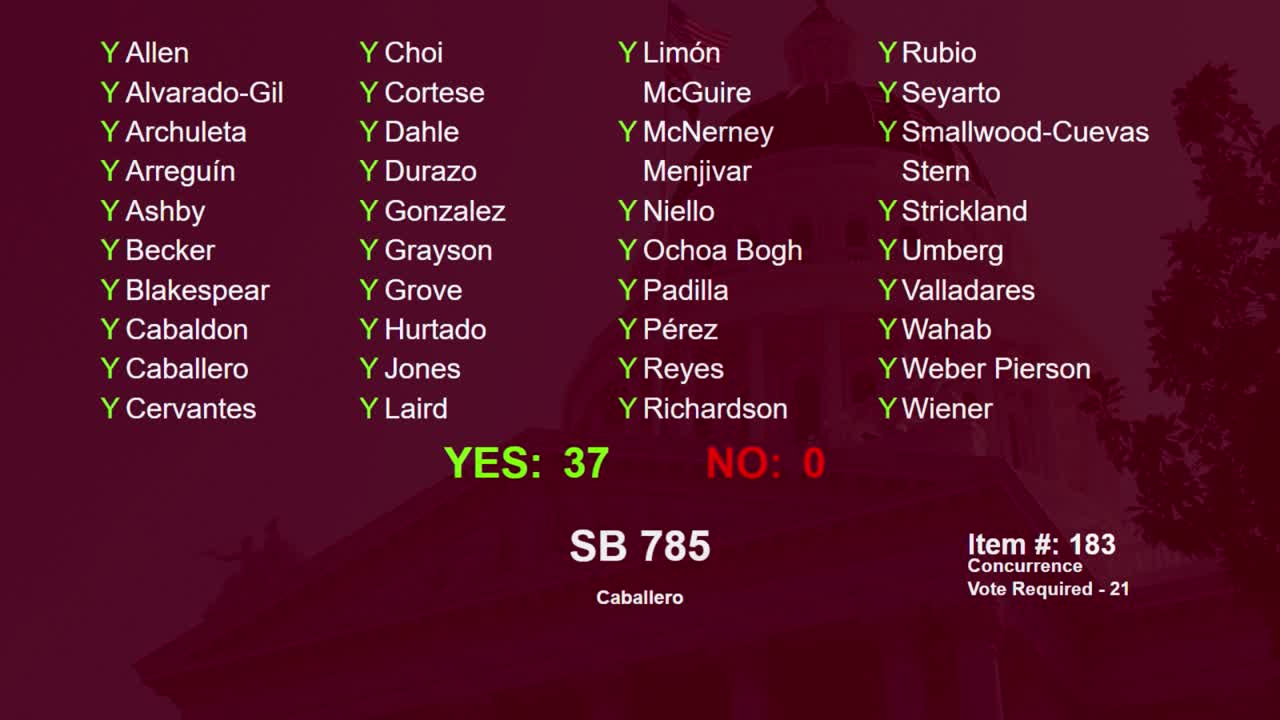 1MIN
Senate Floor
 8MIN
Senate Standing Committee on Business, Professions and Economic Development
 1MIN
Assembly Floor
Bill Author

Bill Co-Author(s):