AB 509: Alcoholic beverages: minors.
- Session Year: 2025-2026
- House: Assembly
- Latest Version Date: 2025-10-03
Current Status:
Passed
(2025-10-03: Chaptered by Secretary of State - Chapter 264, Statutes of 2025.)
Introduced
In Committee
Awaiting First Chamber Vote
Passed First Chamber
In Committee
Awaiting Second Chamber Vote
Passed Second Chamber
Enacted
Existing law, the Alcoholic Beverage Control Act, establishes the Department of Alcoholic Beverage Control for the regulation of licenses or the manufacture, distribution, and sale of alcoholic beverages within the state. Existing law prescribes various penalties for violations of the act, including that every person who sells, furnishes, gives, or causes to be sold, furnished, or given away any alcoholic beverage to any person under 21 years of age is guilty of a misdemeanor. Existing law provides that a licensees acceptance of bona fide evidence, as defined, or utilization of a biometric system constitutes a defense to any prosecution or proceedings against the licensee, as specified.
This bill would provide that the use of an active age verification software or an age verification device, as provided, to establish the age of a purchaser of alcoholic beverages that fails to identify a false identification card is considered evidence in any prosecution or proceedings against the licensee, as specified, if the identification is bona fide evidence and was physically inspected, is seemingly legitimate, and matches the physical appearance of the customer.
Existing law, the Alcoholic Beverage Control Act, establishes the Department of Alcoholic Beverage Control for the regulation of licenses or the manufacture, distribution, and sale of alcoholic beverages within the state. Existing law prescribes various penalties for violations of the act, including that every person who sells, furnishes, gives, or causes to be sold, furnished, or given away any alcoholic beverage to any person under 21 years of age is guilty of a misdemeanor. Existing law provides that a licensees acceptance of bona fide evidence, as defined, or utilization of a biometric system constitutes a defense to any prosecution or proceedings against the licensee, as specified.
This bill would provide that the use of an active age verification software or an age verification device device, as provided, to establish the age of a purchaser of alcoholic beverages that fails to identify a false identification card is considered evidence in any prosecution or proceedings against the licensee, as specified, if the identification is bona fide evidence and was physically inspected, is seemingly legitimate, and matches the physical appearance of the customer.
Existing law, the Alcoholic Beverage Control Act, establishes the Department of Alcoholic Beverage Control for the regulation of licenses or the manufacture, distribution, and sale of alcoholic beverages within the state. Existing law prescribes various penalties for violations of the act, including that every person who sells, furnishes, gives, or causes to be sold, furnished, or given away any alcoholic beverage to any person under 21 years of age is guilty of a misdemeanor. Existing law provides that a licensees acceptance of bona fide evidence, as defined, or utilization of a biometric system constitutes a defense to any prosecution or proceedings against the licensee, as specified.
This bill would prohibit an on- or off-sale licensee that sells an alcoholic beverage to any person under 21 years of age from being subject to any penalty under the act if the licensee utilizes provide that the use of an active age verification software or an age verification device to establish the age of a purchaser of alcoholic beverages and the software or device that fails to identify a false identification card. card is considered evidence in any prosecution or proceedings against the licensee, as specified, if the identification is bona fide evidence and was physically inspected, is seemingly legitimate, and matches the physical appearance of the customer.
Existing law, the Alcoholic Beverage Control Act, establishes the Department of Alcoholic Beverage Control for the regulation of licenses or the manufacture, distribution, and sale of alcoholic beverages within the state. Existing law prescribes various penalties for violations of the act, including that every person who sells, furnishes, gives, or causes to be sold, furnished, or given away any alcoholic beverage to any person under 21 years of age is guilty of a misdemeanor.
This bill would prohibit an on- or off-sale licensee that sells an alcoholic beverage to any person under 21 years of age from being subject to any penalty under the act if the licensee utilizes an active age verification software or an age verification device to establish the age of a purchaser of alcoholic beverages and the software or device fails to identify a false identification card.
(a)Bona fide evidence of majority and identity of the person is any of the following:
(1)A document issued by a federal, state, county, or municipal government, or subdivision or agency thereof, including, but not limited to, a valid motor vehicle operators license, that contains the name, date of birth, description, and picture of the person.
(2)A valid passport issued by the United States or by a foreign government.
(3)A valid identification card issued to a member of the Armed Forces that includes a date of birth and a picture of the person.
(b)(1)Proof that the defendant-licensee, or their employee or agent, demanded, was shown, and acted in reliance upon bona fide evidence, or utilized a biometric system, in any transaction, employment, use, or permission forbidden by Section 25658, 25663, or 25665 shall be a defense to any criminal prosecution therefor or to any proceedings for the suspension or revocation of any license based thereon.
(2)A biometric system utilized by a defendant-licensee shall be based upon a review of bona fide evidence of majority and identity of a person and that verifies and authenticates the validity of that bona fide evidence.
(3)The use of an active age verification software or an age verification device to establish the age of a purchaser of alcoholic beverages, that fails to identify a false identification card, shall be considered evidence in a criminal prosecution therefor, or to any proceedings for the suspension or revocation of any license based thereon, provided that the identification is bona fide evidence of majority and identity as described in subdivision (a) and was physically inspected, is seemingly legitimate, and matches the physical appearance of the customer.
(c)For purposes of this section, the following definitions apply:
(1)Biometrics means the unique characteristics of a person, including, but not limited to, fingerprints, iris, face, or other similar biometric characteristics, or any combination thereof.
(2)Biometric system means technology that links the identity of a person to that persons biometrics.
(3)Use of an active age verification software or an age verification device means scanning the magnetic strip or the barcode on the bona fide evidence of majority and identity, as described in subdivision (a), to verify data on the identification document.
(a)Bona fide evidence of majority and identity of the person is any of the following:
(1)A document issued by a federal, state, county, or municipal government, or subdivision or agency thereof, including, but not limited to, a valid motor vehicle operators license, that contains the name, date of birth, description, and picture of the person.
(2)A valid passport issued by the United States or by a foreign government.
(3)A valid identification card issued to a member of the Armed Forces that includes a date of birth and a picture of the person.
(b)(1)Proof that the defendant-licensee, or their employee or agent, demanded, was shown, and acted in reliance upon bona fide evidence, or utilized a biometric system, in any transaction, employment, use, or permission forbidden by Section 25658, 25663, or 25665 shall be a defense to any criminal prosecution therefor or to any proceedings for the suspension or revocation of any license based thereon.
(2)A biometric system utilized by a defendant-licensee shall be based upon a review of bona fide evidence of majority and identity of a person and that verifies and authenticates the validity of that bona fide evidence.
(3)The use of an active age verification software or an age verification device to establish the age of a purchaser of alcoholic beverages, that fails to identify a false identification card, shall be considered evidence in a criminal prosecution therefor, or to any proceedings for the suspension or revocation of any license based thereon, provided that the identification is bona fide evidence of majority and identity as described in subdivision (a) and was physically inspected, is seemingly legitimate, and matches the physical appearance of the customer.
(c)For purposes of this section, the following definitions apply:
(1)Biometrics means the unique characteristics of a person, including, but not limited to, fingerprints, iris, face, or other similar biometric characteristics, or any combination thereof.
(2)Biometric system means technology that links the identity of a person to that persons biometrics.
SECTION 1.Section 25669 is added to the Business and Professions Code, to read:25669.Notwithstanding this article, an on- or off-sale licensee that sells an alcoholic beverage to any person under 21 years of age shall not be subject to any penalty if both of the following are true:(a)The licensee utilizes an active age verification software or an age verification device to establish the age of a purchaser of alcoholic beverages.(b)The age verification software or age verification device fails to identify a false identification card.Notwithstanding this article, an on- or off-sale licensee that sells an alcoholic beverage to any person under 21 years of age shall not be subject to any penalty if both of the following are true:
(a)The licensee utilizes an active age verification software or an age verification device to establish the age of a purchaser of alcoholic beverages.
(b)The age verification software or age verification device fails to identify a false identification card.
|
Date
|
Status
|
|---|---|
| Oct 3, 2025 | Chaptered by Secretary of State - Chapter 264, Statutes of 2025. |
| Oct 3, 2025 | Approved by the Governor. |
| Sep 15, 2025 | Enrolled and presented to the Governor at 4:30 p.m. |
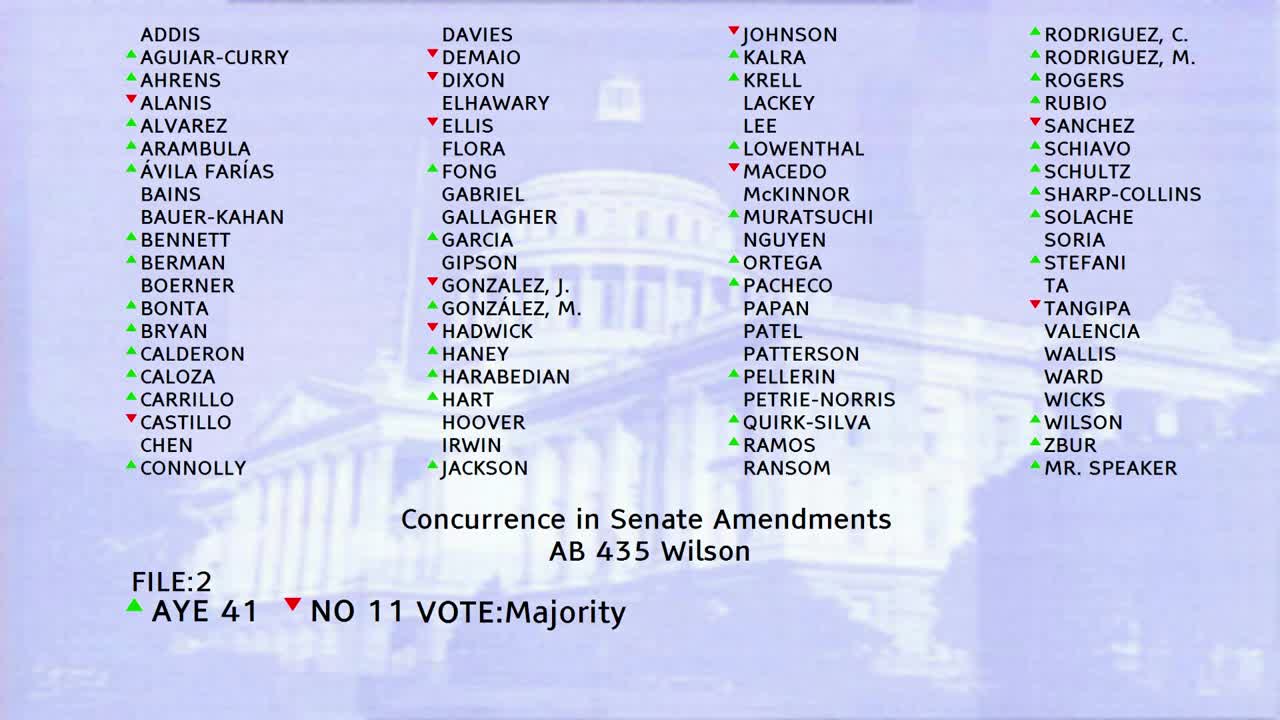
| Sep 8, 2025 | Senate amendments concurred in. To Engrossing and Enrolling. (Ayes 78. Noes 0. Page 3026.). |
| Sep 4, 2025 | In Assembly. Concurrence in Senate amendments pending. |
| Sep 4, 2025 | Read third time. Passed. Ordered to the Assembly. (Ayes 39. Noes 0. Page 2524.). |
| Sep 4, 2025 | Ordered to special consent calendar. |
| Sep 3, 2025 | Ordered to third reading. |
| Sep 3, 2025 | From special consent calendar. |
| Sep 2, 2025 | Ordered to special consent calendar. |
| Aug 29, 2025 | Read second time. Ordered to third reading. |
| Aug 29, 2025 | From committee: Do pass. (Ayes 7. Noes 0.) (August 29). |
| Aug 18, 2025 | In committee: Referred to suspense file. |
| Jul 9, 2025 | In committee: Hearing postponed by committee. |
| Jun 24, 2025 | From committee: Do pass and re-refer to Com. on APPR. with recommendation: To Consent Calendar. (Ayes 15. Noes 0.) (June 24). Re-referred to Com. on APPR. |
| Jun 16, 2025 | From committee chair, with author's amendments: Amend, and re-refer to committee. Read second time, amended, and re-referred to Com. on G.O. |
| Jun 11, 2025 | Referred to Com. on G.O. |
| Jun 3, 2025 | In Senate. Read first time. To Com. on RLS. for assignment. |
| Jun 2, 2025 | Read third time. Passed. Ordered to the Senate. (Ayes 77. Noes 0. Page 1922.) |
| May 27, 2025 | Read second time. Ordered to third reading. |
| May 23, 2025 | From committee: Do pass. (Ayes 14. Noes 0.) (May 23). |
| Apr 9, 2025 | In committee: Set, first hearing. Referred to APPR. suspense file. |
| Mar 28, 2025 | Re-referred to Com. on APPR. |
| Mar 27, 2025 | Read second time and amended. |
| Mar 26, 2025 | From committee: Amend, and do pass as amended and re-refer to Com. on APPR. (Ayes 19. Noes 0.) (March 19). |
| Feb 24, 2025 | Referred to Com. on G.O. |
| Feb 11, 2025 | From printer. May be heard in committee March 13. |
| Feb 10, 2025 | Read first time. To print. |
|
Date
|
Description
|
Location
|
Votes
|
|
|---|---|---|---|---|
| Sep 8, 2025 | AB 509 Flora Concurrence in Senate Amendments | Assembly Floor |
Passed |
|
| Sep 4, 2025 | Assembly 3rd Reading AB509 Flora By Rubio | Senate Floor |
Passed |
|
| Aug 29, 2025 | Do pass | Senate Standing Committee on Appropriations |
Passed |
|
| Aug 18, 2025 | Placed on suspense file | Senate Standing Committee on Appropriations |
Passed |
|
| Jun 24, 2025 | Do pass, but first be re-referred to the Committee on [Appropriations] with the recommendation: To Consent Calendar | Senate Standing Committee on Governmental Organization |
Passed |
|
| Jun 2, 2025 | AB 509 Flora Assembly Third Reading | Assembly Floor |
Passed |
|
| May 23, 2025 | Do pass. | Assembly Standing Committee on Appropriations |
Passed |
|
| Mar 19, 2025 | Do pass as amended and be re-referred to the Committee on [Appropriations] | Assembly Standing Committee on Governmental Organization |
Passed |
This list shows positions taken on this bill by organizations on the date displayed, which is linked to the original source.
Positions by individuals are not included.
|
Organization
|
Position
|
Date
|
|---|---|---|
| California Restaurant Association | ** Support |
CONCURRENCE IN SENATE AMENDMENTS
CSA1 Bill Id:AB 509
Author:(Flora)
As Amended Ver:June 16, 2025
Majority vote
SUMMARY
This bill would provide that the use of ″active age verification software or an age verification device″ that fails to identify a false identification card be considered evidence in related legal proceedings against a person or licensee that provides alcohol to a person under 21 years of age, as specified.
Senate Amendments
1) Defines ″use of an active age verification software or an age verification device″ to mean scanning the magnetic strip or the barcode on the bona fide evidence of majority and identity to verify data on the identification document.
COMMENTS
Background.
The California Department of Alcoholic Beverage Control (ABC) plays a vital role in enforcing the ABC Act, with the authority to conduct investigations, perform inspections, and impose penalties for violations. The scope of the ABC′s enforcement actions is determined by the severity and frequency of the infractions.
For minor or first-time violations, the ABC may issue a notice of violation and require the licensee to correct the problem within a specified period. Repeat or serious violations, however, can result in more severe penalties. These can include fines, temporary suspension of the license, or even revocation of the license, effectively banning the licensee from selling alcohol. In extreme cases, the ABC can also pursue criminal charges against the licensee. This typically occurs in cases of gross negligence or deliberate violations, such as selling alcohol to minors on a repeated basis or engaging in fraudulent activities.
In terms of compliance, the ABC conducts regular inspections and offers various prevention and education programs to retail licensees through its Licensee Education on Alcohol and Drugs (LEAD) program.
Buying alcoholic beverages in California. Except as otherwise provided in the ABC Act, every person who sells, furnishes, gives, or causes to be sold, furnished, or given away, any alcoholic beverage to any person under the age of 21 years is guilty of a misdemeanor. Any on-sale licensee who knowingly permits a person under the age of 21 years to consume any alcoholic beverage in the on-sale premises, whether or not the licensee has knowledge that the person is under the age of 21 years, is guilty of a misdemeanor.
Under the ABC Act, bona fide evidence of majority and identity of the person is any of the following: 1) a document issued by a federal, state, county, or municipal government, or subdivision or agency thereof, including, but not limited to, a valid motor vehicle operator′s license, that contains the name, date of birth, description, and picture of the person; 2) a valid passport issued by the United States or by a foreign government; and 3) a valid identification card issued to a member of the Armed Forces that includes a date of birth and a picture of the person.
Proof that the defendant-licensee, or his or her employee or agent, demanded, was shown, and acted in reliance upon bona fide evidence in any transaction, employment, use, or permission forbidden by B&P Code Sections 25658, 25663, or 25665 shall be a defense to any criminal prosecution therefor or to any proceedings for the suspension or revocation of any license based thereon.
For the purpose of preventing the ABC Act, any licensee, or his or her agent or employee, may refuse to sell or serve alcoholic beverages to any person who is unable to produce adequate written evidence that he or she is over the age of 21 years. A licensee, or his or her agent or employee, may seize any identification presented by a person that shows the person to be under the age of 21 years or that is false, so long as a receipt is given to the person from whom the identification is seized and the seized identification is given within 24 hours of seizure to the local law enforcement agency that has jurisdiction over the licensed premises. A licensee, his or her agent or employees, decision to not seize a license shall not create any civil or criminal liability.
Last year, SB 1371 (Bradford), Chapter 606, authorized the use of a biometric system, as defined, as a defense in any criminal prosecution or legal proceedings against the licensee. The bill stipulated that the biometric system must be based on a review of bona fide evidence of a person′s majority and identity, ensuring the verification and authentication of the validity of that evidence.
In California, although ID scanning is not explicitly required, adopting robust age verification measures, such as using ID scanners, can help licensees avoid specific penalties. Moreover, research indicates that well-publicized and rigorous compliance checks significantly reduce the sale of alcohol to minors.
According to the Author
According to the author′s office, ″AB 509 modernizes alcohol sales enforcement by incentivizing the use of advanced age verification technology. Under current law, businesses are strictly liable for selling alcohol to minors, even when they take reasonable steps to verify a customer′s age. As fake IDs become more sophisticated, manual checks alone are increasingly unreliable, yet businesses are hesitant to adopt electronic verification tools due to the risk of penalties if the technology fails. This bill ensures that licensees using state-approved age verification software or devices are not penalized if those tools fail to detect a false ID. By promoting more reliable verification methods while maintaining accountability, AB 509 helps prevent underage access to alcohol and protects responsible businesses from unfair penalties.″
Arguments in Support
According to the California Restaurant Association, ″our member restaurants and their team-members have a long-track record of upholding the highest standards of responsible alcohol service. This is why many restaurants across the state have implemented age-verification practices that include technological tools to assist with guest age-verification. Yet, fake identification cards are becoming increasingly sophisticated and harder to distinguish from legitimate IDs making age-verification software increasingly appealing. Furthermore, fake IDs being used across the state today mimic security measures that were once considered impossible to counterfeit such as official government holograms, micro printing, laser engraving, and even the use of data chips. Restaurant operators who act in good faith and follow the law should not then be penalized for the failure of the age verification device or software.″
Arguments in Opposition
None on file
FISCAL COMMENTS
According to the Assembly Committee on Appropriations analysis, ″the ABC notes it may require IT technical expertise to provide support to enforcement and legal staff in preparation for and testimony during administrative hearings regarding accusations filed against a licensee. The ABC estimates: 1) One-time cost of $23,000 for staff operating expenses and equipment. 2) Ongoing annual costs of $189,000 for an Information Technology Specialist II. 3) Minor and absorbable costs to adopt regulations.
VOTES:
ASM GOVERNMENTAL ORGANIZATION: 19-0-3
YES: Blanca Rubio, Davies, Berman, Bryan, Carrillo, DeMaio, Dixon, Fong, Gipson, Nguyen, Pacheco, Ramos, Michelle Rodriguez, Sanchez, Solache, Soria, Ta, Valencia, Wallis
ABS, ABST OR NV: Alvarez, Gabriel, McKinnor
ASM APPROPRIATIONS: 14-0-1
YES: Wicks, Arambula, Calderon, Caloza, Dixon, Elhawary, Fong, Mark González, Hart, Pacheco, Pellerin, Solache, Ta, Tangipa
ABS, ABST OR NV: Sanchez
ASSEMBLY FLOOR: 77-0-2
YES: Addis, Aguiar-Curry, Ahrens, Alanis, Alvarez, Arambula, Ávila Farías, Bains, Bauer-Kahan, Bennett, Berman, Boerner, Bonta, Bryan, Calderon, Caloza, Carrillo, Castillo, Chen, Connolly, Davies, DeMaio, Dixon, Elhawary, Flora, Fong, Gabriel, Gallagher, Garcia, Gipson, Jeff Gonzalez, Mark González, Hadwick, Haney, Harabedian, Hart, Hoover, Irwin, Jackson, Kalra, Krell, Lackey, Lowenthal, Macedo, McKinnor, Muratsuchi, Nguyen, Ortega, Pacheco, Papan, Patel, Patterson, Pellerin, Petrie-Norris, Quirk-Silva, Ramos, Ransom, Celeste Rodriguez, Michelle Rodriguez, Rogers, Blanca Rubio, Sanchez, Schiavo, Schultz, Sharp-Collins, Solache, Soria, Stefani, Ta, Tangipa, Valencia, Wallis, Ward, Wicks, Wilson, Zbur, Rivas
ABS, ABST OR NV: Ellis, Lee
SENATE FLOOR: 39-0-1
YES: Allen, Alvarado-Gil, Archuleta, Arreguín, Ashby, Becker, Blakespear, Cabaldon, Caballero, Cervantes, Choi, Cortese, Dahle, Durazo, Gonzalez, Grayson, Grove, Hurtado, Jones, Laird, Limón, McGuire, McNerney, Menjivar, Niello, Ochoa Bogh, Padilla, Pérez, Richardson, Rubio, Seyarto, Smallwood-Cuevas, Stern, Strickland, Umberg, Valladares, Wahab, Weber Pierson, Wiener
ABS, ABST OR NV: Reyes
UPDATED
VERSION: June 16, 2025
CONSULTANT: Eric Johnson / G.O. / (916) 319-2531 FN: 0001645
SENATE RULES COMMITTEE Office of Senate Floor Analyses (916) 651-1520 Fax: (916) 327-4478 | AB 509 |
THIRD READING
Bill No: AB 509
Author: Flora (R)
Amended: 6/16/25 in Senate
Vote: 21
SENATE GOVERNMENTAL ORG. COMMITTEE: 15-0, 6/24/25
AYES: Padilla, Archuleta, Ashby, Blakespear, Cervantes, Choi, Dahle, Hurtado, Jones, Ochoa Bogh, Richardson, Rubio, Smallwood-Cuevas, Wahab, Weber Pierson
SENATE APPROPRIATIONS COMMITTEE: 7-0, 8/29/25
AYES: Caballero, Seyarto, Cabaldon, Dahle, Grayson, Richardson, Wahab
ASSEMBLY FLOOR: 77-0, 6/2/25 - See last page for vote
SUBJECT: Alcoholic beverages: minors
SOURCE: Author
DIGEST: This bill provides that the use of “active age verification software or an age verification device” that fails to identify a false identification card be considered evidence in related legal proceedings against a person or licensee that provides alcohol to a person under 21 years of age, as specified.
ANALYSIS:
Existing law:
- Establishes the Department of Alcoholic Beverage Control (ABC) and grants it exclusive authority to administer the provisions of the ABC Act in accordance with laws enacted by the Legislature. This involves licensing individuals and businesses associated with the manufacture, importation, and sale of alcoholic beverages in this state and the collection of license fees.
- Establishes the Responsible Beverage Service (RBS) Training program that requires the Department of ABC to develop, implement, and administer a curriculum for an RBS training program for servers of alcohol and their managers, as specified. Alcohol servers are required to successfully complete an RBS training course offered or authorized by the Department of ABC.
- Makes it a misdemeanor for any person under 21 years of age to purchase any alcoholic beverage or consume any alcoholic beverage in any on-sale premises.
- Subjects a holder of a license to sell alcoholic beverages to criminal prosecution and suspension or revocation of that license if the licensee sells any alcoholic beverages to any person under 21 years of age.
- Provides that a licensee’s acceptance of bona fide evidence, as defined, constitutes a defense to any prosecution or proceedings against the licensees, as specified.
- Provides that bona fide evidence of majority and identity of the person is any of the following:
- A document issued by a federal, state, county or municipal government, or subdivision therefore including but not limited to, a valid motor vehicle operator’s license, that contains the name, date of birth, description, and a picture of the person.
- A valid passport issued by the United States or by a foreign government.
- A valid identification card issued to a member of the Armed forces that includes a date of birth and a picture of the person.
This bill:
- Provides that the use of an active age verification software or an age verification device to establish the age of a purchaser of alcoholic beverages, that fails to identify a false identification card, shall be considered evidence, provided that the identification is bona fide evidence of majority and identify, as established in current law, and was physically inspected, seemingly legitimate, and matches the physical appearance of the customer.
- Defines “use of an active age verification software or an age verification device” to mean scanning the magnetic strip or the barcode on the bona fide evidence of majority and identity to verify data on the identification document.
Background
Author Statement. According to the author’s office, “AB 509 modernizes alcohol sales enforcement by incentivizing the use of advanced age verification technology. Under current law, businesses are strictly liable for selling alcohol to minors, even when they take reasonable steps to verify a customer’s age. As fake IDs become more sophisticated, manual checks alone are increasingly unreliable, yet businesses are hesitant to adopt electronic verification tools due to the risk of penalties if the technology fails. This bill ensures that licensees using state-approved age verification software or devices are not penalized if those tools fail to detect a false ID. By promoting more reliable verification methods while maintaining accountability, AB 509 helps prevent underage access to alcohol and protects responsible businesses from unfair penalties.”
Selling Alcohol to Minors. Except as otherwise provided in the ABC Act, every person who sells, furnishes, or gives any alcoholic beverage to any person under the age of 21 years is guilty of a misdemeanor. Any on-sale licensee who knowingly permits a person under the age of 21 to consume any alcoholic beverage, whether or not the licensee has knowledge that the person is under the age of 21, is guilty of a misdemeanor.
Under the ABC Act, bona fide evidence of majority and identity of the person is any of the following: 1) a document issued by a federal, state, county, or municipal government, or subdivision or agency thereof, including, but not limited to, a valid motor vehicle operator’s license, that contains the name, date of birth, description, and picture of the person; 2) a valid passport issued by the United States or by a foreign government; and 3) a valid identification card issued to a member of the Armed Forces that includes a date of birth and a picture of the person.
The ABC Act provides that if the licensee, or his or her employee, was shown any of these documents, and that licensee or employee relied on that identification as proof of the individual’s age, then that shall be a defense to any criminal prosecution or to any proceedings for the suspension or revocation of their license. The ABC Act authorizes any licensee, or his or her employee, to refuse to sell or serve alcoholic beverages to any person who is unable to produce adequate written evidence that he or she is over the age of 21 years. A licensee may seize any identification presented by a person that shows the person to be under the age of 21 years or that is false, so long as a receipt is given to the person from whom the identification is seized and the seized identification is given within 24 hours of seizure to the local law enforcement agency.
Last year, SB 1371 (Bradford, Chapter 606, statutes of 2024), authorized the use of a biometric system, as defined, as a defense in any criminal prosecution or legal proceedings against the licensee. The bill stipulated that the biometric system must be based on a review of bona fide evidence of a person's majority and identity, ensuring the verification and authentication of the validity of that evidence.
In California, although ID scanning is not explicitly required, adopting robust age verification measures, such as using ID scanners, can help licensees avoid specific penalties. Moreover, research indicates that well-publicized and rigorous compliance checks significantly reduce the sale of alcohol to minors.
This bill provides that the use of an active age verification software or an age verification device to establish the age of a purchaser of alcoholic beverages, that fails to identify a false identification card, shall be considered evidence, provided that the identification is bona fide evidence of majority and identify, as established in current law, and was physically inspected, seemingly legitimate, and matches the physical appearance of the customer.
Related/Prior Legislation
SB 1371 (Bradford, Chapter 606, Statutes of 2024) made reliance upon a system that reviews bona fide evidence of majority and biometrics to determine age and identify of a person before admittance into a premises where alcoholic beverages may be lawfully purchased a defense to any criminal prosecution or proceedings against a licensee.
AB 3117 (Wilson, 2024) would have made a mobile or digital driver’s license or identification card a bona fide evidence of majority and identity of a person provided the Department of Motor Vehicles or Department of ABC, authorizes the use of those licenses or identification cards without the possession of a physical driver’s license or identification card, as specified. (Held in the Assembly Appropriations Committee Suspense File)
AB 59 (Jeffries, Chapter 405, Statutes of 2009) provided that, if a military identification card lacks a physical description but does not include date of birth and photo, further proof of majority shall not be required to purchase or consume any alcoholic beverage, as specified.
AB 1191 (Conway, Chapter 142, Statutes of 2009) authorized the acceptance of a valid passport, issued by the United State government or foreign government, as bona fide evidence that a person is 21 years of age or older.
AB 764 (Calderon, Chapter 68, Statutes of 2005) established a process where in the event an ID card issued to a member of the Armed Forces is provided as proof of age 21 when purchasing alcoholic beverages, and the ID lacks a physical description, then proof of being age 21 may be further substantiated if a motor vehicle operator’s license or other valid bona fide identification issued by any government jurisdiction is also provided, as specified.
FISCAL EFFECT: Appropriation: No Fiscal Com.: Yes Local: No
According to the Senate Appropriations committee, the Department of ABC notes it may require IT technical expertise to provide support to enforcement and legal staff in preparation for and testimony during administrative hearings regarding accusations filed against a licensee. The Department estimates:
- One-time cost of $23,000 for staff operating expenses and equipment.
- Ongoing annual costs of $189,000 for an Information Technology Specialist II.
- Minor and absorbable costs to adopt regulations.
SUPPORT: (Verified 8/28/25)
California Restaurant Association
OPPOSITION: (Verified 8/28/25)
None received
ARGUMENTS IN SUPPORT: According to the California Restaurant Association, “our member restaurants and their team-members have a long-track record of upholding the highest standards of responsible alcohol service. This is why many restaurants across the state have implemented age-verification practices that include technological tools to assist with guest age-verification. Yet, fake identification cards are becoming increasingly sophisticated and harder to distinguish from legitimate IDs making age-verification software increasingly appealing. Furthermore, fake IDs being used across the state today mimic security measures that were once considered impossible to counterfeit such as official government holograms, micro printing, laser engraving, and even the use of data chips. Restaurant operators who act in good faith and follow the law should not then be penalized for the failure of the age verification device or software.”
ASSEMBLY FLOOR: 77-0, 6/2/25
AYES: Addis, Aguiar-Curry, Ahrens, Alanis, Alvarez, Arambula, Ávila Farías, Bains, Bauer-Kahan, Bennett, Berman, Boerner, Bonta, Bryan, Calderon, Caloza, Carrillo, Castillo, Chen, Connolly, Davies, DeMaio, Dixon, Elhawary, Flora, Fong, Gabriel, Gallagher, Garcia, Gipson, Jeff Gonzalez, Mark González, Hadwick, Haney, Harabedian, Hart, Hoover, Irwin, Jackson, Kalra, Krell, Lackey, Lowenthal, Macedo, McKinnor, Muratsuchi, Nguyen, Ortega, Pacheco, Papan, Patel, Patterson, Pellerin, Petrie-Norris, Quirk-Silva, Ramos, Ransom, Celeste Rodriguez, Michelle Rodriguez, Rogers, Blanca Rubio, Sanchez, Schiavo, Schultz, Sharp-Collins, Solache, Soria, Stefani, Ta, Tangipa, Valencia, Wallis, Ward, Wicks, Wilson, Zbur, Rivas
NO VOTE RECORDED: Ellis, Lee
Prepared by: Felipe Lopez / G.O. / (916) 651-1530
8/29/25 20:39:00
**** END ****
SENATE COMMITTEE ON APPROPRIATIONS
Senator Anna Caballero, Chair
2025 - 2026 Regular Session
AB 509 (Flora) - Alcoholic beverages: minors
Version: June 16, 2025 | Policy Vote: G.O. 15 - 0 |
Urgency: No | Mandate: No |
Hearing Date: August 18, 2025 | Consultant: Janelle Miyashiro |
Bill Summary:
AB 509 provides that the use of “active age verification software or an age verification device” that fails to identify a false identification card be considered evidence in related legal proceedings against a person or licensee that provides alcohol to a person under 21 years of age, as specified.
Fiscal Impact:
The Department of Alcoholic Beverage Control (ABC) notes it may require IT technical expertise to provide support to enforcement and legal staff in preparation for and testimony during administrative hearings regarding accusations filed against a licensee. The Department of ABC estimates:
- One-time cost of $23,000 for staff operating expenses and equipment.
- Ongoing annual costs of $189,000 for an Information Technology Specialist II.
- Minor and absorbable costs to adopt regulations.
Background:
Except as otherwise provided in the ABC Act, every person who sells, furnishes, or gives any alcoholic beverage to any person under the age of 21 years is guilty of a misdemeanor. Any on-sale licensee who knowingly permits a person under the age of 21 to consume any alcoholic beverage, whether or not the licensee has knowledge that the person is under the age of 21, is guilty of a misdemeanor.
Under the ABC Act, bona fide evidence of majority and identity of the person is any of the following:
- A document issued by a federal, state, county, or municipal government, or subdivision or agency thereof, including, but not limited to, a valid motor vehicle operator’s license, that contains the name, date of birth, description, and picture of the person.
- A valid passport issued by the United States or by a foreign government.
- A valid identification card issued to a member of the Armed Forces that includes a date of birth and a picture of the person.
The ABC Act provides that if the licensee, or his or her employee, was shown any of these documents, and that licensee or employee relied on that identification as proof of the individual’s age, then that shall be a defense to any criminal prosecution or to any proceedings for the suspension or revocation of their license.
Proposed Law:
- Provides that the use of an active age verification software or an age verification device to establish the age of a purchaser of alcoholic beverages, that fails to identify a false identification card, shall be considered evidence, provided that the identification is bona fide evidence of majority and identify, as established in current law, and was physically inspected, seemingly legitimate, and matches the physical appearance of the customer.
- Defines “use of an active age verification software or an age verification device” to mean scanning the magnetic strip or the barcode on the bona fide evidence of majority and identity to verify data on the identification document.
Related Legislation:
SB 1371 (Bradford, Chapter 606, Statutes of 2024) made reliance upon a system that reviews bona bide evidence of majority and biometrics to determine age and identify of a person before admittance into a premises where alcoholic beverages may be lawfully purchased a defense to any criminal prosecution or proceedings against a licensee.
AB 3117 (Wilson, 2024) would have made a mobile or digital driver’s license or identification card a bona fide evidence of majority and identity of a person provided the Department of Motor Vehicles or Department of ABC, authorizes the use of those licenses or identification cards without the possession of a physical driver’s license or identification card, as specified. AB 3117 was held on the Assembly Appropriations Committee Suspense File.
-- END --
SENATE COMMITTEE ON GOVERNMENTAL ORGANIZATION
Senator Steve Padilla
Chair
2025 - 2026 Regular
Bill No: AB Hearing Date: 6/24/2025
Author: | Flora | ||
Version: | Amended | ||
Urgency: | Fiscal: | ||
Consultant: | |||
SUBJECT:
DIGEST: This bill provides that the use of “active age verification software or an age verification device” that fails to identify a false identification card be considered evidence in related legal proceedings against a person or licensee that provides alcohol to a person under 21 years of age, as specified.
ANALYSIS:
Existing law:
- Establishes the Department of Alcoholic Beverage Control (ABC) and grants it exclusive authority to administer the provisions of the ABC Act in accordance with laws enacted by the Legislature. This involves licensing individuals and businesses associated with the manufacture, importation, and sale of alcoholic beverages in this state and the collection of license fees.
- Establishes the Responsible Beverage Service (RBS) Training program that requires the Department of ABC to develop, implement, and administer a curriculum for an RBS training program for servers of alcohol and their managers, as specified. Alcohol servers are required to successfully complete an RBS training course offered or authorized by the Department of ABC.
- Makes it a misdemeanor for any person under 21 years of age to purchase any alcoholic beverage or consume any alcoholic beverage in any on-sale premises.
- Subjects a holder of a license to sell alcoholic beverages to criminal prosecution and suspension or revocation of that license if the licensee sells any alcoholic beverages to any person under 21 years of age.
- Provides that a licensee’s acceptance of bona fide evidence, as defined, constitutes a defense to any prosecution or proceedings against the licensees, as specified.
- Provides that bona fide evidence of majority and identity of the person is any of the following:
- A document issued by a federal, state, county or municipal government, or subdivision therefore including but not limited to, a valid motor vehicle operator’s license, that contains the name, date of birth, description, and a picture of the person.
- A valid passport issued by the United States or by a foreign government.
- A valid identification card issued to a member of the Armed forces that includes a date of birth and a picture of the person.
This bill:
- Provides that the use of an active age verification software or an age verification device to establish the age of a purchaser of alcoholic beverages, that fails to identify a false identification card, shall be considered evidence, provided that the identification is bona fide evidence of majority and identify, as established in current law, and was physically inspected, seemingly legitimate, and matches the physical appearance of the customer.
- Defines “use of an active age verification software or an age verification device” to mean scanning the magnetic strip or the barcode on the bona fide evidence of majority and identity to verify data on the identification document.
Background
Author Statement. According to the author’s office, “AB 509 modernizes alcohol sales enforcement by incentivizing the use of advanced age verification technology. Under current law, businesses are strictly liable for selling alcohol to minors, even when they take reasonable steps to verify a customer’s age. As fake IDs become more sophisticated, manual checks alone are increasingly unreliable, yet businesses are hesitant to adopt electronic verification tools due to the risk of penalties if the technology fails. This bill ensures that licensees using state-approved age verification software or devices are not penalized if those tools fail to detect a false ID. By promoting more reliable verification methods while maintaining accountability, AB 509 helps prevent underage access to alcohol and protects responsible businesses from unfair penalties.”
Selling Alcohol to Minors. Except as otherwise provided in the ABC Act, every person who sells, furnishes, or gives any alcoholic beverage to any person under the age of 21 years is guilty of a misdemeanor. Any on-sale licensee who knowingly permits a person under the age of 21 to consume any alcoholic beverage, whether or not the licensee has knowledge that the person is under the age of 21, is guilty of a misdemeanor.
Under the ABC Act, bona fide evidence of majority and identity of the person is any of the following: 1) a document issued by a federal, state, county, or municipal government, or subdivision or agency thereof, including, but not limited to, a valid motor vehicle operator’s license, that contains the name, date of birth, description, and picture of the person; 2) a valid passport issued by the United States or by a foreign government; and 3) a valid identification card issued to a member of the Armed Forces that includes a date of birth and a picture of the person.
The ABC Act provides that if the licensee, or his or her employee, was shown any of these documents, and that licensee or employee relied on that identification as proof of the individual’s age, then that shall be a defense to any criminal prosecution or to any proceedings for the suspension or revocation of their license. The ABC Act authorizes any licensee, or his or her employee, to refuse to sell or serve alcoholic beverages to any person who is unable to produce adequate written evidence that he or she is over the age of 21 years. A licensee may seize any identification presented by a person that shows the person to be under the age of 21 years or that is false, so long as a receipt is given to the person from whom the identification is seized and the seized identification is given within 24 hours of seizure to the local law enforcement agency.
Last year, SB 1371 (Bradford, Chapter 606, statutes of 2024), authorized the use of a biometric system, as defined, as a defense in any criminal prosecution or legal proceedings against the licensee. The bill stipulated that the biometric system must be based on a review of bona fide evidence of a person's majority and identity, ensuring the verification and authentication of the validity of that evidence.
In California, although ID scanning is not explicitly required, adopting robust age verification measures, such as using ID scanners, can help licensees avoid specific penalties. Moreover, research indicates that well-publicized and rigorous compliance checks significantly reduce the sale of alcohol to minors.
This bill provides that the use of an active age verification software or an age verification device to establish the age of a purchaser of alcoholic beverages, that fails to identify a false identification card, shall be considered evidence, provided that the identification is bona fide evidence of majority and identify, as established in current law, and was physically inspected, seemingly legitimate, and matches the physical appearance of the customer.
Prior/Related Legislation
SB 1371 (Bradford, Chapter 606, Statutes of 2024) made reliance upon a system that reviews bona bide evidence of majority and biometrics to determine age and identify of a person before admittance into a premises where alcoholic beverages may be lawfully purchased a defense to any criminal prosecution or proceedings against a licensee.
AB 3117 (Wilson, 2024) makes a mobile or digital driver’s license or identification card a bona fide evidence of majority and identity of a person provided the Department of Motor Vehicles or Department of ABC, authorizes the use of those licenses or identification cards without the possession of a physical driver’s license or identification card, as specified. (Held in the Assembly Appropriations Committee Suspense File)
AB 59 (Jeffries, Chapter 405, Statutes of 2009) provided that, if a military identification card lacks a physical description but does not include date of birth and photo, further proof of majority shall not be required to purchase or consume any alcoholic beverage, as specified.
AB 1191 (Conway, Chapter 142, Statutes of 2009) authorized the acceptance of a valid passport, issued by the United State government or foreign government, as bona fide evidence that a person is 21 years of age or older.
AB 764 (Calderon, Chapter 68, Statutes of 2005) established a process where in the event an ID card issued to a member of the Armed Forces is provided as proof of age 21 when purchasing alcoholic beverages, and the ID lacks a physical description, then proof of being age 21 may be further substantiated if a motor vehicle operator’s license or other valid bona fide identification issued by any government jurisdiction is also provided, as specified.
FISCAL EFFECT: Appropriation: No Fiscal Com.: Yes Local: No
SUPPORT:
California Restaurant Association
OPPOSITION:
None received
ARGUMENTS IN SUPPORT: According to the California Restaurant Association, “our member restaurants and their team-members have a long-track record of upholding the highest standards of responsible alcohol service. This is why many restaurants across the state have implemented age-verification practices that include technological tools to assist with guest age-verification. Yet, fake identification cards are becoming increasingly sophisticated and harder to distinguish from legitimate IDs making age-verification software increasingly appealing. Furthermore, fake IDs being used across the state today mimic security measures that were once considered impossible to counterfeit such as official government holograms, micro printing, laser engraving, and even the use of data chips. Restaurant operators who act in good faith and follow the law should not then be penalized for the failure of the age verification device or software.”
ASSEMBLY THIRD READING
ATR Bill Id:AB 509
Author:(Flora)
As Amended Ver:March 27, 2025
Majority vote
SUMMARY
This bill states the use of "active age verification software or an age verification device" that fails to identify a false identification card be considered evidence in related legal proceedings against a person or licensee that provides alcohol to a person under 21 years of age.
Major Provisions
1) Provides that the use of an active age verification software or an age verification device to establish the age of a purchaser of alcoholic beverages that fails to identify a false identification card is considered evidence in any prosecution or proceedings against the licensee, as specified, if the identification is bona fide evidence and was physically inspected, is seemingly legitimate, and matches the physical appearance of the customer.
COMMENTS
Background.
The California Department of Alcoholic Beverage Control (ABC) plays a vital role in enforcing the ABC Act, with the authority to conduct investigations, perform inspections, and impose penalties for violations. The scope of the ABC's enforcement actions is determined by the severity and frequency of the infractions.
For minor or first-time violations, the ABC may issue a notice of violation and require the licensee to correct the problem within a specified period. Repeat or serious violations, however, can result in more severe penalties. These can include fines, temporary suspension of the license, or even revocation of the license, effectively banning the licensee from selling alcohol. In extreme cases, the ABC can also pursue criminal charges against the licensee. This typically occurs in cases of gross negligence or deliberate violations, such as selling alcohol to minors on a repeated basis or engaging in fraudulent activities.
In terms of compliance, the ABC conducts regular inspections and offers various prevention and education programs to retail licensees through its Licensee Education on Alcohol and Drugs (LEAD) program.
Buying alcoholic beverages in California. Except as otherwise provided in the ABC Act, every person who sells, furnishes, gives, or causes to be sold, furnished, or given away, any alcoholic beverage to any person under the age of 21 years is guilty of a misdemeanor. Any on-sale licensee who knowingly permits a person under the age of 21 years to consume any alcoholic beverage in the on-sale premises, whether or not the licensee has knowledge that the person is under the age of 21 years, is guilty of a misdemeanor.
Under the ABC Act, bona fide evidence of majority and identity of the person is any of the following: 1) a document issued by a federal, state, county, or municipal government, or subdivision or agency thereof, including, but not limited to, a valid motor vehicle operator's license, that contains the name, date of birth, description, and picture of the person; 2) a valid passport issued by the United States or by a foreign government; and 3) a valid identification card issued to a member of the Armed Forces that includes a date of birth and a picture of the person.
Proof that the defendant-licensee, or his or her employee or agent, demanded, was shown, and acted in reliance upon bona fide evidence in any transaction, employment, use, or permission forbidden by B&P Code Sections 25658, 25663, or 25665 shall be a defense to any criminal prosecution therefor or to any proceedings for the suspension or revocation of any license based thereon.
For the purpose of preventing the ABC Act, any licensee, or his or her agent or employee, may refuse to sell or serve alcoholic beverages to any person who is unable to produce adequate written evidence that he or she is over the age of 21 years. A licensee, or his or her agent or employee, may seize any identification presented by a person that shows the person to be under the age of 21 years or that is false, so long as a receipt is given to the person from whom the identification is seized and the seized identification is given within 24 hours of seizure to the local law enforcement agency that has jurisdiction over the licensed premises. A licensee, his or her agent or employees, decision to not seize a license shall not create any civil or criminal liability.
Last year, SB 1371 (Bradford), Chapter 606, Statutes of 2024, authorized the use of a biometric system, as defined, as a defense in any criminal prosecution or legal proceedings against the licensee. The bill stipulated that the biometric system must be based on a review of bona fide evidence of a person's majority and identity, ensuring the verification and authentication of the validity of that evidence.
In California, although ID scanning is not explicitly required, adopting robust age verification measures, such as using ID scanners, can help licensees avoid specific penalties. Moreover, research indicates that well-publicized and rigorous compliance checks significantly reduce the sale of alcohol to minors.
According to the Author
The author states that "AB 509 modernizes alcohol sales enforcement by incentivizing the use of advanced age verification technology. Under current law, businesses are strictly liable for selling alcohol to minors, even when they take reasonable steps to verify a customer's age. As fake IDs become more sophisticated, manual checks alone are increasingly unreliable, yet businesses are hesitant to adopt electronic verification tools due to the risk of penalties if the technology fails. This bill ensures that licensees using state-approved age verification software or devices are not penalized if those tools fail to detect a false ID."
Arguments in Support
The California Restaurant Association writes that throughout the state, fake IDs are being utilized that mimic security features including official government holograms, microprinting, laser engraving, and even data chips that were previously thought to be impossible to counterfeit. Restaurateurs should be encouraged to use proven technologies to weed out fake IDs and ensure alcohol is only served to those 21 years of age or older.
Arguments in Opposition
None on file.
FISCAL COMMENTS
According to the Assembly Committee on Appropriations analysis, "Potential costs in excess of $150,000 to the ABC for a technical expert to consider age verification technology in license suspension or revocation proceedings (Alcohol Beverage Control Fund). ABC notes it is unclear what would be considered "active age verification software or an age verification device," since the term does not exist in the ABC Act and is not defined in this bill. Absent such details, ABC cannot determine whether an information technology specialist with expertise in age verification systems and cryptography would be needed to provide investigatory support to enforcement staff regarding accusations filed against a licensee or testimony during such proceedings. ABC would incur annual costs of approximately $189,000 and one-time costs of approximately $23,000 for staff operating expenses and equipment to hire a technical expert, as well as likely minor and absorbable costs to develop related regulations."
VOTES
ASM GOVERNMENTAL ORGANIZATION: 19-0-3
YES: Blanca Rubio, Davies, Berman, Bryan, Carrillo, DeMaio, Dixon, Fong, Gipson, Nguyen, Pacheco, Ramos, Michelle Rodriguez, Sanchez, Solache, Soria, Ta, Valencia, Wallis
ABS, ABST OR NV: Alvarez, Gabriel, McKinnor
ASM APPROPRIATIONS: 14-0-1
YES: Wicks, Arambula, Calderon, Caloza, Dixon, Elhawary, Fong, Mark González, Hart, Pacheco, Pellerin, Solache, Ta, Tangipa
ABS, ABST OR NV: Sanchez
UPDATED
VERSION: March 27, 2025
CONSULTANT: Eric Johnson / G.O. / (916) 319-2531 FN: 0000728
Date of Hearing: April 9, 2025
ASSEMBLY COMMITTEE ON APPROPRIATIONS
Buffy Wicks, Chair
ABPCA Bill Id:AB 509
Author:(Flora) – As Amended Ver:March 27, 2025
Policy Committee: | Governmental Organization | Vote: | 19 - 0 |
|
| ||
|
|
Urgency: No State Mandated Local Program: No Reimbursable: No
SUMMARY:
This bill requires the use of “active age verification software or an age verification device” that fails to identify a false identification card be considered evidence in related legal proceedings against a person or licensee that provides alcohol to a person under 21 years of age.
FISCAL EFFECT:
Potential costs in excess of $150,000 to the Department of Alcoholic Beverage Control (ABC) for a technical expert to consider age verification technology in license suspension or revocation proceedings (Alcohol Beverage Control Fund). ABC notes it is unclear what would be considered “active age verification software or an age verification device,” since the term does not exist in the Alcoholic Beverage Control Act (Act) and is not defined in this bill. Absent such details, ABC cannot determine whether an information technology specialist with expertise in age verification systems and cryptography would be needed to provide investigatory support to enforcement staff regarding accusations filed against a licensee or testimony during such proceedings. ABC would incur annual costs of approximately $189,000 and one-time costs of approximately $23,000 for staff operating expenses and equipment to hire a technical expert, as well as likely minor and absorbable costs to develop related regulations.
COMMENTS:
- Purpose. According to the author:
AB 509 modernizes alcohol sales enforcement by incentivizing the use of advanced age verification technology. Under current law, businesses are strictly liable for selling alcohol to minors, even when they take reasonable steps to verify a customer’s age. As fake IDs become more sophisticated, manual checks alone are increasingly unreliable, yet businesses are hesitant to adopt electronic verification tools due to the risk of penalties if the technology fails. This bill ensures that licensees using state-approved age verification software or devices are not penalized if those tools fail to detect a false ID.
This bill is supported by the California Restaurant Association.
- Background.
Buying and Selling Alcohol in California. Under current law, a person who sells or otherwise provides alcohol to another person under the age of 21 years is guilty of a misdemeanor. Similarly, any on-sale licensee who permits a person under the age of 21 years to consume an alcoholic beverage in the on-sale premises is guilty of a misdemeanor, regardless of whether or not the licensee is aware that the person is underage.
Legal Identification. Under the Act, bona fide evidence of an individual’s identity and age includes government documents such as a valid motor vehicle operator’s license with name, birthday, description, and photo; a valid U.S. or foreign passport; or a valid identification card issued to a member of the armed forces with birthday and photo. To prevent prosecution under the Act, any licensee, or the licensee’s agent or employee, may refuse to sell or serve alcoholic beverages to any person unable to produce adequate written evidence that the person is over the age of 21 years.
Criminal or Disciplinary Action. ABC enforces the Act through investigations, inspections, and penalties for violations. For minor or first-time violations, ABC may issue a notice of violation and require the licensee to correct the problem within a specified period. More severe penalties for repeat or serious violations can include fines, temporary suspension of the license, or even revocation of the license. In extreme cases, ABC may also pursue criminal charges against the licensee.
Proof that the defendant-licensee, or their employee or agent, demanded, was shown, and acted in reliance upon bona fide evidence of majority and identity in any transaction, employment, use, or permission forbidden under the Act, such as providing alcohol to an underage person, is considered an appropriate legal defense against the suspension or revocation of a license to sell alcohol.
AB 509 additionally allows the use of age verification software or an age verification device to verify an individual’s age when selling the individual alcohol as a legal defense in cases where failure of the technology to identify a false identification card preceded the sale of alcohol to an underage individual.
- Prior Legislation. SB 1371 (Bradford), Chapter 606, Statutes of 2024, made the use of a biometric system a defense in a criminal prosecution or legal proceeding against a person or licensee that provides alcohol to a person under 21 years of age.
Analysis Prepared by: Sophia Karperos & Irene Ho / APPR. / (916) 319-2081
Date of Hearing: March 19, 2025
ASSEMBLY COMMITTEE ON GOVERNMENTAL ORGANIZATION
Blanca Rubio, Chair
ABPCA Bill Id:AB 509 (
Author:Flora) – As Introduced Ver:February 10, 2025
SUBJECT: Alcoholic beverages: minors
SUMMARY: This bill would prohibit an on- or off-sale licensee that sells an alcoholic beverage to any person under 21 years of age from being subject to any penalty under the Alcoholic Beverage Control Act (Act) if the licensee utilizes an active age verification software or an age verification device to establish the age of a purchaser of alcoholic beverages and the software or device fails to identify a false identification card. Specifically, this bill:
1) Provides that an on- or off-sale licensee that sells an alcoholic beverage to any person under 21 years of age shall not be subject to any penalty if both of the following are true:
- The licensee utilizes an active age verification software or an age verification device to establish the age of a purchaser of alcoholic beverages.
- The age verification software or age verification device fails to identify a false identification card (ID).
EXISTING LAW:
1) Provides the California Department of Alcoholic Beverage Control (ABC) has the exclusive power to regulate the manufacture, importation and sale of alcoholic beverages, as well as the licensing and operation of alcoholic beverage retailers. (California Business and Professions Code § 23200, et seq.) The ABC was first made effective on January 1st of 1955 as the result of a constitutional amendment.
2) Provides, it is a misdemeanor for a person under the age of 21 years to purchase or consume an alcoholic beverage, as provided.
3) Provides that bona fide evidence of majority and identity of the person is any of the following:
a) A document issued by a federal, state, county, or municipal government, or subdivision or agency thereof, including, but not limited to, a valid motor vehicle operator’s license, that contains the name, date of birth, description, and picture of the person.
b) A valid passport issued by the United States or by a foreign government.
c) A valid identification card issued to a member of the Armed Forces that includes a date of birth and a picture of the person.
4) Subjects a holder of an ABC license to sell alcoholic beverages to criminal prosecution and suspension or revocation of that license if the licensee sells any alcoholic beverages to any person under the age of 21 years. Makes it a misdemeanor for any person under the age of 21 years to purchase any alcoholic beverage or consume any alcoholic beverage in any on-sale premises.
5) Provides that an ABC licensee's acceptance of bona fide evidence, as defined, constitutes a defense to any action against the licensee. Requires that evidence to contain a description of the person.
6) Makes reliance upon a system that reviews bona fide evidence of majority and biometrics to determine age and identity of a person before admittance into a premises where alcoholic beverages may be lawfully purchased a defense to any criminal prosecution or proceedings against a licensee.
7) Establishes the Responsible Beverage Service (RBS) Training program that requires ABC to develop, implement, and administer a curriculum for an RBS training program for servers of alcohol and their managers, as specified. Alcohol servers are required to successfully complete an RBS training course offered or authorized by the department of ABC.
FISCAL EFFECT: This bill is keyed fiscal by Legislative Counsel.
COMMENTS:
Purpose of this bill. Under current law, licensees who sell alcohol in California are required to accept specific pieces of photo-identification listed in the Act to establish a person's age, as specified.
According the author’s office, “AB 509 modernizes alcohol sales enforcement by incentivizing the use of advanced age verification technology. Under current law, businesses are strictly liable for selling alcohol to minors, even when they take reasonable steps to verify a customer’s age. As fake IDs become more sophisticated, manual checks alone are increasingly unreliable, yet businesses are hesitant to adopt electronic verification tools due to the risk of penalties if the technology fails. This bill ensures that licensees using state-approved age verification software or devices are not penalized if those tools fail to detect a false ID. By promoting more reliable verification methods while maintaining accountability, AB 509 helps prevent underage access to alcohol and protects responsible businesses from unfair penalties.”
Background.
The ABC plays a vital role in enforcing the Act, with the authority to conduct investigations, perform inspections, and impose penalties for violations. The scope of the ABC’s enforcement actions is determined by the severity and frequency of the infractions.
For minor or first-time violations, the ABC may issue a notice of violation and require the licensee to correct the problem within a specified period. Repeat or serious violations, however, can result in more severe penalties. These can include fines, temporary suspension of the license, or even revocation of the license, effectively banning the licensee from selling alcohol. In extreme cases, the ABC can also pursue criminal charges against the licensee. This typically occurs in cases of gross negligence or deliberate violations, such as selling alcohol to minors on a repeated basis or engaging in fraudulent activities.
In terms of compliance, the ABC conducts regular inspections and offers various prevention and education programs to retail licensees through its Licensee Education on Alcohol and Drugs (LEAD) program.
Buying alcoholic beverages in California. Except as otherwise provided in the Act, every person who sells, furnishes, gives, or causes to be sold, furnished, or given away, any alcoholic beverage to any person under the age of 21 years is guilty of a misdemeanor. Any on-sale licensee who knowingly permits a person under the age of 21 years to consume any alcoholic beverage in the on-sale premises, whether or not the licensee has knowledge that the person is under the age of 21 years, is guilty of a misdemeanor.
Under the Act, bona fide evidence of majority and identity of the person is any of the following: 1) a document issued by a federal, state, county, or municipal government, or subdivision or agency thereof, including, but not limited to, a valid motor vehicle operator’s license, that contains the name, date of birth, description, and picture of the person; 2) a valid passport issued by the United States or by a foreign government; and 3) a valid identification card issued to a member of the Armed Forces that includes a date of birth and a picture of the person.
Proof that the defendant-licensee, or his or her employee or agent, demanded, was shown, and acted in reliance upon bona fide evidence in any transaction, employment, use, or permission forbidden by B&P Code Sections 25658, 25663, or 25665 shall be a defense to any criminal prosecution therefor or to any proceedings for the suspension or revocation of any license based thereon.
For the purpose of preventing the Act, any licensee, or his or her agent or employee, may refuse to sell or serve alcoholic beverages to any person who is unable to produce adequate written evidence that he or she is over the age of 21 years. A licensee, or his or her agent or employee, may seize any identification presented by a person that shows the person to be under the age of 21 years or that is false, so long as a receipt is given to the person from whom the identification is seized and the seized identification is given within 24 hours of seizure to the local law enforcement agency that has jurisdiction over the licensed premises. A licensee, his or her agent or employees, decision to not seize a license shall not create any civil or criminal liability.
Last year, SB 1371 (Bradford), Chapter 606, authorized the use of a biometric system, as defined, as a defense in any criminal prosecution or legal proceedings against the licensee. The bill stipulated that the biometric system must be based on a review of bona fide evidence of a person's majority and identity, ensuring the verification and authentication of the validity of that evidence.
In California, although ID scanning is not explicitly required, adopting robust age verification measures, such as using ID scanners, can help licensees avoid specific penalties. Moreover, research indicates that well-publicized and rigorous compliance checks significantly reduce the sale of alcohol to minors.
Responsible Beverage Service (RBS) Training and other ABC programs. Anyone that is employed at an ABC on-premises licensed establishment who is responsible for checking identifications, taking customer orders, and pouring or delivering alcoholic beverages must have a valid RBS certification from ABC. Servers and their managers must register in the RBS Portal, take RBS training from an approved training provider, and pass the ABC RBS exam within 60 days of their first date of employment. On-premises locations include, but are not limited to, bars, restaurants, tasting rooms, clubs, stadiums, movie theaters, hotels, and caterers.
To further deter underage drinking, the ABC has implemented two programs to combat this from occurring. The Minor Decoy and Shoulder-Tap program have steadily decreased the accessibility of minors to obtain alcohol from both licensed premises and the general public. Also, many local law enforcement agencies run programs that target the underage customers who try to buy alcohol.
Policy consideration. In order to achieve the stated purpose of the bill while maintaining the necessary protocols to ensure the alcohol is not sold to individuals under the age of 21, the following amendment should be adopted in committee: 1) Strike the current language in the bill and amend Section 25660 of the Business and Professions Code by adding:
(3) The use of an active age verification software or an age verification device to establish the age of a purchaser of alcoholic beverages, that fails to identify a false identification card, shall be considered evidence in a criminal prosecution therefor, or to any proceedings for the suspension or revocation of any license based thereon, provided that the identification is bona fide evidence of majority and identity as described in subdivision (a) and was physically inspected, is seemingly legitimate, and matches the physical appearance of the customer.
In support. The California Restaurant Association writes in support, “Restaurant operators who act in good faith and follow the law should not be penalized for the failure of an age verification device or software. Throughout the state, fake IDs are being utilized that mimic security features including official government holograms, microprinting, laser engraving, and even data chips that were previously thought to be impossible to counterfeit. Restaurateurs should be encouraged to use any technologies to weed out fake IDs and ensure alcohol is only served to those 21 years of age or older. Responsible restaurateurs should be able to confidently rely on software that verifies age without fear of penalty or prosecution.”
Prior legislation. AB 3117 (Wilson) of 2024. This bill would have made a mobile or digital DL or ID card bona fide evidence of majority and identity of a person under the Act, if the digital card is issued through the DMV’s pilot program to evaluate the use mobile or digital identification alternatives and the DMV authorizes the use of digital identification without possession of a physical card. (Held under submission by the Assembly Committee on Appropriations)
SB 1371 (Bradford), Chapter 606, Statutes of 2024. Made the utilization of a biometric system, as defined, a defense to any criminal prosecution or proceedings against a licensee. The bill required the biometric system to be based upon a review of bona fide evidence of majority and identity of a person and that verifies and authenticates the validity of that bona fide evidence.
SB 125 (Committee on Budget and Fiscal Review), Chapter 54, Statutes of 2023. This bill was the omnibus Transportation budget trailer bill. It contains provisions necessary to implement the 2023 Budget Act. In relation to this bill, expanded the percentage of licensed drivers who can participate in the pilot programs to evaluate the use of optional mobile or digital alternatives to driver’s licenses and identification cards from 0.5 percent to 5 percent of licensed drivers.
AB 149 (Committee on Budget), Chapter 81, Statutes of 2021. Provided for statutory changes necessary to enact the transportation provisions of the Budget Act of 2021. In relation to this bill, authorized the DMV to establish a pilot program to evaluate the use of optional mobile or digital alternatives to driver’s licenses and identification cards, subject to certain requirements, including, but not limited to, the voluntary participation of persons in the program and a limitation on the percentage of licensed drivers that can participate in the program.
AB 59 (Jeffries), Chapter 405, Statutes of 2009. Provided that, if a military identification card lacks a physical description, but does include date of birth and photo, further proof of majority shall not be required to purchase or consume any alcoholic beverage, as specified.
AB 764 (Calderon), Chapter 68, Statutes of 2005. Established a specified process where in the event an ID card issued to a member of the Armed Forces is provided as proof of age 21 when purchasing alcohol beverages, and the ID lacks a physical description, then proof of being age 21 may be further substantiated if a motor vehicle operator's license or other valid bona fide identification issued by any government jurisdiction is also provided as specified
AB 1191 (Conway), Chapter 142, Statutes of 2009. Authorized the acceptance of a valid passport, issued by the United States government or a foreign government, as bona fide evidence that a person is 21 years of age or older.
SB 806 (Hueso), Chapter 569, Statutes of 2013. Authorized the California Department of Motor Vehicles (DMV) to establish a pilot program to evaluate the use of alternatives to license plates, registration stickers, and registration cards.
REGISTERED SUPPORT / OPPOSITION:
Support
The California Restaurant Association
Opposition
None on file
Analysis Prepared by: Eric Johnson / G.O. / (916) 319-2531
Discussed in Hearing
 46SEC
Assembly Floor
 1MIN
Assembly Floor
 3MIN
Assembly Standing Committee on Governmental Organization
Bill Author
Bill Co-Author(s):