AB 538: Public works: payroll records.
- Session Year: 2025-2026
- House: Assembly
- Latest Version Date: 2025-10-11
Current Status:
Passed
(2025-10-11: Chaptered by Secretary of State - Chapter 616, Statutes of 2025.)
Introduced
In Committee
Awaiting First Chamber Vote
Passed First Chamber
In Committee
Awaiting Second Chamber Vote
Passed Second Chamber
Enacted
Existing law requires the Labor Commissioner to investigate allegations that a contractor or subcontractor violated the law regulating public works projects, including the payment of prevailing wages. Existing law requires each contractor and subcontractor on a public works project to keep accurate payroll records, showing the name, address, social security number, work classification, straight time and overtime hours worked each day and week, and the actual per diem wages paid to each journeyman, apprentice, worker, or other employee employed by the contractor or subcontractor in connection with the public work. Existing law requires certified copies of records to be available upon request by the public and sets forth a process for the public to request the records either through the awarding body or the Division of Labor Standards Enforcement. Existing law makes any contractor, subcontractor, agent, or representative who neglects to comply with the requirements to keep accurate payroll records guilty of a misdemeanor.
This bill would require the awarding body, if a request is made by the public through the awarding body and the body is not in possession of the certified records, to obtain those records from the relevant contractor and make them available to the requesting entity. The bill would authorize the Division of Labor Standards Enforcement to enforce certain penalties if a contractor fails to comply with the awarding bodys request within 10 days of receipt of the notice. To the extent that this bill would impose additional duties on any contractor, subcontractor, agent, or representative, the bill would expand the scope of a crime and impose a state-mandated local program.
The California Constitution requires the state to reimburse local agencies and school districts for certain costs mandated by the state. Statutory provisions establish procedures for making that reimbursement.
This bill would provide that no reimbursement is required by this act for a specified reason.
(a)Each contractor and subcontractor shall keep accurate payroll records, showing the name, address, social security number, work classification, straight time and overtime hours worked each day and week, and the actual per diem wages paid to each journeyman, apprentice, worker, or other employee employed by the contractor or subcontractor in connection with the public work. Each payroll record shall contain or be verified by a written declaration that it is made under penalty of perjury, stating both of the following:
(1)The information contained in the payroll record is true and correct.
(2)The employer has complied with the requirements of Sections 1771, 1811, and 1815 for any work performed by that persons employees on the public works project.
(b)The payroll records enumerated under subdivision (a) shall be certified and shall be available for inspection at all reasonable hours at the principal office of the contractor on the following basis:
(1)A certified copy of an employees payroll record shall be made available for inspection or furnished to the employee or the employees authorized representative on request.
(2)A certified copy of all payroll records enumerated in subdivision (a) shall be made available for inspection or furnished upon request to a representative of the body awarding the contract and the Division of Labor Standards Enforcement of the Department of Industrial Relations.
(3)A certified copy of all payroll records enumerated in subdivision (a) shall be made available upon request by the public for inspection or for copies thereof. However, a request by the public shall be made through either the body awarding the contract or the Division of Labor Standards Enforcement. If the request is made through the awarding body and the body is not in possession of the certified payroll records, the awarding body shall obtain those records from the relevant contractor and make them available to the requesting entity. If the requested payroll records have not been provided pursuant to paragraph (2), the requesting party shall, prior to being provided the records, reimburse the costs of preparation by the contractor, subcontractors, and the entity through which the request was made. The public may not be given access to the records at the principal office of the contractor.
(4)If an awarding body seeks to obtain payroll records pursuant to paragraph (3), the contractor shall have 10 days to comply following receipt of a written notice requesting the records described in subdivision (a). If the contractor or subcontractor fails to comply within the 10-day period, the awarding body shall notify the Division of Labor Standards Enforcement who may request penalties be withheld from progress payments then due as described in subdivision (h).
(c)Unless required to be furnished directly to the Labor Commissioner in accordance with paragraph (3) of subdivision (a) of Section 1771.4, the certified payroll records shall be on forms provided by the Division of Labor Standards Enforcement or shall contain the same information as the forms provided by the division. The payroll records may consist of printouts of payroll data that are maintained as computer records, if the printouts contain the same information as the forms provided by the division and the printouts are verified in the manner specified in subdivision (a).
(d)A contractor or subcontractor shall file a certified copy of the records enumerated in subdivision (a) with the entity that requested the records within 10 days after receipt of a written request.
(e)(1)Except as provided in subdivision (f), any copy of records made available for inspection as copies and furnished upon request to the public or any public agency by the awarding body or the Division of Labor Standards Enforcement shall be marked or obliterated to prevent disclosure of an individuals name, address, and social security number. The name and address of the contractor awarded the contract or the subcontractor performing the contract shall not be marked or obliterated. Any copy of records made available for inspection by, or furnished to, a multiemployer Taft-Hartley trust fund (29 U.S.C. Sec. 186(c)(5)) that requests the records for the purposes of allocating contributions to participants shall be marked or obliterated only to prevent disclosure of an individuals full social security number, but shall provide the last four digits of the social security number. Any copy of records made available for inspection by, or furnished to, a joint labor-management committee established pursuant to the federal Labor Management Cooperation Act of 1978 (29 U.S.C. Sec. 175a) shall be marked or obliterated only to prevent disclosure of an individuals social security number.
(2)Copies of electronic certified payroll records shall not satisfy payroll records requests made by Taft-Hartley trust funds and joint labor-management committees. Any copy of records requested by, and made available for inspection by or furnished to, a Taft-Hartley trust fund or joint labor-management committee shall be on forms provided by the Division of Labor Standards Enforcement or shall contain the same information as the forms provided by the division.
(f)(1)Notwithstanding any other provision of law, agencies that are included in the Joint Enforcement Strike Force on the Underground Economy established pursuant to Section 329 of the Unemployment Insurance Code and other law enforcement agencies investigating violations of law shall, upon request, be provided nonredacted copies of certified payroll records. Any copies of records or certified payroll made available for inspection and furnished upon request to the public by an agency included in the Joint Enforcement Strike Force on the Underground Economy or to a law enforcement agency investigating a violation of law shall be marked or redacted to prevent disclosure of an individuals name, address, and social security number.
(2)An employer shall not be liable for damages in a civil action for any reasonable act or omission taken in good faith in compliance with this subdivision.
(g)The contractor shall inform the body awarding the contract of the location of the records enumerated under subdivision (a), including the street address, city, and county, and shall, within five working days, provide a notice of a change of location and address.
(h)The contractor or subcontractor has 10 days in which to comply subsequent to receipt of a written notice requesting the records enumerated in subdivision (a). In the event that the contractor or subcontractor fails to comply within the 10-day period, the contractor or subcontractor shall, as a penalty to the state or political subdivision on whose behalf the contract is made or awarded, forfeit one hundred dollars ($100) for each calendar day, or portion thereof, for each worker, until strict compliance is effectuated. Upon the request of the Division of Labor Standards Enforcement, these penalties shall be withheld from progress payments then due. A contractor is not subject to a penalty assessment pursuant to this section due to the failure of a subcontractor to comply with this section.
(i)The body awarding the contract shall cause to be inserted in the contract stipulations to effectuate this section.
(j)The director shall adopt rules consistent with the California Public Records Act (Division 10 (commencing with Section 7920.000) of Title 1 of the Government Code) and the Information Practices Act of 1977 (Title 1.8 (commencing with Section 1798) of Part 4 of Division 3 of the Civil Code) governing the release of these records, including the establishment of reasonable fees to be charged for reproducing copies of records required by this section.
SEC. 2.No reimbursement is required by this act pursuant to Section 6 of Article XIIIB of the California Constitution because the only costs that may be incurred by a local agency or school district will be incurred because this act creates a new crime or infraction, eliminates a crime or infraction, or changes the penalty for a crime or infraction, within the meaning of Section 17556 of the Government Code, or changes the definition of a crime within the meaning of Section 6 of Article XIIIB of the California Constitution.
(a)Each contractor and subcontractor shall keep accurate payroll records, showing the name, address, social security number, work classification, straight time and overtime hours worked each day and week, and the actual per diem wages paid to each journeyman, apprentice, worker, or other employee employed by the contractor or subcontractor in connection with the public work. Each payroll record shall contain or be verified by a written declaration that it is made under penalty of perjury, stating both of the following:
(1)The information contained in the payroll record is true and correct.
(2)The employer has complied with the requirements of Sections 1771, 1811, and 1815 for any work performed by that persons employees on the public works project.
(b)The payroll records enumerated under subdivision (a) shall be certified and shall be available for inspection at all reasonable hours at the principal office of the contractor on the following basis:
(1)A certified copy of an employees payroll record shall be made available for inspection or furnished to the employee or the employees authorized representative on request.
(2)A certified copy of all payroll records enumerated in subdivision (a) shall be made available for inspection or furnished upon request to a representative of the body awarding the contract and the Division of Labor Standards Enforcement of the Department of Industrial Relations.
(3)A certified copy of all payroll records enumerated in subdivision (a) shall be made available upon request by the public for inspection or for copies thereof. However, a request by the public shall be made through either the body awarding the contract or the Division of Labor Standards Enforcement. If the request is made through the awarding body and the body is not in possession of the certified payroll records, they the awarding body shall obtain those records from the relevant contractor and make them available to the requesting entity. If the requested payroll records have not been provided pursuant to paragraph (2), the requesting party shall, prior to being provided the records, reimburse the costs of preparation by the contractor, subcontractors, and the entity through which the request was made. The public may not be given access to the records at the principal office of the contractor.
(4)If an awarding body seeks to obtain payroll records pursuant to paragraph (3), the contractor shall have 10 days to comply following receipt of a written notice requesting the records described in subdivision (a). If the contractor or subcontractor fails to comply within the 10-day period, the awarding body shall notify the Division of Labor Standards Enforcement who may initiate penalties request penalties be withheld from progress payments then due as described in subdivision (h).
(c)Unless required to be furnished directly to the Labor Commissioner in accordance with paragraph (3) of subdivision (a) of Section 1771.4, the certified payroll records shall be on forms provided by the Division of Labor Standards Enforcement or shall contain the same information as the forms provided by the division. The payroll records may consist of printouts of payroll data that are maintained as computer records, if the printouts contain the same information as the forms provided by the division and the printouts are verified in the manner specified in subdivision (a).
(d)A contractor or subcontractor shall file a certified copy of the records enumerated in subdivision (a) with the entity that requested the records within 10 days after receipt of a written request.
(e)(1)Except as provided in subdivision (f), any copy of records made available for inspection as copies and furnished upon request to the public or any public agency by the awarding body or the Division of Labor Standards Enforcement shall be marked or obliterated to prevent disclosure of an individuals name, address, and social security number. The name and address of the contractor awarded the contract or the subcontractor performing the contract shall not be marked or obliterated. Any copy of records made available for inspection by, or furnished to, a multiemployer Taft-Hartley trust fund (29 U.S.C. Sec. 186(c)(5)) that requests the records for the purposes of allocating contributions to participants shall be marked or obliterated only to prevent disclosure of an individuals full social security number, but shall provide the last four digits of the social security number. Any copy of records made available for inspection by, or furnished to, a joint labor-management committee established pursuant to the federal Labor Management Cooperation Act of 1978 (29 U.S.C. Sec. 175a) shall be marked or obliterated only to prevent disclosure of an individuals social security number.
(2)Copies of electronic certified payroll records shall not satisfy payroll records requests made by Taft-Hartley trust funds and joint labor-management committees. Any copy of records requested by, and made available for inspection by or furnished to, a Taft-Hartley trust fund or joint labor-management committee shall be on forms provided by the Division of Labor Standards Enforcement or shall contain the same information as the forms provided by the division.
(f)(1)Notwithstanding any other provision of law, agencies that are included in the Joint Enforcement Strike Force on the Underground Economy established pursuant to Section 329 of the Unemployment Insurance Code and other law enforcement agencies investigating violations of law shall, upon request, be provided nonredacted copies of certified payroll records. Any copies of records or certified payroll made available for inspection and furnished upon request to the public by an agency included in the Joint Enforcement Strike Force on the Underground Economy or to a law enforcement agency investigating a violation of law shall be marked or redacted to prevent disclosure of an individuals name, address, and social security number.
(2)An employer shall not be liable for damages in a civil action for any reasonable act or omission taken in good faith in compliance with this subdivision.
(g)The contractor shall inform the body awarding the contract of the location of the records enumerated under subdivision (a), including the street address, city, and county, and shall, within five working days, provide a notice of a change of location and address.
(h)The contractor or subcontractor has 10 days in which to comply subsequent to receipt of a written notice requesting the records enumerated in subdivision (a). In the event that the contractor or subcontractor fails to comply within the 10-day period, the contractor or subcontractor shall, as a penalty to the state or political subdivision on whose behalf the contract is made or awarded, forfeit one hundred dollars ($100) for each calendar day, or portion thereof, for each worker, until strict compliance is effectuated. Upon the request of the Division of Labor Standards Enforcement, these penalties shall be withheld from progress payments then due. A contractor is not subject to a penalty assessment pursuant to this section due to the failure of a subcontractor to comply with this section.
(i)The body awarding the contract shall cause to be inserted in the contract stipulations to effectuate this section.
(j)The director shall adopt rules consistent with the California Public Records Act (Division 10 (commencing with Section 7920.000) of Title 1 of the Government Code) and the Information Practices Act of 1977 (Title 1.8 (commencing with Section 1798) of Part 4 of Division 3 of the Civil Code) governing the release of these records, including the establishment of reasonable fees to be charged for reproducing copies of records required by this section.
SEC. 2.No reimbursement is required by this act pursuant to Section 6 of Article XIIIB of the California Constitution because the only costs that may be incurred by a local agency or school district will be incurred because this act creates a new crime or infraction, eliminates a crime or infraction, or changes the penalty for a crime or infraction, within the meaning of Section 17556 of the Government Code, or changes the definition of a crime within the meaning of Section 6 of Article XIIIB of the California Constitution.
(a)Each contractor and subcontractor shall keep accurate payroll records, showing the name, address, social security number, work classification, straight time and overtime hours worked each day and week, and the actual per diem wages paid to each journeyman, apprentice, worker, or other employee employed by the contractor or subcontractor in connection with the public work. Each payroll record shall contain or be verified by a written declaration that it is made under penalty of perjury, stating both of the following:
(1)The information contained in the payroll record is true and correct.
(2)The employer has complied with the requirements of Sections 1771, 1811, and 1815 for any work performed by that persons employees on the public works project.
(b)The payroll records enumerated under subdivision (a) shall be certified and shall be available for inspection at all reasonable hours at the principal office of the contractor on the following basis:
(1)A certified copy of an employees payroll record shall be made available for inspection or furnished to the employee or the employees authorized representative on request.
(2)A certified copy of all payroll records enumerated in subdivision (a) shall be made available for inspection or furnished upon request to a representative of the body awarding the contract and the Division of Labor Standards Enforcement of the Department of Industrial Relations.
(3)A certified copy of all payroll records enumerated in subdivision (a) shall be made available upon request by the public for inspection or for copies thereof. However, a request by the public shall be made through either the body awarding the contract or the Division of Labor Standards Enforcement. If the request is made through the awarding body and the body is not in possession of the certified payroll records, they shall obtain those records from the relevant contractor and make them available to the requesting entity. If the requested payroll records have not been provided pursuant to paragraph (2), the requesting party shall, prior to being provided the records, reimburse the costs of preparation by the contractor, subcontractors, and the entity through which the request was made. The public may not be given access to the records at the principal office of the contractor.
(4)If an awarding body seeks to obtain payroll records pursuant to paragraph (3), the contractor shall have 10 days to comply following receipt of a written notice requesting the records described in subdivision (a). If the contractor or subcontractor fails to comply within the 10-day period, the awarding body shall notify the Division of Labor Standards Enforcement who may initiate penalties as described in subdivision (h).
(c)Unless required to be furnished directly to the Labor Commissioner in accordance with paragraph (3) of subdivision (a) of Section 1771.4, the certified payroll records shall be on forms provided by the Division of Labor Standards Enforcement or shall contain the same information as the forms provided by the division. The payroll records may consist of printouts of payroll data that are maintained as computer records, if the printouts contain the same information as the forms provided by the division and the printouts are verified in the manner specified in subdivision (a).
(d)A contractor or subcontractor shall file a certified copy of the records enumerated in subdivision (a) with the entity that requested the records within 10 days after receipt of a written request.
(e)(1)Except as provided in subdivision (f), any copy of records made available for inspection as copies and furnished upon request to the public or any public agency by the awarding body or the Division of Labor Standards Enforcement shall be marked or obliterated to prevent disclosure of an individuals name, address, and social security number. The name and address of the contractor awarded the contract or the subcontractor performing the contract shall not be marked or obliterated. Any copy of records made available for inspection by, or furnished to, a multiemployer Taft-Hartley trust fund (29 U.S.C. Sec. 186(c)(5)) that requests the records for the purposes of allocating contributions to participants shall be marked or obliterated only to prevent disclosure of an individuals full social security number, but shall provide the last four digits of the social security number. Any copy of records made available for inspection by, or furnished to, a joint labor-management committee established pursuant to the federal Labor Management Cooperation Act of 1978 (29 U.S.C. Sec. 175a) shall be marked or obliterated only to prevent disclosure of an individuals social security number.
(2)Copies of electronic certified payroll records shall not satisfy payroll records requests made by Taft-Hartley trust funds and joint labor-management committees. Any copy of records requested by, and made available for inspection by or furnished to, a Taft-Hartley trust fund or joint labor-management committee shall be on forms provided by the Division of Labor Standards Enforcement or shall contain the same information as the forms provided by the division.
(f)(1)Notwithstanding any other provision of law, agencies that are included in the Joint Enforcement Strike Force on the Underground Economy established pursuant to Section 329 of the Unemployment Insurance Code and other law enforcement agencies investigating violations of law shall, upon request, be provided nonredacted copies of certified payroll records. Any copies of records or certified payroll made available for inspection and furnished upon request to the public by an agency included in the Joint Enforcement Strike Force on the Underground Economy or to a law enforcement agency investigating a violation of law shall be marked or redacted to prevent disclosure of an individuals name, address, and social security number.
(2)An employer shall not be liable for damages in a civil action for any reasonable act or omission taken in good faith in compliance with this subdivision.
(g)The contractor shall inform the body awarding the contract of the location of the records enumerated under subdivision (a), including the street address, city, and county, and shall, within five working days, provide a notice of a change of location and address.
(h)The contractor or subcontractor has 10 days in which to comply subsequent to receipt of a written notice requesting the records enumerated in subdivision (a). In the event that the contractor or subcontractor fails to comply within the 10-day period, the contractor or subcontractor shall, as a penalty to the state or political subdivision on whose behalf the contract is made or awarded, forfeit one hundred dollars ($100) for each calendar day, or portion thereof, for each worker, until strict compliance is effectuated. Upon the request of the Division of Labor Standards Enforcement, these penalties shall be withheld from progress payments then due. A contractor is not subject to a penalty assessment pursuant to this section due to the failure of a subcontractor to comply with this section.
(i)The body awarding the contract shall cause to be inserted in the contract stipulations to effectuate this section.
(j)The director shall adopt rules consistent with the California Public Records Act (Division 10 (commencing with Section 7920.000) of Title 1 of the Government Code) and the Information Practices Act of 1977 (Title 1.8 (commencing with Section 1798) of Part 4 of Division 3 of the Civil Code) governing the release of these records, including the establishment of reasonable fees to be charged for reproducing copies of records required by this section.
SEC. 2.No reimbursement is required by this act pursuant to Section 6 of Article XIIIB of the California Constitution because the only costs that may be incurred by a local agency or school district will be incurred because this act creates a new crime or infraction, eliminates a crime or infraction, or changes the penalty for a crime or infraction, within the meaning of Section 17556 of the Government Code, or changes the definition of a crime within the meaning of Section 6 of Article XIIIB of the California Constitution.
|
Date
|
Status
|
|---|---|
| Oct 11, 2025 | Chaptered by Secretary of State - Chapter 616, Statutes of 2025. |
| Oct 11, 2025 | Approved by the Governor. |
| Sep 22, 2025 | Enrolled and presented to the Governor at 3 p.m. |
| Sep 10, 2025 | In Assembly. Ordered to Engrossing and Enrolling. |
| Sep 10, 2025 | Read third time. Passed. Ordered to the Assembly. (Ayes 30. Noes 9. Page 2807.). |
| Aug 29, 2025 | Read second time. Ordered to third reading. |
| Aug 29, 2025 | From committee: Do pass. (Ayes 6. Noes 1.) (August 29). |
| Jul 7, 2025 | In committee: Referred to APPR. suspense file. |
| Jun 25, 2025 | From committee: Do pass and re-refer to Com. on APPR. (Ayes 4. Noes 1.) (June 25). Re-referred to Com. on APPR. |
| Jun 18, 2025 | Referred to Com. on L., P.E. & R. |
| Jun 4, 2025 | In Senate. Read first time. To Com. on RLS. for assignment. |
| Jun 3, 2025 | Read third time. Passed. Ordered to the Senate. (Ayes 65. Noes 3. Page 2006.) |
| May 27, 2025 | Read second time. Ordered to third reading. |
| May 23, 2025 | Read second time and amended. Ordered returned to second reading. |
| May 23, 2025 | From committee: Amend, and do pass as amended. (Ayes 11. Noes 0.) (May 23). |
| May 23, 2025 | Assembly Rule 63 suspended. (Ayes 51. Noes 16. Page 1644.) |
| Apr 23, 2025 | In committee: Set, first hearing. Referred to suspense file. |
| Mar 19, 2025 | From committee: Do pass and re-refer to Com. on APPR. (Ayes 6. Noes 0.) (March 19). Re-referred to Com. on APPR. |
| Feb 24, 2025 | Referred to Com. on L. & E. |
| Feb 12, 2025 | From printer. May be heard in committee March 14. |
| Feb 11, 2025 | Read first time. To print. |
|
Date
|
Description
|
Location
|
Votes
|
|
|---|---|---|---|---|
| Sep 10, 2025 | Assembly 3rd Reading AB538 Berman By Durazo | Senate Floor |
Passed |
|
| Aug 29, 2025 | Do pass | Senate Standing Committee on Appropriations |
Passed |
|
| Jul 7, 2025 | Placed on suspense file | Senate Standing Committee on Appropriations |
Passed |
|
| Jun 25, 2025 | Do pass, but first be re-referred to the Committee on [Appropriations] | Senate Standing Committee on Labor, Public Employment and Retirement |
Passed |
|
| Jun 3, 2025 | AB 538 Berman Assembly Third Reading | Assembly Floor |
Passed |
|
| May 23, 2025 | Do pass as amended. | Assembly Standing Committee on Appropriations |
Passed |
|
| Mar 19, 2025 | Do pass and be re-referred to the Committee on [Appropriations] | Assembly Standing Committee on Labor and Employment |
Passed |
This list shows positions taken on this bill by organizations on the date displayed, which is linked to the original source.
Positions by individuals are not included.
|
Organization
|
Position
|
Date
|
|---|---|---|
| Associated Builders And Contractors Of California | ** Against | |
| California Council For Affordable Housing | ** Against | |
| California Federation of Labor Unions | ** Support | |
| California Housing Consortium | ** Against | |
| California Housing Partnership | ** Against | |
| California-Nevada Conference of Operating Engineers (Source) | ** Support | |
| California Special Districts Association | ** Against | |
| California State Association Of Counties | ** Against | |
| California State Association Of Electrical Workers | ** Support | |
| California State Council Of Laborers | ** Support | |
| California State Pipe Trades Council | ** Support | |
| City of Rancho Cucamonga | ** Against | |
| County Of Kern | ** Against | |
| County of Riverside | ** Against | |
| Housing California | ** Against | |
| International Union of Painters and Allied Trades, District Council 16 | ** Support | |
| International Union of Painters and Allied Trades, District Council 36 | ** Support | |
| League Of California Cities | ** Against | |
| Non-Profit Housing Association of Northern California | ** Against | |
| Rural County Representatives of California | ** Against | |
| San Diego Housing Federation | ** Against | |
| Southern California Association of Non-Profit Housing | ** Against | |
| State Building and Construction Trades Council of California | ** Support | |
| Urban Counties of California | ** Against | |
| Western States Council Of Sheet Metal Workers | ** Support |
SENATE RULES COMMITTEE Office of Senate Floor Analyses (916) 651-1520 Fax: (916) 327-4478 | AB 538 |
THIRD READING
Bill No: AB 538
Author: Berman (D)
Amended: 5/23/25 in Assembly
Vote: 21
SENATE LABOR, PUB. EMP. & RET. COMMITTEE: 4-1, 6/25/25
AYES: Smallwood-Cuevas, Cortese, Durazo, Laird
NOES: Strickland
SENATE APPROPRIATIONS COMMITTEE: 6-1, 8/29/25
AYES: Caballero, Cabaldon, Dahle, Grayson, Richardson, Wahab
NOES: Seyarto
ASSEMBLY FLOOR: 65-3, 6/3/25 - See last page for vote
SUBJECT: Public works: payroll records
SOURCE: California-Nevada Conference of Operating Engineers
DIGEST:
This bill requires the awarding body of a public works project to obtain certified payroll records (CPRs) from a contractor and make CPRs available to the requesting entity, as specified.
ANALYSIS:
Existing federal law:
- Permits, pursuant to the Labor Management Cooperation Act of 1978, the establishment of plant, area, and industrywide labor management committees (JLMCs), which have been organized jointly by employers and labor organizations representing employees in that plant, area, or industry, as specified. (29 United States Code (U.S.C.) §175a)
- Establishes labor management committees for the purpose of improving labor management relationships, job security, organizational effectiveness, enhancing economic development, or involving workers in decisions affecting their jobs. (29 U.S.C. §175a.)
- Establishes multiemployer Taft-Hartley trust funds, which are collectively bargained pension, health, or welfare benefit trusts jointly administered by an equal number of employer and employee representatives, as specified. (29 U.S.C. §186(c)(5)-(c)(8))
Existing state law:
- Establishes within the Department of Industrial Relations (DIR) the Division of Labor Standards Enforcement (DLSE) under the direction of the Labor Commissioner (LC), and empowers the LC to ensure a just day’s pay in every work place and to promote justice through the robust enforcement of labor laws. (Labor Code §79-107)
- Defines “public works,” for the purposes of regulating public works contracts, as, among other things, construction, alteration, demolition, installation, or repair work done under contract and paid for, in whole or in part, out of public funds. (Labor Code §1720(a))
- Defines “awarding body” or “body awarding the contract” as a department, board, authority, officer or agent awarding a contract for public work. (Labor Code §1722)
- Requires that not less than the general prevailing rate of per diem wages be paid to all workers employed on a “public works” project costing over $1,000 dollars and imposes misdemeanor penalties for violation of this requirement. (Labor Code §1771)
- Requires each contractor and subcontractor to keep accurate payroll records, showing the name, address, social security number, work classification, straight time and overtime hours worked each day and week, and the actual per diem wages paid to each journeyman, apprentice, worker, or other employee employed by the contractor or subcontractor in connection with the public work. (Labor Code §1776 (a))
- Requires the payroll records in 5), above, to be certified and made available for inspection to all of the following:
- An employee’s CPR must be made available for inspection or furnished to the employee or the employee’s authorized representative, upon request.
- All CPRs must be made available for inspection or furnished upon request to a representative of the body awarding the contract and DLSE.
- All CPRs must be made available upon request by the public for inspection or for copies thereof.
(Labor Code §1776(b))
- Requires requests by the public for CPRs to be made through either the body awarding the contract or DLSE. The requesting party shall reimburse the costs of preparation by the contractor, subcontractors, and the entity through which the request was made. The public cannot access records at the principal office of the contractor. (Labor Code §1776(b))
- Requires any copy of CPRs made available for inspection as copies or furnished upon request to the public or any public agency by the awarding body or DLSE to be marked or obliterated to prevent disclosure of an individual’s name, address, and social security number. (Labor Code §1776(e))
- Requires any copy of CPRs made available for inspection by, or furnished to, JLMCs to be marked or obliterated only to prevent disclosure of an individual’s social security number. (Labor Code, §1776(e))
- Requires any copy of CPRs made available for inspection by, or furnished to, a multiemployer Taft-Hartley trust fund to be marked or obliterated only to prevent disclosure of an individual’s full social security number, but to provide the last four digits of the social security number. (Labor Code, §1776(e))
- Requires a contractor or subcontractor to file CPRs with the entity that requested the records within 10 days after written receipt. (Labor Code §1776(d))
- Requires contractors and subcontractors, in the event that they do not comply within the 10-day period, to pay to the state or subdivision on whose behalf the contract was made or awarded a penalty of $100 per day or portion thereof for every worker until strict compliance is effectuated. A contractor is not subject to a penalty due to the failure of a subcontractor to comply with this section. (Labor Code §1776(h))
- Requires contractors and subcontractors, while performing public works, to furnish specified payroll records at least once a month directly to the LC, in an electronic format, in the manner prescribed by the LC, on the department’s internet website. (Labor Code, §1771.4 (a)(3))
- Requires DIR, by July 1, 2024, to develop and implement an online database, accessible only to multiemployer Taft-Hartley trust funds and JLMCs, of electronic certified payroll records submitted in compliance with public works requirements. (Labor Code, §1771.4 (e))
This bill:
- Requires the awarding body of a public works project, upon request by the public, to obtain CPRs from a contractor and make CPRs available to the requesting entity.
- Requires a contractor to comply within 10 days of receiving written notice from an awarding body requesting a certified copy of payroll records.
- Provides that if a contractor or subcontractor fails to comply within the 10-day period, the awarding body shall notify DLSE who may request penalties be withheld from progress payments, as specified.
Background
CPRs Requests. All contractors working on “public works” projects are required to abide by a set of laws that ensure the responsible use of public funds. Among other requirements, this means maintaining accurate payroll records and making them available for inspection or copy. Records must contain the name, address, social security number, work classification, straight time, and overtime hours worked each day and week, and the actual per diem wages paid to each journeyman, apprentice, worker, or other employee employed by the contractor or subcontractor in connection with the public work. Access to CPRs varies depending on the requesting entity. For example, representatives from awarding bodies and DLSE can inspect CPRs at all reasonable hours at the principal office of the contractor, whereas the public cannot. CPRs made available to the public or any public agency must be marked or obliterated to prevent disclosure of an individual’s name, address, and social security number. Any CPRs made available to a multiemployer Taft-Hartley trust fund shall be marked or obliterated only to prevent disclosure of an individual’s full social security address, but shall provide the last four digits. CPRs available to JLMCs shall be marked or obliterated only to prevent disclosure of an individual’s social security number.
A request by the public to inspect CPRs must be made through either the awarding body or DLSE. Once made, contractors and subcontractors have ten days upon receipt of a written request to furnish CPRs. In the event that a contractor or subcontractor fails to comply, they forfeit one hundred dollars for each calendar day, or portion thereof, for each worker, until strict compliance is effectuated. Penalties are paid to the state or subdivision on whose behalf the contract was made or awarded. To facilitate compliance, DLSE provides a standard public works payroll reporting form (Form A-1-131) in all written requests. However, contractors and subcontractors can use an alternate format as long as it contains all of the required information.
CPRs are an essential tool for combatting wage theft. DLSE and JLMCs use the records to confirm that contractors and subcontractors pay prevailing wages. Multiemployer Taft-Hartley trust funds use the records to allocate contributions to pension, health, or welfare benefit trusts.
Electronic Certified Payroll Records Database. Contractors and subcontractors working on public works projects are required to furnish specified payroll records at least once a month directly to the LC, in an electronic format, in the manner prescribed by the LC, on DIR’s website. This requirement is separate and distinct from the requirement to make CPRs available within 10 days upon receipt of a written request. Electronic certified payroll records (e-CPRs) do not contain all of the payroll information that is required for a contractor to comply with written requests. Contractors and subcontractors who fail to submit e-CPRs are liable for penalties of one hundred dollars a day for non-compliance, up to a total of five thousand dollars per project. Penalties are deposited in the State Public Works Enforcement Fund. DIR maintains an online database of e-CPRs accessible only to JLMCs and multiemployer Taft-Hartley trust funds.
The e-CPR database was temporarily paused from June 22, 2024 to June 22, 2025. During that time, the requirement to submit e-CPRs monthly was paused. Given that the database is one of the methods through which JLMCs and multiemployer Taft-Hartley trust funds verify contractors’ compliance with prevailing wage requirements, both entities have had to make formal requests through awarding bodies to obtain CPRs.
This Bill. Although the requirement to maintain CPRs falls on contractors and subcontractors, requests by the public to access CPRs go through either the awarding body or DLSE. The author and sponsor of this bill contend that awarding bodies are increasingly denying access to CPRs without attempting to contact contractors. AB 538 would require an awarding body, upon request by the public, to obtain CPRs from a contractor and make them available to the requesting entity. Contractors would have 10 days to comply upon receipt of a written notice. If a contractor fails to comply, the awarding body would be required to notify DLSE who may request penalties be withheld from progress payments.
Opponents are concerned with the 10-day timeline and argue that it unnecessarily subjects contractors to excessive penalties. However, the timeline is consistent with existing public works law, which already requires contractors to furnish payroll records, upon request, within 10 days.
Related/Prior Legislation
AB 963 (Petrie-Norris, 2025) would require an owner or developer undertaking any public works project to make specified records available upon request to DLSE, to multiemployer Taft-Hartley trust funds, and to JLMCs. This bill is pending on the Senate Floor.
AB 2182 (Haney, Vetoed, 2024) would have, among other things, specified that when the LC requests to review a contractor’s payroll records to verify their accuracy, the contractor must make available all of the items specified in the California Code of Regulation’s definition of payroll records. This bill was vetoed by the Governor.
FISCAL EFFECT: Appropriation: No Fiscal Com.: Yes Local: Yes
According to the Senate Appropriations Committee:
- The Department of Industrial Relations (DIR) indicates that this bill would result in first-year costs of $876,000, and $828,000 annually thereafter, to impose penalties on additional non-compliant contractors (State Public Works Enforcement Fund). Current law penalizes a contractor that does not comply with a CPR request within 10 days; however, this bill would require the awarding body to notify DIR’s Division of Labor Standards Enforcement (DLSE) of such non-compliance, thus providing DLSE with additional specific enforcement cases workload.
- This bill could result in costs to the State as an awarding body of a public works project to request a CPR from a contractor, redact personally identifying information from the CPR, provide the CPR to the requesting entity, and notify DLSE when a contractor does not comply with a CPR request in a timely manner. The magnitude is unknown, and would depend on the number of requests and impacted departments, but could exceed $150,000 per year (General Fund or special fund).
SUPPORT: (Verified 8/29/25)
California-Nevada Conference of Operating Engineers (Source)
California Federation of Labor Unions
California State Association of Electrical Workers
California State Council of Laborers
California State Pipe Trades Council
International Union of Painters and Allied Trades, District Council 16
International Union of Painters and Allied Trades, District Council 36
State Building and Construction Trades Council of California
Western States Council of Sheet Metal Workers
OPPOSITION: (Verified 8/29/25)
Associated Builders and Contractors of California
California Council for Affordable Housing
California Housing Consortium
California Housing Partnership
California Special Districts Association
California State Association of Counties
City of Rancho Cucamonga
County of Kern
County of Riverside
Housing California
League of California Cities
Non-profit Housing Association of Northern California
Rural County Representatives of California
San Diego Housing Federation
Southern California Association of Non-profit Housing
Urban Counties of California
ARGUMENTS IN SUPPORT:
The sponsors of the measure, the California-Nevada Conference of Operating Engineers, argue:
“Existing law requires that contractors and subcontractors on public works projects keep accurate payroll records… Contractors are additionally required to make these records available for inspection at reasonable hours at their principal office for authorized employee representatives, as well as for representatives of the awarding body and the Division of Labor Standards Enforcement (DLSE).
In addition to a contractor’s responsibility to maintain these records and only produce them for select entities, existing law places an obligation on awarding bodies and the Division of Labor Standards Enforcement to produce copies of public works certified payroll records at the request of the public…
While existing law is clear as it relates to the public’s obligation to only make a certified payroll records request through the awarding body or DLSE, the law is silent on situations in which the awarding body does not have the payroll record in their possession at the time of the request.
In situations in which a public request is made through DLSE, existing law establishes a process under which the contractor must comply with DLSE’s request for records within 10 days, or face a potential penalty of $100 per day, for each worker, until compliance is effectuated. Guidance on how contractors are expected to respond to a public works payroll request from the awarding body does not appear to currently exist in statute.
Recently, labor compliance entities have noted increasing instances of awarding bodies denying public requests for payroll records simply because they do not have the records in their possession at the time of the request…
In an effort to bring clarity to awarding bodies, contractors, labor compliance entities, and the public, AB 538 (Berman) would clarify that when the public makes a lawful request to an awarding body for public works payroll records on their project, the awarding body is required to make an attempt to obtain the record from the relevant contractor and make them available to the requesting entity.”
ARGUMENTS IN OPPOSITION:
A coalition of opponents, including Housing California and the California Housing Partnership, argue:
“Our organizations represent the development, non-profit, financial, and public sectors united in the goal of increasing the supply of safe, stable, and affordable housing options for California residents.
Under existing law, contractors and subcontractors are required to maintain accurate payroll records and make them available for inspection or furnished upon request to a representative of the awarding body or to the California Department of Industrial Relations (DIR). Current law also imposes penalties that contractors and subcontractors are subject to if they do not comply with these requirements.
We fail to understand why the existing process for awarding agencies and DIR to collect information regarding payroll records is deficient. We also have significant concerns with the 10-day compliance deadline the bill imposes on contractors and subcontractors when receiving requests from awarding bodies, as it unnecessarily subjects them to excessive penalties.
For these reasons, we remain opposed to AB 538. Please feel free to reach out to us if you have any questions or need additional information regarding our position.”
ASSEMBLY FLOOR: 65-3, 6/3/25
AYES: Addis, Aguiar-Curry, Ahrens, Alvarez, Arambula, Ávila Farías, Bains, Bauer-Kahan, Bennett, Berman, Boerner, Bonta, Bryan, Calderon, Caloza, Carrillo, Chen, Connolly, Davies, Elhawary, Fong, Gabriel, Gallagher, Garcia, Gipson, Jeff Gonzalez, Mark González, Haney, Harabedian, Hart, Irwin, Jackson, Kalra, Krell, Lackey, Lee, Lowenthal, McKinnor, Muratsuchi, Nguyen, Ortega, Pacheco, Papan, Patel, Patterson, Pellerin, Petrie-Norris, Quirk-Silva, Ramos, Ransom, Celeste Rodriguez, Rogers, Blanca Rubio, Schiavo, Schultz, Sharp-Collins, Solache, Soria, Stefani, Valencia, Ward, Wicks, Wilson, Zbur, Rivas
NOES: DeMaio, Ellis, Tangipa
NO VOTE RECORDED: Alanis, Castillo, Dixon, Flora, Hadwick, Hoover, Macedo, Michelle Rodriguez, Sanchez, Ta, Wallis
Prepared by: Emma Bruce / L., P.E. & R. / (916) 651-1556
8/29/25 20:39:04
**** END ****
SENATE COMMITTEE ON LABOR, PUBLIC EMPLOYMENT AND RETIREMENT
Senator Lola Smallwood-Cuevas, Chair
2025 - 2026 Regular
Bill No: AB 538 Hearing Date: June 25, 2025
Author: | Berman | ||
Version: | May 23, 2025 | ||
Urgency: | No | Fiscal: | Yes |
Consultant: | Emma Bruce | ||
SUBJECT: Public works: payroll records
KEY ISSUE
This bill requires the awarding body of a public works project to obtain certified payroll records (CPRs) from a contractor and make CPRs available to the requesting entity, as specified.
ANALYSIS
Existing federal law:
- Permits, pursuant to the Labor Management Cooperation Act of 1978, the establishment of plant, area, and industrywide labor management committees (JLMCs), which have been organized jointly by employers and labor organizations representing employees in that plant, area, or industry, as specified. (29 U.S.C. §175a)
- Establishes labor management committees for the purpose of improving labor management relationships, job security, organizational effectiveness, enhancing economic development, or involving workers in decisions affecting their jobs. (29 U.S.C. §175a.)
- Establishes multiemployer Taft-Hartley trust funds, which are collectively bargained pension, health, or welfare benefit trusts jointly administered by an equal number of employer and employee representatives, as specified. (29 U.S.C. §186(c)(5)-(c)(8))
Existing law:
- Establishes within the Department of Industrial Relations (DIR) the Division of Labor Standards Enforcement (DLSE) under the direction of the Labor Commissioner (LC), and empowers the LC to ensure a just day’s pay in every work place and to promote justice through the robust enforcement of labor laws. (Labor Code §79-107)
- Defines “public works,” for the purposes of regulating public works contracts, as, among other things, construction, alteration, demolition, installation, or repair work done under contract and paid for, in whole or in part, out of public funds. (Labor Code §1720(a))
- Defines “awarding body” or “body awarding the contract” as a department, board, authority, officer or agent awarding a contract for public work. (Labor Code §1722)
- Requires that not less than the general prevailing rate of per diem wages be paid to all workers employed on a “public works” project costing over $1,000 dollars and imposes misdemeanor penalties for violation of this requirement. (Labor Code §1771)
- Requires each contractor and subcontractor to keep accurate payroll records, showing the name, address, social security number, work classification, straight time and overtime hours worked each day and week, and the actual per diem wages paid to each journeyman, apprentice, worker, or other employee employed by the contractor or subcontractor in connection with the public work. (Labor Code §1776 (a))
- Requires the payroll records in 5), above, to be certified and made available for inspection to all of the following:
- An employee’s certified payroll record (CPR) must be made available for inspection or furnished to the employee or the employee’s authorized representative, upon request.
- All CPRs must be made available for inspection or furnished upon request to a representative of the body awarding the contract and DLSE.
- All CPRs must be made available upon request by the public for inspection or for copies thereof.
(Labor Code §1776(b))
- Requires requests by the public for CPRs to be made through either the body awarding the contract or DLSE. The requesting party shall reimburse the costs of preparation by the contractor, subcontractors, and the entity through which the request was made. The public cannot access records at the principal office of the contractor. (Labor Code §1776(b))
- Requires any copy of CPRs made available for inspection as copies or furnished upon request to the public or any public agency by the awarding body or DLSE to be marked or obliterated to prevent disclosure of an individual’s name, address, and social security number. (Labor Code §1776(e))
- Requires any copy of CPRs made available for inspection by, or furnished to, JLMCs to be marked or obliterated only to prevent disclosure of an individual’s social security number. (Labor Code, §1776(e))
- Requires any copy of CPRs made available for inspection by, or furnished to, a multiemployer Taft-Hartley trust fund to be marked or obliterated only to prevent disclosure of an individual’s full social security number, but to provide the last four digits of the social security number. (Labor Code, §1776(e))
- Requires a contractor or subcontractor to file CPRs with the entity that requested the records within 10 days after written receipt. (Labor Code §1776(d))
- Requires contractors and subcontractors, in the event that they do not comply within the 10-day period, to pay to the state or subdivision on whose behalf the contract was made or awarded a penalty of $100 per day or portion thereof for every worker until strict compliance is effectuated. A contractor is not subject to a penalty due to the failure of a subcontractor to comply with this section. (Labor Code §1776(h))
- Requires contractors and subcontractors, while performing public works, to furnish specified payroll records at least once a month directly to the LC, in an electronic format, in the manner prescribed by the LC, on the department’s internet website. (Labor Code, §1771.4 (a)(3))
- Requires DIR, by July 1, 2024, to develop and implement an online database, accessible only to multiemployer Taft-Hartley trust funds and JLMCs, of electronic certified payroll records submitted in compliance with public works requirements. (Labor Code, §1771.4 (e))
This bill:
- This bill requires the awarding body of a public works project, upon request by the public, to obtain CPRs from a contractor and make CPRs available to the requesting entity.
- Requires a contractor to comply within 10 days of receiving written notice from an awarding body requesting a certified copy of payroll records.
- Provides that if a contractor or subcontractor fails to comply within the 10-day period, the awarding body shall notify DLSE who may request penalties be withheld from progress payments, as specified.
COMMENTS
1. Background:
Certified Payroll Records (CPRs) Requests
All contractors working on “public works” projects are required to abide by a set of laws that ensure the responsible use of public funds. Among other requirements, this means maintaining accurate payroll records and making them available for inspection or copy. Records must contain the name, address, social security number, work classification, straight time, and overtime hours worked each day and week, and the actual per diem wages paid to each journeyman, apprentice, worker, or other employee employed by the contractor or subcontractor in connection with the public work. Access to CPRs varies depending on the requesting entity. For example, representatives from awarding bodies and DLSE can inspect CPRs at all reasonable hours at the principal office of the contractor, whereas the public cannot. CPRs made available to the public or any public agency must be marked or obliterated to prevent disclosure of an individual’s name, address, and social security number. Any CPRs made available to a multiemployer Taft-Hartley trust fund shall be marked or obliterated only to prevent disclosure of an individual’s full social security address, but shall provide the last four digits. CPRs available to JLMCs shall be marked or obliterated only to prevent disclosure of an individual’s social security number.
A request by the public to inspect CPRs must be made through either the awarding body or DLSE. Once made, contractors and subcontractors have ten days upon receipt of a written request to furnish CPRs. In the event that a contractor or subcontractor fails to comply, they forfeit one hundred dollars for each calendar day, or portion thereof, for each worker, until strict compliance is effectuated. Penalties are paid to the state or subdivision on whose behalf the contract was made or awarded. To facilitate compliance, DLSE provides a standard public works payroll reporting form (Form A-1-131) in all written requests. However, contractors and subcontractors can use an alternate format as long as it contains all of the required information.
CPRs are an essential tool for combatting wage theft. DLSE and JLMCs use the records to confirm that contractors and subcontractors pay prevailing wages. Multiemployer Taft-Hartley trust funds use the records to allocate contributions to pension, health, or welfare benefit trusts.
Electronic Certified Payroll Records Database
Contractors and subcontractors working on public works projects are required to furnish specified payroll records at least once a month directly to the LC, in an electronic format, in the manner prescribed by the LC, on DIR’s website. This requirement is separate and distinct from the requirement to make CPRs available within 10 days upon receipt of a written request. Electronic certified payroll records (e-CPRs) do not contain all of the payroll information that is required for a contractor to comply with written requests. Contractors and subcontractors who fail to submit e-CPRs are liable for penalties of one hundred dollars a day for non-compliance, up to a total of five thousand dollars per project. Penalties are deposited in the State Public Works Enforcement Fund. DIR maintains an online database of e-CPRs accessible only to JLMCs and multiemployer Taft-Hartley trust funds.
The e-CPR database was temporarily paused from June 22, 2024 to June 22, 2025. During that time, the requirement to submit e-CPRs monthly was paused. Given that the database is one of the methods through which JLMCs and multiemployer Taft-Hartley trust funds verify contractors’ compliance with prevailing wage requirements, both entities have had to make formal requests through awarding bodies to obtain CPRs.
This Bill
Although the requirement to maintain CPRs falls on contractors and subcontractors, requests by the public to access CPRs go through either the awarding body or DLSE. The author and sponsor of this bill contend that awarding bodies are increasingly denying access to CPRs without attempting to contact contractors. AB 538 would require an awarding body, upon request by the public, to obtain CPRs from a contractor and make them available to the requesting entity. Contractors would have 10 days to comply upon receipt of a written notice. If a contractor fails to comply, the awarding body would be required to notify DLSE who may request penalties be withheld from progress payments.
Opponents have concerns with the 10-day timeline and argue that it unnecessarily subjects contractors to excessive penalties. However, the timeline is consistent with existing public works law, which already requires contractors to furnish payroll records, upon request, within 10 days.
2. Need for this bill?
According to the author:
“AB 538 would clarify the existing obligation that awarding agencies of public works projects have to provide payroll records at the request of the public. It would establish a process for these agencies to attempt to obtain the certified payroll record from the contractor when requested by the public without placing additional liability on the awarding body if the contractor fails to provide the record. It would also require the awarding agency notify DLSE of the contractor’s failure to comply.
AB 538 would clarify an awarding agencies’ obligation regarding payroll records requests to increase transparency and accountability for the use of taxpayer dollars. This bill will ensure that employees are being paid what they are rightfully owed, and that public money is being spent appropriately.”
3. Proponent Arguments:
The sponsors of the measure, the California-Nevada Conference of Operating Engineers, argue:
“Existing law requires that contractors and subcontractors on public works projects keep accurate payroll records… Contractors are additionally required to make these records available for inspection at reasonable hours at their principal office for authorized employee representatives, as well as for representatives of the awarding body and the Division of Labor Standards Enforcement (DLSE).
In addition to a contractor’s responsibility to maintain these records and only produce them for select entities, existing law places an obligation on awarding bodies and the Division of Labor Standards Enforcement to produce copies of public works certified payroll records at the request of the public…
While existing law is clear as it relates to the public’s obligation to only make a certified payroll records request through the awarding body or DLSE, the law is silent on situations in which the awarding body does not have the payroll record in their possession at the time of the request.
In situations in which a public request is made through DLSE, existing law establishes a process under which the contractor must comply with DLSE’s request for records within 10 days, or face a potential penalty of $100 per day, for each worker, until compliance is effectuated. Guidance on how contractors are expected to respond to a public works payroll request from the awarding body does not appear to currently exist in statute.
Recently, labor compliance entities have noted increasing instances of awarding bodies denying public requests for payroll records simply because they do not have the records in their possession at the time of the request…
In an effort to bring clarity to awarding bodies, contractors, labor compliance entities, and the public, AB 538 (Berman) would clarify that when the public makes a lawful request to an awarding body for public works payroll records on their project, the awarding body is required to make an attempt to obtain the record from the relevant contractor and make them available to the requesting entity.”
4. Opponent Arguments:
A coalition of opponents, including Housing California and the California Housing Partnership, argue:
“Our organizations represent the development, non-profit, financial, and public sectors united in the goal of increasing the supply of safe, stable, and affordable housing options for California residents.
Under existing law, contractors and subcontractors are required to maintain accurate payroll records and make them available for inspection or furnished upon request to a representative of the awarding body or to the California Department of Industrial Relations (DIR). Current law also imposes penalties that contractors and subcontractors are subject to if they do not comply with these requirements.
We fail to understand why the existing process for awarding agencies and DIR to collect information regarding payroll records is deficient. We also have significant concerns with the 10-day compliance deadline the bill imposes on contractors and subcontractors when receiving requests from awarding bodies, as it unnecessarily subjects them to excessive penalties.
For these reasons, we remain opposed to AB 538. Please feel free to reach out to us if you have any questions or need additional information regarding our position.”
5. Prior Legislation:
AB 963 (Petrie-Norris, 2025) would require an owner or developer undertaking any public works project to make specified records available upon request to DLSE, to multiemployer Taft-Hartley trust funds, and to JLMCs. This bill is pending hearing in the Senate Labor, Public Employment and Retirement Committee.
AB 3186 (Petrie-Norris, 2024) was nearly identical to AB 963, above. This bill was held in the Senate Rules Committee.
AB 2182 (Haney, Vetoed, 2024) would have, among other things, specified that when the LC requests to review a contractor’s payroll records to verify their accuracy, the contractor must make available all of the items specified in the California Code of Regulation’s definition of payroll records. This bill was vetoed by the Governor.
AB 587 (Robert Rivas, Chapter 806, Statutes of 2023) required any copy of records requested by, and made available for inspection by or furnished to, a Taft-Hartley trust fund or JLMC to be on forms provided by the DLSE or contain the same information as the forms provided by the DLSE. Additionally, AB 587 clarified that copies of electronic certified payroll records do not satisfy payroll records requests made by Taft-Hartley trust funds and JLMCs.
SB 954 (Archuleta, Chapter 824, Statutes of 2022) required the Department of Industrial Relations to develop and implement an online database of certified payroll records submitted to comply with public works requirements.
AB 1023 (Flora, Chapter 326, Statutes of 2021) revised the requirement to furnish payroll records monthly to require that the contractor or subcontractor furnish those records at least once every 30 days while work is being performed on the project and within 30 days after the final day of work performed on the project. The bill also required that the contractor or subcontractor furnish these records in an electronic format, in the manner prescribed by the Labor Commissioner, on the department’s internet website.
SUPPORT
California-Nevada Conference of Operating Engineers (Sponsor)
California Federation of Labor Unions
California State Association of Electrical Workers
California State Council of Laborers
California State Pipe Trades Council
International Union of Painters and Allied Trades, District Council 16
International Union of Painters and Allied Trades, District Council 36
State Building and Construction Trades Council of California
Western States Council of Sheet Metal Workers
OPPOSITION
Associated Builders and Contractors of California
California Housing Consortium
California Housing Partnership
California Special Districts Association
California State Association of Counties
City of Rancho Cucamonga
Housing California
League of California Cities
Non-profit Housing Association of Northern California
Rural County Representatives of California
San Diego Housing Federation
Southern California Association of Non-profit Housing
Urban Counties of California
-- END --
ASSEMBLY THIRD READING
ATR Bill Id:AB 538
Author:(Berman)
As Amended Ver:May 23, 2025
Majority vote
SUMMARY
Requires the awarding body of a public works project, if a request for a certified copy of payroll records is made by the public through the awarding body and the body is not in possession of the records, to obtain those records from the relevant contractor and make them available to the requesting entity; requires the contractor to comply within 10 days of receiving a written notice from the awarding body requesting the records; and authorizes the Division of Labor Standards Enforcement (DLSE) to enforce certain penalties against a subcontractor or contractor if it fails to comply within 10 days.
Major Provisions
See summary above.
COMMENTS
Public works laws require that, among other things, prevailing wage is paid to workers on publicly-funded projects, as specified. In California, the prevailing wage rate is an hourly rate paid on public works projects that is often set in the terms of a collective bargaining agreement. According to the Department of Industrial Relations, the wage rate relies upon such factors as "the particular craft, classification or type of work within the locality and in the nearest labor market area (if majorities of such workers are paid at a single rate). If there is no single rate paid to a majority, then the single or modal rate being paid to the greater number of workers is prevailing."
Prevailing wage laws are intended to ensure that contractors are not awarded public works contracts by paying low wages and undercutting competitors who provide higher compensation. In this way, these laws create a level playing field by requiring an across-the-board rate for all bidders on publicly-subsidized projects.
To ensure compliance with various pay requirements under public works laws, contractors and subcontractors are required to maintain accurate payroll records and make them available for inspection, or upon request, by the awarding body, the DLSE, or an employee. Contractors and subcontractors are also required to submit the payroll records to the LC and the LC maintains them in an online database that is accessible only by JLMCs and multiemployer Taft-Hartley trust funds. These entities play a critical role in verifying the accuracy and thoroughness of payroll records, and filing complaints with the LC for suspected violations pertaining to the payment of prevailing wages on public works projects.
The payroll records are also required to be made available upon request by the public, including JLMCs and multiemployer Taft-Hartley trust funds, but must be requested through the DLSE or the body awarding the contract. However, existing law does not explicitly require the awarding body to request the records from the contractor or subcontractor when the awarding body does not have the requested payroll record in their possession at the time of the request.
As a result, JLMCs have noted increasing instances of awarding bodies rejecting record requests because they are not in possession of the record at the time the request is made. There are also multiple examples of awarding bodies directing the public to try to obtain the records from the contractor directly. This is a violation of existing law, as only the awarding body, the DLSE and employees are authorized to request the payroll records directly from a contractor or subcontractor of a public works project.
The author provides numerous examples of awarding bodies' failure to provide certified payroll documents, and states that, in all of these instances, even upon follow up from their agents with Labor Code Section 1776(b)(3) information detailing the awarding body's obligation to provide the records, the awarding body never provided certified payrolls. Examples include the following responses to records requests:
- In September 2022 a school district responded with: "We do not possess these documents. They are submitted directly to the state."
- In March 2024 a school district responded by saying: "We do not have a working relationship/contract/agreement between [Contractors]."
- In June 2024 a county responded with: "The County does not maintain these records, and is unable to provide them. Please reach out to the vendor or the DIR for retrieval of these records."
- In September 2024 a town responded by saying that "The Town has no public records in its possession responsive to your request."
The author also provides examples of other instances in which the awarding body did try to obtain records from the contractor but without success:
- In March 2023 a high school district responded by saying: "I regret to inform you that the contractor has not been responsive to the district. We continue to reach out regarding the required records and I will provide a copy to you as soon as I receive them."
- In November 2024 a sanitation district responded that "[Company] has not submitted the records."
- In December 2024 a school district stated that "I followed up with [construction company] but have yet to hear back from them."
According to the Author
"Certified payroll records are important to ensure that contractors on public works projects are not misusing taxpayer dollars or underpaying workers. The public is entitled to request payroll records from the awarding body, and awarding agencies of public works projects are obligated to provide these records. However, there has been an increasing number of instances that these record requests are rejected because the awarding agency does not have the payroll record in their possession at the time of the request. AB 538 would clarify an awarding agencies' obligation regarding payroll records requests to increase transparency and accountability for the use of taxpayer dollars. It would establish a process for these agencies to attempt to obtain the certified payroll record from the contractor when requested by the public without placing additional liability on the awarding body if the contractor fails to provide the record. This bill will ensure that employees are being paid what they are rightfully owed, and that public money is being spent appropriately."
With regards to how the bill promotes equity solutions and maximizes benefits for underserved and marginalized communities, the author states that "this bill aims to address wage theft and misclassification of workers in the construction industry, which has long been a widespread issue. The construction industry is very diverse and includes sizeable representation of historically underserved populations. This bill promotes equity by increasing transparency in how people are paid and how taxpayers' funds are spent. It maximizes benefits for underserved and marginalized communities by ensuring that all employees who are working on public works projects are being paid prevailing wage."
Arguments in Support
The California-Nevada Conference of Operating Engineers, sponsor of this bill, state that "in situations in which a public request is made through DLSE, existing law establishes a process under which the contractor must comply with the DLSE's request for records within 10 days, or face a potential penalty of $100 per day, for each worker, until compliance is effectuated. Guidance on how contractors are expected to respond to a public works payroll request from the awarding body does not appear to currently exist in statute. Recently, labor compliance entities have noted increasing instances of awarding bodies denying public requests for payroll records simply because they do not have the records in their possession at the time of the request. In many of these situations, awarding bodies have been directing the public to make the request through the DLSE, or the contractor directly, which is a violation of existing law.
Legislation is needed to clarify an Awarding Bodies responsibility to fulfill a lawful records request made by the public."
Arguments in Opposition
The California State Association of Counties, Urban Counties of California, Rural County Representatives of California, League of California Cities, and the California Special Districts Association are in opposition and state, "Current law empowers DLSE, not awarding bodies, to penalize contractors or subcontractors for failing to respond to a records request by either an awarding body or DLSE. Despite this reality, the bill only requires local agencies to seek out records not in their possession and lacks any language to compel the only body with enforcement powers to seek out the records.
Additionally, Section 2 declares that the bill is not a reimbursable state mandate, asserting that the only costs incurred by a local agency or school district will be due to changes to a crime or infraction. We believe the language is inappropriate and should be amended to clearly declare that the bill would establish a new mandate reimbursable under state law, as the bill clearly mandates a new activity by local agencies: seeking records from a public works contractor or subcontractor when the local agency is not in possession of those records."
FISCAL COMMENTS
According to the Assembly Appropriations Committee:
- Costs of an unknown amount, potentially in excess of $150,000, across all awarding bodies (which may include the state or a local agency) to request a CPR from a contractor, redact personally identifying information from the CPR, provide the CPR to the requesting entity, and notify DLSE when a contractor does not comply with a CPR request in a timely manner (General Fund, special fund, local non-reimbursable). The magnitude of costs would depend on the number of requests and impacted public agencies. Although existing law requires a requesting entity to reimburse the contractor, subcontractors, and awarding body for the costs of preparing requested CPRs, that reimbursement does not cover the costs of tracking and notifying DLSE of contractor non-compliance.
- Costs of approximately $876,000 in the first year and $828,000 ongoing to DLSE to impose penalties on additional non-compliant contractors (State Public Works Enforcement Fund). Although existing law already penalizes a contractor that does not comply with a CPR request within 10 days, this bill requires the awarding body to notify DLSE of such non-compliance, thus providing DLSE with additional specific enforcement cases to pursue.
VOTES
ASM LABOR AND EMPLOYMENT: 6-0-1
YES: Ortega, Chen, Elhawary, Kalra, Lee, Ward
ABS, ABST OR NV: Flora
ASM APPROPRIATIONS: 11-0-4
YES: Wicks, Arambula, Calderon, Caloza, Elhawary, Fong, Mark González, Hart, Pacheco, Pellerin, Solache
ABS, ABST OR NV: Sanchez, Dixon, Ta, Tangipa
UPDATED
VERSION: May 23, 2025
CONSULTANT: Erin Hickey / L. & E. / (916) 319-2091 FN: 0000749
Date of Hearing: April 23, 2025
ASSEMBLY COMMITTEE ON APPROPRIATIONS
Buffy Wicks, Chair
ABPCA Bill Id:AB 538
Author:(Berman) – As Introduced Ver:February 11, 2025
Policy Committee: | Labor and Employment | Vote: | 6 - 0 |
|
| ||
|
|
Urgency: No State Mandated Local Program: Yes Reimbursable: No
SUMMARY:
This bill requires the awarding body of a public works project to obtain certified payroll records (CPRs) from a contractor and make CPRs available to the requesting entity.
Specifically, this bill:
- Requires the awarding body of a public works project, if a request for CPRs is made by the public through an awarding body that does not have possession of the CPRs, to obtain the CPRs from the contractor and provide the CPRs to the requesting entity.
- Requires a contractor to comply with the awarding body’s CPR request within 10 days of receiving a written notice of the request.
- Requires the awarding body to notify the Division of Labor Standards Enforcement (DLSE) if the contractor does not comply with the CPR request within 10 days, and authorizes DLSE to initiate penalties against those contractors.
FISCAL EFFECT:
- Costs of an unknown amount, potentially in excess of $150,000, across all awarding bodies (which may include the state or a local agency) to request a CPR from a contractor, redact personally identifying information from the CPR, provide the CPR to the requesting entity, and notify DLSE when a contractor does not comply with a CPR request in a timely manner (General Fund, special fund, local non-reimbursable). The magnitude of costs would depend on the number of requests and impacted public agencies. Although existing law requires a requesting entity to reimburse the contractor, subcontractors, and awarding body for the costs of preparing requested CPRs, that reimbursement does not cover the costs of tracking and notifying DLSE of contractor non-compliance.
- Costs of approximately $876,000 in the first year and $828,000 ongoing to DLSE to impose penalties on additional non-compliant contractors (State Public Works Enforcement Fund). Although existing law already penalizes a contractor that does not comply with a CPR request within 10 days, this bill requires the awarding body to notify DLSE of such non-compliance, thus providing DLSE with additional specific enforcement cases to pursue.
COMMENTS:
- Purpose. According to the author:
The public is entitled to request payroll records form the awarding body, and awarding agencies of public works projects are obligated to provide these records. However, there has been an increasing number of instances that these record requests are rejected because the awarding agency does not have the payroll record in their possession at the time of the request. AB 538 would clarify an awarding agencies’ obligation regarding payroll records requests to increase transparency and accountability for the use of taxpayer dollars.
- Background.
CPRs. CPRs reflect a company’s accounting of funds paid out on a contract performed for a public works project, detailing the hours worked, wages paid to each employee, and the jobs performed. The primary purpose of a CPR is to provide the contracting agency with a method of oversight to guarantee contractors compensate employees with prevailing wages.
Existing law requires a public works contractor to keep accurate CPRs and make a copy of any CPR available for inspection at the contractor’s principal office by an employee or the employee’s authorized representative. The public may request, through the body awarding the contract or DLSE, a copy of a CPR with the individual’s name, address, and social security number redacted. However, if the awarding body does not have the requested CPR in the body’s possession at the time of the request, existing law does not explicitly require the body to request the CPR from the contractor or subcontractor. In such instances, this bill requires the awarding body to obtain the requested CPR from the relevant contractor and make the CPR available to the requesting entity. The contractor must comply with the request within 10 days, otherwise the awarding body must notify DLSE of the contractor’s non-compliance. As noted in the Assembly Labor and Employment Committee’s analysis of this bill, references in this bill to a “contractor” should be modified to also include a “subcontractor,” consistent with the scope of existing law.
Electronic CPRs (eCPRs). Existing law also requires a public works contractor to furnish CPRs to the Labor Commissioner (also known as DLSE), at least monthly, via the Department of Industrial Relations’ (DIR’s) eCPR system. However, a notice on DIR’s website currently states that enforcement of the requirement to submit eCPRs using DIR’s system is “temporarily paused for the period of 12 months, which runs from 6/22/2024 through 6/22/2025.” As noted in the Assembly Labor and Employment Committee’s analysis of this bill, “as a result of this system being down, [entities] have more often had to make formal requests through awarding bodies to try to obtain the records.”
- Support and Opposition. This bill is sponsored by the California-Nevada Conference of Operating Engineers, which argues, “Legislation is needed to clarify an Awarding Bodies responsibility to fulfill a lawful records request made by the public.” This bill is also supported by other labor organizations.
This bill is opposed by affordable housing groups, led by the California Housing Partnership, which note “significant concerns with the 10-day compliance deadline the bill imposes on contractors and subcontractors when receiving requests from awarding bodies, as it unnecessarily subjects them to excessive penalties.” This bill is also opposed by local government associations.
- Related Legislation. AB 963 (Petrie-Norris) requires an owner or developer undertaking a public works project to make certain records, including CPRs, available upon request to DLSE and other labor entities. AB 963 is pending hearing by the Assembly Labor and Employment Committee.
- Prior Legislation. AB 3186 (Petrie-Norris), of the 2023-24 Legislative Session, was identical to AB 963. AB 3186 was referred to the Senate Rules Committee without further action.
Analysis Prepared by: Irene Ho / APPR. / (916) 319-2081
Date of Hearing: March 19, 2025
ASSEMBLY COMMITTEE ON LABOR AND EMPLOYMENT
Liz Ortega, Chair
ABPCA Bill Id:AB 538 (
Author:Berman) – As Introduced Ver:February 11, 2025
SUBJECT: Public works: payroll records
SUMMARY: Requires the awarding body of a public works project, if a request for a certified copy of payroll records is made by the public through the awarding body and the body is not in possession of the records, to obtain those records from the relevant contractor and make them available to the requesting entity; requires the contractor to comply within 10 days of receiving a written notice from the awarding body requesting the records; and authorizes the Division of Labor Standards Enforcement (DLSE) to enforce certain penalties against a subcontractor or contractor if it fails to comply within 10 days.
EXISTING STATE LAW:
- Establishes the DLSE, under the direction of the Labor Commissioner (LC), within the Department of Industrial Relations (DIR), and authorizes the LC to investigate employee complaints and enforce labor laws, as specified. Labor Code § 79 et seq.
- Defines “public works,” for the purposes of regulating public works contracts, as, among other things, construction, alteration, demolition, installation, or repair work done under contract and paid for, in whole or in part, out of public funds. Labor Code § 1720(a).
- Requires that not less than the general prevailing rate of per diem wages be paid to all workers employed on a "public works" project costing over $1,000 dollars and imposes misdemeanor penalties for violation of this requirement. Labor Code § 1771.
- Requires contractors and subcontractors, while performing public works, to furnish specified payroll records at least once a month directly to the LC, in an electronic format, in the manner prescribed by the LC, on the department’s internet website. Labor Code § 1771.4(a)(3).
- Requires the DIR, by July 1, 2024, to develop and implement an online database, accessible only to multiemployer Taft-Hartley trust funds and joint-labor management committees (JLMCs), of electronic certified payroll records submitted in compliance with public works requirements. Labor Code §1771.4(e).
- Requires each contractor and subcontractor on a public works project to keep accurate payroll records, showing the name, address, social security number, work classification, straight time and overtime hours worked each day and week, and the actual per diem wages paid to each journeyman, apprentice, worker, or other employee employed by the contractor or subcontractor in connection with the public work. Labor Code § 1776(a).
- Requires certified copies of the payroll records to be available to employees or their representatives, awarding body representatives, and the DLSE by making them available for inspection at all reasonable hours at the principal office of the contractor, or furnished upon request. Labor Code § 1776(b)(1)-(2).
- Requires the payroll records to be available upon request by the public and sets forth a process for the public to request the records either through the awarding body or the DLSE; specifies that the public may not be given access to records at the principal office of the contractor. Labor Code § 1776(b)(3).
- Requires contractors and subcontractors to file certified copies of the payroll records with the entity that requested the records within 10 days of receipt of a written request. Labor Code § 1776(d).
- Requires contractors and subcontractors, in the event that they do not comply within the 10-day period, to pay to the state or subdivision on whose behalf the contract was made or awarded a penalty of $100 per day or portion thereof for every worker until strict compliance is effectuated. Labor Code § 1776(h).
- Requires the DIR Director to adopt rules consistent with the California Public Records Act and the Information Practices Act of 1977 governing the release of these payroll records, including the establishment of reasonable fees to be charged for reproducing copies of records. Labor Code § 1776(j).
EXISTING FEDERAL LAW
- Establishes JLMCs pursuant to the federal Labor Management Cooperation Act of 1978. 29 U.S.C. § 175a.
- Establishes Taft-Hartley trust funds, which are employee pension or welfare benefit trusts jointly administered by equal numbers of representatives of employees and employers, as specified. 29 U.S.C. § 186(c)(5)-(c)(8).
FISCAL EFFECT: Unknown
COMMENTS: Public works laws require that, among other things, prevailing wage is paid to workers on publicly-funded projects, as specified. In California, the prevailing wage rate is an hourly rate paid on public works projects that is often set in the terms of a collective bargaining agreement. According to the Department of Industrial Relations, the wage rate relies upon such factors as "the particular craft, classification or type of work within the locality and in the nearest labor market area (if majorities of such workers are paid at a single rate). If there is no single rate paid to a majority, then the single or modal rate being paid to the greater number of workers is prevailing."
Prevailing wage laws are intended to ensure that contractors are not awarded public works contracts by paying low wages and undercutting competitors who provide higher compensation. In this way, these laws create a level playing field by requiring an across-the-board rate for all bidders on publicly-subsidized projects.
To ensure compliance with various pay requirements under public works laws, contractors and subcontractors are required to maintain accurate payroll records and make them available for inspection, or upon request, by the awarding body, the DLSE, or an employee. Contractors and subcontractors are also required to submit the payroll records to the LC and the LC maintains them in an online database that is accessible only by JLMCs and multiemployer Taft-Hartley trust funds. These entities play a critical role in verifying the accuracy and thoroughness of payroll records, and filing complaints with the LC for suspected violations pertaining to the payment of prevailing wages on public works projects.
The payroll records are also required to be made available upon request by the public, including JLMCs and multiemployer Taft-Hartley trust funds, but must be requested through the DLSE or the body awarding the contract. However, existing law does not explicitly require the awarding body to request the records from the contractor or subcontractor when the awarding body does not have the requested payroll record in their possession at the time of the request.
As a result, JLMCs have noted increasing instances of awarding bodies rejecting record requests because they are not in possession of the record at the time the request is made. There are also multiple examples of awarding bodies directing the public to try to obtain the records from the contractor directly. This is a violation of existing law, as only the awarding body, the DLSE and employees are authorized to request the payroll records directly from a contractor or subcontractor of a public works project.
The author provides numerous examples of awarding bodies’ failure to provide certified payroll documents, and states that, in all of these instances, even upon follow up from their agents with Labor Code Section 1776(b)(3) information detailing the awarding body’s obligation to provide the records, the awarding body never provided certified payrolls. Examples include the following responses to records requests:
- In September 2022 a school district responded with: “We do not possess these documents. They are submitted directly to the state.”
- In March 2024 a school district responded by saying: “We do not have a working relationship/contract/agreement between [Contractors].”
- In June 2024 a county responded with: “The County does not maintain these records, and is unable to provide them. Please reach out to the vendor or the DIR for retrieval of these records.”
- In September 2024 a town responded by saying that “The Town has no public records in its possession responsive to your request.”
The author also provides examples of other instances in which the awarding body did try to obtain records from the contractor but without success:
- In March 2023 a high school district responded by saying: “I regret to inform you that the contractor has not been responsive to the district. We continue to reach out regarding the required records and I will provide a copy to you as soon as I receive them.”
- In November 2024 a sanitation district responded that “[Company] has not submitted the records.”
- In December 2024 a school district stated that “I followed up with [construction company] but have yet to hear back from them.”
e-CPR system down since June 2024
According to a notice on the DIR website, “the requirement to submit electronic certified payroll records (eCPRs) to the LC using DIR’s online eCPR system is temporarily paused for the period of 12 months, which runs from 6/22/2024 through 6/22/2025.” Given that this is one of the methods through which JLMCs and multiemployer Taft-Hartley trust funds verify contractors’ compliance with prevailing wage requirements, as a result of this system being down, JLMCs and multi-employer Taft-Hartley trust funds have more often had to make formal requests through awarding bodies to try to obtain the records.
According to the author “certified payroll records are important to ensure that contractors on public works projects are not misusing taxpayer dollars or underpaying workers. The public is entitled to request payroll records from the awarding body, and awarding agencies of public works projects are obligated to provide these records. However, there has been an increasing number of instances that these record requests are rejected because the awarding agency does not have the payroll record in their possession at the time of the request. AB 538 would clarify an awarding agencies’ obligation regarding payroll records requests to increase transparency and accountability for the use of taxpayer dollars. It would establish a process for these agencies to attempt to obtain the certified payroll record from the contractor when requested by the public without placing additional liability on the awarding body if the contractor fails to provide the record. This bill will ensure that employees are being paid what they are rightfully owed, and that public money is being spent appropriately.”
With regards to how the bill promotes equity solutions and maximizes benefits for underserved and marginalized communities, the author states that “this bill aims to address wage theft and misclassification of workers in the construction industry, which has long been a widespread issue. The construction industry is very diverse and includes sizeable representation of historically underserved populations. This bill promotes equity by increasing transparency in how people are paid and how taxpayers’ funds are spent. It maximizes benefits for underserved and marginalized communities by ensuring that all employees who are working on public works projects are being paid prevailing wage.”
Committee Comments
The Committee recommends that, in the future, the author amend Section 1776(b)(3) to change the reference to “they” to “the awarding body,” as well as amend the references to “contractor” in 1776(b)(3) and (4) to both say “contractor or subcontractor.”
Arguments in Support
The California-Nevada Conference of Operating Engineers, sponsor of this bill, state that “in situations in which a public request is made through DLSE, existing law establishes a process under which the contractor must comply with the DLSE’s request for records within 10 days, or face a potential penalty of $100 per day, for each worker, until compliance is effectuated. Guidance on how contractors are expected to respond to a public works payroll request from the awarding body does not appear to currently exist in statute. Recently, labor compliance entities have noted increasing instances of awarding bodies denying public requests for payroll records simply because they do not have the records in their possession at the time of the request. In many of these situations, awarding bodies have been directing the public to make the request through the DLSE, or the contractor directly, which is a violation of existing law.
Legislation is needed to clarify an Awarding Bodies responsibility to fulfill a lawful records request made by the public.”
Arguments in Opposition
The California State Association of Counties, Urban Counties of California, Rural County Representatives of California, League of California Cities, and the California Special Districts Association are in opposition and state, “Current law empowers DLSE, not awarding bodies, to penalize contractors or subcontractors for failing to respond to a records request by either an awarding body or DLSE. Despite this reality, the bill only requires local agencies to seek out records not in their possession and lacks any language to compel the only body with enforcement powers to seek out the records.
Additionally, Section 2 declares that the bill is not a reimbursable state mandate, asserting that the only costs incurred by a local agency or school district will be due to changes to a crime or infraction. We believe the language is inappropriate and should be amended to clearly declare that the bill would establish a new mandate reimbursable under state law, as the bill clearly mandates a new activity by local agencies: seeking records from a public works contractor or subcontractor when the local agency is not in possession of those records.”
Prior and Related Legislation
AB 963 (Petrie-Norris) of 2025 would require owners and developers undertaking any public works project to make specified records available to the DLSE, multi-employer Taft-Hartley trust funds, and to JLMCs. This measure is pending before this committee.
AB 3186 (Petrie-Norris) of 2024 was identical to AB 963 above. Died in Senate Rules Committee.
AB 2439 (Quirk-Silva) of 2024 would have required an owner, developer, or the agent of an owner or developer, that, among other things, receives public funds from a public agency to perform specified public works projects, to make available specified records to JLMCs, multiemployer Taft-Hartley trust funds, and nonprofits established to ensure compliance within the building and construction trades. Died in Assembly Appropriations Committee.
AB 587 (Robert Rivas), Chapter 806, Statutes of 2023 required any copy of records requested by, and made available for inspection by or furnished to, a Taft-Hartley trust fund or JLMC to be on forms provided by the DLSE or contain the same information as the forms provided by the DLSE. Additionally, AB 587 clarified that copies of electronic certified payroll records do not satisfy payroll records requests made by Taft-Hartley trust funds and JLMCs.
SB 954 (Archuleta), Chapter 824, Statutes of 2022 required the DIR to develop and implement an online database of certified payroll records submitted to comply with Public Works requirements.
AB 1023 (Flora), Chapter 326, Statutes of 2021 allowed the LC to impose a penalty on a contractor or subcontractor on a public works project if they fail to furnish payroll records to the LC as required by public works standards.
REGISTERED SUPPORT / OPPOSITION:
Support
International Union of Operating Engineers, Cal-Nevada Conference (Sponsor)
California Federation of Labor Unions
California State Association of Electrical Workers
California State Council of Laborers
California State Pipe Trades Council
District Council 16, International Union of Painters and Allied Trades
District Council 36, International Union of Painters and Allied Trades
State Building & Construction Trades Council of California
Western States Council Sheet Metal, Air, Rail and Transportation
Oppose
California Housing Consortium
California Housing Partnership
California Special Districts Association
California State Association of Counties
Housing California
League of California Cities
Rural County Representatives of California
Urban Counties of California
Analysis Prepared by: Erin Hickey / L. & E. / (916) 319-2733
Discussed in Hearing
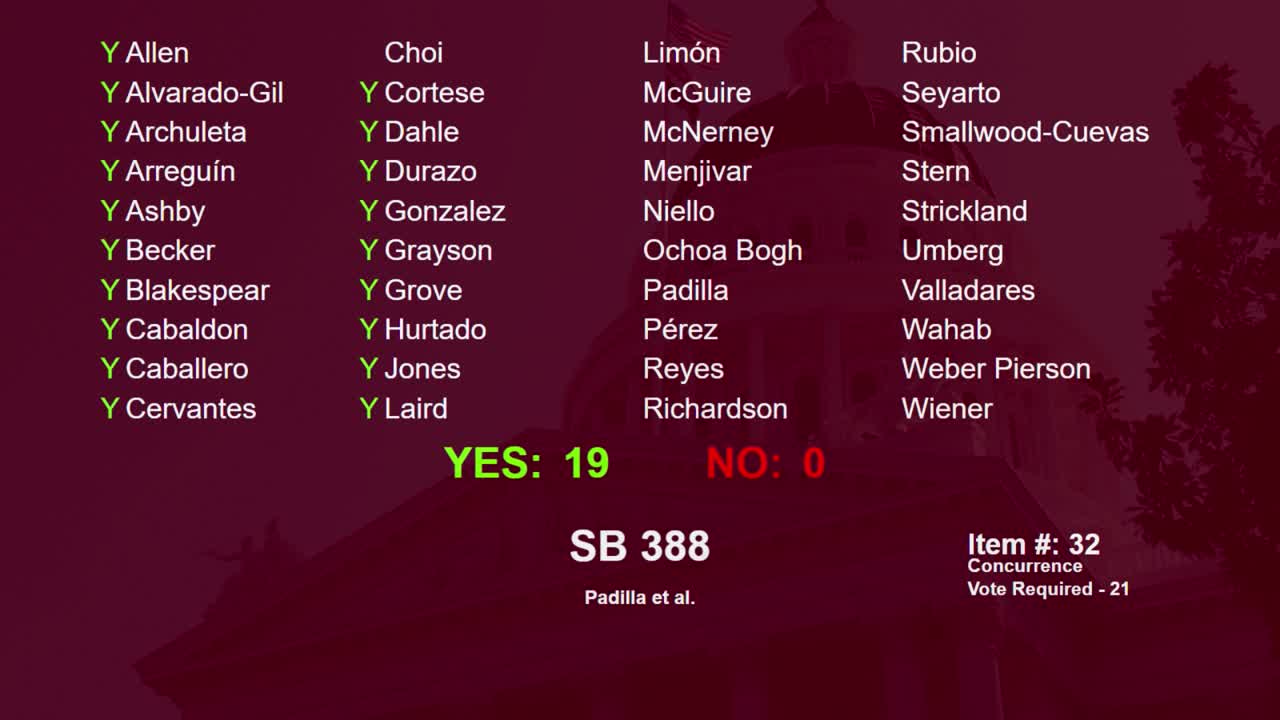 2MIN
Senate Floor
 26SEC
Senate Standing Committee on Appropriations
 8MIN
Senate Standing Committee on Labor, Public Employment and Retirement
 1MIN
Assembly Floor
 16MIN
Assembly Standing Committee on Labor and Employment
Bill Author

Bill Co-Author(s):