AB 542: Continuation schools and classes: youth workforce development programs.
- Session Year: 2025-2026
- House: Assembly
- Latest Version Date: 2025-10-13
Current Status:
Passed
(2025-10-13: Chaptered by Secretary of State - Chapter 696, Statutes of 2025.)
Introduced
In Committee
Awaiting First Chamber Vote
Passed First Chamber
In Committee
Awaiting Second Chamber Vote
Passed Second Chamber
Enacted
Existing law requires the governing board of each school district to fix the length of the schoolday for grades and classes of the schools maintained by the school district, subject to certain conditions and requirements. Under existing law, in continuation high schools and continuation education classes, a day of attendance is 180 minutes of attendance and a pupil is prohibited from being credited with more than 15 hours of attendance per school week, proportionately reduced for those school weeks having weekday holidays on which classes are not held.
This bill would authorize the governing board of a school district that maintains a continuation high school or continuation education classes to offer youth workforce development programs, as defined, to pupils on one or 2 weekdays per school week if it ensures that those pupils are otherwise enrolled in at least 15 hours of class attendance per school week. The bill would require a school district that implements a youth workforce development program for these purposes to establish procedures to track pupil attendance and pupil participation while engaging in a youth workforce development program.
Existing law requires the governing board of each school district to fix the length of the schoolday for grades and classes of the schools maintained by the school district, subject to certain conditions and requirements. Under existing law, in continuation high schools and continuation education classes, a day of attendance is 180 minutes of attendance, but no pupil is credited with more than 15 hours of attendance per school week, proportionately reduced for those school weeks having weekday holidays on which classes are not held.
This bill would authorize the governing board of a school district that maintains a continuation high school or continuation education classes to offer youth workforce development programs, as defined, to pupils on one or 2 weekdays per school week if it ensures that those pupils are otherwise enrolled in at least 15 hours of class attendance per school week. The bill would require a school district that implements a youth workforce development program for these purposes to establish procedures to track pupil attendance and pupil participation while engaging in a youth workforce development program.
Existing law requires the governing board of each school district to fix the length of the schoolday for grades and classes of the schools maintained by the school district, subject to certain conditions and requirements. Under existing law, in continuation high schools and continuation education classes, a day of attendance is 180 minutes of attendance, but no pupil is credited with more than 15 hours of attendance per school week, proportionately reduced for those school weeks having weekday holidays on which classes are not held. Existing law requires the Superintendent of Public Instruction to withhold a portion of specified state funding from a school district that offers fewer than 180 days of instruction during the fiscal year, as provided.
This bill would authorize the governing board of a school district that maintains a continuation high school or continuation education classes to offer youth workforce development programs, as defined, to pupils on one or 2 weekdays per school week if it ensures that those pupils are otherwise enrolled in at least 15 hours of class attendance per school week, and would require youth workforce development program days provided for those purposes to be deemed as instructional days for purposes of the above-described withholding. week. The bill would require a school district that implements a youth workforce development program for these purposes to establish procedures to track pupil attendance and pupil participation while engaging in a youth workforce development program.
Existing law requires the governing board of each school district to fix the length of the schoolday for grades and classes of the schools maintained by the school district, subject to certain conditions and requirements. Under existing law, in continuation high schools and continuation education classes, a day of attendance is 180 minutes of attendance, but no pupil is credited with more than 15 hours of attendance per school week, proportionately reduced for those school weeks having weekday holidays on which classes are not held. Existing law requires the Superintendent of Public Instruction to withhold a portion of specified state funding from a school district or county office of education that offers fewer than 180 days of instruction during the fiscal year, as provided.
This bill would authorize the governing board of a school district that maintains a continuation high school or continuation education classes to offer youth workforce development programs, as defined, to pupils on one or 2 weekdays per school week if it ensures that they those pupils are otherwise offered enrolled in at least 15 hours of class attendance per school week, and would require youth workforce development program days offered provided for those purposes to be deemed as instructional days for purposes of the above-described withholding. The bill would require a school district that implements a youth workforce development program for these purposes to establish procedures to track pupil attendance and pupil participation while engaging in a youth workforce development program.
Existing law requires the governing board of each school district to fix the length of the schoolday for grades and classes of the schools maintained by the school district, subject to certain conditions and requirements. Under existing law, in continuation high schools and continuation education classes, a day of attendance is 180 minutes of attendance, but no pupil is credited with more than 15 hours of attendance per school week, proportionately reduced for those school weeks having weekday holidays on which classes are not held. Existing law requires the Superintendent of Public Instruction to withhold a portion of specified state funding from a school district or county office of education that offers fewer than 180 days of instruction during the fiscal year, as provided.
This bill would reduce the requirement of 180 minutes of attendance to instead be 170 minutes of attendance to constitute a day of attendance in continuation high schools and continuation education classes. To the extent the bill imposes additional duties on local educational agencies, the bill would impose a state-mandated local program. authorize the governing board of a school district that maintains a continuation high school or continuation education classes to offer youth workforce development programs, as defined, to pupils on one or 2 weekdays per school week if it ensures that they are otherwise offered at least 15 hours of class attendance per school week, and would require youth workforce development program days offered for those purposes to be deemed as instructional days for purposes of the above-described withholding. The bill would require a school district that implements a youth workforce development program for these purposes to establish procedures to track pupil attendance and pupil participation while engaging in a youth workforce development program.
The California Constitution requires the state to reimburse local agencies and school districts for certain costs mandated by the state. Statutory provisions establish procedures for making that reimbursement.This bill would provide that, if the Commission on State Mandates determines that the bill contains costs mandated by the state, reimbursement for those costs shall be made pursuant to the statutory provisions noted above.Existing law requires the governing board of each school district to fix the length of the schoolday for grades and classes of the schools maintained by the school district, subject to certain conditions and requirements. Under existing law, in continuation high schools and continuation education classes, a day of attendance is 180 minutes of attendance, but no pupil is credited with more than 15 hours of attendance per school week, proportionately reduced for those school weeks having weekday holidays on which classes are not held.
This bill would reduce the requirement of 180 minutes of attendance to instead be 170 minutes of attendance to constitute a day of attendance in continuation high schools and continuation education classes. To the extent the bill imposes additional duties on local educational agencies, the bill would impose a state-mandated local program.
The California Constitution requires the state to reimburse local agencies and school districts for certain costs mandated by the state. Statutory provisions establish procedures for making that reimbursement.
This bill would provide that, if the Commission on State Mandates determines that the bill contains costs mandated by the state, reimbursement for those costs shall be made pursuant to the statutory provisions noted above.
(a)In continuation high schools and continuation education classes, a day of attendance is 180 minutes of attendance, but no pupil shall be credited with more than 15 hours of attendance per school week, proportionately reduced for those school weeks having weekday holidays on which classes are not held.
(b)Notwithstanding subdivision (a) and any other law, the governing board of a school district that maintains a continuation high school or continuation education classes may offer youth workforce development programs to pupils on one or two weekdays per school week if it ensures that they are otherwise enrolled in at least 15 hours of class attendance per school week.
(c)A school district that implements a youth workforce development program for purposes of this section shall establish procedures to track pupil attendance and pupil participation while engaging in a youth workforce development program.
(d)(1)For purposes of this section, youth workforce development program means a program implemented by a continuation high school or school offering continuation education classes, under the supervision of a certificated employee, which enables pupils to earn either academic credit or an industry certificate while engaging in workplace experiences, or workforce development training, with the goal of providing the pupils with the skills and experience necessary to obtain employment at a livable wage following graduation. A youth workforce development program shall be aligned to pupil skills and in-demand careers and provide pupils with technical training and soft skills. A youth workforce development program shall be offered in partnership with a community college district, adult education program, regional occupational program or center, workforce development program accredited by the Western Association of Schools and Colleges, or an organization that offers industry-recognized certifications. School districts are encouraged to give priority to programs that lead to an industry-recognized certificate or credential.
(2)For purposes of paragraph (1), supervision means pupil participation in paid or unpaid on-the-job experiences wherein the supervisor of the training site and certificated school personnel share the responsibility for the supervision of on-the-job experiences.
(a)In continuation high schools and continuation education classes, a day of attendance is 180 minutes of attendance, but no pupil shall be credited with more than 15 hours of attendance per school week, proportionately reduced for those school weeks having weekday holidays on which classes are not held.
(b)Notwithstanding subdivision (a) and any other law, the governing board of a school district that maintains a continuation high school or continuation education classes may offer youth workforce development programs to pupils on one or two weekdays per school week if it ensures that they are otherwise enrolled in at least 15 hours of class attendance per school week.
(c)A school district that implements a youth workforce development program for purposes of this section shall establish procedures to track pupil attendance and pupil participation while engaging in a youth workforce development program.
(d)(1)For purposes of this section, youth workforce development program means a program implemented by a continuation high school or school offering continuation education classes, under the supervision of a certificated employee, that which enables pupils to earn either academic credit or an industry certificate while engaging in workplace experiences, or workforce development training, with the goal of providing the pupils with the skills and experience necessary to obtain employment at a livable wage following graduation. A youth workforce development program shall be aligned to pupil skills and in-demand careers and provide pupils with technical training and soft skills. A youth workforce development program shall be offered in partnership with a community college district, adult education program, regional occupational program or center, workforce development program accredited by the Western Association of Schools and Colleges, or an organization that offers industry-recognized certifications. School districts are encouraged to give priority to programs that lead to an industry-recognized certificate or credential.
(2)For purposes of paragraph (1), supervision means pupil participation in paid or unpaid on-the-job experiences wherein the supervisor of the training site and certificated school personnel share the responsibility for the supervision of on-the-job experiences.
(a)In continuation high schools and continuation education classes, a day of attendance is 180 minutes of attendance, but no pupil shall be credited with more than 15 hours of attendance per school week, proportionately reduced for those school weeks having weekday holidays on which classes are not held.
(b)(1)Notwithstanding subdivision (a) and any other law, the governing board of a school district that maintains a continuation high school or continuation education classes may offer youth workforce development programs to pupils on one or two weekdays per school week if it ensures that they are otherwise enrolled in at least 15 hours of class attendance per school week.
(2)Youth workforce development program days provided for purposes of paragraph (1) shall be deemed as instructional days for purposes of Section 46208.(c)A school district that implements a youth workforce development program for purposes of this section shall establish procedures to track pupil attendance and pupil participation while engaging in a youth workforce development program.
(d)(1)For purposes of this section, youth workforce development program means a program implemented by a continuation high school or school offering continuation education classes, under the supervision of a certificated employee, that enables pupils to earn either academic credit or an industry certificate while engaging in workplace experiences, or workforce development training, with the goal of providing the pupils with the skills and experience necessary to obtain employment at a livable wage following graduation. A youth workforce development program shall be aligned to pupil skills and in-demand careers and provide pupils with technical training and soft skills. A youth workforce development program shall be offered in partnership with a community college district, adult education program, regional occupational program or center, workforce development program accredited by the Western Association of Schools and Colleges, or an organization that offers industry-recognized certifications. School districts are encouraged to give priority to programs that lead to an industry-recognized certificate or credential.
(2)For purposes of paragraph (1), supervision means pupil participation in paid or unpaid on-the-job experiences wherein the supervisor of the training site and certificated school personnel share the responsibility for the supervision of on-the-job experiences.
(a)In continuation high schools and continuation education classes, a day of attendance is 180 minutes of attendance, but no pupil shall be credited with more than 15 hours of attendance per school week, proportionately reduced for those school weeks having weekday holidays on which classes are not held.
(b)(1)Notwithstanding subdivision (a) and any other law, the governing board of a school district that maintains a continuation high school or continuation education classes may offer youth workforce development programs to pupils on one or two weekdays per school week if it ensures that they are otherwise offered enrolled in at least 15 hours of class attendance per school week.
(2)Notwithstanding subdivision (a) or any other law, youth Youth workforce development program days offered provided for purposes of paragraph (1) shall be deemed as instructional days for purposes of Section 46200. 46208.
(c)A school district that implements a youth workforce development program for purposes of this section shall establish procedures to track pupil attendance and pupil participation while engaging in a youth workforce development program.
(d)(1)For purposes of this section, youth workforce development program means a program, program implemented by a continuation high school or school offering continuation classes education classes, under the supervision of a certificated employee, that enables pupils to engage earn either academic credit or an industry certificate while engaging in workplace or real work experiences, or workforce development training, with the goal of providing the pupils with the skills and experience necessary to obtain employment at a livable wage following graduation. A youth workforce development program shall be aligned to pupil skills and in-demand careers and provide pupils with technical training and soft skills. A youth workforce development program shall be offered in partnership with a community college district, adult education program, regional occupational program or center, workforce development program accredited by the Western Association of Schools and Colleges, or an organization that offers industry-recognized certifications. School districts are encouraged to give priority to programs that lead to an industry-recognized certificate or credential.
(2)For purposes of paragraph (1), supervision means pupil participation in paid or unpaid on-the-job experiences wherein the supervisor of the training site and certificated school personnel share the responsibility for the supervision of on-the-job experiences.
(a)In continuation high schools and continuation education classes, a day of attendance is 170 180 minutes of attendance attendance, but no pupil shall be credited with more than 15 hours of attendance per school week, proportionately reduced for those school weeks having weekday holidays on which classes are not held.
(b)(1)Notwithstanding any other law, the governing board of a school district that maintains a continuation high school or continuation education classes may offer youth workforce development programs to pupils on one or two weekdays per school week if it ensures that they are otherwise offered at least 15 hours of class attendance per school week.
(2)Notwithstanding subdivision (a) or any other law, youth workforce development program days offered for purposes of paragraph (1) shall be deemed as instructional days for purposes of Section 46200.
(c)A school district that implements a youth workforce development program for purposes of this section shall establish procedures to track pupil attendance and pupil participation while engaging in a youth workforce development program.
(d)For purposes of this section, youth workforce development program means a program, implemented by a continuation high school or school offering continuation classes that enables pupils to engage in workplace or real work experiences, or workforce development training, with the goal of providing the pupils with the skills and experience necessary to obtain employment at a livable wage following graduation.
SEC. 2.If the Commission on State Mandates determines that this act contains costs mandated by the state, reimbursement to local agencies and school districts for those costs shall be made pursuant to Part 7 (commencing with Section 17500) of Division 4 of Title 2 of the Government Code.In continuation high schools and continuation education classes, a day of attendance is 180 170 minutes of attendance but no pupil shall be credited with more than 15 hours of attendance per school week, proportionately reduced for those school weeks having weekday holidays on which classes are not held.
SEC. 2.If the Commission on State Mandates determines that this act contains costs mandated by the state, reimbursement to local agencies and school districts for those costs shall be made pursuant to Part 7 (commencing with Section 17500) of Division 4 of Title 2 of the Government Code.
|
Date
|
Status
|
|---|---|
| Oct 13, 2025 | Chaptered by Secretary of State - Chapter 696, Statutes of 2025. |
| Oct 13, 2025 | Approved by the Governor. |
| Sep 15, 2025 | Enrolled and presented to the Governor at 4:30 p.m. |
| Sep 8, 2025 | Senate amendments concurred in. To Engrossing and Enrolling. (Ayes 79. Noes 0. Page 3033.). |
| Sep 4, 2025 | In Assembly. Concurrence in Senate amendments pending. |
| Sep 4, 2025 | Read third time. Passed. Ordered to the Assembly. (Ayes 39. Noes 0. Page 2521.). |
| Sep 2, 2025 | Ordered to special consent calendar. |
| Aug 29, 2025 | Read second time. Ordered to third reading. |
| Aug 29, 2025 | From committee: Do pass. (Ayes 7. Noes 0.) (August 29). |
| Jul 14, 2025 | In committee: Referred to APPR. suspense file. |
| Jul 2, 2025 | From committee: Do pass and re-refer to Com. on APPR. with recommendation: To Consent Calendar. (Ayes 7. Noes 0.) (July 2). Re-referred to Com. on APPR. |
| Jun 23, 2025 | From committee chair, with author's amendments: Amend, and re-refer to committee. Read second time, amended, and re-referred to Com. on ED. |
| Jun 18, 2025 | Referred to Coms. on ED. and APPR. |
| Jun 5, 2025 | In Senate. Read first time. To Com. on RLS. for assignment. |
| Jun 4, 2025 | Read third time. Passed. Ordered to the Senate. (Ayes 79. Noes 0. Page 2065.) |
| May 27, 2025 | Read second time. Ordered to third reading. |
| May 23, 2025 | Read second time and amended. Ordered returned to second reading. |
| May 23, 2025 | From committee: Amend, and do pass as amended. (Ayes 11. Noes 0.) (May 23). |
| May 23, 2025 | Assembly Rule 63 suspended. (Ayes 51. Noes 16. Page 1644.) |
| May 14, 2025 | In committee: Set, first hearing. Referred to suspense file. |
| May 1, 2025 | From committee: Do pass and re-refer to Com. on APPR. with recommendation: To Consent Calendar. (Ayes 9. Noes 0.) (April 30). Re-referred to Com. on APPR. |
| Apr 7, 2025 | Re-referred to Com. on ED. |
| Apr 3, 2025 | From committee chair, with author's amendments: Amend, and re-refer to Com. on ED. Read second time and amended. |
| Mar 20, 2025 | In committee: Hearing postponed by committee. |
| Feb 27, 2025 | Re-referred to Com. on ED. |
| Feb 26, 2025 | From committee chair, with author's amendments: Amend, and re-refer to Com. on ED. Read second time and amended. |
| Feb 24, 2025 | Referred to Com. on ED. |
| Feb 12, 2025 | From printer. May be heard in committee March 14. |
| Feb 11, 2025 | Read first time. To print. |
|
Date
|
Description
|
Location
|
Votes
|
|
|---|---|---|---|---|
| Sep 8, 2025 | AB 542 Celeste Rodriguez Concurrence in Senate Amendments By LOWENTHAL | Assembly Floor |
Passed |
|
| Sep 4, 2025 | Special Consent AB542 Celeste Rodriguez | Senate Floor |
Passed |
|
| Aug 29, 2025 | Do pass | Senate Standing Committee on Appropriations |
Passed |
|
| Jul 14, 2025 | Placed on suspense file | Senate Standing Committee on Appropriations |
Passed |
|
| Jul 2, 2025 | Do pass, but first be re-referred to the Committee on [Appropriations] with the recommendation: To Consent Calendar | Senate Standing Committee on Education |
Passed |
|
| Jun 4, 2025 | AB 542 Celeste Rodriguez Assembly Third Reading | Assembly Floor |
Passed |
|
| May 23, 2025 | Do pass as amended. | Assembly Standing Committee on Appropriations |
Passed |
|
| Apr 30, 2025 | Do pass and be re-referred to the Committee on [Appropriations] with recommendation: To Consent Calendar | Assembly Standing Committee on Education |
Passed |
This list shows positions taken on this bill by organizations on the date displayed, which is linked to the original source.
Positions by individuals are not included.
|
Organization
|
Position
|
Date
|
|---|---|---|
| Association Of California School Administrators | ** Support | |
| California Community Foundation | ** Support | |
| california opportunity youth network | ** Support | |
| Center For Powerful Public Schools | ** Support | |
| County of Los Angeles Board of Supervisors | ** Support | |
| Jerico Development | ** Support | |
| John Muir Charter School | ** Support | |
| Klabin Company | ** Support | |
| Los Angeles Unified School District Lausd | ** Support | |
| New Ways to Work | ** Support | |
| Opportunity Youth Schools Coalition | ** Support | |
| Power CA Action | ** Support | |
| Reaching At Promise Students Association | ** Support | |
| San Diego Unified School District | ** Support | |
| Sharefest | ** Support |
CONCURRENCE IN SENATE AMENDMENTS
CSA1 Bill Id:AB 542
Author:(Celeste Rodriguez)
As Amended Ver:June 23, 2025
Majority vote
SUMMARY
Authorizes school districts operating continuation high schools or continuation education classes to offer youth workforce development programs on one or two weekdays per week, provided students are enrolled in at least 15 hours of class attendance per week.
Senate Amendments
Add a co-author.
COMMENTS
Key provisions of the bill. AB 542 would authorize continuation high schools to reconfigure their schedule to allow students to access workforce opportunities for one to two days per week, while still accessing the required 15 hours of classroom instruction on the remaining days of the week in order to authorize schools to receive average daily attendance funding (ADA) and afford students the opportunity to gain workforce skills.
What is a continuation high school? According to the California Department of Education (CDE), continuation education "is a high school diploma program designed to meet the needs of students who have not graduated from high school, are not exempt from compulsory school attendance, and deemed at risk of not completing their schooling."
According to the Author
"Continuation schools play a key role in the success of students as they provide a more flexible and supportive environment. For example, students may have familial obligations, be employed, have different learning styles or other needs, and are behind on credits needed for graduation. These schools serve diverse student populations across the state and provide additional support that a traditional high school cannot provide.
AB 542 aims to allow students the flexibility to pursue workforce development programs, which will expand employment opportunities. By amending current law, a governing board of a school district will be able to augment the five day instruction schedule while maintaining the state-required instruction time at continuation schools. This flexibility supports various employment pathways for students after graduation as well as economic growth in communities and across the state."
Arguments in Support
The Los Angeles Unified School District (LAUSD), the sponsor of the measure writes, "Students attending continuation schools are disproportionately likely to experience challenges to their success, including working to support their families, being pregnant, parenting, or facing disciplinary or justice-related issues. For many of these students, the opportunity to acquire skills that will lead to steady employment is a strong motivator to remain in school and achieve their diploma. Los Angeles Unified works with a variety of workforce partners to provide students with multiple pathways to reliable, union-connected job opportunities.
Under existing law, students in continuation school must attend classes for a minimum of fifteen hours a week. Continuation schools are required to operate 175 days a year, a schedule that compels students to attend classes five days a week, for a minimum of three hours a day. AB 542 would allow students to attend classes for fewer than five days a week, while maintaining fifteen hours of instruction. This will give students greater flexibility to have work experience education opportunities without having to arrange transportation from school to a worksite, and opens opportunities that are offered in the morning or as part of an eight-hour day.
Workforce experience education, including youth workforce development programs, is supervised by the local education agency with guidelines to ensure an enriching and safe experience for the student that is aligned with their academic and career goals. As such, these hours will count towards average daily attendance and the required days of instruction, while still maintaining required hours of instruction on other days of the week. By providing students with greater opportunities to gain valuable workforce experience, AB 542 supports the goals of the newly released Master Plan for Career Technical Education and the promotion of an education system that supports multiple pathways to student success."
Arguments in Opposition
None on file.
FISCAL COMMENTS
According to the Senate Appropriations Committee: "This bill could result in Proposition 98 General Fund costs in the low hundreds of thousands of dollars each year for school districts to establish attendance and participation tracking procedures for continuation high schools that elect to offer youth workforce development programs. There are about 430 continuation high schools in the state serving about 48,800 students."
VOTES:
ASM EDUCATION: 9-0-0
YES: Muratsuchi, Hoover, Addis, Alvarez, Bonta, Castillo, Garcia, Lowenthal, Patel
ASM APPROPRIATIONS: 11-0-4
YES: Wicks, Arambula, Calderon, Caloza, Elhawary, Fong, Mark González, Hart, Pacheco, Pellerin, Solache
ABS, ABST OR NV: Sanchez, Dixon, Ta, Tangipa
ASSEMBLY FLOOR: 79-0-0
YES: Addis, Aguiar-Curry, Ahrens, Alanis, Alvarez, Arambula, Ávila Farías, Bains, Bauer-Kahan, Bennett, Berman, Boerner, Bonta, Bryan, Calderon, Caloza, Carrillo, Castillo, Chen, Connolly, Davies, DeMaio, Dixon, Elhawary, Ellis, Flora, Fong, Gabriel, Gallagher, Garcia, Gipson, Jeff Gonzalez, Mark González, Hadwick, Haney, Harabedian, Hart, Hoover, Irwin, Jackson, Kalra, Krell, Lackey, Lee, Lowenthal, Macedo, McKinnor, Muratsuchi, Nguyen, Ortega, Pacheco, Papan, Patel, Patterson, Pellerin, Petrie-Norris, Quirk-Silva, Ramos, Ransom, Celeste Rodriguez, Michelle Rodriguez, Rogers, Blanca Rubio, Sanchez, Schiavo, Schultz, Sharp-Collins, Solache, Soria, Stefani, Ta, Tangipa, Valencia, Wallis, Ward, Wicks, Wilson, Zbur, Rivas
UPDATED
VERSION: June 23, 2025
CONSULTANT: Debbie Look / ED. / (916) 319-2087 FN: 0001639
SENATE RULES COMMITTEE Office of Senate Floor Analyses (916) 651-1520 Fax: (916) 327-4478 | AB 542 |
THIRD READING
Bill No: AB 542
Author: Celeste Rodriguez (D), et al.
Amended: 6/23/25 in Senate
Vote: 21
SENATE EDUCATION COMMITTEE: 7-0, 7/2/25
AYES: Pérez, Ochoa Bogh, Cabaldon, Choi, Cortese, Gonzalez, Laird
SENATE APPROPRIATIONS COMMITTEE: 7-0, 8/29/25
AYES: Caballero, Seyarto, Cabaldon, Dahle, Grayson, Richardson, Wahab
ASSEMBLY FLOOR: 79-0, 6/4/25 - See last page for vote
SUBJECT: Continuation schools and classes: youth workforce development programs
SOURCE: Los Angeles Unified School District
DIGEST:
This bill authorizes school districts operating continuation high schools or continuation education classes to offer youth workforce development programs on one or two weekdays per week, provided students are enrolled in at least 15 hours of class attendance per week.
ANALYSIS:
Existing law:
- Establishes that a school day in a continuation high school is 180 minutes and prohibits crediting students with more than 15 hours of attendance per week. (Education Code (EC) § 46170)
- Sets minimum school day requirements for grades 9–12 at 240 minutes, with exceptions for continuation high schools and students in work experience education programs. (EC § 46141)
- Requires students to be under the immediate supervision and control of certificated staff to count instructional time for average daily attendance (ADA). (EC § 46300, § 47612.5)
- Authorizes school boards to offer and supervise work-based learning and experience education programs, and provide liability coverage. (EC § 51760, § 51760.1)
- Defines “work-based learning” as using the workplace to connect school experiences with real-life work activities and career opportunities. (EC § 51760.1)
- Establishes requirements for supervising off-campus work experience and outlines criminal background checks for adults in work-based learning settings. (EC § 45125.1)
This bill:
- Allows continuation high schools or continuation education classes to offer youth workforce development programs one or two days per week.
- Requires students to be enrolled in at least 15 hours of classroom instruction per week to participate.
- Requires school districts to track student attendance and participation while engaged in the program.
- Defines a “youth workforce development program” as one implemented under the supervision of certificated staff that enables students to earn academic credit or an industry certificate while engaging in workplace experiences or training.
- Requires programs to be aligned with student skills and in-demand careers, include both technical and soft skills, and be offered in partnership with one or more of the following:
- A community college district.
- An adult education program.
- A regional occupational program or center.
- A workforce development program accredited by the Western Association of Schools and Colleges.
- An organization offering industry-recognized certifications.
- Encourages priority for programs that lead to industry-recognized certificates or credentials.
- Specifies that supervision includes shared oversight between the worksite supervisor and certificated school personnel.
Comments
- Need for this bill. According to the author, “Continuation schools play a key role in the success of students as they provide a more flexible and supportive environment. For example, students may have familial obligations, be employed, have different learning styles or other needs, and are behind on credits needed for graduation. These schools serve diverse student populations across the state and provide additional support that a traditional high school cannot provide.
“AB 542 aims to allow students the flexibility to pursue workforce development programs, which will expand employment opportunities. By amending current law, a governing board of a school district will be able to augment the five day instruction schedule while maintaining the state required instruction time at continuation schools. This flexibility supports various employment pathways for students after graduation as well as economic growth in communities and across the state.”
- Leveraging flexibility for a high-need student population. Continuation high schools serve students who are at risk of not completing high school and who often face multiple barriers to academic success, such as credit deficiencies, family obligations, and the need to work. This bill builds on the structural flexibility of continuation education—particularly its 180-minute minimum school day and 15-hour weekly cap on attendance—to give students more access to work-based learning without jeopardizing instructional time or ADA compliance.
- Aligned with Career Technical Education (CTE) and dropout prevention goals. Research suggests that work-based learning can re-engage disconnected students and improve postsecondary transitions. By encouraging partnerships with workforce-aligned organizations and prioritizing credentialed outcomes, this bill echoes recommendations from the state’s CTE Master Plan and the broader push to offer more career pathways in secondary education.
- A question of who gets these opportunities. While this bill creates new options for continuation schools, its benefits may ultimately depend on local capacity and partnerships. Schools in urban districts with robust employer networks may be well-positioned to offer paid internships, certifications, and mentoring. Rural or smaller districts, by contrast, may struggle to build comparable experiences. Implementation support—from state agencies or regional intermediaries—could help ensure that youth workforce development programs are not limited to a few well-resourced schools, but rather equitably available to continuation students across California.
FISCAL EFFECT: Appropriation: No Fiscal Com.: No Local: No
According to the Senate Appropriations Committee, this bill could result in Proposition 98 General Fund costs in the low hundreds of thousands of dollars each year for school districts to establish attendance and participation tracking procedures for continuation high schools that elect to offer youth workforce development programs. There are about 430 continuation high schools in the state serving about 48,800 students.
SUPPORT: (Verified 8/28/25)
Los Angeles Unified School District (Source)
Association of California School Administrators
California Community Foundation
County of Los Angeles Board of Supervisors
Power CA Action
San Diego Unified School District
Sharefest
OPPOSITION: (Verified 8/28/25)
None received
ASSEMBLY FLOOR: 79-0, 6/4/25
AYES: Addis, Aguiar-Curry, Ahrens, Alanis, Alvarez, Arambula, Ávila Farías, Bains, Bauer-Kahan, Bennett, Berman, Boerner, Bonta, Bryan, Calderon, Caloza, Carrillo, Castillo, Chen, Connolly, Davies, DeMaio, Dixon, Elhawary, Ellis, Flora, Fong, Gabriel, Gallagher, Garcia, Gipson, Jeff Gonzalez, Mark González, Hadwick, Haney, Harabedian, Hart, Hoover, Irwin, Jackson, Kalra, Krell, Lackey, Lee, Lowenthal, Macedo, McKinnor, Muratsuchi, Nguyen, Ortega, Pacheco, Papan, Patel, Patterson, Pellerin, Petrie-Norris, Quirk-Silva, Ramos, Ransom, Celeste Rodriguez, Michelle Rodriguez, Rogers, Blanca Rubio, Sanchez, Schiavo, Schultz, Sharp-Collins, Solache, Soria, Stefani, Ta, Tangipa, Valencia, Wallis, Ward, Wicks, Wilson, Zbur, Rivas
Prepared by: Ian Johnson / ED. / (916) 651-4105
8/29/25 20:39:04
**** END ****
SENATE COMMITTEE ON
Senator Anna Caballero, Chair
2025 - 2026 Regular Session
AB 542 (Celeste Rodriguez) - Continuation schools and classes: youth workforce development programs
Version: | Policy Vote: |
Urgency: | Mandate: |
Hearing Date: | Consultant: |
Bill Summary:
This bill authorizes school districts operating continuation high schools or continuation education classes to offer youth workforce development programs on one or two weekdays per week, provided students are enrolled in at least 15 hours of class attendance per week.
Fiscal Impact:
This bill could result in Proposition 98 General Fund costs in the low hundreds of thousands of dollars each year for school districts to establish attendance and participation tracking procedures for continuation high schools that elect to offer youth workforce development programs. There are about 430 continuation high schools in the state serving about 48,800 students.
Background:
Existing law provides that a school day in a continuation high school is 180 minutes and prohibits a student with being credited with more than 15 hours of attendance per week.
Existing law requires a minimum school day in a high school to be 240 minutes with some exceptions, including a continuation high school or for students enrolled in a work experience education program as approved.
Existing law requires instructional time to be counted for the purpose of computing average daily attendance (ADA) when the student is in attendance under the immediate supervision and control of a certificated employee of the local educational agency (LEA).
Proposed Law:
This bill allows continuation high schools or continuation education classes to offer youth workforce development programs one or two days per week. The bill provides that the students must be enrolled in at least 15 hours of classroom instruction per week to participate, and requires school districts to track student attendance and participation while engaged in the program.
This bill defines a “youth workforce development program” as one implemented under the supervision of certificated staff that enables students to earn academic credit or an industry certificate while engaging in workplace experiences or training.
This bill requires the programs to be aligned with student skills and in-demand careers, include both technical and soft skills, and be offered in partnership with one or more of the following:
- A community college district.
- An adult education program.
- A regional occupational program or center.
- A workforce development program accredited by the Western Association of Schools and Colleges.
- An organization offering industry-recognized certifications.
This bill encourages priority for programs that lead to industry-recognized certificates or credentials, and specifies that supervision includes shared oversight between the worksite supervisor and certificated school personnel.
Staff Comments:
Continuation high schools serve students who are at risk of not graduating from high school, are not exempt from compulsory school attendance, and deemed at risk of not completing their schooling. Minimum attendance in a continuation school is 15 hours per week and a minimum of 180 minutes per day. However, some continuation high schools provide full-day programs that exceed the minimum daily attendance requirement. In the 2023-24 school year, there were 430 continuation high schools in the state that enrolled about 48,800 students.
This bill would allow continuation high schools to reconfigure their schedule to allow students to access workforce development programs for one to two days per week, while still accessing the required 15 hours of classroom instruction on the remaining days of the week in order to authorize schools to receive ADA funding. According to the author, “Continuation schools play a key role in the success of students as they provide a more flexible and supportive environment. For example, students may have familial obligations, be employed, have different learning styles or other needs, and are behind on credits needed for graduation. These schools serve diverse student populations across the state and provide additional support that a traditional high school cannot provide.
“AB 542 aims to allow students the flexibility to pursue workforce development programs, which will expand employment opportunities. By amending current law, a governing board of a school district will be able to augment the five day instruction schedule while maintaining the state required instruction time at continuation schools. This flexibility supports various employment pathways for students after graduation as well as economic growth in communities and across the state.”
-- END --
ASSEMBLY THIRD READING
ATR Bill Id:AB 542
Author:(Celeste Rodriguez)
As Amended Ver:May 23, 2025
Majority vote
SUMMARY
Authorizes school districts having a continuation high school or offering continuation education classes to offer youth workforce development programs to students on one or two weekdays per school week, provided they are otherwise enrolled in at least 15 hours of class attendance per week.
Major Provisions
- Authorizes school districts with a continuation high school or offering continuation education classes to offer youth workforce development programs to students on one or two weekdays per school week, provided they are otherwise enrolled in at least 15 hours of class attendance per week.
- Requires a school district implementing a youth workforce development program to establish procedures to track student attendance and participation while engaging in the work experience education program.
- Defines ″youth workforce development program″ as a program implemented by a continuation high school or school offering continuation education classes, under the supervision of a certificated employee, that enables pupils to earn either academic credit or an industry certificate while engaging in workplace experiences, or workforce development training, with the goal of providing the pupils with the skills and experience necessary to obtain employment at a livable wage following graduation. Requires a youth workforce development program to be aligned to pupil skills and in-demand careers and provide pupils with technical training and soft skills and to be offered in partnership with a community college district, adult education program, regional occupational program or center, workforce development program accredited by the Western Association of Schools and Colleges, or an organization that offers industry-recognized certifications. Encourages school districts to give priority to programs that lead to an industry-recognized certificate or credential.
- Defines ″supervision″ for the purposes of this program to mean student participation in paid or unpaid on-the-job experiences wherein the supervisor of the training site and certificated school personnel share the responsibility for the supervision of on-the-job experiences.
COMMENTS
Key provisions of the bill. AB 542 would authorize continuation high schools to reconfigure their schedule to allow students to access workforce opportunities for one to two days per week, while still accessing the required minimum 15 hours of classroom instruction on the remaining days of the week in order to afford students the opportunity to gain workforce skills.
What is a continuation high school? According to the California Department of Education (CDE), continuation education ″is a high school diploma program designed to meet the needs of students who have not graduated from high school, are not exempt from compulsory school attendance, and deemed at risk of not completing their schooling.″ In the 2023-24 school year, there were 430 continuation high schools in California enrolling 48,822 students.
According to the California Continuing Education Association (CCEA), ″The continuation high school serves as our education system′s dropout prevention program. For many students, it is a second chance and safety net to help them complete their high school graduation requirements and earn a diploma. For apportionment purposes, minimum attendance in a continuation program is 15 hours per week and a minimum of 180 minutes per day. However, many continuation high schools provide full-day programs that exceed the minimum daily attendance requirement. In addition to the required academic courses for graduation, the program of instruction emphasizes occupational or career orientation or a work-study schedule and intensive guidance and counseling. Supplemental programs and services may include, but not be limited to, independent study, regional occupation programs, career counseling, concurrent enrollment in community college and/or adult education, and job placement and apprenticeships.″
Who are the students attending continuation schools? Students enrolled in continuation education programs are often credit deficient or need a flexible educational environment because they are employed or engaged in family obligations. Many have learning styles that are not as well matched in traditional schools and larger school settings or are dealing with anxiety or other critical needs and challenges. They are often considered at risk of dropping out and may exhibit behavioral issues that impact their ability to succeed in a regular school setting.
Work-based learning. Statute defines ″work-based learning″ as an educational approach or instructional methodology that uses the workplace or real work to provide students with the knowledge and skills that will help them connect school experiences to real-life work activities and future career opportunities.
Work-based learning benefits continuation school students. A study of health pathways at two continuation schools in Oakland includes an analysis of the impact of work-based learning. The authors note, ″work-based learning opportunities can help students see themselves in a career they might not otherwise have considered. Helping students envision a pathway to a career can serve as motivation for continuation high school students to course-correct and re-engage with school.″ (Warner, 2020)
The authors also note the importance of structuring work-based learning opportunities to reduce the barriers that hinder students from participating, including balancing the time spent in class, work, or other family obligations to make time for internships, as well as offering stipends.
They contend that it is imperative that work-based learning opportunities be offered during the school day so students who must work in the evenings can still participate. Staff can take advantage of the less stringent seat time and scheduling requirements in continuation high school settings to allow students greater flexibility in when and how they access work-based learning opportunities and ensure that these school-day opportunities do not come at the expense of earning credits needed for graduation.
According to the Author
″Continuation schools play a key role in the success of students as they provide a more flexible and supportive environment. For example, students may have familial obligations, be employed, have different learning styles or other needs, and are behind on credits needed for graduation. These schools serve diverse student populations across the state and provide additional support that a traditional high school cannot provide.
AB 542 aims to allow students the flexibility to pursue workforce development programs, which will expand employment opportunities. By amending current law, a governing board of a school district will be able to augment the five day instruction schedule while maintaining the state-required instruction time at continuation schools. This flexibility supports various employment pathways for students after graduation as well as economic growth in communities and across the state.″
Arguments in Support
The Los Angeles Unified School District (LAUSD), the sponsor of the measure writes, ″Students attending continuation schools are disproportionately likely to experience challenges to their success, including working to support their families, being pregnant, parenting, or facing disciplinary or justice-related issues. For many of these students, the opportunity to acquire skills that will lead to steady employment is a strong motivator to remain in school and achieve their diploma. Los Angeles Unified works with a variety of workforce partners to provide students with multiple pathways to reliable, union-connected job opportunities.
Under existing law, students in continuation school must attend classes for a minimum of fifteen hours a week. Continuation schools are required to operate 175 days a year, a schedule that compels students to attend classes five days a week, for a minimum of three hours a day. AB 542 would allow students to attend classes for fewer than five days a week, while maintaining fifteen hours of instruction. This will give students greater flexibility to have work experience education opportunities without having to arrange transportation from school to a worksite, and opens opportunities that are offered in the morning or as part of an eight-hour day.
Workforce experience education, including youth workforce development programs, is supervised by the local education agency with guidelines to ensure an enriching and safe experience for the student that is aligned with their academic and career goals. As such, these hours will count towards average daily attendance and the required days of instruction, while still maintaining required hours of instruction on other days of the week. By providing students with greater opportunities to gain valuable workforce experience, AB 542 supports the goals of the newly released Master Plan for Career Technical Education and the promotion of an education system that supports multiple pathways to student success.″
Arguments in Opposition
None on file
FISCAL COMMENTS
According to the Assembly Appropriations Committee:
Ongoing minor Proposition 98 General Fund cost pressures for school districts offering youth workforce development programs to continuation education students to establish the required attendance and participation tracking procedures. Because the bill is largely declarative of existing allowances for school districts providing continuing education programs to students, to the extent a school district is already providing youth workforce development programs then costs would be lower.
VOTES
ASM EDUCATION: 9-0-0
YES: Muratsuchi, Hoover, Addis, Alvarez, Bonta, Castillo, Garcia, Lowenthal, Patel
ASM APPROPRIATIONS: 11-0-4
YES: Wicks, Arambula, Calderon, Caloza, Elhawary, Fong, Mark González, Hart, Pacheco, Pellerin, Solache
ABS, ABST OR NV: Sanchez, Dixon, Ta, Tangipa
UPDATED
VERSION: May 23, 2025
CONSULTANT: Debbie Look / ED. / (916) 319-2087 FN: 0000705
Date of Hearing: May 14, 2025
ASSEMBLY COMMITTEE ON APPROPRIATIONS
Buffy Wicks, Chair
ABPCA Bill Id:AB 542
Author:(Celeste Rodriguez) – As Amended Ver:April 3, 2025
Policy Committee: | Education | Vote: | 9 - 0 |
|
| ||
|
|
Urgency: No State Mandated Local Program: No Reimbursable: No
SUMMARY:
This bill allows a school district that maintains a continuation high school to offer youth workforce development programs to students on or two weekdays per school week if students are otherwise enrolled in at least 15 hours of class attendance per school week.
Specifically, this bill provides that such youth workforce development days qualify as instructional days for the purposes of a school district meeting the annual requirement for minimum number of instructional days. The bill also requires a school district that implements a youth workforce development program establish procedures for tracking student attendance and participation in the program.
FISCAL EFFECT:
Ongoing Proposition 98 General Fund cost pressures potentially in the low hundreds of thousands of dollars for school districts offering youth workforce development programs to continuation education students to establish the required attendance and participation tracking procedures.
If half of the 430 continuation high schools in California offer such programs and update procedures, which likely includes costs for software changes to student information systems, at a cost of $1,000 per school, the bill will result in $215,000 in costs. Additionally, the added complexity to program requirements, which are subject to compliance verification in a school district’s annual audit, may expose schools to considerable financial risk from fiscal penalties imposed for noncompliance, likely in the tens of thousands of dollars Proposition 98 General Fund per school.
COMMENTS:
- Purpose. According to the author:
AB 542 aims to allow students the flexibility to pursue workforce development programs, which will expand employment opportunities. By amending current law, a governing board of a school district will be able to augment the five day instruction schedule while maintaining the state-required instruction time at continuation schools. This flexibility supports various employment pathways for students after graduation as well as economic growth in communities and across the state.
- Background. School District Instructional Time Requirements. State law prescribes daily instructional minute requirements for school districts, which vary by program and grade-span, and annual instructional minute and day requirements. If a school district does not provide 180 days of instruction the meet the annual total minutes requirement by grade-span, the State Superintendent of Public Instruction must withhold state funding.
For a day to count as a day of instruction towards meeting the annual instructional day requirement in a school district, schools must offer and provide at least the minimum instructional day amount of minutes, and students must be under the immediate supervision and control of a certificated employee of the school district and engaged in educational activities required of them. The minimum instructional day for students in grades 9-12 at a school district is 240 minutes. Continuation high schools have a minimum day requirement of 180 minutes, with no student allowed generate more than 15 hours of attendance per school week. With a lower minimum day requirement, continuation schools can offer fewer instructional minutes to students in these settings than students in traditional schools. Attendance for students enrolled in a continuation high school is taken hourly, and students that attend more than 15 hours of instruction in a week may apply any excess hours to previous weeks where instruction provided was short of the 15-hour requirement.
Continuation Schools Policy. This bill allows a student enrolled in a continuation education program to engage in a youth workforce development program one or two days per school week, so long as they receive 15 hours of instruction per school week on the other three or four school days. However, this bill’s authorization seems inconsistent with current law for this student population. Typically, students enrolled in continuation education programs are credit deficient or need a flexible educational environment due to employment or family obligations. Many have learning styles not well served by traditional schools and larger school settings or are experiencing anxiety, or have other critical needs and challenges. Additionally, these students are often at risk of dropping out and may exhibit behavioral issues that impact their ability to succeed in a traditional school setting. This bill allows a continuation education student to receive fewer instructional days than the traditional requirement (up to two fewer per school week) but would simultaneously require these students to attend school for up to five hours (300 minutes) per regular instructional day, 60 minutes longer than the 240 minute requirement for traditional school students.
Nothing in current law precludes a school district from offering both continuing education and youth workforce development opportunities to continuation education students so long as the district meets all applicable instructional time requirements. Current law provides that students participating in work experience programs can participate in continuation education using existing pathways, so long as each school still meets all of the applicable conditions of apportionment. The lower 180-minute minimum day requirement for continuation students already provides significant flexibility for these students to engage in extracurricular opportunities such as youth workforce development.
Analysis Prepared by: Aaron Heredia / APPR. / (916) 319-2081
Date of Hearing: April 30, 2025
ASSEMBLY COMMITTEE ON EDUCATION
Al Muratsuchi, Chair
ABPCA Bill Id:AB 542 (
Author:Celeste Rodriguez) – As Amended Ver:April 3, 2025
SUBJECT: Education finance: continuation schools and classes: youth workforce development programs: instructional days
SUMMARY: Authorizes school districts having a continuation high school or offering continuation education classes to offer youth workforce development programs to students on one or two weekdays per school week, provided they are otherwise enrolled in at least 15 hours of class attendance per week. Specifically, this bill:
- Authorizes school districts having a continuation high school or offering continuation education classes to offer youth workforce development programs to students on one or two weekdays per school week, provided they are otherwise enrolled in at least 15 hours of class attendance per week.
- Requires that youth workforce development program days be counted as instructional days.
- Requires a school district implementing a youth workforce development program to establish procedures to track student attendance and participation while engaging in the work experience education program.
- Defines “youth workforce development program” as a program implemented by a continuation high school or school offering continuation education classes, under the supervision of a certificated employee, that enables pupils to earn either academic credit or an industry certificate while engaging in workplace experiences, or workforce development training, with the goal of providing the pupils with the skills and experience necessary to obtain employment at a livable wage following graduation. Requires a youth workforce development program to be aligned to pupil skills and in-demand careers and provide pupils with technical training and soft skills and to be offered in partnership with a community college district, adult education program, regional occupational program or center, workforce development program accredited by the Western Association of Schools and Colleges, or an organization that offers industry-recognized certifications. Encourages school districts to give priority to programs that lead to an industry-recognized certificate or credential.
- Defines “supervision” for the purposes of this program to mean student participation in paid or unpaid on-the-job experiences wherein the supervisor of the training site and certificated school personnel share the responsibility for the supervision of on-the-job experiences.
EXISTING LAW:
- Requires that in continuation high schools and continuation education classes a day of attendance is 180 minutes of attendance and prohibits a student with being credited with more than 15 hours of attendance per school week. (Education Code (EC) 46170)
- Requires a minimum school day in a high school to be 240 minutes with some exceptions, including a continuation high school or for students enrolled in a work experience education program as approved. (EC 46141)
- Requires instructional time to be counted for the purpose of computing average daily attendance (ADA) when the student is in attendance under the immediate supervision and control of a certificated employee of the local educational agency (LEA). (EC 46300 and 47612.5)
- Specifies that for purposes of a work experience education program in a secondary school that meets the standards of the California State Plan for Career Technical Education (CTE), “immediate supervision,” in the context of off-campus work training stations, means student participation in on-the-job training as outlined under a training agreement, coordinated by the school district under a state-approved plan, wherein the employer and certificated school personnel share the responsibility for on-the-job supervision. (EC 46300)
- Specifies that the course of study for high school does not apply to a student enrolled in certain alternative programs, including a continuation high school. (EC 51228.1)
- Authorizes the governing board of a school district to do all of the following:
- Provide for the instruction of students in the skills, attitudes, and understanding necessary to succeed in employment by means of courses of work-based learning or work experience education;
- Provide for guidance and supervision procedures designed to ensure maximum educational benefit to students from placement in suitable work-based learning or work experience education courses;
- Provide for arranging, approving, coordinating, and awarding credit for work-based learning or work experience education courses, and for those purposes employ instructors, coordinators, and other necessary personnel; and
- Provide for the district to purchase liability insurance for students enrolled in programs of study involving work experience, which may include work-based learning, or vocational education at locations off school grounds approved by the governing board, or require students to purchase insurance and to pass on all or a portion of the costs, at the discretion of the governing board, to the district. (EC 51760)
- Requires that school districts opting to offer work-based learning opportunities to students enrolled in the district shall ensure that students are afforded the same statutory and regulatory safeguards as students in work experience programs. (EC 51760.1)
- Defines “work-based learning” as an educational approach or instructional methodology that uses the workplace or real work to provide students with the knowledge and skills that will help them connect school experiences to real-life work activities and future career opportunities. (EC 51760.1)
- Requires any entity that has a contract with an LEA to ensure that any employee who interacts with students, outside of the immediate supervision and control of the parent/guardian or a school employee has a valid criminal records summary. Exempts an employee of an entity that has a contract with an LEA and offers work experience opportunities for students if all of the following requirements are met:
- At least one adult employee in the workplace during the student’s work hours, who has direct contact with the student and has been designated by the employer as the employee of record who is responsible for the safety of the student has a valid criminal record summary;
- A staff representative of the LEA makes visitations as specified in a student’s individualized education program, or, if unspecified, at least once every three weeks to consult with the student’s workplace liaison, observe the student at the workplace, and check in with the student to ensure their health, safety, and welfare, including by addressing any concerns the student has raised; and
- The parent or guardian of the student has signed a consent form regarding the student’s work placement, attesting that the parent or guardian understands the duties assigned to the student and the nature of the workplace environment. (EC 45125.1)
FISCAL EFFECT: Unknown
COMMENTS:
Need for the bill. According to the author, “Continuation schools play a key role in the success of students as they provide a more flexible and supportive environment. For example, students may have familial obligations, be employed, have different learning styles or other needs, and are behind on credits needed for graduation. These schools serve diverse student populations across the state and provide additional support that a traditional high school cannot provide.
AB 542 aims to allow students the flexibility to pursue workforce development programs, which will expand employment opportunities. By amending current law, a governing board of a school district will be able to augment the five day instruction schedule while maintaining the state-required instruction time at continuation schools. This flexibility supports various employment pathways for students after graduation as well as economic growth in communities and across the state.”
Key provisions of the bill. AB 542 would authorize continuation high schools to reconfigure their schedule to allow students to access workforce opportunities for one to two days per week, while still accessing the required 15 hours of classroom instruction on the remaining days of the week in order to authorize schools to receive average daily attendance funding (ADA) and afford students the opportunity to gain workforce skills.
What is a continuation high school? According to the California Department of Education (CDE), continuation education “is a high school diploma program designed to meet the needs of students who have not graduated from high school, are not exempt from compulsory school attendance, and deemed at risk of not completing their schooling.”
According to the California Continuing Education Association (CCEA):
The continuation high school serves as our education system’s dropout prevention program. For many students, it is a second chance and safety net to help them complete their high school graduation requirements and earn a diploma.”
For apportionment purposes, minimum attendance in a continuation program is 15 hours per week and a minimum of 180 minutes per day. However, many continuation high schools provide full-day programs that exceed the minimum daily attendance requirement. In addition to the required academic courses for graduation, the program of instruction emphasizes occupational or career orientation or a work-study schedule and intensive guidance and counseling. Supplemental programs and services may include, but not be limited to, independent study, regional occupation programs, career counseling, concurrent enrollment in community college and/or adult education, and job placement and apprenticeships.
In the 2023-24 school year, there were 430 continuation high schools in California enrolling 48,822 students.
Who are the students attending continuation schools? Students enrolled in continuation education programs are often credit deficient or need a flexible educational environment because they are employed or engaged in family obligations. Many have learning styles that are not as well matched in traditional schools and larger school settings or are dealing with anxiety or other critical needs and challenges. They are often considered at risk of dropping out and may exhibit behavioral issues that impact their ability to succeed in a regular school setting.
Work-based learning. Statute defines “work-based learning” as an educational approach or instructional methodology that uses the workplace or real work to provide students with the knowledge and skills that will help them connect school experiences to real-life work activities and future career opportunities. It further specifies that high-quality work-based learning may include, but is not limited to, the following:
- Emphasis on learning in the workplace;
- Exposure to a wide range of career areas and worksites in order to help youth make informed choices about education, training options, and career pursuits;
- Thoughtful placement of students into opportunities that are evaluated for their safety, qualified supervision, and learning opportunities;
- Appropriate sequencing of experiences ranging from site visits and tours, job shadowing, unpaid and paid internships, and paid work experience;
- Explicit aim to supplement or systematically reinforce classroom instruction in technical courses, academic courses, or both;
- Systematic attention to the development of 21st-century skills, such as communication, problem solving, teamwork, project planning, and critical thinking;
- A trained mentor who structures the learning at the worksite;
- Coordination between the classroom teacher and the workplace mentor or supervisor;
- Built-in regular assessment and feedback;
- Involvement of youth in choosing and structuring the experience; and
- Clear and measurable learning outcomes.
Work-based learning benefits continuation school students. A study of health pathways at two continuation schools in Oakland includes an analysis of the impact of work-based learning. The authors note, “work-based learning opportunities can help students see themselves in a career they might not otherwise have considered. Helping students envision a pathway to a career can serve as motivation for continuation high school students to course-correct and re-engage with school.” (Warner, 2020)
The authors also note the importance of structuring work-based learning opportunities to reduce the barriers that hinder students from participating, including balancing the time spent in class, work, or other family obligations to make time for internships, as well as offering stipends.
They contend that it is imperative that work-based learning opportunities be offered during the school day so students who must work in the evenings can still participate. Staff can take advantage of the less stringent seat time and scheduling requirements in continuation high school settings to allow students greater flexibility in when and how they access work-based learning opportunities and ensure that these school-day opportunities do not come at the expense of earning credits needed for graduation.
Arguments in support. The Los Angeles Unified School District (LAUSD), the sponsor of the measure writes, “Students attending continuation schools are disproportionately likely to experience challenges to their success, including working to support their families, being pregnant, parenting, or facing disciplinary or justice-related issues. For many of these students, the opportunity to acquire skills that will lead to steady employment is a strong motivator to remain in school and achieve their diploma. Los Angeles Unified works with a variety of workforce partners to provide students with multiple pathways to reliable, union-connected job opportunities.
Under existing law, students in continuation school must attend classes for a minimum of fifteen hours a week. Continuation schools are required to operate 175 days a year, a schedule that compels students to attend classes five days a week, for a minimum of three hours a day. AB 542 would allow students to attend classes for fewer than five days a week, while maintaining fifteen hours of instruction. This will give students greater flexibility to have work experience education opportunities without having to arrange transportation from school to a worksite, and opens opportunities that are offered in the morning or as part of an eight-hour day.
Workforce experience education, including youth workforce development programs, is supervised by the local education agency with guidelines to ensure an enriching and safe experience for the student that is aligned with their academic and career goals. As such, these hours will count towards average daily attendance and the required days of instruction, while still maintaining required hours of instruction on other days of the week. By providing students with greater opportunities to gain valuable workforce experience, AB 542 supports the goals of the newly released Master Plan for Career Technical Education and the promotion of an education system that supports multiple pathways to student success.”
Related legislation. AB 401 (Muratsuchi) of the 2025-26 Session would require Career Technical Education Incentive Grant (CTEIG) program recipients to be granted renewal grants for a total of four years, subject to specified conditions, and requires the Superintendent of Public Instruction (SPI) to designate 90% of the CTEIG funds for renewal grants and 10% for new applicants; adds a cost-of-living adjustment (COLA) to the CTEIG appropriation; and removes a limitation on grant awards above a specified level.
SB 845 (Pérez) of the 2025-26 Session would require the CDE to coordinate the updating of CTE model curriculum standards and framework at least every 5 years, convene CTE industry advisory groups for each CTE subject area including specified representatives, to provide input to the updating of the standards and frameworks, identify various work-based learning opportunities, including apprenticeship and pre-apprenticeship programs, as well as outlining the responsibilities of the LEA in sponsoring work-based learning.
SB 480 (Portantino) of the 2023-24 Session would have authorized CTE courses, for purposes of a high school graduation requirement, to include a course which includes participation in a pre-apprenticeship or a youth apprenticeship program; required the Superintendent of Public Instruction (SPI) to develop and adopt work-based learning program guidelines; requires the CDE to develop guidance on the definition of specified CTE programs; required the State Board of Education (SBE) to consider including youth apprenticeship programs in the College/Career Indicator associated with the California School Dashboard, and established the High School Apprenticeship Pilot Program. This bill was held in the Assembly Appropriations Committee.
REGISTERED SUPPORT / OPPOSITION:
Support
Association of California School Administrators
California Community Foundation
California Opportunity Youth Network
Center for Powerful Public Schools
Jerico Development
John Muir Charter School
Klabin Company
Los Angeles Unified School District
New Ways to Work
Opportunity Youth Schools Coalition
Power California Action
Reaching At Promise Students Association
San Diego Unified School District
3 individuals
Opposition
None on file
Analysis Prepared by: Debbie Look / ED. / (916) 319-2087
Discussed in Hearing
View Older Hearings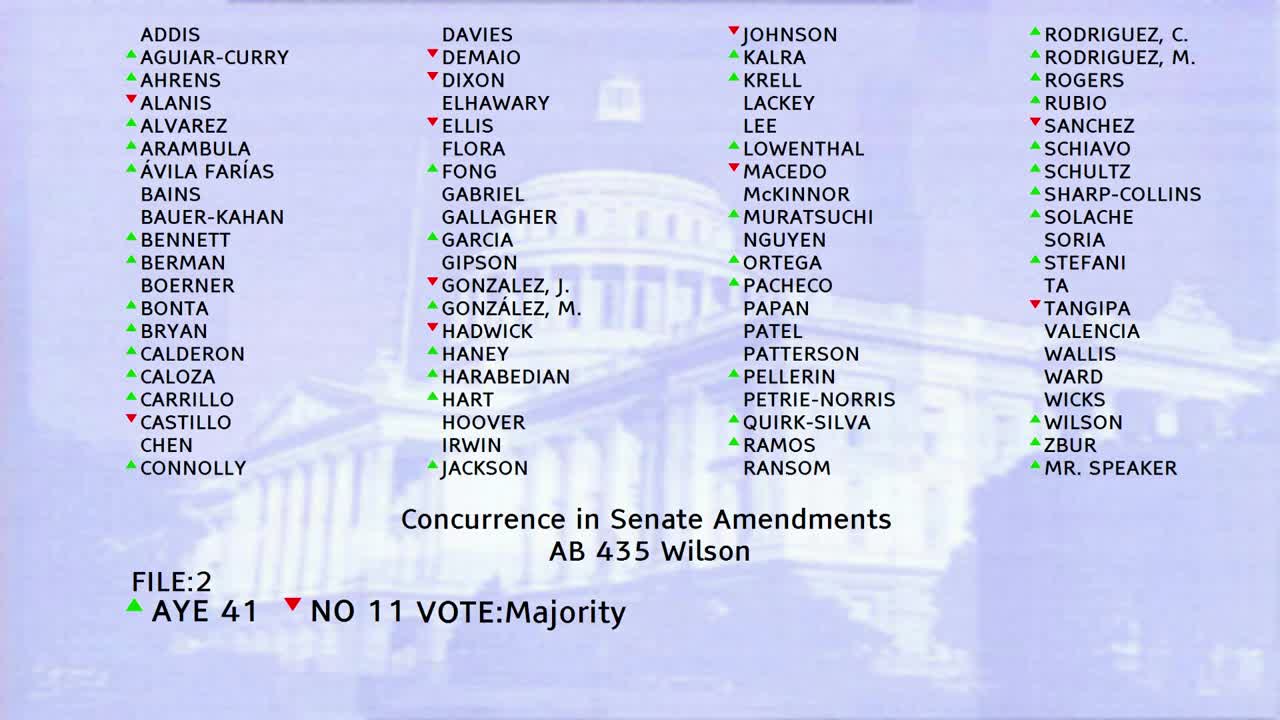
Bill Author

Bill Co-Author(s):
