AB 57: California Dream for All Program: descendants of formerly enslaved people.
- Session Year: 2025-2026
- House: Assembly
- Latest Version Date: 2025-09-11
Current Status:
Failed
(2026-01-22: Consideration of Governor's veto stricken from file.)
Introduced
In Committee
Awaiting First Chamber Vote
Passed First Chamber
In Committee
Awaiting Second Chamber Vote
Passed Second Chamber
Enacted
Existing law establishes the California Housing Finance Agency in the Department of Housing and Community Development, and authorizes the agency to, among other things, make loans to finance affordable housing, including residential structures, housing developments, multifamily rental housing, special needs housing, and other forms of housing, as specified. Existing law establishes the California Dream for All Program to provide shared appreciation loans to qualified first-time homebuyers, as specified. Existing law establishes in the State Treasury the California Dream for All Fund, which is continuously appropriated for expenditure pursuant to the program, as specified.
This bill would require, upon establishment of the certification process for the descendants of American slavery established by the Bureau for Descendants of American Slavery, at least 10% of the moneys in the fund to be reserved for applicants who meet the requirements for a loan under the program and have been certified as descendants of formerly enslaved people, as specified.
This bill would become operative only if SB 518 of the 202526 Regular Session is enacted and takes effect on or before January 1, 2027, and establishes the Bureau for Descendants for American Slavery.
Existing law establishes the California Housing Finance Agency in the Department of Housing and Community Development, and authorizes the agency to, among other things, make loans to finance affordable housing, including residential structures, housing developments, multifamily rental housing, special needs housing, and other forms of housing, as specified. Existing law establishes the California Dream for All Program to provide shared appreciation loans to qualified first-time homebuyers, as specified. Existing law establishes in the State Treasury the California Dream for All Fund, which is continuously appropriated for expenditure pursuant to the program, as specified.
This bill would require, upon establishment of the certification process for the descendants of American slavery established by the Bureau for Descendants of American Slavery, at least 10% of the moneys in the fund to be reserved for applicants who meet the requirements for a loan under the program and have been certified as descendants of formerly enslaved people, as specified.
This bill would become operative only if SB 518 of the 202526 Regular Session is enacted and takes effect on or before January 1, 2026, 2027, and establishes the Bureau for Descendants for American Slavery.
Existing law establishes the California Housing Finance Agency in the Department of Housing and Community Development, and authorizes the agency to, among other things, make loans to finance affordable housing, including residential structures, housing developments, multifamily rental housing, special needs housing, and other forms of housing, as specified. Existing law establishes the California Dream for All Program to provide shared appreciation loans to qualified first-time homebuyers, as specified. Existing law establishes in the State Treasury the California Dream for All Fund, which is continuously appropriated for expenditure pursuant to the program, as specified.
This bill would require, upon establishment of an agency to determine whether an applicant qualifies as a descendant of a formerly enslaved person, the certification process for the descendants of American slavery established by the Bureau for Descendants of American Slavery, at least 10% of the moneys in the fund to be reserved for applicants who meet the requirements for a loan under the program and are have been certified as descendants of formerly enslaved people, as specified.
This bill would become operative only if SB 518 of the 202526 Regular Session is enacted and takes effect on or before January 1, 2026, and establishes the Bureau for Descendants for American Slavery.
Existing law establishes the California Housing Finance Agency in the Department of Housing and Community Development, and authorizes the agency to, among other things, make loans to finance affordable housing, including residential structures, housing developments, multifamily rental housing, special needs housing, and other forms of housing, as specified. Existing law requires the agency to administer a home purchase assistance program for the purpose of assisting low- and moderate-income home buyers to qualify for the purchase of owner-occupied homes, as specified. Existing law establishes the California Dream for All Program to provide shared appreciation loans to qualified first-time homebuyers, as specified. Existing law establishes in the State Treasury the California Dream for All Fund, which is continuously appropriated for expenditure pursuant to the program, as specified.
This bill would require, upon establishment of an agency to determine whether an applicant qualifies as a descendant of a formerly enslaved person, at least 10% of the moneys in the fund to be made available to reserved for applicants who meet the requirements for a loan under the home purchase assistance program and are descendants of formerly enslaved people, as specified.
Existing law establishes the California Housing Finance Agency in the Department of Housing and Community Development, and authorizes the agency to, among other things, make loans to finance affordable housing, including residential structures, housing developments, multifamily rental housing, special needs housing, and other forms of housing, as specified. Existing law requires the agency to administer a home purchase assistance program for the purpose of assisting low- and moderate-income home buyers to qualify for the purchase of owner-occupied homes, as specified. Existing law establishes the Home Purchase Assistance Fund, which is continuously appropriated for expenditure pursuant to the program and defraying the administrative costs for the agency. Existing law requires, on and after July 1, 2016, unobligated amounts remaining in any fund established for specified purposes to be transferred to the fund for expenditure by the agency for the purposes of the program. California Dream for All Program to provide shared appreciation loans to qualified first-time homebuyers, as specified. Existing law establishes in the State Treasury the California Dream for All Fund, which is continuously appropriated for expenditure pursuant to the program, as specified.
This bill would require that require, upon establishment of an agency to determine whether an applicant qualifies as a descendant of a formerly enslaved person, at least 10% of the moneys in the fund to be made available to applicants who meet the requirements for a loan under the home purchase assistance program and are descendants of formerly enslaved people. people, as specified.
Existing law establishes the California Housing Finance Agency in the Department of Housing and Community Development, and authorizes the agency to, among other things, make loans to finance affordable housing, including residential structures, housing developments, multifamily rental housing, special needs housing, and other forms of housing, as specified. Existing law requires the agency to administer a home purchase assistance program for the purpose of assisting low- and moderate-income home buyers to qualify for the purchase of owner-occupied homes, as specified. Existing law establishes the Home Purchase Assistance Fund, which is continuously appropriated for expenditure pursuant to the program and defraying the administrative costs for the agency. Existing law requires, on and after July 1, 2016, unobligated amounts remaining in any fund established for specified purposes to be transferred to the fund for expenditure by the agency for the purposes of the program.
This bill would require that at least 10% of the moneys in the fund to be made available to applicants who meet the requirements for a loan under the home purchase assistance program and are descendants of formerly enslaved people.
Existing law establishes the California Housing Finance Agency in the Department of Housing and Community Development, and authorizes the agency to, among other things, make loans to finance affordable housing, including residential structures, housing developments, multifamily rental housing, special needs housing, and other forms of housing, as specified. Existing law requires the agency to administer a home purchase assistance program for the purpose of assisting low- and moderate-income home buyers to qualify for the purchase of owner-occupied homes, as specified. Existing law establishes the Home Purchase Assistance Fund, which is continuously appropriated for expenditure pursuant to the program and defraying the administrative costs for the agency. Existing law requires, on and after July 1, 2016, unobligated amounts remaining in any fund established for specified purposes to be transferred to the fund for expenditure by the agency for the purposes of the program.
This bill would state the intent of the Legislature to enact legislation that would reserve a portion of the moneys in the program for descendants of slaves. require that at least 10% of the moneys in the fund to be made available to applicants who meet the requirements for a loan under the home purchase assistance program and are descendants of formerly enslaved people.
Existing law establishes the California Housing Finance Agency in the Department of Housing and Community Development, and authorizes the agency to, among other things, make loans to finance affordable housing, including residential structures, housing developments, multifamily rental housing, special needs housing, and other forms of housing, as specified. Existing law requires the agency to administer a home purchase assistance program for the purpose of assisting low- and moderate-income home buyers to qualify for the purchase of owner-occupied homes, as specified. Existing law establishes the Home Purchase Assistance Fund, which is continuously appropriated for expenditure pursuant to the program and defraying the administrative costs for the agency. Existing law requires, on and after July 1, 2016, unobligated amounts remaining in any fund established for specified purposes to be transferred to the fund for expenditure by the agency for the purposes of the program.
This bill would state the intent of the Legislature to enact legislation that would reserve a portion of the moneys in the program for descendants of slaves.
(a)The California Dream for All Program is hereby established to provide shared appreciation loans to qualified first-time homebuyers. The program shall be limited to providing assistance to low- and moderate-income homebuyers in the purchase of owner-occupied homes. The agency, subject to the availability of funds for the purposes of this chapter, shall implement and administer the California Dream for All Program in accordance with this chapter.
(b)(1)In implementing this part, the agency shall adopt policies, rules, and regulations by resolution of the board of directors of the agency and consistent with this part to achieve all of the following:
(A)Provide assistance to meaningfully expand access to home ownership.
(B)Expand opportunities for California households to accumulate wealth for themselves and their families. The agency shall make any necessary program adjustments consistent with the requirements of this chapter, which may include limiting the percentage of appreciation payable under the program, to ensure that design of the loan product is not an unreasonable impediment to homeowner wealth creation.
(C)Maximize the number of households assisted over time by exploring and implementing methods for selling subordinate second mortgages originated pursuant to this chapter to investors in order to generate additional funding for the program.
(D)Establish a revolving, shared appreciation first-time homebuyer program with the goal of eventually providing up to one billion dollars ($1,000,000,000) per year for first-time homebuyers.
(E)The amount of assistance shall only be made available in conjunction with first mortgage loan financing provided by the agency, and funds available pursuant to this chapter shall also be available for interest rate buydowns and closing cost assistance for that first mortgage loan financing. Any funds made available for interest rate buydowns shall be made in conjunction with a shared appreciation loan.
(F)All repayments shall be deposited into the fund for ongoing use in the program.
(G)Sustainability for the agency without significantly adversely affecting its borrowing capacity or ability to meet other affordable housing or agency needs.
(H)Adequate consumer protection and consumer disclosure protections.
(2)Policies, rules, and regulations adopted pursuant to this part shall not be subject to Chapter 3.5 (commencing with Section 11340) of Part 1 of Division 3 of Title 2 of the Government Code.
(c)Upon establishment of the certification process for the descendants of American slavery established by the Bureau for Descendants of American Slavery, at least 10 percent of the moneys in the fund shall be reserved for applicants who meet the requirements for a loan under the program and have been certified as descendants of formerly enslaved people by the Bureau for Descendants of American Slavery.
SEC. 2.This act shall become operative only if Senate Bill 518 of the 202526 Regular Session is enacted and takes effect on or before January 1, 2027, and establishes the Bureau for Descendants of American Slavery.
(a)The California Dream for All Program is hereby established to provide shared appreciation loans to qualified first-time homebuyers. The program shall be limited to providing assistance to low- and moderate-income homebuyers in the purchase of owner-occupied homes. The agency, subject to the availability of funds for the purposes of this chapter, shall implement and administer the California Dream for All Program in accordance with this chapter.
(b)(1)In implementing this part, the agency shall adopt policies, rules, and regulations by resolution of the board of directors of the agency and consistent with this part to achieve all of the following:
(A)Provide assistance to meaningfully expand access to home ownership.
(B)Expand opportunities for California households to accumulate wealth for themselves and their families. The agency shall make any necessary program adjustments consistent with the requirements of this chapter, which may include limiting the percentage of appreciation payable under the program, to ensure that design of the loan product is not an unreasonable impediment to homeowner wealth creation.
(C)Maximize the number of households assisted over time by exploring and implementing methods for selling subordinate second mortgages originated pursuant to this chapter to investors in order to generate additional funding for the program.
(D)Establish a revolving, shared appreciation first-time homebuyer program with the goal of eventually providing up to one billion dollars ($1,000,000,000) per year for first-time homebuyers.
(E)The amount of assistance shall only be made available in conjunction with first mortgage loan financing provided by the agency, and funds available pursuant to this chapter shall also be available for interest rate buydowns and closing cost assistance for that first mortgage loan financing. Any funds made available for interest rate buydowns shall be made in conjunction with a shared appreciation loan.
(F)All repayments shall be deposited into the fund for ongoing use in the program.
(G)Sustainability for the agency without significantly adversely affecting its borrowing capacity or ability to meet other affordable housing or agency needs.
(H)Adequate consumer protection and consumer disclosure protections.
(2)Policies, rules, and regulations adopted pursuant to this part shall not be subject to Chapter 3.5 (commencing with Section 11340) of Part 1 of Division 3 of Title 2 of the Government Code.
(c)Upon establishment of the certification process for the descendants of American slavery established by the Bureau for Descendants of American Slavery, at least 10 percent of the moneys in the fund shall be reserved for applicants who meet the requirements for a loan under the program and have been certified as descendants of formerly enslaved people by the Bureau for Descendants of American Slavery.
SEC. 2.This act shall become operative only if Senate Bill 518 of the 202526 Regular Session is enacted and takes effect on or before January 1, 2026, 2027, and establishes the Bureau for Descendants of American Slavery.
(a)The California Dream for All Program is hereby established to provide shared appreciation loans to qualified first-time homebuyers. The program shall be limited to providing assistance to low- and moderate-income homebuyers in the purchase of owner-occupied homes. The agency, subject to the availability of funds for the purposes of this chapter, shall implement and administer the California Dream for All Program in accordance with this chapter.
(b)(1)In implementing this part, the agency shall adopt policies, rules, and regulations by resolution of the board of directors of the agency and consistent with this part to achieve all of the following:
(A)Provide assistance to meaningfully expand access to homeownership. home ownership.
(B)Expand opportunities for California households to accumulate wealth for themselves and their families. The agency shall make any necessary program adjustments consistent with the requirements of this chapter, which may include limiting the percentage of appreciation payable under the program, to ensure that design of the loan product is not an unreasonable impediment to homeowner wealth creation.
(C)Maximize the number of households assisted over time by exploring and implementing methods for selling subordinate second mortgages originated pursuant to this chapter to investors in order to generate additional funding for the program.
(D)Establish a revolving, shared appreciation first-time homebuyer program with the goal of eventually providing up to one billion dollars ($1,000,000,000) per year for first-time homebuyers.
(E)The amount of assistance shall only be made available in conjunction with first mortgage loan financing provided by the agency, and funds available pursuant to this chapter shall also be available for interest rate buydowns and closing cost assistance for that first mortgage loan financing. Any funds made available for interest rate buydowns shall be made in conjunction with a shared appreciation loan.
(F)All repayments shall be deposited into the fund for ongoing use in the program.
(G)Sustainability for the agency without significantly adversely affecting its borrowing capacity or ability to meet other affordable housing or agency needs.
(H)Adequate consumer protection and consumer disclosure protections.
(2)Policies, rules, and regulations adopted pursuant to this part shall not be subject to Chapter 3.5 (commencing with Section 11340) of Part 1 of Division 3 of Title 2 of the Government Code.
(c)(1)Upon establishment of an agency to determine whether an applicant qualifies as a descendant of a formerly enslaved person, the certification process for the descendants of American slavery established by the Bureau for Descendants of American Slavery, at least 10 percent of the moneys in the fund shall be reserved for applicants who meet the requirements for a loan under the program and are have been certified as descendants of formerly enslaved people. people by the Bureau for Descendants of American Slavery.
(2)Upon establishment of an agency to determine whether an applicant qualifies as a descendant of a formerly enslaved person, that agency shall establish criteria for determining eligibility for moneys made available pursuant to paragraph (1) that include, but are not limited to, a defined historical period for when an applicants ancestor must have been subjected to enslavement within the United States.SEC. 2.This act shall become operative only if Senate Bill 518 of the 202526 Regular Session is enacted and takes effect on or before January 1, 2026, and establishes the Bureau for Descendants of American Slavery.
(a)The California Dream for All Program is hereby established to provide shared appreciation loans to qualified first-time homebuyers. The program shall be limited to providing assistance to low- and moderate-income homebuyers in the purchase of owner-occupied homes. The agency, subject to the availability of funds for the purposes of this chapter, shall implement and administer the California Dream for All Program in accordance with this chapter.
(b)(1)In implementing this part, the agency shall adopt policies, rules, and regulations by resolution of the board of directors of the agency and consistent with this part to achieve all of the following:
(A)Provide assistance to meaningfully expand access to homeownership.
(B)Expand opportunities for California households to accumulate wealth for themselves and their families. The agency shall make any necessary program adjustments consistent with the requirements of this chapter, which may include limiting the percentage of appreciation payable under the program, to ensure that design of the loan product is not an unreasonable impediment to homeowner wealth creation.
(C)Maximize the number of households assisted over time by exploring and implementing methods for selling subordinate second mortgages originated pursuant to this chapter to investors in order to generate additional funding for the program.
(D)Establish a revolving, shared appreciation first-time homebuyer program with the goal of eventually providing up to one billion dollars ($1,000,000,000) per year for first-time homebuyers.
(E)The amount of assistance shall only be made available in conjunction with first mortgage loan financing provided by the agency, and funds available pursuant to this chapter shall also be available for interest rate buydowns and closing cost assistance for that first mortgage loan financing. Any funds made available for interest rate buydowns shall be made in conjunction with a shared appreciation loan.
(F)All repayments shall be deposited into the fund for ongoing use in the program.
(G)Sustainability for the agency without significantly adversely affecting its borrowing capacity or ability to meet other affordable housing or agency needs.
(H)Adequate consumer protection and consumer disclosure protections.
(2)Policies, rules, and regulations adopted pursuant to this part shall not be subject to Chapter 3.5 (commencing with Section 11340) of Part 1 of Division 3 of Title 2 of the Government Code.
(c)(1)Upon establishment of an agency to determine whether an applicant qualifies as a descendant of a formerly enslaved person, at least 10 percent of the moneys in the fund shall be made available to reserved for applicants who meet the requirements for a loan under the program and are descendants of formerly enslaved people.
(2)Upon establishment of an agency to determine whether an applicant qualifies as a descendant of a formerly enslaved person, that agency shall establish criteria for determining eligibility for moneys made available pursuant to paragraph (1) that include, but are not limited to, a defined historical period for when an applicants ancestor must have been subjected to enslavement within the United States.
REVISIONS: HeadingLine 3.(a)The California Dream for All Program is hereby established to provide shared appreciation loans to qualified first-time homebuyers. The program shall be limited to providing assistance to low- and moderate-income homebuyers in the purchase of owner-occupied homes. The agency, subject to the availability of funds for the purposes of this chapter, shall implement and administer the California Dream for All Program in accordance with this chapter.
(b)(1)In implementing this part, the agency shall adopt policies, rules, and regulations by resolution of the board of directors of the agency and consistent with this part to achieve all of the following:
(A)Provide assistance to meaningfully expand access to homeownership.
(B)Expand opportunities for California households to accumulate wealth for themselves and their families. The agency shall make any necessary program adjustments consistent with the requirements of this chapter, which may include limiting the percentage of appreciation payable under the program, to ensure that design of the loan product is not an unreasonable impediment to homeowner wealth creation.
(C)Maximize the number of households assisted over time by exploring and implementing methods for selling subordinate second mortgages originated pursuant to this chapter to investors in order to generate additional funding for the program.
(D)Establish a revolving, shared appreciation first-time homebuyer program with the goal of eventually providing up to one billion dollars ($1,000,000,000) per year for first-time homebuyers.
(E)The amount of assistance shall only be made available in conjunction with first mortgage loan financing provided by the agency, and funds available pursuant to this chapter shall also be available for interest rate buydowns and closing cost assistance for that first mortgage loan financing. Any funds made available for interest rate buydowns shall be made in conjunction with a shared appreciation loan.
(F)All repayments shall be deposited into the fund for ongoing use in the program.
(G)Sustainability for the agency without significantly adversely affecting its borrowing capacity or ability to meet other affordable housing or agency needs.
(H)Adequate consumer protection and consumer disclosure protections.
(2)Policies, rules, and regulations adopted pursuant to this part shall not be subject to Chapter 3.5 (commencing with Section 11340) of Part 1 of Division 3 of Title 2 of the Government Code.
(c)(1)Upon establishment of an agency to determine whether an applicant qualifies as a descendant of a formerly enslaved person, at least 10 percent of the moneys in the fund shall be made available to applicants who meet the requirements for a loan under the program and are descendants of formerly enslaved people.
(2)Upon establishment of an agency to determine whether an applicant qualifies as a descendant of a formerly enslaved person, that agency shall establish criteria for determining eligibility for moneys made available pursuant to paragraph (1) that include, but are not limited to, a defined historical period for when an applicants ancestor must have been subjected to enslavement within the United States.
SECTION 1.Section 51344 is added to the Health and Safety Code, to read:51344.At least 10 percent of the moneys in the fund shall be made available to applicants who meet the requirements for a loan under the home purchase assistance program and are descendants of formerly enslaved people.At least 10 percent of the moneys in the fund shall be made available to applicants who meet the requirements for a loan under the home purchase assistance program and are descendants of formerly enslaved people.
At least 10 percent of moneys in the fund shall be made available to applicants who meet the requirements for a loan under the home purchase assistance program and are descendants of formerly enslaved people.
SECTION 1.It is the intent of the Legislature to enact legislation that would reserve a portion of the moneys in the home purchase assistance program, as described in Chapter 6.8 (commencing with Section 51341) of Part 3 of Division 31 of the Health and Safety Code, for descendants of slaves.It is the intent of the Legislature to enact legislation that would reserve a portion of the moneys in the home purchase assistance program, as described in Chapter 6.8 (commencing with Section 51341) of Part 3 of Division 31 of the Health and Safety Code, for descendants of slaves.
|
Date
|
Status
|
|---|---|
| Jan 22, 2026 | Consideration of Governor's veto stricken from file. |
| Oct 13, 2025 | Consideration of Governor's veto pending. |
| Oct 13, 2025 | Vetoed by Governor. |
| Sep 16, 2025 | Enrolled and presented to the Governor at 2 p.m. |
| Sep 9, 2025 | Senate amendments concurred in. To Engrossing and Enrolling. (Ayes 60. Noes 10. Page 3100.). |
| Sep 8, 2025 | In Assembly. Concurrence in Senate amendments pending. |
| Sep 8, 2025 | Read third time. Passed. Ordered to the Assembly. (Ayes 28. Noes 9. Page 2615.). |
| Sep 2, 2025 | Read second time. Ordered to third reading. |
| Aug 29, 2025 | Read second time and amended. Ordered returned to second reading. |
| Aug 29, 2025 | From committee: Amend, and do pass as amended. (Ayes 5. Noes 2.) (August 29). |
| Aug 18, 2025 | In committee: Referred to suspense file. |
| Jul 9, 2025 | From committee: Do pass and re-refer to Com. on APPR. (Ayes 11. Noes 1.) (July 8). Re-referred to Com. on APPR. |
| Jun 24, 2025 | From committee chair, with author's amendments: Amend, and re-refer to committee. Read second time, amended, and re-referred to Com. on JUD. |
| Jun 18, 2025 | From committee: Do pass and re-refer to Com. on JUD. (Ayes 7. Noes 2.) (June 17). Re-referred to Com. on JUD. |
| Jun 11, 2025 | Referred to Coms. on HOUSING and JUD. |
| May 29, 2025 | In Senate. Read first time. To Com. on RLS. for assignment. |
| May 29, 2025 | Read third time. Passed. Ordered to the Senate. (Ayes 52. Noes 10. Page 1777.) |
| May 27, 2025 | Read second time. Ordered to third reading. |
| May 23, 2025 | From committee: Do pass. (Ayes 11. Noes 1.) (May 23). |
| May 7, 2025 | Coauthors revised. |
| May 7, 2025 | In committee: Set, first hearing. Referred to APPR. suspense file. |
| Apr 24, 2025 | Re-referred to Com. on APPR. |
| Apr 23, 2025 | Read second time and amended. |
| Apr 22, 2025 | From committee: Amend, and do pass as amended and re-refer to Com. on APPR. (Ayes 9. Noes 2.) (April 22). |
| Mar 28, 2025 | Re-referred to Com. on JUD. |
| Mar 27, 2025 | Read second time and amended. |
| Mar 26, 2025 | From committee: Amend, and do pass as amended and re-refer to Com. on JUD. (Ayes 8. Noes 0.) (March 26). |
| Mar 4, 2025 | Re-referred to Com. on H. & C.D. |
| Mar 3, 2025 | From committee chair, with author's amendments: Amend, and re-refer to Com. on H. & C.D. Read second time and amended. |
| Feb 25, 2025 | Re-referred to Com. on H. & C.D. |
| Feb 24, 2025 | From committee chair, with author's amendments: Amend, and re-refer to Com. on H. & C.D. Read second time and amended. |
| Feb 24, 2025 | Referred to Coms. on H. & C.D. and JUD. |
| Dec 3, 2024 | From printer. May be heard in committee January 2. |
| Dec 2, 2024 | Read first time. To print. |
|
Date
|
Description
|
Location
|
Votes
|
|
|---|---|---|---|---|
| Sep 9, 2025 | AB 57 McKinnor Concurrence in Senate Amendments | Assembly Floor |
Passed |
|
| Sep 8, 2025 | Assembly 3rd Reading AB57 McKinnor et al. By Smallwood-Cuevas | Senate Floor |
Passed |
|
| Aug 29, 2025 | Do pass as amended | Senate Standing Committee on Appropriations |
Passed |
|
| Aug 18, 2025 | Placed on suspense file | Senate Standing Committee on Appropriations |
Passed |
|
| Jul 8, 2025 | Do pass, but first be re-referred to the Committee on [Appropriations] | Senate Standing Committee on Judiciary |
Passed |
|
| Jun 17, 2025 | Do pass, but first be re-referred to the Committee on [Judiciary] | Senate Standing Committee on Housing |
Passed |
|
| May 29, 2025 | AB 57 McKinnor Assembly Third Reading | Assembly Floor |
Passed |
|
| May 23, 2025 | Do pass. | Assembly Standing Committee on Appropriations |
Passed |
|
| Apr 22, 2025 | Do pass as amended and be re-referred to the Committee on [Appropriations] | Assembly Standing Committee on Judiciary |
Passed |
|
| Mar 26, 2025 | Do pass as amended and be re-referred to the Committee on [Judiciary] | Assembly Standing Committee on Housing and Community Development |
Passed |
This list shows positions taken on this bill by organizations on the date displayed, which is linked to the original source.
Positions by individuals are not included.
|
Organization
|
Position
|
Date
|
|---|---|---|
| AAPI Force | ** Support | |
| Allison Simon | ** Support | |
| Black Californians United for ECE | ** Support | |
| Black Equity Collective | ** Support | |
| Black Women Organized for Political Action | ** Support | |
| California Black Power Network | ** Support | |
| California Black Women's Collective Empowerment Institute | ** Support | |
| California Faculty Association | ** Support | |
| California-Hawaii State Conference Of The Naacp | ** Support | |
| Californians for Equal Rights Foundation | ** Against | |
| California Reparations Task Force Member Don Tamaki | ** Support | |
| California Reparations Task Force Member Dr. Cheryl Grills | ** Support | |
| California Reparations Task Force Member Lisa Holder | ** Support | |
| California Teachers Association | ** Support | |
| Catalyst California | ** Support | |
| CFT- a Union of Educators & Classified Professionals, Aft, Afl-cio | ** Support | |
| cleanearth4kids.org | ** Support | |
| Coalition for Economic Survival | ** Support | |
| Community Housing Development Corporation | ** Support | |
| Congregations Organized for Prophetic Engagement | ** Support | |
| Courage California | ** Support | |
| Dasia Childress | ** Support | |
| Desean Frazier | ** Support | |
| Equal Justice Society | ** Support | |
| First Congregational Church of Santa Barbara | ** Support | |
| Greater Sacramento Urban League | ** Support | |
| Imperial Valley Equity & Justice Coalition | ** Support | |
| Individuals | ** Support | |
| Japanese American Citizen League (eden Township Chapter) | ** Support | |
| Japanese American Citizens League - San Jose Chapter | ** Support | |
| Livefree California | ** Support | |
| Multi-faith Action Coalition | ** Support | |
| Pacific Legal Foundation | ** Against | |
| Raymond C. Jolla | ** Support | |
| Santa Monica Democratic Club | ** Support | |
| St. Margaret's Center | ** Support | |
| Western Center on Law & Poverty, INC. | ** Support | |
| Westmont West Athens Task Force | ** Support | |
| Where Is My Land | ** Support |
GOVERNOR'S VETO
GV Bill Id:AB 57
Author:(McKinnor)
As Enrolled Ver:September 11, 2025
2/3 vote
SUMMARY
Requires that at least 10% of funds available for the California Dream for All Program administered by California Housing Finance Agency (CalHFA) be made available to qualifying applicants who are also descendants of formerly enslaved people once a certification process for the descendants of American slavery is created by the to be established Bureau for Descendants of American Slavery.
Contingent on the enactment of SB 518 (Weber Pierson) on or before January 1, 2027.
Governor's Veto Message
This bill would require that at least 10 percent of the California Dream for All Program's funds be reserved for descendants of formerly enslaved individuals, contingent on the enactment of Senate Bill 518 and the associated certification process created and administered by a new Bureau for Descendants of American Slavery.
I appreciate the author's leadership on this important issue. However, creating an ancestry-based set-aside presents legal risks and could jeopardize CalHFA's access to federal mortgage markets that are critical to providing housing assistance for thousands of Californians each year.
California has made historic investments to expand equitable access to homeownership, including through the Dream for All Program, which provides downpayment assistance to first-time buyers where at least one borrower is a first-generation homebuyer. In the last fiscal year, CalHFA data across all downpayment assistance programs show encouraging results, with Black or African American borrowers represented at rates well above their share of California homeowners.
Building on this progress, the upcoming funding round for new Dream for All applicants will include a programmatic set-aside designed to address long-standing inequality. In addition to the program's core eligibility criteria, 10 percent of Dream for All funds will be reserved for borrowers in Qualified Census Tracts, as defined by area median income, helping direct resources to areas where residents are more likely to face systemic inequities in lending, wealth-building, and housing access. This approach advances the equity goals of this measure while minimizing legal risks and protecting California's continued access to resources essential for expanding affordability and opportunity.
COMMENTS
CalHFA is the state′s affordable housing lender. In addition to a multi-family loans and grants programs, CalHFA runs several programs to support first time homebuyers including a 30 year fixed interest mortgage and down payment assistance. The fixed interest first mortgage is an FHA-insured loan that is secured on a property. CalHFA does not lend money directly to consumers. CalHFA-approved lenders qualify consumers and make all mortgage loans. CalHFA purchases closed loans that meet CalHFA′s requirements.
CalHFA offers two down payment assistance programs. The MyHome program provides up to 3% in down payment assistance to low- and moderate-income households. Lenders identify borrowers who qualify for the program and refer them to CalHFA for assistance. The mortgage is held and serviced by a private lender and the down payment assistance is recorded as a silent-second on a home. The second can be removed if the borrower refinances and repays the down payment or it can be repaid when the home sells. Funds are returned back to the program to fund future borrowers. My Home is essentially an over-the-counter program and the only requirements needed to qualify are meeting the income threshold and being able to qualify for a home mortgage.
The Dream for All Program operates in the say way as the MyHOME program except for a few key differences. The goal of the program is to create generational wealth for families who have not had a history of homeownership. Borrowers can receive 20% in down payment assistance up to $150,000 and are required to share a portion of any equity increase in the home with the state when the home is sold. These funds are then recycled back into the program to provide for future down payments. Borrowers must also be a first homebuyer and a first generation homebuyer. To qualify as a first generation homebuyer, borrowers must not have a living parent or deceased parent that owns/owned a home or an interest in a home in the Unites States or be an individual who has at any time been placed in foster care or institutional care.
According to CalHFA′s 2023-24 Annual Report, 6,037 homebuyers were helped through down-payment assistance with $157 million in down payment assistance and closing costs and $2.57 billion in first mortgage lending. Demographic data collected on homebuyers shows the following breakdown by race and ethnicity: 8% of borrowers were Asian, 5% of borrowers were African American, 47% Hispanic/Latino, 30% white, and 10% unknown.
Slavery in California: According to The California Reparations Report, the census of 1860, the last census taken before the Civil War, found that of the about 12 million people living in the 15 slave-holding states, almost four million were enslaved. California technically entered the Union in 1850 as a free state. Some scholars estimate that up to 1,500 enslaved African Americans lived in California in 1852. California did not ratify the Fourteenth Amendment, which protected the equal rights of all citizens, until 1959 and did not ratify the Fifteenth Amendment, which prohibited states from denying a person′s right to vote on the basis of race, until 1962.
Redlining and Segregation: Through conscious policy choices, the federal government promoted homeownership for white Americans and prevented black families from owning homes. During the Great Depression, the federal government created the Home Owners′ Loan Corporation (HOLC) to provide assistance to homeowners who were defaulting on their mortgages. HOLC evaluated neighborhoods based on the age of housing, access to transportation, amenities, racial make-up and economic conditions and created maps that denoted whether a neighborhood was a good credit risk by color. The term ″redlining″ comes from the fact that neighborhoods made up of African American households were colored red on the map and deemed a poor credit risk. Out of HOLC came our modern mortgage system. Short term loans with large balloon payments were replaced by 30 year fixed mortgages. Not until 1968 did the Federal Fair Housing Act (FFHA) prohibit discrimination in the sale, rental, and financing of housing based on race, color, religion, sex, familial status, and national origin. The FFHA created a path for Black families to purchase homes. However, the homeownership rate for African Americans nationally is still well below white families. In 2023, the homeownership rate for Black Americans was 45.7%, significantly lower than the 74.3% rate for white Americans, highlighting a persistent racial gap in homeownership. In 2023, the homeownership rate among African American households in California was 36.6%, which is significantly lower than the overall homeownership rate of 55.7% and the rate for white households at 61.8%.
Functionality: This bill would require 10% of funds in CalHFA′s down payment assistance programs to be set aside for descendants of slaves. There is currently no state entity with authority to determine if an individual is a descendant of slaves. SB 518 (Weber Pierson) would require the creation of a Bureau for Descendants of American Slavery. This bill was amended in the Senate to make this bill contingent on the passage of SB 518 and the creation of the Bureau for Descendants of American Slavery to certify if an individual is a descendant of slaves.
According to the Author
″The purpose of AB 57 is to address the long-standing wealth gap by improving access to homeownership for descendants of individuals affected by historic and systemic discrimination. These barriers have prevented many Californians from acquiring and passing down wealth through homeownership. By reserving a portion of home purchase assistance funds, this bill provides targeted support to help rectify these injustices and promote economic mobility.
Arguments in Support
Supporters of this bill argue this bill reflects a commitment to justice, equity and opportunity for an important community that has been disproportionately harmed by historical oppression.
Arguments in Opposition
Opponents of this bill argue it would violate California′s constitutional principle of equal treatment as well as the U.S. Constitution and federal legislation by giving preferential treatment to descendants of formerly enslaved people in a home purchase assistance program.
FISCAL COMMENTS
According to the Senate Appropriations Committee:
- The California Housing Finance Agency (CalHFA) estimates annual costs in the range of $100,000 to $150,000, beginning in a future fiscal year, to implement changes to the program and make necessary IT system updates in the first year, as well as for ongoing staffing workload annually thereafter to conduct ongoing monitoring and oversight related to the 10% set-aside. These costs would only be incurred to the extent SB 518 is enacted, the Bureau establishes a certification process, and future funding is available for allocation under the California Dream for All Program. (General Fund)
- Ongoing General Fund cost pressures in the tens of millions annually to augment future appropriations into the California Dream for All Fund and/or loan repayments that are deposited into the Fund for future funding rounds. Staff notes that previous funding rounds have been heavily oversubscribed, and ongoing program funding is unpredictable. Reserving 10% of funds for a specific population within an oversubscribed program would create cost pressures to provide additional funding to avoid displacing funding for other eligible applicants.
VOTES
ASM HOUSING AND COMMUNITY DEVELOPMENT: 8-0-3
YES: Haney, Ávila Farías, Caloza, Kalra, Lee, Quirk-Silva, Wicks, Wilson
ABS, ABST OR NV: Patterson, Gallagher, Ta
ASM JUDICIARY: 9-2-1
YES: Kalra, Bauer-Kahan, Bryan, Connolly, Harabedian, Pacheco, Lee, Stefani, Zbur
NO: Macedo, Sanchez
ABS, ABST OR NV: Dixon
ASM APPROPRIATIONS: 11-1-3
YES: Wicks, Arambula, Calderon, Caloza, Elhawary, Fong, Mark González, Hart, Pacheco, Pellerin, Solache
NO: Dixon
ABS, ABST OR NV: Sanchez, Ta, Tangipa
ASSEMBLY FLOOR: 52-10-17
YES: Addis, Aguiar-Curry, Ahrens, Alanis, Arambula, Ávila Farías, Bains, Bauer-Kahan, Bennett, Berman, Boerner, Bonta, Calderon, Caloza, Carrillo, Connolly, Elhawary, Fong, Gabriel, Garcia, Gipson, Mark González, Haney, Harabedian, Hart, Jackson, Kalra, Krell, Lee, Lowenthal, McKinnor, Muratsuchi, Ortega, Pacheco, Papan, Patel, Pellerin, Quirk-Silva, Ramos, Ransom, Celeste Rodriguez, Michelle Rodriguez, Rogers, Blanca Rubio, Schultz, Soria, Stefani, Valencia, Wicks, Wilson, Zbur, Rivas
NO: Castillo, Davies, DeMaio, Dixon, Ellis, Gallagher, Hadwick, Macedo, Patterson, Sanchez
ABS, ABST OR NV: Alvarez, Bryan, Chen, Flora, Jeff Gonzalez, Hoover, Irwin, Lackey, Nguyen, Petrie-Norris, Schiavo, Sharp-Collins, Solache, Ta, Tangipa, Wallis, Ward
SENATE FLOOR: 28-9-3
YES: Allen, Archuleta, Arreguín, Ashby, Becker, Blakespear, Caballero, Cervantes, Cortese, Durazo, Gonzalez, Grayson, Hurtado, Laird, Limón, McGuire, McNerney, Menjivar, Padilla, Pérez, Reyes, Richardson, Rubio, Smallwood-Cuevas, Umberg, Wahab, Weber Pierson, Wiener
NO: Alvarado-Gil, Choi, Dahle, Grove, Jones, Niello, Ochoa Bogh, Seyarto, Strickland
ABS, ABST OR NV: Cabaldon, Stern, Valladares
ASSEMBLY FLOOR: 60-10-10
YES: Addis, Aguiar-Curry, Ahrens, Alanis, Alvarez, Arambula, Ávila Farías, Bains, Bauer-Kahan, Bennett, Berman, Boerner, Bonta, Bryan, Calderon, Caloza, Carrillo, Connolly, Elhawary, Fong, Gabriel, Garcia, Gipson, Mark González, Haney, Harabedian, Hart, Irwin, Jackson, Kalra, Krell, Lee, Lowenthal, McKinnor, Muratsuchi, Nguyen, Ortega, Pacheco, Papan, Patel, Pellerin, Petrie-Norris, Quirk-Silva, Ramos, Ransom, Celeste Rodriguez, Michelle Rodriguez, Rogers, Blanca Rubio, Schultz, Sharp-Collins, Solache, Soria, Stefani, Valencia, Ward, Wicks, Wilson, Zbur, Rivas
NO: Davies, DeMaio, Dixon, Ellis, Gallagher, Hadwick, Johnson, Macedo, Patterson, Sanchez
ABS, ABST OR NV: Castillo, Chen, Flora, Jeff Gonzalez, Hoover, Lackey, Schiavo, Ta, Tangipa, Wallis
UPDATED
VERSION: September 11, 2025
CONSULTANT: Lisa Engel / H. & C.D. / (916) 319-2085 FN: 0002204
CONCURRENCE IN SENATE AMENDMENTS
CSA1 Bill Id:AB 57
Author:(McKinnor)
As Amended Ver:August 29, 2025
Majority vote
SUMMARY
Requires that at least 10% of funds available for the California Dream for All Program administered by California Housing Finance Agency (CalHFA) be made available to qualifying applicants who are also descendants of formerly enslaved people once a certification process for the descendants of American slavery is created by the to be established Bureau for Descendants of American Slavery.
Senate Amendments
Adds language making this bill contingent on the enactment of SB 518 (Weber Pierson) on or before January 1, 2027.
COMMENTS
CalHFA is the state′s affordable housing lender. In addition to a multi-family loans and grants programs, CalHFA runs several programs to support first time homebuyers including a 30 year fixed interest mortgage and down payment assistance. The fixed interest first mortgage is an FHA-insured loan that is secured on a property. CalHFA does not lend money directly to consumers. CalHFA-approved lenders qualify consumers and make all mortgage loans. CalHFA purchases closed loans that meet CalHFA′s requirements.
CalHFA offers two down payment assistance programs. The MyHome program provides up to 3% in down payment assistance to low- and moderate-income households. Lenders identify borrowers who qualify for the program and refer them to CalHFA for assistance. The mortgage is held and serviced by a private lender and the down payment assistance is recorded as a silent-second on a home. The second can be removed if the borrower refinances and repays the down payment or it can be repaid when the home sells. Funds are returned back to the program to fund future borrowers. My Home is essentially an over-the-counter program and the only requirements needed to qualify are meeting the income threshold and being able to qualify for a home mortgage.
The Dream for All Program operates in the say way as the MyHOME program except for a few key differences. The goal of the program is to create generational wealth for families who have not had a history of homeownership. Borrowers can receive 20% in down payment assistance up to $150,000 and are required to share a portion of any equity increase in the home with the state when the home is sold. These funds are then recycled back into the program to provide for future down payments. Borrowers must also be a first homebuyer and a first generation homebuyer. To qualify as a first generation homebuyer, borrowers must not have a living parent or deceased parent that owns/owned a home or an interest in a home in the Unites States or be an individual who has at any time been placed in foster care or institutional care.
According to CalHFA′s 2023-24 Annual Report, 6,037 homebuyers were helped through down-payment assistance with $157 million in down payment assistance and closing costs and $2.57 billion in first mortgage lending. Demographic data collected on homebuyers shows the following breakdown by race and ethnicity: 8% of borrowers were Asian, 5% of borrowers were African American, 47% Hispanic/Latino, 30% white, and 10% unknown.
Slavery in California: According to The California Reparations Report, the census of 1860, the last census taken before the Civil War, found that of the about 12 million people living in the 15 slave-holding states, almost four million were enslaved. California technically entered the Union in 1850 as a free state. Some scholars estimate that up to 1,500 enslaved African Americans lived in California in 1852. California did not ratify the Fourteenth Amendment, which protected the equal rights of all citizens, until 1959 and did not ratify the Fifteenth Amendment, which prohibited states from denying a person′s right to vote on the basis of race, until 1962.
Redlining and Segregation: Through conscious policy choices, the federal government promoted homeownership for white Americans and prevented black families from owning homes. During the Great Depression, the federal government created the Home Owners′ Loan Corporation (HOLC) to provide assistance to homeowners who were defaulting on their mortgages. HOLC evaluated neighborhoods based on the age of housing, access to transportation, amenities, racial make-up and economic conditions and created maps that denoted whether a neighborhood was a good credit risk by color. The term ″redlining″ comes from the fact that neighborhoods made up of African American households were colored red on the map and deemed a poor credit risk. Out of HOLC came our modern mortgage system. Short term loans with large balloon payments were replaced by 30 year fixed mortgages. Not until 1968 did the Federal Fair Housing Act (FFHA) prohibit discrimination in the sale, rental, and financing of housing based on race, color, religion, sex, familial status, and national origin. The FFHA created a path for Black families to purchase homes. However, the homeownership rate for African Americans nationally is still well below white families. In 2023, the homeownership rate for Black Americans was 45.7%, significantly lower than the 74.3% rate for white Americans, highlighting a persistent racial gap in homeownership. In 2023, the homeownership rate among African American households in California was 36.6%, which is significantly lower than the overall homeownership rate of 55.7% and the rate for white households at 61.8%.
Functionality: This bill would require 10% of funds in CalHFA′s down payment assistance programs to be set aside for descendants of slaves. There is currently no state entity with authority to determine if an individual is a descendant of slaves. SB 518 (Weber Pierson) would require the creation of a Bureau for Descendants of American Slavery. This bill was amended in the Senate to make this bill contingent on the passage of SB 518 and the creation of the Bureau for Descendants of American Slavery to certify if an individual is a descendant of slaves.
According to the Author
″The purpose of AB 57 is to address the long-standing wealth gap by improving access to homeownership for descendants of individuals affected by historic and systemic discrimination. These barriers have prevented many Californians from acquiring and passing down wealth through homeownership. By reserving a portion of home purchase assistance funds, this bill provides targeted support to help rectify these injustices and promote economic mobility.″
Arguments in Support
Supporters of this bill argue this bill reflects a commitment to justice, equity and opportunity for an important community that has been disproportionately harmed by historical oppression.
Arguments in Opposition
Opponents of this bill argue it would violate California′s constitutional principle of equal treatment as well as the U.S. Constitution and federal legislation by giving preferential treatment to descendants of formerly enslaved people in a home purchase assistance program.
FISCAL COMMENTS
According to the Senate Appropriations Committee:
- The California Housing Finance Agency (CalHFA) estimates annual costs in the range of $100,000 to $150,000, beginning in a future fiscal year, to implement changes to the program and make necessary IT system updates in the first year, as well as for ongoing staffing workload annually thereafter to conduct ongoing monitoring and oversight related to the 10% set-aside. These costs would only be incurred to the extent SB 518 is enacted, the Bureau establishes a certification process, and future funding is available for allocation under the California Dream for All Program. (General Fund)
- Ongoing General Fund cost pressures in the tens of millions annually to augment future appropriations into the California Dream for All Fund and/or loan repayments that are deposited into the Fund for future funding rounds. Staff notes that previous funding rounds have been heavily oversubscribed, and ongoing program funding is unpredictable. Reserving 10% of funds for a specific population within an oversubscribed program would create cost pressures to provide additional funding to avoid displacing funding for other eligible applicants.
VOTES:
ASM HOUSING AND COMMUNITY DEVELOPMENT: 8-0-3
YES: Haney, Ávila Farías, Caloza, Kalra, Lee, Quirk-Silva, Wicks, Wilson
ABS, ABST OR NV: Patterson, Gallagher, Ta
ASM JUDICIARY: 9-2-1
YES: Kalra, Bauer-Kahan, Bryan, Connolly, Harabedian, Pacheco, Lee, Stefani, Zbur
NO: Macedo, Sanchez
ABS, ABST OR NV: Dixon
ASM APPROPRIATIONS: 11-1-3
YES: Wicks, Arambula, Calderon, Caloza, Elhawary, Fong, Mark González, Hart, Pacheco, Pellerin, Solache
NO: Dixon
ABS, ABST OR NV: Sanchez, Ta, Tangipa
ASSEMBLY FLOOR: 52-10-17
YES: Addis, Aguiar-Curry, Ahrens, Alanis, Arambula, Ávila Farías, Bains, Bauer-Kahan, Bennett, Berman, Boerner, Bonta, Calderon, Caloza, Carrillo, Connolly, Elhawary, Fong, Gabriel, Garcia, Gipson, Mark González, Haney, Harabedian, Hart, Jackson, Kalra, Krell, Lee, Lowenthal, McKinnor, Muratsuchi, Ortega, Pacheco, Papan, Patel, Pellerin, Quirk-Silva, Ramos, Ransom, Celeste Rodriguez, Michelle Rodriguez, Rogers, Blanca Rubio, Schultz, Soria, Stefani, Valencia, Wicks, Wilson, Zbur, Rivas
NO: Castillo, Davies, DeMaio, Dixon, Ellis, Gallagher, Hadwick, Macedo, Patterson, Sanchez
ABS, ABST OR NV: Alvarez, Bryan, Chen, Flora, Jeff Gonzalez, Hoover, Irwin, Lackey, Nguyen, Petrie-Norris, Schiavo, Sharp-Collins, Solache, Ta, Tangipa, Wallis, Ward
UPDATED
VERSION: August 29, 2025
CONSULTANT: Lisa Engel / H. & C.D. / (916) 319-2085 FN: 0001589
SENATE RULES COMMITTEE Office of Senate Floor Analyses (916) 651-1520 Fax: (916) 327-4478 | AB 57 |
THIRD READING
Bill No: AB 57
Author: McKinnor (D), et al.
Amended: 8/29/25 in Senate
Vote: 21
SENATE HOUSING COMMITTEE: 7-2, 6/17/25
AYES: Wahab, Arreguín, Cabaldon, Caballero, Cortese, Durazo, Grayson
NOES: Seyarto, Ochoa Bogh
NO VOTE RECORDED: Gonzalez, Padilla
SENATE JUDICIARY COMMITTEE: 11-1, 7/8/25
AYES: Umberg, Allen, Arreguín, Ashby, Caballero, Durazo, Laird, Stern, Wahab, Weber Pierson, Wiener
NOES: Niello
NO VOTE RECORDED: Valladares
SENATE APPROPRIATIONS: 5-2, 8/29/25
AYES: Caballero, Cabaldon, Grayson, Richardson, Wahab
NOES: Seyarto, Dahle
ASSEMBLY FLOOR: 52-10, 5/29/25 - See last page for vote
SUBJECT: California Dream for All Program: descendants of formerly enslaved people
SOURCE: Author
DIGEST:
This bill requires the California Housing Finance Agency (CalHFA) to set aside 10% of funds under the California Dream for All program for applicants who are certified as descendants of formerly enslaved people.
ANALYSIS:
Existing law:
- Establishes CalHFA, which provides first mortgage loans and down payment assistance to first-time homebuyers, as well as financing and programs for affordable rental housing. CalHFA is a self-supporting state agency; its bonds are repaid by revenues generated through mortgage loans.
- Establishes the California Dream for All program a shared-appreciation loan program for low- and moderate-income first-time homebuyers, under CalHFA.
- Establishes the Task Force to Study and Develop Reparations Proposals for African Americans, with a Special Consideration for African Americans Who are Descendants of Persons Enslaved in the United States (Reparations Task Force).
This bill:
- Requires CalHFA to set aside 10% of funds under the California Dream for All program for applicants who meet program requirements and are certified as descendants of formerly enslaved people as determined by a certification process established by the Bureau for Descendants of American Slavery.
- Makes this bill contingent upon the passage of SB 518 (Weber Pierson) in the 2025-26 Regular session and takes effect on or before January 1, 2027.
Background
CalHFA. CalHFA is the state’s affordable housing bank. It borrows money from the private financial market at below-market interest rates by issuing tax-exempt revenue bonds, then passes these interest rate savings on to low- and moderate-income first-time homebuyers and affordable rental housing developers by offering below-market-rate mortgages. These bonds are backed only by CalHFA revenues, not by the state General Fund. CalHFA also provides down payment assistance in the form of deferred, “silent second” mortgages (i.e., the borrower makes no monthly payments but repays the loan at sale or refinance) for families who need extra assistance achieving homeownership. In order to be eligible for CalHFA’s down payment assistance programs, the applicant must be: (a) be a first-time homebuyer; (b) occupy the property as a primary residence (non-occupant co-borrowers are not allowed); (c) complete homebuyer education counseling and obtain a certificate of completion through an eligible homebuyer counseling organization; and (d) meet CalHFA income limits for this program. Eligible properties include: single-family, one-unit residences, including approved condominiums; guest houses, granny units and in-law quarters; or manufactured housing.
California Dream for All. The Legislature created the California Dream for All program in the 2022-23 budget. This program authorizes CalHFA to provide shared-appreciation loans to help low- and moderate-income first-time homebuyers achieve homeownership by assisting with down payments and closing costs. In order to be eligible for California Dream for All, each borrower must be a first-time homebuyer; be either a citizen or other National of the United States, or a “Qualified Alien” as defined under federal law (e.g., a refugee, an individual who has been granted asylum, or a lawful permanent resident); and meet specified credit, income, and loan requirements, including Fannie Mae underwriting goals.[1] In addition, at least one borrower must be a first-generation homebuyer and a current California resident. This is defined as either (1) an applicant who has not been on title, held an ownership interest, or been named on a mortgage to a home in the US in the last seven years and whose parents (biological or adoptive) have not or did not own a home, or (2) an applicant who has at any time been placed in foster care or institutional care.
Comments
- Reparations Task Force recommendations. In 2020, SB 3121 (Weber, Chapter 319, Statutes of 2020) established the Reparations Task Force. The final report of the Reparations Task Force, issued in 2023, included a series of recommendations to increase housing affordability for renters and homeowners, including direct financial assistance for home ownership to African Americans through shared appreciation loans and subsidized down payments, mortgages, and homeowner’s insurance. SB 1007 (Bradford, 2024), which failed to reach the Governor’s desk, sought to implement this recommendation by establishing a new program, the Homeowner’s Assistance for Descendants of Enslaved Persons Program, under CalHFA. That program would have provided financial aid or assistance to help descendants with purchasing, owning, or maintaining real property to be used as a primary residence, including subsidizing mortgage payments for homeowner’s insurance. This bill instead creates a set-aside in an existing CalHFA program, the California Dream for All program.
- Background: Historic Housing Discrimination. As detailed in the Final Report of the Reparations Task Force[2], since the Civil War, federal, state, and local governments worked with private individuals to actively segregate land into African American and white neighborhoods through a variety of strategies and policies. Specifically, this happened through policy in three broad areas: unequal access to public housing, segregated zoning using redlining and racially restrictive covenants, and displacing African American communities.
From World War I until the 1950s, the federal government built high quality housing but did not allow African Americans to live in it, instead often building separate, low quality units for them. From the 1950s, as the federal government subsidized mortgages for white families to move to the suburbs and paid local governments to demolish racially integrated neighborhoods, it also built high-rise apartment buildings in urban neighborhoods that concentrated poverty in African American neighborhoods in the inner cities.
Redlining and racially restrictive covenant policies further exacerbated housing segregation. “Redlining” refers to a practice in which federal and local governments, acting together with private banks, systematically deny home loans to African American people. Redlining was accomplished at the federal level through three agencies: the Federal Housing Administration (FHA), the Veterans Administration (VA), and the Home Owners’ Loan Corporation. In Northern California, from 1946 to 1960, 350,000 new homes were built with support from the FHA; fewer than 100 of these homes went to African Americans.
Racially restrictive covenants are legally binding contracts, usually written into the deed, that prohibit nonwhite people from living on a property or in a neighborhood. By 1940, according to news reports quoted in the 1973 U.S. Commission on Civil Rights Report, 80% of homes in Los Angeles contained restrictive covenants barring African American families. From 1937 to 1948, more than 100 lawsuits attempted to enforce covenants and evict African American families from their homes in Los Angeles.
- Background: Housing segregation today. According to the final report of the Reparations Task Force, America is about as segregated today for African Americans as it was in 1940. Although the Fair Housing Act of 1968 prohibited future discrimination, it did not repair the structures put in place by 100 years of discriminatory government policies. Sixty-eight percent of white Californians own a home, compared with 41% of African American Californians. From 2019 to 2020 nationwide, African American mortgage applicants were 2.5 times more likely than white applicants to be rejected for mortgages. Studies continue to show that African American mortgage borrowers pay more in financing fees, mortgage insurance, and property taxes. Recent studies of home ownership loans find in 2019, despite making up 5.5% of the state’s population, African American Californians received only 3.28% of home purchase loans. Additionally, African American homeowners who apply to refinance their homes are denied over 30% of the time, compared to 17% of white homeowners – making it difficult for African American homeowners to make necessary repairs to their homes and to move out of dilapidated homes.
- How would eligibility be determined? This bill requires, prior to the set-aside taking effect, for the Bureau or Descendants of American Slavery to establish a certification process for the descendants of American slavery. This bill only becomes operative upon the passage of SB 518 (Weber Pierson) in the 2025-26 regular session and takes place on or before January 1, 2026.
- Senate Appropriations Amendments. Author’s amendments taken in the Senate Appropriations Committee revise the contingent enactment language to specify this bill would only become operative if SB 518 (Weber Pierson) is enacted and takes effect on or before January 1, 2027, rather than on or before January 1, 2026.
FISCAL EFFECT: Appropriation: No Fiscal Com.: Yes Local: No
According to the Senate Appropriations Committee:
- The California Housing Finance Agency (CalHFA) estimates annual costs in the range of $100,000 to $150,000, beginning in a future fiscal year, to implement changes to the program and make necessary IT system updates in the first year, as well as for ongoing staffing workload annually thereafter to conduct ongoing monitoring and oversight related to the 10% set-aside. These costs would only be incurred to the extent SB 518 is enacted, the Bureau establishes a certification process, and future funding is available for allocation under the California Dream for All Program. (General Fund)
- Ongoing General Fund cost pressures in the tens of millions annually to augment future appropriations into the California Dream for All Fund and/or loan repayments that are deposited into the Fund for future funding rounds. Staff notes that previous funding rounds have been heavily oversubscribed, and ongoing program funding is unpredictable. Reserving 10% of funds for a specific population within an oversubscribed program would create cost pressures to provide additional funding to avoid displacing funding for other eligible applicants.
SUPPORT: (Verified 8/29/25)
AAPI Force
Black Californians United for Ece
Black Equity Collective
California Black Power Network
California Faculty Association
California Reparations Task Force Members Dr. Cheryl Grills, Lisa Holder, and Don Tamaki
California Teachers Association
California-hawaii State Conference of the NAACP
Catalyst California
Cft- a Union of Educators & Classified Professionals, Aft, Afl-cio
Cleanearth4kids.org
Community Housing Development Corporation
Congregations Organized for Prophetic Engagement
Equal Justice Society
First Congregational Church of Santa Barbara
Imperial Valley Equity & Justice Coalition
Japanese American Citizen League (eden Township Chapter)
Japanese American Citizens League - San Jose Chapter
Livefree California
Multi-faith Action Coalition
Where Is My Land
OPPOSITION: (Verified 8/29/25)
Californians for Equal Rights Foundation
ARGUMENTS IN SUPPORT: According to the author, “The purpose of AB 57 is to address the long-standing racial wealth gap by improving access to homeownership for descendants of formerly enslaved people. Historic and systemic discrimination has prevented Black Californians from acquiring and passing down wealth through homeownership. By reserving a portion of home purchase assistance funds, this bill provides targeted support to help rectify these injustices and promote economic mobility.”
ARGUMENTS IN OPPOSITION: The Californians for Equal Rights Foundation (CFER) states that by establishing a preference for descendants of formerly enslaved people, this bill violates Article 1, Section 31(a) of the California Constitution, established by Proposition 209 of 1996, which states that “The state shall not discriminate against, or grant preferential treatment to, any individual or group on the basis of race, sex, color, ethnicity, or national origin in the operation of public employment, public education, or public contracting.”
ASSEMBLY FLOOR: 52-10, 5/29/25
AYES: Addis, Aguiar-Curry, Ahrens, Alanis, Arambula, Ávila Farías, Bains, Bauer-Kahan, Bennett, Berman, Boerner, Bonta, Calderon, Caloza, Carrillo, Connolly, Elhawary, Fong, Gabriel, Garcia, Gipson, Mark González, Haney, Harabedian, Hart, Jackson, Kalra, Krell, Lee, Lowenthal, McKinnor, Muratsuchi, Ortega, Pacheco, Papan, Patel, Pellerin, Quirk-Silva, Ramos, Ransom, Celeste Rodriguez, Michelle Rodriguez, Rogers, Blanca Rubio, Schultz, Soria, Stefani, Valencia, Wicks, Wilson, Zbur, Rivas
NOES: Castillo, Davies, DeMaio, Dixon, Ellis, Gallagher, Hadwick, Macedo, Patterson, Sanchez
NO VOTE RECORDED: Alvarez, Bryan, Chen, Flora, Jeff Gonzalez, Hoover, Irwin, Lackey, Nguyen, Petrie-Norris, Schiavo, Sharp-Collins, Solache, Ta, Tangipa, Wallis, Ward
Prepared by: Alison Hughes / HOUSING / (916) 651-4124
9/2/25 17:49:56
**** END ****
The Federal National Mortgage Association (Fannie Mae) is a government-sponsored enterprise, under the conservatorship of the Federal Housing Finance Agency (FHFA), which purchases mortgages from lenders to free up the money they need to make other mortgage loans, thereby ensuring the ongoing availability of affordable mortgages. ↑
California Task Force to Study and Develop Reparation Proposals for African Americans Final Report. 6/1/2022. Accessible here: https://oag.ca.gov/system/files/media/full-ca-reparations.pdf ↑
SENATE COMMITTEE ON
Senator Anna Caballero, Chair
2025 - 2026 Regular Session
AB 57 (McKinnor) - California Dream for All Program: descendants of formerly enslaved people
Version: | Policy Vote: |
Urgency: | Mandate: |
Hearing Date: | Consultant: |
Bill Summary:
AB 57 would require that at least 10% of funds available under the California Dream for All Program are reserved for eligible applicants who have been certified as descendants of formerly enslaved people by the Bureau for Descendants of American Slavery (Bureau). The bill is contingent upon the enactment of SB 518 (Weber Pierson) of the current legislative session, which would establish the Bureau.
*********** ANALYSIS ADDENDUM – SUSPENSE FILE ***********
The following information is revised to reflect amendments
adopted by the committee on August 29, 2025
Fiscal Impact:
- The California Housing Finance Agency (CalHFA) estimates annual costs in the range of $100,000 to $150,000, beginning in a future fiscal year, to implement changes to the program and make necessary IT system updates in the first year, as well as for ongoing staffing workload annually thereafter to conduct ongoing monitoring and oversight related to the 10% set-aside. These costs would only be incurred to the extent SB 518 is enacted, the Bureau establishes a certification process, and future funding is available for allocation under the California Dream for All Program. (General Fund)
- Ongoing General Fund cost pressures in the tens of millions annually to augment future appropriations into the California Dream for All Fund and/or loan repayments that are deposited into the Fund for future funding rounds. Staff notes that previous funding rounds have been heavily oversubscribed, and ongoing program funding is unpredictable. Reserving 10% of funds for a specific population within an oversubscribed program would create cost pressures to provide additional funding to avoid displacing funding for other eligible applicants.
Author Amendments:
Revise the contingent enactment language to specify the bill would only become operative if SB 518 (Weber Pierson) is enacted and takes effect on or before January 1, 2027, rather than on or before January 1, 2026.
-- END --
SENATE COMMITTEE ON
Senator Anna Caballero, Chair
2025 - 2026 Regular Session
AB 57 (McKinnor) - California Dream for All Program: descendants of formerly enslaved people
Version: | Policy Vote: |
Urgency: | Mandate: |
Hearing Date: | Consultant: |
Bill Summary:
AB 57 would require that at least 10% of funds available under the California Dream for All Program are reserved for eligible applicants who have been certified as descendants of formerly enslaved people by the Bureau for Descendants of American Slavery (Bureau). The bill is contingent upon the enactment of SB 518 (Weber Pierson) of the current legislative session, which would establish the Bureau.
Fiscal Impact:
- The California Housing Finance Agency (CalHFA) estimates annual costs in the range of $100,000 to $150,000, beginning in a future fiscal year, to implement changes to the program and make necessary IT system updates in the first year, as well as for ongoing staffing workload annually thereafter to conduct ongoing monitoring and oversight related to the 10% set-aside. These costs would only be incurred to the extent SB 518 is enacted, the Bureau establishes a certification process, and future funding is available for allocation under the California Dream for All Program. (General Fund)
- Ongoing General Fund cost pressures in the tens of millions annually to augment future appropriations into the California Dream for All Fund and/or loan repayments that are deposited into the Fund for future funding rounds. Staff notes that previous funding rounds have been heavily oversubscribed, and ongoing program funding is unpredictable. Reserving 10% of funds for a specific population within an oversubscribed program would create cost pressures to provide additional funding to avoid displacing funding for other eligible applicants.
Background:
CalHFA is an independent public instrumentality and political subdivision of the state that was established in 1975 as the state’s affordable housing lender. The agency is governed by its own Board of Directors, and is financially self-supporting, with its own credit rating. While the annual Budget Act may appropriate funds for specific purposes, CalHFA’s operations are not funded through the state budget. Funding for its programs and operations generally comes from the sales of tax-exempt and taxable revenue bonds, and it sets its loan interest rates slightly higher than debt service costs and charges fees for specific services to cover its lending costs and risks. Historically, CalHFA has provided housing assistance in three areas: (1) below-market interest rate mortgages and downpayment assistance for first-time homebuyers, most of whom are low- and moderate income families and ethnic minorities not well-served by market rate products, (2) insurance for single-family home purchase mortgages, and (3) loans for the development of multifamily rental housing. These financial products are funded through sale of revenue bonds secured by the mortgage products and the underlying property.
Existing law, as enacted by SB 197 (Budget and Fiscal Review Committee), Chap. 70/2022, establishes the California Dream for All Program to provide shared appreciation loans to qualified low- and moderate-income first-time homebuyers purchasing owner-occupied homes. Existing law requires CalHFA to administer the program, subject to the availability of funds, and to adopt policies rules, and regulations to achieve specified goals, including expanding opportunities for California households to accumulate wealth for themselves and their families, and establishing a revolving, shared appreciation first-time homebuyer program with the goal of eventually providing up to $1 billion per year for first-time homebuyers. Dream for All loans are used for downpayment assistance and closing costs, up to 20% of the home sale price, not to exceed $150,000. Payment on the loan is deferred until the home is sold, at which time the borrower must repay the original loan amount, plus 20% of the increase in the home’s value (a borrower with less than 80% of the AMI would repay the loan amount, plus 15% of the increase in the home’s value). Loan repayments and shared equity amounts would be deposited back into the California Dream for All Fund and used for future downpayment loans.
The 2022 Budget Act appropriated $500 million in General Fund revenues for the program, $300 million of which was allocated by CalHFA in March of 2023 for the first phase of the program. The 2023 Budget Act appropriated an additional $20 million from the General Fund, which was added to the $200 million remaining from the previous year, and $40 million in fallout funds from cancelled loans from the first phase, providing a total of approximately $260 million for the second phase of the program. CalHFA indicates that all program funds that were previously appropriated have been allocated to date, resulting in the award of approximately 2,300 vouchers out of a total registered applicant pool of approximately 18,000 eligible borrowers. Staff notes that the 2025-26 Budget Act included a General Fund appropriation of an additional $300 million in one-time funds for the Dream for All Program. CalHFA is planning to initiate a third phase of funding in the current budget year.
In 2020, SB 3121 (Weber), Chap. 319/2020, established the Task Force to Study and Develop Reparations Proposals for African Americans, with a Special Consideration for African Americans Who are Descendants of Persons Enslaved in the United States (Reparations Task Force). The 2023 final report of the Reparations Task Force notes that, since the Civil War, federal, state, and local governments worked with private individuals to actively segregate land into African American and white neighborhoods through a variety of strategies and policies. Specifically, this happened through policy in three broad areas: unequal access to public housing, segregated zoning using redlining and racially restrictive covenants, and displacing African American communities. The final report includes a series of recommendations to increase housing affordability for renters and homeowners, including direct financial assistance for home ownership to African Americans through shared appreciation loans and subsidized down payments, mortgages, and homeowner’s insurance.
Proposed Law:
AB 57 would require that, upon establishment of the certification process for the descendants of American slavery by the Bureau, at least 10% of moneys in the California Dream for All Fund must be reserved for applicants who meet the requirements for a loan under the program and have been certified as descendants of formerly enslaved people by the Bureau. The bill’s requirements would only become operative if SB 518 (Weber Pierson) is enacted and takes effect by January 1, 2026 to establish the Bureau.
Related Legislation:
SB 518 (Weber Pierson), which is currently pending in the Assembly Appropriations Committee, would establish the Bureau for Descendants of American Slavery within the Department of Justice, upon appropriation of sufficient funding by the Legislature, and require the Genealogy Division within the Bureau to, among other things, establish a process for certifying an individual’s status as a descendant of a person subjected to chattel slavery, as specified.
SB 101 (Budget and Fiscal Review Committee), Chap. 4/2025, the 2025-26 Budget Bill, includes a General Fund appropriation of $300 million to CalHFA for the California Dream for All Program.
SB 143 (Budget and Fiscal Review Committee), Chap. 196/2023, a budget trailer bill, included provisions that directed CalHFA to establish specific guidance for the California Dream for All Program to better target assistance to lower-income households and first-generations homebuyers, and to support an equitable distribution of funds throughout the state.
SB 197 (Budget and Fiscal Review Committee), Chap. 70/2022, a budget trailer bill, included provisions requiring CalHFA to establish the California Dream for All Program, as specified.
Staff Comments:
The requirements of this bill would only become operative if SB 518 (Weber Pierson) is enacted and takes effect by January 1, 2026, and establishes the Bureau. As currently drafted, the implementation of SB 518 is contingent upon the appropriation of sufficient funding by the Legislature. Furthermore, assuming SB 518 is enacted, the requirement in this bill for CalHFA to reserve 10% of California Dream for All Program funding for descendants of formerly enslaved persons would not be operative until the Bureau created by SB 518 establishes the process to certify individuals as descendants of formerly enslaved persons. As such, the requirements of this bill and related fiscal impacts would be delayed for at least several years, and would only be incurred to the extent that additional funding is made available for the program in a future fiscal year.
-- END --
SENATE COMMITTEE ON HOUSING
Senator Aisha Wahab, Chair
2025 - 2026 Regular
Bill No: AB 57 Hearing Date: 6/17/25
Author: | McKinnor | ||
Version: | 4/23/2025 Amended | ||
Urgency: | No | Fiscal: | Yes |
Consultant: | Erin Riches | ||
SUBJECT: California Dream for All Program: descendants of formerly enslaved people
DIGEST: This bill requires the California Housing Finance Agency (CalHFA) to set aside 10% of funds under the California Dream for All program for applicants who are descendants of formerly enslaved people.
ANALYSIS:
Existing law:
- Establishes CalHFA, which provides first mortgage loans and down payment assistance to first-time homebuyers, as well as financing and programs for affordable rental housing. CalHFA is a self-supporting state agency; its bonds are repaid by revenues generated through mortgage loans.
- Establishes the California Dream for All program a shared-appreciation loan program for low- and moderate-income first-time homebuyers, under CalHFA.
- Establishes the Task Force to Study and Develop Reparations Proposals for African Americans, with a Special Consideration for African Americans Who are Descendants of Persons Enslaved in the United States (Reparations Task Force).
This bill:
- Requires CalHFA to set aside 10% of funds under the California Dream for All program for applicants who meet program requirements and are descendants of formerly enslaved people.
- Makes the set-aside contingent upon creation of an agency to establish criteria for determining eligibility for the set-aside funds, including but not limited to a defined historical period for when an applicant’s ancestor was subjected to enslavement within the US.
- Requires the agency to determine eligibility of applicants for the set-aside funds once these criteria have been established.
Background
CalHFA. CalHFA is the state’s affordable housing bank. It borrows money from the private financial market at below-market interest rates by issuing tax-exempt revenue bonds, then passes these interest rate savings on to low- and moderate-income first-time homebuyers and affordable rental housing developers by offering below-market-rate mortgages. These bonds are backed only by CalHFA revenues, not by the state General Fund. CalHFA also provides down payment assistance in the form of deferred, “silent second” mortgages (i.e., the borrower makes no monthly payments but repays the loan at sale or refinance) for families who need extra assistance achieving homeownership. In order to be eligible for CalHFA’s down payment assistance programs, the applicant must be: (a) be a first-time homebuyer; (b) occupy the property as a primary residence (non-occupant co-borrowers are not allowed); (c) complete homebuyer education counseling and obtain a certificate of completion through an eligible homebuyer counseling organization; and (d) meet CalHFA income limits for this program. Eligible properties include: single-family, one-unit residences, including approved condominiums; guest houses, granny units and in-law quarters; or manufactured housing.
California Dream for All. The Legislature created the California Dream for All program in the 2022-23 budget. This program authorizes CalHFA to provide shared-appreciation loans to help low- and moderate-income first-time homebuyers achieve homeownership by assisting with down payments and closing costs. In order to be eligible for California Dream for All, each borrower must be a first-time homebuyer; be either a citizen or other National of the United States, or a “Qualified Alien” as defined under federal law (e.g., a refugee, an individual who has been granted asylum, or a lawful permanent resident); and meet specified credit, income, and loan requirements, including Fannie Mae underwriting goals.[1] In addition, at least one borrower must be a first-generation homebuyer and a current California resident. This is defined as either (1) an applicant who has not been on title, held an ownership interest, or been named on a mortgage to a home in the US in the last seven years and whose parents (biological or adoptive) have not or did not own a home, or (2) an applicant who has at any time been placed in foster care or institutional care.
Comments
- Author statement. “The purpose of AB 57 is to address the long-standing racial wealth gap by improving access to homeownership for descendants of formerly enslaved people. Historic and systemic discrimination has prevented Black Californians from acquiring and passing down wealth through homeownership. By reserving a portion of home purchase assistance funds, this bill provides targeted support to help rectify these injustices and promote economic mobility.”
- Reparations Task Force recommendations. In 2020, SB 3121 (Weber, Chapter 319, Statutes of 2020) established the Reparations Task Force. The final report of the Reparations Task Force, issued in 2023, included a series of recommendations to increase housing affordability for renters and homeowners, including direct financial assistance for home ownership to African Americans through shared appreciation loans and subsidized down payments, mortgages, and homeowner’s insurance. SB 1007 (Bradford, 2024), which failed to reach the Governor’s desk, sought to implement this recommendation by establishing a new program, the Homeowner’s Assistance for Descendants of Enslaved Persons Program, under CalHFA. That program would have provided financial aid or assistance to help descendants with purchasing, owning, or maintaining real property to be used as a primary residence, including subsidizing mortgage payments for homeowner’s insurance. This bill instead creates a set-aside in an existing CalHFA program, the California Dream for All program.
- Background: Historic Housing Discrimination. As detailed in the Final Report of the Reparations Task Force[2], since the Civil War, federal, state, and local governments worked with private individuals to actively segregate land into African American and white neighborhoods through a variety of strategies and policies. Specifically, this happened through policy in three broad areas: unequal access to public housing, segregated zoning using redlining and racially restrictive covenants, and displacing African American communities.
From World War I until the 1950s, the federal government built high quality housing but did not allow African Americans to live in it, instead often building separate, low quality units for them. From the 1950s, as the federal government subsidized mortgages for white families to move to the suburbs and paid local governments to demolish racially integrated neighborhoods, it also built high-rise apartment buildings in urban neighborhoods that concentrated poverty in African American neighborhoods in the inner cities.
Redlining and racially restrictive covenant policies further exacerbated housing segregation. “Redlining” refers to a practice in which federal and local governments, acting together with private banks, systematically deny home loans to African American people. Redlining was accomplished at the federal level through three agencies: the Federal Housing Administration (FHA), the Veterans Administration (VA), and the Home Owners’ Loan Corporation. In Northern California, from 1946 to 1960, 350,000 new homes were built with support from the FHA; fewer than 100 of these homes went to African Americans.
Racially restrictive covenants are legally binding contracts, usually written into the deed, that prohibit nonwhite people from living on a property or in a neighborhood. By 1940, according to news reports quoted in the 1973 U.S. Commission on Civil Rights Report, 80% of homes in Los Angeles contained restrictive covenants barring African American families. From 1937 to 1948, more than 100 lawsuits attempted to enforce covenants and evict African American families from their homes in Los Angeles.
- Background: Housing segregation today. According to the final report of the Reparations Task Force, America is about as segregated today for African Americans as it was in 1940. Although the Fair Housing Act of 1968 prohibited future discrimination, it did not repair the structures put in place by 100 years of discriminatory government policies. Sixty-eight percent of white Californians own a home, compared with 41% of African American Californians. From 2019 to 2020 nationwide, African American mortgage applicants were 2.5 times more likely than white applicants to be rejected for mortgages. Studies continue to show that African American mortgage borrowers pay more in financing fees, mortgage insurance, and property taxes. Recent studies of home ownership loans find in 2019, despite making up 5.5% of the state’s population, African American Californians received only 3.28% of home purchase loans. Additionally, African American homeowners who apply to refinance their homes are denied over 30% of the time, compared to 17% of white homeowners – making it difficult for African American homeowners to make necessary repairs to their homes and to move out of dilapidated homes.
- How would eligibility be determined? This bill requires, prior to the set-aside taking effect, for an agency to be created to establish criteria for determining eligibility for the set-aside funds. It also charges the new agency with the duty of determining eligibility of applicants once the criteria are established.
This bill is part of a package of bills introduced by members of the California Legislative Black Caucus that seek to implement recommendations of the Reparations Task Force. That package also includes SB 518 (Weber Pierson, 2025), which establishes the Bureau for Descendants of American Slavery (Bureau) within the Department of Justice; one of the Bureau’s duties is to determine an individual’s status as a descendant. SB 518 defines descendants as “descendants of an African American chattel enslaved person in the United States, or descendants of a free Black person living in the United States prior to the end of the 19th century.”
- Appropriations needed. California Dream for All has allocated all of its funding to date and is currently not accepting applications. This bill is contingent upon creation of an agency to establish and determine eligibility criteria; although SB 518 would establish such an agency, it is contingent upon budget funding.
- Opposition. The Pacific Legal Foundation states that by establishing a preference for descendants of formerly enslaved people, this bill violates Article 1, Section 31(a) of the California Constitution, established by Proposition 209 of 1996, which states that “The state shall not discriminate against, or grant preferential treatment to, any individual or group on the basis of race, sex, color, ethnicity, or national origin in the operation of public employment, public education, or public contracting.” The Foundation further states that any racial classification must satisfy strict scrutiny and this bill fails to establish its race-based eligibility criteria as a remedy to specific instances of housing discrimination by the state.
Related/Prior Legislation
SB 518 (Weber Pierson, 2025) – contingent upon appropriation of sufficient funding by the Legislature, (1) establishes the Bureau for Descendants of American Slavery (Bureau) within state government, and (2) establishes the Bureau’s duties relating to determining an individual’s status as a descendant, as defined, and to reviewing and investigating complaints of property taken as a result of racially motivated eminent domain. This bill is pending hearing in the Assembly Judiciary Committee.
SB 1007 (Bradford, 2024) – would have established the Homeowner’s Assistance for Descendants of Enslaved Persons Program to make financial aid or assistance available to descendants for the purposes of purchasing, owning, or maintaining a home. This bill was held on the Senate Appropriations Committee suspense file.
AB 140 (Committee on Budget, Chapter 111, Statutes of 2021) – required the State Treasurer, in consultation with CalHFA, HCD, and other relevant stakeholders, to develop a framework for the California Dream for All First Time Homebuyers Program to reduce barriers to homeownership.
AB 3121 (Weber, Chapter 319, Statutes of 2020) – established an eight-member task force to study the issue of reparations for African Americans; propose ways to educate the California public about its findings; make recommendations on the forms that reparations might take; and submit a report of its findings to the Legislature, as specified.
FISCAL EFFECT: Appropriation: Fiscal Com.: Local:
POSITIONS: (Communicated to the committee before 9:00 a.m. on Thursday, June 12, 2025.)
SUPPORT:
AAPI Force
Black Californians United for ECE
Black Equity Collective
California Black Power Network
California Faculty Association
California Reparations Task Force Members Dr. Cheryl Grills, Lisa Holder, and Don Tamaki
Catalyst California
Congregations Organized for Prophetic Engagement (COPE)
Equal Justice Society
Livefree California
Where Is My Land
OPPOSITION:
Californians for Equal Rights Foundation
-- END --
The Federal National Mortgage Association (Fannie Mae) is a government-sponsored enterprise, under the conservatorship of the Federal Housing Finance Agency (FHFA), which purchases mortgages from lenders to free up the money they need to make other mortgage loans, thereby ensuring the ongoing availability of affordable mortgages. ↑
California Task Force to Study and Develop Reparation Proposals for African Americans Final Report. 6/1/2022. Accessible here: https://oag.ca.gov/system/files/media/full-ca-reparations.pdf ↑
ASSEMBLY THIRD READING
ATR Bill Id:AB 57
Author:(McKinnor)
As Amended Ver:April 23, 2025
Majority vote
SUMMARY
Requires that at least 10% of funds available for the California Dream for All Program administered by California Housing Finance Agency (CalHFA) be made available to qualifying applicants who are also descendants of formerly enslaved people.
Major Provisions
- Requires, upon establishment of an agency to determine whether an applicant qualifies as a descendant of formerly enslaved people, at least 10%of the moneys in a home purchase assistance program fund be made available to applicants who meet the requirements for a loan under the program and are descendants of formerly enslaved people.
- Requires the agency referenced in 1) above to establish criteria for determining eligibility for the home assistance funds that include, but are not limited to, a defined historical period for when an applicant′s ancestor must have been subjected to enslavement within the United States.
COMMENTS
CalHFA is the state′s affordable housing lender. In addition to a multi-family loans and grants programs, CalHFA runs several programs to support first time homebuyers including a 30 year fixed interest mortgage and down payment assistance. The fixed interest first mortgage is an FHA-insured loan that is secured on a property. CalHFA does not lend money directly to consumers. CalHFA-approved lenders qualify consumers and make all mortgage loans. CalHFA purchases closed loans that meet CalHFA′s requirements.
CalHFA offers two down payment assistance programs. The MyHome program provides up to 3% in down payment assistance to low- and moderate-income households. Lenders identify borrowers who qualify for the program and refer them to CalHFA for assistance. The mortgage is held and serviced by a private lender and the down payment assistance is recorded as a silent-second on a home. The second can be removed if the borrower refinances and repays the down payment or it can be repaid when the home sells. Funds are returned back to the program to fund future borrowers. My Home is essentially an over-the-counter program and the only requirements needed to qualify are meeting the income threshold and being able to qualify for a home mortgage.
The Dream for All Program operates in the say way as the MyHOME program except for a few key differences. The goal of the program is to create generational wealth for families who have not had a history of homeownership. Borrowers can receive 20% in down payment assistance up to $150,000 and are required to share a portion of any equity increase in the home with the state when the home is sold. These funds are then recycled back into the program to provide for future down payments. Borrowers must also be a first homebuyer and a first generation homebuyer. To qualify as a first generation homebuyer, borrowers must not have a living parent or deceased parent that owns/owned a home or an interest in a home in the Unites States or be an individual who has at any time been placed in foster care or institutional care.
According to CalHFA′s 2023-24 Annual Report, 6,037 homebuyers were helped through down-payment assistance with $157 million in down payment assistance and closing costs and $2.57 billion in first mortgage lending. Demographic data collected on homebuyers shows the following breakdown by race and ethnicity: 8% of borrowers were Asian, 5% of borrowers were African American, 47% Hispanic/Latino, 30% white, and 10% unknown.
Slavery in California: According to The California Reparations Report, the census of 1860, the last census taken before the Civil War, found that of the about 12 million people living in the 15 slave-holding states, almost four million were enslaved. California technically entered the Union in 1850 as a free state. Some scholars estimate that up to 1,500 enslaved African Americans lived in California in 1852. California did not ratify the Fourteenth Amendment, which protected the equal rights of all citizens, until 1959 and did not ratify the Fifteenth Amendment, which prohibited states from denying a person′s right to vote on the basis of race, until 1962.
Redlining and Segregation: Through conscious policy choices, the federal government promoted homeownership for white Americans and prevented black families from owning homes. During the Great Depression, the federal government created the Home Owners′ Loan Corporation (HOLC) to provide assistance to homeowners who were defaulting on their mortgages. HOLC evaluated neighborhoods based on the age of housing, access to transportation, amenities, racial make-up and economic conditions and created maps that denoted whether a neighborhood was a good credit risk by color. The term ″redlining″ comes from the fact that neighborhoods made up of African American households were colored red on the map and deemed a poor credit risk. Out of HOLC came our modern mortgage system. Short term loans with large balloon payments were replaced by 30 year fixed mortgages. Not until 1968 did the Federal Fair Housing Act (FFHA) prohibit discrimination in the sale, rental, and financing of housing based on race, color, religion, sex, familial status, and national origin. The FFHA created a path for Black families to purchase homes. However, the homeownership rate for African Americans nationally is still well below white families. In 2023, the homeownership rate for Black Americans was 45.7%, significantly lower than the 74.3% rate for white Americans, highlighting a persistent racial gap in homeownership. In 2023, the homeownership rate among African American households in California was 36.6%, which is significantly lower than the overall homeownership rate of 55.7% and the rate for white households at 61.8%.
Functionality: This bill would require 10% of funds in CalHFA′s down payment assistance programs to be set aside for descendants of slaves. There is currently no state entity with authority to determine if an individual is a descendant of slaves. There are bills pending in the Senate and Assembly to create a state level entity to determine status as a descendant of enslaved people. This bill requires the creation of a state level entity to determine descendant status before CalHFA can create the set aside.
According to the Author
″The purpose of AB 57 is to address the long-standing wealth gap by improving access to homeownership for descendants of individuals affected by historic and systemic discrimination. These barriers have prevented many Californians from acquiring and passing down wealth through homeownership. By reserving a portion of home purchase assistance funds, this bill provides targeted support to help rectify these injustices and promote economic mobility.″
Arguments in Support
Supporters of this bill argue this bill reflects a commitment to justice, equity and opportunity for an important community that has been disproportionately harmed by historical oppression.
Arguments in Opposition
Opponents of this bill argue it would violate California′s constitutional principle of equal treatment as well as the U.S. Constitution and federal legislation by giving preferential treatment to descendants of formerly enslaved people in a home purchase assistance program.
FISCAL COMMENTS
According to the Assembly Appropriations Committee,
- Potential cost pressure on the General Fund (GF) in the hundreds of millions of dollars to provide funding for this currently unfunded program. According to CalHFA, all program funds, including the original $500 million GF budget allocation in 2022, and an additional $20 million in 2023, are fully allocated. The Governor′s 2025 budget does not propose additional funding.
- The California Housing Finance Agency (Cal HFA) estimates a GF cost of $200,000 to $250,000, which includes both one-time costs for program design and IT system updates and annual ongoing costs for new staff to conduct monitoring and oversight of the set-aside. These costs will be incurred only if the program receives additional funding and an agency is established to determine how to verify an applicant is descended from formerly enslaved people.
VOTES
ASM HOUSING AND COMMUNITY DEVELOPMENT: 8-0-3
YES: Haney, Ávila Farías, Caloza, Kalra, Lee, Quirk-Silva, Wicks, Wilson
ABS, ABST OR NV: Patterson, Gallagher, Ta
ASM JUDICIARY: 9-2-1
YES: Kalra, Bauer-Kahan, Bryan, Connolly, Harabedian, Pacheco, Lee, Stefani, Zbur
NO: Macedo, Sanchez
ABS, ABST OR NV: Dixon
ASM APPROPRIATIONS: 11-1-3
YES: Wicks, Arambula, Calderon, Caloza, Elhawary, Fong, Mark González, Hart, Pacheco, Pellerin, Solache
NO: Dixon
ABS, ABST OR NV: Sanchez, Ta, Tangipa
UPDATED
VERSION: April 23, 2025
CONSULTANT: Lisa Engel / H. & C.D. / (916) 319-2085 FN: 0000580
Date of Hearing: May 7, 2025
ASSEMBLY COMMITTEE ON APPROPRIATIONS
Buffy Wicks, Chair
ABPCA Bill Id:AB 57
Author:(McKinnor) – As Amended Ver:April 23, 2025
Policy Committee: | Housing and Community Development | Vote: | 8 - 0 |
Judiciary | 9 - 2 | ||
|
|
Urgency: No State Mandated Local Program: No Reimbursable: No
SUMMARY:
This bill requires at least 10% of the funds in the California Dream for All Fund (homebuyer assistance) be reserved for applicants who meet existing program requirements and are descendants of formerly enslaved people.
Specifically, this bill:
- Upon establishment of an agency to determine whether an applicant qualifies as a descendant of formerly enslaved people, requires at least 10% of the moneys in the California Dream for All Fund be reserved for applicants who meet the requirements for a loan under the program and are descendants of formerly enslaved people.
- Requires the agency referenced in item 1, above to establish criteria for determining eligibility for the home assistance funds that include, but are not limited to, a defined historical period for when an applicant’s ancestor must have been subjected to enslavement within the United States.
FISCAL EFFECT:
- Potential cost pressure on the General Fund (GF) in the hundreds of millions of dollars to provide funding for this currently unfunded program. According to CalHFA, all program funds, including the original $500 million GF budget allocation in 2022, and an additional $20 million in 2023, are fully allocated. The Governor’s 2025 budget does not propose additional funding.
- The California Housing Finance Agency (Cal HFA) estimates a GF cost of $200,000 to $250,000, which includes both one-time costs for program design and IT system updates and annual ongoing costs for new staff to conduct monitoring and oversight of the set-aside. These costs will be incurred only if the program receives additional funding and an agency is established to determine how to verify an applicant is descended from formerly enslaved people.
COMMENTS:
- Purpose. This bill is part of a package of bills introduced by members of the California Legislative Black Caucus that seek to implement recommendations of the California’s Task Force to Study and Develop Reparations Proposals for African Americans (Task Force). This bill reflects recommendations by the Task Force to facilitate greater homeownership among African Americans. According to the author:
This bill aims to address the long-standing wealth gap by improving access to homeownership for descendants of individuals who faced historic and systemic discrimination. These barriers have prevented many Californians from acquiring and passing down wealth through homeownership. By reserving a portion of home purchase assistance funds, this bill provides targeted support to help rectify these injustices and promote economic mobility.
- Background. Homeownership Obstacles for African-Americans. There is a well-documented history demonstrating the systemic obstacles to African-American home ownership. Since its passage in 1968, the Federal Fair Housing Act (FFHA) has prohibited discrimination in the sale, rental, and financing of housing based on race, color, religion, sex, familial status, and national origin. However, in 2023, the homeownership rate among African American households in California was 36.6%, significantly lower than the overall homeownership rate of 55.7%, and the rate for white households of 61.8%.
The California Dream for All Program. Existing law establishes the California Housing Finance Agency (CalHFA), the state’s affordable housing lender to, among other things, administer programs that provide assistance to low and moderate-income renters and aspiring homebuyers. CalHFA runs several programs to support first time homebuyers, including the California Dream for All Program, designed to create generational wealth for families who have not had a history of homeownership.
Established in 2022, the California Dream for All Program is a revolving, shared appreciation loan program that provides funding to assist with down payments and closing costs for prospective homebuyers, up to $150,000. All borrowers must be first-time homebuyers and at least one borrower must be a first-generation homebuyer. Borrowers are required to share a portion of any equity increase in the home with the state when the home is sold. These funds are recycled back into the program to provide for future down payments.
The 2022 budget act provided $500 million for the program, $300 million of which was allocated in March of 2023 for phase one of the program. The 2023 budget act added $20 million to the $200 million remaining from the original allocation to support phase two. Phase two funds were allocated on a lottery system from a pool of all qualified applicants. CalHFA indicates all program funds have been allocated, and the Governor’s 2025 budget does not propose to re-fund fund the program. According to CalHFA, in fiscal year 2023-24, over 6,000 people benefitted from the California Dream for All program. African Americans received about 5% of the loans.
This bill requires that at least 10% of the funds in the California Dream for All Fund be reserved for applicants who are descendants of formerly enslaved people and who meet existing program requirements.
The bill does not provide a definition or set of criteria by which the program could verify that an applicant descended from formerly enslaved people. Rather, the bill assumes that other legislation, unspecified in the bill, will create an agency for this purpose. SB 518 (Weber Pierson), pending in the Senate Appropriations Committee, establishes the Bureau for Descendants of American Slavery and requires the bureau to determine how an individual’s status as a descendant would be confirmed for purposes of qualifying for any benefits that the state may authorize for descendants. The requirements in this bill do not take effect until such an agency is established.
- Arguments in Support. Black Women Organized for Political Action (BWOPA) supports this bill because “it reflects a commitment to justice, equity, and opportunity for an important community that has been disproportionately harmed by historical oppression.”
- Arguments in Opposition. According to the Pacific Legal Foundation (PLF) this bill likely violates the Fourteenth Amendment to the United States Constitution. PLF notes that “all racial classifications must satisfy strict scrutiny” and contends that “descendants of formerly enslaved people” is simply “a proxy for race.”
Analysis Prepared by: Jennifer Swenson / APPR. / (916) 319-2081
Date of Hearing: April 22, 2025
ASSEMBLY COMMITTEE ON JUDICIARY
Ash Kalra, Chair
ABPCA Bill Id:AB 57
Author:(McKinnor) – As Amended Ver:March 27, 2025
As Proposed to be Amended
SUBJECT: Home Purchase Assistance Program: descendants of formerly enslaved people
KEY ISSUE: should at least 10% of the moneys in a home purchase assistance fund be reserved for applicants who meet program requirements and are descendants of formerly enslaved people?
SYNOPSIS
Established in 1975, the California Housing Finance Agency (CalHFA) administers programs that provide assistance to low and moderate-income renters and aspiring homebuyers. One of these programs, California Dream for All, provides shared appreciation loans to borrowers who meet CalHFA income criteria. The loans pay for up to 20% of the down payment and closing costs, not to exceed $150,000. All borrowers must be first-time homebuyers and at least one borrower must be a first-generation homebuyer. This bill would require that at least 10 percent of the moneys in the California Dream for All Fund be reserved for applicants who are descendants of formerly enslaved people and who meet existing program requirements. This requirement would only become operative upon the establishment of an agency that will develop criteria to determine when a person qualifies as a descendant of formerly enslaved people. Although not expressly referenced in the bill, this apparently refers to a proposed Bureau for Descendants of American Slavery, which will be established if SB 518 (Weber Pierson) became law.
The bill recently passed out of the Assembly Housing Committee on an 8-0 vote with three members not voting. The bill is supported by several civil rights groups and housing advocates. It is opposed by the Pacific Legal Foundation and Californians for Equal Rights Foundation, who contend that the bill uses a racial classification that is prohibited by the Equal Protection Clause of the 14th Amendment. The author will take a clarifying amendment in this Committee. The amendment is reflected in the summary and discussed in the analysis.
SUMMARY: Requires at least 10% of the funds in a home purchase assistance program to be reserved for applicants who meet program requirements for a loan and are descendants of formerly enslaved people, as specified. Specifically, this bill:
- Requires, upon establishment of an agency to determine whether an applicant qualifies as a descendant of formerly enslaved people, at least 10 percent of the moneys in a home purchase assistance program fund be made available to applicants who meet the requirements for a loan under the program and are descendants of formerly enslaved people.
- Requires the agency referenced in 1) above to establish criteria for determining eligibility for the home assistance funds that include, but are not limited to, a defined historical period for when an applicant’s ancestor must have been subjected to enslavement within the United States.
EXISTING LAW:
- Establishes the California Housing Finance Agency within the Department of Housing and Community Development and requires it to administer a home purchase assistance program for the purpose of assisting low- and moderate-income home buyers to qualify for the purchase of owner-occupied homes, as specified. (Health and Safety Code Section 50900.)
- Establishes California Dream for All Program to provide shared appreciation loans to qualified first-time homebuyers, as specified, and establishes within the State Treasury the California Dream for All Fund, which is continuously appropriated for expenditure pursuant to the program, as specified. (Health and Safety Code Section 51523.)
FISCAL EFFECT: As currently in print this bill is keyed fiscal.
COMMENTS: According to the author, this bill aims “to address the long-standing wealth gap by improving access to homeownership for descendants of individuals who faced historic and systemic discrimination. These barriers have prevented many Californians from acquiring and passing down wealth through homeownership. By reserving a portion of home purchase assistance funds, this bill provides targeted support to help rectify these injustices and promote economic mobility.”
California Dream for All Program. Established in 1975, the California Housing Finance Agency (CalHFA) administers programs that provide assistance to low and moderate-income renters and aspiring homebuyers. For example, its Multifamily Lending Division finances affordable rental housing, while the Single Family Division administers, among other things, the California Dream for All Program. This program provides shared appreciation loans to borrowers who meet CalHFA income criteria. The loans cover up to 20% of the down payment and closing costs, not to exceed $150,000. All borrowers must be first-time homebuyers and at least one borrower must be a first-generation homebuyer. In short, the purpose of the existing program is provide a path to homeownership to those whose families have not enjoyed the benefits of homeownership, not least of which is the ability to transfer wealth from one generation to another.
This bill would require that at least 10 percent of the moneys in the California Dream for All Fund be reserved for applicants who are descendants of formerly enslaved people and who meet existing program requirements. Under existing policies, the program requires the prospective homebuyer to apply for a voucher and, because the number of applicants exceeds the number of available loans, the vouchers are awarded through a random drawing. Under this bill, presumably, at least 10 percent of the funds would be reserved for descendants of enslaved persons and thus not subject to the random drawing. As to who would qualify as a descendant of formerly enslaved people, the bill does not provide a definition or set of criteria by which the program could verify that an applicant descended from formerly enslaved people. Rather, the bill assumes that other legislation will create an agency for this purpose. The most likely candidate is SB 518 (Weber Pierson), which would establish the Bureau for Descendants of American Slavery and require the bureau to determine how an individual’s status as a descendant would be confirmed for purposes of qualifying for any benefits that the state may authorize for descendants. SB 518 defines “descendants” to mean the descendant “of an African American chattel enslaved person in the United States, or descendants of a free Black person living in the United States prior to the end of the 19th century.” SB 518 is pending in the Senate Judiciary Committee.
Systemic obstacles to African-American home ownership. California’s Task Force to Study and Develop Reparations Proposals for African Americans (Task Force) documented, among other things, that racial discrimination in California took the form of both private choices as well as conscious and deliberate public policies. As such, the several proposals recommended by the Task Force included legislation that could facilitate greater homeownership among African Americans. This bill reflects those recommendations.
In addition to findings of the Task Force, there is abundant and persuasive scholarship demonstrating the systemic obstacles to African-American home ownership. In the first two decades of the 20th century, local governments enacted zoning ordinances that restricted the sale of homes in certain neighborhoods to members of particular races. When the U.S. Supreme Court struck down racial zoning ordinances in Buchanan v. Warley (1917) 245 U.S. 60, champions of segregation turned to private agreements in order to achieve the same end, so that “racially restrictive covenants” came increasingly into use in the 1920s. During the Great Depression and New Deal, two government entities –the Home Owners’ Loan Corporation (HOLC) and the Federal Housing Administration (FHA) – promoted more widespread homeownership (for whites, at least) by guaranteeing loans and mortgages. An FHA underwriting manual explicitly stated that mortgage loans in predominantly Black and mixed-neighborhoods constituted a higher risk, warning lenders that the federal government would not back loans unless they reinforced segregation. In his bestselling and award-winning book, The Color of Law: A Forgotten History of How Our Government Segregated America, Richard Rothstein challenged what he called the “myth” of de facto segregation – or the idea that racial segregation outside of the South was the product of private agreements between private persons and private entities. Private agreements and actions did indeed play a role, but as Rothstein demonstrates, the so-called “de facto” segregation in the North and West was in fact “de jure” segregation: a deliberate and conscious product of government policy and law. This bill takes into account this history, attempting to offset past policies that still perpetuate racial inequities in homeownership.
Relevance and irrelevance of Proposition 209. Opponents of this measure cite Proposition 209, and the voters’ recent affirmation of it, as evidence that this bill runs contrary to both state policy and public opinion. However, nothing in this bill conflicts with Proposition 209, which prohibits the state from discriminating against, or granting a preference to, any individual or group on the basis of race, sex, color, ethnicity, or national origin in the (1) operation of public employment, (2) public education, or (3) public contracting. The home assistance program, as a means-tested public benefit, does not fall into any of those three categories. If the framers of Proposition 209 had wanted to include the provision of means-tested public benefits, they certainly could have included it as a fourth category. Having said that, the opposition’s more general argument appears to be that the bill violates the spirit of Proposition 209, and they accurately point out that a ballot measure in 2020 (Proposition 16) to repeal Proposition 209 failed by a wide margin. In other words, opponents contend, California voters appear to oppose racial preferences more generally.
Does this bill violate the equal protection clause of the 14th Amendment? While Proposition 209 does not prohibit the race-based preference proposed by this bill, the same cannot be said of the equal protection clause of the 14th Amendment of the United States Constitution. The relevant language in the 14th Amendment clearly provides that “no state shall deny any person equal protection of the law.” How this seemingly clear language applies to any particular state law or policy, however, is not always clear and has changed greatly over time. In Plessy v. Ferguson (1896) the U.S. Supreme Court held that a state-mandated racial segregation law did not violate the equal protection clause so long as the state provided “separate but equal” facilities. In Brown v. Board of Education (1954) the Court reversed course and held that a state-mandated racial segregation law violated the equal protection clause and that the “separate but equal doctrine” has no place in our law. Prior to the 1970s, no court held that discrimination based on sex or gender violated any provision of the 14th Amendment; since the 1970s, no court would hold that such discrimination would not violate the equal protection clause. [Compare Bradwell v. Illinois (1873) 83 U.S. 130 and Minor v. Happersett (1875) 88 U.S. 162, with Reed v. Reed 404 (1971) U.S. 71 (holding for the first time that the equal protection clause applied to sex-based discrimination), and Craig v. Boren (1976) 429 U.S. 190 (applying heightened scrutiny to sex and gender-based discrimination).]
However, one thing has not changed since the Korematsu case in 1944: racial classifications are always suspect and therefore held to “strict” or “exacting” scrutiny. (Korematsu v. United States (1944) 323 U.S. 214.) Although this decision is usually remembered for upholding the internment of Japanese-American citizens during World War II, it was also the first case to hold that racial classifications should be subjected to greater scrutiny than other classifications. While courts have consistently applied strict scrutiny to racial classifications, it has not struck down all racial classifications. Rather, the strict scrutiny standard of review requires the government to prove that a racial classification furthers a “compelling government interest” by means that are “narrowly tailored” to further that interest.
While strict scrutiny sets a very high bar, historically it was not always impossible to meet, especially where the classification benefitted (as opposed to discriminated against) a group that historically faced discrimination. For almost 50 years, affirmative action policies have sparked some of the most controversial equal protection cases and tested the limits of “strict scrutiny.” In Bakke v. UC Regents (1978) 438 U.S. 265, a divided U.S. Supreme Court held that affirmative action programs that established a “quota” (that is an automatic “set aside” for members of a particular group) violated the equal protection clause because it did not allow for an individualized assessment of each candidate. However, the Court held that considering race as one “factor” among many was constitutionally permissible. As late as 2003, the Court reaffirmed the Bakke distinction between permissible “factors” and impermissible “quotas.” (Grutter v Bollinger (2003) 539 U.S. 306 and Gratz v. Bollinger (2003) 539 U.S. 244.) The Bollinger cases also reaffirmed a distinction between what constituted a constitutionally acceptable purpose for affirmative action programs: using affirmative action to remedy past “societal” or “generalized” discrimination is not constitutionally permissible; however using affirmative action to promote “diversity” is a constitutionally permissible purpose.
The settled distinctions running from Bakke to the Bollinger cases were drastically unsettled two years ago in Students for Fair Admissions, Inc. v. President & Fellows of Harvard College (2023) 600 U.S. 181. The Court held that Harvard’s admissions policies – even if it only used race as a “factor” for admission – violated the equal protection clause of the 14th Amendment. The Court held that Harvard (and the University of North Carolina in a consolidated case) could not show a “compelling state interest” in any measurable way. However, the Court did provide a slight opening for affirmative action when it conceded that a college could consider an applicant’s discussion of how race affected the applicant’s life, so long as the discussion is tied to the character or unique ability of the individual candidate. Yet, the overall message of the Court was perhaps best summarized when, quoting prior case law, the majority of the Court wrote that, “distinctions between citizens solely because of their ancestry are by their very nature odious to a free people whose institutions are founded upon the doctrine of equality.” (Students for Fair Admissions, supra, quoting Rice v. Cayetano (2000) 528 U.S. 495, which in turn was quoting Hirabayashi v. United States (1943) 320 U.S. 81.)
In short, the current position of the U.S. Supreme Court appears to be that any classification based on race or ancestry is “odious” and thus likely to fail strict scrutiny. In light of this, it seems likely that this bill would face a difficult constitutional hurdle were it to be challenged and appealed all the way to the U.S. Supreme Court. Although the bill does not create an express racial classification, it is not unreasonable to assume that a court would find that “descendants of enslaved people” serves as a proxy for race given that slavery in America has always been defined by race. While other racial groups – most notably indigenous people – have endured forms of enforced labor that were effectively forms of slavery, they were not, like African Americans, defined as chattel slaves by express law. Moreover, given the legislative history and the recommendations of the Task Force on Reparations, it would be difficult to argue that this bill is not meant to benefit a particular group, specifically African Americans. This is especially so because SB 518, the bill most likely to establish the agency envisioned by this bill, defines a “descendant” for its purposes as an African American who descends from persons who had been enslaved within the United States.
Having said all of that, interpretation in constitutional law is highly malleable, as has been aptly illustrated by the mercurial U.S. Supreme Court in recent years. While the holding in Students for Fair Admissions suggests that the present Court will place a very high bar on what constitutes a “compelling state interest,” such an interest, if found, would justify a narrowly tailored racial classification. Here, the “compelling state interest” is that California has recently and formally recognized its direct culpability, through past laws and policies, for perpetuating slavery in its early history, and in perpetuating Jim Crow laws, redlining, and a host of other policies that the Final Report of California’s Reparations Task Force concluded were designed to discriminate against and humiliate African Americans. Efforts to remedy these specific policies, therefore, are not attempts to remedy “generalized” or “societal” racism in the abstract – justifications the courts currently frown upon – but an effort to remedy the consequences of quite identifiable laws consciously enacted, implemented, and adjudicated by all three branches of California’s government. Whether the evidence of conscious policies that systemically disadvantaged African Americans who aspired to homeownership would constitute sufficient directness or specificity to justify this bill remains to be seen. To be sure, the bill might fail under the constitutional status quo, but history is replete with examples to show that the constitutional status quo changes. Not too many years ago the U.S. Supreme Court interpreted the equal protection clause to permit racial preferences that are meant to include rather than exclude, and with the right test case it might do so again.
Is 10% sufficient? It is not entirely clear why the bill would reserve only 10% of the funds for the descendants of formerly enslaved people. With the exception of a small number of persons who might descend from colonial-era Free Black communities or Blacks who migrated to the U.S. from Africa, the West Indies, or somewhere else after 1865, virtually all African Americans in California descend from people who were, for at least some period of time, enslaved in the United States. According to a CalHFA 2023-2024 annual report, of the over 6,000 people who benefitted from the California Dream for All program for that period, African Americans received only about 5% of the loans under the present law. According to the 2020 U.S. Census, people who identify as African American make up about 6.5% of California’s population, while another 1.2% identify as having some African ancestry.
However, because the program is only available to persons of low- to moderate-income – and only those who are first-time homebuyers with at least one first-generation homebuyer – African Americans as a percentage of the entire population of the state is not the appropriate baseline. A more accurate measure of the extent to which African Americans are underrepresented would be their percentage of the much smaller segment of the population that qualifies for the program. Because most studies indicate that African American incomes are lower than the mean, and that they are less likely to have parents who owned homes, it is reasonable to assume that African Americans constitute a much larger percentage of the pool of people eligible for the home assistance programs. To be sure, setting aside 10% of the funds for African Americans would double the number of those receiving assistance now; but if African Americans constitute more than 10% of the lower income groups that qualify for the program, then the bill may be setting aside too little for descendants of formerly enslaved people. Moreover, if the bill’s purpose is to counteract a century or more of discriminatory housing policy, then arguably the bill should seek more than a mere proportional distribution of the assistance, whatever baseline is used.
Proposed author amendments. The author will take the following clarifying amendment in this Committee:
- On page 3, lines 30-31, strike out “made available to” and insert: reserved for
ARGUMENTS IN SUPPORT: Black Women Organized for Political Action (BWOPA) supports this bill because “it reflects a commitment to justice, equity, and opportunity for an important community that has been disproportionately harmed by historical oppression.” BWOPA further explains:
California has long been a leader in addressing historical inequities and AB 57 builds on that legacy by acknowledging and addressing the systemic barriers that have prevented descendants of enslaved people from achieving equitable access to homeownership. Homeownership is a cornerstone of wealth building and this bill is an important step toward ensuring that this historically marginalized community has opportunities to close the wealth gap and achieve economic stability.
Existing law provides for the Home Purchase Assistance Program, which assists low- and moderate-income homebuyers in purchasing owner-occupied homes. AB 57 would allocate a portion of these resources for the descendants of formerly enslaved people, recognizing the historical injustices and economic harm caused by slavery and systemic discrimination. This measure would advance equity and help address generational disparities in housing access and wealth accumulation.
ARGUMENTS IN OPPOSITION: According to the Pacific Legal Foundation (PLF) this bill likely violates the Fourteenth Amendment to the United States Constitution. PLF notes that “all racial classifications must satisfy strict scrutiny” and contends that “descendants of formerly enslaved people” is simply “a proxy for race.” PLF contends that the classification used by this bill fails the strict scrutiny test because (1) the state cannot identify a compelling governmental interest and (2) the means used are not narrowly tailored to achieve that interest. Specifically, on these two points PLF writes:
The only compelling interest that a state can have in enacting AB 57’s definition of a descendant is in remedying specific, identified instances of past discrimination that violated the Constitution or a statute. Students for Fair Admissions, 600 U.S. at 207. The state has not demonstrated such an interest in the text of AB 57. . . . [An] effort to alleviate the effects of societal discrimination is not a compelling interest.
Even if California has a compelling interest in enacting AB 57, the legislation fails narrow tailoring. . . Determining whether a race-conscious program is narrowly tailored considers several factors, including the necessity for the relief and the efficacy of alternative remedies; the flexibility and duration of the relief, including the availability of waiver provisions; the relationship of the numerical goals to the relevant labor market; and the impact of the relief on the rights of third parties. [Citations omitted]
First, several alternatives to a race-conscious program exist to remedy the inability of Californians to obtain a home. . . For instance, the state could reserve benefits to those who were improperly denied a mortgage because of their race despite qualifying for one based on race-neutral criteria. Instead, the home purchase assistance fund reserves funding for individuals based on their race and ancestry, and not whether they were subjected to discriminatory housing practices. . . Second, AB 57’s race- and ancestry-based allocation does not have a limited duration. All race-conscious programs must have a logical end point [Citations omitted]. . . Third, AB 57’s allocation demonstrates the lack of a precisely defined market of home buyers that require assistance. Since one’s race and not their individual injury determines eligibility, assistance may go to present individuals that have not experienced discrimination. . . Lastly, the advantage given to those eligible for the funding allocations impacts those that do not meet the racial criteria of a descendant but may have nonetheless experienced housing discrimination. As the Task Force report mentions, racially discriminatory housing impacted other non-whites. A Hispanic or Asian homebuyer would be ineligible for the specially allocated home purchase assistance funds.
REGISTERED SUPPORT / OPPOSITION:
Support
Black Women Organized for Political Action (BWOPA)
California Black Women's Collective Empowerment Institute
California-Hawaii State Conference of the NAACP
California Faculty Association
CFT- A Union of Educators & Classified Professionals, AFT, AFL-CIO
Coalition for Economic Survival (CES)
Congregations Organized for Prophetic Engagement (COPE)
Courage California
Equal Justice Society
Greater Sacramento Urban League
Santa Monica Democratic Club
St. Margaret's Center
Western Center on Law & Poverty, INC.
Westmont West Athens Task Force
Opposition
Californians for Equal Rights Foundation
Pacific Legal Foundation
Analysis Prepared by: Tom Clark / JUD. / (916) 319-2334
Date of Hearing: March 26, 2025
ASSEMBLY COMMITTEE ON HOUSING AND COMMUNITY DEVELOPMENT
Matt Haney, Chair
ABPCA Bill Id:AB 57 (
Author:McKinnor) – As Amended Ver:March 3, 2025
SUBJECT: Home Purchase Assistance Program: descendants of formerly enslaved people
SUMMARY: Requires that at least 10% of funds available for down payment assistance at the California Housing Finance Agency (CalHFA) be made available to qualifying applicants who are also descendants of formerly enslaved people.
EXISTING LAW:
- Establishes the Home Purchase Assistance Fund at CalHFA. (Health and Safety Code (HSC) 51342)
- Requires CalHFA to administer a home purchase program to assist low- and moderate-income homebuyers to qualify for the purchase of owner-occupied homes. Authorizes assistance in the form of any of the following:
- An interest rate subsidy to reduce the interest rate;
- A deferred-payment, low-interest, subordinate mortgage loan, including downpayment assistance, closing cost assistance, or both, to make financing affordable to low- and moderate-income homebuyers; and
- Buying down the cost of mortgage insurance. (HSC 51343)
- Establishes the California Dream for All Program at CalHFA to provide shared appreciation loans to qualified first-time, low- and moderate- income homebuyers. Establishes a revolving, shared appreciation first-time homebuyer program with the goal of eventually providing up to one billion dollars per year for first-time homebuyers. (HSC 51523)
- Requires that prior to the disbursement of the remainder of funding for the California Dream for All Program appropriated in the 2022 Budget Act, and prior to the disbursement of any funding for the program that may be appropriated in the 2023 Budget Act, CalHFA shall review the program terms and parameters, and shall implement adjustments designed to achieve the following program improvements:
- Defining first-generation homebuyers;
- Targeting funds to aid first-generation homebuyers;
- Supporting an equitable distribution of program funds in different regions of the state; and
- Prioritizing participation by homebuyers in the lower tiers of the income eligibility structure. (HSC 51529)
- Establishes, within the Government Code, Chapter 4.5 of Division 1 in Title 2, entitled “Apology Act for the Perpetration of Gross Human Rights Violations and Crimes Against Humanity, with special consideration for African Slaves and their Descendants.” (Government Code (GC) 8301 et seq.)
- Establishes the Task Force to Study and Develop Reparation Proposals for African Americans, with Special Considerations for African Americans who are Descendants of Persons Enslaved in the United States. (GC 8301.1(a))
FISCAL EFFECT: Unknown.
COMMENTS:
Author’s Statement: According to the author, “The purpose of AB 57 is to address the long-standing wealth gap by improving access to homeownership for descendants of individuals affected by historic and systemic discrimination. These barriers have prevented many Californians from acquiring and passing down wealth through homeownership. By reserving a portion of home purchase assistance funds, this bill provides targeted support to help rectify these injustices and promote economic mobility.”
Background: CalHFA is the state’s affordable housing lender. In addition to a multi-family loans and grants programs, CalHFA runs several programs to support first time homebuyers including a 30 year fixed interest mortgage and down payment assistance. The fixed interest first mortgage is an FHA-insured loan that is secured on a property. CalHFA does not lend money directly to consumers. CalHFA-approved lenders qualify consumers and make all mortgage loans. CalHFA purchases closed loans that meet CalHFA's requirements.
CalHFA offers two down payment assistance programs. The MyHome program provides up to 3% in down payment assistance to low- and moderate-income households. Lenders identify borrowers who qualify for the program and refer them to CalHFA for assistance. The mortgage is held and serviced by a private lender and the down payment assistance is recorded as a silent-second on a home. The second can be removed if the borrower refinances and repays the down payment or it can be repaid when the home sells. Funds are returned back to the program to fund future borrowers. My Home is essentially an over-the-counter program and the only requirements needed to qualify are meeting the income threshold and being able to qualify for a home mortgage.
The Dream for All Program operates in the say way as the MyHOME program except for a few key differences. The goal of the program is to create generational wealth for families who have not had a history of homeownership. Borrowers can receive 20% in down payment assistance up to $150,000 and are required to share a portion of any equity increase in the home with the state when the home is sold. These funds are then recycled back into the program to provide for future down payments. Borrowers must also be a first homebuyer and a first generation homebuyer. To qualify as a first generation homebuyer, borrowers must not have a living parent or deceased parent that owns/owned a home or an interest in a home in the Unites States or be an individual who has at any time been placed in foster care or institutional care.
According to CalHFA’s 2023-24 Annual Report, 6,037 homebuyers were helped through down-payment assistance with $157 million in down payment assistance and closing costs and $2.57 billion in first mortgage lending. Demographic data collected on homebuyers shows the following breakdown by race and ethnicity: 8% of borrowers were Asian, 5% of borrowers were African American, 47% Hispanic/Latino, 30% white, and 10% unknown.
Slavery in California: According to The California Reparations Report, the census of 1860, the last census taken before the Civil War, found that of the about 12 million people living in the 15 slave-holding states, almost four million were enslaved. California technically entered the Union in 1850 as a free state. Some scholars estimate that up to 1,500 enslaved African Americans lived in California in 1852. California did not ratify the Fourteenth Amendment, which protected the equal rights of all citizens, until 1959 and did not ratify the Fifteenth Amendment, which prohibited states from denying a person’s right to vote on the basis of race, until 1962.
Redlining and Segregation: Through conscious policy choices, the federal government promoted homeownership for white Americans and prevented black families from owning homes. During the Great Depression, the federal government created the Home Owners’ Loan Corporation (HOLC) to provide assistance to homeowners who were defaulting on their mortgages. HOLC evaluated neighborhoods based on the age of housing, access to transportation, amenities, racial make-up and economic conditions and created maps that denoted whether a neighborhood was a good credit risk by color. The term “redlining” comes from the fact that neighborhoods made up of African American households were colored red on the map and deemed a poor credit risk. Out of HOLC came our modern mortgage system. Short term loans with large balloon payments were replaced by 30 year fixed mortgages. Not until 1968 did the Federal Fair Housing Act (FFHA) prohibit discrimination in the sale, rental, and financing of housing based on race, color, religion, sex, familial status, and national origin. The FFHA created a path for Black families to purchase homes. However, the homeownership rate for African Americans nationally is still well below white families. In 2023, the homeownership rate for Black Americans was 45.7%, significantly lower than the 74.3% rate for white Americans, highlighting a persistent racial gap in homeownership. In 2023, the homeownership rate among African American households in California was 36.6%, which is significantly lower than the overall homeownership rate of 55.7% and the rate for white households at 61.8%.
Functionality: This bill would require 10% of funds in CalHFA’s down payment assistance programs to be set aside for descendants of slaves. There is currently no state entity with authority to determine if an individual is a descendant of slaves. There are bills pending in the Senate and Assembly to create a state level entity to determine status as a descendant of enslaved people. To implement this bill, CalHFA will need a mechanism to determine if an applicant for down payment assistance is a descendant of slaves. The committee may wish to consider amending the bill to require the creation of an entity to establish that a person is a descendent before the 10% set aside is made available.
This bill would apply the set-aside to both the My Home Program and the Dream for All Program. The only requirements to qualify for the My Home Program are income and the ability to qualify for a mortgage. The Dream for All Program has more requirements and could be modified more easily to create a set-aside for descendants of former slaves. The committee may wish to consider limiting this bill to the Dream for All Program.
Arguments in Support: Supporters of this bill argue this bill reflects a commitment to justice, equity and opportunity for an important community that has been disproportionately harmed by historical oppression.
Arguments in Opposition: Opponents of this bill argue it would violate California’s constitutional principle of equal treatment as well as the U.S. Constitution and federal legislation by giving preferential treatment to descendants of formerly enslaved people in a home purchase assistance program.
Committee Amendments:
- Make the creation of a 10% set-aside for descendants for former slaves contingent on the creation of a state entity that will determine that a potential borrower is a descendant of former slaves.
- Limit this bill to down payments from the Dream for All Program.
Related Legislation:
SB 518 (Weber Pierson) of the current legislative session would establish the Bureau for Descendants of American Slavery to determine how an individual’s status as a descendant of a slave would be confirmed. The bill would also require proof of an individual’s descendant status to be a qualifying criterion for benefits authorized by the state for descendants. This bill is pending hearing in the Senate Governmental Organization Committee.
SB 437 (Weber Pierson) of the current legislative session would require the Director of Finance to allocate $6,000,000 to the California State University to conduct research to further the recommendations of the Task Force to Study and Develop Reparation Proposals for African Americans, with a Special Consideration for African Americans Who are Descendants of Persons Enslaved in the United States. This bill would require the California State University to explore options to determine how to confirm an individual’s status as a descendant of a slave and to establish a process for conducting or verifying genealogical research to confirm eligibility for reparative claims. This bill is pending a hearing in Senate Education Committee.
AB 1315 (Essayli) of the current legislative session would establish the California American Freedmen Affairs Agency to create and maintain an accurate database registry of American Freedmen residents. This bill is pending referral in the Assembly Rules Committee.
Double Referred: This bill was also referred to the Assembly Committee on Judiciary where it will be heard should it pass out of this committee.
REGISTERED SUPPORT / OPPOSITION:
Support
Allison Simon
California Faculty Association
CFT- a Union of Educators & Classified Professionals, AFT, AFL-CIO
Courage California
Dasia Childress
Desean Frazier
Greater Sacramento Urban League
Individuals (4)
Raymond C. Jolla
Santa Monica Democratic Club
St. Margaret's Center
Western Center on Law & Poverty
Westmont West Athens Task Force
Opposition
Californians for Equal Rights Foundation
Pacific Legal Foundation
Analysis Prepared by: Lisa Engel / H. & C.D. / (916) 319-2085
Discussed in Hearing
 41SEC
Assembly Floor
 2MIN
Senate Floor
 40SEC
Senate Standing Committee on Appropriations
 5MIN
Senate Standing Committee on Judiciary
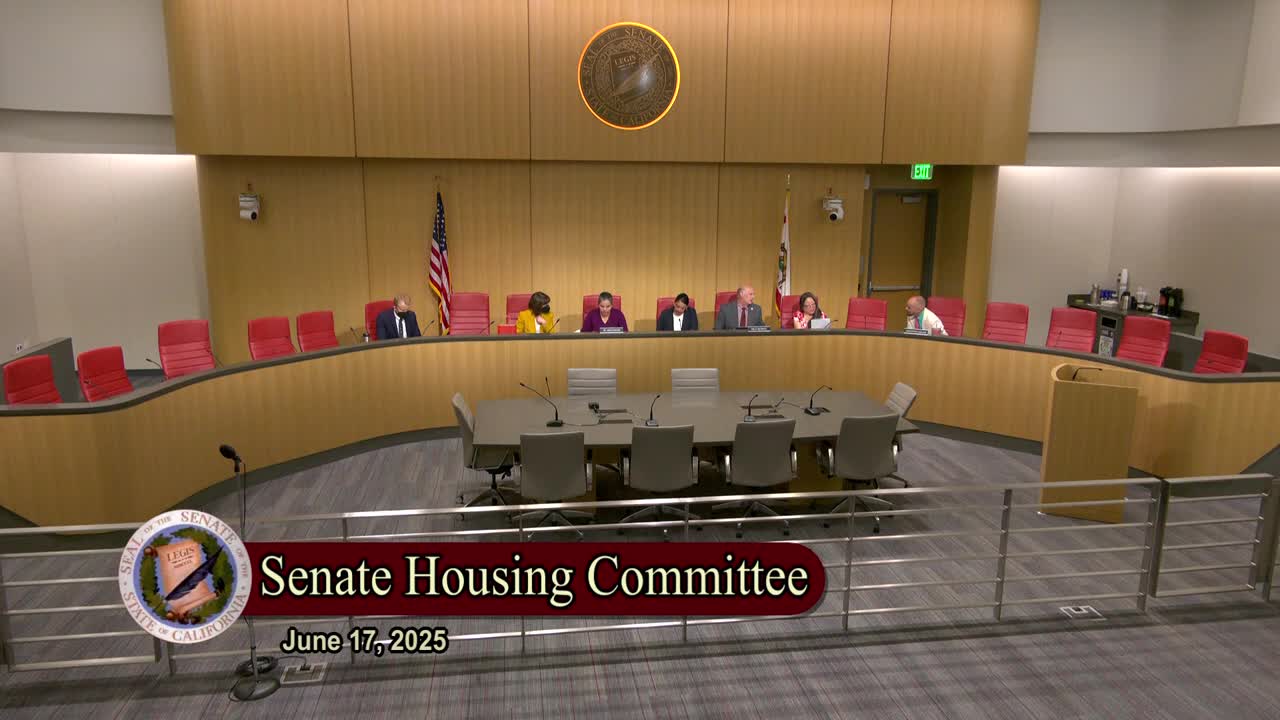 13MIN
Senate Standing Committee on Housing
 2MIN
Assembly Floor
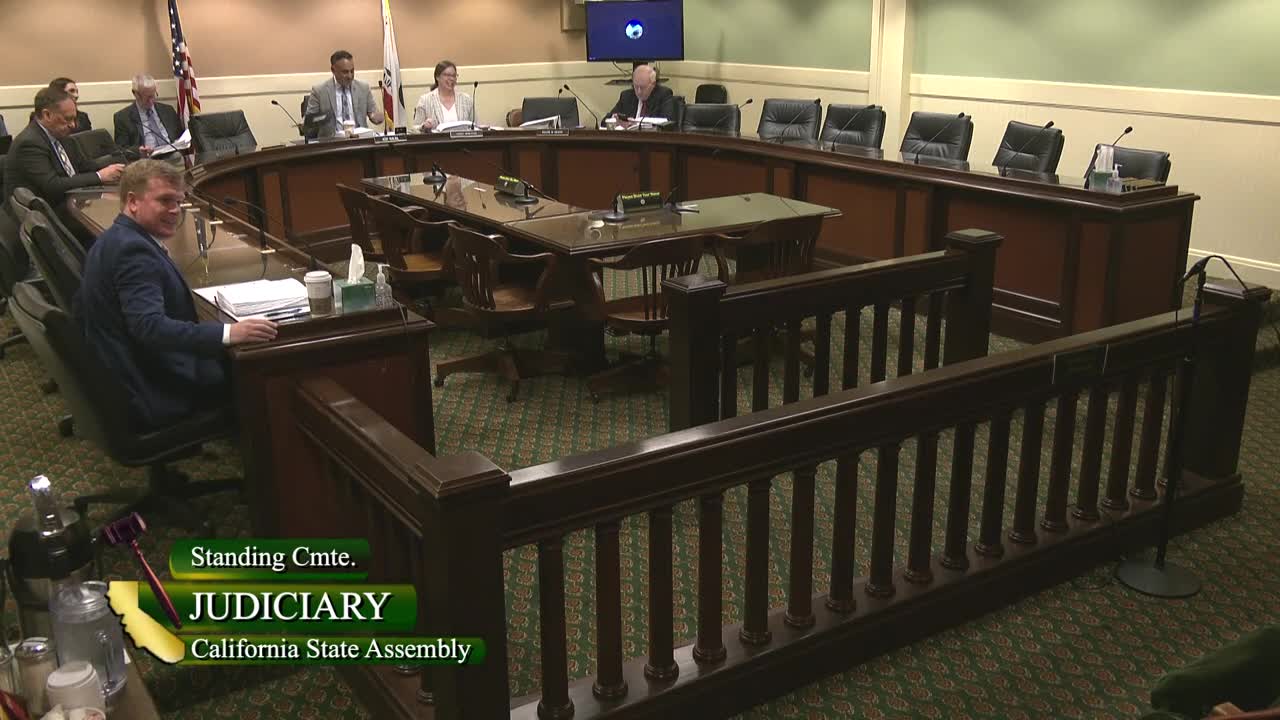 15MIN
Assembly Standing Committee on Judiciary
 20MIN