AB 571: California Environmental Quality Act: exemption: Gypsum Canyon Veterans Cemetery.
- Session Year: 2025-2026
- House: Assembly
- Latest Version Date: 2025-10-01
Current Status:
Passed
(2025-10-01: Chaptered by Secretary of State - Chapter 158, Statutes of 2025.)
Introduced
In Committee
Awaiting First Chamber Vote
Passed First Chamber
In Committee
Awaiting Second Chamber Vote
Passed Second Chamber
Enacted
The California Environmental Quality Act (CEQA) requires a lead agency, as defined, to prepare, or cause to be prepared, and certify the completion of an environmental impact report on a project that it proposes to carry out or approve that may have a significant effect on the environment or to adopt a negative declaration if it finds that the project will not have that effect. CEQA also requires a lead agency to prepare a mitigated negative declaration for a project that may have a significant effect on the environment if revisions in the project would avoid or mitigate that effect and there is no substantial evidence that the project, as revised, would have a significant effect on the environment.
CEQA exempts from its requirements various projects, including, but not limited to, housing projects that meet certain requirements and activities and approvals related to certain prison facilities.
This bill would exempt from the requirements of CEQA any activity or approval necessary for the completion of the Gypsum Canyon Veterans Cemetery in the County of Orange if specified conditions are met. To the extent that a local agency would be required to determine whether an activity or approval qualifies for this exemption, the bill would impose a state-mandated local program. The bill would repeal this provision on January 1, 2030.
This bill would make legislative findings and declarations as to the necessity of a special statute for the Gypsum Canyon Veterans Cemetery in the County of Orange.
The California Constitution requires the state to reimburse local agencies and school districts for certain costs mandated by the state. Statutory provisions establish procedures for making that reimbursement.
This bill would provide that no reimbursement is required by this act for a specified reason.
This bill would declare that it is to take effect immediately as an urgency statute.
The California Environmental Quality Act (CEQA) requires a lead agency, as defined, to prepare, or cause to be prepared, and certify the completion of an environmental impact report on a project that it proposes to carry out or approve that may have a significant effect on the environment or to adopt a negative declaration if it finds that the project will not have that effect. CEQA also requires a lead agency to prepare a mitigated negative declaration for a project that may have a significant effect on the environment if revisions in the project would avoid or mitigate that effect and there is no substantial evidence that the project, as revised, would have a significant effect on the environment.
CEQA exempts from its requirements various projects, including, but not limited to, housing projects that meet certain requirements and activities and approvals related to certain prison facilities.
This bill would exempt from the requirements of CEQA any activity or approval necessary for the completion of the Gypsum Canyon Veterans Cemetery in the County of Orange. Orange if specified conditions are met. To the extent that a local agency would be required to determine whether an activity or approval qualifies for this exemption, the bill would impose a state-mandated local program. The bill would repeal this provision on January 1, 2030.
This bill would make legislative findings and declarations as to the necessity of a special statute for the Gypsum Canyon Veterans Cemetery in the County of Orange.
The California Constitution requires the state to reimburse local agencies and school districts for certain costs mandated by the state. Statutory provisions establish procedures for making that reimbursement.
This bill would provide that no reimbursement is required by this act for a specified reason.
This bill would declare that it is to take effect immediately as an urgency statute.
The California Environmental Quality Act (CEQA) requires a lead agency, as defined, to prepare, or cause to be prepared, and certify the completion of an environmental impact report on a project that it proposes to carry out or approve that may have a significant effect on the environment or to adopt a negative declaration if it finds that the project will not have that effect. CEQA also requires a lead agency to prepare a mitigated negative declaration for a project that may have a significant effect on the environment if revisions in the project would avoid or mitigate that effect and there is no substantial evidence that the project, as revised, would have a significant effect on the environment.
CEQA exempts from its requirements various projects, including, but not limited to, housing projects that meet certain requirements and activities and approvals related to certain prison facilities.
This bill would exempt from the requirements of CEQA any activity or approval necessary for the completion of the Gypsum Canyon Veterans Cemetery in the County of Orange. To the extent that a local agency would be required to determine whether an activity or approval qualifies for this exemption, the bill would impose a state-mandated local program. The bill would repeal this provision on January 1, 2030.
This bill would make legislative findings and declarations as to the necessity of a special statute for the County of Orange.
The California Constitution requires the state to reimburse local agencies and school districts for certain costs mandated by the state. Statutory provisions establish procedures for making that reimbursement.
This bill would provide that no reimbursement is required by this act for a specified reason.
This bill would declare that it is to take effect immediately as an urgency statute.
(a)The Legislature finds and declares the following:
(1)The County of Orange has been identified as the states largest county without a veterans cemetery, despite the fact that the County of Orange is home to United States Army, Navy, and Marine Corps bases and more than 90,000 veterans.
(2)Since 2014, the Legislature has enacted multiple measures related to the Southern California Veterans Cemetery, underscoring the states commitment to providing a final resting place for veterans in the County of Orange.
(3)The County of Orange and all 34 cities in the county have formally adopted resolutions in support of developing a Southern California Veterans Cemetery at Gypsum Canyon. Additionally, the Veterans Alliance of Orange County, a coalition representing numerous veterans organizations, has officially endorsed the project.
(4)In recognition of the urgent need for a veterans and public cemetery, the County of Orange deeded 200 acres of publicly owned land to the Orange County Cemetery District for the construction of a veterans cemetery and an adjacent public cemetery.
(5)The Gypsum Canyon site has undergone extensive environmental review, including a planning-level environmental impact report (EIR), certified in 2005. In 2024, the Anaheim City Council unanimously approved an EIR addendum for the cemetery project, confirming that the proposed development is within the scope of the previously certified EIR.
(6)The proposed cemetery represents a less intensive land use than the uses contemplated under the prior EIR. As such, additional review pursuant to the California Environmental Quality Act (Division 13 (commencing with Section 21000) of the Public Resources Code) is not necessary.
(7)The Orange County Board of Supervisors, the Orange County Cemetery District, and the Department of Veterans Affairs have collaborated to advance the cemetery project while evaluating shared cost options to maximize efficiency in development and operations.
(8)The proposed Gypsum Canyon Veterans Cemetery project provides the specific public benefit of honoring military veterans.
(b)It is, therefore, the intent of the Legislature in enacting this measure to remove barriers that may delay the construction of the Gypsum Canyon Cemetery and to facilitate the timely establishment of this long overdue cemetery for County of Orange veterans, first responders, allied veterans, and their families.
SEC. 2.Section 21080.62 is added to the Public Resources Code, to read:21080.62.(a)This division does not apply to any activity or approval necessary for the completion of the public and state veterans cemetery in Gypsum Canyon in the County of Orange, known as the Gypsum Canyon Veterans Cemetery if both of the following conditions are met:
(1)The public and state veterans cemetery in Gypsum Canyon is a less intensive land use than the project analyzed in the 2005 certified environmental impact report Mountain Park Specific Plan Amendment.
(2)The Gypsum Canyon Cemetery Project Development Project No. 2020-00204 Addendum to the 2005 Certified Environmental Impact Report No. 331 analyzed the impacts of the public and state veterans cemetery in Gypsum Canyon.
(b)This section shall remain in effect only until January 1, 2030, and as of that date is repealed.
SEC. 3.The Legislature finds and declares that a special statute is necessary and that a general statute cannot be made applicable within the meaning of Section 16 of Article IV of the California Constitution because the County of Orange, the states largest county without a veterans cemetery, requires specific legislative action to establish the Gypsum Canyon Veterans Cemetery and provide a final resting place for its veterans.
SEC. 4.No reimbursement is required by this act pursuant to Section 6 of Article XIIIB of the California Constitution because a local agency or school district has the authority to levy service charges, fees, or assessments sufficient to pay for the program or level of service mandated by this act, within the meaning of Section 17556 of the Government Code.
SEC. 5.This act is an urgency statute necessary for the immediate preservation of the public peace, health, or safety within the meaning of Article IV of the California Constitution and shall go into immediate effect. The facts constituting the necessity are:
The County of Orange is the largest county in the state without a veterans cemetery and requires immediate legislative action to facilitate the construction of the Gypsum Canyon Veterans Cemetery. In order to ensure the honorable and respectful treatment of veterans in the County of Orange in the county they called home, it is necessary that this act take effect immediately.
(a)The Legislature finds and declares the following:
(1)The County of Orange has been identified as the states largest county without a veterans cemetery, despite the fact that the County of Orange is home to United States Army, Navy, and Marine Corps bases and more than 90,000 veterans.
(2)Since 2014, the Legislature has enacted multiple measures related to the Southern California Veterans Cemetery, underscoring the states commitment to providing a final resting place for veterans in the County of Orange.
(3)The County of Orange and all 34 cities in the county have formally adopted resolutions in support of developing a Southern California Veterans Cemetery at Gypsum Canyon. Additionally, the Veterans Alliance of Orange County, a coalition representing numerous veterans organizations, has officially endorsed the project.
(4)In recognition of the urgent need for a veterans and public cemetery, the County of Orange deeded 200 acres of publicly owned land to the Orange County Cemetery District for the construction of a veterans cemetery and an adjacent public cemetery.
(5)The Gypsum Canyon site has undergone extensive environmental review, including a planning-level environmental impact report (EIR), certified in 2005. In 2024, the Anaheim City Council unanimously approved an EIR addendum for the cemetery project, confirming that the proposed development is within the scope of the previously certified EIR.
(6)The proposed cemetery represents a less intensive land use than the uses contemplated under the prior EIR. As such, additional review pursuant to the California Environmental Quality Act (Division 13 (commencing with Section 21000) of the Public Resources Code) is not necessary.
(7)The Orange County Board of Supervisors, the Orange County Cemetery District, and the Department of Veterans Affairs have collaborated to advance the cemetery project while evaluating shared cost options to maximize efficiency in development and operations.
(8)The proposed Gypsum Canyon Veterans Cemetery project provides the specific public benefit of honoring military veterans.
(b)It is, therefore, the intent of the Legislature in enacting this measure to remove barriers that may delay the construction of the Gypsum Canyon Cemetery and to facilitate the timely establishment of this long overdue cemetery for County of Orange veterans, first responders, allied veterans, and their families.
SEC. 2.Section 21080.62 is added to the Public Resources Code, to read:21080.62.(a)This division does not apply to any activity or approval necessary for the completion of the public and state veterans cemetery in Gypsum Canyon in the County of Orange, known as the Gypsum Canyon Veterans Cemetery. Cemetery if both of the following conditions are met:
(1)The public and state veterans cemetery in Gypsum Canyon is a less intensive land use than the project analyzed in the 2005 certified environmental impact report Mountain Park Specific Plan Amendment.
(2)The Gypsum Canyon Cemetery Project Development Project No. 2020-00204 Addendum to the 2005 Certified Environmental Impact Report No. 331 analyzed the impacts of the public and state veterans cemetery in Gypsum Canyon.
(b)This section shall remain in effect only until January 1, 2030, and as of that date is repealed.
SEC. 3.The Legislature finds and declares that a special statute is necessary and that a general statute cannot be made applicable within the meaning of Section 16 of Article IV of the California Constitution because the County of Orange, the states largest county without a veterans cemetery, requires specific legislative action to establish the Gypsum Canyon Veterans Cemetery and provide a final resting place for its veterans.
SEC. 4.No reimbursement is required by this act pursuant to Section 6 of Article XIIIB of the California Constitution because a local agency or school district has the authority to levy service charges, fees, or assessments sufficient to pay for the program or level of service mandated by this act, within the meaning of Section 17556 of the Government Code.
SEC. 5.This act is an urgency statute necessary for the immediate preservation of the public peace, health, or safety within the meaning of Article IV of the California Constitution and shall go into immediate effect. The facts constituting the necessity are:
The County of Orange is the largest county in the state without a veterans cemetery and requires immediate legislative action to facilitate the construction of the Gypsum Canyon Veterans Cemetery. In order to ensure the honorable and respectful treatment of veterans in the County of Orange in the county they called home, it is necessary that this act take effect immediately.
(a)The Legislature finds and declares the following:
(1)The County of Orange has been identified as the states largest county without a veterans cemetery, despite the fact that the County of Orange is home to United States Army, Navy, and Marine Corps bases and more than 90,000 veterans.
(2)Since 2014, the Legislature has enacted multiple measures related to the Southern California Veterans Cemetery, underscoring the states commitment to providing a final resting place for veterans in the County of Orange.
(3)The County of Orange and all 34 cities in the county have formally adopted resolutions in support of developing a Southern California Veterans Cemetery at Gypsum Canyon. Additionally, the Veterans Alliance of Orange County, a coalition representing numerous veterans organizations, has officially endorsed the project.
(4)In recognition of the urgent need for a veterans and public cemetery, the County of Orange deeded 200 acres of publicly owned land to the Orange County Cemetery District for the construction of a veterans cemetery and an adjacent public cemetery.
(5)The Gypsum Canyon site has undergone extensive environmental review, including a planning-level environmental impact report (EIR), certified in 2005. In 2024, the Anaheim City Council unanimously approved an EIR addendum for the cemetery project, confirming that the proposed development is within the scope of the previously certified EIR.
(6)The proposed cemetery represents a less intensive land use than the uses contemplated under the prior EIR. As such, additional review pursuant to the California Environmental Quality Act (Division 13 (commencing with Section 21000) of the Public Resources Code) is not necessary.
(7)The Orange County Board of Supervisors, the Orange County Cemetery District, and the Department of Veterans Affairs have collaborated to advance the cemetery project while evaluating shared cost options to maximize efficiency in development and operations.
(8)The proposed Gypsum Canyon Veterans Cemetery project provides the specific public benefit of honoring military veterans.
(b)It is, therefore, the intent of the Legislature in enacting this measure to remove barriers that may delay the construction of the Gypsum Canyon Cemetery and to facilitate the timely establishment of this long overdue cemetery for County of Orange veterans, first responders, allied veterans, and their families.
SECTION 1.SEC. 2.Section 21080.62 is added to the Public Resources Code, to read:21080.62.(a)This division does not apply to any activity or approval necessary for the completion of the public and state veterans cemetery in Gypsum Canyon in the County of Orange, known as the Gypsum Canyon Veterans Cemetery.
(b)This section shall remain in effect only until January 1, 2030, and as of that date is repealed.
SEC. 2.SEC. 3.The Legislature finds and declares that a special statute is necessary and that a general statute cannot be made applicable within the meaning of Section 16 of Article IV of the California Constitution because the County of Orange, the states largest county without a veterans cemetery, requires specific legislative action to establish the Gypsum Canyon Veterans Cemetery and provide a final resting place for its veterans.
SEC. 3.SEC. 4.No reimbursement is required by this act pursuant to Section 6 of Article XIIIB of the California Constitution because a local agency or school district has the authority to levy service charges, fees, or assessments sufficient to pay for the program or level of service mandated by this act, within the meaning of Section 17556 of the Government Code.
SEC. 4.SEC. 5.This act is an urgency statute necessary for the immediate preservation of the public peace, health, or safety within the meaning of Article IV of the California Constitution and shall go into immediate effect. The facts constituting the necessity are:
The County of Orange is the largest county in the state without a veterans cemetery and requires immediate legislative action to facilitate the construction of the Gypsum Canyon Veterans Cemetery. In order to ensure the honorable and respectful treatment of veterans in the County of Orange in the county they called home, it is necessary that this act take effect immediately.
REVISIONS: HeadingLine 3.(a)This division does not apply to any activity or approval necessary for the completion of the public and state veterans cemetery in Gypsum Canyon in the County of Orange, known as the Gypsum Canyon Veterans Cemetery.
(b)This section shall remain in effect only until January 1, 2030, and as of that date is repealed.
SEC. 2.The Legislature finds and declares that a special statute is necessary and that a general statute cannot be made applicable within the meaning of Section 16 of Article IV of the California Constitution because the County of Orange, the states largest county without a veterans cemetery, requires specific legislative action to establish the Gypsum Canyon Veterans Cemetery and provide a final resting place for its veterans.
SEC. 3.No reimbursement is required by this act pursuant to Section 6 of Article XIIIB of the California Constitution because a local agency or school district has the authority to levy service charges, fees, or assessments sufficient to pay for the program or level of service mandated by this act, within the meaning of Section 17556 of the Government Code.
SEC. 4.This act is an urgency statute necessary for the immediate preservation of the public peace, health, or safety within the meaning of Article IV of the California Constitution and shall go into immediate effect. The facts constituting the necessity are:
The County of Orange is the largest county in the state without a veterans cemetery and requires immediate legislative action to facilitate the construction of the Gypsum Canyon Veterans Cemetery. In order to ensure the honorable and respectful treatment of veterans in the County of Orange in the county they called home, it is necessary that this act take effect immediately.
|
Date
|
Status
|
|---|---|
| Oct 1, 2025 | Chaptered by Secretary of State - Chapter 158, Statutes of 2025. |
| Oct 1, 2025 | Approved by the Governor. |
| Sep 9, 2025 | Enrolled and presented to the Governor at 3 p.m. |
| Sep 3, 2025 | Senate amendments concurred in. To Engrossing and Enrolling. (Ayes 79. Noes 0. Page 2858.). |
| Sep 2, 2025 | In Assembly. Concurrence in Senate amendments pending. |
| Sep 2, 2025 | Read third time. Urgency clause adopted. Passed. Ordered to the Assembly. (Ayes 40. Noes 0. Page 2393.). |
| Aug 20, 2025 | Read second time. Ordered to third reading. |
| Aug 19, 2025 | From committee: Be ordered to second reading pursuant to Senate Rule 28.8. |
| Jul 15, 2025 | From committee: Do pass and re-refer to Com. on APPR. (Ayes 5. Noes 0.) (July 14). Re-referred to Com. on APPR. |
| Jun 19, 2025 | Read second time and amended. Re-referred to Com. on M. & V.A. |
| Jun 18, 2025 | From committee: Amend, and do pass as amended and re-refer to Com. on M. & V.A. with recommendation: To Consent Calendar. (Ayes 6. Noes 0.) (June 18). |
| May 28, 2025 | Referred to Coms. on E.Q. and M. & V.A. |
| May 20, 2025 | In Senate. Read first time. To Com. on RLS. for assignment. |
| May 19, 2025 | Read third time. Urgency clause adopted. Passed. Ordered to the Senate. (Ayes 75. Noes 0. Page 1595.). |
| May 8, 2025 | Read second time. Ordered to third reading. |
| May 7, 2025 | From committee: Do pass. (Ayes 15. Noes 0.) (May 7). |
| Apr 30, 2025 | From committee: Do pass and re-refer to Com. on APPR. (Ayes 8. Noes 0.) (April 29). Re-referred to Com. on APPR. |
| Apr 30, 2025 | Coauthors revised. |
| Apr 21, 2025 | Re-referred to Com. on M. & V.A. |
| Apr 10, 2025 | Read second time and amended. |
| Apr 9, 2025 | From committee: Amend, and do pass as amended and re-refer to Com. on M. & V.A. (Ayes 14. Noes 0.) (April 7). |
| Mar 3, 2025 | Referred to Coms. on NAT. RES. and M. & V.A. |
| Feb 13, 2025 | From printer. May be heard in committee March 15. |
| Feb 12, 2025 | Read first time. To print. |
|
Date
|
Description
|
Location
|
Votes
|
|
|---|---|---|---|---|
| Sep 3, 2025 | The committee on CAA recommend that the measure be PASSED, UNAMENDED | Assembly Floor |
Passed |
|
| Sep 2, 2025 | The committee(s) on PSM recommend(s) that the measure be PASSED, UNAMENDED | Senate Floor |
Passed |
|
| Jul 14, 2025 | Do pass, but first be re-referred to the Committee on [Appropriations] | Senate Standing Committee on Military and Veterans Affairs |
Passed |
|
| Jun 18, 2025 | Do pass as amended, but first amend, and re-refer to the Committee on [Military and Veterans Affairs] with the recommendation: To Consent Calendar | Senate Standing Committee on Environmental Quality |
Passed |
|
| May 19, 2025 | AB 571 Quirk-Silva Third Reading Urgency | Assembly Floor |
Passed |
|
| May 7, 2025 | Do pass. | Assembly Standing Committee on Appropriations |
Passed |
|
| Apr 29, 2025 | Do pass and be re-referred to the Committee on [Appropriations] | Assembly Standing Committee on Military and Veterans Affairs |
Passed |
|
| Apr 7, 2025 | Do pass as amended and be re-referred to the Committee on [Military and Veterans Affairs] | Assembly Standing Committee on Natural Resources |
Passed |
This list shows positions taken on this bill by organizations on the date displayed, which is linked to the original source.
Positions by individuals are not included.
|
Organization
|
Position
|
Date
|
|---|---|---|
| 38Alpha | ** Support | |
| American Legion, Department Of California | ** Support | |
| Amvets, Department Of California | ** Support | |
| AMVETS Hal Camp Post 18 | ** Support | |
| AMVETS Post 18 | ** Support | |
| Anaheim Firefighters Association Local 2899 | ** Support | |
| Anaheim Police Association | ** Support | |
| Association of California Cities - Orange County | ** Support | |
| Association of The United States Army, Greater Los Angeles Chapter | ** Support | |
| California Association Of County Veterans Service Officers | ** Support | |
| California-Hawaii State Conference Of The Naacp | ** Support | |
| California State Commanders Veterans Council | ** Support | |
| city of laguna niguel | ** Support | |
| Filipino American Chamber of Commerce of Orange County | ** Support | |
| Heroes Hall Veterans Foundation | ** Support | |
| Military Officers Association Of America, California Council Of Chapters | ** Support | |
| Orange County | ** Support | |
| Orange County Cemetery District | ** Support | |
| Orange County Employees Association | ** Support | |
| Orange County Professional Firefighters Association, Local 3631 | ** Support | |
| Orange County Veterans and Military Families Collaborative | ** Support | |
| Private Citizen | ** Support | |
| Saddleback Valley Chapter, American Gold STAR Mothers | ** Support | |
| Saddleback Valley Chapter, American Gold STAR Mothers, INC. | ** Support | |
| VETERANS ALLIANCE OF ORANGE COUNTY | ** Support | |
| Veterans of Foreign Wars Post 3173 | ** Support | |
| Vietnam Veterans Of America, California State Council | ** Support |
CONCURRENCE IN SENATE AMENDMENTS
CSA1 Bill Id:AB 571
Author:(Quirk-Silva)
As Amended Ver:June 19, 2025
2/3 vote. Urgency
SUMMARY
Exempts the proposed Gypsum Canyon Veterans Cemetery in Anaheim, Orange County from further review under the California Environmental Quality Act (CEQA).
Senate Amendments
Add the following conditions to the exemption:
- The cemetery is a less intensive land use than the project analyzed in the 2005 certified environmental impact report Mountain Park Specific Plan Amendment.
- The Gypsum Canyon Cemetery Project Development Project No. 2020-00204 Addendum to the 2005 Certified Environmental Impact Report No. 331 analyzed the impacts of the cemetery.
COMMENTS
The Gypsum Canyon Veterans Cemetery project was approved by the Anaheim City Council on July 22, 2024. The proposed cemetery lies on a 283-acre site within a former quarry in the hills on the eastern edge of Anaheim.
In 2005, the city certified a Specific Plan EIR for a large housing development on the site, known as Mountain Park. According to the EIR, the Mountain Park Specific Plan allows for the development of an 830-acre, gated residential community with a maximum of 2,500 residential units, public facilities, infrastructure, a fire station, public trails, trail staging area, concession store/interpretive center, school site, and public community park. The cemetery project was reviewed via an addendum to the 2005 Specific Plan EIR.
On August 20, 2024, proponents of an alternative proposed veterans cemetery at Great Park in Irvine filed a lawsuit against Anaheim and the Orange County Cemetery District. The petitioners claimed that the city's approval violated CEQA by relying on an outdated EIR. The case, Build the Great Park Veterans Cemetery, et al v. City of Anaheim, was filed in Orange County Superior Court.
Respondents, including intervenor Orange County, jointly filed a demurrer, arguing the case should be dismissed because the petitioners failed to exhaust their administrative remedies – namely, by not requesting a rehearing after the city approved the project. The trial court sustained the demurrer and granted the petitioners leave to amend, directing them to first follow the city’s appeals process before seeking judicial relief.
Rather than pursuing an administrative appeal, the petitioners amended their complaint to include new allegations asserting they had exhausted their remedies, citing a letter sent to the city in July 2024. However, on March 13, 2025, the court again sustained the demurrer – this time without leave to amend – effectively dismissing the lawsuit in its entirety.
According to the Author
Our veterans gave everything to protect our freedoms. "All gave some, and some gave all." After years of advocating for the Southern California Veterans Cemetery, AB 571 is the crucial tool we need to deliver on a promise we owe to our veterans and their families. This cemetery will be their final resting place, a place of honor and dignity. The time has come for Orange County to be home to the heroes who defended our country. We cannot afford to delay any longer.
Arguments in Support
According to Orange County, AB 571 will accelerate construction of a project that has already undergone extensive environmental review, secured $50 million in local and state funding, and has secured an unprecedented coalition in strong support. Now is the time to turn this vision into a reality, ensuring Orange County's veterans and their families finally receive the dignified final resting place they deserve.
Arguments in Opposition
None received.
FISCAL COMMENTS
According to the Senate Appropriations Committee, pursuant to Senate Rule 28.8, negligible state costs.
VOTES:
ASM NATURAL RESOURCES: 14-0-0
YES: Bryan, Alanis, Connolly, Ellis, Flora, Garcia, Haney, Hoover, Kalra, Muratsuchi, Pellerin, Schultz, Wicks, Zbur
ASM MILITARY AND VETERANS AFFAIRS: 8-0-0
YES: Schiavo, Jeff Gonzalez, Ávila Farías, Carrillo, Davies, Michelle Rodriguez, Sharp-Collins, Valencia
ASM APPROPRIATIONS: 15-0-0
YES: Wicks, Sanchez, Arambula, Calderon, Caloza, Dixon, Elhawary, Fong, Mark González, Hart, Pacheco, Pellerin, Solache, Ta, Tangipa
ASSEMBLY FLOOR: 75-0-4
YES: Addis, Aguiar-Curry, Ahrens, Alanis, Alvarez, Arambula, Ávila Farías, Bains, Bauer-Kahan, Bennett, Berman, Boerner, Bonta, Bryan, Calderon, Caloza, Carrillo, Castillo, Chen, Connolly, Davies, DeMaio, Elhawary, Ellis, Fong, Gabriel, Gallagher, Garcia, Gipson, Mark González, Hadwick, Haney, Harabedian, Hart, Hoover, Irwin, Jackson, Kalra, Krell, Lackey, Lee, Lowenthal, Macedo, McKinnor, Muratsuchi, Nguyen, Ortega, Pacheco, Patel, Patterson, Pellerin, Petrie-Norris, Quirk-Silva, Ramos, Ransom, Celeste Rodriguez, Michelle Rodriguez, Rogers, Blanca Rubio, Sanchez, Schiavo, Schultz, Sharp-Collins, Solache, Soria, Stefani, Ta, Tangipa, Valencia, Wallis, Ward, Wicks, Wilson, Zbur, Rivas
ABS, ABST OR NV: Dixon, Flora, Jeff Gonzalez, Papan
SENATE FLOOR: 40-0-0
YES: Allen, Alvarado-Gil, Archuleta, Arreguín, Ashby, Becker, Blakespear, Cabaldon, Caballero, Cervantes, Choi, Cortese, Dahle, Durazo, Gonzalez, Grayson, Grove, Hurtado, Jones, Laird, Limón, McGuire, McNerney, Menjivar, Niello, Ochoa Bogh, Padilla, Pérez, Reyes, Richardson, Rubio, Seyarto, Smallwood-Cuevas, Stern, Strickland, Umberg, Valladares, Wahab, Weber Pierson, Wiener
UPDATED
VERSION: June 19, 2025
CONSULTANT: Lawrence Lingbloom / NAT. RES. / (916) 319-2092 FN: 0001529
SENATE RULES COMMITTEE Office of Senate Floor Analyses (916) 651-1520 Fax: (916) 327-4478 | AB 571 |
THIRD READING
Bill No: AB 571
Author: Quirk-Silva (D), et al.
Amended: 6/19/25 in Senate
Vote: 27 - Urgency
SENATE ENVIRONMENTAL QUALITY COMMITTEE: 6-0, 6/18/25
AYES: Blakespear, Valladares, Dahle, Hurtado, Menjivar, Pérez
NO VOTE RECORDED: Gonzalez, Padilla
SENATE MILITARY & VETERANS COMMITTEE: 5-0, 7/14/25
AYES: Archuleta, Grove, McNerney, Menjivar, Umberg
SENATE APPROPRIATIONS COMMITTEE: Senate Rule 28.8
ASSEMBLY FLOOR: 75-0, 5/19/25 - See last page for vote
SUBJECT: California Environmental Quality Act: exemption: Gypsum Canyon Veterans Cemetery
SOURCE: Author
DIGEST:
This bill exempts the proposed Gypsum Canyon Veterans Cemetery in Anaheim, Orange County from further review under the California Environmental Quality Act (CEQA).
ANALYSIS:
Existing law:
- Requires under CEQA that a lead agency determines whether a project is exempt from CEQA, or if it must do an initial study to determine if a project will have significant effects on the environment. If a project has no effect on the environment or effects that can be mitigated, the lead agency prepares a negative declaration (ND) or mitigated ND (MND). If the project will have significant impacts, the lead agency prepares an environmental impact report (EIR) to evaluate and propose mitigation measures for any effects on the environment, including impacts or likely impacts to land, air, water, minerals, flora, fauna, ambient noise, and historic or aesthetic significance. (Public Resources Code (PRC) §§21000 et seq.)
- Requires a subsequent or supplemental EIRs in the cases where:
- Substantial changes are proposed in the project which will require major revisions of the EIR.
- Substantial changes occur with respect to the circumstances under which the project is being undertaken which will require major revisions in the EIR.
- New information, which was not known and could not have been known at the time the EIR was certified as complete, becomes available. (PRC § 21166)
- Requires the lead agency or responsible agency to prepare an addendum to a previously certified EIR if some changes or additions are necessary but none of the conditions described above calling for preparation of a subsequent EIR have occurred. (CEQA Guidelines § 15164)
This bill:
- Exempts from CEQA any activity or approval necessary for the completion of the public and state veteran’s cemetery in Gypsum Canyon in the County of Orange, known as the Gypsum Canyon Veterans Cemetery.
- Sunsets this exemption January 1, 2030
- Specifies that the project must have an EIR for a less intensive land use and must have been analyzed in an addendum to the EIR.
- Makes related findings and declarations.
- Is a special, urgency statute.
Background
The A, B, C’s of CEQA. CEQA is designed to (a) make government agencies and the public aware of the environmental impacts of a proposed project, (b) ensure the public can take part in the review process, and (c) identify and implement measures to mitigate or eliminate any negative impact the project may have on the environment. CEQA is enforced by civil lawsuits that can challenge any project’s environmental review. Under CEQA, projects (unless they have a specific exemption) must undergo environmental analysis. This process starts with an initial study which determines what level of further environmental review is needed for a given project. If a project has no significant effects on the environment, or if those effects can be fully mitigated, the project can move forward with a ND or MND. If the initial study finds that the project has potential significant effects on the environment, then a full EIR is conducted. An EIR provides thorough environmental review of a proposed project, analyzing the significant direct and indirect environmental impacts of a proposed project on water quality, transportation, air quality and greenhouse gas emissions, terrestrial and aquatic biological resources, surface and subsurface hydrology, land use and agricultural resources, aesthetics, geology and soils, recreation, public services and utilities such as water supply and wastewater disposal, and cultural resources, among other factors. The EIR also includes proposed mitigation measures for any significant effects that it identifies and considers alternatives to the proposed project.
Gypsum Canyon Veteran’s Cemetery. The Gypsum Canyon Veterans Cemetery is a proposed cemetery located on a 283-acre site in a former quarry in the hills on the eastern edge of Anaheim. Back in 2005, the city certified a Specific Plan EIR for a large housing development on the site, known as Mountain Park. According to the EIR, the Mountain Park Specific Plan allows for the development of an 830-acre, gated residential community with a maximum of 2,500 residential units, public facilities, infrastructure, a fire station, public trails, trail staging area, concession store/interpretive center, school site, and public community park. The cemetery project was reviewed via an addendum to the 2005 Specific Plan EIR. The Gypsum Canyon Veterans Cemetery project was approved by the Anaheim City Council on July 22, 2024.
However, on August 20, 2024, supporters of an alternative veteran’s cemetery proposal at the Great Park in Irvine filed a lawsuit against the City of Anaheim and the Orange County Cemetery District. The plaintiffs argued that Anaheim had violated the CEQA by relying on an outdated environmental review. The case, Build the Great Park Veterans Cemetery, et al. v. City of Anaheim, was filed in Orange County Superior Court.
In response, the lead agency and other respondents, including intervener Orange County, jointly filed a demurrer, arguing the lawsuit against the Gypsum Canyon Veteran’s Cemetery should be dismissed because the petitioners failed to exhaust their administrative remedies –namely, by not requesting a rehearing after the city approved the project. The trial court sustained the demurrer and granted the petitioners leave to amend, directing them to first follow the city’s appeals process before seeking judicial relief.
Rather than pursuing an administrative appeal, the petitioners amended their complaint to include new allegations asserting they had exhausted their remedies, citing a letter sent to the city in July 2024. However, on March 13, 2025, the court again sustained the demurrer – this time without leave to amend – effectively dismissing the lawsuit in its entirety. The petitioners have 60 days to appeal the decision once the ruling is finalized, which is expected shortly.
Comments
Purpose of this bill. According to the author, “Our veterans gave everything to protect our freedoms. “All gave some, and some gave all.” After years of advocating for the Southern California Veterans Cemetery, AB 571 is the crucial tool we need to deliver on a promise we owe to our veterans and their families. This cemetery will be their final resting place, a place of honor and dignity. The time has come for Orange County to be home to the heroes who defended our country. We cannot afford to delay any longer.”
Recognizing the special circumstances of Gypsum Canyon Veterans Cemetery. CEQA provides important information on the environmental impacts of a project that can help decision-makers and the public make informed choices on development. CEQA also requires that projects with significant impacts take steps to mitigate those impacts. Typically, a large project that is likely to have significant impact on the environment, such as a cemetery, would need to be subject to CEQA in order to understand and potentially mitigate those impacts.
However, the Gypsum Canyon Veteran’s Cemetery may be a unique case, because it has already undergone recent environmental review under CEQA. In 2005, a large housing project was proposed on the site of the Gypsum Canyon Veteran’s Cemetery, and that project was evaluated in a full EIR. The impacts of a housing project are not the same as the impacts that result from a cemetery: however, housing projects are generally higher intensity use than cemeteries. Even more relevant, in 2024, the lead agency approved an addendum to the 2005 EIR. Based off of information in the addendum, the city council found that the original 2005 EIR and addendum:
“…provides an adequate assessment of environmental impacts satisfying the requirements of CEQA supplemental review by fully disclosing new or substantially more severe significant impacts that would occur due to the Project and/or changes under supplemental review standards since certification of the prior EIR”
AB 571 adds numerous guardrails to the CEQA exemption, including specifying that the Veteran’s Cemetery must have a certified EIR for a more intensive land use and an addendum to the EIR for the gypsum canyon veteran’s cemetery project—both of which are already filed for the Gypsum Canyon Veteran’s Cemetery project.
FISCAL EFFECT: Appropriation: No Fiscal Com.: Yes Local: Yes
SUPPORT: (Verified 8/18/25)
American Legion, Department of California
Amvets, Department of California
California State Commanders Veterans Council
California-hawaii State Conference of the NAACP
Military Officers Association of America, California Council of Chapters
Orange County Employees Association
Orange; County of
Vietnam Veterans of America, California State Council
OPPOSITION: (Verified 8/18/25)
ASSEMBLY FLOOR: 75-0, 5/19/25
AYES: Addis, Aguiar-Curry, Ahrens, Alanis, Alvarez, Arambula, Ávila Farías, Bains, Bauer-Kahan, Bennett, Berman, Boerner, Bonta, Bryan, Calderon, Caloza, Carrillo, Castillo, Chen, Connolly, Davies, DeMaio, Elhawary, Ellis, Fong, Gabriel, Gallagher, Garcia, Gipson, Mark González, Hadwick, Haney, Harabedian, Hart, Hoover, Irwin, Jackson, Kalra, Krell, Lackey, Lee, Lowenthal, Macedo, McKinnor, Muratsuchi, Nguyen, Ortega, Pacheco, Patel, Patterson, Pellerin, Petrie-Norris, Quirk-Silva, Ramos, Ransom, Celeste Rodriguez, Michelle Rodriguez, Rogers, Blanca Rubio, Sanchez, Schiavo, Schultz, Sharp-Collins, Solache, Soria, Stefani, Ta, Tangipa, Valencia, Wallis, Ward, Wicks, Wilson, Zbur, Rivas
NO VOTE RECORDED: Dixon, Flora, Jeff Gonzalez, Papan
Prepared by: Brynn Cook / E.Q. / (916) 651-4108
8/20/25 23:11:17
**** END ****
SENATE COMMITTEE ON MILITARY AND VETERANS AFFAIRS
Senator Bob Archuleta, Chair
2025 - 2026 Regular
Bill No: AB 571 Hearing Date: 7/14/25
Author: | Quirk-Silva | ||
Version: | 6/19/25 Amended | ||
Urgency: | Yes | Fiscal: | Yes |
Consultant: | Jenny Callison | ||
Subject: California Environmental Quality Act: exemption: Gypsum Canyon Veterans Cemetery
DESCRIPTION
Summary:
Exempts the proposed Gypsum Canyon Veterans Cemetery in Anaheim, Orange County from further review under the California Environmental Quality Act (CEQA).
Existing law:
- Requires under CEQA that a lead agency determines whether a project is exempt from CEQA, or if it must do an initial study to determine if a project will have significant effects on the environment. If a project has no effect on the environment or effects that can be mitigated, the lead agency prepares a negative declaration (ND) or mitigated ND (MND). If the project will have significant impacts, the lead agency prepares an environmental impact report (EIR) to evaluate and propose mitigation measures for any effects on the environment, including impacts or likely impacts to land, air, water, minerals, flora, fauna, ambient noise, and historic or aesthetic significance. (Public Resources Code (PRC) §§21000 et seq.)
- Requires a subsequent or supplemental EIRs in the cases where:
- Substantial changes are proposed in the project which will require major revisions of the EIR.
- Substantial changes occur with respect to the circumstances under which the project is being undertaken which will require major revisions in the EIR.
- New information, which was not known and could not have been known at the time the EIR was certified as complete, becomes available. (PRC 21166)
- Requires the lead agency or responsible agency to prepare an addendum to a previously certified EIR if some changes or additions are necessary but none of the conditions described above calling for preparation of a subsequent EIR have occurred. (CEQA Guidelines 15164)
This bill:
- Exempts from CEQA any activity or approval necessary for the completion of the public and state veteran’s cemetery in Gypsum Canyon in the County of Orange, known as the Gypsum Canyon Veterans Cemetery, and sunsets this exemption January 1, 2030
- Makes related findings and declarations, including that the Gypsum Canyon site has undergone extensive environmental review, through a certified EIR in 2005 and an approved EIR addendum in 2024, and noting that the proposed cemetery represents a less intensive land use than the uses contemplated under the prior EIR.
- Is a special, urgency statute.
BACKGROUND
By population, Orange County is the sixth largest county in the United States and is the largest
county in the State without a veterans cemetery. It is home to more than 115,000 veterans. In
Southern California, the closest veterans cemeteries with burial spaces still available are in San
Diego and Riverside counties. The legislative pursuit of a veterans cemetery in Orange County
began with the January 2014 introduction and later passing of State Assembly Bill 1453.
The Anaheim City Council approved the Gypsum Canyon location on July 22, 2024. The location lies on a 283-acre site within a former quarry in the hills on the eastern edge of Anaheim. The approved Cemetery plans to split the plot of land in the Anaheim Hills into two cemeteries, one for the general public and one for veterans. The first phase will include 11,000 burial plots for veterans and over 4,000 columbarium niches, estimated to cost $66 million. Construction is slated to begin in 2026, with a potential opening for burials in 2027. There are plans for 10 phases over the next 100 years, with the first phase focusing on cremation remains.
In 2005, the city certified a Specific Plan EIR for a large housing development on the site, known as Mountain Park. According to the EIR, the Mountain Park Specific Plan allows for the development of an 830-acre, gated residential community with a maximum of 2,500 residential units, public facilities, infrastructure, a fire station, public trails, a trail staging area, a concession store/interpretive center, a school site, and a public community park. The cemetery project was reviewed via an addendum to the 2005 Specific Plan EIR.
COMMENT
According to the Senate Environmental Quality Committee: CEQA provides important information on the environmental impacts of a project that can help decision-makers and the public make informed choices on development. CEQA also requires that projects with significant impacts take steps to mitigate those impacts. Typically, a large project that is likely to have significant impact on the environment, such as a cemetery, would need to be subject to CEQA in order to understand and potentially mitigate those impacts.
However, the Gypsum Canyon Veteran’s Cemetery may be a unique case, because it has already undergone recent environmental review under CEQA. In 2005, a large housing project was proposed on the site of the Gypsum Canyon Veteran’s Cemetery, and that project was evaluated in a full EIR. The impacts of a housing project are not the same as the impacts that result from a cemetery: however, housing projects are generally higher intensity use than cemeteries. Even more relevant, in 2024, the lead agency approved an addendum to the 2005 EIR. Based off of information in the addendum, the city council found that the original 2005 EIR and addendum:
“…provides an adequate assessment of environmental impacts satisfying the requirements of CEQA supplemental review by fully disclosing new or substantially more severe significant impacts that would occur due to the Project and/or changes under supplemental review standards since certification of the prior EIR”
According to the author, “Our veterans gave everything to protect our freedoms. “All gave some, and some gave all.” After years of advocating for the Southern California Veterans Cemetery, AB 571 is the crucial tool we need to deliver on a promise we owe to our veterans and their families. This cemetery will be their final resting place, a place of honor and dignity. The time has come for Orange County to be home to the heroes who defended our country. We cannot afford to delay any longer.”
Currently, the Orange County Board of Supervisors, all 34 Cities in the county, and a bipartisan majority of the county’s federal and state delegation, as well as public safety, labor organizations, and veterans organizations, are in support of the Southern California at Gypsum Canyon in Anaheim.
POSITIONS
Sponsor: County of Orange.
Support: 38alpha
American Legion, Department of California
AMVETs Hal Camp Post 18
AMVETs, Department of California
Anaheim Firefighters Association Local 2899
Anaheim Police Association
Association of California Cities - Orange County (ACC-OC)
Association of the United States Army, Greater Los Angeles Chapter
California Association of County Veterans Service Officers
California State Commanders Veterans Council
California-Hawaii State Conference of the NAACP
City of Laguna Niguel
Filipino American Chamber of Commerce of Orange County
Heroes Hall Veterans Foundation
Military Officers Association of America, California Council of Chapters
Orange County Cemetery District
Orange County Employees Association
Orange County Professional Firefighters Association, Local 3631
Orange County Veterans and Military Families Collaborative (OCVMFC)
Orange; County of
Private Citizen
Saddleback Valley Chapter, American Gold STAR Mothers, INC.
Veterans Alliance of Orange County (VALOR)
Veterans of Foreign Wars Post 3173
Vietnam Veterans of America, California State Council
Oppose: None on File.
-- END --
SENATE COMMITTEE ON ENVIRONMENTAL QUALITY
Senator Blakespear, Chair
2025 - 2026 Regular
Bill No: AB 571
Author: | Quirk-Silva | ||
Version: | 4/10/2025 | Hearing Date: | 6/18/2025 |
Urgency: | Yes | Fiscal: | Yes |
Consultant: | Brynn Cook | ||
SUBJECT: California Environmental Quality Act: exemption: Gypsum Canyon Veterans Cemetery
DIGEST: This bill exempts the proposed Gypsum Canyon Veterans Cemetery in Anaheim, Orange County from further review under the California Environmental Quality Act (CEQA).
ANALYSIS:
Existing law:
- Requires under CEQA that a lead agency determines whether a project is exempt from CEQA, or if it must do an initial study to determine if a project will have significant effects on the environment. If a project has no effect on the environment or effects that can be mitigated, the lead agency prepares a negative declaration (ND) or mitigated ND (MND). If the project will have significant impacts, the lead agency prepares an environmental impact report (EIR) to evaluate and propose mitigation measures for any effects on the environment, including impacts or likely impacts to land, air, water, minerals, flora, fauna, ambient noise, and historic or aesthetic significance. (Public Resources Code (PRC) §§21000 et seq.)
- Requires a subsequent or supplemental EIRs in the cases where:
- Substantial changes are proposed in the project which will require major revisions of the EIR.
- Substantial changes occur with respect to the circumstances under which the project is being undertaken which will require major revisions in the EIR.
- New information, which was not known and could not have been known at the time the EIR was certified as complete, becomes available. (PRC 21166)
- Requires the lead agency or responsible agency to prepare an addendum to a previously certified EIR if some changes or additions are necessary but none of the conditions described above calling for preparation of a subsequent EIR have occurred. (CEQA Guidelines 15164)
This bill:
- Exempts from CEQA any activity or approval necessary for the completion of the public and state veteran’s cemetery in Gypsum Canyon in the County of Orange, known as the Gypsum Canyon Veterans Cemetery.
- Sunsets this exemption January 1, 2030
- Makes related findings and declarations, including that the Gypsum Canyon site has undergone extensive environmental review, through a certified EIR in 2005 and an approved EIR addendum in 2024, and noting that the proposed cemetery represents a less intensive land use than the uses contemplated under the prior EIR.
- Is a special, urgency statute.
Background
- The A, B, C’s of CEQA. CEQA is designed to (a) make government agencies and the public aware of the environmental impacts of a proposed project, (b) ensure the public can take part in the review process, and (c) identify and implement measures to mitigate or eliminate any negative impact the project may have on the environment. CEQA is enforced by civil lawsuits that can challenge any project’s environmental review. Under CEQA, projects (unless they have a specific exemption) must undergo environmental analysis. This process starts with an initial study which determines what level of further environmental review is needed for a given project. If a project has no significant effects on the environment, or if those effects can be fully mitigated, the project can move forward with a negative declaration (ND) or mitigated negative declaration (MND). If the initial study finds that the project has potential significant effects on the environment, then a full EIR is conducted. An EIR provides thorough environmental review of a proposed project, analyzing the significant direct and indirect environmental impacts of a proposed project on water quality, transportation, air quality and greenhouse gas emissions, terrestrial and aquatic biological resources, surface and subsurface hydrology, land use and agricultural resources, aesthetics, geology and soils, recreation, public services and utilities such as water supply and wastewater disposal, and cultural resources, among other factors. The EIR also includes proposed mitigation measures for any significant effects that it identifies and considers alternatives to the proposed project.
- Gypsum Canyon Veteran’s Cemetery. The Gypsum Canyon Veterans Cemetery is a proposed cemetery located on a 283-acre site in a former quarry in the hills on the eastern edge of Anaheim. Back in 2005, the city certified a Specific Plan EIR for a large housing development on the site, known as Mountain Park. According to the EIR, the Mountain Park Specific Plan allows for the development of an 830-acre, gated residential community with a maximum of 2,500 residential units, public facilities, infrastructure, a fire station, public trails, trail staging area, concession store/interpretive center, school site, and public community park. The cemetery project was reviewed via an addendum to the 2005 Specific Plan EIR. The Gypsum Canyon Veterans Cemetery project was approved by the Anaheim City Council on July 22, 2024.
However, on August 20, 2024, supporters of an alternative veteran’s cemetery proposal at the Great Park in Irvine filed a lawsuit against the City of Anaheim and the Orange County Cemetery District. The plaintiffs argued that Anaheim had violated the CEQA by relying on an outdated environmental review. The case, Build the Great Park Veterans Cemetery, et al. v. City of Anaheim, was filed in Orange County Superior Court.
In response, the lead agency and other respondents, including intervener Orange County, jointly filed a demurrer, arguing the lawsuit against the Gypsum Canyon Veteran’s Cemetery should be dismissed because the petitioners failed to exhaust their administrative remedies –namely, by not requesting a rehearing after the city approved the project. The trial court sustained the demurrer and granted the petitioners leave to amend, directing them to first follow the city’s appeals process before seeking judicial relief.
Rather than pursuing an administrative appeal, the petitioners amended their complaint to include new allegations asserting they had exhausted their remedies, citing a letter sent to the city in July 2024. However, on March 13, 2025, the court again sustained the demurrer – this time without leave to amend – effectively dismissing the lawsuit in its entirety. The petitioners have 60 days to appeal the decision once the ruling is finalized, which is expected shortly.
Comments
- Purpose of Bill. According to the author, “Our veterans gave everything to protect our freedoms. “All gave some, and some gave all.” After years of advocating for the Southern California Veterans Cemetery, AB 571 is the crucial tool we need to deliver on a promise we owe to our veterans and their families. This cemetery will be their final resting place, a place of honor and dignity. The time has come for Orange County to be home to the heroes who defended our country. We cannot afford to delay any longer.”
- Recognizing the special circumstances of Gypsum Canyon Veterans Cemetery. CEQA provides important information on the environmental impacts of a project that can help decision-makers and the public make informed choices on development. CEQA also requires that projects with significant impacts take steps to mitigate those impacts. Typically, a large project that is likely to have significant impact on the environment, such as a cemetery, would need to be subject to CEQA in order to understand and potentially mitigate those impacts.
However, the Gypsum Canyon Veteran’s Cemetery may be a unique case, because it has already undergone recent environmental review under CEQA. In 2005, a large housing project was proposed on the site of the Gypsum Canyon Veteran’s Cemetery, and that project was evaluated in a full EIR. The impacts of a housing project are not the same as the impacts that result from a cemetery: however, housing projects are generally higher intensity use than cemeteries. Even more relevant, in 2024, the lead agency approved an addendum to the 2005 EIR. Based off of information in the addendum, the city council found that the original 2005 EIR and addendum:
“…provides an adequate assessment of environmental impacts satisfying the requirements of CEQA supplemental review by fully disclosing new or substantially more severe significant impacts that would occur due to the Project and/or changes under supplemental review standards since certification of the prior EIR”
The author and committee may wish to specify, as part of the statute and not merely as intent language, that in order to be eligible for this CEQA exemption, a Veteran’s Cemetery must have a certified EIR or EIR addendum for that project that was finalized within two years of the exemption being used.
3) Committee amendments. Staff recommends the committee adopt the bolded amendments contained in comment 3 above.
DOUBLE REFERRAL:
If this measure is approved by the Senate Environmental Quality Committee, the do pass motion must include the action to re-refer the bill to the Senate Military and Veteran’s Affairs Committee.
Related/Prior Legislation
AB 317 (2025) would establish a CEQA exemption for construction of single-family dwellings meeting specified criteria. This bill is pending hearing in this committee.
SOURCE:
County of Orange
SUPPORT:
Orange; County of
OPPOSITION:
None received
-- END --
ASSEMBLY THIRD READING
ATR Bill Id:AB 571
Author:(Quirk-Silva)
As Amended Ver:April 10, 2025
2/3 vote. Urgency
SUMMARY
Exempts the proposed Gypsum Canyon Veterans Cemetery in Anaheim, Orange County from further review under the California Environmental Quality Act (CEQA).
Major Provisions
- Exempts from CEQA any activity or approval necessary for the completion of the public and state veterans cemetery in Gypsum Canyon in the County of Orange, known as the Gypsum Canyon Veterans Cemetery.
- Makes related findings.
- Sunsets January 1, 2030.
- Is a special, urgency statute.
COMMENTS
The Gypsum Canyon Veterans Cemetery project was approved by the Anaheim City Council on July 22, 2024. The proposed cemetery lies on a 283-acre site within a former quarry in the hills on the eastern edge of Anaheim.
In 2005, the city certified a Specific Plan EIR for a large housing development on the site, known as Mountain Park. According to the EIR, the Mountain Park Specific Plan allows for the development of an 830-acre, gated residential community with a maximum of 2,500 residential units, public facilities, infrastructure, a fire station, public trails, trail staging area, concession store/interpretive center, school site, and public community park. The cemetery project was reviewed via an addendum to the 2005 Specific Plan EIR.
On August 20, 2024, proponents of an alternative proposed veterans cemetery at Great Park in Irvine filed a lawsuit against Anaheim and the Orange County Cemetery District. The petitioners claimed that the city's approval violated CEQA by relying on an outdated EIR. The case, Build the Great Park Veterans Cemetery, et al v. City of Anaheim, was filed in Orange County Superior Court.
Respondents, including intervenor Orange County, jointly filed a demurrer, arguing the case should be dismissed because the petitioners failed to exhaust their administrative remedies – namely, by not requesting a rehearing after the city approved the project. The trial court sustained the demurrer and granted the petitioners leave to amend, directing them to first follow the city's appeals process before seeking judicial relief.
Rather than pursuing an administrative appeal, the petitioners amended their complaint to include new allegations asserting they had exhausted their remedies, citing a letter sent to the city in July 2024. However, on March 13, 2025, the court again sustained the demurrer – this time without leave to amend – effectively dismissing the lawsuit in its entirety.
According to the Author
Our veterans gave everything to protect our freedoms. "All gave some, and some gave all." After years of advocating for the Southern California Veterans Cemetery, AB 571 is the crucial tool we need to deliver on a promise we owe to our veterans and their families. This cemetery will be their final resting place, a place of honor and dignity. The time has come for Orange County to be home to the heroes who defended our country. We cannot afford to delay any longer.
Arguments in Support
According to Orange County, AB 571 will accelerate construction of a project that has already undergone extensive environmental review, secured $50 million in local and state funding, and has secured an unprecedented coalition in strong support. Now is the time to turn this vision into a reality, ensuring Orange County's veterans and their families finally receive the dignified final resting place they deserve.
Arguments in Opposition
None received.
FISCAL COMMENTS
According to the Assembly Appropriations Committee, negligible state costs.
VOTES
ASM NATURAL RESOURCES: 14-0-0
YES: Bryan, Alanis, Connolly, Ellis, Flora, Garcia, Haney, Hoover, Kalra, Muratsuchi, Pellerin, Schultz, Wicks, Zbur
ASM MILITARY AND VETERANS AFFAIRS: 8-0-0
YES: Schiavo, Jeff Gonzalez, Ávila Farías, Carrillo, Davies, Michelle Rodriguez, Sharp‑Collins, Valencia
ASM APPROPRIATIONS: 15-0-0
YES: Wicks, Sanchez, Arambula, Calderon, Caloza, Dixon, Elhawary, Fong, Mark González, Hart, Pacheco, Pellerin, Solache, Ta, Tangipa
UPDATED
VERSION: April 10, 2025
CONSULTANT: Lawrence Lingbloom / NAT. RES. / (916) 319-2092 FN: 0000370
Date of Hearing: May 7, 2025
ASSEMBLY COMMITTEE ON APPROPRIATIONS
Buffy Wicks, Chair
ABPCA Bill Id:AB 571
Author:(Quirk-Silva) – As Amended Ver:April 10, 2025
Policy Committee: | Natural Resources | Vote: | 14 - 0 |
Military and Veterans Affairs | 8 - 0 | ||
|
|
Urgency: Yes State Mandated Local Program: Yes Reimbursable: No
SUMMARY:
This bill exempts, until January 1, 2030, any activity or approval necessary for the completion of the Gypsum Canyon Veterans Cemetery in Orange County from the California Environmental Quality Act (CEQA).
FISCAL EFFECT:
Negligible state costs.
COMMENTS:
1) Purpose. According to the author:
Our veterans gave everything to protect our freedoms. “All gave some, and some gave all.” After years of advocating for the Southern California Veterans Cemetery, AB 571 is the crucial tool we need to deliver on a promise we owe to our veterans and their families. This cemetery will be their final resting place, a place of honor and dignity. The time has come for Orange County to be home to the heroes who defended our country. We cannot afford to delay any longer.
2) Background. CEQA. CEQA provides a process for evaluating the environmental effects of applicable projects undertaken or approved by public agencies. If a project is not exempt from CEQA, the lead agency prepares an initial study to determine whether the project may have a significant effect on the environment. If the initial study shows the project would not have a significant effect on the environment, the lead agency must prepare a negative declaration. If the initial study shows that project may have a significant effect, the lead agency must prepare an environmental impact report (EIR).
Generally, an EIR must accurately describe the proposed project, identify and analyze each significant environmental impact expected to result from the proposed project, identify mitigation measures to reduce those impacts to the extent feasible, and evaluate a range of reasonable alternatives to the proposed project. Prior to approving any project that has received environmental review, the lead agency must make certain findings. If mitigation measures are required or incorporated into a project, the lead agency must adopt a reporting or monitoring program to ensure compliance with those measures.
Proposed Project. The Anaheim City Council approved the Gypsum Canyon Veterans Cemetery project on July 22, 2024. The proposed cemetery is on a 283-acre site within a former quarry in the hills on the eastern edge of Anaheim.
In 2005, the city certified a Specific Plan EIR for a large housing development on the site, known as Mountain Park. According to the EIR, the Mountain Park Specific Plan allows for the development of an 830-acre gated residential community with a maximum of 2,500 residential units, public facilities, infrastructure, a fire station, public trails, trail staging area, concession store, interpretive center, school site, and public community park. In 2024, the city approved the cemetery project via an addendum to the 2005 Specific Plan EIR.
On August 20, 2024, proponents of an alternative proposed veterans cemetery at Great Park in Irvine filed a lawsuit against Anaheim and the Orange County Cemetery District. The petitioners claimed that the city's approval violated CEQA by relying on an outdated EIR.
Respondents, including intervenor Orange County, argued the case should be dismissed because the proponents of the alternative cemetery (“petitioners”) failed to exhaust their administrative remedies – namely, by not requesting a rehearing after the city approved the project. The trial court sustained the demurrer and granted the petitioners leave to amend, directing the petitioners to first follow the city’s appeals process before seeking judicial relief.
Rather than pursuing an administrative appeal, the petitioners amended their complaint to include new allegations asserting they had exhausted their remedies, citing a letter sent to the city in July 2024. However, on March 13, 2025, the court again sustained the demurrer – this time without leave to amend – effectively dismissing the lawsuit in its entirety. The petitioners have 60 days to appeal the decision once the ruling is finalized, which is expected shortly.
Among others in support, the Veterans of Foreign Wars Post 3173 writes:
Orange County is home to more than 100,000 veterans who have honorably served, yet it remains the largest county in California without a dedicated veterans cemetery… Despite the extensive planning and support for this project, a single legal challenge threatens to delay its progress… AB 571 will ensure that construction can proceed expeditiously, honoring our state’s commitment to its veterans.
Analysis Prepared by: Nikita Koraddi / APPR. / (916) 319-2081
Date of Hearing: April 29, 2025
ASSEMBLY COMMITTEE ON MILITARY AND VETERANS AFFAIRS
Pilar Schiavo, Chair
ABPCA Bill Id:AB 571 (
Author:Quirk-Silva) – As Amended Ver:April 10, 2025
SUBJECT: California Environmental Quality Act: exemption: Gypsum Canyon Veterans Cemetery.
SUMMARY: Exempts the proposed Gypsum Canyon Veterans Cemetery (Cemetery) in Anaheim, Orange County, from further review under the California Environmental Quality Act (CEQA). Makes legislative findings regarding the Cemetery. Contains an urgency clause to ensure the provisions of this bill go into immediate effect upon enactment. Specifically, this bill:
- Exempts the proposed Cemetery from the requirements of CEQA.
- Makes Legislative findings, including the following:
- Orange County has been identified as the state’s largest county without a veterans cemetery, despite the fact that Orange County is home to Army, Navy, and Marine bases, and more than 90,000 veterans;
- Since 2014, the California State Legislature has enacted multiple measures related to the Southern California Veterans Cemetery, underscoring the state’s commitment to providing a final resting place for veterans in Orange County;
- The County of Orange and all 34 cities in the County have formally adopted resolutions in support of developing the Cemetery at Gypsum Canyon;
- The Gypsum Canyon site has undergone extensive environmental review, including a planning-level Environmental Impact Report (EIR), certified in 2005. In 2024, the Anaheim City Council unanimously approved an EIR addendum for the cemetery project, confirming that the proposed development is within the scope of the previously certified EIR;
- The proposed Gypsum Canyon Veterans Cemetery project provides the specific public benefit of honoring military veterans; and,
- It is, therefore, the intent of the Legislature in enacting this act to remove barriers that may delay the construction of the Gypsum Canyon Cemetery and to facilitate the timely establishment of this long-overdue cemetery for Orange County veterans, first responders, allied veterans, and their families.
- Repeals the provisions of this bill on January 1, 2030.
EXISTING LAW:
- Requires lead agencies with the principal responsibility for carrying out or approving a proposed project to prepare a negative declaration, mitigated negative declaration, or EIR for this action, unless the project is exempt from CEQA. (CEQA includes various statutory exemptions, as well as categorical exemptions in the CEQA Guidelines.) (Public Resources Code (PRC) 21000, et seq.)
- Provides, when an EIR has been prepared for a project, no subsequent or supplemental environmental impact report shall be required, unless one or more of the following events occur:
- Substantial changes are proposed in the project, which will require major revisions of the EIR.
- Substantial changes occur with respect to the circumstances under which the project is being undertaken, which will require major revisions in the EIR.
- New information, which was not known and could not have been known at the time the EIR was certified as complete, becomes available. (PRC 21166)
- Requires the lead agency or responsible agency to prepare an addendum to a previously certified EIR if some changes or additions are necessary but none of the conditions described above calling for preparation of a subsequent EIR have occurred. (CEQA Guidelines 15164)
FISCAL EFFECT: This bill has not been analyzed by a fiscal committee.
COMMENTS:
- PURPOSE OF THIS BILL. According to the author, our veterans gave everything to protect our freedoms. ‘All gave some, and some gave all.’ After years of advocating for the Southern California Veterans Cemetery, this bill is the crucial tool needed to deliver on a promise owed to our veterans and their families. This Cemetery will be their final resting place, a place of honor and dignity. The time has come for Orange County to be home to the heroes who defended our country. We cannot afford to delay any longer.
- BACKGROUND.
- Cemetery Project. The Cemetery project was approved by the Anaheim City Council on July 22, 2024, and lies on a 283-acre site within a former quarry in the hills on the eastern edge of Anaheim. The approved Cemetery plans to split the plot of land in the Anaheim Hills into two cemeteries, one for the general public and one for veterans. The first phase will include 11,000 burial plots for veterans and over 4,000 columbarium niches, estimated to cost $66 million. Construction is slated to begin in 2026, with a potential opening for burials in 2027. There are plans for 10 phases over the next 100 years, with the first phase focusing on cremation remains.
In 2005, the city certified a Specific Plan EIR for a large housing development on the site, known as Mountain Park. According to the EIR, the Mountain Park Specific Plan allows for the development of an 830-acre, gated residential community with a maximum of 2,500 residential units, public facilities, infrastructure, a fire station, public trails, a trail staging area, a concession store/interpretive center, a school site, and a public community park. The cemetery project was reviewed via an addendum to the 2005 Specific Plan EIR. - Lawsuit. On August 21, 2024, proponents of an alternative proposed veterans cemetery at Great Park in Irvine filed a lawsuit against Anaheim and the Orange County Cemetery District. The plaintiff argues that the veterans cemetery should be located in Irvine, where years of efforts to find a suitable site have failed to come to fruition. The petitioners claimed that the city's approval violated CEQA by relying on an outdated EIR. The case, Build the Great Park Veterans Cemetery, et al v. City of Anaheim, was filed in Orange County Superior Court.
Respondents, including intervenor Orange County, jointly filed a demurrer, arguing the case should be dismissed because the petitioners failed to exhaust their administrative remedies – namely, by not requesting a rehearing after the city approved the project. The trial court sustained the demurrer and granted the petitioners leave to amend, directing them to first follow the city’s appeals process before seeking judicial relief.
Rather than pursuing an administrative appeal, the petitioners amended their complaint to include new allegations asserting they had exhausted their remedies, citing a letter sent to the city in July 2024. However, on March 13, 2025, the court again sustained the demurrer – this time without leave to amend – effectively dismissing the lawsuit in its entirety. The petitioners have 60 days to appeal the decision once the ruling is finalized, which is expected shortly.
- Cemetery Project. The Cemetery project was approved by the Anaheim City Council on July 22, 2024, and lies on a 283-acre site within a former quarry in the hills on the eastern edge of Anaheim. The approved Cemetery plans to split the plot of land in the Anaheim Hills into two cemeteries, one for the general public and one for veterans. The first phase will include 11,000 burial plots for veterans and over 4,000 columbarium niches, estimated to cost $66 million. Construction is slated to begin in 2026, with a potential opening for burials in 2027. There are plans for 10 phases over the next 100 years, with the first phase focusing on cremation remains.
- SUPPORT. This bill is supported by veteran, firefighter, and police organizations, the City of Anaheim, the City of Laguna Niguel, Orange County, and the Orange County Cemetery District. The Veterans Alliance of Orange County (VALOR) writes in support of this bill, stating that over 150 veteran organizations, represented by VALOR, have come together in support of this project. Additionally, the County of Orange has dedicated 200 acres of public land and $20 million in funding, with an additional $30 million secured through state support, demonstrating a broad commitment to making this cemetery a reality. The Gypsum Canyon site has undergone extensive environmental review, including an EIR certified in 2005 and an addendum approved unanimously by the Anaheim City Council in 2024, confirming consistency with prior environmental findings. Despite this, a single legal challenge threatens to delay this critical project. The broader project on the public land adjacent to the Cemetery site will also include two very special sections: one dedicated to first responders, including firefighters and law enforcement, and another for American allies who served alongside U.S. troops. Orange County, also in support, states that the Orange County Board of Supervisors, all 34 cities in the county, a bipartisan majority of state and federal delegation, as well as public safety, labor organizations, and veterans organizations across all levels of government are unified in support of the Southern California Veterans Cemetery at Gypsum Canyon. According to Orange County, the California Department of Veterans Affairs intends to revise its pre-application for federal funding under the Veterans Cemetery Grants Program this summer, with the Gypsum Canyon site already designated by the U.S. Department of Veterans Affairs for this project. Orange County concludes that this bill will expedite the construction of a well-reviewed project backed by $50 million in funding and broad support, which will provide Orange County’s veterans and their families with the dignified final resting place they deserve.
- DOUBLE REFERRAL. This bill is double referred, it passed the Assembly Committee on Natural Resources with a vote of 14-0 on April 7, 2025.
- PREVIOUS LEGISLATION.
- AB 1595 (Quirk-Silva), Chapter 579, Statutes of 2022, authorizes, upon completion of an acquisition study by the California Department of Veterans Affairs (CalVet), any site within the County of Orange to be eligible for construction of a state-owned and operated Southern California Veterans Cemetery, and creates a fund for the purpose of receiving donations from non-state parties in order to pay for the costs of conducting site selection studies, under specified requirements, pursuant to the cemetery project
- AB 368 (Quirk-Silva), Chapter 284, Statutes of 2019, changes the specific Orange County location authorized in statute for a prospective Southern California Veterans Cemetery to either the Marine Corps Air Station El Toro or the Golf Course Site in the Orange County Great Park in the City of Irvine. Requires CalVet to complete acquisition studies on both sites and consult with the Department of General Services to determine which site to pursue.
- AB 1453 (Quirk-Silva), Chapter 646, Statutes of 2014, requires CalVet, in voluntary cooperation with local government entities in Orange County, to design, develop, construct, and equip a state-owned and state-operated Southern California Veterans Cemetery to be located at the former Marine Corps Air Station El Toro, on 125 acres known as the Amended and Restated Development Agreement Site in the Great Park in the City of Irvine, among other provisions.
REGISTERED SUPPORT / OPPOSITION:
Support
38Alpha
American Legion, Department of California
AMVETS Hal Camp Post 18
Amvets, Department of California
Anaheim Firefighters Association Local 2899
Anaheim Police Association
Association of California Cities - Orange County
Association of the United States Army, Greater Los Angeles Chapter
California-Hawaii State Conference of the NAACP
City of Laguna Niguel
Filipino American Chamber of Commerce of Orange County
Heroes Hall Veterans Foundation
Military Officers Association of America, California Council of Chapters
Orange County
Orange County Cemetery District
Orange County Employees Association
Orange County Professional Firefighters Association, Local 3631
Orange County Veterans and Military Families Collaborative
Saddleback Valley Chapter, American Gold STAR Mothers, INC.
Veterans Alliance of Orange County (VALOR)
Veterans of Foreign Wars Post 3173
Vietnam Veterans of America, California State Council
One individual
Opposition
None on file.
Analysis Prepared by: Patty Patten / M. & V.A. / (916) 319-3550
Date of Hearing: April 7, 2025
ASSEMBLY COMMITTEE ON NATURAL RESOURCES
Isaac G. Bryan, Chair
ABPCA Bill Id:AB 571 (
Author:Quirk-Silva) – As Introduced Ver:February 12, 2025
SUBJECT: California Environmental Quality Act: exemption: Gypsum Canyon Veterans Cemetery
SUMMARY: Exempts the proposed Gypsum Canyon Veterans Cemetery in Anaheim, Orange County from further review under the California Environmental Quality Act (CEQA).
EXISTING LAW:
- Requires lead agencies with the principal responsibility for carrying out or approving a proposed project to prepare a negative declaration, mitigated negative declaration, or environmental impact report (EIR) for this action, unless the project is exempt from CEQA. (CEQA includes various statutory exemptions, as well as categorical exemptions in the CEQA Guidelines.) (Public Resources Code (PRC) 21000, et seq.)
- Provides, when an EIR has been prepared for a project, no subsequent or supplemental environmental impact report shall be required, unless one or more of the following events occurs:
- Substantial changes are proposed in the project which will require major revisions of the EIR.
- Substantial changes occur with respect to the circumstances under which the project is being undertaken which will require major revisions in the EIR.
- New information, which was not known and could not have been known at the time the EIR was certified as complete, becomes available.
(PRC 21166)
- Requires the lead agency or responsible agency to prepare an addendum to a previously certified EIR if some changes or additions are necessary but none of the conditions described above calling for preparation of a subsequent EIR have occurred. (CEQA Guidelines 15164)
THIS BILL:
- Exempts from CEQA any activity or approval necessary for the completion of the public and state veterans cemetery in Gypsum Canyon in the County of Orange, known as the Gypsum Canyon Veterans Cemetery.
- Sunsets January 1, 2030.
- Is a special, urgency statute.
FISCAL EFFECT: Unknown
COMMENTS:
- Background. The Gypsum Canyon Veterans Cemetery project was approved by the Anaheim City Council on July 22, 2024. The proposed cemetery lies on a 283-acre site within a former quarry in the hills on the eastern edge of Anaheim. https://www.anaheim.net/DocumentCenter/View/46509/Illustrative-Master-Plan?bidId=
In 2005, the city certified a Specific Plan EIR for a large housing development on the site, known as Mountain Park. According to the EIR, the Mountain Park Specific Plan allows for the development of an 830-acre, gated residential community with a maximum of 2,500 residential units, public facilities, infrastructure, a fire station, public trails, trail staging area, concession store/interpretive center, school site, and public community park. The cemetery project was reviewed via an addendum to the 2005 Specific Plan EIR.
On August 20, 2024, proponents of an alternative proposed veterans cemetery at Great Park in Irvine filed a lawsuit against Anaheim and the Orange County Cemetery District. The petitioners claimed that the city's approval violated CEQA by relying on an outdated EIR. The case, Build the Great Park Veterans Cemetery, et al v. City of Anaheim, was filed in Orange County Superior Court.
Respondents, including intervenor Orange County, jointly filed a demurrer, arguing the case should be dismissed because the petitioners failed to exhaust their administrative remedies – namely, by not requesting a rehearing after the city approved the project. The trial court sustained the demurrer and granted the petitioners leave to amend, directing them to first follow the city’s appeals process before seeking judicial relief.
Rather than pursuing an administrative appeal, the petitioners amended their complaint to include new allegations asserting they had exhausted their remedies, citing a letter sent to the city in July 2024. However, on March 13, 2025, the court again sustained the demurrer – this time without leave to amend – effectively dismissing the lawsuit in its entirety. The petitioners have 60 days to appeal the decision once the ruling is finalized, which is expected shortly.
- Author’s statement:
Our veterans gave everything to protect our freedoms. “All gave some, and some gave all.” After years of advocating for the Southern California Veterans Cemetery, AB 571 is the crucial tool we need to deliver on a promise we owe to our veterans and their families. This cemetery will be their final resting place, a place of honor and dignity. The time has come for Orange County to be home to the heroes who defended our country. We cannot afford to delay any longer.
- Suggested amendments. To elaborate and confirm the unique circumstances of the Gypsum Canyon Veterans Cemetery, the author and the committee may wish to consider adding findings to this bill that outline the history of the project and make the following points:
- Development on the site of the Gypsum Canyon Veterans Cemetery was reviewed under CEQA.
- The cemetery project was reviewed via EIR addendum.
- The cemetery project is a less intensive land use than uses reviewed in the prior EIR.
- The cemetery project provides the specific public benefit of honoring military veterans.
- Therefore additional CEQA review is not necessary.
- Double referral. This bill has been double-referred to the Military and Veterans Affairs Committee.
REGISTERED SUPPORT / OPPOSITION:
Support
38Alpha
American Legion, Department of California
AMVETS Post 18
Anaheim Firefighters Association Local 2899
Anaheim Police Association
Association of California Cities - Orange County
Association of The United States Army, Greater Los Angeles Chapter
California-Hawaii State Conference of The NAACP
City of Laguna Niguel
Filipino American Chamber of Commerce of Orange County
Heroes Hall Veterans Foundation
Orange County
Orange County Cemetery District
Orange County Employees Association
Orange County Professional Firefighters Association, Local 3631
Orange County Veterans and Military Families Collaboration
Saddleback Valley Chapter, American Gold STAR Mothers
Veterans Alliance of Orange County (VALOR)
Veterans of Foreign Wars Post 3173
Opposition
None on file
Analysis Prepared by: Lawrence Lingbloom / NAT. RES. /
Discussed in Hearing
 6MIN
Assembly Floor
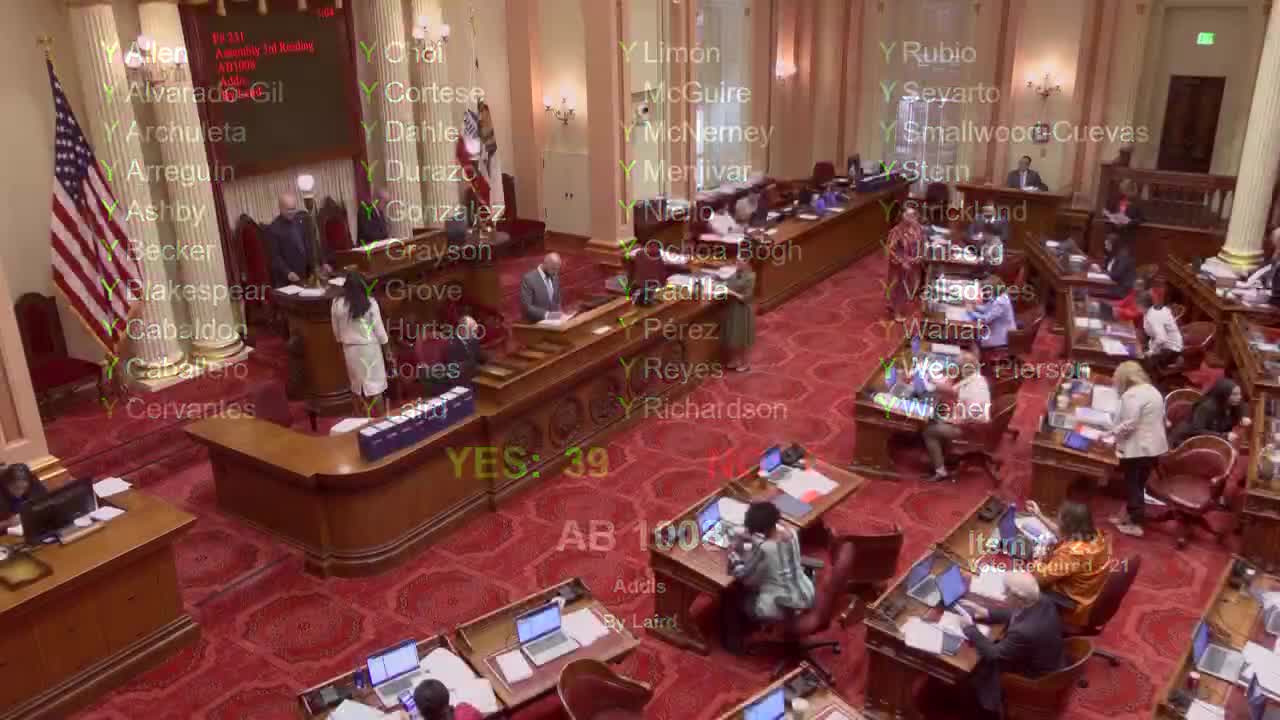 4MIN
Senate Floor
 21MIN
Senate Standing Committee on Military and Veterans Affairs
 3MIN
Assembly Floor
 12MIN
Assembly Standing Committee on Military and Veterans Affairs
 8MIN