AB 595: Housing: Building Home Ownership for All Program.
- Session Year: 2025-2026
- House: Assembly
- Latest Version Date: 2025-05-05
Current Status:
Failed
(2026-02-02: From committee: Filed with the Chief Clerk pursuant to Joint Rule 56.)
Introduced
In Committee
Awaiting First Chamber Vote
Passed First Chamber
In Committee
Awaiting Second Chamber Vote
Passed Second Chamber
Enacted
Existing law defines the duties of the Treasurer, which include, but are not limited to, keeping an account of all money received and disbursed. Existing law requires, as soon as April 1, 2022, but no later than specified, the Treasurer, in consultation with the California Housing Finance Agency, the Department of Housing and Community Development, and other relevant stakeholders, to develop a framework for the California Dream For All Program in accordance with the goals and intent of the program, including, among other things, making home ownership more affordable by reducing the cost of home ownership by up to 45 percent for lower and moderate-income Californians, and submit a report outlining the program framework to the Legislature, as specified.
This bill, upon appropriation by the Legislature, on or before January 1, 2027, would require the Treasurer, in consultation with the California Housing Finance Agency, the Department of Housing and Community Development, and other stakeholders deemed relevant by the Treasurer, to develop the Building Home Ownership for All Program in accordance with the goals and elements of the program, including, among other things, expanding access to home ownership and maximizing wealth-building opportunities by making it affordable for moderate- and middle-income lower and moderate-income Californians to buy a home. home, as specified, and with the elements of the program, including, among other things, certain eligibility limits for persons obtaining housing under the program and for housing eligible under the program, as specified. The bill would require, on or before January 1, 2028, and annually thereafter, the Legislative Analyst to collaborate with the California Tax Allocation Committee to review the effectiveness of the program. The bill would repeal these provisions on December 31, 2031.
Existing law defines the duties of the Treasurer, which include, but are not limited to, keeping an account of all money received and disbursed. Existing law requires, as soon as April 1, 2022, but no later than specified, the Treasurer, in consultation with the California Housing Finance Agency, the Department of Housing and Community Development, and other relevant stakeholders, to develop a framework for the California Dream For All Program in accordance with the goals and intent of the program, including, among other things, making home ownership more affordable by reducing the cost of home ownership by up to 45 percent for lower and moderate-income Californians, and submit a report outlining the program framework to the Legislature, as specified.
This bill, upon appropriation by the Legislature, on or before January 1, 2027, would require the Treasurer, in consultation with the California Housing Finance Agency, the Department of Housing and Community Development, and other stakeholders deemed relevant by the Treasurer, to develop the Building Home Ownership for All Program in accordance with the goals and elements of the program, including, among other things, expanding access to home ownership and maximizing wealth-building opportunities by making it affordable for moderate- and middle-income Californians to buy a home. The bill would require, on or before January 1, 2028, and annually thereafter, the Legislative Analyst to collaborate with the California Tax Allocation Committee to review the effectiveness of the program. The bill would repeal these provisions on December 31, 2031.
The Personal Income Tax Law allows a credit against the taxes imposed by that law, for taxable years beginning on or after January 1, 2021, and before January 1, 2027, for rehabilitation of certified historic structures, as defined.This bill would make nonsubstantive changes to that provision.The Personal Income Tax Law allows a credit against the taxes imposed by that law, for taxable years beginning on or after January 1, 2021, and before January 1, 2027, for rehabilitation of certified historic structures, as defined.
This bill would make nonsubstantive changes to that provision.
The Legislature finds and declares all of the following:
(a)California has a statewide housing crisis, represented by a shortage of nearly 3,500,000 homes.
(b)Californias housing crisis stifles economic growth, contributes to homelessness, consumes an ever-growing share of the paychecks of working families, and holds millions of households back from realizing the California dream of home ownership.
(c)Home ownership is still the primary way in which most Americans build wealth and assets. California has the third-highest median home price in the country and the high cost of housing has pushed what was once a modest goal of owning a home further and further out of reach for most people of color.
(d)Home ownership rates in California are among the lowest nationwide, and in recent years those numbers have continued downward. Between 2020 and 2022, California home ownership declined by 3.19 percent.
(e)While the home ownership gap is an issue throughout the country, the rate of African American and Latinx home ownership is significantly worse in California. At a national level, African Americans and Latinx have a home ownership rate of 42 percent and 47 percent, respectively, while here in California, that rate drops down to 35 percent and 42 percent, respectively.
(f)The Legislative Analysts Office has identified a lack of housing supply as one of the culprits for the severe home ownership gap. The offices 2016 housing affordability report, found that the states housing shortage also makes many Californians, not only low-income residents, more likely to commute longer distances, live in overcrowded housing, and delay or forgo home ownership.
(g)Access to sustainable home ownership can be expanded with fiscal assistance, housing counseling, sound lending, flexible underwriting that ensures the ability to pay, and backing by Federal Housing Administration (FHA) mortgage insurance.
(h)As production has slowed and changed, for-sale inventory has tightened, particularly for entry-level homes.
(i)Higher home prices have translated to less diversity in who is able to purchase a home.
(j)Home ownership is a powerful tool to close the racial and ethnic wealth gap across the State of California and nationwide.
SEC. 2.Section 12335 is added to the Government Code, immediately following Section 12334, to read:12335.(a)Upon appropriation by the Legislature, on or before January 1, 2027, the Treasurer, in consultation with the California Housing Finance Agency, the Department of Housing and Community Development, and other stakeholders determined relevant by the Treasurer, shall develop the Building Home Ownership for All Program in accordance with the goals of and the elements specified by this section.
(b)The goals of the program shall include, but not be limited to, all of the following:
(1)Establishing a program to finance the construction of for-sale housing units at a price that is ultimately affordable to moderate- and middle-income lower and moderate-income Californians through the use of tradable tax credits similar to the federal and state Low-Income Housing Tax Credit Program, New Markets Tax Credit Program, and other similar tax credit programs.
(2)Expanding access to home ownership and maximizing wealth-building opportunities by making it affordable for moderate- and middle-income lower and moderate-income Californians to buy a home, including, but not limited to, Californians impacted by generational barriers to home ownership due to systemic racism, including redlining, Californians who lost homes during the Great Recession and have not returned to home ownership, Californians with substantial higher education student loan debt, and Californians who have lost their homes due to wildfires or other natural disasters.
(3)Ensuring that this new program maximizes the effectiveness of state subsidies by prioritizing the efficiency and speed of the review and allocation process.
(4)Ensuring that existing rental programs do not see a reduction in funding due to enactment of the program.
(5)Focusing on homebuyers who are historically excluded from home ownership opportunities due to systemic barriers.
(6)Ensuring that housing under the program is priced below market rate to ensure that the value of the tax credit is passed on in the form of lower housing costs.
(c)The program shall include, but not be limited to, all of the following elements:
(1)Program structuring tailored to the development of income-restricted for-sale housing similar to tax-credit-based programs, such as, including the Low-Income Housing Tax Credit Program and the New Markets Tax Credit Program.
(2)Income limits for Californians and price limits for homes eligible for the program consistent with those already used by the California Housing Finance Agencys first-time homebuyer programs.
(3)Tax credit allocation to a project that offsets the equivalent of 40 percent of eligible costs.
(4)Incentive structure that effectively creates demand and participation in the program from homebuilders as well as traditional investor participants in the Low-Income Housing Tax Credit Program, New Market Tax Credit Program, and other existing housing finance programs.
(5)Resale restrictions consistent with the California Housing Finance Agencys first-time home buyer programs such as programs, including the California Dream for All Program, without jeopardizing any of the previously stated goals.
(6)Ability for these tax credits to be syndicated and resyndicated consistent with other tax credit programs that finance residential development.
(7)Eligibility limits for persons obtaining housing under the program and for housing eligible under the program, including both of the following:
(A)Persons eligible to obtain housing under the program shall be limited to lower and moderate-income homebuyers.
(B)Housing eligible under the program shall be limited to housing that is owner-occupied.
(d)On or before January 1, 2028, and annually thereafter, the Legislative Analyst shall collaborate with the California Tax Credit Allocation Committee to review the effectiveness of the program, including, but not limited to:
(1)The number of units produced.
(2)The ability of first-time home buyers to purchase a market rate home at or below market rate due to wealth created by the program.
(3)The efficiency of the program at delivering capital to homebuilders and improvements that could be made to make the program even more efficient in the delivery.
(e)This section shall become inoperative on December 31, 2031, and shall be repealed as of that date.
The Legislature finds and declares all of the following:
(a)California has a statewide housing crisis, represented by a shortage of nearly 3,500,000 homes.
(b)Californias housing crisis stifles economic growth, contributes to homelessness, consumes an ever-growing share of the paychecks of working families, and holds millions of households back from realizing the California dream of home ownership.
(c)Home ownership is still the primary way in which most Americans build wealth and assets. California has the third-highest median home price in the country and the high cost of housing has pushed what was once a modest goal of owning a home further and further out of reach for most people of color.
(d)Home ownership rates in California are among the lowest nationwide, and in recent years those numbers have continued downward. Between 2020 and 2022, California home ownership declined by 3.19 percent.
(e)While the home ownership gap is an issue throughout the country, the rate of African American and Latinx home ownership is significantly worse in California. At a national level, African Americans and Latinx have a home ownership rate of 42 percent and 47 percent, respectively, while here in California, that rate drops down to 35 percent and 42 percent, respectively.
(f)The Legislative Analysts Office has identified a lack of housing supply as one of the culprits for the severe home ownership gap. The offices 2016 housing affordability report, found that the states housing shortage also makes many Californians, not only low-income residents, more likely to commute longer distances, live in overcrowded housing, and delay or forgo home ownership.
(g)Access to sustainable home ownership can be expanded with fiscal assistance, housing counseling, sound lending, flexible underwriting that ensures the ability to pay, and backing by Federal Housing Administration (FHA) mortgage insurance.
(h)As production has slowed and changed, for-sale inventory has tightened, particularly for entry-level homes.
(i)Higher home prices have translated to less diversity in who is able to purchase a home.
(j)Home ownership is a powerful tool to close the racial and ethnic wealth gap across the State of California and nationwide.
SEC. 2.Section 12335 is added to the Government Code, immediately following Section 12334, to read:12335.(a)Upon appropriation by the Legislature, on or before January 1, 2027, the Treasurer, in consultation with the California Housing Finance Agency, the Department of Housing and Community Development, and other stakeholders determined relevant by the Treasurer, shall develop the Building Home Ownership for All Program in accordance with the goals of and the elements specified by this section.
(b)The goals of the program shall include, but not be limited to, all of the following:
(1)Establishing a program to finance the construction of for-sale housing units at a price that is ultimately affordable to moderate- and middle-income Californians through the use of tradable tax credits similar to the federal and state Low-Income Housing Tax Credit Program, New Markets Tax Credit Program, and other similar tax credit programs.
(2)Expanding access to home ownership and maximizing wealth-building opportunities by making it affordable for moderate- and middle-income Californians to buy a home, including, but not limited to, Californians impacted by generational barriers to home ownership due to systemic racism, including redlining, Californians who lost homes during the Great Recession and have not returned to home ownership, Californians with substantial higher education student loan debt, and Californians who have lost their homes due to wildfires or other natural disasters.
(3)Ensuring that this new program maximizes the effectiveness of state subsidies by prioritizing the efficiency and speed of the review and allocation process.
(4)Ensuring that existing rental programs do not see a reduction in funding due to enactment of the program.
(c)The program shall include, but not be limited to, all of the following elements:
(1)Program structuring tailored to the development of income-restricted for-sale housing similar to tax-credit-based programs, such as, the Low-Income Housing Tax Credit Program and the New Markets Tax Credit Program.
(2)Income limits for Californians and price limits for homes eligible for the program consistent with those already used by the California Housing Finance Agencys first-time homebuyer programs.
(3)Tax credit allocation to a project that offsets the equivalent of 40 percent of eligible costs.
(4)Incentive structure that effectively creates demand and participation in the program from homebuilders as well as traditional investor participants in the Low-Income Housing Tax Credit Program, New Market Tax Credit Program, and other existing housing finance programs.
(5)Resale restrictions consistent with the California Housing Finance Agencys first-time home buyer programs such as the California Dream for All Program, without jeopardizing any of the previously stated goals.
(6)Ability for these tax credits to be syndicated and resyndicated consistent with other tax credit programs that finance residential development.
(d)On or before January 1, 2028, and annually thereafter, the Legislative Analyst shall collaborate with the California Tax Credit Allocation Committee to review the effectiveness of the program, including, but not limited to:
(1)The number of units produced.
(2)The ability of first-time home buyers to purchase a market rate home due to wealth created by the program.
(3)The efficiency of the program at delivering capital to homebuilders and improvements that could be made to make the program even more efficient in the delivery.
(e)This section shall become inoperative on December 31, 2031, and shall be repealed as of that date.
SECTION 1.Section 17053.91 of the Revenue and Taxation Code is amended to read:17053.91.For each taxable year beginning on or after January 1, 2021, and before January 1, 2027, there shall be allowed to a taxpayer that receives a tax credit allocation a credit against the net tax, as defined in Section 17039, in an amount determined in accordance with Section 47 of the Internal Revenue Code, except as follows:(a)(1)In lieu of the percentage specified in Section 47(a) of the Internal Revenue Code, except as provided in paragraph (2), the applicable percentage shall be 20 percent of the qualified rehabilitation expenditures with respect to a certified historic structure.(2)The applicable percentage shall be 25 percent of the qualified rehabilitation expenditures with respect to a certified historic structure if that certified historic structure meets one of the following criteria:(A)The structure is located on federal surplus property, if obtained by a local agency under Section 54142 of the Government Code, on surplus state real property, as defined by Section 11011.1 of the Government Code, or on surplus land, as defined by subdivision (b) of Section 54221 of the Government Code.(B)The rehabilitated structure includes affordable housing for lower-income households, as defined by Section 50079.5 of the Health and Safety Code.(C)The structure is located in a designated census tract, as defined in paragraph (7) of subdivision (b) of Section 17053.73.(D)The rehabilitated structure is a part of a military base reuse authority established pursuant to Title 7.86 (commencing with Section 67800) of the Government Code.(E)The structure is a transit-oriented development that is a higher density, mixed-use development within a walking distance of one-half mile of a transit station.(3)(A)The credit shall be allowed for qualified rehabilitation expenditures for a qualified residence determined by the California Tax Credit Allocation Committee and the Office of Historic Preservation to rehabilitate the historic character and improve the integrity of the residence in the year of completion in the percentages specified in paragraphs (1) and (2), as applicable, except that the credit shall only be allowed in an amount equal to or more than five thousand dollars ($5,000) but not exceeding twenty-five thousand dollars ($25,000). A taxpayer shall only be allowed a credit pursuant to this paragraph once every 10 taxable years.(B)Section 47(c)(1)(B)(ii) of the Internal Revenue Code, relating to special rule for phased rehabilitation, shall not apply.(b)For purposes of this section, the following definitions shall apply:(1)Certified historic structure has the same meaning as defined in Section 47(c)(3) of the Internal Revenue Code, that is a structure in this state and is listed on the California Register of Historical Resources.(2)Qualified residence has the same meaning as that term is defined in Section 163(h)(4) of the Internal Revenue Code, that will be owned and occupied by an individual taxpayer who has a modified adjusted gross income, as defined by Section 86(b)(2) of the Internal Revenue Code, of two hundred thousand dollars ($200,000) or less, as the taxpayers principal residence or what will be the taxpayers principal residence within two years after the rehabilitation of the residence.(3)(A)Qualified rehabilitation expenditure has the same meaning as that term is defined in Section 47(c)(2) of the Internal Revenue Code, except that qualified rehabilitation expenditures may include expenditures in connection with the rehabilitation of a building without regard to whether any portion of the building is or is reasonably expected to be tax-exempt use property.(B)Qualified rehabilitation expenditure has the same meaning as that term is defined in Section 47(c)(2) of the Internal Revenue Code and also means rehabilitation expenditures incurred by the taxpayer with respect to a qualified residence for the rehabilitation of the exterior of the building or rehabilitation necessary for the functioning of the home, including, but not limited to, rehabilitation of the electrical, plumbing, or foundation of the qualified residence.(c)(1)To be eligible for the credit allowed by this section, a taxpayer shall request a tax credit allocation from the California Tax Credit Allocation Committee, in conjunction with the Office of Historic Preservation.(2)To obtain a tax credit allocation, the taxpayer shall provide necessary information, as determined by the Office of Historic Preservation and the California Tax Credit Allocation Committee.(3)A tax credit allocation provided to a taxpayer shall not constitute a determination by the California Tax Credit Allocation Committee with respect to any of the requirements of this section regarding a taxpayers eligibility for the credit authorized by this section.(4)The Office of Historic Preservation shall establish in regulations the time period that a taxpayer who receives a tax credit allocation must commence rehabilitation after the issuance of the tax credit allocation. If rehabilitation is not commenced within the time period established by the office, the tax credit allocation shall be forfeited and the credit amount associated with the tax credit allocation shall be treated as an unused allocation tax credit amount.(d)A deduction shall not be allowed under this part for any expense for which a credit for that expense is allowed by this section.(e)If a credit is allowed under this section with respect to any property, the basis of that property shall be reduced by the amount of the credit allowed.(f)(1)A credit allowed under this section shall be claimed in the first taxable year that the structure is placed in service.(2)In the case where the credit allowed by this section exceeds the net tax, the excess may be carried over to reduce the net tax in the following year, and the seven succeeding years, if necessary, until the credit is exhausted.(g)For purposes of this section, the Office of Historic Preservation shall do all of the following:(1)Adopt regulations to implement the requirements of this section. The regulations shall comply with the requirements of the rulemaking provisions of the Administrative Procedure Act (Chapter 3.5 (commencing with Section 11340) of Part 1 of Division 3 of Title 2 of the Government Code).(2)Establish a written application, on a form jointly prescribed by the office and the California Tax Credit Allocation Committee, for the allocation of the tax credit. The written application shall require the applicant to include a summary of the expected economic benefits of the project. The economic benefits shall include, but are not limited to, all of the following:(A)The number of jobs created by the rehabilitation project, both during and after the rehabilitation of the structure.(B)The expected increase in state and local tax revenues derived from the rehabilitation project, including those from increased wages and property taxes.(C)Any additional incentives or contributions included in the rehabilitation project from federal, state, or local governments.(D)For the qualified rehabilitation expenditures with respect to a qualified residence, the rehabilitation has a public benefit, as determined jointly with the Office of Historic Preservation.(3)Establish a process to determine that applicants meet the requirements of this section and to ensure that the rehabilitation project meets the Secretary of the Interiors Standards for Rehabilitation, as found in Part 67 of Title 36 of the Code of Federal Regulations.(4)Establish a process to approve, or reject, all tax credit allocation applications.(h)For purposes of this section, the California Tax Credit Allocation Committee shall do all of the following:(1)Establish a process jointly with the Office of Historic Preservation to implement the provisions of this section.(2)(A)Subject to the annual cap established as provided in subdivision (i), allocate on a first-come-first-served basis an aggregate amount of credits under this section and Section 23691, and allocate any carryover of unallocated credits from prior years.(B)A taxpayer shall be allocated a tax credit pursuant to the taxpayers tax credit allocation upon receipt by the California Tax Credit Allocation Committee of a cost certification for the qualified rehabilitation expenditures. For projects with qualified rehabilitation expenditures in excess of two hundred fifty thousand dollars ($250,000), the cost certification shall be issued by a licensed certified public accountant.(3)Certify tax credits allocated to taxpayers.(4)Provide the Franchise Tax Board an annual list of the taxpayers that were allocated a credit pursuant to this section and Section 23691, including each taxpayers taxpayer identification number, and the amount allocated to each taxpayer.(5)Establish procedures for the recapture of amounts allocated for a tax credit allowed to a taxpayer for the rehabilitation of a qualified residence if the taxpayer does not use the qualified residence as their principal residence within two years after the rehabilitation of the residence.(i)(1)The aggregate amount of credits that may be allocated in any calendar year pursuant to this section and Section 23691 shall be an amount equal to the sum of all of the following:(A)Fifty million dollars ($50,000,000) in tax credits for the 2021 calendar year and each calendar year thereafter, through and including the 2027 calendar year.(B)The unused allocation tax credit amount, if any, for the preceding calendar year.(2)Notwithstanding the foregoing, the California Tax Credit Allocation Committee shall set aside ten million dollars ($10,000,000) of tax credits that may be allocated each calendar year for taxpayers in the aggregate, pursuant to this paragraph and paragraph (2) of subdivision (i) of Section 23691, as follows:(A)Two million dollars ($2,000,000) of tax credits, in the aggregate, for taxpayers with qualified rehabilitation expenditures for a certified historic structure that is a qualified residence. To the extent that this amount is not fully allocated in any calendar year, the unused portion shall become available in subsequent calendar years for allocation to other taxpayers with qualified rehabilitation expenditures for a certified historic structure that is a qualified residence.(B)Eight million dollars ($8,000,000) of tax credits, in the aggregate, for taxpayers with qualified rehabilitation expenditures of less than one million dollars ($1,000,000) for any other certified historic building that is not a qualified residence. To the extent that this amount is not fully allocated in any calendar year, the unused portion shall become available in subsequent calendar years for allocation to other taxpayers, except those taxpayers subject to subparagraph (A).(j)In the case of any application for tax credits by an entity treated as a partnership for income tax purposes:(1)Credits awarded to a partnership shall be allocated to the partners of that partnership in accordance with the partnership agreement, regardless of how the federal historic rehabilitation tax credit with respect to the project is allocated to the partners, or whether the allocation of the credit under the terms of the partnership agreement has substantial economic effect, within the meaning of Section 704(b) of the Internal Revenue Code.(2)To the extent the allocation of the credit to a partner under this section lacks substantial economic effect, any loss or deduction otherwise allowable under this part that is attributable to the sale or other disposition of that partners partnership interest made prior to the expiration of the tax credit recapture period for the project described in paragraph (1) shall not be allowed in the taxable year that the sale or other disposition occurs, but shall instead be deferred until, and treated as if, it occurred in the first taxable year immediately following the taxable year that the tax credit recapture period expires for the project described in paragraph (1). The credits awarded to a partnership shall be allocated to the partners of that partnership in accordance with the partnership agreement.(k)For purposes of this section, the provisions of subsection (a) of Section 50 of the Internal Revenue Code shall apply.(l)Notwithstanding any other provision of this part, a credit allowed pursuant to this section may reduce the tax imposed under Section 17041 or 17048 plus the tax imposed under Section 17504, relating to the separate tax on lump-sum distributions, below the tentative minimum tax.(m)This section shall remain in effect regardless of the expiration or repeal of Section 47 of the Internal Revenue Code, relating to rehabilitation credit.(n)The California Tax Credit Allocation Committee and the Office of Historic Preservation may charge a reasonable fee in an amount that does not exceed the reasonable costs incurred by the California Tax Credit Allocation Committee and the Office of Historic Preservation in fulfilling the responsibilities described in paragraphs (4) and (5) of subdivision (g) and subdivision (h) and paragraphs (4) and (5) of subdivision (g) and subdivision (h) of Section 23691.(o)(1)This section shall remain in effect only until December 1, 2027, and as of that date is repealed.(2)Unless otherwise specified in any bill providing for appropriations related to the Budget Act, for taxable years beginning on or after January 1, 2021, and before January 1, 2027, the amount of credit allowed pursuant to this section shall be zero dollars ($0).For each taxable year beginning on or after January 1, 2021, and before January 1, 2027, there shall be allowed to a taxpayer that receives a tax credit allocation a credit against the net tax, as defined in Section 17039, in an amount determined in accordance with Section 47 of the Internal Revenue Code, except as follows:
(a)(1)In lieu of the percentage specified in Section 47(a) of the Internal Revenue Code, except as provided in paragraph (2), the applicable percentage shall be 20 percent of the qualified rehabilitation expenditures with respect to a certified historic structure.
(2)The applicable percentage shall be 25 percent of the qualified rehabilitation expenditures with respect to a certified historic structure if that certified historic structure meets one of the following criteria:
(A)The structure is located on federal surplus property, if obtained by a local agency under Section 54142 of the Government Code, on surplus state real property, as defined by Section 11011.1 of the Government Code, or on surplus land, as defined by subdivision (b) of Section 54221 of the Government Code.
(B)The rehabilitated structure includes affordable housing for lower-income households, as defined by Section 50079.5 of the Health and Safety Code.
(C)The structure is located in a designated census tract, as defined in paragraph (7) of subdivision (b) of Section 17053.73.
(D)The rehabilitated structure is a part of a military base reuse authority established pursuant to Title 7.86 (commencing with Section 67800) of the Government Code.
(E)The structure is a transit-oriented development that is a higher density, mixed-use development within a walking distance of one-half mile of a transit station.
(3)(A)The credit shall be allowed for qualified rehabilitation expenditures for a qualified residence determined by the California Tax Credit Allocation Committee and the Office of Historic Preservation to rehabilitate the historic character and improve the integrity of the residence in the year of completion in the percentages specified in paragraphs (1) and (2), as applicable, except that the credit shall only be allowed in an amount equal to or more than five thousand dollars ($5,000) but not exceeding twenty-five thousand dollars ($25,000). A taxpayer shall only be allowed a credit pursuant to this paragraph once every 10 taxable years.
(B)Section 47(c)(1)(B)(ii) of the Internal Revenue Code, relating to special rule for phased rehabilitation, shall not apply.
(b)For purposes of this section, the following definitions shall apply:
(1)Certified historic structure has the same meaning as defined in Section 47(c)(3) of the Internal Revenue Code, that is a structure in this state and is listed on the California Register of Historical Resources.
(2)Qualified residence has the same meaning as that term is defined in Section 163(h)(4) of the Internal Revenue Code, that will be owned and occupied by an individual taxpayer who has a modified adjusted gross income, as defined by Section 86(b)(2) of the Internal Revenue Code, of two hundred thousand dollars ($200,000) or less, as the taxpayers principal residence or what will be the taxpayers principal residence within two years after the rehabilitation of the residence.
(3)(A)Qualified rehabilitation expenditure has the same meaning as that term is defined in Section 47(c)(2) of the Internal Revenue Code, except that qualified rehabilitation expenditures may include expenditures in connection with the rehabilitation of a building without regard to whether any portion of the building is or is reasonably expected to be tax-exempt use property.
(B)Qualified rehabilitation expenditure has the same meaning as that term is defined in Section 47(c)(2) of the Internal Revenue Code and also means rehabilitation expenditures incurred by the taxpayer with respect to a qualified residence for the rehabilitation of the exterior of the building or rehabilitation necessary for the functioning of the home, including, but not limited to, rehabilitation of the electrical, plumbing, or foundation of the qualified residence.
(c)(1)To be eligible for the credit allowed by this section, a taxpayer shall request a tax credit allocation from the California Tax Credit Allocation Committee, in conjunction with the Office of Historic Preservation.
(2)To obtain a tax credit allocation, the taxpayer shall provide necessary information, as determined by the Office of Historic Preservation and the California Tax Credit Allocation Committee.
(3)A tax credit allocation provided to a taxpayer shall not constitute a determination by the California Tax Credit Allocation Committee with respect to any of the requirements of this section regarding a taxpayers eligibility for the credit authorized by this section.
(4)The Office of Historic Preservation shall establish in regulations the time period that a taxpayer who receives a tax credit allocation must commence rehabilitation after the issuance of the tax credit allocation. If rehabilitation is not commenced within the time period established by the office, the tax credit allocation shall be forfeited and the credit amount associated with the tax credit allocation shall be treated as an unused allocation tax credit amount.
(d)A deduction shall not be allowed under this part for any expense for which a credit for that expense is allowed by this section.
(e)If a credit is allowed under this section with respect to any property, the basis of that property shall be reduced by the amount of the credit allowed.
(f)(1)A credit allowed under this section shall be claimed in the first taxable year in which that the structure is placed in service.
(2)In the case where the credit allowed by this section exceeds the net tax, the excess may be carried over to reduce the net tax in the following year, and the seven succeeding years, if necessary, until the credit is exhausted.
(g)For purposes of this section, the Office of Historic Preservation shall do all of the following:
(1)Adopt regulations to implement the requirements of this section. The regulations shall comply with the requirements of the rulemaking provisions of the Administrative Procedure Act (Chapter 3.5 (commencing with Section 11340) of Part 1 of Division 3 of Title 2 of the Government Code).
(2)Establish a written application, on a form jointly prescribed by the office and the California Tax Credit Allocation Committee, for the allocation of the tax credit. The written application shall require the applicant to include a summary of the expected economic benefits of the project. The economic benefits shall include, but are not limited to, all of the following:
(A)The number of jobs created by the rehabilitation project, both during and after the rehabilitation of the structure.
(B)The expected increase in state and local tax revenues derived from the rehabilitation project, including those from increased wages and property taxes.
(C)Any additional incentives or contributions included in the rehabilitation project from federal, state, or local governments.
(D)For the qualified rehabilitation expenditures with respect to a qualified residence, the rehabilitation has a public benefit, as determined jointly with the Office of Historic Preservation.
(3)Establish a process to determine that applicants meet the requirements of this section and to ensure that the rehabilitation project meets the Secretary of the Interiors Standards for Rehabilitation, as found in Part 67 of Title 36 of the Code of Federal Regulations.
(4)Establish a process to approve, or reject, all tax credit allocation applications.
(h)For purposes of this section, the California Tax Credit Allocation Committee shall do all of the following:
(1)Establish a process jointly with the Office of Historic Preservation to implement the provisions of this section.
(2)(A)Subject to the annual cap established as provided in subdivision (i), allocate on a first-come-first-served basis an aggregate amount of credits under this section and Section 23691, and allocate any carryover of unallocated credits from prior years.
(B)A taxpayer shall be allocated a tax credit pursuant to the taxpayers tax credit allocation upon receipt by the California Tax Credit Allocation Committee of a cost certification for the qualified rehabilitation expenditures. For projects with qualified rehabilitation expenditures in excess of two hundred fifty thousand dollars ($250,000), the cost certification shall be issued by a licensed certified public accountant.
(3)Certify tax credits allocated to taxpayers.
(4)Provide the Franchise Tax Board an annual list of the taxpayers that were allocated a credit pursuant to this section and Section 23691, including each taxpayers taxpayer identification number, and the amount allocated to each taxpayer.
(5)Establish procedures for the recapture of amounts allocated for a tax credit allowed to a taxpayer for the rehabilitation of a qualified residence if the taxpayer does not use the qualified residence as their principal residence within two years after the rehabilitation of the residence.
(i)(1)The aggregate amount of credits that may be allocated in any calendar year pursuant to this section and Section 23691 shall be an amount equal to the sum of all of the following:
(A)Fifty million dollars ($50,000,000) in tax credits for the 2021 calendar year and each calendar year thereafter, through and including the 2027 calendar year.
(B)The unused allocation tax credit amount, if any, for the preceding calendar year.
(2)Notwithstanding the foregoing, the California Tax Credit Allocation Committee shall set aside ten million dollars ($10,000,000) of tax credits that may be allocated each calendar year for taxpayers in the aggregate, pursuant to this paragraph and paragraph (2) of subdivision (i) of Section 23691, as follows:
(A)Two million dollars ($2,000,000) of tax credits, in the aggregate, for taxpayers with qualified rehabilitation expenditures for a certified historic structure that is a qualified residence. To the extent that this amount is not fully allocated in any calendar year, the unused portion shall become available in subsequent calendar years for allocation to other taxpayers with qualified rehabilitation expenditures for a certified historic structure that is a qualified residence.
(B)Eight million dollars ($8,000,000) of tax credits, in the aggregate, for taxpayers with qualified rehabilitation expenditures of less than one million dollars ($1,000,000) for any other certified historic building that is not a qualified residence. To the extent that this amount is not fully allocated in any calendar year, the unused portion shall become available in subsequent calendar years for allocation to other taxpayers, except those taxpayers subject to subparagraph (A).
(j)In the case of any application for tax credits by an entity treated as a partnership for income tax purposes:
(1)Credits awarded to a partnership shall be allocated to the partners of that partnership in accordance with the partnership agreement, regardless of how the federal historic rehabilitation tax credit with respect to the project is allocated to the partners, or whether the allocation of the credit under the terms of the partnership agreement has substantial economic effect, within the meaning of Section 704(b) of the Internal Revenue Code.
(2)To the extent the allocation of the credit to a partner under this section lacks substantial economic effect, any loss or deduction otherwise allowable under this part that is attributable to the sale or other disposition of that partners partnership interest made prior to the expiration of the tax credit recapture period for the project described in paragraph (1) shall not be allowed in the taxable year in which that the sale or other disposition occurs, but shall instead be deferred until, and treated as if, it occurred in the first taxable year immediately following the taxable year in which that the tax credit recapture period expires for the project described in paragraph (1). The credits awarded to a partnership shall be allocated to the partners of that partnership in accordance with the partnership agreement.
(k)For purposes of this section, the provisions of subsection (a) of Section 50 of the Internal Revenue Code shall apply.
(l)Notwithstanding any other provision of this part, a credit allowed pursuant to this section may reduce the tax imposed under Section 17041 or 17048 plus the tax imposed under Section 17504, relating to the separate tax on lump-sum distributions, below the tentative minimum tax.
(m)This section shall remain in effect regardless of the expiration or repeal of Section 47 of the Internal Revenue Code, relating to rehabilitation credit.
(n)The California Tax Credit Allocation Committee and the Office of Historic Preservation may charge a reasonable fee in an amount that does not exceed the reasonable costs incurred by the California Tax Credit Allocation Committee and the Office of Historic Preservation in fulfilling the responsibilities described in paragraphs (4) and (5) of subdivision (g) and subdivision (h) and paragraphs (4) and (5) of subdivision (g) and subdivision (h) of Section 23691.
(o)(1)This section shall remain in effect only until December 1, 2027, and as of that date is repealed.
(2)Unless otherwise specified in any bill providing for appropriations related to the Budget Act, for taxable years beginning on or after January 1, 2021, and before January 1, 2027, the amount of credit allowed pursuant to this section shall be zero dollars ($0).
|
Date
|
Status
|
|---|---|
| Feb 2, 2026 | From committee: Filed with the Chief Clerk pursuant to Joint Rule 56. |
| Jan 31, 2026 | Died pursuant to Art. IV, Sec. 10(c) of the Constitution. |
| May 23, 2025 | In committee: Held under submission. |
| May 14, 2025 | In committee: Set, first hearing. Referred to suspense file. |
| May 6, 2025 | Re-referred to Com. on APPR. |
| May 5, 2025 | Read second time and amended. |
| May 1, 2025 | From committee: Amend, and do pass as amended and re-refer to Com. on APPR. (Ayes 9. Noes 1.) (April 30). |
| Mar 25, 2025 | Re-referred to Com. on H. & C.D. |
| Mar 24, 2025 | From committee chair, with author's amendments: Amend, and re-refer to Com. on H. & C.D. Read second time and amended. |
| Mar 24, 2025 | Referred to Com. on H. & C.D. |
| Feb 14, 2025 | From printer. May be heard in committee March 16. |
| Feb 13, 2025 | Read first time. To print. |
|
Date
|
Description
|
Location
|
Votes
|
|
|---|---|---|---|---|
| Apr 30, 2025 | Do pass as amended and be re-referred to the Committee on [Appropriations] | Assembly Standing Committee on Housing and Community Development |
Passed |
This list shows positions taken on this bill by organizations on the date displayed, which is linked to the original source.
Positions by individuals are not included.
|
Organization
|
Position
|
Date
|
|---|---|---|
| Abundant Housing LA | ** Support | |
| Architecture Frolic Community | ** Support | |
| Azure Community Development | ** Support | |
| Black Oak Group | ** Support | |
| California Catholic Conference | ** Support | |
| California community builders | ** Support | |
| California Community Defense League | ** Support | |
| California YIMBY | ** Support | |
| Casita Coalition | ** Support | |
| Central Valley Immigrant Integration Collaborative | ** Support | |
| Central Valley Urban Institute | ** Support | |
| Enterprise Community Partners Inc | ** Support | |
| Faith And Community Empowerment | ** Support | |
| Hogar Hispano | ** Support | |
| Housing Action Coalition | ** Support | |
| Inland Empire Latino Coalition | ** Support | |
| Lisc San Diego | ** Support | |
| Livable Communities Initiative | ** Support | |
| MAAC | ** Support | |
| Montebello Housing Development Corporation | ** Support | |
| Neighborhood Housing Services of the Inland Empire | ** Support | |
| New Way Homes | ** Support | |
| Next Door Real Estate | ** Support | |
| Nicola Duesberg | ** Support | |
| Pathway to Tomorrow | ** Support | |
| People For Housing Orange County | ** Support | |
| Redlands YIMBY | ** Support | |
| Regenerate California Innovation, INC | ** Support | |
| Richmond Community Foundation | ** Support | |
| Southern California Black Chamber of Commerce | ** Support | |
| SPUR | ** Support | |
| Student Homes Coalition | ** Support | |
| The Billups Group | ** Support | |
| The Two Hundred | ** Support | |
| Unidosus | ** Support | |
| UNITED LATINOS VOTE | ** Support | |
| united way bay area | ** Support | |
| Ventura County Community Development Corp | ** Support | |
| Ventura County YIMBY | ** Support |
Date of Hearing: May 14, 2025
ASSEMBLY COMMITTEE ON APPROPRIATIONS
Buffy Wicks, Chair
ABPCA Bill Id:AB 595
Author:(Carrillo) – As Amended Ver:May 5, 2025
Policy Committee: | Housing and Community Development | Vote: | 9 - 1 |
|
| ||
|
|
Urgency: No State Mandated Local Program: No Reimbursable: No
SUMMARY:
This bill requires the State Treasurer, in consultation with state housing agencies, to develop the Building Home Ownership for All Program (Program), a state-level homeownership tax credit pilot program, in accordance with the goals specified in the bill. The bill also requires the Legislative Analyst to annually evaluate the program.
Specifically, this bill:
- Upon appropriation by the Legislature, requires the State Treasurer, by January 1, 2027, in consultation with the California Housing Finance Agency (CalHFA), the Department of Housing and Community Development (HCD), and other stakeholders deemed relevant, to develop the tax-credit pilot program as a five-year program in accordance with specified Program goals and elements.
- Requires the goals of the Program to include, among other goals:
- Expanding access to homeownership and maximizing wealth-building opportunities for lower- and moderate-income Californians, focusing on those impacted by systemic racism, those who lost their homes during the Great Recession, those with substantial student loan debt, and those who lost their home due to wildfires or other natural disasters.
- Establishing a program to finance the construction of for-sale housing units at a price affordable to lower- and moderate-income Californians through the use of tradable tax credit similar to the federal and state Low-Income Housing Tax Credit Program and other similar tax credit programs.
- Requires the Program to include specified elements, including, program structuring tailored to the development of income-restricted for-sale housing similar to tax-credit-based programs, regional income and home price eligibility limits, and tax credit allocation to a project that offsets the equivalent of 40% of eligible costs.
- Requires the Legislative Analyst, in collaboration with the California Tax Credit Allocation Committee, to annually evaluate the effectiveness of the program starting by January 1, 2028, as specified.
- Sunsets the Program on December 31, 2031.
FISCAL EFFECT:
- General Fund (GF) cost pressures, likely in the low hundreds of millions of dollars, to fund the tax-credit program for five years.
- The State Treasurer’s Office estimates total GF costs of approximately $3 million to develop the framework for the Program and report to the Legislature, per the requirements of the bill. This estimate is based on the development of the California Dream for All Program.
- HCD and CalHFA each indicate minor and absorbable costs to collaborate and consult with the State Treasurer.
The author has submitted a one-time $100 million budget request to fund the program for five years to serve approximately 300 homebuyers.
COMMENTS:
- Purpose. According to the author:
For far too many Californians, the dream of homeownership remains just that—a dream. [This bill] is a bold step toward changing that reality by making it financially feasible to build the affordable for-sale homes our working families need. Homeownership is more than just a milestone; it’s a foundation for economic security and generational wealth. With this bill, we are taking action to ensure that more Californians, especially those historically left behind in communities of color, have a real path to owning a home.
- Background. California, like the nation as a whole, has lower homeownership rates among communities of color than among other communities. According to Census data, 65% of white Californians are homeowners, while 59% of Asian/Asian-American, 49% of Native/Indigenous descent, 44% of Latino/Hispanic, and 35% of Black Californians are homeowners. Studies indicate multiple reasons for the homeownership gaps in California, including racial discrimination and a lack of affordable housing supply, among others.
The state has established a number of programs, such as MyHome, the California Dream for All Program, and CalHome, to assist and encourage affordable homeownership, primarily by providing down payment and other assistance to low- and moderate-income home buyers. CalHOME also provides loans to nonprofit developers to construct single-family homes and provides grants to nonprofit organizations and local governments to make loans to individual homeowners to construct accessory dwelling units (ADUs) or junior ADUs. However, most affordable housing construction financing programs, such as the low income housing tax credit (LIHTC), are available only for rental housing.
- Related Legislation. AB 2140 (Carrillo), of the 2023-24 Legislative Session, was similar to this bill. AB 2140 was held on this committee’s suspense file.
Analysis Prepared by: Jennifer Swenson / APPR. / (916) 319-2081
Date of Hearing: April 30, 2025
ASSEMBLY COMMITTEE ON HOUSING AND COMMUNITY DEVELOPMENT
Matt Haney, Chair
ABPCA Bill Id:AB 595 (
Author:Carrillo) – As Amended Ver:March 24, 2025
SUBJECT: Housing: Building Home Ownership for All Program
SUMMARY: Requires the Treasurer, on or before January 1, 2027, in consultation with the California Housing Finance Agency (CalHFA), the Department of Housing and Community Development (HCD), and other stakeholders, to develop a framework for the Building Home Ownership for All Program (the Program) in accordance with the goals and elements of the program and submit a report outlining the program framework to the Legislature. Specifically, this bill:
- Require the goals of the Program to include, but not be limited to, all of the following:
- Expanding access to homeownership by making it affordable for moderate and middle-income Californians, as specified;
- Establishing a program to finance the construction of for-sale housing units at a price that is ultimately affordable to moderate and middle-income Californians through the use of tradable tax credits modeled after the Low-Income Housing Tax Credit Program, the New Markets Tax Credit Program, and other similar financing models;
- Ensuring the Program maximizes the effectiveness of state subsidies by prioritizing efficiency and speed in the review and allocation process; and
- Ensuring that there is not a reduction in funding to existing rental programs due to enactment of the program.
- Require the framework of the Program to include, but not be limited to, all of the following elements:
- Program structuring tailored to the development of income-restricted for-sale housing, similar to tax-credit-based models;
- Income limits and home price limits aligned with CalHFA first-time homebuyer programs;
- Allocation of tax credits to projects to offset up to 40% of eligible development costs;
- An incentive structure designed to attract participation from homebuilders and investors familiar to existing tax credit programs;
- Resale restrictions consistent with CalHFA’s existing first-time homebuyer programs, such as the California Dream for All Program, without undermining the Program’s affordability goals;
- Allowance for tax credits to be syndicated and resyndicated, consistent with practices in other residential development finance programs.
- Requires the Legislative Analyst, in collaboration with the California Tax Credit Allocation Committee, to annually evaluate the effectiveness of the program starting on or before January 1, 2028. The evaluation must include, but is not limited to all of the following:
- The number of for-sale housing units produced;
- The extent to which the Program has enabled first-time homebuyers to build wealth and access market-rate homeownership; and
- An assessment of the Program’s efficiency in delivering capital to developers and recommendations for improving program implementation.
- Sunsets the Program on December 31, 2031, unless extended by a later statute.
EXISTING LAW:
- Establishes a number of housing assistance programs for affordable housing at HCD, including CalHOME, which provides grants to individual homebuyers to purchase a home and loans to nonprofit developers to construct single-family homes. The program also provides grants to nonprofit organizations and local governments to make loans to individual homeowners to construct accessory dwelling units (ADUs) or junior ADUs (JADUs). (Health and Safety Code (HSC) Section 50650.3)
- Establishes and authorizes CalHFA to make loans to housing sponsors for housing developments and to qualified mortgage lenders, among others. Provides that the primary purpose of CalHFA is to meet the housing needs of persons and families of low- or moderate-income. (HSC 51345)
- Provides that CalHFA is administered by a board of directors and is supervised on a day-to-day basis by an executive director. (HSC 50903)
FISCAL EFFECT: Unknown.
COMMENTS:
Author’s statement: According to the author, “For far too many Californians, the dream of homeownership remains just that—a dream. AB 595 is a bold step toward changing that reality by making it financially feasible to build the affordable for-sale homes our working families need. Homeownership is more than just a milestone; it’s a foundation for economic security and generational wealth. With this bill, we are taking action to ensure that more Californians, especially those historically left behind in communities of color, have a real path to owning a home.”
Disparities in Homeownership: California, like the nation as a whole, has lower homeownership rates among communities of color. According to Census data, 65% of white Californians are homeowners while Asian/Asian-Americans have a homeownership rate that is six percentage points lower at 59%. About one in two Californians of Native/Indigenous descent are homeowners (49%), while the rate of homeownership amongst the Latinx population is 44%. Black Californians have the lowest rate of homeownership across racial/ethnic groups in California with only about 1 in 3 owning their home (35%).
For Black Californians who do own homes, racial disparities also exist in the valuation of their assets. Black-owned homes in majority-Black areas of both the San Francisco-Oakland-Hayward Metropolitan Statistical Area (MSA) and the Los Angeles-Long Beach-Anaheim MSA are worth substantially less than equivalent homes with the same structural characteristics and neighborhood amenities in non-majority-Black areas. In the Bay Area, the average devaluation of homes in majority-Black neighborhoods is 22.3%, and in the Los Angeles area it is 17.1%. Differences in credit scores also contribute to racial disparities in homeownership. About 54% of Black Americans report having no credit or a credit score of below 640. About 41% of Latinx Americans report falling into this category as well. In contrast, 37% of white Americans and 18% of Asian Americans report similar credit circumstances. Home Mortgage Disclosure Act (HMDA) data show that Black applicants are denied loans at twice the rate of white applicants, controlling for income and gender. Even when approved for home loans, HMDA data also show that Black and Latinx borrowers are more likely to be offered higher-cost mortgages.
Neighborhood Homes Investment Act: The Neighborhood Homes Investment Act, which has been introduced in Congress, would create a new financing tool for homeownership modeled after the Low Income Housing Tax Credit (LIHTC). LIHTC funds the creation of multifamily rental housing for households at or below 80% of the area median income. States would receive an allocation of tax credits and select sponsors through a competitive process, and developers would sell the tax credits and raise equity to invest in building or acquiring homeownership units.
According to the author, the goal of AB 595 is to establish the Building Home Ownership for All Program, a statewide financing initiative that uses tradable tax credits to support the development of income-restricted, for-sale housing affordable to moderate- and middle-income Californians. The program is modeled after existing tax credit programs like LIHTC and the New Markets Tax Credit, and is designed to expand access to homeownership, particularly for communities historically excluded from homeownership opportunities due to systemic barriers.
State Support for Homeownership: The state invests in homeownership through several programs, including the following:
Mortgage Interest Deduction: The mortgage interest deduction is the largest investment the state makes in housing. Homeowners can deduct the mortgage interest on up to $750,000 of qualified residence loans ($375,000 for married individuals filing separately) on their primary home and a second home that they live in part of the year. The mortgage interest deduction costs the state General Fund approximately $5 billion each year.
MyHome: MyHome offers a deferred-payment junior loan of an amount up to the lesser of 3.5% of the purchase price or appraised value to assist with down payment closing costs of a home that is capped at $15,000. There is no cap on the amount of down payment buyers can receive if they are a veteran, school employee, or have an income of 80% of AMI or less, and are purchasing a new home, manufactured home, or a home with an ADU. Buyers must be first time homeowners (have not owned a home in the last three years), complete homebuyer education, and meet the income qualifications (which extend to households up to 150% of AMI in high cost areas). CalHFA received $150 million for home purchase assistance from Proposition 1 (2018) bond funds to provide first and junior loan options for low- to moderate-income families, including low to zero interest rate down payment assistance loans. CalHFA issues bonds to fund the mortgages and uses the proceeds of mortgage repayments to repay the bonds. Down payment assistance is funded by voter-approved bonds and through repayment of assistance as buyers sell or refinance their homes. CalHFA provides first-mortgages to buyers who income qualify. CalHFA is not a direct lender but partners with qualified lenders that offer their products.
California Dream for All Program: The 2022-23 State Budget (SB 197 (Committee on Budget)), Chapter 70, established the California Dream for All Program, a revolving shared appreciation loan program designed to increase access to homeownership for low- and moderate-income Californians. The 2022-23 budget included $300 million which was awarded to 2,500 homeowners with an average appreciation loan of $112,000. The 2023-24 budget included an additional $200 million for the program with a requirement that the program be revamped to focus on providing down payment assistance to homebuyers who would not otherwise be able to purchase a home.
CalHOME: The CalHOME program provides loans and grants to nonprofit corporations and local governments to support homeownership activities. Grants provide down payment assistance to qualified households and loans to fund the construction of ownership units. To qualify, households must be lower income (making 80% of AMI or less); however, grants may be made to households making up to 120% of AMI in areas where the Governor has declared a state of emergency due to a disaster. In 2019, AB 101 (Committee on Budget), Chapter 159, expanded the uses of CalHOME to include grants to local governments or nonprofit corporations to develop and construct ADUs and JADUs. The program makes grants to local agencies that then loan funds to qualifying homeowners who build ADUs or JADUs and rent them out. The program is intended to increase the supply of affordable housing and provide income to lower income homeowners. Although the CalHOME program provides loans to nonprofit corporations that build ownership units for qualifying families, it does not allow nonprofits to construct ADUs or JADUs and sell them as separate units.
Tax Credits: In 1987, the Legislature authorized a state LIHTC program to augment the federal tax credit program. State tax credits can only be awarded to projects that have also received, or are concurrently receiving, an allocation of federal 4% LIHTC. The amount of state LIHTC that may be annually allocated by TCAC is limited to $70 million, adjusted for inflation. In 2020, the total credit amount available for allocation was about $100 million plus any unused or returned credit allocations from previous years.
While the state LIHTC program is patterned after the federal LIHTC program, there are several differences. First, investors may claim the state LIHTC over four years rather than the 10-year federal allocation period. Second, the rates used to determine the total amount of the state tax credit (representing all four years of allocation) are 30% of the eligible basis of a project that is not federally subsidized and 13% of the eligible basis of a project that is federally subsidized, in contrast to 70% and 30% (representing all 10 years of allocation on a present-value basis), respectively, for purposes of the federal LIHTC.
Combining federal 9% credits (which amounts to roughly 70%) with state credits (which amounts to 30%) generally equals 100% of a project’s eligible basis. Combining federal 4% credits (which amounts to roughly 30%) with state credits (which amounts to 13%), only results in 43% of a project’s eligible basis, again requiring developers to seek additional funding sources to make up the remaining gap.
Policy Considerations: The program envisioned by this bill is intended to be modeled after the LIHTC, however because it is designed to fund the construction of single-family homes it is inherently different. LIHTC provides subsidy to multi-family rental housing that is affordable to multiple families over at least 55 years. LIHTC serves as an equity investment that is passed on to lower-income renters in the form of affordable rental units. This bill lacks specifics on how a tax credit awarded to developers constructing single-family homes would be passed on to a homebuyer in the form a lower sales price or affordable mortgage. This bill should also be clarified to make clear that a home created by the program must be owner occupied.
In addition, this bill seeks to create a new tax credit to subsidize the creation of for-sale homes for moderate and middle income households. As drafted, the bill gives the Treasurer authority to create a tax credit with broad parameters. This bill lacks the details and authority needed for a tax credit including the amount of the credit available and other guardrails that are the purview of the Legislature.
Arguments in Support: According to the California Community Builders and UnidosUs, the Building Homeownership for All Act, will create a state-level homeownership construction tax credit pilot program to increase affordable for-sale housing for working families and communities of color by making such development more financially feasible. Homeownership is a key tool for building wealth and stabilizing neighborhoods, yet rising housing costs have made it unattainable for many Californians, particularly Black and Latino families, whose homeownership rates are 26% and 19% lower than white Californians. While programs like LIHTC focus on rental housing and down payment assistance is helpful, they do not create new homes for purchase. Meanwhile, CalHOME funding has been unreliable, and federal support is increasingly uncertain. To ensure affordable for-sale development remains viable in California, state support is essential.
Arguments in Opposition: None on file.
Committee Amendments: The Committee may wish to consider the following amendments which address some of the concerns raised above.
- Require that the Program be available for lower income households in addition to moderate income households.
- Clarifying that the program is intended to assist first-time homebuyers, with a focus on those historically excluded from home ownership opportunities due to systemic barriers.
- Require homes to be owner occupied.
- Add that eligible homes must be priced below market rate, to ensure that the value of the tax credit is passed on in the form of lower housing costs.
Related Legislation:
AB 2140 (Carrillo) of 2024 would have required the State Treasurer, in consultation with CalHFA and HCD, to develop a framework for the Building Home Ownership for All Program, to expand access to homeownership for lower- and moderate-income Californians by financing for-sale housing that is affordable and increasing support for communities impacted by systemic barriers. The bill was held in Assembly Appropriations Committee.
SB 17 (Caballero) of 2023 would have revised the California Tax Credit Allocation Committee's LIHTC program to ensure a minimum percentage of credits are allocated for senior housing projects. The bill was vetoed by the Governor.
AB 2873 (Jones-Sawyer), Chapter 316, Statutes of 2022: Mandated that housing sponsors receiving LIHTC allocations report on the utilization of women, minority, disabled veteran, and LGBT business enterprises, promoting diversity and inclusion in affordable housing development.
AB 1654 (Robert Rivas), Chapter 638, Statutes of 2022: Required that a portion of the LIHTC allocation be specifically reserved for farmworker housing projects, addressing the unique housing needs of agricultural workers.
AB 447 (Grayson), Chapter 344, Statutes of 2021: Made changes to the state LIHTC program at the California Tax Credit Allocation Committee, aiming to enhance the allocation process for low-income housing projects.
REGISTERED SUPPORT / OPPOSITION:
Support
Abundant Housing LA
Architecture Frolic Community
Azure Community Development
Black Oak Group
California Catholic Conference
California Community Builders
California Community Defense League
California YIMBY
Casita Coalition
Central Valley Immigrant Integration Collaborative
Central Valley Urban Institute
Enterprise Community Partners, Inc.
Faith and Community Empowerment
Hogar Hispano
Housing Action Coalition
Inland Empire Latino Coalition
LISC San Diego
Livable Communities Initiative
MAAC
Montebello Housing Development Corporation
Neighborhood Housing Services of the Inland Empire (NHSIE)
New Way Homes
Next Door Real Estate
Nicola Duesberg
Pathway to Tomorrow
People for Housing - Orange County
Redlands YIMBY
Regenerate California Innovation, Inc.
Richmond Community Foundation
Southern California Black Chamber of Commerce
SPUR
Student Homes Coalition
The Billup Group
The Two Hundred
UnidosUS
United Latinos Vote
Unite Way Bay Area
Ventura County Community Development Corp
Ventura County YIMBY
Individuals -1
Opposition
None on file.
Analysis Prepared by: Lisa Engel and Leila Romero / H. & C.D. / (916) 319-2085
Discussed in Hearing
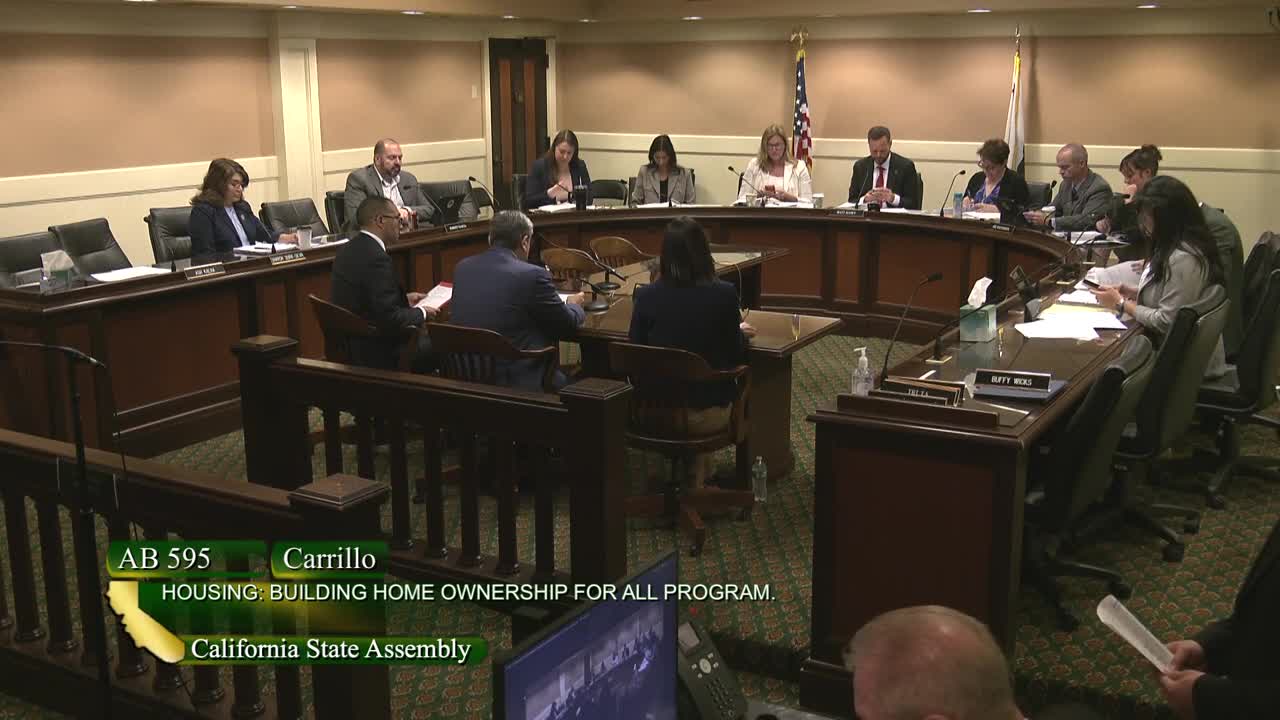 9MIN
Assembly Standing Committee on Housing and Community Development
Bill Author

Bill Co-Author(s):