AB 611: Voluntary tax contribution funds: spinal cord injury research.
- Session Year: 2025-2026
- House: Assembly
- Latest Version Date: 2026-09-18
Current Status:
Passed
(2026-09-18: Chaptered by Secretary of State - Chapter 264, Statutes of 2026.)
Introduced
In Committee
Awaiting First Chamber Vote
Passed First Chamber
In Committee
Awaiting Second Chamber Vote
Passed Second Chamber
Enacted
Existing law allows an individual taxpayer to contribute amounts in excess of their personal income tax liability for the support of specified funds and accounts, including, among others, to the California Cancer Research Voluntary Tax Contribution Fund.
This bill, for taxable years beginning on or after January 1, 2027, and before January 1, 2034, would allow an individual to designate on their tax return that a specified amount in excess of their tax liability be transferred to the continuously appropriated California Spinal Cord Injury Research Voluntary Tax Contribution Fund, which would be created by this bill. The bill would require the Franchise Tax Board to revise the tax return form to include a space for the designation of contributions to the fund. By establishing a new continuously appropriated fund, this bill would make an appropriation. The bill would repeal its provisions on December 1, 2034, except as specified.
Existing law allows an individual taxpayer to contribute amounts in excess of their personal income tax liability for the support of specified funds and accounts, including, among others, to the California Cancer Research Voluntary Tax Contribution Fund.
This bill bill, for taxable years beginning on or after January 1, 2027, and before January 1, 2034, would allow an individual to designate on their tax return that a specified amount in excess of their tax liability be transferred to the continuously appropriated California Spinal Cord Injury Research Voluntary Tax Contribution Fund, which would be created by this bill. The bill would require the Franchise Tax Board to revise the tax return form to include a space for the designation of contributions to the fund when another voluntary designation is removed from the form or there is space, whichever occurs first. fund. By establishing a new continuously appropriated fund, this bill would make an appropriation. The bill would require that the above provisions remain operative only until January 1 of the 7th calendar year following the first appearance of the California Pediatric Cancer Research Voluntary Tax Contribution Fund on the tax return, repeal its provisions on December 1, 2034, except as specified.
Existing law allows an individual taxpayer to contribute amounts in excess of their personal income tax liability for the support of specified funds and accounts, including, among others, to the California Cancer Research Voluntary Tax Contribution Fund.
This bill would allow an individual to designate on their tax return that a specified amount in excess of their tax liability be transferred to the continuously appropriated California Spinal Cord Injury Research Voluntary Tax Contribution Fund, which would be created by this bill. The bill would require the Franchise Tax Board to revise the tax return form to include a space for the designation of contributions to the fund when another voluntary designation is removed from the form or there is space, whichever occurs first. By establishing a new continuously appropriated fund, this bill would make an appropriation. The bill would require that the above provisions remain operative only until January 1 of the 7th calendar year following the first appearance of the California Pediatric Cancer Research Voluntary Tax Contribution Fund on the tax return, except as specified.
Existing law requires an incumbent grocery employer, defined as a person that owns, controls, or operates the grocery establishment at the time of a change in control, as defined, to post a public notice of a change in control at the location of the affected grocery establishment within 5 business days following the execution of the transfer document, as specified. Existing law, among other things, requires a covered establishment, defined to include a grocery establishment or a pharmacy establishment, to provide written notice of a closure to persons or entities, as specified, no later than 45 days before the closure takes effect.This bill would require a legacy local news organization, at least 120 days before the final execution of any transaction agreement, to provide a notice of intent to sell, as specified. The bill would require written notice to be provided, among other things, directly to each employee of the legacy local news organization, as specified, and would require the notice to include prescribed information, including the name of the proposed buyer. The bill would specify that its provisions do not apply to a legacy local news organization that would be independently owned after a transaction. The bill would define various terms for these purposes.Existing law requires an incumbent grocery employer, defined as a person that owns, controls, or operates the grocery establishment at the time of a change in control, as defined, to post a public notice of a change in control at the location of the affected grocery establishment within 5 business days following the execution of the transfer document, as specified. Existing law, among other things, requires a covered establishment, defined to include a grocery establishment or a pharmacy establishment, to provide written notice of a closure to persons or entities, as specified, no later than 45 days before the closure takes effect.
This bill would require a legacy local news organization, at least 120 days before the final execution of any transaction agreement, to provide a notice of intent to sell, as specified. The bill would require written notice to be provided, among other things, directly to each employee of the legacy local news organization, as specified, and would require the notice to include prescribed information, including the name of the proposed buyer. The bill would specify that its provisions do not apply to a legacy local news organization that would be independently owned after a transaction. The bill would define various terms for these purposes.
Existing law requires an incumbent grocery employer, defined as a person that owns, controls, or operates the grocery establishment at the time of a change in control, as defined, to post a public notice of a change in control at the location of the affected grocery establishment within 5 business days following the execution of the transfer document, as specified. Existing law, among other things, requires a covered establishment, defined to include a grocery establishment or a pharmacy establishment, to provide written notice of a closure to persons or entities, as specified, no later than 45 days before the closure takes effect.
This bill would require a legacy local media outlet, as defined, at least 120 days before any sale or transfer of a material amount of its assets or voting securities greater than 10 percent of the business, to provide specified notices of the sale or transfer, including written notice to each employee of the legacy local media outlet, that includes prescribed information, including the name of the proposed buyer. Within 60 days of the notice of the sale or transfer, this bill would require a legacy local media outlet to provide its employees a notice of the right of first refusal to purchase a portion or the entirety of that percent of the legacy local media outlet to be sold or transferred. The bill would give an employee a right of first refusal, and would authorize the employee to invoke that right by submitting a written notice of their intent and purchase offer at any time within 60 days of receiving the notice of first refusal. The bill would require the legacy local media outlet to engage in good faith negotiations with an employee who invokes this right of first refusal, and prohibit the local media outlet from accepting another offer until the 60-day period has elapsed. The bill would authorize a legacy local media outlet to reject any employee offer at the end of the 60-day period.This bill would require any purchase or transfer of a portion or the entirety of a legacy local media outlet, as described above, in which the buyer will receive, among other things, financing guarantees from a governmental source to effectuate a purchase or transfer subject to these provisions to accept and continue any collectively bargained employee contract in effect 120 days before any sale or transfer of ownership.This bill would require a legacy local news organization, at least 120 days before the final execution of any transaction agreement, to provide a notice of intent to sell, as specified. The bill would require written notice to be provided, among other things, directly to each employee of the legacy local news organization, as specified, and would require the notice to include prescribed information, including the name of the proposed buyer. The bill would specify that its provisions do not apply to a legacy local news organization that would be independently owned after a transaction. The bill would define various terms for these purposes.
Existing law requires an incumbent grocery employer, defined as a person that owns, controls, or operates the grocery establishment at the time of a change in control, as defined, to post a public notice of a change in control at the location of the affected grocery establishment within 5 business days following the execution of the transfer document, as specified. Existing law, among other things, requires a covered establishment, defined to include a grocery establishment or a pharmacy establishment, to provide written notice of a closure to persons or entities, as specified, no later than 45 days before the closure takes effect.
This bill would require a legacy local media outlet, as defined, at least 120 days before any sale or transfer of a material amount of its assets or voting securities greater than 10 percent of the business, to provide specified notices of the sale or transfer, including written notice to each employee of the legacy local media outlet, that includes prescribed information, including the name of the proposed buyer.
Within 60 days of the notice of the sale or transfer, this bill would require a legacy local media outlet to provide its employees a notice of the right of first refusal to purchase a portion or the entirety of that percent of the legacy local media outlet to be sold or transferred. The bill would give an employee a right of first refusal, and would authorize the employee to invoke that right by submitting a written notice of their intent and purchase offer at any time within 60 days of receiving the notice of first refusal. The bill would require the legacy local media outlet to engage in good faith negotiations with an employee who invokes this right of first refusal, and prohibit the local media outlet from accepting another offer until the 60-day period has elapsed. The bill would authorize a legacy local media outlet to reject any employee offer at the end of the 60-day period.
This bill would require any purchase or transfer of a portion or the entirety of a legacy local media outlet, as described above, in which the buyer will receive, among other things, financing guarantees from a governmental source to effectuate a purchase or transfer subject to these provisions to accept and continue any collectively bargained employee contract in effect 120 days before any sale or transfer of ownership.
Existing law requires an incumbent grocery employer, defined as a person that owns, controls, or operates the grocery establishment at the time of a change in control, as defined, to post a public notice of a change in control at the location of the affected grocery establishment within 5 business days following the execution of the transfer document, as specified. Existing law requires a covered establishment, defined to include a grocery establishment or a pharmacy establishment, to post a written notice of the closure, as defined, of the covered establishment in a conspicuous location at the entrance to the covered establishments premises, as specified, no later than 45 days before the closure takes effect.This bill would state the intent of the Legislature to enact legislation regarding public notices of proposed sales or transfers of local media outlets.Existing law requires an incumbent grocery employer, defined as a person that owns, controls, or operates the grocery establishment at the time of a change in control, as defined, to post a public notice of a change in control at the location of the affected grocery establishment within 5 business days following the execution of the transfer document, as specified. Existing law requires a covered establishment, defined to include a grocery establishment or a pharmacy establishment, to post a written notice of the closure, as defined, of the covered establishment in a conspicuous location at the entrance to the covered establishments premises, as specified, no later than 45 days before the closure takes effect.
This bill would state the intent of the Legislature to enact legislation regarding public notices of proposed sales or transfers of local media outlets.
(a)For taxable years beginning on or after January 1, 2027, and before January 1, 2034, an individual may designate on the tax return that a contribution in excess of the tax liability, if any, be made to the California Spinal Cord Injury Research Voluntary Tax Contribution Fund, established pursuant to Section 18724.1. That designation is to be used as a voluntary checkoff on the tax return.
(b)The contributions shall be in full dollar amounts and may be made individually by each signatory on a joint return.
(c)A designation under subdivision (a) shall be made for a taxable year on the original return for that taxable year, and once made shall be irrevocable. If payments and credits reported on the return, together with any other credits associated with the taxpayers account, do not exceed the taxpayers liability, the return shall be treated as though no designation has been made.
(d)If a taxpayer designates a contribution to more than one account or fund listed on the tax return, and the amount available for designation is insufficient to satisfy the total amount designated, the contribution shall be allocated among the designees on a pro rata basis.
(e)The Franchise Tax Board shall revise the forms of the return to include a space labeled the California Spinal Cord Injury Research Voluntary Tax Contribution Fund to allow for the designation permitted under subdivision (a). The forms shall also include in the instructions information that the contribution may be in the amount of one dollar ($1) or more and that the contribution shall be used to support research relating to the treatment of spinal cord injuries.
(f)A deduction shall be allowed under Article 6 (commencing with Section 17201) of Chapter 3 of Part 10 for any contribution made pursuant to subdivision (a).
18724.1.(a)There is hereby established in the State Treasury the California Spinal Cord Injury Research Voluntary Tax Contribution Fund to receive contributions made pursuant to Section 18724.
(b)The Franchise Tax Board shall notify the Controller of both the amount of moneys paid by taxpayers in excess of their tax liability and the amount of refund moneys that taxpayers have designated pursuant to Section 18724 to be transferred to the California Spinal Cord Injury Research Voluntary Tax Contribution Fund.
(c)The Controller shall transfer from the Personal Income Tax Fund to the California Spinal Cord Injury Research Voluntary Tax Contribution Fund an amount not in excess of the sum of the amounts designated by individuals pursuant to Section 18724 for payment into that fund.
18724.2.(a)Notwithstanding Section 13340 of the Government Code, all moneys transferred to the California Spinal Cord Injury Research Voluntary Tax Contribution Fund shall be continuously appropriated and allocated as follows:
(1)To the Franchise Tax Board and the Controller for reimbursement of all costs incurred by the Franchise Tax Board and the Controller in connection with their duties under this article.
(2)To the Regents of the University of California for distribution of grants for the purposes of conducting research on the treatments of spinal cord injuries, pursuant to Chapter 2 (commencing with Section 104335) of Part 2 of Division 103 of the Health and Safety Code. The Regents of the University of California may use up to 5 percent of the moneys allocated to them for administering and promoting the Spinal Cord Injury Research Program.
(b)The Legislature requests the Regents of the University of California to report on its internet website the process for awarding moneys, the amount of moneys spent on administration, and an itemization of how program funds were awarded, including, but not limited to, information regarding recipients of funds.
18724.3.(a)Except as otherwise provided in subdivision (b), this article shall remain operative only until December 1, 2034, and as of that date is repealed.
(b)(1)On or before September 1, 2028, and each September 1 thereafter, the Franchise Tax Board shall determine whether the amount of contributions estimated to be received during the calendar year will equal or exceed the minimum contribution amount for the calendar year pursuant to paragraph (3). The Franchise Tax Board shall estimate the amount of contributions to be received by using the actual amounts received and an estimate of the contributions that will be received by the end of that calendar year.
(2)If the Franchise Tax Board determines that the amount of the contributions estimated to be received during a calendar year will not at least equal the minimum contribution amount for that calendar year, this article is inoperative with respect to taxable years beginning on or after January 1 of that calendar year and is repealed on December 1 of that calendar year.
(3)For purposes of this section, the minimum contribution amount for a calendar year means two hundred fifty thousand dollars ($250,000).
(c)Notwithstanding the repeal of this article, any contribution amounts designated pursuant to this article prior to its repeal shall continue to be transferred and disbursed in accordance with this article as in effect immediately prior to that repeal.
(a)Any For taxable years beginning on or after January 1, 2027, and before January 1, 2034, an individual may designate on the tax return that a contribution in excess of the tax liability, if any, be made to the California Spinal Cord Injury Research Voluntary Tax Contribution Fund, established pursuant to Section 18724.1. That designation is to be used as a voluntary checkoff on the tax return.
(b)The contributions shall be in full dollar amounts and may be made individually by each signatory on a joint return.
(c)A designation under subdivision (a) shall be made for any a taxable year on the original return for that taxable year, and once made shall be irrevocable. In the event that If payments and credits reported on the return, together with any other credits associated with the taxpayers account, do not exceed the taxpayers liability, the return shall be treated as though no designation has been made.
(d)In the event If a taxpayer designates a contribution to more than one account or fund listed on the tax return, and the amount available for designation is insufficient to satisfy the total amount designated, the contribution shall be allocated among the designees on a pro rata basis.
(e)When another voluntary contribution designation is removed from the tax return, or as soon as space is available, whichever occurs first, the The Franchise Tax Board shall revise the forms of the return to include a space labeled the California Spinal Cord Injury Research Voluntary Tax Contribution Fund to allow for the designation permitted under subdivision (a). The forms shall also include in the instructions information that the contribution may be in the amount of one dollar ($1) or more and that the contribution shall be used to support research relating to the treatment of spinal cord injuries.
(f)A deduction shall be allowed under Article 6 (commencing with Section 17201) of Chapter 3 of Part 10 for any contribution made pursuant to subdivision (a).
18724.1.(a)There is hereby established in the State Treasury the California Spinal Cord Injury Research Voluntary Tax Contribution Fund to receive contributions made pursuant to Section 18724. The
(b)The Franchise Tax Board shall notify the Controller of both the amount of moneys paid by taxpayers in excess of their tax liability and the amount of refund moneys that taxpayers have designated pursuant to Section 18724 to be transferred to the California Spinal Cord Injury Research Voluntary Tax Contribution Fund. The
(c)The Controller shall transfer from the Personal Income Tax Fund to the California Spinal Cord Injury Research Voluntary Tax Contribution Fund an amount not in excess of the sum of the amounts designated by individuals pursuant to Section 18724 for payment into that fund.
18724.2.(a)Notwithstanding Section 13340 of the Government Code, all moneys transferred to the California Spinal Cord Injury Research Voluntary Tax Contribution Fund shall be continuously appropriated and allocated as follows:
(1)To the Franchise Tax Board and the Controller for reimbursement of all costs incurred by the Franchise Tax Board and the Controller in connection with their duties under this article.
(2)To the Regents of the University of California for distribution of grants for the purposes of conducting research on the treatments of spinal cord injuries, pursuant to Chapter 2 (commencing with Section 104335) of Part 2 of Division 103 of the Health and Safety Code. The Regents of the University of California may use up to 5 percent of the moneys allocated to them for administering and promoting the Spinal Cord Injury Research Program.
(b)The Legislature requests the Regents of the University of California to report on its internet website the process for awarding moneys, the amount of moneys spent on administration, and an itemization of how program funds were awarded, including, but not limited to, information regarding recipients of funds.
18724.3.(a)Except as otherwise provided in subdivision (b), this article shall remain operative only until January 1 of the seventh calendar year following the first appearance of the California Spinal Cord Injury Research Voluntary Tax Contribution Fund on the tax return, and is repealed as of December 1 of that year. December 1, 2034, and as of that date is repealed.
(b)(1)By September 1 of the second calendar year and each subsequent calendar year that the California Spinal Cord Injury Research Voluntary Tax Contribution Fund appears on the tax return, On or before September 1, 2028, and each September 1 thereafter, the Franchise Tax Board shall determine whether the amount of contributions estimated to be received during the calendar year will equal or exceed the minimum contribution amount for the calendar year pursuant to paragraph (3). The Franchise Tax Board shall estimate the amount of contributions to be received by using the actual amounts received and an estimate of the contributions that will be received by the end of that calendar year.
(2)If the Franchise Tax Board determines that the amount of the contributions estimated to be received during a calendar year will not at least equal the minimum contribution amount for that calendar year, this article is inoperative with respect to taxable years beginning on or after January 1 of that calendar year and is repealed on December 1 of that calendar year.
(3)For purposes of this section, the minimum contribution amount for a calendar year means two hundred fifty thousand dollars ($250,000).
(c)Notwithstanding the repeal of this article, any contribution amounts designated pursuant to this article prior to its repeal shall continue to be transferred and disbursed in accordance with this article as in effect immediately prior to that repeal.
(a)Any individual may designate on the tax return that a contribution in excess of the tax liability, if any, be made to the California Spinal Cord Injury Research Voluntary Tax Contribution Fund, established pursuant to Section 18724.1. That designation is to be used as a voluntary checkoff on the tax return.
(b)The contributions shall be in full dollar amounts and may be made individually by each signatory on a joint return.
(c)A designation under subdivision (a) shall be made for any taxable year on the original return for that taxable year, and once made shall be irrevocable. In the event that payments and credits reported on the return, together with any other credits associated with the taxpayers account, do not exceed the taxpayers liability, the return shall be treated as though no designation has been made.
(d)In the event a taxpayer designates a contribution to more than one account or fund listed on the tax return, and the amount available for designation is insufficient to satisfy the total amount designated, the contribution shall be allocated among the designees on a pro rata basis.
(e)When another voluntary contribution designation is removed from the tax return, or as soon as space is available, whichever occurs first, the Franchise Tax Board shall revise the forms of the return to include a space labeled the California Spinal Cord Injury Research Voluntary Tax Contribution Fund to allow for the designation permitted under subdivision (a). The forms shall also include in the instructions information that the contribution may be in the amount of one dollar ($1) or more and that the contribution shall be used to support research relating to the treatment of spinal cord injuries.
(f)A deduction shall be allowed under Article 6 (commencing with Section 17201) of Chapter 3 of Part 10 for any contribution made pursuant to subdivision (a).
18724.1.There is hereby established in the State Treasury the California Spinal Cord Injury Research Voluntary Tax Contribution Fund to receive contributions made pursuant to Section 18724. The Franchise Tax Board shall notify the Controller of both the amount of moneys paid by taxpayers in excess of their tax liability and the amount of refund moneys that taxpayers have designated pursuant to Section 18724 to be transferred to the California Spinal Cord Injury Research Voluntary Tax Contribution Fund. The Controller shall transfer from the Personal Income Tax Fund to the California Spinal Cord Injury Research Voluntary Tax Contribution Fund an amount not in excess of the sum of the amounts designated by individuals pursuant to Section 18724 for payment into that fund.
18724.2.(a)Notwithstanding Section 13340 of the Government Code, all moneys transferred to the California Spinal Cord Injury Research Voluntary Tax Contribution Fund shall be continuously appropriated and allocated as follows:
(1)To the Franchise Tax Board and the Controller for reimbursement of all costs incurred by the Franchise Tax Board and the Controller in connection with their duties under this article.
(2)To the Regents of the University of California for distribution of grants for the purposes of conducting research on the treatments of spinal cord injuries, pursuant to Chapter 2 (commencing with Section 104335) of Part 2 of Division 103 of the Health and Safety Code. The Regents of the University of California may use up to 5 percent of the moneys allocated to them for administering and promoting the Spinal Cord Injury Research Program.
(b)The Legislature requests the Regents of the University of California to report on its internet website the process for awarding moneys, the amount of moneys spent on administration, and an itemization of how program funds were awarded, including, but not limited to, information regarding recipients of funds.
18724.3.(a)Except as otherwise provided in subdivision (b), this article shall remain operative only until January 1 of the seventh calendar year following the first appearance of the California Spinal Cord Injury Research Voluntary Tax Contribution Fund on the tax return, and is repealed as of December 1 of that year.
(b)(1)By September 1 of the second calendar year and each subsequent calendar year that the California Spinal Cord Injury Research Voluntary Tax Contribution Fund appears on the tax return, the Franchise Tax Board shall determine whether the amount of contributions estimated to be received during the calendar year will equal or exceed the minimum contribution amount for the calendar year pursuant to paragraph (3). The Franchise Tax Board shall estimate the amount of contributions to be received by using the actual amounts received and an estimate of the contributions that will be received by the end of that calendar year.
(2)If the Franchise Tax Board determines that the amount of the contributions estimated to be received during a calendar year will not at least equal the minimum contribution amount for that calendar year, this article is inoperative with respect to taxable years beginning on or after January 1 of that calendar year and is repealed on December 1 of that calendar year.
(3)For purposes of this section, the minimum contribution amount for a calendar year means two hundred fifty thousand dollars ($250,000).
(c)Notwithstanding the repeal of this article, any contribution amounts designated pursuant to this article prior to its repeal shall continue to be transferred and disbursed in accordance with this article as in effect immediately prior to that repeal.
SECTION 1.The Legislature finds and declares both of the following:(a)Preserving access to high-quality and diverse sources of local news is of vital importance to our communities. In the struggling independent community news industry, many local newsroom owners find it difficult to make payroll each month or attract competitive bidders when looking to retire or exit the sector, with large conglomerates managed by hedge funds and private equity often acting as the buyers of last resort. This has led to growing concentration in ownership of community-based newsrooms, giving fewer owners more control over the news that Californians see. This concentration of newsroom ownership has coincided in a dramatic loss in the number of journalists employed in the state, which threatens consumer access to diverse sources of high-quality local news reporting.(b)Preserving Californias independently owned and operated newsrooms does all of the following:(1)Promotes local reporting and government accountability to the public.(2)Protects diversity of opinion.(3)Improves local business development, community engagement, and connection to arts and culture.(4)Maintains resident access to accurate and essential community information, from disaster preparedness to voting information.(5)Undergirds our local, state, and even national democracies.(c)Promoting independent, employee, and small business ownership opportunities of legacy newsrooms by employee journalists via a notice period will help preserve access to diverse sources of community news by stimulating competition in the ownership markets for local newsrooms, which preserves and supports the unique character of local communities and culture throughout the state.SEC. 2.Title 23 (commencing with Section 3273.80) is added to Part 4 of Division 3 of the Civil Code, to read:23.The Keep News Independent Act3273.80.This title shall be known, and may be cited, as the Keep News Independent Act.3273.81.For the purposes of this title, the following definitions apply:(a)Independently owned means a local new organization that meets all of the following requirements:(1)The local news organization is not a publicly traded entity, and no more than 5 percent of the beneficial ownership of the local news organization is owned, directly or indirectly, by a publicly traded entity.(2)The local news organization is not beneficially owned by a private fund.(3)The local news organization is not a subsidiary.(b)Legacy local news organization means a local news organization that meets both of the following requirements:(1)The local news organization has been operating for 10 years or more with no break in operations exceeding 1 year, regardless of ownership changes.(2)The local news organizations content is produced through print or digital means that meets either of the following requirements:(A)A print news publication that has been published at least 24 times over the previous 12 months.(B)A digital news publication that has published new content an average of once per week in 48 of the previous 52 weeks.(c)Local news organization means an entity that engages professionals to create, edit, produce, and distribute original local or state community news in the state for dissemination to a local or state community, through reporting activities, including conducting interviews, observing current events, or analyzing documents or other information. Local news organization does not include an entity that is a television or radio broadcasting station licensed by the Federal Communications Commission.(d)Private fund means a corporation that is an investment company, as defined in Section 3 of the Investment Company Act of 1940 (15 U.S.C. Sec. 80a-3), except paragraphs (1) to (7), inclusive, of subsection (c). Private fund does not include either of the following:(1)A venture capital fund, as defined in Section 275.203(l)-1 of Title 17 of the Code of Federal Regulations, as that section read on the effective date of this title.(2)A selected community development financial institution pursuant to Section 107 of the federal Community Development Banking and Financial Institutions Act of 1994 (12 U.S.C. Sec. 4706).(e)Transaction means an ownership sale or transfer involving any of the following:(1)A sufficient amount of a legacy local news organizations assets to constitute a merger or transfer of control of editorial operations or distribution.(2)Voting securities greater than 10 percent of a legacy local news organization.(3) A legacy local news organizations name, branding, or adjudication.3273.82.(a)A legacy local news organization shall provide notice of intent to sell pursuant to subdivision (b) at least 120 days before the final execution of any transaction agreement.(b)The notice described in subdivision (a) shall comply with both of the following:(1)Notice shall be provided as follows:(A)Written notice directly to each employee of the legacy local news organization.(B)Written or any other applicable form of notice to subscribers and consumers of the legacy local news organization in each print edition of content published or posted by the legacy local news organization during the 120-day notice period.(C)(i)Written notice in at least seven-point type shall be published in an adjudicated newspaper of general circulation in the county where the local news organization is located for three consecutive weeks.(ii)If there is no adjudicated newspaper of general circulation in the county, the written notice described in clause (i) shall be published in an adjudicated newspaper of general circulation in a county that geographically borders the county where the local news organization is located.(2)The notice shall include, but not be limited to, all of the following information:(A)A statement of intent to sell by the owner of the legacy local news organization.(B)The name of the proposed buyer.(C)If there is an expected date of the proposed sale or transfer, the date.(D)The legacy local news organizations affirmation of compliance with the requirements of this section.3273.83.This title shall not apply to a legacy local news organization that would be independently owned after a transaction.The Legislature finds and declares both of the following:
(a)Preserving access to high-quality and diverse sources of local news is of vital importance to our communities. In the struggling independent community news industry, many local newsroom owners find it difficult to make payroll each month or attract competitive bidders when looking to retire or exit the sector, with large conglomerates managed by hedge funds and private equity often acting as the buyers of last resort. This has led to growing concentration in ownership of community-based newsrooms, giving fewer owners more control over the news that Californians see. This concentration of newsroom ownership has coincided in a dramatic loss in the number of journalists employed in the state, which threatens consumer access to diverse sources of high-quality local news reporting.
(b)Preserving Californias independently owned and operated newsrooms does all of the following:
(1)Promotes local reporting and government accountability to the public.
(2)Protects diversity of opinion.
(3)Improves local business development, community engagement, and connection to arts and culture.
(4)Maintains resident access to accurate and essential community information, from disaster preparedness to voting information.
(5)Undergirds our local, state, and even national democracies.
(c)Promoting independent, employee, and small business ownership opportunities of legacy newsrooms by employee journalists via a notice period will help preserve access to diverse sources of community news by stimulating competition in the ownership markets for local newsrooms, which preserves and supports the unique character of local communities and culture throughout the state.
SEC. 2.Title 23 (commencing with Section 3273.80) is added to Part 4 of Division 3 of the Civil Code, to read:23.The Keep News Independent Act3273.80.This title shall be known, and may be cited, as the Keep News Independent Act.
3273.81.For the purposes of this title, the following definitions apply:
(a)Independently owned means a local new organization that meets all of the following requirements:
(1)The local news organization is not a publicly traded entity, and no more than 5 percent of the beneficial ownership of the local news organization is owned, directly or indirectly, by a publicly traded entity.
(2)The local news organization is not beneficially owned by a private fund.
(3)The local news organization is not a subsidiary.
(b)Legacy local news organization means a local news organization that meets both of the following requirements:
(1)The local news organization has been operating for 10 years or more with no break in operations exceeding one 1 year, regardless of ownership changes.
(2)The local news organizations content is produced through print or digital means that meets either of the following requirements:
(A)A print news publication that has been published at least 24 times over the previous 12 months.
(B)A digital news publication that has published new content an average of once per week in 48 of the previous 52 weeks.
(c)Local news organization means an entity that engages professionals to create, edit, produce, and distribute original local or state community news in the state for dissemination to a local or state community, through reporting activities, including conducting interviews, observing current events, or analyzing documents or other information. Local news organization does not include an entity that is a television or radio broadcasting station licensed by the Federal Communications Commission.
(d)Private fund means a corporation that is an investment company, as defined in Section 3 of the Investment Company Act of 1940 (15 U.S.C. Sec. 80a-3), except paragraphs (1) to (7), inclusive, of subsection (c). Private fund does not include either of the following:
(1)A venture capital fund, as defined in Section 275.203(l)-1 of Title 17 of the Code of Federal Regulations, as that section read on the effective date of this title.
(2)A selected community development financial institution pursuant to Section 107 of the federal Community Development Banking and Financial Institutions Act of 1994 (12 U.S.C. Sec. 4706).
(e)Transaction means an ownership sale or transfer involving either any of the following:
(1)A material sufficient amount of a legacy local news organizations assets. assets to constitute a merger or transfer of control of editorial operations or distribution.
(2)Voting securities greater than 10 percent of a legacy local news organization.
(3) A legacy local news organizations name, branding, or adjudication.
3273.82.(a)A legacy local news organization shall provide notice of intent to sell pursuant to subdivision (b) at least 120 days before the final execution of any transaction agreement.
(b)The notice described in subdivision (a) shall comply with both of the following:
(1)Notice shall be provided as follows:
(A)Written notice directly to each employee of the legacy local news organization.
(B)Written or any other applicable form of notice to subscribers and consumers of the legacy local news organization in each print edition of content published or posted by the legacy local news organization during the 120-day notice period.
(C)(i)Written notice in at least seven-point type shall be published in an adjudicated newspaper of general circulation in the county where the local news organization is located for three consecutive weeks.
(ii)If there is no adjudicated newspaper of general circulation in the county, the written notice described in clause (i) shall be published in an adjudicated newspaper of general circulation in a county that geographically borders the county where the local news organization is located.
(2)The notice shall include, but not be limited to, all of the following information:
(A)A statement of intent to sell by the owner of the legacy local news organization.
(B)The name of the proposed buyer.
(C)If there is an expected date of the proposed sale or transfer, the date.
(D)The legacy local news organizations affirmation of compliance with the requirements of this section.
3273.83.This title shall not apply to a legacy local media news organization that would be independently owned after a transaction.
The Legislature finds and declares both of the following:
(a)Preserving access to high-quality and diverse sources of local news is of vital importance to our communities. In the struggling local independent community news industry, many local newsroom owners find it difficult to make payroll each month or attract competitive bidders when looking to retire or exit the sector, with large conglomerates managed by hedge funds and private equity often acting as the buyers of last resort. This has led to growing concentration in ownership of local community-based newsrooms, giving fewer owners more control over the news that Californians see. This concentration of newsroom ownership has coincided in a dramatic loss in the number of journalists employed in the state, which threatens consumer access to diverse sources of high-quality local news. news reporting.
(b)Promoting employee ownership of legacy newsrooms by employee journalists via notice period will help preserve access to diverse sources of community news by stimulating competition in the ownership markets for local newsrooms.(b)Preserving Californias independently owned and operated newsrooms does all of the following:
(1)Promotes local reporting and government accountability to the public.
(2)Protects diversity of opinion.
(3)Improves local business development, community engagement, and connection to arts and culture.
(4)Maintains resident access to accurate and essential community information, from disaster preparedness to voting information.
(5)Undergirds our local, state, and even national democracies.
(c)Promoting independent, employee, and small business ownership opportunities of legacy newsrooms by employee journalists via a notice period will help preserve access to diverse sources of community news by stimulating competition in the ownership markets for local newsrooms, which preserves and supports the unique character of local communities and culture throughout the state.
SEC. 2.Title 23 (commencing with Section 3273.80) is added to Part 4 of Division 3 of the Civil Code, to read:23.The Keep News Local Act3273.80.This title shall be known, and may be cited, as The Keep News Local Act.3273.81.For the purposes of this title, legacy local media outlet means a business that meets all of the following requirements:(a)The business has been running for 10 years or more and performs a public information function comparable to that traditionally served by newspapers and other periodical news publications.(b)The business employs professionals to create, edit, produce, and distribute original content, at least 25 percent of which concerns specific interests to a community, city, neighborhood, or region in the state.(c)The businesss content is produced through print or digital means that meets either of the following requirements:(1)A print publication that has been published at least once per month in 11 of the previous 12 months.(2)A digital publication that has been published once per week in 48 of the previous 52 weeks.3273.82.(a)A legacy local media outlet shall provide notice pursuant to subdivision (b) at least 120 days before any sale or transfer of either of the following:(1)A material amount of its assets.(2)Voting securities greater than 10 percent of the business.(b)Notice described in subdivision (a) shall comply with both of the following:(1)Notice shall be provided as follows:(A)Written notice directly to each employee of the legacy local media outlet.(B)Written or any other applicable form of notice to subscribers and consumers of the legacy local media outlet in each print edition of content published or posted by the local media outlet during the 120-day notice period.(C)Written notice to the governing body of any city or county where the legacy local media outlet is headquartered.(2)The notice shall include, but not be limited to, all of the following information:(A)The name of the proposed buyer.(B)The dollar amount of the proposed sale or transfer.(C)The expected date of the proposed sale or transfer.(D)The legacy local media outlets affirmation of compliance with the requirements of this section.3273.83.(a)Within the first 60 days of the notice required by Section 3273.82, a legacy local media outlet shall provide its employees a notice of the right of first refusal to purchase a portion or the entirety of that percent of the ownership interest of the local media outlet to be sold or transferred as described in subdivision (a) of Section 3273.82, including an opportunity to substantially match any terms offered by another person.(b)(1)An employee shall have the right of first refusal and may invoke that right by submitting a written notice of their intent and purchase offer at any time within 60 days of receiving a notice of the right to first refusal.(2)A legacy local media outlet shall engage in good faith negotiations with an employee who invokes the right of first refusal pursuant to paragraph (1), and shall not accept an offer from any other employee or person until the 60-day period has elapsed.(3)The legacy local media outlet may reject any employee offer at the end of the 60-day period.3273.84.Any purchase or transfer of a portion or the entirety of a legacy local media outlet as described in subdivision (a) of Section 3273.82 in which the buyer will receive any grants, financing, or financing guarantees from a governmental source to effectuate a purchase or transfer subject to this title shall accept and continue any collectively bargained employee contract in effect 120 days before any sale or transfer of ownership.SEC. 2.Title 23 (commencing with Section 3273.80) is added to Part 4 of Division 3 of the Civil Code, to read:23.The Keep News Independent Act3273.80.This title shall be known, and may be cited, as the Keep News Independent Act.
3273.81.For the purposes of this title, the following definitions apply:
(a)Independently owned means a local new organization that meets all of the following requirements:
(1)The local news organization is not a publicly traded entity, and no more than 5 percent of the beneficial ownership of the local news organization is owned, directly or indirectly, by a publicly traded entity.
(2)The local news organization is not beneficially owned by a private fund.
(3)The local news organization is not a subsidiary.
(b)Legacy local news organization means a local news organization that meets both of the following requirements:
(1)The local news organization has been operating for 10 years or more with no break in operations exceeding one year, regardless of ownership changes.
(2)The local news organizations content is produced through print or digital means that meets either of the following requirements:
(A)A print news publication that has been published at least 24 times over the previous 12 months.
(B)A digital news publication that has published new content an average of once per week in 48 of the previous 52 weeks.
(c)Local news organization means an entity that engages professionals to create, edit, produce, and distribute original local or state community news in the state for dissemination to a local or state community, through reporting activities, including conducting interviews, observing current events, or analyzing documents or other information.
(d)Private fund means a corporation that is an investment company, as defined in Section 3 of the Investment Company Act of 1940 (15 U.S.C. Sec. 80a-3), except paragraphs (1) to (7), inclusive, of subsection (c). Private fund does not include either of the following:
(1)A venture capital fund, as defined in Section 275.203(l)-1 of Title 17 of the Code of Federal Regulations, as that section read on the effective date of this title.
(2)A selected community development financial institution pursuant to Section 107 of the federal Community Development Banking and Financial Institutions Act of 1994 (12 U.S.C. Sec. 4706).
(e)Transaction means an ownership sale or transfer involving either of the following:
(1)A material amount of a legacy local news organizations assets.
(2)Voting securities greater than 10 percent of a legacy local news organization.
3273.82.(a)A legacy local news organization shall provide notice of intent to sell pursuant to subdivision (b) at least 120 days before the final execution of any transaction agreement.
(b)The notice described in subdivision (a) shall comply with both of the following:
(1)Notice shall be provided as follows:
(A)Written notice directly to each employee of the legacy local news organization.
(B)Written or any other applicable form of notice to subscribers and consumers of the legacy local news organization in each print edition of content published or posted by the legacy local news organization during the 120-day notice period.
(C)(i)Written notice in at least seven-point type shall be published in an adjudicated newspaper of general circulation in the county where the local news organization is located for three consecutive weeks.
(ii)If there is no adjudicated newspaper of general circulation in the county, the written notice described in clause (i) shall be published in an adjudicated newspaper of general circulation in a county that geographically borders the county where the local news organization is located.
(2)The notice shall include, but not be limited to, all of the following information:
(A)A statement of intent to sell by the owner of the legacy local news organization.
(B)The name of the proposed buyer.
(C)If there is an expected date of the proposed sale or transfer, the date.
(D)The legacy local news organizations affirmation of compliance with the requirements of this section.
3273.83.This title shall not apply to a legacy local media organization that would be independently owned after a transaction.
The Legislature finds and declares both of the following:
(a)Preserving access to high-quality and diverse sources of local news is of vital importance to our communities. In the struggling local news industry, many local newsroom owners find it difficult to make payroll each month or attract competitive bidders when looking to retire or exit the sector, with large conglomerates managed by hedge funds and private equity often acting as the buyers of last resort. This has led to growing concentration in ownership of local newsrooms, giving fewer owners more control over the news that Californians see. This concentration of newsroom ownership threatens consumer access to diverse sources of high-quality local news.
(b)Promoting employee ownership of legacy newsrooms by employee journalists via notice period will help preserve access to diverse sources of community news by stimulating competition in the ownership markets for local newsrooms.
SEC. 2.Title 23 (commencing with Section 3273.80) is added to Part 4 of Division 3 of the Civil Code, to read:23.The Keep News Local Act3273.80.This title shall be known, and may be cited, as The Keep News Local Act.
3273.81.For the purposes of this title, legacy local media outlet means a business that meets all of the following requirements:
(a)The business has been running for 10 years or more and performs a public information function comparable to that traditionally served by newspapers and other periodical news publications.
(b)The business employs professionals to create, edit, produce, and distribute original content, at least 25 percent of which concerns specific interests to a community, city, neighborhood, or region in the state.
(c)The businesss content is produced through print or digital means that meets either of the following requirements:
(1)A print publication that has been published at least once per month in 11 of the previous 12 months.
(2)A digital publication that has been published once per week in 48 of the previous 52 weeks.
3273.82.(a)A legacy local media outlet shall provide notice pursuant to subdivision (b) at least 120 days before any sale or transfer of either of the following:
(1)A material amount of its assets.
(2)Voting securities greater than 10 percent of the business.
(b)Notice described in subdivision (a) shall comply with both of the following:
(1)Notice shall be provided as follows:
(A)Written notice directly to each employee of the legacy local media outlet.
(B)Written or any other applicable form of notice to subscribers and consumers of the legacy local media outlet in each print edition of content published or posted by the local media outlet during the 120-day notice period.
(C)Written notice to the governing body of any city or county where the legacy local media outlet is headquartered.
(2)The notice shall include, but not be limited to, all of the following information:
(A)The name of the proposed buyer.
(B)The dollar amount of the proposed sale or transfer.
(C)The expected date of the proposed sale or transfer.
(D)The legacy local media outlets affirmation of compliance with the requirements of this section.
3273.83.(a)Within the first 60 days of the notice required by Section 3273.82, a legacy local media outlet shall provide its employees a notice of the right of first refusal to purchase a portion or the entirety of that percent of the ownership interest of the local media outlet to be sold or transferred as described in subdivision (a) of Section 3273.82, including an opportunity to substantially match any terms offered by another person.
(b)(1)An employee shall have the right of first refusal and may invoke that right by submitting a written notice of their intent and purchase offer at any time within 60 days of receiving a notice of the right to first refusal.
(2)A legacy local media outlet shall engage in good faith negotiations with an employee who invokes the right of first refusal pursuant to paragraph (1), and shall not accept an offer from any other employee or person until the 60-day period has elapsed.
(3)The legacy local media outlet may reject any employee offer at the end of the 60-day period.
3273.84.Any purchase or transfer of a portion or the entirety of a legacy local media outlet as described in subdivision (a) of Section 3273.82 in which the buyer will receive any grants, financing, or financing guarantees from a governmental source to effectuate a purchase or transfer subject to this title shall accept and continue any collectively bargained employee contract in effect 120 days before any sale or transfer of ownership.
SECTION 1.It is the intent of the Legislature to enact legislation regarding public notices of proposed sales or transfers of local media outlets.It is the intent of the Legislature to enact legislation regarding public notices of proposed sales or transfers of local media outlets.
|
Date
|
Status
|
|---|---|
| Sep 18, 2026 | Chaptered by Secretary of State - Chapter 264, Statutes of 2026. |
| Sep 18, 2026 | Approved by the Governor. |
| Sep 14, 2026 | Enrolled and presented to the Governor at 1:30 p.m. |
| Aug 31, 2026 | Senate amendments concurred in. To Engrossing and Enrolling. (Ayes 78. Noes 0. Page 6988.). |
| Aug 31, 2026 | Assembly Rule 63 suspended. (Page 6985.) |
| Aug 31, 2026 | From committee: That the Senate amendments be concurred in. (Ayes 5. Noes 0. Page 6988.) (August 30). |
| Aug 31, 2026 | Senate amendments concurred in. To Engrossing and Enrolling. (Ayes 78. Noes 0.). |
| Aug 31, 2026 | Senate amendments concurred in. To Engrossing and Enrolling. |
| Aug 31, 2026 | Assembly Rule 63 suspended. |
| Aug 31, 2026 | From committee: That the Senate amendments be concurred in. (Ayes 5. Noes 0.) (August 30). |
| Aug 30, 2026 | Joint Rule 62(a), file notice suspended. (Page 6872.) |
| Aug 30, 2026 | Joint Rule 62(a), file notice suspended. |
| Aug 27, 2026 | Re-referred to Com. on REV. & TAX. pursuant to Assembly Rule 77.2. |
| Aug 27, 2026 | In Assembly. Concurrence in Senate amendments pending. |
| Aug 26, 2026 | Read third time. Passed. Ordered to the Assembly. (Ayes 39. Noes 0. Page 5910.). |
| Aug 26, 2026 | Read third time. Passed. Ordered to the Assembly. (Ayes 38. Noes 0.). |
| Aug 13, 2026 | Read second time. Ordered to third reading. |
| Aug 13, 2026 | From committee: Do pass. (Ayes 6. Noes 0.) (August 13). |
| Aug 3, 2026 | In committee: Referred to APPR. suspense file. |
| Jun 25, 2026 | Read second time and amended. Re-referred to Com. on APPR. |
| Jun 24, 2026 | From committee: Amend, and do pass as amended and re-refer to Com. on APPR. with recommendation: To Consent Calendar. (Ayes 4. Noes 0.) (June 24). |
| Jun 15, 2026 | Re-referred to Com. on REV. & TAX. |
| Jun 12, 2026 | Re-referred to Com. on RLS. |
| Jun 12, 2026 | Withdrawn from committee. |
| Jun 11, 2026 | From committee chair, with author's amendments: Amend, and re-refer to committee. Read second time, amended, and re-referred to Com. on JUD. |
| Jun 26, 2025 | In committee: Set, first hearing. Hearing canceled at the request of author. |
| Jun 19, 2025 | From committee chair, with author's amendments: Amend, and re-refer to committee. Read second time, amended, and re-referred to Com. on JUD. |
| May 21, 2025 | Referred to Coms. on JUD. and L., P.E. & R. |
| May 8, 2025 | In Senate. Read first time. To Com. on RLS. for assignment. |
| May 8, 2025 | Read third time. Passed. Ordered to the Senate. (Ayes 41. Noes 14. Page 1480.) |
| May 1, 2025 | Read second time. Ordered to third reading. |
| Apr 30, 2025 | From committee: Do pass. (Ayes 7. Noes 3.) (April 29). |
| Apr 24, 2025 | From committee: Do pass and re-refer to Com. on JUD. (Ayes 5. Noes 0.) (April 23). Re-referred to Com. on JUD. |
| Apr 22, 2025 | Re-referred to Com. on L. & E. |
| Apr 21, 2025 | From committee chair, with author's amendments: Amend, and re-refer to Com. on L. & E. Read second time and amended. |
| Mar 25, 2025 | Re-referred to Com. on L. & E. |
| Mar 24, 2025 | From committee chair, with author's amendments: Amend, and re-refer to Com. on L. & E. Read second time and amended. |
| Mar 24, 2025 | Referred to Coms. on L. & E. and JUD. |
| Feb 14, 2025 | From printer. May be heard in committee March 16. |
| Feb 13, 2025 | Read first time. To print. |
|
Date
|
Description
|
Location
|
Votes
|
|
|---|---|---|---|---|
| Aug 31, 2026 | AB 611 LEE Concurrence in Senate Amendments | Assembly Floor |
Passed |
|
| Aug 30, 2026 | With recommendation: That Senate amendments be concurred in. | Assembly Standing Committee on Revenue and Taxation |
Passed |
|
| Aug 26, 2026 | Assembly 3rd Reading AB611 Lee By McNerney | Senate Floor |
Passed |
|
| Aug 13, 2026 | Do pass | Senate Standing Committee on Appropriations |
Passed |
|
| Aug 3, 2026 | Placed on suspense file | Senate Standing Committee on Appropriations |
Passed |
|
| Jun 24, 2026 | Do pass as amended, but first amend, and re-refer to the Committee on [Appropriations] with the recommendation: To Consent Calendar | Senate Standing Committee on Revenue and Taxation |
Passed |
|
| May 8, 2025 | AB 611 Lee Assembly Third Reading | Assembly Floor |
Passed |
|
| Apr 29, 2025 | Do pass. | Assembly Standing Committee on Judiciary |
Passed |
|
| Apr 23, 2025 | Do pass and be re-referred to the Committee on [Judiciary] | Assembly Standing Committee on Labor and Employment |
Passed |
This list shows positions taken on this bill by organizations on the date displayed, which is linked to the original source.
Positions by individuals are not included.
|
Organization
|
Position
|
Date
|
|---|---|---|
| California Common Cause | ** Support | |
| California Independent News Alliance | ** Support | |
| California News Publishers Association | ** Against | |
| City College of San Francisco Department of Journalism | ** Support | |
| Claremont Courier | ** Support | |
| Courage California | ** Support | |
| CSU Journalism | ** Support | |
| El Tecolote | ** Support | |
| Media Guild of The West, NewsGuild-CWA Local 39213 | ** Support | |
| Pacific Media Workers Guild | ** Support | |
| Rebuild Local News | ** Support | |
| Santa Paula Times | ** Support | |
| Showing Up for Racial Justice North County San Diego | ** Support |
(Without Reference to File)
CONCURRENCE IN SENATE AMENDMENTS
CSA2 Bill Id:AB 611
Author:(Lee)
As Amended Ver:June 25, 2026
Majority vote
SUMMARY
Original Committee of Reference: Committee on Labor and Employment
Establishes the California Spinal Cord Injury Research Voluntary Tax Contribution Fund (Fund) and authorizes a taxpayer to make a voluntary contribution to the fund on their state personal income tax return from tax year 2027 to 2033.
Senate Amendments
Current Committee Recommendation: Concur in Senate Amendments
- Delete the prior contents of the bill as passed by the Assembly.
- Require the Franchise Tax Board (FTB) to revise the personal income tax (PIT) return to add the Fund as a voluntary contribution fund (VCF) for taxable years beginning on or after January 1, 2027, and before January 1, 2034.
- Allow taxpayers to make designated contributions to the Fund on their original PIT return in full dollar amounts of $1 or more.
- Require the Fund to receive a standard minimum annual contribution amount of $250,000 to remain in effect.
- Establish the Fund in the State Treasury.
- Provide that all of the moneys transferred to the Fund shall be continuously appropriated and first allocated to the FTB and the State Controller for reimbursement of all administrative costs incurred.
- Require the State Controller to transfer remaining moneys in the Fund after paying administrative costs to the Regents of the University of California (UC) for distribution of grants for the purposes of conducting research on the treatments of spinal cord injuries.
- Provide that the UC may use up to 5% of the moneys allocated to them for administering and promoting the Spinal Cord Injury Research Program.
- Request that the UC report on its internet website the process for awarding moneys, the amount of moneys spent on administration, and an itemization of how program funds were awarded, including, but not limited to, information regarding recipients of funds.
COMMENTS
- Roman Reed Spinal Cord Injury Research Act of 1999: AB 750 (Dutra), Chapter 777, Statutes of 2000, established the Roman Reed Spinal Cord Injury Research Act of 1999 (Roman Reed Act), created a UC-administered research grant program to support basic neurological research into potential cures and treatments for spinal cord injuries. The program responded to the significant human and fiscal costs of spinal cord injury, including tens of thousands of paralyzed Californians and high annual care costs for paraplegic and quadriplegic individuals. AB 750 continuously appropriated $16 million from the General Fund and was scheduled to sunset in 2006.
AB 1794 (Dutra), Chapter 414, Statutes of 2004, extended the Roman Reed Act sunset to January 1, 2011, continuing state support for the program. AB 1931 (Torrico), Chapter 457, Statutes of 2010, deleted the repeal date, eliminated the unused State Treasury fund structure, and instead authorized UC to maintain an independent fund to accept public and private funds. Committee analyses of AB 1931 noted that the intended fund for the program had never been placed in the State Treasury; instead, UC operated the program through budget appropriations not expressly earmarked for the Roman Reed Spinal Cord Injury Research program. Subsequent bills attempted to restore or identify new funding sources for the program but were either held in committee or vetoed.
The statutory authority remained, but state funding was not renewed. UC Irvine's website states that the Roman Reed Core Laboratory continued some functions using local funds, but the state-funded grant program ended.[1] The Roman Reed Core Laboratory continues today, providing training in spinal cord injury techniques to enable investigators new to the field to launch research programs in their own labs.
- What would this bill do? For taxable years beginning on or after January 1, 2027, and before January 1, 2034, this bill would require the inclusion of the Fund as a VCF on the PIT return. After reimbursement of the FTB and State Controller for their administrative costs, all moneys in the Fund would be continuously appropriated to the UC for distribution of grants for the purposes of conducting research on the treatments of spinal cord injuries pursuant to the Roman Reed Act. Up to 5% of the moneys allocated to the UC may be used to administer and promote the Spinal Cord Injury Research Program.
- So many causes, so little space: There are countless worthy causes that would benefit from the inclusion of a VCF on the state's income tax returns. At the same time, space on the returns is limited. Thus, it could be argued that the current system for adding VCFs to the form is subjective and essentially rewards organizations and causes that can convince the Legislature to include their fund on the form.
In 2025, the Legislature authorized two new VCFs: the California Pediatric Cancer Research VCF and the Parkinson's Disease Research VCF, bringing the total to 18 active VCFs in the 2026 calendar year. The contributions to these VCF during the 2025 calendar year as of May 2026 for the 2026 calendar year are as follows:[2]
Fund Name | 2025 | 2026 Jan. - May |
Alzheimer's Disease and Related Dementia | $ 401,309 | $ 347,544 |
California ALS Research Network | $ 75,418 | $ 67,684 |
California Breast Cancer Research | $ 353,549 | $ 290,899 |
California Cancer Research | $ 344,918 | $ 268,527 |
California Firefighters' Memorial | $ 210,997 | $ 139,462 |
California Peace Officer Memorial Foundation | $ 88,274 | $ 70,234 |
California Pediatric Cancer Research | NEW VCF | $ 120,254 |
California Sea Otter | $ 228,948 | INACTIVE |
California Senior Citizen Advocacy | $ 104,465 | $ 90,539 |
California Seniors Special Fund | $ 108,752 | $ 107,339 |
Emergency Food for Families** | $ 455,440 | $ 391,528 |
Keep Arts in Schools | $ 221,043 | INACTIVE |
Mental Health Crisis Prevention | $ 267,818 | $ 213,328 |
Native California Wildlife Rehabilitation | $ 281,545 | $ 242,346 |
Parkinson's Disease Research | NEW VCF | $ 158,760 |
Prevention of Animal Homelessness and Cruelty | $ 229,269 | $ 208,061 |
Protect Our Coast and Oceans | $ 247,745 | $ 227,321 |
Rare and Endangered Species Preservation | $ 319,151 | $ 283,829 |
School Supplies for Homeless Children | $ 479,871 | $ 406,142 |
State Parks Protection Fund/Parks Pass Purchase* | $ 510,171 | $ 418,337 |
2025 TOTAL | $4,937,314 | ----- |
2025 Average | $ 274,295 | ----- |
* Most Popular 2025 |
| |
** Historically Most Popular VCF by Annual Average Contributions |
- Related VCFs. Three other active VCFs direct their fund monies to the UC for medical research grant funding: (i) California Pediatric Cancer Research VCF; (ii) California Breast Cancer Research VCF; and (iii) California Cancer Research VCF. If this bill is enacted, the Fund would be a fourth VCF with funds allocated to the UC.
Additionally, three other VCFs direct their fund monies towards medical-related research: (i) Alzheimer's Disease and Related Dementia; (ii) California ALS Research Network; and (iii) Parkinson's Disease Research. If this bill is enacted, the Fund would be the seventh VCF listed on the return, wherein the fund monies are allocated to medical-related research.
As noted by the Senate Committee on Appropriations, the UC indicates that it would incur annual administrative costs of $165,000, which is considerably more than 5% of estimated donations earmarked for administrative costs by this bill. The Committee may wish to consider how restructuring the administration of medical research-related VCFs could improve efficiency and reduce potentially duplicative clerical work.
- Leveling the field: In an effort to promote a fair playing field, the Legislature enacted a series of requirements for new and extended VCFs. Specifically, Revenue and Taxation Code Section 18873 was added by SB 1476 (Committee on Governance and Finance), Chapter 597, Statutes of 2016, to bring a degree of uniformity and improvement to the disparate VCF statutes. Among other things, Section 18873 provides the following parameters:
- The words "voluntary tax contribution" shall be included as part of the name of the fund;
- The website of the fund's administering agency shall report the process for awarding money, the amount of money spent on administration, and an itemization of how program funds were awarded, as specified;
- The minimum contribution amount that must be received for the fund to continue appearing on the tax return is $250,000, without subsequent inflation adjustments; and,
- The statutory provisions establishing a VCF shall remain in effect only until January 1 of the seventh calendar year following the VCF's first appearance on the return.
- Related legislation:
- SB 575 (Laird) reauthorizes the California Sea Otter VCF for taxable years beginning on or after January 1, 2026, and before January 1, 2033, provided it receives at least $250,000 in annual contributions. SB 575 pending signature by the Governor.
- SB 881 (McNerney) would, among other things, extend the statutory provisions authorizing the Emergency Food for Families Voluntary Tax Contribution Fund until January 1, 2033, as provided. SB 881 is currently pending signature by the Governor.
- SB 1073 (Smallwood-Cuevas) would create the Black Cultural District VCF and require the FTB to include it on the PIT return for taxable years beginning on or after January 1, 2026, and before January 1, 2033, provided it receives at least $250,000 in annual contributions. SB 1073 is currently pending signature by the Governor.
According to the Author
Over 300,000 people in the United States are living with spinal cord injuries. Depending on the type of spinal cord injury, people can expect significantly reduced life expectancy and significant challenges in the daily routines of life. This bill demonstrates our state's ongoing commitment to finding treatments and solutions to help Californians living with spinal cord injuries.
Arguments in Support
None on file.
Arguments in Opposition
None on file.
FISCAL COMMENTS
According to the Senate Committee on Appropriations:
- The FTB indicates that this bill would result in annual General Fund revenue losses of $6,000, beginning in 2028-29. FTB administrative costs would be minor and absorbable.
- The bill would result in an annual administrative cost pressure in the low hundreds of thousands of dollars to the UC. The bill's language permits UC to use 5 percent of donated funds for administrative purposes. However, UC indicates that it would incur annual administrative costs of $165,000, considerably more than five percent of estimated donations (General Fund).
VOTES
ASM LABOR AND EMPLOYMENT: 5-0-2
YES: Ortega, Elhawary, Kalra, Lee, Ward
ABS, ABST OR NV: Flora, Chen
ASM JUDICIARY: 7-3-2
YES: Kalra, Bryan, Connolly, Harabedian, Papan, Stefani, Zbur
NO: Dixon, Macedo, Sanchez
ABS, ABST OR NV: Bauer-Kahan, Pacheco
ASSEMBLY FLOOR: 41-14-24
YES: Addis, Ahrens, Alvarez, Ávila Farías, Bains, Bennett, Bonta, Bryan, Caloza, Connolly, Elhawary, Fong, Garcia, Gipson, Mark González, Haney, Harabedian, Hart, Jackson, Kalra, Krell, Lee, Lowenthal, McKinnor, Muratsuchi, Nguyen, Ortega, Patel, Pellerin, Petrie-Norris, Quirk-Silva, Rogers, Schiavo, Schultz, Sharp-Collins, Solache, Soria, Stefani, Ward, Zbur, Rivas
NO: Alanis, Castillo, Davies, DeMaio, Dixon, Ellis, Gallagher, Hadwick, Hoover, Lackey, Macedo, Sanchez, Ta, Tangipa
ABS, ABST OR NV: Aguiar-Curry, Arambula, Bauer-Kahan, Berman, Boerner, Calderon, Carrillo, Chen, Flora, Gabriel, Jeff Gonzalez, Irwin, Pacheco, Papan, Patterson, Ramos, Ransom, Celeste Rodriguez, Michelle Rodriguez, Blanca Rubio, Valencia, Wallis, Wicks, Wilson
SENATE FLOOR: 39-0-1
YES: Allen, Alvarado-Gil, Archuleta, Arreguín, Ashby, Becker, Blakespear, Cabaldon, Caballero, Cervantes, Cortese, Dahle, Durazo, Gonzalez, Grayson, Grove, Hurtado, Jones, Laird, Limón, McGuire, McNerney, Menjivar, Niello, Ochoa Bogh, Padilla, Pérez, Reyes, Richardson, Rubio, Seyarto, Smallwood-Cuevas, Stern, Strickland, Umberg, Valladares, Wahab, Weber Pierson, Wiener
ABS, ABST OR NV: Choi
ASM REVENUE AND TAXATION: 5-0-2
YES: Gipson, Sanchez, Carrillo, McKinnor, Quirk-Silva
ABS, ABST OR NV: DeMaio, Michelle Rodriguez
UPDATED
VERSION: June 25, 2026
CONSULTANT: Wesley Whitaker / REV. & TAX. / (916) 319-2098 FN: 0004544
SENATE RULES COMMITTEE Office of Senate Floor Analyses (916) 651-4171 | AB 611 |
THIRD READING
Bill No: AB 611
Author: Lee (D)
Amended: 6/25/26 in Senate
Vote: 21
SENATE REVENUE AND TAXATION COMMITTEE: 4-0, 6/24/26
AYES: McNerney, Ashby, Becker, Grayson
NO VOTE RECORDED: Alvarado-Gil
SENATE APPROPRIATIONS COMMITTEE: 6-0, 8/13/26
AYES: Cervantes, Seyarto, Cabaldon, Dahle, Grayson, Richardson
NO VOTE RECORDED: Wahab
ASSEMBLY FLOOR: 41-14, 5/8/25 - See last page for vote
SUBJECT: Voluntary tax contribution funds: spinal cord injury research
SOURCE: Author
DIGEST:
This bill establishes the California Spinal Cord Injury Research Voluntary Tax Contribution Fund and authorizes a taxpayer to make a voluntary contribution to the fund on their state personal income tax return from tax year 2027 to 2033.
ANALYSIS:
Existing law:
- Allows taxpayers to contribute money from their own resources in excess of the amount they owe in taxes to Voluntary Contribution Funds (VCF) by checking a box on their state Personal Income Tax (PIT) return.
- Establishes 18 VCFs on the PIT Return for the 2025 taxable year.
- Requires, generally, the Franchise Tax Board (FTB) to remove a VCF due to a sunset provision or if the VCF fails to meet the statutory minimum contribution amount.
- Requires, generally FTB to annually determine whether estimated contributions to each VCF will exceed $250,000 to remain on the PIT form.
- Provides that after a taxpayer contributes to a VCF, FTB deposits all contributions, minus its administration costs, into a fund named for the VCF.
- Requires that VCFs meet certain best practices:
- Include “voluntary tax contribution” in the fund name;
- Requires the administering agency’s internet website to report specific data related to the usage of the amounts received from a VCF;
- Be repealed following January 1 of the seventh calendar year following the first appearance of the contribution on the tax return and be repealed as of December 1 of that year.
- Establishes the Roman Reed Spinal Cord Injury Research Act of 1999, which created a University of California-administered research grant program to support basic neurological research into potential cures and treatments for spinal cord injuries (AB 750, Dutra, Chapter 777, Statutes of 2000; extended by AB 1794, (Dutra, Chapter 414, Statutes of 2004); made permanent by AB 1931, (Torrico, Chapter 457, Statutes of 2010).
This bill:
- Establishes the California Spinal Cord Injury Research Voluntary Tax Contribution Fund.
- Authorizes a taxpayer to make a voluntary contribution to the fund on their state PIT return from tax year 2027 to 2033, if the fund meets the minimum contribution amount of $250,000 annually.
- Provides that if the amount of contributions for that calendar year is not at least equal to the minimum contribution amount, the VCF shall become inoperative on January 1 of that calendar year and be repealed on December 1 of that year.
- Directs that contributions to this fund be allocated to the University of California for distribution of grants for the purposes of researching the treatment of spinal cord injuries, pursuant to the Roman Reed Spinal Cord Injury Research Act of 1999.
- Authorizes the Regents of the University of California to use up to 5% of the money for administering and promoting the program.
Background
Roman Reed University of California (UC) research program. The Roman Reed Spinal Cord Injury Research Act of 1999 created a UC-administered research grant program to support basic neurological research into potential cures and treatments for spinal cord injuries. The program responded to the significant human and fiscal costs of spinal cord injury, including tens of thousands of paralyzed Californians and high annual care costs for paraplegic and quadriplegic individuals. The Roman Reed Core Laboratory continues today, providing training in spinal cord injury techniques to enable investigators new to the field to launch research programs in their own labs.
Related/Prior Legislation
SB 575 (Laird, 2026), which would reestablish the California Sea Otter Voluntary Tax Contribution Fund for tax years 2027 through 2034.
SB 881 (McNerney, 2026), which, among other provisions, extends the January 1, 2026, repeal date for the Emergency Food for Families Voluntary Tax Contribution Fund to January 1, 2037.
SB 1073 (Smallwood-Cuevas, 2026), which establishes the Black Cultural District Voluntary Tax Contribution Fund, and authorizes a taxpayer to make a voluntary contribution to the fund on their state personal income tax return for taxable years 2026 through 2032.
FISCAL EFFECT: Appropriation: Yes Fiscal Com.: Yes Local: No
According to the Senate Appropriations Committee:
- The FTB indicates that this bill would result in annual General Fund revenue losses of $6,000, beginning in 2028-29. FTB administrative costs would be minor and absorbable.
- The bill would result in an annual administrative cost pressure in the low hundreds of thousands of dollars to the University of California. The bill’s language permits UC to use 5 percent of donated funds for administrative purposes. However, UC indicates that it would incur annual administrative costs of $165,000, considerably more than five percent of estimated donations (General Fund).
SUPPORT: (Verified 8/14/26)
None received
OPPOSITION: (Verified 8/14/26)
None received
ARGUMENTS IN SUPPORT:
According to the author, “Over 300,000 people in the United States are living with spinal cord injuries. Depending on the type of spinal cord injury, people can expect significantly reduced life expectancy and significant challenges in the daily routines of life. This bill demonstrates our state’s ongoing commitment to finding treatments and solutions to help Californians living with spinal cord injuries.”
ASSEMBLY FLOOR: 41-14, 5/8/25
AYES: Addis, Ahrens, Alvarez, Ávila Farías, Bains, Bennett, Bonta, Bryan, Caloza, Connolly, Elhawary, Fong, Garcia, Gipson, Mark González, Haney, Harabedian, Hart, Jackson, Kalra, Krell, Lee, Lowenthal, McKinnor, Muratsuchi, Nguyen, Ortega, Patel, Pellerin, Petrie-Norris, Quirk-Silva, Rogers, Schiavo, Schultz, Sharp-Collins, Solache, Soria, Stefani, Ward, Zbur, Rivas
NOES: Alanis, Castillo, Davies, DeMaio, Dixon, Ellis, Gallagher, Hadwick, Hoover, Lackey, Macedo, Sanchez, Ta, Tangipa
NO VOTE RECORDED: Aguiar-Curry, Arambula, Bauer-Kahan, Berman, Boerner, Calderon, Carrillo, Chen, Flora, Gabriel, Jeff Gonzalez, Irwin, Pacheco, Papan, Patterson, Ramos, Ransom, Celeste Rodriguez, Michelle Rodriguez, Blanca Rubio, Valencia, Wallis, Wicks, Wilson
Prepared by: Haley Summers / REV. & TAX. / (916) 651-4117
8/15/26 8:48:06
**** END ****
SENATE COMMITTEE ON
Senator Sabrina Cervantes, Chair
2025 - 2026 Regular Session
AB 611 (Lee) - Voluntary tax contribution funds: spinal cord injury research
Version: | Policy Vote: |
Urgency: | Mandate: |
Hearing Date: | Consultant: |
Bill Summary:
AB 611 would (1) establish the California Spinal Cord Injury Research Voluntary Tax Contribution Fund, and (2) authorize taxpayers to make a voluntary contribution to the Fund on their state personal income tax return for tax years 2027 through 2033.
Fiscal Impact:
- The Franchise Tax Board (FTB) indicates that this bill would result in annual General Fund revenue losses of $6,000, beginning in 2028-29. FTB administrative costs would be minor and absorbable.
- The bill would result in an annual administrative cost pressure in the low hundreds of thousands of dollars to the University of California (UC). The bill’s language permits UC to use 5 percent of donated funds for administrative purposes. However, UC indicates that it would incur annual administrative costs of $165,000, considerably more than five percent of estimated donations (General Fund, see Staff Comments).
Background:
California’s Personal Income Tax (PIT) return includes a series of voluntary contribution funds (VCFs), commonly referred to as “check-offs,” that allow taxpayers to direct a portion of their tax refund to specified charitable or public-benefit purposes. Contributions may be designated only when a taxpayer’s payments and credits exceed the amount of tax owed. Taxpayers who make a contribution may claim a charitable deduction for the taxable year in which the contribution is made.
VCFs are established individually through legislation and are administered either by a state agency or, in certain cases, through direct allocation by the State Controller to a designated nonprofit organization. Contributions support a wide range of purposes, including medical research, emergency food assistance, wildlife conservation, homelessness prevention, and memorial foundations.
State law generally requires a VCF to generate a minimum annual contribution amount, currently $250,000 and adjusted periodically for inflation, beginning with the fund’s second year on the PIT return. Each year, the Franchise Tax Board (FTB) determines whether a fund is projected to meet the required threshold; funds that fail to do so are removed from the return in the following calendar year. Four funds are exempt from the minimum contribution requirement: the California Firefighters’ Memorial Foundation Fund, California Peace Officer Memorial Foundation Fund, California Senior Citizen Advocacy Voluntary Tax Contribution Fund, and California Seniors Special Fund.
For tax year 2025, 18 VCFs appeared on the PIT return. Two funds—the California Sea Otter Fund and the Keep Arts in Schools Fund—subsequently became inactive after failing to meet the statutory minimum contribution requirement. The Legislature authorized two new funds in 2025, the California Pediatric Cancer Research Voluntary Tax Contribution Fund and the Parkinson’s Disease Research Voluntary Tax Contribution Fund, resulting in 18 active VCFs for the 2026 calendar year.
Total contributions to VCFs in 2025 were approximately $4.9 million, with an average contribution of roughly $274,000 per fund. The State Parks Protection Fund/Parks Pass Purchase option generated the highest level of contributions in 2025, while the Emergency Food for Families Fund has historically received the largest average annual contributions.
Following collection by FTB, contributions are deposited into the fund associated with the applicable VCF, net of administrative costs. Most funds are administered by a state agency for expenditure consistent with the statutory purpose of the fund. In a limited number of cases, such as the California Firefighters’ Memorial Foundation Fund, the State Controller distributes contributions directly to the designated nonprofit entity.
In response to concerns regarding transparency, accountability, and timeliness in the administration of VCFs, the Senate Committee on Governance and Finance conducted an oversight hearing in 2015 and identified several best practices for the program. The Legislature subsequently enacted SB 1476 (Wolk, 2016), which established uniform requirements for VCFs enacted or extended on or after January 2, 2017. Among other provisions, SB 1476 required that: (1) the fund name include the phrase “voluntary tax contribution”, (2) the administering agency publicly report information regarding the receipt and expenditure of contributions, (3) funds meet the statutory minimum contribution threshold beginning in their second year on the return, and (4) funds generally sunset on January 1 of the seventh calendar year following their first appearance on the PIT return.
AB 750 established the Roman Reed Spinal Cord Injury Research Act of 1999, creating a University of California-administered grant program to support research into treatments and potential cures for spinal cord injuries. The measure provided a continuous appropriation of $16 million annually from the General Fund and was originally scheduled to sunset in 2006. AB 1794 extended the program’s sunset date to January 1, 2011. Subsequently, AB 1931 eliminated the repeal date and authorized UC to maintain an independent fund to receive public and private contributions. Legislative analyses at the time noted that the originally envisioned State Treasury fund had never been established and that the program had instead operated through University-administered appropriations.
Although the statutory authority for the program remained in place, dedicated state funding was not renewed, and the state-funded grant program eventually ended. According to the University of California, Irvine, the Roman Reed Core Laboratory has continued certain activities using local funding sources and currently provides training and technical support for researchers entering the field of spinal cord injury research.
Proposed Law:
This bill, among other things, would do the following:
- Establish the California Spinal Cord Injury Research Voluntary Tax Contribution Fund and authorize a taxpayer to make a voluntary contribution to the fund on their state personal income tax return for tax years 2027 to 2033, if the fund meets the minimum annual contribution amount of $250,000.
- Allocate contributions to the Fund to the UC for distribution of grants for the purposes of researching the treatment of spinal cord injuries, pursuant to the Roman Reed Spinal Cord Injury Research Act of 1999.
- Authorize UC to use up to 5 percent of the money for administering and promoting the program.
Staff Comments:
As noted above, UC estimates annual costs of $165,000 annually to implement this bill. UC notes that the spinal cord research grant program is not currently active; consequently, UC would require one position to run the grant program. Additionally, UC anticipates a cost of up to $15,000 annually for outside reviewers to review the grant applications.
-- END --
SENATE COMMITTEE ON REVENUE AND TAXATION
Senator Jerry McNerney, Chair
2025 - 2026 Regular
Bill No: | AB 611 | Hearing Date: | 6/24/26 |
Author: | Lee | Tax Levy: | No |
Version: | 6/11/26 Amended | Fiscal: | Yes |
Consultant: | Summers | ||
Voluntary tax contribution funds: spinal cord injury research
Establishes the California Spinal Cord Injury Research Voluntary Tax Contribution Fund and authorizes a taxpayer to make a voluntary contribution to the fund on their state personal income tax return from tax year 2027 to 2033.
Background
California allows taxpayers to donate their tax refund to one or several voluntary contribution funds (VCFs), commonly called “check-offs,” on their PIT return, and they can claim a deduction for the year the contribution is made. Their contribution to a VCF is only made if their tax payments and credits exceed the taxes they owe to the state. There are currently 18 VCFs on the PIT form, whose contributions are allocated to various organizations, including nonprofits that work on disease, resource conservation, and more.
The Legislature adds each VCF individually to the PIT return forms through legislation. With a few exceptions, VCFs remain on the return until FTB removes the VCF due to a sunset provision or the VCF fails to meet the statutory minimum contribution amount. By September 1 of each calendar year, the FTB must determine whether estimated contributions to specified funds will be less than the minimum contribution amount required for that calendar year. If FTB estimates a fund will fail to meet the minimum contribution amount for a calendar year, the fund is repealed on January 1 of the following calendar year. In general, the annual minimum contribution amount is $250,000, beginning in the fund’s second year, with adjustments for inflation. The VCFs below do not have a minimum contribution requirement:
- California Firefighters’ Memorial Foundation Fund;
- California Peace Officer Memorial Foundation Fund;
- California Senior Citizen Advocacy Voluntary Tax Contribution Fund; and
- California Seniors Special Fund.
In tax year 2025, there were 18 active VCFs, two of which are now inactive: the Sea Otter VCF and the Keep Arts in Schools VCF, both of which failed to meet their annual minimum contributions to stay on the return.
In 2025, the legislature authorized two new VCFs: the California Pediatric Cancer Research VCF and the Parkinson’s Disease Research VCF, bringing the total to 18 active VCFs in the 2026 calendar year. The contributions to these VCF during the year 2025 calendar and as of May 2026 for the 2026 calendar year are as follows[1]:
Fund Name | 2025 | 2026 Jan. - May |
Alzheimer’s Disease and Related Dementia | $ 401,309 | $ 347,544 |
California ALS Research Network | $ 75,418 | $ 67,684 |
California Breast Cancer Research | $ 353,549 | $ 290,899 |
California Cancer Research | $ 344,918 | $ 268,527 |
California Firefighters’ Memorial | $ 210,997 | $ 139,462 |
California Peace Officer Memorial Foundation | $ 88,274 | $ 70,234 |
California Pediatric Cancer Research | NEW VCF | $ 120,254 |
California Sea Otter | $ 228,948 | INACTIVE |
California Senior Citizen Advocacy | $ 104,465 | $ 90,539 |
California Seniors Special Fund | $ 108,752 | $ 107,339 |
Emergency Food for Families** | $ 455,440 | $ 391,528 |
Keep Arts in Schools | $ 221,043 | INACTIVE |
Mental Health Crisis Prevention | $ 267,818 | $ 213,328 |
Native California Wildlife Rehabilitation | $ 281,545 | $ 242,346 |
Parkinson's Disease Research | NEW VCF | $ 158,760 |
Prevention of Animal Homelessness and Cruelty | $ 229,269 | $ 208,061 |
Protect Our Coast and Oceans | $ 247,745 | $ 227,321 |
Rare and Endangered Species Preservation | $ 319,151 | $ 283,829 |
School Supplies for Homeless Children | $ 479,871 | $ 406,142 |
State Parks Protection Fund/Parks Pass Purchase* | $ 510,171 | $ 418,337 |
2025 TOTAL | $4,937,314 | ----- |
2025 Average | $ 274,295 | ----- |
* Most Popular 2025 |
| |
** Historically Most Popular VCF by Annual Average Contributions |
After a taxpayer contributes to a VCF, the FTB deposits all contributions, minus its administration costs, into a fund named for the VCF. State agencies administer most VCF funds to fund the purpose outlined in the legislation that placed the VCF on the PIT form. For other VCFs, the State Controller’s office allocates taxpayer contributions directly to the private organization without going through an administrative agency. For example, the State Controller’s office directly passes taxpayer contributions to the California Fire Foundation.
Senate Bill 1476. In December 2015, the Senate Committee on Governance and Finance held an oversight hearing on VCFs. The Committee identified best practices and reforms needed to ensure the state allocates taxpayer contributions toward charitable purposes transparently and in a timely manner. In 2016, the Legislature enacted SB 1476 (Committee on Governance and Finance), which codified those best practices and established general provisions for all VCFs enacted or extended after January 2, 2017. Specifically, the bill required:
- The words “voluntary tax contribution” must be included in the fund’s name;
- The administering agency’s website shall report specific data related to the usage of the amounts received via voluntary contribution;
- A voluntary contribution fund must receive a minimum contribution of $250,000 for the second calendar year after it first appears on the tax return and each year after that to remain on the tax return; and
- A voluntary tax contribution would remain in effect only until January 1 of the seventh calendar year following the first appearance of the contribution on the tax return and be repealed as of December 1 of that year.
Roman Reed Spinal Cord Injury Research Act of 1999. AB 750 (Dutra) established the Roman Reed Spinal Cord Injury Research Act of 1999, created a University of California-administered research grant program to support basic neurological research into potential cures and treatments for spinal cord injuries. The program responded to the significant human and fiscal costs of spinal cord injury, including tens of thousands of paralyzed Californians and high annual care costs for paraplegic and quadriplegic individuals. AB 750 continuously appropriated $16 million from the General Fund and was scheduled to sunset in 2006.
AB 1794 (Dutra, 2004) extended the Roman Reed Act sunset to January 1, 2011, continuing state support for the program. AB 1931 (Torrico, 2010) deleted the repeal date, eliminated the unused State Treasury fund structure, and instead authorized UC to maintain an independent fund to accept public and private funds. Committee analyses of AB 1931 noted that the intended fund for the program had never been placed in the State Treasury; instead, UC operated the program through budget appropriations not expressly earmarked for the Roman Reed Spinal Cord Injury Research program. Subsequent bills attempted to restore or identify new funding sources for the program but were either held in committee or vetoed.
The statutory authority remained, but state funding was not renewed. UC Irvine says the Roman Reed Core Laboratory continued some functions using local funds, but the state-funded grant program ended.[2] The Roman Reed Core Laboratory continues today, providing training in spinal cord injury techniques to enable investigators new to the field to launch research programs in their own labs.
The author wants to establish a VCF whose contributions will support spinal cord research through grants administered by the Regents of the University of California.
Proposed Law
Assembly Bill 611 establishes the California Spinal Cord Injury Research Voluntary Tax
Contribution Fund and authorizes a taxpayer to make a voluntary contribution to the fund on
their state personal income tax return for tax years 2027 to 2033, if the fund meets the minimum annual contribution amount of $250,000.
Contributions to this fund are allocated to the Regents of the University of California for distribution of grants for the purposes of researching the treatment of spinal cord injuries, pursuant to the Roman Reed Spinal Cord Injury Research Act of 1999. The bill also authorizes the Regents of the University of California to use up to 5% of the money for administering and promoting the program.
State Revenue Impact
Pending.
Comments
1. Purpose of the bill. According to the author, “Over 300,000 people in the United States are living with spinal cord injuries. Depending on the type of spinal cord injury, people can expect significantly reduced life expectancy and significant challenges in the daily routines of life. This bill demonstrates our state’s ongoing commitment to finding treatments and solutions to help Californians living with spinal cord injuries.”
2. Revenue loss. Existing tax law provides various credits, deductions, exclusions, and exemptions for certain taxpayers. By authorizing a credit against personal income tax, AB 611 will result in the State General Fund receiving less revenue. As a result, the state will have to reduce spending or increase taxes to offset the loss. Additionally, because Proposition 98 establishes a minimum funding guarantee for K-14 education in California, which generally represents roughly 40% of the state’s General Fund revenues, every dollar of General Fund loss results in approximately 40 cents less of funding for K-14 education.
3. Many worthy causes. Today, the PIT return contains 18 VCFs. Even though the Legislature has added many VCFs over the years, the total year-over-year contributions to each fund have remained fairly consistent. As a result, extending current or adding new ones may make it more difficult for each to meet its minimum contribution requirement.
4. Minimum contribution requirement. The $250,000 minimum contribution requirement for VCFs, which SB 1476 made mandatory for all new or extended VCFs, was intended to ensure that only funds with significant taxpayer support remain on the tax return, thereby justifying administrative costs and competition among funds. While paper forms posed clear cost and space concerns, the minimum requirement persists even as taxpayers have shifted to electronic filing over time. Additionally, despite the increased number of VCFs added to tax forms over the years, it is a rare occasion that a VCF fails to meet the minimum contribution requirement. In these cases, the Legislature has previously removed the minimum threshold for some VCFs, such as the California Senior Citizen Advocacy VCF (SB 309, Rubio, 2019; extended by AB 559, Boerner, 2023). The Committee may wish to consider whether the reduced administrative costs resulting from the shift to electronic filing diminish the intent of the minimum contribution requirement.
5. Challenges presented by increased electronic filing. A key challenge for VCFs, from the increase in taxpayers using electronic filing, is that many taxpayers may never see these voluntary contribution options. Electronic tax preparation software often prioritizes credits and deductions, and VCF checkboxes may require proactive navigation or be otherwise unavailable in the software. As a result, even taxpayers who might want to contribute to a VCF may not be aware of the option, leading to lower overall contributions and making it difficult for VCFs to meet the $250,000 minimum. The Committee may wish to consider whether this reduced-visibility issue diminishes the practical impact of the minimum contribution requirement and the fairness of removing a fund solely because of low contributions.
6. Related VCFs. Three other active VCFs direct their fund monies to the University of California for medical research grant funding:
- California Pediatric Cancer Research VCF
- California Breast Cancer Research VCF
- California Cancer Research VCF
As of May 2026, these three funds combined have received $679,680 during in 2026. If AB 611 is enacted, the Spinal Cord Injury Research VCF would be a fourth VCF, with funds allocated to the University of California.
Additionally, three other VCFs direct their fund monies towards medical-related research:
- Alzheimer’s Disease and Related Dementia
- California ALS Research Network
- Parkinson’s Disease Research
If AB 611 is enacted, the Spinal Cord Injury Research VCF would be the seventh VCF listed on the return, wherein the funds monies are allocated to medical-related research.
7. Related legislation. The Governor’s 2026-27 Budget Proposal includes trailer bill language to reauthorize the Keep Arts in Schools Voluntary Tax Contribution Fund.[3] Additionally, the Committee and Senate approved three VCF measures earlier this year:
- SB 575 (Laird), which would reestablish the California Sea Otter Voluntary Tax Contribution Fund for tax years 2027 through 2034. SB 575 was passed by this Committee on a 5-0 vote and is pending before the Assembly Committee on Appropriations;
- SB 881 (McNerney), which would extend the repeal date for the Emergency Food for Families Voluntary Tax Contribution Fund to January 1, 2037. SB 881 is pending before the Assembly Committee on Revenue Taxation; and
- SB 1073, which establishes the Black Cultural District Voluntary Tax Contribution Fund; authorizes a taxpayer to make a voluntary contribution to the fund on their state personal income tax return for tax years 2026 through 2032. SB 1073 is pending before the Assembly Committee on Arts, Entertainment, Sports, & Tourism.
8. Gut and amend. As approved by the Assembly, AB 611 requires a legacy local news organization to provide notice of intent to sell at least 120 days before the final execution of any transaction agreement. On June 11, 2026, the author amended AB 611 to delete those provisions and insert the current ones.
9. Committee amendments. The Committee amendments for AB 611 amend the bill in the following ways:
- Specify that the VCF be authorized for taxable years beginning on or after January 1, 2027, and before January 1, 2034.
- Make other technical and conforming changes.
Assembly Actions
Not relevant to this version of the bill.
Support and Opposition
(6/18/26)
Support: None received.
Opposition: None received.
-- END --
ASSEMBLY THIRD READING
ATR Bill Id:AB 611
Author:(Lee)
As Amended Ver:April 21, 2025
Majority vote
SUMMARY
Requires a legacy local news organization, as defined, at least 120 days before the final execution of any transaction agreement, as defined, to provide written notice of intent to sell to employees, subscribers and consumers, as well as publish notice in a newspaper of general circulation in the county where the local news organization is located, as specified.
Major Provisions
- Requires a legacy local news organization to provide notice of intent to sell pursuant to 2), below, at least 120 days before the final execution of any transaction agreement.
- Requires the notice described in 1), above, to comply with both of the following:
- Requires notice to be provided as follows:
- Written notice directly to each employee of the legacy local news organization.
- Written or any other applicable form of notice to subscribers and consumers of the legacy local news organization in each print edition of content published or posted by the legacy local news organization during the 120-day notice period.
- Requires written notice in at least seven-point type shall be published in an adjudicated newspaper of general circulation in the county where the local news organization is located for three consecutive weeks. If there is no adjudicated newspaper of general circulation in the county, requires the written notice to be published in an adjudicated newspaper of general circulation in a county that geographically borders the county where the local news organization is located.
- Requires the notice to include, but not be limited to, all of the following information:
- A statement of intent to sell by the owner of the legacy local news organization.
- The name of the proposed buyer.
- If there is an expected date of the proposed sale or transfer, the date.
- The legacy local news organization's affirmation of compliance with the requirements of this section.
- Requires notice to be provided as follows:
- Provides that the above provisions shall not apply to a legacy local media organization that would be independently owned after a transaction.
- Defines "independently owned" to mean a local news organization that meets all of the following requirements:
- The local news organization is not a publicly traded entity, and no more than 5% of the beneficial ownership of the local news organization is owned, directly or indirectly, by a publicly traded entity.
- The local news organization is not beneficially owned by a private fund.
- The local news organization is not a subsidiary.
- Defines "legacy local news organization" to mean a local news organization that meets both of the following requirements:
- The local news organization has been operating for 10 years or more with no break in operations exceeding one year, regardless of ownership changes.
- The local news organization's content is produced through print or digital means that meets either of the following requirements:
- A print news publication that has been published at least 24 times over the previous 12 months.
- A digital news publication that has published new content an average of once per week in 48 of the previous 52 weeks.
- Defines "local news organization" to mean an entity that engages professionals to create, edit, produce, and distribute original local or state community news in the state for dissemination to a local or state community, through reporting activities, including conducting interviews, observing current events, or analyzing documents or other information.
- Defines "private fund" to mean a corporation that is an investment company, as defined; provides that "private fund" does not include either of the following:
- A venture capital fund, as defined.
- A selected community development financial institution, as specified.
- Defines "transaction" to mean an ownership sale or transfer involving either of the following:
- A material amount of a legacy local news organization's assets.
- Voting securities greater than 10% of a legacy local news organization.
- Makes related findings and declarations.
COMMENTS
According to the National Center for Employee Ownership, "Employee ownership is a term for any arrangement in which a company's employees own shares in their company or the right to the value of shares in their company. Employee ownership is a broad concept that can take many forms, ranging from simple grants of shares to highly structured plans. Congress created tax incentives to promote the creation of employee stock ownership plans (ESOPs), currently the most common form of employee ownership in the United States. Other forms of employee ownership include worker cooperatives, employee ownership trusts, direct employee ownership, stock options, stock grants, and synthetic equity (granting the right to the value of shares but not the shares themselves). The most common reason companies become employee-owned is that the current owner wants to exit their ownership position and does not want to leave the business in the hands of private equity, a public company, or another outsider."[1]
In 2022, the Legislature passed and governor signed SB 1407 (Becker), which created the California Employee Ownership Act. This legislation, in part, established, upon appropriation by the Legislature, the California Employee Ownership Hub and a Hub Manager within the Office of Small Business Advocate at the Governor's Office of Business and Economic Development aimed at increasing awareness and understanding of employee ownership of businesses, assisting business owners and employees in navigating available resources, and streamlining and reducing barriers to employee ownership.
In addition, in 2022 the Legislature passed and governor signed AB 2849 (Bonta), which enacted the Promote Ownership by Workers for Economic Recovery (POWER) Act. The legislation established a panel convened by the Labor & Workforce Development Agency to conduct a study regarding the creation of an Association of Cooperative Labor Contractors for the purpose of facilitating the growth of democratically run high-road cooperative labor contractors.
According to the Author
"AB 611 preserves access to diverse sources of local news that reflect and respond to community needs by promoting employee and small business ownership of newsrooms. This bill aims to prioritize locally owned and operated newsrooms in communities, ensuring a diversity of ownership and fostering community-centered journalism. AB 611 empowers local stakeholders, rather than private equity, hedge funds, or media conglomerates, and strengthens the press as a core function of democracy, which will contribute to a healthier and more informed public."
The author adds that the bill promotes equity solutions in that "Local news outlets are critical to people engaging with their community, including local and ethnic media that has demonstrated a commitment to connecting with underserved and marginalized communities. Slowing or reversing the trend of chain media and investor owned local media outlets would help maintain those key connections and mitigate the harms to these communities."
Arguments in Support
California Common Cause, sponsor of this measure, states that "Democracy depends on thriving local news. However, many independent newspapers are at risk of closure or acquisition by hedge funds and corporate chains that prioritize profit over public service. AB 611 helps safeguard local journalism by requiring newspaper owners to provide advance notice of sales and giving employees and the local community the opportunity to submit competing bids before ownership transfers. This will help keep newspapers locally owned and operated, serving the interests of the communities they represent.
The decline of local newspapers has resulted in the spread of news deserts, leaving residents without essential coverage of local government, schools, and community affairs. Without intervention, more communities will lose access to reliable, independent journalism that holds power to account and keeps citizens informed. AB 611 creates a pathway for sustaining community-based newsrooms and upholding the public's right to be informed of what is happening in their communities."
Arguments in Opposition
The California News Publishers Association states in opposition that "The financial prospects of affected local news businesses are likely to worsen considerably during this four-month period as employees and advertisers head for the exits of publications that are being sold (and if the sale falls through, it may lead to closing of the publication). The bill may have the unintended consequence of lowering the cost for would-be buyers that are not "independently owned."
We agree that journalism is critical to the future of democracy in this country. However, the proponents have no evidence that government-compelled notice of a sale of a local news organization will arrest the decline of local journalism in California. This bill unfairly targets Legacy Local Media and interferes with the freedom to contract or sell their own property. The requirements of this bill would put a stranglehold on publications and eliminate potential deals from coming to fruition."
FISCAL COMMENTS
This measure is keyed non-fiscal.
VOTES
ASM LABOR AND EMPLOYMENT: 5-0-2
YES: Ortega, Elhawary, Kalra, Lee, Ward
ABS, ABST OR NV: Flora, Chen
ASM JUDICIARY: 7-3-2
YES: Kalra, Bryan, Connolly, Harabedian, Papan, Stefani, Zbur
NO: Dixon, Macedo, Sanchez
ABS, ABST OR NV: Bauer-Kahan, Pacheco
UPDATED
VERSION: April 21, 2025
CONSULTANT: Erin Hickey / L. & E. / (916) 319 2091 FN: 0000300
https://www.nceo.org/what-is-employee-ownership ↑
Date of Hearing: April 29, 2025
ASSEMBLY COMMITTEE ON JUDICIARY
Ash Kalra, Chair
ABPCA Bill Id:AB 611
Author:(Lee) – As Amended Ver:April 21, 2025
SUBJECT: Legacy local news organizations: notice of sale
KEY ISSUE: SHOULD LEGACY LOCAL NEWS ORGANIZATIONS BE REQUIRED TO PROVIDE AT LEAST 120 DAYS NOTICE OF A PENDING OWNERSHIP SALE OR TRANSFER TRANSACTION TO EMPLOYEES, SUBSCRIBERS, CONSUMERS, AND THE GENERAL PUBLIC, AS SPECIFIED?
SYNOPSIS
If you turn on your television on any given night you’re likely to find a local news anchor reporting the day’s events. While national outlets like NBC, CNN, and Fox News provide important insight into national events, these local mews outlets reflect updates from the surrounding community. According to a 2024 report, there have been $23 billion in broadcast TV ownership deals, “further concentrating an industry in which the three largest owners control 40% of all local news stations[.]” Similar trends are also noticeable with print media. In an attempt to preserve “diverse sources of local news,” this bill would require legacy local news organizations to provide notice of intent to sell to each employee, the news outlet’s subscribers and consumers, and published in a newspaper of general circulation in the selling-outlet’ is located at least 120 days before the final execution of any transaction agreement.
This bill is sponsored by Common Cause. It is supported by a number of local news organizations and advocates, including CSU Journalism and the Santa Paula Times. It enjoys further support from Courage California, Media Guild of the West, Newsguild-CWA Local 39213, Pacific Media Workers Guild, and Showing UP for Racial Justice North County San Diego. This bill is opposed by the California News Publishers Association. The bill was previously heard by the Assembly Committee on Labor and Employment, where it was approved by a vote of 5-0.
SUMMARY: Requires legacy local news organizations, as defined, to provide notice to specified individuals, including employees, at least 120 days prior to the sale of a material amount of their assets or voting securities greater than 10 percent. Specifically, this bill:
- Makes various findings and declarations relating to the importance of high-quality and diverse sources of local news.
- Defines all of the following:
- “Independently owned” means a local news organization that meets all of the following requirements:
- The local news organization is not a publicly traded entity, and no more than 5 percent of the beneficial ownership of the local news organization is owned, directly or indirectly, by a publicly traded entity;
- The local news organization is not beneficially owned by a private fund;
- The local news organization is not a subsidiary.
- “Legacy local news organization” means a local news organization that meets both of the following requirements:
- The local news organization has been operating for 10 years or more with no break in operations exceeding one year, regardless of ownership changes;
- The local news organization’s content is produced through print or digital means that is either a print news publication that has been published at least 24 times over the previous 12 months, or a digital news publication that has published new content an average of once per week in 48 of the previous 52 weeks.
- “Local news organization” means an entity that engages professionals to create, edit, produce, and distribute original local or state community news in the state for dissemination to a local or state community, through reporting activities, including conducting interviews, observing current events, or analyzing documents or other information.
- “Private fund” means a corporation that is an investment company, as defined. “Private fund” does not include either a venture capital fund, as defined, or a selected community development financial institution, as defined.
- “Transaction” means an ownership sale or transfer involving either a material amount of a legacy local news organization’s assets or voting securities greater than 10 percent of a legacy local news organization.
- “Independently owned” means a local news organization that meets all of the following requirements:
- Requires a legacy local news organization to provide notice of intent to sell pursuant to 4) at least 120 days before the final execution of any transaction agreement.
- Requires the notice to comply with both of the following:
- Notice shall be provided as follows:
- A written notice directly to each employee of the legacy local news organization;
- Written or any other applicable form of notice to subscribers and consumers of the legacy local news organization in each print edition of content published or posted by the legacy local news organization during the 120-day notice period;
- Written notice in at least seven-point type shall be published in an adjudicated newspaper of general circulation in the county where the local news organization is located for three consecutive weeks. If there is no adjudicated newspaper of general circulation in the county, the written notice shall be published in an adjudicated newspaper of general circulation in a county that geographically borders the county where the local news organization is located.
- The notice shall include, but not be limited to, all of the following information:
- A statement of intent to sell by the owner of the legacy local news organization;
- The name of the proposed buyer;
- If there is an expected date of the proposed sale or transfer, the date;
- The legacy local news organization’s affirmation of compliance with the requirements of this section.
- Notice shall be provided as follows:
- Exempts from 1) – 4) a legacy local media organization that would be independently owned after a transaction.
EXISTING LAW:
- Requires a purchasing party to a transaction involving a retail grocery or drug firm to provide at least 180 days-notice to the Attorney General before the acquisition is effective. (Corporations Code Section 14701.)
- Requires grocery and pharmacy establishments to provide 45 days-notice to the following entities prior to closure of a grocery or pharmacy establishment, subject to identified exceptions:
- The employees affected by the closure;
- The Employment Development Department;
- The State Department of Social Services;
- The local workforce development board of any city and county government where the closure occurs;
- The chief elected official of each city and county government where the closure occurs;
- The California State Board of Pharmacy, if the closing establishment is a pharmacy. (Business and Professions Code Section 22949.92.)
- Requires an incumbent grocery store to provide a successor grocery employer and any collective bargaining representative the name, address, date of hire, employment occupation classification, and, if known, the cellular telephone number and email address of each eligible grocery worker, as defined, within 15 days after the execution of the transfer document. (Labor Code Section 20504.)
- Requires an incumbent grocery employer to post a public notice of the change in control at the location of an affected grocery establishment within five business days following the execution of the transfer document, and requires the notice to remain posted during any closure of the establishment until the establishment is fully operational and open to the public under the successor grocery employer. Requires the notice to be posted in a conspicuous place at the grocery establishment in a manner to be readily viewed by eligible grocery workers and other employees, customers, and members of the public. (Labor Code Section 2508.)
FISCAL EFFECT: As currently in print this bill is keyed non-fiscal.
COMMENTS: If you turn on your television on any given night, you’re likely to find a local news anchor reporting the day’s events. While national outlets like NBC, CNN, and Fox News provide important insight into national events, these local media outlets reflect updates from the surrounding community. According to a 2024 report, there have been $23 billion in broadcast TV ownership deals, “further concentrating an industry in which the three largest owners control 40% of all local news stations[.]” (Stanford Graduate School of Business How consolidation is changing local TV news (December 11, 2024) available at: https://news.stanford.edu/stories/2024/12/remote-control-how-consolidation-changing-local-tv-news.) That same report found that the focus of local news coverage post-acquisition varied dramatically depending on who acquired the station. Stations acquired by Sinclair Broadcast Group, which owns TV stations across the country affiliated with networks such as ABC, Fox, NBC and CBS, decreased local coverage by 10%. On the other hand, stations acquired by Nexstar Media Group increased their local coverage. (Ibid.) Both Sinclair and Nexstar own television stations and other media outlets across the country that are affiliated with a wide range of media outlets, such as Fox, CBS, and NBC.
Similar trends are noticeable in the newspaper industry. A report by Harvard University details how, of the 672 major daily newspapers in the country, 382 of them are owned by just seven parent companies. (Harvard University, US Media Index (April 2021) available at: https://projects.iq.harvard.edu/futureofmedia/index-seven-big-owners-dailies.) For example, one single company, Gannett Co., owns USA Today as well as local newspapers across the country including in Phoenix, Providence, Daytona Beach, Sioux Falls, Rochester, Memphis, Indianapolis, Milwaukee, Louisville, Oklahoma City, Des Moines, and Jacksonville.
According to the author:
AB 611 preserves access to diverse sources of local news that reflect and respond to community needs by promoting employee and small business ownership of newsrooms. This bill aims to prioritize locally owned and operated newsrooms in communities, ensuring a diversity of ownership and fostering community-centered journalism. AB 611 empowers local stakeholders, rather than private equity, hedge funds, or media conglomerates, and strengthens the press as a core function of democracy, which will contribute to a healthier and more informed public.
This bill would require legacy local news organizations to provide notice of intent to sell to each employee, the news outlet’s subscribers, and consumers, and would require the notice to be published in a newspaper of general circulation in the selling-outlet’s local area for at least 120 days before the final execution of any transaction agreement.
The bill defines “legacy local news organization” as a local news organization that has been operational for 10 years or more, with no break in operations for more than one year, regardless of any ownership changes, that has content produced through print or digital means that meets specified requirements. The bill further defines “local news organization” as an outlet that creates and distributes “local or state community news in the state for dissemination to a local or state community.” Notably, the bill exempts any organization from the notice requirement if after a transaction, it would be “independently owned”, which is defined as a local news organization that 1) is not a publicly traded entity, 2) is not beneficially owned by a private fund, and 3) is not a subsidiary. This exemption appears to focus the bill on curbing acquisition of smaller local news stations by large conglomerates such as Sinclair and Nexstar.
The bill requires the local news organization to provide the required notice at least 120 days “before the final execution of any transaction agreement.” The bill defines “transaction” as an ownership sale or transfer of either 1) a material amount of a legacy local news organization’s assets, or 2) voting securities greater than 10 percent of a legacy local news organization.
Materials provided to the Committee by the author’s office reflect an intent to mirror existing notice provisions tied to the sale of grocery stores and pharmacies. Among other provisions tailored to protect grocery workers, AB 359 (Gonzalez, Chap. 212, Stats. 2015) required grocery stores to provide public notice regarding the change in control within five days of the sale, and required the notice to remain posted until the grocery store was fully operational and open to the public under the new ownership. (Labor Code Section 2508.) AB 853 (Maienschein, Chap. 457, Stats. 2023) prohibited any acquisition of voting securities or assets of a retail grocery firm or drug firm absent written notice from both parties to the Attorney General at least 180 days before the acquisition was completed. (Corporations Code Section 14700.) Just last year, SB 1089 (Smallwood-Cuevas, Chap. 625, Stats. 2024) required grocery and pharmacy establishments to provide at least 45 days-notice to specific entities, including employees and various state departments, prior to closing a grocery store or pharmacy. (Business and Professions Code Section 22949.92.1.)
This current measure to some extent mirrors each of these prior efforts. Similar to the requirements imposed on grocery stores, this bill requires notice be given to employees of the impacted local news outlet. While the timeline considered by this measure, 120 days, is significantly longer than the notice required by either AB 359 or SB 1089, it is shorter than what is imposed on mergers of grocery stores and pharmacies under AB 853. It is not immediately clear why 120 days is the appropriate amount of time to provide the requisite notice. Nonetheless, it seems possible that 120 days would be a sufficient amount of time to allow competing offers to be made so that the local news outlet could remain independently-owned.
“Material amount” of assets. The notice requirement is also distinguishable from existing notice requirements. AB 359 and SB 1089 imposed the notice requirement only in the event of a closure, rather than sale of any of the stores’ “material amount” of assets. It is not immediately clear what is captured by an ownership sale involving a “material amount of a legacy local news organization’s assets.” Arguably the requirement that the sale be for a “material amount” of the news outlet implies that notice is only necessary when the sale significantly impacts the control of the news organization, and in any case is necessarily limited to any transaction that involves a change in ownership.
The California New Publishers Association (CNPA) opposes the bill in part due to this trigger. In a letter submitted on April 22, they contend the bill “unfairly restrain[s] local news businesses by requiring notice four months in advance for virtually any sale of a printing press, office space, digital reporting tools and anything else that could fall into the bill’s incredibly vague language of ‘any material asset.’”
Prior to April 21, this bill indeed required notice before the sale of “a material amount of its assets.” Recent amendments significantly modified the language. As currently in print, the bill only requires notice in the event of a transaction involving “an ownership sale or transfer” involving either a material amount of the organization’s assets, or voting securities greater than 10 percent. The most recent amendments also incorporate an exemption for any organization that would continue to be independently owned following the transaction. That is to say that if a news outlet wished to sell its office space in order to free up budget to pay its reporters, it could do so without providing the requisite notice so long as it would remain independent after the sale. Presumably, the vast majority of sales of physical assets completed by outlets would fall into this category. To the extent the opposition’s concerns focus on ensuring that local outlets retain the flexibility to quickly complete transactions in order to remain afloat, this concern appears to be addressed by the exemption. Nevertheless, if this bill should move forward the author may wish to consider clarifying amendments to remove any ambiguity as to what constitutes “a material amount” of the organization’s assets.
Notice requirement. The bill requires the notice be provided as follows: written notice directly to each employee, written or any other applicable form of notice to subscribers and consumers in each print edition of content published or posted, and a written notice in at least seven-point font published in an “adjudicated newspaper of general circulation in the county where the news organization is located, for at least three consecutive weeks.” The bill also requires the notice to include a statement of the intent to sell, the name of the proposed buyer, the expected date of the sale, and an affirmation of compliance with all of the above requirements.
In sum, this bill obligates a legacy local news organization that intends to engage in an ownership sale that results in loss of their independent status to provide written notice to their employees, subscribers or consumers, and to the general public by means of a written notice in an adjudicated newspaper, at least 120 days before the date of the transaction. This bill seems targeted to achieve an understandable goal of alerting those most engaged with their local news outlets of the pending sale, and potentially provide a window for intervention in order to save an important sources of local news.
ARGUMENTS IN SUPPORT: This bill is sponsored by Common Cause. It is supported by a number of local news organizations and advocates, including CSU Journalism and the Santa Paula Times. It enjoys further support from Courage California, Media Guild of the West, Newsguild-CWA Local 39213, Pacific Media Workers Guild, and Showing UP for Racial Justice North County San Diego. The sponsors submit:
California Common Cause is proud to be the lead sponsor of your AB 611, the Keep News Local Act. This critical legislation is necessary to preserve independent community journalism and protect local newspapers from corporate takeovers that threaten journalistic integrity and community access to reliable news.
Democracy depends on thriving local news. However, many independent newspapers are at risk of closure or acquisition by hedge funds and corporate chains that prioritize profit over public service. AB 611 helps safeguard local journalism by requiring newspaper owners to provide advance notice of sales and giving employees and the local community the opportunity to submit competing bids before ownership transfers. This will help keep newspapers locally owned and operated, serving the interests of the communities they represent.
The decline of local newspapers has resulted in the spread of news deserts, leaving residents without essential coverage of local government, schools, and community affairs. Without intervention, more communities will lose access to reliable, independent journalism that holds power to account and keeps citizens informed. AB 611 creates a pathway for sustaining community-based newsrooms and upholding the public’s right to be informed of what is happening in their communities.
The Asian American Journalists Association, Los Angeles and Cal State University Journalism Program Chairs have submitted a position of Support if amended, requesting clarification surrounding the issue of what constitutes a sale that would trigger the notice requirement. It is not clear when these letters were submitted and if recent amendments address their concerns.
ARGUMENTS IN OPPOSITION: This bill is opposed by the California News Publishers Association. They submit:
AB 611 (Lee) Harms News Publications Across California
We agree that journalism is critical to the future of democracy in this country. However, the proponents have no evidence that government-compelled notice of a sale of a local news organization will arrest the decline of local journalism in California. This bill unfairly targets legacy local media and interferes with the freedom to contract or sell their own property. The requirements of this bill would put a stranglehold on publications and eliminate potential deals from coming to fruition. As such, the California News Publishers Association (CNPA), opposes this bill and requests your “no” vote.
The sponsors of this bill, who have no experience in the local news space, claim that they are trying to help small business and community publications from corporate or hedge fund ownership. This bill only places additional burdens on all publications that are fighting for their survival, including the individuals who this bill is claiming to protect. The bill would unfairly restrain local news businesses by requiring notice four months in advance for virtually any sale of a printing press, office space, digital reporting tools and anything else that could fall into the bill's incredibly vague language of “any material asset.”
This bill would diminish the value of the local news assets by requiring publishers to give four months' notice to employees and the government before they can seriously consider sales of their publications or material assets. The bill would hamper sales of assets that may be necessary to keep the local news businesses operating and could impede the evolution of such businesses by placing restrictions on such asset sales.
The financial prospects of affected local news businesses are likely to worsen considerably during this four-month period as employees and advertisers head for the exits of publications that are being sold (and if the sale falls through, it may lead to closing of the publication). The bill may have the unintended consequence of lowering the cost for would-be buyers that are not "independently owned."
AB 611 Is Overbroad and Further Reaching than the Sponsors Claim
The bill's definition of “any sale or transfer” includes any “material assets” or as little as 10 percent of a voting interest. This language is overbroad and untenable for community publications, binding the hands of small business owners to make financial decisions that impact their ability to maintain their publications. Publishers may not have more than four months' runway to sell off space or materials to cover shortfalls caused by increased costs that are likely to get worse, given the tariffs and economic insecurity we are facing as a nation. This would require a 4-month waiting period to sell their building or reducing office space to save funds and keep journalists reporting on issues important issues to the communities they serve.
There Are Several Ways to Help Struggling Publications, This Is Not One of Them
News publications have seen steady declines in revenue as the dominance of Big Tech has emerged and monopolized the digital ad ecosystem. That is why our publishers fought to enact AB 886 for the prior two years, seeking to address the root causes of declines in publications’ revenue. Additionally, our publishers agreed to codifying that 75 percent of the proceeds from AB 886 would go to journalism jobs. In recent years, we have fought for legislation like AB 886 that would help the industry, including state advertising dollars that are already budgeted each year, tax credits for small businesses advertising in print, tax credits for employing journalists, sales tax relief for newspapers, and many similar ideas. These policy innovations are what is needed, not legislation that would harm the news publications in California.
REGISTERED SUPPORT / OPPOSITION:
Support
California Common CAUSE (sponsor)
California Independent News Alliance
City College of San Francisco Department of Journalism
Claremont Courier
Courage California
CSU Journalism
El Tecolote
Media Guild of the West, NewsGuild-CWA Local 39213
Pacific Media Workers Guild (the NewsGuild-communications Workers of America Local 39521)
Rebuild Local News
Santa Paula Times
Showing Up for Racial Justice North County San Diego
Opposition
California News Publishers Association (CNPA)
Analysis Prepared by: Manuela Boucher-de la Cadena / JUD. / (916) 319-2334
Date of Hearing: April 23, 2025
ASSEMBLY COMMITTEE ON LABOR AND EMPLOYMENT
Liz Ortega, Chair
ABPCA Bill Id:AB 611 (
Author:Lee) – As Amended Ver:April 21, 2025
SUBJECT: Legacy local news organizations: notice of sale
SUMMARY: Requires a legacy local news organization, as defined, at least 120 days before the final execution of any transaction agreement, as defined, to provide written notice of intent to sell to employees, subscribers and consumers, as well as publish notice in a newspaper of general circulation in the county where the local news organization is located, as specified. Specifically, this bill:
- Requires a legacy local news organization to provide notice of intent to sell pursuant to 2) below at least 120 days before the final execution of any transaction agreement.
- Requires the notice described in 1) above to comply with both of the following:
- Requires notice to be provided as follows:
- Written notice directly to each employee of the legacy local news organization.
- Written or any other applicable form of notice to subscribers and consumers of the legacy local news organization in each print edition of content published or posted by the legacy local news organization during the 120-day notice period.
- Requires written notice in at least seven-point type shall be published in an adjudicated newspaper of general circulation in the county where the local news organization is located for three consecutive weeks. If there is no adjudicated newspaper of general circulation in the county, requires the written notice to be published in an adjudicated newspaper of general circulation in a county that geographically borders the county where the local news organization is located.
- Requires the notice to include, but not be limited to, all of the following information:
- A statement of intent to sell by the owner of the legacy local news organization.
- The name of the proposed buyer.
- If there is an expected date of the proposed sale or transfer, the date.
- The legacy local news organization’s affirmation of compliance with the requirements of this section.
- Requires notice to be provided as follows:
- Provides that the above provisions shall not apply to a legacy local media organization that would be independently owned after a transaction.
- Defines “independently owned” to mean a local news organization that meets all of the following requirements:
- The local news organization is not a publicly traded entity, and no more than 5 percent of the beneficial ownership of the local news organization is owned, directly or indirectly, by a publicly traded entity.
- The local news organization is not beneficially owned by a private fund.
- The local news organization is not a subsidiary.
- Defines “legacy local news organization” to mean a local news organization that meets both of the following requirements:
- The local news organization has been operating for 10 years or more with no break in operations exceeding one year, regardless of ownership changes.
- The local news organization’s content is produced through print or digital means that meets either of the following requirements:
- A print news publication that has been published at least 24 times over the previous 12 months.
- A digital news publication that has published new content an average of once per week in 48 of the previous 52 weeks.
- Defines “local news organization” to mean an entity that engages professionals to create, edit, produce, and distribute original local or state community news in the state for dissemination to a local or state community, through reporting activities, including conducting interviews, observing current events, or analyzing documents or other information.
- Defines “private fund” to mean a corporation that is an investment company, as defined; provides that “private fund” does not include either of the following:
- A venture capital fund, as defined.
- A selected community development financial institution, as specified.
- Defines “transaction” to mean an ownership sale or transfer involving either of the following:
- A material amount of a legacy local news organization’s assets.
- Voting securities greater than 10 percent of a legacy local news organization.
- Makes related findings and declarations.
EXISTING LAW:
- Requires an incumbent grocery employer, as defined, to post a public notice of a change in control at the location of the affected grocery establishment within five business days following the execution of the transfer document, as specified. Labor Code § 2508.
- Requires a covered establishment, defined to include a grocery establishment or a pharmacy establishment, to provide written notice of a closure to persons or entities, as specified, no later than 45 days before the closure takes effect. B&P Code § 22949.92.1.
FISCAL EFFECT: None
COMMENTS: Note: this bill is double referred to the Assembly Judiciary Committee upon passage out of this Committee.
Please also note that this analysis only considers the provisions in this Committee’s purview – namely, the employee notice requirement.
Background on employee ownership:
According to the National Center for Employee Ownership, “Employee ownership is a term for any arrangement in which a company’s employees own shares in their company or the right to the value of shares in their company. Employee ownership is a broad concept that can take many forms, ranging from simple grants of shares to highly structured plans. Congress created tax incentives to promote the creation of employee stock ownership plans (ESOPs), currently the most common form of employee ownership in the United States. Other forms of employee ownership include worker cooperatives, employee ownership trusts, direct employee ownership, stock options, stock grants, and synthetic equity (granting the right to the value of shares but not the shares themselves). The most common reason companies become employee-owned is that the current owner wants to exit their ownership position and does not want to leave the business in the hands of private equity, a public company, or another outsider.”[1]
Legislative actions related to employee ownership:
In 2022, the Legislature passed and governor signed SB 1407 (Becker), which created the California Employee Ownership Act. This legislation, in part, established, upon appropriation by the Legislature, the California Employee Ownership Hub and a Hub Manager within the Office of Small Business Advocate at the Governor’s Office of Business and Economic Development aimed at increasing awareness and understanding of employee ownership of businesses, assisting business owners and employees in navigating available resources, and streamlining and reducing barriers to employee ownership.
In addition, in 2022 the Legislature passed and governor signed AB 2849 (Bonta), which enacted the Promote Ownership by Workers for Economic Recovery (POWER) Act. The legislation established a panel convened by the Labor & Workforce Development Agency to conduct a study regarding the creation of an Association of Cooperative Labor Contractors for the purpose of facilitating the growth of democratically run high-road cooperative labor contractors.
Author’s statements:
According to the author, “AB 611 preserves access to diverse sources of local news that reflect and respond to community needs by promoting employee and small business ownership of newsrooms. This bill aims to prioritize locally owned and operated newsrooms in communities, ensuring a diversity of ownership and fostering community-centered journalism. AB 611 empowers local stakeholders, rather than private equity, hedge funds, or media conglomerates, and strengthens the press as a core function of democracy, which will contribute to a healthier and more informed public.”
The author adds that the bill promotes equity solutions in that “Local news outlets are critical to people engaging with their community, including local and ethnic media that has demonstrated a commitment to connecting with underserved and marginalized communities. Slowing or reversing the trend of chain media and investor owned local media outlets would help maintain those key connections and mitigate the harms to these communities.”
Arguments in Support
California Common Cause, sponsor of this measure, states that “Democracy depends on thriving local news. However, many independent newspapers are at risk of closure or acquisition by hedge funds and corporate chains that prioritize profit over public service. AB 611 helps safeguard local journalism by requiring newspaper owners to provide advance notice of sales and giving employees and the local community the opportunity to submit competing bids before ownership transfers. This will help keep newspapers locally owned and operated, serving the interests of the communities they represent.
The decline of local newspapers has resulted in the spread of news deserts, leaving residents without essential coverage of local government, schools, and community affairs. Without intervention, more communities will lose access to reliable, independent journalism that holds power to account and keeps citizens informed. AB 611 creates a pathway for sustaining community-based newsrooms and upholding the public’s right to be informed of what is happening in their communities.”
Arguments in Opposition
The California News Publishers Association states in opposition that “The financial prospects of affected local news businesses are likely to worsen considerably during this four-month period as employees and advertisers head for the exits of publications that are being sold (and if the sale falls through, it may lead to closing of the publication). The bill may have the unintended consequence of lowering the cost for would-be buyers that are not "independently owned."
We agree that journalism is critical to the future of democracy in this country. However, the proponents have no evidence that government-compelled notice of a sale of a local news organization will arrest the decline of local journalism in California. This bill unfairly targets Legacy Local Media and interferes with the freedom to contract or sell their own property. The requirements of this bill would put a stranglehold on publications and eliminate potential deals from coming to fruition.”
Prior Legislation
AB 1089 (Smallwood-Cuevas) Chapter 625, Statutes of 2024, among other things, requires grocery and pharmacy establishments to provide written notice to its employees and others no later than 45 days prior to a closure, with some exceptions as specified.
AB 889 (Gipson) of 2021 would have required grocery establishments, as soon as possible, but no later than 60 or 180 days depending on the size of the establishment, to provide written notice, as specified, to the California Department of Social Services (CDSS), the city and county in which the establishment is located, and the local workforce development board of a planned closure; as well as would have required a county to provide information to the grocery establishment about the availability of public social services benefits; and would have required CDSS to include closure information in its website, among other requirements. Gut and amended to different content in the Senate and died in the Senate Judiciary Committee.
REGISTERED SUPPORT / OPPOSITION:
Support
California Common CAUSE (Sponsor)
California Independent News Alliance
City College of San Francisco Department of Journalism
Claremont Courier
Courage California
CSU Journalism
El Tecolote
Pacific Media Workers Guild (Newsguild-Communications Workers of America Local 39521)
Rebuild Local News
Santa Paula Times
Showing Up for Racial Justice North County San Diego
Oppose
California News Publishers Association
Analysis Prepared by: Erin Hickey / L. & E. /
https://www.nceo.org/what-is-employee-ownership ↑
Discussed in Hearing
 1MIN
Assembly Floor
 2MIN
Assembly Standing Committee on Revenue and Taxation
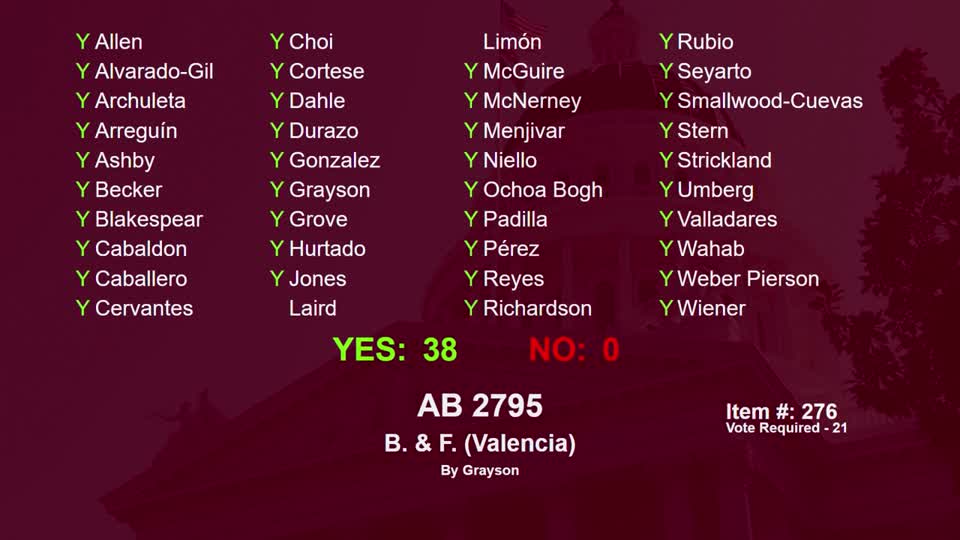 2MIN
Senate Floor
 4MIN
Assembly Standing Committee on Local Government
 8MIN
Assembly Floor
 22MIN
Assembly Standing Committee on Judiciary
 10MIN
Assembly Standing Committee on Labor and Employment
Bill Author

Bill Co-Author(s):