AB 617: Developmental services: personal care or assistance and in-home respite services.
- Session Year: 2025-2026
- House: Assembly
- Latest Version Date: 2025-03-20
Current Status:
Failed
(2026-02-02: From committee: Filed with the Chief Clerk pursuant to Joint Rule 56.)
Introduced
In Committee
Awaiting First Chamber Vote
Passed First Chamber
In Committee
Awaiting Second Chamber Vote
Passed Second Chamber
Enacted
Existing law, the Lanterman Developmental Disabilities Services Act (Lanterman Act), requires the State Department of Developmental Services to contract with regional centers to provide services and supports to individuals with developmental disabilities through various programs, including personal care or personal assistance services and in-home respite services. Existing law requires the Director of Developmental Services to develop program standards for in-home respite services purchased by regional centers from agencies vendored to provide these services.
Existing law establishes the Home Care Services Consumer Protection Act, which provides for the licensure and regulation of home care organizations by the State Department of Social Services, and for the registration of home care aides who provide home care services, as defined, on the home care aide registry. Existing law exempts from these provisions an organization vendored or contracted through a regional center or the State Department of Developmental Services pursuant to the Lanterman Act to provide services and supports for persons with developmental disabilities, as specified. A violation of the act is a misdemeanor.
This bill would require, prior to providing personal care or personal assistance services or in-home respite services to a consumer receiving services under the Lanterman Act, an organization vendored or contracted through a regional center or the department to provide personal care or personal assistance services or in-home respite services to a consumer receiving services under the Lanterman Act to be licensed as a home care organization, and an individual who is employed by such an organization to be listed on the home care aide registry, as specified. By expanding the scope of an existing crime, the bill would impose a state-mandated local program.
The California Constitution requires the state to reimburse local agencies and school districts for certain costs mandated by the state. Statutory provisions establish procedures for making that reimbursement.
This bill would provide that no reimbursement is required by this act for a specified reason.
Existing law establishes an Aging and Disability Resource Connection (ADRC) program, administered by the California Department of Aging, to provide information to consumers and their families on available long-term services and supports (LTSS) programs and to assist older adults, caregivers, and persons with disabilities in accessing LTSS programs at the local level. Existing law requires the California Department of Aging to administer the ADRC Infrastructure Grants Program for the purpose of implementing a No Wrong Door System, a system that enables consumers to access all LTSS through one agency, organization, coordinated network, or portal. Existing law states the intent of the Legislature that the No Wrong Door System serve seniors and individuals with disabilities by, among other things, providing consumers and their caregivers access to information and services. Existing law also establishes the Aging and Disability Resource Connection Advisory Committee, within the California Department of Aging, as the primary adviser in the implementation of the No Wrong Door System, and authorizes the committee to use the staff of the California Department of Aging to accomplish its purposes.This bill would instead require the committee to use the staff of the California Department of Aging. The bill would also instead require the No Wrong Door System to serve seniors and individuals with disabilities, as specified, and would require, no later than December 31, 2027, the system to also establish a statewide respite referral registry to connect consumers enrolled in the Medi-Cal program with culturally competent, prescreened respite providers, and create and implement a consumer-directed employer program to assist in the provision of the statewide respite referral system.Existing law establishes an Aging and Disability Resource Connection (ADRC) program, administered by the California Department of Aging, to provide information to consumers and their families on available long-term services and supports (LTSS) programs and to assist older adults, caregivers, and persons with disabilities in accessing LTSS programs at the local level. Existing law requires the California Department of Aging to administer the ADRC Infrastructure Grants Program for the purpose of implementing a No Wrong Door System, a system that enables consumers to access all LTSS through one agency, organization, coordinated network, or portal. Existing law states the intent of the Legislature that the No Wrong Door System serve seniors and individuals with disabilities by, among other things, providing consumers and their caregivers access to information and services. Existing law also establishes the Aging and Disability Resource Connection Advisory Committee, within the California Department of Aging, as the primary adviser in the implementation of the No Wrong Door System, and authorizes the committee to use the staff of the California Department of Aging to accomplish its purposes.
This bill would instead require the committee to use the staff of the California Department of Aging. The bill would also instead require the No Wrong Door System to serve seniors and individuals with disabilities, as specified, and would require, no later than December 31, 2027, the system to also establish a statewide respite referral registry to connect consumers enrolled in the Medi-Cal program with culturally competent, prescreened respite providers, and create and implement a consumer-directed employer program to assist in the provision of the statewide respite referral system.
(a)Individuals who are not employed by a home care organization organization, but who provide home care services to a client client, may be listed on the home care aide registry.
(b)An affiliated home care aide shall be listed on the home care aide registry prior to providing home care services to a client.
(c)(1)Home care aides shall not include individuals who are providing home care services as part of their job duties through one of the following entities:
(A)Services authorized to be provided by a licensed home health agency under Chapter 8 (commencing with Section 1725).
(B)Services authorized to be provided by a licensed hospice pursuant to Chapter 8.5 (commencing with Section 1745).
(C)Services authorized to be provided by a licensed health facility pursuant to Chapter 2 (commencing with Section 1250).
(D)In-home supportive services provided pursuant to Article 7 (commencing with Section 12300) of Chapter 3 of Part 3 of Division 9 of, or Section 14132.95, 14132.952, or 14132.956 of, the Welfare and Institutions Code.
(E)A community care facility licensed pursuant to Chapter 3 (commencing with Section 1500), a residential care facility for persons with chronic life-threatening illness licensed pursuant to Chapter 3.01 (commencing with Section 1568.01), a residential care facility for the elderly licensed pursuant to Chapter 3.2 (commencing with Section 1569), or a facility licensed pursuant to the California Child Day Care Facilities Act, Act (Chapter 3.4 (commencing with Section 1596.70)), which includes day care centers, as described in Chapter 3.5 (commencing with Section 1596.90), family day care homes, as described in Chapter 3.6 (commencing with Section 1597.30), and employer-sponsored child care centers, as described in Chapter 3.65 (commencing with Section 1597.70).
(F)A clinic licensed pursuant to Section 1204 or 1204.1.
(G)A home medical device retail facility licensed pursuant to Section 111656.
(H)An organization vendored or contracted through a regional center or the State Department of Developmental Services pursuant to the Lanterman Developmental Disabilities Services Act (Chapter 1 (commencing with Section 4500) of Division 4.5 of the Welfare and Institutions Code) and the California Early Intervention Services Act (Title 14 (commencing with Section 95000) of the Government Code) to provide services and supports for persons with developmental disabilities, as defined in Section 4512 of the Welfare and Institutions Code, when funding for those services is provided through the State Department of Developmental Services and more than 50 percent of the recipients of the home care services provided by the organization are persons with developmental disabilities. disabilities, except a vendored or contracted organization providing personal care or personal assistance services or in-home respite services.
(I)An alcoholism or drug abuse recovery or treatment facility facility, as defined in Section 11834.02.
(J)A facility in which only Indian children who are eligible under the federal Indian Child Welfare Act (25 U.S.C. Sec. 1901 et seq.) are placed and is either of the following:
(i)An extended family member of the Indian child, as defined in Section 1903 of Title 25 of the United States Code.
(ii)A foster home that is licensed, approved, or specified by the Indian childs tribe pursuant to Section 1915 of Title 25 of the United States Code.
(2)Home care aides shall not include individuals providing services authorized to be provided pursuant to Section 2731 of the Business and Professions Code.
(d)Home care aides shall not include a nonrelative extended family member, as defined in Section 362.7 of the Welfare and Institutions Code.
(e)In the event of a conflict between this chapter and a provision listed in subdivision (b), (c), or (d), the provision in subdivision (b), (c), or (d) shall control.
SEC. 2.Section 1796.17 of the Health and Safety Code is amended to read:1796.17.(a)Each home care organization shall be separately licensed. This chapter does not prevent a licensee from obtaining more than one home care organization license or obtaining a home care organization license in addition to other licenses issued by the department, or both.
(b)A home care organization does not include the following:
(1)A home health agency licensed under Chapter 8 (commencing with Section 1725).
(2)A hospice licensed under Chapter 8.5 (commencing with Section 1745).
(3)A health facility licensed under Chapter 2 (commencing with Section 1250).
(4)A person who performs services through the In-Home Supportive Services program pursuant to Article 7 (commencing with Section 12300) of Chapter 3 of Part 3 of Division 9 of, or Section 14132.95, 14132.952, or 14132.956 of, the Welfare and Institutions Code.
(5)A home medical device retail facility licensed under Section 111656.
(6)An organization vendored or contracted through a regional center or the State Department of Developmental Services pursuant to the Lanterman Developmental Disabilities Services Act (Division 4.5 (commencing with Section 4500) of the Welfare and Institutions Code) and the California Early Intervention Services Act (Title 14 (commencing with Section 95000) of the Government Code) to provide services and supports for persons with developmental disabilities, as defined in Section 4512 of the Welfare and Institutions Code, when funding for those services is provided through the State Department of Developmental Services and more than 50 percent of the recipients of the home care services provided by the organization are persons with developmental disabilities. disabilities, except a vendored or contracted organization providing personal care or personal assistance services or in-home respite services.
(7)An employment agency, as defined in Section 1812.5095 of the Civil Code, that procures, offers, refers, provides, or attempts to provide an independent home care aide who provides home care services to clients.
(8)A community care facility licensed pursuant to Chapter 3 (commencing with Section 1500), a residential care facility for persons with chronic life-threatening illness licensed pursuant to Chapter 3.01 (commencing with Section 1568.01), a residential care facility for the elderly licensed pursuant to Chapter 3.2 (commencing with Section 1569), or a facility licensed pursuant to the California Child Day Care Facilities Act (Chapter 3.4 (commencing with Section 1596.70)), which includes day care centers, as described in Chapter 3.5 (commencing with Section 1596.90), family day care homes, as described in Chapter 3.6 (commencing with Section 1597.30), and employer-sponsored child care centers, as described in Chapter 3.65 (commencing with Section 1597.70).
(9)An alcoholism or drug abuse recovery or treatment facility facility, as defined in Section 11834.02.
(10)A person providing services authorized pursuant to Section 2731 of the Business and Professions Code.
(11)A clinic licensed pursuant to Section 1204 or 1204.1.
(12)A nonrelative extended family member, as defined in Section 362.7 of the Welfare and Institutions Code.
(13)A facility providing home care services in which only Indian children who are eligible under the federal Indian Child Welfare Act (25 U.S.C. Sec. 1901 et seq.) are placed and which that satisfies either of the following:
(A)An extended family member of the Indian child, as defined in Section 1903 of Title 25 of the United States Code.
(B)A foster home that is licensed, approved, or specified by the Indian childs tribe pursuant to Section 1915 of Title 25 of the United States Code.
(14)Any other individual or entity providing services similar to those described in this chapter, as determined by the director.
(c)In the event of a conflict between this chapter and a provision listed in subdivision (b), the provision in subdivision (b) controls.
SEC. 3.Section 4686.1 is added to the Welfare and Institutions Code, to read:4686.1.(a)Commencing January 1, 2026, an organization vendored or contracted through a regional center or the department to provide personal care or personal assistance services or in-home respite services to a consumer receiving services under this chapter shall be licensed as a home care organization by the State Department of Social Services under the Home Care Services Consumer Protection Act (Chapter 13 (commencing with Section 1796.10) of Division 2 of the Health and Safety Code) prior to providing personal care or personal assistance services or in-home respite services to a consumer receiving services under to this chapter.
(b)Commencing January 1, 2026, an individual who is employed by an organization described in subdivision (a) shall be listed on the home care aide registry under the Home Care Services Consumer Protection Act (Chapter 13 (commencing with Section 1796.10) of Division 2 of the Health and Safety Code) prior to providing personal care or personal assistance services or in-home respite services to a consumer receiving services under to this chapter.
(c)Notwithstanding subdivisions (a) and (b), an organization vendored or contracted through a regional center or the department to provide personal care or personal assistance services or in-home respite services to a consumer receiving services under this chapter before January 1, 2026, and an individual who is employed by such an organization before January 1, 2026, shall meet the requirements specified in subdivisions (a) and (b) on or before January 1, 2028.
SEC. 4.No reimbursement is required by this act pursuant to Section 6 of Article XIIIB of the California Constitution because the only costs that may be incurred by a local agency or school district will be incurred because this act creates a new crime or infraction, eliminates a crime or infraction, or changes the penalty for a crime or infraction, within the meaning of Section 17556 of the Government Code, or changes the definition of a crime within the meaning of Section 6 of Article XIIIB of the California Constitution.
SECTION 1.Section 9122 of the Welfare and Institutions Code is amended to read:9122.(a)The No Wrong Door System described in Section 9121 shall serve seniors and individuals with disabilities by doing all of the following:(1)Providing consumers and their caregivers access to information and services, regardless of income or benefit level.(2)Enabling an Aging and Disability Resource Connection (ADRC) program to directly connect a client to appropriate local programs.(3)Providing each consumer in California with access to individualized support and community resources to meet their needs and to enable them to continue living in their own homes, if desired.(4)No later than December 31, 2027, establishing a statewide respite referral registry to connect consumers enrolled in the Medi-Cal program with culturally competent, prescreened respite providers. It is the intent of the Legislature for those implementing the statewide respite referral registry to consider all of the following:(A)Accounting for consumer needs and preferences when identifying potential respite providers.(B)Providing for reasonable standards of accountability for respite providers and prospective respite providers listed through the registry.(C)Ensuring voluntariness for respite providers and prospective respite providers and consumers.(D)Promoting job opportunities for respite providers and prospective respite providers.(E)Providing access to the registry for consumers who want to query a referral independently.(F)Increasing a consumers choice of respite providers and prospective respite providers via an established pool of available respite providers and prospective respite providers on the registry.(5)No later than December 31, 2027, creating and implementing a consumer-directed employer program to assist in the provision of the statewide respite referral system.(b)The Aging and Disability Resource Connection Advisory Committee, which has been established within the California Department of Aging, shall serve as the primary adviser to the California Department of Aging, the Department of Rehabilitation, and the State Department of Health Care Services in the ongoing development and implementation of the No Wrong Door System described in Section 9121. The advisory committee shall utilize staff of the California Department of Aging, as needed, to accomplish its purposes. The California Department of Aging shall expand the membership of the advisory committee as necessary to include the perspective of all relevant stakeholders.(c)The Aging and Disability Resource Connection Advisory Committee shall, upon the request of the California Department of Aging, or any task force appointed thereunder for the purpose of developing and updating a master plan on aging, consult with and offer input regarding the development and updating of that master plan.(d)The California Department of Aging, in consultation with the advisory committee, shall do all of the following:(1)Develop a plan for, and oversee the phased statewide implementation of, the No Wrong Door System that utilizes the ADRC program to assist older adults and people with disabilities to obtain accurate information and timely referrals to appropriate community services and supports. The plan shall include near- and long-term tactics for statewide implementation.(2)Serve as a statewide facilitator, coordinator, and policy development resource on the ADRC program and No Wrong Door System.(3)Identify mainstream resources, benefits, and services that can be accessed for the No Wrong Door System.(4)Create partnerships among state agencies and departments, local government agencies, the federal Administration for Community Living, the federal Centers for Medicare and Medicaid Services, and the federal Veterans Health Administration.(5)Coordinate existing funding and applications for competitive funding, while also exploring avenues for future funding, including, but not limited to, Medicaid and federal Veterans Health Administration funding.(6)Make policy and procedural recommendations to the Legislature and other governmental entities.(7)Consider the expansion of the no wrong door approach to programs and policies outside of the California Health and Human Services Agency.(8)(A)Report to the Governor and the Legislature on the No Wrong Door System and the implementation of the system.(B)Reports to be submitted pursuant to subparagraph (A) shall be submitted in compliance with Section 9795 of the Government Code.(e)The implementation of this section is contingent on an appropriation in the annual Budget Act, or another act, for that express purpose.(a)It is the intent of the Legislature that the The No Wrong Door System described in Section 9121 shall serve seniors and individuals with disabilities by doing all of the following:
(1)Providing consumers and their caregivers access to information and services, regardless of income or benefit level.
(2)Enabling an Aging and Disability Resource Connection (ADRC) program to directly connect a client to appropriate local programs.
(3)Providing each consumer in California with access to individualized support and community resources to meet their needs and to enable them to continue living in their own homes, if desired.
(4)No later than December 31, 2027, establishing a statewide respite referral registry to connect consumers enrolled in the Medi-Cal program with culturally competent, prescreened respite providers. It is the intent of the Legislature for those implementing the statewide respite referral registry to consider all of the following:
(A)Accounting for consumer needs and preferences when identifying potential respite providers.
(B)Providing for reasonable standards of accountability for respite providers and prospective respite providers listed through the registry.
(C)Ensuring voluntariness for respite providers and prospective respite providers and consumers.
(D)Promoting job opportunities for respite providers and prospective respite providers.
(E)Providing access to the registry for consumers who want to query a referral independently.
(F)Increasing a consumers choice of respite providers and prospective respite providers via an established pool of available respite providers and prospective respite providers on the registry.
(5)No later than December 31, 2027, creating and implementing a consumer-directed employer program to assist in the provision of the statewide respite referral system.
(b)The Aging and Disability Resource Connection Advisory Committee, which has been established within the California Department of Aging, shall serve as the primary adviser to the California Department of Aging, the Department of Rehabilitation, and the State Department of Health Care Services in the ongoing development and implementation of the No Wrong Door System described in Section 9121. The advisory committee may shall utilize staff of the California Department of Aging, as needed, to accomplish its purposes. The California Department of Aging shall expand the membership of the advisory committee as necessary to include the perspective of all relevant stakeholders.
(c)The Aging and Disability Resource Connection Advisory Committee shall, upon the request of the California Department of Aging, or any task force appointed thereunder for the purpose of developing and updating a master plan on aging, consult with and offer input regarding the development and updating of that master plan.
(d)The California Department of Aging, in consultation with the advisory committee, shall do all of the following:
(1)Develop a plan for, and oversee the phased statewide implementation of, the No Wrong Door System that utilizes the ADRC program to assist older adults and people with disabilities to obtain accurate information and timely referrals to appropriate community services and supports. The plan shall include near- and long-term tactics for statewide implementation.
(2)Serve as a statewide facilitator, coordinator, and policy development resource on the ADRC program and No Wrong Door System.
(3)Identify mainstream resources, benefits, and services that can be accessed for the No Wrong Door System.
(4)Create partnerships among state agencies and departments, local government agencies, the federal Administration for Community Living, the federal Centers for Medicare and Medicaid Services, and the federal Veterans Health Administration.
(5)Coordinate existing funding and applications for competitive funding, while also exploring avenues for future funding, including, but not limited to, Medicaid and federal Veterans Health Administration funding.
(6)Make policy and procedural recommendations to the Legislature and other governmental entities.
(7)Consider the expansion of the no wrong door approach to programs and policies outside of the California Health and Human Services Agency.
(8)(A)Report to the Governor and the Legislature on the No Wrong Door System and the implementation of the system.
(B)Reports to be submitted pursuant to subparagraph (A) shall be submitted in compliance with Section 9795 of the Government Code.
(e)The implementation of this section is contingent on an appropriation in the annual Budget Act, or another act, for that express purpose.
|
Date
|
Status
|
|---|---|
| Feb 2, 2026 | From committee: Filed with the Chief Clerk pursuant to Joint Rule 56. |
| Jan 31, 2026 | Died pursuant to Art. IV, Sec. 10(c) of the Constitution. |
| May 23, 2025 | In committee: Held under submission. |
| May 14, 2025 | In committee: Set, first hearing. Referred to suspense file. |
| Apr 30, 2025 | From committee: Do pass and re-refer to Com. on APPR. (Ayes 5. Noes 1.) (April 29). Re-referred to Com. on APPR. |
| Apr 10, 2025 | Re-referred to Com. on HUM. S. pursuant to Assembly Rule 96. |
| Mar 24, 2025 | Re-referred to Com. on AGING & L.T.C. |
| Mar 20, 2025 | From committee chair, with author's amendments: Amend, and re-refer to Com. on AGING & L.T.C. Read second time and amended. |
| Mar 3, 2025 | Referred to Com. on AGING & L.T.C. |
| Feb 14, 2025 | From printer. May be heard in committee March 16. |
| Feb 13, 2025 | Read first time. To print. |
|
Date
|
Description
|
Location
|
Votes
|
|
|---|---|---|---|---|
| Apr 29, 2025 | Do pass and be re-referred to the Committee on [Appropriations] | Assembly Standing Committee on Human Services |
Passed |
This list shows positions taken on this bill by organizations on the date displayed, which is linked to the original source.
Positions by individuals are not included.
|
Organization
|
Position
|
Date
|
|---|---|---|
| Achievement House, INC. | ** Against | |
| Achievement House, Incorporated | ** Against | |
| Achievement House & NCI Affiliates, INC. | ** Against | |
| Alzheimer'S Association, State Policy Office | ** Support | |
| Aveanna Healthcare | ** Against | |
| California Community Living Network | ** Against | |
| California Disability Services Association | ** Against | |
| California Respite Association | ** Against | |
| Channel Islands Social Services | ** Against | |
| Compass LLC | ** Against | |
| Compass SLS & ILS | ** Against | |
| In2vision Programs, LLC | ** Against | |
| InClusion Services LLC | ** Against | |
| Networx Supported Living Services | ** Against | |
| North East Medical Services | ** Support | |
| PathPoint | ** Against | |
| Progressive Employment Concepts | ** Against | |
| SEIU California | ** Support | |
| Special Care Services | ** Against | |
| Strategies to Empower People | ** Against | |
| The Adult Skills Center | ** Against | |
| Tri-county Respite Care Service | ** Against | |
| Twenty-seven private citizens | ** Against | |
| UCP of Sacramento and Northern California | ** Against |
Date of Hearing: May 14, 2025
ASSEMBLY COMMITTEE ON APPROPRIATIONS
Buffy Wicks, Chair
ABPCA Bill Id:AB 617
Author:(McKinnor) – As Amended Ver:March 20, 2025
Policy Committee: | Human Services | Vote: | 5 - 1 |
|
| ||
|
|
Urgency: No State Mandated Local Program: Yes Reimbursable: No
SUMMARY:
This bill requires an organization vendored or contracted through a regional center or the Department of Developmental Services (DDS) to provide personal care or services for persons with developmental disabilities be a licensed home care organization, and requires individuals employed by these organizations to register with the state’s home care aide registry.
Specifically, this bill:
- Amends the Lanterman Developmental Disabilities Services Act to require an organization vendored or contracted through a regional center or DDS to provide personal care or personal assistance services or in-home respite services to a regional center consumer receiving services under the Lanterman Act be licensed as a home care organization by the California Department of Social Services (CDSS) under the Home Care Services Consumer Protection Act prior to providing these services.
- Requires an individual who is employed by an organization described in item 1, above, be listed on the home care aide registry under the Home Care Services Consumer Protection Act prior to providing personal care or personal assistance services or in-home respite services to a consumer receiving services under the Lanterman Act.
- Requires an organization vendored or contracted through a regional center or DDS to provide personal care or personal assistance services or in-home respite services before January 1, 2026. An individual who is employed by such an organization before January 1, 2026, must meet these requirements by January 1, 2028.
FISCAL EFFECT:
- DDS estimates one-time costs of $846,000 ($591,000 General Fund) in fiscal year (FY) 2025-26, for one temporary part-time position at each of 21 regional centers to implement processes, identify and track providers, support compliance with licensing and registration standards, and confirm licensure before services are delivered. DDS assumes the cost per regional center is $40,000 ($28,000 General Fund). DDS notes there are about 1,500 personal care, personal assistance, and in-home respite services provider vendorizations system wide.
- CDSS estimates General Fund costs of $8.0 million in FY 2025-26, and ongoing costs of $7.9 million annually for 42 positions to handle additional registry caseload, develop licensing policy and procedures, provide training, handle additional complaints and legal cases, and perform numerous administrative functions, among other tasks. CDSS indicates this estimate is based on DDS reporting approximately 675 vendors and a current average of 166 cases per Home Care Organization Analyst.
COMMENTS:
- Purpose. This bill is sponsored by SEIU California. According to the author:
[This bill] adds respite providers to the home care aid registry and will serve as a directory to help connect consumers and their families to qualified respite providers. By also removing an exemption, we can encourage non-medical providers that are already licensed as a home care organization to become respite providers, thus increasing access to a much needed service.
- Background. Home care services are nonmedical services and assistance provided by a registered home care aide to a client in their own home, and include assistance with daily living activities, housekeeping tasks and support with mobility and companionship. Home care services support individuals who may have chronic illnesses, disabilities, or are recovering from surgeries or medical procedures, allowing them to remain in their home rather than in a hospital or nursing facility.
AB 1217 (Lowenthal), Chapter 790, Statutes of 2013, enacted the Home Care Services Consumer Protection Act (Act) which requires home care organizations to be licensed and creates a public online registry for home care aides. Home care aides directly employed by home care organizations must register, and other independent home care aides may register voluntarily. CDSS is responsible for the licensure and registry compliance. Organizations must pay a registration fee of $5,603 per agency location and $35 per employee every two years.
The Act exempts from its registry and licensing requirements organizations vendored or contracted through a regional center or DDS, pursuant to the Lanterman Act, to provide services and supports for persons with developmental disabilities when funding for those services is provided through DDS and more than 50% of the recipients of the home care services provided by the organization are persons with developmental disabilities.
Under the Lanterman Act, service providers must be “vendored” (approved) by a regional center before they can provide and be reimbursed for services. The vendorization process allows regional centers to verify, prior to the provision of services to consumers, that an applicant meets all of the requirements and standards specified in regulations. Applicants who meet the requirements and standards are assigned a service code and a unique vendor identification number.
This bill removes the exemption for DDS vendored or contracted organizations providing personal care or services to persons with developmental disabilities, and their employees. The bill, instead, explicitly requires these organizations to be licensed as a home care organization under the Act and requires an individual employed by such as organization to be listed on the home care aide registry.
The bill does not change the requirement that these organizations be vendorized to provide services to regional centers.
- Arguments in Support. This bill is sponsored by SEIU California, which asserts:
This bill would help those family care providers who have struggled to locate and connect with attested providers who can offer respite, particularly for families who need support provided in languages other than English. On the provider side, as providers struggle to navigate a job landscape that offers inadequate wages for difficult and demanding work, they can use the registry to make sure consumers can reach out for services without having to navigate overlapping vendorization and home care licensing requirements to provide in-home care.
- Arguments in Opposition. This bill is opposed by numerous disability advocate groups who argue this bill creates a duplicative process for DDS vendored organizations and their employees by requiring additional fees, training, and redundant background checks to provide care and services they are already qualified to provide under the regional center vendorization process. California Disability Services Association asserts:
Respite providers operating under the Regional Center system already fall under the regulatory authority of DDS and are required to meet service and administrative standards designed specifically for the developmental disabilities service system. These standards are grounded in the Lanterman Act and tailored to ensure that individuals with IDD receive services in a manner consistent with their rights and needs. Requiring these same providers to also register as home care organizations under DSS would create redundant oversight structures, increase costs, and add administrative complexity.
- Prior Legislation. AB 2455 (Kalra), Chapter 917, Statutes of 2018), required CDSS to provide a labor organization, upon request, an electronic copy of a registered home care aide’s name, telephone number, and cellphone number for the sole purpose of employee organizing, representation and assistance, unless the employee opted out of the disclosure.
Analysis Prepared by: Jennifer Swenson / APPR. / (916) 319-2081
Date of Hearing: April 29, 2025
ASSEMBLY COMMITTEE ON HUMAN SERVICES
Alex Lee, Chair
ABPCA Bill Id:AB 617 (
Author:McKinnor) – As Amended Ver:March 20, 2025
SUBJECT: Developmental services: personal care or assistance and in-home respite services
SUMMARY: Requires vendored or contracted organization providing personal care or personal assistance services or in-home respite services to become a licensed home care organization, and requires individuals providing personal care or personal assistance services or in-home respite services to register with the home care aide registry. Specifically, this bill:
- Requires organizations vendored or contracted through a regional center or the Department of Developmental Services (DDS) to provide personal care or personal assistance services or in-home respite services to a consumer receiving services to be licensed as a home care organization prior to providing personal care or personal assistance services or in-home respite services to a consumer receiving services.
- Requires an individual who is employed by organizations described in 1) above, to be listed on the home care aide registry prior to providing personal care or personal assistance services or in-home respite services to a consumer receiving services.
- Permits an organization vendored or contracted through a regional center or DDS to provide personal care or personal assistance services or in-home respite services to a consumer receiving services prior and an individual who is employed by such an organization before January 1, 2026, must meet the requirements in 1) and 2) above, by January 1, 2028.
EXISTING LAW:
- Established the Home Care Services Consumer Protection Act. (Health and Safety Code [HSC] §§1796.10 - 1796.70)
- Specifies individuals who are not employed by a home care organization but who provide home care services to a client may be listed on the home care aide registry. (HSC § 1796.14 (a))
- Exempts specified individuals from being required to register with the home care registry. (HSC § 1796.14 (c) (1))
- Specifies organizations are not precluded from obtaining more than one home care license or from obtaining a home care organization license in addition to other licenses issued by the department, or both. (HSC § 1796.17 (a))
- Exempts specified organizations from licensure requirements (HSC § 1796.17 (b))
FISCAL EFFECT: Unknown, this bill has not been analyzed by a fiscal committee.
COMMENTS:
Background: Home Care Services Consumer Protection Act. Home care refers to a range of nonmedical services provided to individuals in their own homes to help them manage their health, personal needs, and activities of daily living. The goal of home care is to support individuals who may have chronic illnesses, disabilities, or are recovering from surgeries or medical procedures, allowing them to remain in the comfort of their own home rather than in a hospital or nursing facility. Home care services can be short-term or long-term, depending on the needs of the individual. The types of services provided by a home care aide employed by a home care organization are nonmedical and include the following:
- Assistance with daily living activities such as bathing, dressing, grooming, and eating.
- Help with housekeeping tasks like cleaning, cooking, and laundry.
- Support with mobility and companionship.
After several attempts to require a licensing scheme, AB 1217 (Lowenthal), Chapter 790, Statutes of 2013, enacted the Home Care Services Consumer Protection Act which requires Home Care Organizations to be licensed and creates a public online registry for Home Care Aides who have been background checked. The California Department of Social Services (CDSS) is responsible for the licensure and registry compliance.
The law provides for numerous exemptions to licensure and registry. Exemptions include, but are not limited to: home health agencies, hospices, health facilities, In-Home Supportive Services providers, an organization vendored or contracted through a regional center or DDS to provide services and supports for persons with developmental disabilities when funding for those services is provided through DDS and more than 50% of the recipients of the home care services, independent home care aides, nonrelative extended family members, clinics, alcoholism or drug recovery facilities, and foster homes. The organizations listed are not precluded from voluntarily becoming licensed. Similarly, individuals who provide services through the listed exempt organizations are still permitted to be listed on the registry on a volunteer basis.
DDS’ Vendorization Process. Service providers must be vendored by a regional center before they can provide and be reimbursed for services. DDS and regional centers use the term “vendorization” to describe the entire approval process involved in preparing to provide services to regional center consumers. Typically, this process also often involves obtaining licenses or approvals from other state and local agencies prior to becoming a vendor, but starts at the regional center.
According to DDS, vendorization is the process for identification, selection, and utilization of service providers based on the qualifications and other requirements necessary in order to provide the services. The vendorization process allows regional centers to verify, prior to the provision of services to consumers, that an applicant meets all of the requirements and standards specified in regulations. Applicants who meet the specified requirements and standards are assigned a service code and a unique vendor identification number.
Service providers are vendored by the regional center in whose catchment area the service is located, known as the vendoring regional center. The vendoring regional center is responsible for ensuring that the applicant meets licensing and Title 17 requirements for vendorization, determining the appropriate vendor category for the service to be provided, and approving or disapproving vendorization based upon their review of the documentation submitted by the applicant.
Once a potential service provider has obtained all necessary licenses, submitted a complete application and all necessary documentation to the vendoring regional center, the regional center has 45 days to approve or disapprove vendorization.
This bill removes the exemption for regional centers or DDS vendored or contracted organizations providing personal care or personal assistance services or in-home respite services as well as the individuals providing that care through these organizations.
This bill does not make changes to the vendorization process or requirements. These organizations still must be a vendor to provide services to regional center consumers.
Author’s Statement: According to the Author, “[This bill] adds respite providers to the home care aid registry and will serve as a directory to help connect consumers and their families to qualified respite providers. By also removing an exemption, we can encourage non-medical providers, that are already licensed as a home care organization, to become respite providers, thus increasing access to a much needed service.”
Equity Implications: This bill adds to the existing list of organizations and individuals required to be licensed and listed on the home care registry. Increased oversight of these individuals providing care might increase quality; however, it is unclear if this will impact the number of available providers if they now must become licensed.
RELATED AND PRIOR LEGISLATION:
AB 1217 (Lowenthal), Chapter 790, Statutes of 2013, created the Home Care Services Consumer Protection Act, which provided, on and after January 1, 2015, for the licensure and regulation of home care organizations by CDSS and the registration of home care aides.
AB 322 (Yamada) of 2013, would have established the Home Care Services Act of 2013 to license and regulate home care organizations providing services for the elderly, frail, and persons with disabilities. AB 322 was held on the Assembly Committee on Appropriations suspense file.
SB 411 (Price) of 2011, would have established the Home Care Services Act of 2011, which required the Department of Public Health to license and regulate home care organizations.
SB 411 was vetoed by Governor Brown.
AB 899 (Yamada) of 2011, would have established the Home Care Services Act of 2013 to license and regulate home care organizations providing services for the elderly, frail, and persons with disabilities. AB 899 was held on the Assembly Committee on Appropriations suspense file.
AB 853 (Jones) of 2007, would have established the Home Care Services Act to license and regulate home care services for the elderly, frail, and persons with disabilities. AB 853 was held was held on the Assembly Committee on Appropriations suspense file.
REGISTERED SUPPORT / OPPOSITION:
Support
SEIU California (Sponsor)
Alzheimer's Association, State Policy Office
North East Medical Services (NEMS)
Opposition
Achievement House & NCI Affiliates, INC.
Achievement House, INC.
Achievement House, Incorporated
Aveanna Healthcare
California Community Living Network
California Community Living Network (UNREG)
California Disability Services Association
California Respite Association
Channel Islands Social Services
Compass LLC
Compass SLS & ILS
In2vision Programs, LLC
InClusion Services LLC
Networx Supported Living Services
Pathpoint
Progressive Employment Concepts
Special Care Services
Strategies to Empower People
The Adult Skills Center
Tri-County Respite Care Service
UCP of Sacramento and Northern California
Twenty-seven private citizens
Analysis Prepared by: Alexandria Smith / HUM. S. / (916) 319-2089
Discussed in Hearing
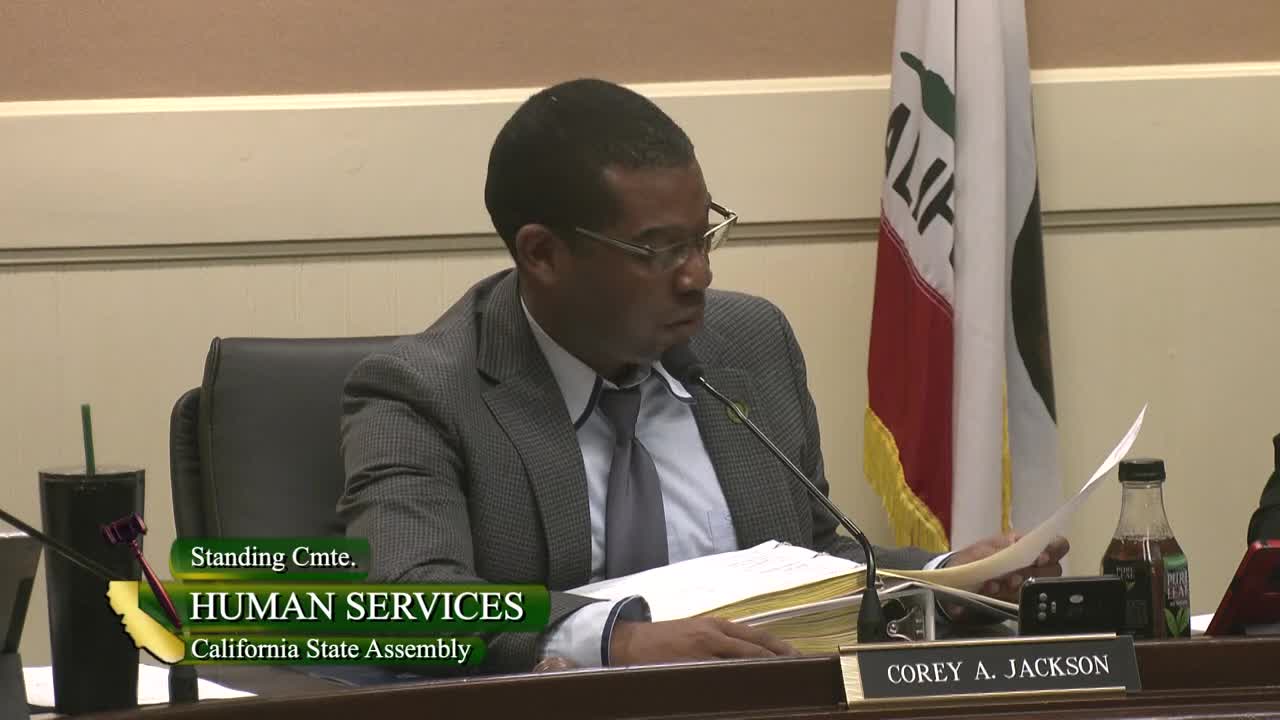 17MIN
Assembly Standing Committee on Human Services
Bill Author

Bill Co-Author(s):