AB 619: California Conservation Corps: training programs: formerly incarcerated individuals: reporting.
- Session Year: 2025-2026
- House: Assembly
- Latest Version Date: 2025-02-13
Current Status:
Failed
(2026-02-02: From committee: Filed with the Chief Clerk pursuant to Joint Rule 56.)
Introduced
In Committee
Awaiting First Chamber Vote
Passed First Chamber
In Committee
Awaiting Second Chamber Vote
Passed Second Chamber
Enacted
Existing law establishes the California Conservation Corps in the Natural Resources Agency and requires the corps to implement and administer the conservation corps program. Existing law authorizes the Director of the California Conservation Corps to establish various training and educational program, including, among others, the Education and Employment Reentry Program, within the corps, to provide education and training to formerly incarcerated individuals who successfully served on a California Conservation Camp program crew.
This bill would require the Department of Forestry and Fire Protection and the Department of Corrections and Rehabilitation to jointly evaluate the Ventura Training Center and would require the evaluation to include specified components, including, among others, an evaluation of ways to increase the rate of graduated trainees entering the firefighter workforce. The bill would require the departments to submit a report describing the evaluation to certain legislative committees by January 1, 2026, and would repeal these provisions on January 1, 2030.
This bill would declare that it is to take effect immediately as an urgency statute.
(a)The Department of Forestry and Fire Protection and the Department of Corrections and Rehabilitation shall jointly evaluate the Ventura Training Center. The evaluation shall include, but shall not be limited to, an evaluation of all of the following:
(1)How to streamline the enrollment of formerly incarcerated individuals into the program after their successful participation in the California Conservation Camp program.
(2)Ways to increase the rate of graduated trainees entering the firefighter workforce.
(3)The feasibility of establishing one or more centers in other regions of the state.
(b)(1)The departments shall prepare a report describing the evaluation conducted pursuant to subdivision (a) and submit the report, by January 1, 2026, to the Senate Committee on Public Safety, the Assembly Committee on Public Safety, the Senate Committee on Organization, and the Assembly Committee on Emergency Management.
(2)(A)A report to be submitted pursuant to paragraph (1) shall be submitted in compliance with Section 9795 of the Government Code.
(B)Pursuant to Section 10231.5 of the Government Code, this section is repealed on January 1, 2030.
SEC. 2.This act is an urgency statute necessary for the immediate preservation of the public peace, health, or safety within the meaning of Article IV of the California Constitution and shall go into immediate effect. The facts constituting the necessity are:
In order to address the shortage of firefighters occurring while there is an increasing number of catastrophic fires in California, it is necessary that this act take effect immediately.
|
Date
|
Status
|
|---|---|
| Feb 2, 2026 | From committee: Filed with the Chief Clerk pursuant to Joint Rule 56. |
| Jan 31, 2026 | Died pursuant to Art. IV, Sec. 10(c) of the Constitution. |
| May 23, 2025 | In committee: Held under submission. |
| May 14, 2025 | In committee: Set, first hearing. Referred to suspense file. |
| Apr 30, 2025 | From committee: Do pass and re-refer to Com. on APPR. with recommendation: To Consent Calendar. (Ayes 9. Noes 0.) (April 29). Re-referred to Com. on APPR. |
| Apr 8, 2025 | From committee: Do pass and re-refer to Com. on PUB. S. (Ayes 14. Noes 0.) (April 7). Re-referred to Com. on PUB. S. |
| Mar 17, 2025 | Referred to Coms. on NAT. RES. and PUB. S. |
| Feb 14, 2025 | From printer. May be heard in committee March 16. |
| Feb 13, 2025 | Read first time. To print. |
|
Date
|
Description
|
Location
|
Votes
|
|
|---|---|---|---|---|
| Apr 29, 2025 | Do pass and be re-referred to the Committee on [Appropriations] with recommendation: To Consent Calendar | Assembly Standing Committee on Public Safety |
Passed |
|
| Apr 7, 2025 | Do pass and be re-referred to the Committee on [Public Safety] | Assembly Standing Committee on Natural Resources |
Passed |
This list shows positions taken on this bill by organizations on the date displayed, which is linked to the original source.
Positions by individuals are not included.
|
Organization
|
Position
|
Date
|
|---|---|---|
| California Police Chiefs Association | ** Support | |
| California Public Defenders Association | ** Support | |
| Vera Institute Of Justice | ** Support |
Date of Hearing: May 14, 2025
ASSEMBLY COMMITTEE ON APPROPRIATIONS
Buffy Wicks, Chair
ABPCA Bill Id:AB 619
Author:(Ransom) – As Introduced Ver:February 13, 2025
Policy Committee: | Natural Resources | Vote: | 14 - 0 |
Public Safety | 9 - 0 | ||
|
|
Urgency: Yes State Mandated Local Program: No Reimbursable: No
SUMMARY:
This bill requires the Department of Forestry and Fire Protection (CAL FIRE) and the Department of Corrections and Rehabilitation (CDCR) to jointly evaluate the Ventura Training Center (VTC) and report to the Legislature on its evaluation.
Specifically, this bill:
- Requires the evaluation to include:
- How to streamline the enrollment of formerly incarcerated individuals into the program after their successful participation in the California Conservation Camps program (CCP).
- Ways to increase the rate of graduated trainees entering the firefighter workforce.
- The feasibility of establishing one or more centers in other regions of the state.
2) Requires CAL FIRE and CDCR, by January 1, 2026, to submit the report to specified standing committees of the Legislature.
3) Sunsets the evaluation and reporting requirements on January 1, 2030.
FISCAL EFFECT:
1) CAL FIRE estimates a one-time General Fund cost of $500,000 to contract with an outside consulting firm to assess the VTC program and provide an evaluation of the feasibility of expanding the VTC model to other geographic locations across the state.
The committee notes the January 1, 2026, deadline for the report may prove to be challenging if CAL FIRE is unable to absorb the workload associated with this bill within existing resourrces.
2) Costs of an unknown, but likely absorbable, amount for CDCR to assist CAL FIRE with the evaluation. Because CAL FIRE bears primary responsibility for operating the VTC, CDCR anticipates its costs will likely be relatively modest.
COMMENTS:
- Purpose. According to the author, the VTC was established to offer formerly incarcerated firefighters a pathway to a full-time firefighting career; however, “of the 432 program graduates, only 63% secured full-time employment, and just 45% found work in the firefighting field.” The author contends the goal of the evaluation required by the bill is to “strengthen our firefighting workforce by creating a clear pathway for formerly incarcerated firefighters to continue their service in full time professional roles.”
2) Background. CCP. CDCR, in cooperation with CAL FIRE and the Los Angeles County Fire Department, jointly operates 35 conservation camps, commonly known as fire camps, located in 25 counties across California. Camp participants support local, state, and federal agencies as they respond to all types of emergencies such as fires, floods, and other natural or manmade disasters. Crews also maintain parks and assist with sand bagging during flood fighting operations and reforestation. The program paves the way for several job opportunities and benefits after release, including advanced training and criminal record expungement.
VTC. To offer formerly incarcerated firefighters an opportunity to continue using the skills and knowledge they secured while participating in the CCP, CAL FIRE, the California Conservation Corps (CCC), and CDCR, in partnership with the Anti-Recidivism Coalition, developed an enhanced firefighter training and certification program at the VTC in Ventura County. VTC began training participants in October 2018 and accepts trainees who have recently been part of a trained firefighting workforce in fire camps or institutional firehouses operated by CAL FIRE and CDCR. Members of the CCC are also eligible to participate. Participants in the certification program are provided with additional rehabilitation and job training skills to help them be more successful after completion of the program. Cadets who complete the program will be qualified to apply for entry-level firefighting jobs with local, state, and federal firefighting agencies.
The author notes the VTC has enrolled 432 cadets to date, but only 272 currently have jobs – 78 of whom are not employed in a fire-related role. The Vera Institute of Justice argues this bill is intended to address “the significant gaps between the number of incarcerated firefighters, those who enroll in the [VTC] after release, and those who ultimately secure firefighting jobs.” The organization contends that the “sole outlet for becoming a wildland firefighter remains joining a 25-person cohort at the Ventura Training Center, which has strict eligibility criteria and a long waitlist,” and that this bill requires an evaluation of ways to increase the rate of graduated trainees from the CCP. The organization contends these programs “provide career pathways for recently released individuals, helping to fill the gaps caused by our state’s persistent wildland firefighter staff shortage, reduce formerly incarcerated people’s dependency on government assistance, and reduce recidivism.”
Training Center Costs. This bill requires the joint evaluation to include an assessment of the feasibility of establishing one or more centers in other regions of the state. According to a 2022 report by the Legislative Analyst’s Office, the annual operating cost for the VTC is roughly $6.3 million, and it costs over $100,000 per participant enrolled in the 18-month program. In addition, the creation of the VTC involved the renovation of a vacated conservation camp facility and cost roughly $19 million to complete.
Analysis Prepared by: Nikita Koraddi / APPR. / (916) 319-2081
Date of Hearing: April 29, 2025
Counsel: Dustin Weber
ASSEMBLY COMMITTEE ON
Nick Schultz, Chair
ABPCA Bill Id:
Author:() – As Ver:
SUMMARY:
Requires the Department of Forestry and Fire Protection (CAL FIRE) and the Department of Corrections and Rehabilitation (CDCR) to jointly evaluate the Ventura Training Center (VTC) and report to the Legislature on its evaluation. Specifically, this bill:
- Requires a joint evaluation of VTC, which shall include, but not be limited to, an evaluation of all of the following:
- How to streamline the enrollment of formerly incarcerated individuals into the program after their successful participation in the California Conservation Camps (CCC) program;
- Ways to increase the rate of graduated trainees entering the firefighter workforce; and,
- The feasibility of establishing one or more centers in other regions of the state.
2) Requires preparation of a report describing the evaluation to be submitted by January 1, 2026, to the Senate Committee on Public Safety, Assembly Committee on Public Safety, Senate Committee on Organization, and Assembly Committee on Emergency Management.
3) Sunsets the evaluation and reporting requirements on January 1, 2030.
4) Establishes bill as an urgency statute in order to address the shortage of firefighters occurring while there is an increasing number of catastrophic fires in California.
EXISTING LAW:
- Authorizes any department, division, bureau, commission or other agency of the State of California or the Federal Government may use or cause to be used convicts confined in the state prisons to perform work necessary and proper to be done by them at permanent, temporary, and mobile camps to be established under this article. (Pen. Code, § 2780)
- Establishes CAL FIRE in the California Natural Resources Agency (NRA) to provide fire protection and prevention services, as specified. (Pub. Res. Code, §§ 701-701.6.)
- Establishes the CCC in the NRA and requires the CCC to implement and administer the conservation corps program. (Pub. Res. Code, § 14001.)
- Establishes the CCC for the purpose of having incarcerated persons work on projects supervised by CAL FIRE. (Pub. Res. Code, § 4951.)
5) Requires CAL FIRE to utilize inmates and wards assigned to conservation camps in performing fire prevention, fire control, and department work. (Pub. Res. Code, § 4953.)
6) Establishes the Education and Employment Reentry Program within the CCC and authorizes the director of CCC to enroll formerly incarcerated individuals who successfully served on a California Conservation Camp program crew for participation as a program member by the Director of CAL FIRE and the Secretary of CDCR. (Pub. Res. Code, § 14415.1.)
FISCAL EFFECT:
Unknown
COMMENTS:
- Author's Statement: According to the author, “Every fire season, incarcerated individuals serve alongside professional firefighting crews risking their lives to protect communities across California. Through this service, they gain critical, hands-on experience in battling wildfires, which is invaluable especially as the state faces increasingly severe and frequent wildfires. Despite their training and experience, too many of these individuals face unnecessary barriers when seeking permanent employment in fire services after release. The Ventura Training Center (VTC) was established to bridge this gap by offering formerly incarcerated firefighters a pathway to full-time firefighting careers. However of the 432 program graduates, only 63% secured full-time employment, and just 45% found work in the firefighting field.
“AB 619 addresses this issue by directing CAL FIRE and the California Department of Corrections and Rehabilitation to assess the VTC program and identify gaps in training, certification, and job placement. The goal is to remove the roadblocks that prevent participants from securing careers in firefighting. At this time when California faces an ever growing wildfire crisis, we must strengthen our firefighting workforce by creating a clear pathway for formerly incarcerated firefighters to continue their service in full time professional roles.”
- Ventura Training Center: This bill would require CAL FIRE and CDCR to jointly evaluate VTC and report to the Legislature on its evaluation. The VTC began training participants in October 2018.[1] It accepts trainees who have recently been part of a trained firefighting workforce housed in fire camps or institutional firehouses operated by CAL FIRE and CDCR.[2] To offer formerly-incarcerated firefighters an opportunity to continue using the skills and knowledge they worked to achieve while participating in the Conservation Camp Program, CALFIRE, CCC, and CDCR, in partnership with the Anti-Recidivism Coalition (ARC), developed an enhanced firefighter training and certification program at the VTC in Ventura County.[3] Participants in the 18-month certification program are provided with additional rehabilitation and job training skills to help them be more successful after completion of the program.[4] Cadets who complete the program will be qualified to apply for entry-level firefighting jobs with local, state, and federal firefighting agencies.[5]
CDCR parole agents are on duty at VTC on a daily basis. Through a contract with CDCR’s Division of Rehabilitative Programs (DRP), ARC provides life skills training and resources, including education and employment assistance, and community service referrals. VTC has enrolled 432 cadets to date, and only 272 currently have jobs – 78 of which are not employed in a fire related role.[6] That results in a 63% employment rate. Requiring an evaluation of VTC could identify obstacles that prevent more VTC graduates from securing full-time employment, which could facilitate the reintegration of trained individuals into the workforce and augment the state's firefighting capacity.
- Inmate Fire and Hand Crews: According to the California Department of Corrections and Rehabilitation (CDCR):
CDCR initiated the Conservation (Fire) Camp Program to provide able-bodied incarcerated people the opportunity to work on meaningful projects throughout the state. The CDCR road camps were established in 1915. During World War II, much of the work force that was used by the Division of Forestry (now known as CAL FIRE), was depleted.
CDCR provided the needed work force by having incarcerated people occupy “temporary camps” to augment the regular firefighting forces. During WWII, were 41 “interim camps,” which would become the foundation for the network of camps in operation today. In 1946, the Rainbow Conservation Camp opened as the first permanent male conservation camp. Rainbow made history again when it converted to a female camp in 1983. The Los Angeles County Fire Department (LAC), in contract with the CDCR, opened five camps in Los Angeles County in the 1980’s.[7]
CCC participants make up 27% of the state’s firefighting force.[8] The demographics are similar to the demographics of California’s general incarcerated population: while most people involved are adult males, women and juveniles may also participate in fire camps. CDCR employees oversee the fire camps, which are all minimum-security facilities. [9]
When responding to a wildfire or working on conservation projects, a Cal Fire captain is responsible for the incarcerated inmates’ custody. The fire captain acts as the supervisor for the hand crew, which can include up to 17 people.[10] Custody transfers back to correctional staff when the hand crews end their shift and return to either the fire location camp or a base camp. Cal Fire assigns conservation projects for the crews.[11] Prior to the start of a project, CDCR and Cal Fire staff members evaluate the project site to ensure there are no security issues.[12]
Incarcerated people convicted of homicide, kidnapping, rape, child molestation, any offense for which sex offender registration is required, any offense punishable by death or life in prison, escape, or arson are automatically ineligible for fire camps. (Pen. Code, § 1203.4b, sub. (a)(1)(A-H).) Fire camp participants must also have “minimum custody” status, or the lowest-security classification based on their sustained good behavior in prison and participation in rehabilitative programming.[13] Participants must also have eight years or less remaining on their sentence to be considered. Participants also have to be medically cleared to participate in a fire crew.[14]
Through the evaluation, this bill could help identify areas where additional application of VTC’s successes with training inmate fire crews could be deployed.
- Argument in Support: According to the Vera Institute of Justice, “On behalf of the Vera Institute of Justice, a national organization that works to end mass incarceration, protect immigrants' rights, ensure dignity for people behind bars, and build safe, thriving communities, I write in support of AB 619 by Assemblymember Ransom. This bill will address the significant gaps between the number of incarcerated firefighters, those who enroll in the Ventura Training Center (VTC) after release, and those who ultimately secure firefighting jobs. By requiring CAL FIRE and CDCR to identify barriers to employment, this bill aims to improve enrollment in post-release training and job placement for VTC graduates, strengthening California’s firefighting workforce.
“Having served two seasons as an incarcerated firefighter, I can personally attest to the life-changing and rehabilitative powers of the California Conservation Fire Camp program. However, I have also experienced the demoralizing inability to apply the skills I learned there to a career after release. I took great pride in serving my community during emergencies while incarcerated, yet I was barred from continuing that work after release. The sole outlet for becoming a wildland firefighter remains joining a 25-person cohort at the Ventura Training Center, which has strict eligibility criteria and long waitlist.
“Further, the 18-month Ventura Training Center program can only accommodate two to three cohorts a year for a total of 80 participants at maximum. (For comparison, California deployed roughly 1,100 incarcerated firefighters during the Los Angeles fires in January.) This leaves the bulk of incarcerated firefighters to endure the harsh realities of reentry with no way of applying the niche skillset learned while serving as incarcerated firefighters.”
- Related Legislation: AB 247 (Bryan) requires incarcerated individual hand crew members, from county jails, to be paid an hourly wage of $19 and to have the wage rate updated on an annual basis. AB 247 is pending in the Assembly Appropriations Committee.
- Prior Legislation: AB 2147 (Reyes), Chapter 60, Statutes of 2020, provides an expedited expungement pathway for formerly incarcerated people who have successfully participated as incarcerated firefighters in the state’s Conservation Camp Program. Many former incarcerated firefighters from fire camps go on to gain employment with CAL FIRE, the USFS and interagency hotshot crews.
REGISTERED SUPPORT / OPPOSITION:
Support
California Police Chiefs Association
California Public Defenders Association (CPDA)
Vera Institute of Justice
Opposition
None submitted
Analysis Prepared by:
Ventura Training Center, California Department of Corrections and Rehabilitation (CDCR) <https://www.cdcr.ca.gov/facility-locator/conservation-camps/ventura/> [as of Apr. 24, 2025]. ↑
Ibid. ↑
Ibid. ↑
Ibid. ↑
Ventura Training Center, Anti-Recidivism Coalition (ARC) <https://antirecidivism.org/our-programs/vtc/> [as of Apr. 24, 2025]. ↑
Ibid. ↑
Frequently Asked Questions: Conservation (Fire) Camp Program, California Department of Corrections and Rehabilitation (CDCR) <https://www.cdcr.ca.gov/facility-locator/conservation-camps/faq-conservation-fire-camp-program/> [as of Apr. 24, 2025]. ↑
Ibid. ↑
Ibid. ↑
Ibid. ↑
Ibid. ↑
Ibid. ↑
Ibid. ↑
Ibid. ↑
Date of Hearing: April 7, 2025
ASSEMBLY COMMITTEE ON NATURAL RESOURCES
Isaac G. Bryan, Chair
ABPCA Bill Id:AB 619 (
Author:Ransom) – As Introduced Ver:February 13, 2025
SUBJECT: California Conservation Corps: training programs: formerly incarcerated individuals: reporting
SUMMARY: Requires the Department of Forestry and Fire Protection (CAL FIRE) and the Department of Corrections and Rehabilitation (CDCR) to jointly evaluate the Ventura Training Center (VTC) and report to the Legislature on its evaluation.
EXISTING LAW:
- Establishes the Department of Forestry and Fire Prevention (CAL FIRE) in the California Natural Resources Agency (NRA) to provide fire protection and prevention services, as specified.
- Establishes the California Conservation Corps (CCC) in the NRA and requires the CCC to implement and administer the conservation corps program. (Public Resources Code (PRC) 14000 et seq.)
- Authorizes any department, division, bureau, commission or other agency of the State of California or the Federal Government may use or cause to be used convicts confined in the state prisons to perform work necessary and proper to be done by them at permanent, temporary, and mobile camps to be established under this article. (Penal Code 2780)
- Establishes the California Conservation Camps for the purpose of having incarcerated persons work on projects supervised by CAL FIRE. Establishes the policy of this state to require the inmates and wards assigned to such camps to perform public conservation projects including, but not limited to, forest fire prevention and control, forest and watershed management, recreation, fish and game management, soil conversion, and forest and watershed revegetation. (PRC 4951)
- Requires CAL FIRE to utilize inmates and wards assigned to conservation camps in performing fire prevention, fire control, and other work of the department. (PRC 4953)
- Establishes the Education and Employment Reentry Program within the CCC and authorizes the director of CCC to enroll formerly incarcerated individuals who successfully served on a California Conservation Camp program crew and were recommended for participation as a program member by the Director of CAL FIRE and the Secretary of CDCR. (PRC 14415.1)
- Authorizes an incarcerated individual who has successfully participated in either a California Conservation Camp program or a county program as an incarcerated individual hand crewmember, as determined by specified authorities, and has been released from custody, to file a petition for relief with a court.
THIS BILL:
- Requires CAL FIRE and CDCR to jointly evaluate the VTC. Requires the evaluation to include, but not be limited to, an evaluation of all of the following:
- How to streamline the enrollment of formerly incarcerated individuals into the program after their successful participation in the CCC program;
- Ways to increase the rate of graduated trainees entering the firefighter workforce; and,
- The feasibility of establishing one or more centers in other regions of the state.
- Requires CAL FIRE and CDCR to prepare a report describing the evaluation and submit the report, by January 1, 2026, to the Senate Committee on Public Safety, the Assembly Committee on Public Safety, the Senate Committee on Organization, and the Assembly Committee on Emergency Management.
- Sunsets the evaluation and reporting requirements on January 1, 2030.
- Establishes this as an urgency statute in order to address the shortage of firefighters occurring while there is an increasing number of catastrophic fires in California.
FISCAL EFFECT: Unknown
COMMENTS:
- California Conservation Corps. The CCC, established in 1976, is the oldest and largest state conservation corps program in the country. It's modeled after the 1930s Civilian Conservation Corps. The CCC’s motto is “Hard work, low pay, miserable conditions ... and more!” The CCC has provided more than 74 million hours of natural resource work, such as trail restoration, tree planting, habitat restoration, and more than 11.3 million hours of work on emergency response for nearly every major California natural disaster including floods, fires, and earthquakes.
Although the CCC was originally conceived as a labor source for trail maintenance and restoration, it evolved to a workforce development program. Corpsmembers learn skills such as forestry management, energy auditing and installation, emergency services management, and firefighting. Many corpsmembers also receive their high school diplomas and industry certifications at the conclusion of their service. The CCC provides health care (including mental health) to all of its members. Approximately 3,000 corpsmembers apply each round for the 1,587 available corpsmember slots. More than 120,000 young adults have participated in the CCC.
AB 864 (McCarty), Chapter 659, Statutes of 2017, allowed the director of the CCC to select applicants who are on probation, post release community supervision, or mandatory supervision. Those applicants affected by the passage of AB 864 make up less than 1% of the total active corpsmembership. Furthermore, the applicant’s probation officer has to consent to the placement of the applicant into the corps. CCC worked with the probation officers on a case-by-case basis to evaluate the applicant’s acceptance to the program. AB 278 (McCarty), Chapter 571, statutes of 2019, allows the director to consider those applicants who are actively on parole.
- CCC Involvement with CAL FIRE. The CCC has worked on fuel reduction in forests in the state for much of the last four decades. In 2011, the CCC established a formal partnership with CAL FIRE to work on fire prevention activities in the State Responsibility Area. Activities performed under this partnership include controlled burns, vegetation removal, fuel break creation, and erosion control, and have covered three thousand acres to date. The CCC works with local fire safe councils, county agencies and utilities on fuel reduction projects.
In addition to fire prevention activities, the CCC partners with CAL FIRE to provide Type II fire crews, which are trained using US Forest Service guidelines to provide initial attack and fire line construction. “Initial attack” is defined as the actions taken by the first responders to arrive at a wildfire to protect lives and property, prevent further extension of the fire, and fire line construction that removes fuels adjacent to active fires to reduce the chance of spread. CCC crews also provide logistics support for Type I fire crews on the frontlines of active fires.
- Conservation Camp Program. The primary mission of the Conservation Camp Program is to support state, local, and federal government agencies as they respond to emergencies such as fires, floods, and other natural or manmade disasters. CDCR, in cooperation with CAL FIRE and the Los Angeles County Fire Department (LAC FIRE), jointly operates 30 conservation camps, commonly referred to as fire camps, across 30 counties. All camps are minimum-security facilities, staffed with correctional staff, and typically located within a few miles of a small population center. CAL FIRE is allocated up to 2,584 spaces for incarcerated firefighters; currently there are approximately 1,125 incarcerated persons serving at fire camps, 1,011 of whom are fire-line qualified.
In addition to inmate firefighters, camp inmates can work as support staff. All inmates receive the same entry-level training as CAL FIRE's seasonal firefighters, in addition to ongoing training from CAL FIRE throughout the time they are in the program. An inmate must volunteer for the fire camp program; no inmate is involuntarily assigned to work in a fire camp. Volunteers must have “minimum custody” status, or the lowest classification for inmates based on their sustained good behavior in prison, their conforming to rules within the prison and participation in rehabilitative programming. Some conviction offenses automatically make an inmate ineligible for conservation camp assignment, even if they have minimum custody status. Those convictions include sexual offenses, arson, and any history of escape with force or violence.
The crews at the conservation camps, known as “fire crews” or “hand crews,” are available to respond to all types of emergencies, including wildfires, floods, search, and rescue. Fire crew participants are paid between $5.80 and $10.24 per day (paid by CDCR), and an additional $1 per hour (paid by CAL FIRE) when fighting an active fire. The crews perform more than 3 million hours of emergency response work each year. When not assigned to emergency response or pre-fire project work, crews undertake labor-intensive project work on public lands. Fire crews conduct critical hazard fuels reduction projects in support of the state and federal fire plans, repair and maintain public infrastructure, and implement other community-service projects.
- Ventura Training Center. To offer formerly-incarcerated firefighters an opportunity to continue using the skills and knowledge they worked to achieve while participating in the Conservation Camp Program, CALFIRE, CCC, and CDCR, in partnership with the Anti-Recidivism Coalition (ARC), developed an enhanced firefighter training and certification program at the VTC in Ventura County. VTC began training participants in October 2018 and accepts trainees who have recently been part of a trained firefighting workforce housed in fire camps or institutional firehouses operated by CAL FIRE and CDCR.
Participants in the 18-month certification program are provided with additional rehabilitation and job training skills to help them be more successful after completion of the program. Cadets who complete the program will be qualified to apply for entry-level firefighting jobs with local, state, and federal firefighting agencies.
CDCR parole agents are on duty at VTC on a daily basis. Through a contract with CDCR’s Division of Rehabilitative Programs (DRP), the nonprofit ARC provides life skills training and resources, including education and employment assistance, and community service referrals.
AB 2147 (Reyes), Chapter 60, Statutes of 2020, provides an expedited expungement pathway for formerly incarcerated people who have successfully participated as incarcerated firefighters in the state’s Conservation Camp Program. Many former incarcerated firefighters from fire camps go on to gain employment with CAL FIRE, the USFS and interagency hotshot crews.
VTC has enrolled 432 cadets to date, and only 272 currently have jobs – 78 of which are not employed in a fire related role. That results in a 63% employment rate. According to the author, by directing CAL FIRE and CDCR to identify obstacles that prevent VTC graduates from securing full-time employment, the bill addresses the need to facilitate the reintegration of trained individuals into the workforce, thereby bolstering the state's firefighting capacity.
- For future consideration. The VTC is not codified in state law. This bill is drafted within the CCC’s governing statutes, but the CCC does not operate the VTC. When the author next amends the bill, she may wish to consider moving the language of the bill to CAL FIRE’s statutes.
- Double referral. This bill is also referred to the Assembly Public Safety Committee.
- Related legislation.
AB 1380 (Elhawary) establishes the Formerly Incarcerated Handcrew Employment Program and requires CAL FIRE to establish an entry-level handcrew member classification for qualified formerly incarcerated individuals, as defined, with the same union representation and organizational rights as other department employees. This bill is referred to the Assembly Natural Resources Committee.
SB 936 (Glazer) 2021 would have required, upon an appropriation, the director of the CCC to establish a forestry training center in northern California in partnership with CAL FIRE and CDCR to provide enhanced training, education, work experience, and job readiness for entry-level forestry and vegetation management jobs. This bill was vetoed by the Governor.
AB 2126 (Eggman), Chapter 362, Statutes of 2018, requires the CCC to establish a forestry corps program to accomplish certain objectives including developing and implementing forest health projects, as provided, and establishing forestry corps crews.
REGISTERED SUPPORT / OPPOSITION:
Support
None on file
Opposition
None on file
Analysis Prepared by: Paige Brokaw / NAT. RES. /
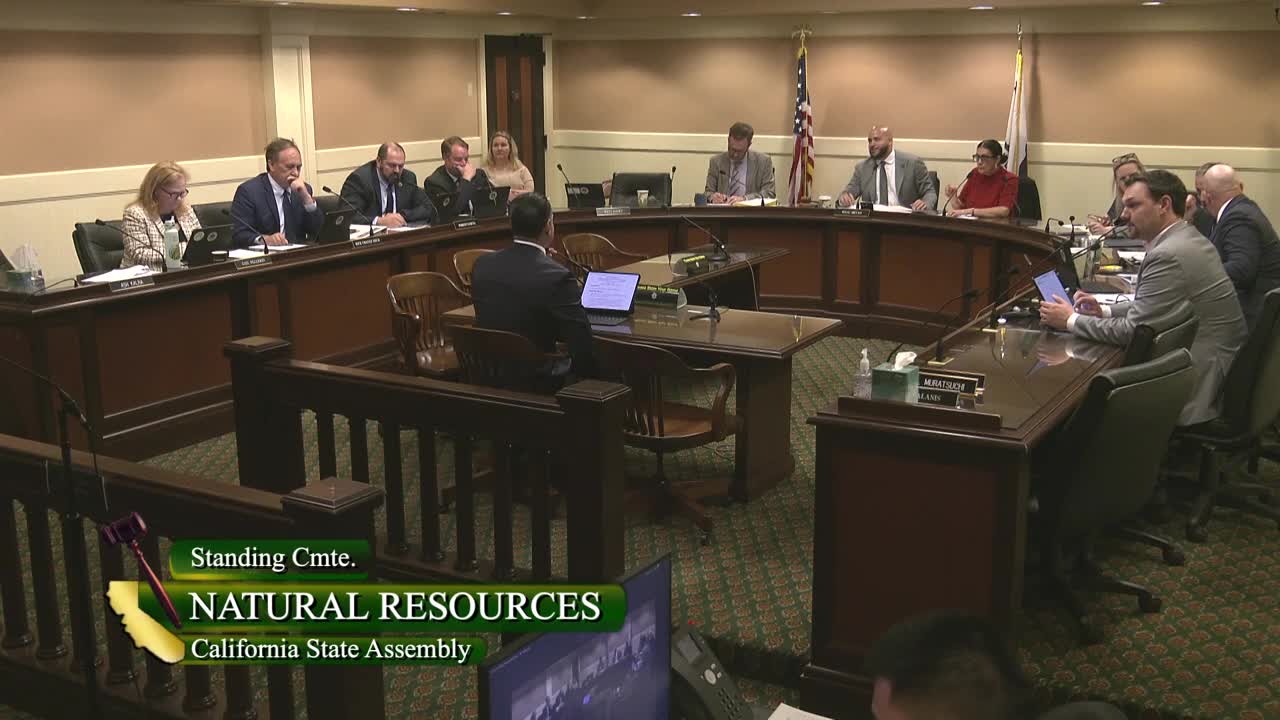
Discussed in Hearing
 7MIN
Assembly Standing Committee on Natural Resources
Bill Author

Bill Co-Author(s):